Structural design of concrete 3D discontinuities in IDEA StatiCa Detail
Introduction to the 3D CSFM method
General introduction for the structural design of concrete 3D details
Main assumptions and limitations
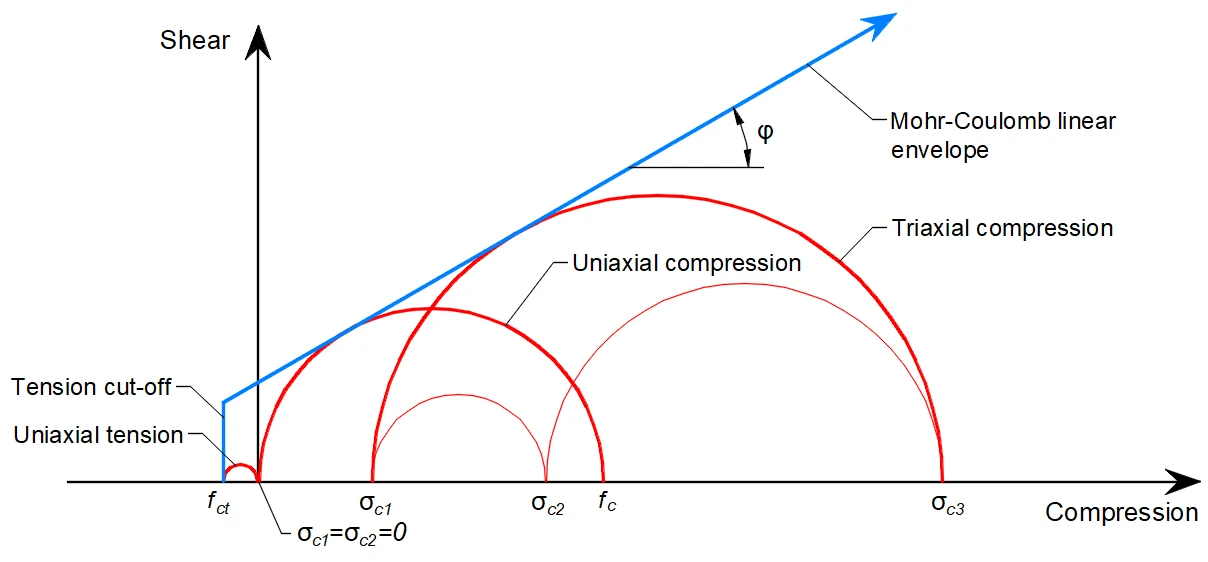
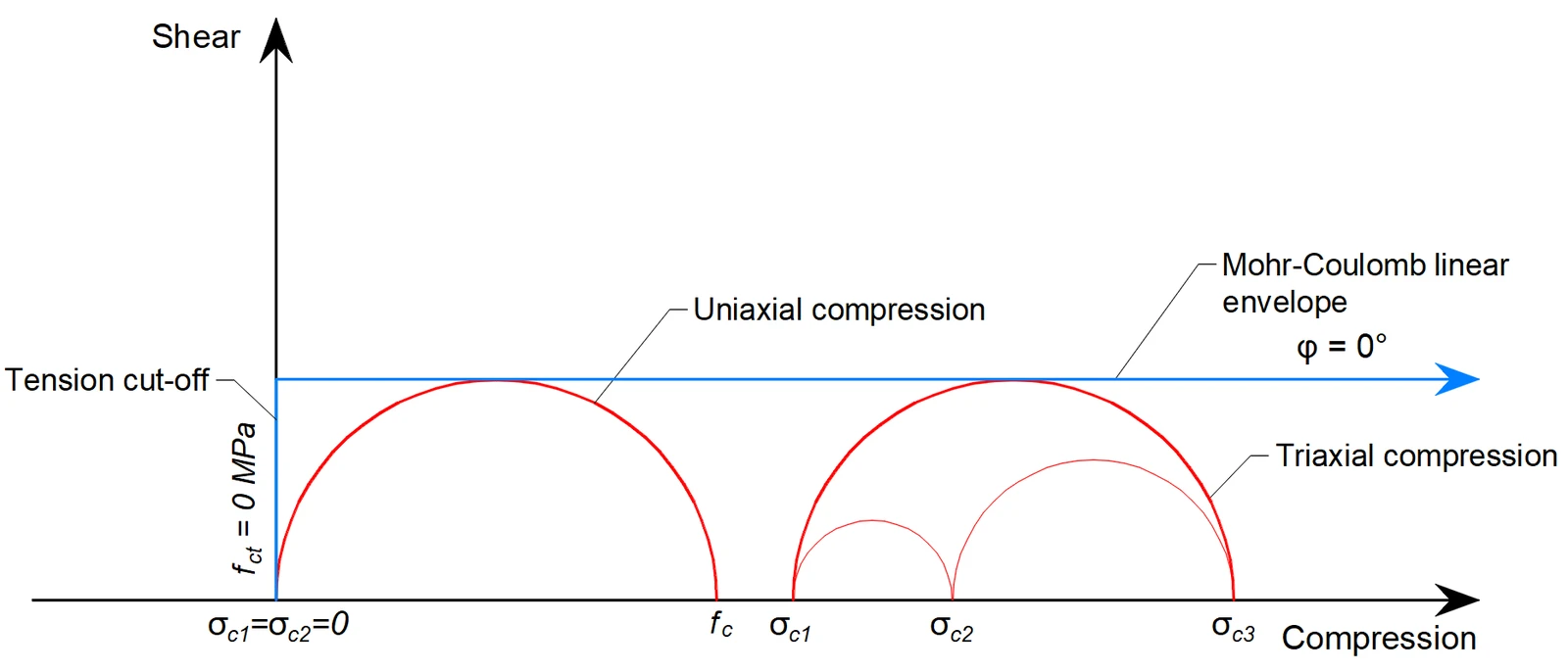
Mohr-Coulomb plasticity theory implementation in 3D CSFM
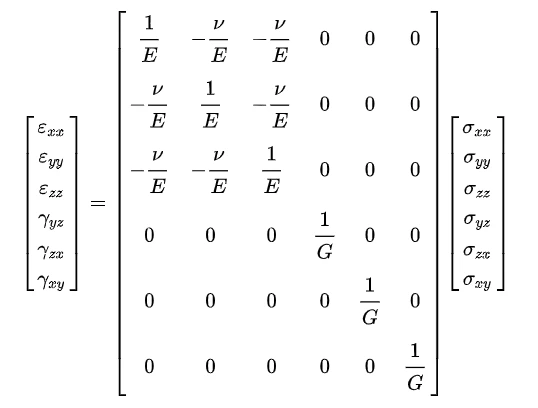
General mechanics assumptions for 3D CSFM
Analysis model of IDEA StatiCa 3D Detail
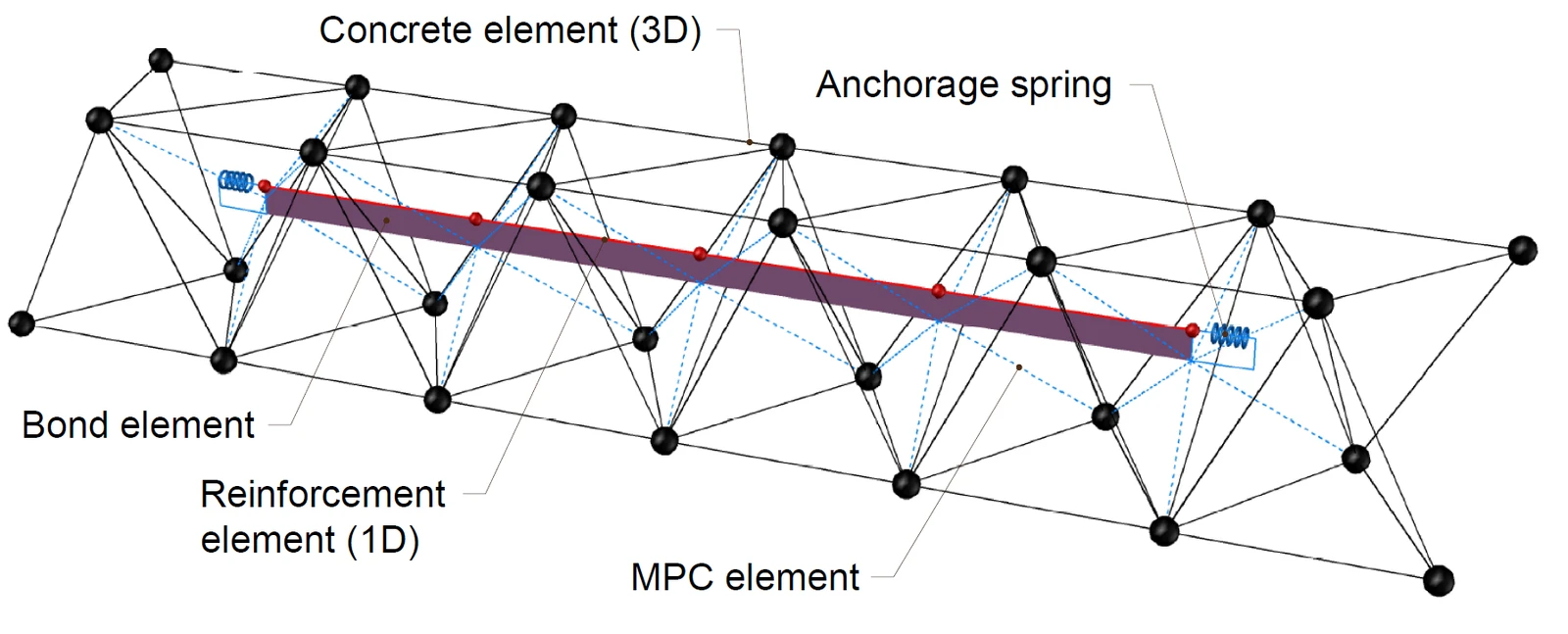
Introduction to finite element implementation
General finite element types
Load transfer devices
Meshing in 3D CSFM
Solution method and load-control algorithm for 3D CSFM
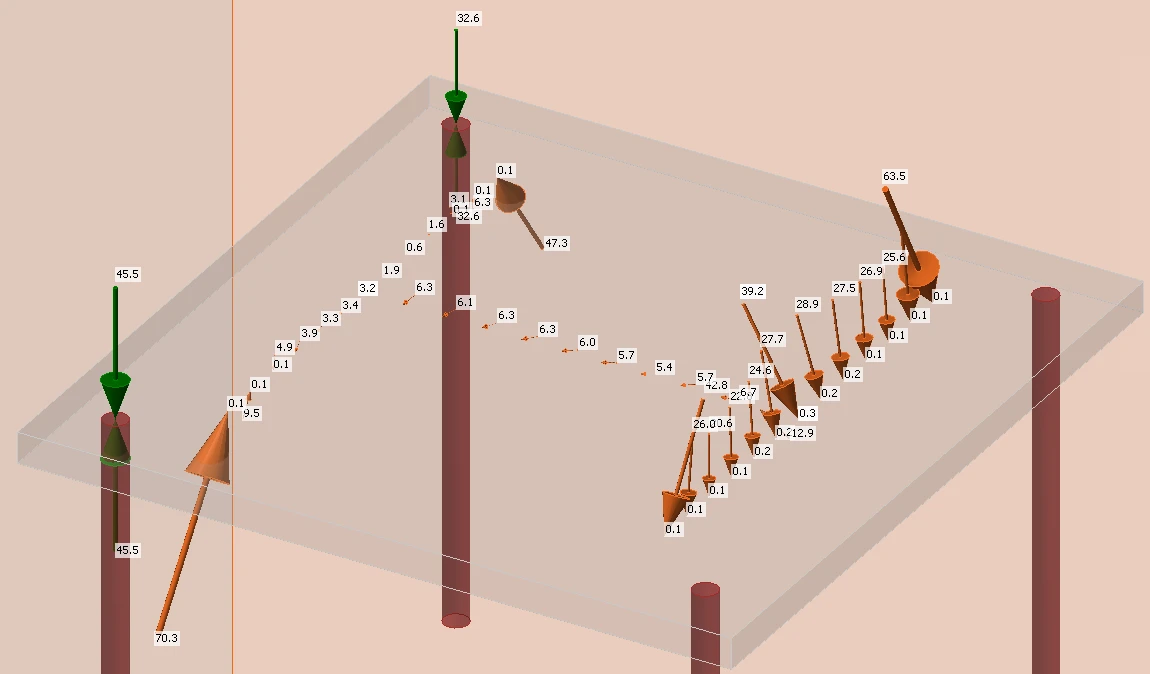
Presentation of 3D results
Model imported from IDEA StatiCa Connection
Model verification
Structural verifications according to EUROCODE
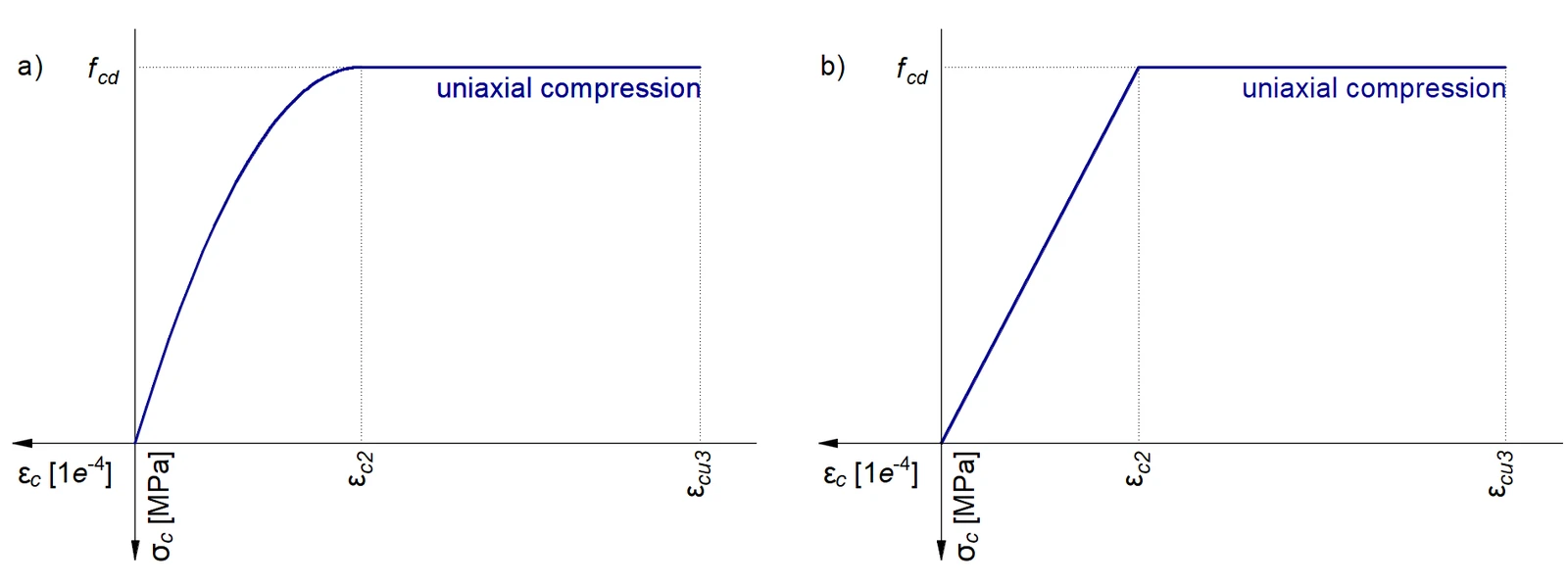
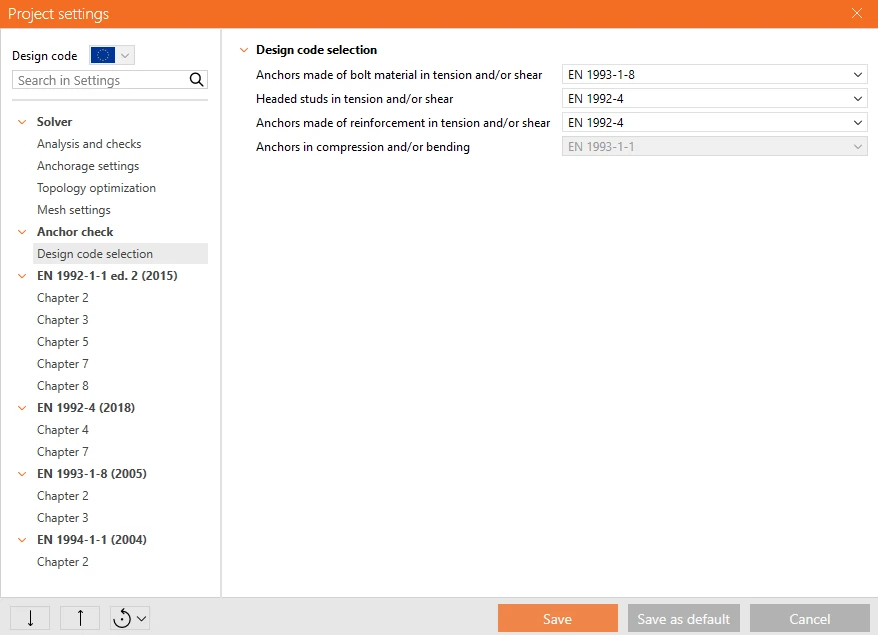
- Material models in 3D CSFM (EN)
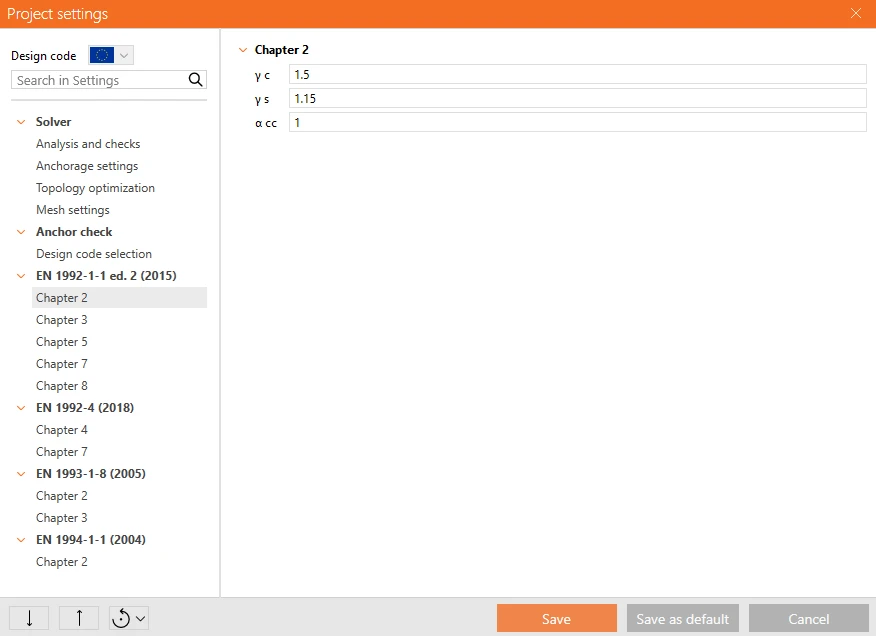
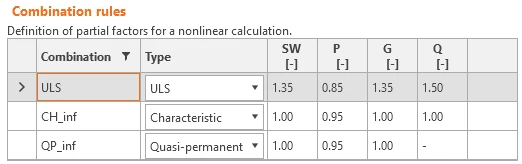
- Partial safety factors
- Ultimate limit state checks
Structural verifications according to ACI 318-19
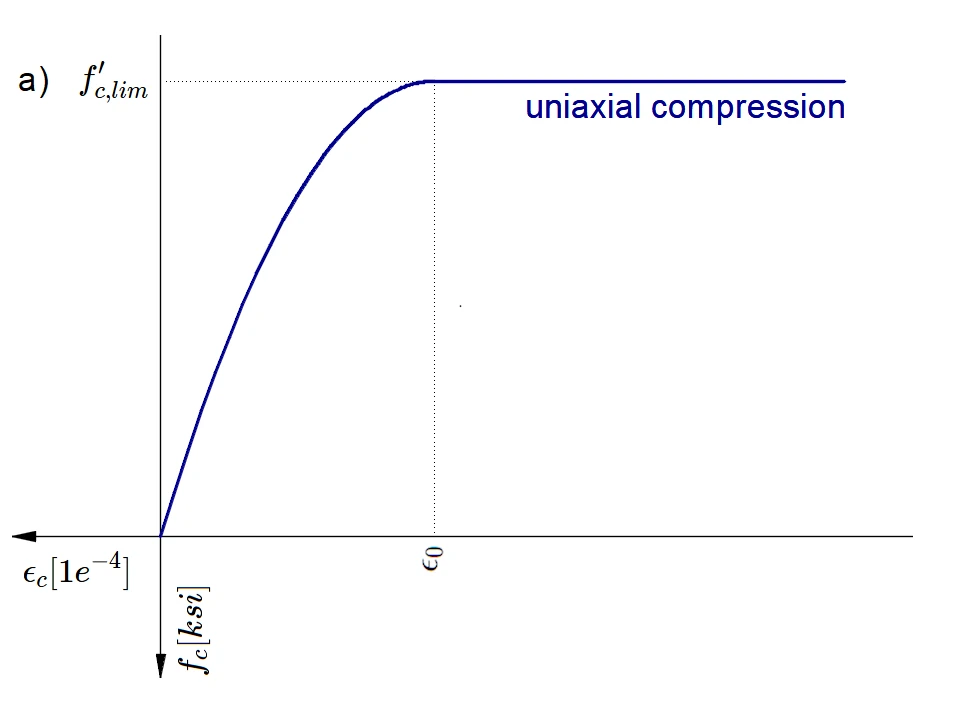
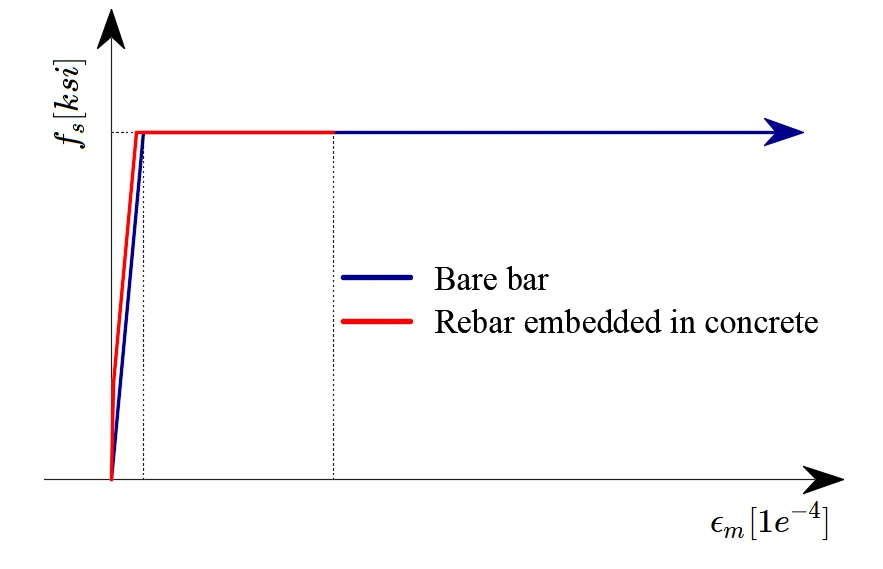
- Material models in 3D CSFM (ACI)
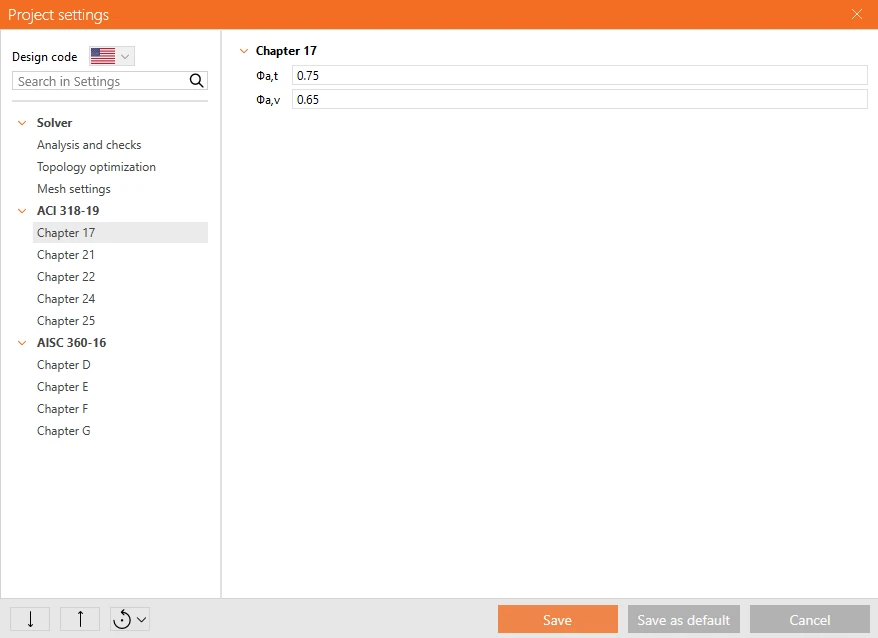
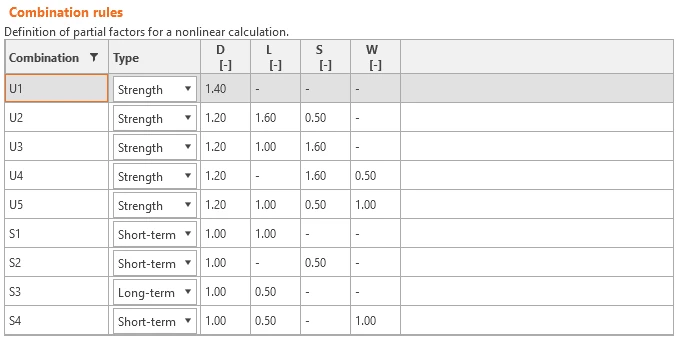
- Strength reduction and load factors
- Strength verifications
Structural verifications according to AS 3600
- Material models in 3D CSFM (AUS)
- Stress and strength reduction factors and load factors
- Strength and anchorage verifications
Introduction to the 3D CSFM method
Widget #NaN: support_center_article
Name: Theoretical background 3D Detail - General introduction
ID: 11116f05-8416-4b56-8ab0-66ac1eb887d3
Show Raw Data
{
"title": {
"name": "Main headline (H1)",
"type": "text",
"value": "A general introduction to the structural design of concrete 3D details"
},
"preview_image": {
"name": "Preview image",
"type": "asset",
"value": []
},
"post_date": {
"name": "Post date",
"type": "date_time",
"value": null,
"displayTimeZone": "Europe/Prague"
},
"perex_content": {
"name": "Lead paragraph",
"type": "text",
"value": ""
},
"content": {
"images": [],
"linkedItemCodenames": [],
"linkedItems": [],
"links": [],
"name": "Content",
"type": "rich_text",
"value": "<p>In practice, engineers may encounter different types of finite elements (from simple 1D bar elements to more complicated 3D brick elements) that are used in a variety of applications for the analysis and design of structural elements. A common feature of most of the computations in practice tends to be the linear behavior of the models, the advantages of which are undoubtedly speed, clarity, and simply the fact that for a large variety of problems, this solution is quite sufficient.</p>\n<p>Especially in the world of concrete structures, it often happens that the linear approach is not sufficient simply because after the first cracks appear in the loaded element, the stresses are redistributed and the problem becomes significantly non-linear.</p>\n<p>For these cases, it is necessary to choose one of the more sophisticated approaches. For 1D cases, analytical methods defined directly in codes can often be found. For example, popular Strut and Tie models can be built for 2D planar elements and discontinuity regions (D-regions), or the more sophisticated stress field method implemented in IDEA StatiCa Detail, CSFM, can be used.</p>\n<p>However, if the engineer encounters a problem that cannot be simplified into planar behavior, the options are very limited. Of course, a 3D Strut and Tie model can be built or semi-scientific software can be used for accurate analysis. These procedures are often time-consuming, not code-compliant, and require an engineer knowledgeable in advanced modeling methods.</p>\n<p>For this reason, IDEA StatiCa has developed and implemented the 3D CSFM (Compatible Stress Field Method) in the Detail application. 3D CSFM extends the established CSFM into a third dimension, offering a fast and code-compliant solution that is primarily applicable to the everyday engineer, giving them a unique new ability to safely tackle the complex details of concrete structures.</p>"
},
"regions": {
"name": "Region",
"type": "taxonomy",
"value": [
{
"name": "EMEA",
"codename": "emea"
},
{
"name": "AMER",
"codename": "amer"
}
],
"taxonomyGroup": "region"
},
"product_groups": {
"name": "Product group",
"type": "taxonomy",
"value": [
{
"name": "Concrete",
"codename": "concrete"
},
{
"name": "Reinforced concrete",
"codename": "reinforced_concrete"
}
],
"taxonomyGroup": "product_group"
},
"support_center_article_types": {
"name": "Support center article",
"type": "taxonomy",
"value": [
{
"name": "Knowledge base",
"codename": "knowledgebase_article"
}
],
"taxonomyGroup": "support_center_article"
},
"expertise_levels": {
"name": "Expertise level",
"type": "taxonomy",
"value": [
{
"name": "Beginner",
"codename": "beginner"
},
{
"name": "Intermediate",
"codename": "intermediate"
}
],
"taxonomyGroup": "expertise_level"
},
"labels": {
"name": "Labels",
"type": "taxonomy",
"value": [
{
"name": "EN (Eurocode)",
"codename": "eurocode"
},
{
"name": "CSFM",
"codename": "csfm"
},
{
"name": "Detail 3D",
"codename": "detail_3d"
}
],
"taxonomyGroup": "labels"
},
"linked_items": {
"name": "Linked items",
"type": "modular_content",
"value": [],
"linkedItems": []
},
"attachments__files": {
"name": "Attachments",
"type": "asset",
"value": []
},
"content_priority__value": {
"name": "Content priority value",
"type": "number",
"value": null
},
"options": {
"name": "Options",
"type": "multiple_choice",
"value": []
},
"url_slug": {
"name": "Url slug",
"type": "url_slug",
"value": "a-general-introduction-to-the-structural-design-of-concrete-3d-details"
},
"unique_url_slug": {
"name": "Unique URL slug",
"type": "custom",
"value": "[\"general-introduction-for-the-structural-design-of-concrete-3d-details\",\"[autogenerated]\"]"
},
"content_settings__sitemap": {
"name": "Show in sitemap",
"type": "multiple_choice",
"value": []
},
"content_settings__robots": {
"name": "Search engine indexing",
"type": "multiple_choice",
"value": []
},
"content_settings__is_hidden": {
"name": "Hidden nested content",
"type": "multiple_choice",
"value": [
{
"name": "yes",
"codename": "yes"
}
]
},
"metadata__page_title": {
"name": "Page title",
"type": "text",
"value": ""
},
"metadata__page_description": {
"name": "Page description",
"type": "text",
"value": ""
},
"metadata__page_keywords": {
"name": "Page keywords",
"type": "text",
"value": ""
},
"metadata__canonical_url": {
"name": "Canonical URL",
"type": "text",
"value": ""
},
"metadata__og_title": {
"name": "OG:title",
"type": "text",
"value": ""
},
"metadata__og_description": {
"name": "OG:description",
"type": "text",
"value": ""
},
"metadata__og_image": {
"name": "OG:image",
"type": "asset",
"value": []
},
"translation__translation_connector": {
"name": "Translation Connector",
"type": "taxonomy",
"value": [],
"taxonomyGroup": "languages"
},
"translation__force_translation": {
"name": "Force translation",
"type": "multiple_choice",
"value": []
},
"translation__last_translation": {
"images": [],
"linkedItemCodenames": [],
"linkedItems": [],
"links": [],
"name": "Last translation",
"type": "rich_text",
"value": "<p><br></p>"
},
"translation__ai_translated": {
"name": "AI translated",
"type": "multiple_choice",
"value": []
},
"page_tree_settings__page_label": {
"name": "Page label",
"type": "text",
"value": ""
},
"page_tree_settings__path_segment": {
"name": "Path segment",
"type": "text",
"value": ""
},
"page_tree_settings__breadcrumb_style": {
"name": "Breadcrumb style",
"type": "multiple_choice",
"value": []
},
"page_tree_settings__hide_in_breadcrumbs": {
"name": "Hide in breadcrumbs",
"type": "multiple_choice",
"value": []
}
}Widget #NaN: support_center_article
Name: Theoretical background 3D Detail - Main assumptions and limitations
ID: d07820f8-072b-44dc-a35a-94b73e2e284b
Show Raw Data
{
"title": {
"name": "Main headline (H1)",
"type": "text",
"value": "Main assumptions and limitations for CSFM in 3D"
},
"preview_image": {
"name": "Preview image",
"type": "asset",
"value": []
},
"post_date": {
"name": "Post date",
"type": "date_time",
"value": null,
"displayTimeZone": "Europe/Prague"
},
"perex_content": {
"name": "Lead paragraph",
"type": "text",
"value": ""
},
"content": {
"images": [
{
"description": null,
"imageId": "749c6949-1e95-4bb3-a7d6-c4d9e61543b7",
"url": "https://assets-us-01.kc-usercontent.com:443/28eac049-c8ed-00e2-220c-12142a968dff/893fb5c9-66fd-4188-a343-c6b088d0d26b/Main%20assumptions%203D.png",
"height": 836,
"width": 1376
},
{
"description": null,
"imageId": "2be61213-d2e5-4d37-80c1-67f0a7176b6f",
"url": "https://assets-us-01.kc-usercontent.com:443/28eac049-c8ed-00e2-220c-12142a968dff/c818225e-7dac-4bd4-81f0-8ccbe2ee0200/Mohrs%20plasticity%20surfaces.png",
"height": 885,
"width": 1881
},
{
"description": null,
"imageId": "f0dc574b-a09f-4237-8d2d-a97d9b04216a",
"url": "https://assets-us-01.kc-usercontent.com:443/28eac049-c8ed-00e2-220c-12142a968dff/b7dc2b3e-f3e4-4741-8826-118ea9a6372a/Cast-in-reinforcement%20shapes.png",
"height": 554,
"width": 827
}
],
"linkedItemCodenames": [],
"linkedItems": [],
"links": [
{
"codename": "theoretical_background_detail___crack_width_calcul",
"linkId": "3b2ffddf-80fb-4ad0-822b-89d98e3fee43",
"urlSlug": "crack-width-calculation-and-tension-stiffening",
"type": "support_center_article"
}
],
"name": "Content",
"type": "rich_text",
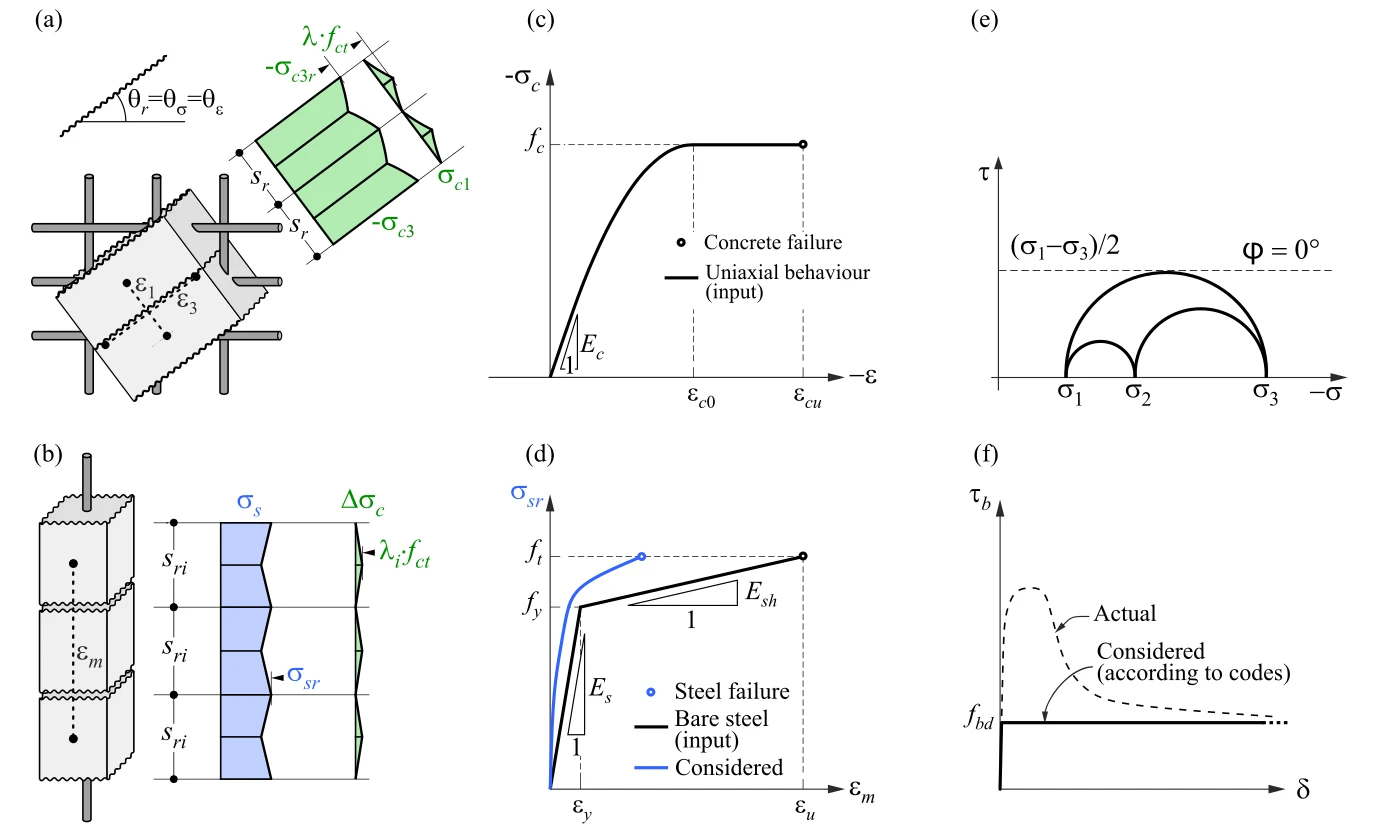
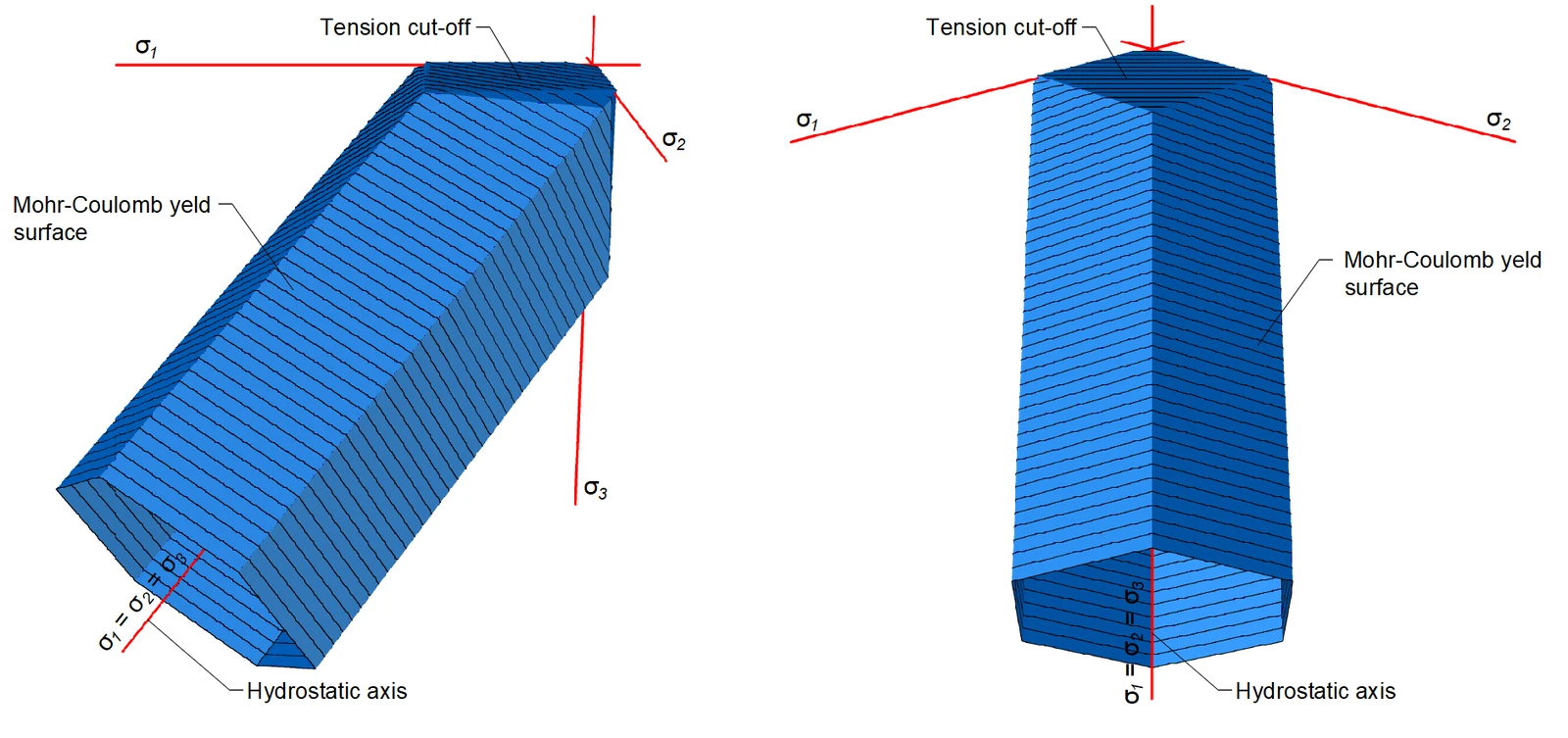
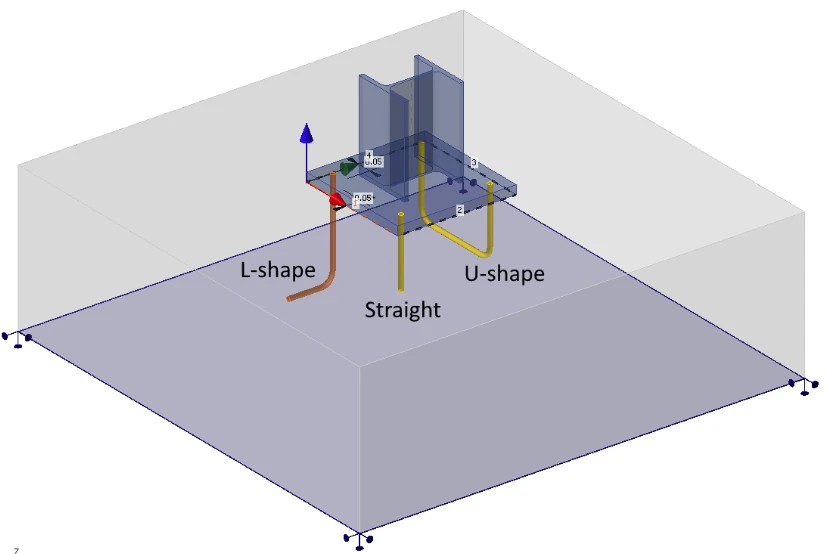
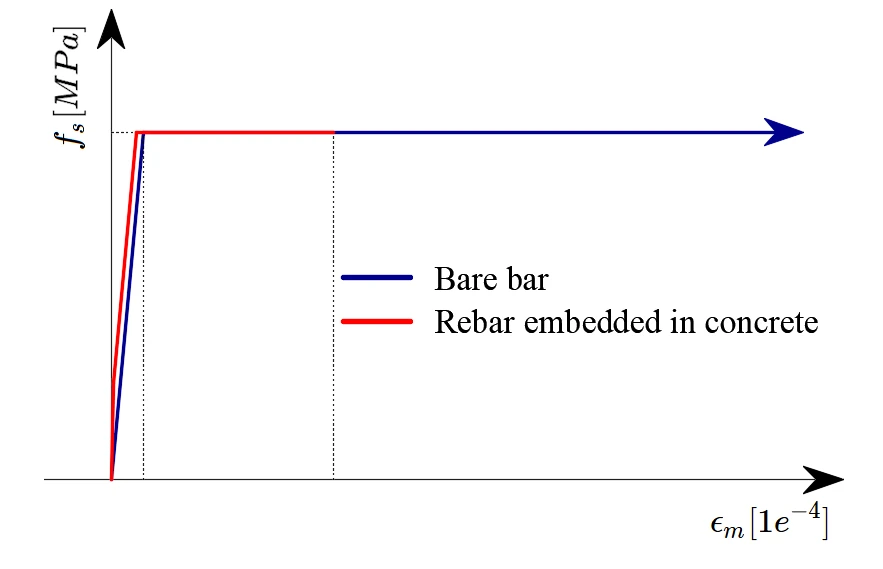
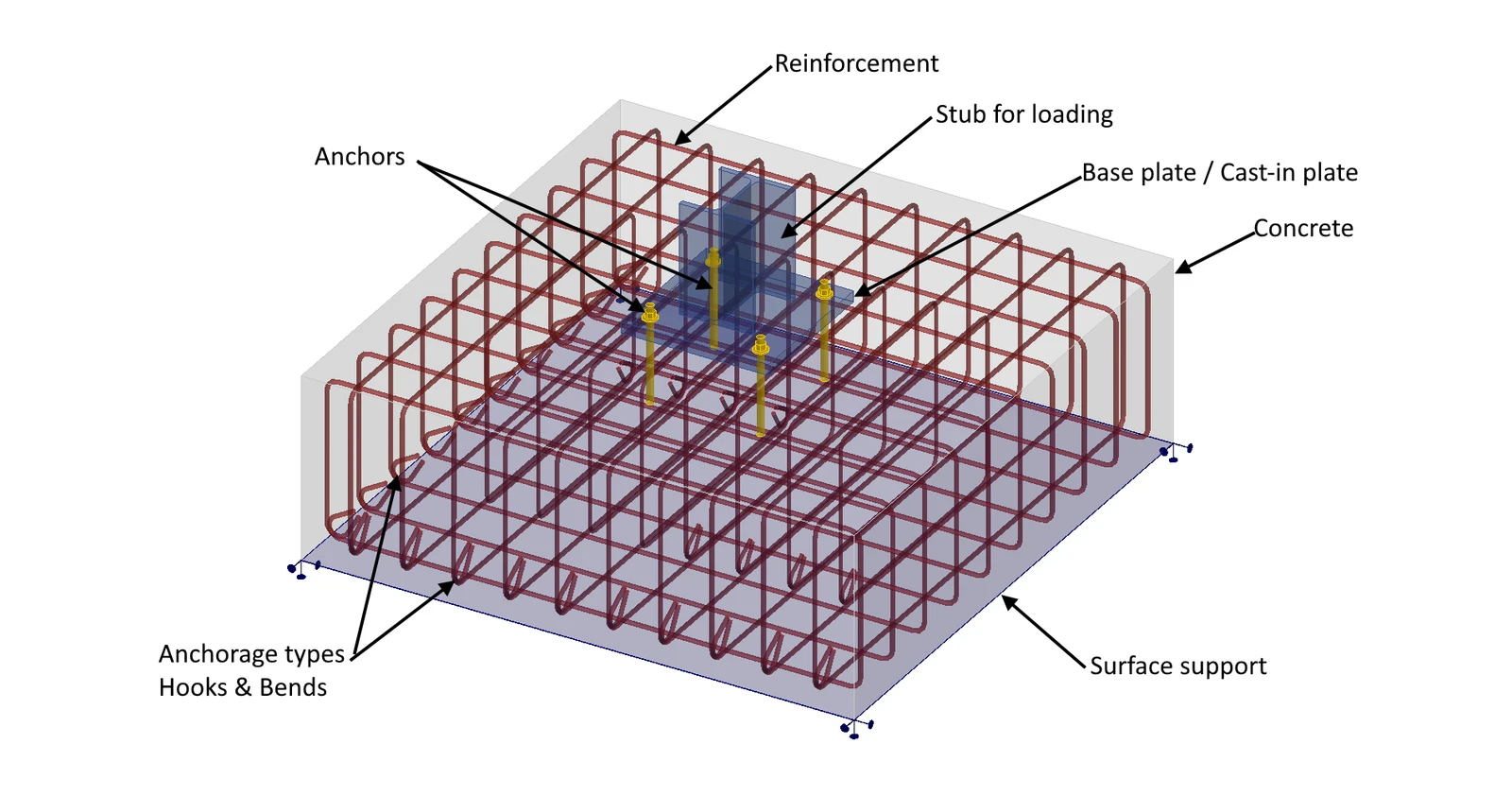
"value": "<p>3D CSFM defines the concrete behavior based on the<strong> Modified Mohr-Coulomb</strong> plasticity theory for monotonic loading. The method <strong>considers principal concrete stresses in compression and reinforcement stresses (σ</strong><em><strong><sub>sr</sub></strong></em><strong>) at the cracks while neglecting the concrete tensile strength (tension cut-off), except for its stiffening effect on the reinforcement (</strong><a data-item-id=\"3b2ffddf-80fb-4ad0-822b-89d98e3fee43\" href=\"\"><strong>Tension stiffening</strong></a><strong>).</strong></p>\n<p><strong>σ</strong><em><strong><sub>c</sub></strong></em><strong><sub>1</sub></strong><em><strong><sub>r</sub></strong></em><em><strong>, </strong></em><strong>σ</strong><em><strong><sub>c</sub></strong></em><strong><sub>2</sub></strong><em><strong><sub>r</sub></strong></em><em><strong>, </strong></em><strong>σ</strong><em><strong><sub>c</sub></strong></em><strong><sub>3</sub></strong><em><strong><sub>r</sub></strong></em><em><strong> ≤ 0 MPa</strong></em></p>\n<p>The reinforcement bars are linked to concrete volume finite elements through bond elements, allowing for slip between the concrete and reinforcement. It should be noted that 3D CSFM <strong>is not suitable for simulating plain concrete</strong> due to the absence of tension, which may result in misleading deformation and model divergence. Generally, the Mohr-Coulomb theory includes two fundamental properties governing the evolution of the plasticity surface in compression and partially in tension: the internal friction angle <em>φ</em> and cohesion parameter <em>c</em>. <strong>3D CSFM assumes a zero angle of internal friction </strong>(Fig. 1e), leading to a conservative design due to the plasticity surface resembling the Tresca model, which is independent of the first stress invariant.</p>\n<figure data-asset-id=\"749c6949-1e95-4bb3-a7d6-c4d9e61543b7\" data-image-id=\"749c6949-1e95-4bb3-a7d6-c4d9e61543b7\"><img src=\"https://assets-us-01.kc-usercontent.com:443/28eac049-c8ed-00e2-220c-12142a968dff/893fb5c9-66fd-4188-a343-c6b088d0d26b/Main%20assumptions%203D.png\" data-asset-id=\"749c6949-1e95-4bb3-a7d6-c4d9e61543b7\" data-image-id=\"749c6949-1e95-4bb3-a7d6-c4d9e61543b7\" alt=\"\"></figure>\n<p><em>\\( \\textsf{\\textit{\\footnotesize{Fig. 1\\qquad Basic assumptions of the 3D CSFM: (a) principal stresses in concrete; (b) stresses in the reinforcement direction;}}}\\) \\( \\textsf{\\textit{\\footnotesize{(c) stress-strain diagram of concrete in terms of maximum stresses; (d) stress-strain diagram of reinforcement}}}\\) \\( \\textsf{\\textit{\\footnotesize{in terms of stresses at cracks and average strains; (e) Mohr's circles for concrete model in 3D CSFM; (f) bond shear stress-slip}}}\\) \\( \\textsf{\\textit{\\footnotesize{relationship for anchorage length verifications.}}}\\)</em></p>\n<h4>Concrete </h4>\n<p>The presented material model is a multisurface plasticity model given by the combination of the Mohr-Coulomb and Rankine models for monotonic loading. It’s important to note that this model does not address unloading, therefore, state variables are not stored, as they would be in classical plasticity models used for cyclic loading.</p>\n<figure data-asset-id=\"2be61213-d2e5-4d37-80c1-67f0a7176b6f\" data-image-id=\"2be61213-d2e5-4d37-80c1-67f0a7176b6f\"><img src=\"https://assets-us-01.kc-usercontent.com:443/28eac049-c8ed-00e2-220c-12142a968dff/c818225e-7dac-4bd4-81f0-8ccbe2ee0200/Mohrs%20plasticity%20surfaces.png\" data-asset-id=\"2be61213-d2e5-4d37-80c1-67f0a7176b6f\" data-image-id=\"2be61213-d2e5-4d37-80c1-67f0a7176b6f\" alt=\"\"></figure>\n<p><em>\\[ \\textsf{\\textit{\\footnotesize{Fig. 2\\qquad Mohr-Coulomb multi-surface plasticity model for friction angle 0 degree}}}\\]</em></p>\n<p>As already mentioned, the material model is intended for use in applications that calculate the response of reinforced concrete (not suitable for plain concrete). This is due to the exclusion of concrete in tension. Therefore, the model is not even suitable for structural elements where the design rules for reinforced concrete such as minimum reinforcement ratio, maximum bar spacing, etc., are not fulfilled. It should also be added that, for numerical stability reasons, a very small tensile capacity is defined in the model. The tensile part is restricted by planes corresponding to the Rankine model.</p>\n<p>3D CSFM in <em>IDEA StatiCa Detail</em> does not consider an explicit failure criterion in terms of strains for concrete in compression (i.e., it considers an infinitely plastic branch after the peak stress is reached). This simplification does not allow the deformation capacity of structures failing in compression to be verified. However, their ultimate capacity is properly predicted when the increase in the brittleness of concrete as its strength rises is considered by means of the 𝜂<sub>𝑓𝑐</sub> reduction factor defined in <em>fib</em> Model Code 2010 as follows:</p>\n<p>\\[f_{c,red} = \\eta _{fc} \\cdot f_{c}\\]</p>\n<p>\\[{\\eta _{fc}} = {\\left( {\\frac{{30}}{{{f_{c}}}}} \\right)^{\\frac{1}{3}}} \\le 1\\]</p>\n<p>where:</p>\n<p><em>f</em><em><sub>c</sub></em> is the concrete cylinder characteristic strength (in MPa for the definition of <em>\\( \\eta_{fc} \\)</em>).</p>\n<p>The <em>f</em><em><sub>c,red</sub></em> is then compared with the Equivalent Principal Stress σ<em><sub>c,eq</sub></em> in concrete, which will be defined further, of course, with consideration of all safety factors prescribed by code.</p>\n<p>A detailed description of the concrete model can be found at the following link:</p>\n<ul>\n <li><a data-asset-id=\"ab4d6a64-e6e3-474a-a358-8ba882f37669\" href=\"https://assets-us-01.kc-usercontent.com:443/28eac049-c8ed-00e2-220c-12142a968dff/efa87501-bbfc-4fef-abe1-bc1de8123991/Concrete%20material%20model%20designated%20for%203D%20version.pdf\"><strong>Concrete Material Model for 3D Detail</strong></a></li>\n</ul>\n<h4>Reinforcement</h4>\n<p>The bilinear stress-strain diagram for reinforcement bars, as defined by design codes (Fig. 1d), represents an idealized model. This model necessitates knowledge of the basic properties of the reinforcement during the design phase, specifically the strength and ductility class. Alternatively, users have the option to define a customized stress-strain relationship.</p>\n<p>Tension stiffening is considered by modifying the stress-strain relationship of the bare reinforcing bar to capture the average stiffness of the bars embedded in the concrete (ε<sub>m</sub>) (Fig 1b).</p>\n<h4>Anchorage</h4>\n<p>Bond-slip between reinforcement and concrete is introduced in the finite element model by considering the simplified rigid-perfectly plastic constitutive relationship presented in (Fig. 1f), with <em>f</em><em><sub>bd</sub></em> being the design value (factored value) of the ultimate bond stress specified by the design code for the specific bond conditions.</p>\n<p>This is a simplified model with the sole purpose of verifying bond prescriptions according to design codes (i.e., anchorage of reinforcement). The reduction of the anchorage length when using hooks, loops, and similar bar shapes can be considered by defining a certain capacity at the end of the reinforcement, as will be described further.</p>\n<h4>Anchors</h4>\n<p>The element of the anchor is defined as being able to transfer normal tensile or compression forces, as well as shear forces, considering the bending stiffness. </p>\n<p>The following types of anchors are available:</p>\n<ul>\n <li>Cast-in-place anchors\n <ul>\n <li>Reinforcement</li>\n <li>Washer plate</li>\n <li>Headed stud</li>\n </ul>\n </li>\n <li>Cast-in-place reinforcement\n <ul>\n <li>Reinforcement</li>\n <li>Threaded rods</li>\n </ul>\n </li>\n</ul>\n<p><br></p>\n<p><strong>Cast-in-place - Reinforcement</strong></p>\n<p>Modeled as ribbed reinforcement embedded in concrete. Bond strength is calculated according to selected code rules in the same way as for standard reinforcement. At the anchor end, an <strong>Anchorage type</strong> can be defined, working identically to reinforcement - an anchorage spring is applied with the β-factor set according to the chosen code. Three geometric shapes are available: <strong>Straight, L-shape, U-shape</strong>.</p>\n<figure data-asset-id=\"f0dc574b-a09f-4237-8d2d-a97d9b04216a\" data-image-id=\"f0dc574b-a09f-4237-8d2d-a97d9b04216a\"><img src=\"https://assets-us-01.kc-usercontent.com:443/28eac049-c8ed-00e2-220c-12142a968dff/b7dc2b3e-f3e4-4741-8826-118ea9a6372a/Cast-in-reinforcement%20shapes.png\" data-asset-id=\"f0dc574b-a09f-4237-8d2d-a97d9b04216a\" data-image-id=\"f0dc574b-a09f-4237-8d2d-a97d9b04216a\" alt=\"\"></figure>\n<p><em>\\[ \\textsf{\\textit{\\footnotesize{Fig. 3\\qquad Cast-in reinforcement anchor - shapes}}}\\]</em></p>\n<p><strong>Cast-in-place - Washer plate and Headed stud</strong></p>\n<p>The washer plate and the head of the headed stud are modeled as a plate-shell element from the corresponding material attached directly to the anchor shank. It transfers load to the concrete through compression-only contact. Available shapes: circular and square (only circular for headed stud), with customizable dimensions. The washer plate and head model is elastic and is not checked for resistance. </p>\n<p>At the finite element model level, the <strong>pull-out</strong> of the anchor is directly checked. The compression contact has stop criteria set so that it is not able to transfer greater contact stress to the concrete than prescribed by the selected standard. In practical terms, this means that if the anchor were to be loaded with a force that does not comply with the pull-out assessment, the result would be premature termination of the calculation because this stop criterion would be exceeded during further loading.</p>\n<p>The anchor shank has <strong>zero bond strength</strong> – all load is transferred to the concrete through the plate or head into the concrete.</p>\n<p><strong>Post-installed - Reinforcement and Threaded rod</strong></p>\n<p>Designed as bars installed into drilled holes and bonded with adhesive. The engineer specifies the <strong>design bond strength</strong> directly from the technical specification of the adhesive product.</p>\n<p>More information about connecting individual anchor types to the base plate or cast-in plate can be found in the chapter Finite elements types - <a href=\"https://www.ideastatica.com/support-center/idea-statica-detail-structural-design-of-concrete-3d-discontinuities#load-transfer-devices\" title=\"Load transferring devices\">Load transferring devices</a>. </p>"
},
"regions": {
"name": "Region",
"type": "taxonomy",
"value": [
{
"name": "EMEA",
"codename": "emea"
},
{
"name": "AMER",
"codename": "amer"
}
],
"taxonomyGroup": "region"
},
"product_groups": {
"name": "Product group",
"type": "taxonomy",
"value": [
{
"name": "Concrete",
"codename": "concrete"
},
{
"name": "Reinforced concrete",
"codename": "reinforced_concrete"
}
],
"taxonomyGroup": "product_group"
},
"support_center_article_types": {
"name": "Support center article",
"type": "taxonomy",
"value": [
{
"name": "Knowledge base",
"codename": "knowledgebase_article"
}
],
"taxonomyGroup": "support_center_article"
},
"expertise_levels": {
"name": "Expertise level",
"type": "taxonomy",
"value": [
{
"name": "Beginner",
"codename": "beginner"
},
{
"name": "Intermediate",
"codename": "intermediate"
}
],
"taxonomyGroup": "expertise_level"
},
"labels": {
"name": "Labels",
"type": "taxonomy",
"value": [
{
"name": "EN (Eurocode)",
"codename": "eurocode"
},
{
"name": "CSFM",
"codename": "csfm"
},
{
"name": "Detail 3D",
"codename": "detail_3d"
}
],
"taxonomyGroup": "labels"
},
"linked_items": {
"name": "Linked items",
"type": "modular_content",
"value": [],
"linkedItems": []
},
"attachments__files": {
"name": "Attachments",
"type": "asset",
"value": []
},
"content_priority__value": {
"name": "Content priority value",
"type": "number",
"value": null
},
"options": {
"name": "Options",
"type": "multiple_choice",
"value": []
},
"url_slug": {
"name": "Url slug",
"type": "url_slug",
"value": "main-assumptions-and-limitations"
},
"unique_url_slug": {
"name": "Unique URL slug",
"type": "custom",
"value": "[\"main-assumptions-and-limitations\",\"[autogenerated]\"]"
},
"content_settings__sitemap": {
"name": "Show in sitemap",
"type": "multiple_choice",
"value": []
},
"content_settings__robots": {
"name": "Search engine indexing",
"type": "multiple_choice",
"value": []
},
"content_settings__is_hidden": {
"name": "Hidden nested content",
"type": "multiple_choice",
"value": [
{
"name": "yes",
"codename": "yes"
}
]
},
"metadata__page_title": {
"name": "Page title",
"type": "text",
"value": ""
},
"metadata__page_description": {
"name": "Page description",
"type": "text",
"value": ""
},
"metadata__page_keywords": {
"name": "Page keywords",
"type": "text",
"value": ""
},
"metadata__canonical_url": {
"name": "Canonical URL",
"type": "text",
"value": ""
},
"metadata__og_title": {
"name": "OG:title",
"type": "text",
"value": ""
},
"metadata__og_description": {
"name": "OG:description",
"type": "text",
"value": ""
},
"metadata__og_image": {
"name": "OG:image",
"type": "asset",
"value": []
},
"translation__translation_connector": {
"name": "Translation Connector",
"type": "taxonomy",
"value": [],
"taxonomyGroup": "languages"
},
"translation__force_translation": {
"name": "Force translation",
"type": "multiple_choice",
"value": []
},
"translation__last_translation": {
"images": [],
"linkedItemCodenames": [],
"linkedItems": [],
"links": [],
"name": "Last translation",
"type": "rich_text",
"value": "<p><br></p>"
},
"translation__ai_translated": {
"name": "AI translated",
"type": "multiple_choice",
"value": []
},
"page_tree_settings__page_label": {
"name": "Page label",
"type": "text",
"value": ""
},
"page_tree_settings__path_segment": {
"name": "Path segment",
"type": "text",
"value": ""
},
"page_tree_settings__breadcrumb_style": {
"name": "Breadcrumb style",
"type": "multiple_choice",
"value": []
},
"page_tree_settings__hide_in_breadcrumbs": {
"name": "Hide in breadcrumbs",
"type": "multiple_choice",
"value": []
}
}Widget #NaN: support_center_article
Name: Theoretical background 3D Detail - Mohr-Coulomb plasticity theory implementation in 3D CSFM
ID: 6d62f0c3-b9a1-48d1-ad78-00c5011cd3a9
Show Raw Data
{
"title": {
"name": "Main headline (H1)",
"type": "text",
"value": "Mohr-Coulomb plasticity theory implementation in 3D CSFM"
},
"preview_image": {
"name": "Preview image",
"type": "asset",
"value": []
},
"post_date": {
"name": "Post date",
"type": "date_time",
"value": null,
"displayTimeZone": "Europe/Prague"
},
"perex_content": {
"name": "Lead paragraph",
"type": "text",
"value": ""
},
"content": {
"images": [
{
"description": null,
"imageId": "0efd9940-94f4-4a5c-845f-4e8a444c8cc4",
"url": "https://assets-us-01.kc-usercontent.com:443/28eac049-c8ed-00e2-220c-12142a968dff/7282915e-1152-48e3-92ed-76a5464967cf/Mohr%20intro.png",
"height": 555,
"width": 1197
},
{
"description": null,
"imageId": "4962a8ef-007d-48ec-9fb5-8de7f68c9dc0",
"url": "https://assets-us-01.kc-usercontent.com:443/28eac049-c8ed-00e2-220c-12142a968dff/cd1f2b6a-98ff-4114-b442-f1ae9463d0c2/01.png",
"height": 278,
"width": 400
},
{
"description": null,
"imageId": "f0359fcd-2033-4b19-a6dd-154dc0bbfa82",
"url": "https://assets-us-01.kc-usercontent.com:443/28eac049-c8ed-00e2-220c-12142a968dff/7ca2aece-2d9e-4ac9-a3e2-fb9938b610e0/Mohrs%20circles%20for%20real%20concrete.png",
"height": 562,
"width": 1208
},
{
"description": null,
"imageId": "4ada49d8-d60e-44d9-a343-a0b88366cb7a",
"url": "https://assets-us-01.kc-usercontent.com:443/28eac049-c8ed-00e2-220c-12142a968dff/a356c004-fcd0-4557-9209-da5d8264edae/Mohrs%20circles%20for%20concrete%20in%20Detail.png",
"height": 800,
"width": 1865
}
],
"linkedItemCodenames": [],
"linkedItems": [],
"links": [
{
"codename": "confinement_effect_and_failure_hypothesis",
"linkId": "738c9a41-0902-4013-8dd7-87b062dea2a5",
"urlSlug": "tri-axial-stress-the-active-confinement-effect",
"type": "support_center_article"
}
],
"name": "Content",
"type": "rich_text",
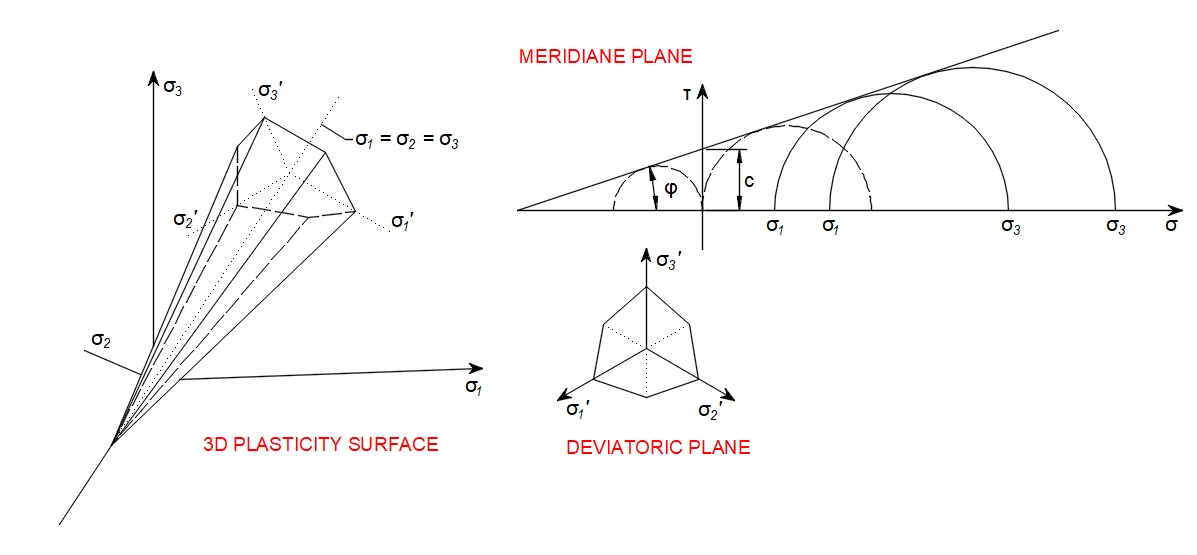
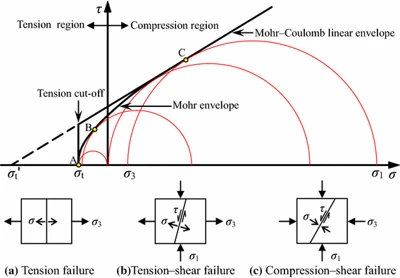
"value": "<p>In the following chapter, we will take a look at how the Mohr-Coulomb theory is implemented in 3D CSFM. We will explain how the confinement effect (triaxial stress) is considered and how the Equivalent Principal Stress σ<em><sub>c,eq</sub></em> is calculated, which is used to determine the load-bearing capacity from the point of view of concrete.</p>\n<h3>Introduction to the theory</h3>\n<p>Mohr–Coulomb theory is a mathematical model describing the response of<strong> </strong>brittle materials, to shear and normal stress. Most of the classical engineering materials follow this rule in at least a part of their shear failure envelope. Generally, the theory applies to materials for which the compressive strength far exceeds the tensile strength.</p>\n<figure data-asset-id=\"0efd9940-94f4-4a5c-845f-4e8a444c8cc4\" data-image-id=\"0efd9940-94f4-4a5c-845f-4e8a444c8cc4\"><img src=\"https://assets-us-01.kc-usercontent.com:443/28eac049-c8ed-00e2-220c-12142a968dff/7282915e-1152-48e3-92ed-76a5464967cf/Mohr%20intro.png\" data-asset-id=\"0efd9940-94f4-4a5c-845f-4e8a444c8cc4\" data-image-id=\"0efd9940-94f4-4a5c-845f-4e8a444c8cc4\" alt=\"\"></figure>\n<p><em>\\[ \\textsf{\\textit{\\footnotesize{Fig. 4\\qquad Mohr-Coulomb Plasticity Model }}}\\]</em></p>\n<p>In structural engineering, it is used to determine failure load as well as the angle of fracture for displacement of fracture surface in concrete and similar materials. Coulomb's friction hypothesis is used to determine the combination of shear and normal stress that will cause a fracture of the material. Mohr's circle is used to determine which principal stresses will produce this combination of shear and normal stress and the angle of the plane in which this will occur. According to the principle of normality, the stress introduced at failure will be perpendicular to the line describing the fracture condition. </p>\n<figure data-asset-id=\"4962a8ef-007d-48ec-9fb5-8de7f68c9dc0\" data-image-id=\"4962a8ef-007d-48ec-9fb5-8de7f68c9dc0\"><img src=\"https://assets-us-01.kc-usercontent.com:443/28eac049-c8ed-00e2-220c-12142a968dff/cd1f2b6a-98ff-4114-b442-f1ae9463d0c2/01.png\" data-asset-id=\"4962a8ef-007d-48ec-9fb5-8de7f68c9dc0\" data-image-id=\"4962a8ef-007d-48ec-9fb5-8de7f68c9dc0\" alt=\"\"></figure>\n<p><em>\\[ \\textsf{\\textit{\\footnotesize{Fig. 5\\qquad Meridian plane and tension cut-off}}}\\]</em></p>\n<p>It can be shown that a material failing according to Coulomb's friction hypothesis will show the displacement introduced at failure forming an angle to the line of fracture equal to the angle of friction. This makes the strength of the material determinable by comparing the external mechanical work introduced by the displacement and the external load with the internal mechanical work introduced by the strain and stress at the line of failure. By conservation of energy, the sum of these must be zero and this will make it possible to calculate the failure load of the construction.</p>\n<h3>Implementation in 3D CSFM</h3>\n<p>In general, for a given angle of internal friction of the concrete, which is around <em>φ = 30-40° </em>in Reference [1], [2], [3], [4], the tensile and compressive strengths of the concrete Mohr's circles can be constructed as in Figure 6.</p>\n<figure data-asset-id=\"f0359fcd-2033-4b19-a6dd-154dc0bbfa82\" data-image-id=\"f0359fcd-2033-4b19-a6dd-154dc0bbfa82\"><img src=\"https://assets-us-01.kc-usercontent.com:443/28eac049-c8ed-00e2-220c-12142a968dff/7ca2aece-2d9e-4ac9-a3e2-fb9938b610e0/Mohrs%20circles%20for%20real%20concrete.png\" data-asset-id=\"f0359fcd-2033-4b19-a6dd-154dc0bbfa82\" data-image-id=\"f0359fcd-2033-4b19-a6dd-154dc0bbfa82\" alt=\"\"></figure>\n<p><em>\\[ \\textsf{\\textit{\\footnotesize{Fig. 6\\qquad Mohr's circles for concrete}}}\\]</em></p>\n<p>Where <em>f</em><em><sub>c</sub></em> is concrete strength in compression, <em>f</em><em><sub>ct</sub></em> is concrete strength in tension, <em>φ</em> is the angle of internal friction, and σ<em><sub>c</sub></em><sub>1</sub><em>, </em>σ<em><sub>c</sub></em><sub>3</sub> are the principal stresses of concrete under triaxial compression.</p>\n<p>It can be noticed that as the principal stress σ<em><sub>c</sub></em><sub>3</sub> increases, the maximal possible difference between the values of σ<em><sub>c</sub></em><sub>3</sub> and σ<em><sub>c</sub></em><sub>1</sub>, which we define as maximal σ<em><sub>c,eq</sub></em> (see below), also increases. This difference corresponds to twice the deviatoric stress defined in the literature as a radius of the mohr circles.</p>\n<p>In 3D CSFM implemented in IDEA StatiCa Detail, the angle of internal friction is considered as <em>φ = 0°, </em>as shown in Figure 7.</p>\n<figure data-asset-id=\"4ada49d8-d60e-44d9-a343-a0b88366cb7a\" data-image-id=\"4ada49d8-d60e-44d9-a343-a0b88366cb7a\"><img src=\"https://assets-us-01.kc-usercontent.com:443/28eac049-c8ed-00e2-220c-12142a968dff/a356c004-fcd0-4557-9209-da5d8264edae/Mohrs%20circles%20for%20concrete%20in%20Detail.png\" data-asset-id=\"4ada49d8-d60e-44d9-a343-a0b88366cb7a\" data-image-id=\"4ada49d8-d60e-44d9-a343-a0b88366cb7a\" alt=\"\"></figure>\n<p><em>\\[ \\textsf{\\textit{\\footnotesize{Fig. 7\\qquad Mohr's circles for concrete implemented in IDEA StatiCa Detail}}}\\]</em></p>\n<p>The practical consequence of this implementation is that the maximum difference between σ<em><sub>c</sub></em><sub>3</sub> and σ<em><sub>c</sub></em><sub>1</sub> is constant as σ<em><sub>c</sub></em><sub>3</sub> increases. </p>\n<p><strong>Equivalent Principal Stress expresses the equivalent uni-axial stress for a general tri-axial stress state.</strong></p>\n<p>\\[\\sigma_{c,eq} = \\sigma_{c3} - \\sigma_{c1}\\]</p>\n<p>The σ<em><sub>c,eq</sub></em> value can, therefore, be directly compared with uniaxial strength limits according to codes.</p>\n<p>\\[\\frac{\\sigma_{c,eq} }{ \\sigma_{c,lim}} \\le 1\\]</p>\n<p>Where σ<em><sub>c</sub></em><sub>,lim</sub> is the design (factored) uniaxial strength of concrete <em>f</em><em><sub>c</sub></em>.</p>\n<p>Comparing Figure 6, where the real angle of internal friction is used, and Figure 7, which shows the Mohr-Coulomb theory implementation with zero angle of internal friction, it can be seen that the approach chosen for the calculations in Detail is very conservative for the assessment of triaxial stress state.</p>\n<p>For a better understanding of the areas affected by tri-axial compression stress, the expression of the increase of the effective material strength due to tri-axial compression has been added to the IDEA StatiCa Detail application as a ratio σ<em><sub>c</sub></em><sub>3</sub>/σ<em><sub>c,lim</sub></em>. You can find this ratio in the Strength code check.</p>\n<p>In the Auxiliary results, the user can also find the <em>κ</em> factor, which explains the tri-axiality in a different way. </p>\n<p>\\[\\kappa = \\frac{ \\sigma_{c3}}{ \\sigma_{c,eq}}\\]</p>\n<p>The concrete strength check can be then rewritten as:</p>\n<p>\\[\\frac{\\sigma_{c,eq} }{ \\sigma_{c,lim}} = \\frac{\\sigma_{c,3} }{ \\kappa \\cdot \\sigma_{c,lim}} \\le 1\\]</p>\n<p>It follows from the previous that if the element is under hydrostatic stress - σ<em><sub>c</sub></em><sub>3</sub>=σ<em><sub>c</sub></em><sub>2</sub>=σ<em><sub>c</sub></em><sub>1</sub>, the Equivalent Principal Stress σ<em><sub>c,eq</sub></em> will have the zero value, and the kappa factor will reach infinity.</p>\n<p>More can be found here: <a data-item-id=\"738c9a41-0902-4013-8dd7-87b062dea2a5\" href=\"\"><strong>Tri-axial stress – the active confinement effect</strong></a></p>"
},
"regions": {
"name": "Region",
"type": "taxonomy",
"value": [
{
"name": "EMEA",
"codename": "emea"
},
{
"name": "AMER",
"codename": "amer"
}
],
"taxonomyGroup": "region"
},
"product_groups": {
"name": "Product group",
"type": "taxonomy",
"value": [
{
"name": "Concrete",
"codename": "concrete"
},
{
"name": "Reinforced concrete",
"codename": "reinforced_concrete"
}
],
"taxonomyGroup": "product_group"
},
"support_center_article_types": {
"name": "Support center article",
"type": "taxonomy",
"value": [
{
"name": "Knowledge base",
"codename": "knowledgebase_article"
}
],
"taxonomyGroup": "support_center_article"
},
"expertise_levels": {
"name": "Expertise level",
"type": "taxonomy",
"value": [
{
"name": "Beginner",
"codename": "beginner"
},
{
"name": "Intermediate",
"codename": "intermediate"
}
],
"taxonomyGroup": "expertise_level"
},
"labels": {
"name": "Labels",
"type": "taxonomy",
"value": [
{
"name": "Detail 2D",
"codename": "detail"
},
{
"name": "EN (Eurocode)",
"codename": "eurocode"
},
{
"name": "CSFM",
"codename": "csfm"
}
],
"taxonomyGroup": "labels"
},
"linked_items": {
"name": "Linked items",
"type": "modular_content",
"value": [],
"linkedItems": []
},
"attachments__files": {
"name": "Attachments",
"type": "asset",
"value": []
},
"content_priority__value": {
"name": "Content priority value",
"type": "number",
"value": null
},
"options": {
"name": "Options",
"type": "multiple_choice",
"value": []
},
"url_slug": {
"name": "Url slug",
"type": "url_slug",
"value": "mohr-coulomb-plasticity-theory-implementation-in-3d-csfm"
},
"unique_url_slug": {
"name": "Unique URL slug",
"type": "custom",
"value": "[\"mohr-coulomb-plasticity-theory-implementation-in-3d-csfm\",\"[autogenerated]\"]"
},
"content_settings__sitemap": {
"name": "Show in sitemap",
"type": "multiple_choice",
"value": []
},
"content_settings__robots": {
"name": "Search engine indexing",
"type": "multiple_choice",
"value": []
},
"content_settings__is_hidden": {
"name": "Hidden nested content",
"type": "multiple_choice",
"value": [
{
"name": "yes",
"codename": "yes"
}
]
},
"metadata__page_title": {
"name": "Page title",
"type": "text",
"value": ""
},
"metadata__page_description": {
"name": "Page description",
"type": "text",
"value": ""
},
"metadata__page_keywords": {
"name": "Page keywords",
"type": "text",
"value": ""
},
"metadata__canonical_url": {
"name": "Canonical URL",
"type": "text",
"value": ""
},
"metadata__og_title": {
"name": "OG:title",
"type": "text",
"value": ""
},
"metadata__og_description": {
"name": "OG:description",
"type": "text",
"value": ""
},
"metadata__og_image": {
"name": "OG:image",
"type": "asset",
"value": []
},
"translation__translation_connector": {
"name": "Translation Connector",
"type": "taxonomy",
"value": [],
"taxonomyGroup": "languages"
},
"translation__force_translation": {
"name": "Force translation",
"type": "multiple_choice",
"value": []
},
"translation__last_translation": {
"images": [],
"linkedItemCodenames": [],
"linkedItems": [],
"links": [],
"name": "Last translation",
"type": "rich_text",
"value": "<p><br></p>"
},
"translation__ai_translated": {
"name": "AI translated",
"type": "multiple_choice",
"value": []
},
"page_tree_settings__page_label": {
"name": "Page label",
"type": "text",
"value": ""
},
"page_tree_settings__path_segment": {
"name": "Path segment",
"type": "text",
"value": ""
},
"page_tree_settings__breadcrumb_style": {
"name": "Breadcrumb style",
"type": "multiple_choice",
"value": []
},
"page_tree_settings__hide_in_breadcrumbs": {
"name": "Hide in breadcrumbs",
"type": "multiple_choice",
"value": []
}
}Widget #NaN: support_center_article
Name: Theoretical background 3D Detail - General mechanics assumptions for 3D CSFM
ID: 4739b48d-bfef-46c0-98a1-afccae4d7bcb
Show Raw Data
{
"title": {
"name": "Main headline (H1)",
"type": "text",
"value": "General mechanics assumptions for 3D CSFM"
},
"preview_image": {
"name": "Preview image",
"type": "asset",
"value": []
},
"post_date": {
"name": "Post date",
"type": "date_time",
"value": null,
"displayTimeZone": "Europe/Prague"
},
"perex_content": {
"name": "Lead paragraph",
"type": "text",
"value": ""
},
"content": {
"images": [
{
"description": null,
"imageId": "dc9faa89-b191-44d3-b878-b79ed47c82b5",
"url": "https://assets-us-01.kc-usercontent.com:443/28eac049-c8ed-00e2-220c-12142a968dff/c69bee50-7a44-4db5-82f1-11c8bfdb294b/05.png",
"height": 575,
"width": 997
},
{
"description": null,
"imageId": "e8a9a447-3458-470a-addd-709405e6ba22",
"url": "https://assets-us-01.kc-usercontent.com:443/28eac049-c8ed-00e2-220c-12142a968dff/95c6d00e-0cfa-45e0-ac79-d367c7db7960/06.png",
"height": 408,
"width": 538
}
],
"linkedItemCodenames": [],
"linkedItems": [],
"links": [],
"name": "Content",
"type": "rich_text",
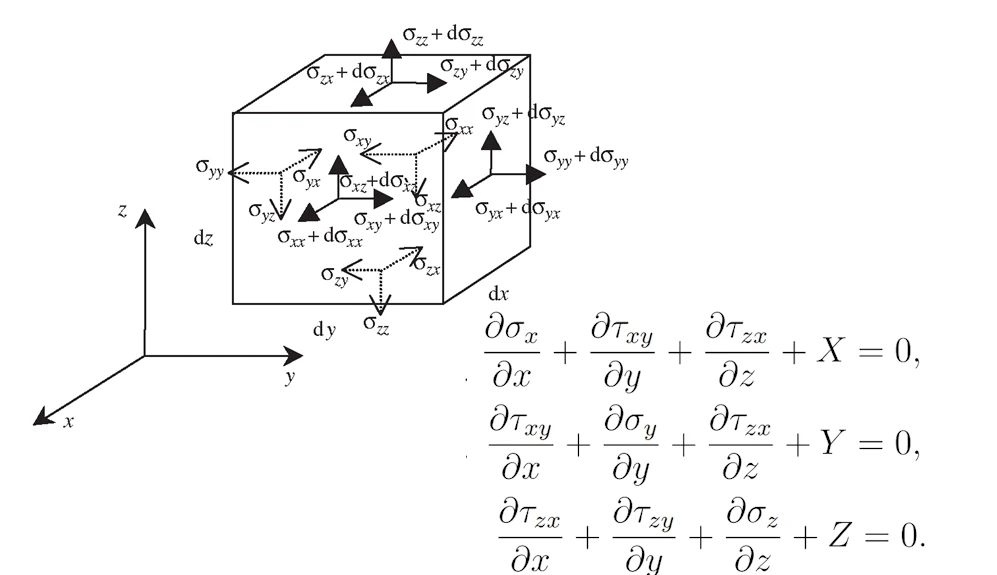
"value": "<h3>Equilibrium equations</h3>\n<p>The theory of small deformations enables the assembly of the equilibrium equation based on the undeformed volume using a first-order approach. </p>\n<figure data-asset-id=\"dc9faa89-b191-44d3-b878-b79ed47c82b5\" data-image-id=\"dc9faa89-b191-44d3-b878-b79ed47c82b5\"><img src=\"https://assets-us-01.kc-usercontent.com:443/28eac049-c8ed-00e2-220c-12142a968dff/c69bee50-7a44-4db5-82f1-11c8bfdb294b/05.png\" data-asset-id=\"dc9faa89-b191-44d3-b878-b79ed47c82b5\" data-image-id=\"dc9faa89-b191-44d3-b878-b79ed47c82b5\" alt=\"\"></figure>\n<p><em>\\[ \\textsf{\\textit{\\footnotesize{Fig. 8\\qquad Equilibrium equations and graphical representation on infinitesimal element}}}\\]</em></p>\n<h3>Compatibility equations</h3>\n<p>A solid body comprises infinitesimal volumes or material points, each of which is interconnected without gaps or overlaps. Mathematical conditions must be adhered to in order to prevent the occurrence of gaps or overlaps when a continuum body undergoes deformation.</p>\n<h3>Constitutive equations</h3>\n<p>The constitutive equations governing the behavior of 3D elements play a pivotal role in the analysis of material behavior in structural mechanics. These equations are formulated to accommodate the non-linear <strong>isotropic behavior</strong>, which is valid for <strong>solid block </strong>members in IDEA StatiCa Detail. </p>\n<figure data-asset-id=\"e8a9a447-3458-470a-addd-709405e6ba22\" data-image-id=\"e8a9a447-3458-470a-addd-709405e6ba22\"><img src=\"https://assets-us-01.kc-usercontent.com:443/28eac049-c8ed-00e2-220c-12142a968dff/95c6d00e-0cfa-45e0-ac79-d367c7db7960/06.png\" data-asset-id=\"e8a9a447-3458-470a-addd-709405e6ba22\" data-image-id=\"e8a9a447-3458-470a-addd-709405e6ba22\" alt=\"\"></figure>\n<p><em>\\[ \\textsf{\\textit{\\footnotesize{Fig. 9\\qquad Linearly elastic isotropic compliance matrix}}}\\]</em></p>"
},
"regions": {
"name": "Region",
"type": "taxonomy",
"value": [
{
"name": "EMEA",
"codename": "emea"
},
{
"name": "AMER",
"codename": "amer"
}
],
"taxonomyGroup": "region"
},
"product_groups": {
"name": "Product group",
"type": "taxonomy",
"value": [
{
"name": "Concrete",
"codename": "concrete"
},
{
"name": "Reinforced concrete",
"codename": "reinforced_concrete"
}
],
"taxonomyGroup": "product_group"
},
"support_center_article_types": {
"name": "Support center article",
"type": "taxonomy",
"value": [
{
"name": "Knowledge base",
"codename": "knowledgebase_article"
}
],
"taxonomyGroup": "support_center_article"
},
"expertise_levels": {
"name": "Expertise level",
"type": "taxonomy",
"value": [
{
"name": "Beginner",
"codename": "beginner"
},
{
"name": "Intermediate",
"codename": "intermediate"
}
],
"taxonomyGroup": "expertise_level"
},
"labels": {
"name": "Labels",
"type": "taxonomy",
"value": [
{
"name": "EN (Eurocode)",
"codename": "eurocode"
},
{
"name": "CSFM",
"codename": "csfm"
},
{
"name": "Detail 3D",
"codename": "detail_3d"
}
],
"taxonomyGroup": "labels"
},
"linked_items": {
"name": "Linked items",
"type": "modular_content",
"value": [],
"linkedItems": []
},
"attachments__files": {
"name": "Attachments",
"type": "asset",
"value": []
},
"content_priority__value": {
"name": "Content priority value",
"type": "number",
"value": null
},
"options": {
"name": "Options",
"type": "multiple_choice",
"value": []
},
"url_slug": {
"name": "Url slug",
"type": "url_slug",
"value": "general-mechanics-assumptions-for-3d-csfm"
},
"unique_url_slug": {
"name": "Unique URL slug",
"type": "custom",
"value": "[\"general-mechanics-assumptions-for-3d-csfm\",\"[autogenerated]\"]"
},
"content_settings__sitemap": {
"name": "Show in sitemap",
"type": "multiple_choice",
"value": []
},
"content_settings__robots": {
"name": "Search engine indexing",
"type": "multiple_choice",
"value": []
},
"content_settings__is_hidden": {
"name": "Hidden nested content",
"type": "multiple_choice",
"value": [
{
"name": "yes",
"codename": "yes"
}
]
},
"metadata__page_title": {
"name": "Page title",
"type": "text",
"value": ""
},
"metadata__page_description": {
"name": "Page description",
"type": "text",
"value": ""
},
"metadata__page_keywords": {
"name": "Page keywords",
"type": "text",
"value": ""
},
"metadata__canonical_url": {
"name": "Canonical URL",
"type": "text",
"value": ""
},
"metadata__og_title": {
"name": "OG:title",
"type": "text",
"value": ""
},
"metadata__og_description": {
"name": "OG:description",
"type": "text",
"value": ""
},
"metadata__og_image": {
"name": "OG:image",
"type": "asset",
"value": []
},
"translation__translation_connector": {
"name": "Translation Connector",
"type": "taxonomy",
"value": [],
"taxonomyGroup": "languages"
},
"translation__force_translation": {
"name": "Force translation",
"type": "multiple_choice",
"value": []
},
"translation__last_translation": {
"images": [],
"linkedItemCodenames": [],
"linkedItems": [],
"links": [],
"name": "Last translation",
"type": "rich_text",
"value": "<p><br></p>"
},
"translation__ai_translated": {
"name": "AI translated",
"type": "multiple_choice",
"value": []
},
"page_tree_settings__page_label": {
"name": "Page label",
"type": "text",
"value": ""
},
"page_tree_settings__path_segment": {
"name": "Path segment",
"type": "text",
"value": ""
},
"page_tree_settings__breadcrumb_style": {
"name": "Breadcrumb style",
"type": "multiple_choice",
"value": []
},
"page_tree_settings__hide_in_breadcrumbs": {
"name": "Hide in breadcrumbs",
"type": "multiple_choice",
"value": []
}
}Analysis model of IDEA StatiCa 3D Detail
Widget #NaN: support_center_article
Name: Theoretical background 3D Detail - Introduction to finite element implementation
ID: fdc3d2ca-103b-47a7-a94b-27d75babcb3a
Show Raw Data
{
"title": {
"name": "Main headline (H1)",
"type": "text",
"value": "An introduction to finite element implementation"
},
"preview_image": {
"name": "Preview image",
"type": "asset",
"value": []
},
"post_date": {
"name": "Post date",
"type": "date_time",
"value": null,
"displayTimeZone": "Europe/Prague"
},
"perex_content": {
"name": "Lead paragraph",
"type": "text",
"value": ""
},
"content": {
"images": [
{
"description": null,
"imageId": "3ea5794c-8d0d-4cd1-ab18-33e0418b4a67",
"url": "https://assets-us-01.kc-usercontent.com:443/28eac049-c8ed-00e2-220c-12142a968dff/c798c245-3d04-4741-9a1f-98fe77c3d439/FE%20model%203D%20Detail.png",
"height": 1000,
"width": 1900
}
],
"linkedItemCodenames": [],
"linkedItems": [],
"links": [],
"name": "Content",
"type": "rich_text",
"value": "<p>3D CSFM considers continuous stress fields in the concrete (3D finite elements), complemented by discrete “rod” elements representing the reinforcement (1D finite elements). Therefore, the reinforcement is not diffusely embedded into the concrete 3D finite elements but explicitly modeled and connected to them. </p>\n<figure data-asset-id=\"3ea5794c-8d0d-4cd1-ab18-33e0418b4a67\" data-image-id=\"3ea5794c-8d0d-4cd1-ab18-33e0418b4a67\"><img src=\"https://assets-us-01.kc-usercontent.com:443/28eac049-c8ed-00e2-220c-12142a968dff/c798c245-3d04-4741-9a1f-98fe77c3d439/FE%20model%203D%20Detail.png\" data-asset-id=\"3ea5794c-8d0d-4cd1-ab18-33e0418b4a67\" data-image-id=\"3ea5794c-8d0d-4cd1-ab18-33e0418b4a67\" alt=\"\"></figure>\n<p><em>\\[ \\textsf{\\textit{\\footnotesize{Fig. 10\\qquad Rendering of the calculation model for concrete block and out-of-plane wall}}}\\]</em></p>"
},
"regions": {
"name": "Region",
"type": "taxonomy",
"value": [
{
"name": "EMEA",
"codename": "emea"
},
{
"name": "AMER",
"codename": "amer"
}
],
"taxonomyGroup": "region"
},
"product_groups": {
"name": "Product group",
"type": "taxonomy",
"value": [
{
"name": "Concrete",
"codename": "concrete"
},
{
"name": "Reinforced concrete",
"codename": "reinforced_concrete"
}
],
"taxonomyGroup": "product_group"
},
"support_center_article_types": {
"name": "Support center article",
"type": "taxonomy",
"value": [
{
"name": "Knowledge base",
"codename": "knowledgebase_article"
}
],
"taxonomyGroup": "support_center_article"
},
"expertise_levels": {
"name": "Expertise level",
"type": "taxonomy",
"value": [
{
"name": "Beginner",
"codename": "beginner"
},
{
"name": "Intermediate",
"codename": "intermediate"
}
],
"taxonomyGroup": "expertise_level"
},
"labels": {
"name": "Labels",
"type": "taxonomy",
"value": [
{
"name": "EN (Eurocode)",
"codename": "eurocode"
},
{
"name": "CSFM",
"codename": "csfm"
},
{
"name": "Detail 3D",
"codename": "detail_3d"
}
],
"taxonomyGroup": "labels"
},
"linked_items": {
"name": "Linked items",
"type": "modular_content",
"value": [],
"linkedItems": []
},
"attachments__files": {
"name": "Attachments",
"type": "asset",
"value": []
},
"content_priority__value": {
"name": "Content priority value",
"type": "number",
"value": null
},
"options": {
"name": "Options",
"type": "multiple_choice",
"value": []
},
"url_slug": {
"name": "Url slug",
"type": "url_slug",
"value": "an-introduction-to-finite-element-implementation"
},
"unique_url_slug": {
"name": "Unique URL slug",
"type": "custom",
"value": "[\"introduction-to-finite-element-implementation\",\"[autogenerated]\"]"
},
"content_settings__sitemap": {
"name": "Show in sitemap",
"type": "multiple_choice",
"value": []
},
"content_settings__robots": {
"name": "Search engine indexing",
"type": "multiple_choice",
"value": []
},
"content_settings__is_hidden": {
"name": "Hidden nested content",
"type": "multiple_choice",
"value": [
{
"name": "yes",
"codename": "yes"
}
]
},
"metadata__page_title": {
"name": "Page title",
"type": "text",
"value": ""
},
"metadata__page_description": {
"name": "Page description",
"type": "text",
"value": ""
},
"metadata__page_keywords": {
"name": "Page keywords",
"type": "text",
"value": ""
},
"metadata__canonical_url": {
"name": "Canonical URL",
"type": "text",
"value": ""
},
"metadata__og_title": {
"name": "OG:title",
"type": "text",
"value": ""
},
"metadata__og_description": {
"name": "OG:description",
"type": "text",
"value": ""
},
"metadata__og_image": {
"name": "OG:image",
"type": "asset",
"value": []
},
"translation__translation_connector": {
"name": "Translation Connector",
"type": "taxonomy",
"value": [],
"taxonomyGroup": "languages"
},
"translation__force_translation": {
"name": "Force translation",
"type": "multiple_choice",
"value": []
},
"translation__last_translation": {
"images": [],
"linkedItemCodenames": [],
"linkedItems": [],
"links": [],
"name": "Last translation",
"type": "rich_text",
"value": "<p><br></p>"
},
"translation__ai_translated": {
"name": "AI translated",
"type": "multiple_choice",
"value": []
},
"page_tree_settings__page_label": {
"name": "Page label",
"type": "text",
"value": ""
},
"page_tree_settings__path_segment": {
"name": "Path segment",
"type": "text",
"value": ""
},
"page_tree_settings__breadcrumb_style": {
"name": "Breadcrumb style",
"type": "multiple_choice",
"value": []
},
"page_tree_settings__hide_in_breadcrumbs": {
"name": "Hide in breadcrumbs",
"type": "multiple_choice",
"value": []
}
}Widget #NaN: support_center_article
Name: Theoretical background 3D Detail - Finite element types
ID: 6f2a1c3b-07b0-4e5d-8b41-8205d2a7b2da
Show Raw Data
{
"title": {
"name": "Main headline (H1)",
"type": "text",
"value": "General finite element types"
},
"preview_image": {
"name": "Preview image",
"type": "asset",
"value": []
},
"post_date": {
"name": "Post date",
"type": "date_time",
"value": null,
"displayTimeZone": "Europe/Prague"
},
"perex_content": {
"name": "Lead paragraph",
"type": "text",
"value": ""
},
"content": {
"images": [
{
"description": null,
"imageId": "4edc33ee-6deb-467c-a229-355e726e5505",
"url": "https://assets-us-01.kc-usercontent.com:443/28eac049-c8ed-00e2-220c-12142a968dff/4fdc48d7-668c-4525-8066-92c0cf98fec2/FE%203D%20model.png",
"height": 724,
"width": 1791
},
{
"description": null,
"imageId": "248b8a69-ac53-4d77-ae02-42c07ac5fdb6",
"url": "https://assets-us-01.kc-usercontent.com:443/28eac049-c8ed-00e2-220c-12142a968dff/a833cda6-cf17-4c1f-9f83-c345621c0267/14.png",
"height": 707,
"width": 1773
},
{
"description": null,
"imageId": "72456c32-3fb6-4671-91fa-f288cbc7e1fc",
"url": "https://assets-us-01.kc-usercontent.com:443/28eac049-c8ed-00e2-220c-12142a968dff/92e32489-804f-495a-937e-40b647a0abf1/15.png",
"height": 702,
"width": 1792
}
],
"linkedItemCodenames": [],
"linkedItems": [],
"links": [],
"name": "Content",
"type": "rich_text",
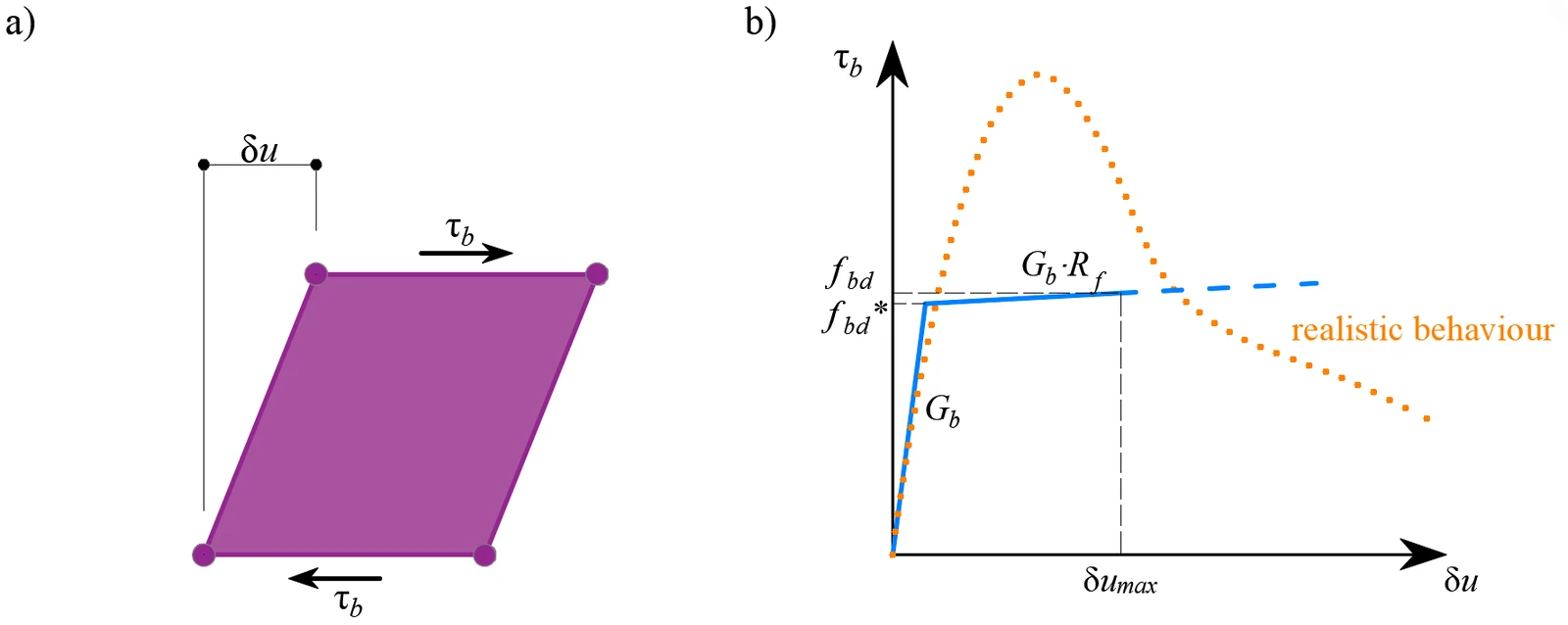
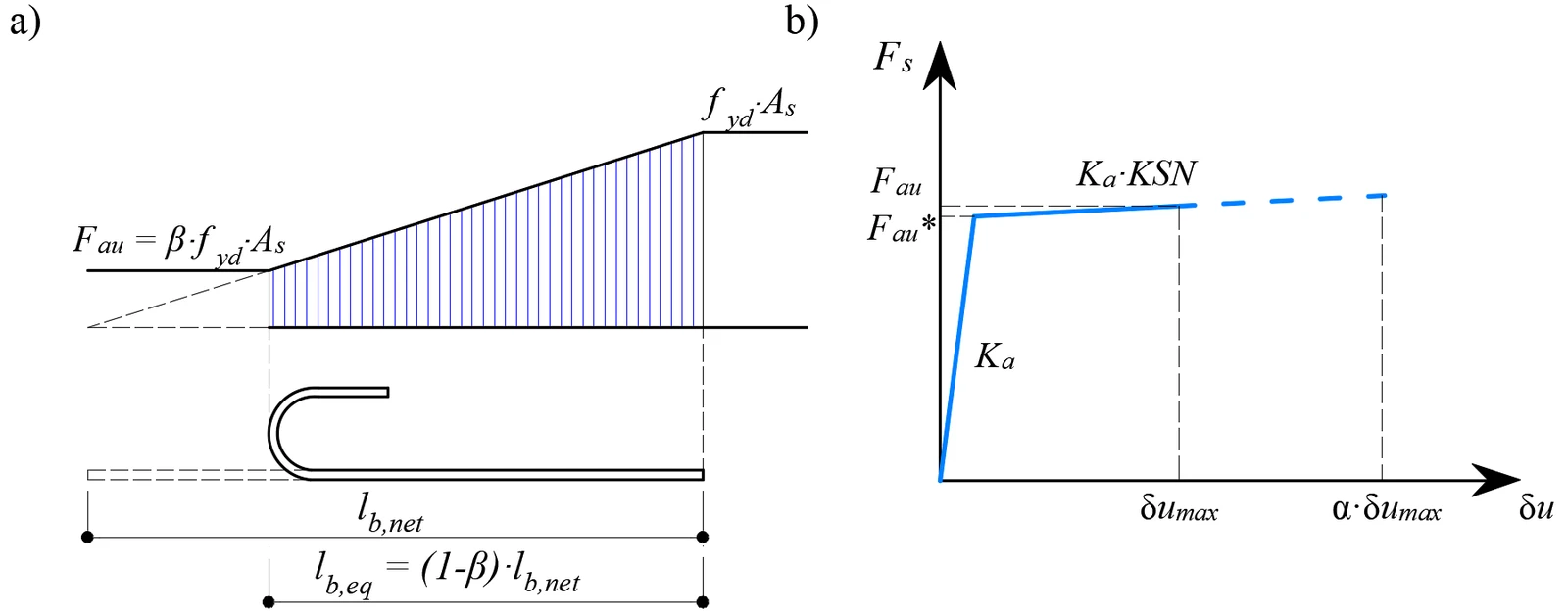
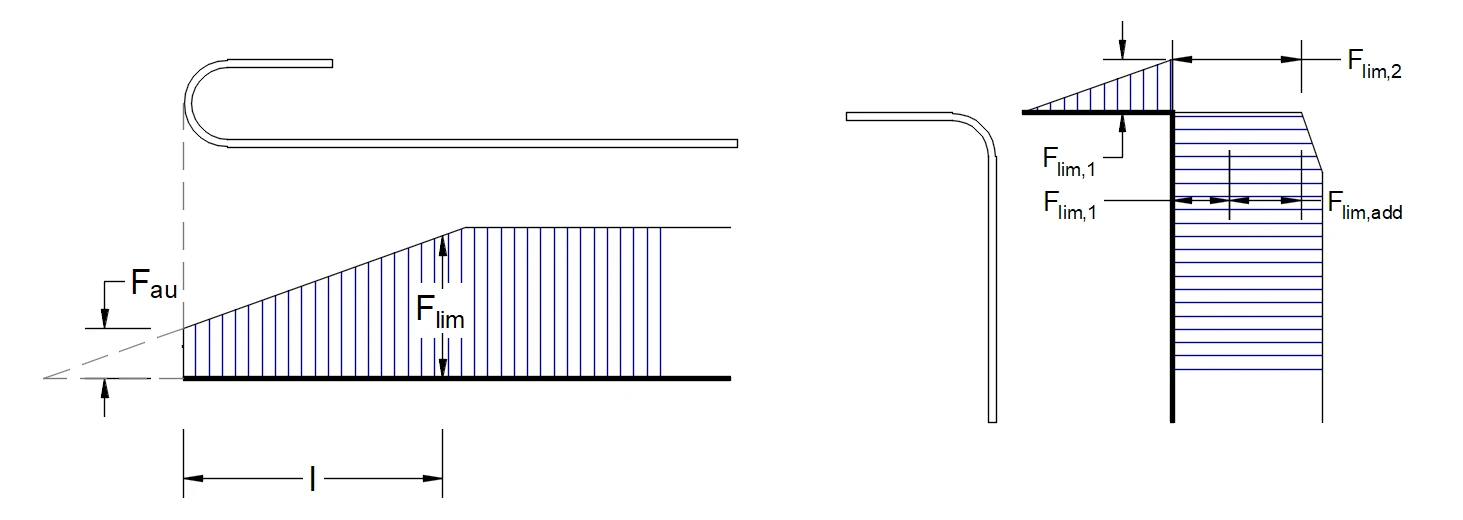
"value": "<p>The non-linear (inelastic) finite element analysis model is created by several types of finite elements used to model concrete, reinforcement, and the bond between them. Concrete and reinforcement elements are first meshed independently and then interconnected using multi-point constraints (MPC elements). This allows the reinforcement to occupy any position not limited to nodes of tetrahedral mesh. To verify anchorage length, bond, and anchorage end spring elements are inserted between the reinforcement and the MPC elements.</p>\n<figure data-asset-id=\"4edc33ee-6deb-467c-a229-355e726e5505\" data-image-id=\"4edc33ee-6deb-467c-a229-355e726e5505\"><img src=\"https://assets-us-01.kc-usercontent.com:443/28eac049-c8ed-00e2-220c-12142a968dff/4fdc48d7-668c-4525-8066-92c0cf98fec2/FE%203D%20model.png\" data-asset-id=\"4edc33ee-6deb-467c-a229-355e726e5505\" data-image-id=\"4edc33ee-6deb-467c-a229-355e726e5505\" alt=\"\"></figure>\n<p><em>\\[ \\textsf{\\textit{\\footnotesize{Fig. 11\\qquad Finite element model: reinforcement elements mapped to concrete mesh using MPC and bond elements}}}\\]</em></p>\n<h4>Concrete</h4>\n<p>Concrete is analyzed using <strong>mixed tetrahedral elements with nodal rotations</strong>. The tetrahedral elements allow us to mesh regions of any topology while the implemented formulation guarantees accurate deformation results (without spurious shear stress known as the shear lock effect) even for the coarse mesh which would not be suitable for linear tetrahedral elements formulation. </p>\n<p>Full integration is utilized. It means that each element is equipped with four integration points situated within the volume. Such an integration yields a precise strain and stress field, allowing for sufficient evaluation and presentation of the results across the whole volume. Subsequently, the stop criteria are established based on the value in the integration point.</p>\n<h4>Reinforcement</h4>\n<p>Rebars are modeled by two-node 1D “rod” elements (CROD), which only have axial stiffness. These elements are connected to special “bond” elements that were developed in order to model the slip behavior between a reinforcing bar and the surrounding concrete. These bond elements are subsequently connected by MPC (multi-point constraint) elements to the mesh representing the concrete. This approach allows the independent meshing of reinforcement and concrete, while their interconnection is ensured later.</p>\n<h4>Bond elements</h4>\n<p>The anchorage length is verified by implementing the bond shear stresses between concrete elements (3D) and reinforcing bar elements (1D) in the finite element model. For this purpose, the “bond” finite element type was developed.</p>\n<p>The bond element is defined as a shell finite element connected to elements representing reinforcement by the first layer and by the second layer to concrete mesh via multi-point constraints (MPC elements). It should be noted that the bond element is always displayed in this article with a non-zero height, which is, however, defined as infinitesimal in the model.</p>\n<p>The behavior of this element is described by the bond stress, τ<em><sub>b</sub></em>, as a bilinear function of the slip between the upper and lower nodes, δ<em>u</em>, see (Fig. 12).</p>\n<figure data-asset-id=\"248b8a69-ac53-4d77-ae02-42c07ac5fdb6\" data-image-id=\"248b8a69-ac53-4d77-ae02-42c07ac5fdb6\"><img src=\"https://assets-us-01.kc-usercontent.com:443/28eac049-c8ed-00e2-220c-12142a968dff/a833cda6-cf17-4c1f-9f83-c345621c0267/14.png\" data-asset-id=\"248b8a69-ac53-4d77-ae02-42c07ac5fdb6\" data-image-id=\"248b8a69-ac53-4d77-ae02-42c07ac5fdb6\" alt=\"\"></figure>\n<p><em>\\[ \\textsf{\\textit{\\footnotesize{Fig. 12\\qquad (a) Conceptual illustration of the deformation of a bond element; (b) shear-deformation function}}}\\]</em></p>\n<p>The elastic stiffness modulus of the bond-slip relationship, <em>Gb</em>, is defined as follows:</p>\n<p>\\[G_b = k_g \\cdot \\frac{E_c}{Ø}\\]</p>\n<p><em>k</em><em><sub>g</sub></em> coefficient depending on the reinforcing bar surface (by default <em>kg</em> = 0.2)</p>\n<p><em>E</em><em><sub>c</sub></em> modulus of elasticity of concrete (taken as <em>Ecm</em> in case of EN)</p>\n<p>Ø the diameter of the reinforcing bar</p>\n<p>The design values (factored values) of ultimate bond shear stress, <em>f</em><em><sub>bd</sub></em>, provided in the respective selected design codes EN 1992-1-1 or ACI 318-19 are used to verify the anchorage length. The hardening of the plastic branch is calculated by default as <em>Gb</em>/105.</p>\n<h4>Anchorage spring</h4>\n<p>The provision of anchorage ends to the reinforcing bars (i.e., bends, hooks, loops…), which fulfills the prescriptions of design codes, allows the reduction of the basic anchorage length of the bars (<em>l</em><em><sub>b,net</sub></em>) by a certain factor β (referred to as the ‘anchorage coefficient’ below). The design value of the anchorage length (<em>lb</em>) is then calculated as follows:</p>\n<figure data-asset-id=\"72456c32-3fb6-4671-91fa-f288cbc7e1fc\" data-image-id=\"72456c32-3fb6-4671-91fa-f288cbc7e1fc\"><img src=\"https://assets-us-01.kc-usercontent.com:443/28eac049-c8ed-00e2-220c-12142a968dff/92e32489-804f-495a-937e-40b647a0abf1/15.png\" data-asset-id=\"72456c32-3fb6-4671-91fa-f288cbc7e1fc\" data-image-id=\"72456c32-3fb6-4671-91fa-f288cbc7e1fc\" alt=\"\"></figure>\n<p><em>\\[ \\textsf{\\textit{\\footnotesize{Fig. 13\\qquad Model for the reduction of the anchorage length: a) Anchorage force along the anchorage length of }}}\\] \\[ \\textsf{\\textit{\\footnotesize{the reinforcement bar, b) slip-anchorage force constitutive law}}}\\]</em></p>\n<p><br></p>\n<p>The reduction of the anchorage length is included in the finite element model by means of a spring element at the end of the bar (Fig. 13a), which is defined by the constitutive model shown in (Fig. 13b). The maximum force transmitted by this spring (<em>F</em><em><sub>au</sub></em>) is:</p>\n<p>\\[F_{au} = \\beta \\cdot A_s \\cdot f_{yd}\\]</p>\n<p>where :</p>\n<p><em>β</em> the anchorage coefficient based on anchorage type</p>\n<p><em>A</em><em><sub>s</sub></em> the cross-section of the reinforcing bar</p>\n<p><em>f</em><em><sub>yd</sub></em><em> </em> the design value (factored value) of the yield strength of the reinforcement</p>"
},
"regions": {
"name": "Region",
"type": "taxonomy",
"value": [
{
"name": "EMEA",
"codename": "emea"
},
{
"name": "AMER",
"codename": "amer"
}
],
"taxonomyGroup": "region"
},
"product_groups": {
"name": "Product group",
"type": "taxonomy",
"value": [
{
"name": "Concrete",
"codename": "concrete"
},
{
"name": "Reinforced concrete",
"codename": "reinforced_concrete"
}
],
"taxonomyGroup": "product_group"
},
"support_center_article_types": {
"name": "Support center article",
"type": "taxonomy",
"value": [
{
"name": "Knowledge base",
"codename": "knowledgebase_article"
}
],
"taxonomyGroup": "support_center_article"
},
"expertise_levels": {
"name": "Expertise level",
"type": "taxonomy",
"value": [
{
"name": "Beginner",
"codename": "beginner"
},
{
"name": "Intermediate",
"codename": "intermediate"
}
],
"taxonomyGroup": "expertise_level"
},
"labels": {
"name": "Labels",
"type": "taxonomy",
"value": [
{
"name": "Detail 2D",
"codename": "detail"
},
{
"name": "EN (Eurocode)",
"codename": "eurocode"
},
{
"name": "CSFM",
"codename": "csfm"
}
],
"taxonomyGroup": "labels"
},
"linked_items": {
"name": "Linked items",
"type": "modular_content",
"value": [],
"linkedItems": []
},
"attachments__files": {
"name": "Attachments",
"type": "asset",
"value": []
},
"content_priority__value": {
"name": "Content priority value",
"type": "number",
"value": null
},
"options": {
"name": "Options",
"type": "multiple_choice",
"value": []
},
"url_slug": {
"name": "Url slug",
"type": "url_slug",
"value": "general-finite-element-types"
},
"unique_url_slug": {
"name": "Unique URL slug",
"type": "custom",
"value": "[\"general-finite-element-types\",\"[autogenerated]\"]"
},
"content_settings__sitemap": {
"name": "Show in sitemap",
"type": "multiple_choice",
"value": []
},
"content_settings__robots": {
"name": "Search engine indexing",
"type": "multiple_choice",
"value": []
},
"content_settings__is_hidden": {
"name": "Hidden nested content",
"type": "multiple_choice",
"value": [
{
"name": "yes",
"codename": "yes"
}
]
},
"metadata__page_title": {
"name": "Page title",
"type": "text",
"value": ""
},
"metadata__page_description": {
"name": "Page description",
"type": "text",
"value": ""
},
"metadata__page_keywords": {
"name": "Page keywords",
"type": "text",
"value": ""
},
"metadata__canonical_url": {
"name": "Canonical URL",
"type": "text",
"value": ""
},
"metadata__og_title": {
"name": "OG:title",
"type": "text",
"value": ""
},
"metadata__og_description": {
"name": "OG:description",
"type": "text",
"value": ""
},
"metadata__og_image": {
"name": "OG:image",
"type": "asset",
"value": []
},
"translation__translation_connector": {
"name": "Translation Connector",
"type": "taxonomy",
"value": [],
"taxonomyGroup": "languages"
},
"translation__force_translation": {
"name": "Force translation",
"type": "multiple_choice",
"value": []
},
"translation__last_translation": {
"images": [],
"linkedItemCodenames": [],
"linkedItems": [],
"links": [],
"name": "Last translation",
"type": "rich_text",
"value": "<p><br></p>"
},
"translation__ai_translated": {
"name": "AI translated",
"type": "multiple_choice",
"value": []
},
"page_tree_settings__page_label": {
"name": "Page label",
"type": "text",
"value": ""
},
"page_tree_settings__path_segment": {
"name": "Path segment",
"type": "text",
"value": ""
},
"page_tree_settings__breadcrumb_style": {
"name": "Breadcrumb style",
"type": "multiple_choice",
"value": []
},
"page_tree_settings__hide_in_breadcrumbs": {
"name": "Hide in breadcrumbs",
"type": "multiple_choice",
"value": []
}
}Widget #NaN: support_center_article
Name: Theoretical background 3D Detail - Load transfer devices
ID: 9b010b81-7a05-40ae-8c04-546e595014fe
Show Raw Data
{
"title": {
"name": "Main headline (H1)",
"type": "text",
"value": "Load transfer devices"
},
"preview_image": {
"name": "Preview image",
"type": "asset",
"value": []
},
"post_date": {
"name": "Post date",
"type": "date_time",
"value": null,
"displayTimeZone": "Europe/Prague"
},
"perex_content": {
"name": "Lead paragraph",
"type": "text",
"value": ""
},
"content": {
"images": [
{
"description": null,
"imageId": "26c9d9a5-1064-44e2-8707-eb635d75347f",
"url": "https://assets-us-01.kc-usercontent.com:443/28eac049-c8ed-00e2-220c-12142a968dff/371f790c-72d7-49be-8247-ade39e45d4d9/Linear%20steel.png",
"height": 462,
"width": 722
},
{
"description": null,
"imageId": "617b4b30-44ed-4b98-aa32-012e5b98e09b",
"url": "https://assets-us-01.kc-usercontent.com:443/28eac049-c8ed-00e2-220c-12142a968dff/33381e95-f9e8-4586-8a4e-d723bbab5356/Stub%20for%20loading.png",
"height": 558,
"width": 1407
},
{
"description": null,
"imageId": "2937e4c9-29aa-4613-9d4e-c44bbc628457",
"url": "https://assets-us-01.kc-usercontent.com:443/28eac049-c8ed-00e2-220c-12142a968dff/c9f5d8cb-31be-436c-881b-1ed934e28860/Friction%20-%20load%20input.png",
"height": 895,
"width": 1193
},
{
"description": null,
"imageId": "d506d242-bb4e-41a7-8847-3211617b017d",
"url": "https://assets-us-01.kc-usercontent.com:443/28eac049-c8ed-00e2-220c-12142a968dff/e430f86d-007d-4b58-8ac3-6c561def378d/Friction%20-%20result.png",
"height": 1149,
"width": 1914
},
{
"description": null,
"imageId": "19efc159-8105-4a48-b356-24e75616f28d",
"url": "https://assets-us-01.kc-usercontent.com:443/28eac049-c8ed-00e2-220c-12142a968dff/e64e31cd-772c-4b95-84c2-b3442e790aa6/Friction%20contact%20graph.png",
"height": 469,
"width": 1186
},
{
"description": null,
"imageId": "ae58f4f5-1a75-4eac-99f5-9964a720abe5",
"url": "https://assets-us-01.kc-usercontent.com:443/28eac049-c8ed-00e2-220c-12142a968dff/f5a88134-312b-4689-9bcd-a77eb0e834e3/Shear%20lug%20transfer.png",
"height": 450,
"width": 1264
},
{
"description": null,
"imageId": "c07375e3-202a-449e-a4ef-aa55f268fdee",
"url": "https://assets-us-01.kc-usercontent.com:443/28eac049-c8ed-00e2-220c-12142a968dff/dc2938e5-b707-4f53-a0b6-b795bfef8d4d/Interconnection%20with%20base%20plate%20settings.png",
"height": 258,
"width": 778
},
{
"description": null,
"imageId": "772c22fe-dd8e-4a7e-824b-aac7dcf1e4b0",
"url": "https://assets-us-01.kc-usercontent.com:443/28eac049-c8ed-00e2-220c-12142a968dff/30a7aadf-a72c-4ca5-be2f-35a9bf4f3c45/Cut%20threads%20weld%20or%20pinned.png",
"height": 1147,
"width": 1916
},
{
"description": null,
"imageId": "d70a94d5-1c08-4015-a70f-1d1383d86d80",
"url": "https://assets-us-01.kc-usercontent.com:443/28eac049-c8ed-00e2-220c-12142a968dff/4ba36be0-87e2-416f-a380-66f3f14638dc/Rotational%20constrains.png",
"height": 595,
"width": 1574
},
{
"description": null,
"imageId": "f32ae8e3-e5c9-4fbb-b7d6-596b442d7e6e",
"url": "https://assets-us-01.kc-usercontent.com:443/28eac049-c8ed-00e2-220c-12142a968dff/568c6688-adc1-4f20-b28f-914f917ab5be/Axial%20and%20rotational%20constrains%20table.png",
"height": 499,
"width": 1233
},
{
"description": null,
"imageId": "750b7ed0-ff95-4138-88a4-de437fc2d9d9",
"url": "https://assets-us-01.kc-usercontent.com:443/28eac049-c8ed-00e2-220c-12142a968dff/6b53c46b-318c-4347-bf21-959cbc8fbde8/Interaction%20with%20cast-in%20plate.png",
"height": 394,
"width": 1835
}
],
"linkedItemCodenames": [],
"linkedItems": [],
"links": [],
"name": "Content",
"type": "rich_text",
"value": "<h3>Base plate</h3>\n<p>The base plate is modeled as an elastic shell element. The steel material used for base plates is defined in the Materials tab. The only physical property is the modulus of elasticity <em>E</em>.</p>\n<figure data-asset-id=\"26c9d9a5-1064-44e2-8707-eb635d75347f\" data-image-id=\"26c9d9a5-1064-44e2-8707-eb635d75347f\"><img src=\"https://assets-us-01.kc-usercontent.com:443/28eac049-c8ed-00e2-220c-12142a968dff/371f790c-72d7-49be-8247-ade39e45d4d9/Linear%20steel.png\" data-asset-id=\"26c9d9a5-1064-44e2-8707-eb635d75347f\" data-image-id=\"26c9d9a5-1064-44e2-8707-eb635d75347f\" alt=\"\"></figure>\n<p><em>\\[ \\textsf{\\textit{\\footnotesize{Fig. 14\\qquad The base plate material definition}}}\\]</em></p>\n<p>The base plate can be loaded by the point load (Fx, Fy, Fz, Mx, My, Mz) and the group of forces (Fx, Fy, Fz), mainly used for loading models exported from the IDEA StatiCa Connection. Note that point loads and point moments directly load the corresponding node of the base plate. It means that there is no redistribution, only by the stiffness of the base plate. </p>\n<p>This implementation allows importing load effects from the IDEA StatiCa Connection that are applied to the base plate at the location of the individual weld finite elements with the value and direction determined from the general stress of that weld finite element. More can be read in the corresponding chapter of this document.</p>\n<p>The second loading option is the <strong>Stub</strong> — representing a short portion of the column above the base plate. The stub is modeled as an elastic shell element structure and behaves as a physically accurate interface between the internal forces and the plate. The user selects a cross-section for the stub from a standard section database. The 6-component internal force set (forces and moments) is applied at a <strong>single point</strong> on the <strong>bottom face of the stub</strong> — i.e. the base of the column. Constraints transfer the forces to the top face of the stub, from where they are naturally redistributed through the stub into the base plate, anchors, and concrete.</p>\n<figure data-asset-id=\"617b4b30-44ed-4b98-aa32-012e5b98e09b\" data-image-id=\"617b4b30-44ed-4b98-aa32-012e5b98e09b\"><img src=\"https://assets-us-01.kc-usercontent.com:443/28eac049-c8ed-00e2-220c-12142a968dff/33381e95-f9e8-4586-8a4e-d723bbab5356/Stub%20for%20loading.png\" data-asset-id=\"617b4b30-44ed-4b98-aa32-012e5b98e09b\" data-image-id=\"617b4b30-44ed-4b98-aa32-012e5b98e09b\" alt=\"\"></figure>\n<p><em>\\[ \\textsf{\\textit{\\footnotesize{Fig. 15\\qquad The load transfer through the stub}}}\\]</em></p>\n<p><br></p>\n<p><strong>Shear transfer mechanism (from base plate to concrete block)</strong></p>\n<p>Frictional compression-only contact is defined between the baseplate and concrete. For the shear transfer user can choose from three options:</p>\n<ul>\n <li><strong>By anchors</strong></li>\n <li><strong>By friction</strong></li>\n <li><strong>By shear lug</strong></li>\n</ul>\n<p>The software does not allow the combination of these shear transfer mechanisms. </p>\n<p><strong>The friction</strong> coefficient should be input as a designed (factored) value. In case the resultant shear force <em>F</em><em><sub>xy</sub></em><em> </em>exceeds the pressure force <em>F</em><em><sub>z</sub></em> times the frictional coefficient <em>μ,</em> the calculation will stop, and not all the loads will apply to the model. The condition is written as follows:</p>\n<p>\\[\\frac {F_{xy}}{ \\mu \\cdot F_{z}}\\le 1\\]</p>\n<p>This can be seen in the following example, where two load cases are considered. </p>\n<ul>\n <li>LC1 - Permanent type - F<sub>z</sub> = 100 kN</li>\n <li>LC2 - Variable type- F<sub>x</sub> = 100 kN</li>\n</ul>\n<figure data-asset-id=\"2937e4c9-29aa-4613-9d4e-c44bbc628457\" data-image-id=\"2937e4c9-29aa-4613-9d4e-c44bbc628457\"><img src=\"https://assets-us-01.kc-usercontent.com:443/28eac049-c8ed-00e2-220c-12142a968dff/c9f5d8cb-31be-436c-881b-1ed934e28860/Friction%20-%20load%20input.png\" data-asset-id=\"2937e4c9-29aa-4613-9d4e-c44bbc628457\" data-image-id=\"2937e4c9-29aa-4613-9d4e-c44bbc628457\" alt=\"\"></figure>\n<p><em>\\[ \\textsf{\\textit{\\footnotesize{Fig. 16\\qquad Load input for example explaining shear transfer by friction}}}\\]</em></p>\n<p>In the first calculation step, all the permanent load is applied. Then the variable load is gradually applied until it reaches the value of the pressure load times the friction coefficient.</p>\n<figure data-asset-id=\"d506d242-bb4e-41a7-8847-3211617b017d\" data-image-id=\"d506d242-bb4e-41a7-8847-3211617b017d\"><img src=\"https://assets-us-01.kc-usercontent.com:443/28eac049-c8ed-00e2-220c-12142a968dff/e430f86d-007d-4b58-8ac3-6c561def378d/Friction%20-%20result.png\" data-asset-id=\"d506d242-bb4e-41a7-8847-3211617b017d\" data-image-id=\"d506d242-bb4e-41a7-8847-3211617b017d\" alt=\"\"></figure>\n<p><em>\\[ \\textsf{\\textit{\\footnotesize{Fig. 17\\qquad Results from example explaining shear transfer by friction}}}\\]</em></p>\n<p>The graph in Figure 18 defines the behavior of the frictional contact between the baseplate and concrete.</p>\n<figure data-asset-id=\"19efc159-8105-4a48-b356-24e75616f28d\" data-image-id=\"19efc159-8105-4a48-b356-24e75616f28d\"><img src=\"https://assets-us-01.kc-usercontent.com:443/28eac049-c8ed-00e2-220c-12142a968dff/e64e31cd-772c-4b95-84c2-b3442e790aa6/Friction%20contact%20graph.png\" data-asset-id=\"19efc159-8105-4a48-b356-24e75616f28d\" data-image-id=\"19efc159-8105-4a48-b356-24e75616f28d\" alt=\"\"></figure>\n<p><em>\\[ \\textsf{\\textit{\\footnotesize{Fig. 18\\qquad Force-displacement graph describing the behavior of frictional contact}}}\\]</em></p>\n<p>The value of<em> F</em><em><sub>z</sub></em><em>μ</em> differs for each increment of the calculation, whereas the value of maximal shear deformation <em>u</em><em><sub>xy</sub></em> is constant. </p>\n<p>If the compressive normal force <em>F</em><em><sub>z</sub></em> and the shear force <em>F</em><em><sub>xy</sub></em> are input in one load case type (e.g. only permanent), and the condition of <em>F</em><em><sub>xy</sub></em><em> / (F</em><em><sub>z</sub></em><em>μ) ≤ 1</em> is not fulfilled<em>, </em>no load will be applied to the model because the condition is not fulfilled in any increment of the calculation.</p>\n<p><strong>The shear lug</strong> is connected with the concrete mesh by constraints allowing only compression only normal stress transfer. </p>\n<figure data-asset-id=\"ae58f4f5-1a75-4eac-99f5-9964a720abe5\" data-image-id=\"ae58f4f5-1a75-4eac-99f5-9964a720abe5\"><img src=\"https://assets-us-01.kc-usercontent.com:443/28eac049-c8ed-00e2-220c-12142a968dff/f5a88134-312b-4689-9bcd-a77eb0e834e3/Shear%20lug%20transfer.png\" data-asset-id=\"ae58f4f5-1a75-4eac-99f5-9964a720abe5\" data-image-id=\"ae58f4f5-1a75-4eac-99f5-9964a720abe5\" alt=\"\"></figure>\n<p><em>\\[ \\textsf{\\textit{\\footnotesize{Fig. 19\\qquad Shear lug transfer of shear mechanism}}}\\]</em></p>\n<p>The shear lug is modeled from elastic shell elements, where the modulus of elasticity E defines the material.</p>\n<p>The results are not evaluated and displayed for the base plate as well as for the shear lug.</p>\n<p><br></p>\n<p><strong> Base plate options (stand-off, grout)</strong></p>\n<p>The following set of stand-off options, fully aligned with the Connection application, is available.</p>\n<ul>\n <li><strong>Direct</strong></li>\n <li><strong>Mortar joint – nuts from the top</strong></li>\n <li><strong>Mortar joint – nuts from the top and bottom</strong></li>\n <li><strong>Gap</strong></li>\n</ul>\n<p>The mortar layer is modeled as a <strong>shell element</strong>, with its stiffness taken into account. Note that shell elements are incompressible in the direction of their thickness. This helps to redistribute local forces to the concrete and is valid for typical bedding thicknesses used in practice - 25-50 mm.</p>\n<p>The distinction between nuts only from the top (pinned interconnection between anchor and base plate) vs. top and bottom (fixed interconnection between anchor and base plate) strongly influences the shear capacity from the point of view of concrete bearing.</p>\n<h3>Anchors</h3>\n<p>The finite elements representing anchors are modeled to be able to transfer normal and shear forces to the concrete, also taking into account the bending stiffness of the anchors. To model the slip between the anchor and the surrounding concrete, the same bond and MPC elements are used as for the reinforcement. With the difference that:</p>\n<ul>\n <li>For post-installed (adhesive) anchors, it is necessary to specify the design bond strength.</li>\n <li>For Washer plates and Headed studs, the bond is neglected along the shank of the anchor. All axial load is then transferred to the concrete through the washer plate or head of the anchor.</li>\n</ul>\n<p>Anchors can be interconnected with base plates. For this interconnection, a fully nonlinear constraint is used to connect the anchor's end and a base plate node. This constraint allows us to control all degrees of freedom to ensure, for example, that the anchors transfer no compression force from the base plate, or that no shear is transferred by the anchor when modeling a shear lug, etc.</p>\n<p><strong>Interconnection with base plate</strong> properties for anchors allows the user to control whether the anchor will be connected with the base plate by the previously mentioned constraint and how. </p>\n<figure data-asset-id=\"c07375e3-202a-449e-a4ef-aa55f268fdee\" data-image-id=\"c07375e3-202a-449e-a4ef-aa55f268fdee\"><img src=\"https://assets-us-01.kc-usercontent.com:443/28eac049-c8ed-00e2-220c-12142a968dff/dc2938e5-b707-4f53-a0b6-b795bfef8d4d/Interconnection%20with%20base%20plate%20settings.png\" data-asset-id=\"c07375e3-202a-449e-a4ef-aa55f268fdee\" data-image-id=\"c07375e3-202a-449e-a4ef-aa55f268fdee\" alt=\"\"></figure>\n<p><em>\\[ \\textsf{\\textit{\\footnotesize{Fig. 20\\qquad Interconnection with base plate settings}}}\\]</em></p>\n<p>The <strong>Transfer of shear</strong> checkbox can be used to control whether the anchor and base plate will be connected or not in terms of shear. Note that it is not supported to combine shear transfer mechanisms, so for transfer by friction and shear lug, this checkbox is irrelevant. On the other hand, for shear transfer using anchors, this field gives the option to exclude some anchors from shear transfer.</p>\n<p>The <strong>Transfer of axial forces</strong> checkbox can be used to control whether the anchor and base plate will be connected or not in terms of the axial direction. This is mainly used for the export from the Connection feature (see the corresponding chapter). For manual modeling, it makes sense to have this checkbox always checked.</p>\n<p>When the checkbox is unchecked, the anchor is disconnected in both tension and compression (in the case of a model exported from the Connection application, the connection is replaced by a pair of forces). If the checkbox is checked, the anchor is always connected to the plate in tension, but the connection in compression is controlled by the anchor type and the type of stand-off. For more information, see Figure 23.</p>\n<p><strong>Cut threads</strong></p>\n<p>Controlled by a checkbox in anchor properties and has 2 purposes:</p>\n<p>1. Defines how the anchor connects to the base plate:</p>\n<ul>\n <ul>\n <li>For headed studs and cast-in reinforcement connected to the Base plate (not for Cast-in plates), it distinguishes between a <strong>bolt connection (pinned)</strong> and a <strong>welded connection (fixed)</strong> — visible in the 3D scene.</li>\n <li>Note that the way of anchor-to-plate connection has a significant influence on the shear resistance from the point of view of bearing of the concrete.</li>\n </ul>\n</ul>\n<figure data-asset-id=\"772c22fe-dd8e-4a7e-824b-aac7dcf1e4b0\" data-image-id=\"772c22fe-dd8e-4a7e-824b-aac7dcf1e4b0\"><img src=\"https://assets-us-01.kc-usercontent.com:443/28eac049-c8ed-00e2-220c-12142a968dff/30a7aadf-a72c-4ca5-be2f-35a9bf4f3c45/Cut%20threads%20weld%20or%20pinned.png\" data-asset-id=\"772c22fe-dd8e-4a7e-824b-aac7dcf1e4b0\" data-image-id=\"772c22fe-dd8e-4a7e-824b-aac7dcf1e4b0\" alt=\"\"></figure>\n<p><em>\\[ \\textsf{\\textit{\\footnotesize{Fig. 21\\qquad Cut threads options}}}\\]</em></p>\n<p>2. For Eurocode, the resistance of the anchor with cut threads is reduced according to EN 1993-1-8 3.6.1 (3). It can be set in Project settings. For Threaded rods and Washer plates, it is recommended to keep this setting on at all times.</p>\n<h3>Axial and rotational interconnection between Anchor and Base plate</h3>\n<p>As already mentioned in this chapter, depending on the type of anchor, the stand-off setting, and whether or not cut threads are considered, anchors are connected to the base plate in different ways. In terms of rotational connection, this can be <strong>Hinged / Fixed</strong>. In terms of axial connection, this can be <strong>Tension / Tension + Compression</strong>. The rotational connection types strongly influence the shear capacity from the point of view of concrete bearing. In a 3D scene, it is easy to tell whether an anchor is connected as fixed or hinged based on the presence of nuts, see Figure 22.</p>\n<figure data-asset-id=\"d70a94d5-1c08-4015-a70f-1d1383d86d80\" data-image-id=\"d70a94d5-1c08-4015-a70f-1d1383d86d80\"><img src=\"https://assets-us-01.kc-usercontent.com:443/28eac049-c8ed-00e2-220c-12142a968dff/4ba36be0-87e2-416f-a380-66f3f14638dc/Rotational%20constrains.png\" data-asset-id=\"d70a94d5-1c08-4015-a70f-1d1383d86d80\" data-image-id=\"d70a94d5-1c08-4015-a70f-1d1383d86d80\" alt=\"\"></figure>\n<p><em>\\[ \\textsf{\\textit{\\footnotesize{Fig. 22\\qquad Rotational constraints}}}\\]</em></p>\n<p>The following table shows all possible combinations of base plate connections with anchors and the corresponding rotational and axial connections.</p>\n<figure data-asset-id=\"f32ae8e3-e5c9-4fbb-b7d6-596b442d7e6e\" data-image-id=\"f32ae8e3-e5c9-4fbb-b7d6-596b442d7e6e\"><img src=\"https://assets-us-01.kc-usercontent.com:443/28eac049-c8ed-00e2-220c-12142a968dff/568c6688-adc1-4f20-b28f-914f917ab5be/Axial%20and%20rotational%20constrains%20table.png\" data-asset-id=\"f32ae8e3-e5c9-4fbb-b7d6-596b442d7e6e\" data-image-id=\"f32ae8e3-e5c9-4fbb-b7d6-596b442d7e6e\" alt=\"\"></figure>\n<p><em>\\[ \\textsf{\\textit{\\footnotesize{Fig. 23\\qquad Axial and rotational constraints between an anchor and a base plate}}}\\]</em></p>\n<h3>Cast-in plates</h3>\n<p>Cast-in plate is a special case of a base plate. It is modeled analogously with the following differences:</p>\n<p>Since the plate is embedded inside a concrete block, no type of stand-off can be specified. The depth of the slab embedding is neglected. The plate, modeled by shell elements, is placed directly on the concrete surface. Therefore, the side surfaces of the slab are not considered to be supported by the concrete.</p>\n<p>It is only possible to use Reinforcement and Headed studs, which, like classic anchors, can be set to be connected to the slab in the axial and shear directions. Practical experience and some national documents indicate the need to design Headed studs only for shear and Reinforcement for axial load. From the perspective of axial and rotational constraints, anchors are always connected as Fixed and Tension + Compression.</p>\n<figure data-asset-id=\"750b7ed0-ff95-4138-88a4-de437fc2d9d9\" data-image-id=\"750b7ed0-ff95-4138-88a4-de437fc2d9d9\"><img src=\"https://assets-us-01.kc-usercontent.com:443/28eac049-c8ed-00e2-220c-12142a968dff/6b53c46b-318c-4347-bf21-959cbc8fbde8/Interaction%20with%20cast-in%20plate.png\" data-asset-id=\"750b7ed0-ff95-4138-88a4-de437fc2d9d9\" data-image-id=\"750b7ed0-ff95-4138-88a4-de437fc2d9d9\" alt=\"\"></figure>\n<p><em>\\[ \\textsf{\\textit{\\footnotesize{Fig. 24\\qquad Axial and rotational constraints between an anchor and a base plate}}}\\]</em></p>"
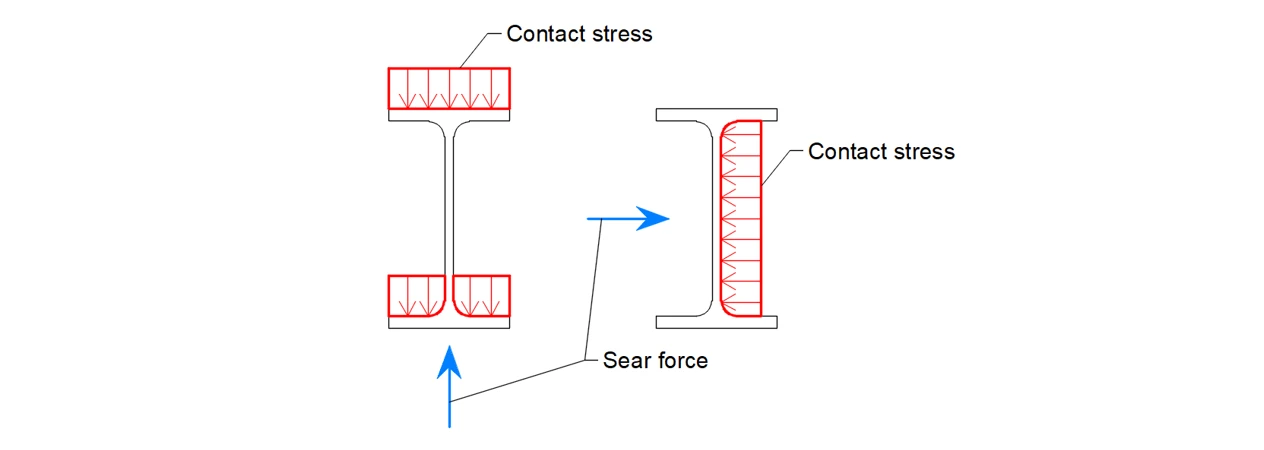
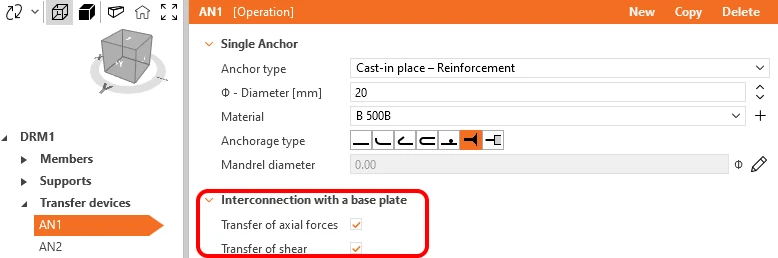
},
"regions": {
"name": "Region",
"type": "taxonomy",
"value": [
{
"name": "EMEA",
"codename": "emea"
},
{
"name": "AMER",
"codename": "amer"
},
{
"name": "APAC",
"codename": "apac"
},
{
"name": "CZ/SK",
"codename": "cz_sk"
}
],
"taxonomyGroup": "region"
},
"product_groups": {
"name": "Product group",
"type": "taxonomy",
"value": [
{
"name": "Concrete",
"codename": "concrete"
},
{
"name": "Reinforced concrete",
"codename": "reinforced_concrete"
}
],
"taxonomyGroup": "product_group"
},
"support_center_article_types": {
"name": "Support center article",
"type": "taxonomy",
"value": [
{
"name": "Knowledge base",
"codename": "knowledgebase_article"
}
],
"taxonomyGroup": "support_center_article"
},
"expertise_levels": {
"name": "Expertise level",
"type": "taxonomy",
"value": [
{
"name": "Beginner",
"codename": "beginner"
},
{
"name": "Intermediate",
"codename": "intermediate"
}
],
"taxonomyGroup": "expertise_level"
},
"labels": {
"name": "Labels",
"type": "taxonomy",
"value": [
{
"name": "EN (Eurocode)",
"codename": "eurocode"
},
{
"name": "CSFM",
"codename": "csfm"
},
{
"name": "Detail 3D",
"codename": "detail_3d"
}
],
"taxonomyGroup": "labels"
},
"linked_items": {
"name": "Linked items",
"type": "modular_content",
"value": [],
"linkedItems": []
},
"attachments__files": {
"name": "Attachments",
"type": "asset",
"value": []
},
"content_priority__value": {
"name": "Content priority value",
"type": "number",
"value": null
},
"options": {
"name": "Options",
"type": "multiple_choice",
"value": []
},
"url_slug": {
"name": "Url slug",
"type": "url_slug",
"value": "load-transfer-devices"
},
"unique_url_slug": {
"name": "Unique URL slug",
"type": "custom",
"value": "[\"introduction-to-finite-element-implementation\",\"[autogenerated]\"]"
},
"content_settings__sitemap": {
"name": "Show in sitemap",
"type": "multiple_choice",
"value": []
},
"content_settings__robots": {
"name": "Search engine indexing",
"type": "multiple_choice",
"value": []
},
"content_settings__is_hidden": {
"name": "Hidden nested content",
"type": "multiple_choice",
"value": [
{
"name": "yes",
"codename": "yes"
}
]
},
"metadata__page_title": {
"name": "Page title",
"type": "text",
"value": ""
},
"metadata__page_description": {
"name": "Page description",
"type": "text",
"value": ""
},
"metadata__page_keywords": {
"name": "Page keywords",
"type": "text",
"value": ""
},
"metadata__canonical_url": {
"name": "Canonical URL",
"type": "text",
"value": ""
},
"metadata__og_title": {
"name": "OG:title",
"type": "text",
"value": ""
},
"metadata__og_description": {
"name": "OG:description",
"type": "text",
"value": ""
},
"metadata__og_image": {
"name": "OG:image",
"type": "asset",
"value": []
},
"translation__translation_connector": {
"name": "Translation Connector",
"type": "taxonomy",
"value": [],
"taxonomyGroup": "languages"
},
"translation__force_translation": {
"name": "Force translation",
"type": "multiple_choice",
"value": []
},
"translation__last_translation": {
"images": [],
"linkedItemCodenames": [],
"linkedItems": [],
"links": [],
"name": "Last translation",
"type": "rich_text",
"value": "<p><br></p>"
},
"translation__ai_translated": {
"name": "AI translated",
"type": "multiple_choice",
"value": []
},
"page_tree_settings__page_label": {
"name": "Page label",
"type": "text",
"value": ""
},
"page_tree_settings__path_segment": {
"name": "Path segment",
"type": "text",
"value": ""
},
"page_tree_settings__breadcrumb_style": {
"name": "Breadcrumb style",
"type": "multiple_choice",
"value": []
},
"page_tree_settings__hide_in_breadcrumbs": {
"name": "Hide in breadcrumbs",
"type": "multiple_choice",
"value": []
}
}Widget #NaN: support_center_article
Name: Theoretical background 3D Detail - Meshing
ID: 32ba2731-7f02-401a-9b20-eea8a1bc2025
Show Raw Data
{
"title": {
"name": "Main headline (H1)",
"type": "text",
"value": "Concrete Meshing in 3D CSFM"
},
"preview_image": {
"name": "Preview image",
"type": "asset",
"value": []
},
"post_date": {
"name": "Post date",
"type": "date_time",
"value": null,
"displayTimeZone": "Europe/Prague"
},
"perex_content": {
"name": "Lead paragraph",
"type": "text",
"value": ""
},
"content": {
"images": [],
"linkedItemCodenames": [],
"linkedItems": [],
"links": [],
"name": "Content",
"type": "rich_text",
"value": "<p>The finite elements are implemented internally, and the analysis model is generated automatically without any need for proficient user interaction. An important part of this process is meshing.</p>\n<h4>Concrete</h4>\n<p>All concrete members are meshed together. A recommended element size is automatically computed by the application based on the size and shape of the structure and taking into account the diameter of the largest reinforcing bar. Moreover, the recommended element size guarantees that a minimum of four elements are generated in thin parts of the structure, such as slender columns or thin walls, to ensure reliable results in these areas. Designers can always select a user-defined concrete element size by modifying the multiplier of the default mesh size.</p>\n<h4>Reinforcement</h4>\n<p>The reinforcement is divided into elements with approximately the same length as the concrete element size. Once the reinforcement and concrete meshes are generated, they are interconnected with bond elements, as shown in Fig. 9.</p>\n<h4>Refinement</h4>\n<p>Concrete mesh is automatically refined around anchors, around shear lugs, and under the stub for loading. The size of the refined mesh is approximately twice smaller than the basic concrete mesh. The radius of the refined area is defined approximately as the element size multiplied by two.</p>"
},
"regions": {
"name": "Region",
"type": "taxonomy",
"value": [
{
"name": "EMEA",
"codename": "emea"
},
{
"name": "AMER",
"codename": "amer"
}
],
"taxonomyGroup": "region"
},
"product_groups": {
"name": "Product group",
"type": "taxonomy",
"value": [
{
"name": "Concrete",
"codename": "concrete"
},
{
"name": "Reinforced concrete",
"codename": "reinforced_concrete"
}
],
"taxonomyGroup": "product_group"
},
"support_center_article_types": {
"name": "Support center article",
"type": "taxonomy",
"value": [
{
"name": "Knowledge base",
"codename": "knowledgebase_article"
}
],
"taxonomyGroup": "support_center_article"
},
"expertise_levels": {
"name": "Expertise level",
"type": "taxonomy",
"value": [
{
"name": "Beginner",
"codename": "beginner"
},
{
"name": "Intermediate",
"codename": "intermediate"
}
],
"taxonomyGroup": "expertise_level"
},
"labels": {
"name": "Labels",
"type": "taxonomy",
"value": [
{
"name": "EN (Eurocode)",
"codename": "eurocode"
},
{
"name": "CSFM",
"codename": "csfm"
},
{
"name": "Detail 3D",
"codename": "detail_3d"
}
],
"taxonomyGroup": "labels"
},
"linked_items": {
"name": "Linked items",
"type": "modular_content",
"value": [],
"linkedItems": []
},
"attachments__files": {
"name": "Attachments",
"type": "asset",
"value": []
},
"content_priority__value": {
"name": "Content priority value",
"type": "number",
"value": null
},
"options": {
"name": "Options",
"type": "multiple_choice",
"value": []
},
"url_slug": {
"name": "Url slug",
"type": "url_slug",
"value": "concrete-meshing-in-3d-csfm"
},
"unique_url_slug": {
"name": "Unique URL slug",
"type": "custom",
"value": "[\"concrete-meshing-in-3d-csfm\",\"[autogenerated]\"]"
},
"content_settings__sitemap": {
"name": "Show in sitemap",
"type": "multiple_choice",
"value": []
},
"content_settings__robots": {
"name": "Search engine indexing",
"type": "multiple_choice",
"value": []
},
"content_settings__is_hidden": {
"name": "Hidden nested content",
"type": "multiple_choice",
"value": [
{
"name": "yes",
"codename": "yes"
}
]
},
"metadata__page_title": {
"name": "Page title",
"type": "text",
"value": ""
},
"metadata__page_description": {
"name": "Page description",
"type": "text",
"value": ""
},
"metadata__page_keywords": {
"name": "Page keywords",
"type": "text",
"value": ""
},
"metadata__canonical_url": {
"name": "Canonical URL",
"type": "text",
"value": ""
},
"metadata__og_title": {
"name": "OG:title",
"type": "text",
"value": ""
},
"metadata__og_description": {
"name": "OG:description",
"type": "text",
"value": ""
},
"metadata__og_image": {
"name": "OG:image",
"type": "asset",
"value": []
},
"translation__translation_connector": {
"name": "Translation Connector",
"type": "taxonomy",
"value": [],
"taxonomyGroup": "languages"
},
"translation__force_translation": {
"name": "Force translation",
"type": "multiple_choice",
"value": []
},
"translation__last_translation": {
"images": [],
"linkedItemCodenames": [],
"linkedItems": [],
"links": [],
"name": "Last translation",
"type": "rich_text",
"value": "<p><br></p>"
},
"translation__ai_translated": {
"name": "AI translated",
"type": "multiple_choice",
"value": []
},
"page_tree_settings__page_label": {
"name": "Page label",
"type": "text",
"value": ""
},
"page_tree_settings__path_segment": {
"name": "Path segment",
"type": "text",
"value": ""
},
"page_tree_settings__breadcrumb_style": {
"name": "Breadcrumb style",
"type": "multiple_choice",
"value": []
},
"page_tree_settings__hide_in_breadcrumbs": {
"name": "Hide in breadcrumbs",
"type": "multiple_choice",
"value": []
}
}Widget #NaN: support_center_article
Name: Theoretical background 3D Detail - Solution method and load-control algorithm for 3D CSFM
ID: e811ef78-8ac8-49f7-9009-3eb25d710f60
Show Raw Data
{
"title": {
"name": "Main headline (H1)",
"type": "text",
"value": "The solution method and load-control algorithm for 3D CSFM"
},
"preview_image": {
"name": "Preview image",
"type": "asset",
"value": []
},
"post_date": {
"name": "Post date",
"type": "date_time",
"value": null,
"displayTimeZone": "Europe/Prague"
},
"perex_content": {
"name": "Lead paragraph",
"type": "text",
"value": ""
},
"content": {
"images": [
{
"description": null,
"imageId": "f52823d4-6603-4d3a-8405-71c3d8d92ddd",
"url": "https://assets-us-01.kc-usercontent.com:443/28eac049-c8ed-00e2-220c-12142a968dff/1178a514-d8d2-4a37-a0f2-517809af1881/16.png",
"height": 603,
"width": 1788
}
],
"linkedItemCodenames": [],
"linkedItems": [],
"links": [],
"name": "Content",
"type": "rich_text",
"value": "<p>A standard full Newton-Raphson (NR) algorithm is used to find the solution to a non-linear FEM problem. </p>\n<p>Generally, the NR algorithm does not often converge when the full load is applied in a single step. A usual approach, which is also used here, is to apply the load sequentially in multiple increments and use the result from the previous load increment to start the Newton solution of the subsequent one. For this purpose, a load control algorithm was implemented on top of the Newton-Raphson. In the case that the NR iterations do not converge, the current load increment is reduced to half its value, and the NR iterations are retried.</p>\n<p>A second purpose of the load-control algorithm is to find the critical load, which corresponds to certain “stop criteria” – specifically the maximum strain in concrete, the maximum slip in bond elements, the maximum displacement in anchorage elements, and the maximum strain in reinforcing bars. The critical load is found using the bisection method. In the case where the stop criterion is exceeded anywhere in the model, the results of the last load increment are discarded and a new increment of half the size of the previous one is calculated. This process is repeated until the critical load is found with a certain error tolerance.</p>\n<p>For concrete, the stop criterion was set to a 5% strain in compression (i.e., around an order of magnitude larger than the actual failure strain of concrete) and 7% in tension at the integration points of shell elements. In tension, the value was set to allow for the limit strain in reinforcement, which is usually around 5% without accounting for tension stiffening, to be reached first. In compression, the value was chosen from among several alternatives as one that is large enough for the effects of crushing to be visible in the results, but small enough so as not to cause too many problems with numerical stability.</p>\n<figure data-asset-id=\"f52823d4-6603-4d3a-8405-71c3d8d92ddd\" data-image-id=\"f52823d4-6603-4d3a-8405-71c3d8d92ddd\"><img src=\"https://assets-us-01.kc-usercontent.com:443/28eac049-c8ed-00e2-220c-12142a968dff/1178a514-d8d2-4a37-a0f2-517809af1881/16.png\" data-asset-id=\"f52823d4-6603-4d3a-8405-71c3d8d92ddd\" data-image-id=\"f52823d4-6603-4d3a-8405-71c3d8d92ddd\" alt=\"\"></figure>\n<p><em>\\[ \\textsf{\\textit{\\footnotesize{Fig 25\\qquad Constitutive law of bond and anchorage elements used for anchorage length verification: a) Bond shear stress}}}\\] \\[ \\textsf{\\textit{\\footnotesize{slip response of bond element, b) force-displacement response of an anchorage element}}}\\]</em></p>\n<p><br></p>\n<p>For reinforcement, the stop criterion is defined in terms of stresses. Since stresses at the crack are modeled, the criterion in tension corresponds to the reinforcement tensile strength accounting for the safety coefficient. The same value is used for the criterion in compression.</p>\n<p>The stop criterion in bond elements and anchorage springs is α·δ<em><sub>umax</sub></em>, where δ<em><sub>umax</sub></em> is the maximum slip used in code checks and α = 10.</p>\n<p><br></p>\n<p>Other stop criteria for anchoring:</p>\n<ul>\n <li>Pull out of headed anchors (maximal contact compression stress at the top face of the head of the anchor). </li>\n <li>Maximal shear force that can be transferred by the anchor from the point of view of the bearing of concrete.</li>\n</ul>\n<p>These two criteria are dependent on the selected code. You can find more information about them in the sections explaining the code-dependent parts of structural analysis in the application.</p>"
},
"regions": {
"name": "Region",
"type": "taxonomy",
"value": [
{
"name": "EMEA",
"codename": "emea"
},
{
"name": "AMER",
"codename": "amer"
}
],
"taxonomyGroup": "region"
},
"product_groups": {
"name": "Product group",
"type": "taxonomy",
"value": [
{
"name": "Concrete",
"codename": "concrete"
},
{
"name": "Reinforced concrete",
"codename": "reinforced_concrete"
}
],
"taxonomyGroup": "product_group"
},
"support_center_article_types": {
"name": "Support center article",
"type": "taxonomy",
"value": [
{
"name": "Knowledge base",
"codename": "knowledgebase_article"
}
],
"taxonomyGroup": "support_center_article"
},
"expertise_levels": {
"name": "Expertise level",
"type": "taxonomy",
"value": [
{
"name": "Beginner",
"codename": "beginner"
},
{
"name": "Intermediate",
"codename": "intermediate"
}
],
"taxonomyGroup": "expertise_level"
},
"labels": {
"name": "Labels",
"type": "taxonomy",
"value": [
{
"name": "Detail 2D",
"codename": "detail"
},
{
"name": "EN (Eurocode)",
"codename": "eurocode"
},
{
"name": "CSFM",
"codename": "csfm"
}
],
"taxonomyGroup": "labels"
},
"linked_items": {
"name": "Linked items",
"type": "modular_content",
"value": [],
"linkedItems": []
},
"attachments__files": {
"name": "Attachments",
"type": "asset",
"value": []
},
"content_priority__value": {
"name": "Content priority value",
"type": "number",
"value": null
},
"options": {
"name": "Options",
"type": "multiple_choice",
"value": []
},
"url_slug": {
"name": "Url slug",
"type": "url_slug",
"value": "the-solution-method-and-load-control-algorithm-for-3d-csfm"
},
"unique_url_slug": {
"name": "Unique URL slug",
"type": "custom",
"value": "[\"solution-method-and-load-control-algorithm-for-3d-csfm\",\"[autogenerated]\"]"
},
"content_settings__sitemap": {
"name": "Show in sitemap",
"type": "multiple_choice",
"value": []
},
"content_settings__robots": {
"name": "Search engine indexing",
"type": "multiple_choice",
"value": []
},
"content_settings__is_hidden": {
"name": "Hidden nested content",
"type": "multiple_choice",
"value": [
{
"name": "yes",
"codename": "yes"
}
]
},
"metadata__page_title": {
"name": "Page title",
"type": "text",
"value": ""
},
"metadata__page_description": {
"name": "Page description",
"type": "text",
"value": ""
},
"metadata__page_keywords": {
"name": "Page keywords",
"type": "text",
"value": ""
},
"metadata__canonical_url": {
"name": "Canonical URL",
"type": "text",
"value": ""
},
"metadata__og_title": {
"name": "OG:title",
"type": "text",
"value": ""
},
"metadata__og_description": {
"name": "OG:description",
"type": "text",
"value": ""
},
"metadata__og_image": {
"name": "OG:image",
"type": "asset",
"value": []
},
"translation__translation_connector": {
"name": "Translation Connector",
"type": "taxonomy",
"value": [],
"taxonomyGroup": "languages"
},
"translation__force_translation": {
"name": "Force translation",
"type": "multiple_choice",
"value": []
},
"translation__last_translation": {
"images": [],
"linkedItemCodenames": [],
"linkedItems": [],
"links": [],
"name": "Last translation",
"type": "rich_text",
"value": "<p><br></p>"
},
"translation__ai_translated": {
"name": "AI translated",
"type": "multiple_choice",
"value": []
},
"page_tree_settings__page_label": {
"name": "Page label",
"type": "text",
"value": ""
},
"page_tree_settings__path_segment": {
"name": "Path segment",
"type": "text",
"value": ""
},
"page_tree_settings__breadcrumb_style": {
"name": "Breadcrumb style",
"type": "multiple_choice",
"value": []
},
"page_tree_settings__hide_in_breadcrumbs": {
"name": "Hide in breadcrumbs",
"type": "multiple_choice",
"value": []
}
}Widget #NaN: support_center_article
Name: Theoretical background 3D Detail - Presentation of 3D results
ID: 5e3a48d6-4484-4b94-b2b1-ed851a56e0bd
Show Raw Data
{
"title": {
"name": "Main headline (H1)",
"type": "text",
"value": "Presentation of 3D results"
},
"preview_image": {
"name": "Preview image",
"type": "asset",
"value": []
},
"post_date": {
"name": "Post date",
"type": "date_time",
"value": null,
"displayTimeZone": "Europe/Prague"
},
"perex_content": {
"name": "Lead paragraph",
"type": "text",
"value": ""
},
"content": {
"images": [],
"linkedItemCodenames": [],
"linkedItems": [],
"links": [],
"name": "Content",
"type": "rich_text",
"value": "<p>The results are presented independently for concrete and for reinforcement elements. The stress and strain values in concrete are calculated at the integration points of volume elements. However, as it is not practical to present the data in such a manner, the results are presented by default in nodes, like the maximum value of compressive stress from adjacent Gauss integration points in connected elements. It should be noted that this representation might locally underestimate the results at compressed edges of members in a case where the finite-element size is similar to the depth of the compression zone.</p>\n<p>The results for the reinforcement finite elements are either constant for each element (one value – e.g., for steel stresses) or linear (two values – for bond results). For auxiliary elements, such as elements of bearing plates, only deformations are presented.</p>"
},
"regions": {
"name": "Region",
"type": "taxonomy",
"value": [
{
"name": "EMEA",
"codename": "emea"
},
{
"name": "AMER",
"codename": "amer"
}
],
"taxonomyGroup": "region"
},
"product_groups": {
"name": "Product group",
"type": "taxonomy",
"value": [
{
"name": "Concrete",
"codename": "concrete"
},
{
"name": "Reinforced concrete",
"codename": "reinforced_concrete"
}
],
"taxonomyGroup": "product_group"
},
"support_center_article_types": {
"name": "Support center article",
"type": "taxonomy",
"value": [
{
"name": "Knowledge base",
"codename": "knowledgebase_article"
}
],
"taxonomyGroup": "support_center_article"
},
"expertise_levels": {
"name": "Expertise level",
"type": "taxonomy",
"value": [
{
"name": "Beginner",
"codename": "beginner"
},
{
"name": "Intermediate",
"codename": "intermediate"
}
],
"taxonomyGroup": "expertise_level"
},
"labels": {
"name": "Labels",
"type": "taxonomy",
"value": [
{
"name": "EN (Eurocode)",
"codename": "eurocode"
},
{
"name": "CSFM",
"codename": "csfm"
},
{
"name": "Detail 3D",
"codename": "detail_3d"
}
],
"taxonomyGroup": "labels"
},
"linked_items": {
"name": "Linked items",
"type": "modular_content",
"value": [],
"linkedItems": []
},
"attachments__files": {
"name": "Attachments",
"type": "asset",
"value": []
},
"content_priority__value": {
"name": "Content priority value",
"type": "number",
"value": null
},
"options": {
"name": "Options",
"type": "multiple_choice",
"value": []
},
"url_slug": {
"name": "Url slug",
"type": "url_slug",
"value": "presentation-of-3d-results"
},
"unique_url_slug": {
"name": "Unique URL slug",
"type": "custom",
"value": "[\"presentation-of-3d-results\",\"[autogenerated]\"]"
},
"content_settings__sitemap": {
"name": "Show in sitemap",
"type": "multiple_choice",
"value": []
},
"content_settings__robots": {
"name": "Search engine indexing",
"type": "multiple_choice",
"value": []
},
"content_settings__is_hidden": {
"name": "Hidden nested content",
"type": "multiple_choice",
"value": [
{
"name": "yes",
"codename": "yes"
}
]
},
"metadata__page_title": {
"name": "Page title",
"type": "text",
"value": ""
},
"metadata__page_description": {
"name": "Page description",
"type": "text",
"value": ""
},
"metadata__page_keywords": {
"name": "Page keywords",
"type": "text",
"value": ""
},
"metadata__canonical_url": {
"name": "Canonical URL",
"type": "text",
"value": ""
},
"metadata__og_title": {
"name": "OG:title",
"type": "text",
"value": ""
},
"metadata__og_description": {
"name": "OG:description",
"type": "text",
"value": ""
},
"metadata__og_image": {
"name": "OG:image",
"type": "asset",
"value": []
},
"translation__translation_connector": {
"name": "Translation Connector",
"type": "taxonomy",
"value": [],
"taxonomyGroup": "languages"
},
"translation__force_translation": {
"name": "Force translation",
"type": "multiple_choice",
"value": []
},
"translation__last_translation": {
"images": [],
"linkedItemCodenames": [],
"linkedItems": [],
"links": [],
"name": "Last translation",
"type": "rich_text",
"value": "<p><br></p>"
},
"translation__ai_translated": {
"name": "AI translated",
"type": "multiple_choice",
"value": []
},
"page_tree_settings__page_label": {
"name": "Page label",
"type": "text",
"value": ""
},
"page_tree_settings__path_segment": {
"name": "Path segment",
"type": "text",
"value": ""
},
"page_tree_settings__breadcrumb_style": {
"name": "Breadcrumb style",
"type": "multiple_choice",
"value": []
},
"page_tree_settings__hide_in_breadcrumbs": {
"name": "Hide in breadcrumbs",
"type": "multiple_choice",
"value": []
}
}Widget #NaN: support_center_article
Name: Theoretical background 3D Detail - Model imported from IDEA StatiCa Connection
ID: 5868d7bf-6f1e-4bba-801f-b2cd0b42bb99
Show Raw Data
{
"title": {
"name": "Main headline (H1)",
"type": "text",
"value": "Model imported from IDEA StatiCa Connection"
},
"preview_image": {
"name": "Preview image",
"type": "asset",
"value": []
},
"post_date": {
"name": "Post date",
"type": "date_time",
"value": null,
"displayTimeZone": "Europe/Prague"
},
"perex_content": {
"name": "Lead paragraph",
"type": "text",
"value": ""
},
"content": {
"images": [
{
"description": null,
"imageId": "10a571a8-c649-479f-a6a1-775847ff787b",
"url": "https://assets-us-01.kc-usercontent.com:443/28eac049-c8ed-00e2-220c-12142a968dff/4d9e99b1-b39c-4b40-876a-1bb351b6f5c8/Connection%20export.png",
"height": 674,
"width": 1150
}
],
"linkedItemCodenames": [],
"linkedItems": [],
"links": [],
"name": "Content",
"type": "rich_text",
"value": "<p>The IDEA StatiCa Detail model does not always have to be modeled from scratch or from a template. There is also an option to import the model, including load effects, from IDEA StatiCa Connection. In Connection, the steel superstructure above the concrete block is analyzed using a nonlinear 3D model, while the concrete block itself is represented in a simplified way by a Winkler foundation. In Detail, on the other hand, the reinforced concrete block is modeled explicitly and checked in detail.</p>\n<p>When transferring the model, only the base plate, anchors, and concrete block are imported into Detail – the steel member itself (and its global stiffness) is not. In the Connection model, this steel member is connected to the base plate by a weld. The stresses in the weld finite elements are integrated and converted into a set of equivalent forces that load the base plate in Detail. In this way, the effect of the missing steel member is represented by weld forces applied directly to the base plate.</p>\n<figure data-asset-id=\"10a571a8-c649-479f-a6a1-775847ff787b\" data-image-id=\"10a571a8-c649-479f-a6a1-775847ff787b\"><img src=\"https://assets-us-01.kc-usercontent.com:443/28eac049-c8ed-00e2-220c-12142a968dff/4d9e99b1-b39c-4b40-876a-1bb351b6f5c8/Connection%20export.png\" data-asset-id=\"10a571a8-c649-479f-a6a1-775847ff787b\" data-image-id=\"10a571a8-c649-479f-a6a1-775847ff787b\" alt=\"\"></figure>\n<p><em>\\[ \\textsf{\\textit{\\footnotesize{Fig. 26\\qquad Loads imported from IDEA StatiCa Connection}}}\\]</em></p>\n<p>Due to the different definition of stiffness between Connection and Detail (missing steel member, different material models, and concrete representation), a direct connection between the base plate and anchors in Detail would generally lead to a different redistribution of loads and, therefore, different tensile forces in the anchors. To avoid this, the anchors are imported <strong>axially disconnected</strong> from the base plate. Instead of transferring axial forces through the physical contact, the anchor tensions obtained from the Connection are applied directly to the anchors in Detail. At the same time, an equal and opposite force is applied to the base plate at each anchor location, so that the global equilibrium of the model is preserved. This pair of forces (one acting on the anchor, the other on the base plate) represents the interaction between the base plate and the anchor without allowing additional redistribution of axial forces in Detail. These two opposite forces are illustrated in Figure 26.</p>\n<p>However, the shear forces are still transferred by the connection between the base plate and the anchors (or shear lug, or friction). This is possible because a constraint is used to connect the base plate and the anchors in shear, allowing us to control the relevant degrees of freedom of this interconnection. In Detail, the user can therefore modify the shear load path – for example, by releasing shear in two of four anchors and keeping only the edge anchors engaged in shear – while the axial forces remain as imported from Connection.</p>\n<p>For <strong>cast-in plates,</strong> we adopted a different approach. Several European design recommendations require that only the reinforcement bars are considered to resist axial forces, while headed studs are assumed to transfer shear only. Since IDEA StatiCa Connection cannot internally separate axial forces in reinforcement anchors from those in headed studs during the export, the anchors of cast-in plates are imported into Detail <strong>fully connected, also in the axial direction</strong>. This allows the user to activate a design option in Detail where reinforcement anchors carry only axial tension and headed studs carry only shear. In this workflow, the axial force that was originally assigned to the headed studs has to be <strong>redistributed</strong> onto the reinforcement anchors within the Detail model. Such redistribution would not be possible if we used the pair-of-opposite-forces approach described above, which is why cast-in plates are handled differently.</p>"
},
"regions": {
"name": "Region",
"type": "taxonomy",
"value": [
{
"name": "EMEA",
"codename": "emea"
},
{
"name": "AMER",
"codename": "amer"
},
{
"name": "APAC",
"codename": "apac"
}
],
"taxonomyGroup": "region"
},
"product_groups": {
"name": "Product group",
"type": "taxonomy",
"value": [
{
"name": "Concrete",
"codename": "concrete"
},
{
"name": "Reinforced concrete",
"codename": "reinforced_concrete"
}
],
"taxonomyGroup": "product_group"
},
"support_center_article_types": {
"name": "Support center article",
"type": "taxonomy",
"value": [
{
"name": "Knowledge base",
"codename": "knowledgebase_article"
}
],
"taxonomyGroup": "support_center_article"
},
"expertise_levels": {
"name": "Expertise level",
"type": "taxonomy",
"value": [
{
"name": "Beginner",
"codename": "beginner"
},
{
"name": "Intermediate",
"codename": "intermediate"
}
],
"taxonomyGroup": "expertise_level"
},
"labels": {
"name": "Labels",
"type": "taxonomy",
"value": [
{
"name": "EN (Eurocode)",
"codename": "eurocode"
},
{
"name": "CSFM",
"codename": "csfm"
},
{
"name": "Detail 3D",
"codename": "detail_3d"
}
],
"taxonomyGroup": "labels"
},
"linked_items": {
"name": "Linked items",
"type": "modular_content",
"value": [],
"linkedItems": []
},
"attachments__files": {
"name": "Attachments",
"type": "asset",
"value": []
},
"content_priority__value": {
"name": "Content priority value",
"type": "number",
"value": null
},
"options": {
"name": "Options",
"type": "multiple_choice",
"value": []
},
"url_slug": {
"name": "Url slug",
"type": "url_slug",
"value": "model-imported-from-idea-statica-connection"
},
"unique_url_slug": {
"name": "Unique URL slug",
"type": "custom",
"value": "[\"model-imported-from-idea-statica-connection\",\"[autogenerated]\"]"
},
"content_settings__sitemap": {
"name": "Show in sitemap",
"type": "multiple_choice",
"value": []
},
"content_settings__robots": {
"name": "Search engine indexing",
"type": "multiple_choice",
"value": []
},
"content_settings__is_hidden": {
"name": "Hidden nested content",
"type": "multiple_choice",
"value": [
{
"name": "yes",
"codename": "yes"
}
]
},
"metadata__page_title": {
"name": "Page title",
"type": "text",
"value": ""
},
"metadata__page_description": {
"name": "Page description",
"type": "text",
"value": ""
},
"metadata__page_keywords": {
"name": "Page keywords",
"type": "text",
"value": ""
},
"metadata__canonical_url": {
"name": "Canonical URL",
"type": "text",
"value": ""
},
"metadata__og_title": {
"name": "OG:title",
"type": "text",
"value": ""
},
"metadata__og_description": {
"name": "OG:description",
"type": "text",
"value": ""
},
"metadata__og_image": {
"name": "OG:image",
"type": "asset",
"value": []
},
"translation__translation_connector": {
"name": "Translation Connector",
"type": "taxonomy",
"value": [],
"taxonomyGroup": "languages"
},
"translation__force_translation": {
"name": "Force translation",
"type": "multiple_choice",
"value": []
},
"translation__last_translation": {
"images": [],
"linkedItemCodenames": [],
"linkedItems": [],
"links": [],
"name": "Last translation",
"type": "rich_text",
"value": "<p><br></p>"
},
"translation__ai_translated": {
"name": "AI translated",
"type": "multiple_choice",
"value": []
},
"page_tree_settings__page_label": {
"name": "Page label",
"type": "text",
"value": ""
},
"page_tree_settings__path_segment": {
"name": "Path segment",
"type": "text",
"value": ""
},
"page_tree_settings__breadcrumb_style": {
"name": "Breadcrumb style",
"type": "multiple_choice",
"value": []
},
"page_tree_settings__hide_in_breadcrumbs": {
"name": "Hide in breadcrumbs",
"type": "multiple_choice",
"value": []
}
}Model verification
Widget #NaN: support_center_article
Name: Theoretical background 3D Detail - Limit states
ID: e40723a0-aa58-4c1e-bb6f-89c6f542d516
Show Raw Data
{
"title": {
"name": "Main headline (H1)",
"type": "text",
"value": "Limit states"
},
"preview_image": {
"name": "Preview image",
"type": "asset",
"value": []
},
"post_date": {
"name": "Post date",
"type": "date_time",
"value": null,
"displayTimeZone": "Europe/Prague"
},
"perex_content": {
"name": "Lead paragraph",
"type": "text",
"value": ""
},
"content": {
"images": [
{
"description": null,
"imageId": "ef499945-27e1-4fef-94af-ddfedd4e15bd",
"url": "https://assets-us-01.kc-usercontent.com:443/28eac049-c8ed-00e2-220c-12142a968dff/1633c630-1610-428f-9f76-d50d4d8ce8c2/18.png",
"height": 55,
"width": 421
}
],
"linkedItemCodenames": [],
"linkedItems": [],
"links": [],
"name": "Content",
"type": "rich_text",
"value": "<h3>Ultimate limit state</h3>\n<p>The different verifications required by specific design codes are assessed based on the direct results provided by the model. ULS verifications are carried out for concrete strength, reinforcement strength, and anchorage (bond shear stresses).</p>\n<p>To ensure a structural element has an efficient design, it is highly recommended to run a preliminary analysis that takes into account the following steps:</p>\n<ul>\n <li>Choose a selection of the most critical load combinations.</li>\n <li>Calculate only Ultimate Limit State (ULS) load combinations.</li>\n <li>To expedite the calculation time and address any issues, consider using a coarse mesh by increasing the multiplier of the default mesh size in the Setup (Fig. 27). If the model performs well, revert the multiplier back to a factor of 1.</li>\n</ul>\n<figure data-asset-id=\"ef499945-27e1-4fef-94af-ddfedd4e15bd\" data-image-id=\"ef499945-27e1-4fef-94af-ddfedd4e15bd\"><img src=\"https://assets-us-01.kc-usercontent.com:443/28eac049-c8ed-00e2-220c-12142a968dff/1633c630-1610-428f-9f76-d50d4d8ce8c2/18.png\" data-asset-id=\"ef499945-27e1-4fef-94af-ddfedd4e15bd\" data-image-id=\"ef499945-27e1-4fef-94af-ddfedd4e15bd\" alt=\"\"></figure>\n<p><em>\\[ \\textsf{\\textit{\\footnotesize{Fig 27\\qquad Mesh multiplier}}}\\]</em></p>\n<p>Such a model will calculate very quickly, allowing designers to review the detailing of the structural element efficiently and re-run the analysis until all verification requirements are fulfilled for the most critical load combinations. Once all the verification requirements of this preliminary analysis are fulfilled, it is suggested that the complete ultimate load combinations be included and the use of fine mesh size (the mesh size recommended by the program). Users can change mesh size by the multiplier, which can reach values from 0.5 to 5 (Fig. 27).</p>\n<p>The basic results and verifications (stress, strain, and utilization (i.e., the calculated value/limit value from the code)), as well as the direction of principal stresses in the case of concrete elements) are displayed by means of different plots where compression is generally presented in red and tension in blue. Global minimum and maximum values for the entire structure can be highlighted as well as minimum and maximum values for every user-defined part. In a separate tab of the program, advanced results such as tensor values, deformations of the structure, and reinforcement ratios (effective and geometric) used for computing the tension stiffening of reinforcing bars can be shown. Furthermore, loads and reactions for selected combinations or load cases can be presented.</p>"
},
"regions": {
"name": "Region",
"type": "taxonomy",
"value": [
{
"name": "EMEA",
"codename": "emea"
},
{
"name": "AMER",
"codename": "amer"
}
],
"taxonomyGroup": "region"
},
"product_groups": {
"name": "Product group",
"type": "taxonomy",
"value": [
{
"name": "Concrete",
"codename": "concrete"
},
{
"name": "Reinforced concrete",
"codename": "reinforced_concrete"
}
],
"taxonomyGroup": "product_group"
},
"support_center_article_types": {
"name": "Support center article",
"type": "taxonomy",
"value": [
{
"name": "Knowledge base",
"codename": "knowledgebase_article"
}
],
"taxonomyGroup": "support_center_article"
},
"expertise_levels": {
"name": "Expertise level",
"type": "taxonomy",
"value": [
{
"name": "Beginner",
"codename": "beginner"
},
{
"name": "Intermediate",
"codename": "intermediate"
}
],
"taxonomyGroup": "expertise_level"
},
"labels": {
"name": "Labels",
"type": "taxonomy",
"value": [
{
"name": "EN (Eurocode)",
"codename": "eurocode"
},
{
"name": "CSFM",
"codename": "csfm"
},
{
"name": "Detail 3D",
"codename": "detail_3d"
}
],
"taxonomyGroup": "labels"
},
"linked_items": {
"name": "Linked items",
"type": "modular_content",
"value": [],
"linkedItems": []
},
"attachments__files": {
"name": "Attachments",
"type": "asset",
"value": []
},
"content_priority__value": {
"name": "Content priority value",
"type": "number",
"value": null
},
"options": {
"name": "Options",
"type": "multiple_choice",
"value": []
},
"url_slug": {
"name": "Url slug",
"type": "url_slug",
"value": "limit-states"
},
"unique_url_slug": {
"name": "Unique URL slug",
"type": "custom",
"value": "[\"limit-states\",\"[autogenerated]\"]"
},
"content_settings__sitemap": {
"name": "Show in sitemap",
"type": "multiple_choice",
"value": []
},
"content_settings__robots": {
"name": "Search engine indexing",
"type": "multiple_choice",
"value": []
},
"content_settings__is_hidden": {
"name": "Hidden nested content",
"type": "multiple_choice",
"value": [
{
"name": "yes",
"codename": "yes"
}
]
},
"metadata__page_title": {
"name": "Page title",
"type": "text",
"value": ""
},
"metadata__page_description": {
"name": "Page description",
"type": "text",
"value": ""
},
"metadata__page_keywords": {
"name": "Page keywords",
"type": "text",
"value": ""
},
"metadata__canonical_url": {
"name": "Canonical URL",
"type": "text",
"value": ""
},
"metadata__og_title": {
"name": "OG:title",
"type": "text",
"value": ""
},
"metadata__og_description": {
"name": "OG:description",
"type": "text",
"value": ""
},
"metadata__og_image": {
"name": "OG:image",
"type": "asset",
"value": []
},
"translation__translation_connector": {
"name": "Translation Connector",
"type": "taxonomy",
"value": [],
"taxonomyGroup": "languages"
},
"translation__force_translation": {
"name": "Force translation",
"type": "multiple_choice",
"value": []
},
"translation__last_translation": {
"images": [],
"linkedItemCodenames": [],
"linkedItems": [],
"links": [],
"name": "Last translation",
"type": "rich_text",
"value": "<p><br></p>"
},
"translation__ai_translated": {
"name": "AI translated",
"type": "multiple_choice",
"value": []
},
"page_tree_settings__page_label": {
"name": "Page label",
"type": "text",
"value": ""
},
"page_tree_settings__path_segment": {
"name": "Path segment",
"type": "text",
"value": ""
},
"page_tree_settings__breadcrumb_style": {
"name": "Breadcrumb style",
"type": "multiple_choice",
"value": []
},
"page_tree_settings__hide_in_breadcrumbs": {
"name": "Hide in breadcrumbs",
"type": "multiple_choice",
"value": []
}
}Structural verifications according to EUROCODE
Widget #NaN: support_center_article
Name: Theoretical background 3D Detail - Material models in 3D CSFM (EN)
ID: e5b2bc61-fc71-437a-b885-e26c445e4fcb
Show Raw Data
{
"title": {
"name": "Main headline (H1)",
"type": "text",
"value": "Material models in 3D CSFM (EN)"
},
"preview_image": {
"name": "Preview image",
"type": "asset",
"value": []
},
"post_date": {
"name": "Post date",
"type": "date_time",
"value": null,
"displayTimeZone": "Europe/Prague"
},
"perex_content": {
"name": "Lead paragraph",
"type": "text",
"value": ""
},
"content": {
"images": [
{
"description": null,
"imageId": "b2fb51e7-b2de-4a4f-a36c-fe77b2c4d056",
"url": "https://assets-us-01.kc-usercontent.com:443/28eac049-c8ed-00e2-220c-12142a968dff/48e6b672-8f00-481a-8f1c-87d1c46a175d/SS%20diagrams%20conc.png",
"height": 708,
"width": 1898
},
{
"description": "Fig. 29\tStress-strain diagram of reinforcement: a) bilinear diagram with an inclined top branch; b) bilinear diagram with a horizontal top branch.",
"imageId": "ba3b27c3-ad63-46d8-b734-279c1a98639f",
"url": "https://assets-us-01.kc-usercontent.com:443/28eac049-c8ed-00e2-220c-12142a968dff/47fb26f0-9509-403c-ac42-7d68821d59d1/Steel%20stress-strain%20diagram%20CSFM.PNG",
"height": 719,
"width": 1822
},
{
"description": "Fig. 30\tScheme of tension stiffening.",
"imageId": "4a23c310-98c5-488d-a3a0-2ec9064a2f61",
"url": "https://assets-us-01.kc-usercontent.com:443/28eac049-c8ed-00e2-220c-12142a968dff/111ff130-8480-486a-adca-4c0068bcf66e/Tension%20stiffening%20CSFM.PNG",
"height": 569,
"width": 1761
}
],
"linkedItemCodenames": [],
"linkedItems": [],
"links": [],
"name": "Content",
"type": "rich_text",
"value": "<h3>Concrete - ULS</h3>\n<p>The concrete model implemented in 3D CSFM is based on the uniaxial compression constitutive laws prescribed by EN 1992-1-1 for the design of cross-sections, which only depend on compressive strength. The parabola-rectangle diagram specified in EN 1992-1-1 Cl. 3.1.7 (1) (Fig. 28a) is used by default in 3D CSFM, but designers can also choose a more simplified elastic ideal plastic relationship according to EN 1992-1-1 Cl. 3.1.7 (2) (Fig. 28b). The tensile strength is neglected, as it is in classic reinforced concrete design.</p>\n<figure data-asset-id=\"b2fb51e7-b2de-4a4f-a36c-fe77b2c4d056\" data-image-id=\"b2fb51e7-b2de-4a4f-a36c-fe77b2c4d056\"><img src=\"https://assets-us-01.kc-usercontent.com:443/28eac049-c8ed-00e2-220c-12142a968dff/48e6b672-8f00-481a-8f1c-87d1c46a175d/SS%20diagrams%20conc.png\" data-asset-id=\"b2fb51e7-b2de-4a4f-a36c-fe77b2c4d056\" data-image-id=\"b2fb51e7-b2de-4a4f-a36c-fe77b2c4d056\" alt=\"\"></figure>\n<p><em>\\[ \\textsf{\\textit{\\footnotesize{Fig 28\\qquad The stress-strain diagrams of concrete for ULS: a) parabola-rectangle diagram; b) bilinear diagram}}}\\]</em></p>\n<p>The implementation of 3D CSFM in <em>IDEA StatiCa Detail</em> does not consider an explicit failure criterion in terms of strains for concrete in compression (i.e., after the peak stress is reached, it considers a plastic branch with ε<em><sub>cu</sub></em><sub>2</sub> (ε<em><sub>cu</sub></em><sub>3</sub>) in a value of 5% while EN 1992-1-1 assumes ultimate strain less than 0.35%). This simplification does not allow the deformation capacity of structures failing in compression to be verified. However, their ultimate capacity <em>f</em><em><sub>cd</sub></em> according to EN 1992-1-1 3.1.3 is properly predicted when the increase in the brittleness of concrete as its strength rises is considered by means of the <em>\\(\\eta_{fc}\\)</em> reduction factor defined in <em>fib</em> Model Code 2010 as follows:</p>\n<p>\\[f_{cd}={\\alpha_{cc}} \\cdot \\frac{f_{ck,red}}{γ_c} = {\\alpha_{cc}} \\cdot \\frac{\\eta _{fc} \\cdot f_{ck}}{γ_c}\\]</p>\n<p>\\[{\\eta _{fc}} = {\\left( {\\frac{{30}}{{{f_{ck}}}}} \\right)^{\\frac{1}{3}}} \\le 1\\]</p>\n<p>where:</p>\n<p>α<em><sub>cc</sub></em> is the coefficient taking account of long-term effects on the compressive strength and of unfavorable effects resulting from the way the load is applied. It is according to EN 1992-1-1 Cl. 3.1.6 (1). The default value is 1.0.</p>\n<p><em>f</em><em><sub>ck</sub></em> is the concrete cylinder characteristic strength (in MPa for the definition of <em>\\( \\eta_{fc} \\)</em>).</p>\n<h3>Reinforcement</h3>\n<p>By default, the idealized bilinear stress-strain diagram for the bare reinforcing bars defined in EN 1992-1-1, section 3.2.7 (Fig. 29) is considered. The definition of this diagram only requires the basic properties of the reinforcement to be known during the design phase (strength and ductility class). Whenever known, the actual stress-strain relationship of the reinforcement (hot-rolled, cold-worked, quenched, and self-tempered, …) can be considered. The reinforcement stress-strain diagram can be defined by the user, but in this case, it is impossible to assume the tension stiffening effect (it is impossible to calculate crack width). Using the stress-strain diagram with a horizontal top branch does not allow for the verification of structural durability. Therefore, manual verification of standard ductility requirements is necessary.</p>\n<figure data-asset-id=\"ba3b27c3-ad63-46d8-b734-279c1a98639f\" data-image-id=\"ba3b27c3-ad63-46d8-b734-279c1a98639f\"><img src=\"https://assets-us-01.kc-usercontent.com:443/28eac049-c8ed-00e2-220c-12142a968dff/47fb26f0-9509-403c-ac42-7d68821d59d1/Steel%20stress-strain%20diagram%20CSFM.PNG\" data-asset-id=\"ba3b27c3-ad63-46d8-b734-279c1a98639f\" data-image-id=\"ba3b27c3-ad63-46d8-b734-279c1a98639f\" alt=\"Fig. 29\tStress-strain diagram of reinforcement: a) bilinear diagram with an inclined top branch; b) bilinear diagram with a horizontal top branch.\"></figure>\n<p><em>\\[ \\textsf{\\textit{\\footnotesize{Fig. 29 \\qquad Stress-strain diagram of reinforcement: a) bilinear diagram with an inclined top branch; b) bilinear diagram}}}\\] \\[ \\textsf{\\textit{\\footnotesize{with a horizontal top branch.}}}\\]</em></p>\n<p>Tension stiffening (Fig. 30) is accounted for automatically by modifying the input stress-strain relationship of the bare reinforcing bar in order to capture the average stiffness of the bars embedded in the concrete (ε<em><sub>m</sub></em>).</p>\n<figure data-asset-id=\"4a23c310-98c5-488d-a3a0-2ec9064a2f61\" data-image-id=\"4a23c310-98c5-488d-a3a0-2ec9064a2f61\"><img src=\"https://assets-us-01.kc-usercontent.com:443/28eac049-c8ed-00e2-220c-12142a968dff/111ff130-8480-486a-adca-4c0068bcf66e/Tension%20stiffening%20CSFM.PNG\" data-asset-id=\"4a23c310-98c5-488d-a3a0-2ec9064a2f61\" data-image-id=\"4a23c310-98c5-488d-a3a0-2ec9064a2f61\" alt=\"Fig. 30\tScheme of tension stiffening.\"></figure>\n<p><em>\\[ \\textsf{\\textit{\\footnotesize{Fig. 30\\qquad Scheme of tension stiffening.}}}\\]</em></p>"
},
"regions": {
"name": "Region",
"type": "taxonomy",
"value": [
{
"name": "EMEA",
"codename": "emea"
},
{
"name": "AMER",
"codename": "amer"
}
],
"taxonomyGroup": "region"
},
"product_groups": {
"name": "Product group",
"type": "taxonomy",
"value": [
{
"name": "Concrete",
"codename": "concrete"
},
{
"name": "Reinforced concrete",
"codename": "reinforced_concrete"
}
],
"taxonomyGroup": "product_group"
},
"support_center_article_types": {
"name": "Support center article",
"type": "taxonomy",
"value": [
{
"name": "Knowledge base",
"codename": "knowledgebase_article"
}
],
"taxonomyGroup": "support_center_article"
},
"expertise_levels": {
"name": "Expertise level",
"type": "taxonomy",
"value": [
{
"name": "Beginner",
"codename": "beginner"
},
{
"name": "Intermediate",
"codename": "intermediate"
}
],
"taxonomyGroup": "expertise_level"
},
"labels": {
"name": "Labels",
"type": "taxonomy",
"value": [
{
"name": "Detail 2D",
"codename": "detail"
},
{
"name": "EN (Eurocode)",
"codename": "eurocode"
},
{
"name": "CSFM",
"codename": "csfm"
}
],
"taxonomyGroup": "labels"
},
"linked_items": {
"name": "Linked items",
"type": "modular_content",
"value": [],
"linkedItems": []
},
"attachments__files": {
"name": "Attachments",
"type": "asset",
"value": []
},
"content_priority__value": {
"name": "Content priority value",
"type": "number",
"value": null
},
"options": {
"name": "Options",
"type": "multiple_choice",
"value": []
},
"url_slug": {
"name": "Url slug",
"type": "url_slug",
"value": "material-models-in-3d-csfm-en"
},
"unique_url_slug": {
"name": "Unique URL slug",
"type": "custom",
"value": "[\"material-models-in-3d-csfm-en\",\"[autogenerated]\"]"
},
"content_settings__sitemap": {
"name": "Show in sitemap",
"type": "multiple_choice",
"value": []
},
"content_settings__robots": {
"name": "Search engine indexing",
"type": "multiple_choice",
"value": []
},
"content_settings__is_hidden": {
"name": "Hidden nested content",
"type": "multiple_choice",
"value": [
{
"name": "yes",
"codename": "yes"
}
]
},
"metadata__page_title": {
"name": "Page title",
"type": "text",
"value": ""
},
"metadata__page_description": {
"name": "Page description",
"type": "text",
"value": ""
},
"metadata__page_keywords": {
"name": "Page keywords",
"type": "text",
"value": ""
},
"metadata__canonical_url": {
"name": "Canonical URL",
"type": "text",
"value": ""
},
"metadata__og_title": {
"name": "OG:title",
"type": "text",
"value": ""
},
"metadata__og_description": {
"name": "OG:description",
"type": "text",
"value": ""
},
"metadata__og_image": {
"name": "OG:image",
"type": "asset",
"value": []
},
"translation__translation_connector": {
"name": "Translation Connector",
"type": "taxonomy",
"value": [],
"taxonomyGroup": "languages"
},
"translation__force_translation": {
"name": "Force translation",
"type": "multiple_choice",
"value": []
},
"translation__last_translation": {
"images": [],
"linkedItemCodenames": [],
"linkedItems": [],
"links": [],
"name": "Last translation",
"type": "rich_text",
"value": "<p><br></p>"
},
"translation__ai_translated": {
"name": "AI translated",
"type": "multiple_choice",
"value": []
},
"page_tree_settings__page_label": {
"name": "Page label",
"type": "text",
"value": ""
},
"page_tree_settings__path_segment": {
"name": "Path segment",
"type": "text",
"value": ""
},
"page_tree_settings__breadcrumb_style": {
"name": "Breadcrumb style",
"type": "multiple_choice",
"value": []
},
"page_tree_settings__hide_in_breadcrumbs": {
"name": "Hide in breadcrumbs",
"type": "multiple_choice",
"value": []
}
}Widget #NaN: support_center_article
Name: Theoretical background 3D Detail - Partial safety factors
ID: 24d2b331-4ef1-449f-b65d-50bce11bf8c6
Show Raw Data
{
"title": {
"name": "Main headline (H1)",
"type": "text",
"value": "Partial safety factors"
},
"preview_image": {
"name": "Preview image",
"type": "asset",
"value": []
},
"post_date": {
"name": "Post date",
"type": "date_time",
"value": null,
"displayTimeZone": "Europe/Prague"
},
"perex_content": {
"name": "Lead paragraph",
"type": "text",
"value": ""
},
"content": {
"images": [
{
"description": null,
"imageId": "af337034-9bd2-4f89-a0eb-c57c416ccb44",
"url": "https://assets-us-01.kc-usercontent.com:443/28eac049-c8ed-00e2-220c-12142a968dff/74bc9fff-b55c-46b3-a638-345044b4de8e/Partial%20safety%20factors.png",
"height": 636,
"width": 876
},
{
"description": "Fig. 32\tThe setting of load partial factors in Idea StatiCa Detail.",
"imageId": "99632028-f378-4338-b74b-bef12aec3f6a",
"url": "https://assets-us-01.kc-usercontent.com:443/28eac049-c8ed-00e2-220c-12142a968dff/2d2607d1-29e9-4dfd-80ef-db2ba7d172bf/Combination%20factors.png",
"height": 164,
"width": 522
}
],
"linkedItemCodenames": [],
"linkedItems": [],
"links": [
{
"codename": "concrete",
"linkId": "b4790cf9-a605-45b3-b41b-e36909ad4291",
"urlSlug": "concrete",
"type": "landing_page"
}
],
"name": "Content",
"type": "rich_text",
"value": "<p>The Compatible Stress Field Method is compliant with modern design codes. As the calculation models only use standard material properties, the partial safety factor format prescribed in the design codes can be applied without any adaptation. In this way, the input loads are factored, and the characteristic material properties are reduced using the respective safety coefficients prescribed in design codes, exactly as in conventional concrete analysis. Values of material safety factors prescribed in EN 1992-1-1 chap. 2.4.2.4 and factors for anchors prescribed in EN 1992-4, EN 1993-1-8, and EN 1994-1-1 are set by default, but the user can change safety factors in the Code and calculation settings (Fig. 31).</p>\n<figure data-asset-id=\"af337034-9bd2-4f89-a0eb-c57c416ccb44\" data-image-id=\"af337034-9bd2-4f89-a0eb-c57c416ccb44\"><img src=\"https://assets-us-01.kc-usercontent.com:443/28eac049-c8ed-00e2-220c-12142a968dff/74bc9fff-b55c-46b3-a638-345044b4de8e/Partial%20safety%20factors.png\" data-asset-id=\"af337034-9bd2-4f89-a0eb-c57c416ccb44\" data-image-id=\"af337034-9bd2-4f89-a0eb-c57c416ccb44\" alt=\"\"></figure>\n<p><em>\\[ \\textsf{\\textit{\\footnotesize{Fig. 31\\qquad The setting of material safety factors in Idea StatiCa Detail.}}}\\]</em></p>\n<p>Load safety factors have to be defined by the user in Combination rules for each non-linear combination of load cases (Fig. 32). For all templates implemented in <a data-item-id=\"b4790cf9-a605-45b3-b41b-e36909ad4291\" href=\"\">Idea StatiCa Detail</a>, partial safety factors are already predefined.</p>\n<figure data-asset-id=\"99632028-f378-4338-b74b-bef12aec3f6a\" data-image-id=\"99632028-f378-4338-b74b-bef12aec3f6a\"><img src=\"https://assets-us-01.kc-usercontent.com:443/28eac049-c8ed-00e2-220c-12142a968dff/2d2607d1-29e9-4dfd-80ef-db2ba7d172bf/Combination%20factors.png\" data-asset-id=\"99632028-f378-4338-b74b-bef12aec3f6a\" data-image-id=\"99632028-f378-4338-b74b-bef12aec3f6a\" alt=\"Fig. 32\tThe setting of load partial factors in Idea StatiCa Detail.\"></figure>\n<p><em>\\[ \\textsf{\\textit{\\footnotesize{Fig. 32\\qquad The setting of load partial factors in Idea StatiCa Detail.}}}\\]</em></p>\n<p>By using appropriate user-defined combinations of partial safety factors, users can also compute with 3D CSFM using the global resistance factor method (Navrátil, et al. 2017), but this approach is hardly ever used in design practice. Some guidelines recommend using the global resistance factor method for non-linear analysis. However, in simplified non-linear analyses (such as 3D CSFM), which only require those material properties that are used in conventional hand calculations, it is still more desirable to use the partial safety format.</p>"
},
"regions": {
"name": "Region",
"type": "taxonomy",
"value": [
{
"name": "EMEA",
"codename": "emea"
},
{
"name": "AMER",
"codename": "amer"
}
],
"taxonomyGroup": "region"
},
"product_groups": {
"name": "Product group",
"type": "taxonomy",
"value": [
{
"name": "Concrete",
"codename": "concrete"
},
{
"name": "Reinforced concrete",
"codename": "reinforced_concrete"
}
],
"taxonomyGroup": "product_group"
},
"support_center_article_types": {
"name": "Support center article",
"type": "taxonomy",
"value": [
{
"name": "Knowledge base",
"codename": "knowledgebase_article"
}
],
"taxonomyGroup": "support_center_article"
},
"expertise_levels": {
"name": "Expertise level",
"type": "taxonomy",
"value": [
{
"name": "Beginner",
"codename": "beginner"
},
{
"name": "Intermediate",
"codename": "intermediate"
}
],
"taxonomyGroup": "expertise_level"
},
"labels": {
"name": "Labels",
"type": "taxonomy",
"value": [
{
"name": "Detail 2D",
"codename": "detail"
},
{
"name": "EN (Eurocode)",
"codename": "eurocode"
},
{
"name": "CSFM",
"codename": "csfm"
}
],
"taxonomyGroup": "labels"
},
"linked_items": {
"name": "Linked items",
"type": "modular_content",
"value": [],
"linkedItems": []
},
"attachments__files": {
"name": "Attachments",
"type": "asset",
"value": []
},
"content_priority__value": {
"name": "Content priority value",
"type": "number",
"value": null
},
"options": {
"name": "Options",
"type": "multiple_choice",
"value": []
},
"url_slug": {
"name": "Url slug",
"type": "url_slug",
"value": "partial-safety-factors"
},
"unique_url_slug": {
"name": "Unique URL slug",
"type": "custom",
"value": "[\"partial-safety-factors\",\"[autogenerated]\"]"
},
"content_settings__sitemap": {
"name": "Show in sitemap",
"type": "multiple_choice",
"value": []
},
"content_settings__robots": {
"name": "Search engine indexing",
"type": "multiple_choice",
"value": []
},
"content_settings__is_hidden": {
"name": "Hidden nested content",
"type": "multiple_choice",
"value": [
{
"name": "yes",
"codename": "yes"
}
]
},
"metadata__page_title": {
"name": "Page title",
"type": "text",
"value": ""
},
"metadata__page_description": {
"name": "Page description",
"type": "text",
"value": ""
},
"metadata__page_keywords": {
"name": "Page keywords",
"type": "text",
"value": ""
},
"metadata__canonical_url": {
"name": "Canonical URL",
"type": "text",
"value": ""
},
"metadata__og_title": {
"name": "OG:title",
"type": "text",
"value": ""
},
"metadata__og_description": {
"name": "OG:description",
"type": "text",
"value": ""
},
"metadata__og_image": {
"name": "OG:image",
"type": "asset",
"value": []
},
"translation__translation_connector": {
"name": "Translation Connector",
"type": "taxonomy",
"value": [],
"taxonomyGroup": "languages"
},
"translation__force_translation": {
"name": "Force translation",
"type": "multiple_choice",
"value": []
},
"translation__last_translation": {
"images": [],
"linkedItemCodenames": [],
"linkedItems": [],
"links": [],
"name": "Last translation",
"type": "rich_text",
"value": "<p><br></p>"
},
"translation__ai_translated": {
"name": "AI translated",
"type": "multiple_choice",
"value": []
},
"page_tree_settings__page_label": {
"name": "Page label",
"type": "text",
"value": ""
},
"page_tree_settings__path_segment": {
"name": "Path segment",
"type": "text",
"value": ""
},
"page_tree_settings__breadcrumb_style": {
"name": "Breadcrumb style",
"type": "multiple_choice",
"value": []
},
"page_tree_settings__hide_in_breadcrumbs": {
"name": "Hide in breadcrumbs",
"type": "multiple_choice",
"value": []
}
}Widget #NaN: support_center_article
Name: Theoretical background 3D Detail - Ultimate limit state checks
ID: 0aee5140-9dff-427d-8c79-84d231932d13
Show Raw Data
{
"title": {
"name": "Main headline (H1)",
"type": "text",
"value": "Ultimate limit state checks"
},
"preview_image": {
"name": "Preview image",
"type": "asset",
"value": []
},
"post_date": {
"name": "Post date",
"type": "date_time",
"value": null,
"displayTimeZone": "Europe/Prague"
},
"perex_content": {
"name": "Lead paragraph",
"type": "text",
"value": ""
},
"content": {
"images": [
{
"description": null,
"imageId": "3330b2c1-f91f-4b71-bac4-76ce7c775686",
"url": "https://assets-us-01.kc-usercontent.com:443/28eac049-c8ed-00e2-220c-12142a968dff/230a0c76-3c87-40ae-9f83-26d6635e85dc/Project%20settings%20-%20code%20select.png",
"height": 635,
"width": 877
},
{
"description": "Fig. 33\tDescription of bond conditions.",
"imageId": "c6ca9e31-4172-4034-a8b0-cdb2ad98d82a",
"url": "https://assets-us-01.kc-usercontent.com:443/28eac049-c8ed-00e2-220c-12142a968dff/7aa307dc-3cd6-4d42-8dd8-d0ff97994677/Bond%20conditions.PNG",
"height": 701,
"width": 1116
},
{
"description": null,
"imageId": "8a2ed21c-590e-4061-8c46-c5cc4c60ade1",
"url": "https://assets-us-01.kc-usercontent.com:443/28eac049-c8ed-00e2-220c-12142a968dff/e00845bc-3d60-4315-a8b3-67d4a52666a4/Direction%20of%20concreting.png",
"height": 442,
"width": 1011
},
{
"description": null,
"imageId": "d3675eaf-0adb-4512-9366-58e4bdf171b1",
"url": "https://assets-us-01.kc-usercontent.com:443/28eac049-c8ed-00e2-220c-12142a968dff/1a6bbdca-e56b-47e1-a85f-00d4317689a8/Flim.png",
"height": 520,
"width": 1463
},
{
"description": "Fig. 17\t Available anchorage types and respective anchorage coefficients for longitudinal reinforcing bars in the CSFM: (a) straight bar; (b) bend; (c) hook; (d) loop; (e) welded transverse bar; (f) perfect bond; (g) continuous bar.",
"imageId": "a4b32213-4a43-4c1d-a3c3-21d42d5dfbad",
"url": "https://assets-us-01.kc-usercontent.com:443/28eac049-c8ed-00e2-220c-12142a968dff/b16975dc-aeea-4e7e-bfc7-23a8f8b28c7e/Available%20anchorage%20types%20for%20longitudinal%20rebars.png",
"height": 141,
"width": 1200
},
{
"description": "Fig. 18\t Available anchorage types and respective anchorage coefficients for stirrups. Closed stirrups: (a) hook; (b) bend; (c) overlap. Open stirrups: (d) hook; (e) continuous bar.",
"imageId": "ec5159ea-3a7f-43fa-a807-a217b79d6cc9",
"url": "https://assets-us-01.kc-usercontent.com:443/28eac049-c8ed-00e2-220c-12142a968dff/86ffb525-5912-4a7f-9576-fff17481b7a1/Available%20anchorage%20types%20for%20stirrups.png",
"height": 230,
"width": 1200
}
],
"linkedItemCodenames": [],
"linkedItems": [],
"links": [],
"name": "Content",
"type": "rich_text",
"value": "<p>The different verifications required by EN 1992-1-1 are assessed based on the direct results provided by the model. ULS verifications are carried out for concrete strength, reinforcement strength, and anchorage (bond shear stresses).</p>\n<h4>Strength - Concrete</h4>\n<p>The <strong>concrete strength</strong> in compression is evaluated as the ratio between the maximum Equivalent principal stress σ<em><sub>c,eq </sub></em>obtained from FE analysis and the limit value σ<em><sub>c,lim</sub></em> = <em>f</em><em><sub>cd</sub></em>.</p>\n<p><strong>Equivalent Principal Stress expresses the equivalent uni-axial stress for a general tri-axial stress state.</strong></p>\n<p>\\[\\sigma_{c,eq} = \\sigma_{c3} - \\sigma_{c1}\\]</p>\n<p>The σ<em><sub>c,eq</sub></em> value can, therefore, be directly compared with uniaxial strength limits according to 1992-1-1 Cl. 3.1.7 (1).</p>\n<p>This expression is derived from the implementation of the Mohr-Coulomb plasticity theory, conservatively assuming the angle of internal friction <em>φ = 0°.</em></p>\n<h4>Strength - Reinforcement</h4>\n<p>The <strong>strength of the reinforcement</strong> is evaluated in both tension and compression as the ratio between the stress in the reinforcement at the cracks σ<em><sub>sr</sub></em> and the specified limit value σ<em><sub>s,lim</sub></em>:</p>\n<p>\\(σ_{s,lim} = \\frac{k \\cdot f_{yk}}{γ_s}\\qquad\\qquad\\textsf{\\small{for bilinear diagram with inclined top branch}}\\)</p>\n<p>\\(σ_{s,lim} = \\frac{f_{yk}}{γ_s}\\qquad\\qquad\\,\\,\\,\\,\\textsf{\\small{for bilinear diagram with horizontal top branch}}\\)</p>\n<p>where:</p>\n<p><em>f</em><em><sub>yk</sub></em> is the yield strength of the reinforcement according to EN 1992-1-1 Cl. 3.2.3,</p>\n<p><em>k</em> is the ratio of tensile strength <em>f</em><em><sub>tk</sub></em> to the yield stress, <br>\n \\(k = \\frac{f_{tk}}{f_{yk}}\\)</p>\n<p><em>γ</em><em><sub>s </sub></em><sub> </sub>is the partial safety factor for reinforcement.</p>\n<h4>Strength - Anchors</h4>\n<p>Anchors are checked for normal stresses in a similar way to reinforcement, where the limit value <em>σ</em><em><sub>s,lim</sub></em> is determined.</p>\n<p>In addition, the <em>N</em><em><sub>Ed</sub></em> and <em>V</em><em><sub>Ed</sub></em> values are specified for anchors, which are checked against <em>N</em><em><sub>Rd,s</sub></em> and <em>V</em><em><sub>Rd,s</sub></em> according to the selected code. The code is chosen depending on the type of anchor used in Project settings.</p>\n<figure data-asset-id=\"3330b2c1-f91f-4b71-bac4-76ce7c775686\" data-image-id=\"3330b2c1-f91f-4b71-bac4-76ce7c775686\"><img src=\"https://assets-us-01.kc-usercontent.com:443/28eac049-c8ed-00e2-220c-12142a968dff/230a0c76-3c87-40ae-9f83-26d6635e85dc/Project%20settings%20-%20code%20select.png\" data-asset-id=\"3330b2c1-f91f-4b71-bac4-76ce7c775686\" data-image-id=\"3330b2c1-f91f-4b71-bac4-76ce7c775686\" alt=\"\"></figure>\n<p><em>\\[ \\textsf{\\textit{\\footnotesize{Fig. 33\\qquad EN 1992-1-1 Figure 8.2 - Anchor check - Design code selection}}}\\]</em></p>\n<p>Since different approaches are chosen for checking anchors in different standards, the user can choose the following standards for individual anchor types:</p>\n<ul>\n <li>Anchors made of bolt material - EN 1992-4, EN 1993-1-8</li>\n <li>Headed studs subjected to axial force - EN 1992-4</li>\n <li>Headed studs subjected to shear force - EN 1992-4, EN 1994-1-1</li>\n <li>Anchors made of reinforcement - EN 1992-4</li>\n</ul>\n<p><br></p>\n<p><strong>Tension check according to EN 1992-4 - 7.2.1.3</strong></p>\n<p>\\[N_{Rd,s} = \\frac{c \\cdot A_s \\cdot f_{uk}}{\\gamma_{Ms}}\\]</p>\n<p>where:</p>\n<ul>\n <li><em>c</em> – reduction for cut threads </li>\n <li><em>f</em><em><sub>uk</sub></em> – minimum tensile strength of the bolt</li>\n <li><em>A</em><em><sub>s</sub></em> – anchor bolt tensile stress area (reduced by the thread in the case of bolt material)</li>\n <li><em>γ</em><em><sub>Ms</sub></em> = partial safety factor for steel</li>\n</ul>\n<p>\\[\\gamma_{Ms} = 1.2 \\cdot \\frac{f_{uk}}{f_{yk}} \\ge 1.4\\]</p>\n<p>where: </p>\n<ul>\n <li><em>f</em><em><sub>yk</sub></em> – minimum yield strength of the bolt</li>\n</ul>\n<p><br></p>\n<p><strong>Tension check according to EN 1993-1-8 - 3.6.1</strong></p>\n<p>\\[N_{Rd,s} = F_{t.Rd} = \\frac{c \\cdot k_2 \\cdot f_{ub} \\cdot A_s}{\\gamma_{M2}}\\]</p>\n<p>where:</p>\n<ul>\n <li><em>c</em> – decrease in tensile resistance of bolts with cut thread according to EN 1993-1-8 – Cl. 3.6.1. (3) </li>\n <li><em>k</em><em><sub>2</sub></em> = 0.9 – factor for non-countersunk anchors </li>\n <li><em>f</em><em><sub>ub</sub></em> – anchor bolt ultimate tensile strength </li>\n <li><em>A</em><em><sub>s</sub></em> – anchor bolt tensile stress area (reduced by the thread in the case of bolt material)</li>\n <li><em>γ</em><em><sub>M2</sub></em> =1.25 – partial safety factor for bolts (EN 1993-1-8, Table 2.1) </li>\n</ul>\n<p><br></p>\n<p><strong>Shear check according to EN 1992-4 - 7.2.2.3</strong></p>\n<p>For stand-off = direct, <strong>the shear without lever arm</strong> is assumed (EN 1992-4 – Cl. 7.2.2.3.1):</p>\n<p>\\[V_{Rd,s} = \\frac{k_6 \\cdot A_s \\cdot f_{uk}}{\\gamma_{Ms}}\\]</p>\n<p>For stand-off = mortar joint, <strong>the shear with lever arm</strong> is assumed (EN 1992-4 – Cl. 7.2.2.3.2):</p>\n<p>\\[V_{Rd,s} = \\frac{\\alpha_M \\cdot M_{Rk,s}}{\\gamma_{Ms} \\cdot l_a}\\]</p>\n<p>where:</p>\n<ul>\n <li><em>k</em><em><sub>6</sub></em> = 0.6 for anchors with fuk ≤ 500 MPa; <em>k</em><em><sub>6</sub></em> = 0.5 otherwise</li>\n <li><em>A</em><em><sub>s</sub></em> – shear area of anchor reduced by threads</li>\n <li><em>f</em><em><sub>uk</sub></em> – anchor bolt ultimate strength</li>\n <li><em>α</em><em><sub>M</sub></em> = 2 – full restraint is assumed (EN 1992-4 – Cl. 6.2.2.3)</li>\n <li>\\(M_{Rk,s} = M^{0}_{Rk,s} \\left(1 - \\frac{N_{Ed}}{N_{Rd,s}} \\right)\\) – characteristic bending resistance of the anchor decreased by the tensile force in the anchor</li>\n <li><sub> </sub>\\(M^{0}_{Rk,s} = 1.2 \\cdot W_{el} \\cdot f_{ub}\\) – characteristic bending resistance of the anchor (ETAG 001, Annex C – Equation (5.5b))</li>\n <li>\\(W_{el} = \\frac{\\pi d^{3}}{32}\\) – section modulus of the anchor</li>\n <li><em>d</em> – anchor bolt diameter; if the shear plane in a thread is selected (which always is for threaded rod), the diameter reduced by threads is used; otherwise, nominal diameter, <em>d</em><em><sub>nom</sub></em>, is used</li>\n <li><em>N</em><em><sub>Ed</sub></em> – tensile force in the anchor</li>\n <li><em>N</em><em><sub>Rd,s</sub></em> – tensile resistance of the anchor</li>\n <li>\\(l_{a} = 0.5\\, d_{\\mathrm{nom}} + t_{\\mathrm{mortar}} + 0.5\\, t_{\\mathrm{bp}}\\) – lever arm</li>\n <li><em>t</em><em><sub>mortar</sub></em> – thickness of mortar (grout)</li>\n <li><em>t</em><em><sub>bp</sub></em> – thickness of the base plate</li>\n <li>\\(\\gamma_{Ms} = 1.0 \\cdot \\frac{f_{uk}}{f_{yk}} \\ge 1.25\\) for \\(f_{uk} \\le 800 \\text{ MPa}\\) and \\(\\frac{f_{yk}}{f_{uk}} \\le 0.8\\); <em>γ</em><em><sub>Ms</sub></em><sub> </sub>= 1.5 otherwise – partial safety factor for steel failure (EN 1992-4 – Table 4.1)</li>\n</ul>\n<p><br></p>\n<p><strong>Shear check according to EN 1993-1-8 - 6.2.2</strong></p>\n<p>Anchor shear steel resistance is determined according to EN 1993-1-8 – 6.2.2 (7) <strong>regardless of direct or mortar joint stand-off</strong>. The grout strength and thickness should be according to Cl. 6.2.5 (7).</p>\n<p>\\[V_{Rd,s} = F_{v,b,Rd} = \\min \\left\\{ F_{1v,b,Rd} ,\\, F_{2v,b,Rd} \\right\\}\\]</p>\n<p>where:</p>\n<p>\\[F_{1v,b,Rd} = \\frac{\\alpha_v \\cdot f_{ub} \\cdot A}{\\gamma_{M2}}\\]</p>\n<ul>\n <li><em>α</em><em><sub>v</sub></em> = 0.6 for grades 4.6, 5.6, 8.8, and 0.5 for grades 4.8, 5.8, 6.8, 10.9</li>\n <li><em>f</em><em><sub>ub</sub></em> – ultimate tensile strength of the bolt material</li>\n <li><em>A</em> – tensile stress area of the bolt, <em>A</em> = <em>A</em><em><sub>s,</sub></em> where <em>As</em> is the tensile stress area of the bolt (reduced by the thread)</li>\n <li><em>γ</em><em><sub>M2</sub></em> – safety factor - EN 1993-1-8 – Table 2.1</li>\n</ul>\n<p>\\[F_{2v,b,Rd} = \\frac{\\alpha_b \\cdot f_{ub} \\cdot A_s}{\\gamma_{M2}}\\]</p>\n<ul>\n <li> \\(\\alpha_b = 0.44 - 0.0003\\, f_{yb}\\)</li>\n <li><em>α</em><em><sub>b</sub></em> is a coefficient depending on the yield strength of the anchor bolt</li>\n <li><em>f</em><em><sub>yb</sub></em> – anchor yield strength; 235 MPa ≤fyb≤ 640 MPa</li>\n <li><em>f</em><em><sub>ub</sub></em> – anchor tensile strength </li>\n <li><em>A</em><em><sub>s</sub></em> – tensile stress area (reduced by the thread)</li>\n</ul>\n<p><br></p>\n<p><strong>Shear check according to EN 1994-1-1 - 6.6.3.1</strong></p>\n<p>\\[V_{Rd,s} = P_{Rd} = \\frac{0.8 \\, f_u \\, \\pi \\, d^2}{4 \\, \\gamma_v}\\]</p>\n<p>where:</p>\n<ul>\n <li><em>γ</em><em><sub>v</sub></em> is the partial factor for shear connection per EN 1994-1-1 chap. 2.4.1.2. The recommended value for <em>γ</em><em><sub>v</sub></em> is 1.25</li>\n <li><em>d</em> is the diameter of the shank of the stud, 16 mm ≤ d ≤ 25 mm;</li>\n <li><em>f</em><em><sub>u</sub></em> is the specified ultimate tensile strength of the material of the stud, but not greater than 500 MPa.</li>\n</ul>\n<p>In EN 1994-1-1, clause 6.6.3.1 also provides Equation (6.19), which limits the shear resistance of a stud by the punching (bearing) capacity of the concrete. In IDEA StatiCa Detail, this failure mode is not checked by a separate code formula in the post-processing. Instead, it is built directly into the nonlinear finite element analysis as a stop criterion: the analysis is terminated before the shear force in an anchor reaches the corresponding <em>P</em><em><sub>Rd</sub></em><br>\nfrom Equation (6.19). This approach is used because Equation (6.19) is valid only for headed studs welded to the steel plate and for stud diameters in the range 16 mm ≤ d ≤ 25 mm, as specified in 6.6.3.1.</p>\n<p>To cover a wider range of practical cases, we created a series of 3D reference models in Abaqus with anchor diameters from 8 mm to 50 mm and concrete strengths from C16/20 to C50/60. The studs were modeled either welded rigidly to the base plate or connected by a pinned (hinged) joint. The material models and contact parameters in Detail were then calibrated against these Abaqus simulations, which were themselves verified against Equation (6.19) within its validity range. This stop criterion is valid for all anchor types and all EN codes.</p>\n<p><br></p>\n<p><strong>Interaction of tension and shear in anchor steel</strong></p>\n<p>The interaction of tension and shear per EN 1993-1-8 is implicitly included in the anchor shear check.</p>\n<p>The interaction of tension and shear per EN 1992-4 is determined separately for steel and concrete failure modes according to Table 7.3. Interaction in steel is checked according to Equation (7.54) or (7.57). The interaction in steel is checked for each anchor separately.</p>\n<p>Two approaches based on load conditions are applied for anchoring with supplementary reinforcement.</p>\n<ul>\n <li>For anchors subjected to <strong>tensile and shear forces</strong>, the interaction is calculated as</li>\n</ul>\n<p>\\[\\left( \\frac{N_{Ed}}{N_{Rd,s}} \\right)^{2}+\\left( \\frac{V_{Ed}}{V_{Rd,s}} \\right)^{2}\\le 1\\]</p>\n<p><br></p>\n<p>EN 1994-1-1 states in Article 6.6.3.2 that if the anchor tensile force is greater than <em>0.1P</em><em><sub>Rd</sub></em>, the check is not covered by this standard. In such a case, the interaction is assessed in accordance with EN 1992-4 in the application. In such a case, the shear check should not be considered according to EN 1994-1-1.</p>\n<p><br></p>\n<p><strong>Pull-out check for headed anchors (Washer plates and Headed studs)</strong></p>\n<p>For headed anchors, an additional stop criterion is implemented to check the concrete bearing (crushing) above the anchor head - pull-out. During the analysis, the compressive force transferred through the head-to-concrete contact is monitored and compared with the limit value given by EN 1992-4, Clause 7.2.1.5 (pull-out failure of headed fastenings).</p>\n<p>\\[N_{Rd,p} = k_2 \\cdot A_h \\cdot f_{ck} / \\gamma_{Mp}\\]</p>\n<p>where:</p>\n<ul>\n <li><em>A</em><em><sub>h</sub></em> is the load bearing area of the head of the fastener (without the shank area). </li>\n <li><em>f</em><em><sub>ck</sub></em> is the characteristic compressive strength of concrete - EN 1992-1-1 Cl. 3.1.2</li>\n <li><em>γ</em><em><sub>Mp</sub></em> is taken in the application as <em>γ</em><em><sub>Mp</sub></em> = <em>γ</em><em><sub>c</sub></em> with the default value of 1.5</li>\n <li> <em>k</em><em><sub>2</sub></em> is always taken as 7.5, i.e. the value for cracked concrete. This is consistent with the CSFM approach used in Detail, where the tensile strength of concrete is neglected and the concrete is assumed to be cracked in tension. </li>\n</ul>\n<p>Once the contact force reaches this code-based limit, the stop criterion is triggered and the analysis is terminated before the design pull-out resistance is exceeded.</p>\n<p><br></p>\n<h4>Anchorage - Bond stress</h4>\n<p>The <strong>bond shear stress</strong> is evaluated independently as the ratio between the bond stress τ<em><sub>b</sub></em> calculated by FE analysis and the ultimate bond strength <em>f</em><em><sub>bd</sub></em><sub>,</sub> according to EN 1992-1-1 chap. 8.4.2:</p>\n<p>\\[\\frac{τ_{b}}{f_{bd}}\\le 1\\]</p>\n<p>\\[f_{bd} = 2.25 \\cdot η_1\\cdot η_2\\cdot f_{ctd}\\]</p>\n<p>where:</p>\n<ul>\n <li><em>f</em><em><sub>ctd</sub></em><sub> </sub> is the design value of concrete tensile strength according to EN 1992-1-1 Cl. 3.1.6 (2). Due to the increasing brittleness of higher-strength concrete, <em>f</em><em><sub>ctk,0.05</sub></em><sub> </sub>is limited to the value for C60/75 according to EN 1992-1-1 Cl. 8.4.2 (2)</li>\n <li>η<sub>1</sub> is a coefficient related to the quality of the bond condition and the position of the bar during concreting (Fig. 34).</li>\n <li>η<sub>1</sub> = 1.0 when ‘good’ conditions are obtained and</li>\n <li>η<sub>1</sub> = 0.7 for all other cases and for bars in structural elements built with slip-forms, unless it can be shown that ‘good’ bond conditions exist</li>\n <li>η<sub>2</sub> is related to the bar diameter:<br>\nη<sub>2</sub> = 1.0 for Ø ≤ 32 mm<br>\nη<sub>2</sub> = (132 - Ø)/100 for Ø > 32 mm</li>\n</ul>\n<figure data-asset-id=\"c6ca9e31-4172-4034-a8b0-cdb2ad98d82a\" data-image-id=\"c6ca9e31-4172-4034-a8b0-cdb2ad98d82a\"><img src=\"https://assets-us-01.kc-usercontent.com:443/28eac049-c8ed-00e2-220c-12142a968dff/7aa307dc-3cd6-4d42-8dd8-d0ff97994677/Bond%20conditions.PNG\" data-asset-id=\"c6ca9e31-4172-4034-a8b0-cdb2ad98d82a\" data-image-id=\"c6ca9e31-4172-4034-a8b0-cdb2ad98d82a\" alt=\"Fig. 33\tDescription of bond conditions.\"></figure>\n<p><em>\\[ \\textsf{\\textit{\\footnotesize{Fig. 34\\qquad EN 1992-1-1 Figure 8.2 - Description of bond conditions.}}}\\]</em></p>\n<p>In IDEA StatiCa Detail, the bond conditions are taken into account according to Fig. 34 c) and d). The direction of concreting can be set in the application for each project item as follows:</p>\n<figure data-asset-id=\"8a2ed21c-590e-4061-8c46-c5cc4c60ade1\" data-image-id=\"8a2ed21c-590e-4061-8c46-c5cc4c60ade1\"><img src=\"https://assets-us-01.kc-usercontent.com:443/28eac049-c8ed-00e2-220c-12142a968dff/e00845bc-3d60-4315-a8b3-67d4a52666a4/Direction%20of%20concreting.png\" data-asset-id=\"8a2ed21c-590e-4061-8c46-c5cc4c60ade1\" data-image-id=\"8a2ed21c-590e-4061-8c46-c5cc4c60ade1\" alt=\"\"></figure>\n<p><em>\\[ \\textsf{\\textit{\\footnotesize{Fig. 35\\qquad Direction of concreting}}}\\]</em></p>\n<p>These verifications are carried out with respect to the appropriate limit values for the respective parts of the structure (i.e., in spite of having a single grade both for concrete and reinforcement material, the final stress-strain diagrams will differ in each part of the structure due to tension stiffening and compression softening effects).</p>\n<h4>Anchorage - Total force</h4>\n<p><strong>Total force </strong><em><strong>F</strong></em><em><strong><sub>tot</sub></strong></em><strong> and Limit force </strong><em><strong>F</strong></em><em><strong><sub>lim</sub></strong></em></p>\n<p>The total force <em><strong>F</strong></em><em><strong><sub>tot</sub></strong></em> is a result of the finite element analysis and can be defined in two ways.</p>\n<p>\\[F_{tot}=A_{s}\\cdot \\sigma_{s}\\]</p>\n<p>where <em>A</em><em><sub>s</sub></em> is the area of the reinforcement bar and <em>σ</em><em><sub>s</sub></em> is the stress in the bar.</p>\n<p>Or as a sum of the anchorage force <em>F</em><em><sub>a </sub></em>and the bond force <em>F</em><em><sub>bond</sub></em><em>.</em></p>\n<p>\\[F_{tot}=F_{a}+F_{bond}\\]</p>\n<p>where <em>F</em><em><sub>a</sub></em> is the actual force in the anchorage spring and <em>F</em><em><sub>bond</sub></em> is the bond force that can be obtained by integrating the bond stress <em>τ</em><em><sub>b</sub></em> along the length of reinforcement bar <em>l.</em></p>\n<p>\\[F_{bond}=C_{s} \\cdot \\int_{0}^{l}\\tau_{b}\\left( x \\right)dx\\]</p>\n<p>C<sub>s</sub> is the circumference of the reinforcement bar.</p>\n<p>The limit force <em><strong>F</strong></em><em><strong><sub>lim</sub></strong></em> is the maximum force in the element of the rebar considering the <strong>ultimate strength</strong> of the rebar and also <strong>anchoring conditions </strong>(bond between concrete and reinforcement and anchorage hooks, loops, etc.).</p>\n<p>\\[F_{lim}=min\\left( F_{lim,bond}+F_{au},F_{u} \\right)\\]</p>\n<p>\\[F_{u}=k\\cdot f_{yd}\\cdot A_{s}\\]</p>\n<p>\\[F_{au}=\\beta\\cdot k\\cdot f_{yd}\\cdot A_{s}\\]</p>\n<p>\\[F_{lim,bond}=C_{s}\\cdot l \\cdot f_{bd}\\]</p>\n<p>where C<sub>s</sub> is the circumference of the reinforcement bar, and <em>l</em> is the length from the beginning of the rebar to the point of interest.</p>\n<figure data-asset-id=\"d3675eaf-0adb-4512-9366-58e4bdf171b1\" data-image-id=\"d3675eaf-0adb-4512-9366-58e4bdf171b1\"><img src=\"https://assets-us-01.kc-usercontent.com:443/28eac049-c8ed-00e2-220c-12142a968dff/1a6bbdca-e56b-47e1-a85f-00d4317689a8/Flim.png\" data-asset-id=\"d3675eaf-0adb-4512-9366-58e4bdf171b1\" data-image-id=\"d3675eaf-0adb-4512-9366-58e4bdf171b1\" alt=\"\"></figure>\n<p><em>\\[ \\textsf{\\textit{\\footnotesize{Fig. 36\\qquad Definition of the limit force Flim}}}\\]</em></p>\n<p><br></p>\n<p>\\[F_{lim,2}=F_{lim,1}+F_{lim,add}\\]</p>\n<p>where <em>F</em><em><sub>lim,add</sub></em> is the additional force calculated from the magnitude of the angle between neighboring elements. <em>F</em><em><sub>lim,2</sub></em> must always be lower than <em>F</em><em><sub>u</sub></em>.</p>\n<h4>Anchorage types at the end of Reinforcement (Anchors and Rebars)</h4>\n<p>The available <strong>anchorage types</strong> in 3D CSFM include a straight bar (i.e., no anchor end reduction), bend, hook, loop, welded transverse bar, perfect bond, and continuous bar. All these types, along with the respective anchorage coefficients β, are shown in Fig. 36 for longitudinal reinforcement and in Fig. 37 for stirrups. The values of the adopted anchorage coefficients are in accordance with EN 1992-1-1 section 8.4.4 Tab. 8.2. It should be noted that in spite of the different available options, 3D CSFM distinguishes three types of anchorage ends: (i) no reduction in the anchorage length, (ii) a reduction of 30% of the anchorage length in the case of a normalized anchorage, and (iii) perfect bond.</p>\n<figure data-asset-id=\"a4b32213-4a43-4c1d-a3c3-21d42d5dfbad\" data-image-id=\"a4b32213-4a43-4c1d-a3c3-21d42d5dfbad\"><img src=\"https://assets-us-01.kc-usercontent.com:443/28eac049-c8ed-00e2-220c-12142a968dff/b16975dc-aeea-4e7e-bfc7-23a8f8b28c7e/Available%20anchorage%20types%20for%20longitudinal%20rebars.png\" data-asset-id=\"a4b32213-4a43-4c1d-a3c3-21d42d5dfbad\" data-image-id=\"a4b32213-4a43-4c1d-a3c3-21d42d5dfbad\" alt=\"Fig. 17\t Available anchorage types and respective anchorage coefficients for longitudinal reinforcing bars in the CSFM: (a) straight bar; (b) bend; (c) hook; (d) loop; (e) welded transverse bar; (f) perfect bond; (g) continuous bar.\"></figure>\n<p><em>\\[ \\textsf{\\textit{\\footnotesize{Fig. 37\\qquad Available anchorage types and respective anchorage coefficients for longitudinal reinforcing bars in the 3D CSFM:}}}\\]</em></p>\n<p><em>\\[ \\textsf{\\textit{\\footnotesize{(a) straight bar; (b) bend; (c) hook; (d) loop; (e) welded transverse bar; (f) perfect bond; (g) continuous bar.}}}\\]</em></p>\n<p><br></p>\n<figure data-asset-id=\"ec5159ea-3a7f-43fa-a807-a217b79d6cc9\" data-image-id=\"ec5159ea-3a7f-43fa-a807-a217b79d6cc9\"><img src=\"https://assets-us-01.kc-usercontent.com:443/28eac049-c8ed-00e2-220c-12142a968dff/86ffb525-5912-4a7f-9576-fff17481b7a1/Available%20anchorage%20types%20for%20stirrups.png\" data-asset-id=\"ec5159ea-3a7f-43fa-a807-a217b79d6cc9\" data-image-id=\"ec5159ea-3a7f-43fa-a807-a217b79d6cc9\" alt=\"Fig. 18\t Available anchorage types and respective anchorage coefficients for stirrups. Closed stirrups: (a) hook; (b) bend; (c) overlap. Open stirrups: (d) hook; (e) continuous bar.\"></figure>\n<p><em>\\[ \\textsf{\\textit{\\footnotesize{Fig. 38\\qquad Available anchorage types and respective anchorage coefficients for stirrups.}}}\\]</em></p>\n<p><em>\\[ \\textsf{\\textit{\\footnotesize{Closed stirrups: (a) hook; (b) bend; (c) overlap. Open stirrups: (d) hook; (e) continuous bar.}}}\\]</em></p>\n<p>In order to comply with EN 1992-1-1, the anchorage spring should be used in the calculation, the anchorage spring is modified by the β coefficient so the user must use one of the available anchorage types when defining the reinforcement start and end conditions. </p>"
},
"regions": {
"name": "Region",
"type": "taxonomy",
"value": [
{
"name": "EMEA",
"codename": "emea"
},
{
"name": "AMER",
"codename": "amer"
}
],
"taxonomyGroup": "region"
},
"product_groups": {
"name": "Product group",
"type": "taxonomy",
"value": [
{
"name": "Concrete",
"codename": "concrete"
},
{
"name": "Reinforced concrete",
"codename": "reinforced_concrete"
}
],
"taxonomyGroup": "product_group"
},
"support_center_article_types": {
"name": "Support center article",
"type": "taxonomy",
"value": [
{
"name": "Knowledge base",
"codename": "knowledgebase_article"
}
],
"taxonomyGroup": "support_center_article"
},
"expertise_levels": {
"name": "Expertise level",
"type": "taxonomy",
"value": [
{
"name": "Beginner",
"codename": "beginner"
},
{
"name": "Intermediate",
"codename": "intermediate"
}
],
"taxonomyGroup": "expertise_level"
},
"labels": {
"name": "Labels",
"type": "taxonomy",
"value": [
{
"name": "EN (Eurocode)",
"codename": "eurocode"
},
{
"name": "CSFM",
"codename": "csfm"
},
{
"name": "Detail 3D",
"codename": "detail_3d"
}
],
"taxonomyGroup": "labels"
},
"linked_items": {
"name": "Linked items",
"type": "modular_content",
"value": [],
"linkedItems": []
},
"attachments__files": {
"name": "Attachments",
"type": "asset",
"value": []
},
"content_priority__value": {
"name": "Content priority value",
"type": "number",
"value": null
},
"options": {
"name": "Options",
"type": "multiple_choice",
"value": []
},
"url_slug": {
"name": "Url slug",
"type": "url_slug",
"value": "ultimate-limit-state-checks"
},
"unique_url_slug": {
"name": "Unique URL slug",
"type": "custom",
"value": "[\"ultimate-limit-state-checks\",\"[autogenerated]\"]"
},
"content_settings__sitemap": {
"name": "Show in sitemap",
"type": "multiple_choice",
"value": []
},
"content_settings__robots": {
"name": "Search engine indexing",
"type": "multiple_choice",
"value": []
},
"content_settings__is_hidden": {
"name": "Hidden nested content",
"type": "multiple_choice",
"value": [
{
"name": "yes",
"codename": "yes"
}
]
},
"metadata__page_title": {
"name": "Page title",
"type": "text",
"value": ""
},
"metadata__page_description": {
"name": "Page description",
"type": "text",
"value": ""
},
"metadata__page_keywords": {
"name": "Page keywords",
"type": "text",
"value": ""
},
"metadata__canonical_url": {
"name": "Canonical URL",
"type": "text",
"value": ""
},
"metadata__og_title": {
"name": "OG:title",
"type": "text",
"value": ""
},
"metadata__og_description": {
"name": "OG:description",
"type": "text",
"value": ""
},
"metadata__og_image": {
"name": "OG:image",
"type": "asset",
"value": []
},
"translation__translation_connector": {
"name": "Translation Connector",
"type": "taxonomy",
"value": [],
"taxonomyGroup": "languages"
},
"translation__force_translation": {
"name": "Force translation",
"type": "multiple_choice",
"value": []
},
"translation__last_translation": {
"images": [],
"linkedItemCodenames": [],
"linkedItems": [],
"links": [],
"name": "Last translation",
"type": "rich_text",
"value": "<p><br></p>"
},
"translation__ai_translated": {
"name": "AI translated",
"type": "multiple_choice",
"value": []
},
"page_tree_settings__page_label": {
"name": "Page label",
"type": "text",
"value": ""
},
"page_tree_settings__path_segment": {
"name": "Path segment",
"type": "text",
"value": ""
},
"page_tree_settings__breadcrumb_style": {
"name": "Breadcrumb style",
"type": "multiple_choice",
"value": []
},
"page_tree_settings__hide_in_breadcrumbs": {
"name": "Hide in breadcrumbs",
"type": "multiple_choice",
"value": []
}
}Structural verifications according to ACI 318-19
3D CSFM is in accordance with ACI 318-19, chapter 6.8.1.1. In order for the 3D CSFM to meet the requirements from ACI 318-19 Section 6.8.1.2, a lot of verification testing was done at various universities. Individual articles summarizing the results of verification and validation can be found at the following link.
Widget #NaN: support_center_article
Name: Theoretical background Detail - Material models 3D CSFM (ACI)
ID: 2c071cd9-fa67-46b6-b498-fa142a880c10
Show Raw Data
{
"title": {
"name": "Main headline (H1)",
"type": "text",
"value": "Material models in 3D CSFM (ACI)"
},
"preview_image": {
"name": "Preview image",
"type": "asset",
"value": []
},
"post_date": {
"name": "Post date",
"type": "date_time",
"value": null,
"displayTimeZone": null
},
"perex_content": {
"name": "Lead paragraph",
"type": "text",
"value": ""
},
"content": {
"images": [
{
"description": null,
"imageId": "839fc455-78ea-4fa5-b0a2-d05127192ead",
"url": "https://assets-us-01.kc-usercontent.com:443/28eac049-c8ed-00e2-220c-12142a968dff/dade5431-c749-41c4-a9be-e4e5ebb96462/SS%20diagrams%20conc%20-%20ACI.png",
"height": 708,
"width": 965
},
{
"description": null,
"imageId": "2d9c6401-28af-4bfe-bc92-1d6f830f7c93",
"url": "https://assets-us-01.kc-usercontent.com:443/28eac049-c8ed-00e2-220c-12142a968dff/77dadff9-85d4-402e-94e5-a3725f908933/Steel%20stress-strain%20diagram%20CSFM%20-%20ACI.png",
"height": 719,
"width": 938
},
{
"description": null,
"imageId": "c9add949-2ad5-4922-8e6c-0d75fb47cb70",
"url": "https://assets-us-01.kc-usercontent.com:443/28eac049-c8ed-00e2-220c-12142a968dff/c045fcb6-32c6-4a92-aa15-24530fb11484/Tension%20stiffening%20CSFM%20-%20ACI.png",
"height": 569,
"width": 883
}
],
"linkedItemCodenames": [],
"linkedItems": [],
"links": [],
"name": "Content",
"type": "rich_text",
"value": "<h3>Concrete - Strength</h3>\n<p>The concrete model implemented for strength calculations in the CSFM is based on the parabolic-plastic stress-strain curve for concrete based on the Portland CementAssociation’s parabolic stress-strain curve described in PCA’s Notes on ACI 318-99 Building Code Requirements for Structural Concrete, Figure 6-8. The tensile strength is neglected, as it is in classic reinforced concrete design.</p>\n<figure data-asset-id=\"839fc455-78ea-4fa5-b0a2-d05127192ead\" data-image-id=\"839fc455-78ea-4fa5-b0a2-d05127192ead\"><img src=\"https://assets-us-01.kc-usercontent.com:443/28eac049-c8ed-00e2-220c-12142a968dff/dade5431-c749-41c4-a9be-e4e5ebb96462/SS%20diagrams%20conc%20-%20ACI.png\" data-asset-id=\"839fc455-78ea-4fa5-b0a2-d05127192ead\" data-image-id=\"839fc455-78ea-4fa5-b0a2-d05127192ead\" alt=\"\"></figure>\n<p><em>\\[ \\textsf{\\textit{\\footnotesize{Fig. 39\\qquad The stress-strain diagram of concrete for Strength analysis}}}\\]</em></p>\n<p>The implementation of the CSFM in <em>IDEA StatiCa Detail</em> does not consider an explicit failure criterion in terms of strains for concrete in compression (i.e., after the peak stress is reached it considers a plastic branch with ε<em><sub>c</sub></em><sub>0</sub> in maximum value 5% while ACI 318-19 Cl. 22.2.2.1 assumes ultimate strain less than 0.3%). This simplification does not allow the deformation capacity of structures failing in compression to be verified. However, the strength is properly predicted when the increase in the brittleness of concrete as its strength rises is considered by means of the <em>\\(\\eta_{fc}\\)</em> reduction factor defined in <em>fib</em> Model Code 2010 as follows:</p>\n<p>\\[f'_{c,lim}=\\alpha_{1}\\cdot\\phi_{c}\\cdot \\eta _{fc}\\cdot f'_{c}\\]</p>\n<p>\\[{\\eta _{fc}} = {\\left( {\\frac{{30}}{{{f'_{c}}}}} \\right)^{\\frac{1}{3}}} \\le 1\\]</p>\n<p>where:</p>\n<p><em>α</em><sub>1</sub> is the Reduction factor of concrete compressive strength defined in ACI 318-19 Cl. 22.2.2.4.1. When using a parabola-rectangle stress-strain diagram, it is necessary to reduce the maximum compressive stress by this factor. This averages the stress distribution in the compression zone in such a way that the resulting compressive strength is less than or equal to the compressive strength calculated using a stress-strain diagram with a decreasing plastic branch<em>.</em></p>\n<p><em>Φ</em><em><sub>c </sub></em>is the strength reduction factor for concrete. The default value is set according to ACI 318-19 Table 24.2.1 (b)(f).</p>\n<p><em>f'</em><em><sub>c</sub></em> is the concrete cylinder strength (in MPa for the definition of <em>\\( \\eta_{fc} \\)</em>).</p>\n<h3>Reinforcement</h3>\n<p>A perfectly elasto-plastic stress-strain diagram with a defined yield point for the non-prestresses reinforcement is considered. See ACI 319-19 Cl. 20.2.1. The definition of this diagram only requires the basic properties of the reinforcement to be known - strength and modulus of elasticity.</p>\n<p>The reinforcement stress-strain diagram can be also defined by the user, but in this case, it is impossible to assume the tension stiffening effect. </p>\n<figure data-asset-id=\"2d9c6401-28af-4bfe-bc92-1d6f830f7c93\" data-image-id=\"2d9c6401-28af-4bfe-bc92-1d6f830f7c93\"><img src=\"https://assets-us-01.kc-usercontent.com:443/28eac049-c8ed-00e2-220c-12142a968dff/77dadff9-85d4-402e-94e5-a3725f908933/Steel%20stress-strain%20diagram%20CSFM%20-%20ACI.png\" data-asset-id=\"2d9c6401-28af-4bfe-bc92-1d6f830f7c93\" data-image-id=\"2d9c6401-28af-4bfe-bc92-1d6f830f7c93\" alt=\"\"></figure>\n<p><em>\\[ \\textsf{\\textit{\\footnotesize{Fig. 40 \\qquad Stress-strain diagram of reinforcement}}}\\]</em></p>\n<p>where:</p>\n<p><em>Φ</em><em><sub>s </sub></em>is the strength reduction factor for reinforcement. Where the default value is set according to ACI 318-19 Table 24.2.1.</p>\n<p><em>f</em><em><sub>y</sub></em> is the yield strength of reinforcement</p>\n<p><em>E</em><em><sub>s</sub></em> modulus of elasticity of reinforcement</p>\n<p>10% is selected as the limit strain at which the calculation is stopped. This is considered safe based on ASTM A955/A955M-20c Article 7.</p>\n<p>Tension stiffening (Fig. 41) is accounted for automatically by modifying the input stress-strain relationship of the bare reinforcing bar in order to capture the average stiffness of the bars embedded in the concrete (ε<em><sub>m</sub></em>).</p>\n<figure data-asset-id=\"c9add949-2ad5-4922-8e6c-0d75fb47cb70\" data-image-id=\"c9add949-2ad5-4922-8e6c-0d75fb47cb70\"><img src=\"https://assets-us-01.kc-usercontent.com:443/28eac049-c8ed-00e2-220c-12142a968dff/c045fcb6-32c6-4a92-aa15-24530fb11484/Tension%20stiffening%20CSFM%20-%20ACI.png\" data-asset-id=\"c9add949-2ad5-4922-8e6c-0d75fb47cb70\" data-image-id=\"c9add949-2ad5-4922-8e6c-0d75fb47cb70\" alt=\"\"></figure>\n<p><em>\\[ \\textsf{\\textit{\\footnotesize{Fig. 41\\qquad Scheme of tension stiffening.}}}\\]</em></p>"
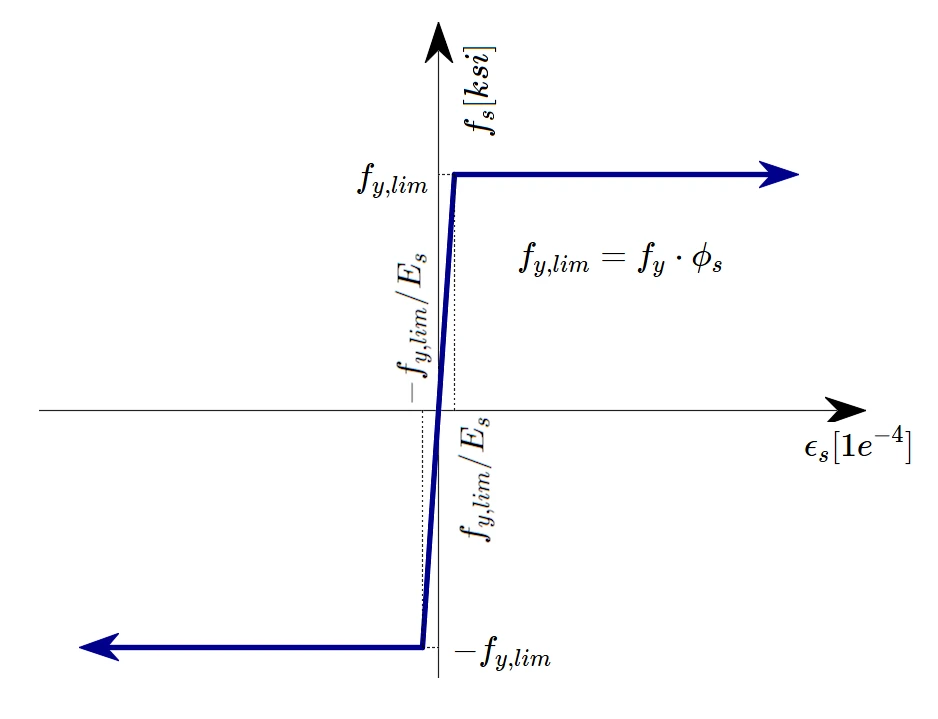
},
"regions": {
"name": "Region",
"type": "taxonomy",
"value": [
{
"name": "AMER",
"codename": "amer"
},
{
"name": "EMEA",
"codename": "emea"
},
{
"name": "APAC",
"codename": "apac"
}
],
"taxonomyGroup": "region"
},
"product_groups": {
"name": "Product group",
"type": "taxonomy",
"value": [
{
"name": "Concrete",
"codename": "concrete"
},
{
"name": "Reinforced concrete",
"codename": "reinforced_concrete"
},
{
"name": "Prestressed concrete",
"codename": "prestressed_concrete"
}
],
"taxonomyGroup": "product_group"
},
"support_center_article_types": {
"name": "Support center article",
"type": "taxonomy",
"value": [
{
"name": "Knowledge base",
"codename": "knowledgebase_article"
}
],
"taxonomyGroup": "support_center_article"
},
"expertise_levels": {
"name": "Expertise level",
"type": "taxonomy",
"value": [],
"taxonomyGroup": "expertise_level"
},
"labels": {
"name": "Labels",
"type": "taxonomy",
"value": [
{
"name": "Detail 2D",
"codename": "detail"
},
{
"name": "Cracks",
"codename": "cracks"
},
{
"name": "Reinforcement",
"codename": "reinforcement"
},
{
"name": "ACI (USA)",
"codename": "aci__usa_"
}
],
"taxonomyGroup": "labels"
},
"linked_items": {
"name": "Linked items",
"type": "modular_content",
"value": [
"theoretical_background_detail___general___verifica",
"detail_theoretical_background",
"reinforcement_template_in_idea_statica_detail",
"n2022_03_16_code_check_of_walls_and_deep_beams"
],
"linkedItems": [
{
"elements": {
"title": {
"name": "Main headline (H1)",
"type": "text",
"value": "Limit states and crack width calculation"
},
"preview_image": {
"name": "Preview image",
"type": "asset",
"value": [
{
"name": "Structural element verification in IDEA StatiCa Detail.png",
"description": "Assessment of the structure using the CSFM is performed by two different analyses: one for serviceability and one for ultimate limit state load combinations. IDEA StatiCa Detail - a structural engineering design software.",
"type": "image/png",
"size": 174643,
"url": "https://assets-us-01.kc-usercontent.com:443/28eac049-c8ed-00e2-220c-12142a968dff/3ab2c71e-930c-4975-88fe-72502fad03d5/Structural%20element%20verification%20in%20IDEA%20StatiCa%20Detail.png",
"width": 1200,
"height": 630,
"renditions": {}
}
]
},
"post_date": {
"name": "Post date",
"type": "date_time",
"value": null,
"displayTimeZone": null
},
"perex_content": {
"name": "Lead paragraph",
"type": "text",
"value": ""
},
"content": {
"images": [
{
"description": "Fig. 23\tMesh multiplier.",
"imageId": "8c27dc0f-1cfe-4026-bbf5-4b51604c3558",
"url": "https://assets-us-01.kc-usercontent.com:443/28eac049-c8ed-00e2-220c-12142a968dff/aabe4d74-d599-4c9d-a62d-8e448a66360a/Mesh%20multiplier.PNG",
"height": 55,
"width": 421
}
],
"linkedItemCodenames": [
"theoretical_background_detail___crack_width_calcul"
],
"linkedItems": [
{
"elements": {
"title": {
"name": "Main headline (H1)",
"type": "text",
"value": "Crack width calculation and Tension stiffening"
},
"preview_image": {
"name": "Preview image",
"type": "asset",
"value": [
{
"name": "Structural element verification in IDEA StatiCa Detail.png",
"description": "Assessment of the structure using the CSFM is performed by two different analyses: one for serviceability and one for ultimate limit state load combinations. IDEA StatiCa Detail - a structural engineering design software.",
"type": "image/png",
"size": 174643,
"url": "https://assets-us-01.kc-usercontent.com:443/28eac049-c8ed-00e2-220c-12142a968dff/3ab2c71e-930c-4975-88fe-72502fad03d5/Structural%20element%20verification%20in%20IDEA%20StatiCa%20Detail.png",
"width": 1200,
"height": 630,
"renditions": {}
}
]
},
"post_date": {
"name": "Post date",
"type": "date_time",
"value": null,
"displayTimeZone": null
},
"perex_content": {
"name": "Lead paragraph",
"type": "text",
"value": ""
},
"content": {
"images": [
{
"description": "Fig. 24\tCrack width calculation: (a) considered crack kinematics; (b) projection of crack kinematics into the principal directions of the reinforcing bar; (c) crack width in the direction of the reinforcing bar for stabilized cracking; (d) cases with local non-stabilized cracking regardless of the reinforcement amount; (e) crack width in the direction of the reinforcing bar for non-stabilized cracking.",
"imageId": "4a11f2de-770f-43aa-840a-4c41d9c2abf9",
"url": "https://assets-us-01.kc-usercontent.com:443/28eac049-c8ed-00e2-220c-12142a968dff/62ba3929-8689-4973-8782-fcdd0780002b/Crack%20width%20calculation.PNG",
"height": 903,
"width": 1395
},
{
"description": "Fig. 25\tDefinition of the region at concave corners in which the crack width is computed as if it were non-stabilized.",
"imageId": "cb811a73-9dfe-4b06-8a93-34019678e846",
"url": "https://assets-us-01.kc-usercontent.com:443/28eac049-c8ed-00e2-220c-12142a968dff/5a46a740-1622-47eb-b7f3-186fee0f6fbc/Concave%20corner.png",
"height": 458,
"width": 1167
},
{
"description": "Fig. 3\tTension stiffening model: (a) tension chord element for stabilized cracking with distribution of bond shear, steel and concrete stresses, and steel strains between cracks, considering average crack spacing (λ=0.67); (b) pull-out assumption for non-stabilized cracking with distribution of bond shear and steel stresses and strains around the crack; (c) resulting tension chord behavior in terms of reinforcement stresses at the cracks and average strains for European B500B steel; (d) detail of the initial branches of the tension chord response.",
"imageId": "bcb3e177-6a83-42bd-a51a-7294e4a7d6e8",
"url": "https://assets-us-01.kc-usercontent.com:443/28eac049-c8ed-00e2-220c-12142a968dff/80e8fffe-3c98-4677-af35-7c2ce025e0bb/Tension%20stiffening%20model.PNG",
"height": 823,
"width": 1361
},
{
"description": "Fig. 4\tEffective area of concrete in tension for stabilized cracking: (a) maximum concrete area that can be activated; (b) cover and global symmetry condition; (c) resultant effective area.",
"imageId": "7a370722-a56b-438d-8cf3-21d62a938811",
"url": "https://assets-us-01.kc-usercontent.com:443/28eac049-c8ed-00e2-220c-12142a968dff/2c0d58ae-1639-4b2a-a99c-a5e274a318ac/Effective%20area%20of%20concrete.png",
"height": 560,
"width": 1424
},
{
"description": null,
"imageId": "cd3ad82c-e048-4baa-abd9-c0957e0a7f4b",
"url": "https://assets-us-01.kc-usercontent.com:443/28eac049-c8ed-00e2-220c-12142a968dff/43adc17b-b9e9-4a81-ab9f-ff4c13297b34/Equation%201.2.4.2.PNG",
"height": 459,
"width": 1501
}
],
"linkedItemCodenames": [],
"linkedItems": [],
"links": [],
"name": "Content",
"type": "rich_text",
"value": "<h4>Crack width calculation</h4>\n<p>There are two ways of computing crack widths - stabilized and non-stabilized cracking. According to the geometrical reinforcement ratio in each part of the structure is decided, which type of crack calculation model will be used (TCM for stabilized cracking and POM for non-stabilized cracking model).</p>\n<figure data-asset-id=\"4a11f2de-770f-43aa-840a-4c41d9c2abf9\" data-image-id=\"4a11f2de-770f-43aa-840a-4c41d9c2abf9\"><img src=\"https://assets-us-01.kc-usercontent.com:443/28eac049-c8ed-00e2-220c-12142a968dff/62ba3929-8689-4973-8782-fcdd0780002b/Crack%20width%20calculation.PNG\" data-asset-id=\"4a11f2de-770f-43aa-840a-4c41d9c2abf9\" data-image-id=\"4a11f2de-770f-43aa-840a-4c41d9c2abf9\" alt=\"Fig. 24\tCrack width calculation: (a) considered crack kinematics; (b) projection of crack kinematics into the principal directions of the reinforcing bar; (c) crack width in the direction of the reinforcing bar for stabilized cracking; (d) cases with local non-stabilized cracking regardless of the reinforcement amount; (e) crack width in the direction of the reinforcing bar for non-stabilized cracking.\"></figure>\n<p><em>\\( \\textsf{\\textit{\\footnotesize{Fig. 20 \\qquad Crack width calculation: (a) considered crack kinematics; (b) projection of crack kinematics into the principal}}}\\) \\( \\textsf{\\textit{\\footnotesize{directions of the reinforcing bar; (c) crack width in the direction of the reinforcing bar for stabilized cracking; (d) cases with}}}\\) \\( \\textsf{\\textit{\\footnotesize{local non-stabilized cracking regardless of the reinforcement amount; (e) crack width in the direction of the reinforcing bar}}}\\)\\( \\textsf{\\textit{\\footnotesize{for non-stabilized cracking.}}}\\)</em></p>\n<p><br></p>\n<p>While the CSFM yields a direct result for most verifications (e.g., member capacity, deflections…), crack width results are calculated from the reinforcement strain results directly provided by FE analysis following the methodology described in Fig. 20. A crack kinematic without slip (pure crack opening) is considered (Fig. 20a), which is consistent with the main assumptions of the model. The principal directions of stresses and strains define the inclination of the cracks (θ<em><sub>r</sub></em> = θ<sub>s</sub>= θ<sub>e</sub>). According to (Fig. 20b), the crack width (<em>w</em>) can be projected in the direction of the reinforcing bar (<em>w</em><em><sub>b</sub></em>), leading to:</p>\n<p>\\[w = \\frac{w_b}{\\cos\\left(θ_r + θ_b - \\frac{π}{2}\\right)}\\]</p>\n<p>where θ<em><sub>b</sub></em> is the bar inclination.</p>\n<p>Please note, that the program displays values of θ<em><sub>r</sub></em> and θ<em><sub>b</sub></em> < <em>π/2</em>. It means that the previous equation works for cases, where the reinforcement and crack go through the different quadrants of the Cartesian coordinate system as shown in Fig. 20, where reinforcement goes through I. and III. quadrants and crack through II and IV. For cases where the reinforcement and crack go through the same quadrants, the equation has to be modified as follows:</p>\n<p>\\[w = \\frac{w_b}{\\cos\\left(-θ_r + θ_b + \\frac{π}{2}\\right)}\\]</p>\n<p>The component <em>w</em><em><sub>b</sub></em> is consistently calculated based on the tension stiffening models by integrating the reinforcement strains. For those regions with fully developed crack patterns, the calculated average strains (e<em><sub>m</sub></em>) along the reinforcing bars are directly integrated along the crack spacing (<em>s</em><em><sub>r</sub></em>), as indicated in (Fig. 20c). While this approach to calculating the crack directions does not correspond to the real position of the cracks, it still provides representative values that lead to crack width results that can be compared to code-required crack width values at the position of the reinforcing bar.</p>\n<p>Special situations are observed at concave corners of the calculated structure. In this case, the corner predefines the position of a single crack that behaves in a non-stabilized fashion before additional adjacent cracks develop. These additional cracks generally develop after the serviceability range (Mata-Falcón 2015), which justifies calculating the crack widths in such a region as if they were non-stabilized (Fig. 21).</p>\n<figure data-asset-id=\"cb811a73-9dfe-4b06-8a93-34019678e846\" data-image-id=\"cb811a73-9dfe-4b06-8a93-34019678e846\"><img src=\"https://assets-us-01.kc-usercontent.com:443/28eac049-c8ed-00e2-220c-12142a968dff/5a46a740-1622-47eb-b7f3-186fee0f6fbc/Concave%20corner.png\" data-asset-id=\"cb811a73-9dfe-4b06-8a93-34019678e846\" data-image-id=\"cb811a73-9dfe-4b06-8a93-34019678e846\" alt=\"Fig. 25\tDefinition of the region at concave corners in which the crack width is computed as if it were non-stabilized.\"></figure>\n<p><em>\\[ \\textsf{\\textit{\\footnotesize{Fig. 21\\qquad Definition of the region at concave corners in which the crack width is computed as if it were non-stabilized.}}}\\]</em></p>\n<h4>Tension stiffening</h4>\n<p>The implementation of tension stiffening distinguishes between cases of stabilized and non-stabilized crack patterns. In both cases, the concrete is considered fully cracked before loading by default.</p>\n<figure data-asset-id=\"bcb3e177-6a83-42bd-a51a-7294e4a7d6e8\" data-image-id=\"bcb3e177-6a83-42bd-a51a-7294e4a7d6e8\"><img src=\"https://assets-us-01.kc-usercontent.com:443/28eac049-c8ed-00e2-220c-12142a968dff/80e8fffe-3c98-4677-af35-7c2ce025e0bb/Tension%20stiffening%20model.PNG\" data-asset-id=\"bcb3e177-6a83-42bd-a51a-7294e4a7d6e8\" data-image-id=\"bcb3e177-6a83-42bd-a51a-7294e4a7d6e8\" alt=\"Fig. 3\tTension stiffening model: (a) tension chord element for stabilized cracking with distribution of bond shear, steel and concrete stresses, and steel strains between cracks, considering average crack spacing (λ=0.67); (b) pull-out assumption for non-stabilized cracking with distribution of bond shear and steel stresses and strains around the crack; (c) resulting tension chord behavior in terms of reinforcement stresses at the cracks and average strains for European B500B steel; (d) detail of the initial branches of the tension chord response.\"></figure>\n<p><em>\\( \\textsf{\\textit{\\footnotesize{Fig. 22\\qquad Tension stiffening model: (a) tension chord element for stabilized cracking with distribution of bond shear,}}}\\) </em>\\( \\textsf{\\textit{\\footnotesize{steel and concrete stresses, and steel strains between cracks, considering average crack spacing); (b) pull-out assumption}}}\\) \\( \\textsf{\\textit{\\footnotesize{for non-stabilized cracking with distribution of bond shear and steel stresses and strains around the crack; (c) resulting}}}\\) \\( \\textsf{\\textit{\\footnotesize{tension chord behavior in terms of reinforcement stresses at the cracks and average strains for European B500B steel;}}}\\) \\( \\textsf{\\textit{\\footnotesize{(d) detail of the initial branches of the tension chord response.}}}\\)</p>\n<p><br></p>\n<p><strong>Stabilized cracking</strong></p>\n<p>In fully developed crack patterns, tension stiffening is introduced using the Tension Chord Model (TCM) (Marti et al. 1998; Alvarez 1998) – Fig. 22a – which has been shown to yield excellent response predictions in spite of its simplicity (Burns 2012). The TCM assumes a stepped, rigid-perfectly plastic bond shear stress-slip relationship with τ<em><sub>b </sub></em>= τ<em><sub>b</sub></em><sub>0</sub> =2 <em>f</em><em><sub>ctm</sub></em> for σ<em><sub>s</sub></em> ≤ <em>f</em><em><sub>y</sub></em> and τ<em><sub>b</sub></em> =τ<em><sub>b</sub></em><sub>1</sub> = <em>f</em><em><sub>ctm</sub></em> for σ<em><sub>s </sub></em>> <em>f</em><em><sub>y</sub></em>. Treating every reinforcing bar as a tension chord – Fig. 22b and Fig. 22a – the distribution of bond shear, steel, and concrete stresses and hence the strain distribution between two cracks can be determined for any given value of the maximum steel stresses (or strains) at the cracks.</p>\n<p>For <em>s</em><em><sub>r</sub></em> = <em>s</em><em><sub>r</sub></em><sub>0</sub>, a new crack may or may not form because at the center between two cracks σ<em><sub>c</sub></em><sub>1</sub> = <em>f</em><em><sub>ct</sub></em>. Consequently, the crack spacing may vary by a factor of two, i.e., <em>s</em><em><sub>r</sub></em> = λ<em>s</em><em><sub>r</sub></em><sub>0</sub>, with l = 0.5…1.0. Assuming a certain value for λ, the average strain of the chord (ε<em><sub>m</sub></em>) can be expressed as a function of the maximum reinforcement stresses (i.e., stresses at the cracks, σ<em><sub>sr</sub></em>). For the idealized bilinear stress-strain diagram for the reinforcing bare bars considered by default in the CSFM, the following closed-form analytical expressions are obtained (Marti et al. 1998):</p>\n<p>\\[\\varepsilon_m = \\frac{\\sigma_{sr}}{E_s} - \\frac{\\tau_{b0}s_r}{E_s Ø}\\]</p>\n<p>\\[\\textrm{for}\\qquad\\qquad\\sigma_{sr} \\le f_y\\]</p>\n<p><br></p>\n<p>\\[{\\varepsilon_m} = \\frac{{{{\\left( {{\\sigma_{sr}} - {f_y}} \\right)}^2}Ø}}{{4{E_{sh}}{\\tau _{b1}}{s_r}}}\\left( {1 - \\frac{{{E_{sh}}{\\tau_{b0}}}}{{{E_s}{\\tau_{b1}}}}} \\right) + \\frac{{\\left( {{\\sigma_{sr}} - {f_y}} \\right)}}{{{E_s}}}\\frac{{{\\tau_{b0}}}}{{{\\tau_{b1}}}} + \\left( {{\\varepsilon_y} - \\frac{{{\\tau_{b0}}{s_r}}}{{{E_s}Ø}}} \\right)\\]</p>\n<p><em>\\[\\textrm{for}\\qquad\\qquad{f_y} \\le {\\sigma _{sr}} \\le \\left( {{f_y} + \\frac{{2{\\tau _{b1}}{s_r}}}{Ø}} \\right)\\]</em></p>\n<p><br></p>\n<p>\\[ \\varepsilon_m = \\frac{f_s}{E_s} + \\frac{\\sigma_{sr}-f_y}{E_{sh}} - \\frac{\\tau_{b1} s_r}{E_{sh} Ø}\\]</p>\n<p>\\[\\textrm{for}\\qquad\\qquad\\left(f_y + \\frac{2\\tau_{b1}s_r}{Ø}\\right) \\le \\sigma_{sr} \\le f_t\\]</p>\n<p>where:<br>\n <em>E</em><em><sub>sh</sub></em> the steel hardening modulus <em>E</em><em><sub>sh</sub></em> = (<em>f</em><em><sub>t</sub></em> – <em>f</em><em><sub>y</sub></em>)/(ε<em><sub>u</sub></em> – <em>f</em><em><sub>y</sub></em> /<em>E</em><em><sub>s</sub></em>) ,</p>\n<p><em>E</em><em><sub>s</sub></em> modulus of elasticity of reinforcement,</p>\n<p><em>Ø</em> reinforcing bar diameter,</p>\n<p>s<em><sub>r</sub></em><em><sup> </sup></em>crack spacing,</p>\n<p>σ<em><sub>sr</sub></em><em> </em>reinforcement stresses at the cracks,</p>\n<p>σ<em><sub>s</sub></em><em> </em>actual reinforcement stresses,</p>\n<p><em>f</em><em><sub>y </sub></em>yield strength of reinforcement.</p>\n<p><br></p>\n<p>The Idea StatiCa Detail implementation of the CSFM considers average crack spacing by default when performing computer-aided stress field analysis. The average crack spacing is considered to be 2/3 of the maximum crack spacing (λ = 0.67), which follows recommendations made on the basis of bending and tension tests (Broms 1965; Beeby 1979; Meier 1983). It should be noted that calculations of crack widths consider a maximum crack spacing (λ = 1.0) in order to obtain conservative values.</p>\n<p>The application of the TCM depends on the reinforcement ratio, and hence the assignment of an appropriate concrete area acting in tension between the cracks to each reinforcing bar is crucial. An automatic numerical procedure has been developed to define the corresponding effective reinforcement ratio (ρ<em><sub>eff</sub></em><em> = A</em><em><sub>s</sub></em><em>/A</em><em><sub>c,eff</sub></em>) for any configuration, including skewed reinforcement (Fig. 23).</p>\n<figure data-asset-id=\"7a370722-a56b-438d-8cf3-21d62a938811\" data-image-id=\"7a370722-a56b-438d-8cf3-21d62a938811\"><img src=\"https://assets-us-01.kc-usercontent.com:443/28eac049-c8ed-00e2-220c-12142a968dff/2c0d58ae-1639-4b2a-a99c-a5e274a318ac/Effective%20area%20of%20concrete.png\" data-asset-id=\"7a370722-a56b-438d-8cf3-21d62a938811\" data-image-id=\"7a370722-a56b-438d-8cf3-21d62a938811\" alt=\"Fig. 4\tEffective area of concrete in tension for stabilized cracking: (a) maximum concrete area that can be activated; (b) cover and global symmetry condition; (c) resultant effective area.\"></figure>\n<p><em>\\( \\textsf{\\textit{\\footnotesize{Fig. 23\\qquad Effective area of concrete in tension for stabilized cracking: (a) maximum concrete area that can be activated;}}}\\) \\( \\textsf{\\textit{\\footnotesize{(b) cover and global symmetry condition; (c) resultant effective area.}}}\\)</em></p>\n<p><br></p>\n<p><strong>Non-stabilized cracking</strong></p>\n<p>Cracks existing in regions with geometric reinforcement ratios lower than ρ<em><sub>cr</sub></em>, i.e., the minimum reinforcement amount for which the reinforcement is able to carry the cracking load without yielding, are generated by either non-mechanical actions (e.g. shrinkage) or the progression of cracks controlled by other reinforcement. The value of this minimum reinforcement is obtained as follows:</p>\n<p>\\[{\\rho _{cr}} = \\frac{{{f_{ct}}}}{{{f_y} - \\left( {n - 1} \\right){f_{ct}}}}\\]</p>\n<p>where:</p>\n<p><em>f</em><em><sub>y</sub></em> reinforcement yield strength,</p>\n<p><em>f</em><em><sub>ct</sub></em> concrete tensile strength,</p>\n<p><em>n</em> modular ratio, <em>n</em> = <em>E</em><em><sub>s</sub></em> / <em>E</em><em><sub>c</sub></em> .</p>\n<p>For conventional concrete and reinforcing steel, ρ<em><sub>cr</sub></em> amounts to approximately 0.6%.</p>\n<p>For stirrups with reinforcement ratios below ρ<em><sub>cr</sub></em>, cracking is considered to be non-stabilized and tension stiffening is implemented by means of the Pull-Out Model (POM) described in Fig. 22b. This model analyzes the behavior of a single crack considering no mechanical interaction between separate cracks, neglecting the deformability of concrete in tension and assuming the same stepped, rigid-perfectly plastic bond shear stress-slip relationship used by the TCM. This allows the reinforcement strain distribution (ε<em><sub>s</sub></em>) in the vicinity of the crack to be obtained for any maximum steel stress at the crack (σ<em><sub>sr</sub></em>) directly from equilibrium. Given the fact that the crack spacing is unknown for a non-fully developed crack pattern, the average strain (ε<em><sub>m</sub></em>) is computed for any load level over the distance between points with zero slip when the reinforcing bar reaches its tensile strength (<em>f</em><em><sub>t</sub></em>) at the crack (<em>l</em><sub>ε,</sub><em><sub>avg</sub></em> in Fig. 22b), leading to the following relationships:</p>\n<figure data-asset-id=\"cd3ad82c-e048-4baa-abd9-c0957e0a7f4b\" data-image-id=\"cd3ad82c-e048-4baa-abd9-c0957e0a7f4b\"><img src=\"https://assets-us-01.kc-usercontent.com:443/28eac049-c8ed-00e2-220c-12142a968dff/43adc17b-b9e9-4a81-ab9f-ff4c13297b34/Equation%201.2.4.2.PNG\" data-asset-id=\"cd3ad82c-e048-4baa-abd9-c0957e0a7f4b\" data-image-id=\"cd3ad82c-e048-4baa-abd9-c0957e0a7f4b\" alt=\"\"></figure>\n<p>The proposed models allow the computation of the behavior of bonded reinforcement, which is finally considered in the analysis. This behavior (including tension stiffening) for the most common European reinforcing steel (B500B, with <em>f</em><em><sub>t</sub></em> / <em>f</em><em><sub>y</sub></em> = 1.08 and ε<em><sub>u</sub></em> = 5%) is illustrated in Fig. 22c-d.</p>"
},
"regions": {
"name": "Region",
"type": "taxonomy",
"value": [
{
"name": "AMER",
"codename": "amer"
},
{
"name": "EMEA",
"codename": "emea"
},
{
"name": "APAC",
"codename": "apac"
}
],
"taxonomyGroup": "region"
},
"product_groups": {
"name": "Product group",
"type": "taxonomy",
"value": [
{
"name": "Concrete",
"codename": "concrete"
}
],
"taxonomyGroup": "product_group"
},
"support_center_article_types": {
"name": "Support center article",
"type": "taxonomy",
"value": [
{
"name": "Knowledge base",
"codename": "knowledgebase_article"
}
],
"taxonomyGroup": "support_center_article"
},
"expertise_levels": {
"name": "Expertise level",
"type": "taxonomy",
"value": [],
"taxonomyGroup": "expertise_level"
},
"labels": {
"name": "Labels",
"type": "taxonomy",
"value": [
{
"name": "Detail 2D",
"codename": "detail"
},
{
"name": "ACI (USA)",
"codename": "aci__usa_"
},
{
"name": "EN (Eurocode)",
"codename": "eurocode"
}
],
"taxonomyGroup": "labels"
},
"linked_items": {
"name": "Linked items",
"type": "modular_content",
"value": [
"theoretical_background_detail___general___finite_e",
"theoretical_background_detail___finite_element_typ",
"general_description_of_sls_results_in_detail_appli"
],
"linkedItems": [
{
"elements": {
"title": {
"name": "Main headline (H1)",
"type": "text",
"value": "Introduction to finite element implementation"
},
"preview_image": {
"name": "Preview image",
"type": "asset",
"value": [
{
"name": "Finite element implementation in IDEA StatiCa Detail.png",
"description": "Detailed description of the finite element implementation in IDEA StatiCa Detail. IDEA StatiCa Detail - a concrete design software.",
"type": "image/png",
"size": 481046,
"url": "https://assets-us-01.kc-usercontent.com:443/28eac049-c8ed-00e2-220c-12142a968dff/0388381a-906d-48f1-a5b2-ce00188fded9/Finite%20element%20implementation%20in%20IDEA%20StatiCa%20Detail.png",
"width": 1200,
"height": 630,
"renditions": {}
}
]
},
"post_date": {
"name": "Post date",
"type": "date_time",
"value": null,
"displayTimeZone": null
},
"perex_content": {
"name": "Lead paragraph",
"type": "text",
"value": ""
},
"content": {
"images": [
{
"description": "Fig. 8\t Visualization of the calculation model of a structural element (trimmed beam) in Idea StatiCa Detail.",
"imageId": "9e86fe68-36a5-433d-9451-40d2b5078b86",
"url": "https://assets-us-01.kc-usercontent.com:443/28eac049-c8ed-00e2-220c-12142a968dff/3f70008c-0c34-4dbe-8219-4d8aa7079bb5/Visualization%20of%20the%20calculation%20model.png",
"height": 562,
"width": 847
}
],
"linkedItemCodenames": [],
"linkedItems": [],
"links": [
{
"codename": "untitled_content_item_a11adc2",
"linkId": "a11adc2d-9c84-4667-8061-600660e1ad87",
"urlSlug": "concrete-walls-challenge-or-routine",
"type": "blog_post"
}
],
"name": "Content",
"type": "rich_text",
"value": "<p>The CSFM considers continuous stress fields in the concrete (2D finite elements), complemented by discrete “rod” elements representing the reinforcement (1D finite elements). Therefore, the reinforcement is not diffusely embedded into the concrete 2D finite elements but explicitly modeled and connected to them. A plane stress state is considered in the calculation model.</p>\n<figure data-asset-id=\"9e86fe68-36a5-433d-9451-40d2b5078b86\" data-image-id=\"9e86fe68-36a5-433d-9451-40d2b5078b86\"><img src=\"https://assets-us-01.kc-usercontent.com:443/28eac049-c8ed-00e2-220c-12142a968dff/3f70008c-0c34-4dbe-8219-4d8aa7079bb5/Visualization%20of%20the%20calculation%20model.png\" data-asset-id=\"9e86fe68-36a5-433d-9451-40d2b5078b86\" data-image-id=\"9e86fe68-36a5-433d-9451-40d2b5078b86\" alt=\"Fig. 8\t Visualization of the calculation model of a structural element (trimmed beam) in Idea StatiCa Detail.\"></figure>\n<p><em>\\[ \\textsf{\\textit{\\footnotesize{Fig. 6\\qquad Visualization of the calculation model of a structural element (trimmed beam) in Idea StatiCa Detail.}}}\\]</em></p>\n<p>Both entire <a data-item-id=\"a11adc2d-9c84-4667-8061-600660e1ad87\" href=\"\">walls</a> and beams, as well as details (parts) of beams (isolated discontinuity region, also called trimmed end), can be modeled. In the case of walls and entire beams, supports must be defined in such a way that an (externally) isostatic (statically determinate) or hyperstatic (statically indeterminate) structure results. The load transfer at the trimmed ends of beams is introduced by means of a special Saint-Venant transfer zone, which ensures a realistic stress distribution in the analyzed detail region.</p>"
},
"regions": {
"name": "Region",
"type": "taxonomy",
"value": [
{
"name": "AMER",
"codename": "amer"
},
{
"name": "EMEA",
"codename": "emea"
},
{
"name": "APAC",
"codename": "apac"
}
],
"taxonomyGroup": "region"
},
"product_groups": {
"name": "Product group",
"type": "taxonomy",
"value": [
{
"name": "Concrete",
"codename": "concrete"
}
],
"taxonomyGroup": "product_group"
},
"support_center_article_types": {
"name": "Support center article",
"type": "taxonomy",
"value": [
{
"name": "Knowledge base",
"codename": "knowledgebase_article"
}
],
"taxonomyGroup": "support_center_article"
},
"expertise_levels": {
"name": "Expertise level",
"type": "taxonomy",
"value": [],
"taxonomyGroup": "expertise_level"
},
"labels": {
"name": "Labels",
"type": "taxonomy",
"value": [
{
"name": "Detail 2D",
"codename": "detail"
},
{
"name": "ACI (USA)",
"codename": "aci__usa_"
},
{
"name": "EN (Eurocode)",
"codename": "eurocode"
}
],
"taxonomyGroup": "labels"
},
"linked_items": {
"name": "Linked items",
"type": "modular_content",
"value": [
"theoretical_background_detail___general___reinforc",
"theoretical_background_detail___general___verifica",
"n2017_solution_for_walls_and_details_of_concrete_st",
"fire_resistance_check_of_concrete_structures"
],
"linkedItems": [
{
"elements": {
"title": {
"name": "Main headline (H1)",
"type": "text",
"value": "Design tools for reinforcement"
},
"preview_image": {
"name": "Preview image",
"type": "asset",
"value": [
{
"name": "Reinforcement structural design.png",
"description": "IDEA StatiCa Detail theoretical background for the structural design of concrete reinforcement. IDEA StatiCa Detail - a concrete design software.",
"type": "image/png",
"size": 61765,
"url": "https://assets-us-01.kc-usercontent.com:443/28eac049-c8ed-00e2-220c-12142a968dff/8d4e1ab7-8d44-491e-873f-8ea42d620992/Reinforcement%20structural%20design.png",
"width": 1200,
"height": 630,
"renditions": {}
}
]
},
"post_date": {
"name": "Post date",
"type": "date_time",
"value": null,
"displayTimeZone": null
},
"perex_content": {
"name": "Lead paragraph",
"type": "text",
"value": ""
},
"content": {
"images": [
{
"description": "Fig. 5\tModel used to illustrate the use of the reinforcement design tools.",
"imageId": "eee2b9e4-83cd-4b9c-98e7-f575b2ff9cff",
"url": "https://assets-us-01.kc-usercontent.com:443/28eac049-c8ed-00e2-220c-12142a968dff/9b0c4840-5a55-46f3-95ba-86a9baabbf0c/Model%20used%20to%20illustrate%20the%20use%20of%20the%20reinforcement%20design%20tools.png",
"height": 603,
"width": 864
},
{
"description": "Fig. 6\tResults from the linear analysis tool for defining reinforcement layout (red: areas in compression, blue: areas in tension).",
"imageId": "f6c14a09-4d2b-40e6-ac82-5ff08c10439a",
"url": "https://assets-us-01.kc-usercontent.com:443/28eac049-c8ed-00e2-220c-12142a968dff/ea7896d1-8276-4d08-b811-066cca73b455/Results%20from%20the%20linear%20analysis%20tool.jpg",
"height": 315,
"width": 1177
},
{
"description": null,
"imageId": "f4f47d5e-3196-4a88-96ca-7162b0c8c271",
"url": "https://assets-us-01.kc-usercontent.com:443/28eac049-c8ed-00e2-220c-12142a968dff/f4d37064-76c7-4413-b1aa-87455a32852c/Results%20from%20the%20topology%20optimization%201.jpg",
"height": 320,
"width": 1179
},
{
"description": "Fig. 7\tResults from the topology optimization design tool with 20% and 40% effective volume (red: areas in compression, blue: areas in tension).",
"imageId": "7ddd1329-64ea-4a47-be5d-64994439e729",
"url": "https://assets-us-01.kc-usercontent.com:443/28eac049-c8ed-00e2-220c-12142a968dff/d81f2841-8274-414a-8f30-b55427216169/Results%20from%20the%20topology%20optimization%202.png",
"height": 315,
"width": 1179
}
],
"linkedItemCodenames": [],
"linkedItems": [],
"links": [
{
"codename": "csfm_concrete_verification",
"linkId": "42ce7f6b-6491-4224-a01e-c4c0072ed1cd",
"urlSlug": "design-your-structural-concrete-details-with-confidence",
"type": "blog_post"
},
{
"codename": "topology_optimization_for_reinforced_concrete",
"linkId": "decdf07d-a46b-5894-9a22-793436e318c7",
"urlSlug": "topology-optimization-for-reinforced-concrete",
"type": "blog_post"
}
],
"name": "Content",
"type": "rich_text",
"value": "<h3>Workflow and goals</h3>\n<p>The goal of reinforcement design tools in the <a data-item-id=\"42ce7f6b-6491-4224-a01e-c4c0072ed1cd\" href=\"\">CSFM</a> is to help designers determine the location and required amount of reinforcing bars efficiently. The following tools are available to help / guide the user in this process: linear calculation and <a data-item-id=\"decdf07d-a46b-5894-9a22-793436e318c7\" href=\"\">topology optimization</a>.</p>\n<p>Reinforcement design tools consider more simplified constitutive models than the models used for the final verification of the structure. Therefore, the definition of the reinforcement in this step should be considered a pre-design to be confirmed/refined during the final verification step. The use of the different reinforcement design tools will be depicted in the model shown in Fig. 3, which consists of one end of a simply supported beam with variable depth subjected to a uniformly distributed load.</p>\n<figure data-asset-id=\"eee2b9e4-83cd-4b9c-98e7-f575b2ff9cff\" data-image-id=\"eee2b9e4-83cd-4b9c-98e7-f575b2ff9cff\"><img src=\"https://assets-us-01.kc-usercontent.com:443/28eac049-c8ed-00e2-220c-12142a968dff/9b0c4840-5a55-46f3-95ba-86a9baabbf0c/Model%20used%20to%20illustrate%20the%20use%20of%20the%20reinforcement%20design%20tools.png\" data-asset-id=\"eee2b9e4-83cd-4b9c-98e7-f575b2ff9cff\" data-image-id=\"eee2b9e4-83cd-4b9c-98e7-f575b2ff9cff\" alt=\"Fig. 5\tModel used to illustrate the use of the reinforcement design tools.\"></figure>\n<p><em>\\[ \\textsf{\\textit{\\footnotesize{Fig. 3\\qquad Model used to illustrate the use of the reinforcement design tools.}}}\\]</em></p>\n<h3>Linear analysis</h3>\n<p>The linear analysis considers linear elastic material properties and neglects reinforcement in the concrete region. It is, therefore, a very fast calculation that provides a first insight into the locations of tension and compression areas. An example of such a calculation is shown in Fig. 4.</p>\n<figure data-asset-id=\"f6c14a09-4d2b-40e6-ac82-5ff08c10439a\" data-image-id=\"f6c14a09-4d2b-40e6-ac82-5ff08c10439a\"><img src=\"https://assets-us-01.kc-usercontent.com:443/28eac049-c8ed-00e2-220c-12142a968dff/ea7896d1-8276-4d08-b811-066cca73b455/Results%20from%20the%20linear%20analysis%20tool.jpg\" data-asset-id=\"f6c14a09-4d2b-40e6-ac82-5ff08c10439a\" data-image-id=\"f6c14a09-4d2b-40e6-ac82-5ff08c10439a\" alt=\"Fig. 6\tResults from the linear analysis tool for defining reinforcement layout (red: areas in compression, blue: areas in tension).\"></figure>\n<p><em>\\[ \\textsf{\\textit{\\footnotesize{Fig. 4\\qquad Results from the linear analysis tool for defining reinforcement layout}}}\\]</em></p>\n<p><em>\\[ \\textsf{\\textit{\\footnotesize{(red: areas in compression, blue: areas in tension).}}}\\]</em></p>\n<h3>Topology optimization</h3>\n<p>Topology optimization is a method that aims to find the optimal distribution of material in a given volume for a certain load configuration. The topology optimization implemented in <em>Idea StatiCa Detail</em> uses a linear finite element model. Each finite element may have a relative density from 0 to 100 %, representing the relative amount of material used. These element densities are the optimization parameters in the optimization problem. The resulting material distribution is considered optimal for the given set of loads if it minimizes the total strain energy of the system. By definition, the optimal distribution is also the geometry that has the largest possible stiffness for the given loads.</p>\n<p>The iterative optimization process starts with a homogeneous density distribution.<em> </em>The calculation is performed for multiple total volume fractions (20%, 40%, 60%, and 80%), which allows the user to select the most practical result. The resulting shape consists of trusses with struts and ties and represents the optimum shape for the given load cases (Fig. 5).</p>\n<figure data-asset-id=\"f4f47d5e-3196-4a88-96ca-7162b0c8c271\" data-image-id=\"f4f47d5e-3196-4a88-96ca-7162b0c8c271\"><img src=\"https://assets-us-01.kc-usercontent.com:443/28eac049-c8ed-00e2-220c-12142a968dff/f4d37064-76c7-4413-b1aa-87455a32852c/Results%20from%20the%20topology%20optimization%201.jpg\" data-asset-id=\"f4f47d5e-3196-4a88-96ca-7162b0c8c271\" data-image-id=\"f4f47d5e-3196-4a88-96ca-7162b0c8c271\" alt=\"\"></figure>\n<figure data-asset-id=\"7ddd1329-64ea-4a47-be5d-64994439e729\" data-image-id=\"7ddd1329-64ea-4a47-be5d-64994439e729\"><img src=\"https://assets-us-01.kc-usercontent.com:443/28eac049-c8ed-00e2-220c-12142a968dff/d81f2841-8274-414a-8f30-b55427216169/Results%20from%20the%20topology%20optimization%202.png\" data-asset-id=\"7ddd1329-64ea-4a47-be5d-64994439e729\" data-image-id=\"7ddd1329-64ea-4a47-be5d-64994439e729\" alt=\"Fig. 7\tResults from the topology optimization design tool with 20% and 40% effective volume (red: areas in compression, blue: areas in tension).\"></figure>\n<p><em>\\[ \\textsf{\\textit{\\footnotesize{Fig. 5\\qquad Results from the topology optimization design tool with 20\\% and 40\\% effective volume}}}\\]</em></p>\n<p><em>\\[ \\textsf{\\textit{\\footnotesize{(red: areas in compression, blue: areas in tension).}}}\\]</em></p>\n<p><br></p>"
},
"regions": {
"name": "Region",
"type": "taxonomy",
"value": [
{
"name": "AMER",
"codename": "amer"
},
{
"name": "EMEA",
"codename": "emea"
},
{
"name": "APAC",
"codename": "apac"
}
],
"taxonomyGroup": "region"
},
"product_groups": {
"name": "Product group",
"type": "taxonomy",
"value": [
{
"name": "Concrete",
"codename": "concrete"
}
],
"taxonomyGroup": "product_group"
},
"support_center_article_types": {
"name": "Support center article",
"type": "taxonomy",
"value": [
{
"name": "Knowledge base",
"codename": "knowledgebase_article"
}
],
"taxonomyGroup": "support_center_article"
},
"expertise_levels": {
"name": "Expertise level",
"type": "taxonomy",
"value": [],
"taxonomyGroup": "expertise_level"
},
"labels": {
"name": "Labels",
"type": "taxonomy",
"value": [
{
"name": "Detail 2D",
"codename": "detail"
},
{
"name": "EN (Eurocode)",
"codename": "eurocode"
},
{
"name": "Reinforcement",
"codename": "reinforcement"
},
{
"name": "ACI (USA)",
"codename": "aci__usa_"
}
],
"taxonomyGroup": "labels"
},
"linked_items": {
"name": "Linked items",
"type": "modular_content",
"value": [
"theoretical_background_detail___general",
"theoretical_background_detail___general___finite_e",
"how_to_design_rc_beams_and_their_details",
"dimenzovani_zb_konstrukci_podle_csfm"
],
"linkedItems": [
{
"elements": {
"title": {
"name": "Main headline (H1)",
"type": "text",
"value": "General introduction for the structural design of concrete details"
},
"preview_image": {
"name": "Preview image",
"type": "asset",
"value": [
{
"name": "General introduction for the structural design of concrete details.png",
"description": "DEA StatiCa Detail theoretical background for the advanced structural design of concrete details. Structural design of concrete members implementing the CSFM method. IDEA StatiCa Detail - a concrete design software.",
"type": "image/png",
"size": 151821,
"url": "https://assets-us-01.kc-usercontent.com:443/28eac049-c8ed-00e2-220c-12142a968dff/918cd80e-191a-437a-8d6a-d2f8c7f688c2/General%20introduction%20for%20the%20structural%20design%20of%20concrete%20details.png",
"width": 1200,
"height": 630,
"renditions": {}
}
]
},
"post_date": {
"name": "Post date",
"type": "date_time",
"value": null,
"displayTimeZone": null
},
"perex_content": {
"name": "Lead paragraph",
"type": "text",
"value": ""
},
"content": {
"images": [
{
"description": "Fig. 1\tDiscontinuity regions (Navrátil et al., 2017) ",
"imageId": "874c8092-fb41-44c6-804d-52727044d470",
"url": "https://assets-us-01.kc-usercontent.com:443/28eac049-c8ed-00e2-220c-12142a968dff/dc96c2fd-25aa-43fd-b6d5-556b5242b9cf/Discontinuity%20regions.png",
"height": 939,
"width": 1394
}
],
"linkedItemCodenames": [],
"linkedItems": [],
"links": [],
"name": "Content",
"type": "rich_text",
"value": "<p>The design and assessment of concrete elements are normally performed at the sectional (1D-element) or point (2D-element) level. This procedure is described in all standards for structural design, e.g., in (EN 1992-1-1 or ACI 318-19), and it is used in everyday structural engineering practice. However, it is not always known or respected that the procedure is only acceptable in areas where the Bernoulli-Navier hypothesis of plane strain distribution applies (referred to as B-regions). The places where this hypothesis does not apply are called discontinuity or disturbed regions (D-Regions). Examples of B and D regions of 1D-elements are given in (Fig. 1). These are, e.g., bearing areas, parts where concentrated loads are applied, locations where an abrupt change in the cross-section occurs, openings, etc. When designing concrete structures, we meet a lot of other D-Regions such as walls, bridge diaphragms, corbels, etc. </p>\n<figure data-asset-id=\"874c8092-fb41-44c6-804d-52727044d470\" data-image-id=\"874c8092-fb41-44c6-804d-52727044d470\"><img src=\"https://assets-us-01.kc-usercontent.com:443/28eac049-c8ed-00e2-220c-12142a968dff/dc96c2fd-25aa-43fd-b6d5-556b5242b9cf/Discontinuity%20regions.png\" data-asset-id=\"874c8092-fb41-44c6-804d-52727044d470\" data-image-id=\"874c8092-fb41-44c6-804d-52727044d470\" alt=\"Fig. 1\tDiscontinuity regions (Navrátil et al., 2017) \"></figure>\n<p><em>\\[ \\textsf{\\textit{\\footnotesize{Fig. 1\\qquad Discontinuity regions (Navrátil et al. 2017)}}}\\]</em></p>\n<p>In the past, semi-empirical design rules were used for dimensioning discontinuity regions. Fortunately, these rules have been largely superseded over the past decades by strut-and-tie models (Schlaich et al., 1987) and stress fields (Marti 1985), which are featured in current design codes and frequently used by designers today. These models are mechanically consistent and powerful tools. Note that stress fields can generally be continuous or discontinuous and that strut-and-tie models are a special case of discontinuous stress fields.</p>\n<p>Despite the evolution of computational tools over the past decades, Strut-and-Tie models are essentially still used as hand calculations. Their application for real-world structures is tedious and time-consuming since iterations are required, and several load cases need to be considered. Furthermore, this method is not suitable for verifying serviceability criteria (deformations, crack widths, etc.).</p>\n<p>The interest of structural engineers in a reliable and fast tool to design D-regions led to the decision to develop the new Compatible Stress Field Method, a method for computer-aided stress field design that allows the automatic design and assessment of structural concrete members subjected to in-plane loading.</p>\n<p>The Compatible Stress Field Method (CSFM) is a continuous FE-based stress field analysis method in which classic stress field solutions are complemented with kinematic considerations, i.e., the state of strain is evaluated throughout the structure. Hence, the effective compressive strength of concrete can be automatically computed based on the state of transverse strain in a similar manner as in compression field analyses that account for compression softening (Vecchio and Collins 1986; Kaufmann and Marti 1998) and the EPSF method (Fernández Ruiz and Muttoni 2007). Moreover, the CSFM considers tension stiffening, providing realistic stiffnesses to the elements, and covers all design code prescriptions (including serviceability and deformation capacity aspects) not consistently addressed by previous approaches. The CSFM uses common uniaxial constitutive laws provided by design standards for concrete and reinforcement. These are known at the design stage, which allows the partial safety factor method to be used. Hence, designers do not have to provide additional, often arbitrary material properties as are typically required for non-linear FE-analyses, making the method perfectly suitable for engineering practice.</p>\n<p>To foster the use of computer-aided stress fields by structural engineers, these methods should be implemented in user-friendly software environments. To this end, the CSFM has been implemented in <em>IDEA StatiCa Detail</em>; a new user-friendly commercial software developed jointly by ETH Zurich and the software company IDEA StatiCa in the framework of the DR-Design Eurostars-10571 project.</p>"
},
"regions": {
"name": "Region",
"type": "taxonomy",
"value": [
{
"name": "EMEA",
"codename": "emea"
},
{
"name": "APAC",
"codename": "apac"
}
],
"taxonomyGroup": "region"
},
"product_groups": {
"name": "Product group",
"type": "taxonomy",
"value": [
{
"name": "Concrete",
"codename": "concrete"
}
],
"taxonomyGroup": "product_group"
},
"support_center_article_types": {
"name": "Support center article",
"type": "taxonomy",
"value": [
{
"name": "Knowledge base",
"codename": "knowledgebase_article"
}
],
"taxonomyGroup": "support_center_article"
},
"expertise_levels": {
"name": "Expertise level",
"type": "taxonomy",
"value": [],
"taxonomyGroup": "expertise_level"
},
"labels": {
"name": "Labels",
"type": "taxonomy",
"value": [
{
"name": "Detail 2D",
"codename": "detail"
},
{
"name": "EN (Eurocode)",
"codename": "eurocode"
},
{
"name": "CSFM",
"codename": "csfm"
},
{
"name": "ACI (USA)",
"codename": "aci__usa_"
}
],
"taxonomyGroup": "labels"
},
"linked_items": {
"name": "Linked items",
"type": "modular_content",
"value": [
"detail_theoretical_background",
"theoretical_background_detail___general___reinforc",
"dimenzovani_zb_konstrukci_podle_csfm",
"prestressed_i_section"
],
"linkedItems": [
{
"elements": {
"title": {
"name": "Main headline (H1)",
"type": "text",
"value": "IDEA StatiCa Detail – Structural design of concrete discontinuities"
},
"preview_image": {
"name": "Preview image",
"type": "asset",
"value": [
{
"name": "Structural design of concrete members in IDEA StatiCa Detail.png",
"description": "IDEA StatiCa Detail is concrete design software for the structural design and code-check of concrete discontinuity regions. Concrete members stress analysis & concrete wall design.",
"type": "image/png",
"size": 163091,
"url": "https://assets-us-01.kc-usercontent.com:443/28eac049-c8ed-00e2-220c-12142a968dff/7885cdc1-8e4a-4744-834e-72ea84ebbaf4/Structural%20design%20of%20concrete%20members%20in%20IDEA%20StatiCa%20Detail.png",
"width": 1200,
"height": 630,
"renditions": {}
}
]
},
"post_date": {
"name": "Post date",
"type": "date_time",
"value": null,
"displayTimeZone": null
},
"perex_content": {
"name": "Lead paragraph",
"type": "text",
"value": ""
},
"content": {
"images": [],
"linkedItemCodenames": [
"n8161827f_4fd0_019b_30ec_1aacffee82a8",
"theoretical_background_detail___general",
"n387365f7_e3d9_01aa_e886_972961a26e65",
"theoretical_background_detail___main_assumptions_a",
"n0a84f631_ea9b_013c_03cc_539ce65deca6",
"theoretical_background_detail___general___reinforc",
"n89f4de7a_1d1c_0124_366a_02fface0ceb4",
"theoretical_background_detail___general___finite_e",
"e688ad2c_cf9f_01bc_f232_0e8775f4ea76",
"theoretical_background_detail___supports_and_load_",
"n7c119da7_a9d0_01c7_1ed2_863545949b9d",
"theoretical_background_detail___load_transfer_at_t",
"n91eb67de_a4e3_0116_4e1d_a5d40a51a9f5",
"theoretical_background_detail___geometric_modifica",
"n0f9ca641_709c_01f7_e9e9_8bc2ba8a3caa",
"theoretical_background_detail___finite_element_typ",
"n733ffebb_6b50_0162_851a_23e757287ac5",
"theoretical_background_detail___meshing",
"n9cb31166_8318_01ab_9863_1f3f0c142b7d",
"theoretical_background_detail___solution_method_an",
"dcdd3559_e216_01a8_796d_905a8bf8dfa4",
"theoretical_background_detail___presentation_of_re",
"n86f24311_5115_0178_6257_893251992815",
"theoretical_background_detail___general___verifica",
"n14632137_15ba_01af_c5f2_f8806b7af7d5",
"theoretical_background_detail___material_models__e",
"n2a996bb1_7427_0141_697a_2f4649d9bbbc",
"theoretical_background_detail___safety_factors",
"n7d7fbadc_7f26_0159_2acd_a508ea63d72e",
"theoretical_background_detail___ultimate_limit_sta",
"ff6e634b_31f7_01aa_ae97_3cc277823534",
"theoretical_background_detail___partially_loaded_a",
"d1ef4528_2e76_010d_453d_fb29f1bbf92c",
"theoretical_background_detail___serviceability_lim",
"n290d9d15_842c_016f_16ed_e82b056aedaa",
"theoretical_background_detail___material_models__a",
"n8db66791_e455_015f_0225_68cb060469a3",
"theoretical_background_detail___factors___aci",
"n5518b5db_9a75_0114_3040_d88e8b8b7a97",
"theoretical_background_detail___strength_analysis_",
"n6f82b2c2_dd71_0110_ff39_352e28b1afb8",
"theoretical_background_detail___bearing_and_anchor",
"n9a0db098_ea3e_012f_f7c6_b8b8582f3e9a",
"theoretical_background_detail___serviceability_ver",
"n93622323_5a16_0121_3cab_de1e1f0fd677",
"theoretical_background_detail___material_models__a_b7035a6",
"n126c047e_65e6_0169_94ce_c74e41c5ca7c",
"theoretical_background_detail___stress_reduction_a",
"abcd9332_ed6f_0156_c6e9_2b18784bffe3",
"theoretical_background_detail___strength_analysis__8bc3bfe",
"ff7c0163_1239_012b_43da_91da8d3dfbcd",
"theoretical_background_detail___serviceability_ver_77b5f2c",
"c1b068bd_e046_0151_e774_bd083e4cceca",
"prestressing_in_detail___model_description__body_",
"e7385921_c260_01af_098b_dcd12e427a3a"
],
"linkedItems": [
{
"elements": {
"title": {
"name": "Title",
"type": "text",
"value": "General introduction"
},
"id": {
"name": "ID",
"type": "text",
"value": "general-introduction"
},
"printable_anchor": {
"name": "Printable anchor used in PDF content table",
"type": "multiple_choice",
"value": []
},
"translation__translation_connector": {
"name": "Translation Connector",
"type": "taxonomy",
"value": [],
"taxonomyGroup": "languages"
},
"translation__force_translation": {
"name": "Force translation",
"type": "multiple_choice",
"value": []
},
"translation__last_translation": {
"images": [],
"linkedItemCodenames": [],
"linkedItems": [],
"links": [],
"name": "Last translation",
"type": "rich_text",
"value": "<p><br></p>"
},
"translation__ai_translated": {
"name": "AI translated",
"type": "multiple_choice",
"value": []
}
},
"system": {
"codename": "n8161827f_4fd0_019b_30ec_1aacffee82a8",
"collection": "default",
"id": "8161827f-4fd0-019b-30ec-1aacffee82a8",
"language": "en-US",
"lastModified": "2025-04-24T07:34:50.0181083Z",
"name": "8161827f-4fd0-019b-30ec-1aacffee82a8",
"sitemapLocations": [],
"type": "widget_anchor_target",
"workflowStep": null,
"workflow": null
}
},
"[Circular Reference]",
{
"elements": {
"title": {
"name": "Title",
"type": "text",
"value": "Main assumptions and limitations"
},
"id": {
"name": "ID",
"type": "text",
"value": "main-assumptions-and-limitations"
},
"printable_anchor": {
"name": "Printable anchor used in PDF content table",
"type": "multiple_choice",
"value": []
},
"translation__translation_connector": {
"name": "Translation Connector",
"type": "taxonomy",
"value": [],
"taxonomyGroup": "languages"
},
"translation__force_translation": {
"name": "Force translation",
"type": "multiple_choice",
"value": []
},
"translation__last_translation": {
"images": [],
"linkedItemCodenames": [],
"linkedItems": [],
"links": [],
"name": "Last translation",
"type": "rich_text",
"value": "<p><br></p>"
},
"translation__ai_translated": {
"name": "AI translated",
"type": "multiple_choice",
"value": []
}
},
"system": {
"codename": "n387365f7_e3d9_01aa_e886_972961a26e65",
"collection": "default",
"id": "387365f7-e3d9-01aa-e886-972961a26e65",
"language": "en-US",
"lastModified": "2025-04-24T07:34:50.0181083Z",
"name": "387365f7-e3d9-01aa-e886-972961a26e65",
"sitemapLocations": [],
"type": "widget_anchor_target",
"workflowStep": null,
"workflow": null
}
},
{
"elements": {
"title": {
"name": "Main headline (H1)",
"type": "text",
"value": "Main assumptions and limitations for CSFM in 2D"
},
"preview_image": {
"name": "Preview image",
"type": "asset",
"value": [
{
"name": "Fig. 2 - Basic assumptions of CSFM.png",
"description": "Basic assumptions of Compatible stress field method (CSFM)",
"type": "image/png",
"size": 187222,
"url": "https://assets-us-01.kc-usercontent.com:443/28eac049-c8ed-00e2-220c-12142a968dff/70d687dc-a209-4d67-aeb9-c0bdabacd5c1/Fig.%202%20-%20Basic%20assumptions%20of%20CSFM.png",
"width": 1343,
"height": 824,
"renditions": {}
}
]
},
"post_date": {
"name": "Post date",
"type": "date_time",
"value": null,
"displayTimeZone": null
},
"perex_content": {
"name": "Lead paragraph",
"type": "text",
"value": ""
},
"content": {
"images": [
{
"description": "Basic assumptions of Compatible stress field method (CSFM)",
"imageId": "a5b4f7ac-3fc1-4050-9269-afdb9901a92e",
"url": "https://assets-us-01.kc-usercontent.com:443/28eac049-c8ed-00e2-220c-12142a968dff/70d687dc-a209-4d67-aeb9-c0bdabacd5c1/Fig.%202%20-%20Basic%20assumptions%20of%20CSFM.png",
"height": 824,
"width": 1343
}
],
"linkedItemCodenames": [],
"linkedItems": [],
"links": [
{
"codename": "concrete",
"linkId": "b4790cf9-a605-45b3-b41b-e36909ad4291",
"urlSlug": "concrete",
"type": "landing_page"
}
],
"name": "Content",
"type": "rich_text",
"value": "<p><strong>CSFM considers maximum principal concrete stress in compression (σ</strong><em><strong><sub>c</sub></strong></em><strong><sub>2</sub></strong><em><strong><sub>r</sub></strong></em><strong>) and reinforcement stresses (σ</strong><em><strong><sub>sr</sub></strong></em><strong>) at the cracks while neglecting the concrete tensile strength (σ</strong><em><strong><sub>c</sub></strong></em><strong><sub>1</sub></strong><em><strong><sub>r</sub></strong></em><strong> = 0), except for its stiffening effect on the reinforcement.</strong> The consideration of tension stiffening allows the average reinforcement strains (ε<em><sub>m</sub></em>) to be simulated. Fictitious, rotating, stress-free cracks that open without slip (Fig. 2a) are considered and the equilibrium at the cracks together with the average strains of the reinforcement is also taken into account. </p>\n<figure data-asset-id=\"a5b4f7ac-3fc1-4050-9269-afdb9901a92e\" data-image-id=\"a5b4f7ac-3fc1-4050-9269-afdb9901a92e\"><img src=\"https://assets-us-01.kc-usercontent.com:443/28eac049-c8ed-00e2-220c-12142a968dff/70d687dc-a209-4d67-aeb9-c0bdabacd5c1/Fig.%202%20-%20Basic%20assumptions%20of%20CSFM.png\" data-asset-id=\"a5b4f7ac-3fc1-4050-9269-afdb9901a92e\" data-image-id=\"a5b4f7ac-3fc1-4050-9269-afdb9901a92e\" alt=\"Basic assumptions of Compatible stress field method (CSFM)\"></figure>\n<p><em>\\( \\textsf{\\textit{\\footnotesize{Fig. 2\\qquad Basic assumptions of the CSFM: (a) principal stresses in concrete; (b) stresses in the reinforcement direction;}}}\\) \\( \\textsf{\\textit{\\footnotesize{(c) stress-strain diagram of concrete in terms of maximum stresses with consideration of compression softening;}}}\\) \\( \\textsf{\\textit{\\footnotesize{(d) stress-strain diagram of reinforcement in terms of stresses at cracks and average strains; (e) compression softening}}}\\) \\( \\textsf{\\textit{\\footnotesize{law; (f) bond shear stress-slip relationship for anchorage length verifications.}}}\\)</em></p>\n<p><br></p>\n<p>Despite their simplicity, similar assumptions have been demonstrated to yield accurate predictions for reinforced members subjected to in-plane loading (Kaufmann 1998; Kaufmann and Marti 1998) if the provided reinforcement avoids brittle failures at cracking. Furthermore, the non-consideration of any contribution of the tensile strength of concrete to the ultimate load is consistent with the principles of modern design codes, which are mostly based on plasticity theory.</p>\n<p>However, <strong>the CSFM is not suited for slender elements</strong> without transverse reinforcement since relevant mechanisms for such elements as aggregate interlock, residual tensile stresses at the crack tip, and dowel action – all of them relying directly or indirectly on the tensile strength of the concrete – are disregarded. While some design standards allow the design of such elements based on semi-empirical provisions, the CSFM is not intended for this type of potentially brittle structure.</p>\n<h4>Concrete</h4>\n<p>The concrete model implemented in the CSFM is based on the uniaxial compression constitutive laws prescribed by design codes for the design of cross-sections, which only depend on compressive strength. The parabola-rectangle diagram (Fig. 2c) is used by default in the CSFM, but designers can also choose a more simplified elastic ideal plastic relationship. When assessing according to the ACI code, it is possible to use only the parabola-rectangle stress-strain diagram. As previously mentioned, the tensile strength is neglected, as it is in classic reinforced concrete design.</p>\n<p>The effective compressive strength is automatically evaluated for cracked concrete based on the principal tensile strain (ε<sub>1</sub>) by means of the <em>k</em><em><sub>c</sub></em><sub>2</sub> reduction factor, as shown in Fig. 2c and e. The implemented reduction relationship (Fig. 2e) is a generalization of the <em>fib</em> Model Code 2010 proposal for shear verifications, which contains a limiting value of 0.65 for the maximum ratio of effective concrete strength to concrete compressive strength, which is not applicable to other loading cases.</p>\n<p>The CSFM in <a data-item-id=\"b4790cf9-a605-45b3-b41b-e36909ad4291\" href=\"\"><em>IDEA StatiCa Detail</em></a> does not consider an explicit failure criterion in terms of strains for concrete in compression (i.e., it considers an infinitely plastic branch after the peak stress is reached). This simplification does not allow the deformation capacity of structures failing in compression to be verified. However, their ultimate capacity is properly predicted when, in addition to the factor of cracked concrete (<em>k</em><em><sub>c</sub></em><sub>2</sub>) defined in (Fig. 2e), the increase in the brittleness of concrete as its strength rises is considered by means of the <em>\\( \\eta_{fc} \\)</em> reduction factor defined in <em>fib</em> Model Code 2010 as follows:</p>\n<p>\\[f_{c,red} = k_c \\cdot f_{c} = \\eta _{fc} \\cdot k_{c2} \\cdot f_{c}\\]</p>\n<p>\\[{\\eta _{fc}} = {\\left( {\\frac{{30}}{{{f_{c}}}}} \\right)^{\\frac{1}{3}}} \\le 1\\]</p>\n<p>where:</p>\n<p><em>k</em><em><sub>c </sub></em>is the global reduction factor of the compressive strength</p>\n<p><em>k</em><em><sub>c</sub></em><sub>2</sub> is the reduction factor due to the presence of transverse cracking</p>\n<p><em>f</em><em><sub>c</sub></em> is the concrete cylinder characteristic strength (in MPa for the definition of <em>\\( \\eta_{fc} \\)</em>).</p>\n<p>There is also a reduction of the<em> k</em><em><sub>c</sub></em><sub>2</sub> factor because of the stability of the calculation. This reduction doesn't influence the total strength of members. Assuming <em>f</em><em><sub>cd</sub></em> value as the factored strength of concrete (design value), the <em>k</em><em><sub>c</sub></em><sub>2</sub> value is reduced according to the following rules.</p>\n<p>σ<em><sub>c</sub></em><sub>2</sub><em><sub>r</sub></em><em> < 0.11f</em><em><sub>cd</sub></em><em> k</em><em><sub>c</sub></em><sub>2</sub><em>=1.0<br>\n0.11f</em><em><sub>cd</sub></em><em> < </em>σ<em><sub>c</sub></em><sub>2</sub><em><sub>r</sub></em><em> < 0.37f</em><em><sub>cd</sub></em><em> k</em><em><sub>c</sub></em><sub>2</sub><em> </em>is a linear interpolation between 1.0 and the value taken from the<br>\n graph displayed in Fig. 2f<em><br>\n</em>σ<em><sub>c</sub></em><sub>2</sub><em><sub>r</sub></em><em> > 0.37f</em><em><sub>cd</sub></em><em> k</em><em><sub>c</sub></em><sub>2</sub><em> </em>is directly taken from the graph from Fig. 2f</p>\n<h4>Reinforcement</h4>\n<p>The idealized bilinear stress-strain diagram for the bare reinforcing bars typically defined by design codes (Fig. 2d) is considered. The definition of this diagram only requires the basic properties of the reinforcement to be known during the design phase (strength and ductility class). A user-defined stress-strain relationship can also be defined.</p>\n<p>Tension stiffening is accounted for by modifying the input stress-strain relationship of the bare reinforcing bar in order to capture the average stiffness of the bars embedded in the concrete (ε<em><sub>m</sub></em>).</p>\n<h4>Bond model</h4>\n<p>Bond-slip between reinforcement and concrete is introduced in the finite element model by considering the simplified rigid-perfectly plastic constitutive relationship presented in Fig. 2f, with <em>f</em><em><sub>bd</sub></em> being the design value (factored value) of the ultimate bond stress specified by the design code for the specific bond conditions.</p>\n<p>This is a simplified model with the sole purpose of verifying bond prescriptions according to design codes (i.e., anchorage of reinforcement). The reduction of the anchorage length when using hooks, loops, and similar bar shapes can be considered by defining a certain capacity at the end of the reinforcement, as will be described further. </p>"
},
"regions": {
"name": "Region",
"type": "taxonomy",
"value": [
{
"name": "AMER",
"codename": "amer"
},
{
"name": "EMEA",
"codename": "emea"
},
{
"name": "APAC",
"codename": "apac"
}
],
"taxonomyGroup": "region"
},
"product_groups": {
"name": "Product group",
"type": "taxonomy",
"value": [
{
"name": "Concrete",
"codename": "concrete"
}
],
"taxonomyGroup": "product_group"
},
"support_center_article_types": {
"name": "Support center article",
"type": "taxonomy",
"value": [
{
"name": "Knowledge base",
"codename": "knowledgebase_article"
}
],
"taxonomyGroup": "support_center_article"
},
"expertise_levels": {
"name": "Expertise level",
"type": "taxonomy",
"value": [],
"taxonomyGroup": "expertise_level"
},
"labels": {
"name": "Labels",
"type": "taxonomy",
"value": [
{
"name": "Detail 2D",
"codename": "detail"
},
{
"name": "EN (Eurocode)",
"codename": "eurocode"
},
{
"name": "CSFM",
"codename": "csfm"
},
{
"name": "ACI (USA)",
"codename": "aci__usa_"
}
],
"taxonomyGroup": "labels"
},
"linked_items": {
"name": "Linked items",
"type": "modular_content",
"value": [
"detail_theoretical_background",
"theoretical_background_detail___general___reinforc",
"dimenzovani_zb_konstrukci_podle_csfm",
"prestressed_i_section"
],
"linkedItems": [
"[Circular Reference]",
"[Circular Reference]"
]
},
"attachments__files": {
"name": "Attachments",
"type": "asset",
"value": []
},
"content_priority__value": {
"name": "Content priority value",
"type": "number",
"value": 7300
},
"options": {
"name": "Options",
"type": "multiple_choice",
"value": []
},
"url_slug": {
"name": "Url slug",
"type": "url_slug",
"value": "main-assumptions-and-limitations-for-csfm"
},
"unique_url_slug": {
"name": "Unique URL slug",
"type": "custom",
"value": "[\"main-assumptions-and-limitations-for-csfm\",\"[autogenerated]\"]"
},
"content_settings__sitemap": {
"name": "Show in sitemap",
"type": "multiple_choice",
"value": []
},
"content_settings__robots": {
"name": "Search engine indexing",
"type": "multiple_choice",
"value": []
},
"content_settings__is_hidden": {
"name": "Hidden nested content",
"type": "multiple_choice",
"value": []
},
"metadata__page_title": {
"name": "Page title",
"type": "text",
"value": ""
},
"metadata__page_description": {
"name": "Page description",
"type": "text",
"value": ""
},
"metadata__page_keywords": {
"name": "Page keywords",
"type": "text",
"value": ""
},
"metadata__canonical_url": {
"name": "Canonical URL",
"type": "text",
"value": ""
},
"metadata__og_title": {
"name": "OG:title",
"type": "text",
"value": ""
},
"metadata__og_description": {
"name": "OG:description",
"type": "text",
"value": ""
},
"metadata__og_image": {
"name": "OG:image",
"type": "asset",
"value": []
},
"translation__translation_connector": {
"name": "Translation Connector",
"type": "taxonomy",
"value": [],
"taxonomyGroup": "languages"
},
"translation__force_translation": {
"name": "Force translation",
"type": "multiple_choice",
"value": []
},
"translation__last_translation": {
"images": [],
"linkedItemCodenames": [],
"linkedItems": [],
"links": [],
"name": "Last translation",
"type": "rich_text",
"value": "<p><br></p>"
},
"translation__ai_translated": {
"name": "AI translated",
"type": "multiple_choice",
"value": []
},
"page_tree_settings__page_label": {
"name": "Page label",
"type": "text",
"value": ""
},
"page_tree_settings__path_segment": {
"name": "Path segment",
"type": "text",
"value": ""
},
"page_tree_settings__breadcrumb_style": {
"name": "Breadcrumb style",
"type": "multiple_choice",
"value": []
},
"page_tree_settings__hide_in_breadcrumbs": {
"name": "Hide in breadcrumbs",
"type": "multiple_choice",
"value": []
}
},
"system": {
"codename": "theoretical_background_detail___main_assumptions_a",
"collection": "default",
"id": "2ebdaf9c-827f-4fd6-9f82-28bc96970a64",
"language": "en-US",
"lastModified": "2026-02-06T10:33:43.9998346Z",
"name": "Theoretical background Detail - Main assumptions and limitations",
"sitemapLocations": [],
"type": "support_center_article",
"workflowStep": "published",
"workflow": "default"
}
},
{
"elements": {
"title": {
"name": "Title",
"type": "text",
"value": "Design tools for reinforcement"
},
"id": {
"name": "ID",
"type": "text",
"value": "design-tools-for-reinforcement"
},
"printable_anchor": {
"name": "Printable anchor used in PDF content table",
"type": "multiple_choice",
"value": []
},
"translation__translation_connector": {
"name": "Translation Connector",
"type": "taxonomy",
"value": [],
"taxonomyGroup": "languages"
},
"translation__force_translation": {
"name": "Force translation",
"type": "multiple_choice",
"value": []
},
"translation__last_translation": {
"images": [],
"linkedItemCodenames": [],
"linkedItems": [],
"links": [],
"name": "Last translation",
"type": "rich_text",
"value": "<p><br></p>"
},
"translation__ai_translated": {
"name": "AI translated",
"type": "multiple_choice",
"value": []
}
},
"system": {
"codename": "n0a84f631_ea9b_013c_03cc_539ce65deca6",
"collection": "default",
"id": "0a84f631-ea9b-013c-03cc-539ce65deca6",
"language": "en-US",
"lastModified": "2025-04-24T07:34:50.0181083Z",
"name": "0a84f631-ea9b-013c-03cc-539ce65deca6",
"sitemapLocations": [],
"type": "widget_anchor_target",
"workflowStep": null,
"workflow": null
}
},
"[Circular Reference]",
{
"elements": {
"title": {
"name": "Title",
"type": "text",
"value": "Introduction to finite element implementation"
},
"id": {
"name": "ID",
"type": "text",
"value": "introduction-to-finite-element-implementation"
},
"printable_anchor": {
"name": "Printable anchor used in PDF content table",
"type": "multiple_choice",
"value": []
},
"translation__translation_connector": {
"name": "Translation Connector",
"type": "taxonomy",
"value": [],
"taxonomyGroup": "languages"
},
"translation__force_translation": {
"name": "Force translation",
"type": "multiple_choice",
"value": []
},
"translation__last_translation": {
"images": [],
"linkedItemCodenames": [],
"linkedItems": [],
"links": [],
"name": "Last translation",
"type": "rich_text",
"value": "<p><br></p>"
},
"translation__ai_translated": {
"name": "AI translated",
"type": "multiple_choice",
"value": []
}
},
"system": {
"codename": "n89f4de7a_1d1c_0124_366a_02fface0ceb4",
"collection": "default",
"id": "89f4de7a-1d1c-0124-366a-02fface0ceb4",
"language": "en-US",
"lastModified": "2025-04-24T07:34:50.0181083Z",
"name": "89f4de7a-1d1c-0124-366a-02fface0ceb4",
"sitemapLocations": [],
"type": "widget_anchor_target",
"workflowStep": null,
"workflow": null
}
},
"[Circular Reference]",
{
"elements": {
"title": {
"name": "Title",
"type": "text",
"value": "Supports and load transmitting components"
},
"id": {
"name": "ID",
"type": "text",
"value": "supports-and-load-transmitting-components"
},
"printable_anchor": {
"name": "Printable anchor used in PDF content table",
"type": "multiple_choice",
"value": []
},
"translation__translation_connector": {
"name": "Translation Connector",
"type": "taxonomy",
"value": [],
"taxonomyGroup": "languages"
},
"translation__force_translation": {
"name": "Force translation",
"type": "multiple_choice",
"value": []
},
"translation__last_translation": {
"images": [],
"linkedItemCodenames": [],
"linkedItems": [],
"links": [],
"name": "Last translation",
"type": "rich_text",
"value": "<p><br></p>"
},
"translation__ai_translated": {
"name": "AI translated",
"type": "multiple_choice",
"value": []
}
},
"system": {
"codename": "e688ad2c_cf9f_01bc_f232_0e8775f4ea76",
"collection": "default",
"id": "e688ad2c-cf9f-01bc-f232-0e8775f4ea76",
"language": "en-US",
"lastModified": "2025-04-24T07:34:50.0181083Z",
"name": "e688ad2c-cf9f-01bc-f232-0e8775f4ea76",
"sitemapLocations": [],
"type": "widget_anchor_target",
"workflowStep": null,
"workflow": null
}
},
{
"elements": {
"title": {
"name": "Main headline (H1)",
"type": "text",
"value": "Supports and load transmitting components"
},
"preview_image": {
"name": "Preview image",
"type": "asset",
"value": [
{
"name": "supports and load transmitting components.png",
"description": null,
"type": "image/png",
"size": 61630,
"url": "https://assets-us-01.kc-usercontent.com:443/28eac049-c8ed-00e2-220c-12142a968dff/5a3640a9-3cfd-49bc-a306-ef899e97e9a7/supports%20and%20load%20transmitting%20components.png",
"width": 1230,
"height": 630,
"renditions": {}
}
]
},
"post_date": {
"name": "Post date",
"type": "date_time",
"value": null,
"displayTimeZone": null
},
"perex_content": {
"name": "Lead paragraph",
"type": "text",
"value": ""
},
"content": {
"images": [
{
"description": "Fig. 9\t Various types of supports: (a) point distributed; (b) bearing plate; (c) line support; (d) patch support; (e) hanging.",
"imageId": "168a03f0-9bf7-4893-87d9-9744163d0453",
"url": "https://assets-us-01.kc-usercontent.com:443/28eac049-c8ed-00e2-220c-12142a968dff/e51c52f3-be54-4b55-bb4d-c4089b8239a5/Supports.png",
"height": 119,
"width": 606
},
{
"description": "Fig. 10\t Various types of load transfer components: (a) bearing plate; (b) patch load; (c) hanging; (d) partially loaded area.",
"imageId": "d0cdeffe-373f-419a-8e49-d714b8494a68",
"url": "https://assets-us-01.kc-usercontent.com:443/28eac049-c8ed-00e2-220c-12142a968dff/069fe6fe-74e0-41a9-90ba-1aeeede8a0fb/Load%20transmitting%20devices.png",
"height": 129,
"width": 557
},
{
"description": "Fig. 11\t Patch load: (a) load application; (b) load transferred through reinforcement; (c) load transferred through concrete.",
"imageId": "04324fc6-7d2d-43a7-9248-3056e9bcc513",
"url": "https://assets-us-01.kc-usercontent.com:443/28eac049-c8ed-00e2-220c-12142a968dff/38d4656d-6c90-445a-858b-cd97d4b29730/Patch%20support.png",
"height": 434,
"width": 1311
}
],
"linkedItemCodenames": [],
"linkedItems": [],
"links": [
{
"codename": "types_of_supports_in_idea_statica_detail__csfm_",
"linkId": "5a121972-f384-4f14-8788-9da298e1aae1",
"urlSlug": "types-of-supports-in-idea-statica-detail",
"type": "support_center_article"
}
],
"name": "Content",
"type": "rich_text",
"value": "<p>To model most of the situations during the construction process, many types of supports (Fig. 7) and components used for transferring load (Fig. 8) are available in the CSFM.</p>\n<h3>Supports</h3>\n<p>Point support can be modeled in several ways to ensure that stresses are not localized in one point but rather distributed over a larger area. The first option is a distributed point support (Fig. 7a), which uniformly distributes the load on the edge of the member over the specified width.</p>\n<figure data-asset-id=\"168a03f0-9bf7-4893-87d9-9744163d0453\" data-image-id=\"168a03f0-9bf7-4893-87d9-9744163d0453\"><img src=\"https://assets-us-01.kc-usercontent.com:443/28eac049-c8ed-00e2-220c-12142a968dff/e51c52f3-be54-4b55-bb4d-c4089b8239a5/Supports.png\" data-asset-id=\"168a03f0-9bf7-4893-87d9-9744163d0453\" data-image-id=\"168a03f0-9bf7-4893-87d9-9744163d0453\" alt=\"Fig. 9\t Various types of supports: (a) point distributed; (b) bearing plate; (c) line support; (d) patch support; (e) hanging.\"></figure>\n<p><em>\\[ \\textsf{\\textit{\\footnotesize{Fig. 7\\qquad Various types of supports:}}}\\]</em></p>\n<p><em>\\[ \\textsf{\\textit{\\footnotesize{(a) point distributed; (b) bearing plate; (c) line support; (d) patch support; (e) hanging.}}}\\]</em></p>\n<p>Patch support (Fig. 7d), on the other hand, can only be placed inside a volume of concrete with a defined effective radius. It is then connected by rigid elements to the nodes of the reinforcement mesh within this radius. Therefore, it is required to define a reinforcing cage around patch support.</p>\n<p>For the more precise modeling of some real scenarios, there are two other options for point support. Firstly, there is point support with a bearing plate of defined width and thickness (Fig. 7b). The material of the bearing plate can be specified, and the whole bearing plate is meshed independently. Secondly, there is hanging support available (Fig. 7e), which can be used for modeling lifting anchors or lifting studs.</p>\n<p>Line support (Fig. 7c) can be defined on an edge (by specifying its length) or inside an element (by a polyline). It is also possible to specify its stiffness and/or non-linear behavior (support in compression/tension or only in compression).</p>\n<ul>\n <li>Read detailed descriptions in<strong> </strong><a data-item-id=\"5a121972-f384-4f14-8788-9da298e1aae1\" href=\"\"><strong>Types of supports in IDEA StatiCa Detail</strong></a></li>\n</ul>\n<h3>Load transmitting components</h3>\n<p>The introduction of loads into the structure can also be modeled in several ways. For point loads, a bearing plate (Fig. 8a) can be used similarly as point support, distributing the concentrated load onto a larger area thanks to a steel plate with defined width and thickness. </p>\n<figure data-asset-id=\"d0cdeffe-373f-419a-8e49-d714b8494a68\" data-image-id=\"d0cdeffe-373f-419a-8e49-d714b8494a68\"><img src=\"https://assets-us-01.kc-usercontent.com:443/28eac049-c8ed-00e2-220c-12142a968dff/069fe6fe-74e0-41a9-90ba-1aeeede8a0fb/Load%20transmitting%20devices.png\" data-asset-id=\"d0cdeffe-373f-419a-8e49-d714b8494a68\" data-image-id=\"d0cdeffe-373f-419a-8e49-d714b8494a68\" alt=\"Fig. 10\t Various types of load transfer components: (a) bearing plate; (b) patch load; (c) hanging; (d) partially loaded area.\"></figure>\n<p><em>\\[ \\textsf{\\textit{\\footnotesize{Fig. 8\\qquad Various types of load transfer components:}}}\\]</em></p>\n<p><em>\\[ \\textsf{\\textit{\\footnotesize{(a) bearing plate; (b) patch load; (c) hanging; (d) partially loaded area.}}}\\]</em></p>\n<p>The point load can be applied either directly to the surface of the structure with a defined radius of action (load is applied to the concrete elements) or via a special transmitting device called patch load (Fig. 8b and Fig. 9). Patch load allows transmitting the load directly to the defined reinforcement located within the area of the effective radius. To secure the correct functionality of the patch load, a group of rebars that will be interconnected with the load is necessary to define (in the reinforcement properties). When the interconnected reinforcement is not defined, the load transfer mechanism is the same as for the point load placed on a member surface, and the load is transferred by the constraints to the concrete elements, not directly to the reinforcement. </p>\n<figure data-asset-id=\"04324fc6-7d2d-43a7-9248-3056e9bcc513\" data-image-id=\"04324fc6-7d2d-43a7-9248-3056e9bcc513\"><img src=\"https://assets-us-01.kc-usercontent.com:443/28eac049-c8ed-00e2-220c-12142a968dff/38d4656d-6c90-445a-858b-cd97d4b29730/Patch%20support.png\" data-asset-id=\"04324fc6-7d2d-43a7-9248-3056e9bcc513\" data-image-id=\"04324fc6-7d2d-43a7-9248-3056e9bcc513\" alt=\"Fig. 11\t Patch load: (a) load application; (b) load transferred through reinforcement; (c) load transferred through concrete.\"></figure>\n<p><em>\\[ \\textsf{\\textit{\\footnotesize{Fig. 9\\qquad Patch load: (a) load application; (b) load transferred through rebars (a group of bars for the load transfer is defined);}}}\\]</em></p>\n<p><em>\\[ \\textsf{\\textit{\\footnotesize{(c) load transferred through concrete (a group of bars for the load transfer is not defined).}}}\\]</em></p>\n<p>Lifting anchors or lifting studs can be modeled by a hanging load (Fig. 8c). User can use a partially loaded area (Fig. 8d), which allows for increasing the load-bearing capacity of concrete in compression according to Eurocode (it is not possible to use this type of load transmitting component when ACI is set). The structure can also be loaded with line loads on the edges, by general polyline, or by surface loads. The Detail application is able to automatically consider a self-weight in the analysis.</p>\n<p><br></p>"
},
"regions": {
"name": "Region",
"type": "taxonomy",
"value": [
{
"name": "AMER",
"codename": "amer"
},
{
"name": "EMEA",
"codename": "emea"
},
{
"name": "APAC",
"codename": "apac"
}
],
"taxonomyGroup": "region"
},
"product_groups": {
"name": "Product group",
"type": "taxonomy",
"value": [
{
"name": "Concrete",
"codename": "concrete"
}
],
"taxonomyGroup": "product_group"
},
"support_center_article_types": {
"name": "Support center article",
"type": "taxonomy",
"value": [
{
"name": "Knowledge base",
"codename": "knowledgebase_article"
}
],
"taxonomyGroup": "support_center_article"
},
"expertise_levels": {
"name": "Expertise level",
"type": "taxonomy",
"value": [],
"taxonomyGroup": "expertise_level"
},
"labels": {
"name": "Labels",
"type": "taxonomy",
"value": [
{
"name": "Detail 2D",
"codename": "detail"
},
{
"name": "EN (Eurocode)",
"codename": "eurocode"
}
],
"taxonomyGroup": "labels"
},
"linked_items": {
"name": "Linked items",
"type": "modular_content",
"value": [
"theoretical_background_detail___general___reinforc",
"theoretical_background_detail___general___verifica",
"n2017_solution_for_walls_and_details_of_concrete_st",
"fire_resistance_check_of_concrete_structures"
],
"linkedItems": [
"[Circular Reference]",
"[Circular Reference]"
]
},
"attachments__files": {
"name": "Attachments",
"type": "asset",
"value": []
},
"content_priority__value": {
"name": "Content priority value",
"type": "number",
"value": 7100
},
"options": {
"name": "Options",
"type": "multiple_choice",
"value": []
},
"url_slug": {
"name": "Url slug",
"type": "url_slug",
"value": "supports-and-load-transmitting-components"
},
"unique_url_slug": {
"name": "Unique URL slug",
"type": "custom",
"value": "[\"supports-and-load-transmitting-components\",\"[autogenerated]\"]"
},
"content_settings__sitemap": {
"name": "Show in sitemap",
"type": "multiple_choice",
"value": []
},
"content_settings__robots": {
"name": "Search engine indexing",
"type": "multiple_choice",
"value": []
},
"content_settings__is_hidden": {
"name": "Hidden nested content",
"type": "multiple_choice",
"value": []
},
"metadata__page_title": {
"name": "Page title",
"type": "text",
"value": ""
},
"metadata__page_description": {
"name": "Page description",
"type": "text",
"value": ""
},
"metadata__page_keywords": {
"name": "Page keywords",
"type": "text",
"value": ""
},
"metadata__canonical_url": {
"name": "Canonical URL",
"type": "text",
"value": ""
},
"metadata__og_title": {
"name": "OG:title",
"type": "text",
"value": ""
},
"metadata__og_description": {
"name": "OG:description",
"type": "text",
"value": ""
},
"metadata__og_image": {
"name": "OG:image",
"type": "asset",
"value": []
},
"translation__translation_connector": {
"name": "Translation Connector",
"type": "taxonomy",
"value": [],
"taxonomyGroup": "languages"
},
"translation__force_translation": {
"name": "Force translation",
"type": "multiple_choice",
"value": []
},
"translation__last_translation": {
"images": [],
"linkedItemCodenames": [],
"linkedItems": [],
"links": [],
"name": "Last translation",
"type": "rich_text",
"value": "<p><br></p>"
},
"translation__ai_translated": {
"name": "AI translated",
"type": "multiple_choice",
"value": []
},
"page_tree_settings__page_label": {
"name": "Page label",
"type": "text",
"value": ""
},
"page_tree_settings__path_segment": {
"name": "Path segment",
"type": "text",
"value": ""
},
"page_tree_settings__breadcrumb_style": {
"name": "Breadcrumb style",
"type": "multiple_choice",
"value": []
},
"page_tree_settings__hide_in_breadcrumbs": {
"name": "Hide in breadcrumbs",
"type": "multiple_choice",
"value": []
}
},
"system": {
"codename": "theoretical_background_detail___supports_and_load_",
"collection": "default",
"id": "50ed723b-9b87-4870-a69f-e05b5a8a8150",
"language": "en-US",
"lastModified": "2024-01-31T11:29:02.0096224Z",
"name": "Theoretical background Detail - Supports and load transmitting components",
"sitemapLocations": [],
"type": "support_center_article",
"workflowStep": "published",
"workflow": "default"
}
},
{
"elements": {
"title": {
"name": "Title",
"type": "text",
"value": "Load transfer at trimmed ends of beams"
},
"id": {
"name": "ID",
"type": "text",
"value": "load-transfer-at-trimmed-ends-of-beams"
},
"printable_anchor": {
"name": "Printable anchor used in PDF content table",
"type": "multiple_choice",
"value": []
},
"translation__translation_connector": {
"name": "Translation Connector",
"type": "taxonomy",
"value": [],
"taxonomyGroup": "languages"
},
"translation__force_translation": {
"name": "Force translation",
"type": "multiple_choice",
"value": []
},
"translation__last_translation": {
"images": [],
"linkedItemCodenames": [],
"linkedItems": [],
"links": [],
"name": "Last translation",
"type": "rich_text",
"value": "<p><br></p>"
},
"translation__ai_translated": {
"name": "AI translated",
"type": "multiple_choice",
"value": []
}
},
"system": {
"codename": "n7c119da7_a9d0_01c7_1ed2_863545949b9d",
"collection": "default",
"id": "7c119da7-a9d0-01c7-1ed2-863545949b9d",
"language": "en-US",
"lastModified": "2025-04-24T07:34:50.0181083Z",
"name": "7c119da7-a9d0-01c7-1ed2-863545949b9d",
"sitemapLocations": [],
"type": "widget_anchor_target",
"workflowStep": null,
"workflow": null
}
},
{
"elements": {
"title": {
"name": "Main headline (H1)",
"type": "text",
"value": "Load transfer at trimmed ends of beams"
},
"preview_image": {
"name": "Preview image",
"type": "asset",
"value": [
{
"name": "trimmed end.png",
"description": null,
"type": "image/png",
"size": 103606,
"url": "https://assets-us-01.kc-usercontent.com:443/28eac049-c8ed-00e2-220c-12142a968dff/4af393d0-87fd-40a9-b70f-c259c02b14aa/trimmed%20end.png",
"width": 1230,
"height": 630,
"renditions": {}
}
]
},
"post_date": {
"name": "Post date",
"type": "date_time",
"value": null,
"displayTimeZone": null
},
"perex_content": {
"name": "Lead paragraph",
"type": "text",
"value": ""
},
"content": {
"images": [
{
"description": "Fig. 12\t Transfer of internal forces at a trimmed end.",
"imageId": "aa4c7293-3a3e-4c89-b88b-f6a84b0c457f",
"url": "https://assets-us-01.kc-usercontent.com:443/28eac049-c8ed-00e2-220c-12142a968dff/a2eb228a-7276-410a-a213-edf91bcfb6e9/Saint-Venant%20zone.PNG",
"height": 640,
"width": 1778
}
],
"linkedItemCodenames": [],
"linkedItems": [],
"links": [],
"name": "Content",
"type": "rich_text",
"value": "<p>In many cases, we need to model only some detail (part) of a structural member, such as beam support, opening in the middle of the beam, etc. This approach can lead to support configurations that are unstable but admissible in <em>IDEA StatiCa Detail</em> (including the case of no supports). However, in such cases, it is also necessary to model the section representing the connection to the adjoining B-region, including internal forces at this section that satisfy the equilibrium. In certain cases (e.g., when modeling beam support), these internal forces can be determined automatically by the program.</p>\n<p>Between the B-region and the analyzed discontinuity region, a Saint-Venant transfer zone is automatically created to ensure a realistic stress distribution in the analyzed region. The width of the transfer zone is determined as half of the section’s depth. As the only purpose of the Saint-Venant zone is to achieve a proper stress distribution in the rest of the model, no results from this area are displayed in verification, and no stop criteria are considered here.</p>\n<p>The edge of the Saint-Venant zone that represents the trimmed end of the beam is modeled as rigid, i.e., it may rotate but must rest plane. This is done by connecting all the FEM nodes of the edge to a separate node at the centre of inertia of the section using a rigid body element<em> </em>(RBE2). The internal forces of the element may then be applied at this node, as shown in Fig. 10.</p>\n<figure data-asset-id=\"aa4c7293-3a3e-4c89-b88b-f6a84b0c457f\" data-image-id=\"aa4c7293-3a3e-4c89-b88b-f6a84b0c457f\"><img src=\"https://assets-us-01.kc-usercontent.com:443/28eac049-c8ed-00e2-220c-12142a968dff/a2eb228a-7276-410a-a213-edf91bcfb6e9/Saint-Venant%20zone.PNG\" data-asset-id=\"aa4c7293-3a3e-4c89-b88b-f6a84b0c457f\" data-image-id=\"aa4c7293-3a3e-4c89-b88b-f6a84b0c457f\" alt=\"Fig. 12\t Transfer of internal forces at a trimmed end.\"></figure>\n<p><em>\\[ \\textsf{\\textit{\\footnotesize{Fig. 10\\qquad Transfer of internal forces at a trimmed end.}}}\\]</em></p>"
},
"regions": {
"name": "Region",
"type": "taxonomy",
"value": [
{
"name": "AMER",
"codename": "amer"
},
{
"name": "EMEA",
"codename": "emea"
},
{
"name": "APAC",
"codename": "apac"
}
],
"taxonomyGroup": "region"
},
"product_groups": {
"name": "Product group",
"type": "taxonomy",
"value": [
{
"name": "Concrete",
"codename": "concrete"
}
],
"taxonomyGroup": "product_group"
},
"support_center_article_types": {
"name": "Support center article",
"type": "taxonomy",
"value": [
{
"name": "Knowledge base",
"codename": "knowledgebase_article"
}
],
"taxonomyGroup": "support_center_article"
},
"expertise_levels": {
"name": "Expertise level",
"type": "taxonomy",
"value": [],
"taxonomyGroup": "expertise_level"
},
"labels": {
"name": "Labels",
"type": "taxonomy",
"value": [
{
"name": "Detail 2D",
"codename": "detail"
},
{
"name": "ACI (USA)",
"codename": "aci__usa_"
},
{
"name": "EN (Eurocode)",
"codename": "eurocode"
}
],
"taxonomyGroup": "labels"
},
"linked_items": {
"name": "Linked items",
"type": "modular_content",
"value": [
"theoretical_background_detail___general___reinforc",
"theoretical_background_detail___general___verifica",
"n2017_solution_for_walls_and_details_of_concrete_st",
"fire_resistance_check_of_concrete_structures"
],
"linkedItems": [
"[Circular Reference]",
"[Circular Reference]"
]
},
"attachments__files": {
"name": "Attachments",
"type": "asset",
"value": []
},
"content_priority__value": {
"name": "Content priority value",
"type": "number",
"value": 7100
},
"options": {
"name": "Options",
"type": "multiple_choice",
"value": []
},
"url_slug": {
"name": "Url slug",
"type": "url_slug",
"value": "load-transfer-at-trimmed-ends-of-beams"
},
"unique_url_slug": {
"name": "Unique URL slug",
"type": "custom",
"value": "[\"load-transfer-at-trimmed-ends-of-beams\",\"[autogenerated]\"]"
},
"content_settings__sitemap": {
"name": "Show in sitemap",
"type": "multiple_choice",
"value": []
},
"content_settings__robots": {
"name": "Search engine indexing",
"type": "multiple_choice",
"value": []
},
"content_settings__is_hidden": {
"name": "Hidden nested content",
"type": "multiple_choice",
"value": []
},
"metadata__page_title": {
"name": "Page title",
"type": "text",
"value": ""
},
"metadata__page_description": {
"name": "Page description",
"type": "text",
"value": ""
},
"metadata__page_keywords": {
"name": "Page keywords",
"type": "text",
"value": ""
},
"metadata__canonical_url": {
"name": "Canonical URL",
"type": "text",
"value": ""
},
"metadata__og_title": {
"name": "OG:title",
"type": "text",
"value": ""
},
"metadata__og_description": {
"name": "OG:description",
"type": "text",
"value": ""
},
"metadata__og_image": {
"name": "OG:image",
"type": "asset",
"value": []
},
"translation__translation_connector": {
"name": "Translation Connector",
"type": "taxonomy",
"value": [],
"taxonomyGroup": "languages"
},
"translation__force_translation": {
"name": "Force translation",
"type": "multiple_choice",
"value": []
},
"translation__last_translation": {
"images": [],
"linkedItemCodenames": [],
"linkedItems": [],
"links": [],
"name": "Last translation",
"type": "rich_text",
"value": "<p><br></p>"
},
"translation__ai_translated": {
"name": "AI translated",
"type": "multiple_choice",
"value": []
},
"page_tree_settings__page_label": {
"name": "Page label",
"type": "text",
"value": ""
},
"page_tree_settings__path_segment": {
"name": "Path segment",
"type": "text",
"value": ""
},
"page_tree_settings__breadcrumb_style": {
"name": "Breadcrumb style",
"type": "multiple_choice",
"value": []
},
"page_tree_settings__hide_in_breadcrumbs": {
"name": "Hide in breadcrumbs",
"type": "multiple_choice",
"value": []
}
},
"system": {
"codename": "theoretical_background_detail___load_transfer_at_t",
"collection": "default",
"id": "aa1a5fc8-a069-4196-9c2e-cde472068193",
"language": "en-US",
"lastModified": "2024-01-31T11:27:25.2027766Z",
"name": "Theoretical background Detail - Load transfer at trimmed ends of beams",
"sitemapLocations": [],
"type": "support_center_article",
"workflowStep": "published",
"workflow": "default"
}
},
{
"elements": {
"title": {
"name": "Title",
"type": "text",
"value": "Geometric modification of cross-sections"
},
"id": {
"name": "ID",
"type": "text",
"value": "geometric-modification-of-cross-sections"
},
"printable_anchor": {
"name": "Printable anchor used in PDF content table",
"type": "multiple_choice",
"value": []
},
"translation__translation_connector": {
"name": "Translation Connector",
"type": "taxonomy",
"value": [],
"taxonomyGroup": "languages"
},
"translation__force_translation": {
"name": "Force translation",
"type": "multiple_choice",
"value": []
},
"translation__last_translation": {
"images": [],
"linkedItemCodenames": [],
"linkedItems": [],
"links": [],
"name": "Last translation",
"type": "rich_text",
"value": "<p><br></p>"
},
"translation__ai_translated": {
"name": "AI translated",
"type": "multiple_choice",
"value": []
}
},
"system": {
"codename": "n91eb67de_a4e3_0116_4e1d_a5d40a51a9f5",
"collection": "default",
"id": "91eb67de-a4e3-0116-4e1d-a5d40a51a9f5",
"language": "en-US",
"lastModified": "2025-04-24T07:34:50.0181083Z",
"name": "91eb67de-a4e3-0116-4e1d-a5d40a51a9f5",
"sitemapLocations": [],
"type": "widget_anchor_target",
"workflowStep": null,
"workflow": null
}
},
{
"elements": {
"title": {
"name": "Main headline (H1)",
"type": "text",
"value": "Geometric modification of cross-sections"
},
"preview_image": {
"name": "Preview image",
"type": "asset",
"value": [
{
"name": "cross section.png",
"description": null,
"type": "image/png",
"size": 4944,
"url": "https://assets-us-01.kc-usercontent.com:443/28eac049-c8ed-00e2-220c-12142a968dff/f7db528e-c5cc-4a96-b054-b9db8dc23939/cross%20section.png",
"width": 1230,
"height": 630,
"renditions": {}
}
]
},
"post_date": {
"name": "Post date",
"type": "date_time",
"value": null,
"displayTimeZone": null
},
"perex_content": {
"name": "Lead paragraph",
"type": "text",
"value": ""
},
"content": {
"images": [
{
"description": "Fig. 13\t Width reduction of a cross-section: (a) user input; (b) FE model – automatically determined reduced width of a flange.",
"imageId": "ce95f78c-b3c0-4954-9fb1-7a5435c91008",
"url": "https://assets-us-01.kc-usercontent.com:443/28eac049-c8ed-00e2-220c-12142a968dff/4e366c46-e62a-448b-8a80-26ed25dda17d/Cross-section%20reduction.png",
"height": 441,
"width": 1200
},
{
"description": "Fig. 14\tHorizontal haunch: (a) user input; (b) FE model – a haunch automatically divided into five sections.",
"imageId": "1068a23c-e975-4022-afc5-3143ddacfdd2",
"url": "https://assets-us-01.kc-usercontent.com:443/28eac049-c8ed-00e2-220c-12142a968dff/0baf2a09-9999-4a25-b83b-8433d9fae04d/Horizontal%20haunch.png",
"height": 605,
"width": 1384
}
],
"linkedItemCodenames": [],
"linkedItems": [],
"links": [],
"name": "Content",
"type": "rich_text",
"value": "<p>Reduction of the cross-section is automatically performed for structures defined as a beam or frame joint (defined by the x-axis and a cross-section). This modification is automatically applied on cross-sections with very wide flanges (Fig. 11) and is based on the assumption that a compression stress field would expand from the wall at a 45° angle, so the aforementioned reduced width would be the maximum width capable of transferring loads</p>\n<p>Note that the method of determining the effective width flange implemented in CSFM is different from the one stated in 5.3.2.1 EN 1992-1-1 (2015) or in 9.2.4.4 ACI 318-19. Besides geometry, Eurocode-based effective width flange is explicitly affected by the span lengths and boundary conditions of a structure.</p>\n<figure data-asset-id=\"ce95f78c-b3c0-4954-9fb1-7a5435c91008\" data-image-id=\"ce95f78c-b3c0-4954-9fb1-7a5435c91008\"><img src=\"https://assets-us-01.kc-usercontent.com:443/28eac049-c8ed-00e2-220c-12142a968dff/4e366c46-e62a-448b-8a80-26ed25dda17d/Cross-section%20reduction.png\" data-asset-id=\"ce95f78c-b3c0-4954-9fb1-7a5435c91008\" data-image-id=\"ce95f78c-b3c0-4954-9fb1-7a5435c91008\" alt=\"Fig. 13\t Width reduction of a cross-section: (a) user input; (b) FE model – automatically determined reduced width of a flange.\"></figure>\n<p><em>\\[ \\textsf{\\textit{\\footnotesize{Fig. 11\\qquad Width reduction of a cross-section: (a) user input; (b) FE model – automatically determined reduced flange width.}}}\\]</em></p>\n<p>In the case of haunches lying in the horizontal plane (Fig. 12), each haunch is divided into five sections along its length. Each of these sections is then modeled as a wall with a constant thickness, which is equal to the real thickness in the middle of the respective section.</p>\n<figure data-asset-id=\"1068a23c-e975-4022-afc5-3143ddacfdd2\" data-image-id=\"1068a23c-e975-4022-afc5-3143ddacfdd2\"><img src=\"https://assets-us-01.kc-usercontent.com:443/28eac049-c8ed-00e2-220c-12142a968dff/0baf2a09-9999-4a25-b83b-8433d9fae04d/Horizontal%20haunch.png\" data-asset-id=\"1068a23c-e975-4022-afc5-3143ddacfdd2\" data-image-id=\"1068a23c-e975-4022-afc5-3143ddacfdd2\" alt=\"Fig. 14\tHorizontal haunch: (a) user input; (b) FE model – a haunch automatically divided into five sections.\"></figure>\n<p><em>\\[ \\textsf{\\textit{\\footnotesize{Fig. 12\\qquad Horizontal haunch: (a) user input; (b) FE model – a haunch automatically divided into five sections.}}}\\]</em></p>"
},
"regions": {
"name": "Region",
"type": "taxonomy",
"value": [
{
"name": "AMER",
"codename": "amer"
},
{
"name": "EMEA",
"codename": "emea"
},
{
"name": "APAC",
"codename": "apac"
}
],
"taxonomyGroup": "region"
},
"product_groups": {
"name": "Product group",
"type": "taxonomy",
"value": [
{
"name": "Concrete",
"codename": "concrete"
}
],
"taxonomyGroup": "product_group"
},
"support_center_article_types": {
"name": "Support center article",
"type": "taxonomy",
"value": [
{
"name": "Knowledge base",
"codename": "knowledgebase_article"
}
],
"taxonomyGroup": "support_center_article"
},
"expertise_levels": {
"name": "Expertise level",
"type": "taxonomy",
"value": [],
"taxonomyGroup": "expertise_level"
},
"labels": {
"name": "Labels",
"type": "taxonomy",
"value": [
{
"name": "Detail 2D",
"codename": "detail"
},
{
"name": "ACI (USA)",
"codename": "aci__usa_"
},
{
"name": "EN (Eurocode)",
"codename": "eurocode"
}
],
"taxonomyGroup": "labels"
},
"linked_items": {
"name": "Linked items",
"type": "modular_content",
"value": [
"theoretical_background_detail___general___reinforc",
"theoretical_background_detail___general___verifica",
"n2017_solution_for_walls_and_details_of_concrete_st",
"fire_resistance_check_of_concrete_structures"
],
"linkedItems": [
"[Circular Reference]",
"[Circular Reference]"
]
},
"attachments__files": {
"name": "Attachments",
"type": "asset",
"value": []
},
"content_priority__value": {
"name": "Content priority value",
"type": "number",
"value": 7100
},
"options": {
"name": "Options",
"type": "multiple_choice",
"value": []
},
"url_slug": {
"name": "Url slug",
"type": "url_slug",
"value": "geometric-modification-of-cross-sections"
},
"unique_url_slug": {
"name": "Unique URL slug",
"type": "custom",
"value": "[\"geometric-modification-of-cross-sections\",\"[autogenerated]\"]"
},
"content_settings__sitemap": {
"name": "Show in sitemap",
"type": "multiple_choice",
"value": []
},
"content_settings__robots": {
"name": "Search engine indexing",
"type": "multiple_choice",
"value": []
},
"content_settings__is_hidden": {
"name": "Hidden nested content",
"type": "multiple_choice",
"value": []
},
"metadata__page_title": {
"name": "Page title",
"type": "text",
"value": ""
},
"metadata__page_description": {
"name": "Page description",
"type": "text",
"value": ""
},
"metadata__page_keywords": {
"name": "Page keywords",
"type": "text",
"value": ""
},
"metadata__canonical_url": {
"name": "Canonical URL",
"type": "text",
"value": ""
},
"metadata__og_title": {
"name": "OG:title",
"type": "text",
"value": ""
},
"metadata__og_description": {
"name": "OG:description",
"type": "text",
"value": ""
},
"metadata__og_image": {
"name": "OG:image",
"type": "asset",
"value": []
},
"translation__translation_connector": {
"name": "Translation Connector",
"type": "taxonomy",
"value": [],
"taxonomyGroup": "languages"
},
"translation__force_translation": {
"name": "Force translation",
"type": "multiple_choice",
"value": []
},
"translation__last_translation": {
"images": [],
"linkedItemCodenames": [],
"linkedItems": [],
"links": [],
"name": "Last translation",
"type": "rich_text",
"value": "<p><br></p>"
},
"translation__ai_translated": {
"name": "AI translated",
"type": "multiple_choice",
"value": []
},
"page_tree_settings__page_label": {
"name": "Page label",
"type": "text",
"value": ""
},
"page_tree_settings__path_segment": {
"name": "Path segment",
"type": "text",
"value": ""
},
"page_tree_settings__breadcrumb_style": {
"name": "Breadcrumb style",
"type": "multiple_choice",
"value": []
},
"page_tree_settings__hide_in_breadcrumbs": {
"name": "Hide in breadcrumbs",
"type": "multiple_choice",
"value": []
}
},
"system": {
"codename": "theoretical_background_detail___geometric_modifica",
"collection": "default",
"id": "5cff133b-460c-4bf2-94c2-3957a7b88e47",
"language": "en-US",
"lastModified": "2024-01-31T11:29:53.9085499Z",
"name": "Theoretical background Detail - Geometric modification of cross-sections",
"sitemapLocations": [],
"type": "support_center_article",
"workflowStep": "published",
"workflow": "default"
}
},
{
"elements": {
"title": {
"name": "Title",
"type": "text",
"value": "Finite element types"
},
"id": {
"name": "ID",
"type": "text",
"value": "finite-element-types"
},
"printable_anchor": {
"name": "Printable anchor used in PDF content table",
"type": "multiple_choice",
"value": []
},
"translation__translation_connector": {
"name": "Translation Connector",
"type": "taxonomy",
"value": [],
"taxonomyGroup": "languages"
},
"translation__force_translation": {
"name": "Force translation",
"type": "multiple_choice",
"value": []
},
"translation__last_translation": {
"images": [],
"linkedItemCodenames": [],
"linkedItems": [],
"links": [],
"name": "Last translation",
"type": "rich_text",
"value": "<p><br></p>"
},
"translation__ai_translated": {
"name": "AI translated",
"type": "multiple_choice",
"value": []
}
},
"system": {
"codename": "n0f9ca641_709c_01f7_e9e9_8bc2ba8a3caa",
"collection": "default",
"id": "0f9ca641-709c-01f7-e9e9-8bc2ba8a3caa",
"language": "en-US",
"lastModified": "2025-04-24T07:34:50.0181083Z",
"name": "0f9ca641-709c-01f7-e9e9-8bc2ba8a3caa",
"sitemapLocations": [],
"type": "widget_anchor_target",
"workflowStep": null,
"workflow": null
}
},
{
"elements": {
"title": {
"name": "Main headline (H1)",
"type": "text",
"value": "Finite element types"
},
"preview_image": {
"name": "Preview image",
"type": "asset",
"value": [
{
"name": "finite elements.png",
"description": null,
"type": "image/png",
"size": 219517,
"url": "https://assets-us-01.kc-usercontent.com:443/28eac049-c8ed-00e2-220c-12142a968dff/48fa7d1e-4cae-4946-924d-ec19029fa362/finite%20elements.png",
"width": 1230,
"height": 630,
"renditions": {}
}
]
},
"post_date": {
"name": "Post date",
"type": "date_time",
"value": null,
"displayTimeZone": null
},
"perex_content": {
"name": "Lead paragraph",
"type": "text",
"value": ""
},
"content": {
"images": [
{
"description": "Fig. 15\tFinite element model: reinforcement elements mapped to concrete mesh using MPC elements and bond elements.",
"imageId": "03fd72f4-b362-492a-8885-349785eaa70a",
"url": "https://assets-us-01.kc-usercontent.com:443/28eac049-c8ed-00e2-220c-12142a968dff/511cc4d5-618a-4542-ac53-52a29549070f/Finite%20element%20model.png",
"height": 449,
"width": 1177
},
{
"description": "Fig. 16 \t(a) conceptual illustration of the deformation of a bond element, (b) a stress-deformation function. ",
"imageId": "a031a0ff-a5a7-4a37-b59f-cb1c408f080b",
"url": "https://assets-us-01.kc-usercontent.com:443/28eac049-c8ed-00e2-220c-12142a968dff/1cc20fd2-92d7-42dc-ac17-24f318cbd45c/Bond.PNG",
"height": 707,
"width": 1773
},
{
"description": "Fig. 19\t Model for the reduction of the anchorage length: (a) anchorage force along the anchorage length of the reinforcing bar; (b) slip-anchorage force constitutive relationship. ",
"imageId": "6e05f6d3-2d4c-4c6c-90f0-89e34117415c",
"url": "https://assets-us-01.kc-usercontent.com:443/28eac049-c8ed-00e2-220c-12142a968dff/748b5346-4251-4154-b923-919c94d0c6d0/Model%20for%20the%20reduction%20of%20the%20anchorage%20length.PNG",
"height": 702,
"width": 1792
}
],
"linkedItemCodenames": [],
"linkedItems": [],
"links": [],
"name": "Content",
"type": "rich_text",
"value": "<p>The non-linear (inelastic) finite element analysis model is created by several types of finite elements used to model concrete, reinforcement, and the bond between them. Concrete and reinforcement elements are first meshed independently and then connected to each other using multi-point constraints (MPC elements). This allows the reinforcement to occupy an arbitrary, relative position in relation to the concrete. If anchorage length verification is to be calculated, bond and anchorage end spring elements are inserted between the reinforcement and the MPC elements.</p>\n<figure data-asset-id=\"03fd72f4-b362-492a-8885-349785eaa70a\" data-image-id=\"03fd72f4-b362-492a-8885-349785eaa70a\"><img src=\"https://assets-us-01.kc-usercontent.com:443/28eac049-c8ed-00e2-220c-12142a968dff/511cc4d5-618a-4542-ac53-52a29549070f/Finite%20element%20model.png\" data-asset-id=\"03fd72f4-b362-492a-8885-349785eaa70a\" data-image-id=\"03fd72f4-b362-492a-8885-349785eaa70a\" alt=\"Fig. 15\tFinite element model: reinforcement elements mapped to concrete mesh using MPC elements and bond elements.\"></figure>\n<p><em>\\[ \\textsf{\\textit{\\footnotesize{Fig. 13\\qquad Finite element model: reinforcement elements mapped to concrete mesh using MPC elements and bond elements.}}}\\]</em></p>\n<h3>Concrete</h3>\n<p>Concrete is modeled using quadrilateral and trilateral shell elements, CQUAD4 and CTRIA3. These can be defined by four or three nodes, respectively. Only plane stress is assumed to exist in these elements, i.e., stresses or strains in the z-direction are not considered.</p>\n<p>Each element has four or three integration points which are placed at approximately 1/4 of its size. At each integration point in every element, the directions of principal strains α<sub>1</sub>, α<sub>2</sub> are calculated. In both of these directions, the principal stresses σ<em><sub>c</sub></em><sub>1</sub>, σ<em><sub>c</sub></em><sub>2</sub> and stiffnesses <em>E</em><sub>1</sub>, <em>E</em><sub>2</sub> are evaluated according to the specified concrete stress-strain diagram, as per Fig. 2. It should be noted that the impact of the compression softening effect couples the behavior of the main compressive direction to the actual state of the other principal direction.</p>\n<h3>Reinforcement</h3>\n<p>Rebars are modeled by two-node 1D “rod” elements (CROD), which only have axial stiffness. These elements are connected to special “bond” elements which were developed in order to model the slip behavior between a reinforcing bar and the surrounding concrete. These bond elements are subsequently connected by MPC (multi-point constraint) elements to the mesh representing the concrete. This approach allows the independent meshing of reinforcement and concrete, while their interconnection is ensured later.</p>\n<h3>Bond elements</h3>\n<p>The anchorage length is verified by implementing the bond shear stresses between concrete elements (2D) and reinforcing bar elements (1D) in the finite element model. To this end, a “bond” finite element type was developed.</p>\n<p>The definition of the bond element is similar to that of a shell element (CQUAD4). It is also defined by 4 nodes, but in contrast to a shell, it only has a non-zero stiffness in shear between the two upper and two lower nodes. In the model, the upper nodes are connected to the elements representing reinforcement and the lower nodes to those representing concrete. The behavior of this element is described by the bond stress, τ<em><sub>b</sub></em>, as a bilinear function of the slip between the upper and lower nodes, δ<em><sub>u</sub></em>, see Fig. 14.</p>\n<figure data-asset-id=\"a031a0ff-a5a7-4a37-b59f-cb1c408f080b\" data-image-id=\"a031a0ff-a5a7-4a37-b59f-cb1c408f080b\"><img src=\"https://assets-us-01.kc-usercontent.com:443/28eac049-c8ed-00e2-220c-12142a968dff/1cc20fd2-92d7-42dc-ac17-24f318cbd45c/Bond.PNG\" data-asset-id=\"a031a0ff-a5a7-4a37-b59f-cb1c408f080b\" data-image-id=\"a031a0ff-a5a7-4a37-b59f-cb1c408f080b\" alt=\"Fig. 16 \t(a) conceptual illustration of the deformation of a bond element, (b) a stress-deformation function. \"></figure>\n<p><em>\\[ \\textsf{\\textit{\\footnotesize{Fig. 14\\qquad (a) conceptual illustration of the deformation of a bond element; (b) a stress-deformation function.}}}\\]</em></p>\n<p><br></p>\n<p>The elastic stiffness modulus of the bond-slip relationship, <em>G</em><em><sub>b</sub></em>, is defined as follows:</p>\n<p>\\[G_b = k_g \\cdot \\frac{E_c}{Ø}\\]</p>\n<p>where:</p>\n<p><em>k</em><em><sub>g</sub></em> coefficient depending on the reinforcing bar surface (by default <em>k</em><em><sub>g</sub></em><sub> </sub>= 0.2)</p>\n<p><em>E</em><em><sub>c</sub></em> modulus of elasticity of concrete (taken as <em>E</em><em><sub>cm</sub></em> in case of EN)</p>\n<p>Ø the diameter of the reinforcing bar</p>\n<p>The design values (factored values) of ultimate bond shear stress, <em>f</em><em><sub>bd</sub></em>, provided in the respective selected design codes EN 1992-1-1 or ACI 318-19 are used to verify the anchorage length. The hardening of the plastic branch is calculated by default as <em>G</em><em><sub>b</sub></em>/10<sup>5</sup>.</p>\n<h3>Anchorage spring</h3>\n<p>The provision of anchorage ends to the reinforcing bars (i.e., bends, hooks, loops…), which fulfills the prescriptions of design codes, allows the reduction of the basic anchorage length of the bars (<em>l</em><em><sub>b,net</sub></em>) by a certain factor β (referred to as the ‘anchorage coefficient’ below). The design value of the anchorage length (<em>l</em><em><sub>b</sub></em>) is then calculated as follows:</p>\n<p>\\[l_b = \\left(1 - \\beta\\right)l_{b,net}\\]</p>\n<p>The intended reduction in <em>l</em><em><sub>b,net</sub></em> is equivalent to the activation of the reinforcing bar at its end at a percentage of its maximum capacity given by the anchorage reduction coefficient, as shown in Fig. 15a.</p>\n<figure data-asset-id=\"6e05f6d3-2d4c-4c6c-90f0-89e34117415c\" data-image-id=\"6e05f6d3-2d4c-4c6c-90f0-89e34117415c\"><img src=\"https://assets-us-01.kc-usercontent.com:443/28eac049-c8ed-00e2-220c-12142a968dff/748b5346-4251-4154-b923-919c94d0c6d0/Model%20for%20the%20reduction%20of%20the%20anchorage%20length.PNG\" data-asset-id=\"6e05f6d3-2d4c-4c6c-90f0-89e34117415c\" data-image-id=\"6e05f6d3-2d4c-4c6c-90f0-89e34117415c\" alt=\"Fig. 19\t Model for the reduction of the anchorage length: (a) anchorage force along the anchorage length of the reinforcing bar; (b) slip-anchorage force constitutive relationship. \"></figure>\n<p><em>\\[ \\textsf{\\textit{\\footnotesize{Fig. 15\\qquad Model for the reduction of the anchorage length:}}}\\]</em></p>\n<p><em>\\[ \\textsf{\\textit{\\footnotesize{(a) anchorage force along the anchorage length of the reinforcing bar; (b) slip-anchorage force constitutive relationship.}}}\\]</em></p>\n<p>The reduction of the anchorage length is included in the finite element model by means of a spring element at the end of the bar (Fig. 15), which is defined by the constitutive model shown in Fig. 15b. The maximum force transmitted by this spring (<em>F</em><em><sub>au</sub></em>) is:</p>\n<p>\\[F_{au} = \\beta \\cdot A_s \\cdot f_{yd}\\]</p>\n<p>where :</p>\n<p><em>β</em> the anchorage coefficient based on anchorage type,</p>\n<p><em>A</em><em><sub>s</sub></em> the cross-section of the reinforcing bar,</p>\n<p><em>f</em><em><sub>yd</sub></em><em> </em> the design value (factored value) of the yield strength of the reinforcement.</p>"
},
"regions": {
"name": "Region",
"type": "taxonomy",
"value": [
{
"name": "AMER",
"codename": "amer"
},
{
"name": "EMEA",
"codename": "emea"
},
{
"name": "APAC",
"codename": "apac"
}
],
"taxonomyGroup": "region"
},
"product_groups": {
"name": "Product group",
"type": "taxonomy",
"value": [
{
"name": "Concrete",
"codename": "concrete"
}
],
"taxonomyGroup": "product_group"
},
"support_center_article_types": {
"name": "Support center article",
"type": "taxonomy",
"value": [
{
"name": "Knowledge base",
"codename": "knowledgebase_article"
}
],
"taxonomyGroup": "support_center_article"
},
"expertise_levels": {
"name": "Expertise level",
"type": "taxonomy",
"value": [],
"taxonomyGroup": "expertise_level"
},
"labels": {
"name": "Labels",
"type": "taxonomy",
"value": [
{
"name": "Detail 2D",
"codename": "detail"
},
{
"name": "ACI (USA)",
"codename": "aci__usa_"
},
{
"name": "EN (Eurocode)",
"codename": "eurocode"
}
],
"taxonomyGroup": "labels"
},
"linked_items": {
"name": "Linked items",
"type": "modular_content",
"value": [
"theoretical_background_detail___general___reinforc",
"theoretical_background_detail___general___verifica",
"n2017_solution_for_walls_and_details_of_concrete_st",
"fire_resistance_check_of_concrete_structures"
],
"linkedItems": [
"[Circular Reference]",
"[Circular Reference]"
]
},
"attachments__files": {
"name": "Attachments",
"type": "asset",
"value": []
},
"content_priority__value": {
"name": "Content priority value",
"type": "number",
"value": 7100
},
"options": {
"name": "Options",
"type": "multiple_choice",
"value": []
},
"url_slug": {
"name": "Url slug",
"type": "url_slug",
"value": "finite-element-types"
},
"unique_url_slug": {
"name": "Unique URL slug",
"type": "custom",
"value": "[\"finite-element-types\",\"[autogenerated]\"]"
},
"content_settings__sitemap": {
"name": "Show in sitemap",
"type": "multiple_choice",
"value": []
},
"content_settings__robots": {
"name": "Search engine indexing",
"type": "multiple_choice",
"value": []
},
"content_settings__is_hidden": {
"name": "Hidden nested content",
"type": "multiple_choice",
"value": []
},
"metadata__page_title": {
"name": "Page title",
"type": "text",
"value": ""
},
"metadata__page_description": {
"name": "Page description",
"type": "text",
"value": ""
},
"metadata__page_keywords": {
"name": "Page keywords",
"type": "text",
"value": ""
},
"metadata__canonical_url": {
"name": "Canonical URL",
"type": "text",
"value": ""
},
"metadata__og_title": {
"name": "OG:title",
"type": "text",
"value": ""
},
"metadata__og_description": {
"name": "OG:description",
"type": "text",
"value": ""
},
"metadata__og_image": {
"name": "OG:image",
"type": "asset",
"value": []
},
"translation__translation_connector": {
"name": "Translation Connector",
"type": "taxonomy",
"value": [],
"taxonomyGroup": "languages"
},
"translation__force_translation": {
"name": "Force translation",
"type": "multiple_choice",
"value": []
},
"translation__last_translation": {
"images": [],
"linkedItemCodenames": [],
"linkedItems": [],
"links": [],
"name": "Last translation",
"type": "rich_text",
"value": "<p><br></p>"
},
"translation__ai_translated": {
"name": "AI translated",
"type": "multiple_choice",
"value": []
},
"page_tree_settings__page_label": {
"name": "Page label",
"type": "text",
"value": ""
},
"page_tree_settings__path_segment": {
"name": "Path segment",
"type": "text",
"value": ""
},
"page_tree_settings__breadcrumb_style": {
"name": "Breadcrumb style",
"type": "multiple_choice",
"value": []
},
"page_tree_settings__hide_in_breadcrumbs": {
"name": "Hide in breadcrumbs",
"type": "multiple_choice",
"value": []
}
},
"system": {
"codename": "theoretical_background_detail___finite_element_typ",
"collection": "default",
"id": "85424e98-41cd-4bdd-a978-e4b540a10be5",
"language": "en-US",
"lastModified": "2024-01-31T11:31:21.8898508Z",
"name": "Theoretical background Detail - Finite element types",
"sitemapLocations": [],
"type": "support_center_article",
"workflowStep": "published",
"workflow": "default"
}
},
{
"elements": {
"title": {
"name": "Title",
"type": "text",
"value": "Meshing"
},
"id": {
"name": "ID",
"type": "text",
"value": "meshing"
},
"printable_anchor": {
"name": "Printable anchor used in PDF content table",
"type": "multiple_choice",
"value": []
},
"translation__translation_connector": {
"name": "Translation Connector",
"type": "taxonomy",
"value": [],
"taxonomyGroup": "languages"
},
"translation__force_translation": {
"name": "Force translation",
"type": "multiple_choice",
"value": []
},
"translation__last_translation": {
"images": [],
"linkedItemCodenames": [],
"linkedItems": [],
"links": [],
"name": "Last translation",
"type": "rich_text",
"value": "<p><br></p>"
},
"translation__ai_translated": {
"name": "AI translated",
"type": "multiple_choice",
"value": []
}
},
"system": {
"codename": "n733ffebb_6b50_0162_851a_23e757287ac5",
"collection": "default",
"id": "733ffebb-6b50-0162-851a-23e757287ac5",
"language": "en-US",
"lastModified": "2025-04-24T07:34:50.0181083Z",
"name": "733ffebb-6b50-0162-851a-23e757287ac5",
"sitemapLocations": [],
"type": "widget_anchor_target",
"workflowStep": null,
"workflow": null
}
},
{
"elements": {
"title": {
"name": "Main headline (H1)",
"type": "text",
"value": "Meshing"
},
"preview_image": {
"name": "Preview image",
"type": "asset",
"value": [
{
"name": "meshing.png",
"description": null,
"type": "image/png",
"size": 97183,
"url": "https://assets-us-01.kc-usercontent.com:443/28eac049-c8ed-00e2-220c-12142a968dff/5d7b4b67-07f2-43de-aeb0-425cd2860402/meshing.png",
"width": 1230,
"height": 630,
"renditions": {}
}
]
},
"post_date": {
"name": "Post date",
"type": "date_time",
"value": null,
"displayTimeZone": null
},
"perex_content": {
"name": "Lead paragraph",
"type": "text",
"value": ""
},
"content": {
"images": [
{
"description": "Fig. 20\t Patch load mapping to reinforcement mesh",
"imageId": "fdb308bd-ea8c-424d-84fd-7203d42e3a8d",
"url": "https://assets-us-01.kc-usercontent.com:443/28eac049-c8ed-00e2-220c-12142a968dff/addaaf72-0c44-4147-8ec2-03986c3fa271/Patch%20load%20mapping.png",
"height": 435,
"width": 1400
}
],
"linkedItemCodenames": [],
"linkedItems": [],
"links": [
{
"codename": "general_description_of_load_impulses_in_detail_app",
"linkId": "38cbe005-0e1e-4d75-ae8a-2ef9dcee4c2b",
"urlSlug": "general-description-of-load-impulses-in-detail-application",
"type": "support_center_article"
}
],
"name": "Content",
"type": "rich_text",
"value": "<p>The finite elements are implemented internally, and the analysis model is generated automatically without any need for proficient user interaction. An important part of this process is meshing.</p>\n<h3>Concrete</h3>\n<p>All concrete members are meshed together. A recommended element size is automatically computed by the application based on the size and shape of the structure and taking into account the diameter of the largest reinforcing bar. Moreover, the recommended element size guarantees that a minimum of 4 elements are generated in thin parts of the structure, such as slim columns or thin slabs, to ensure reliable results in these areas. The maximum number of concrete elements is limited to 5000, but this value is sufficient to provide the recommended element size for most structures. Designers can always select a user-defined concrete element size by modifying the multiplier of the default mesh size.</p>\n<h3>Reinforcement</h3>\n<p>The reinforcement is divided into elements with approximately the same length as the concrete element size. Once the reinforcement and concrete meshes are generated, they are interconnected with bond elements as shown in Fig. 13.</p>\n<h3>Bearing plates</h3>\n<p>Auxiliary structural parts, such as bearing plates, are meshed independently. The size of these elements is calculated as 2/3 of the size of concrete elements in the connection area. The nodes of the bearing plate mesh are then connected to the edge nodes of the concrete mesh using interpolation constraint elements (RBE3).</p>\n<h3>Loads and supports</h3>\n<p>Patch loads and patch supports are connected only to the reinforcement, as shown in Fig. 16. Therefore, it is necessary to define the reinforcement around them. Connection to all nodes of the reinforcement within the effective radius is ensured by RBE3 elements with equal weight.</p>\n<figure data-asset-id=\"fdb308bd-ea8c-424d-84fd-7203d42e3a8d\" data-image-id=\"fdb308bd-ea8c-424d-84fd-7203d42e3a8d\"><img src=\"https://assets-us-01.kc-usercontent.com:443/28eac049-c8ed-00e2-220c-12142a968dff/addaaf72-0c44-4147-8ec2-03986c3fa271/Patch%20load%20mapping.png\" data-asset-id=\"fdb308bd-ea8c-424d-84fd-7203d42e3a8d\" data-image-id=\"fdb308bd-ea8c-424d-84fd-7203d42e3a8d\" alt=\"Fig. 20\t Patch load mapping to reinforcement mesh\"></figure>\n<p><em>\\[ \\textsf{\\textit{\\footnotesize{Fig. 16\\qquad Patch load mapping to reinforcement mesh.}}}\\]</em></p>\n<p>Line supports, and line loads are connected to the nodes of the concrete mesh using RBE3 elements based on the specified width or effective radius. The weight of the connections is inversely proportional to the distance from the support or load impulse.</p>\n<ul>\n <li>Read more about the interconnection between individual loads and mesh in <a data-item-id=\"38cbe005-0e1e-4d75-ae8a-2ef9dcee4c2b\" href=\"\"><strong>General description of Load impulses in Detail application</strong></a></li>\n</ul>"
},
"regions": {
"name": "Region",
"type": "taxonomy",
"value": [
{
"name": "AMER",
"codename": "amer"
},
{
"name": "EMEA",
"codename": "emea"
},
{
"name": "APAC",
"codename": "apac"
}
],
"taxonomyGroup": "region"
},
"product_groups": {
"name": "Product group",
"type": "taxonomy",
"value": [
{
"name": "Concrete",
"codename": "concrete"
}
],
"taxonomyGroup": "product_group"
},
"support_center_article_types": {
"name": "Support center article",
"type": "taxonomy",
"value": [
{
"name": "Knowledge base",
"codename": "knowledgebase_article"
}
],
"taxonomyGroup": "support_center_article"
},
"expertise_levels": {
"name": "Expertise level",
"type": "taxonomy",
"value": [],
"taxonomyGroup": "expertise_level"
},
"labels": {
"name": "Labels",
"type": "taxonomy",
"value": [
{
"name": "Detail 2D",
"codename": "detail"
},
{
"name": "ACI (USA)",
"codename": "aci__usa_"
},
{
"name": "EN (Eurocode)",
"codename": "eurocode"
}
],
"taxonomyGroup": "labels"
},
"linked_items": {
"name": "Linked items",
"type": "modular_content",
"value": [
"theoretical_background_detail___general___reinforc",
"theoretical_background_detail___general___verifica",
"n2017_solution_for_walls_and_details_of_concrete_st",
"fire_resistance_check_of_concrete_structures"
],
"linkedItems": [
"[Circular Reference]",
"[Circular Reference]"
]
},
"attachments__files": {
"name": "Attachments",
"type": "asset",
"value": []
},
"content_priority__value": {
"name": "Content priority value",
"type": "number",
"value": 7100
},
"options": {
"name": "Options",
"type": "multiple_choice",
"value": []
},
"url_slug": {
"name": "Url slug",
"type": "url_slug",
"value": "meshing"
},
"unique_url_slug": {
"name": "Unique URL slug",
"type": "custom",
"value": "[\"meshing\",\"[autogenerated]\"]"
},
"content_settings__sitemap": {
"name": "Show in sitemap",
"type": "multiple_choice",
"value": []
},
"content_settings__robots": {
"name": "Search engine indexing",
"type": "multiple_choice",
"value": []
},
"content_settings__is_hidden": {
"name": "Hidden nested content",
"type": "multiple_choice",
"value": []
},
"metadata__page_title": {
"name": "Page title",
"type": "text",
"value": ""
},
"metadata__page_description": {
"name": "Page description",
"type": "text",
"value": ""
},
"metadata__page_keywords": {
"name": "Page keywords",
"type": "text",
"value": ""
},
"metadata__canonical_url": {
"name": "Canonical URL",
"type": "text",
"value": ""
},
"metadata__og_title": {
"name": "OG:title",
"type": "text",
"value": ""
},
"metadata__og_description": {
"name": "OG:description",
"type": "text",
"value": ""
},
"metadata__og_image": {
"name": "OG:image",
"type": "asset",
"value": []
},
"translation__translation_connector": {
"name": "Translation Connector",
"type": "taxonomy",
"value": [],
"taxonomyGroup": "languages"
},
"translation__force_translation": {
"name": "Force translation",
"type": "multiple_choice",
"value": []
},
"translation__last_translation": {
"images": [],
"linkedItemCodenames": [],
"linkedItems": [],
"links": [],
"name": "Last translation",
"type": "rich_text",
"value": "<p><br></p>"
},
"translation__ai_translated": {
"name": "AI translated",
"type": "multiple_choice",
"value": []
},
"page_tree_settings__page_label": {
"name": "Page label",
"type": "text",
"value": ""
},
"page_tree_settings__path_segment": {
"name": "Path segment",
"type": "text",
"value": ""
},
"page_tree_settings__breadcrumb_style": {
"name": "Breadcrumb style",
"type": "multiple_choice",
"value": []
},
"page_tree_settings__hide_in_breadcrumbs": {
"name": "Hide in breadcrumbs",
"type": "multiple_choice",
"value": []
}
},
"system": {
"codename": "theoretical_background_detail___meshing",
"collection": "default",
"id": "5ac4303b-fbe3-4ca1-b1a4-850fd7a9657f",
"language": "en-US",
"lastModified": "2024-01-31T11:33:54.0534648Z",
"name": "Theoretical background Detail - Meshing",
"sitemapLocations": [],
"type": "support_center_article",
"workflowStep": "published",
"workflow": "default"
}
},
{
"elements": {
"title": {
"name": "Title",
"type": "text",
"value": "Solution method and load control algorithm"
},
"id": {
"name": "ID",
"type": "text",
"value": "solution-method-and-load-control-algorithm"
},
"printable_anchor": {
"name": "Printable anchor used in PDF content table",
"type": "multiple_choice",
"value": []
},
"translation__translation_connector": {
"name": "Translation Connector",
"type": "taxonomy",
"value": [],
"taxonomyGroup": "languages"
},
"translation__force_translation": {
"name": "Force translation",
"type": "multiple_choice",
"value": []
},
"translation__last_translation": {
"images": [],
"linkedItemCodenames": [],
"linkedItems": [],
"links": [],
"name": "Last translation",
"type": "rich_text",
"value": "<p><br></p>"
},
"translation__ai_translated": {
"name": "AI translated",
"type": "multiple_choice",
"value": []
}
},
"system": {
"codename": "n9cb31166_8318_01ab_9863_1f3f0c142b7d",
"collection": "default",
"id": "9cb31166-8318-01ab-9863-1f3f0c142b7d",
"language": "en-US",
"lastModified": "2025-04-24T07:34:50.0181083Z",
"name": "9cb31166-8318-01ab-9863-1f3f0c142b7d",
"sitemapLocations": [],
"type": "widget_anchor_target",
"workflowStep": null,
"workflow": null
}
},
{
"elements": {
"title": {
"name": "Main headline (H1)",
"type": "text",
"value": "Solution method and load-control algorithm"
},
"preview_image": {
"name": "Preview image",
"type": "asset",
"value": [
{
"name": "solution method.png",
"description": null,
"type": "image/png",
"size": 17501,
"url": "https://assets-us-01.kc-usercontent.com:443/28eac049-c8ed-00e2-220c-12142a968dff/30d885ad-5360-4a31-bafe-34519ace3c53/solution%20method.png",
"width": 1200,
"height": 630,
"renditions": {}
}
]
},
"post_date": {
"name": "Post date",
"type": "date_time",
"value": null,
"displayTimeZone": null
},
"perex_content": {
"name": "Lead paragraph",
"type": "text",
"value": ""
},
"content": {
"images": [
{
"description": "Fig. 21\t Constitutive relationship of bond and anchorage elements used for anchorage length verification: (a) bond shear stress slip response of a bond element; (b) force-displacement response of an anchorage element.",
"imageId": "883637b4-6077-43ff-b6e8-ac1e86785345",
"url": "https://assets-us-01.kc-usercontent.com:443/28eac049-c8ed-00e2-220c-12142a968dff/c1026dcf-91ed-47ab-af2e-705ca886a9ed/Constitutive%20relationship%20of%20bond%20and%20anchorage.PNG",
"height": 603,
"width": 1788
}
],
"linkedItemCodenames": [],
"linkedItems": [],
"links": [],
"name": "Content",
"type": "rich_text",
"value": "<p>A standard full Newton-Raphson (NR) algorithm is used to find the solution to a non-linear FEM problem. </p>\n<p>Generally, the NR algorithm does not often converge when the full load is applied in a single step. A usual approach, which is also used here, is to apply the load sequentially in multiple increments and use the result from the previous load increment to start the Newton solution of a subsequent one. For this purpose, a load control algorithm was implemented on top of the Newton-Raphson. In the case that the NR iterations do not converge, the current load increment is reduced to half its value, and the NR iterations are retried.</p>\n<p>A second purpose of the load-control algorithm is to find the critical load, which corresponds to certain “stop criteria” – specifically the maximum strain in concrete, the maximum slip in bond elements, the maximum displacement in anchorage elements, and the maximum strain in reinforcing bars. The critical load is found using the bisection method. In the case that the stop criterion is exceeded anywhere in the model, the results of the last load increment are discarded, and a new increment of half the size of the previous one is calculated. This process is repeated until the critical load is found with a certain error tolerance.</p>\n<p>For concrete, the stop criterion was set to a 5% strain in compression (i.e., around an order of magnitude larger than the actual failure strain of concrete) and 7% in tension at the integration points of shell elements. In tension, the value was set to allow for the limit strain in reinforcement, which is usually around 5% without accounting for tension stiffening, to be reached first. In compression, the value was chosen from among several alternatives as one that is large enough for the effects of crushing to be visible in the results, but small enough so as not to cause too many problems with numerical stability.</p>\n<figure data-asset-id=\"883637b4-6077-43ff-b6e8-ac1e86785345\" data-image-id=\"883637b4-6077-43ff-b6e8-ac1e86785345\"><img src=\"https://assets-us-01.kc-usercontent.com:443/28eac049-c8ed-00e2-220c-12142a968dff/c1026dcf-91ed-47ab-af2e-705ca886a9ed/Constitutive%20relationship%20of%20bond%20and%20anchorage.PNG\" data-asset-id=\"883637b4-6077-43ff-b6e8-ac1e86785345\" data-image-id=\"883637b4-6077-43ff-b6e8-ac1e86785345\" alt=\"Fig. 21\t Constitutive relationship of bond and anchorage elements used for anchorage length verification: (a) bond shear stress slip response of a bond element; (b) force-displacement response of an anchorage element.\"></figure>\n<p><em>\\[ \\textsf{\\textit{\\footnotesize{Fig. 17\\qquad Constitutive relationship of bond and anchorage elements used for anchorage length verification:}}}\\]</em></p>\n<p><em>\\[ \\textsf{\\textit{\\footnotesize{(a) bond shear stress slip response of a bond element; (b) force-displacement response of an anchorage element.}}}\\]</em></p>\n<p>For reinforcement, the stop criterion is defined in terms of stresses. Since stresses at the crack are modeled, the criterion in tension corresponds to the reinforcement tensile strength accounting for the safety coefficient. The same value is used for the criterion in compression.</p>\n<p>The stop criterion in bond elements and anchorage springs is α·δ<em>u</em><em><sub>max</sub></em>, where δ<em>u</em><em><sub>max</sub></em> is the maximal slip used in code checks and α = 10.</p>"
},
"regions": {
"name": "Region",
"type": "taxonomy",
"value": [
{
"name": "AMER",
"codename": "amer"
},
{
"name": "EMEA",
"codename": "emea"
},
{
"name": "APAC",
"codename": "apac"
}
],
"taxonomyGroup": "region"
},
"product_groups": {
"name": "Product group",
"type": "taxonomy",
"value": [
{
"name": "Concrete",
"codename": "concrete"
}
],
"taxonomyGroup": "product_group"
},
"support_center_article_types": {
"name": "Support center article",
"type": "taxonomy",
"value": [
{
"name": "Knowledge base",
"codename": "knowledgebase_article"
}
],
"taxonomyGroup": "support_center_article"
},
"expertise_levels": {
"name": "Expertise level",
"type": "taxonomy",
"value": [],
"taxonomyGroup": "expertise_level"
},
"labels": {
"name": "Labels",
"type": "taxonomy",
"value": [
{
"name": "Detail 2D",
"codename": "detail"
},
{
"name": "ACI (USA)",
"codename": "aci__usa_"
},
{
"name": "EN (Eurocode)",
"codename": "eurocode"
}
],
"taxonomyGroup": "labels"
},
"linked_items": {
"name": "Linked items",
"type": "modular_content",
"value": [
"theoretical_background_detail___general___reinforc",
"theoretical_background_detail___general___verifica",
"n2017_solution_for_walls_and_details_of_concrete_st",
"fire_resistance_check_of_concrete_structures"
],
"linkedItems": [
"[Circular Reference]",
"[Circular Reference]"
]
},
"attachments__files": {
"name": "Attachments",
"type": "asset",
"value": []
},
"content_priority__value": {
"name": "Content priority value",
"type": "number",
"value": 7100
},
"options": {
"name": "Options",
"type": "multiple_choice",
"value": []
},
"url_slug": {
"name": "Url slug",
"type": "url_slug",
"value": "solution-method-and-load-control-algorithm"
},
"unique_url_slug": {
"name": "Unique URL slug",
"type": "custom",
"value": "[\"solution-method-and-load-control-algorithm\",\"[autogenerated]\"]"
},
"content_settings__sitemap": {
"name": "Show in sitemap",
"type": "multiple_choice",
"value": []
},
"content_settings__robots": {
"name": "Search engine indexing",
"type": "multiple_choice",
"value": []
},
"content_settings__is_hidden": {
"name": "Hidden nested content",
"type": "multiple_choice",
"value": []
},
"metadata__page_title": {
"name": "Page title",
"type": "text",
"value": ""
},
"metadata__page_description": {
"name": "Page description",
"type": "text",
"value": ""
},
"metadata__page_keywords": {
"name": "Page keywords",
"type": "text",
"value": ""
},
"metadata__canonical_url": {
"name": "Canonical URL",
"type": "text",
"value": ""
},
"metadata__og_title": {
"name": "OG:title",
"type": "text",
"value": ""
},
"metadata__og_description": {
"name": "OG:description",
"type": "text",
"value": ""
},
"metadata__og_image": {
"name": "OG:image",
"type": "asset",
"value": []
},
"translation__translation_connector": {
"name": "Translation Connector",
"type": "taxonomy",
"value": [],
"taxonomyGroup": "languages"
},
"translation__force_translation": {
"name": "Force translation",
"type": "multiple_choice",
"value": []
},
"translation__last_translation": {
"images": [],
"linkedItemCodenames": [],
"linkedItems": [],
"links": [],
"name": "Last translation",
"type": "rich_text",
"value": "<p><br></p>"
},
"translation__ai_translated": {
"name": "AI translated",
"type": "multiple_choice",
"value": []
},
"page_tree_settings__page_label": {
"name": "Page label",
"type": "text",
"value": ""
},
"page_tree_settings__path_segment": {
"name": "Path segment",
"type": "text",
"value": ""
},
"page_tree_settings__breadcrumb_style": {
"name": "Breadcrumb style",
"type": "multiple_choice",
"value": []
},
"page_tree_settings__hide_in_breadcrumbs": {
"name": "Hide in breadcrumbs",
"type": "multiple_choice",
"value": []
}
},
"system": {
"codename": "theoretical_background_detail___solution_method_an",
"collection": "default",
"id": "b1a7fc51-513b-4798-bbdb-4f9488d24004",
"language": "en-US",
"lastModified": "2024-01-31T11:34:13.6153088Z",
"name": "Theoretical background Detail - Solution method and load-control algorithm",
"sitemapLocations": [],
"type": "support_center_article",
"workflowStep": "published",
"workflow": "default"
}
},
{
"elements": {
"title": {
"name": "Title",
"type": "text",
"value": "Presentation of results"
},
"id": {
"name": "ID",
"type": "text",
"value": "presentation-of-results"
},
"printable_anchor": {
"name": "Printable anchor used in PDF content table",
"type": "multiple_choice",
"value": []
},
"translation__translation_connector": {
"name": "Translation Connector",
"type": "taxonomy",
"value": [],
"taxonomyGroup": "languages"
},
"translation__force_translation": {
"name": "Force translation",
"type": "multiple_choice",
"value": []
},
"translation__last_translation": {
"images": [],
"linkedItemCodenames": [],
"linkedItems": [],
"links": [],
"name": "Last translation",
"type": "rich_text",
"value": "<p><br></p>"
},
"translation__ai_translated": {
"name": "AI translated",
"type": "multiple_choice",
"value": []
}
},
"system": {
"codename": "dcdd3559_e216_01a8_796d_905a8bf8dfa4",
"collection": "default",
"id": "dcdd3559-e216-01a8-796d-905a8bf8dfa4",
"language": "en-US",
"lastModified": "2025-04-24T07:34:50.0181083Z",
"name": "dcdd3559-e216-01a8-796d-905a8bf8dfa4",
"sitemapLocations": [],
"type": "widget_anchor_target",
"workflowStep": null,
"workflow": null
}
},
{
"elements": {
"title": {
"name": "Main headline (H1)",
"type": "text",
"value": "Presentation of results"
},
"preview_image": {
"name": "Preview image",
"type": "asset",
"value": [
{
"name": "presentation_results_preview2.png",
"description": null,
"type": "image/png",
"size": 258008,
"url": "https://assets-us-01.kc-usercontent.com:443/28eac049-c8ed-00e2-220c-12142a968dff/b8b2eaf9-d685-410f-bf37-89ac34e16a40/presentation_results_preview2.png",
"width": 1200,
"height": 630,
"renditions": {}
}
]
},
"post_date": {
"name": "Post date",
"type": "date_time",
"value": null,
"displayTimeZone": null
},
"perex_content": {
"name": "Lead paragraph",
"type": "text",
"value": ""
},
"content": {
"images": [
{
"description": "Fig. 22\t Concrete finite element with integration points and nodes: presentation of the results for concrete in nodes and in finite elements.",
"imageId": "5633d094-25c8-46e3-a481-843b6082214b",
"url": "https://assets-us-01.kc-usercontent.com:443/28eac049-c8ed-00e2-220c-12142a968dff/9dac87f5-fd94-41db-bcb2-c56897b22a45/Result%20presentation.PNG",
"height": 801,
"width": 2000
}
],
"linkedItemCodenames": [],
"linkedItems": [],
"links": [],
"name": "Content",
"type": "rich_text",
"value": "<p>Results are presented independently for concrete and for reinforcement elements. The stress and strain values in concrete are calculated at the integration points of shell elements. However, as it is not practical to present the data in such a manner, the results are presented by default in nodes, like the maximal value of compressive stress from adjacent gauss integration points in connected elements (Fig. 18). It should be noted that this representation might locally underestimate the results at compressed edges of members in a case that the finite-element size is similar to the depth of the compression zone.</p>\n<figure data-asset-id=\"5633d094-25c8-46e3-a481-843b6082214b\" data-image-id=\"5633d094-25c8-46e3-a481-843b6082214b\"><img src=\"https://assets-us-01.kc-usercontent.com:443/28eac049-c8ed-00e2-220c-12142a968dff/9dac87f5-fd94-41db-bcb2-c56897b22a45/Result%20presentation.PNG\" data-asset-id=\"5633d094-25c8-46e3-a481-843b6082214b\" data-image-id=\"5633d094-25c8-46e3-a481-843b6082214b\" alt=\"Fig. 22\t Concrete finite element with integration points and nodes: presentation of the results for concrete in nodes and in finite elements.\"></figure>\n<p><em>Fig. 18 - Concrete finite element with integration points and nodes: presentation of the results for concrete in nodes and in finite elements.</em></p>\n<p>The results for the reinforcement finite elements are either constant for each element (one value – e.g., for steel stresses) or linear (two values – for bond results). For auxiliary elements, such as elements of bearing plates, only deformations are presented.</p>"
},
"regions": {
"name": "Region",
"type": "taxonomy",
"value": [
{
"name": "AMER",
"codename": "amer"
},
{
"name": "EMEA",
"codename": "emea"
},
{
"name": "APAC",
"codename": "apac"
}
],
"taxonomyGroup": "region"
},
"product_groups": {
"name": "Product group",
"type": "taxonomy",
"value": [
{
"name": "Concrete",
"codename": "concrete"
}
],
"taxonomyGroup": "product_group"
},
"support_center_article_types": {
"name": "Support center article",
"type": "taxonomy",
"value": [
{
"name": "Knowledge base",
"codename": "knowledgebase_article"
}
],
"taxonomyGroup": "support_center_article"
},
"expertise_levels": {
"name": "Expertise level",
"type": "taxonomy",
"value": [],
"taxonomyGroup": "expertise_level"
},
"labels": {
"name": "Labels",
"type": "taxonomy",
"value": [
{
"name": "Detail 2D",
"codename": "detail"
},
{
"name": "ACI (USA)",
"codename": "aci__usa_"
},
{
"name": "EN (Eurocode)",
"codename": "eurocode"
}
],
"taxonomyGroup": "labels"
},
"linked_items": {
"name": "Linked items",
"type": "modular_content",
"value": [
"theoretical_background_detail___general___reinforc",
"theoretical_background_detail___general___verifica",
"n2017_solution_for_walls_and_details_of_concrete_st",
"fire_resistance_check_of_concrete_structures"
],
"linkedItems": [
"[Circular Reference]",
"[Circular Reference]"
]
},
"attachments__files": {
"name": "Attachments",
"type": "asset",
"value": []
},
"content_priority__value": {
"name": "Content priority value",
"type": "number",
"value": 7100
},
"options": {
"name": "Options",
"type": "multiple_choice",
"value": []
},
"url_slug": {
"name": "Url slug",
"type": "url_slug",
"value": "presentation-of-results"
},
"unique_url_slug": {
"name": "Unique URL slug",
"type": "custom",
"value": "[\"presentation-of-results\",\"[autogenerated]\"]"
},
"content_settings__sitemap": {
"name": "Show in sitemap",
"type": "multiple_choice",
"value": []
},
"content_settings__robots": {
"name": "Search engine indexing",
"type": "multiple_choice",
"value": []
},
"content_settings__is_hidden": {
"name": "Hidden nested content",
"type": "multiple_choice",
"value": []
},
"metadata__page_title": {
"name": "Page title",
"type": "text",
"value": ""
},
"metadata__page_description": {
"name": "Page description",
"type": "text",
"value": ""
},
"metadata__page_keywords": {
"name": "Page keywords",
"type": "text",
"value": ""
},
"metadata__canonical_url": {
"name": "Canonical URL",
"type": "text",
"value": ""
},
"metadata__og_title": {
"name": "OG:title",
"type": "text",
"value": ""
},
"metadata__og_description": {
"name": "OG:description",
"type": "text",
"value": ""
},
"metadata__og_image": {
"name": "OG:image",
"type": "asset",
"value": []
},
"translation__translation_connector": {
"name": "Translation Connector",
"type": "taxonomy",
"value": [],
"taxonomyGroup": "languages"
},
"translation__force_translation": {
"name": "Force translation",
"type": "multiple_choice",
"value": []
},
"translation__last_translation": {
"images": [],
"linkedItemCodenames": [],
"linkedItems": [],
"links": [],
"name": "Last translation",
"type": "rich_text",
"value": "<p><br></p>"
},
"translation__ai_translated": {
"name": "AI translated",
"type": "multiple_choice",
"value": []
},
"page_tree_settings__page_label": {
"name": "Page label",
"type": "text",
"value": ""
},
"page_tree_settings__path_segment": {
"name": "Path segment",
"type": "text",
"value": ""
},
"page_tree_settings__breadcrumb_style": {
"name": "Breadcrumb style",
"type": "multiple_choice",
"value": []
},
"page_tree_settings__hide_in_breadcrumbs": {
"name": "Hide in breadcrumbs",
"type": "multiple_choice",
"value": []
}
},
"system": {
"codename": "theoretical_background_detail___presentation_of_re",
"collection": "default",
"id": "8b9399db-b927-491a-a50f-c66ad97560af",
"language": "en-US",
"lastModified": "2024-02-28T23:10:11.7545296Z",
"name": "Theoretical background Detail - Presentation of results",
"sitemapLocations": [],
"type": "support_center_article",
"workflowStep": "published",
"workflow": "default"
}
},
{
"elements": {
"title": {
"name": "Title",
"type": "text",
"value": "Limit states and crack width calculation"
},
"id": {
"name": "ID",
"type": "text",
"value": "limit-states-and-crack-width-calculation"
},
"printable_anchor": {
"name": "Printable anchor used in PDF content table",
"type": "multiple_choice",
"value": []
},
"translation__translation_connector": {
"name": "Translation Connector",
"type": "taxonomy",
"value": [],
"taxonomyGroup": "languages"
},
"translation__force_translation": {
"name": "Force translation",
"type": "multiple_choice",
"value": []
},
"translation__last_translation": {
"images": [],
"linkedItemCodenames": [],
"linkedItems": [],
"links": [],
"name": "Last translation",
"type": "rich_text",
"value": "<p><br></p>"
},
"translation__ai_translated": {
"name": "AI translated",
"type": "multiple_choice",
"value": []
}
},
"system": {
"codename": "n86f24311_5115_0178_6257_893251992815",
"collection": "default",
"id": "86f24311-5115-0178-6257-893251992815",
"language": "en-US",
"lastModified": "2025-04-24T07:34:50.0181083Z",
"name": "86f24311-5115-0178-6257-893251992815",
"sitemapLocations": [],
"type": "widget_anchor_target",
"workflowStep": null,
"workflow": null
}
},
"[Circular Reference]",
{
"elements": {
"title": {
"name": "Title",
"type": "text",
"value": "Material models EN"
},
"id": {
"name": "ID",
"type": "text",
"value": "material-models-en"
},
"printable_anchor": {
"name": "Printable anchor used in PDF content table",
"type": "multiple_choice",
"value": []
},
"translation__translation_connector": {
"name": "Translation Connector",
"type": "taxonomy",
"value": [],
"taxonomyGroup": "languages"
},
"translation__force_translation": {
"name": "Force translation",
"type": "multiple_choice",
"value": []
},
"translation__last_translation": {
"images": [],
"linkedItemCodenames": [],
"linkedItems": [],
"links": [],
"name": "Last translation",
"type": "rich_text",
"value": "<p><br></p>"
},
"translation__ai_translated": {
"name": "AI translated",
"type": "multiple_choice",
"value": []
}
},
"system": {
"codename": "n14632137_15ba_01af_c5f2_f8806b7af7d5",
"collection": "default",
"id": "14632137-15ba-01af-c5f2-f8806b7af7d5",
"language": "en-US",
"lastModified": "2025-04-24T07:34:50.0181083Z",
"name": "14632137-15ba-01af-c5f2-f8806b7af7d5",
"sitemapLocations": [],
"type": "widget_anchor_target",
"workflowStep": null,
"workflow": null
}
},
{
"elements": {
"title": {
"name": "Main headline (H1)",
"type": "text",
"value": "Material models (EN)"
},
"preview_image": {
"name": "Preview image",
"type": "asset",
"value": [
{
"name": "Verification of the structural concrete elements (EN).png",
"description": null,
"type": "image/png",
"size": 69784,
"url": "https://assets-us-01.kc-usercontent.com:443/28eac049-c8ed-00e2-220c-12142a968dff/5787011f-bbfb-47f8-8496-0401101a4bd0/Verification%20of%20the%20structural%20concrete%20elements%20%28EN%29.png",
"width": 1200,
"height": 630,
"renditions": {}
}
]
},
"post_date": {
"name": "Post date",
"type": "date_time",
"value": null,
"displayTimeZone": null
},
"perex_content": {
"name": "Lead paragraph",
"type": "text",
"value": ""
},
"content": {
"images": [
{
"description": "Fig. 26\tThe stress-strain diagrams of concrete for ULS: a) parabola-rectangle diagram; b) bilinear diagram.",
"imageId": "d99ce820-6afd-4050-a438-c0bd6d3e5e29",
"url": "https://assets-us-01.kc-usercontent.com:443/28eac049-c8ed-00e2-220c-12142a968dff/e72b03ac-c1db-4c39-bbc2-f4d87b7522f2/Concrete%20stress-strain%20diagram%20CSFM.PNG",
"height": 571,
"width": 1739
},
{
"description": "Fig. 27\tThe compression softening law.",
"imageId": "b9d5ff6a-d0b5-43f3-a686-dddbe6675ac1",
"url": "https://assets-us-01.kc-usercontent.com:443/28eac049-c8ed-00e2-220c-12142a968dff/085222c7-055a-4870-9bcb-8f18bd65620f/Compression%20softening%20CSFM.PNG",
"height": 574,
"width": 1500
},
{
"description": null,
"imageId": "78f0e024-ae44-4ec0-b939-6ac74688ae23",
"url": "https://assets-us-01.kc-usercontent.com:443/28eac049-c8ed-00e2-220c-12142a968dff/bca48b51-2839-4b96-8dac-078574e47c12/Fig.%2011%20-%20Concrete%20stress-strain%20for%20serviceability%20.png",
"height": 908,
"width": 1750
},
{
"description": "Fig. 29\tStress-strain diagram of reinforcement: a) bilinear diagram with an inclined top branch; b) bilinear diagram with a horizontal top branch.",
"imageId": "ba3b27c3-ad63-46d8-b734-279c1a98639f",
"url": "https://assets-us-01.kc-usercontent.com:443/28eac049-c8ed-00e2-220c-12142a968dff/47fb26f0-9509-403c-ac42-7d68821d59d1/Steel%20stress-strain%20diagram%20CSFM.PNG",
"height": 719,
"width": 1822
},
{
"description": "Fig. 30\tScheme of tension stiffening.",
"imageId": "4a23c310-98c5-488d-a3a0-2ec9064a2f61",
"url": "https://assets-us-01.kc-usercontent.com:443/28eac049-c8ed-00e2-220c-12142a968dff/111ff130-8480-486a-adca-4c0068bcf66e/Tension%20stiffening%20CSFM.PNG",
"height": 569,
"width": 1761
}
],
"linkedItemCodenames": [],
"linkedItems": [],
"links": [],
"name": "Content",
"type": "rich_text",
"value": "<h3>Concrete - ULS</h3>\n<p>The concrete model implemented in the CSFM is based on the uniaxial compression constitutive laws prescribed by EN 1992-1-1 for the design of cross-sections, which only depend on compressive strength. The parabola-rectangle diagram specified in EN 1992-1-1 Cl. 3.1.7 (1) (Fig. 24a) is used by default in the CSFM, but designers can also choose a more simplified elastic ideal plastic relationship according to EN 1992-1-1 Cl. 3.1.7 (2) (Fig. 24b). The tensile strength is neglected, as it is in classic reinforced concrete design.</p>\n<figure data-asset-id=\"d99ce820-6afd-4050-a438-c0bd6d3e5e29\" data-image-id=\"d99ce820-6afd-4050-a438-c0bd6d3e5e29\"><img src=\"https://assets-us-01.kc-usercontent.com:443/28eac049-c8ed-00e2-220c-12142a968dff/e72b03ac-c1db-4c39-bbc2-f4d87b7522f2/Concrete%20stress-strain%20diagram%20CSFM.PNG\" data-asset-id=\"d99ce820-6afd-4050-a438-c0bd6d3e5e29\" data-image-id=\"d99ce820-6afd-4050-a438-c0bd6d3e5e29\" alt=\"Fig. 26\tThe stress-strain diagrams of concrete for ULS: a) parabola-rectangle diagram; b) bilinear diagram.\"></figure>\n<p><em>\\[ \\textsf{\\textit{\\footnotesize{Fig. 24\\qquad The stress-strain diagrams of concrete for ULS: a) parabola-rectangle diagram; b) bilinear diagram.}}}\\]</em></p>\n<p>The implementation of the CSFM in <em>IDEA StatiCa Detail</em> does not consider an explicit failure criterion in terms of strains for concrete in compression (i.e., after the peak stress is reached it considers a plastic branch with ε<em><sub>cu</sub></em><sub>2</sub> (ε<em><sub>cu</sub></em><sub>3</sub>) in value 5% while EN 1992-1-1 assumes ultimate strain less than 0.35%). This simplification does not allow the deformation capacity of structures failing in compression to be verified. However, their ultimate capacity <em>f</em><em><sub>cd</sub></em> according to EN 1992-1-1 3.1.3 is properly predicted when, in addition to the factor of cracked concrete (<em>k</em><em><sub>c</sub></em><sub>2</sub> defined in (Fig. 25)), the increase in the brittleness of concrete as its strength rises is considered by means of the <em>\\(\\eta_{fc}\\)</em> reduction factor defined in <em>fib</em> Model Code 2010 as follows:</p>\n<p>\\[f_{cd}={\\alpha_{cc}} \\cdot \\frac{f_{ck,red}}{γ_c} = {\\alpha_{cc}} \\cdot \\frac{k_c \\cdot f_{ck}}{γ_c} = {\\alpha_{cc}} \\cdot \\frac{\\eta _{fc} \\cdot k_{c2} \\cdot f_{ck}}{γ_c}\\]</p>\n<p>\\[{\\eta _{fc}} = {\\left( {\\frac{{30}}{{{f_{ck}}}}} \\right)^{\\frac{1}{3}}} \\le 1\\]</p>\n<p>where:</p>\n<p>α<em><sub>cc</sub></em> is the coefficient taking account of long-term effects on the compressive strength and of unfavorable effects resulting from the way the load is applied. It is according to the EN 1992-1-1 Cl. 3.1.6 (1). The default value is 1,0.</p>\n<p><em>k</em><em><sub>c </sub></em>is the global reduction factor of the compressive strength</p>\n<p><em>k</em><em><sub>c</sub></em><sub>2</sub> is the reduction factor due to the presence of transverse cracking</p>\n<p><em>f</em><em><sub>ck</sub></em> is the concrete cylinder characteristic strength (in MPa for the definition of <em>\\( \\eta_{fc} \\)</em>).</p>\n<figure data-asset-id=\"b9d5ff6a-d0b5-43f3-a686-dddbe6675ac1\" data-image-id=\"b9d5ff6a-d0b5-43f3-a686-dddbe6675ac1\"><img src=\"https://assets-us-01.kc-usercontent.com:443/28eac049-c8ed-00e2-220c-12142a968dff/085222c7-055a-4870-9bcb-8f18bd65620f/Compression%20softening%20CSFM.PNG\" data-asset-id=\"b9d5ff6a-d0b5-43f3-a686-dddbe6675ac1\" data-image-id=\"b9d5ff6a-d0b5-43f3-a686-dddbe6675ac1\" alt=\"Fig. 27\tThe compression softening law.\"></figure>\n<p><em>\\[ \\textsf{\\textit{\\footnotesize{Fig. 25\\qquad The compression softening law.}}}\\]</em></p>\n<h3>Concrete - SLS</h3>\n<p>The serviceability analysis contains certain simplifications of the constitutive models which are used for ultimate limit state analysis. The plastic branch of the stress-strain curve of concrete in compression is disregarded, while the elastic branch is linear and infinite. Compression softening law is not considered. These simplifications enhance the numerical stability and calculation speed and do not reduce the generality of the solution as long as the resultant material stress limits at serviceability are clearly below their yielding points (as required by Eurocode). Therefore, the simplified models used for serviceability are only valid if all verification requirements are fulfilled.</p>\n<figure data-asset-id=\"78f0e024-ae44-4ec0-b939-6ac74688ae23\" data-image-id=\"78f0e024-ae44-4ec0-b939-6ac74688ae23\"><img src=\"https://assets-us-01.kc-usercontent.com:443/28eac049-c8ed-00e2-220c-12142a968dff/bca48b51-2839-4b96-8dac-078574e47c12/Fig.%2011%20-%20Concrete%20stress-strain%20for%20serviceability%20.png\" data-asset-id=\"78f0e024-ae44-4ec0-b939-6ac74688ae23\" data-image-id=\"78f0e024-ae44-4ec0-b939-6ac74688ae23\" alt=\"\"></figure>\n<p><em>\\[ \\textsf{\\textit{\\footnotesize{Fig. 26\\qquad Concrete stress-strain diagrams implemented for serviceability analysis: short- and long-term verifications.}}}\\]</em></p>\n<p><br></p>\n<p><strong>Long term effects</strong></p>\n<p>In serviceability analysis, the long-term effects of concrete are considered using an effective infinite creep coefficient (\\(\\varphi\\), taken as a value of 2.5 by default) which modifies the secant modulus of elasticity of concrete (<em>E</em><em><sub>cm</sub></em>) according to EN 1992-1-1, section 3.1.4 (3) resp. 7.4.3 (5) as follows:</p>\n<p>\\[E_{c,eff} = \\frac{E_{cm}}{1+\\varphi}\\]</p>\n<p>When considering long-term effects, a load step with all permanent loads is first calculated considering the creep coefficient (i.e., using the effective modulus of elasticity of concrete, <em>E</em><em><sub>c,eff</sub></em>) and then the additional loads are calculated without the creep coefficient (i.e., using <em>E</em><em><sub>cm</sub></em>). In addition, to conduct short-term verifications, another calculation is performed in which all loads are calculated without the creep coefficient. Both calculations for long and short-term verifications are depicted in Fig. 26.</p>\n<p>Creep factors are defined by the user in material properties and shall be calculated according to EN 1992-1-1, Fig 3.1.</p>\n<h3>Reinforcement</h3>\n<p>By default, the idealized bilinear stress-strain diagram for the bare reinforcing bars defined in EN 1992-1-1, section 3.2.7 (Fig. 27) is considered. The definition of this diagram only requires the basic properties of the reinforcement to be known during the design phase (strength and ductility class). Whenever known, the actual stress-strain relationship of the reinforcement (hot-rolled, cold-worked, quenched and self-tempered, …) can be considered. The reinforcement stress-strain diagram can be defined by the user, but in this case, it is impossible to assume the tension stiffening effect (it is impossible to calculate crack width). Using the stress-strain diagram with a horizontal top branch does not allow for the verification of structural durability. Therefore, manual verification of standard ductility requirements is necessary.</p>\n<figure data-asset-id=\"ba3b27c3-ad63-46d8-b734-279c1a98639f\" data-image-id=\"ba3b27c3-ad63-46d8-b734-279c1a98639f\"><img src=\"https://assets-us-01.kc-usercontent.com:443/28eac049-c8ed-00e2-220c-12142a968dff/47fb26f0-9509-403c-ac42-7d68821d59d1/Steel%20stress-strain%20diagram%20CSFM.PNG\" data-asset-id=\"ba3b27c3-ad63-46d8-b734-279c1a98639f\" data-image-id=\"ba3b27c3-ad63-46d8-b734-279c1a98639f\" alt=\"Fig. 29\tStress-strain diagram of reinforcement: a) bilinear diagram with an inclined top branch; b) bilinear diagram with a horizontal top branch.\"></figure>\n<p><em>\\( \\textsf{\\textit{\\footnotesize{Fig. 27 \\qquad Stress-strain diagram of reinforcement: a) bilinear diagram with an inclined top branch; b) bilinear diagram}}}\\) \\( \\textsf{\\textit{\\footnotesize{with a horizontal top branch.}}}\\)</em></p>\n<p><br></p>\n<p>Tension stiffening (Fig. 28) is accounted for automatically by modifying the input stress-strain relationship of the bare reinforcing bar in order to capture the average stiffness of the bars embedded in the concrete (ε<em><sub>m</sub></em>).</p>\n<figure data-asset-id=\"4a23c310-98c5-488d-a3a0-2ec9064a2f61\" data-image-id=\"4a23c310-98c5-488d-a3a0-2ec9064a2f61\"><img src=\"https://assets-us-01.kc-usercontent.com:443/28eac049-c8ed-00e2-220c-12142a968dff/111ff130-8480-486a-adca-4c0068bcf66e/Tension%20stiffening%20CSFM.PNG\" data-asset-id=\"4a23c310-98c5-488d-a3a0-2ec9064a2f61\" data-image-id=\"4a23c310-98c5-488d-a3a0-2ec9064a2f61\" alt=\"Fig. 30\tScheme of tension stiffening.\"></figure>\n<p><em>\\[ \\textsf{\\textit{\\footnotesize{Fig. 28\\qquad Scheme of tension stiffening.}}}\\]</em></p>"
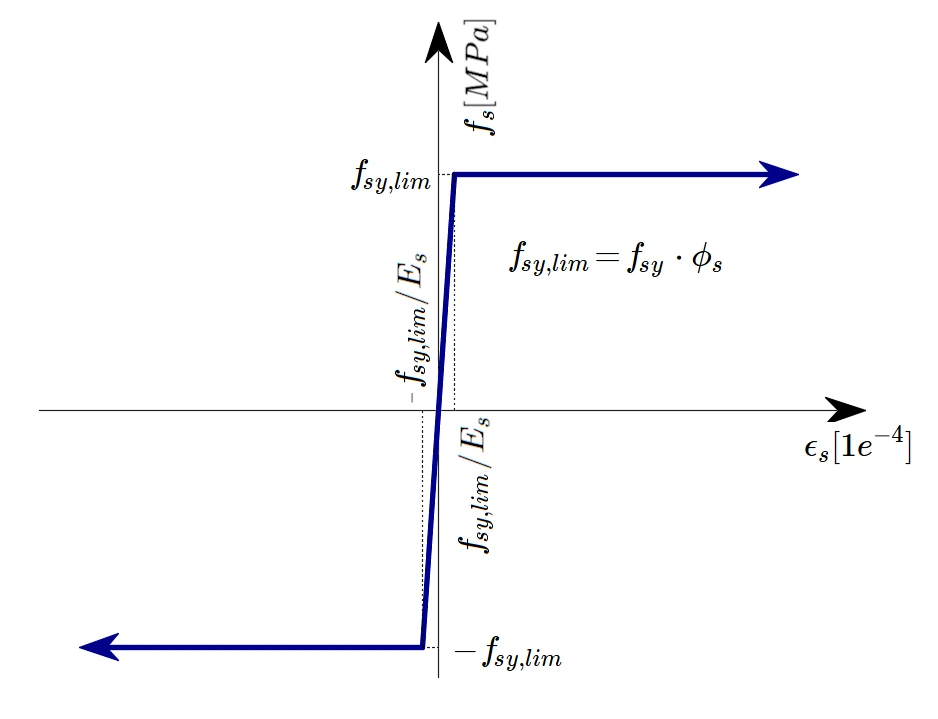
},
"regions": {
"name": "Region",
"type": "taxonomy",
"value": [
{
"name": "AMER",
"codename": "amer"
},
{
"name": "EMEA",
"codename": "emea"
},
{
"name": "APAC",
"codename": "apac"
}
],
"taxonomyGroup": "region"
},
"product_groups": {
"name": "Product group",
"type": "taxonomy",
"value": [
{
"name": "Concrete",
"codename": "concrete"
}
],
"taxonomyGroup": "product_group"
},
"support_center_article_types": {
"name": "Support center article",
"type": "taxonomy",
"value": [
{
"name": "Knowledge base",
"codename": "knowledgebase_article"
}
],
"taxonomyGroup": "support_center_article"
},
"expertise_levels": {
"name": "Expertise level",
"type": "taxonomy",
"value": [],
"taxonomyGroup": "expertise_level"
},
"labels": {
"name": "Labels",
"type": "taxonomy",
"value": [
{
"name": "Detail 2D",
"codename": "detail"
},
{
"name": "EN (Eurocode)",
"codename": "eurocode"
},
{
"name": "Cracks",
"codename": "cracks"
},
{
"name": "Reinforcement",
"codename": "reinforcement"
}
],
"taxonomyGroup": "labels"
},
"linked_items": {
"name": "Linked items",
"type": "modular_content",
"value": [
"theoretical_background_detail___general___verifica",
"detail_theoretical_background",
"reinforcement_template_in_idea_statica_detail",
"n2022_03_16_code_check_of_walls_and_deep_beams"
],
"linkedItems": [
"[Circular Reference]",
{
"elements": {
"title": {
"name": "Main headline (H1)",
"type": "text",
"value": "Reinforcement template in IDEA StatiCa Detail"
},
"preview_image": {
"name": "Preview image",
"type": "asset",
"value": [
{
"name": "Reinforcement template in IDEA StatiCa Detail.png",
"description": null,
"type": "image/png",
"size": 307321,
"url": "https://assets-us-01.kc-usercontent.com:443/28eac049-c8ed-00e2-220c-12142a968dff/dd1fdcca-33d9-4936-a7fa-fa3cef48aed8/Reinforcement%20template%20in%20IDEA%20StatiCa%20Detail.png",
"width": 1200,
"height": 630,
"renditions": {}
}
]
},
"post_date": {
"name": "Post date",
"type": "date_time",
"value": null,
"displayTimeZone": null
},
"perex_content": {
"name": "Lead paragraph",
"type": "text",
"value": ""
},
"content": {
"images": [],
"linkedItemCodenames": [
"n41751eaf_1529_01eb_29ce_ed6115b85028"
],
"linkedItems": [
{
"elements": {
"url": {
"name": "Video URL",
"type": "text",
"value": "https://youtu.be/DRFKxGnbl7U?t=1798"
}
},
"system": {
"codename": "n41751eaf_1529_01eb_29ce_ed6115b85028",
"collection": "default",
"id": "41751eaf-1529-01eb-29ce-ed6115b85028",
"language": "en-US",
"lastModified": "2023-08-02T12:38:04.3979124Z",
"name": "41751eaf-1529-01eb-29ce-ed6115b85028",
"sitemapLocations": [],
"type": "video",
"workflowStep": null,
"workflow": null
}
}
],
"links": [],
"name": "Content",
"type": "rich_text",
"value": "<p>Nobody likes designing the reinforcement of typical concrete details again and again. With IDEA StatiCa you can reinforce your concrete detail just once and then use the reinforcement as a template for future use! </p>\n<p>The template is saved to your local disk and you can apply it whenever you want if the topology of the concrete detail is more or less similar. In order to share the templates with your colleagues, export/import buttons shall be used.</p>\n<p>Watch the recording of one of our webinars, where concrete reinforcement templates were introduced. </p>\n<object type=\"application/kenticocloud\" data-type=\"item\" data-rel=\"component\" data-codename=\"n41751eaf_1529_01eb_29ce_ed6115b85028\"></object>"
},
"regions": {
"name": "Region",
"type": "taxonomy",
"value": [
{
"name": "AMER",
"codename": "amer"
},
{
"name": "EMEA",
"codename": "emea"
},
{
"name": "APAC",
"codename": "apac"
}
],
"taxonomyGroup": "region"
},
"product_groups": {
"name": "Product group",
"type": "taxonomy",
"value": [
{
"name": "Concrete",
"codename": "concrete"
}
],
"taxonomyGroup": "product_group"
},
"support_center_article_types": {
"name": "Support center article",
"type": "taxonomy",
"value": [
{
"name": "Knowledge base",
"codename": "knowledgebase_article"
}
],
"taxonomyGroup": "support_center_article"
},
"expertise_levels": {
"name": "Expertise level",
"type": "taxonomy",
"value": [
{
"name": "Beginner",
"codename": "beginner"
},
{
"name": "Intermediate",
"codename": "intermediate"
}
],
"taxonomyGroup": "expertise_level"
},
"labels": {
"name": "Labels",
"type": "taxonomy",
"value": [
{
"name": "ACI (USA)",
"codename": "aci__usa_"
},
{
"name": "EN (Eurocode)",
"codename": "eurocode"
},
{
"name": "Openings",
"codename": "openings"
},
{
"name": "Reinforcement",
"codename": "reinforcement"
},
{
"name": "Detail 2D",
"codename": "detail"
}
],
"taxonomyGroup": "labels"
},
"linked_items": {
"name": "Linked items",
"type": "modular_content",
"value": [
"idea_statica_tutorial___pier_cap_from_dxf"
],
"linkedItems": [
{
"elements": {
"title": {
"name": "Main headline (H1)",
"type": "text",
"value": "Structural design of a pier cap from DXF (EN)"
},
"preview_image": {
"name": "Preview image",
"type": "asset",
"value": [
{
"name": "intro.png",
"description": null,
"type": "image/png",
"size": 170523,
"url": "https://assets-us-01.kc-usercontent.com:443/28eac049-c8ed-00e2-220c-12142a968dff/9936a25c-6e30-4956-9da3-be35c14e7a61/intro.png",
"width": 1200,
"height": 630,
"renditions": {}
}
]
},
"post_date": {
"name": "Post date",
"type": "date_time",
"value": null,
"displayTimeZone": null
},
"perex_content": {
"name": "Lead paragraph",
"type": "text",
"value": "By following this step-by-step tutorial, you will learn how to design and code-check a pier cap by DXF references in IDEA StatiCa Detail."
},
"content": {
"images": [
{
"description": null,
"imageId": "51ba599d-8de7-4cc0-bb50-27eac77cab6c",
"url": "https://assets-us-01.kc-usercontent.com:443/28eac049-c8ed-00e2-220c-12142a968dff/fe21d78b-0647-4837-8b89-24e8ce24ca29/1_1%20New%20project.png",
"height": 1153,
"width": 1921
},
{
"description": null,
"imageId": "cc9ecd14-d5ec-4563-afca-429b96ad5c22",
"url": "https://assets-us-01.kc-usercontent.com:443/28eac049-c8ed-00e2-220c-12142a968dff/97919dd3-c3af-412c-a7c6-7f236eab183d/1_2%20New%20project.png",
"height": 680,
"width": 450
},
{
"description": null,
"imageId": "b56414c4-957f-4a00-9fd2-216223d4b60f",
"url": "https://assets-us-01.kc-usercontent.com:443/28eac049-c8ed-00e2-220c-12142a968dff/6778c05d-0b68-4c71-9e34-a83db2822936/2_1%20Geometry.png",
"height": 439,
"width": 1094
},
{
"description": null,
"imageId": "ed360367-4110-4723-b943-94c2958aea56",
"url": "https://assets-us-01.kc-usercontent.com:443/28eac049-c8ed-00e2-220c-12142a968dff/c7ac3717-3e8a-4d71-bef7-53a90dbb06db/2_2%20Geometry.png",
"height": 793,
"width": 986
},
{
"description": null,
"imageId": "49b8bcec-0c83-4f13-869a-9af90392ebf4",
"url": "https://assets-us-01.kc-usercontent.com:443/28eac049-c8ed-00e2-220c-12142a968dff/2f79bfee-8f3e-40d2-b06e-9b5f370ed524/2_3%20Geometry.png",
"height": 793,
"width": 986
},
{
"description": null,
"imageId": "7dabe2fa-1b90-4805-a503-8a1f665d1091",
"url": "https://assets-us-01.kc-usercontent.com:443/28eac049-c8ed-00e2-220c-12142a968dff/56914c67-b574-4458-9c75-6300515250cc/2_4%20Geometry.png",
"height": 513,
"width": 1055
},
{
"description": null,
"imageId": "85d75495-728d-45ce-a0c9-55f8e7da6594",
"url": "https://assets-us-01.kc-usercontent.com:443/28eac049-c8ed-00e2-220c-12142a968dff/902146d1-35d7-494d-ad33-0c533d6371d8/2_5%20Geometry.png",
"height": 938,
"width": 1387
},
{
"description": null,
"imageId": "28cd534b-fe6b-4603-ac41-d43e0436916f",
"url": "https://assets-us-01.kc-usercontent.com:443/28eac049-c8ed-00e2-220c-12142a968dff/6b851c91-a374-48ef-910b-f714f94bf4ae/2_6%20Geometry.png",
"height": 475,
"width": 1112
},
{
"description": null,
"imageId": "0bcce3af-dc3d-45e0-875e-0899ae84ff19",
"url": "https://assets-us-01.kc-usercontent.com:443/28eac049-c8ed-00e2-220c-12142a968dff/f214f09d-65b0-4caf-9a4b-42a77221348d/2_7%20Geometry.png",
"height": 810,
"width": 1386
},
{
"description": null,
"imageId": "9b55b426-71ca-42eb-a271-401c9c34edf5",
"url": "https://assets-us-01.kc-usercontent.com:443/28eac049-c8ed-00e2-220c-12142a968dff/50355c70-edcd-43fd-a8db-dea4af49c1f1/2_8%20Geometry.png",
"height": 492,
"width": 1069
},
{
"description": null,
"imageId": "53bbefc5-dda4-4ed2-81ef-d036116d43f0",
"url": "https://assets-us-01.kc-usercontent.com:443/28eac049-c8ed-00e2-220c-12142a968dff/0eac1da7-c569-4dc1-ad01-4c005e088d98/2_9%20Geometry.png",
"height": 480,
"width": 1050
},
{
"description": null,
"imageId": "b2f03b16-0201-4e17-b574-de607fbf91a8",
"url": "https://assets-us-01.kc-usercontent.com:443/28eac049-c8ed-00e2-220c-12142a968dff/64b6b1b0-2105-4f7d-89db-9588533f35d8/3_1%20Loads.png",
"height": 618,
"width": 1919
},
{
"description": null,
"imageId": "133d1a9c-9ec2-4d5c-b546-f7e6cb3e40e5",
"url": "https://assets-us-01.kc-usercontent.com:443/28eac049-c8ed-00e2-220c-12142a968dff/73eccf54-b16e-4d04-a79d-975a253174d4/3_2%20Loads.png",
"height": 689,
"width": 1103
},
{
"description": null,
"imageId": "7613b782-5d53-4adb-a49a-53ab1e9e90c8",
"url": "https://assets-us-01.kc-usercontent.com:443/28eac049-c8ed-00e2-220c-12142a968dff/e8e5a8b2-e039-4b6d-a19b-bd1ab5215a04/3_3%20Loads.png",
"height": 450,
"width": 1080
},
{
"description": null,
"imageId": "5552e8cd-23e8-462c-9e93-ae416d4aff63",
"url": "https://assets-us-01.kc-usercontent.com:443/28eac049-c8ed-00e2-220c-12142a968dff/ee28dab2-90d2-42f3-b772-475d518de122/3_4%20Loads.png",
"height": 471,
"width": 1025
},
{
"description": null,
"imageId": "50f3925c-d1e3-43c5-b069-28e6b57cc7ad",
"url": "https://assets-us-01.kc-usercontent.com:443/28eac049-c8ed-00e2-220c-12142a968dff/7d574c49-bd02-4af9-9011-0a3b1130d9e6/3_5%20Loads.png",
"height": 467,
"width": 1033
},
{
"description": null,
"imageId": "79bdbc02-821f-4f20-b7d3-37e64d2f547d",
"url": "https://assets-us-01.kc-usercontent.com:443/28eac049-c8ed-00e2-220c-12142a968dff/20e05d97-1652-4bf4-b997-f6fcda13a155/3_6%20Loads.png",
"height": 443,
"width": 1030
},
{
"description": null,
"imageId": "d0815179-0b84-44f0-84b0-7437351d3dc5",
"url": "https://assets-us-01.kc-usercontent.com:443/28eac049-c8ed-00e2-220c-12142a968dff/17bb129d-f8dd-4c81-97ca-18f6fb7fecc3/3_7%20Loads.png",
"height": 642,
"width": 1919
},
{
"description": null,
"imageId": "fa5ca9d3-4f8a-4824-b425-29a218e3a820",
"url": "https://assets-us-01.kc-usercontent.com:443/28eac049-c8ed-00e2-220c-12142a968dff/c7e8dcb4-07a9-44ba-b7db-5dae47d39f18/3_8%20Loads.png",
"height": 554,
"width": 1093
},
{
"description": null,
"imageId": "5b924e5f-43c1-41f0-818a-7cb1bfc7eafc",
"url": "https://assets-us-01.kc-usercontent.com:443/28eac049-c8ed-00e2-220c-12142a968dff/49282476-6070-4ee9-a3da-8ba806c532db/3_9%20Loads.png",
"height": 582,
"width": 1060
},
{
"description": null,
"imageId": "3bc7fadd-3912-48f8-8000-0d91cb0af453",
"url": "https://assets-us-01.kc-usercontent.com:443/28eac049-c8ed-00e2-220c-12142a968dff/87b44d74-eede-4ef9-aab9-5b75c7ad351b/3_10%20Loads.png",
"height": 835,
"width": 1138
},
{
"description": null,
"imageId": "f5126442-836e-4f7b-929a-d56d2b4c1162",
"url": "https://assets-us-01.kc-usercontent.com:443/28eac049-c8ed-00e2-220c-12142a968dff/e51e193e-5772-4e02-9724-efe612a9955f/4_1%20Reinforcement.png",
"height": 443,
"width": 1136
},
{
"description": null,
"imageId": "2e870d3c-beb7-4d83-96f3-92739983e310",
"url": "https://assets-us-01.kc-usercontent.com:443/28eac049-c8ed-00e2-220c-12142a968dff/7433e93f-9795-495a-a20d-9e4f2ef5f1d5/4_3%20Reinforcement.png",
"height": 786,
"width": 981
},
{
"description": null,
"imageId": "33ec1295-68ad-494c-a3c3-a5f71e4f89cc",
"url": "https://assets-us-01.kc-usercontent.com:443/28eac049-c8ed-00e2-220c-12142a968dff/522a97b6-22e0-4aa6-956d-ea0b8ffb70ee/4_4%20Reinforcement.png",
"height": 745,
"width": 1255
},
{
"description": null,
"imageId": "fa4a932c-e111-4839-a1c5-55cbb6c7975b",
"url": "https://assets-us-01.kc-usercontent.com:443/28eac049-c8ed-00e2-220c-12142a968dff/3027cb33-110c-4b80-a470-01af1345750a/4_5%20Reinforcement.png",
"height": 784,
"width": 1115
},
{
"description": null,
"imageId": "26fd362e-faa0-46f2-bee8-f94379378482",
"url": "https://assets-us-01.kc-usercontent.com:443/28eac049-c8ed-00e2-220c-12142a968dff/233bba37-5214-421f-9646-9fa9cf49e2ca/4_6%20Reinforcement.png",
"height": 742,
"width": 1212
},
{
"description": null,
"imageId": "53ae292c-4fb6-4f31-b595-85c4fc4c8c29",
"url": "https://assets-us-01.kc-usercontent.com:443/28eac049-c8ed-00e2-220c-12142a968dff/2a628132-4994-469e-9917-872f31fcbc0b/4_7%20Reinforcement.png",
"height": 786,
"width": 1223
},
{
"description": null,
"imageId": "293450a5-ac45-42f9-99f6-fff86ba8cde1",
"url": "https://assets-us-01.kc-usercontent.com:443/28eac049-c8ed-00e2-220c-12142a968dff/a78bd3ba-73dd-4b26-98a0-692b54ad5b09/4_8%20Reinforcement.png",
"height": 761,
"width": 1218
},
{
"description": null,
"imageId": "9fc368d8-b05f-4e7e-b35d-325ab88796e3",
"url": "https://assets-us-01.kc-usercontent.com:443/28eac049-c8ed-00e2-220c-12142a968dff/62b5c0a1-9129-4b33-ae51-650f7cc3ac20/4_9%20Reinforcement.png",
"height": 756,
"width": 1169
},
{
"description": null,
"imageId": "33ee2cb4-19a0-4435-bf05-ea1f263be8ba",
"url": "https://assets-us-01.kc-usercontent.com:443/28eac049-c8ed-00e2-220c-12142a968dff/fa95121e-d453-4304-80e6-85dda909891c/4_10%20Reinforcement.png",
"height": 197,
"width": 1091
},
{
"description": null,
"imageId": "c310c8a9-405a-407d-bae2-0f380acbe2e5",
"url": "https://assets-us-01.kc-usercontent.com:443/28eac049-c8ed-00e2-220c-12142a968dff/7c9cdd56-cdb0-4c8b-963f-6b0dc4669234/5_1%20Check.png",
"height": 1160,
"width": 1928
},
{
"description": null,
"imageId": "87bd3bff-ee4a-4cf7-9490-a685fe5e1c3e",
"url": "https://assets-us-01.kc-usercontent.com:443/28eac049-c8ed-00e2-220c-12142a968dff/4c4aa00e-48cc-409e-bc79-21d28e55a786/5_2%20Check.png",
"height": 1160,
"width": 1928
},
{
"description": null,
"imageId": "4dac15a1-9f3a-4039-b532-47ac9a19e21a",
"url": "https://assets-us-01.kc-usercontent.com:443/28eac049-c8ed-00e2-220c-12142a968dff/aa19009c-39f5-4c08-bba0-493ac6d5a4ef/5_3%20Check.png",
"height": 1160,
"width": 1928
},
{
"description": null,
"imageId": "61faf394-9e26-4c85-b7c3-0c450dbcb495",
"url": "https://assets-us-01.kc-usercontent.com:443/28eac049-c8ed-00e2-220c-12142a968dff/79b005fd-2d09-4e79-a97b-d45dc3c4fbd4/5_4%20Check.png",
"height": 1160,
"width": 1928
},
{
"description": null,
"imageId": "67aab4ff-4acd-45be-883c-775f9612870f",
"url": "https://assets-us-01.kc-usercontent.com:443/28eac049-c8ed-00e2-220c-12142a968dff/bea7f38c-6c84-49f0-8502-66bfb347093e/5_5%20Check.png",
"height": 1160,
"width": 1928
},
{
"description": null,
"imageId": "982806dc-d702-4e8e-8c84-cfa8336ce687",
"url": "https://assets-us-01.kc-usercontent.com:443/28eac049-c8ed-00e2-220c-12142a968dff/6e3c18c1-a97e-4301-8ee4-31b1ed278382/6_1%20Report.png",
"height": 1160,
"width": 1928
},
{
"description": null,
"imageId": "c4a06b84-478b-437a-ac93-3cb615623ae6",
"url": "https://assets-us-01.kc-usercontent.com:443/28eac049-c8ed-00e2-220c-12142a968dff/33137b76-efe1-4357-a046-99a24413aa88/6_2%20Report.png",
"height": 872,
"width": 1860
}
],
"linkedItemCodenames": [
"idea_statica_tutorial___pier_cap_from_dxf_2495f70",
"campus_cta",
"n43878f26_ce84_01dd_ef01_d4aa4a30c1f5"
],
"linkedItems": [
{
"elements": {
"title": {
"name": "Title",
"type": "text",
"value": "RELATED CONTENT"
},
"description": {
"name": "Description",
"type": "text",
"value": ""
},
"featured_articles": {
"name": "Featured articles",
"type": "modular_content",
"value": [
"corbel_from_dxf",
"idea_statica_tutorial___frame_joint_1623b41",
"n2021_10_30_concrete_webinar_luk"
],
"linkedItems": []
},
"support_center_articles": {
"name": "Support center article",
"type": "taxonomy",
"value": [],
"taxonomyGroup": "support_center_article"
},
"blog_categories": {
"name": "Blog category",
"type": "taxonomy",
"value": [],
"taxonomyGroup": "blog_category"
},
"labels": {
"name": "Labels",
"type": "taxonomy",
"value": [],
"taxonomyGroup": "labels"
},
"product_groups": {
"name": "Product group",
"type": "taxonomy",
"value": [],
"taxonomyGroup": "product_group"
},
"include_webinars": {
"name": "Include webinars",
"type": "multiple_choice",
"value": []
},
"include_case_studies": {
"name": "Only case studies",
"type": "multiple_choice",
"value": []
},
"translation__translation_connector": {
"name": "Translation Connector",
"type": "taxonomy",
"value": [],
"taxonomyGroup": "languages"
},
"translation__force_translation": {
"name": "Force translation",
"type": "multiple_choice",
"value": []
},
"translation__last_translation": {
"images": [],
"linkedItemCodenames": [],
"linkedItems": [],
"links": [],
"name": "Last translation",
"type": "rich_text",
"value": "<p><br></p>"
},
"translation__ai_translated": {
"name": "AI translated",
"type": "multiple_choice",
"value": []
}
},
"system": {
"codename": "n43878f26_ce84_01dd_ef01_d4aa4a30c1f5",
"collection": "default",
"id": "43878f26-ce84-01dd-ef01-d4aa4a30c1f5",
"language": "en-US",
"lastModified": "2024-06-12T11:22:27.4447116Z",
"name": "43878f26-ce84-01dd-ef01-d4aa4a30c1f5",
"sitemapLocations": [],
"type": "widget_support_center_articles",
"workflowStep": null,
"workflow": null
}
}
],
"links": [
{
"codename": "landing_page___downloads",
"linkId": "0dff6482-3e17-4ca2-bb66-b4abc6a8dde4",
"urlSlug": "product-downloads",
"type": "landing_page"
},
{
"codename": "types_of_supports_in_idea_statica_detail__csfm_",
"linkId": "5a121972-f384-4f14-8788-9da298e1aae1",
"urlSlug": "types-of-supports-in-idea-statica-detail",
"type": "support_center_article"
},
{
"codename": "how_to_apply_a_horizontal_force_occurring_in_the_b",
"linkId": "1d52ff19-b6b3-5290-905a-178825f7cdc1",
"urlSlug": "supports-in-idea-statica-detail-advanced-topics",
"type": "support_center_article"
},
{
"codename": "theoretical_background_detail___verification_accor",
"linkId": "6fbebc50-77e1-42e3-b7e8-9079c605a805",
"urlSlug": "structural-element-checks-according-to-eurocode",
"type": "support_center_article"
},
{
"codename": "stress_strain_diagrams_in_csfm",
"linkId": "64fe8853-4024-409f-9e71-8e2007782f5b",
"urlSlug": "stress-strain-diagrams-in-csfm",
"type": "support_center_article"
},
{
"codename": "theoretical_background_detail___general___reinforc",
"linkId": "0e906322-2262-4075-a13c-2f864a41b7ee",
"urlSlug": "2-reinforcement-design",
"type": "support_center_article"
},
{
"codename": "understanding_concrete_design_reinforcement",
"linkId": "792f89a1-cc17-54fb-8eaa-611f8a0ea070",
"urlSlug": "understanding-concrete-design-reinforcement",
"type": "blog_post"
},
{
"codename": "concrete___reinforced_concrete_expert",
"linkId": "a0e85d28-23e6-4006-94d6-f334c2be9b67",
"urlSlug": "reinforced-concrete-expert",
"type": "landing_page"
},
{
"codename": "rn_21_0___detail___rebar_modeling_enhancement___su",
"linkId": "e891a412-d4f5-4473-8e9c-bded813ee5e3",
"urlSlug": "rebar-modeling-enhancement-superelement",
"type": "support_center_article"
},
{
"codename": "rn_24_0__detail_property_grid___multiselect___mult",
"linkId": "c6a63f28-f703-4125-993e-8b2b00d61479",
"urlSlug": "multiselect-and-multi-edit-in-detail",
"type": "support_center_article"
},
{
"codename": "theoretical_background_detail___general",
"linkId": "2b523983-1e01-41c9-bad0-5807b5485059",
"urlSlug": "general-introduction-for-the-structural-design-of-concrete-details",
"type": "support_center_article"
},
{
"codename": "general_description_of_sls_results_in_detail_appli",
"linkId": "9e7e995c-6e74-422f-af6e-88a8d7fe047f",
"urlSlug": "general-description-of-sls-results-in-detail-application",
"type": "support_center_article"
}
],
"name": "Content",
"type": "rich_text",
"value": "<h2>1 New project</h2>\n<p>Let’s launch the <strong>IDEA StatiCa </strong>(<a data-item-id=\"0dff6482-3e17-4ca2-bb66-b4abc6a8dde4\" href=\"\">download the newest version</a>) and select the application <strong>Detail</strong>. Set up a new project by clicking 2D Detail with General input section, select proper concrete grade and cover. Finish setting by clicking <strong>Create</strong>.</p>\n<figure data-asset-id=\"51ba599d-8de7-4cc0-bb50-27eac77cab6c\" data-image-id=\"51ba599d-8de7-4cc0-bb50-27eac77cab6c\"><img src=\"https://assets-us-01.kc-usercontent.com:443/28eac049-c8ed-00e2-220c-12142a968dff/fe21d78b-0647-4837-8b89-24e8ce24ca29/1_1%20New%20project.png\" data-asset-id=\"51ba599d-8de7-4cc0-bb50-27eac77cab6c\" data-image-id=\"51ba599d-8de7-4cc0-bb50-27eac77cab6c\" alt=\"\"></figure>\n<figure data-asset-id=\"cc9ecd14-d5ec-4563-afca-429b96ad5c22\" data-image-id=\"cc9ecd14-d5ec-4563-afca-429b96ad5c22\"><img src=\"https://assets-us-01.kc-usercontent.com:443/28eac049-c8ed-00e2-220c-12142a968dff/97919dd3-c3af-412c-a7c6-7f236eab183d/1_2%20New%20project.png\" data-asset-id=\"cc9ecd14-d5ec-4563-afca-429b96ad5c22\" data-image-id=\"cc9ecd14-d5ec-4563-afca-429b96ad5c22\" alt=\"\"></figure>\n<p>This will load a blank project where we start from scratch.</p>\n<h2>2 Geometry</h2>\n<p>Start with the addition of a wall element by the <strong>DXF</strong> <strong>Import </strong>button.</p>\n<figure data-asset-id=\"b56414c4-957f-4a00-9fd2-216223d4b60f\" data-image-id=\"b56414c4-957f-4a00-9fd2-216223d4b60f\"><img src=\"https://assets-us-01.kc-usercontent.com:443/28eac049-c8ed-00e2-220c-12142a968dff/6778c05d-0b68-4c71-9e34-a83db2822936/2_1%20Geometry.png\" data-asset-id=\"b56414c4-957f-4a00-9fd2-216223d4b60f\" data-image-id=\"b56414c4-957f-4a00-9fd2-216223d4b60f\" alt=\"\"></figure>\n<p>A dialog to locate and open the desired DXF file will pop-up. After the selection of <strong>pier_cap.dxf</strong> (available in source files), you will land in a dialog for selection. Select the part of the outline of the pier cap (if you used lines in DXF continue with Consecutive button) and click on <strong>Outline</strong>. Finish the selection by <strong>OK</strong> button.</p>\n<figure data-asset-id=\"ed360367-4110-4723-b943-94c2958aea56\" data-image-id=\"ed360367-4110-4723-b943-94c2958aea56\"><img src=\"https://assets-us-01.kc-usercontent.com:443/28eac049-c8ed-00e2-220c-12142a968dff/c7ac3717-3e8a-4d71-bef7-53a90dbb06db/2_2%20Geometry.png\" data-asset-id=\"ed360367-4110-4723-b943-94c2958aea56\" data-image-id=\"ed360367-4110-4723-b943-94c2958aea56\" alt=\"\"></figure>\n<p>Then <strong>import</strong> the upper part of the pier cap from the same DXF file.</p>\n<figure data-asset-id=\"49b8bcec-0c83-4f13-869a-9af90392ebf4\" data-image-id=\"49b8bcec-0c83-4f13-869a-9af90392ebf4\"><img src=\"https://assets-us-01.kc-usercontent.com:443/28eac049-c8ed-00e2-220c-12142a968dff/2f79bfee-8f3e-40d2-b06e-9b5f370ed524/2_3%20Geometry.png\" data-asset-id=\"49b8bcec-0c83-4f13-869a-9af90392ebf4\" data-image-id=\"49b8bcec-0c83-4f13-869a-9af90392ebf4\" alt=\"\"></figure>\n<p>The shapes of the wall elements have been generated by DXF, but the 2D DXF reference lacks the information about thickness, thus you need to adjust it manually now. Set the <strong>Thickness</strong> for both <strong>W1</strong> and <strong>W2</strong> members to <strong>1,20 m</strong>.</p>\n<figure data-asset-id=\"7dabe2fa-1b90-4805-a503-8a1f665d1091\" data-image-id=\"7dabe2fa-1b90-4805-a503-8a1f665d1091\"><img src=\"https://assets-us-01.kc-usercontent.com:443/28eac049-c8ed-00e2-220c-12142a968dff/56914c67-b574-4458-9c75-6300515250cc/2_4%20Geometry.png\" data-asset-id=\"7dabe2fa-1b90-4805-a503-8a1f665d1091\" data-image-id=\"7dabe2fa-1b90-4805-a503-8a1f665d1091\" alt=\"\"></figure>\n<p>Right now, our structure is statically overdetermined, you need to add boundary conditions. To create <a data-item-id=\"5a121972-f384-4f14-8788-9da298e1aae1\" href=\"\"><strong>line support</strong></a>, click on the <strong>Model Entity</strong> button and select the third type in <strong>Supports</strong> section.</p>\n<figure data-asset-id=\"85d75495-728d-45ce-a0c9-55f8e7da6594\" data-image-id=\"85d75495-728d-45ce-a0c9-55f8e7da6594\"><img src=\"https://assets-us-01.kc-usercontent.com:443/28eac049-c8ed-00e2-220c-12142a968dff/902146d1-35d7-494d-ad33-0c533d6371d8/2_5%20Geometry.png\" data-asset-id=\"85d75495-728d-45ce-a0c9-55f8e7da6594\" data-image-id=\"85d75495-728d-45ce-a0c9-55f8e7da6594\" alt=\"\"></figure>\n<p><strong>Constraint</strong> the support in <strong>X</strong>, <strong>Z</strong> and <strong>Ry</strong> directions and change the <strong>edge</strong> number to <strong>7</strong>. Also, switch off the <strong>Compression only</strong> functionality. The edge numbers can be seen in the <strong>Main window</strong>.</p>\n<figure data-asset-id=\"28cd534b-fe6b-4603-ac41-d43e0436916f\" data-image-id=\"28cd534b-fe6b-4603-ac41-d43e0436916f\"><img src=\"https://assets-us-01.kc-usercontent.com:443/28eac049-c8ed-00e2-220c-12142a968dff/6b851c91-a374-48ef-910b-f714f94bf4ae/2_6%20Geometry.png\" data-asset-id=\"28cd534b-fe6b-4603-ac41-d43e0436916f\" data-image-id=\"28cd534b-fe6b-4603-ac41-d43e0436916f\" alt=\"\"></figure>\n<p>As a Point force-placed directly on the edge of a pier cap would crash the concrete locally in compression, we will use bearing plates to distribute the load more evenly. To add one, press <strong>Model Entity button</strong> once again, and in the <strong>Load transfer devices</strong> section, pick the first - <a data-item-id=\"1d52ff19-b6b3-5290-905a-178825f7cdc1\" href=\"\"><strong>Bearing plate</strong></a>.</p>\n<figure data-asset-id=\"0bcce3af-dc3d-45e0-875e-0899ae84ff19\" data-image-id=\"0bcce3af-dc3d-45e0-875e-0899ae84ff19\"><img src=\"https://assets-us-01.kc-usercontent.com:443/28eac049-c8ed-00e2-220c-12142a968dff/f214f09d-65b0-4caf-9a4b-42a77221348d/2_7%20Geometry.png\" data-asset-id=\"0bcce3af-dc3d-45e0-875e-0899ae84ff19\" data-image-id=\"0bcce3af-dc3d-45e0-875e-0899ae84ff19\" alt=\"\"></figure>\n<p>Change the <strong>Width</strong> to <strong>0,40 m</strong> and the <strong>Thickness</strong> to <strong>0,04 m</strong>, then the <strong>Edge</strong> number to <strong>3</strong> and shift its <strong>X-Position</strong> to <strong>0,45 m</strong>.</p>\n<figure data-asset-id=\"9b55b426-71ca-42eb-a271-401c9c34edf5\" data-image-id=\"9b55b426-71ca-42eb-a271-401c9c34edf5\"><img src=\"https://assets-us-01.kc-usercontent.com:443/28eac049-c8ed-00e2-220c-12142a968dff/50355c70-edcd-43fd-a8db-dea4af49c1f1/2_8%20Geometry.png\" data-asset-id=\"9b55b426-71ca-42eb-a271-401c9c34edf5\" data-image-id=\"9b55b426-71ca-42eb-a271-401c9c34edf5\" alt=\"\"></figure>\n<p>Then <strong>copy</strong> the <strong>Bearing plate</strong> and change its position to be measured <strong>From end</strong>.</p>\n<figure data-asset-id=\"53bbefc5-dda4-4ed2-81ef-d036116d43f0\" data-image-id=\"53bbefc5-dda4-4ed2-81ef-d036116d43f0\"><img src=\"https://assets-us-01.kc-usercontent.com:443/28eac049-c8ed-00e2-220c-12142a968dff/0eac1da7-c569-4dc1-ad01-4c005e088d98/2_9%20Geometry.png\" data-asset-id=\"53bbefc5-dda4-4ed2-81ef-d036116d43f0\" data-image-id=\"53bbefc5-dda4-4ed2-81ef-d036116d43f0\" alt=\"\"></figure>\n<h2>3 Loads</h2>\n<p>Load Case will be created by clicking <strong>Load Case</strong> button and its for <strong>Permanent</strong> effects by default. You need two load cases to distinguish between permanent and variable loads and three combinations to cover one <a data-item-id=\"6fbebc50-77e1-42e3-b7e8-9079c605a805\" href=\"\">ULS</a> and two <a data-item-id=\"6fbebc50-77e1-42e3-b7e8-9079c605a805\" href=\"\">SLS</a> combinations (Characteristic and Quasi-permanent) for all checks.</p>\n<figure data-asset-id=\"b2f03b16-0201-4e17-b574-de607fbf91a8\" data-image-id=\"b2f03b16-0201-4e17-b574-de607fbf91a8\"><img src=\"https://assets-us-01.kc-usercontent.com:443/28eac049-c8ed-00e2-220c-12142a968dff/64b6b1b0-2105-4f7d-89db-9588533f35d8/3_1%20Loads.png\" data-asset-id=\"b2f03b16-0201-4e17-b574-de607fbf91a8\" data-image-id=\"b2f03b16-0201-4e17-b574-de607fbf91a8\" alt=\"\"></figure>\n<p>Let's modify the automatically added load case <strong>LC1</strong> for permanent effects. In the <strong>Load impulses</strong> tab, click on the <strong>Plus</strong> button and apply a <strong>Point load</strong>. It will be automatically placed on one of the bearing plates.</p>\n<figure data-asset-id=\"133d1a9c-9ec2-4d5c-b546-f7e6cb3e40e5\" data-image-id=\"133d1a9c-9ec2-4d5c-b546-f7e6cb3e40e5\"><img src=\"https://assets-us-01.kc-usercontent.com:443/28eac049-c8ed-00e2-220c-12142a968dff/73eccf54-b16e-4d04-a79d-975a253174d4/3_2%20Loads.png\" data-asset-id=\"133d1a9c-9ec2-4d5c-b546-f7e6cb3e40e5\" data-image-id=\"133d1a9c-9ec2-4d5c-b546-f7e6cb3e40e5\" alt=\"\"></figure>\n<p>As the last step, change its value to <strong>-2500 kN</strong>.</p>\n<figure data-asset-id=\"7613b782-5d53-4adb-a49a-53ab1e9e90c8\" data-image-id=\"7613b782-5d53-4adb-a49a-53ab1e9e90c8\"><img src=\"https://assets-us-01.kc-usercontent.com:443/28eac049-c8ed-00e2-220c-12142a968dff/e8e5a8b2-e039-4b6d-a19b-bd1ab5215a04/3_3%20Loads.png\" data-asset-id=\"7613b782-5d53-4adb-a49a-53ab1e9e90c8\" data-image-id=\"7613b782-5d53-4adb-a49a-53ab1e9e90c8\" alt=\"\"></figure>\n<p>Copy that Point load to the other bearing plate <strong>BP2</strong>.</p>\n<figure data-asset-id=\"5552e8cd-23e8-462c-9e93-ae416d4aff63\" data-image-id=\"5552e8cd-23e8-462c-9e93-ae416d4aff63\"><img src=\"https://assets-us-01.kc-usercontent.com:443/28eac049-c8ed-00e2-220c-12142a968dff/ee28dab2-90d2-42f3-b772-475d518de122/3_4%20Loads.png\" data-asset-id=\"5552e8cd-23e8-462c-9e93-ae416d4aff63\" data-image-id=\"5552e8cd-23e8-462c-9e93-ae416d4aff63\" alt=\"\"></figure>\n<p>Copy Load Case 1 and change the LC type to the <strong>variable</strong>. Click on Point Load and change force to <strong>-1000 kN.</strong></p>\n<figure data-asset-id=\"50f3925c-d1e3-43c5-b069-28e6b57cc7ad\" data-image-id=\"50f3925c-d1e3-43c5-b069-28e6b57cc7ad\"><img src=\"https://assets-us-01.kc-usercontent.com:443/28eac049-c8ed-00e2-220c-12142a968dff/7d574c49-bd02-4af9-9011-0a3b1130d9e6/3_5%20Loads.png\" data-asset-id=\"50f3925c-d1e3-43c5-b069-28e6b57cc7ad\" data-image-id=\"50f3925c-d1e3-43c5-b069-28e6b57cc7ad\" alt=\"\"></figure>\n<p>Repeat the steps for the last point load.</p>\n<figure data-asset-id=\"79bdbc02-821f-4f20-b7d3-37e64d2f547d\" data-image-id=\"79bdbc02-821f-4f20-b7d3-37e64d2f547d\"><img src=\"https://assets-us-01.kc-usercontent.com:443/28eac049-c8ed-00e2-220c-12142a968dff/20e05d97-1652-4bf4-b997-f6fcda13a155/3_6%20Loads.png\" data-asset-id=\"79bdbc02-821f-4f20-b7d3-37e64d2f547d\" data-image-id=\"79bdbc02-821f-4f20-b7d3-37e64d2f547d\" alt=\"\"></figure>\n<p>Create the first nonlinear combination by <strong>Combination</strong> button, and set it as ULS limit state.</p>\n<figure data-asset-id=\"d0815179-0b84-44f0-84b0-7437351d3dc5\" data-image-id=\"d0815179-0b84-44f0-84b0-7437351d3dc5\"><img src=\"https://assets-us-01.kc-usercontent.com:443/28eac049-c8ed-00e2-220c-12142a968dff/17bb129d-f8dd-4c81-97ca-18f6fb7fecc3/3_7%20Loads.png\" data-asset-id=\"d0815179-0b84-44f0-84b0-7437351d3dc5\" data-image-id=\"d0815179-0b84-44f0-84b0-7437351d3dc5\" alt=\"\"></figure>\n<p>Copy C1 and choose <a data-item-id=\"64fe8853-4024-409f-9e71-8e2007782f5b\" href=\"\"><strong>SLS</strong></a><strong> Characteristic. </strong>In addition, the option is available to check the combination on deflection and crack width both for a given combination and individually. For <strong>Characteristic</strong> combination choose Active for <strong>deflection</strong> check according to the picture below. </p>\n<figure data-asset-id=\"fa5ca9d3-4f8a-4824-b425-29a218e3a820\" data-image-id=\"fa5ca9d3-4f8a-4824-b425-29a218e3a820\"><img src=\"https://assets-us-01.kc-usercontent.com:443/28eac049-c8ed-00e2-220c-12142a968dff/c7e8dcb4-07a9-44ba-b7db-5dae47d39f18/3_8%20Loads.png\" data-asset-id=\"fa5ca9d3-4f8a-4824-b425-29a218e3a820\" data-image-id=\"fa5ca9d3-4f8a-4824-b425-29a218e3a820\" alt=\"\"></figure>\n<p>Now you can repeat the steps, <strong>copy</strong> C2 and choose <strong>SLS Quasi-Permanent </strong>for new C3. Activate <strong>Quasi-Permanent </strong>combination only for <strong>crack width</strong> calculation. </p>\n<figure data-asset-id=\"5b924e5f-43c1-41f0-818a-7cb1bfc7eafc\" data-image-id=\"5b924e5f-43c1-41f0-818a-7cb1bfc7eafc\"><img src=\"https://assets-us-01.kc-usercontent.com:443/28eac049-c8ed-00e2-220c-12142a968dff/49282476-6070-4ee9-a3da-8ba806c532db/3_9%20Loads.png\" data-asset-id=\"5b924e5f-43c1-41f0-818a-7cb1bfc7eafc\" data-image-id=\"5b924e5f-43c1-41f0-818a-7cb1bfc7eafc\" alt=\"\"></figure>\n<p>Now, change the partial factors for all combinations. To do that, click on the <strong>pen icon</strong> in any combination you defined and change the partial factors you see in the following picture.</p>\n<figure data-asset-id=\"3bc7fadd-3912-48f8-8000-0d91cb0af453\" data-image-id=\"3bc7fadd-3912-48f8-8000-0d91cb0af453\"><img src=\"https://assets-us-01.kc-usercontent.com:443/28eac049-c8ed-00e2-220c-12142a968dff/87b44d74-eede-4ef9-aab9-5b75c7ad351b/3_10%20Loads.png\" data-asset-id=\"3bc7fadd-3912-48f8-8000-0d91cb0af453\" data-image-id=\"3bc7fadd-3912-48f8-8000-0d91cb0af453\" alt=\"\"></figure>\n<p>Note that the calculations are performed only for combinations of load cases that are ticked in the operation tree, not for individual load cases.</p>\n<h2>4 Reinforcement</h2>\n<p>The next step is to <a data-item-id=\"0e906322-2262-4075-a13c-2f864a41b7ee\" href=\"\"><strong>reinforce</strong></a> the model. Combine the definition from scratch in IDEA StatiCa with the batch import of the reinforcement from the <strong>DXF</strong> file. In this tutorial, we assume that the user knows how to reinforce a pier cap and prepared some <a data-item-id=\"792f89a1-cc17-54fb-8eaa-611f8a0ea070\" href=\"\">reinforcement</a> in DXF in advance from drawings thus, we leave the tools for <a data-item-id=\"a0e85d28-23e6-4006-94d6-f334c2be9b67\" href=\"\">reinforcement design</a> for another tutorial.</p>\n<p>Click on <strong>DXF</strong> <strong>Import </strong>and choose Group of bars entity.</p>\n<figure data-asset-id=\"f5126442-836e-4f7b-929a-d56d2b4c1162\" data-image-id=\"f5126442-836e-4f7b-929a-d56d2b4c1162\"><img src=\"https://assets-us-01.kc-usercontent.com:443/28eac049-c8ed-00e2-220c-12142a968dff/e51e193e-5772-4e02-9724-efe612a9955f/4_1%20Reinforcement.png\" data-asset-id=\"f5126442-836e-4f7b-929a-d56d2b4c1162\" data-image-id=\"f5126442-836e-4f7b-929a-d56d2b4c1162\" alt=\"\"></figure>\n<p>A dialog to locate and open the desired DXF file will pop-up. After the selection of <strong>pier_cap.dxf</strong> (available in the source files), you will land in a dialog for selection. Select all the polylines (rebars shape) you need in order shown on the following picture and click on <strong>Select</strong> after each polyline (the order is not important in general, we just want to keep track in this tutorial when we talk about the specific name of an item). Finish the selection by <strong>OK</strong> button.</p>\n<figure data-asset-id=\"2e870d3c-beb7-4d83-96f3-92739983e310\" data-image-id=\"2e870d3c-beb7-4d83-96f3-92739983e310\"><img src=\"https://assets-us-01.kc-usercontent.com:443/28eac049-c8ed-00e2-220c-12142a968dff/7433e93f-9795-495a-a20d-9e4f2ef5f1d5/4_3%20Reinforcement.png\" data-asset-id=\"2e870d3c-beb7-4d83-96f3-92739983e310\" data-image-id=\"2e870d3c-beb7-4d83-96f3-92739983e310\" alt=\"\"></figure>\n<p>The 2D DXF file transfers the global width of a polyline as the diameter for each <a data-item-id=\"e891a412-d4f5-4473-8e9c-bded813ee5e3\" href=\"\">rebar</a>, but it does not contain information about the number of bars in the perpendicular direction, and we need to adjust them manually. Thanks to the <a data-item-id=\"c6a63f28-f703-4125-993e-8b2b00d61479\" href=\"\">multi-editing</a> feature, we can provide all changes for all reinforcement entities at once. </p>\n<p>Hold <strong>Ctrl</strong> and select all imported reinforcement, change the number of bars in a layer <strong>10 </strong>and diameter to <strong>20 mm</strong>.</p>\n<figure data-asset-id=\"33ec1295-68ad-494c-a3c3-a5f71e4f89cc\" data-image-id=\"33ec1295-68ad-494c-a3c3-a5f71e4f89cc\"><img src=\"https://assets-us-01.kc-usercontent.com:443/28eac049-c8ed-00e2-220c-12142a968dff/522a97b6-22e0-4aa6-956d-ea0b8ffb70ee/4_4%20Reinforcement.png\" data-asset-id=\"33ec1295-68ad-494c-a3c3-a5f71e4f89cc\" data-image-id=\"33ec1295-68ad-494c-a3c3-a5f71e4f89cc\" alt=\"\"></figure>\n<p>To finish the reinforcement in this example, combine the reference from DXF with reinforcement defined in IDEA StatiCa Detail. In this case, add some horizontal and longitudinal reinforcement into the pier cap and a few layers of reinforcement representing the stirrups in the pier. Click on the <strong>Rebar assembly</strong> button and select the first reinforcement item <strong>Group of bars</strong>.</p>\n<figure data-asset-id=\"fa4a932c-e111-4839-a1c5-55cbb6c7975b\" data-image-id=\"fa4a932c-e111-4839-a1c5-55cbb6c7975b\"><img src=\"https://assets-us-01.kc-usercontent.com:443/28eac049-c8ed-00e2-220c-12142a968dff/3027cb33-110c-4b80-a470-01af1345750a/4_5%20Reinforcement.png\" data-asset-id=\"fa4a932c-e111-4839-a1c5-55cbb6c7975b\" data-image-id=\"fa4a932c-e111-4839-a1c5-55cbb6c7975b\" alt=\"\"></figure>\n<p>Change the definition to <strong>On outline or opening edge</strong>. Then adjust the number of layers, their distances, the diameter, the number of bars in a layer, <a data-item-id=\"2b523983-1e01-41c9-bad0-5807b5485059\" href=\"\">anchorage</a> type for both ends and edges according to the following picture:</p>\n<figure data-asset-id=\"26fd362e-faa0-46f2-bee8-f94379378482\" data-image-id=\"26fd362e-faa0-46f2-bee8-f94379378482\"><img src=\"https://assets-us-01.kc-usercontent.com:443/28eac049-c8ed-00e2-220c-12142a968dff/233bba37-5214-421f-9646-9fa9cf49e2ca/4_6%20Reinforcement.png\" data-asset-id=\"26fd362e-faa0-46f2-bee8-f94379378482\" data-image-id=\"26fd362e-faa0-46f2-bee8-f94379378482\" alt=\"\"></figure>\n<p>Use the <strong>copy</strong> function to create <strong>GB6,</strong> which will represent the stirrups, and switch the edge to <strong>7</strong>. Set all parameters according to the picture below:</p>\n<figure data-asset-id=\"53ae292c-4fb6-4f31-b595-85c4fc4c8c29\" data-image-id=\"53ae292c-4fb6-4f31-b595-85c4fc4c8c29\"><img src=\"https://assets-us-01.kc-usercontent.com:443/28eac049-c8ed-00e2-220c-12142a968dff/2a628132-4994-469e-9917-872f31fcbc0b/4_7%20Reinforcement.png\" data-asset-id=\"53ae292c-4fb6-4f31-b595-85c4fc4c8c29\" data-image-id=\"53ae292c-4fb6-4f31-b595-85c4fc4c8c29\" alt=\"\"></figure>\n<p>The last reinforcement items will introduce the longitudinal reinforcement of the pier cap. To do that, <strong>add a new group of bars</strong>. Change the properties as follows:</p>\n<figure data-asset-id=\"293450a5-ac45-42f9-99f6-fff86ba8cde1\" data-image-id=\"293450a5-ac45-42f9-99f6-fff86ba8cde1\"><img src=\"https://assets-us-01.kc-usercontent.com:443/28eac049-c8ed-00e2-220c-12142a968dff/a78bd3ba-73dd-4b26-98a0-692b54ad5b09/4_8%20Reinforcement.png\" data-asset-id=\"293450a5-ac45-42f9-99f6-fff86ba8cde1\" data-image-id=\"293450a5-ac45-42f9-99f6-fff86ba8cde1\" alt=\"\"></figure>\n<p>Use the <strong>copy</strong> button for the last time. Change the edge to <strong>8</strong>.</p>\n<figure data-asset-id=\"9fc368d8-b05f-4e7e-b35d-325ab88796e3\" data-image-id=\"9fc368d8-b05f-4e7e-b35d-325ab88796e3\"><img src=\"https://assets-us-01.kc-usercontent.com:443/28eac049-c8ed-00e2-220c-12142a968dff/62b5c0a1-9129-4b33-ae51-650f7cc3ac20/4_9%20Reinforcement.png\" data-asset-id=\"9fc368d8-b05f-4e7e-b35d-325ab88796e3\" data-image-id=\"9fc368d8-b05f-4e7e-b35d-325ab88796e3\" alt=\"\"></figure>\n<p>After all reinforcement added and edited we can start the calculation by clicking on <strong>Calculate</strong> button.</p>\n<figure data-asset-id=\"33ee2cb4-19a0-4435-bf05-ea1f263be8ba\" data-image-id=\"33ee2cb4-19a0-4435-bf05-ea1f263be8ba\"><img src=\"https://assets-us-01.kc-usercontent.com:443/28eac049-c8ed-00e2-220c-12142a968dff/fa95121e-d453-4304-80e6-85dda909891c/4_10%20Reinforcement.png\" data-asset-id=\"33ee2cb4-19a0-4435-bf05-ea1f263be8ba\" data-image-id=\"33ee2cb4-19a0-4435-bf05-ea1f263be8ba\" alt=\"\"></figure>\n<h2>5 Calculation and Check</h2>\n<p>Start the analysis by clicking <strong>Calculation</strong> in the ribbon. The analysis model is automatically generated, the calculations are performed and you can see the summary of checks displayed together with the values of check results.</p>\n<figure data-asset-id=\"c310c8a9-405a-407d-bae2-0f380acbe2e5\" data-image-id=\"c310c8a9-405a-407d-bae2-0f380acbe2e5\"><img src=\"https://assets-us-01.kc-usercontent.com:443/28eac049-c8ed-00e2-220c-12142a968dff/7c9cdd56-cdb0-4c8b-963f-6b0dc4669234/5_1%20Check.png\" data-asset-id=\"c310c8a9-405a-407d-bae2-0f380acbe2e5\" data-image-id=\"c310c8a9-405a-407d-bae2-0f380acbe2e5\" alt=\"\"></figure>\n<p>To go through the detailed checks of each component, start with the <strong>Strength</strong> tab. This will show concrete checks such as utilization in stress, principal stresses, strains, and a map of reduction factor k<sub>c,</sub> which can be switched on the ribbon.</p>\n<figure data-asset-id=\"87bd3bff-ee4a-4cf7-9490-a685fe5e1c3e\" data-image-id=\"87bd3bff-ee4a-4cf7-9490-a685fe5e1c3e\"><img src=\"https://assets-us-01.kc-usercontent.com:443/28eac049-c8ed-00e2-220c-12142a968dff/4c4aa00e-48cc-409e-bc79-21d28e55a786/5_2%20Check.png\" data-asset-id=\"87bd3bff-ee4a-4cf7-9490-a685fe5e1c3e\" data-image-id=\"87bd3bff-ee4a-4cf7-9490-a685fe5e1c3e\" alt=\"\"></figure>\n<p>For detailed results of reinforcement, you need to click on the row <a data-item-id=\"0e906322-2262-4075-a13c-2f864a41b7ee\" href=\"\"><strong>Reinforcement</strong></a>. This will change the ribbon icons and unroll the table for results. You can display the results for <a data-item-id=\"64fe8853-4024-409f-9e71-8e2007782f5b\" href=\"\">strains and stresses</a> in each bar and their utilization.</p>\n<figure data-asset-id=\"4dac15a1-9f3a-4039-b532-47ac9a19e21a\" data-image-id=\"4dac15a1-9f3a-4039-b532-47ac9a19e21a\"><img src=\"https://assets-us-01.kc-usercontent.com:443/28eac049-c8ed-00e2-220c-12142a968dff/aa19009c-39f5-4c08-bba0-493ac6d5a4ef/5_3%20Check.png\" data-asset-id=\"4dac15a1-9f3a-4039-b532-47ac9a19e21a\" data-image-id=\"4dac15a1-9f3a-4039-b532-47ac9a19e21a\" alt=\"\"></figure>\n<p>All results can be displayed in the same way. Let´s show the difference in the ribbon for SLS checks of <a data-item-id=\"9e7e995c-6e74-422f-af6e-88a8d7fe047f\" href=\"\">crack-width</a> and deflection. Besides the icons to switch between the results, there are settings in the ribbon to set the limit value of cracks or to display the results of deflections from short/long-term models.</p>\n<figure data-asset-id=\"61faf394-9e26-4c85-b7c3-0c450dbcb495\" data-image-id=\"61faf394-9e26-4c85-b7c3-0c450dbcb495\"><img src=\"https://assets-us-01.kc-usercontent.com:443/28eac049-c8ed-00e2-220c-12142a968dff/79b005fd-2d09-4e79-a97b-d45dc3c4fbd4/5_4%20Check.png\" data-asset-id=\"61faf394-9e26-4c85-b7c3-0c450dbcb495\" data-image-id=\"61faf394-9e26-4c85-b7c3-0c450dbcb495\" alt=\"\"></figure>\n<figure data-asset-id=\"67aab4ff-4acd-45be-883c-775f9612870f\" data-image-id=\"67aab4ff-4acd-45be-883c-775f9612870f\"><img src=\"https://assets-us-01.kc-usercontent.com:443/28eac049-c8ed-00e2-220c-12142a968dff/bea7f38c-6c84-49f0-8502-66bfb347093e/5_5%20Check.png\" data-asset-id=\"67aab4ff-4acd-45be-883c-775f9612870f\" data-image-id=\"67aab4ff-4acd-45be-883c-775f9612870f\" alt=\"\"></figure>\n<h2>6 Report</h2>\n<p>At last, go to the <strong>Report</strong>. IDEA StatiCa offers a fully customizable report to print out or save in an editable format.</p>\n<figure data-asset-id=\"982806dc-d702-4e8e-8c84-cfa8336ce687\" data-image-id=\"982806dc-d702-4e8e-8c84-cfa8336ce687\"><img src=\"https://assets-us-01.kc-usercontent.com:443/28eac049-c8ed-00e2-220c-12142a968dff/6e3c18c1-a97e-4301-8ee4-31b1ed278382/6_1%20Report.png\" data-asset-id=\"982806dc-d702-4e8e-8c84-cfa8336ce687\" data-image-id=\"982806dc-d702-4e8e-8c84-cfa8336ce687\" alt=\"\"></figure>\n<figure data-asset-id=\"c4a06b84-478b-437a-ac93-3cb615623ae6\" data-image-id=\"c4a06b84-478b-437a-ac93-3cb615623ae6\"><img src=\"https://assets-us-01.kc-usercontent.com:443/28eac049-c8ed-00e2-220c-12142a968dff/33137b76-efe1-4357-a046-99a24413aa88/6_2%20Report.png\" data-asset-id=\"c4a06b84-478b-437a-ac93-3cb615623ae6\" data-image-id=\"c4a06b84-478b-437a-ac93-3cb615623ae6\" alt=\"\"></figure>\n<p>You have designed, optimized, and code-checked a pier cap according to Eurocode.</p>\n<object type=\"application/kenticocloud\" data-type=\"item\" data-rel=\"link\" data-codename=\"idea_statica_tutorial___pier_cap_from_dxf_2495f70\"></object>\n<object type=\"application/kenticocloud\" data-type=\"item\" data-rel=\"link\" data-codename=\"campus_cta\"></object>\n<object type=\"application/kenticocloud\" data-type=\"item\" data-rel=\"component\" data-codename=\"n43878f26_ce84_01dd_ef01_d4aa4a30c1f5\"></object>"
},
"regions": {
"name": "Region",
"type": "taxonomy",
"value": [
{
"name": "EMEA",
"codename": "emea"
},
{
"name": "APAC",
"codename": "apac"
}
],
"taxonomyGroup": "region"
},
"product_groups": {
"name": "Product group",
"type": "taxonomy",
"value": [
{
"name": "Concrete",
"codename": "concrete"
},
{
"name": "Reinforced concrete",
"codename": "reinforced_concrete"
}
],
"taxonomyGroup": "product_group"
},
"support_center_article_types": {
"name": "Support center article",
"type": "taxonomy",
"value": [
{
"name": "Tutorials",
"codename": "tutorial"
}
],
"taxonomyGroup": "support_center_article"
},
"expertise_levels": {
"name": "Expertise level",
"type": "taxonomy",
"value": [
{
"name": "Beginner",
"codename": "beginner"
},
{
"name": "Intermediate",
"codename": "intermediate"
}
],
"taxonomyGroup": "expertise_level"
},
"labels": {
"name": "Labels",
"type": "taxonomy",
"value": [
{
"name": "Detail 2D",
"codename": "detail"
},
{
"name": "EN (Eurocode)",
"codename": "eurocode"
},
{
"name": "Pier caps",
"codename": "pier_caps"
}
],
"taxonomyGroup": "labels"
},
"linked_items": {
"name": "Linked items",
"type": "modular_content",
"value": [],
"linkedItems": []
},
"attachments__files": {
"name": "Attachments",
"type": "asset",
"value": []
},
"content_priority__value": {
"name": "Content priority value",
"type": "number",
"value": 9700
},
"options": {
"name": "Options",
"type": "multiple_choice",
"value": []
},
"url_slug": {
"name": "Url slug",
"type": "url_slug",
"value": "designing-a-pier-cap-from-dxf"
},
"unique_url_slug": {
"name": "Unique URL slug",
"type": "custom",
"value": "[\"designing-a-pier-cap-from-dxf\",\"[autogenerated]\"]"
},
"content_settings__sitemap": {
"name": "Show in sitemap",
"type": "multiple_choice",
"value": [
{
"name": "default",
"codename": "default"
}
]
},
"content_settings__robots": {
"name": "Search engine indexing",
"type": "multiple_choice",
"value": [
{
"name": "default",
"codename": "default"
}
]
},
"content_settings__is_hidden": {
"name": "Hidden nested content",
"type": "multiple_choice",
"value": []
},
"metadata__page_title": {
"name": "Page title",
"type": "text",
"value": "Design and code-check of a pier cap from DXF (EN)"
},
"metadata__page_description": {
"name": "Page description",
"type": "text",
"value": "IDEA StatiCa Detail step-by-step tutorial for the structural design of a pier cap from DXF. Structural engineering concrete design software."
},
"metadata__page_keywords": {
"name": "Page keywords",
"type": "text",
"value": ""
},
"metadata__canonical_url": {
"name": "Canonical URL",
"type": "text",
"value": ""
},
"metadata__og_title": {
"name": "OG:title",
"type": "text",
"value": ""
},
"metadata__og_description": {
"name": "OG:description",
"type": "text",
"value": ""
},
"metadata__og_image": {
"name": "OG:image",
"type": "asset",
"value": []
},
"translation__translation_connector": {
"name": "Translation Connector",
"type": "taxonomy",
"value": [],
"taxonomyGroup": "languages"
},
"translation__force_translation": {
"name": "Force translation",
"type": "multiple_choice",
"value": []
},
"translation__last_translation": {
"images": [],
"linkedItemCodenames": [],
"linkedItems": [],
"links": [],
"name": "Last translation",
"type": "rich_text",
"value": "<p><br></p>"
},
"translation__ai_translated": {
"name": "AI translated",
"type": "multiple_choice",
"value": []
},
"page_tree_settings__page_label": {
"name": "Page label",
"type": "text",
"value": ""
},
"page_tree_settings__path_segment": {
"name": "Path segment",
"type": "text",
"value": ""
},
"page_tree_settings__breadcrumb_style": {
"name": "Breadcrumb style",
"type": "multiple_choice",
"value": []
},
"page_tree_settings__hide_in_breadcrumbs": {
"name": "Hide in breadcrumbs",
"type": "multiple_choice",
"value": []
}
},
"system": {
"codename": "idea_statica_tutorial___pier_cap_from_dxf",
"collection": "default",
"id": "e45ef11c-3fc3-5195-8233-362d5c1d8f2a",
"language": "en-US",
"lastModified": "2024-06-12T11:22:27.4447116Z",
"name": "Detail tutorial - Pier cap from DXF",
"sitemapLocations": [],
"type": "support_center_article",
"workflowStep": "published",
"workflow": "default"
}
}
]
},
"attachments__files": {
"name": "Attachments",
"type": "asset",
"value": []
},
"content_priority__value": {
"name": "Content priority value",
"type": "number",
"value": null
},
"options": {
"name": "Options",
"type": "multiple_choice",
"value": []
},
"url_slug": {
"name": "Url slug",
"type": "url_slug",
"value": "reinforcement-template-in-idea-statica-detail"
},
"unique_url_slug": {
"name": "Unique URL slug",
"type": "custom",
"value": "[\"reinforcement-template-in-idea-statica-detail\",\"[autogenerated]\"]"
},
"content_settings__sitemap": {
"name": "Show in sitemap",
"type": "multiple_choice",
"value": []
},
"content_settings__robots": {
"name": "Search engine indexing",
"type": "multiple_choice",
"value": []
},
"content_settings__is_hidden": {
"name": "Hidden nested content",
"type": "multiple_choice",
"value": []
},
"metadata__page_title": {
"name": "Page title",
"type": "text",
"value": "Reinforcement template in IDEA StatiCa Detail"
},
"metadata__page_description": {
"name": "Page description",
"type": "text",
"value": "With IDEA StatiCa you can reinforce your concrete detail just once and then save the reinforcement as a template for future use! "
},
"metadata__page_keywords": {
"name": "Page keywords",
"type": "text",
"value": ""
},
"metadata__canonical_url": {
"name": "Canonical URL",
"type": "text",
"value": ""
},
"metadata__og_title": {
"name": "OG:title",
"type": "text",
"value": ""
},
"metadata__og_description": {
"name": "OG:description",
"type": "text",
"value": ""
},
"metadata__og_image": {
"name": "OG:image",
"type": "asset",
"value": []
},
"translation__translation_connector": {
"name": "Translation Connector",
"type": "taxonomy",
"value": [],
"taxonomyGroup": "languages"
},
"translation__force_translation": {
"name": "Force translation",
"type": "multiple_choice",
"value": []
},
"translation__last_translation": {
"images": [],
"linkedItemCodenames": [],
"linkedItems": [],
"links": [],
"name": "Last translation",
"type": "rich_text",
"value": "<p><br></p>"
},
"translation__ai_translated": {
"name": "AI translated",
"type": "multiple_choice",
"value": []
},
"page_tree_settings__page_label": {
"name": "Page label",
"type": "text",
"value": ""
},
"page_tree_settings__path_segment": {
"name": "Path segment",
"type": "text",
"value": ""
},
"page_tree_settings__breadcrumb_style": {
"name": "Breadcrumb style",
"type": "multiple_choice",
"value": []
},
"page_tree_settings__hide_in_breadcrumbs": {
"name": "Hide in breadcrumbs",
"type": "multiple_choice",
"value": []
}
},
"system": {
"codename": "reinforcement_template_in_idea_statica_detail",
"collection": "default",
"id": "b8eb5557-9f71-4f26-9e5b-3a90686a1832",
"language": "en-US",
"lastModified": "2023-08-02T12:38:04.3979124Z",
"name": "Reinforcement template in IDEA StatiCa Detail",
"sitemapLocations": [],
"type": "support_center_article",
"workflowStep": "published",
"workflow": "default"
}
},
{
"elements": {
"title": {
"name": "Title",
"type": "text",
"value": "Code-check of walls and deep beams"
},
"preview_image": {
"name": "Preview image",
"type": "asset",
"value": [
{
"name": "2022-03-16 Code-check of walls and deep beams.png",
"description": null,
"type": "image/png",
"size": 396892,
"url": "https://assets-us-01.kc-usercontent.com:443/28eac049-c8ed-00e2-220c-12142a968dff/c732c6a0-fc75-4ab1-8c68-6449c75c3d68/2022-03-16%20%20Code-check%20of%20walls%20and%20deep%20beams.png",
"width": 1000,
"height": 625,
"renditions": {}
}
]
},
"post_date": {
"name": "Webinar date",
"type": "date_time",
"value": "2022-03-16T00:00:00Z",
"displayTimeZone": null
},
"post_date_2": {
"name": "Webinar date 2",
"type": "date_time",
"value": null,
"displayTimeZone": null
},
"agenda": {
"images": [],
"linkedItemCodenames": [],
"linkedItems": [],
"links": [],
"name": "Agenda",
"type": "rich_text",
"value": "<ul>\n <li>Creating a model of reinforced concrete wall</li>\n <li>How to load the submodel and what results from FEA do we need to apply?</li>\n <li>Explaining differences between shell and wall elements</li>\n <li>Limitations and recommendations for IDEA StatiCa Detail</li>\n <li>Interpretation of the results</li>\n</ul>"
},
"perex_content": {
"name": "Lead paragraph",
"type": "text",
"value": "Concrete walls and deep beams are common load-bearing elements in building structures. However, due to the layout requirements, these bearing structures are very often weakened by doors, windows, and other openings. "
},
"content": {
"images": [
{
"description": null,
"imageId": "2a799851-47a8-48ba-a994-6142976c5204",
"url": "https://assets-us-01.kc-usercontent.com:443/28eac049-c8ed-00e2-220c-12142a968dff/177694cc-5c91-42cb-b88c-568f900670fe/Code-check%20of%20walls%20and%20deep%20beams.png",
"height": 600,
"width": 1000
}
],
"linkedItemCodenames": [],
"linkedItems": [],
"links": [
{
"codename": "landing_page_role_navigation",
"linkId": "0c872071-6a3f-4b99-8cd4-66440db9cc0d",
"urlSlug": "role-navigation",
"type": "landing_page"
},
{
"codename": "wall",
"linkId": "1dc3667d-ddd6-5483-8b97-e7b69923fef7",
"urlSlug": "concrete-wall-en",
"type": "support_center_article"
},
{
"codename": "csfm_concrete_verification",
"linkId": "42ce7f6b-6491-4224-a01e-c4c0072ed1cd",
"urlSlug": "design-your-structural-concrete-details-with-confidence",
"type": "blog_post"
},
{
"codename": "n2021_10_30_concrete_webinar_luk",
"linkId": "1300fb1c-8e32-47f3-8b21-0e8e77e1f238",
"urlSlug": "how-to-design-the-prestressed-beam-with-openings-easily",
"type": "webinar"
},
{
"codename": "cast_in_situ_wall___ruzomberok__slovakia_",
"linkId": "73d449cf-610e-5c7c-9e8c-da8093630d24",
"urlSlug": "cast-in-situ-wall-ruzomberok-slovakia",
"type": "webinar"
},
{
"codename": "detail_theoretical_background",
"linkId": "0000c94c-b603-48c4-8d31-bc56d7c95886",
"urlSlug": "theoretical-background-for-idea-statica-detail",
"type": "support_center_article"
}
],
"name": "Content",
"type": "rich_text",
"value": "<h4>Reinforced concrete wall or deep beams full code-check? No problem!</h4>\n<p>The aim of the webinar is to present how to code-check a <strong>general-shape deep beam</strong> in <strong>IDEA StatiCa Detail</strong> in connection with results from the FEA application in minutes. We will show the workflow on an example of a residential concrete building – exporting the geometry, creating the submodel in IDEA StatiCa Detail, applying the <strong>correct loads</strong>, design of the reinforcement, and the final code-check for both <strong>ultimate and serviceability limit</strong> <strong>states</strong>.</p>\n<p>Try it on your own - get the <a data-item-id=\"0c872071-6a3f-4b99-8cd4-66440db9cc0d\" href=\"\">free Trial license</a> and follow the step-by-step tutorial on <a data-item-id=\"1dc3667d-ddd6-5483-8b97-e7b69923fef7\" href=\"\">Concrete wall</a>.</p>\n<figure data-asset-id=\"2a799851-47a8-48ba-a994-6142976c5204\" data-image-id=\"2a799851-47a8-48ba-a994-6142976c5204\"><img src=\"https://assets-us-01.kc-usercontent.com:443/28eac049-c8ed-00e2-220c-12142a968dff/177694cc-5c91-42cb-b88c-568f900670fe/Code-check%20of%20walls%20and%20deep%20beams.png\" data-asset-id=\"2a799851-47a8-48ba-a994-6142976c5204\" data-image-id=\"2a799851-47a8-48ba-a994-6142976c5204\" alt=\"\"></figure>\n<h4>The ultimate solution for concrete details and structural parts</h4>\n<p>Common 3D FEA software considers the linear behavior of concrete. Design and code-checks of reinforcement are limited, especially for the <strong>serviceability limit state</strong> which may lead to the development of <strong>excessive cracks</strong>. All of that is covered within the <a data-item-id=\"42ce7f6b-6491-4224-a01e-c4c0072ed1cd\" href=\"\">CSFM-based</a> application IDEA StatiCa Detail. Now, all engineers can efficiently design and code-check walls or deep beams of any shape and many more.</p>\n<p>If you want to see more of <strong>IDEA StatiCa Detail </strong>in action, there are two other recorded webinars to watch:</p>\n<ul>\n <li><a data-item-id=\"1300fb1c-8e32-47f3-8b21-0e8e77e1f238\" href=\"\">How to design a prestressed beam with openings easily?</a></li>\n <li><a data-item-id=\"73d449cf-610e-5c7c-9e8c-da8093630d24\" href=\"\">Cast in situ wall – Ruzomberok (Slovakia)</a></li>\n</ul>\n<p>Or browse our Support center for <a href=\"https://www.ideastatica.com/support-center-tutorials?product=concrete&label=detail\" title=\"IDEA StatiCa Detail\">tutorials</a> and read the <a data-item-id=\"0000c94c-b603-48c4-8d31-bc56d7c95886\" href=\"\">theoretical background.</a></p>\n<p><br></p>\n<h3>Webinar recording</h3>"
},
"presenters": {
"name": "Presenters",
"type": "modular_content",
"value": [
"lukas_juricek",
"lukas_juricek__copy_"
],
"linkedItems": [
{
"elements": {
"name": {
"name": "Name",
"type": "text",
"value": "Lukas Juricek"
},
"position": {
"name": "Position",
"type": "text",
"value": "Product Engineer\nIDEA StatiCa"
},
"images": {
"name": "Image",
"type": "asset",
"value": [
{
"name": "lukas_juricek.png",
"description": null,
"type": "image/png",
"size": 173196,
"url": "https://assets-us-01.kc-usercontent.com:443/28eac049-c8ed-00e2-220c-12142a968dff/db1d57b0-2844-4543-8cac-e1cc4966da0f/lukas_juricek.png",
"width": 500,
"height": 500,
"renditions": {}
}
]
},
"perex": {
"name": "Perex",
"type": "text",
"value": "Verifying & validating engineering models for accuracy & reliability"
},
"content": {
"images": [],
"linkedItemCodenames": [],
"linkedItems": [],
"links": [],
"name": "Content",
"type": "rich_text",
"value": "<p><br></p>"
},
"linkedin": {
"name": "LinkedIn",
"type": "text",
"value": "https://linkedin.com/in/lukáš-juříček-4848aa11b"
},
"url_slug": {
"name": "Url slug",
"type": "url_slug",
"value": "lukas-juricek"
},
"unique_url_slug": {
"name": "Unique URL slug",
"type": "custom",
"value": "[\"lukas-juricek\",\"[autogenerated]\"]"
},
"content_settings__sitemap": {
"name": "Show in sitemap",
"type": "multiple_choice",
"value": []
},
"content_settings__robots": {
"name": "Search engine indexing",
"type": "multiple_choice",
"value": []
},
"content_settings__is_hidden": {
"name": "Hidden nested content",
"type": "multiple_choice",
"value": []
},
"metadata__page_title": {
"name": "Page title",
"type": "text",
"value": ""
},
"metadata__page_description": {
"name": "Page description",
"type": "text",
"value": ""
},
"metadata__page_keywords": {
"name": "Page keywords",
"type": "text",
"value": ""
},
"metadata__canonical_url": {
"name": "Canonical URL",
"type": "text",
"value": ""
},
"metadata__og_title": {
"name": "OG:title",
"type": "text",
"value": ""
},
"metadata__og_description": {
"name": "OG:description",
"type": "text",
"value": ""
},
"metadata__og_image": {
"name": "OG:image",
"type": "asset",
"value": []
},
"translation__translation_connector": {
"name": "Translation Connector",
"type": "taxonomy",
"value": [],
"taxonomyGroup": "languages"
},
"translation__force_translation": {
"name": "Force translation",
"type": "multiple_choice",
"value": []
},
"translation__last_translation": {
"images": [],
"linkedItemCodenames": [],
"linkedItems": [],
"links": [],
"name": "Last translation",
"type": "rich_text",
"value": "<p><br></p>"
},
"translation__ai_translated": {
"name": "AI translated",
"type": "multiple_choice",
"value": []
},
"page_tree_settings__page_label": {
"name": "Page label",
"type": "text",
"value": "Lukas Juricek"
},
"page_tree_settings__path_segment": {
"name": "Path segment",
"type": "text",
"value": "lukas-juricek"
},
"page_tree_settings__breadcrumb_style": {
"name": "Breadcrumb style",
"type": "multiple_choice",
"value": []
},
"page_tree_settings__hide_in_breadcrumbs": {
"name": "Hide in breadcrumbs",
"type": "multiple_choice",
"value": []
}
},
"system": {
"codename": "lukas_juricek",
"collection": "default",
"id": "68d5dfa1-fe0f-4d2d-a66a-5aef93099a83",
"language": "en-US",
"lastModified": "2026-04-29T15:06:29.5181953Z",
"name": "Lukas Juricek",
"sitemapLocations": [],
"type": "author",
"workflowStep": "published",
"workflow": "default"
}
},
{
"elements": {
"name": {
"name": "Name",
"type": "text",
"value": "Vlastimil Konecny"
},
"position": {
"name": "Position",
"type": "text",
"value": "Technical Channel Manager APAC\nIDEA StatiCa"
},
"images": {
"name": "Image",
"type": "asset",
"value": [
{
"name": "vlastimil_konecny.png",
"description": null,
"type": "image/png",
"size": 419003,
"url": "https://assets-us-01.kc-usercontent.com:443/28eac049-c8ed-00e2-220c-12142a968dff/21b91a73-2254-4189-89eb-66a808e4266e/vlastimil_konecny.png",
"width": 500,
"height": 500,
"renditions": {}
}
]
},
"perex": {
"name": "Perex",
"type": "text",
"value": ""
},
"content": {
"images": [],
"linkedItemCodenames": [],
"linkedItems": [],
"links": [],
"name": "Content",
"type": "rich_text",
"value": "<p><br></p>"
},
"linkedin": {
"name": "LinkedIn",
"type": "text",
"value": ""
},
"url_slug": {
"name": "Url slug",
"type": "url_slug",
"value": "vlastimil-konecny"
},
"unique_url_slug": {
"name": "Unique URL slug",
"type": "custom",
"value": "[\"vlastimil-konecny\",\"[autogenerated]\"]"
},
"content_settings__sitemap": {
"name": "Show in sitemap",
"type": "multiple_choice",
"value": []
},
"content_settings__robots": {
"name": "Search engine indexing",
"type": "multiple_choice",
"value": []
},
"content_settings__is_hidden": {
"name": "Hidden nested content",
"type": "multiple_choice",
"value": []
},
"metadata__page_title": {
"name": "Page title",
"type": "text",
"value": ""
},
"metadata__page_description": {
"name": "Page description",
"type": "text",
"value": ""
},
"metadata__page_keywords": {
"name": "Page keywords",
"type": "text",
"value": ""
},
"metadata__canonical_url": {
"name": "Canonical URL",
"type": "text",
"value": ""
},
"metadata__og_title": {
"name": "OG:title",
"type": "text",
"value": ""
},
"metadata__og_description": {
"name": "OG:description",
"type": "text",
"value": ""
},
"metadata__og_image": {
"name": "OG:image",
"type": "asset",
"value": []
},
"translation__translation_connector": {
"name": "Translation Connector",
"type": "taxonomy",
"value": [],
"taxonomyGroup": "languages"
},
"translation__force_translation": {
"name": "Force translation",
"type": "multiple_choice",
"value": []
},
"translation__last_translation": {
"images": [],
"linkedItemCodenames": [],
"linkedItems": [],
"links": [],
"name": "Last translation",
"type": "rich_text",
"value": "<p><br></p>"
},
"translation__ai_translated": {
"name": "AI translated",
"type": "multiple_choice",
"value": []
},
"page_tree_settings__page_label": {
"name": "Page label",
"type": "text",
"value": "Vlastimil Konecny"
},
"page_tree_settings__path_segment": {
"name": "Path segment",
"type": "text",
"value": "vlastimil-konecny"
},
"page_tree_settings__breadcrumb_style": {
"name": "Breadcrumb style",
"type": "multiple_choice",
"value": []
},
"page_tree_settings__hide_in_breadcrumbs": {
"name": "Hide in breadcrumbs",
"type": "multiple_choice",
"value": []
}
},
"system": {
"codename": "lukas_juricek__copy_",
"collection": "default",
"id": "d1bcdb59-a417-4556-a71c-983cc44222b8",
"language": "en-US",
"lastModified": "2026-04-29T15:07:41.7650886Z",
"name": "Vlastimil Konecny",
"sitemapLocations": [],
"type": "author",
"workflowStep": "published",
"workflow": "default"
}
}
]
},
"recorded_video": {
"name": "Recorded video",
"type": "text",
"value": "https://youtu.be/odNsICbbuNs"
},
"gotowebinar_key": {
"name": "GoToWebinar key",
"type": "text",
"value": ""
},
"marketing_consent": {
"images": [],
"linkedItemCodenames": [],
"linkedItems": [],
"links": [],
"name": "Marketing consent",
"type": "rich_text",
"value": "<p><br></p>"
},
"regions": {
"name": "Region",
"type": "taxonomy",
"value": [
{
"name": "AMER",
"codename": "amer"
},
{
"name": "EMEA",
"codename": "emea"
},
{
"name": "APAC",
"codename": "apac"
}
],
"taxonomyGroup": "region"
},
"product_groups": {
"name": "Product group",
"type": "taxonomy",
"value": [
{
"name": "Concrete",
"codename": "concrete"
},
{
"name": "Reinforced concrete",
"codename": "reinforced_concrete"
},
{
"name": "Prestressed concrete",
"codename": "prestressed_concrete"
}
],
"taxonomyGroup": "product_group"
},
"labels": {
"name": "Labels",
"type": "taxonomy",
"value": [
{
"name": "Detail 2D",
"codename": "detail"
},
{
"name": "EN (Eurocode)",
"codename": "eurocode"
},
{
"name": "BIM link",
"codename": "bim_links"
},
{
"name": "SCIA Engineer",
"codename": "scia"
},
{
"name": "CSFM",
"codename": "csfm"
}
],
"taxonomyGroup": "labels"
},
"attachments__files": {
"name": "Attachments",
"type": "asset",
"value": []
},
"preview_image_amer": {
"name": "Preview image AMER",
"type": "asset",
"value": []
},
"preview_image_emea_apac": {
"name": "Preview image EMEA+APAC",
"type": "asset",
"value": []
},
"url_slug": {
"name": "URL slug",
"type": "url_slug",
"value": "code-check-of-walls-and-deep-beams"
},
"unique_url_slug": {
"name": "Unique URL slug",
"type": "custom",
"value": "[\"code-check-of-walls-and-deep-beams\",\"[autogenerated]\"]"
},
"metadata__page_title": {
"name": "Page title",
"type": "text",
"value": "Code-check of walls and deep beams"
},
"metadata__page_description": {
"name": "Page description",
"type": "text",
"value": "The aim of the webinar is to present how to code-check a general-shape deep beam in IDEA StatiCa Detail in connection with results from the FEA application in minutes."
},
"metadata__page_keywords": {
"name": "Page keywords",
"type": "text",
"value": ""
},
"metadata__canonical_url": {
"name": "Canonical URL",
"type": "text",
"value": ""
},
"metadata__og_title": {
"name": "OG:title",
"type": "text",
"value": ""
},
"metadata__og_description": {
"name": "OG:description",
"type": "text",
"value": ""
},
"metadata__og_image": {
"name": "OG:image",
"type": "asset",
"value": []
},
"content_settings__sitemap": {
"name": "Show in sitemap",
"type": "multiple_choice",
"value": [
{
"name": "default",
"codename": "default"
}
]
},
"content_settings__robots": {
"name": "Search engine indexing",
"type": "multiple_choice",
"value": [
{
"name": "default",
"codename": "default"
}
]
},
"content_settings__is_hidden": {
"name": "Hidden nested content",
"type": "multiple_choice",
"value": []
},
"page_tree_settings__page_label": {
"name": "Page label",
"type": "text",
"value": ""
},
"page_tree_settings__path_segment": {
"name": "Path segment",
"type": "text",
"value": ""
},
"page_tree_settings__breadcrumb_style": {
"name": "Breadcrumb style",
"type": "multiple_choice",
"value": []
},
"page_tree_settings__hide_in_breadcrumbs": {
"name": "Hide in breadcrumbs",
"type": "multiple_choice",
"value": []
}
},
"system": {
"codename": "n2022_03_16_code_check_of_walls_and_deep_beams",
"collection": "default",
"id": "ecc5afad-b381-4b86-8e99-621a2dac9a41",
"language": "en-US",
"lastModified": "2023-03-18T19:17:52.9537761Z",
"name": "2022-03-16 Code-check of walls and deep beams",
"sitemapLocations": [],
"type": "webinar",
"workflowStep": "published",
"workflow": "default"
}
}
]
},
"attachments__files": {
"name": "Attachments",
"type": "asset",
"value": []
},
"content_priority__value": {
"name": "Content priority value",
"type": "number",
"value": 6900
},
"options": {
"name": "Options",
"type": "multiple_choice",
"value": []
},
"url_slug": {
"name": "Url slug",
"type": "url_slug",
"value": "material-models-en"
},
"unique_url_slug": {
"name": "Unique URL slug",
"type": "custom",
"value": "[\"material-models-en\",\"[autogenerated]\"]"
},
"content_settings__sitemap": {
"name": "Show in sitemap",
"type": "multiple_choice",
"value": []
},
"content_settings__robots": {
"name": "Search engine indexing",
"type": "multiple_choice",
"value": []
},
"content_settings__is_hidden": {
"name": "Hidden nested content",
"type": "multiple_choice",
"value": []
},
"metadata__page_title": {
"name": "Page title",
"type": "text",
"value": ""
},
"metadata__page_description": {
"name": "Page description",
"type": "text",
"value": ""
},
"metadata__page_keywords": {
"name": "Page keywords",
"type": "text",
"value": ""
},
"metadata__canonical_url": {
"name": "Canonical URL",
"type": "text",
"value": ""
},
"metadata__og_title": {
"name": "OG:title",
"type": "text",
"value": ""
},
"metadata__og_description": {
"name": "OG:description",
"type": "text",
"value": ""
},
"metadata__og_image": {
"name": "OG:image",
"type": "asset",
"value": []
},
"translation__translation_connector": {
"name": "Translation Connector",
"type": "taxonomy",
"value": [],
"taxonomyGroup": "languages"
},
"translation__force_translation": {
"name": "Force translation",
"type": "multiple_choice",
"value": []
},
"translation__last_translation": {
"images": [],
"linkedItemCodenames": [],
"linkedItems": [],
"links": [],
"name": "Last translation",
"type": "rich_text",
"value": "<p><br></p>"
},
"translation__ai_translated": {
"name": "AI translated",
"type": "multiple_choice",
"value": []
},
"page_tree_settings__page_label": {
"name": "Page label",
"type": "text",
"value": ""
},
"page_tree_settings__path_segment": {
"name": "Path segment",
"type": "text",
"value": ""
},
"page_tree_settings__breadcrumb_style": {
"name": "Breadcrumb style",
"type": "multiple_choice",
"value": []
},
"page_tree_settings__hide_in_breadcrumbs": {
"name": "Hide in breadcrumbs",
"type": "multiple_choice",
"value": []
}
},
"system": {
"codename": "theoretical_background_detail___material_models__e",
"collection": "default",
"id": "1838439f-0398-4754-b0c9-6f627127a407",
"language": "en-US",
"lastModified": "2024-01-31T11:41:41.8297159Z",
"name": "Theoretical background Detail - Material models (EN)",
"sitemapLocations": [],
"type": "support_center_article",
"workflowStep": "published",
"workflow": "default"
}
},
{
"elements": {
"title": {
"name": "Title",
"type": "text",
"value": "Safety factors"
},
"id": {
"name": "ID",
"type": "text",
"value": "safety-factors"
},
"printable_anchor": {
"name": "Printable anchor used in PDF content table",
"type": "multiple_choice",
"value": []
},
"translation__translation_connector": {
"name": "Translation Connector",
"type": "taxonomy",
"value": [],
"taxonomyGroup": "languages"
},
"translation__force_translation": {
"name": "Force translation",
"type": "multiple_choice",
"value": []
},
"translation__last_translation": {
"images": [],
"linkedItemCodenames": [],
"linkedItems": [],
"links": [],
"name": "Last translation",
"type": "rich_text",
"value": "<p><br></p>"
},
"translation__ai_translated": {
"name": "AI translated",
"type": "multiple_choice",
"value": []
}
},
"system": {
"codename": "n2a996bb1_7427_0141_697a_2f4649d9bbbc",
"collection": "default",
"id": "2a996bb1-7427-0141-697a-2f4649d9bbbc",
"language": "en-US",
"lastModified": "2025-04-24T07:34:50.0181083Z",
"name": "2a996bb1-7427-0141-697a-2f4649d9bbbc",
"sitemapLocations": [],
"type": "widget_anchor_target",
"workflowStep": null,
"workflow": null
}
},
{
"elements": {
"title": {
"name": "Main headline (H1)",
"type": "text",
"value": "Safety factors"
},
"preview_image": {
"name": "Preview image",
"type": "asset",
"value": [
{
"name": "safety factors.png",
"description": null,
"type": "image/png",
"size": 163446,
"url": "https://assets-us-01.kc-usercontent.com:443/28eac049-c8ed-00e2-220c-12142a968dff/776e0780-6d49-4fbc-9056-8923de185410/safety%20factors.png",
"width": 1200,
"height": 630,
"renditions": {}
}
]
},
"post_date": {
"name": "Post date",
"type": "date_time",
"value": null,
"displayTimeZone": null
},
"perex_content": {
"name": "Lead paragraph",
"type": "text",
"value": ""
},
"content": {
"images": [
{
"description": "Fig. 31\tThe setting of material safety factors in Idea StatiCa Detail.",
"imageId": "7b26aa26-7ec4-4296-9296-645d3d6041b5",
"url": "https://assets-us-01.kc-usercontent.com:443/28eac049-c8ed-00e2-220c-12142a968dff/4cadae4a-9a8a-4f9b-935c-51395116ed4e/Material%20factors.png",
"height": 124,
"width": 417
},
{
"description": "Fig. 32\tThe setting of load partial factors in Idea StatiCa Detail.",
"imageId": "99632028-f378-4338-b74b-bef12aec3f6a",
"url": "https://assets-us-01.kc-usercontent.com:443/28eac049-c8ed-00e2-220c-12142a968dff/2d2607d1-29e9-4dfd-80ef-db2ba7d172bf/Combination%20factors.png",
"height": 164,
"width": 522
}
],
"linkedItemCodenames": [],
"linkedItems": [],
"links": [
{
"codename": "concrete",
"linkId": "b4790cf9-a605-45b3-b41b-e36909ad4291",
"urlSlug": "concrete",
"type": "landing_page"
}
],
"name": "Content",
"type": "rich_text",
"value": "<p>The Compatible Stress Field Method is compliant with modern design codes. As the calculation models only use standard material properties, the partial safety factor format prescribed in the design codes can be applied without any adaptation. In this way, the input loads are factored, and the characteristic material properties are reduced using the respective safety coefficients prescribed in design codes, exactly as in conventional concrete analysis. Values of material safety factors prescribed in EN 1992-1-1 chap. 2.4.2.4 are set by default, but the user can change safety factors in the Code and calculation settings (Fig. 29).</p>\n<figure data-asset-id=\"7b26aa26-7ec4-4296-9296-645d3d6041b5\" data-image-id=\"7b26aa26-7ec4-4296-9296-645d3d6041b5\"><img src=\"https://assets-us-01.kc-usercontent.com:443/28eac049-c8ed-00e2-220c-12142a968dff/4cadae4a-9a8a-4f9b-935c-51395116ed4e/Material%20factors.png\" data-asset-id=\"7b26aa26-7ec4-4296-9296-645d3d6041b5\" data-image-id=\"7b26aa26-7ec4-4296-9296-645d3d6041b5\" alt=\"Fig. 31\tThe setting of material safety factors in Idea StatiCa Detail.\"></figure>\n<p><em>\\[ \\textsf{\\textit{\\footnotesize{Fig. 29\\qquad The setting of material safety factors in Idea StatiCa Detail.}}}\\]</em></p>\n<p><br></p>\n<p>Load safety factors have to be defined by the user in Combination rules for each non-linear combination of load cases (Fig. 30). For all templates implemented in <a data-item-id=\"b4790cf9-a605-45b3-b41b-e36909ad4291\" href=\"\">Idea StatiCa Detail</a>, partial safety factors are already predefined.</p>\n<figure data-asset-id=\"99632028-f378-4338-b74b-bef12aec3f6a\" data-image-id=\"99632028-f378-4338-b74b-bef12aec3f6a\"><img src=\"https://assets-us-01.kc-usercontent.com:443/28eac049-c8ed-00e2-220c-12142a968dff/2d2607d1-29e9-4dfd-80ef-db2ba7d172bf/Combination%20factors.png\" data-asset-id=\"99632028-f378-4338-b74b-bef12aec3f6a\" data-image-id=\"99632028-f378-4338-b74b-bef12aec3f6a\" alt=\"Fig. 32\tThe setting of load partial factors in Idea StatiCa Detail.\"></figure>\n<p><em>\\[ \\textsf{\\textit{\\footnotesize{Fig. 30\\qquad The setting of load partial factors in Idea StatiCa Detail.}}}\\]</em></p>\n<p><br></p>\n<p>By using appropriate user-defined combinations of partial safety factors, users can also compute with the CSFM using the global resistance factor method (Navrátil, et al. 2017), but this approach is hardly ever used in design practice. Some guidelines recommend using the global resistance factor method for non-linear analysis. However, in simplified non-linear analyses (such as the CSFM), which only require those material properties that are used in conventional hand calculations, it is still more desirable to use the partial safety format.</p>"
},
"regions": {
"name": "Region",
"type": "taxonomy",
"value": [
{
"name": "AMER",
"codename": "amer"
},
{
"name": "EMEA",
"codename": "emea"
},
{
"name": "APAC",
"codename": "apac"
}
],
"taxonomyGroup": "region"
},
"product_groups": {
"name": "Product group",
"type": "taxonomy",
"value": [
{
"name": "Concrete",
"codename": "concrete"
}
],
"taxonomyGroup": "product_group"
},
"support_center_article_types": {
"name": "Support center article",
"type": "taxonomy",
"value": [
{
"name": "Knowledge base",
"codename": "knowledgebase_article"
}
],
"taxonomyGroup": "support_center_article"
},
"expertise_levels": {
"name": "Expertise level",
"type": "taxonomy",
"value": [],
"taxonomyGroup": "expertise_level"
},
"labels": {
"name": "Labels",
"type": "taxonomy",
"value": [
{
"name": "Detail 2D",
"codename": "detail"
},
{
"name": "EN (Eurocode)",
"codename": "eurocode"
},
{
"name": "Cracks",
"codename": "cracks"
},
{
"name": "Reinforcement",
"codename": "reinforcement"
}
],
"taxonomyGroup": "labels"
},
"linked_items": {
"name": "Linked items",
"type": "modular_content",
"value": [
"theoretical_background_detail___general___verifica",
"detail_theoretical_background",
"reinforcement_template_in_idea_statica_detail",
"n2022_03_16_code_check_of_walls_and_deep_beams"
],
"linkedItems": [
"[Circular Reference]",
"[Circular Reference]"
]
},
"attachments__files": {
"name": "Attachments",
"type": "asset",
"value": []
},
"content_priority__value": {
"name": "Content priority value",
"type": "number",
"value": 6900
},
"options": {
"name": "Options",
"type": "multiple_choice",
"value": []
},
"url_slug": {
"name": "Url slug",
"type": "url_slug",
"value": "safety-factors"
},
"unique_url_slug": {
"name": "Unique URL slug",
"type": "custom",
"value": "[\"safety-factors\",\"[autogenerated]\"]"
},
"content_settings__sitemap": {
"name": "Show in sitemap",
"type": "multiple_choice",
"value": []
},
"content_settings__robots": {
"name": "Search engine indexing",
"type": "multiple_choice",
"value": []
},
"content_settings__is_hidden": {
"name": "Hidden nested content",
"type": "multiple_choice",
"value": []
},
"metadata__page_title": {
"name": "Page title",
"type": "text",
"value": ""
},
"metadata__page_description": {
"name": "Page description",
"type": "text",
"value": ""
},
"metadata__page_keywords": {
"name": "Page keywords",
"type": "text",
"value": ""
},
"metadata__canonical_url": {
"name": "Canonical URL",
"type": "text",
"value": ""
},
"metadata__og_title": {
"name": "OG:title",
"type": "text",
"value": ""
},
"metadata__og_description": {
"name": "OG:description",
"type": "text",
"value": ""
},
"metadata__og_image": {
"name": "OG:image",
"type": "asset",
"value": []
},
"translation__translation_connector": {
"name": "Translation Connector",
"type": "taxonomy",
"value": [],
"taxonomyGroup": "languages"
},
"translation__force_translation": {
"name": "Force translation",
"type": "multiple_choice",
"value": []
},
"translation__last_translation": {
"images": [],
"linkedItemCodenames": [],
"linkedItems": [],
"links": [],
"name": "Last translation",
"type": "rich_text",
"value": "<p><br></p>"
},
"translation__ai_translated": {
"name": "AI translated",
"type": "multiple_choice",
"value": []
},
"page_tree_settings__page_label": {
"name": "Page label",
"type": "text",
"value": ""
},
"page_tree_settings__path_segment": {
"name": "Path segment",
"type": "text",
"value": ""
},
"page_tree_settings__breadcrumb_style": {
"name": "Breadcrumb style",
"type": "multiple_choice",
"value": []
},
"page_tree_settings__hide_in_breadcrumbs": {
"name": "Hide in breadcrumbs",
"type": "multiple_choice",
"value": []
}
},
"system": {
"codename": "theoretical_background_detail___safety_factors",
"collection": "default",
"id": "3cbd210f-4490-4b0e-9de8-c84044452bc1",
"language": "en-US",
"lastModified": "2024-01-31T11:42:17.7082159Z",
"name": "Theoretical background Detail - Safety factors",
"sitemapLocations": [],
"type": "support_center_article",
"workflowStep": "published",
"workflow": "default"
}
},
{
"elements": {
"title": {
"name": "Title",
"type": "text",
"value": "Ultimate limit state analysis"
},
"id": {
"name": "ID",
"type": "text",
"value": "ultimate-limit-state-analysis"
},
"printable_anchor": {
"name": "Printable anchor used in PDF content table",
"type": "multiple_choice",
"value": []
},
"translation__translation_connector": {
"name": "Translation Connector",
"type": "taxonomy",
"value": [],
"taxonomyGroup": "languages"
},
"translation__force_translation": {
"name": "Force translation",
"type": "multiple_choice",
"value": []
},
"translation__last_translation": {
"images": [],
"linkedItemCodenames": [],
"linkedItems": [],
"links": [],
"name": "Last translation",
"type": "rich_text",
"value": "<p><br></p>"
},
"translation__ai_translated": {
"name": "AI translated",
"type": "multiple_choice",
"value": []
}
},
"system": {
"codename": "n7d7fbadc_7f26_0159_2acd_a508ea63d72e",
"collection": "default",
"id": "7d7fbadc-7f26-0159-2acd-a508ea63d72e",
"language": "en-US",
"lastModified": "2025-04-24T07:34:50.0181083Z",
"name": "7d7fbadc-7f26-0159-2acd-a508ea63d72e",
"sitemapLocations": [],
"type": "widget_anchor_target",
"workflowStep": null,
"workflow": null
}
},
{
"elements": {
"title": {
"name": "Main headline (H1)",
"type": "text",
"value": "Ultimate limit state analysis"
},
"preview_image": {
"name": "Preview image",
"type": "asset",
"value": [
{
"name": "eurocodes.png",
"description": null,
"type": "image/png",
"size": 295317,
"url": "https://assets-us-01.kc-usercontent.com:443/28eac049-c8ed-00e2-220c-12142a968dff/44f1ebbb-483c-4c24-bf68-64ec39607c70/eurocodes.png",
"width": 1200,
"height": 630,
"renditions": {}
}
]
},
"post_date": {
"name": "Post date",
"type": "date_time",
"value": null,
"displayTimeZone": null
},
"perex_content": {
"name": "Lead paragraph",
"type": "text",
"value": ""
},
"content": {
"images": [
{
"description": "Fig. 33\tDescription of bond conditions.",
"imageId": "c6ca9e31-4172-4034-a8b0-cdb2ad98d82a",
"url": "https://assets-us-01.kc-usercontent.com:443/28eac049-c8ed-00e2-220c-12142a968dff/7aa307dc-3cd6-4d42-8dd8-d0ff97994677/Bond%20conditions.PNG",
"height": 701,
"width": 1116
},
{
"description": null,
"imageId": "8a2ed21c-590e-4061-8c46-c5cc4c60ade1",
"url": "https://assets-us-01.kc-usercontent.com:443/28eac049-c8ed-00e2-220c-12142a968dff/e00845bc-3d60-4315-a8b3-67d4a52666a4/Direction%20of%20concreting.png",
"height": 442,
"width": 1011
},
{
"description": null,
"imageId": "d3675eaf-0adb-4512-9366-58e4bdf171b1",
"url": "https://assets-us-01.kc-usercontent.com:443/28eac049-c8ed-00e2-220c-12142a968dff/1a6bbdca-e56b-47e1-a85f-00d4317689a8/Flim.png",
"height": 520,
"width": 1463
},
{
"description": "Fig. 17\t Available anchorage types and respective anchorage coefficients for longitudinal reinforcing bars in the CSFM: (a) straight bar; (b) bend; (c) hook; (d) loop; (e) welded transverse bar; (f) perfect bond; (g) continuous bar.",
"imageId": "a4b32213-4a43-4c1d-a3c3-21d42d5dfbad",
"url": "https://assets-us-01.kc-usercontent.com:443/28eac049-c8ed-00e2-220c-12142a968dff/b16975dc-aeea-4e7e-bfc7-23a8f8b28c7e/Available%20anchorage%20types%20for%20longitudinal%20rebars.png",
"height": 141,
"width": 1200
},
{
"description": "Fig. 18\t Available anchorage types and respective anchorage coefficients for stirrups. Closed stirrups: (a) hook; (b) bend; (c) overlap. Open stirrups: (d) hook; (e) continuous bar.",
"imageId": "ec5159ea-3a7f-43fa-a807-a217b79d6cc9",
"url": "https://assets-us-01.kc-usercontent.com:443/28eac049-c8ed-00e2-220c-12142a968dff/86ffb525-5912-4a7f-9576-fff17481b7a1/Available%20anchorage%20types%20for%20stirrups.png",
"height": 230,
"width": 1200
}
],
"linkedItemCodenames": [],
"linkedItems": [],
"links": [
{
"codename": "rn_25_1__smooth_rebars_in_detail",
"linkId": "182f8ba8-899b-44fc-a1c7-59d562ef8c6c",
"urlSlug": "smooth-rebars-in-detail",
"type": "support_center_article"
}
],
"name": "Content",
"type": "rich_text",
"value": "<p>The different verifications required by EN 1992-1-1 are assessed based on the direct results provided by the model. ULS verifications are carried out for concrete strength, reinforcement strength, and anchorage (bond shear stresses).</p>\n<p>The <strong>concrete strength</strong> in compression is evaluated as the ratio between the maximum principal compressive stress σ<em><sub>c </sub></em>= σ<em><sub>c</sub></em><sub>2</sub> obtained from FE analysis and the limit value σ<em><sub>c,lim</sub></em> = <em>f</em><em><sub>cd</sub></em>. </p>\n<p>The <strong>strength of the reinforcement</strong> is evaluated in both tension and compression as the ratio between the stress in the reinforcement at the cracks σ<em><sub>sr</sub></em> and the specified limit value σ<em><sub>s,lim</sub></em>:</p>\n<p>\\(σ_{s,lim} = \\frac{k \\cdot f_{yk}}{γ_s}\\qquad\\qquad\\textsf{\\small{for bilinear diagram with inclined top branch}}\\)</p>\n<p>\\(σ_{s,lim} = \\frac{f_{yk}}{γ_s}\\qquad\\qquad\\,\\,\\,\\,\\textsf{\\small{for bilinear diagram with horizontal top branch}}\\)</p>\n<p>where:</p>\n<p><em>f</em><em><sub>yk</sub></em> yield strength of the reinforcement according to EN 1992-1-1 Cl. 3.2.3,</p>\n<p><em>k</em> the ratio of tensile strength <em>f</em><em><sub>tk</sub></em> to the yield stress, <br>\n \\(k = \\frac{f_{tk}}{f_{yk}}\\)</p>\n<p><em>γ</em><em><sub>s </sub></em><sub> </sub>is the partial safety factor for reinforcement</p>\n<p>The <strong>bond shear stress</strong> is evaluated independently as the ratio between the bond stress τ<em><sub>b</sub></em> calculated by FE analysis and the ultimate bond strength <em>f</em><em><sub>bd</sub></em><sub>,</sub> according to EN 1992-1-1 chap. 8.4.2:</p>\n<p>\\[\\frac{τ_{b}}{f_{bd}}\\]</p>\n<p>\\[f_{bd} = 2.25 \\cdot η_1\\cdot η_2\\cdot f_{ctd}\\]</p>\n<p>where:</p>\n<p><em>f</em><em><sub>ctd</sub></em><sub> </sub> is the design value of concrete tensile strength according to EN 1992-1-1 Cl. 3.1.6 (2). Due to the increasing brittleness of higher-strength concrete, <em>f</em><em><sub>ctk,0.05</sub></em><sub> </sub>is limited to the value for C60/75 according to EN 1992-1-1 Cl. 8.4.2 (2)</p>\n<p>η<sub>1</sub> is a coefficient related to the quality of the bond condition and the position of the bar during concreting (Fig. 31).</p>\n<p>η<sub>1</sub> = 1.0 when ‘good’ conditions are obtained and</p>\n<p>η<sub>1</sub> = 0.7 for all other cases and for bars in structural elements built with slip-forms, unless it can be shown that ‘good’ bond conditions exist</p>\n<p>η<sub>2</sub> is related to the bar diameter:</p>\n<p> η<sub>2</sub> = 1.0 for Ø ≤ 32 mm</p>\n<p> η<sub>2</sub> = (132 - Ø)/100 for Ø > 32 mm</p>\n<figure data-asset-id=\"c6ca9e31-4172-4034-a8b0-cdb2ad98d82a\" data-image-id=\"c6ca9e31-4172-4034-a8b0-cdb2ad98d82a\"><img src=\"https://assets-us-01.kc-usercontent.com:443/28eac049-c8ed-00e2-220c-12142a968dff/7aa307dc-3cd6-4d42-8dd8-d0ff97994677/Bond%20conditions.PNG\" data-asset-id=\"c6ca9e31-4172-4034-a8b0-cdb2ad98d82a\" data-image-id=\"c6ca9e31-4172-4034-a8b0-cdb2ad98d82a\" alt=\"Fig. 33\tDescription of bond conditions.\"></figure>\n<p><em>\\[ \\textsf{\\textit{\\footnotesize{Fig. 31\\qquad EN 1992-1-1 Figure 8.2 - Description of bond conditions.}}}\\]</em></p>\n<p>In IDEA StatiCa Detail the bond conditions are taken into account according to Fig. 31 c) and d). The direction of concreting can be set in the application for each project item as follows.</p>\n<figure data-asset-id=\"8a2ed21c-590e-4061-8c46-c5cc4c60ade1\" data-image-id=\"8a2ed21c-590e-4061-8c46-c5cc4c60ade1\"><img src=\"https://assets-us-01.kc-usercontent.com:443/28eac049-c8ed-00e2-220c-12142a968dff/e00845bc-3d60-4315-a8b3-67d4a52666a4/Direction%20of%20concreting.png\" data-asset-id=\"8a2ed21c-590e-4061-8c46-c5cc4c60ade1\" data-image-id=\"8a2ed21c-590e-4061-8c46-c5cc4c60ade1\" alt=\"\"></figure>\n<p>These verifications are carried out with respect to the appropriate limit values for the respective parts of the structure (i.e., in spite of having a single grade both for concrete and reinforcement material, the final stress-strain diagrams will differ in each part of the structure due to tension stiffening and compression softening effects).</p>\n<p>There is also an option to model <strong>smooth rebars</strong>. More information can be found here: <a data-item-id=\"182f8ba8-899b-44fc-a1c7-59d562ef8c6c\" href=\"\">Smooth rebars in Detail</a></p>\n<p><strong>Total force </strong><em><strong>F</strong></em><em><strong><sub>tot</sub></strong></em><strong> and Limit force </strong><em><strong>F</strong></em><em><strong><sub>lim</sub></strong></em></p>\n<p>The total force <em><strong>F</strong></em><em><strong><sub>tot</sub></strong></em> is a result of the finite element analysis and can be defined in two ways.</p>\n<p>\\[F_{tot}=A_{s}\\cdot \\sigma_{s}\\]</p>\n<p>where <em>A</em><em><sub>s</sub></em> is the area of the reinforcement bar and <em>σ</em><em><sub>s</sub></em> is the stress in the bar.</p>\n<p>Or as a sum of the anchorage force <em>F</em><em><sub>a </sub></em>and the bond force <em>F</em><em><sub>bond</sub></em><em>.</em></p>\n<p>\\[F_{tot}=F_{a}+F_{bond}\\]</p>\n<p>where <em>F</em><em><sub>a</sub></em> is the actual force in the anchorage spring and <em>F</em><em><sub>bond</sub></em> is the bond force that can be obtained by integrating the bond stress <em>τ</em><em><sub>b</sub></em> along the length of reinforcement bar <em>l.</em></p>\n<p>\\[F_{bond}=C_{s} \\cdot \\int_{0}^{l}\\tau_{b}\\left( x \\right)dx\\]</p>\n<p>C<sub>s</sub> is the circumference of the reinforcement bar.</p>\n<p>The limit force <em><strong>F</strong></em><em><strong><sub>lim</sub></strong></em> is the maximum force in the element of the rebar considering the <strong>ultimate strength</strong> of the rebar and also <strong>anchoring conditions </strong>(bond between concrete and reinforcement and anchorage hooks, loops, etc.).</p>\n<p>\\[F_{lim}=min\\left( F_{lim,bond}+F_{au},F_{u} \\right)\\]</p>\n<p>\\[F_{u}=k\\cdot f_{yd}\\cdot A_{s}\\]</p>\n<p>\\[F_{au}=\\beta\\cdot k\\cdot f_{yd}\\cdot A_{s}\\]</p>\n<p>\\[F_{lim,bond}=C_{s}\\cdot l \\cdot f_{bd}\\]</p>\n<p>where C<sub>s</sub> is the circumference of the reinforcement bar, and <em>l</em> is the length from the beginning of the rebar to the point of interest.</p>\n<figure data-asset-id=\"d3675eaf-0adb-4512-9366-58e4bdf171b1\" data-image-id=\"d3675eaf-0adb-4512-9366-58e4bdf171b1\"><img src=\"https://assets-us-01.kc-usercontent.com:443/28eac049-c8ed-00e2-220c-12142a968dff/1a6bbdca-e56b-47e1-a85f-00d4317689a8/Flim.png\" data-asset-id=\"d3675eaf-0adb-4512-9366-58e4bdf171b1\" data-image-id=\"d3675eaf-0adb-4512-9366-58e4bdf171b1\" alt=\"\"></figure>\n<p><em>\\[ \\textsf{\\textit{\\footnotesize{Fig. 32\\qquad Definition of the limit force Flim}}}\\]</em></p>\n<p><br></p>\n<p>\\[F_{lim,2}=F_{lim,1}+F_{lim,add}\\]</p>\n<p>where <em>F</em><em><sub>lim,add</sub></em> is the additional force calculated from the magnitude of the angle between neighboring elements. <em>F</em><em><sub>lim,2</sub></em> must be always lower than <em>F</em><em><sub>u</sub></em>.</p>\n<p><br></p>\n<p>The available <strong>anchorage types</strong> in the CSFM include a straight bar (i.e., no anchor end reduction), bend, hook, loop, welded transverse bar, perfect bond, and continuous bar. All these types, along with the respective anchorage coefficients β, are shown in Fig. 32 for longitudinal reinforcement and in Fig. 33 for stirrups. The values of the adopted anchorage coefficients are in accordance with EN 1992-1-1 section 8.4.4 Tab. 8.2. It should be noted that in spite of the different available options, the CSFM distinguishes three types of anchorage ends: (i) no reduction in the anchorage length, (ii) a reduction of 30 % of the anchorage length in the case of a normalized anchorage and (iii) perfect bond.</p>\n<figure data-asset-id=\"a4b32213-4a43-4c1d-a3c3-21d42d5dfbad\" data-image-id=\"a4b32213-4a43-4c1d-a3c3-21d42d5dfbad\"><img src=\"https://assets-us-01.kc-usercontent.com:443/28eac049-c8ed-00e2-220c-12142a968dff/b16975dc-aeea-4e7e-bfc7-23a8f8b28c7e/Available%20anchorage%20types%20for%20longitudinal%20rebars.png\" data-asset-id=\"a4b32213-4a43-4c1d-a3c3-21d42d5dfbad\" data-image-id=\"a4b32213-4a43-4c1d-a3c3-21d42d5dfbad\" alt=\"Fig. 17\t Available anchorage types and respective anchorage coefficients for longitudinal reinforcing bars in the CSFM: (a) straight bar; (b) bend; (c) hook; (d) loop; (e) welded transverse bar; (f) perfect bond; (g) continuous bar.\"></figure>\n<p><em>\\[ \\textsf{\\textit{\\footnotesize{Fig. 33\\qquad Available anchorage types and respective anchorage coefficients for longitudinal reinforcing bars in the CSFM:}}}\\]</em></p>\n<p><em>\\[ \\textsf{\\textit{\\footnotesize{(a) straight bar; (b) bend; (c) hook; (d) loop; (e) welded transverse bar; (f) perfect bond; (g) continuous bar.}}}\\]</em></p>\n<p><br></p>\n<figure data-asset-id=\"ec5159ea-3a7f-43fa-a807-a217b79d6cc9\" data-image-id=\"ec5159ea-3a7f-43fa-a807-a217b79d6cc9\"><img src=\"https://assets-us-01.kc-usercontent.com:443/28eac049-c8ed-00e2-220c-12142a968dff/86ffb525-5912-4a7f-9576-fff17481b7a1/Available%20anchorage%20types%20for%20stirrups.png\" data-asset-id=\"ec5159ea-3a7f-43fa-a807-a217b79d6cc9\" data-image-id=\"ec5159ea-3a7f-43fa-a807-a217b79d6cc9\" alt=\"Fig. 18\t Available anchorage types and respective anchorage coefficients for stirrups. Closed stirrups: (a) hook; (b) bend; (c) overlap. Open stirrups: (d) hook; (e) continuous bar.\"></figure>\n<p><em>\\[ \\textsf{\\textit{\\footnotesize{Fig. 33\\qquad Available anchorage types and respective anchorage coefficients for stirrups.}}}\\]</em></p>\n<p><em>\\[ \\textsf{\\textit{\\footnotesize{Closed stirrups: (a) hook; (b) bend; (c) overlap. Open stirrups: (d) hook; (e) continuous bar.}}}\\]</em></p>\n<p>In order to comply with EN 1992-1-1, the anchorage spring should be used in the calculation, the anchorage spring is modified by the β coefficient so the user must use one of the available anchorage types when defining the reinforcement start and end conditions. </p>"
},
"regions": {
"name": "Region",
"type": "taxonomy",
"value": [
{
"name": "AMER",
"codename": "amer"
},
{
"name": "EMEA",
"codename": "emea"
},
{
"name": "APAC",
"codename": "apac"
}
],
"taxonomyGroup": "region"
},
"product_groups": {
"name": "Product group",
"type": "taxonomy",
"value": [
{
"name": "Concrete",
"codename": "concrete"
}
],
"taxonomyGroup": "product_group"
},
"support_center_article_types": {
"name": "Support center article",
"type": "taxonomy",
"value": [
{
"name": "Knowledge base",
"codename": "knowledgebase_article"
}
],
"taxonomyGroup": "support_center_article"
},
"expertise_levels": {
"name": "Expertise level",
"type": "taxonomy",
"value": [],
"taxonomyGroup": "expertise_level"
},
"labels": {
"name": "Labels",
"type": "taxonomy",
"value": [
{
"name": "Detail 2D",
"codename": "detail"
},
{
"name": "EN (Eurocode)",
"codename": "eurocode"
},
{
"name": "Cracks",
"codename": "cracks"
},
{
"name": "Reinforcement",
"codename": "reinforcement"
}
],
"taxonomyGroup": "labels"
},
"linked_items": {
"name": "Linked items",
"type": "modular_content",
"value": [
"theoretical_background_detail___general___verifica",
"detail_theoretical_background",
"reinforcement_template_in_idea_statica_detail",
"n2022_03_16_code_check_of_walls_and_deep_beams"
],
"linkedItems": [
"[Circular Reference]",
"[Circular Reference]"
]
},
"attachments__files": {
"name": "Attachments",
"type": "asset",
"value": []
},
"content_priority__value": {
"name": "Content priority value",
"type": "number",
"value": 6900
},
"options": {
"name": "Options",
"type": "multiple_choice",
"value": []
},
"url_slug": {
"name": "Url slug",
"type": "url_slug",
"value": "ultimate-limit-state-analysis"
},
"unique_url_slug": {
"name": "Unique URL slug",
"type": "custom",
"value": "[\"ultimate-limit-state-analysis\",\"[autogenerated]\"]"
},
"content_settings__sitemap": {
"name": "Show in sitemap",
"type": "multiple_choice",
"value": []
},
"content_settings__robots": {
"name": "Search engine indexing",
"type": "multiple_choice",
"value": []
},
"content_settings__is_hidden": {
"name": "Hidden nested content",
"type": "multiple_choice",
"value": []
},
"metadata__page_title": {
"name": "Page title",
"type": "text",
"value": ""
},
"metadata__page_description": {
"name": "Page description",
"type": "text",
"value": ""
},
"metadata__page_keywords": {
"name": "Page keywords",
"type": "text",
"value": ""
},
"metadata__canonical_url": {
"name": "Canonical URL",
"type": "text",
"value": ""
},
"metadata__og_title": {
"name": "OG:title",
"type": "text",
"value": ""
},
"metadata__og_description": {
"name": "OG:description",
"type": "text",
"value": ""
},
"metadata__og_image": {
"name": "OG:image",
"type": "asset",
"value": []
},
"translation__translation_connector": {
"name": "Translation Connector",
"type": "taxonomy",
"value": [],
"taxonomyGroup": "languages"
},
"translation__force_translation": {
"name": "Force translation",
"type": "multiple_choice",
"value": []
},
"translation__last_translation": {
"images": [],
"linkedItemCodenames": [],
"linkedItems": [],
"links": [],
"name": "Last translation",
"type": "rich_text",
"value": "<p><br></p>"
},
"translation__ai_translated": {
"name": "AI translated",
"type": "multiple_choice",
"value": []
},
"page_tree_settings__page_label": {
"name": "Page label",
"type": "text",
"value": ""
},
"page_tree_settings__path_segment": {
"name": "Path segment",
"type": "text",
"value": ""
},
"page_tree_settings__breadcrumb_style": {
"name": "Breadcrumb style",
"type": "multiple_choice",
"value": []
},
"page_tree_settings__hide_in_breadcrumbs": {
"name": "Hide in breadcrumbs",
"type": "multiple_choice",
"value": []
}
},
"system": {
"codename": "theoretical_background_detail___ultimate_limit_sta",
"collection": "default",
"id": "49596809-9b1e-4b70-8cf6-27aa7f840b83",
"language": "en-US",
"lastModified": "2026-01-05T15:03:23.2759695Z",
"name": "Theoretical background Detail - Ultimate limit state analysis",
"sitemapLocations": [],
"type": "support_center_article",
"workflowStep": "published",
"workflow": "default"
}
},
{
"elements": {
"title": {
"name": "Title",
"type": "text",
"value": "Partially loaded areas (PLA)"
},
"id": {
"name": "ID",
"type": "text",
"value": "partially-loaded-areas"
},
"printable_anchor": {
"name": "Printable anchor used in PDF content table",
"type": "multiple_choice",
"value": []
},
"translation__translation_connector": {
"name": "Translation Connector",
"type": "taxonomy",
"value": [],
"taxonomyGroup": "languages"
},
"translation__force_translation": {
"name": "Force translation",
"type": "multiple_choice",
"value": []
},
"translation__last_translation": {
"images": [],
"linkedItemCodenames": [],
"linkedItems": [],
"links": [],
"name": "Last translation",
"type": "rich_text",
"value": "<p><br></p>"
},
"translation__ai_translated": {
"name": "AI translated",
"type": "multiple_choice",
"value": []
}
},
"system": {
"codename": "ff6e634b_31f7_01aa_ae97_3cc277823534",
"collection": "default",
"id": "ff6e634b-31f7-01aa-ae97-3cc277823534",
"language": "en-US",
"lastModified": "2025-04-24T07:34:50.0181083Z",
"name": "ff6e634b-31f7-01aa-ae97-3cc277823534",
"sitemapLocations": [],
"type": "widget_anchor_target",
"workflowStep": null,
"workflow": null
}
},
{
"elements": {
"title": {
"name": "Main headline (H1)",
"type": "text",
"value": "Partially loaded areas (PLA)"
},
"preview_image": {
"name": "Preview image",
"type": "asset",
"value": [
{
"name": "Partially loaded areas.png",
"description": "Partially loaded areas",
"type": "image/png",
"size": 105195,
"url": "https://assets-us-01.kc-usercontent.com:443/28eac049-c8ed-00e2-220c-12142a968dff/3a60077b-3642-4e6c-b93e-e264a9f4609e/Partially%20loaded%20areas.png",
"width": 1200,
"height": 630,
"renditions": {}
}
]
},
"post_date": {
"name": "Post date",
"type": "date_time",
"value": null,
"displayTimeZone": null
},
"perex_content": {
"name": "Lead paragraph",
"type": "text",
"value": ""
},
"content": {
"images": [
{
"description": "Fig. 34\tPartially loaded areas according to EN 1992-1-1.",
"imageId": "d2ebd9b3-ebcd-4cb6-a090-4b0a9a1d2566",
"url": "https://assets-us-01.kc-usercontent.com:443/28eac049-c8ed-00e2-220c-12142a968dff/94ecb791-703a-44b7-8665-2f1526a20c1e/Partially%20loaded%20areas%20EC.PNG",
"height": 480,
"width": 1191
},
{
"description": "Fig. 35\tFictitious struts with concrete finite element mesh.",
"imageId": "77fdebe4-afac-4ee7-aee5-716984d4e6d3",
"url": "https://assets-us-01.kc-usercontent.com:443/28eac049-c8ed-00e2-220c-12142a968dff/3dcea2b1-7700-46f3-a938-4c08204d52e8/Fictitious%20struts.PNG",
"height": 420,
"width": 1633
},
{
"description": "Fig. 36\tAllowable cone geometries.",
"imageId": "05c2e193-bc14-42b5-bc07-da8610febda8",
"url": "https://assets-us-01.kc-usercontent.com:443/28eac049-c8ed-00e2-220c-12142a968dff/6ae87bd2-682b-4b92-ab1f-4b12e9d3a0df/Cone%20geometry.png",
"height": 406,
"width": 1857
},
{
"description": "Fig. 37\tFictitious struts in the computational model.",
"imageId": "47a5fe4b-0b51-4d87-a9cd-8e59e61835e4",
"url": "https://assets-us-01.kc-usercontent.com:443/28eac049-c8ed-00e2-220c-12142a968dff/c4ff37a9-9d49-493b-946e-f048713b05cf/Partially%20loaded%20areas.PNG",
"height": 474,
"width": 1791
}
],
"linkedItemCodenames": [],
"linkedItems": [],
"links": [],
"name": "Content",
"type": "rich_text",
"value": "<p>When designing concrete structures, we meet two large groups of partially loaded areas (PLA) - the first of these comprises bearings, while the other consists of anchoring areas. According to currently valid standards for the design of reinforced concrete structures EN 1992-1-1 chap. 6.7 (<em>Fig. 34</em>), local crushing of concrete and transverse tension forces should be considered for partially loaded areas. For a uniformly distributed load on an area, <em>A</em><em><sub>c0</sub></em>, the compressive capacity of concrete may be increased by up to three times depending on the design distribution area <em>A</em><em><sub>c1.</sub></em></p>\n<figure data-asset-id=\"d2ebd9b3-ebcd-4cb6-a090-4b0a9a1d2566\" data-image-id=\"d2ebd9b3-ebcd-4cb6-a090-4b0a9a1d2566\"><img src=\"https://assets-us-01.kc-usercontent.com:443/28eac049-c8ed-00e2-220c-12142a968dff/94ecb791-703a-44b7-8665-2f1526a20c1e/Partially%20loaded%20areas%20EC.PNG\" data-asset-id=\"d2ebd9b3-ebcd-4cb6-a090-4b0a9a1d2566\" data-image-id=\"d2ebd9b3-ebcd-4cb6-a090-4b0a9a1d2566\" alt=\"Fig. 34\tPartially loaded areas according to EN 1992-1-1.\"></figure>\n<p><em>\\[ \\textsf{\\textit{\\footnotesize{Fig. 34\\qquad Partially loaded areas according to EN 1992-1-1.}}}\\]</em></p>\n<p>The partially loaded area must be sufficiently reinforced with transverse reinforcement designed to transmit the bursting forces that occur in the area. For the design of transverse reinforcement in partially loaded areas, the Strut-and-Tie method is used according to the Eurocode. Without the required transverse reinforcement, it is not possible to consider increasing the compressive capacity of the concrete.</p>\n<p><br></p>\n<p><strong>Partially loaded areas in the CSFM</strong></p>\n<figure data-asset-id=\"77fdebe4-afac-4ee7-aee5-716984d4e6d3\" data-image-id=\"77fdebe4-afac-4ee7-aee5-716984d4e6d3\"><img src=\"https://assets-us-01.kc-usercontent.com:443/28eac049-c8ed-00e2-220c-12142a968dff/3dcea2b1-7700-46f3-a938-4c08204d52e8/Fictitious%20struts.PNG\" data-asset-id=\"77fdebe4-afac-4ee7-aee5-716984d4e6d3\" data-image-id=\"77fdebe4-afac-4ee7-aee5-716984d4e6d3\" alt=\"Fig. 35\tFictitious struts with concrete finite element mesh.\"></figure>\n<p><em>\\[ \\textsf{\\textit{\\footnotesize{Fig. 35\\qquad Fictitious struts with concrete finite element mesh.}}}\\]</em></p>\n<p>Using the CSFM, it is possible to design and assess reinforced concrete structures while including the influence of the increasing compressive resistance of concrete in partially loaded areas. Because the CSFM is a wall (2D) model and the partially loaded areas are a spatial (3D) task, it was necessary to find a solution that combines these two different types of tasks (<em>Fig. 35</em>). If the “partially loaded areas” function is activated, the allowable cone geometry is created according to the Eurocode (<em>Fig. 34</em>). All geometric collisions are solved fully in 3D for the specified concrete member geometry and the dimensions of each PLA. Subsequently, a computational model of the partially loaded area is created.</p>\n<figure data-asset-id=\"05c2e193-bc14-42b5-bc07-da8610febda8\" data-image-id=\"05c2e193-bc14-42b5-bc07-da8610febda8\"><img src=\"https://assets-us-01.kc-usercontent.com:443/28eac049-c8ed-00e2-220c-12142a968dff/6ae87bd2-682b-4b92-ab1f-4b12e9d3a0df/Cone%20geometry.png\" data-asset-id=\"05c2e193-bc14-42b5-bc07-da8610febda8\" data-image-id=\"05c2e193-bc14-42b5-bc07-da8610febda8\" alt=\"Fig. 36\tAllowable cone geometries.\"></figure>\n<p><em>\\[ \\textsf{\\textit{\\footnotesize{Fig. 36\\qquad Allowable cone geometries.}}}\\]</em></p>\n<p>The modification of the material model proved to be an unsuitable approach, which was mainly because the mapping of properties to the finite element mesh is problematic. It was determined that an approach independent of the finite element mesh is a more appropriate solution. Absolutely coherent fictitious struts are created for the known compression cone geometry (<em>Fig. 35</em> <em>and Fig. 37</em>). These struts have identical material properties to the concrete used in the model, including the stress-strain diagram. The shape of the cone determines the direction of the struts, which gradually distributes the load over the PLA to the design distribution area. The area density of the fictitious struts is variable at each part of the cone, and it adds a fictitious concrete area in the load direction. At the level of the loaded area (<em>A</em><em><sub>c0</sub></em>), a fictitious area of concrete is added according to the ratio \\(\\sqrt{A_{c0} \\cdot A_{c1}} - A_{real}\\) (where <em>A</em><em><sub>real</sub></em> is an area of the support assumed in the 2D computational model), and this area decreases linearly to zero towards the design distribution area (<em>A</em><em><sub>c1</sub></em>). This solution ensures that the compressive stress in the concrete is constant over the entire cone volume.</p>\n<figure data-asset-id=\"47a5fe4b-0b51-4d87-a9cd-8e59e61835e4\" data-image-id=\"47a5fe4b-0b51-4d87-a9cd-8e59e61835e4\"><img src=\"https://assets-us-01.kc-usercontent.com:443/28eac049-c8ed-00e2-220c-12142a968dff/c4ff37a9-9d49-493b-946e-f048713b05cf/Partially%20loaded%20areas.PNG\" data-asset-id=\"47a5fe4b-0b51-4d87-a9cd-8e59e61835e4\" data-image-id=\"47a5fe4b-0b51-4d87-a9cd-8e59e61835e4\" alt=\"Fig. 37\tFictitious struts in the computational model.\"></figure>\n<p>\\[\\rho \\left( {\\beta ,z} \\right) = \\left( {\\sqrt {\\frac{A_{c1}}{A_{c0}}} - \\frac{A_{real}}{A_{c0}}} \\right)\\,\\cdot\\,\\left( {1 - \\frac{z}{h}} \\right)\\,\\cdot\\,\\frac{1}{{\\cos \\beta }}\\]</p>\n<p><em>\\[ \\textsf{\\textit{\\footnotesize{Fig. 37\\qquad Fictitious struts in the computational model}}}\\]</em></p>\n<p>The resistance of the partially loaded area is increased according to the ratio of the design distributed area and the loaded area laid in EN 1992-1-1 (6.7). It should be remembered that this is a design model that cannot precisely describe the stress state over a partially loaded area whose actual flow is much more complicated. However, this solution allows the correct distribution of load to the whole model while respecting the increased load capacity of the partially loaded area. In addition, it correctly introduces transverse stresses in this area.</p>\n<p>While using the Partially areas loaded areas feature to simulate the increase of concrete compressive capacity, it is necessary to provide the code check separately according to EN 1992-1-1, section 6.7 (2). The transverse tensile forces (splitting forces) transferred by the reinforcement are automatically checked.</p>"
},
"regions": {
"name": "Region",
"type": "taxonomy",
"value": [
{
"name": "EMEA",
"codename": "emea"
},
{
"name": "APAC",
"codename": "apac"
}
],
"taxonomyGroup": "region"
},
"product_groups": {
"name": "Product group",
"type": "taxonomy",
"value": [
{
"name": "Concrete",
"codename": "concrete"
}
],
"taxonomyGroup": "product_group"
},
"support_center_article_types": {
"name": "Support center article",
"type": "taxonomy",
"value": [
{
"name": "Knowledge base",
"codename": "knowledgebase_article"
}
],
"taxonomyGroup": "support_center_article"
},
"expertise_levels": {
"name": "Expertise level",
"type": "taxonomy",
"value": [],
"taxonomyGroup": "expertise_level"
},
"labels": {
"name": "Labels",
"type": "taxonomy",
"value": [
{
"name": "Detail 2D",
"codename": "detail"
},
{
"name": "EN (Eurocode)",
"codename": "eurocode"
},
{
"name": "ACI (USA)",
"codename": "aci__usa_"
},
{
"name": "Cracks",
"codename": "cracks"
},
{
"name": "Reinforcement",
"codename": "reinforcement"
}
],
"taxonomyGroup": "labels"
},
"linked_items": {
"name": "Linked items",
"type": "modular_content",
"value": [
"theoretical_background_detail___general___verifica",
"detail_theoretical_background",
"reinforcement_template_in_idea_statica_detail",
"n2022_03_16_code_check_of_walls_and_deep_beams"
],
"linkedItems": [
"[Circular Reference]",
"[Circular Reference]"
]
},
"attachments__files": {
"name": "Attachments",
"type": "asset",
"value": []
},
"content_priority__value": {
"name": "Content priority value",
"type": "number",
"value": 6900
},
"options": {
"name": "Options",
"type": "multiple_choice",
"value": []
},
"url_slug": {
"name": "Url slug",
"type": "url_slug",
"value": "partially-loaded-areas-pla"
},
"unique_url_slug": {
"name": "Unique URL slug",
"type": "custom",
"value": "[\"partially-loaded-areas-pla\",\"[autogenerated]\"]"
},
"content_settings__sitemap": {
"name": "Show in sitemap",
"type": "multiple_choice",
"value": []
},
"content_settings__robots": {
"name": "Search engine indexing",
"type": "multiple_choice",
"value": []
},
"content_settings__is_hidden": {
"name": "Hidden nested content",
"type": "multiple_choice",
"value": []
},
"metadata__page_title": {
"name": "Page title",
"type": "text",
"value": ""
},
"metadata__page_description": {
"name": "Page description",
"type": "text",
"value": ""
},
"metadata__page_keywords": {
"name": "Page keywords",
"type": "text",
"value": ""
},
"metadata__canonical_url": {
"name": "Canonical URL",
"type": "text",
"value": ""
},
"metadata__og_title": {
"name": "OG:title",
"type": "text",
"value": ""
},
"metadata__og_description": {
"name": "OG:description",
"type": "text",
"value": ""
},
"metadata__og_image": {
"name": "OG:image",
"type": "asset",
"value": []
},
"translation__translation_connector": {
"name": "Translation Connector",
"type": "taxonomy",
"value": [],
"taxonomyGroup": "languages"
},
"translation__force_translation": {
"name": "Force translation",
"type": "multiple_choice",
"value": []
},
"translation__last_translation": {
"images": [],
"linkedItemCodenames": [],
"linkedItems": [],
"links": [],
"name": "Last translation",
"type": "rich_text",
"value": "<p><br></p>"
},
"translation__ai_translated": {
"name": "AI translated",
"type": "multiple_choice",
"value": []
},
"page_tree_settings__page_label": {
"name": "Page label",
"type": "text",
"value": ""
},
"page_tree_settings__path_segment": {
"name": "Path segment",
"type": "text",
"value": ""
},
"page_tree_settings__breadcrumb_style": {
"name": "Breadcrumb style",
"type": "multiple_choice",
"value": []
},
"page_tree_settings__hide_in_breadcrumbs": {
"name": "Hide in breadcrumbs",
"type": "multiple_choice",
"value": []
}
},
"system": {
"codename": "theoretical_background_detail___partially_loaded_a",
"collection": "default",
"id": "9fd288fa-b420-4063-981c-e44e8a4daf55",
"language": "en-US",
"lastModified": "2024-08-22T12:53:27.1746649Z",
"name": "Theoretical background Detail - Partially loaded areas",
"sitemapLocations": [],
"type": "support_center_article",
"workflowStep": "published",
"workflow": "default"
}
},
{
"elements": {
"title": {
"name": "Title",
"type": "text",
"value": "Serviceability limit state analysis"
},
"id": {
"name": "ID",
"type": "text",
"value": "serviceability-limit-state-analysis"
},
"printable_anchor": {
"name": "Printable anchor used in PDF content table",
"type": "multiple_choice",
"value": []
},
"translation__translation_connector": {
"name": "Translation Connector",
"type": "taxonomy",
"value": [],
"taxonomyGroup": "languages"
},
"translation__force_translation": {
"name": "Force translation",
"type": "multiple_choice",
"value": []
},
"translation__last_translation": {
"images": [],
"linkedItemCodenames": [],
"linkedItems": [],
"links": [],
"name": "Last translation",
"type": "rich_text",
"value": "<p><br></p>"
},
"translation__ai_translated": {
"name": "AI translated",
"type": "multiple_choice",
"value": []
}
},
"system": {
"codename": "d1ef4528_2e76_010d_453d_fb29f1bbf92c",
"collection": "default",
"id": "d1ef4528-2e76-010d-453d-fb29f1bbf92c",
"language": "en-US",
"lastModified": "2025-04-24T07:34:50.0181083Z",
"name": "d1ef4528-2e76-010d-453d-fb29f1bbf92c",
"sitemapLocations": [],
"type": "widget_anchor_target",
"workflowStep": null,
"workflow": null
}
},
{
"elements": {
"title": {
"name": "Main headline (H1)",
"type": "text",
"value": "Serviceability limit state analysis"
},
"preview_image": {
"name": "Preview image",
"type": "asset",
"value": [
{
"name": "eurocodes.png",
"description": null,
"type": "image/png",
"size": 295317,
"url": "https://assets-us-01.kc-usercontent.com:443/28eac049-c8ed-00e2-220c-12142a968dff/44f1ebbb-483c-4c24-bf68-64ec39607c70/eurocodes.png",
"width": 1200,
"height": 630,
"renditions": {}
}
]
},
"post_date": {
"name": "Post date",
"type": "date_time",
"value": null,
"displayTimeZone": null
},
"perex_content": {
"name": "Lead paragraph",
"type": "text",
"value": ""
},
"content": {
"images": [],
"linkedItemCodenames": [],
"linkedItems": [],
"links": [],
"name": "Content",
"type": "rich_text",
"value": "<p>SLS assessments are carried out for stress limitation, crack width, and deflection limits. Stresses are checked in concrete and reinforcement elements according to EN 1992-1-1 in a similar manner to that specified for the ULS.</p>\n<h3>Stress limitation</h3>\n<p>The compressive stress in the concrete shall be limited in order to avoid longitudinal cracks. According to EN 1992-1-1 chap. 7.2 (2), longitudinal cracks may occur if the stress level under the characteristic combination of loads exceeds a value <em>k</em><sub>1</sub><em>f</em><em><sub>ck</sub></em>. The concrete stress in compression is evaluated as the ratio between the maximum principal compressive stress σ<em><sub>c</sub></em> <em>= σ</em><em><sub>c</sub></em><sub>2</sub><em><sub> </sub></em>obtained from FE analysis for serviceability limit states and the limit value σ<em><sub>c,lim</sub></em>. Then:</p>\n<p>\\[\\frac{σ_{c}}{σ_{c,lim}}\\]</p>\n<p>\\[σ_{c,lim} = k_1\\cdot f_{ck}\\]</p>\n<p>where:</p>\n<p><em>f</em><em><sub>ck</sub></em> characteristic cylinder strength of concrete,</p>\n<p><em>k</em><sub>1</sub> =0.6.</p>\n<p>If the stress in the concrete under the quasi-permanent loads is less than <em>k</em><sub>2</sub><em>f</em><em><sub>ck</sub></em> according to EN 1992-1-1 Cl. 7.2(3), linear creep may be assumed. If the stress in concrete exceeds <em>k</em><sub>2</sub><em>f</em><em><sub>ck</sub></em>, non-linear creep should be considered (see EN 1992-1-1 Cl. 3.1.4). In IDEA StatiCa Detail only linear creep according to EN 1992-1-1 Cl. 3.1.4 (3) can be assumed (see Material models (EN)).</p>\n<p>Unacceptable cracking or deformation may be assumed to be avoided if, under the characteristic combination of loads, the tensile stress in the reinforcement does not exceed <em>k</em><sub>3</sub><em>f</em><em><sub>yk</sub></em> (EN 1992-1-1 chap. 7.2 (5)). The strength of the reinforcement is evaluated as the ratio between the stress in the reinforcement at the cracks σ<em><sub>s</sub></em> <em>= </em>σ<em><sub>sr</sub></em> and the specified limit value σ<em><sub>s,lim</sub></em>:</p>\n<p>\\[\\frac{σ_{s}}{σ_{s,lim}}\\]</p>\n<p>\\[σ_{s,lim} = k_3\\cdot f_{yk}\\]</p>\n<p>where:</p>\n<p><em>f</em><em><sub>yk</sub></em> yield strength of the reinforcement,</p>\n<p><em>k</em><sub>3</sub> =0.8.</p>\n<h3>Deflection</h3>\n<p>Deflections can only be assessed for walls or isostatic (statically determinate) or hyperstatic (statically indeterminate) beams. In these cases, the absolute value of deflections is considered (compared to the initial state before loading), and the maximum admissible value of deflections must be set by the user. Deflections at trimmed ends cannot be checked since these are essentially unstable structures where the equilibrium is satisfied by adding end forces, and hence deflections are unrealistic. Short-term <em>u</em><em><sub>z,st</sub></em> or long-term <em>u</em><em><sub>z,lt</sub></em> deflection can be calculated and checked against user-defined limit values:</p>\n<p>\\[\\frac{u_ z}{u_{z,lim}}\\]</p>\n<p>where:</p>\n<p><em>u</em><em><sub>z</sub></em> short- or long-term deflection calculated by FE analysis,</p>\n<p><em>u</em><em><sub>z,lim</sub></em> limit value of the deflection defined by the user.</p>\n<h3>Crack width</h3>\n<p>Crack widths and crack orientations are calculated only for permanent loads, either short-term or long-term. The verifications with respect to limit values specified by the user according to the Eurocode are presented as follows:</p>\n<p>\\[\\frac{w}{w_{lim}}\\]</p>\n<p>where:</p>\n<p><em>w</em> short- or long-term crack width calculated by FE analysis,</p>\n<p><em>w</em><em><sub>lim</sub></em> limit value of the crack width defined by the user.</p>\n<p><br></p>\n<p>There are two ways of computing crack widths (stabilized and non-stabilized cracking). In the general case (stabilized cracking), the crack width is calculated by integrating the strains on 1D elements of reinforcing bars. The crack direction is then calculated from the three closest (from the center of the given 1D finite element of reinforcement) integration points of 2D concrete elements. While this approach to calculating the crack directions does not correspond to the real position of the cracks, it still provides representative values that lead to crack width results that can be compared to code-required crack width values at the position of the reinforcing bar.</p>"
},
"regions": {
"name": "Region",
"type": "taxonomy",
"value": [
{
"name": "EMEA",
"codename": "emea"
},
{
"name": "APAC",
"codename": "apac"
}
],
"taxonomyGroup": "region"
},
"product_groups": {
"name": "Product group",
"type": "taxonomy",
"value": [
{
"name": "Concrete",
"codename": "concrete"
}
],
"taxonomyGroup": "product_group"
},
"support_center_article_types": {
"name": "Support center article",
"type": "taxonomy",
"value": [
{
"name": "Knowledge base",
"codename": "knowledgebase_article"
}
],
"taxonomyGroup": "support_center_article"
},
"expertise_levels": {
"name": "Expertise level",
"type": "taxonomy",
"value": [],
"taxonomyGroup": "expertise_level"
},
"labels": {
"name": "Labels",
"type": "taxonomy",
"value": [
{
"name": "Detail 2D",
"codename": "detail"
},
{
"name": "EN (Eurocode)",
"codename": "eurocode"
},
{
"name": "Cracks",
"codename": "cracks"
},
{
"name": "Reinforcement",
"codename": "reinforcement"
}
],
"taxonomyGroup": "labels"
},
"linked_items": {
"name": "Linked items",
"type": "modular_content",
"value": [
"theoretical_background_detail___general___verifica",
"detail_theoretical_background",
"reinforcement_template_in_idea_statica_detail",
"n2022_03_16_code_check_of_walls_and_deep_beams"
],
"linkedItems": [
"[Circular Reference]",
"[Circular Reference]"
]
},
"attachments__files": {
"name": "Attachments",
"type": "asset",
"value": []
},
"content_priority__value": {
"name": "Content priority value",
"type": "number",
"value": 6900
},
"options": {
"name": "Options",
"type": "multiple_choice",
"value": []
},
"url_slug": {
"name": "Url slug",
"type": "url_slug",
"value": "serviceability-limit-state-analysis"
},
"unique_url_slug": {
"name": "Unique URL slug",
"type": "custom",
"value": "[\"serviceability-limit-state-analysis\",\"[autogenerated]\"]"
},
"content_settings__sitemap": {
"name": "Show in sitemap",
"type": "multiple_choice",
"value": []
},
"content_settings__robots": {
"name": "Search engine indexing",
"type": "multiple_choice",
"value": []
},
"content_settings__is_hidden": {
"name": "Hidden nested content",
"type": "multiple_choice",
"value": []
},
"metadata__page_title": {
"name": "Page title",
"type": "text",
"value": ""
},
"metadata__page_description": {
"name": "Page description",
"type": "text",
"value": ""
},
"metadata__page_keywords": {
"name": "Page keywords",
"type": "text",
"value": ""
},
"metadata__canonical_url": {
"name": "Canonical URL",
"type": "text",
"value": ""
},
"metadata__og_title": {
"name": "OG:title",
"type": "text",
"value": ""
},
"metadata__og_description": {
"name": "OG:description",
"type": "text",
"value": ""
},
"metadata__og_image": {
"name": "OG:image",
"type": "asset",
"value": []
},
"translation__translation_connector": {
"name": "Translation Connector",
"type": "taxonomy",
"value": [],
"taxonomyGroup": "languages"
},
"translation__force_translation": {
"name": "Force translation",
"type": "multiple_choice",
"value": []
},
"translation__last_translation": {
"images": [],
"linkedItemCodenames": [],
"linkedItems": [],
"links": [],
"name": "Last translation",
"type": "rich_text",
"value": "<p><br></p>"
},
"translation__ai_translated": {
"name": "AI translated",
"type": "multiple_choice",
"value": []
},
"page_tree_settings__page_label": {
"name": "Page label",
"type": "text",
"value": ""
},
"page_tree_settings__path_segment": {
"name": "Path segment",
"type": "text",
"value": ""
},
"page_tree_settings__breadcrumb_style": {
"name": "Breadcrumb style",
"type": "multiple_choice",
"value": []
},
"page_tree_settings__hide_in_breadcrumbs": {
"name": "Hide in breadcrumbs",
"type": "multiple_choice",
"value": []
}
},
"system": {
"codename": "theoretical_background_detail___serviceability_lim",
"collection": "default",
"id": "70b033ed-8364-4692-a84d-8eda80f00dce",
"language": "en-US",
"lastModified": "2024-08-22T12:50:50.7661927Z",
"name": "Theoretical background Detail - Serviceability limit state analysis",
"sitemapLocations": [],
"type": "support_center_article",
"workflowStep": "published",
"workflow": "default"
}
},
{
"elements": {
"title": {
"name": "Title",
"type": "text",
"value": "Material models (ACI)"
},
"id": {
"name": "ID",
"type": "text",
"value": "material-models-aci"
},
"printable_anchor": {
"name": "Printable anchor used in PDF content table",
"type": "multiple_choice",
"value": []
},
"translation__translation_connector": {
"name": "Translation Connector",
"type": "taxonomy",
"value": [],
"taxonomyGroup": "languages"
},
"translation__force_translation": {
"name": "Force translation",
"type": "multiple_choice",
"value": []
},
"translation__last_translation": {
"images": [],
"linkedItemCodenames": [],
"linkedItems": [],
"links": [],
"name": "Last translation",
"type": "rich_text",
"value": "<p><br></p>"
},
"translation__ai_translated": {
"name": "AI translated",
"type": "multiple_choice",
"value": []
}
},
"system": {
"codename": "n290d9d15_842c_016f_16ed_e82b056aedaa",
"collection": "default",
"id": "290d9d15-842c-016f-16ed-e82b056aedaa",
"language": "en-US",
"lastModified": "2025-04-24T07:34:50.0181083Z",
"name": "290d9d15-842c-016f-16ed-e82b056aedaa",
"sitemapLocations": [],
"type": "widget_anchor_target",
"workflowStep": null,
"workflow": null
}
},
{
"elements": {
"title": {
"name": "Main headline (H1)",
"type": "text",
"value": "Material models (ACI)"
},
"preview_image": {
"name": "Preview image",
"type": "asset",
"value": [
{
"name": "Material models (ACI)_00.png",
"description": "IDEA StatiCa material models according to ACI",
"type": "image/png",
"size": 62924,
"url": "https://assets-us-01.kc-usercontent.com:443/28eac049-c8ed-00e2-220c-12142a968dff/f2c16af0-081e-4a8b-9956-2fd59a52d765/Material%20models%20%28ACI%29_00.png",
"width": 1200,
"height": 630,
"renditions": {}
}
]
},
"post_date": {
"name": "Post date",
"type": "date_time",
"value": null,
"displayTimeZone": null
},
"perex_content": {
"name": "Lead paragraph",
"type": "text",
"value": ""
},
"content": {
"images": [
{
"description": null,
"imageId": "a84d11ec-b1f2-431e-afad-b6e1b7e8a83c",
"url": "https://assets-us-01.kc-usercontent.com:443/28eac049-c8ed-00e2-220c-12142a968dff/f578dd02-9167-45e0-b80f-4a1331dfe20a/Concrete%20stress-strain%20diagram%20CSFM%20-%20ACI.png",
"height": 571,
"width": 859
},
{
"description": "Fig. 27\tThe compression softening law.",
"imageId": "b9d5ff6a-d0b5-43f3-a686-dddbe6675ac1",
"url": "https://assets-us-01.kc-usercontent.com:443/28eac049-c8ed-00e2-220c-12142a968dff/085222c7-055a-4870-9bcb-8f18bd65620f/Compression%20softening%20CSFM.PNG",
"height": 574,
"width": 1500
},
{
"description": null,
"imageId": "0d015331-6ce6-4a70-b087-58766f33e248",
"url": "https://assets-us-01.kc-usercontent.com:443/28eac049-c8ed-00e2-220c-12142a968dff/07b977ad-1511-48d6-b96e-12b3c67bb3b9/Concrete%20stress-strain%20for%20serviceability%20-%20ACI.png",
"height": 858,
"width": 1235
},
{
"description": null,
"imageId": "f5a1e9f7-76c9-4bdf-9d6b-a28ade763397",
"url": "https://assets-us-01.kc-usercontent.com:443/28eac049-c8ed-00e2-220c-12142a968dff/1bb4b6d8-065d-4c52-a7e0-66ed3c01281f/Sustained%20load%20duration%20-%20ACI.png",
"height": 220,
"width": 690
},
{
"description": null,
"imageId": "2d9c6401-28af-4bfe-bc92-1d6f830f7c93",
"url": "https://assets-us-01.kc-usercontent.com:443/28eac049-c8ed-00e2-220c-12142a968dff/77dadff9-85d4-402e-94e5-a3725f908933/Steel%20stress-strain%20diagram%20CSFM%20-%20ACI.png",
"height": 719,
"width": 938
},
{
"description": null,
"imageId": "c9add949-2ad5-4922-8e6c-0d75fb47cb70",
"url": "https://assets-us-01.kc-usercontent.com:443/28eac049-c8ed-00e2-220c-12142a968dff/c045fcb6-32c6-4a92-aa15-24530fb11484/Tension%20stiffening%20CSFM%20-%20ACI.png",
"height": 569,
"width": 883
}
],
"linkedItemCodenames": [],
"linkedItems": [],
"links": [],
"name": "Content",
"type": "rich_text",
"value": "<h3>Concrete - Strength</h3>\n<p>The concrete model implemented for strength calculations in CSFM is based on the parabolic-plastic stress-strain curve for concrete based on the Portland Cement Association’s parabolic stress-strain curve described in PCA’s Notes on ACI 318-99 Building Code Requirements for Structural Concrete, Figure 6-8. The tensile strength is neglected, as it is in classic reinforced concrete design.</p>\n<figure data-asset-id=\"a84d11ec-b1f2-431e-afad-b6e1b7e8a83c\" data-image-id=\"a84d11ec-b1f2-431e-afad-b6e1b7e8a83c\"><img src=\"https://assets-us-01.kc-usercontent.com:443/28eac049-c8ed-00e2-220c-12142a968dff/f578dd02-9167-45e0-b80f-4a1331dfe20a/Concrete%20stress-strain%20diagram%20CSFM%20-%20ACI.png\" data-asset-id=\"a84d11ec-b1f2-431e-afad-b6e1b7e8a83c\" data-image-id=\"a84d11ec-b1f2-431e-afad-b6e1b7e8a83c\" alt=\"\"></figure>\n<p><em>\\[ \\textsf{\\textit{\\footnotesize{Fig. 38\\qquad The stress-strain diagram of concrete for Strength analysis}}}\\]</em></p>\n<p>The implementation of CSFM in <em>IDEA StatiCa Detail</em> does not consider an explicit failure criterion in terms of strains for concrete in compression (i.e., after the peak stress is reached, it considers a plastic branch with ε<em><sub>c</sub></em><sub>0</sub> in maximum value 5%, while ACI 318-19 Cl. 22.2.2.1 assumes ultimate strain of less than 0.3%). This simplification does not allow the deformation capacity of structures failing in compression to be verified. However, the strength is properly predicted when, in addition to the factor of cracked concrete (<em>k</em><em><sub>c</sub></em><sub>2</sub> defined in (Fig. 39)), the increase in the brittleness of concrete as its strength rises is considered by means of the <em>\\(\\eta_{fc}\\)</em> reduction factor defined in <em>fib</em> Model Code 2010 as follows:</p>\n<p>\\[f'_{c,lim}=\\alpha_{1}\\cdot\\phi_{c}\\cdot k_{c}\\cdot f'_{c}\\]</p>\n<p>\\[k_{c}=\\eta_{fc}\\cdot k_{c2}\\]</p>\n<p>\\[{\\eta _{fc}} = {\\left( {\\frac{{30}}{{{f'_{c}}}}} \\right)^{\\frac{1}{3}}} \\le 1\\]</p>\n<p>where:</p>\n<p><em>α</em><sub>1</sub> is the reduction factor of concrete compressive strength defined in ACI 318-19 Cl. 22.2.2.4.1. When using a parabola-rectangle stress-strain diagram, it is necessary to reduce the maximum compressive stress by this factor. This averages the stress distribution in the compression zone in such a way that the resulting compressive strength is less than or equal to the compressive strength calculated using a stress-strain diagram with a decreasing plastic branch<em>.</em></p>\n<p><em>Φ</em><em><sub>c </sub></em>is the strength reduction factor for concrete. The default value is set according to ACI 318-19 Table 24.2.1 (b)(f).</p>\n<p><em>k</em><em><sub>c</sub></em><sub>2</sub> is the reduction factor due to the presence of transverse cracking.</p>\n<p><em>f'</em><em><sub>c</sub></em> is the concrete cylinder strength (in MPa for the definition of <em>\\( \\eta_{fc} \\)</em>).</p>\n<figure data-asset-id=\"b9d5ff6a-d0b5-43f3-a686-dddbe6675ac1\" data-image-id=\"b9d5ff6a-d0b5-43f3-a686-dddbe6675ac1\"><img src=\"https://assets-us-01.kc-usercontent.com:443/28eac049-c8ed-00e2-220c-12142a968dff/085222c7-055a-4870-9bcb-8f18bd65620f/Compression%20softening%20CSFM.PNG\" data-asset-id=\"b9d5ff6a-d0b5-43f3-a686-dddbe6675ac1\" data-image-id=\"b9d5ff6a-d0b5-43f3-a686-dddbe6675ac1\" alt=\"Fig. 27\tThe compression softening law.\"></figure>\n<p><em>\\[ \\textsf{\\textit{\\footnotesize{Fig. 39\\qquad The compression softening law.}}}\\]</em></p>\n<p><em>k</em><em><sub>c</sub></em><sub>2</sub> is a reduction factor based on the same assumptions as the nodal zone coefficient <em>β</em><em><sub>n</sub></em> given in ACI 318-19 Table 23.9.2, except that in CSFM, the presence of a principal tensional stress perpendicular to the principal compressional stress is checked for each finite element (not only for nodes of the Strut and Tie model).</p>\n<h3>Concrete – Serviceability</h3>\n<p>The serviceability analysis contains certain simplifications of the constitutive models which are used for strength analysis. The plastic branch of the stress-strain curve of concrete in compression is disregarded, while the elastic branch is linear and infinite. Compression softening law is not considered. These simplifications enhance the numerical stability and calculation speed and do not reduce the generality of the solution as long as the resultant material stress limits at serviceability are clearly below their yielding points (as required by ACI). Therefore, the simplified models used for serviceability are only valid if all verification requirements are fulfilled.</p>\n<figure data-asset-id=\"0d015331-6ce6-4a70-b087-58766f33e248\" data-image-id=\"0d015331-6ce6-4a70-b087-58766f33e248\"><img src=\"https://assets-us-01.kc-usercontent.com:443/28eac049-c8ed-00e2-220c-12142a968dff/07b977ad-1511-48d6-b96e-12b3c67bb3b9/Concrete%20stress-strain%20for%20serviceability%20-%20ACI.png\" data-asset-id=\"0d015331-6ce6-4a70-b087-58766f33e248\" data-image-id=\"0d015331-6ce6-4a70-b087-58766f33e248\" alt=\"\"></figure>\n<p><em>\\[ \\textsf{\\textit{\\footnotesize{Fig. 40\\qquad Concrete stress-strain diagrams implemented for serviceability analysis: short- and long-term verifications.}}}\\]</em></p>\n<p><br></p>\n<p><strong>Long-term effects</strong></p>\n<p>The long-term behavior of the structure, such as long-term deflections or calculation of crack widths caused by sustained loads, is influenced by concrete creep. The ACI 318-19 in paragraph 24.2.4.1.3 defines the time-dependent factor for sustained loads – ξ representing creep effect for specified sustained load duration.</p>\n<p>In the Detail application, the modulus of elasticity <em>E</em><em><sub>c</sub></em> is adjusted to determine the long-term behavior of the structure through the factor ξ. The adjusted modulus of elasticity is referred to as <em>E</em><em><sub>c,eff</sub></em> – see Figure 40.</p>\n<p>Assuming that the deformation of the element is expressed by strain, it can be written that:</p>\n<p>\\[\\epsilon_{tot} = \\epsilon_{0} + \\epsilon_{creep} = \\epsilon_{0} \\cdot (1+\\xi)\\]</p>\n<p>where:</p>\n<p><em>ε</em><em><sub>0</sub></em> is a short-term strain (without the influence of creep) and <em>ε</em><em><sub>creep</sub></em> is a strain caused by creep.</p>\n<p>Using Hooke's law, we can write:</p>\n<p>\\[E_{c,eff} = \\frac{f_{c}}{\\epsilon_{tot}}\\]</p>\n<p>Substituting for \\(\\epsilon_{tot} = \\epsilon_{0} \\cdot (1+\\xi)\\) and \\(\\epsilon_{0} = f_{c} / E_{c}\\) we get:</p>\n<p>\\[E_{c,eff} = \\frac{E_{c}}{1+\\xi}\\]</p>\n<p>Sustained load duration for determination of the factor ξ can be set individually for each service long-term combination.</p>\n<figure data-asset-id=\"f5a1e9f7-76c9-4bdf-9d6b-a28ade763397\" data-image-id=\"f5a1e9f7-76c9-4bdf-9d6b-a28ade763397\"><img src=\"https://assets-us-01.kc-usercontent.com:443/28eac049-c8ed-00e2-220c-12142a968dff/1bb4b6d8-065d-4c52-a7e0-66ed3c01281f/Sustained%20load%20duration%20-%20ACI.png\" data-asset-id=\"f5a1e9f7-76c9-4bdf-9d6b-a28ade763397\" data-image-id=\"f5a1e9f7-76c9-4bdf-9d6b-a28ade763397\" alt=\"\"></figure>\n<p><em>\\[ \\textsf{\\textit{\\footnotesize{Fig. 41\\qquad Sustained load duration}}}\\]</em></p>\n<p>The time-dependent deflections, stresses, and crack widths are then calculated with a modified material model where the effect of compression refinement is taken into account automatically by the nature of the FE analysis. It is, therefore, not necessary to further multiply them by the factor defined in 24.2.4.1.1.</p>\n<p><strong>Short-term effects</strong></p>\n<p>To conduct short-term verifications, another calculation is performed in which all loads are calculated without the time-dependent factor for sustained loads. Both calculations for long and short-term verifications are depicted in Fig. 40.</p>\n<h3>Reinforcement</h3>\n<p>A perfectly elasto-plastic stress-strain diagram with a defined yield point for the non-prestresses reinforcement is considered, see ACI 319-19 CL. 20.2.1. The definition of this diagram only requires the basic properties of the reinforcement to be known – the strength and modulus of elasticity.</p>\n<p>The reinforcement stress-strain diagram can be also defined by the user, but in this case, it is impossible to assume the tension stiffening effect (it is impossible to calculate crack width). </p>\n<figure data-asset-id=\"2d9c6401-28af-4bfe-bc92-1d6f830f7c93\" data-image-id=\"2d9c6401-28af-4bfe-bc92-1d6f830f7c93\"><img src=\"https://assets-us-01.kc-usercontent.com:443/28eac049-c8ed-00e2-220c-12142a968dff/77dadff9-85d4-402e-94e5-a3725f908933/Steel%20stress-strain%20diagram%20CSFM%20-%20ACI.png\" data-asset-id=\"2d9c6401-28af-4bfe-bc92-1d6f830f7c93\" data-image-id=\"2d9c6401-28af-4bfe-bc92-1d6f830f7c93\" alt=\"\"></figure>\n<p><em>\\[ \\textsf{\\textit{\\footnotesize{Fig. 42 \\qquad Stress-strain diagram of reinforcement}}}\\]</em></p>\n<p>where:</p>\n<p><em>Φ</em><em><sub>s </sub></em>is the strength reduction factor for reinforcement. Where the default value is set according to ACI 318-19 Table 24.2.1.</p>\n<p><em>f</em><em><sub>y</sub></em> is the yield strength of reinforcement</p>\n<p><em>E</em><em><sub>s</sub></em> modulus of elasticity of reinforcement</p>\n<p>10% is selected as the limit strain at which the calculation is stopped. This is considered safe based on ASTM A955/A955M-20c Article 7.</p>\n<p>Tension stiffening (Fig. 43) is accounted for automatically by modifying the input stress-strain relationship of the bare reinforcing bar in order to capture the average stiffness of the bars embedded in the concrete (ε<em><sub>m</sub></em>).</p>\n<figure data-asset-id=\"c9add949-2ad5-4922-8e6c-0d75fb47cb70\" data-image-id=\"c9add949-2ad5-4922-8e6c-0d75fb47cb70\"><img src=\"https://assets-us-01.kc-usercontent.com:443/28eac049-c8ed-00e2-220c-12142a968dff/c045fcb6-32c6-4a92-aa15-24530fb11484/Tension%20stiffening%20CSFM%20-%20ACI.png\" data-asset-id=\"c9add949-2ad5-4922-8e6c-0d75fb47cb70\" data-image-id=\"c9add949-2ad5-4922-8e6c-0d75fb47cb70\" alt=\"\"></figure>\n<p><em>\\[ \\textsf{\\textit{\\footnotesize{Fig. 43\\qquad Scheme of tension stiffening.}}}\\]</em></p>"
},
"regions": {
"name": "Region",
"type": "taxonomy",
"value": [
{
"name": "AMER",
"codename": "amer"
},
{
"name": "EMEA",
"codename": "emea"
},
{
"name": "APAC",
"codename": "apac"
}
],
"taxonomyGroup": "region"
},
"product_groups": {
"name": "Product group",
"type": "taxonomy",
"value": [
{
"name": "Concrete",
"codename": "concrete"
},
{
"name": "Reinforced concrete",
"codename": "reinforced_concrete"
},
{
"name": "Prestressed concrete",
"codename": "prestressed_concrete"
}
],
"taxonomyGroup": "product_group"
},
"support_center_article_types": {
"name": "Support center article",
"type": "taxonomy",
"value": [
{
"name": "Knowledge base",
"codename": "knowledgebase_article"
}
],
"taxonomyGroup": "support_center_article"
},
"expertise_levels": {
"name": "Expertise level",
"type": "taxonomy",
"value": [],
"taxonomyGroup": "expertise_level"
},
"labels": {
"name": "Labels",
"type": "taxonomy",
"value": [
{
"name": "Detail 2D",
"codename": "detail"
},
{
"name": "Cracks",
"codename": "cracks"
},
{
"name": "Reinforcement",
"codename": "reinforcement"
},
{
"name": "ACI (USA)",
"codename": "aci__usa_"
}
],
"taxonomyGroup": "labels"
},
"linked_items": {
"name": "Linked items",
"type": "modular_content",
"value": [
"theoretical_background_detail___general___verifica",
"detail_theoretical_background",
"reinforcement_template_in_idea_statica_detail",
"n2022_03_16_code_check_of_walls_and_deep_beams"
],
"linkedItems": [
"[Circular Reference]",
"[Circular Reference]"
]
},
"attachments__files": {
"name": "Attachments",
"type": "asset",
"value": []
},
"content_priority__value": {
"name": "Content priority value",
"type": "number",
"value": 6900
},
"options": {
"name": "Options",
"type": "multiple_choice",
"value": []
},
"url_slug": {
"name": "Url slug",
"type": "url_slug",
"value": "material-models-aci"
},
"unique_url_slug": {
"name": "Unique URL slug",
"type": "custom",
"value": "[\"material-models-aci\",\"[autogenerated]\"]"
},
"content_settings__sitemap": {
"name": "Show in sitemap",
"type": "multiple_choice",
"value": []
},
"content_settings__robots": {
"name": "Search engine indexing",
"type": "multiple_choice",
"value": []
},
"content_settings__is_hidden": {
"name": "Hidden nested content",
"type": "multiple_choice",
"value": []
},
"metadata__page_title": {
"name": "Page title",
"type": "text",
"value": ""
},
"metadata__page_description": {
"name": "Page description",
"type": "text",
"value": ""
},
"metadata__page_keywords": {
"name": "Page keywords",
"type": "text",
"value": ""
},
"metadata__canonical_url": {
"name": "Canonical URL",
"type": "text",
"value": ""
},
"metadata__og_title": {
"name": "OG:title",
"type": "text",
"value": ""
},
"metadata__og_description": {
"name": "OG:description",
"type": "text",
"value": ""
},
"metadata__og_image": {
"name": "OG:image",
"type": "asset",
"value": []
},
"translation__translation_connector": {
"name": "Translation Connector",
"type": "taxonomy",
"value": [],
"taxonomyGroup": "languages"
},
"translation__force_translation": {
"name": "Force translation",
"type": "multiple_choice",
"value": []
},
"translation__last_translation": {
"images": [],
"linkedItemCodenames": [],
"linkedItems": [],
"links": [],
"name": "Last translation",
"type": "rich_text",
"value": "<p><br></p>"
},
"translation__ai_translated": {
"name": "AI translated",
"type": "multiple_choice",
"value": []
},
"page_tree_settings__page_label": {
"name": "Page label",
"type": "text",
"value": ""
},
"page_tree_settings__path_segment": {
"name": "Path segment",
"type": "text",
"value": ""
},
"page_tree_settings__breadcrumb_style": {
"name": "Breadcrumb style",
"type": "multiple_choice",
"value": []
},
"page_tree_settings__hide_in_breadcrumbs": {
"name": "Hide in breadcrumbs",
"type": "multiple_choice",
"value": []
}
},
"system": {
"codename": "theoretical_background_detail___material_models__a",
"collection": "default",
"id": "068aeaae-4e4d-4b95-904a-fe6148f87287",
"language": "en-US",
"lastModified": "2025-03-13T07:24:57.3925118Z",
"name": "Theoretical background Detail - Material models (ACI)",
"sitemapLocations": [],
"type": "support_center_article",
"workflowStep": "published",
"workflow": "default"
}
},
{
"elements": {
"title": {
"name": "Title",
"type": "text",
"value": "Strength reduction and load factors"
},
"id": {
"name": "ID",
"type": "text",
"value": "strength-reduction-and-load-factors"
},
"printable_anchor": {
"name": "Printable anchor used in PDF content table",
"type": "multiple_choice",
"value": []
},
"translation__translation_connector": {
"name": "Translation Connector",
"type": "taxonomy",
"value": [],
"taxonomyGroup": "languages"
},
"translation__force_translation": {
"name": "Force translation",
"type": "multiple_choice",
"value": []
},
"translation__last_translation": {
"images": [],
"linkedItemCodenames": [],
"linkedItems": [],
"links": [],
"name": "Last translation",
"type": "rich_text",
"value": "<p><br></p>"
},
"translation__ai_translated": {
"name": "AI translated",
"type": "multiple_choice",
"value": []
}
},
"system": {
"codename": "n8db66791_e455_015f_0225_68cb060469a3",
"collection": "default",
"id": "8db66791-e455-015f-0225-68cb060469a3",
"language": "en-US",
"lastModified": "2025-04-24T07:34:50.0181083Z",
"name": "8db66791-e455-015f-0225-68cb060469a3",
"sitemapLocations": [],
"type": "widget_anchor_target",
"workflowStep": null,
"workflow": null
}
},
{
"elements": {
"title": {
"name": "Main headline (H1)",
"type": "text",
"value": "Strength reduction and load factors"
},
"preview_image": {
"name": "Preview image",
"type": "asset",
"value": []
},
"post_date": {
"name": "Post date",
"type": "date_time",
"value": null,
"displayTimeZone": null
},
"perex_content": {
"name": "Lead paragraph",
"type": "text",
"value": ""
},
"content": {
"images": [
{
"description": null,
"imageId": "1fa1394b-aa7d-4e35-ba1b-74d51ffa7f89",
"url": "https://assets-us-01.kc-usercontent.com:443/28eac049-c8ed-00e2-220c-12142a968dff/7f5c8c73-4050-4623-9f74-04bee16498f2/Strength%20reduction%20factors%20-%20ACI.png",
"height": 496,
"width": 879
},
{
"description": null,
"imageId": "fe8369c9-e929-4d00-b389-fa2c8d9c0cca",
"url": "https://assets-us-01.kc-usercontent.com:443/28eac049-c8ed-00e2-220c-12142a968dff/db9f1517-72eb-45bd-9f0c-6c748d7c9146/Load%20factors%20-%20ACI.png",
"height": 339,
"width": 678
}
],
"linkedItemCodenames": [],
"linkedItems": [],
"links": [],
"name": "Content",
"type": "rich_text",
"value": "<p>The Compatible Stress Field Method is compliant with modern design codes. As the calculation models only use standard material properties, the partial safety factor format prescribed in the design codes can be applied without any adaptation. In this way, the input loads are factored, and the characteristic material properties are reduced using the respective strength reduction factors, exactly as in conventional concrete analysis.</p>\n<p>Values of <strong>strength reduction factors</strong> are prescribed in ACI 318-19 Cl. 21.2. The default values for concrete and reinforcement are chosen based on the assumption that the typical example solved in the application is shear-controlled (based on Table 21.2.1 (b), (f), (g)). However, it is possible to model any type of element. Therefore, if a compression or tension-controlled element is assessed, the user has the option to change the strength reduction factor value in the Preferences.</p>\n<figure data-asset-id=\"1fa1394b-aa7d-4e35-ba1b-74d51ffa7f89\" data-image-id=\"1fa1394b-aa7d-4e35-ba1b-74d51ffa7f89\"><img src=\"https://assets-us-01.kc-usercontent.com:443/28eac049-c8ed-00e2-220c-12142a968dff/7f5c8c73-4050-4623-9f74-04bee16498f2/Strength%20reduction%20factors%20-%20ACI.png\" data-asset-id=\"1fa1394b-aa7d-4e35-ba1b-74d51ffa7f89\" data-image-id=\"1fa1394b-aa7d-4e35-ba1b-74d51ffa7f89\" alt=\"\"></figure>\n<p><em>\\[ \\textsf{\\textit{\\footnotesize{Fig. 44\\qquad The setting of strength reduction factors in IDEA StatiCa Detail.}}}\\]</em></p>\n<p><br></p>\n<p><strong>Load factors</strong> for Strength combinations shall be defined according to ACI 318-19 Table 5.3.1.</p>\n<p>Except as stated in Chapter 34, service-level load combinations are not defined in ACI 318-19. It is recommended to use combination rules based on Appendix C of ASCE/SEI 7-16. For all templates, load factors are already predefined.</p>\n<figure data-asset-id=\"fe8369c9-e929-4d00-b389-fa2c8d9c0cca\" data-image-id=\"fe8369c9-e929-4d00-b389-fa2c8d9c0cca\"><img src=\"https://assets-us-01.kc-usercontent.com:443/28eac049-c8ed-00e2-220c-12142a968dff/db9f1517-72eb-45bd-9f0c-6c748d7c9146/Load%20factors%20-%20ACI.png\" data-asset-id=\"fe8369c9-e929-4d00-b389-fa2c8d9c0cca\" data-image-id=\"fe8369c9-e929-4d00-b389-fa2c8d9c0cca\" alt=\"\"></figure>\n<p><em>\\[ \\textsf{\\textit{\\footnotesize{Fig. 45\\qquad The setting of load factors in Idea StatiCa Detail.}}}\\]</em></p>"
},
"regions": {
"name": "Region",
"type": "taxonomy",
"value": [
{
"name": "AMER",
"codename": "amer"
},
{
"name": "EMEA",
"codename": "emea"
},
{
"name": "APAC",
"codename": "apac"
}
],
"taxonomyGroup": "region"
},
"product_groups": {
"name": "Product group",
"type": "taxonomy",
"value": [
{
"name": "Concrete",
"codename": "concrete"
}
],
"taxonomyGroup": "product_group"
},
"support_center_article_types": {
"name": "Support center article",
"type": "taxonomy",
"value": [
{
"name": "Knowledge base",
"codename": "knowledgebase_article"
}
],
"taxonomyGroup": "support_center_article"
},
"expertise_levels": {
"name": "Expertise level",
"type": "taxonomy",
"value": [],
"taxonomyGroup": "expertise_level"
},
"labels": {
"name": "Labels",
"type": "taxonomy",
"value": [
{
"name": "Detail 2D",
"codename": "detail"
},
{
"name": "EN (Eurocode)",
"codename": "eurocode"
},
{
"name": "Cracks",
"codename": "cracks"
},
{
"name": "Reinforcement",
"codename": "reinforcement"
}
],
"taxonomyGroup": "labels"
},
"linked_items": {
"name": "Linked items",
"type": "modular_content",
"value": [
"theoretical_background_detail___general___verifica",
"detail_theoretical_background",
"reinforcement_template_in_idea_statica_detail",
"n2022_03_16_code_check_of_walls_and_deep_beams"
],
"linkedItems": [
"[Circular Reference]",
"[Circular Reference]"
]
},
"attachments__files": {
"name": "Attachments",
"type": "asset",
"value": []
},
"content_priority__value": {
"name": "Content priority value",
"type": "number",
"value": 6900
},
"options": {
"name": "Options",
"type": "multiple_choice",
"value": []
},
"url_slug": {
"name": "Url slug",
"type": "url_slug",
"value": "strength-reduction-and-load-factors"
},
"unique_url_slug": {
"name": "Unique URL slug",
"type": "custom",
"value": "[\"strength-reduction-and-load-factors\",\"[autogenerated]\"]"
},
"content_settings__sitemap": {
"name": "Show in sitemap",
"type": "multiple_choice",
"value": []
},
"content_settings__robots": {
"name": "Search engine indexing",
"type": "multiple_choice",
"value": []
},
"content_settings__is_hidden": {
"name": "Hidden nested content",
"type": "multiple_choice",
"value": [
{
"name": "yes",
"codename": "yes"
}
]
},
"metadata__page_title": {
"name": "Page title",
"type": "text",
"value": ""
},
"metadata__page_description": {
"name": "Page description",
"type": "text",
"value": ""
},
"metadata__page_keywords": {
"name": "Page keywords",
"type": "text",
"value": ""
},
"metadata__canonical_url": {
"name": "Canonical URL",
"type": "text",
"value": ""
},
"metadata__og_title": {
"name": "OG:title",
"type": "text",
"value": ""
},
"metadata__og_description": {
"name": "OG:description",
"type": "text",
"value": ""
},
"metadata__og_image": {
"name": "OG:image",
"type": "asset",
"value": []
},
"translation__translation_connector": {
"name": "Translation Connector",
"type": "taxonomy",
"value": [],
"taxonomyGroup": "languages"
},
"translation__force_translation": {
"name": "Force translation",
"type": "multiple_choice",
"value": []
},
"translation__last_translation": {
"images": [],
"linkedItemCodenames": [],
"linkedItems": [],
"links": [],
"name": "Last translation",
"type": "rich_text",
"value": "<p><br></p>"
},
"translation__ai_translated": {
"name": "AI translated",
"type": "multiple_choice",
"value": []
},
"page_tree_settings__page_label": {
"name": "Page label",
"type": "text",
"value": ""
},
"page_tree_settings__path_segment": {
"name": "Path segment",
"type": "text",
"value": ""
},
"page_tree_settings__breadcrumb_style": {
"name": "Breadcrumb style",
"type": "multiple_choice",
"value": []
},
"page_tree_settings__hide_in_breadcrumbs": {
"name": "Hide in breadcrumbs",
"type": "multiple_choice",
"value": []
}
},
"system": {
"codename": "theoretical_background_detail___factors___aci",
"collection": "default",
"id": "bc990646-f698-490d-851e-4ab70850a3bc",
"language": "en-US",
"lastModified": "2025-03-13T07:32:33.6389105Z",
"name": "Theoretical background Detail - Strength reduction and load factors - ACI",
"sitemapLocations": [],
"type": "support_center_article",
"workflowStep": "published",
"workflow": "default"
}
},
{
"elements": {
"title": {
"name": "Title",
"type": "text",
"value": "Strength verifications"
},
"id": {
"name": "ID",
"type": "text",
"value": "strength-verifications"
},
"printable_anchor": {
"name": "Printable anchor used in PDF content table",
"type": "multiple_choice",
"value": []
},
"translation__translation_connector": {
"name": "Translation Connector",
"type": "taxonomy",
"value": [],
"taxonomyGroup": "languages"
},
"translation__force_translation": {
"name": "Force translation",
"type": "multiple_choice",
"value": []
},
"translation__last_translation": {
"images": [],
"linkedItemCodenames": [],
"linkedItems": [],
"links": [],
"name": "Last translation",
"type": "rich_text",
"value": "<p><br></p>"
},
"translation__ai_translated": {
"name": "AI translated",
"type": "multiple_choice",
"value": []
}
},
"system": {
"codename": "n5518b5db_9a75_0114_3040_d88e8b8b7a97",
"collection": "default",
"id": "5518b5db-9a75-0114-3040-d88e8b8b7a97",
"language": "en-US",
"lastModified": "2025-04-24T07:34:50.0181083Z",
"name": "5518b5db-9a75-0114-3040-d88e8b8b7a97",
"sitemapLocations": [],
"type": "widget_anchor_target",
"workflowStep": null,
"workflow": null
}
},
{
"elements": {
"title": {
"name": "Main headline (H1)",
"type": "text",
"value": "Strength verifications"
},
"preview_image": {
"name": "Preview image",
"type": "asset",
"value": []
},
"post_date": {
"name": "Post date",
"type": "date_time",
"value": null,
"displayTimeZone": null
},
"perex_content": {
"name": "Lead paragraph",
"type": "text",
"value": ""
},
"content": {
"images": [
{
"description": null,
"imageId": "8a2ed21c-590e-4061-8c46-c5cc4c60ade1",
"url": "https://assets-us-01.kc-usercontent.com:443/28eac049-c8ed-00e2-220c-12142a968dff/e00845bc-3d60-4315-a8b3-67d4a52666a4/Direction%20of%20concreting.png",
"height": 442,
"width": 1011
},
{
"description": null,
"imageId": "d3675eaf-0adb-4512-9366-58e4bdf171b1",
"url": "https://assets-us-01.kc-usercontent.com:443/28eac049-c8ed-00e2-220c-12142a968dff/1a6bbdca-e56b-47e1-a85f-00d4317689a8/Flim.png",
"height": 520,
"width": 1463
},
{
"description": null,
"imageId": "85c164c0-d864-4723-8c34-a84a426100b2",
"url": "https://assets-us-01.kc-usercontent.com:443/28eac049-c8ed-00e2-220c-12142a968dff/b76bc446-995d-4d16-8ef9-4aa26671edda/Available%20anchorage%20types%20for%20longitudinal%20rebars.png",
"height": 140,
"width": 951
}
],
"linkedItemCodenames": [],
"linkedItems": [],
"links": [
{
"codename": "rn_25_1__smooth_rebars_in_detail",
"linkId": "182f8ba8-899b-44fc-a1c7-59d562ef8c6c",
"urlSlug": "smooth-rebars-in-detail",
"type": "support_center_article"
}
],
"name": "Content",
"type": "rich_text",
"value": "<p>The different verifications required by ACI 318-19 are assessed based on the direct results provided by the model. Verifications are carried out for concrete strength, reinforcement strength, and anchorage (bond shear stresses).</p>\n<p>The <strong>concrete strength</strong> in compression is evaluated as the ratio between the maximum principal compressive stress <em>f</em><em><sub>c</sub></em> (also σ<sub>2</sub> in Auxiliary results) obtained from FE analysis and the limit value <em>f'</em><em><sub>c,lim</sub></em>.</p>\n<p>The <strong>strength of the reinforcement</strong> is evaluated in both tension and compression as the ratio between the stress in the reinforcement at the cracks <em>f</em><em><sub>s</sub></em> and the specified limit value <em>f</em><em><sub>y,lim</sub></em>.</p>\n<p>The <strong>bond shear stress</strong> is evaluated independently as the ratio between the bond stress τ<em><sub>b</sub></em> calculated by FE analysis and the bond strength <em>f</em><em><sub>bu</sub></em>.</p>\n<p>Although the bond strength is not explicitly defined in ACI 318-19, the calculation of the development length can be found in Section 25.4.2. However, since the bond strength is the basic input for determining the development length, see R25.4.1.1 and ACI Committee 408 1966, the bond strength can be calculated as follows:</p>\n<p>Let us assume that if we anchor the reinforcement bar into a concrete block to the development length <em>l</em><em><sub>d</sub></em> or greater, pulling out the reinforcement will lead to rupture of the reinforcement and not to pulling out of the concrete. This can be written with the following formula.</p>\n<p>\\[\\pi\\cdot d_{b} \\cdot l_{d} \\cdot f_{bu}=f_{y}\\cdot A_{s}\\]</p>\n<p>where:</p>\n<p><em>d</em><em><sub>b</sub></em> is the diameter of the reinforcement bar, <em>l</em><em><sub>d</sub></em> is the development length, <em>f</em><em><sub>bu</sub></em> is the bond strength, <em>f</em><em><sub>y</sub></em> is the yield strength of the reinforcement, and <em>A</em><em><sub>s</sub></em> is the area of the reinforcement rebar.</p>\n<p>From the preceding, the formula for calculating bond strength can be easily derived:</p>\n<p>\\[f_{bu}=\\frac{f_{y}\\cdot A_{s}}{\\pi\\cdot d_{b} \\cdot l_{d} }\\]</p>\n<p>The development length <em>l</em><em><sub>d</sub></em> is then determined according to ACI 318-19 Table 25.4.2.3 as follows:</p>\n<p>\\[l_{d}=\\left( \\frac{f_{y}\\cdot\\psi_{t}\\cdot\\psi_{e}\\cdot\\psi_{g}}{C\\cdot\\lambda\\sqrt{f'_{c}}} \\right)\\cdot d_{b}\\]</p>\n<p>where:</p>\n<p><em>C = 25</em> (2.1 for metric) for no. 6 and smaller bars and deformed wires, <em>C = 20</em> (1.7 for metric) for no. 7 and larger bars, λ = 1.0 for normal weight concrete, <em>ψ</em><em><sub>t</sub></em>, <em>ψ</em><em><sub>e</sub></em><sub>,</sub> <em>ψ</em><em><sub>g</sub></em> are determined according to ACI 318-19 Table 25.4.2.3. </p>\n<p>Only uncoated or zinc-coated (galvanized) reinforcement is supported, so <em>ψ</em><em><sub>e</sub></em><em> = 1.0</em>. <em>ψ</em><em><sub>g</sub></em> is automatically determined from the reinforcement grade, and <em>ψ</em><em><sub>t</sub></em> is automatically derived from the position of the reinforcement in the model and from the direction of concreting that can be set in the application for each project item as follows.</p>\n<figure data-asset-id=\"8a2ed21c-590e-4061-8c46-c5cc4c60ade1\" data-image-id=\"8a2ed21c-590e-4061-8c46-c5cc4c60ade1\"><img src=\"https://assets-us-01.kc-usercontent.com:443/28eac049-c8ed-00e2-220c-12142a968dff/e00845bc-3d60-4315-a8b3-67d4a52666a4/Direction%20of%20concreting.png\" data-asset-id=\"8a2ed21c-590e-4061-8c46-c5cc4c60ade1\" data-image-id=\"8a2ed21c-590e-4061-8c46-c5cc4c60ade1\" alt=\"\"></figure>\n<p><em>\\[ \\textsf{\\textit{\\footnotesize{Fig. 46\\qquad Direction of concreting}}}\\]</em></p>\n<p>These verifications are carried out with respect to the appropriate limit values for the respective parts of the structure (i.e., in spite of having a single grade both for concrete and reinforcement material, the final stress-strain diagrams will differ in each part of the structure due to tension stiffening and compression softening effects).</p>\n<p>There is also an option to model <strong>smooth rebars</strong>. More information can be found here: <a data-item-id=\"182f8ba8-899b-44fc-a1c7-59d562ef8c6c\" href=\"\">Smooth rebars in Detail</a></p>\n<p><strong>Total force </strong><em><strong>F</strong></em><em><strong><sub>tot</sub></strong></em><strong> and limit force </strong><em><strong>F</strong></em><em><strong><sub>lim</sub></strong></em></p>\n<p>The total force <em><strong>F</strong></em><em><strong><sub>tot</sub></strong></em> is a result of the finite element analysis and can be defined in two ways.</p>\n<p>\\[F_{tot}=A_{s} \\cdot f_{s}\\]</p>\n<p>where <em>A</em><em><sub>s</sub></em> is the area of the reinforcement bar and <em>f</em><em><sub>s</sub></em> is the stress in the bar.</p>\n<p>Or as a sum of the anchorage force <em>F</em><em><sub>a </sub></em>and the bond force <em>F</em><em><sub>bond</sub></em><em>.</em></p>\n<p>\\[F_{tot}=F_{a}+F_{bond}\\]</p>\n<p>where <em>F</em><em><sub>a</sub></em> is the actual force in the anchorage spring and <em>F</em><em><sub>bond</sub></em> is the bond force that can be obtained by integrating the bond stress <em>τ</em><em><sub>b</sub></em> along the length of reinforcement bar <em>l.</em></p>\n<p>\\[F_{bond}=C_{s} \\cdot \\int_{0}^{l}\\tau_{b}\\left( x \\right)dx\\]</p>\n<p>C<sub>s</sub> is the circumference of the reinforcement bar.</p>\n<p>The limit force <em><strong>F</strong></em><em><strong><sub>lim</sub></strong></em> is the maximum force in the element of the rebar considering the <strong>strength</strong> of the rebar and also <strong>anchoring conditions </strong>(bond between concrete and reinforcement and anchorage hooks, loops, etc.).</p>\n<p>\\[F_{lim}=min\\left( F_{lim,bond}+F_{au},F_{u} \\right)\\]</p>\n<p>\\[F_{u}=f_{y,lim}\\cdot A_{s}\\]</p>\n<p>\\[F_{au}=\\beta\\cdot f_{y,lim}\\cdot A_{s}\\]</p>\n<p>\\[F_{lim,bond}=C_{s}\\cdot l \\cdot f_{bu}\\]</p>\n<p>where C<sub>s</sub> is the circumference of the reinforcement bar, and <em>l</em> is the length from the beginning of the rebar to the point of interest.</p>\n<figure data-asset-id=\"d3675eaf-0adb-4512-9366-58e4bdf171b1\" data-image-id=\"d3675eaf-0adb-4512-9366-58e4bdf171b1\"><img src=\"https://assets-us-01.kc-usercontent.com:443/28eac049-c8ed-00e2-220c-12142a968dff/1a6bbdca-e56b-47e1-a85f-00d4317689a8/Flim.png\" data-asset-id=\"d3675eaf-0adb-4512-9366-58e4bdf171b1\" data-image-id=\"d3675eaf-0adb-4512-9366-58e4bdf171b1\" alt=\"\"></figure>\n<p><em>\\[ \\textsf{\\textit{\\footnotesize{Fig. 47\\qquad Definition of the limit force Flim}}}\\]</em></p>\n<p><br></p>\n<p>\\[F_{lim,2}=F_{lim,1}+F_{lim,add}\\]</p>\n<p>where <em>F</em><em><sub>lim,add</sub></em> is the additional force calculated from the magnitude of the angle between neighboring elements. <em>F</em><em><sub>lim,2</sub></em> must be always lower than <em>F</em><em><sub>u</sub></em>.</p>\n<p><br></p>\n<p>The available <strong>anchorage types</strong> in CSFM include a straight bar (i.e., no anchor end reduction), 90-degree hook, 180-degree hook, perfect bond, and continuous bar. All these types, along with the respective anchorage coefficients β, are shown in Fig. 48 for longitudinal reinforcement. The values of the adopted anchorage coefficients are derived from the comparison of the equation from section ACI 318-19 25.4.3.1 and equations taken from section ACI 318-19 25.4.2.3. It should be noted that, in spite of the different available options, CSFM distinguishes three types of anchorage ends: (i) no reduction in the anchorage length, (ii) a reduction of 30% of the anchorage length in the case of a normalized anchorage, and (iii) perfect bond.</p>\n<figure data-asset-id=\"85c164c0-d864-4723-8c34-a84a426100b2\" data-image-id=\"85c164c0-d864-4723-8c34-a84a426100b2\"><img src=\"https://assets-us-01.kc-usercontent.com:443/28eac049-c8ed-00e2-220c-12142a968dff/b76bc446-995d-4d16-8ef9-4aa26671edda/Available%20anchorage%20types%20for%20longitudinal%20rebars.png\" data-asset-id=\"85c164c0-d864-4723-8c34-a84a426100b2\" data-image-id=\"85c164c0-d864-4723-8c34-a84a426100b2\" alt=\"\"></figure>\n<p><em>\\[ \\textsf{\\textit{\\footnotesize{Fig. 48\\qquad Available anchorage types and respective anchorage coefficients for longitudinal reinforcing bars in CSFM:}}}\\]</em></p>\n<p><em>\\[ \\textsf{\\textit{\\footnotesize{(a) straight bar; (b) 90-degree hook; (c) 180-degree hook; (d) perfect bond; (e) continuous bar}}}\\]</em></p>\n<p>The anchorage coefficient for stirrups is always - β = 1.0.</p>\n<p>In order to comply with ACI, the anchorage spring should be used in the calculation, the anchorage spring is modified by the β coefficient so the user must use one of the available anchorage types when defining the reinforcement start and end conditions. </p>"
},
"regions": {
"name": "Region",
"type": "taxonomy",
"value": [
{
"name": "AMER",
"codename": "amer"
},
{
"name": "EMEA",
"codename": "emea"
},
{
"name": "APAC",
"codename": "apac"
}
],
"taxonomyGroup": "region"
},
"product_groups": {
"name": "Product group",
"type": "taxonomy",
"value": [
{
"name": "Concrete",
"codename": "concrete"
}
],
"taxonomyGroup": "product_group"
},
"support_center_article_types": {
"name": "Support center article",
"type": "taxonomy",
"value": [
{
"name": "Knowledge base",
"codename": "knowledgebase_article"
}
],
"taxonomyGroup": "support_center_article"
},
"expertise_levels": {
"name": "Expertise level",
"type": "taxonomy",
"value": [],
"taxonomyGroup": "expertise_level"
},
"labels": {
"name": "Labels",
"type": "taxonomy",
"value": [
{
"name": "Detail 2D",
"codename": "detail"
},
{
"name": "EN (Eurocode)",
"codename": "eurocode"
},
{
"name": "Cracks",
"codename": "cracks"
},
{
"name": "Reinforcement",
"codename": "reinforcement"
}
],
"taxonomyGroup": "labels"
},
"linked_items": {
"name": "Linked items",
"type": "modular_content",
"value": [
"theoretical_background_detail___general___verifica",
"detail_theoretical_background",
"reinforcement_template_in_idea_statica_detail",
"n2022_03_16_code_check_of_walls_and_deep_beams"
],
"linkedItems": [
"[Circular Reference]",
"[Circular Reference]"
]
},
"attachments__files": {
"name": "Attachments",
"type": "asset",
"value": []
},
"content_priority__value": {
"name": "Content priority value",
"type": "number",
"value": 6900
},
"options": {
"name": "Options",
"type": "multiple_choice",
"value": []
},
"url_slug": {
"name": "Url slug",
"type": "url_slug",
"value": "strength-verifications"
},
"unique_url_slug": {
"name": "Unique URL slug",
"type": "custom",
"value": "[\"strength-verifications\",\"[autogenerated]\"]"
},
"content_settings__sitemap": {
"name": "Show in sitemap",
"type": "multiple_choice",
"value": []
},
"content_settings__robots": {
"name": "Search engine indexing",
"type": "multiple_choice",
"value": []
},
"content_settings__is_hidden": {
"name": "Hidden nested content",
"type": "multiple_choice",
"value": [
{
"name": "yes",
"codename": "yes"
}
]
},
"metadata__page_title": {
"name": "Page title",
"type": "text",
"value": ""
},
"metadata__page_description": {
"name": "Page description",
"type": "text",
"value": ""
},
"metadata__page_keywords": {
"name": "Page keywords",
"type": "text",
"value": ""
},
"metadata__canonical_url": {
"name": "Canonical URL",
"type": "text",
"value": ""
},
"metadata__og_title": {
"name": "OG:title",
"type": "text",
"value": ""
},
"metadata__og_description": {
"name": "OG:description",
"type": "text",
"value": ""
},
"metadata__og_image": {
"name": "OG:image",
"type": "asset",
"value": []
},
"translation__translation_connector": {
"name": "Translation Connector",
"type": "taxonomy",
"value": [],
"taxonomyGroup": "languages"
},
"translation__force_translation": {
"name": "Force translation",
"type": "multiple_choice",
"value": []
},
"translation__last_translation": {
"images": [],
"linkedItemCodenames": [],
"linkedItems": [],
"links": [],
"name": "Last translation",
"type": "rich_text",
"value": "<p><br></p>"
},
"translation__ai_translated": {
"name": "AI translated",
"type": "multiple_choice",
"value": []
},
"page_tree_settings__page_label": {
"name": "Page label",
"type": "text",
"value": ""
},
"page_tree_settings__path_segment": {
"name": "Path segment",
"type": "text",
"value": ""
},
"page_tree_settings__breadcrumb_style": {
"name": "Breadcrumb style",
"type": "multiple_choice",
"value": []
},
"page_tree_settings__hide_in_breadcrumbs": {
"name": "Hide in breadcrumbs",
"type": "multiple_choice",
"value": []
}
},
"system": {
"codename": "theoretical_background_detail___strength_analysis_",
"collection": "default",
"id": "6364de3b-5531-4046-a57b-f8150ac0e9f6",
"language": "en-US",
"lastModified": "2026-01-05T15:04:10.1382059Z",
"name": "Theoretical background Detail - Strength analysis - ACI",
"sitemapLocations": [],
"type": "support_center_article",
"workflowStep": "published",
"workflow": "default"
}
},
{
"elements": {
"title": {
"name": "Title",
"type": "text",
"value": "Bearing and anchorage zones - Partially loaded areas"
},
"id": {
"name": "ID",
"type": "text",
"value": "bearing-and-anchorage-zones-partially-loaded-areas"
},
"printable_anchor": {
"name": "Printable anchor used in PDF content table",
"type": "multiple_choice",
"value": []
},
"translation__translation_connector": {
"name": "Translation Connector",
"type": "taxonomy",
"value": [],
"taxonomyGroup": "languages"
},
"translation__force_translation": {
"name": "Force translation",
"type": "multiple_choice",
"value": []
},
"translation__last_translation": {
"images": [],
"linkedItemCodenames": [],
"linkedItems": [],
"links": [],
"name": "Last translation",
"type": "rich_text",
"value": "<p><br></p>"
},
"translation__ai_translated": {
"name": "AI translated",
"type": "multiple_choice",
"value": []
}
},
"system": {
"codename": "n6f82b2c2_dd71_0110_ff39_352e28b1afb8",
"collection": "default",
"id": "6f82b2c2-dd71-0110-ff39-352e28b1afb8",
"language": "en-US",
"lastModified": "2025-04-24T07:34:50.0181083Z",
"name": "6f82b2c2-dd71-0110-ff39-352e28b1afb8",
"sitemapLocations": [],
"type": "widget_anchor_target",
"workflowStep": null,
"workflow": null
}
},
{
"elements": {
"title": {
"name": "Main headline (H1)",
"type": "text",
"value": "Bearing and anchorage zones – Partially loaded areas"
},
"preview_image": {
"name": "Preview image",
"type": "asset",
"value": []
},
"post_date": {
"name": "Post date",
"type": "date_time",
"value": null,
"displayTimeZone": null
},
"perex_content": {
"name": "Lead paragraph",
"type": "text",
"value": ""
},
"content": {
"images": [
{
"description": null,
"imageId": "0d1d9eab-8cca-488d-a1fc-a0e55a22ba6e",
"url": "https://assets-us-01.kc-usercontent.com:443/28eac049-c8ed-00e2-220c-12142a968dff/2d1db553-b91c-4327-8c20-396cc2144140/Partially%20loaded%20areas%20Bearings.png",
"height": 659,
"width": 1059
},
{
"description": "Fig. 35\tFictitious struts with concrete finite element mesh.",
"imageId": "77fdebe4-afac-4ee7-aee5-716984d4e6d3",
"url": "https://assets-us-01.kc-usercontent.com:443/28eac049-c8ed-00e2-220c-12142a968dff/3dcea2b1-7700-46f3-a938-4c08204d52e8/Fictitious%20struts.PNG",
"height": 420,
"width": 1633
},
{
"description": "Fig. 36\tAllowable cone geometries.",
"imageId": "05c2e193-bc14-42b5-bc07-da8610febda8",
"url": "https://assets-us-01.kc-usercontent.com:443/28eac049-c8ed-00e2-220c-12142a968dff/6ae87bd2-682b-4b92-ab1f-4b12e9d3a0df/Cone%20geometry.png",
"height": 406,
"width": 1857
},
{
"description": null,
"imageId": "aff079fa-74f7-4575-a46b-8e589950238a",
"url": "https://assets-us-01.kc-usercontent.com:443/28eac049-c8ed-00e2-220c-12142a968dff/1dae350c-2f3a-445d-930f-f383e991dcca/Partially%20loaded%20areas%20-%20ACI.png",
"height": 474,
"width": 1791
}
],
"linkedItemCodenames": [],
"linkedItems": [],
"links": [],
"name": "Content",
"type": "rich_text",
"value": "<p>When designing concrete structures, we meet two large groups of partially loaded areas (PLA) – the first of these comprises <strong>bearings</strong>, while the other consists of <strong>anchoring areas</strong>. </p>\n<p>According to currently valid standards for the design of reinforced concrete structures ACI 318-19 chap. 22.8, local crushing of concrete and transverse tension forces should be considered for <strong>bearings</strong>. For a uniformly distributed load on an area, <em>A</em><em><sub>c1</sub></em>, the compressive capacity of concrete may be increased by up to two times depending on the design distribution area <em>A</em><em><sub>c2</sub></em>. See the ACI 318-19 table 22.8.3.2.</p>\n<figure data-asset-id=\"0d1d9eab-8cca-488d-a1fc-a0e55a22ba6e\" data-image-id=\"0d1d9eab-8cca-488d-a1fc-a0e55a22ba6e\"><img src=\"https://assets-us-01.kc-usercontent.com:443/28eac049-c8ed-00e2-220c-12142a968dff/2d1db553-b91c-4327-8c20-396cc2144140/Partially%20loaded%20areas%20Bearings.png\" data-asset-id=\"0d1d9eab-8cca-488d-a1fc-a0e55a22ba6e\" data-image-id=\"0d1d9eab-8cca-488d-a1fc-a0e55a22ba6e\" alt=\"\"></figure>\n<p><em>\\[ \\textsf{\\textit{\\footnotesize{Fig. 49\\qquad Partially loaded areas for bearings according to ACI 318-19}}}\\]</em></p>\n<p>For post-tensioned <strong>anchorage zones</strong>, the following should be followed ACI 318-19 chap. 25.9.</p>\n<p>The partially loaded area must be sufficiently reinforced with transverse reinforcement designed to transmit the splitting forces that occur in the area. Without the required transverse reinforcement, it is not possible to consider increasing the compressive capacity of the concrete.</p>\n<p><br></p>\n<p><strong>Partially loaded areas in CSFM</strong></p>\n<figure data-asset-id=\"77fdebe4-afac-4ee7-aee5-716984d4e6d3\" data-image-id=\"77fdebe4-afac-4ee7-aee5-716984d4e6d3\"><img src=\"https://assets-us-01.kc-usercontent.com:443/28eac049-c8ed-00e2-220c-12142a968dff/3dcea2b1-7700-46f3-a938-4c08204d52e8/Fictitious%20struts.PNG\" data-asset-id=\"77fdebe4-afac-4ee7-aee5-716984d4e6d3\" data-image-id=\"77fdebe4-afac-4ee7-aee5-716984d4e6d3\" alt=\"Fig. 35\tFictitious struts with concrete finite element mesh.\"></figure>\n<p><em>\\[ \\textsf{\\textit{\\footnotesize{Fig. 50\\qquad Fictitious struts with concrete finite element mesh.}}}\\]</em></p>\n<p>Using CSFM, it is possible to design and assess reinforced concrete structures while including the influence of the increasing compressive resistance of concrete in partially loaded areas. Because CSFM is a wall (2D) model and the partially loaded areas are a spatial (3D) task, it was necessary to find a solution that combines these two different types of tasks (<em>Fig. 50</em>). If the “partially loaded areas” function is activated, the allowable cone geometry is created according to the ACI (<em>Fig. 49</em>). All geometric collisions are solved fully in 3D for the specified concrete member geometry and the dimensions of each PLA. Subsequently, a computational model of the partially loaded area is created.</p>\n<figure data-asset-id=\"05c2e193-bc14-42b5-bc07-da8610febda8\" data-image-id=\"05c2e193-bc14-42b5-bc07-da8610febda8\"><img src=\"https://assets-us-01.kc-usercontent.com:443/28eac049-c8ed-00e2-220c-12142a968dff/6ae87bd2-682b-4b92-ab1f-4b12e9d3a0df/Cone%20geometry.png\" data-asset-id=\"05c2e193-bc14-42b5-bc07-da8610febda8\" data-image-id=\"05c2e193-bc14-42b5-bc07-da8610febda8\" alt=\"Fig. 36\tAllowable cone geometries.\"></figure>\n<p><em>\\[ \\textsf{\\textit{\\footnotesize{Fig. 51\\qquad Allowable cone geometries.}}}\\]</em></p>\n<p>The modification of the material model proved to be an unsuitable approach, which was mainly because the mapping of properties to the finite element mesh is problematic. It was determined that an approach independent of the finite element mesh is a more appropriate solution. Absolutely coherent fictitious struts are created for the known compression cone geometry (<em>Fig. 51</em> <em>and Fig. 52</em>). These struts have identical material properties to the concrete used in the model, including the stress-strain diagram. The shape of the cone determines the direction of the struts, which gradually distributes the load over the PLA to the design distribution area. The area density of the fictitious struts is variable at each part of the cone, and it adds a fictitious concrete area in the load direction. At the level of the loaded area (<em>A</em><em><sub>c1</sub></em>), a fictitious area of concrete is added according to the ratio \\(\\sqrt{A_{c1} \\cdot A_{c2}} - A_{real}\\) (where <em>A</em><em><sub>real</sub></em> is an area of the support assumed in the 2D computational model), and this area decreases linearly to zero towards the design distribution area (<em>A</em><em><sub>c2</sub></em>). This solution ensures that the compressive stress in the concrete is constant over the entire cone volume.</p>\n<figure data-asset-id=\"aff079fa-74f7-4575-a46b-8e589950238a\" data-image-id=\"aff079fa-74f7-4575-a46b-8e589950238a\"><img src=\"https://assets-us-01.kc-usercontent.com:443/28eac049-c8ed-00e2-220c-12142a968dff/1dae350c-2f3a-445d-930f-f383e991dcca/Partially%20loaded%20areas%20-%20ACI.png\" data-asset-id=\"aff079fa-74f7-4575-a46b-8e589950238a\" data-image-id=\"aff079fa-74f7-4575-a46b-8e589950238a\" alt=\"\"></figure>\n<p>\\[\\rho \\left( {\\beta ,z} \\right) = \\left( {\\sqrt {\\frac{A_{c2}}{A_{c1}}} - \\frac{A_{real}}{A_{c1}}} \\right)\\,\\cdot\\,\\left( {1 - \\frac{z}{h}} \\right)\\,\\cdot\\,\\frac{1}{{\\cos \\beta }}\\]</p>\n<p><em>\\[ \\textsf{\\textit{\\footnotesize{Fig. 52\\qquad Fictitious struts in the computational model}}}\\]</em></p>\n<p>The resistance of the partially loaded area is increased according to the ratio of the design distributed area and the loaded area laid in ACI 318-19 chap. 22.8. It should be remembered that this is a design model that cannot precisely describe the stress state over a partially loaded area whose actual flow is much more complicated. However, this solution allows the correct distribution of load to the whole model while respecting the increased load capacity of the partially loaded area. In addition, it correctly introduces transverse stresses in this area to correctly design reinforcement for splitting forces.</p>\n<p>The permissible <strong>bearing</strong> stress of <em>0.85f</em><em><sub>c</sub></em><em>'</em> is listed in Table 22.8.3.2. The density is limited so that the maximum double capacity given in the formula in Table 22.8.3.2(b) is not exceeded. </p>\n<p>For the <strong>anchorage zones</strong>, PLA is used in the same way as for bearings in the application. That is why the local zones defined in ACI 318-19 chapter 25.9 must checked according to the ACI 318-19 25.9.3 manually. The PLA is, therefore, only used to avoid exceeding strain criterion in the local zone and thus prematurely stopping the calculation. On the other hand, according to ACI 318-19, Cl. 25.9.4.3.1 (b), reinforcement resisting the bursting and spalling in-plane stresses can be directly and advantageously verified in the application.</p>"
},
"regions": {
"name": "Region",
"type": "taxonomy",
"value": [
{
"name": "EMEA",
"codename": "emea"
},
{
"name": "APAC",
"codename": "apac"
},
{
"name": "AMER",
"codename": "amer"
}
],
"taxonomyGroup": "region"
},
"product_groups": {
"name": "Product group",
"type": "taxonomy",
"value": [
{
"name": "Concrete",
"codename": "concrete"
},
{
"name": "Reinforced concrete",
"codename": "reinforced_concrete"
},
{
"name": "Prestressed concrete",
"codename": "prestressed_concrete"
}
],
"taxonomyGroup": "product_group"
},
"support_center_article_types": {
"name": "Support center article",
"type": "taxonomy",
"value": [
{
"name": "Knowledge base",
"codename": "knowledgebase_article"
}
],
"taxonomyGroup": "support_center_article"
},
"expertise_levels": {
"name": "Expertise level",
"type": "taxonomy",
"value": [],
"taxonomyGroup": "expertise_level"
},
"labels": {
"name": "Labels",
"type": "taxonomy",
"value": [
{
"name": "Detail 2D",
"codename": "detail"
},
{
"name": "EN (Eurocode)",
"codename": "eurocode"
},
{
"name": "ACI (USA)",
"codename": "aci__usa_"
},
{
"name": "Cracks",
"codename": "cracks"
},
{
"name": "Reinforcement",
"codename": "reinforcement"
}
],
"taxonomyGroup": "labels"
},
"linked_items": {
"name": "Linked items",
"type": "modular_content",
"value": [
"theoretical_background_detail___general___verifica",
"detail_theoretical_background",
"reinforcement_template_in_idea_statica_detail",
"n2022_03_16_code_check_of_walls_and_deep_beams"
],
"linkedItems": [
"[Circular Reference]",
"[Circular Reference]"
]
},
"attachments__files": {
"name": "Attachments",
"type": "asset",
"value": []
},
"content_priority__value": {
"name": "Content priority value",
"type": "number",
"value": 6900
},
"options": {
"name": "Options",
"type": "multiple_choice",
"value": []
},
"url_slug": {
"name": "Url slug",
"type": "url_slug",
"value": "bearing-and-anchorage-zones-partially-loaded-areas"
},
"unique_url_slug": {
"name": "Unique URL slug",
"type": "custom",
"value": "[\"bearing-and-anchorage-zones-partially-loaded-areas\",\"[autogenerated]\"]"
},
"content_settings__sitemap": {
"name": "Show in sitemap",
"type": "multiple_choice",
"value": []
},
"content_settings__robots": {
"name": "Search engine indexing",
"type": "multiple_choice",
"value": []
},
"content_settings__is_hidden": {
"name": "Hidden nested content",
"type": "multiple_choice",
"value": [
{
"name": "yes",
"codename": "yes"
}
]
},
"metadata__page_title": {
"name": "Page title",
"type": "text",
"value": ""
},
"metadata__page_description": {
"name": "Page description",
"type": "text",
"value": ""
},
"metadata__page_keywords": {
"name": "Page keywords",
"type": "text",
"value": ""
},
"metadata__canonical_url": {
"name": "Canonical URL",
"type": "text",
"value": ""
},
"metadata__og_title": {
"name": "OG:title",
"type": "text",
"value": ""
},
"metadata__og_description": {
"name": "OG:description",
"type": "text",
"value": ""
},
"metadata__og_image": {
"name": "OG:image",
"type": "asset",
"value": []
},
"translation__translation_connector": {
"name": "Translation Connector",
"type": "taxonomy",
"value": [],
"taxonomyGroup": "languages"
},
"translation__force_translation": {
"name": "Force translation",
"type": "multiple_choice",
"value": []
},
"translation__last_translation": {
"images": [],
"linkedItemCodenames": [],
"linkedItems": [],
"links": [],
"name": "Last translation",
"type": "rich_text",
"value": "<p><br></p>"
},
"translation__ai_translated": {
"name": "AI translated",
"type": "multiple_choice",
"value": []
},
"page_tree_settings__page_label": {
"name": "Page label",
"type": "text",
"value": ""
},
"page_tree_settings__path_segment": {
"name": "Path segment",
"type": "text",
"value": ""
},
"page_tree_settings__breadcrumb_style": {
"name": "Breadcrumb style",
"type": "multiple_choice",
"value": []
},
"page_tree_settings__hide_in_breadcrumbs": {
"name": "Hide in breadcrumbs",
"type": "multiple_choice",
"value": []
}
},
"system": {
"codename": "theoretical_background_detail___bearing_and_anchor",
"collection": "default",
"id": "e1ddec17-9dd8-4216-bef1-8157fd1a576d",
"language": "en-US",
"lastModified": "2025-03-17T13:21:04.3062383Z",
"name": "Theoretical background Detail – Bearing and anchorage zones – Partially loaded areas - ACI",
"sitemapLocations": [],
"type": "support_center_article",
"workflowStep": "published",
"workflow": "default"
}
},
{
"elements": {
"title": {
"name": "Title",
"type": "text",
"value": "Serviceability verifications"
},
"id": {
"name": "ID",
"type": "text",
"value": "serviceability-verifications"
},
"printable_anchor": {
"name": "Printable anchor used in PDF content table",
"type": "multiple_choice",
"value": []
},
"translation__translation_connector": {
"name": "Translation Connector",
"type": "taxonomy",
"value": [],
"taxonomyGroup": "languages"
},
"translation__force_translation": {
"name": "Force translation",
"type": "multiple_choice",
"value": []
},
"translation__last_translation": {
"images": [],
"linkedItemCodenames": [],
"linkedItems": [],
"links": [],
"name": "Last translation",
"type": "rich_text",
"value": "<p><br></p>"
},
"translation__ai_translated": {
"name": "AI translated",
"type": "multiple_choice",
"value": []
}
},
"system": {
"codename": "n9a0db098_ea3e_012f_f7c6_b8b8582f3e9a",
"collection": "default",
"id": "9a0db098-ea3e-012f-f7c6-b8b8582f3e9a",
"language": "en-US",
"lastModified": "2025-04-24T07:34:50.0181083Z",
"name": "9a0db098-ea3e-012f-f7c6-b8b8582f3e9a",
"sitemapLocations": [],
"type": "widget_anchor_target",
"workflowStep": null,
"workflow": null
}
},
{
"elements": {
"title": {
"name": "Main headline (H1)",
"type": "text",
"value": "Serviceability verifications"
},
"preview_image": {
"name": "Preview image",
"type": "asset",
"value": []
},
"post_date": {
"name": "Post date",
"type": "date_time",
"value": null,
"displayTimeZone": null
},
"perex_content": {
"name": "Lead paragraph",
"type": "text",
"value": ""
},
"content": {
"images": [
{
"description": null,
"imageId": "aebd4701-afaa-4f1f-b7f6-e531c65ed403",
"url": "https://assets-us-01.kc-usercontent.com:443/28eac049-c8ed-00e2-220c-12142a968dff/5dff4f86-fd02-432a-812c-cf520aabe92b/Prestressed%20member%20class.png",
"height": 445,
"width": 856
},
{
"description": null,
"imageId": "5f5abc59-7c83-43de-9aa6-045ba160e215",
"url": "https://assets-us-01.kc-usercontent.com:443/28eac049-c8ed-00e2-220c-12142a968dff/26aa9ff8-a409-41a2-b69b-b28fc2841ec0/Concrete%20compressive%20stress%20limits%20at%20service%20loads%20-%20ACI.png",
"height": 156,
"width": 455
},
{
"description": null,
"imageId": "977137a7-f1f0-4e67-8f44-06634328b1a4",
"url": "https://assets-us-01.kc-usercontent.com:443/28eac049-c8ed-00e2-220c-12142a968dff/35ae9de1-6a34-4952-a6e7-ffc528e1e5aa/Deflection%20limit%20value%20selection.png",
"height": 94,
"width": 588
},
{
"description": null,
"imageId": "00675749-f338-4b86-80b7-14648ef6e0b5",
"url": "https://assets-us-01.kc-usercontent.com:443/28eac049-c8ed-00e2-220c-12142a968dff/4af498a4-6b3b-4043-be8f-f10522f5b188/Reasonable%20crack%20widths%20-%20ACI.png",
"height": 414,
"width": 1150
}
],
"linkedItemCodenames": [],
"linkedItems": [],
"links": [],
"name": "Content",
"type": "rich_text",
"value": "<p>Serviceability assessments are carried out for stress limitation, crack width, and deflection limits. Stresses are checked in concrete and reinforcement elements according to ACI 318-19 in a similar manner to that specified for the Strength.</p>\n<h3>Stress limitation</h3>\n<p>Permissible concrete compressive stresses at service load shall be verified for prestressed members Class U and T. Based on Table R24.5.2.1, there is no stress limitation check required for concrete that is assumed to be cracked. The user needs to set the class of the prestressed member in the design member settings.</p>\n<figure data-asset-id=\"aebd4701-afaa-4f1f-b7f6-e531c65ed403\" data-image-id=\"aebd4701-afaa-4f1f-b7f6-e531c65ed403\"><img src=\"https://assets-us-01.kc-usercontent.com:443/28eac049-c8ed-00e2-220c-12142a968dff/5dff4f86-fd02-432a-812c-cf520aabe92b/Prestressed%20member%20class.png\" data-asset-id=\"aebd4701-afaa-4f1f-b7f6-e531c65ed403\" data-image-id=\"aebd4701-afaa-4f1f-b7f6-e531c65ed403\" alt=\"\"></figure>\n<p><em>\\[ \\textsf{\\textit{\\footnotesize{Fig. 53\\qquad Prestressed flexural member class selection}}}\\]</em></p>\n<p>The allowable compressive stress for members subjected to transient loads is specified by ACI 318-19 24.5.4.1 as <em>0.6f</em><em><sub>c</sub></em><em>'. </em>The compressive stress limit of <em>0.45f</em><em><sub>c</sub></em><em>'</em> was established to decrease the probability of failure of prestressed concrete members due to repeated loads. This limit also seemed reasonable to preclude excessive creep deformation. At higher values of stress, creep strains tend to increase more rapidly as applied stress increases.</p>\n<p>The concrete stress in compression is evaluated as the ratio between the maximum principal compressive stress <em>f</em><em><sub>c</sub></em> <em>= σ</em><em><sub>c</sub></em><sub>2</sub><em><sub> </sub></em>obtained from FE analysis for serviceability and the limit value, which is set based on Table 24.5.4.1.</p>\n<figure data-asset-id=\"5f5abc59-7c83-43de-9aa6-045ba160e215\" data-image-id=\"5f5abc59-7c83-43de-9aa6-045ba160e215\"><img src=\"https://assets-us-01.kc-usercontent.com:443/28eac049-c8ed-00e2-220c-12142a968dff/26aa9ff8-a409-41a2-b69b-b28fc2841ec0/Concrete%20compressive%20stress%20limits%20at%20service%20loads%20-%20ACI.png\" data-asset-id=\"5f5abc59-7c83-43de-9aa6-045ba160e215\" data-image-id=\"5f5abc59-7c83-43de-9aa6-045ba160e215\" alt=\"\"></figure>\n<p><em>\\[ \\textsf{\\textit{\\footnotesize{Fig. 54\\qquad Concrete compressive stress limits at service loads}}}\\]</em></p>\n<p>In the application, <em>Prestress plus sustained load</em> is treated as a Long-term combination, and <em>Prestress plus total load</em> as a Short-term combination.</p>\n<h3>Deflection</h3>\n<p>Based on the selected combination type (long-term or short-term), either long-term or short-term deflection is evaluated. The maximum allowable deflection value shall be determined by the user and shall be considered in accordance with ACI 138-19 24.2. </p>\n<figure data-asset-id=\"977137a7-f1f0-4e67-8f44-06634328b1a4\" data-image-id=\"977137a7-f1f0-4e67-8f44-06634328b1a4\"><img src=\"https://assets-us-01.kc-usercontent.com:443/28eac049-c8ed-00e2-220c-12142a968dff/35ae9de1-6a34-4952-a6e7-ffc528e1e5aa/Deflection%20limit%20value%20selection.png\" data-asset-id=\"977137a7-f1f0-4e67-8f44-06634328b1a4\" data-image-id=\"977137a7-f1f0-4e67-8f44-06634328b1a4\" alt=\"\"></figure>\n<p><em>\\[ \\textsf{\\textit{\\footnotesize{Fig. 55\\qquad Maximum allowable deflection value}}}\\]</em></p>\n<p>In the application, it is possible to display the deflections from dead load <em>Δ</em><em><sub>DL</sub></em> and live load <em>Δ</em><em><sub>LL</sub></em> separately as well as the total deflection <em>Δ</em><em><sub>Tot</sub></em><sub> </sub>(deal+live), all while displaying the deformed shape.</p>\n<p>Deflections at trimmed ends cannot be checked.</p>\n<h3>Crack width</h3>\n<p><br></p>\n<p>Crack widths and crack orientations are calculated for serviceability short-term or long-term combinations. Since ACI does not directly prescribe limiting crack widths, the user must specify a limiting crack width <em>w</em><em><sub>lim</sub></em>.</p>\n<p>The verifications are presented as follows:</p>\n<p>\\[\\frac{w}{w_{lim}}\\]</p>\n<p>where:</p>\n<p><em>w</em> short- or long-term crack width calculated by FE analysis,</p>\n<p><em>w</em><em><sub>lim</sub></em> limit value of the crack width defined by the user.</p>\n<p>The method of calculating crack widths used in the application, also described in more detail in this document, is in accordance with ACI 224R-01. It is, therefore, possible to use ACI 224R-01 Table 4.1 to determine the limiting value of crack widths.</p>\n<figure data-asset-id=\"00675749-f338-4b86-80b7-14648ef6e0b5\" data-image-id=\"00675749-f338-4b86-80b7-14648ef6e0b5\"><img src=\"https://assets-us-01.kc-usercontent.com:443/28eac049-c8ed-00e2-220c-12142a968dff/4af498a4-6b3b-4043-be8f-f10522f5b188/Reasonable%20crack%20widths%20-%20ACI.png\" data-asset-id=\"00675749-f338-4b86-80b7-14648ef6e0b5\" data-image-id=\"00675749-f338-4b86-80b7-14648ef6e0b5\" alt=\"\"></figure>\n<p><em>\\[ \\textsf{\\textit{\\footnotesize{Fig. 56\\qquad Reasonable crack widths for reinforced concrete under service load}}}\\]</em></p>\n<p>There are two ways of computing crack widths (stabilized and non-stabilized cracking). In the general case (stabilized cracking), the crack width is calculated by integrating the strains on 1D elements of reinforcing bars. The crack direction is then calculated from the three closest (from the center of the given 1D finite element of reinforcement) integration points of 2D concrete elements. While this approach to calculating the crack directions does not correspond to the real position of the cracks, it still provides representative values that lead to crack width results that can be compared to code-required crack width values at the position of the reinforcing bar.</p>"
},
"regions": {
"name": "Region",
"type": "taxonomy",
"value": [
{
"name": "EMEA",
"codename": "emea"
},
{
"name": "APAC",
"codename": "apac"
},
{
"name": "AMER",
"codename": "amer"
}
],
"taxonomyGroup": "region"
},
"product_groups": {
"name": "Product group",
"type": "taxonomy",
"value": [
{
"name": "Concrete",
"codename": "concrete"
},
{
"name": "Reinforced concrete",
"codename": "reinforced_concrete"
},
{
"name": "Prestressed concrete",
"codename": "prestressed_concrete"
}
],
"taxonomyGroup": "product_group"
},
"support_center_article_types": {
"name": "Support center article",
"type": "taxonomy",
"value": [
{
"name": "Knowledge base",
"codename": "knowledgebase_article"
}
],
"taxonomyGroup": "support_center_article"
},
"expertise_levels": {
"name": "Expertise level",
"type": "taxonomy",
"value": [],
"taxonomyGroup": "expertise_level"
},
"labels": {
"name": "Labels",
"type": "taxonomy",
"value": [
{
"name": "Detail 2D",
"codename": "detail"
},
{
"name": "Cracks",
"codename": "cracks"
},
{
"name": "Reinforcement",
"codename": "reinforcement"
},
{
"name": "ACI (USA)",
"codename": "aci__usa_"
}
],
"taxonomyGroup": "labels"
},
"linked_items": {
"name": "Linked items",
"type": "modular_content",
"value": [
"theoretical_background_detail___general___verifica",
"detail_theoretical_background",
"reinforcement_template_in_idea_statica_detail",
"n2022_03_16_code_check_of_walls_and_deep_beams"
],
"linkedItems": [
"[Circular Reference]",
"[Circular Reference]"
]
},
"attachments__files": {
"name": "Attachments",
"type": "asset",
"value": []
},
"content_priority__value": {
"name": "Content priority value",
"type": "number",
"value": 6900
},
"options": {
"name": "Options",
"type": "multiple_choice",
"value": []
},
"url_slug": {
"name": "Url slug",
"type": "url_slug",
"value": "serviceability-verifications"
},
"unique_url_slug": {
"name": "Unique URL slug",
"type": "custom",
"value": "[\"serviceability-verifications\",\"[autogenerated]\"]"
},
"content_settings__sitemap": {
"name": "Show in sitemap",
"type": "multiple_choice",
"value": []
},
"content_settings__robots": {
"name": "Search engine indexing",
"type": "multiple_choice",
"value": []
},
"content_settings__is_hidden": {
"name": "Hidden nested content",
"type": "multiple_choice",
"value": [
{
"name": "yes",
"codename": "yes"
}
]
},
"metadata__page_title": {
"name": "Page title",
"type": "text",
"value": ""
},
"metadata__page_description": {
"name": "Page description",
"type": "text",
"value": ""
},
"metadata__page_keywords": {
"name": "Page keywords",
"type": "text",
"value": ""
},
"metadata__canonical_url": {
"name": "Canonical URL",
"type": "text",
"value": ""
},
"metadata__og_title": {
"name": "OG:title",
"type": "text",
"value": ""
},
"metadata__og_description": {
"name": "OG:description",
"type": "text",
"value": ""
},
"metadata__og_image": {
"name": "OG:image",
"type": "asset",
"value": []
},
"translation__translation_connector": {
"name": "Translation Connector",
"type": "taxonomy",
"value": [],
"taxonomyGroup": "languages"
},
"translation__force_translation": {
"name": "Force translation",
"type": "multiple_choice",
"value": []
},
"translation__last_translation": {
"images": [],
"linkedItemCodenames": [],
"linkedItems": [],
"links": [],
"name": "Last translation",
"type": "rich_text",
"value": "<p><br></p>"
},
"translation__ai_translated": {
"name": "AI translated",
"type": "multiple_choice",
"value": []
},
"page_tree_settings__page_label": {
"name": "Page label",
"type": "text",
"value": ""
},
"page_tree_settings__path_segment": {
"name": "Path segment",
"type": "text",
"value": ""
},
"page_tree_settings__breadcrumb_style": {
"name": "Breadcrumb style",
"type": "multiple_choice",
"value": []
},
"page_tree_settings__hide_in_breadcrumbs": {
"name": "Hide in breadcrumbs",
"type": "multiple_choice",
"value": []
}
},
"system": {
"codename": "theoretical_background_detail___serviceability_ver",
"collection": "default",
"id": "6a23f6dd-ff47-4acc-8fab-37165f10b585",
"language": "en-US",
"lastModified": "2025-04-23T13:25:31.5136872Z",
"name": "Theoretical background Detail – Serviceability verifications – ACI",
"sitemapLocations": [],
"type": "support_center_article",
"workflowStep": "published",
"workflow": "default"
}
},
{
"elements": {
"title": {
"name": "Title",
"type": "text",
"value": "Material models (AUS)"
},
"id": {
"name": "ID",
"type": "text",
"value": "material-models-aus"
},
"printable_anchor": {
"name": "Printable anchor used in PDF content table",
"type": "multiple_choice",
"value": []
},
"translation__translation_connector": {
"name": "Translation Connector",
"type": "taxonomy",
"value": [],
"taxonomyGroup": "languages"
},
"translation__force_translation": {
"name": "Force translation",
"type": "multiple_choice",
"value": []
},
"translation__last_translation": {
"images": [],
"linkedItemCodenames": [],
"linkedItems": [],
"links": [],
"name": "Last translation",
"type": "rich_text",
"value": "<p><br></p>"
},
"translation__ai_translated": {
"name": "AI translated",
"type": "multiple_choice",
"value": []
}
},
"system": {
"codename": "n93622323_5a16_0121_3cab_de1e1f0fd677",
"collection": "default",
"id": "93622323-5a16-0121-3cab-de1e1f0fd677",
"language": "en-US",
"lastModified": "2025-04-24T07:34:50.0181083Z",
"name": "93622323-5a16-0121-3cab-de1e1f0fd677",
"sitemapLocations": [],
"type": "widget_anchor_target",
"workflowStep": null,
"workflow": null
}
},
{
"elements": {
"title": {
"name": "Main headline (H1)",
"type": "text",
"value": "Material models (AS 3600)"
},
"preview_image": {
"name": "Preview image",
"type": "asset",
"value": []
},
"post_date": {
"name": "Post date",
"type": "date_time",
"value": null,
"displayTimeZone": null
},
"perex_content": {
"name": "Lead paragraph",
"type": "text",
"value": ""
},
"content": {
"images": [
{
"description": null,
"imageId": "1ce5c049-0015-4d84-8bd2-9bacc8e4b5b4",
"url": "https://assets-us-01.kc-usercontent.com:443/28eac049-c8ed-00e2-220c-12142a968dff/dc47139c-3c53-4397-bfa6-71fe09d5c24b/Concrete%20stress-strain%20diagram%20CSFM%20-%20AUS.png",
"height": 571,
"width": 859
},
{
"description": "Fig. 27\tThe compression softening law.",
"imageId": "b9d5ff6a-d0b5-43f3-a686-dddbe6675ac1",
"url": "https://assets-us-01.kc-usercontent.com:443/28eac049-c8ed-00e2-220c-12142a968dff/085222c7-055a-4870-9bcb-8f18bd65620f/Compression%20softening%20CSFM.PNG",
"height": 574,
"width": 1500
},
{
"description": null,
"imageId": "1a187098-8984-42f2-b203-d261cab0f727",
"url": "https://assets-us-01.kc-usercontent.com:443/28eac049-c8ed-00e2-220c-12142a968dff/5b3dc17b-2a5b-4258-8495-b5d436e4885b/Concrete%20stress-strain%20for%20serviceability%20-%20AUS.png",
"height": 628,
"width": 1181
},
{
"description": null,
"imageId": "7c1e2af1-4d0f-46da-8cf0-d5bee4931cf3",
"url": "https://assets-us-01.kc-usercontent.com:443/28eac049-c8ed-00e2-220c-12142a968dff/f9c75c70-4a16-4077-963e-7ccbed22202a/Desgn%20creep%20factor%20-%20AUS.png",
"height": 649,
"width": 1916
},
{
"description": null,
"imageId": "b5b99d46-a4ed-4625-853e-cdc4c4ede122",
"url": "https://assets-us-01.kc-usercontent.com:443/28eac049-c8ed-00e2-220c-12142a968dff/4e33b934-9d0f-4ba7-9764-4f31801c752b/Steel%20stress-strain%20diagram%20CSFM%20-%20AUS.png",
"height": 719,
"width": 938
},
{
"description": null,
"imageId": "c9465d3e-05e3-4514-a218-3a96876ed503",
"url": "https://assets-us-01.kc-usercontent.com:443/28eac049-c8ed-00e2-220c-12142a968dff/b27b5ab6-24ea-410b-901a-fccbd7e4005f/Tension%20stiffening%20CSFM%20-%20AUS.png",
"height": 569,
"width": 883
}
],
"linkedItemCodenames": [],
"linkedItems": [],
"links": [],
"name": "Content",
"type": "rich_text",
"value": "<h3>Concrete - Strength</h3>\n<p>The concrete model implemented for strength calculations in CSFM is based on the parabolic-plastic stress-strain curve. The tensile strength is neglected, as it is in classic reinforced concrete design.</p>\n<figure data-asset-id=\"1ce5c049-0015-4d84-8bd2-9bacc8e4b5b4\" data-image-id=\"1ce5c049-0015-4d84-8bd2-9bacc8e4b5b4\"><img src=\"https://assets-us-01.kc-usercontent.com:443/28eac049-c8ed-00e2-220c-12142a968dff/dc47139c-3c53-4397-bfa6-71fe09d5c24b/Concrete%20stress-strain%20diagram%20CSFM%20-%20AUS.png\" data-asset-id=\"1ce5c049-0015-4d84-8bd2-9bacc8e4b5b4\" data-image-id=\"1ce5c049-0015-4d84-8bd2-9bacc8e4b5b4\" alt=\"\"></figure>\n<p><em>\\[ \\textsf{\\textit{\\footnotesize{Fig. 57\\qquad The stress-strain diagram of concrete for Strength analysis}}}\\]</em></p>\n<p>The implementation of CSFM in <em>IDEA StatiCa Detail</em> does not consider an explicit failure criterion in terms of strains for concrete in compression (i.e., after the peak stress is reached, it considers a plastic branch with ε<em><sub>c</sub></em><sub>0</sub> in maximum value 5%, while AS 3600 Cl. 8.3.1 assumes ultimate strain of less than 0.3%). This simplification does not allow the deformation capacity of structures failing in compression to be verified. However, the strength is properly predicted when, in addition to the factor of cracked concrete (<em>k</em><em><sub>c</sub></em><sub>2</sub> defined in (Fig. 58)), the increase in the brittleness of concrete as its strength rises is considered by means of the <em>\\(\\eta_{fc}\\)</em> reduction factor defined in <em>fib</em> Model Code 2010 as follows:</p>\n<p>\\[f'_{c,lim}=\\alpha_{2}\\cdot\\phi_{s}\\cdot \\beta \\cdot \\eta_{fc}\\cdot f'_{c}\\]</p>\n<p>\\[{\\eta _{fc}} = {\\left( {\\frac{{30}}{{{f'_{c}}}}} \\right)^{\\frac{1}{3}}} \\le 1\\]</p>\n<p>where:</p>\n<p><em>α</em><sub>2</sub> is the reduction factor of concrete compressive strength defined in AS 3600 Cl. 8.3.1 <br>\nWhen using a parabola-rectangle stress-strain diagram, it is necessary to reduce the maximum compressive stress by this factor. This averages the stress distribution in the compression zone in such a way that the resulting compressive strength is less than or equal to the compressive strength calculated using a stress-strain diagram with a decreasing plastic branch<em>. </em>An analogous approach is defined for the Rectangular stress block in Chapter 8.1.3.</p>\n<p><em>Φ</em><em><sub>s </sub></em>is the stress reduction factor for concrete. The default value is set according to AS 3600 Table 2.2.3.</p>\n<p><em>β</em> is the reduction factor due to the presence of transverse cracking (also referred to as <em>k</em><em><sub>c</sub></em><sub>2</sub> in this text)</p>\n<p><em>f'</em><em><sub>c</sub></em> is the concrete cylinder strength (in MPa for the definition of <em>\\( \\eta_{fc} \\)</em>).</p>\n<figure data-asset-id=\"b9d5ff6a-d0b5-43f3-a686-dddbe6675ac1\" data-image-id=\"b9d5ff6a-d0b5-43f3-a686-dddbe6675ac1\"><img src=\"https://assets-us-01.kc-usercontent.com:443/28eac049-c8ed-00e2-220c-12142a968dff/085222c7-055a-4870-9bcb-8f18bd65620f/Compression%20softening%20CSFM.PNG\" data-asset-id=\"b9d5ff6a-d0b5-43f3-a686-dddbe6675ac1\" data-image-id=\"b9d5ff6a-d0b5-43f3-a686-dddbe6675ac1\" alt=\"Fig. 27\tThe compression softening law.\"></figure>\n<p><em>\\[ \\textsf{\\textit{\\footnotesize{Fig. 58\\qquad The compression softening law.}}}\\]</em></p>\n<p><em>β</em> is a reduction factor based on the same principles as an effective compressive strength factor defined in Chapter 2.2.3. The literature against which this factor is determined can be found (including the context of the AS3600 standard) in AS3600:2018 Sup 1:2022 CL. C2.2.3.</p>\n<h3>Concrete – Serviceability</h3>\n<p>The serviceability analysis contains certain simplifications of the constitutive models which are used for strength analysis. The plastic branch of the stress-strain curve of concrete in compression is disregarded, while the elastic branch is linear and infinite. Compression softening law is not considered. These simplifications enhance the numerical stability and calculation speed and do not reduce the generality of the solution as long as the resultant material stress limits at serviceability are clearly below their yielding points (as required by AS3600). Therefore, the simplified models used for serviceability are only valid if all verification requirements are fulfilled.</p>\n<figure data-asset-id=\"1a187098-8984-42f2-b203-d261cab0f727\" data-image-id=\"1a187098-8984-42f2-b203-d261cab0f727\"><img src=\"https://assets-us-01.kc-usercontent.com:443/28eac049-c8ed-00e2-220c-12142a968dff/5b3dc17b-2a5b-4258-8495-b5d436e4885b/Concrete%20stress-strain%20for%20serviceability%20-%20AUS.png\" data-asset-id=\"1a187098-8984-42f2-b203-d261cab0f727\" data-image-id=\"1a187098-8984-42f2-b203-d261cab0f727\" alt=\"\"></figure>\n<p><em>\\[ \\textsf{\\textit{\\footnotesize{Fig. 59\\qquad Concrete stress-strain diagrams implemented for serviceability analysis: short- and long-term verifications.}}}\\]</em></p>\n<p><br></p>\n<p><strong>Long-term effects</strong></p>\n<p>In serviceability analysis, the long-term effects of concrete are considered using the Design creep coefficient according to AS 3600 CL 3.1.8 (<em>φ</em><em><sub>cc</sub></em>, taken as a value of 2.5 by default), which modifies the secant modulus of elasticity of concrete (<em>E</em><em><sub>c</sub></em>) as follows:</p>\n<p>\\[E_{c,eff} = \\frac{E_{c}}{1+\\varphi_{cc}}\\]</p>\n<p>Load increments are sequentially calculated in the order: Prestressing - Permanent - Imposed, using the appropriate effective modulus of elasticity for each increment as shown in Fig. 59. Creep factors are defined by the user in material properties and shall be calculated according to AS 3600 CL 3.1.8.3</p>\n<figure data-asset-id=\"7c1e2af1-4d0f-46da-8cf0-d5bee4931cf3\" data-image-id=\"7c1e2af1-4d0f-46da-8cf0-d5bee4931cf3\"><img src=\"https://assets-us-01.kc-usercontent.com:443/28eac049-c8ed-00e2-220c-12142a968dff/f9c75c70-4a16-4077-963e-7ccbed22202a/Desgn%20creep%20factor%20-%20AUS.png\" data-asset-id=\"7c1e2af1-4d0f-46da-8cf0-d5bee4931cf3\" data-image-id=\"7c1e2af1-4d0f-46da-8cf0-d5bee4931cf3\" alt=\"\"></figure>\n<p><em>\\[ \\textsf{\\textit{\\footnotesize{Fig. 60\\qquad Definition of the design creep factor}}}\\]</em></p>\n<p><strong>Short-term effects</strong></p>\n<p>To conduct short-term verifications, another calculation is performed in which all loads are calculated without the time-dependent factor for sustained loads. Both calculations for long and short-term verifications are depicted in Fig. 59.</p>\n<h3>Reinforcement</h3>\n<p>A perfectly elasto-plastic stress-strain diagram with a defined yield point for the non-prestresses reinforcement is considered, see AS 3600 Section 3.2. The definition of this diagram only requires the basic properties of the reinforcement to be known – the strength and modulus of elasticity.</p>\n<p>The reinforcement stress-strain diagram can be also defined by the user, but in this case, it is impossible to assume the tension stiffening effect (it is impossible to calculate crack width). </p>\n<figure data-asset-id=\"b5b99d46-a4ed-4625-853e-cdc4c4ede122\" data-image-id=\"b5b99d46-a4ed-4625-853e-cdc4c4ede122\"><img src=\"https://assets-us-01.kc-usercontent.com:443/28eac049-c8ed-00e2-220c-12142a968dff/4e33b934-9d0f-4ba7-9764-4f31801c752b/Steel%20stress-strain%20diagram%20CSFM%20-%20AUS.png\" data-asset-id=\"b5b99d46-a4ed-4625-853e-cdc4c4ede122\" data-image-id=\"b5b99d46-a4ed-4625-853e-cdc4c4ede122\" alt=\"\"></figure>\n<p><em>\\[ \\textsf{\\textit{\\footnotesize{Fig. 61 \\qquad Stress-strain diagram of reinforcement}}}\\]</em></p>\n<p>where:</p>\n<p><em>Φ</em><em><sub>s </sub></em>is the strength reduction factor for reinforcement. Where the default value is set according to AS 3600 Table 2.2.3.</p>\n<p><em>f</em><em><sub>y</sub></em> is the yield strength of reinforcement</p>\n<p><em>E</em><em><sub>s</sub></em> modulus of elasticity of reinforcement</p>\n<p>Tension stiffening (Fig. 62) is accounted for automatically by modifying the input stress-strain relationship of the bare reinforcing bar in order to capture the average stiffness of the bars embedded in the concrete (ε<em><sub>m</sub></em>).</p>\n<figure data-asset-id=\"c9465d3e-05e3-4514-a218-3a96876ed503\" data-image-id=\"c9465d3e-05e3-4514-a218-3a96876ed503\"><img src=\"https://assets-us-01.kc-usercontent.com:443/28eac049-c8ed-00e2-220c-12142a968dff/b27b5ab6-24ea-410b-901a-fccbd7e4005f/Tension%20stiffening%20CSFM%20-%20AUS.png\" data-asset-id=\"c9465d3e-05e3-4514-a218-3a96876ed503\" data-image-id=\"c9465d3e-05e3-4514-a218-3a96876ed503\" alt=\"\"></figure>\n<p><em>\\[ \\textsf{\\textit{\\footnotesize{Fig. 62\\qquad Scheme of tension stiffening.}}}\\]</em></p>"
},
"regions": {
"name": "Region",
"type": "taxonomy",
"value": [
{
"name": "AMER",
"codename": "amer"
},
{
"name": "EMEA",
"codename": "emea"
},
{
"name": "APAC",
"codename": "apac"
}
],
"taxonomyGroup": "region"
},
"product_groups": {
"name": "Product group",
"type": "taxonomy",
"value": [
{
"name": "Concrete",
"codename": "concrete"
},
{
"name": "Reinforced concrete",
"codename": "reinforced_concrete"
},
{
"name": "Prestressed concrete",
"codename": "prestressed_concrete"
}
],
"taxonomyGroup": "product_group"
},
"support_center_article_types": {
"name": "Support center article",
"type": "taxonomy",
"value": [
{
"name": "Knowledge base",
"codename": "knowledgebase_article"
}
],
"taxonomyGroup": "support_center_article"
},
"expertise_levels": {
"name": "Expertise level",
"type": "taxonomy",
"value": [],
"taxonomyGroup": "expertise_level"
},
"labels": {
"name": "Labels",
"type": "taxonomy",
"value": [
{
"name": "Detail 2D",
"codename": "detail"
},
{
"name": "Cracks",
"codename": "cracks"
},
{
"name": "Reinforcement",
"codename": "reinforcement"
},
{
"name": "ACI (USA)",
"codename": "aci__usa_"
}
],
"taxonomyGroup": "labels"
},
"linked_items": {
"name": "Linked items",
"type": "modular_content",
"value": [
"theoretical_background_detail___general___verifica",
"detail_theoretical_background",
"reinforcement_template_in_idea_statica_detail",
"n2022_03_16_code_check_of_walls_and_deep_beams"
],
"linkedItems": [
"[Circular Reference]",
"[Circular Reference]"
]
},
"attachments__files": {
"name": "Attachments",
"type": "asset",
"value": []
},
"content_priority__value": {
"name": "Content priority value",
"type": "number",
"value": 6900
},
"options": {
"name": "Options",
"type": "multiple_choice",
"value": []
},
"url_slug": {
"name": "Url slug",
"type": "url_slug",
"value": "material-models-as-3600"
},
"unique_url_slug": {
"name": "Unique URL slug",
"type": "custom",
"value": "[\"material-models-aci\",\"[autogenerated]\"]"
},
"content_settings__sitemap": {
"name": "Show in sitemap",
"type": "multiple_choice",
"value": []
},
"content_settings__robots": {
"name": "Search engine indexing",
"type": "multiple_choice",
"value": []
},
"content_settings__is_hidden": {
"name": "Hidden nested content",
"type": "multiple_choice",
"value": []
},
"metadata__page_title": {
"name": "Page title",
"type": "text",
"value": ""
},
"metadata__page_description": {
"name": "Page description",
"type": "text",
"value": ""
},
"metadata__page_keywords": {
"name": "Page keywords",
"type": "text",
"value": ""
},
"metadata__canonical_url": {
"name": "Canonical URL",
"type": "text",
"value": ""
},
"metadata__og_title": {
"name": "OG:title",
"type": "text",
"value": ""
},
"metadata__og_description": {
"name": "OG:description",
"type": "text",
"value": ""
},
"metadata__og_image": {
"name": "OG:image",
"type": "asset",
"value": []
},
"translation__translation_connector": {
"name": "Translation Connector",
"type": "taxonomy",
"value": [],
"taxonomyGroup": "languages"
},
"translation__force_translation": {
"name": "Force translation",
"type": "multiple_choice",
"value": []
},
"translation__last_translation": {
"images": [],
"linkedItemCodenames": [],
"linkedItems": [],
"links": [],
"name": "Last translation",
"type": "rich_text",
"value": "<p><br></p>"
},
"translation__ai_translated": {
"name": "AI translated",
"type": "multiple_choice",
"value": []
},
"page_tree_settings__page_label": {
"name": "Page label",
"type": "text",
"value": ""
},
"page_tree_settings__path_segment": {
"name": "Path segment",
"type": "text",
"value": ""
},
"page_tree_settings__breadcrumb_style": {
"name": "Breadcrumb style",
"type": "multiple_choice",
"value": []
},
"page_tree_settings__hide_in_breadcrumbs": {
"name": "Hide in breadcrumbs",
"type": "multiple_choice",
"value": []
}
},
"system": {
"codename": "theoretical_background_detail___material_models__a_b7035a6",
"collection": "default",
"id": "b7035a6c-2e63-49b0-9f5a-4924322cc969",
"language": "en-US",
"lastModified": "2025-04-24T12:28:46.6030238Z",
"name": "Theoretical background Detail - Material models (AS 3600)",
"sitemapLocations": [],
"type": "support_center_article",
"workflowStep": "published",
"workflow": "default"
}
},
{
"elements": {
"title": {
"name": "Title",
"type": "text",
"value": "Stress reduction and load factors"
},
"id": {
"name": "ID",
"type": "text",
"value": "stress-reduction-and-load-factors"
},
"printable_anchor": {
"name": "Printable anchor used in PDF content table",
"type": "multiple_choice",
"value": []
},
"translation__translation_connector": {
"name": "Translation Connector",
"type": "taxonomy",
"value": [],
"taxonomyGroup": "languages"
},
"translation__force_translation": {
"name": "Force translation",
"type": "multiple_choice",
"value": []
},
"translation__last_translation": {
"images": [],
"linkedItemCodenames": [],
"linkedItems": [],
"links": [],
"name": "Last translation",
"type": "rich_text",
"value": "<p><br></p>"
},
"translation__ai_translated": {
"name": "AI translated",
"type": "multiple_choice",
"value": []
}
},
"system": {
"codename": "n126c047e_65e6_0169_94ce_c74e41c5ca7c",
"collection": "default",
"id": "126c047e-65e6-0169-94ce-c74e41c5ca7c",
"language": "en-US",
"lastModified": "2025-04-24T07:34:50.0181083Z",
"name": "126c047e-65e6-0169-94ce-c74e41c5ca7c",
"sitemapLocations": [],
"type": "widget_anchor_target",
"workflowStep": null,
"workflow": null
}
},
{
"elements": {
"title": {
"name": "Main headline (H1)",
"type": "text",
"value": "Stress reduction and load factors"
},
"preview_image": {
"name": "Preview image",
"type": "asset",
"value": []
},
"post_date": {
"name": "Post date",
"type": "date_time",
"value": null,
"displayTimeZone": null
},
"perex_content": {
"name": "Lead paragraph",
"type": "text",
"value": ""
},
"content": {
"images": [
{
"description": null,
"imageId": "61735d28-361b-4275-b2d7-9ca00e01ebcf",
"url": "https://assets-us-01.kc-usercontent.com:443/28eac049-c8ed-00e2-220c-12142a968dff/1d32796c-ae70-42fb-a3d3-4542e785f5b1/Stress%20reduction%20factors_AUS.png",
"height": 496,
"width": 876
},
{
"description": null,
"imageId": "c986c0fc-2e9a-42e1-95b4-1055d3ae76e2",
"url": "https://assets-us-01.kc-usercontent.com:443/28eac049-c8ed-00e2-220c-12142a968dff/887ee546-c598-41fd-b494-c43ccbc55194/Load%20factors%20AUS.png",
"height": 217,
"width": 609
}
],
"linkedItemCodenames": [],
"linkedItems": [],
"links": [],
"name": "Content",
"type": "rich_text",
"value": "<p>The Compatible Stress Field Method is compliant with modern design codes. As the calculation models only use standard material properties, the partial safety factor format prescribed in the design codes can be applied without any adaptation. In this way, the input loads are factored, and the characteristic material properties are reduced using the respective stress reduction factors, exactly as in conventional concrete analysis.</p>\n<p>Values of <strong>stress reduction factors</strong> are prescribed in AUS 3600 Cl. 2.2.3. The default values for concrete and reinforcement are set according to Table 2.2.3</p>\n<figure data-asset-id=\"61735d28-361b-4275-b2d7-9ca00e01ebcf\" data-image-id=\"61735d28-361b-4275-b2d7-9ca00e01ebcf\"><img src=\"https://assets-us-01.kc-usercontent.com:443/28eac049-c8ed-00e2-220c-12142a968dff/1d32796c-ae70-42fb-a3d3-4542e785f5b1/Stress%20reduction%20factors_AUS.png\" data-asset-id=\"61735d28-361b-4275-b2d7-9ca00e01ebcf\" data-image-id=\"61735d28-361b-4275-b2d7-9ca00e01ebcf\" alt=\"\"></figure>\n<p><em>\\[ \\textsf{\\textit{\\footnotesize{Fig. 63\\qquad The setting of stress reduction factors in IDEA StatiCa Detail.}}}\\]</em></p>\n<p><br></p>\n<p><strong>Load factors</strong> for Strength combinations shall be defined according to AS 3600 Cl. 4.2.2. Load factors for Serviceability combinations shall be determined according to Table 4.1. For all templates, load factors are already predefined.</p>\n<figure data-asset-id=\"c986c0fc-2e9a-42e1-95b4-1055d3ae76e2\" data-image-id=\"c986c0fc-2e9a-42e1-95b4-1055d3ae76e2\"><img src=\"https://assets-us-01.kc-usercontent.com:443/28eac049-c8ed-00e2-220c-12142a968dff/887ee546-c598-41fd-b494-c43ccbc55194/Load%20factors%20AUS.png\" data-asset-id=\"c986c0fc-2e9a-42e1-95b4-1055d3ae76e2\" data-image-id=\"c986c0fc-2e9a-42e1-95b4-1055d3ae76e2\" alt=\"\"></figure>\n<p><em>\\[ \\textsf{\\textit{\\footnotesize{Fig. 64\\qquad The setting of load factors in Idea StatiCa Detail.}}}\\]</em></p>"
},
"regions": {
"name": "Region",
"type": "taxonomy",
"value": [
{
"name": "AMER",
"codename": "amer"
},
{
"name": "EMEA",
"codename": "emea"
},
{
"name": "APAC",
"codename": "apac"
}
],
"taxonomyGroup": "region"
},
"product_groups": {
"name": "Product group",
"type": "taxonomy",
"value": [
{
"name": "Concrete",
"codename": "concrete"
}
],
"taxonomyGroup": "product_group"
},
"support_center_article_types": {
"name": "Support center article",
"type": "taxonomy",
"value": [
{
"name": "Knowledge base",
"codename": "knowledgebase_article"
}
],
"taxonomyGroup": "support_center_article"
},
"expertise_levels": {
"name": "Expertise level",
"type": "taxonomy",
"value": [],
"taxonomyGroup": "expertise_level"
},
"labels": {
"name": "Labels",
"type": "taxonomy",
"value": [
{
"name": "Detail 2D",
"codename": "detail"
},
{
"name": "EN (Eurocode)",
"codename": "eurocode"
},
{
"name": "Cracks",
"codename": "cracks"
},
{
"name": "Reinforcement",
"codename": "reinforcement"
}
],
"taxonomyGroup": "labels"
},
"linked_items": {
"name": "Linked items",
"type": "modular_content",
"value": [
"theoretical_background_detail___general___verifica",
"detail_theoretical_background",
"reinforcement_template_in_idea_statica_detail",
"n2022_03_16_code_check_of_walls_and_deep_beams"
],
"linkedItems": [
"[Circular Reference]",
"[Circular Reference]"
]
},
"attachments__files": {
"name": "Attachments",
"type": "asset",
"value": []
},
"content_priority__value": {
"name": "Content priority value",
"type": "number",
"value": 6900
},
"options": {
"name": "Options",
"type": "multiple_choice",
"value": []
},
"url_slug": {
"name": "Url slug",
"type": "url_slug",
"value": "stress-reduction-and-load-factors"
},
"unique_url_slug": {
"name": "Unique URL slug",
"type": "custom",
"value": "[\"stress-reduction-and-load-factors\",\"[autogenerated]\"]"
},
"content_settings__sitemap": {
"name": "Show in sitemap",
"type": "multiple_choice",
"value": []
},
"content_settings__robots": {
"name": "Search engine indexing",
"type": "multiple_choice",
"value": []
},
"content_settings__is_hidden": {
"name": "Hidden nested content",
"type": "multiple_choice",
"value": [
{
"name": "yes",
"codename": "yes"
}
]
},
"metadata__page_title": {
"name": "Page title",
"type": "text",
"value": ""
},
"metadata__page_description": {
"name": "Page description",
"type": "text",
"value": ""
},
"metadata__page_keywords": {
"name": "Page keywords",
"type": "text",
"value": ""
},
"metadata__canonical_url": {
"name": "Canonical URL",
"type": "text",
"value": ""
},
"metadata__og_title": {
"name": "OG:title",
"type": "text",
"value": ""
},
"metadata__og_description": {
"name": "OG:description",
"type": "text",
"value": ""
},
"metadata__og_image": {
"name": "OG:image",
"type": "asset",
"value": []
},
"translation__translation_connector": {
"name": "Translation Connector",
"type": "taxonomy",
"value": [],
"taxonomyGroup": "languages"
},
"translation__force_translation": {
"name": "Force translation",
"type": "multiple_choice",
"value": []
},
"translation__last_translation": {
"images": [],
"linkedItemCodenames": [],
"linkedItems": [],
"links": [],
"name": "Last translation",
"type": "rich_text",
"value": "<p><br></p>"
},
"translation__ai_translated": {
"name": "AI translated",
"type": "multiple_choice",
"value": []
},
"page_tree_settings__page_label": {
"name": "Page label",
"type": "text",
"value": ""
},
"page_tree_settings__path_segment": {
"name": "Path segment",
"type": "text",
"value": ""
},
"page_tree_settings__breadcrumb_style": {
"name": "Breadcrumb style",
"type": "multiple_choice",
"value": []
},
"page_tree_settings__hide_in_breadcrumbs": {
"name": "Hide in breadcrumbs",
"type": "multiple_choice",
"value": []
}
},
"system": {
"codename": "theoretical_background_detail___stress_reduction_a",
"collection": "default",
"id": "86837551-3791-4e0a-bdac-5523ce25f882",
"language": "en-US",
"lastModified": "2025-04-24T12:40:57.3491656Z",
"name": "Theoretical background Detail - Stress reduction and load factors - AUS",
"sitemapLocations": [],
"type": "support_center_article",
"workflowStep": "published",
"workflow": "default"
}
},
{
"elements": {
"title": {
"name": "Title",
"type": "text",
"value": "Strength and anchorage verifications"
},
"id": {
"name": "ID",
"type": "text",
"value": "strength-and-anchorage-verifications"
},
"printable_anchor": {
"name": "Printable anchor used in PDF content table",
"type": "multiple_choice",
"value": []
},
"translation__translation_connector": {
"name": "Translation Connector",
"type": "taxonomy",
"value": [],
"taxonomyGroup": "languages"
},
"translation__force_translation": {
"name": "Force translation",
"type": "multiple_choice",
"value": []
},
"translation__last_translation": {
"images": [],
"linkedItemCodenames": [],
"linkedItems": [],
"links": [],
"name": "Last translation",
"type": "rich_text",
"value": "<p><br></p>"
},
"translation__ai_translated": {
"name": "AI translated",
"type": "multiple_choice",
"value": []
}
},
"system": {
"codename": "abcd9332_ed6f_0156_c6e9_2b18784bffe3",
"collection": "default",
"id": "abcd9332-ed6f-0156-c6e9-2b18784bffe3",
"language": "en-US",
"lastModified": "2025-04-24T07:34:50.0181083Z",
"name": "abcd9332-ed6f-0156-c6e9-2b18784bffe3",
"sitemapLocations": [],
"type": "widget_anchor_target",
"workflowStep": null,
"workflow": null
}
},
{
"elements": {
"title": {
"name": "Main headline (H1)",
"type": "text",
"value": "Strength and anchorage verifications"
},
"preview_image": {
"name": "Preview image",
"type": "asset",
"value": []
},
"post_date": {
"name": "Post date",
"type": "date_time",
"value": null,
"displayTimeZone": null
},
"perex_content": {
"name": "Lead paragraph",
"type": "text",
"value": ""
},
"content": {
"images": [
{
"description": null,
"imageId": "8a2ed21c-590e-4061-8c46-c5cc4c60ade1",
"url": "https://assets-us-01.kc-usercontent.com:443/28eac049-c8ed-00e2-220c-12142a968dff/e00845bc-3d60-4315-a8b3-67d4a52666a4/Direction%20of%20concreting.png",
"height": 442,
"width": 1011
},
{
"description": null,
"imageId": "d3675eaf-0adb-4512-9366-58e4bdf171b1",
"url": "https://assets-us-01.kc-usercontent.com:443/28eac049-c8ed-00e2-220c-12142a968dff/1a6bbdca-e56b-47e1-a85f-00d4317689a8/Flim.png",
"height": 520,
"width": 1463
},
{
"description": null,
"imageId": "ea687a47-41cc-487f-b7b9-2ed97bfb2932",
"url": "https://assets-us-01.kc-usercontent.com:443/28eac049-c8ed-00e2-220c-12142a968dff/021688e6-24c8-441b-8210-9f0bb4377e75/Available%20anchorage%20types%20for%20longitudinal%20rebars_AUS.png",
"height": 140,
"width": 951
}
],
"linkedItemCodenames": [],
"linkedItems": [],
"links": [
{
"codename": "rn_25_1__smooth_rebars_in_detail",
"linkId": "182f8ba8-899b-44fc-a1c7-59d562ef8c6c",
"urlSlug": "smooth-rebars-in-detail",
"type": "support_center_article"
}
],
"name": "Content",
"type": "rich_text",
"value": "<p>The different verifications required by AS 3600 are assessed based on the direct results provided by the model. Verifications are carried out for concrete strength, reinforcement strength, and anchorage (bond shear stresses).</p>\n<p>The <strong>concrete strength</strong> in compression is evaluated as the ratio between the maximum principal compressive stress <em>f</em><em><sub>c</sub></em> (also σ<sub>2</sub> in Auxiliary results) obtained from FE analysis and the limit value <em>f'</em><em><sub>c,lim</sub></em>.</p>\n<p>The <strong>strength of the reinforcement</strong> is evaluated in both tension and compression as the ratio between the stress in the reinforcement at the cracks <em>f</em><em><sub>s</sub></em> and the specified limit value <em>f</em><em><sub>sy,lim</sub></em>.</p>\n<p>The <strong>bond shear stress</strong> is evaluated independently as the ratio between the bond stress τ<em><sub>b</sub></em> calculated by FE analysis and the design ultimate bond stress <em>f</em><em><sub>bu</sub></em>.</p>\n<p>For the determination of the design ultimate bond stress <em>f</em><em><sub>bu</sub></em>, the formula C13.1.2.2 defined in AS3600:2018 Sup 1:2022 is considered in the application.</p>\n<p>\\[f_{bu}=\\frac{k_{2}}{k_{1} \\cdot k_{3}} \\cdot (0.5 \\cdot \\sqrt{f'_{c}})\\]</p>\n<p>Where <em>f'</em><em><sub>c</sub></em><em> ≤ 65 MPa</em> (in the formula is in MPa), and <em>k</em> factors are determined from AS 3600 Cl. 13.1.2.2 as follows:</p>\n<p><em>k</em><em><sub>3</sub></em><em> = 0.7</em> (conservative value for all reinforcement)<br>\n<em>k</em><em><sub>2</sub></em><em> = (132 - d</em><em><sub>b</sub></em><em>) / 100</em> (<em>d</em><em><sub>b</sub></em> is diameret of rebar in millimeters)<br>\n = 1.3 for a horizontal bar with more than 300 mm of concrete cast below the bar, or 1.0 otherwise</p>\n<p><em>k</em><em><sub>1</sub></em> is automatically derived from the position of the reinforcement in the model and from the direction of concreting that can be set in the application for each project item as follows.</p>\n<figure data-asset-id=\"8a2ed21c-590e-4061-8c46-c5cc4c60ade1\" data-image-id=\"8a2ed21c-590e-4061-8c46-c5cc4c60ade1\"><img src=\"https://assets-us-01.kc-usercontent.com:443/28eac049-c8ed-00e2-220c-12142a968dff/e00845bc-3d60-4315-a8b3-67d4a52666a4/Direction%20of%20concreting.png\" data-asset-id=\"8a2ed21c-590e-4061-8c46-c5cc4c60ade1\" data-image-id=\"8a2ed21c-590e-4061-8c46-c5cc4c60ade1\" alt=\"\"></figure>\n<p><em>\\[ \\textsf{\\textit{\\footnotesize{Fig. 65\\qquad Direction of concreting}}}\\]</em></p>\n<p>The basic development length <em>L</em><em><sub>sy,tb</sub></em> is calculated according to formula 13.1.2.2 in AS 3600 as follows:</p>\n<p>\\[L_{sy,tb}=\\frac{0.5\\cdot k_{1}\\cdot k_{3}\\cdot f_{sy}\\cdot d_{b}}{k_{2}\\cdot \\sqrt{f'_{c}}}\\ge 29 \\cdot k_{1}\\cdot d_{b}\\]</p>\n<p>As can be seen in the formula, the basic development length <em>L</em><em><sub>sy,tb</sub></em> is limited from below, and therefore the design ultimate bond stress <em>f</em><em><sub>bu</sub></em> must be limited in the same way in the application, so the following applies:</p>\n<p>\\[f_{bu}\\le \\frac{f_{sy}}{116 \\cdot k_{1}} \\]</p>\n<p>Where <em>f</em><em><sub>sy</sub></em> is in MPa.</p>\n<p>The derivation of the <em>f</em><em><sub>bu</sub></em> limitation is as follows:</p>\n<p>\\[f_{bu}= \\frac{f_{sy}\\cdot A_{s}}{ \\pi \\cdot d_{b} \\cdot L_{sy,tb}}=\\frac{f_{sy}\\cdot \\pi \\cdot d_{b}^{2}}{4 \\cdot \\pi \\cdot d_{b} \\cdot 29 \\cdot k{1} \\cdot d_{b}} =\\frac{f_{sy}}{116 \\cdot k_{1}} \\]</p>\n<p>There is also an option to model <strong>smooth rebars</strong>. More information can be found here: <a data-item-id=\"182f8ba8-899b-44fc-a1c7-59d562ef8c6c\" href=\"\">Smooth rebars in Detail</a></p>\n<p><br></p>\n<p><strong>Total force </strong><em><strong>F</strong></em><em><strong><sub>tot</sub></strong></em><strong> and limit force </strong><em><strong>F</strong></em><em><strong><sub>lim</sub></strong></em></p>\n<p>The total force <em><strong>F</strong></em><em><strong><sub>tot</sub></strong></em> is a result of the finite element analysis and can be defined in two ways.</p>\n<p>\\[F_{tot}=A_{s} \\cdot f_{s}\\]</p>\n<p>where <em>A</em><em><sub>s</sub></em> is the area of the reinforcement bar and <em>f</em><em><sub>s</sub></em> is the stress in the bar.</p>\n<p>Or as a sum of the anchorage force <em>F</em><em><sub>a </sub></em>and the bond force <em>F</em><em><sub>bond</sub></em><em>.</em></p>\n<p>\\[F_{tot}=F_{a}+F_{bond}\\]</p>\n<p>where <em>F</em><em><sub>a</sub></em> is the actual force in the anchorage spring and <em>F</em><em><sub>bond</sub></em> is the bond force that can be obtained by integrating the bond stress <em>τ</em><em><sub>b</sub></em> along the length of reinforcement bar <em>l.</em></p>\n<p>\\[F_{bond}=C_{s} \\cdot \\int_{0}^{l}\\tau_{b}\\left( x \\right)dx\\]</p>\n<p>C<sub>s</sub> is the circumference of the reinforcement bar.</p>\n<p>The limit force <em><strong>F</strong></em><em><strong><sub>lim</sub></strong></em> is the maximum force in the element of the rebar considering the <strong>strength</strong> of the rebar and also <strong>anchoring conditions </strong>(bond between concrete and reinforcement and anchorage hooks, loops, etc.).</p>\n<p>\\[F_{lim}=min\\left( F_{lim,bond}+F_{au},F_{u} \\right)\\]</p>\n<p>\\[F_{u}=f_{y,lim}\\cdot A_{s}\\]</p>\n<p>\\[F_{au}=\\beta\\cdot f_{y,lim}\\cdot A_{s}\\]</p>\n<p>\\[F_{lim,bond}=C_{s}\\cdot l \\cdot f_{bu}\\]</p>\n<p>where C<sub>s</sub> is the circumference of the reinforcement bar, and <em>l</em> is the length from the beginning of the rebar to the point of interest.</p>\n<figure data-asset-id=\"d3675eaf-0adb-4512-9366-58e4bdf171b1\" data-image-id=\"d3675eaf-0adb-4512-9366-58e4bdf171b1\"><img src=\"https://assets-us-01.kc-usercontent.com:443/28eac049-c8ed-00e2-220c-12142a968dff/1a6bbdca-e56b-47e1-a85f-00d4317689a8/Flim.png\" data-asset-id=\"d3675eaf-0adb-4512-9366-58e4bdf171b1\" data-image-id=\"d3675eaf-0adb-4512-9366-58e4bdf171b1\" alt=\"\"></figure>\n<p><em>\\[ \\textsf{\\textit{\\footnotesize{Fig. 66\\qquad Definition of the limit force Flim}}}\\]</em></p>\n<p><br></p>\n<p>\\[F_{lim,2}=F_{lim,1}+F_{lim,add}\\]</p>\n<p>where <em>F</em><em><sub>lim,add</sub></em> is the additional force calculated from the magnitude of the angle between neighboring elements. <em>F</em><em><sub>lim,2</sub></em> must be always lower than <em>F</em><em><sub>u</sub></em>.</p>\n<p><br></p>\n<p>The available <strong>anchorage types</strong> in CSFM include a straight bar (i.e., no anchor end reduction), Standard cog, Standard hook, perfect bond, and continuous bar. All these types, along with the respective anchorage coefficients β, are shown in Fig. 67 for longitudinal reinforcement. The values of the adopted anchorage coefficients are derived from AS 3600 Cl. 13.1.2. It should be noted that, CSFM distinguishes three types of anchorage ends: (i) no reduction in the anchorage length, (ii) a reduction of 50% of the anchorage length in the case of a normalized anchorage, and (iii) perfect bond.</p>\n<figure data-asset-id=\"ea687a47-41cc-487f-b7b9-2ed97bfb2932\" data-image-id=\"ea687a47-41cc-487f-b7b9-2ed97bfb2932\"><img src=\"https://assets-us-01.kc-usercontent.com:443/28eac049-c8ed-00e2-220c-12142a968dff/021688e6-24c8-441b-8210-9f0bb4377e75/Available%20anchorage%20types%20for%20longitudinal%20rebars_AUS.png\" data-asset-id=\"ea687a47-41cc-487f-b7b9-2ed97bfb2932\" data-image-id=\"ea687a47-41cc-487f-b7b9-2ed97bfb2932\" alt=\"\"></figure>\n<p><em>\\[ \\textsf{\\textit{\\footnotesize{Fig. 67\\qquad Available anchorage types and respective anchorage coefficients for longitudinal reinforcing bars in CSFM:}}}\\]</em></p>\n<p><em>\\[ \\textsf{\\textit{\\footnotesize{(a) straight bar; (b) Standard cog; (c) Standard hook; (d) perfect bond; (e) continuous bar}}}\\]</em></p>\n<p>The anchorage coefficient for stirrups is always - β = 1.0.</p>\n<p>In order to comply with AS 3600, the anchorage spring should be used in the calculation, the anchorage spring is modified by the β coefficient so the user must use one of the available anchorage types when defining the reinforcement start and end conditions. </p>"
},
"regions": {
"name": "Region",
"type": "taxonomy",
"value": [
{
"name": "AMER",
"codename": "amer"
},
{
"name": "EMEA",
"codename": "emea"
},
{
"name": "APAC",
"codename": "apac"
}
],
"taxonomyGroup": "region"
},
"product_groups": {
"name": "Product group",
"type": "taxonomy",
"value": [
{
"name": "Concrete",
"codename": "concrete"
}
],
"taxonomyGroup": "product_group"
},
"support_center_article_types": {
"name": "Support center article",
"type": "taxonomy",
"value": [
{
"name": "Knowledge base",
"codename": "knowledgebase_article"
}
],
"taxonomyGroup": "support_center_article"
},
"expertise_levels": {
"name": "Expertise level",
"type": "taxonomy",
"value": [],
"taxonomyGroup": "expertise_level"
},
"labels": {
"name": "Labels",
"type": "taxonomy",
"value": [
{
"name": "Detail 2D",
"codename": "detail"
},
{
"name": "EN (Eurocode)",
"codename": "eurocode"
},
{
"name": "Cracks",
"codename": "cracks"
},
{
"name": "Reinforcement",
"codename": "reinforcement"
}
],
"taxonomyGroup": "labels"
},
"linked_items": {
"name": "Linked items",
"type": "modular_content",
"value": [
"theoretical_background_detail___general___verifica",
"detail_theoretical_background",
"reinforcement_template_in_idea_statica_detail",
"n2022_03_16_code_check_of_walls_and_deep_beams"
],
"linkedItems": [
"[Circular Reference]",
"[Circular Reference]"
]
},
"attachments__files": {
"name": "Attachments",
"type": "asset",
"value": []
},
"content_priority__value": {
"name": "Content priority value",
"type": "number",
"value": 6900
},
"options": {
"name": "Options",
"type": "multiple_choice",
"value": []
},
"url_slug": {
"name": "Url slug",
"type": "url_slug",
"value": "strength-and-anchorage-verifications"
},
"unique_url_slug": {
"name": "Unique URL slug",
"type": "custom",
"value": "[\"strength-and-anchorage-verifications\",\"[autogenerated]\"]"
},
"content_settings__sitemap": {
"name": "Show in sitemap",
"type": "multiple_choice",
"value": []
},
"content_settings__robots": {
"name": "Search engine indexing",
"type": "multiple_choice",
"value": []
},
"content_settings__is_hidden": {
"name": "Hidden nested content",
"type": "multiple_choice",
"value": [
{
"name": "yes",
"codename": "yes"
}
]
},
"metadata__page_title": {
"name": "Page title",
"type": "text",
"value": ""
},
"metadata__page_description": {
"name": "Page description",
"type": "text",
"value": ""
},
"metadata__page_keywords": {
"name": "Page keywords",
"type": "text",
"value": ""
},
"metadata__canonical_url": {
"name": "Canonical URL",
"type": "text",
"value": ""
},
"metadata__og_title": {
"name": "OG:title",
"type": "text",
"value": ""
},
"metadata__og_description": {
"name": "OG:description",
"type": "text",
"value": ""
},
"metadata__og_image": {
"name": "OG:image",
"type": "asset",
"value": []
},
"translation__translation_connector": {
"name": "Translation Connector",
"type": "taxonomy",
"value": [],
"taxonomyGroup": "languages"
},
"translation__force_translation": {
"name": "Force translation",
"type": "multiple_choice",
"value": []
},
"translation__last_translation": {
"images": [],
"linkedItemCodenames": [],
"linkedItems": [],
"links": [],
"name": "Last translation",
"type": "rich_text",
"value": "<p><br></p>"
},
"translation__ai_translated": {
"name": "AI translated",
"type": "multiple_choice",
"value": []
},
"page_tree_settings__page_label": {
"name": "Page label",
"type": "text",
"value": ""
},
"page_tree_settings__path_segment": {
"name": "Path segment",
"type": "text",
"value": ""
},
"page_tree_settings__breadcrumb_style": {
"name": "Breadcrumb style",
"type": "multiple_choice",
"value": []
},
"page_tree_settings__hide_in_breadcrumbs": {
"name": "Hide in breadcrumbs",
"type": "multiple_choice",
"value": []
}
},
"system": {
"codename": "theoretical_background_detail___strength_analysis__8bc3bfe",
"collection": "default",
"id": "8bc3bfea-3de7-4f48-bc7e-4b5c199c56ba",
"language": "en-US",
"lastModified": "2026-01-05T15:04:40.2691486Z",
"name": "Theoretical background Detail - Strength analysis - AUS",
"sitemapLocations": [],
"type": "support_center_article",
"workflowStep": "published",
"workflow": "default"
}
},
{
"elements": {
"title": {
"name": "Title",
"type": "text",
"value": "Serviceability checks"
},
"id": {
"name": "ID",
"type": "text",
"value": "serviceability-checks"
},
"printable_anchor": {
"name": "Printable anchor used in PDF content table",
"type": "multiple_choice",
"value": []
},
"translation__translation_connector": {
"name": "Translation Connector",
"type": "taxonomy",
"value": [],
"taxonomyGroup": "languages"
},
"translation__force_translation": {
"name": "Force translation",
"type": "multiple_choice",
"value": []
},
"translation__last_translation": {
"images": [],
"linkedItemCodenames": [],
"linkedItems": [],
"links": [],
"name": "Last translation",
"type": "rich_text",
"value": "<p><br></p>"
},
"translation__ai_translated": {
"name": "AI translated",
"type": "multiple_choice",
"value": []
}
},
"system": {
"codename": "ff7c0163_1239_012b_43da_91da8d3dfbcd",
"collection": "default",
"id": "ff7c0163-1239-012b-43da-91da8d3dfbcd",
"language": "en-US",
"lastModified": "2025-04-24T07:34:50.0181083Z",
"name": "ff7c0163-1239-012b-43da-91da8d3dfbcd",
"sitemapLocations": [],
"type": "widget_anchor_target",
"workflowStep": null,
"workflow": null
}
},
{
"elements": {
"title": {
"name": "Main headline (H1)",
"type": "text",
"value": "Serviceability checks"
},
"preview_image": {
"name": "Preview image",
"type": "asset",
"value": []
},
"post_date": {
"name": "Post date",
"type": "date_time",
"value": null,
"displayTimeZone": null
},
"perex_content": {
"name": "Lead paragraph",
"type": "text",
"value": ""
},
"content": {
"images": [
{
"description": null,
"imageId": "c0d94b19-9672-487a-ac1b-41ee34a7f969",
"url": "https://assets-us-01.kc-usercontent.com:443/28eac049-c8ed-00e2-220c-12142a968dff/b1e12226-ebe6-4ecf-be42-0f9857c02cf9/Maximum%20allowable%20deflections.png",
"height": 96,
"width": 587
},
{
"description": null,
"imageId": "58beec32-b322-44cc-8a6f-af552cb75f67",
"url": "https://assets-us-01.kc-usercontent.com:443/28eac049-c8ed-00e2-220c-12142a968dff/34472a7f-e0a5-4d30-b990-361d7cd59f2b/REcommended%20final%20design%20crack%20widths%20-%20AUS.png",
"height": 619,
"width": 1035
},
{
"description": null,
"imageId": "709c3d3e-e2bf-4160-9dc7-8edfba902ee0",
"url": "https://assets-us-01.kc-usercontent.com:443/28eac049-c8ed-00e2-220c-12142a968dff/e16caacd-4f7b-4ba4-a7d1-48dd71a47890/Reccomended%20max%20cracks%20widths%20values%20for%20long-term%20loads.png",
"height": 310,
"width": 1130
}
],
"linkedItemCodenames": [],
"linkedItems": [],
"links": [],
"name": "Content",
"type": "rich_text",
"value": "<p>Serviceability assessments are carried out for crack width and deflection limits. </p>\n<h3>Deflection</h3>\n<p>Based on the selected combination type (long-term or short-term), either long-term or short-term deflection is evaluated. The maximum allowable deflection value shall be determined by the user and shall be considered in accordance with AS 3600 Cl. 2.3.2. </p>\n<figure data-asset-id=\"c0d94b19-9672-487a-ac1b-41ee34a7f969\" data-image-id=\"c0d94b19-9672-487a-ac1b-41ee34a7f969\"><img src=\"https://assets-us-01.kc-usercontent.com:443/28eac049-c8ed-00e2-220c-12142a968dff/b1e12226-ebe6-4ecf-be42-0f9857c02cf9/Maximum%20allowable%20deflections.png\" data-asset-id=\"c0d94b19-9672-487a-ac1b-41ee34a7f969\" data-image-id=\"c0d94b19-9672-487a-ac1b-41ee34a7f969\" alt=\"\"></figure>\n<p><em>\\[ \\textsf{\\textit{\\footnotesize{Fig. 68\\qquad Maximum allowable deflection values}}}\\]</em></p>\n<p>In the application, it is possible to display the deflections from permanent load <em>Δ</em><em><sub>PL</sub></em> and imposed load <em>Δ</em><em><sub>IL</sub></em> separately as well as the total deflection <em>Δ</em><em><sub>Tot</sub></em><sub> </sub>(permanent + imposed), all while displaying the deformed shape.</p>\n<p>Deflections at trimmed ends cannot be checked.</p>\n<h3>Crack width</h3>\n<p>Crack widths and crack orientations are calculated for serviceability short-term or long-term combinations. The method of direct calculation of crack widths in the application is in accordance with (based on) the method given in AS 3600 8.6.2.3. </p>\n<p>The verifications are presented as follows:</p>\n<p>\\[\\frac{w}{w_{lim}}\\]</p>\n<p>where:</p>\n<p><em>w</em> short- or long-term crack width calculated by FE analysis,</p>\n<p><em>w</em><em><sub>lim</sub></em> limit value of the crack width defined by the user.</p>\n<p>Recommended maximum crack widths can be found in AS3600:2018 Sup 1:2022 Table C2.3.3.1.</p>\n<figure data-asset-id=\"58beec32-b322-44cc-8a6f-af552cb75f67\" data-image-id=\"58beec32-b322-44cc-8a6f-af552cb75f67\"><img src=\"https://assets-us-01.kc-usercontent.com:443/28eac049-c8ed-00e2-220c-12142a968dff/34472a7f-e0a5-4d30-b990-361d7cd59f2b/REcommended%20final%20design%20crack%20widths%20-%20AUS.png\" data-asset-id=\"58beec32-b322-44cc-8a6f-af552cb75f67\" data-image-id=\"58beec32-b322-44cc-8a6f-af552cb75f67\" alt=\"\"></figure>\n<p><em>\\[ \\textsf{\\textit{\\footnotesize{Fig. 69\\qquad Recommended final design crack widths}}}\\]</em></p>\n<p>Alternatively, according to AS3600:2018 Sup 1:2022 Cl. C8.6.1 - For structures subjected to the long-term service loads, recommended values for <em>w</em><em><sub>lim</sub></em> are as follows:</p>\n<figure data-asset-id=\"709c3d3e-e2bf-4160-9dc7-8edfba902ee0\" data-image-id=\"709c3d3e-e2bf-4160-9dc7-8edfba902ee0\"><img src=\"https://assets-us-01.kc-usercontent.com:443/28eac049-c8ed-00e2-220c-12142a968dff/e16caacd-4f7b-4ba4-a7d1-48dd71a47890/Reccomended%20max%20cracks%20widths%20values%20for%20long-term%20loads.png\" data-asset-id=\"709c3d3e-e2bf-4160-9dc7-8edfba902ee0\" data-image-id=\"709c3d3e-e2bf-4160-9dc7-8edfba902ee0\" alt=\"\"></figure>\n<p><em>\\[ \\textsf{\\textit{\\footnotesize{Fig. 70\\qquad Recommended values for the limit value of the crack width for beams based on exposure classes}}}\\]</em></p>\n<p>There are two ways of computing crack widths (stabilized and non-stabilized cracking). In the general case (stabilized cracking), the crack width is calculated by integrating the strains on 1D elements of reinforcing bars. The crack direction is then calculated from the three closest (from the center of the given 1D finite element of reinforcement) integration points of 2D concrete elements. While this approach to calculating the crack directions does not correspond to the real position of the cracks, it still provides representative values that lead to crack width results that can be compared to code-required crack width values at the position of the reinforcing bar.</p>"
},
"regions": {
"name": "Region",
"type": "taxonomy",
"value": [
{
"name": "EMEA",
"codename": "emea"
},
{
"name": "APAC",
"codename": "apac"
},
{
"name": "AMER",
"codename": "amer"
}
],
"taxonomyGroup": "region"
},
"product_groups": {
"name": "Product group",
"type": "taxonomy",
"value": [
{
"name": "Concrete",
"codename": "concrete"
},
{
"name": "Reinforced concrete",
"codename": "reinforced_concrete"
},
{
"name": "Prestressed concrete",
"codename": "prestressed_concrete"
}
],
"taxonomyGroup": "product_group"
},
"support_center_article_types": {
"name": "Support center article",
"type": "taxonomy",
"value": [
{
"name": "Knowledge base",
"codename": "knowledgebase_article"
}
],
"taxonomyGroup": "support_center_article"
},
"expertise_levels": {
"name": "Expertise level",
"type": "taxonomy",
"value": [],
"taxonomyGroup": "expertise_level"
},
"labels": {
"name": "Labels",
"type": "taxonomy",
"value": [
{
"name": "Detail 2D",
"codename": "detail"
},
{
"name": "EN (Eurocode)",
"codename": "eurocode"
},
{
"name": "Cracks",
"codename": "cracks"
},
{
"name": "Reinforcement",
"codename": "reinforcement"
}
],
"taxonomyGroup": "labels"
},
"linked_items": {
"name": "Linked items",
"type": "modular_content",
"value": [
"theoretical_background_detail___general___verifica",
"detail_theoretical_background",
"reinforcement_template_in_idea_statica_detail",
"n2022_03_16_code_check_of_walls_and_deep_beams"
],
"linkedItems": [
"[Circular Reference]",
"[Circular Reference]"
]
},
"attachments__files": {
"name": "Attachments",
"type": "asset",
"value": []
},
"content_priority__value": {
"name": "Content priority value",
"type": "number",
"value": 6900
},
"options": {
"name": "Options",
"type": "multiple_choice",
"value": []
},
"url_slug": {
"name": "Url slug",
"type": "url_slug",
"value": "serviceability-checks"
},
"unique_url_slug": {
"name": "Unique URL slug",
"type": "custom",
"value": "[\"serviceability-checks\",\"[autogenerated]\"]"
},
"content_settings__sitemap": {
"name": "Show in sitemap",
"type": "multiple_choice",
"value": []
},
"content_settings__robots": {
"name": "Search engine indexing",
"type": "multiple_choice",
"value": []
},
"content_settings__is_hidden": {
"name": "Hidden nested content",
"type": "multiple_choice",
"value": [
{
"name": "yes",
"codename": "yes"
}
]
},
"metadata__page_title": {
"name": "Page title",
"type": "text",
"value": ""
},
"metadata__page_description": {
"name": "Page description",
"type": "text",
"value": ""
},
"metadata__page_keywords": {
"name": "Page keywords",
"type": "text",
"value": ""
},
"metadata__canonical_url": {
"name": "Canonical URL",
"type": "text",
"value": ""
},
"metadata__og_title": {
"name": "OG:title",
"type": "text",
"value": ""
},
"metadata__og_description": {
"name": "OG:description",
"type": "text",
"value": ""
},
"metadata__og_image": {
"name": "OG:image",
"type": "asset",
"value": []
},
"translation__translation_connector": {
"name": "Translation Connector",
"type": "taxonomy",
"value": [],
"taxonomyGroup": "languages"
},
"translation__force_translation": {
"name": "Force translation",
"type": "multiple_choice",
"value": []
},
"translation__last_translation": {
"images": [],
"linkedItemCodenames": [],
"linkedItems": [],
"links": [],
"name": "Last translation",
"type": "rich_text",
"value": "<p><br></p>"
},
"translation__ai_translated": {
"name": "AI translated",
"type": "multiple_choice",
"value": []
},
"page_tree_settings__page_label": {
"name": "Page label",
"type": "text",
"value": ""
},
"page_tree_settings__path_segment": {
"name": "Path segment",
"type": "text",
"value": ""
},
"page_tree_settings__breadcrumb_style": {
"name": "Breadcrumb style",
"type": "multiple_choice",
"value": []
},
"page_tree_settings__hide_in_breadcrumbs": {
"name": "Hide in breadcrumbs",
"type": "multiple_choice",
"value": []
}
},
"system": {
"codename": "theoretical_background_detail___serviceability_ver_77b5f2c",
"collection": "default",
"id": "77b5f2cf-4383-4009-baad-662643d8f2ad",
"language": "en-US",
"lastModified": "2025-04-24T07:40:36.7809736Z",
"name": "Theoretical background Detail – Serviceability verifications – AUS",
"sitemapLocations": [],
"type": "support_center_article",
"workflowStep": "published",
"workflow": "default"
}
},
{
"elements": {
"title": {
"name": "Title",
"type": "text",
"value": "Prestressing in Detail - Model description"
},
"id": {
"name": "ID",
"type": "text",
"value": "prestressing-in-detail-model-description"
},
"printable_anchor": {
"name": "Printable anchor used in PDF content table",
"type": "multiple_choice",
"value": []
},
"translation__translation_connector": {
"name": "Translation Connector",
"type": "taxonomy",
"value": [],
"taxonomyGroup": "languages"
},
"translation__force_translation": {
"name": "Force translation",
"type": "multiple_choice",
"value": []
},
"translation__last_translation": {
"images": [],
"linkedItemCodenames": [],
"linkedItems": [],
"links": [],
"name": "Last translation",
"type": "rich_text",
"value": "<p><br></p>"
},
"translation__ai_translated": {
"name": "AI translated",
"type": "multiple_choice",
"value": []
}
},
"system": {
"codename": "c1b068bd_e046_0151_e774_bd083e4cceca",
"collection": "default",
"id": "c1b068bd-e046-0151-e774-bd083e4cceca",
"language": "en-US",
"lastModified": "2025-04-24T07:34:50.0181083Z",
"name": "c1b068bd-e046-0151-e774-bd083e4cceca",
"sitemapLocations": [],
"type": "widget_anchor_target",
"workflowStep": null,
"workflow": null
}
},
{
"elements": {
"title": {
"name": "Main headline (H1)",
"type": "text",
"value": "Introduction and material models"
},
"preview_image": {
"name": "Preview image",
"type": "asset",
"value": []
},
"post_date": {
"name": "Post date",
"type": "date_time",
"value": null,
"displayTimeZone": "Europe/Prague"
},
"perex_content": {
"name": "Lead paragraph",
"type": "text",
"value": ""
},
"content": {
"images": [
{
"description": null,
"imageId": "7d9fac4b-fa97-49d3-a624-ddfab1bf7dee",
"url": "https://assets-us-01.kc-usercontent.com:443/28eac049-c8ed-00e2-220c-12142a968dff/aa25e678-c691-4887-9f8f-b5ae0c4a4fb2/prestressing%20model_Detail_01.png",
"height": 605,
"width": 2141
},
{
"description": null,
"imageId": "7b26f280-9951-4255-98c4-90f558de030f",
"url": "https://assets-us-01.kc-usercontent.com:443/28eac049-c8ed-00e2-220c-12142a968dff/1c112ef0-c06a-4141-9d09-1e3cfa42d079/prestressing%20model_Detail__ACI.png",
"height": 605,
"width": 2141
},
{
"description": null,
"imageId": "cd6cee68-68e6-44b3-921a-4ccf8cd4df35",
"url": "https://assets-us-01.kc-usercontent.com:443/28eac049-c8ed-00e2-220c-12142a968dff/035bbeed-4b37-4477-b848-8ee98b174f72/prestressing%20model_Detail_02.png",
"height": 361,
"width": 1387
},
{
"description": null,
"imageId": "3b267c80-ee0e-457f-af00-f74c91a48d7d",
"url": "https://assets-us-01.kc-usercontent.com:443/28eac049-c8ed-00e2-220c-12142a968dff/a028db63-b458-44e7-945b-bedabb1a6785/prestressing%20model_Detail_03.png",
"height": 309,
"width": 1011
}
],
"linkedItemCodenames": [],
"linkedItems": [],
"links": [
{
"codename": "theoretical_background_detail___finite_element_typ",
"linkId": "85424e98-41cd-4bdd-a978-e4b540a10be5",
"urlSlug": "finite-element-types",
"type": "support_center_article"
}
],
"name": "Content",
"type": "rich_text",
"value": "<p>The Compatible Stress Field Method (CSFM) is a computational method based on 2D plane stresses in which concrete is modelled using 2D finite elements to which 1D reinforcement elements are connected by constraints. There can be also special types of 1D elements representing bonded prestressing reinforcement added to the model, which can be modelled as pre-tensioned and post-tensioned.</p>\n<p>Prestressed reinforcement is modelled similarly to conventional reinforcement using linear elements transmitting the axial force. Each individual prestressed reinforcement element is characterised by its area and material properties. These properties are given by the characteristic material curve according to the used code (EN 1992-1-1, ACI 318-19, etc.)</p>\n<p><strong>EUROCODE</strong></p>\n<p>Stress-strain diagram of prestressing reinforcement: a) Stress-strain diagram as defined in EN 1992-1-1; b) initial strain for pre-tensioned reinforcement</p>\n<figure data-asset-id=\"7d9fac4b-fa97-49d3-a624-ddfab1bf7dee\" data-image-id=\"7d9fac4b-fa97-49d3-a624-ddfab1bf7dee\"><img src=\"https://assets-us-01.kc-usercontent.com:443/28eac049-c8ed-00e2-220c-12142a968dff/aa25e678-c691-4887-9f8f-b5ae0c4a4fb2/prestressing%20model_Detail_01.png\" data-asset-id=\"7d9fac4b-fa97-49d3-a624-ddfab1bf7dee\" data-image-id=\"7d9fac4b-fa97-49d3-a624-ddfab1bf7dee\" alt=\"\"></figure>\n<p><strong>ACI</strong></p>\n<p>Stress-strain diagram of prestressing reinforcement: a) Stress-strain diagram; b) initial strain for pre-tensioned reinforcement</p>\n<figure data-asset-id=\"7b26f280-9951-4255-98c4-90f558de030f\" data-image-id=\"7b26f280-9951-4255-98c4-90f558de030f\"><img src=\"https://assets-us-01.kc-usercontent.com:443/28eac049-c8ed-00e2-220c-12142a968dff/1c112ef0-c06a-4141-9d09-1e3cfa42d079/prestressing%20model_Detail__ACI.png\" data-asset-id=\"7b26f280-9951-4255-98c4-90f558de030f\" data-image-id=\"7b26f280-9951-4255-98c4-90f558de030f\" alt=\"\"></figure>\n<p><br></p>\n<p>The reinforcement elements are connected by a bond model to the 2D elements of the concrete model in the same way as the classical concrete reinforcement. </p>\n<ul>\n <li>Read <a data-item-id=\"85424e98-41cd-4bdd-a978-e4b540a10be5\" href=\"\">Finite element types</a></li>\n</ul>\n<p>The bond model elements allow the relative deformation of the prestressed reinforcement and the concrete with appropriate nonlinear characteristics. This correctly models the cohesion of the reinforcement with the concrete and also the anchorage model of the pre-tensioned reinforcement. The end modifications of the post-tensioned reinforcement e.g., the anchor plate, are modelled by an element with a stiffness corresponding to the anchor at the end of the prestressing reinforcement, and the end prestressing force is applied as an area load into the concrete model over an area of the anchoring plate size. The model cannot correctly describe the local triaxial stress in the sub-anchor region, and this region must be considered separately. </p>\n<p>The tension stiffening of the reinforcement due to concrete interactions is not considered in the prestressing reinforcement because the concrete in the vicinity of the prestressing reinforcement is assumed to be in compression.</p>\n<h2>Pre-tensioned reinforcement</h2>\n<p>The pre-tensioned reinforcement is prestressed before the casting of the element, the prestressing reinforcement is almost always routed as a straight line, therefore no frictional prestressing losses occur. Once the required concrete strength is reached, the reinforcement is released from the anchor blocks, thus activating the prestressed reinforcement and transferring the forces from the reinforcement to the concrete. This effect is physically equivalent to the subcooling of the reinforcement and is modelled by an initial strain similar to that of thermal loading. This gives a stress-strain diagram of prestressed reinforcement as shown in the figure above in b). The computational model automatically calculates the deformation response of the structure to the applied prestress, and therefore directly determines the prestress losses by elastic strain of the element.</p>\n<p>Since the prestressing force is known, and therefore also the prestressing stress <em>σ</em><em><sub>pmo</sub></em>, the material diagram of the reinforcement is used for the stress dependence on the deformation and can be written as:</p>\n<p><em>\\[{{σ}_{p}}=~{{f}}({{ε}}-{{ε}_{0}})\\]</em></p>\n<p>Assuming that the prestress in the reinforcement is lower than the yield strength (i.e. the conditions defined in EN 1992-1-1, chapter 5.10.3 are fulfilled), the initial deformation can also be calculated as:</p>\n<p><em>\\[{{ε}_{0}}=\\frac{{{σ}_{pm0}}}{{{E}_{p}}}\\]</em></p>\n<p><em>ε</em><em><sub>0</sub></em> - initial strain from prestressing<br>\n<em>σ</em><em><sub>pm0</sub></em> - stress just before release<br>\n<em>E</em><em><sub>p</sub></em> - modulus of elasticity for restressing reinforcement</p>\n<p>Pre-tensioned reinforcement is specific in that its anchoring of the ends is accomplished by several different mechanisms - adhesion of the reinforcement and concrete at the molecular level, the friction generated at the interface between the surface of the reinforcement and concrete, mechanical pushing of the spiral reinforcement into the concrete, and an increase in the diameter of the prestressing reinforcement known as the wedge mechanism or Hoyer effect. The aforementioned effects are included in the CSFM computational model by modifying the properties of the anchorage model in the end region of the pre-tensioned reinforcement.</p>\n<p>Interaction of pre-tensioned reinforcement and concrete: a) spiral reinforcement pushing into concrete; b) Hoyer effect</p>\n<figure data-asset-id=\"cd6cee68-68e6-44b3-921a-4ccf8cd4df35\" data-image-id=\"cd6cee68-68e6-44b3-921a-4ccf8cd4df35\"><img src=\"https://assets-us-01.kc-usercontent.com:443/28eac049-c8ed-00e2-220c-12142a968dff/035bbeed-4b37-4477-b848-8ee98b174f72/prestressing%20model_Detail_02.png\" data-asset-id=\"cd6cee68-68e6-44b3-921a-4ccf8cd4df35\" data-image-id=\"cd6cee68-68e6-44b3-921a-4ccf8cd4df35\" alt=\"\"></figure>\n<h2>Post-tensioned reinforcement</h2>\n<p>The post-tensioned reinforcement is prestressed after the structure has been cast. The prestressing device is supported directly in the structure, thus eliminating the losses due to the elastic strain of the structure from prestressing. Once the desired prestressing force is achieved, the reinforcement is anchored, and then the cable ducts are grouted, thereby achieving a reinforcement bond with the structure. When modelling post-tensioned reinforcement, the calculation is therefore divided into several loading steps - prestressing, application of other permanent loads and application of variable loads.</p>\n<p>Finite-element concrete mesh with attached 1D prestressing reinforcement elements:</p>\n<figure data-asset-id=\"3b267c80-ee0e-457f-af00-f74c91a48d7d\" data-image-id=\"3b267c80-ee0e-457f-af00-f74c91a48d7d\"><img src=\"https://assets-us-01.kc-usercontent.com:443/28eac049-c8ed-00e2-220c-12142a968dff/a028db63-b458-44e7-945b-bedabb1a6785/prestressing%20model_Detail_03.png\" data-asset-id=\"3b267c80-ee0e-457f-af00-f74c91a48d7d\" data-image-id=\"3b267c80-ee0e-457f-af00-f74c91a48d7d\" alt=\"\"></figure>\n<h4>Load step \"prestressing\"</h4>\n<p>When prestressing the reinforcement, the stiffness of the reinforcement is not incorporated into the stiffness of the structure. In this loading step, the stiffness of the linear element is not considered in the model, the reinforcement elements are replaced by a substitute load corresponding to the prestressing stress and reinforcement area as shown in the figure above. After reaching the full load from the prestress and convergence of this loading step, the deformation of the specific linear element is read off, based on the deformation the initial strain <em>ε</em><em><sub>0</sub></em> of the individual linear elements of the prestressing reinforcement is determined.</p>\n<p>The prestressing stress can be defined manually along the length of the reinforcement or calculated automatically based on the geometry of the reinforcement. If the automatic calculation of losses is chosen, frictional loss (according to EN 1992-1-1, 5.10.5.2, or ACI 318-19, 20.3.2) and reinforcement slip (pressing of anchor wedges) during anchoring are considered. As all prestressing reinforcement is applied in one step, loss by successive prestressing is not considered.</p>\n<h4>Subsequent loading steps with prestressing reinforcement engaged</h4>\n<p>In the following loading steps (application of other permanent and variable loads) the same procedure is followed as for pre-tensioned reinforcement. The full stiffness of the prestressed reinforcement is considered, the bond between the reinforcement and the surrounding concrete is considered, and the stress-strain diagram of the prestressed reinforcement is modified by the initial strain <em>ε</em><em><sub>0</sub></em>. This strain is different for each element and was obtained from the previous loading step \"prestressing\". Due to the bond of the reinforcement and the concrete, the change of prestress due to the elastic deformation of the structure from the external load is correctly considered in the model.</p>"
},
"regions": {
"name": "Region",
"type": "taxonomy",
"value": [
{
"name": "AMER",
"codename": "amer"
},
{
"name": "EMEA",
"codename": "emea"
},
{
"name": "APAC",
"codename": "apac"
}
],
"taxonomyGroup": "region"
},
"product_groups": {
"name": "Product group",
"type": "taxonomy",
"value": [
{
"name": "Concrete",
"codename": "concrete"
},
{
"name": "Reinforced concrete",
"codename": "reinforced_concrete"
},
{
"name": "Prestressed concrete",
"codename": "prestressed_concrete"
}
],
"taxonomyGroup": "product_group"
},
"support_center_article_types": {
"name": "Support center article",
"type": "taxonomy",
"value": [
{
"name": "Knowledge base",
"codename": "knowledgebase_article"
}
],
"taxonomyGroup": "support_center_article"
},
"expertise_levels": {
"name": "Expertise level",
"type": "taxonomy",
"value": [
{
"name": "Beginner",
"codename": "beginner"
},
{
"name": "Intermediate",
"codename": "intermediate"
},
{
"name": "Expert",
"codename": "expert"
}
],
"taxonomyGroup": "expertise_level"
},
"labels": {
"name": "Labels",
"type": "taxonomy",
"value": [
{
"name": "Detail 2D",
"codename": "detail"
},
{
"name": "CSFM",
"codename": "csfm"
},
{
"name": "Prestressed members",
"codename": "prestressed_members"
},
{
"name": "Prestressing losses",
"codename": "prestressing_losses"
},
{
"name": "Reinforcement",
"codename": "reinforcement"
},
{
"name": "EN (Eurocode)",
"codename": "eurocode"
},
{
"name": "AISC (USA)",
"codename": "aisc"
}
],
"taxonomyGroup": "labels"
},
"linked_items": {
"name": "Linked items",
"type": "modular_content",
"value": [],
"linkedItems": []
},
"attachments__files": {
"name": "Attachments",
"type": "asset",
"value": []
},
"content_priority__value": {
"name": "Content priority value",
"type": "number",
"value": null
},
"options": {
"name": "Options",
"type": "multiple_choice",
"value": []
},
"url_slug": {
"name": "Url slug",
"type": "url_slug",
"value": "introduction-and-material-models"
},
"unique_url_slug": {
"name": "Unique URL slug",
"type": "custom",
"value": "[\"introduction-and-material-models\",\"[autogenerated]\"]"
},
"content_settings__sitemap": {
"name": "Show in sitemap",
"type": "multiple_choice",
"value": []
},
"content_settings__robots": {
"name": "Search engine indexing",
"type": "multiple_choice",
"value": []
},
"content_settings__is_hidden": {
"name": "Hidden nested content",
"type": "multiple_choice",
"value": [
{
"name": "yes",
"codename": "yes"
}
]
},
"metadata__page_title": {
"name": "Page title",
"type": "text",
"value": ""
},
"metadata__page_description": {
"name": "Page description",
"type": "text",
"value": ""
},
"metadata__page_keywords": {
"name": "Page keywords",
"type": "text",
"value": ""
},
"metadata__canonical_url": {
"name": "Canonical URL",
"type": "text",
"value": ""
},
"metadata__og_title": {
"name": "OG:title",
"type": "text",
"value": ""
},
"metadata__og_description": {
"name": "OG:description",
"type": "text",
"value": ""
},
"metadata__og_image": {
"name": "OG:image",
"type": "asset",
"value": []
},
"translation__translation_connector": {
"name": "Translation Connector",
"type": "taxonomy",
"value": [],
"taxonomyGroup": "languages"
},
"translation__force_translation": {
"name": "Force translation",
"type": "multiple_choice",
"value": []
},
"translation__last_translation": {
"images": [],
"linkedItemCodenames": [],
"linkedItems": [],
"links": [],
"name": "Last translation",
"type": "rich_text",
"value": "<p><br></p>"
},
"translation__ai_translated": {
"name": "AI translated",
"type": "multiple_choice",
"value": []
},
"page_tree_settings__page_label": {
"name": "Page label",
"type": "text",
"value": ""
},
"page_tree_settings__path_segment": {
"name": "Path segment",
"type": "text",
"value": ""
},
"page_tree_settings__breadcrumb_style": {
"name": "Breadcrumb style",
"type": "multiple_choice",
"value": []
},
"page_tree_settings__hide_in_breadcrumbs": {
"name": "Hide in breadcrumbs",
"type": "multiple_choice",
"value": []
}
},
"system": {
"codename": "prestressing_in_detail___model_description__body_",
"collection": "default",
"id": "9e466f52-e5a6-4543-9d32-164897c5165e",
"language": "en-US",
"lastModified": "2025-03-17T13:43:18.9349761Z",
"name": "Prestressing in Detail - Model description (body)",
"sitemapLocations": [],
"type": "support_center_article",
"workflowStep": "published",
"workflow": "default"
}
},
{
"elements": {
"title": {
"name": "Title",
"type": "text",
"value": ""
},
"event_id": {
"name": "Event ID",
"type": "text",
"value": ""
},
"description_top": {
"name": "Description before",
"type": "text",
"value": ""
},
"link_text": {
"name": "Link text",
"type": "text",
"value": "Start FREE trial"
},
"link_url": {
"name": "Link URL",
"type": "text",
"value": ""
},
"content_item_link": {
"name": "Content Item Link",
"type": "modular_content",
"value": [
"landing_page_role_navigation"
],
"linkedItems": [
{
"elements": {
"title": {
"name": "Main headline (H1)",
"type": "text",
"value": "Get started for FREE"
},
"subtitle": {
"name": "Subtitle",
"type": "text",
"value": ""
},
"breadcrumbs_page_title": {
"name": "Breadcrumbs page title",
"type": "text",
"value": ""
},
"breadcrumbs_parent": {
"name": "Breadcrumbs parent",
"type": "modular_content",
"value": [],
"linkedItems": []
},
"content": {
"images": [],
"linkedItemCodenames": [],
"linkedItems": [],
"links": [],
"name": "Content",
"type": "rich_text",
"value": "<p>Select your role below, and we will send you the right free IDEA StatiCa license for your needs.</p>"
},
"shared_content": {
"images": [],
"linkedItemCodenames": [],
"linkedItems": [],
"links": [
{
"codename": "portal_dashboard_landing_page",
"linkId": "2f0412c5-5b52-423c-a352-8af4da02be92",
"urlSlug": "dashboard",
"type": "portal_landing_page"
}
],
"name": "Shared content",
"type": "rich_text",
"value": "<h3>Already have an account? <a data-item-id=\"2f0412c5-5b52-423c-a352-8af4da02be92\" href=\"\">Log In</a></h3>"
},
"design": {
"name": "Design",
"type": "multiple_choice",
"value": []
},
"header_link": {
"name": "Header link",
"type": "text",
"value": ""
},
"header_content_item_link": {
"name": "Header Content Item Link",
"type": "modular_content",
"value": [],
"linkedItems": []
},
"header_cross_links": {
"name": "Header cross links",
"type": "modular_content",
"value": [],
"linkedItems": []
},
"header_content": {
"images": [],
"linkedItemCodenames": [],
"linkedItems": [],
"links": [],
"name": "Header content",
"type": "rich_text",
"value": "<p><br></p>"
},
"header_title": {
"name": "Header title",
"type": "text",
"value": ""
},
"header_alignment": {
"name": "Header alignment",
"type": "multiple_choice",
"value": []
},
"header_button_text": {
"name": "Header button text",
"type": "text",
"value": ""
},
"is_breadcrumbs_hidden": {
"name": "Hide breadcrumbs",
"type": "multiple_choice",
"value": []
},
"header_background_image": {
"name": "Background image",
"type": "asset",
"value": []
},
"header_background_image_effects": {
"name": "Background image effect",
"type": "multiple_choice",
"value": []
},
"is_header_full_height": {
"name": "Small height header",
"type": "multiple_choice",
"value": []
},
"header_background_video": {
"name": "Background video",
"type": "asset",
"value": []
},
"url_slug": {
"name": "URL slug",
"type": "url_slug",
"value": "role-navigation"
},
"unique_url_slug": {
"name": "Unique URL slug",
"type": "custom",
"value": "[\"role-navigation\",\"[autogenerated]\"]"
},
"content_settings__sitemap": {
"name": "Show in sitemap",
"type": "multiple_choice",
"value": []
},
"content_settings__robots": {
"name": "Search engine indexing",
"type": "multiple_choice",
"value": []
},
"content_settings__is_hidden": {
"name": "Hidden nested content",
"type": "multiple_choice",
"value": []
},
"metadata__page_title": {
"name": "Page title",
"type": "text",
"value": "14-Day Free Trial"
},
"metadata__page_description": {
"name": "Page description",
"type": "text",
"value": "Get the free license which suits you best. For business users, we offer a 14-day free trial license, students would enjoy 1-year educational license. "
},
"metadata__page_keywords": {
"name": "Page keywords",
"type": "text",
"value": ""
},
"metadata__canonical_url": {
"name": "Canonical URL",
"type": "text",
"value": ""
},
"metadata__og_title": {
"name": "OG:title",
"type": "text",
"value": ""
},
"metadata__og_description": {
"name": "OG:description",
"type": "text",
"value": ""
},
"metadata__og_image": {
"name": "OG:image",
"type": "asset",
"value": []
},
"translation__translation_connector": {
"name": "Translation Connector",
"type": "taxonomy",
"value": [],
"taxonomyGroup": "languages"
},
"translation__force_translation": {
"name": "Force translation",
"type": "multiple_choice",
"value": []
},
"translation__last_translation": {
"images": [],
"linkedItemCodenames": [],
"linkedItems": [],
"links": [],
"name": "Last translation",
"type": "rich_text",
"value": "<p><br></p>"
},
"translation__ai_translated": {
"name": "AI translated",
"type": "multiple_choice",
"value": []
},
"page_tree_settings__page_label": {
"name": "Page label",
"type": "text",
"value": ""
},
"page_tree_settings__path_segment": {
"name": "Path segment",
"type": "text",
"value": ""
},
"page_tree_settings__breadcrumb_style": {
"name": "Breadcrumb style",
"type": "multiple_choice",
"value": []
},
"page_tree_settings__hide_in_breadcrumbs": {
"name": "Hide in breadcrumbs",
"type": "multiple_choice",
"value": []
}
},
"system": {
"codename": "landing_page_role_navigation",
"collection": "default",
"id": "0c872071-6a3f-4b99-8cd4-66440db9cc0d",
"language": "en-US",
"lastModified": "2026-03-30T09:49:59.3701156Z",
"name": "Free trial / EDU license request – Role-navigation",
"sitemapLocations": [],
"type": "landing_page",
"workflowStep": "published",
"workflow": "default"
}
}
]
},
"description_bottom": {
"name": "Description after",
"type": "text",
"value": ""
},
"button_styles": {
"name": "Button style",
"type": "multiple_choice",
"value": [
{
"name": "filled button",
"codename": "filled_button"
}
]
},
"button_position": {
"name": "Button position",
"type": "multiple_choice",
"value": [
{
"name": "center",
"codename": "center"
}
]
},
"visibleinregion": {
"name": "VisibleInRegion",
"type": "multiple_choice",
"value": []
},
"regions": {
"name": "Region",
"type": "taxonomy",
"value": [],
"taxonomyGroup": "region"
},
"translation__translation_connector": {
"name": "Translation Connector",
"type": "taxonomy",
"value": [],
"taxonomyGroup": "languages"
},
"translation__force_translation": {
"name": "Force translation",
"type": "multiple_choice",
"value": []
},
"translation__last_translation": {
"images": [],
"linkedItemCodenames": [],
"linkedItems": [],
"links": [],
"name": "Last translation",
"type": "rich_text",
"value": "<p><br></p>"
},
"translation__ai_translated": {
"name": "AI translated",
"type": "multiple_choice",
"value": []
}
},
"system": {
"codename": "e7385921_c260_01af_098b_dcd12e427a3a",
"collection": "default",
"id": "e7385921-c260-01af-098b-dcd12e427a3a",
"language": "en-US",
"lastModified": "2025-04-24T07:34:50.0181083Z",
"name": "e7385921-c260-01af-098b-dcd12e427a3a",
"sitemapLocations": [],
"type": "widget_cta_button",
"workflowStep": null,
"workflow": null
}
}
],
"links": [],
"name": "Content",
"type": "rich_text",
"value": "<p><br></p>\n<p>The theoretical background is based on COMPATIBLE STRESS FIELD DESIGN OF STRUCTURAL CONCRETE<br>\n(Kaufmann et al., 2020)</p>\n<h1>Structural design of concrete discontinuities in IDEA StatiCa Detail</h1>\n<h2>Introduction to the CSFM method</h2>\n<p><a href=\"#general-introduction\">General introduction for the structural design of concrete details</a><br>\n<a href=\"#main-assumptions-and-limitations\">Main assumptions and limitations</a><br>\n<a href=\"#design-tools-for-reinforcement\">Design tools for reinforcement</a></p>\n<h2>Analysis model of IDEA StatiCa Detail</h2>\n<p><a href=\"#introduction-to-finite-element-implementation\">Introduction to finite element implementation</a><br>\n<a href=\"#supports-and-load-transmitting-components\">Supports and load transmitting components</a><br>\n<a href=\"#load-transfer-at-trimmed-ends-of-beams\">Load transfer at trimmed ends of beams</a><br>\n<a href=\"#geometric-modification-of-cross-sections\">Geometric modification of cross-sections</a><br>\n<a href=\"#finite-element-types\">Finite element types</a><br>\n<a href=\"#meshing\">Meshing</a><br>\n<a href=\"#solution-method-and-load-control-algorithm\">Solution method and load-control algorithm</a><br>\n<a href=\"#presentation-of-results\">Presentation of results</a></p>\n<h2>Model verification</h2>\n<p><a href=\"#limit-states-and-crack-width-calculation\">Limit states, crack width calculation, and Tension stiffening</a></p>\n<h3>Structural verifications according to EUROCODE</h3>\n<p>- <a href=\"#material-models-en\">Material models (EN)</a><br>\n- <a href=\"#safety-factors\">Safety factors</a><br>\n- <a href=\"#ultimate-limit-state-analysis\">Ultimate limit state analysis</a><br>\n- <a href=\"#partially-loaded-areas\">Partially loaded areas (PLA)<br>\n</a>- <a href=\"#serviceability-limit-state-analysis\">Serviceability limit state analysis</a></p>\n<h3>Structural verifications according to ACI 318-19</h3>\n<p>- <a href=\"#material-models-aci\">Material models (ACI)</a><br>\n- <a href=\"#strength-reduction-and-load-factors\">Strength reduction and load factors</a><br>\n- <a href=\"#strength-verifications\">Strength verifications</a><br>\n- <a href=\"#bearing-and-anchorage-zones-partially-loaded-areas\">Bearing and anchorage zones - Partially loaded areas<br>\n</a>- <a href=\"#serviceability-verifications\">Serviceability verifications</a></p>\n<h3>Structural verifications according to AS 3600</h3>\n<p>- <a href=\"#material-models-aus\">Material models (AUS)</a><br>\n- <a href=\"#stress-reduction-and-load-factors\">Stress reduction and load factors</a><br>\n- <a href=\"#strength-and-anchorage-verifications\">Strength and anchorage verifications</a><a href=\"#bearing-and-anchorage-zones-partially-loaded-areas\"><br>\n</a>- <a href=\"#serviceability-checks\">Serviceability checks</a></p>\n<p><br></p>\n<p><a href=\"#prestressing-in-detail-model-description\">Prestressing in Detail - Model description</a></p>\n<p><br></p>\n<h1>Introduction to the CSFM method</h1>\n<object type=\"application/kenticocloud\" data-type=\"item\" data-rel=\"component\" data-codename=\"n8161827f_4fd0_019b_30ec_1aacffee82a8\"></object>\n<object type=\"application/kenticocloud\" data-type=\"item\" data-rel=\"link\" data-codename=\"theoretical_background_detail___general\"></object>\n<object type=\"application/kenticocloud\" data-type=\"item\" data-rel=\"component\" data-codename=\"n387365f7_e3d9_01aa_e886_972961a26e65\"></object>\n<object type=\"application/kenticocloud\" data-type=\"item\" data-rel=\"link\" data-codename=\"theoretical_background_detail___main_assumptions_a\"></object>\n<object type=\"application/kenticocloud\" data-type=\"item\" data-rel=\"component\" data-codename=\"n0a84f631_ea9b_013c_03cc_539ce65deca6\"></object>\n<object type=\"application/kenticocloud\" data-type=\"item\" data-rel=\"link\" data-codename=\"theoretical_background_detail___general___reinforc\"></object>\n<h1><br></h1>\n<h1>Analysis model of IDEA StatiCa Detail</h1>\n<object type=\"application/kenticocloud\" data-type=\"item\" data-rel=\"component\" data-codename=\"n89f4de7a_1d1c_0124_366a_02fface0ceb4\"></object>\n<object type=\"application/kenticocloud\" data-type=\"item\" data-rel=\"link\" data-codename=\"theoretical_background_detail___general___finite_e\"></object>\n<object type=\"application/kenticocloud\" data-type=\"item\" data-rel=\"component\" data-codename=\"e688ad2c_cf9f_01bc_f232_0e8775f4ea76\"></object>\n<object type=\"application/kenticocloud\" data-type=\"item\" data-rel=\"link\" data-codename=\"theoretical_background_detail___supports_and_load_\"></object>\n<object type=\"application/kenticocloud\" data-type=\"item\" data-rel=\"component\" data-codename=\"n7c119da7_a9d0_01c7_1ed2_863545949b9d\"></object>\n<object type=\"application/kenticocloud\" data-type=\"item\" data-rel=\"link\" data-codename=\"theoretical_background_detail___load_transfer_at_t\"></object>\n<object type=\"application/kenticocloud\" data-type=\"item\" data-rel=\"component\" data-codename=\"n91eb67de_a4e3_0116_4e1d_a5d40a51a9f5\"></object>\n<object type=\"application/kenticocloud\" data-type=\"item\" data-rel=\"link\" data-codename=\"theoretical_background_detail___geometric_modifica\"></object>\n<object type=\"application/kenticocloud\" data-type=\"item\" data-rel=\"component\" data-codename=\"n0f9ca641_709c_01f7_e9e9_8bc2ba8a3caa\"></object>\n<object type=\"application/kenticocloud\" data-type=\"item\" data-rel=\"link\" data-codename=\"theoretical_background_detail___finite_element_typ\"></object>\n<object type=\"application/kenticocloud\" data-type=\"item\" data-rel=\"component\" data-codename=\"n733ffebb_6b50_0162_851a_23e757287ac5\"></object>\n<object type=\"application/kenticocloud\" data-type=\"item\" data-rel=\"link\" data-codename=\"theoretical_background_detail___meshing\"></object>\n<object type=\"application/kenticocloud\" data-type=\"item\" data-rel=\"component\" data-codename=\"n9cb31166_8318_01ab_9863_1f3f0c142b7d\"></object>\n<object type=\"application/kenticocloud\" data-type=\"item\" data-rel=\"link\" data-codename=\"theoretical_background_detail___solution_method_an\"></object>\n<object type=\"application/kenticocloud\" data-type=\"item\" data-rel=\"component\" data-codename=\"dcdd3559_e216_01a8_796d_905a8bf8dfa4\"></object>\n<object type=\"application/kenticocloud\" data-type=\"item\" data-rel=\"link\" data-codename=\"theoretical_background_detail___presentation_of_re\"></object>\n<h1><br></h1>\n<h1>Model verification</h1>\n<object type=\"application/kenticocloud\" data-type=\"item\" data-rel=\"component\" data-codename=\"n86f24311_5115_0178_6257_893251992815\"></object>\n<object type=\"application/kenticocloud\" data-type=\"item\" data-rel=\"link\" data-codename=\"theoretical_background_detail___general___verifica\"></object>\n<h1><br></h1>\n<h1>Structural verifications according to Eurocode</h1>\n<p>Assessment of the structure using CSFM is performed by two different analyses: one for serviceability, and one for ultimate limit state load combinations. The serviceability analysis assumes that the ultimate behavior of the element is satisfactory, and the yield conditions of the material will not be reached at serviceability load levels. This approach enables the use of simplified constitutive models (with a linear branch of concrete stress-strain diagram) for serviceability analysis to enhance numerical stability and calculation speed.</p>\n<p><br></p>\n<object type=\"application/kenticocloud\" data-type=\"item\" data-rel=\"component\" data-codename=\"n14632137_15ba_01af_c5f2_f8806b7af7d5\"></object>\n<object type=\"application/kenticocloud\" data-type=\"item\" data-rel=\"link\" data-codename=\"theoretical_background_detail___material_models__e\"></object>\n<object type=\"application/kenticocloud\" data-type=\"item\" data-rel=\"component\" data-codename=\"n2a996bb1_7427_0141_697a_2f4649d9bbbc\"></object>\n<object type=\"application/kenticocloud\" data-type=\"item\" data-rel=\"link\" data-codename=\"theoretical_background_detail___safety_factors\"></object>\n<object type=\"application/kenticocloud\" data-type=\"item\" data-rel=\"component\" data-codename=\"n7d7fbadc_7f26_0159_2acd_a508ea63d72e\"></object>\n<object type=\"application/kenticocloud\" data-type=\"item\" data-rel=\"link\" data-codename=\"theoretical_background_detail___ultimate_limit_sta\"></object>\n<object type=\"application/kenticocloud\" data-type=\"item\" data-rel=\"component\" data-codename=\"ff6e634b_31f7_01aa_ae97_3cc277823534\"></object>\n<object type=\"application/kenticocloud\" data-type=\"item\" data-rel=\"link\" data-codename=\"theoretical_background_detail___partially_loaded_a\"></object>\n<object type=\"application/kenticocloud\" data-type=\"item\" data-rel=\"component\" data-codename=\"d1ef4528_2e76_010d_453d_fb29f1bbf92c\"></object>\n<object type=\"application/kenticocloud\" data-type=\"item\" data-rel=\"link\" data-codename=\"theoretical_background_detail___serviceability_lim\"></object>\n<h1><br></h1>\n<h1>Structural verifications according to ACI 318-19</h1>\n<p>Assessment of the structure using the CSFM is performed by two different analyses: one for serviceability, and one for strength load combinations. The serviceability analysis assumes that the behavior under factored loads is satisfactory, and the yield conditions of the material will not be reached at serviceability load levels. This approach enables the use of simplified constitutive models (with a linear branch of concrete stress-strain diagram) for serviceability analysis to enhance numerical stability and calculation speed.</p>\n<p>CSFM is in accordance with ACI 318-19, chapter 6.8.1.1. In order for the CSFM to meet the requirements from ACI 318-19 Section 6.8.1.2, a lot of verification testing was done at various universities. Individual articles summarizing the results of verification and validation can be found at the following link.</p>\n<ul>\n <li><a href=\"https://www.ideastatica.com/support-center-verifications?label=detail\">Verifications: Detail 2D</a></li>\n</ul>\n<object type=\"application/kenticocloud\" data-type=\"item\" data-rel=\"component\" data-codename=\"n290d9d15_842c_016f_16ed_e82b056aedaa\"></object>\n<object type=\"application/kenticocloud\" data-type=\"item\" data-rel=\"link\" data-codename=\"theoretical_background_detail___material_models__a\"></object>\n<object type=\"application/kenticocloud\" data-type=\"item\" data-rel=\"component\" data-codename=\"n8db66791_e455_015f_0225_68cb060469a3\"></object>\n<object type=\"application/kenticocloud\" data-type=\"item\" data-rel=\"link\" data-codename=\"theoretical_background_detail___factors___aci\"></object>\n<object type=\"application/kenticocloud\" data-type=\"item\" data-rel=\"component\" data-codename=\"n5518b5db_9a75_0114_3040_d88e8b8b7a97\"></object>\n<object type=\"application/kenticocloud\" data-type=\"item\" data-rel=\"link\" data-codename=\"theoretical_background_detail___strength_analysis_\"></object>\n<object type=\"application/kenticocloud\" data-type=\"item\" data-rel=\"component\" data-codename=\"n6f82b2c2_dd71_0110_ff39_352e28b1afb8\"></object>\n<object type=\"application/kenticocloud\" data-type=\"item\" data-rel=\"link\" data-codename=\"theoretical_background_detail___bearing_and_anchor\"></object>\n<object type=\"application/kenticocloud\" data-type=\"item\" data-rel=\"component\" data-codename=\"n9a0db098_ea3e_012f_f7c6_b8b8582f3e9a\"></object>\n<object type=\"application/kenticocloud\" data-type=\"item\" data-rel=\"link\" data-codename=\"theoretical_background_detail___serviceability_ver\"></object>\n<h1><br></h1>\n<h1>Structural verifications according to Australian standard AS 3600 (2018)</h1>\n<p>Assessment of the structure using the CSFM is performed by two different analyses: one for serviceability, and one for strength load combinations. The serviceability analysis assumes that the behavior under factored loads is satisfactory, and the yield conditions of the material will not be reached at serviceability load levels. This approach enables the use of simplified constitutive models (with a linear branch of concrete stress-strain diagram) for serviceability analysis to enhance numerical stability and calculation speed.</p>\n<p>The CSFM is a structural analysis method that satisfies the general rules in Chapters 6.1.1 and 6.1.2 and is defined as (f) non-linear stress analysis in Chapter 6.1.3 - further in Chapter 6.6. </p>\n<p>The analysis by CSFM takes into account all relevant non-linear and inelastic effects (except shrinkage) defined in 6.6.3. </p>\n<p>In order to satisfy the requirements in Sections 6.6.4 and 6.6.5 - more can be found in AS3600:2018 Sup 1:2022 Section C6.6 - verification and validations of the method were done at various universities. Individual articles summarizing the results of verification and validation can be found at the following link.</p>\n<ul>\n <li><a href=\"https://www.ideastatica.com/support-center-verifications?label=detail\">Verifications: Detail 2D</a></li>\n</ul>\n<p>Since IDEA StatiCa Detail is a practical design program, factored characteristic compressive cylinder strength at 28 days <em>f'</em><em><sub>c</sub></em> is used for calculations, as is described in the next chapter.</p>\n<object type=\"application/kenticocloud\" data-type=\"item\" data-rel=\"component\" data-codename=\"n93622323_5a16_0121_3cab_de1e1f0fd677\"></object>\n<object type=\"application/kenticocloud\" data-type=\"item\" data-rel=\"link\" data-codename=\"theoretical_background_detail___material_models__a_b7035a6\"></object>\n<object type=\"application/kenticocloud\" data-type=\"item\" data-rel=\"component\" data-codename=\"n126c047e_65e6_0169_94ce_c74e41c5ca7c\"></object>\n<object type=\"application/kenticocloud\" data-type=\"item\" data-rel=\"link\" data-codename=\"theoretical_background_detail___stress_reduction_a\"></object>\n<object type=\"application/kenticocloud\" data-type=\"item\" data-rel=\"component\" data-codename=\"abcd9332_ed6f_0156_c6e9_2b18784bffe3\"></object>\n<object type=\"application/kenticocloud\" data-type=\"item\" data-rel=\"link\" data-codename=\"theoretical_background_detail___strength_analysis__8bc3bfe\"></object>\n<object type=\"application/kenticocloud\" data-type=\"item\" data-rel=\"component\" data-codename=\"ff7c0163_1239_012b_43da_91da8d3dfbcd\"></object>\n<object type=\"application/kenticocloud\" data-type=\"item\" data-rel=\"link\" data-codename=\"theoretical_background_detail___serviceability_ver_77b5f2c\"></object>\n<h1><br></h1>\n<h1>Prestressing - model description</h1>\n<object type=\"application/kenticocloud\" data-type=\"item\" data-rel=\"component\" data-codename=\"c1b068bd_e046_0151_e774_bd083e4cceca\"></object>\n<object type=\"application/kenticocloud\" data-type=\"item\" data-rel=\"link\" data-codename=\"prestressing_in_detail___model_description__body_\"></object>\n<object type=\"application/kenticocloud\" data-type=\"item\" data-rel=\"component\" data-codename=\"e7385921_c260_01af_098b_dcd12e427a3a\"></object>\n<h1><br></h1>\n<h1>References</h1>\n<p>ACI Committee 318. 2019. <em>Building Code Requirements for Structural Concrete (ACI 318-19) and Commentary</em>. Farmington Hills, MI: American Concrete Institute.</p>\n<p><br></p>\n<p>Alvarez, Manuel. 1998. <em>Einfluss des Verbundverhaltens auf das Verformungsvermögen von Stahlbeton</em>. IBK Bericht 236. Basel: Institut für Baustatik und Konstruktion, ETH Zurich, Birkhäuser Verlag.</p>\n<p><br></p>\n<p>Beeby, A. W. 1979. “The Prediction of Crack Widths in Hardened Concrete.” <em>The Structural Engineer</em> 57A (1): 9–17.</p>\n<p><br></p>\n<p>Broms, Bengt B. 1965. “Crack Width and Crack Spacing In Reinforced Concrete Members.” <em>ACI Journal Proceedings</em> 62 (10): 1237–56. https://doi.org/10.14359/7742.</p>\n<p><br></p>\n<p>Burns, C.. 2012. “Serviceability Analysis of Reinforced Concrete Members Based on the Tension Chord Model.” IBK Report Nr. 342, Zurich, Switzerland: ETH Zurich.</p>\n<p><br></p>\n<p>Crisfield, M. A. 1997. <em>Non-Linear Finite Element Analysis of Solids and Structures</em>. Wiley.</p>\n<p><br></p>\n<p>European Committee for Standardization (CEN). 2015. <em>1 Eurocode 2: Design of concrete structures - Part 1-1: General rules and rules for buildings</em>. Brussels: CEN, 2005.</p>\n<p><br></p>\n<p>Fernández Ruiz, M., and A. Muttoni. 2007. “On Development of Suitable Stress Fields for Structural Concrete.” <em>ACI Structural Journal</em> 104 (4): 495–502.</p>\n<p><br></p>\n<p>Kaufmann, W., J. Mata-Falcón, M. Weber, T. Galkovski, D. Thong Tran, J. Kabelac, M. Konecny, J. Navratil, M. Cihal, and P. Komarkova. 2020. “<em>Compatible Stress Field Design Of Structural Concrete</em>. Berlin, Germany.”AZ Druck und Datentechnik GmbH, ISBN 978-3-906916-95-8.</p>\n<p><br></p>\n<p>Kaufmann, W., and P. Marti. 1998. “Structural Concrete: Cracked Membrane Model.” <em>Journal of Structural Engineering</em> 124 (12): 1467–75. https://doi.org/10.1061/(ASCE)0733-9445(1998)124:12(1467).</p>\n<p><br></p>\n<p>Kaufmann, W.. 1998. “Strength and Deformations of Structural Concrete Subjected to In-Plane Shear and Normal Forces.” Doctoral dissertation, Basel: Institut für Baustatik und Konstruktion, ETH Zürich. https://doi.org/10.1007/978-3-0348-7612-4.</p>\n<p><br></p>\n<p>Konečný, M., J. Kabeláč, and J. Navrátil. 2017. <em>Use of Topology Optimization in Concrete Reinforcement Design</em>. 24. Czech Concrete Days (2017). ČBS ČSSI. https://resources.ideastatica.com/Content/06_Detail/Verification/Articles/Topology_optimization_US.pdf.</p>\n<p><br></p>\n<p>Marti, P. 1985. “Truss Models in Detailing.” <em>Concrete International</em> 7 (12): 66–73.</p>\n<p><br></p>\n<p>Marti, P. 2013. <em>Theory of Structures: Fundamentals, Framed Structures, Plates and Shells</em>. First edition. Berlin, Germany: Wiley Ernst & Sohn.</p>\n<p>http://sfx.ethz.ch/sfx_locater?sid=ALEPH:EBI01&genre=book&isbn=9783433029916.</p>\n<p><br></p>\n<p>Marti, P., M.Alvarez, W. Kaufmann, and V. Sigrist. 1998. “Tension Chord Model for Structural Concrete.” <em>Structural Engineering International</em> 8 (4): 287–298.</p>\n<p>https://doi.org/10.2749/101686698780488875.</p>\n<p><br></p>\n<p>Mata-Falcón, J. 2015. “Serviceability and Ultimate Behaviour of Dapped-End Beams (In Spanish: Estudio Del Comportamiento En Servicio y Rotura de Los Apoyos a Media Madera).” PhD thesis, Valencia: Universitat Politècnica de València.</p>\n<p><br></p>\n<p>Meier, H. 1983. “Berücksichtigung Des Wirklichkeitsnahen Werkstoffverhaltens Beim Standsicherheitsnachweis Turmartiger Stahlbetonbauwerke.” Institut für Massivbau, Universität Stuttgart.</p>\n<p><br></p>\n<p>Navrátil, J., P. Ševčík, L. Michalčík, P. Foltyn, and J. Kabeláč. 2017. <em>A Solution for Walls and Details of Concrete Structures</em>. 24. Czech Concrete Days.</p>\n<p><br></p>\n<p>Schlaich, J., K. Schäfer, and M. Jennewein. 1987a. “Toward a Consistent Design of Structural Concrete.” <em>PCI Journal</em> 32 (3): 74–150.</p>\n<p><br></p>\n<p>Standards Australia. 2018. <em>Concrete Structures (AS 3600:2018)</em>. Sydney, NSW: Standards Australia.</p>\n<p><br></p>\n<p>Standards Australia. 2022. <em>Concrete Structures – Commentary (Supplement 1 to AS 3600:2018)</em>. Sydney, NSW: Standards Australia.</p>\n<p><br></p>\n<p>Vecchio, F.J., and M.P. Collins. 1986. “The Modified Compression Field Theory for Reinforced Concrete Elements Subjected to Shear.” <em>ACI Journal</em> 83 (2): 219–31.</p>"
},
"regions": {
"name": "Region",
"type": "taxonomy",
"value": [
{
"name": "AMER",
"codename": "amer"
},
{
"name": "EMEA",
"codename": "emea"
},
{
"name": "APAC",
"codename": "apac"
},
{
"name": "CZ/SK",
"codename": "cz_sk"
}
],
"taxonomyGroup": "region"
},
"product_groups": {
"name": "Product group",
"type": "taxonomy",
"value": [
{
"name": "Reinforced concrete",
"codename": "reinforced_concrete"
},
{
"name": "Concrete",
"codename": "concrete"
}
],
"taxonomyGroup": "product_group"
},
"support_center_article_types": {
"name": "Support center article",
"type": "taxonomy",
"value": [
{
"name": "Theoretical background",
"codename": "theoretical_background"
}
],
"taxonomyGroup": "support_center_article"
},
"expertise_levels": {
"name": "Expertise level",
"type": "taxonomy",
"value": [],
"taxonomyGroup": "expertise_level"
},
"labels": {
"name": "Labels",
"type": "taxonomy",
"value": [
{
"name": "ACI (USA)",
"codename": "aci__usa_"
},
{
"name": "EN (Eurocode)",
"codename": "eurocode"
},
{
"name": "Geometry",
"codename": "geometry"
},
{
"name": "Load effects",
"codename": "load_effects"
},
{
"name": "Overall check",
"codename": "check"
},
{
"name": "Material settings",
"codename": "material_settings"
},
{
"name": "Corbels/Brackets",
"codename": "corbels_brackets"
},
{
"name": "CSFM",
"codename": "csfm"
},
{
"name": "Cracks",
"codename": "cracks"
},
{
"name": "Deflections",
"codename": "deflections"
},
{
"name": "Diaphragms",
"codename": "diaphragms"
},
{
"name": "Openings",
"codename": "openings"
},
{
"name": "SLS",
"codename": "sls"
},
{
"name": "Stress in reinforcement",
"codename": "stress_in_reinforcement"
},
{
"name": "TDA",
"codename": "tda"
},
{
"name": "Topology optimization",
"codename": "topology_optimization"
},
{
"name": "ULS",
"codename": "uls"
},
{
"name": "Detail 2D",
"codename": "detail"
}
],
"taxonomyGroup": "labels"
},
"linked_items": {
"name": "Linked items",
"type": "modular_content",
"value": [
"why_idea_statica_detail_",
"types_of_supports_in_idea_statica_detail__csfm_",
"design_and_code_check_of_a_diaphragm_using_idea_st",
"how_to_design_rc_beams_and_their_details"
],
"linkedItems": [
{
"elements": {
"title": {
"name": "Main headline (H1)",
"type": "text",
"value": "Why IDEA StatiCa Detail?"
},
"preview_image": {
"name": "Preview image",
"type": "asset",
"value": [
{
"name": "Why IDEA StatiCa Detail.png",
"description": "Why IDEA StatiCa Detail?",
"type": "image/png",
"size": 115014,
"url": "https://assets-us-01.kc-usercontent.com:443/28eac049-c8ed-00e2-220c-12142a968dff/1ed4518c-8a8b-410a-8861-5d3ae3651a38/Why%20IDEA%20StatiCa%20Detail.png",
"width": 1200,
"height": 630,
"renditions": {}
}
]
},
"post_date": {
"name": "Post date",
"type": "date_time",
"value": null,
"displayTimeZone": null
},
"perex_content": {
"name": "Lead paragraph",
"type": "text",
"value": "IDEA StatiCa Detail has been introduced to the engineering world in 2016. Since then, it brought to its users a true revolution and significant advantages on time-saving, productivity, and safety of concrete structures."
},
"content": {
"images": [
{
"description": null,
"imageId": "e64e76ed-1716-4e7f-b9ec-be1320f955bb",
"url": "https://assets-us-01.kc-usercontent.com:443/28eac049-c8ed-00e2-220c-12142a968dff/d689c8e2-667e-473d-8397-b5baafe7b6fb/CSFM_model.PNG",
"height": 226,
"width": 817
},
{
"description": "CSFM Book – Compatible stress field design of structural concrete",
"imageId": "dda944fc-8343-4468-9ce6-b1bf1afbd332",
"url": "https://assets-us-01.kc-usercontent.com:443/28eac049-c8ed-00e2-220c-12142a968dff/956577c4-179b-4257-b59f-fa94e79df096/CSFM%20Book%20visualization%201200x630.png",
"height": 630,
"width": 1200
}
],
"linkedItemCodenames": [
"n79deeb94_4aa5_0111_63d9_eec6f0c540f6"
],
"linkedItems": [
{
"elements": {
"url": {
"name": "Video URL",
"type": "text",
"value": "https://www.youtube.com/embed/2VXrcu_Sobw"
}
},
"system": {
"codename": "n79deeb94_4aa5_0111_63d9_eec6f0c540f6",
"collection": "default",
"id": "79deeb94-4aa5-0111-63d9-eec6f0c540f6",
"language": "en-US",
"lastModified": "2023-03-18T18:26:37.7769878Z",
"name": "79deeb94-4aa5-0111-63d9-eec6f0c540f6",
"sitemapLocations": [],
"type": "video",
"workflowStep": null,
"workflow": null
}
}
],
"links": [],
"name": "Content",
"type": "rich_text",
"value": "<p>For years, we have been researching new ways how to reinforce and code-check concrete details of all topologies and loading. In 2016, we partnered up with one of the top technical universities worldwide – ETH Zurich – to create IDEA StatiCa Detail, a revolutionary tool for concrete design with unique solver, material models, GUI, and output report.</p>\n<p>Watch this introductory webinar to know the key features, method inside the software, and validation of results:</p>\n<object type=\"application/kenticocloud\" data-type=\"item\" data-rel=\"component\" data-codename=\"n79deeb94_4aa5_0111_63d9_eec6f0c540f6\"></object>\n<p>IDEA StatiCa Detail reinforces and checks all types of walls, beams, and details (in 2D) such as dapped ends, openings, hangings, brackets, diaphragms, frame joints, and many more. We provide clear pass / fail checks of ULS and SLS according to the code with complete report and bill of material. The most effective position of reinforcement is identified automatically. Results were verified by ETH Zurich.</p>\n<h2>New CSFM method inside changes the game of concrete design</h2>\n<p>Together with the top technical universities, we created a new method for analysis and check of concrete details of general shapes and loading. It is called the Compatible Stress Field Method (CSFM). After years of primary research and theoretical preparations, the first version of the application was coded and released.</p>\n<h2>How CSFM works</h2>\n<p>IDEA StatiCa Detail uses finite element analysis to break the limits of the standard design approach. </p>\n<ul>\n <li>Non-linear analysis performed in the background.</li>\n <li>Stress and strain determined by the modified compression field theory.</li>\n <li>Reinforcement results based on the tension chord model.</li>\n <li> Crack width and deflection checks.</li>\n <li>Compression softening.</li>\n <li>Tension stiffening.</li>\n</ul>\n<figure data-asset-id=\"e64e76ed-1716-4e7f-b9ec-be1320f955bb\" data-image-id=\"e64e76ed-1716-4e7f-b9ec-be1320f955bb\"><img src=\"https://assets-us-01.kc-usercontent.com:443/28eac049-c8ed-00e2-220c-12142a968dff/d689c8e2-667e-473d-8397-b5baafe7b6fb/CSFM_model.PNG\" data-asset-id=\"e64e76ed-1716-4e7f-b9ec-be1320f955bb\" data-image-id=\"e64e76ed-1716-4e7f-b9ec-be1320f955bb\" alt=\"\"></figure>\n<h2>Validation and verification</h2>\n<p>Results of all tests performed to confirm the safety and reliability of the CSFM method and IDEA StatiCa Detail are published and available. Visit our website to examine them. Professor Kaufmann and his team are also publishing a book devoted to structural concrete design using the CSFM method.</p>\n<figure data-asset-id=\"dda944fc-8343-4468-9ce6-b1bf1afbd332\" data-image-id=\"dda944fc-8343-4468-9ce6-b1bf1afbd332\"><img src=\"https://assets-us-01.kc-usercontent.com:443/28eac049-c8ed-00e2-220c-12142a968dff/956577c4-179b-4257-b59f-fa94e79df096/CSFM%20Book%20visualization%201200x630.png\" data-asset-id=\"dda944fc-8343-4468-9ce6-b1bf1afbd332\" data-image-id=\"dda944fc-8343-4468-9ce6-b1bf1afbd332\" alt=\"CSFM Book – Compatible stress field design of structural concrete\"></figure>"
},
"regions": {
"name": "Region",
"type": "taxonomy",
"value": [],
"taxonomyGroup": "region"
},
"product_groups": {
"name": "Product group",
"type": "taxonomy",
"value": [
{
"name": "Concrete",
"codename": "concrete"
}
],
"taxonomyGroup": "product_group"
},
"support_center_article_types": {
"name": "Support center article",
"type": "taxonomy",
"value": [
{
"name": "FAQ",
"codename": "faq"
}
],
"taxonomyGroup": "support_center_article"
},
"expertise_levels": {
"name": "Expertise level",
"type": "taxonomy",
"value": [
{
"name": "Beginner",
"codename": "beginner"
},
{
"name": "Intermediate",
"codename": "intermediate"
}
],
"taxonomyGroup": "expertise_level"
},
"labels": {
"name": "Labels",
"type": "taxonomy",
"value": [
{
"name": "Detail 2D",
"codename": "detail"
},
{
"name": "EN (Eurocode)",
"codename": "eurocode"
},
{
"name": "CSFM",
"codename": "csfm"
},
{
"name": "ACI (USA)",
"codename": "aci__usa_"
}
],
"taxonomyGroup": "labels"
},
"linked_items": {
"name": "Linked items",
"type": "modular_content",
"value": [],
"linkedItems": []
},
"attachments__files": {
"name": "Attachments",
"type": "asset",
"value": []
},
"content_priority__value": {
"name": "Content priority value",
"type": "number",
"value": null
},
"options": {
"name": "Options",
"type": "multiple_choice",
"value": []
},
"url_slug": {
"name": "Url slug",
"type": "url_slug",
"value": "why-idea-statica-detail"
},
"unique_url_slug": {
"name": "Unique URL slug",
"type": "custom",
"value": "[\"why-idea-statica-detail\",\"[autogenerated]\"]"
},
"content_settings__sitemap": {
"name": "Show in sitemap",
"type": "multiple_choice",
"value": [
{
"name": "default",
"codename": "default"
}
]
},
"content_settings__robots": {
"name": "Search engine indexing",
"type": "multiple_choice",
"value": [
{
"name": "default",
"codename": "default"
}
]
},
"content_settings__is_hidden": {
"name": "Hidden nested content",
"type": "multiple_choice",
"value": []
},
"metadata__page_title": {
"name": "Page title",
"type": "text",
"value": "Why IDEA StatiCa Detail?"
},
"metadata__page_description": {
"name": "Page description",
"type": "text",
"value": "IDEA StatiCa Concrete products bring engineers a true revolution and significant advantages on time-saving, productivity and safety of concrete structures."
},
"metadata__page_keywords": {
"name": "Page keywords",
"type": "text",
"value": ""
},
"metadata__canonical_url": {
"name": "Canonical URL",
"type": "text",
"value": ""
},
"metadata__og_title": {
"name": "OG:title",
"type": "text",
"value": ""
},
"metadata__og_description": {
"name": "OG:description",
"type": "text",
"value": ""
},
"metadata__og_image": {
"name": "OG:image",
"type": "asset",
"value": []
},
"translation__translation_connector": {
"name": "Translation Connector",
"type": "taxonomy",
"value": [],
"taxonomyGroup": "languages"
},
"translation__force_translation": {
"name": "Force translation",
"type": "multiple_choice",
"value": []
},
"translation__last_translation": {
"images": [],
"linkedItemCodenames": [],
"linkedItems": [],
"links": [],
"name": "Last translation",
"type": "rich_text",
"value": "<p><br></p>"
},
"translation__ai_translated": {
"name": "AI translated",
"type": "multiple_choice",
"value": []
},
"page_tree_settings__page_label": {
"name": "Page label",
"type": "text",
"value": ""
},
"page_tree_settings__path_segment": {
"name": "Path segment",
"type": "text",
"value": ""
},
"page_tree_settings__breadcrumb_style": {
"name": "Breadcrumb style",
"type": "multiple_choice",
"value": []
},
"page_tree_settings__hide_in_breadcrumbs": {
"name": "Hide in breadcrumbs",
"type": "multiple_choice",
"value": []
}
},
"system": {
"codename": "why_idea_statica_detail_",
"collection": "default",
"id": "51f5d8ce-efb6-4282-a309-9b903b226e41",
"language": "en-US",
"lastModified": "2023-03-18T18:26:37.7769878Z",
"name": "Why IDEA StatiCa Detail?",
"sitemapLocations": [],
"type": "support_center_article",
"workflowStep": "published",
"workflow": "default"
}
},
{
"elements": {
"title": {
"name": "Main headline (H1)",
"type": "text",
"value": "Types of supports in IDEA StatiCa Detail"
},
"preview_image": {
"name": "Preview image",
"type": "asset",
"value": [
{
"name": "Types of support (CSFM).png",
"description": "Types of supports in IDEA StatiCa Detail",
"type": "image/png",
"size": 44828,
"url": "https://assets-us-01.kc-usercontent.com:443/28eac049-c8ed-00e2-220c-12142a968dff/1f4d6607-4929-4968-ac51-4feabf42d36f/Types%20of%20support%20%28CSFM%29.png",
"width": 1200,
"height": 630,
"renditions": {}
}
]
},
"post_date": {
"name": "Post date",
"type": "date_time",
"value": null,
"displayTimeZone": null
},
"perex_content": {
"name": "Lead paragraph",
"type": "text",
"value": "Boundary conditions definition is always a tricky task when modeling the structure in FEA software. The model with only properly defined supports can capture reality."
},
"content": {
"images": [
{
"description": "Point distributed support",
"imageId": "8b1b6d29-5bae-44ec-992e-cef457d6e920",
"url": "https://assets-us-01.kc-usercontent.com:443/28eac049-c8ed-00e2-220c-12142a968dff/76438042-0256-4eee-b9c3-96cc482f48ad/Point%20distributed%20support%20%28CSFM%29.png",
"height": 630,
"width": 1200
},
{
"description": "Bearing plate support",
"imageId": "b685fe3c-ec08-4d5f-b2e1-415a3a23b3c0",
"url": "https://assets-us-01.kc-usercontent.com:443/28eac049-c8ed-00e2-220c-12142a968dff/d5dca6f7-506e-49ea-9248-00bd2856aa32/Bearing%20plate%20support%20%28CSFM%29.png",
"height": 630,
"width": 1200
},
{
"description": "Line support",
"imageId": "377ec61e-0181-42d6-b807-8551ef18e856",
"url": "https://assets-us-01.kc-usercontent.com:443/28eac049-c8ed-00e2-220c-12142a968dff/41b6a0e5-80c3-4712-bf5b-3fa1cc373c2c/Line%20support%20%28CSFM%29.png",
"height": 630,
"width": 1200
},
{
"description": "Hanging support",
"imageId": "22af22f4-8657-4453-9e4a-866083d1532b",
"url": "https://assets-us-01.kc-usercontent.com:443/28eac049-c8ed-00e2-220c-12142a968dff/d68c0c7a-0f69-467d-b9bc-52e66cfa8c7c/Hanging%20support%20%28CSFM%29.png",
"height": 630,
"width": 1200
},
{
"description": "Patch support",
"imageId": "6e2f43a4-8c61-4552-a93e-8d8cb24ccb1e",
"url": "https://assets-us-01.kc-usercontent.com:443/28eac049-c8ed-00e2-220c-12142a968dff/f6e72c10-0612-4ceb-b2fb-98d198e75fd1/Patch%20support%20%28CSFM%29.png",
"height": 630,
"width": 1200
}
],
"linkedItemCodenames": [
"cdd07ef9_c42d_01a5_1459_805b95cfbe50"
],
"linkedItems": [
{
"elements": {
"url": {
"name": "Video URL",
"type": "text",
"value": "https://www.youtube.com/embed/RZMPmA2ef3k?start=614"
}
},
"system": {
"codename": "cdd07ef9_c42d_01a5_1459_805b95cfbe50",
"collection": "default",
"id": "cdd07ef9-c42d-01a5-1459-805b95cfbe50",
"language": "en-US",
"lastModified": "2024-08-22T12:42:07.1371695Z",
"name": "cdd07ef9-c42d-01a5-1459-805b95cfbe50",
"sitemapLocations": [],
"type": "video",
"workflowStep": null,
"workflow": null
}
}
],
"links": [
{
"codename": "what_is_the_csfm_",
"linkId": "86ad7678-0f7f-452a-8e0d-376ea5797b27",
"urlSlug": "what-is-the-csfm",
"type": "support_center_article"
},
{
"codename": "partially_loaded_areas",
"linkId": "bc5b5556-856a-4f0d-8f32-c4e2de75e237",
"urlSlug": "partially-loaded-areas",
"type": "support_center_article"
},
{
"codename": "how_to_apply_a_horizontal_force_occurring_in_the_b",
"linkId": "1d52ff19-b6b3-5290-905a-178825f7cdc1",
"urlSlug": "supports-in-idea-statica-detail-advanced-topics",
"type": "support_center_article"
}
],
"name": "Content",
"type": "rich_text",
"value": "<p>You will find out how to apply boundary conditions in the application IDEA StatiCa Detail which uses the <a data-item-id=\"86ad7678-0f7f-452a-8e0d-376ea5797b27\" href=\"\">CSFM (Compatible stress field method)</a>. There are five types of supports, let's find out what are they for.</p>\n<h2>Supports in IDEA StatiCa Detail</h2>\n<h4>Point Distributed Support</h4>\n<p>The first type of support is <strong>point distributed support</strong> which is defined on the edge or within an area of the model where the reaction is distributed. Due to distribution, the stress is not concentrated at one point but distributed over an area. No abrupt changes of stress occur. This type of support is perfect where rotation is enabled, and the stress distribution is uniform under the support, especially <strong>elastomeric</strong> and <strong>pot bridge bearings</strong>. Check out the functionality of <a data-item-id=\"bc5b5556-856a-4f0d-8f32-c4e2de75e237\" href=\"\">partially loaded areas</a> which is compatible only with point-distributed support.</p>\n<figure data-asset-id=\"8b1b6d29-5bae-44ec-992e-cef457d6e920\" data-image-id=\"8b1b6d29-5bae-44ec-992e-cef457d6e920\"><img src=\"https://assets-us-01.kc-usercontent.com:443/28eac049-c8ed-00e2-220c-12142a968dff/76438042-0256-4eee-b9c3-96cc482f48ad/Point%20distributed%20support%20%28CSFM%29.png\" data-asset-id=\"8b1b6d29-5bae-44ec-992e-cef457d6e920\" data-image-id=\"8b1b6d29-5bae-44ec-992e-cef457d6e920\" alt=\"Point distributed support\"></figure>\n<h4>Bearing Plate Support</h4>\n<p>The second type of support is called <strong>bearing plate support</strong>. A point reaction is transferred to the model via a steel plate where the plate is not checked, and it serves as a reaction transfer device. The steel plate prevents the occurrence of cracks in concrete and deforms. The dimensions of the plate may affect the results significantly. This kind of support is perfect for structures where a real steel plate is, such as <strong>roller bridge bearing</strong>.</p>\n<figure data-asset-id=\"b685fe3c-ec08-4d5f-b2e1-415a3a23b3c0\" data-image-id=\"b685fe3c-ec08-4d5f-b2e1-415a3a23b3c0\"><img src=\"https://assets-us-01.kc-usercontent.com:443/28eac049-c8ed-00e2-220c-12142a968dff/d5dca6f7-506e-49ea-9248-00bd2856aa32/Bearing%20plate%20support%20%28CSFM%29.png\" data-asset-id=\"b685fe3c-ec08-4d5f-b2e1-415a3a23b3c0\" data-image-id=\"b685fe3c-ec08-4d5f-b2e1-415a3a23b3c0\" alt=\"Bearing plate support\"></figure>\n<h4>Line Support</h4>\n<p>The third type of support, which can be considered as universal or more general than these two previous ones, is called <strong>line support</strong>. It acts as a <strong>group of spring supports within a defined length</strong> on the edge or area of the model. Spring stiffness is either default (corresponding to the structure stiffness above the support) or defined by the user. There is a possibility of modeling non-linear support acting in compression only. This kind of support is perfect for any support which does not fit to assumptions of the first two supports (point distributed, bearing plate), especially line supports and spring supports of the piles acting in compression only.</p>\n<figure data-asset-id=\"377ec61e-0181-42d6-b807-8551ef18e856\" data-image-id=\"377ec61e-0181-42d6-b807-8551ef18e856\"><img src=\"https://assets-us-01.kc-usercontent.com:443/28eac049-c8ed-00e2-220c-12142a968dff/41b6a0e5-80c3-4712-bf5b-3fa1cc373c2c/Line%20support%20%28CSFM%29.png\" data-asset-id=\"377ec61e-0181-42d6-b807-8551ef18e856\" data-image-id=\"377ec61e-0181-42d6-b807-8551ef18e856\" alt=\"Line support\"></figure>\n<h4>Hanging Support</h4>\n<p>The fourth type of support is the <strong>hanging support</strong>. The support applied at the hanging is converted, according to the rotation, to the supports acting in the axes of each hanging branch, applied at the point where the hanging branches enter the concrete. The part of the hanging protruding from the concrete is not checked. The utilization of such support is quite obvious – precast concrete <strong>lifting anchor system</strong>, especially the site operational loop made from reinforcing steel. </p>\n<figure data-asset-id=\"22af22f4-8657-4453-9e4a-866083d1532b\" data-image-id=\"22af22f4-8657-4453-9e4a-866083d1532b\"><img src=\"https://assets-us-01.kc-usercontent.com:443/28eac049-c8ed-00e2-220c-12142a968dff/d68c0c7a-0f69-467d-b9bc-52e66cfa8c7c/Hanging%20support%20%28CSFM%29.png\" data-asset-id=\"22af22f4-8657-4453-9e4a-866083d1532b\" data-image-id=\"22af22f4-8657-4453-9e4a-866083d1532b\" alt=\"Hanging support\"></figure>\n<h4>Patch Support</h4>\n<p>The fifth type of support in IDEA StatiCa Detail is <strong>patch support</strong>. It is a point support with a specific area through which the reaction is transferred to the model. The reaction is applied directly to reinforcement, explicitly specified (otherwise, it is applied to a concrete). The utilization of such support is quite obvious – <strong>precast concrete lifting anchor system</strong>, especially steel plate welded to reinforcement, basically all kinds of lifting anchor systems fastened (welded) to reinforcement or supported the anchor against it. Another use of this support is the modeling of the bearing of the ledge beam (indirect support system).</p>\n<figure data-asset-id=\"6e2f43a4-8c61-4552-a93e-8d8cb24ccb1e\" data-image-id=\"6e2f43a4-8c61-4552-a93e-8d8cb24ccb1e\"><img src=\"https://assets-us-01.kc-usercontent.com:443/28eac049-c8ed-00e2-220c-12142a968dff/f6e72c10-0612-4ceb-b2fb-98d198e75fd1/Patch%20support%20%28CSFM%29.png\" data-asset-id=\"6e2f43a4-8c61-4552-a93e-8d8cb24ccb1e\" data-image-id=\"6e2f43a4-8c61-4552-a93e-8d8cb24ccb1e\" alt=\"Patch support\"></figure>\n<p><strong>For a more demonstrative explanation, check the webinar, where all the types of support are explained one by one:</strong></p>\n<object type=\"application/kenticocloud\" data-type=\"item\" data-rel=\"component\" data-codename=\"cdd07ef9_c42d_01a5_1459_805b95cfbe50\"></object>\n<h2> Tip for advanced users</h2>\n<p>In the previous article, we covered the basic types of supports applicable in IDEA StatiCa Detail. However, it may happen that for specific structures, these basic types are not sufficient.</p>\n<p>We have prepared an article focusing on specific, more advanced topics relevant to anchors, bridge bearings, etc.: <a data-item-id=\"1d52ff19-b6b3-5290-905a-178825f7cdc1\" href=\"\">Supports in IDEA StatiCa Detail - Advanced Topics</a></p>"
},
"regions": {
"name": "Region",
"type": "taxonomy",
"value": [
{
"name": "EMEA",
"codename": "emea"
},
{
"name": "APAC",
"codename": "apac"
}
],
"taxonomyGroup": "region"
},
"product_groups": {
"name": "Product group",
"type": "taxonomy",
"value": [
{
"name": "Concrete",
"codename": "concrete"
},
{
"name": "Reinforced concrete",
"codename": "reinforced_concrete"
},
{
"name": "Prestressed concrete",
"codename": "prestressed_concrete"
}
],
"taxonomyGroup": "product_group"
},
"support_center_article_types": {
"name": "Support center article",
"type": "taxonomy",
"value": [
{
"name": "Knowledge base",
"codename": "knowledgebase_article"
}
],
"taxonomyGroup": "support_center_article"
},
"expertise_levels": {
"name": "Expertise level",
"type": "taxonomy",
"value": [
{
"name": "Beginner",
"codename": "beginner"
},
{
"name": "Intermediate",
"codename": "intermediate"
}
],
"taxonomyGroup": "expertise_level"
},
"labels": {
"name": "Labels",
"type": "taxonomy",
"value": [
{
"name": "Detail 2D",
"codename": "detail"
},
{
"name": "EN (Eurocode)",
"codename": "eurocode"
},
{
"name": "Support",
"codename": "support"
},
{
"name": "CSFM",
"codename": "csfm"
},
{
"name": "ACI (USA)",
"codename": "aci__usa_"
}
],
"taxonomyGroup": "labels"
},
"linked_items": {
"name": "Linked items",
"type": "modular_content",
"value": [
"detail_theoretical_background",
"how_to_apply_a_horizontal_force_occurring_in_the_b",
"basic_assumptions_of_csfm"
],
"linkedItems": [
"[Circular Reference]"
]
},
"attachments__files": {
"name": "Attachments",
"type": "asset",
"value": []
},
"content_priority__value": {
"name": "Content priority value",
"type": "number",
"value": 9200
},
"options": {
"name": "Options",
"type": "multiple_choice",
"value": []
},
"url_slug": {
"name": "Url slug",
"type": "url_slug",
"value": "types-of-supports-in-idea-statica-detail"
},
"unique_url_slug": {
"name": "Unique URL slug",
"type": "custom",
"value": "[\"types-of-supports-in-idea-statica-detail\",\"[autogenerated]\"]"
},
"content_settings__sitemap": {
"name": "Show in sitemap",
"type": "multiple_choice",
"value": []
},
"content_settings__robots": {
"name": "Search engine indexing",
"type": "multiple_choice",
"value": []
},
"content_settings__is_hidden": {
"name": "Hidden nested content",
"type": "multiple_choice",
"value": []
},
"metadata__page_title": {
"name": "Page title",
"type": "text",
"value": "Types of supports in IDEA StatiCa Detail"
},
"metadata__page_description": {
"name": "Page description",
"type": "text",
"value": "There are five types of supports in IDEA StatiCa Detail (CSFM) let's find out what are they for."
},
"metadata__page_keywords": {
"name": "Page keywords",
"type": "text",
"value": ""
},
"metadata__canonical_url": {
"name": "Canonical URL",
"type": "text",
"value": ""
},
"metadata__og_title": {
"name": "OG:title",
"type": "text",
"value": ""
},
"metadata__og_description": {
"name": "OG:description",
"type": "text",
"value": ""
},
"metadata__og_image": {
"name": "OG:image",
"type": "asset",
"value": []
},
"translation__translation_connector": {
"name": "Translation Connector",
"type": "taxonomy",
"value": [],
"taxonomyGroup": "languages"
},
"translation__force_translation": {
"name": "Force translation",
"type": "multiple_choice",
"value": []
},
"translation__last_translation": {
"images": [],
"linkedItemCodenames": [],
"linkedItems": [],
"links": [],
"name": "Last translation",
"type": "rich_text",
"value": "<p><br></p>"
},
"translation__ai_translated": {
"name": "AI translated",
"type": "multiple_choice",
"value": []
},
"page_tree_settings__page_label": {
"name": "Page label",
"type": "text",
"value": ""
},
"page_tree_settings__path_segment": {
"name": "Path segment",
"type": "text",
"value": ""
},
"page_tree_settings__breadcrumb_style": {
"name": "Breadcrumb style",
"type": "multiple_choice",
"value": []
},
"page_tree_settings__hide_in_breadcrumbs": {
"name": "Hide in breadcrumbs",
"type": "multiple_choice",
"value": []
}
},
"system": {
"codename": "types_of_supports_in_idea_statica_detail__csfm_",
"collection": "default",
"id": "5a121972-f384-4f14-8788-9da298e1aae1",
"language": "en-US",
"lastModified": "2024-08-22T12:42:07.1371695Z",
"name": "Types of supports in IDEA StatiCa Detail",
"sitemapLocations": [],
"type": "support_center_article",
"workflowStep": "published",
"workflow": "default"
}
},
{
"elements": {
"title": {
"name": "Title",
"type": "text",
"value": "Design and code check of a diaphragm using IDEA StatiCa Detail"
},
"preview_image": {
"name": "Preview image",
"type": "asset",
"value": [
{
"name": "Design-and-code-check-of-a-diaphragm-using-IDEA-StatiCa-Detail.png",
"description": "Design and code check of a diaphragm using IDEA StatiCa Detail",
"type": "image/png",
"size": 543696,
"url": "https://assets-us-01.kc-usercontent.com:443/28eac049-c8ed-00e2-220c-12142a968dff/64033588-5c40-458f-af47-9b6d8455041f/Design-and-code-check-of-a-diaphragm-using-IDEA-StatiCa-Detail.png",
"width": 1000,
"height": 625,
"renditions": {}
}
]
},
"post_date": {
"name": "Webinar date",
"type": "date_time",
"value": "2018-11-16T00:00:00Z",
"displayTimeZone": null
},
"post_date_2": {
"name": "Webinar date 2",
"type": "date_time",
"value": null,
"displayTimeZone": null
},
"agenda": {
"images": [],
"linkedItemCodenames": [],
"linkedItems": [],
"links": [],
"name": "Agenda",
"type": "rich_text",
"value": "<ul>\n <li>How to add the effect of longitudinal prestressed tendons</li>\n <li>How to arrange the transverse prestressing</li>\n <li>How to input the shear stress flow from the vehicle loads</li>\n <li>How does fixed bearing influence the topology of compression struts and tensile areas</li>\n <li>How to interpret the results</li>\n <li>How to work in IDEA StatiCa Detail</li>\n</ul>"
},
"perex_content": {
"name": "Lead paragraph",
"type": "text",
"value": "Diaphragms are important D-regions in the bridge structures, which are carrying effects of all loads by torsion, shear, and flexure through the bearings to the piers or directly to the substructure. Due to that fact it is necessary to keep bigger attention to its design and analysis."
},
"content": {
"images": [],
"linkedItemCodenames": [],
"linkedItems": [],
"links": [],
"name": "Content",
"type": "rich_text",
"value": "<p>The topology of compression struts and tensile areas are influenced by many factors as the rate of concrete plasticity, tension stiffening effect, size of the bearings, type of loads, etc.</p>\n<p>The webinar will be focused on the design, reinforcement, and code-check of a box diaphragm which is part of a continuous bridge with the spans 40, 45, and 40 meters. Using non-linear analysis and the effect of tension stiffening we can also check the serviceability limit state, which was impossible in the strut and tie method.</p>\n<p>Join our experienced Product Engineers and calculate yesterday’s estimates!</p>\n<h2>Webinar recording</h2>"
},
"presenters": {
"name": "Presenters",
"type": "modular_content",
"value": [
"petra_komarkova",
"orsolya_kartali"
],
"linkedItems": []
},
"recorded_video": {
"name": "Recorded video",
"type": "text",
"value": "https://youtu.be/raLSkc-Xlh4"
},
"gotowebinar_key": {
"name": "GoToWebinar key",
"type": "text",
"value": ""
},
"marketing_consent": {
"images": [],
"linkedItemCodenames": [],
"linkedItems": [],
"links": [],
"name": "Marketing consent",
"type": "rich_text",
"value": "<p><br></p>"
},
"regions": {
"name": "Region",
"type": "taxonomy",
"value": [],
"taxonomyGroup": "region"
},
"product_groups": {
"name": "Product group",
"type": "taxonomy",
"value": [
{
"name": "Concrete",
"codename": "concrete"
},
{
"name": "Reinforced concrete",
"codename": "reinforced_concrete"
},
{
"name": "Prestressed concrete",
"codename": "prestressed_concrete"
}
],
"taxonomyGroup": "product_group"
},
"labels": {
"name": "Labels",
"type": "taxonomy",
"value": [
{
"name": "Diaphragms",
"codename": "diaphragms"
},
{
"name": "Detail 2D",
"codename": "detail"
},
{
"name": "Bridges",
"codename": "bridges"
}
],
"taxonomyGroup": "labels"
},
"attachments__files": {
"name": "Attachments",
"type": "asset",
"value": []
},
"preview_image_amer": {
"name": "Preview image AMER",
"type": "asset",
"value": []
},
"preview_image_emea_apac": {
"name": "Preview image EMEA+APAC",
"type": "asset",
"value": []
},
"url_slug": {
"name": "URL slug",
"type": "url_slug",
"value": "design-and-code-check-of-a-diaphragm-using-idea-statica-detail"
},
"unique_url_slug": {
"name": "Unique URL slug",
"type": "custom",
"value": "[\"design-and-code-check-of-a-diaphragm-using-idea-statica-detail\",\"[autogenerated]\"]"
},
"metadata__page_title": {
"name": "Page title",
"type": "text",
"value": "Design and check of a diaphragm using IDEA StatiCa Detail"
},
"metadata__page_description": {
"name": "Page description",
"type": "text",
"value": "Diaphragms are important D-regions in the bridges, are carrying effects of all loads by torsion, shear, and flexure through the bearings to the substructure."
},
"metadata__page_keywords": {
"name": "Page keywords",
"type": "text",
"value": ""
},
"metadata__canonical_url": {
"name": "Canonical URL",
"type": "text",
"value": ""
},
"metadata__og_title": {
"name": "OG:title",
"type": "text",
"value": ""
},
"metadata__og_description": {
"name": "OG:description",
"type": "text",
"value": ""
},
"metadata__og_image": {
"name": "OG:image",
"type": "asset",
"value": []
},
"content_settings__sitemap": {
"name": "Show in sitemap",
"type": "multiple_choice",
"value": [
{
"name": "default",
"codename": "default"
}
]
},
"content_settings__robots": {
"name": "Search engine indexing",
"type": "multiple_choice",
"value": [
{
"name": "default",
"codename": "default"
}
]
},
"content_settings__is_hidden": {
"name": "Hidden nested content",
"type": "multiple_choice",
"value": []
},
"page_tree_settings__page_label": {
"name": "Page label",
"type": "text",
"value": ""
},
"page_tree_settings__path_segment": {
"name": "Path segment",
"type": "text",
"value": ""
},
"page_tree_settings__breadcrumb_style": {
"name": "Breadcrumb style",
"type": "multiple_choice",
"value": []
},
"page_tree_settings__hide_in_breadcrumbs": {
"name": "Hide in breadcrumbs",
"type": "multiple_choice",
"value": []
}
},
"system": {
"codename": "design_and_code_check_of_a_diaphragm_using_idea_st",
"collection": "default",
"id": "81a52469-2031-5bee-847d-d0fcd645eb40",
"language": "en-US",
"lastModified": "2023-03-18T19:17:01.6518058Z",
"name": "Design and code check of a diaphragm using IDEA StatiCa Detail",
"sitemapLocations": [],
"type": "webinar",
"workflowStep": "published",
"workflow": "default"
}
},
{
"elements": {
"title": {
"name": "Title",
"type": "text",
"value": "How to design RC beams and their details"
},
"preview_image": {
"name": "Preview image",
"type": "asset",
"value": [
{
"name": "Snímek1.png",
"description": "How to design RC beams and their details",
"type": "image/png",
"size": 444535,
"url": "https://assets-us-01.kc-usercontent.com:443/28eac049-c8ed-00e2-220c-12142a968dff/835a89ce-0ddb-406f-ab5e-b831d7ec6649/Sn%C3%ADmek1.png",
"width": 960,
"height": 600,
"renditions": {}
}
]
},
"post_date": {
"name": "Webinar date",
"type": "date_time",
"value": "2018-08-14T00:00:00Z",
"displayTimeZone": null
},
"post_date_2": {
"name": "Webinar date 2",
"type": "date_time",
"value": null,
"displayTimeZone": null
},
"agenda": {
"images": [],
"linkedItemCodenames": [],
"linkedItems": [],
"links": [],
"name": "Agenda",
"type": "rich_text",
"value": "<ul>\n <li>How to model, load and support prefabricated reinforced concrete beam in a 3D</li>\n <li>How to reinforce and code-check the beam</li>\n <li>How to set the analysis for correct design</li>\n <li>How to model, load, reinforce and calculate hanging in transport stage of a beam</li>\n <li>How to use IDEA StatiCa Detail</li>\n <li>Deliver clear results and plot them in a nice report</li>\n</ul>"
},
"perex_content": {
"name": "Lead paragraph",
"type": "text",
"value": "We will show the practical workflow on how to design more challenging reinforced concrete beams in IDEA StatiCa Beam and one particular example of hanging in IDEA StatiCa Detail."
},
"content": {
"images": [],
"linkedItemCodenames": [],
"linkedItems": [],
"links": [],
"name": "Content",
"type": "rich_text",
"value": "<p>From time to time we get to design more challenging reinforced concrete beams than usual. How to solve them with the more advanced approach with construction stages and all challenges in the design process? We will do our best to show practical workflow how to do that in IDEA StatiCa Beam and we will show one particular example of hanging in IDEA StatiCa Detail.</p>\n<p><br>\nCalculate yesterday’s estimates with IDEA StatiCa!</p>\n<h2>Webinar recording</h2>"
},
"presenters": {
"name": "Presenters",
"type": "modular_content",
"value": [
"jana_kaderova",
"filip_adler"
],
"linkedItems": []
},
"recorded_video": {
"name": "Recorded video",
"type": "text",
"value": "https://youtu.be/7tk2W-GbJQQ"
},
"gotowebinar_key": {
"name": "GoToWebinar key",
"type": "text",
"value": ""
},
"marketing_consent": {
"images": [],
"linkedItemCodenames": [],
"linkedItems": [],
"links": [],
"name": "Marketing consent",
"type": "rich_text",
"value": "<p><br></p>"
},
"regions": {
"name": "Region",
"type": "taxonomy",
"value": [],
"taxonomyGroup": "region"
},
"product_groups": {
"name": "Product group",
"type": "taxonomy",
"value": [
{
"name": "Concrete",
"codename": "concrete"
},
{
"name": "Reinforced concrete",
"codename": "reinforced_concrete"
}
],
"taxonomyGroup": "product_group"
},
"labels": {
"name": "Labels",
"type": "taxonomy",
"value": [
{
"name": "Detail 2D",
"codename": "detail"
},
{
"name": "Beam",
"codename": "beam"
}
],
"taxonomyGroup": "labels"
},
"attachments__files": {
"name": "Attachments",
"type": "asset",
"value": []
},
"preview_image_amer": {
"name": "Preview image AMER",
"type": "asset",
"value": []
},
"preview_image_emea_apac": {
"name": "Preview image EMEA+APAC",
"type": "asset",
"value": []
},
"url_slug": {
"name": "URL slug",
"type": "url_slug",
"value": "how-to-design-rc-beams-and-their-details"
},
"unique_url_slug": {
"name": "Unique URL slug",
"type": "custom",
"value": "[\"how-to-design-rc-beams-and-their-details\",\"[autogenerated]\"]"
},
"metadata__page_title": {
"name": "Page title",
"type": "text",
"value": "How to design RC beams and their details"
},
"metadata__page_description": {
"name": "Page description",
"type": "text",
"value": "Practical workflow on how to design more challenging reinforced concrete beams in IDEA StatiCa Beam and one particular example of hanging in Detail."
},
"metadata__page_keywords": {
"name": "Page keywords",
"type": "text",
"value": ""
},
"metadata__canonical_url": {
"name": "Canonical URL",
"type": "text",
"value": ""
},
"metadata__og_title": {
"name": "OG:title",
"type": "text",
"value": ""
},
"metadata__og_description": {
"name": "OG:description",
"type": "text",
"value": ""
},
"metadata__og_image": {
"name": "OG:image",
"type": "asset",
"value": []
},
"content_settings__sitemap": {
"name": "Show in sitemap",
"type": "multiple_choice",
"value": [
{
"name": "default",
"codename": "default"
}
]
},
"content_settings__robots": {
"name": "Search engine indexing",
"type": "multiple_choice",
"value": [
{
"name": "default",
"codename": "default"
}
]
},
"content_settings__is_hidden": {
"name": "Hidden nested content",
"type": "multiple_choice",
"value": []
},
"page_tree_settings__page_label": {
"name": "Page label",
"type": "text",
"value": ""
},
"page_tree_settings__path_segment": {
"name": "Path segment",
"type": "text",
"value": ""
},
"page_tree_settings__breadcrumb_style": {
"name": "Breadcrumb style",
"type": "multiple_choice",
"value": []
},
"page_tree_settings__hide_in_breadcrumbs": {
"name": "Hide in breadcrumbs",
"type": "multiple_choice",
"value": []
}
},
"system": {
"codename": "how_to_design_rc_beams_and_their_details",
"collection": "default",
"id": "f9869b36-3d0d-59f0-b2f5-3d0c10b95006",
"language": "en-US",
"lastModified": "2023-03-18T19:17:13.4955901Z",
"name": "How to design RC beams and their details",
"sitemapLocations": [],
"type": "webinar",
"workflowStep": "published",
"workflow": "default"
}
}
]
},
"attachments__files": {
"name": "Attachments",
"type": "asset",
"value": []
},
"content_priority__value": {
"name": "Content priority value",
"type": "number",
"value": 9970
},
"options": {
"name": "Options",
"type": "multiple_choice",
"value": [
{
"name": "Show Print Button",
"codename": "show_print_button"
},
{
"name": "Show Navigation",
"codename": "show_navigation"
}
]
},
"url_slug": {
"name": "Url slug",
"type": "url_slug",
"value": "theoretical-background-for-idea-statica-detail"
},
"unique_url_slug": {
"name": "Unique URL slug",
"type": "custom",
"value": "[\"theoretical-background-for-idea-statica-detail\",\"[autogenerated]\"]"
},
"content_settings__sitemap": {
"name": "Show in sitemap",
"type": "multiple_choice",
"value": [
{
"name": "default",
"codename": "default"
}
]
},
"content_settings__robots": {
"name": "Search engine indexing",
"type": "multiple_choice",
"value": [
{
"name": "default",
"codename": "default"
}
]
},
"content_settings__is_hidden": {
"name": "Hidden nested content",
"type": "multiple_choice",
"value": []
},
"metadata__page_title": {
"name": "Page title",
"type": "text",
"value": "IDEA StatiCa Detail – Structural design of concrete discontinuities"
},
"metadata__page_description": {
"name": "Page description",
"type": "text",
"value": "IDEA StatiCa Detail is concrete design software for the structural design and code-check of concrete discontinuity regions. Concrete members stress analysis & concrete wall design."
},
"metadata__page_keywords": {
"name": "Page keywords",
"type": "text",
"value": ""
},
"metadata__canonical_url": {
"name": "Canonical URL",
"type": "text",
"value": ""
},
"metadata__og_title": {
"name": "OG:title",
"type": "text",
"value": ""
},
"metadata__og_description": {
"name": "OG:description",
"type": "text",
"value": ""
},
"metadata__og_image": {
"name": "OG:image",
"type": "asset",
"value": []
},
"translation__translation_connector": {
"name": "Translation Connector",
"type": "taxonomy",
"value": [],
"taxonomyGroup": "languages"
},
"translation__force_translation": {
"name": "Force translation",
"type": "multiple_choice",
"value": []
},
"translation__last_translation": {
"images": [],
"linkedItemCodenames": [],
"linkedItems": [],
"links": [],
"name": "Last translation",
"type": "rich_text",
"value": "<p><br></p>"
},
"translation__ai_translated": {
"name": "AI translated",
"type": "multiple_choice",
"value": []
},
"page_tree_settings__page_label": {
"name": "Page label",
"type": "text",
"value": ""
},
"page_tree_settings__path_segment": {
"name": "Path segment",
"type": "text",
"value": ""
},
"page_tree_settings__breadcrumb_style": {
"name": "Breadcrumb style",
"type": "multiple_choice",
"value": []
},
"page_tree_settings__hide_in_breadcrumbs": {
"name": "Hide in breadcrumbs",
"type": "multiple_choice",
"value": []
}
},
"system": {
"codename": "detail_theoretical_background",
"collection": "default",
"id": "0000c94c-b603-48c4-8d31-bc56d7c95886",
"language": "en-US",
"lastModified": "2025-04-24T07:34:50.0181083Z",
"name": "Theoretical background Detail",
"sitemapLocations": [],
"type": "support_center_article",
"workflowStep": "published",
"workflow": "default"
}
},
"[Circular Reference]"
]
},
"attachments__files": {
"name": "Attachments",
"type": "asset",
"value": []
},
"content_priority__value": {
"name": "Content priority value",
"type": "number",
"value": 7300
},
"options": {
"name": "Options",
"type": "multiple_choice",
"value": []
},
"url_slug": {
"name": "Url slug",
"type": "url_slug",
"value": "general-introduction-for-the-structural-design-of-concrete-details"
},
"unique_url_slug": {
"name": "Unique URL slug",
"type": "custom",
"value": "[\"general-introduction-for-the-structural-design-of-concrete-details\",\"[autogenerated]\"]"
},
"content_settings__sitemap": {
"name": "Show in sitemap",
"type": "multiple_choice",
"value": []
},
"content_settings__robots": {
"name": "Search engine indexing",
"type": "multiple_choice",
"value": []
},
"content_settings__is_hidden": {
"name": "Hidden nested content",
"type": "multiple_choice",
"value": []
},
"metadata__page_title": {
"name": "Page title",
"type": "text",
"value": "General introduction for the structural design of concrete details"
},
"metadata__page_description": {
"name": "Page description",
"type": "text",
"value": "IDEA StatiCa Detail theoretical background for the advanced structural design of concrete details. Structural design of concrete members implementing the CSFM method. IDEA StatiCa Detail - a concrete design software."
},
"metadata__page_keywords": {
"name": "Page keywords",
"type": "text",
"value": ""
},
"metadata__canonical_url": {
"name": "Canonical URL",
"type": "text",
"value": ""
},
"metadata__og_title": {
"name": "OG:title",
"type": "text",
"value": ""
},
"metadata__og_description": {
"name": "OG:description",
"type": "text",
"value": ""
},
"metadata__og_image": {
"name": "OG:image",
"type": "asset",
"value": []
},
"translation__translation_connector": {
"name": "Translation Connector",
"type": "taxonomy",
"value": [],
"taxonomyGroup": "languages"
},
"translation__force_translation": {
"name": "Force translation",
"type": "multiple_choice",
"value": []
},
"translation__last_translation": {
"images": [],
"linkedItemCodenames": [],
"linkedItems": [],
"links": [],
"name": "Last translation",
"type": "rich_text",
"value": "<p><br></p>"
},
"translation__ai_translated": {
"name": "AI translated",
"type": "multiple_choice",
"value": []
},
"page_tree_settings__page_label": {
"name": "Page label",
"type": "text",
"value": ""
},
"page_tree_settings__path_segment": {
"name": "Path segment",
"type": "text",
"value": ""
},
"page_tree_settings__breadcrumb_style": {
"name": "Breadcrumb style",
"type": "multiple_choice",
"value": []
},
"page_tree_settings__hide_in_breadcrumbs": {
"name": "Hide in breadcrumbs",
"type": "multiple_choice",
"value": []
}
},
"system": {
"codename": "theoretical_background_detail___general",
"collection": "default",
"id": "2b523983-1e01-41c9-bad0-5807b5485059",
"language": "en-US",
"lastModified": "2024-08-22T12:48:48.1184392Z",
"name": "Theoretical background Detail - General - Introduction",
"sitemapLocations": [],
"type": "support_center_article",
"workflowStep": "published",
"workflow": "default"
}
},
"[Circular Reference]",
"[Circular Reference]"
]
},
"attachments__files": {
"name": "Attachments",
"type": "asset",
"value": []
},
"content_priority__value": {
"name": "Content priority value",
"type": "number",
"value": 7200
},
"options": {
"name": "Options",
"type": "multiple_choice",
"value": []
},
"url_slug": {
"name": "Url slug",
"type": "url_slug",
"value": "2-reinforcement-design"
},
"unique_url_slug": {
"name": "Unique URL slug",
"type": "custom",
"value": "[\"2-reinforcement-design\",\"[autogenerated]\"]"
},
"content_settings__sitemap": {
"name": "Show in sitemap",
"type": "multiple_choice",
"value": []
},
"content_settings__robots": {
"name": "Search engine indexing",
"type": "multiple_choice",
"value": []
},
"content_settings__is_hidden": {
"name": "Hidden nested content",
"type": "multiple_choice",
"value": []
},
"metadata__page_title": {
"name": "Page title",
"type": "text",
"value": "Reinforcement structural design"
},
"metadata__page_description": {
"name": "Page description",
"type": "text",
"value": "IDEA StatiCa Detail theoretical background for the structural design of concrete reinforcement. IDEA StatiCa Detail - a concrete design software."
},
"metadata__page_keywords": {
"name": "Page keywords",
"type": "text",
"value": ""
},
"metadata__canonical_url": {
"name": "Canonical URL",
"type": "text",
"value": ""
},
"metadata__og_title": {
"name": "OG:title",
"type": "text",
"value": ""
},
"metadata__og_description": {
"name": "OG:description",
"type": "text",
"value": ""
},
"metadata__og_image": {
"name": "OG:image",
"type": "asset",
"value": []
},
"translation__translation_connector": {
"name": "Translation Connector",
"type": "taxonomy",
"value": [],
"taxonomyGroup": "languages"
},
"translation__force_translation": {
"name": "Force translation",
"type": "multiple_choice",
"value": []
},
"translation__last_translation": {
"images": [],
"linkedItemCodenames": [],
"linkedItems": [],
"links": [],
"name": "Last translation",
"type": "rich_text",
"value": "<p><br></p>"
},
"translation__ai_translated": {
"name": "AI translated",
"type": "multiple_choice",
"value": []
},
"page_tree_settings__page_label": {
"name": "Page label",
"type": "text",
"value": ""
},
"page_tree_settings__path_segment": {
"name": "Path segment",
"type": "text",
"value": ""
},
"page_tree_settings__breadcrumb_style": {
"name": "Breadcrumb style",
"type": "multiple_choice",
"value": []
},
"page_tree_settings__hide_in_breadcrumbs": {
"name": "Hide in breadcrumbs",
"type": "multiple_choice",
"value": []
}
},
"system": {
"codename": "theoretical_background_detail___general___reinforc",
"collection": "default",
"id": "0e906322-2262-4075-a13c-2f864a41b7ee",
"language": "en-US",
"lastModified": "2024-01-31T11:45:37.0654164Z",
"name": "Theoretical background Detail - General - Reinforcement design",
"sitemapLocations": [],
"type": "support_center_article",
"workflowStep": "published",
"workflow": "default"
}
},
"[Circular Reference]"
]
},
"attachments__files": {
"name": "Attachments",
"type": "asset",
"value": []
},
"content_priority__value": {
"name": "Content priority value",
"type": "number",
"value": 7100
},
"options": {
"name": "Options",
"type": "multiple_choice",
"value": []
},
"url_slug": {
"name": "Url slug",
"type": "url_slug",
"value": "finite-element-implementation"
},
"unique_url_slug": {
"name": "Unique URL slug",
"type": "custom",
"value": "[\"finite-element-implementation\",\"[autogenerated]\"]"
},
"content_settings__sitemap": {
"name": "Show in sitemap",
"type": "multiple_choice",
"value": []
},
"content_settings__robots": {
"name": "Search engine indexing",
"type": "multiple_choice",
"value": []
},
"content_settings__is_hidden": {
"name": "Hidden nested content",
"type": "multiple_choice",
"value": [
{
"name": "yes",
"codename": "yes"
}
]
},
"metadata__page_title": {
"name": "Page title",
"type": "text",
"value": "Finite element implementation in IDEA StatiCa Detail"
},
"metadata__page_description": {
"name": "Page description",
"type": "text",
"value": "Detailed description of the finite element implementation in IDEA StatiCa Detail. IDEA StatiCa Detail - a concrete design software."
},
"metadata__page_keywords": {
"name": "Page keywords",
"type": "text",
"value": ""
},
"metadata__canonical_url": {
"name": "Canonical URL",
"type": "text",
"value": ""
},
"metadata__og_title": {
"name": "OG:title",
"type": "text",
"value": ""
},
"metadata__og_description": {
"name": "OG:description",
"type": "text",
"value": ""
},
"metadata__og_image": {
"name": "OG:image",
"type": "asset",
"value": []
},
"translation__translation_connector": {
"name": "Translation Connector",
"type": "taxonomy",
"value": [],
"taxonomyGroup": "languages"
},
"translation__force_translation": {
"name": "Force translation",
"type": "multiple_choice",
"value": []
},
"translation__last_translation": {
"images": [],
"linkedItemCodenames": [],
"linkedItems": [],
"links": [],
"name": "Last translation",
"type": "rich_text",
"value": "<p><br></p>"
},
"translation__ai_translated": {
"name": "AI translated",
"type": "multiple_choice",
"value": []
},
"page_tree_settings__page_label": {
"name": "Page label",
"type": "text",
"value": ""
},
"page_tree_settings__path_segment": {
"name": "Path segment",
"type": "text",
"value": ""
},
"page_tree_settings__breadcrumb_style": {
"name": "Breadcrumb style",
"type": "multiple_choice",
"value": []
},
"page_tree_settings__hide_in_breadcrumbs": {
"name": "Hide in breadcrumbs",
"type": "multiple_choice",
"value": []
}
},
"system": {
"codename": "theoretical_background_detail___general___finite_e",
"collection": "default",
"id": "1638f9e0-9e47-421b-9191-15d040e77c8a",
"language": "en-US",
"lastModified": "2024-01-31T11:24:46.6783484Z",
"name": "Theoretical background Detail - General - Finite element implementation",
"sitemapLocations": [],
"type": "support_center_article",
"workflowStep": "published",
"workflow": "default"
}
},
"[Circular Reference]",
{
"elements": {
"title": {
"name": "Main headline (H1)",
"type": "text",
"value": "General description of SLS results in Detail application"
},
"preview_image": {
"name": "Preview image",
"type": "asset",
"value": [
{
"name": "RC-D_06_KBA_03.png",
"description": null,
"type": "image/png",
"size": 57997,
"url": "https://assets-us-01.kc-usercontent.com:443/28eac049-c8ed-00e2-220c-12142a968dff/bbfac665-de34-4cdb-b405-f1c271294c46/RC-D_06_KBA_03.png",
"width": 1200,
"height": 630,
"renditions": {}
}
]
},
"post_date": {
"name": "Post date",
"type": "date_time",
"value": null,
"displayTimeZone": "Europe/Prague"
},
"perex_content": {
"name": "Lead paragraph",
"type": "text",
"value": "This article dedicates to presenting the results in the Detail application, focusing on the Serviceability Limit State."
},
"content": {
"images": [
{
"description": null,
"imageId": "9a616d2b-74cb-45c4-b2c1-c2c4e126973d",
"url": "https://assets-us-01.kc-usercontent.com:443/28eac049-c8ed-00e2-220c-12142a968dff/d12601c9-32a1-408f-9b41-e031d5b6fc45/RC-D_06_20.png",
"height": 1160,
"width": 1920
},
{
"description": null,
"imageId": "1ae8c1e4-5d61-421b-8f05-b54df99ec4c6",
"url": "https://assets-us-01.kc-usercontent.com:443/28eac049-c8ed-00e2-220c-12142a968dff/45cd98c6-57b5-4373-a001-6e5c3ed8f5b8/RC-D_06_21.png.png",
"height": 1160,
"width": 1920
},
{
"description": null,
"imageId": "9d57f668-7250-467a-b305-817be6809f9c",
"url": "https://assets-us-01.kc-usercontent.com:443/28eac049-c8ed-00e2-220c-12142a968dff/6f65c964-8c56-4aac-a14c-4307bfde6a8d/RC-D_06_22.png",
"height": 1160,
"width": 1920
},
{
"description": null,
"imageId": "02dda510-4b1e-4b1e-bb64-81077f8e3a1d",
"url": "https://assets-us-01.kc-usercontent.com:443/28eac049-c8ed-00e2-220c-12142a968dff/16c8bb7b-6bc7-4b9a-b27f-cf1075f7715a/RC-D_06_23.png",
"height": 1160,
"width": 1920
},
{
"description": null,
"imageId": "0b4f0d29-6d96-4cc6-a8fe-ea633f20f628",
"url": "https://assets-us-01.kc-usercontent.com:443/28eac049-c8ed-00e2-220c-12142a968dff/9fa5bdd1-ec85-4575-9e0f-6d26ce70c206/RC-D_06_24.png",
"height": 1160,
"width": 1920
},
{
"description": null,
"imageId": "46fb1a3f-e513-4d03-9c50-04a9f4ca4c16",
"url": "https://assets-us-01.kc-usercontent.com:443/28eac049-c8ed-00e2-220c-12142a968dff/97bc905a-76c9-4b12-abe1-3a93c71cdf2b/RC-D_06_25.png",
"height": 1160,
"width": 1920
},
{
"description": null,
"imageId": "62e5dda7-3887-421b-a4ec-b4afe26fcbda",
"url": "https://assets-us-01.kc-usercontent.com:443/28eac049-c8ed-00e2-220c-12142a968dff/bcb4dbbc-29b3-48bb-a1f1-72cdb456b0b6/RC-D_06_26.png",
"height": 1160,
"width": 1920
},
{
"description": null,
"imageId": "60363106-9502-4217-9931-e493c71e7e5b",
"url": "https://assets-us-01.kc-usercontent.com:443/28eac049-c8ed-00e2-220c-12142a968dff/4f60ea99-7197-4ee8-865e-2e282fdf60ef/RC-D_06_27.png",
"height": 1160,
"width": 1920
},
{
"description": null,
"imageId": "e4454c67-f23e-461a-baac-97d2a3b92614",
"url": "https://assets-us-01.kc-usercontent.com:443/28eac049-c8ed-00e2-220c-12142a968dff/815bac57-2809-4383-b0cc-abfa3349b443/RC-D_06_29.png",
"height": 1160,
"width": 1920
},
{
"description": null,
"imageId": "929831b6-68db-4720-bfd3-e7c27d1cfd85",
"url": "https://assets-us-01.kc-usercontent.com:443/28eac049-c8ed-00e2-220c-12142a968dff/9efce2e8-54f2-4fe3-8fcb-700d0bc1bd32/RC-D_06_30.png",
"height": 1160,
"width": 1920
}
],
"linkedItemCodenames": [
"n2d2a3d75_fd83_01e8_404c_a86288f83049"
],
"linkedItems": [
{
"elements": {
"title": {
"name": "Title",
"type": "text",
"value": "Try IDEA StatiCa for free"
},
"event_id": {
"name": "Event ID",
"type": "text",
"value": ""
},
"description_top": {
"name": "Description before",
"type": "text",
"value": "Start your trial today and enjoy 14-days of full access and services free of charge."
},
"link_text": {
"name": "Link text",
"type": "text",
"value": "Start free trial"
},
"link_url": {
"name": "Link URL",
"type": "text",
"value": ""
},
"content_item_link": {
"name": "Content Item Link",
"type": "modular_content",
"value": [
"landing_page_role_navigation"
],
"linkedItems": [
"[Circular Reference]"
]
},
"description_bottom": {
"name": "Description after",
"type": "text",
"value": ""
},
"button_styles": {
"name": "Button style",
"type": "multiple_choice",
"value": [
{
"name": "filled button",
"codename": "filled_button"
}
]
},
"button_position": {
"name": "Button position",
"type": "multiple_choice",
"value": [
{
"name": "center",
"codename": "center"
}
]
},
"visibleinregion": {
"name": "VisibleInRegion",
"type": "multiple_choice",
"value": []
},
"regions": {
"name": "Region",
"type": "taxonomy",
"value": [],
"taxonomyGroup": "region"
},
"translation__translation_connector": {
"name": "Translation Connector",
"type": "taxonomy",
"value": [],
"taxonomyGroup": "languages"
},
"translation__force_translation": {
"name": "Force translation",
"type": "multiple_choice",
"value": []
},
"translation__last_translation": {
"images": [],
"linkedItemCodenames": [],
"linkedItems": [],
"links": [],
"name": "Last translation",
"type": "rich_text",
"value": "<p><br></p>"
},
"translation__ai_translated": {
"name": "AI translated",
"type": "multiple_choice",
"value": []
}
},
"system": {
"codename": "n2d2a3d75_fd83_01e8_404c_a86288f83049",
"collection": "default",
"id": "2d2a3d75-fd83-01e8-404c-a86288f83049",
"language": "en-US",
"lastModified": "2024-08-22T12:38:57.3193535Z",
"name": "2d2a3d75-fd83-01e8-404c-a86288f83049",
"sitemapLocations": [],
"type": "widget_cta_button",
"workflowStep": null,
"workflow": null
}
}
],
"links": [
{
"codename": "theoretical_background_detail___material_models__e",
"linkId": "1838439f-0398-4754-b0c9-6f627127a407",
"urlSlug": "material-models-en",
"type": "support_center_article"
},
{
"codename": "theoretical_background_detail___serviceability_lim",
"linkId": "70b033ed-8364-4692-a84d-8eda80f00dce",
"urlSlug": "serviceability-limit-state-analysis",
"type": "support_center_article"
},
{
"codename": "theoretical_background_detail___main_assumptions_a",
"linkId": "2ebdaf9c-827f-4fd6-9f82-28bc96970a64",
"urlSlug": "main-assumptions-and-limitations-for-csfm",
"type": "support_center_article"
},
{
"codename": "theoretical_background_detail___general___verifica",
"linkId": "b42f7f51-b2ee-464e-bfeb-5170776cbd10",
"urlSlug": "limit-states-and-crack-width-calculation",
"type": "support_center_article"
}
],
"name": "Content",
"type": "rich_text",
"value": "<p>In the calculation for the results of SLS, only the elastic behavior of concrete is taken into account. In other words, an infinite linear stress-strain diagram is considered for concrete. You can display <strong>long-term</strong> or <strong>short-term</strong> effects for SLS checks. What is the difference between these two effects? Read the article below (paragraph Concrete SLS) to learn more.</p>\n<ul>\n <li><a data-item-id=\"1838439f-0398-4754-b0c9-6f627127a407\" href=\"\">Material models (EN)</a></li>\n</ul>\n<h2>Stress</h2>\n<p>There are two options for displaying results for concrete and reinforcement: </p>\n<ul>\n <li>the ratio of the stress and the limit stress </li>\n <li>the stress itself </li>\n</ul>\n<p>Stresses are calculated for the <strong>Characteristic</strong> and for the <strong>Quasi-permanent</strong> load combinations.</p>\n<h4>Ratio of the stress and limit stress</h4>\n<p>The results are clear at first sight: Green color means the utilization is up to 90%, orange is 90-100% of utilization, and red is above 100%.</p>\n<p>Read about how the limit value is determined in the following article.</p>\n<ul>\n <li><a data-item-id=\"70b033ed-8364-4692-a84d-8eda80f00dce\" href=\"\">Serviceability limit state analysis</a></li>\n</ul>\n<figure data-asset-id=\"9a616d2b-74cb-45c4-b2c1-c2c4e126973d\" data-image-id=\"9a616d2b-74cb-45c4-b2c1-c2c4e126973d\"><img src=\"https://assets-us-01.kc-usercontent.com:443/28eac049-c8ed-00e2-220c-12142a968dff/d12601c9-32a1-408f-9b41-e031d5b6fc45/RC-D_06_20.png\" data-asset-id=\"9a616d2b-74cb-45c4-b2c1-c2c4e126973d\" data-image-id=\"9a616d2b-74cb-45c4-b2c1-c2c4e126973d\" alt=\"\"></figure>\n<figure data-asset-id=\"1ae8c1e4-5d61-421b-8f05-b54df99ec4c6\" data-image-id=\"1ae8c1e4-5d61-421b-8f05-b54df99ec4c6\"><img src=\"https://assets-us-01.kc-usercontent.com:443/28eac049-c8ed-00e2-220c-12142a968dff/45cd98c6-57b5-4373-a001-6e5c3ed8f5b8/RC-D_06_21.png.png\" data-asset-id=\"1ae8c1e4-5d61-421b-8f05-b54df99ec4c6\" data-image-id=\"1ae8c1e4-5d61-421b-8f05-b54df99ec4c6\" alt=\"\"></figure>\n<h4>Stress</h4>\n<p>The display method is similar to the ULS results (in this case, the stress is from the calculation with the elastic behavior of concrete). You can display the distribution of concrete stress <em>σ</em><em><sub>c</sub></em><sub> </sub>for an applied portion of the load. Also known as principal stresses <em>σ</em><em><sub>2</sub></em>.</p>\n<figure data-asset-id=\"9d57f668-7250-467a-b305-817be6809f9c\" data-image-id=\"9d57f668-7250-467a-b305-817be6809f9c\"><img src=\"https://assets-us-01.kc-usercontent.com:443/28eac049-c8ed-00e2-220c-12142a968dff/6f65c964-8c56-4aac-a14c-4307bfde6a8d/RC-D_06_22.png\" data-asset-id=\"9d57f668-7250-467a-b305-817be6809f9c\" data-image-id=\"9d57f668-7250-467a-b305-817be6809f9c\" alt=\"\"></figure>\n<figure data-asset-id=\"02dda510-4b1e-4b1e-bb64-81077f8e3a1d\" data-image-id=\"02dda510-4b1e-4b1e-bb64-81077f8e3a1d\"><img src=\"https://assets-us-01.kc-usercontent.com:443/28eac049-c8ed-00e2-220c-12142a968dff/16c8bb7b-6bc7-4b9a-b27f-cf1075f7715a/RC-D_06_23.png\" data-asset-id=\"02dda510-4b1e-4b1e-bb64-81077f8e3a1d\" data-image-id=\"02dda510-4b1e-4b1e-bb64-81077f8e3a1d\" alt=\"\"></figure>\n<h2>Crack</h2>\n<p>In this section, you will learn about all four options for displaying results for crack checks. Read the further articles to learn about the calculation.</p>\n<ul>\n <li><a data-item-id=\"2ebdaf9c-827f-4fd6-9f82-28bc96970a64\" href=\"\">Main assumptions and limitations for CSFM</a></li>\n <li><a data-item-id=\"b42f7f51-b2ee-464e-bfeb-5170776cbd10\" href=\"\">Structural element verification in IDEA StatiCa Detail</a></li>\n</ul>\n<p>Cracks are calculated only for the <strong>Quasi-permanent</strong> load combinations.</p>\n<h4>Ratio of crack width and limit crack width</h4>\n<p>The limit value w<sub>lim</sub> can be set in the top ribbon. The w<sub>lim</sub> = 0.3 mm is set by default according to Eurocode. The results are again differentiated by color (green/orange/red) so that the check is obvious at first sight.</p>\n<figure data-asset-id=\"0b4f0d29-6d96-4cc6-a8fe-ea633f20f628\" data-image-id=\"0b4f0d29-6d96-4cc6-a8fe-ea633f20f628\"><img src=\"https://assets-us-01.kc-usercontent.com:443/28eac049-c8ed-00e2-220c-12142a968dff/9fa5bdd1-ec85-4575-9e0f-6d26ce70c206/RC-D_06_24.png\" data-asset-id=\"0b4f0d29-6d96-4cc6-a8fe-ea633f20f628\" data-image-id=\"0b4f0d29-6d96-4cc6-a8fe-ea633f20f628\" alt=\"\"></figure>\n<h4>Crack width</h4>\n<p>This functionality is used to display the crack width for every single element of the reinforcement. </p>\n<figure data-asset-id=\"46fb1a3f-e513-4d03-9c50-04a9f4ca4c16\" data-image-id=\"46fb1a3f-e513-4d03-9c50-04a9f4ca4c16\"><img src=\"https://assets-us-01.kc-usercontent.com:443/28eac049-c8ed-00e2-220c-12142a968dff/97bc905a-76c9-4b12-abe1-3a93c71cdf2b/RC-D_06_25.png\" data-asset-id=\"46fb1a3f-e513-4d03-9c50-04a9f4ca4c16\" data-image-id=\"46fb1a3f-e513-4d03-9c50-04a9f4ca4c16\" alt=\"\"></figure>\n<h4>The distance between stabilized cracks</h4>\n<p>See the links at the beginning of the section. The article explains the method of calculating the distance between stabilized cracks.</p>\n<figure data-asset-id=\"62e5dda7-3887-421b-a4ec-b4afe26fcbda\" data-image-id=\"62e5dda7-3887-421b-a4ec-b4afe26fcbda\"><img src=\"https://assets-us-01.kc-usercontent.com:443/28eac049-c8ed-00e2-220c-12142a968dff/bcb4dbbc-29b3-48bb-a1f1-72cdb456b0b6/RC-D_06_26.png\" data-asset-id=\"62e5dda7-3887-421b-a4ec-b4afe26fcbda\" data-image-id=\"62e5dda7-3887-421b-a4ec-b4afe26fcbda\" alt=\"\"></figure>\n<p>The presentation of crack spacing is schematic only. It does not represent the crack spacing computed for the calculation.</p>\n<h4>Unreinforced area</h4>\n<p>The crack width is checked only in the vicinity of the reinforcement. Control of cracking is not performed in non-reinforced zones.</p>\n<p>This result simply shows the non-reinforced areas where cracks will probably appear. It is recommended to design some reinforcement to that areas.</p>\n<figure data-asset-id=\"60363106-9502-4217-9931-e493c71e7e5b\" data-image-id=\"60363106-9502-4217-9931-e493c71e7e5b\"><img src=\"https://assets-us-01.kc-usercontent.com:443/28eac049-c8ed-00e2-220c-12142a968dff/4f60ea99-7197-4ee8-865e-2e282fdf60ef/RC-D_06_27.png\" data-asset-id=\"60363106-9502-4217-9931-e493c71e7e5b\" data-image-id=\"60363106-9502-4217-9931-e493c71e7e5b\" alt=\"\"></figure>\n<h2>Deflection</h2>\n<p>See the options below:</p>\n<ul>\n <li><em>u</em><em><sub>z,st</sub></em> - Immediate deflection caused by <strong>total load</strong> - calculated with <strong>short-term stiffnesses </strong><em><strong>Ec</strong></em><strong>.</strong></li>\n <li><em>u</em><em><sub>z,lt</sub></em> - Long-term deflection caused by <strong>long-term loads </strong>(permanent and prestressing load type) - calculated with <strong>long-term stiffnesses </strong><em><strong>Ec,eff</strong></em><strong>. </strong>In other words, the creep coefficients are included.</li>\n <li><em>Δu</em><em><sub>z</sub></em> - Deflection increment caused by <strong>short-term loads</strong> (variable load type) - calculated with <strong>short-term stiffnesses </strong><em><strong>Ec</strong></em><strong>.</strong></li>\n <li><em>u</em><em><sub>z,tot</sub></em><em> = u</em><em><sub>z,lt</sub></em><em> + Δu</em><em><sub>z</sub></em><sub> </sub></li>\n</ul>\n<p>Deflections are calculated only for the <strong>Characteristic</strong> load combinations.</p>\n<figure data-asset-id=\"e4454c67-f23e-461a-baac-97d2a3b92614\" data-image-id=\"e4454c67-f23e-461a-baac-97d2a3b92614\"><img src=\"https://assets-us-01.kc-usercontent.com:443/28eac049-c8ed-00e2-220c-12142a968dff/815bac57-2809-4383-b0cc-abfa3349b443/RC-D_06_29.png\" data-asset-id=\"e4454c67-f23e-461a-baac-97d2a3b92614\" data-image-id=\"e4454c67-f23e-461a-baac-97d2a3b92614\" alt=\"\"></figure>\n<p>Besides the table values in the Data section, you can display the deformed shape. You can also modify the scale of the deformation.</p>\n<p>Finally, in addition to displaying deformations, it is also possible to do a <strong>deflection check</strong>. You can choose between two checks - <strong>Increment</strong> and <strong>Total.</strong></p>\n<ul>\n <li><em>Δu</em><em><sub>z</sub></em><em> / Δu</em><em><sub>z,lim</sub></em> - Increment</li>\n <li><em>u</em><em><sub>z,tot</sub></em><em> / Δu</em><em><sub>z,lim</sub></em> - Total</li>\n</ul>\n<p><em>Δu</em><em><sub>z,lim</sub></em>, and <em>Δu</em><em><sub>z,lim</sub></em> can be manually set in the Deflection check bar in the top ribbon.</p>\n<figure data-asset-id=\"929831b6-68db-4720-bfd3-e7c27d1cfd85\" data-image-id=\"929831b6-68db-4720-bfd3-e7c27d1cfd85\"><img src=\"https://assets-us-01.kc-usercontent.com:443/28eac049-c8ed-00e2-220c-12142a968dff/9efce2e8-54f2-4fe3-8fcb-700d0bc1bd32/RC-D_06_30.png\" data-asset-id=\"929831b6-68db-4720-bfd3-e7c27d1cfd85\" data-image-id=\"929831b6-68db-4720-bfd3-e7c27d1cfd85\" alt=\"\"></figure>\n<p>The deflection check is not allowed for trimmed ends. </p>\n<h2>Practical example</h2>\n<p>For a practical example of displaying the results, continue to the <a href=\"https://www.youtube.com/embed/77fFYFUvv5c/?start=2408\">video</a> from the previously streamed webinar. Due to the fact that we have two identical models, which vary in the usage method, we can check and compare results for both.</p>\n<p><br></p>\n<object type=\"application/kenticocloud\" data-type=\"item\" data-rel=\"component\" data-codename=\"n2d2a3d75_fd83_01e8_404c_a86288f83049\"></object>"
},
"regions": {
"name": "Region",
"type": "taxonomy",
"value": [
{
"name": "EMEA",
"codename": "emea"
},
{
"name": "APAC",
"codename": "apac"
}
],
"taxonomyGroup": "region"
},
"product_groups": {
"name": "Product group",
"type": "taxonomy",
"value": [
{
"name": "Concrete",
"codename": "concrete"
},
{
"name": "Reinforced concrete",
"codename": "reinforced_concrete"
}
],
"taxonomyGroup": "product_group"
},
"support_center_article_types": {
"name": "Support center article",
"type": "taxonomy",
"value": [
{
"name": "Knowledge base",
"codename": "knowledgebase_article"
}
],
"taxonomyGroup": "support_center_article"
},
"expertise_levels": {
"name": "Expertise level",
"type": "taxonomy",
"value": [
{
"name": "Beginner",
"codename": "beginner"
},
{
"name": "Intermediate",
"codename": "intermediate"
}
],
"taxonomyGroup": "expertise_level"
},
"labels": {
"name": "Labels",
"type": "taxonomy",
"value": [
{
"name": "Detail 2D",
"codename": "detail"
},
{
"name": "EN (Eurocode)",
"codename": "eurocode"
},
{
"name": "Overall check",
"codename": "check"
}
],
"taxonomyGroup": "labels"
},
"linked_items": {
"name": "Linked items",
"type": "modular_content",
"value": [
"singularities_vs__stress_concentration_area",
"solve_critical_parts_of_shear_walls",
"how_to_input_compressive_load_under_the_anchoring_"
],
"linkedItems": []
},
"attachments__files": {
"name": "Attachments",
"type": "asset",
"value": []
},
"content_priority__value": {
"name": "Content priority value",
"type": "number",
"value": 9500
},
"options": {
"name": "Options",
"type": "multiple_choice",
"value": []
},
"url_slug": {
"name": "Url slug",
"type": "url_slug",
"value": "general-description-of-sls-results-in-detail-application"
},
"unique_url_slug": {
"name": "Unique URL slug",
"type": "custom",
"value": "[\"general-description-of-sls-results-in-detail-application\",\"[autogenerated]\"]"
},
"content_settings__sitemap": {
"name": "Show in sitemap",
"type": "multiple_choice",
"value": []
},
"content_settings__robots": {
"name": "Search engine indexing",
"type": "multiple_choice",
"value": []
},
"content_settings__is_hidden": {
"name": "Hidden nested content",
"type": "multiple_choice",
"value": []
},
"metadata__page_title": {
"name": "Page title",
"type": "text",
"value": "General description of SLS results in Detail application"
},
"metadata__page_description": {
"name": "Page description",
"type": "text",
"value": "This article dedicates to presenting the results in the Detail application, focusing on the Serviceability Limit State."
},
"metadata__page_keywords": {
"name": "Page keywords",
"type": "text",
"value": ""
},
"metadata__canonical_url": {
"name": "Canonical URL",
"type": "text",
"value": ""
},
"metadata__og_title": {
"name": "OG:title",
"type": "text",
"value": ""
},
"metadata__og_description": {
"name": "OG:description",
"type": "text",
"value": ""
},
"metadata__og_image": {
"name": "OG:image",
"type": "asset",
"value": []
},
"translation__translation_connector": {
"name": "Translation Connector",
"type": "taxonomy",
"value": [],
"taxonomyGroup": "languages"
},
"translation__force_translation": {
"name": "Force translation",
"type": "multiple_choice",
"value": []
},
"translation__last_translation": {
"images": [],
"linkedItemCodenames": [],
"linkedItems": [],
"links": [],
"name": "Last translation",
"type": "rich_text",
"value": "<p><br></p>"
},
"translation__ai_translated": {
"name": "AI translated",
"type": "multiple_choice",
"value": []
},
"page_tree_settings__page_label": {
"name": "Page label",
"type": "text",
"value": ""
},
"page_tree_settings__path_segment": {
"name": "Path segment",
"type": "text",
"value": ""
},
"page_tree_settings__breadcrumb_style": {
"name": "Breadcrumb style",
"type": "multiple_choice",
"value": []
},
"page_tree_settings__hide_in_breadcrumbs": {
"name": "Hide in breadcrumbs",
"type": "multiple_choice",
"value": []
}
},
"system": {
"codename": "general_description_of_sls_results_in_detail_appli",
"collection": "default",
"id": "9e7e995c-6e74-422f-af6e-88a8d7fe047f",
"language": "en-US",
"lastModified": "2024-08-22T12:38:57.3193535Z",
"name": "General description of SLS results in Detail application",
"sitemapLocations": [],
"type": "support_center_article",
"workflowStep": "published",
"workflow": "default"
}
}
]
},
"attachments__files": {
"name": "Attachments",
"type": "asset",
"value": []
},
"content_priority__value": {
"name": "Content priority value",
"type": "number",
"value": 7000
},
"options": {
"name": "Options",
"type": "multiple_choice",
"value": []
},
"url_slug": {
"name": "Url slug",
"type": "url_slug",
"value": "crack-width-calculation-and-tension-stiffening"
},
"unique_url_slug": {
"name": "Unique URL slug",
"type": "custom",
"value": "[\"crack-width-calculation-and-tension-stiffening\",\"[autogenerated]\"]"
},
"content_settings__sitemap": {
"name": "Show in sitemap",
"type": "multiple_choice",
"value": []
},
"content_settings__robots": {
"name": "Search engine indexing",
"type": "multiple_choice",
"value": []
},
"content_settings__is_hidden": {
"name": "Hidden nested content",
"type": "multiple_choice",
"value": []
},
"metadata__page_title": {
"name": "Page title",
"type": "text",
"value": "Structural element verification in IDEA StatiCa Detail"
},
"metadata__page_description": {
"name": "Page description",
"type": "text",
"value": "Assessment of the structure using the CSFM is performed by two different analyses: one for serviceability and one for ultimate limit state load combinations. IDEA StatiCa Detail - a structural engineering design software."
},
"metadata__page_keywords": {
"name": "Page keywords",
"type": "text",
"value": ""
},
"metadata__canonical_url": {
"name": "Canonical URL",
"type": "text",
"value": ""
},
"metadata__og_title": {
"name": "OG:title",
"type": "text",
"value": ""
},
"metadata__og_description": {
"name": "OG:description",
"type": "text",
"value": ""
},
"metadata__og_image": {
"name": "OG:image",
"type": "asset",
"value": []
},
"translation__translation_connector": {
"name": "Translation Connector",
"type": "taxonomy",
"value": [],
"taxonomyGroup": "languages"
},
"translation__force_translation": {
"name": "Force translation",
"type": "multiple_choice",
"value": []
},
"translation__last_translation": {
"images": [],
"linkedItemCodenames": [],
"linkedItems": [],
"links": [],
"name": "Last translation",
"type": "rich_text",
"value": "<p><br></p>"
},
"translation__ai_translated": {
"name": "AI translated",
"type": "multiple_choice",
"value": []
},
"page_tree_settings__page_label": {
"name": "Page label",
"type": "text",
"value": ""
},
"page_tree_settings__path_segment": {
"name": "Path segment",
"type": "text",
"value": ""
},
"page_tree_settings__breadcrumb_style": {
"name": "Breadcrumb style",
"type": "multiple_choice",
"value": []
},
"page_tree_settings__hide_in_breadcrumbs": {
"name": "Hide in breadcrumbs",
"type": "multiple_choice",
"value": []
}
},
"system": {
"codename": "theoretical_background_detail___crack_width_calcul",
"collection": "default",
"id": "3b2ffddf-80fb-4ad0-822b-89d98e3fee43",
"language": "en-US",
"lastModified": "2024-08-20T11:55:53.3723195Z",
"name": "Theoretical background Detail - Crack width calculation and Tension stiffening",
"sitemapLocations": [],
"type": "support_center_article",
"workflowStep": "published",
"workflow": "default"
}
}
],
"links": [],
"name": "Content",
"type": "rich_text",
"value": "<p>Assessment of the structure using the CSFM is performed by two different analyses: one for serviceability and one for ultimate limit state load combinations. The serviceability analysis assumes that the ultimate behavior of the element is satisfactory, and the yield conditions of the material will not be reached at serviceability load levels. This approach enables the use of simplified constitutive models (with a linear branch of concrete stress-strain diagram) for serviceability analysis to enhance numerical stability and calculation speed. Therefore, it is recommended the use the workflow presented below, in which the ultimate limit state analysis is carried out as the first step.</p>\n<h3>Ultimate limit state analysis</h3>\n<p>The different verifications required by specific design codes are assessed based on the direct results provided by the model. ULS verifications are carried out for concrete strength, reinforcement strength, and anchorage (bond shear stresses).</p>\n<p>To ensure a structural element has an efficient design, it is highly recommended to run a preliminary analysis which takes into account the following steps:</p>\n<ul>\n <li>Choose a selection of the most critical load combinations.</li>\n <li>Calculate only Ultimate Limit State (ULS) load combinations.</li>\n <li>Use a coarse mesh (by increasing the multiplier of the default mesh size in Setup (Fig. 19)).</li>\n</ul>\n<figure data-asset-id=\"8c27dc0f-1cfe-4026-bbf5-4b51604c3558\" data-image-id=\"8c27dc0f-1cfe-4026-bbf5-4b51604c3558\"><img src=\"https://assets-us-01.kc-usercontent.com:443/28eac049-c8ed-00e2-220c-12142a968dff/aabe4d74-d599-4c9d-a62d-8e448a66360a/Mesh%20multiplier.PNG\" data-asset-id=\"8c27dc0f-1cfe-4026-bbf5-4b51604c3558\" data-image-id=\"8c27dc0f-1cfe-4026-bbf5-4b51604c3558\" alt=\"Fig. 23\tMesh multiplier.\"></figure>\n<p><em>\\[ \\textsf{\\textit{\\footnotesize{Fig. 19\\qquad Mesh multiplier.}}}\\]</em></p>\n<p>Such a model will calculate very quickly, allowing designers to review the detailing of the structural element efficiently and re-run the analysis until all verification requirements are fulfilled for the most critical load combinations. Once all the verification requirements of this preliminary analysis are fulfilled, it is suggested that the complete ultimate load combinations be included and the use of fine mesh size (the mesh size recommended by the program). User can change mesh size by the multiplier, which can reach values from 0.5 to 5 (Fig. 19).</p>\n<p>The basic results and verifications (stress, strain, and utilization (i.e., the calculated value/limit value from the code), as well as the direction of principal stresses in the case of concrete elements) are displayed by means of different plots where compression is generally presented in red and tension in blue. Global minimum and maximum values for the entire structure can be highlighted as well as minimum and maximum values for every user-defined part. In a separate tab of the program, advanced results such as tensor values, deformations of the structure, and reinforcement ratios (effective and geometric) used for computing the tension stiffening of reinforcing bars can be shown. Furthermore, loads and reactions for selected combinations or load cases can be presented.</p>\n<h3>Serviceability limit state analysis</h3>\n<p>SLS assessments are carried out for stress limitation, crack width, and deflection limits. Stresses are checked in concrete and reinforcement elements according to the applicable code in a similar manner to that specified for the ULS.</p>\n<p>The serviceability analysis contains certain simplifications of the constitutive models which are used for ultimate limit state analysis. A perfect bond is assumed, i.e., the anchorage length is not verified at serviceability. Furthermore, the plastic branch of the stress-strain curve of concrete in compression is disregarded, while the elastic branch is linear and infinite. These simplifications enhance the numerical stability and calculation speed, and do not reduce the generality of the solution as long as the resultant material stress limits at serviceability are clearly below their yielding points (as required by standards). Therefore, the simplified models used for serviceability are only valid if all verification requirements are fulfilled.</p>\n<object type=\"application/kenticocloud\" data-type=\"item\" data-rel=\"link\" data-codename=\"theoretical_background_detail___crack_width_calcul\"></object>"
},
"regions": {
"name": "Region",
"type": "taxonomy",
"value": [
{
"name": "AMER",
"codename": "amer"
},
{
"name": "EMEA",
"codename": "emea"
},
{
"name": "APAC",
"codename": "apac"
}
],
"taxonomyGroup": "region"
},
"product_groups": {
"name": "Product group",
"type": "taxonomy",
"value": [
{
"name": "Concrete",
"codename": "concrete"
}
],
"taxonomyGroup": "product_group"
},
"support_center_article_types": {
"name": "Support center article",
"type": "taxonomy",
"value": [
{
"name": "Knowledge base",
"codename": "knowledgebase_article"
}
],
"taxonomyGroup": "support_center_article"
},
"expertise_levels": {
"name": "Expertise level",
"type": "taxonomy",
"value": [],
"taxonomyGroup": "expertise_level"
},
"labels": {
"name": "Labels",
"type": "taxonomy",
"value": [
{
"name": "Detail 2D",
"codename": "detail"
},
{
"name": "ACI (USA)",
"codename": "aci__usa_"
},
{
"name": "EN (Eurocode)",
"codename": "eurocode"
}
],
"taxonomyGroup": "labels"
},
"linked_items": {
"name": "Linked items",
"type": "modular_content",
"value": [
"theoretical_background_detail___general___finite_e",
"theoretical_background_detail___finite_element_typ",
"general_description_of_sls_results_in_detail_appli"
],
"linkedItems": [
"[Circular Reference]",
"[Circular Reference]"
]
},
"attachments__files": {
"name": "Attachments",
"type": "asset",
"value": []
},
"content_priority__value": {
"name": "Content priority value",
"type": "number",
"value": 7000
},
"options": {
"name": "Options",
"type": "multiple_choice",
"value": []
},
"url_slug": {
"name": "Url slug",
"type": "url_slug",
"value": "limit-states-and-crack-width-calculation"
},
"unique_url_slug": {
"name": "Unique URL slug",
"type": "custom",
"value": "[\"structural-element-verification-in-idea-statica-detail\",\"[autogenerated]\"]"
},
"content_settings__sitemap": {
"name": "Show in sitemap",
"type": "multiple_choice",
"value": []
},
"content_settings__robots": {
"name": "Search engine indexing",
"type": "multiple_choice",
"value": []
},
"content_settings__is_hidden": {
"name": "Hidden nested content",
"type": "multiple_choice",
"value": []
},
"metadata__page_title": {
"name": "Page title",
"type": "text",
"value": "Structural element verification in IDEA StatiCa Detail"
},
"metadata__page_description": {
"name": "Page description",
"type": "text",
"value": "Assessment of the structure using the CSFM is performed by two different analyses: one for serviceability and one for ultimate limit state load combinations. IDEA StatiCa Detail - a structural engineering design software."
},
"metadata__page_keywords": {
"name": "Page keywords",
"type": "text",
"value": ""
},
"metadata__canonical_url": {
"name": "Canonical URL",
"type": "text",
"value": ""
},
"metadata__og_title": {
"name": "OG:title",
"type": "text",
"value": ""
},
"metadata__og_description": {
"name": "OG:description",
"type": "text",
"value": ""
},
"metadata__og_image": {
"name": "OG:image",
"type": "asset",
"value": []
},
"translation__translation_connector": {
"name": "Translation Connector",
"type": "taxonomy",
"value": [],
"taxonomyGroup": "languages"
},
"translation__force_translation": {
"name": "Force translation",
"type": "multiple_choice",
"value": []
},
"translation__last_translation": {
"images": [],
"linkedItemCodenames": [],
"linkedItems": [],
"links": [],
"name": "Last translation",
"type": "rich_text",
"value": "<p><br></p>"
},
"translation__ai_translated": {
"name": "AI translated",
"type": "multiple_choice",
"value": []
},
"page_tree_settings__page_label": {
"name": "Page label",
"type": "text",
"value": ""
},
"page_tree_settings__path_segment": {
"name": "Path segment",
"type": "text",
"value": ""
},
"page_tree_settings__breadcrumb_style": {
"name": "Breadcrumb style",
"type": "multiple_choice",
"value": []
},
"page_tree_settings__hide_in_breadcrumbs": {
"name": "Hide in breadcrumbs",
"type": "multiple_choice",
"value": []
}
},
"system": {
"codename": "theoretical_background_detail___general___verifica",
"collection": "default",
"id": "b42f7f51-b2ee-464e-bfeb-5170776cbd10",
"language": "en-US",
"lastModified": "2024-05-20T12:40:36.892035Z",
"name": "Theoretical background Detail - General - Verification of the structural element",
"sitemapLocations": [],
"type": "support_center_article",
"workflowStep": "published",
"workflow": "default"
}
},
"[Circular Reference]",
"[Circular Reference]"
]
},
"attachments__files": {
"name": "Attachments",
"type": "asset",
"value": []
},
"content_priority__value": {
"name": "Content priority value",
"type": "number",
"value": 6900
},
"options": {
"name": "Options",
"type": "multiple_choice",
"value": []
},
"url_slug": {
"name": "Url slug",
"type": "url_slug",
"value": "material-models-in-3d-csfm-aci"
},
"unique_url_slug": {
"name": "Unique URL slug",
"type": "custom",
"value": "[\"material-models-in-3d-csfm-aci\",\"[autogenerated]\"]"
},
"content_settings__sitemap": {
"name": "Show in sitemap",
"type": "multiple_choice",
"value": []
},
"content_settings__robots": {
"name": "Search engine indexing",
"type": "multiple_choice",
"value": []
},
"content_settings__is_hidden": {
"name": "Hidden nested content",
"type": "multiple_choice",
"value": [
{
"name": "yes",
"codename": "yes"
}
]
},
"metadata__page_title": {
"name": "Page title",
"type": "text",
"value": ""
},
"metadata__page_description": {
"name": "Page description",
"type": "text",
"value": ""
},
"metadata__page_keywords": {
"name": "Page keywords",
"type": "text",
"value": ""
},
"metadata__canonical_url": {
"name": "Canonical URL",
"type": "text",
"value": ""
},
"metadata__og_title": {
"name": "OG:title",
"type": "text",
"value": ""
},
"metadata__og_description": {
"name": "OG:description",
"type": "text",
"value": ""
},
"metadata__og_image": {
"name": "OG:image",
"type": "asset",
"value": []
},
"translation__translation_connector": {
"name": "Translation Connector",
"type": "taxonomy",
"value": [],
"taxonomyGroup": "languages"
},
"translation__force_translation": {
"name": "Force translation",
"type": "multiple_choice",
"value": []
},
"translation__last_translation": {
"images": [],
"linkedItemCodenames": [],
"linkedItems": [],
"links": [],
"name": "Last translation",
"type": "rich_text",
"value": "<p><br></p>"
},
"translation__ai_translated": {
"name": "AI translated",
"type": "multiple_choice",
"value": []
},
"page_tree_settings__page_label": {
"name": "Page label",
"type": "text",
"value": ""
},
"page_tree_settings__path_segment": {
"name": "Path segment",
"type": "text",
"value": ""
},
"page_tree_settings__breadcrumb_style": {
"name": "Breadcrumb style",
"type": "multiple_choice",
"value": []
},
"page_tree_settings__hide_in_breadcrumbs": {
"name": "Hide in breadcrumbs",
"type": "multiple_choice",
"value": []
}
}Widget #NaN: support_center_article
Name: Theoretical background Detail 3D - Strength reduction and load factors - ACI
ID: 1ebeca87-2e12-4c2b-a42f-2a76bc03410f
Show Raw Data
{
"title": {
"name": "Main headline (H1)",
"type": "text",
"value": "Strength reduction factors and load factors"
},
"preview_image": {
"name": "Preview image",
"type": "asset",
"value": []
},
"post_date": {
"name": "Post date",
"type": "date_time",
"value": null,
"displayTimeZone": null
},
"perex_content": {
"name": "Lead paragraph",
"type": "text",
"value": ""
},
"content": {
"images": [
{
"description": null,
"imageId": "1fa1394b-aa7d-4e35-ba1b-74d51ffa7f89",
"url": "https://assets-us-01.kc-usercontent.com:443/28eac049-c8ed-00e2-220c-12142a968dff/7f5c8c73-4050-4623-9f74-04bee16498f2/Strength%20reduction%20factors%20-%20ACI.png",
"height": 496,
"width": 879
},
{
"description": null,
"imageId": "fe8369c9-e929-4d00-b389-fa2c8d9c0cca",
"url": "https://assets-us-01.kc-usercontent.com:443/28eac049-c8ed-00e2-220c-12142a968dff/db9f1517-72eb-45bd-9f0c-6c748d7c9146/Load%20factors%20-%20ACI.png",
"height": 339,
"width": 678
}
],
"linkedItemCodenames": [],
"linkedItems": [],
"links": [],
"name": "Content",
"type": "rich_text",
"value": "<p>The Compatible Stress Field Method is compliant with modern design codes. As the calculation models only use standard material properties, the partial safety factor format prescribed in the design codes can be applied without any adaptation. In this way, the input loads are factored, and the characteristic material properties are reduced using the respective strength reduction factors, exactly as in conventional concrete analysis.</p>\n<p>Values of <strong>strength reduction factors</strong> are prescribed in ACI 318-19 Cl. 21.2. The default values for concrete and reinforcement are chosen based on the assumption that the typical example solved in the application is shear-controlled (based on Table 21.2.1 (b), (f), (g)). However, it is possible to model any type of element. Therefore, if a compression or tension-controlled element is assessed, the user has the option to change the strength reduction factor value in the Preferences.</p>\n<figure data-asset-id=\"1fa1394b-aa7d-4e35-ba1b-74d51ffa7f89\" data-image-id=\"1fa1394b-aa7d-4e35-ba1b-74d51ffa7f89\"><img src=\"https://assets-us-01.kc-usercontent.com:443/28eac049-c8ed-00e2-220c-12142a968dff/7f5c8c73-4050-4623-9f74-04bee16498f2/Strength%20reduction%20factors%20-%20ACI.png\" data-asset-id=\"1fa1394b-aa7d-4e35-ba1b-74d51ffa7f89\" data-image-id=\"1fa1394b-aa7d-4e35-ba1b-74d51ffa7f89\" alt=\"\"></figure>\n<p><em>\\[ \\textsf{\\textit{\\footnotesize{Fig. 42\\qquad The setting of strength reduction factors in IDEA StatiCa Detail.}}}\\]</em></p>\n<p><br></p>\n<p><strong>Load factors</strong> for Strength combinations shall be defined according to ACI 318-19 Table 5.3.1.</p>\n<p>Except as stated in Chapter 34, service-level load combinations are not defined in ACI 318-19. It is recommended to use combination rules based on Appendix C of ASCE/SEI 7-16. For all templates, load factors are already predefined.</p>\n<figure data-asset-id=\"fe8369c9-e929-4d00-b389-fa2c8d9c0cca\" data-image-id=\"fe8369c9-e929-4d00-b389-fa2c8d9c0cca\"><img src=\"https://assets-us-01.kc-usercontent.com:443/28eac049-c8ed-00e2-220c-12142a968dff/db9f1517-72eb-45bd-9f0c-6c748d7c9146/Load%20factors%20-%20ACI.png\" data-asset-id=\"fe8369c9-e929-4d00-b389-fa2c8d9c0cca\" data-image-id=\"fe8369c9-e929-4d00-b389-fa2c8d9c0cca\" alt=\"\"></figure>\n<p><em>\\[ \\textsf{\\textit{\\footnotesize{Fig. 43\\qquad The setting of load factors in IDEA StatiCa Detail.}}}\\]</em></p>"
},
"regions": {
"name": "Region",
"type": "taxonomy",
"value": [
{
"name": "AMER",
"codename": "amer"
},
{
"name": "EMEA",
"codename": "emea"
},
{
"name": "APAC",
"codename": "apac"
}
],
"taxonomyGroup": "region"
},
"product_groups": {
"name": "Product group",
"type": "taxonomy",
"value": [
{
"name": "Concrete",
"codename": "concrete"
}
],
"taxonomyGroup": "product_group"
},
"support_center_article_types": {
"name": "Support center article",
"type": "taxonomy",
"value": [
{
"name": "Knowledge base",
"codename": "knowledgebase_article"
}
],
"taxonomyGroup": "support_center_article"
},
"expertise_levels": {
"name": "Expertise level",
"type": "taxonomy",
"value": [],
"taxonomyGroup": "expertise_level"
},
"labels": {
"name": "Labels",
"type": "taxonomy",
"value": [
{
"name": "Detail 2D",
"codename": "detail"
},
{
"name": "EN (Eurocode)",
"codename": "eurocode"
},
{
"name": "Cracks",
"codename": "cracks"
},
{
"name": "Reinforcement",
"codename": "reinforcement"
}
],
"taxonomyGroup": "labels"
},
"linked_items": {
"name": "Linked items",
"type": "modular_content",
"value": [
"theoretical_background_detail___general___verifica",
"detail_theoretical_background",
"reinforcement_template_in_idea_statica_detail",
"n2022_03_16_code_check_of_walls_and_deep_beams"
],
"linkedItems": [
{
"elements": {
"title": {
"name": "Main headline (H1)",
"type": "text",
"value": "Limit states and crack width calculation"
},
"preview_image": {
"name": "Preview image",
"type": "asset",
"value": [
{
"name": "Structural element verification in IDEA StatiCa Detail.png",
"description": "Assessment of the structure using the CSFM is performed by two different analyses: one for serviceability and one for ultimate limit state load combinations. IDEA StatiCa Detail - a structural engineering design software.",
"type": "image/png",
"size": 174643,
"url": "https://assets-us-01.kc-usercontent.com:443/28eac049-c8ed-00e2-220c-12142a968dff/3ab2c71e-930c-4975-88fe-72502fad03d5/Structural%20element%20verification%20in%20IDEA%20StatiCa%20Detail.png",
"width": 1200,
"height": 630,
"renditions": {}
}
]
},
"post_date": {
"name": "Post date",
"type": "date_time",
"value": null,
"displayTimeZone": null
},
"perex_content": {
"name": "Lead paragraph",
"type": "text",
"value": ""
},
"content": {
"images": [
{
"description": "Fig. 23\tMesh multiplier.",
"imageId": "8c27dc0f-1cfe-4026-bbf5-4b51604c3558",
"url": "https://assets-us-01.kc-usercontent.com:443/28eac049-c8ed-00e2-220c-12142a968dff/aabe4d74-d599-4c9d-a62d-8e448a66360a/Mesh%20multiplier.PNG",
"height": 55,
"width": 421
}
],
"linkedItemCodenames": [
"theoretical_background_detail___crack_width_calcul"
],
"linkedItems": [
{
"elements": {
"title": {
"name": "Main headline (H1)",
"type": "text",
"value": "Crack width calculation and Tension stiffening"
},
"preview_image": {
"name": "Preview image",
"type": "asset",
"value": [
{
"name": "Structural element verification in IDEA StatiCa Detail.png",
"description": "Assessment of the structure using the CSFM is performed by two different analyses: one for serviceability and one for ultimate limit state load combinations. IDEA StatiCa Detail - a structural engineering design software.",
"type": "image/png",
"size": 174643,
"url": "https://assets-us-01.kc-usercontent.com:443/28eac049-c8ed-00e2-220c-12142a968dff/3ab2c71e-930c-4975-88fe-72502fad03d5/Structural%20element%20verification%20in%20IDEA%20StatiCa%20Detail.png",
"width": 1200,
"height": 630,
"renditions": {}
}
]
},
"post_date": {
"name": "Post date",
"type": "date_time",
"value": null,
"displayTimeZone": null
},
"perex_content": {
"name": "Lead paragraph",
"type": "text",
"value": ""
},
"content": {
"images": [
{
"description": "Fig. 24\tCrack width calculation: (a) considered crack kinematics; (b) projection of crack kinematics into the principal directions of the reinforcing bar; (c) crack width in the direction of the reinforcing bar for stabilized cracking; (d) cases with local non-stabilized cracking regardless of the reinforcement amount; (e) crack width in the direction of the reinforcing bar for non-stabilized cracking.",
"imageId": "4a11f2de-770f-43aa-840a-4c41d9c2abf9",
"url": "https://assets-us-01.kc-usercontent.com:443/28eac049-c8ed-00e2-220c-12142a968dff/62ba3929-8689-4973-8782-fcdd0780002b/Crack%20width%20calculation.PNG",
"height": 903,
"width": 1395
},
{
"description": "Fig. 25\tDefinition of the region at concave corners in which the crack width is computed as if it were non-stabilized.",
"imageId": "cb811a73-9dfe-4b06-8a93-34019678e846",
"url": "https://assets-us-01.kc-usercontent.com:443/28eac049-c8ed-00e2-220c-12142a968dff/5a46a740-1622-47eb-b7f3-186fee0f6fbc/Concave%20corner.png",
"height": 458,
"width": 1167
},
{
"description": "Fig. 3\tTension stiffening model: (a) tension chord element for stabilized cracking with distribution of bond shear, steel and concrete stresses, and steel strains between cracks, considering average crack spacing (λ=0.67); (b) pull-out assumption for non-stabilized cracking with distribution of bond shear and steel stresses and strains around the crack; (c) resulting tension chord behavior in terms of reinforcement stresses at the cracks and average strains for European B500B steel; (d) detail of the initial branches of the tension chord response.",
"imageId": "bcb3e177-6a83-42bd-a51a-7294e4a7d6e8",
"url": "https://assets-us-01.kc-usercontent.com:443/28eac049-c8ed-00e2-220c-12142a968dff/80e8fffe-3c98-4677-af35-7c2ce025e0bb/Tension%20stiffening%20model.PNG",
"height": 823,
"width": 1361
},
{
"description": "Fig. 4\tEffective area of concrete in tension for stabilized cracking: (a) maximum concrete area that can be activated; (b) cover and global symmetry condition; (c) resultant effective area.",
"imageId": "7a370722-a56b-438d-8cf3-21d62a938811",
"url": "https://assets-us-01.kc-usercontent.com:443/28eac049-c8ed-00e2-220c-12142a968dff/2c0d58ae-1639-4b2a-a99c-a5e274a318ac/Effective%20area%20of%20concrete.png",
"height": 560,
"width": 1424
},
{
"description": null,
"imageId": "cd3ad82c-e048-4baa-abd9-c0957e0a7f4b",
"url": "https://assets-us-01.kc-usercontent.com:443/28eac049-c8ed-00e2-220c-12142a968dff/43adc17b-b9e9-4a81-ab9f-ff4c13297b34/Equation%201.2.4.2.PNG",
"height": 459,
"width": 1501
}
],
"linkedItemCodenames": [],
"linkedItems": [],
"links": [],
"name": "Content",
"type": "rich_text",
"value": "<h4>Crack width calculation</h4>\n<p>There are two ways of computing crack widths - stabilized and non-stabilized cracking. According to the geometrical reinforcement ratio in each part of the structure is decided, which type of crack calculation model will be used (TCM for stabilized cracking and POM for non-stabilized cracking model).</p>\n<figure data-asset-id=\"4a11f2de-770f-43aa-840a-4c41d9c2abf9\" data-image-id=\"4a11f2de-770f-43aa-840a-4c41d9c2abf9\"><img src=\"https://assets-us-01.kc-usercontent.com:443/28eac049-c8ed-00e2-220c-12142a968dff/62ba3929-8689-4973-8782-fcdd0780002b/Crack%20width%20calculation.PNG\" data-asset-id=\"4a11f2de-770f-43aa-840a-4c41d9c2abf9\" data-image-id=\"4a11f2de-770f-43aa-840a-4c41d9c2abf9\" alt=\"Fig. 24\tCrack width calculation: (a) considered crack kinematics; (b) projection of crack kinematics into the principal directions of the reinforcing bar; (c) crack width in the direction of the reinforcing bar for stabilized cracking; (d) cases with local non-stabilized cracking regardless of the reinforcement amount; (e) crack width in the direction of the reinforcing bar for non-stabilized cracking.\"></figure>\n<p><em>\\( \\textsf{\\textit{\\footnotesize{Fig. 20 \\qquad Crack width calculation: (a) considered crack kinematics; (b) projection of crack kinematics into the principal}}}\\) \\( \\textsf{\\textit{\\footnotesize{directions of the reinforcing bar; (c) crack width in the direction of the reinforcing bar for stabilized cracking; (d) cases with}}}\\) \\( \\textsf{\\textit{\\footnotesize{local non-stabilized cracking regardless of the reinforcement amount; (e) crack width in the direction of the reinforcing bar}}}\\)\\( \\textsf{\\textit{\\footnotesize{for non-stabilized cracking.}}}\\)</em></p>\n<p><br></p>\n<p>While the CSFM yields a direct result for most verifications (e.g., member capacity, deflections…), crack width results are calculated from the reinforcement strain results directly provided by FE analysis following the methodology described in Fig. 20. A crack kinematic without slip (pure crack opening) is considered (Fig. 20a), which is consistent with the main assumptions of the model. The principal directions of stresses and strains define the inclination of the cracks (θ<em><sub>r</sub></em> = θ<sub>s</sub>= θ<sub>e</sub>). According to (Fig. 20b), the crack width (<em>w</em>) can be projected in the direction of the reinforcing bar (<em>w</em><em><sub>b</sub></em>), leading to:</p>\n<p>\\[w = \\frac{w_b}{\\cos\\left(θ_r + θ_b - \\frac{π}{2}\\right)}\\]</p>\n<p>where θ<em><sub>b</sub></em> is the bar inclination.</p>\n<p>Please note, that the program displays values of θ<em><sub>r</sub></em> and θ<em><sub>b</sub></em> < <em>π/2</em>. It means that the previous equation works for cases, where the reinforcement and crack go through the different quadrants of the Cartesian coordinate system as shown in Fig. 20, where reinforcement goes through I. and III. quadrants and crack through II and IV. For cases where the reinforcement and crack go through the same quadrants, the equation has to be modified as follows:</p>\n<p>\\[w = \\frac{w_b}{\\cos\\left(-θ_r + θ_b + \\frac{π}{2}\\right)}\\]</p>\n<p>The component <em>w</em><em><sub>b</sub></em> is consistently calculated based on the tension stiffening models by integrating the reinforcement strains. For those regions with fully developed crack patterns, the calculated average strains (e<em><sub>m</sub></em>) along the reinforcing bars are directly integrated along the crack spacing (<em>s</em><em><sub>r</sub></em>), as indicated in (Fig. 20c). While this approach to calculating the crack directions does not correspond to the real position of the cracks, it still provides representative values that lead to crack width results that can be compared to code-required crack width values at the position of the reinforcing bar.</p>\n<p>Special situations are observed at concave corners of the calculated structure. In this case, the corner predefines the position of a single crack that behaves in a non-stabilized fashion before additional adjacent cracks develop. These additional cracks generally develop after the serviceability range (Mata-Falcón 2015), which justifies calculating the crack widths in such a region as if they were non-stabilized (Fig. 21).</p>\n<figure data-asset-id=\"cb811a73-9dfe-4b06-8a93-34019678e846\" data-image-id=\"cb811a73-9dfe-4b06-8a93-34019678e846\"><img src=\"https://assets-us-01.kc-usercontent.com:443/28eac049-c8ed-00e2-220c-12142a968dff/5a46a740-1622-47eb-b7f3-186fee0f6fbc/Concave%20corner.png\" data-asset-id=\"cb811a73-9dfe-4b06-8a93-34019678e846\" data-image-id=\"cb811a73-9dfe-4b06-8a93-34019678e846\" alt=\"Fig. 25\tDefinition of the region at concave corners in which the crack width is computed as if it were non-stabilized.\"></figure>\n<p><em>\\[ \\textsf{\\textit{\\footnotesize{Fig. 21\\qquad Definition of the region at concave corners in which the crack width is computed as if it were non-stabilized.}}}\\]</em></p>\n<h4>Tension stiffening</h4>\n<p>The implementation of tension stiffening distinguishes between cases of stabilized and non-stabilized crack patterns. In both cases, the concrete is considered fully cracked before loading by default.</p>\n<figure data-asset-id=\"bcb3e177-6a83-42bd-a51a-7294e4a7d6e8\" data-image-id=\"bcb3e177-6a83-42bd-a51a-7294e4a7d6e8\"><img src=\"https://assets-us-01.kc-usercontent.com:443/28eac049-c8ed-00e2-220c-12142a968dff/80e8fffe-3c98-4677-af35-7c2ce025e0bb/Tension%20stiffening%20model.PNG\" data-asset-id=\"bcb3e177-6a83-42bd-a51a-7294e4a7d6e8\" data-image-id=\"bcb3e177-6a83-42bd-a51a-7294e4a7d6e8\" alt=\"Fig. 3\tTension stiffening model: (a) tension chord element for stabilized cracking with distribution of bond shear, steel and concrete stresses, and steel strains between cracks, considering average crack spacing (λ=0.67); (b) pull-out assumption for non-stabilized cracking with distribution of bond shear and steel stresses and strains around the crack; (c) resulting tension chord behavior in terms of reinforcement stresses at the cracks and average strains for European B500B steel; (d) detail of the initial branches of the tension chord response.\"></figure>\n<p><em>\\( \\textsf{\\textit{\\footnotesize{Fig. 22\\qquad Tension stiffening model: (a) tension chord element for stabilized cracking with distribution of bond shear,}}}\\) </em>\\( \\textsf{\\textit{\\footnotesize{steel and concrete stresses, and steel strains between cracks, considering average crack spacing); (b) pull-out assumption}}}\\) \\( \\textsf{\\textit{\\footnotesize{for non-stabilized cracking with distribution of bond shear and steel stresses and strains around the crack; (c) resulting}}}\\) \\( \\textsf{\\textit{\\footnotesize{tension chord behavior in terms of reinforcement stresses at the cracks and average strains for European B500B steel;}}}\\) \\( \\textsf{\\textit{\\footnotesize{(d) detail of the initial branches of the tension chord response.}}}\\)</p>\n<p><br></p>\n<p><strong>Stabilized cracking</strong></p>\n<p>In fully developed crack patterns, tension stiffening is introduced using the Tension Chord Model (TCM) (Marti et al. 1998; Alvarez 1998) – Fig. 22a – which has been shown to yield excellent response predictions in spite of its simplicity (Burns 2012). The TCM assumes a stepped, rigid-perfectly plastic bond shear stress-slip relationship with τ<em><sub>b </sub></em>= τ<em><sub>b</sub></em><sub>0</sub> =2 <em>f</em><em><sub>ctm</sub></em> for σ<em><sub>s</sub></em> ≤ <em>f</em><em><sub>y</sub></em> and τ<em><sub>b</sub></em> =τ<em><sub>b</sub></em><sub>1</sub> = <em>f</em><em><sub>ctm</sub></em> for σ<em><sub>s </sub></em>> <em>f</em><em><sub>y</sub></em>. Treating every reinforcing bar as a tension chord – Fig. 22b and Fig. 22a – the distribution of bond shear, steel, and concrete stresses and hence the strain distribution between two cracks can be determined for any given value of the maximum steel stresses (or strains) at the cracks.</p>\n<p>For <em>s</em><em><sub>r</sub></em> = <em>s</em><em><sub>r</sub></em><sub>0</sub>, a new crack may or may not form because at the center between two cracks σ<em><sub>c</sub></em><sub>1</sub> = <em>f</em><em><sub>ct</sub></em>. Consequently, the crack spacing may vary by a factor of two, i.e., <em>s</em><em><sub>r</sub></em> = λ<em>s</em><em><sub>r</sub></em><sub>0</sub>, with l = 0.5…1.0. Assuming a certain value for λ, the average strain of the chord (ε<em><sub>m</sub></em>) can be expressed as a function of the maximum reinforcement stresses (i.e., stresses at the cracks, σ<em><sub>sr</sub></em>). For the idealized bilinear stress-strain diagram for the reinforcing bare bars considered by default in the CSFM, the following closed-form analytical expressions are obtained (Marti et al. 1998):</p>\n<p>\\[\\varepsilon_m = \\frac{\\sigma_{sr}}{E_s} - \\frac{\\tau_{b0}s_r}{E_s Ø}\\]</p>\n<p>\\[\\textrm{for}\\qquad\\qquad\\sigma_{sr} \\le f_y\\]</p>\n<p><br></p>\n<p>\\[{\\varepsilon_m} = \\frac{{{{\\left( {{\\sigma_{sr}} - {f_y}} \\right)}^2}Ø}}{{4{E_{sh}}{\\tau _{b1}}{s_r}}}\\left( {1 - \\frac{{{E_{sh}}{\\tau_{b0}}}}{{{E_s}{\\tau_{b1}}}}} \\right) + \\frac{{\\left( {{\\sigma_{sr}} - {f_y}} \\right)}}{{{E_s}}}\\frac{{{\\tau_{b0}}}}{{{\\tau_{b1}}}} + \\left( {{\\varepsilon_y} - \\frac{{{\\tau_{b0}}{s_r}}}{{{E_s}Ø}}} \\right)\\]</p>\n<p><em>\\[\\textrm{for}\\qquad\\qquad{f_y} \\le {\\sigma _{sr}} \\le \\left( {{f_y} + \\frac{{2{\\tau _{b1}}{s_r}}}{Ø}} \\right)\\]</em></p>\n<p><br></p>\n<p>\\[ \\varepsilon_m = \\frac{f_s}{E_s} + \\frac{\\sigma_{sr}-f_y}{E_{sh}} - \\frac{\\tau_{b1} s_r}{E_{sh} Ø}\\]</p>\n<p>\\[\\textrm{for}\\qquad\\qquad\\left(f_y + \\frac{2\\tau_{b1}s_r}{Ø}\\right) \\le \\sigma_{sr} \\le f_t\\]</p>\n<p>where:<br>\n <em>E</em><em><sub>sh</sub></em> the steel hardening modulus <em>E</em><em><sub>sh</sub></em> = (<em>f</em><em><sub>t</sub></em> – <em>f</em><em><sub>y</sub></em>)/(ε<em><sub>u</sub></em> – <em>f</em><em><sub>y</sub></em> /<em>E</em><em><sub>s</sub></em>) ,</p>\n<p><em>E</em><em><sub>s</sub></em> modulus of elasticity of reinforcement,</p>\n<p><em>Ø</em> reinforcing bar diameter,</p>\n<p>s<em><sub>r</sub></em><em><sup> </sup></em>crack spacing,</p>\n<p>σ<em><sub>sr</sub></em><em> </em>reinforcement stresses at the cracks,</p>\n<p>σ<em><sub>s</sub></em><em> </em>actual reinforcement stresses,</p>\n<p><em>f</em><em><sub>y </sub></em>yield strength of reinforcement.</p>\n<p><br></p>\n<p>The Idea StatiCa Detail implementation of the CSFM considers average crack spacing by default when performing computer-aided stress field analysis. The average crack spacing is considered to be 2/3 of the maximum crack spacing (λ = 0.67), which follows recommendations made on the basis of bending and tension tests (Broms 1965; Beeby 1979; Meier 1983). It should be noted that calculations of crack widths consider a maximum crack spacing (λ = 1.0) in order to obtain conservative values.</p>\n<p>The application of the TCM depends on the reinforcement ratio, and hence the assignment of an appropriate concrete area acting in tension between the cracks to each reinforcing bar is crucial. An automatic numerical procedure has been developed to define the corresponding effective reinforcement ratio (ρ<em><sub>eff</sub></em><em> = A</em><em><sub>s</sub></em><em>/A</em><em><sub>c,eff</sub></em>) for any configuration, including skewed reinforcement (Fig. 23).</p>\n<figure data-asset-id=\"7a370722-a56b-438d-8cf3-21d62a938811\" data-image-id=\"7a370722-a56b-438d-8cf3-21d62a938811\"><img src=\"https://assets-us-01.kc-usercontent.com:443/28eac049-c8ed-00e2-220c-12142a968dff/2c0d58ae-1639-4b2a-a99c-a5e274a318ac/Effective%20area%20of%20concrete.png\" data-asset-id=\"7a370722-a56b-438d-8cf3-21d62a938811\" data-image-id=\"7a370722-a56b-438d-8cf3-21d62a938811\" alt=\"Fig. 4\tEffective area of concrete in tension for stabilized cracking: (a) maximum concrete area that can be activated; (b) cover and global symmetry condition; (c) resultant effective area.\"></figure>\n<p><em>\\( \\textsf{\\textit{\\footnotesize{Fig. 23\\qquad Effective area of concrete in tension for stabilized cracking: (a) maximum concrete area that can be activated;}}}\\) \\( \\textsf{\\textit{\\footnotesize{(b) cover and global symmetry condition; (c) resultant effective area.}}}\\)</em></p>\n<p><br></p>\n<p><strong>Non-stabilized cracking</strong></p>\n<p>Cracks existing in regions with geometric reinforcement ratios lower than ρ<em><sub>cr</sub></em>, i.e., the minimum reinforcement amount for which the reinforcement is able to carry the cracking load without yielding, are generated by either non-mechanical actions (e.g. shrinkage) or the progression of cracks controlled by other reinforcement. The value of this minimum reinforcement is obtained as follows:</p>\n<p>\\[{\\rho _{cr}} = \\frac{{{f_{ct}}}}{{{f_y} - \\left( {n - 1} \\right){f_{ct}}}}\\]</p>\n<p>where:</p>\n<p><em>f</em><em><sub>y</sub></em> reinforcement yield strength,</p>\n<p><em>f</em><em><sub>ct</sub></em> concrete tensile strength,</p>\n<p><em>n</em> modular ratio, <em>n</em> = <em>E</em><em><sub>s</sub></em> / <em>E</em><em><sub>c</sub></em> .</p>\n<p>For conventional concrete and reinforcing steel, ρ<em><sub>cr</sub></em> amounts to approximately 0.6%.</p>\n<p>For stirrups with reinforcement ratios below ρ<em><sub>cr</sub></em>, cracking is considered to be non-stabilized and tension stiffening is implemented by means of the Pull-Out Model (POM) described in Fig. 22b. This model analyzes the behavior of a single crack considering no mechanical interaction between separate cracks, neglecting the deformability of concrete in tension and assuming the same stepped, rigid-perfectly plastic bond shear stress-slip relationship used by the TCM. This allows the reinforcement strain distribution (ε<em><sub>s</sub></em>) in the vicinity of the crack to be obtained for any maximum steel stress at the crack (σ<em><sub>sr</sub></em>) directly from equilibrium. Given the fact that the crack spacing is unknown for a non-fully developed crack pattern, the average strain (ε<em><sub>m</sub></em>) is computed for any load level over the distance between points with zero slip when the reinforcing bar reaches its tensile strength (<em>f</em><em><sub>t</sub></em>) at the crack (<em>l</em><sub>ε,</sub><em><sub>avg</sub></em> in Fig. 22b), leading to the following relationships:</p>\n<figure data-asset-id=\"cd3ad82c-e048-4baa-abd9-c0957e0a7f4b\" data-image-id=\"cd3ad82c-e048-4baa-abd9-c0957e0a7f4b\"><img src=\"https://assets-us-01.kc-usercontent.com:443/28eac049-c8ed-00e2-220c-12142a968dff/43adc17b-b9e9-4a81-ab9f-ff4c13297b34/Equation%201.2.4.2.PNG\" data-asset-id=\"cd3ad82c-e048-4baa-abd9-c0957e0a7f4b\" data-image-id=\"cd3ad82c-e048-4baa-abd9-c0957e0a7f4b\" alt=\"\"></figure>\n<p>The proposed models allow the computation of the behavior of bonded reinforcement, which is finally considered in the analysis. This behavior (including tension stiffening) for the most common European reinforcing steel (B500B, with <em>f</em><em><sub>t</sub></em> / <em>f</em><em><sub>y</sub></em> = 1.08 and ε<em><sub>u</sub></em> = 5%) is illustrated in Fig. 22c-d.</p>"
},
"regions": {
"name": "Region",
"type": "taxonomy",
"value": [
{
"name": "AMER",
"codename": "amer"
},
{
"name": "EMEA",
"codename": "emea"
},
{
"name": "APAC",
"codename": "apac"
}
],
"taxonomyGroup": "region"
},
"product_groups": {
"name": "Product group",
"type": "taxonomy",
"value": [
{
"name": "Concrete",
"codename": "concrete"
}
],
"taxonomyGroup": "product_group"
},
"support_center_article_types": {
"name": "Support center article",
"type": "taxonomy",
"value": [
{
"name": "Knowledge base",
"codename": "knowledgebase_article"
}
],
"taxonomyGroup": "support_center_article"
},
"expertise_levels": {
"name": "Expertise level",
"type": "taxonomy",
"value": [],
"taxonomyGroup": "expertise_level"
},
"labels": {
"name": "Labels",
"type": "taxonomy",
"value": [
{
"name": "Detail 2D",
"codename": "detail"
},
{
"name": "ACI (USA)",
"codename": "aci__usa_"
},
{
"name": "EN (Eurocode)",
"codename": "eurocode"
}
],
"taxonomyGroup": "labels"
},
"linked_items": {
"name": "Linked items",
"type": "modular_content",
"value": [
"theoretical_background_detail___general___finite_e",
"theoretical_background_detail___finite_element_typ",
"general_description_of_sls_results_in_detail_appli"
],
"linkedItems": [
{
"elements": {
"title": {
"name": "Main headline (H1)",
"type": "text",
"value": "Introduction to finite element implementation"
},
"preview_image": {
"name": "Preview image",
"type": "asset",
"value": [
{
"name": "Finite element implementation in IDEA StatiCa Detail.png",
"description": "Detailed description of the finite element implementation in IDEA StatiCa Detail. IDEA StatiCa Detail - a concrete design software.",
"type": "image/png",
"size": 481046,
"url": "https://assets-us-01.kc-usercontent.com:443/28eac049-c8ed-00e2-220c-12142a968dff/0388381a-906d-48f1-a5b2-ce00188fded9/Finite%20element%20implementation%20in%20IDEA%20StatiCa%20Detail.png",
"width": 1200,
"height": 630,
"renditions": {}
}
]
},
"post_date": {
"name": "Post date",
"type": "date_time",
"value": null,
"displayTimeZone": null
},
"perex_content": {
"name": "Lead paragraph",
"type": "text",
"value": ""
},
"content": {
"images": [
{
"description": "Fig. 8\t Visualization of the calculation model of a structural element (trimmed beam) in Idea StatiCa Detail.",
"imageId": "9e86fe68-36a5-433d-9451-40d2b5078b86",
"url": "https://assets-us-01.kc-usercontent.com:443/28eac049-c8ed-00e2-220c-12142a968dff/3f70008c-0c34-4dbe-8219-4d8aa7079bb5/Visualization%20of%20the%20calculation%20model.png",
"height": 562,
"width": 847
}
],
"linkedItemCodenames": [],
"linkedItems": [],
"links": [
{
"codename": "untitled_content_item_a11adc2",
"linkId": "a11adc2d-9c84-4667-8061-600660e1ad87",
"urlSlug": "concrete-walls-challenge-or-routine",
"type": "blog_post"
}
],
"name": "Content",
"type": "rich_text",
"value": "<p>The CSFM considers continuous stress fields in the concrete (2D finite elements), complemented by discrete “rod” elements representing the reinforcement (1D finite elements). Therefore, the reinforcement is not diffusely embedded into the concrete 2D finite elements but explicitly modeled and connected to them. A plane stress state is considered in the calculation model.</p>\n<figure data-asset-id=\"9e86fe68-36a5-433d-9451-40d2b5078b86\" data-image-id=\"9e86fe68-36a5-433d-9451-40d2b5078b86\"><img src=\"https://assets-us-01.kc-usercontent.com:443/28eac049-c8ed-00e2-220c-12142a968dff/3f70008c-0c34-4dbe-8219-4d8aa7079bb5/Visualization%20of%20the%20calculation%20model.png\" data-asset-id=\"9e86fe68-36a5-433d-9451-40d2b5078b86\" data-image-id=\"9e86fe68-36a5-433d-9451-40d2b5078b86\" alt=\"Fig. 8\t Visualization of the calculation model of a structural element (trimmed beam) in Idea StatiCa Detail.\"></figure>\n<p><em>\\[ \\textsf{\\textit{\\footnotesize{Fig. 6\\qquad Visualization of the calculation model of a structural element (trimmed beam) in Idea StatiCa Detail.}}}\\]</em></p>\n<p>Both entire <a data-item-id=\"a11adc2d-9c84-4667-8061-600660e1ad87\" href=\"\">walls</a> and beams, as well as details (parts) of beams (isolated discontinuity region, also called trimmed end), can be modeled. In the case of walls and entire beams, supports must be defined in such a way that an (externally) isostatic (statically determinate) or hyperstatic (statically indeterminate) structure results. The load transfer at the trimmed ends of beams is introduced by means of a special Saint-Venant transfer zone, which ensures a realistic stress distribution in the analyzed detail region.</p>"
},
"regions": {
"name": "Region",
"type": "taxonomy",
"value": [
{
"name": "AMER",
"codename": "amer"
},
{
"name": "EMEA",
"codename": "emea"
},
{
"name": "APAC",
"codename": "apac"
}
],
"taxonomyGroup": "region"
},
"product_groups": {
"name": "Product group",
"type": "taxonomy",
"value": [
{
"name": "Concrete",
"codename": "concrete"
}
],
"taxonomyGroup": "product_group"
},
"support_center_article_types": {
"name": "Support center article",
"type": "taxonomy",
"value": [
{
"name": "Knowledge base",
"codename": "knowledgebase_article"
}
],
"taxonomyGroup": "support_center_article"
},
"expertise_levels": {
"name": "Expertise level",
"type": "taxonomy",
"value": [],
"taxonomyGroup": "expertise_level"
},
"labels": {
"name": "Labels",
"type": "taxonomy",
"value": [
{
"name": "Detail 2D",
"codename": "detail"
},
{
"name": "ACI (USA)",
"codename": "aci__usa_"
},
{
"name": "EN (Eurocode)",
"codename": "eurocode"
}
],
"taxonomyGroup": "labels"
},
"linked_items": {
"name": "Linked items",
"type": "modular_content",
"value": [
"theoretical_background_detail___general___reinforc",
"theoretical_background_detail___general___verifica",
"n2017_solution_for_walls_and_details_of_concrete_st",
"fire_resistance_check_of_concrete_structures"
],
"linkedItems": [
{
"elements": {
"title": {
"name": "Main headline (H1)",
"type": "text",
"value": "Design tools for reinforcement"
},
"preview_image": {
"name": "Preview image",
"type": "asset",
"value": [
{
"name": "Reinforcement structural design.png",
"description": "IDEA StatiCa Detail theoretical background for the structural design of concrete reinforcement. IDEA StatiCa Detail - a concrete design software.",
"type": "image/png",
"size": 61765,
"url": "https://assets-us-01.kc-usercontent.com:443/28eac049-c8ed-00e2-220c-12142a968dff/8d4e1ab7-8d44-491e-873f-8ea42d620992/Reinforcement%20structural%20design.png",
"width": 1200,
"height": 630,
"renditions": {}
}
]
},
"post_date": {
"name": "Post date",
"type": "date_time",
"value": null,
"displayTimeZone": null
},
"perex_content": {
"name": "Lead paragraph",
"type": "text",
"value": ""
},
"content": {
"images": [
{
"description": "Fig. 5\tModel used to illustrate the use of the reinforcement design tools.",
"imageId": "eee2b9e4-83cd-4b9c-98e7-f575b2ff9cff",
"url": "https://assets-us-01.kc-usercontent.com:443/28eac049-c8ed-00e2-220c-12142a968dff/9b0c4840-5a55-46f3-95ba-86a9baabbf0c/Model%20used%20to%20illustrate%20the%20use%20of%20the%20reinforcement%20design%20tools.png",
"height": 603,
"width": 864
},
{
"description": "Fig. 6\tResults from the linear analysis tool for defining reinforcement layout (red: areas in compression, blue: areas in tension).",
"imageId": "f6c14a09-4d2b-40e6-ac82-5ff08c10439a",
"url": "https://assets-us-01.kc-usercontent.com:443/28eac049-c8ed-00e2-220c-12142a968dff/ea7896d1-8276-4d08-b811-066cca73b455/Results%20from%20the%20linear%20analysis%20tool.jpg",
"height": 315,
"width": 1177
},
{
"description": null,
"imageId": "f4f47d5e-3196-4a88-96ca-7162b0c8c271",
"url": "https://assets-us-01.kc-usercontent.com:443/28eac049-c8ed-00e2-220c-12142a968dff/f4d37064-76c7-4413-b1aa-87455a32852c/Results%20from%20the%20topology%20optimization%201.jpg",
"height": 320,
"width": 1179
},
{
"description": "Fig. 7\tResults from the topology optimization design tool with 20% and 40% effective volume (red: areas in compression, blue: areas in tension).",
"imageId": "7ddd1329-64ea-4a47-be5d-64994439e729",
"url": "https://assets-us-01.kc-usercontent.com:443/28eac049-c8ed-00e2-220c-12142a968dff/d81f2841-8274-414a-8f30-b55427216169/Results%20from%20the%20topology%20optimization%202.png",
"height": 315,
"width": 1179
}
],
"linkedItemCodenames": [],
"linkedItems": [],
"links": [
{
"codename": "csfm_concrete_verification",
"linkId": "42ce7f6b-6491-4224-a01e-c4c0072ed1cd",
"urlSlug": "design-your-structural-concrete-details-with-confidence",
"type": "blog_post"
},
{
"codename": "topology_optimization_for_reinforced_concrete",
"linkId": "decdf07d-a46b-5894-9a22-793436e318c7",
"urlSlug": "topology-optimization-for-reinforced-concrete",
"type": "blog_post"
}
],
"name": "Content",
"type": "rich_text",
"value": "<h3>Workflow and goals</h3>\n<p>The goal of reinforcement design tools in the <a data-item-id=\"42ce7f6b-6491-4224-a01e-c4c0072ed1cd\" href=\"\">CSFM</a> is to help designers determine the location and required amount of reinforcing bars efficiently. The following tools are available to help / guide the user in this process: linear calculation and <a data-item-id=\"decdf07d-a46b-5894-9a22-793436e318c7\" href=\"\">topology optimization</a>.</p>\n<p>Reinforcement design tools consider more simplified constitutive models than the models used for the final verification of the structure. Therefore, the definition of the reinforcement in this step should be considered a pre-design to be confirmed/refined during the final verification step. The use of the different reinforcement design tools will be depicted in the model shown in Fig. 3, which consists of one end of a simply supported beam with variable depth subjected to a uniformly distributed load.</p>\n<figure data-asset-id=\"eee2b9e4-83cd-4b9c-98e7-f575b2ff9cff\" data-image-id=\"eee2b9e4-83cd-4b9c-98e7-f575b2ff9cff\"><img src=\"https://assets-us-01.kc-usercontent.com:443/28eac049-c8ed-00e2-220c-12142a968dff/9b0c4840-5a55-46f3-95ba-86a9baabbf0c/Model%20used%20to%20illustrate%20the%20use%20of%20the%20reinforcement%20design%20tools.png\" data-asset-id=\"eee2b9e4-83cd-4b9c-98e7-f575b2ff9cff\" data-image-id=\"eee2b9e4-83cd-4b9c-98e7-f575b2ff9cff\" alt=\"Fig. 5\tModel used to illustrate the use of the reinforcement design tools.\"></figure>\n<p><em>\\[ \\textsf{\\textit{\\footnotesize{Fig. 3\\qquad Model used to illustrate the use of the reinforcement design tools.}}}\\]</em></p>\n<h3>Linear analysis</h3>\n<p>The linear analysis considers linear elastic material properties and neglects reinforcement in the concrete region. It is, therefore, a very fast calculation that provides a first insight into the locations of tension and compression areas. An example of such a calculation is shown in Fig. 4.</p>\n<figure data-asset-id=\"f6c14a09-4d2b-40e6-ac82-5ff08c10439a\" data-image-id=\"f6c14a09-4d2b-40e6-ac82-5ff08c10439a\"><img src=\"https://assets-us-01.kc-usercontent.com:443/28eac049-c8ed-00e2-220c-12142a968dff/ea7896d1-8276-4d08-b811-066cca73b455/Results%20from%20the%20linear%20analysis%20tool.jpg\" data-asset-id=\"f6c14a09-4d2b-40e6-ac82-5ff08c10439a\" data-image-id=\"f6c14a09-4d2b-40e6-ac82-5ff08c10439a\" alt=\"Fig. 6\tResults from the linear analysis tool for defining reinforcement layout (red: areas in compression, blue: areas in tension).\"></figure>\n<p><em>\\[ \\textsf{\\textit{\\footnotesize{Fig. 4\\qquad Results from the linear analysis tool for defining reinforcement layout}}}\\]</em></p>\n<p><em>\\[ \\textsf{\\textit{\\footnotesize{(red: areas in compression, blue: areas in tension).}}}\\]</em></p>\n<h3>Topology optimization</h3>\n<p>Topology optimization is a method that aims to find the optimal distribution of material in a given volume for a certain load configuration. The topology optimization implemented in <em>Idea StatiCa Detail</em> uses a linear finite element model. Each finite element may have a relative density from 0 to 100 %, representing the relative amount of material used. These element densities are the optimization parameters in the optimization problem. The resulting material distribution is considered optimal for the given set of loads if it minimizes the total strain energy of the system. By definition, the optimal distribution is also the geometry that has the largest possible stiffness for the given loads.</p>\n<p>The iterative optimization process starts with a homogeneous density distribution.<em> </em>The calculation is performed for multiple total volume fractions (20%, 40%, 60%, and 80%), which allows the user to select the most practical result. The resulting shape consists of trusses with struts and ties and represents the optimum shape for the given load cases (Fig. 5).</p>\n<figure data-asset-id=\"f4f47d5e-3196-4a88-96ca-7162b0c8c271\" data-image-id=\"f4f47d5e-3196-4a88-96ca-7162b0c8c271\"><img src=\"https://assets-us-01.kc-usercontent.com:443/28eac049-c8ed-00e2-220c-12142a968dff/f4d37064-76c7-4413-b1aa-87455a32852c/Results%20from%20the%20topology%20optimization%201.jpg\" data-asset-id=\"f4f47d5e-3196-4a88-96ca-7162b0c8c271\" data-image-id=\"f4f47d5e-3196-4a88-96ca-7162b0c8c271\" alt=\"\"></figure>\n<figure data-asset-id=\"7ddd1329-64ea-4a47-be5d-64994439e729\" data-image-id=\"7ddd1329-64ea-4a47-be5d-64994439e729\"><img src=\"https://assets-us-01.kc-usercontent.com:443/28eac049-c8ed-00e2-220c-12142a968dff/d81f2841-8274-414a-8f30-b55427216169/Results%20from%20the%20topology%20optimization%202.png\" data-asset-id=\"7ddd1329-64ea-4a47-be5d-64994439e729\" data-image-id=\"7ddd1329-64ea-4a47-be5d-64994439e729\" alt=\"Fig. 7\tResults from the topology optimization design tool with 20% and 40% effective volume (red: areas in compression, blue: areas in tension).\"></figure>\n<p><em>\\[ \\textsf{\\textit{\\footnotesize{Fig. 5\\qquad Results from the topology optimization design tool with 20\\% and 40\\% effective volume}}}\\]</em></p>\n<p><em>\\[ \\textsf{\\textit{\\footnotesize{(red: areas in compression, blue: areas in tension).}}}\\]</em></p>\n<p><br></p>"
},
"regions": {
"name": "Region",
"type": "taxonomy",
"value": [
{
"name": "AMER",
"codename": "amer"
},
{
"name": "EMEA",
"codename": "emea"
},
{
"name": "APAC",
"codename": "apac"
}
],
"taxonomyGroup": "region"
},
"product_groups": {
"name": "Product group",
"type": "taxonomy",
"value": [
{
"name": "Concrete",
"codename": "concrete"
}
],
"taxonomyGroup": "product_group"
},
"support_center_article_types": {
"name": "Support center article",
"type": "taxonomy",
"value": [
{
"name": "Knowledge base",
"codename": "knowledgebase_article"
}
],
"taxonomyGroup": "support_center_article"
},
"expertise_levels": {
"name": "Expertise level",
"type": "taxonomy",
"value": [],
"taxonomyGroup": "expertise_level"
},
"labels": {
"name": "Labels",
"type": "taxonomy",
"value": [
{
"name": "Detail 2D",
"codename": "detail"
},
{
"name": "EN (Eurocode)",
"codename": "eurocode"
},
{
"name": "Reinforcement",
"codename": "reinforcement"
},
{
"name": "ACI (USA)",
"codename": "aci__usa_"
}
],
"taxonomyGroup": "labels"
},
"linked_items": {
"name": "Linked items",
"type": "modular_content",
"value": [
"theoretical_background_detail___general",
"theoretical_background_detail___general___finite_e",
"how_to_design_rc_beams_and_their_details",
"dimenzovani_zb_konstrukci_podle_csfm"
],
"linkedItems": [
{
"elements": {
"title": {
"name": "Main headline (H1)",
"type": "text",
"value": "General introduction for the structural design of concrete details"
},
"preview_image": {
"name": "Preview image",
"type": "asset",
"value": [
{
"name": "General introduction for the structural design of concrete details.png",
"description": "DEA StatiCa Detail theoretical background for the advanced structural design of concrete details. Structural design of concrete members implementing the CSFM method. IDEA StatiCa Detail - a concrete design software.",
"type": "image/png",
"size": 151821,
"url": "https://assets-us-01.kc-usercontent.com:443/28eac049-c8ed-00e2-220c-12142a968dff/918cd80e-191a-437a-8d6a-d2f8c7f688c2/General%20introduction%20for%20the%20structural%20design%20of%20concrete%20details.png",
"width": 1200,
"height": 630,
"renditions": {}
}
]
},
"post_date": {
"name": "Post date",
"type": "date_time",
"value": null,
"displayTimeZone": null
},
"perex_content": {
"name": "Lead paragraph",
"type": "text",
"value": ""
},
"content": {
"images": [
{
"description": "Fig. 1\tDiscontinuity regions (Navrátil et al., 2017) ",
"imageId": "874c8092-fb41-44c6-804d-52727044d470",
"url": "https://assets-us-01.kc-usercontent.com:443/28eac049-c8ed-00e2-220c-12142a968dff/dc96c2fd-25aa-43fd-b6d5-556b5242b9cf/Discontinuity%20regions.png",
"height": 939,
"width": 1394
}
],
"linkedItemCodenames": [],
"linkedItems": [],
"links": [],
"name": "Content",
"type": "rich_text",
"value": "<p>The design and assessment of concrete elements are normally performed at the sectional (1D-element) or point (2D-element) level. This procedure is described in all standards for structural design, e.g., in (EN 1992-1-1 or ACI 318-19), and it is used in everyday structural engineering practice. However, it is not always known or respected that the procedure is only acceptable in areas where the Bernoulli-Navier hypothesis of plane strain distribution applies (referred to as B-regions). The places where this hypothesis does not apply are called discontinuity or disturbed regions (D-Regions). Examples of B and D regions of 1D-elements are given in (Fig. 1). These are, e.g., bearing areas, parts where concentrated loads are applied, locations where an abrupt change in the cross-section occurs, openings, etc. When designing concrete structures, we meet a lot of other D-Regions such as walls, bridge diaphragms, corbels, etc. </p>\n<figure data-asset-id=\"874c8092-fb41-44c6-804d-52727044d470\" data-image-id=\"874c8092-fb41-44c6-804d-52727044d470\"><img src=\"https://assets-us-01.kc-usercontent.com:443/28eac049-c8ed-00e2-220c-12142a968dff/dc96c2fd-25aa-43fd-b6d5-556b5242b9cf/Discontinuity%20regions.png\" data-asset-id=\"874c8092-fb41-44c6-804d-52727044d470\" data-image-id=\"874c8092-fb41-44c6-804d-52727044d470\" alt=\"Fig. 1\tDiscontinuity regions (Navrátil et al., 2017) \"></figure>\n<p><em>\\[ \\textsf{\\textit{\\footnotesize{Fig. 1\\qquad Discontinuity regions (Navrátil et al. 2017)}}}\\]</em></p>\n<p>In the past, semi-empirical design rules were used for dimensioning discontinuity regions. Fortunately, these rules have been largely superseded over the past decades by strut-and-tie models (Schlaich et al., 1987) and stress fields (Marti 1985), which are featured in current design codes and frequently used by designers today. These models are mechanically consistent and powerful tools. Note that stress fields can generally be continuous or discontinuous and that strut-and-tie models are a special case of discontinuous stress fields.</p>\n<p>Despite the evolution of computational tools over the past decades, Strut-and-Tie models are essentially still used as hand calculations. Their application for real-world structures is tedious and time-consuming since iterations are required, and several load cases need to be considered. Furthermore, this method is not suitable for verifying serviceability criteria (deformations, crack widths, etc.).</p>\n<p>The interest of structural engineers in a reliable and fast tool to design D-regions led to the decision to develop the new Compatible Stress Field Method, a method for computer-aided stress field design that allows the automatic design and assessment of structural concrete members subjected to in-plane loading.</p>\n<p>The Compatible Stress Field Method (CSFM) is a continuous FE-based stress field analysis method in which classic stress field solutions are complemented with kinematic considerations, i.e., the state of strain is evaluated throughout the structure. Hence, the effective compressive strength of concrete can be automatically computed based on the state of transverse strain in a similar manner as in compression field analyses that account for compression softening (Vecchio and Collins 1986; Kaufmann and Marti 1998) and the EPSF method (Fernández Ruiz and Muttoni 2007). Moreover, the CSFM considers tension stiffening, providing realistic stiffnesses to the elements, and covers all design code prescriptions (including serviceability and deformation capacity aspects) not consistently addressed by previous approaches. The CSFM uses common uniaxial constitutive laws provided by design standards for concrete and reinforcement. These are known at the design stage, which allows the partial safety factor method to be used. Hence, designers do not have to provide additional, often arbitrary material properties as are typically required for non-linear FE-analyses, making the method perfectly suitable for engineering practice.</p>\n<p>To foster the use of computer-aided stress fields by structural engineers, these methods should be implemented in user-friendly software environments. To this end, the CSFM has been implemented in <em>IDEA StatiCa Detail</em>; a new user-friendly commercial software developed jointly by ETH Zurich and the software company IDEA StatiCa in the framework of the DR-Design Eurostars-10571 project.</p>"
},
"regions": {
"name": "Region",
"type": "taxonomy",
"value": [
{
"name": "EMEA",
"codename": "emea"
},
{
"name": "APAC",
"codename": "apac"
}
],
"taxonomyGroup": "region"
},
"product_groups": {
"name": "Product group",
"type": "taxonomy",
"value": [
{
"name": "Concrete",
"codename": "concrete"
}
],
"taxonomyGroup": "product_group"
},
"support_center_article_types": {
"name": "Support center article",
"type": "taxonomy",
"value": [
{
"name": "Knowledge base",
"codename": "knowledgebase_article"
}
],
"taxonomyGroup": "support_center_article"
},
"expertise_levels": {
"name": "Expertise level",
"type": "taxonomy",
"value": [],
"taxonomyGroup": "expertise_level"
},
"labels": {
"name": "Labels",
"type": "taxonomy",
"value": [
{
"name": "Detail 2D",
"codename": "detail"
},
{
"name": "EN (Eurocode)",
"codename": "eurocode"
},
{
"name": "CSFM",
"codename": "csfm"
},
{
"name": "ACI (USA)",
"codename": "aci__usa_"
}
],
"taxonomyGroup": "labels"
},
"linked_items": {
"name": "Linked items",
"type": "modular_content",
"value": [
"detail_theoretical_background",
"theoretical_background_detail___general___reinforc",
"dimenzovani_zb_konstrukci_podle_csfm",
"prestressed_i_section"
],
"linkedItems": [
{
"elements": {
"title": {
"name": "Main headline (H1)",
"type": "text",
"value": "IDEA StatiCa Detail – Structural design of concrete discontinuities"
},
"preview_image": {
"name": "Preview image",
"type": "asset",
"value": [
{
"name": "Structural design of concrete members in IDEA StatiCa Detail.png",
"description": "IDEA StatiCa Detail is concrete design software for the structural design and code-check of concrete discontinuity regions. Concrete members stress analysis & concrete wall design.",
"type": "image/png",
"size": 163091,
"url": "https://assets-us-01.kc-usercontent.com:443/28eac049-c8ed-00e2-220c-12142a968dff/7885cdc1-8e4a-4744-834e-72ea84ebbaf4/Structural%20design%20of%20concrete%20members%20in%20IDEA%20StatiCa%20Detail.png",
"width": 1200,
"height": 630,
"renditions": {}
}
]
},
"post_date": {
"name": "Post date",
"type": "date_time",
"value": null,
"displayTimeZone": null
},
"perex_content": {
"name": "Lead paragraph",
"type": "text",
"value": ""
},
"content": {
"images": [],
"linkedItemCodenames": [
"n8161827f_4fd0_019b_30ec_1aacffee82a8",
"theoretical_background_detail___general",
"n387365f7_e3d9_01aa_e886_972961a26e65",
"theoretical_background_detail___main_assumptions_a",
"n0a84f631_ea9b_013c_03cc_539ce65deca6",
"theoretical_background_detail___general___reinforc",
"n89f4de7a_1d1c_0124_366a_02fface0ceb4",
"theoretical_background_detail___general___finite_e",
"e688ad2c_cf9f_01bc_f232_0e8775f4ea76",
"theoretical_background_detail___supports_and_load_",
"n7c119da7_a9d0_01c7_1ed2_863545949b9d",
"theoretical_background_detail___load_transfer_at_t",
"n91eb67de_a4e3_0116_4e1d_a5d40a51a9f5",
"theoretical_background_detail___geometric_modifica",
"n0f9ca641_709c_01f7_e9e9_8bc2ba8a3caa",
"theoretical_background_detail___finite_element_typ",
"n733ffebb_6b50_0162_851a_23e757287ac5",
"theoretical_background_detail___meshing",
"n9cb31166_8318_01ab_9863_1f3f0c142b7d",
"theoretical_background_detail___solution_method_an",
"dcdd3559_e216_01a8_796d_905a8bf8dfa4",
"theoretical_background_detail___presentation_of_re",
"n86f24311_5115_0178_6257_893251992815",
"theoretical_background_detail___general___verifica",
"n14632137_15ba_01af_c5f2_f8806b7af7d5",
"theoretical_background_detail___material_models__e",
"n2a996bb1_7427_0141_697a_2f4649d9bbbc",
"theoretical_background_detail___safety_factors",
"n7d7fbadc_7f26_0159_2acd_a508ea63d72e",
"theoretical_background_detail___ultimate_limit_sta",
"ff6e634b_31f7_01aa_ae97_3cc277823534",
"theoretical_background_detail___partially_loaded_a",
"d1ef4528_2e76_010d_453d_fb29f1bbf92c",
"theoretical_background_detail___serviceability_lim",
"n290d9d15_842c_016f_16ed_e82b056aedaa",
"theoretical_background_detail___material_models__a",
"n8db66791_e455_015f_0225_68cb060469a3",
"theoretical_background_detail___factors___aci",
"n5518b5db_9a75_0114_3040_d88e8b8b7a97",
"theoretical_background_detail___strength_analysis_",
"n6f82b2c2_dd71_0110_ff39_352e28b1afb8",
"theoretical_background_detail___bearing_and_anchor",
"n9a0db098_ea3e_012f_f7c6_b8b8582f3e9a",
"theoretical_background_detail___serviceability_ver",
"n93622323_5a16_0121_3cab_de1e1f0fd677",
"theoretical_background_detail___material_models__a_b7035a6",
"n126c047e_65e6_0169_94ce_c74e41c5ca7c",
"theoretical_background_detail___stress_reduction_a",
"abcd9332_ed6f_0156_c6e9_2b18784bffe3",
"theoretical_background_detail___strength_analysis__8bc3bfe",
"ff7c0163_1239_012b_43da_91da8d3dfbcd",
"theoretical_background_detail___serviceability_ver_77b5f2c",
"c1b068bd_e046_0151_e774_bd083e4cceca",
"prestressing_in_detail___model_description__body_",
"e7385921_c260_01af_098b_dcd12e427a3a"
],
"linkedItems": [
{
"elements": {
"title": {
"name": "Title",
"type": "text",
"value": "General introduction"
},
"id": {
"name": "ID",
"type": "text",
"value": "general-introduction"
},
"printable_anchor": {
"name": "Printable anchor used in PDF content table",
"type": "multiple_choice",
"value": []
},
"translation__translation_connector": {
"name": "Translation Connector",
"type": "taxonomy",
"value": [],
"taxonomyGroup": "languages"
},
"translation__force_translation": {
"name": "Force translation",
"type": "multiple_choice",
"value": []
},
"translation__last_translation": {
"images": [],
"linkedItemCodenames": [],
"linkedItems": [],
"links": [],
"name": "Last translation",
"type": "rich_text",
"value": "<p><br></p>"
},
"translation__ai_translated": {
"name": "AI translated",
"type": "multiple_choice",
"value": []
}
},
"system": {
"codename": "n8161827f_4fd0_019b_30ec_1aacffee82a8",
"collection": "default",
"id": "8161827f-4fd0-019b-30ec-1aacffee82a8",
"language": "en-US",
"lastModified": "2025-04-24T07:34:50.0181083Z",
"name": "8161827f-4fd0-019b-30ec-1aacffee82a8",
"sitemapLocations": [],
"type": "widget_anchor_target",
"workflowStep": null,
"workflow": null
}
},
"[Circular Reference]",
{
"elements": {
"title": {
"name": "Title",
"type": "text",
"value": "Main assumptions and limitations"
},
"id": {
"name": "ID",
"type": "text",
"value": "main-assumptions-and-limitations"
},
"printable_anchor": {
"name": "Printable anchor used in PDF content table",
"type": "multiple_choice",
"value": []
},
"translation__translation_connector": {
"name": "Translation Connector",
"type": "taxonomy",
"value": [],
"taxonomyGroup": "languages"
},
"translation__force_translation": {
"name": "Force translation",
"type": "multiple_choice",
"value": []
},
"translation__last_translation": {
"images": [],
"linkedItemCodenames": [],
"linkedItems": [],
"links": [],
"name": "Last translation",
"type": "rich_text",
"value": "<p><br></p>"
},
"translation__ai_translated": {
"name": "AI translated",
"type": "multiple_choice",
"value": []
}
},
"system": {
"codename": "n387365f7_e3d9_01aa_e886_972961a26e65",
"collection": "default",
"id": "387365f7-e3d9-01aa-e886-972961a26e65",
"language": "en-US",
"lastModified": "2025-04-24T07:34:50.0181083Z",
"name": "387365f7-e3d9-01aa-e886-972961a26e65",
"sitemapLocations": [],
"type": "widget_anchor_target",
"workflowStep": null,
"workflow": null
}
},
{
"elements": {
"title": {
"name": "Main headline (H1)",
"type": "text",
"value": "Main assumptions and limitations for CSFM in 2D"
},
"preview_image": {
"name": "Preview image",
"type": "asset",
"value": [
{
"name": "Fig. 2 - Basic assumptions of CSFM.png",
"description": "Basic assumptions of Compatible stress field method (CSFM)",
"type": "image/png",
"size": 187222,
"url": "https://assets-us-01.kc-usercontent.com:443/28eac049-c8ed-00e2-220c-12142a968dff/70d687dc-a209-4d67-aeb9-c0bdabacd5c1/Fig.%202%20-%20Basic%20assumptions%20of%20CSFM.png",
"width": 1343,
"height": 824,
"renditions": {}
}
]
},
"post_date": {
"name": "Post date",
"type": "date_time",
"value": null,
"displayTimeZone": null
},
"perex_content": {
"name": "Lead paragraph",
"type": "text",
"value": ""
},
"content": {
"images": [
{
"description": "Basic assumptions of Compatible stress field method (CSFM)",
"imageId": "a5b4f7ac-3fc1-4050-9269-afdb9901a92e",
"url": "https://assets-us-01.kc-usercontent.com:443/28eac049-c8ed-00e2-220c-12142a968dff/70d687dc-a209-4d67-aeb9-c0bdabacd5c1/Fig.%202%20-%20Basic%20assumptions%20of%20CSFM.png",
"height": 824,
"width": 1343
}
],
"linkedItemCodenames": [],
"linkedItems": [],
"links": [
{
"codename": "concrete",
"linkId": "b4790cf9-a605-45b3-b41b-e36909ad4291",
"urlSlug": "concrete",
"type": "landing_page"
}
],
"name": "Content",
"type": "rich_text",
"value": "<p><strong>CSFM considers maximum principal concrete stress in compression (σ</strong><em><strong><sub>c</sub></strong></em><strong><sub>2</sub></strong><em><strong><sub>r</sub></strong></em><strong>) and reinforcement stresses (σ</strong><em><strong><sub>sr</sub></strong></em><strong>) at the cracks while neglecting the concrete tensile strength (σ</strong><em><strong><sub>c</sub></strong></em><strong><sub>1</sub></strong><em><strong><sub>r</sub></strong></em><strong> = 0), except for its stiffening effect on the reinforcement.</strong> The consideration of tension stiffening allows the average reinforcement strains (ε<em><sub>m</sub></em>) to be simulated. Fictitious, rotating, stress-free cracks that open without slip (Fig. 2a) are considered and the equilibrium at the cracks together with the average strains of the reinforcement is also taken into account. </p>\n<figure data-asset-id=\"a5b4f7ac-3fc1-4050-9269-afdb9901a92e\" data-image-id=\"a5b4f7ac-3fc1-4050-9269-afdb9901a92e\"><img src=\"https://assets-us-01.kc-usercontent.com:443/28eac049-c8ed-00e2-220c-12142a968dff/70d687dc-a209-4d67-aeb9-c0bdabacd5c1/Fig.%202%20-%20Basic%20assumptions%20of%20CSFM.png\" data-asset-id=\"a5b4f7ac-3fc1-4050-9269-afdb9901a92e\" data-image-id=\"a5b4f7ac-3fc1-4050-9269-afdb9901a92e\" alt=\"Basic assumptions of Compatible stress field method (CSFM)\"></figure>\n<p><em>\\( \\textsf{\\textit{\\footnotesize{Fig. 2\\qquad Basic assumptions of the CSFM: (a) principal stresses in concrete; (b) stresses in the reinforcement direction;}}}\\) \\( \\textsf{\\textit{\\footnotesize{(c) stress-strain diagram of concrete in terms of maximum stresses with consideration of compression softening;}}}\\) \\( \\textsf{\\textit{\\footnotesize{(d) stress-strain diagram of reinforcement in terms of stresses at cracks and average strains; (e) compression softening}}}\\) \\( \\textsf{\\textit{\\footnotesize{law; (f) bond shear stress-slip relationship for anchorage length verifications.}}}\\)</em></p>\n<p><br></p>\n<p>Despite their simplicity, similar assumptions have been demonstrated to yield accurate predictions for reinforced members subjected to in-plane loading (Kaufmann 1998; Kaufmann and Marti 1998) if the provided reinforcement avoids brittle failures at cracking. Furthermore, the non-consideration of any contribution of the tensile strength of concrete to the ultimate load is consistent with the principles of modern design codes, which are mostly based on plasticity theory.</p>\n<p>However, <strong>the CSFM is not suited for slender elements</strong> without transverse reinforcement since relevant mechanisms for such elements as aggregate interlock, residual tensile stresses at the crack tip, and dowel action – all of them relying directly or indirectly on the tensile strength of the concrete – are disregarded. While some design standards allow the design of such elements based on semi-empirical provisions, the CSFM is not intended for this type of potentially brittle structure.</p>\n<h4>Concrete</h4>\n<p>The concrete model implemented in the CSFM is based on the uniaxial compression constitutive laws prescribed by design codes for the design of cross-sections, which only depend on compressive strength. The parabola-rectangle diagram (Fig. 2c) is used by default in the CSFM, but designers can also choose a more simplified elastic ideal plastic relationship. When assessing according to the ACI code, it is possible to use only the parabola-rectangle stress-strain diagram. As previously mentioned, the tensile strength is neglected, as it is in classic reinforced concrete design.</p>\n<p>The effective compressive strength is automatically evaluated for cracked concrete based on the principal tensile strain (ε<sub>1</sub>) by means of the <em>k</em><em><sub>c</sub></em><sub>2</sub> reduction factor, as shown in Fig. 2c and e. The implemented reduction relationship (Fig. 2e) is a generalization of the <em>fib</em> Model Code 2010 proposal for shear verifications, which contains a limiting value of 0.65 for the maximum ratio of effective concrete strength to concrete compressive strength, which is not applicable to other loading cases.</p>\n<p>The CSFM in <a data-item-id=\"b4790cf9-a605-45b3-b41b-e36909ad4291\" href=\"\"><em>IDEA StatiCa Detail</em></a> does not consider an explicit failure criterion in terms of strains for concrete in compression (i.e., it considers an infinitely plastic branch after the peak stress is reached). This simplification does not allow the deformation capacity of structures failing in compression to be verified. However, their ultimate capacity is properly predicted when, in addition to the factor of cracked concrete (<em>k</em><em><sub>c</sub></em><sub>2</sub>) defined in (Fig. 2e), the increase in the brittleness of concrete as its strength rises is considered by means of the <em>\\( \\eta_{fc} \\)</em> reduction factor defined in <em>fib</em> Model Code 2010 as follows:</p>\n<p>\\[f_{c,red} = k_c \\cdot f_{c} = \\eta _{fc} \\cdot k_{c2} \\cdot f_{c}\\]</p>\n<p>\\[{\\eta _{fc}} = {\\left( {\\frac{{30}}{{{f_{c}}}}} \\right)^{\\frac{1}{3}}} \\le 1\\]</p>\n<p>where:</p>\n<p><em>k</em><em><sub>c </sub></em>is the global reduction factor of the compressive strength</p>\n<p><em>k</em><em><sub>c</sub></em><sub>2</sub> is the reduction factor due to the presence of transverse cracking</p>\n<p><em>f</em><em><sub>c</sub></em> is the concrete cylinder characteristic strength (in MPa for the definition of <em>\\( \\eta_{fc} \\)</em>).</p>\n<p>There is also a reduction of the<em> k</em><em><sub>c</sub></em><sub>2</sub> factor because of the stability of the calculation. This reduction doesn't influence the total strength of members. Assuming <em>f</em><em><sub>cd</sub></em> value as the factored strength of concrete (design value), the <em>k</em><em><sub>c</sub></em><sub>2</sub> value is reduced according to the following rules.</p>\n<p>σ<em><sub>c</sub></em><sub>2</sub><em><sub>r</sub></em><em> < 0.11f</em><em><sub>cd</sub></em><em> k</em><em><sub>c</sub></em><sub>2</sub><em>=1.0<br>\n0.11f</em><em><sub>cd</sub></em><em> < </em>σ<em><sub>c</sub></em><sub>2</sub><em><sub>r</sub></em><em> < 0.37f</em><em><sub>cd</sub></em><em> k</em><em><sub>c</sub></em><sub>2</sub><em> </em>is a linear interpolation between 1.0 and the value taken from the<br>\n graph displayed in Fig. 2f<em><br>\n</em>σ<em><sub>c</sub></em><sub>2</sub><em><sub>r</sub></em><em> > 0.37f</em><em><sub>cd</sub></em><em> k</em><em><sub>c</sub></em><sub>2</sub><em> </em>is directly taken from the graph from Fig. 2f</p>\n<h4>Reinforcement</h4>\n<p>The idealized bilinear stress-strain diagram for the bare reinforcing bars typically defined by design codes (Fig. 2d) is considered. The definition of this diagram only requires the basic properties of the reinforcement to be known during the design phase (strength and ductility class). A user-defined stress-strain relationship can also be defined.</p>\n<p>Tension stiffening is accounted for by modifying the input stress-strain relationship of the bare reinforcing bar in order to capture the average stiffness of the bars embedded in the concrete (ε<em><sub>m</sub></em>).</p>\n<h4>Bond model</h4>\n<p>Bond-slip between reinforcement and concrete is introduced in the finite element model by considering the simplified rigid-perfectly plastic constitutive relationship presented in Fig. 2f, with <em>f</em><em><sub>bd</sub></em> being the design value (factored value) of the ultimate bond stress specified by the design code for the specific bond conditions.</p>\n<p>This is a simplified model with the sole purpose of verifying bond prescriptions according to design codes (i.e., anchorage of reinforcement). The reduction of the anchorage length when using hooks, loops, and similar bar shapes can be considered by defining a certain capacity at the end of the reinforcement, as will be described further. </p>"
},
"regions": {
"name": "Region",
"type": "taxonomy",
"value": [
{
"name": "AMER",
"codename": "amer"
},
{
"name": "EMEA",
"codename": "emea"
},
{
"name": "APAC",
"codename": "apac"
}
],
"taxonomyGroup": "region"
},
"product_groups": {
"name": "Product group",
"type": "taxonomy",
"value": [
{
"name": "Concrete",
"codename": "concrete"
}
],
"taxonomyGroup": "product_group"
},
"support_center_article_types": {
"name": "Support center article",
"type": "taxonomy",
"value": [
{
"name": "Knowledge base",
"codename": "knowledgebase_article"
}
],
"taxonomyGroup": "support_center_article"
},
"expertise_levels": {
"name": "Expertise level",
"type": "taxonomy",
"value": [],
"taxonomyGroup": "expertise_level"
},
"labels": {
"name": "Labels",
"type": "taxonomy",
"value": [
{
"name": "Detail 2D",
"codename": "detail"
},
{
"name": "EN (Eurocode)",
"codename": "eurocode"
},
{
"name": "CSFM",
"codename": "csfm"
},
{
"name": "ACI (USA)",
"codename": "aci__usa_"
}
],
"taxonomyGroup": "labels"
},
"linked_items": {
"name": "Linked items",
"type": "modular_content",
"value": [
"detail_theoretical_background",
"theoretical_background_detail___general___reinforc",
"dimenzovani_zb_konstrukci_podle_csfm",
"prestressed_i_section"
],
"linkedItems": [
"[Circular Reference]",
"[Circular Reference]"
]
},
"attachments__files": {
"name": "Attachments",
"type": "asset",
"value": []
},
"content_priority__value": {
"name": "Content priority value",
"type": "number",
"value": 7300
},
"options": {
"name": "Options",
"type": "multiple_choice",
"value": []
},
"url_slug": {
"name": "Url slug",
"type": "url_slug",
"value": "main-assumptions-and-limitations-for-csfm"
},
"unique_url_slug": {
"name": "Unique URL slug",
"type": "custom",
"value": "[\"main-assumptions-and-limitations-for-csfm\",\"[autogenerated]\"]"
},
"content_settings__sitemap": {
"name": "Show in sitemap",
"type": "multiple_choice",
"value": []
},
"content_settings__robots": {
"name": "Search engine indexing",
"type": "multiple_choice",
"value": []
},
"content_settings__is_hidden": {
"name": "Hidden nested content",
"type": "multiple_choice",
"value": []
},
"metadata__page_title": {
"name": "Page title",
"type": "text",
"value": ""
},
"metadata__page_description": {
"name": "Page description",
"type": "text",
"value": ""
},
"metadata__page_keywords": {
"name": "Page keywords",
"type": "text",
"value": ""
},
"metadata__canonical_url": {
"name": "Canonical URL",
"type": "text",
"value": ""
},
"metadata__og_title": {
"name": "OG:title",
"type": "text",
"value": ""
},
"metadata__og_description": {
"name": "OG:description",
"type": "text",
"value": ""
},
"metadata__og_image": {
"name": "OG:image",
"type": "asset",
"value": []
},
"translation__translation_connector": {
"name": "Translation Connector",
"type": "taxonomy",
"value": [],
"taxonomyGroup": "languages"
},
"translation__force_translation": {
"name": "Force translation",
"type": "multiple_choice",
"value": []
},
"translation__last_translation": {
"images": [],
"linkedItemCodenames": [],
"linkedItems": [],
"links": [],
"name": "Last translation",
"type": "rich_text",
"value": "<p><br></p>"
},
"translation__ai_translated": {
"name": "AI translated",
"type": "multiple_choice",
"value": []
},
"page_tree_settings__page_label": {
"name": "Page label",
"type": "text",
"value": ""
},
"page_tree_settings__path_segment": {
"name": "Path segment",
"type": "text",
"value": ""
},
"page_tree_settings__breadcrumb_style": {
"name": "Breadcrumb style",
"type": "multiple_choice",
"value": []
},
"page_tree_settings__hide_in_breadcrumbs": {
"name": "Hide in breadcrumbs",
"type": "multiple_choice",
"value": []
}
},
"system": {
"codename": "theoretical_background_detail___main_assumptions_a",
"collection": "default",
"id": "2ebdaf9c-827f-4fd6-9f82-28bc96970a64",
"language": "en-US",
"lastModified": "2026-02-06T10:33:43.9998346Z",
"name": "Theoretical background Detail - Main assumptions and limitations",
"sitemapLocations": [],
"type": "support_center_article",
"workflowStep": "published",
"workflow": "default"
}
},
{
"elements": {
"title": {
"name": "Title",
"type": "text",
"value": "Design tools for reinforcement"
},
"id": {
"name": "ID",
"type": "text",
"value": "design-tools-for-reinforcement"
},
"printable_anchor": {
"name": "Printable anchor used in PDF content table",
"type": "multiple_choice",
"value": []
},
"translation__translation_connector": {
"name": "Translation Connector",
"type": "taxonomy",
"value": [],
"taxonomyGroup": "languages"
},
"translation__force_translation": {
"name": "Force translation",
"type": "multiple_choice",
"value": []
},
"translation__last_translation": {
"images": [],
"linkedItemCodenames": [],
"linkedItems": [],
"links": [],
"name": "Last translation",
"type": "rich_text",
"value": "<p><br></p>"
},
"translation__ai_translated": {
"name": "AI translated",
"type": "multiple_choice",
"value": []
}
},
"system": {
"codename": "n0a84f631_ea9b_013c_03cc_539ce65deca6",
"collection": "default",
"id": "0a84f631-ea9b-013c-03cc-539ce65deca6",
"language": "en-US",
"lastModified": "2025-04-24T07:34:50.0181083Z",
"name": "0a84f631-ea9b-013c-03cc-539ce65deca6",
"sitemapLocations": [],
"type": "widget_anchor_target",
"workflowStep": null,
"workflow": null
}
},
"[Circular Reference]",
{
"elements": {
"title": {
"name": "Title",
"type": "text",
"value": "Introduction to finite element implementation"
},
"id": {
"name": "ID",
"type": "text",
"value": "introduction-to-finite-element-implementation"
},
"printable_anchor": {
"name": "Printable anchor used in PDF content table",
"type": "multiple_choice",
"value": []
},
"translation__translation_connector": {
"name": "Translation Connector",
"type": "taxonomy",
"value": [],
"taxonomyGroup": "languages"
},
"translation__force_translation": {
"name": "Force translation",
"type": "multiple_choice",
"value": []
},
"translation__last_translation": {
"images": [],
"linkedItemCodenames": [],
"linkedItems": [],
"links": [],
"name": "Last translation",
"type": "rich_text",
"value": "<p><br></p>"
},
"translation__ai_translated": {
"name": "AI translated",
"type": "multiple_choice",
"value": []
}
},
"system": {
"codename": "n89f4de7a_1d1c_0124_366a_02fface0ceb4",
"collection": "default",
"id": "89f4de7a-1d1c-0124-366a-02fface0ceb4",
"language": "en-US",
"lastModified": "2025-04-24T07:34:50.0181083Z",
"name": "89f4de7a-1d1c-0124-366a-02fface0ceb4",
"sitemapLocations": [],
"type": "widget_anchor_target",
"workflowStep": null,
"workflow": null
}
},
"[Circular Reference]",
{
"elements": {
"title": {
"name": "Title",
"type": "text",
"value": "Supports and load transmitting components"
},
"id": {
"name": "ID",
"type": "text",
"value": "supports-and-load-transmitting-components"
},
"printable_anchor": {
"name": "Printable anchor used in PDF content table",
"type": "multiple_choice",
"value": []
},
"translation__translation_connector": {
"name": "Translation Connector",
"type": "taxonomy",
"value": [],
"taxonomyGroup": "languages"
},
"translation__force_translation": {
"name": "Force translation",
"type": "multiple_choice",
"value": []
},
"translation__last_translation": {
"images": [],
"linkedItemCodenames": [],
"linkedItems": [],
"links": [],
"name": "Last translation",
"type": "rich_text",
"value": "<p><br></p>"
},
"translation__ai_translated": {
"name": "AI translated",
"type": "multiple_choice",
"value": []
}
},
"system": {
"codename": "e688ad2c_cf9f_01bc_f232_0e8775f4ea76",
"collection": "default",
"id": "e688ad2c-cf9f-01bc-f232-0e8775f4ea76",
"language": "en-US",
"lastModified": "2025-04-24T07:34:50.0181083Z",
"name": "e688ad2c-cf9f-01bc-f232-0e8775f4ea76",
"sitemapLocations": [],
"type": "widget_anchor_target",
"workflowStep": null,
"workflow": null
}
},
{
"elements": {
"title": {
"name": "Main headline (H1)",
"type": "text",
"value": "Supports and load transmitting components"
},
"preview_image": {
"name": "Preview image",
"type": "asset",
"value": [
{
"name": "supports and load transmitting components.png",
"description": null,
"type": "image/png",
"size": 61630,
"url": "https://assets-us-01.kc-usercontent.com:443/28eac049-c8ed-00e2-220c-12142a968dff/5a3640a9-3cfd-49bc-a306-ef899e97e9a7/supports%20and%20load%20transmitting%20components.png",
"width": 1230,
"height": 630,
"renditions": {}
}
]
},
"post_date": {
"name": "Post date",
"type": "date_time",
"value": null,
"displayTimeZone": null
},
"perex_content": {
"name": "Lead paragraph",
"type": "text",
"value": ""
},
"content": {
"images": [
{
"description": "Fig. 9\t Various types of supports: (a) point distributed; (b) bearing plate; (c) line support; (d) patch support; (e) hanging.",
"imageId": "168a03f0-9bf7-4893-87d9-9744163d0453",
"url": "https://assets-us-01.kc-usercontent.com:443/28eac049-c8ed-00e2-220c-12142a968dff/e51c52f3-be54-4b55-bb4d-c4089b8239a5/Supports.png",
"height": 119,
"width": 606
},
{
"description": "Fig. 10\t Various types of load transfer components: (a) bearing plate; (b) patch load; (c) hanging; (d) partially loaded area.",
"imageId": "d0cdeffe-373f-419a-8e49-d714b8494a68",
"url": "https://assets-us-01.kc-usercontent.com:443/28eac049-c8ed-00e2-220c-12142a968dff/069fe6fe-74e0-41a9-90ba-1aeeede8a0fb/Load%20transmitting%20devices.png",
"height": 129,
"width": 557
},
{
"description": "Fig. 11\t Patch load: (a) load application; (b) load transferred through reinforcement; (c) load transferred through concrete.",
"imageId": "04324fc6-7d2d-43a7-9248-3056e9bcc513",
"url": "https://assets-us-01.kc-usercontent.com:443/28eac049-c8ed-00e2-220c-12142a968dff/38d4656d-6c90-445a-858b-cd97d4b29730/Patch%20support.png",
"height": 434,
"width": 1311
}
],
"linkedItemCodenames": [],
"linkedItems": [],
"links": [
{
"codename": "types_of_supports_in_idea_statica_detail__csfm_",
"linkId": "5a121972-f384-4f14-8788-9da298e1aae1",
"urlSlug": "types-of-supports-in-idea-statica-detail",
"type": "support_center_article"
}
],
"name": "Content",
"type": "rich_text",
"value": "<p>To model most of the situations during the construction process, many types of supports (Fig. 7) and components used for transferring load (Fig. 8) are available in the CSFM.</p>\n<h3>Supports</h3>\n<p>Point support can be modeled in several ways to ensure that stresses are not localized in one point but rather distributed over a larger area. The first option is a distributed point support (Fig. 7a), which uniformly distributes the load on the edge of the member over the specified width.</p>\n<figure data-asset-id=\"168a03f0-9bf7-4893-87d9-9744163d0453\" data-image-id=\"168a03f0-9bf7-4893-87d9-9744163d0453\"><img src=\"https://assets-us-01.kc-usercontent.com:443/28eac049-c8ed-00e2-220c-12142a968dff/e51c52f3-be54-4b55-bb4d-c4089b8239a5/Supports.png\" data-asset-id=\"168a03f0-9bf7-4893-87d9-9744163d0453\" data-image-id=\"168a03f0-9bf7-4893-87d9-9744163d0453\" alt=\"Fig. 9\t Various types of supports: (a) point distributed; (b) bearing plate; (c) line support; (d) patch support; (e) hanging.\"></figure>\n<p><em>\\[ \\textsf{\\textit{\\footnotesize{Fig. 7\\qquad Various types of supports:}}}\\]</em></p>\n<p><em>\\[ \\textsf{\\textit{\\footnotesize{(a) point distributed; (b) bearing plate; (c) line support; (d) patch support; (e) hanging.}}}\\]</em></p>\n<p>Patch support (Fig. 7d), on the other hand, can only be placed inside a volume of concrete with a defined effective radius. It is then connected by rigid elements to the nodes of the reinforcement mesh within this radius. Therefore, it is required to define a reinforcing cage around patch support.</p>\n<p>For the more precise modeling of some real scenarios, there are two other options for point support. Firstly, there is point support with a bearing plate of defined width and thickness (Fig. 7b). The material of the bearing plate can be specified, and the whole bearing plate is meshed independently. Secondly, there is hanging support available (Fig. 7e), which can be used for modeling lifting anchors or lifting studs.</p>\n<p>Line support (Fig. 7c) can be defined on an edge (by specifying its length) or inside an element (by a polyline). It is also possible to specify its stiffness and/or non-linear behavior (support in compression/tension or only in compression).</p>\n<ul>\n <li>Read detailed descriptions in<strong> </strong><a data-item-id=\"5a121972-f384-4f14-8788-9da298e1aae1\" href=\"\"><strong>Types of supports in IDEA StatiCa Detail</strong></a></li>\n</ul>\n<h3>Load transmitting components</h3>\n<p>The introduction of loads into the structure can also be modeled in several ways. For point loads, a bearing plate (Fig. 8a) can be used similarly as point support, distributing the concentrated load onto a larger area thanks to a steel plate with defined width and thickness. </p>\n<figure data-asset-id=\"d0cdeffe-373f-419a-8e49-d714b8494a68\" data-image-id=\"d0cdeffe-373f-419a-8e49-d714b8494a68\"><img src=\"https://assets-us-01.kc-usercontent.com:443/28eac049-c8ed-00e2-220c-12142a968dff/069fe6fe-74e0-41a9-90ba-1aeeede8a0fb/Load%20transmitting%20devices.png\" data-asset-id=\"d0cdeffe-373f-419a-8e49-d714b8494a68\" data-image-id=\"d0cdeffe-373f-419a-8e49-d714b8494a68\" alt=\"Fig. 10\t Various types of load transfer components: (a) bearing plate; (b) patch load; (c) hanging; (d) partially loaded area.\"></figure>\n<p><em>\\[ \\textsf{\\textit{\\footnotesize{Fig. 8\\qquad Various types of load transfer components:}}}\\]</em></p>\n<p><em>\\[ \\textsf{\\textit{\\footnotesize{(a) bearing plate; (b) patch load; (c) hanging; (d) partially loaded area.}}}\\]</em></p>\n<p>The point load can be applied either directly to the surface of the structure with a defined radius of action (load is applied to the concrete elements) or via a special transmitting device called patch load (Fig. 8b and Fig. 9). Patch load allows transmitting the load directly to the defined reinforcement located within the area of the effective radius. To secure the correct functionality of the patch load, a group of rebars that will be interconnected with the load is necessary to define (in the reinforcement properties). When the interconnected reinforcement is not defined, the load transfer mechanism is the same as for the point load placed on a member surface, and the load is transferred by the constraints to the concrete elements, not directly to the reinforcement. </p>\n<figure data-asset-id=\"04324fc6-7d2d-43a7-9248-3056e9bcc513\" data-image-id=\"04324fc6-7d2d-43a7-9248-3056e9bcc513\"><img src=\"https://assets-us-01.kc-usercontent.com:443/28eac049-c8ed-00e2-220c-12142a968dff/38d4656d-6c90-445a-858b-cd97d4b29730/Patch%20support.png\" data-asset-id=\"04324fc6-7d2d-43a7-9248-3056e9bcc513\" data-image-id=\"04324fc6-7d2d-43a7-9248-3056e9bcc513\" alt=\"Fig. 11\t Patch load: (a) load application; (b) load transferred through reinforcement; (c) load transferred through concrete.\"></figure>\n<p><em>\\[ \\textsf{\\textit{\\footnotesize{Fig. 9\\qquad Patch load: (a) load application; (b) load transferred through rebars (a group of bars for the load transfer is defined);}}}\\]</em></p>\n<p><em>\\[ \\textsf{\\textit{\\footnotesize{(c) load transferred through concrete (a group of bars for the load transfer is not defined).}}}\\]</em></p>\n<p>Lifting anchors or lifting studs can be modeled by a hanging load (Fig. 8c). User can use a partially loaded area (Fig. 8d), which allows for increasing the load-bearing capacity of concrete in compression according to Eurocode (it is not possible to use this type of load transmitting component when ACI is set). The structure can also be loaded with line loads on the edges, by general polyline, or by surface loads. The Detail application is able to automatically consider a self-weight in the analysis.</p>\n<p><br></p>"
},
"regions": {
"name": "Region",
"type": "taxonomy",
"value": [
{
"name": "AMER",
"codename": "amer"
},
{
"name": "EMEA",
"codename": "emea"
},
{
"name": "APAC",
"codename": "apac"
}
],
"taxonomyGroup": "region"
},
"product_groups": {
"name": "Product group",
"type": "taxonomy",
"value": [
{
"name": "Concrete",
"codename": "concrete"
}
],
"taxonomyGroup": "product_group"
},
"support_center_article_types": {
"name": "Support center article",
"type": "taxonomy",
"value": [
{
"name": "Knowledge base",
"codename": "knowledgebase_article"
}
],
"taxonomyGroup": "support_center_article"
},
"expertise_levels": {
"name": "Expertise level",
"type": "taxonomy",
"value": [],
"taxonomyGroup": "expertise_level"
},
"labels": {
"name": "Labels",
"type": "taxonomy",
"value": [
{
"name": "Detail 2D",
"codename": "detail"
},
{
"name": "EN (Eurocode)",
"codename": "eurocode"
}
],
"taxonomyGroup": "labels"
},
"linked_items": {
"name": "Linked items",
"type": "modular_content",
"value": [
"theoretical_background_detail___general___reinforc",
"theoretical_background_detail___general___verifica",
"n2017_solution_for_walls_and_details_of_concrete_st",
"fire_resistance_check_of_concrete_structures"
],
"linkedItems": [
"[Circular Reference]",
"[Circular Reference]"
]
},
"attachments__files": {
"name": "Attachments",
"type": "asset",
"value": []
},
"content_priority__value": {
"name": "Content priority value",
"type": "number",
"value": 7100
},
"options": {
"name": "Options",
"type": "multiple_choice",
"value": []
},
"url_slug": {
"name": "Url slug",
"type": "url_slug",
"value": "supports-and-load-transmitting-components"
},
"unique_url_slug": {
"name": "Unique URL slug",
"type": "custom",
"value": "[\"supports-and-load-transmitting-components\",\"[autogenerated]\"]"
},
"content_settings__sitemap": {
"name": "Show in sitemap",
"type": "multiple_choice",
"value": []
},
"content_settings__robots": {
"name": "Search engine indexing",
"type": "multiple_choice",
"value": []
},
"content_settings__is_hidden": {
"name": "Hidden nested content",
"type": "multiple_choice",
"value": []
},
"metadata__page_title": {
"name": "Page title",
"type": "text",
"value": ""
},
"metadata__page_description": {
"name": "Page description",
"type": "text",
"value": ""
},
"metadata__page_keywords": {
"name": "Page keywords",
"type": "text",
"value": ""
},
"metadata__canonical_url": {
"name": "Canonical URL",
"type": "text",
"value": ""
},
"metadata__og_title": {
"name": "OG:title",
"type": "text",
"value": ""
},
"metadata__og_description": {
"name": "OG:description",
"type": "text",
"value": ""
},
"metadata__og_image": {
"name": "OG:image",
"type": "asset",
"value": []
},
"translation__translation_connector": {
"name": "Translation Connector",
"type": "taxonomy",
"value": [],
"taxonomyGroup": "languages"
},
"translation__force_translation": {
"name": "Force translation",
"type": "multiple_choice",
"value": []
},
"translation__last_translation": {
"images": [],
"linkedItemCodenames": [],
"linkedItems": [],
"links": [],
"name": "Last translation",
"type": "rich_text",
"value": "<p><br></p>"
},
"translation__ai_translated": {
"name": "AI translated",
"type": "multiple_choice",
"value": []
},
"page_tree_settings__page_label": {
"name": "Page label",
"type": "text",
"value": ""
},
"page_tree_settings__path_segment": {
"name": "Path segment",
"type": "text",
"value": ""
},
"page_tree_settings__breadcrumb_style": {
"name": "Breadcrumb style",
"type": "multiple_choice",
"value": []
},
"page_tree_settings__hide_in_breadcrumbs": {
"name": "Hide in breadcrumbs",
"type": "multiple_choice",
"value": []
}
},
"system": {
"codename": "theoretical_background_detail___supports_and_load_",
"collection": "default",
"id": "50ed723b-9b87-4870-a69f-e05b5a8a8150",
"language": "en-US",
"lastModified": "2024-01-31T11:29:02.0096224Z",
"name": "Theoretical background Detail - Supports and load transmitting components",
"sitemapLocations": [],
"type": "support_center_article",
"workflowStep": "published",
"workflow": "default"
}
},
{
"elements": {
"title": {
"name": "Title",
"type": "text",
"value": "Load transfer at trimmed ends of beams"
},
"id": {
"name": "ID",
"type": "text",
"value": "load-transfer-at-trimmed-ends-of-beams"
},
"printable_anchor": {
"name": "Printable anchor used in PDF content table",
"type": "multiple_choice",
"value": []
},
"translation__translation_connector": {
"name": "Translation Connector",
"type": "taxonomy",
"value": [],
"taxonomyGroup": "languages"
},
"translation__force_translation": {
"name": "Force translation",
"type": "multiple_choice",
"value": []
},
"translation__last_translation": {
"images": [],
"linkedItemCodenames": [],
"linkedItems": [],
"links": [],
"name": "Last translation",
"type": "rich_text",
"value": "<p><br></p>"
},
"translation__ai_translated": {
"name": "AI translated",
"type": "multiple_choice",
"value": []
}
},
"system": {
"codename": "n7c119da7_a9d0_01c7_1ed2_863545949b9d",
"collection": "default",
"id": "7c119da7-a9d0-01c7-1ed2-863545949b9d",
"language": "en-US",
"lastModified": "2025-04-24T07:34:50.0181083Z",
"name": "7c119da7-a9d0-01c7-1ed2-863545949b9d",
"sitemapLocations": [],
"type": "widget_anchor_target",
"workflowStep": null,
"workflow": null
}
},
{
"elements": {
"title": {
"name": "Main headline (H1)",
"type": "text",
"value": "Load transfer at trimmed ends of beams"
},
"preview_image": {
"name": "Preview image",
"type": "asset",
"value": [
{
"name": "trimmed end.png",
"description": null,
"type": "image/png",
"size": 103606,
"url": "https://assets-us-01.kc-usercontent.com:443/28eac049-c8ed-00e2-220c-12142a968dff/4af393d0-87fd-40a9-b70f-c259c02b14aa/trimmed%20end.png",
"width": 1230,
"height": 630,
"renditions": {}
}
]
},
"post_date": {
"name": "Post date",
"type": "date_time",
"value": null,
"displayTimeZone": null
},
"perex_content": {
"name": "Lead paragraph",
"type": "text",
"value": ""
},
"content": {
"images": [
{
"description": "Fig. 12\t Transfer of internal forces at a trimmed end.",
"imageId": "aa4c7293-3a3e-4c89-b88b-f6a84b0c457f",
"url": "https://assets-us-01.kc-usercontent.com:443/28eac049-c8ed-00e2-220c-12142a968dff/a2eb228a-7276-410a-a213-edf91bcfb6e9/Saint-Venant%20zone.PNG",
"height": 640,
"width": 1778
}
],
"linkedItemCodenames": [],
"linkedItems": [],
"links": [],
"name": "Content",
"type": "rich_text",
"value": "<p>In many cases, we need to model only some detail (part) of a structural member, such as beam support, opening in the middle of the beam, etc. This approach can lead to support configurations that are unstable but admissible in <em>IDEA StatiCa Detail</em> (including the case of no supports). However, in such cases, it is also necessary to model the section representing the connection to the adjoining B-region, including internal forces at this section that satisfy the equilibrium. In certain cases (e.g., when modeling beam support), these internal forces can be determined automatically by the program.</p>\n<p>Between the B-region and the analyzed discontinuity region, a Saint-Venant transfer zone is automatically created to ensure a realistic stress distribution in the analyzed region. The width of the transfer zone is determined as half of the section’s depth. As the only purpose of the Saint-Venant zone is to achieve a proper stress distribution in the rest of the model, no results from this area are displayed in verification, and no stop criteria are considered here.</p>\n<p>The edge of the Saint-Venant zone that represents the trimmed end of the beam is modeled as rigid, i.e., it may rotate but must rest plane. This is done by connecting all the FEM nodes of the edge to a separate node at the centre of inertia of the section using a rigid body element<em> </em>(RBE2). The internal forces of the element may then be applied at this node, as shown in Fig. 10.</p>\n<figure data-asset-id=\"aa4c7293-3a3e-4c89-b88b-f6a84b0c457f\" data-image-id=\"aa4c7293-3a3e-4c89-b88b-f6a84b0c457f\"><img src=\"https://assets-us-01.kc-usercontent.com:443/28eac049-c8ed-00e2-220c-12142a968dff/a2eb228a-7276-410a-a213-edf91bcfb6e9/Saint-Venant%20zone.PNG\" data-asset-id=\"aa4c7293-3a3e-4c89-b88b-f6a84b0c457f\" data-image-id=\"aa4c7293-3a3e-4c89-b88b-f6a84b0c457f\" alt=\"Fig. 12\t Transfer of internal forces at a trimmed end.\"></figure>\n<p><em>\\[ \\textsf{\\textit{\\footnotesize{Fig. 10\\qquad Transfer of internal forces at a trimmed end.}}}\\]</em></p>"
},
"regions": {
"name": "Region",
"type": "taxonomy",
"value": [
{
"name": "AMER",
"codename": "amer"
},
{
"name": "EMEA",
"codename": "emea"
},
{
"name": "APAC",
"codename": "apac"
}
],
"taxonomyGroup": "region"
},
"product_groups": {
"name": "Product group",
"type": "taxonomy",
"value": [
{
"name": "Concrete",
"codename": "concrete"
}
],
"taxonomyGroup": "product_group"
},
"support_center_article_types": {
"name": "Support center article",
"type": "taxonomy",
"value": [
{
"name": "Knowledge base",
"codename": "knowledgebase_article"
}
],
"taxonomyGroup": "support_center_article"
},
"expertise_levels": {
"name": "Expertise level",
"type": "taxonomy",
"value": [],
"taxonomyGroup": "expertise_level"
},
"labels": {
"name": "Labels",
"type": "taxonomy",
"value": [
{
"name": "Detail 2D",
"codename": "detail"
},
{
"name": "ACI (USA)",
"codename": "aci__usa_"
},
{
"name": "EN (Eurocode)",
"codename": "eurocode"
}
],
"taxonomyGroup": "labels"
},
"linked_items": {
"name": "Linked items",
"type": "modular_content",
"value": [
"theoretical_background_detail___general___reinforc",
"theoretical_background_detail___general___verifica",
"n2017_solution_for_walls_and_details_of_concrete_st",
"fire_resistance_check_of_concrete_structures"
],
"linkedItems": [
"[Circular Reference]",
"[Circular Reference]"
]
},
"attachments__files": {
"name": "Attachments",
"type": "asset",
"value": []
},
"content_priority__value": {
"name": "Content priority value",
"type": "number",
"value": 7100
},
"options": {
"name": "Options",
"type": "multiple_choice",
"value": []
},
"url_slug": {
"name": "Url slug",
"type": "url_slug",
"value": "load-transfer-at-trimmed-ends-of-beams"
},
"unique_url_slug": {
"name": "Unique URL slug",
"type": "custom",
"value": "[\"load-transfer-at-trimmed-ends-of-beams\",\"[autogenerated]\"]"
},
"content_settings__sitemap": {
"name": "Show in sitemap",
"type": "multiple_choice",
"value": []
},
"content_settings__robots": {
"name": "Search engine indexing",
"type": "multiple_choice",
"value": []
},
"content_settings__is_hidden": {
"name": "Hidden nested content",
"type": "multiple_choice",
"value": []
},
"metadata__page_title": {
"name": "Page title",
"type": "text",
"value": ""
},
"metadata__page_description": {
"name": "Page description",
"type": "text",
"value": ""
},
"metadata__page_keywords": {
"name": "Page keywords",
"type": "text",
"value": ""
},
"metadata__canonical_url": {
"name": "Canonical URL",
"type": "text",
"value": ""
},
"metadata__og_title": {
"name": "OG:title",
"type": "text",
"value": ""
},
"metadata__og_description": {
"name": "OG:description",
"type": "text",
"value": ""
},
"metadata__og_image": {
"name": "OG:image",
"type": "asset",
"value": []
},
"translation__translation_connector": {
"name": "Translation Connector",
"type": "taxonomy",
"value": [],
"taxonomyGroup": "languages"
},
"translation__force_translation": {
"name": "Force translation",
"type": "multiple_choice",
"value": []
},
"translation__last_translation": {
"images": [],
"linkedItemCodenames": [],
"linkedItems": [],
"links": [],
"name": "Last translation",
"type": "rich_text",
"value": "<p><br></p>"
},
"translation__ai_translated": {
"name": "AI translated",
"type": "multiple_choice",
"value": []
},
"page_tree_settings__page_label": {
"name": "Page label",
"type": "text",
"value": ""
},
"page_tree_settings__path_segment": {
"name": "Path segment",
"type": "text",
"value": ""
},
"page_tree_settings__breadcrumb_style": {
"name": "Breadcrumb style",
"type": "multiple_choice",
"value": []
},
"page_tree_settings__hide_in_breadcrumbs": {
"name": "Hide in breadcrumbs",
"type": "multiple_choice",
"value": []
}
},
"system": {
"codename": "theoretical_background_detail___load_transfer_at_t",
"collection": "default",
"id": "aa1a5fc8-a069-4196-9c2e-cde472068193",
"language": "en-US",
"lastModified": "2024-01-31T11:27:25.2027766Z",
"name": "Theoretical background Detail - Load transfer at trimmed ends of beams",
"sitemapLocations": [],
"type": "support_center_article",
"workflowStep": "published",
"workflow": "default"
}
},
{
"elements": {
"title": {
"name": "Title",
"type": "text",
"value": "Geometric modification of cross-sections"
},
"id": {
"name": "ID",
"type": "text",
"value": "geometric-modification-of-cross-sections"
},
"printable_anchor": {
"name": "Printable anchor used in PDF content table",
"type": "multiple_choice",
"value": []
},
"translation__translation_connector": {
"name": "Translation Connector",
"type": "taxonomy",
"value": [],
"taxonomyGroup": "languages"
},
"translation__force_translation": {
"name": "Force translation",
"type": "multiple_choice",
"value": []
},
"translation__last_translation": {
"images": [],
"linkedItemCodenames": [],
"linkedItems": [],
"links": [],
"name": "Last translation",
"type": "rich_text",
"value": "<p><br></p>"
},
"translation__ai_translated": {
"name": "AI translated",
"type": "multiple_choice",
"value": []
}
},
"system": {
"codename": "n91eb67de_a4e3_0116_4e1d_a5d40a51a9f5",
"collection": "default",
"id": "91eb67de-a4e3-0116-4e1d-a5d40a51a9f5",
"language": "en-US",
"lastModified": "2025-04-24T07:34:50.0181083Z",
"name": "91eb67de-a4e3-0116-4e1d-a5d40a51a9f5",
"sitemapLocations": [],
"type": "widget_anchor_target",
"workflowStep": null,
"workflow": null
}
},
{
"elements": {
"title": {
"name": "Main headline (H1)",
"type": "text",
"value": "Geometric modification of cross-sections"
},
"preview_image": {
"name": "Preview image",
"type": "asset",
"value": [
{
"name": "cross section.png",
"description": null,
"type": "image/png",
"size": 4944,
"url": "https://assets-us-01.kc-usercontent.com:443/28eac049-c8ed-00e2-220c-12142a968dff/f7db528e-c5cc-4a96-b054-b9db8dc23939/cross%20section.png",
"width": 1230,
"height": 630,
"renditions": {}
}
]
},
"post_date": {
"name": "Post date",
"type": "date_time",
"value": null,
"displayTimeZone": null
},
"perex_content": {
"name": "Lead paragraph",
"type": "text",
"value": ""
},
"content": {
"images": [
{
"description": "Fig. 13\t Width reduction of a cross-section: (a) user input; (b) FE model – automatically determined reduced width of a flange.",
"imageId": "ce95f78c-b3c0-4954-9fb1-7a5435c91008",
"url": "https://assets-us-01.kc-usercontent.com:443/28eac049-c8ed-00e2-220c-12142a968dff/4e366c46-e62a-448b-8a80-26ed25dda17d/Cross-section%20reduction.png",
"height": 441,
"width": 1200
},
{
"description": "Fig. 14\tHorizontal haunch: (a) user input; (b) FE model – a haunch automatically divided into five sections.",
"imageId": "1068a23c-e975-4022-afc5-3143ddacfdd2",
"url": "https://assets-us-01.kc-usercontent.com:443/28eac049-c8ed-00e2-220c-12142a968dff/0baf2a09-9999-4a25-b83b-8433d9fae04d/Horizontal%20haunch.png",
"height": 605,
"width": 1384
}
],
"linkedItemCodenames": [],
"linkedItems": [],
"links": [],
"name": "Content",
"type": "rich_text",
"value": "<p>Reduction of the cross-section is automatically performed for structures defined as a beam or frame joint (defined by the x-axis and a cross-section). This modification is automatically applied on cross-sections with very wide flanges (Fig. 11) and is based on the assumption that a compression stress field would expand from the wall at a 45° angle, so the aforementioned reduced width would be the maximum width capable of transferring loads</p>\n<p>Note that the method of determining the effective width flange implemented in CSFM is different from the one stated in 5.3.2.1 EN 1992-1-1 (2015) or in 9.2.4.4 ACI 318-19. Besides geometry, Eurocode-based effective width flange is explicitly affected by the span lengths and boundary conditions of a structure.</p>\n<figure data-asset-id=\"ce95f78c-b3c0-4954-9fb1-7a5435c91008\" data-image-id=\"ce95f78c-b3c0-4954-9fb1-7a5435c91008\"><img src=\"https://assets-us-01.kc-usercontent.com:443/28eac049-c8ed-00e2-220c-12142a968dff/4e366c46-e62a-448b-8a80-26ed25dda17d/Cross-section%20reduction.png\" data-asset-id=\"ce95f78c-b3c0-4954-9fb1-7a5435c91008\" data-image-id=\"ce95f78c-b3c0-4954-9fb1-7a5435c91008\" alt=\"Fig. 13\t Width reduction of a cross-section: (a) user input; (b) FE model – automatically determined reduced width of a flange.\"></figure>\n<p><em>\\[ \\textsf{\\textit{\\footnotesize{Fig. 11\\qquad Width reduction of a cross-section: (a) user input; (b) FE model – automatically determined reduced flange width.}}}\\]</em></p>\n<p>In the case of haunches lying in the horizontal plane (Fig. 12), each haunch is divided into five sections along its length. Each of these sections is then modeled as a wall with a constant thickness, which is equal to the real thickness in the middle of the respective section.</p>\n<figure data-asset-id=\"1068a23c-e975-4022-afc5-3143ddacfdd2\" data-image-id=\"1068a23c-e975-4022-afc5-3143ddacfdd2\"><img src=\"https://assets-us-01.kc-usercontent.com:443/28eac049-c8ed-00e2-220c-12142a968dff/0baf2a09-9999-4a25-b83b-8433d9fae04d/Horizontal%20haunch.png\" data-asset-id=\"1068a23c-e975-4022-afc5-3143ddacfdd2\" data-image-id=\"1068a23c-e975-4022-afc5-3143ddacfdd2\" alt=\"Fig. 14\tHorizontal haunch: (a) user input; (b) FE model – a haunch automatically divided into five sections.\"></figure>\n<p><em>\\[ \\textsf{\\textit{\\footnotesize{Fig. 12\\qquad Horizontal haunch: (a) user input; (b) FE model – a haunch automatically divided into five sections.}}}\\]</em></p>"
},
"regions": {
"name": "Region",
"type": "taxonomy",
"value": [
{
"name": "AMER",
"codename": "amer"
},
{
"name": "EMEA",
"codename": "emea"
},
{
"name": "APAC",
"codename": "apac"
}
],
"taxonomyGroup": "region"
},
"product_groups": {
"name": "Product group",
"type": "taxonomy",
"value": [
{
"name": "Concrete",
"codename": "concrete"
}
],
"taxonomyGroup": "product_group"
},
"support_center_article_types": {
"name": "Support center article",
"type": "taxonomy",
"value": [
{
"name": "Knowledge base",
"codename": "knowledgebase_article"
}
],
"taxonomyGroup": "support_center_article"
},
"expertise_levels": {
"name": "Expertise level",
"type": "taxonomy",
"value": [],
"taxonomyGroup": "expertise_level"
},
"labels": {
"name": "Labels",
"type": "taxonomy",
"value": [
{
"name": "Detail 2D",
"codename": "detail"
},
{
"name": "ACI (USA)",
"codename": "aci__usa_"
},
{
"name": "EN (Eurocode)",
"codename": "eurocode"
}
],
"taxonomyGroup": "labels"
},
"linked_items": {
"name": "Linked items",
"type": "modular_content",
"value": [
"theoretical_background_detail___general___reinforc",
"theoretical_background_detail___general___verifica",
"n2017_solution_for_walls_and_details_of_concrete_st",
"fire_resistance_check_of_concrete_structures"
],
"linkedItems": [
"[Circular Reference]",
"[Circular Reference]"
]
},
"attachments__files": {
"name": "Attachments",
"type": "asset",
"value": []
},
"content_priority__value": {
"name": "Content priority value",
"type": "number",
"value": 7100
},
"options": {
"name": "Options",
"type": "multiple_choice",
"value": []
},
"url_slug": {
"name": "Url slug",
"type": "url_slug",
"value": "geometric-modification-of-cross-sections"
},
"unique_url_slug": {
"name": "Unique URL slug",
"type": "custom",
"value": "[\"geometric-modification-of-cross-sections\",\"[autogenerated]\"]"
},
"content_settings__sitemap": {
"name": "Show in sitemap",
"type": "multiple_choice",
"value": []
},
"content_settings__robots": {
"name": "Search engine indexing",
"type": "multiple_choice",
"value": []
},
"content_settings__is_hidden": {
"name": "Hidden nested content",
"type": "multiple_choice",
"value": []
},
"metadata__page_title": {
"name": "Page title",
"type": "text",
"value": ""
},
"metadata__page_description": {
"name": "Page description",
"type": "text",
"value": ""
},
"metadata__page_keywords": {
"name": "Page keywords",
"type": "text",
"value": ""
},
"metadata__canonical_url": {
"name": "Canonical URL",
"type": "text",
"value": ""
},
"metadata__og_title": {
"name": "OG:title",
"type": "text",
"value": ""
},
"metadata__og_description": {
"name": "OG:description",
"type": "text",
"value": ""
},
"metadata__og_image": {
"name": "OG:image",
"type": "asset",
"value": []
},
"translation__translation_connector": {
"name": "Translation Connector",
"type": "taxonomy",
"value": [],
"taxonomyGroup": "languages"
},
"translation__force_translation": {
"name": "Force translation",
"type": "multiple_choice",
"value": []
},
"translation__last_translation": {
"images": [],
"linkedItemCodenames": [],
"linkedItems": [],
"links": [],
"name": "Last translation",
"type": "rich_text",
"value": "<p><br></p>"
},
"translation__ai_translated": {
"name": "AI translated",
"type": "multiple_choice",
"value": []
},
"page_tree_settings__page_label": {
"name": "Page label",
"type": "text",
"value": ""
},
"page_tree_settings__path_segment": {
"name": "Path segment",
"type": "text",
"value": ""
},
"page_tree_settings__breadcrumb_style": {
"name": "Breadcrumb style",
"type": "multiple_choice",
"value": []
},
"page_tree_settings__hide_in_breadcrumbs": {
"name": "Hide in breadcrumbs",
"type": "multiple_choice",
"value": []
}
},
"system": {
"codename": "theoretical_background_detail___geometric_modifica",
"collection": "default",
"id": "5cff133b-460c-4bf2-94c2-3957a7b88e47",
"language": "en-US",
"lastModified": "2024-01-31T11:29:53.9085499Z",
"name": "Theoretical background Detail - Geometric modification of cross-sections",
"sitemapLocations": [],
"type": "support_center_article",
"workflowStep": "published",
"workflow": "default"
}
},
{
"elements": {
"title": {
"name": "Title",
"type": "text",
"value": "Finite element types"
},
"id": {
"name": "ID",
"type": "text",
"value": "finite-element-types"
},
"printable_anchor": {
"name": "Printable anchor used in PDF content table",
"type": "multiple_choice",
"value": []
},
"translation__translation_connector": {
"name": "Translation Connector",
"type": "taxonomy",
"value": [],
"taxonomyGroup": "languages"
},
"translation__force_translation": {
"name": "Force translation",
"type": "multiple_choice",
"value": []
},
"translation__last_translation": {
"images": [],
"linkedItemCodenames": [],
"linkedItems": [],
"links": [],
"name": "Last translation",
"type": "rich_text",
"value": "<p><br></p>"
},
"translation__ai_translated": {
"name": "AI translated",
"type": "multiple_choice",
"value": []
}
},
"system": {
"codename": "n0f9ca641_709c_01f7_e9e9_8bc2ba8a3caa",
"collection": "default",
"id": "0f9ca641-709c-01f7-e9e9-8bc2ba8a3caa",
"language": "en-US",
"lastModified": "2025-04-24T07:34:50.0181083Z",
"name": "0f9ca641-709c-01f7-e9e9-8bc2ba8a3caa",
"sitemapLocations": [],
"type": "widget_anchor_target",
"workflowStep": null,
"workflow": null
}
},
{
"elements": {
"title": {
"name": "Main headline (H1)",
"type": "text",
"value": "Finite element types"
},
"preview_image": {
"name": "Preview image",
"type": "asset",
"value": [
{
"name": "finite elements.png",
"description": null,
"type": "image/png",
"size": 219517,
"url": "https://assets-us-01.kc-usercontent.com:443/28eac049-c8ed-00e2-220c-12142a968dff/48fa7d1e-4cae-4946-924d-ec19029fa362/finite%20elements.png",
"width": 1230,
"height": 630,
"renditions": {}
}
]
},
"post_date": {
"name": "Post date",
"type": "date_time",
"value": null,
"displayTimeZone": null
},
"perex_content": {
"name": "Lead paragraph",
"type": "text",
"value": ""
},
"content": {
"images": [
{
"description": "Fig. 15\tFinite element model: reinforcement elements mapped to concrete mesh using MPC elements and bond elements.",
"imageId": "03fd72f4-b362-492a-8885-349785eaa70a",
"url": "https://assets-us-01.kc-usercontent.com:443/28eac049-c8ed-00e2-220c-12142a968dff/511cc4d5-618a-4542-ac53-52a29549070f/Finite%20element%20model.png",
"height": 449,
"width": 1177
},
{
"description": "Fig. 16 \t(a) conceptual illustration of the deformation of a bond element, (b) a stress-deformation function. ",
"imageId": "a031a0ff-a5a7-4a37-b59f-cb1c408f080b",
"url": "https://assets-us-01.kc-usercontent.com:443/28eac049-c8ed-00e2-220c-12142a968dff/1cc20fd2-92d7-42dc-ac17-24f318cbd45c/Bond.PNG",
"height": 707,
"width": 1773
},
{
"description": "Fig. 19\t Model for the reduction of the anchorage length: (a) anchorage force along the anchorage length of the reinforcing bar; (b) slip-anchorage force constitutive relationship. ",
"imageId": "6e05f6d3-2d4c-4c6c-90f0-89e34117415c",
"url": "https://assets-us-01.kc-usercontent.com:443/28eac049-c8ed-00e2-220c-12142a968dff/748b5346-4251-4154-b923-919c94d0c6d0/Model%20for%20the%20reduction%20of%20the%20anchorage%20length.PNG",
"height": 702,
"width": 1792
}
],
"linkedItemCodenames": [],
"linkedItems": [],
"links": [],
"name": "Content",
"type": "rich_text",
"value": "<p>The non-linear (inelastic) finite element analysis model is created by several types of finite elements used to model concrete, reinforcement, and the bond between them. Concrete and reinforcement elements are first meshed independently and then connected to each other using multi-point constraints (MPC elements). This allows the reinforcement to occupy an arbitrary, relative position in relation to the concrete. If anchorage length verification is to be calculated, bond and anchorage end spring elements are inserted between the reinforcement and the MPC elements.</p>\n<figure data-asset-id=\"03fd72f4-b362-492a-8885-349785eaa70a\" data-image-id=\"03fd72f4-b362-492a-8885-349785eaa70a\"><img src=\"https://assets-us-01.kc-usercontent.com:443/28eac049-c8ed-00e2-220c-12142a968dff/511cc4d5-618a-4542-ac53-52a29549070f/Finite%20element%20model.png\" data-asset-id=\"03fd72f4-b362-492a-8885-349785eaa70a\" data-image-id=\"03fd72f4-b362-492a-8885-349785eaa70a\" alt=\"Fig. 15\tFinite element model: reinforcement elements mapped to concrete mesh using MPC elements and bond elements.\"></figure>\n<p><em>\\[ \\textsf{\\textit{\\footnotesize{Fig. 13\\qquad Finite element model: reinforcement elements mapped to concrete mesh using MPC elements and bond elements.}}}\\]</em></p>\n<h3>Concrete</h3>\n<p>Concrete is modeled using quadrilateral and trilateral shell elements, CQUAD4 and CTRIA3. These can be defined by four or three nodes, respectively. Only plane stress is assumed to exist in these elements, i.e., stresses or strains in the z-direction are not considered.</p>\n<p>Each element has four or three integration points which are placed at approximately 1/4 of its size. At each integration point in every element, the directions of principal strains α<sub>1</sub>, α<sub>2</sub> are calculated. In both of these directions, the principal stresses σ<em><sub>c</sub></em><sub>1</sub>, σ<em><sub>c</sub></em><sub>2</sub> and stiffnesses <em>E</em><sub>1</sub>, <em>E</em><sub>2</sub> are evaluated according to the specified concrete stress-strain diagram, as per Fig. 2. It should be noted that the impact of the compression softening effect couples the behavior of the main compressive direction to the actual state of the other principal direction.</p>\n<h3>Reinforcement</h3>\n<p>Rebars are modeled by two-node 1D “rod” elements (CROD), which only have axial stiffness. These elements are connected to special “bond” elements which were developed in order to model the slip behavior between a reinforcing bar and the surrounding concrete. These bond elements are subsequently connected by MPC (multi-point constraint) elements to the mesh representing the concrete. This approach allows the independent meshing of reinforcement and concrete, while their interconnection is ensured later.</p>\n<h3>Bond elements</h3>\n<p>The anchorage length is verified by implementing the bond shear stresses between concrete elements (2D) and reinforcing bar elements (1D) in the finite element model. To this end, a “bond” finite element type was developed.</p>\n<p>The definition of the bond element is similar to that of a shell element (CQUAD4). It is also defined by 4 nodes, but in contrast to a shell, it only has a non-zero stiffness in shear between the two upper and two lower nodes. In the model, the upper nodes are connected to the elements representing reinforcement and the lower nodes to those representing concrete. The behavior of this element is described by the bond stress, τ<em><sub>b</sub></em>, as a bilinear function of the slip between the upper and lower nodes, δ<em><sub>u</sub></em>, see Fig. 14.</p>\n<figure data-asset-id=\"a031a0ff-a5a7-4a37-b59f-cb1c408f080b\" data-image-id=\"a031a0ff-a5a7-4a37-b59f-cb1c408f080b\"><img src=\"https://assets-us-01.kc-usercontent.com:443/28eac049-c8ed-00e2-220c-12142a968dff/1cc20fd2-92d7-42dc-ac17-24f318cbd45c/Bond.PNG\" data-asset-id=\"a031a0ff-a5a7-4a37-b59f-cb1c408f080b\" data-image-id=\"a031a0ff-a5a7-4a37-b59f-cb1c408f080b\" alt=\"Fig. 16 \t(a) conceptual illustration of the deformation of a bond element, (b) a stress-deformation function. \"></figure>\n<p><em>\\[ \\textsf{\\textit{\\footnotesize{Fig. 14\\qquad (a) conceptual illustration of the deformation of a bond element; (b) a stress-deformation function.}}}\\]</em></p>\n<p><br></p>\n<p>The elastic stiffness modulus of the bond-slip relationship, <em>G</em><em><sub>b</sub></em>, is defined as follows:</p>\n<p>\\[G_b = k_g \\cdot \\frac{E_c}{Ø}\\]</p>\n<p>where:</p>\n<p><em>k</em><em><sub>g</sub></em> coefficient depending on the reinforcing bar surface (by default <em>k</em><em><sub>g</sub></em><sub> </sub>= 0.2)</p>\n<p><em>E</em><em><sub>c</sub></em> modulus of elasticity of concrete (taken as <em>E</em><em><sub>cm</sub></em> in case of EN)</p>\n<p>Ø the diameter of the reinforcing bar</p>\n<p>The design values (factored values) of ultimate bond shear stress, <em>f</em><em><sub>bd</sub></em>, provided in the respective selected design codes EN 1992-1-1 or ACI 318-19 are used to verify the anchorage length. The hardening of the plastic branch is calculated by default as <em>G</em><em><sub>b</sub></em>/10<sup>5</sup>.</p>\n<h3>Anchorage spring</h3>\n<p>The provision of anchorage ends to the reinforcing bars (i.e., bends, hooks, loops…), which fulfills the prescriptions of design codes, allows the reduction of the basic anchorage length of the bars (<em>l</em><em><sub>b,net</sub></em>) by a certain factor β (referred to as the ‘anchorage coefficient’ below). The design value of the anchorage length (<em>l</em><em><sub>b</sub></em>) is then calculated as follows:</p>\n<p>\\[l_b = \\left(1 - \\beta\\right)l_{b,net}\\]</p>\n<p>The intended reduction in <em>l</em><em><sub>b,net</sub></em> is equivalent to the activation of the reinforcing bar at its end at a percentage of its maximum capacity given by the anchorage reduction coefficient, as shown in Fig. 15a.</p>\n<figure data-asset-id=\"6e05f6d3-2d4c-4c6c-90f0-89e34117415c\" data-image-id=\"6e05f6d3-2d4c-4c6c-90f0-89e34117415c\"><img src=\"https://assets-us-01.kc-usercontent.com:443/28eac049-c8ed-00e2-220c-12142a968dff/748b5346-4251-4154-b923-919c94d0c6d0/Model%20for%20the%20reduction%20of%20the%20anchorage%20length.PNG\" data-asset-id=\"6e05f6d3-2d4c-4c6c-90f0-89e34117415c\" data-image-id=\"6e05f6d3-2d4c-4c6c-90f0-89e34117415c\" alt=\"Fig. 19\t Model for the reduction of the anchorage length: (a) anchorage force along the anchorage length of the reinforcing bar; (b) slip-anchorage force constitutive relationship. \"></figure>\n<p><em>\\[ \\textsf{\\textit{\\footnotesize{Fig. 15\\qquad Model for the reduction of the anchorage length:}}}\\]</em></p>\n<p><em>\\[ \\textsf{\\textit{\\footnotesize{(a) anchorage force along the anchorage length of the reinforcing bar; (b) slip-anchorage force constitutive relationship.}}}\\]</em></p>\n<p>The reduction of the anchorage length is included in the finite element model by means of a spring element at the end of the bar (Fig. 15), which is defined by the constitutive model shown in Fig. 15b. The maximum force transmitted by this spring (<em>F</em><em><sub>au</sub></em>) is:</p>\n<p>\\[F_{au} = \\beta \\cdot A_s \\cdot f_{yd}\\]</p>\n<p>where :</p>\n<p><em>β</em> the anchorage coefficient based on anchorage type,</p>\n<p><em>A</em><em><sub>s</sub></em> the cross-section of the reinforcing bar,</p>\n<p><em>f</em><em><sub>yd</sub></em><em> </em> the design value (factored value) of the yield strength of the reinforcement.</p>"
},
"regions": {
"name": "Region",
"type": "taxonomy",
"value": [
{
"name": "AMER",
"codename": "amer"
},
{
"name": "EMEA",
"codename": "emea"
},
{
"name": "APAC",
"codename": "apac"
}
],
"taxonomyGroup": "region"
},
"product_groups": {
"name": "Product group",
"type": "taxonomy",
"value": [
{
"name": "Concrete",
"codename": "concrete"
}
],
"taxonomyGroup": "product_group"
},
"support_center_article_types": {
"name": "Support center article",
"type": "taxonomy",
"value": [
{
"name": "Knowledge base",
"codename": "knowledgebase_article"
}
],
"taxonomyGroup": "support_center_article"
},
"expertise_levels": {
"name": "Expertise level",
"type": "taxonomy",
"value": [],
"taxonomyGroup": "expertise_level"
},
"labels": {
"name": "Labels",
"type": "taxonomy",
"value": [
{
"name": "Detail 2D",
"codename": "detail"
},
{
"name": "ACI (USA)",
"codename": "aci__usa_"
},
{
"name": "EN (Eurocode)",
"codename": "eurocode"
}
],
"taxonomyGroup": "labels"
},
"linked_items": {
"name": "Linked items",
"type": "modular_content",
"value": [
"theoretical_background_detail___general___reinforc",
"theoretical_background_detail___general___verifica",
"n2017_solution_for_walls_and_details_of_concrete_st",
"fire_resistance_check_of_concrete_structures"
],
"linkedItems": [
"[Circular Reference]",
"[Circular Reference]"
]
},
"attachments__files": {
"name": "Attachments",
"type": "asset",
"value": []
},
"content_priority__value": {
"name": "Content priority value",
"type": "number",
"value": 7100
},
"options": {
"name": "Options",
"type": "multiple_choice",
"value": []
},
"url_slug": {
"name": "Url slug",
"type": "url_slug",
"value": "finite-element-types"
},
"unique_url_slug": {
"name": "Unique URL slug",
"type": "custom",
"value": "[\"finite-element-types\",\"[autogenerated]\"]"
},
"content_settings__sitemap": {
"name": "Show in sitemap",
"type": "multiple_choice",
"value": []
},
"content_settings__robots": {
"name": "Search engine indexing",
"type": "multiple_choice",
"value": []
},
"content_settings__is_hidden": {
"name": "Hidden nested content",
"type": "multiple_choice",
"value": []
},
"metadata__page_title": {
"name": "Page title",
"type": "text",
"value": ""
},
"metadata__page_description": {
"name": "Page description",
"type": "text",
"value": ""
},
"metadata__page_keywords": {
"name": "Page keywords",
"type": "text",
"value": ""
},
"metadata__canonical_url": {
"name": "Canonical URL",
"type": "text",
"value": ""
},
"metadata__og_title": {
"name": "OG:title",
"type": "text",
"value": ""
},
"metadata__og_description": {
"name": "OG:description",
"type": "text",
"value": ""
},
"metadata__og_image": {
"name": "OG:image",
"type": "asset",
"value": []
},
"translation__translation_connector": {
"name": "Translation Connector",
"type": "taxonomy",
"value": [],
"taxonomyGroup": "languages"
},
"translation__force_translation": {
"name": "Force translation",
"type": "multiple_choice",
"value": []
},
"translation__last_translation": {
"images": [],
"linkedItemCodenames": [],
"linkedItems": [],
"links": [],
"name": "Last translation",
"type": "rich_text",
"value": "<p><br></p>"
},
"translation__ai_translated": {
"name": "AI translated",
"type": "multiple_choice",
"value": []
},
"page_tree_settings__page_label": {
"name": "Page label",
"type": "text",
"value": ""
},
"page_tree_settings__path_segment": {
"name": "Path segment",
"type": "text",
"value": ""
},
"page_tree_settings__breadcrumb_style": {
"name": "Breadcrumb style",
"type": "multiple_choice",
"value": []
},
"page_tree_settings__hide_in_breadcrumbs": {
"name": "Hide in breadcrumbs",
"type": "multiple_choice",
"value": []
}
},
"system": {
"codename": "theoretical_background_detail___finite_element_typ",
"collection": "default",
"id": "85424e98-41cd-4bdd-a978-e4b540a10be5",
"language": "en-US",
"lastModified": "2024-01-31T11:31:21.8898508Z",
"name": "Theoretical background Detail - Finite element types",
"sitemapLocations": [],
"type": "support_center_article",
"workflowStep": "published",
"workflow": "default"
}
},
{
"elements": {
"title": {
"name": "Title",
"type": "text",
"value": "Meshing"
},
"id": {
"name": "ID",
"type": "text",
"value": "meshing"
},
"printable_anchor": {
"name": "Printable anchor used in PDF content table",
"type": "multiple_choice",
"value": []
},
"translation__translation_connector": {
"name": "Translation Connector",
"type": "taxonomy",
"value": [],
"taxonomyGroup": "languages"
},
"translation__force_translation": {
"name": "Force translation",
"type": "multiple_choice",
"value": []
},
"translation__last_translation": {
"images": [],
"linkedItemCodenames": [],
"linkedItems": [],
"links": [],
"name": "Last translation",
"type": "rich_text",
"value": "<p><br></p>"
},
"translation__ai_translated": {
"name": "AI translated",
"type": "multiple_choice",
"value": []
}
},
"system": {
"codename": "n733ffebb_6b50_0162_851a_23e757287ac5",
"collection": "default",
"id": "733ffebb-6b50-0162-851a-23e757287ac5",
"language": "en-US",
"lastModified": "2025-04-24T07:34:50.0181083Z",
"name": "733ffebb-6b50-0162-851a-23e757287ac5",
"sitemapLocations": [],
"type": "widget_anchor_target",
"workflowStep": null,
"workflow": null
}
},
{
"elements": {
"title": {
"name": "Main headline (H1)",
"type": "text",
"value": "Meshing"
},
"preview_image": {
"name": "Preview image",
"type": "asset",
"value": [
{
"name": "meshing.png",
"description": null,
"type": "image/png",
"size": 97183,
"url": "https://assets-us-01.kc-usercontent.com:443/28eac049-c8ed-00e2-220c-12142a968dff/5d7b4b67-07f2-43de-aeb0-425cd2860402/meshing.png",
"width": 1230,
"height": 630,
"renditions": {}
}
]
},
"post_date": {
"name": "Post date",
"type": "date_time",
"value": null,
"displayTimeZone": null
},
"perex_content": {
"name": "Lead paragraph",
"type": "text",
"value": ""
},
"content": {
"images": [
{
"description": "Fig. 20\t Patch load mapping to reinforcement mesh",
"imageId": "fdb308bd-ea8c-424d-84fd-7203d42e3a8d",
"url": "https://assets-us-01.kc-usercontent.com:443/28eac049-c8ed-00e2-220c-12142a968dff/addaaf72-0c44-4147-8ec2-03986c3fa271/Patch%20load%20mapping.png",
"height": 435,
"width": 1400
}
],
"linkedItemCodenames": [],
"linkedItems": [],
"links": [
{
"codename": "general_description_of_load_impulses_in_detail_app",
"linkId": "38cbe005-0e1e-4d75-ae8a-2ef9dcee4c2b",
"urlSlug": "general-description-of-load-impulses-in-detail-application",
"type": "support_center_article"
}
],
"name": "Content",
"type": "rich_text",
"value": "<p>The finite elements are implemented internally, and the analysis model is generated automatically without any need for proficient user interaction. An important part of this process is meshing.</p>\n<h3>Concrete</h3>\n<p>All concrete members are meshed together. A recommended element size is automatically computed by the application based on the size and shape of the structure and taking into account the diameter of the largest reinforcing bar. Moreover, the recommended element size guarantees that a minimum of 4 elements are generated in thin parts of the structure, such as slim columns or thin slabs, to ensure reliable results in these areas. The maximum number of concrete elements is limited to 5000, but this value is sufficient to provide the recommended element size for most structures. Designers can always select a user-defined concrete element size by modifying the multiplier of the default mesh size.</p>\n<h3>Reinforcement</h3>\n<p>The reinforcement is divided into elements with approximately the same length as the concrete element size. Once the reinforcement and concrete meshes are generated, they are interconnected with bond elements as shown in Fig. 13.</p>\n<h3>Bearing plates</h3>\n<p>Auxiliary structural parts, such as bearing plates, are meshed independently. The size of these elements is calculated as 2/3 of the size of concrete elements in the connection area. The nodes of the bearing plate mesh are then connected to the edge nodes of the concrete mesh using interpolation constraint elements (RBE3).</p>\n<h3>Loads and supports</h3>\n<p>Patch loads and patch supports are connected only to the reinforcement, as shown in Fig. 16. Therefore, it is necessary to define the reinforcement around them. Connection to all nodes of the reinforcement within the effective radius is ensured by RBE3 elements with equal weight.</p>\n<figure data-asset-id=\"fdb308bd-ea8c-424d-84fd-7203d42e3a8d\" data-image-id=\"fdb308bd-ea8c-424d-84fd-7203d42e3a8d\"><img src=\"https://assets-us-01.kc-usercontent.com:443/28eac049-c8ed-00e2-220c-12142a968dff/addaaf72-0c44-4147-8ec2-03986c3fa271/Patch%20load%20mapping.png\" data-asset-id=\"fdb308bd-ea8c-424d-84fd-7203d42e3a8d\" data-image-id=\"fdb308bd-ea8c-424d-84fd-7203d42e3a8d\" alt=\"Fig. 20\t Patch load mapping to reinforcement mesh\"></figure>\n<p><em>\\[ \\textsf{\\textit{\\footnotesize{Fig. 16\\qquad Patch load mapping to reinforcement mesh.}}}\\]</em></p>\n<p>Line supports, and line loads are connected to the nodes of the concrete mesh using RBE3 elements based on the specified width or effective radius. The weight of the connections is inversely proportional to the distance from the support or load impulse.</p>\n<ul>\n <li>Read more about the interconnection between individual loads and mesh in <a data-item-id=\"38cbe005-0e1e-4d75-ae8a-2ef9dcee4c2b\" href=\"\"><strong>General description of Load impulses in Detail application</strong></a></li>\n</ul>"
},
"regions": {
"name": "Region",
"type": "taxonomy",
"value": [
{
"name": "AMER",
"codename": "amer"
},
{
"name": "EMEA",
"codename": "emea"
},
{
"name": "APAC",
"codename": "apac"
}
],
"taxonomyGroup": "region"
},
"product_groups": {
"name": "Product group",
"type": "taxonomy",
"value": [
{
"name": "Concrete",
"codename": "concrete"
}
],
"taxonomyGroup": "product_group"
},
"support_center_article_types": {
"name": "Support center article",
"type": "taxonomy",
"value": [
{
"name": "Knowledge base",
"codename": "knowledgebase_article"
}
],
"taxonomyGroup": "support_center_article"
},
"expertise_levels": {
"name": "Expertise level",
"type": "taxonomy",
"value": [],
"taxonomyGroup": "expertise_level"
},
"labels": {
"name": "Labels",
"type": "taxonomy",
"value": [
{
"name": "Detail 2D",
"codename": "detail"
},
{
"name": "ACI (USA)",
"codename": "aci__usa_"
},
{
"name": "EN (Eurocode)",
"codename": "eurocode"
}
],
"taxonomyGroup": "labels"
},
"linked_items": {
"name": "Linked items",
"type": "modular_content",
"value": [
"theoretical_background_detail___general___reinforc",
"theoretical_background_detail___general___verifica",
"n2017_solution_for_walls_and_details_of_concrete_st",
"fire_resistance_check_of_concrete_structures"
],
"linkedItems": [
"[Circular Reference]",
"[Circular Reference]"
]
},
"attachments__files": {
"name": "Attachments",
"type": "asset",
"value": []
},
"content_priority__value": {
"name": "Content priority value",
"type": "number",
"value": 7100
},
"options": {
"name": "Options",
"type": "multiple_choice",
"value": []
},
"url_slug": {
"name": "Url slug",
"type": "url_slug",
"value": "meshing"
},
"unique_url_slug": {
"name": "Unique URL slug",
"type": "custom",
"value": "[\"meshing\",\"[autogenerated]\"]"
},
"content_settings__sitemap": {
"name": "Show in sitemap",
"type": "multiple_choice",
"value": []
},
"content_settings__robots": {
"name": "Search engine indexing",
"type": "multiple_choice",
"value": []
},
"content_settings__is_hidden": {
"name": "Hidden nested content",
"type": "multiple_choice",
"value": []
},
"metadata__page_title": {
"name": "Page title",
"type": "text",
"value": ""
},
"metadata__page_description": {
"name": "Page description",
"type": "text",
"value": ""
},
"metadata__page_keywords": {
"name": "Page keywords",
"type": "text",
"value": ""
},
"metadata__canonical_url": {
"name": "Canonical URL",
"type": "text",
"value": ""
},
"metadata__og_title": {
"name": "OG:title",
"type": "text",
"value": ""
},
"metadata__og_description": {
"name": "OG:description",
"type": "text",
"value": ""
},
"metadata__og_image": {
"name": "OG:image",
"type": "asset",
"value": []
},
"translation__translation_connector": {
"name": "Translation Connector",
"type": "taxonomy",
"value": [],
"taxonomyGroup": "languages"
},
"translation__force_translation": {
"name": "Force translation",
"type": "multiple_choice",
"value": []
},
"translation__last_translation": {
"images": [],
"linkedItemCodenames": [],
"linkedItems": [],
"links": [],
"name": "Last translation",
"type": "rich_text",
"value": "<p><br></p>"
},
"translation__ai_translated": {
"name": "AI translated",
"type": "multiple_choice",
"value": []
},
"page_tree_settings__page_label": {
"name": "Page label",
"type": "text",
"value": ""
},
"page_tree_settings__path_segment": {
"name": "Path segment",
"type": "text",
"value": ""
},
"page_tree_settings__breadcrumb_style": {
"name": "Breadcrumb style",
"type": "multiple_choice",
"value": []
},
"page_tree_settings__hide_in_breadcrumbs": {
"name": "Hide in breadcrumbs",
"type": "multiple_choice",
"value": []
}
},
"system": {
"codename": "theoretical_background_detail___meshing",
"collection": "default",
"id": "5ac4303b-fbe3-4ca1-b1a4-850fd7a9657f",
"language": "en-US",
"lastModified": "2024-01-31T11:33:54.0534648Z",
"name": "Theoretical background Detail - Meshing",
"sitemapLocations": [],
"type": "support_center_article",
"workflowStep": "published",
"workflow": "default"
}
},
{
"elements": {
"title": {
"name": "Title",
"type": "text",
"value": "Solution method and load control algorithm"
},
"id": {
"name": "ID",
"type": "text",
"value": "solution-method-and-load-control-algorithm"
},
"printable_anchor": {
"name": "Printable anchor used in PDF content table",
"type": "multiple_choice",
"value": []
},
"translation__translation_connector": {
"name": "Translation Connector",
"type": "taxonomy",
"value": [],
"taxonomyGroup": "languages"
},
"translation__force_translation": {
"name": "Force translation",
"type": "multiple_choice",
"value": []
},
"translation__last_translation": {
"images": [],
"linkedItemCodenames": [],
"linkedItems": [],
"links": [],
"name": "Last translation",
"type": "rich_text",
"value": "<p><br></p>"
},
"translation__ai_translated": {
"name": "AI translated",
"type": "multiple_choice",
"value": []
}
},
"system": {
"codename": "n9cb31166_8318_01ab_9863_1f3f0c142b7d",
"collection": "default",
"id": "9cb31166-8318-01ab-9863-1f3f0c142b7d",
"language": "en-US",
"lastModified": "2025-04-24T07:34:50.0181083Z",
"name": "9cb31166-8318-01ab-9863-1f3f0c142b7d",
"sitemapLocations": [],
"type": "widget_anchor_target",
"workflowStep": null,
"workflow": null
}
},
{
"elements": {
"title": {
"name": "Main headline (H1)",
"type": "text",
"value": "Solution method and load-control algorithm"
},
"preview_image": {
"name": "Preview image",
"type": "asset",
"value": [
{
"name": "solution method.png",
"description": null,
"type": "image/png",
"size": 17501,
"url": "https://assets-us-01.kc-usercontent.com:443/28eac049-c8ed-00e2-220c-12142a968dff/30d885ad-5360-4a31-bafe-34519ace3c53/solution%20method.png",
"width": 1200,
"height": 630,
"renditions": {}
}
]
},
"post_date": {
"name": "Post date",
"type": "date_time",
"value": null,
"displayTimeZone": null
},
"perex_content": {
"name": "Lead paragraph",
"type": "text",
"value": ""
},
"content": {
"images": [
{
"description": "Fig. 21\t Constitutive relationship of bond and anchorage elements used for anchorage length verification: (a) bond shear stress slip response of a bond element; (b) force-displacement response of an anchorage element.",
"imageId": "883637b4-6077-43ff-b6e8-ac1e86785345",
"url": "https://assets-us-01.kc-usercontent.com:443/28eac049-c8ed-00e2-220c-12142a968dff/c1026dcf-91ed-47ab-af2e-705ca886a9ed/Constitutive%20relationship%20of%20bond%20and%20anchorage.PNG",
"height": 603,
"width": 1788
}
],
"linkedItemCodenames": [],
"linkedItems": [],
"links": [],
"name": "Content",
"type": "rich_text",
"value": "<p>A standard full Newton-Raphson (NR) algorithm is used to find the solution to a non-linear FEM problem. </p>\n<p>Generally, the NR algorithm does not often converge when the full load is applied in a single step. A usual approach, which is also used here, is to apply the load sequentially in multiple increments and use the result from the previous load increment to start the Newton solution of a subsequent one. For this purpose, a load control algorithm was implemented on top of the Newton-Raphson. In the case that the NR iterations do not converge, the current load increment is reduced to half its value, and the NR iterations are retried.</p>\n<p>A second purpose of the load-control algorithm is to find the critical load, which corresponds to certain “stop criteria” – specifically the maximum strain in concrete, the maximum slip in bond elements, the maximum displacement in anchorage elements, and the maximum strain in reinforcing bars. The critical load is found using the bisection method. In the case that the stop criterion is exceeded anywhere in the model, the results of the last load increment are discarded, and a new increment of half the size of the previous one is calculated. This process is repeated until the critical load is found with a certain error tolerance.</p>\n<p>For concrete, the stop criterion was set to a 5% strain in compression (i.e., around an order of magnitude larger than the actual failure strain of concrete) and 7% in tension at the integration points of shell elements. In tension, the value was set to allow for the limit strain in reinforcement, which is usually around 5% without accounting for tension stiffening, to be reached first. In compression, the value was chosen from among several alternatives as one that is large enough for the effects of crushing to be visible in the results, but small enough so as not to cause too many problems with numerical stability.</p>\n<figure data-asset-id=\"883637b4-6077-43ff-b6e8-ac1e86785345\" data-image-id=\"883637b4-6077-43ff-b6e8-ac1e86785345\"><img src=\"https://assets-us-01.kc-usercontent.com:443/28eac049-c8ed-00e2-220c-12142a968dff/c1026dcf-91ed-47ab-af2e-705ca886a9ed/Constitutive%20relationship%20of%20bond%20and%20anchorage.PNG\" data-asset-id=\"883637b4-6077-43ff-b6e8-ac1e86785345\" data-image-id=\"883637b4-6077-43ff-b6e8-ac1e86785345\" alt=\"Fig. 21\t Constitutive relationship of bond and anchorage elements used for anchorage length verification: (a) bond shear stress slip response of a bond element; (b) force-displacement response of an anchorage element.\"></figure>\n<p><em>\\[ \\textsf{\\textit{\\footnotesize{Fig. 17\\qquad Constitutive relationship of bond and anchorage elements used for anchorage length verification:}}}\\]</em></p>\n<p><em>\\[ \\textsf{\\textit{\\footnotesize{(a) bond shear stress slip response of a bond element; (b) force-displacement response of an anchorage element.}}}\\]</em></p>\n<p>For reinforcement, the stop criterion is defined in terms of stresses. Since stresses at the crack are modeled, the criterion in tension corresponds to the reinforcement tensile strength accounting for the safety coefficient. The same value is used for the criterion in compression.</p>\n<p>The stop criterion in bond elements and anchorage springs is α·δ<em>u</em><em><sub>max</sub></em>, where δ<em>u</em><em><sub>max</sub></em> is the maximal slip used in code checks and α = 10.</p>"
},
"regions": {
"name": "Region",
"type": "taxonomy",
"value": [
{
"name": "AMER",
"codename": "amer"
},
{
"name": "EMEA",
"codename": "emea"
},
{
"name": "APAC",
"codename": "apac"
}
],
"taxonomyGroup": "region"
},
"product_groups": {
"name": "Product group",
"type": "taxonomy",
"value": [
{
"name": "Concrete",
"codename": "concrete"
}
],
"taxonomyGroup": "product_group"
},
"support_center_article_types": {
"name": "Support center article",
"type": "taxonomy",
"value": [
{
"name": "Knowledge base",
"codename": "knowledgebase_article"
}
],
"taxonomyGroup": "support_center_article"
},
"expertise_levels": {
"name": "Expertise level",
"type": "taxonomy",
"value": [],
"taxonomyGroup": "expertise_level"
},
"labels": {
"name": "Labels",
"type": "taxonomy",
"value": [
{
"name": "Detail 2D",
"codename": "detail"
},
{
"name": "ACI (USA)",
"codename": "aci__usa_"
},
{
"name": "EN (Eurocode)",
"codename": "eurocode"
}
],
"taxonomyGroup": "labels"
},
"linked_items": {
"name": "Linked items",
"type": "modular_content",
"value": [
"theoretical_background_detail___general___reinforc",
"theoretical_background_detail___general___verifica",
"n2017_solution_for_walls_and_details_of_concrete_st",
"fire_resistance_check_of_concrete_structures"
],
"linkedItems": [
"[Circular Reference]",
"[Circular Reference]"
]
},
"attachments__files": {
"name": "Attachments",
"type": "asset",
"value": []
},
"content_priority__value": {
"name": "Content priority value",
"type": "number",
"value": 7100
},
"options": {
"name": "Options",
"type": "multiple_choice",
"value": []
},
"url_slug": {
"name": "Url slug",
"type": "url_slug",
"value": "solution-method-and-load-control-algorithm"
},
"unique_url_slug": {
"name": "Unique URL slug",
"type": "custom",
"value": "[\"solution-method-and-load-control-algorithm\",\"[autogenerated]\"]"
},
"content_settings__sitemap": {
"name": "Show in sitemap",
"type": "multiple_choice",
"value": []
},
"content_settings__robots": {
"name": "Search engine indexing",
"type": "multiple_choice",
"value": []
},
"content_settings__is_hidden": {
"name": "Hidden nested content",
"type": "multiple_choice",
"value": []
},
"metadata__page_title": {
"name": "Page title",
"type": "text",
"value": ""
},
"metadata__page_description": {
"name": "Page description",
"type": "text",
"value": ""
},
"metadata__page_keywords": {
"name": "Page keywords",
"type": "text",
"value": ""
},
"metadata__canonical_url": {
"name": "Canonical URL",
"type": "text",
"value": ""
},
"metadata__og_title": {
"name": "OG:title",
"type": "text",
"value": ""
},
"metadata__og_description": {
"name": "OG:description",
"type": "text",
"value": ""
},
"metadata__og_image": {
"name": "OG:image",
"type": "asset",
"value": []
},
"translation__translation_connector": {
"name": "Translation Connector",
"type": "taxonomy",
"value": [],
"taxonomyGroup": "languages"
},
"translation__force_translation": {
"name": "Force translation",
"type": "multiple_choice",
"value": []
},
"translation__last_translation": {
"images": [],
"linkedItemCodenames": [],
"linkedItems": [],
"links": [],
"name": "Last translation",
"type": "rich_text",
"value": "<p><br></p>"
},
"translation__ai_translated": {
"name": "AI translated",
"type": "multiple_choice",
"value": []
},
"page_tree_settings__page_label": {
"name": "Page label",
"type": "text",
"value": ""
},
"page_tree_settings__path_segment": {
"name": "Path segment",
"type": "text",
"value": ""
},
"page_tree_settings__breadcrumb_style": {
"name": "Breadcrumb style",
"type": "multiple_choice",
"value": []
},
"page_tree_settings__hide_in_breadcrumbs": {
"name": "Hide in breadcrumbs",
"type": "multiple_choice",
"value": []
}
},
"system": {
"codename": "theoretical_background_detail___solution_method_an",
"collection": "default",
"id": "b1a7fc51-513b-4798-bbdb-4f9488d24004",
"language": "en-US",
"lastModified": "2024-01-31T11:34:13.6153088Z",
"name": "Theoretical background Detail - Solution method and load-control algorithm",
"sitemapLocations": [],
"type": "support_center_article",
"workflowStep": "published",
"workflow": "default"
}
},
{
"elements": {
"title": {
"name": "Title",
"type": "text",
"value": "Presentation of results"
},
"id": {
"name": "ID",
"type": "text",
"value": "presentation-of-results"
},
"printable_anchor": {
"name": "Printable anchor used in PDF content table",
"type": "multiple_choice",
"value": []
},
"translation__translation_connector": {
"name": "Translation Connector",
"type": "taxonomy",
"value": [],
"taxonomyGroup": "languages"
},
"translation__force_translation": {
"name": "Force translation",
"type": "multiple_choice",
"value": []
},
"translation__last_translation": {
"images": [],
"linkedItemCodenames": [],
"linkedItems": [],
"links": [],
"name": "Last translation",
"type": "rich_text",
"value": "<p><br></p>"
},
"translation__ai_translated": {
"name": "AI translated",
"type": "multiple_choice",
"value": []
}
},
"system": {
"codename": "dcdd3559_e216_01a8_796d_905a8bf8dfa4",
"collection": "default",
"id": "dcdd3559-e216-01a8-796d-905a8bf8dfa4",
"language": "en-US",
"lastModified": "2025-04-24T07:34:50.0181083Z",
"name": "dcdd3559-e216-01a8-796d-905a8bf8dfa4",
"sitemapLocations": [],
"type": "widget_anchor_target",
"workflowStep": null,
"workflow": null
}
},
{
"elements": {
"title": {
"name": "Main headline (H1)",
"type": "text",
"value": "Presentation of results"
},
"preview_image": {
"name": "Preview image",
"type": "asset",
"value": [
{
"name": "presentation_results_preview2.png",
"description": null,
"type": "image/png",
"size": 258008,
"url": "https://assets-us-01.kc-usercontent.com:443/28eac049-c8ed-00e2-220c-12142a968dff/b8b2eaf9-d685-410f-bf37-89ac34e16a40/presentation_results_preview2.png",
"width": 1200,
"height": 630,
"renditions": {}
}
]
},
"post_date": {
"name": "Post date",
"type": "date_time",
"value": null,
"displayTimeZone": null
},
"perex_content": {
"name": "Lead paragraph",
"type": "text",
"value": ""
},
"content": {
"images": [
{
"description": "Fig. 22\t Concrete finite element with integration points and nodes: presentation of the results for concrete in nodes and in finite elements.",
"imageId": "5633d094-25c8-46e3-a481-843b6082214b",
"url": "https://assets-us-01.kc-usercontent.com:443/28eac049-c8ed-00e2-220c-12142a968dff/9dac87f5-fd94-41db-bcb2-c56897b22a45/Result%20presentation.PNG",
"height": 801,
"width": 2000
}
],
"linkedItemCodenames": [],
"linkedItems": [],
"links": [],
"name": "Content",
"type": "rich_text",
"value": "<p>Results are presented independently for concrete and for reinforcement elements. The stress and strain values in concrete are calculated at the integration points of shell elements. However, as it is not practical to present the data in such a manner, the results are presented by default in nodes, like the maximal value of compressive stress from adjacent gauss integration points in connected elements (Fig. 18). It should be noted that this representation might locally underestimate the results at compressed edges of members in a case that the finite-element size is similar to the depth of the compression zone.</p>\n<figure data-asset-id=\"5633d094-25c8-46e3-a481-843b6082214b\" data-image-id=\"5633d094-25c8-46e3-a481-843b6082214b\"><img src=\"https://assets-us-01.kc-usercontent.com:443/28eac049-c8ed-00e2-220c-12142a968dff/9dac87f5-fd94-41db-bcb2-c56897b22a45/Result%20presentation.PNG\" data-asset-id=\"5633d094-25c8-46e3-a481-843b6082214b\" data-image-id=\"5633d094-25c8-46e3-a481-843b6082214b\" alt=\"Fig. 22\t Concrete finite element with integration points and nodes: presentation of the results for concrete in nodes and in finite elements.\"></figure>\n<p><em>Fig. 18 - Concrete finite element with integration points and nodes: presentation of the results for concrete in nodes and in finite elements.</em></p>\n<p>The results for the reinforcement finite elements are either constant for each element (one value – e.g., for steel stresses) or linear (two values – for bond results). For auxiliary elements, such as elements of bearing plates, only deformations are presented.</p>"
},
"regions": {
"name": "Region",
"type": "taxonomy",
"value": [
{
"name": "AMER",
"codename": "amer"
},
{
"name": "EMEA",
"codename": "emea"
},
{
"name": "APAC",
"codename": "apac"
}
],
"taxonomyGroup": "region"
},
"product_groups": {
"name": "Product group",
"type": "taxonomy",
"value": [
{
"name": "Concrete",
"codename": "concrete"
}
],
"taxonomyGroup": "product_group"
},
"support_center_article_types": {
"name": "Support center article",
"type": "taxonomy",
"value": [
{
"name": "Knowledge base",
"codename": "knowledgebase_article"
}
],
"taxonomyGroup": "support_center_article"
},
"expertise_levels": {
"name": "Expertise level",
"type": "taxonomy",
"value": [],
"taxonomyGroup": "expertise_level"
},
"labels": {
"name": "Labels",
"type": "taxonomy",
"value": [
{
"name": "Detail 2D",
"codename": "detail"
},
{
"name": "ACI (USA)",
"codename": "aci__usa_"
},
{
"name": "EN (Eurocode)",
"codename": "eurocode"
}
],
"taxonomyGroup": "labels"
},
"linked_items": {
"name": "Linked items",
"type": "modular_content",
"value": [
"theoretical_background_detail___general___reinforc",
"theoretical_background_detail___general___verifica",
"n2017_solution_for_walls_and_details_of_concrete_st",
"fire_resistance_check_of_concrete_structures"
],
"linkedItems": [
"[Circular Reference]",
"[Circular Reference]"
]
},
"attachments__files": {
"name": "Attachments",
"type": "asset",
"value": []
},
"content_priority__value": {
"name": "Content priority value",
"type": "number",
"value": 7100
},
"options": {
"name": "Options",
"type": "multiple_choice",
"value": []
},
"url_slug": {
"name": "Url slug",
"type": "url_slug",
"value": "presentation-of-results"
},
"unique_url_slug": {
"name": "Unique URL slug",
"type": "custom",
"value": "[\"presentation-of-results\",\"[autogenerated]\"]"
},
"content_settings__sitemap": {
"name": "Show in sitemap",
"type": "multiple_choice",
"value": []
},
"content_settings__robots": {
"name": "Search engine indexing",
"type": "multiple_choice",
"value": []
},
"content_settings__is_hidden": {
"name": "Hidden nested content",
"type": "multiple_choice",
"value": []
},
"metadata__page_title": {
"name": "Page title",
"type": "text",
"value": ""
},
"metadata__page_description": {
"name": "Page description",
"type": "text",
"value": ""
},
"metadata__page_keywords": {
"name": "Page keywords",
"type": "text",
"value": ""
},
"metadata__canonical_url": {
"name": "Canonical URL",
"type": "text",
"value": ""
},
"metadata__og_title": {
"name": "OG:title",
"type": "text",
"value": ""
},
"metadata__og_description": {
"name": "OG:description",
"type": "text",
"value": ""
},
"metadata__og_image": {
"name": "OG:image",
"type": "asset",
"value": []
},
"translation__translation_connector": {
"name": "Translation Connector",
"type": "taxonomy",
"value": [],
"taxonomyGroup": "languages"
},
"translation__force_translation": {
"name": "Force translation",
"type": "multiple_choice",
"value": []
},
"translation__last_translation": {
"images": [],
"linkedItemCodenames": [],
"linkedItems": [],
"links": [],
"name": "Last translation",
"type": "rich_text",
"value": "<p><br></p>"
},
"translation__ai_translated": {
"name": "AI translated",
"type": "multiple_choice",
"value": []
},
"page_tree_settings__page_label": {
"name": "Page label",
"type": "text",
"value": ""
},
"page_tree_settings__path_segment": {
"name": "Path segment",
"type": "text",
"value": ""
},
"page_tree_settings__breadcrumb_style": {
"name": "Breadcrumb style",
"type": "multiple_choice",
"value": []
},
"page_tree_settings__hide_in_breadcrumbs": {
"name": "Hide in breadcrumbs",
"type": "multiple_choice",
"value": []
}
},
"system": {
"codename": "theoretical_background_detail___presentation_of_re",
"collection": "default",
"id": "8b9399db-b927-491a-a50f-c66ad97560af",
"language": "en-US",
"lastModified": "2024-02-28T23:10:11.7545296Z",
"name": "Theoretical background Detail - Presentation of results",
"sitemapLocations": [],
"type": "support_center_article",
"workflowStep": "published",
"workflow": "default"
}
},
{
"elements": {
"title": {
"name": "Title",
"type": "text",
"value": "Limit states and crack width calculation"
},
"id": {
"name": "ID",
"type": "text",
"value": "limit-states-and-crack-width-calculation"
},
"printable_anchor": {
"name": "Printable anchor used in PDF content table",
"type": "multiple_choice",
"value": []
},
"translation__translation_connector": {
"name": "Translation Connector",
"type": "taxonomy",
"value": [],
"taxonomyGroup": "languages"
},
"translation__force_translation": {
"name": "Force translation",
"type": "multiple_choice",
"value": []
},
"translation__last_translation": {
"images": [],
"linkedItemCodenames": [],
"linkedItems": [],
"links": [],
"name": "Last translation",
"type": "rich_text",
"value": "<p><br></p>"
},
"translation__ai_translated": {
"name": "AI translated",
"type": "multiple_choice",
"value": []
}
},
"system": {
"codename": "n86f24311_5115_0178_6257_893251992815",
"collection": "default",
"id": "86f24311-5115-0178-6257-893251992815",
"language": "en-US",
"lastModified": "2025-04-24T07:34:50.0181083Z",
"name": "86f24311-5115-0178-6257-893251992815",
"sitemapLocations": [],
"type": "widget_anchor_target",
"workflowStep": null,
"workflow": null
}
},
"[Circular Reference]",
{
"elements": {
"title": {
"name": "Title",
"type": "text",
"value": "Material models EN"
},
"id": {
"name": "ID",
"type": "text",
"value": "material-models-en"
},
"printable_anchor": {
"name": "Printable anchor used in PDF content table",
"type": "multiple_choice",
"value": []
},
"translation__translation_connector": {
"name": "Translation Connector",
"type": "taxonomy",
"value": [],
"taxonomyGroup": "languages"
},
"translation__force_translation": {
"name": "Force translation",
"type": "multiple_choice",
"value": []
},
"translation__last_translation": {
"images": [],
"linkedItemCodenames": [],
"linkedItems": [],
"links": [],
"name": "Last translation",
"type": "rich_text",
"value": "<p><br></p>"
},
"translation__ai_translated": {
"name": "AI translated",
"type": "multiple_choice",
"value": []
}
},
"system": {
"codename": "n14632137_15ba_01af_c5f2_f8806b7af7d5",
"collection": "default",
"id": "14632137-15ba-01af-c5f2-f8806b7af7d5",
"language": "en-US",
"lastModified": "2025-04-24T07:34:50.0181083Z",
"name": "14632137-15ba-01af-c5f2-f8806b7af7d5",
"sitemapLocations": [],
"type": "widget_anchor_target",
"workflowStep": null,
"workflow": null
}
},
{
"elements": {
"title": {
"name": "Main headline (H1)",
"type": "text",
"value": "Material models (EN)"
},
"preview_image": {
"name": "Preview image",
"type": "asset",
"value": [
{
"name": "Verification of the structural concrete elements (EN).png",
"description": null,
"type": "image/png",
"size": 69784,
"url": "https://assets-us-01.kc-usercontent.com:443/28eac049-c8ed-00e2-220c-12142a968dff/5787011f-bbfb-47f8-8496-0401101a4bd0/Verification%20of%20the%20structural%20concrete%20elements%20%28EN%29.png",
"width": 1200,
"height": 630,
"renditions": {}
}
]
},
"post_date": {
"name": "Post date",
"type": "date_time",
"value": null,
"displayTimeZone": null
},
"perex_content": {
"name": "Lead paragraph",
"type": "text",
"value": ""
},
"content": {
"images": [
{
"description": "Fig. 26\tThe stress-strain diagrams of concrete for ULS: a) parabola-rectangle diagram; b) bilinear diagram.",
"imageId": "d99ce820-6afd-4050-a438-c0bd6d3e5e29",
"url": "https://assets-us-01.kc-usercontent.com:443/28eac049-c8ed-00e2-220c-12142a968dff/e72b03ac-c1db-4c39-bbc2-f4d87b7522f2/Concrete%20stress-strain%20diagram%20CSFM.PNG",
"height": 571,
"width": 1739
},
{
"description": "Fig. 27\tThe compression softening law.",
"imageId": "b9d5ff6a-d0b5-43f3-a686-dddbe6675ac1",
"url": "https://assets-us-01.kc-usercontent.com:443/28eac049-c8ed-00e2-220c-12142a968dff/085222c7-055a-4870-9bcb-8f18bd65620f/Compression%20softening%20CSFM.PNG",
"height": 574,
"width": 1500
},
{
"description": null,
"imageId": "78f0e024-ae44-4ec0-b939-6ac74688ae23",
"url": "https://assets-us-01.kc-usercontent.com:443/28eac049-c8ed-00e2-220c-12142a968dff/bca48b51-2839-4b96-8dac-078574e47c12/Fig.%2011%20-%20Concrete%20stress-strain%20for%20serviceability%20.png",
"height": 908,
"width": 1750
},
{
"description": "Fig. 29\tStress-strain diagram of reinforcement: a) bilinear diagram with an inclined top branch; b) bilinear diagram with a horizontal top branch.",
"imageId": "ba3b27c3-ad63-46d8-b734-279c1a98639f",
"url": "https://assets-us-01.kc-usercontent.com:443/28eac049-c8ed-00e2-220c-12142a968dff/47fb26f0-9509-403c-ac42-7d68821d59d1/Steel%20stress-strain%20diagram%20CSFM.PNG",
"height": 719,
"width": 1822
},
{
"description": "Fig. 30\tScheme of tension stiffening.",
"imageId": "4a23c310-98c5-488d-a3a0-2ec9064a2f61",
"url": "https://assets-us-01.kc-usercontent.com:443/28eac049-c8ed-00e2-220c-12142a968dff/111ff130-8480-486a-adca-4c0068bcf66e/Tension%20stiffening%20CSFM.PNG",
"height": 569,
"width": 1761
}
],
"linkedItemCodenames": [],
"linkedItems": [],
"links": [],
"name": "Content",
"type": "rich_text",
"value": "<h3>Concrete - ULS</h3>\n<p>The concrete model implemented in the CSFM is based on the uniaxial compression constitutive laws prescribed by EN 1992-1-1 for the design of cross-sections, which only depend on compressive strength. The parabola-rectangle diagram specified in EN 1992-1-1 Cl. 3.1.7 (1) (Fig. 24a) is used by default in the CSFM, but designers can also choose a more simplified elastic ideal plastic relationship according to EN 1992-1-1 Cl. 3.1.7 (2) (Fig. 24b). The tensile strength is neglected, as it is in classic reinforced concrete design.</p>\n<figure data-asset-id=\"d99ce820-6afd-4050-a438-c0bd6d3e5e29\" data-image-id=\"d99ce820-6afd-4050-a438-c0bd6d3e5e29\"><img src=\"https://assets-us-01.kc-usercontent.com:443/28eac049-c8ed-00e2-220c-12142a968dff/e72b03ac-c1db-4c39-bbc2-f4d87b7522f2/Concrete%20stress-strain%20diagram%20CSFM.PNG\" data-asset-id=\"d99ce820-6afd-4050-a438-c0bd6d3e5e29\" data-image-id=\"d99ce820-6afd-4050-a438-c0bd6d3e5e29\" alt=\"Fig. 26\tThe stress-strain diagrams of concrete for ULS: a) parabola-rectangle diagram; b) bilinear diagram.\"></figure>\n<p><em>\\[ \\textsf{\\textit{\\footnotesize{Fig. 24\\qquad The stress-strain diagrams of concrete for ULS: a) parabola-rectangle diagram; b) bilinear diagram.}}}\\]</em></p>\n<p>The implementation of the CSFM in <em>IDEA StatiCa Detail</em> does not consider an explicit failure criterion in terms of strains for concrete in compression (i.e., after the peak stress is reached it considers a plastic branch with ε<em><sub>cu</sub></em><sub>2</sub> (ε<em><sub>cu</sub></em><sub>3</sub>) in value 5% while EN 1992-1-1 assumes ultimate strain less than 0.35%). This simplification does not allow the deformation capacity of structures failing in compression to be verified. However, their ultimate capacity <em>f</em><em><sub>cd</sub></em> according to EN 1992-1-1 3.1.3 is properly predicted when, in addition to the factor of cracked concrete (<em>k</em><em><sub>c</sub></em><sub>2</sub> defined in (Fig. 25)), the increase in the brittleness of concrete as its strength rises is considered by means of the <em>\\(\\eta_{fc}\\)</em> reduction factor defined in <em>fib</em> Model Code 2010 as follows:</p>\n<p>\\[f_{cd}={\\alpha_{cc}} \\cdot \\frac{f_{ck,red}}{γ_c} = {\\alpha_{cc}} \\cdot \\frac{k_c \\cdot f_{ck}}{γ_c} = {\\alpha_{cc}} \\cdot \\frac{\\eta _{fc} \\cdot k_{c2} \\cdot f_{ck}}{γ_c}\\]</p>\n<p>\\[{\\eta _{fc}} = {\\left( {\\frac{{30}}{{{f_{ck}}}}} \\right)^{\\frac{1}{3}}} \\le 1\\]</p>\n<p>where:</p>\n<p>α<em><sub>cc</sub></em> is the coefficient taking account of long-term effects on the compressive strength and of unfavorable effects resulting from the way the load is applied. It is according to the EN 1992-1-1 Cl. 3.1.6 (1). The default value is 1,0.</p>\n<p><em>k</em><em><sub>c </sub></em>is the global reduction factor of the compressive strength</p>\n<p><em>k</em><em><sub>c</sub></em><sub>2</sub> is the reduction factor due to the presence of transverse cracking</p>\n<p><em>f</em><em><sub>ck</sub></em> is the concrete cylinder characteristic strength (in MPa for the definition of <em>\\( \\eta_{fc} \\)</em>).</p>\n<figure data-asset-id=\"b9d5ff6a-d0b5-43f3-a686-dddbe6675ac1\" data-image-id=\"b9d5ff6a-d0b5-43f3-a686-dddbe6675ac1\"><img src=\"https://assets-us-01.kc-usercontent.com:443/28eac049-c8ed-00e2-220c-12142a968dff/085222c7-055a-4870-9bcb-8f18bd65620f/Compression%20softening%20CSFM.PNG\" data-asset-id=\"b9d5ff6a-d0b5-43f3-a686-dddbe6675ac1\" data-image-id=\"b9d5ff6a-d0b5-43f3-a686-dddbe6675ac1\" alt=\"Fig. 27\tThe compression softening law.\"></figure>\n<p><em>\\[ \\textsf{\\textit{\\footnotesize{Fig. 25\\qquad The compression softening law.}}}\\]</em></p>\n<h3>Concrete - SLS</h3>\n<p>The serviceability analysis contains certain simplifications of the constitutive models which are used for ultimate limit state analysis. The plastic branch of the stress-strain curve of concrete in compression is disregarded, while the elastic branch is linear and infinite. Compression softening law is not considered. These simplifications enhance the numerical stability and calculation speed and do not reduce the generality of the solution as long as the resultant material stress limits at serviceability are clearly below their yielding points (as required by Eurocode). Therefore, the simplified models used for serviceability are only valid if all verification requirements are fulfilled.</p>\n<figure data-asset-id=\"78f0e024-ae44-4ec0-b939-6ac74688ae23\" data-image-id=\"78f0e024-ae44-4ec0-b939-6ac74688ae23\"><img src=\"https://assets-us-01.kc-usercontent.com:443/28eac049-c8ed-00e2-220c-12142a968dff/bca48b51-2839-4b96-8dac-078574e47c12/Fig.%2011%20-%20Concrete%20stress-strain%20for%20serviceability%20.png\" data-asset-id=\"78f0e024-ae44-4ec0-b939-6ac74688ae23\" data-image-id=\"78f0e024-ae44-4ec0-b939-6ac74688ae23\" alt=\"\"></figure>\n<p><em>\\[ \\textsf{\\textit{\\footnotesize{Fig. 26\\qquad Concrete stress-strain diagrams implemented for serviceability analysis: short- and long-term verifications.}}}\\]</em></p>\n<p><br></p>\n<p><strong>Long term effects</strong></p>\n<p>In serviceability analysis, the long-term effects of concrete are considered using an effective infinite creep coefficient (\\(\\varphi\\), taken as a value of 2.5 by default) which modifies the secant modulus of elasticity of concrete (<em>E</em><em><sub>cm</sub></em>) according to EN 1992-1-1, section 3.1.4 (3) resp. 7.4.3 (5) as follows:</p>\n<p>\\[E_{c,eff} = \\frac{E_{cm}}{1+\\varphi}\\]</p>\n<p>When considering long-term effects, a load step with all permanent loads is first calculated considering the creep coefficient (i.e., using the effective modulus of elasticity of concrete, <em>E</em><em><sub>c,eff</sub></em>) and then the additional loads are calculated without the creep coefficient (i.e., using <em>E</em><em><sub>cm</sub></em>). In addition, to conduct short-term verifications, another calculation is performed in which all loads are calculated without the creep coefficient. Both calculations for long and short-term verifications are depicted in Fig. 26.</p>\n<p>Creep factors are defined by the user in material properties and shall be calculated according to EN 1992-1-1, Fig 3.1.</p>\n<h3>Reinforcement</h3>\n<p>By default, the idealized bilinear stress-strain diagram for the bare reinforcing bars defined in EN 1992-1-1, section 3.2.7 (Fig. 27) is considered. The definition of this diagram only requires the basic properties of the reinforcement to be known during the design phase (strength and ductility class). Whenever known, the actual stress-strain relationship of the reinforcement (hot-rolled, cold-worked, quenched and self-tempered, …) can be considered. The reinforcement stress-strain diagram can be defined by the user, but in this case, it is impossible to assume the tension stiffening effect (it is impossible to calculate crack width). Using the stress-strain diagram with a horizontal top branch does not allow for the verification of structural durability. Therefore, manual verification of standard ductility requirements is necessary.</p>\n<figure data-asset-id=\"ba3b27c3-ad63-46d8-b734-279c1a98639f\" data-image-id=\"ba3b27c3-ad63-46d8-b734-279c1a98639f\"><img src=\"https://assets-us-01.kc-usercontent.com:443/28eac049-c8ed-00e2-220c-12142a968dff/47fb26f0-9509-403c-ac42-7d68821d59d1/Steel%20stress-strain%20diagram%20CSFM.PNG\" data-asset-id=\"ba3b27c3-ad63-46d8-b734-279c1a98639f\" data-image-id=\"ba3b27c3-ad63-46d8-b734-279c1a98639f\" alt=\"Fig. 29\tStress-strain diagram of reinforcement: a) bilinear diagram with an inclined top branch; b) bilinear diagram with a horizontal top branch.\"></figure>\n<p><em>\\( \\textsf{\\textit{\\footnotesize{Fig. 27 \\qquad Stress-strain diagram of reinforcement: a) bilinear diagram with an inclined top branch; b) bilinear diagram}}}\\) \\( \\textsf{\\textit{\\footnotesize{with a horizontal top branch.}}}\\)</em></p>\n<p><br></p>\n<p>Tension stiffening (Fig. 28) is accounted for automatically by modifying the input stress-strain relationship of the bare reinforcing bar in order to capture the average stiffness of the bars embedded in the concrete (ε<em><sub>m</sub></em>).</p>\n<figure data-asset-id=\"4a23c310-98c5-488d-a3a0-2ec9064a2f61\" data-image-id=\"4a23c310-98c5-488d-a3a0-2ec9064a2f61\"><img src=\"https://assets-us-01.kc-usercontent.com:443/28eac049-c8ed-00e2-220c-12142a968dff/111ff130-8480-486a-adca-4c0068bcf66e/Tension%20stiffening%20CSFM.PNG\" data-asset-id=\"4a23c310-98c5-488d-a3a0-2ec9064a2f61\" data-image-id=\"4a23c310-98c5-488d-a3a0-2ec9064a2f61\" alt=\"Fig. 30\tScheme of tension stiffening.\"></figure>\n<p><em>\\[ \\textsf{\\textit{\\footnotesize{Fig. 28\\qquad Scheme of tension stiffening.}}}\\]</em></p>"
},
"regions": {
"name": "Region",
"type": "taxonomy",
"value": [
{
"name": "AMER",
"codename": "amer"
},
{
"name": "EMEA",
"codename": "emea"
},
{
"name": "APAC",
"codename": "apac"
}
],
"taxonomyGroup": "region"
},
"product_groups": {
"name": "Product group",
"type": "taxonomy",
"value": [
{
"name": "Concrete",
"codename": "concrete"
}
],
"taxonomyGroup": "product_group"
},
"support_center_article_types": {
"name": "Support center article",
"type": "taxonomy",
"value": [
{
"name": "Knowledge base",
"codename": "knowledgebase_article"
}
],
"taxonomyGroup": "support_center_article"
},
"expertise_levels": {
"name": "Expertise level",
"type": "taxonomy",
"value": [],
"taxonomyGroup": "expertise_level"
},
"labels": {
"name": "Labels",
"type": "taxonomy",
"value": [
{
"name": "Detail 2D",
"codename": "detail"
},
{
"name": "EN (Eurocode)",
"codename": "eurocode"
},
{
"name": "Cracks",
"codename": "cracks"
},
{
"name": "Reinforcement",
"codename": "reinforcement"
}
],
"taxonomyGroup": "labels"
},
"linked_items": {
"name": "Linked items",
"type": "modular_content",
"value": [
"theoretical_background_detail___general___verifica",
"detail_theoretical_background",
"reinforcement_template_in_idea_statica_detail",
"n2022_03_16_code_check_of_walls_and_deep_beams"
],
"linkedItems": [
"[Circular Reference]",
{
"elements": {
"title": {
"name": "Main headline (H1)",
"type": "text",
"value": "Reinforcement template in IDEA StatiCa Detail"
},
"preview_image": {
"name": "Preview image",
"type": "asset",
"value": [
{
"name": "Reinforcement template in IDEA StatiCa Detail.png",
"description": null,
"type": "image/png",
"size": 307321,
"url": "https://assets-us-01.kc-usercontent.com:443/28eac049-c8ed-00e2-220c-12142a968dff/dd1fdcca-33d9-4936-a7fa-fa3cef48aed8/Reinforcement%20template%20in%20IDEA%20StatiCa%20Detail.png",
"width": 1200,
"height": 630,
"renditions": {}
}
]
},
"post_date": {
"name": "Post date",
"type": "date_time",
"value": null,
"displayTimeZone": null
},
"perex_content": {
"name": "Lead paragraph",
"type": "text",
"value": ""
},
"content": {
"images": [],
"linkedItemCodenames": [
"n41751eaf_1529_01eb_29ce_ed6115b85028"
],
"linkedItems": [
{
"elements": {
"url": {
"name": "Video URL",
"type": "text",
"value": "https://youtu.be/DRFKxGnbl7U?t=1798"
}
},
"system": {
"codename": "n41751eaf_1529_01eb_29ce_ed6115b85028",
"collection": "default",
"id": "41751eaf-1529-01eb-29ce-ed6115b85028",
"language": "en-US",
"lastModified": "2023-08-02T12:38:04.3979124Z",
"name": "41751eaf-1529-01eb-29ce-ed6115b85028",
"sitemapLocations": [],
"type": "video",
"workflowStep": null,
"workflow": null
}
}
],
"links": [],
"name": "Content",
"type": "rich_text",
"value": "<p>Nobody likes designing the reinforcement of typical concrete details again and again. With IDEA StatiCa you can reinforce your concrete detail just once and then use the reinforcement as a template for future use! </p>\n<p>The template is saved to your local disk and you can apply it whenever you want if the topology of the concrete detail is more or less similar. In order to share the templates with your colleagues, export/import buttons shall be used.</p>\n<p>Watch the recording of one of our webinars, where concrete reinforcement templates were introduced. </p>\n<object type=\"application/kenticocloud\" data-type=\"item\" data-rel=\"component\" data-codename=\"n41751eaf_1529_01eb_29ce_ed6115b85028\"></object>"
},
"regions": {
"name": "Region",
"type": "taxonomy",
"value": [
{
"name": "AMER",
"codename": "amer"
},
{
"name": "EMEA",
"codename": "emea"
},
{
"name": "APAC",
"codename": "apac"
}
],
"taxonomyGroup": "region"
},
"product_groups": {
"name": "Product group",
"type": "taxonomy",
"value": [
{
"name": "Concrete",
"codename": "concrete"
}
],
"taxonomyGroup": "product_group"
},
"support_center_article_types": {
"name": "Support center article",
"type": "taxonomy",
"value": [
{
"name": "Knowledge base",
"codename": "knowledgebase_article"
}
],
"taxonomyGroup": "support_center_article"
},
"expertise_levels": {
"name": "Expertise level",
"type": "taxonomy",
"value": [
{
"name": "Beginner",
"codename": "beginner"
},
{
"name": "Intermediate",
"codename": "intermediate"
}
],
"taxonomyGroup": "expertise_level"
},
"labels": {
"name": "Labels",
"type": "taxonomy",
"value": [
{
"name": "ACI (USA)",
"codename": "aci__usa_"
},
{
"name": "EN (Eurocode)",
"codename": "eurocode"
},
{
"name": "Openings",
"codename": "openings"
},
{
"name": "Reinforcement",
"codename": "reinforcement"
},
{
"name": "Detail 2D",
"codename": "detail"
}
],
"taxonomyGroup": "labels"
},
"linked_items": {
"name": "Linked items",
"type": "modular_content",
"value": [
"idea_statica_tutorial___pier_cap_from_dxf"
],
"linkedItems": [
{
"elements": {
"title": {
"name": "Main headline (H1)",
"type": "text",
"value": "Structural design of a pier cap from DXF (EN)"
},
"preview_image": {
"name": "Preview image",
"type": "asset",
"value": [
{
"name": "intro.png",
"description": null,
"type": "image/png",
"size": 170523,
"url": "https://assets-us-01.kc-usercontent.com:443/28eac049-c8ed-00e2-220c-12142a968dff/9936a25c-6e30-4956-9da3-be35c14e7a61/intro.png",
"width": 1200,
"height": 630,
"renditions": {}
}
]
},
"post_date": {
"name": "Post date",
"type": "date_time",
"value": null,
"displayTimeZone": null
},
"perex_content": {
"name": "Lead paragraph",
"type": "text",
"value": "By following this step-by-step tutorial, you will learn how to design and code-check a pier cap by DXF references in IDEA StatiCa Detail."
},
"content": {
"images": [
{
"description": null,
"imageId": "51ba599d-8de7-4cc0-bb50-27eac77cab6c",
"url": "https://assets-us-01.kc-usercontent.com:443/28eac049-c8ed-00e2-220c-12142a968dff/fe21d78b-0647-4837-8b89-24e8ce24ca29/1_1%20New%20project.png",
"height": 1153,
"width": 1921
},
{
"description": null,
"imageId": "cc9ecd14-d5ec-4563-afca-429b96ad5c22",
"url": "https://assets-us-01.kc-usercontent.com:443/28eac049-c8ed-00e2-220c-12142a968dff/97919dd3-c3af-412c-a7c6-7f236eab183d/1_2%20New%20project.png",
"height": 680,
"width": 450
},
{
"description": null,
"imageId": "b56414c4-957f-4a00-9fd2-216223d4b60f",
"url": "https://assets-us-01.kc-usercontent.com:443/28eac049-c8ed-00e2-220c-12142a968dff/6778c05d-0b68-4c71-9e34-a83db2822936/2_1%20Geometry.png",
"height": 439,
"width": 1094
},
{
"description": null,
"imageId": "ed360367-4110-4723-b943-94c2958aea56",
"url": "https://assets-us-01.kc-usercontent.com:443/28eac049-c8ed-00e2-220c-12142a968dff/c7ac3717-3e8a-4d71-bef7-53a90dbb06db/2_2%20Geometry.png",
"height": 793,
"width": 986
},
{
"description": null,
"imageId": "49b8bcec-0c83-4f13-869a-9af90392ebf4",
"url": "https://assets-us-01.kc-usercontent.com:443/28eac049-c8ed-00e2-220c-12142a968dff/2f79bfee-8f3e-40d2-b06e-9b5f370ed524/2_3%20Geometry.png",
"height": 793,
"width": 986
},
{
"description": null,
"imageId": "7dabe2fa-1b90-4805-a503-8a1f665d1091",
"url": "https://assets-us-01.kc-usercontent.com:443/28eac049-c8ed-00e2-220c-12142a968dff/56914c67-b574-4458-9c75-6300515250cc/2_4%20Geometry.png",
"height": 513,
"width": 1055
},
{
"description": null,
"imageId": "85d75495-728d-45ce-a0c9-55f8e7da6594",
"url": "https://assets-us-01.kc-usercontent.com:443/28eac049-c8ed-00e2-220c-12142a968dff/902146d1-35d7-494d-ad33-0c533d6371d8/2_5%20Geometry.png",
"height": 938,
"width": 1387
},
{
"description": null,
"imageId": "28cd534b-fe6b-4603-ac41-d43e0436916f",
"url": "https://assets-us-01.kc-usercontent.com:443/28eac049-c8ed-00e2-220c-12142a968dff/6b851c91-a374-48ef-910b-f714f94bf4ae/2_6%20Geometry.png",
"height": 475,
"width": 1112
},
{
"description": null,
"imageId": "0bcce3af-dc3d-45e0-875e-0899ae84ff19",
"url": "https://assets-us-01.kc-usercontent.com:443/28eac049-c8ed-00e2-220c-12142a968dff/f214f09d-65b0-4caf-9a4b-42a77221348d/2_7%20Geometry.png",
"height": 810,
"width": 1386
},
{
"description": null,
"imageId": "9b55b426-71ca-42eb-a271-401c9c34edf5",
"url": "https://assets-us-01.kc-usercontent.com:443/28eac049-c8ed-00e2-220c-12142a968dff/50355c70-edcd-43fd-a8db-dea4af49c1f1/2_8%20Geometry.png",
"height": 492,
"width": 1069
},
{
"description": null,
"imageId": "53bbefc5-dda4-4ed2-81ef-d036116d43f0",
"url": "https://assets-us-01.kc-usercontent.com:443/28eac049-c8ed-00e2-220c-12142a968dff/0eac1da7-c569-4dc1-ad01-4c005e088d98/2_9%20Geometry.png",
"height": 480,
"width": 1050
},
{
"description": null,
"imageId": "b2f03b16-0201-4e17-b574-de607fbf91a8",
"url": "https://assets-us-01.kc-usercontent.com:443/28eac049-c8ed-00e2-220c-12142a968dff/64b6b1b0-2105-4f7d-89db-9588533f35d8/3_1%20Loads.png",
"height": 618,
"width": 1919
},
{
"description": null,
"imageId": "133d1a9c-9ec2-4d5c-b546-f7e6cb3e40e5",
"url": "https://assets-us-01.kc-usercontent.com:443/28eac049-c8ed-00e2-220c-12142a968dff/73eccf54-b16e-4d04-a79d-975a253174d4/3_2%20Loads.png",
"height": 689,
"width": 1103
},
{
"description": null,
"imageId": "7613b782-5d53-4adb-a49a-53ab1e9e90c8",
"url": "https://assets-us-01.kc-usercontent.com:443/28eac049-c8ed-00e2-220c-12142a968dff/e8e5a8b2-e039-4b6d-a19b-bd1ab5215a04/3_3%20Loads.png",
"height": 450,
"width": 1080
},
{
"description": null,
"imageId": "5552e8cd-23e8-462c-9e93-ae416d4aff63",
"url": "https://assets-us-01.kc-usercontent.com:443/28eac049-c8ed-00e2-220c-12142a968dff/ee28dab2-90d2-42f3-b772-475d518de122/3_4%20Loads.png",
"height": 471,
"width": 1025
},
{
"description": null,
"imageId": "50f3925c-d1e3-43c5-b069-28e6b57cc7ad",
"url": "https://assets-us-01.kc-usercontent.com:443/28eac049-c8ed-00e2-220c-12142a968dff/7d574c49-bd02-4af9-9011-0a3b1130d9e6/3_5%20Loads.png",
"height": 467,
"width": 1033
},
{
"description": null,
"imageId": "79bdbc02-821f-4f20-b7d3-37e64d2f547d",
"url": "https://assets-us-01.kc-usercontent.com:443/28eac049-c8ed-00e2-220c-12142a968dff/20e05d97-1652-4bf4-b997-f6fcda13a155/3_6%20Loads.png",
"height": 443,
"width": 1030
},
{
"description": null,
"imageId": "d0815179-0b84-44f0-84b0-7437351d3dc5",
"url": "https://assets-us-01.kc-usercontent.com:443/28eac049-c8ed-00e2-220c-12142a968dff/17bb129d-f8dd-4c81-97ca-18f6fb7fecc3/3_7%20Loads.png",
"height": 642,
"width": 1919
},
{
"description": null,
"imageId": "fa5ca9d3-4f8a-4824-b425-29a218e3a820",
"url": "https://assets-us-01.kc-usercontent.com:443/28eac049-c8ed-00e2-220c-12142a968dff/c7e8dcb4-07a9-44ba-b7db-5dae47d39f18/3_8%20Loads.png",
"height": 554,
"width": 1093
},
{
"description": null,
"imageId": "5b924e5f-43c1-41f0-818a-7cb1bfc7eafc",
"url": "https://assets-us-01.kc-usercontent.com:443/28eac049-c8ed-00e2-220c-12142a968dff/49282476-6070-4ee9-a3da-8ba806c532db/3_9%20Loads.png",
"height": 582,
"width": 1060
},
{
"description": null,
"imageId": "3bc7fadd-3912-48f8-8000-0d91cb0af453",
"url": "https://assets-us-01.kc-usercontent.com:443/28eac049-c8ed-00e2-220c-12142a968dff/87b44d74-eede-4ef9-aab9-5b75c7ad351b/3_10%20Loads.png",
"height": 835,
"width": 1138
},
{
"description": null,
"imageId": "f5126442-836e-4f7b-929a-d56d2b4c1162",
"url": "https://assets-us-01.kc-usercontent.com:443/28eac049-c8ed-00e2-220c-12142a968dff/e51e193e-5772-4e02-9724-efe612a9955f/4_1%20Reinforcement.png",
"height": 443,
"width": 1136
},
{
"description": null,
"imageId": "2e870d3c-beb7-4d83-96f3-92739983e310",
"url": "https://assets-us-01.kc-usercontent.com:443/28eac049-c8ed-00e2-220c-12142a968dff/7433e93f-9795-495a-a20d-9e4f2ef5f1d5/4_3%20Reinforcement.png",
"height": 786,
"width": 981
},
{
"description": null,
"imageId": "33ec1295-68ad-494c-a3c3-a5f71e4f89cc",
"url": "https://assets-us-01.kc-usercontent.com:443/28eac049-c8ed-00e2-220c-12142a968dff/522a97b6-22e0-4aa6-956d-ea0b8ffb70ee/4_4%20Reinforcement.png",
"height": 745,
"width": 1255
},
{
"description": null,
"imageId": "fa4a932c-e111-4839-a1c5-55cbb6c7975b",
"url": "https://assets-us-01.kc-usercontent.com:443/28eac049-c8ed-00e2-220c-12142a968dff/3027cb33-110c-4b80-a470-01af1345750a/4_5%20Reinforcement.png",
"height": 784,
"width": 1115
},
{
"description": null,
"imageId": "26fd362e-faa0-46f2-bee8-f94379378482",
"url": "https://assets-us-01.kc-usercontent.com:443/28eac049-c8ed-00e2-220c-12142a968dff/233bba37-5214-421f-9646-9fa9cf49e2ca/4_6%20Reinforcement.png",
"height": 742,
"width": 1212
},
{
"description": null,
"imageId": "53ae292c-4fb6-4f31-b595-85c4fc4c8c29",
"url": "https://assets-us-01.kc-usercontent.com:443/28eac049-c8ed-00e2-220c-12142a968dff/2a628132-4994-469e-9917-872f31fcbc0b/4_7%20Reinforcement.png",
"height": 786,
"width": 1223
},
{
"description": null,
"imageId": "293450a5-ac45-42f9-99f6-fff86ba8cde1",
"url": "https://assets-us-01.kc-usercontent.com:443/28eac049-c8ed-00e2-220c-12142a968dff/a78bd3ba-73dd-4b26-98a0-692b54ad5b09/4_8%20Reinforcement.png",
"height": 761,
"width": 1218
},
{
"description": null,
"imageId": "9fc368d8-b05f-4e7e-b35d-325ab88796e3",
"url": "https://assets-us-01.kc-usercontent.com:443/28eac049-c8ed-00e2-220c-12142a968dff/62b5c0a1-9129-4b33-ae51-650f7cc3ac20/4_9%20Reinforcement.png",
"height": 756,
"width": 1169
},
{
"description": null,
"imageId": "33ee2cb4-19a0-4435-bf05-ea1f263be8ba",
"url": "https://assets-us-01.kc-usercontent.com:443/28eac049-c8ed-00e2-220c-12142a968dff/fa95121e-d453-4304-80e6-85dda909891c/4_10%20Reinforcement.png",
"height": 197,
"width": 1091
},
{
"description": null,
"imageId": "c310c8a9-405a-407d-bae2-0f380acbe2e5",
"url": "https://assets-us-01.kc-usercontent.com:443/28eac049-c8ed-00e2-220c-12142a968dff/7c9cdd56-cdb0-4c8b-963f-6b0dc4669234/5_1%20Check.png",
"height": 1160,
"width": 1928
},
{
"description": null,
"imageId": "87bd3bff-ee4a-4cf7-9490-a685fe5e1c3e",
"url": "https://assets-us-01.kc-usercontent.com:443/28eac049-c8ed-00e2-220c-12142a968dff/4c4aa00e-48cc-409e-bc79-21d28e55a786/5_2%20Check.png",
"height": 1160,
"width": 1928
},
{
"description": null,
"imageId": "4dac15a1-9f3a-4039-b532-47ac9a19e21a",
"url": "https://assets-us-01.kc-usercontent.com:443/28eac049-c8ed-00e2-220c-12142a968dff/aa19009c-39f5-4c08-bba0-493ac6d5a4ef/5_3%20Check.png",
"height": 1160,
"width": 1928
},
{
"description": null,
"imageId": "61faf394-9e26-4c85-b7c3-0c450dbcb495",
"url": "https://assets-us-01.kc-usercontent.com:443/28eac049-c8ed-00e2-220c-12142a968dff/79b005fd-2d09-4e79-a97b-d45dc3c4fbd4/5_4%20Check.png",
"height": 1160,
"width": 1928
},
{
"description": null,
"imageId": "67aab4ff-4acd-45be-883c-775f9612870f",
"url": "https://assets-us-01.kc-usercontent.com:443/28eac049-c8ed-00e2-220c-12142a968dff/bea7f38c-6c84-49f0-8502-66bfb347093e/5_5%20Check.png",
"height": 1160,
"width": 1928
},
{
"description": null,
"imageId": "982806dc-d702-4e8e-8c84-cfa8336ce687",
"url": "https://assets-us-01.kc-usercontent.com:443/28eac049-c8ed-00e2-220c-12142a968dff/6e3c18c1-a97e-4301-8ee4-31b1ed278382/6_1%20Report.png",
"height": 1160,
"width": 1928
},
{
"description": null,
"imageId": "c4a06b84-478b-437a-ac93-3cb615623ae6",
"url": "https://assets-us-01.kc-usercontent.com:443/28eac049-c8ed-00e2-220c-12142a968dff/33137b76-efe1-4357-a046-99a24413aa88/6_2%20Report.png",
"height": 872,
"width": 1860
}
],
"linkedItemCodenames": [
"idea_statica_tutorial___pier_cap_from_dxf_2495f70",
"campus_cta",
"n43878f26_ce84_01dd_ef01_d4aa4a30c1f5"
],
"linkedItems": [
{
"elements": {
"title": {
"name": "Title",
"type": "text",
"value": "RELATED CONTENT"
},
"description": {
"name": "Description",
"type": "text",
"value": ""
},
"featured_articles": {
"name": "Featured articles",
"type": "modular_content",
"value": [
"corbel_from_dxf",
"idea_statica_tutorial___frame_joint_1623b41",
"n2021_10_30_concrete_webinar_luk"
],
"linkedItems": []
},
"support_center_articles": {
"name": "Support center article",
"type": "taxonomy",
"value": [],
"taxonomyGroup": "support_center_article"
},
"blog_categories": {
"name": "Blog category",
"type": "taxonomy",
"value": [],
"taxonomyGroup": "blog_category"
},
"labels": {
"name": "Labels",
"type": "taxonomy",
"value": [],
"taxonomyGroup": "labels"
},
"product_groups": {
"name": "Product group",
"type": "taxonomy",
"value": [],
"taxonomyGroup": "product_group"
},
"include_webinars": {
"name": "Include webinars",
"type": "multiple_choice",
"value": []
},
"include_case_studies": {
"name": "Only case studies",
"type": "multiple_choice",
"value": []
},
"translation__translation_connector": {
"name": "Translation Connector",
"type": "taxonomy",
"value": [],
"taxonomyGroup": "languages"
},
"translation__force_translation": {
"name": "Force translation",
"type": "multiple_choice",
"value": []
},
"translation__last_translation": {
"images": [],
"linkedItemCodenames": [],
"linkedItems": [],
"links": [],
"name": "Last translation",
"type": "rich_text",
"value": "<p><br></p>"
},
"translation__ai_translated": {
"name": "AI translated",
"type": "multiple_choice",
"value": []
}
},
"system": {
"codename": "n43878f26_ce84_01dd_ef01_d4aa4a30c1f5",
"collection": "default",
"id": "43878f26-ce84-01dd-ef01-d4aa4a30c1f5",
"language": "en-US",
"lastModified": "2024-06-12T11:22:27.4447116Z",
"name": "43878f26-ce84-01dd-ef01-d4aa4a30c1f5",
"sitemapLocations": [],
"type": "widget_support_center_articles",
"workflowStep": null,
"workflow": null
}
}
],
"links": [
{
"codename": "landing_page___downloads",
"linkId": "0dff6482-3e17-4ca2-bb66-b4abc6a8dde4",
"urlSlug": "product-downloads",
"type": "landing_page"
},
{
"codename": "types_of_supports_in_idea_statica_detail__csfm_",
"linkId": "5a121972-f384-4f14-8788-9da298e1aae1",
"urlSlug": "types-of-supports-in-idea-statica-detail",
"type": "support_center_article"
},
{
"codename": "how_to_apply_a_horizontal_force_occurring_in_the_b",
"linkId": "1d52ff19-b6b3-5290-905a-178825f7cdc1",
"urlSlug": "supports-in-idea-statica-detail-advanced-topics",
"type": "support_center_article"
},
{
"codename": "theoretical_background_detail___verification_accor",
"linkId": "6fbebc50-77e1-42e3-b7e8-9079c605a805",
"urlSlug": "structural-element-checks-according-to-eurocode",
"type": "support_center_article"
},
{
"codename": "stress_strain_diagrams_in_csfm",
"linkId": "64fe8853-4024-409f-9e71-8e2007782f5b",
"urlSlug": "stress-strain-diagrams-in-csfm",
"type": "support_center_article"
},
{
"codename": "theoretical_background_detail___general___reinforc",
"linkId": "0e906322-2262-4075-a13c-2f864a41b7ee",
"urlSlug": "2-reinforcement-design",
"type": "support_center_article"
},
{
"codename": "understanding_concrete_design_reinforcement",
"linkId": "792f89a1-cc17-54fb-8eaa-611f8a0ea070",
"urlSlug": "understanding-concrete-design-reinforcement",
"type": "blog_post"
},
{
"codename": "concrete___reinforced_concrete_expert",
"linkId": "a0e85d28-23e6-4006-94d6-f334c2be9b67",
"urlSlug": "reinforced-concrete-expert",
"type": "landing_page"
},
{
"codename": "rn_21_0___detail___rebar_modeling_enhancement___su",
"linkId": "e891a412-d4f5-4473-8e9c-bded813ee5e3",
"urlSlug": "rebar-modeling-enhancement-superelement",
"type": "support_center_article"
},
{
"codename": "rn_24_0__detail_property_grid___multiselect___mult",
"linkId": "c6a63f28-f703-4125-993e-8b2b00d61479",
"urlSlug": "multiselect-and-multi-edit-in-detail",
"type": "support_center_article"
},
{
"codename": "theoretical_background_detail___general",
"linkId": "2b523983-1e01-41c9-bad0-5807b5485059",
"urlSlug": "general-introduction-for-the-structural-design-of-concrete-details",
"type": "support_center_article"
},
{
"codename": "general_description_of_sls_results_in_detail_appli",
"linkId": "9e7e995c-6e74-422f-af6e-88a8d7fe047f",
"urlSlug": "general-description-of-sls-results-in-detail-application",
"type": "support_center_article"
}
],
"name": "Content",
"type": "rich_text",
"value": "<h2>1 New project</h2>\n<p>Let’s launch the <strong>IDEA StatiCa </strong>(<a data-item-id=\"0dff6482-3e17-4ca2-bb66-b4abc6a8dde4\" href=\"\">download the newest version</a>) and select the application <strong>Detail</strong>. Set up a new project by clicking 2D Detail with General input section, select proper concrete grade and cover. Finish setting by clicking <strong>Create</strong>.</p>\n<figure data-asset-id=\"51ba599d-8de7-4cc0-bb50-27eac77cab6c\" data-image-id=\"51ba599d-8de7-4cc0-bb50-27eac77cab6c\"><img src=\"https://assets-us-01.kc-usercontent.com:443/28eac049-c8ed-00e2-220c-12142a968dff/fe21d78b-0647-4837-8b89-24e8ce24ca29/1_1%20New%20project.png\" data-asset-id=\"51ba599d-8de7-4cc0-bb50-27eac77cab6c\" data-image-id=\"51ba599d-8de7-4cc0-bb50-27eac77cab6c\" alt=\"\"></figure>\n<figure data-asset-id=\"cc9ecd14-d5ec-4563-afca-429b96ad5c22\" data-image-id=\"cc9ecd14-d5ec-4563-afca-429b96ad5c22\"><img src=\"https://assets-us-01.kc-usercontent.com:443/28eac049-c8ed-00e2-220c-12142a968dff/97919dd3-c3af-412c-a7c6-7f236eab183d/1_2%20New%20project.png\" data-asset-id=\"cc9ecd14-d5ec-4563-afca-429b96ad5c22\" data-image-id=\"cc9ecd14-d5ec-4563-afca-429b96ad5c22\" alt=\"\"></figure>\n<p>This will load a blank project where we start from scratch.</p>\n<h2>2 Geometry</h2>\n<p>Start with the addition of a wall element by the <strong>DXF</strong> <strong>Import </strong>button.</p>\n<figure data-asset-id=\"b56414c4-957f-4a00-9fd2-216223d4b60f\" data-image-id=\"b56414c4-957f-4a00-9fd2-216223d4b60f\"><img src=\"https://assets-us-01.kc-usercontent.com:443/28eac049-c8ed-00e2-220c-12142a968dff/6778c05d-0b68-4c71-9e34-a83db2822936/2_1%20Geometry.png\" data-asset-id=\"b56414c4-957f-4a00-9fd2-216223d4b60f\" data-image-id=\"b56414c4-957f-4a00-9fd2-216223d4b60f\" alt=\"\"></figure>\n<p>A dialog to locate and open the desired DXF file will pop-up. After the selection of <strong>pier_cap.dxf</strong> (available in source files), you will land in a dialog for selection. Select the part of the outline of the pier cap (if you used lines in DXF continue with Consecutive button) and click on <strong>Outline</strong>. Finish the selection by <strong>OK</strong> button.</p>\n<figure data-asset-id=\"ed360367-4110-4723-b943-94c2958aea56\" data-image-id=\"ed360367-4110-4723-b943-94c2958aea56\"><img src=\"https://assets-us-01.kc-usercontent.com:443/28eac049-c8ed-00e2-220c-12142a968dff/c7ac3717-3e8a-4d71-bef7-53a90dbb06db/2_2%20Geometry.png\" data-asset-id=\"ed360367-4110-4723-b943-94c2958aea56\" data-image-id=\"ed360367-4110-4723-b943-94c2958aea56\" alt=\"\"></figure>\n<p>Then <strong>import</strong> the upper part of the pier cap from the same DXF file.</p>\n<figure data-asset-id=\"49b8bcec-0c83-4f13-869a-9af90392ebf4\" data-image-id=\"49b8bcec-0c83-4f13-869a-9af90392ebf4\"><img src=\"https://assets-us-01.kc-usercontent.com:443/28eac049-c8ed-00e2-220c-12142a968dff/2f79bfee-8f3e-40d2-b06e-9b5f370ed524/2_3%20Geometry.png\" data-asset-id=\"49b8bcec-0c83-4f13-869a-9af90392ebf4\" data-image-id=\"49b8bcec-0c83-4f13-869a-9af90392ebf4\" alt=\"\"></figure>\n<p>The shapes of the wall elements have been generated by DXF, but the 2D DXF reference lacks the information about thickness, thus you need to adjust it manually now. Set the <strong>Thickness</strong> for both <strong>W1</strong> and <strong>W2</strong> members to <strong>1,20 m</strong>.</p>\n<figure data-asset-id=\"7dabe2fa-1b90-4805-a503-8a1f665d1091\" data-image-id=\"7dabe2fa-1b90-4805-a503-8a1f665d1091\"><img src=\"https://assets-us-01.kc-usercontent.com:443/28eac049-c8ed-00e2-220c-12142a968dff/56914c67-b574-4458-9c75-6300515250cc/2_4%20Geometry.png\" data-asset-id=\"7dabe2fa-1b90-4805-a503-8a1f665d1091\" data-image-id=\"7dabe2fa-1b90-4805-a503-8a1f665d1091\" alt=\"\"></figure>\n<p>Right now, our structure is statically overdetermined, you need to add boundary conditions. To create <a data-item-id=\"5a121972-f384-4f14-8788-9da298e1aae1\" href=\"\"><strong>line support</strong></a>, click on the <strong>Model Entity</strong> button and select the third type in <strong>Supports</strong> section.</p>\n<figure data-asset-id=\"85d75495-728d-45ce-a0c9-55f8e7da6594\" data-image-id=\"85d75495-728d-45ce-a0c9-55f8e7da6594\"><img src=\"https://assets-us-01.kc-usercontent.com:443/28eac049-c8ed-00e2-220c-12142a968dff/902146d1-35d7-494d-ad33-0c533d6371d8/2_5%20Geometry.png\" data-asset-id=\"85d75495-728d-45ce-a0c9-55f8e7da6594\" data-image-id=\"85d75495-728d-45ce-a0c9-55f8e7da6594\" alt=\"\"></figure>\n<p><strong>Constraint</strong> the support in <strong>X</strong>, <strong>Z</strong> and <strong>Ry</strong> directions and change the <strong>edge</strong> number to <strong>7</strong>. Also, switch off the <strong>Compression only</strong> functionality. The edge numbers can be seen in the <strong>Main window</strong>.</p>\n<figure data-asset-id=\"28cd534b-fe6b-4603-ac41-d43e0436916f\" data-image-id=\"28cd534b-fe6b-4603-ac41-d43e0436916f\"><img src=\"https://assets-us-01.kc-usercontent.com:443/28eac049-c8ed-00e2-220c-12142a968dff/6b851c91-a374-48ef-910b-f714f94bf4ae/2_6%20Geometry.png\" data-asset-id=\"28cd534b-fe6b-4603-ac41-d43e0436916f\" data-image-id=\"28cd534b-fe6b-4603-ac41-d43e0436916f\" alt=\"\"></figure>\n<p>As a Point force-placed directly on the edge of a pier cap would crash the concrete locally in compression, we will use bearing plates to distribute the load more evenly. To add one, press <strong>Model Entity button</strong> once again, and in the <strong>Load transfer devices</strong> section, pick the first - <a data-item-id=\"1d52ff19-b6b3-5290-905a-178825f7cdc1\" href=\"\"><strong>Bearing plate</strong></a>.</p>\n<figure data-asset-id=\"0bcce3af-dc3d-45e0-875e-0899ae84ff19\" data-image-id=\"0bcce3af-dc3d-45e0-875e-0899ae84ff19\"><img src=\"https://assets-us-01.kc-usercontent.com:443/28eac049-c8ed-00e2-220c-12142a968dff/f214f09d-65b0-4caf-9a4b-42a77221348d/2_7%20Geometry.png\" data-asset-id=\"0bcce3af-dc3d-45e0-875e-0899ae84ff19\" data-image-id=\"0bcce3af-dc3d-45e0-875e-0899ae84ff19\" alt=\"\"></figure>\n<p>Change the <strong>Width</strong> to <strong>0,40 m</strong> and the <strong>Thickness</strong> to <strong>0,04 m</strong>, then the <strong>Edge</strong> number to <strong>3</strong> and shift its <strong>X-Position</strong> to <strong>0,45 m</strong>.</p>\n<figure data-asset-id=\"9b55b426-71ca-42eb-a271-401c9c34edf5\" data-image-id=\"9b55b426-71ca-42eb-a271-401c9c34edf5\"><img src=\"https://assets-us-01.kc-usercontent.com:443/28eac049-c8ed-00e2-220c-12142a968dff/50355c70-edcd-43fd-a8db-dea4af49c1f1/2_8%20Geometry.png\" data-asset-id=\"9b55b426-71ca-42eb-a271-401c9c34edf5\" data-image-id=\"9b55b426-71ca-42eb-a271-401c9c34edf5\" alt=\"\"></figure>\n<p>Then <strong>copy</strong> the <strong>Bearing plate</strong> and change its position to be measured <strong>From end</strong>.</p>\n<figure data-asset-id=\"53bbefc5-dda4-4ed2-81ef-d036116d43f0\" data-image-id=\"53bbefc5-dda4-4ed2-81ef-d036116d43f0\"><img src=\"https://assets-us-01.kc-usercontent.com:443/28eac049-c8ed-00e2-220c-12142a968dff/0eac1da7-c569-4dc1-ad01-4c005e088d98/2_9%20Geometry.png\" data-asset-id=\"53bbefc5-dda4-4ed2-81ef-d036116d43f0\" data-image-id=\"53bbefc5-dda4-4ed2-81ef-d036116d43f0\" alt=\"\"></figure>\n<h2>3 Loads</h2>\n<p>Load Case will be created by clicking <strong>Load Case</strong> button and its for <strong>Permanent</strong> effects by default. You need two load cases to distinguish between permanent and variable loads and three combinations to cover one <a data-item-id=\"6fbebc50-77e1-42e3-b7e8-9079c605a805\" href=\"\">ULS</a> and two <a data-item-id=\"6fbebc50-77e1-42e3-b7e8-9079c605a805\" href=\"\">SLS</a> combinations (Characteristic and Quasi-permanent) for all checks.</p>\n<figure data-asset-id=\"b2f03b16-0201-4e17-b574-de607fbf91a8\" data-image-id=\"b2f03b16-0201-4e17-b574-de607fbf91a8\"><img src=\"https://assets-us-01.kc-usercontent.com:443/28eac049-c8ed-00e2-220c-12142a968dff/64b6b1b0-2105-4f7d-89db-9588533f35d8/3_1%20Loads.png\" data-asset-id=\"b2f03b16-0201-4e17-b574-de607fbf91a8\" data-image-id=\"b2f03b16-0201-4e17-b574-de607fbf91a8\" alt=\"\"></figure>\n<p>Let's modify the automatically added load case <strong>LC1</strong> for permanent effects. In the <strong>Load impulses</strong> tab, click on the <strong>Plus</strong> button and apply a <strong>Point load</strong>. It will be automatically placed on one of the bearing plates.</p>\n<figure data-asset-id=\"133d1a9c-9ec2-4d5c-b546-f7e6cb3e40e5\" data-image-id=\"133d1a9c-9ec2-4d5c-b546-f7e6cb3e40e5\"><img src=\"https://assets-us-01.kc-usercontent.com:443/28eac049-c8ed-00e2-220c-12142a968dff/73eccf54-b16e-4d04-a79d-975a253174d4/3_2%20Loads.png\" data-asset-id=\"133d1a9c-9ec2-4d5c-b546-f7e6cb3e40e5\" data-image-id=\"133d1a9c-9ec2-4d5c-b546-f7e6cb3e40e5\" alt=\"\"></figure>\n<p>As the last step, change its value to <strong>-2500 kN</strong>.</p>\n<figure data-asset-id=\"7613b782-5d53-4adb-a49a-53ab1e9e90c8\" data-image-id=\"7613b782-5d53-4adb-a49a-53ab1e9e90c8\"><img src=\"https://assets-us-01.kc-usercontent.com:443/28eac049-c8ed-00e2-220c-12142a968dff/e8e5a8b2-e039-4b6d-a19b-bd1ab5215a04/3_3%20Loads.png\" data-asset-id=\"7613b782-5d53-4adb-a49a-53ab1e9e90c8\" data-image-id=\"7613b782-5d53-4adb-a49a-53ab1e9e90c8\" alt=\"\"></figure>\n<p>Copy that Point load to the other bearing plate <strong>BP2</strong>.</p>\n<figure data-asset-id=\"5552e8cd-23e8-462c-9e93-ae416d4aff63\" data-image-id=\"5552e8cd-23e8-462c-9e93-ae416d4aff63\"><img src=\"https://assets-us-01.kc-usercontent.com:443/28eac049-c8ed-00e2-220c-12142a968dff/ee28dab2-90d2-42f3-b772-475d518de122/3_4%20Loads.png\" data-asset-id=\"5552e8cd-23e8-462c-9e93-ae416d4aff63\" data-image-id=\"5552e8cd-23e8-462c-9e93-ae416d4aff63\" alt=\"\"></figure>\n<p>Copy Load Case 1 and change the LC type to the <strong>variable</strong>. Click on Point Load and change force to <strong>-1000 kN.</strong></p>\n<figure data-asset-id=\"50f3925c-d1e3-43c5-b069-28e6b57cc7ad\" data-image-id=\"50f3925c-d1e3-43c5-b069-28e6b57cc7ad\"><img src=\"https://assets-us-01.kc-usercontent.com:443/28eac049-c8ed-00e2-220c-12142a968dff/7d574c49-bd02-4af9-9011-0a3b1130d9e6/3_5%20Loads.png\" data-asset-id=\"50f3925c-d1e3-43c5-b069-28e6b57cc7ad\" data-image-id=\"50f3925c-d1e3-43c5-b069-28e6b57cc7ad\" alt=\"\"></figure>\n<p>Repeat the steps for the last point load.</p>\n<figure data-asset-id=\"79bdbc02-821f-4f20-b7d3-37e64d2f547d\" data-image-id=\"79bdbc02-821f-4f20-b7d3-37e64d2f547d\"><img src=\"https://assets-us-01.kc-usercontent.com:443/28eac049-c8ed-00e2-220c-12142a968dff/20e05d97-1652-4bf4-b997-f6fcda13a155/3_6%20Loads.png\" data-asset-id=\"79bdbc02-821f-4f20-b7d3-37e64d2f547d\" data-image-id=\"79bdbc02-821f-4f20-b7d3-37e64d2f547d\" alt=\"\"></figure>\n<p>Create the first nonlinear combination by <strong>Combination</strong> button, and set it as ULS limit state.</p>\n<figure data-asset-id=\"d0815179-0b84-44f0-84b0-7437351d3dc5\" data-image-id=\"d0815179-0b84-44f0-84b0-7437351d3dc5\"><img src=\"https://assets-us-01.kc-usercontent.com:443/28eac049-c8ed-00e2-220c-12142a968dff/17bb129d-f8dd-4c81-97ca-18f6fb7fecc3/3_7%20Loads.png\" data-asset-id=\"d0815179-0b84-44f0-84b0-7437351d3dc5\" data-image-id=\"d0815179-0b84-44f0-84b0-7437351d3dc5\" alt=\"\"></figure>\n<p>Copy C1 and choose <a data-item-id=\"64fe8853-4024-409f-9e71-8e2007782f5b\" href=\"\"><strong>SLS</strong></a><strong> Characteristic. </strong>In addition, the option is available to check the combination on deflection and crack width both for a given combination and individually. For <strong>Characteristic</strong> combination choose Active for <strong>deflection</strong> check according to the picture below. </p>\n<figure data-asset-id=\"fa5ca9d3-4f8a-4824-b425-29a218e3a820\" data-image-id=\"fa5ca9d3-4f8a-4824-b425-29a218e3a820\"><img src=\"https://assets-us-01.kc-usercontent.com:443/28eac049-c8ed-00e2-220c-12142a968dff/c7e8dcb4-07a9-44ba-b7db-5dae47d39f18/3_8%20Loads.png\" data-asset-id=\"fa5ca9d3-4f8a-4824-b425-29a218e3a820\" data-image-id=\"fa5ca9d3-4f8a-4824-b425-29a218e3a820\" alt=\"\"></figure>\n<p>Now you can repeat the steps, <strong>copy</strong> C2 and choose <strong>SLS Quasi-Permanent </strong>for new C3. Activate <strong>Quasi-Permanent </strong>combination only for <strong>crack width</strong> calculation. </p>\n<figure data-asset-id=\"5b924e5f-43c1-41f0-818a-7cb1bfc7eafc\" data-image-id=\"5b924e5f-43c1-41f0-818a-7cb1bfc7eafc\"><img src=\"https://assets-us-01.kc-usercontent.com:443/28eac049-c8ed-00e2-220c-12142a968dff/49282476-6070-4ee9-a3da-8ba806c532db/3_9%20Loads.png\" data-asset-id=\"5b924e5f-43c1-41f0-818a-7cb1bfc7eafc\" data-image-id=\"5b924e5f-43c1-41f0-818a-7cb1bfc7eafc\" alt=\"\"></figure>\n<p>Now, change the partial factors for all combinations. To do that, click on the <strong>pen icon</strong> in any combination you defined and change the partial factors you see in the following picture.</p>\n<figure data-asset-id=\"3bc7fadd-3912-48f8-8000-0d91cb0af453\" data-image-id=\"3bc7fadd-3912-48f8-8000-0d91cb0af453\"><img src=\"https://assets-us-01.kc-usercontent.com:443/28eac049-c8ed-00e2-220c-12142a968dff/87b44d74-eede-4ef9-aab9-5b75c7ad351b/3_10%20Loads.png\" data-asset-id=\"3bc7fadd-3912-48f8-8000-0d91cb0af453\" data-image-id=\"3bc7fadd-3912-48f8-8000-0d91cb0af453\" alt=\"\"></figure>\n<p>Note that the calculations are performed only for combinations of load cases that are ticked in the operation tree, not for individual load cases.</p>\n<h2>4 Reinforcement</h2>\n<p>The next step is to <a data-item-id=\"0e906322-2262-4075-a13c-2f864a41b7ee\" href=\"\"><strong>reinforce</strong></a> the model. Combine the definition from scratch in IDEA StatiCa with the batch import of the reinforcement from the <strong>DXF</strong> file. In this tutorial, we assume that the user knows how to reinforce a pier cap and prepared some <a data-item-id=\"792f89a1-cc17-54fb-8eaa-611f8a0ea070\" href=\"\">reinforcement</a> in DXF in advance from drawings thus, we leave the tools for <a data-item-id=\"a0e85d28-23e6-4006-94d6-f334c2be9b67\" href=\"\">reinforcement design</a> for another tutorial.</p>\n<p>Click on <strong>DXF</strong> <strong>Import </strong>and choose Group of bars entity.</p>\n<figure data-asset-id=\"f5126442-836e-4f7b-929a-d56d2b4c1162\" data-image-id=\"f5126442-836e-4f7b-929a-d56d2b4c1162\"><img src=\"https://assets-us-01.kc-usercontent.com:443/28eac049-c8ed-00e2-220c-12142a968dff/e51e193e-5772-4e02-9724-efe612a9955f/4_1%20Reinforcement.png\" data-asset-id=\"f5126442-836e-4f7b-929a-d56d2b4c1162\" data-image-id=\"f5126442-836e-4f7b-929a-d56d2b4c1162\" alt=\"\"></figure>\n<p>A dialog to locate and open the desired DXF file will pop-up. After the selection of <strong>pier_cap.dxf</strong> (available in the source files), you will land in a dialog for selection. Select all the polylines (rebars shape) you need in order shown on the following picture and click on <strong>Select</strong> after each polyline (the order is not important in general, we just want to keep track in this tutorial when we talk about the specific name of an item). Finish the selection by <strong>OK</strong> button.</p>\n<figure data-asset-id=\"2e870d3c-beb7-4d83-96f3-92739983e310\" data-image-id=\"2e870d3c-beb7-4d83-96f3-92739983e310\"><img src=\"https://assets-us-01.kc-usercontent.com:443/28eac049-c8ed-00e2-220c-12142a968dff/7433e93f-9795-495a-a20d-9e4f2ef5f1d5/4_3%20Reinforcement.png\" data-asset-id=\"2e870d3c-beb7-4d83-96f3-92739983e310\" data-image-id=\"2e870d3c-beb7-4d83-96f3-92739983e310\" alt=\"\"></figure>\n<p>The 2D DXF file transfers the global width of a polyline as the diameter for each <a data-item-id=\"e891a412-d4f5-4473-8e9c-bded813ee5e3\" href=\"\">rebar</a>, but it does not contain information about the number of bars in the perpendicular direction, and we need to adjust them manually. Thanks to the <a data-item-id=\"c6a63f28-f703-4125-993e-8b2b00d61479\" href=\"\">multi-editing</a> feature, we can provide all changes for all reinforcement entities at once. </p>\n<p>Hold <strong>Ctrl</strong> and select all imported reinforcement, change the number of bars in a layer <strong>10 </strong>and diameter to <strong>20 mm</strong>.</p>\n<figure data-asset-id=\"33ec1295-68ad-494c-a3c3-a5f71e4f89cc\" data-image-id=\"33ec1295-68ad-494c-a3c3-a5f71e4f89cc\"><img src=\"https://assets-us-01.kc-usercontent.com:443/28eac049-c8ed-00e2-220c-12142a968dff/522a97b6-22e0-4aa6-956d-ea0b8ffb70ee/4_4%20Reinforcement.png\" data-asset-id=\"33ec1295-68ad-494c-a3c3-a5f71e4f89cc\" data-image-id=\"33ec1295-68ad-494c-a3c3-a5f71e4f89cc\" alt=\"\"></figure>\n<p>To finish the reinforcement in this example, combine the reference from DXF with reinforcement defined in IDEA StatiCa Detail. In this case, add some horizontal and longitudinal reinforcement into the pier cap and a few layers of reinforcement representing the stirrups in the pier. Click on the <strong>Rebar assembly</strong> button and select the first reinforcement item <strong>Group of bars</strong>.</p>\n<figure data-asset-id=\"fa4a932c-e111-4839-a1c5-55cbb6c7975b\" data-image-id=\"fa4a932c-e111-4839-a1c5-55cbb6c7975b\"><img src=\"https://assets-us-01.kc-usercontent.com:443/28eac049-c8ed-00e2-220c-12142a968dff/3027cb33-110c-4b80-a470-01af1345750a/4_5%20Reinforcement.png\" data-asset-id=\"fa4a932c-e111-4839-a1c5-55cbb6c7975b\" data-image-id=\"fa4a932c-e111-4839-a1c5-55cbb6c7975b\" alt=\"\"></figure>\n<p>Change the definition to <strong>On outline or opening edge</strong>. Then adjust the number of layers, their distances, the diameter, the number of bars in a layer, <a data-item-id=\"2b523983-1e01-41c9-bad0-5807b5485059\" href=\"\">anchorage</a> type for both ends and edges according to the following picture:</p>\n<figure data-asset-id=\"26fd362e-faa0-46f2-bee8-f94379378482\" data-image-id=\"26fd362e-faa0-46f2-bee8-f94379378482\"><img src=\"https://assets-us-01.kc-usercontent.com:443/28eac049-c8ed-00e2-220c-12142a968dff/233bba37-5214-421f-9646-9fa9cf49e2ca/4_6%20Reinforcement.png\" data-asset-id=\"26fd362e-faa0-46f2-bee8-f94379378482\" data-image-id=\"26fd362e-faa0-46f2-bee8-f94379378482\" alt=\"\"></figure>\n<p>Use the <strong>copy</strong> function to create <strong>GB6,</strong> which will represent the stirrups, and switch the edge to <strong>7</strong>. Set all parameters according to the picture below:</p>\n<figure data-asset-id=\"53ae292c-4fb6-4f31-b595-85c4fc4c8c29\" data-image-id=\"53ae292c-4fb6-4f31-b595-85c4fc4c8c29\"><img src=\"https://assets-us-01.kc-usercontent.com:443/28eac049-c8ed-00e2-220c-12142a968dff/2a628132-4994-469e-9917-872f31fcbc0b/4_7%20Reinforcement.png\" data-asset-id=\"53ae292c-4fb6-4f31-b595-85c4fc4c8c29\" data-image-id=\"53ae292c-4fb6-4f31-b595-85c4fc4c8c29\" alt=\"\"></figure>\n<p>The last reinforcement items will introduce the longitudinal reinforcement of the pier cap. To do that, <strong>add a new group of bars</strong>. Change the properties as follows:</p>\n<figure data-asset-id=\"293450a5-ac45-42f9-99f6-fff86ba8cde1\" data-image-id=\"293450a5-ac45-42f9-99f6-fff86ba8cde1\"><img src=\"https://assets-us-01.kc-usercontent.com:443/28eac049-c8ed-00e2-220c-12142a968dff/a78bd3ba-73dd-4b26-98a0-692b54ad5b09/4_8%20Reinforcement.png\" data-asset-id=\"293450a5-ac45-42f9-99f6-fff86ba8cde1\" data-image-id=\"293450a5-ac45-42f9-99f6-fff86ba8cde1\" alt=\"\"></figure>\n<p>Use the <strong>copy</strong> button for the last time. Change the edge to <strong>8</strong>.</p>\n<figure data-asset-id=\"9fc368d8-b05f-4e7e-b35d-325ab88796e3\" data-image-id=\"9fc368d8-b05f-4e7e-b35d-325ab88796e3\"><img src=\"https://assets-us-01.kc-usercontent.com:443/28eac049-c8ed-00e2-220c-12142a968dff/62b5c0a1-9129-4b33-ae51-650f7cc3ac20/4_9%20Reinforcement.png\" data-asset-id=\"9fc368d8-b05f-4e7e-b35d-325ab88796e3\" data-image-id=\"9fc368d8-b05f-4e7e-b35d-325ab88796e3\" alt=\"\"></figure>\n<p>After all reinforcement added and edited we can start the calculation by clicking on <strong>Calculate</strong> button.</p>\n<figure data-asset-id=\"33ee2cb4-19a0-4435-bf05-ea1f263be8ba\" data-image-id=\"33ee2cb4-19a0-4435-bf05-ea1f263be8ba\"><img src=\"https://assets-us-01.kc-usercontent.com:443/28eac049-c8ed-00e2-220c-12142a968dff/fa95121e-d453-4304-80e6-85dda909891c/4_10%20Reinforcement.png\" data-asset-id=\"33ee2cb4-19a0-4435-bf05-ea1f263be8ba\" data-image-id=\"33ee2cb4-19a0-4435-bf05-ea1f263be8ba\" alt=\"\"></figure>\n<h2>5 Calculation and Check</h2>\n<p>Start the analysis by clicking <strong>Calculation</strong> in the ribbon. The analysis model is automatically generated, the calculations are performed and you can see the summary of checks displayed together with the values of check results.</p>\n<figure data-asset-id=\"c310c8a9-405a-407d-bae2-0f380acbe2e5\" data-image-id=\"c310c8a9-405a-407d-bae2-0f380acbe2e5\"><img src=\"https://assets-us-01.kc-usercontent.com:443/28eac049-c8ed-00e2-220c-12142a968dff/7c9cdd56-cdb0-4c8b-963f-6b0dc4669234/5_1%20Check.png\" data-asset-id=\"c310c8a9-405a-407d-bae2-0f380acbe2e5\" data-image-id=\"c310c8a9-405a-407d-bae2-0f380acbe2e5\" alt=\"\"></figure>\n<p>To go through the detailed checks of each component, start with the <strong>Strength</strong> tab. This will show concrete checks such as utilization in stress, principal stresses, strains, and a map of reduction factor k<sub>c,</sub> which can be switched on the ribbon.</p>\n<figure data-asset-id=\"87bd3bff-ee4a-4cf7-9490-a685fe5e1c3e\" data-image-id=\"87bd3bff-ee4a-4cf7-9490-a685fe5e1c3e\"><img src=\"https://assets-us-01.kc-usercontent.com:443/28eac049-c8ed-00e2-220c-12142a968dff/4c4aa00e-48cc-409e-bc79-21d28e55a786/5_2%20Check.png\" data-asset-id=\"87bd3bff-ee4a-4cf7-9490-a685fe5e1c3e\" data-image-id=\"87bd3bff-ee4a-4cf7-9490-a685fe5e1c3e\" alt=\"\"></figure>\n<p>For detailed results of reinforcement, you need to click on the row <a data-item-id=\"0e906322-2262-4075-a13c-2f864a41b7ee\" href=\"\"><strong>Reinforcement</strong></a>. This will change the ribbon icons and unroll the table for results. You can display the results for <a data-item-id=\"64fe8853-4024-409f-9e71-8e2007782f5b\" href=\"\">strains and stresses</a> in each bar and their utilization.</p>\n<figure data-asset-id=\"4dac15a1-9f3a-4039-b532-47ac9a19e21a\" data-image-id=\"4dac15a1-9f3a-4039-b532-47ac9a19e21a\"><img src=\"https://assets-us-01.kc-usercontent.com:443/28eac049-c8ed-00e2-220c-12142a968dff/aa19009c-39f5-4c08-bba0-493ac6d5a4ef/5_3%20Check.png\" data-asset-id=\"4dac15a1-9f3a-4039-b532-47ac9a19e21a\" data-image-id=\"4dac15a1-9f3a-4039-b532-47ac9a19e21a\" alt=\"\"></figure>\n<p>All results can be displayed in the same way. Let´s show the difference in the ribbon for SLS checks of <a data-item-id=\"9e7e995c-6e74-422f-af6e-88a8d7fe047f\" href=\"\">crack-width</a> and deflection. Besides the icons to switch between the results, there are settings in the ribbon to set the limit value of cracks or to display the results of deflections from short/long-term models.</p>\n<figure data-asset-id=\"61faf394-9e26-4c85-b7c3-0c450dbcb495\" data-image-id=\"61faf394-9e26-4c85-b7c3-0c450dbcb495\"><img src=\"https://assets-us-01.kc-usercontent.com:443/28eac049-c8ed-00e2-220c-12142a968dff/79b005fd-2d09-4e79-a97b-d45dc3c4fbd4/5_4%20Check.png\" data-asset-id=\"61faf394-9e26-4c85-b7c3-0c450dbcb495\" data-image-id=\"61faf394-9e26-4c85-b7c3-0c450dbcb495\" alt=\"\"></figure>\n<figure data-asset-id=\"67aab4ff-4acd-45be-883c-775f9612870f\" data-image-id=\"67aab4ff-4acd-45be-883c-775f9612870f\"><img src=\"https://assets-us-01.kc-usercontent.com:443/28eac049-c8ed-00e2-220c-12142a968dff/bea7f38c-6c84-49f0-8502-66bfb347093e/5_5%20Check.png\" data-asset-id=\"67aab4ff-4acd-45be-883c-775f9612870f\" data-image-id=\"67aab4ff-4acd-45be-883c-775f9612870f\" alt=\"\"></figure>\n<h2>6 Report</h2>\n<p>At last, go to the <strong>Report</strong>. IDEA StatiCa offers a fully customizable report to print out or save in an editable format.</p>\n<figure data-asset-id=\"982806dc-d702-4e8e-8c84-cfa8336ce687\" data-image-id=\"982806dc-d702-4e8e-8c84-cfa8336ce687\"><img src=\"https://assets-us-01.kc-usercontent.com:443/28eac049-c8ed-00e2-220c-12142a968dff/6e3c18c1-a97e-4301-8ee4-31b1ed278382/6_1%20Report.png\" data-asset-id=\"982806dc-d702-4e8e-8c84-cfa8336ce687\" data-image-id=\"982806dc-d702-4e8e-8c84-cfa8336ce687\" alt=\"\"></figure>\n<figure data-asset-id=\"c4a06b84-478b-437a-ac93-3cb615623ae6\" data-image-id=\"c4a06b84-478b-437a-ac93-3cb615623ae6\"><img src=\"https://assets-us-01.kc-usercontent.com:443/28eac049-c8ed-00e2-220c-12142a968dff/33137b76-efe1-4357-a046-99a24413aa88/6_2%20Report.png\" data-asset-id=\"c4a06b84-478b-437a-ac93-3cb615623ae6\" data-image-id=\"c4a06b84-478b-437a-ac93-3cb615623ae6\" alt=\"\"></figure>\n<p>You have designed, optimized, and code-checked a pier cap according to Eurocode.</p>\n<object type=\"application/kenticocloud\" data-type=\"item\" data-rel=\"link\" data-codename=\"idea_statica_tutorial___pier_cap_from_dxf_2495f70\"></object>\n<object type=\"application/kenticocloud\" data-type=\"item\" data-rel=\"link\" data-codename=\"campus_cta\"></object>\n<object type=\"application/kenticocloud\" data-type=\"item\" data-rel=\"component\" data-codename=\"n43878f26_ce84_01dd_ef01_d4aa4a30c1f5\"></object>"
},
"regions": {
"name": "Region",
"type": "taxonomy",
"value": [
{
"name": "EMEA",
"codename": "emea"
},
{
"name": "APAC",
"codename": "apac"
}
],
"taxonomyGroup": "region"
},
"product_groups": {
"name": "Product group",
"type": "taxonomy",
"value": [
{
"name": "Concrete",
"codename": "concrete"
},
{
"name": "Reinforced concrete",
"codename": "reinforced_concrete"
}
],
"taxonomyGroup": "product_group"
},
"support_center_article_types": {
"name": "Support center article",
"type": "taxonomy",
"value": [
{
"name": "Tutorials",
"codename": "tutorial"
}
],
"taxonomyGroup": "support_center_article"
},
"expertise_levels": {
"name": "Expertise level",
"type": "taxonomy",
"value": [
{
"name": "Beginner",
"codename": "beginner"
},
{
"name": "Intermediate",
"codename": "intermediate"
}
],
"taxonomyGroup": "expertise_level"
},
"labels": {
"name": "Labels",
"type": "taxonomy",
"value": [
{
"name": "Detail 2D",
"codename": "detail"
},
{
"name": "EN (Eurocode)",
"codename": "eurocode"
},
{
"name": "Pier caps",
"codename": "pier_caps"
}
],
"taxonomyGroup": "labels"
},
"linked_items": {
"name": "Linked items",
"type": "modular_content",
"value": [],
"linkedItems": []
},
"attachments__files": {
"name": "Attachments",
"type": "asset",
"value": []
},
"content_priority__value": {
"name": "Content priority value",
"type": "number",
"value": 9700
},
"options": {
"name": "Options",
"type": "multiple_choice",
"value": []
},
"url_slug": {
"name": "Url slug",
"type": "url_slug",
"value": "designing-a-pier-cap-from-dxf"
},
"unique_url_slug": {
"name": "Unique URL slug",
"type": "custom",
"value": "[\"designing-a-pier-cap-from-dxf\",\"[autogenerated]\"]"
},
"content_settings__sitemap": {
"name": "Show in sitemap",
"type": "multiple_choice",
"value": [
{
"name": "default",
"codename": "default"
}
]
},
"content_settings__robots": {
"name": "Search engine indexing",
"type": "multiple_choice",
"value": [
{
"name": "default",
"codename": "default"
}
]
},
"content_settings__is_hidden": {
"name": "Hidden nested content",
"type": "multiple_choice",
"value": []
},
"metadata__page_title": {
"name": "Page title",
"type": "text",
"value": "Design and code-check of a pier cap from DXF (EN)"
},
"metadata__page_description": {
"name": "Page description",
"type": "text",
"value": "IDEA StatiCa Detail step-by-step tutorial for the structural design of a pier cap from DXF. Structural engineering concrete design software."
},
"metadata__page_keywords": {
"name": "Page keywords",
"type": "text",
"value": ""
},
"metadata__canonical_url": {
"name": "Canonical URL",
"type": "text",
"value": ""
},
"metadata__og_title": {
"name": "OG:title",
"type": "text",
"value": ""
},
"metadata__og_description": {
"name": "OG:description",
"type": "text",
"value": ""
},
"metadata__og_image": {
"name": "OG:image",
"type": "asset",
"value": []
},
"translation__translation_connector": {
"name": "Translation Connector",
"type": "taxonomy",
"value": [],
"taxonomyGroup": "languages"
},
"translation__force_translation": {
"name": "Force translation",
"type": "multiple_choice",
"value": []
},
"translation__last_translation": {
"images": [],
"linkedItemCodenames": [],
"linkedItems": [],
"links": [],
"name": "Last translation",
"type": "rich_text",
"value": "<p><br></p>"
},
"translation__ai_translated": {
"name": "AI translated",
"type": "multiple_choice",
"value": []
},
"page_tree_settings__page_label": {
"name": "Page label",
"type": "text",
"value": ""
},
"page_tree_settings__path_segment": {
"name": "Path segment",
"type": "text",
"value": ""
},
"page_tree_settings__breadcrumb_style": {
"name": "Breadcrumb style",
"type": "multiple_choice",
"value": []
},
"page_tree_settings__hide_in_breadcrumbs": {
"name": "Hide in breadcrumbs",
"type": "multiple_choice",
"value": []
}
},
"system": {
"codename": "idea_statica_tutorial___pier_cap_from_dxf",
"collection": "default",
"id": "e45ef11c-3fc3-5195-8233-362d5c1d8f2a",
"language": "en-US",
"lastModified": "2024-06-12T11:22:27.4447116Z",
"name": "Detail tutorial - Pier cap from DXF",
"sitemapLocations": [],
"type": "support_center_article",
"workflowStep": "published",
"workflow": "default"
}
}
]
},
"attachments__files": {
"name": "Attachments",
"type": "asset",
"value": []
},
"content_priority__value": {
"name": "Content priority value",
"type": "number",
"value": null
},
"options": {
"name": "Options",
"type": "multiple_choice",
"value": []
},
"url_slug": {
"name": "Url slug",
"type": "url_slug",
"value": "reinforcement-template-in-idea-statica-detail"
},
"unique_url_slug": {
"name": "Unique URL slug",
"type": "custom",
"value": "[\"reinforcement-template-in-idea-statica-detail\",\"[autogenerated]\"]"
},
"content_settings__sitemap": {
"name": "Show in sitemap",
"type": "multiple_choice",
"value": []
},
"content_settings__robots": {
"name": "Search engine indexing",
"type": "multiple_choice",
"value": []
},
"content_settings__is_hidden": {
"name": "Hidden nested content",
"type": "multiple_choice",
"value": []
},
"metadata__page_title": {
"name": "Page title",
"type": "text",
"value": "Reinforcement template in IDEA StatiCa Detail"
},
"metadata__page_description": {
"name": "Page description",
"type": "text",
"value": "With IDEA StatiCa you can reinforce your concrete detail just once and then save the reinforcement as a template for future use! "
},
"metadata__page_keywords": {
"name": "Page keywords",
"type": "text",
"value": ""
},
"metadata__canonical_url": {
"name": "Canonical URL",
"type": "text",
"value": ""
},
"metadata__og_title": {
"name": "OG:title",
"type": "text",
"value": ""
},
"metadata__og_description": {
"name": "OG:description",
"type": "text",
"value": ""
},
"metadata__og_image": {
"name": "OG:image",
"type": "asset",
"value": []
},
"translation__translation_connector": {
"name": "Translation Connector",
"type": "taxonomy",
"value": [],
"taxonomyGroup": "languages"
},
"translation__force_translation": {
"name": "Force translation",
"type": "multiple_choice",
"value": []
},
"translation__last_translation": {
"images": [],
"linkedItemCodenames": [],
"linkedItems": [],
"links": [],
"name": "Last translation",
"type": "rich_text",
"value": "<p><br></p>"
},
"translation__ai_translated": {
"name": "AI translated",
"type": "multiple_choice",
"value": []
},
"page_tree_settings__page_label": {
"name": "Page label",
"type": "text",
"value": ""
},
"page_tree_settings__path_segment": {
"name": "Path segment",
"type": "text",
"value": ""
},
"page_tree_settings__breadcrumb_style": {
"name": "Breadcrumb style",
"type": "multiple_choice",
"value": []
},
"page_tree_settings__hide_in_breadcrumbs": {
"name": "Hide in breadcrumbs",
"type": "multiple_choice",
"value": []
}
},
"system": {
"codename": "reinforcement_template_in_idea_statica_detail",
"collection": "default",
"id": "b8eb5557-9f71-4f26-9e5b-3a90686a1832",
"language": "en-US",
"lastModified": "2023-08-02T12:38:04.3979124Z",
"name": "Reinforcement template in IDEA StatiCa Detail",
"sitemapLocations": [],
"type": "support_center_article",
"workflowStep": "published",
"workflow": "default"
}
},
{
"elements": {
"title": {
"name": "Title",
"type": "text",
"value": "Code-check of walls and deep beams"
},
"preview_image": {
"name": "Preview image",
"type": "asset",
"value": [
{
"name": "2022-03-16 Code-check of walls and deep beams.png",
"description": null,
"type": "image/png",
"size": 396892,
"url": "https://assets-us-01.kc-usercontent.com:443/28eac049-c8ed-00e2-220c-12142a968dff/c732c6a0-fc75-4ab1-8c68-6449c75c3d68/2022-03-16%20%20Code-check%20of%20walls%20and%20deep%20beams.png",
"width": 1000,
"height": 625,
"renditions": {}
}
]
},
"post_date": {
"name": "Webinar date",
"type": "date_time",
"value": "2022-03-16T00:00:00Z",
"displayTimeZone": null
},
"post_date_2": {
"name": "Webinar date 2",
"type": "date_time",
"value": null,
"displayTimeZone": null
},
"agenda": {
"images": [],
"linkedItemCodenames": [],
"linkedItems": [],
"links": [],
"name": "Agenda",
"type": "rich_text",
"value": "<ul>\n <li>Creating a model of reinforced concrete wall</li>\n <li>How to load the submodel and what results from FEA do we need to apply?</li>\n <li>Explaining differences between shell and wall elements</li>\n <li>Limitations and recommendations for IDEA StatiCa Detail</li>\n <li>Interpretation of the results</li>\n</ul>"
},
"perex_content": {
"name": "Lead paragraph",
"type": "text",
"value": "Concrete walls and deep beams are common load-bearing elements in building structures. However, due to the layout requirements, these bearing structures are very often weakened by doors, windows, and other openings. "
},
"content": {
"images": [
{
"description": null,
"imageId": "2a799851-47a8-48ba-a994-6142976c5204",
"url": "https://assets-us-01.kc-usercontent.com:443/28eac049-c8ed-00e2-220c-12142a968dff/177694cc-5c91-42cb-b88c-568f900670fe/Code-check%20of%20walls%20and%20deep%20beams.png",
"height": 600,
"width": 1000
}
],
"linkedItemCodenames": [],
"linkedItems": [],
"links": [
{
"codename": "landing_page_role_navigation",
"linkId": "0c872071-6a3f-4b99-8cd4-66440db9cc0d",
"urlSlug": "role-navigation",
"type": "landing_page"
},
{
"codename": "wall",
"linkId": "1dc3667d-ddd6-5483-8b97-e7b69923fef7",
"urlSlug": "concrete-wall-en",
"type": "support_center_article"
},
{
"codename": "csfm_concrete_verification",
"linkId": "42ce7f6b-6491-4224-a01e-c4c0072ed1cd",
"urlSlug": "design-your-structural-concrete-details-with-confidence",
"type": "blog_post"
},
{
"codename": "n2021_10_30_concrete_webinar_luk",
"linkId": "1300fb1c-8e32-47f3-8b21-0e8e77e1f238",
"urlSlug": "how-to-design-the-prestressed-beam-with-openings-easily",
"type": "webinar"
},
{
"codename": "cast_in_situ_wall___ruzomberok__slovakia_",
"linkId": "73d449cf-610e-5c7c-9e8c-da8093630d24",
"urlSlug": "cast-in-situ-wall-ruzomberok-slovakia",
"type": "webinar"
},
{
"codename": "detail_theoretical_background",
"linkId": "0000c94c-b603-48c4-8d31-bc56d7c95886",
"urlSlug": "theoretical-background-for-idea-statica-detail",
"type": "support_center_article"
}
],
"name": "Content",
"type": "rich_text",
"value": "<h4>Reinforced concrete wall or deep beams full code-check? No problem!</h4>\n<p>The aim of the webinar is to present how to code-check a <strong>general-shape deep beam</strong> in <strong>IDEA StatiCa Detail</strong> in connection with results from the FEA application in minutes. We will show the workflow on an example of a residential concrete building – exporting the geometry, creating the submodel in IDEA StatiCa Detail, applying the <strong>correct loads</strong>, design of the reinforcement, and the final code-check for both <strong>ultimate and serviceability limit</strong> <strong>states</strong>.</p>\n<p>Try it on your own - get the <a data-item-id=\"0c872071-6a3f-4b99-8cd4-66440db9cc0d\" href=\"\">free Trial license</a> and follow the step-by-step tutorial on <a data-item-id=\"1dc3667d-ddd6-5483-8b97-e7b69923fef7\" href=\"\">Concrete wall</a>.</p>\n<figure data-asset-id=\"2a799851-47a8-48ba-a994-6142976c5204\" data-image-id=\"2a799851-47a8-48ba-a994-6142976c5204\"><img src=\"https://assets-us-01.kc-usercontent.com:443/28eac049-c8ed-00e2-220c-12142a968dff/177694cc-5c91-42cb-b88c-568f900670fe/Code-check%20of%20walls%20and%20deep%20beams.png\" data-asset-id=\"2a799851-47a8-48ba-a994-6142976c5204\" data-image-id=\"2a799851-47a8-48ba-a994-6142976c5204\" alt=\"\"></figure>\n<h4>The ultimate solution for concrete details and structural parts</h4>\n<p>Common 3D FEA software considers the linear behavior of concrete. Design and code-checks of reinforcement are limited, especially for the <strong>serviceability limit state</strong> which may lead to the development of <strong>excessive cracks</strong>. All of that is covered within the <a data-item-id=\"42ce7f6b-6491-4224-a01e-c4c0072ed1cd\" href=\"\">CSFM-based</a> application IDEA StatiCa Detail. Now, all engineers can efficiently design and code-check walls or deep beams of any shape and many more.</p>\n<p>If you want to see more of <strong>IDEA StatiCa Detail </strong>in action, there are two other recorded webinars to watch:</p>\n<ul>\n <li><a data-item-id=\"1300fb1c-8e32-47f3-8b21-0e8e77e1f238\" href=\"\">How to design a prestressed beam with openings easily?</a></li>\n <li><a data-item-id=\"73d449cf-610e-5c7c-9e8c-da8093630d24\" href=\"\">Cast in situ wall – Ruzomberok (Slovakia)</a></li>\n</ul>\n<p>Or browse our Support center for <a href=\"https://www.ideastatica.com/support-center-tutorials?product=concrete&label=detail\" title=\"IDEA StatiCa Detail\">tutorials</a> and read the <a data-item-id=\"0000c94c-b603-48c4-8d31-bc56d7c95886\" href=\"\">theoretical background.</a></p>\n<p><br></p>\n<h3>Webinar recording</h3>"
},
"presenters": {
"name": "Presenters",
"type": "modular_content",
"value": [
"lukas_juricek",
"lukas_juricek__copy_"
],
"linkedItems": [
{
"elements": {
"name": {
"name": "Name",
"type": "text",
"value": "Lukas Juricek"
},
"position": {
"name": "Position",
"type": "text",
"value": "Product Engineer\nIDEA StatiCa"
},
"images": {
"name": "Image",
"type": "asset",
"value": [
{
"name": "lukas_juricek.png",
"description": null,
"type": "image/png",
"size": 173196,
"url": "https://assets-us-01.kc-usercontent.com:443/28eac049-c8ed-00e2-220c-12142a968dff/db1d57b0-2844-4543-8cac-e1cc4966da0f/lukas_juricek.png",
"width": 500,
"height": 500,
"renditions": {}
}
]
},
"perex": {
"name": "Perex",
"type": "text",
"value": "Verifying & validating engineering models for accuracy & reliability"
},
"content": {
"images": [],
"linkedItemCodenames": [],
"linkedItems": [],
"links": [],
"name": "Content",
"type": "rich_text",
"value": "<p><br></p>"
},
"linkedin": {
"name": "LinkedIn",
"type": "text",
"value": "https://linkedin.com/in/lukáš-juříček-4848aa11b"
},
"url_slug": {
"name": "Url slug",
"type": "url_slug",
"value": "lukas-juricek"
},
"unique_url_slug": {
"name": "Unique URL slug",
"type": "custom",
"value": "[\"lukas-juricek\",\"[autogenerated]\"]"
},
"content_settings__sitemap": {
"name": "Show in sitemap",
"type": "multiple_choice",
"value": []
},
"content_settings__robots": {
"name": "Search engine indexing",
"type": "multiple_choice",
"value": []
},
"content_settings__is_hidden": {
"name": "Hidden nested content",
"type": "multiple_choice",
"value": []
},
"metadata__page_title": {
"name": "Page title",
"type": "text",
"value": ""
},
"metadata__page_description": {
"name": "Page description",
"type": "text",
"value": ""
},
"metadata__page_keywords": {
"name": "Page keywords",
"type": "text",
"value": ""
},
"metadata__canonical_url": {
"name": "Canonical URL",
"type": "text",
"value": ""
},
"metadata__og_title": {
"name": "OG:title",
"type": "text",
"value": ""
},
"metadata__og_description": {
"name": "OG:description",
"type": "text",
"value": ""
},
"metadata__og_image": {
"name": "OG:image",
"type": "asset",
"value": []
},
"translation__translation_connector": {
"name": "Translation Connector",
"type": "taxonomy",
"value": [],
"taxonomyGroup": "languages"
},
"translation__force_translation": {
"name": "Force translation",
"type": "multiple_choice",
"value": []
},
"translation__last_translation": {
"images": [],
"linkedItemCodenames": [],
"linkedItems": [],
"links": [],
"name": "Last translation",
"type": "rich_text",
"value": "<p><br></p>"
},
"translation__ai_translated": {
"name": "AI translated",
"type": "multiple_choice",
"value": []
},
"page_tree_settings__page_label": {
"name": "Page label",
"type": "text",
"value": "Lukas Juricek"
},
"page_tree_settings__path_segment": {
"name": "Path segment",
"type": "text",
"value": "lukas-juricek"
},
"page_tree_settings__breadcrumb_style": {
"name": "Breadcrumb style",
"type": "multiple_choice",
"value": []
},
"page_tree_settings__hide_in_breadcrumbs": {
"name": "Hide in breadcrumbs",
"type": "multiple_choice",
"value": []
}
},
"system": {
"codename": "lukas_juricek",
"collection": "default",
"id": "68d5dfa1-fe0f-4d2d-a66a-5aef93099a83",
"language": "en-US",
"lastModified": "2026-04-29T15:06:29.5181953Z",
"name": "Lukas Juricek",
"sitemapLocations": [],
"type": "author",
"workflowStep": "published",
"workflow": "default"
}
},
{
"elements": {
"name": {
"name": "Name",
"type": "text",
"value": "Vlastimil Konecny"
},
"position": {
"name": "Position",
"type": "text",
"value": "Technical Channel Manager APAC\nIDEA StatiCa"
},
"images": {
"name": "Image",
"type": "asset",
"value": [
{
"name": "vlastimil_konecny.png",
"description": null,
"type": "image/png",
"size": 419003,
"url": "https://assets-us-01.kc-usercontent.com:443/28eac049-c8ed-00e2-220c-12142a968dff/21b91a73-2254-4189-89eb-66a808e4266e/vlastimil_konecny.png",
"width": 500,
"height": 500,
"renditions": {}
}
]
},
"perex": {
"name": "Perex",
"type": "text",
"value": ""
},
"content": {
"images": [],
"linkedItemCodenames": [],
"linkedItems": [],
"links": [],
"name": "Content",
"type": "rich_text",
"value": "<p><br></p>"
},
"linkedin": {
"name": "LinkedIn",
"type": "text",
"value": ""
},
"url_slug": {
"name": "Url slug",
"type": "url_slug",
"value": "vlastimil-konecny"
},
"unique_url_slug": {
"name": "Unique URL slug",
"type": "custom",
"value": "[\"vlastimil-konecny\",\"[autogenerated]\"]"
},
"content_settings__sitemap": {
"name": "Show in sitemap",
"type": "multiple_choice",
"value": []
},
"content_settings__robots": {
"name": "Search engine indexing",
"type": "multiple_choice",
"value": []
},
"content_settings__is_hidden": {
"name": "Hidden nested content",
"type": "multiple_choice",
"value": []
},
"metadata__page_title": {
"name": "Page title",
"type": "text",
"value": ""
},
"metadata__page_description": {
"name": "Page description",
"type": "text",
"value": ""
},
"metadata__page_keywords": {
"name": "Page keywords",
"type": "text",
"value": ""
},
"metadata__canonical_url": {
"name": "Canonical URL",
"type": "text",
"value": ""
},
"metadata__og_title": {
"name": "OG:title",
"type": "text",
"value": ""
},
"metadata__og_description": {
"name": "OG:description",
"type": "text",
"value": ""
},
"metadata__og_image": {
"name": "OG:image",
"type": "asset",
"value": []
},
"translation__translation_connector": {
"name": "Translation Connector",
"type": "taxonomy",
"value": [],
"taxonomyGroup": "languages"
},
"translation__force_translation": {
"name": "Force translation",
"type": "multiple_choice",
"value": []
},
"translation__last_translation": {
"images": [],
"linkedItemCodenames": [],
"linkedItems": [],
"links": [],
"name": "Last translation",
"type": "rich_text",
"value": "<p><br></p>"
},
"translation__ai_translated": {
"name": "AI translated",
"type": "multiple_choice",
"value": []
},
"page_tree_settings__page_label": {
"name": "Page label",
"type": "text",
"value": "Vlastimil Konecny"
},
"page_tree_settings__path_segment": {
"name": "Path segment",
"type": "text",
"value": "vlastimil-konecny"
},
"page_tree_settings__breadcrumb_style": {
"name": "Breadcrumb style",
"type": "multiple_choice",
"value": []
},
"page_tree_settings__hide_in_breadcrumbs": {
"name": "Hide in breadcrumbs",
"type": "multiple_choice",
"value": []
}
},
"system": {
"codename": "lukas_juricek__copy_",
"collection": "default",
"id": "d1bcdb59-a417-4556-a71c-983cc44222b8",
"language": "en-US",
"lastModified": "2026-04-29T15:07:41.7650886Z",
"name": "Vlastimil Konecny",
"sitemapLocations": [],
"type": "author",
"workflowStep": "published",
"workflow": "default"
}
}
]
},
"recorded_video": {
"name": "Recorded video",
"type": "text",
"value": "https://youtu.be/odNsICbbuNs"
},
"gotowebinar_key": {
"name": "GoToWebinar key",
"type": "text",
"value": ""
},
"marketing_consent": {
"images": [],
"linkedItemCodenames": [],
"linkedItems": [],
"links": [],
"name": "Marketing consent",
"type": "rich_text",
"value": "<p><br></p>"
},
"regions": {
"name": "Region",
"type": "taxonomy",
"value": [
{
"name": "AMER",
"codename": "amer"
},
{
"name": "EMEA",
"codename": "emea"
},
{
"name": "APAC",
"codename": "apac"
}
],
"taxonomyGroup": "region"
},
"product_groups": {
"name": "Product group",
"type": "taxonomy",
"value": [
{
"name": "Concrete",
"codename": "concrete"
},
{
"name": "Reinforced concrete",
"codename": "reinforced_concrete"
},
{
"name": "Prestressed concrete",
"codename": "prestressed_concrete"
}
],
"taxonomyGroup": "product_group"
},
"labels": {
"name": "Labels",
"type": "taxonomy",
"value": [
{
"name": "Detail 2D",
"codename": "detail"
},
{
"name": "EN (Eurocode)",
"codename": "eurocode"
},
{
"name": "BIM link",
"codename": "bim_links"
},
{
"name": "SCIA Engineer",
"codename": "scia"
},
{
"name": "CSFM",
"codename": "csfm"
}
],
"taxonomyGroup": "labels"
},
"attachments__files": {
"name": "Attachments",
"type": "asset",
"value": []
},
"preview_image_amer": {
"name": "Preview image AMER",
"type": "asset",
"value": []
},
"preview_image_emea_apac": {
"name": "Preview image EMEA+APAC",
"type": "asset",
"value": []
},
"url_slug": {
"name": "URL slug",
"type": "url_slug",
"value": "code-check-of-walls-and-deep-beams"
},
"unique_url_slug": {
"name": "Unique URL slug",
"type": "custom",
"value": "[\"code-check-of-walls-and-deep-beams\",\"[autogenerated]\"]"
},
"metadata__page_title": {
"name": "Page title",
"type": "text",
"value": "Code-check of walls and deep beams"
},
"metadata__page_description": {
"name": "Page description",
"type": "text",
"value": "The aim of the webinar is to present how to code-check a general-shape deep beam in IDEA StatiCa Detail in connection with results from the FEA application in minutes."
},
"metadata__page_keywords": {
"name": "Page keywords",
"type": "text",
"value": ""
},
"metadata__canonical_url": {
"name": "Canonical URL",
"type": "text",
"value": ""
},
"metadata__og_title": {
"name": "OG:title",
"type": "text",
"value": ""
},
"metadata__og_description": {
"name": "OG:description",
"type": "text",
"value": ""
},
"metadata__og_image": {
"name": "OG:image",
"type": "asset",
"value": []
},
"content_settings__sitemap": {
"name": "Show in sitemap",
"type": "multiple_choice",
"value": [
{
"name": "default",
"codename": "default"
}
]
},
"content_settings__robots": {
"name": "Search engine indexing",
"type": "multiple_choice",
"value": [
{
"name": "default",
"codename": "default"
}
]
},
"content_settings__is_hidden": {
"name": "Hidden nested content",
"type": "multiple_choice",
"value": []
},
"page_tree_settings__page_label": {
"name": "Page label",
"type": "text",
"value": ""
},
"page_tree_settings__path_segment": {
"name": "Path segment",
"type": "text",
"value": ""
},
"page_tree_settings__breadcrumb_style": {
"name": "Breadcrumb style",
"type": "multiple_choice",
"value": []
},
"page_tree_settings__hide_in_breadcrumbs": {
"name": "Hide in breadcrumbs",
"type": "multiple_choice",
"value": []
}
},
"system": {
"codename": "n2022_03_16_code_check_of_walls_and_deep_beams",
"collection": "default",
"id": "ecc5afad-b381-4b86-8e99-621a2dac9a41",
"language": "en-US",
"lastModified": "2023-03-18T19:17:52.9537761Z",
"name": "2022-03-16 Code-check of walls and deep beams",
"sitemapLocations": [],
"type": "webinar",
"workflowStep": "published",
"workflow": "default"
}
}
]
},
"attachments__files": {
"name": "Attachments",
"type": "asset",
"value": []
},
"content_priority__value": {
"name": "Content priority value",
"type": "number",
"value": 6900
},
"options": {
"name": "Options",
"type": "multiple_choice",
"value": []
},
"url_slug": {
"name": "Url slug",
"type": "url_slug",
"value": "material-models-en"
},
"unique_url_slug": {
"name": "Unique URL slug",
"type": "custom",
"value": "[\"material-models-en\",\"[autogenerated]\"]"
},
"content_settings__sitemap": {
"name": "Show in sitemap",
"type": "multiple_choice",
"value": []
},
"content_settings__robots": {
"name": "Search engine indexing",
"type": "multiple_choice",
"value": []
},
"content_settings__is_hidden": {
"name": "Hidden nested content",
"type": "multiple_choice",
"value": []
},
"metadata__page_title": {
"name": "Page title",
"type": "text",
"value": ""
},
"metadata__page_description": {
"name": "Page description",
"type": "text",
"value": ""
},
"metadata__page_keywords": {
"name": "Page keywords",
"type": "text",
"value": ""
},
"metadata__canonical_url": {
"name": "Canonical URL",
"type": "text",
"value": ""
},
"metadata__og_title": {
"name": "OG:title",
"type": "text",
"value": ""
},
"metadata__og_description": {
"name": "OG:description",
"type": "text",
"value": ""
},
"metadata__og_image": {
"name": "OG:image",
"type": "asset",
"value": []
},
"translation__translation_connector": {
"name": "Translation Connector",
"type": "taxonomy",
"value": [],
"taxonomyGroup": "languages"
},
"translation__force_translation": {
"name": "Force translation",
"type": "multiple_choice",
"value": []
},
"translation__last_translation": {
"images": [],
"linkedItemCodenames": [],
"linkedItems": [],
"links": [],
"name": "Last translation",
"type": "rich_text",
"value": "<p><br></p>"
},
"translation__ai_translated": {
"name": "AI translated",
"type": "multiple_choice",
"value": []
},
"page_tree_settings__page_label": {
"name": "Page label",
"type": "text",
"value": ""
},
"page_tree_settings__path_segment": {
"name": "Path segment",
"type": "text",
"value": ""
},
"page_tree_settings__breadcrumb_style": {
"name": "Breadcrumb style",
"type": "multiple_choice",
"value": []
},
"page_tree_settings__hide_in_breadcrumbs": {
"name": "Hide in breadcrumbs",
"type": "multiple_choice",
"value": []
}
},
"system": {
"codename": "theoretical_background_detail___material_models__e",
"collection": "default",
"id": "1838439f-0398-4754-b0c9-6f627127a407",
"language": "en-US",
"lastModified": "2024-01-31T11:41:41.8297159Z",
"name": "Theoretical background Detail - Material models (EN)",
"sitemapLocations": [],
"type": "support_center_article",
"workflowStep": "published",
"workflow": "default"
}
},
{
"elements": {
"title": {
"name": "Title",
"type": "text",
"value": "Safety factors"
},
"id": {
"name": "ID",
"type": "text",
"value": "safety-factors"
},
"printable_anchor": {
"name": "Printable anchor used in PDF content table",
"type": "multiple_choice",
"value": []
},
"translation__translation_connector": {
"name": "Translation Connector",
"type": "taxonomy",
"value": [],
"taxonomyGroup": "languages"
},
"translation__force_translation": {
"name": "Force translation",
"type": "multiple_choice",
"value": []
},
"translation__last_translation": {
"images": [],
"linkedItemCodenames": [],
"linkedItems": [],
"links": [],
"name": "Last translation",
"type": "rich_text",
"value": "<p><br></p>"
},
"translation__ai_translated": {
"name": "AI translated",
"type": "multiple_choice",
"value": []
}
},
"system": {
"codename": "n2a996bb1_7427_0141_697a_2f4649d9bbbc",
"collection": "default",
"id": "2a996bb1-7427-0141-697a-2f4649d9bbbc",
"language": "en-US",
"lastModified": "2025-04-24T07:34:50.0181083Z",
"name": "2a996bb1-7427-0141-697a-2f4649d9bbbc",
"sitemapLocations": [],
"type": "widget_anchor_target",
"workflowStep": null,
"workflow": null
}
},
{
"elements": {
"title": {
"name": "Main headline (H1)",
"type": "text",
"value": "Safety factors"
},
"preview_image": {
"name": "Preview image",
"type": "asset",
"value": [
{
"name": "safety factors.png",
"description": null,
"type": "image/png",
"size": 163446,
"url": "https://assets-us-01.kc-usercontent.com:443/28eac049-c8ed-00e2-220c-12142a968dff/776e0780-6d49-4fbc-9056-8923de185410/safety%20factors.png",
"width": 1200,
"height": 630,
"renditions": {}
}
]
},
"post_date": {
"name": "Post date",
"type": "date_time",
"value": null,
"displayTimeZone": null
},
"perex_content": {
"name": "Lead paragraph",
"type": "text",
"value": ""
},
"content": {
"images": [
{
"description": "Fig. 31\tThe setting of material safety factors in Idea StatiCa Detail.",
"imageId": "7b26aa26-7ec4-4296-9296-645d3d6041b5",
"url": "https://assets-us-01.kc-usercontent.com:443/28eac049-c8ed-00e2-220c-12142a968dff/4cadae4a-9a8a-4f9b-935c-51395116ed4e/Material%20factors.png",
"height": 124,
"width": 417
},
{
"description": "Fig. 32\tThe setting of load partial factors in Idea StatiCa Detail.",
"imageId": "99632028-f378-4338-b74b-bef12aec3f6a",
"url": "https://assets-us-01.kc-usercontent.com:443/28eac049-c8ed-00e2-220c-12142a968dff/2d2607d1-29e9-4dfd-80ef-db2ba7d172bf/Combination%20factors.png",
"height": 164,
"width": 522
}
],
"linkedItemCodenames": [],
"linkedItems": [],
"links": [
{
"codename": "concrete",
"linkId": "b4790cf9-a605-45b3-b41b-e36909ad4291",
"urlSlug": "concrete",
"type": "landing_page"
}
],
"name": "Content",
"type": "rich_text",
"value": "<p>The Compatible Stress Field Method is compliant with modern design codes. As the calculation models only use standard material properties, the partial safety factor format prescribed in the design codes can be applied without any adaptation. In this way, the input loads are factored, and the characteristic material properties are reduced using the respective safety coefficients prescribed in design codes, exactly as in conventional concrete analysis. Values of material safety factors prescribed in EN 1992-1-1 chap. 2.4.2.4 are set by default, but the user can change safety factors in the Code and calculation settings (Fig. 29).</p>\n<figure data-asset-id=\"7b26aa26-7ec4-4296-9296-645d3d6041b5\" data-image-id=\"7b26aa26-7ec4-4296-9296-645d3d6041b5\"><img src=\"https://assets-us-01.kc-usercontent.com:443/28eac049-c8ed-00e2-220c-12142a968dff/4cadae4a-9a8a-4f9b-935c-51395116ed4e/Material%20factors.png\" data-asset-id=\"7b26aa26-7ec4-4296-9296-645d3d6041b5\" data-image-id=\"7b26aa26-7ec4-4296-9296-645d3d6041b5\" alt=\"Fig. 31\tThe setting of material safety factors in Idea StatiCa Detail.\"></figure>\n<p><em>\\[ \\textsf{\\textit{\\footnotesize{Fig. 29\\qquad The setting of material safety factors in Idea StatiCa Detail.}}}\\]</em></p>\n<p><br></p>\n<p>Load safety factors have to be defined by the user in Combination rules for each non-linear combination of load cases (Fig. 30). For all templates implemented in <a data-item-id=\"b4790cf9-a605-45b3-b41b-e36909ad4291\" href=\"\">Idea StatiCa Detail</a>, partial safety factors are already predefined.</p>\n<figure data-asset-id=\"99632028-f378-4338-b74b-bef12aec3f6a\" data-image-id=\"99632028-f378-4338-b74b-bef12aec3f6a\"><img src=\"https://assets-us-01.kc-usercontent.com:443/28eac049-c8ed-00e2-220c-12142a968dff/2d2607d1-29e9-4dfd-80ef-db2ba7d172bf/Combination%20factors.png\" data-asset-id=\"99632028-f378-4338-b74b-bef12aec3f6a\" data-image-id=\"99632028-f378-4338-b74b-bef12aec3f6a\" alt=\"Fig. 32\tThe setting of load partial factors in Idea StatiCa Detail.\"></figure>\n<p><em>\\[ \\textsf{\\textit{\\footnotesize{Fig. 30\\qquad The setting of load partial factors in Idea StatiCa Detail.}}}\\]</em></p>\n<p><br></p>\n<p>By using appropriate user-defined combinations of partial safety factors, users can also compute with the CSFM using the global resistance factor method (Navrátil, et al. 2017), but this approach is hardly ever used in design practice. Some guidelines recommend using the global resistance factor method for non-linear analysis. However, in simplified non-linear analyses (such as the CSFM), which only require those material properties that are used in conventional hand calculations, it is still more desirable to use the partial safety format.</p>"
},
"regions": {
"name": "Region",
"type": "taxonomy",
"value": [
{
"name": "AMER",
"codename": "amer"
},
{
"name": "EMEA",
"codename": "emea"
},
{
"name": "APAC",
"codename": "apac"
}
],
"taxonomyGroup": "region"
},
"product_groups": {
"name": "Product group",
"type": "taxonomy",
"value": [
{
"name": "Concrete",
"codename": "concrete"
}
],
"taxonomyGroup": "product_group"
},
"support_center_article_types": {
"name": "Support center article",
"type": "taxonomy",
"value": [
{
"name": "Knowledge base",
"codename": "knowledgebase_article"
}
],
"taxonomyGroup": "support_center_article"
},
"expertise_levels": {
"name": "Expertise level",
"type": "taxonomy",
"value": [],
"taxonomyGroup": "expertise_level"
},
"labels": {
"name": "Labels",
"type": "taxonomy",
"value": [
{
"name": "Detail 2D",
"codename": "detail"
},
{
"name": "EN (Eurocode)",
"codename": "eurocode"
},
{
"name": "Cracks",
"codename": "cracks"
},
{
"name": "Reinforcement",
"codename": "reinforcement"
}
],
"taxonomyGroup": "labels"
},
"linked_items": {
"name": "Linked items",
"type": "modular_content",
"value": [
"theoretical_background_detail___general___verifica",
"detail_theoretical_background",
"reinforcement_template_in_idea_statica_detail",
"n2022_03_16_code_check_of_walls_and_deep_beams"
],
"linkedItems": [
"[Circular Reference]",
"[Circular Reference]"
]
},
"attachments__files": {
"name": "Attachments",
"type": "asset",
"value": []
},
"content_priority__value": {
"name": "Content priority value",
"type": "number",
"value": 6900
},
"options": {
"name": "Options",
"type": "multiple_choice",
"value": []
},
"url_slug": {
"name": "Url slug",
"type": "url_slug",
"value": "safety-factors"
},
"unique_url_slug": {
"name": "Unique URL slug",
"type": "custom",
"value": "[\"safety-factors\",\"[autogenerated]\"]"
},
"content_settings__sitemap": {
"name": "Show in sitemap",
"type": "multiple_choice",
"value": []
},
"content_settings__robots": {
"name": "Search engine indexing",
"type": "multiple_choice",
"value": []
},
"content_settings__is_hidden": {
"name": "Hidden nested content",
"type": "multiple_choice",
"value": []
},
"metadata__page_title": {
"name": "Page title",
"type": "text",
"value": ""
},
"metadata__page_description": {
"name": "Page description",
"type": "text",
"value": ""
},
"metadata__page_keywords": {
"name": "Page keywords",
"type": "text",
"value": ""
},
"metadata__canonical_url": {
"name": "Canonical URL",
"type": "text",
"value": ""
},
"metadata__og_title": {
"name": "OG:title",
"type": "text",
"value": ""
},
"metadata__og_description": {
"name": "OG:description",
"type": "text",
"value": ""
},
"metadata__og_image": {
"name": "OG:image",
"type": "asset",
"value": []
},
"translation__translation_connector": {
"name": "Translation Connector",
"type": "taxonomy",
"value": [],
"taxonomyGroup": "languages"
},
"translation__force_translation": {
"name": "Force translation",
"type": "multiple_choice",
"value": []
},
"translation__last_translation": {
"images": [],
"linkedItemCodenames": [],
"linkedItems": [],
"links": [],
"name": "Last translation",
"type": "rich_text",
"value": "<p><br></p>"
},
"translation__ai_translated": {
"name": "AI translated",
"type": "multiple_choice",
"value": []
},
"page_tree_settings__page_label": {
"name": "Page label",
"type": "text",
"value": ""
},
"page_tree_settings__path_segment": {
"name": "Path segment",
"type": "text",
"value": ""
},
"page_tree_settings__breadcrumb_style": {
"name": "Breadcrumb style",
"type": "multiple_choice",
"value": []
},
"page_tree_settings__hide_in_breadcrumbs": {
"name": "Hide in breadcrumbs",
"type": "multiple_choice",
"value": []
}
},
"system": {
"codename": "theoretical_background_detail___safety_factors",
"collection": "default",
"id": "3cbd210f-4490-4b0e-9de8-c84044452bc1",
"language": "en-US",
"lastModified": "2024-01-31T11:42:17.7082159Z",
"name": "Theoretical background Detail - Safety factors",
"sitemapLocations": [],
"type": "support_center_article",
"workflowStep": "published",
"workflow": "default"
}
},
{
"elements": {
"title": {
"name": "Title",
"type": "text",
"value": "Ultimate limit state analysis"
},
"id": {
"name": "ID",
"type": "text",
"value": "ultimate-limit-state-analysis"
},
"printable_anchor": {
"name": "Printable anchor used in PDF content table",
"type": "multiple_choice",
"value": []
},
"translation__translation_connector": {
"name": "Translation Connector",
"type": "taxonomy",
"value": [],
"taxonomyGroup": "languages"
},
"translation__force_translation": {
"name": "Force translation",
"type": "multiple_choice",
"value": []
},
"translation__last_translation": {
"images": [],
"linkedItemCodenames": [],
"linkedItems": [],
"links": [],
"name": "Last translation",
"type": "rich_text",
"value": "<p><br></p>"
},
"translation__ai_translated": {
"name": "AI translated",
"type": "multiple_choice",
"value": []
}
},
"system": {
"codename": "n7d7fbadc_7f26_0159_2acd_a508ea63d72e",
"collection": "default",
"id": "7d7fbadc-7f26-0159-2acd-a508ea63d72e",
"language": "en-US",
"lastModified": "2025-04-24T07:34:50.0181083Z",
"name": "7d7fbadc-7f26-0159-2acd-a508ea63d72e",
"sitemapLocations": [],
"type": "widget_anchor_target",
"workflowStep": null,
"workflow": null
}
},
{
"elements": {
"title": {
"name": "Main headline (H1)",
"type": "text",
"value": "Ultimate limit state analysis"
},
"preview_image": {
"name": "Preview image",
"type": "asset",
"value": [
{
"name": "eurocodes.png",
"description": null,
"type": "image/png",
"size": 295317,
"url": "https://assets-us-01.kc-usercontent.com:443/28eac049-c8ed-00e2-220c-12142a968dff/44f1ebbb-483c-4c24-bf68-64ec39607c70/eurocodes.png",
"width": 1200,
"height": 630,
"renditions": {}
}
]
},
"post_date": {
"name": "Post date",
"type": "date_time",
"value": null,
"displayTimeZone": null
},
"perex_content": {
"name": "Lead paragraph",
"type": "text",
"value": ""
},
"content": {
"images": [
{
"description": "Fig. 33\tDescription of bond conditions.",
"imageId": "c6ca9e31-4172-4034-a8b0-cdb2ad98d82a",
"url": "https://assets-us-01.kc-usercontent.com:443/28eac049-c8ed-00e2-220c-12142a968dff/7aa307dc-3cd6-4d42-8dd8-d0ff97994677/Bond%20conditions.PNG",
"height": 701,
"width": 1116
},
{
"description": null,
"imageId": "8a2ed21c-590e-4061-8c46-c5cc4c60ade1",
"url": "https://assets-us-01.kc-usercontent.com:443/28eac049-c8ed-00e2-220c-12142a968dff/e00845bc-3d60-4315-a8b3-67d4a52666a4/Direction%20of%20concreting.png",
"height": 442,
"width": 1011
},
{
"description": null,
"imageId": "d3675eaf-0adb-4512-9366-58e4bdf171b1",
"url": "https://assets-us-01.kc-usercontent.com:443/28eac049-c8ed-00e2-220c-12142a968dff/1a6bbdca-e56b-47e1-a85f-00d4317689a8/Flim.png",
"height": 520,
"width": 1463
},
{
"description": "Fig. 17\t Available anchorage types and respective anchorage coefficients for longitudinal reinforcing bars in the CSFM: (a) straight bar; (b) bend; (c) hook; (d) loop; (e) welded transverse bar; (f) perfect bond; (g) continuous bar.",
"imageId": "a4b32213-4a43-4c1d-a3c3-21d42d5dfbad",
"url": "https://assets-us-01.kc-usercontent.com:443/28eac049-c8ed-00e2-220c-12142a968dff/b16975dc-aeea-4e7e-bfc7-23a8f8b28c7e/Available%20anchorage%20types%20for%20longitudinal%20rebars.png",
"height": 141,
"width": 1200
},
{
"description": "Fig. 18\t Available anchorage types and respective anchorage coefficients for stirrups. Closed stirrups: (a) hook; (b) bend; (c) overlap. Open stirrups: (d) hook; (e) continuous bar.",
"imageId": "ec5159ea-3a7f-43fa-a807-a217b79d6cc9",
"url": "https://assets-us-01.kc-usercontent.com:443/28eac049-c8ed-00e2-220c-12142a968dff/86ffb525-5912-4a7f-9576-fff17481b7a1/Available%20anchorage%20types%20for%20stirrups.png",
"height": 230,
"width": 1200
}
],
"linkedItemCodenames": [],
"linkedItems": [],
"links": [
{
"codename": "rn_25_1__smooth_rebars_in_detail",
"linkId": "182f8ba8-899b-44fc-a1c7-59d562ef8c6c",
"urlSlug": "smooth-rebars-in-detail",
"type": "support_center_article"
}
],
"name": "Content",
"type": "rich_text",
"value": "<p>The different verifications required by EN 1992-1-1 are assessed based on the direct results provided by the model. ULS verifications are carried out for concrete strength, reinforcement strength, and anchorage (bond shear stresses).</p>\n<p>The <strong>concrete strength</strong> in compression is evaluated as the ratio between the maximum principal compressive stress σ<em><sub>c </sub></em>= σ<em><sub>c</sub></em><sub>2</sub> obtained from FE analysis and the limit value σ<em><sub>c,lim</sub></em> = <em>f</em><em><sub>cd</sub></em>. </p>\n<p>The <strong>strength of the reinforcement</strong> is evaluated in both tension and compression as the ratio between the stress in the reinforcement at the cracks σ<em><sub>sr</sub></em> and the specified limit value σ<em><sub>s,lim</sub></em>:</p>\n<p>\\(σ_{s,lim} = \\frac{k \\cdot f_{yk}}{γ_s}\\qquad\\qquad\\textsf{\\small{for bilinear diagram with inclined top branch}}\\)</p>\n<p>\\(σ_{s,lim} = \\frac{f_{yk}}{γ_s}\\qquad\\qquad\\,\\,\\,\\,\\textsf{\\small{for bilinear diagram with horizontal top branch}}\\)</p>\n<p>where:</p>\n<p><em>f</em><em><sub>yk</sub></em> yield strength of the reinforcement according to EN 1992-1-1 Cl. 3.2.3,</p>\n<p><em>k</em> the ratio of tensile strength <em>f</em><em><sub>tk</sub></em> to the yield stress, <br>\n \\(k = \\frac{f_{tk}}{f_{yk}}\\)</p>\n<p><em>γ</em><em><sub>s </sub></em><sub> </sub>is the partial safety factor for reinforcement</p>\n<p>The <strong>bond shear stress</strong> is evaluated independently as the ratio between the bond stress τ<em><sub>b</sub></em> calculated by FE analysis and the ultimate bond strength <em>f</em><em><sub>bd</sub></em><sub>,</sub> according to EN 1992-1-1 chap. 8.4.2:</p>\n<p>\\[\\frac{τ_{b}}{f_{bd}}\\]</p>\n<p>\\[f_{bd} = 2.25 \\cdot η_1\\cdot η_2\\cdot f_{ctd}\\]</p>\n<p>where:</p>\n<p><em>f</em><em><sub>ctd</sub></em><sub> </sub> is the design value of concrete tensile strength according to EN 1992-1-1 Cl. 3.1.6 (2). Due to the increasing brittleness of higher-strength concrete, <em>f</em><em><sub>ctk,0.05</sub></em><sub> </sub>is limited to the value for C60/75 according to EN 1992-1-1 Cl. 8.4.2 (2)</p>\n<p>η<sub>1</sub> is a coefficient related to the quality of the bond condition and the position of the bar during concreting (Fig. 31).</p>\n<p>η<sub>1</sub> = 1.0 when ‘good’ conditions are obtained and</p>\n<p>η<sub>1</sub> = 0.7 for all other cases and for bars in structural elements built with slip-forms, unless it can be shown that ‘good’ bond conditions exist</p>\n<p>η<sub>2</sub> is related to the bar diameter:</p>\n<p> η<sub>2</sub> = 1.0 for Ø ≤ 32 mm</p>\n<p> η<sub>2</sub> = (132 - Ø)/100 for Ø > 32 mm</p>\n<figure data-asset-id=\"c6ca9e31-4172-4034-a8b0-cdb2ad98d82a\" data-image-id=\"c6ca9e31-4172-4034-a8b0-cdb2ad98d82a\"><img src=\"https://assets-us-01.kc-usercontent.com:443/28eac049-c8ed-00e2-220c-12142a968dff/7aa307dc-3cd6-4d42-8dd8-d0ff97994677/Bond%20conditions.PNG\" data-asset-id=\"c6ca9e31-4172-4034-a8b0-cdb2ad98d82a\" data-image-id=\"c6ca9e31-4172-4034-a8b0-cdb2ad98d82a\" alt=\"Fig. 33\tDescription of bond conditions.\"></figure>\n<p><em>\\[ \\textsf{\\textit{\\footnotesize{Fig. 31\\qquad EN 1992-1-1 Figure 8.2 - Description of bond conditions.}}}\\]</em></p>\n<p>In IDEA StatiCa Detail the bond conditions are taken into account according to Fig. 31 c) and d). The direction of concreting can be set in the application for each project item as follows.</p>\n<figure data-asset-id=\"8a2ed21c-590e-4061-8c46-c5cc4c60ade1\" data-image-id=\"8a2ed21c-590e-4061-8c46-c5cc4c60ade1\"><img src=\"https://assets-us-01.kc-usercontent.com:443/28eac049-c8ed-00e2-220c-12142a968dff/e00845bc-3d60-4315-a8b3-67d4a52666a4/Direction%20of%20concreting.png\" data-asset-id=\"8a2ed21c-590e-4061-8c46-c5cc4c60ade1\" data-image-id=\"8a2ed21c-590e-4061-8c46-c5cc4c60ade1\" alt=\"\"></figure>\n<p>These verifications are carried out with respect to the appropriate limit values for the respective parts of the structure (i.e., in spite of having a single grade both for concrete and reinforcement material, the final stress-strain diagrams will differ in each part of the structure due to tension stiffening and compression softening effects).</p>\n<p>There is also an option to model <strong>smooth rebars</strong>. More information can be found here: <a data-item-id=\"182f8ba8-899b-44fc-a1c7-59d562ef8c6c\" href=\"\">Smooth rebars in Detail</a></p>\n<p><strong>Total force </strong><em><strong>F</strong></em><em><strong><sub>tot</sub></strong></em><strong> and Limit force </strong><em><strong>F</strong></em><em><strong><sub>lim</sub></strong></em></p>\n<p>The total force <em><strong>F</strong></em><em><strong><sub>tot</sub></strong></em> is a result of the finite element analysis and can be defined in two ways.</p>\n<p>\\[F_{tot}=A_{s}\\cdot \\sigma_{s}\\]</p>\n<p>where <em>A</em><em><sub>s</sub></em> is the area of the reinforcement bar and <em>σ</em><em><sub>s</sub></em> is the stress in the bar.</p>\n<p>Or as a sum of the anchorage force <em>F</em><em><sub>a </sub></em>and the bond force <em>F</em><em><sub>bond</sub></em><em>.</em></p>\n<p>\\[F_{tot}=F_{a}+F_{bond}\\]</p>\n<p>where <em>F</em><em><sub>a</sub></em> is the actual force in the anchorage spring and <em>F</em><em><sub>bond</sub></em> is the bond force that can be obtained by integrating the bond stress <em>τ</em><em><sub>b</sub></em> along the length of reinforcement bar <em>l.</em></p>\n<p>\\[F_{bond}=C_{s} \\cdot \\int_{0}^{l}\\tau_{b}\\left( x \\right)dx\\]</p>\n<p>C<sub>s</sub> is the circumference of the reinforcement bar.</p>\n<p>The limit force <em><strong>F</strong></em><em><strong><sub>lim</sub></strong></em> is the maximum force in the element of the rebar considering the <strong>ultimate strength</strong> of the rebar and also <strong>anchoring conditions </strong>(bond between concrete and reinforcement and anchorage hooks, loops, etc.).</p>\n<p>\\[F_{lim}=min\\left( F_{lim,bond}+F_{au},F_{u} \\right)\\]</p>\n<p>\\[F_{u}=k\\cdot f_{yd}\\cdot A_{s}\\]</p>\n<p>\\[F_{au}=\\beta\\cdot k\\cdot f_{yd}\\cdot A_{s}\\]</p>\n<p>\\[F_{lim,bond}=C_{s}\\cdot l \\cdot f_{bd}\\]</p>\n<p>where C<sub>s</sub> is the circumference of the reinforcement bar, and <em>l</em> is the length from the beginning of the rebar to the point of interest.</p>\n<figure data-asset-id=\"d3675eaf-0adb-4512-9366-58e4bdf171b1\" data-image-id=\"d3675eaf-0adb-4512-9366-58e4bdf171b1\"><img src=\"https://assets-us-01.kc-usercontent.com:443/28eac049-c8ed-00e2-220c-12142a968dff/1a6bbdca-e56b-47e1-a85f-00d4317689a8/Flim.png\" data-asset-id=\"d3675eaf-0adb-4512-9366-58e4bdf171b1\" data-image-id=\"d3675eaf-0adb-4512-9366-58e4bdf171b1\" alt=\"\"></figure>\n<p><em>\\[ \\textsf{\\textit{\\footnotesize{Fig. 32\\qquad Definition of the limit force Flim}}}\\]</em></p>\n<p><br></p>\n<p>\\[F_{lim,2}=F_{lim,1}+F_{lim,add}\\]</p>\n<p>where <em>F</em><em><sub>lim,add</sub></em> is the additional force calculated from the magnitude of the angle between neighboring elements. <em>F</em><em><sub>lim,2</sub></em> must be always lower than <em>F</em><em><sub>u</sub></em>.</p>\n<p><br></p>\n<p>The available <strong>anchorage types</strong> in the CSFM include a straight bar (i.e., no anchor end reduction), bend, hook, loop, welded transverse bar, perfect bond, and continuous bar. All these types, along with the respective anchorage coefficients β, are shown in Fig. 32 for longitudinal reinforcement and in Fig. 33 for stirrups. The values of the adopted anchorage coefficients are in accordance with EN 1992-1-1 section 8.4.4 Tab. 8.2. It should be noted that in spite of the different available options, the CSFM distinguishes three types of anchorage ends: (i) no reduction in the anchorage length, (ii) a reduction of 30 % of the anchorage length in the case of a normalized anchorage and (iii) perfect bond.</p>\n<figure data-asset-id=\"a4b32213-4a43-4c1d-a3c3-21d42d5dfbad\" data-image-id=\"a4b32213-4a43-4c1d-a3c3-21d42d5dfbad\"><img src=\"https://assets-us-01.kc-usercontent.com:443/28eac049-c8ed-00e2-220c-12142a968dff/b16975dc-aeea-4e7e-bfc7-23a8f8b28c7e/Available%20anchorage%20types%20for%20longitudinal%20rebars.png\" data-asset-id=\"a4b32213-4a43-4c1d-a3c3-21d42d5dfbad\" data-image-id=\"a4b32213-4a43-4c1d-a3c3-21d42d5dfbad\" alt=\"Fig. 17\t Available anchorage types and respective anchorage coefficients for longitudinal reinforcing bars in the CSFM: (a) straight bar; (b) bend; (c) hook; (d) loop; (e) welded transverse bar; (f) perfect bond; (g) continuous bar.\"></figure>\n<p><em>\\[ \\textsf{\\textit{\\footnotesize{Fig. 33\\qquad Available anchorage types and respective anchorage coefficients for longitudinal reinforcing bars in the CSFM:}}}\\]</em></p>\n<p><em>\\[ \\textsf{\\textit{\\footnotesize{(a) straight bar; (b) bend; (c) hook; (d) loop; (e) welded transverse bar; (f) perfect bond; (g) continuous bar.}}}\\]</em></p>\n<p><br></p>\n<figure data-asset-id=\"ec5159ea-3a7f-43fa-a807-a217b79d6cc9\" data-image-id=\"ec5159ea-3a7f-43fa-a807-a217b79d6cc9\"><img src=\"https://assets-us-01.kc-usercontent.com:443/28eac049-c8ed-00e2-220c-12142a968dff/86ffb525-5912-4a7f-9576-fff17481b7a1/Available%20anchorage%20types%20for%20stirrups.png\" data-asset-id=\"ec5159ea-3a7f-43fa-a807-a217b79d6cc9\" data-image-id=\"ec5159ea-3a7f-43fa-a807-a217b79d6cc9\" alt=\"Fig. 18\t Available anchorage types and respective anchorage coefficients for stirrups. Closed stirrups: (a) hook; (b) bend; (c) overlap. Open stirrups: (d) hook; (e) continuous bar.\"></figure>\n<p><em>\\[ \\textsf{\\textit{\\footnotesize{Fig. 33\\qquad Available anchorage types and respective anchorage coefficients for stirrups.}}}\\]</em></p>\n<p><em>\\[ \\textsf{\\textit{\\footnotesize{Closed stirrups: (a) hook; (b) bend; (c) overlap. Open stirrups: (d) hook; (e) continuous bar.}}}\\]</em></p>\n<p>In order to comply with EN 1992-1-1, the anchorage spring should be used in the calculation, the anchorage spring is modified by the β coefficient so the user must use one of the available anchorage types when defining the reinforcement start and end conditions. </p>"
},
"regions": {
"name": "Region",
"type": "taxonomy",
"value": [
{
"name": "AMER",
"codename": "amer"
},
{
"name": "EMEA",
"codename": "emea"
},
{
"name": "APAC",
"codename": "apac"
}
],
"taxonomyGroup": "region"
},
"product_groups": {
"name": "Product group",
"type": "taxonomy",
"value": [
{
"name": "Concrete",
"codename": "concrete"
}
],
"taxonomyGroup": "product_group"
},
"support_center_article_types": {
"name": "Support center article",
"type": "taxonomy",
"value": [
{
"name": "Knowledge base",
"codename": "knowledgebase_article"
}
],
"taxonomyGroup": "support_center_article"
},
"expertise_levels": {
"name": "Expertise level",
"type": "taxonomy",
"value": [],
"taxonomyGroup": "expertise_level"
},
"labels": {
"name": "Labels",
"type": "taxonomy",
"value": [
{
"name": "Detail 2D",
"codename": "detail"
},
{
"name": "EN (Eurocode)",
"codename": "eurocode"
},
{
"name": "Cracks",
"codename": "cracks"
},
{
"name": "Reinforcement",
"codename": "reinforcement"
}
],
"taxonomyGroup": "labels"
},
"linked_items": {
"name": "Linked items",
"type": "modular_content",
"value": [
"theoretical_background_detail___general___verifica",
"detail_theoretical_background",
"reinforcement_template_in_idea_statica_detail",
"n2022_03_16_code_check_of_walls_and_deep_beams"
],
"linkedItems": [
"[Circular Reference]",
"[Circular Reference]"
]
},
"attachments__files": {
"name": "Attachments",
"type": "asset",
"value": []
},
"content_priority__value": {
"name": "Content priority value",
"type": "number",
"value": 6900
},
"options": {
"name": "Options",
"type": "multiple_choice",
"value": []
},
"url_slug": {
"name": "Url slug",
"type": "url_slug",
"value": "ultimate-limit-state-analysis"
},
"unique_url_slug": {
"name": "Unique URL slug",
"type": "custom",
"value": "[\"ultimate-limit-state-analysis\",\"[autogenerated]\"]"
},
"content_settings__sitemap": {
"name": "Show in sitemap",
"type": "multiple_choice",
"value": []
},
"content_settings__robots": {
"name": "Search engine indexing",
"type": "multiple_choice",
"value": []
},
"content_settings__is_hidden": {
"name": "Hidden nested content",
"type": "multiple_choice",
"value": []
},
"metadata__page_title": {
"name": "Page title",
"type": "text",
"value": ""
},
"metadata__page_description": {
"name": "Page description",
"type": "text",
"value": ""
},
"metadata__page_keywords": {
"name": "Page keywords",
"type": "text",
"value": ""
},
"metadata__canonical_url": {
"name": "Canonical URL",
"type": "text",
"value": ""
},
"metadata__og_title": {
"name": "OG:title",
"type": "text",
"value": ""
},
"metadata__og_description": {
"name": "OG:description",
"type": "text",
"value": ""
},
"metadata__og_image": {
"name": "OG:image",
"type": "asset",
"value": []
},
"translation__translation_connector": {
"name": "Translation Connector",
"type": "taxonomy",
"value": [],
"taxonomyGroup": "languages"
},
"translation__force_translation": {
"name": "Force translation",
"type": "multiple_choice",
"value": []
},
"translation__last_translation": {
"images": [],
"linkedItemCodenames": [],
"linkedItems": [],
"links": [],
"name": "Last translation",
"type": "rich_text",
"value": "<p><br></p>"
},
"translation__ai_translated": {
"name": "AI translated",
"type": "multiple_choice",
"value": []
},
"page_tree_settings__page_label": {
"name": "Page label",
"type": "text",
"value": ""
},
"page_tree_settings__path_segment": {
"name": "Path segment",
"type": "text",
"value": ""
},
"page_tree_settings__breadcrumb_style": {
"name": "Breadcrumb style",
"type": "multiple_choice",
"value": []
},
"page_tree_settings__hide_in_breadcrumbs": {
"name": "Hide in breadcrumbs",
"type": "multiple_choice",
"value": []
}
},
"system": {
"codename": "theoretical_background_detail___ultimate_limit_sta",
"collection": "default",
"id": "49596809-9b1e-4b70-8cf6-27aa7f840b83",
"language": "en-US",
"lastModified": "2026-01-05T15:03:23.2759695Z",
"name": "Theoretical background Detail - Ultimate limit state analysis",
"sitemapLocations": [],
"type": "support_center_article",
"workflowStep": "published",
"workflow": "default"
}
},
{
"elements": {
"title": {
"name": "Title",
"type": "text",
"value": "Partially loaded areas (PLA)"
},
"id": {
"name": "ID",
"type": "text",
"value": "partially-loaded-areas"
},
"printable_anchor": {
"name": "Printable anchor used in PDF content table",
"type": "multiple_choice",
"value": []
},
"translation__translation_connector": {
"name": "Translation Connector",
"type": "taxonomy",
"value": [],
"taxonomyGroup": "languages"
},
"translation__force_translation": {
"name": "Force translation",
"type": "multiple_choice",
"value": []
},
"translation__last_translation": {
"images": [],
"linkedItemCodenames": [],
"linkedItems": [],
"links": [],
"name": "Last translation",
"type": "rich_text",
"value": "<p><br></p>"
},
"translation__ai_translated": {
"name": "AI translated",
"type": "multiple_choice",
"value": []
}
},
"system": {
"codename": "ff6e634b_31f7_01aa_ae97_3cc277823534",
"collection": "default",
"id": "ff6e634b-31f7-01aa-ae97-3cc277823534",
"language": "en-US",
"lastModified": "2025-04-24T07:34:50.0181083Z",
"name": "ff6e634b-31f7-01aa-ae97-3cc277823534",
"sitemapLocations": [],
"type": "widget_anchor_target",
"workflowStep": null,
"workflow": null
}
},
{
"elements": {
"title": {
"name": "Main headline (H1)",
"type": "text",
"value": "Partially loaded areas (PLA)"
},
"preview_image": {
"name": "Preview image",
"type": "asset",
"value": [
{
"name": "Partially loaded areas.png",
"description": "Partially loaded areas",
"type": "image/png",
"size": 105195,
"url": "https://assets-us-01.kc-usercontent.com:443/28eac049-c8ed-00e2-220c-12142a968dff/3a60077b-3642-4e6c-b93e-e264a9f4609e/Partially%20loaded%20areas.png",
"width": 1200,
"height": 630,
"renditions": {}
}
]
},
"post_date": {
"name": "Post date",
"type": "date_time",
"value": null,
"displayTimeZone": null
},
"perex_content": {
"name": "Lead paragraph",
"type": "text",
"value": ""
},
"content": {
"images": [
{
"description": "Fig. 34\tPartially loaded areas according to EN 1992-1-1.",
"imageId": "d2ebd9b3-ebcd-4cb6-a090-4b0a9a1d2566",
"url": "https://assets-us-01.kc-usercontent.com:443/28eac049-c8ed-00e2-220c-12142a968dff/94ecb791-703a-44b7-8665-2f1526a20c1e/Partially%20loaded%20areas%20EC.PNG",
"height": 480,
"width": 1191
},
{
"description": "Fig. 35\tFictitious struts with concrete finite element mesh.",
"imageId": "77fdebe4-afac-4ee7-aee5-716984d4e6d3",
"url": "https://assets-us-01.kc-usercontent.com:443/28eac049-c8ed-00e2-220c-12142a968dff/3dcea2b1-7700-46f3-a938-4c08204d52e8/Fictitious%20struts.PNG",
"height": 420,
"width": 1633
},
{
"description": "Fig. 36\tAllowable cone geometries.",
"imageId": "05c2e193-bc14-42b5-bc07-da8610febda8",
"url": "https://assets-us-01.kc-usercontent.com:443/28eac049-c8ed-00e2-220c-12142a968dff/6ae87bd2-682b-4b92-ab1f-4b12e9d3a0df/Cone%20geometry.png",
"height": 406,
"width": 1857
},
{
"description": "Fig. 37\tFictitious struts in the computational model.",
"imageId": "47a5fe4b-0b51-4d87-a9cd-8e59e61835e4",
"url": "https://assets-us-01.kc-usercontent.com:443/28eac049-c8ed-00e2-220c-12142a968dff/c4ff37a9-9d49-493b-946e-f048713b05cf/Partially%20loaded%20areas.PNG",
"height": 474,
"width": 1791
}
],
"linkedItemCodenames": [],
"linkedItems": [],
"links": [],
"name": "Content",
"type": "rich_text",
"value": "<p>When designing concrete structures, we meet two large groups of partially loaded areas (PLA) - the first of these comprises bearings, while the other consists of anchoring areas. According to currently valid standards for the design of reinforced concrete structures EN 1992-1-1 chap. 6.7 (<em>Fig. 34</em>), local crushing of concrete and transverse tension forces should be considered for partially loaded areas. For a uniformly distributed load on an area, <em>A</em><em><sub>c0</sub></em>, the compressive capacity of concrete may be increased by up to three times depending on the design distribution area <em>A</em><em><sub>c1.</sub></em></p>\n<figure data-asset-id=\"d2ebd9b3-ebcd-4cb6-a090-4b0a9a1d2566\" data-image-id=\"d2ebd9b3-ebcd-4cb6-a090-4b0a9a1d2566\"><img src=\"https://assets-us-01.kc-usercontent.com:443/28eac049-c8ed-00e2-220c-12142a968dff/94ecb791-703a-44b7-8665-2f1526a20c1e/Partially%20loaded%20areas%20EC.PNG\" data-asset-id=\"d2ebd9b3-ebcd-4cb6-a090-4b0a9a1d2566\" data-image-id=\"d2ebd9b3-ebcd-4cb6-a090-4b0a9a1d2566\" alt=\"Fig. 34\tPartially loaded areas according to EN 1992-1-1.\"></figure>\n<p><em>\\[ \\textsf{\\textit{\\footnotesize{Fig. 34\\qquad Partially loaded areas according to EN 1992-1-1.}}}\\]</em></p>\n<p>The partially loaded area must be sufficiently reinforced with transverse reinforcement designed to transmit the bursting forces that occur in the area. For the design of transverse reinforcement in partially loaded areas, the Strut-and-Tie method is used according to the Eurocode. Without the required transverse reinforcement, it is not possible to consider increasing the compressive capacity of the concrete.</p>\n<p><br></p>\n<p><strong>Partially loaded areas in the CSFM</strong></p>\n<figure data-asset-id=\"77fdebe4-afac-4ee7-aee5-716984d4e6d3\" data-image-id=\"77fdebe4-afac-4ee7-aee5-716984d4e6d3\"><img src=\"https://assets-us-01.kc-usercontent.com:443/28eac049-c8ed-00e2-220c-12142a968dff/3dcea2b1-7700-46f3-a938-4c08204d52e8/Fictitious%20struts.PNG\" data-asset-id=\"77fdebe4-afac-4ee7-aee5-716984d4e6d3\" data-image-id=\"77fdebe4-afac-4ee7-aee5-716984d4e6d3\" alt=\"Fig. 35\tFictitious struts with concrete finite element mesh.\"></figure>\n<p><em>\\[ \\textsf{\\textit{\\footnotesize{Fig. 35\\qquad Fictitious struts with concrete finite element mesh.}}}\\]</em></p>\n<p>Using the CSFM, it is possible to design and assess reinforced concrete structures while including the influence of the increasing compressive resistance of concrete in partially loaded areas. Because the CSFM is a wall (2D) model and the partially loaded areas are a spatial (3D) task, it was necessary to find a solution that combines these two different types of tasks (<em>Fig. 35</em>). If the “partially loaded areas” function is activated, the allowable cone geometry is created according to the Eurocode (<em>Fig. 34</em>). All geometric collisions are solved fully in 3D for the specified concrete member geometry and the dimensions of each PLA. Subsequently, a computational model of the partially loaded area is created.</p>\n<figure data-asset-id=\"05c2e193-bc14-42b5-bc07-da8610febda8\" data-image-id=\"05c2e193-bc14-42b5-bc07-da8610febda8\"><img src=\"https://assets-us-01.kc-usercontent.com:443/28eac049-c8ed-00e2-220c-12142a968dff/6ae87bd2-682b-4b92-ab1f-4b12e9d3a0df/Cone%20geometry.png\" data-asset-id=\"05c2e193-bc14-42b5-bc07-da8610febda8\" data-image-id=\"05c2e193-bc14-42b5-bc07-da8610febda8\" alt=\"Fig. 36\tAllowable cone geometries.\"></figure>\n<p><em>\\[ \\textsf{\\textit{\\footnotesize{Fig. 36\\qquad Allowable cone geometries.}}}\\]</em></p>\n<p>The modification of the material model proved to be an unsuitable approach, which was mainly because the mapping of properties to the finite element mesh is problematic. It was determined that an approach independent of the finite element mesh is a more appropriate solution. Absolutely coherent fictitious struts are created for the known compression cone geometry (<em>Fig. 35</em> <em>and Fig. 37</em>). These struts have identical material properties to the concrete used in the model, including the stress-strain diagram. The shape of the cone determines the direction of the struts, which gradually distributes the load over the PLA to the design distribution area. The area density of the fictitious struts is variable at each part of the cone, and it adds a fictitious concrete area in the load direction. At the level of the loaded area (<em>A</em><em><sub>c0</sub></em>), a fictitious area of concrete is added according to the ratio \\(\\sqrt{A_{c0} \\cdot A_{c1}} - A_{real}\\) (where <em>A</em><em><sub>real</sub></em> is an area of the support assumed in the 2D computational model), and this area decreases linearly to zero towards the design distribution area (<em>A</em><em><sub>c1</sub></em>). This solution ensures that the compressive stress in the concrete is constant over the entire cone volume.</p>\n<figure data-asset-id=\"47a5fe4b-0b51-4d87-a9cd-8e59e61835e4\" data-image-id=\"47a5fe4b-0b51-4d87-a9cd-8e59e61835e4\"><img src=\"https://assets-us-01.kc-usercontent.com:443/28eac049-c8ed-00e2-220c-12142a968dff/c4ff37a9-9d49-493b-946e-f048713b05cf/Partially%20loaded%20areas.PNG\" data-asset-id=\"47a5fe4b-0b51-4d87-a9cd-8e59e61835e4\" data-image-id=\"47a5fe4b-0b51-4d87-a9cd-8e59e61835e4\" alt=\"Fig. 37\tFictitious struts in the computational model.\"></figure>\n<p>\\[\\rho \\left( {\\beta ,z} \\right) = \\left( {\\sqrt {\\frac{A_{c1}}{A_{c0}}} - \\frac{A_{real}}{A_{c0}}} \\right)\\,\\cdot\\,\\left( {1 - \\frac{z}{h}} \\right)\\,\\cdot\\,\\frac{1}{{\\cos \\beta }}\\]</p>\n<p><em>\\[ \\textsf{\\textit{\\footnotesize{Fig. 37\\qquad Fictitious struts in the computational model}}}\\]</em></p>\n<p>The resistance of the partially loaded area is increased according to the ratio of the design distributed area and the loaded area laid in EN 1992-1-1 (6.7). It should be remembered that this is a design model that cannot precisely describe the stress state over a partially loaded area whose actual flow is much more complicated. However, this solution allows the correct distribution of load to the whole model while respecting the increased load capacity of the partially loaded area. In addition, it correctly introduces transverse stresses in this area.</p>\n<p>While using the Partially areas loaded areas feature to simulate the increase of concrete compressive capacity, it is necessary to provide the code check separately according to EN 1992-1-1, section 6.7 (2). The transverse tensile forces (splitting forces) transferred by the reinforcement are automatically checked.</p>"
},
"regions": {
"name": "Region",
"type": "taxonomy",
"value": [
{
"name": "EMEA",
"codename": "emea"
},
{
"name": "APAC",
"codename": "apac"
}
],
"taxonomyGroup": "region"
},
"product_groups": {
"name": "Product group",
"type": "taxonomy",
"value": [
{
"name": "Concrete",
"codename": "concrete"
}
],
"taxonomyGroup": "product_group"
},
"support_center_article_types": {
"name": "Support center article",
"type": "taxonomy",
"value": [
{
"name": "Knowledge base",
"codename": "knowledgebase_article"
}
],
"taxonomyGroup": "support_center_article"
},
"expertise_levels": {
"name": "Expertise level",
"type": "taxonomy",
"value": [],
"taxonomyGroup": "expertise_level"
},
"labels": {
"name": "Labels",
"type": "taxonomy",
"value": [
{
"name": "Detail 2D",
"codename": "detail"
},
{
"name": "EN (Eurocode)",
"codename": "eurocode"
},
{
"name": "ACI (USA)",
"codename": "aci__usa_"
},
{
"name": "Cracks",
"codename": "cracks"
},
{
"name": "Reinforcement",
"codename": "reinforcement"
}
],
"taxonomyGroup": "labels"
},
"linked_items": {
"name": "Linked items",
"type": "modular_content",
"value": [
"theoretical_background_detail___general___verifica",
"detail_theoretical_background",
"reinforcement_template_in_idea_statica_detail",
"n2022_03_16_code_check_of_walls_and_deep_beams"
],
"linkedItems": [
"[Circular Reference]",
"[Circular Reference]"
]
},
"attachments__files": {
"name": "Attachments",
"type": "asset",
"value": []
},
"content_priority__value": {
"name": "Content priority value",
"type": "number",
"value": 6900
},
"options": {
"name": "Options",
"type": "multiple_choice",
"value": []
},
"url_slug": {
"name": "Url slug",
"type": "url_slug",
"value": "partially-loaded-areas-pla"
},
"unique_url_slug": {
"name": "Unique URL slug",
"type": "custom",
"value": "[\"partially-loaded-areas-pla\",\"[autogenerated]\"]"
},
"content_settings__sitemap": {
"name": "Show in sitemap",
"type": "multiple_choice",
"value": []
},
"content_settings__robots": {
"name": "Search engine indexing",
"type": "multiple_choice",
"value": []
},
"content_settings__is_hidden": {
"name": "Hidden nested content",
"type": "multiple_choice",
"value": []
},
"metadata__page_title": {
"name": "Page title",
"type": "text",
"value": ""
},
"metadata__page_description": {
"name": "Page description",
"type": "text",
"value": ""
},
"metadata__page_keywords": {
"name": "Page keywords",
"type": "text",
"value": ""
},
"metadata__canonical_url": {
"name": "Canonical URL",
"type": "text",
"value": ""
},
"metadata__og_title": {
"name": "OG:title",
"type": "text",
"value": ""
},
"metadata__og_description": {
"name": "OG:description",
"type": "text",
"value": ""
},
"metadata__og_image": {
"name": "OG:image",
"type": "asset",
"value": []
},
"translation__translation_connector": {
"name": "Translation Connector",
"type": "taxonomy",
"value": [],
"taxonomyGroup": "languages"
},
"translation__force_translation": {
"name": "Force translation",
"type": "multiple_choice",
"value": []
},
"translation__last_translation": {
"images": [],
"linkedItemCodenames": [],
"linkedItems": [],
"links": [],
"name": "Last translation",
"type": "rich_text",
"value": "<p><br></p>"
},
"translation__ai_translated": {
"name": "AI translated",
"type": "multiple_choice",
"value": []
},
"page_tree_settings__page_label": {
"name": "Page label",
"type": "text",
"value": ""
},
"page_tree_settings__path_segment": {
"name": "Path segment",
"type": "text",
"value": ""
},
"page_tree_settings__breadcrumb_style": {
"name": "Breadcrumb style",
"type": "multiple_choice",
"value": []
},
"page_tree_settings__hide_in_breadcrumbs": {
"name": "Hide in breadcrumbs",
"type": "multiple_choice",
"value": []
}
},
"system": {
"codename": "theoretical_background_detail___partially_loaded_a",
"collection": "default",
"id": "9fd288fa-b420-4063-981c-e44e8a4daf55",
"language": "en-US",
"lastModified": "2024-08-22T12:53:27.1746649Z",
"name": "Theoretical background Detail - Partially loaded areas",
"sitemapLocations": [],
"type": "support_center_article",
"workflowStep": "published",
"workflow": "default"
}
},
{
"elements": {
"title": {
"name": "Title",
"type": "text",
"value": "Serviceability limit state analysis"
},
"id": {
"name": "ID",
"type": "text",
"value": "serviceability-limit-state-analysis"
},
"printable_anchor": {
"name": "Printable anchor used in PDF content table",
"type": "multiple_choice",
"value": []
},
"translation__translation_connector": {
"name": "Translation Connector",
"type": "taxonomy",
"value": [],
"taxonomyGroup": "languages"
},
"translation__force_translation": {
"name": "Force translation",
"type": "multiple_choice",
"value": []
},
"translation__last_translation": {
"images": [],
"linkedItemCodenames": [],
"linkedItems": [],
"links": [],
"name": "Last translation",
"type": "rich_text",
"value": "<p><br></p>"
},
"translation__ai_translated": {
"name": "AI translated",
"type": "multiple_choice",
"value": []
}
},
"system": {
"codename": "d1ef4528_2e76_010d_453d_fb29f1bbf92c",
"collection": "default",
"id": "d1ef4528-2e76-010d-453d-fb29f1bbf92c",
"language": "en-US",
"lastModified": "2025-04-24T07:34:50.0181083Z",
"name": "d1ef4528-2e76-010d-453d-fb29f1bbf92c",
"sitemapLocations": [],
"type": "widget_anchor_target",
"workflowStep": null,
"workflow": null
}
},
{
"elements": {
"title": {
"name": "Main headline (H1)",
"type": "text",
"value": "Serviceability limit state analysis"
},
"preview_image": {
"name": "Preview image",
"type": "asset",
"value": [
{
"name": "eurocodes.png",
"description": null,
"type": "image/png",
"size": 295317,
"url": "https://assets-us-01.kc-usercontent.com:443/28eac049-c8ed-00e2-220c-12142a968dff/44f1ebbb-483c-4c24-bf68-64ec39607c70/eurocodes.png",
"width": 1200,
"height": 630,
"renditions": {}
}
]
},
"post_date": {
"name": "Post date",
"type": "date_time",
"value": null,
"displayTimeZone": null
},
"perex_content": {
"name": "Lead paragraph",
"type": "text",
"value": ""
},
"content": {
"images": [],
"linkedItemCodenames": [],
"linkedItems": [],
"links": [],
"name": "Content",
"type": "rich_text",
"value": "<p>SLS assessments are carried out for stress limitation, crack width, and deflection limits. Stresses are checked in concrete and reinforcement elements according to EN 1992-1-1 in a similar manner to that specified for the ULS.</p>\n<h3>Stress limitation</h3>\n<p>The compressive stress in the concrete shall be limited in order to avoid longitudinal cracks. According to EN 1992-1-1 chap. 7.2 (2), longitudinal cracks may occur if the stress level under the characteristic combination of loads exceeds a value <em>k</em><sub>1</sub><em>f</em><em><sub>ck</sub></em>. The concrete stress in compression is evaluated as the ratio between the maximum principal compressive stress σ<em><sub>c</sub></em> <em>= σ</em><em><sub>c</sub></em><sub>2</sub><em><sub> </sub></em>obtained from FE analysis for serviceability limit states and the limit value σ<em><sub>c,lim</sub></em>. Then:</p>\n<p>\\[\\frac{σ_{c}}{σ_{c,lim}}\\]</p>\n<p>\\[σ_{c,lim} = k_1\\cdot f_{ck}\\]</p>\n<p>where:</p>\n<p><em>f</em><em><sub>ck</sub></em> characteristic cylinder strength of concrete,</p>\n<p><em>k</em><sub>1</sub> =0.6.</p>\n<p>If the stress in the concrete under the quasi-permanent loads is less than <em>k</em><sub>2</sub><em>f</em><em><sub>ck</sub></em> according to EN 1992-1-1 Cl. 7.2(3), linear creep may be assumed. If the stress in concrete exceeds <em>k</em><sub>2</sub><em>f</em><em><sub>ck</sub></em>, non-linear creep should be considered (see EN 1992-1-1 Cl. 3.1.4). In IDEA StatiCa Detail only linear creep according to EN 1992-1-1 Cl. 3.1.4 (3) can be assumed (see Material models (EN)).</p>\n<p>Unacceptable cracking or deformation may be assumed to be avoided if, under the characteristic combination of loads, the tensile stress in the reinforcement does not exceed <em>k</em><sub>3</sub><em>f</em><em><sub>yk</sub></em> (EN 1992-1-1 chap. 7.2 (5)). The strength of the reinforcement is evaluated as the ratio between the stress in the reinforcement at the cracks σ<em><sub>s</sub></em> <em>= </em>σ<em><sub>sr</sub></em> and the specified limit value σ<em><sub>s,lim</sub></em>:</p>\n<p>\\[\\frac{σ_{s}}{σ_{s,lim}}\\]</p>\n<p>\\[σ_{s,lim} = k_3\\cdot f_{yk}\\]</p>\n<p>where:</p>\n<p><em>f</em><em><sub>yk</sub></em> yield strength of the reinforcement,</p>\n<p><em>k</em><sub>3</sub> =0.8.</p>\n<h3>Deflection</h3>\n<p>Deflections can only be assessed for walls or isostatic (statically determinate) or hyperstatic (statically indeterminate) beams. In these cases, the absolute value of deflections is considered (compared to the initial state before loading), and the maximum admissible value of deflections must be set by the user. Deflections at trimmed ends cannot be checked since these are essentially unstable structures where the equilibrium is satisfied by adding end forces, and hence deflections are unrealistic. Short-term <em>u</em><em><sub>z,st</sub></em> or long-term <em>u</em><em><sub>z,lt</sub></em> deflection can be calculated and checked against user-defined limit values:</p>\n<p>\\[\\frac{u_ z}{u_{z,lim}}\\]</p>\n<p>where:</p>\n<p><em>u</em><em><sub>z</sub></em> short- or long-term deflection calculated by FE analysis,</p>\n<p><em>u</em><em><sub>z,lim</sub></em> limit value of the deflection defined by the user.</p>\n<h3>Crack width</h3>\n<p>Crack widths and crack orientations are calculated only for permanent loads, either short-term or long-term. The verifications with respect to limit values specified by the user according to the Eurocode are presented as follows:</p>\n<p>\\[\\frac{w}{w_{lim}}\\]</p>\n<p>where:</p>\n<p><em>w</em> short- or long-term crack width calculated by FE analysis,</p>\n<p><em>w</em><em><sub>lim</sub></em> limit value of the crack width defined by the user.</p>\n<p><br></p>\n<p>There are two ways of computing crack widths (stabilized and non-stabilized cracking). In the general case (stabilized cracking), the crack width is calculated by integrating the strains on 1D elements of reinforcing bars. The crack direction is then calculated from the three closest (from the center of the given 1D finite element of reinforcement) integration points of 2D concrete elements. While this approach to calculating the crack directions does not correspond to the real position of the cracks, it still provides representative values that lead to crack width results that can be compared to code-required crack width values at the position of the reinforcing bar.</p>"
},
"regions": {
"name": "Region",
"type": "taxonomy",
"value": [
{
"name": "EMEA",
"codename": "emea"
},
{
"name": "APAC",
"codename": "apac"
}
],
"taxonomyGroup": "region"
},
"product_groups": {
"name": "Product group",
"type": "taxonomy",
"value": [
{
"name": "Concrete",
"codename": "concrete"
}
],
"taxonomyGroup": "product_group"
},
"support_center_article_types": {
"name": "Support center article",
"type": "taxonomy",
"value": [
{
"name": "Knowledge base",
"codename": "knowledgebase_article"
}
],
"taxonomyGroup": "support_center_article"
},
"expertise_levels": {
"name": "Expertise level",
"type": "taxonomy",
"value": [],
"taxonomyGroup": "expertise_level"
},
"labels": {
"name": "Labels",
"type": "taxonomy",
"value": [
{
"name": "Detail 2D",
"codename": "detail"
},
{
"name": "EN (Eurocode)",
"codename": "eurocode"
},
{
"name": "Cracks",
"codename": "cracks"
},
{
"name": "Reinforcement",
"codename": "reinforcement"
}
],
"taxonomyGroup": "labels"
},
"linked_items": {
"name": "Linked items",
"type": "modular_content",
"value": [
"theoretical_background_detail___general___verifica",
"detail_theoretical_background",
"reinforcement_template_in_idea_statica_detail",
"n2022_03_16_code_check_of_walls_and_deep_beams"
],
"linkedItems": [
"[Circular Reference]",
"[Circular Reference]"
]
},
"attachments__files": {
"name": "Attachments",
"type": "asset",
"value": []
},
"content_priority__value": {
"name": "Content priority value",
"type": "number",
"value": 6900
},
"options": {
"name": "Options",
"type": "multiple_choice",
"value": []
},
"url_slug": {
"name": "Url slug",
"type": "url_slug",
"value": "serviceability-limit-state-analysis"
},
"unique_url_slug": {
"name": "Unique URL slug",
"type": "custom",
"value": "[\"serviceability-limit-state-analysis\",\"[autogenerated]\"]"
},
"content_settings__sitemap": {
"name": "Show in sitemap",
"type": "multiple_choice",
"value": []
},
"content_settings__robots": {
"name": "Search engine indexing",
"type": "multiple_choice",
"value": []
},
"content_settings__is_hidden": {
"name": "Hidden nested content",
"type": "multiple_choice",
"value": []
},
"metadata__page_title": {
"name": "Page title",
"type": "text",
"value": ""
},
"metadata__page_description": {
"name": "Page description",
"type": "text",
"value": ""
},
"metadata__page_keywords": {
"name": "Page keywords",
"type": "text",
"value": ""
},
"metadata__canonical_url": {
"name": "Canonical URL",
"type": "text",
"value": ""
},
"metadata__og_title": {
"name": "OG:title",
"type": "text",
"value": ""
},
"metadata__og_description": {
"name": "OG:description",
"type": "text",
"value": ""
},
"metadata__og_image": {
"name": "OG:image",
"type": "asset",
"value": []
},
"translation__translation_connector": {
"name": "Translation Connector",
"type": "taxonomy",
"value": [],
"taxonomyGroup": "languages"
},
"translation__force_translation": {
"name": "Force translation",
"type": "multiple_choice",
"value": []
},
"translation__last_translation": {
"images": [],
"linkedItemCodenames": [],
"linkedItems": [],
"links": [],
"name": "Last translation",
"type": "rich_text",
"value": "<p><br></p>"
},
"translation__ai_translated": {
"name": "AI translated",
"type": "multiple_choice",
"value": []
},
"page_tree_settings__page_label": {
"name": "Page label",
"type": "text",
"value": ""
},
"page_tree_settings__path_segment": {
"name": "Path segment",
"type": "text",
"value": ""
},
"page_tree_settings__breadcrumb_style": {
"name": "Breadcrumb style",
"type": "multiple_choice",
"value": []
},
"page_tree_settings__hide_in_breadcrumbs": {
"name": "Hide in breadcrumbs",
"type": "multiple_choice",
"value": []
}
},
"system": {
"codename": "theoretical_background_detail___serviceability_lim",
"collection": "default",
"id": "70b033ed-8364-4692-a84d-8eda80f00dce",
"language": "en-US",
"lastModified": "2024-08-22T12:50:50.7661927Z",
"name": "Theoretical background Detail - Serviceability limit state analysis",
"sitemapLocations": [],
"type": "support_center_article",
"workflowStep": "published",
"workflow": "default"
}
},
{
"elements": {
"title": {
"name": "Title",
"type": "text",
"value": "Material models (ACI)"
},
"id": {
"name": "ID",
"type": "text",
"value": "material-models-aci"
},
"printable_anchor": {
"name": "Printable anchor used in PDF content table",
"type": "multiple_choice",
"value": []
},
"translation__translation_connector": {
"name": "Translation Connector",
"type": "taxonomy",
"value": [],
"taxonomyGroup": "languages"
},
"translation__force_translation": {
"name": "Force translation",
"type": "multiple_choice",
"value": []
},
"translation__last_translation": {
"images": [],
"linkedItemCodenames": [],
"linkedItems": [],
"links": [],
"name": "Last translation",
"type": "rich_text",
"value": "<p><br></p>"
},
"translation__ai_translated": {
"name": "AI translated",
"type": "multiple_choice",
"value": []
}
},
"system": {
"codename": "n290d9d15_842c_016f_16ed_e82b056aedaa",
"collection": "default",
"id": "290d9d15-842c-016f-16ed-e82b056aedaa",
"language": "en-US",
"lastModified": "2025-04-24T07:34:50.0181083Z",
"name": "290d9d15-842c-016f-16ed-e82b056aedaa",
"sitemapLocations": [],
"type": "widget_anchor_target",
"workflowStep": null,
"workflow": null
}
},
{
"elements": {
"title": {
"name": "Main headline (H1)",
"type": "text",
"value": "Material models (ACI)"
},
"preview_image": {
"name": "Preview image",
"type": "asset",
"value": [
{
"name": "Material models (ACI)_00.png",
"description": "IDEA StatiCa material models according to ACI",
"type": "image/png",
"size": 62924,
"url": "https://assets-us-01.kc-usercontent.com:443/28eac049-c8ed-00e2-220c-12142a968dff/f2c16af0-081e-4a8b-9956-2fd59a52d765/Material%20models%20%28ACI%29_00.png",
"width": 1200,
"height": 630,
"renditions": {}
}
]
},
"post_date": {
"name": "Post date",
"type": "date_time",
"value": null,
"displayTimeZone": null
},
"perex_content": {
"name": "Lead paragraph",
"type": "text",
"value": ""
},
"content": {
"images": [
{
"description": null,
"imageId": "a84d11ec-b1f2-431e-afad-b6e1b7e8a83c",
"url": "https://assets-us-01.kc-usercontent.com:443/28eac049-c8ed-00e2-220c-12142a968dff/f578dd02-9167-45e0-b80f-4a1331dfe20a/Concrete%20stress-strain%20diagram%20CSFM%20-%20ACI.png",
"height": 571,
"width": 859
},
{
"description": "Fig. 27\tThe compression softening law.",
"imageId": "b9d5ff6a-d0b5-43f3-a686-dddbe6675ac1",
"url": "https://assets-us-01.kc-usercontent.com:443/28eac049-c8ed-00e2-220c-12142a968dff/085222c7-055a-4870-9bcb-8f18bd65620f/Compression%20softening%20CSFM.PNG",
"height": 574,
"width": 1500
},
{
"description": null,
"imageId": "0d015331-6ce6-4a70-b087-58766f33e248",
"url": "https://assets-us-01.kc-usercontent.com:443/28eac049-c8ed-00e2-220c-12142a968dff/07b977ad-1511-48d6-b96e-12b3c67bb3b9/Concrete%20stress-strain%20for%20serviceability%20-%20ACI.png",
"height": 858,
"width": 1235
},
{
"description": null,
"imageId": "f5a1e9f7-76c9-4bdf-9d6b-a28ade763397",
"url": "https://assets-us-01.kc-usercontent.com:443/28eac049-c8ed-00e2-220c-12142a968dff/1bb4b6d8-065d-4c52-a7e0-66ed3c01281f/Sustained%20load%20duration%20-%20ACI.png",
"height": 220,
"width": 690
},
{
"description": null,
"imageId": "2d9c6401-28af-4bfe-bc92-1d6f830f7c93",
"url": "https://assets-us-01.kc-usercontent.com:443/28eac049-c8ed-00e2-220c-12142a968dff/77dadff9-85d4-402e-94e5-a3725f908933/Steel%20stress-strain%20diagram%20CSFM%20-%20ACI.png",
"height": 719,
"width": 938
},
{
"description": null,
"imageId": "c9add949-2ad5-4922-8e6c-0d75fb47cb70",
"url": "https://assets-us-01.kc-usercontent.com:443/28eac049-c8ed-00e2-220c-12142a968dff/c045fcb6-32c6-4a92-aa15-24530fb11484/Tension%20stiffening%20CSFM%20-%20ACI.png",
"height": 569,
"width": 883
}
],
"linkedItemCodenames": [],
"linkedItems": [],
"links": [],
"name": "Content",
"type": "rich_text",
"value": "<h3>Concrete - Strength</h3>\n<p>The concrete model implemented for strength calculations in CSFM is based on the parabolic-plastic stress-strain curve for concrete based on the Portland Cement Association’s parabolic stress-strain curve described in PCA’s Notes on ACI 318-99 Building Code Requirements for Structural Concrete, Figure 6-8. The tensile strength is neglected, as it is in classic reinforced concrete design.</p>\n<figure data-asset-id=\"a84d11ec-b1f2-431e-afad-b6e1b7e8a83c\" data-image-id=\"a84d11ec-b1f2-431e-afad-b6e1b7e8a83c\"><img src=\"https://assets-us-01.kc-usercontent.com:443/28eac049-c8ed-00e2-220c-12142a968dff/f578dd02-9167-45e0-b80f-4a1331dfe20a/Concrete%20stress-strain%20diagram%20CSFM%20-%20ACI.png\" data-asset-id=\"a84d11ec-b1f2-431e-afad-b6e1b7e8a83c\" data-image-id=\"a84d11ec-b1f2-431e-afad-b6e1b7e8a83c\" alt=\"\"></figure>\n<p><em>\\[ \\textsf{\\textit{\\footnotesize{Fig. 38\\qquad The stress-strain diagram of concrete for Strength analysis}}}\\]</em></p>\n<p>The implementation of CSFM in <em>IDEA StatiCa Detail</em> does not consider an explicit failure criterion in terms of strains for concrete in compression (i.e., after the peak stress is reached, it considers a plastic branch with ε<em><sub>c</sub></em><sub>0</sub> in maximum value 5%, while ACI 318-19 Cl. 22.2.2.1 assumes ultimate strain of less than 0.3%). This simplification does not allow the deformation capacity of structures failing in compression to be verified. However, the strength is properly predicted when, in addition to the factor of cracked concrete (<em>k</em><em><sub>c</sub></em><sub>2</sub> defined in (Fig. 39)), the increase in the brittleness of concrete as its strength rises is considered by means of the <em>\\(\\eta_{fc}\\)</em> reduction factor defined in <em>fib</em> Model Code 2010 as follows:</p>\n<p>\\[f'_{c,lim}=\\alpha_{1}\\cdot\\phi_{c}\\cdot k_{c}\\cdot f'_{c}\\]</p>\n<p>\\[k_{c}=\\eta_{fc}\\cdot k_{c2}\\]</p>\n<p>\\[{\\eta _{fc}} = {\\left( {\\frac{{30}}{{{f'_{c}}}}} \\right)^{\\frac{1}{3}}} \\le 1\\]</p>\n<p>where:</p>\n<p><em>α</em><sub>1</sub> is the reduction factor of concrete compressive strength defined in ACI 318-19 Cl. 22.2.2.4.1. When using a parabola-rectangle stress-strain diagram, it is necessary to reduce the maximum compressive stress by this factor. This averages the stress distribution in the compression zone in such a way that the resulting compressive strength is less than or equal to the compressive strength calculated using a stress-strain diagram with a decreasing plastic branch<em>.</em></p>\n<p><em>Φ</em><em><sub>c </sub></em>is the strength reduction factor for concrete. The default value is set according to ACI 318-19 Table 24.2.1 (b)(f).</p>\n<p><em>k</em><em><sub>c</sub></em><sub>2</sub> is the reduction factor due to the presence of transverse cracking.</p>\n<p><em>f'</em><em><sub>c</sub></em> is the concrete cylinder strength (in MPa for the definition of <em>\\( \\eta_{fc} \\)</em>).</p>\n<figure data-asset-id=\"b9d5ff6a-d0b5-43f3-a686-dddbe6675ac1\" data-image-id=\"b9d5ff6a-d0b5-43f3-a686-dddbe6675ac1\"><img src=\"https://assets-us-01.kc-usercontent.com:443/28eac049-c8ed-00e2-220c-12142a968dff/085222c7-055a-4870-9bcb-8f18bd65620f/Compression%20softening%20CSFM.PNG\" data-asset-id=\"b9d5ff6a-d0b5-43f3-a686-dddbe6675ac1\" data-image-id=\"b9d5ff6a-d0b5-43f3-a686-dddbe6675ac1\" alt=\"Fig. 27\tThe compression softening law.\"></figure>\n<p><em>\\[ \\textsf{\\textit{\\footnotesize{Fig. 39\\qquad The compression softening law.}}}\\]</em></p>\n<p><em>k</em><em><sub>c</sub></em><sub>2</sub> is a reduction factor based on the same assumptions as the nodal zone coefficient <em>β</em><em><sub>n</sub></em> given in ACI 318-19 Table 23.9.2, except that in CSFM, the presence of a principal tensional stress perpendicular to the principal compressional stress is checked for each finite element (not only for nodes of the Strut and Tie model).</p>\n<h3>Concrete – Serviceability</h3>\n<p>The serviceability analysis contains certain simplifications of the constitutive models which are used for strength analysis. The plastic branch of the stress-strain curve of concrete in compression is disregarded, while the elastic branch is linear and infinite. Compression softening law is not considered. These simplifications enhance the numerical stability and calculation speed and do not reduce the generality of the solution as long as the resultant material stress limits at serviceability are clearly below their yielding points (as required by ACI). Therefore, the simplified models used for serviceability are only valid if all verification requirements are fulfilled.</p>\n<figure data-asset-id=\"0d015331-6ce6-4a70-b087-58766f33e248\" data-image-id=\"0d015331-6ce6-4a70-b087-58766f33e248\"><img src=\"https://assets-us-01.kc-usercontent.com:443/28eac049-c8ed-00e2-220c-12142a968dff/07b977ad-1511-48d6-b96e-12b3c67bb3b9/Concrete%20stress-strain%20for%20serviceability%20-%20ACI.png\" data-asset-id=\"0d015331-6ce6-4a70-b087-58766f33e248\" data-image-id=\"0d015331-6ce6-4a70-b087-58766f33e248\" alt=\"\"></figure>\n<p><em>\\[ \\textsf{\\textit{\\footnotesize{Fig. 40\\qquad Concrete stress-strain diagrams implemented for serviceability analysis: short- and long-term verifications.}}}\\]</em></p>\n<p><br></p>\n<p><strong>Long-term effects</strong></p>\n<p>The long-term behavior of the structure, such as long-term deflections or calculation of crack widths caused by sustained loads, is influenced by concrete creep. The ACI 318-19 in paragraph 24.2.4.1.3 defines the time-dependent factor for sustained loads – ξ representing creep effect for specified sustained load duration.</p>\n<p>In the Detail application, the modulus of elasticity <em>E</em><em><sub>c</sub></em> is adjusted to determine the long-term behavior of the structure through the factor ξ. The adjusted modulus of elasticity is referred to as <em>E</em><em><sub>c,eff</sub></em> – see Figure 40.</p>\n<p>Assuming that the deformation of the element is expressed by strain, it can be written that:</p>\n<p>\\[\\epsilon_{tot} = \\epsilon_{0} + \\epsilon_{creep} = \\epsilon_{0} \\cdot (1+\\xi)\\]</p>\n<p>where:</p>\n<p><em>ε</em><em><sub>0</sub></em> is a short-term strain (without the influence of creep) and <em>ε</em><em><sub>creep</sub></em> is a strain caused by creep.</p>\n<p>Using Hooke's law, we can write:</p>\n<p>\\[E_{c,eff} = \\frac{f_{c}}{\\epsilon_{tot}}\\]</p>\n<p>Substituting for \\(\\epsilon_{tot} = \\epsilon_{0} \\cdot (1+\\xi)\\) and \\(\\epsilon_{0} = f_{c} / E_{c}\\) we get:</p>\n<p>\\[E_{c,eff} = \\frac{E_{c}}{1+\\xi}\\]</p>\n<p>Sustained load duration for determination of the factor ξ can be set individually for each service long-term combination.</p>\n<figure data-asset-id=\"f5a1e9f7-76c9-4bdf-9d6b-a28ade763397\" data-image-id=\"f5a1e9f7-76c9-4bdf-9d6b-a28ade763397\"><img src=\"https://assets-us-01.kc-usercontent.com:443/28eac049-c8ed-00e2-220c-12142a968dff/1bb4b6d8-065d-4c52-a7e0-66ed3c01281f/Sustained%20load%20duration%20-%20ACI.png\" data-asset-id=\"f5a1e9f7-76c9-4bdf-9d6b-a28ade763397\" data-image-id=\"f5a1e9f7-76c9-4bdf-9d6b-a28ade763397\" alt=\"\"></figure>\n<p><em>\\[ \\textsf{\\textit{\\footnotesize{Fig. 41\\qquad Sustained load duration}}}\\]</em></p>\n<p>The time-dependent deflections, stresses, and crack widths are then calculated with a modified material model where the effect of compression refinement is taken into account automatically by the nature of the FE analysis. It is, therefore, not necessary to further multiply them by the factor defined in 24.2.4.1.1.</p>\n<p><strong>Short-term effects</strong></p>\n<p>To conduct short-term verifications, another calculation is performed in which all loads are calculated without the time-dependent factor for sustained loads. Both calculations for long and short-term verifications are depicted in Fig. 40.</p>\n<h3>Reinforcement</h3>\n<p>A perfectly elasto-plastic stress-strain diagram with a defined yield point for the non-prestresses reinforcement is considered, see ACI 319-19 CL. 20.2.1. The definition of this diagram only requires the basic properties of the reinforcement to be known – the strength and modulus of elasticity.</p>\n<p>The reinforcement stress-strain diagram can be also defined by the user, but in this case, it is impossible to assume the tension stiffening effect (it is impossible to calculate crack width). </p>\n<figure data-asset-id=\"2d9c6401-28af-4bfe-bc92-1d6f830f7c93\" data-image-id=\"2d9c6401-28af-4bfe-bc92-1d6f830f7c93\"><img src=\"https://assets-us-01.kc-usercontent.com:443/28eac049-c8ed-00e2-220c-12142a968dff/77dadff9-85d4-402e-94e5-a3725f908933/Steel%20stress-strain%20diagram%20CSFM%20-%20ACI.png\" data-asset-id=\"2d9c6401-28af-4bfe-bc92-1d6f830f7c93\" data-image-id=\"2d9c6401-28af-4bfe-bc92-1d6f830f7c93\" alt=\"\"></figure>\n<p><em>\\[ \\textsf{\\textit{\\footnotesize{Fig. 42 \\qquad Stress-strain diagram of reinforcement}}}\\]</em></p>\n<p>where:</p>\n<p><em>Φ</em><em><sub>s </sub></em>is the strength reduction factor for reinforcement. Where the default value is set according to ACI 318-19 Table 24.2.1.</p>\n<p><em>f</em><em><sub>y</sub></em> is the yield strength of reinforcement</p>\n<p><em>E</em><em><sub>s</sub></em> modulus of elasticity of reinforcement</p>\n<p>10% is selected as the limit strain at which the calculation is stopped. This is considered safe based on ASTM A955/A955M-20c Article 7.</p>\n<p>Tension stiffening (Fig. 43) is accounted for automatically by modifying the input stress-strain relationship of the bare reinforcing bar in order to capture the average stiffness of the bars embedded in the concrete (ε<em><sub>m</sub></em>).</p>\n<figure data-asset-id=\"c9add949-2ad5-4922-8e6c-0d75fb47cb70\" data-image-id=\"c9add949-2ad5-4922-8e6c-0d75fb47cb70\"><img src=\"https://assets-us-01.kc-usercontent.com:443/28eac049-c8ed-00e2-220c-12142a968dff/c045fcb6-32c6-4a92-aa15-24530fb11484/Tension%20stiffening%20CSFM%20-%20ACI.png\" data-asset-id=\"c9add949-2ad5-4922-8e6c-0d75fb47cb70\" data-image-id=\"c9add949-2ad5-4922-8e6c-0d75fb47cb70\" alt=\"\"></figure>\n<p><em>\\[ \\textsf{\\textit{\\footnotesize{Fig. 43\\qquad Scheme of tension stiffening.}}}\\]</em></p>"
},
"regions": {
"name": "Region",
"type": "taxonomy",
"value": [
{
"name": "AMER",
"codename": "amer"
},
{
"name": "EMEA",
"codename": "emea"
},
{
"name": "APAC",
"codename": "apac"
}
],
"taxonomyGroup": "region"
},
"product_groups": {
"name": "Product group",
"type": "taxonomy",
"value": [
{
"name": "Concrete",
"codename": "concrete"
},
{
"name": "Reinforced concrete",
"codename": "reinforced_concrete"
},
{
"name": "Prestressed concrete",
"codename": "prestressed_concrete"
}
],
"taxonomyGroup": "product_group"
},
"support_center_article_types": {
"name": "Support center article",
"type": "taxonomy",
"value": [
{
"name": "Knowledge base",
"codename": "knowledgebase_article"
}
],
"taxonomyGroup": "support_center_article"
},
"expertise_levels": {
"name": "Expertise level",
"type": "taxonomy",
"value": [],
"taxonomyGroup": "expertise_level"
},
"labels": {
"name": "Labels",
"type": "taxonomy",
"value": [
{
"name": "Detail 2D",
"codename": "detail"
},
{
"name": "Cracks",
"codename": "cracks"
},
{
"name": "Reinforcement",
"codename": "reinforcement"
},
{
"name": "ACI (USA)",
"codename": "aci__usa_"
}
],
"taxonomyGroup": "labels"
},
"linked_items": {
"name": "Linked items",
"type": "modular_content",
"value": [
"theoretical_background_detail___general___verifica",
"detail_theoretical_background",
"reinforcement_template_in_idea_statica_detail",
"n2022_03_16_code_check_of_walls_and_deep_beams"
],
"linkedItems": [
"[Circular Reference]",
"[Circular Reference]"
]
},
"attachments__files": {
"name": "Attachments",
"type": "asset",
"value": []
},
"content_priority__value": {
"name": "Content priority value",
"type": "number",
"value": 6900
},
"options": {
"name": "Options",
"type": "multiple_choice",
"value": []
},
"url_slug": {
"name": "Url slug",
"type": "url_slug",
"value": "material-models-aci"
},
"unique_url_slug": {
"name": "Unique URL slug",
"type": "custom",
"value": "[\"material-models-aci\",\"[autogenerated]\"]"
},
"content_settings__sitemap": {
"name": "Show in sitemap",
"type": "multiple_choice",
"value": []
},
"content_settings__robots": {
"name": "Search engine indexing",
"type": "multiple_choice",
"value": []
},
"content_settings__is_hidden": {
"name": "Hidden nested content",
"type": "multiple_choice",
"value": []
},
"metadata__page_title": {
"name": "Page title",
"type": "text",
"value": ""
},
"metadata__page_description": {
"name": "Page description",
"type": "text",
"value": ""
},
"metadata__page_keywords": {
"name": "Page keywords",
"type": "text",
"value": ""
},
"metadata__canonical_url": {
"name": "Canonical URL",
"type": "text",
"value": ""
},
"metadata__og_title": {
"name": "OG:title",
"type": "text",
"value": ""
},
"metadata__og_description": {
"name": "OG:description",
"type": "text",
"value": ""
},
"metadata__og_image": {
"name": "OG:image",
"type": "asset",
"value": []
},
"translation__translation_connector": {
"name": "Translation Connector",
"type": "taxonomy",
"value": [],
"taxonomyGroup": "languages"
},
"translation__force_translation": {
"name": "Force translation",
"type": "multiple_choice",
"value": []
},
"translation__last_translation": {
"images": [],
"linkedItemCodenames": [],
"linkedItems": [],
"links": [],
"name": "Last translation",
"type": "rich_text",
"value": "<p><br></p>"
},
"translation__ai_translated": {
"name": "AI translated",
"type": "multiple_choice",
"value": []
},
"page_tree_settings__page_label": {
"name": "Page label",
"type": "text",
"value": ""
},
"page_tree_settings__path_segment": {
"name": "Path segment",
"type": "text",
"value": ""
},
"page_tree_settings__breadcrumb_style": {
"name": "Breadcrumb style",
"type": "multiple_choice",
"value": []
},
"page_tree_settings__hide_in_breadcrumbs": {
"name": "Hide in breadcrumbs",
"type": "multiple_choice",
"value": []
}
},
"system": {
"codename": "theoretical_background_detail___material_models__a",
"collection": "default",
"id": "068aeaae-4e4d-4b95-904a-fe6148f87287",
"language": "en-US",
"lastModified": "2025-03-13T07:24:57.3925118Z",
"name": "Theoretical background Detail - Material models (ACI)",
"sitemapLocations": [],
"type": "support_center_article",
"workflowStep": "published",
"workflow": "default"
}
},
{
"elements": {
"title": {
"name": "Title",
"type": "text",
"value": "Strength reduction and load factors"
},
"id": {
"name": "ID",
"type": "text",
"value": "strength-reduction-and-load-factors"
},
"printable_anchor": {
"name": "Printable anchor used in PDF content table",
"type": "multiple_choice",
"value": []
},
"translation__translation_connector": {
"name": "Translation Connector",
"type": "taxonomy",
"value": [],
"taxonomyGroup": "languages"
},
"translation__force_translation": {
"name": "Force translation",
"type": "multiple_choice",
"value": []
},
"translation__last_translation": {
"images": [],
"linkedItemCodenames": [],
"linkedItems": [],
"links": [],
"name": "Last translation",
"type": "rich_text",
"value": "<p><br></p>"
},
"translation__ai_translated": {
"name": "AI translated",
"type": "multiple_choice",
"value": []
}
},
"system": {
"codename": "n8db66791_e455_015f_0225_68cb060469a3",
"collection": "default",
"id": "8db66791-e455-015f-0225-68cb060469a3",
"language": "en-US",
"lastModified": "2025-04-24T07:34:50.0181083Z",
"name": "8db66791-e455-015f-0225-68cb060469a3",
"sitemapLocations": [],
"type": "widget_anchor_target",
"workflowStep": null,
"workflow": null
}
},
{
"elements": {
"title": {
"name": "Main headline (H1)",
"type": "text",
"value": "Strength reduction and load factors"
},
"preview_image": {
"name": "Preview image",
"type": "asset",
"value": []
},
"post_date": {
"name": "Post date",
"type": "date_time",
"value": null,
"displayTimeZone": null
},
"perex_content": {
"name": "Lead paragraph",
"type": "text",
"value": ""
},
"content": {
"images": [
{
"description": null,
"imageId": "1fa1394b-aa7d-4e35-ba1b-74d51ffa7f89",
"url": "https://assets-us-01.kc-usercontent.com:443/28eac049-c8ed-00e2-220c-12142a968dff/7f5c8c73-4050-4623-9f74-04bee16498f2/Strength%20reduction%20factors%20-%20ACI.png",
"height": 496,
"width": 879
},
{
"description": null,
"imageId": "fe8369c9-e929-4d00-b389-fa2c8d9c0cca",
"url": "https://assets-us-01.kc-usercontent.com:443/28eac049-c8ed-00e2-220c-12142a968dff/db9f1517-72eb-45bd-9f0c-6c748d7c9146/Load%20factors%20-%20ACI.png",
"height": 339,
"width": 678
}
],
"linkedItemCodenames": [],
"linkedItems": [],
"links": [],
"name": "Content",
"type": "rich_text",
"value": "<p>The Compatible Stress Field Method is compliant with modern design codes. As the calculation models only use standard material properties, the partial safety factor format prescribed in the design codes can be applied without any adaptation. In this way, the input loads are factored, and the characteristic material properties are reduced using the respective strength reduction factors, exactly as in conventional concrete analysis.</p>\n<p>Values of <strong>strength reduction factors</strong> are prescribed in ACI 318-19 Cl. 21.2. The default values for concrete and reinforcement are chosen based on the assumption that the typical example solved in the application is shear-controlled (based on Table 21.2.1 (b), (f), (g)). However, it is possible to model any type of element. Therefore, if a compression or tension-controlled element is assessed, the user has the option to change the strength reduction factor value in the Preferences.</p>\n<figure data-asset-id=\"1fa1394b-aa7d-4e35-ba1b-74d51ffa7f89\" data-image-id=\"1fa1394b-aa7d-4e35-ba1b-74d51ffa7f89\"><img src=\"https://assets-us-01.kc-usercontent.com:443/28eac049-c8ed-00e2-220c-12142a968dff/7f5c8c73-4050-4623-9f74-04bee16498f2/Strength%20reduction%20factors%20-%20ACI.png\" data-asset-id=\"1fa1394b-aa7d-4e35-ba1b-74d51ffa7f89\" data-image-id=\"1fa1394b-aa7d-4e35-ba1b-74d51ffa7f89\" alt=\"\"></figure>\n<p><em>\\[ \\textsf{\\textit{\\footnotesize{Fig. 44\\qquad The setting of strength reduction factors in IDEA StatiCa Detail.}}}\\]</em></p>\n<p><br></p>\n<p><strong>Load factors</strong> for Strength combinations shall be defined according to ACI 318-19 Table 5.3.1.</p>\n<p>Except as stated in Chapter 34, service-level load combinations are not defined in ACI 318-19. It is recommended to use combination rules based on Appendix C of ASCE/SEI 7-16. For all templates, load factors are already predefined.</p>\n<figure data-asset-id=\"fe8369c9-e929-4d00-b389-fa2c8d9c0cca\" data-image-id=\"fe8369c9-e929-4d00-b389-fa2c8d9c0cca\"><img src=\"https://assets-us-01.kc-usercontent.com:443/28eac049-c8ed-00e2-220c-12142a968dff/db9f1517-72eb-45bd-9f0c-6c748d7c9146/Load%20factors%20-%20ACI.png\" data-asset-id=\"fe8369c9-e929-4d00-b389-fa2c8d9c0cca\" data-image-id=\"fe8369c9-e929-4d00-b389-fa2c8d9c0cca\" alt=\"\"></figure>\n<p><em>\\[ \\textsf{\\textit{\\footnotesize{Fig. 45\\qquad The setting of load factors in Idea StatiCa Detail.}}}\\]</em></p>"
},
"regions": {
"name": "Region",
"type": "taxonomy",
"value": [
{
"name": "AMER",
"codename": "amer"
},
{
"name": "EMEA",
"codename": "emea"
},
{
"name": "APAC",
"codename": "apac"
}
],
"taxonomyGroup": "region"
},
"product_groups": {
"name": "Product group",
"type": "taxonomy",
"value": [
{
"name": "Concrete",
"codename": "concrete"
}
],
"taxonomyGroup": "product_group"
},
"support_center_article_types": {
"name": "Support center article",
"type": "taxonomy",
"value": [
{
"name": "Knowledge base",
"codename": "knowledgebase_article"
}
],
"taxonomyGroup": "support_center_article"
},
"expertise_levels": {
"name": "Expertise level",
"type": "taxonomy",
"value": [],
"taxonomyGroup": "expertise_level"
},
"labels": {
"name": "Labels",
"type": "taxonomy",
"value": [
{
"name": "Detail 2D",
"codename": "detail"
},
{
"name": "EN (Eurocode)",
"codename": "eurocode"
},
{
"name": "Cracks",
"codename": "cracks"
},
{
"name": "Reinforcement",
"codename": "reinforcement"
}
],
"taxonomyGroup": "labels"
},
"linked_items": {
"name": "Linked items",
"type": "modular_content",
"value": [
"theoretical_background_detail___general___verifica",
"detail_theoretical_background",
"reinforcement_template_in_idea_statica_detail",
"n2022_03_16_code_check_of_walls_and_deep_beams"
],
"linkedItems": [
"[Circular Reference]",
"[Circular Reference]"
]
},
"attachments__files": {
"name": "Attachments",
"type": "asset",
"value": []
},
"content_priority__value": {
"name": "Content priority value",
"type": "number",
"value": 6900
},
"options": {
"name": "Options",
"type": "multiple_choice",
"value": []
},
"url_slug": {
"name": "Url slug",
"type": "url_slug",
"value": "strength-reduction-and-load-factors"
},
"unique_url_slug": {
"name": "Unique URL slug",
"type": "custom",
"value": "[\"strength-reduction-and-load-factors\",\"[autogenerated]\"]"
},
"content_settings__sitemap": {
"name": "Show in sitemap",
"type": "multiple_choice",
"value": []
},
"content_settings__robots": {
"name": "Search engine indexing",
"type": "multiple_choice",
"value": []
},
"content_settings__is_hidden": {
"name": "Hidden nested content",
"type": "multiple_choice",
"value": [
{
"name": "yes",
"codename": "yes"
}
]
},
"metadata__page_title": {
"name": "Page title",
"type": "text",
"value": ""
},
"metadata__page_description": {
"name": "Page description",
"type": "text",
"value": ""
},
"metadata__page_keywords": {
"name": "Page keywords",
"type": "text",
"value": ""
},
"metadata__canonical_url": {
"name": "Canonical URL",
"type": "text",
"value": ""
},
"metadata__og_title": {
"name": "OG:title",
"type": "text",
"value": ""
},
"metadata__og_description": {
"name": "OG:description",
"type": "text",
"value": ""
},
"metadata__og_image": {
"name": "OG:image",
"type": "asset",
"value": []
},
"translation__translation_connector": {
"name": "Translation Connector",
"type": "taxonomy",
"value": [],
"taxonomyGroup": "languages"
},
"translation__force_translation": {
"name": "Force translation",
"type": "multiple_choice",
"value": []
},
"translation__last_translation": {
"images": [],
"linkedItemCodenames": [],
"linkedItems": [],
"links": [],
"name": "Last translation",
"type": "rich_text",
"value": "<p><br></p>"
},
"translation__ai_translated": {
"name": "AI translated",
"type": "multiple_choice",
"value": []
},
"page_tree_settings__page_label": {
"name": "Page label",
"type": "text",
"value": ""
},
"page_tree_settings__path_segment": {
"name": "Path segment",
"type": "text",
"value": ""
},
"page_tree_settings__breadcrumb_style": {
"name": "Breadcrumb style",
"type": "multiple_choice",
"value": []
},
"page_tree_settings__hide_in_breadcrumbs": {
"name": "Hide in breadcrumbs",
"type": "multiple_choice",
"value": []
}
},
"system": {
"codename": "theoretical_background_detail___factors___aci",
"collection": "default",
"id": "bc990646-f698-490d-851e-4ab70850a3bc",
"language": "en-US",
"lastModified": "2025-03-13T07:32:33.6389105Z",
"name": "Theoretical background Detail - Strength reduction and load factors - ACI",
"sitemapLocations": [],
"type": "support_center_article",
"workflowStep": "published",
"workflow": "default"
}
},
{
"elements": {
"title": {
"name": "Title",
"type": "text",
"value": "Strength verifications"
},
"id": {
"name": "ID",
"type": "text",
"value": "strength-verifications"
},
"printable_anchor": {
"name": "Printable anchor used in PDF content table",
"type": "multiple_choice",
"value": []
},
"translation__translation_connector": {
"name": "Translation Connector",
"type": "taxonomy",
"value": [],
"taxonomyGroup": "languages"
},
"translation__force_translation": {
"name": "Force translation",
"type": "multiple_choice",
"value": []
},
"translation__last_translation": {
"images": [],
"linkedItemCodenames": [],
"linkedItems": [],
"links": [],
"name": "Last translation",
"type": "rich_text",
"value": "<p><br></p>"
},
"translation__ai_translated": {
"name": "AI translated",
"type": "multiple_choice",
"value": []
}
},
"system": {
"codename": "n5518b5db_9a75_0114_3040_d88e8b8b7a97",
"collection": "default",
"id": "5518b5db-9a75-0114-3040-d88e8b8b7a97",
"language": "en-US",
"lastModified": "2025-04-24T07:34:50.0181083Z",
"name": "5518b5db-9a75-0114-3040-d88e8b8b7a97",
"sitemapLocations": [],
"type": "widget_anchor_target",
"workflowStep": null,
"workflow": null
}
},
{
"elements": {
"title": {
"name": "Main headline (H1)",
"type": "text",
"value": "Strength verifications"
},
"preview_image": {
"name": "Preview image",
"type": "asset",
"value": []
},
"post_date": {
"name": "Post date",
"type": "date_time",
"value": null,
"displayTimeZone": null
},
"perex_content": {
"name": "Lead paragraph",
"type": "text",
"value": ""
},
"content": {
"images": [
{
"description": null,
"imageId": "8a2ed21c-590e-4061-8c46-c5cc4c60ade1",
"url": "https://assets-us-01.kc-usercontent.com:443/28eac049-c8ed-00e2-220c-12142a968dff/e00845bc-3d60-4315-a8b3-67d4a52666a4/Direction%20of%20concreting.png",
"height": 442,
"width": 1011
},
{
"description": null,
"imageId": "d3675eaf-0adb-4512-9366-58e4bdf171b1",
"url": "https://assets-us-01.kc-usercontent.com:443/28eac049-c8ed-00e2-220c-12142a968dff/1a6bbdca-e56b-47e1-a85f-00d4317689a8/Flim.png",
"height": 520,
"width": 1463
},
{
"description": null,
"imageId": "85c164c0-d864-4723-8c34-a84a426100b2",
"url": "https://assets-us-01.kc-usercontent.com:443/28eac049-c8ed-00e2-220c-12142a968dff/b76bc446-995d-4d16-8ef9-4aa26671edda/Available%20anchorage%20types%20for%20longitudinal%20rebars.png",
"height": 140,
"width": 951
}
],
"linkedItemCodenames": [],
"linkedItems": [],
"links": [
{
"codename": "rn_25_1__smooth_rebars_in_detail",
"linkId": "182f8ba8-899b-44fc-a1c7-59d562ef8c6c",
"urlSlug": "smooth-rebars-in-detail",
"type": "support_center_article"
}
],
"name": "Content",
"type": "rich_text",
"value": "<p>The different verifications required by ACI 318-19 are assessed based on the direct results provided by the model. Verifications are carried out for concrete strength, reinforcement strength, and anchorage (bond shear stresses).</p>\n<p>The <strong>concrete strength</strong> in compression is evaluated as the ratio between the maximum principal compressive stress <em>f</em><em><sub>c</sub></em> (also σ<sub>2</sub> in Auxiliary results) obtained from FE analysis and the limit value <em>f'</em><em><sub>c,lim</sub></em>.</p>\n<p>The <strong>strength of the reinforcement</strong> is evaluated in both tension and compression as the ratio between the stress in the reinforcement at the cracks <em>f</em><em><sub>s</sub></em> and the specified limit value <em>f</em><em><sub>y,lim</sub></em>.</p>\n<p>The <strong>bond shear stress</strong> is evaluated independently as the ratio between the bond stress τ<em><sub>b</sub></em> calculated by FE analysis and the bond strength <em>f</em><em><sub>bu</sub></em>.</p>\n<p>Although the bond strength is not explicitly defined in ACI 318-19, the calculation of the development length can be found in Section 25.4.2. However, since the bond strength is the basic input for determining the development length, see R25.4.1.1 and ACI Committee 408 1966, the bond strength can be calculated as follows:</p>\n<p>Let us assume that if we anchor the reinforcement bar into a concrete block to the development length <em>l</em><em><sub>d</sub></em> or greater, pulling out the reinforcement will lead to rupture of the reinforcement and not to pulling out of the concrete. This can be written with the following formula.</p>\n<p>\\[\\pi\\cdot d_{b} \\cdot l_{d} \\cdot f_{bu}=f_{y}\\cdot A_{s}\\]</p>\n<p>where:</p>\n<p><em>d</em><em><sub>b</sub></em> is the diameter of the reinforcement bar, <em>l</em><em><sub>d</sub></em> is the development length, <em>f</em><em><sub>bu</sub></em> is the bond strength, <em>f</em><em><sub>y</sub></em> is the yield strength of the reinforcement, and <em>A</em><em><sub>s</sub></em> is the area of the reinforcement rebar.</p>\n<p>From the preceding, the formula for calculating bond strength can be easily derived:</p>\n<p>\\[f_{bu}=\\frac{f_{y}\\cdot A_{s}}{\\pi\\cdot d_{b} \\cdot l_{d} }\\]</p>\n<p>The development length <em>l</em><em><sub>d</sub></em> is then determined according to ACI 318-19 Table 25.4.2.3 as follows:</p>\n<p>\\[l_{d}=\\left( \\frac{f_{y}\\cdot\\psi_{t}\\cdot\\psi_{e}\\cdot\\psi_{g}}{C\\cdot\\lambda\\sqrt{f'_{c}}} \\right)\\cdot d_{b}\\]</p>\n<p>where:</p>\n<p><em>C = 25</em> (2.1 for metric) for no. 6 and smaller bars and deformed wires, <em>C = 20</em> (1.7 for metric) for no. 7 and larger bars, λ = 1.0 for normal weight concrete, <em>ψ</em><em><sub>t</sub></em>, <em>ψ</em><em><sub>e</sub></em><sub>,</sub> <em>ψ</em><em><sub>g</sub></em> are determined according to ACI 318-19 Table 25.4.2.3. </p>\n<p>Only uncoated or zinc-coated (galvanized) reinforcement is supported, so <em>ψ</em><em><sub>e</sub></em><em> = 1.0</em>. <em>ψ</em><em><sub>g</sub></em> is automatically determined from the reinforcement grade, and <em>ψ</em><em><sub>t</sub></em> is automatically derived from the position of the reinforcement in the model and from the direction of concreting that can be set in the application for each project item as follows.</p>\n<figure data-asset-id=\"8a2ed21c-590e-4061-8c46-c5cc4c60ade1\" data-image-id=\"8a2ed21c-590e-4061-8c46-c5cc4c60ade1\"><img src=\"https://assets-us-01.kc-usercontent.com:443/28eac049-c8ed-00e2-220c-12142a968dff/e00845bc-3d60-4315-a8b3-67d4a52666a4/Direction%20of%20concreting.png\" data-asset-id=\"8a2ed21c-590e-4061-8c46-c5cc4c60ade1\" data-image-id=\"8a2ed21c-590e-4061-8c46-c5cc4c60ade1\" alt=\"\"></figure>\n<p><em>\\[ \\textsf{\\textit{\\footnotesize{Fig. 46\\qquad Direction of concreting}}}\\]</em></p>\n<p>These verifications are carried out with respect to the appropriate limit values for the respective parts of the structure (i.e., in spite of having a single grade both for concrete and reinforcement material, the final stress-strain diagrams will differ in each part of the structure due to tension stiffening and compression softening effects).</p>\n<p>There is also an option to model <strong>smooth rebars</strong>. More information can be found here: <a data-item-id=\"182f8ba8-899b-44fc-a1c7-59d562ef8c6c\" href=\"\">Smooth rebars in Detail</a></p>\n<p><strong>Total force </strong><em><strong>F</strong></em><em><strong><sub>tot</sub></strong></em><strong> and limit force </strong><em><strong>F</strong></em><em><strong><sub>lim</sub></strong></em></p>\n<p>The total force <em><strong>F</strong></em><em><strong><sub>tot</sub></strong></em> is a result of the finite element analysis and can be defined in two ways.</p>\n<p>\\[F_{tot}=A_{s} \\cdot f_{s}\\]</p>\n<p>where <em>A</em><em><sub>s</sub></em> is the area of the reinforcement bar and <em>f</em><em><sub>s</sub></em> is the stress in the bar.</p>\n<p>Or as a sum of the anchorage force <em>F</em><em><sub>a </sub></em>and the bond force <em>F</em><em><sub>bond</sub></em><em>.</em></p>\n<p>\\[F_{tot}=F_{a}+F_{bond}\\]</p>\n<p>where <em>F</em><em><sub>a</sub></em> is the actual force in the anchorage spring and <em>F</em><em><sub>bond</sub></em> is the bond force that can be obtained by integrating the bond stress <em>τ</em><em><sub>b</sub></em> along the length of reinforcement bar <em>l.</em></p>\n<p>\\[F_{bond}=C_{s} \\cdot \\int_{0}^{l}\\tau_{b}\\left( x \\right)dx\\]</p>\n<p>C<sub>s</sub> is the circumference of the reinforcement bar.</p>\n<p>The limit force <em><strong>F</strong></em><em><strong><sub>lim</sub></strong></em> is the maximum force in the element of the rebar considering the <strong>strength</strong> of the rebar and also <strong>anchoring conditions </strong>(bond between concrete and reinforcement and anchorage hooks, loops, etc.).</p>\n<p>\\[F_{lim}=min\\left( F_{lim,bond}+F_{au},F_{u} \\right)\\]</p>\n<p>\\[F_{u}=f_{y,lim}\\cdot A_{s}\\]</p>\n<p>\\[F_{au}=\\beta\\cdot f_{y,lim}\\cdot A_{s}\\]</p>\n<p>\\[F_{lim,bond}=C_{s}\\cdot l \\cdot f_{bu}\\]</p>\n<p>where C<sub>s</sub> is the circumference of the reinforcement bar, and <em>l</em> is the length from the beginning of the rebar to the point of interest.</p>\n<figure data-asset-id=\"d3675eaf-0adb-4512-9366-58e4bdf171b1\" data-image-id=\"d3675eaf-0adb-4512-9366-58e4bdf171b1\"><img src=\"https://assets-us-01.kc-usercontent.com:443/28eac049-c8ed-00e2-220c-12142a968dff/1a6bbdca-e56b-47e1-a85f-00d4317689a8/Flim.png\" data-asset-id=\"d3675eaf-0adb-4512-9366-58e4bdf171b1\" data-image-id=\"d3675eaf-0adb-4512-9366-58e4bdf171b1\" alt=\"\"></figure>\n<p><em>\\[ \\textsf{\\textit{\\footnotesize{Fig. 47\\qquad Definition of the limit force Flim}}}\\]</em></p>\n<p><br></p>\n<p>\\[F_{lim,2}=F_{lim,1}+F_{lim,add}\\]</p>\n<p>where <em>F</em><em><sub>lim,add</sub></em> is the additional force calculated from the magnitude of the angle between neighboring elements. <em>F</em><em><sub>lim,2</sub></em> must be always lower than <em>F</em><em><sub>u</sub></em>.</p>\n<p><br></p>\n<p>The available <strong>anchorage types</strong> in CSFM include a straight bar (i.e., no anchor end reduction), 90-degree hook, 180-degree hook, perfect bond, and continuous bar. All these types, along with the respective anchorage coefficients β, are shown in Fig. 48 for longitudinal reinforcement. The values of the adopted anchorage coefficients are derived from the comparison of the equation from section ACI 318-19 25.4.3.1 and equations taken from section ACI 318-19 25.4.2.3. It should be noted that, in spite of the different available options, CSFM distinguishes three types of anchorage ends: (i) no reduction in the anchorage length, (ii) a reduction of 30% of the anchorage length in the case of a normalized anchorage, and (iii) perfect bond.</p>\n<figure data-asset-id=\"85c164c0-d864-4723-8c34-a84a426100b2\" data-image-id=\"85c164c0-d864-4723-8c34-a84a426100b2\"><img src=\"https://assets-us-01.kc-usercontent.com:443/28eac049-c8ed-00e2-220c-12142a968dff/b76bc446-995d-4d16-8ef9-4aa26671edda/Available%20anchorage%20types%20for%20longitudinal%20rebars.png\" data-asset-id=\"85c164c0-d864-4723-8c34-a84a426100b2\" data-image-id=\"85c164c0-d864-4723-8c34-a84a426100b2\" alt=\"\"></figure>\n<p><em>\\[ \\textsf{\\textit{\\footnotesize{Fig. 48\\qquad Available anchorage types and respective anchorage coefficients for longitudinal reinforcing bars in CSFM:}}}\\]</em></p>\n<p><em>\\[ \\textsf{\\textit{\\footnotesize{(a) straight bar; (b) 90-degree hook; (c) 180-degree hook; (d) perfect bond; (e) continuous bar}}}\\]</em></p>\n<p>The anchorage coefficient for stirrups is always - β = 1.0.</p>\n<p>In order to comply with ACI, the anchorage spring should be used in the calculation, the anchorage spring is modified by the β coefficient so the user must use one of the available anchorage types when defining the reinforcement start and end conditions. </p>"
},
"regions": {
"name": "Region",
"type": "taxonomy",
"value": [
{
"name": "AMER",
"codename": "amer"
},
{
"name": "EMEA",
"codename": "emea"
},
{
"name": "APAC",
"codename": "apac"
}
],
"taxonomyGroup": "region"
},
"product_groups": {
"name": "Product group",
"type": "taxonomy",
"value": [
{
"name": "Concrete",
"codename": "concrete"
}
],
"taxonomyGroup": "product_group"
},
"support_center_article_types": {
"name": "Support center article",
"type": "taxonomy",
"value": [
{
"name": "Knowledge base",
"codename": "knowledgebase_article"
}
],
"taxonomyGroup": "support_center_article"
},
"expertise_levels": {
"name": "Expertise level",
"type": "taxonomy",
"value": [],
"taxonomyGroup": "expertise_level"
},
"labels": {
"name": "Labels",
"type": "taxonomy",
"value": [
{
"name": "Detail 2D",
"codename": "detail"
},
{
"name": "EN (Eurocode)",
"codename": "eurocode"
},
{
"name": "Cracks",
"codename": "cracks"
},
{
"name": "Reinforcement",
"codename": "reinforcement"
}
],
"taxonomyGroup": "labels"
},
"linked_items": {
"name": "Linked items",
"type": "modular_content",
"value": [
"theoretical_background_detail___general___verifica",
"detail_theoretical_background",
"reinforcement_template_in_idea_statica_detail",
"n2022_03_16_code_check_of_walls_and_deep_beams"
],
"linkedItems": [
"[Circular Reference]",
"[Circular Reference]"
]
},
"attachments__files": {
"name": "Attachments",
"type": "asset",
"value": []
},
"content_priority__value": {
"name": "Content priority value",
"type": "number",
"value": 6900
},
"options": {
"name": "Options",
"type": "multiple_choice",
"value": []
},
"url_slug": {
"name": "Url slug",
"type": "url_slug",
"value": "strength-verifications"
},
"unique_url_slug": {
"name": "Unique URL slug",
"type": "custom",
"value": "[\"strength-verifications\",\"[autogenerated]\"]"
},
"content_settings__sitemap": {
"name": "Show in sitemap",
"type": "multiple_choice",
"value": []
},
"content_settings__robots": {
"name": "Search engine indexing",
"type": "multiple_choice",
"value": []
},
"content_settings__is_hidden": {
"name": "Hidden nested content",
"type": "multiple_choice",
"value": [
{
"name": "yes",
"codename": "yes"
}
]
},
"metadata__page_title": {
"name": "Page title",
"type": "text",
"value": ""
},
"metadata__page_description": {
"name": "Page description",
"type": "text",
"value": ""
},
"metadata__page_keywords": {
"name": "Page keywords",
"type": "text",
"value": ""
},
"metadata__canonical_url": {
"name": "Canonical URL",
"type": "text",
"value": ""
},
"metadata__og_title": {
"name": "OG:title",
"type": "text",
"value": ""
},
"metadata__og_description": {
"name": "OG:description",
"type": "text",
"value": ""
},
"metadata__og_image": {
"name": "OG:image",
"type": "asset",
"value": []
},
"translation__translation_connector": {
"name": "Translation Connector",
"type": "taxonomy",
"value": [],
"taxonomyGroup": "languages"
},
"translation__force_translation": {
"name": "Force translation",
"type": "multiple_choice",
"value": []
},
"translation__last_translation": {
"images": [],
"linkedItemCodenames": [],
"linkedItems": [],
"links": [],
"name": "Last translation",
"type": "rich_text",
"value": "<p><br></p>"
},
"translation__ai_translated": {
"name": "AI translated",
"type": "multiple_choice",
"value": []
},
"page_tree_settings__page_label": {
"name": "Page label",
"type": "text",
"value": ""
},
"page_tree_settings__path_segment": {
"name": "Path segment",
"type": "text",
"value": ""
},
"page_tree_settings__breadcrumb_style": {
"name": "Breadcrumb style",
"type": "multiple_choice",
"value": []
},
"page_tree_settings__hide_in_breadcrumbs": {
"name": "Hide in breadcrumbs",
"type": "multiple_choice",
"value": []
}
},
"system": {
"codename": "theoretical_background_detail___strength_analysis_",
"collection": "default",
"id": "6364de3b-5531-4046-a57b-f8150ac0e9f6",
"language": "en-US",
"lastModified": "2026-01-05T15:04:10.1382059Z",
"name": "Theoretical background Detail - Strength analysis - ACI",
"sitemapLocations": [],
"type": "support_center_article",
"workflowStep": "published",
"workflow": "default"
}
},
{
"elements": {
"title": {
"name": "Title",
"type": "text",
"value": "Bearing and anchorage zones - Partially loaded areas"
},
"id": {
"name": "ID",
"type": "text",
"value": "bearing-and-anchorage-zones-partially-loaded-areas"
},
"printable_anchor": {
"name": "Printable anchor used in PDF content table",
"type": "multiple_choice",
"value": []
},
"translation__translation_connector": {
"name": "Translation Connector",
"type": "taxonomy",
"value": [],
"taxonomyGroup": "languages"
},
"translation__force_translation": {
"name": "Force translation",
"type": "multiple_choice",
"value": []
},
"translation__last_translation": {
"images": [],
"linkedItemCodenames": [],
"linkedItems": [],
"links": [],
"name": "Last translation",
"type": "rich_text",
"value": "<p><br></p>"
},
"translation__ai_translated": {
"name": "AI translated",
"type": "multiple_choice",
"value": []
}
},
"system": {
"codename": "n6f82b2c2_dd71_0110_ff39_352e28b1afb8",
"collection": "default",
"id": "6f82b2c2-dd71-0110-ff39-352e28b1afb8",
"language": "en-US",
"lastModified": "2025-04-24T07:34:50.0181083Z",
"name": "6f82b2c2-dd71-0110-ff39-352e28b1afb8",
"sitemapLocations": [],
"type": "widget_anchor_target",
"workflowStep": null,
"workflow": null
}
},
{
"elements": {
"title": {
"name": "Main headline (H1)",
"type": "text",
"value": "Bearing and anchorage zones – Partially loaded areas"
},
"preview_image": {
"name": "Preview image",
"type": "asset",
"value": []
},
"post_date": {
"name": "Post date",
"type": "date_time",
"value": null,
"displayTimeZone": null
},
"perex_content": {
"name": "Lead paragraph",
"type": "text",
"value": ""
},
"content": {
"images": [
{
"description": null,
"imageId": "0d1d9eab-8cca-488d-a1fc-a0e55a22ba6e",
"url": "https://assets-us-01.kc-usercontent.com:443/28eac049-c8ed-00e2-220c-12142a968dff/2d1db553-b91c-4327-8c20-396cc2144140/Partially%20loaded%20areas%20Bearings.png",
"height": 659,
"width": 1059
},
{
"description": "Fig. 35\tFictitious struts with concrete finite element mesh.",
"imageId": "77fdebe4-afac-4ee7-aee5-716984d4e6d3",
"url": "https://assets-us-01.kc-usercontent.com:443/28eac049-c8ed-00e2-220c-12142a968dff/3dcea2b1-7700-46f3-a938-4c08204d52e8/Fictitious%20struts.PNG",
"height": 420,
"width": 1633
},
{
"description": "Fig. 36\tAllowable cone geometries.",
"imageId": "05c2e193-bc14-42b5-bc07-da8610febda8",
"url": "https://assets-us-01.kc-usercontent.com:443/28eac049-c8ed-00e2-220c-12142a968dff/6ae87bd2-682b-4b92-ab1f-4b12e9d3a0df/Cone%20geometry.png",
"height": 406,
"width": 1857
},
{
"description": null,
"imageId": "aff079fa-74f7-4575-a46b-8e589950238a",
"url": "https://assets-us-01.kc-usercontent.com:443/28eac049-c8ed-00e2-220c-12142a968dff/1dae350c-2f3a-445d-930f-f383e991dcca/Partially%20loaded%20areas%20-%20ACI.png",
"height": 474,
"width": 1791
}
],
"linkedItemCodenames": [],
"linkedItems": [],
"links": [],
"name": "Content",
"type": "rich_text",
"value": "<p>When designing concrete structures, we meet two large groups of partially loaded areas (PLA) – the first of these comprises <strong>bearings</strong>, while the other consists of <strong>anchoring areas</strong>. </p>\n<p>According to currently valid standards for the design of reinforced concrete structures ACI 318-19 chap. 22.8, local crushing of concrete and transverse tension forces should be considered for <strong>bearings</strong>. For a uniformly distributed load on an area, <em>A</em><em><sub>c1</sub></em>, the compressive capacity of concrete may be increased by up to two times depending on the design distribution area <em>A</em><em><sub>c2</sub></em>. See the ACI 318-19 table 22.8.3.2.</p>\n<figure data-asset-id=\"0d1d9eab-8cca-488d-a1fc-a0e55a22ba6e\" data-image-id=\"0d1d9eab-8cca-488d-a1fc-a0e55a22ba6e\"><img src=\"https://assets-us-01.kc-usercontent.com:443/28eac049-c8ed-00e2-220c-12142a968dff/2d1db553-b91c-4327-8c20-396cc2144140/Partially%20loaded%20areas%20Bearings.png\" data-asset-id=\"0d1d9eab-8cca-488d-a1fc-a0e55a22ba6e\" data-image-id=\"0d1d9eab-8cca-488d-a1fc-a0e55a22ba6e\" alt=\"\"></figure>\n<p><em>\\[ \\textsf{\\textit{\\footnotesize{Fig. 49\\qquad Partially loaded areas for bearings according to ACI 318-19}}}\\]</em></p>\n<p>For post-tensioned <strong>anchorage zones</strong>, the following should be followed ACI 318-19 chap. 25.9.</p>\n<p>The partially loaded area must be sufficiently reinforced with transverse reinforcement designed to transmit the splitting forces that occur in the area. Without the required transverse reinforcement, it is not possible to consider increasing the compressive capacity of the concrete.</p>\n<p><br></p>\n<p><strong>Partially loaded areas in CSFM</strong></p>\n<figure data-asset-id=\"77fdebe4-afac-4ee7-aee5-716984d4e6d3\" data-image-id=\"77fdebe4-afac-4ee7-aee5-716984d4e6d3\"><img src=\"https://assets-us-01.kc-usercontent.com:443/28eac049-c8ed-00e2-220c-12142a968dff/3dcea2b1-7700-46f3-a938-4c08204d52e8/Fictitious%20struts.PNG\" data-asset-id=\"77fdebe4-afac-4ee7-aee5-716984d4e6d3\" data-image-id=\"77fdebe4-afac-4ee7-aee5-716984d4e6d3\" alt=\"Fig. 35\tFictitious struts with concrete finite element mesh.\"></figure>\n<p><em>\\[ \\textsf{\\textit{\\footnotesize{Fig. 50\\qquad Fictitious struts with concrete finite element mesh.}}}\\]</em></p>\n<p>Using CSFM, it is possible to design and assess reinforced concrete structures while including the influence of the increasing compressive resistance of concrete in partially loaded areas. Because CSFM is a wall (2D) model and the partially loaded areas are a spatial (3D) task, it was necessary to find a solution that combines these two different types of tasks (<em>Fig. 50</em>). If the “partially loaded areas” function is activated, the allowable cone geometry is created according to the ACI (<em>Fig. 49</em>). All geometric collisions are solved fully in 3D for the specified concrete member geometry and the dimensions of each PLA. Subsequently, a computational model of the partially loaded area is created.</p>\n<figure data-asset-id=\"05c2e193-bc14-42b5-bc07-da8610febda8\" data-image-id=\"05c2e193-bc14-42b5-bc07-da8610febda8\"><img src=\"https://assets-us-01.kc-usercontent.com:443/28eac049-c8ed-00e2-220c-12142a968dff/6ae87bd2-682b-4b92-ab1f-4b12e9d3a0df/Cone%20geometry.png\" data-asset-id=\"05c2e193-bc14-42b5-bc07-da8610febda8\" data-image-id=\"05c2e193-bc14-42b5-bc07-da8610febda8\" alt=\"Fig. 36\tAllowable cone geometries.\"></figure>\n<p><em>\\[ \\textsf{\\textit{\\footnotesize{Fig. 51\\qquad Allowable cone geometries.}}}\\]</em></p>\n<p>The modification of the material model proved to be an unsuitable approach, which was mainly because the mapping of properties to the finite element mesh is problematic. It was determined that an approach independent of the finite element mesh is a more appropriate solution. Absolutely coherent fictitious struts are created for the known compression cone geometry (<em>Fig. 51</em> <em>and Fig. 52</em>). These struts have identical material properties to the concrete used in the model, including the stress-strain diagram. The shape of the cone determines the direction of the struts, which gradually distributes the load over the PLA to the design distribution area. The area density of the fictitious struts is variable at each part of the cone, and it adds a fictitious concrete area in the load direction. At the level of the loaded area (<em>A</em><em><sub>c1</sub></em>), a fictitious area of concrete is added according to the ratio \\(\\sqrt{A_{c1} \\cdot A_{c2}} - A_{real}\\) (where <em>A</em><em><sub>real</sub></em> is an area of the support assumed in the 2D computational model), and this area decreases linearly to zero towards the design distribution area (<em>A</em><em><sub>c2</sub></em>). This solution ensures that the compressive stress in the concrete is constant over the entire cone volume.</p>\n<figure data-asset-id=\"aff079fa-74f7-4575-a46b-8e589950238a\" data-image-id=\"aff079fa-74f7-4575-a46b-8e589950238a\"><img src=\"https://assets-us-01.kc-usercontent.com:443/28eac049-c8ed-00e2-220c-12142a968dff/1dae350c-2f3a-445d-930f-f383e991dcca/Partially%20loaded%20areas%20-%20ACI.png\" data-asset-id=\"aff079fa-74f7-4575-a46b-8e589950238a\" data-image-id=\"aff079fa-74f7-4575-a46b-8e589950238a\" alt=\"\"></figure>\n<p>\\[\\rho \\left( {\\beta ,z} \\right) = \\left( {\\sqrt {\\frac{A_{c2}}{A_{c1}}} - \\frac{A_{real}}{A_{c1}}} \\right)\\,\\cdot\\,\\left( {1 - \\frac{z}{h}} \\right)\\,\\cdot\\,\\frac{1}{{\\cos \\beta }}\\]</p>\n<p><em>\\[ \\textsf{\\textit{\\footnotesize{Fig. 52\\qquad Fictitious struts in the computational model}}}\\]</em></p>\n<p>The resistance of the partially loaded area is increased according to the ratio of the design distributed area and the loaded area laid in ACI 318-19 chap. 22.8. It should be remembered that this is a design model that cannot precisely describe the stress state over a partially loaded area whose actual flow is much more complicated. However, this solution allows the correct distribution of load to the whole model while respecting the increased load capacity of the partially loaded area. In addition, it correctly introduces transverse stresses in this area to correctly design reinforcement for splitting forces.</p>\n<p>The permissible <strong>bearing</strong> stress of <em>0.85f</em><em><sub>c</sub></em><em>'</em> is listed in Table 22.8.3.2. The density is limited so that the maximum double capacity given in the formula in Table 22.8.3.2(b) is not exceeded. </p>\n<p>For the <strong>anchorage zones</strong>, PLA is used in the same way as for bearings in the application. That is why the local zones defined in ACI 318-19 chapter 25.9 must checked according to the ACI 318-19 25.9.3 manually. The PLA is, therefore, only used to avoid exceeding strain criterion in the local zone and thus prematurely stopping the calculation. On the other hand, according to ACI 318-19, Cl. 25.9.4.3.1 (b), reinforcement resisting the bursting and spalling in-plane stresses can be directly and advantageously verified in the application.</p>"
},
"regions": {
"name": "Region",
"type": "taxonomy",
"value": [
{
"name": "EMEA",
"codename": "emea"
},
{
"name": "APAC",
"codename": "apac"
},
{
"name": "AMER",
"codename": "amer"
}
],
"taxonomyGroup": "region"
},
"product_groups": {
"name": "Product group",
"type": "taxonomy",
"value": [
{
"name": "Concrete",
"codename": "concrete"
},
{
"name": "Reinforced concrete",
"codename": "reinforced_concrete"
},
{
"name": "Prestressed concrete",
"codename": "prestressed_concrete"
}
],
"taxonomyGroup": "product_group"
},
"support_center_article_types": {
"name": "Support center article",
"type": "taxonomy",
"value": [
{
"name": "Knowledge base",
"codename": "knowledgebase_article"
}
],
"taxonomyGroup": "support_center_article"
},
"expertise_levels": {
"name": "Expertise level",
"type": "taxonomy",
"value": [],
"taxonomyGroup": "expertise_level"
},
"labels": {
"name": "Labels",
"type": "taxonomy",
"value": [
{
"name": "Detail 2D",
"codename": "detail"
},
{
"name": "EN (Eurocode)",
"codename": "eurocode"
},
{
"name": "ACI (USA)",
"codename": "aci__usa_"
},
{
"name": "Cracks",
"codename": "cracks"
},
{
"name": "Reinforcement",
"codename": "reinforcement"
}
],
"taxonomyGroup": "labels"
},
"linked_items": {
"name": "Linked items",
"type": "modular_content",
"value": [
"theoretical_background_detail___general___verifica",
"detail_theoretical_background",
"reinforcement_template_in_idea_statica_detail",
"n2022_03_16_code_check_of_walls_and_deep_beams"
],
"linkedItems": [
"[Circular Reference]",
"[Circular Reference]"
]
},
"attachments__files": {
"name": "Attachments",
"type": "asset",
"value": []
},
"content_priority__value": {
"name": "Content priority value",
"type": "number",
"value": 6900
},
"options": {
"name": "Options",
"type": "multiple_choice",
"value": []
},
"url_slug": {
"name": "Url slug",
"type": "url_slug",
"value": "bearing-and-anchorage-zones-partially-loaded-areas"
},
"unique_url_slug": {
"name": "Unique URL slug",
"type": "custom",
"value": "[\"bearing-and-anchorage-zones-partially-loaded-areas\",\"[autogenerated]\"]"
},
"content_settings__sitemap": {
"name": "Show in sitemap",
"type": "multiple_choice",
"value": []
},
"content_settings__robots": {
"name": "Search engine indexing",
"type": "multiple_choice",
"value": []
},
"content_settings__is_hidden": {
"name": "Hidden nested content",
"type": "multiple_choice",
"value": [
{
"name": "yes",
"codename": "yes"
}
]
},
"metadata__page_title": {
"name": "Page title",
"type": "text",
"value": ""
},
"metadata__page_description": {
"name": "Page description",
"type": "text",
"value": ""
},
"metadata__page_keywords": {
"name": "Page keywords",
"type": "text",
"value": ""
},
"metadata__canonical_url": {
"name": "Canonical URL",
"type": "text",
"value": ""
},
"metadata__og_title": {
"name": "OG:title",
"type": "text",
"value": ""
},
"metadata__og_description": {
"name": "OG:description",
"type": "text",
"value": ""
},
"metadata__og_image": {
"name": "OG:image",
"type": "asset",
"value": []
},
"translation__translation_connector": {
"name": "Translation Connector",
"type": "taxonomy",
"value": [],
"taxonomyGroup": "languages"
},
"translation__force_translation": {
"name": "Force translation",
"type": "multiple_choice",
"value": []
},
"translation__last_translation": {
"images": [],
"linkedItemCodenames": [],
"linkedItems": [],
"links": [],
"name": "Last translation",
"type": "rich_text",
"value": "<p><br></p>"
},
"translation__ai_translated": {
"name": "AI translated",
"type": "multiple_choice",
"value": []
},
"page_tree_settings__page_label": {
"name": "Page label",
"type": "text",
"value": ""
},
"page_tree_settings__path_segment": {
"name": "Path segment",
"type": "text",
"value": ""
},
"page_tree_settings__breadcrumb_style": {
"name": "Breadcrumb style",
"type": "multiple_choice",
"value": []
},
"page_tree_settings__hide_in_breadcrumbs": {
"name": "Hide in breadcrumbs",
"type": "multiple_choice",
"value": []
}
},
"system": {
"codename": "theoretical_background_detail___bearing_and_anchor",
"collection": "default",
"id": "e1ddec17-9dd8-4216-bef1-8157fd1a576d",
"language": "en-US",
"lastModified": "2025-03-17T13:21:04.3062383Z",
"name": "Theoretical background Detail – Bearing and anchorage zones – Partially loaded areas - ACI",
"sitemapLocations": [],
"type": "support_center_article",
"workflowStep": "published",
"workflow": "default"
}
},
{
"elements": {
"title": {
"name": "Title",
"type": "text",
"value": "Serviceability verifications"
},
"id": {
"name": "ID",
"type": "text",
"value": "serviceability-verifications"
},
"printable_anchor": {
"name": "Printable anchor used in PDF content table",
"type": "multiple_choice",
"value": []
},
"translation__translation_connector": {
"name": "Translation Connector",
"type": "taxonomy",
"value": [],
"taxonomyGroup": "languages"
},
"translation__force_translation": {
"name": "Force translation",
"type": "multiple_choice",
"value": []
},
"translation__last_translation": {
"images": [],
"linkedItemCodenames": [],
"linkedItems": [],
"links": [],
"name": "Last translation",
"type": "rich_text",
"value": "<p><br></p>"
},
"translation__ai_translated": {
"name": "AI translated",
"type": "multiple_choice",
"value": []
}
},
"system": {
"codename": "n9a0db098_ea3e_012f_f7c6_b8b8582f3e9a",
"collection": "default",
"id": "9a0db098-ea3e-012f-f7c6-b8b8582f3e9a",
"language": "en-US",
"lastModified": "2025-04-24T07:34:50.0181083Z",
"name": "9a0db098-ea3e-012f-f7c6-b8b8582f3e9a",
"sitemapLocations": [],
"type": "widget_anchor_target",
"workflowStep": null,
"workflow": null
}
},
{
"elements": {
"title": {
"name": "Main headline (H1)",
"type": "text",
"value": "Serviceability verifications"
},
"preview_image": {
"name": "Preview image",
"type": "asset",
"value": []
},
"post_date": {
"name": "Post date",
"type": "date_time",
"value": null,
"displayTimeZone": null
},
"perex_content": {
"name": "Lead paragraph",
"type": "text",
"value": ""
},
"content": {
"images": [
{
"description": null,
"imageId": "aebd4701-afaa-4f1f-b7f6-e531c65ed403",
"url": "https://assets-us-01.kc-usercontent.com:443/28eac049-c8ed-00e2-220c-12142a968dff/5dff4f86-fd02-432a-812c-cf520aabe92b/Prestressed%20member%20class.png",
"height": 445,
"width": 856
},
{
"description": null,
"imageId": "5f5abc59-7c83-43de-9aa6-045ba160e215",
"url": "https://assets-us-01.kc-usercontent.com:443/28eac049-c8ed-00e2-220c-12142a968dff/26aa9ff8-a409-41a2-b69b-b28fc2841ec0/Concrete%20compressive%20stress%20limits%20at%20service%20loads%20-%20ACI.png",
"height": 156,
"width": 455
},
{
"description": null,
"imageId": "977137a7-f1f0-4e67-8f44-06634328b1a4",
"url": "https://assets-us-01.kc-usercontent.com:443/28eac049-c8ed-00e2-220c-12142a968dff/35ae9de1-6a34-4952-a6e7-ffc528e1e5aa/Deflection%20limit%20value%20selection.png",
"height": 94,
"width": 588
},
{
"description": null,
"imageId": "00675749-f338-4b86-80b7-14648ef6e0b5",
"url": "https://assets-us-01.kc-usercontent.com:443/28eac049-c8ed-00e2-220c-12142a968dff/4af498a4-6b3b-4043-be8f-f10522f5b188/Reasonable%20crack%20widths%20-%20ACI.png",
"height": 414,
"width": 1150
}
],
"linkedItemCodenames": [],
"linkedItems": [],
"links": [],
"name": "Content",
"type": "rich_text",
"value": "<p>Serviceability assessments are carried out for stress limitation, crack width, and deflection limits. Stresses are checked in concrete and reinforcement elements according to ACI 318-19 in a similar manner to that specified for the Strength.</p>\n<h3>Stress limitation</h3>\n<p>Permissible concrete compressive stresses at service load shall be verified for prestressed members Class U and T. Based on Table R24.5.2.1, there is no stress limitation check required for concrete that is assumed to be cracked. The user needs to set the class of the prestressed member in the design member settings.</p>\n<figure data-asset-id=\"aebd4701-afaa-4f1f-b7f6-e531c65ed403\" data-image-id=\"aebd4701-afaa-4f1f-b7f6-e531c65ed403\"><img src=\"https://assets-us-01.kc-usercontent.com:443/28eac049-c8ed-00e2-220c-12142a968dff/5dff4f86-fd02-432a-812c-cf520aabe92b/Prestressed%20member%20class.png\" data-asset-id=\"aebd4701-afaa-4f1f-b7f6-e531c65ed403\" data-image-id=\"aebd4701-afaa-4f1f-b7f6-e531c65ed403\" alt=\"\"></figure>\n<p><em>\\[ \\textsf{\\textit{\\footnotesize{Fig. 53\\qquad Prestressed flexural member class selection}}}\\]</em></p>\n<p>The allowable compressive stress for members subjected to transient loads is specified by ACI 318-19 24.5.4.1 as <em>0.6f</em><em><sub>c</sub></em><em>'. </em>The compressive stress limit of <em>0.45f</em><em><sub>c</sub></em><em>'</em> was established to decrease the probability of failure of prestressed concrete members due to repeated loads. This limit also seemed reasonable to preclude excessive creep deformation. At higher values of stress, creep strains tend to increase more rapidly as applied stress increases.</p>\n<p>The concrete stress in compression is evaluated as the ratio between the maximum principal compressive stress <em>f</em><em><sub>c</sub></em> <em>= σ</em><em><sub>c</sub></em><sub>2</sub><em><sub> </sub></em>obtained from FE analysis for serviceability and the limit value, which is set based on Table 24.5.4.1.</p>\n<figure data-asset-id=\"5f5abc59-7c83-43de-9aa6-045ba160e215\" data-image-id=\"5f5abc59-7c83-43de-9aa6-045ba160e215\"><img src=\"https://assets-us-01.kc-usercontent.com:443/28eac049-c8ed-00e2-220c-12142a968dff/26aa9ff8-a409-41a2-b69b-b28fc2841ec0/Concrete%20compressive%20stress%20limits%20at%20service%20loads%20-%20ACI.png\" data-asset-id=\"5f5abc59-7c83-43de-9aa6-045ba160e215\" data-image-id=\"5f5abc59-7c83-43de-9aa6-045ba160e215\" alt=\"\"></figure>\n<p><em>\\[ \\textsf{\\textit{\\footnotesize{Fig. 54\\qquad Concrete compressive stress limits at service loads}}}\\]</em></p>\n<p>In the application, <em>Prestress plus sustained load</em> is treated as a Long-term combination, and <em>Prestress plus total load</em> as a Short-term combination.</p>\n<h3>Deflection</h3>\n<p>Based on the selected combination type (long-term or short-term), either long-term or short-term deflection is evaluated. The maximum allowable deflection value shall be determined by the user and shall be considered in accordance with ACI 138-19 24.2. </p>\n<figure data-asset-id=\"977137a7-f1f0-4e67-8f44-06634328b1a4\" data-image-id=\"977137a7-f1f0-4e67-8f44-06634328b1a4\"><img src=\"https://assets-us-01.kc-usercontent.com:443/28eac049-c8ed-00e2-220c-12142a968dff/35ae9de1-6a34-4952-a6e7-ffc528e1e5aa/Deflection%20limit%20value%20selection.png\" data-asset-id=\"977137a7-f1f0-4e67-8f44-06634328b1a4\" data-image-id=\"977137a7-f1f0-4e67-8f44-06634328b1a4\" alt=\"\"></figure>\n<p><em>\\[ \\textsf{\\textit{\\footnotesize{Fig. 55\\qquad Maximum allowable deflection value}}}\\]</em></p>\n<p>In the application, it is possible to display the deflections from dead load <em>Δ</em><em><sub>DL</sub></em> and live load <em>Δ</em><em><sub>LL</sub></em> separately as well as the total deflection <em>Δ</em><em><sub>Tot</sub></em><sub> </sub>(deal+live), all while displaying the deformed shape.</p>\n<p>Deflections at trimmed ends cannot be checked.</p>\n<h3>Crack width</h3>\n<p><br></p>\n<p>Crack widths and crack orientations are calculated for serviceability short-term or long-term combinations. Since ACI does not directly prescribe limiting crack widths, the user must specify a limiting crack width <em>w</em><em><sub>lim</sub></em>.</p>\n<p>The verifications are presented as follows:</p>\n<p>\\[\\frac{w}{w_{lim}}\\]</p>\n<p>where:</p>\n<p><em>w</em> short- or long-term crack width calculated by FE analysis,</p>\n<p><em>w</em><em><sub>lim</sub></em> limit value of the crack width defined by the user.</p>\n<p>The method of calculating crack widths used in the application, also described in more detail in this document, is in accordance with ACI 224R-01. It is, therefore, possible to use ACI 224R-01 Table 4.1 to determine the limiting value of crack widths.</p>\n<figure data-asset-id=\"00675749-f338-4b86-80b7-14648ef6e0b5\" data-image-id=\"00675749-f338-4b86-80b7-14648ef6e0b5\"><img src=\"https://assets-us-01.kc-usercontent.com:443/28eac049-c8ed-00e2-220c-12142a968dff/4af498a4-6b3b-4043-be8f-f10522f5b188/Reasonable%20crack%20widths%20-%20ACI.png\" data-asset-id=\"00675749-f338-4b86-80b7-14648ef6e0b5\" data-image-id=\"00675749-f338-4b86-80b7-14648ef6e0b5\" alt=\"\"></figure>\n<p><em>\\[ \\textsf{\\textit{\\footnotesize{Fig. 56\\qquad Reasonable crack widths for reinforced concrete under service load}}}\\]</em></p>\n<p>There are two ways of computing crack widths (stabilized and non-stabilized cracking). In the general case (stabilized cracking), the crack width is calculated by integrating the strains on 1D elements of reinforcing bars. The crack direction is then calculated from the three closest (from the center of the given 1D finite element of reinforcement) integration points of 2D concrete elements. While this approach to calculating the crack directions does not correspond to the real position of the cracks, it still provides representative values that lead to crack width results that can be compared to code-required crack width values at the position of the reinforcing bar.</p>"
},
"regions": {
"name": "Region",
"type": "taxonomy",
"value": [
{
"name": "EMEA",
"codename": "emea"
},
{
"name": "APAC",
"codename": "apac"
},
{
"name": "AMER",
"codename": "amer"
}
],
"taxonomyGroup": "region"
},
"product_groups": {
"name": "Product group",
"type": "taxonomy",
"value": [
{
"name": "Concrete",
"codename": "concrete"
},
{
"name": "Reinforced concrete",
"codename": "reinforced_concrete"
},
{
"name": "Prestressed concrete",
"codename": "prestressed_concrete"
}
],
"taxonomyGroup": "product_group"
},
"support_center_article_types": {
"name": "Support center article",
"type": "taxonomy",
"value": [
{
"name": "Knowledge base",
"codename": "knowledgebase_article"
}
],
"taxonomyGroup": "support_center_article"
},
"expertise_levels": {
"name": "Expertise level",
"type": "taxonomy",
"value": [],
"taxonomyGroup": "expertise_level"
},
"labels": {
"name": "Labels",
"type": "taxonomy",
"value": [
{
"name": "Detail 2D",
"codename": "detail"
},
{
"name": "Cracks",
"codename": "cracks"
},
{
"name": "Reinforcement",
"codename": "reinforcement"
},
{
"name": "ACI (USA)",
"codename": "aci__usa_"
}
],
"taxonomyGroup": "labels"
},
"linked_items": {
"name": "Linked items",
"type": "modular_content",
"value": [
"theoretical_background_detail___general___verifica",
"detail_theoretical_background",
"reinforcement_template_in_idea_statica_detail",
"n2022_03_16_code_check_of_walls_and_deep_beams"
],
"linkedItems": [
"[Circular Reference]",
"[Circular Reference]"
]
},
"attachments__files": {
"name": "Attachments",
"type": "asset",
"value": []
},
"content_priority__value": {
"name": "Content priority value",
"type": "number",
"value": 6900
},
"options": {
"name": "Options",
"type": "multiple_choice",
"value": []
},
"url_slug": {
"name": "Url slug",
"type": "url_slug",
"value": "serviceability-verifications"
},
"unique_url_slug": {
"name": "Unique URL slug",
"type": "custom",
"value": "[\"serviceability-verifications\",\"[autogenerated]\"]"
},
"content_settings__sitemap": {
"name": "Show in sitemap",
"type": "multiple_choice",
"value": []
},
"content_settings__robots": {
"name": "Search engine indexing",
"type": "multiple_choice",
"value": []
},
"content_settings__is_hidden": {
"name": "Hidden nested content",
"type": "multiple_choice",
"value": [
{
"name": "yes",
"codename": "yes"
}
]
},
"metadata__page_title": {
"name": "Page title",
"type": "text",
"value": ""
},
"metadata__page_description": {
"name": "Page description",
"type": "text",
"value": ""
},
"metadata__page_keywords": {
"name": "Page keywords",
"type": "text",
"value": ""
},
"metadata__canonical_url": {
"name": "Canonical URL",
"type": "text",
"value": ""
},
"metadata__og_title": {
"name": "OG:title",
"type": "text",
"value": ""
},
"metadata__og_description": {
"name": "OG:description",
"type": "text",
"value": ""
},
"metadata__og_image": {
"name": "OG:image",
"type": "asset",
"value": []
},
"translation__translation_connector": {
"name": "Translation Connector",
"type": "taxonomy",
"value": [],
"taxonomyGroup": "languages"
},
"translation__force_translation": {
"name": "Force translation",
"type": "multiple_choice",
"value": []
},
"translation__last_translation": {
"images": [],
"linkedItemCodenames": [],
"linkedItems": [],
"links": [],
"name": "Last translation",
"type": "rich_text",
"value": "<p><br></p>"
},
"translation__ai_translated": {
"name": "AI translated",
"type": "multiple_choice",
"value": []
},
"page_tree_settings__page_label": {
"name": "Page label",
"type": "text",
"value": ""
},
"page_tree_settings__path_segment": {
"name": "Path segment",
"type": "text",
"value": ""
},
"page_tree_settings__breadcrumb_style": {
"name": "Breadcrumb style",
"type": "multiple_choice",
"value": []
},
"page_tree_settings__hide_in_breadcrumbs": {
"name": "Hide in breadcrumbs",
"type": "multiple_choice",
"value": []
}
},
"system": {
"codename": "theoretical_background_detail___serviceability_ver",
"collection": "default",
"id": "6a23f6dd-ff47-4acc-8fab-37165f10b585",
"language": "en-US",
"lastModified": "2025-04-23T13:25:31.5136872Z",
"name": "Theoretical background Detail – Serviceability verifications – ACI",
"sitemapLocations": [],
"type": "support_center_article",
"workflowStep": "published",
"workflow": "default"
}
},
{
"elements": {
"title": {
"name": "Title",
"type": "text",
"value": "Material models (AUS)"
},
"id": {
"name": "ID",
"type": "text",
"value": "material-models-aus"
},
"printable_anchor": {
"name": "Printable anchor used in PDF content table",
"type": "multiple_choice",
"value": []
},
"translation__translation_connector": {
"name": "Translation Connector",
"type": "taxonomy",
"value": [],
"taxonomyGroup": "languages"
},
"translation__force_translation": {
"name": "Force translation",
"type": "multiple_choice",
"value": []
},
"translation__last_translation": {
"images": [],
"linkedItemCodenames": [],
"linkedItems": [],
"links": [],
"name": "Last translation",
"type": "rich_text",
"value": "<p><br></p>"
},
"translation__ai_translated": {
"name": "AI translated",
"type": "multiple_choice",
"value": []
}
},
"system": {
"codename": "n93622323_5a16_0121_3cab_de1e1f0fd677",
"collection": "default",
"id": "93622323-5a16-0121-3cab-de1e1f0fd677",
"language": "en-US",
"lastModified": "2025-04-24T07:34:50.0181083Z",
"name": "93622323-5a16-0121-3cab-de1e1f0fd677",
"sitemapLocations": [],
"type": "widget_anchor_target",
"workflowStep": null,
"workflow": null
}
},
{
"elements": {
"title": {
"name": "Main headline (H1)",
"type": "text",
"value": "Material models (AS 3600)"
},
"preview_image": {
"name": "Preview image",
"type": "asset",
"value": []
},
"post_date": {
"name": "Post date",
"type": "date_time",
"value": null,
"displayTimeZone": null
},
"perex_content": {
"name": "Lead paragraph",
"type": "text",
"value": ""
},
"content": {
"images": [
{
"description": null,
"imageId": "1ce5c049-0015-4d84-8bd2-9bacc8e4b5b4",
"url": "https://assets-us-01.kc-usercontent.com:443/28eac049-c8ed-00e2-220c-12142a968dff/dc47139c-3c53-4397-bfa6-71fe09d5c24b/Concrete%20stress-strain%20diagram%20CSFM%20-%20AUS.png",
"height": 571,
"width": 859
},
{
"description": "Fig. 27\tThe compression softening law.",
"imageId": "b9d5ff6a-d0b5-43f3-a686-dddbe6675ac1",
"url": "https://assets-us-01.kc-usercontent.com:443/28eac049-c8ed-00e2-220c-12142a968dff/085222c7-055a-4870-9bcb-8f18bd65620f/Compression%20softening%20CSFM.PNG",
"height": 574,
"width": 1500
},
{
"description": null,
"imageId": "1a187098-8984-42f2-b203-d261cab0f727",
"url": "https://assets-us-01.kc-usercontent.com:443/28eac049-c8ed-00e2-220c-12142a968dff/5b3dc17b-2a5b-4258-8495-b5d436e4885b/Concrete%20stress-strain%20for%20serviceability%20-%20AUS.png",
"height": 628,
"width": 1181
},
{
"description": null,
"imageId": "7c1e2af1-4d0f-46da-8cf0-d5bee4931cf3",
"url": "https://assets-us-01.kc-usercontent.com:443/28eac049-c8ed-00e2-220c-12142a968dff/f9c75c70-4a16-4077-963e-7ccbed22202a/Desgn%20creep%20factor%20-%20AUS.png",
"height": 649,
"width": 1916
},
{
"description": null,
"imageId": "b5b99d46-a4ed-4625-853e-cdc4c4ede122",
"url": "https://assets-us-01.kc-usercontent.com:443/28eac049-c8ed-00e2-220c-12142a968dff/4e33b934-9d0f-4ba7-9764-4f31801c752b/Steel%20stress-strain%20diagram%20CSFM%20-%20AUS.png",
"height": 719,
"width": 938
},
{
"description": null,
"imageId": "c9465d3e-05e3-4514-a218-3a96876ed503",
"url": "https://assets-us-01.kc-usercontent.com:443/28eac049-c8ed-00e2-220c-12142a968dff/b27b5ab6-24ea-410b-901a-fccbd7e4005f/Tension%20stiffening%20CSFM%20-%20AUS.png",
"height": 569,
"width": 883
}
],
"linkedItemCodenames": [],
"linkedItems": [],
"links": [],
"name": "Content",
"type": "rich_text",
"value": "<h3>Concrete - Strength</h3>\n<p>The concrete model implemented for strength calculations in CSFM is based on the parabolic-plastic stress-strain curve. The tensile strength is neglected, as it is in classic reinforced concrete design.</p>\n<figure data-asset-id=\"1ce5c049-0015-4d84-8bd2-9bacc8e4b5b4\" data-image-id=\"1ce5c049-0015-4d84-8bd2-9bacc8e4b5b4\"><img src=\"https://assets-us-01.kc-usercontent.com:443/28eac049-c8ed-00e2-220c-12142a968dff/dc47139c-3c53-4397-bfa6-71fe09d5c24b/Concrete%20stress-strain%20diagram%20CSFM%20-%20AUS.png\" data-asset-id=\"1ce5c049-0015-4d84-8bd2-9bacc8e4b5b4\" data-image-id=\"1ce5c049-0015-4d84-8bd2-9bacc8e4b5b4\" alt=\"\"></figure>\n<p><em>\\[ \\textsf{\\textit{\\footnotesize{Fig. 57\\qquad The stress-strain diagram of concrete for Strength analysis}}}\\]</em></p>\n<p>The implementation of CSFM in <em>IDEA StatiCa Detail</em> does not consider an explicit failure criterion in terms of strains for concrete in compression (i.e., after the peak stress is reached, it considers a plastic branch with ε<em><sub>c</sub></em><sub>0</sub> in maximum value 5%, while AS 3600 Cl. 8.3.1 assumes ultimate strain of less than 0.3%). This simplification does not allow the deformation capacity of structures failing in compression to be verified. However, the strength is properly predicted when, in addition to the factor of cracked concrete (<em>k</em><em><sub>c</sub></em><sub>2</sub> defined in (Fig. 58)), the increase in the brittleness of concrete as its strength rises is considered by means of the <em>\\(\\eta_{fc}\\)</em> reduction factor defined in <em>fib</em> Model Code 2010 as follows:</p>\n<p>\\[f'_{c,lim}=\\alpha_{2}\\cdot\\phi_{s}\\cdot \\beta \\cdot \\eta_{fc}\\cdot f'_{c}\\]</p>\n<p>\\[{\\eta _{fc}} = {\\left( {\\frac{{30}}{{{f'_{c}}}}} \\right)^{\\frac{1}{3}}} \\le 1\\]</p>\n<p>where:</p>\n<p><em>α</em><sub>2</sub> is the reduction factor of concrete compressive strength defined in AS 3600 Cl. 8.3.1 <br>\nWhen using a parabola-rectangle stress-strain diagram, it is necessary to reduce the maximum compressive stress by this factor. This averages the stress distribution in the compression zone in such a way that the resulting compressive strength is less than or equal to the compressive strength calculated using a stress-strain diagram with a decreasing plastic branch<em>. </em>An analogous approach is defined for the Rectangular stress block in Chapter 8.1.3.</p>\n<p><em>Φ</em><em><sub>s </sub></em>is the stress reduction factor for concrete. The default value is set according to AS 3600 Table 2.2.3.</p>\n<p><em>β</em> is the reduction factor due to the presence of transverse cracking (also referred to as <em>k</em><em><sub>c</sub></em><sub>2</sub> in this text)</p>\n<p><em>f'</em><em><sub>c</sub></em> is the concrete cylinder strength (in MPa for the definition of <em>\\( \\eta_{fc} \\)</em>).</p>\n<figure data-asset-id=\"b9d5ff6a-d0b5-43f3-a686-dddbe6675ac1\" data-image-id=\"b9d5ff6a-d0b5-43f3-a686-dddbe6675ac1\"><img src=\"https://assets-us-01.kc-usercontent.com:443/28eac049-c8ed-00e2-220c-12142a968dff/085222c7-055a-4870-9bcb-8f18bd65620f/Compression%20softening%20CSFM.PNG\" data-asset-id=\"b9d5ff6a-d0b5-43f3-a686-dddbe6675ac1\" data-image-id=\"b9d5ff6a-d0b5-43f3-a686-dddbe6675ac1\" alt=\"Fig. 27\tThe compression softening law.\"></figure>\n<p><em>\\[ \\textsf{\\textit{\\footnotesize{Fig. 58\\qquad The compression softening law.}}}\\]</em></p>\n<p><em>β</em> is a reduction factor based on the same principles as an effective compressive strength factor defined in Chapter 2.2.3. The literature against which this factor is determined can be found (including the context of the AS3600 standard) in AS3600:2018 Sup 1:2022 CL. C2.2.3.</p>\n<h3>Concrete – Serviceability</h3>\n<p>The serviceability analysis contains certain simplifications of the constitutive models which are used for strength analysis. The plastic branch of the stress-strain curve of concrete in compression is disregarded, while the elastic branch is linear and infinite. Compression softening law is not considered. These simplifications enhance the numerical stability and calculation speed and do not reduce the generality of the solution as long as the resultant material stress limits at serviceability are clearly below their yielding points (as required by AS3600). Therefore, the simplified models used for serviceability are only valid if all verification requirements are fulfilled.</p>\n<figure data-asset-id=\"1a187098-8984-42f2-b203-d261cab0f727\" data-image-id=\"1a187098-8984-42f2-b203-d261cab0f727\"><img src=\"https://assets-us-01.kc-usercontent.com:443/28eac049-c8ed-00e2-220c-12142a968dff/5b3dc17b-2a5b-4258-8495-b5d436e4885b/Concrete%20stress-strain%20for%20serviceability%20-%20AUS.png\" data-asset-id=\"1a187098-8984-42f2-b203-d261cab0f727\" data-image-id=\"1a187098-8984-42f2-b203-d261cab0f727\" alt=\"\"></figure>\n<p><em>\\[ \\textsf{\\textit{\\footnotesize{Fig. 59\\qquad Concrete stress-strain diagrams implemented for serviceability analysis: short- and long-term verifications.}}}\\]</em></p>\n<p><br></p>\n<p><strong>Long-term effects</strong></p>\n<p>In serviceability analysis, the long-term effects of concrete are considered using the Design creep coefficient according to AS 3600 CL 3.1.8 (<em>φ</em><em><sub>cc</sub></em>, taken as a value of 2.5 by default), which modifies the secant modulus of elasticity of concrete (<em>E</em><em><sub>c</sub></em>) as follows:</p>\n<p>\\[E_{c,eff} = \\frac{E_{c}}{1+\\varphi_{cc}}\\]</p>\n<p>Load increments are sequentially calculated in the order: Prestressing - Permanent - Imposed, using the appropriate effective modulus of elasticity for each increment as shown in Fig. 59. Creep factors are defined by the user in material properties and shall be calculated according to AS 3600 CL 3.1.8.3</p>\n<figure data-asset-id=\"7c1e2af1-4d0f-46da-8cf0-d5bee4931cf3\" data-image-id=\"7c1e2af1-4d0f-46da-8cf0-d5bee4931cf3\"><img src=\"https://assets-us-01.kc-usercontent.com:443/28eac049-c8ed-00e2-220c-12142a968dff/f9c75c70-4a16-4077-963e-7ccbed22202a/Desgn%20creep%20factor%20-%20AUS.png\" data-asset-id=\"7c1e2af1-4d0f-46da-8cf0-d5bee4931cf3\" data-image-id=\"7c1e2af1-4d0f-46da-8cf0-d5bee4931cf3\" alt=\"\"></figure>\n<p><em>\\[ \\textsf{\\textit{\\footnotesize{Fig. 60\\qquad Definition of the design creep factor}}}\\]</em></p>\n<p><strong>Short-term effects</strong></p>\n<p>To conduct short-term verifications, another calculation is performed in which all loads are calculated without the time-dependent factor for sustained loads. Both calculations for long and short-term verifications are depicted in Fig. 59.</p>\n<h3>Reinforcement</h3>\n<p>A perfectly elasto-plastic stress-strain diagram with a defined yield point for the non-prestresses reinforcement is considered, see AS 3600 Section 3.2. The definition of this diagram only requires the basic properties of the reinforcement to be known – the strength and modulus of elasticity.</p>\n<p>The reinforcement stress-strain diagram can be also defined by the user, but in this case, it is impossible to assume the tension stiffening effect (it is impossible to calculate crack width). </p>\n<figure data-asset-id=\"b5b99d46-a4ed-4625-853e-cdc4c4ede122\" data-image-id=\"b5b99d46-a4ed-4625-853e-cdc4c4ede122\"><img src=\"https://assets-us-01.kc-usercontent.com:443/28eac049-c8ed-00e2-220c-12142a968dff/4e33b934-9d0f-4ba7-9764-4f31801c752b/Steel%20stress-strain%20diagram%20CSFM%20-%20AUS.png\" data-asset-id=\"b5b99d46-a4ed-4625-853e-cdc4c4ede122\" data-image-id=\"b5b99d46-a4ed-4625-853e-cdc4c4ede122\" alt=\"\"></figure>\n<p><em>\\[ \\textsf{\\textit{\\footnotesize{Fig. 61 \\qquad Stress-strain diagram of reinforcement}}}\\]</em></p>\n<p>where:</p>\n<p><em>Φ</em><em><sub>s </sub></em>is the strength reduction factor for reinforcement. Where the default value is set according to AS 3600 Table 2.2.3.</p>\n<p><em>f</em><em><sub>y</sub></em> is the yield strength of reinforcement</p>\n<p><em>E</em><em><sub>s</sub></em> modulus of elasticity of reinforcement</p>\n<p>Tension stiffening (Fig. 62) is accounted for automatically by modifying the input stress-strain relationship of the bare reinforcing bar in order to capture the average stiffness of the bars embedded in the concrete (ε<em><sub>m</sub></em>).</p>\n<figure data-asset-id=\"c9465d3e-05e3-4514-a218-3a96876ed503\" data-image-id=\"c9465d3e-05e3-4514-a218-3a96876ed503\"><img src=\"https://assets-us-01.kc-usercontent.com:443/28eac049-c8ed-00e2-220c-12142a968dff/b27b5ab6-24ea-410b-901a-fccbd7e4005f/Tension%20stiffening%20CSFM%20-%20AUS.png\" data-asset-id=\"c9465d3e-05e3-4514-a218-3a96876ed503\" data-image-id=\"c9465d3e-05e3-4514-a218-3a96876ed503\" alt=\"\"></figure>\n<p><em>\\[ \\textsf{\\textit{\\footnotesize{Fig. 62\\qquad Scheme of tension stiffening.}}}\\]</em></p>"
},
"regions": {
"name": "Region",
"type": "taxonomy",
"value": [
{
"name": "AMER",
"codename": "amer"
},
{
"name": "EMEA",
"codename": "emea"
},
{
"name": "APAC",
"codename": "apac"
}
],
"taxonomyGroup": "region"
},
"product_groups": {
"name": "Product group",
"type": "taxonomy",
"value": [
{
"name": "Concrete",
"codename": "concrete"
},
{
"name": "Reinforced concrete",
"codename": "reinforced_concrete"
},
{
"name": "Prestressed concrete",
"codename": "prestressed_concrete"
}
],
"taxonomyGroup": "product_group"
},
"support_center_article_types": {
"name": "Support center article",
"type": "taxonomy",
"value": [
{
"name": "Knowledge base",
"codename": "knowledgebase_article"
}
],
"taxonomyGroup": "support_center_article"
},
"expertise_levels": {
"name": "Expertise level",
"type": "taxonomy",
"value": [],
"taxonomyGroup": "expertise_level"
},
"labels": {
"name": "Labels",
"type": "taxonomy",
"value": [
{
"name": "Detail 2D",
"codename": "detail"
},
{
"name": "Cracks",
"codename": "cracks"
},
{
"name": "Reinforcement",
"codename": "reinforcement"
},
{
"name": "ACI (USA)",
"codename": "aci__usa_"
}
],
"taxonomyGroup": "labels"
},
"linked_items": {
"name": "Linked items",
"type": "modular_content",
"value": [
"theoretical_background_detail___general___verifica",
"detail_theoretical_background",
"reinforcement_template_in_idea_statica_detail",
"n2022_03_16_code_check_of_walls_and_deep_beams"
],
"linkedItems": [
"[Circular Reference]",
"[Circular Reference]"
]
},
"attachments__files": {
"name": "Attachments",
"type": "asset",
"value": []
},
"content_priority__value": {
"name": "Content priority value",
"type": "number",
"value": 6900
},
"options": {
"name": "Options",
"type": "multiple_choice",
"value": []
},
"url_slug": {
"name": "Url slug",
"type": "url_slug",
"value": "material-models-as-3600"
},
"unique_url_slug": {
"name": "Unique URL slug",
"type": "custom",
"value": "[\"material-models-aci\",\"[autogenerated]\"]"
},
"content_settings__sitemap": {
"name": "Show in sitemap",
"type": "multiple_choice",
"value": []
},
"content_settings__robots": {
"name": "Search engine indexing",
"type": "multiple_choice",
"value": []
},
"content_settings__is_hidden": {
"name": "Hidden nested content",
"type": "multiple_choice",
"value": []
},
"metadata__page_title": {
"name": "Page title",
"type": "text",
"value": ""
},
"metadata__page_description": {
"name": "Page description",
"type": "text",
"value": ""
},
"metadata__page_keywords": {
"name": "Page keywords",
"type": "text",
"value": ""
},
"metadata__canonical_url": {
"name": "Canonical URL",
"type": "text",
"value": ""
},
"metadata__og_title": {
"name": "OG:title",
"type": "text",
"value": ""
},
"metadata__og_description": {
"name": "OG:description",
"type": "text",
"value": ""
},
"metadata__og_image": {
"name": "OG:image",
"type": "asset",
"value": []
},
"translation__translation_connector": {
"name": "Translation Connector",
"type": "taxonomy",
"value": [],
"taxonomyGroup": "languages"
},
"translation__force_translation": {
"name": "Force translation",
"type": "multiple_choice",
"value": []
},
"translation__last_translation": {
"images": [],
"linkedItemCodenames": [],
"linkedItems": [],
"links": [],
"name": "Last translation",
"type": "rich_text",
"value": "<p><br></p>"
},
"translation__ai_translated": {
"name": "AI translated",
"type": "multiple_choice",
"value": []
},
"page_tree_settings__page_label": {
"name": "Page label",
"type": "text",
"value": ""
},
"page_tree_settings__path_segment": {
"name": "Path segment",
"type": "text",
"value": ""
},
"page_tree_settings__breadcrumb_style": {
"name": "Breadcrumb style",
"type": "multiple_choice",
"value": []
},
"page_tree_settings__hide_in_breadcrumbs": {
"name": "Hide in breadcrumbs",
"type": "multiple_choice",
"value": []
}
},
"system": {
"codename": "theoretical_background_detail___material_models__a_b7035a6",
"collection": "default",
"id": "b7035a6c-2e63-49b0-9f5a-4924322cc969",
"language": "en-US",
"lastModified": "2025-04-24T12:28:46.6030238Z",
"name": "Theoretical background Detail - Material models (AS 3600)",
"sitemapLocations": [],
"type": "support_center_article",
"workflowStep": "published",
"workflow": "default"
}
},
{
"elements": {
"title": {
"name": "Title",
"type": "text",
"value": "Stress reduction and load factors"
},
"id": {
"name": "ID",
"type": "text",
"value": "stress-reduction-and-load-factors"
},
"printable_anchor": {
"name": "Printable anchor used in PDF content table",
"type": "multiple_choice",
"value": []
},
"translation__translation_connector": {
"name": "Translation Connector",
"type": "taxonomy",
"value": [],
"taxonomyGroup": "languages"
},
"translation__force_translation": {
"name": "Force translation",
"type": "multiple_choice",
"value": []
},
"translation__last_translation": {
"images": [],
"linkedItemCodenames": [],
"linkedItems": [],
"links": [],
"name": "Last translation",
"type": "rich_text",
"value": "<p><br></p>"
},
"translation__ai_translated": {
"name": "AI translated",
"type": "multiple_choice",
"value": []
}
},
"system": {
"codename": "n126c047e_65e6_0169_94ce_c74e41c5ca7c",
"collection": "default",
"id": "126c047e-65e6-0169-94ce-c74e41c5ca7c",
"language": "en-US",
"lastModified": "2025-04-24T07:34:50.0181083Z",
"name": "126c047e-65e6-0169-94ce-c74e41c5ca7c",
"sitemapLocations": [],
"type": "widget_anchor_target",
"workflowStep": null,
"workflow": null
}
},
{
"elements": {
"title": {
"name": "Main headline (H1)",
"type": "text",
"value": "Stress reduction and load factors"
},
"preview_image": {
"name": "Preview image",
"type": "asset",
"value": []
},
"post_date": {
"name": "Post date",
"type": "date_time",
"value": null,
"displayTimeZone": null
},
"perex_content": {
"name": "Lead paragraph",
"type": "text",
"value": ""
},
"content": {
"images": [
{
"description": null,
"imageId": "61735d28-361b-4275-b2d7-9ca00e01ebcf",
"url": "https://assets-us-01.kc-usercontent.com:443/28eac049-c8ed-00e2-220c-12142a968dff/1d32796c-ae70-42fb-a3d3-4542e785f5b1/Stress%20reduction%20factors_AUS.png",
"height": 496,
"width": 876
},
{
"description": null,
"imageId": "c986c0fc-2e9a-42e1-95b4-1055d3ae76e2",
"url": "https://assets-us-01.kc-usercontent.com:443/28eac049-c8ed-00e2-220c-12142a968dff/887ee546-c598-41fd-b494-c43ccbc55194/Load%20factors%20AUS.png",
"height": 217,
"width": 609
}
],
"linkedItemCodenames": [],
"linkedItems": [],
"links": [],
"name": "Content",
"type": "rich_text",
"value": "<p>The Compatible Stress Field Method is compliant with modern design codes. As the calculation models only use standard material properties, the partial safety factor format prescribed in the design codes can be applied without any adaptation. In this way, the input loads are factored, and the characteristic material properties are reduced using the respective stress reduction factors, exactly as in conventional concrete analysis.</p>\n<p>Values of <strong>stress reduction factors</strong> are prescribed in AUS 3600 Cl. 2.2.3. The default values for concrete and reinforcement are set according to Table 2.2.3</p>\n<figure data-asset-id=\"61735d28-361b-4275-b2d7-9ca00e01ebcf\" data-image-id=\"61735d28-361b-4275-b2d7-9ca00e01ebcf\"><img src=\"https://assets-us-01.kc-usercontent.com:443/28eac049-c8ed-00e2-220c-12142a968dff/1d32796c-ae70-42fb-a3d3-4542e785f5b1/Stress%20reduction%20factors_AUS.png\" data-asset-id=\"61735d28-361b-4275-b2d7-9ca00e01ebcf\" data-image-id=\"61735d28-361b-4275-b2d7-9ca00e01ebcf\" alt=\"\"></figure>\n<p><em>\\[ \\textsf{\\textit{\\footnotesize{Fig. 63\\qquad The setting of stress reduction factors in IDEA StatiCa Detail.}}}\\]</em></p>\n<p><br></p>\n<p><strong>Load factors</strong> for Strength combinations shall be defined according to AS 3600 Cl. 4.2.2. Load factors for Serviceability combinations shall be determined according to Table 4.1. For all templates, load factors are already predefined.</p>\n<figure data-asset-id=\"c986c0fc-2e9a-42e1-95b4-1055d3ae76e2\" data-image-id=\"c986c0fc-2e9a-42e1-95b4-1055d3ae76e2\"><img src=\"https://assets-us-01.kc-usercontent.com:443/28eac049-c8ed-00e2-220c-12142a968dff/887ee546-c598-41fd-b494-c43ccbc55194/Load%20factors%20AUS.png\" data-asset-id=\"c986c0fc-2e9a-42e1-95b4-1055d3ae76e2\" data-image-id=\"c986c0fc-2e9a-42e1-95b4-1055d3ae76e2\" alt=\"\"></figure>\n<p><em>\\[ \\textsf{\\textit{\\footnotesize{Fig. 64\\qquad The setting of load factors in Idea StatiCa Detail.}}}\\]</em></p>"
},
"regions": {
"name": "Region",
"type": "taxonomy",
"value": [
{
"name": "AMER",
"codename": "amer"
},
{
"name": "EMEA",
"codename": "emea"
},
{
"name": "APAC",
"codename": "apac"
}
],
"taxonomyGroup": "region"
},
"product_groups": {
"name": "Product group",
"type": "taxonomy",
"value": [
{
"name": "Concrete",
"codename": "concrete"
}
],
"taxonomyGroup": "product_group"
},
"support_center_article_types": {
"name": "Support center article",
"type": "taxonomy",
"value": [
{
"name": "Knowledge base",
"codename": "knowledgebase_article"
}
],
"taxonomyGroup": "support_center_article"
},
"expertise_levels": {
"name": "Expertise level",
"type": "taxonomy",
"value": [],
"taxonomyGroup": "expertise_level"
},
"labels": {
"name": "Labels",
"type": "taxonomy",
"value": [
{
"name": "Detail 2D",
"codename": "detail"
},
{
"name": "EN (Eurocode)",
"codename": "eurocode"
},
{
"name": "Cracks",
"codename": "cracks"
},
{
"name": "Reinforcement",
"codename": "reinforcement"
}
],
"taxonomyGroup": "labels"
},
"linked_items": {
"name": "Linked items",
"type": "modular_content",
"value": [
"theoretical_background_detail___general___verifica",
"detail_theoretical_background",
"reinforcement_template_in_idea_statica_detail",
"n2022_03_16_code_check_of_walls_and_deep_beams"
],
"linkedItems": [
"[Circular Reference]",
"[Circular Reference]"
]
},
"attachments__files": {
"name": "Attachments",
"type": "asset",
"value": []
},
"content_priority__value": {
"name": "Content priority value",
"type": "number",
"value": 6900
},
"options": {
"name": "Options",
"type": "multiple_choice",
"value": []
},
"url_slug": {
"name": "Url slug",
"type": "url_slug",
"value": "stress-reduction-and-load-factors"
},
"unique_url_slug": {
"name": "Unique URL slug",
"type": "custom",
"value": "[\"stress-reduction-and-load-factors\",\"[autogenerated]\"]"
},
"content_settings__sitemap": {
"name": "Show in sitemap",
"type": "multiple_choice",
"value": []
},
"content_settings__robots": {
"name": "Search engine indexing",
"type": "multiple_choice",
"value": []
},
"content_settings__is_hidden": {
"name": "Hidden nested content",
"type": "multiple_choice",
"value": [
{
"name": "yes",
"codename": "yes"
}
]
},
"metadata__page_title": {
"name": "Page title",
"type": "text",
"value": ""
},
"metadata__page_description": {
"name": "Page description",
"type": "text",
"value": ""
},
"metadata__page_keywords": {
"name": "Page keywords",
"type": "text",
"value": ""
},
"metadata__canonical_url": {
"name": "Canonical URL",
"type": "text",
"value": ""
},
"metadata__og_title": {
"name": "OG:title",
"type": "text",
"value": ""
},
"metadata__og_description": {
"name": "OG:description",
"type": "text",
"value": ""
},
"metadata__og_image": {
"name": "OG:image",
"type": "asset",
"value": []
},
"translation__translation_connector": {
"name": "Translation Connector",
"type": "taxonomy",
"value": [],
"taxonomyGroup": "languages"
},
"translation__force_translation": {
"name": "Force translation",
"type": "multiple_choice",
"value": []
},
"translation__last_translation": {
"images": [],
"linkedItemCodenames": [],
"linkedItems": [],
"links": [],
"name": "Last translation",
"type": "rich_text",
"value": "<p><br></p>"
},
"translation__ai_translated": {
"name": "AI translated",
"type": "multiple_choice",
"value": []
},
"page_tree_settings__page_label": {
"name": "Page label",
"type": "text",
"value": ""
},
"page_tree_settings__path_segment": {
"name": "Path segment",
"type": "text",
"value": ""
},
"page_tree_settings__breadcrumb_style": {
"name": "Breadcrumb style",
"type": "multiple_choice",
"value": []
},
"page_tree_settings__hide_in_breadcrumbs": {
"name": "Hide in breadcrumbs",
"type": "multiple_choice",
"value": []
}
},
"system": {
"codename": "theoretical_background_detail___stress_reduction_a",
"collection": "default",
"id": "86837551-3791-4e0a-bdac-5523ce25f882",
"language": "en-US",
"lastModified": "2025-04-24T12:40:57.3491656Z",
"name": "Theoretical background Detail - Stress reduction and load factors - AUS",
"sitemapLocations": [],
"type": "support_center_article",
"workflowStep": "published",
"workflow": "default"
}
},
{
"elements": {
"title": {
"name": "Title",
"type": "text",
"value": "Strength and anchorage verifications"
},
"id": {
"name": "ID",
"type": "text",
"value": "strength-and-anchorage-verifications"
},
"printable_anchor": {
"name": "Printable anchor used in PDF content table",
"type": "multiple_choice",
"value": []
},
"translation__translation_connector": {
"name": "Translation Connector",
"type": "taxonomy",
"value": [],
"taxonomyGroup": "languages"
},
"translation__force_translation": {
"name": "Force translation",
"type": "multiple_choice",
"value": []
},
"translation__last_translation": {
"images": [],
"linkedItemCodenames": [],
"linkedItems": [],
"links": [],
"name": "Last translation",
"type": "rich_text",
"value": "<p><br></p>"
},
"translation__ai_translated": {
"name": "AI translated",
"type": "multiple_choice",
"value": []
}
},
"system": {
"codename": "abcd9332_ed6f_0156_c6e9_2b18784bffe3",
"collection": "default",
"id": "abcd9332-ed6f-0156-c6e9-2b18784bffe3",
"language": "en-US",
"lastModified": "2025-04-24T07:34:50.0181083Z",
"name": "abcd9332-ed6f-0156-c6e9-2b18784bffe3",
"sitemapLocations": [],
"type": "widget_anchor_target",
"workflowStep": null,
"workflow": null
}
},
{
"elements": {
"title": {
"name": "Main headline (H1)",
"type": "text",
"value": "Strength and anchorage verifications"
},
"preview_image": {
"name": "Preview image",
"type": "asset",
"value": []
},
"post_date": {
"name": "Post date",
"type": "date_time",
"value": null,
"displayTimeZone": null
},
"perex_content": {
"name": "Lead paragraph",
"type": "text",
"value": ""
},
"content": {
"images": [
{
"description": null,
"imageId": "8a2ed21c-590e-4061-8c46-c5cc4c60ade1",
"url": "https://assets-us-01.kc-usercontent.com:443/28eac049-c8ed-00e2-220c-12142a968dff/e00845bc-3d60-4315-a8b3-67d4a52666a4/Direction%20of%20concreting.png",
"height": 442,
"width": 1011
},
{
"description": null,
"imageId": "d3675eaf-0adb-4512-9366-58e4bdf171b1",
"url": "https://assets-us-01.kc-usercontent.com:443/28eac049-c8ed-00e2-220c-12142a968dff/1a6bbdca-e56b-47e1-a85f-00d4317689a8/Flim.png",
"height": 520,
"width": 1463
},
{
"description": null,
"imageId": "ea687a47-41cc-487f-b7b9-2ed97bfb2932",
"url": "https://assets-us-01.kc-usercontent.com:443/28eac049-c8ed-00e2-220c-12142a968dff/021688e6-24c8-441b-8210-9f0bb4377e75/Available%20anchorage%20types%20for%20longitudinal%20rebars_AUS.png",
"height": 140,
"width": 951
}
],
"linkedItemCodenames": [],
"linkedItems": [],
"links": [
{
"codename": "rn_25_1__smooth_rebars_in_detail",
"linkId": "182f8ba8-899b-44fc-a1c7-59d562ef8c6c",
"urlSlug": "smooth-rebars-in-detail",
"type": "support_center_article"
}
],
"name": "Content",
"type": "rich_text",
"value": "<p>The different verifications required by AS 3600 are assessed based on the direct results provided by the model. Verifications are carried out for concrete strength, reinforcement strength, and anchorage (bond shear stresses).</p>\n<p>The <strong>concrete strength</strong> in compression is evaluated as the ratio between the maximum principal compressive stress <em>f</em><em><sub>c</sub></em> (also σ<sub>2</sub> in Auxiliary results) obtained from FE analysis and the limit value <em>f'</em><em><sub>c,lim</sub></em>.</p>\n<p>The <strong>strength of the reinforcement</strong> is evaluated in both tension and compression as the ratio between the stress in the reinforcement at the cracks <em>f</em><em><sub>s</sub></em> and the specified limit value <em>f</em><em><sub>sy,lim</sub></em>.</p>\n<p>The <strong>bond shear stress</strong> is evaluated independently as the ratio between the bond stress τ<em><sub>b</sub></em> calculated by FE analysis and the design ultimate bond stress <em>f</em><em><sub>bu</sub></em>.</p>\n<p>For the determination of the design ultimate bond stress <em>f</em><em><sub>bu</sub></em>, the formula C13.1.2.2 defined in AS3600:2018 Sup 1:2022 is considered in the application.</p>\n<p>\\[f_{bu}=\\frac{k_{2}}{k_{1} \\cdot k_{3}} \\cdot (0.5 \\cdot \\sqrt{f'_{c}})\\]</p>\n<p>Where <em>f'</em><em><sub>c</sub></em><em> ≤ 65 MPa</em> (in the formula is in MPa), and <em>k</em> factors are determined from AS 3600 Cl. 13.1.2.2 as follows:</p>\n<p><em>k</em><em><sub>3</sub></em><em> = 0.7</em> (conservative value for all reinforcement)<br>\n<em>k</em><em><sub>2</sub></em><em> = (132 - d</em><em><sub>b</sub></em><em>) / 100</em> (<em>d</em><em><sub>b</sub></em> is diameret of rebar in millimeters)<br>\n = 1.3 for a horizontal bar with more than 300 mm of concrete cast below the bar, or 1.0 otherwise</p>\n<p><em>k</em><em><sub>1</sub></em> is automatically derived from the position of the reinforcement in the model and from the direction of concreting that can be set in the application for each project item as follows.</p>\n<figure data-asset-id=\"8a2ed21c-590e-4061-8c46-c5cc4c60ade1\" data-image-id=\"8a2ed21c-590e-4061-8c46-c5cc4c60ade1\"><img src=\"https://assets-us-01.kc-usercontent.com:443/28eac049-c8ed-00e2-220c-12142a968dff/e00845bc-3d60-4315-a8b3-67d4a52666a4/Direction%20of%20concreting.png\" data-asset-id=\"8a2ed21c-590e-4061-8c46-c5cc4c60ade1\" data-image-id=\"8a2ed21c-590e-4061-8c46-c5cc4c60ade1\" alt=\"\"></figure>\n<p><em>\\[ \\textsf{\\textit{\\footnotesize{Fig. 65\\qquad Direction of concreting}}}\\]</em></p>\n<p>The basic development length <em>L</em><em><sub>sy,tb</sub></em> is calculated according to formula 13.1.2.2 in AS 3600 as follows:</p>\n<p>\\[L_{sy,tb}=\\frac{0.5\\cdot k_{1}\\cdot k_{3}\\cdot f_{sy}\\cdot d_{b}}{k_{2}\\cdot \\sqrt{f'_{c}}}\\ge 29 \\cdot k_{1}\\cdot d_{b}\\]</p>\n<p>As can be seen in the formula, the basic development length <em>L</em><em><sub>sy,tb</sub></em> is limited from below, and therefore the design ultimate bond stress <em>f</em><em><sub>bu</sub></em> must be limited in the same way in the application, so the following applies:</p>\n<p>\\[f_{bu}\\le \\frac{f_{sy}}{116 \\cdot k_{1}} \\]</p>\n<p>Where <em>f</em><em><sub>sy</sub></em> is in MPa.</p>\n<p>The derivation of the <em>f</em><em><sub>bu</sub></em> limitation is as follows:</p>\n<p>\\[f_{bu}= \\frac{f_{sy}\\cdot A_{s}}{ \\pi \\cdot d_{b} \\cdot L_{sy,tb}}=\\frac{f_{sy}\\cdot \\pi \\cdot d_{b}^{2}}{4 \\cdot \\pi \\cdot d_{b} \\cdot 29 \\cdot k{1} \\cdot d_{b}} =\\frac{f_{sy}}{116 \\cdot k_{1}} \\]</p>\n<p>There is also an option to model <strong>smooth rebars</strong>. More information can be found here: <a data-item-id=\"182f8ba8-899b-44fc-a1c7-59d562ef8c6c\" href=\"\">Smooth rebars in Detail</a></p>\n<p><br></p>\n<p><strong>Total force </strong><em><strong>F</strong></em><em><strong><sub>tot</sub></strong></em><strong> and limit force </strong><em><strong>F</strong></em><em><strong><sub>lim</sub></strong></em></p>\n<p>The total force <em><strong>F</strong></em><em><strong><sub>tot</sub></strong></em> is a result of the finite element analysis and can be defined in two ways.</p>\n<p>\\[F_{tot}=A_{s} \\cdot f_{s}\\]</p>\n<p>where <em>A</em><em><sub>s</sub></em> is the area of the reinforcement bar and <em>f</em><em><sub>s</sub></em> is the stress in the bar.</p>\n<p>Or as a sum of the anchorage force <em>F</em><em><sub>a </sub></em>and the bond force <em>F</em><em><sub>bond</sub></em><em>.</em></p>\n<p>\\[F_{tot}=F_{a}+F_{bond}\\]</p>\n<p>where <em>F</em><em><sub>a</sub></em> is the actual force in the anchorage spring and <em>F</em><em><sub>bond</sub></em> is the bond force that can be obtained by integrating the bond stress <em>τ</em><em><sub>b</sub></em> along the length of reinforcement bar <em>l.</em></p>\n<p>\\[F_{bond}=C_{s} \\cdot \\int_{0}^{l}\\tau_{b}\\left( x \\right)dx\\]</p>\n<p>C<sub>s</sub> is the circumference of the reinforcement bar.</p>\n<p>The limit force <em><strong>F</strong></em><em><strong><sub>lim</sub></strong></em> is the maximum force in the element of the rebar considering the <strong>strength</strong> of the rebar and also <strong>anchoring conditions </strong>(bond between concrete and reinforcement and anchorage hooks, loops, etc.).</p>\n<p>\\[F_{lim}=min\\left( F_{lim,bond}+F_{au},F_{u} \\right)\\]</p>\n<p>\\[F_{u}=f_{y,lim}\\cdot A_{s}\\]</p>\n<p>\\[F_{au}=\\beta\\cdot f_{y,lim}\\cdot A_{s}\\]</p>\n<p>\\[F_{lim,bond}=C_{s}\\cdot l \\cdot f_{bu}\\]</p>\n<p>where C<sub>s</sub> is the circumference of the reinforcement bar, and <em>l</em> is the length from the beginning of the rebar to the point of interest.</p>\n<figure data-asset-id=\"d3675eaf-0adb-4512-9366-58e4bdf171b1\" data-image-id=\"d3675eaf-0adb-4512-9366-58e4bdf171b1\"><img src=\"https://assets-us-01.kc-usercontent.com:443/28eac049-c8ed-00e2-220c-12142a968dff/1a6bbdca-e56b-47e1-a85f-00d4317689a8/Flim.png\" data-asset-id=\"d3675eaf-0adb-4512-9366-58e4bdf171b1\" data-image-id=\"d3675eaf-0adb-4512-9366-58e4bdf171b1\" alt=\"\"></figure>\n<p><em>\\[ \\textsf{\\textit{\\footnotesize{Fig. 66\\qquad Definition of the limit force Flim}}}\\]</em></p>\n<p><br></p>\n<p>\\[F_{lim,2}=F_{lim,1}+F_{lim,add}\\]</p>\n<p>where <em>F</em><em><sub>lim,add</sub></em> is the additional force calculated from the magnitude of the angle between neighboring elements. <em>F</em><em><sub>lim,2</sub></em> must be always lower than <em>F</em><em><sub>u</sub></em>.</p>\n<p><br></p>\n<p>The available <strong>anchorage types</strong> in CSFM include a straight bar (i.e., no anchor end reduction), Standard cog, Standard hook, perfect bond, and continuous bar. All these types, along with the respective anchorage coefficients β, are shown in Fig. 67 for longitudinal reinforcement. The values of the adopted anchorage coefficients are derived from AS 3600 Cl. 13.1.2. It should be noted that, CSFM distinguishes three types of anchorage ends: (i) no reduction in the anchorage length, (ii) a reduction of 50% of the anchorage length in the case of a normalized anchorage, and (iii) perfect bond.</p>\n<figure data-asset-id=\"ea687a47-41cc-487f-b7b9-2ed97bfb2932\" data-image-id=\"ea687a47-41cc-487f-b7b9-2ed97bfb2932\"><img src=\"https://assets-us-01.kc-usercontent.com:443/28eac049-c8ed-00e2-220c-12142a968dff/021688e6-24c8-441b-8210-9f0bb4377e75/Available%20anchorage%20types%20for%20longitudinal%20rebars_AUS.png\" data-asset-id=\"ea687a47-41cc-487f-b7b9-2ed97bfb2932\" data-image-id=\"ea687a47-41cc-487f-b7b9-2ed97bfb2932\" alt=\"\"></figure>\n<p><em>\\[ \\textsf{\\textit{\\footnotesize{Fig. 67\\qquad Available anchorage types and respective anchorage coefficients for longitudinal reinforcing bars in CSFM:}}}\\]</em></p>\n<p><em>\\[ \\textsf{\\textit{\\footnotesize{(a) straight bar; (b) Standard cog; (c) Standard hook; (d) perfect bond; (e) continuous bar}}}\\]</em></p>\n<p>The anchorage coefficient for stirrups is always - β = 1.0.</p>\n<p>In order to comply with AS 3600, the anchorage spring should be used in the calculation, the anchorage spring is modified by the β coefficient so the user must use one of the available anchorage types when defining the reinforcement start and end conditions. </p>"
},
"regions": {
"name": "Region",
"type": "taxonomy",
"value": [
{
"name": "AMER",
"codename": "amer"
},
{
"name": "EMEA",
"codename": "emea"
},
{
"name": "APAC",
"codename": "apac"
}
],
"taxonomyGroup": "region"
},
"product_groups": {
"name": "Product group",
"type": "taxonomy",
"value": [
{
"name": "Concrete",
"codename": "concrete"
}
],
"taxonomyGroup": "product_group"
},
"support_center_article_types": {
"name": "Support center article",
"type": "taxonomy",
"value": [
{
"name": "Knowledge base",
"codename": "knowledgebase_article"
}
],
"taxonomyGroup": "support_center_article"
},
"expertise_levels": {
"name": "Expertise level",
"type": "taxonomy",
"value": [],
"taxonomyGroup": "expertise_level"
},
"labels": {
"name": "Labels",
"type": "taxonomy",
"value": [
{
"name": "Detail 2D",
"codename": "detail"
},
{
"name": "EN (Eurocode)",
"codename": "eurocode"
},
{
"name": "Cracks",
"codename": "cracks"
},
{
"name": "Reinforcement",
"codename": "reinforcement"
}
],
"taxonomyGroup": "labels"
},
"linked_items": {
"name": "Linked items",
"type": "modular_content",
"value": [
"theoretical_background_detail___general___verifica",
"detail_theoretical_background",
"reinforcement_template_in_idea_statica_detail",
"n2022_03_16_code_check_of_walls_and_deep_beams"
],
"linkedItems": [
"[Circular Reference]",
"[Circular Reference]"
]
},
"attachments__files": {
"name": "Attachments",
"type": "asset",
"value": []
},
"content_priority__value": {
"name": "Content priority value",
"type": "number",
"value": 6900
},
"options": {
"name": "Options",
"type": "multiple_choice",
"value": []
},
"url_slug": {
"name": "Url slug",
"type": "url_slug",
"value": "strength-and-anchorage-verifications"
},
"unique_url_slug": {
"name": "Unique URL slug",
"type": "custom",
"value": "[\"strength-and-anchorage-verifications\",\"[autogenerated]\"]"
},
"content_settings__sitemap": {
"name": "Show in sitemap",
"type": "multiple_choice",
"value": []
},
"content_settings__robots": {
"name": "Search engine indexing",
"type": "multiple_choice",
"value": []
},
"content_settings__is_hidden": {
"name": "Hidden nested content",
"type": "multiple_choice",
"value": [
{
"name": "yes",
"codename": "yes"
}
]
},
"metadata__page_title": {
"name": "Page title",
"type": "text",
"value": ""
},
"metadata__page_description": {
"name": "Page description",
"type": "text",
"value": ""
},
"metadata__page_keywords": {
"name": "Page keywords",
"type": "text",
"value": ""
},
"metadata__canonical_url": {
"name": "Canonical URL",
"type": "text",
"value": ""
},
"metadata__og_title": {
"name": "OG:title",
"type": "text",
"value": ""
},
"metadata__og_description": {
"name": "OG:description",
"type": "text",
"value": ""
},
"metadata__og_image": {
"name": "OG:image",
"type": "asset",
"value": []
},
"translation__translation_connector": {
"name": "Translation Connector",
"type": "taxonomy",
"value": [],
"taxonomyGroup": "languages"
},
"translation__force_translation": {
"name": "Force translation",
"type": "multiple_choice",
"value": []
},
"translation__last_translation": {
"images": [],
"linkedItemCodenames": [],
"linkedItems": [],
"links": [],
"name": "Last translation",
"type": "rich_text",
"value": "<p><br></p>"
},
"translation__ai_translated": {
"name": "AI translated",
"type": "multiple_choice",
"value": []
},
"page_tree_settings__page_label": {
"name": "Page label",
"type": "text",
"value": ""
},
"page_tree_settings__path_segment": {
"name": "Path segment",
"type": "text",
"value": ""
},
"page_tree_settings__breadcrumb_style": {
"name": "Breadcrumb style",
"type": "multiple_choice",
"value": []
},
"page_tree_settings__hide_in_breadcrumbs": {
"name": "Hide in breadcrumbs",
"type": "multiple_choice",
"value": []
}
},
"system": {
"codename": "theoretical_background_detail___strength_analysis__8bc3bfe",
"collection": "default",
"id": "8bc3bfea-3de7-4f48-bc7e-4b5c199c56ba",
"language": "en-US",
"lastModified": "2026-01-05T15:04:40.2691486Z",
"name": "Theoretical background Detail - Strength analysis - AUS",
"sitemapLocations": [],
"type": "support_center_article",
"workflowStep": "published",
"workflow": "default"
}
},
{
"elements": {
"title": {
"name": "Title",
"type": "text",
"value": "Serviceability checks"
},
"id": {
"name": "ID",
"type": "text",
"value": "serviceability-checks"
},
"printable_anchor": {
"name": "Printable anchor used in PDF content table",
"type": "multiple_choice",
"value": []
},
"translation__translation_connector": {
"name": "Translation Connector",
"type": "taxonomy",
"value": [],
"taxonomyGroup": "languages"
},
"translation__force_translation": {
"name": "Force translation",
"type": "multiple_choice",
"value": []
},
"translation__last_translation": {
"images": [],
"linkedItemCodenames": [],
"linkedItems": [],
"links": [],
"name": "Last translation",
"type": "rich_text",
"value": "<p><br></p>"
},
"translation__ai_translated": {
"name": "AI translated",
"type": "multiple_choice",
"value": []
}
},
"system": {
"codename": "ff7c0163_1239_012b_43da_91da8d3dfbcd",
"collection": "default",
"id": "ff7c0163-1239-012b-43da-91da8d3dfbcd",
"language": "en-US",
"lastModified": "2025-04-24T07:34:50.0181083Z",
"name": "ff7c0163-1239-012b-43da-91da8d3dfbcd",
"sitemapLocations": [],
"type": "widget_anchor_target",
"workflowStep": null,
"workflow": null
}
},
{
"elements": {
"title": {
"name": "Main headline (H1)",
"type": "text",
"value": "Serviceability checks"
},
"preview_image": {
"name": "Preview image",
"type": "asset",
"value": []
},
"post_date": {
"name": "Post date",
"type": "date_time",
"value": null,
"displayTimeZone": null
},
"perex_content": {
"name": "Lead paragraph",
"type": "text",
"value": ""
},
"content": {
"images": [
{
"description": null,
"imageId": "c0d94b19-9672-487a-ac1b-41ee34a7f969",
"url": "https://assets-us-01.kc-usercontent.com:443/28eac049-c8ed-00e2-220c-12142a968dff/b1e12226-ebe6-4ecf-be42-0f9857c02cf9/Maximum%20allowable%20deflections.png",
"height": 96,
"width": 587
},
{
"description": null,
"imageId": "58beec32-b322-44cc-8a6f-af552cb75f67",
"url": "https://assets-us-01.kc-usercontent.com:443/28eac049-c8ed-00e2-220c-12142a968dff/34472a7f-e0a5-4d30-b990-361d7cd59f2b/REcommended%20final%20design%20crack%20widths%20-%20AUS.png",
"height": 619,
"width": 1035
},
{
"description": null,
"imageId": "709c3d3e-e2bf-4160-9dc7-8edfba902ee0",
"url": "https://assets-us-01.kc-usercontent.com:443/28eac049-c8ed-00e2-220c-12142a968dff/e16caacd-4f7b-4ba4-a7d1-48dd71a47890/Reccomended%20max%20cracks%20widths%20values%20for%20long-term%20loads.png",
"height": 310,
"width": 1130
}
],
"linkedItemCodenames": [],
"linkedItems": [],
"links": [],
"name": "Content",
"type": "rich_text",
"value": "<p>Serviceability assessments are carried out for crack width and deflection limits. </p>\n<h3>Deflection</h3>\n<p>Based on the selected combination type (long-term or short-term), either long-term or short-term deflection is evaluated. The maximum allowable deflection value shall be determined by the user and shall be considered in accordance with AS 3600 Cl. 2.3.2. </p>\n<figure data-asset-id=\"c0d94b19-9672-487a-ac1b-41ee34a7f969\" data-image-id=\"c0d94b19-9672-487a-ac1b-41ee34a7f969\"><img src=\"https://assets-us-01.kc-usercontent.com:443/28eac049-c8ed-00e2-220c-12142a968dff/b1e12226-ebe6-4ecf-be42-0f9857c02cf9/Maximum%20allowable%20deflections.png\" data-asset-id=\"c0d94b19-9672-487a-ac1b-41ee34a7f969\" data-image-id=\"c0d94b19-9672-487a-ac1b-41ee34a7f969\" alt=\"\"></figure>\n<p><em>\\[ \\textsf{\\textit{\\footnotesize{Fig. 68\\qquad Maximum allowable deflection values}}}\\]</em></p>\n<p>In the application, it is possible to display the deflections from permanent load <em>Δ</em><em><sub>PL</sub></em> and imposed load <em>Δ</em><em><sub>IL</sub></em> separately as well as the total deflection <em>Δ</em><em><sub>Tot</sub></em><sub> </sub>(permanent + imposed), all while displaying the deformed shape.</p>\n<p>Deflections at trimmed ends cannot be checked.</p>\n<h3>Crack width</h3>\n<p>Crack widths and crack orientations are calculated for serviceability short-term or long-term combinations. The method of direct calculation of crack widths in the application is in accordance with (based on) the method given in AS 3600 8.6.2.3. </p>\n<p>The verifications are presented as follows:</p>\n<p>\\[\\frac{w}{w_{lim}}\\]</p>\n<p>where:</p>\n<p><em>w</em> short- or long-term crack width calculated by FE analysis,</p>\n<p><em>w</em><em><sub>lim</sub></em> limit value of the crack width defined by the user.</p>\n<p>Recommended maximum crack widths can be found in AS3600:2018 Sup 1:2022 Table C2.3.3.1.</p>\n<figure data-asset-id=\"58beec32-b322-44cc-8a6f-af552cb75f67\" data-image-id=\"58beec32-b322-44cc-8a6f-af552cb75f67\"><img src=\"https://assets-us-01.kc-usercontent.com:443/28eac049-c8ed-00e2-220c-12142a968dff/34472a7f-e0a5-4d30-b990-361d7cd59f2b/REcommended%20final%20design%20crack%20widths%20-%20AUS.png\" data-asset-id=\"58beec32-b322-44cc-8a6f-af552cb75f67\" data-image-id=\"58beec32-b322-44cc-8a6f-af552cb75f67\" alt=\"\"></figure>\n<p><em>\\[ \\textsf{\\textit{\\footnotesize{Fig. 69\\qquad Recommended final design crack widths}}}\\]</em></p>\n<p>Alternatively, according to AS3600:2018 Sup 1:2022 Cl. C8.6.1 - For structures subjected to the long-term service loads, recommended values for <em>w</em><em><sub>lim</sub></em> are as follows:</p>\n<figure data-asset-id=\"709c3d3e-e2bf-4160-9dc7-8edfba902ee0\" data-image-id=\"709c3d3e-e2bf-4160-9dc7-8edfba902ee0\"><img src=\"https://assets-us-01.kc-usercontent.com:443/28eac049-c8ed-00e2-220c-12142a968dff/e16caacd-4f7b-4ba4-a7d1-48dd71a47890/Reccomended%20max%20cracks%20widths%20values%20for%20long-term%20loads.png\" data-asset-id=\"709c3d3e-e2bf-4160-9dc7-8edfba902ee0\" data-image-id=\"709c3d3e-e2bf-4160-9dc7-8edfba902ee0\" alt=\"\"></figure>\n<p><em>\\[ \\textsf{\\textit{\\footnotesize{Fig. 70\\qquad Recommended values for the limit value of the crack width for beams based on exposure classes}}}\\]</em></p>\n<p>There are two ways of computing crack widths (stabilized and non-stabilized cracking). In the general case (stabilized cracking), the crack width is calculated by integrating the strains on 1D elements of reinforcing bars. The crack direction is then calculated from the three closest (from the center of the given 1D finite element of reinforcement) integration points of 2D concrete elements. While this approach to calculating the crack directions does not correspond to the real position of the cracks, it still provides representative values that lead to crack width results that can be compared to code-required crack width values at the position of the reinforcing bar.</p>"
},
"regions": {
"name": "Region",
"type": "taxonomy",
"value": [
{
"name": "EMEA",
"codename": "emea"
},
{
"name": "APAC",
"codename": "apac"
},
{
"name": "AMER",
"codename": "amer"
}
],
"taxonomyGroup": "region"
},
"product_groups": {
"name": "Product group",
"type": "taxonomy",
"value": [
{
"name": "Concrete",
"codename": "concrete"
},
{
"name": "Reinforced concrete",
"codename": "reinforced_concrete"
},
{
"name": "Prestressed concrete",
"codename": "prestressed_concrete"
}
],
"taxonomyGroup": "product_group"
},
"support_center_article_types": {
"name": "Support center article",
"type": "taxonomy",
"value": [
{
"name": "Knowledge base",
"codename": "knowledgebase_article"
}
],
"taxonomyGroup": "support_center_article"
},
"expertise_levels": {
"name": "Expertise level",
"type": "taxonomy",
"value": [],
"taxonomyGroup": "expertise_level"
},
"labels": {
"name": "Labels",
"type": "taxonomy",
"value": [
{
"name": "Detail 2D",
"codename": "detail"
},
{
"name": "EN (Eurocode)",
"codename": "eurocode"
},
{
"name": "Cracks",
"codename": "cracks"
},
{
"name": "Reinforcement",
"codename": "reinforcement"
}
],
"taxonomyGroup": "labels"
},
"linked_items": {
"name": "Linked items",
"type": "modular_content",
"value": [
"theoretical_background_detail___general___verifica",
"detail_theoretical_background",
"reinforcement_template_in_idea_statica_detail",
"n2022_03_16_code_check_of_walls_and_deep_beams"
],
"linkedItems": [
"[Circular Reference]",
"[Circular Reference]"
]
},
"attachments__files": {
"name": "Attachments",
"type": "asset",
"value": []
},
"content_priority__value": {
"name": "Content priority value",
"type": "number",
"value": 6900
},
"options": {
"name": "Options",
"type": "multiple_choice",
"value": []
},
"url_slug": {
"name": "Url slug",
"type": "url_slug",
"value": "serviceability-checks"
},
"unique_url_slug": {
"name": "Unique URL slug",
"type": "custom",
"value": "[\"serviceability-checks\",\"[autogenerated]\"]"
},
"content_settings__sitemap": {
"name": "Show in sitemap",
"type": "multiple_choice",
"value": []
},
"content_settings__robots": {
"name": "Search engine indexing",
"type": "multiple_choice",
"value": []
},
"content_settings__is_hidden": {
"name": "Hidden nested content",
"type": "multiple_choice",
"value": [
{
"name": "yes",
"codename": "yes"
}
]
},
"metadata__page_title": {
"name": "Page title",
"type": "text",
"value": ""
},
"metadata__page_description": {
"name": "Page description",
"type": "text",
"value": ""
},
"metadata__page_keywords": {
"name": "Page keywords",
"type": "text",
"value": ""
},
"metadata__canonical_url": {
"name": "Canonical URL",
"type": "text",
"value": ""
},
"metadata__og_title": {
"name": "OG:title",
"type": "text",
"value": ""
},
"metadata__og_description": {
"name": "OG:description",
"type": "text",
"value": ""
},
"metadata__og_image": {
"name": "OG:image",
"type": "asset",
"value": []
},
"translation__translation_connector": {
"name": "Translation Connector",
"type": "taxonomy",
"value": [],
"taxonomyGroup": "languages"
},
"translation__force_translation": {
"name": "Force translation",
"type": "multiple_choice",
"value": []
},
"translation__last_translation": {
"images": [],
"linkedItemCodenames": [],
"linkedItems": [],
"links": [],
"name": "Last translation",
"type": "rich_text",
"value": "<p><br></p>"
},
"translation__ai_translated": {
"name": "AI translated",
"type": "multiple_choice",
"value": []
},
"page_tree_settings__page_label": {
"name": "Page label",
"type": "text",
"value": ""
},
"page_tree_settings__path_segment": {
"name": "Path segment",
"type": "text",
"value": ""
},
"page_tree_settings__breadcrumb_style": {
"name": "Breadcrumb style",
"type": "multiple_choice",
"value": []
},
"page_tree_settings__hide_in_breadcrumbs": {
"name": "Hide in breadcrumbs",
"type": "multiple_choice",
"value": []
}
},
"system": {
"codename": "theoretical_background_detail___serviceability_ver_77b5f2c",
"collection": "default",
"id": "77b5f2cf-4383-4009-baad-662643d8f2ad",
"language": "en-US",
"lastModified": "2025-04-24T07:40:36.7809736Z",
"name": "Theoretical background Detail – Serviceability verifications – AUS",
"sitemapLocations": [],
"type": "support_center_article",
"workflowStep": "published",
"workflow": "default"
}
},
{
"elements": {
"title": {
"name": "Title",
"type": "text",
"value": "Prestressing in Detail - Model description"
},
"id": {
"name": "ID",
"type": "text",
"value": "prestressing-in-detail-model-description"
},
"printable_anchor": {
"name": "Printable anchor used in PDF content table",
"type": "multiple_choice",
"value": []
},
"translation__translation_connector": {
"name": "Translation Connector",
"type": "taxonomy",
"value": [],
"taxonomyGroup": "languages"
},
"translation__force_translation": {
"name": "Force translation",
"type": "multiple_choice",
"value": []
},
"translation__last_translation": {
"images": [],
"linkedItemCodenames": [],
"linkedItems": [],
"links": [],
"name": "Last translation",
"type": "rich_text",
"value": "<p><br></p>"
},
"translation__ai_translated": {
"name": "AI translated",
"type": "multiple_choice",
"value": []
}
},
"system": {
"codename": "c1b068bd_e046_0151_e774_bd083e4cceca",
"collection": "default",
"id": "c1b068bd-e046-0151-e774-bd083e4cceca",
"language": "en-US",
"lastModified": "2025-04-24T07:34:50.0181083Z",
"name": "c1b068bd-e046-0151-e774-bd083e4cceca",
"sitemapLocations": [],
"type": "widget_anchor_target",
"workflowStep": null,
"workflow": null
}
},
{
"elements": {
"title": {
"name": "Main headline (H1)",
"type": "text",
"value": "Introduction and material models"
},
"preview_image": {
"name": "Preview image",
"type": "asset",
"value": []
},
"post_date": {
"name": "Post date",
"type": "date_time",
"value": null,
"displayTimeZone": "Europe/Prague"
},
"perex_content": {
"name": "Lead paragraph",
"type": "text",
"value": ""
},
"content": {
"images": [
{
"description": null,
"imageId": "7d9fac4b-fa97-49d3-a624-ddfab1bf7dee",
"url": "https://assets-us-01.kc-usercontent.com:443/28eac049-c8ed-00e2-220c-12142a968dff/aa25e678-c691-4887-9f8f-b5ae0c4a4fb2/prestressing%20model_Detail_01.png",
"height": 605,
"width": 2141
},
{
"description": null,
"imageId": "7b26f280-9951-4255-98c4-90f558de030f",
"url": "https://assets-us-01.kc-usercontent.com:443/28eac049-c8ed-00e2-220c-12142a968dff/1c112ef0-c06a-4141-9d09-1e3cfa42d079/prestressing%20model_Detail__ACI.png",
"height": 605,
"width": 2141
},
{
"description": null,
"imageId": "cd6cee68-68e6-44b3-921a-4ccf8cd4df35",
"url": "https://assets-us-01.kc-usercontent.com:443/28eac049-c8ed-00e2-220c-12142a968dff/035bbeed-4b37-4477-b848-8ee98b174f72/prestressing%20model_Detail_02.png",
"height": 361,
"width": 1387
},
{
"description": null,
"imageId": "3b267c80-ee0e-457f-af00-f74c91a48d7d",
"url": "https://assets-us-01.kc-usercontent.com:443/28eac049-c8ed-00e2-220c-12142a968dff/a028db63-b458-44e7-945b-bedabb1a6785/prestressing%20model_Detail_03.png",
"height": 309,
"width": 1011
}
],
"linkedItemCodenames": [],
"linkedItems": [],
"links": [
{
"codename": "theoretical_background_detail___finite_element_typ",
"linkId": "85424e98-41cd-4bdd-a978-e4b540a10be5",
"urlSlug": "finite-element-types",
"type": "support_center_article"
}
],
"name": "Content",
"type": "rich_text",
"value": "<p>The Compatible Stress Field Method (CSFM) is a computational method based on 2D plane stresses in which concrete is modelled using 2D finite elements to which 1D reinforcement elements are connected by constraints. There can be also special types of 1D elements representing bonded prestressing reinforcement added to the model, which can be modelled as pre-tensioned and post-tensioned.</p>\n<p>Prestressed reinforcement is modelled similarly to conventional reinforcement using linear elements transmitting the axial force. Each individual prestressed reinforcement element is characterised by its area and material properties. These properties are given by the characteristic material curve according to the used code (EN 1992-1-1, ACI 318-19, etc.)</p>\n<p><strong>EUROCODE</strong></p>\n<p>Stress-strain diagram of prestressing reinforcement: a) Stress-strain diagram as defined in EN 1992-1-1; b) initial strain for pre-tensioned reinforcement</p>\n<figure data-asset-id=\"7d9fac4b-fa97-49d3-a624-ddfab1bf7dee\" data-image-id=\"7d9fac4b-fa97-49d3-a624-ddfab1bf7dee\"><img src=\"https://assets-us-01.kc-usercontent.com:443/28eac049-c8ed-00e2-220c-12142a968dff/aa25e678-c691-4887-9f8f-b5ae0c4a4fb2/prestressing%20model_Detail_01.png\" data-asset-id=\"7d9fac4b-fa97-49d3-a624-ddfab1bf7dee\" data-image-id=\"7d9fac4b-fa97-49d3-a624-ddfab1bf7dee\" alt=\"\"></figure>\n<p><strong>ACI</strong></p>\n<p>Stress-strain diagram of prestressing reinforcement: a) Stress-strain diagram; b) initial strain for pre-tensioned reinforcement</p>\n<figure data-asset-id=\"7b26f280-9951-4255-98c4-90f558de030f\" data-image-id=\"7b26f280-9951-4255-98c4-90f558de030f\"><img src=\"https://assets-us-01.kc-usercontent.com:443/28eac049-c8ed-00e2-220c-12142a968dff/1c112ef0-c06a-4141-9d09-1e3cfa42d079/prestressing%20model_Detail__ACI.png\" data-asset-id=\"7b26f280-9951-4255-98c4-90f558de030f\" data-image-id=\"7b26f280-9951-4255-98c4-90f558de030f\" alt=\"\"></figure>\n<p><br></p>\n<p>The reinforcement elements are connected by a bond model to the 2D elements of the concrete model in the same way as the classical concrete reinforcement. </p>\n<ul>\n <li>Read <a data-item-id=\"85424e98-41cd-4bdd-a978-e4b540a10be5\" href=\"\">Finite element types</a></li>\n</ul>\n<p>The bond model elements allow the relative deformation of the prestressed reinforcement and the concrete with appropriate nonlinear characteristics. This correctly models the cohesion of the reinforcement with the concrete and also the anchorage model of the pre-tensioned reinforcement. The end modifications of the post-tensioned reinforcement e.g., the anchor plate, are modelled by an element with a stiffness corresponding to the anchor at the end of the prestressing reinforcement, and the end prestressing force is applied as an area load into the concrete model over an area of the anchoring plate size. The model cannot correctly describe the local triaxial stress in the sub-anchor region, and this region must be considered separately. </p>\n<p>The tension stiffening of the reinforcement due to concrete interactions is not considered in the prestressing reinforcement because the concrete in the vicinity of the prestressing reinforcement is assumed to be in compression.</p>\n<h2>Pre-tensioned reinforcement</h2>\n<p>The pre-tensioned reinforcement is prestressed before the casting of the element, the prestressing reinforcement is almost always routed as a straight line, therefore no frictional prestressing losses occur. Once the required concrete strength is reached, the reinforcement is released from the anchor blocks, thus activating the prestressed reinforcement and transferring the forces from the reinforcement to the concrete. This effect is physically equivalent to the subcooling of the reinforcement and is modelled by an initial strain similar to that of thermal loading. This gives a stress-strain diagram of prestressed reinforcement as shown in the figure above in b). The computational model automatically calculates the deformation response of the structure to the applied prestress, and therefore directly determines the prestress losses by elastic strain of the element.</p>\n<p>Since the prestressing force is known, and therefore also the prestressing stress <em>σ</em><em><sub>pmo</sub></em>, the material diagram of the reinforcement is used for the stress dependence on the deformation and can be written as:</p>\n<p><em>\\[{{σ}_{p}}=~{{f}}({{ε}}-{{ε}_{0}})\\]</em></p>\n<p>Assuming that the prestress in the reinforcement is lower than the yield strength (i.e. the conditions defined in EN 1992-1-1, chapter 5.10.3 are fulfilled), the initial deformation can also be calculated as:</p>\n<p><em>\\[{{ε}_{0}}=\\frac{{{σ}_{pm0}}}{{{E}_{p}}}\\]</em></p>\n<p><em>ε</em><em><sub>0</sub></em> - initial strain from prestressing<br>\n<em>σ</em><em><sub>pm0</sub></em> - stress just before release<br>\n<em>E</em><em><sub>p</sub></em> - modulus of elasticity for restressing reinforcement</p>\n<p>Pre-tensioned reinforcement is specific in that its anchoring of the ends is accomplished by several different mechanisms - adhesion of the reinforcement and concrete at the molecular level, the friction generated at the interface between the surface of the reinforcement and concrete, mechanical pushing of the spiral reinforcement into the concrete, and an increase in the diameter of the prestressing reinforcement known as the wedge mechanism or Hoyer effect. The aforementioned effects are included in the CSFM computational model by modifying the properties of the anchorage model in the end region of the pre-tensioned reinforcement.</p>\n<p>Interaction of pre-tensioned reinforcement and concrete: a) spiral reinforcement pushing into concrete; b) Hoyer effect</p>\n<figure data-asset-id=\"cd6cee68-68e6-44b3-921a-4ccf8cd4df35\" data-image-id=\"cd6cee68-68e6-44b3-921a-4ccf8cd4df35\"><img src=\"https://assets-us-01.kc-usercontent.com:443/28eac049-c8ed-00e2-220c-12142a968dff/035bbeed-4b37-4477-b848-8ee98b174f72/prestressing%20model_Detail_02.png\" data-asset-id=\"cd6cee68-68e6-44b3-921a-4ccf8cd4df35\" data-image-id=\"cd6cee68-68e6-44b3-921a-4ccf8cd4df35\" alt=\"\"></figure>\n<h2>Post-tensioned reinforcement</h2>\n<p>The post-tensioned reinforcement is prestressed after the structure has been cast. The prestressing device is supported directly in the structure, thus eliminating the losses due to the elastic strain of the structure from prestressing. Once the desired prestressing force is achieved, the reinforcement is anchored, and then the cable ducts are grouted, thereby achieving a reinforcement bond with the structure. When modelling post-tensioned reinforcement, the calculation is therefore divided into several loading steps - prestressing, application of other permanent loads and application of variable loads.</p>\n<p>Finite-element concrete mesh with attached 1D prestressing reinforcement elements:</p>\n<figure data-asset-id=\"3b267c80-ee0e-457f-af00-f74c91a48d7d\" data-image-id=\"3b267c80-ee0e-457f-af00-f74c91a48d7d\"><img src=\"https://assets-us-01.kc-usercontent.com:443/28eac049-c8ed-00e2-220c-12142a968dff/a028db63-b458-44e7-945b-bedabb1a6785/prestressing%20model_Detail_03.png\" data-asset-id=\"3b267c80-ee0e-457f-af00-f74c91a48d7d\" data-image-id=\"3b267c80-ee0e-457f-af00-f74c91a48d7d\" alt=\"\"></figure>\n<h4>Load step \"prestressing\"</h4>\n<p>When prestressing the reinforcement, the stiffness of the reinforcement is not incorporated into the stiffness of the structure. In this loading step, the stiffness of the linear element is not considered in the model, the reinforcement elements are replaced by a substitute load corresponding to the prestressing stress and reinforcement area as shown in the figure above. After reaching the full load from the prestress and convergence of this loading step, the deformation of the specific linear element is read off, based on the deformation the initial strain <em>ε</em><em><sub>0</sub></em> of the individual linear elements of the prestressing reinforcement is determined.</p>\n<p>The prestressing stress can be defined manually along the length of the reinforcement or calculated automatically based on the geometry of the reinforcement. If the automatic calculation of losses is chosen, frictional loss (according to EN 1992-1-1, 5.10.5.2, or ACI 318-19, 20.3.2) and reinforcement slip (pressing of anchor wedges) during anchoring are considered. As all prestressing reinforcement is applied in one step, loss by successive prestressing is not considered.</p>\n<h4>Subsequent loading steps with prestressing reinforcement engaged</h4>\n<p>In the following loading steps (application of other permanent and variable loads) the same procedure is followed as for pre-tensioned reinforcement. The full stiffness of the prestressed reinforcement is considered, the bond between the reinforcement and the surrounding concrete is considered, and the stress-strain diagram of the prestressed reinforcement is modified by the initial strain <em>ε</em><em><sub>0</sub></em>. This strain is different for each element and was obtained from the previous loading step \"prestressing\". Due to the bond of the reinforcement and the concrete, the change of prestress due to the elastic deformation of the structure from the external load is correctly considered in the model.</p>"
},
"regions": {
"name": "Region",
"type": "taxonomy",
"value": [
{
"name": "AMER",
"codename": "amer"
},
{
"name": "EMEA",
"codename": "emea"
},
{
"name": "APAC",
"codename": "apac"
}
],
"taxonomyGroup": "region"
},
"product_groups": {
"name": "Product group",
"type": "taxonomy",
"value": [
{
"name": "Concrete",
"codename": "concrete"
},
{
"name": "Reinforced concrete",
"codename": "reinforced_concrete"
},
{
"name": "Prestressed concrete",
"codename": "prestressed_concrete"
}
],
"taxonomyGroup": "product_group"
},
"support_center_article_types": {
"name": "Support center article",
"type": "taxonomy",
"value": [
{
"name": "Knowledge base",
"codename": "knowledgebase_article"
}
],
"taxonomyGroup": "support_center_article"
},
"expertise_levels": {
"name": "Expertise level",
"type": "taxonomy",
"value": [
{
"name": "Beginner",
"codename": "beginner"
},
{
"name": "Intermediate",
"codename": "intermediate"
},
{
"name": "Expert",
"codename": "expert"
}
],
"taxonomyGroup": "expertise_level"
},
"labels": {
"name": "Labels",
"type": "taxonomy",
"value": [
{
"name": "Detail 2D",
"codename": "detail"
},
{
"name": "CSFM",
"codename": "csfm"
},
{
"name": "Prestressed members",
"codename": "prestressed_members"
},
{
"name": "Prestressing losses",
"codename": "prestressing_losses"
},
{
"name": "Reinforcement",
"codename": "reinforcement"
},
{
"name": "EN (Eurocode)",
"codename": "eurocode"
},
{
"name": "AISC (USA)",
"codename": "aisc"
}
],
"taxonomyGroup": "labels"
},
"linked_items": {
"name": "Linked items",
"type": "modular_content",
"value": [],
"linkedItems": []
},
"attachments__files": {
"name": "Attachments",
"type": "asset",
"value": []
},
"content_priority__value": {
"name": "Content priority value",
"type": "number",
"value": null
},
"options": {
"name": "Options",
"type": "multiple_choice",
"value": []
},
"url_slug": {
"name": "Url slug",
"type": "url_slug",
"value": "introduction-and-material-models"
},
"unique_url_slug": {
"name": "Unique URL slug",
"type": "custom",
"value": "[\"introduction-and-material-models\",\"[autogenerated]\"]"
},
"content_settings__sitemap": {
"name": "Show in sitemap",
"type": "multiple_choice",
"value": []
},
"content_settings__robots": {
"name": "Search engine indexing",
"type": "multiple_choice",
"value": []
},
"content_settings__is_hidden": {
"name": "Hidden nested content",
"type": "multiple_choice",
"value": [
{
"name": "yes",
"codename": "yes"
}
]
},
"metadata__page_title": {
"name": "Page title",
"type": "text",
"value": ""
},
"metadata__page_description": {
"name": "Page description",
"type": "text",
"value": ""
},
"metadata__page_keywords": {
"name": "Page keywords",
"type": "text",
"value": ""
},
"metadata__canonical_url": {
"name": "Canonical URL",
"type": "text",
"value": ""
},
"metadata__og_title": {
"name": "OG:title",
"type": "text",
"value": ""
},
"metadata__og_description": {
"name": "OG:description",
"type": "text",
"value": ""
},
"metadata__og_image": {
"name": "OG:image",
"type": "asset",
"value": []
},
"translation__translation_connector": {
"name": "Translation Connector",
"type": "taxonomy",
"value": [],
"taxonomyGroup": "languages"
},
"translation__force_translation": {
"name": "Force translation",
"type": "multiple_choice",
"value": []
},
"translation__last_translation": {
"images": [],
"linkedItemCodenames": [],
"linkedItems": [],
"links": [],
"name": "Last translation",
"type": "rich_text",
"value": "<p><br></p>"
},
"translation__ai_translated": {
"name": "AI translated",
"type": "multiple_choice",
"value": []
},
"page_tree_settings__page_label": {
"name": "Page label",
"type": "text",
"value": ""
},
"page_tree_settings__path_segment": {
"name": "Path segment",
"type": "text",
"value": ""
},
"page_tree_settings__breadcrumb_style": {
"name": "Breadcrumb style",
"type": "multiple_choice",
"value": []
},
"page_tree_settings__hide_in_breadcrumbs": {
"name": "Hide in breadcrumbs",
"type": "multiple_choice",
"value": []
}
},
"system": {
"codename": "prestressing_in_detail___model_description__body_",
"collection": "default",
"id": "9e466f52-e5a6-4543-9d32-164897c5165e",
"language": "en-US",
"lastModified": "2025-03-17T13:43:18.9349761Z",
"name": "Prestressing in Detail - Model description (body)",
"sitemapLocations": [],
"type": "support_center_article",
"workflowStep": "published",
"workflow": "default"
}
},
{
"elements": {
"title": {
"name": "Title",
"type": "text",
"value": ""
},
"event_id": {
"name": "Event ID",
"type": "text",
"value": ""
},
"description_top": {
"name": "Description before",
"type": "text",
"value": ""
},
"link_text": {
"name": "Link text",
"type": "text",
"value": "Start FREE trial"
},
"link_url": {
"name": "Link URL",
"type": "text",
"value": ""
},
"content_item_link": {
"name": "Content Item Link",
"type": "modular_content",
"value": [
"landing_page_role_navigation"
],
"linkedItems": [
{
"elements": {
"title": {
"name": "Main headline (H1)",
"type": "text",
"value": "Get started for FREE"
},
"subtitle": {
"name": "Subtitle",
"type": "text",
"value": ""
},
"breadcrumbs_page_title": {
"name": "Breadcrumbs page title",
"type": "text",
"value": ""
},
"breadcrumbs_parent": {
"name": "Breadcrumbs parent",
"type": "modular_content",
"value": [],
"linkedItems": []
},
"content": {
"images": [],
"linkedItemCodenames": [],
"linkedItems": [],
"links": [],
"name": "Content",
"type": "rich_text",
"value": "<p>Select your role below, and we will send you the right free IDEA StatiCa license for your needs.</p>"
},
"shared_content": {
"images": [],
"linkedItemCodenames": [],
"linkedItems": [],
"links": [
{
"codename": "portal_dashboard_landing_page",
"linkId": "2f0412c5-5b52-423c-a352-8af4da02be92",
"urlSlug": "dashboard",
"type": "portal_landing_page"
}
],
"name": "Shared content",
"type": "rich_text",
"value": "<h3>Already have an account? <a data-item-id=\"2f0412c5-5b52-423c-a352-8af4da02be92\" href=\"\">Log In</a></h3>"
},
"design": {
"name": "Design",
"type": "multiple_choice",
"value": []
},
"header_link": {
"name": "Header link",
"type": "text",
"value": ""
},
"header_content_item_link": {
"name": "Header Content Item Link",
"type": "modular_content",
"value": [],
"linkedItems": []
},
"header_cross_links": {
"name": "Header cross links",
"type": "modular_content",
"value": [],
"linkedItems": []
},
"header_content": {
"images": [],
"linkedItemCodenames": [],
"linkedItems": [],
"links": [],
"name": "Header content",
"type": "rich_text",
"value": "<p><br></p>"
},
"header_title": {
"name": "Header title",
"type": "text",
"value": ""
},
"header_alignment": {
"name": "Header alignment",
"type": "multiple_choice",
"value": []
},
"header_button_text": {
"name": "Header button text",
"type": "text",
"value": ""
},
"is_breadcrumbs_hidden": {
"name": "Hide breadcrumbs",
"type": "multiple_choice",
"value": []
},
"header_background_image": {
"name": "Background image",
"type": "asset",
"value": []
},
"header_background_image_effects": {
"name": "Background image effect",
"type": "multiple_choice",
"value": []
},
"is_header_full_height": {
"name": "Small height header",
"type": "multiple_choice",
"value": []
},
"header_background_video": {
"name": "Background video",
"type": "asset",
"value": []
},
"url_slug": {
"name": "URL slug",
"type": "url_slug",
"value": "role-navigation"
},
"unique_url_slug": {
"name": "Unique URL slug",
"type": "custom",
"value": "[\"role-navigation\",\"[autogenerated]\"]"
},
"content_settings__sitemap": {
"name": "Show in sitemap",
"type": "multiple_choice",
"value": []
},
"content_settings__robots": {
"name": "Search engine indexing",
"type": "multiple_choice",
"value": []
},
"content_settings__is_hidden": {
"name": "Hidden nested content",
"type": "multiple_choice",
"value": []
},
"metadata__page_title": {
"name": "Page title",
"type": "text",
"value": "14-Day Free Trial"
},
"metadata__page_description": {
"name": "Page description",
"type": "text",
"value": "Get the free license which suits you best. For business users, we offer a 14-day free trial license, students would enjoy 1-year educational license. "
},
"metadata__page_keywords": {
"name": "Page keywords",
"type": "text",
"value": ""
},
"metadata__canonical_url": {
"name": "Canonical URL",
"type": "text",
"value": ""
},
"metadata__og_title": {
"name": "OG:title",
"type": "text",
"value": ""
},
"metadata__og_description": {
"name": "OG:description",
"type": "text",
"value": ""
},
"metadata__og_image": {
"name": "OG:image",
"type": "asset",
"value": []
},
"translation__translation_connector": {
"name": "Translation Connector",
"type": "taxonomy",
"value": [],
"taxonomyGroup": "languages"
},
"translation__force_translation": {
"name": "Force translation",
"type": "multiple_choice",
"value": []
},
"translation__last_translation": {
"images": [],
"linkedItemCodenames": [],
"linkedItems": [],
"links": [],
"name": "Last translation",
"type": "rich_text",
"value": "<p><br></p>"
},
"translation__ai_translated": {
"name": "AI translated",
"type": "multiple_choice",
"value": []
},
"page_tree_settings__page_label": {
"name": "Page label",
"type": "text",
"value": ""
},
"page_tree_settings__path_segment": {
"name": "Path segment",
"type": "text",
"value": ""
},
"page_tree_settings__breadcrumb_style": {
"name": "Breadcrumb style",
"type": "multiple_choice",
"value": []
},
"page_tree_settings__hide_in_breadcrumbs": {
"name": "Hide in breadcrumbs",
"type": "multiple_choice",
"value": []
}
},
"system": {
"codename": "landing_page_role_navigation",
"collection": "default",
"id": "0c872071-6a3f-4b99-8cd4-66440db9cc0d",
"language": "en-US",
"lastModified": "2026-03-30T09:49:59.3701156Z",
"name": "Free trial / EDU license request – Role-navigation",
"sitemapLocations": [],
"type": "landing_page",
"workflowStep": "published",
"workflow": "default"
}
}
]
},
"description_bottom": {
"name": "Description after",
"type": "text",
"value": ""
},
"button_styles": {
"name": "Button style",
"type": "multiple_choice",
"value": [
{
"name": "filled button",
"codename": "filled_button"
}
]
},
"button_position": {
"name": "Button position",
"type": "multiple_choice",
"value": [
{
"name": "center",
"codename": "center"
}
]
},
"visibleinregion": {
"name": "VisibleInRegion",
"type": "multiple_choice",
"value": []
},
"regions": {
"name": "Region",
"type": "taxonomy",
"value": [],
"taxonomyGroup": "region"
},
"translation__translation_connector": {
"name": "Translation Connector",
"type": "taxonomy",
"value": [],
"taxonomyGroup": "languages"
},
"translation__force_translation": {
"name": "Force translation",
"type": "multiple_choice",
"value": []
},
"translation__last_translation": {
"images": [],
"linkedItemCodenames": [],
"linkedItems": [],
"links": [],
"name": "Last translation",
"type": "rich_text",
"value": "<p><br></p>"
},
"translation__ai_translated": {
"name": "AI translated",
"type": "multiple_choice",
"value": []
}
},
"system": {
"codename": "e7385921_c260_01af_098b_dcd12e427a3a",
"collection": "default",
"id": "e7385921-c260-01af-098b-dcd12e427a3a",
"language": "en-US",
"lastModified": "2025-04-24T07:34:50.0181083Z",
"name": "e7385921-c260-01af-098b-dcd12e427a3a",
"sitemapLocations": [],
"type": "widget_cta_button",
"workflowStep": null,
"workflow": null
}
}
],
"links": [],
"name": "Content",
"type": "rich_text",
"value": "<p><br></p>\n<p>The theoretical background is based on COMPATIBLE STRESS FIELD DESIGN OF STRUCTURAL CONCRETE<br>\n(Kaufmann et al., 2020)</p>\n<h1>Structural design of concrete discontinuities in IDEA StatiCa Detail</h1>\n<h2>Introduction to the CSFM method</h2>\n<p><a href=\"#general-introduction\">General introduction for the structural design of concrete details</a><br>\n<a href=\"#main-assumptions-and-limitations\">Main assumptions and limitations</a><br>\n<a href=\"#design-tools-for-reinforcement\">Design tools for reinforcement</a></p>\n<h2>Analysis model of IDEA StatiCa Detail</h2>\n<p><a href=\"#introduction-to-finite-element-implementation\">Introduction to finite element implementation</a><br>\n<a href=\"#supports-and-load-transmitting-components\">Supports and load transmitting components</a><br>\n<a href=\"#load-transfer-at-trimmed-ends-of-beams\">Load transfer at trimmed ends of beams</a><br>\n<a href=\"#geometric-modification-of-cross-sections\">Geometric modification of cross-sections</a><br>\n<a href=\"#finite-element-types\">Finite element types</a><br>\n<a href=\"#meshing\">Meshing</a><br>\n<a href=\"#solution-method-and-load-control-algorithm\">Solution method and load-control algorithm</a><br>\n<a href=\"#presentation-of-results\">Presentation of results</a></p>\n<h2>Model verification</h2>\n<p><a href=\"#limit-states-and-crack-width-calculation\">Limit states, crack width calculation, and Tension stiffening</a></p>\n<h3>Structural verifications according to EUROCODE</h3>\n<p>- <a href=\"#material-models-en\">Material models (EN)</a><br>\n- <a href=\"#safety-factors\">Safety factors</a><br>\n- <a href=\"#ultimate-limit-state-analysis\">Ultimate limit state analysis</a><br>\n- <a href=\"#partially-loaded-areas\">Partially loaded areas (PLA)<br>\n</a>- <a href=\"#serviceability-limit-state-analysis\">Serviceability limit state analysis</a></p>\n<h3>Structural verifications according to ACI 318-19</h3>\n<p>- <a href=\"#material-models-aci\">Material models (ACI)</a><br>\n- <a href=\"#strength-reduction-and-load-factors\">Strength reduction and load factors</a><br>\n- <a href=\"#strength-verifications\">Strength verifications</a><br>\n- <a href=\"#bearing-and-anchorage-zones-partially-loaded-areas\">Bearing and anchorage zones - Partially loaded areas<br>\n</a>- <a href=\"#serviceability-verifications\">Serviceability verifications</a></p>\n<h3>Structural verifications according to AS 3600</h3>\n<p>- <a href=\"#material-models-aus\">Material models (AUS)</a><br>\n- <a href=\"#stress-reduction-and-load-factors\">Stress reduction and load factors</a><br>\n- <a href=\"#strength-and-anchorage-verifications\">Strength and anchorage verifications</a><a href=\"#bearing-and-anchorage-zones-partially-loaded-areas\"><br>\n</a>- <a href=\"#serviceability-checks\">Serviceability checks</a></p>\n<p><br></p>\n<p><a href=\"#prestressing-in-detail-model-description\">Prestressing in Detail - Model description</a></p>\n<p><br></p>\n<h1>Introduction to the CSFM method</h1>\n<object type=\"application/kenticocloud\" data-type=\"item\" data-rel=\"component\" data-codename=\"n8161827f_4fd0_019b_30ec_1aacffee82a8\"></object>\n<object type=\"application/kenticocloud\" data-type=\"item\" data-rel=\"link\" data-codename=\"theoretical_background_detail___general\"></object>\n<object type=\"application/kenticocloud\" data-type=\"item\" data-rel=\"component\" data-codename=\"n387365f7_e3d9_01aa_e886_972961a26e65\"></object>\n<object type=\"application/kenticocloud\" data-type=\"item\" data-rel=\"link\" data-codename=\"theoretical_background_detail___main_assumptions_a\"></object>\n<object type=\"application/kenticocloud\" data-type=\"item\" data-rel=\"component\" data-codename=\"n0a84f631_ea9b_013c_03cc_539ce65deca6\"></object>\n<object type=\"application/kenticocloud\" data-type=\"item\" data-rel=\"link\" data-codename=\"theoretical_background_detail___general___reinforc\"></object>\n<h1><br></h1>\n<h1>Analysis model of IDEA StatiCa Detail</h1>\n<object type=\"application/kenticocloud\" data-type=\"item\" data-rel=\"component\" data-codename=\"n89f4de7a_1d1c_0124_366a_02fface0ceb4\"></object>\n<object type=\"application/kenticocloud\" data-type=\"item\" data-rel=\"link\" data-codename=\"theoretical_background_detail___general___finite_e\"></object>\n<object type=\"application/kenticocloud\" data-type=\"item\" data-rel=\"component\" data-codename=\"e688ad2c_cf9f_01bc_f232_0e8775f4ea76\"></object>\n<object type=\"application/kenticocloud\" data-type=\"item\" data-rel=\"link\" data-codename=\"theoretical_background_detail___supports_and_load_\"></object>\n<object type=\"application/kenticocloud\" data-type=\"item\" data-rel=\"component\" data-codename=\"n7c119da7_a9d0_01c7_1ed2_863545949b9d\"></object>\n<object type=\"application/kenticocloud\" data-type=\"item\" data-rel=\"link\" data-codename=\"theoretical_background_detail___load_transfer_at_t\"></object>\n<object type=\"application/kenticocloud\" data-type=\"item\" data-rel=\"component\" data-codename=\"n91eb67de_a4e3_0116_4e1d_a5d40a51a9f5\"></object>\n<object type=\"application/kenticocloud\" data-type=\"item\" data-rel=\"link\" data-codename=\"theoretical_background_detail___geometric_modifica\"></object>\n<object type=\"application/kenticocloud\" data-type=\"item\" data-rel=\"component\" data-codename=\"n0f9ca641_709c_01f7_e9e9_8bc2ba8a3caa\"></object>\n<object type=\"application/kenticocloud\" data-type=\"item\" data-rel=\"link\" data-codename=\"theoretical_background_detail___finite_element_typ\"></object>\n<object type=\"application/kenticocloud\" data-type=\"item\" data-rel=\"component\" data-codename=\"n733ffebb_6b50_0162_851a_23e757287ac5\"></object>\n<object type=\"application/kenticocloud\" data-type=\"item\" data-rel=\"link\" data-codename=\"theoretical_background_detail___meshing\"></object>\n<object type=\"application/kenticocloud\" data-type=\"item\" data-rel=\"component\" data-codename=\"n9cb31166_8318_01ab_9863_1f3f0c142b7d\"></object>\n<object type=\"application/kenticocloud\" data-type=\"item\" data-rel=\"link\" data-codename=\"theoretical_background_detail___solution_method_an\"></object>\n<object type=\"application/kenticocloud\" data-type=\"item\" data-rel=\"component\" data-codename=\"dcdd3559_e216_01a8_796d_905a8bf8dfa4\"></object>\n<object type=\"application/kenticocloud\" data-type=\"item\" data-rel=\"link\" data-codename=\"theoretical_background_detail___presentation_of_re\"></object>\n<h1><br></h1>\n<h1>Model verification</h1>\n<object type=\"application/kenticocloud\" data-type=\"item\" data-rel=\"component\" data-codename=\"n86f24311_5115_0178_6257_893251992815\"></object>\n<object type=\"application/kenticocloud\" data-type=\"item\" data-rel=\"link\" data-codename=\"theoretical_background_detail___general___verifica\"></object>\n<h1><br></h1>\n<h1>Structural verifications according to Eurocode</h1>\n<p>Assessment of the structure using CSFM is performed by two different analyses: one for serviceability, and one for ultimate limit state load combinations. The serviceability analysis assumes that the ultimate behavior of the element is satisfactory, and the yield conditions of the material will not be reached at serviceability load levels. This approach enables the use of simplified constitutive models (with a linear branch of concrete stress-strain diagram) for serviceability analysis to enhance numerical stability and calculation speed.</p>\n<p><br></p>\n<object type=\"application/kenticocloud\" data-type=\"item\" data-rel=\"component\" data-codename=\"n14632137_15ba_01af_c5f2_f8806b7af7d5\"></object>\n<object type=\"application/kenticocloud\" data-type=\"item\" data-rel=\"link\" data-codename=\"theoretical_background_detail___material_models__e\"></object>\n<object type=\"application/kenticocloud\" data-type=\"item\" data-rel=\"component\" data-codename=\"n2a996bb1_7427_0141_697a_2f4649d9bbbc\"></object>\n<object type=\"application/kenticocloud\" data-type=\"item\" data-rel=\"link\" data-codename=\"theoretical_background_detail___safety_factors\"></object>\n<object type=\"application/kenticocloud\" data-type=\"item\" data-rel=\"component\" data-codename=\"n7d7fbadc_7f26_0159_2acd_a508ea63d72e\"></object>\n<object type=\"application/kenticocloud\" data-type=\"item\" data-rel=\"link\" data-codename=\"theoretical_background_detail___ultimate_limit_sta\"></object>\n<object type=\"application/kenticocloud\" data-type=\"item\" data-rel=\"component\" data-codename=\"ff6e634b_31f7_01aa_ae97_3cc277823534\"></object>\n<object type=\"application/kenticocloud\" data-type=\"item\" data-rel=\"link\" data-codename=\"theoretical_background_detail___partially_loaded_a\"></object>\n<object type=\"application/kenticocloud\" data-type=\"item\" data-rel=\"component\" data-codename=\"d1ef4528_2e76_010d_453d_fb29f1bbf92c\"></object>\n<object type=\"application/kenticocloud\" data-type=\"item\" data-rel=\"link\" data-codename=\"theoretical_background_detail___serviceability_lim\"></object>\n<h1><br></h1>\n<h1>Structural verifications according to ACI 318-19</h1>\n<p>Assessment of the structure using the CSFM is performed by two different analyses: one for serviceability, and one for strength load combinations. The serviceability analysis assumes that the behavior under factored loads is satisfactory, and the yield conditions of the material will not be reached at serviceability load levels. This approach enables the use of simplified constitutive models (with a linear branch of concrete stress-strain diagram) for serviceability analysis to enhance numerical stability and calculation speed.</p>\n<p>CSFM is in accordance with ACI 318-19, chapter 6.8.1.1. In order for the CSFM to meet the requirements from ACI 318-19 Section 6.8.1.2, a lot of verification testing was done at various universities. Individual articles summarizing the results of verification and validation can be found at the following link.</p>\n<ul>\n <li><a href=\"https://www.ideastatica.com/support-center-verifications?label=detail\">Verifications: Detail 2D</a></li>\n</ul>\n<object type=\"application/kenticocloud\" data-type=\"item\" data-rel=\"component\" data-codename=\"n290d9d15_842c_016f_16ed_e82b056aedaa\"></object>\n<object type=\"application/kenticocloud\" data-type=\"item\" data-rel=\"link\" data-codename=\"theoretical_background_detail___material_models__a\"></object>\n<object type=\"application/kenticocloud\" data-type=\"item\" data-rel=\"component\" data-codename=\"n8db66791_e455_015f_0225_68cb060469a3\"></object>\n<object type=\"application/kenticocloud\" data-type=\"item\" data-rel=\"link\" data-codename=\"theoretical_background_detail___factors___aci\"></object>\n<object type=\"application/kenticocloud\" data-type=\"item\" data-rel=\"component\" data-codename=\"n5518b5db_9a75_0114_3040_d88e8b8b7a97\"></object>\n<object type=\"application/kenticocloud\" data-type=\"item\" data-rel=\"link\" data-codename=\"theoretical_background_detail___strength_analysis_\"></object>\n<object type=\"application/kenticocloud\" data-type=\"item\" data-rel=\"component\" data-codename=\"n6f82b2c2_dd71_0110_ff39_352e28b1afb8\"></object>\n<object type=\"application/kenticocloud\" data-type=\"item\" data-rel=\"link\" data-codename=\"theoretical_background_detail___bearing_and_anchor\"></object>\n<object type=\"application/kenticocloud\" data-type=\"item\" data-rel=\"component\" data-codename=\"n9a0db098_ea3e_012f_f7c6_b8b8582f3e9a\"></object>\n<object type=\"application/kenticocloud\" data-type=\"item\" data-rel=\"link\" data-codename=\"theoretical_background_detail___serviceability_ver\"></object>\n<h1><br></h1>\n<h1>Structural verifications according to Australian standard AS 3600 (2018)</h1>\n<p>Assessment of the structure using the CSFM is performed by two different analyses: one for serviceability, and one for strength load combinations. The serviceability analysis assumes that the behavior under factored loads is satisfactory, and the yield conditions of the material will not be reached at serviceability load levels. This approach enables the use of simplified constitutive models (with a linear branch of concrete stress-strain diagram) for serviceability analysis to enhance numerical stability and calculation speed.</p>\n<p>The CSFM is a structural analysis method that satisfies the general rules in Chapters 6.1.1 and 6.1.2 and is defined as (f) non-linear stress analysis in Chapter 6.1.3 - further in Chapter 6.6. </p>\n<p>The analysis by CSFM takes into account all relevant non-linear and inelastic effects (except shrinkage) defined in 6.6.3. </p>\n<p>In order to satisfy the requirements in Sections 6.6.4 and 6.6.5 - more can be found in AS3600:2018 Sup 1:2022 Section C6.6 - verification and validations of the method were done at various universities. Individual articles summarizing the results of verification and validation can be found at the following link.</p>\n<ul>\n <li><a href=\"https://www.ideastatica.com/support-center-verifications?label=detail\">Verifications: Detail 2D</a></li>\n</ul>\n<p>Since IDEA StatiCa Detail is a practical design program, factored characteristic compressive cylinder strength at 28 days <em>f'</em><em><sub>c</sub></em> is used for calculations, as is described in the next chapter.</p>\n<object type=\"application/kenticocloud\" data-type=\"item\" data-rel=\"component\" data-codename=\"n93622323_5a16_0121_3cab_de1e1f0fd677\"></object>\n<object type=\"application/kenticocloud\" data-type=\"item\" data-rel=\"link\" data-codename=\"theoretical_background_detail___material_models__a_b7035a6\"></object>\n<object type=\"application/kenticocloud\" data-type=\"item\" data-rel=\"component\" data-codename=\"n126c047e_65e6_0169_94ce_c74e41c5ca7c\"></object>\n<object type=\"application/kenticocloud\" data-type=\"item\" data-rel=\"link\" data-codename=\"theoretical_background_detail___stress_reduction_a\"></object>\n<object type=\"application/kenticocloud\" data-type=\"item\" data-rel=\"component\" data-codename=\"abcd9332_ed6f_0156_c6e9_2b18784bffe3\"></object>\n<object type=\"application/kenticocloud\" data-type=\"item\" data-rel=\"link\" data-codename=\"theoretical_background_detail___strength_analysis__8bc3bfe\"></object>\n<object type=\"application/kenticocloud\" data-type=\"item\" data-rel=\"component\" data-codename=\"ff7c0163_1239_012b_43da_91da8d3dfbcd\"></object>\n<object type=\"application/kenticocloud\" data-type=\"item\" data-rel=\"link\" data-codename=\"theoretical_background_detail___serviceability_ver_77b5f2c\"></object>\n<h1><br></h1>\n<h1>Prestressing - model description</h1>\n<object type=\"application/kenticocloud\" data-type=\"item\" data-rel=\"component\" data-codename=\"c1b068bd_e046_0151_e774_bd083e4cceca\"></object>\n<object type=\"application/kenticocloud\" data-type=\"item\" data-rel=\"link\" data-codename=\"prestressing_in_detail___model_description__body_\"></object>\n<object type=\"application/kenticocloud\" data-type=\"item\" data-rel=\"component\" data-codename=\"e7385921_c260_01af_098b_dcd12e427a3a\"></object>\n<h1><br></h1>\n<h1>References</h1>\n<p>ACI Committee 318. 2019. <em>Building Code Requirements for Structural Concrete (ACI 318-19) and Commentary</em>. Farmington Hills, MI: American Concrete Institute.</p>\n<p><br></p>\n<p>Alvarez, Manuel. 1998. <em>Einfluss des Verbundverhaltens auf das Verformungsvermögen von Stahlbeton</em>. IBK Bericht 236. Basel: Institut für Baustatik und Konstruktion, ETH Zurich, Birkhäuser Verlag.</p>\n<p><br></p>\n<p>Beeby, A. W. 1979. “The Prediction of Crack Widths in Hardened Concrete.” <em>The Structural Engineer</em> 57A (1): 9–17.</p>\n<p><br></p>\n<p>Broms, Bengt B. 1965. “Crack Width and Crack Spacing In Reinforced Concrete Members.” <em>ACI Journal Proceedings</em> 62 (10): 1237–56. https://doi.org/10.14359/7742.</p>\n<p><br></p>\n<p>Burns, C.. 2012. “Serviceability Analysis of Reinforced Concrete Members Based on the Tension Chord Model.” IBK Report Nr. 342, Zurich, Switzerland: ETH Zurich.</p>\n<p><br></p>\n<p>Crisfield, M. A. 1997. <em>Non-Linear Finite Element Analysis of Solids and Structures</em>. Wiley.</p>\n<p><br></p>\n<p>European Committee for Standardization (CEN). 2015. <em>1 Eurocode 2: Design of concrete structures - Part 1-1: General rules and rules for buildings</em>. Brussels: CEN, 2005.</p>\n<p><br></p>\n<p>Fernández Ruiz, M., and A. Muttoni. 2007. “On Development of Suitable Stress Fields for Structural Concrete.” <em>ACI Structural Journal</em> 104 (4): 495–502.</p>\n<p><br></p>\n<p>Kaufmann, W., J. Mata-Falcón, M. Weber, T. Galkovski, D. Thong Tran, J. Kabelac, M. Konecny, J. Navratil, M. Cihal, and P. Komarkova. 2020. “<em>Compatible Stress Field Design Of Structural Concrete</em>. Berlin, Germany.”AZ Druck und Datentechnik GmbH, ISBN 978-3-906916-95-8.</p>\n<p><br></p>\n<p>Kaufmann, W., and P. Marti. 1998. “Structural Concrete: Cracked Membrane Model.” <em>Journal of Structural Engineering</em> 124 (12): 1467–75. https://doi.org/10.1061/(ASCE)0733-9445(1998)124:12(1467).</p>\n<p><br></p>\n<p>Kaufmann, W.. 1998. “Strength and Deformations of Structural Concrete Subjected to In-Plane Shear and Normal Forces.” Doctoral dissertation, Basel: Institut für Baustatik und Konstruktion, ETH Zürich. https://doi.org/10.1007/978-3-0348-7612-4.</p>\n<p><br></p>\n<p>Konečný, M., J. Kabeláč, and J. Navrátil. 2017. <em>Use of Topology Optimization in Concrete Reinforcement Design</em>. 24. Czech Concrete Days (2017). ČBS ČSSI. https://resources.ideastatica.com/Content/06_Detail/Verification/Articles/Topology_optimization_US.pdf.</p>\n<p><br></p>\n<p>Marti, P. 1985. “Truss Models in Detailing.” <em>Concrete International</em> 7 (12): 66–73.</p>\n<p><br></p>\n<p>Marti, P. 2013. <em>Theory of Structures: Fundamentals, Framed Structures, Plates and Shells</em>. First edition. Berlin, Germany: Wiley Ernst & Sohn.</p>\n<p>http://sfx.ethz.ch/sfx_locater?sid=ALEPH:EBI01&genre=book&isbn=9783433029916.</p>\n<p><br></p>\n<p>Marti, P., M.Alvarez, W. Kaufmann, and V. Sigrist. 1998. “Tension Chord Model for Structural Concrete.” <em>Structural Engineering International</em> 8 (4): 287–298.</p>\n<p>https://doi.org/10.2749/101686698780488875.</p>\n<p><br></p>\n<p>Mata-Falcón, J. 2015. “Serviceability and Ultimate Behaviour of Dapped-End Beams (In Spanish: Estudio Del Comportamiento En Servicio y Rotura de Los Apoyos a Media Madera).” PhD thesis, Valencia: Universitat Politècnica de València.</p>\n<p><br></p>\n<p>Meier, H. 1983. “Berücksichtigung Des Wirklichkeitsnahen Werkstoffverhaltens Beim Standsicherheitsnachweis Turmartiger Stahlbetonbauwerke.” Institut für Massivbau, Universität Stuttgart.</p>\n<p><br></p>\n<p>Navrátil, J., P. Ševčík, L. Michalčík, P. Foltyn, and J. Kabeláč. 2017. <em>A Solution for Walls and Details of Concrete Structures</em>. 24. Czech Concrete Days.</p>\n<p><br></p>\n<p>Schlaich, J., K. Schäfer, and M. Jennewein. 1987a. “Toward a Consistent Design of Structural Concrete.” <em>PCI Journal</em> 32 (3): 74–150.</p>\n<p><br></p>\n<p>Standards Australia. 2018. <em>Concrete Structures (AS 3600:2018)</em>. Sydney, NSW: Standards Australia.</p>\n<p><br></p>\n<p>Standards Australia. 2022. <em>Concrete Structures – Commentary (Supplement 1 to AS 3600:2018)</em>. Sydney, NSW: Standards Australia.</p>\n<p><br></p>\n<p>Vecchio, F.J., and M.P. Collins. 1986. “The Modified Compression Field Theory for Reinforced Concrete Elements Subjected to Shear.” <em>ACI Journal</em> 83 (2): 219–31.</p>"
},
"regions": {
"name": "Region",
"type": "taxonomy",
"value": [
{
"name": "AMER",
"codename": "amer"
},
{
"name": "EMEA",
"codename": "emea"
},
{
"name": "APAC",
"codename": "apac"
},
{
"name": "CZ/SK",
"codename": "cz_sk"
}
],
"taxonomyGroup": "region"
},
"product_groups": {
"name": "Product group",
"type": "taxonomy",
"value": [
{
"name": "Reinforced concrete",
"codename": "reinforced_concrete"
},
{
"name": "Concrete",
"codename": "concrete"
}
],
"taxonomyGroup": "product_group"
},
"support_center_article_types": {
"name": "Support center article",
"type": "taxonomy",
"value": [
{
"name": "Theoretical background",
"codename": "theoretical_background"
}
],
"taxonomyGroup": "support_center_article"
},
"expertise_levels": {
"name": "Expertise level",
"type": "taxonomy",
"value": [],
"taxonomyGroup": "expertise_level"
},
"labels": {
"name": "Labels",
"type": "taxonomy",
"value": [
{
"name": "ACI (USA)",
"codename": "aci__usa_"
},
{
"name": "EN (Eurocode)",
"codename": "eurocode"
},
{
"name": "Geometry",
"codename": "geometry"
},
{
"name": "Load effects",
"codename": "load_effects"
},
{
"name": "Overall check",
"codename": "check"
},
{
"name": "Material settings",
"codename": "material_settings"
},
{
"name": "Corbels/Brackets",
"codename": "corbels_brackets"
},
{
"name": "CSFM",
"codename": "csfm"
},
{
"name": "Cracks",
"codename": "cracks"
},
{
"name": "Deflections",
"codename": "deflections"
},
{
"name": "Diaphragms",
"codename": "diaphragms"
},
{
"name": "Openings",
"codename": "openings"
},
{
"name": "SLS",
"codename": "sls"
},
{
"name": "Stress in reinforcement",
"codename": "stress_in_reinforcement"
},
{
"name": "TDA",
"codename": "tda"
},
{
"name": "Topology optimization",
"codename": "topology_optimization"
},
{
"name": "ULS",
"codename": "uls"
},
{
"name": "Detail 2D",
"codename": "detail"
}
],
"taxonomyGroup": "labels"
},
"linked_items": {
"name": "Linked items",
"type": "modular_content",
"value": [
"why_idea_statica_detail_",
"types_of_supports_in_idea_statica_detail__csfm_",
"design_and_code_check_of_a_diaphragm_using_idea_st",
"how_to_design_rc_beams_and_their_details"
],
"linkedItems": [
{
"elements": {
"title": {
"name": "Main headline (H1)",
"type": "text",
"value": "Why IDEA StatiCa Detail?"
},
"preview_image": {
"name": "Preview image",
"type": "asset",
"value": [
{
"name": "Why IDEA StatiCa Detail.png",
"description": "Why IDEA StatiCa Detail?",
"type": "image/png",
"size": 115014,
"url": "https://assets-us-01.kc-usercontent.com:443/28eac049-c8ed-00e2-220c-12142a968dff/1ed4518c-8a8b-410a-8861-5d3ae3651a38/Why%20IDEA%20StatiCa%20Detail.png",
"width": 1200,
"height": 630,
"renditions": {}
}
]
},
"post_date": {
"name": "Post date",
"type": "date_time",
"value": null,
"displayTimeZone": null
},
"perex_content": {
"name": "Lead paragraph",
"type": "text",
"value": "IDEA StatiCa Detail has been introduced to the engineering world in 2016. Since then, it brought to its users a true revolution and significant advantages on time-saving, productivity, and safety of concrete structures."
},
"content": {
"images": [
{
"description": null,
"imageId": "e64e76ed-1716-4e7f-b9ec-be1320f955bb",
"url": "https://assets-us-01.kc-usercontent.com:443/28eac049-c8ed-00e2-220c-12142a968dff/d689c8e2-667e-473d-8397-b5baafe7b6fb/CSFM_model.PNG",
"height": 226,
"width": 817
},
{
"description": "CSFM Book – Compatible stress field design of structural concrete",
"imageId": "dda944fc-8343-4468-9ce6-b1bf1afbd332",
"url": "https://assets-us-01.kc-usercontent.com:443/28eac049-c8ed-00e2-220c-12142a968dff/956577c4-179b-4257-b59f-fa94e79df096/CSFM%20Book%20visualization%201200x630.png",
"height": 630,
"width": 1200
}
],
"linkedItemCodenames": [
"n79deeb94_4aa5_0111_63d9_eec6f0c540f6"
],
"linkedItems": [
{
"elements": {
"url": {
"name": "Video URL",
"type": "text",
"value": "https://www.youtube.com/embed/2VXrcu_Sobw"
}
},
"system": {
"codename": "n79deeb94_4aa5_0111_63d9_eec6f0c540f6",
"collection": "default",
"id": "79deeb94-4aa5-0111-63d9-eec6f0c540f6",
"language": "en-US",
"lastModified": "2023-03-18T18:26:37.7769878Z",
"name": "79deeb94-4aa5-0111-63d9-eec6f0c540f6",
"sitemapLocations": [],
"type": "video",
"workflowStep": null,
"workflow": null
}
}
],
"links": [],
"name": "Content",
"type": "rich_text",
"value": "<p>For years, we have been researching new ways how to reinforce and code-check concrete details of all topologies and loading. In 2016, we partnered up with one of the top technical universities worldwide – ETH Zurich – to create IDEA StatiCa Detail, a revolutionary tool for concrete design with unique solver, material models, GUI, and output report.</p>\n<p>Watch this introductory webinar to know the key features, method inside the software, and validation of results:</p>\n<object type=\"application/kenticocloud\" data-type=\"item\" data-rel=\"component\" data-codename=\"n79deeb94_4aa5_0111_63d9_eec6f0c540f6\"></object>\n<p>IDEA StatiCa Detail reinforces and checks all types of walls, beams, and details (in 2D) such as dapped ends, openings, hangings, brackets, diaphragms, frame joints, and many more. We provide clear pass / fail checks of ULS and SLS according to the code with complete report and bill of material. The most effective position of reinforcement is identified automatically. Results were verified by ETH Zurich.</p>\n<h2>New CSFM method inside changes the game of concrete design</h2>\n<p>Together with the top technical universities, we created a new method for analysis and check of concrete details of general shapes and loading. It is called the Compatible Stress Field Method (CSFM). After years of primary research and theoretical preparations, the first version of the application was coded and released.</p>\n<h2>How CSFM works</h2>\n<p>IDEA StatiCa Detail uses finite element analysis to break the limits of the standard design approach. </p>\n<ul>\n <li>Non-linear analysis performed in the background.</li>\n <li>Stress and strain determined by the modified compression field theory.</li>\n <li>Reinforcement results based on the tension chord model.</li>\n <li> Crack width and deflection checks.</li>\n <li>Compression softening.</li>\n <li>Tension stiffening.</li>\n</ul>\n<figure data-asset-id=\"e64e76ed-1716-4e7f-b9ec-be1320f955bb\" data-image-id=\"e64e76ed-1716-4e7f-b9ec-be1320f955bb\"><img src=\"https://assets-us-01.kc-usercontent.com:443/28eac049-c8ed-00e2-220c-12142a968dff/d689c8e2-667e-473d-8397-b5baafe7b6fb/CSFM_model.PNG\" data-asset-id=\"e64e76ed-1716-4e7f-b9ec-be1320f955bb\" data-image-id=\"e64e76ed-1716-4e7f-b9ec-be1320f955bb\" alt=\"\"></figure>\n<h2>Validation and verification</h2>\n<p>Results of all tests performed to confirm the safety and reliability of the CSFM method and IDEA StatiCa Detail are published and available. Visit our website to examine them. Professor Kaufmann and his team are also publishing a book devoted to structural concrete design using the CSFM method.</p>\n<figure data-asset-id=\"dda944fc-8343-4468-9ce6-b1bf1afbd332\" data-image-id=\"dda944fc-8343-4468-9ce6-b1bf1afbd332\"><img src=\"https://assets-us-01.kc-usercontent.com:443/28eac049-c8ed-00e2-220c-12142a968dff/956577c4-179b-4257-b59f-fa94e79df096/CSFM%20Book%20visualization%201200x630.png\" data-asset-id=\"dda944fc-8343-4468-9ce6-b1bf1afbd332\" data-image-id=\"dda944fc-8343-4468-9ce6-b1bf1afbd332\" alt=\"CSFM Book – Compatible stress field design of structural concrete\"></figure>"
},
"regions": {
"name": "Region",
"type": "taxonomy",
"value": [],
"taxonomyGroup": "region"
},
"product_groups": {
"name": "Product group",
"type": "taxonomy",
"value": [
{
"name": "Concrete",
"codename": "concrete"
}
],
"taxonomyGroup": "product_group"
},
"support_center_article_types": {
"name": "Support center article",
"type": "taxonomy",
"value": [
{
"name": "FAQ",
"codename": "faq"
}
],
"taxonomyGroup": "support_center_article"
},
"expertise_levels": {
"name": "Expertise level",
"type": "taxonomy",
"value": [
{
"name": "Beginner",
"codename": "beginner"
},
{
"name": "Intermediate",
"codename": "intermediate"
}
],
"taxonomyGroup": "expertise_level"
},
"labels": {
"name": "Labels",
"type": "taxonomy",
"value": [
{
"name": "Detail 2D",
"codename": "detail"
},
{
"name": "EN (Eurocode)",
"codename": "eurocode"
},
{
"name": "CSFM",
"codename": "csfm"
},
{
"name": "ACI (USA)",
"codename": "aci__usa_"
}
],
"taxonomyGroup": "labels"
},
"linked_items": {
"name": "Linked items",
"type": "modular_content",
"value": [],
"linkedItems": []
},
"attachments__files": {
"name": "Attachments",
"type": "asset",
"value": []
},
"content_priority__value": {
"name": "Content priority value",
"type": "number",
"value": null
},
"options": {
"name": "Options",
"type": "multiple_choice",
"value": []
},
"url_slug": {
"name": "Url slug",
"type": "url_slug",
"value": "why-idea-statica-detail"
},
"unique_url_slug": {
"name": "Unique URL slug",
"type": "custom",
"value": "[\"why-idea-statica-detail\",\"[autogenerated]\"]"
},
"content_settings__sitemap": {
"name": "Show in sitemap",
"type": "multiple_choice",
"value": [
{
"name": "default",
"codename": "default"
}
]
},
"content_settings__robots": {
"name": "Search engine indexing",
"type": "multiple_choice",
"value": [
{
"name": "default",
"codename": "default"
}
]
},
"content_settings__is_hidden": {
"name": "Hidden nested content",
"type": "multiple_choice",
"value": []
},
"metadata__page_title": {
"name": "Page title",
"type": "text",
"value": "Why IDEA StatiCa Detail?"
},
"metadata__page_description": {
"name": "Page description",
"type": "text",
"value": "IDEA StatiCa Concrete products bring engineers a true revolution and significant advantages on time-saving, productivity and safety of concrete structures."
},
"metadata__page_keywords": {
"name": "Page keywords",
"type": "text",
"value": ""
},
"metadata__canonical_url": {
"name": "Canonical URL",
"type": "text",
"value": ""
},
"metadata__og_title": {
"name": "OG:title",
"type": "text",
"value": ""
},
"metadata__og_description": {
"name": "OG:description",
"type": "text",
"value": ""
},
"metadata__og_image": {
"name": "OG:image",
"type": "asset",
"value": []
},
"translation__translation_connector": {
"name": "Translation Connector",
"type": "taxonomy",
"value": [],
"taxonomyGroup": "languages"
},
"translation__force_translation": {
"name": "Force translation",
"type": "multiple_choice",
"value": []
},
"translation__last_translation": {
"images": [],
"linkedItemCodenames": [],
"linkedItems": [],
"links": [],
"name": "Last translation",
"type": "rich_text",
"value": "<p><br></p>"
},
"translation__ai_translated": {
"name": "AI translated",
"type": "multiple_choice",
"value": []
},
"page_tree_settings__page_label": {
"name": "Page label",
"type": "text",
"value": ""
},
"page_tree_settings__path_segment": {
"name": "Path segment",
"type": "text",
"value": ""
},
"page_tree_settings__breadcrumb_style": {
"name": "Breadcrumb style",
"type": "multiple_choice",
"value": []
},
"page_tree_settings__hide_in_breadcrumbs": {
"name": "Hide in breadcrumbs",
"type": "multiple_choice",
"value": []
}
},
"system": {
"codename": "why_idea_statica_detail_",
"collection": "default",
"id": "51f5d8ce-efb6-4282-a309-9b903b226e41",
"language": "en-US",
"lastModified": "2023-03-18T18:26:37.7769878Z",
"name": "Why IDEA StatiCa Detail?",
"sitemapLocations": [],
"type": "support_center_article",
"workflowStep": "published",
"workflow": "default"
}
},
{
"elements": {
"title": {
"name": "Main headline (H1)",
"type": "text",
"value": "Types of supports in IDEA StatiCa Detail"
},
"preview_image": {
"name": "Preview image",
"type": "asset",
"value": [
{
"name": "Types of support (CSFM).png",
"description": "Types of supports in IDEA StatiCa Detail",
"type": "image/png",
"size": 44828,
"url": "https://assets-us-01.kc-usercontent.com:443/28eac049-c8ed-00e2-220c-12142a968dff/1f4d6607-4929-4968-ac51-4feabf42d36f/Types%20of%20support%20%28CSFM%29.png",
"width": 1200,
"height": 630,
"renditions": {}
}
]
},
"post_date": {
"name": "Post date",
"type": "date_time",
"value": null,
"displayTimeZone": null
},
"perex_content": {
"name": "Lead paragraph",
"type": "text",
"value": "Boundary conditions definition is always a tricky task when modeling the structure in FEA software. The model with only properly defined supports can capture reality."
},
"content": {
"images": [
{
"description": "Point distributed support",
"imageId": "8b1b6d29-5bae-44ec-992e-cef457d6e920",
"url": "https://assets-us-01.kc-usercontent.com:443/28eac049-c8ed-00e2-220c-12142a968dff/76438042-0256-4eee-b9c3-96cc482f48ad/Point%20distributed%20support%20%28CSFM%29.png",
"height": 630,
"width": 1200
},
{
"description": "Bearing plate support",
"imageId": "b685fe3c-ec08-4d5f-b2e1-415a3a23b3c0",
"url": "https://assets-us-01.kc-usercontent.com:443/28eac049-c8ed-00e2-220c-12142a968dff/d5dca6f7-506e-49ea-9248-00bd2856aa32/Bearing%20plate%20support%20%28CSFM%29.png",
"height": 630,
"width": 1200
},
{
"description": "Line support",
"imageId": "377ec61e-0181-42d6-b807-8551ef18e856",
"url": "https://assets-us-01.kc-usercontent.com:443/28eac049-c8ed-00e2-220c-12142a968dff/41b6a0e5-80c3-4712-bf5b-3fa1cc373c2c/Line%20support%20%28CSFM%29.png",
"height": 630,
"width": 1200
},
{
"description": "Hanging support",
"imageId": "22af22f4-8657-4453-9e4a-866083d1532b",
"url": "https://assets-us-01.kc-usercontent.com:443/28eac049-c8ed-00e2-220c-12142a968dff/d68c0c7a-0f69-467d-b9bc-52e66cfa8c7c/Hanging%20support%20%28CSFM%29.png",
"height": 630,
"width": 1200
},
{
"description": "Patch support",
"imageId": "6e2f43a4-8c61-4552-a93e-8d8cb24ccb1e",
"url": "https://assets-us-01.kc-usercontent.com:443/28eac049-c8ed-00e2-220c-12142a968dff/f6e72c10-0612-4ceb-b2fb-98d198e75fd1/Patch%20support%20%28CSFM%29.png",
"height": 630,
"width": 1200
}
],
"linkedItemCodenames": [
"cdd07ef9_c42d_01a5_1459_805b95cfbe50"
],
"linkedItems": [
{
"elements": {
"url": {
"name": "Video URL",
"type": "text",
"value": "https://www.youtube.com/embed/RZMPmA2ef3k?start=614"
}
},
"system": {
"codename": "cdd07ef9_c42d_01a5_1459_805b95cfbe50",
"collection": "default",
"id": "cdd07ef9-c42d-01a5-1459-805b95cfbe50",
"language": "en-US",
"lastModified": "2024-08-22T12:42:07.1371695Z",
"name": "cdd07ef9-c42d-01a5-1459-805b95cfbe50",
"sitemapLocations": [],
"type": "video",
"workflowStep": null,
"workflow": null
}
}
],
"links": [
{
"codename": "what_is_the_csfm_",
"linkId": "86ad7678-0f7f-452a-8e0d-376ea5797b27",
"urlSlug": "what-is-the-csfm",
"type": "support_center_article"
},
{
"codename": "partially_loaded_areas",
"linkId": "bc5b5556-856a-4f0d-8f32-c4e2de75e237",
"urlSlug": "partially-loaded-areas",
"type": "support_center_article"
},
{
"codename": "how_to_apply_a_horizontal_force_occurring_in_the_b",
"linkId": "1d52ff19-b6b3-5290-905a-178825f7cdc1",
"urlSlug": "supports-in-idea-statica-detail-advanced-topics",
"type": "support_center_article"
}
],
"name": "Content",
"type": "rich_text",
"value": "<p>You will find out how to apply boundary conditions in the application IDEA StatiCa Detail which uses the <a data-item-id=\"86ad7678-0f7f-452a-8e0d-376ea5797b27\" href=\"\">CSFM (Compatible stress field method)</a>. There are five types of supports, let's find out what are they for.</p>\n<h2>Supports in IDEA StatiCa Detail</h2>\n<h4>Point Distributed Support</h4>\n<p>The first type of support is <strong>point distributed support</strong> which is defined on the edge or within an area of the model where the reaction is distributed. Due to distribution, the stress is not concentrated at one point but distributed over an area. No abrupt changes of stress occur. This type of support is perfect where rotation is enabled, and the stress distribution is uniform under the support, especially <strong>elastomeric</strong> and <strong>pot bridge bearings</strong>. Check out the functionality of <a data-item-id=\"bc5b5556-856a-4f0d-8f32-c4e2de75e237\" href=\"\">partially loaded areas</a> which is compatible only with point-distributed support.</p>\n<figure data-asset-id=\"8b1b6d29-5bae-44ec-992e-cef457d6e920\" data-image-id=\"8b1b6d29-5bae-44ec-992e-cef457d6e920\"><img src=\"https://assets-us-01.kc-usercontent.com:443/28eac049-c8ed-00e2-220c-12142a968dff/76438042-0256-4eee-b9c3-96cc482f48ad/Point%20distributed%20support%20%28CSFM%29.png\" data-asset-id=\"8b1b6d29-5bae-44ec-992e-cef457d6e920\" data-image-id=\"8b1b6d29-5bae-44ec-992e-cef457d6e920\" alt=\"Point distributed support\"></figure>\n<h4>Bearing Plate Support</h4>\n<p>The second type of support is called <strong>bearing plate support</strong>. A point reaction is transferred to the model via a steel plate where the plate is not checked, and it serves as a reaction transfer device. The steel plate prevents the occurrence of cracks in concrete and deforms. The dimensions of the plate may affect the results significantly. This kind of support is perfect for structures where a real steel plate is, such as <strong>roller bridge bearing</strong>.</p>\n<figure data-asset-id=\"b685fe3c-ec08-4d5f-b2e1-415a3a23b3c0\" data-image-id=\"b685fe3c-ec08-4d5f-b2e1-415a3a23b3c0\"><img src=\"https://assets-us-01.kc-usercontent.com:443/28eac049-c8ed-00e2-220c-12142a968dff/d5dca6f7-506e-49ea-9248-00bd2856aa32/Bearing%20plate%20support%20%28CSFM%29.png\" data-asset-id=\"b685fe3c-ec08-4d5f-b2e1-415a3a23b3c0\" data-image-id=\"b685fe3c-ec08-4d5f-b2e1-415a3a23b3c0\" alt=\"Bearing plate support\"></figure>\n<h4>Line Support</h4>\n<p>The third type of support, which can be considered as universal or more general than these two previous ones, is called <strong>line support</strong>. It acts as a <strong>group of spring supports within a defined length</strong> on the edge or area of the model. Spring stiffness is either default (corresponding to the structure stiffness above the support) or defined by the user. There is a possibility of modeling non-linear support acting in compression only. This kind of support is perfect for any support which does not fit to assumptions of the first two supports (point distributed, bearing plate), especially line supports and spring supports of the piles acting in compression only.</p>\n<figure data-asset-id=\"377ec61e-0181-42d6-b807-8551ef18e856\" data-image-id=\"377ec61e-0181-42d6-b807-8551ef18e856\"><img src=\"https://assets-us-01.kc-usercontent.com:443/28eac049-c8ed-00e2-220c-12142a968dff/41b6a0e5-80c3-4712-bf5b-3fa1cc373c2c/Line%20support%20%28CSFM%29.png\" data-asset-id=\"377ec61e-0181-42d6-b807-8551ef18e856\" data-image-id=\"377ec61e-0181-42d6-b807-8551ef18e856\" alt=\"Line support\"></figure>\n<h4>Hanging Support</h4>\n<p>The fourth type of support is the <strong>hanging support</strong>. The support applied at the hanging is converted, according to the rotation, to the supports acting in the axes of each hanging branch, applied at the point where the hanging branches enter the concrete. The part of the hanging protruding from the concrete is not checked. The utilization of such support is quite obvious – precast concrete <strong>lifting anchor system</strong>, especially the site operational loop made from reinforcing steel. </p>\n<figure data-asset-id=\"22af22f4-8657-4453-9e4a-866083d1532b\" data-image-id=\"22af22f4-8657-4453-9e4a-866083d1532b\"><img src=\"https://assets-us-01.kc-usercontent.com:443/28eac049-c8ed-00e2-220c-12142a968dff/d68c0c7a-0f69-467d-b9bc-52e66cfa8c7c/Hanging%20support%20%28CSFM%29.png\" data-asset-id=\"22af22f4-8657-4453-9e4a-866083d1532b\" data-image-id=\"22af22f4-8657-4453-9e4a-866083d1532b\" alt=\"Hanging support\"></figure>\n<h4>Patch Support</h4>\n<p>The fifth type of support in IDEA StatiCa Detail is <strong>patch support</strong>. It is a point support with a specific area through which the reaction is transferred to the model. The reaction is applied directly to reinforcement, explicitly specified (otherwise, it is applied to a concrete). The utilization of such support is quite obvious – <strong>precast concrete lifting anchor system</strong>, especially steel plate welded to reinforcement, basically all kinds of lifting anchor systems fastened (welded) to reinforcement or supported the anchor against it. Another use of this support is the modeling of the bearing of the ledge beam (indirect support system).</p>\n<figure data-asset-id=\"6e2f43a4-8c61-4552-a93e-8d8cb24ccb1e\" data-image-id=\"6e2f43a4-8c61-4552-a93e-8d8cb24ccb1e\"><img src=\"https://assets-us-01.kc-usercontent.com:443/28eac049-c8ed-00e2-220c-12142a968dff/f6e72c10-0612-4ceb-b2fb-98d198e75fd1/Patch%20support%20%28CSFM%29.png\" data-asset-id=\"6e2f43a4-8c61-4552-a93e-8d8cb24ccb1e\" data-image-id=\"6e2f43a4-8c61-4552-a93e-8d8cb24ccb1e\" alt=\"Patch support\"></figure>\n<p><strong>For a more demonstrative explanation, check the webinar, where all the types of support are explained one by one:</strong></p>\n<object type=\"application/kenticocloud\" data-type=\"item\" data-rel=\"component\" data-codename=\"cdd07ef9_c42d_01a5_1459_805b95cfbe50\"></object>\n<h2> Tip for advanced users</h2>\n<p>In the previous article, we covered the basic types of supports applicable in IDEA StatiCa Detail. However, it may happen that for specific structures, these basic types are not sufficient.</p>\n<p>We have prepared an article focusing on specific, more advanced topics relevant to anchors, bridge bearings, etc.: <a data-item-id=\"1d52ff19-b6b3-5290-905a-178825f7cdc1\" href=\"\">Supports in IDEA StatiCa Detail - Advanced Topics</a></p>"
},
"regions": {
"name": "Region",
"type": "taxonomy",
"value": [
{
"name": "EMEA",
"codename": "emea"
},
{
"name": "APAC",
"codename": "apac"
}
],
"taxonomyGroup": "region"
},
"product_groups": {
"name": "Product group",
"type": "taxonomy",
"value": [
{
"name": "Concrete",
"codename": "concrete"
},
{
"name": "Reinforced concrete",
"codename": "reinforced_concrete"
},
{
"name": "Prestressed concrete",
"codename": "prestressed_concrete"
}
],
"taxonomyGroup": "product_group"
},
"support_center_article_types": {
"name": "Support center article",
"type": "taxonomy",
"value": [
{
"name": "Knowledge base",
"codename": "knowledgebase_article"
}
],
"taxonomyGroup": "support_center_article"
},
"expertise_levels": {
"name": "Expertise level",
"type": "taxonomy",
"value": [
{
"name": "Beginner",
"codename": "beginner"
},
{
"name": "Intermediate",
"codename": "intermediate"
}
],
"taxonomyGroup": "expertise_level"
},
"labels": {
"name": "Labels",
"type": "taxonomy",
"value": [
{
"name": "Detail 2D",
"codename": "detail"
},
{
"name": "EN (Eurocode)",
"codename": "eurocode"
},
{
"name": "Support",
"codename": "support"
},
{
"name": "CSFM",
"codename": "csfm"
},
{
"name": "ACI (USA)",
"codename": "aci__usa_"
}
],
"taxonomyGroup": "labels"
},
"linked_items": {
"name": "Linked items",
"type": "modular_content",
"value": [
"detail_theoretical_background",
"how_to_apply_a_horizontal_force_occurring_in_the_b",
"basic_assumptions_of_csfm"
],
"linkedItems": [
"[Circular Reference]"
]
},
"attachments__files": {
"name": "Attachments",
"type": "asset",
"value": []
},
"content_priority__value": {
"name": "Content priority value",
"type": "number",
"value": 9200
},
"options": {
"name": "Options",
"type": "multiple_choice",
"value": []
},
"url_slug": {
"name": "Url slug",
"type": "url_slug",
"value": "types-of-supports-in-idea-statica-detail"
},
"unique_url_slug": {
"name": "Unique URL slug",
"type": "custom",
"value": "[\"types-of-supports-in-idea-statica-detail\",\"[autogenerated]\"]"
},
"content_settings__sitemap": {
"name": "Show in sitemap",
"type": "multiple_choice",
"value": []
},
"content_settings__robots": {
"name": "Search engine indexing",
"type": "multiple_choice",
"value": []
},
"content_settings__is_hidden": {
"name": "Hidden nested content",
"type": "multiple_choice",
"value": []
},
"metadata__page_title": {
"name": "Page title",
"type": "text",
"value": "Types of supports in IDEA StatiCa Detail"
},
"metadata__page_description": {
"name": "Page description",
"type": "text",
"value": "There are five types of supports in IDEA StatiCa Detail (CSFM) let's find out what are they for."
},
"metadata__page_keywords": {
"name": "Page keywords",
"type": "text",
"value": ""
},
"metadata__canonical_url": {
"name": "Canonical URL",
"type": "text",
"value": ""
},
"metadata__og_title": {
"name": "OG:title",
"type": "text",
"value": ""
},
"metadata__og_description": {
"name": "OG:description",
"type": "text",
"value": ""
},
"metadata__og_image": {
"name": "OG:image",
"type": "asset",
"value": []
},
"translation__translation_connector": {
"name": "Translation Connector",
"type": "taxonomy",
"value": [],
"taxonomyGroup": "languages"
},
"translation__force_translation": {
"name": "Force translation",
"type": "multiple_choice",
"value": []
},
"translation__last_translation": {
"images": [],
"linkedItemCodenames": [],
"linkedItems": [],
"links": [],
"name": "Last translation",
"type": "rich_text",
"value": "<p><br></p>"
},
"translation__ai_translated": {
"name": "AI translated",
"type": "multiple_choice",
"value": []
},
"page_tree_settings__page_label": {
"name": "Page label",
"type": "text",
"value": ""
},
"page_tree_settings__path_segment": {
"name": "Path segment",
"type": "text",
"value": ""
},
"page_tree_settings__breadcrumb_style": {
"name": "Breadcrumb style",
"type": "multiple_choice",
"value": []
},
"page_tree_settings__hide_in_breadcrumbs": {
"name": "Hide in breadcrumbs",
"type": "multiple_choice",
"value": []
}
},
"system": {
"codename": "types_of_supports_in_idea_statica_detail__csfm_",
"collection": "default",
"id": "5a121972-f384-4f14-8788-9da298e1aae1",
"language": "en-US",
"lastModified": "2024-08-22T12:42:07.1371695Z",
"name": "Types of supports in IDEA StatiCa Detail",
"sitemapLocations": [],
"type": "support_center_article",
"workflowStep": "published",
"workflow": "default"
}
},
{
"elements": {
"title": {
"name": "Title",
"type": "text",
"value": "Design and code check of a diaphragm using IDEA StatiCa Detail"
},
"preview_image": {
"name": "Preview image",
"type": "asset",
"value": [
{
"name": "Design-and-code-check-of-a-diaphragm-using-IDEA-StatiCa-Detail.png",
"description": "Design and code check of a diaphragm using IDEA StatiCa Detail",
"type": "image/png",
"size": 543696,
"url": "https://assets-us-01.kc-usercontent.com:443/28eac049-c8ed-00e2-220c-12142a968dff/64033588-5c40-458f-af47-9b6d8455041f/Design-and-code-check-of-a-diaphragm-using-IDEA-StatiCa-Detail.png",
"width": 1000,
"height": 625,
"renditions": {}
}
]
},
"post_date": {
"name": "Webinar date",
"type": "date_time",
"value": "2018-11-16T00:00:00Z",
"displayTimeZone": null
},
"post_date_2": {
"name": "Webinar date 2",
"type": "date_time",
"value": null,
"displayTimeZone": null
},
"agenda": {
"images": [],
"linkedItemCodenames": [],
"linkedItems": [],
"links": [],
"name": "Agenda",
"type": "rich_text",
"value": "<ul>\n <li>How to add the effect of longitudinal prestressed tendons</li>\n <li>How to arrange the transverse prestressing</li>\n <li>How to input the shear stress flow from the vehicle loads</li>\n <li>How does fixed bearing influence the topology of compression struts and tensile areas</li>\n <li>How to interpret the results</li>\n <li>How to work in IDEA StatiCa Detail</li>\n</ul>"
},
"perex_content": {
"name": "Lead paragraph",
"type": "text",
"value": "Diaphragms are important D-regions in the bridge structures, which are carrying effects of all loads by torsion, shear, and flexure through the bearings to the piers or directly to the substructure. Due to that fact it is necessary to keep bigger attention to its design and analysis."
},
"content": {
"images": [],
"linkedItemCodenames": [],
"linkedItems": [],
"links": [],
"name": "Content",
"type": "rich_text",
"value": "<p>The topology of compression struts and tensile areas are influenced by many factors as the rate of concrete plasticity, tension stiffening effect, size of the bearings, type of loads, etc.</p>\n<p>The webinar will be focused on the design, reinforcement, and code-check of a box diaphragm which is part of a continuous bridge with the spans 40, 45, and 40 meters. Using non-linear analysis and the effect of tension stiffening we can also check the serviceability limit state, which was impossible in the strut and tie method.</p>\n<p>Join our experienced Product Engineers and calculate yesterday’s estimates!</p>\n<h2>Webinar recording</h2>"
},
"presenters": {
"name": "Presenters",
"type": "modular_content",
"value": [
"petra_komarkova",
"orsolya_kartali"
],
"linkedItems": []
},
"recorded_video": {
"name": "Recorded video",
"type": "text",
"value": "https://youtu.be/raLSkc-Xlh4"
},
"gotowebinar_key": {
"name": "GoToWebinar key",
"type": "text",
"value": ""
},
"marketing_consent": {
"images": [],
"linkedItemCodenames": [],
"linkedItems": [],
"links": [],
"name": "Marketing consent",
"type": "rich_text",
"value": "<p><br></p>"
},
"regions": {
"name": "Region",
"type": "taxonomy",
"value": [],
"taxonomyGroup": "region"
},
"product_groups": {
"name": "Product group",
"type": "taxonomy",
"value": [
{
"name": "Concrete",
"codename": "concrete"
},
{
"name": "Reinforced concrete",
"codename": "reinforced_concrete"
},
{
"name": "Prestressed concrete",
"codename": "prestressed_concrete"
}
],
"taxonomyGroup": "product_group"
},
"labels": {
"name": "Labels",
"type": "taxonomy",
"value": [
{
"name": "Diaphragms",
"codename": "diaphragms"
},
{
"name": "Detail 2D",
"codename": "detail"
},
{
"name": "Bridges",
"codename": "bridges"
}
],
"taxonomyGroup": "labels"
},
"attachments__files": {
"name": "Attachments",
"type": "asset",
"value": []
},
"preview_image_amer": {
"name": "Preview image AMER",
"type": "asset",
"value": []
},
"preview_image_emea_apac": {
"name": "Preview image EMEA+APAC",
"type": "asset",
"value": []
},
"url_slug": {
"name": "URL slug",
"type": "url_slug",
"value": "design-and-code-check-of-a-diaphragm-using-idea-statica-detail"
},
"unique_url_slug": {
"name": "Unique URL slug",
"type": "custom",
"value": "[\"design-and-code-check-of-a-diaphragm-using-idea-statica-detail\",\"[autogenerated]\"]"
},
"metadata__page_title": {
"name": "Page title",
"type": "text",
"value": "Design and check of a diaphragm using IDEA StatiCa Detail"
},
"metadata__page_description": {
"name": "Page description",
"type": "text",
"value": "Diaphragms are important D-regions in the bridges, are carrying effects of all loads by torsion, shear, and flexure through the bearings to the substructure."
},
"metadata__page_keywords": {
"name": "Page keywords",
"type": "text",
"value": ""
},
"metadata__canonical_url": {
"name": "Canonical URL",
"type": "text",
"value": ""
},
"metadata__og_title": {
"name": "OG:title",
"type": "text",
"value": ""
},
"metadata__og_description": {
"name": "OG:description",
"type": "text",
"value": ""
},
"metadata__og_image": {
"name": "OG:image",
"type": "asset",
"value": []
},
"content_settings__sitemap": {
"name": "Show in sitemap",
"type": "multiple_choice",
"value": [
{
"name": "default",
"codename": "default"
}
]
},
"content_settings__robots": {
"name": "Search engine indexing",
"type": "multiple_choice",
"value": [
{
"name": "default",
"codename": "default"
}
]
},
"content_settings__is_hidden": {
"name": "Hidden nested content",
"type": "multiple_choice",
"value": []
},
"page_tree_settings__page_label": {
"name": "Page label",
"type": "text",
"value": ""
},
"page_tree_settings__path_segment": {
"name": "Path segment",
"type": "text",
"value": ""
},
"page_tree_settings__breadcrumb_style": {
"name": "Breadcrumb style",
"type": "multiple_choice",
"value": []
},
"page_tree_settings__hide_in_breadcrumbs": {
"name": "Hide in breadcrumbs",
"type": "multiple_choice",
"value": []
}
},
"system": {
"codename": "design_and_code_check_of_a_diaphragm_using_idea_st",
"collection": "default",
"id": "81a52469-2031-5bee-847d-d0fcd645eb40",
"language": "en-US",
"lastModified": "2023-03-18T19:17:01.6518058Z",
"name": "Design and code check of a diaphragm using IDEA StatiCa Detail",
"sitemapLocations": [],
"type": "webinar",
"workflowStep": "published",
"workflow": "default"
}
},
{
"elements": {
"title": {
"name": "Title",
"type": "text",
"value": "How to design RC beams and their details"
},
"preview_image": {
"name": "Preview image",
"type": "asset",
"value": [
{
"name": "Snímek1.png",
"description": "How to design RC beams and their details",
"type": "image/png",
"size": 444535,
"url": "https://assets-us-01.kc-usercontent.com:443/28eac049-c8ed-00e2-220c-12142a968dff/835a89ce-0ddb-406f-ab5e-b831d7ec6649/Sn%C3%ADmek1.png",
"width": 960,
"height": 600,
"renditions": {}
}
]
},
"post_date": {
"name": "Webinar date",
"type": "date_time",
"value": "2018-08-14T00:00:00Z",
"displayTimeZone": null
},
"post_date_2": {
"name": "Webinar date 2",
"type": "date_time",
"value": null,
"displayTimeZone": null
},
"agenda": {
"images": [],
"linkedItemCodenames": [],
"linkedItems": [],
"links": [],
"name": "Agenda",
"type": "rich_text",
"value": "<ul>\n <li>How to model, load and support prefabricated reinforced concrete beam in a 3D</li>\n <li>How to reinforce and code-check the beam</li>\n <li>How to set the analysis for correct design</li>\n <li>How to model, load, reinforce and calculate hanging in transport stage of a beam</li>\n <li>How to use IDEA StatiCa Detail</li>\n <li>Deliver clear results and plot them in a nice report</li>\n</ul>"
},
"perex_content": {
"name": "Lead paragraph",
"type": "text",
"value": "We will show the practical workflow on how to design more challenging reinforced concrete beams in IDEA StatiCa Beam and one particular example of hanging in IDEA StatiCa Detail."
},
"content": {
"images": [],
"linkedItemCodenames": [],
"linkedItems": [],
"links": [],
"name": "Content",
"type": "rich_text",
"value": "<p>From time to time we get to design more challenging reinforced concrete beams than usual. How to solve them with the more advanced approach with construction stages and all challenges in the design process? We will do our best to show practical workflow how to do that in IDEA StatiCa Beam and we will show one particular example of hanging in IDEA StatiCa Detail.</p>\n<p><br>\nCalculate yesterday’s estimates with IDEA StatiCa!</p>\n<h2>Webinar recording</h2>"
},
"presenters": {
"name": "Presenters",
"type": "modular_content",
"value": [
"jana_kaderova",
"filip_adler"
],
"linkedItems": []
},
"recorded_video": {
"name": "Recorded video",
"type": "text",
"value": "https://youtu.be/7tk2W-GbJQQ"
},
"gotowebinar_key": {
"name": "GoToWebinar key",
"type": "text",
"value": ""
},
"marketing_consent": {
"images": [],
"linkedItemCodenames": [],
"linkedItems": [],
"links": [],
"name": "Marketing consent",
"type": "rich_text",
"value": "<p><br></p>"
},
"regions": {
"name": "Region",
"type": "taxonomy",
"value": [],
"taxonomyGroup": "region"
},
"product_groups": {
"name": "Product group",
"type": "taxonomy",
"value": [
{
"name": "Concrete",
"codename": "concrete"
},
{
"name": "Reinforced concrete",
"codename": "reinforced_concrete"
}
],
"taxonomyGroup": "product_group"
},
"labels": {
"name": "Labels",
"type": "taxonomy",
"value": [
{
"name": "Detail 2D",
"codename": "detail"
},
{
"name": "Beam",
"codename": "beam"
}
],
"taxonomyGroup": "labels"
},
"attachments__files": {
"name": "Attachments",
"type": "asset",
"value": []
},
"preview_image_amer": {
"name": "Preview image AMER",
"type": "asset",
"value": []
},
"preview_image_emea_apac": {
"name": "Preview image EMEA+APAC",
"type": "asset",
"value": []
},
"url_slug": {
"name": "URL slug",
"type": "url_slug",
"value": "how-to-design-rc-beams-and-their-details"
},
"unique_url_slug": {
"name": "Unique URL slug",
"type": "custom",
"value": "[\"how-to-design-rc-beams-and-their-details\",\"[autogenerated]\"]"
},
"metadata__page_title": {
"name": "Page title",
"type": "text",
"value": "How to design RC beams and their details"
},
"metadata__page_description": {
"name": "Page description",
"type": "text",
"value": "Practical workflow on how to design more challenging reinforced concrete beams in IDEA StatiCa Beam and one particular example of hanging in Detail."
},
"metadata__page_keywords": {
"name": "Page keywords",
"type": "text",
"value": ""
},
"metadata__canonical_url": {
"name": "Canonical URL",
"type": "text",
"value": ""
},
"metadata__og_title": {
"name": "OG:title",
"type": "text",
"value": ""
},
"metadata__og_description": {
"name": "OG:description",
"type": "text",
"value": ""
},
"metadata__og_image": {
"name": "OG:image",
"type": "asset",
"value": []
},
"content_settings__sitemap": {
"name": "Show in sitemap",
"type": "multiple_choice",
"value": [
{
"name": "default",
"codename": "default"
}
]
},
"content_settings__robots": {
"name": "Search engine indexing",
"type": "multiple_choice",
"value": [
{
"name": "default",
"codename": "default"
}
]
},
"content_settings__is_hidden": {
"name": "Hidden nested content",
"type": "multiple_choice",
"value": []
},
"page_tree_settings__page_label": {
"name": "Page label",
"type": "text",
"value": ""
},
"page_tree_settings__path_segment": {
"name": "Path segment",
"type": "text",
"value": ""
},
"page_tree_settings__breadcrumb_style": {
"name": "Breadcrumb style",
"type": "multiple_choice",
"value": []
},
"page_tree_settings__hide_in_breadcrumbs": {
"name": "Hide in breadcrumbs",
"type": "multiple_choice",
"value": []
}
},
"system": {
"codename": "how_to_design_rc_beams_and_their_details",
"collection": "default",
"id": "f9869b36-3d0d-59f0-b2f5-3d0c10b95006",
"language": "en-US",
"lastModified": "2023-03-18T19:17:13.4955901Z",
"name": "How to design RC beams and their details",
"sitemapLocations": [],
"type": "webinar",
"workflowStep": "published",
"workflow": "default"
}
}
]
},
"attachments__files": {
"name": "Attachments",
"type": "asset",
"value": []
},
"content_priority__value": {
"name": "Content priority value",
"type": "number",
"value": 9970
},
"options": {
"name": "Options",
"type": "multiple_choice",
"value": [
{
"name": "Show Print Button",
"codename": "show_print_button"
},
{
"name": "Show Navigation",
"codename": "show_navigation"
}
]
},
"url_slug": {
"name": "Url slug",
"type": "url_slug",
"value": "theoretical-background-for-idea-statica-detail"
},
"unique_url_slug": {
"name": "Unique URL slug",
"type": "custom",
"value": "[\"theoretical-background-for-idea-statica-detail\",\"[autogenerated]\"]"
},
"content_settings__sitemap": {
"name": "Show in sitemap",
"type": "multiple_choice",
"value": [
{
"name": "default",
"codename": "default"
}
]
},
"content_settings__robots": {
"name": "Search engine indexing",
"type": "multiple_choice",
"value": [
{
"name": "default",
"codename": "default"
}
]
},
"content_settings__is_hidden": {
"name": "Hidden nested content",
"type": "multiple_choice",
"value": []
},
"metadata__page_title": {
"name": "Page title",
"type": "text",
"value": "IDEA StatiCa Detail – Structural design of concrete discontinuities"
},
"metadata__page_description": {
"name": "Page description",
"type": "text",
"value": "IDEA StatiCa Detail is concrete design software for the structural design and code-check of concrete discontinuity regions. Concrete members stress analysis & concrete wall design."
},
"metadata__page_keywords": {
"name": "Page keywords",
"type": "text",
"value": ""
},
"metadata__canonical_url": {
"name": "Canonical URL",
"type": "text",
"value": ""
},
"metadata__og_title": {
"name": "OG:title",
"type": "text",
"value": ""
},
"metadata__og_description": {
"name": "OG:description",
"type": "text",
"value": ""
},
"metadata__og_image": {
"name": "OG:image",
"type": "asset",
"value": []
},
"translation__translation_connector": {
"name": "Translation Connector",
"type": "taxonomy",
"value": [],
"taxonomyGroup": "languages"
},
"translation__force_translation": {
"name": "Force translation",
"type": "multiple_choice",
"value": []
},
"translation__last_translation": {
"images": [],
"linkedItemCodenames": [],
"linkedItems": [],
"links": [],
"name": "Last translation",
"type": "rich_text",
"value": "<p><br></p>"
},
"translation__ai_translated": {
"name": "AI translated",
"type": "multiple_choice",
"value": []
},
"page_tree_settings__page_label": {
"name": "Page label",
"type": "text",
"value": ""
},
"page_tree_settings__path_segment": {
"name": "Path segment",
"type": "text",
"value": ""
},
"page_tree_settings__breadcrumb_style": {
"name": "Breadcrumb style",
"type": "multiple_choice",
"value": []
},
"page_tree_settings__hide_in_breadcrumbs": {
"name": "Hide in breadcrumbs",
"type": "multiple_choice",
"value": []
}
},
"system": {
"codename": "detail_theoretical_background",
"collection": "default",
"id": "0000c94c-b603-48c4-8d31-bc56d7c95886",
"language": "en-US",
"lastModified": "2025-04-24T07:34:50.0181083Z",
"name": "Theoretical background Detail",
"sitemapLocations": [],
"type": "support_center_article",
"workflowStep": "published",
"workflow": "default"
}
},
"[Circular Reference]"
]
},
"attachments__files": {
"name": "Attachments",
"type": "asset",
"value": []
},
"content_priority__value": {
"name": "Content priority value",
"type": "number",
"value": 7300
},
"options": {
"name": "Options",
"type": "multiple_choice",
"value": []
},
"url_slug": {
"name": "Url slug",
"type": "url_slug",
"value": "general-introduction-for-the-structural-design-of-concrete-details"
},
"unique_url_slug": {
"name": "Unique URL slug",
"type": "custom",
"value": "[\"general-introduction-for-the-structural-design-of-concrete-details\",\"[autogenerated]\"]"
},
"content_settings__sitemap": {
"name": "Show in sitemap",
"type": "multiple_choice",
"value": []
},
"content_settings__robots": {
"name": "Search engine indexing",
"type": "multiple_choice",
"value": []
},
"content_settings__is_hidden": {
"name": "Hidden nested content",
"type": "multiple_choice",
"value": []
},
"metadata__page_title": {
"name": "Page title",
"type": "text",
"value": "General introduction for the structural design of concrete details"
},
"metadata__page_description": {
"name": "Page description",
"type": "text",
"value": "IDEA StatiCa Detail theoretical background for the advanced structural design of concrete details. Structural design of concrete members implementing the CSFM method. IDEA StatiCa Detail - a concrete design software."
},
"metadata__page_keywords": {
"name": "Page keywords",
"type": "text",
"value": ""
},
"metadata__canonical_url": {
"name": "Canonical URL",
"type": "text",
"value": ""
},
"metadata__og_title": {
"name": "OG:title",
"type": "text",
"value": ""
},
"metadata__og_description": {
"name": "OG:description",
"type": "text",
"value": ""
},
"metadata__og_image": {
"name": "OG:image",
"type": "asset",
"value": []
},
"translation__translation_connector": {
"name": "Translation Connector",
"type": "taxonomy",
"value": [],
"taxonomyGroup": "languages"
},
"translation__force_translation": {
"name": "Force translation",
"type": "multiple_choice",
"value": []
},
"translation__last_translation": {
"images": [],
"linkedItemCodenames": [],
"linkedItems": [],
"links": [],
"name": "Last translation",
"type": "rich_text",
"value": "<p><br></p>"
},
"translation__ai_translated": {
"name": "AI translated",
"type": "multiple_choice",
"value": []
},
"page_tree_settings__page_label": {
"name": "Page label",
"type": "text",
"value": ""
},
"page_tree_settings__path_segment": {
"name": "Path segment",
"type": "text",
"value": ""
},
"page_tree_settings__breadcrumb_style": {
"name": "Breadcrumb style",
"type": "multiple_choice",
"value": []
},
"page_tree_settings__hide_in_breadcrumbs": {
"name": "Hide in breadcrumbs",
"type": "multiple_choice",
"value": []
}
},
"system": {
"codename": "theoretical_background_detail___general",
"collection": "default",
"id": "2b523983-1e01-41c9-bad0-5807b5485059",
"language": "en-US",
"lastModified": "2024-08-22T12:48:48.1184392Z",
"name": "Theoretical background Detail - General - Introduction",
"sitemapLocations": [],
"type": "support_center_article",
"workflowStep": "published",
"workflow": "default"
}
},
"[Circular Reference]",
"[Circular Reference]"
]
},
"attachments__files": {
"name": "Attachments",
"type": "asset",
"value": []
},
"content_priority__value": {
"name": "Content priority value",
"type": "number",
"value": 7200
},
"options": {
"name": "Options",
"type": "multiple_choice",
"value": []
},
"url_slug": {
"name": "Url slug",
"type": "url_slug",
"value": "2-reinforcement-design"
},
"unique_url_slug": {
"name": "Unique URL slug",
"type": "custom",
"value": "[\"2-reinforcement-design\",\"[autogenerated]\"]"
},
"content_settings__sitemap": {
"name": "Show in sitemap",
"type": "multiple_choice",
"value": []
},
"content_settings__robots": {
"name": "Search engine indexing",
"type": "multiple_choice",
"value": []
},
"content_settings__is_hidden": {
"name": "Hidden nested content",
"type": "multiple_choice",
"value": []
},
"metadata__page_title": {
"name": "Page title",
"type": "text",
"value": "Reinforcement structural design"
},
"metadata__page_description": {
"name": "Page description",
"type": "text",
"value": "IDEA StatiCa Detail theoretical background for the structural design of concrete reinforcement. IDEA StatiCa Detail - a concrete design software."
},
"metadata__page_keywords": {
"name": "Page keywords",
"type": "text",
"value": ""
},
"metadata__canonical_url": {
"name": "Canonical URL",
"type": "text",
"value": ""
},
"metadata__og_title": {
"name": "OG:title",
"type": "text",
"value": ""
},
"metadata__og_description": {
"name": "OG:description",
"type": "text",
"value": ""
},
"metadata__og_image": {
"name": "OG:image",
"type": "asset",
"value": []
},
"translation__translation_connector": {
"name": "Translation Connector",
"type": "taxonomy",
"value": [],
"taxonomyGroup": "languages"
},
"translation__force_translation": {
"name": "Force translation",
"type": "multiple_choice",
"value": []
},
"translation__last_translation": {
"images": [],
"linkedItemCodenames": [],
"linkedItems": [],
"links": [],
"name": "Last translation",
"type": "rich_text",
"value": "<p><br></p>"
},
"translation__ai_translated": {
"name": "AI translated",
"type": "multiple_choice",
"value": []
},
"page_tree_settings__page_label": {
"name": "Page label",
"type": "text",
"value": ""
},
"page_tree_settings__path_segment": {
"name": "Path segment",
"type": "text",
"value": ""
},
"page_tree_settings__breadcrumb_style": {
"name": "Breadcrumb style",
"type": "multiple_choice",
"value": []
},
"page_tree_settings__hide_in_breadcrumbs": {
"name": "Hide in breadcrumbs",
"type": "multiple_choice",
"value": []
}
},
"system": {
"codename": "theoretical_background_detail___general___reinforc",
"collection": "default",
"id": "0e906322-2262-4075-a13c-2f864a41b7ee",
"language": "en-US",
"lastModified": "2024-01-31T11:45:37.0654164Z",
"name": "Theoretical background Detail - General - Reinforcement design",
"sitemapLocations": [],
"type": "support_center_article",
"workflowStep": "published",
"workflow": "default"
}
},
"[Circular Reference]"
]
},
"attachments__files": {
"name": "Attachments",
"type": "asset",
"value": []
},
"content_priority__value": {
"name": "Content priority value",
"type": "number",
"value": 7100
},
"options": {
"name": "Options",
"type": "multiple_choice",
"value": []
},
"url_slug": {
"name": "Url slug",
"type": "url_slug",
"value": "finite-element-implementation"
},
"unique_url_slug": {
"name": "Unique URL slug",
"type": "custom",
"value": "[\"finite-element-implementation\",\"[autogenerated]\"]"
},
"content_settings__sitemap": {
"name": "Show in sitemap",
"type": "multiple_choice",
"value": []
},
"content_settings__robots": {
"name": "Search engine indexing",
"type": "multiple_choice",
"value": []
},
"content_settings__is_hidden": {
"name": "Hidden nested content",
"type": "multiple_choice",
"value": [
{
"name": "yes",
"codename": "yes"
}
]
},
"metadata__page_title": {
"name": "Page title",
"type": "text",
"value": "Finite element implementation in IDEA StatiCa Detail"
},
"metadata__page_description": {
"name": "Page description",
"type": "text",
"value": "Detailed description of the finite element implementation in IDEA StatiCa Detail. IDEA StatiCa Detail - a concrete design software."
},
"metadata__page_keywords": {
"name": "Page keywords",
"type": "text",
"value": ""
},
"metadata__canonical_url": {
"name": "Canonical URL",
"type": "text",
"value": ""
},
"metadata__og_title": {
"name": "OG:title",
"type": "text",
"value": ""
},
"metadata__og_description": {
"name": "OG:description",
"type": "text",
"value": ""
},
"metadata__og_image": {
"name": "OG:image",
"type": "asset",
"value": []
},
"translation__translation_connector": {
"name": "Translation Connector",
"type": "taxonomy",
"value": [],
"taxonomyGroup": "languages"
},
"translation__force_translation": {
"name": "Force translation",
"type": "multiple_choice",
"value": []
},
"translation__last_translation": {
"images": [],
"linkedItemCodenames": [],
"linkedItems": [],
"links": [],
"name": "Last translation",
"type": "rich_text",
"value": "<p><br></p>"
},
"translation__ai_translated": {
"name": "AI translated",
"type": "multiple_choice",
"value": []
},
"page_tree_settings__page_label": {
"name": "Page label",
"type": "text",
"value": ""
},
"page_tree_settings__path_segment": {
"name": "Path segment",
"type": "text",
"value": ""
},
"page_tree_settings__breadcrumb_style": {
"name": "Breadcrumb style",
"type": "multiple_choice",
"value": []
},
"page_tree_settings__hide_in_breadcrumbs": {
"name": "Hide in breadcrumbs",
"type": "multiple_choice",
"value": []
}
},
"system": {
"codename": "theoretical_background_detail___general___finite_e",
"collection": "default",
"id": "1638f9e0-9e47-421b-9191-15d040e77c8a",
"language": "en-US",
"lastModified": "2024-01-31T11:24:46.6783484Z",
"name": "Theoretical background Detail - General - Finite element implementation",
"sitemapLocations": [],
"type": "support_center_article",
"workflowStep": "published",
"workflow": "default"
}
},
"[Circular Reference]",
{
"elements": {
"title": {
"name": "Main headline (H1)",
"type": "text",
"value": "General description of SLS results in Detail application"
},
"preview_image": {
"name": "Preview image",
"type": "asset",
"value": [
{
"name": "RC-D_06_KBA_03.png",
"description": null,
"type": "image/png",
"size": 57997,
"url": "https://assets-us-01.kc-usercontent.com:443/28eac049-c8ed-00e2-220c-12142a968dff/bbfac665-de34-4cdb-b405-f1c271294c46/RC-D_06_KBA_03.png",
"width": 1200,
"height": 630,
"renditions": {}
}
]
},
"post_date": {
"name": "Post date",
"type": "date_time",
"value": null,
"displayTimeZone": "Europe/Prague"
},
"perex_content": {
"name": "Lead paragraph",
"type": "text",
"value": "This article dedicates to presenting the results in the Detail application, focusing on the Serviceability Limit State."
},
"content": {
"images": [
{
"description": null,
"imageId": "9a616d2b-74cb-45c4-b2c1-c2c4e126973d",
"url": "https://assets-us-01.kc-usercontent.com:443/28eac049-c8ed-00e2-220c-12142a968dff/d12601c9-32a1-408f-9b41-e031d5b6fc45/RC-D_06_20.png",
"height": 1160,
"width": 1920
},
{
"description": null,
"imageId": "1ae8c1e4-5d61-421b-8f05-b54df99ec4c6",
"url": "https://assets-us-01.kc-usercontent.com:443/28eac049-c8ed-00e2-220c-12142a968dff/45cd98c6-57b5-4373-a001-6e5c3ed8f5b8/RC-D_06_21.png.png",
"height": 1160,
"width": 1920
},
{
"description": null,
"imageId": "9d57f668-7250-467a-b305-817be6809f9c",
"url": "https://assets-us-01.kc-usercontent.com:443/28eac049-c8ed-00e2-220c-12142a968dff/6f65c964-8c56-4aac-a14c-4307bfde6a8d/RC-D_06_22.png",
"height": 1160,
"width": 1920
},
{
"description": null,
"imageId": "02dda510-4b1e-4b1e-bb64-81077f8e3a1d",
"url": "https://assets-us-01.kc-usercontent.com:443/28eac049-c8ed-00e2-220c-12142a968dff/16c8bb7b-6bc7-4b9a-b27f-cf1075f7715a/RC-D_06_23.png",
"height": 1160,
"width": 1920
},
{
"description": null,
"imageId": "0b4f0d29-6d96-4cc6-a8fe-ea633f20f628",
"url": "https://assets-us-01.kc-usercontent.com:443/28eac049-c8ed-00e2-220c-12142a968dff/9fa5bdd1-ec85-4575-9e0f-6d26ce70c206/RC-D_06_24.png",
"height": 1160,
"width": 1920
},
{
"description": null,
"imageId": "46fb1a3f-e513-4d03-9c50-04a9f4ca4c16",
"url": "https://assets-us-01.kc-usercontent.com:443/28eac049-c8ed-00e2-220c-12142a968dff/97bc905a-76c9-4b12-abe1-3a93c71cdf2b/RC-D_06_25.png",
"height": 1160,
"width": 1920
},
{
"description": null,
"imageId": "62e5dda7-3887-421b-a4ec-b4afe26fcbda",
"url": "https://assets-us-01.kc-usercontent.com:443/28eac049-c8ed-00e2-220c-12142a968dff/bcb4dbbc-29b3-48bb-a1f1-72cdb456b0b6/RC-D_06_26.png",
"height": 1160,
"width": 1920
},
{
"description": null,
"imageId": "60363106-9502-4217-9931-e493c71e7e5b",
"url": "https://assets-us-01.kc-usercontent.com:443/28eac049-c8ed-00e2-220c-12142a968dff/4f60ea99-7197-4ee8-865e-2e282fdf60ef/RC-D_06_27.png",
"height": 1160,
"width": 1920
},
{
"description": null,
"imageId": "e4454c67-f23e-461a-baac-97d2a3b92614",
"url": "https://assets-us-01.kc-usercontent.com:443/28eac049-c8ed-00e2-220c-12142a968dff/815bac57-2809-4383-b0cc-abfa3349b443/RC-D_06_29.png",
"height": 1160,
"width": 1920
},
{
"description": null,
"imageId": "929831b6-68db-4720-bfd3-e7c27d1cfd85",
"url": "https://assets-us-01.kc-usercontent.com:443/28eac049-c8ed-00e2-220c-12142a968dff/9efce2e8-54f2-4fe3-8fcb-700d0bc1bd32/RC-D_06_30.png",
"height": 1160,
"width": 1920
}
],
"linkedItemCodenames": [
"n2d2a3d75_fd83_01e8_404c_a86288f83049"
],
"linkedItems": [
{
"elements": {
"title": {
"name": "Title",
"type": "text",
"value": "Try IDEA StatiCa for free"
},
"event_id": {
"name": "Event ID",
"type": "text",
"value": ""
},
"description_top": {
"name": "Description before",
"type": "text",
"value": "Start your trial today and enjoy 14-days of full access and services free of charge."
},
"link_text": {
"name": "Link text",
"type": "text",
"value": "Start free trial"
},
"link_url": {
"name": "Link URL",
"type": "text",
"value": ""
},
"content_item_link": {
"name": "Content Item Link",
"type": "modular_content",
"value": [
"landing_page_role_navigation"
],
"linkedItems": [
"[Circular Reference]"
]
},
"description_bottom": {
"name": "Description after",
"type": "text",
"value": ""
},
"button_styles": {
"name": "Button style",
"type": "multiple_choice",
"value": [
{
"name": "filled button",
"codename": "filled_button"
}
]
},
"button_position": {
"name": "Button position",
"type": "multiple_choice",
"value": [
{
"name": "center",
"codename": "center"
}
]
},
"visibleinregion": {
"name": "VisibleInRegion",
"type": "multiple_choice",
"value": []
},
"regions": {
"name": "Region",
"type": "taxonomy",
"value": [],
"taxonomyGroup": "region"
},
"translation__translation_connector": {
"name": "Translation Connector",
"type": "taxonomy",
"value": [],
"taxonomyGroup": "languages"
},
"translation__force_translation": {
"name": "Force translation",
"type": "multiple_choice",
"value": []
},
"translation__last_translation": {
"images": [],
"linkedItemCodenames": [],
"linkedItems": [],
"links": [],
"name": "Last translation",
"type": "rich_text",
"value": "<p><br></p>"
},
"translation__ai_translated": {
"name": "AI translated",
"type": "multiple_choice",
"value": []
}
},
"system": {
"codename": "n2d2a3d75_fd83_01e8_404c_a86288f83049",
"collection": "default",
"id": "2d2a3d75-fd83-01e8-404c-a86288f83049",
"language": "en-US",
"lastModified": "2024-08-22T12:38:57.3193535Z",
"name": "2d2a3d75-fd83-01e8-404c-a86288f83049",
"sitemapLocations": [],
"type": "widget_cta_button",
"workflowStep": null,
"workflow": null
}
}
],
"links": [
{
"codename": "theoretical_background_detail___material_models__e",
"linkId": "1838439f-0398-4754-b0c9-6f627127a407",
"urlSlug": "material-models-en",
"type": "support_center_article"
},
{
"codename": "theoretical_background_detail___serviceability_lim",
"linkId": "70b033ed-8364-4692-a84d-8eda80f00dce",
"urlSlug": "serviceability-limit-state-analysis",
"type": "support_center_article"
},
{
"codename": "theoretical_background_detail___main_assumptions_a",
"linkId": "2ebdaf9c-827f-4fd6-9f82-28bc96970a64",
"urlSlug": "main-assumptions-and-limitations-for-csfm",
"type": "support_center_article"
},
{
"codename": "theoretical_background_detail___general___verifica",
"linkId": "b42f7f51-b2ee-464e-bfeb-5170776cbd10",
"urlSlug": "limit-states-and-crack-width-calculation",
"type": "support_center_article"
}
],
"name": "Content",
"type": "rich_text",
"value": "<p>In the calculation for the results of SLS, only the elastic behavior of concrete is taken into account. In other words, an infinite linear stress-strain diagram is considered for concrete. You can display <strong>long-term</strong> or <strong>short-term</strong> effects for SLS checks. What is the difference between these two effects? Read the article below (paragraph Concrete SLS) to learn more.</p>\n<ul>\n <li><a data-item-id=\"1838439f-0398-4754-b0c9-6f627127a407\" href=\"\">Material models (EN)</a></li>\n</ul>\n<h2>Stress</h2>\n<p>There are two options for displaying results for concrete and reinforcement: </p>\n<ul>\n <li>the ratio of the stress and the limit stress </li>\n <li>the stress itself </li>\n</ul>\n<p>Stresses are calculated for the <strong>Characteristic</strong> and for the <strong>Quasi-permanent</strong> load combinations.</p>\n<h4>Ratio of the stress and limit stress</h4>\n<p>The results are clear at first sight: Green color means the utilization is up to 90%, orange is 90-100% of utilization, and red is above 100%.</p>\n<p>Read about how the limit value is determined in the following article.</p>\n<ul>\n <li><a data-item-id=\"70b033ed-8364-4692-a84d-8eda80f00dce\" href=\"\">Serviceability limit state analysis</a></li>\n</ul>\n<figure data-asset-id=\"9a616d2b-74cb-45c4-b2c1-c2c4e126973d\" data-image-id=\"9a616d2b-74cb-45c4-b2c1-c2c4e126973d\"><img src=\"https://assets-us-01.kc-usercontent.com:443/28eac049-c8ed-00e2-220c-12142a968dff/d12601c9-32a1-408f-9b41-e031d5b6fc45/RC-D_06_20.png\" data-asset-id=\"9a616d2b-74cb-45c4-b2c1-c2c4e126973d\" data-image-id=\"9a616d2b-74cb-45c4-b2c1-c2c4e126973d\" alt=\"\"></figure>\n<figure data-asset-id=\"1ae8c1e4-5d61-421b-8f05-b54df99ec4c6\" data-image-id=\"1ae8c1e4-5d61-421b-8f05-b54df99ec4c6\"><img src=\"https://assets-us-01.kc-usercontent.com:443/28eac049-c8ed-00e2-220c-12142a968dff/45cd98c6-57b5-4373-a001-6e5c3ed8f5b8/RC-D_06_21.png.png\" data-asset-id=\"1ae8c1e4-5d61-421b-8f05-b54df99ec4c6\" data-image-id=\"1ae8c1e4-5d61-421b-8f05-b54df99ec4c6\" alt=\"\"></figure>\n<h4>Stress</h4>\n<p>The display method is similar to the ULS results (in this case, the stress is from the calculation with the elastic behavior of concrete). You can display the distribution of concrete stress <em>σ</em><em><sub>c</sub></em><sub> </sub>for an applied portion of the load. Also known as principal stresses <em>σ</em><em><sub>2</sub></em>.</p>\n<figure data-asset-id=\"9d57f668-7250-467a-b305-817be6809f9c\" data-image-id=\"9d57f668-7250-467a-b305-817be6809f9c\"><img src=\"https://assets-us-01.kc-usercontent.com:443/28eac049-c8ed-00e2-220c-12142a968dff/6f65c964-8c56-4aac-a14c-4307bfde6a8d/RC-D_06_22.png\" data-asset-id=\"9d57f668-7250-467a-b305-817be6809f9c\" data-image-id=\"9d57f668-7250-467a-b305-817be6809f9c\" alt=\"\"></figure>\n<figure data-asset-id=\"02dda510-4b1e-4b1e-bb64-81077f8e3a1d\" data-image-id=\"02dda510-4b1e-4b1e-bb64-81077f8e3a1d\"><img src=\"https://assets-us-01.kc-usercontent.com:443/28eac049-c8ed-00e2-220c-12142a968dff/16c8bb7b-6bc7-4b9a-b27f-cf1075f7715a/RC-D_06_23.png\" data-asset-id=\"02dda510-4b1e-4b1e-bb64-81077f8e3a1d\" data-image-id=\"02dda510-4b1e-4b1e-bb64-81077f8e3a1d\" alt=\"\"></figure>\n<h2>Crack</h2>\n<p>In this section, you will learn about all four options for displaying results for crack checks. Read the further articles to learn about the calculation.</p>\n<ul>\n <li><a data-item-id=\"2ebdaf9c-827f-4fd6-9f82-28bc96970a64\" href=\"\">Main assumptions and limitations for CSFM</a></li>\n <li><a data-item-id=\"b42f7f51-b2ee-464e-bfeb-5170776cbd10\" href=\"\">Structural element verification in IDEA StatiCa Detail</a></li>\n</ul>\n<p>Cracks are calculated only for the <strong>Quasi-permanent</strong> load combinations.</p>\n<h4>Ratio of crack width and limit crack width</h4>\n<p>The limit value w<sub>lim</sub> can be set in the top ribbon. The w<sub>lim</sub> = 0.3 mm is set by default according to Eurocode. The results are again differentiated by color (green/orange/red) so that the check is obvious at first sight.</p>\n<figure data-asset-id=\"0b4f0d29-6d96-4cc6-a8fe-ea633f20f628\" data-image-id=\"0b4f0d29-6d96-4cc6-a8fe-ea633f20f628\"><img src=\"https://assets-us-01.kc-usercontent.com:443/28eac049-c8ed-00e2-220c-12142a968dff/9fa5bdd1-ec85-4575-9e0f-6d26ce70c206/RC-D_06_24.png\" data-asset-id=\"0b4f0d29-6d96-4cc6-a8fe-ea633f20f628\" data-image-id=\"0b4f0d29-6d96-4cc6-a8fe-ea633f20f628\" alt=\"\"></figure>\n<h4>Crack width</h4>\n<p>This functionality is used to display the crack width for every single element of the reinforcement. </p>\n<figure data-asset-id=\"46fb1a3f-e513-4d03-9c50-04a9f4ca4c16\" data-image-id=\"46fb1a3f-e513-4d03-9c50-04a9f4ca4c16\"><img src=\"https://assets-us-01.kc-usercontent.com:443/28eac049-c8ed-00e2-220c-12142a968dff/97bc905a-76c9-4b12-abe1-3a93c71cdf2b/RC-D_06_25.png\" data-asset-id=\"46fb1a3f-e513-4d03-9c50-04a9f4ca4c16\" data-image-id=\"46fb1a3f-e513-4d03-9c50-04a9f4ca4c16\" alt=\"\"></figure>\n<h4>The distance between stabilized cracks</h4>\n<p>See the links at the beginning of the section. The article explains the method of calculating the distance between stabilized cracks.</p>\n<figure data-asset-id=\"62e5dda7-3887-421b-a4ec-b4afe26fcbda\" data-image-id=\"62e5dda7-3887-421b-a4ec-b4afe26fcbda\"><img src=\"https://assets-us-01.kc-usercontent.com:443/28eac049-c8ed-00e2-220c-12142a968dff/bcb4dbbc-29b3-48bb-a1f1-72cdb456b0b6/RC-D_06_26.png\" data-asset-id=\"62e5dda7-3887-421b-a4ec-b4afe26fcbda\" data-image-id=\"62e5dda7-3887-421b-a4ec-b4afe26fcbda\" alt=\"\"></figure>\n<p>The presentation of crack spacing is schematic only. It does not represent the crack spacing computed for the calculation.</p>\n<h4>Unreinforced area</h4>\n<p>The crack width is checked only in the vicinity of the reinforcement. Control of cracking is not performed in non-reinforced zones.</p>\n<p>This result simply shows the non-reinforced areas where cracks will probably appear. It is recommended to design some reinforcement to that areas.</p>\n<figure data-asset-id=\"60363106-9502-4217-9931-e493c71e7e5b\" data-image-id=\"60363106-9502-4217-9931-e493c71e7e5b\"><img src=\"https://assets-us-01.kc-usercontent.com:443/28eac049-c8ed-00e2-220c-12142a968dff/4f60ea99-7197-4ee8-865e-2e282fdf60ef/RC-D_06_27.png\" data-asset-id=\"60363106-9502-4217-9931-e493c71e7e5b\" data-image-id=\"60363106-9502-4217-9931-e493c71e7e5b\" alt=\"\"></figure>\n<h2>Deflection</h2>\n<p>See the options below:</p>\n<ul>\n <li><em>u</em><em><sub>z,st</sub></em> - Immediate deflection caused by <strong>total load</strong> - calculated with <strong>short-term stiffnesses </strong><em><strong>Ec</strong></em><strong>.</strong></li>\n <li><em>u</em><em><sub>z,lt</sub></em> - Long-term deflection caused by <strong>long-term loads </strong>(permanent and prestressing load type) - calculated with <strong>long-term stiffnesses </strong><em><strong>Ec,eff</strong></em><strong>. </strong>In other words, the creep coefficients are included.</li>\n <li><em>Δu</em><em><sub>z</sub></em> - Deflection increment caused by <strong>short-term loads</strong> (variable load type) - calculated with <strong>short-term stiffnesses </strong><em><strong>Ec</strong></em><strong>.</strong></li>\n <li><em>u</em><em><sub>z,tot</sub></em><em> = u</em><em><sub>z,lt</sub></em><em> + Δu</em><em><sub>z</sub></em><sub> </sub></li>\n</ul>\n<p>Deflections are calculated only for the <strong>Characteristic</strong> load combinations.</p>\n<figure data-asset-id=\"e4454c67-f23e-461a-baac-97d2a3b92614\" data-image-id=\"e4454c67-f23e-461a-baac-97d2a3b92614\"><img src=\"https://assets-us-01.kc-usercontent.com:443/28eac049-c8ed-00e2-220c-12142a968dff/815bac57-2809-4383-b0cc-abfa3349b443/RC-D_06_29.png\" data-asset-id=\"e4454c67-f23e-461a-baac-97d2a3b92614\" data-image-id=\"e4454c67-f23e-461a-baac-97d2a3b92614\" alt=\"\"></figure>\n<p>Besides the table values in the Data section, you can display the deformed shape. You can also modify the scale of the deformation.</p>\n<p>Finally, in addition to displaying deformations, it is also possible to do a <strong>deflection check</strong>. You can choose between two checks - <strong>Increment</strong> and <strong>Total.</strong></p>\n<ul>\n <li><em>Δu</em><em><sub>z</sub></em><em> / Δu</em><em><sub>z,lim</sub></em> - Increment</li>\n <li><em>u</em><em><sub>z,tot</sub></em><em> / Δu</em><em><sub>z,lim</sub></em> - Total</li>\n</ul>\n<p><em>Δu</em><em><sub>z,lim</sub></em>, and <em>Δu</em><em><sub>z,lim</sub></em> can be manually set in the Deflection check bar in the top ribbon.</p>\n<figure data-asset-id=\"929831b6-68db-4720-bfd3-e7c27d1cfd85\" data-image-id=\"929831b6-68db-4720-bfd3-e7c27d1cfd85\"><img src=\"https://assets-us-01.kc-usercontent.com:443/28eac049-c8ed-00e2-220c-12142a968dff/9efce2e8-54f2-4fe3-8fcb-700d0bc1bd32/RC-D_06_30.png\" data-asset-id=\"929831b6-68db-4720-bfd3-e7c27d1cfd85\" data-image-id=\"929831b6-68db-4720-bfd3-e7c27d1cfd85\" alt=\"\"></figure>\n<p>The deflection check is not allowed for trimmed ends. </p>\n<h2>Practical example</h2>\n<p>For a practical example of displaying the results, continue to the <a href=\"https://www.youtube.com/embed/77fFYFUvv5c/?start=2408\">video</a> from the previously streamed webinar. Due to the fact that we have two identical models, which vary in the usage method, we can check and compare results for both.</p>\n<p><br></p>\n<object type=\"application/kenticocloud\" data-type=\"item\" data-rel=\"component\" data-codename=\"n2d2a3d75_fd83_01e8_404c_a86288f83049\"></object>"
},
"regions": {
"name": "Region",
"type": "taxonomy",
"value": [
{
"name": "EMEA",
"codename": "emea"
},
{
"name": "APAC",
"codename": "apac"
}
],
"taxonomyGroup": "region"
},
"product_groups": {
"name": "Product group",
"type": "taxonomy",
"value": [
{
"name": "Concrete",
"codename": "concrete"
},
{
"name": "Reinforced concrete",
"codename": "reinforced_concrete"
}
],
"taxonomyGroup": "product_group"
},
"support_center_article_types": {
"name": "Support center article",
"type": "taxonomy",
"value": [
{
"name": "Knowledge base",
"codename": "knowledgebase_article"
}
],
"taxonomyGroup": "support_center_article"
},
"expertise_levels": {
"name": "Expertise level",
"type": "taxonomy",
"value": [
{
"name": "Beginner",
"codename": "beginner"
},
{
"name": "Intermediate",
"codename": "intermediate"
}
],
"taxonomyGroup": "expertise_level"
},
"labels": {
"name": "Labels",
"type": "taxonomy",
"value": [
{
"name": "Detail 2D",
"codename": "detail"
},
{
"name": "EN (Eurocode)",
"codename": "eurocode"
},
{
"name": "Overall check",
"codename": "check"
}
],
"taxonomyGroup": "labels"
},
"linked_items": {
"name": "Linked items",
"type": "modular_content",
"value": [
"singularities_vs__stress_concentration_area",
"solve_critical_parts_of_shear_walls",
"how_to_input_compressive_load_under_the_anchoring_"
],
"linkedItems": []
},
"attachments__files": {
"name": "Attachments",
"type": "asset",
"value": []
},
"content_priority__value": {
"name": "Content priority value",
"type": "number",
"value": 9500
},
"options": {
"name": "Options",
"type": "multiple_choice",
"value": []
},
"url_slug": {
"name": "Url slug",
"type": "url_slug",
"value": "general-description-of-sls-results-in-detail-application"
},
"unique_url_slug": {
"name": "Unique URL slug",
"type": "custom",
"value": "[\"general-description-of-sls-results-in-detail-application\",\"[autogenerated]\"]"
},
"content_settings__sitemap": {
"name": "Show in sitemap",
"type": "multiple_choice",
"value": []
},
"content_settings__robots": {
"name": "Search engine indexing",
"type": "multiple_choice",
"value": []
},
"content_settings__is_hidden": {
"name": "Hidden nested content",
"type": "multiple_choice",
"value": []
},
"metadata__page_title": {
"name": "Page title",
"type": "text",
"value": "General description of SLS results in Detail application"
},
"metadata__page_description": {
"name": "Page description",
"type": "text",
"value": "This article dedicates to presenting the results in the Detail application, focusing on the Serviceability Limit State."
},
"metadata__page_keywords": {
"name": "Page keywords",
"type": "text",
"value": ""
},
"metadata__canonical_url": {
"name": "Canonical URL",
"type": "text",
"value": ""
},
"metadata__og_title": {
"name": "OG:title",
"type": "text",
"value": ""
},
"metadata__og_description": {
"name": "OG:description",
"type": "text",
"value": ""
},
"metadata__og_image": {
"name": "OG:image",
"type": "asset",
"value": []
},
"translation__translation_connector": {
"name": "Translation Connector",
"type": "taxonomy",
"value": [],
"taxonomyGroup": "languages"
},
"translation__force_translation": {
"name": "Force translation",
"type": "multiple_choice",
"value": []
},
"translation__last_translation": {
"images": [],
"linkedItemCodenames": [],
"linkedItems": [],
"links": [],
"name": "Last translation",
"type": "rich_text",
"value": "<p><br></p>"
},
"translation__ai_translated": {
"name": "AI translated",
"type": "multiple_choice",
"value": []
},
"page_tree_settings__page_label": {
"name": "Page label",
"type": "text",
"value": ""
},
"page_tree_settings__path_segment": {
"name": "Path segment",
"type": "text",
"value": ""
},
"page_tree_settings__breadcrumb_style": {
"name": "Breadcrumb style",
"type": "multiple_choice",
"value": []
},
"page_tree_settings__hide_in_breadcrumbs": {
"name": "Hide in breadcrumbs",
"type": "multiple_choice",
"value": []
}
},
"system": {
"codename": "general_description_of_sls_results_in_detail_appli",
"collection": "default",
"id": "9e7e995c-6e74-422f-af6e-88a8d7fe047f",
"language": "en-US",
"lastModified": "2024-08-22T12:38:57.3193535Z",
"name": "General description of SLS results in Detail application",
"sitemapLocations": [],
"type": "support_center_article",
"workflowStep": "published",
"workflow": "default"
}
}
]
},
"attachments__files": {
"name": "Attachments",
"type": "asset",
"value": []
},
"content_priority__value": {
"name": "Content priority value",
"type": "number",
"value": 7000
},
"options": {
"name": "Options",
"type": "multiple_choice",
"value": []
},
"url_slug": {
"name": "Url slug",
"type": "url_slug",
"value": "crack-width-calculation-and-tension-stiffening"
},
"unique_url_slug": {
"name": "Unique URL slug",
"type": "custom",
"value": "[\"crack-width-calculation-and-tension-stiffening\",\"[autogenerated]\"]"
},
"content_settings__sitemap": {
"name": "Show in sitemap",
"type": "multiple_choice",
"value": []
},
"content_settings__robots": {
"name": "Search engine indexing",
"type": "multiple_choice",
"value": []
},
"content_settings__is_hidden": {
"name": "Hidden nested content",
"type": "multiple_choice",
"value": []
},
"metadata__page_title": {
"name": "Page title",
"type": "text",
"value": "Structural element verification in IDEA StatiCa Detail"
},
"metadata__page_description": {
"name": "Page description",
"type": "text",
"value": "Assessment of the structure using the CSFM is performed by two different analyses: one for serviceability and one for ultimate limit state load combinations. IDEA StatiCa Detail - a structural engineering design software."
},
"metadata__page_keywords": {
"name": "Page keywords",
"type": "text",
"value": ""
},
"metadata__canonical_url": {
"name": "Canonical URL",
"type": "text",
"value": ""
},
"metadata__og_title": {
"name": "OG:title",
"type": "text",
"value": ""
},
"metadata__og_description": {
"name": "OG:description",
"type": "text",
"value": ""
},
"metadata__og_image": {
"name": "OG:image",
"type": "asset",
"value": []
},
"translation__translation_connector": {
"name": "Translation Connector",
"type": "taxonomy",
"value": [],
"taxonomyGroup": "languages"
},
"translation__force_translation": {
"name": "Force translation",
"type": "multiple_choice",
"value": []
},
"translation__last_translation": {
"images": [],
"linkedItemCodenames": [],
"linkedItems": [],
"links": [],
"name": "Last translation",
"type": "rich_text",
"value": "<p><br></p>"
},
"translation__ai_translated": {
"name": "AI translated",
"type": "multiple_choice",
"value": []
},
"page_tree_settings__page_label": {
"name": "Page label",
"type": "text",
"value": ""
},
"page_tree_settings__path_segment": {
"name": "Path segment",
"type": "text",
"value": ""
},
"page_tree_settings__breadcrumb_style": {
"name": "Breadcrumb style",
"type": "multiple_choice",
"value": []
},
"page_tree_settings__hide_in_breadcrumbs": {
"name": "Hide in breadcrumbs",
"type": "multiple_choice",
"value": []
}
},
"system": {
"codename": "theoretical_background_detail___crack_width_calcul",
"collection": "default",
"id": "3b2ffddf-80fb-4ad0-822b-89d98e3fee43",
"language": "en-US",
"lastModified": "2024-08-20T11:55:53.3723195Z",
"name": "Theoretical background Detail - Crack width calculation and Tension stiffening",
"sitemapLocations": [],
"type": "support_center_article",
"workflowStep": "published",
"workflow": "default"
}
}
],
"links": [],
"name": "Content",
"type": "rich_text",
"value": "<p>Assessment of the structure using the CSFM is performed by two different analyses: one for serviceability and one for ultimate limit state load combinations. The serviceability analysis assumes that the ultimate behavior of the element is satisfactory, and the yield conditions of the material will not be reached at serviceability load levels. This approach enables the use of simplified constitutive models (with a linear branch of concrete stress-strain diagram) for serviceability analysis to enhance numerical stability and calculation speed. Therefore, it is recommended the use the workflow presented below, in which the ultimate limit state analysis is carried out as the first step.</p>\n<h3>Ultimate limit state analysis</h3>\n<p>The different verifications required by specific design codes are assessed based on the direct results provided by the model. ULS verifications are carried out for concrete strength, reinforcement strength, and anchorage (bond shear stresses).</p>\n<p>To ensure a structural element has an efficient design, it is highly recommended to run a preliminary analysis which takes into account the following steps:</p>\n<ul>\n <li>Choose a selection of the most critical load combinations.</li>\n <li>Calculate only Ultimate Limit State (ULS) load combinations.</li>\n <li>Use a coarse mesh (by increasing the multiplier of the default mesh size in Setup (Fig. 19)).</li>\n</ul>\n<figure data-asset-id=\"8c27dc0f-1cfe-4026-bbf5-4b51604c3558\" data-image-id=\"8c27dc0f-1cfe-4026-bbf5-4b51604c3558\"><img src=\"https://assets-us-01.kc-usercontent.com:443/28eac049-c8ed-00e2-220c-12142a968dff/aabe4d74-d599-4c9d-a62d-8e448a66360a/Mesh%20multiplier.PNG\" data-asset-id=\"8c27dc0f-1cfe-4026-bbf5-4b51604c3558\" data-image-id=\"8c27dc0f-1cfe-4026-bbf5-4b51604c3558\" alt=\"Fig. 23\tMesh multiplier.\"></figure>\n<p><em>\\[ \\textsf{\\textit{\\footnotesize{Fig. 19\\qquad Mesh multiplier.}}}\\]</em></p>\n<p>Such a model will calculate very quickly, allowing designers to review the detailing of the structural element efficiently and re-run the analysis until all verification requirements are fulfilled for the most critical load combinations. Once all the verification requirements of this preliminary analysis are fulfilled, it is suggested that the complete ultimate load combinations be included and the use of fine mesh size (the mesh size recommended by the program). User can change mesh size by the multiplier, which can reach values from 0.5 to 5 (Fig. 19).</p>\n<p>The basic results and verifications (stress, strain, and utilization (i.e., the calculated value/limit value from the code), as well as the direction of principal stresses in the case of concrete elements) are displayed by means of different plots where compression is generally presented in red and tension in blue. Global minimum and maximum values for the entire structure can be highlighted as well as minimum and maximum values for every user-defined part. In a separate tab of the program, advanced results such as tensor values, deformations of the structure, and reinforcement ratios (effective and geometric) used for computing the tension stiffening of reinforcing bars can be shown. Furthermore, loads and reactions for selected combinations or load cases can be presented.</p>\n<h3>Serviceability limit state analysis</h3>\n<p>SLS assessments are carried out for stress limitation, crack width, and deflection limits. Stresses are checked in concrete and reinforcement elements according to the applicable code in a similar manner to that specified for the ULS.</p>\n<p>The serviceability analysis contains certain simplifications of the constitutive models which are used for ultimate limit state analysis. A perfect bond is assumed, i.e., the anchorage length is not verified at serviceability. Furthermore, the plastic branch of the stress-strain curve of concrete in compression is disregarded, while the elastic branch is linear and infinite. These simplifications enhance the numerical stability and calculation speed, and do not reduce the generality of the solution as long as the resultant material stress limits at serviceability are clearly below their yielding points (as required by standards). Therefore, the simplified models used for serviceability are only valid if all verification requirements are fulfilled.</p>\n<object type=\"application/kenticocloud\" data-type=\"item\" data-rel=\"link\" data-codename=\"theoretical_background_detail___crack_width_calcul\"></object>"
},
"regions": {
"name": "Region",
"type": "taxonomy",
"value": [
{
"name": "AMER",
"codename": "amer"
},
{
"name": "EMEA",
"codename": "emea"
},
{
"name": "APAC",
"codename": "apac"
}
],
"taxonomyGroup": "region"
},
"product_groups": {
"name": "Product group",
"type": "taxonomy",
"value": [
{
"name": "Concrete",
"codename": "concrete"
}
],
"taxonomyGroup": "product_group"
},
"support_center_article_types": {
"name": "Support center article",
"type": "taxonomy",
"value": [
{
"name": "Knowledge base",
"codename": "knowledgebase_article"
}
],
"taxonomyGroup": "support_center_article"
},
"expertise_levels": {
"name": "Expertise level",
"type": "taxonomy",
"value": [],
"taxonomyGroup": "expertise_level"
},
"labels": {
"name": "Labels",
"type": "taxonomy",
"value": [
{
"name": "Detail 2D",
"codename": "detail"
},
{
"name": "ACI (USA)",
"codename": "aci__usa_"
},
{
"name": "EN (Eurocode)",
"codename": "eurocode"
}
],
"taxonomyGroup": "labels"
},
"linked_items": {
"name": "Linked items",
"type": "modular_content",
"value": [
"theoretical_background_detail___general___finite_e",
"theoretical_background_detail___finite_element_typ",
"general_description_of_sls_results_in_detail_appli"
],
"linkedItems": [
"[Circular Reference]",
"[Circular Reference]"
]
},
"attachments__files": {
"name": "Attachments",
"type": "asset",
"value": []
},
"content_priority__value": {
"name": "Content priority value",
"type": "number",
"value": 7000
},
"options": {
"name": "Options",
"type": "multiple_choice",
"value": []
},
"url_slug": {
"name": "Url slug",
"type": "url_slug",
"value": "limit-states-and-crack-width-calculation"
},
"unique_url_slug": {
"name": "Unique URL slug",
"type": "custom",
"value": "[\"structural-element-verification-in-idea-statica-detail\",\"[autogenerated]\"]"
},
"content_settings__sitemap": {
"name": "Show in sitemap",
"type": "multiple_choice",
"value": []
},
"content_settings__robots": {
"name": "Search engine indexing",
"type": "multiple_choice",
"value": []
},
"content_settings__is_hidden": {
"name": "Hidden nested content",
"type": "multiple_choice",
"value": []
},
"metadata__page_title": {
"name": "Page title",
"type": "text",
"value": "Structural element verification in IDEA StatiCa Detail"
},
"metadata__page_description": {
"name": "Page description",
"type": "text",
"value": "Assessment of the structure using the CSFM is performed by two different analyses: one for serviceability and one for ultimate limit state load combinations. IDEA StatiCa Detail - a structural engineering design software."
},
"metadata__page_keywords": {
"name": "Page keywords",
"type": "text",
"value": ""
},
"metadata__canonical_url": {
"name": "Canonical URL",
"type": "text",
"value": ""
},
"metadata__og_title": {
"name": "OG:title",
"type": "text",
"value": ""
},
"metadata__og_description": {
"name": "OG:description",
"type": "text",
"value": ""
},
"metadata__og_image": {
"name": "OG:image",
"type": "asset",
"value": []
},
"translation__translation_connector": {
"name": "Translation Connector",
"type": "taxonomy",
"value": [],
"taxonomyGroup": "languages"
},
"translation__force_translation": {
"name": "Force translation",
"type": "multiple_choice",
"value": []
},
"translation__last_translation": {
"images": [],
"linkedItemCodenames": [],
"linkedItems": [],
"links": [],
"name": "Last translation",
"type": "rich_text",
"value": "<p><br></p>"
},
"translation__ai_translated": {
"name": "AI translated",
"type": "multiple_choice",
"value": []
},
"page_tree_settings__page_label": {
"name": "Page label",
"type": "text",
"value": ""
},
"page_tree_settings__path_segment": {
"name": "Path segment",
"type": "text",
"value": ""
},
"page_tree_settings__breadcrumb_style": {
"name": "Breadcrumb style",
"type": "multiple_choice",
"value": []
},
"page_tree_settings__hide_in_breadcrumbs": {
"name": "Hide in breadcrumbs",
"type": "multiple_choice",
"value": []
}
},
"system": {
"codename": "theoretical_background_detail___general___verifica",
"collection": "default",
"id": "b42f7f51-b2ee-464e-bfeb-5170776cbd10",
"language": "en-US",
"lastModified": "2024-05-20T12:40:36.892035Z",
"name": "Theoretical background Detail - General - Verification of the structural element",
"sitemapLocations": [],
"type": "support_center_article",
"workflowStep": "published",
"workflow": "default"
}
},
"[Circular Reference]",
"[Circular Reference]"
]
},
"attachments__files": {
"name": "Attachments",
"type": "asset",
"value": []
},
"content_priority__value": {
"name": "Content priority value",
"type": "number",
"value": 6900
},
"options": {
"name": "Options",
"type": "multiple_choice",
"value": []
},
"url_slug": {
"name": "Url slug",
"type": "url_slug",
"value": "strength-reduction-factors-and-load-factors"
},
"unique_url_slug": {
"name": "Unique URL slug",
"type": "custom",
"value": "[\"strength-reduction-factors-and-load-factors\",\"[autogenerated]\"]"
},
"content_settings__sitemap": {
"name": "Show in sitemap",
"type": "multiple_choice",
"value": []
},
"content_settings__robots": {
"name": "Search engine indexing",
"type": "multiple_choice",
"value": []
},
"content_settings__is_hidden": {
"name": "Hidden nested content",
"type": "multiple_choice",
"value": [
{
"name": "yes",
"codename": "yes"
}
]
},
"metadata__page_title": {
"name": "Page title",
"type": "text",
"value": ""
},
"metadata__page_description": {
"name": "Page description",
"type": "text",
"value": ""
},
"metadata__page_keywords": {
"name": "Page keywords",
"type": "text",
"value": ""
},
"metadata__canonical_url": {
"name": "Canonical URL",
"type": "text",
"value": ""
},
"metadata__og_title": {
"name": "OG:title",
"type": "text",
"value": ""
},
"metadata__og_description": {
"name": "OG:description",
"type": "text",
"value": ""
},
"metadata__og_image": {
"name": "OG:image",
"type": "asset",
"value": []
},
"translation__translation_connector": {
"name": "Translation Connector",
"type": "taxonomy",
"value": [],
"taxonomyGroup": "languages"
},
"translation__force_translation": {
"name": "Force translation",
"type": "multiple_choice",
"value": []
},
"translation__last_translation": {
"images": [],
"linkedItemCodenames": [],
"linkedItems": [],
"links": [],
"name": "Last translation",
"type": "rich_text",
"value": "<p><br></p>"
},
"translation__ai_translated": {
"name": "AI translated",
"type": "multiple_choice",
"value": []
},
"page_tree_settings__page_label": {
"name": "Page label",
"type": "text",
"value": ""
},
"page_tree_settings__path_segment": {
"name": "Path segment",
"type": "text",
"value": ""
},
"page_tree_settings__breadcrumb_style": {
"name": "Breadcrumb style",
"type": "multiple_choice",
"value": []
},
"page_tree_settings__hide_in_breadcrumbs": {
"name": "Hide in breadcrumbs",
"type": "multiple_choice",
"value": []
}
}Widget #NaN: support_center_article
Name: Theoretical background Detail 3D - Strength analysis - ACI
ID: 1132a4d0-4269-4b7b-aec5-7681acaa50d8
Show Raw Data
{
"title": {
"name": "Main headline (H1)",
"type": "text",
"value": "Strength verifications in Detail 3D"
},
"preview_image": {
"name": "Preview image",
"type": "asset",
"value": []
},
"post_date": {
"name": "Post date",
"type": "date_time",
"value": null,
"displayTimeZone": null
},
"perex_content": {
"name": "Lead paragraph",
"type": "text",
"value": ""
},
"content": {
"images": [
{
"description": null,
"imageId": "8a2ed21c-590e-4061-8c46-c5cc4c60ade1",
"url": "https://assets-us-01.kc-usercontent.com:443/28eac049-c8ed-00e2-220c-12142a968dff/e00845bc-3d60-4315-a8b3-67d4a52666a4/Direction%20of%20concreting.png",
"height": 442,
"width": 1011
},
{
"description": null,
"imageId": "d3675eaf-0adb-4512-9366-58e4bdf171b1",
"url": "https://assets-us-01.kc-usercontent.com:443/28eac049-c8ed-00e2-220c-12142a968dff/1a6bbdca-e56b-47e1-a85f-00d4317689a8/Flim.png",
"height": 520,
"width": 1463
},
{
"description": null,
"imageId": "85c164c0-d864-4723-8c34-a84a426100b2",
"url": "https://assets-us-01.kc-usercontent.com:443/28eac049-c8ed-00e2-220c-12142a968dff/b76bc446-995d-4d16-8ef9-4aa26671edda/Available%20anchorage%20types%20for%20longitudinal%20rebars.png",
"height": 140,
"width": 951
}
],
"linkedItemCodenames": [],
"linkedItems": [],
"links": [],
"name": "Content",
"type": "rich_text",
"value": "<p>The different verifications required by ACI 318-19 are assessed based on the direct results provided by the model. Verifications are carried out for concrete strength, reinforcement strength, and anchorage (bond shear stresses).</p>\n<h4>Strength - Concrete</h4>\n<p>The <strong>concrete strength</strong> in compression is evaluated as the ratio between the maximum Equivalent principal stress <em>f</em><em><sub>c,eq</sub></em> (also σ<em><sub>c,eq</sub></em> in previous text) obtained from FE analysis and the limit value <em>f'</em><em><sub>c,lim</sub></em>.</p>\n<p><strong>Equivalent Principal Stress expresses the equivalent uni-axial stress for a general tri-axial stress state.</strong></p>\n<p>\\[f_{c,eq} = \\sigma_{c3} - \\sigma_{c1}\\]</p>\n<p>The f<em><sub>c,eq</sub></em> value can, therefore, be directly compared with uniaxial strength limits. This expression is derived from the implementation of the Mohr-Coulomb plasticity theory, conservatively assuming the angle of internal friction <em>φ = 0°.</em></p>\n<h4>Strength - Reinforcement</h4>\n<p>The <strong>strength of the reinforcement</strong> is evaluated in both tension and compression as the ratio between the stress in the reinforcement at the cracks <em>f</em><em><sub>s</sub></em> and the specified limit value <em>f</em><em><sub>y,lim</sub></em>.</p>\n<p>\\[f_{y,lim} = \\phi_{s} \\cdot f_{y}\\]</p>\n<h4>Strength - Anchors</h4>\n<p>Anchors are checked for normal stresses in a similar way to reinforcement, where the limit value <em>f</em><em><sub>y,lim</sub></em> is determined. </p>\n<p>In the current version, the code checks for anchors in shear and shear with tension<strong> </strong>are not available.</p>\n<p><strong>Pull-out check for headed anchors (Washer plates and Headed studs)</strong></p>\n<p>For headed anchors, an additional stop criterion is implemented to check the concrete bearing (crushing) above the anchor head - pull-out. During the analysis, the compressive force transferred through the head-to-concrete contact is monitored and compared with the limit value given by ACI 318-19, Clause 17.6.3.2.2a (pull-out failure of headed fastenings).</p>\n<p>\\[N_{pn} = \\Phi \\cdot \\Psi_{c,p} \\cdot 8 \\cdot A_{brg} \\cdot f'_c\\]<br>\n</p>\n<p>where:</p>\n<ul>\n <li>\\( \\Phi\\) is the strength reduction factor - Table 17.5.3(c)</li>\n <li><em>A</em><em><sub>brg</sub></em> net bearing area of the head of stud, anchor bolt, or headed deformed bar (without the shank area). </li>\n <li><em>f</em><em><sub>c</sub></em><em>'</em> is the specified compressive strength of concrete</li>\n <li>\\(\\Psi_{c,p}\\) is the pullout cracking factor according to 17.6.3.3, and is always taken as 1.0, i.e. the value for cracked concrete. This is consistent with the CSFM approach used in Detail, where the tensile strength of concrete is neglected and the concrete is assumed to be cracked in tension.</li>\n</ul>\n<p>Once the contact force reaches this code-based limit, the stop criterion is triggered and the analysis is terminated before the design pull-out resistance is exceeded. </p>\n<h4>Anchorage - Bond stress</h4>\n<p>The <strong>bond shear stress</strong> is evaluated independently as the ratio between the bond stress τ<em><sub>b</sub></em> calculated by FE analysis and the bond strength <em>f</em><em><sub>bu</sub></em>.</p>\n<p>Although the bond strength is not explicitly defined in ACI 318-19, the calculation of the development length can be found in Section 25.4.2. However, since the bond strength is the basic input for determining the development length, see R25.4.1.1 and ACI Committee 408 1966, the bond strength can be calculated as follows:</p>\n<p>Let us assume that if we anchor the reinforcement bar into a concrete block to the development length <em>l</em><em><sub>d</sub></em> or greater, pulling out the reinforcement will lead to rupture of the reinforcement and not to pulling out of the concrete. This can be written with the following formula.</p>\n<p>\\[\\pi\\cdot d_{b} \\cdot l_{d} \\cdot f_{bu}=f_{y}\\cdot A_{s}\\]</p>\n<p>where:</p>\n<p><em>d</em><em><sub>b</sub></em> is the diameter of the reinforcement bar, <em>l</em><em><sub>d</sub></em> is the development length, <em>f</em><em><sub>bu</sub></em> is the bond strength, <em>f</em><em><sub>y</sub></em> is the yield strength of the reinforcement, and <em>A</em><em><sub>s</sub></em> is the area of the reinforcement rebar.</p>\n<p>From the preceding, the formula for calculating bond strength can be easily derived:</p>\n<p>\\[f_{bu}=\\frac{f_{y}\\cdot A_{s}}{\\pi\\cdot d_{b} \\cdot l_{d} }\\]</p>\n<p>The development length <em>l</em><em><sub>d</sub></em> is then determined according to ACI 318-19 Table 25.4.2.3 as follows:</p>\n<p>\\[l_{d}=\\left( \\frac{f_{y}\\cdot\\psi_{t}\\cdot\\psi_{e}\\cdot\\psi_{g}}{C\\cdot\\lambda\\sqrt{f'_{c}}} \\right)\\cdot d_{b}\\]</p>\n<p>where:</p>\n<p><em>C = 25</em> (2.1 for metric) for no. 6 and smaller bars and deformed wires, <em>C = 20</em> (1.7 for metric) for no. 7 and larger bars, λ = 1.0 for normal weight concrete, <em>ψ</em><em><sub>t</sub></em>, <em>ψ</em><em><sub>e</sub></em><sub>,</sub> <em>ψ</em><em><sub>g</sub></em> are determined according to ACI 318-19 Table 25.4.2.3. </p>\n<p>Only uncoated or zinc-coated (galvanized) reinforcement is supported, so <em>ψ</em><em><sub>e</sub></em><em> = 1.0</em>. <em>ψ</em><em><sub>g</sub></em> is automatically determined from the reinforcement grade, and <em>ψ</em><em><sub>t</sub></em> is automatically derived from the position of the reinforcement in the model and from the direction of concreting that can be set in the application for each project item as follows.</p>\n<figure data-asset-id=\"8a2ed21c-590e-4061-8c46-c5cc4c60ade1\" data-image-id=\"8a2ed21c-590e-4061-8c46-c5cc4c60ade1\"><img src=\"https://assets-us-01.kc-usercontent.com:443/28eac049-c8ed-00e2-220c-12142a968dff/e00845bc-3d60-4315-a8b3-67d4a52666a4/Direction%20of%20concreting.png\" data-asset-id=\"8a2ed21c-590e-4061-8c46-c5cc4c60ade1\" data-image-id=\"8a2ed21c-590e-4061-8c46-c5cc4c60ade1\" alt=\"\"></figure>\n<p><em>\\[ \\textsf{\\textit{\\footnotesize{Fig. 44\\qquad Direction of concreting}}}\\]</em></p>\n<p>These verifications are carried out with respect to the appropriate limit values for the respective parts of the structure (i.e., in spite of having a single grade both for concrete and reinforcement material, the final stress-strain diagrams will differ in each part of the structure due to tension stiffening and compression softening effects).</p>\n<h4>Anchorage - Total force</h4>\n<p><strong>Total force </strong><em><strong>F</strong></em><em><strong><sub>tot</sub></strong></em><strong> and limit force </strong><em><strong>F</strong></em><em><strong><sub>lim</sub></strong></em></p>\n<p>The total force <em><strong>F</strong></em><em><strong><sub>tot</sub></strong></em> is a result of the finite element analysis and can be defined in two ways.</p>\n<p>\\[F_{tot}=A_{s} \\cdot f_{s}\\]</p>\n<p>where <em>A</em><em><sub>s</sub></em> is the area of the reinforcement bar and <em>f</em><em><sub>s</sub></em> is the stress in the bar.</p>\n<p>Or as a sum of the anchorage force <em>F</em><em><sub>a </sub></em>and the bond force <em>F</em><em><sub>bond</sub></em><em>.</em></p>\n<p>\\[F_{tot}=F_{a}+F_{bond}\\]</p>\n<p>where <em>F</em><em><sub>a</sub></em> is the actual force in the anchorage spring and <em>F</em><em><sub>bond</sub></em> is the bond force that can be obtained by integrating the bond stress <em>τ</em><em><sub>b</sub></em> along the length of reinforcement bar <em>l.</em></p>\n<p>\\[F_{bond}=C_{s} \\cdot \\int_{0}^{l}\\tau_{b}\\left( x \\right)dx\\]</p>\n<p>C<sub>s</sub> is the circumference of the reinforcement bar.</p>\n<p>The limit force <em><strong>F</strong></em><em><strong><sub>lim</sub></strong></em> is the maximum force in the element of the rebar considering the <strong>strength</strong> of the rebar and also <strong>anchoring conditions </strong>(bond between concrete and reinforcement and anchorage hooks, loops, etc.).</p>\n<p>\\[F_{lim}=min\\left( F_{lim,bond}+F_{au},F_{u} \\right)\\]</p>\n<p>\\[F_{u}=f_{y,lim}\\cdot A_{s}\\]</p>\n<p>\\[F_{au}=\\beta\\cdot f_{y,lim}\\cdot A_{s}\\]</p>\n<p>\\[F_{lim,bond}=C_{s}\\cdot l \\cdot f_{bu}\\]</p>\n<p>where C<sub>s</sub> is the circumference of the reinforcement bar, and <em>l</em> is the length from the beginning of the rebar to the point of interest.</p>\n<figure data-asset-id=\"d3675eaf-0adb-4512-9366-58e4bdf171b1\" data-image-id=\"d3675eaf-0adb-4512-9366-58e4bdf171b1\"><img src=\"https://assets-us-01.kc-usercontent.com:443/28eac049-c8ed-00e2-220c-12142a968dff/1a6bbdca-e56b-47e1-a85f-00d4317689a8/Flim.png\" data-asset-id=\"d3675eaf-0adb-4512-9366-58e4bdf171b1\" data-image-id=\"d3675eaf-0adb-4512-9366-58e4bdf171b1\" alt=\"\"></figure>\n<p><em>\\[ \\textsf{\\textit{\\footnotesize{Fig. 45\\qquad Definition of the limit force Flim}}}\\]</em></p>\n<p><br></p>\n<p>\\[F_{lim,2}=F_{lim,1}+F_{lim,add}\\]</p>\n<p>where <em>F</em><em><sub>lim,add</sub></em> is the additional force calculated from the magnitude of the angle between neighboring elements. <em>F</em><em><sub>lim,2</sub></em> must be always lower than <em>F</em><em><sub>u</sub></em>.</p>\n<p><br></p>\n<p>The available <strong>anchorage types</strong> in CSFM include a straight bar (i.e., no anchor end reduction), 90-degree hook, 180-degree hook, perfect bond, and continuous bar. All these types, along with the respective anchorage coefficients β, are shown in Fig. 46 for longitudinal reinforcement. The values of the adopted anchorage coefficients are derived from the comparison of the equation from section ACI 318-19 25.4.3.1 and equations taken from section ACI 318-19 25.4.2.3. It should be noted that, in spite of the different available options, CSFM distinguishes three types of anchorage ends: (i) no reduction in the anchorage length, (ii) a reduction of 30% of the anchorage length in the case of a normalized anchorage, and (iii) perfect bond.</p>\n<figure data-asset-id=\"85c164c0-d864-4723-8c34-a84a426100b2\" data-image-id=\"85c164c0-d864-4723-8c34-a84a426100b2\"><img src=\"https://assets-us-01.kc-usercontent.com:443/28eac049-c8ed-00e2-220c-12142a968dff/b76bc446-995d-4d16-8ef9-4aa26671edda/Available%20anchorage%20types%20for%20longitudinal%20rebars.png\" data-asset-id=\"85c164c0-d864-4723-8c34-a84a426100b2\" data-image-id=\"85c164c0-d864-4723-8c34-a84a426100b2\" alt=\"\"></figure>\n<p><em>\\[ \\textsf{\\textit{\\footnotesize{Fig. 46\\qquad Available anchorage types and respective anchorage coefficients for longitudinal reinforcing bars in CSFM:}}}\\]</em></p>\n<p><em>\\[ \\textsf{\\textit{\\footnotesize{(a) straight bar; (b) 90-degree hook; (c) 180-degree hook; (d) perfect bond; (e) continuous bar}}}\\]</em></p>\n<p>The anchorage coefficient for stirrups is always - β = 1.0.</p>\n<p>In order to comply with ACI, the anchorage spring should be used in the calculation, the anchorage spring is modified by the β coefficient so the user must use one of the available anchorage types when defining the reinforcement start and end conditions. </p>"
},
"regions": {
"name": "Region",
"type": "taxonomy",
"value": [
{
"name": "AMER",
"codename": "amer"
},
{
"name": "EMEA",
"codename": "emea"
},
{
"name": "APAC",
"codename": "apac"
}
],
"taxonomyGroup": "region"
},
"product_groups": {
"name": "Product group",
"type": "taxonomy",
"value": [
{
"name": "Concrete",
"codename": "concrete"
}
],
"taxonomyGroup": "product_group"
},
"support_center_article_types": {
"name": "Support center article",
"type": "taxonomy",
"value": [
{
"name": "Knowledge base",
"codename": "knowledgebase_article"
}
],
"taxonomyGroup": "support_center_article"
},
"expertise_levels": {
"name": "Expertise level",
"type": "taxonomy",
"value": [],
"taxonomyGroup": "expertise_level"
},
"labels": {
"name": "Labels",
"type": "taxonomy",
"value": [
{
"name": "Detail 2D",
"codename": "detail"
},
{
"name": "EN (Eurocode)",
"codename": "eurocode"
},
{
"name": "Cracks",
"codename": "cracks"
},
{
"name": "Reinforcement",
"codename": "reinforcement"
}
],
"taxonomyGroup": "labels"
},
"linked_items": {
"name": "Linked items",
"type": "modular_content",
"value": [
"theoretical_background_detail___general___verifica",
"detail_theoretical_background",
"reinforcement_template_in_idea_statica_detail",
"n2022_03_16_code_check_of_walls_and_deep_beams"
],
"linkedItems": [
{
"elements": {
"title": {
"name": "Main headline (H1)",
"type": "text",
"value": "Limit states and crack width calculation"
},
"preview_image": {
"name": "Preview image",
"type": "asset",
"value": [
{
"name": "Structural element verification in IDEA StatiCa Detail.png",
"description": "Assessment of the structure using the CSFM is performed by two different analyses: one for serviceability and one for ultimate limit state load combinations. IDEA StatiCa Detail - a structural engineering design software.",
"type": "image/png",
"size": 174643,
"url": "https://assets-us-01.kc-usercontent.com:443/28eac049-c8ed-00e2-220c-12142a968dff/3ab2c71e-930c-4975-88fe-72502fad03d5/Structural%20element%20verification%20in%20IDEA%20StatiCa%20Detail.png",
"width": 1200,
"height": 630,
"renditions": {}
}
]
},
"post_date": {
"name": "Post date",
"type": "date_time",
"value": null,
"displayTimeZone": null
},
"perex_content": {
"name": "Lead paragraph",
"type": "text",
"value": ""
},
"content": {
"images": [
{
"description": "Fig. 23\tMesh multiplier.",
"imageId": "8c27dc0f-1cfe-4026-bbf5-4b51604c3558",
"url": "https://assets-us-01.kc-usercontent.com:443/28eac049-c8ed-00e2-220c-12142a968dff/aabe4d74-d599-4c9d-a62d-8e448a66360a/Mesh%20multiplier.PNG",
"height": 55,
"width": 421
}
],
"linkedItemCodenames": [
"theoretical_background_detail___crack_width_calcul"
],
"linkedItems": [
{
"elements": {
"title": {
"name": "Main headline (H1)",
"type": "text",
"value": "Crack width calculation and Tension stiffening"
},
"preview_image": {
"name": "Preview image",
"type": "asset",
"value": [
{
"name": "Structural element verification in IDEA StatiCa Detail.png",
"description": "Assessment of the structure using the CSFM is performed by two different analyses: one for serviceability and one for ultimate limit state load combinations. IDEA StatiCa Detail - a structural engineering design software.",
"type": "image/png",
"size": 174643,
"url": "https://assets-us-01.kc-usercontent.com:443/28eac049-c8ed-00e2-220c-12142a968dff/3ab2c71e-930c-4975-88fe-72502fad03d5/Structural%20element%20verification%20in%20IDEA%20StatiCa%20Detail.png",
"width": 1200,
"height": 630,
"renditions": {}
}
]
},
"post_date": {
"name": "Post date",
"type": "date_time",
"value": null,
"displayTimeZone": null
},
"perex_content": {
"name": "Lead paragraph",
"type": "text",
"value": ""
},
"content": {
"images": [
{
"description": "Fig. 24\tCrack width calculation: (a) considered crack kinematics; (b) projection of crack kinematics into the principal directions of the reinforcing bar; (c) crack width in the direction of the reinforcing bar for stabilized cracking; (d) cases with local non-stabilized cracking regardless of the reinforcement amount; (e) crack width in the direction of the reinforcing bar for non-stabilized cracking.",
"imageId": "4a11f2de-770f-43aa-840a-4c41d9c2abf9",
"url": "https://assets-us-01.kc-usercontent.com:443/28eac049-c8ed-00e2-220c-12142a968dff/62ba3929-8689-4973-8782-fcdd0780002b/Crack%20width%20calculation.PNG",
"height": 903,
"width": 1395
},
{
"description": "Fig. 25\tDefinition of the region at concave corners in which the crack width is computed as if it were non-stabilized.",
"imageId": "cb811a73-9dfe-4b06-8a93-34019678e846",
"url": "https://assets-us-01.kc-usercontent.com:443/28eac049-c8ed-00e2-220c-12142a968dff/5a46a740-1622-47eb-b7f3-186fee0f6fbc/Concave%20corner.png",
"height": 458,
"width": 1167
},
{
"description": "Fig. 3\tTension stiffening model: (a) tension chord element for stabilized cracking with distribution of bond shear, steel and concrete stresses, and steel strains between cracks, considering average crack spacing (λ=0.67); (b) pull-out assumption for non-stabilized cracking with distribution of bond shear and steel stresses and strains around the crack; (c) resulting tension chord behavior in terms of reinforcement stresses at the cracks and average strains for European B500B steel; (d) detail of the initial branches of the tension chord response.",
"imageId": "bcb3e177-6a83-42bd-a51a-7294e4a7d6e8",
"url": "https://assets-us-01.kc-usercontent.com:443/28eac049-c8ed-00e2-220c-12142a968dff/80e8fffe-3c98-4677-af35-7c2ce025e0bb/Tension%20stiffening%20model.PNG",
"height": 823,
"width": 1361
},
{
"description": "Fig. 4\tEffective area of concrete in tension for stabilized cracking: (a) maximum concrete area that can be activated; (b) cover and global symmetry condition; (c) resultant effective area.",
"imageId": "7a370722-a56b-438d-8cf3-21d62a938811",
"url": "https://assets-us-01.kc-usercontent.com:443/28eac049-c8ed-00e2-220c-12142a968dff/2c0d58ae-1639-4b2a-a99c-a5e274a318ac/Effective%20area%20of%20concrete.png",
"height": 560,
"width": 1424
},
{
"description": null,
"imageId": "cd3ad82c-e048-4baa-abd9-c0957e0a7f4b",
"url": "https://assets-us-01.kc-usercontent.com:443/28eac049-c8ed-00e2-220c-12142a968dff/43adc17b-b9e9-4a81-ab9f-ff4c13297b34/Equation%201.2.4.2.PNG",
"height": 459,
"width": 1501
}
],
"linkedItemCodenames": [],
"linkedItems": [],
"links": [],
"name": "Content",
"type": "rich_text",
"value": "<h4>Crack width calculation</h4>\n<p>There are two ways of computing crack widths - stabilized and non-stabilized cracking. According to the geometrical reinforcement ratio in each part of the structure is decided, which type of crack calculation model will be used (TCM for stabilized cracking and POM for non-stabilized cracking model).</p>\n<figure data-asset-id=\"4a11f2de-770f-43aa-840a-4c41d9c2abf9\" data-image-id=\"4a11f2de-770f-43aa-840a-4c41d9c2abf9\"><img src=\"https://assets-us-01.kc-usercontent.com:443/28eac049-c8ed-00e2-220c-12142a968dff/62ba3929-8689-4973-8782-fcdd0780002b/Crack%20width%20calculation.PNG\" data-asset-id=\"4a11f2de-770f-43aa-840a-4c41d9c2abf9\" data-image-id=\"4a11f2de-770f-43aa-840a-4c41d9c2abf9\" alt=\"Fig. 24\tCrack width calculation: (a) considered crack kinematics; (b) projection of crack kinematics into the principal directions of the reinforcing bar; (c) crack width in the direction of the reinforcing bar for stabilized cracking; (d) cases with local non-stabilized cracking regardless of the reinforcement amount; (e) crack width in the direction of the reinforcing bar for non-stabilized cracking.\"></figure>\n<p><em>\\( \\textsf{\\textit{\\footnotesize{Fig. 20 \\qquad Crack width calculation: (a) considered crack kinematics; (b) projection of crack kinematics into the principal}}}\\) \\( \\textsf{\\textit{\\footnotesize{directions of the reinforcing bar; (c) crack width in the direction of the reinforcing bar for stabilized cracking; (d) cases with}}}\\) \\( \\textsf{\\textit{\\footnotesize{local non-stabilized cracking regardless of the reinforcement amount; (e) crack width in the direction of the reinforcing bar}}}\\)\\( \\textsf{\\textit{\\footnotesize{for non-stabilized cracking.}}}\\)</em></p>\n<p><br></p>\n<p>While the CSFM yields a direct result for most verifications (e.g., member capacity, deflections…), crack width results are calculated from the reinforcement strain results directly provided by FE analysis following the methodology described in Fig. 20. A crack kinematic without slip (pure crack opening) is considered (Fig. 20a), which is consistent with the main assumptions of the model. The principal directions of stresses and strains define the inclination of the cracks (θ<em><sub>r</sub></em> = θ<sub>s</sub>= θ<sub>e</sub>). According to (Fig. 20b), the crack width (<em>w</em>) can be projected in the direction of the reinforcing bar (<em>w</em><em><sub>b</sub></em>), leading to:</p>\n<p>\\[w = \\frac{w_b}{\\cos\\left(θ_r + θ_b - \\frac{π}{2}\\right)}\\]</p>\n<p>where θ<em><sub>b</sub></em> is the bar inclination.</p>\n<p>Please note, that the program displays values of θ<em><sub>r</sub></em> and θ<em><sub>b</sub></em> < <em>π/2</em>. It means that the previous equation works for cases, where the reinforcement and crack go through the different quadrants of the Cartesian coordinate system as shown in Fig. 20, where reinforcement goes through I. and III. quadrants and crack through II and IV. For cases where the reinforcement and crack go through the same quadrants, the equation has to be modified as follows:</p>\n<p>\\[w = \\frac{w_b}{\\cos\\left(-θ_r + θ_b + \\frac{π}{2}\\right)}\\]</p>\n<p>The component <em>w</em><em><sub>b</sub></em> is consistently calculated based on the tension stiffening models by integrating the reinforcement strains. For those regions with fully developed crack patterns, the calculated average strains (e<em><sub>m</sub></em>) along the reinforcing bars are directly integrated along the crack spacing (<em>s</em><em><sub>r</sub></em>), as indicated in (Fig. 20c). While this approach to calculating the crack directions does not correspond to the real position of the cracks, it still provides representative values that lead to crack width results that can be compared to code-required crack width values at the position of the reinforcing bar.</p>\n<p>Special situations are observed at concave corners of the calculated structure. In this case, the corner predefines the position of a single crack that behaves in a non-stabilized fashion before additional adjacent cracks develop. These additional cracks generally develop after the serviceability range (Mata-Falcón 2015), which justifies calculating the crack widths in such a region as if they were non-stabilized (Fig. 21).</p>\n<figure data-asset-id=\"cb811a73-9dfe-4b06-8a93-34019678e846\" data-image-id=\"cb811a73-9dfe-4b06-8a93-34019678e846\"><img src=\"https://assets-us-01.kc-usercontent.com:443/28eac049-c8ed-00e2-220c-12142a968dff/5a46a740-1622-47eb-b7f3-186fee0f6fbc/Concave%20corner.png\" data-asset-id=\"cb811a73-9dfe-4b06-8a93-34019678e846\" data-image-id=\"cb811a73-9dfe-4b06-8a93-34019678e846\" alt=\"Fig. 25\tDefinition of the region at concave corners in which the crack width is computed as if it were non-stabilized.\"></figure>\n<p><em>\\[ \\textsf{\\textit{\\footnotesize{Fig. 21\\qquad Definition of the region at concave corners in which the crack width is computed as if it were non-stabilized.}}}\\]</em></p>\n<h4>Tension stiffening</h4>\n<p>The implementation of tension stiffening distinguishes between cases of stabilized and non-stabilized crack patterns. In both cases, the concrete is considered fully cracked before loading by default.</p>\n<figure data-asset-id=\"bcb3e177-6a83-42bd-a51a-7294e4a7d6e8\" data-image-id=\"bcb3e177-6a83-42bd-a51a-7294e4a7d6e8\"><img src=\"https://assets-us-01.kc-usercontent.com:443/28eac049-c8ed-00e2-220c-12142a968dff/80e8fffe-3c98-4677-af35-7c2ce025e0bb/Tension%20stiffening%20model.PNG\" data-asset-id=\"bcb3e177-6a83-42bd-a51a-7294e4a7d6e8\" data-image-id=\"bcb3e177-6a83-42bd-a51a-7294e4a7d6e8\" alt=\"Fig. 3\tTension stiffening model: (a) tension chord element for stabilized cracking with distribution of bond shear, steel and concrete stresses, and steel strains between cracks, considering average crack spacing (λ=0.67); (b) pull-out assumption for non-stabilized cracking with distribution of bond shear and steel stresses and strains around the crack; (c) resulting tension chord behavior in terms of reinforcement stresses at the cracks and average strains for European B500B steel; (d) detail of the initial branches of the tension chord response.\"></figure>\n<p><em>\\( \\textsf{\\textit{\\footnotesize{Fig. 22\\qquad Tension stiffening model: (a) tension chord element for stabilized cracking with distribution of bond shear,}}}\\) </em>\\( \\textsf{\\textit{\\footnotesize{steel and concrete stresses, and steel strains between cracks, considering average crack spacing); (b) pull-out assumption}}}\\) \\( \\textsf{\\textit{\\footnotesize{for non-stabilized cracking with distribution of bond shear and steel stresses and strains around the crack; (c) resulting}}}\\) \\( \\textsf{\\textit{\\footnotesize{tension chord behavior in terms of reinforcement stresses at the cracks and average strains for European B500B steel;}}}\\) \\( \\textsf{\\textit{\\footnotesize{(d) detail of the initial branches of the tension chord response.}}}\\)</p>\n<p><br></p>\n<p><strong>Stabilized cracking</strong></p>\n<p>In fully developed crack patterns, tension stiffening is introduced using the Tension Chord Model (TCM) (Marti et al. 1998; Alvarez 1998) – Fig. 22a – which has been shown to yield excellent response predictions in spite of its simplicity (Burns 2012). The TCM assumes a stepped, rigid-perfectly plastic bond shear stress-slip relationship with τ<em><sub>b </sub></em>= τ<em><sub>b</sub></em><sub>0</sub> =2 <em>f</em><em><sub>ctm</sub></em> for σ<em><sub>s</sub></em> ≤ <em>f</em><em><sub>y</sub></em> and τ<em><sub>b</sub></em> =τ<em><sub>b</sub></em><sub>1</sub> = <em>f</em><em><sub>ctm</sub></em> for σ<em><sub>s </sub></em>> <em>f</em><em><sub>y</sub></em>. Treating every reinforcing bar as a tension chord – Fig. 22b and Fig. 22a – the distribution of bond shear, steel, and concrete stresses and hence the strain distribution between two cracks can be determined for any given value of the maximum steel stresses (or strains) at the cracks.</p>\n<p>For <em>s</em><em><sub>r</sub></em> = <em>s</em><em><sub>r</sub></em><sub>0</sub>, a new crack may or may not form because at the center between two cracks σ<em><sub>c</sub></em><sub>1</sub> = <em>f</em><em><sub>ct</sub></em>. Consequently, the crack spacing may vary by a factor of two, i.e., <em>s</em><em><sub>r</sub></em> = λ<em>s</em><em><sub>r</sub></em><sub>0</sub>, with l = 0.5…1.0. Assuming a certain value for λ, the average strain of the chord (ε<em><sub>m</sub></em>) can be expressed as a function of the maximum reinforcement stresses (i.e., stresses at the cracks, σ<em><sub>sr</sub></em>). For the idealized bilinear stress-strain diagram for the reinforcing bare bars considered by default in the CSFM, the following closed-form analytical expressions are obtained (Marti et al. 1998):</p>\n<p>\\[\\varepsilon_m = \\frac{\\sigma_{sr}}{E_s} - \\frac{\\tau_{b0}s_r}{E_s Ø}\\]</p>\n<p>\\[\\textrm{for}\\qquad\\qquad\\sigma_{sr} \\le f_y\\]</p>\n<p><br></p>\n<p>\\[{\\varepsilon_m} = \\frac{{{{\\left( {{\\sigma_{sr}} - {f_y}} \\right)}^2}Ø}}{{4{E_{sh}}{\\tau _{b1}}{s_r}}}\\left( {1 - \\frac{{{E_{sh}}{\\tau_{b0}}}}{{{E_s}{\\tau_{b1}}}}} \\right) + \\frac{{\\left( {{\\sigma_{sr}} - {f_y}} \\right)}}{{{E_s}}}\\frac{{{\\tau_{b0}}}}{{{\\tau_{b1}}}} + \\left( {{\\varepsilon_y} - \\frac{{{\\tau_{b0}}{s_r}}}{{{E_s}Ø}}} \\right)\\]</p>\n<p><em>\\[\\textrm{for}\\qquad\\qquad{f_y} \\le {\\sigma _{sr}} \\le \\left( {{f_y} + \\frac{{2{\\tau _{b1}}{s_r}}}{Ø}} \\right)\\]</em></p>\n<p><br></p>\n<p>\\[ \\varepsilon_m = \\frac{f_s}{E_s} + \\frac{\\sigma_{sr}-f_y}{E_{sh}} - \\frac{\\tau_{b1} s_r}{E_{sh} Ø}\\]</p>\n<p>\\[\\textrm{for}\\qquad\\qquad\\left(f_y + \\frac{2\\tau_{b1}s_r}{Ø}\\right) \\le \\sigma_{sr} \\le f_t\\]</p>\n<p>where:<br>\n <em>E</em><em><sub>sh</sub></em> the steel hardening modulus <em>E</em><em><sub>sh</sub></em> = (<em>f</em><em><sub>t</sub></em> – <em>f</em><em><sub>y</sub></em>)/(ε<em><sub>u</sub></em> – <em>f</em><em><sub>y</sub></em> /<em>E</em><em><sub>s</sub></em>) ,</p>\n<p><em>E</em><em><sub>s</sub></em> modulus of elasticity of reinforcement,</p>\n<p><em>Ø</em> reinforcing bar diameter,</p>\n<p>s<em><sub>r</sub></em><em><sup> </sup></em>crack spacing,</p>\n<p>σ<em><sub>sr</sub></em><em> </em>reinforcement stresses at the cracks,</p>\n<p>σ<em><sub>s</sub></em><em> </em>actual reinforcement stresses,</p>\n<p><em>f</em><em><sub>y </sub></em>yield strength of reinforcement.</p>\n<p><br></p>\n<p>The Idea StatiCa Detail implementation of the CSFM considers average crack spacing by default when performing computer-aided stress field analysis. The average crack spacing is considered to be 2/3 of the maximum crack spacing (λ = 0.67), which follows recommendations made on the basis of bending and tension tests (Broms 1965; Beeby 1979; Meier 1983). It should be noted that calculations of crack widths consider a maximum crack spacing (λ = 1.0) in order to obtain conservative values.</p>\n<p>The application of the TCM depends on the reinforcement ratio, and hence the assignment of an appropriate concrete area acting in tension between the cracks to each reinforcing bar is crucial. An automatic numerical procedure has been developed to define the corresponding effective reinforcement ratio (ρ<em><sub>eff</sub></em><em> = A</em><em><sub>s</sub></em><em>/A</em><em><sub>c,eff</sub></em>) for any configuration, including skewed reinforcement (Fig. 23).</p>\n<figure data-asset-id=\"7a370722-a56b-438d-8cf3-21d62a938811\" data-image-id=\"7a370722-a56b-438d-8cf3-21d62a938811\"><img src=\"https://assets-us-01.kc-usercontent.com:443/28eac049-c8ed-00e2-220c-12142a968dff/2c0d58ae-1639-4b2a-a99c-a5e274a318ac/Effective%20area%20of%20concrete.png\" data-asset-id=\"7a370722-a56b-438d-8cf3-21d62a938811\" data-image-id=\"7a370722-a56b-438d-8cf3-21d62a938811\" alt=\"Fig. 4\tEffective area of concrete in tension for stabilized cracking: (a) maximum concrete area that can be activated; (b) cover and global symmetry condition; (c) resultant effective area.\"></figure>\n<p><em>\\( \\textsf{\\textit{\\footnotesize{Fig. 23\\qquad Effective area of concrete in tension for stabilized cracking: (a) maximum concrete area that can be activated;}}}\\) \\( \\textsf{\\textit{\\footnotesize{(b) cover and global symmetry condition; (c) resultant effective area.}}}\\)</em></p>\n<p><br></p>\n<p><strong>Non-stabilized cracking</strong></p>\n<p>Cracks existing in regions with geometric reinforcement ratios lower than ρ<em><sub>cr</sub></em>, i.e., the minimum reinforcement amount for which the reinforcement is able to carry the cracking load without yielding, are generated by either non-mechanical actions (e.g. shrinkage) or the progression of cracks controlled by other reinforcement. The value of this minimum reinforcement is obtained as follows:</p>\n<p>\\[{\\rho _{cr}} = \\frac{{{f_{ct}}}}{{{f_y} - \\left( {n - 1} \\right){f_{ct}}}}\\]</p>\n<p>where:</p>\n<p><em>f</em><em><sub>y</sub></em> reinforcement yield strength,</p>\n<p><em>f</em><em><sub>ct</sub></em> concrete tensile strength,</p>\n<p><em>n</em> modular ratio, <em>n</em> = <em>E</em><em><sub>s</sub></em> / <em>E</em><em><sub>c</sub></em> .</p>\n<p>For conventional concrete and reinforcing steel, ρ<em><sub>cr</sub></em> amounts to approximately 0.6%.</p>\n<p>For stirrups with reinforcement ratios below ρ<em><sub>cr</sub></em>, cracking is considered to be non-stabilized and tension stiffening is implemented by means of the Pull-Out Model (POM) described in Fig. 22b. This model analyzes the behavior of a single crack considering no mechanical interaction between separate cracks, neglecting the deformability of concrete in tension and assuming the same stepped, rigid-perfectly plastic bond shear stress-slip relationship used by the TCM. This allows the reinforcement strain distribution (ε<em><sub>s</sub></em>) in the vicinity of the crack to be obtained for any maximum steel stress at the crack (σ<em><sub>sr</sub></em>) directly from equilibrium. Given the fact that the crack spacing is unknown for a non-fully developed crack pattern, the average strain (ε<em><sub>m</sub></em>) is computed for any load level over the distance between points with zero slip when the reinforcing bar reaches its tensile strength (<em>f</em><em><sub>t</sub></em>) at the crack (<em>l</em><sub>ε,</sub><em><sub>avg</sub></em> in Fig. 22b), leading to the following relationships:</p>\n<figure data-asset-id=\"cd3ad82c-e048-4baa-abd9-c0957e0a7f4b\" data-image-id=\"cd3ad82c-e048-4baa-abd9-c0957e0a7f4b\"><img src=\"https://assets-us-01.kc-usercontent.com:443/28eac049-c8ed-00e2-220c-12142a968dff/43adc17b-b9e9-4a81-ab9f-ff4c13297b34/Equation%201.2.4.2.PNG\" data-asset-id=\"cd3ad82c-e048-4baa-abd9-c0957e0a7f4b\" data-image-id=\"cd3ad82c-e048-4baa-abd9-c0957e0a7f4b\" alt=\"\"></figure>\n<p>The proposed models allow the computation of the behavior of bonded reinforcement, which is finally considered in the analysis. This behavior (including tension stiffening) for the most common European reinforcing steel (B500B, with <em>f</em><em><sub>t</sub></em> / <em>f</em><em><sub>y</sub></em> = 1.08 and ε<em><sub>u</sub></em> = 5%) is illustrated in Fig. 22c-d.</p>"
},
"regions": {
"name": "Region",
"type": "taxonomy",
"value": [
{
"name": "AMER",
"codename": "amer"
},
{
"name": "EMEA",
"codename": "emea"
},
{
"name": "APAC",
"codename": "apac"
}
],
"taxonomyGroup": "region"
},
"product_groups": {
"name": "Product group",
"type": "taxonomy",
"value": [
{
"name": "Concrete",
"codename": "concrete"
}
],
"taxonomyGroup": "product_group"
},
"support_center_article_types": {
"name": "Support center article",
"type": "taxonomy",
"value": [
{
"name": "Knowledge base",
"codename": "knowledgebase_article"
}
],
"taxonomyGroup": "support_center_article"
},
"expertise_levels": {
"name": "Expertise level",
"type": "taxonomy",
"value": [],
"taxonomyGroup": "expertise_level"
},
"labels": {
"name": "Labels",
"type": "taxonomy",
"value": [
{
"name": "Detail 2D",
"codename": "detail"
},
{
"name": "ACI (USA)",
"codename": "aci__usa_"
},
{
"name": "EN (Eurocode)",
"codename": "eurocode"
}
],
"taxonomyGroup": "labels"
},
"linked_items": {
"name": "Linked items",
"type": "modular_content",
"value": [
"theoretical_background_detail___general___finite_e",
"theoretical_background_detail___finite_element_typ",
"general_description_of_sls_results_in_detail_appli"
],
"linkedItems": [
{
"elements": {
"title": {
"name": "Main headline (H1)",
"type": "text",
"value": "Introduction to finite element implementation"
},
"preview_image": {
"name": "Preview image",
"type": "asset",
"value": [
{
"name": "Finite element implementation in IDEA StatiCa Detail.png",
"description": "Detailed description of the finite element implementation in IDEA StatiCa Detail. IDEA StatiCa Detail - a concrete design software.",
"type": "image/png",
"size": 481046,
"url": "https://assets-us-01.kc-usercontent.com:443/28eac049-c8ed-00e2-220c-12142a968dff/0388381a-906d-48f1-a5b2-ce00188fded9/Finite%20element%20implementation%20in%20IDEA%20StatiCa%20Detail.png",
"width": 1200,
"height": 630,
"renditions": {}
}
]
},
"post_date": {
"name": "Post date",
"type": "date_time",
"value": null,
"displayTimeZone": null
},
"perex_content": {
"name": "Lead paragraph",
"type": "text",
"value": ""
},
"content": {
"images": [
{
"description": "Fig. 8\t Visualization of the calculation model of a structural element (trimmed beam) in Idea StatiCa Detail.",
"imageId": "9e86fe68-36a5-433d-9451-40d2b5078b86",
"url": "https://assets-us-01.kc-usercontent.com:443/28eac049-c8ed-00e2-220c-12142a968dff/3f70008c-0c34-4dbe-8219-4d8aa7079bb5/Visualization%20of%20the%20calculation%20model.png",
"height": 562,
"width": 847
}
],
"linkedItemCodenames": [],
"linkedItems": [],
"links": [
{
"codename": "untitled_content_item_a11adc2",
"linkId": "a11adc2d-9c84-4667-8061-600660e1ad87",
"urlSlug": "concrete-walls-challenge-or-routine",
"type": "blog_post"
}
],
"name": "Content",
"type": "rich_text",
"value": "<p>The CSFM considers continuous stress fields in the concrete (2D finite elements), complemented by discrete “rod” elements representing the reinforcement (1D finite elements). Therefore, the reinforcement is not diffusely embedded into the concrete 2D finite elements but explicitly modeled and connected to them. A plane stress state is considered in the calculation model.</p>\n<figure data-asset-id=\"9e86fe68-36a5-433d-9451-40d2b5078b86\" data-image-id=\"9e86fe68-36a5-433d-9451-40d2b5078b86\"><img src=\"https://assets-us-01.kc-usercontent.com:443/28eac049-c8ed-00e2-220c-12142a968dff/3f70008c-0c34-4dbe-8219-4d8aa7079bb5/Visualization%20of%20the%20calculation%20model.png\" data-asset-id=\"9e86fe68-36a5-433d-9451-40d2b5078b86\" data-image-id=\"9e86fe68-36a5-433d-9451-40d2b5078b86\" alt=\"Fig. 8\t Visualization of the calculation model of a structural element (trimmed beam) in Idea StatiCa Detail.\"></figure>\n<p><em>\\[ \\textsf{\\textit{\\footnotesize{Fig. 6\\qquad Visualization of the calculation model of a structural element (trimmed beam) in Idea StatiCa Detail.}}}\\]</em></p>\n<p>Both entire <a data-item-id=\"a11adc2d-9c84-4667-8061-600660e1ad87\" href=\"\">walls</a> and beams, as well as details (parts) of beams (isolated discontinuity region, also called trimmed end), can be modeled. In the case of walls and entire beams, supports must be defined in such a way that an (externally) isostatic (statically determinate) or hyperstatic (statically indeterminate) structure results. The load transfer at the trimmed ends of beams is introduced by means of a special Saint-Venant transfer zone, which ensures a realistic stress distribution in the analyzed detail region.</p>"
},
"regions": {
"name": "Region",
"type": "taxonomy",
"value": [
{
"name": "AMER",
"codename": "amer"
},
{
"name": "EMEA",
"codename": "emea"
},
{
"name": "APAC",
"codename": "apac"
}
],
"taxonomyGroup": "region"
},
"product_groups": {
"name": "Product group",
"type": "taxonomy",
"value": [
{
"name": "Concrete",
"codename": "concrete"
}
],
"taxonomyGroup": "product_group"
},
"support_center_article_types": {
"name": "Support center article",
"type": "taxonomy",
"value": [
{
"name": "Knowledge base",
"codename": "knowledgebase_article"
}
],
"taxonomyGroup": "support_center_article"
},
"expertise_levels": {
"name": "Expertise level",
"type": "taxonomy",
"value": [],
"taxonomyGroup": "expertise_level"
},
"labels": {
"name": "Labels",
"type": "taxonomy",
"value": [
{
"name": "Detail 2D",
"codename": "detail"
},
{
"name": "ACI (USA)",
"codename": "aci__usa_"
},
{
"name": "EN (Eurocode)",
"codename": "eurocode"
}
],
"taxonomyGroup": "labels"
},
"linked_items": {
"name": "Linked items",
"type": "modular_content",
"value": [
"theoretical_background_detail___general___reinforc",
"theoretical_background_detail___general___verifica",
"n2017_solution_for_walls_and_details_of_concrete_st",
"fire_resistance_check_of_concrete_structures"
],
"linkedItems": [
{
"elements": {
"title": {
"name": "Main headline (H1)",
"type": "text",
"value": "Design tools for reinforcement"
},
"preview_image": {
"name": "Preview image",
"type": "asset",
"value": [
{
"name": "Reinforcement structural design.png",
"description": "IDEA StatiCa Detail theoretical background for the structural design of concrete reinforcement. IDEA StatiCa Detail - a concrete design software.",
"type": "image/png",
"size": 61765,
"url": "https://assets-us-01.kc-usercontent.com:443/28eac049-c8ed-00e2-220c-12142a968dff/8d4e1ab7-8d44-491e-873f-8ea42d620992/Reinforcement%20structural%20design.png",
"width": 1200,
"height": 630,
"renditions": {}
}
]
},
"post_date": {
"name": "Post date",
"type": "date_time",
"value": null,
"displayTimeZone": null
},
"perex_content": {
"name": "Lead paragraph",
"type": "text",
"value": ""
},
"content": {
"images": [
{
"description": "Fig. 5\tModel used to illustrate the use of the reinforcement design tools.",
"imageId": "eee2b9e4-83cd-4b9c-98e7-f575b2ff9cff",
"url": "https://assets-us-01.kc-usercontent.com:443/28eac049-c8ed-00e2-220c-12142a968dff/9b0c4840-5a55-46f3-95ba-86a9baabbf0c/Model%20used%20to%20illustrate%20the%20use%20of%20the%20reinforcement%20design%20tools.png",
"height": 603,
"width": 864
},
{
"description": "Fig. 6\tResults from the linear analysis tool for defining reinforcement layout (red: areas in compression, blue: areas in tension).",
"imageId": "f6c14a09-4d2b-40e6-ac82-5ff08c10439a",
"url": "https://assets-us-01.kc-usercontent.com:443/28eac049-c8ed-00e2-220c-12142a968dff/ea7896d1-8276-4d08-b811-066cca73b455/Results%20from%20the%20linear%20analysis%20tool.jpg",
"height": 315,
"width": 1177
},
{
"description": null,
"imageId": "f4f47d5e-3196-4a88-96ca-7162b0c8c271",
"url": "https://assets-us-01.kc-usercontent.com:443/28eac049-c8ed-00e2-220c-12142a968dff/f4d37064-76c7-4413-b1aa-87455a32852c/Results%20from%20the%20topology%20optimization%201.jpg",
"height": 320,
"width": 1179
},
{
"description": "Fig. 7\tResults from the topology optimization design tool with 20% and 40% effective volume (red: areas in compression, blue: areas in tension).",
"imageId": "7ddd1329-64ea-4a47-be5d-64994439e729",
"url": "https://assets-us-01.kc-usercontent.com:443/28eac049-c8ed-00e2-220c-12142a968dff/d81f2841-8274-414a-8f30-b55427216169/Results%20from%20the%20topology%20optimization%202.png",
"height": 315,
"width": 1179
}
],
"linkedItemCodenames": [],
"linkedItems": [],
"links": [
{
"codename": "csfm_concrete_verification",
"linkId": "42ce7f6b-6491-4224-a01e-c4c0072ed1cd",
"urlSlug": "design-your-structural-concrete-details-with-confidence",
"type": "blog_post"
},
{
"codename": "topology_optimization_for_reinforced_concrete",
"linkId": "decdf07d-a46b-5894-9a22-793436e318c7",
"urlSlug": "topology-optimization-for-reinforced-concrete",
"type": "blog_post"
}
],
"name": "Content",
"type": "rich_text",
"value": "<h3>Workflow and goals</h3>\n<p>The goal of reinforcement design tools in the <a data-item-id=\"42ce7f6b-6491-4224-a01e-c4c0072ed1cd\" href=\"\">CSFM</a> is to help designers determine the location and required amount of reinforcing bars efficiently. The following tools are available to help / guide the user in this process: linear calculation and <a data-item-id=\"decdf07d-a46b-5894-9a22-793436e318c7\" href=\"\">topology optimization</a>.</p>\n<p>Reinforcement design tools consider more simplified constitutive models than the models used for the final verification of the structure. Therefore, the definition of the reinforcement in this step should be considered a pre-design to be confirmed/refined during the final verification step. The use of the different reinforcement design tools will be depicted in the model shown in Fig. 3, which consists of one end of a simply supported beam with variable depth subjected to a uniformly distributed load.</p>\n<figure data-asset-id=\"eee2b9e4-83cd-4b9c-98e7-f575b2ff9cff\" data-image-id=\"eee2b9e4-83cd-4b9c-98e7-f575b2ff9cff\"><img src=\"https://assets-us-01.kc-usercontent.com:443/28eac049-c8ed-00e2-220c-12142a968dff/9b0c4840-5a55-46f3-95ba-86a9baabbf0c/Model%20used%20to%20illustrate%20the%20use%20of%20the%20reinforcement%20design%20tools.png\" data-asset-id=\"eee2b9e4-83cd-4b9c-98e7-f575b2ff9cff\" data-image-id=\"eee2b9e4-83cd-4b9c-98e7-f575b2ff9cff\" alt=\"Fig. 5\tModel used to illustrate the use of the reinforcement design tools.\"></figure>\n<p><em>\\[ \\textsf{\\textit{\\footnotesize{Fig. 3\\qquad Model used to illustrate the use of the reinforcement design tools.}}}\\]</em></p>\n<h3>Linear analysis</h3>\n<p>The linear analysis considers linear elastic material properties and neglects reinforcement in the concrete region. It is, therefore, a very fast calculation that provides a first insight into the locations of tension and compression areas. An example of such a calculation is shown in Fig. 4.</p>\n<figure data-asset-id=\"f6c14a09-4d2b-40e6-ac82-5ff08c10439a\" data-image-id=\"f6c14a09-4d2b-40e6-ac82-5ff08c10439a\"><img src=\"https://assets-us-01.kc-usercontent.com:443/28eac049-c8ed-00e2-220c-12142a968dff/ea7896d1-8276-4d08-b811-066cca73b455/Results%20from%20the%20linear%20analysis%20tool.jpg\" data-asset-id=\"f6c14a09-4d2b-40e6-ac82-5ff08c10439a\" data-image-id=\"f6c14a09-4d2b-40e6-ac82-5ff08c10439a\" alt=\"Fig. 6\tResults from the linear analysis tool for defining reinforcement layout (red: areas in compression, blue: areas in tension).\"></figure>\n<p><em>\\[ \\textsf{\\textit{\\footnotesize{Fig. 4\\qquad Results from the linear analysis tool for defining reinforcement layout}}}\\]</em></p>\n<p><em>\\[ \\textsf{\\textit{\\footnotesize{(red: areas in compression, blue: areas in tension).}}}\\]</em></p>\n<h3>Topology optimization</h3>\n<p>Topology optimization is a method that aims to find the optimal distribution of material in a given volume for a certain load configuration. The topology optimization implemented in <em>Idea StatiCa Detail</em> uses a linear finite element model. Each finite element may have a relative density from 0 to 100 %, representing the relative amount of material used. These element densities are the optimization parameters in the optimization problem. The resulting material distribution is considered optimal for the given set of loads if it minimizes the total strain energy of the system. By definition, the optimal distribution is also the geometry that has the largest possible stiffness for the given loads.</p>\n<p>The iterative optimization process starts with a homogeneous density distribution.<em> </em>The calculation is performed for multiple total volume fractions (20%, 40%, 60%, and 80%), which allows the user to select the most practical result. The resulting shape consists of trusses with struts and ties and represents the optimum shape for the given load cases (Fig. 5).</p>\n<figure data-asset-id=\"f4f47d5e-3196-4a88-96ca-7162b0c8c271\" data-image-id=\"f4f47d5e-3196-4a88-96ca-7162b0c8c271\"><img src=\"https://assets-us-01.kc-usercontent.com:443/28eac049-c8ed-00e2-220c-12142a968dff/f4d37064-76c7-4413-b1aa-87455a32852c/Results%20from%20the%20topology%20optimization%201.jpg\" data-asset-id=\"f4f47d5e-3196-4a88-96ca-7162b0c8c271\" data-image-id=\"f4f47d5e-3196-4a88-96ca-7162b0c8c271\" alt=\"\"></figure>\n<figure data-asset-id=\"7ddd1329-64ea-4a47-be5d-64994439e729\" data-image-id=\"7ddd1329-64ea-4a47-be5d-64994439e729\"><img src=\"https://assets-us-01.kc-usercontent.com:443/28eac049-c8ed-00e2-220c-12142a968dff/d81f2841-8274-414a-8f30-b55427216169/Results%20from%20the%20topology%20optimization%202.png\" data-asset-id=\"7ddd1329-64ea-4a47-be5d-64994439e729\" data-image-id=\"7ddd1329-64ea-4a47-be5d-64994439e729\" alt=\"Fig. 7\tResults from the topology optimization design tool with 20% and 40% effective volume (red: areas in compression, blue: areas in tension).\"></figure>\n<p><em>\\[ \\textsf{\\textit{\\footnotesize{Fig. 5\\qquad Results from the topology optimization design tool with 20\\% and 40\\% effective volume}}}\\]</em></p>\n<p><em>\\[ \\textsf{\\textit{\\footnotesize{(red: areas in compression, blue: areas in tension).}}}\\]</em></p>\n<p><br></p>"
},
"regions": {
"name": "Region",
"type": "taxonomy",
"value": [
{
"name": "AMER",
"codename": "amer"
},
{
"name": "EMEA",
"codename": "emea"
},
{
"name": "APAC",
"codename": "apac"
}
],
"taxonomyGroup": "region"
},
"product_groups": {
"name": "Product group",
"type": "taxonomy",
"value": [
{
"name": "Concrete",
"codename": "concrete"
}
],
"taxonomyGroup": "product_group"
},
"support_center_article_types": {
"name": "Support center article",
"type": "taxonomy",
"value": [
{
"name": "Knowledge base",
"codename": "knowledgebase_article"
}
],
"taxonomyGroup": "support_center_article"
},
"expertise_levels": {
"name": "Expertise level",
"type": "taxonomy",
"value": [],
"taxonomyGroup": "expertise_level"
},
"labels": {
"name": "Labels",
"type": "taxonomy",
"value": [
{
"name": "Detail 2D",
"codename": "detail"
},
{
"name": "EN (Eurocode)",
"codename": "eurocode"
},
{
"name": "Reinforcement",
"codename": "reinforcement"
},
{
"name": "ACI (USA)",
"codename": "aci__usa_"
}
],
"taxonomyGroup": "labels"
},
"linked_items": {
"name": "Linked items",
"type": "modular_content",
"value": [
"theoretical_background_detail___general",
"theoretical_background_detail___general___finite_e",
"how_to_design_rc_beams_and_their_details",
"dimenzovani_zb_konstrukci_podle_csfm"
],
"linkedItems": [
{
"elements": {
"title": {
"name": "Main headline (H1)",
"type": "text",
"value": "General introduction for the structural design of concrete details"
},
"preview_image": {
"name": "Preview image",
"type": "asset",
"value": [
{
"name": "General introduction for the structural design of concrete details.png",
"description": "DEA StatiCa Detail theoretical background for the advanced structural design of concrete details. Structural design of concrete members implementing the CSFM method. IDEA StatiCa Detail - a concrete design software.",
"type": "image/png",
"size": 151821,
"url": "https://assets-us-01.kc-usercontent.com:443/28eac049-c8ed-00e2-220c-12142a968dff/918cd80e-191a-437a-8d6a-d2f8c7f688c2/General%20introduction%20for%20the%20structural%20design%20of%20concrete%20details.png",
"width": 1200,
"height": 630,
"renditions": {}
}
]
},
"post_date": {
"name": "Post date",
"type": "date_time",
"value": null,
"displayTimeZone": null
},
"perex_content": {
"name": "Lead paragraph",
"type": "text",
"value": ""
},
"content": {
"images": [
{
"description": "Fig. 1\tDiscontinuity regions (Navrátil et al., 2017) ",
"imageId": "874c8092-fb41-44c6-804d-52727044d470",
"url": "https://assets-us-01.kc-usercontent.com:443/28eac049-c8ed-00e2-220c-12142a968dff/dc96c2fd-25aa-43fd-b6d5-556b5242b9cf/Discontinuity%20regions.png",
"height": 939,
"width": 1394
}
],
"linkedItemCodenames": [],
"linkedItems": [],
"links": [],
"name": "Content",
"type": "rich_text",
"value": "<p>The design and assessment of concrete elements are normally performed at the sectional (1D-element) or point (2D-element) level. This procedure is described in all standards for structural design, e.g., in (EN 1992-1-1 or ACI 318-19), and it is used in everyday structural engineering practice. However, it is not always known or respected that the procedure is only acceptable in areas where the Bernoulli-Navier hypothesis of plane strain distribution applies (referred to as B-regions). The places where this hypothesis does not apply are called discontinuity or disturbed regions (D-Regions). Examples of B and D regions of 1D-elements are given in (Fig. 1). These are, e.g., bearing areas, parts where concentrated loads are applied, locations where an abrupt change in the cross-section occurs, openings, etc. When designing concrete structures, we meet a lot of other D-Regions such as walls, bridge diaphragms, corbels, etc. </p>\n<figure data-asset-id=\"874c8092-fb41-44c6-804d-52727044d470\" data-image-id=\"874c8092-fb41-44c6-804d-52727044d470\"><img src=\"https://assets-us-01.kc-usercontent.com:443/28eac049-c8ed-00e2-220c-12142a968dff/dc96c2fd-25aa-43fd-b6d5-556b5242b9cf/Discontinuity%20regions.png\" data-asset-id=\"874c8092-fb41-44c6-804d-52727044d470\" data-image-id=\"874c8092-fb41-44c6-804d-52727044d470\" alt=\"Fig. 1\tDiscontinuity regions (Navrátil et al., 2017) \"></figure>\n<p><em>\\[ \\textsf{\\textit{\\footnotesize{Fig. 1\\qquad Discontinuity regions (Navrátil et al. 2017)}}}\\]</em></p>\n<p>In the past, semi-empirical design rules were used for dimensioning discontinuity regions. Fortunately, these rules have been largely superseded over the past decades by strut-and-tie models (Schlaich et al., 1987) and stress fields (Marti 1985), which are featured in current design codes and frequently used by designers today. These models are mechanically consistent and powerful tools. Note that stress fields can generally be continuous or discontinuous and that strut-and-tie models are a special case of discontinuous stress fields.</p>\n<p>Despite the evolution of computational tools over the past decades, Strut-and-Tie models are essentially still used as hand calculations. Their application for real-world structures is tedious and time-consuming since iterations are required, and several load cases need to be considered. Furthermore, this method is not suitable for verifying serviceability criteria (deformations, crack widths, etc.).</p>\n<p>The interest of structural engineers in a reliable and fast tool to design D-regions led to the decision to develop the new Compatible Stress Field Method, a method for computer-aided stress field design that allows the automatic design and assessment of structural concrete members subjected to in-plane loading.</p>\n<p>The Compatible Stress Field Method (CSFM) is a continuous FE-based stress field analysis method in which classic stress field solutions are complemented with kinematic considerations, i.e., the state of strain is evaluated throughout the structure. Hence, the effective compressive strength of concrete can be automatically computed based on the state of transverse strain in a similar manner as in compression field analyses that account for compression softening (Vecchio and Collins 1986; Kaufmann and Marti 1998) and the EPSF method (Fernández Ruiz and Muttoni 2007). Moreover, the CSFM considers tension stiffening, providing realistic stiffnesses to the elements, and covers all design code prescriptions (including serviceability and deformation capacity aspects) not consistently addressed by previous approaches. The CSFM uses common uniaxial constitutive laws provided by design standards for concrete and reinforcement. These are known at the design stage, which allows the partial safety factor method to be used. Hence, designers do not have to provide additional, often arbitrary material properties as are typically required for non-linear FE-analyses, making the method perfectly suitable for engineering practice.</p>\n<p>To foster the use of computer-aided stress fields by structural engineers, these methods should be implemented in user-friendly software environments. To this end, the CSFM has been implemented in <em>IDEA StatiCa Detail</em>; a new user-friendly commercial software developed jointly by ETH Zurich and the software company IDEA StatiCa in the framework of the DR-Design Eurostars-10571 project.</p>"
},
"regions": {
"name": "Region",
"type": "taxonomy",
"value": [
{
"name": "EMEA",
"codename": "emea"
},
{
"name": "APAC",
"codename": "apac"
}
],
"taxonomyGroup": "region"
},
"product_groups": {
"name": "Product group",
"type": "taxonomy",
"value": [
{
"name": "Concrete",
"codename": "concrete"
}
],
"taxonomyGroup": "product_group"
},
"support_center_article_types": {
"name": "Support center article",
"type": "taxonomy",
"value": [
{
"name": "Knowledge base",
"codename": "knowledgebase_article"
}
],
"taxonomyGroup": "support_center_article"
},
"expertise_levels": {
"name": "Expertise level",
"type": "taxonomy",
"value": [],
"taxonomyGroup": "expertise_level"
},
"labels": {
"name": "Labels",
"type": "taxonomy",
"value": [
{
"name": "Detail 2D",
"codename": "detail"
},
{
"name": "EN (Eurocode)",
"codename": "eurocode"
},
{
"name": "CSFM",
"codename": "csfm"
},
{
"name": "ACI (USA)",
"codename": "aci__usa_"
}
],
"taxonomyGroup": "labels"
},
"linked_items": {
"name": "Linked items",
"type": "modular_content",
"value": [
"detail_theoretical_background",
"theoretical_background_detail___general___reinforc",
"dimenzovani_zb_konstrukci_podle_csfm",
"prestressed_i_section"
],
"linkedItems": [
{
"elements": {
"title": {
"name": "Main headline (H1)",
"type": "text",
"value": "IDEA StatiCa Detail – Structural design of concrete discontinuities"
},
"preview_image": {
"name": "Preview image",
"type": "asset",
"value": [
{
"name": "Structural design of concrete members in IDEA StatiCa Detail.png",
"description": "IDEA StatiCa Detail is concrete design software for the structural design and code-check of concrete discontinuity regions. Concrete members stress analysis & concrete wall design.",
"type": "image/png",
"size": 163091,
"url": "https://assets-us-01.kc-usercontent.com:443/28eac049-c8ed-00e2-220c-12142a968dff/7885cdc1-8e4a-4744-834e-72ea84ebbaf4/Structural%20design%20of%20concrete%20members%20in%20IDEA%20StatiCa%20Detail.png",
"width": 1200,
"height": 630,
"renditions": {}
}
]
},
"post_date": {
"name": "Post date",
"type": "date_time",
"value": null,
"displayTimeZone": null
},
"perex_content": {
"name": "Lead paragraph",
"type": "text",
"value": ""
},
"content": {
"images": [],
"linkedItemCodenames": [
"n8161827f_4fd0_019b_30ec_1aacffee82a8",
"theoretical_background_detail___general",
"n387365f7_e3d9_01aa_e886_972961a26e65",
"theoretical_background_detail___main_assumptions_a",
"n0a84f631_ea9b_013c_03cc_539ce65deca6",
"theoretical_background_detail___general___reinforc",
"n89f4de7a_1d1c_0124_366a_02fface0ceb4",
"theoretical_background_detail___general___finite_e",
"e688ad2c_cf9f_01bc_f232_0e8775f4ea76",
"theoretical_background_detail___supports_and_load_",
"n7c119da7_a9d0_01c7_1ed2_863545949b9d",
"theoretical_background_detail___load_transfer_at_t",
"n91eb67de_a4e3_0116_4e1d_a5d40a51a9f5",
"theoretical_background_detail___geometric_modifica",
"n0f9ca641_709c_01f7_e9e9_8bc2ba8a3caa",
"theoretical_background_detail___finite_element_typ",
"n733ffebb_6b50_0162_851a_23e757287ac5",
"theoretical_background_detail___meshing",
"n9cb31166_8318_01ab_9863_1f3f0c142b7d",
"theoretical_background_detail___solution_method_an",
"dcdd3559_e216_01a8_796d_905a8bf8dfa4",
"theoretical_background_detail___presentation_of_re",
"n86f24311_5115_0178_6257_893251992815",
"theoretical_background_detail___general___verifica",
"n14632137_15ba_01af_c5f2_f8806b7af7d5",
"theoretical_background_detail___material_models__e",
"n2a996bb1_7427_0141_697a_2f4649d9bbbc",
"theoretical_background_detail___safety_factors",
"n7d7fbadc_7f26_0159_2acd_a508ea63d72e",
"theoretical_background_detail___ultimate_limit_sta",
"ff6e634b_31f7_01aa_ae97_3cc277823534",
"theoretical_background_detail___partially_loaded_a",
"d1ef4528_2e76_010d_453d_fb29f1bbf92c",
"theoretical_background_detail___serviceability_lim",
"n290d9d15_842c_016f_16ed_e82b056aedaa",
"theoretical_background_detail___material_models__a",
"n8db66791_e455_015f_0225_68cb060469a3",
"theoretical_background_detail___factors___aci",
"n5518b5db_9a75_0114_3040_d88e8b8b7a97",
"theoretical_background_detail___strength_analysis_",
"n6f82b2c2_dd71_0110_ff39_352e28b1afb8",
"theoretical_background_detail___bearing_and_anchor",
"n9a0db098_ea3e_012f_f7c6_b8b8582f3e9a",
"theoretical_background_detail___serviceability_ver",
"n93622323_5a16_0121_3cab_de1e1f0fd677",
"theoretical_background_detail___material_models__a_b7035a6",
"n126c047e_65e6_0169_94ce_c74e41c5ca7c",
"theoretical_background_detail___stress_reduction_a",
"abcd9332_ed6f_0156_c6e9_2b18784bffe3",
"theoretical_background_detail___strength_analysis__8bc3bfe",
"ff7c0163_1239_012b_43da_91da8d3dfbcd",
"theoretical_background_detail___serviceability_ver_77b5f2c",
"c1b068bd_e046_0151_e774_bd083e4cceca",
"prestressing_in_detail___model_description__body_",
"e7385921_c260_01af_098b_dcd12e427a3a"
],
"linkedItems": [
{
"elements": {
"title": {
"name": "Title",
"type": "text",
"value": "General introduction"
},
"id": {
"name": "ID",
"type": "text",
"value": "general-introduction"
},
"printable_anchor": {
"name": "Printable anchor used in PDF content table",
"type": "multiple_choice",
"value": []
},
"translation__translation_connector": {
"name": "Translation Connector",
"type": "taxonomy",
"value": [],
"taxonomyGroup": "languages"
},
"translation__force_translation": {
"name": "Force translation",
"type": "multiple_choice",
"value": []
},
"translation__last_translation": {
"images": [],
"linkedItemCodenames": [],
"linkedItems": [],
"links": [],
"name": "Last translation",
"type": "rich_text",
"value": "<p><br></p>"
},
"translation__ai_translated": {
"name": "AI translated",
"type": "multiple_choice",
"value": []
}
},
"system": {
"codename": "n8161827f_4fd0_019b_30ec_1aacffee82a8",
"collection": "default",
"id": "8161827f-4fd0-019b-30ec-1aacffee82a8",
"language": "en-US",
"lastModified": "2025-04-24T07:34:50.0181083Z",
"name": "8161827f-4fd0-019b-30ec-1aacffee82a8",
"sitemapLocations": [],
"type": "widget_anchor_target",
"workflowStep": null,
"workflow": null
}
},
"[Circular Reference]",
{
"elements": {
"title": {
"name": "Title",
"type": "text",
"value": "Main assumptions and limitations"
},
"id": {
"name": "ID",
"type": "text",
"value": "main-assumptions-and-limitations"
},
"printable_anchor": {
"name": "Printable anchor used in PDF content table",
"type": "multiple_choice",
"value": []
},
"translation__translation_connector": {
"name": "Translation Connector",
"type": "taxonomy",
"value": [],
"taxonomyGroup": "languages"
},
"translation__force_translation": {
"name": "Force translation",
"type": "multiple_choice",
"value": []
},
"translation__last_translation": {
"images": [],
"linkedItemCodenames": [],
"linkedItems": [],
"links": [],
"name": "Last translation",
"type": "rich_text",
"value": "<p><br></p>"
},
"translation__ai_translated": {
"name": "AI translated",
"type": "multiple_choice",
"value": []
}
},
"system": {
"codename": "n387365f7_e3d9_01aa_e886_972961a26e65",
"collection": "default",
"id": "387365f7-e3d9-01aa-e886-972961a26e65",
"language": "en-US",
"lastModified": "2025-04-24T07:34:50.0181083Z",
"name": "387365f7-e3d9-01aa-e886-972961a26e65",
"sitemapLocations": [],
"type": "widget_anchor_target",
"workflowStep": null,
"workflow": null
}
},
{
"elements": {
"title": {
"name": "Main headline (H1)",
"type": "text",
"value": "Main assumptions and limitations for CSFM in 2D"
},
"preview_image": {
"name": "Preview image",
"type": "asset",
"value": [
{
"name": "Fig. 2 - Basic assumptions of CSFM.png",
"description": "Basic assumptions of Compatible stress field method (CSFM)",
"type": "image/png",
"size": 187222,
"url": "https://assets-us-01.kc-usercontent.com:443/28eac049-c8ed-00e2-220c-12142a968dff/70d687dc-a209-4d67-aeb9-c0bdabacd5c1/Fig.%202%20-%20Basic%20assumptions%20of%20CSFM.png",
"width": 1343,
"height": 824,
"renditions": {}
}
]
},
"post_date": {
"name": "Post date",
"type": "date_time",
"value": null,
"displayTimeZone": null
},
"perex_content": {
"name": "Lead paragraph",
"type": "text",
"value": ""
},
"content": {
"images": [
{
"description": "Basic assumptions of Compatible stress field method (CSFM)",
"imageId": "a5b4f7ac-3fc1-4050-9269-afdb9901a92e",
"url": "https://assets-us-01.kc-usercontent.com:443/28eac049-c8ed-00e2-220c-12142a968dff/70d687dc-a209-4d67-aeb9-c0bdabacd5c1/Fig.%202%20-%20Basic%20assumptions%20of%20CSFM.png",
"height": 824,
"width": 1343
}
],
"linkedItemCodenames": [],
"linkedItems": [],
"links": [
{
"codename": "concrete",
"linkId": "b4790cf9-a605-45b3-b41b-e36909ad4291",
"urlSlug": "concrete",
"type": "landing_page"
}
],
"name": "Content",
"type": "rich_text",
"value": "<p><strong>CSFM considers maximum principal concrete stress in compression (σ</strong><em><strong><sub>c</sub></strong></em><strong><sub>2</sub></strong><em><strong><sub>r</sub></strong></em><strong>) and reinforcement stresses (σ</strong><em><strong><sub>sr</sub></strong></em><strong>) at the cracks while neglecting the concrete tensile strength (σ</strong><em><strong><sub>c</sub></strong></em><strong><sub>1</sub></strong><em><strong><sub>r</sub></strong></em><strong> = 0), except for its stiffening effect on the reinforcement.</strong> The consideration of tension stiffening allows the average reinforcement strains (ε<em><sub>m</sub></em>) to be simulated. Fictitious, rotating, stress-free cracks that open without slip (Fig. 2a) are considered and the equilibrium at the cracks together with the average strains of the reinforcement is also taken into account. </p>\n<figure data-asset-id=\"a5b4f7ac-3fc1-4050-9269-afdb9901a92e\" data-image-id=\"a5b4f7ac-3fc1-4050-9269-afdb9901a92e\"><img src=\"https://assets-us-01.kc-usercontent.com:443/28eac049-c8ed-00e2-220c-12142a968dff/70d687dc-a209-4d67-aeb9-c0bdabacd5c1/Fig.%202%20-%20Basic%20assumptions%20of%20CSFM.png\" data-asset-id=\"a5b4f7ac-3fc1-4050-9269-afdb9901a92e\" data-image-id=\"a5b4f7ac-3fc1-4050-9269-afdb9901a92e\" alt=\"Basic assumptions of Compatible stress field method (CSFM)\"></figure>\n<p><em>\\( \\textsf{\\textit{\\footnotesize{Fig. 2\\qquad Basic assumptions of the CSFM: (a) principal stresses in concrete; (b) stresses in the reinforcement direction;}}}\\) \\( \\textsf{\\textit{\\footnotesize{(c) stress-strain diagram of concrete in terms of maximum stresses with consideration of compression softening;}}}\\) \\( \\textsf{\\textit{\\footnotesize{(d) stress-strain diagram of reinforcement in terms of stresses at cracks and average strains; (e) compression softening}}}\\) \\( \\textsf{\\textit{\\footnotesize{law; (f) bond shear stress-slip relationship for anchorage length verifications.}}}\\)</em></p>\n<p><br></p>\n<p>Despite their simplicity, similar assumptions have been demonstrated to yield accurate predictions for reinforced members subjected to in-plane loading (Kaufmann 1998; Kaufmann and Marti 1998) if the provided reinforcement avoids brittle failures at cracking. Furthermore, the non-consideration of any contribution of the tensile strength of concrete to the ultimate load is consistent with the principles of modern design codes, which are mostly based on plasticity theory.</p>\n<p>However, <strong>the CSFM is not suited for slender elements</strong> without transverse reinforcement since relevant mechanisms for such elements as aggregate interlock, residual tensile stresses at the crack tip, and dowel action – all of them relying directly or indirectly on the tensile strength of the concrete – are disregarded. While some design standards allow the design of such elements based on semi-empirical provisions, the CSFM is not intended for this type of potentially brittle structure.</p>\n<h4>Concrete</h4>\n<p>The concrete model implemented in the CSFM is based on the uniaxial compression constitutive laws prescribed by design codes for the design of cross-sections, which only depend on compressive strength. The parabola-rectangle diagram (Fig. 2c) is used by default in the CSFM, but designers can also choose a more simplified elastic ideal plastic relationship. When assessing according to the ACI code, it is possible to use only the parabola-rectangle stress-strain diagram. As previously mentioned, the tensile strength is neglected, as it is in classic reinforced concrete design.</p>\n<p>The effective compressive strength is automatically evaluated for cracked concrete based on the principal tensile strain (ε<sub>1</sub>) by means of the <em>k</em><em><sub>c</sub></em><sub>2</sub> reduction factor, as shown in Fig. 2c and e. The implemented reduction relationship (Fig. 2e) is a generalization of the <em>fib</em> Model Code 2010 proposal for shear verifications, which contains a limiting value of 0.65 for the maximum ratio of effective concrete strength to concrete compressive strength, which is not applicable to other loading cases.</p>\n<p>The CSFM in <a data-item-id=\"b4790cf9-a605-45b3-b41b-e36909ad4291\" href=\"\"><em>IDEA StatiCa Detail</em></a> does not consider an explicit failure criterion in terms of strains for concrete in compression (i.e., it considers an infinitely plastic branch after the peak stress is reached). This simplification does not allow the deformation capacity of structures failing in compression to be verified. However, their ultimate capacity is properly predicted when, in addition to the factor of cracked concrete (<em>k</em><em><sub>c</sub></em><sub>2</sub>) defined in (Fig. 2e), the increase in the brittleness of concrete as its strength rises is considered by means of the <em>\\( \\eta_{fc} \\)</em> reduction factor defined in <em>fib</em> Model Code 2010 as follows:</p>\n<p>\\[f_{c,red} = k_c \\cdot f_{c} = \\eta _{fc} \\cdot k_{c2} \\cdot f_{c}\\]</p>\n<p>\\[{\\eta _{fc}} = {\\left( {\\frac{{30}}{{{f_{c}}}}} \\right)^{\\frac{1}{3}}} \\le 1\\]</p>\n<p>where:</p>\n<p><em>k</em><em><sub>c </sub></em>is the global reduction factor of the compressive strength</p>\n<p><em>k</em><em><sub>c</sub></em><sub>2</sub> is the reduction factor due to the presence of transverse cracking</p>\n<p><em>f</em><em><sub>c</sub></em> is the concrete cylinder characteristic strength (in MPa for the definition of <em>\\( \\eta_{fc} \\)</em>).</p>\n<p>There is also a reduction of the<em> k</em><em><sub>c</sub></em><sub>2</sub> factor because of the stability of the calculation. This reduction doesn't influence the total strength of members. Assuming <em>f</em><em><sub>cd</sub></em> value as the factored strength of concrete (design value), the <em>k</em><em><sub>c</sub></em><sub>2</sub> value is reduced according to the following rules.</p>\n<p>σ<em><sub>c</sub></em><sub>2</sub><em><sub>r</sub></em><em> < 0.11f</em><em><sub>cd</sub></em><em> k</em><em><sub>c</sub></em><sub>2</sub><em>=1.0<br>\n0.11f</em><em><sub>cd</sub></em><em> < </em>σ<em><sub>c</sub></em><sub>2</sub><em><sub>r</sub></em><em> < 0.37f</em><em><sub>cd</sub></em><em> k</em><em><sub>c</sub></em><sub>2</sub><em> </em>is a linear interpolation between 1.0 and the value taken from the<br>\n graph displayed in Fig. 2f<em><br>\n</em>σ<em><sub>c</sub></em><sub>2</sub><em><sub>r</sub></em><em> > 0.37f</em><em><sub>cd</sub></em><em> k</em><em><sub>c</sub></em><sub>2</sub><em> </em>is directly taken from the graph from Fig. 2f</p>\n<h4>Reinforcement</h4>\n<p>The idealized bilinear stress-strain diagram for the bare reinforcing bars typically defined by design codes (Fig. 2d) is considered. The definition of this diagram only requires the basic properties of the reinforcement to be known during the design phase (strength and ductility class). A user-defined stress-strain relationship can also be defined.</p>\n<p>Tension stiffening is accounted for by modifying the input stress-strain relationship of the bare reinforcing bar in order to capture the average stiffness of the bars embedded in the concrete (ε<em><sub>m</sub></em>).</p>\n<h4>Bond model</h4>\n<p>Bond-slip between reinforcement and concrete is introduced in the finite element model by considering the simplified rigid-perfectly plastic constitutive relationship presented in Fig. 2f, with <em>f</em><em><sub>bd</sub></em> being the design value (factored value) of the ultimate bond stress specified by the design code for the specific bond conditions.</p>\n<p>This is a simplified model with the sole purpose of verifying bond prescriptions according to design codes (i.e., anchorage of reinforcement). The reduction of the anchorage length when using hooks, loops, and similar bar shapes can be considered by defining a certain capacity at the end of the reinforcement, as will be described further. </p>"
},
"regions": {
"name": "Region",
"type": "taxonomy",
"value": [
{
"name": "AMER",
"codename": "amer"
},
{
"name": "EMEA",
"codename": "emea"
},
{
"name": "APAC",
"codename": "apac"
}
],
"taxonomyGroup": "region"
},
"product_groups": {
"name": "Product group",
"type": "taxonomy",
"value": [
{
"name": "Concrete",
"codename": "concrete"
}
],
"taxonomyGroup": "product_group"
},
"support_center_article_types": {
"name": "Support center article",
"type": "taxonomy",
"value": [
{
"name": "Knowledge base",
"codename": "knowledgebase_article"
}
],
"taxonomyGroup": "support_center_article"
},
"expertise_levels": {
"name": "Expertise level",
"type": "taxonomy",
"value": [],
"taxonomyGroup": "expertise_level"
},
"labels": {
"name": "Labels",
"type": "taxonomy",
"value": [
{
"name": "Detail 2D",
"codename": "detail"
},
{
"name": "EN (Eurocode)",
"codename": "eurocode"
},
{
"name": "CSFM",
"codename": "csfm"
},
{
"name": "ACI (USA)",
"codename": "aci__usa_"
}
],
"taxonomyGroup": "labels"
},
"linked_items": {
"name": "Linked items",
"type": "modular_content",
"value": [
"detail_theoretical_background",
"theoretical_background_detail___general___reinforc",
"dimenzovani_zb_konstrukci_podle_csfm",
"prestressed_i_section"
],
"linkedItems": [
"[Circular Reference]",
"[Circular Reference]"
]
},
"attachments__files": {
"name": "Attachments",
"type": "asset",
"value": []
},
"content_priority__value": {
"name": "Content priority value",
"type": "number",
"value": 7300
},
"options": {
"name": "Options",
"type": "multiple_choice",
"value": []
},
"url_slug": {
"name": "Url slug",
"type": "url_slug",
"value": "main-assumptions-and-limitations-for-csfm"
},
"unique_url_slug": {
"name": "Unique URL slug",
"type": "custom",
"value": "[\"main-assumptions-and-limitations-for-csfm\",\"[autogenerated]\"]"
},
"content_settings__sitemap": {
"name": "Show in sitemap",
"type": "multiple_choice",
"value": []
},
"content_settings__robots": {
"name": "Search engine indexing",
"type": "multiple_choice",
"value": []
},
"content_settings__is_hidden": {
"name": "Hidden nested content",
"type": "multiple_choice",
"value": []
},
"metadata__page_title": {
"name": "Page title",
"type": "text",
"value": ""
},
"metadata__page_description": {
"name": "Page description",
"type": "text",
"value": ""
},
"metadata__page_keywords": {
"name": "Page keywords",
"type": "text",
"value": ""
},
"metadata__canonical_url": {
"name": "Canonical URL",
"type": "text",
"value": ""
},
"metadata__og_title": {
"name": "OG:title",
"type": "text",
"value": ""
},
"metadata__og_description": {
"name": "OG:description",
"type": "text",
"value": ""
},
"metadata__og_image": {
"name": "OG:image",
"type": "asset",
"value": []
},
"translation__translation_connector": {
"name": "Translation Connector",
"type": "taxonomy",
"value": [],
"taxonomyGroup": "languages"
},
"translation__force_translation": {
"name": "Force translation",
"type": "multiple_choice",
"value": []
},
"translation__last_translation": {
"images": [],
"linkedItemCodenames": [],
"linkedItems": [],
"links": [],
"name": "Last translation",
"type": "rich_text",
"value": "<p><br></p>"
},
"translation__ai_translated": {
"name": "AI translated",
"type": "multiple_choice",
"value": []
},
"page_tree_settings__page_label": {
"name": "Page label",
"type": "text",
"value": ""
},
"page_tree_settings__path_segment": {
"name": "Path segment",
"type": "text",
"value": ""
},
"page_tree_settings__breadcrumb_style": {
"name": "Breadcrumb style",
"type": "multiple_choice",
"value": []
},
"page_tree_settings__hide_in_breadcrumbs": {
"name": "Hide in breadcrumbs",
"type": "multiple_choice",
"value": []
}
},
"system": {
"codename": "theoretical_background_detail___main_assumptions_a",
"collection": "default",
"id": "2ebdaf9c-827f-4fd6-9f82-28bc96970a64",
"language": "en-US",
"lastModified": "2026-02-06T10:33:43.9998346Z",
"name": "Theoretical background Detail - Main assumptions and limitations",
"sitemapLocations": [],
"type": "support_center_article",
"workflowStep": "published",
"workflow": "default"
}
},
{
"elements": {
"title": {
"name": "Title",
"type": "text",
"value": "Design tools for reinforcement"
},
"id": {
"name": "ID",
"type": "text",
"value": "design-tools-for-reinforcement"
},
"printable_anchor": {
"name": "Printable anchor used in PDF content table",
"type": "multiple_choice",
"value": []
},
"translation__translation_connector": {
"name": "Translation Connector",
"type": "taxonomy",
"value": [],
"taxonomyGroup": "languages"
},
"translation__force_translation": {
"name": "Force translation",
"type": "multiple_choice",
"value": []
},
"translation__last_translation": {
"images": [],
"linkedItemCodenames": [],
"linkedItems": [],
"links": [],
"name": "Last translation",
"type": "rich_text",
"value": "<p><br></p>"
},
"translation__ai_translated": {
"name": "AI translated",
"type": "multiple_choice",
"value": []
}
},
"system": {
"codename": "n0a84f631_ea9b_013c_03cc_539ce65deca6",
"collection": "default",
"id": "0a84f631-ea9b-013c-03cc-539ce65deca6",
"language": "en-US",
"lastModified": "2025-04-24T07:34:50.0181083Z",
"name": "0a84f631-ea9b-013c-03cc-539ce65deca6",
"sitemapLocations": [],
"type": "widget_anchor_target",
"workflowStep": null,
"workflow": null
}
},
"[Circular Reference]",
{
"elements": {
"title": {
"name": "Title",
"type": "text",
"value": "Introduction to finite element implementation"
},
"id": {
"name": "ID",
"type": "text",
"value": "introduction-to-finite-element-implementation"
},
"printable_anchor": {
"name": "Printable anchor used in PDF content table",
"type": "multiple_choice",
"value": []
},
"translation__translation_connector": {
"name": "Translation Connector",
"type": "taxonomy",
"value": [],
"taxonomyGroup": "languages"
},
"translation__force_translation": {
"name": "Force translation",
"type": "multiple_choice",
"value": []
},
"translation__last_translation": {
"images": [],
"linkedItemCodenames": [],
"linkedItems": [],
"links": [],
"name": "Last translation",
"type": "rich_text",
"value": "<p><br></p>"
},
"translation__ai_translated": {
"name": "AI translated",
"type": "multiple_choice",
"value": []
}
},
"system": {
"codename": "n89f4de7a_1d1c_0124_366a_02fface0ceb4",
"collection": "default",
"id": "89f4de7a-1d1c-0124-366a-02fface0ceb4",
"language": "en-US",
"lastModified": "2025-04-24T07:34:50.0181083Z",
"name": "89f4de7a-1d1c-0124-366a-02fface0ceb4",
"sitemapLocations": [],
"type": "widget_anchor_target",
"workflowStep": null,
"workflow": null
}
},
"[Circular Reference]",
{
"elements": {
"title": {
"name": "Title",
"type": "text",
"value": "Supports and load transmitting components"
},
"id": {
"name": "ID",
"type": "text",
"value": "supports-and-load-transmitting-components"
},
"printable_anchor": {
"name": "Printable anchor used in PDF content table",
"type": "multiple_choice",
"value": []
},
"translation__translation_connector": {
"name": "Translation Connector",
"type": "taxonomy",
"value": [],
"taxonomyGroup": "languages"
},
"translation__force_translation": {
"name": "Force translation",
"type": "multiple_choice",
"value": []
},
"translation__last_translation": {
"images": [],
"linkedItemCodenames": [],
"linkedItems": [],
"links": [],
"name": "Last translation",
"type": "rich_text",
"value": "<p><br></p>"
},
"translation__ai_translated": {
"name": "AI translated",
"type": "multiple_choice",
"value": []
}
},
"system": {
"codename": "e688ad2c_cf9f_01bc_f232_0e8775f4ea76",
"collection": "default",
"id": "e688ad2c-cf9f-01bc-f232-0e8775f4ea76",
"language": "en-US",
"lastModified": "2025-04-24T07:34:50.0181083Z",
"name": "e688ad2c-cf9f-01bc-f232-0e8775f4ea76",
"sitemapLocations": [],
"type": "widget_anchor_target",
"workflowStep": null,
"workflow": null
}
},
{
"elements": {
"title": {
"name": "Main headline (H1)",
"type": "text",
"value": "Supports and load transmitting components"
},
"preview_image": {
"name": "Preview image",
"type": "asset",
"value": [
{
"name": "supports and load transmitting components.png",
"description": null,
"type": "image/png",
"size": 61630,
"url": "https://assets-us-01.kc-usercontent.com:443/28eac049-c8ed-00e2-220c-12142a968dff/5a3640a9-3cfd-49bc-a306-ef899e97e9a7/supports%20and%20load%20transmitting%20components.png",
"width": 1230,
"height": 630,
"renditions": {}
}
]
},
"post_date": {
"name": "Post date",
"type": "date_time",
"value": null,
"displayTimeZone": null
},
"perex_content": {
"name": "Lead paragraph",
"type": "text",
"value": ""
},
"content": {
"images": [
{
"description": "Fig. 9\t Various types of supports: (a) point distributed; (b) bearing plate; (c) line support; (d) patch support; (e) hanging.",
"imageId": "168a03f0-9bf7-4893-87d9-9744163d0453",
"url": "https://assets-us-01.kc-usercontent.com:443/28eac049-c8ed-00e2-220c-12142a968dff/e51c52f3-be54-4b55-bb4d-c4089b8239a5/Supports.png",
"height": 119,
"width": 606
},
{
"description": "Fig. 10\t Various types of load transfer components: (a) bearing plate; (b) patch load; (c) hanging; (d) partially loaded area.",
"imageId": "d0cdeffe-373f-419a-8e49-d714b8494a68",
"url": "https://assets-us-01.kc-usercontent.com:443/28eac049-c8ed-00e2-220c-12142a968dff/069fe6fe-74e0-41a9-90ba-1aeeede8a0fb/Load%20transmitting%20devices.png",
"height": 129,
"width": 557
},
{
"description": "Fig. 11\t Patch load: (a) load application; (b) load transferred through reinforcement; (c) load transferred through concrete.",
"imageId": "04324fc6-7d2d-43a7-9248-3056e9bcc513",
"url": "https://assets-us-01.kc-usercontent.com:443/28eac049-c8ed-00e2-220c-12142a968dff/38d4656d-6c90-445a-858b-cd97d4b29730/Patch%20support.png",
"height": 434,
"width": 1311
}
],
"linkedItemCodenames": [],
"linkedItems": [],
"links": [
{
"codename": "types_of_supports_in_idea_statica_detail__csfm_",
"linkId": "5a121972-f384-4f14-8788-9da298e1aae1",
"urlSlug": "types-of-supports-in-idea-statica-detail",
"type": "support_center_article"
}
],
"name": "Content",
"type": "rich_text",
"value": "<p>To model most of the situations during the construction process, many types of supports (Fig. 7) and components used for transferring load (Fig. 8) are available in the CSFM.</p>\n<h3>Supports</h3>\n<p>Point support can be modeled in several ways to ensure that stresses are not localized in one point but rather distributed over a larger area. The first option is a distributed point support (Fig. 7a), which uniformly distributes the load on the edge of the member over the specified width.</p>\n<figure data-asset-id=\"168a03f0-9bf7-4893-87d9-9744163d0453\" data-image-id=\"168a03f0-9bf7-4893-87d9-9744163d0453\"><img src=\"https://assets-us-01.kc-usercontent.com:443/28eac049-c8ed-00e2-220c-12142a968dff/e51c52f3-be54-4b55-bb4d-c4089b8239a5/Supports.png\" data-asset-id=\"168a03f0-9bf7-4893-87d9-9744163d0453\" data-image-id=\"168a03f0-9bf7-4893-87d9-9744163d0453\" alt=\"Fig. 9\t Various types of supports: (a) point distributed; (b) bearing plate; (c) line support; (d) patch support; (e) hanging.\"></figure>\n<p><em>\\[ \\textsf{\\textit{\\footnotesize{Fig. 7\\qquad Various types of supports:}}}\\]</em></p>\n<p><em>\\[ \\textsf{\\textit{\\footnotesize{(a) point distributed; (b) bearing plate; (c) line support; (d) patch support; (e) hanging.}}}\\]</em></p>\n<p>Patch support (Fig. 7d), on the other hand, can only be placed inside a volume of concrete with a defined effective radius. It is then connected by rigid elements to the nodes of the reinforcement mesh within this radius. Therefore, it is required to define a reinforcing cage around patch support.</p>\n<p>For the more precise modeling of some real scenarios, there are two other options for point support. Firstly, there is point support with a bearing plate of defined width and thickness (Fig. 7b). The material of the bearing plate can be specified, and the whole bearing plate is meshed independently. Secondly, there is hanging support available (Fig. 7e), which can be used for modeling lifting anchors or lifting studs.</p>\n<p>Line support (Fig. 7c) can be defined on an edge (by specifying its length) or inside an element (by a polyline). It is also possible to specify its stiffness and/or non-linear behavior (support in compression/tension or only in compression).</p>\n<ul>\n <li>Read detailed descriptions in<strong> </strong><a data-item-id=\"5a121972-f384-4f14-8788-9da298e1aae1\" href=\"\"><strong>Types of supports in IDEA StatiCa Detail</strong></a></li>\n</ul>\n<h3>Load transmitting components</h3>\n<p>The introduction of loads into the structure can also be modeled in several ways. For point loads, a bearing plate (Fig. 8a) can be used similarly as point support, distributing the concentrated load onto a larger area thanks to a steel plate with defined width and thickness. </p>\n<figure data-asset-id=\"d0cdeffe-373f-419a-8e49-d714b8494a68\" data-image-id=\"d0cdeffe-373f-419a-8e49-d714b8494a68\"><img src=\"https://assets-us-01.kc-usercontent.com:443/28eac049-c8ed-00e2-220c-12142a968dff/069fe6fe-74e0-41a9-90ba-1aeeede8a0fb/Load%20transmitting%20devices.png\" data-asset-id=\"d0cdeffe-373f-419a-8e49-d714b8494a68\" data-image-id=\"d0cdeffe-373f-419a-8e49-d714b8494a68\" alt=\"Fig. 10\t Various types of load transfer components: (a) bearing plate; (b) patch load; (c) hanging; (d) partially loaded area.\"></figure>\n<p><em>\\[ \\textsf{\\textit{\\footnotesize{Fig. 8\\qquad Various types of load transfer components:}}}\\]</em></p>\n<p><em>\\[ \\textsf{\\textit{\\footnotesize{(a) bearing plate; (b) patch load; (c) hanging; (d) partially loaded area.}}}\\]</em></p>\n<p>The point load can be applied either directly to the surface of the structure with a defined radius of action (load is applied to the concrete elements) or via a special transmitting device called patch load (Fig. 8b and Fig. 9). Patch load allows transmitting the load directly to the defined reinforcement located within the area of the effective radius. To secure the correct functionality of the patch load, a group of rebars that will be interconnected with the load is necessary to define (in the reinforcement properties). When the interconnected reinforcement is not defined, the load transfer mechanism is the same as for the point load placed on a member surface, and the load is transferred by the constraints to the concrete elements, not directly to the reinforcement. </p>\n<figure data-asset-id=\"04324fc6-7d2d-43a7-9248-3056e9bcc513\" data-image-id=\"04324fc6-7d2d-43a7-9248-3056e9bcc513\"><img src=\"https://assets-us-01.kc-usercontent.com:443/28eac049-c8ed-00e2-220c-12142a968dff/38d4656d-6c90-445a-858b-cd97d4b29730/Patch%20support.png\" data-asset-id=\"04324fc6-7d2d-43a7-9248-3056e9bcc513\" data-image-id=\"04324fc6-7d2d-43a7-9248-3056e9bcc513\" alt=\"Fig. 11\t Patch load: (a) load application; (b) load transferred through reinforcement; (c) load transferred through concrete.\"></figure>\n<p><em>\\[ \\textsf{\\textit{\\footnotesize{Fig. 9\\qquad Patch load: (a) load application; (b) load transferred through rebars (a group of bars for the load transfer is defined);}}}\\]</em></p>\n<p><em>\\[ \\textsf{\\textit{\\footnotesize{(c) load transferred through concrete (a group of bars for the load transfer is not defined).}}}\\]</em></p>\n<p>Lifting anchors or lifting studs can be modeled by a hanging load (Fig. 8c). User can use a partially loaded area (Fig. 8d), which allows for increasing the load-bearing capacity of concrete in compression according to Eurocode (it is not possible to use this type of load transmitting component when ACI is set). The structure can also be loaded with line loads on the edges, by general polyline, or by surface loads. The Detail application is able to automatically consider a self-weight in the analysis.</p>\n<p><br></p>"
},
"regions": {
"name": "Region",
"type": "taxonomy",
"value": [
{
"name": "AMER",
"codename": "amer"
},
{
"name": "EMEA",
"codename": "emea"
},
{
"name": "APAC",
"codename": "apac"
}
],
"taxonomyGroup": "region"
},
"product_groups": {
"name": "Product group",
"type": "taxonomy",
"value": [
{
"name": "Concrete",
"codename": "concrete"
}
],
"taxonomyGroup": "product_group"
},
"support_center_article_types": {
"name": "Support center article",
"type": "taxonomy",
"value": [
{
"name": "Knowledge base",
"codename": "knowledgebase_article"
}
],
"taxonomyGroup": "support_center_article"
},
"expertise_levels": {
"name": "Expertise level",
"type": "taxonomy",
"value": [],
"taxonomyGroup": "expertise_level"
},
"labels": {
"name": "Labels",
"type": "taxonomy",
"value": [
{
"name": "Detail 2D",
"codename": "detail"
},
{
"name": "EN (Eurocode)",
"codename": "eurocode"
}
],
"taxonomyGroup": "labels"
},
"linked_items": {
"name": "Linked items",
"type": "modular_content",
"value": [
"theoretical_background_detail___general___reinforc",
"theoretical_background_detail___general___verifica",
"n2017_solution_for_walls_and_details_of_concrete_st",
"fire_resistance_check_of_concrete_structures"
],
"linkedItems": [
"[Circular Reference]",
"[Circular Reference]"
]
},
"attachments__files": {
"name": "Attachments",
"type": "asset",
"value": []
},
"content_priority__value": {
"name": "Content priority value",
"type": "number",
"value": 7100
},
"options": {
"name": "Options",
"type": "multiple_choice",
"value": []
},
"url_slug": {
"name": "Url slug",
"type": "url_slug",
"value": "supports-and-load-transmitting-components"
},
"unique_url_slug": {
"name": "Unique URL slug",
"type": "custom",
"value": "[\"supports-and-load-transmitting-components\",\"[autogenerated]\"]"
},
"content_settings__sitemap": {
"name": "Show in sitemap",
"type": "multiple_choice",
"value": []
},
"content_settings__robots": {
"name": "Search engine indexing",
"type": "multiple_choice",
"value": []
},
"content_settings__is_hidden": {
"name": "Hidden nested content",
"type": "multiple_choice",
"value": []
},
"metadata__page_title": {
"name": "Page title",
"type": "text",
"value": ""
},
"metadata__page_description": {
"name": "Page description",
"type": "text",
"value": ""
},
"metadata__page_keywords": {
"name": "Page keywords",
"type": "text",
"value": ""
},
"metadata__canonical_url": {
"name": "Canonical URL",
"type": "text",
"value": ""
},
"metadata__og_title": {
"name": "OG:title",
"type": "text",
"value": ""
},
"metadata__og_description": {
"name": "OG:description",
"type": "text",
"value": ""
},
"metadata__og_image": {
"name": "OG:image",
"type": "asset",
"value": []
},
"translation__translation_connector": {
"name": "Translation Connector",
"type": "taxonomy",
"value": [],
"taxonomyGroup": "languages"
},
"translation__force_translation": {
"name": "Force translation",
"type": "multiple_choice",
"value": []
},
"translation__last_translation": {
"images": [],
"linkedItemCodenames": [],
"linkedItems": [],
"links": [],
"name": "Last translation",
"type": "rich_text",
"value": "<p><br></p>"
},
"translation__ai_translated": {
"name": "AI translated",
"type": "multiple_choice",
"value": []
},
"page_tree_settings__page_label": {
"name": "Page label",
"type": "text",
"value": ""
},
"page_tree_settings__path_segment": {
"name": "Path segment",
"type": "text",
"value": ""
},
"page_tree_settings__breadcrumb_style": {
"name": "Breadcrumb style",
"type": "multiple_choice",
"value": []
},
"page_tree_settings__hide_in_breadcrumbs": {
"name": "Hide in breadcrumbs",
"type": "multiple_choice",
"value": []
}
},
"system": {
"codename": "theoretical_background_detail___supports_and_load_",
"collection": "default",
"id": "50ed723b-9b87-4870-a69f-e05b5a8a8150",
"language": "en-US",
"lastModified": "2024-01-31T11:29:02.0096224Z",
"name": "Theoretical background Detail - Supports and load transmitting components",
"sitemapLocations": [],
"type": "support_center_article",
"workflowStep": "published",
"workflow": "default"
}
},
{
"elements": {
"title": {
"name": "Title",
"type": "text",
"value": "Load transfer at trimmed ends of beams"
},
"id": {
"name": "ID",
"type": "text",
"value": "load-transfer-at-trimmed-ends-of-beams"
},
"printable_anchor": {
"name": "Printable anchor used in PDF content table",
"type": "multiple_choice",
"value": []
},
"translation__translation_connector": {
"name": "Translation Connector",
"type": "taxonomy",
"value": [],
"taxonomyGroup": "languages"
},
"translation__force_translation": {
"name": "Force translation",
"type": "multiple_choice",
"value": []
},
"translation__last_translation": {
"images": [],
"linkedItemCodenames": [],
"linkedItems": [],
"links": [],
"name": "Last translation",
"type": "rich_text",
"value": "<p><br></p>"
},
"translation__ai_translated": {
"name": "AI translated",
"type": "multiple_choice",
"value": []
}
},
"system": {
"codename": "n7c119da7_a9d0_01c7_1ed2_863545949b9d",
"collection": "default",
"id": "7c119da7-a9d0-01c7-1ed2-863545949b9d",
"language": "en-US",
"lastModified": "2025-04-24T07:34:50.0181083Z",
"name": "7c119da7-a9d0-01c7-1ed2-863545949b9d",
"sitemapLocations": [],
"type": "widget_anchor_target",
"workflowStep": null,
"workflow": null
}
},
{
"elements": {
"title": {
"name": "Main headline (H1)",
"type": "text",
"value": "Load transfer at trimmed ends of beams"
},
"preview_image": {
"name": "Preview image",
"type": "asset",
"value": [
{
"name": "trimmed end.png",
"description": null,
"type": "image/png",
"size": 103606,
"url": "https://assets-us-01.kc-usercontent.com:443/28eac049-c8ed-00e2-220c-12142a968dff/4af393d0-87fd-40a9-b70f-c259c02b14aa/trimmed%20end.png",
"width": 1230,
"height": 630,
"renditions": {}
}
]
},
"post_date": {
"name": "Post date",
"type": "date_time",
"value": null,
"displayTimeZone": null
},
"perex_content": {
"name": "Lead paragraph",
"type": "text",
"value": ""
},
"content": {
"images": [
{
"description": "Fig. 12\t Transfer of internal forces at a trimmed end.",
"imageId": "aa4c7293-3a3e-4c89-b88b-f6a84b0c457f",
"url": "https://assets-us-01.kc-usercontent.com:443/28eac049-c8ed-00e2-220c-12142a968dff/a2eb228a-7276-410a-a213-edf91bcfb6e9/Saint-Venant%20zone.PNG",
"height": 640,
"width": 1778
}
],
"linkedItemCodenames": [],
"linkedItems": [],
"links": [],
"name": "Content",
"type": "rich_text",
"value": "<p>In many cases, we need to model only some detail (part) of a structural member, such as beam support, opening in the middle of the beam, etc. This approach can lead to support configurations that are unstable but admissible in <em>IDEA StatiCa Detail</em> (including the case of no supports). However, in such cases, it is also necessary to model the section representing the connection to the adjoining B-region, including internal forces at this section that satisfy the equilibrium. In certain cases (e.g., when modeling beam support), these internal forces can be determined automatically by the program.</p>\n<p>Between the B-region and the analyzed discontinuity region, a Saint-Venant transfer zone is automatically created to ensure a realistic stress distribution in the analyzed region. The width of the transfer zone is determined as half of the section’s depth. As the only purpose of the Saint-Venant zone is to achieve a proper stress distribution in the rest of the model, no results from this area are displayed in verification, and no stop criteria are considered here.</p>\n<p>The edge of the Saint-Venant zone that represents the trimmed end of the beam is modeled as rigid, i.e., it may rotate but must rest plane. This is done by connecting all the FEM nodes of the edge to a separate node at the centre of inertia of the section using a rigid body element<em> </em>(RBE2). The internal forces of the element may then be applied at this node, as shown in Fig. 10.</p>\n<figure data-asset-id=\"aa4c7293-3a3e-4c89-b88b-f6a84b0c457f\" data-image-id=\"aa4c7293-3a3e-4c89-b88b-f6a84b0c457f\"><img src=\"https://assets-us-01.kc-usercontent.com:443/28eac049-c8ed-00e2-220c-12142a968dff/a2eb228a-7276-410a-a213-edf91bcfb6e9/Saint-Venant%20zone.PNG\" data-asset-id=\"aa4c7293-3a3e-4c89-b88b-f6a84b0c457f\" data-image-id=\"aa4c7293-3a3e-4c89-b88b-f6a84b0c457f\" alt=\"Fig. 12\t Transfer of internal forces at a trimmed end.\"></figure>\n<p><em>\\[ \\textsf{\\textit{\\footnotesize{Fig. 10\\qquad Transfer of internal forces at a trimmed end.}}}\\]</em></p>"
},
"regions": {
"name": "Region",
"type": "taxonomy",
"value": [
{
"name": "AMER",
"codename": "amer"
},
{
"name": "EMEA",
"codename": "emea"
},
{
"name": "APAC",
"codename": "apac"
}
],
"taxonomyGroup": "region"
},
"product_groups": {
"name": "Product group",
"type": "taxonomy",
"value": [
{
"name": "Concrete",
"codename": "concrete"
}
],
"taxonomyGroup": "product_group"
},
"support_center_article_types": {
"name": "Support center article",
"type": "taxonomy",
"value": [
{
"name": "Knowledge base",
"codename": "knowledgebase_article"
}
],
"taxonomyGroup": "support_center_article"
},
"expertise_levels": {
"name": "Expertise level",
"type": "taxonomy",
"value": [],
"taxonomyGroup": "expertise_level"
},
"labels": {
"name": "Labels",
"type": "taxonomy",
"value": [
{
"name": "Detail 2D",
"codename": "detail"
},
{
"name": "ACI (USA)",
"codename": "aci__usa_"
},
{
"name": "EN (Eurocode)",
"codename": "eurocode"
}
],
"taxonomyGroup": "labels"
},
"linked_items": {
"name": "Linked items",
"type": "modular_content",
"value": [
"theoretical_background_detail___general___reinforc",
"theoretical_background_detail___general___verifica",
"n2017_solution_for_walls_and_details_of_concrete_st",
"fire_resistance_check_of_concrete_structures"
],
"linkedItems": [
"[Circular Reference]",
"[Circular Reference]"
]
},
"attachments__files": {
"name": "Attachments",
"type": "asset",
"value": []
},
"content_priority__value": {
"name": "Content priority value",
"type": "number",
"value": 7100
},
"options": {
"name": "Options",
"type": "multiple_choice",
"value": []
},
"url_slug": {
"name": "Url slug",
"type": "url_slug",
"value": "load-transfer-at-trimmed-ends-of-beams"
},
"unique_url_slug": {
"name": "Unique URL slug",
"type": "custom",
"value": "[\"load-transfer-at-trimmed-ends-of-beams\",\"[autogenerated]\"]"
},
"content_settings__sitemap": {
"name": "Show in sitemap",
"type": "multiple_choice",
"value": []
},
"content_settings__robots": {
"name": "Search engine indexing",
"type": "multiple_choice",
"value": []
},
"content_settings__is_hidden": {
"name": "Hidden nested content",
"type": "multiple_choice",
"value": []
},
"metadata__page_title": {
"name": "Page title",
"type": "text",
"value": ""
},
"metadata__page_description": {
"name": "Page description",
"type": "text",
"value": ""
},
"metadata__page_keywords": {
"name": "Page keywords",
"type": "text",
"value": ""
},
"metadata__canonical_url": {
"name": "Canonical URL",
"type": "text",
"value": ""
},
"metadata__og_title": {
"name": "OG:title",
"type": "text",
"value": ""
},
"metadata__og_description": {
"name": "OG:description",
"type": "text",
"value": ""
},
"metadata__og_image": {
"name": "OG:image",
"type": "asset",
"value": []
},
"translation__translation_connector": {
"name": "Translation Connector",
"type": "taxonomy",
"value": [],
"taxonomyGroup": "languages"
},
"translation__force_translation": {
"name": "Force translation",
"type": "multiple_choice",
"value": []
},
"translation__last_translation": {
"images": [],
"linkedItemCodenames": [],
"linkedItems": [],
"links": [],
"name": "Last translation",
"type": "rich_text",
"value": "<p><br></p>"
},
"translation__ai_translated": {
"name": "AI translated",
"type": "multiple_choice",
"value": []
},
"page_tree_settings__page_label": {
"name": "Page label",
"type": "text",
"value": ""
},
"page_tree_settings__path_segment": {
"name": "Path segment",
"type": "text",
"value": ""
},
"page_tree_settings__breadcrumb_style": {
"name": "Breadcrumb style",
"type": "multiple_choice",
"value": []
},
"page_tree_settings__hide_in_breadcrumbs": {
"name": "Hide in breadcrumbs",
"type": "multiple_choice",
"value": []
}
},
"system": {
"codename": "theoretical_background_detail___load_transfer_at_t",
"collection": "default",
"id": "aa1a5fc8-a069-4196-9c2e-cde472068193",
"language": "en-US",
"lastModified": "2024-01-31T11:27:25.2027766Z",
"name": "Theoretical background Detail - Load transfer at trimmed ends of beams",
"sitemapLocations": [],
"type": "support_center_article",
"workflowStep": "published",
"workflow": "default"
}
},
{
"elements": {
"title": {
"name": "Title",
"type": "text",
"value": "Geometric modification of cross-sections"
},
"id": {
"name": "ID",
"type": "text",
"value": "geometric-modification-of-cross-sections"
},
"printable_anchor": {
"name": "Printable anchor used in PDF content table",
"type": "multiple_choice",
"value": []
},
"translation__translation_connector": {
"name": "Translation Connector",
"type": "taxonomy",
"value": [],
"taxonomyGroup": "languages"
},
"translation__force_translation": {
"name": "Force translation",
"type": "multiple_choice",
"value": []
},
"translation__last_translation": {
"images": [],
"linkedItemCodenames": [],
"linkedItems": [],
"links": [],
"name": "Last translation",
"type": "rich_text",
"value": "<p><br></p>"
},
"translation__ai_translated": {
"name": "AI translated",
"type": "multiple_choice",
"value": []
}
},
"system": {
"codename": "n91eb67de_a4e3_0116_4e1d_a5d40a51a9f5",
"collection": "default",
"id": "91eb67de-a4e3-0116-4e1d-a5d40a51a9f5",
"language": "en-US",
"lastModified": "2025-04-24T07:34:50.0181083Z",
"name": "91eb67de-a4e3-0116-4e1d-a5d40a51a9f5",
"sitemapLocations": [],
"type": "widget_anchor_target",
"workflowStep": null,
"workflow": null
}
},
{
"elements": {
"title": {
"name": "Main headline (H1)",
"type": "text",
"value": "Geometric modification of cross-sections"
},
"preview_image": {
"name": "Preview image",
"type": "asset",
"value": [
{
"name": "cross section.png",
"description": null,
"type": "image/png",
"size": 4944,
"url": "https://assets-us-01.kc-usercontent.com:443/28eac049-c8ed-00e2-220c-12142a968dff/f7db528e-c5cc-4a96-b054-b9db8dc23939/cross%20section.png",
"width": 1230,
"height": 630,
"renditions": {}
}
]
},
"post_date": {
"name": "Post date",
"type": "date_time",
"value": null,
"displayTimeZone": null
},
"perex_content": {
"name": "Lead paragraph",
"type": "text",
"value": ""
},
"content": {
"images": [
{
"description": "Fig. 13\t Width reduction of a cross-section: (a) user input; (b) FE model – automatically determined reduced width of a flange.",
"imageId": "ce95f78c-b3c0-4954-9fb1-7a5435c91008",
"url": "https://assets-us-01.kc-usercontent.com:443/28eac049-c8ed-00e2-220c-12142a968dff/4e366c46-e62a-448b-8a80-26ed25dda17d/Cross-section%20reduction.png",
"height": 441,
"width": 1200
},
{
"description": "Fig. 14\tHorizontal haunch: (a) user input; (b) FE model – a haunch automatically divided into five sections.",
"imageId": "1068a23c-e975-4022-afc5-3143ddacfdd2",
"url": "https://assets-us-01.kc-usercontent.com:443/28eac049-c8ed-00e2-220c-12142a968dff/0baf2a09-9999-4a25-b83b-8433d9fae04d/Horizontal%20haunch.png",
"height": 605,
"width": 1384
}
],
"linkedItemCodenames": [],
"linkedItems": [],
"links": [],
"name": "Content",
"type": "rich_text",
"value": "<p>Reduction of the cross-section is automatically performed for structures defined as a beam or frame joint (defined by the x-axis and a cross-section). This modification is automatically applied on cross-sections with very wide flanges (Fig. 11) and is based on the assumption that a compression stress field would expand from the wall at a 45° angle, so the aforementioned reduced width would be the maximum width capable of transferring loads</p>\n<p>Note that the method of determining the effective width flange implemented in CSFM is different from the one stated in 5.3.2.1 EN 1992-1-1 (2015) or in 9.2.4.4 ACI 318-19. Besides geometry, Eurocode-based effective width flange is explicitly affected by the span lengths and boundary conditions of a structure.</p>\n<figure data-asset-id=\"ce95f78c-b3c0-4954-9fb1-7a5435c91008\" data-image-id=\"ce95f78c-b3c0-4954-9fb1-7a5435c91008\"><img src=\"https://assets-us-01.kc-usercontent.com:443/28eac049-c8ed-00e2-220c-12142a968dff/4e366c46-e62a-448b-8a80-26ed25dda17d/Cross-section%20reduction.png\" data-asset-id=\"ce95f78c-b3c0-4954-9fb1-7a5435c91008\" data-image-id=\"ce95f78c-b3c0-4954-9fb1-7a5435c91008\" alt=\"Fig. 13\t Width reduction of a cross-section: (a) user input; (b) FE model – automatically determined reduced width of a flange.\"></figure>\n<p><em>\\[ \\textsf{\\textit{\\footnotesize{Fig. 11\\qquad Width reduction of a cross-section: (a) user input; (b) FE model – automatically determined reduced flange width.}}}\\]</em></p>\n<p>In the case of haunches lying in the horizontal plane (Fig. 12), each haunch is divided into five sections along its length. Each of these sections is then modeled as a wall with a constant thickness, which is equal to the real thickness in the middle of the respective section.</p>\n<figure data-asset-id=\"1068a23c-e975-4022-afc5-3143ddacfdd2\" data-image-id=\"1068a23c-e975-4022-afc5-3143ddacfdd2\"><img src=\"https://assets-us-01.kc-usercontent.com:443/28eac049-c8ed-00e2-220c-12142a968dff/0baf2a09-9999-4a25-b83b-8433d9fae04d/Horizontal%20haunch.png\" data-asset-id=\"1068a23c-e975-4022-afc5-3143ddacfdd2\" data-image-id=\"1068a23c-e975-4022-afc5-3143ddacfdd2\" alt=\"Fig. 14\tHorizontal haunch: (a) user input; (b) FE model – a haunch automatically divided into five sections.\"></figure>\n<p><em>\\[ \\textsf{\\textit{\\footnotesize{Fig. 12\\qquad Horizontal haunch: (a) user input; (b) FE model – a haunch automatically divided into five sections.}}}\\]</em></p>"
},
"regions": {
"name": "Region",
"type": "taxonomy",
"value": [
{
"name": "AMER",
"codename": "amer"
},
{
"name": "EMEA",
"codename": "emea"
},
{
"name": "APAC",
"codename": "apac"
}
],
"taxonomyGroup": "region"
},
"product_groups": {
"name": "Product group",
"type": "taxonomy",
"value": [
{
"name": "Concrete",
"codename": "concrete"
}
],
"taxonomyGroup": "product_group"
},
"support_center_article_types": {
"name": "Support center article",
"type": "taxonomy",
"value": [
{
"name": "Knowledge base",
"codename": "knowledgebase_article"
}
],
"taxonomyGroup": "support_center_article"
},
"expertise_levels": {
"name": "Expertise level",
"type": "taxonomy",
"value": [],
"taxonomyGroup": "expertise_level"
},
"labels": {
"name": "Labels",
"type": "taxonomy",
"value": [
{
"name": "Detail 2D",
"codename": "detail"
},
{
"name": "ACI (USA)",
"codename": "aci__usa_"
},
{
"name": "EN (Eurocode)",
"codename": "eurocode"
}
],
"taxonomyGroup": "labels"
},
"linked_items": {
"name": "Linked items",
"type": "modular_content",
"value": [
"theoretical_background_detail___general___reinforc",
"theoretical_background_detail___general___verifica",
"n2017_solution_for_walls_and_details_of_concrete_st",
"fire_resistance_check_of_concrete_structures"
],
"linkedItems": [
"[Circular Reference]",
"[Circular Reference]"
]
},
"attachments__files": {
"name": "Attachments",
"type": "asset",
"value": []
},
"content_priority__value": {
"name": "Content priority value",
"type": "number",
"value": 7100
},
"options": {
"name": "Options",
"type": "multiple_choice",
"value": []
},
"url_slug": {
"name": "Url slug",
"type": "url_slug",
"value": "geometric-modification-of-cross-sections"
},
"unique_url_slug": {
"name": "Unique URL slug",
"type": "custom",
"value": "[\"geometric-modification-of-cross-sections\",\"[autogenerated]\"]"
},
"content_settings__sitemap": {
"name": "Show in sitemap",
"type": "multiple_choice",
"value": []
},
"content_settings__robots": {
"name": "Search engine indexing",
"type": "multiple_choice",
"value": []
},
"content_settings__is_hidden": {
"name": "Hidden nested content",
"type": "multiple_choice",
"value": []
},
"metadata__page_title": {
"name": "Page title",
"type": "text",
"value": ""
},
"metadata__page_description": {
"name": "Page description",
"type": "text",
"value": ""
},
"metadata__page_keywords": {
"name": "Page keywords",
"type": "text",
"value": ""
},
"metadata__canonical_url": {
"name": "Canonical URL",
"type": "text",
"value": ""
},
"metadata__og_title": {
"name": "OG:title",
"type": "text",
"value": ""
},
"metadata__og_description": {
"name": "OG:description",
"type": "text",
"value": ""
},
"metadata__og_image": {
"name": "OG:image",
"type": "asset",
"value": []
},
"translation__translation_connector": {
"name": "Translation Connector",
"type": "taxonomy",
"value": [],
"taxonomyGroup": "languages"
},
"translation__force_translation": {
"name": "Force translation",
"type": "multiple_choice",
"value": []
},
"translation__last_translation": {
"images": [],
"linkedItemCodenames": [],
"linkedItems": [],
"links": [],
"name": "Last translation",
"type": "rich_text",
"value": "<p><br></p>"
},
"translation__ai_translated": {
"name": "AI translated",
"type": "multiple_choice",
"value": []
},
"page_tree_settings__page_label": {
"name": "Page label",
"type": "text",
"value": ""
},
"page_tree_settings__path_segment": {
"name": "Path segment",
"type": "text",
"value": ""
},
"page_tree_settings__breadcrumb_style": {
"name": "Breadcrumb style",
"type": "multiple_choice",
"value": []
},
"page_tree_settings__hide_in_breadcrumbs": {
"name": "Hide in breadcrumbs",
"type": "multiple_choice",
"value": []
}
},
"system": {
"codename": "theoretical_background_detail___geometric_modifica",
"collection": "default",
"id": "5cff133b-460c-4bf2-94c2-3957a7b88e47",
"language": "en-US",
"lastModified": "2024-01-31T11:29:53.9085499Z",
"name": "Theoretical background Detail - Geometric modification of cross-sections",
"sitemapLocations": [],
"type": "support_center_article",
"workflowStep": "published",
"workflow": "default"
}
},
{
"elements": {
"title": {
"name": "Title",
"type": "text",
"value": "Finite element types"
},
"id": {
"name": "ID",
"type": "text",
"value": "finite-element-types"
},
"printable_anchor": {
"name": "Printable anchor used in PDF content table",
"type": "multiple_choice",
"value": []
},
"translation__translation_connector": {
"name": "Translation Connector",
"type": "taxonomy",
"value": [],
"taxonomyGroup": "languages"
},
"translation__force_translation": {
"name": "Force translation",
"type": "multiple_choice",
"value": []
},
"translation__last_translation": {
"images": [],
"linkedItemCodenames": [],
"linkedItems": [],
"links": [],
"name": "Last translation",
"type": "rich_text",
"value": "<p><br></p>"
},
"translation__ai_translated": {
"name": "AI translated",
"type": "multiple_choice",
"value": []
}
},
"system": {
"codename": "n0f9ca641_709c_01f7_e9e9_8bc2ba8a3caa",
"collection": "default",
"id": "0f9ca641-709c-01f7-e9e9-8bc2ba8a3caa",
"language": "en-US",
"lastModified": "2025-04-24T07:34:50.0181083Z",
"name": "0f9ca641-709c-01f7-e9e9-8bc2ba8a3caa",
"sitemapLocations": [],
"type": "widget_anchor_target",
"workflowStep": null,
"workflow": null
}
},
{
"elements": {
"title": {
"name": "Main headline (H1)",
"type": "text",
"value": "Finite element types"
},
"preview_image": {
"name": "Preview image",
"type": "asset",
"value": [
{
"name": "finite elements.png",
"description": null,
"type": "image/png",
"size": 219517,
"url": "https://assets-us-01.kc-usercontent.com:443/28eac049-c8ed-00e2-220c-12142a968dff/48fa7d1e-4cae-4946-924d-ec19029fa362/finite%20elements.png",
"width": 1230,
"height": 630,
"renditions": {}
}
]
},
"post_date": {
"name": "Post date",
"type": "date_time",
"value": null,
"displayTimeZone": null
},
"perex_content": {
"name": "Lead paragraph",
"type": "text",
"value": ""
},
"content": {
"images": [
{
"description": "Fig. 15\tFinite element model: reinforcement elements mapped to concrete mesh using MPC elements and bond elements.",
"imageId": "03fd72f4-b362-492a-8885-349785eaa70a",
"url": "https://assets-us-01.kc-usercontent.com:443/28eac049-c8ed-00e2-220c-12142a968dff/511cc4d5-618a-4542-ac53-52a29549070f/Finite%20element%20model.png",
"height": 449,
"width": 1177
},
{
"description": "Fig. 16 \t(a) conceptual illustration of the deformation of a bond element, (b) a stress-deformation function. ",
"imageId": "a031a0ff-a5a7-4a37-b59f-cb1c408f080b",
"url": "https://assets-us-01.kc-usercontent.com:443/28eac049-c8ed-00e2-220c-12142a968dff/1cc20fd2-92d7-42dc-ac17-24f318cbd45c/Bond.PNG",
"height": 707,
"width": 1773
},
{
"description": "Fig. 19\t Model for the reduction of the anchorage length: (a) anchorage force along the anchorage length of the reinforcing bar; (b) slip-anchorage force constitutive relationship. ",
"imageId": "6e05f6d3-2d4c-4c6c-90f0-89e34117415c",
"url": "https://assets-us-01.kc-usercontent.com:443/28eac049-c8ed-00e2-220c-12142a968dff/748b5346-4251-4154-b923-919c94d0c6d0/Model%20for%20the%20reduction%20of%20the%20anchorage%20length.PNG",
"height": 702,
"width": 1792
}
],
"linkedItemCodenames": [],
"linkedItems": [],
"links": [],
"name": "Content",
"type": "rich_text",
"value": "<p>The non-linear (inelastic) finite element analysis model is created by several types of finite elements used to model concrete, reinforcement, and the bond between them. Concrete and reinforcement elements are first meshed independently and then connected to each other using multi-point constraints (MPC elements). This allows the reinforcement to occupy an arbitrary, relative position in relation to the concrete. If anchorage length verification is to be calculated, bond and anchorage end spring elements are inserted between the reinforcement and the MPC elements.</p>\n<figure data-asset-id=\"03fd72f4-b362-492a-8885-349785eaa70a\" data-image-id=\"03fd72f4-b362-492a-8885-349785eaa70a\"><img src=\"https://assets-us-01.kc-usercontent.com:443/28eac049-c8ed-00e2-220c-12142a968dff/511cc4d5-618a-4542-ac53-52a29549070f/Finite%20element%20model.png\" data-asset-id=\"03fd72f4-b362-492a-8885-349785eaa70a\" data-image-id=\"03fd72f4-b362-492a-8885-349785eaa70a\" alt=\"Fig. 15\tFinite element model: reinforcement elements mapped to concrete mesh using MPC elements and bond elements.\"></figure>\n<p><em>\\[ \\textsf{\\textit{\\footnotesize{Fig. 13\\qquad Finite element model: reinforcement elements mapped to concrete mesh using MPC elements and bond elements.}}}\\]</em></p>\n<h3>Concrete</h3>\n<p>Concrete is modeled using quadrilateral and trilateral shell elements, CQUAD4 and CTRIA3. These can be defined by four or three nodes, respectively. Only plane stress is assumed to exist in these elements, i.e., stresses or strains in the z-direction are not considered.</p>\n<p>Each element has four or three integration points which are placed at approximately 1/4 of its size. At each integration point in every element, the directions of principal strains α<sub>1</sub>, α<sub>2</sub> are calculated. In both of these directions, the principal stresses σ<em><sub>c</sub></em><sub>1</sub>, σ<em><sub>c</sub></em><sub>2</sub> and stiffnesses <em>E</em><sub>1</sub>, <em>E</em><sub>2</sub> are evaluated according to the specified concrete stress-strain diagram, as per Fig. 2. It should be noted that the impact of the compression softening effect couples the behavior of the main compressive direction to the actual state of the other principal direction.</p>\n<h3>Reinforcement</h3>\n<p>Rebars are modeled by two-node 1D “rod” elements (CROD), which only have axial stiffness. These elements are connected to special “bond” elements which were developed in order to model the slip behavior between a reinforcing bar and the surrounding concrete. These bond elements are subsequently connected by MPC (multi-point constraint) elements to the mesh representing the concrete. This approach allows the independent meshing of reinforcement and concrete, while their interconnection is ensured later.</p>\n<h3>Bond elements</h3>\n<p>The anchorage length is verified by implementing the bond shear stresses between concrete elements (2D) and reinforcing bar elements (1D) in the finite element model. To this end, a “bond” finite element type was developed.</p>\n<p>The definition of the bond element is similar to that of a shell element (CQUAD4). It is also defined by 4 nodes, but in contrast to a shell, it only has a non-zero stiffness in shear between the two upper and two lower nodes. In the model, the upper nodes are connected to the elements representing reinforcement and the lower nodes to those representing concrete. The behavior of this element is described by the bond stress, τ<em><sub>b</sub></em>, as a bilinear function of the slip between the upper and lower nodes, δ<em><sub>u</sub></em>, see Fig. 14.</p>\n<figure data-asset-id=\"a031a0ff-a5a7-4a37-b59f-cb1c408f080b\" data-image-id=\"a031a0ff-a5a7-4a37-b59f-cb1c408f080b\"><img src=\"https://assets-us-01.kc-usercontent.com:443/28eac049-c8ed-00e2-220c-12142a968dff/1cc20fd2-92d7-42dc-ac17-24f318cbd45c/Bond.PNG\" data-asset-id=\"a031a0ff-a5a7-4a37-b59f-cb1c408f080b\" data-image-id=\"a031a0ff-a5a7-4a37-b59f-cb1c408f080b\" alt=\"Fig. 16 \t(a) conceptual illustration of the deformation of a bond element, (b) a stress-deformation function. \"></figure>\n<p><em>\\[ \\textsf{\\textit{\\footnotesize{Fig. 14\\qquad (a) conceptual illustration of the deformation of a bond element; (b) a stress-deformation function.}}}\\]</em></p>\n<p><br></p>\n<p>The elastic stiffness modulus of the bond-slip relationship, <em>G</em><em><sub>b</sub></em>, is defined as follows:</p>\n<p>\\[G_b = k_g \\cdot \\frac{E_c}{Ø}\\]</p>\n<p>where:</p>\n<p><em>k</em><em><sub>g</sub></em> coefficient depending on the reinforcing bar surface (by default <em>k</em><em><sub>g</sub></em><sub> </sub>= 0.2)</p>\n<p><em>E</em><em><sub>c</sub></em> modulus of elasticity of concrete (taken as <em>E</em><em><sub>cm</sub></em> in case of EN)</p>\n<p>Ø the diameter of the reinforcing bar</p>\n<p>The design values (factored values) of ultimate bond shear stress, <em>f</em><em><sub>bd</sub></em>, provided in the respective selected design codes EN 1992-1-1 or ACI 318-19 are used to verify the anchorage length. The hardening of the plastic branch is calculated by default as <em>G</em><em><sub>b</sub></em>/10<sup>5</sup>.</p>\n<h3>Anchorage spring</h3>\n<p>The provision of anchorage ends to the reinforcing bars (i.e., bends, hooks, loops…), which fulfills the prescriptions of design codes, allows the reduction of the basic anchorage length of the bars (<em>l</em><em><sub>b,net</sub></em>) by a certain factor β (referred to as the ‘anchorage coefficient’ below). The design value of the anchorage length (<em>l</em><em><sub>b</sub></em>) is then calculated as follows:</p>\n<p>\\[l_b = \\left(1 - \\beta\\right)l_{b,net}\\]</p>\n<p>The intended reduction in <em>l</em><em><sub>b,net</sub></em> is equivalent to the activation of the reinforcing bar at its end at a percentage of its maximum capacity given by the anchorage reduction coefficient, as shown in Fig. 15a.</p>\n<figure data-asset-id=\"6e05f6d3-2d4c-4c6c-90f0-89e34117415c\" data-image-id=\"6e05f6d3-2d4c-4c6c-90f0-89e34117415c\"><img src=\"https://assets-us-01.kc-usercontent.com:443/28eac049-c8ed-00e2-220c-12142a968dff/748b5346-4251-4154-b923-919c94d0c6d0/Model%20for%20the%20reduction%20of%20the%20anchorage%20length.PNG\" data-asset-id=\"6e05f6d3-2d4c-4c6c-90f0-89e34117415c\" data-image-id=\"6e05f6d3-2d4c-4c6c-90f0-89e34117415c\" alt=\"Fig. 19\t Model for the reduction of the anchorage length: (a) anchorage force along the anchorage length of the reinforcing bar; (b) slip-anchorage force constitutive relationship. \"></figure>\n<p><em>\\[ \\textsf{\\textit{\\footnotesize{Fig. 15\\qquad Model for the reduction of the anchorage length:}}}\\]</em></p>\n<p><em>\\[ \\textsf{\\textit{\\footnotesize{(a) anchorage force along the anchorage length of the reinforcing bar; (b) slip-anchorage force constitutive relationship.}}}\\]</em></p>\n<p>The reduction of the anchorage length is included in the finite element model by means of a spring element at the end of the bar (Fig. 15), which is defined by the constitutive model shown in Fig. 15b. The maximum force transmitted by this spring (<em>F</em><em><sub>au</sub></em>) is:</p>\n<p>\\[F_{au} = \\beta \\cdot A_s \\cdot f_{yd}\\]</p>\n<p>where :</p>\n<p><em>β</em> the anchorage coefficient based on anchorage type,</p>\n<p><em>A</em><em><sub>s</sub></em> the cross-section of the reinforcing bar,</p>\n<p><em>f</em><em><sub>yd</sub></em><em> </em> the design value (factored value) of the yield strength of the reinforcement.</p>"
},
"regions": {
"name": "Region",
"type": "taxonomy",
"value": [
{
"name": "AMER",
"codename": "amer"
},
{
"name": "EMEA",
"codename": "emea"
},
{
"name": "APAC",
"codename": "apac"
}
],
"taxonomyGroup": "region"
},
"product_groups": {
"name": "Product group",
"type": "taxonomy",
"value": [
{
"name": "Concrete",
"codename": "concrete"
}
],
"taxonomyGroup": "product_group"
},
"support_center_article_types": {
"name": "Support center article",
"type": "taxonomy",
"value": [
{
"name": "Knowledge base",
"codename": "knowledgebase_article"
}
],
"taxonomyGroup": "support_center_article"
},
"expertise_levels": {
"name": "Expertise level",
"type": "taxonomy",
"value": [],
"taxonomyGroup": "expertise_level"
},
"labels": {
"name": "Labels",
"type": "taxonomy",
"value": [
{
"name": "Detail 2D",
"codename": "detail"
},
{
"name": "ACI (USA)",
"codename": "aci__usa_"
},
{
"name": "EN (Eurocode)",
"codename": "eurocode"
}
],
"taxonomyGroup": "labels"
},
"linked_items": {
"name": "Linked items",
"type": "modular_content",
"value": [
"theoretical_background_detail___general___reinforc",
"theoretical_background_detail___general___verifica",
"n2017_solution_for_walls_and_details_of_concrete_st",
"fire_resistance_check_of_concrete_structures"
],
"linkedItems": [
"[Circular Reference]",
"[Circular Reference]"
]
},
"attachments__files": {
"name": "Attachments",
"type": "asset",
"value": []
},
"content_priority__value": {
"name": "Content priority value",
"type": "number",
"value": 7100
},
"options": {
"name": "Options",
"type": "multiple_choice",
"value": []
},
"url_slug": {
"name": "Url slug",
"type": "url_slug",
"value": "finite-element-types"
},
"unique_url_slug": {
"name": "Unique URL slug",
"type": "custom",
"value": "[\"finite-element-types\",\"[autogenerated]\"]"
},
"content_settings__sitemap": {
"name": "Show in sitemap",
"type": "multiple_choice",
"value": []
},
"content_settings__robots": {
"name": "Search engine indexing",
"type": "multiple_choice",
"value": []
},
"content_settings__is_hidden": {
"name": "Hidden nested content",
"type": "multiple_choice",
"value": []
},
"metadata__page_title": {
"name": "Page title",
"type": "text",
"value": ""
},
"metadata__page_description": {
"name": "Page description",
"type": "text",
"value": ""
},
"metadata__page_keywords": {
"name": "Page keywords",
"type": "text",
"value": ""
},
"metadata__canonical_url": {
"name": "Canonical URL",
"type": "text",
"value": ""
},
"metadata__og_title": {
"name": "OG:title",
"type": "text",
"value": ""
},
"metadata__og_description": {
"name": "OG:description",
"type": "text",
"value": ""
},
"metadata__og_image": {
"name": "OG:image",
"type": "asset",
"value": []
},
"translation__translation_connector": {
"name": "Translation Connector",
"type": "taxonomy",
"value": [],
"taxonomyGroup": "languages"
},
"translation__force_translation": {
"name": "Force translation",
"type": "multiple_choice",
"value": []
},
"translation__last_translation": {
"images": [],
"linkedItemCodenames": [],
"linkedItems": [],
"links": [],
"name": "Last translation",
"type": "rich_text",
"value": "<p><br></p>"
},
"translation__ai_translated": {
"name": "AI translated",
"type": "multiple_choice",
"value": []
},
"page_tree_settings__page_label": {
"name": "Page label",
"type": "text",
"value": ""
},
"page_tree_settings__path_segment": {
"name": "Path segment",
"type": "text",
"value": ""
},
"page_tree_settings__breadcrumb_style": {
"name": "Breadcrumb style",
"type": "multiple_choice",
"value": []
},
"page_tree_settings__hide_in_breadcrumbs": {
"name": "Hide in breadcrumbs",
"type": "multiple_choice",
"value": []
}
},
"system": {
"codename": "theoretical_background_detail___finite_element_typ",
"collection": "default",
"id": "85424e98-41cd-4bdd-a978-e4b540a10be5",
"language": "en-US",
"lastModified": "2024-01-31T11:31:21.8898508Z",
"name": "Theoretical background Detail - Finite element types",
"sitemapLocations": [],
"type": "support_center_article",
"workflowStep": "published",
"workflow": "default"
}
},
{
"elements": {
"title": {
"name": "Title",
"type": "text",
"value": "Meshing"
},
"id": {
"name": "ID",
"type": "text",
"value": "meshing"
},
"printable_anchor": {
"name": "Printable anchor used in PDF content table",
"type": "multiple_choice",
"value": []
},
"translation__translation_connector": {
"name": "Translation Connector",
"type": "taxonomy",
"value": [],
"taxonomyGroup": "languages"
},
"translation__force_translation": {
"name": "Force translation",
"type": "multiple_choice",
"value": []
},
"translation__last_translation": {
"images": [],
"linkedItemCodenames": [],
"linkedItems": [],
"links": [],
"name": "Last translation",
"type": "rich_text",
"value": "<p><br></p>"
},
"translation__ai_translated": {
"name": "AI translated",
"type": "multiple_choice",
"value": []
}
},
"system": {
"codename": "n733ffebb_6b50_0162_851a_23e757287ac5",
"collection": "default",
"id": "733ffebb-6b50-0162-851a-23e757287ac5",
"language": "en-US",
"lastModified": "2025-04-24T07:34:50.0181083Z",
"name": "733ffebb-6b50-0162-851a-23e757287ac5",
"sitemapLocations": [],
"type": "widget_anchor_target",
"workflowStep": null,
"workflow": null
}
},
{
"elements": {
"title": {
"name": "Main headline (H1)",
"type": "text",
"value": "Meshing"
},
"preview_image": {
"name": "Preview image",
"type": "asset",
"value": [
{
"name": "meshing.png",
"description": null,
"type": "image/png",
"size": 97183,
"url": "https://assets-us-01.kc-usercontent.com:443/28eac049-c8ed-00e2-220c-12142a968dff/5d7b4b67-07f2-43de-aeb0-425cd2860402/meshing.png",
"width": 1230,
"height": 630,
"renditions": {}
}
]
},
"post_date": {
"name": "Post date",
"type": "date_time",
"value": null,
"displayTimeZone": null
},
"perex_content": {
"name": "Lead paragraph",
"type": "text",
"value": ""
},
"content": {
"images": [
{
"description": "Fig. 20\t Patch load mapping to reinforcement mesh",
"imageId": "fdb308bd-ea8c-424d-84fd-7203d42e3a8d",
"url": "https://assets-us-01.kc-usercontent.com:443/28eac049-c8ed-00e2-220c-12142a968dff/addaaf72-0c44-4147-8ec2-03986c3fa271/Patch%20load%20mapping.png",
"height": 435,
"width": 1400
}
],
"linkedItemCodenames": [],
"linkedItems": [],
"links": [
{
"codename": "general_description_of_load_impulses_in_detail_app",
"linkId": "38cbe005-0e1e-4d75-ae8a-2ef9dcee4c2b",
"urlSlug": "general-description-of-load-impulses-in-detail-application",
"type": "support_center_article"
}
],
"name": "Content",
"type": "rich_text",
"value": "<p>The finite elements are implemented internally, and the analysis model is generated automatically without any need for proficient user interaction. An important part of this process is meshing.</p>\n<h3>Concrete</h3>\n<p>All concrete members are meshed together. A recommended element size is automatically computed by the application based on the size and shape of the structure and taking into account the diameter of the largest reinforcing bar. Moreover, the recommended element size guarantees that a minimum of 4 elements are generated in thin parts of the structure, such as slim columns or thin slabs, to ensure reliable results in these areas. The maximum number of concrete elements is limited to 5000, but this value is sufficient to provide the recommended element size for most structures. Designers can always select a user-defined concrete element size by modifying the multiplier of the default mesh size.</p>\n<h3>Reinforcement</h3>\n<p>The reinforcement is divided into elements with approximately the same length as the concrete element size. Once the reinforcement and concrete meshes are generated, they are interconnected with bond elements as shown in Fig. 13.</p>\n<h3>Bearing plates</h3>\n<p>Auxiliary structural parts, such as bearing plates, are meshed independently. The size of these elements is calculated as 2/3 of the size of concrete elements in the connection area. The nodes of the bearing plate mesh are then connected to the edge nodes of the concrete mesh using interpolation constraint elements (RBE3).</p>\n<h3>Loads and supports</h3>\n<p>Patch loads and patch supports are connected only to the reinforcement, as shown in Fig. 16. Therefore, it is necessary to define the reinforcement around them. Connection to all nodes of the reinforcement within the effective radius is ensured by RBE3 elements with equal weight.</p>\n<figure data-asset-id=\"fdb308bd-ea8c-424d-84fd-7203d42e3a8d\" data-image-id=\"fdb308bd-ea8c-424d-84fd-7203d42e3a8d\"><img src=\"https://assets-us-01.kc-usercontent.com:443/28eac049-c8ed-00e2-220c-12142a968dff/addaaf72-0c44-4147-8ec2-03986c3fa271/Patch%20load%20mapping.png\" data-asset-id=\"fdb308bd-ea8c-424d-84fd-7203d42e3a8d\" data-image-id=\"fdb308bd-ea8c-424d-84fd-7203d42e3a8d\" alt=\"Fig. 20\t Patch load mapping to reinforcement mesh\"></figure>\n<p><em>\\[ \\textsf{\\textit{\\footnotesize{Fig. 16\\qquad Patch load mapping to reinforcement mesh.}}}\\]</em></p>\n<p>Line supports, and line loads are connected to the nodes of the concrete mesh using RBE3 elements based on the specified width or effective radius. The weight of the connections is inversely proportional to the distance from the support or load impulse.</p>\n<ul>\n <li>Read more about the interconnection between individual loads and mesh in <a data-item-id=\"38cbe005-0e1e-4d75-ae8a-2ef9dcee4c2b\" href=\"\"><strong>General description of Load impulses in Detail application</strong></a></li>\n</ul>"
},
"regions": {
"name": "Region",
"type": "taxonomy",
"value": [
{
"name": "AMER",
"codename": "amer"
},
{
"name": "EMEA",
"codename": "emea"
},
{
"name": "APAC",
"codename": "apac"
}
],
"taxonomyGroup": "region"
},
"product_groups": {
"name": "Product group",
"type": "taxonomy",
"value": [
{
"name": "Concrete",
"codename": "concrete"
}
],
"taxonomyGroup": "product_group"
},
"support_center_article_types": {
"name": "Support center article",
"type": "taxonomy",
"value": [
{
"name": "Knowledge base",
"codename": "knowledgebase_article"
}
],
"taxonomyGroup": "support_center_article"
},
"expertise_levels": {
"name": "Expertise level",
"type": "taxonomy",
"value": [],
"taxonomyGroup": "expertise_level"
},
"labels": {
"name": "Labels",
"type": "taxonomy",
"value": [
{
"name": "Detail 2D",
"codename": "detail"
},
{
"name": "ACI (USA)",
"codename": "aci__usa_"
},
{
"name": "EN (Eurocode)",
"codename": "eurocode"
}
],
"taxonomyGroup": "labels"
},
"linked_items": {
"name": "Linked items",
"type": "modular_content",
"value": [
"theoretical_background_detail___general___reinforc",
"theoretical_background_detail___general___verifica",
"n2017_solution_for_walls_and_details_of_concrete_st",
"fire_resistance_check_of_concrete_structures"
],
"linkedItems": [
"[Circular Reference]",
"[Circular Reference]"
]
},
"attachments__files": {
"name": "Attachments",
"type": "asset",
"value": []
},
"content_priority__value": {
"name": "Content priority value",
"type": "number",
"value": 7100
},
"options": {
"name": "Options",
"type": "multiple_choice",
"value": []
},
"url_slug": {
"name": "Url slug",
"type": "url_slug",
"value": "meshing"
},
"unique_url_slug": {
"name": "Unique URL slug",
"type": "custom",
"value": "[\"meshing\",\"[autogenerated]\"]"
},
"content_settings__sitemap": {
"name": "Show in sitemap",
"type": "multiple_choice",
"value": []
},
"content_settings__robots": {
"name": "Search engine indexing",
"type": "multiple_choice",
"value": []
},
"content_settings__is_hidden": {
"name": "Hidden nested content",
"type": "multiple_choice",
"value": []
},
"metadata__page_title": {
"name": "Page title",
"type": "text",
"value": ""
},
"metadata__page_description": {
"name": "Page description",
"type": "text",
"value": ""
},
"metadata__page_keywords": {
"name": "Page keywords",
"type": "text",
"value": ""
},
"metadata__canonical_url": {
"name": "Canonical URL",
"type": "text",
"value": ""
},
"metadata__og_title": {
"name": "OG:title",
"type": "text",
"value": ""
},
"metadata__og_description": {
"name": "OG:description",
"type": "text",
"value": ""
},
"metadata__og_image": {
"name": "OG:image",
"type": "asset",
"value": []
},
"translation__translation_connector": {
"name": "Translation Connector",
"type": "taxonomy",
"value": [],
"taxonomyGroup": "languages"
},
"translation__force_translation": {
"name": "Force translation",
"type": "multiple_choice",
"value": []
},
"translation__last_translation": {
"images": [],
"linkedItemCodenames": [],
"linkedItems": [],
"links": [],
"name": "Last translation",
"type": "rich_text",
"value": "<p><br></p>"
},
"translation__ai_translated": {
"name": "AI translated",
"type": "multiple_choice",
"value": []
},
"page_tree_settings__page_label": {
"name": "Page label",
"type": "text",
"value": ""
},
"page_tree_settings__path_segment": {
"name": "Path segment",
"type": "text",
"value": ""
},
"page_tree_settings__breadcrumb_style": {
"name": "Breadcrumb style",
"type": "multiple_choice",
"value": []
},
"page_tree_settings__hide_in_breadcrumbs": {
"name": "Hide in breadcrumbs",
"type": "multiple_choice",
"value": []
}
},
"system": {
"codename": "theoretical_background_detail___meshing",
"collection": "default",
"id": "5ac4303b-fbe3-4ca1-b1a4-850fd7a9657f",
"language": "en-US",
"lastModified": "2024-01-31T11:33:54.0534648Z",
"name": "Theoretical background Detail - Meshing",
"sitemapLocations": [],
"type": "support_center_article",
"workflowStep": "published",
"workflow": "default"
}
},
{
"elements": {
"title": {
"name": "Title",
"type": "text",
"value": "Solution method and load control algorithm"
},
"id": {
"name": "ID",
"type": "text",
"value": "solution-method-and-load-control-algorithm"
},
"printable_anchor": {
"name": "Printable anchor used in PDF content table",
"type": "multiple_choice",
"value": []
},
"translation__translation_connector": {
"name": "Translation Connector",
"type": "taxonomy",
"value": [],
"taxonomyGroup": "languages"
},
"translation__force_translation": {
"name": "Force translation",
"type": "multiple_choice",
"value": []
},
"translation__last_translation": {
"images": [],
"linkedItemCodenames": [],
"linkedItems": [],
"links": [],
"name": "Last translation",
"type": "rich_text",
"value": "<p><br></p>"
},
"translation__ai_translated": {
"name": "AI translated",
"type": "multiple_choice",
"value": []
}
},
"system": {
"codename": "n9cb31166_8318_01ab_9863_1f3f0c142b7d",
"collection": "default",
"id": "9cb31166-8318-01ab-9863-1f3f0c142b7d",
"language": "en-US",
"lastModified": "2025-04-24T07:34:50.0181083Z",
"name": "9cb31166-8318-01ab-9863-1f3f0c142b7d",
"sitemapLocations": [],
"type": "widget_anchor_target",
"workflowStep": null,
"workflow": null
}
},
{
"elements": {
"title": {
"name": "Main headline (H1)",
"type": "text",
"value": "Solution method and load-control algorithm"
},
"preview_image": {
"name": "Preview image",
"type": "asset",
"value": [
{
"name": "solution method.png",
"description": null,
"type": "image/png",
"size": 17501,
"url": "https://assets-us-01.kc-usercontent.com:443/28eac049-c8ed-00e2-220c-12142a968dff/30d885ad-5360-4a31-bafe-34519ace3c53/solution%20method.png",
"width": 1200,
"height": 630,
"renditions": {}
}
]
},
"post_date": {
"name": "Post date",
"type": "date_time",
"value": null,
"displayTimeZone": null
},
"perex_content": {
"name": "Lead paragraph",
"type": "text",
"value": ""
},
"content": {
"images": [
{
"description": "Fig. 21\t Constitutive relationship of bond and anchorage elements used for anchorage length verification: (a) bond shear stress slip response of a bond element; (b) force-displacement response of an anchorage element.",
"imageId": "883637b4-6077-43ff-b6e8-ac1e86785345",
"url": "https://assets-us-01.kc-usercontent.com:443/28eac049-c8ed-00e2-220c-12142a968dff/c1026dcf-91ed-47ab-af2e-705ca886a9ed/Constitutive%20relationship%20of%20bond%20and%20anchorage.PNG",
"height": 603,
"width": 1788
}
],
"linkedItemCodenames": [],
"linkedItems": [],
"links": [],
"name": "Content",
"type": "rich_text",
"value": "<p>A standard full Newton-Raphson (NR) algorithm is used to find the solution to a non-linear FEM problem. </p>\n<p>Generally, the NR algorithm does not often converge when the full load is applied in a single step. A usual approach, which is also used here, is to apply the load sequentially in multiple increments and use the result from the previous load increment to start the Newton solution of a subsequent one. For this purpose, a load control algorithm was implemented on top of the Newton-Raphson. In the case that the NR iterations do not converge, the current load increment is reduced to half its value, and the NR iterations are retried.</p>\n<p>A second purpose of the load-control algorithm is to find the critical load, which corresponds to certain “stop criteria” – specifically the maximum strain in concrete, the maximum slip in bond elements, the maximum displacement in anchorage elements, and the maximum strain in reinforcing bars. The critical load is found using the bisection method. In the case that the stop criterion is exceeded anywhere in the model, the results of the last load increment are discarded, and a new increment of half the size of the previous one is calculated. This process is repeated until the critical load is found with a certain error tolerance.</p>\n<p>For concrete, the stop criterion was set to a 5% strain in compression (i.e., around an order of magnitude larger than the actual failure strain of concrete) and 7% in tension at the integration points of shell elements. In tension, the value was set to allow for the limit strain in reinforcement, which is usually around 5% without accounting for tension stiffening, to be reached first. In compression, the value was chosen from among several alternatives as one that is large enough for the effects of crushing to be visible in the results, but small enough so as not to cause too many problems with numerical stability.</p>\n<figure data-asset-id=\"883637b4-6077-43ff-b6e8-ac1e86785345\" data-image-id=\"883637b4-6077-43ff-b6e8-ac1e86785345\"><img src=\"https://assets-us-01.kc-usercontent.com:443/28eac049-c8ed-00e2-220c-12142a968dff/c1026dcf-91ed-47ab-af2e-705ca886a9ed/Constitutive%20relationship%20of%20bond%20and%20anchorage.PNG\" data-asset-id=\"883637b4-6077-43ff-b6e8-ac1e86785345\" data-image-id=\"883637b4-6077-43ff-b6e8-ac1e86785345\" alt=\"Fig. 21\t Constitutive relationship of bond and anchorage elements used for anchorage length verification: (a) bond shear stress slip response of a bond element; (b) force-displacement response of an anchorage element.\"></figure>\n<p><em>\\[ \\textsf{\\textit{\\footnotesize{Fig. 17\\qquad Constitutive relationship of bond and anchorage elements used for anchorage length verification:}}}\\]</em></p>\n<p><em>\\[ \\textsf{\\textit{\\footnotesize{(a) bond shear stress slip response of a bond element; (b) force-displacement response of an anchorage element.}}}\\]</em></p>\n<p>For reinforcement, the stop criterion is defined in terms of stresses. Since stresses at the crack are modeled, the criterion in tension corresponds to the reinforcement tensile strength accounting for the safety coefficient. The same value is used for the criterion in compression.</p>\n<p>The stop criterion in bond elements and anchorage springs is α·δ<em>u</em><em><sub>max</sub></em>, where δ<em>u</em><em><sub>max</sub></em> is the maximal slip used in code checks and α = 10.</p>"
},
"regions": {
"name": "Region",
"type": "taxonomy",
"value": [
{
"name": "AMER",
"codename": "amer"
},
{
"name": "EMEA",
"codename": "emea"
},
{
"name": "APAC",
"codename": "apac"
}
],
"taxonomyGroup": "region"
},
"product_groups": {
"name": "Product group",
"type": "taxonomy",
"value": [
{
"name": "Concrete",
"codename": "concrete"
}
],
"taxonomyGroup": "product_group"
},
"support_center_article_types": {
"name": "Support center article",
"type": "taxonomy",
"value": [
{
"name": "Knowledge base",
"codename": "knowledgebase_article"
}
],
"taxonomyGroup": "support_center_article"
},
"expertise_levels": {
"name": "Expertise level",
"type": "taxonomy",
"value": [],
"taxonomyGroup": "expertise_level"
},
"labels": {
"name": "Labels",
"type": "taxonomy",
"value": [
{
"name": "Detail 2D",
"codename": "detail"
},
{
"name": "ACI (USA)",
"codename": "aci__usa_"
},
{
"name": "EN (Eurocode)",
"codename": "eurocode"
}
],
"taxonomyGroup": "labels"
},
"linked_items": {
"name": "Linked items",
"type": "modular_content",
"value": [
"theoretical_background_detail___general___reinforc",
"theoretical_background_detail___general___verifica",
"n2017_solution_for_walls_and_details_of_concrete_st",
"fire_resistance_check_of_concrete_structures"
],
"linkedItems": [
"[Circular Reference]",
"[Circular Reference]"
]
},
"attachments__files": {
"name": "Attachments",
"type": "asset",
"value": []
},
"content_priority__value": {
"name": "Content priority value",
"type": "number",
"value": 7100
},
"options": {
"name": "Options",
"type": "multiple_choice",
"value": []
},
"url_slug": {
"name": "Url slug",
"type": "url_slug",
"value": "solution-method-and-load-control-algorithm"
},
"unique_url_slug": {
"name": "Unique URL slug",
"type": "custom",
"value": "[\"solution-method-and-load-control-algorithm\",\"[autogenerated]\"]"
},
"content_settings__sitemap": {
"name": "Show in sitemap",
"type": "multiple_choice",
"value": []
},
"content_settings__robots": {
"name": "Search engine indexing",
"type": "multiple_choice",
"value": []
},
"content_settings__is_hidden": {
"name": "Hidden nested content",
"type": "multiple_choice",
"value": []
},
"metadata__page_title": {
"name": "Page title",
"type": "text",
"value": ""
},
"metadata__page_description": {
"name": "Page description",
"type": "text",
"value": ""
},
"metadata__page_keywords": {
"name": "Page keywords",
"type": "text",
"value": ""
},
"metadata__canonical_url": {
"name": "Canonical URL",
"type": "text",
"value": ""
},
"metadata__og_title": {
"name": "OG:title",
"type": "text",
"value": ""
},
"metadata__og_description": {
"name": "OG:description",
"type": "text",
"value": ""
},
"metadata__og_image": {
"name": "OG:image",
"type": "asset",
"value": []
},
"translation__translation_connector": {
"name": "Translation Connector",
"type": "taxonomy",
"value": [],
"taxonomyGroup": "languages"
},
"translation__force_translation": {
"name": "Force translation",
"type": "multiple_choice",
"value": []
},
"translation__last_translation": {
"images": [],
"linkedItemCodenames": [],
"linkedItems": [],
"links": [],
"name": "Last translation",
"type": "rich_text",
"value": "<p><br></p>"
},
"translation__ai_translated": {
"name": "AI translated",
"type": "multiple_choice",
"value": []
},
"page_tree_settings__page_label": {
"name": "Page label",
"type": "text",
"value": ""
},
"page_tree_settings__path_segment": {
"name": "Path segment",
"type": "text",
"value": ""
},
"page_tree_settings__breadcrumb_style": {
"name": "Breadcrumb style",
"type": "multiple_choice",
"value": []
},
"page_tree_settings__hide_in_breadcrumbs": {
"name": "Hide in breadcrumbs",
"type": "multiple_choice",
"value": []
}
},
"system": {
"codename": "theoretical_background_detail___solution_method_an",
"collection": "default",
"id": "b1a7fc51-513b-4798-bbdb-4f9488d24004",
"language": "en-US",
"lastModified": "2024-01-31T11:34:13.6153088Z",
"name": "Theoretical background Detail - Solution method and load-control algorithm",
"sitemapLocations": [],
"type": "support_center_article",
"workflowStep": "published",
"workflow": "default"
}
},
{
"elements": {
"title": {
"name": "Title",
"type": "text",
"value": "Presentation of results"
},
"id": {
"name": "ID",
"type": "text",
"value": "presentation-of-results"
},
"printable_anchor": {
"name": "Printable anchor used in PDF content table",
"type": "multiple_choice",
"value": []
},
"translation__translation_connector": {
"name": "Translation Connector",
"type": "taxonomy",
"value": [],
"taxonomyGroup": "languages"
},
"translation__force_translation": {
"name": "Force translation",
"type": "multiple_choice",
"value": []
},
"translation__last_translation": {
"images": [],
"linkedItemCodenames": [],
"linkedItems": [],
"links": [],
"name": "Last translation",
"type": "rich_text",
"value": "<p><br></p>"
},
"translation__ai_translated": {
"name": "AI translated",
"type": "multiple_choice",
"value": []
}
},
"system": {
"codename": "dcdd3559_e216_01a8_796d_905a8bf8dfa4",
"collection": "default",
"id": "dcdd3559-e216-01a8-796d-905a8bf8dfa4",
"language": "en-US",
"lastModified": "2025-04-24T07:34:50.0181083Z",
"name": "dcdd3559-e216-01a8-796d-905a8bf8dfa4",
"sitemapLocations": [],
"type": "widget_anchor_target",
"workflowStep": null,
"workflow": null
}
},
{
"elements": {
"title": {
"name": "Main headline (H1)",
"type": "text",
"value": "Presentation of results"
},
"preview_image": {
"name": "Preview image",
"type": "asset",
"value": [
{
"name": "presentation_results_preview2.png",
"description": null,
"type": "image/png",
"size": 258008,
"url": "https://assets-us-01.kc-usercontent.com:443/28eac049-c8ed-00e2-220c-12142a968dff/b8b2eaf9-d685-410f-bf37-89ac34e16a40/presentation_results_preview2.png",
"width": 1200,
"height": 630,
"renditions": {}
}
]
},
"post_date": {
"name": "Post date",
"type": "date_time",
"value": null,
"displayTimeZone": null
},
"perex_content": {
"name": "Lead paragraph",
"type": "text",
"value": ""
},
"content": {
"images": [
{
"description": "Fig. 22\t Concrete finite element with integration points and nodes: presentation of the results for concrete in nodes and in finite elements.",
"imageId": "5633d094-25c8-46e3-a481-843b6082214b",
"url": "https://assets-us-01.kc-usercontent.com:443/28eac049-c8ed-00e2-220c-12142a968dff/9dac87f5-fd94-41db-bcb2-c56897b22a45/Result%20presentation.PNG",
"height": 801,
"width": 2000
}
],
"linkedItemCodenames": [],
"linkedItems": [],
"links": [],
"name": "Content",
"type": "rich_text",
"value": "<p>Results are presented independently for concrete and for reinforcement elements. The stress and strain values in concrete are calculated at the integration points of shell elements. However, as it is not practical to present the data in such a manner, the results are presented by default in nodes, like the maximal value of compressive stress from adjacent gauss integration points in connected elements (Fig. 18). It should be noted that this representation might locally underestimate the results at compressed edges of members in a case that the finite-element size is similar to the depth of the compression zone.</p>\n<figure data-asset-id=\"5633d094-25c8-46e3-a481-843b6082214b\" data-image-id=\"5633d094-25c8-46e3-a481-843b6082214b\"><img src=\"https://assets-us-01.kc-usercontent.com:443/28eac049-c8ed-00e2-220c-12142a968dff/9dac87f5-fd94-41db-bcb2-c56897b22a45/Result%20presentation.PNG\" data-asset-id=\"5633d094-25c8-46e3-a481-843b6082214b\" data-image-id=\"5633d094-25c8-46e3-a481-843b6082214b\" alt=\"Fig. 22\t Concrete finite element with integration points and nodes: presentation of the results for concrete in nodes and in finite elements.\"></figure>\n<p><em>Fig. 18 - Concrete finite element with integration points and nodes: presentation of the results for concrete in nodes and in finite elements.</em></p>\n<p>The results for the reinforcement finite elements are either constant for each element (one value – e.g., for steel stresses) or linear (two values – for bond results). For auxiliary elements, such as elements of bearing plates, only deformations are presented.</p>"
},
"regions": {
"name": "Region",
"type": "taxonomy",
"value": [
{
"name": "AMER",
"codename": "amer"
},
{
"name": "EMEA",
"codename": "emea"
},
{
"name": "APAC",
"codename": "apac"
}
],
"taxonomyGroup": "region"
},
"product_groups": {
"name": "Product group",
"type": "taxonomy",
"value": [
{
"name": "Concrete",
"codename": "concrete"
}
],
"taxonomyGroup": "product_group"
},
"support_center_article_types": {
"name": "Support center article",
"type": "taxonomy",
"value": [
{
"name": "Knowledge base",
"codename": "knowledgebase_article"
}
],
"taxonomyGroup": "support_center_article"
},
"expertise_levels": {
"name": "Expertise level",
"type": "taxonomy",
"value": [],
"taxonomyGroup": "expertise_level"
},
"labels": {
"name": "Labels",
"type": "taxonomy",
"value": [
{
"name": "Detail 2D",
"codename": "detail"
},
{
"name": "ACI (USA)",
"codename": "aci__usa_"
},
{
"name": "EN (Eurocode)",
"codename": "eurocode"
}
],
"taxonomyGroup": "labels"
},
"linked_items": {
"name": "Linked items",
"type": "modular_content",
"value": [
"theoretical_background_detail___general___reinforc",
"theoretical_background_detail___general___verifica",
"n2017_solution_for_walls_and_details_of_concrete_st",
"fire_resistance_check_of_concrete_structures"
],
"linkedItems": [
"[Circular Reference]",
"[Circular Reference]"
]
},
"attachments__files": {
"name": "Attachments",
"type": "asset",
"value": []
},
"content_priority__value": {
"name": "Content priority value",
"type": "number",
"value": 7100
},
"options": {
"name": "Options",
"type": "multiple_choice",
"value": []
},
"url_slug": {
"name": "Url slug",
"type": "url_slug",
"value": "presentation-of-results"
},
"unique_url_slug": {
"name": "Unique URL slug",
"type": "custom",
"value": "[\"presentation-of-results\",\"[autogenerated]\"]"
},
"content_settings__sitemap": {
"name": "Show in sitemap",
"type": "multiple_choice",
"value": []
},
"content_settings__robots": {
"name": "Search engine indexing",
"type": "multiple_choice",
"value": []
},
"content_settings__is_hidden": {
"name": "Hidden nested content",
"type": "multiple_choice",
"value": []
},
"metadata__page_title": {
"name": "Page title",
"type": "text",
"value": ""
},
"metadata__page_description": {
"name": "Page description",
"type": "text",
"value": ""
},
"metadata__page_keywords": {
"name": "Page keywords",
"type": "text",
"value": ""
},
"metadata__canonical_url": {
"name": "Canonical URL",
"type": "text",
"value": ""
},
"metadata__og_title": {
"name": "OG:title",
"type": "text",
"value": ""
},
"metadata__og_description": {
"name": "OG:description",
"type": "text",
"value": ""
},
"metadata__og_image": {
"name": "OG:image",
"type": "asset",
"value": []
},
"translation__translation_connector": {
"name": "Translation Connector",
"type": "taxonomy",
"value": [],
"taxonomyGroup": "languages"
},
"translation__force_translation": {
"name": "Force translation",
"type": "multiple_choice",
"value": []
},
"translation__last_translation": {
"images": [],
"linkedItemCodenames": [],
"linkedItems": [],
"links": [],
"name": "Last translation",
"type": "rich_text",
"value": "<p><br></p>"
},
"translation__ai_translated": {
"name": "AI translated",
"type": "multiple_choice",
"value": []
},
"page_tree_settings__page_label": {
"name": "Page label",
"type": "text",
"value": ""
},
"page_tree_settings__path_segment": {
"name": "Path segment",
"type": "text",
"value": ""
},
"page_tree_settings__breadcrumb_style": {
"name": "Breadcrumb style",
"type": "multiple_choice",
"value": []
},
"page_tree_settings__hide_in_breadcrumbs": {
"name": "Hide in breadcrumbs",
"type": "multiple_choice",
"value": []
}
},
"system": {
"codename": "theoretical_background_detail___presentation_of_re",
"collection": "default",
"id": "8b9399db-b927-491a-a50f-c66ad97560af",
"language": "en-US",
"lastModified": "2024-02-28T23:10:11.7545296Z",
"name": "Theoretical background Detail - Presentation of results",
"sitemapLocations": [],
"type": "support_center_article",
"workflowStep": "published",
"workflow": "default"
}
},
{
"elements": {
"title": {
"name": "Title",
"type": "text",
"value": "Limit states and crack width calculation"
},
"id": {
"name": "ID",
"type": "text",
"value": "limit-states-and-crack-width-calculation"
},
"printable_anchor": {
"name": "Printable anchor used in PDF content table",
"type": "multiple_choice",
"value": []
},
"translation__translation_connector": {
"name": "Translation Connector",
"type": "taxonomy",
"value": [],
"taxonomyGroup": "languages"
},
"translation__force_translation": {
"name": "Force translation",
"type": "multiple_choice",
"value": []
},
"translation__last_translation": {
"images": [],
"linkedItemCodenames": [],
"linkedItems": [],
"links": [],
"name": "Last translation",
"type": "rich_text",
"value": "<p><br></p>"
},
"translation__ai_translated": {
"name": "AI translated",
"type": "multiple_choice",
"value": []
}
},
"system": {
"codename": "n86f24311_5115_0178_6257_893251992815",
"collection": "default",
"id": "86f24311-5115-0178-6257-893251992815",
"language": "en-US",
"lastModified": "2025-04-24T07:34:50.0181083Z",
"name": "86f24311-5115-0178-6257-893251992815",
"sitemapLocations": [],
"type": "widget_anchor_target",
"workflowStep": null,
"workflow": null
}
},
"[Circular Reference]",
{
"elements": {
"title": {
"name": "Title",
"type": "text",
"value": "Material models EN"
},
"id": {
"name": "ID",
"type": "text",
"value": "material-models-en"
},
"printable_anchor": {
"name": "Printable anchor used in PDF content table",
"type": "multiple_choice",
"value": []
},
"translation__translation_connector": {
"name": "Translation Connector",
"type": "taxonomy",
"value": [],
"taxonomyGroup": "languages"
},
"translation__force_translation": {
"name": "Force translation",
"type": "multiple_choice",
"value": []
},
"translation__last_translation": {
"images": [],
"linkedItemCodenames": [],
"linkedItems": [],
"links": [],
"name": "Last translation",
"type": "rich_text",
"value": "<p><br></p>"
},
"translation__ai_translated": {
"name": "AI translated",
"type": "multiple_choice",
"value": []
}
},
"system": {
"codename": "n14632137_15ba_01af_c5f2_f8806b7af7d5",
"collection": "default",
"id": "14632137-15ba-01af-c5f2-f8806b7af7d5",
"language": "en-US",
"lastModified": "2025-04-24T07:34:50.0181083Z",
"name": "14632137-15ba-01af-c5f2-f8806b7af7d5",
"sitemapLocations": [],
"type": "widget_anchor_target",
"workflowStep": null,
"workflow": null
}
},
{
"elements": {
"title": {
"name": "Main headline (H1)",
"type": "text",
"value": "Material models (EN)"
},
"preview_image": {
"name": "Preview image",
"type": "asset",
"value": [
{
"name": "Verification of the structural concrete elements (EN).png",
"description": null,
"type": "image/png",
"size": 69784,
"url": "https://assets-us-01.kc-usercontent.com:443/28eac049-c8ed-00e2-220c-12142a968dff/5787011f-bbfb-47f8-8496-0401101a4bd0/Verification%20of%20the%20structural%20concrete%20elements%20%28EN%29.png",
"width": 1200,
"height": 630,
"renditions": {}
}
]
},
"post_date": {
"name": "Post date",
"type": "date_time",
"value": null,
"displayTimeZone": null
},
"perex_content": {
"name": "Lead paragraph",
"type": "text",
"value": ""
},
"content": {
"images": [
{
"description": "Fig. 26\tThe stress-strain diagrams of concrete for ULS: a) parabola-rectangle diagram; b) bilinear diagram.",
"imageId": "d99ce820-6afd-4050-a438-c0bd6d3e5e29",
"url": "https://assets-us-01.kc-usercontent.com:443/28eac049-c8ed-00e2-220c-12142a968dff/e72b03ac-c1db-4c39-bbc2-f4d87b7522f2/Concrete%20stress-strain%20diagram%20CSFM.PNG",
"height": 571,
"width": 1739
},
{
"description": "Fig. 27\tThe compression softening law.",
"imageId": "b9d5ff6a-d0b5-43f3-a686-dddbe6675ac1",
"url": "https://assets-us-01.kc-usercontent.com:443/28eac049-c8ed-00e2-220c-12142a968dff/085222c7-055a-4870-9bcb-8f18bd65620f/Compression%20softening%20CSFM.PNG",
"height": 574,
"width": 1500
},
{
"description": null,
"imageId": "78f0e024-ae44-4ec0-b939-6ac74688ae23",
"url": "https://assets-us-01.kc-usercontent.com:443/28eac049-c8ed-00e2-220c-12142a968dff/bca48b51-2839-4b96-8dac-078574e47c12/Fig.%2011%20-%20Concrete%20stress-strain%20for%20serviceability%20.png",
"height": 908,
"width": 1750
},
{
"description": "Fig. 29\tStress-strain diagram of reinforcement: a) bilinear diagram with an inclined top branch; b) bilinear diagram with a horizontal top branch.",
"imageId": "ba3b27c3-ad63-46d8-b734-279c1a98639f",
"url": "https://assets-us-01.kc-usercontent.com:443/28eac049-c8ed-00e2-220c-12142a968dff/47fb26f0-9509-403c-ac42-7d68821d59d1/Steel%20stress-strain%20diagram%20CSFM.PNG",
"height": 719,
"width": 1822
},
{
"description": "Fig. 30\tScheme of tension stiffening.",
"imageId": "4a23c310-98c5-488d-a3a0-2ec9064a2f61",
"url": "https://assets-us-01.kc-usercontent.com:443/28eac049-c8ed-00e2-220c-12142a968dff/111ff130-8480-486a-adca-4c0068bcf66e/Tension%20stiffening%20CSFM.PNG",
"height": 569,
"width": 1761
}
],
"linkedItemCodenames": [],
"linkedItems": [],
"links": [],
"name": "Content",
"type": "rich_text",
"value": "<h3>Concrete - ULS</h3>\n<p>The concrete model implemented in the CSFM is based on the uniaxial compression constitutive laws prescribed by EN 1992-1-1 for the design of cross-sections, which only depend on compressive strength. The parabola-rectangle diagram specified in EN 1992-1-1 Cl. 3.1.7 (1) (Fig. 24a) is used by default in the CSFM, but designers can also choose a more simplified elastic ideal plastic relationship according to EN 1992-1-1 Cl. 3.1.7 (2) (Fig. 24b). The tensile strength is neglected, as it is in classic reinforced concrete design.</p>\n<figure data-asset-id=\"d99ce820-6afd-4050-a438-c0bd6d3e5e29\" data-image-id=\"d99ce820-6afd-4050-a438-c0bd6d3e5e29\"><img src=\"https://assets-us-01.kc-usercontent.com:443/28eac049-c8ed-00e2-220c-12142a968dff/e72b03ac-c1db-4c39-bbc2-f4d87b7522f2/Concrete%20stress-strain%20diagram%20CSFM.PNG\" data-asset-id=\"d99ce820-6afd-4050-a438-c0bd6d3e5e29\" data-image-id=\"d99ce820-6afd-4050-a438-c0bd6d3e5e29\" alt=\"Fig. 26\tThe stress-strain diagrams of concrete for ULS: a) parabola-rectangle diagram; b) bilinear diagram.\"></figure>\n<p><em>\\[ \\textsf{\\textit{\\footnotesize{Fig. 24\\qquad The stress-strain diagrams of concrete for ULS: a) parabola-rectangle diagram; b) bilinear diagram.}}}\\]</em></p>\n<p>The implementation of the CSFM in <em>IDEA StatiCa Detail</em> does not consider an explicit failure criterion in terms of strains for concrete in compression (i.e., after the peak stress is reached it considers a plastic branch with ε<em><sub>cu</sub></em><sub>2</sub> (ε<em><sub>cu</sub></em><sub>3</sub>) in value 5% while EN 1992-1-1 assumes ultimate strain less than 0.35%). This simplification does not allow the deformation capacity of structures failing in compression to be verified. However, their ultimate capacity <em>f</em><em><sub>cd</sub></em> according to EN 1992-1-1 3.1.3 is properly predicted when, in addition to the factor of cracked concrete (<em>k</em><em><sub>c</sub></em><sub>2</sub> defined in (Fig. 25)), the increase in the brittleness of concrete as its strength rises is considered by means of the <em>\\(\\eta_{fc}\\)</em> reduction factor defined in <em>fib</em> Model Code 2010 as follows:</p>\n<p>\\[f_{cd}={\\alpha_{cc}} \\cdot \\frac{f_{ck,red}}{γ_c} = {\\alpha_{cc}} \\cdot \\frac{k_c \\cdot f_{ck}}{γ_c} = {\\alpha_{cc}} \\cdot \\frac{\\eta _{fc} \\cdot k_{c2} \\cdot f_{ck}}{γ_c}\\]</p>\n<p>\\[{\\eta _{fc}} = {\\left( {\\frac{{30}}{{{f_{ck}}}}} \\right)^{\\frac{1}{3}}} \\le 1\\]</p>\n<p>where:</p>\n<p>α<em><sub>cc</sub></em> is the coefficient taking account of long-term effects on the compressive strength and of unfavorable effects resulting from the way the load is applied. It is according to the EN 1992-1-1 Cl. 3.1.6 (1). The default value is 1,0.</p>\n<p><em>k</em><em><sub>c </sub></em>is the global reduction factor of the compressive strength</p>\n<p><em>k</em><em><sub>c</sub></em><sub>2</sub> is the reduction factor due to the presence of transverse cracking</p>\n<p><em>f</em><em><sub>ck</sub></em> is the concrete cylinder characteristic strength (in MPa for the definition of <em>\\( \\eta_{fc} \\)</em>).</p>\n<figure data-asset-id=\"b9d5ff6a-d0b5-43f3-a686-dddbe6675ac1\" data-image-id=\"b9d5ff6a-d0b5-43f3-a686-dddbe6675ac1\"><img src=\"https://assets-us-01.kc-usercontent.com:443/28eac049-c8ed-00e2-220c-12142a968dff/085222c7-055a-4870-9bcb-8f18bd65620f/Compression%20softening%20CSFM.PNG\" data-asset-id=\"b9d5ff6a-d0b5-43f3-a686-dddbe6675ac1\" data-image-id=\"b9d5ff6a-d0b5-43f3-a686-dddbe6675ac1\" alt=\"Fig. 27\tThe compression softening law.\"></figure>\n<p><em>\\[ \\textsf{\\textit{\\footnotesize{Fig. 25\\qquad The compression softening law.}}}\\]</em></p>\n<h3>Concrete - SLS</h3>\n<p>The serviceability analysis contains certain simplifications of the constitutive models which are used for ultimate limit state analysis. The plastic branch of the stress-strain curve of concrete in compression is disregarded, while the elastic branch is linear and infinite. Compression softening law is not considered. These simplifications enhance the numerical stability and calculation speed and do not reduce the generality of the solution as long as the resultant material stress limits at serviceability are clearly below their yielding points (as required by Eurocode). Therefore, the simplified models used for serviceability are only valid if all verification requirements are fulfilled.</p>\n<figure data-asset-id=\"78f0e024-ae44-4ec0-b939-6ac74688ae23\" data-image-id=\"78f0e024-ae44-4ec0-b939-6ac74688ae23\"><img src=\"https://assets-us-01.kc-usercontent.com:443/28eac049-c8ed-00e2-220c-12142a968dff/bca48b51-2839-4b96-8dac-078574e47c12/Fig.%2011%20-%20Concrete%20stress-strain%20for%20serviceability%20.png\" data-asset-id=\"78f0e024-ae44-4ec0-b939-6ac74688ae23\" data-image-id=\"78f0e024-ae44-4ec0-b939-6ac74688ae23\" alt=\"\"></figure>\n<p><em>\\[ \\textsf{\\textit{\\footnotesize{Fig. 26\\qquad Concrete stress-strain diagrams implemented for serviceability analysis: short- and long-term verifications.}}}\\]</em></p>\n<p><br></p>\n<p><strong>Long term effects</strong></p>\n<p>In serviceability analysis, the long-term effects of concrete are considered using an effective infinite creep coefficient (\\(\\varphi\\), taken as a value of 2.5 by default) which modifies the secant modulus of elasticity of concrete (<em>E</em><em><sub>cm</sub></em>) according to EN 1992-1-1, section 3.1.4 (3) resp. 7.4.3 (5) as follows:</p>\n<p>\\[E_{c,eff} = \\frac{E_{cm}}{1+\\varphi}\\]</p>\n<p>When considering long-term effects, a load step with all permanent loads is first calculated considering the creep coefficient (i.e., using the effective modulus of elasticity of concrete, <em>E</em><em><sub>c,eff</sub></em>) and then the additional loads are calculated without the creep coefficient (i.e., using <em>E</em><em><sub>cm</sub></em>). In addition, to conduct short-term verifications, another calculation is performed in which all loads are calculated without the creep coefficient. Both calculations for long and short-term verifications are depicted in Fig. 26.</p>\n<p>Creep factors are defined by the user in material properties and shall be calculated according to EN 1992-1-1, Fig 3.1.</p>\n<h3>Reinforcement</h3>\n<p>By default, the idealized bilinear stress-strain diagram for the bare reinforcing bars defined in EN 1992-1-1, section 3.2.7 (Fig. 27) is considered. The definition of this diagram only requires the basic properties of the reinforcement to be known during the design phase (strength and ductility class). Whenever known, the actual stress-strain relationship of the reinforcement (hot-rolled, cold-worked, quenched and self-tempered, …) can be considered. The reinforcement stress-strain diagram can be defined by the user, but in this case, it is impossible to assume the tension stiffening effect (it is impossible to calculate crack width). Using the stress-strain diagram with a horizontal top branch does not allow for the verification of structural durability. Therefore, manual verification of standard ductility requirements is necessary.</p>\n<figure data-asset-id=\"ba3b27c3-ad63-46d8-b734-279c1a98639f\" data-image-id=\"ba3b27c3-ad63-46d8-b734-279c1a98639f\"><img src=\"https://assets-us-01.kc-usercontent.com:443/28eac049-c8ed-00e2-220c-12142a968dff/47fb26f0-9509-403c-ac42-7d68821d59d1/Steel%20stress-strain%20diagram%20CSFM.PNG\" data-asset-id=\"ba3b27c3-ad63-46d8-b734-279c1a98639f\" data-image-id=\"ba3b27c3-ad63-46d8-b734-279c1a98639f\" alt=\"Fig. 29\tStress-strain diagram of reinforcement: a) bilinear diagram with an inclined top branch; b) bilinear diagram with a horizontal top branch.\"></figure>\n<p><em>\\( \\textsf{\\textit{\\footnotesize{Fig. 27 \\qquad Stress-strain diagram of reinforcement: a) bilinear diagram with an inclined top branch; b) bilinear diagram}}}\\) \\( \\textsf{\\textit{\\footnotesize{with a horizontal top branch.}}}\\)</em></p>\n<p><br></p>\n<p>Tension stiffening (Fig. 28) is accounted for automatically by modifying the input stress-strain relationship of the bare reinforcing bar in order to capture the average stiffness of the bars embedded in the concrete (ε<em><sub>m</sub></em>).</p>\n<figure data-asset-id=\"4a23c310-98c5-488d-a3a0-2ec9064a2f61\" data-image-id=\"4a23c310-98c5-488d-a3a0-2ec9064a2f61\"><img src=\"https://assets-us-01.kc-usercontent.com:443/28eac049-c8ed-00e2-220c-12142a968dff/111ff130-8480-486a-adca-4c0068bcf66e/Tension%20stiffening%20CSFM.PNG\" data-asset-id=\"4a23c310-98c5-488d-a3a0-2ec9064a2f61\" data-image-id=\"4a23c310-98c5-488d-a3a0-2ec9064a2f61\" alt=\"Fig. 30\tScheme of tension stiffening.\"></figure>\n<p><em>\\[ \\textsf{\\textit{\\footnotesize{Fig. 28\\qquad Scheme of tension stiffening.}}}\\]</em></p>"
},
"regions": {
"name": "Region",
"type": "taxonomy",
"value": [
{
"name": "AMER",
"codename": "amer"
},
{
"name": "EMEA",
"codename": "emea"
},
{
"name": "APAC",
"codename": "apac"
}
],
"taxonomyGroup": "region"
},
"product_groups": {
"name": "Product group",
"type": "taxonomy",
"value": [
{
"name": "Concrete",
"codename": "concrete"
}
],
"taxonomyGroup": "product_group"
},
"support_center_article_types": {
"name": "Support center article",
"type": "taxonomy",
"value": [
{
"name": "Knowledge base",
"codename": "knowledgebase_article"
}
],
"taxonomyGroup": "support_center_article"
},
"expertise_levels": {
"name": "Expertise level",
"type": "taxonomy",
"value": [],
"taxonomyGroup": "expertise_level"
},
"labels": {
"name": "Labels",
"type": "taxonomy",
"value": [
{
"name": "Detail 2D",
"codename": "detail"
},
{
"name": "EN (Eurocode)",
"codename": "eurocode"
},
{
"name": "Cracks",
"codename": "cracks"
},
{
"name": "Reinforcement",
"codename": "reinforcement"
}
],
"taxonomyGroup": "labels"
},
"linked_items": {
"name": "Linked items",
"type": "modular_content",
"value": [
"theoretical_background_detail___general___verifica",
"detail_theoretical_background",
"reinforcement_template_in_idea_statica_detail",
"n2022_03_16_code_check_of_walls_and_deep_beams"
],
"linkedItems": [
"[Circular Reference]",
{
"elements": {
"title": {
"name": "Main headline (H1)",
"type": "text",
"value": "Reinforcement template in IDEA StatiCa Detail"
},
"preview_image": {
"name": "Preview image",
"type": "asset",
"value": [
{
"name": "Reinforcement template in IDEA StatiCa Detail.png",
"description": null,
"type": "image/png",
"size": 307321,
"url": "https://assets-us-01.kc-usercontent.com:443/28eac049-c8ed-00e2-220c-12142a968dff/dd1fdcca-33d9-4936-a7fa-fa3cef48aed8/Reinforcement%20template%20in%20IDEA%20StatiCa%20Detail.png",
"width": 1200,
"height": 630,
"renditions": {}
}
]
},
"post_date": {
"name": "Post date",
"type": "date_time",
"value": null,
"displayTimeZone": null
},
"perex_content": {
"name": "Lead paragraph",
"type": "text",
"value": ""
},
"content": {
"images": [],
"linkedItemCodenames": [
"n41751eaf_1529_01eb_29ce_ed6115b85028"
],
"linkedItems": [
{
"elements": {
"url": {
"name": "Video URL",
"type": "text",
"value": "https://youtu.be/DRFKxGnbl7U?t=1798"
}
},
"system": {
"codename": "n41751eaf_1529_01eb_29ce_ed6115b85028",
"collection": "default",
"id": "41751eaf-1529-01eb-29ce-ed6115b85028",
"language": "en-US",
"lastModified": "2023-08-02T12:38:04.3979124Z",
"name": "41751eaf-1529-01eb-29ce-ed6115b85028",
"sitemapLocations": [],
"type": "video",
"workflowStep": null,
"workflow": null
}
}
],
"links": [],
"name": "Content",
"type": "rich_text",
"value": "<p>Nobody likes designing the reinforcement of typical concrete details again and again. With IDEA StatiCa you can reinforce your concrete detail just once and then use the reinforcement as a template for future use! </p>\n<p>The template is saved to your local disk and you can apply it whenever you want if the topology of the concrete detail is more or less similar. In order to share the templates with your colleagues, export/import buttons shall be used.</p>\n<p>Watch the recording of one of our webinars, where concrete reinforcement templates were introduced. </p>\n<object type=\"application/kenticocloud\" data-type=\"item\" data-rel=\"component\" data-codename=\"n41751eaf_1529_01eb_29ce_ed6115b85028\"></object>"
},
"regions": {
"name": "Region",
"type": "taxonomy",
"value": [
{
"name": "AMER",
"codename": "amer"
},
{
"name": "EMEA",
"codename": "emea"
},
{
"name": "APAC",
"codename": "apac"
}
],
"taxonomyGroup": "region"
},
"product_groups": {
"name": "Product group",
"type": "taxonomy",
"value": [
{
"name": "Concrete",
"codename": "concrete"
}
],
"taxonomyGroup": "product_group"
},
"support_center_article_types": {
"name": "Support center article",
"type": "taxonomy",
"value": [
{
"name": "Knowledge base",
"codename": "knowledgebase_article"
}
],
"taxonomyGroup": "support_center_article"
},
"expertise_levels": {
"name": "Expertise level",
"type": "taxonomy",
"value": [
{
"name": "Beginner",
"codename": "beginner"
},
{
"name": "Intermediate",
"codename": "intermediate"
}
],
"taxonomyGroup": "expertise_level"
},
"labels": {
"name": "Labels",
"type": "taxonomy",
"value": [
{
"name": "ACI (USA)",
"codename": "aci__usa_"
},
{
"name": "EN (Eurocode)",
"codename": "eurocode"
},
{
"name": "Openings",
"codename": "openings"
},
{
"name": "Reinforcement",
"codename": "reinforcement"
},
{
"name": "Detail 2D",
"codename": "detail"
}
],
"taxonomyGroup": "labels"
},
"linked_items": {
"name": "Linked items",
"type": "modular_content",
"value": [
"idea_statica_tutorial___pier_cap_from_dxf"
],
"linkedItems": [
{
"elements": {
"title": {
"name": "Main headline (H1)",
"type": "text",
"value": "Structural design of a pier cap from DXF (EN)"
},
"preview_image": {
"name": "Preview image",
"type": "asset",
"value": [
{
"name": "intro.png",
"description": null,
"type": "image/png",
"size": 170523,
"url": "https://assets-us-01.kc-usercontent.com:443/28eac049-c8ed-00e2-220c-12142a968dff/9936a25c-6e30-4956-9da3-be35c14e7a61/intro.png",
"width": 1200,
"height": 630,
"renditions": {}
}
]
},
"post_date": {
"name": "Post date",
"type": "date_time",
"value": null,
"displayTimeZone": null
},
"perex_content": {
"name": "Lead paragraph",
"type": "text",
"value": "By following this step-by-step tutorial, you will learn how to design and code-check a pier cap by DXF references in IDEA StatiCa Detail."
},
"content": {
"images": [
{
"description": null,
"imageId": "51ba599d-8de7-4cc0-bb50-27eac77cab6c",
"url": "https://assets-us-01.kc-usercontent.com:443/28eac049-c8ed-00e2-220c-12142a968dff/fe21d78b-0647-4837-8b89-24e8ce24ca29/1_1%20New%20project.png",
"height": 1153,
"width": 1921
},
{
"description": null,
"imageId": "cc9ecd14-d5ec-4563-afca-429b96ad5c22",
"url": "https://assets-us-01.kc-usercontent.com:443/28eac049-c8ed-00e2-220c-12142a968dff/97919dd3-c3af-412c-a7c6-7f236eab183d/1_2%20New%20project.png",
"height": 680,
"width": 450
},
{
"description": null,
"imageId": "b56414c4-957f-4a00-9fd2-216223d4b60f",
"url": "https://assets-us-01.kc-usercontent.com:443/28eac049-c8ed-00e2-220c-12142a968dff/6778c05d-0b68-4c71-9e34-a83db2822936/2_1%20Geometry.png",
"height": 439,
"width": 1094
},
{
"description": null,
"imageId": "ed360367-4110-4723-b943-94c2958aea56",
"url": "https://assets-us-01.kc-usercontent.com:443/28eac049-c8ed-00e2-220c-12142a968dff/c7ac3717-3e8a-4d71-bef7-53a90dbb06db/2_2%20Geometry.png",
"height": 793,
"width": 986
},
{
"description": null,
"imageId": "49b8bcec-0c83-4f13-869a-9af90392ebf4",
"url": "https://assets-us-01.kc-usercontent.com:443/28eac049-c8ed-00e2-220c-12142a968dff/2f79bfee-8f3e-40d2-b06e-9b5f370ed524/2_3%20Geometry.png",
"height": 793,
"width": 986
},
{
"description": null,
"imageId": "7dabe2fa-1b90-4805-a503-8a1f665d1091",
"url": "https://assets-us-01.kc-usercontent.com:443/28eac049-c8ed-00e2-220c-12142a968dff/56914c67-b574-4458-9c75-6300515250cc/2_4%20Geometry.png",
"height": 513,
"width": 1055
},
{
"description": null,
"imageId": "85d75495-728d-45ce-a0c9-55f8e7da6594",
"url": "https://assets-us-01.kc-usercontent.com:443/28eac049-c8ed-00e2-220c-12142a968dff/902146d1-35d7-494d-ad33-0c533d6371d8/2_5%20Geometry.png",
"height": 938,
"width": 1387
},
{
"description": null,
"imageId": "28cd534b-fe6b-4603-ac41-d43e0436916f",
"url": "https://assets-us-01.kc-usercontent.com:443/28eac049-c8ed-00e2-220c-12142a968dff/6b851c91-a374-48ef-910b-f714f94bf4ae/2_6%20Geometry.png",
"height": 475,
"width": 1112
},
{
"description": null,
"imageId": "0bcce3af-dc3d-45e0-875e-0899ae84ff19",
"url": "https://assets-us-01.kc-usercontent.com:443/28eac049-c8ed-00e2-220c-12142a968dff/f214f09d-65b0-4caf-9a4b-42a77221348d/2_7%20Geometry.png",
"height": 810,
"width": 1386
},
{
"description": null,
"imageId": "9b55b426-71ca-42eb-a271-401c9c34edf5",
"url": "https://assets-us-01.kc-usercontent.com:443/28eac049-c8ed-00e2-220c-12142a968dff/50355c70-edcd-43fd-a8db-dea4af49c1f1/2_8%20Geometry.png",
"height": 492,
"width": 1069
},
{
"description": null,
"imageId": "53bbefc5-dda4-4ed2-81ef-d036116d43f0",
"url": "https://assets-us-01.kc-usercontent.com:443/28eac049-c8ed-00e2-220c-12142a968dff/0eac1da7-c569-4dc1-ad01-4c005e088d98/2_9%20Geometry.png",
"height": 480,
"width": 1050
},
{
"description": null,
"imageId": "b2f03b16-0201-4e17-b574-de607fbf91a8",
"url": "https://assets-us-01.kc-usercontent.com:443/28eac049-c8ed-00e2-220c-12142a968dff/64b6b1b0-2105-4f7d-89db-9588533f35d8/3_1%20Loads.png",
"height": 618,
"width": 1919
},
{
"description": null,
"imageId": "133d1a9c-9ec2-4d5c-b546-f7e6cb3e40e5",
"url": "https://assets-us-01.kc-usercontent.com:443/28eac049-c8ed-00e2-220c-12142a968dff/73eccf54-b16e-4d04-a79d-975a253174d4/3_2%20Loads.png",
"height": 689,
"width": 1103
},
{
"description": null,
"imageId": "7613b782-5d53-4adb-a49a-53ab1e9e90c8",
"url": "https://assets-us-01.kc-usercontent.com:443/28eac049-c8ed-00e2-220c-12142a968dff/e8e5a8b2-e039-4b6d-a19b-bd1ab5215a04/3_3%20Loads.png",
"height": 450,
"width": 1080
},
{
"description": null,
"imageId": "5552e8cd-23e8-462c-9e93-ae416d4aff63",
"url": "https://assets-us-01.kc-usercontent.com:443/28eac049-c8ed-00e2-220c-12142a968dff/ee28dab2-90d2-42f3-b772-475d518de122/3_4%20Loads.png",
"height": 471,
"width": 1025
},
{
"description": null,
"imageId": "50f3925c-d1e3-43c5-b069-28e6b57cc7ad",
"url": "https://assets-us-01.kc-usercontent.com:443/28eac049-c8ed-00e2-220c-12142a968dff/7d574c49-bd02-4af9-9011-0a3b1130d9e6/3_5%20Loads.png",
"height": 467,
"width": 1033
},
{
"description": null,
"imageId": "79bdbc02-821f-4f20-b7d3-37e64d2f547d",
"url": "https://assets-us-01.kc-usercontent.com:443/28eac049-c8ed-00e2-220c-12142a968dff/20e05d97-1652-4bf4-b997-f6fcda13a155/3_6%20Loads.png",
"height": 443,
"width": 1030
},
{
"description": null,
"imageId": "d0815179-0b84-44f0-84b0-7437351d3dc5",
"url": "https://assets-us-01.kc-usercontent.com:443/28eac049-c8ed-00e2-220c-12142a968dff/17bb129d-f8dd-4c81-97ca-18f6fb7fecc3/3_7%20Loads.png",
"height": 642,
"width": 1919
},
{
"description": null,
"imageId": "fa5ca9d3-4f8a-4824-b425-29a218e3a820",
"url": "https://assets-us-01.kc-usercontent.com:443/28eac049-c8ed-00e2-220c-12142a968dff/c7e8dcb4-07a9-44ba-b7db-5dae47d39f18/3_8%20Loads.png",
"height": 554,
"width": 1093
},
{
"description": null,
"imageId": "5b924e5f-43c1-41f0-818a-7cb1bfc7eafc",
"url": "https://assets-us-01.kc-usercontent.com:443/28eac049-c8ed-00e2-220c-12142a968dff/49282476-6070-4ee9-a3da-8ba806c532db/3_9%20Loads.png",
"height": 582,
"width": 1060
},
{
"description": null,
"imageId": "3bc7fadd-3912-48f8-8000-0d91cb0af453",
"url": "https://assets-us-01.kc-usercontent.com:443/28eac049-c8ed-00e2-220c-12142a968dff/87b44d74-eede-4ef9-aab9-5b75c7ad351b/3_10%20Loads.png",
"height": 835,
"width": 1138
},
{
"description": null,
"imageId": "f5126442-836e-4f7b-929a-d56d2b4c1162",
"url": "https://assets-us-01.kc-usercontent.com:443/28eac049-c8ed-00e2-220c-12142a968dff/e51e193e-5772-4e02-9724-efe612a9955f/4_1%20Reinforcement.png",
"height": 443,
"width": 1136
},
{
"description": null,
"imageId": "2e870d3c-beb7-4d83-96f3-92739983e310",
"url": "https://assets-us-01.kc-usercontent.com:443/28eac049-c8ed-00e2-220c-12142a968dff/7433e93f-9795-495a-a20d-9e4f2ef5f1d5/4_3%20Reinforcement.png",
"height": 786,
"width": 981
},
{
"description": null,
"imageId": "33ec1295-68ad-494c-a3c3-a5f71e4f89cc",
"url": "https://assets-us-01.kc-usercontent.com:443/28eac049-c8ed-00e2-220c-12142a968dff/522a97b6-22e0-4aa6-956d-ea0b8ffb70ee/4_4%20Reinforcement.png",
"height": 745,
"width": 1255
},
{
"description": null,
"imageId": "fa4a932c-e111-4839-a1c5-55cbb6c7975b",
"url": "https://assets-us-01.kc-usercontent.com:443/28eac049-c8ed-00e2-220c-12142a968dff/3027cb33-110c-4b80-a470-01af1345750a/4_5%20Reinforcement.png",
"height": 784,
"width": 1115
},
{
"description": null,
"imageId": "26fd362e-faa0-46f2-bee8-f94379378482",
"url": "https://assets-us-01.kc-usercontent.com:443/28eac049-c8ed-00e2-220c-12142a968dff/233bba37-5214-421f-9646-9fa9cf49e2ca/4_6%20Reinforcement.png",
"height": 742,
"width": 1212
},
{
"description": null,
"imageId": "53ae292c-4fb6-4f31-b595-85c4fc4c8c29",
"url": "https://assets-us-01.kc-usercontent.com:443/28eac049-c8ed-00e2-220c-12142a968dff/2a628132-4994-469e-9917-872f31fcbc0b/4_7%20Reinforcement.png",
"height": 786,
"width": 1223
},
{
"description": null,
"imageId": "293450a5-ac45-42f9-99f6-fff86ba8cde1",
"url": "https://assets-us-01.kc-usercontent.com:443/28eac049-c8ed-00e2-220c-12142a968dff/a78bd3ba-73dd-4b26-98a0-692b54ad5b09/4_8%20Reinforcement.png",
"height": 761,
"width": 1218
},
{
"description": null,
"imageId": "9fc368d8-b05f-4e7e-b35d-325ab88796e3",
"url": "https://assets-us-01.kc-usercontent.com:443/28eac049-c8ed-00e2-220c-12142a968dff/62b5c0a1-9129-4b33-ae51-650f7cc3ac20/4_9%20Reinforcement.png",
"height": 756,
"width": 1169
},
{
"description": null,
"imageId": "33ee2cb4-19a0-4435-bf05-ea1f263be8ba",
"url": "https://assets-us-01.kc-usercontent.com:443/28eac049-c8ed-00e2-220c-12142a968dff/fa95121e-d453-4304-80e6-85dda909891c/4_10%20Reinforcement.png",
"height": 197,
"width": 1091
},
{
"description": null,
"imageId": "c310c8a9-405a-407d-bae2-0f380acbe2e5",
"url": "https://assets-us-01.kc-usercontent.com:443/28eac049-c8ed-00e2-220c-12142a968dff/7c9cdd56-cdb0-4c8b-963f-6b0dc4669234/5_1%20Check.png",
"height": 1160,
"width": 1928
},
{
"description": null,
"imageId": "87bd3bff-ee4a-4cf7-9490-a685fe5e1c3e",
"url": "https://assets-us-01.kc-usercontent.com:443/28eac049-c8ed-00e2-220c-12142a968dff/4c4aa00e-48cc-409e-bc79-21d28e55a786/5_2%20Check.png",
"height": 1160,
"width": 1928
},
{
"description": null,
"imageId": "4dac15a1-9f3a-4039-b532-47ac9a19e21a",
"url": "https://assets-us-01.kc-usercontent.com:443/28eac049-c8ed-00e2-220c-12142a968dff/aa19009c-39f5-4c08-bba0-493ac6d5a4ef/5_3%20Check.png",
"height": 1160,
"width": 1928
},
{
"description": null,
"imageId": "61faf394-9e26-4c85-b7c3-0c450dbcb495",
"url": "https://assets-us-01.kc-usercontent.com:443/28eac049-c8ed-00e2-220c-12142a968dff/79b005fd-2d09-4e79-a97b-d45dc3c4fbd4/5_4%20Check.png",
"height": 1160,
"width": 1928
},
{
"description": null,
"imageId": "67aab4ff-4acd-45be-883c-775f9612870f",
"url": "https://assets-us-01.kc-usercontent.com:443/28eac049-c8ed-00e2-220c-12142a968dff/bea7f38c-6c84-49f0-8502-66bfb347093e/5_5%20Check.png",
"height": 1160,
"width": 1928
},
{
"description": null,
"imageId": "982806dc-d702-4e8e-8c84-cfa8336ce687",
"url": "https://assets-us-01.kc-usercontent.com:443/28eac049-c8ed-00e2-220c-12142a968dff/6e3c18c1-a97e-4301-8ee4-31b1ed278382/6_1%20Report.png",
"height": 1160,
"width": 1928
},
{
"description": null,
"imageId": "c4a06b84-478b-437a-ac93-3cb615623ae6",
"url": "https://assets-us-01.kc-usercontent.com:443/28eac049-c8ed-00e2-220c-12142a968dff/33137b76-efe1-4357-a046-99a24413aa88/6_2%20Report.png",
"height": 872,
"width": 1860
}
],
"linkedItemCodenames": [
"idea_statica_tutorial___pier_cap_from_dxf_2495f70",
"campus_cta",
"n43878f26_ce84_01dd_ef01_d4aa4a30c1f5"
],
"linkedItems": [
{
"elements": {
"title": {
"name": "Title",
"type": "text",
"value": "RELATED CONTENT"
},
"description": {
"name": "Description",
"type": "text",
"value": ""
},
"featured_articles": {
"name": "Featured articles",
"type": "modular_content",
"value": [
"corbel_from_dxf",
"idea_statica_tutorial___frame_joint_1623b41",
"n2021_10_30_concrete_webinar_luk"
],
"linkedItems": []
},
"support_center_articles": {
"name": "Support center article",
"type": "taxonomy",
"value": [],
"taxonomyGroup": "support_center_article"
},
"blog_categories": {
"name": "Blog category",
"type": "taxonomy",
"value": [],
"taxonomyGroup": "blog_category"
},
"labels": {
"name": "Labels",
"type": "taxonomy",
"value": [],
"taxonomyGroup": "labels"
},
"product_groups": {
"name": "Product group",
"type": "taxonomy",
"value": [],
"taxonomyGroup": "product_group"
},
"include_webinars": {
"name": "Include webinars",
"type": "multiple_choice",
"value": []
},
"include_case_studies": {
"name": "Only case studies",
"type": "multiple_choice",
"value": []
},
"translation__translation_connector": {
"name": "Translation Connector",
"type": "taxonomy",
"value": [],
"taxonomyGroup": "languages"
},
"translation__force_translation": {
"name": "Force translation",
"type": "multiple_choice",
"value": []
},
"translation__last_translation": {
"images": [],
"linkedItemCodenames": [],
"linkedItems": [],
"links": [],
"name": "Last translation",
"type": "rich_text",
"value": "<p><br></p>"
},
"translation__ai_translated": {
"name": "AI translated",
"type": "multiple_choice",
"value": []
}
},
"system": {
"codename": "n43878f26_ce84_01dd_ef01_d4aa4a30c1f5",
"collection": "default",
"id": "43878f26-ce84-01dd-ef01-d4aa4a30c1f5",
"language": "en-US",
"lastModified": "2024-06-12T11:22:27.4447116Z",
"name": "43878f26-ce84-01dd-ef01-d4aa4a30c1f5",
"sitemapLocations": [],
"type": "widget_support_center_articles",
"workflowStep": null,
"workflow": null
}
}
],
"links": [
{
"codename": "landing_page___downloads",
"linkId": "0dff6482-3e17-4ca2-bb66-b4abc6a8dde4",
"urlSlug": "product-downloads",
"type": "landing_page"
},
{
"codename": "types_of_supports_in_idea_statica_detail__csfm_",
"linkId": "5a121972-f384-4f14-8788-9da298e1aae1",
"urlSlug": "types-of-supports-in-idea-statica-detail",
"type": "support_center_article"
},
{
"codename": "how_to_apply_a_horizontal_force_occurring_in_the_b",
"linkId": "1d52ff19-b6b3-5290-905a-178825f7cdc1",
"urlSlug": "supports-in-idea-statica-detail-advanced-topics",
"type": "support_center_article"
},
{
"codename": "theoretical_background_detail___verification_accor",
"linkId": "6fbebc50-77e1-42e3-b7e8-9079c605a805",
"urlSlug": "structural-element-checks-according-to-eurocode",
"type": "support_center_article"
},
{
"codename": "stress_strain_diagrams_in_csfm",
"linkId": "64fe8853-4024-409f-9e71-8e2007782f5b",
"urlSlug": "stress-strain-diagrams-in-csfm",
"type": "support_center_article"
},
{
"codename": "theoretical_background_detail___general___reinforc",
"linkId": "0e906322-2262-4075-a13c-2f864a41b7ee",
"urlSlug": "2-reinforcement-design",
"type": "support_center_article"
},
{
"codename": "understanding_concrete_design_reinforcement",
"linkId": "792f89a1-cc17-54fb-8eaa-611f8a0ea070",
"urlSlug": "understanding-concrete-design-reinforcement",
"type": "blog_post"
},
{
"codename": "concrete___reinforced_concrete_expert",
"linkId": "a0e85d28-23e6-4006-94d6-f334c2be9b67",
"urlSlug": "reinforced-concrete-expert",
"type": "landing_page"
},
{
"codename": "rn_21_0___detail___rebar_modeling_enhancement___su",
"linkId": "e891a412-d4f5-4473-8e9c-bded813ee5e3",
"urlSlug": "rebar-modeling-enhancement-superelement",
"type": "support_center_article"
},
{
"codename": "rn_24_0__detail_property_grid___multiselect___mult",
"linkId": "c6a63f28-f703-4125-993e-8b2b00d61479",
"urlSlug": "multiselect-and-multi-edit-in-detail",
"type": "support_center_article"
},
{
"codename": "theoretical_background_detail___general",
"linkId": "2b523983-1e01-41c9-bad0-5807b5485059",
"urlSlug": "general-introduction-for-the-structural-design-of-concrete-details",
"type": "support_center_article"
},
{
"codename": "general_description_of_sls_results_in_detail_appli",
"linkId": "9e7e995c-6e74-422f-af6e-88a8d7fe047f",
"urlSlug": "general-description-of-sls-results-in-detail-application",
"type": "support_center_article"
}
],
"name": "Content",
"type": "rich_text",
"value": "<h2>1 New project</h2>\n<p>Let’s launch the <strong>IDEA StatiCa </strong>(<a data-item-id=\"0dff6482-3e17-4ca2-bb66-b4abc6a8dde4\" href=\"\">download the newest version</a>) and select the application <strong>Detail</strong>. Set up a new project by clicking 2D Detail with General input section, select proper concrete grade and cover. Finish setting by clicking <strong>Create</strong>.</p>\n<figure data-asset-id=\"51ba599d-8de7-4cc0-bb50-27eac77cab6c\" data-image-id=\"51ba599d-8de7-4cc0-bb50-27eac77cab6c\"><img src=\"https://assets-us-01.kc-usercontent.com:443/28eac049-c8ed-00e2-220c-12142a968dff/fe21d78b-0647-4837-8b89-24e8ce24ca29/1_1%20New%20project.png\" data-asset-id=\"51ba599d-8de7-4cc0-bb50-27eac77cab6c\" data-image-id=\"51ba599d-8de7-4cc0-bb50-27eac77cab6c\" alt=\"\"></figure>\n<figure data-asset-id=\"cc9ecd14-d5ec-4563-afca-429b96ad5c22\" data-image-id=\"cc9ecd14-d5ec-4563-afca-429b96ad5c22\"><img src=\"https://assets-us-01.kc-usercontent.com:443/28eac049-c8ed-00e2-220c-12142a968dff/97919dd3-c3af-412c-a7c6-7f236eab183d/1_2%20New%20project.png\" data-asset-id=\"cc9ecd14-d5ec-4563-afca-429b96ad5c22\" data-image-id=\"cc9ecd14-d5ec-4563-afca-429b96ad5c22\" alt=\"\"></figure>\n<p>This will load a blank project where we start from scratch.</p>\n<h2>2 Geometry</h2>\n<p>Start with the addition of a wall element by the <strong>DXF</strong> <strong>Import </strong>button.</p>\n<figure data-asset-id=\"b56414c4-957f-4a00-9fd2-216223d4b60f\" data-image-id=\"b56414c4-957f-4a00-9fd2-216223d4b60f\"><img src=\"https://assets-us-01.kc-usercontent.com:443/28eac049-c8ed-00e2-220c-12142a968dff/6778c05d-0b68-4c71-9e34-a83db2822936/2_1%20Geometry.png\" data-asset-id=\"b56414c4-957f-4a00-9fd2-216223d4b60f\" data-image-id=\"b56414c4-957f-4a00-9fd2-216223d4b60f\" alt=\"\"></figure>\n<p>A dialog to locate and open the desired DXF file will pop-up. After the selection of <strong>pier_cap.dxf</strong> (available in source files), you will land in a dialog for selection. Select the part of the outline of the pier cap (if you used lines in DXF continue with Consecutive button) and click on <strong>Outline</strong>. Finish the selection by <strong>OK</strong> button.</p>\n<figure data-asset-id=\"ed360367-4110-4723-b943-94c2958aea56\" data-image-id=\"ed360367-4110-4723-b943-94c2958aea56\"><img src=\"https://assets-us-01.kc-usercontent.com:443/28eac049-c8ed-00e2-220c-12142a968dff/c7ac3717-3e8a-4d71-bef7-53a90dbb06db/2_2%20Geometry.png\" data-asset-id=\"ed360367-4110-4723-b943-94c2958aea56\" data-image-id=\"ed360367-4110-4723-b943-94c2958aea56\" alt=\"\"></figure>\n<p>Then <strong>import</strong> the upper part of the pier cap from the same DXF file.</p>\n<figure data-asset-id=\"49b8bcec-0c83-4f13-869a-9af90392ebf4\" data-image-id=\"49b8bcec-0c83-4f13-869a-9af90392ebf4\"><img src=\"https://assets-us-01.kc-usercontent.com:443/28eac049-c8ed-00e2-220c-12142a968dff/2f79bfee-8f3e-40d2-b06e-9b5f370ed524/2_3%20Geometry.png\" data-asset-id=\"49b8bcec-0c83-4f13-869a-9af90392ebf4\" data-image-id=\"49b8bcec-0c83-4f13-869a-9af90392ebf4\" alt=\"\"></figure>\n<p>The shapes of the wall elements have been generated by DXF, but the 2D DXF reference lacks the information about thickness, thus you need to adjust it manually now. Set the <strong>Thickness</strong> for both <strong>W1</strong> and <strong>W2</strong> members to <strong>1,20 m</strong>.</p>\n<figure data-asset-id=\"7dabe2fa-1b90-4805-a503-8a1f665d1091\" data-image-id=\"7dabe2fa-1b90-4805-a503-8a1f665d1091\"><img src=\"https://assets-us-01.kc-usercontent.com:443/28eac049-c8ed-00e2-220c-12142a968dff/56914c67-b574-4458-9c75-6300515250cc/2_4%20Geometry.png\" data-asset-id=\"7dabe2fa-1b90-4805-a503-8a1f665d1091\" data-image-id=\"7dabe2fa-1b90-4805-a503-8a1f665d1091\" alt=\"\"></figure>\n<p>Right now, our structure is statically overdetermined, you need to add boundary conditions. To create <a data-item-id=\"5a121972-f384-4f14-8788-9da298e1aae1\" href=\"\"><strong>line support</strong></a>, click on the <strong>Model Entity</strong> button and select the third type in <strong>Supports</strong> section.</p>\n<figure data-asset-id=\"85d75495-728d-45ce-a0c9-55f8e7da6594\" data-image-id=\"85d75495-728d-45ce-a0c9-55f8e7da6594\"><img src=\"https://assets-us-01.kc-usercontent.com:443/28eac049-c8ed-00e2-220c-12142a968dff/902146d1-35d7-494d-ad33-0c533d6371d8/2_5%20Geometry.png\" data-asset-id=\"85d75495-728d-45ce-a0c9-55f8e7da6594\" data-image-id=\"85d75495-728d-45ce-a0c9-55f8e7da6594\" alt=\"\"></figure>\n<p><strong>Constraint</strong> the support in <strong>X</strong>, <strong>Z</strong> and <strong>Ry</strong> directions and change the <strong>edge</strong> number to <strong>7</strong>. Also, switch off the <strong>Compression only</strong> functionality. The edge numbers can be seen in the <strong>Main window</strong>.</p>\n<figure data-asset-id=\"28cd534b-fe6b-4603-ac41-d43e0436916f\" data-image-id=\"28cd534b-fe6b-4603-ac41-d43e0436916f\"><img src=\"https://assets-us-01.kc-usercontent.com:443/28eac049-c8ed-00e2-220c-12142a968dff/6b851c91-a374-48ef-910b-f714f94bf4ae/2_6%20Geometry.png\" data-asset-id=\"28cd534b-fe6b-4603-ac41-d43e0436916f\" data-image-id=\"28cd534b-fe6b-4603-ac41-d43e0436916f\" alt=\"\"></figure>\n<p>As a Point force-placed directly on the edge of a pier cap would crash the concrete locally in compression, we will use bearing plates to distribute the load more evenly. To add one, press <strong>Model Entity button</strong> once again, and in the <strong>Load transfer devices</strong> section, pick the first - <a data-item-id=\"1d52ff19-b6b3-5290-905a-178825f7cdc1\" href=\"\"><strong>Bearing plate</strong></a>.</p>\n<figure data-asset-id=\"0bcce3af-dc3d-45e0-875e-0899ae84ff19\" data-image-id=\"0bcce3af-dc3d-45e0-875e-0899ae84ff19\"><img src=\"https://assets-us-01.kc-usercontent.com:443/28eac049-c8ed-00e2-220c-12142a968dff/f214f09d-65b0-4caf-9a4b-42a77221348d/2_7%20Geometry.png\" data-asset-id=\"0bcce3af-dc3d-45e0-875e-0899ae84ff19\" data-image-id=\"0bcce3af-dc3d-45e0-875e-0899ae84ff19\" alt=\"\"></figure>\n<p>Change the <strong>Width</strong> to <strong>0,40 m</strong> and the <strong>Thickness</strong> to <strong>0,04 m</strong>, then the <strong>Edge</strong> number to <strong>3</strong> and shift its <strong>X-Position</strong> to <strong>0,45 m</strong>.</p>\n<figure data-asset-id=\"9b55b426-71ca-42eb-a271-401c9c34edf5\" data-image-id=\"9b55b426-71ca-42eb-a271-401c9c34edf5\"><img src=\"https://assets-us-01.kc-usercontent.com:443/28eac049-c8ed-00e2-220c-12142a968dff/50355c70-edcd-43fd-a8db-dea4af49c1f1/2_8%20Geometry.png\" data-asset-id=\"9b55b426-71ca-42eb-a271-401c9c34edf5\" data-image-id=\"9b55b426-71ca-42eb-a271-401c9c34edf5\" alt=\"\"></figure>\n<p>Then <strong>copy</strong> the <strong>Bearing plate</strong> and change its position to be measured <strong>From end</strong>.</p>\n<figure data-asset-id=\"53bbefc5-dda4-4ed2-81ef-d036116d43f0\" data-image-id=\"53bbefc5-dda4-4ed2-81ef-d036116d43f0\"><img src=\"https://assets-us-01.kc-usercontent.com:443/28eac049-c8ed-00e2-220c-12142a968dff/0eac1da7-c569-4dc1-ad01-4c005e088d98/2_9%20Geometry.png\" data-asset-id=\"53bbefc5-dda4-4ed2-81ef-d036116d43f0\" data-image-id=\"53bbefc5-dda4-4ed2-81ef-d036116d43f0\" alt=\"\"></figure>\n<h2>3 Loads</h2>\n<p>Load Case will be created by clicking <strong>Load Case</strong> button and its for <strong>Permanent</strong> effects by default. You need two load cases to distinguish between permanent and variable loads and three combinations to cover one <a data-item-id=\"6fbebc50-77e1-42e3-b7e8-9079c605a805\" href=\"\">ULS</a> and two <a data-item-id=\"6fbebc50-77e1-42e3-b7e8-9079c605a805\" href=\"\">SLS</a> combinations (Characteristic and Quasi-permanent) for all checks.</p>\n<figure data-asset-id=\"b2f03b16-0201-4e17-b574-de607fbf91a8\" data-image-id=\"b2f03b16-0201-4e17-b574-de607fbf91a8\"><img src=\"https://assets-us-01.kc-usercontent.com:443/28eac049-c8ed-00e2-220c-12142a968dff/64b6b1b0-2105-4f7d-89db-9588533f35d8/3_1%20Loads.png\" data-asset-id=\"b2f03b16-0201-4e17-b574-de607fbf91a8\" data-image-id=\"b2f03b16-0201-4e17-b574-de607fbf91a8\" alt=\"\"></figure>\n<p>Let's modify the automatically added load case <strong>LC1</strong> for permanent effects. In the <strong>Load impulses</strong> tab, click on the <strong>Plus</strong> button and apply a <strong>Point load</strong>. It will be automatically placed on one of the bearing plates.</p>\n<figure data-asset-id=\"133d1a9c-9ec2-4d5c-b546-f7e6cb3e40e5\" data-image-id=\"133d1a9c-9ec2-4d5c-b546-f7e6cb3e40e5\"><img src=\"https://assets-us-01.kc-usercontent.com:443/28eac049-c8ed-00e2-220c-12142a968dff/73eccf54-b16e-4d04-a79d-975a253174d4/3_2%20Loads.png\" data-asset-id=\"133d1a9c-9ec2-4d5c-b546-f7e6cb3e40e5\" data-image-id=\"133d1a9c-9ec2-4d5c-b546-f7e6cb3e40e5\" alt=\"\"></figure>\n<p>As the last step, change its value to <strong>-2500 kN</strong>.</p>\n<figure data-asset-id=\"7613b782-5d53-4adb-a49a-53ab1e9e90c8\" data-image-id=\"7613b782-5d53-4adb-a49a-53ab1e9e90c8\"><img src=\"https://assets-us-01.kc-usercontent.com:443/28eac049-c8ed-00e2-220c-12142a968dff/e8e5a8b2-e039-4b6d-a19b-bd1ab5215a04/3_3%20Loads.png\" data-asset-id=\"7613b782-5d53-4adb-a49a-53ab1e9e90c8\" data-image-id=\"7613b782-5d53-4adb-a49a-53ab1e9e90c8\" alt=\"\"></figure>\n<p>Copy that Point load to the other bearing plate <strong>BP2</strong>.</p>\n<figure data-asset-id=\"5552e8cd-23e8-462c-9e93-ae416d4aff63\" data-image-id=\"5552e8cd-23e8-462c-9e93-ae416d4aff63\"><img src=\"https://assets-us-01.kc-usercontent.com:443/28eac049-c8ed-00e2-220c-12142a968dff/ee28dab2-90d2-42f3-b772-475d518de122/3_4%20Loads.png\" data-asset-id=\"5552e8cd-23e8-462c-9e93-ae416d4aff63\" data-image-id=\"5552e8cd-23e8-462c-9e93-ae416d4aff63\" alt=\"\"></figure>\n<p>Copy Load Case 1 and change the LC type to the <strong>variable</strong>. Click on Point Load and change force to <strong>-1000 kN.</strong></p>\n<figure data-asset-id=\"50f3925c-d1e3-43c5-b069-28e6b57cc7ad\" data-image-id=\"50f3925c-d1e3-43c5-b069-28e6b57cc7ad\"><img src=\"https://assets-us-01.kc-usercontent.com:443/28eac049-c8ed-00e2-220c-12142a968dff/7d574c49-bd02-4af9-9011-0a3b1130d9e6/3_5%20Loads.png\" data-asset-id=\"50f3925c-d1e3-43c5-b069-28e6b57cc7ad\" data-image-id=\"50f3925c-d1e3-43c5-b069-28e6b57cc7ad\" alt=\"\"></figure>\n<p>Repeat the steps for the last point load.</p>\n<figure data-asset-id=\"79bdbc02-821f-4f20-b7d3-37e64d2f547d\" data-image-id=\"79bdbc02-821f-4f20-b7d3-37e64d2f547d\"><img src=\"https://assets-us-01.kc-usercontent.com:443/28eac049-c8ed-00e2-220c-12142a968dff/20e05d97-1652-4bf4-b997-f6fcda13a155/3_6%20Loads.png\" data-asset-id=\"79bdbc02-821f-4f20-b7d3-37e64d2f547d\" data-image-id=\"79bdbc02-821f-4f20-b7d3-37e64d2f547d\" alt=\"\"></figure>\n<p>Create the first nonlinear combination by <strong>Combination</strong> button, and set it as ULS limit state.</p>\n<figure data-asset-id=\"d0815179-0b84-44f0-84b0-7437351d3dc5\" data-image-id=\"d0815179-0b84-44f0-84b0-7437351d3dc5\"><img src=\"https://assets-us-01.kc-usercontent.com:443/28eac049-c8ed-00e2-220c-12142a968dff/17bb129d-f8dd-4c81-97ca-18f6fb7fecc3/3_7%20Loads.png\" data-asset-id=\"d0815179-0b84-44f0-84b0-7437351d3dc5\" data-image-id=\"d0815179-0b84-44f0-84b0-7437351d3dc5\" alt=\"\"></figure>\n<p>Copy C1 and choose <a data-item-id=\"64fe8853-4024-409f-9e71-8e2007782f5b\" href=\"\"><strong>SLS</strong></a><strong> Characteristic. </strong>In addition, the option is available to check the combination on deflection and crack width both for a given combination and individually. For <strong>Characteristic</strong> combination choose Active for <strong>deflection</strong> check according to the picture below. </p>\n<figure data-asset-id=\"fa5ca9d3-4f8a-4824-b425-29a218e3a820\" data-image-id=\"fa5ca9d3-4f8a-4824-b425-29a218e3a820\"><img src=\"https://assets-us-01.kc-usercontent.com:443/28eac049-c8ed-00e2-220c-12142a968dff/c7e8dcb4-07a9-44ba-b7db-5dae47d39f18/3_8%20Loads.png\" data-asset-id=\"fa5ca9d3-4f8a-4824-b425-29a218e3a820\" data-image-id=\"fa5ca9d3-4f8a-4824-b425-29a218e3a820\" alt=\"\"></figure>\n<p>Now you can repeat the steps, <strong>copy</strong> C2 and choose <strong>SLS Quasi-Permanent </strong>for new C3. Activate <strong>Quasi-Permanent </strong>combination only for <strong>crack width</strong> calculation. </p>\n<figure data-asset-id=\"5b924e5f-43c1-41f0-818a-7cb1bfc7eafc\" data-image-id=\"5b924e5f-43c1-41f0-818a-7cb1bfc7eafc\"><img src=\"https://assets-us-01.kc-usercontent.com:443/28eac049-c8ed-00e2-220c-12142a968dff/49282476-6070-4ee9-a3da-8ba806c532db/3_9%20Loads.png\" data-asset-id=\"5b924e5f-43c1-41f0-818a-7cb1bfc7eafc\" data-image-id=\"5b924e5f-43c1-41f0-818a-7cb1bfc7eafc\" alt=\"\"></figure>\n<p>Now, change the partial factors for all combinations. To do that, click on the <strong>pen icon</strong> in any combination you defined and change the partial factors you see in the following picture.</p>\n<figure data-asset-id=\"3bc7fadd-3912-48f8-8000-0d91cb0af453\" data-image-id=\"3bc7fadd-3912-48f8-8000-0d91cb0af453\"><img src=\"https://assets-us-01.kc-usercontent.com:443/28eac049-c8ed-00e2-220c-12142a968dff/87b44d74-eede-4ef9-aab9-5b75c7ad351b/3_10%20Loads.png\" data-asset-id=\"3bc7fadd-3912-48f8-8000-0d91cb0af453\" data-image-id=\"3bc7fadd-3912-48f8-8000-0d91cb0af453\" alt=\"\"></figure>\n<p>Note that the calculations are performed only for combinations of load cases that are ticked in the operation tree, not for individual load cases.</p>\n<h2>4 Reinforcement</h2>\n<p>The next step is to <a data-item-id=\"0e906322-2262-4075-a13c-2f864a41b7ee\" href=\"\"><strong>reinforce</strong></a> the model. Combine the definition from scratch in IDEA StatiCa with the batch import of the reinforcement from the <strong>DXF</strong> file. In this tutorial, we assume that the user knows how to reinforce a pier cap and prepared some <a data-item-id=\"792f89a1-cc17-54fb-8eaa-611f8a0ea070\" href=\"\">reinforcement</a> in DXF in advance from drawings thus, we leave the tools for <a data-item-id=\"a0e85d28-23e6-4006-94d6-f334c2be9b67\" href=\"\">reinforcement design</a> for another tutorial.</p>\n<p>Click on <strong>DXF</strong> <strong>Import </strong>and choose Group of bars entity.</p>\n<figure data-asset-id=\"f5126442-836e-4f7b-929a-d56d2b4c1162\" data-image-id=\"f5126442-836e-4f7b-929a-d56d2b4c1162\"><img src=\"https://assets-us-01.kc-usercontent.com:443/28eac049-c8ed-00e2-220c-12142a968dff/e51e193e-5772-4e02-9724-efe612a9955f/4_1%20Reinforcement.png\" data-asset-id=\"f5126442-836e-4f7b-929a-d56d2b4c1162\" data-image-id=\"f5126442-836e-4f7b-929a-d56d2b4c1162\" alt=\"\"></figure>\n<p>A dialog to locate and open the desired DXF file will pop-up. After the selection of <strong>pier_cap.dxf</strong> (available in the source files), you will land in a dialog for selection. Select all the polylines (rebars shape) you need in order shown on the following picture and click on <strong>Select</strong> after each polyline (the order is not important in general, we just want to keep track in this tutorial when we talk about the specific name of an item). Finish the selection by <strong>OK</strong> button.</p>\n<figure data-asset-id=\"2e870d3c-beb7-4d83-96f3-92739983e310\" data-image-id=\"2e870d3c-beb7-4d83-96f3-92739983e310\"><img src=\"https://assets-us-01.kc-usercontent.com:443/28eac049-c8ed-00e2-220c-12142a968dff/7433e93f-9795-495a-a20d-9e4f2ef5f1d5/4_3%20Reinforcement.png\" data-asset-id=\"2e870d3c-beb7-4d83-96f3-92739983e310\" data-image-id=\"2e870d3c-beb7-4d83-96f3-92739983e310\" alt=\"\"></figure>\n<p>The 2D DXF file transfers the global width of a polyline as the diameter for each <a data-item-id=\"e891a412-d4f5-4473-8e9c-bded813ee5e3\" href=\"\">rebar</a>, but it does not contain information about the number of bars in the perpendicular direction, and we need to adjust them manually. Thanks to the <a data-item-id=\"c6a63f28-f703-4125-993e-8b2b00d61479\" href=\"\">multi-editing</a> feature, we can provide all changes for all reinforcement entities at once. </p>\n<p>Hold <strong>Ctrl</strong> and select all imported reinforcement, change the number of bars in a layer <strong>10 </strong>and diameter to <strong>20 mm</strong>.</p>\n<figure data-asset-id=\"33ec1295-68ad-494c-a3c3-a5f71e4f89cc\" data-image-id=\"33ec1295-68ad-494c-a3c3-a5f71e4f89cc\"><img src=\"https://assets-us-01.kc-usercontent.com:443/28eac049-c8ed-00e2-220c-12142a968dff/522a97b6-22e0-4aa6-956d-ea0b8ffb70ee/4_4%20Reinforcement.png\" data-asset-id=\"33ec1295-68ad-494c-a3c3-a5f71e4f89cc\" data-image-id=\"33ec1295-68ad-494c-a3c3-a5f71e4f89cc\" alt=\"\"></figure>\n<p>To finish the reinforcement in this example, combine the reference from DXF with reinforcement defined in IDEA StatiCa Detail. In this case, add some horizontal and longitudinal reinforcement into the pier cap and a few layers of reinforcement representing the stirrups in the pier. Click on the <strong>Rebar assembly</strong> button and select the first reinforcement item <strong>Group of bars</strong>.</p>\n<figure data-asset-id=\"fa4a932c-e111-4839-a1c5-55cbb6c7975b\" data-image-id=\"fa4a932c-e111-4839-a1c5-55cbb6c7975b\"><img src=\"https://assets-us-01.kc-usercontent.com:443/28eac049-c8ed-00e2-220c-12142a968dff/3027cb33-110c-4b80-a470-01af1345750a/4_5%20Reinforcement.png\" data-asset-id=\"fa4a932c-e111-4839-a1c5-55cbb6c7975b\" data-image-id=\"fa4a932c-e111-4839-a1c5-55cbb6c7975b\" alt=\"\"></figure>\n<p>Change the definition to <strong>On outline or opening edge</strong>. Then adjust the number of layers, their distances, the diameter, the number of bars in a layer, <a data-item-id=\"2b523983-1e01-41c9-bad0-5807b5485059\" href=\"\">anchorage</a> type for both ends and edges according to the following picture:</p>\n<figure data-asset-id=\"26fd362e-faa0-46f2-bee8-f94379378482\" data-image-id=\"26fd362e-faa0-46f2-bee8-f94379378482\"><img src=\"https://assets-us-01.kc-usercontent.com:443/28eac049-c8ed-00e2-220c-12142a968dff/233bba37-5214-421f-9646-9fa9cf49e2ca/4_6%20Reinforcement.png\" data-asset-id=\"26fd362e-faa0-46f2-bee8-f94379378482\" data-image-id=\"26fd362e-faa0-46f2-bee8-f94379378482\" alt=\"\"></figure>\n<p>Use the <strong>copy</strong> function to create <strong>GB6,</strong> which will represent the stirrups, and switch the edge to <strong>7</strong>. Set all parameters according to the picture below:</p>\n<figure data-asset-id=\"53ae292c-4fb6-4f31-b595-85c4fc4c8c29\" data-image-id=\"53ae292c-4fb6-4f31-b595-85c4fc4c8c29\"><img src=\"https://assets-us-01.kc-usercontent.com:443/28eac049-c8ed-00e2-220c-12142a968dff/2a628132-4994-469e-9917-872f31fcbc0b/4_7%20Reinforcement.png\" data-asset-id=\"53ae292c-4fb6-4f31-b595-85c4fc4c8c29\" data-image-id=\"53ae292c-4fb6-4f31-b595-85c4fc4c8c29\" alt=\"\"></figure>\n<p>The last reinforcement items will introduce the longitudinal reinforcement of the pier cap. To do that, <strong>add a new group of bars</strong>. Change the properties as follows:</p>\n<figure data-asset-id=\"293450a5-ac45-42f9-99f6-fff86ba8cde1\" data-image-id=\"293450a5-ac45-42f9-99f6-fff86ba8cde1\"><img src=\"https://assets-us-01.kc-usercontent.com:443/28eac049-c8ed-00e2-220c-12142a968dff/a78bd3ba-73dd-4b26-98a0-692b54ad5b09/4_8%20Reinforcement.png\" data-asset-id=\"293450a5-ac45-42f9-99f6-fff86ba8cde1\" data-image-id=\"293450a5-ac45-42f9-99f6-fff86ba8cde1\" alt=\"\"></figure>\n<p>Use the <strong>copy</strong> button for the last time. Change the edge to <strong>8</strong>.</p>\n<figure data-asset-id=\"9fc368d8-b05f-4e7e-b35d-325ab88796e3\" data-image-id=\"9fc368d8-b05f-4e7e-b35d-325ab88796e3\"><img src=\"https://assets-us-01.kc-usercontent.com:443/28eac049-c8ed-00e2-220c-12142a968dff/62b5c0a1-9129-4b33-ae51-650f7cc3ac20/4_9%20Reinforcement.png\" data-asset-id=\"9fc368d8-b05f-4e7e-b35d-325ab88796e3\" data-image-id=\"9fc368d8-b05f-4e7e-b35d-325ab88796e3\" alt=\"\"></figure>\n<p>After all reinforcement added and edited we can start the calculation by clicking on <strong>Calculate</strong> button.</p>\n<figure data-asset-id=\"33ee2cb4-19a0-4435-bf05-ea1f263be8ba\" data-image-id=\"33ee2cb4-19a0-4435-bf05-ea1f263be8ba\"><img src=\"https://assets-us-01.kc-usercontent.com:443/28eac049-c8ed-00e2-220c-12142a968dff/fa95121e-d453-4304-80e6-85dda909891c/4_10%20Reinforcement.png\" data-asset-id=\"33ee2cb4-19a0-4435-bf05-ea1f263be8ba\" data-image-id=\"33ee2cb4-19a0-4435-bf05-ea1f263be8ba\" alt=\"\"></figure>\n<h2>5 Calculation and Check</h2>\n<p>Start the analysis by clicking <strong>Calculation</strong> in the ribbon. The analysis model is automatically generated, the calculations are performed and you can see the summary of checks displayed together with the values of check results.</p>\n<figure data-asset-id=\"c310c8a9-405a-407d-bae2-0f380acbe2e5\" data-image-id=\"c310c8a9-405a-407d-bae2-0f380acbe2e5\"><img src=\"https://assets-us-01.kc-usercontent.com:443/28eac049-c8ed-00e2-220c-12142a968dff/7c9cdd56-cdb0-4c8b-963f-6b0dc4669234/5_1%20Check.png\" data-asset-id=\"c310c8a9-405a-407d-bae2-0f380acbe2e5\" data-image-id=\"c310c8a9-405a-407d-bae2-0f380acbe2e5\" alt=\"\"></figure>\n<p>To go through the detailed checks of each component, start with the <strong>Strength</strong> tab. This will show concrete checks such as utilization in stress, principal stresses, strains, and a map of reduction factor k<sub>c,</sub> which can be switched on the ribbon.</p>\n<figure data-asset-id=\"87bd3bff-ee4a-4cf7-9490-a685fe5e1c3e\" data-image-id=\"87bd3bff-ee4a-4cf7-9490-a685fe5e1c3e\"><img src=\"https://assets-us-01.kc-usercontent.com:443/28eac049-c8ed-00e2-220c-12142a968dff/4c4aa00e-48cc-409e-bc79-21d28e55a786/5_2%20Check.png\" data-asset-id=\"87bd3bff-ee4a-4cf7-9490-a685fe5e1c3e\" data-image-id=\"87bd3bff-ee4a-4cf7-9490-a685fe5e1c3e\" alt=\"\"></figure>\n<p>For detailed results of reinforcement, you need to click on the row <a data-item-id=\"0e906322-2262-4075-a13c-2f864a41b7ee\" href=\"\"><strong>Reinforcement</strong></a>. This will change the ribbon icons and unroll the table for results. You can display the results for <a data-item-id=\"64fe8853-4024-409f-9e71-8e2007782f5b\" href=\"\">strains and stresses</a> in each bar and their utilization.</p>\n<figure data-asset-id=\"4dac15a1-9f3a-4039-b532-47ac9a19e21a\" data-image-id=\"4dac15a1-9f3a-4039-b532-47ac9a19e21a\"><img src=\"https://assets-us-01.kc-usercontent.com:443/28eac049-c8ed-00e2-220c-12142a968dff/aa19009c-39f5-4c08-bba0-493ac6d5a4ef/5_3%20Check.png\" data-asset-id=\"4dac15a1-9f3a-4039-b532-47ac9a19e21a\" data-image-id=\"4dac15a1-9f3a-4039-b532-47ac9a19e21a\" alt=\"\"></figure>\n<p>All results can be displayed in the same way. Let´s show the difference in the ribbon for SLS checks of <a data-item-id=\"9e7e995c-6e74-422f-af6e-88a8d7fe047f\" href=\"\">crack-width</a> and deflection. Besides the icons to switch between the results, there are settings in the ribbon to set the limit value of cracks or to display the results of deflections from short/long-term models.</p>\n<figure data-asset-id=\"61faf394-9e26-4c85-b7c3-0c450dbcb495\" data-image-id=\"61faf394-9e26-4c85-b7c3-0c450dbcb495\"><img src=\"https://assets-us-01.kc-usercontent.com:443/28eac049-c8ed-00e2-220c-12142a968dff/79b005fd-2d09-4e79-a97b-d45dc3c4fbd4/5_4%20Check.png\" data-asset-id=\"61faf394-9e26-4c85-b7c3-0c450dbcb495\" data-image-id=\"61faf394-9e26-4c85-b7c3-0c450dbcb495\" alt=\"\"></figure>\n<figure data-asset-id=\"67aab4ff-4acd-45be-883c-775f9612870f\" data-image-id=\"67aab4ff-4acd-45be-883c-775f9612870f\"><img src=\"https://assets-us-01.kc-usercontent.com:443/28eac049-c8ed-00e2-220c-12142a968dff/bea7f38c-6c84-49f0-8502-66bfb347093e/5_5%20Check.png\" data-asset-id=\"67aab4ff-4acd-45be-883c-775f9612870f\" data-image-id=\"67aab4ff-4acd-45be-883c-775f9612870f\" alt=\"\"></figure>\n<h2>6 Report</h2>\n<p>At last, go to the <strong>Report</strong>. IDEA StatiCa offers a fully customizable report to print out or save in an editable format.</p>\n<figure data-asset-id=\"982806dc-d702-4e8e-8c84-cfa8336ce687\" data-image-id=\"982806dc-d702-4e8e-8c84-cfa8336ce687\"><img src=\"https://assets-us-01.kc-usercontent.com:443/28eac049-c8ed-00e2-220c-12142a968dff/6e3c18c1-a97e-4301-8ee4-31b1ed278382/6_1%20Report.png\" data-asset-id=\"982806dc-d702-4e8e-8c84-cfa8336ce687\" data-image-id=\"982806dc-d702-4e8e-8c84-cfa8336ce687\" alt=\"\"></figure>\n<figure data-asset-id=\"c4a06b84-478b-437a-ac93-3cb615623ae6\" data-image-id=\"c4a06b84-478b-437a-ac93-3cb615623ae6\"><img src=\"https://assets-us-01.kc-usercontent.com:443/28eac049-c8ed-00e2-220c-12142a968dff/33137b76-efe1-4357-a046-99a24413aa88/6_2%20Report.png\" data-asset-id=\"c4a06b84-478b-437a-ac93-3cb615623ae6\" data-image-id=\"c4a06b84-478b-437a-ac93-3cb615623ae6\" alt=\"\"></figure>\n<p>You have designed, optimized, and code-checked a pier cap according to Eurocode.</p>\n<object type=\"application/kenticocloud\" data-type=\"item\" data-rel=\"link\" data-codename=\"idea_statica_tutorial___pier_cap_from_dxf_2495f70\"></object>\n<object type=\"application/kenticocloud\" data-type=\"item\" data-rel=\"link\" data-codename=\"campus_cta\"></object>\n<object type=\"application/kenticocloud\" data-type=\"item\" data-rel=\"component\" data-codename=\"n43878f26_ce84_01dd_ef01_d4aa4a30c1f5\"></object>"
},
"regions": {
"name": "Region",
"type": "taxonomy",
"value": [
{
"name": "EMEA",
"codename": "emea"
},
{
"name": "APAC",
"codename": "apac"
}
],
"taxonomyGroup": "region"
},
"product_groups": {
"name": "Product group",
"type": "taxonomy",
"value": [
{
"name": "Concrete",
"codename": "concrete"
},
{
"name": "Reinforced concrete",
"codename": "reinforced_concrete"
}
],
"taxonomyGroup": "product_group"
},
"support_center_article_types": {
"name": "Support center article",
"type": "taxonomy",
"value": [
{
"name": "Tutorials",
"codename": "tutorial"
}
],
"taxonomyGroup": "support_center_article"
},
"expertise_levels": {
"name": "Expertise level",
"type": "taxonomy",
"value": [
{
"name": "Beginner",
"codename": "beginner"
},
{
"name": "Intermediate",
"codename": "intermediate"
}
],
"taxonomyGroup": "expertise_level"
},
"labels": {
"name": "Labels",
"type": "taxonomy",
"value": [
{
"name": "Detail 2D",
"codename": "detail"
},
{
"name": "EN (Eurocode)",
"codename": "eurocode"
},
{
"name": "Pier caps",
"codename": "pier_caps"
}
],
"taxonomyGroup": "labels"
},
"linked_items": {
"name": "Linked items",
"type": "modular_content",
"value": [],
"linkedItems": []
},
"attachments__files": {
"name": "Attachments",
"type": "asset",
"value": []
},
"content_priority__value": {
"name": "Content priority value",
"type": "number",
"value": 9700
},
"options": {
"name": "Options",
"type": "multiple_choice",
"value": []
},
"url_slug": {
"name": "Url slug",
"type": "url_slug",
"value": "designing-a-pier-cap-from-dxf"
},
"unique_url_slug": {
"name": "Unique URL slug",
"type": "custom",
"value": "[\"designing-a-pier-cap-from-dxf\",\"[autogenerated]\"]"
},
"content_settings__sitemap": {
"name": "Show in sitemap",
"type": "multiple_choice",
"value": [
{
"name": "default",
"codename": "default"
}
]
},
"content_settings__robots": {
"name": "Search engine indexing",
"type": "multiple_choice",
"value": [
{
"name": "default",
"codename": "default"
}
]
},
"content_settings__is_hidden": {
"name": "Hidden nested content",
"type": "multiple_choice",
"value": []
},
"metadata__page_title": {
"name": "Page title",
"type": "text",
"value": "Design and code-check of a pier cap from DXF (EN)"
},
"metadata__page_description": {
"name": "Page description",
"type": "text",
"value": "IDEA StatiCa Detail step-by-step tutorial for the structural design of a pier cap from DXF. Structural engineering concrete design software."
},
"metadata__page_keywords": {
"name": "Page keywords",
"type": "text",
"value": ""
},
"metadata__canonical_url": {
"name": "Canonical URL",
"type": "text",
"value": ""
},
"metadata__og_title": {
"name": "OG:title",
"type": "text",
"value": ""
},
"metadata__og_description": {
"name": "OG:description",
"type": "text",
"value": ""
},
"metadata__og_image": {
"name": "OG:image",
"type": "asset",
"value": []
},
"translation__translation_connector": {
"name": "Translation Connector",
"type": "taxonomy",
"value": [],
"taxonomyGroup": "languages"
},
"translation__force_translation": {
"name": "Force translation",
"type": "multiple_choice",
"value": []
},
"translation__last_translation": {
"images": [],
"linkedItemCodenames": [],
"linkedItems": [],
"links": [],
"name": "Last translation",
"type": "rich_text",
"value": "<p><br></p>"
},
"translation__ai_translated": {
"name": "AI translated",
"type": "multiple_choice",
"value": []
},
"page_tree_settings__page_label": {
"name": "Page label",
"type": "text",
"value": ""
},
"page_tree_settings__path_segment": {
"name": "Path segment",
"type": "text",
"value": ""
},
"page_tree_settings__breadcrumb_style": {
"name": "Breadcrumb style",
"type": "multiple_choice",
"value": []
},
"page_tree_settings__hide_in_breadcrumbs": {
"name": "Hide in breadcrumbs",
"type": "multiple_choice",
"value": []
}
},
"system": {
"codename": "idea_statica_tutorial___pier_cap_from_dxf",
"collection": "default",
"id": "e45ef11c-3fc3-5195-8233-362d5c1d8f2a",
"language": "en-US",
"lastModified": "2024-06-12T11:22:27.4447116Z",
"name": "Detail tutorial - Pier cap from DXF",
"sitemapLocations": [],
"type": "support_center_article",
"workflowStep": "published",
"workflow": "default"
}
}
]
},
"attachments__files": {
"name": "Attachments",
"type": "asset",
"value": []
},
"content_priority__value": {
"name": "Content priority value",
"type": "number",
"value": null
},
"options": {
"name": "Options",
"type": "multiple_choice",
"value": []
},
"url_slug": {
"name": "Url slug",
"type": "url_slug",
"value": "reinforcement-template-in-idea-statica-detail"
},
"unique_url_slug": {
"name": "Unique URL slug",
"type": "custom",
"value": "[\"reinforcement-template-in-idea-statica-detail\",\"[autogenerated]\"]"
},
"content_settings__sitemap": {
"name": "Show in sitemap",
"type": "multiple_choice",
"value": []
},
"content_settings__robots": {
"name": "Search engine indexing",
"type": "multiple_choice",
"value": []
},
"content_settings__is_hidden": {
"name": "Hidden nested content",
"type": "multiple_choice",
"value": []
},
"metadata__page_title": {
"name": "Page title",
"type": "text",
"value": "Reinforcement template in IDEA StatiCa Detail"
},
"metadata__page_description": {
"name": "Page description",
"type": "text",
"value": "With IDEA StatiCa you can reinforce your concrete detail just once and then save the reinforcement as a template for future use! "
},
"metadata__page_keywords": {
"name": "Page keywords",
"type": "text",
"value": ""
},
"metadata__canonical_url": {
"name": "Canonical URL",
"type": "text",
"value": ""
},
"metadata__og_title": {
"name": "OG:title",
"type": "text",
"value": ""
},
"metadata__og_description": {
"name": "OG:description",
"type": "text",
"value": ""
},
"metadata__og_image": {
"name": "OG:image",
"type": "asset",
"value": []
},
"translation__translation_connector": {
"name": "Translation Connector",
"type": "taxonomy",
"value": [],
"taxonomyGroup": "languages"
},
"translation__force_translation": {
"name": "Force translation",
"type": "multiple_choice",
"value": []
},
"translation__last_translation": {
"images": [],
"linkedItemCodenames": [],
"linkedItems": [],
"links": [],
"name": "Last translation",
"type": "rich_text",
"value": "<p><br></p>"
},
"translation__ai_translated": {
"name": "AI translated",
"type": "multiple_choice",
"value": []
},
"page_tree_settings__page_label": {
"name": "Page label",
"type": "text",
"value": ""
},
"page_tree_settings__path_segment": {
"name": "Path segment",
"type": "text",
"value": ""
},
"page_tree_settings__breadcrumb_style": {
"name": "Breadcrumb style",
"type": "multiple_choice",
"value": []
},
"page_tree_settings__hide_in_breadcrumbs": {
"name": "Hide in breadcrumbs",
"type": "multiple_choice",
"value": []
}
},
"system": {
"codename": "reinforcement_template_in_idea_statica_detail",
"collection": "default",
"id": "b8eb5557-9f71-4f26-9e5b-3a90686a1832",
"language": "en-US",
"lastModified": "2023-08-02T12:38:04.3979124Z",
"name": "Reinforcement template in IDEA StatiCa Detail",
"sitemapLocations": [],
"type": "support_center_article",
"workflowStep": "published",
"workflow": "default"
}
},
{
"elements": {
"title": {
"name": "Title",
"type": "text",
"value": "Code-check of walls and deep beams"
},
"preview_image": {
"name": "Preview image",
"type": "asset",
"value": [
{
"name": "2022-03-16 Code-check of walls and deep beams.png",
"description": null,
"type": "image/png",
"size": 396892,
"url": "https://assets-us-01.kc-usercontent.com:443/28eac049-c8ed-00e2-220c-12142a968dff/c732c6a0-fc75-4ab1-8c68-6449c75c3d68/2022-03-16%20%20Code-check%20of%20walls%20and%20deep%20beams.png",
"width": 1000,
"height": 625,
"renditions": {}
}
]
},
"post_date": {
"name": "Webinar date",
"type": "date_time",
"value": "2022-03-16T00:00:00Z",
"displayTimeZone": null
},
"post_date_2": {
"name": "Webinar date 2",
"type": "date_time",
"value": null,
"displayTimeZone": null
},
"agenda": {
"images": [],
"linkedItemCodenames": [],
"linkedItems": [],
"links": [],
"name": "Agenda",
"type": "rich_text",
"value": "<ul>\n <li>Creating a model of reinforced concrete wall</li>\n <li>How to load the submodel and what results from FEA do we need to apply?</li>\n <li>Explaining differences between shell and wall elements</li>\n <li>Limitations and recommendations for IDEA StatiCa Detail</li>\n <li>Interpretation of the results</li>\n</ul>"
},
"perex_content": {
"name": "Lead paragraph",
"type": "text",
"value": "Concrete walls and deep beams are common load-bearing elements in building structures. However, due to the layout requirements, these bearing structures are very often weakened by doors, windows, and other openings. "
},
"content": {
"images": [
{
"description": null,
"imageId": "2a799851-47a8-48ba-a994-6142976c5204",
"url": "https://assets-us-01.kc-usercontent.com:443/28eac049-c8ed-00e2-220c-12142a968dff/177694cc-5c91-42cb-b88c-568f900670fe/Code-check%20of%20walls%20and%20deep%20beams.png",
"height": 600,
"width": 1000
}
],
"linkedItemCodenames": [],
"linkedItems": [],
"links": [
{
"codename": "landing_page_role_navigation",
"linkId": "0c872071-6a3f-4b99-8cd4-66440db9cc0d",
"urlSlug": "role-navigation",
"type": "landing_page"
},
{
"codename": "wall",
"linkId": "1dc3667d-ddd6-5483-8b97-e7b69923fef7",
"urlSlug": "concrete-wall-en",
"type": "support_center_article"
},
{
"codename": "csfm_concrete_verification",
"linkId": "42ce7f6b-6491-4224-a01e-c4c0072ed1cd",
"urlSlug": "design-your-structural-concrete-details-with-confidence",
"type": "blog_post"
},
{
"codename": "n2021_10_30_concrete_webinar_luk",
"linkId": "1300fb1c-8e32-47f3-8b21-0e8e77e1f238",
"urlSlug": "how-to-design-the-prestressed-beam-with-openings-easily",
"type": "webinar"
},
{
"codename": "cast_in_situ_wall___ruzomberok__slovakia_",
"linkId": "73d449cf-610e-5c7c-9e8c-da8093630d24",
"urlSlug": "cast-in-situ-wall-ruzomberok-slovakia",
"type": "webinar"
},
{
"codename": "detail_theoretical_background",
"linkId": "0000c94c-b603-48c4-8d31-bc56d7c95886",
"urlSlug": "theoretical-background-for-idea-statica-detail",
"type": "support_center_article"
}
],
"name": "Content",
"type": "rich_text",
"value": "<h4>Reinforced concrete wall or deep beams full code-check? No problem!</h4>\n<p>The aim of the webinar is to present how to code-check a <strong>general-shape deep beam</strong> in <strong>IDEA StatiCa Detail</strong> in connection with results from the FEA application in minutes. We will show the workflow on an example of a residential concrete building – exporting the geometry, creating the submodel in IDEA StatiCa Detail, applying the <strong>correct loads</strong>, design of the reinforcement, and the final code-check for both <strong>ultimate and serviceability limit</strong> <strong>states</strong>.</p>\n<p>Try it on your own - get the <a data-item-id=\"0c872071-6a3f-4b99-8cd4-66440db9cc0d\" href=\"\">free Trial license</a> and follow the step-by-step tutorial on <a data-item-id=\"1dc3667d-ddd6-5483-8b97-e7b69923fef7\" href=\"\">Concrete wall</a>.</p>\n<figure data-asset-id=\"2a799851-47a8-48ba-a994-6142976c5204\" data-image-id=\"2a799851-47a8-48ba-a994-6142976c5204\"><img src=\"https://assets-us-01.kc-usercontent.com:443/28eac049-c8ed-00e2-220c-12142a968dff/177694cc-5c91-42cb-b88c-568f900670fe/Code-check%20of%20walls%20and%20deep%20beams.png\" data-asset-id=\"2a799851-47a8-48ba-a994-6142976c5204\" data-image-id=\"2a799851-47a8-48ba-a994-6142976c5204\" alt=\"\"></figure>\n<h4>The ultimate solution for concrete details and structural parts</h4>\n<p>Common 3D FEA software considers the linear behavior of concrete. Design and code-checks of reinforcement are limited, especially for the <strong>serviceability limit state</strong> which may lead to the development of <strong>excessive cracks</strong>. All of that is covered within the <a data-item-id=\"42ce7f6b-6491-4224-a01e-c4c0072ed1cd\" href=\"\">CSFM-based</a> application IDEA StatiCa Detail. Now, all engineers can efficiently design and code-check walls or deep beams of any shape and many more.</p>\n<p>If you want to see more of <strong>IDEA StatiCa Detail </strong>in action, there are two other recorded webinars to watch:</p>\n<ul>\n <li><a data-item-id=\"1300fb1c-8e32-47f3-8b21-0e8e77e1f238\" href=\"\">How to design a prestressed beam with openings easily?</a></li>\n <li><a data-item-id=\"73d449cf-610e-5c7c-9e8c-da8093630d24\" href=\"\">Cast in situ wall – Ruzomberok (Slovakia)</a></li>\n</ul>\n<p>Or browse our Support center for <a href=\"https://www.ideastatica.com/support-center-tutorials?product=concrete&label=detail\" title=\"IDEA StatiCa Detail\">tutorials</a> and read the <a data-item-id=\"0000c94c-b603-48c4-8d31-bc56d7c95886\" href=\"\">theoretical background.</a></p>\n<p><br></p>\n<h3>Webinar recording</h3>"
},
"presenters": {
"name": "Presenters",
"type": "modular_content",
"value": [
"lukas_juricek",
"lukas_juricek__copy_"
],
"linkedItems": [
{
"elements": {
"name": {
"name": "Name",
"type": "text",
"value": "Lukas Juricek"
},
"position": {
"name": "Position",
"type": "text",
"value": "Product Engineer\nIDEA StatiCa"
},
"images": {
"name": "Image",
"type": "asset",
"value": [
{
"name": "lukas_juricek.png",
"description": null,
"type": "image/png",
"size": 173196,
"url": "https://assets-us-01.kc-usercontent.com:443/28eac049-c8ed-00e2-220c-12142a968dff/db1d57b0-2844-4543-8cac-e1cc4966da0f/lukas_juricek.png",
"width": 500,
"height": 500,
"renditions": {}
}
]
},
"perex": {
"name": "Perex",
"type": "text",
"value": "Verifying & validating engineering models for accuracy & reliability"
},
"content": {
"images": [],
"linkedItemCodenames": [],
"linkedItems": [],
"links": [],
"name": "Content",
"type": "rich_text",
"value": "<p><br></p>"
},
"linkedin": {
"name": "LinkedIn",
"type": "text",
"value": "https://linkedin.com/in/lukáš-juříček-4848aa11b"
},
"url_slug": {
"name": "Url slug",
"type": "url_slug",
"value": "lukas-juricek"
},
"unique_url_slug": {
"name": "Unique URL slug",
"type": "custom",
"value": "[\"lukas-juricek\",\"[autogenerated]\"]"
},
"content_settings__sitemap": {
"name": "Show in sitemap",
"type": "multiple_choice",
"value": []
},
"content_settings__robots": {
"name": "Search engine indexing",
"type": "multiple_choice",
"value": []
},
"content_settings__is_hidden": {
"name": "Hidden nested content",
"type": "multiple_choice",
"value": []
},
"metadata__page_title": {
"name": "Page title",
"type": "text",
"value": ""
},
"metadata__page_description": {
"name": "Page description",
"type": "text",
"value": ""
},
"metadata__page_keywords": {
"name": "Page keywords",
"type": "text",
"value": ""
},
"metadata__canonical_url": {
"name": "Canonical URL",
"type": "text",
"value": ""
},
"metadata__og_title": {
"name": "OG:title",
"type": "text",
"value": ""
},
"metadata__og_description": {
"name": "OG:description",
"type": "text",
"value": ""
},
"metadata__og_image": {
"name": "OG:image",
"type": "asset",
"value": []
},
"translation__translation_connector": {
"name": "Translation Connector",
"type": "taxonomy",
"value": [],
"taxonomyGroup": "languages"
},
"translation__force_translation": {
"name": "Force translation",
"type": "multiple_choice",
"value": []
},
"translation__last_translation": {
"images": [],
"linkedItemCodenames": [],
"linkedItems": [],
"links": [],
"name": "Last translation",
"type": "rich_text",
"value": "<p><br></p>"
},
"translation__ai_translated": {
"name": "AI translated",
"type": "multiple_choice",
"value": []
},
"page_tree_settings__page_label": {
"name": "Page label",
"type": "text",
"value": "Lukas Juricek"
},
"page_tree_settings__path_segment": {
"name": "Path segment",
"type": "text",
"value": "lukas-juricek"
},
"page_tree_settings__breadcrumb_style": {
"name": "Breadcrumb style",
"type": "multiple_choice",
"value": []
},
"page_tree_settings__hide_in_breadcrumbs": {
"name": "Hide in breadcrumbs",
"type": "multiple_choice",
"value": []
}
},
"system": {
"codename": "lukas_juricek",
"collection": "default",
"id": "68d5dfa1-fe0f-4d2d-a66a-5aef93099a83",
"language": "en-US",
"lastModified": "2026-04-29T15:06:29.5181953Z",
"name": "Lukas Juricek",
"sitemapLocations": [],
"type": "author",
"workflowStep": "published",
"workflow": "default"
}
},
{
"elements": {
"name": {
"name": "Name",
"type": "text",
"value": "Vlastimil Konecny"
},
"position": {
"name": "Position",
"type": "text",
"value": "Technical Channel Manager APAC\nIDEA StatiCa"
},
"images": {
"name": "Image",
"type": "asset",
"value": [
{
"name": "vlastimil_konecny.png",
"description": null,
"type": "image/png",
"size": 419003,
"url": "https://assets-us-01.kc-usercontent.com:443/28eac049-c8ed-00e2-220c-12142a968dff/21b91a73-2254-4189-89eb-66a808e4266e/vlastimil_konecny.png",
"width": 500,
"height": 500,
"renditions": {}
}
]
},
"perex": {
"name": "Perex",
"type": "text",
"value": ""
},
"content": {
"images": [],
"linkedItemCodenames": [],
"linkedItems": [],
"links": [],
"name": "Content",
"type": "rich_text",
"value": "<p><br></p>"
},
"linkedin": {
"name": "LinkedIn",
"type": "text",
"value": ""
},
"url_slug": {
"name": "Url slug",
"type": "url_slug",
"value": "vlastimil-konecny"
},
"unique_url_slug": {
"name": "Unique URL slug",
"type": "custom",
"value": "[\"vlastimil-konecny\",\"[autogenerated]\"]"
},
"content_settings__sitemap": {
"name": "Show in sitemap",
"type": "multiple_choice",
"value": []
},
"content_settings__robots": {
"name": "Search engine indexing",
"type": "multiple_choice",
"value": []
},
"content_settings__is_hidden": {
"name": "Hidden nested content",
"type": "multiple_choice",
"value": []
},
"metadata__page_title": {
"name": "Page title",
"type": "text",
"value": ""
},
"metadata__page_description": {
"name": "Page description",
"type": "text",
"value": ""
},
"metadata__page_keywords": {
"name": "Page keywords",
"type": "text",
"value": ""
},
"metadata__canonical_url": {
"name": "Canonical URL",
"type": "text",
"value": ""
},
"metadata__og_title": {
"name": "OG:title",
"type": "text",
"value": ""
},
"metadata__og_description": {
"name": "OG:description",
"type": "text",
"value": ""
},
"metadata__og_image": {
"name": "OG:image",
"type": "asset",
"value": []
},
"translation__translation_connector": {
"name": "Translation Connector",
"type": "taxonomy",
"value": [],
"taxonomyGroup": "languages"
},
"translation__force_translation": {
"name": "Force translation",
"type": "multiple_choice",
"value": []
},
"translation__last_translation": {
"images": [],
"linkedItemCodenames": [],
"linkedItems": [],
"links": [],
"name": "Last translation",
"type": "rich_text",
"value": "<p><br></p>"
},
"translation__ai_translated": {
"name": "AI translated",
"type": "multiple_choice",
"value": []
},
"page_tree_settings__page_label": {
"name": "Page label",
"type": "text",
"value": "Vlastimil Konecny"
},
"page_tree_settings__path_segment": {
"name": "Path segment",
"type": "text",
"value": "vlastimil-konecny"
},
"page_tree_settings__breadcrumb_style": {
"name": "Breadcrumb style",
"type": "multiple_choice",
"value": []
},
"page_tree_settings__hide_in_breadcrumbs": {
"name": "Hide in breadcrumbs",
"type": "multiple_choice",
"value": []
}
},
"system": {
"codename": "lukas_juricek__copy_",
"collection": "default",
"id": "d1bcdb59-a417-4556-a71c-983cc44222b8",
"language": "en-US",
"lastModified": "2026-04-29T15:07:41.7650886Z",
"name": "Vlastimil Konecny",
"sitemapLocations": [],
"type": "author",
"workflowStep": "published",
"workflow": "default"
}
}
]
},
"recorded_video": {
"name": "Recorded video",
"type": "text",
"value": "https://youtu.be/odNsICbbuNs"
},
"gotowebinar_key": {
"name": "GoToWebinar key",
"type": "text",
"value": ""
},
"marketing_consent": {
"images": [],
"linkedItemCodenames": [],
"linkedItems": [],
"links": [],
"name": "Marketing consent",
"type": "rich_text",
"value": "<p><br></p>"
},
"regions": {
"name": "Region",
"type": "taxonomy",
"value": [
{
"name": "AMER",
"codename": "amer"
},
{
"name": "EMEA",
"codename": "emea"
},
{
"name": "APAC",
"codename": "apac"
}
],
"taxonomyGroup": "region"
},
"product_groups": {
"name": "Product group",
"type": "taxonomy",
"value": [
{
"name": "Concrete",
"codename": "concrete"
},
{
"name": "Reinforced concrete",
"codename": "reinforced_concrete"
},
{
"name": "Prestressed concrete",
"codename": "prestressed_concrete"
}
],
"taxonomyGroup": "product_group"
},
"labels": {
"name": "Labels",
"type": "taxonomy",
"value": [
{
"name": "Detail 2D",
"codename": "detail"
},
{
"name": "EN (Eurocode)",
"codename": "eurocode"
},
{
"name": "BIM link",
"codename": "bim_links"
},
{
"name": "SCIA Engineer",
"codename": "scia"
},
{
"name": "CSFM",
"codename": "csfm"
}
],
"taxonomyGroup": "labels"
},
"attachments__files": {
"name": "Attachments",
"type": "asset",
"value": []
},
"preview_image_amer": {
"name": "Preview image AMER",
"type": "asset",
"value": []
},
"preview_image_emea_apac": {
"name": "Preview image EMEA+APAC",
"type": "asset",
"value": []
},
"url_slug": {
"name": "URL slug",
"type": "url_slug",
"value": "code-check-of-walls-and-deep-beams"
},
"unique_url_slug": {
"name": "Unique URL slug",
"type": "custom",
"value": "[\"code-check-of-walls-and-deep-beams\",\"[autogenerated]\"]"
},
"metadata__page_title": {
"name": "Page title",
"type": "text",
"value": "Code-check of walls and deep beams"
},
"metadata__page_description": {
"name": "Page description",
"type": "text",
"value": "The aim of the webinar is to present how to code-check a general-shape deep beam in IDEA StatiCa Detail in connection with results from the FEA application in minutes."
},
"metadata__page_keywords": {
"name": "Page keywords",
"type": "text",
"value": ""
},
"metadata__canonical_url": {
"name": "Canonical URL",
"type": "text",
"value": ""
},
"metadata__og_title": {
"name": "OG:title",
"type": "text",
"value": ""
},
"metadata__og_description": {
"name": "OG:description",
"type": "text",
"value": ""
},
"metadata__og_image": {
"name": "OG:image",
"type": "asset",
"value": []
},
"content_settings__sitemap": {
"name": "Show in sitemap",
"type": "multiple_choice",
"value": [
{
"name": "default",
"codename": "default"
}
]
},
"content_settings__robots": {
"name": "Search engine indexing",
"type": "multiple_choice",
"value": [
{
"name": "default",
"codename": "default"
}
]
},
"content_settings__is_hidden": {
"name": "Hidden nested content",
"type": "multiple_choice",
"value": []
},
"page_tree_settings__page_label": {
"name": "Page label",
"type": "text",
"value": ""
},
"page_tree_settings__path_segment": {
"name": "Path segment",
"type": "text",
"value": ""
},
"page_tree_settings__breadcrumb_style": {
"name": "Breadcrumb style",
"type": "multiple_choice",
"value": []
},
"page_tree_settings__hide_in_breadcrumbs": {
"name": "Hide in breadcrumbs",
"type": "multiple_choice",
"value": []
}
},
"system": {
"codename": "n2022_03_16_code_check_of_walls_and_deep_beams",
"collection": "default",
"id": "ecc5afad-b381-4b86-8e99-621a2dac9a41",
"language": "en-US",
"lastModified": "2023-03-18T19:17:52.9537761Z",
"name": "2022-03-16 Code-check of walls and deep beams",
"sitemapLocations": [],
"type": "webinar",
"workflowStep": "published",
"workflow": "default"
}
}
]
},
"attachments__files": {
"name": "Attachments",
"type": "asset",
"value": []
},
"content_priority__value": {
"name": "Content priority value",
"type": "number",
"value": 6900
},
"options": {
"name": "Options",
"type": "multiple_choice",
"value": []
},
"url_slug": {
"name": "Url slug",
"type": "url_slug",
"value": "material-models-en"
},
"unique_url_slug": {
"name": "Unique URL slug",
"type": "custom",
"value": "[\"material-models-en\",\"[autogenerated]\"]"
},
"content_settings__sitemap": {
"name": "Show in sitemap",
"type": "multiple_choice",
"value": []
},
"content_settings__robots": {
"name": "Search engine indexing",
"type": "multiple_choice",
"value": []
},
"content_settings__is_hidden": {
"name": "Hidden nested content",
"type": "multiple_choice",
"value": []
},
"metadata__page_title": {
"name": "Page title",
"type": "text",
"value": ""
},
"metadata__page_description": {
"name": "Page description",
"type": "text",
"value": ""
},
"metadata__page_keywords": {
"name": "Page keywords",
"type": "text",
"value": ""
},
"metadata__canonical_url": {
"name": "Canonical URL",
"type": "text",
"value": ""
},
"metadata__og_title": {
"name": "OG:title",
"type": "text",
"value": ""
},
"metadata__og_description": {
"name": "OG:description",
"type": "text",
"value": ""
},
"metadata__og_image": {
"name": "OG:image",
"type": "asset",
"value": []
},
"translation__translation_connector": {
"name": "Translation Connector",
"type": "taxonomy",
"value": [],
"taxonomyGroup": "languages"
},
"translation__force_translation": {
"name": "Force translation",
"type": "multiple_choice",
"value": []
},
"translation__last_translation": {
"images": [],
"linkedItemCodenames": [],
"linkedItems": [],
"links": [],
"name": "Last translation",
"type": "rich_text",
"value": "<p><br></p>"
},
"translation__ai_translated": {
"name": "AI translated",
"type": "multiple_choice",
"value": []
},
"page_tree_settings__page_label": {
"name": "Page label",
"type": "text",
"value": ""
},
"page_tree_settings__path_segment": {
"name": "Path segment",
"type": "text",
"value": ""
},
"page_tree_settings__breadcrumb_style": {
"name": "Breadcrumb style",
"type": "multiple_choice",
"value": []
},
"page_tree_settings__hide_in_breadcrumbs": {
"name": "Hide in breadcrumbs",
"type": "multiple_choice",
"value": []
}
},
"system": {
"codename": "theoretical_background_detail___material_models__e",
"collection": "default",
"id": "1838439f-0398-4754-b0c9-6f627127a407",
"language": "en-US",
"lastModified": "2024-01-31T11:41:41.8297159Z",
"name": "Theoretical background Detail - Material models (EN)",
"sitemapLocations": [],
"type": "support_center_article",
"workflowStep": "published",
"workflow": "default"
}
},
{
"elements": {
"title": {
"name": "Title",
"type": "text",
"value": "Safety factors"
},
"id": {
"name": "ID",
"type": "text",
"value": "safety-factors"
},
"printable_anchor": {
"name": "Printable anchor used in PDF content table",
"type": "multiple_choice",
"value": []
},
"translation__translation_connector": {
"name": "Translation Connector",
"type": "taxonomy",
"value": [],
"taxonomyGroup": "languages"
},
"translation__force_translation": {
"name": "Force translation",
"type": "multiple_choice",
"value": []
},
"translation__last_translation": {
"images": [],
"linkedItemCodenames": [],
"linkedItems": [],
"links": [],
"name": "Last translation",
"type": "rich_text",
"value": "<p><br></p>"
},
"translation__ai_translated": {
"name": "AI translated",
"type": "multiple_choice",
"value": []
}
},
"system": {
"codename": "n2a996bb1_7427_0141_697a_2f4649d9bbbc",
"collection": "default",
"id": "2a996bb1-7427-0141-697a-2f4649d9bbbc",
"language": "en-US",
"lastModified": "2025-04-24T07:34:50.0181083Z",
"name": "2a996bb1-7427-0141-697a-2f4649d9bbbc",
"sitemapLocations": [],
"type": "widget_anchor_target",
"workflowStep": null,
"workflow": null
}
},
{
"elements": {
"title": {
"name": "Main headline (H1)",
"type": "text",
"value": "Safety factors"
},
"preview_image": {
"name": "Preview image",
"type": "asset",
"value": [
{
"name": "safety factors.png",
"description": null,
"type": "image/png",
"size": 163446,
"url": "https://assets-us-01.kc-usercontent.com:443/28eac049-c8ed-00e2-220c-12142a968dff/776e0780-6d49-4fbc-9056-8923de185410/safety%20factors.png",
"width": 1200,
"height": 630,
"renditions": {}
}
]
},
"post_date": {
"name": "Post date",
"type": "date_time",
"value": null,
"displayTimeZone": null
},
"perex_content": {
"name": "Lead paragraph",
"type": "text",
"value": ""
},
"content": {
"images": [
{
"description": "Fig. 31\tThe setting of material safety factors in Idea StatiCa Detail.",
"imageId": "7b26aa26-7ec4-4296-9296-645d3d6041b5",
"url": "https://assets-us-01.kc-usercontent.com:443/28eac049-c8ed-00e2-220c-12142a968dff/4cadae4a-9a8a-4f9b-935c-51395116ed4e/Material%20factors.png",
"height": 124,
"width": 417
},
{
"description": "Fig. 32\tThe setting of load partial factors in Idea StatiCa Detail.",
"imageId": "99632028-f378-4338-b74b-bef12aec3f6a",
"url": "https://assets-us-01.kc-usercontent.com:443/28eac049-c8ed-00e2-220c-12142a968dff/2d2607d1-29e9-4dfd-80ef-db2ba7d172bf/Combination%20factors.png",
"height": 164,
"width": 522
}
],
"linkedItemCodenames": [],
"linkedItems": [],
"links": [
{
"codename": "concrete",
"linkId": "b4790cf9-a605-45b3-b41b-e36909ad4291",
"urlSlug": "concrete",
"type": "landing_page"
}
],
"name": "Content",
"type": "rich_text",
"value": "<p>The Compatible Stress Field Method is compliant with modern design codes. As the calculation models only use standard material properties, the partial safety factor format prescribed in the design codes can be applied without any adaptation. In this way, the input loads are factored, and the characteristic material properties are reduced using the respective safety coefficients prescribed in design codes, exactly as in conventional concrete analysis. Values of material safety factors prescribed in EN 1992-1-1 chap. 2.4.2.4 are set by default, but the user can change safety factors in the Code and calculation settings (Fig. 29).</p>\n<figure data-asset-id=\"7b26aa26-7ec4-4296-9296-645d3d6041b5\" data-image-id=\"7b26aa26-7ec4-4296-9296-645d3d6041b5\"><img src=\"https://assets-us-01.kc-usercontent.com:443/28eac049-c8ed-00e2-220c-12142a968dff/4cadae4a-9a8a-4f9b-935c-51395116ed4e/Material%20factors.png\" data-asset-id=\"7b26aa26-7ec4-4296-9296-645d3d6041b5\" data-image-id=\"7b26aa26-7ec4-4296-9296-645d3d6041b5\" alt=\"Fig. 31\tThe setting of material safety factors in Idea StatiCa Detail.\"></figure>\n<p><em>\\[ \\textsf{\\textit{\\footnotesize{Fig. 29\\qquad The setting of material safety factors in Idea StatiCa Detail.}}}\\]</em></p>\n<p><br></p>\n<p>Load safety factors have to be defined by the user in Combination rules for each non-linear combination of load cases (Fig. 30). For all templates implemented in <a data-item-id=\"b4790cf9-a605-45b3-b41b-e36909ad4291\" href=\"\">Idea StatiCa Detail</a>, partial safety factors are already predefined.</p>\n<figure data-asset-id=\"99632028-f378-4338-b74b-bef12aec3f6a\" data-image-id=\"99632028-f378-4338-b74b-bef12aec3f6a\"><img src=\"https://assets-us-01.kc-usercontent.com:443/28eac049-c8ed-00e2-220c-12142a968dff/2d2607d1-29e9-4dfd-80ef-db2ba7d172bf/Combination%20factors.png\" data-asset-id=\"99632028-f378-4338-b74b-bef12aec3f6a\" data-image-id=\"99632028-f378-4338-b74b-bef12aec3f6a\" alt=\"Fig. 32\tThe setting of load partial factors in Idea StatiCa Detail.\"></figure>\n<p><em>\\[ \\textsf{\\textit{\\footnotesize{Fig. 30\\qquad The setting of load partial factors in Idea StatiCa Detail.}}}\\]</em></p>\n<p><br></p>\n<p>By using appropriate user-defined combinations of partial safety factors, users can also compute with the CSFM using the global resistance factor method (Navrátil, et al. 2017), but this approach is hardly ever used in design practice. Some guidelines recommend using the global resistance factor method for non-linear analysis. However, in simplified non-linear analyses (such as the CSFM), which only require those material properties that are used in conventional hand calculations, it is still more desirable to use the partial safety format.</p>"
},
"regions": {
"name": "Region",
"type": "taxonomy",
"value": [
{
"name": "AMER",
"codename": "amer"
},
{
"name": "EMEA",
"codename": "emea"
},
{
"name": "APAC",
"codename": "apac"
}
],
"taxonomyGroup": "region"
},
"product_groups": {
"name": "Product group",
"type": "taxonomy",
"value": [
{
"name": "Concrete",
"codename": "concrete"
}
],
"taxonomyGroup": "product_group"
},
"support_center_article_types": {
"name": "Support center article",
"type": "taxonomy",
"value": [
{
"name": "Knowledge base",
"codename": "knowledgebase_article"
}
],
"taxonomyGroup": "support_center_article"
},
"expertise_levels": {
"name": "Expertise level",
"type": "taxonomy",
"value": [],
"taxonomyGroup": "expertise_level"
},
"labels": {
"name": "Labels",
"type": "taxonomy",
"value": [
{
"name": "Detail 2D",
"codename": "detail"
},
{
"name": "EN (Eurocode)",
"codename": "eurocode"
},
{
"name": "Cracks",
"codename": "cracks"
},
{
"name": "Reinforcement",
"codename": "reinforcement"
}
],
"taxonomyGroup": "labels"
},
"linked_items": {
"name": "Linked items",
"type": "modular_content",
"value": [
"theoretical_background_detail___general___verifica",
"detail_theoretical_background",
"reinforcement_template_in_idea_statica_detail",
"n2022_03_16_code_check_of_walls_and_deep_beams"
],
"linkedItems": [
"[Circular Reference]",
"[Circular Reference]"
]
},
"attachments__files": {
"name": "Attachments",
"type": "asset",
"value": []
},
"content_priority__value": {
"name": "Content priority value",
"type": "number",
"value": 6900
},
"options": {
"name": "Options",
"type": "multiple_choice",
"value": []
},
"url_slug": {
"name": "Url slug",
"type": "url_slug",
"value": "safety-factors"
},
"unique_url_slug": {
"name": "Unique URL slug",
"type": "custom",
"value": "[\"safety-factors\",\"[autogenerated]\"]"
},
"content_settings__sitemap": {
"name": "Show in sitemap",
"type": "multiple_choice",
"value": []
},
"content_settings__robots": {
"name": "Search engine indexing",
"type": "multiple_choice",
"value": []
},
"content_settings__is_hidden": {
"name": "Hidden nested content",
"type": "multiple_choice",
"value": []
},
"metadata__page_title": {
"name": "Page title",
"type": "text",
"value": ""
},
"metadata__page_description": {
"name": "Page description",
"type": "text",
"value": ""
},
"metadata__page_keywords": {
"name": "Page keywords",
"type": "text",
"value": ""
},
"metadata__canonical_url": {
"name": "Canonical URL",
"type": "text",
"value": ""
},
"metadata__og_title": {
"name": "OG:title",
"type": "text",
"value": ""
},
"metadata__og_description": {
"name": "OG:description",
"type": "text",
"value": ""
},
"metadata__og_image": {
"name": "OG:image",
"type": "asset",
"value": []
},
"translation__translation_connector": {
"name": "Translation Connector",
"type": "taxonomy",
"value": [],
"taxonomyGroup": "languages"
},
"translation__force_translation": {
"name": "Force translation",
"type": "multiple_choice",
"value": []
},
"translation__last_translation": {
"images": [],
"linkedItemCodenames": [],
"linkedItems": [],
"links": [],
"name": "Last translation",
"type": "rich_text",
"value": "<p><br></p>"
},
"translation__ai_translated": {
"name": "AI translated",
"type": "multiple_choice",
"value": []
},
"page_tree_settings__page_label": {
"name": "Page label",
"type": "text",
"value": ""
},
"page_tree_settings__path_segment": {
"name": "Path segment",
"type": "text",
"value": ""
},
"page_tree_settings__breadcrumb_style": {
"name": "Breadcrumb style",
"type": "multiple_choice",
"value": []
},
"page_tree_settings__hide_in_breadcrumbs": {
"name": "Hide in breadcrumbs",
"type": "multiple_choice",
"value": []
}
},
"system": {
"codename": "theoretical_background_detail___safety_factors",
"collection": "default",
"id": "3cbd210f-4490-4b0e-9de8-c84044452bc1",
"language": "en-US",
"lastModified": "2024-01-31T11:42:17.7082159Z",
"name": "Theoretical background Detail - Safety factors",
"sitemapLocations": [],
"type": "support_center_article",
"workflowStep": "published",
"workflow": "default"
}
},
{
"elements": {
"title": {
"name": "Title",
"type": "text",
"value": "Ultimate limit state analysis"
},
"id": {
"name": "ID",
"type": "text",
"value": "ultimate-limit-state-analysis"
},
"printable_anchor": {
"name": "Printable anchor used in PDF content table",
"type": "multiple_choice",
"value": []
},
"translation__translation_connector": {
"name": "Translation Connector",
"type": "taxonomy",
"value": [],
"taxonomyGroup": "languages"
},
"translation__force_translation": {
"name": "Force translation",
"type": "multiple_choice",
"value": []
},
"translation__last_translation": {
"images": [],
"linkedItemCodenames": [],
"linkedItems": [],
"links": [],
"name": "Last translation",
"type": "rich_text",
"value": "<p><br></p>"
},
"translation__ai_translated": {
"name": "AI translated",
"type": "multiple_choice",
"value": []
}
},
"system": {
"codename": "n7d7fbadc_7f26_0159_2acd_a508ea63d72e",
"collection": "default",
"id": "7d7fbadc-7f26-0159-2acd-a508ea63d72e",
"language": "en-US",
"lastModified": "2025-04-24T07:34:50.0181083Z",
"name": "7d7fbadc-7f26-0159-2acd-a508ea63d72e",
"sitemapLocations": [],
"type": "widget_anchor_target",
"workflowStep": null,
"workflow": null
}
},
{
"elements": {
"title": {
"name": "Main headline (H1)",
"type": "text",
"value": "Ultimate limit state analysis"
},
"preview_image": {
"name": "Preview image",
"type": "asset",
"value": [
{
"name": "eurocodes.png",
"description": null,
"type": "image/png",
"size": 295317,
"url": "https://assets-us-01.kc-usercontent.com:443/28eac049-c8ed-00e2-220c-12142a968dff/44f1ebbb-483c-4c24-bf68-64ec39607c70/eurocodes.png",
"width": 1200,
"height": 630,
"renditions": {}
}
]
},
"post_date": {
"name": "Post date",
"type": "date_time",
"value": null,
"displayTimeZone": null
},
"perex_content": {
"name": "Lead paragraph",
"type": "text",
"value": ""
},
"content": {
"images": [
{
"description": "Fig. 33\tDescription of bond conditions.",
"imageId": "c6ca9e31-4172-4034-a8b0-cdb2ad98d82a",
"url": "https://assets-us-01.kc-usercontent.com:443/28eac049-c8ed-00e2-220c-12142a968dff/7aa307dc-3cd6-4d42-8dd8-d0ff97994677/Bond%20conditions.PNG",
"height": 701,
"width": 1116
},
{
"description": null,
"imageId": "8a2ed21c-590e-4061-8c46-c5cc4c60ade1",
"url": "https://assets-us-01.kc-usercontent.com:443/28eac049-c8ed-00e2-220c-12142a968dff/e00845bc-3d60-4315-a8b3-67d4a52666a4/Direction%20of%20concreting.png",
"height": 442,
"width": 1011
},
{
"description": null,
"imageId": "d3675eaf-0adb-4512-9366-58e4bdf171b1",
"url": "https://assets-us-01.kc-usercontent.com:443/28eac049-c8ed-00e2-220c-12142a968dff/1a6bbdca-e56b-47e1-a85f-00d4317689a8/Flim.png",
"height": 520,
"width": 1463
},
{
"description": "Fig. 17\t Available anchorage types and respective anchorage coefficients for longitudinal reinforcing bars in the CSFM: (a) straight bar; (b) bend; (c) hook; (d) loop; (e) welded transverse bar; (f) perfect bond; (g) continuous bar.",
"imageId": "a4b32213-4a43-4c1d-a3c3-21d42d5dfbad",
"url": "https://assets-us-01.kc-usercontent.com:443/28eac049-c8ed-00e2-220c-12142a968dff/b16975dc-aeea-4e7e-bfc7-23a8f8b28c7e/Available%20anchorage%20types%20for%20longitudinal%20rebars.png",
"height": 141,
"width": 1200
},
{
"description": "Fig. 18\t Available anchorage types and respective anchorage coefficients for stirrups. Closed stirrups: (a) hook; (b) bend; (c) overlap. Open stirrups: (d) hook; (e) continuous bar.",
"imageId": "ec5159ea-3a7f-43fa-a807-a217b79d6cc9",
"url": "https://assets-us-01.kc-usercontent.com:443/28eac049-c8ed-00e2-220c-12142a968dff/86ffb525-5912-4a7f-9576-fff17481b7a1/Available%20anchorage%20types%20for%20stirrups.png",
"height": 230,
"width": 1200
}
],
"linkedItemCodenames": [],
"linkedItems": [],
"links": [
{
"codename": "rn_25_1__smooth_rebars_in_detail",
"linkId": "182f8ba8-899b-44fc-a1c7-59d562ef8c6c",
"urlSlug": "smooth-rebars-in-detail",
"type": "support_center_article"
}
],
"name": "Content",
"type": "rich_text",
"value": "<p>The different verifications required by EN 1992-1-1 are assessed based on the direct results provided by the model. ULS verifications are carried out for concrete strength, reinforcement strength, and anchorage (bond shear stresses).</p>\n<p>The <strong>concrete strength</strong> in compression is evaluated as the ratio between the maximum principal compressive stress σ<em><sub>c </sub></em>= σ<em><sub>c</sub></em><sub>2</sub> obtained from FE analysis and the limit value σ<em><sub>c,lim</sub></em> = <em>f</em><em><sub>cd</sub></em>. </p>\n<p>The <strong>strength of the reinforcement</strong> is evaluated in both tension and compression as the ratio between the stress in the reinforcement at the cracks σ<em><sub>sr</sub></em> and the specified limit value σ<em><sub>s,lim</sub></em>:</p>\n<p>\\(σ_{s,lim} = \\frac{k \\cdot f_{yk}}{γ_s}\\qquad\\qquad\\textsf{\\small{for bilinear diagram with inclined top branch}}\\)</p>\n<p>\\(σ_{s,lim} = \\frac{f_{yk}}{γ_s}\\qquad\\qquad\\,\\,\\,\\,\\textsf{\\small{for bilinear diagram with horizontal top branch}}\\)</p>\n<p>where:</p>\n<p><em>f</em><em><sub>yk</sub></em> yield strength of the reinforcement according to EN 1992-1-1 Cl. 3.2.3,</p>\n<p><em>k</em> the ratio of tensile strength <em>f</em><em><sub>tk</sub></em> to the yield stress, <br>\n \\(k = \\frac{f_{tk}}{f_{yk}}\\)</p>\n<p><em>γ</em><em><sub>s </sub></em><sub> </sub>is the partial safety factor for reinforcement</p>\n<p>The <strong>bond shear stress</strong> is evaluated independently as the ratio between the bond stress τ<em><sub>b</sub></em> calculated by FE analysis and the ultimate bond strength <em>f</em><em><sub>bd</sub></em><sub>,</sub> according to EN 1992-1-1 chap. 8.4.2:</p>\n<p>\\[\\frac{τ_{b}}{f_{bd}}\\]</p>\n<p>\\[f_{bd} = 2.25 \\cdot η_1\\cdot η_2\\cdot f_{ctd}\\]</p>\n<p>where:</p>\n<p><em>f</em><em><sub>ctd</sub></em><sub> </sub> is the design value of concrete tensile strength according to EN 1992-1-1 Cl. 3.1.6 (2). Due to the increasing brittleness of higher-strength concrete, <em>f</em><em><sub>ctk,0.05</sub></em><sub> </sub>is limited to the value for C60/75 according to EN 1992-1-1 Cl. 8.4.2 (2)</p>\n<p>η<sub>1</sub> is a coefficient related to the quality of the bond condition and the position of the bar during concreting (Fig. 31).</p>\n<p>η<sub>1</sub> = 1.0 when ‘good’ conditions are obtained and</p>\n<p>η<sub>1</sub> = 0.7 for all other cases and for bars in structural elements built with slip-forms, unless it can be shown that ‘good’ bond conditions exist</p>\n<p>η<sub>2</sub> is related to the bar diameter:</p>\n<p> η<sub>2</sub> = 1.0 for Ø ≤ 32 mm</p>\n<p> η<sub>2</sub> = (132 - Ø)/100 for Ø > 32 mm</p>\n<figure data-asset-id=\"c6ca9e31-4172-4034-a8b0-cdb2ad98d82a\" data-image-id=\"c6ca9e31-4172-4034-a8b0-cdb2ad98d82a\"><img src=\"https://assets-us-01.kc-usercontent.com:443/28eac049-c8ed-00e2-220c-12142a968dff/7aa307dc-3cd6-4d42-8dd8-d0ff97994677/Bond%20conditions.PNG\" data-asset-id=\"c6ca9e31-4172-4034-a8b0-cdb2ad98d82a\" data-image-id=\"c6ca9e31-4172-4034-a8b0-cdb2ad98d82a\" alt=\"Fig. 33\tDescription of bond conditions.\"></figure>\n<p><em>\\[ \\textsf{\\textit{\\footnotesize{Fig. 31\\qquad EN 1992-1-1 Figure 8.2 - Description of bond conditions.}}}\\]</em></p>\n<p>In IDEA StatiCa Detail the bond conditions are taken into account according to Fig. 31 c) and d). The direction of concreting can be set in the application for each project item as follows.</p>\n<figure data-asset-id=\"8a2ed21c-590e-4061-8c46-c5cc4c60ade1\" data-image-id=\"8a2ed21c-590e-4061-8c46-c5cc4c60ade1\"><img src=\"https://assets-us-01.kc-usercontent.com:443/28eac049-c8ed-00e2-220c-12142a968dff/e00845bc-3d60-4315-a8b3-67d4a52666a4/Direction%20of%20concreting.png\" data-asset-id=\"8a2ed21c-590e-4061-8c46-c5cc4c60ade1\" data-image-id=\"8a2ed21c-590e-4061-8c46-c5cc4c60ade1\" alt=\"\"></figure>\n<p>These verifications are carried out with respect to the appropriate limit values for the respective parts of the structure (i.e., in spite of having a single grade both for concrete and reinforcement material, the final stress-strain diagrams will differ in each part of the structure due to tension stiffening and compression softening effects).</p>\n<p>There is also an option to model <strong>smooth rebars</strong>. More information can be found here: <a data-item-id=\"182f8ba8-899b-44fc-a1c7-59d562ef8c6c\" href=\"\">Smooth rebars in Detail</a></p>\n<p><strong>Total force </strong><em><strong>F</strong></em><em><strong><sub>tot</sub></strong></em><strong> and Limit force </strong><em><strong>F</strong></em><em><strong><sub>lim</sub></strong></em></p>\n<p>The total force <em><strong>F</strong></em><em><strong><sub>tot</sub></strong></em> is a result of the finite element analysis and can be defined in two ways.</p>\n<p>\\[F_{tot}=A_{s}\\cdot \\sigma_{s}\\]</p>\n<p>where <em>A</em><em><sub>s</sub></em> is the area of the reinforcement bar and <em>σ</em><em><sub>s</sub></em> is the stress in the bar.</p>\n<p>Or as a sum of the anchorage force <em>F</em><em><sub>a </sub></em>and the bond force <em>F</em><em><sub>bond</sub></em><em>.</em></p>\n<p>\\[F_{tot}=F_{a}+F_{bond}\\]</p>\n<p>where <em>F</em><em><sub>a</sub></em> is the actual force in the anchorage spring and <em>F</em><em><sub>bond</sub></em> is the bond force that can be obtained by integrating the bond stress <em>τ</em><em><sub>b</sub></em> along the length of reinforcement bar <em>l.</em></p>\n<p>\\[F_{bond}=C_{s} \\cdot \\int_{0}^{l}\\tau_{b}\\left( x \\right)dx\\]</p>\n<p>C<sub>s</sub> is the circumference of the reinforcement bar.</p>\n<p>The limit force <em><strong>F</strong></em><em><strong><sub>lim</sub></strong></em> is the maximum force in the element of the rebar considering the <strong>ultimate strength</strong> of the rebar and also <strong>anchoring conditions </strong>(bond between concrete and reinforcement and anchorage hooks, loops, etc.).</p>\n<p>\\[F_{lim}=min\\left( F_{lim,bond}+F_{au},F_{u} \\right)\\]</p>\n<p>\\[F_{u}=k\\cdot f_{yd}\\cdot A_{s}\\]</p>\n<p>\\[F_{au}=\\beta\\cdot k\\cdot f_{yd}\\cdot A_{s}\\]</p>\n<p>\\[F_{lim,bond}=C_{s}\\cdot l \\cdot f_{bd}\\]</p>\n<p>where C<sub>s</sub> is the circumference of the reinforcement bar, and <em>l</em> is the length from the beginning of the rebar to the point of interest.</p>\n<figure data-asset-id=\"d3675eaf-0adb-4512-9366-58e4bdf171b1\" data-image-id=\"d3675eaf-0adb-4512-9366-58e4bdf171b1\"><img src=\"https://assets-us-01.kc-usercontent.com:443/28eac049-c8ed-00e2-220c-12142a968dff/1a6bbdca-e56b-47e1-a85f-00d4317689a8/Flim.png\" data-asset-id=\"d3675eaf-0adb-4512-9366-58e4bdf171b1\" data-image-id=\"d3675eaf-0adb-4512-9366-58e4bdf171b1\" alt=\"\"></figure>\n<p><em>\\[ \\textsf{\\textit{\\footnotesize{Fig. 32\\qquad Definition of the limit force Flim}}}\\]</em></p>\n<p><br></p>\n<p>\\[F_{lim,2}=F_{lim,1}+F_{lim,add}\\]</p>\n<p>where <em>F</em><em><sub>lim,add</sub></em> is the additional force calculated from the magnitude of the angle between neighboring elements. <em>F</em><em><sub>lim,2</sub></em> must be always lower than <em>F</em><em><sub>u</sub></em>.</p>\n<p><br></p>\n<p>The available <strong>anchorage types</strong> in the CSFM include a straight bar (i.e., no anchor end reduction), bend, hook, loop, welded transverse bar, perfect bond, and continuous bar. All these types, along with the respective anchorage coefficients β, are shown in Fig. 32 for longitudinal reinforcement and in Fig. 33 for stirrups. The values of the adopted anchorage coefficients are in accordance with EN 1992-1-1 section 8.4.4 Tab. 8.2. It should be noted that in spite of the different available options, the CSFM distinguishes three types of anchorage ends: (i) no reduction in the anchorage length, (ii) a reduction of 30 % of the anchorage length in the case of a normalized anchorage and (iii) perfect bond.</p>\n<figure data-asset-id=\"a4b32213-4a43-4c1d-a3c3-21d42d5dfbad\" data-image-id=\"a4b32213-4a43-4c1d-a3c3-21d42d5dfbad\"><img src=\"https://assets-us-01.kc-usercontent.com:443/28eac049-c8ed-00e2-220c-12142a968dff/b16975dc-aeea-4e7e-bfc7-23a8f8b28c7e/Available%20anchorage%20types%20for%20longitudinal%20rebars.png\" data-asset-id=\"a4b32213-4a43-4c1d-a3c3-21d42d5dfbad\" data-image-id=\"a4b32213-4a43-4c1d-a3c3-21d42d5dfbad\" alt=\"Fig. 17\t Available anchorage types and respective anchorage coefficients for longitudinal reinforcing bars in the CSFM: (a) straight bar; (b) bend; (c) hook; (d) loop; (e) welded transverse bar; (f) perfect bond; (g) continuous bar.\"></figure>\n<p><em>\\[ \\textsf{\\textit{\\footnotesize{Fig. 33\\qquad Available anchorage types and respective anchorage coefficients for longitudinal reinforcing bars in the CSFM:}}}\\]</em></p>\n<p><em>\\[ \\textsf{\\textit{\\footnotesize{(a) straight bar; (b) bend; (c) hook; (d) loop; (e) welded transverse bar; (f) perfect bond; (g) continuous bar.}}}\\]</em></p>\n<p><br></p>\n<figure data-asset-id=\"ec5159ea-3a7f-43fa-a807-a217b79d6cc9\" data-image-id=\"ec5159ea-3a7f-43fa-a807-a217b79d6cc9\"><img src=\"https://assets-us-01.kc-usercontent.com:443/28eac049-c8ed-00e2-220c-12142a968dff/86ffb525-5912-4a7f-9576-fff17481b7a1/Available%20anchorage%20types%20for%20stirrups.png\" data-asset-id=\"ec5159ea-3a7f-43fa-a807-a217b79d6cc9\" data-image-id=\"ec5159ea-3a7f-43fa-a807-a217b79d6cc9\" alt=\"Fig. 18\t Available anchorage types and respective anchorage coefficients for stirrups. Closed stirrups: (a) hook; (b) bend; (c) overlap. Open stirrups: (d) hook; (e) continuous bar.\"></figure>\n<p><em>\\[ \\textsf{\\textit{\\footnotesize{Fig. 33\\qquad Available anchorage types and respective anchorage coefficients for stirrups.}}}\\]</em></p>\n<p><em>\\[ \\textsf{\\textit{\\footnotesize{Closed stirrups: (a) hook; (b) bend; (c) overlap. Open stirrups: (d) hook; (e) continuous bar.}}}\\]</em></p>\n<p>In order to comply with EN 1992-1-1, the anchorage spring should be used in the calculation, the anchorage spring is modified by the β coefficient so the user must use one of the available anchorage types when defining the reinforcement start and end conditions. </p>"
},
"regions": {
"name": "Region",
"type": "taxonomy",
"value": [
{
"name": "AMER",
"codename": "amer"
},
{
"name": "EMEA",
"codename": "emea"
},
{
"name": "APAC",
"codename": "apac"
}
],
"taxonomyGroup": "region"
},
"product_groups": {
"name": "Product group",
"type": "taxonomy",
"value": [
{
"name": "Concrete",
"codename": "concrete"
}
],
"taxonomyGroup": "product_group"
},
"support_center_article_types": {
"name": "Support center article",
"type": "taxonomy",
"value": [
{
"name": "Knowledge base",
"codename": "knowledgebase_article"
}
],
"taxonomyGroup": "support_center_article"
},
"expertise_levels": {
"name": "Expertise level",
"type": "taxonomy",
"value": [],
"taxonomyGroup": "expertise_level"
},
"labels": {
"name": "Labels",
"type": "taxonomy",
"value": [
{
"name": "Detail 2D",
"codename": "detail"
},
{
"name": "EN (Eurocode)",
"codename": "eurocode"
},
{
"name": "Cracks",
"codename": "cracks"
},
{
"name": "Reinforcement",
"codename": "reinforcement"
}
],
"taxonomyGroup": "labels"
},
"linked_items": {
"name": "Linked items",
"type": "modular_content",
"value": [
"theoretical_background_detail___general___verifica",
"detail_theoretical_background",
"reinforcement_template_in_idea_statica_detail",
"n2022_03_16_code_check_of_walls_and_deep_beams"
],
"linkedItems": [
"[Circular Reference]",
"[Circular Reference]"
]
},
"attachments__files": {
"name": "Attachments",
"type": "asset",
"value": []
},
"content_priority__value": {
"name": "Content priority value",
"type": "number",
"value": 6900
},
"options": {
"name": "Options",
"type": "multiple_choice",
"value": []
},
"url_slug": {
"name": "Url slug",
"type": "url_slug",
"value": "ultimate-limit-state-analysis"
},
"unique_url_slug": {
"name": "Unique URL slug",
"type": "custom",
"value": "[\"ultimate-limit-state-analysis\",\"[autogenerated]\"]"
},
"content_settings__sitemap": {
"name": "Show in sitemap",
"type": "multiple_choice",
"value": []
},
"content_settings__robots": {
"name": "Search engine indexing",
"type": "multiple_choice",
"value": []
},
"content_settings__is_hidden": {
"name": "Hidden nested content",
"type": "multiple_choice",
"value": []
},
"metadata__page_title": {
"name": "Page title",
"type": "text",
"value": ""
},
"metadata__page_description": {
"name": "Page description",
"type": "text",
"value": ""
},
"metadata__page_keywords": {
"name": "Page keywords",
"type": "text",
"value": ""
},
"metadata__canonical_url": {
"name": "Canonical URL",
"type": "text",
"value": ""
},
"metadata__og_title": {
"name": "OG:title",
"type": "text",
"value": ""
},
"metadata__og_description": {
"name": "OG:description",
"type": "text",
"value": ""
},
"metadata__og_image": {
"name": "OG:image",
"type": "asset",
"value": []
},
"translation__translation_connector": {
"name": "Translation Connector",
"type": "taxonomy",
"value": [],
"taxonomyGroup": "languages"
},
"translation__force_translation": {
"name": "Force translation",
"type": "multiple_choice",
"value": []
},
"translation__last_translation": {
"images": [],
"linkedItemCodenames": [],
"linkedItems": [],
"links": [],
"name": "Last translation",
"type": "rich_text",
"value": "<p><br></p>"
},
"translation__ai_translated": {
"name": "AI translated",
"type": "multiple_choice",
"value": []
},
"page_tree_settings__page_label": {
"name": "Page label",
"type": "text",
"value": ""
},
"page_tree_settings__path_segment": {
"name": "Path segment",
"type": "text",
"value": ""
},
"page_tree_settings__breadcrumb_style": {
"name": "Breadcrumb style",
"type": "multiple_choice",
"value": []
},
"page_tree_settings__hide_in_breadcrumbs": {
"name": "Hide in breadcrumbs",
"type": "multiple_choice",
"value": []
}
},
"system": {
"codename": "theoretical_background_detail___ultimate_limit_sta",
"collection": "default",
"id": "49596809-9b1e-4b70-8cf6-27aa7f840b83",
"language": "en-US",
"lastModified": "2026-01-05T15:03:23.2759695Z",
"name": "Theoretical background Detail - Ultimate limit state analysis",
"sitemapLocations": [],
"type": "support_center_article",
"workflowStep": "published",
"workflow": "default"
}
},
{
"elements": {
"title": {
"name": "Title",
"type": "text",
"value": "Partially loaded areas (PLA)"
},
"id": {
"name": "ID",
"type": "text",
"value": "partially-loaded-areas"
},
"printable_anchor": {
"name": "Printable anchor used in PDF content table",
"type": "multiple_choice",
"value": []
},
"translation__translation_connector": {
"name": "Translation Connector",
"type": "taxonomy",
"value": [],
"taxonomyGroup": "languages"
},
"translation__force_translation": {
"name": "Force translation",
"type": "multiple_choice",
"value": []
},
"translation__last_translation": {
"images": [],
"linkedItemCodenames": [],
"linkedItems": [],
"links": [],
"name": "Last translation",
"type": "rich_text",
"value": "<p><br></p>"
},
"translation__ai_translated": {
"name": "AI translated",
"type": "multiple_choice",
"value": []
}
},
"system": {
"codename": "ff6e634b_31f7_01aa_ae97_3cc277823534",
"collection": "default",
"id": "ff6e634b-31f7-01aa-ae97-3cc277823534",
"language": "en-US",
"lastModified": "2025-04-24T07:34:50.0181083Z",
"name": "ff6e634b-31f7-01aa-ae97-3cc277823534",
"sitemapLocations": [],
"type": "widget_anchor_target",
"workflowStep": null,
"workflow": null
}
},
{
"elements": {
"title": {
"name": "Main headline (H1)",
"type": "text",
"value": "Partially loaded areas (PLA)"
},
"preview_image": {
"name": "Preview image",
"type": "asset",
"value": [
{
"name": "Partially loaded areas.png",
"description": "Partially loaded areas",
"type": "image/png",
"size": 105195,
"url": "https://assets-us-01.kc-usercontent.com:443/28eac049-c8ed-00e2-220c-12142a968dff/3a60077b-3642-4e6c-b93e-e264a9f4609e/Partially%20loaded%20areas.png",
"width": 1200,
"height": 630,
"renditions": {}
}
]
},
"post_date": {
"name": "Post date",
"type": "date_time",
"value": null,
"displayTimeZone": null
},
"perex_content": {
"name": "Lead paragraph",
"type": "text",
"value": ""
},
"content": {
"images": [
{
"description": "Fig. 34\tPartially loaded areas according to EN 1992-1-1.",
"imageId": "d2ebd9b3-ebcd-4cb6-a090-4b0a9a1d2566",
"url": "https://assets-us-01.kc-usercontent.com:443/28eac049-c8ed-00e2-220c-12142a968dff/94ecb791-703a-44b7-8665-2f1526a20c1e/Partially%20loaded%20areas%20EC.PNG",
"height": 480,
"width": 1191
},
{
"description": "Fig. 35\tFictitious struts with concrete finite element mesh.",
"imageId": "77fdebe4-afac-4ee7-aee5-716984d4e6d3",
"url": "https://assets-us-01.kc-usercontent.com:443/28eac049-c8ed-00e2-220c-12142a968dff/3dcea2b1-7700-46f3-a938-4c08204d52e8/Fictitious%20struts.PNG",
"height": 420,
"width": 1633
},
{
"description": "Fig. 36\tAllowable cone geometries.",
"imageId": "05c2e193-bc14-42b5-bc07-da8610febda8",
"url": "https://assets-us-01.kc-usercontent.com:443/28eac049-c8ed-00e2-220c-12142a968dff/6ae87bd2-682b-4b92-ab1f-4b12e9d3a0df/Cone%20geometry.png",
"height": 406,
"width": 1857
},
{
"description": "Fig. 37\tFictitious struts in the computational model.",
"imageId": "47a5fe4b-0b51-4d87-a9cd-8e59e61835e4",
"url": "https://assets-us-01.kc-usercontent.com:443/28eac049-c8ed-00e2-220c-12142a968dff/c4ff37a9-9d49-493b-946e-f048713b05cf/Partially%20loaded%20areas.PNG",
"height": 474,
"width": 1791
}
],
"linkedItemCodenames": [],
"linkedItems": [],
"links": [],
"name": "Content",
"type": "rich_text",
"value": "<p>When designing concrete structures, we meet two large groups of partially loaded areas (PLA) - the first of these comprises bearings, while the other consists of anchoring areas. According to currently valid standards for the design of reinforced concrete structures EN 1992-1-1 chap. 6.7 (<em>Fig. 34</em>), local crushing of concrete and transverse tension forces should be considered for partially loaded areas. For a uniformly distributed load on an area, <em>A</em><em><sub>c0</sub></em>, the compressive capacity of concrete may be increased by up to three times depending on the design distribution area <em>A</em><em><sub>c1.</sub></em></p>\n<figure data-asset-id=\"d2ebd9b3-ebcd-4cb6-a090-4b0a9a1d2566\" data-image-id=\"d2ebd9b3-ebcd-4cb6-a090-4b0a9a1d2566\"><img src=\"https://assets-us-01.kc-usercontent.com:443/28eac049-c8ed-00e2-220c-12142a968dff/94ecb791-703a-44b7-8665-2f1526a20c1e/Partially%20loaded%20areas%20EC.PNG\" data-asset-id=\"d2ebd9b3-ebcd-4cb6-a090-4b0a9a1d2566\" data-image-id=\"d2ebd9b3-ebcd-4cb6-a090-4b0a9a1d2566\" alt=\"Fig. 34\tPartially loaded areas according to EN 1992-1-1.\"></figure>\n<p><em>\\[ \\textsf{\\textit{\\footnotesize{Fig. 34\\qquad Partially loaded areas according to EN 1992-1-1.}}}\\]</em></p>\n<p>The partially loaded area must be sufficiently reinforced with transverse reinforcement designed to transmit the bursting forces that occur in the area. For the design of transverse reinforcement in partially loaded areas, the Strut-and-Tie method is used according to the Eurocode. Without the required transverse reinforcement, it is not possible to consider increasing the compressive capacity of the concrete.</p>\n<p><br></p>\n<p><strong>Partially loaded areas in the CSFM</strong></p>\n<figure data-asset-id=\"77fdebe4-afac-4ee7-aee5-716984d4e6d3\" data-image-id=\"77fdebe4-afac-4ee7-aee5-716984d4e6d3\"><img src=\"https://assets-us-01.kc-usercontent.com:443/28eac049-c8ed-00e2-220c-12142a968dff/3dcea2b1-7700-46f3-a938-4c08204d52e8/Fictitious%20struts.PNG\" data-asset-id=\"77fdebe4-afac-4ee7-aee5-716984d4e6d3\" data-image-id=\"77fdebe4-afac-4ee7-aee5-716984d4e6d3\" alt=\"Fig. 35\tFictitious struts with concrete finite element mesh.\"></figure>\n<p><em>\\[ \\textsf{\\textit{\\footnotesize{Fig. 35\\qquad Fictitious struts with concrete finite element mesh.}}}\\]</em></p>\n<p>Using the CSFM, it is possible to design and assess reinforced concrete structures while including the influence of the increasing compressive resistance of concrete in partially loaded areas. Because the CSFM is a wall (2D) model and the partially loaded areas are a spatial (3D) task, it was necessary to find a solution that combines these two different types of tasks (<em>Fig. 35</em>). If the “partially loaded areas” function is activated, the allowable cone geometry is created according to the Eurocode (<em>Fig. 34</em>). All geometric collisions are solved fully in 3D for the specified concrete member geometry and the dimensions of each PLA. Subsequently, a computational model of the partially loaded area is created.</p>\n<figure data-asset-id=\"05c2e193-bc14-42b5-bc07-da8610febda8\" data-image-id=\"05c2e193-bc14-42b5-bc07-da8610febda8\"><img src=\"https://assets-us-01.kc-usercontent.com:443/28eac049-c8ed-00e2-220c-12142a968dff/6ae87bd2-682b-4b92-ab1f-4b12e9d3a0df/Cone%20geometry.png\" data-asset-id=\"05c2e193-bc14-42b5-bc07-da8610febda8\" data-image-id=\"05c2e193-bc14-42b5-bc07-da8610febda8\" alt=\"Fig. 36\tAllowable cone geometries.\"></figure>\n<p><em>\\[ \\textsf{\\textit{\\footnotesize{Fig. 36\\qquad Allowable cone geometries.}}}\\]</em></p>\n<p>The modification of the material model proved to be an unsuitable approach, which was mainly because the mapping of properties to the finite element mesh is problematic. It was determined that an approach independent of the finite element mesh is a more appropriate solution. Absolutely coherent fictitious struts are created for the known compression cone geometry (<em>Fig. 35</em> <em>and Fig. 37</em>). These struts have identical material properties to the concrete used in the model, including the stress-strain diagram. The shape of the cone determines the direction of the struts, which gradually distributes the load over the PLA to the design distribution area. The area density of the fictitious struts is variable at each part of the cone, and it adds a fictitious concrete area in the load direction. At the level of the loaded area (<em>A</em><em><sub>c0</sub></em>), a fictitious area of concrete is added according to the ratio \\(\\sqrt{A_{c0} \\cdot A_{c1}} - A_{real}\\) (where <em>A</em><em><sub>real</sub></em> is an area of the support assumed in the 2D computational model), and this area decreases linearly to zero towards the design distribution area (<em>A</em><em><sub>c1</sub></em>). This solution ensures that the compressive stress in the concrete is constant over the entire cone volume.</p>\n<figure data-asset-id=\"47a5fe4b-0b51-4d87-a9cd-8e59e61835e4\" data-image-id=\"47a5fe4b-0b51-4d87-a9cd-8e59e61835e4\"><img src=\"https://assets-us-01.kc-usercontent.com:443/28eac049-c8ed-00e2-220c-12142a968dff/c4ff37a9-9d49-493b-946e-f048713b05cf/Partially%20loaded%20areas.PNG\" data-asset-id=\"47a5fe4b-0b51-4d87-a9cd-8e59e61835e4\" data-image-id=\"47a5fe4b-0b51-4d87-a9cd-8e59e61835e4\" alt=\"Fig. 37\tFictitious struts in the computational model.\"></figure>\n<p>\\[\\rho \\left( {\\beta ,z} \\right) = \\left( {\\sqrt {\\frac{A_{c1}}{A_{c0}}} - \\frac{A_{real}}{A_{c0}}} \\right)\\,\\cdot\\,\\left( {1 - \\frac{z}{h}} \\right)\\,\\cdot\\,\\frac{1}{{\\cos \\beta }}\\]</p>\n<p><em>\\[ \\textsf{\\textit{\\footnotesize{Fig. 37\\qquad Fictitious struts in the computational model}}}\\]</em></p>\n<p>The resistance of the partially loaded area is increased according to the ratio of the design distributed area and the loaded area laid in EN 1992-1-1 (6.7). It should be remembered that this is a design model that cannot precisely describe the stress state over a partially loaded area whose actual flow is much more complicated. However, this solution allows the correct distribution of load to the whole model while respecting the increased load capacity of the partially loaded area. In addition, it correctly introduces transverse stresses in this area.</p>\n<p>While using the Partially areas loaded areas feature to simulate the increase of concrete compressive capacity, it is necessary to provide the code check separately according to EN 1992-1-1, section 6.7 (2). The transverse tensile forces (splitting forces) transferred by the reinforcement are automatically checked.</p>"
},
"regions": {
"name": "Region",
"type": "taxonomy",
"value": [
{
"name": "EMEA",
"codename": "emea"
},
{
"name": "APAC",
"codename": "apac"
}
],
"taxonomyGroup": "region"
},
"product_groups": {
"name": "Product group",
"type": "taxonomy",
"value": [
{
"name": "Concrete",
"codename": "concrete"
}
],
"taxonomyGroup": "product_group"
},
"support_center_article_types": {
"name": "Support center article",
"type": "taxonomy",
"value": [
{
"name": "Knowledge base",
"codename": "knowledgebase_article"
}
],
"taxonomyGroup": "support_center_article"
},
"expertise_levels": {
"name": "Expertise level",
"type": "taxonomy",
"value": [],
"taxonomyGroup": "expertise_level"
},
"labels": {
"name": "Labels",
"type": "taxonomy",
"value": [
{
"name": "Detail 2D",
"codename": "detail"
},
{
"name": "EN (Eurocode)",
"codename": "eurocode"
},
{
"name": "ACI (USA)",
"codename": "aci__usa_"
},
{
"name": "Cracks",
"codename": "cracks"
},
{
"name": "Reinforcement",
"codename": "reinforcement"
}
],
"taxonomyGroup": "labels"
},
"linked_items": {
"name": "Linked items",
"type": "modular_content",
"value": [
"theoretical_background_detail___general___verifica",
"detail_theoretical_background",
"reinforcement_template_in_idea_statica_detail",
"n2022_03_16_code_check_of_walls_and_deep_beams"
],
"linkedItems": [
"[Circular Reference]",
"[Circular Reference]"
]
},
"attachments__files": {
"name": "Attachments",
"type": "asset",
"value": []
},
"content_priority__value": {
"name": "Content priority value",
"type": "number",
"value": 6900
},
"options": {
"name": "Options",
"type": "multiple_choice",
"value": []
},
"url_slug": {
"name": "Url slug",
"type": "url_slug",
"value": "partially-loaded-areas-pla"
},
"unique_url_slug": {
"name": "Unique URL slug",
"type": "custom",
"value": "[\"partially-loaded-areas-pla\",\"[autogenerated]\"]"
},
"content_settings__sitemap": {
"name": "Show in sitemap",
"type": "multiple_choice",
"value": []
},
"content_settings__robots": {
"name": "Search engine indexing",
"type": "multiple_choice",
"value": []
},
"content_settings__is_hidden": {
"name": "Hidden nested content",
"type": "multiple_choice",
"value": []
},
"metadata__page_title": {
"name": "Page title",
"type": "text",
"value": ""
},
"metadata__page_description": {
"name": "Page description",
"type": "text",
"value": ""
},
"metadata__page_keywords": {
"name": "Page keywords",
"type": "text",
"value": ""
},
"metadata__canonical_url": {
"name": "Canonical URL",
"type": "text",
"value": ""
},
"metadata__og_title": {
"name": "OG:title",
"type": "text",
"value": ""
},
"metadata__og_description": {
"name": "OG:description",
"type": "text",
"value": ""
},
"metadata__og_image": {
"name": "OG:image",
"type": "asset",
"value": []
},
"translation__translation_connector": {
"name": "Translation Connector",
"type": "taxonomy",
"value": [],
"taxonomyGroup": "languages"
},
"translation__force_translation": {
"name": "Force translation",
"type": "multiple_choice",
"value": []
},
"translation__last_translation": {
"images": [],
"linkedItemCodenames": [],
"linkedItems": [],
"links": [],
"name": "Last translation",
"type": "rich_text",
"value": "<p><br></p>"
},
"translation__ai_translated": {
"name": "AI translated",
"type": "multiple_choice",
"value": []
},
"page_tree_settings__page_label": {
"name": "Page label",
"type": "text",
"value": ""
},
"page_tree_settings__path_segment": {
"name": "Path segment",
"type": "text",
"value": ""
},
"page_tree_settings__breadcrumb_style": {
"name": "Breadcrumb style",
"type": "multiple_choice",
"value": []
},
"page_tree_settings__hide_in_breadcrumbs": {
"name": "Hide in breadcrumbs",
"type": "multiple_choice",
"value": []
}
},
"system": {
"codename": "theoretical_background_detail___partially_loaded_a",
"collection": "default",
"id": "9fd288fa-b420-4063-981c-e44e8a4daf55",
"language": "en-US",
"lastModified": "2024-08-22T12:53:27.1746649Z",
"name": "Theoretical background Detail - Partially loaded areas",
"sitemapLocations": [],
"type": "support_center_article",
"workflowStep": "published",
"workflow": "default"
}
},
{
"elements": {
"title": {
"name": "Title",
"type": "text",
"value": "Serviceability limit state analysis"
},
"id": {
"name": "ID",
"type": "text",
"value": "serviceability-limit-state-analysis"
},
"printable_anchor": {
"name": "Printable anchor used in PDF content table",
"type": "multiple_choice",
"value": []
},
"translation__translation_connector": {
"name": "Translation Connector",
"type": "taxonomy",
"value": [],
"taxonomyGroup": "languages"
},
"translation__force_translation": {
"name": "Force translation",
"type": "multiple_choice",
"value": []
},
"translation__last_translation": {
"images": [],
"linkedItemCodenames": [],
"linkedItems": [],
"links": [],
"name": "Last translation",
"type": "rich_text",
"value": "<p><br></p>"
},
"translation__ai_translated": {
"name": "AI translated",
"type": "multiple_choice",
"value": []
}
},
"system": {
"codename": "d1ef4528_2e76_010d_453d_fb29f1bbf92c",
"collection": "default",
"id": "d1ef4528-2e76-010d-453d-fb29f1bbf92c",
"language": "en-US",
"lastModified": "2025-04-24T07:34:50.0181083Z",
"name": "d1ef4528-2e76-010d-453d-fb29f1bbf92c",
"sitemapLocations": [],
"type": "widget_anchor_target",
"workflowStep": null,
"workflow": null
}
},
{
"elements": {
"title": {
"name": "Main headline (H1)",
"type": "text",
"value": "Serviceability limit state analysis"
},
"preview_image": {
"name": "Preview image",
"type": "asset",
"value": [
{
"name": "eurocodes.png",
"description": null,
"type": "image/png",
"size": 295317,
"url": "https://assets-us-01.kc-usercontent.com:443/28eac049-c8ed-00e2-220c-12142a968dff/44f1ebbb-483c-4c24-bf68-64ec39607c70/eurocodes.png",
"width": 1200,
"height": 630,
"renditions": {}
}
]
},
"post_date": {
"name": "Post date",
"type": "date_time",
"value": null,
"displayTimeZone": null
},
"perex_content": {
"name": "Lead paragraph",
"type": "text",
"value": ""
},
"content": {
"images": [],
"linkedItemCodenames": [],
"linkedItems": [],
"links": [],
"name": "Content",
"type": "rich_text",
"value": "<p>SLS assessments are carried out for stress limitation, crack width, and deflection limits. Stresses are checked in concrete and reinforcement elements according to EN 1992-1-1 in a similar manner to that specified for the ULS.</p>\n<h3>Stress limitation</h3>\n<p>The compressive stress in the concrete shall be limited in order to avoid longitudinal cracks. According to EN 1992-1-1 chap. 7.2 (2), longitudinal cracks may occur if the stress level under the characteristic combination of loads exceeds a value <em>k</em><sub>1</sub><em>f</em><em><sub>ck</sub></em>. The concrete stress in compression is evaluated as the ratio between the maximum principal compressive stress σ<em><sub>c</sub></em> <em>= σ</em><em><sub>c</sub></em><sub>2</sub><em><sub> </sub></em>obtained from FE analysis for serviceability limit states and the limit value σ<em><sub>c,lim</sub></em>. Then:</p>\n<p>\\[\\frac{σ_{c}}{σ_{c,lim}}\\]</p>\n<p>\\[σ_{c,lim} = k_1\\cdot f_{ck}\\]</p>\n<p>where:</p>\n<p><em>f</em><em><sub>ck</sub></em> characteristic cylinder strength of concrete,</p>\n<p><em>k</em><sub>1</sub> =0.6.</p>\n<p>If the stress in the concrete under the quasi-permanent loads is less than <em>k</em><sub>2</sub><em>f</em><em><sub>ck</sub></em> according to EN 1992-1-1 Cl. 7.2(3), linear creep may be assumed. If the stress in concrete exceeds <em>k</em><sub>2</sub><em>f</em><em><sub>ck</sub></em>, non-linear creep should be considered (see EN 1992-1-1 Cl. 3.1.4). In IDEA StatiCa Detail only linear creep according to EN 1992-1-1 Cl. 3.1.4 (3) can be assumed (see Material models (EN)).</p>\n<p>Unacceptable cracking or deformation may be assumed to be avoided if, under the characteristic combination of loads, the tensile stress in the reinforcement does not exceed <em>k</em><sub>3</sub><em>f</em><em><sub>yk</sub></em> (EN 1992-1-1 chap. 7.2 (5)). The strength of the reinforcement is evaluated as the ratio between the stress in the reinforcement at the cracks σ<em><sub>s</sub></em> <em>= </em>σ<em><sub>sr</sub></em> and the specified limit value σ<em><sub>s,lim</sub></em>:</p>\n<p>\\[\\frac{σ_{s}}{σ_{s,lim}}\\]</p>\n<p>\\[σ_{s,lim} = k_3\\cdot f_{yk}\\]</p>\n<p>where:</p>\n<p><em>f</em><em><sub>yk</sub></em> yield strength of the reinforcement,</p>\n<p><em>k</em><sub>3</sub> =0.8.</p>\n<h3>Deflection</h3>\n<p>Deflections can only be assessed for walls or isostatic (statically determinate) or hyperstatic (statically indeterminate) beams. In these cases, the absolute value of deflections is considered (compared to the initial state before loading), and the maximum admissible value of deflections must be set by the user. Deflections at trimmed ends cannot be checked since these are essentially unstable structures where the equilibrium is satisfied by adding end forces, and hence deflections are unrealistic. Short-term <em>u</em><em><sub>z,st</sub></em> or long-term <em>u</em><em><sub>z,lt</sub></em> deflection can be calculated and checked against user-defined limit values:</p>\n<p>\\[\\frac{u_ z}{u_{z,lim}}\\]</p>\n<p>where:</p>\n<p><em>u</em><em><sub>z</sub></em> short- or long-term deflection calculated by FE analysis,</p>\n<p><em>u</em><em><sub>z,lim</sub></em> limit value of the deflection defined by the user.</p>\n<h3>Crack width</h3>\n<p>Crack widths and crack orientations are calculated only for permanent loads, either short-term or long-term. The verifications with respect to limit values specified by the user according to the Eurocode are presented as follows:</p>\n<p>\\[\\frac{w}{w_{lim}}\\]</p>\n<p>where:</p>\n<p><em>w</em> short- or long-term crack width calculated by FE analysis,</p>\n<p><em>w</em><em><sub>lim</sub></em> limit value of the crack width defined by the user.</p>\n<p><br></p>\n<p>There are two ways of computing crack widths (stabilized and non-stabilized cracking). In the general case (stabilized cracking), the crack width is calculated by integrating the strains on 1D elements of reinforcing bars. The crack direction is then calculated from the three closest (from the center of the given 1D finite element of reinforcement) integration points of 2D concrete elements. While this approach to calculating the crack directions does not correspond to the real position of the cracks, it still provides representative values that lead to crack width results that can be compared to code-required crack width values at the position of the reinforcing bar.</p>"
},
"regions": {
"name": "Region",
"type": "taxonomy",
"value": [
{
"name": "EMEA",
"codename": "emea"
},
{
"name": "APAC",
"codename": "apac"
}
],
"taxonomyGroup": "region"
},
"product_groups": {
"name": "Product group",
"type": "taxonomy",
"value": [
{
"name": "Concrete",
"codename": "concrete"
}
],
"taxonomyGroup": "product_group"
},
"support_center_article_types": {
"name": "Support center article",
"type": "taxonomy",
"value": [
{
"name": "Knowledge base",
"codename": "knowledgebase_article"
}
],
"taxonomyGroup": "support_center_article"
},
"expertise_levels": {
"name": "Expertise level",
"type": "taxonomy",
"value": [],
"taxonomyGroup": "expertise_level"
},
"labels": {
"name": "Labels",
"type": "taxonomy",
"value": [
{
"name": "Detail 2D",
"codename": "detail"
},
{
"name": "EN (Eurocode)",
"codename": "eurocode"
},
{
"name": "Cracks",
"codename": "cracks"
},
{
"name": "Reinforcement",
"codename": "reinforcement"
}
],
"taxonomyGroup": "labels"
},
"linked_items": {
"name": "Linked items",
"type": "modular_content",
"value": [
"theoretical_background_detail___general___verifica",
"detail_theoretical_background",
"reinforcement_template_in_idea_statica_detail",
"n2022_03_16_code_check_of_walls_and_deep_beams"
],
"linkedItems": [
"[Circular Reference]",
"[Circular Reference]"
]
},
"attachments__files": {
"name": "Attachments",
"type": "asset",
"value": []
},
"content_priority__value": {
"name": "Content priority value",
"type": "number",
"value": 6900
},
"options": {
"name": "Options",
"type": "multiple_choice",
"value": []
},
"url_slug": {
"name": "Url slug",
"type": "url_slug",
"value": "serviceability-limit-state-analysis"
},
"unique_url_slug": {
"name": "Unique URL slug",
"type": "custom",
"value": "[\"serviceability-limit-state-analysis\",\"[autogenerated]\"]"
},
"content_settings__sitemap": {
"name": "Show in sitemap",
"type": "multiple_choice",
"value": []
},
"content_settings__robots": {
"name": "Search engine indexing",
"type": "multiple_choice",
"value": []
},
"content_settings__is_hidden": {
"name": "Hidden nested content",
"type": "multiple_choice",
"value": []
},
"metadata__page_title": {
"name": "Page title",
"type": "text",
"value": ""
},
"metadata__page_description": {
"name": "Page description",
"type": "text",
"value": ""
},
"metadata__page_keywords": {
"name": "Page keywords",
"type": "text",
"value": ""
},
"metadata__canonical_url": {
"name": "Canonical URL",
"type": "text",
"value": ""
},
"metadata__og_title": {
"name": "OG:title",
"type": "text",
"value": ""
},
"metadata__og_description": {
"name": "OG:description",
"type": "text",
"value": ""
},
"metadata__og_image": {
"name": "OG:image",
"type": "asset",
"value": []
},
"translation__translation_connector": {
"name": "Translation Connector",
"type": "taxonomy",
"value": [],
"taxonomyGroup": "languages"
},
"translation__force_translation": {
"name": "Force translation",
"type": "multiple_choice",
"value": []
},
"translation__last_translation": {
"images": [],
"linkedItemCodenames": [],
"linkedItems": [],
"links": [],
"name": "Last translation",
"type": "rich_text",
"value": "<p><br></p>"
},
"translation__ai_translated": {
"name": "AI translated",
"type": "multiple_choice",
"value": []
},
"page_tree_settings__page_label": {
"name": "Page label",
"type": "text",
"value": ""
},
"page_tree_settings__path_segment": {
"name": "Path segment",
"type": "text",
"value": ""
},
"page_tree_settings__breadcrumb_style": {
"name": "Breadcrumb style",
"type": "multiple_choice",
"value": []
},
"page_tree_settings__hide_in_breadcrumbs": {
"name": "Hide in breadcrumbs",
"type": "multiple_choice",
"value": []
}
},
"system": {
"codename": "theoretical_background_detail___serviceability_lim",
"collection": "default",
"id": "70b033ed-8364-4692-a84d-8eda80f00dce",
"language": "en-US",
"lastModified": "2024-08-22T12:50:50.7661927Z",
"name": "Theoretical background Detail - Serviceability limit state analysis",
"sitemapLocations": [],
"type": "support_center_article",
"workflowStep": "published",
"workflow": "default"
}
},
{
"elements": {
"title": {
"name": "Title",
"type": "text",
"value": "Material models (ACI)"
},
"id": {
"name": "ID",
"type": "text",
"value": "material-models-aci"
},
"printable_anchor": {
"name": "Printable anchor used in PDF content table",
"type": "multiple_choice",
"value": []
},
"translation__translation_connector": {
"name": "Translation Connector",
"type": "taxonomy",
"value": [],
"taxonomyGroup": "languages"
},
"translation__force_translation": {
"name": "Force translation",
"type": "multiple_choice",
"value": []
},
"translation__last_translation": {
"images": [],
"linkedItemCodenames": [],
"linkedItems": [],
"links": [],
"name": "Last translation",
"type": "rich_text",
"value": "<p><br></p>"
},
"translation__ai_translated": {
"name": "AI translated",
"type": "multiple_choice",
"value": []
}
},
"system": {
"codename": "n290d9d15_842c_016f_16ed_e82b056aedaa",
"collection": "default",
"id": "290d9d15-842c-016f-16ed-e82b056aedaa",
"language": "en-US",
"lastModified": "2025-04-24T07:34:50.0181083Z",
"name": "290d9d15-842c-016f-16ed-e82b056aedaa",
"sitemapLocations": [],
"type": "widget_anchor_target",
"workflowStep": null,
"workflow": null
}
},
{
"elements": {
"title": {
"name": "Main headline (H1)",
"type": "text",
"value": "Material models (ACI)"
},
"preview_image": {
"name": "Preview image",
"type": "asset",
"value": [
{
"name": "Material models (ACI)_00.png",
"description": "IDEA StatiCa material models according to ACI",
"type": "image/png",
"size": 62924,
"url": "https://assets-us-01.kc-usercontent.com:443/28eac049-c8ed-00e2-220c-12142a968dff/f2c16af0-081e-4a8b-9956-2fd59a52d765/Material%20models%20%28ACI%29_00.png",
"width": 1200,
"height": 630,
"renditions": {}
}
]
},
"post_date": {
"name": "Post date",
"type": "date_time",
"value": null,
"displayTimeZone": null
},
"perex_content": {
"name": "Lead paragraph",
"type": "text",
"value": ""
},
"content": {
"images": [
{
"description": null,
"imageId": "a84d11ec-b1f2-431e-afad-b6e1b7e8a83c",
"url": "https://assets-us-01.kc-usercontent.com:443/28eac049-c8ed-00e2-220c-12142a968dff/f578dd02-9167-45e0-b80f-4a1331dfe20a/Concrete%20stress-strain%20diagram%20CSFM%20-%20ACI.png",
"height": 571,
"width": 859
},
{
"description": "Fig. 27\tThe compression softening law.",
"imageId": "b9d5ff6a-d0b5-43f3-a686-dddbe6675ac1",
"url": "https://assets-us-01.kc-usercontent.com:443/28eac049-c8ed-00e2-220c-12142a968dff/085222c7-055a-4870-9bcb-8f18bd65620f/Compression%20softening%20CSFM.PNG",
"height": 574,
"width": 1500
},
{
"description": null,
"imageId": "0d015331-6ce6-4a70-b087-58766f33e248",
"url": "https://assets-us-01.kc-usercontent.com:443/28eac049-c8ed-00e2-220c-12142a968dff/07b977ad-1511-48d6-b96e-12b3c67bb3b9/Concrete%20stress-strain%20for%20serviceability%20-%20ACI.png",
"height": 858,
"width": 1235
},
{
"description": null,
"imageId": "f5a1e9f7-76c9-4bdf-9d6b-a28ade763397",
"url": "https://assets-us-01.kc-usercontent.com:443/28eac049-c8ed-00e2-220c-12142a968dff/1bb4b6d8-065d-4c52-a7e0-66ed3c01281f/Sustained%20load%20duration%20-%20ACI.png",
"height": 220,
"width": 690
},
{
"description": null,
"imageId": "2d9c6401-28af-4bfe-bc92-1d6f830f7c93",
"url": "https://assets-us-01.kc-usercontent.com:443/28eac049-c8ed-00e2-220c-12142a968dff/77dadff9-85d4-402e-94e5-a3725f908933/Steel%20stress-strain%20diagram%20CSFM%20-%20ACI.png",
"height": 719,
"width": 938
},
{
"description": null,
"imageId": "c9add949-2ad5-4922-8e6c-0d75fb47cb70",
"url": "https://assets-us-01.kc-usercontent.com:443/28eac049-c8ed-00e2-220c-12142a968dff/c045fcb6-32c6-4a92-aa15-24530fb11484/Tension%20stiffening%20CSFM%20-%20ACI.png",
"height": 569,
"width": 883
}
],
"linkedItemCodenames": [],
"linkedItems": [],
"links": [],
"name": "Content",
"type": "rich_text",
"value": "<h3>Concrete - Strength</h3>\n<p>The concrete model implemented for strength calculations in CSFM is based on the parabolic-plastic stress-strain curve for concrete based on the Portland Cement Association’s parabolic stress-strain curve described in PCA’s Notes on ACI 318-99 Building Code Requirements for Structural Concrete, Figure 6-8. The tensile strength is neglected, as it is in classic reinforced concrete design.</p>\n<figure data-asset-id=\"a84d11ec-b1f2-431e-afad-b6e1b7e8a83c\" data-image-id=\"a84d11ec-b1f2-431e-afad-b6e1b7e8a83c\"><img src=\"https://assets-us-01.kc-usercontent.com:443/28eac049-c8ed-00e2-220c-12142a968dff/f578dd02-9167-45e0-b80f-4a1331dfe20a/Concrete%20stress-strain%20diagram%20CSFM%20-%20ACI.png\" data-asset-id=\"a84d11ec-b1f2-431e-afad-b6e1b7e8a83c\" data-image-id=\"a84d11ec-b1f2-431e-afad-b6e1b7e8a83c\" alt=\"\"></figure>\n<p><em>\\[ \\textsf{\\textit{\\footnotesize{Fig. 38\\qquad The stress-strain diagram of concrete for Strength analysis}}}\\]</em></p>\n<p>The implementation of CSFM in <em>IDEA StatiCa Detail</em> does not consider an explicit failure criterion in terms of strains for concrete in compression (i.e., after the peak stress is reached, it considers a plastic branch with ε<em><sub>c</sub></em><sub>0</sub> in maximum value 5%, while ACI 318-19 Cl. 22.2.2.1 assumes ultimate strain of less than 0.3%). This simplification does not allow the deformation capacity of structures failing in compression to be verified. However, the strength is properly predicted when, in addition to the factor of cracked concrete (<em>k</em><em><sub>c</sub></em><sub>2</sub> defined in (Fig. 39)), the increase in the brittleness of concrete as its strength rises is considered by means of the <em>\\(\\eta_{fc}\\)</em> reduction factor defined in <em>fib</em> Model Code 2010 as follows:</p>\n<p>\\[f'_{c,lim}=\\alpha_{1}\\cdot\\phi_{c}\\cdot k_{c}\\cdot f'_{c}\\]</p>\n<p>\\[k_{c}=\\eta_{fc}\\cdot k_{c2}\\]</p>\n<p>\\[{\\eta _{fc}} = {\\left( {\\frac{{30}}{{{f'_{c}}}}} \\right)^{\\frac{1}{3}}} \\le 1\\]</p>\n<p>where:</p>\n<p><em>α</em><sub>1</sub> is the reduction factor of concrete compressive strength defined in ACI 318-19 Cl. 22.2.2.4.1. When using a parabola-rectangle stress-strain diagram, it is necessary to reduce the maximum compressive stress by this factor. This averages the stress distribution in the compression zone in such a way that the resulting compressive strength is less than or equal to the compressive strength calculated using a stress-strain diagram with a decreasing plastic branch<em>.</em></p>\n<p><em>Φ</em><em><sub>c </sub></em>is the strength reduction factor for concrete. The default value is set according to ACI 318-19 Table 24.2.1 (b)(f).</p>\n<p><em>k</em><em><sub>c</sub></em><sub>2</sub> is the reduction factor due to the presence of transverse cracking.</p>\n<p><em>f'</em><em><sub>c</sub></em> is the concrete cylinder strength (in MPa for the definition of <em>\\( \\eta_{fc} \\)</em>).</p>\n<figure data-asset-id=\"b9d5ff6a-d0b5-43f3-a686-dddbe6675ac1\" data-image-id=\"b9d5ff6a-d0b5-43f3-a686-dddbe6675ac1\"><img src=\"https://assets-us-01.kc-usercontent.com:443/28eac049-c8ed-00e2-220c-12142a968dff/085222c7-055a-4870-9bcb-8f18bd65620f/Compression%20softening%20CSFM.PNG\" data-asset-id=\"b9d5ff6a-d0b5-43f3-a686-dddbe6675ac1\" data-image-id=\"b9d5ff6a-d0b5-43f3-a686-dddbe6675ac1\" alt=\"Fig. 27\tThe compression softening law.\"></figure>\n<p><em>\\[ \\textsf{\\textit{\\footnotesize{Fig. 39\\qquad The compression softening law.}}}\\]</em></p>\n<p><em>k</em><em><sub>c</sub></em><sub>2</sub> is a reduction factor based on the same assumptions as the nodal zone coefficient <em>β</em><em><sub>n</sub></em> given in ACI 318-19 Table 23.9.2, except that in CSFM, the presence of a principal tensional stress perpendicular to the principal compressional stress is checked for each finite element (not only for nodes of the Strut and Tie model).</p>\n<h3>Concrete – Serviceability</h3>\n<p>The serviceability analysis contains certain simplifications of the constitutive models which are used for strength analysis. The plastic branch of the stress-strain curve of concrete in compression is disregarded, while the elastic branch is linear and infinite. Compression softening law is not considered. These simplifications enhance the numerical stability and calculation speed and do not reduce the generality of the solution as long as the resultant material stress limits at serviceability are clearly below their yielding points (as required by ACI). Therefore, the simplified models used for serviceability are only valid if all verification requirements are fulfilled.</p>\n<figure data-asset-id=\"0d015331-6ce6-4a70-b087-58766f33e248\" data-image-id=\"0d015331-6ce6-4a70-b087-58766f33e248\"><img src=\"https://assets-us-01.kc-usercontent.com:443/28eac049-c8ed-00e2-220c-12142a968dff/07b977ad-1511-48d6-b96e-12b3c67bb3b9/Concrete%20stress-strain%20for%20serviceability%20-%20ACI.png\" data-asset-id=\"0d015331-6ce6-4a70-b087-58766f33e248\" data-image-id=\"0d015331-6ce6-4a70-b087-58766f33e248\" alt=\"\"></figure>\n<p><em>\\[ \\textsf{\\textit{\\footnotesize{Fig. 40\\qquad Concrete stress-strain diagrams implemented for serviceability analysis: short- and long-term verifications.}}}\\]</em></p>\n<p><br></p>\n<p><strong>Long-term effects</strong></p>\n<p>The long-term behavior of the structure, such as long-term deflections or calculation of crack widths caused by sustained loads, is influenced by concrete creep. The ACI 318-19 in paragraph 24.2.4.1.3 defines the time-dependent factor for sustained loads – ξ representing creep effect for specified sustained load duration.</p>\n<p>In the Detail application, the modulus of elasticity <em>E</em><em><sub>c</sub></em> is adjusted to determine the long-term behavior of the structure through the factor ξ. The adjusted modulus of elasticity is referred to as <em>E</em><em><sub>c,eff</sub></em> – see Figure 40.</p>\n<p>Assuming that the deformation of the element is expressed by strain, it can be written that:</p>\n<p>\\[\\epsilon_{tot} = \\epsilon_{0} + \\epsilon_{creep} = \\epsilon_{0} \\cdot (1+\\xi)\\]</p>\n<p>where:</p>\n<p><em>ε</em><em><sub>0</sub></em> is a short-term strain (without the influence of creep) and <em>ε</em><em><sub>creep</sub></em> is a strain caused by creep.</p>\n<p>Using Hooke's law, we can write:</p>\n<p>\\[E_{c,eff} = \\frac{f_{c}}{\\epsilon_{tot}}\\]</p>\n<p>Substituting for \\(\\epsilon_{tot} = \\epsilon_{0} \\cdot (1+\\xi)\\) and \\(\\epsilon_{0} = f_{c} / E_{c}\\) we get:</p>\n<p>\\[E_{c,eff} = \\frac{E_{c}}{1+\\xi}\\]</p>\n<p>Sustained load duration for determination of the factor ξ can be set individually for each service long-term combination.</p>\n<figure data-asset-id=\"f5a1e9f7-76c9-4bdf-9d6b-a28ade763397\" data-image-id=\"f5a1e9f7-76c9-4bdf-9d6b-a28ade763397\"><img src=\"https://assets-us-01.kc-usercontent.com:443/28eac049-c8ed-00e2-220c-12142a968dff/1bb4b6d8-065d-4c52-a7e0-66ed3c01281f/Sustained%20load%20duration%20-%20ACI.png\" data-asset-id=\"f5a1e9f7-76c9-4bdf-9d6b-a28ade763397\" data-image-id=\"f5a1e9f7-76c9-4bdf-9d6b-a28ade763397\" alt=\"\"></figure>\n<p><em>\\[ \\textsf{\\textit{\\footnotesize{Fig. 41\\qquad Sustained load duration}}}\\]</em></p>\n<p>The time-dependent deflections, stresses, and crack widths are then calculated with a modified material model where the effect of compression refinement is taken into account automatically by the nature of the FE analysis. It is, therefore, not necessary to further multiply them by the factor defined in 24.2.4.1.1.</p>\n<p><strong>Short-term effects</strong></p>\n<p>To conduct short-term verifications, another calculation is performed in which all loads are calculated without the time-dependent factor for sustained loads. Both calculations for long and short-term verifications are depicted in Fig. 40.</p>\n<h3>Reinforcement</h3>\n<p>A perfectly elasto-plastic stress-strain diagram with a defined yield point for the non-prestresses reinforcement is considered, see ACI 319-19 CL. 20.2.1. The definition of this diagram only requires the basic properties of the reinforcement to be known – the strength and modulus of elasticity.</p>\n<p>The reinforcement stress-strain diagram can be also defined by the user, but in this case, it is impossible to assume the tension stiffening effect (it is impossible to calculate crack width). </p>\n<figure data-asset-id=\"2d9c6401-28af-4bfe-bc92-1d6f830f7c93\" data-image-id=\"2d9c6401-28af-4bfe-bc92-1d6f830f7c93\"><img src=\"https://assets-us-01.kc-usercontent.com:443/28eac049-c8ed-00e2-220c-12142a968dff/77dadff9-85d4-402e-94e5-a3725f908933/Steel%20stress-strain%20diagram%20CSFM%20-%20ACI.png\" data-asset-id=\"2d9c6401-28af-4bfe-bc92-1d6f830f7c93\" data-image-id=\"2d9c6401-28af-4bfe-bc92-1d6f830f7c93\" alt=\"\"></figure>\n<p><em>\\[ \\textsf{\\textit{\\footnotesize{Fig. 42 \\qquad Stress-strain diagram of reinforcement}}}\\]</em></p>\n<p>where:</p>\n<p><em>Φ</em><em><sub>s </sub></em>is the strength reduction factor for reinforcement. Where the default value is set according to ACI 318-19 Table 24.2.1.</p>\n<p><em>f</em><em><sub>y</sub></em> is the yield strength of reinforcement</p>\n<p><em>E</em><em><sub>s</sub></em> modulus of elasticity of reinforcement</p>\n<p>10% is selected as the limit strain at which the calculation is stopped. This is considered safe based on ASTM A955/A955M-20c Article 7.</p>\n<p>Tension stiffening (Fig. 43) is accounted for automatically by modifying the input stress-strain relationship of the bare reinforcing bar in order to capture the average stiffness of the bars embedded in the concrete (ε<em><sub>m</sub></em>).</p>\n<figure data-asset-id=\"c9add949-2ad5-4922-8e6c-0d75fb47cb70\" data-image-id=\"c9add949-2ad5-4922-8e6c-0d75fb47cb70\"><img src=\"https://assets-us-01.kc-usercontent.com:443/28eac049-c8ed-00e2-220c-12142a968dff/c045fcb6-32c6-4a92-aa15-24530fb11484/Tension%20stiffening%20CSFM%20-%20ACI.png\" data-asset-id=\"c9add949-2ad5-4922-8e6c-0d75fb47cb70\" data-image-id=\"c9add949-2ad5-4922-8e6c-0d75fb47cb70\" alt=\"\"></figure>\n<p><em>\\[ \\textsf{\\textit{\\footnotesize{Fig. 43\\qquad Scheme of tension stiffening.}}}\\]</em></p>"
},
"regions": {
"name": "Region",
"type": "taxonomy",
"value": [
{
"name": "AMER",
"codename": "amer"
},
{
"name": "EMEA",
"codename": "emea"
},
{
"name": "APAC",
"codename": "apac"
}
],
"taxonomyGroup": "region"
},
"product_groups": {
"name": "Product group",
"type": "taxonomy",
"value": [
{
"name": "Concrete",
"codename": "concrete"
},
{
"name": "Reinforced concrete",
"codename": "reinforced_concrete"
},
{
"name": "Prestressed concrete",
"codename": "prestressed_concrete"
}
],
"taxonomyGroup": "product_group"
},
"support_center_article_types": {
"name": "Support center article",
"type": "taxonomy",
"value": [
{
"name": "Knowledge base",
"codename": "knowledgebase_article"
}
],
"taxonomyGroup": "support_center_article"
},
"expertise_levels": {
"name": "Expertise level",
"type": "taxonomy",
"value": [],
"taxonomyGroup": "expertise_level"
},
"labels": {
"name": "Labels",
"type": "taxonomy",
"value": [
{
"name": "Detail 2D",
"codename": "detail"
},
{
"name": "Cracks",
"codename": "cracks"
},
{
"name": "Reinforcement",
"codename": "reinforcement"
},
{
"name": "ACI (USA)",
"codename": "aci__usa_"
}
],
"taxonomyGroup": "labels"
},
"linked_items": {
"name": "Linked items",
"type": "modular_content",
"value": [
"theoretical_background_detail___general___verifica",
"detail_theoretical_background",
"reinforcement_template_in_idea_statica_detail",
"n2022_03_16_code_check_of_walls_and_deep_beams"
],
"linkedItems": [
"[Circular Reference]",
"[Circular Reference]"
]
},
"attachments__files": {
"name": "Attachments",
"type": "asset",
"value": []
},
"content_priority__value": {
"name": "Content priority value",
"type": "number",
"value": 6900
},
"options": {
"name": "Options",
"type": "multiple_choice",
"value": []
},
"url_slug": {
"name": "Url slug",
"type": "url_slug",
"value": "material-models-aci"
},
"unique_url_slug": {
"name": "Unique URL slug",
"type": "custom",
"value": "[\"material-models-aci\",\"[autogenerated]\"]"
},
"content_settings__sitemap": {
"name": "Show in sitemap",
"type": "multiple_choice",
"value": []
},
"content_settings__robots": {
"name": "Search engine indexing",
"type": "multiple_choice",
"value": []
},
"content_settings__is_hidden": {
"name": "Hidden nested content",
"type": "multiple_choice",
"value": []
},
"metadata__page_title": {
"name": "Page title",
"type": "text",
"value": ""
},
"metadata__page_description": {
"name": "Page description",
"type": "text",
"value": ""
},
"metadata__page_keywords": {
"name": "Page keywords",
"type": "text",
"value": ""
},
"metadata__canonical_url": {
"name": "Canonical URL",
"type": "text",
"value": ""
},
"metadata__og_title": {
"name": "OG:title",
"type": "text",
"value": ""
},
"metadata__og_description": {
"name": "OG:description",
"type": "text",
"value": ""
},
"metadata__og_image": {
"name": "OG:image",
"type": "asset",
"value": []
},
"translation__translation_connector": {
"name": "Translation Connector",
"type": "taxonomy",
"value": [],
"taxonomyGroup": "languages"
},
"translation__force_translation": {
"name": "Force translation",
"type": "multiple_choice",
"value": []
},
"translation__last_translation": {
"images": [],
"linkedItemCodenames": [],
"linkedItems": [],
"links": [],
"name": "Last translation",
"type": "rich_text",
"value": "<p><br></p>"
},
"translation__ai_translated": {
"name": "AI translated",
"type": "multiple_choice",
"value": []
},
"page_tree_settings__page_label": {
"name": "Page label",
"type": "text",
"value": ""
},
"page_tree_settings__path_segment": {
"name": "Path segment",
"type": "text",
"value": ""
},
"page_tree_settings__breadcrumb_style": {
"name": "Breadcrumb style",
"type": "multiple_choice",
"value": []
},
"page_tree_settings__hide_in_breadcrumbs": {
"name": "Hide in breadcrumbs",
"type": "multiple_choice",
"value": []
}
},
"system": {
"codename": "theoretical_background_detail___material_models__a",
"collection": "default",
"id": "068aeaae-4e4d-4b95-904a-fe6148f87287",
"language": "en-US",
"lastModified": "2025-03-13T07:24:57.3925118Z",
"name": "Theoretical background Detail - Material models (ACI)",
"sitemapLocations": [],
"type": "support_center_article",
"workflowStep": "published",
"workflow": "default"
}
},
{
"elements": {
"title": {
"name": "Title",
"type": "text",
"value": "Strength reduction and load factors"
},
"id": {
"name": "ID",
"type": "text",
"value": "strength-reduction-and-load-factors"
},
"printable_anchor": {
"name": "Printable anchor used in PDF content table",
"type": "multiple_choice",
"value": []
},
"translation__translation_connector": {
"name": "Translation Connector",
"type": "taxonomy",
"value": [],
"taxonomyGroup": "languages"
},
"translation__force_translation": {
"name": "Force translation",
"type": "multiple_choice",
"value": []
},
"translation__last_translation": {
"images": [],
"linkedItemCodenames": [],
"linkedItems": [],
"links": [],
"name": "Last translation",
"type": "rich_text",
"value": "<p><br></p>"
},
"translation__ai_translated": {
"name": "AI translated",
"type": "multiple_choice",
"value": []
}
},
"system": {
"codename": "n8db66791_e455_015f_0225_68cb060469a3",
"collection": "default",
"id": "8db66791-e455-015f-0225-68cb060469a3",
"language": "en-US",
"lastModified": "2025-04-24T07:34:50.0181083Z",
"name": "8db66791-e455-015f-0225-68cb060469a3",
"sitemapLocations": [],
"type": "widget_anchor_target",
"workflowStep": null,
"workflow": null
}
},
{
"elements": {
"title": {
"name": "Main headline (H1)",
"type": "text",
"value": "Strength reduction and load factors"
},
"preview_image": {
"name": "Preview image",
"type": "asset",
"value": []
},
"post_date": {
"name": "Post date",
"type": "date_time",
"value": null,
"displayTimeZone": null
},
"perex_content": {
"name": "Lead paragraph",
"type": "text",
"value": ""
},
"content": {
"images": [
{
"description": null,
"imageId": "1fa1394b-aa7d-4e35-ba1b-74d51ffa7f89",
"url": "https://assets-us-01.kc-usercontent.com:443/28eac049-c8ed-00e2-220c-12142a968dff/7f5c8c73-4050-4623-9f74-04bee16498f2/Strength%20reduction%20factors%20-%20ACI.png",
"height": 496,
"width": 879
},
{
"description": null,
"imageId": "fe8369c9-e929-4d00-b389-fa2c8d9c0cca",
"url": "https://assets-us-01.kc-usercontent.com:443/28eac049-c8ed-00e2-220c-12142a968dff/db9f1517-72eb-45bd-9f0c-6c748d7c9146/Load%20factors%20-%20ACI.png",
"height": 339,
"width": 678
}
],
"linkedItemCodenames": [],
"linkedItems": [],
"links": [],
"name": "Content",
"type": "rich_text",
"value": "<p>The Compatible Stress Field Method is compliant with modern design codes. As the calculation models only use standard material properties, the partial safety factor format prescribed in the design codes can be applied without any adaptation. In this way, the input loads are factored, and the characteristic material properties are reduced using the respective strength reduction factors, exactly as in conventional concrete analysis.</p>\n<p>Values of <strong>strength reduction factors</strong> are prescribed in ACI 318-19 Cl. 21.2. The default values for concrete and reinforcement are chosen based on the assumption that the typical example solved in the application is shear-controlled (based on Table 21.2.1 (b), (f), (g)). However, it is possible to model any type of element. Therefore, if a compression or tension-controlled element is assessed, the user has the option to change the strength reduction factor value in the Preferences.</p>\n<figure data-asset-id=\"1fa1394b-aa7d-4e35-ba1b-74d51ffa7f89\" data-image-id=\"1fa1394b-aa7d-4e35-ba1b-74d51ffa7f89\"><img src=\"https://assets-us-01.kc-usercontent.com:443/28eac049-c8ed-00e2-220c-12142a968dff/7f5c8c73-4050-4623-9f74-04bee16498f2/Strength%20reduction%20factors%20-%20ACI.png\" data-asset-id=\"1fa1394b-aa7d-4e35-ba1b-74d51ffa7f89\" data-image-id=\"1fa1394b-aa7d-4e35-ba1b-74d51ffa7f89\" alt=\"\"></figure>\n<p><em>\\[ \\textsf{\\textit{\\footnotesize{Fig. 44\\qquad The setting of strength reduction factors in IDEA StatiCa Detail.}}}\\]</em></p>\n<p><br></p>\n<p><strong>Load factors</strong> for Strength combinations shall be defined according to ACI 318-19 Table 5.3.1.</p>\n<p>Except as stated in Chapter 34, service-level load combinations are not defined in ACI 318-19. It is recommended to use combination rules based on Appendix C of ASCE/SEI 7-16. For all templates, load factors are already predefined.</p>\n<figure data-asset-id=\"fe8369c9-e929-4d00-b389-fa2c8d9c0cca\" data-image-id=\"fe8369c9-e929-4d00-b389-fa2c8d9c0cca\"><img src=\"https://assets-us-01.kc-usercontent.com:443/28eac049-c8ed-00e2-220c-12142a968dff/db9f1517-72eb-45bd-9f0c-6c748d7c9146/Load%20factors%20-%20ACI.png\" data-asset-id=\"fe8369c9-e929-4d00-b389-fa2c8d9c0cca\" data-image-id=\"fe8369c9-e929-4d00-b389-fa2c8d9c0cca\" alt=\"\"></figure>\n<p><em>\\[ \\textsf{\\textit{\\footnotesize{Fig. 45\\qquad The setting of load factors in Idea StatiCa Detail.}}}\\]</em></p>"
},
"regions": {
"name": "Region",
"type": "taxonomy",
"value": [
{
"name": "AMER",
"codename": "amer"
},
{
"name": "EMEA",
"codename": "emea"
},
{
"name": "APAC",
"codename": "apac"
}
],
"taxonomyGroup": "region"
},
"product_groups": {
"name": "Product group",
"type": "taxonomy",
"value": [
{
"name": "Concrete",
"codename": "concrete"
}
],
"taxonomyGroup": "product_group"
},
"support_center_article_types": {
"name": "Support center article",
"type": "taxonomy",
"value": [
{
"name": "Knowledge base",
"codename": "knowledgebase_article"
}
],
"taxonomyGroup": "support_center_article"
},
"expertise_levels": {
"name": "Expertise level",
"type": "taxonomy",
"value": [],
"taxonomyGroup": "expertise_level"
},
"labels": {
"name": "Labels",
"type": "taxonomy",
"value": [
{
"name": "Detail 2D",
"codename": "detail"
},
{
"name": "EN (Eurocode)",
"codename": "eurocode"
},
{
"name": "Cracks",
"codename": "cracks"
},
{
"name": "Reinforcement",
"codename": "reinforcement"
}
],
"taxonomyGroup": "labels"
},
"linked_items": {
"name": "Linked items",
"type": "modular_content",
"value": [
"theoretical_background_detail___general___verifica",
"detail_theoretical_background",
"reinforcement_template_in_idea_statica_detail",
"n2022_03_16_code_check_of_walls_and_deep_beams"
],
"linkedItems": [
"[Circular Reference]",
"[Circular Reference]"
]
},
"attachments__files": {
"name": "Attachments",
"type": "asset",
"value": []
},
"content_priority__value": {
"name": "Content priority value",
"type": "number",
"value": 6900
},
"options": {
"name": "Options",
"type": "multiple_choice",
"value": []
},
"url_slug": {
"name": "Url slug",
"type": "url_slug",
"value": "strength-reduction-and-load-factors"
},
"unique_url_slug": {
"name": "Unique URL slug",
"type": "custom",
"value": "[\"strength-reduction-and-load-factors\",\"[autogenerated]\"]"
},
"content_settings__sitemap": {
"name": "Show in sitemap",
"type": "multiple_choice",
"value": []
},
"content_settings__robots": {
"name": "Search engine indexing",
"type": "multiple_choice",
"value": []
},
"content_settings__is_hidden": {
"name": "Hidden nested content",
"type": "multiple_choice",
"value": [
{
"name": "yes",
"codename": "yes"
}
]
},
"metadata__page_title": {
"name": "Page title",
"type": "text",
"value": ""
},
"metadata__page_description": {
"name": "Page description",
"type": "text",
"value": ""
},
"metadata__page_keywords": {
"name": "Page keywords",
"type": "text",
"value": ""
},
"metadata__canonical_url": {
"name": "Canonical URL",
"type": "text",
"value": ""
},
"metadata__og_title": {
"name": "OG:title",
"type": "text",
"value": ""
},
"metadata__og_description": {
"name": "OG:description",
"type": "text",
"value": ""
},
"metadata__og_image": {
"name": "OG:image",
"type": "asset",
"value": []
},
"translation__translation_connector": {
"name": "Translation Connector",
"type": "taxonomy",
"value": [],
"taxonomyGroup": "languages"
},
"translation__force_translation": {
"name": "Force translation",
"type": "multiple_choice",
"value": []
},
"translation__last_translation": {
"images": [],
"linkedItemCodenames": [],
"linkedItems": [],
"links": [],
"name": "Last translation",
"type": "rich_text",
"value": "<p><br></p>"
},
"translation__ai_translated": {
"name": "AI translated",
"type": "multiple_choice",
"value": []
},
"page_tree_settings__page_label": {
"name": "Page label",
"type": "text",
"value": ""
},
"page_tree_settings__path_segment": {
"name": "Path segment",
"type": "text",
"value": ""
},
"page_tree_settings__breadcrumb_style": {
"name": "Breadcrumb style",
"type": "multiple_choice",
"value": []
},
"page_tree_settings__hide_in_breadcrumbs": {
"name": "Hide in breadcrumbs",
"type": "multiple_choice",
"value": []
}
},
"system": {
"codename": "theoretical_background_detail___factors___aci",
"collection": "default",
"id": "bc990646-f698-490d-851e-4ab70850a3bc",
"language": "en-US",
"lastModified": "2025-03-13T07:32:33.6389105Z",
"name": "Theoretical background Detail - Strength reduction and load factors - ACI",
"sitemapLocations": [],
"type": "support_center_article",
"workflowStep": "published",
"workflow": "default"
}
},
{
"elements": {
"title": {
"name": "Title",
"type": "text",
"value": "Strength verifications"
},
"id": {
"name": "ID",
"type": "text",
"value": "strength-verifications"
},
"printable_anchor": {
"name": "Printable anchor used in PDF content table",
"type": "multiple_choice",
"value": []
},
"translation__translation_connector": {
"name": "Translation Connector",
"type": "taxonomy",
"value": [],
"taxonomyGroup": "languages"
},
"translation__force_translation": {
"name": "Force translation",
"type": "multiple_choice",
"value": []
},
"translation__last_translation": {
"images": [],
"linkedItemCodenames": [],
"linkedItems": [],
"links": [],
"name": "Last translation",
"type": "rich_text",
"value": "<p><br></p>"
},
"translation__ai_translated": {
"name": "AI translated",
"type": "multiple_choice",
"value": []
}
},
"system": {
"codename": "n5518b5db_9a75_0114_3040_d88e8b8b7a97",
"collection": "default",
"id": "5518b5db-9a75-0114-3040-d88e8b8b7a97",
"language": "en-US",
"lastModified": "2025-04-24T07:34:50.0181083Z",
"name": "5518b5db-9a75-0114-3040-d88e8b8b7a97",
"sitemapLocations": [],
"type": "widget_anchor_target",
"workflowStep": null,
"workflow": null
}
},
{
"elements": {
"title": {
"name": "Main headline (H1)",
"type": "text",
"value": "Strength verifications"
},
"preview_image": {
"name": "Preview image",
"type": "asset",
"value": []
},
"post_date": {
"name": "Post date",
"type": "date_time",
"value": null,
"displayTimeZone": null
},
"perex_content": {
"name": "Lead paragraph",
"type": "text",
"value": ""
},
"content": {
"images": [
{
"description": null,
"imageId": "8a2ed21c-590e-4061-8c46-c5cc4c60ade1",
"url": "https://assets-us-01.kc-usercontent.com:443/28eac049-c8ed-00e2-220c-12142a968dff/e00845bc-3d60-4315-a8b3-67d4a52666a4/Direction%20of%20concreting.png",
"height": 442,
"width": 1011
},
{
"description": null,
"imageId": "d3675eaf-0adb-4512-9366-58e4bdf171b1",
"url": "https://assets-us-01.kc-usercontent.com:443/28eac049-c8ed-00e2-220c-12142a968dff/1a6bbdca-e56b-47e1-a85f-00d4317689a8/Flim.png",
"height": 520,
"width": 1463
},
{
"description": null,
"imageId": "85c164c0-d864-4723-8c34-a84a426100b2",
"url": "https://assets-us-01.kc-usercontent.com:443/28eac049-c8ed-00e2-220c-12142a968dff/b76bc446-995d-4d16-8ef9-4aa26671edda/Available%20anchorage%20types%20for%20longitudinal%20rebars.png",
"height": 140,
"width": 951
}
],
"linkedItemCodenames": [],
"linkedItems": [],
"links": [
{
"codename": "rn_25_1__smooth_rebars_in_detail",
"linkId": "182f8ba8-899b-44fc-a1c7-59d562ef8c6c",
"urlSlug": "smooth-rebars-in-detail",
"type": "support_center_article"
}
],
"name": "Content",
"type": "rich_text",
"value": "<p>The different verifications required by ACI 318-19 are assessed based on the direct results provided by the model. Verifications are carried out for concrete strength, reinforcement strength, and anchorage (bond shear stresses).</p>\n<p>The <strong>concrete strength</strong> in compression is evaluated as the ratio between the maximum principal compressive stress <em>f</em><em><sub>c</sub></em> (also σ<sub>2</sub> in Auxiliary results) obtained from FE analysis and the limit value <em>f'</em><em><sub>c,lim</sub></em>.</p>\n<p>The <strong>strength of the reinforcement</strong> is evaluated in both tension and compression as the ratio between the stress in the reinforcement at the cracks <em>f</em><em><sub>s</sub></em> and the specified limit value <em>f</em><em><sub>y,lim</sub></em>.</p>\n<p>The <strong>bond shear stress</strong> is evaluated independently as the ratio between the bond stress τ<em><sub>b</sub></em> calculated by FE analysis and the bond strength <em>f</em><em><sub>bu</sub></em>.</p>\n<p>Although the bond strength is not explicitly defined in ACI 318-19, the calculation of the development length can be found in Section 25.4.2. However, since the bond strength is the basic input for determining the development length, see R25.4.1.1 and ACI Committee 408 1966, the bond strength can be calculated as follows:</p>\n<p>Let us assume that if we anchor the reinforcement bar into a concrete block to the development length <em>l</em><em><sub>d</sub></em> or greater, pulling out the reinforcement will lead to rupture of the reinforcement and not to pulling out of the concrete. This can be written with the following formula.</p>\n<p>\\[\\pi\\cdot d_{b} \\cdot l_{d} \\cdot f_{bu}=f_{y}\\cdot A_{s}\\]</p>\n<p>where:</p>\n<p><em>d</em><em><sub>b</sub></em> is the diameter of the reinforcement bar, <em>l</em><em><sub>d</sub></em> is the development length, <em>f</em><em><sub>bu</sub></em> is the bond strength, <em>f</em><em><sub>y</sub></em> is the yield strength of the reinforcement, and <em>A</em><em><sub>s</sub></em> is the area of the reinforcement rebar.</p>\n<p>From the preceding, the formula for calculating bond strength can be easily derived:</p>\n<p>\\[f_{bu}=\\frac{f_{y}\\cdot A_{s}}{\\pi\\cdot d_{b} \\cdot l_{d} }\\]</p>\n<p>The development length <em>l</em><em><sub>d</sub></em> is then determined according to ACI 318-19 Table 25.4.2.3 as follows:</p>\n<p>\\[l_{d}=\\left( \\frac{f_{y}\\cdot\\psi_{t}\\cdot\\psi_{e}\\cdot\\psi_{g}}{C\\cdot\\lambda\\sqrt{f'_{c}}} \\right)\\cdot d_{b}\\]</p>\n<p>where:</p>\n<p><em>C = 25</em> (2.1 for metric) for no. 6 and smaller bars and deformed wires, <em>C = 20</em> (1.7 for metric) for no. 7 and larger bars, λ = 1.0 for normal weight concrete, <em>ψ</em><em><sub>t</sub></em>, <em>ψ</em><em><sub>e</sub></em><sub>,</sub> <em>ψ</em><em><sub>g</sub></em> are determined according to ACI 318-19 Table 25.4.2.3. </p>\n<p>Only uncoated or zinc-coated (galvanized) reinforcement is supported, so <em>ψ</em><em><sub>e</sub></em><em> = 1.0</em>. <em>ψ</em><em><sub>g</sub></em> is automatically determined from the reinforcement grade, and <em>ψ</em><em><sub>t</sub></em> is automatically derived from the position of the reinforcement in the model and from the direction of concreting that can be set in the application for each project item as follows.</p>\n<figure data-asset-id=\"8a2ed21c-590e-4061-8c46-c5cc4c60ade1\" data-image-id=\"8a2ed21c-590e-4061-8c46-c5cc4c60ade1\"><img src=\"https://assets-us-01.kc-usercontent.com:443/28eac049-c8ed-00e2-220c-12142a968dff/e00845bc-3d60-4315-a8b3-67d4a52666a4/Direction%20of%20concreting.png\" data-asset-id=\"8a2ed21c-590e-4061-8c46-c5cc4c60ade1\" data-image-id=\"8a2ed21c-590e-4061-8c46-c5cc4c60ade1\" alt=\"\"></figure>\n<p><em>\\[ \\textsf{\\textit{\\footnotesize{Fig. 46\\qquad Direction of concreting}}}\\]</em></p>\n<p>These verifications are carried out with respect to the appropriate limit values for the respective parts of the structure (i.e., in spite of having a single grade both for concrete and reinforcement material, the final stress-strain diagrams will differ in each part of the structure due to tension stiffening and compression softening effects).</p>\n<p>There is also an option to model <strong>smooth rebars</strong>. More information can be found here: <a data-item-id=\"182f8ba8-899b-44fc-a1c7-59d562ef8c6c\" href=\"\">Smooth rebars in Detail</a></p>\n<p><strong>Total force </strong><em><strong>F</strong></em><em><strong><sub>tot</sub></strong></em><strong> and limit force </strong><em><strong>F</strong></em><em><strong><sub>lim</sub></strong></em></p>\n<p>The total force <em><strong>F</strong></em><em><strong><sub>tot</sub></strong></em> is a result of the finite element analysis and can be defined in two ways.</p>\n<p>\\[F_{tot}=A_{s} \\cdot f_{s}\\]</p>\n<p>where <em>A</em><em><sub>s</sub></em> is the area of the reinforcement bar and <em>f</em><em><sub>s</sub></em> is the stress in the bar.</p>\n<p>Or as a sum of the anchorage force <em>F</em><em><sub>a </sub></em>and the bond force <em>F</em><em><sub>bond</sub></em><em>.</em></p>\n<p>\\[F_{tot}=F_{a}+F_{bond}\\]</p>\n<p>where <em>F</em><em><sub>a</sub></em> is the actual force in the anchorage spring and <em>F</em><em><sub>bond</sub></em> is the bond force that can be obtained by integrating the bond stress <em>τ</em><em><sub>b</sub></em> along the length of reinforcement bar <em>l.</em></p>\n<p>\\[F_{bond}=C_{s} \\cdot \\int_{0}^{l}\\tau_{b}\\left( x \\right)dx\\]</p>\n<p>C<sub>s</sub> is the circumference of the reinforcement bar.</p>\n<p>The limit force <em><strong>F</strong></em><em><strong><sub>lim</sub></strong></em> is the maximum force in the element of the rebar considering the <strong>strength</strong> of the rebar and also <strong>anchoring conditions </strong>(bond between concrete and reinforcement and anchorage hooks, loops, etc.).</p>\n<p>\\[F_{lim}=min\\left( F_{lim,bond}+F_{au},F_{u} \\right)\\]</p>\n<p>\\[F_{u}=f_{y,lim}\\cdot A_{s}\\]</p>\n<p>\\[F_{au}=\\beta\\cdot f_{y,lim}\\cdot A_{s}\\]</p>\n<p>\\[F_{lim,bond}=C_{s}\\cdot l \\cdot f_{bu}\\]</p>\n<p>where C<sub>s</sub> is the circumference of the reinforcement bar, and <em>l</em> is the length from the beginning of the rebar to the point of interest.</p>\n<figure data-asset-id=\"d3675eaf-0adb-4512-9366-58e4bdf171b1\" data-image-id=\"d3675eaf-0adb-4512-9366-58e4bdf171b1\"><img src=\"https://assets-us-01.kc-usercontent.com:443/28eac049-c8ed-00e2-220c-12142a968dff/1a6bbdca-e56b-47e1-a85f-00d4317689a8/Flim.png\" data-asset-id=\"d3675eaf-0adb-4512-9366-58e4bdf171b1\" data-image-id=\"d3675eaf-0adb-4512-9366-58e4bdf171b1\" alt=\"\"></figure>\n<p><em>\\[ \\textsf{\\textit{\\footnotesize{Fig. 47\\qquad Definition of the limit force Flim}}}\\]</em></p>\n<p><br></p>\n<p>\\[F_{lim,2}=F_{lim,1}+F_{lim,add}\\]</p>\n<p>where <em>F</em><em><sub>lim,add</sub></em> is the additional force calculated from the magnitude of the angle between neighboring elements. <em>F</em><em><sub>lim,2</sub></em> must be always lower than <em>F</em><em><sub>u</sub></em>.</p>\n<p><br></p>\n<p>The available <strong>anchorage types</strong> in CSFM include a straight bar (i.e., no anchor end reduction), 90-degree hook, 180-degree hook, perfect bond, and continuous bar. All these types, along with the respective anchorage coefficients β, are shown in Fig. 48 for longitudinal reinforcement. The values of the adopted anchorage coefficients are derived from the comparison of the equation from section ACI 318-19 25.4.3.1 and equations taken from section ACI 318-19 25.4.2.3. It should be noted that, in spite of the different available options, CSFM distinguishes three types of anchorage ends: (i) no reduction in the anchorage length, (ii) a reduction of 30% of the anchorage length in the case of a normalized anchorage, and (iii) perfect bond.</p>\n<figure data-asset-id=\"85c164c0-d864-4723-8c34-a84a426100b2\" data-image-id=\"85c164c0-d864-4723-8c34-a84a426100b2\"><img src=\"https://assets-us-01.kc-usercontent.com:443/28eac049-c8ed-00e2-220c-12142a968dff/b76bc446-995d-4d16-8ef9-4aa26671edda/Available%20anchorage%20types%20for%20longitudinal%20rebars.png\" data-asset-id=\"85c164c0-d864-4723-8c34-a84a426100b2\" data-image-id=\"85c164c0-d864-4723-8c34-a84a426100b2\" alt=\"\"></figure>\n<p><em>\\[ \\textsf{\\textit{\\footnotesize{Fig. 48\\qquad Available anchorage types and respective anchorage coefficients for longitudinal reinforcing bars in CSFM:}}}\\]</em></p>\n<p><em>\\[ \\textsf{\\textit{\\footnotesize{(a) straight bar; (b) 90-degree hook; (c) 180-degree hook; (d) perfect bond; (e) continuous bar}}}\\]</em></p>\n<p>The anchorage coefficient for stirrups is always - β = 1.0.</p>\n<p>In order to comply with ACI, the anchorage spring should be used in the calculation, the anchorage spring is modified by the β coefficient so the user must use one of the available anchorage types when defining the reinforcement start and end conditions. </p>"
},
"regions": {
"name": "Region",
"type": "taxonomy",
"value": [
{
"name": "AMER",
"codename": "amer"
},
{
"name": "EMEA",
"codename": "emea"
},
{
"name": "APAC",
"codename": "apac"
}
],
"taxonomyGroup": "region"
},
"product_groups": {
"name": "Product group",
"type": "taxonomy",
"value": [
{
"name": "Concrete",
"codename": "concrete"
}
],
"taxonomyGroup": "product_group"
},
"support_center_article_types": {
"name": "Support center article",
"type": "taxonomy",
"value": [
{
"name": "Knowledge base",
"codename": "knowledgebase_article"
}
],
"taxonomyGroup": "support_center_article"
},
"expertise_levels": {
"name": "Expertise level",
"type": "taxonomy",
"value": [],
"taxonomyGroup": "expertise_level"
},
"labels": {
"name": "Labels",
"type": "taxonomy",
"value": [
{
"name": "Detail 2D",
"codename": "detail"
},
{
"name": "EN (Eurocode)",
"codename": "eurocode"
},
{
"name": "Cracks",
"codename": "cracks"
},
{
"name": "Reinforcement",
"codename": "reinforcement"
}
],
"taxonomyGroup": "labels"
},
"linked_items": {
"name": "Linked items",
"type": "modular_content",
"value": [
"theoretical_background_detail___general___verifica",
"detail_theoretical_background",
"reinforcement_template_in_idea_statica_detail",
"n2022_03_16_code_check_of_walls_and_deep_beams"
],
"linkedItems": [
"[Circular Reference]",
"[Circular Reference]"
]
},
"attachments__files": {
"name": "Attachments",
"type": "asset",
"value": []
},
"content_priority__value": {
"name": "Content priority value",
"type": "number",
"value": 6900
},
"options": {
"name": "Options",
"type": "multiple_choice",
"value": []
},
"url_slug": {
"name": "Url slug",
"type": "url_slug",
"value": "strength-verifications"
},
"unique_url_slug": {
"name": "Unique URL slug",
"type": "custom",
"value": "[\"strength-verifications\",\"[autogenerated]\"]"
},
"content_settings__sitemap": {
"name": "Show in sitemap",
"type": "multiple_choice",
"value": []
},
"content_settings__robots": {
"name": "Search engine indexing",
"type": "multiple_choice",
"value": []
},
"content_settings__is_hidden": {
"name": "Hidden nested content",
"type": "multiple_choice",
"value": [
{
"name": "yes",
"codename": "yes"
}
]
},
"metadata__page_title": {
"name": "Page title",
"type": "text",
"value": ""
},
"metadata__page_description": {
"name": "Page description",
"type": "text",
"value": ""
},
"metadata__page_keywords": {
"name": "Page keywords",
"type": "text",
"value": ""
},
"metadata__canonical_url": {
"name": "Canonical URL",
"type": "text",
"value": ""
},
"metadata__og_title": {
"name": "OG:title",
"type": "text",
"value": ""
},
"metadata__og_description": {
"name": "OG:description",
"type": "text",
"value": ""
},
"metadata__og_image": {
"name": "OG:image",
"type": "asset",
"value": []
},
"translation__translation_connector": {
"name": "Translation Connector",
"type": "taxonomy",
"value": [],
"taxonomyGroup": "languages"
},
"translation__force_translation": {
"name": "Force translation",
"type": "multiple_choice",
"value": []
},
"translation__last_translation": {
"images": [],
"linkedItemCodenames": [],
"linkedItems": [],
"links": [],
"name": "Last translation",
"type": "rich_text",
"value": "<p><br></p>"
},
"translation__ai_translated": {
"name": "AI translated",
"type": "multiple_choice",
"value": []
},
"page_tree_settings__page_label": {
"name": "Page label",
"type": "text",
"value": ""
},
"page_tree_settings__path_segment": {
"name": "Path segment",
"type": "text",
"value": ""
},
"page_tree_settings__breadcrumb_style": {
"name": "Breadcrumb style",
"type": "multiple_choice",
"value": []
},
"page_tree_settings__hide_in_breadcrumbs": {
"name": "Hide in breadcrumbs",
"type": "multiple_choice",
"value": []
}
},
"system": {
"codename": "theoretical_background_detail___strength_analysis_",
"collection": "default",
"id": "6364de3b-5531-4046-a57b-f8150ac0e9f6",
"language": "en-US",
"lastModified": "2026-01-05T15:04:10.1382059Z",
"name": "Theoretical background Detail - Strength analysis - ACI",
"sitemapLocations": [],
"type": "support_center_article",
"workflowStep": "published",
"workflow": "default"
}
},
{
"elements": {
"title": {
"name": "Title",
"type": "text",
"value": "Bearing and anchorage zones - Partially loaded areas"
},
"id": {
"name": "ID",
"type": "text",
"value": "bearing-and-anchorage-zones-partially-loaded-areas"
},
"printable_anchor": {
"name": "Printable anchor used in PDF content table",
"type": "multiple_choice",
"value": []
},
"translation__translation_connector": {
"name": "Translation Connector",
"type": "taxonomy",
"value": [],
"taxonomyGroup": "languages"
},
"translation__force_translation": {
"name": "Force translation",
"type": "multiple_choice",
"value": []
},
"translation__last_translation": {
"images": [],
"linkedItemCodenames": [],
"linkedItems": [],
"links": [],
"name": "Last translation",
"type": "rich_text",
"value": "<p><br></p>"
},
"translation__ai_translated": {
"name": "AI translated",
"type": "multiple_choice",
"value": []
}
},
"system": {
"codename": "n6f82b2c2_dd71_0110_ff39_352e28b1afb8",
"collection": "default",
"id": "6f82b2c2-dd71-0110-ff39-352e28b1afb8",
"language": "en-US",
"lastModified": "2025-04-24T07:34:50.0181083Z",
"name": "6f82b2c2-dd71-0110-ff39-352e28b1afb8",
"sitemapLocations": [],
"type": "widget_anchor_target",
"workflowStep": null,
"workflow": null
}
},
{
"elements": {
"title": {
"name": "Main headline (H1)",
"type": "text",
"value": "Bearing and anchorage zones – Partially loaded areas"
},
"preview_image": {
"name": "Preview image",
"type": "asset",
"value": []
},
"post_date": {
"name": "Post date",
"type": "date_time",
"value": null,
"displayTimeZone": null
},
"perex_content": {
"name": "Lead paragraph",
"type": "text",
"value": ""
},
"content": {
"images": [
{
"description": null,
"imageId": "0d1d9eab-8cca-488d-a1fc-a0e55a22ba6e",
"url": "https://assets-us-01.kc-usercontent.com:443/28eac049-c8ed-00e2-220c-12142a968dff/2d1db553-b91c-4327-8c20-396cc2144140/Partially%20loaded%20areas%20Bearings.png",
"height": 659,
"width": 1059
},
{
"description": "Fig. 35\tFictitious struts with concrete finite element mesh.",
"imageId": "77fdebe4-afac-4ee7-aee5-716984d4e6d3",
"url": "https://assets-us-01.kc-usercontent.com:443/28eac049-c8ed-00e2-220c-12142a968dff/3dcea2b1-7700-46f3-a938-4c08204d52e8/Fictitious%20struts.PNG",
"height": 420,
"width": 1633
},
{
"description": "Fig. 36\tAllowable cone geometries.",
"imageId": "05c2e193-bc14-42b5-bc07-da8610febda8",
"url": "https://assets-us-01.kc-usercontent.com:443/28eac049-c8ed-00e2-220c-12142a968dff/6ae87bd2-682b-4b92-ab1f-4b12e9d3a0df/Cone%20geometry.png",
"height": 406,
"width": 1857
},
{
"description": null,
"imageId": "aff079fa-74f7-4575-a46b-8e589950238a",
"url": "https://assets-us-01.kc-usercontent.com:443/28eac049-c8ed-00e2-220c-12142a968dff/1dae350c-2f3a-445d-930f-f383e991dcca/Partially%20loaded%20areas%20-%20ACI.png",
"height": 474,
"width": 1791
}
],
"linkedItemCodenames": [],
"linkedItems": [],
"links": [],
"name": "Content",
"type": "rich_text",
"value": "<p>When designing concrete structures, we meet two large groups of partially loaded areas (PLA) – the first of these comprises <strong>bearings</strong>, while the other consists of <strong>anchoring areas</strong>. </p>\n<p>According to currently valid standards for the design of reinforced concrete structures ACI 318-19 chap. 22.8, local crushing of concrete and transverse tension forces should be considered for <strong>bearings</strong>. For a uniformly distributed load on an area, <em>A</em><em><sub>c1</sub></em>, the compressive capacity of concrete may be increased by up to two times depending on the design distribution area <em>A</em><em><sub>c2</sub></em>. See the ACI 318-19 table 22.8.3.2.</p>\n<figure data-asset-id=\"0d1d9eab-8cca-488d-a1fc-a0e55a22ba6e\" data-image-id=\"0d1d9eab-8cca-488d-a1fc-a0e55a22ba6e\"><img src=\"https://assets-us-01.kc-usercontent.com:443/28eac049-c8ed-00e2-220c-12142a968dff/2d1db553-b91c-4327-8c20-396cc2144140/Partially%20loaded%20areas%20Bearings.png\" data-asset-id=\"0d1d9eab-8cca-488d-a1fc-a0e55a22ba6e\" data-image-id=\"0d1d9eab-8cca-488d-a1fc-a0e55a22ba6e\" alt=\"\"></figure>\n<p><em>\\[ \\textsf{\\textit{\\footnotesize{Fig. 49\\qquad Partially loaded areas for bearings according to ACI 318-19}}}\\]</em></p>\n<p>For post-tensioned <strong>anchorage zones</strong>, the following should be followed ACI 318-19 chap. 25.9.</p>\n<p>The partially loaded area must be sufficiently reinforced with transverse reinforcement designed to transmit the splitting forces that occur in the area. Without the required transverse reinforcement, it is not possible to consider increasing the compressive capacity of the concrete.</p>\n<p><br></p>\n<p><strong>Partially loaded areas in CSFM</strong></p>\n<figure data-asset-id=\"77fdebe4-afac-4ee7-aee5-716984d4e6d3\" data-image-id=\"77fdebe4-afac-4ee7-aee5-716984d4e6d3\"><img src=\"https://assets-us-01.kc-usercontent.com:443/28eac049-c8ed-00e2-220c-12142a968dff/3dcea2b1-7700-46f3-a938-4c08204d52e8/Fictitious%20struts.PNG\" data-asset-id=\"77fdebe4-afac-4ee7-aee5-716984d4e6d3\" data-image-id=\"77fdebe4-afac-4ee7-aee5-716984d4e6d3\" alt=\"Fig. 35\tFictitious struts with concrete finite element mesh.\"></figure>\n<p><em>\\[ \\textsf{\\textit{\\footnotesize{Fig. 50\\qquad Fictitious struts with concrete finite element mesh.}}}\\]</em></p>\n<p>Using CSFM, it is possible to design and assess reinforced concrete structures while including the influence of the increasing compressive resistance of concrete in partially loaded areas. Because CSFM is a wall (2D) model and the partially loaded areas are a spatial (3D) task, it was necessary to find a solution that combines these two different types of tasks (<em>Fig. 50</em>). If the “partially loaded areas” function is activated, the allowable cone geometry is created according to the ACI (<em>Fig. 49</em>). All geometric collisions are solved fully in 3D for the specified concrete member geometry and the dimensions of each PLA. Subsequently, a computational model of the partially loaded area is created.</p>\n<figure data-asset-id=\"05c2e193-bc14-42b5-bc07-da8610febda8\" data-image-id=\"05c2e193-bc14-42b5-bc07-da8610febda8\"><img src=\"https://assets-us-01.kc-usercontent.com:443/28eac049-c8ed-00e2-220c-12142a968dff/6ae87bd2-682b-4b92-ab1f-4b12e9d3a0df/Cone%20geometry.png\" data-asset-id=\"05c2e193-bc14-42b5-bc07-da8610febda8\" data-image-id=\"05c2e193-bc14-42b5-bc07-da8610febda8\" alt=\"Fig. 36\tAllowable cone geometries.\"></figure>\n<p><em>\\[ \\textsf{\\textit{\\footnotesize{Fig. 51\\qquad Allowable cone geometries.}}}\\]</em></p>\n<p>The modification of the material model proved to be an unsuitable approach, which was mainly because the mapping of properties to the finite element mesh is problematic. It was determined that an approach independent of the finite element mesh is a more appropriate solution. Absolutely coherent fictitious struts are created for the known compression cone geometry (<em>Fig. 51</em> <em>and Fig. 52</em>). These struts have identical material properties to the concrete used in the model, including the stress-strain diagram. The shape of the cone determines the direction of the struts, which gradually distributes the load over the PLA to the design distribution area. The area density of the fictitious struts is variable at each part of the cone, and it adds a fictitious concrete area in the load direction. At the level of the loaded area (<em>A</em><em><sub>c1</sub></em>), a fictitious area of concrete is added according to the ratio \\(\\sqrt{A_{c1} \\cdot A_{c2}} - A_{real}\\) (where <em>A</em><em><sub>real</sub></em> is an area of the support assumed in the 2D computational model), and this area decreases linearly to zero towards the design distribution area (<em>A</em><em><sub>c2</sub></em>). This solution ensures that the compressive stress in the concrete is constant over the entire cone volume.</p>\n<figure data-asset-id=\"aff079fa-74f7-4575-a46b-8e589950238a\" data-image-id=\"aff079fa-74f7-4575-a46b-8e589950238a\"><img src=\"https://assets-us-01.kc-usercontent.com:443/28eac049-c8ed-00e2-220c-12142a968dff/1dae350c-2f3a-445d-930f-f383e991dcca/Partially%20loaded%20areas%20-%20ACI.png\" data-asset-id=\"aff079fa-74f7-4575-a46b-8e589950238a\" data-image-id=\"aff079fa-74f7-4575-a46b-8e589950238a\" alt=\"\"></figure>\n<p>\\[\\rho \\left( {\\beta ,z} \\right) = \\left( {\\sqrt {\\frac{A_{c2}}{A_{c1}}} - \\frac{A_{real}}{A_{c1}}} \\right)\\,\\cdot\\,\\left( {1 - \\frac{z}{h}} \\right)\\,\\cdot\\,\\frac{1}{{\\cos \\beta }}\\]</p>\n<p><em>\\[ \\textsf{\\textit{\\footnotesize{Fig. 52\\qquad Fictitious struts in the computational model}}}\\]</em></p>\n<p>The resistance of the partially loaded area is increased according to the ratio of the design distributed area and the loaded area laid in ACI 318-19 chap. 22.8. It should be remembered that this is a design model that cannot precisely describe the stress state over a partially loaded area whose actual flow is much more complicated. However, this solution allows the correct distribution of load to the whole model while respecting the increased load capacity of the partially loaded area. In addition, it correctly introduces transverse stresses in this area to correctly design reinforcement for splitting forces.</p>\n<p>The permissible <strong>bearing</strong> stress of <em>0.85f</em><em><sub>c</sub></em><em>'</em> is listed in Table 22.8.3.2. The density is limited so that the maximum double capacity given in the formula in Table 22.8.3.2(b) is not exceeded. </p>\n<p>For the <strong>anchorage zones</strong>, PLA is used in the same way as for bearings in the application. That is why the local zones defined in ACI 318-19 chapter 25.9 must checked according to the ACI 318-19 25.9.3 manually. The PLA is, therefore, only used to avoid exceeding strain criterion in the local zone and thus prematurely stopping the calculation. On the other hand, according to ACI 318-19, Cl. 25.9.4.3.1 (b), reinforcement resisting the bursting and spalling in-plane stresses can be directly and advantageously verified in the application.</p>"
},
"regions": {
"name": "Region",
"type": "taxonomy",
"value": [
{
"name": "EMEA",
"codename": "emea"
},
{
"name": "APAC",
"codename": "apac"
},
{
"name": "AMER",
"codename": "amer"
}
],
"taxonomyGroup": "region"
},
"product_groups": {
"name": "Product group",
"type": "taxonomy",
"value": [
{
"name": "Concrete",
"codename": "concrete"
},
{
"name": "Reinforced concrete",
"codename": "reinforced_concrete"
},
{
"name": "Prestressed concrete",
"codename": "prestressed_concrete"
}
],
"taxonomyGroup": "product_group"
},
"support_center_article_types": {
"name": "Support center article",
"type": "taxonomy",
"value": [
{
"name": "Knowledge base",
"codename": "knowledgebase_article"
}
],
"taxonomyGroup": "support_center_article"
},
"expertise_levels": {
"name": "Expertise level",
"type": "taxonomy",
"value": [],
"taxonomyGroup": "expertise_level"
},
"labels": {
"name": "Labels",
"type": "taxonomy",
"value": [
{
"name": "Detail 2D",
"codename": "detail"
},
{
"name": "EN (Eurocode)",
"codename": "eurocode"
},
{
"name": "ACI (USA)",
"codename": "aci__usa_"
},
{
"name": "Cracks",
"codename": "cracks"
},
{
"name": "Reinforcement",
"codename": "reinforcement"
}
],
"taxonomyGroup": "labels"
},
"linked_items": {
"name": "Linked items",
"type": "modular_content",
"value": [
"theoretical_background_detail___general___verifica",
"detail_theoretical_background",
"reinforcement_template_in_idea_statica_detail",
"n2022_03_16_code_check_of_walls_and_deep_beams"
],
"linkedItems": [
"[Circular Reference]",
"[Circular Reference]"
]
},
"attachments__files": {
"name": "Attachments",
"type": "asset",
"value": []
},
"content_priority__value": {
"name": "Content priority value",
"type": "number",
"value": 6900
},
"options": {
"name": "Options",
"type": "multiple_choice",
"value": []
},
"url_slug": {
"name": "Url slug",
"type": "url_slug",
"value": "bearing-and-anchorage-zones-partially-loaded-areas"
},
"unique_url_slug": {
"name": "Unique URL slug",
"type": "custom",
"value": "[\"bearing-and-anchorage-zones-partially-loaded-areas\",\"[autogenerated]\"]"
},
"content_settings__sitemap": {
"name": "Show in sitemap",
"type": "multiple_choice",
"value": []
},
"content_settings__robots": {
"name": "Search engine indexing",
"type": "multiple_choice",
"value": []
},
"content_settings__is_hidden": {
"name": "Hidden nested content",
"type": "multiple_choice",
"value": [
{
"name": "yes",
"codename": "yes"
}
]
},
"metadata__page_title": {
"name": "Page title",
"type": "text",
"value": ""
},
"metadata__page_description": {
"name": "Page description",
"type": "text",
"value": ""
},
"metadata__page_keywords": {
"name": "Page keywords",
"type": "text",
"value": ""
},
"metadata__canonical_url": {
"name": "Canonical URL",
"type": "text",
"value": ""
},
"metadata__og_title": {
"name": "OG:title",
"type": "text",
"value": ""
},
"metadata__og_description": {
"name": "OG:description",
"type": "text",
"value": ""
},
"metadata__og_image": {
"name": "OG:image",
"type": "asset",
"value": []
},
"translation__translation_connector": {
"name": "Translation Connector",
"type": "taxonomy",
"value": [],
"taxonomyGroup": "languages"
},
"translation__force_translation": {
"name": "Force translation",
"type": "multiple_choice",
"value": []
},
"translation__last_translation": {
"images": [],
"linkedItemCodenames": [],
"linkedItems": [],
"links": [],
"name": "Last translation",
"type": "rich_text",
"value": "<p><br></p>"
},
"translation__ai_translated": {
"name": "AI translated",
"type": "multiple_choice",
"value": []
},
"page_tree_settings__page_label": {
"name": "Page label",
"type": "text",
"value": ""
},
"page_tree_settings__path_segment": {
"name": "Path segment",
"type": "text",
"value": ""
},
"page_tree_settings__breadcrumb_style": {
"name": "Breadcrumb style",
"type": "multiple_choice",
"value": []
},
"page_tree_settings__hide_in_breadcrumbs": {
"name": "Hide in breadcrumbs",
"type": "multiple_choice",
"value": []
}
},
"system": {
"codename": "theoretical_background_detail___bearing_and_anchor",
"collection": "default",
"id": "e1ddec17-9dd8-4216-bef1-8157fd1a576d",
"language": "en-US",
"lastModified": "2025-03-17T13:21:04.3062383Z",
"name": "Theoretical background Detail – Bearing and anchorage zones – Partially loaded areas - ACI",
"sitemapLocations": [],
"type": "support_center_article",
"workflowStep": "published",
"workflow": "default"
}
},
{
"elements": {
"title": {
"name": "Title",
"type": "text",
"value": "Serviceability verifications"
},
"id": {
"name": "ID",
"type": "text",
"value": "serviceability-verifications"
},
"printable_anchor": {
"name": "Printable anchor used in PDF content table",
"type": "multiple_choice",
"value": []
},
"translation__translation_connector": {
"name": "Translation Connector",
"type": "taxonomy",
"value": [],
"taxonomyGroup": "languages"
},
"translation__force_translation": {
"name": "Force translation",
"type": "multiple_choice",
"value": []
},
"translation__last_translation": {
"images": [],
"linkedItemCodenames": [],
"linkedItems": [],
"links": [],
"name": "Last translation",
"type": "rich_text",
"value": "<p><br></p>"
},
"translation__ai_translated": {
"name": "AI translated",
"type": "multiple_choice",
"value": []
}
},
"system": {
"codename": "n9a0db098_ea3e_012f_f7c6_b8b8582f3e9a",
"collection": "default",
"id": "9a0db098-ea3e-012f-f7c6-b8b8582f3e9a",
"language": "en-US",
"lastModified": "2025-04-24T07:34:50.0181083Z",
"name": "9a0db098-ea3e-012f-f7c6-b8b8582f3e9a",
"sitemapLocations": [],
"type": "widget_anchor_target",
"workflowStep": null,
"workflow": null
}
},
{
"elements": {
"title": {
"name": "Main headline (H1)",
"type": "text",
"value": "Serviceability verifications"
},
"preview_image": {
"name": "Preview image",
"type": "asset",
"value": []
},
"post_date": {
"name": "Post date",
"type": "date_time",
"value": null,
"displayTimeZone": null
},
"perex_content": {
"name": "Lead paragraph",
"type": "text",
"value": ""
},
"content": {
"images": [
{
"description": null,
"imageId": "aebd4701-afaa-4f1f-b7f6-e531c65ed403",
"url": "https://assets-us-01.kc-usercontent.com:443/28eac049-c8ed-00e2-220c-12142a968dff/5dff4f86-fd02-432a-812c-cf520aabe92b/Prestressed%20member%20class.png",
"height": 445,
"width": 856
},
{
"description": null,
"imageId": "5f5abc59-7c83-43de-9aa6-045ba160e215",
"url": "https://assets-us-01.kc-usercontent.com:443/28eac049-c8ed-00e2-220c-12142a968dff/26aa9ff8-a409-41a2-b69b-b28fc2841ec0/Concrete%20compressive%20stress%20limits%20at%20service%20loads%20-%20ACI.png",
"height": 156,
"width": 455
},
{
"description": null,
"imageId": "977137a7-f1f0-4e67-8f44-06634328b1a4",
"url": "https://assets-us-01.kc-usercontent.com:443/28eac049-c8ed-00e2-220c-12142a968dff/35ae9de1-6a34-4952-a6e7-ffc528e1e5aa/Deflection%20limit%20value%20selection.png",
"height": 94,
"width": 588
},
{
"description": null,
"imageId": "00675749-f338-4b86-80b7-14648ef6e0b5",
"url": "https://assets-us-01.kc-usercontent.com:443/28eac049-c8ed-00e2-220c-12142a968dff/4af498a4-6b3b-4043-be8f-f10522f5b188/Reasonable%20crack%20widths%20-%20ACI.png",
"height": 414,
"width": 1150
}
],
"linkedItemCodenames": [],
"linkedItems": [],
"links": [],
"name": "Content",
"type": "rich_text",
"value": "<p>Serviceability assessments are carried out for stress limitation, crack width, and deflection limits. Stresses are checked in concrete and reinforcement elements according to ACI 318-19 in a similar manner to that specified for the Strength.</p>\n<h3>Stress limitation</h3>\n<p>Permissible concrete compressive stresses at service load shall be verified for prestressed members Class U and T. Based on Table R24.5.2.1, there is no stress limitation check required for concrete that is assumed to be cracked. The user needs to set the class of the prestressed member in the design member settings.</p>\n<figure data-asset-id=\"aebd4701-afaa-4f1f-b7f6-e531c65ed403\" data-image-id=\"aebd4701-afaa-4f1f-b7f6-e531c65ed403\"><img src=\"https://assets-us-01.kc-usercontent.com:443/28eac049-c8ed-00e2-220c-12142a968dff/5dff4f86-fd02-432a-812c-cf520aabe92b/Prestressed%20member%20class.png\" data-asset-id=\"aebd4701-afaa-4f1f-b7f6-e531c65ed403\" data-image-id=\"aebd4701-afaa-4f1f-b7f6-e531c65ed403\" alt=\"\"></figure>\n<p><em>\\[ \\textsf{\\textit{\\footnotesize{Fig. 53\\qquad Prestressed flexural member class selection}}}\\]</em></p>\n<p>The allowable compressive stress for members subjected to transient loads is specified by ACI 318-19 24.5.4.1 as <em>0.6f</em><em><sub>c</sub></em><em>'. </em>The compressive stress limit of <em>0.45f</em><em><sub>c</sub></em><em>'</em> was established to decrease the probability of failure of prestressed concrete members due to repeated loads. This limit also seemed reasonable to preclude excessive creep deformation. At higher values of stress, creep strains tend to increase more rapidly as applied stress increases.</p>\n<p>The concrete stress in compression is evaluated as the ratio between the maximum principal compressive stress <em>f</em><em><sub>c</sub></em> <em>= σ</em><em><sub>c</sub></em><sub>2</sub><em><sub> </sub></em>obtained from FE analysis for serviceability and the limit value, which is set based on Table 24.5.4.1.</p>\n<figure data-asset-id=\"5f5abc59-7c83-43de-9aa6-045ba160e215\" data-image-id=\"5f5abc59-7c83-43de-9aa6-045ba160e215\"><img src=\"https://assets-us-01.kc-usercontent.com:443/28eac049-c8ed-00e2-220c-12142a968dff/26aa9ff8-a409-41a2-b69b-b28fc2841ec0/Concrete%20compressive%20stress%20limits%20at%20service%20loads%20-%20ACI.png\" data-asset-id=\"5f5abc59-7c83-43de-9aa6-045ba160e215\" data-image-id=\"5f5abc59-7c83-43de-9aa6-045ba160e215\" alt=\"\"></figure>\n<p><em>\\[ \\textsf{\\textit{\\footnotesize{Fig. 54\\qquad Concrete compressive stress limits at service loads}}}\\]</em></p>\n<p>In the application, <em>Prestress plus sustained load</em> is treated as a Long-term combination, and <em>Prestress plus total load</em> as a Short-term combination.</p>\n<h3>Deflection</h3>\n<p>Based on the selected combination type (long-term or short-term), either long-term or short-term deflection is evaluated. The maximum allowable deflection value shall be determined by the user and shall be considered in accordance with ACI 138-19 24.2. </p>\n<figure data-asset-id=\"977137a7-f1f0-4e67-8f44-06634328b1a4\" data-image-id=\"977137a7-f1f0-4e67-8f44-06634328b1a4\"><img src=\"https://assets-us-01.kc-usercontent.com:443/28eac049-c8ed-00e2-220c-12142a968dff/35ae9de1-6a34-4952-a6e7-ffc528e1e5aa/Deflection%20limit%20value%20selection.png\" data-asset-id=\"977137a7-f1f0-4e67-8f44-06634328b1a4\" data-image-id=\"977137a7-f1f0-4e67-8f44-06634328b1a4\" alt=\"\"></figure>\n<p><em>\\[ \\textsf{\\textit{\\footnotesize{Fig. 55\\qquad Maximum allowable deflection value}}}\\]</em></p>\n<p>In the application, it is possible to display the deflections from dead load <em>Δ</em><em><sub>DL</sub></em> and live load <em>Δ</em><em><sub>LL</sub></em> separately as well as the total deflection <em>Δ</em><em><sub>Tot</sub></em><sub> </sub>(deal+live), all while displaying the deformed shape.</p>\n<p>Deflections at trimmed ends cannot be checked.</p>\n<h3>Crack width</h3>\n<p><br></p>\n<p>Crack widths and crack orientations are calculated for serviceability short-term or long-term combinations. Since ACI does not directly prescribe limiting crack widths, the user must specify a limiting crack width <em>w</em><em><sub>lim</sub></em>.</p>\n<p>The verifications are presented as follows:</p>\n<p>\\[\\frac{w}{w_{lim}}\\]</p>\n<p>where:</p>\n<p><em>w</em> short- or long-term crack width calculated by FE analysis,</p>\n<p><em>w</em><em><sub>lim</sub></em> limit value of the crack width defined by the user.</p>\n<p>The method of calculating crack widths used in the application, also described in more detail in this document, is in accordance with ACI 224R-01. It is, therefore, possible to use ACI 224R-01 Table 4.1 to determine the limiting value of crack widths.</p>\n<figure data-asset-id=\"00675749-f338-4b86-80b7-14648ef6e0b5\" data-image-id=\"00675749-f338-4b86-80b7-14648ef6e0b5\"><img src=\"https://assets-us-01.kc-usercontent.com:443/28eac049-c8ed-00e2-220c-12142a968dff/4af498a4-6b3b-4043-be8f-f10522f5b188/Reasonable%20crack%20widths%20-%20ACI.png\" data-asset-id=\"00675749-f338-4b86-80b7-14648ef6e0b5\" data-image-id=\"00675749-f338-4b86-80b7-14648ef6e0b5\" alt=\"\"></figure>\n<p><em>\\[ \\textsf{\\textit{\\footnotesize{Fig. 56\\qquad Reasonable crack widths for reinforced concrete under service load}}}\\]</em></p>\n<p>There are two ways of computing crack widths (stabilized and non-stabilized cracking). In the general case (stabilized cracking), the crack width is calculated by integrating the strains on 1D elements of reinforcing bars. The crack direction is then calculated from the three closest (from the center of the given 1D finite element of reinforcement) integration points of 2D concrete elements. While this approach to calculating the crack directions does not correspond to the real position of the cracks, it still provides representative values that lead to crack width results that can be compared to code-required crack width values at the position of the reinforcing bar.</p>"
},
"regions": {
"name": "Region",
"type": "taxonomy",
"value": [
{
"name": "EMEA",
"codename": "emea"
},
{
"name": "APAC",
"codename": "apac"
},
{
"name": "AMER",
"codename": "amer"
}
],
"taxonomyGroup": "region"
},
"product_groups": {
"name": "Product group",
"type": "taxonomy",
"value": [
{
"name": "Concrete",
"codename": "concrete"
},
{
"name": "Reinforced concrete",
"codename": "reinforced_concrete"
},
{
"name": "Prestressed concrete",
"codename": "prestressed_concrete"
}
],
"taxonomyGroup": "product_group"
},
"support_center_article_types": {
"name": "Support center article",
"type": "taxonomy",
"value": [
{
"name": "Knowledge base",
"codename": "knowledgebase_article"
}
],
"taxonomyGroup": "support_center_article"
},
"expertise_levels": {
"name": "Expertise level",
"type": "taxonomy",
"value": [],
"taxonomyGroup": "expertise_level"
},
"labels": {
"name": "Labels",
"type": "taxonomy",
"value": [
{
"name": "Detail 2D",
"codename": "detail"
},
{
"name": "Cracks",
"codename": "cracks"
},
{
"name": "Reinforcement",
"codename": "reinforcement"
},
{
"name": "ACI (USA)",
"codename": "aci__usa_"
}
],
"taxonomyGroup": "labels"
},
"linked_items": {
"name": "Linked items",
"type": "modular_content",
"value": [
"theoretical_background_detail___general___verifica",
"detail_theoretical_background",
"reinforcement_template_in_idea_statica_detail",
"n2022_03_16_code_check_of_walls_and_deep_beams"
],
"linkedItems": [
"[Circular Reference]",
"[Circular Reference]"
]
},
"attachments__files": {
"name": "Attachments",
"type": "asset",
"value": []
},
"content_priority__value": {
"name": "Content priority value",
"type": "number",
"value": 6900
},
"options": {
"name": "Options",
"type": "multiple_choice",
"value": []
},
"url_slug": {
"name": "Url slug",
"type": "url_slug",
"value": "serviceability-verifications"
},
"unique_url_slug": {
"name": "Unique URL slug",
"type": "custom",
"value": "[\"serviceability-verifications\",\"[autogenerated]\"]"
},
"content_settings__sitemap": {
"name": "Show in sitemap",
"type": "multiple_choice",
"value": []
},
"content_settings__robots": {
"name": "Search engine indexing",
"type": "multiple_choice",
"value": []
},
"content_settings__is_hidden": {
"name": "Hidden nested content",
"type": "multiple_choice",
"value": [
{
"name": "yes",
"codename": "yes"
}
]
},
"metadata__page_title": {
"name": "Page title",
"type": "text",
"value": ""
},
"metadata__page_description": {
"name": "Page description",
"type": "text",
"value": ""
},
"metadata__page_keywords": {
"name": "Page keywords",
"type": "text",
"value": ""
},
"metadata__canonical_url": {
"name": "Canonical URL",
"type": "text",
"value": ""
},
"metadata__og_title": {
"name": "OG:title",
"type": "text",
"value": ""
},
"metadata__og_description": {
"name": "OG:description",
"type": "text",
"value": ""
},
"metadata__og_image": {
"name": "OG:image",
"type": "asset",
"value": []
},
"translation__translation_connector": {
"name": "Translation Connector",
"type": "taxonomy",
"value": [],
"taxonomyGroup": "languages"
},
"translation__force_translation": {
"name": "Force translation",
"type": "multiple_choice",
"value": []
},
"translation__last_translation": {
"images": [],
"linkedItemCodenames": [],
"linkedItems": [],
"links": [],
"name": "Last translation",
"type": "rich_text",
"value": "<p><br></p>"
},
"translation__ai_translated": {
"name": "AI translated",
"type": "multiple_choice",
"value": []
},
"page_tree_settings__page_label": {
"name": "Page label",
"type": "text",
"value": ""
},
"page_tree_settings__path_segment": {
"name": "Path segment",
"type": "text",
"value": ""
},
"page_tree_settings__breadcrumb_style": {
"name": "Breadcrumb style",
"type": "multiple_choice",
"value": []
},
"page_tree_settings__hide_in_breadcrumbs": {
"name": "Hide in breadcrumbs",
"type": "multiple_choice",
"value": []
}
},
"system": {
"codename": "theoretical_background_detail___serviceability_ver",
"collection": "default",
"id": "6a23f6dd-ff47-4acc-8fab-37165f10b585",
"language": "en-US",
"lastModified": "2025-04-23T13:25:31.5136872Z",
"name": "Theoretical background Detail – Serviceability verifications – ACI",
"sitemapLocations": [],
"type": "support_center_article",
"workflowStep": "published",
"workflow": "default"
}
},
{
"elements": {
"title": {
"name": "Title",
"type": "text",
"value": "Material models (AUS)"
},
"id": {
"name": "ID",
"type": "text",
"value": "material-models-aus"
},
"printable_anchor": {
"name": "Printable anchor used in PDF content table",
"type": "multiple_choice",
"value": []
},
"translation__translation_connector": {
"name": "Translation Connector",
"type": "taxonomy",
"value": [],
"taxonomyGroup": "languages"
},
"translation__force_translation": {
"name": "Force translation",
"type": "multiple_choice",
"value": []
},
"translation__last_translation": {
"images": [],
"linkedItemCodenames": [],
"linkedItems": [],
"links": [],
"name": "Last translation",
"type": "rich_text",
"value": "<p><br></p>"
},
"translation__ai_translated": {
"name": "AI translated",
"type": "multiple_choice",
"value": []
}
},
"system": {
"codename": "n93622323_5a16_0121_3cab_de1e1f0fd677",
"collection": "default",
"id": "93622323-5a16-0121-3cab-de1e1f0fd677",
"language": "en-US",
"lastModified": "2025-04-24T07:34:50.0181083Z",
"name": "93622323-5a16-0121-3cab-de1e1f0fd677",
"sitemapLocations": [],
"type": "widget_anchor_target",
"workflowStep": null,
"workflow": null
}
},
{
"elements": {
"title": {
"name": "Main headline (H1)",
"type": "text",
"value": "Material models (AS 3600)"
},
"preview_image": {
"name": "Preview image",
"type": "asset",
"value": []
},
"post_date": {
"name": "Post date",
"type": "date_time",
"value": null,
"displayTimeZone": null
},
"perex_content": {
"name": "Lead paragraph",
"type": "text",
"value": ""
},
"content": {
"images": [
{
"description": null,
"imageId": "1ce5c049-0015-4d84-8bd2-9bacc8e4b5b4",
"url": "https://assets-us-01.kc-usercontent.com:443/28eac049-c8ed-00e2-220c-12142a968dff/dc47139c-3c53-4397-bfa6-71fe09d5c24b/Concrete%20stress-strain%20diagram%20CSFM%20-%20AUS.png",
"height": 571,
"width": 859
},
{
"description": "Fig. 27\tThe compression softening law.",
"imageId": "b9d5ff6a-d0b5-43f3-a686-dddbe6675ac1",
"url": "https://assets-us-01.kc-usercontent.com:443/28eac049-c8ed-00e2-220c-12142a968dff/085222c7-055a-4870-9bcb-8f18bd65620f/Compression%20softening%20CSFM.PNG",
"height": 574,
"width": 1500
},
{
"description": null,
"imageId": "1a187098-8984-42f2-b203-d261cab0f727",
"url": "https://assets-us-01.kc-usercontent.com:443/28eac049-c8ed-00e2-220c-12142a968dff/5b3dc17b-2a5b-4258-8495-b5d436e4885b/Concrete%20stress-strain%20for%20serviceability%20-%20AUS.png",
"height": 628,
"width": 1181
},
{
"description": null,
"imageId": "7c1e2af1-4d0f-46da-8cf0-d5bee4931cf3",
"url": "https://assets-us-01.kc-usercontent.com:443/28eac049-c8ed-00e2-220c-12142a968dff/f9c75c70-4a16-4077-963e-7ccbed22202a/Desgn%20creep%20factor%20-%20AUS.png",
"height": 649,
"width": 1916
},
{
"description": null,
"imageId": "b5b99d46-a4ed-4625-853e-cdc4c4ede122",
"url": "https://assets-us-01.kc-usercontent.com:443/28eac049-c8ed-00e2-220c-12142a968dff/4e33b934-9d0f-4ba7-9764-4f31801c752b/Steel%20stress-strain%20diagram%20CSFM%20-%20AUS.png",
"height": 719,
"width": 938
},
{
"description": null,
"imageId": "c9465d3e-05e3-4514-a218-3a96876ed503",
"url": "https://assets-us-01.kc-usercontent.com:443/28eac049-c8ed-00e2-220c-12142a968dff/b27b5ab6-24ea-410b-901a-fccbd7e4005f/Tension%20stiffening%20CSFM%20-%20AUS.png",
"height": 569,
"width": 883
}
],
"linkedItemCodenames": [],
"linkedItems": [],
"links": [],
"name": "Content",
"type": "rich_text",
"value": "<h3>Concrete - Strength</h3>\n<p>The concrete model implemented for strength calculations in CSFM is based on the parabolic-plastic stress-strain curve. The tensile strength is neglected, as it is in classic reinforced concrete design.</p>\n<figure data-asset-id=\"1ce5c049-0015-4d84-8bd2-9bacc8e4b5b4\" data-image-id=\"1ce5c049-0015-4d84-8bd2-9bacc8e4b5b4\"><img src=\"https://assets-us-01.kc-usercontent.com:443/28eac049-c8ed-00e2-220c-12142a968dff/dc47139c-3c53-4397-bfa6-71fe09d5c24b/Concrete%20stress-strain%20diagram%20CSFM%20-%20AUS.png\" data-asset-id=\"1ce5c049-0015-4d84-8bd2-9bacc8e4b5b4\" data-image-id=\"1ce5c049-0015-4d84-8bd2-9bacc8e4b5b4\" alt=\"\"></figure>\n<p><em>\\[ \\textsf{\\textit{\\footnotesize{Fig. 57\\qquad The stress-strain diagram of concrete for Strength analysis}}}\\]</em></p>\n<p>The implementation of CSFM in <em>IDEA StatiCa Detail</em> does not consider an explicit failure criterion in terms of strains for concrete in compression (i.e., after the peak stress is reached, it considers a plastic branch with ε<em><sub>c</sub></em><sub>0</sub> in maximum value 5%, while AS 3600 Cl. 8.3.1 assumes ultimate strain of less than 0.3%). This simplification does not allow the deformation capacity of structures failing in compression to be verified. However, the strength is properly predicted when, in addition to the factor of cracked concrete (<em>k</em><em><sub>c</sub></em><sub>2</sub> defined in (Fig. 58)), the increase in the brittleness of concrete as its strength rises is considered by means of the <em>\\(\\eta_{fc}\\)</em> reduction factor defined in <em>fib</em> Model Code 2010 as follows:</p>\n<p>\\[f'_{c,lim}=\\alpha_{2}\\cdot\\phi_{s}\\cdot \\beta \\cdot \\eta_{fc}\\cdot f'_{c}\\]</p>\n<p>\\[{\\eta _{fc}} = {\\left( {\\frac{{30}}{{{f'_{c}}}}} \\right)^{\\frac{1}{3}}} \\le 1\\]</p>\n<p>where:</p>\n<p><em>α</em><sub>2</sub> is the reduction factor of concrete compressive strength defined in AS 3600 Cl. 8.3.1 <br>\nWhen using a parabola-rectangle stress-strain diagram, it is necessary to reduce the maximum compressive stress by this factor. This averages the stress distribution in the compression zone in such a way that the resulting compressive strength is less than or equal to the compressive strength calculated using a stress-strain diagram with a decreasing plastic branch<em>. </em>An analogous approach is defined for the Rectangular stress block in Chapter 8.1.3.</p>\n<p><em>Φ</em><em><sub>s </sub></em>is the stress reduction factor for concrete. The default value is set according to AS 3600 Table 2.2.3.</p>\n<p><em>β</em> is the reduction factor due to the presence of transverse cracking (also referred to as <em>k</em><em><sub>c</sub></em><sub>2</sub> in this text)</p>\n<p><em>f'</em><em><sub>c</sub></em> is the concrete cylinder strength (in MPa for the definition of <em>\\( \\eta_{fc} \\)</em>).</p>\n<figure data-asset-id=\"b9d5ff6a-d0b5-43f3-a686-dddbe6675ac1\" data-image-id=\"b9d5ff6a-d0b5-43f3-a686-dddbe6675ac1\"><img src=\"https://assets-us-01.kc-usercontent.com:443/28eac049-c8ed-00e2-220c-12142a968dff/085222c7-055a-4870-9bcb-8f18bd65620f/Compression%20softening%20CSFM.PNG\" data-asset-id=\"b9d5ff6a-d0b5-43f3-a686-dddbe6675ac1\" data-image-id=\"b9d5ff6a-d0b5-43f3-a686-dddbe6675ac1\" alt=\"Fig. 27\tThe compression softening law.\"></figure>\n<p><em>\\[ \\textsf{\\textit{\\footnotesize{Fig. 58\\qquad The compression softening law.}}}\\]</em></p>\n<p><em>β</em> is a reduction factor based on the same principles as an effective compressive strength factor defined in Chapter 2.2.3. The literature against which this factor is determined can be found (including the context of the AS3600 standard) in AS3600:2018 Sup 1:2022 CL. C2.2.3.</p>\n<h3>Concrete – Serviceability</h3>\n<p>The serviceability analysis contains certain simplifications of the constitutive models which are used for strength analysis. The plastic branch of the stress-strain curve of concrete in compression is disregarded, while the elastic branch is linear and infinite. Compression softening law is not considered. These simplifications enhance the numerical stability and calculation speed and do not reduce the generality of the solution as long as the resultant material stress limits at serviceability are clearly below their yielding points (as required by AS3600). Therefore, the simplified models used for serviceability are only valid if all verification requirements are fulfilled.</p>\n<figure data-asset-id=\"1a187098-8984-42f2-b203-d261cab0f727\" data-image-id=\"1a187098-8984-42f2-b203-d261cab0f727\"><img src=\"https://assets-us-01.kc-usercontent.com:443/28eac049-c8ed-00e2-220c-12142a968dff/5b3dc17b-2a5b-4258-8495-b5d436e4885b/Concrete%20stress-strain%20for%20serviceability%20-%20AUS.png\" data-asset-id=\"1a187098-8984-42f2-b203-d261cab0f727\" data-image-id=\"1a187098-8984-42f2-b203-d261cab0f727\" alt=\"\"></figure>\n<p><em>\\[ \\textsf{\\textit{\\footnotesize{Fig. 59\\qquad Concrete stress-strain diagrams implemented for serviceability analysis: short- and long-term verifications.}}}\\]</em></p>\n<p><br></p>\n<p><strong>Long-term effects</strong></p>\n<p>In serviceability analysis, the long-term effects of concrete are considered using the Design creep coefficient according to AS 3600 CL 3.1.8 (<em>φ</em><em><sub>cc</sub></em>, taken as a value of 2.5 by default), which modifies the secant modulus of elasticity of concrete (<em>E</em><em><sub>c</sub></em>) as follows:</p>\n<p>\\[E_{c,eff} = \\frac{E_{c}}{1+\\varphi_{cc}}\\]</p>\n<p>Load increments are sequentially calculated in the order: Prestressing - Permanent - Imposed, using the appropriate effective modulus of elasticity for each increment as shown in Fig. 59. Creep factors are defined by the user in material properties and shall be calculated according to AS 3600 CL 3.1.8.3</p>\n<figure data-asset-id=\"7c1e2af1-4d0f-46da-8cf0-d5bee4931cf3\" data-image-id=\"7c1e2af1-4d0f-46da-8cf0-d5bee4931cf3\"><img src=\"https://assets-us-01.kc-usercontent.com:443/28eac049-c8ed-00e2-220c-12142a968dff/f9c75c70-4a16-4077-963e-7ccbed22202a/Desgn%20creep%20factor%20-%20AUS.png\" data-asset-id=\"7c1e2af1-4d0f-46da-8cf0-d5bee4931cf3\" data-image-id=\"7c1e2af1-4d0f-46da-8cf0-d5bee4931cf3\" alt=\"\"></figure>\n<p><em>\\[ \\textsf{\\textit{\\footnotesize{Fig. 60\\qquad Definition of the design creep factor}}}\\]</em></p>\n<p><strong>Short-term effects</strong></p>\n<p>To conduct short-term verifications, another calculation is performed in which all loads are calculated without the time-dependent factor for sustained loads. Both calculations for long and short-term verifications are depicted in Fig. 59.</p>\n<h3>Reinforcement</h3>\n<p>A perfectly elasto-plastic stress-strain diagram with a defined yield point for the non-prestresses reinforcement is considered, see AS 3600 Section 3.2. The definition of this diagram only requires the basic properties of the reinforcement to be known – the strength and modulus of elasticity.</p>\n<p>The reinforcement stress-strain diagram can be also defined by the user, but in this case, it is impossible to assume the tension stiffening effect (it is impossible to calculate crack width). </p>\n<figure data-asset-id=\"b5b99d46-a4ed-4625-853e-cdc4c4ede122\" data-image-id=\"b5b99d46-a4ed-4625-853e-cdc4c4ede122\"><img src=\"https://assets-us-01.kc-usercontent.com:443/28eac049-c8ed-00e2-220c-12142a968dff/4e33b934-9d0f-4ba7-9764-4f31801c752b/Steel%20stress-strain%20diagram%20CSFM%20-%20AUS.png\" data-asset-id=\"b5b99d46-a4ed-4625-853e-cdc4c4ede122\" data-image-id=\"b5b99d46-a4ed-4625-853e-cdc4c4ede122\" alt=\"\"></figure>\n<p><em>\\[ \\textsf{\\textit{\\footnotesize{Fig. 61 \\qquad Stress-strain diagram of reinforcement}}}\\]</em></p>\n<p>where:</p>\n<p><em>Φ</em><em><sub>s </sub></em>is the strength reduction factor for reinforcement. Where the default value is set according to AS 3600 Table 2.2.3.</p>\n<p><em>f</em><em><sub>y</sub></em> is the yield strength of reinforcement</p>\n<p><em>E</em><em><sub>s</sub></em> modulus of elasticity of reinforcement</p>\n<p>Tension stiffening (Fig. 62) is accounted for automatically by modifying the input stress-strain relationship of the bare reinforcing bar in order to capture the average stiffness of the bars embedded in the concrete (ε<em><sub>m</sub></em>).</p>\n<figure data-asset-id=\"c9465d3e-05e3-4514-a218-3a96876ed503\" data-image-id=\"c9465d3e-05e3-4514-a218-3a96876ed503\"><img src=\"https://assets-us-01.kc-usercontent.com:443/28eac049-c8ed-00e2-220c-12142a968dff/b27b5ab6-24ea-410b-901a-fccbd7e4005f/Tension%20stiffening%20CSFM%20-%20AUS.png\" data-asset-id=\"c9465d3e-05e3-4514-a218-3a96876ed503\" data-image-id=\"c9465d3e-05e3-4514-a218-3a96876ed503\" alt=\"\"></figure>\n<p><em>\\[ \\textsf{\\textit{\\footnotesize{Fig. 62\\qquad Scheme of tension stiffening.}}}\\]</em></p>"
},
"regions": {
"name": "Region",
"type": "taxonomy",
"value": [
{
"name": "AMER",
"codename": "amer"
},
{
"name": "EMEA",
"codename": "emea"
},
{
"name": "APAC",
"codename": "apac"
}
],
"taxonomyGroup": "region"
},
"product_groups": {
"name": "Product group",
"type": "taxonomy",
"value": [
{
"name": "Concrete",
"codename": "concrete"
},
{
"name": "Reinforced concrete",
"codename": "reinforced_concrete"
},
{
"name": "Prestressed concrete",
"codename": "prestressed_concrete"
}
],
"taxonomyGroup": "product_group"
},
"support_center_article_types": {
"name": "Support center article",
"type": "taxonomy",
"value": [
{
"name": "Knowledge base",
"codename": "knowledgebase_article"
}
],
"taxonomyGroup": "support_center_article"
},
"expertise_levels": {
"name": "Expertise level",
"type": "taxonomy",
"value": [],
"taxonomyGroup": "expertise_level"
},
"labels": {
"name": "Labels",
"type": "taxonomy",
"value": [
{
"name": "Detail 2D",
"codename": "detail"
},
{
"name": "Cracks",
"codename": "cracks"
},
{
"name": "Reinforcement",
"codename": "reinforcement"
},
{
"name": "ACI (USA)",
"codename": "aci__usa_"
}
],
"taxonomyGroup": "labels"
},
"linked_items": {
"name": "Linked items",
"type": "modular_content",
"value": [
"theoretical_background_detail___general___verifica",
"detail_theoretical_background",
"reinforcement_template_in_idea_statica_detail",
"n2022_03_16_code_check_of_walls_and_deep_beams"
],
"linkedItems": [
"[Circular Reference]",
"[Circular Reference]"
]
},
"attachments__files": {
"name": "Attachments",
"type": "asset",
"value": []
},
"content_priority__value": {
"name": "Content priority value",
"type": "number",
"value": 6900
},
"options": {
"name": "Options",
"type": "multiple_choice",
"value": []
},
"url_slug": {
"name": "Url slug",
"type": "url_slug",
"value": "material-models-as-3600"
},
"unique_url_slug": {
"name": "Unique URL slug",
"type": "custom",
"value": "[\"material-models-aci\",\"[autogenerated]\"]"
},
"content_settings__sitemap": {
"name": "Show in sitemap",
"type": "multiple_choice",
"value": []
},
"content_settings__robots": {
"name": "Search engine indexing",
"type": "multiple_choice",
"value": []
},
"content_settings__is_hidden": {
"name": "Hidden nested content",
"type": "multiple_choice",
"value": []
},
"metadata__page_title": {
"name": "Page title",
"type": "text",
"value": ""
},
"metadata__page_description": {
"name": "Page description",
"type": "text",
"value": ""
},
"metadata__page_keywords": {
"name": "Page keywords",
"type": "text",
"value": ""
},
"metadata__canonical_url": {
"name": "Canonical URL",
"type": "text",
"value": ""
},
"metadata__og_title": {
"name": "OG:title",
"type": "text",
"value": ""
},
"metadata__og_description": {
"name": "OG:description",
"type": "text",
"value": ""
},
"metadata__og_image": {
"name": "OG:image",
"type": "asset",
"value": []
},
"translation__translation_connector": {
"name": "Translation Connector",
"type": "taxonomy",
"value": [],
"taxonomyGroup": "languages"
},
"translation__force_translation": {
"name": "Force translation",
"type": "multiple_choice",
"value": []
},
"translation__last_translation": {
"images": [],
"linkedItemCodenames": [],
"linkedItems": [],
"links": [],
"name": "Last translation",
"type": "rich_text",
"value": "<p><br></p>"
},
"translation__ai_translated": {
"name": "AI translated",
"type": "multiple_choice",
"value": []
},
"page_tree_settings__page_label": {
"name": "Page label",
"type": "text",
"value": ""
},
"page_tree_settings__path_segment": {
"name": "Path segment",
"type": "text",
"value": ""
},
"page_tree_settings__breadcrumb_style": {
"name": "Breadcrumb style",
"type": "multiple_choice",
"value": []
},
"page_tree_settings__hide_in_breadcrumbs": {
"name": "Hide in breadcrumbs",
"type": "multiple_choice",
"value": []
}
},
"system": {
"codename": "theoretical_background_detail___material_models__a_b7035a6",
"collection": "default",
"id": "b7035a6c-2e63-49b0-9f5a-4924322cc969",
"language": "en-US",
"lastModified": "2025-04-24T12:28:46.6030238Z",
"name": "Theoretical background Detail - Material models (AS 3600)",
"sitemapLocations": [],
"type": "support_center_article",
"workflowStep": "published",
"workflow": "default"
}
},
{
"elements": {
"title": {
"name": "Title",
"type": "text",
"value": "Stress reduction and load factors"
},
"id": {
"name": "ID",
"type": "text",
"value": "stress-reduction-and-load-factors"
},
"printable_anchor": {
"name": "Printable anchor used in PDF content table",
"type": "multiple_choice",
"value": []
},
"translation__translation_connector": {
"name": "Translation Connector",
"type": "taxonomy",
"value": [],
"taxonomyGroup": "languages"
},
"translation__force_translation": {
"name": "Force translation",
"type": "multiple_choice",
"value": []
},
"translation__last_translation": {
"images": [],
"linkedItemCodenames": [],
"linkedItems": [],
"links": [],
"name": "Last translation",
"type": "rich_text",
"value": "<p><br></p>"
},
"translation__ai_translated": {
"name": "AI translated",
"type": "multiple_choice",
"value": []
}
},
"system": {
"codename": "n126c047e_65e6_0169_94ce_c74e41c5ca7c",
"collection": "default",
"id": "126c047e-65e6-0169-94ce-c74e41c5ca7c",
"language": "en-US",
"lastModified": "2025-04-24T07:34:50.0181083Z",
"name": "126c047e-65e6-0169-94ce-c74e41c5ca7c",
"sitemapLocations": [],
"type": "widget_anchor_target",
"workflowStep": null,
"workflow": null
}
},
{
"elements": {
"title": {
"name": "Main headline (H1)",
"type": "text",
"value": "Stress reduction and load factors"
},
"preview_image": {
"name": "Preview image",
"type": "asset",
"value": []
},
"post_date": {
"name": "Post date",
"type": "date_time",
"value": null,
"displayTimeZone": null
},
"perex_content": {
"name": "Lead paragraph",
"type": "text",
"value": ""
},
"content": {
"images": [
{
"description": null,
"imageId": "61735d28-361b-4275-b2d7-9ca00e01ebcf",
"url": "https://assets-us-01.kc-usercontent.com:443/28eac049-c8ed-00e2-220c-12142a968dff/1d32796c-ae70-42fb-a3d3-4542e785f5b1/Stress%20reduction%20factors_AUS.png",
"height": 496,
"width": 876
},
{
"description": null,
"imageId": "c986c0fc-2e9a-42e1-95b4-1055d3ae76e2",
"url": "https://assets-us-01.kc-usercontent.com:443/28eac049-c8ed-00e2-220c-12142a968dff/887ee546-c598-41fd-b494-c43ccbc55194/Load%20factors%20AUS.png",
"height": 217,
"width": 609
}
],
"linkedItemCodenames": [],
"linkedItems": [],
"links": [],
"name": "Content",
"type": "rich_text",
"value": "<p>The Compatible Stress Field Method is compliant with modern design codes. As the calculation models only use standard material properties, the partial safety factor format prescribed in the design codes can be applied without any adaptation. In this way, the input loads are factored, and the characteristic material properties are reduced using the respective stress reduction factors, exactly as in conventional concrete analysis.</p>\n<p>Values of <strong>stress reduction factors</strong> are prescribed in AUS 3600 Cl. 2.2.3. The default values for concrete and reinforcement are set according to Table 2.2.3</p>\n<figure data-asset-id=\"61735d28-361b-4275-b2d7-9ca00e01ebcf\" data-image-id=\"61735d28-361b-4275-b2d7-9ca00e01ebcf\"><img src=\"https://assets-us-01.kc-usercontent.com:443/28eac049-c8ed-00e2-220c-12142a968dff/1d32796c-ae70-42fb-a3d3-4542e785f5b1/Stress%20reduction%20factors_AUS.png\" data-asset-id=\"61735d28-361b-4275-b2d7-9ca00e01ebcf\" data-image-id=\"61735d28-361b-4275-b2d7-9ca00e01ebcf\" alt=\"\"></figure>\n<p><em>\\[ \\textsf{\\textit{\\footnotesize{Fig. 63\\qquad The setting of stress reduction factors in IDEA StatiCa Detail.}}}\\]</em></p>\n<p><br></p>\n<p><strong>Load factors</strong> for Strength combinations shall be defined according to AS 3600 Cl. 4.2.2. Load factors for Serviceability combinations shall be determined according to Table 4.1. For all templates, load factors are already predefined.</p>\n<figure data-asset-id=\"c986c0fc-2e9a-42e1-95b4-1055d3ae76e2\" data-image-id=\"c986c0fc-2e9a-42e1-95b4-1055d3ae76e2\"><img src=\"https://assets-us-01.kc-usercontent.com:443/28eac049-c8ed-00e2-220c-12142a968dff/887ee546-c598-41fd-b494-c43ccbc55194/Load%20factors%20AUS.png\" data-asset-id=\"c986c0fc-2e9a-42e1-95b4-1055d3ae76e2\" data-image-id=\"c986c0fc-2e9a-42e1-95b4-1055d3ae76e2\" alt=\"\"></figure>\n<p><em>\\[ \\textsf{\\textit{\\footnotesize{Fig. 64\\qquad The setting of load factors in Idea StatiCa Detail.}}}\\]</em></p>"
},
"regions": {
"name": "Region",
"type": "taxonomy",
"value": [
{
"name": "AMER",
"codename": "amer"
},
{
"name": "EMEA",
"codename": "emea"
},
{
"name": "APAC",
"codename": "apac"
}
],
"taxonomyGroup": "region"
},
"product_groups": {
"name": "Product group",
"type": "taxonomy",
"value": [
{
"name": "Concrete",
"codename": "concrete"
}
],
"taxonomyGroup": "product_group"
},
"support_center_article_types": {
"name": "Support center article",
"type": "taxonomy",
"value": [
{
"name": "Knowledge base",
"codename": "knowledgebase_article"
}
],
"taxonomyGroup": "support_center_article"
},
"expertise_levels": {
"name": "Expertise level",
"type": "taxonomy",
"value": [],
"taxonomyGroup": "expertise_level"
},
"labels": {
"name": "Labels",
"type": "taxonomy",
"value": [
{
"name": "Detail 2D",
"codename": "detail"
},
{
"name": "EN (Eurocode)",
"codename": "eurocode"
},
{
"name": "Cracks",
"codename": "cracks"
},
{
"name": "Reinforcement",
"codename": "reinforcement"
}
],
"taxonomyGroup": "labels"
},
"linked_items": {
"name": "Linked items",
"type": "modular_content",
"value": [
"theoretical_background_detail___general___verifica",
"detail_theoretical_background",
"reinforcement_template_in_idea_statica_detail",
"n2022_03_16_code_check_of_walls_and_deep_beams"
],
"linkedItems": [
"[Circular Reference]",
"[Circular Reference]"
]
},
"attachments__files": {
"name": "Attachments",
"type": "asset",
"value": []
},
"content_priority__value": {
"name": "Content priority value",
"type": "number",
"value": 6900
},
"options": {
"name": "Options",
"type": "multiple_choice",
"value": []
},
"url_slug": {
"name": "Url slug",
"type": "url_slug",
"value": "stress-reduction-and-load-factors"
},
"unique_url_slug": {
"name": "Unique URL slug",
"type": "custom",
"value": "[\"stress-reduction-and-load-factors\",\"[autogenerated]\"]"
},
"content_settings__sitemap": {
"name": "Show in sitemap",
"type": "multiple_choice",
"value": []
},
"content_settings__robots": {
"name": "Search engine indexing",
"type": "multiple_choice",
"value": []
},
"content_settings__is_hidden": {
"name": "Hidden nested content",
"type": "multiple_choice",
"value": [
{
"name": "yes",
"codename": "yes"
}
]
},
"metadata__page_title": {
"name": "Page title",
"type": "text",
"value": ""
},
"metadata__page_description": {
"name": "Page description",
"type": "text",
"value": ""
},
"metadata__page_keywords": {
"name": "Page keywords",
"type": "text",
"value": ""
},
"metadata__canonical_url": {
"name": "Canonical URL",
"type": "text",
"value": ""
},
"metadata__og_title": {
"name": "OG:title",
"type": "text",
"value": ""
},
"metadata__og_description": {
"name": "OG:description",
"type": "text",
"value": ""
},
"metadata__og_image": {
"name": "OG:image",
"type": "asset",
"value": []
},
"translation__translation_connector": {
"name": "Translation Connector",
"type": "taxonomy",
"value": [],
"taxonomyGroup": "languages"
},
"translation__force_translation": {
"name": "Force translation",
"type": "multiple_choice",
"value": []
},
"translation__last_translation": {
"images": [],
"linkedItemCodenames": [],
"linkedItems": [],
"links": [],
"name": "Last translation",
"type": "rich_text",
"value": "<p><br></p>"
},
"translation__ai_translated": {
"name": "AI translated",
"type": "multiple_choice",
"value": []
},
"page_tree_settings__page_label": {
"name": "Page label",
"type": "text",
"value": ""
},
"page_tree_settings__path_segment": {
"name": "Path segment",
"type": "text",
"value": ""
},
"page_tree_settings__breadcrumb_style": {
"name": "Breadcrumb style",
"type": "multiple_choice",
"value": []
},
"page_tree_settings__hide_in_breadcrumbs": {
"name": "Hide in breadcrumbs",
"type": "multiple_choice",
"value": []
}
},
"system": {
"codename": "theoretical_background_detail___stress_reduction_a",
"collection": "default",
"id": "86837551-3791-4e0a-bdac-5523ce25f882",
"language": "en-US",
"lastModified": "2025-04-24T12:40:57.3491656Z",
"name": "Theoretical background Detail - Stress reduction and load factors - AUS",
"sitemapLocations": [],
"type": "support_center_article",
"workflowStep": "published",
"workflow": "default"
}
},
{
"elements": {
"title": {
"name": "Title",
"type": "text",
"value": "Strength and anchorage verifications"
},
"id": {
"name": "ID",
"type": "text",
"value": "strength-and-anchorage-verifications"
},
"printable_anchor": {
"name": "Printable anchor used in PDF content table",
"type": "multiple_choice",
"value": []
},
"translation__translation_connector": {
"name": "Translation Connector",
"type": "taxonomy",
"value": [],
"taxonomyGroup": "languages"
},
"translation__force_translation": {
"name": "Force translation",
"type": "multiple_choice",
"value": []
},
"translation__last_translation": {
"images": [],
"linkedItemCodenames": [],
"linkedItems": [],
"links": [],
"name": "Last translation",
"type": "rich_text",
"value": "<p><br></p>"
},
"translation__ai_translated": {
"name": "AI translated",
"type": "multiple_choice",
"value": []
}
},
"system": {
"codename": "abcd9332_ed6f_0156_c6e9_2b18784bffe3",
"collection": "default",
"id": "abcd9332-ed6f-0156-c6e9-2b18784bffe3",
"language": "en-US",
"lastModified": "2025-04-24T07:34:50.0181083Z",
"name": "abcd9332-ed6f-0156-c6e9-2b18784bffe3",
"sitemapLocations": [],
"type": "widget_anchor_target",
"workflowStep": null,
"workflow": null
}
},
{
"elements": {
"title": {
"name": "Main headline (H1)",
"type": "text",
"value": "Strength and anchorage verifications"
},
"preview_image": {
"name": "Preview image",
"type": "asset",
"value": []
},
"post_date": {
"name": "Post date",
"type": "date_time",
"value": null,
"displayTimeZone": null
},
"perex_content": {
"name": "Lead paragraph",
"type": "text",
"value": ""
},
"content": {
"images": [
{
"description": null,
"imageId": "8a2ed21c-590e-4061-8c46-c5cc4c60ade1",
"url": "https://assets-us-01.kc-usercontent.com:443/28eac049-c8ed-00e2-220c-12142a968dff/e00845bc-3d60-4315-a8b3-67d4a52666a4/Direction%20of%20concreting.png",
"height": 442,
"width": 1011
},
{
"description": null,
"imageId": "d3675eaf-0adb-4512-9366-58e4bdf171b1",
"url": "https://assets-us-01.kc-usercontent.com:443/28eac049-c8ed-00e2-220c-12142a968dff/1a6bbdca-e56b-47e1-a85f-00d4317689a8/Flim.png",
"height": 520,
"width": 1463
},
{
"description": null,
"imageId": "ea687a47-41cc-487f-b7b9-2ed97bfb2932",
"url": "https://assets-us-01.kc-usercontent.com:443/28eac049-c8ed-00e2-220c-12142a968dff/021688e6-24c8-441b-8210-9f0bb4377e75/Available%20anchorage%20types%20for%20longitudinal%20rebars_AUS.png",
"height": 140,
"width": 951
}
],
"linkedItemCodenames": [],
"linkedItems": [],
"links": [
{
"codename": "rn_25_1__smooth_rebars_in_detail",
"linkId": "182f8ba8-899b-44fc-a1c7-59d562ef8c6c",
"urlSlug": "smooth-rebars-in-detail",
"type": "support_center_article"
}
],
"name": "Content",
"type": "rich_text",
"value": "<p>The different verifications required by AS 3600 are assessed based on the direct results provided by the model. Verifications are carried out for concrete strength, reinforcement strength, and anchorage (bond shear stresses).</p>\n<p>The <strong>concrete strength</strong> in compression is evaluated as the ratio between the maximum principal compressive stress <em>f</em><em><sub>c</sub></em> (also σ<sub>2</sub> in Auxiliary results) obtained from FE analysis and the limit value <em>f'</em><em><sub>c,lim</sub></em>.</p>\n<p>The <strong>strength of the reinforcement</strong> is evaluated in both tension and compression as the ratio between the stress in the reinforcement at the cracks <em>f</em><em><sub>s</sub></em> and the specified limit value <em>f</em><em><sub>sy,lim</sub></em>.</p>\n<p>The <strong>bond shear stress</strong> is evaluated independently as the ratio between the bond stress τ<em><sub>b</sub></em> calculated by FE analysis and the design ultimate bond stress <em>f</em><em><sub>bu</sub></em>.</p>\n<p>For the determination of the design ultimate bond stress <em>f</em><em><sub>bu</sub></em>, the formula C13.1.2.2 defined in AS3600:2018 Sup 1:2022 is considered in the application.</p>\n<p>\\[f_{bu}=\\frac{k_{2}}{k_{1} \\cdot k_{3}} \\cdot (0.5 \\cdot \\sqrt{f'_{c}})\\]</p>\n<p>Where <em>f'</em><em><sub>c</sub></em><em> ≤ 65 MPa</em> (in the formula is in MPa), and <em>k</em> factors are determined from AS 3600 Cl. 13.1.2.2 as follows:</p>\n<p><em>k</em><em><sub>3</sub></em><em> = 0.7</em> (conservative value for all reinforcement)<br>\n<em>k</em><em><sub>2</sub></em><em> = (132 - d</em><em><sub>b</sub></em><em>) / 100</em> (<em>d</em><em><sub>b</sub></em> is diameret of rebar in millimeters)<br>\n = 1.3 for a horizontal bar with more than 300 mm of concrete cast below the bar, or 1.0 otherwise</p>\n<p><em>k</em><em><sub>1</sub></em> is automatically derived from the position of the reinforcement in the model and from the direction of concreting that can be set in the application for each project item as follows.</p>\n<figure data-asset-id=\"8a2ed21c-590e-4061-8c46-c5cc4c60ade1\" data-image-id=\"8a2ed21c-590e-4061-8c46-c5cc4c60ade1\"><img src=\"https://assets-us-01.kc-usercontent.com:443/28eac049-c8ed-00e2-220c-12142a968dff/e00845bc-3d60-4315-a8b3-67d4a52666a4/Direction%20of%20concreting.png\" data-asset-id=\"8a2ed21c-590e-4061-8c46-c5cc4c60ade1\" data-image-id=\"8a2ed21c-590e-4061-8c46-c5cc4c60ade1\" alt=\"\"></figure>\n<p><em>\\[ \\textsf{\\textit{\\footnotesize{Fig. 65\\qquad Direction of concreting}}}\\]</em></p>\n<p>The basic development length <em>L</em><em><sub>sy,tb</sub></em> is calculated according to formula 13.1.2.2 in AS 3600 as follows:</p>\n<p>\\[L_{sy,tb}=\\frac{0.5\\cdot k_{1}\\cdot k_{3}\\cdot f_{sy}\\cdot d_{b}}{k_{2}\\cdot \\sqrt{f'_{c}}}\\ge 29 \\cdot k_{1}\\cdot d_{b}\\]</p>\n<p>As can be seen in the formula, the basic development length <em>L</em><em><sub>sy,tb</sub></em> is limited from below, and therefore the design ultimate bond stress <em>f</em><em><sub>bu</sub></em> must be limited in the same way in the application, so the following applies:</p>\n<p>\\[f_{bu}\\le \\frac{f_{sy}}{116 \\cdot k_{1}} \\]</p>\n<p>Where <em>f</em><em><sub>sy</sub></em> is in MPa.</p>\n<p>The derivation of the <em>f</em><em><sub>bu</sub></em> limitation is as follows:</p>\n<p>\\[f_{bu}= \\frac{f_{sy}\\cdot A_{s}}{ \\pi \\cdot d_{b} \\cdot L_{sy,tb}}=\\frac{f_{sy}\\cdot \\pi \\cdot d_{b}^{2}}{4 \\cdot \\pi \\cdot d_{b} \\cdot 29 \\cdot k{1} \\cdot d_{b}} =\\frac{f_{sy}}{116 \\cdot k_{1}} \\]</p>\n<p>There is also an option to model <strong>smooth rebars</strong>. More information can be found here: <a data-item-id=\"182f8ba8-899b-44fc-a1c7-59d562ef8c6c\" href=\"\">Smooth rebars in Detail</a></p>\n<p><br></p>\n<p><strong>Total force </strong><em><strong>F</strong></em><em><strong><sub>tot</sub></strong></em><strong> and limit force </strong><em><strong>F</strong></em><em><strong><sub>lim</sub></strong></em></p>\n<p>The total force <em><strong>F</strong></em><em><strong><sub>tot</sub></strong></em> is a result of the finite element analysis and can be defined in two ways.</p>\n<p>\\[F_{tot}=A_{s} \\cdot f_{s}\\]</p>\n<p>where <em>A</em><em><sub>s</sub></em> is the area of the reinforcement bar and <em>f</em><em><sub>s</sub></em> is the stress in the bar.</p>\n<p>Or as a sum of the anchorage force <em>F</em><em><sub>a </sub></em>and the bond force <em>F</em><em><sub>bond</sub></em><em>.</em></p>\n<p>\\[F_{tot}=F_{a}+F_{bond}\\]</p>\n<p>where <em>F</em><em><sub>a</sub></em> is the actual force in the anchorage spring and <em>F</em><em><sub>bond</sub></em> is the bond force that can be obtained by integrating the bond stress <em>τ</em><em><sub>b</sub></em> along the length of reinforcement bar <em>l.</em></p>\n<p>\\[F_{bond}=C_{s} \\cdot \\int_{0}^{l}\\tau_{b}\\left( x \\right)dx\\]</p>\n<p>C<sub>s</sub> is the circumference of the reinforcement bar.</p>\n<p>The limit force <em><strong>F</strong></em><em><strong><sub>lim</sub></strong></em> is the maximum force in the element of the rebar considering the <strong>strength</strong> of the rebar and also <strong>anchoring conditions </strong>(bond between concrete and reinforcement and anchorage hooks, loops, etc.).</p>\n<p>\\[F_{lim}=min\\left( F_{lim,bond}+F_{au},F_{u} \\right)\\]</p>\n<p>\\[F_{u}=f_{y,lim}\\cdot A_{s}\\]</p>\n<p>\\[F_{au}=\\beta\\cdot f_{y,lim}\\cdot A_{s}\\]</p>\n<p>\\[F_{lim,bond}=C_{s}\\cdot l \\cdot f_{bu}\\]</p>\n<p>where C<sub>s</sub> is the circumference of the reinforcement bar, and <em>l</em> is the length from the beginning of the rebar to the point of interest.</p>\n<figure data-asset-id=\"d3675eaf-0adb-4512-9366-58e4bdf171b1\" data-image-id=\"d3675eaf-0adb-4512-9366-58e4bdf171b1\"><img src=\"https://assets-us-01.kc-usercontent.com:443/28eac049-c8ed-00e2-220c-12142a968dff/1a6bbdca-e56b-47e1-a85f-00d4317689a8/Flim.png\" data-asset-id=\"d3675eaf-0adb-4512-9366-58e4bdf171b1\" data-image-id=\"d3675eaf-0adb-4512-9366-58e4bdf171b1\" alt=\"\"></figure>\n<p><em>\\[ \\textsf{\\textit{\\footnotesize{Fig. 66\\qquad Definition of the limit force Flim}}}\\]</em></p>\n<p><br></p>\n<p>\\[F_{lim,2}=F_{lim,1}+F_{lim,add}\\]</p>\n<p>where <em>F</em><em><sub>lim,add</sub></em> is the additional force calculated from the magnitude of the angle between neighboring elements. <em>F</em><em><sub>lim,2</sub></em> must be always lower than <em>F</em><em><sub>u</sub></em>.</p>\n<p><br></p>\n<p>The available <strong>anchorage types</strong> in CSFM include a straight bar (i.e., no anchor end reduction), Standard cog, Standard hook, perfect bond, and continuous bar. All these types, along with the respective anchorage coefficients β, are shown in Fig. 67 for longitudinal reinforcement. The values of the adopted anchorage coefficients are derived from AS 3600 Cl. 13.1.2. It should be noted that, CSFM distinguishes three types of anchorage ends: (i) no reduction in the anchorage length, (ii) a reduction of 50% of the anchorage length in the case of a normalized anchorage, and (iii) perfect bond.</p>\n<figure data-asset-id=\"ea687a47-41cc-487f-b7b9-2ed97bfb2932\" data-image-id=\"ea687a47-41cc-487f-b7b9-2ed97bfb2932\"><img src=\"https://assets-us-01.kc-usercontent.com:443/28eac049-c8ed-00e2-220c-12142a968dff/021688e6-24c8-441b-8210-9f0bb4377e75/Available%20anchorage%20types%20for%20longitudinal%20rebars_AUS.png\" data-asset-id=\"ea687a47-41cc-487f-b7b9-2ed97bfb2932\" data-image-id=\"ea687a47-41cc-487f-b7b9-2ed97bfb2932\" alt=\"\"></figure>\n<p><em>\\[ \\textsf{\\textit{\\footnotesize{Fig. 67\\qquad Available anchorage types and respective anchorage coefficients for longitudinal reinforcing bars in CSFM:}}}\\]</em></p>\n<p><em>\\[ \\textsf{\\textit{\\footnotesize{(a) straight bar; (b) Standard cog; (c) Standard hook; (d) perfect bond; (e) continuous bar}}}\\]</em></p>\n<p>The anchorage coefficient for stirrups is always - β = 1.0.</p>\n<p>In order to comply with AS 3600, the anchorage spring should be used in the calculation, the anchorage spring is modified by the β coefficient so the user must use one of the available anchorage types when defining the reinforcement start and end conditions. </p>"
},
"regions": {
"name": "Region",
"type": "taxonomy",
"value": [
{
"name": "AMER",
"codename": "amer"
},
{
"name": "EMEA",
"codename": "emea"
},
{
"name": "APAC",
"codename": "apac"
}
],
"taxonomyGroup": "region"
},
"product_groups": {
"name": "Product group",
"type": "taxonomy",
"value": [
{
"name": "Concrete",
"codename": "concrete"
}
],
"taxonomyGroup": "product_group"
},
"support_center_article_types": {
"name": "Support center article",
"type": "taxonomy",
"value": [
{
"name": "Knowledge base",
"codename": "knowledgebase_article"
}
],
"taxonomyGroup": "support_center_article"
},
"expertise_levels": {
"name": "Expertise level",
"type": "taxonomy",
"value": [],
"taxonomyGroup": "expertise_level"
},
"labels": {
"name": "Labels",
"type": "taxonomy",
"value": [
{
"name": "Detail 2D",
"codename": "detail"
},
{
"name": "EN (Eurocode)",
"codename": "eurocode"
},
{
"name": "Cracks",
"codename": "cracks"
},
{
"name": "Reinforcement",
"codename": "reinforcement"
}
],
"taxonomyGroup": "labels"
},
"linked_items": {
"name": "Linked items",
"type": "modular_content",
"value": [
"theoretical_background_detail___general___verifica",
"detail_theoretical_background",
"reinforcement_template_in_idea_statica_detail",
"n2022_03_16_code_check_of_walls_and_deep_beams"
],
"linkedItems": [
"[Circular Reference]",
"[Circular Reference]"
]
},
"attachments__files": {
"name": "Attachments",
"type": "asset",
"value": []
},
"content_priority__value": {
"name": "Content priority value",
"type": "number",
"value": 6900
},
"options": {
"name": "Options",
"type": "multiple_choice",
"value": []
},
"url_slug": {
"name": "Url slug",
"type": "url_slug",
"value": "strength-and-anchorage-verifications"
},
"unique_url_slug": {
"name": "Unique URL slug",
"type": "custom",
"value": "[\"strength-and-anchorage-verifications\",\"[autogenerated]\"]"
},
"content_settings__sitemap": {
"name": "Show in sitemap",
"type": "multiple_choice",
"value": []
},
"content_settings__robots": {
"name": "Search engine indexing",
"type": "multiple_choice",
"value": []
},
"content_settings__is_hidden": {
"name": "Hidden nested content",
"type": "multiple_choice",
"value": [
{
"name": "yes",
"codename": "yes"
}
]
},
"metadata__page_title": {
"name": "Page title",
"type": "text",
"value": ""
},
"metadata__page_description": {
"name": "Page description",
"type": "text",
"value": ""
},
"metadata__page_keywords": {
"name": "Page keywords",
"type": "text",
"value": ""
},
"metadata__canonical_url": {
"name": "Canonical URL",
"type": "text",
"value": ""
},
"metadata__og_title": {
"name": "OG:title",
"type": "text",
"value": ""
},
"metadata__og_description": {
"name": "OG:description",
"type": "text",
"value": ""
},
"metadata__og_image": {
"name": "OG:image",
"type": "asset",
"value": []
},
"translation__translation_connector": {
"name": "Translation Connector",
"type": "taxonomy",
"value": [],
"taxonomyGroup": "languages"
},
"translation__force_translation": {
"name": "Force translation",
"type": "multiple_choice",
"value": []
},
"translation__last_translation": {
"images": [],
"linkedItemCodenames": [],
"linkedItems": [],
"links": [],
"name": "Last translation",
"type": "rich_text",
"value": "<p><br></p>"
},
"translation__ai_translated": {
"name": "AI translated",
"type": "multiple_choice",
"value": []
},
"page_tree_settings__page_label": {
"name": "Page label",
"type": "text",
"value": ""
},
"page_tree_settings__path_segment": {
"name": "Path segment",
"type": "text",
"value": ""
},
"page_tree_settings__breadcrumb_style": {
"name": "Breadcrumb style",
"type": "multiple_choice",
"value": []
},
"page_tree_settings__hide_in_breadcrumbs": {
"name": "Hide in breadcrumbs",
"type": "multiple_choice",
"value": []
}
},
"system": {
"codename": "theoretical_background_detail___strength_analysis__8bc3bfe",
"collection": "default",
"id": "8bc3bfea-3de7-4f48-bc7e-4b5c199c56ba",
"language": "en-US",
"lastModified": "2026-01-05T15:04:40.2691486Z",
"name": "Theoretical background Detail - Strength analysis - AUS",
"sitemapLocations": [],
"type": "support_center_article",
"workflowStep": "published",
"workflow": "default"
}
},
{
"elements": {
"title": {
"name": "Title",
"type": "text",
"value": "Serviceability checks"
},
"id": {
"name": "ID",
"type": "text",
"value": "serviceability-checks"
},
"printable_anchor": {
"name": "Printable anchor used in PDF content table",
"type": "multiple_choice",
"value": []
},
"translation__translation_connector": {
"name": "Translation Connector",
"type": "taxonomy",
"value": [],
"taxonomyGroup": "languages"
},
"translation__force_translation": {
"name": "Force translation",
"type": "multiple_choice",
"value": []
},
"translation__last_translation": {
"images": [],
"linkedItemCodenames": [],
"linkedItems": [],
"links": [],
"name": "Last translation",
"type": "rich_text",
"value": "<p><br></p>"
},
"translation__ai_translated": {
"name": "AI translated",
"type": "multiple_choice",
"value": []
}
},
"system": {
"codename": "ff7c0163_1239_012b_43da_91da8d3dfbcd",
"collection": "default",
"id": "ff7c0163-1239-012b-43da-91da8d3dfbcd",
"language": "en-US",
"lastModified": "2025-04-24T07:34:50.0181083Z",
"name": "ff7c0163-1239-012b-43da-91da8d3dfbcd",
"sitemapLocations": [],
"type": "widget_anchor_target",
"workflowStep": null,
"workflow": null
}
},
{
"elements": {
"title": {
"name": "Main headline (H1)",
"type": "text",
"value": "Serviceability checks"
},
"preview_image": {
"name": "Preview image",
"type": "asset",
"value": []
},
"post_date": {
"name": "Post date",
"type": "date_time",
"value": null,
"displayTimeZone": null
},
"perex_content": {
"name": "Lead paragraph",
"type": "text",
"value": ""
},
"content": {
"images": [
{
"description": null,
"imageId": "c0d94b19-9672-487a-ac1b-41ee34a7f969",
"url": "https://assets-us-01.kc-usercontent.com:443/28eac049-c8ed-00e2-220c-12142a968dff/b1e12226-ebe6-4ecf-be42-0f9857c02cf9/Maximum%20allowable%20deflections.png",
"height": 96,
"width": 587
},
{
"description": null,
"imageId": "58beec32-b322-44cc-8a6f-af552cb75f67",
"url": "https://assets-us-01.kc-usercontent.com:443/28eac049-c8ed-00e2-220c-12142a968dff/34472a7f-e0a5-4d30-b990-361d7cd59f2b/REcommended%20final%20design%20crack%20widths%20-%20AUS.png",
"height": 619,
"width": 1035
},
{
"description": null,
"imageId": "709c3d3e-e2bf-4160-9dc7-8edfba902ee0",
"url": "https://assets-us-01.kc-usercontent.com:443/28eac049-c8ed-00e2-220c-12142a968dff/e16caacd-4f7b-4ba4-a7d1-48dd71a47890/Reccomended%20max%20cracks%20widths%20values%20for%20long-term%20loads.png",
"height": 310,
"width": 1130
}
],
"linkedItemCodenames": [],
"linkedItems": [],
"links": [],
"name": "Content",
"type": "rich_text",
"value": "<p>Serviceability assessments are carried out for crack width and deflection limits. </p>\n<h3>Deflection</h3>\n<p>Based on the selected combination type (long-term or short-term), either long-term or short-term deflection is evaluated. The maximum allowable deflection value shall be determined by the user and shall be considered in accordance with AS 3600 Cl. 2.3.2. </p>\n<figure data-asset-id=\"c0d94b19-9672-487a-ac1b-41ee34a7f969\" data-image-id=\"c0d94b19-9672-487a-ac1b-41ee34a7f969\"><img src=\"https://assets-us-01.kc-usercontent.com:443/28eac049-c8ed-00e2-220c-12142a968dff/b1e12226-ebe6-4ecf-be42-0f9857c02cf9/Maximum%20allowable%20deflections.png\" data-asset-id=\"c0d94b19-9672-487a-ac1b-41ee34a7f969\" data-image-id=\"c0d94b19-9672-487a-ac1b-41ee34a7f969\" alt=\"\"></figure>\n<p><em>\\[ \\textsf{\\textit{\\footnotesize{Fig. 68\\qquad Maximum allowable deflection values}}}\\]</em></p>\n<p>In the application, it is possible to display the deflections from permanent load <em>Δ</em><em><sub>PL</sub></em> and imposed load <em>Δ</em><em><sub>IL</sub></em> separately as well as the total deflection <em>Δ</em><em><sub>Tot</sub></em><sub> </sub>(permanent + imposed), all while displaying the deformed shape.</p>\n<p>Deflections at trimmed ends cannot be checked.</p>\n<h3>Crack width</h3>\n<p>Crack widths and crack orientations are calculated for serviceability short-term or long-term combinations. The method of direct calculation of crack widths in the application is in accordance with (based on) the method given in AS 3600 8.6.2.3. </p>\n<p>The verifications are presented as follows:</p>\n<p>\\[\\frac{w}{w_{lim}}\\]</p>\n<p>where:</p>\n<p><em>w</em> short- or long-term crack width calculated by FE analysis,</p>\n<p><em>w</em><em><sub>lim</sub></em> limit value of the crack width defined by the user.</p>\n<p>Recommended maximum crack widths can be found in AS3600:2018 Sup 1:2022 Table C2.3.3.1.</p>\n<figure data-asset-id=\"58beec32-b322-44cc-8a6f-af552cb75f67\" data-image-id=\"58beec32-b322-44cc-8a6f-af552cb75f67\"><img src=\"https://assets-us-01.kc-usercontent.com:443/28eac049-c8ed-00e2-220c-12142a968dff/34472a7f-e0a5-4d30-b990-361d7cd59f2b/REcommended%20final%20design%20crack%20widths%20-%20AUS.png\" data-asset-id=\"58beec32-b322-44cc-8a6f-af552cb75f67\" data-image-id=\"58beec32-b322-44cc-8a6f-af552cb75f67\" alt=\"\"></figure>\n<p><em>\\[ \\textsf{\\textit{\\footnotesize{Fig. 69\\qquad Recommended final design crack widths}}}\\]</em></p>\n<p>Alternatively, according to AS3600:2018 Sup 1:2022 Cl. C8.6.1 - For structures subjected to the long-term service loads, recommended values for <em>w</em><em><sub>lim</sub></em> are as follows:</p>\n<figure data-asset-id=\"709c3d3e-e2bf-4160-9dc7-8edfba902ee0\" data-image-id=\"709c3d3e-e2bf-4160-9dc7-8edfba902ee0\"><img src=\"https://assets-us-01.kc-usercontent.com:443/28eac049-c8ed-00e2-220c-12142a968dff/e16caacd-4f7b-4ba4-a7d1-48dd71a47890/Reccomended%20max%20cracks%20widths%20values%20for%20long-term%20loads.png\" data-asset-id=\"709c3d3e-e2bf-4160-9dc7-8edfba902ee0\" data-image-id=\"709c3d3e-e2bf-4160-9dc7-8edfba902ee0\" alt=\"\"></figure>\n<p><em>\\[ \\textsf{\\textit{\\footnotesize{Fig. 70\\qquad Recommended values for the limit value of the crack width for beams based on exposure classes}}}\\]</em></p>\n<p>There are two ways of computing crack widths (stabilized and non-stabilized cracking). In the general case (stabilized cracking), the crack width is calculated by integrating the strains on 1D elements of reinforcing bars. The crack direction is then calculated from the three closest (from the center of the given 1D finite element of reinforcement) integration points of 2D concrete elements. While this approach to calculating the crack directions does not correspond to the real position of the cracks, it still provides representative values that lead to crack width results that can be compared to code-required crack width values at the position of the reinforcing bar.</p>"
},
"regions": {
"name": "Region",
"type": "taxonomy",
"value": [
{
"name": "EMEA",
"codename": "emea"
},
{
"name": "APAC",
"codename": "apac"
},
{
"name": "AMER",
"codename": "amer"
}
],
"taxonomyGroup": "region"
},
"product_groups": {
"name": "Product group",
"type": "taxonomy",
"value": [
{
"name": "Concrete",
"codename": "concrete"
},
{
"name": "Reinforced concrete",
"codename": "reinforced_concrete"
},
{
"name": "Prestressed concrete",
"codename": "prestressed_concrete"
}
],
"taxonomyGroup": "product_group"
},
"support_center_article_types": {
"name": "Support center article",
"type": "taxonomy",
"value": [
{
"name": "Knowledge base",
"codename": "knowledgebase_article"
}
],
"taxonomyGroup": "support_center_article"
},
"expertise_levels": {
"name": "Expertise level",
"type": "taxonomy",
"value": [],
"taxonomyGroup": "expertise_level"
},
"labels": {
"name": "Labels",
"type": "taxonomy",
"value": [
{
"name": "Detail 2D",
"codename": "detail"
},
{
"name": "EN (Eurocode)",
"codename": "eurocode"
},
{
"name": "Cracks",
"codename": "cracks"
},
{
"name": "Reinforcement",
"codename": "reinforcement"
}
],
"taxonomyGroup": "labels"
},
"linked_items": {
"name": "Linked items",
"type": "modular_content",
"value": [
"theoretical_background_detail___general___verifica",
"detail_theoretical_background",
"reinforcement_template_in_idea_statica_detail",
"n2022_03_16_code_check_of_walls_and_deep_beams"
],
"linkedItems": [
"[Circular Reference]",
"[Circular Reference]"
]
},
"attachments__files": {
"name": "Attachments",
"type": "asset",
"value": []
},
"content_priority__value": {
"name": "Content priority value",
"type": "number",
"value": 6900
},
"options": {
"name": "Options",
"type": "multiple_choice",
"value": []
},
"url_slug": {
"name": "Url slug",
"type": "url_slug",
"value": "serviceability-checks"
},
"unique_url_slug": {
"name": "Unique URL slug",
"type": "custom",
"value": "[\"serviceability-checks\",\"[autogenerated]\"]"
},
"content_settings__sitemap": {
"name": "Show in sitemap",
"type": "multiple_choice",
"value": []
},
"content_settings__robots": {
"name": "Search engine indexing",
"type": "multiple_choice",
"value": []
},
"content_settings__is_hidden": {
"name": "Hidden nested content",
"type": "multiple_choice",
"value": [
{
"name": "yes",
"codename": "yes"
}
]
},
"metadata__page_title": {
"name": "Page title",
"type": "text",
"value": ""
},
"metadata__page_description": {
"name": "Page description",
"type": "text",
"value": ""
},
"metadata__page_keywords": {
"name": "Page keywords",
"type": "text",
"value": ""
},
"metadata__canonical_url": {
"name": "Canonical URL",
"type": "text",
"value": ""
},
"metadata__og_title": {
"name": "OG:title",
"type": "text",
"value": ""
},
"metadata__og_description": {
"name": "OG:description",
"type": "text",
"value": ""
},
"metadata__og_image": {
"name": "OG:image",
"type": "asset",
"value": []
},
"translation__translation_connector": {
"name": "Translation Connector",
"type": "taxonomy",
"value": [],
"taxonomyGroup": "languages"
},
"translation__force_translation": {
"name": "Force translation",
"type": "multiple_choice",
"value": []
},
"translation__last_translation": {
"images": [],
"linkedItemCodenames": [],
"linkedItems": [],
"links": [],
"name": "Last translation",
"type": "rich_text",
"value": "<p><br></p>"
},
"translation__ai_translated": {
"name": "AI translated",
"type": "multiple_choice",
"value": []
},
"page_tree_settings__page_label": {
"name": "Page label",
"type": "text",
"value": ""
},
"page_tree_settings__path_segment": {
"name": "Path segment",
"type": "text",
"value": ""
},
"page_tree_settings__breadcrumb_style": {
"name": "Breadcrumb style",
"type": "multiple_choice",
"value": []
},
"page_tree_settings__hide_in_breadcrumbs": {
"name": "Hide in breadcrumbs",
"type": "multiple_choice",
"value": []
}
},
"system": {
"codename": "theoretical_background_detail___serviceability_ver_77b5f2c",
"collection": "default",
"id": "77b5f2cf-4383-4009-baad-662643d8f2ad",
"language": "en-US",
"lastModified": "2025-04-24T07:40:36.7809736Z",
"name": "Theoretical background Detail – Serviceability verifications – AUS",
"sitemapLocations": [],
"type": "support_center_article",
"workflowStep": "published",
"workflow": "default"
}
},
{
"elements": {
"title": {
"name": "Title",
"type": "text",
"value": "Prestressing in Detail - Model description"
},
"id": {
"name": "ID",
"type": "text",
"value": "prestressing-in-detail-model-description"
},
"printable_anchor": {
"name": "Printable anchor used in PDF content table",
"type": "multiple_choice",
"value": []
},
"translation__translation_connector": {
"name": "Translation Connector",
"type": "taxonomy",
"value": [],
"taxonomyGroup": "languages"
},
"translation__force_translation": {
"name": "Force translation",
"type": "multiple_choice",
"value": []
},
"translation__last_translation": {
"images": [],
"linkedItemCodenames": [],
"linkedItems": [],
"links": [],
"name": "Last translation",
"type": "rich_text",
"value": "<p><br></p>"
},
"translation__ai_translated": {
"name": "AI translated",
"type": "multiple_choice",
"value": []
}
},
"system": {
"codename": "c1b068bd_e046_0151_e774_bd083e4cceca",
"collection": "default",
"id": "c1b068bd-e046-0151-e774-bd083e4cceca",
"language": "en-US",
"lastModified": "2025-04-24T07:34:50.0181083Z",
"name": "c1b068bd-e046-0151-e774-bd083e4cceca",
"sitemapLocations": [],
"type": "widget_anchor_target",
"workflowStep": null,
"workflow": null
}
},
{
"elements": {
"title": {
"name": "Main headline (H1)",
"type": "text",
"value": "Introduction and material models"
},
"preview_image": {
"name": "Preview image",
"type": "asset",
"value": []
},
"post_date": {
"name": "Post date",
"type": "date_time",
"value": null,
"displayTimeZone": "Europe/Prague"
},
"perex_content": {
"name": "Lead paragraph",
"type": "text",
"value": ""
},
"content": {
"images": [
{
"description": null,
"imageId": "7d9fac4b-fa97-49d3-a624-ddfab1bf7dee",
"url": "https://assets-us-01.kc-usercontent.com:443/28eac049-c8ed-00e2-220c-12142a968dff/aa25e678-c691-4887-9f8f-b5ae0c4a4fb2/prestressing%20model_Detail_01.png",
"height": 605,
"width": 2141
},
{
"description": null,
"imageId": "7b26f280-9951-4255-98c4-90f558de030f",
"url": "https://assets-us-01.kc-usercontent.com:443/28eac049-c8ed-00e2-220c-12142a968dff/1c112ef0-c06a-4141-9d09-1e3cfa42d079/prestressing%20model_Detail__ACI.png",
"height": 605,
"width": 2141
},
{
"description": null,
"imageId": "cd6cee68-68e6-44b3-921a-4ccf8cd4df35",
"url": "https://assets-us-01.kc-usercontent.com:443/28eac049-c8ed-00e2-220c-12142a968dff/035bbeed-4b37-4477-b848-8ee98b174f72/prestressing%20model_Detail_02.png",
"height": 361,
"width": 1387
},
{
"description": null,
"imageId": "3b267c80-ee0e-457f-af00-f74c91a48d7d",
"url": "https://assets-us-01.kc-usercontent.com:443/28eac049-c8ed-00e2-220c-12142a968dff/a028db63-b458-44e7-945b-bedabb1a6785/prestressing%20model_Detail_03.png",
"height": 309,
"width": 1011
}
],
"linkedItemCodenames": [],
"linkedItems": [],
"links": [
{
"codename": "theoretical_background_detail___finite_element_typ",
"linkId": "85424e98-41cd-4bdd-a978-e4b540a10be5",
"urlSlug": "finite-element-types",
"type": "support_center_article"
}
],
"name": "Content",
"type": "rich_text",
"value": "<p>The Compatible Stress Field Method (CSFM) is a computational method based on 2D plane stresses in which concrete is modelled using 2D finite elements to which 1D reinforcement elements are connected by constraints. There can be also special types of 1D elements representing bonded prestressing reinforcement added to the model, which can be modelled as pre-tensioned and post-tensioned.</p>\n<p>Prestressed reinforcement is modelled similarly to conventional reinforcement using linear elements transmitting the axial force. Each individual prestressed reinforcement element is characterised by its area and material properties. These properties are given by the characteristic material curve according to the used code (EN 1992-1-1, ACI 318-19, etc.)</p>\n<p><strong>EUROCODE</strong></p>\n<p>Stress-strain diagram of prestressing reinforcement: a) Stress-strain diagram as defined in EN 1992-1-1; b) initial strain for pre-tensioned reinforcement</p>\n<figure data-asset-id=\"7d9fac4b-fa97-49d3-a624-ddfab1bf7dee\" data-image-id=\"7d9fac4b-fa97-49d3-a624-ddfab1bf7dee\"><img src=\"https://assets-us-01.kc-usercontent.com:443/28eac049-c8ed-00e2-220c-12142a968dff/aa25e678-c691-4887-9f8f-b5ae0c4a4fb2/prestressing%20model_Detail_01.png\" data-asset-id=\"7d9fac4b-fa97-49d3-a624-ddfab1bf7dee\" data-image-id=\"7d9fac4b-fa97-49d3-a624-ddfab1bf7dee\" alt=\"\"></figure>\n<p><strong>ACI</strong></p>\n<p>Stress-strain diagram of prestressing reinforcement: a) Stress-strain diagram; b) initial strain for pre-tensioned reinforcement</p>\n<figure data-asset-id=\"7b26f280-9951-4255-98c4-90f558de030f\" data-image-id=\"7b26f280-9951-4255-98c4-90f558de030f\"><img src=\"https://assets-us-01.kc-usercontent.com:443/28eac049-c8ed-00e2-220c-12142a968dff/1c112ef0-c06a-4141-9d09-1e3cfa42d079/prestressing%20model_Detail__ACI.png\" data-asset-id=\"7b26f280-9951-4255-98c4-90f558de030f\" data-image-id=\"7b26f280-9951-4255-98c4-90f558de030f\" alt=\"\"></figure>\n<p><br></p>\n<p>The reinforcement elements are connected by a bond model to the 2D elements of the concrete model in the same way as the classical concrete reinforcement. </p>\n<ul>\n <li>Read <a data-item-id=\"85424e98-41cd-4bdd-a978-e4b540a10be5\" href=\"\">Finite element types</a></li>\n</ul>\n<p>The bond model elements allow the relative deformation of the prestressed reinforcement and the concrete with appropriate nonlinear characteristics. This correctly models the cohesion of the reinforcement with the concrete and also the anchorage model of the pre-tensioned reinforcement. The end modifications of the post-tensioned reinforcement e.g., the anchor plate, are modelled by an element with a stiffness corresponding to the anchor at the end of the prestressing reinforcement, and the end prestressing force is applied as an area load into the concrete model over an area of the anchoring plate size. The model cannot correctly describe the local triaxial stress in the sub-anchor region, and this region must be considered separately. </p>\n<p>The tension stiffening of the reinforcement due to concrete interactions is not considered in the prestressing reinforcement because the concrete in the vicinity of the prestressing reinforcement is assumed to be in compression.</p>\n<h2>Pre-tensioned reinforcement</h2>\n<p>The pre-tensioned reinforcement is prestressed before the casting of the element, the prestressing reinforcement is almost always routed as a straight line, therefore no frictional prestressing losses occur. Once the required concrete strength is reached, the reinforcement is released from the anchor blocks, thus activating the prestressed reinforcement and transferring the forces from the reinforcement to the concrete. This effect is physically equivalent to the subcooling of the reinforcement and is modelled by an initial strain similar to that of thermal loading. This gives a stress-strain diagram of prestressed reinforcement as shown in the figure above in b). The computational model automatically calculates the deformation response of the structure to the applied prestress, and therefore directly determines the prestress losses by elastic strain of the element.</p>\n<p>Since the prestressing force is known, and therefore also the prestressing stress <em>σ</em><em><sub>pmo</sub></em>, the material diagram of the reinforcement is used for the stress dependence on the deformation and can be written as:</p>\n<p><em>\\[{{σ}_{p}}=~{{f}}({{ε}}-{{ε}_{0}})\\]</em></p>\n<p>Assuming that the prestress in the reinforcement is lower than the yield strength (i.e. the conditions defined in EN 1992-1-1, chapter 5.10.3 are fulfilled), the initial deformation can also be calculated as:</p>\n<p><em>\\[{{ε}_{0}}=\\frac{{{σ}_{pm0}}}{{{E}_{p}}}\\]</em></p>\n<p><em>ε</em><em><sub>0</sub></em> - initial strain from prestressing<br>\n<em>σ</em><em><sub>pm0</sub></em> - stress just before release<br>\n<em>E</em><em><sub>p</sub></em> - modulus of elasticity for restressing reinforcement</p>\n<p>Pre-tensioned reinforcement is specific in that its anchoring of the ends is accomplished by several different mechanisms - adhesion of the reinforcement and concrete at the molecular level, the friction generated at the interface between the surface of the reinforcement and concrete, mechanical pushing of the spiral reinforcement into the concrete, and an increase in the diameter of the prestressing reinforcement known as the wedge mechanism or Hoyer effect. The aforementioned effects are included in the CSFM computational model by modifying the properties of the anchorage model in the end region of the pre-tensioned reinforcement.</p>\n<p>Interaction of pre-tensioned reinforcement and concrete: a) spiral reinforcement pushing into concrete; b) Hoyer effect</p>\n<figure data-asset-id=\"cd6cee68-68e6-44b3-921a-4ccf8cd4df35\" data-image-id=\"cd6cee68-68e6-44b3-921a-4ccf8cd4df35\"><img src=\"https://assets-us-01.kc-usercontent.com:443/28eac049-c8ed-00e2-220c-12142a968dff/035bbeed-4b37-4477-b848-8ee98b174f72/prestressing%20model_Detail_02.png\" data-asset-id=\"cd6cee68-68e6-44b3-921a-4ccf8cd4df35\" data-image-id=\"cd6cee68-68e6-44b3-921a-4ccf8cd4df35\" alt=\"\"></figure>\n<h2>Post-tensioned reinforcement</h2>\n<p>The post-tensioned reinforcement is prestressed after the structure has been cast. The prestressing device is supported directly in the structure, thus eliminating the losses due to the elastic strain of the structure from prestressing. Once the desired prestressing force is achieved, the reinforcement is anchored, and then the cable ducts are grouted, thereby achieving a reinforcement bond with the structure. When modelling post-tensioned reinforcement, the calculation is therefore divided into several loading steps - prestressing, application of other permanent loads and application of variable loads.</p>\n<p>Finite-element concrete mesh with attached 1D prestressing reinforcement elements:</p>\n<figure data-asset-id=\"3b267c80-ee0e-457f-af00-f74c91a48d7d\" data-image-id=\"3b267c80-ee0e-457f-af00-f74c91a48d7d\"><img src=\"https://assets-us-01.kc-usercontent.com:443/28eac049-c8ed-00e2-220c-12142a968dff/a028db63-b458-44e7-945b-bedabb1a6785/prestressing%20model_Detail_03.png\" data-asset-id=\"3b267c80-ee0e-457f-af00-f74c91a48d7d\" data-image-id=\"3b267c80-ee0e-457f-af00-f74c91a48d7d\" alt=\"\"></figure>\n<h4>Load step \"prestressing\"</h4>\n<p>When prestressing the reinforcement, the stiffness of the reinforcement is not incorporated into the stiffness of the structure. In this loading step, the stiffness of the linear element is not considered in the model, the reinforcement elements are replaced by a substitute load corresponding to the prestressing stress and reinforcement area as shown in the figure above. After reaching the full load from the prestress and convergence of this loading step, the deformation of the specific linear element is read off, based on the deformation the initial strain <em>ε</em><em><sub>0</sub></em> of the individual linear elements of the prestressing reinforcement is determined.</p>\n<p>The prestressing stress can be defined manually along the length of the reinforcement or calculated automatically based on the geometry of the reinforcement. If the automatic calculation of losses is chosen, frictional loss (according to EN 1992-1-1, 5.10.5.2, or ACI 318-19, 20.3.2) and reinforcement slip (pressing of anchor wedges) during anchoring are considered. As all prestressing reinforcement is applied in one step, loss by successive prestressing is not considered.</p>\n<h4>Subsequent loading steps with prestressing reinforcement engaged</h4>\n<p>In the following loading steps (application of other permanent and variable loads) the same procedure is followed as for pre-tensioned reinforcement. The full stiffness of the prestressed reinforcement is considered, the bond between the reinforcement and the surrounding concrete is considered, and the stress-strain diagram of the prestressed reinforcement is modified by the initial strain <em>ε</em><em><sub>0</sub></em>. This strain is different for each element and was obtained from the previous loading step \"prestressing\". Due to the bond of the reinforcement and the concrete, the change of prestress due to the elastic deformation of the structure from the external load is correctly considered in the model.</p>"
},
"regions": {
"name": "Region",
"type": "taxonomy",
"value": [
{
"name": "AMER",
"codename": "amer"
},
{
"name": "EMEA",
"codename": "emea"
},
{
"name": "APAC",
"codename": "apac"
}
],
"taxonomyGroup": "region"
},
"product_groups": {
"name": "Product group",
"type": "taxonomy",
"value": [
{
"name": "Concrete",
"codename": "concrete"
},
{
"name": "Reinforced concrete",
"codename": "reinforced_concrete"
},
{
"name": "Prestressed concrete",
"codename": "prestressed_concrete"
}
],
"taxonomyGroup": "product_group"
},
"support_center_article_types": {
"name": "Support center article",
"type": "taxonomy",
"value": [
{
"name": "Knowledge base",
"codename": "knowledgebase_article"
}
],
"taxonomyGroup": "support_center_article"
},
"expertise_levels": {
"name": "Expertise level",
"type": "taxonomy",
"value": [
{
"name": "Beginner",
"codename": "beginner"
},
{
"name": "Intermediate",
"codename": "intermediate"
},
{
"name": "Expert",
"codename": "expert"
}
],
"taxonomyGroup": "expertise_level"
},
"labels": {
"name": "Labels",
"type": "taxonomy",
"value": [
{
"name": "Detail 2D",
"codename": "detail"
},
{
"name": "CSFM",
"codename": "csfm"
},
{
"name": "Prestressed members",
"codename": "prestressed_members"
},
{
"name": "Prestressing losses",
"codename": "prestressing_losses"
},
{
"name": "Reinforcement",
"codename": "reinforcement"
},
{
"name": "EN (Eurocode)",
"codename": "eurocode"
},
{
"name": "AISC (USA)",
"codename": "aisc"
}
],
"taxonomyGroup": "labels"
},
"linked_items": {
"name": "Linked items",
"type": "modular_content",
"value": [],
"linkedItems": []
},
"attachments__files": {
"name": "Attachments",
"type": "asset",
"value": []
},
"content_priority__value": {
"name": "Content priority value",
"type": "number",
"value": null
},
"options": {
"name": "Options",
"type": "multiple_choice",
"value": []
},
"url_slug": {
"name": "Url slug",
"type": "url_slug",
"value": "introduction-and-material-models"
},
"unique_url_slug": {
"name": "Unique URL slug",
"type": "custom",
"value": "[\"introduction-and-material-models\",\"[autogenerated]\"]"
},
"content_settings__sitemap": {
"name": "Show in sitemap",
"type": "multiple_choice",
"value": []
},
"content_settings__robots": {
"name": "Search engine indexing",
"type": "multiple_choice",
"value": []
},
"content_settings__is_hidden": {
"name": "Hidden nested content",
"type": "multiple_choice",
"value": [
{
"name": "yes",
"codename": "yes"
}
]
},
"metadata__page_title": {
"name": "Page title",
"type": "text",
"value": ""
},
"metadata__page_description": {
"name": "Page description",
"type": "text",
"value": ""
},
"metadata__page_keywords": {
"name": "Page keywords",
"type": "text",
"value": ""
},
"metadata__canonical_url": {
"name": "Canonical URL",
"type": "text",
"value": ""
},
"metadata__og_title": {
"name": "OG:title",
"type": "text",
"value": ""
},
"metadata__og_description": {
"name": "OG:description",
"type": "text",
"value": ""
},
"metadata__og_image": {
"name": "OG:image",
"type": "asset",
"value": []
},
"translation__translation_connector": {
"name": "Translation Connector",
"type": "taxonomy",
"value": [],
"taxonomyGroup": "languages"
},
"translation__force_translation": {
"name": "Force translation",
"type": "multiple_choice",
"value": []
},
"translation__last_translation": {
"images": [],
"linkedItemCodenames": [],
"linkedItems": [],
"links": [],
"name": "Last translation",
"type": "rich_text",
"value": "<p><br></p>"
},
"translation__ai_translated": {
"name": "AI translated",
"type": "multiple_choice",
"value": []
},
"page_tree_settings__page_label": {
"name": "Page label",
"type": "text",
"value": ""
},
"page_tree_settings__path_segment": {
"name": "Path segment",
"type": "text",
"value": ""
},
"page_tree_settings__breadcrumb_style": {
"name": "Breadcrumb style",
"type": "multiple_choice",
"value": []
},
"page_tree_settings__hide_in_breadcrumbs": {
"name": "Hide in breadcrumbs",
"type": "multiple_choice",
"value": []
}
},
"system": {
"codename": "prestressing_in_detail___model_description__body_",
"collection": "default",
"id": "9e466f52-e5a6-4543-9d32-164897c5165e",
"language": "en-US",
"lastModified": "2025-03-17T13:43:18.9349761Z",
"name": "Prestressing in Detail - Model description (body)",
"sitemapLocations": [],
"type": "support_center_article",
"workflowStep": "published",
"workflow": "default"
}
},
{
"elements": {
"title": {
"name": "Title",
"type": "text",
"value": ""
},
"event_id": {
"name": "Event ID",
"type": "text",
"value": ""
},
"description_top": {
"name": "Description before",
"type": "text",
"value": ""
},
"link_text": {
"name": "Link text",
"type": "text",
"value": "Start FREE trial"
},
"link_url": {
"name": "Link URL",
"type": "text",
"value": ""
},
"content_item_link": {
"name": "Content Item Link",
"type": "modular_content",
"value": [
"landing_page_role_navigation"
],
"linkedItems": [
{
"elements": {
"title": {
"name": "Main headline (H1)",
"type": "text",
"value": "Get started for FREE"
},
"subtitle": {
"name": "Subtitle",
"type": "text",
"value": ""
},
"breadcrumbs_page_title": {
"name": "Breadcrumbs page title",
"type": "text",
"value": ""
},
"breadcrumbs_parent": {
"name": "Breadcrumbs parent",
"type": "modular_content",
"value": [],
"linkedItems": []
},
"content": {
"images": [],
"linkedItemCodenames": [],
"linkedItems": [],
"links": [],
"name": "Content",
"type": "rich_text",
"value": "<p>Select your role below, and we will send you the right free IDEA StatiCa license for your needs.</p>"
},
"shared_content": {
"images": [],
"linkedItemCodenames": [],
"linkedItems": [],
"links": [
{
"codename": "portal_dashboard_landing_page",
"linkId": "2f0412c5-5b52-423c-a352-8af4da02be92",
"urlSlug": "dashboard",
"type": "portal_landing_page"
}
],
"name": "Shared content",
"type": "rich_text",
"value": "<h3>Already have an account? <a data-item-id=\"2f0412c5-5b52-423c-a352-8af4da02be92\" href=\"\">Log In</a></h3>"
},
"design": {
"name": "Design",
"type": "multiple_choice",
"value": []
},
"header_link": {
"name": "Header link",
"type": "text",
"value": ""
},
"header_content_item_link": {
"name": "Header Content Item Link",
"type": "modular_content",
"value": [],
"linkedItems": []
},
"header_cross_links": {
"name": "Header cross links",
"type": "modular_content",
"value": [],
"linkedItems": []
},
"header_content": {
"images": [],
"linkedItemCodenames": [],
"linkedItems": [],
"links": [],
"name": "Header content",
"type": "rich_text",
"value": "<p><br></p>"
},
"header_title": {
"name": "Header title",
"type": "text",
"value": ""
},
"header_alignment": {
"name": "Header alignment",
"type": "multiple_choice",
"value": []
},
"header_button_text": {
"name": "Header button text",
"type": "text",
"value": ""
},
"is_breadcrumbs_hidden": {
"name": "Hide breadcrumbs",
"type": "multiple_choice",
"value": []
},
"header_background_image": {
"name": "Background image",
"type": "asset",
"value": []
},
"header_background_image_effects": {
"name": "Background image effect",
"type": "multiple_choice",
"value": []
},
"is_header_full_height": {
"name": "Small height header",
"type": "multiple_choice",
"value": []
},
"header_background_video": {
"name": "Background video",
"type": "asset",
"value": []
},
"url_slug": {
"name": "URL slug",
"type": "url_slug",
"value": "role-navigation"
},
"unique_url_slug": {
"name": "Unique URL slug",
"type": "custom",
"value": "[\"role-navigation\",\"[autogenerated]\"]"
},
"content_settings__sitemap": {
"name": "Show in sitemap",
"type": "multiple_choice",
"value": []
},
"content_settings__robots": {
"name": "Search engine indexing",
"type": "multiple_choice",
"value": []
},
"content_settings__is_hidden": {
"name": "Hidden nested content",
"type": "multiple_choice",
"value": []
},
"metadata__page_title": {
"name": "Page title",
"type": "text",
"value": "14-Day Free Trial"
},
"metadata__page_description": {
"name": "Page description",
"type": "text",
"value": "Get the free license which suits you best. For business users, we offer a 14-day free trial license, students would enjoy 1-year educational license. "
},
"metadata__page_keywords": {
"name": "Page keywords",
"type": "text",
"value": ""
},
"metadata__canonical_url": {
"name": "Canonical URL",
"type": "text",
"value": ""
},
"metadata__og_title": {
"name": "OG:title",
"type": "text",
"value": ""
},
"metadata__og_description": {
"name": "OG:description",
"type": "text",
"value": ""
},
"metadata__og_image": {
"name": "OG:image",
"type": "asset",
"value": []
},
"translation__translation_connector": {
"name": "Translation Connector",
"type": "taxonomy",
"value": [],
"taxonomyGroup": "languages"
},
"translation__force_translation": {
"name": "Force translation",
"type": "multiple_choice",
"value": []
},
"translation__last_translation": {
"images": [],
"linkedItemCodenames": [],
"linkedItems": [],
"links": [],
"name": "Last translation",
"type": "rich_text",
"value": "<p><br></p>"
},
"translation__ai_translated": {
"name": "AI translated",
"type": "multiple_choice",
"value": []
},
"page_tree_settings__page_label": {
"name": "Page label",
"type": "text",
"value": ""
},
"page_tree_settings__path_segment": {
"name": "Path segment",
"type": "text",
"value": ""
},
"page_tree_settings__breadcrumb_style": {
"name": "Breadcrumb style",
"type": "multiple_choice",
"value": []
},
"page_tree_settings__hide_in_breadcrumbs": {
"name": "Hide in breadcrumbs",
"type": "multiple_choice",
"value": []
}
},
"system": {
"codename": "landing_page_role_navigation",
"collection": "default",
"id": "0c872071-6a3f-4b99-8cd4-66440db9cc0d",
"language": "en-US",
"lastModified": "2026-03-30T09:49:59.3701156Z",
"name": "Free trial / EDU license request – Role-navigation",
"sitemapLocations": [],
"type": "landing_page",
"workflowStep": "published",
"workflow": "default"
}
}
]
},
"description_bottom": {
"name": "Description after",
"type": "text",
"value": ""
},
"button_styles": {
"name": "Button style",
"type": "multiple_choice",
"value": [
{
"name": "filled button",
"codename": "filled_button"
}
]
},
"button_position": {
"name": "Button position",
"type": "multiple_choice",
"value": [
{
"name": "center",
"codename": "center"
}
]
},
"visibleinregion": {
"name": "VisibleInRegion",
"type": "multiple_choice",
"value": []
},
"regions": {
"name": "Region",
"type": "taxonomy",
"value": [],
"taxonomyGroup": "region"
},
"translation__translation_connector": {
"name": "Translation Connector",
"type": "taxonomy",
"value": [],
"taxonomyGroup": "languages"
},
"translation__force_translation": {
"name": "Force translation",
"type": "multiple_choice",
"value": []
},
"translation__last_translation": {
"images": [],
"linkedItemCodenames": [],
"linkedItems": [],
"links": [],
"name": "Last translation",
"type": "rich_text",
"value": "<p><br></p>"
},
"translation__ai_translated": {
"name": "AI translated",
"type": "multiple_choice",
"value": []
}
},
"system": {
"codename": "e7385921_c260_01af_098b_dcd12e427a3a",
"collection": "default",
"id": "e7385921-c260-01af-098b-dcd12e427a3a",
"language": "en-US",
"lastModified": "2025-04-24T07:34:50.0181083Z",
"name": "e7385921-c260-01af-098b-dcd12e427a3a",
"sitemapLocations": [],
"type": "widget_cta_button",
"workflowStep": null,
"workflow": null
}
}
],
"links": [],
"name": "Content",
"type": "rich_text",
"value": "<p><br></p>\n<p>The theoretical background is based on COMPATIBLE STRESS FIELD DESIGN OF STRUCTURAL CONCRETE<br>\n(Kaufmann et al., 2020)</p>\n<h1>Structural design of concrete discontinuities in IDEA StatiCa Detail</h1>\n<h2>Introduction to the CSFM method</h2>\n<p><a href=\"#general-introduction\">General introduction for the structural design of concrete details</a><br>\n<a href=\"#main-assumptions-and-limitations\">Main assumptions and limitations</a><br>\n<a href=\"#design-tools-for-reinforcement\">Design tools for reinforcement</a></p>\n<h2>Analysis model of IDEA StatiCa Detail</h2>\n<p><a href=\"#introduction-to-finite-element-implementation\">Introduction to finite element implementation</a><br>\n<a href=\"#supports-and-load-transmitting-components\">Supports and load transmitting components</a><br>\n<a href=\"#load-transfer-at-trimmed-ends-of-beams\">Load transfer at trimmed ends of beams</a><br>\n<a href=\"#geometric-modification-of-cross-sections\">Geometric modification of cross-sections</a><br>\n<a href=\"#finite-element-types\">Finite element types</a><br>\n<a href=\"#meshing\">Meshing</a><br>\n<a href=\"#solution-method-and-load-control-algorithm\">Solution method and load-control algorithm</a><br>\n<a href=\"#presentation-of-results\">Presentation of results</a></p>\n<h2>Model verification</h2>\n<p><a href=\"#limit-states-and-crack-width-calculation\">Limit states, crack width calculation, and Tension stiffening</a></p>\n<h3>Structural verifications according to EUROCODE</h3>\n<p>- <a href=\"#material-models-en\">Material models (EN)</a><br>\n- <a href=\"#safety-factors\">Safety factors</a><br>\n- <a href=\"#ultimate-limit-state-analysis\">Ultimate limit state analysis</a><br>\n- <a href=\"#partially-loaded-areas\">Partially loaded areas (PLA)<br>\n</a>- <a href=\"#serviceability-limit-state-analysis\">Serviceability limit state analysis</a></p>\n<h3>Structural verifications according to ACI 318-19</h3>\n<p>- <a href=\"#material-models-aci\">Material models (ACI)</a><br>\n- <a href=\"#strength-reduction-and-load-factors\">Strength reduction and load factors</a><br>\n- <a href=\"#strength-verifications\">Strength verifications</a><br>\n- <a href=\"#bearing-and-anchorage-zones-partially-loaded-areas\">Bearing and anchorage zones - Partially loaded areas<br>\n</a>- <a href=\"#serviceability-verifications\">Serviceability verifications</a></p>\n<h3>Structural verifications according to AS 3600</h3>\n<p>- <a href=\"#material-models-aus\">Material models (AUS)</a><br>\n- <a href=\"#stress-reduction-and-load-factors\">Stress reduction and load factors</a><br>\n- <a href=\"#strength-and-anchorage-verifications\">Strength and anchorage verifications</a><a href=\"#bearing-and-anchorage-zones-partially-loaded-areas\"><br>\n</a>- <a href=\"#serviceability-checks\">Serviceability checks</a></p>\n<p><br></p>\n<p><a href=\"#prestressing-in-detail-model-description\">Prestressing in Detail - Model description</a></p>\n<p><br></p>\n<h1>Introduction to the CSFM method</h1>\n<object type=\"application/kenticocloud\" data-type=\"item\" data-rel=\"component\" data-codename=\"n8161827f_4fd0_019b_30ec_1aacffee82a8\"></object>\n<object type=\"application/kenticocloud\" data-type=\"item\" data-rel=\"link\" data-codename=\"theoretical_background_detail___general\"></object>\n<object type=\"application/kenticocloud\" data-type=\"item\" data-rel=\"component\" data-codename=\"n387365f7_e3d9_01aa_e886_972961a26e65\"></object>\n<object type=\"application/kenticocloud\" data-type=\"item\" data-rel=\"link\" data-codename=\"theoretical_background_detail___main_assumptions_a\"></object>\n<object type=\"application/kenticocloud\" data-type=\"item\" data-rel=\"component\" data-codename=\"n0a84f631_ea9b_013c_03cc_539ce65deca6\"></object>\n<object type=\"application/kenticocloud\" data-type=\"item\" data-rel=\"link\" data-codename=\"theoretical_background_detail___general___reinforc\"></object>\n<h1><br></h1>\n<h1>Analysis model of IDEA StatiCa Detail</h1>\n<object type=\"application/kenticocloud\" data-type=\"item\" data-rel=\"component\" data-codename=\"n89f4de7a_1d1c_0124_366a_02fface0ceb4\"></object>\n<object type=\"application/kenticocloud\" data-type=\"item\" data-rel=\"link\" data-codename=\"theoretical_background_detail___general___finite_e\"></object>\n<object type=\"application/kenticocloud\" data-type=\"item\" data-rel=\"component\" data-codename=\"e688ad2c_cf9f_01bc_f232_0e8775f4ea76\"></object>\n<object type=\"application/kenticocloud\" data-type=\"item\" data-rel=\"link\" data-codename=\"theoretical_background_detail___supports_and_load_\"></object>\n<object type=\"application/kenticocloud\" data-type=\"item\" data-rel=\"component\" data-codename=\"n7c119da7_a9d0_01c7_1ed2_863545949b9d\"></object>\n<object type=\"application/kenticocloud\" data-type=\"item\" data-rel=\"link\" data-codename=\"theoretical_background_detail___load_transfer_at_t\"></object>\n<object type=\"application/kenticocloud\" data-type=\"item\" data-rel=\"component\" data-codename=\"n91eb67de_a4e3_0116_4e1d_a5d40a51a9f5\"></object>\n<object type=\"application/kenticocloud\" data-type=\"item\" data-rel=\"link\" data-codename=\"theoretical_background_detail___geometric_modifica\"></object>\n<object type=\"application/kenticocloud\" data-type=\"item\" data-rel=\"component\" data-codename=\"n0f9ca641_709c_01f7_e9e9_8bc2ba8a3caa\"></object>\n<object type=\"application/kenticocloud\" data-type=\"item\" data-rel=\"link\" data-codename=\"theoretical_background_detail___finite_element_typ\"></object>\n<object type=\"application/kenticocloud\" data-type=\"item\" data-rel=\"component\" data-codename=\"n733ffebb_6b50_0162_851a_23e757287ac5\"></object>\n<object type=\"application/kenticocloud\" data-type=\"item\" data-rel=\"link\" data-codename=\"theoretical_background_detail___meshing\"></object>\n<object type=\"application/kenticocloud\" data-type=\"item\" data-rel=\"component\" data-codename=\"n9cb31166_8318_01ab_9863_1f3f0c142b7d\"></object>\n<object type=\"application/kenticocloud\" data-type=\"item\" data-rel=\"link\" data-codename=\"theoretical_background_detail___solution_method_an\"></object>\n<object type=\"application/kenticocloud\" data-type=\"item\" data-rel=\"component\" data-codename=\"dcdd3559_e216_01a8_796d_905a8bf8dfa4\"></object>\n<object type=\"application/kenticocloud\" data-type=\"item\" data-rel=\"link\" data-codename=\"theoretical_background_detail___presentation_of_re\"></object>\n<h1><br></h1>\n<h1>Model verification</h1>\n<object type=\"application/kenticocloud\" data-type=\"item\" data-rel=\"component\" data-codename=\"n86f24311_5115_0178_6257_893251992815\"></object>\n<object type=\"application/kenticocloud\" data-type=\"item\" data-rel=\"link\" data-codename=\"theoretical_background_detail___general___verifica\"></object>\n<h1><br></h1>\n<h1>Structural verifications according to Eurocode</h1>\n<p>Assessment of the structure using CSFM is performed by two different analyses: one for serviceability, and one for ultimate limit state load combinations. The serviceability analysis assumes that the ultimate behavior of the element is satisfactory, and the yield conditions of the material will not be reached at serviceability load levels. This approach enables the use of simplified constitutive models (with a linear branch of concrete stress-strain diagram) for serviceability analysis to enhance numerical stability and calculation speed.</p>\n<p><br></p>\n<object type=\"application/kenticocloud\" data-type=\"item\" data-rel=\"component\" data-codename=\"n14632137_15ba_01af_c5f2_f8806b7af7d5\"></object>\n<object type=\"application/kenticocloud\" data-type=\"item\" data-rel=\"link\" data-codename=\"theoretical_background_detail___material_models__e\"></object>\n<object type=\"application/kenticocloud\" data-type=\"item\" data-rel=\"component\" data-codename=\"n2a996bb1_7427_0141_697a_2f4649d9bbbc\"></object>\n<object type=\"application/kenticocloud\" data-type=\"item\" data-rel=\"link\" data-codename=\"theoretical_background_detail___safety_factors\"></object>\n<object type=\"application/kenticocloud\" data-type=\"item\" data-rel=\"component\" data-codename=\"n7d7fbadc_7f26_0159_2acd_a508ea63d72e\"></object>\n<object type=\"application/kenticocloud\" data-type=\"item\" data-rel=\"link\" data-codename=\"theoretical_background_detail___ultimate_limit_sta\"></object>\n<object type=\"application/kenticocloud\" data-type=\"item\" data-rel=\"component\" data-codename=\"ff6e634b_31f7_01aa_ae97_3cc277823534\"></object>\n<object type=\"application/kenticocloud\" data-type=\"item\" data-rel=\"link\" data-codename=\"theoretical_background_detail___partially_loaded_a\"></object>\n<object type=\"application/kenticocloud\" data-type=\"item\" data-rel=\"component\" data-codename=\"d1ef4528_2e76_010d_453d_fb29f1bbf92c\"></object>\n<object type=\"application/kenticocloud\" data-type=\"item\" data-rel=\"link\" data-codename=\"theoretical_background_detail___serviceability_lim\"></object>\n<h1><br></h1>\n<h1>Structural verifications according to ACI 318-19</h1>\n<p>Assessment of the structure using the CSFM is performed by two different analyses: one for serviceability, and one for strength load combinations. The serviceability analysis assumes that the behavior under factored loads is satisfactory, and the yield conditions of the material will not be reached at serviceability load levels. This approach enables the use of simplified constitutive models (with a linear branch of concrete stress-strain diagram) for serviceability analysis to enhance numerical stability and calculation speed.</p>\n<p>CSFM is in accordance with ACI 318-19, chapter 6.8.1.1. In order for the CSFM to meet the requirements from ACI 318-19 Section 6.8.1.2, a lot of verification testing was done at various universities. Individual articles summarizing the results of verification and validation can be found at the following link.</p>\n<ul>\n <li><a href=\"https://www.ideastatica.com/support-center-verifications?label=detail\">Verifications: Detail 2D</a></li>\n</ul>\n<object type=\"application/kenticocloud\" data-type=\"item\" data-rel=\"component\" data-codename=\"n290d9d15_842c_016f_16ed_e82b056aedaa\"></object>\n<object type=\"application/kenticocloud\" data-type=\"item\" data-rel=\"link\" data-codename=\"theoretical_background_detail___material_models__a\"></object>\n<object type=\"application/kenticocloud\" data-type=\"item\" data-rel=\"component\" data-codename=\"n8db66791_e455_015f_0225_68cb060469a3\"></object>\n<object type=\"application/kenticocloud\" data-type=\"item\" data-rel=\"link\" data-codename=\"theoretical_background_detail___factors___aci\"></object>\n<object type=\"application/kenticocloud\" data-type=\"item\" data-rel=\"component\" data-codename=\"n5518b5db_9a75_0114_3040_d88e8b8b7a97\"></object>\n<object type=\"application/kenticocloud\" data-type=\"item\" data-rel=\"link\" data-codename=\"theoretical_background_detail___strength_analysis_\"></object>\n<object type=\"application/kenticocloud\" data-type=\"item\" data-rel=\"component\" data-codename=\"n6f82b2c2_dd71_0110_ff39_352e28b1afb8\"></object>\n<object type=\"application/kenticocloud\" data-type=\"item\" data-rel=\"link\" data-codename=\"theoretical_background_detail___bearing_and_anchor\"></object>\n<object type=\"application/kenticocloud\" data-type=\"item\" data-rel=\"component\" data-codename=\"n9a0db098_ea3e_012f_f7c6_b8b8582f3e9a\"></object>\n<object type=\"application/kenticocloud\" data-type=\"item\" data-rel=\"link\" data-codename=\"theoretical_background_detail___serviceability_ver\"></object>\n<h1><br></h1>\n<h1>Structural verifications according to Australian standard AS 3600 (2018)</h1>\n<p>Assessment of the structure using the CSFM is performed by two different analyses: one for serviceability, and one for strength load combinations. The serviceability analysis assumes that the behavior under factored loads is satisfactory, and the yield conditions of the material will not be reached at serviceability load levels. This approach enables the use of simplified constitutive models (with a linear branch of concrete stress-strain diagram) for serviceability analysis to enhance numerical stability and calculation speed.</p>\n<p>The CSFM is a structural analysis method that satisfies the general rules in Chapters 6.1.1 and 6.1.2 and is defined as (f) non-linear stress analysis in Chapter 6.1.3 - further in Chapter 6.6. </p>\n<p>The analysis by CSFM takes into account all relevant non-linear and inelastic effects (except shrinkage) defined in 6.6.3. </p>\n<p>In order to satisfy the requirements in Sections 6.6.4 and 6.6.5 - more can be found in AS3600:2018 Sup 1:2022 Section C6.6 - verification and validations of the method were done at various universities. Individual articles summarizing the results of verification and validation can be found at the following link.</p>\n<ul>\n <li><a href=\"https://www.ideastatica.com/support-center-verifications?label=detail\">Verifications: Detail 2D</a></li>\n</ul>\n<p>Since IDEA StatiCa Detail is a practical design program, factored characteristic compressive cylinder strength at 28 days <em>f'</em><em><sub>c</sub></em> is used for calculations, as is described in the next chapter.</p>\n<object type=\"application/kenticocloud\" data-type=\"item\" data-rel=\"component\" data-codename=\"n93622323_5a16_0121_3cab_de1e1f0fd677\"></object>\n<object type=\"application/kenticocloud\" data-type=\"item\" data-rel=\"link\" data-codename=\"theoretical_background_detail___material_models__a_b7035a6\"></object>\n<object type=\"application/kenticocloud\" data-type=\"item\" data-rel=\"component\" data-codename=\"n126c047e_65e6_0169_94ce_c74e41c5ca7c\"></object>\n<object type=\"application/kenticocloud\" data-type=\"item\" data-rel=\"link\" data-codename=\"theoretical_background_detail___stress_reduction_a\"></object>\n<object type=\"application/kenticocloud\" data-type=\"item\" data-rel=\"component\" data-codename=\"abcd9332_ed6f_0156_c6e9_2b18784bffe3\"></object>\n<object type=\"application/kenticocloud\" data-type=\"item\" data-rel=\"link\" data-codename=\"theoretical_background_detail___strength_analysis__8bc3bfe\"></object>\n<object type=\"application/kenticocloud\" data-type=\"item\" data-rel=\"component\" data-codename=\"ff7c0163_1239_012b_43da_91da8d3dfbcd\"></object>\n<object type=\"application/kenticocloud\" data-type=\"item\" data-rel=\"link\" data-codename=\"theoretical_background_detail___serviceability_ver_77b5f2c\"></object>\n<h1><br></h1>\n<h1>Prestressing - model description</h1>\n<object type=\"application/kenticocloud\" data-type=\"item\" data-rel=\"component\" data-codename=\"c1b068bd_e046_0151_e774_bd083e4cceca\"></object>\n<object type=\"application/kenticocloud\" data-type=\"item\" data-rel=\"link\" data-codename=\"prestressing_in_detail___model_description__body_\"></object>\n<object type=\"application/kenticocloud\" data-type=\"item\" data-rel=\"component\" data-codename=\"e7385921_c260_01af_098b_dcd12e427a3a\"></object>\n<h1><br></h1>\n<h1>References</h1>\n<p>ACI Committee 318. 2019. <em>Building Code Requirements for Structural Concrete (ACI 318-19) and Commentary</em>. Farmington Hills, MI: American Concrete Institute.</p>\n<p><br></p>\n<p>Alvarez, Manuel. 1998. <em>Einfluss des Verbundverhaltens auf das Verformungsvermögen von Stahlbeton</em>. IBK Bericht 236. Basel: Institut für Baustatik und Konstruktion, ETH Zurich, Birkhäuser Verlag.</p>\n<p><br></p>\n<p>Beeby, A. W. 1979. “The Prediction of Crack Widths in Hardened Concrete.” <em>The Structural Engineer</em> 57A (1): 9–17.</p>\n<p><br></p>\n<p>Broms, Bengt B. 1965. “Crack Width and Crack Spacing In Reinforced Concrete Members.” <em>ACI Journal Proceedings</em> 62 (10): 1237–56. https://doi.org/10.14359/7742.</p>\n<p><br></p>\n<p>Burns, C.. 2012. “Serviceability Analysis of Reinforced Concrete Members Based on the Tension Chord Model.” IBK Report Nr. 342, Zurich, Switzerland: ETH Zurich.</p>\n<p><br></p>\n<p>Crisfield, M. A. 1997. <em>Non-Linear Finite Element Analysis of Solids and Structures</em>. Wiley.</p>\n<p><br></p>\n<p>European Committee for Standardization (CEN). 2015. <em>1 Eurocode 2: Design of concrete structures - Part 1-1: General rules and rules for buildings</em>. Brussels: CEN, 2005.</p>\n<p><br></p>\n<p>Fernández Ruiz, M., and A. Muttoni. 2007. “On Development of Suitable Stress Fields for Structural Concrete.” <em>ACI Structural Journal</em> 104 (4): 495–502.</p>\n<p><br></p>\n<p>Kaufmann, W., J. Mata-Falcón, M. Weber, T. Galkovski, D. Thong Tran, J. Kabelac, M. Konecny, J. Navratil, M. Cihal, and P. Komarkova. 2020. “<em>Compatible Stress Field Design Of Structural Concrete</em>. Berlin, Germany.”AZ Druck und Datentechnik GmbH, ISBN 978-3-906916-95-8.</p>\n<p><br></p>\n<p>Kaufmann, W., and P. Marti. 1998. “Structural Concrete: Cracked Membrane Model.” <em>Journal of Structural Engineering</em> 124 (12): 1467–75. https://doi.org/10.1061/(ASCE)0733-9445(1998)124:12(1467).</p>\n<p><br></p>\n<p>Kaufmann, W.. 1998. “Strength and Deformations of Structural Concrete Subjected to In-Plane Shear and Normal Forces.” Doctoral dissertation, Basel: Institut für Baustatik und Konstruktion, ETH Zürich. https://doi.org/10.1007/978-3-0348-7612-4.</p>\n<p><br></p>\n<p>Konečný, M., J. Kabeláč, and J. Navrátil. 2017. <em>Use of Topology Optimization in Concrete Reinforcement Design</em>. 24. Czech Concrete Days (2017). ČBS ČSSI. https://resources.ideastatica.com/Content/06_Detail/Verification/Articles/Topology_optimization_US.pdf.</p>\n<p><br></p>\n<p>Marti, P. 1985. “Truss Models in Detailing.” <em>Concrete International</em> 7 (12): 66–73.</p>\n<p><br></p>\n<p>Marti, P. 2013. <em>Theory of Structures: Fundamentals, Framed Structures, Plates and Shells</em>. First edition. Berlin, Germany: Wiley Ernst & Sohn.</p>\n<p>http://sfx.ethz.ch/sfx_locater?sid=ALEPH:EBI01&genre=book&isbn=9783433029916.</p>\n<p><br></p>\n<p>Marti, P., M.Alvarez, W. Kaufmann, and V. Sigrist. 1998. “Tension Chord Model for Structural Concrete.” <em>Structural Engineering International</em> 8 (4): 287–298.</p>\n<p>https://doi.org/10.2749/101686698780488875.</p>\n<p><br></p>\n<p>Mata-Falcón, J. 2015. “Serviceability and Ultimate Behaviour of Dapped-End Beams (In Spanish: Estudio Del Comportamiento En Servicio y Rotura de Los Apoyos a Media Madera).” PhD thesis, Valencia: Universitat Politècnica de València.</p>\n<p><br></p>\n<p>Meier, H. 1983. “Berücksichtigung Des Wirklichkeitsnahen Werkstoffverhaltens Beim Standsicherheitsnachweis Turmartiger Stahlbetonbauwerke.” Institut für Massivbau, Universität Stuttgart.</p>\n<p><br></p>\n<p>Navrátil, J., P. Ševčík, L. Michalčík, P. Foltyn, and J. Kabeláč. 2017. <em>A Solution for Walls and Details of Concrete Structures</em>. 24. Czech Concrete Days.</p>\n<p><br></p>\n<p>Schlaich, J., K. Schäfer, and M. Jennewein. 1987a. “Toward a Consistent Design of Structural Concrete.” <em>PCI Journal</em> 32 (3): 74–150.</p>\n<p><br></p>\n<p>Standards Australia. 2018. <em>Concrete Structures (AS 3600:2018)</em>. Sydney, NSW: Standards Australia.</p>\n<p><br></p>\n<p>Standards Australia. 2022. <em>Concrete Structures – Commentary (Supplement 1 to AS 3600:2018)</em>. Sydney, NSW: Standards Australia.</p>\n<p><br></p>\n<p>Vecchio, F.J., and M.P. Collins. 1986. “The Modified Compression Field Theory for Reinforced Concrete Elements Subjected to Shear.” <em>ACI Journal</em> 83 (2): 219–31.</p>"
},
"regions": {
"name": "Region",
"type": "taxonomy",
"value": [
{
"name": "AMER",
"codename": "amer"
},
{
"name": "EMEA",
"codename": "emea"
},
{
"name": "APAC",
"codename": "apac"
},
{
"name": "CZ/SK",
"codename": "cz_sk"
}
],
"taxonomyGroup": "region"
},
"product_groups": {
"name": "Product group",
"type": "taxonomy",
"value": [
{
"name": "Reinforced concrete",
"codename": "reinforced_concrete"
},
{
"name": "Concrete",
"codename": "concrete"
}
],
"taxonomyGroup": "product_group"
},
"support_center_article_types": {
"name": "Support center article",
"type": "taxonomy",
"value": [
{
"name": "Theoretical background",
"codename": "theoretical_background"
}
],
"taxonomyGroup": "support_center_article"
},
"expertise_levels": {
"name": "Expertise level",
"type": "taxonomy",
"value": [],
"taxonomyGroup": "expertise_level"
},
"labels": {
"name": "Labels",
"type": "taxonomy",
"value": [
{
"name": "ACI (USA)",
"codename": "aci__usa_"
},
{
"name": "EN (Eurocode)",
"codename": "eurocode"
},
{
"name": "Geometry",
"codename": "geometry"
},
{
"name": "Load effects",
"codename": "load_effects"
},
{
"name": "Overall check",
"codename": "check"
},
{
"name": "Material settings",
"codename": "material_settings"
},
{
"name": "Corbels/Brackets",
"codename": "corbels_brackets"
},
{
"name": "CSFM",
"codename": "csfm"
},
{
"name": "Cracks",
"codename": "cracks"
},
{
"name": "Deflections",
"codename": "deflections"
},
{
"name": "Diaphragms",
"codename": "diaphragms"
},
{
"name": "Openings",
"codename": "openings"
},
{
"name": "SLS",
"codename": "sls"
},
{
"name": "Stress in reinforcement",
"codename": "stress_in_reinforcement"
},
{
"name": "TDA",
"codename": "tda"
},
{
"name": "Topology optimization",
"codename": "topology_optimization"
},
{
"name": "ULS",
"codename": "uls"
},
{
"name": "Detail 2D",
"codename": "detail"
}
],
"taxonomyGroup": "labels"
},
"linked_items": {
"name": "Linked items",
"type": "modular_content",
"value": [
"why_idea_statica_detail_",
"types_of_supports_in_idea_statica_detail__csfm_",
"design_and_code_check_of_a_diaphragm_using_idea_st",
"how_to_design_rc_beams_and_their_details"
],
"linkedItems": [
{
"elements": {
"title": {
"name": "Main headline (H1)",
"type": "text",
"value": "Why IDEA StatiCa Detail?"
},
"preview_image": {
"name": "Preview image",
"type": "asset",
"value": [
{
"name": "Why IDEA StatiCa Detail.png",
"description": "Why IDEA StatiCa Detail?",
"type": "image/png",
"size": 115014,
"url": "https://assets-us-01.kc-usercontent.com:443/28eac049-c8ed-00e2-220c-12142a968dff/1ed4518c-8a8b-410a-8861-5d3ae3651a38/Why%20IDEA%20StatiCa%20Detail.png",
"width": 1200,
"height": 630,
"renditions": {}
}
]
},
"post_date": {
"name": "Post date",
"type": "date_time",
"value": null,
"displayTimeZone": null
},
"perex_content": {
"name": "Lead paragraph",
"type": "text",
"value": "IDEA StatiCa Detail has been introduced to the engineering world in 2016. Since then, it brought to its users a true revolution and significant advantages on time-saving, productivity, and safety of concrete structures."
},
"content": {
"images": [
{
"description": null,
"imageId": "e64e76ed-1716-4e7f-b9ec-be1320f955bb",
"url": "https://assets-us-01.kc-usercontent.com:443/28eac049-c8ed-00e2-220c-12142a968dff/d689c8e2-667e-473d-8397-b5baafe7b6fb/CSFM_model.PNG",
"height": 226,
"width": 817
},
{
"description": "CSFM Book – Compatible stress field design of structural concrete",
"imageId": "dda944fc-8343-4468-9ce6-b1bf1afbd332",
"url": "https://assets-us-01.kc-usercontent.com:443/28eac049-c8ed-00e2-220c-12142a968dff/956577c4-179b-4257-b59f-fa94e79df096/CSFM%20Book%20visualization%201200x630.png",
"height": 630,
"width": 1200
}
],
"linkedItemCodenames": [
"n79deeb94_4aa5_0111_63d9_eec6f0c540f6"
],
"linkedItems": [
{
"elements": {
"url": {
"name": "Video URL",
"type": "text",
"value": "https://www.youtube.com/embed/2VXrcu_Sobw"
}
},
"system": {
"codename": "n79deeb94_4aa5_0111_63d9_eec6f0c540f6",
"collection": "default",
"id": "79deeb94-4aa5-0111-63d9-eec6f0c540f6",
"language": "en-US",
"lastModified": "2023-03-18T18:26:37.7769878Z",
"name": "79deeb94-4aa5-0111-63d9-eec6f0c540f6",
"sitemapLocations": [],
"type": "video",
"workflowStep": null,
"workflow": null
}
}
],
"links": [],
"name": "Content",
"type": "rich_text",
"value": "<p>For years, we have been researching new ways how to reinforce and code-check concrete details of all topologies and loading. In 2016, we partnered up with one of the top technical universities worldwide – ETH Zurich – to create IDEA StatiCa Detail, a revolutionary tool for concrete design with unique solver, material models, GUI, and output report.</p>\n<p>Watch this introductory webinar to know the key features, method inside the software, and validation of results:</p>\n<object type=\"application/kenticocloud\" data-type=\"item\" data-rel=\"component\" data-codename=\"n79deeb94_4aa5_0111_63d9_eec6f0c540f6\"></object>\n<p>IDEA StatiCa Detail reinforces and checks all types of walls, beams, and details (in 2D) such as dapped ends, openings, hangings, brackets, diaphragms, frame joints, and many more. We provide clear pass / fail checks of ULS and SLS according to the code with complete report and bill of material. The most effective position of reinforcement is identified automatically. Results were verified by ETH Zurich.</p>\n<h2>New CSFM method inside changes the game of concrete design</h2>\n<p>Together with the top technical universities, we created a new method for analysis and check of concrete details of general shapes and loading. It is called the Compatible Stress Field Method (CSFM). After years of primary research and theoretical preparations, the first version of the application was coded and released.</p>\n<h2>How CSFM works</h2>\n<p>IDEA StatiCa Detail uses finite element analysis to break the limits of the standard design approach. </p>\n<ul>\n <li>Non-linear analysis performed in the background.</li>\n <li>Stress and strain determined by the modified compression field theory.</li>\n <li>Reinforcement results based on the tension chord model.</li>\n <li> Crack width and deflection checks.</li>\n <li>Compression softening.</li>\n <li>Tension stiffening.</li>\n</ul>\n<figure data-asset-id=\"e64e76ed-1716-4e7f-b9ec-be1320f955bb\" data-image-id=\"e64e76ed-1716-4e7f-b9ec-be1320f955bb\"><img src=\"https://assets-us-01.kc-usercontent.com:443/28eac049-c8ed-00e2-220c-12142a968dff/d689c8e2-667e-473d-8397-b5baafe7b6fb/CSFM_model.PNG\" data-asset-id=\"e64e76ed-1716-4e7f-b9ec-be1320f955bb\" data-image-id=\"e64e76ed-1716-4e7f-b9ec-be1320f955bb\" alt=\"\"></figure>\n<h2>Validation and verification</h2>\n<p>Results of all tests performed to confirm the safety and reliability of the CSFM method and IDEA StatiCa Detail are published and available. Visit our website to examine them. Professor Kaufmann and his team are also publishing a book devoted to structural concrete design using the CSFM method.</p>\n<figure data-asset-id=\"dda944fc-8343-4468-9ce6-b1bf1afbd332\" data-image-id=\"dda944fc-8343-4468-9ce6-b1bf1afbd332\"><img src=\"https://assets-us-01.kc-usercontent.com:443/28eac049-c8ed-00e2-220c-12142a968dff/956577c4-179b-4257-b59f-fa94e79df096/CSFM%20Book%20visualization%201200x630.png\" data-asset-id=\"dda944fc-8343-4468-9ce6-b1bf1afbd332\" data-image-id=\"dda944fc-8343-4468-9ce6-b1bf1afbd332\" alt=\"CSFM Book – Compatible stress field design of structural concrete\"></figure>"
},
"regions": {
"name": "Region",
"type": "taxonomy",
"value": [],
"taxonomyGroup": "region"
},
"product_groups": {
"name": "Product group",
"type": "taxonomy",
"value": [
{
"name": "Concrete",
"codename": "concrete"
}
],
"taxonomyGroup": "product_group"
},
"support_center_article_types": {
"name": "Support center article",
"type": "taxonomy",
"value": [
{
"name": "FAQ",
"codename": "faq"
}
],
"taxonomyGroup": "support_center_article"
},
"expertise_levels": {
"name": "Expertise level",
"type": "taxonomy",
"value": [
{
"name": "Beginner",
"codename": "beginner"
},
{
"name": "Intermediate",
"codename": "intermediate"
}
],
"taxonomyGroup": "expertise_level"
},
"labels": {
"name": "Labels",
"type": "taxonomy",
"value": [
{
"name": "Detail 2D",
"codename": "detail"
},
{
"name": "EN (Eurocode)",
"codename": "eurocode"
},
{
"name": "CSFM",
"codename": "csfm"
},
{
"name": "ACI (USA)",
"codename": "aci__usa_"
}
],
"taxonomyGroup": "labels"
},
"linked_items": {
"name": "Linked items",
"type": "modular_content",
"value": [],
"linkedItems": []
},
"attachments__files": {
"name": "Attachments",
"type": "asset",
"value": []
},
"content_priority__value": {
"name": "Content priority value",
"type": "number",
"value": null
},
"options": {
"name": "Options",
"type": "multiple_choice",
"value": []
},
"url_slug": {
"name": "Url slug",
"type": "url_slug",
"value": "why-idea-statica-detail"
},
"unique_url_slug": {
"name": "Unique URL slug",
"type": "custom",
"value": "[\"why-idea-statica-detail\",\"[autogenerated]\"]"
},
"content_settings__sitemap": {
"name": "Show in sitemap",
"type": "multiple_choice",
"value": [
{
"name": "default",
"codename": "default"
}
]
},
"content_settings__robots": {
"name": "Search engine indexing",
"type": "multiple_choice",
"value": [
{
"name": "default",
"codename": "default"
}
]
},
"content_settings__is_hidden": {
"name": "Hidden nested content",
"type": "multiple_choice",
"value": []
},
"metadata__page_title": {
"name": "Page title",
"type": "text",
"value": "Why IDEA StatiCa Detail?"
},
"metadata__page_description": {
"name": "Page description",
"type": "text",
"value": "IDEA StatiCa Concrete products bring engineers a true revolution and significant advantages on time-saving, productivity and safety of concrete structures."
},
"metadata__page_keywords": {
"name": "Page keywords",
"type": "text",
"value": ""
},
"metadata__canonical_url": {
"name": "Canonical URL",
"type": "text",
"value": ""
},
"metadata__og_title": {
"name": "OG:title",
"type": "text",
"value": ""
},
"metadata__og_description": {
"name": "OG:description",
"type": "text",
"value": ""
},
"metadata__og_image": {
"name": "OG:image",
"type": "asset",
"value": []
},
"translation__translation_connector": {
"name": "Translation Connector",
"type": "taxonomy",
"value": [],
"taxonomyGroup": "languages"
},
"translation__force_translation": {
"name": "Force translation",
"type": "multiple_choice",
"value": []
},
"translation__last_translation": {
"images": [],
"linkedItemCodenames": [],
"linkedItems": [],
"links": [],
"name": "Last translation",
"type": "rich_text",
"value": "<p><br></p>"
},
"translation__ai_translated": {
"name": "AI translated",
"type": "multiple_choice",
"value": []
},
"page_tree_settings__page_label": {
"name": "Page label",
"type": "text",
"value": ""
},
"page_tree_settings__path_segment": {
"name": "Path segment",
"type": "text",
"value": ""
},
"page_tree_settings__breadcrumb_style": {
"name": "Breadcrumb style",
"type": "multiple_choice",
"value": []
},
"page_tree_settings__hide_in_breadcrumbs": {
"name": "Hide in breadcrumbs",
"type": "multiple_choice",
"value": []
}
},
"system": {
"codename": "why_idea_statica_detail_",
"collection": "default",
"id": "51f5d8ce-efb6-4282-a309-9b903b226e41",
"language": "en-US",
"lastModified": "2023-03-18T18:26:37.7769878Z",
"name": "Why IDEA StatiCa Detail?",
"sitemapLocations": [],
"type": "support_center_article",
"workflowStep": "published",
"workflow": "default"
}
},
{
"elements": {
"title": {
"name": "Main headline (H1)",
"type": "text",
"value": "Types of supports in IDEA StatiCa Detail"
},
"preview_image": {
"name": "Preview image",
"type": "asset",
"value": [
{
"name": "Types of support (CSFM).png",
"description": "Types of supports in IDEA StatiCa Detail",
"type": "image/png",
"size": 44828,
"url": "https://assets-us-01.kc-usercontent.com:443/28eac049-c8ed-00e2-220c-12142a968dff/1f4d6607-4929-4968-ac51-4feabf42d36f/Types%20of%20support%20%28CSFM%29.png",
"width": 1200,
"height": 630,
"renditions": {}
}
]
},
"post_date": {
"name": "Post date",
"type": "date_time",
"value": null,
"displayTimeZone": null
},
"perex_content": {
"name": "Lead paragraph",
"type": "text",
"value": "Boundary conditions definition is always a tricky task when modeling the structure in FEA software. The model with only properly defined supports can capture reality."
},
"content": {
"images": [
{
"description": "Point distributed support",
"imageId": "8b1b6d29-5bae-44ec-992e-cef457d6e920",
"url": "https://assets-us-01.kc-usercontent.com:443/28eac049-c8ed-00e2-220c-12142a968dff/76438042-0256-4eee-b9c3-96cc482f48ad/Point%20distributed%20support%20%28CSFM%29.png",
"height": 630,
"width": 1200
},
{
"description": "Bearing plate support",
"imageId": "b685fe3c-ec08-4d5f-b2e1-415a3a23b3c0",
"url": "https://assets-us-01.kc-usercontent.com:443/28eac049-c8ed-00e2-220c-12142a968dff/d5dca6f7-506e-49ea-9248-00bd2856aa32/Bearing%20plate%20support%20%28CSFM%29.png",
"height": 630,
"width": 1200
},
{
"description": "Line support",
"imageId": "377ec61e-0181-42d6-b807-8551ef18e856",
"url": "https://assets-us-01.kc-usercontent.com:443/28eac049-c8ed-00e2-220c-12142a968dff/41b6a0e5-80c3-4712-bf5b-3fa1cc373c2c/Line%20support%20%28CSFM%29.png",
"height": 630,
"width": 1200
},
{
"description": "Hanging support",
"imageId": "22af22f4-8657-4453-9e4a-866083d1532b",
"url": "https://assets-us-01.kc-usercontent.com:443/28eac049-c8ed-00e2-220c-12142a968dff/d68c0c7a-0f69-467d-b9bc-52e66cfa8c7c/Hanging%20support%20%28CSFM%29.png",
"height": 630,
"width": 1200
},
{
"description": "Patch support",
"imageId": "6e2f43a4-8c61-4552-a93e-8d8cb24ccb1e",
"url": "https://assets-us-01.kc-usercontent.com:443/28eac049-c8ed-00e2-220c-12142a968dff/f6e72c10-0612-4ceb-b2fb-98d198e75fd1/Patch%20support%20%28CSFM%29.png",
"height": 630,
"width": 1200
}
],
"linkedItemCodenames": [
"cdd07ef9_c42d_01a5_1459_805b95cfbe50"
],
"linkedItems": [
{
"elements": {
"url": {
"name": "Video URL",
"type": "text",
"value": "https://www.youtube.com/embed/RZMPmA2ef3k?start=614"
}
},
"system": {
"codename": "cdd07ef9_c42d_01a5_1459_805b95cfbe50",
"collection": "default",
"id": "cdd07ef9-c42d-01a5-1459-805b95cfbe50",
"language": "en-US",
"lastModified": "2024-08-22T12:42:07.1371695Z",
"name": "cdd07ef9-c42d-01a5-1459-805b95cfbe50",
"sitemapLocations": [],
"type": "video",
"workflowStep": null,
"workflow": null
}
}
],
"links": [
{
"codename": "what_is_the_csfm_",
"linkId": "86ad7678-0f7f-452a-8e0d-376ea5797b27",
"urlSlug": "what-is-the-csfm",
"type": "support_center_article"
},
{
"codename": "partially_loaded_areas",
"linkId": "bc5b5556-856a-4f0d-8f32-c4e2de75e237",
"urlSlug": "partially-loaded-areas",
"type": "support_center_article"
},
{
"codename": "how_to_apply_a_horizontal_force_occurring_in_the_b",
"linkId": "1d52ff19-b6b3-5290-905a-178825f7cdc1",
"urlSlug": "supports-in-idea-statica-detail-advanced-topics",
"type": "support_center_article"
}
],
"name": "Content",
"type": "rich_text",
"value": "<p>You will find out how to apply boundary conditions in the application IDEA StatiCa Detail which uses the <a data-item-id=\"86ad7678-0f7f-452a-8e0d-376ea5797b27\" href=\"\">CSFM (Compatible stress field method)</a>. There are five types of supports, let's find out what are they for.</p>\n<h2>Supports in IDEA StatiCa Detail</h2>\n<h4>Point Distributed Support</h4>\n<p>The first type of support is <strong>point distributed support</strong> which is defined on the edge or within an area of the model where the reaction is distributed. Due to distribution, the stress is not concentrated at one point but distributed over an area. No abrupt changes of stress occur. This type of support is perfect where rotation is enabled, and the stress distribution is uniform under the support, especially <strong>elastomeric</strong> and <strong>pot bridge bearings</strong>. Check out the functionality of <a data-item-id=\"bc5b5556-856a-4f0d-8f32-c4e2de75e237\" href=\"\">partially loaded areas</a> which is compatible only with point-distributed support.</p>\n<figure data-asset-id=\"8b1b6d29-5bae-44ec-992e-cef457d6e920\" data-image-id=\"8b1b6d29-5bae-44ec-992e-cef457d6e920\"><img src=\"https://assets-us-01.kc-usercontent.com:443/28eac049-c8ed-00e2-220c-12142a968dff/76438042-0256-4eee-b9c3-96cc482f48ad/Point%20distributed%20support%20%28CSFM%29.png\" data-asset-id=\"8b1b6d29-5bae-44ec-992e-cef457d6e920\" data-image-id=\"8b1b6d29-5bae-44ec-992e-cef457d6e920\" alt=\"Point distributed support\"></figure>\n<h4>Bearing Plate Support</h4>\n<p>The second type of support is called <strong>bearing plate support</strong>. A point reaction is transferred to the model via a steel plate where the plate is not checked, and it serves as a reaction transfer device. The steel plate prevents the occurrence of cracks in concrete and deforms. The dimensions of the plate may affect the results significantly. This kind of support is perfect for structures where a real steel plate is, such as <strong>roller bridge bearing</strong>.</p>\n<figure data-asset-id=\"b685fe3c-ec08-4d5f-b2e1-415a3a23b3c0\" data-image-id=\"b685fe3c-ec08-4d5f-b2e1-415a3a23b3c0\"><img src=\"https://assets-us-01.kc-usercontent.com:443/28eac049-c8ed-00e2-220c-12142a968dff/d5dca6f7-506e-49ea-9248-00bd2856aa32/Bearing%20plate%20support%20%28CSFM%29.png\" data-asset-id=\"b685fe3c-ec08-4d5f-b2e1-415a3a23b3c0\" data-image-id=\"b685fe3c-ec08-4d5f-b2e1-415a3a23b3c0\" alt=\"Bearing plate support\"></figure>\n<h4>Line Support</h4>\n<p>The third type of support, which can be considered as universal or more general than these two previous ones, is called <strong>line support</strong>. It acts as a <strong>group of spring supports within a defined length</strong> on the edge or area of the model. Spring stiffness is either default (corresponding to the structure stiffness above the support) or defined by the user. There is a possibility of modeling non-linear support acting in compression only. This kind of support is perfect for any support which does not fit to assumptions of the first two supports (point distributed, bearing plate), especially line supports and spring supports of the piles acting in compression only.</p>\n<figure data-asset-id=\"377ec61e-0181-42d6-b807-8551ef18e856\" data-image-id=\"377ec61e-0181-42d6-b807-8551ef18e856\"><img src=\"https://assets-us-01.kc-usercontent.com:443/28eac049-c8ed-00e2-220c-12142a968dff/41b6a0e5-80c3-4712-bf5b-3fa1cc373c2c/Line%20support%20%28CSFM%29.png\" data-asset-id=\"377ec61e-0181-42d6-b807-8551ef18e856\" data-image-id=\"377ec61e-0181-42d6-b807-8551ef18e856\" alt=\"Line support\"></figure>\n<h4>Hanging Support</h4>\n<p>The fourth type of support is the <strong>hanging support</strong>. The support applied at the hanging is converted, according to the rotation, to the supports acting in the axes of each hanging branch, applied at the point where the hanging branches enter the concrete. The part of the hanging protruding from the concrete is not checked. The utilization of such support is quite obvious – precast concrete <strong>lifting anchor system</strong>, especially the site operational loop made from reinforcing steel. </p>\n<figure data-asset-id=\"22af22f4-8657-4453-9e4a-866083d1532b\" data-image-id=\"22af22f4-8657-4453-9e4a-866083d1532b\"><img src=\"https://assets-us-01.kc-usercontent.com:443/28eac049-c8ed-00e2-220c-12142a968dff/d68c0c7a-0f69-467d-b9bc-52e66cfa8c7c/Hanging%20support%20%28CSFM%29.png\" data-asset-id=\"22af22f4-8657-4453-9e4a-866083d1532b\" data-image-id=\"22af22f4-8657-4453-9e4a-866083d1532b\" alt=\"Hanging support\"></figure>\n<h4>Patch Support</h4>\n<p>The fifth type of support in IDEA StatiCa Detail is <strong>patch support</strong>. It is a point support with a specific area through which the reaction is transferred to the model. The reaction is applied directly to reinforcement, explicitly specified (otherwise, it is applied to a concrete). The utilization of such support is quite obvious – <strong>precast concrete lifting anchor system</strong>, especially steel plate welded to reinforcement, basically all kinds of lifting anchor systems fastened (welded) to reinforcement or supported the anchor against it. Another use of this support is the modeling of the bearing of the ledge beam (indirect support system).</p>\n<figure data-asset-id=\"6e2f43a4-8c61-4552-a93e-8d8cb24ccb1e\" data-image-id=\"6e2f43a4-8c61-4552-a93e-8d8cb24ccb1e\"><img src=\"https://assets-us-01.kc-usercontent.com:443/28eac049-c8ed-00e2-220c-12142a968dff/f6e72c10-0612-4ceb-b2fb-98d198e75fd1/Patch%20support%20%28CSFM%29.png\" data-asset-id=\"6e2f43a4-8c61-4552-a93e-8d8cb24ccb1e\" data-image-id=\"6e2f43a4-8c61-4552-a93e-8d8cb24ccb1e\" alt=\"Patch support\"></figure>\n<p><strong>For a more demonstrative explanation, check the webinar, where all the types of support are explained one by one:</strong></p>\n<object type=\"application/kenticocloud\" data-type=\"item\" data-rel=\"component\" data-codename=\"cdd07ef9_c42d_01a5_1459_805b95cfbe50\"></object>\n<h2> Tip for advanced users</h2>\n<p>In the previous article, we covered the basic types of supports applicable in IDEA StatiCa Detail. However, it may happen that for specific structures, these basic types are not sufficient.</p>\n<p>We have prepared an article focusing on specific, more advanced topics relevant to anchors, bridge bearings, etc.: <a data-item-id=\"1d52ff19-b6b3-5290-905a-178825f7cdc1\" href=\"\">Supports in IDEA StatiCa Detail - Advanced Topics</a></p>"
},
"regions": {
"name": "Region",
"type": "taxonomy",
"value": [
{
"name": "EMEA",
"codename": "emea"
},
{
"name": "APAC",
"codename": "apac"
}
],
"taxonomyGroup": "region"
},
"product_groups": {
"name": "Product group",
"type": "taxonomy",
"value": [
{
"name": "Concrete",
"codename": "concrete"
},
{
"name": "Reinforced concrete",
"codename": "reinforced_concrete"
},
{
"name": "Prestressed concrete",
"codename": "prestressed_concrete"
}
],
"taxonomyGroup": "product_group"
},
"support_center_article_types": {
"name": "Support center article",
"type": "taxonomy",
"value": [
{
"name": "Knowledge base",
"codename": "knowledgebase_article"
}
],
"taxonomyGroup": "support_center_article"
},
"expertise_levels": {
"name": "Expertise level",
"type": "taxonomy",
"value": [
{
"name": "Beginner",
"codename": "beginner"
},
{
"name": "Intermediate",
"codename": "intermediate"
}
],
"taxonomyGroup": "expertise_level"
},
"labels": {
"name": "Labels",
"type": "taxonomy",
"value": [
{
"name": "Detail 2D",
"codename": "detail"
},
{
"name": "EN (Eurocode)",
"codename": "eurocode"
},
{
"name": "Support",
"codename": "support"
},
{
"name": "CSFM",
"codename": "csfm"
},
{
"name": "ACI (USA)",
"codename": "aci__usa_"
}
],
"taxonomyGroup": "labels"
},
"linked_items": {
"name": "Linked items",
"type": "modular_content",
"value": [
"detail_theoretical_background",
"how_to_apply_a_horizontal_force_occurring_in_the_b",
"basic_assumptions_of_csfm"
],
"linkedItems": [
"[Circular Reference]"
]
},
"attachments__files": {
"name": "Attachments",
"type": "asset",
"value": []
},
"content_priority__value": {
"name": "Content priority value",
"type": "number",
"value": 9200
},
"options": {
"name": "Options",
"type": "multiple_choice",
"value": []
},
"url_slug": {
"name": "Url slug",
"type": "url_slug",
"value": "types-of-supports-in-idea-statica-detail"
},
"unique_url_slug": {
"name": "Unique URL slug",
"type": "custom",
"value": "[\"types-of-supports-in-idea-statica-detail\",\"[autogenerated]\"]"
},
"content_settings__sitemap": {
"name": "Show in sitemap",
"type": "multiple_choice",
"value": []
},
"content_settings__robots": {
"name": "Search engine indexing",
"type": "multiple_choice",
"value": []
},
"content_settings__is_hidden": {
"name": "Hidden nested content",
"type": "multiple_choice",
"value": []
},
"metadata__page_title": {
"name": "Page title",
"type": "text",
"value": "Types of supports in IDEA StatiCa Detail"
},
"metadata__page_description": {
"name": "Page description",
"type": "text",
"value": "There are five types of supports in IDEA StatiCa Detail (CSFM) let's find out what are they for."
},
"metadata__page_keywords": {
"name": "Page keywords",
"type": "text",
"value": ""
},
"metadata__canonical_url": {
"name": "Canonical URL",
"type": "text",
"value": ""
},
"metadata__og_title": {
"name": "OG:title",
"type": "text",
"value": ""
},
"metadata__og_description": {
"name": "OG:description",
"type": "text",
"value": ""
},
"metadata__og_image": {
"name": "OG:image",
"type": "asset",
"value": []
},
"translation__translation_connector": {
"name": "Translation Connector",
"type": "taxonomy",
"value": [],
"taxonomyGroup": "languages"
},
"translation__force_translation": {
"name": "Force translation",
"type": "multiple_choice",
"value": []
},
"translation__last_translation": {
"images": [],
"linkedItemCodenames": [],
"linkedItems": [],
"links": [],
"name": "Last translation",
"type": "rich_text",
"value": "<p><br></p>"
},
"translation__ai_translated": {
"name": "AI translated",
"type": "multiple_choice",
"value": []
},
"page_tree_settings__page_label": {
"name": "Page label",
"type": "text",
"value": ""
},
"page_tree_settings__path_segment": {
"name": "Path segment",
"type": "text",
"value": ""
},
"page_tree_settings__breadcrumb_style": {
"name": "Breadcrumb style",
"type": "multiple_choice",
"value": []
},
"page_tree_settings__hide_in_breadcrumbs": {
"name": "Hide in breadcrumbs",
"type": "multiple_choice",
"value": []
}
},
"system": {
"codename": "types_of_supports_in_idea_statica_detail__csfm_",
"collection": "default",
"id": "5a121972-f384-4f14-8788-9da298e1aae1",
"language": "en-US",
"lastModified": "2024-08-22T12:42:07.1371695Z",
"name": "Types of supports in IDEA StatiCa Detail",
"sitemapLocations": [],
"type": "support_center_article",
"workflowStep": "published",
"workflow": "default"
}
},
{
"elements": {
"title": {
"name": "Title",
"type": "text",
"value": "Design and code check of a diaphragm using IDEA StatiCa Detail"
},
"preview_image": {
"name": "Preview image",
"type": "asset",
"value": [
{
"name": "Design-and-code-check-of-a-diaphragm-using-IDEA-StatiCa-Detail.png",
"description": "Design and code check of a diaphragm using IDEA StatiCa Detail",
"type": "image/png",
"size": 543696,
"url": "https://assets-us-01.kc-usercontent.com:443/28eac049-c8ed-00e2-220c-12142a968dff/64033588-5c40-458f-af47-9b6d8455041f/Design-and-code-check-of-a-diaphragm-using-IDEA-StatiCa-Detail.png",
"width": 1000,
"height": 625,
"renditions": {}
}
]
},
"post_date": {
"name": "Webinar date",
"type": "date_time",
"value": "2018-11-16T00:00:00Z",
"displayTimeZone": null
},
"post_date_2": {
"name": "Webinar date 2",
"type": "date_time",
"value": null,
"displayTimeZone": null
},
"agenda": {
"images": [],
"linkedItemCodenames": [],
"linkedItems": [],
"links": [],
"name": "Agenda",
"type": "rich_text",
"value": "<ul>\n <li>How to add the effect of longitudinal prestressed tendons</li>\n <li>How to arrange the transverse prestressing</li>\n <li>How to input the shear stress flow from the vehicle loads</li>\n <li>How does fixed bearing influence the topology of compression struts and tensile areas</li>\n <li>How to interpret the results</li>\n <li>How to work in IDEA StatiCa Detail</li>\n</ul>"
},
"perex_content": {
"name": "Lead paragraph",
"type": "text",
"value": "Diaphragms are important D-regions in the bridge structures, which are carrying effects of all loads by torsion, shear, and flexure through the bearings to the piers or directly to the substructure. Due to that fact it is necessary to keep bigger attention to its design and analysis."
},
"content": {
"images": [],
"linkedItemCodenames": [],
"linkedItems": [],
"links": [],
"name": "Content",
"type": "rich_text",
"value": "<p>The topology of compression struts and tensile areas are influenced by many factors as the rate of concrete plasticity, tension stiffening effect, size of the bearings, type of loads, etc.</p>\n<p>The webinar will be focused on the design, reinforcement, and code-check of a box diaphragm which is part of a continuous bridge with the spans 40, 45, and 40 meters. Using non-linear analysis and the effect of tension stiffening we can also check the serviceability limit state, which was impossible in the strut and tie method.</p>\n<p>Join our experienced Product Engineers and calculate yesterday’s estimates!</p>\n<h2>Webinar recording</h2>"
},
"presenters": {
"name": "Presenters",
"type": "modular_content",
"value": [
"petra_komarkova",
"orsolya_kartali"
],
"linkedItems": []
},
"recorded_video": {
"name": "Recorded video",
"type": "text",
"value": "https://youtu.be/raLSkc-Xlh4"
},
"gotowebinar_key": {
"name": "GoToWebinar key",
"type": "text",
"value": ""
},
"marketing_consent": {
"images": [],
"linkedItemCodenames": [],
"linkedItems": [],
"links": [],
"name": "Marketing consent",
"type": "rich_text",
"value": "<p><br></p>"
},
"regions": {
"name": "Region",
"type": "taxonomy",
"value": [],
"taxonomyGroup": "region"
},
"product_groups": {
"name": "Product group",
"type": "taxonomy",
"value": [
{
"name": "Concrete",
"codename": "concrete"
},
{
"name": "Reinforced concrete",
"codename": "reinforced_concrete"
},
{
"name": "Prestressed concrete",
"codename": "prestressed_concrete"
}
],
"taxonomyGroup": "product_group"
},
"labels": {
"name": "Labels",
"type": "taxonomy",
"value": [
{
"name": "Diaphragms",
"codename": "diaphragms"
},
{
"name": "Detail 2D",
"codename": "detail"
},
{
"name": "Bridges",
"codename": "bridges"
}
],
"taxonomyGroup": "labels"
},
"attachments__files": {
"name": "Attachments",
"type": "asset",
"value": []
},
"preview_image_amer": {
"name": "Preview image AMER",
"type": "asset",
"value": []
},
"preview_image_emea_apac": {
"name": "Preview image EMEA+APAC",
"type": "asset",
"value": []
},
"url_slug": {
"name": "URL slug",
"type": "url_slug",
"value": "design-and-code-check-of-a-diaphragm-using-idea-statica-detail"
},
"unique_url_slug": {
"name": "Unique URL slug",
"type": "custom",
"value": "[\"design-and-code-check-of-a-diaphragm-using-idea-statica-detail\",\"[autogenerated]\"]"
},
"metadata__page_title": {
"name": "Page title",
"type": "text",
"value": "Design and check of a diaphragm using IDEA StatiCa Detail"
},
"metadata__page_description": {
"name": "Page description",
"type": "text",
"value": "Diaphragms are important D-regions in the bridges, are carrying effects of all loads by torsion, shear, and flexure through the bearings to the substructure."
},
"metadata__page_keywords": {
"name": "Page keywords",
"type": "text",
"value": ""
},
"metadata__canonical_url": {
"name": "Canonical URL",
"type": "text",
"value": ""
},
"metadata__og_title": {
"name": "OG:title",
"type": "text",
"value": ""
},
"metadata__og_description": {
"name": "OG:description",
"type": "text",
"value": ""
},
"metadata__og_image": {
"name": "OG:image",
"type": "asset",
"value": []
},
"content_settings__sitemap": {
"name": "Show in sitemap",
"type": "multiple_choice",
"value": [
{
"name": "default",
"codename": "default"
}
]
},
"content_settings__robots": {
"name": "Search engine indexing",
"type": "multiple_choice",
"value": [
{
"name": "default",
"codename": "default"
}
]
},
"content_settings__is_hidden": {
"name": "Hidden nested content",
"type": "multiple_choice",
"value": []
},
"page_tree_settings__page_label": {
"name": "Page label",
"type": "text",
"value": ""
},
"page_tree_settings__path_segment": {
"name": "Path segment",
"type": "text",
"value": ""
},
"page_tree_settings__breadcrumb_style": {
"name": "Breadcrumb style",
"type": "multiple_choice",
"value": []
},
"page_tree_settings__hide_in_breadcrumbs": {
"name": "Hide in breadcrumbs",
"type": "multiple_choice",
"value": []
}
},
"system": {
"codename": "design_and_code_check_of_a_diaphragm_using_idea_st",
"collection": "default",
"id": "81a52469-2031-5bee-847d-d0fcd645eb40",
"language": "en-US",
"lastModified": "2023-03-18T19:17:01.6518058Z",
"name": "Design and code check of a diaphragm using IDEA StatiCa Detail",
"sitemapLocations": [],
"type": "webinar",
"workflowStep": "published",
"workflow": "default"
}
},
{
"elements": {
"title": {
"name": "Title",
"type": "text",
"value": "How to design RC beams and their details"
},
"preview_image": {
"name": "Preview image",
"type": "asset",
"value": [
{
"name": "Snímek1.png",
"description": "How to design RC beams and their details",
"type": "image/png",
"size": 444535,
"url": "https://assets-us-01.kc-usercontent.com:443/28eac049-c8ed-00e2-220c-12142a968dff/835a89ce-0ddb-406f-ab5e-b831d7ec6649/Sn%C3%ADmek1.png",
"width": 960,
"height": 600,
"renditions": {}
}
]
},
"post_date": {
"name": "Webinar date",
"type": "date_time",
"value": "2018-08-14T00:00:00Z",
"displayTimeZone": null
},
"post_date_2": {
"name": "Webinar date 2",
"type": "date_time",
"value": null,
"displayTimeZone": null
},
"agenda": {
"images": [],
"linkedItemCodenames": [],
"linkedItems": [],
"links": [],
"name": "Agenda",
"type": "rich_text",
"value": "<ul>\n <li>How to model, load and support prefabricated reinforced concrete beam in a 3D</li>\n <li>How to reinforce and code-check the beam</li>\n <li>How to set the analysis for correct design</li>\n <li>How to model, load, reinforce and calculate hanging in transport stage of a beam</li>\n <li>How to use IDEA StatiCa Detail</li>\n <li>Deliver clear results and plot them in a nice report</li>\n</ul>"
},
"perex_content": {
"name": "Lead paragraph",
"type": "text",
"value": "We will show the practical workflow on how to design more challenging reinforced concrete beams in IDEA StatiCa Beam and one particular example of hanging in IDEA StatiCa Detail."
},
"content": {
"images": [],
"linkedItemCodenames": [],
"linkedItems": [],
"links": [],
"name": "Content",
"type": "rich_text",
"value": "<p>From time to time we get to design more challenging reinforced concrete beams than usual. How to solve them with the more advanced approach with construction stages and all challenges in the design process? We will do our best to show practical workflow how to do that in IDEA StatiCa Beam and we will show one particular example of hanging in IDEA StatiCa Detail.</p>\n<p><br>\nCalculate yesterday’s estimates with IDEA StatiCa!</p>\n<h2>Webinar recording</h2>"
},
"presenters": {
"name": "Presenters",
"type": "modular_content",
"value": [
"jana_kaderova",
"filip_adler"
],
"linkedItems": []
},
"recorded_video": {
"name": "Recorded video",
"type": "text",
"value": "https://youtu.be/7tk2W-GbJQQ"
},
"gotowebinar_key": {
"name": "GoToWebinar key",
"type": "text",
"value": ""
},
"marketing_consent": {
"images": [],
"linkedItemCodenames": [],
"linkedItems": [],
"links": [],
"name": "Marketing consent",
"type": "rich_text",
"value": "<p><br></p>"
},
"regions": {
"name": "Region",
"type": "taxonomy",
"value": [],
"taxonomyGroup": "region"
},
"product_groups": {
"name": "Product group",
"type": "taxonomy",
"value": [
{
"name": "Concrete",
"codename": "concrete"
},
{
"name": "Reinforced concrete",
"codename": "reinforced_concrete"
}
],
"taxonomyGroup": "product_group"
},
"labels": {
"name": "Labels",
"type": "taxonomy",
"value": [
{
"name": "Detail 2D",
"codename": "detail"
},
{
"name": "Beam",
"codename": "beam"
}
],
"taxonomyGroup": "labels"
},
"attachments__files": {
"name": "Attachments",
"type": "asset",
"value": []
},
"preview_image_amer": {
"name": "Preview image AMER",
"type": "asset",
"value": []
},
"preview_image_emea_apac": {
"name": "Preview image EMEA+APAC",
"type": "asset",
"value": []
},
"url_slug": {
"name": "URL slug",
"type": "url_slug",
"value": "how-to-design-rc-beams-and-their-details"
},
"unique_url_slug": {
"name": "Unique URL slug",
"type": "custom",
"value": "[\"how-to-design-rc-beams-and-their-details\",\"[autogenerated]\"]"
},
"metadata__page_title": {
"name": "Page title",
"type": "text",
"value": "How to design RC beams and their details"
},
"metadata__page_description": {
"name": "Page description",
"type": "text",
"value": "Practical workflow on how to design more challenging reinforced concrete beams in IDEA StatiCa Beam and one particular example of hanging in Detail."
},
"metadata__page_keywords": {
"name": "Page keywords",
"type": "text",
"value": ""
},
"metadata__canonical_url": {
"name": "Canonical URL",
"type": "text",
"value": ""
},
"metadata__og_title": {
"name": "OG:title",
"type": "text",
"value": ""
},
"metadata__og_description": {
"name": "OG:description",
"type": "text",
"value": ""
},
"metadata__og_image": {
"name": "OG:image",
"type": "asset",
"value": []
},
"content_settings__sitemap": {
"name": "Show in sitemap",
"type": "multiple_choice",
"value": [
{
"name": "default",
"codename": "default"
}
]
},
"content_settings__robots": {
"name": "Search engine indexing",
"type": "multiple_choice",
"value": [
{
"name": "default",
"codename": "default"
}
]
},
"content_settings__is_hidden": {
"name": "Hidden nested content",
"type": "multiple_choice",
"value": []
},
"page_tree_settings__page_label": {
"name": "Page label",
"type": "text",
"value": ""
},
"page_tree_settings__path_segment": {
"name": "Path segment",
"type": "text",
"value": ""
},
"page_tree_settings__breadcrumb_style": {
"name": "Breadcrumb style",
"type": "multiple_choice",
"value": []
},
"page_tree_settings__hide_in_breadcrumbs": {
"name": "Hide in breadcrumbs",
"type": "multiple_choice",
"value": []
}
},
"system": {
"codename": "how_to_design_rc_beams_and_their_details",
"collection": "default",
"id": "f9869b36-3d0d-59f0-b2f5-3d0c10b95006",
"language": "en-US",
"lastModified": "2023-03-18T19:17:13.4955901Z",
"name": "How to design RC beams and their details",
"sitemapLocations": [],
"type": "webinar",
"workflowStep": "published",
"workflow": "default"
}
}
]
},
"attachments__files": {
"name": "Attachments",
"type": "asset",
"value": []
},
"content_priority__value": {
"name": "Content priority value",
"type": "number",
"value": 9970
},
"options": {
"name": "Options",
"type": "multiple_choice",
"value": [
{
"name": "Show Print Button",
"codename": "show_print_button"
},
{
"name": "Show Navigation",
"codename": "show_navigation"
}
]
},
"url_slug": {
"name": "Url slug",
"type": "url_slug",
"value": "theoretical-background-for-idea-statica-detail"
},
"unique_url_slug": {
"name": "Unique URL slug",
"type": "custom",
"value": "[\"theoretical-background-for-idea-statica-detail\",\"[autogenerated]\"]"
},
"content_settings__sitemap": {
"name": "Show in sitemap",
"type": "multiple_choice",
"value": [
{
"name": "default",
"codename": "default"
}
]
},
"content_settings__robots": {
"name": "Search engine indexing",
"type": "multiple_choice",
"value": [
{
"name": "default",
"codename": "default"
}
]
},
"content_settings__is_hidden": {
"name": "Hidden nested content",
"type": "multiple_choice",
"value": []
},
"metadata__page_title": {
"name": "Page title",
"type": "text",
"value": "IDEA StatiCa Detail – Structural design of concrete discontinuities"
},
"metadata__page_description": {
"name": "Page description",
"type": "text",
"value": "IDEA StatiCa Detail is concrete design software for the structural design and code-check of concrete discontinuity regions. Concrete members stress analysis & concrete wall design."
},
"metadata__page_keywords": {
"name": "Page keywords",
"type": "text",
"value": ""
},
"metadata__canonical_url": {
"name": "Canonical URL",
"type": "text",
"value": ""
},
"metadata__og_title": {
"name": "OG:title",
"type": "text",
"value": ""
},
"metadata__og_description": {
"name": "OG:description",
"type": "text",
"value": ""
},
"metadata__og_image": {
"name": "OG:image",
"type": "asset",
"value": []
},
"translation__translation_connector": {
"name": "Translation Connector",
"type": "taxonomy",
"value": [],
"taxonomyGroup": "languages"
},
"translation__force_translation": {
"name": "Force translation",
"type": "multiple_choice",
"value": []
},
"translation__last_translation": {
"images": [],
"linkedItemCodenames": [],
"linkedItems": [],
"links": [],
"name": "Last translation",
"type": "rich_text",
"value": "<p><br></p>"
},
"translation__ai_translated": {
"name": "AI translated",
"type": "multiple_choice",
"value": []
},
"page_tree_settings__page_label": {
"name": "Page label",
"type": "text",
"value": ""
},
"page_tree_settings__path_segment": {
"name": "Path segment",
"type": "text",
"value": ""
},
"page_tree_settings__breadcrumb_style": {
"name": "Breadcrumb style",
"type": "multiple_choice",
"value": []
},
"page_tree_settings__hide_in_breadcrumbs": {
"name": "Hide in breadcrumbs",
"type": "multiple_choice",
"value": []
}
},
"system": {
"codename": "detail_theoretical_background",
"collection": "default",
"id": "0000c94c-b603-48c4-8d31-bc56d7c95886",
"language": "en-US",
"lastModified": "2025-04-24T07:34:50.0181083Z",
"name": "Theoretical background Detail",
"sitemapLocations": [],
"type": "support_center_article",
"workflowStep": "published",
"workflow": "default"
}
},
"[Circular Reference]"
]
},
"attachments__files": {
"name": "Attachments",
"type": "asset",
"value": []
},
"content_priority__value": {
"name": "Content priority value",
"type": "number",
"value": 7300
},
"options": {
"name": "Options",
"type": "multiple_choice",
"value": []
},
"url_slug": {
"name": "Url slug",
"type": "url_slug",
"value": "general-introduction-for-the-structural-design-of-concrete-details"
},
"unique_url_slug": {
"name": "Unique URL slug",
"type": "custom",
"value": "[\"general-introduction-for-the-structural-design-of-concrete-details\",\"[autogenerated]\"]"
},
"content_settings__sitemap": {
"name": "Show in sitemap",
"type": "multiple_choice",
"value": []
},
"content_settings__robots": {
"name": "Search engine indexing",
"type": "multiple_choice",
"value": []
},
"content_settings__is_hidden": {
"name": "Hidden nested content",
"type": "multiple_choice",
"value": []
},
"metadata__page_title": {
"name": "Page title",
"type": "text",
"value": "General introduction for the structural design of concrete details"
},
"metadata__page_description": {
"name": "Page description",
"type": "text",
"value": "IDEA StatiCa Detail theoretical background for the advanced structural design of concrete details. Structural design of concrete members implementing the CSFM method. IDEA StatiCa Detail - a concrete design software."
},
"metadata__page_keywords": {
"name": "Page keywords",
"type": "text",
"value": ""
},
"metadata__canonical_url": {
"name": "Canonical URL",
"type": "text",
"value": ""
},
"metadata__og_title": {
"name": "OG:title",
"type": "text",
"value": ""
},
"metadata__og_description": {
"name": "OG:description",
"type": "text",
"value": ""
},
"metadata__og_image": {
"name": "OG:image",
"type": "asset",
"value": []
},
"translation__translation_connector": {
"name": "Translation Connector",
"type": "taxonomy",
"value": [],
"taxonomyGroup": "languages"
},
"translation__force_translation": {
"name": "Force translation",
"type": "multiple_choice",
"value": []
},
"translation__last_translation": {
"images": [],
"linkedItemCodenames": [],
"linkedItems": [],
"links": [],
"name": "Last translation",
"type": "rich_text",
"value": "<p><br></p>"
},
"translation__ai_translated": {
"name": "AI translated",
"type": "multiple_choice",
"value": []
},
"page_tree_settings__page_label": {
"name": "Page label",
"type": "text",
"value": ""
},
"page_tree_settings__path_segment": {
"name": "Path segment",
"type": "text",
"value": ""
},
"page_tree_settings__breadcrumb_style": {
"name": "Breadcrumb style",
"type": "multiple_choice",
"value": []
},
"page_tree_settings__hide_in_breadcrumbs": {
"name": "Hide in breadcrumbs",
"type": "multiple_choice",
"value": []
}
},
"system": {
"codename": "theoretical_background_detail___general",
"collection": "default",
"id": "2b523983-1e01-41c9-bad0-5807b5485059",
"language": "en-US",
"lastModified": "2024-08-22T12:48:48.1184392Z",
"name": "Theoretical background Detail - General - Introduction",
"sitemapLocations": [],
"type": "support_center_article",
"workflowStep": "published",
"workflow": "default"
}
},
"[Circular Reference]",
"[Circular Reference]"
]
},
"attachments__files": {
"name": "Attachments",
"type": "asset",
"value": []
},
"content_priority__value": {
"name": "Content priority value",
"type": "number",
"value": 7200
},
"options": {
"name": "Options",
"type": "multiple_choice",
"value": []
},
"url_slug": {
"name": "Url slug",
"type": "url_slug",
"value": "2-reinforcement-design"
},
"unique_url_slug": {
"name": "Unique URL slug",
"type": "custom",
"value": "[\"2-reinforcement-design\",\"[autogenerated]\"]"
},
"content_settings__sitemap": {
"name": "Show in sitemap",
"type": "multiple_choice",
"value": []
},
"content_settings__robots": {
"name": "Search engine indexing",
"type": "multiple_choice",
"value": []
},
"content_settings__is_hidden": {
"name": "Hidden nested content",
"type": "multiple_choice",
"value": []
},
"metadata__page_title": {
"name": "Page title",
"type": "text",
"value": "Reinforcement structural design"
},
"metadata__page_description": {
"name": "Page description",
"type": "text",
"value": "IDEA StatiCa Detail theoretical background for the structural design of concrete reinforcement. IDEA StatiCa Detail - a concrete design software."
},
"metadata__page_keywords": {
"name": "Page keywords",
"type": "text",
"value": ""
},
"metadata__canonical_url": {
"name": "Canonical URL",
"type": "text",
"value": ""
},
"metadata__og_title": {
"name": "OG:title",
"type": "text",
"value": ""
},
"metadata__og_description": {
"name": "OG:description",
"type": "text",
"value": ""
},
"metadata__og_image": {
"name": "OG:image",
"type": "asset",
"value": []
},
"translation__translation_connector": {
"name": "Translation Connector",
"type": "taxonomy",
"value": [],
"taxonomyGroup": "languages"
},
"translation__force_translation": {
"name": "Force translation",
"type": "multiple_choice",
"value": []
},
"translation__last_translation": {
"images": [],
"linkedItemCodenames": [],
"linkedItems": [],
"links": [],
"name": "Last translation",
"type": "rich_text",
"value": "<p><br></p>"
},
"translation__ai_translated": {
"name": "AI translated",
"type": "multiple_choice",
"value": []
},
"page_tree_settings__page_label": {
"name": "Page label",
"type": "text",
"value": ""
},
"page_tree_settings__path_segment": {
"name": "Path segment",
"type": "text",
"value": ""
},
"page_tree_settings__breadcrumb_style": {
"name": "Breadcrumb style",
"type": "multiple_choice",
"value": []
},
"page_tree_settings__hide_in_breadcrumbs": {
"name": "Hide in breadcrumbs",
"type": "multiple_choice",
"value": []
}
},
"system": {
"codename": "theoretical_background_detail___general___reinforc",
"collection": "default",
"id": "0e906322-2262-4075-a13c-2f864a41b7ee",
"language": "en-US",
"lastModified": "2024-01-31T11:45:37.0654164Z",
"name": "Theoretical background Detail - General - Reinforcement design",
"sitemapLocations": [],
"type": "support_center_article",
"workflowStep": "published",
"workflow": "default"
}
},
"[Circular Reference]"
]
},
"attachments__files": {
"name": "Attachments",
"type": "asset",
"value": []
},
"content_priority__value": {
"name": "Content priority value",
"type": "number",
"value": 7100
},
"options": {
"name": "Options",
"type": "multiple_choice",
"value": []
},
"url_slug": {
"name": "Url slug",
"type": "url_slug",
"value": "finite-element-implementation"
},
"unique_url_slug": {
"name": "Unique URL slug",
"type": "custom",
"value": "[\"finite-element-implementation\",\"[autogenerated]\"]"
},
"content_settings__sitemap": {
"name": "Show in sitemap",
"type": "multiple_choice",
"value": []
},
"content_settings__robots": {
"name": "Search engine indexing",
"type": "multiple_choice",
"value": []
},
"content_settings__is_hidden": {
"name": "Hidden nested content",
"type": "multiple_choice",
"value": [
{
"name": "yes",
"codename": "yes"
}
]
},
"metadata__page_title": {
"name": "Page title",
"type": "text",
"value": "Finite element implementation in IDEA StatiCa Detail"
},
"metadata__page_description": {
"name": "Page description",
"type": "text",
"value": "Detailed description of the finite element implementation in IDEA StatiCa Detail. IDEA StatiCa Detail - a concrete design software."
},
"metadata__page_keywords": {
"name": "Page keywords",
"type": "text",
"value": ""
},
"metadata__canonical_url": {
"name": "Canonical URL",
"type": "text",
"value": ""
},
"metadata__og_title": {
"name": "OG:title",
"type": "text",
"value": ""
},
"metadata__og_description": {
"name": "OG:description",
"type": "text",
"value": ""
},
"metadata__og_image": {
"name": "OG:image",
"type": "asset",
"value": []
},
"translation__translation_connector": {
"name": "Translation Connector",
"type": "taxonomy",
"value": [],
"taxonomyGroup": "languages"
},
"translation__force_translation": {
"name": "Force translation",
"type": "multiple_choice",
"value": []
},
"translation__last_translation": {
"images": [],
"linkedItemCodenames": [],
"linkedItems": [],
"links": [],
"name": "Last translation",
"type": "rich_text",
"value": "<p><br></p>"
},
"translation__ai_translated": {
"name": "AI translated",
"type": "multiple_choice",
"value": []
},
"page_tree_settings__page_label": {
"name": "Page label",
"type": "text",
"value": ""
},
"page_tree_settings__path_segment": {
"name": "Path segment",
"type": "text",
"value": ""
},
"page_tree_settings__breadcrumb_style": {
"name": "Breadcrumb style",
"type": "multiple_choice",
"value": []
},
"page_tree_settings__hide_in_breadcrumbs": {
"name": "Hide in breadcrumbs",
"type": "multiple_choice",
"value": []
}
},
"system": {
"codename": "theoretical_background_detail___general___finite_e",
"collection": "default",
"id": "1638f9e0-9e47-421b-9191-15d040e77c8a",
"language": "en-US",
"lastModified": "2024-01-31T11:24:46.6783484Z",
"name": "Theoretical background Detail - General - Finite element implementation",
"sitemapLocations": [],
"type": "support_center_article",
"workflowStep": "published",
"workflow": "default"
}
},
"[Circular Reference]",
{
"elements": {
"title": {
"name": "Main headline (H1)",
"type": "text",
"value": "General description of SLS results in Detail application"
},
"preview_image": {
"name": "Preview image",
"type": "asset",
"value": [
{
"name": "RC-D_06_KBA_03.png",
"description": null,
"type": "image/png",
"size": 57997,
"url": "https://assets-us-01.kc-usercontent.com:443/28eac049-c8ed-00e2-220c-12142a968dff/bbfac665-de34-4cdb-b405-f1c271294c46/RC-D_06_KBA_03.png",
"width": 1200,
"height": 630,
"renditions": {}
}
]
},
"post_date": {
"name": "Post date",
"type": "date_time",
"value": null,
"displayTimeZone": "Europe/Prague"
},
"perex_content": {
"name": "Lead paragraph",
"type": "text",
"value": "This article dedicates to presenting the results in the Detail application, focusing on the Serviceability Limit State."
},
"content": {
"images": [
{
"description": null,
"imageId": "9a616d2b-74cb-45c4-b2c1-c2c4e126973d",
"url": "https://assets-us-01.kc-usercontent.com:443/28eac049-c8ed-00e2-220c-12142a968dff/d12601c9-32a1-408f-9b41-e031d5b6fc45/RC-D_06_20.png",
"height": 1160,
"width": 1920
},
{
"description": null,
"imageId": "1ae8c1e4-5d61-421b-8f05-b54df99ec4c6",
"url": "https://assets-us-01.kc-usercontent.com:443/28eac049-c8ed-00e2-220c-12142a968dff/45cd98c6-57b5-4373-a001-6e5c3ed8f5b8/RC-D_06_21.png.png",
"height": 1160,
"width": 1920
},
{
"description": null,
"imageId": "9d57f668-7250-467a-b305-817be6809f9c",
"url": "https://assets-us-01.kc-usercontent.com:443/28eac049-c8ed-00e2-220c-12142a968dff/6f65c964-8c56-4aac-a14c-4307bfde6a8d/RC-D_06_22.png",
"height": 1160,
"width": 1920
},
{
"description": null,
"imageId": "02dda510-4b1e-4b1e-bb64-81077f8e3a1d",
"url": "https://assets-us-01.kc-usercontent.com:443/28eac049-c8ed-00e2-220c-12142a968dff/16c8bb7b-6bc7-4b9a-b27f-cf1075f7715a/RC-D_06_23.png",
"height": 1160,
"width": 1920
},
{
"description": null,
"imageId": "0b4f0d29-6d96-4cc6-a8fe-ea633f20f628",
"url": "https://assets-us-01.kc-usercontent.com:443/28eac049-c8ed-00e2-220c-12142a968dff/9fa5bdd1-ec85-4575-9e0f-6d26ce70c206/RC-D_06_24.png",
"height": 1160,
"width": 1920
},
{
"description": null,
"imageId": "46fb1a3f-e513-4d03-9c50-04a9f4ca4c16",
"url": "https://assets-us-01.kc-usercontent.com:443/28eac049-c8ed-00e2-220c-12142a968dff/97bc905a-76c9-4b12-abe1-3a93c71cdf2b/RC-D_06_25.png",
"height": 1160,
"width": 1920
},
{
"description": null,
"imageId": "62e5dda7-3887-421b-a4ec-b4afe26fcbda",
"url": "https://assets-us-01.kc-usercontent.com:443/28eac049-c8ed-00e2-220c-12142a968dff/bcb4dbbc-29b3-48bb-a1f1-72cdb456b0b6/RC-D_06_26.png",
"height": 1160,
"width": 1920
},
{
"description": null,
"imageId": "60363106-9502-4217-9931-e493c71e7e5b",
"url": "https://assets-us-01.kc-usercontent.com:443/28eac049-c8ed-00e2-220c-12142a968dff/4f60ea99-7197-4ee8-865e-2e282fdf60ef/RC-D_06_27.png",
"height": 1160,
"width": 1920
},
{
"description": null,
"imageId": "e4454c67-f23e-461a-baac-97d2a3b92614",
"url": "https://assets-us-01.kc-usercontent.com:443/28eac049-c8ed-00e2-220c-12142a968dff/815bac57-2809-4383-b0cc-abfa3349b443/RC-D_06_29.png",
"height": 1160,
"width": 1920
},
{
"description": null,
"imageId": "929831b6-68db-4720-bfd3-e7c27d1cfd85",
"url": "https://assets-us-01.kc-usercontent.com:443/28eac049-c8ed-00e2-220c-12142a968dff/9efce2e8-54f2-4fe3-8fcb-700d0bc1bd32/RC-D_06_30.png",
"height": 1160,
"width": 1920
}
],
"linkedItemCodenames": [
"n2d2a3d75_fd83_01e8_404c_a86288f83049"
],
"linkedItems": [
{
"elements": {
"title": {
"name": "Title",
"type": "text",
"value": "Try IDEA StatiCa for free"
},
"event_id": {
"name": "Event ID",
"type": "text",
"value": ""
},
"description_top": {
"name": "Description before",
"type": "text",
"value": "Start your trial today and enjoy 14-days of full access and services free of charge."
},
"link_text": {
"name": "Link text",
"type": "text",
"value": "Start free trial"
},
"link_url": {
"name": "Link URL",
"type": "text",
"value": ""
},
"content_item_link": {
"name": "Content Item Link",
"type": "modular_content",
"value": [
"landing_page_role_navigation"
],
"linkedItems": [
"[Circular Reference]"
]
},
"description_bottom": {
"name": "Description after",
"type": "text",
"value": ""
},
"button_styles": {
"name": "Button style",
"type": "multiple_choice",
"value": [
{
"name": "filled button",
"codename": "filled_button"
}
]
},
"button_position": {
"name": "Button position",
"type": "multiple_choice",
"value": [
{
"name": "center",
"codename": "center"
}
]
},
"visibleinregion": {
"name": "VisibleInRegion",
"type": "multiple_choice",
"value": []
},
"regions": {
"name": "Region",
"type": "taxonomy",
"value": [],
"taxonomyGroup": "region"
},
"translation__translation_connector": {
"name": "Translation Connector",
"type": "taxonomy",
"value": [],
"taxonomyGroup": "languages"
},
"translation__force_translation": {
"name": "Force translation",
"type": "multiple_choice",
"value": []
},
"translation__last_translation": {
"images": [],
"linkedItemCodenames": [],
"linkedItems": [],
"links": [],
"name": "Last translation",
"type": "rich_text",
"value": "<p><br></p>"
},
"translation__ai_translated": {
"name": "AI translated",
"type": "multiple_choice",
"value": []
}
},
"system": {
"codename": "n2d2a3d75_fd83_01e8_404c_a86288f83049",
"collection": "default",
"id": "2d2a3d75-fd83-01e8-404c-a86288f83049",
"language": "en-US",
"lastModified": "2024-08-22T12:38:57.3193535Z",
"name": "2d2a3d75-fd83-01e8-404c-a86288f83049",
"sitemapLocations": [],
"type": "widget_cta_button",
"workflowStep": null,
"workflow": null
}
}
],
"links": [
{
"codename": "theoretical_background_detail___material_models__e",
"linkId": "1838439f-0398-4754-b0c9-6f627127a407",
"urlSlug": "material-models-en",
"type": "support_center_article"
},
{
"codename": "theoretical_background_detail___serviceability_lim",
"linkId": "70b033ed-8364-4692-a84d-8eda80f00dce",
"urlSlug": "serviceability-limit-state-analysis",
"type": "support_center_article"
},
{
"codename": "theoretical_background_detail___main_assumptions_a",
"linkId": "2ebdaf9c-827f-4fd6-9f82-28bc96970a64",
"urlSlug": "main-assumptions-and-limitations-for-csfm",
"type": "support_center_article"
},
{
"codename": "theoretical_background_detail___general___verifica",
"linkId": "b42f7f51-b2ee-464e-bfeb-5170776cbd10",
"urlSlug": "limit-states-and-crack-width-calculation",
"type": "support_center_article"
}
],
"name": "Content",
"type": "rich_text",
"value": "<p>In the calculation for the results of SLS, only the elastic behavior of concrete is taken into account. In other words, an infinite linear stress-strain diagram is considered for concrete. You can display <strong>long-term</strong> or <strong>short-term</strong> effects for SLS checks. What is the difference between these two effects? Read the article below (paragraph Concrete SLS) to learn more.</p>\n<ul>\n <li><a data-item-id=\"1838439f-0398-4754-b0c9-6f627127a407\" href=\"\">Material models (EN)</a></li>\n</ul>\n<h2>Stress</h2>\n<p>There are two options for displaying results for concrete and reinforcement: </p>\n<ul>\n <li>the ratio of the stress and the limit stress </li>\n <li>the stress itself </li>\n</ul>\n<p>Stresses are calculated for the <strong>Characteristic</strong> and for the <strong>Quasi-permanent</strong> load combinations.</p>\n<h4>Ratio of the stress and limit stress</h4>\n<p>The results are clear at first sight: Green color means the utilization is up to 90%, orange is 90-100% of utilization, and red is above 100%.</p>\n<p>Read about how the limit value is determined in the following article.</p>\n<ul>\n <li><a data-item-id=\"70b033ed-8364-4692-a84d-8eda80f00dce\" href=\"\">Serviceability limit state analysis</a></li>\n</ul>\n<figure data-asset-id=\"9a616d2b-74cb-45c4-b2c1-c2c4e126973d\" data-image-id=\"9a616d2b-74cb-45c4-b2c1-c2c4e126973d\"><img src=\"https://assets-us-01.kc-usercontent.com:443/28eac049-c8ed-00e2-220c-12142a968dff/d12601c9-32a1-408f-9b41-e031d5b6fc45/RC-D_06_20.png\" data-asset-id=\"9a616d2b-74cb-45c4-b2c1-c2c4e126973d\" data-image-id=\"9a616d2b-74cb-45c4-b2c1-c2c4e126973d\" alt=\"\"></figure>\n<figure data-asset-id=\"1ae8c1e4-5d61-421b-8f05-b54df99ec4c6\" data-image-id=\"1ae8c1e4-5d61-421b-8f05-b54df99ec4c6\"><img src=\"https://assets-us-01.kc-usercontent.com:443/28eac049-c8ed-00e2-220c-12142a968dff/45cd98c6-57b5-4373-a001-6e5c3ed8f5b8/RC-D_06_21.png.png\" data-asset-id=\"1ae8c1e4-5d61-421b-8f05-b54df99ec4c6\" data-image-id=\"1ae8c1e4-5d61-421b-8f05-b54df99ec4c6\" alt=\"\"></figure>\n<h4>Stress</h4>\n<p>The display method is similar to the ULS results (in this case, the stress is from the calculation with the elastic behavior of concrete). You can display the distribution of concrete stress <em>σ</em><em><sub>c</sub></em><sub> </sub>for an applied portion of the load. Also known as principal stresses <em>σ</em><em><sub>2</sub></em>.</p>\n<figure data-asset-id=\"9d57f668-7250-467a-b305-817be6809f9c\" data-image-id=\"9d57f668-7250-467a-b305-817be6809f9c\"><img src=\"https://assets-us-01.kc-usercontent.com:443/28eac049-c8ed-00e2-220c-12142a968dff/6f65c964-8c56-4aac-a14c-4307bfde6a8d/RC-D_06_22.png\" data-asset-id=\"9d57f668-7250-467a-b305-817be6809f9c\" data-image-id=\"9d57f668-7250-467a-b305-817be6809f9c\" alt=\"\"></figure>\n<figure data-asset-id=\"02dda510-4b1e-4b1e-bb64-81077f8e3a1d\" data-image-id=\"02dda510-4b1e-4b1e-bb64-81077f8e3a1d\"><img src=\"https://assets-us-01.kc-usercontent.com:443/28eac049-c8ed-00e2-220c-12142a968dff/16c8bb7b-6bc7-4b9a-b27f-cf1075f7715a/RC-D_06_23.png\" data-asset-id=\"02dda510-4b1e-4b1e-bb64-81077f8e3a1d\" data-image-id=\"02dda510-4b1e-4b1e-bb64-81077f8e3a1d\" alt=\"\"></figure>\n<h2>Crack</h2>\n<p>In this section, you will learn about all four options for displaying results for crack checks. Read the further articles to learn about the calculation.</p>\n<ul>\n <li><a data-item-id=\"2ebdaf9c-827f-4fd6-9f82-28bc96970a64\" href=\"\">Main assumptions and limitations for CSFM</a></li>\n <li><a data-item-id=\"b42f7f51-b2ee-464e-bfeb-5170776cbd10\" href=\"\">Structural element verification in IDEA StatiCa Detail</a></li>\n</ul>\n<p>Cracks are calculated only for the <strong>Quasi-permanent</strong> load combinations.</p>\n<h4>Ratio of crack width and limit crack width</h4>\n<p>The limit value w<sub>lim</sub> can be set in the top ribbon. The w<sub>lim</sub> = 0.3 mm is set by default according to Eurocode. The results are again differentiated by color (green/orange/red) so that the check is obvious at first sight.</p>\n<figure data-asset-id=\"0b4f0d29-6d96-4cc6-a8fe-ea633f20f628\" data-image-id=\"0b4f0d29-6d96-4cc6-a8fe-ea633f20f628\"><img src=\"https://assets-us-01.kc-usercontent.com:443/28eac049-c8ed-00e2-220c-12142a968dff/9fa5bdd1-ec85-4575-9e0f-6d26ce70c206/RC-D_06_24.png\" data-asset-id=\"0b4f0d29-6d96-4cc6-a8fe-ea633f20f628\" data-image-id=\"0b4f0d29-6d96-4cc6-a8fe-ea633f20f628\" alt=\"\"></figure>\n<h4>Crack width</h4>\n<p>This functionality is used to display the crack width for every single element of the reinforcement. </p>\n<figure data-asset-id=\"46fb1a3f-e513-4d03-9c50-04a9f4ca4c16\" data-image-id=\"46fb1a3f-e513-4d03-9c50-04a9f4ca4c16\"><img src=\"https://assets-us-01.kc-usercontent.com:443/28eac049-c8ed-00e2-220c-12142a968dff/97bc905a-76c9-4b12-abe1-3a93c71cdf2b/RC-D_06_25.png\" data-asset-id=\"46fb1a3f-e513-4d03-9c50-04a9f4ca4c16\" data-image-id=\"46fb1a3f-e513-4d03-9c50-04a9f4ca4c16\" alt=\"\"></figure>\n<h4>The distance between stabilized cracks</h4>\n<p>See the links at the beginning of the section. The article explains the method of calculating the distance between stabilized cracks.</p>\n<figure data-asset-id=\"62e5dda7-3887-421b-a4ec-b4afe26fcbda\" data-image-id=\"62e5dda7-3887-421b-a4ec-b4afe26fcbda\"><img src=\"https://assets-us-01.kc-usercontent.com:443/28eac049-c8ed-00e2-220c-12142a968dff/bcb4dbbc-29b3-48bb-a1f1-72cdb456b0b6/RC-D_06_26.png\" data-asset-id=\"62e5dda7-3887-421b-a4ec-b4afe26fcbda\" data-image-id=\"62e5dda7-3887-421b-a4ec-b4afe26fcbda\" alt=\"\"></figure>\n<p>The presentation of crack spacing is schematic only. It does not represent the crack spacing computed for the calculation.</p>\n<h4>Unreinforced area</h4>\n<p>The crack width is checked only in the vicinity of the reinforcement. Control of cracking is not performed in non-reinforced zones.</p>\n<p>This result simply shows the non-reinforced areas where cracks will probably appear. It is recommended to design some reinforcement to that areas.</p>\n<figure data-asset-id=\"60363106-9502-4217-9931-e493c71e7e5b\" data-image-id=\"60363106-9502-4217-9931-e493c71e7e5b\"><img src=\"https://assets-us-01.kc-usercontent.com:443/28eac049-c8ed-00e2-220c-12142a968dff/4f60ea99-7197-4ee8-865e-2e282fdf60ef/RC-D_06_27.png\" data-asset-id=\"60363106-9502-4217-9931-e493c71e7e5b\" data-image-id=\"60363106-9502-4217-9931-e493c71e7e5b\" alt=\"\"></figure>\n<h2>Deflection</h2>\n<p>See the options below:</p>\n<ul>\n <li><em>u</em><em><sub>z,st</sub></em> - Immediate deflection caused by <strong>total load</strong> - calculated with <strong>short-term stiffnesses </strong><em><strong>Ec</strong></em><strong>.</strong></li>\n <li><em>u</em><em><sub>z,lt</sub></em> - Long-term deflection caused by <strong>long-term loads </strong>(permanent and prestressing load type) - calculated with <strong>long-term stiffnesses </strong><em><strong>Ec,eff</strong></em><strong>. </strong>In other words, the creep coefficients are included.</li>\n <li><em>Δu</em><em><sub>z</sub></em> - Deflection increment caused by <strong>short-term loads</strong> (variable load type) - calculated with <strong>short-term stiffnesses </strong><em><strong>Ec</strong></em><strong>.</strong></li>\n <li><em>u</em><em><sub>z,tot</sub></em><em> = u</em><em><sub>z,lt</sub></em><em> + Δu</em><em><sub>z</sub></em><sub> </sub></li>\n</ul>\n<p>Deflections are calculated only for the <strong>Characteristic</strong> load combinations.</p>\n<figure data-asset-id=\"e4454c67-f23e-461a-baac-97d2a3b92614\" data-image-id=\"e4454c67-f23e-461a-baac-97d2a3b92614\"><img src=\"https://assets-us-01.kc-usercontent.com:443/28eac049-c8ed-00e2-220c-12142a968dff/815bac57-2809-4383-b0cc-abfa3349b443/RC-D_06_29.png\" data-asset-id=\"e4454c67-f23e-461a-baac-97d2a3b92614\" data-image-id=\"e4454c67-f23e-461a-baac-97d2a3b92614\" alt=\"\"></figure>\n<p>Besides the table values in the Data section, you can display the deformed shape. You can also modify the scale of the deformation.</p>\n<p>Finally, in addition to displaying deformations, it is also possible to do a <strong>deflection check</strong>. You can choose between two checks - <strong>Increment</strong> and <strong>Total.</strong></p>\n<ul>\n <li><em>Δu</em><em><sub>z</sub></em><em> / Δu</em><em><sub>z,lim</sub></em> - Increment</li>\n <li><em>u</em><em><sub>z,tot</sub></em><em> / Δu</em><em><sub>z,lim</sub></em> - Total</li>\n</ul>\n<p><em>Δu</em><em><sub>z,lim</sub></em>, and <em>Δu</em><em><sub>z,lim</sub></em> can be manually set in the Deflection check bar in the top ribbon.</p>\n<figure data-asset-id=\"929831b6-68db-4720-bfd3-e7c27d1cfd85\" data-image-id=\"929831b6-68db-4720-bfd3-e7c27d1cfd85\"><img src=\"https://assets-us-01.kc-usercontent.com:443/28eac049-c8ed-00e2-220c-12142a968dff/9efce2e8-54f2-4fe3-8fcb-700d0bc1bd32/RC-D_06_30.png\" data-asset-id=\"929831b6-68db-4720-bfd3-e7c27d1cfd85\" data-image-id=\"929831b6-68db-4720-bfd3-e7c27d1cfd85\" alt=\"\"></figure>\n<p>The deflection check is not allowed for trimmed ends. </p>\n<h2>Practical example</h2>\n<p>For a practical example of displaying the results, continue to the <a href=\"https://www.youtube.com/embed/77fFYFUvv5c/?start=2408\">video</a> from the previously streamed webinar. Due to the fact that we have two identical models, which vary in the usage method, we can check and compare results for both.</p>\n<p><br></p>\n<object type=\"application/kenticocloud\" data-type=\"item\" data-rel=\"component\" data-codename=\"n2d2a3d75_fd83_01e8_404c_a86288f83049\"></object>"
},
"regions": {
"name": "Region",
"type": "taxonomy",
"value": [
{
"name": "EMEA",
"codename": "emea"
},
{
"name": "APAC",
"codename": "apac"
}
],
"taxonomyGroup": "region"
},
"product_groups": {
"name": "Product group",
"type": "taxonomy",
"value": [
{
"name": "Concrete",
"codename": "concrete"
},
{
"name": "Reinforced concrete",
"codename": "reinforced_concrete"
}
],
"taxonomyGroup": "product_group"
},
"support_center_article_types": {
"name": "Support center article",
"type": "taxonomy",
"value": [
{
"name": "Knowledge base",
"codename": "knowledgebase_article"
}
],
"taxonomyGroup": "support_center_article"
},
"expertise_levels": {
"name": "Expertise level",
"type": "taxonomy",
"value": [
{
"name": "Beginner",
"codename": "beginner"
},
{
"name": "Intermediate",
"codename": "intermediate"
}
],
"taxonomyGroup": "expertise_level"
},
"labels": {
"name": "Labels",
"type": "taxonomy",
"value": [
{
"name": "Detail 2D",
"codename": "detail"
},
{
"name": "EN (Eurocode)",
"codename": "eurocode"
},
{
"name": "Overall check",
"codename": "check"
}
],
"taxonomyGroup": "labels"
},
"linked_items": {
"name": "Linked items",
"type": "modular_content",
"value": [
"singularities_vs__stress_concentration_area",
"solve_critical_parts_of_shear_walls",
"how_to_input_compressive_load_under_the_anchoring_"
],
"linkedItems": []
},
"attachments__files": {
"name": "Attachments",
"type": "asset",
"value": []
},
"content_priority__value": {
"name": "Content priority value",
"type": "number",
"value": 9500
},
"options": {
"name": "Options",
"type": "multiple_choice",
"value": []
},
"url_slug": {
"name": "Url slug",
"type": "url_slug",
"value": "general-description-of-sls-results-in-detail-application"
},
"unique_url_slug": {
"name": "Unique URL slug",
"type": "custom",
"value": "[\"general-description-of-sls-results-in-detail-application\",\"[autogenerated]\"]"
},
"content_settings__sitemap": {
"name": "Show in sitemap",
"type": "multiple_choice",
"value": []
},
"content_settings__robots": {
"name": "Search engine indexing",
"type": "multiple_choice",
"value": []
},
"content_settings__is_hidden": {
"name": "Hidden nested content",
"type": "multiple_choice",
"value": []
},
"metadata__page_title": {
"name": "Page title",
"type": "text",
"value": "General description of SLS results in Detail application"
},
"metadata__page_description": {
"name": "Page description",
"type": "text",
"value": "This article dedicates to presenting the results in the Detail application, focusing on the Serviceability Limit State."
},
"metadata__page_keywords": {
"name": "Page keywords",
"type": "text",
"value": ""
},
"metadata__canonical_url": {
"name": "Canonical URL",
"type": "text",
"value": ""
},
"metadata__og_title": {
"name": "OG:title",
"type": "text",
"value": ""
},
"metadata__og_description": {
"name": "OG:description",
"type": "text",
"value": ""
},
"metadata__og_image": {
"name": "OG:image",
"type": "asset",
"value": []
},
"translation__translation_connector": {
"name": "Translation Connector",
"type": "taxonomy",
"value": [],
"taxonomyGroup": "languages"
},
"translation__force_translation": {
"name": "Force translation",
"type": "multiple_choice",
"value": []
},
"translation__last_translation": {
"images": [],
"linkedItemCodenames": [],
"linkedItems": [],
"links": [],
"name": "Last translation",
"type": "rich_text",
"value": "<p><br></p>"
},
"translation__ai_translated": {
"name": "AI translated",
"type": "multiple_choice",
"value": []
},
"page_tree_settings__page_label": {
"name": "Page label",
"type": "text",
"value": ""
},
"page_tree_settings__path_segment": {
"name": "Path segment",
"type": "text",
"value": ""
},
"page_tree_settings__breadcrumb_style": {
"name": "Breadcrumb style",
"type": "multiple_choice",
"value": []
},
"page_tree_settings__hide_in_breadcrumbs": {
"name": "Hide in breadcrumbs",
"type": "multiple_choice",
"value": []
}
},
"system": {
"codename": "general_description_of_sls_results_in_detail_appli",
"collection": "default",
"id": "9e7e995c-6e74-422f-af6e-88a8d7fe047f",
"language": "en-US",
"lastModified": "2024-08-22T12:38:57.3193535Z",
"name": "General description of SLS results in Detail application",
"sitemapLocations": [],
"type": "support_center_article",
"workflowStep": "published",
"workflow": "default"
}
}
]
},
"attachments__files": {
"name": "Attachments",
"type": "asset",
"value": []
},
"content_priority__value": {
"name": "Content priority value",
"type": "number",
"value": 7000
},
"options": {
"name": "Options",
"type": "multiple_choice",
"value": []
},
"url_slug": {
"name": "Url slug",
"type": "url_slug",
"value": "crack-width-calculation-and-tension-stiffening"
},
"unique_url_slug": {
"name": "Unique URL slug",
"type": "custom",
"value": "[\"crack-width-calculation-and-tension-stiffening\",\"[autogenerated]\"]"
},
"content_settings__sitemap": {
"name": "Show in sitemap",
"type": "multiple_choice",
"value": []
},
"content_settings__robots": {
"name": "Search engine indexing",
"type": "multiple_choice",
"value": []
},
"content_settings__is_hidden": {
"name": "Hidden nested content",
"type": "multiple_choice",
"value": []
},
"metadata__page_title": {
"name": "Page title",
"type": "text",
"value": "Structural element verification in IDEA StatiCa Detail"
},
"metadata__page_description": {
"name": "Page description",
"type": "text",
"value": "Assessment of the structure using the CSFM is performed by two different analyses: one for serviceability and one for ultimate limit state load combinations. IDEA StatiCa Detail - a structural engineering design software."
},
"metadata__page_keywords": {
"name": "Page keywords",
"type": "text",
"value": ""
},
"metadata__canonical_url": {
"name": "Canonical URL",
"type": "text",
"value": ""
},
"metadata__og_title": {
"name": "OG:title",
"type": "text",
"value": ""
},
"metadata__og_description": {
"name": "OG:description",
"type": "text",
"value": ""
},
"metadata__og_image": {
"name": "OG:image",
"type": "asset",
"value": []
},
"translation__translation_connector": {
"name": "Translation Connector",
"type": "taxonomy",
"value": [],
"taxonomyGroup": "languages"
},
"translation__force_translation": {
"name": "Force translation",
"type": "multiple_choice",
"value": []
},
"translation__last_translation": {
"images": [],
"linkedItemCodenames": [],
"linkedItems": [],
"links": [],
"name": "Last translation",
"type": "rich_text",
"value": "<p><br></p>"
},
"translation__ai_translated": {
"name": "AI translated",
"type": "multiple_choice",
"value": []
},
"page_tree_settings__page_label": {
"name": "Page label",
"type": "text",
"value": ""
},
"page_tree_settings__path_segment": {
"name": "Path segment",
"type": "text",
"value": ""
},
"page_tree_settings__breadcrumb_style": {
"name": "Breadcrumb style",
"type": "multiple_choice",
"value": []
},
"page_tree_settings__hide_in_breadcrumbs": {
"name": "Hide in breadcrumbs",
"type": "multiple_choice",
"value": []
}
},
"system": {
"codename": "theoretical_background_detail___crack_width_calcul",
"collection": "default",
"id": "3b2ffddf-80fb-4ad0-822b-89d98e3fee43",
"language": "en-US",
"lastModified": "2024-08-20T11:55:53.3723195Z",
"name": "Theoretical background Detail - Crack width calculation and Tension stiffening",
"sitemapLocations": [],
"type": "support_center_article",
"workflowStep": "published",
"workflow": "default"
}
}
],
"links": [],
"name": "Content",
"type": "rich_text",
"value": "<p>Assessment of the structure using the CSFM is performed by two different analyses: one for serviceability and one for ultimate limit state load combinations. The serviceability analysis assumes that the ultimate behavior of the element is satisfactory, and the yield conditions of the material will not be reached at serviceability load levels. This approach enables the use of simplified constitutive models (with a linear branch of concrete stress-strain diagram) for serviceability analysis to enhance numerical stability and calculation speed. Therefore, it is recommended the use the workflow presented below, in which the ultimate limit state analysis is carried out as the first step.</p>\n<h3>Ultimate limit state analysis</h3>\n<p>The different verifications required by specific design codes are assessed based on the direct results provided by the model. ULS verifications are carried out for concrete strength, reinforcement strength, and anchorage (bond shear stresses).</p>\n<p>To ensure a structural element has an efficient design, it is highly recommended to run a preliminary analysis which takes into account the following steps:</p>\n<ul>\n <li>Choose a selection of the most critical load combinations.</li>\n <li>Calculate only Ultimate Limit State (ULS) load combinations.</li>\n <li>Use a coarse mesh (by increasing the multiplier of the default mesh size in Setup (Fig. 19)).</li>\n</ul>\n<figure data-asset-id=\"8c27dc0f-1cfe-4026-bbf5-4b51604c3558\" data-image-id=\"8c27dc0f-1cfe-4026-bbf5-4b51604c3558\"><img src=\"https://assets-us-01.kc-usercontent.com:443/28eac049-c8ed-00e2-220c-12142a968dff/aabe4d74-d599-4c9d-a62d-8e448a66360a/Mesh%20multiplier.PNG\" data-asset-id=\"8c27dc0f-1cfe-4026-bbf5-4b51604c3558\" data-image-id=\"8c27dc0f-1cfe-4026-bbf5-4b51604c3558\" alt=\"Fig. 23\tMesh multiplier.\"></figure>\n<p><em>\\[ \\textsf{\\textit{\\footnotesize{Fig. 19\\qquad Mesh multiplier.}}}\\]</em></p>\n<p>Such a model will calculate very quickly, allowing designers to review the detailing of the structural element efficiently and re-run the analysis until all verification requirements are fulfilled for the most critical load combinations. Once all the verification requirements of this preliminary analysis are fulfilled, it is suggested that the complete ultimate load combinations be included and the use of fine mesh size (the mesh size recommended by the program). User can change mesh size by the multiplier, which can reach values from 0.5 to 5 (Fig. 19).</p>\n<p>The basic results and verifications (stress, strain, and utilization (i.e., the calculated value/limit value from the code), as well as the direction of principal stresses in the case of concrete elements) are displayed by means of different plots where compression is generally presented in red and tension in blue. Global minimum and maximum values for the entire structure can be highlighted as well as minimum and maximum values for every user-defined part. In a separate tab of the program, advanced results such as tensor values, deformations of the structure, and reinforcement ratios (effective and geometric) used for computing the tension stiffening of reinforcing bars can be shown. Furthermore, loads and reactions for selected combinations or load cases can be presented.</p>\n<h3>Serviceability limit state analysis</h3>\n<p>SLS assessments are carried out for stress limitation, crack width, and deflection limits. Stresses are checked in concrete and reinforcement elements according to the applicable code in a similar manner to that specified for the ULS.</p>\n<p>The serviceability analysis contains certain simplifications of the constitutive models which are used for ultimate limit state analysis. A perfect bond is assumed, i.e., the anchorage length is not verified at serviceability. Furthermore, the plastic branch of the stress-strain curve of concrete in compression is disregarded, while the elastic branch is linear and infinite. These simplifications enhance the numerical stability and calculation speed, and do not reduce the generality of the solution as long as the resultant material stress limits at serviceability are clearly below their yielding points (as required by standards). Therefore, the simplified models used for serviceability are only valid if all verification requirements are fulfilled.</p>\n<object type=\"application/kenticocloud\" data-type=\"item\" data-rel=\"link\" data-codename=\"theoretical_background_detail___crack_width_calcul\"></object>"
},
"regions": {
"name": "Region",
"type": "taxonomy",
"value": [
{
"name": "AMER",
"codename": "amer"
},
{
"name": "EMEA",
"codename": "emea"
},
{
"name": "APAC",
"codename": "apac"
}
],
"taxonomyGroup": "region"
},
"product_groups": {
"name": "Product group",
"type": "taxonomy",
"value": [
{
"name": "Concrete",
"codename": "concrete"
}
],
"taxonomyGroup": "product_group"
},
"support_center_article_types": {
"name": "Support center article",
"type": "taxonomy",
"value": [
{
"name": "Knowledge base",
"codename": "knowledgebase_article"
}
],
"taxonomyGroup": "support_center_article"
},
"expertise_levels": {
"name": "Expertise level",
"type": "taxonomy",
"value": [],
"taxonomyGroup": "expertise_level"
},
"labels": {
"name": "Labels",
"type": "taxonomy",
"value": [
{
"name": "Detail 2D",
"codename": "detail"
},
{
"name": "ACI (USA)",
"codename": "aci__usa_"
},
{
"name": "EN (Eurocode)",
"codename": "eurocode"
}
],
"taxonomyGroup": "labels"
},
"linked_items": {
"name": "Linked items",
"type": "modular_content",
"value": [
"theoretical_background_detail___general___finite_e",
"theoretical_background_detail___finite_element_typ",
"general_description_of_sls_results_in_detail_appli"
],
"linkedItems": [
"[Circular Reference]",
"[Circular Reference]"
]
},
"attachments__files": {
"name": "Attachments",
"type": "asset",
"value": []
},
"content_priority__value": {
"name": "Content priority value",
"type": "number",
"value": 7000
},
"options": {
"name": "Options",
"type": "multiple_choice",
"value": []
},
"url_slug": {
"name": "Url slug",
"type": "url_slug",
"value": "limit-states-and-crack-width-calculation"
},
"unique_url_slug": {
"name": "Unique URL slug",
"type": "custom",
"value": "[\"structural-element-verification-in-idea-statica-detail\",\"[autogenerated]\"]"
},
"content_settings__sitemap": {
"name": "Show in sitemap",
"type": "multiple_choice",
"value": []
},
"content_settings__robots": {
"name": "Search engine indexing",
"type": "multiple_choice",
"value": []
},
"content_settings__is_hidden": {
"name": "Hidden nested content",
"type": "multiple_choice",
"value": []
},
"metadata__page_title": {
"name": "Page title",
"type": "text",
"value": "Structural element verification in IDEA StatiCa Detail"
},
"metadata__page_description": {
"name": "Page description",
"type": "text",
"value": "Assessment of the structure using the CSFM is performed by two different analyses: one for serviceability and one for ultimate limit state load combinations. IDEA StatiCa Detail - a structural engineering design software."
},
"metadata__page_keywords": {
"name": "Page keywords",
"type": "text",
"value": ""
},
"metadata__canonical_url": {
"name": "Canonical URL",
"type": "text",
"value": ""
},
"metadata__og_title": {
"name": "OG:title",
"type": "text",
"value": ""
},
"metadata__og_description": {
"name": "OG:description",
"type": "text",
"value": ""
},
"metadata__og_image": {
"name": "OG:image",
"type": "asset",
"value": []
},
"translation__translation_connector": {
"name": "Translation Connector",
"type": "taxonomy",
"value": [],
"taxonomyGroup": "languages"
},
"translation__force_translation": {
"name": "Force translation",
"type": "multiple_choice",
"value": []
},
"translation__last_translation": {
"images": [],
"linkedItemCodenames": [],
"linkedItems": [],
"links": [],
"name": "Last translation",
"type": "rich_text",
"value": "<p><br></p>"
},
"translation__ai_translated": {
"name": "AI translated",
"type": "multiple_choice",
"value": []
},
"page_tree_settings__page_label": {
"name": "Page label",
"type": "text",
"value": ""
},
"page_tree_settings__path_segment": {
"name": "Path segment",
"type": "text",
"value": ""
},
"page_tree_settings__breadcrumb_style": {
"name": "Breadcrumb style",
"type": "multiple_choice",
"value": []
},
"page_tree_settings__hide_in_breadcrumbs": {
"name": "Hide in breadcrumbs",
"type": "multiple_choice",
"value": []
}
},
"system": {
"codename": "theoretical_background_detail___general___verifica",
"collection": "default",
"id": "b42f7f51-b2ee-464e-bfeb-5170776cbd10",
"language": "en-US",
"lastModified": "2024-05-20T12:40:36.892035Z",
"name": "Theoretical background Detail - General - Verification of the structural element",
"sitemapLocations": [],
"type": "support_center_article",
"workflowStep": "published",
"workflow": "default"
}
},
"[Circular Reference]",
"[Circular Reference]"
]
},
"attachments__files": {
"name": "Attachments",
"type": "asset",
"value": []
},
"content_priority__value": {
"name": "Content priority value",
"type": "number",
"value": 6900
},
"options": {
"name": "Options",
"type": "multiple_choice",
"value": []
},
"url_slug": {
"name": "Url slug",
"type": "url_slug",
"value": "strength-verifications-in-detail-3d"
},
"unique_url_slug": {
"name": "Unique URL slug",
"type": "custom",
"value": "[\"strength-verifications\",\"[autogenerated]\"]"
},
"content_settings__sitemap": {
"name": "Show in sitemap",
"type": "multiple_choice",
"value": []
},
"content_settings__robots": {
"name": "Search engine indexing",
"type": "multiple_choice",
"value": []
},
"content_settings__is_hidden": {
"name": "Hidden nested content",
"type": "multiple_choice",
"value": [
{
"name": "yes",
"codename": "yes"
}
]
},
"metadata__page_title": {
"name": "Page title",
"type": "text",
"value": ""
},
"metadata__page_description": {
"name": "Page description",
"type": "text",
"value": ""
},
"metadata__page_keywords": {
"name": "Page keywords",
"type": "text",
"value": ""
},
"metadata__canonical_url": {
"name": "Canonical URL",
"type": "text",
"value": ""
},
"metadata__og_title": {
"name": "OG:title",
"type": "text",
"value": ""
},
"metadata__og_description": {
"name": "OG:description",
"type": "text",
"value": ""
},
"metadata__og_image": {
"name": "OG:image",
"type": "asset",
"value": []
},
"translation__translation_connector": {
"name": "Translation Connector",
"type": "taxonomy",
"value": [],
"taxonomyGroup": "languages"
},
"translation__force_translation": {
"name": "Force translation",
"type": "multiple_choice",
"value": []
},
"translation__last_translation": {
"images": [],
"linkedItemCodenames": [],
"linkedItems": [],
"links": [],
"name": "Last translation",
"type": "rich_text",
"value": "<p><br></p>"
},
"translation__ai_translated": {
"name": "AI translated",
"type": "multiple_choice",
"value": []
},
"page_tree_settings__page_label": {
"name": "Page label",
"type": "text",
"value": ""
},
"page_tree_settings__path_segment": {
"name": "Path segment",
"type": "text",
"value": ""
},
"page_tree_settings__breadcrumb_style": {
"name": "Breadcrumb style",
"type": "multiple_choice",
"value": []
},
"page_tree_settings__hide_in_breadcrumbs": {
"name": "Hide in breadcrumbs",
"type": "multiple_choice",
"value": []
}
}Structural verifications according to Australian standard AS 3600
The CSFM is a structural analysis method that satisfies the general rules in Chapters 6.1.1 and 6.1.2 and is defined as (f) non-linear stress analysis in Chapter 6.1.3 - further in Chapter 6.6.
In order to satisfy the requirements in Sections 6.6.4 and 6.6.5 - more can be found in AS3600:2018 Sup 1:2022 Section C6.6 - verification and validations of the method were done. Individual articles summarizing the results of verification and validation can be found at the following link.
Since IDEA StatiCa Detail is a practical design program, factored characteristic compressive cylinder strength at 28 days f'c is used for calculations, as is described in the next chapter.
Widget #NaN: support_center_article
Name: Theoretical background Detail 3D - Material models (AS 3600)
ID: fac39cf7-561b-4f42-a084-fe9b7eb8be8a
Show Raw Data
{
"title": {
"name": "Main headline (H1)",
"type": "text",
"value": "Material models in 3D CSFM (AS 3600)"
},
"preview_image": {
"name": "Preview image",
"type": "asset",
"value": []
},
"post_date": {
"name": "Post date",
"type": "date_time",
"value": null,
"displayTimeZone": null
},
"perex_content": {
"name": "Lead paragraph",
"type": "text",
"value": ""
},
"content": {
"images": [
{
"description": null,
"imageId": "52146a6b-a36a-4782-8d86-9f21cc21cb86",
"url": "https://assets-us-01.kc-usercontent.com:443/28eac049-c8ed-00e2-220c-12142a968dff/22a6013d-68bc-406c-b92a-f500a9ba191e/SS%20diagrams%20conc%20-%20AUS.png",
"height": 708,
"width": 965
},
{
"description": null,
"imageId": "b5b99d46-a4ed-4625-853e-cdc4c4ede122",
"url": "https://assets-us-01.kc-usercontent.com:443/28eac049-c8ed-00e2-220c-12142a968dff/4e33b934-9d0f-4ba7-9764-4f31801c752b/Steel%20stress-strain%20diagram%20CSFM%20-%20AUS.png",
"height": 719,
"width": 938
},
{
"description": null,
"imageId": "c9465d3e-05e3-4514-a218-3a96876ed503",
"url": "https://assets-us-01.kc-usercontent.com:443/28eac049-c8ed-00e2-220c-12142a968dff/b27b5ab6-24ea-410b-901a-fccbd7e4005f/Tension%20stiffening%20CSFM%20-%20AUS.png",
"height": 569,
"width": 883
}
],
"linkedItemCodenames": [],
"linkedItems": [],
"links": [],
"name": "Content",
"type": "rich_text",
"value": "<h3>Concrete - Strength</h3>\n<p>The concrete model implemented for strength calculations in CSFM is based on the parabolic-plastic stress-strain curve. The tensile strength is neglected, as it is in classic reinforced concrete design.</p>\n<figure data-asset-id=\"52146a6b-a36a-4782-8d86-9f21cc21cb86\" data-image-id=\"52146a6b-a36a-4782-8d86-9f21cc21cb86\"><img src=\"https://assets-us-01.kc-usercontent.com:443/28eac049-c8ed-00e2-220c-12142a968dff/22a6013d-68bc-406c-b92a-f500a9ba191e/SS%20diagrams%20conc%20-%20AUS.png\" data-asset-id=\"52146a6b-a36a-4782-8d86-9f21cc21cb86\" data-image-id=\"52146a6b-a36a-4782-8d86-9f21cc21cb86\" alt=\"\"></figure>\n<p><em>\\[ \\textsf{\\textit{\\footnotesize{Fig. 47\\qquad The stress-strain diagram of concrete for Strength analysis}}}\\]</em></p>\n<p>The implementation of CSFM in <em>IDEA StatiCa Detail</em> does not consider an explicit failure criterion in terms of strains for concrete in compression (i.e., after the peak stress is reached, it considers a plastic branch with ε<em><sub>cp</sub></em> in maximum value 5%, while AS 3600 Cl. 8.3.1 assumes ultimate strain of less than 0.3%). This simplification does not allow the deformation capacity of structures failing in compression to be verified. However, the strength is properly predicted when the increase in the brittleness of concrete as its strength rises is considered by means of the <em>\\(\\eta_{fc}\\)</em> reduction factor defined in <em>fib</em> Model Code 2010 as follows:</p>\n<p>\\[f'_{c,lim}=\\alpha_{2}\\cdot\\phi_{s} \\cdot \\eta_{fc}\\cdot f'_{c}\\]</p>\n<p>\\[{\\eta _{fc}} = {\\left( {\\frac{{30}}{{{f'_{c}}}}} \\right)^{\\frac{1}{3}}} \\le 1\\]</p>\n<p>where:</p>\n<p><em>α</em><sub>2</sub> is the reduction factor of concrete compressive strength defined in AS 3600 Cl. 8.3.1 <br>\nWhen using a parabola-rectangle stress-strain diagram, it is necessary to reduce the maximum compressive stress by this factor. This averages the stress distribution in the compression zone in such a way that the resulting compressive strength is less than or equal to the compressive strength calculated using a stress-strain diagram with a decreasing plastic branch<em>. </em>An analogous approach is defined for the Rectangular stress block in Chapter 8.1.3.</p>\n<p><em>Φ</em><em><sub>s </sub></em>is the stress reduction factor for concrete. The default value is set according to AS 3600 Table 2.2.3.</p>\n<p><em>f'</em><em><sub>c</sub></em> is the concrete cylinder strength (in MPa for the definition of <em>\\( \\eta_{fc} \\)</em>).</p>\n<h3>Reinforcement</h3>\n<p>A perfectly elasto-plastic stress-strain diagram with a defined yield point for the non-prestresses reinforcement is considered, see AS 3600 Section 3.2. The definition of this diagram only requires the basic properties of the reinforcement to be known – the strength and modulus of elasticity.</p>\n<p>The reinforcement stress-strain diagram can be also defined by the user, but in this case, it is impossible to assume the tension stiffening effect (it is impossible to calculate crack width). </p>\n<figure data-asset-id=\"b5b99d46-a4ed-4625-853e-cdc4c4ede122\" data-image-id=\"b5b99d46-a4ed-4625-853e-cdc4c4ede122\"><img src=\"https://assets-us-01.kc-usercontent.com:443/28eac049-c8ed-00e2-220c-12142a968dff/4e33b934-9d0f-4ba7-9764-4f31801c752b/Steel%20stress-strain%20diagram%20CSFM%20-%20AUS.png\" data-asset-id=\"b5b99d46-a4ed-4625-853e-cdc4c4ede122\" data-image-id=\"b5b99d46-a4ed-4625-853e-cdc4c4ede122\" alt=\"\"></figure>\n<p><em>\\[ \\textsf{\\textit{\\footnotesize{Fig. 48 \\qquad Stress-strain diagram of reinforcement}}}\\]</em></p>\n<p>where:</p>\n<p><em>Φ</em><em><sub>s </sub></em>is the strength reduction factor for reinforcement. Where the default value is set according to AS 3600 Table 2.2.3.</p>\n<p><em>f</em><em><sub>y</sub></em> is the yield strength of reinforcement</p>\n<p><em>E</em><em><sub>s</sub></em> modulus of elasticity of reinforcement</p>\n<p>Tension stiffening (Fig. 49) is accounted for automatically by modifying the input stress-strain relationship of the bare reinforcing bar in order to capture the average stiffness of the bars embedded in the concrete (ε<em><sub>m</sub></em>).</p>\n<figure data-asset-id=\"c9465d3e-05e3-4514-a218-3a96876ed503\" data-image-id=\"c9465d3e-05e3-4514-a218-3a96876ed503\"><img src=\"https://assets-us-01.kc-usercontent.com:443/28eac049-c8ed-00e2-220c-12142a968dff/b27b5ab6-24ea-410b-901a-fccbd7e4005f/Tension%20stiffening%20CSFM%20-%20AUS.png\" data-asset-id=\"c9465d3e-05e3-4514-a218-3a96876ed503\" data-image-id=\"c9465d3e-05e3-4514-a218-3a96876ed503\" alt=\"\"></figure>\n<p><em>\\[ \\textsf{\\textit{\\footnotesize{Fig. 49\\qquad Scheme of tension stiffening.}}}\\]</em></p>"
},
"regions": {
"name": "Region",
"type": "taxonomy",
"value": [
{
"name": "AMER",
"codename": "amer"
},
{
"name": "EMEA",
"codename": "emea"
},
{
"name": "APAC",
"codename": "apac"
}
],
"taxonomyGroup": "region"
},
"product_groups": {
"name": "Product group",
"type": "taxonomy",
"value": [
{
"name": "Concrete",
"codename": "concrete"
},
{
"name": "Reinforced concrete",
"codename": "reinforced_concrete"
},
{
"name": "Prestressed concrete",
"codename": "prestressed_concrete"
}
],
"taxonomyGroup": "product_group"
},
"support_center_article_types": {
"name": "Support center article",
"type": "taxonomy",
"value": [
{
"name": "Knowledge base",
"codename": "knowledgebase_article"
}
],
"taxonomyGroup": "support_center_article"
},
"expertise_levels": {
"name": "Expertise level",
"type": "taxonomy",
"value": [],
"taxonomyGroup": "expertise_level"
},
"labels": {
"name": "Labels",
"type": "taxonomy",
"value": [
{
"name": "Detail 2D",
"codename": "detail"
},
{
"name": "Cracks",
"codename": "cracks"
},
{
"name": "Reinforcement",
"codename": "reinforcement"
},
{
"name": "ACI (USA)",
"codename": "aci__usa_"
}
],
"taxonomyGroup": "labels"
},
"linked_items": {
"name": "Linked items",
"type": "modular_content",
"value": [
"theoretical_background_detail___general___verifica",
"detail_theoretical_background",
"reinforcement_template_in_idea_statica_detail",
"n2022_03_16_code_check_of_walls_and_deep_beams"
],
"linkedItems": [
{
"elements": {
"title": {
"name": "Main headline (H1)",
"type": "text",
"value": "Limit states and crack width calculation"
},
"preview_image": {
"name": "Preview image",
"type": "asset",
"value": [
{
"name": "Structural element verification in IDEA StatiCa Detail.png",
"description": "Assessment of the structure using the CSFM is performed by two different analyses: one for serviceability and one for ultimate limit state load combinations. IDEA StatiCa Detail - a structural engineering design software.",
"type": "image/png",
"size": 174643,
"url": "https://assets-us-01.kc-usercontent.com:443/28eac049-c8ed-00e2-220c-12142a968dff/3ab2c71e-930c-4975-88fe-72502fad03d5/Structural%20element%20verification%20in%20IDEA%20StatiCa%20Detail.png",
"width": 1200,
"height": 630,
"renditions": {}
}
]
},
"post_date": {
"name": "Post date",
"type": "date_time",
"value": null,
"displayTimeZone": null
},
"perex_content": {
"name": "Lead paragraph",
"type": "text",
"value": ""
},
"content": {
"images": [
{
"description": "Fig. 23\tMesh multiplier.",
"imageId": "8c27dc0f-1cfe-4026-bbf5-4b51604c3558",
"url": "https://assets-us-01.kc-usercontent.com:443/28eac049-c8ed-00e2-220c-12142a968dff/aabe4d74-d599-4c9d-a62d-8e448a66360a/Mesh%20multiplier.PNG",
"height": 55,
"width": 421
}
],
"linkedItemCodenames": [
"theoretical_background_detail___crack_width_calcul"
],
"linkedItems": [
{
"elements": {
"title": {
"name": "Main headline (H1)",
"type": "text",
"value": "Crack width calculation and Tension stiffening"
},
"preview_image": {
"name": "Preview image",
"type": "asset",
"value": [
{
"name": "Structural element verification in IDEA StatiCa Detail.png",
"description": "Assessment of the structure using the CSFM is performed by two different analyses: one for serviceability and one for ultimate limit state load combinations. IDEA StatiCa Detail - a structural engineering design software.",
"type": "image/png",
"size": 174643,
"url": "https://assets-us-01.kc-usercontent.com:443/28eac049-c8ed-00e2-220c-12142a968dff/3ab2c71e-930c-4975-88fe-72502fad03d5/Structural%20element%20verification%20in%20IDEA%20StatiCa%20Detail.png",
"width": 1200,
"height": 630,
"renditions": {}
}
]
},
"post_date": {
"name": "Post date",
"type": "date_time",
"value": null,
"displayTimeZone": null
},
"perex_content": {
"name": "Lead paragraph",
"type": "text",
"value": ""
},
"content": {
"images": [
{
"description": "Fig. 24\tCrack width calculation: (a) considered crack kinematics; (b) projection of crack kinematics into the principal directions of the reinforcing bar; (c) crack width in the direction of the reinforcing bar for stabilized cracking; (d) cases with local non-stabilized cracking regardless of the reinforcement amount; (e) crack width in the direction of the reinforcing bar for non-stabilized cracking.",
"imageId": "4a11f2de-770f-43aa-840a-4c41d9c2abf9",
"url": "https://assets-us-01.kc-usercontent.com:443/28eac049-c8ed-00e2-220c-12142a968dff/62ba3929-8689-4973-8782-fcdd0780002b/Crack%20width%20calculation.PNG",
"height": 903,
"width": 1395
},
{
"description": "Fig. 25\tDefinition of the region at concave corners in which the crack width is computed as if it were non-stabilized.",
"imageId": "cb811a73-9dfe-4b06-8a93-34019678e846",
"url": "https://assets-us-01.kc-usercontent.com:443/28eac049-c8ed-00e2-220c-12142a968dff/5a46a740-1622-47eb-b7f3-186fee0f6fbc/Concave%20corner.png",
"height": 458,
"width": 1167
},
{
"description": "Fig. 3\tTension stiffening model: (a) tension chord element for stabilized cracking with distribution of bond shear, steel and concrete stresses, and steel strains between cracks, considering average crack spacing (λ=0.67); (b) pull-out assumption for non-stabilized cracking with distribution of bond shear and steel stresses and strains around the crack; (c) resulting tension chord behavior in terms of reinforcement stresses at the cracks and average strains for European B500B steel; (d) detail of the initial branches of the tension chord response.",
"imageId": "bcb3e177-6a83-42bd-a51a-7294e4a7d6e8",
"url": "https://assets-us-01.kc-usercontent.com:443/28eac049-c8ed-00e2-220c-12142a968dff/80e8fffe-3c98-4677-af35-7c2ce025e0bb/Tension%20stiffening%20model.PNG",
"height": 823,
"width": 1361
},
{
"description": "Fig. 4\tEffective area of concrete in tension for stabilized cracking: (a) maximum concrete area that can be activated; (b) cover and global symmetry condition; (c) resultant effective area.",
"imageId": "7a370722-a56b-438d-8cf3-21d62a938811",
"url": "https://assets-us-01.kc-usercontent.com:443/28eac049-c8ed-00e2-220c-12142a968dff/2c0d58ae-1639-4b2a-a99c-a5e274a318ac/Effective%20area%20of%20concrete.png",
"height": 560,
"width": 1424
},
{
"description": null,
"imageId": "cd3ad82c-e048-4baa-abd9-c0957e0a7f4b",
"url": "https://assets-us-01.kc-usercontent.com:443/28eac049-c8ed-00e2-220c-12142a968dff/43adc17b-b9e9-4a81-ab9f-ff4c13297b34/Equation%201.2.4.2.PNG",
"height": 459,
"width": 1501
}
],
"linkedItemCodenames": [],
"linkedItems": [],
"links": [],
"name": "Content",
"type": "rich_text",
"value": "<h4>Crack width calculation</h4>\n<p>There are two ways of computing crack widths - stabilized and non-stabilized cracking. According to the geometrical reinforcement ratio in each part of the structure is decided, which type of crack calculation model will be used (TCM for stabilized cracking and POM for non-stabilized cracking model).</p>\n<figure data-asset-id=\"4a11f2de-770f-43aa-840a-4c41d9c2abf9\" data-image-id=\"4a11f2de-770f-43aa-840a-4c41d9c2abf9\"><img src=\"https://assets-us-01.kc-usercontent.com:443/28eac049-c8ed-00e2-220c-12142a968dff/62ba3929-8689-4973-8782-fcdd0780002b/Crack%20width%20calculation.PNG\" data-asset-id=\"4a11f2de-770f-43aa-840a-4c41d9c2abf9\" data-image-id=\"4a11f2de-770f-43aa-840a-4c41d9c2abf9\" alt=\"Fig. 24\tCrack width calculation: (a) considered crack kinematics; (b) projection of crack kinematics into the principal directions of the reinforcing bar; (c) crack width in the direction of the reinforcing bar for stabilized cracking; (d) cases with local non-stabilized cracking regardless of the reinforcement amount; (e) crack width in the direction of the reinforcing bar for non-stabilized cracking.\"></figure>\n<p><em>\\( \\textsf{\\textit{\\footnotesize{Fig. 20 \\qquad Crack width calculation: (a) considered crack kinematics; (b) projection of crack kinematics into the principal}}}\\) \\( \\textsf{\\textit{\\footnotesize{directions of the reinforcing bar; (c) crack width in the direction of the reinforcing bar for stabilized cracking; (d) cases with}}}\\) \\( \\textsf{\\textit{\\footnotesize{local non-stabilized cracking regardless of the reinforcement amount; (e) crack width in the direction of the reinforcing bar}}}\\)\\( \\textsf{\\textit{\\footnotesize{for non-stabilized cracking.}}}\\)</em></p>\n<p><br></p>\n<p>While the CSFM yields a direct result for most verifications (e.g., member capacity, deflections…), crack width results are calculated from the reinforcement strain results directly provided by FE analysis following the methodology described in Fig. 20. A crack kinematic without slip (pure crack opening) is considered (Fig. 20a), which is consistent with the main assumptions of the model. The principal directions of stresses and strains define the inclination of the cracks (θ<em><sub>r</sub></em> = θ<sub>s</sub>= θ<sub>e</sub>). According to (Fig. 20b), the crack width (<em>w</em>) can be projected in the direction of the reinforcing bar (<em>w</em><em><sub>b</sub></em>), leading to:</p>\n<p>\\[w = \\frac{w_b}{\\cos\\left(θ_r + θ_b - \\frac{π}{2}\\right)}\\]</p>\n<p>where θ<em><sub>b</sub></em> is the bar inclination.</p>\n<p>Please note, that the program displays values of θ<em><sub>r</sub></em> and θ<em><sub>b</sub></em> < <em>π/2</em>. It means that the previous equation works for cases, where the reinforcement and crack go through the different quadrants of the Cartesian coordinate system as shown in Fig. 20, where reinforcement goes through I. and III. quadrants and crack through II and IV. For cases where the reinforcement and crack go through the same quadrants, the equation has to be modified as follows:</p>\n<p>\\[w = \\frac{w_b}{\\cos\\left(-θ_r + θ_b + \\frac{π}{2}\\right)}\\]</p>\n<p>The component <em>w</em><em><sub>b</sub></em> is consistently calculated based on the tension stiffening models by integrating the reinforcement strains. For those regions with fully developed crack patterns, the calculated average strains (e<em><sub>m</sub></em>) along the reinforcing bars are directly integrated along the crack spacing (<em>s</em><em><sub>r</sub></em>), as indicated in (Fig. 20c). While this approach to calculating the crack directions does not correspond to the real position of the cracks, it still provides representative values that lead to crack width results that can be compared to code-required crack width values at the position of the reinforcing bar.</p>\n<p>Special situations are observed at concave corners of the calculated structure. In this case, the corner predefines the position of a single crack that behaves in a non-stabilized fashion before additional adjacent cracks develop. These additional cracks generally develop after the serviceability range (Mata-Falcón 2015), which justifies calculating the crack widths in such a region as if they were non-stabilized (Fig. 21).</p>\n<figure data-asset-id=\"cb811a73-9dfe-4b06-8a93-34019678e846\" data-image-id=\"cb811a73-9dfe-4b06-8a93-34019678e846\"><img src=\"https://assets-us-01.kc-usercontent.com:443/28eac049-c8ed-00e2-220c-12142a968dff/5a46a740-1622-47eb-b7f3-186fee0f6fbc/Concave%20corner.png\" data-asset-id=\"cb811a73-9dfe-4b06-8a93-34019678e846\" data-image-id=\"cb811a73-9dfe-4b06-8a93-34019678e846\" alt=\"Fig. 25\tDefinition of the region at concave corners in which the crack width is computed as if it were non-stabilized.\"></figure>\n<p><em>\\[ \\textsf{\\textit{\\footnotesize{Fig. 21\\qquad Definition of the region at concave corners in which the crack width is computed as if it were non-stabilized.}}}\\]</em></p>\n<h4>Tension stiffening</h4>\n<p>The implementation of tension stiffening distinguishes between cases of stabilized and non-stabilized crack patterns. In both cases, the concrete is considered fully cracked before loading by default.</p>\n<figure data-asset-id=\"bcb3e177-6a83-42bd-a51a-7294e4a7d6e8\" data-image-id=\"bcb3e177-6a83-42bd-a51a-7294e4a7d6e8\"><img src=\"https://assets-us-01.kc-usercontent.com:443/28eac049-c8ed-00e2-220c-12142a968dff/80e8fffe-3c98-4677-af35-7c2ce025e0bb/Tension%20stiffening%20model.PNG\" data-asset-id=\"bcb3e177-6a83-42bd-a51a-7294e4a7d6e8\" data-image-id=\"bcb3e177-6a83-42bd-a51a-7294e4a7d6e8\" alt=\"Fig. 3\tTension stiffening model: (a) tension chord element for stabilized cracking with distribution of bond shear, steel and concrete stresses, and steel strains between cracks, considering average crack spacing (λ=0.67); (b) pull-out assumption for non-stabilized cracking with distribution of bond shear and steel stresses and strains around the crack; (c) resulting tension chord behavior in terms of reinforcement stresses at the cracks and average strains for European B500B steel; (d) detail of the initial branches of the tension chord response.\"></figure>\n<p><em>\\( \\textsf{\\textit{\\footnotesize{Fig. 22\\qquad Tension stiffening model: (a) tension chord element for stabilized cracking with distribution of bond shear,}}}\\) </em>\\( \\textsf{\\textit{\\footnotesize{steel and concrete stresses, and steel strains between cracks, considering average crack spacing); (b) pull-out assumption}}}\\) \\( \\textsf{\\textit{\\footnotesize{for non-stabilized cracking with distribution of bond shear and steel stresses and strains around the crack; (c) resulting}}}\\) \\( \\textsf{\\textit{\\footnotesize{tension chord behavior in terms of reinforcement stresses at the cracks and average strains for European B500B steel;}}}\\) \\( \\textsf{\\textit{\\footnotesize{(d) detail of the initial branches of the tension chord response.}}}\\)</p>\n<p><br></p>\n<p><strong>Stabilized cracking</strong></p>\n<p>In fully developed crack patterns, tension stiffening is introduced using the Tension Chord Model (TCM) (Marti et al. 1998; Alvarez 1998) – Fig. 22a – which has been shown to yield excellent response predictions in spite of its simplicity (Burns 2012). The TCM assumes a stepped, rigid-perfectly plastic bond shear stress-slip relationship with τ<em><sub>b </sub></em>= τ<em><sub>b</sub></em><sub>0</sub> =2 <em>f</em><em><sub>ctm</sub></em> for σ<em><sub>s</sub></em> ≤ <em>f</em><em><sub>y</sub></em> and τ<em><sub>b</sub></em> =τ<em><sub>b</sub></em><sub>1</sub> = <em>f</em><em><sub>ctm</sub></em> for σ<em><sub>s </sub></em>> <em>f</em><em><sub>y</sub></em>. Treating every reinforcing bar as a tension chord – Fig. 22b and Fig. 22a – the distribution of bond shear, steel, and concrete stresses and hence the strain distribution between two cracks can be determined for any given value of the maximum steel stresses (or strains) at the cracks.</p>\n<p>For <em>s</em><em><sub>r</sub></em> = <em>s</em><em><sub>r</sub></em><sub>0</sub>, a new crack may or may not form because at the center between two cracks σ<em><sub>c</sub></em><sub>1</sub> = <em>f</em><em><sub>ct</sub></em>. Consequently, the crack spacing may vary by a factor of two, i.e., <em>s</em><em><sub>r</sub></em> = λ<em>s</em><em><sub>r</sub></em><sub>0</sub>, with l = 0.5…1.0. Assuming a certain value for λ, the average strain of the chord (ε<em><sub>m</sub></em>) can be expressed as a function of the maximum reinforcement stresses (i.e., stresses at the cracks, σ<em><sub>sr</sub></em>). For the idealized bilinear stress-strain diagram for the reinforcing bare bars considered by default in the CSFM, the following closed-form analytical expressions are obtained (Marti et al. 1998):</p>\n<p>\\[\\varepsilon_m = \\frac{\\sigma_{sr}}{E_s} - \\frac{\\tau_{b0}s_r}{E_s Ø}\\]</p>\n<p>\\[\\textrm{for}\\qquad\\qquad\\sigma_{sr} \\le f_y\\]</p>\n<p><br></p>\n<p>\\[{\\varepsilon_m} = \\frac{{{{\\left( {{\\sigma_{sr}} - {f_y}} \\right)}^2}Ø}}{{4{E_{sh}}{\\tau _{b1}}{s_r}}}\\left( {1 - \\frac{{{E_{sh}}{\\tau_{b0}}}}{{{E_s}{\\tau_{b1}}}}} \\right) + \\frac{{\\left( {{\\sigma_{sr}} - {f_y}} \\right)}}{{{E_s}}}\\frac{{{\\tau_{b0}}}}{{{\\tau_{b1}}}} + \\left( {{\\varepsilon_y} - \\frac{{{\\tau_{b0}}{s_r}}}{{{E_s}Ø}}} \\right)\\]</p>\n<p><em>\\[\\textrm{for}\\qquad\\qquad{f_y} \\le {\\sigma _{sr}} \\le \\left( {{f_y} + \\frac{{2{\\tau _{b1}}{s_r}}}{Ø}} \\right)\\]</em></p>\n<p><br></p>\n<p>\\[ \\varepsilon_m = \\frac{f_s}{E_s} + \\frac{\\sigma_{sr}-f_y}{E_{sh}} - \\frac{\\tau_{b1} s_r}{E_{sh} Ø}\\]</p>\n<p>\\[\\textrm{for}\\qquad\\qquad\\left(f_y + \\frac{2\\tau_{b1}s_r}{Ø}\\right) \\le \\sigma_{sr} \\le f_t\\]</p>\n<p>where:<br>\n <em>E</em><em><sub>sh</sub></em> the steel hardening modulus <em>E</em><em><sub>sh</sub></em> = (<em>f</em><em><sub>t</sub></em> – <em>f</em><em><sub>y</sub></em>)/(ε<em><sub>u</sub></em> – <em>f</em><em><sub>y</sub></em> /<em>E</em><em><sub>s</sub></em>) ,</p>\n<p><em>E</em><em><sub>s</sub></em> modulus of elasticity of reinforcement,</p>\n<p><em>Ø</em> reinforcing bar diameter,</p>\n<p>s<em><sub>r</sub></em><em><sup> </sup></em>crack spacing,</p>\n<p>σ<em><sub>sr</sub></em><em> </em>reinforcement stresses at the cracks,</p>\n<p>σ<em><sub>s</sub></em><em> </em>actual reinforcement stresses,</p>\n<p><em>f</em><em><sub>y </sub></em>yield strength of reinforcement.</p>\n<p><br></p>\n<p>The Idea StatiCa Detail implementation of the CSFM considers average crack spacing by default when performing computer-aided stress field analysis. The average crack spacing is considered to be 2/3 of the maximum crack spacing (λ = 0.67), which follows recommendations made on the basis of bending and tension tests (Broms 1965; Beeby 1979; Meier 1983). It should be noted that calculations of crack widths consider a maximum crack spacing (λ = 1.0) in order to obtain conservative values.</p>\n<p>The application of the TCM depends on the reinforcement ratio, and hence the assignment of an appropriate concrete area acting in tension between the cracks to each reinforcing bar is crucial. An automatic numerical procedure has been developed to define the corresponding effective reinforcement ratio (ρ<em><sub>eff</sub></em><em> = A</em><em><sub>s</sub></em><em>/A</em><em><sub>c,eff</sub></em>) for any configuration, including skewed reinforcement (Fig. 23).</p>\n<figure data-asset-id=\"7a370722-a56b-438d-8cf3-21d62a938811\" data-image-id=\"7a370722-a56b-438d-8cf3-21d62a938811\"><img src=\"https://assets-us-01.kc-usercontent.com:443/28eac049-c8ed-00e2-220c-12142a968dff/2c0d58ae-1639-4b2a-a99c-a5e274a318ac/Effective%20area%20of%20concrete.png\" data-asset-id=\"7a370722-a56b-438d-8cf3-21d62a938811\" data-image-id=\"7a370722-a56b-438d-8cf3-21d62a938811\" alt=\"Fig. 4\tEffective area of concrete in tension for stabilized cracking: (a) maximum concrete area that can be activated; (b) cover and global symmetry condition; (c) resultant effective area.\"></figure>\n<p><em>\\( \\textsf{\\textit{\\footnotesize{Fig. 23\\qquad Effective area of concrete in tension for stabilized cracking: (a) maximum concrete area that can be activated;}}}\\) \\( \\textsf{\\textit{\\footnotesize{(b) cover and global symmetry condition; (c) resultant effective area.}}}\\)</em></p>\n<p><br></p>\n<p><strong>Non-stabilized cracking</strong></p>\n<p>Cracks existing in regions with geometric reinforcement ratios lower than ρ<em><sub>cr</sub></em>, i.e., the minimum reinforcement amount for which the reinforcement is able to carry the cracking load without yielding, are generated by either non-mechanical actions (e.g. shrinkage) or the progression of cracks controlled by other reinforcement. The value of this minimum reinforcement is obtained as follows:</p>\n<p>\\[{\\rho _{cr}} = \\frac{{{f_{ct}}}}{{{f_y} - \\left( {n - 1} \\right){f_{ct}}}}\\]</p>\n<p>where:</p>\n<p><em>f</em><em><sub>y</sub></em> reinforcement yield strength,</p>\n<p><em>f</em><em><sub>ct</sub></em> concrete tensile strength,</p>\n<p><em>n</em> modular ratio, <em>n</em> = <em>E</em><em><sub>s</sub></em> / <em>E</em><em><sub>c</sub></em> .</p>\n<p>For conventional concrete and reinforcing steel, ρ<em><sub>cr</sub></em> amounts to approximately 0.6%.</p>\n<p>For stirrups with reinforcement ratios below ρ<em><sub>cr</sub></em>, cracking is considered to be non-stabilized and tension stiffening is implemented by means of the Pull-Out Model (POM) described in Fig. 22b. This model analyzes the behavior of a single crack considering no mechanical interaction between separate cracks, neglecting the deformability of concrete in tension and assuming the same stepped, rigid-perfectly plastic bond shear stress-slip relationship used by the TCM. This allows the reinforcement strain distribution (ε<em><sub>s</sub></em>) in the vicinity of the crack to be obtained for any maximum steel stress at the crack (σ<em><sub>sr</sub></em>) directly from equilibrium. Given the fact that the crack spacing is unknown for a non-fully developed crack pattern, the average strain (ε<em><sub>m</sub></em>) is computed for any load level over the distance between points with zero slip when the reinforcing bar reaches its tensile strength (<em>f</em><em><sub>t</sub></em>) at the crack (<em>l</em><sub>ε,</sub><em><sub>avg</sub></em> in Fig. 22b), leading to the following relationships:</p>\n<figure data-asset-id=\"cd3ad82c-e048-4baa-abd9-c0957e0a7f4b\" data-image-id=\"cd3ad82c-e048-4baa-abd9-c0957e0a7f4b\"><img src=\"https://assets-us-01.kc-usercontent.com:443/28eac049-c8ed-00e2-220c-12142a968dff/43adc17b-b9e9-4a81-ab9f-ff4c13297b34/Equation%201.2.4.2.PNG\" data-asset-id=\"cd3ad82c-e048-4baa-abd9-c0957e0a7f4b\" data-image-id=\"cd3ad82c-e048-4baa-abd9-c0957e0a7f4b\" alt=\"\"></figure>\n<p>The proposed models allow the computation of the behavior of bonded reinforcement, which is finally considered in the analysis. This behavior (including tension stiffening) for the most common European reinforcing steel (B500B, with <em>f</em><em><sub>t</sub></em> / <em>f</em><em><sub>y</sub></em> = 1.08 and ε<em><sub>u</sub></em> = 5%) is illustrated in Fig. 22c-d.</p>"
},
"regions": {
"name": "Region",
"type": "taxonomy",
"value": [
{
"name": "AMER",
"codename": "amer"
},
{
"name": "EMEA",
"codename": "emea"
},
{
"name": "APAC",
"codename": "apac"
}
],
"taxonomyGroup": "region"
},
"product_groups": {
"name": "Product group",
"type": "taxonomy",
"value": [
{
"name": "Concrete",
"codename": "concrete"
}
],
"taxonomyGroup": "product_group"
},
"support_center_article_types": {
"name": "Support center article",
"type": "taxonomy",
"value": [
{
"name": "Knowledge base",
"codename": "knowledgebase_article"
}
],
"taxonomyGroup": "support_center_article"
},
"expertise_levels": {
"name": "Expertise level",
"type": "taxonomy",
"value": [],
"taxonomyGroup": "expertise_level"
},
"labels": {
"name": "Labels",
"type": "taxonomy",
"value": [
{
"name": "Detail 2D",
"codename": "detail"
},
{
"name": "ACI (USA)",
"codename": "aci__usa_"
},
{
"name": "EN (Eurocode)",
"codename": "eurocode"
}
],
"taxonomyGroup": "labels"
},
"linked_items": {
"name": "Linked items",
"type": "modular_content",
"value": [
"theoretical_background_detail___general___finite_e",
"theoretical_background_detail___finite_element_typ",
"general_description_of_sls_results_in_detail_appli"
],
"linkedItems": [
{
"elements": {
"title": {
"name": "Main headline (H1)",
"type": "text",
"value": "Introduction to finite element implementation"
},
"preview_image": {
"name": "Preview image",
"type": "asset",
"value": [
{
"name": "Finite element implementation in IDEA StatiCa Detail.png",
"description": "Detailed description of the finite element implementation in IDEA StatiCa Detail. IDEA StatiCa Detail - a concrete design software.",
"type": "image/png",
"size": 481046,
"url": "https://assets-us-01.kc-usercontent.com:443/28eac049-c8ed-00e2-220c-12142a968dff/0388381a-906d-48f1-a5b2-ce00188fded9/Finite%20element%20implementation%20in%20IDEA%20StatiCa%20Detail.png",
"width": 1200,
"height": 630,
"renditions": {}
}
]
},
"post_date": {
"name": "Post date",
"type": "date_time",
"value": null,
"displayTimeZone": null
},
"perex_content": {
"name": "Lead paragraph",
"type": "text",
"value": ""
},
"content": {
"images": [
{
"description": "Fig. 8\t Visualization of the calculation model of a structural element (trimmed beam) in Idea StatiCa Detail.",
"imageId": "9e86fe68-36a5-433d-9451-40d2b5078b86",
"url": "https://assets-us-01.kc-usercontent.com:443/28eac049-c8ed-00e2-220c-12142a968dff/3f70008c-0c34-4dbe-8219-4d8aa7079bb5/Visualization%20of%20the%20calculation%20model.png",
"height": 562,
"width": 847
}
],
"linkedItemCodenames": [],
"linkedItems": [],
"links": [
{
"codename": "untitled_content_item_a11adc2",
"linkId": "a11adc2d-9c84-4667-8061-600660e1ad87",
"urlSlug": "concrete-walls-challenge-or-routine",
"type": "blog_post"
}
],
"name": "Content",
"type": "rich_text",
"value": "<p>The CSFM considers continuous stress fields in the concrete (2D finite elements), complemented by discrete “rod” elements representing the reinforcement (1D finite elements). Therefore, the reinforcement is not diffusely embedded into the concrete 2D finite elements but explicitly modeled and connected to them. A plane stress state is considered in the calculation model.</p>\n<figure data-asset-id=\"9e86fe68-36a5-433d-9451-40d2b5078b86\" data-image-id=\"9e86fe68-36a5-433d-9451-40d2b5078b86\"><img src=\"https://assets-us-01.kc-usercontent.com:443/28eac049-c8ed-00e2-220c-12142a968dff/3f70008c-0c34-4dbe-8219-4d8aa7079bb5/Visualization%20of%20the%20calculation%20model.png\" data-asset-id=\"9e86fe68-36a5-433d-9451-40d2b5078b86\" data-image-id=\"9e86fe68-36a5-433d-9451-40d2b5078b86\" alt=\"Fig. 8\t Visualization of the calculation model of a structural element (trimmed beam) in Idea StatiCa Detail.\"></figure>\n<p><em>\\[ \\textsf{\\textit{\\footnotesize{Fig. 6\\qquad Visualization of the calculation model of a structural element (trimmed beam) in Idea StatiCa Detail.}}}\\]</em></p>\n<p>Both entire <a data-item-id=\"a11adc2d-9c84-4667-8061-600660e1ad87\" href=\"\">walls</a> and beams, as well as details (parts) of beams (isolated discontinuity region, also called trimmed end), can be modeled. In the case of walls and entire beams, supports must be defined in such a way that an (externally) isostatic (statically determinate) or hyperstatic (statically indeterminate) structure results. The load transfer at the trimmed ends of beams is introduced by means of a special Saint-Venant transfer zone, which ensures a realistic stress distribution in the analyzed detail region.</p>"
},
"regions": {
"name": "Region",
"type": "taxonomy",
"value": [
{
"name": "AMER",
"codename": "amer"
},
{
"name": "EMEA",
"codename": "emea"
},
{
"name": "APAC",
"codename": "apac"
}
],
"taxonomyGroup": "region"
},
"product_groups": {
"name": "Product group",
"type": "taxonomy",
"value": [
{
"name": "Concrete",
"codename": "concrete"
}
],
"taxonomyGroup": "product_group"
},
"support_center_article_types": {
"name": "Support center article",
"type": "taxonomy",
"value": [
{
"name": "Knowledge base",
"codename": "knowledgebase_article"
}
],
"taxonomyGroup": "support_center_article"
},
"expertise_levels": {
"name": "Expertise level",
"type": "taxonomy",
"value": [],
"taxonomyGroup": "expertise_level"
},
"labels": {
"name": "Labels",
"type": "taxonomy",
"value": [
{
"name": "Detail 2D",
"codename": "detail"
},
{
"name": "ACI (USA)",
"codename": "aci__usa_"
},
{
"name": "EN (Eurocode)",
"codename": "eurocode"
}
],
"taxonomyGroup": "labels"
},
"linked_items": {
"name": "Linked items",
"type": "modular_content",
"value": [
"theoretical_background_detail___general___reinforc",
"theoretical_background_detail___general___verifica",
"n2017_solution_for_walls_and_details_of_concrete_st",
"fire_resistance_check_of_concrete_structures"
],
"linkedItems": [
{
"elements": {
"title": {
"name": "Main headline (H1)",
"type": "text",
"value": "Design tools for reinforcement"
},
"preview_image": {
"name": "Preview image",
"type": "asset",
"value": [
{
"name": "Reinforcement structural design.png",
"description": "IDEA StatiCa Detail theoretical background for the structural design of concrete reinforcement. IDEA StatiCa Detail - a concrete design software.",
"type": "image/png",
"size": 61765,
"url": "https://assets-us-01.kc-usercontent.com:443/28eac049-c8ed-00e2-220c-12142a968dff/8d4e1ab7-8d44-491e-873f-8ea42d620992/Reinforcement%20structural%20design.png",
"width": 1200,
"height": 630,
"renditions": {}
}
]
},
"post_date": {
"name": "Post date",
"type": "date_time",
"value": null,
"displayTimeZone": null
},
"perex_content": {
"name": "Lead paragraph",
"type": "text",
"value": ""
},
"content": {
"images": [
{
"description": "Fig. 5\tModel used to illustrate the use of the reinforcement design tools.",
"imageId": "eee2b9e4-83cd-4b9c-98e7-f575b2ff9cff",
"url": "https://assets-us-01.kc-usercontent.com:443/28eac049-c8ed-00e2-220c-12142a968dff/9b0c4840-5a55-46f3-95ba-86a9baabbf0c/Model%20used%20to%20illustrate%20the%20use%20of%20the%20reinforcement%20design%20tools.png",
"height": 603,
"width": 864
},
{
"description": "Fig. 6\tResults from the linear analysis tool for defining reinforcement layout (red: areas in compression, blue: areas in tension).",
"imageId": "f6c14a09-4d2b-40e6-ac82-5ff08c10439a",
"url": "https://assets-us-01.kc-usercontent.com:443/28eac049-c8ed-00e2-220c-12142a968dff/ea7896d1-8276-4d08-b811-066cca73b455/Results%20from%20the%20linear%20analysis%20tool.jpg",
"height": 315,
"width": 1177
},
{
"description": null,
"imageId": "f4f47d5e-3196-4a88-96ca-7162b0c8c271",
"url": "https://assets-us-01.kc-usercontent.com:443/28eac049-c8ed-00e2-220c-12142a968dff/f4d37064-76c7-4413-b1aa-87455a32852c/Results%20from%20the%20topology%20optimization%201.jpg",
"height": 320,
"width": 1179
},
{
"description": "Fig. 7\tResults from the topology optimization design tool with 20% and 40% effective volume (red: areas in compression, blue: areas in tension).",
"imageId": "7ddd1329-64ea-4a47-be5d-64994439e729",
"url": "https://assets-us-01.kc-usercontent.com:443/28eac049-c8ed-00e2-220c-12142a968dff/d81f2841-8274-414a-8f30-b55427216169/Results%20from%20the%20topology%20optimization%202.png",
"height": 315,
"width": 1179
}
],
"linkedItemCodenames": [],
"linkedItems": [],
"links": [
{
"codename": "csfm_concrete_verification",
"linkId": "42ce7f6b-6491-4224-a01e-c4c0072ed1cd",
"urlSlug": "design-your-structural-concrete-details-with-confidence",
"type": "blog_post"
},
{
"codename": "topology_optimization_for_reinforced_concrete",
"linkId": "decdf07d-a46b-5894-9a22-793436e318c7",
"urlSlug": "topology-optimization-for-reinforced-concrete",
"type": "blog_post"
}
],
"name": "Content",
"type": "rich_text",
"value": "<h3>Workflow and goals</h3>\n<p>The goal of reinforcement design tools in the <a data-item-id=\"42ce7f6b-6491-4224-a01e-c4c0072ed1cd\" href=\"\">CSFM</a> is to help designers determine the location and required amount of reinforcing bars efficiently. The following tools are available to help / guide the user in this process: linear calculation and <a data-item-id=\"decdf07d-a46b-5894-9a22-793436e318c7\" href=\"\">topology optimization</a>.</p>\n<p>Reinforcement design tools consider more simplified constitutive models than the models used for the final verification of the structure. Therefore, the definition of the reinforcement in this step should be considered a pre-design to be confirmed/refined during the final verification step. The use of the different reinforcement design tools will be depicted in the model shown in Fig. 3, which consists of one end of a simply supported beam with variable depth subjected to a uniformly distributed load.</p>\n<figure data-asset-id=\"eee2b9e4-83cd-4b9c-98e7-f575b2ff9cff\" data-image-id=\"eee2b9e4-83cd-4b9c-98e7-f575b2ff9cff\"><img src=\"https://assets-us-01.kc-usercontent.com:443/28eac049-c8ed-00e2-220c-12142a968dff/9b0c4840-5a55-46f3-95ba-86a9baabbf0c/Model%20used%20to%20illustrate%20the%20use%20of%20the%20reinforcement%20design%20tools.png\" data-asset-id=\"eee2b9e4-83cd-4b9c-98e7-f575b2ff9cff\" data-image-id=\"eee2b9e4-83cd-4b9c-98e7-f575b2ff9cff\" alt=\"Fig. 5\tModel used to illustrate the use of the reinforcement design tools.\"></figure>\n<p><em>\\[ \\textsf{\\textit{\\footnotesize{Fig. 3\\qquad Model used to illustrate the use of the reinforcement design tools.}}}\\]</em></p>\n<h3>Linear analysis</h3>\n<p>The linear analysis considers linear elastic material properties and neglects reinforcement in the concrete region. It is, therefore, a very fast calculation that provides a first insight into the locations of tension and compression areas. An example of such a calculation is shown in Fig. 4.</p>\n<figure data-asset-id=\"f6c14a09-4d2b-40e6-ac82-5ff08c10439a\" data-image-id=\"f6c14a09-4d2b-40e6-ac82-5ff08c10439a\"><img src=\"https://assets-us-01.kc-usercontent.com:443/28eac049-c8ed-00e2-220c-12142a968dff/ea7896d1-8276-4d08-b811-066cca73b455/Results%20from%20the%20linear%20analysis%20tool.jpg\" data-asset-id=\"f6c14a09-4d2b-40e6-ac82-5ff08c10439a\" data-image-id=\"f6c14a09-4d2b-40e6-ac82-5ff08c10439a\" alt=\"Fig. 6\tResults from the linear analysis tool for defining reinforcement layout (red: areas in compression, blue: areas in tension).\"></figure>\n<p><em>\\[ \\textsf{\\textit{\\footnotesize{Fig. 4\\qquad Results from the linear analysis tool for defining reinforcement layout}}}\\]</em></p>\n<p><em>\\[ \\textsf{\\textit{\\footnotesize{(red: areas in compression, blue: areas in tension).}}}\\]</em></p>\n<h3>Topology optimization</h3>\n<p>Topology optimization is a method that aims to find the optimal distribution of material in a given volume for a certain load configuration. The topology optimization implemented in <em>Idea StatiCa Detail</em> uses a linear finite element model. Each finite element may have a relative density from 0 to 100 %, representing the relative amount of material used. These element densities are the optimization parameters in the optimization problem. The resulting material distribution is considered optimal for the given set of loads if it minimizes the total strain energy of the system. By definition, the optimal distribution is also the geometry that has the largest possible stiffness for the given loads.</p>\n<p>The iterative optimization process starts with a homogeneous density distribution.<em> </em>The calculation is performed for multiple total volume fractions (20%, 40%, 60%, and 80%), which allows the user to select the most practical result. The resulting shape consists of trusses with struts and ties and represents the optimum shape for the given load cases (Fig. 5).</p>\n<figure data-asset-id=\"f4f47d5e-3196-4a88-96ca-7162b0c8c271\" data-image-id=\"f4f47d5e-3196-4a88-96ca-7162b0c8c271\"><img src=\"https://assets-us-01.kc-usercontent.com:443/28eac049-c8ed-00e2-220c-12142a968dff/f4d37064-76c7-4413-b1aa-87455a32852c/Results%20from%20the%20topology%20optimization%201.jpg\" data-asset-id=\"f4f47d5e-3196-4a88-96ca-7162b0c8c271\" data-image-id=\"f4f47d5e-3196-4a88-96ca-7162b0c8c271\" alt=\"\"></figure>\n<figure data-asset-id=\"7ddd1329-64ea-4a47-be5d-64994439e729\" data-image-id=\"7ddd1329-64ea-4a47-be5d-64994439e729\"><img src=\"https://assets-us-01.kc-usercontent.com:443/28eac049-c8ed-00e2-220c-12142a968dff/d81f2841-8274-414a-8f30-b55427216169/Results%20from%20the%20topology%20optimization%202.png\" data-asset-id=\"7ddd1329-64ea-4a47-be5d-64994439e729\" data-image-id=\"7ddd1329-64ea-4a47-be5d-64994439e729\" alt=\"Fig. 7\tResults from the topology optimization design tool with 20% and 40% effective volume (red: areas in compression, blue: areas in tension).\"></figure>\n<p><em>\\[ \\textsf{\\textit{\\footnotesize{Fig. 5\\qquad Results from the topology optimization design tool with 20\\% and 40\\% effective volume}}}\\]</em></p>\n<p><em>\\[ \\textsf{\\textit{\\footnotesize{(red: areas in compression, blue: areas in tension).}}}\\]</em></p>\n<p><br></p>"
},
"regions": {
"name": "Region",
"type": "taxonomy",
"value": [
{
"name": "AMER",
"codename": "amer"
},
{
"name": "EMEA",
"codename": "emea"
},
{
"name": "APAC",
"codename": "apac"
}
],
"taxonomyGroup": "region"
},
"product_groups": {
"name": "Product group",
"type": "taxonomy",
"value": [
{
"name": "Concrete",
"codename": "concrete"
}
],
"taxonomyGroup": "product_group"
},
"support_center_article_types": {
"name": "Support center article",
"type": "taxonomy",
"value": [
{
"name": "Knowledge base",
"codename": "knowledgebase_article"
}
],
"taxonomyGroup": "support_center_article"
},
"expertise_levels": {
"name": "Expertise level",
"type": "taxonomy",
"value": [],
"taxonomyGroup": "expertise_level"
},
"labels": {
"name": "Labels",
"type": "taxonomy",
"value": [
{
"name": "Detail 2D",
"codename": "detail"
},
{
"name": "EN (Eurocode)",
"codename": "eurocode"
},
{
"name": "Reinforcement",
"codename": "reinforcement"
},
{
"name": "ACI (USA)",
"codename": "aci__usa_"
}
],
"taxonomyGroup": "labels"
},
"linked_items": {
"name": "Linked items",
"type": "modular_content",
"value": [
"theoretical_background_detail___general",
"theoretical_background_detail___general___finite_e",
"how_to_design_rc_beams_and_their_details",
"dimenzovani_zb_konstrukci_podle_csfm"
],
"linkedItems": [
{
"elements": {
"title": {
"name": "Main headline (H1)",
"type": "text",
"value": "General introduction for the structural design of concrete details"
},
"preview_image": {
"name": "Preview image",
"type": "asset",
"value": [
{
"name": "General introduction for the structural design of concrete details.png",
"description": "DEA StatiCa Detail theoretical background for the advanced structural design of concrete details. Structural design of concrete members implementing the CSFM method. IDEA StatiCa Detail - a concrete design software.",
"type": "image/png",
"size": 151821,
"url": "https://assets-us-01.kc-usercontent.com:443/28eac049-c8ed-00e2-220c-12142a968dff/918cd80e-191a-437a-8d6a-d2f8c7f688c2/General%20introduction%20for%20the%20structural%20design%20of%20concrete%20details.png",
"width": 1200,
"height": 630,
"renditions": {}
}
]
},
"post_date": {
"name": "Post date",
"type": "date_time",
"value": null,
"displayTimeZone": null
},
"perex_content": {
"name": "Lead paragraph",
"type": "text",
"value": ""
},
"content": {
"images": [
{
"description": "Fig. 1\tDiscontinuity regions (Navrátil et al., 2017) ",
"imageId": "874c8092-fb41-44c6-804d-52727044d470",
"url": "https://assets-us-01.kc-usercontent.com:443/28eac049-c8ed-00e2-220c-12142a968dff/dc96c2fd-25aa-43fd-b6d5-556b5242b9cf/Discontinuity%20regions.png",
"height": 939,
"width": 1394
}
],
"linkedItemCodenames": [],
"linkedItems": [],
"links": [],
"name": "Content",
"type": "rich_text",
"value": "<p>The design and assessment of concrete elements are normally performed at the sectional (1D-element) or point (2D-element) level. This procedure is described in all standards for structural design, e.g., in (EN 1992-1-1 or ACI 318-19), and it is used in everyday structural engineering practice. However, it is not always known or respected that the procedure is only acceptable in areas where the Bernoulli-Navier hypothesis of plane strain distribution applies (referred to as B-regions). The places where this hypothesis does not apply are called discontinuity or disturbed regions (D-Regions). Examples of B and D regions of 1D-elements are given in (Fig. 1). These are, e.g., bearing areas, parts where concentrated loads are applied, locations where an abrupt change in the cross-section occurs, openings, etc. When designing concrete structures, we meet a lot of other D-Regions such as walls, bridge diaphragms, corbels, etc. </p>\n<figure data-asset-id=\"874c8092-fb41-44c6-804d-52727044d470\" data-image-id=\"874c8092-fb41-44c6-804d-52727044d470\"><img src=\"https://assets-us-01.kc-usercontent.com:443/28eac049-c8ed-00e2-220c-12142a968dff/dc96c2fd-25aa-43fd-b6d5-556b5242b9cf/Discontinuity%20regions.png\" data-asset-id=\"874c8092-fb41-44c6-804d-52727044d470\" data-image-id=\"874c8092-fb41-44c6-804d-52727044d470\" alt=\"Fig. 1\tDiscontinuity regions (Navrátil et al., 2017) \"></figure>\n<p><em>\\[ \\textsf{\\textit{\\footnotesize{Fig. 1\\qquad Discontinuity regions (Navrátil et al. 2017)}}}\\]</em></p>\n<p>In the past, semi-empirical design rules were used for dimensioning discontinuity regions. Fortunately, these rules have been largely superseded over the past decades by strut-and-tie models (Schlaich et al., 1987) and stress fields (Marti 1985), which are featured in current design codes and frequently used by designers today. These models are mechanically consistent and powerful tools. Note that stress fields can generally be continuous or discontinuous and that strut-and-tie models are a special case of discontinuous stress fields.</p>\n<p>Despite the evolution of computational tools over the past decades, Strut-and-Tie models are essentially still used as hand calculations. Their application for real-world structures is tedious and time-consuming since iterations are required, and several load cases need to be considered. Furthermore, this method is not suitable for verifying serviceability criteria (deformations, crack widths, etc.).</p>\n<p>The interest of structural engineers in a reliable and fast tool to design D-regions led to the decision to develop the new Compatible Stress Field Method, a method for computer-aided stress field design that allows the automatic design and assessment of structural concrete members subjected to in-plane loading.</p>\n<p>The Compatible Stress Field Method (CSFM) is a continuous FE-based stress field analysis method in which classic stress field solutions are complemented with kinematic considerations, i.e., the state of strain is evaluated throughout the structure. Hence, the effective compressive strength of concrete can be automatically computed based on the state of transverse strain in a similar manner as in compression field analyses that account for compression softening (Vecchio and Collins 1986; Kaufmann and Marti 1998) and the EPSF method (Fernández Ruiz and Muttoni 2007). Moreover, the CSFM considers tension stiffening, providing realistic stiffnesses to the elements, and covers all design code prescriptions (including serviceability and deformation capacity aspects) not consistently addressed by previous approaches. The CSFM uses common uniaxial constitutive laws provided by design standards for concrete and reinforcement. These are known at the design stage, which allows the partial safety factor method to be used. Hence, designers do not have to provide additional, often arbitrary material properties as are typically required for non-linear FE-analyses, making the method perfectly suitable for engineering practice.</p>\n<p>To foster the use of computer-aided stress fields by structural engineers, these methods should be implemented in user-friendly software environments. To this end, the CSFM has been implemented in <em>IDEA StatiCa Detail</em>; a new user-friendly commercial software developed jointly by ETH Zurich and the software company IDEA StatiCa in the framework of the DR-Design Eurostars-10571 project.</p>"
},
"regions": {
"name": "Region",
"type": "taxonomy",
"value": [
{
"name": "EMEA",
"codename": "emea"
},
{
"name": "APAC",
"codename": "apac"
}
],
"taxonomyGroup": "region"
},
"product_groups": {
"name": "Product group",
"type": "taxonomy",
"value": [
{
"name": "Concrete",
"codename": "concrete"
}
],
"taxonomyGroup": "product_group"
},
"support_center_article_types": {
"name": "Support center article",
"type": "taxonomy",
"value": [
{
"name": "Knowledge base",
"codename": "knowledgebase_article"
}
],
"taxonomyGroup": "support_center_article"
},
"expertise_levels": {
"name": "Expertise level",
"type": "taxonomy",
"value": [],
"taxonomyGroup": "expertise_level"
},
"labels": {
"name": "Labels",
"type": "taxonomy",
"value": [
{
"name": "Detail 2D",
"codename": "detail"
},
{
"name": "EN (Eurocode)",
"codename": "eurocode"
},
{
"name": "CSFM",
"codename": "csfm"
},
{
"name": "ACI (USA)",
"codename": "aci__usa_"
}
],
"taxonomyGroup": "labels"
},
"linked_items": {
"name": "Linked items",
"type": "modular_content",
"value": [
"detail_theoretical_background",
"theoretical_background_detail___general___reinforc",
"dimenzovani_zb_konstrukci_podle_csfm",
"prestressed_i_section"
],
"linkedItems": [
{
"elements": {
"title": {
"name": "Main headline (H1)",
"type": "text",
"value": "IDEA StatiCa Detail – Structural design of concrete discontinuities"
},
"preview_image": {
"name": "Preview image",
"type": "asset",
"value": [
{
"name": "Structural design of concrete members in IDEA StatiCa Detail.png",
"description": "IDEA StatiCa Detail is concrete design software for the structural design and code-check of concrete discontinuity regions. Concrete members stress analysis & concrete wall design.",
"type": "image/png",
"size": 163091,
"url": "https://assets-us-01.kc-usercontent.com:443/28eac049-c8ed-00e2-220c-12142a968dff/7885cdc1-8e4a-4744-834e-72ea84ebbaf4/Structural%20design%20of%20concrete%20members%20in%20IDEA%20StatiCa%20Detail.png",
"width": 1200,
"height": 630,
"renditions": {}
}
]
},
"post_date": {
"name": "Post date",
"type": "date_time",
"value": null,
"displayTimeZone": null
},
"perex_content": {
"name": "Lead paragraph",
"type": "text",
"value": ""
},
"content": {
"images": [],
"linkedItemCodenames": [
"n8161827f_4fd0_019b_30ec_1aacffee82a8",
"theoretical_background_detail___general",
"n387365f7_e3d9_01aa_e886_972961a26e65",
"theoretical_background_detail___main_assumptions_a",
"n0a84f631_ea9b_013c_03cc_539ce65deca6",
"theoretical_background_detail___general___reinforc",
"n89f4de7a_1d1c_0124_366a_02fface0ceb4",
"theoretical_background_detail___general___finite_e",
"e688ad2c_cf9f_01bc_f232_0e8775f4ea76",
"theoretical_background_detail___supports_and_load_",
"n7c119da7_a9d0_01c7_1ed2_863545949b9d",
"theoretical_background_detail___load_transfer_at_t",
"n91eb67de_a4e3_0116_4e1d_a5d40a51a9f5",
"theoretical_background_detail___geometric_modifica",
"n0f9ca641_709c_01f7_e9e9_8bc2ba8a3caa",
"theoretical_background_detail___finite_element_typ",
"n733ffebb_6b50_0162_851a_23e757287ac5",
"theoretical_background_detail___meshing",
"n9cb31166_8318_01ab_9863_1f3f0c142b7d",
"theoretical_background_detail___solution_method_an",
"dcdd3559_e216_01a8_796d_905a8bf8dfa4",
"theoretical_background_detail___presentation_of_re",
"n86f24311_5115_0178_6257_893251992815",
"theoretical_background_detail___general___verifica",
"n14632137_15ba_01af_c5f2_f8806b7af7d5",
"theoretical_background_detail___material_models__e",
"n2a996bb1_7427_0141_697a_2f4649d9bbbc",
"theoretical_background_detail___safety_factors",
"n7d7fbadc_7f26_0159_2acd_a508ea63d72e",
"theoretical_background_detail___ultimate_limit_sta",
"ff6e634b_31f7_01aa_ae97_3cc277823534",
"theoretical_background_detail___partially_loaded_a",
"d1ef4528_2e76_010d_453d_fb29f1bbf92c",
"theoretical_background_detail___serviceability_lim",
"n290d9d15_842c_016f_16ed_e82b056aedaa",
"theoretical_background_detail___material_models__a",
"n8db66791_e455_015f_0225_68cb060469a3",
"theoretical_background_detail___factors___aci",
"n5518b5db_9a75_0114_3040_d88e8b8b7a97",
"theoretical_background_detail___strength_analysis_",
"n6f82b2c2_dd71_0110_ff39_352e28b1afb8",
"theoretical_background_detail___bearing_and_anchor",
"n9a0db098_ea3e_012f_f7c6_b8b8582f3e9a",
"theoretical_background_detail___serviceability_ver",
"n93622323_5a16_0121_3cab_de1e1f0fd677",
"theoretical_background_detail___material_models__a_b7035a6",
"n126c047e_65e6_0169_94ce_c74e41c5ca7c",
"theoretical_background_detail___stress_reduction_a",
"abcd9332_ed6f_0156_c6e9_2b18784bffe3",
"theoretical_background_detail___strength_analysis__8bc3bfe",
"ff7c0163_1239_012b_43da_91da8d3dfbcd",
"theoretical_background_detail___serviceability_ver_77b5f2c",
"c1b068bd_e046_0151_e774_bd083e4cceca",
"prestressing_in_detail___model_description__body_",
"e7385921_c260_01af_098b_dcd12e427a3a"
],
"linkedItems": [
{
"elements": {
"title": {
"name": "Title",
"type": "text",
"value": "General introduction"
},
"id": {
"name": "ID",
"type": "text",
"value": "general-introduction"
},
"printable_anchor": {
"name": "Printable anchor used in PDF content table",
"type": "multiple_choice",
"value": []
},
"translation__translation_connector": {
"name": "Translation Connector",
"type": "taxonomy",
"value": [],
"taxonomyGroup": "languages"
},
"translation__force_translation": {
"name": "Force translation",
"type": "multiple_choice",
"value": []
},
"translation__last_translation": {
"images": [],
"linkedItemCodenames": [],
"linkedItems": [],
"links": [],
"name": "Last translation",
"type": "rich_text",
"value": "<p><br></p>"
},
"translation__ai_translated": {
"name": "AI translated",
"type": "multiple_choice",
"value": []
}
},
"system": {
"codename": "n8161827f_4fd0_019b_30ec_1aacffee82a8",
"collection": "default",
"id": "8161827f-4fd0-019b-30ec-1aacffee82a8",
"language": "en-US",
"lastModified": "2025-04-24T07:34:50.0181083Z",
"name": "8161827f-4fd0-019b-30ec-1aacffee82a8",
"sitemapLocations": [],
"type": "widget_anchor_target",
"workflowStep": null,
"workflow": null
}
},
"[Circular Reference]",
{
"elements": {
"title": {
"name": "Title",
"type": "text",
"value": "Main assumptions and limitations"
},
"id": {
"name": "ID",
"type": "text",
"value": "main-assumptions-and-limitations"
},
"printable_anchor": {
"name": "Printable anchor used in PDF content table",
"type": "multiple_choice",
"value": []
},
"translation__translation_connector": {
"name": "Translation Connector",
"type": "taxonomy",
"value": [],
"taxonomyGroup": "languages"
},
"translation__force_translation": {
"name": "Force translation",
"type": "multiple_choice",
"value": []
},
"translation__last_translation": {
"images": [],
"linkedItemCodenames": [],
"linkedItems": [],
"links": [],
"name": "Last translation",
"type": "rich_text",
"value": "<p><br></p>"
},
"translation__ai_translated": {
"name": "AI translated",
"type": "multiple_choice",
"value": []
}
},
"system": {
"codename": "n387365f7_e3d9_01aa_e886_972961a26e65",
"collection": "default",
"id": "387365f7-e3d9-01aa-e886-972961a26e65",
"language": "en-US",
"lastModified": "2025-04-24T07:34:50.0181083Z",
"name": "387365f7-e3d9-01aa-e886-972961a26e65",
"sitemapLocations": [],
"type": "widget_anchor_target",
"workflowStep": null,
"workflow": null
}
},
{
"elements": {
"title": {
"name": "Main headline (H1)",
"type": "text",
"value": "Main assumptions and limitations for CSFM in 2D"
},
"preview_image": {
"name": "Preview image",
"type": "asset",
"value": [
{
"name": "Fig. 2 - Basic assumptions of CSFM.png",
"description": "Basic assumptions of Compatible stress field method (CSFM)",
"type": "image/png",
"size": 187222,
"url": "https://assets-us-01.kc-usercontent.com:443/28eac049-c8ed-00e2-220c-12142a968dff/70d687dc-a209-4d67-aeb9-c0bdabacd5c1/Fig.%202%20-%20Basic%20assumptions%20of%20CSFM.png",
"width": 1343,
"height": 824,
"renditions": {}
}
]
},
"post_date": {
"name": "Post date",
"type": "date_time",
"value": null,
"displayTimeZone": null
},
"perex_content": {
"name": "Lead paragraph",
"type": "text",
"value": ""
},
"content": {
"images": [
{
"description": "Basic assumptions of Compatible stress field method (CSFM)",
"imageId": "a5b4f7ac-3fc1-4050-9269-afdb9901a92e",
"url": "https://assets-us-01.kc-usercontent.com:443/28eac049-c8ed-00e2-220c-12142a968dff/70d687dc-a209-4d67-aeb9-c0bdabacd5c1/Fig.%202%20-%20Basic%20assumptions%20of%20CSFM.png",
"height": 824,
"width": 1343
}
],
"linkedItemCodenames": [],
"linkedItems": [],
"links": [
{
"codename": "concrete",
"linkId": "b4790cf9-a605-45b3-b41b-e36909ad4291",
"urlSlug": "concrete",
"type": "landing_page"
}
],
"name": "Content",
"type": "rich_text",
"value": "<p><strong>CSFM considers maximum principal concrete stress in compression (σ</strong><em><strong><sub>c</sub></strong></em><strong><sub>2</sub></strong><em><strong><sub>r</sub></strong></em><strong>) and reinforcement stresses (σ</strong><em><strong><sub>sr</sub></strong></em><strong>) at the cracks while neglecting the concrete tensile strength (σ</strong><em><strong><sub>c</sub></strong></em><strong><sub>1</sub></strong><em><strong><sub>r</sub></strong></em><strong> = 0), except for its stiffening effect on the reinforcement.</strong> The consideration of tension stiffening allows the average reinforcement strains (ε<em><sub>m</sub></em>) to be simulated. Fictitious, rotating, stress-free cracks that open without slip (Fig. 2a) are considered and the equilibrium at the cracks together with the average strains of the reinforcement is also taken into account. </p>\n<figure data-asset-id=\"a5b4f7ac-3fc1-4050-9269-afdb9901a92e\" data-image-id=\"a5b4f7ac-3fc1-4050-9269-afdb9901a92e\"><img src=\"https://assets-us-01.kc-usercontent.com:443/28eac049-c8ed-00e2-220c-12142a968dff/70d687dc-a209-4d67-aeb9-c0bdabacd5c1/Fig.%202%20-%20Basic%20assumptions%20of%20CSFM.png\" data-asset-id=\"a5b4f7ac-3fc1-4050-9269-afdb9901a92e\" data-image-id=\"a5b4f7ac-3fc1-4050-9269-afdb9901a92e\" alt=\"Basic assumptions of Compatible stress field method (CSFM)\"></figure>\n<p><em>\\( \\textsf{\\textit{\\footnotesize{Fig. 2\\qquad Basic assumptions of the CSFM: (a) principal stresses in concrete; (b) stresses in the reinforcement direction;}}}\\) \\( \\textsf{\\textit{\\footnotesize{(c) stress-strain diagram of concrete in terms of maximum stresses with consideration of compression softening;}}}\\) \\( \\textsf{\\textit{\\footnotesize{(d) stress-strain diagram of reinforcement in terms of stresses at cracks and average strains; (e) compression softening}}}\\) \\( \\textsf{\\textit{\\footnotesize{law; (f) bond shear stress-slip relationship for anchorage length verifications.}}}\\)</em></p>\n<p><br></p>\n<p>Despite their simplicity, similar assumptions have been demonstrated to yield accurate predictions for reinforced members subjected to in-plane loading (Kaufmann 1998; Kaufmann and Marti 1998) if the provided reinforcement avoids brittle failures at cracking. Furthermore, the non-consideration of any contribution of the tensile strength of concrete to the ultimate load is consistent with the principles of modern design codes, which are mostly based on plasticity theory.</p>\n<p>However, <strong>the CSFM is not suited for slender elements</strong> without transverse reinforcement since relevant mechanisms for such elements as aggregate interlock, residual tensile stresses at the crack tip, and dowel action – all of them relying directly or indirectly on the tensile strength of the concrete – are disregarded. While some design standards allow the design of such elements based on semi-empirical provisions, the CSFM is not intended for this type of potentially brittle structure.</p>\n<h4>Concrete</h4>\n<p>The concrete model implemented in the CSFM is based on the uniaxial compression constitutive laws prescribed by design codes for the design of cross-sections, which only depend on compressive strength. The parabola-rectangle diagram (Fig. 2c) is used by default in the CSFM, but designers can also choose a more simplified elastic ideal plastic relationship. When assessing according to the ACI code, it is possible to use only the parabola-rectangle stress-strain diagram. As previously mentioned, the tensile strength is neglected, as it is in classic reinforced concrete design.</p>\n<p>The effective compressive strength is automatically evaluated for cracked concrete based on the principal tensile strain (ε<sub>1</sub>) by means of the <em>k</em><em><sub>c</sub></em><sub>2</sub> reduction factor, as shown in Fig. 2c and e. The implemented reduction relationship (Fig. 2e) is a generalization of the <em>fib</em> Model Code 2010 proposal for shear verifications, which contains a limiting value of 0.65 for the maximum ratio of effective concrete strength to concrete compressive strength, which is not applicable to other loading cases.</p>\n<p>The CSFM in <a data-item-id=\"b4790cf9-a605-45b3-b41b-e36909ad4291\" href=\"\"><em>IDEA StatiCa Detail</em></a> does not consider an explicit failure criterion in terms of strains for concrete in compression (i.e., it considers an infinitely plastic branch after the peak stress is reached). This simplification does not allow the deformation capacity of structures failing in compression to be verified. However, their ultimate capacity is properly predicted when, in addition to the factor of cracked concrete (<em>k</em><em><sub>c</sub></em><sub>2</sub>) defined in (Fig. 2e), the increase in the brittleness of concrete as its strength rises is considered by means of the <em>\\( \\eta_{fc} \\)</em> reduction factor defined in <em>fib</em> Model Code 2010 as follows:</p>\n<p>\\[f_{c,red} = k_c \\cdot f_{c} = \\eta _{fc} \\cdot k_{c2} \\cdot f_{c}\\]</p>\n<p>\\[{\\eta _{fc}} = {\\left( {\\frac{{30}}{{{f_{c}}}}} \\right)^{\\frac{1}{3}}} \\le 1\\]</p>\n<p>where:</p>\n<p><em>k</em><em><sub>c </sub></em>is the global reduction factor of the compressive strength</p>\n<p><em>k</em><em><sub>c</sub></em><sub>2</sub> is the reduction factor due to the presence of transverse cracking</p>\n<p><em>f</em><em><sub>c</sub></em> is the concrete cylinder characteristic strength (in MPa for the definition of <em>\\( \\eta_{fc} \\)</em>).</p>\n<p>There is also a reduction of the<em> k</em><em><sub>c</sub></em><sub>2</sub> factor because of the stability of the calculation. This reduction doesn't influence the total strength of members. Assuming <em>f</em><em><sub>cd</sub></em> value as the factored strength of concrete (design value), the <em>k</em><em><sub>c</sub></em><sub>2</sub> value is reduced according to the following rules.</p>\n<p>σ<em><sub>c</sub></em><sub>2</sub><em><sub>r</sub></em><em> < 0.11f</em><em><sub>cd</sub></em><em> k</em><em><sub>c</sub></em><sub>2</sub><em>=1.0<br>\n0.11f</em><em><sub>cd</sub></em><em> < </em>σ<em><sub>c</sub></em><sub>2</sub><em><sub>r</sub></em><em> < 0.37f</em><em><sub>cd</sub></em><em> k</em><em><sub>c</sub></em><sub>2</sub><em> </em>is a linear interpolation between 1.0 and the value taken from the<br>\n graph displayed in Fig. 2f<em><br>\n</em>σ<em><sub>c</sub></em><sub>2</sub><em><sub>r</sub></em><em> > 0.37f</em><em><sub>cd</sub></em><em> k</em><em><sub>c</sub></em><sub>2</sub><em> </em>is directly taken from the graph from Fig. 2f</p>\n<h4>Reinforcement</h4>\n<p>The idealized bilinear stress-strain diagram for the bare reinforcing bars typically defined by design codes (Fig. 2d) is considered. The definition of this diagram only requires the basic properties of the reinforcement to be known during the design phase (strength and ductility class). A user-defined stress-strain relationship can also be defined.</p>\n<p>Tension stiffening is accounted for by modifying the input stress-strain relationship of the bare reinforcing bar in order to capture the average stiffness of the bars embedded in the concrete (ε<em><sub>m</sub></em>).</p>\n<h4>Bond model</h4>\n<p>Bond-slip between reinforcement and concrete is introduced in the finite element model by considering the simplified rigid-perfectly plastic constitutive relationship presented in Fig. 2f, with <em>f</em><em><sub>bd</sub></em> being the design value (factored value) of the ultimate bond stress specified by the design code for the specific bond conditions.</p>\n<p>This is a simplified model with the sole purpose of verifying bond prescriptions according to design codes (i.e., anchorage of reinforcement). The reduction of the anchorage length when using hooks, loops, and similar bar shapes can be considered by defining a certain capacity at the end of the reinforcement, as will be described further. </p>"
},
"regions": {
"name": "Region",
"type": "taxonomy",
"value": [
{
"name": "AMER",
"codename": "amer"
},
{
"name": "EMEA",
"codename": "emea"
},
{
"name": "APAC",
"codename": "apac"
}
],
"taxonomyGroup": "region"
},
"product_groups": {
"name": "Product group",
"type": "taxonomy",
"value": [
{
"name": "Concrete",
"codename": "concrete"
}
],
"taxonomyGroup": "product_group"
},
"support_center_article_types": {
"name": "Support center article",
"type": "taxonomy",
"value": [
{
"name": "Knowledge base",
"codename": "knowledgebase_article"
}
],
"taxonomyGroup": "support_center_article"
},
"expertise_levels": {
"name": "Expertise level",
"type": "taxonomy",
"value": [],
"taxonomyGroup": "expertise_level"
},
"labels": {
"name": "Labels",
"type": "taxonomy",
"value": [
{
"name": "Detail 2D",
"codename": "detail"
},
{
"name": "EN (Eurocode)",
"codename": "eurocode"
},
{
"name": "CSFM",
"codename": "csfm"
},
{
"name": "ACI (USA)",
"codename": "aci__usa_"
}
],
"taxonomyGroup": "labels"
},
"linked_items": {
"name": "Linked items",
"type": "modular_content",
"value": [
"detail_theoretical_background",
"theoretical_background_detail___general___reinforc",
"dimenzovani_zb_konstrukci_podle_csfm",
"prestressed_i_section"
],
"linkedItems": [
"[Circular Reference]",
"[Circular Reference]"
]
},
"attachments__files": {
"name": "Attachments",
"type": "asset",
"value": []
},
"content_priority__value": {
"name": "Content priority value",
"type": "number",
"value": 7300
},
"options": {
"name": "Options",
"type": "multiple_choice",
"value": []
},
"url_slug": {
"name": "Url slug",
"type": "url_slug",
"value": "main-assumptions-and-limitations-for-csfm"
},
"unique_url_slug": {
"name": "Unique URL slug",
"type": "custom",
"value": "[\"main-assumptions-and-limitations-for-csfm\",\"[autogenerated]\"]"
},
"content_settings__sitemap": {
"name": "Show in sitemap",
"type": "multiple_choice",
"value": []
},
"content_settings__robots": {
"name": "Search engine indexing",
"type": "multiple_choice",
"value": []
},
"content_settings__is_hidden": {
"name": "Hidden nested content",
"type": "multiple_choice",
"value": []
},
"metadata__page_title": {
"name": "Page title",
"type": "text",
"value": ""
},
"metadata__page_description": {
"name": "Page description",
"type": "text",
"value": ""
},
"metadata__page_keywords": {
"name": "Page keywords",
"type": "text",
"value": ""
},
"metadata__canonical_url": {
"name": "Canonical URL",
"type": "text",
"value": ""
},
"metadata__og_title": {
"name": "OG:title",
"type": "text",
"value": ""
},
"metadata__og_description": {
"name": "OG:description",
"type": "text",
"value": ""
},
"metadata__og_image": {
"name": "OG:image",
"type": "asset",
"value": []
},
"translation__translation_connector": {
"name": "Translation Connector",
"type": "taxonomy",
"value": [],
"taxonomyGroup": "languages"
},
"translation__force_translation": {
"name": "Force translation",
"type": "multiple_choice",
"value": []
},
"translation__last_translation": {
"images": [],
"linkedItemCodenames": [],
"linkedItems": [],
"links": [],
"name": "Last translation",
"type": "rich_text",
"value": "<p><br></p>"
},
"translation__ai_translated": {
"name": "AI translated",
"type": "multiple_choice",
"value": []
},
"page_tree_settings__page_label": {
"name": "Page label",
"type": "text",
"value": ""
},
"page_tree_settings__path_segment": {
"name": "Path segment",
"type": "text",
"value": ""
},
"page_tree_settings__breadcrumb_style": {
"name": "Breadcrumb style",
"type": "multiple_choice",
"value": []
},
"page_tree_settings__hide_in_breadcrumbs": {
"name": "Hide in breadcrumbs",
"type": "multiple_choice",
"value": []
}
},
"system": {
"codename": "theoretical_background_detail___main_assumptions_a",
"collection": "default",
"id": "2ebdaf9c-827f-4fd6-9f82-28bc96970a64",
"language": "en-US",
"lastModified": "2026-02-06T10:33:43.9998346Z",
"name": "Theoretical background Detail - Main assumptions and limitations",
"sitemapLocations": [],
"type": "support_center_article",
"workflowStep": "published",
"workflow": "default"
}
},
{
"elements": {
"title": {
"name": "Title",
"type": "text",
"value": "Design tools for reinforcement"
},
"id": {
"name": "ID",
"type": "text",
"value": "design-tools-for-reinforcement"
},
"printable_anchor": {
"name": "Printable anchor used in PDF content table",
"type": "multiple_choice",
"value": []
},
"translation__translation_connector": {
"name": "Translation Connector",
"type": "taxonomy",
"value": [],
"taxonomyGroup": "languages"
},
"translation__force_translation": {
"name": "Force translation",
"type": "multiple_choice",
"value": []
},
"translation__last_translation": {
"images": [],
"linkedItemCodenames": [],
"linkedItems": [],
"links": [],
"name": "Last translation",
"type": "rich_text",
"value": "<p><br></p>"
},
"translation__ai_translated": {
"name": "AI translated",
"type": "multiple_choice",
"value": []
}
},
"system": {
"codename": "n0a84f631_ea9b_013c_03cc_539ce65deca6",
"collection": "default",
"id": "0a84f631-ea9b-013c-03cc-539ce65deca6",
"language": "en-US",
"lastModified": "2025-04-24T07:34:50.0181083Z",
"name": "0a84f631-ea9b-013c-03cc-539ce65deca6",
"sitemapLocations": [],
"type": "widget_anchor_target",
"workflowStep": null,
"workflow": null
}
},
"[Circular Reference]",
{
"elements": {
"title": {
"name": "Title",
"type": "text",
"value": "Introduction to finite element implementation"
},
"id": {
"name": "ID",
"type": "text",
"value": "introduction-to-finite-element-implementation"
},
"printable_anchor": {
"name": "Printable anchor used in PDF content table",
"type": "multiple_choice",
"value": []
},
"translation__translation_connector": {
"name": "Translation Connector",
"type": "taxonomy",
"value": [],
"taxonomyGroup": "languages"
},
"translation__force_translation": {
"name": "Force translation",
"type": "multiple_choice",
"value": []
},
"translation__last_translation": {
"images": [],
"linkedItemCodenames": [],
"linkedItems": [],
"links": [],
"name": "Last translation",
"type": "rich_text",
"value": "<p><br></p>"
},
"translation__ai_translated": {
"name": "AI translated",
"type": "multiple_choice",
"value": []
}
},
"system": {
"codename": "n89f4de7a_1d1c_0124_366a_02fface0ceb4",
"collection": "default",
"id": "89f4de7a-1d1c-0124-366a-02fface0ceb4",
"language": "en-US",
"lastModified": "2025-04-24T07:34:50.0181083Z",
"name": "89f4de7a-1d1c-0124-366a-02fface0ceb4",
"sitemapLocations": [],
"type": "widget_anchor_target",
"workflowStep": null,
"workflow": null
}
},
"[Circular Reference]",
{
"elements": {
"title": {
"name": "Title",
"type": "text",
"value": "Supports and load transmitting components"
},
"id": {
"name": "ID",
"type": "text",
"value": "supports-and-load-transmitting-components"
},
"printable_anchor": {
"name": "Printable anchor used in PDF content table",
"type": "multiple_choice",
"value": []
},
"translation__translation_connector": {
"name": "Translation Connector",
"type": "taxonomy",
"value": [],
"taxonomyGroup": "languages"
},
"translation__force_translation": {
"name": "Force translation",
"type": "multiple_choice",
"value": []
},
"translation__last_translation": {
"images": [],
"linkedItemCodenames": [],
"linkedItems": [],
"links": [],
"name": "Last translation",
"type": "rich_text",
"value": "<p><br></p>"
},
"translation__ai_translated": {
"name": "AI translated",
"type": "multiple_choice",
"value": []
}
},
"system": {
"codename": "e688ad2c_cf9f_01bc_f232_0e8775f4ea76",
"collection": "default",
"id": "e688ad2c-cf9f-01bc-f232-0e8775f4ea76",
"language": "en-US",
"lastModified": "2025-04-24T07:34:50.0181083Z",
"name": "e688ad2c-cf9f-01bc-f232-0e8775f4ea76",
"sitemapLocations": [],
"type": "widget_anchor_target",
"workflowStep": null,
"workflow": null
}
},
{
"elements": {
"title": {
"name": "Main headline (H1)",
"type": "text",
"value": "Supports and load transmitting components"
},
"preview_image": {
"name": "Preview image",
"type": "asset",
"value": [
{
"name": "supports and load transmitting components.png",
"description": null,
"type": "image/png",
"size": 61630,
"url": "https://assets-us-01.kc-usercontent.com:443/28eac049-c8ed-00e2-220c-12142a968dff/5a3640a9-3cfd-49bc-a306-ef899e97e9a7/supports%20and%20load%20transmitting%20components.png",
"width": 1230,
"height": 630,
"renditions": {}
}
]
},
"post_date": {
"name": "Post date",
"type": "date_time",
"value": null,
"displayTimeZone": null
},
"perex_content": {
"name": "Lead paragraph",
"type": "text",
"value": ""
},
"content": {
"images": [
{
"description": "Fig. 9\t Various types of supports: (a) point distributed; (b) bearing plate; (c) line support; (d) patch support; (e) hanging.",
"imageId": "168a03f0-9bf7-4893-87d9-9744163d0453",
"url": "https://assets-us-01.kc-usercontent.com:443/28eac049-c8ed-00e2-220c-12142a968dff/e51c52f3-be54-4b55-bb4d-c4089b8239a5/Supports.png",
"height": 119,
"width": 606
},
{
"description": "Fig. 10\t Various types of load transfer components: (a) bearing plate; (b) patch load; (c) hanging; (d) partially loaded area.",
"imageId": "d0cdeffe-373f-419a-8e49-d714b8494a68",
"url": "https://assets-us-01.kc-usercontent.com:443/28eac049-c8ed-00e2-220c-12142a968dff/069fe6fe-74e0-41a9-90ba-1aeeede8a0fb/Load%20transmitting%20devices.png",
"height": 129,
"width": 557
},
{
"description": "Fig. 11\t Patch load: (a) load application; (b) load transferred through reinforcement; (c) load transferred through concrete.",
"imageId": "04324fc6-7d2d-43a7-9248-3056e9bcc513",
"url": "https://assets-us-01.kc-usercontent.com:443/28eac049-c8ed-00e2-220c-12142a968dff/38d4656d-6c90-445a-858b-cd97d4b29730/Patch%20support.png",
"height": 434,
"width": 1311
}
],
"linkedItemCodenames": [],
"linkedItems": [],
"links": [
{
"codename": "types_of_supports_in_idea_statica_detail__csfm_",
"linkId": "5a121972-f384-4f14-8788-9da298e1aae1",
"urlSlug": "types-of-supports-in-idea-statica-detail",
"type": "support_center_article"
}
],
"name": "Content",
"type": "rich_text",
"value": "<p>To model most of the situations during the construction process, many types of supports (Fig. 7) and components used for transferring load (Fig. 8) are available in the CSFM.</p>\n<h3>Supports</h3>\n<p>Point support can be modeled in several ways to ensure that stresses are not localized in one point but rather distributed over a larger area. The first option is a distributed point support (Fig. 7a), which uniformly distributes the load on the edge of the member over the specified width.</p>\n<figure data-asset-id=\"168a03f0-9bf7-4893-87d9-9744163d0453\" data-image-id=\"168a03f0-9bf7-4893-87d9-9744163d0453\"><img src=\"https://assets-us-01.kc-usercontent.com:443/28eac049-c8ed-00e2-220c-12142a968dff/e51c52f3-be54-4b55-bb4d-c4089b8239a5/Supports.png\" data-asset-id=\"168a03f0-9bf7-4893-87d9-9744163d0453\" data-image-id=\"168a03f0-9bf7-4893-87d9-9744163d0453\" alt=\"Fig. 9\t Various types of supports: (a) point distributed; (b) bearing plate; (c) line support; (d) patch support; (e) hanging.\"></figure>\n<p><em>\\[ \\textsf{\\textit{\\footnotesize{Fig. 7\\qquad Various types of supports:}}}\\]</em></p>\n<p><em>\\[ \\textsf{\\textit{\\footnotesize{(a) point distributed; (b) bearing plate; (c) line support; (d) patch support; (e) hanging.}}}\\]</em></p>\n<p>Patch support (Fig. 7d), on the other hand, can only be placed inside a volume of concrete with a defined effective radius. It is then connected by rigid elements to the nodes of the reinforcement mesh within this radius. Therefore, it is required to define a reinforcing cage around patch support.</p>\n<p>For the more precise modeling of some real scenarios, there are two other options for point support. Firstly, there is point support with a bearing plate of defined width and thickness (Fig. 7b). The material of the bearing plate can be specified, and the whole bearing plate is meshed independently. Secondly, there is hanging support available (Fig. 7e), which can be used for modeling lifting anchors or lifting studs.</p>\n<p>Line support (Fig. 7c) can be defined on an edge (by specifying its length) or inside an element (by a polyline). It is also possible to specify its stiffness and/or non-linear behavior (support in compression/tension or only in compression).</p>\n<ul>\n <li>Read detailed descriptions in<strong> </strong><a data-item-id=\"5a121972-f384-4f14-8788-9da298e1aae1\" href=\"\"><strong>Types of supports in IDEA StatiCa Detail</strong></a></li>\n</ul>\n<h3>Load transmitting components</h3>\n<p>The introduction of loads into the structure can also be modeled in several ways. For point loads, a bearing plate (Fig. 8a) can be used similarly as point support, distributing the concentrated load onto a larger area thanks to a steel plate with defined width and thickness. </p>\n<figure data-asset-id=\"d0cdeffe-373f-419a-8e49-d714b8494a68\" data-image-id=\"d0cdeffe-373f-419a-8e49-d714b8494a68\"><img src=\"https://assets-us-01.kc-usercontent.com:443/28eac049-c8ed-00e2-220c-12142a968dff/069fe6fe-74e0-41a9-90ba-1aeeede8a0fb/Load%20transmitting%20devices.png\" data-asset-id=\"d0cdeffe-373f-419a-8e49-d714b8494a68\" data-image-id=\"d0cdeffe-373f-419a-8e49-d714b8494a68\" alt=\"Fig. 10\t Various types of load transfer components: (a) bearing plate; (b) patch load; (c) hanging; (d) partially loaded area.\"></figure>\n<p><em>\\[ \\textsf{\\textit{\\footnotesize{Fig. 8\\qquad Various types of load transfer components:}}}\\]</em></p>\n<p><em>\\[ \\textsf{\\textit{\\footnotesize{(a) bearing plate; (b) patch load; (c) hanging; (d) partially loaded area.}}}\\]</em></p>\n<p>The point load can be applied either directly to the surface of the structure with a defined radius of action (load is applied to the concrete elements) or via a special transmitting device called patch load (Fig. 8b and Fig. 9). Patch load allows transmitting the load directly to the defined reinforcement located within the area of the effective radius. To secure the correct functionality of the patch load, a group of rebars that will be interconnected with the load is necessary to define (in the reinforcement properties). When the interconnected reinforcement is not defined, the load transfer mechanism is the same as for the point load placed on a member surface, and the load is transferred by the constraints to the concrete elements, not directly to the reinforcement. </p>\n<figure data-asset-id=\"04324fc6-7d2d-43a7-9248-3056e9bcc513\" data-image-id=\"04324fc6-7d2d-43a7-9248-3056e9bcc513\"><img src=\"https://assets-us-01.kc-usercontent.com:443/28eac049-c8ed-00e2-220c-12142a968dff/38d4656d-6c90-445a-858b-cd97d4b29730/Patch%20support.png\" data-asset-id=\"04324fc6-7d2d-43a7-9248-3056e9bcc513\" data-image-id=\"04324fc6-7d2d-43a7-9248-3056e9bcc513\" alt=\"Fig. 11\t Patch load: (a) load application; (b) load transferred through reinforcement; (c) load transferred through concrete.\"></figure>\n<p><em>\\[ \\textsf{\\textit{\\footnotesize{Fig. 9\\qquad Patch load: (a) load application; (b) load transferred through rebars (a group of bars for the load transfer is defined);}}}\\]</em></p>\n<p><em>\\[ \\textsf{\\textit{\\footnotesize{(c) load transferred through concrete (a group of bars for the load transfer is not defined).}}}\\]</em></p>\n<p>Lifting anchors or lifting studs can be modeled by a hanging load (Fig. 8c). User can use a partially loaded area (Fig. 8d), which allows for increasing the load-bearing capacity of concrete in compression according to Eurocode (it is not possible to use this type of load transmitting component when ACI is set). The structure can also be loaded with line loads on the edges, by general polyline, or by surface loads. The Detail application is able to automatically consider a self-weight in the analysis.</p>\n<p><br></p>"
},
"regions": {
"name": "Region",
"type": "taxonomy",
"value": [
{
"name": "AMER",
"codename": "amer"
},
{
"name": "EMEA",
"codename": "emea"
},
{
"name": "APAC",
"codename": "apac"
}
],
"taxonomyGroup": "region"
},
"product_groups": {
"name": "Product group",
"type": "taxonomy",
"value": [
{
"name": "Concrete",
"codename": "concrete"
}
],
"taxonomyGroup": "product_group"
},
"support_center_article_types": {
"name": "Support center article",
"type": "taxonomy",
"value": [
{
"name": "Knowledge base",
"codename": "knowledgebase_article"
}
],
"taxonomyGroup": "support_center_article"
},
"expertise_levels": {
"name": "Expertise level",
"type": "taxonomy",
"value": [],
"taxonomyGroup": "expertise_level"
},
"labels": {
"name": "Labels",
"type": "taxonomy",
"value": [
{
"name": "Detail 2D",
"codename": "detail"
},
{
"name": "EN (Eurocode)",
"codename": "eurocode"
}
],
"taxonomyGroup": "labels"
},
"linked_items": {
"name": "Linked items",
"type": "modular_content",
"value": [
"theoretical_background_detail___general___reinforc",
"theoretical_background_detail___general___verifica",
"n2017_solution_for_walls_and_details_of_concrete_st",
"fire_resistance_check_of_concrete_structures"
],
"linkedItems": [
"[Circular Reference]",
"[Circular Reference]"
]
},
"attachments__files": {
"name": "Attachments",
"type": "asset",
"value": []
},
"content_priority__value": {
"name": "Content priority value",
"type": "number",
"value": 7100
},
"options": {
"name": "Options",
"type": "multiple_choice",
"value": []
},
"url_slug": {
"name": "Url slug",
"type": "url_slug",
"value": "supports-and-load-transmitting-components"
},
"unique_url_slug": {
"name": "Unique URL slug",
"type": "custom",
"value": "[\"supports-and-load-transmitting-components\",\"[autogenerated]\"]"
},
"content_settings__sitemap": {
"name": "Show in sitemap",
"type": "multiple_choice",
"value": []
},
"content_settings__robots": {
"name": "Search engine indexing",
"type": "multiple_choice",
"value": []
},
"content_settings__is_hidden": {
"name": "Hidden nested content",
"type": "multiple_choice",
"value": []
},
"metadata__page_title": {
"name": "Page title",
"type": "text",
"value": ""
},
"metadata__page_description": {
"name": "Page description",
"type": "text",
"value": ""
},
"metadata__page_keywords": {
"name": "Page keywords",
"type": "text",
"value": ""
},
"metadata__canonical_url": {
"name": "Canonical URL",
"type": "text",
"value": ""
},
"metadata__og_title": {
"name": "OG:title",
"type": "text",
"value": ""
},
"metadata__og_description": {
"name": "OG:description",
"type": "text",
"value": ""
},
"metadata__og_image": {
"name": "OG:image",
"type": "asset",
"value": []
},
"translation__translation_connector": {
"name": "Translation Connector",
"type": "taxonomy",
"value": [],
"taxonomyGroup": "languages"
},
"translation__force_translation": {
"name": "Force translation",
"type": "multiple_choice",
"value": []
},
"translation__last_translation": {
"images": [],
"linkedItemCodenames": [],
"linkedItems": [],
"links": [],
"name": "Last translation",
"type": "rich_text",
"value": "<p><br></p>"
},
"translation__ai_translated": {
"name": "AI translated",
"type": "multiple_choice",
"value": []
},
"page_tree_settings__page_label": {
"name": "Page label",
"type": "text",
"value": ""
},
"page_tree_settings__path_segment": {
"name": "Path segment",
"type": "text",
"value": ""
},
"page_tree_settings__breadcrumb_style": {
"name": "Breadcrumb style",
"type": "multiple_choice",
"value": []
},
"page_tree_settings__hide_in_breadcrumbs": {
"name": "Hide in breadcrumbs",
"type": "multiple_choice",
"value": []
}
},
"system": {
"codename": "theoretical_background_detail___supports_and_load_",
"collection": "default",
"id": "50ed723b-9b87-4870-a69f-e05b5a8a8150",
"language": "en-US",
"lastModified": "2024-01-31T11:29:02.0096224Z",
"name": "Theoretical background Detail - Supports and load transmitting components",
"sitemapLocations": [],
"type": "support_center_article",
"workflowStep": "published",
"workflow": "default"
}
},
{
"elements": {
"title": {
"name": "Title",
"type": "text",
"value": "Load transfer at trimmed ends of beams"
},
"id": {
"name": "ID",
"type": "text",
"value": "load-transfer-at-trimmed-ends-of-beams"
},
"printable_anchor": {
"name": "Printable anchor used in PDF content table",
"type": "multiple_choice",
"value": []
},
"translation__translation_connector": {
"name": "Translation Connector",
"type": "taxonomy",
"value": [],
"taxonomyGroup": "languages"
},
"translation__force_translation": {
"name": "Force translation",
"type": "multiple_choice",
"value": []
},
"translation__last_translation": {
"images": [],
"linkedItemCodenames": [],
"linkedItems": [],
"links": [],
"name": "Last translation",
"type": "rich_text",
"value": "<p><br></p>"
},
"translation__ai_translated": {
"name": "AI translated",
"type": "multiple_choice",
"value": []
}
},
"system": {
"codename": "n7c119da7_a9d0_01c7_1ed2_863545949b9d",
"collection": "default",
"id": "7c119da7-a9d0-01c7-1ed2-863545949b9d",
"language": "en-US",
"lastModified": "2025-04-24T07:34:50.0181083Z",
"name": "7c119da7-a9d0-01c7-1ed2-863545949b9d",
"sitemapLocations": [],
"type": "widget_anchor_target",
"workflowStep": null,
"workflow": null
}
},
{
"elements": {
"title": {
"name": "Main headline (H1)",
"type": "text",
"value": "Load transfer at trimmed ends of beams"
},
"preview_image": {
"name": "Preview image",
"type": "asset",
"value": [
{
"name": "trimmed end.png",
"description": null,
"type": "image/png",
"size": 103606,
"url": "https://assets-us-01.kc-usercontent.com:443/28eac049-c8ed-00e2-220c-12142a968dff/4af393d0-87fd-40a9-b70f-c259c02b14aa/trimmed%20end.png",
"width": 1230,
"height": 630,
"renditions": {}
}
]
},
"post_date": {
"name": "Post date",
"type": "date_time",
"value": null,
"displayTimeZone": null
},
"perex_content": {
"name": "Lead paragraph",
"type": "text",
"value": ""
},
"content": {
"images": [
{
"description": "Fig. 12\t Transfer of internal forces at a trimmed end.",
"imageId": "aa4c7293-3a3e-4c89-b88b-f6a84b0c457f",
"url": "https://assets-us-01.kc-usercontent.com:443/28eac049-c8ed-00e2-220c-12142a968dff/a2eb228a-7276-410a-a213-edf91bcfb6e9/Saint-Venant%20zone.PNG",
"height": 640,
"width": 1778
}
],
"linkedItemCodenames": [],
"linkedItems": [],
"links": [],
"name": "Content",
"type": "rich_text",
"value": "<p>In many cases, we need to model only some detail (part) of a structural member, such as beam support, opening in the middle of the beam, etc. This approach can lead to support configurations that are unstable but admissible in <em>IDEA StatiCa Detail</em> (including the case of no supports). However, in such cases, it is also necessary to model the section representing the connection to the adjoining B-region, including internal forces at this section that satisfy the equilibrium. In certain cases (e.g., when modeling beam support), these internal forces can be determined automatically by the program.</p>\n<p>Between the B-region and the analyzed discontinuity region, a Saint-Venant transfer zone is automatically created to ensure a realistic stress distribution in the analyzed region. The width of the transfer zone is determined as half of the section’s depth. As the only purpose of the Saint-Venant zone is to achieve a proper stress distribution in the rest of the model, no results from this area are displayed in verification, and no stop criteria are considered here.</p>\n<p>The edge of the Saint-Venant zone that represents the trimmed end of the beam is modeled as rigid, i.e., it may rotate but must rest plane. This is done by connecting all the FEM nodes of the edge to a separate node at the centre of inertia of the section using a rigid body element<em> </em>(RBE2). The internal forces of the element may then be applied at this node, as shown in Fig. 10.</p>\n<figure data-asset-id=\"aa4c7293-3a3e-4c89-b88b-f6a84b0c457f\" data-image-id=\"aa4c7293-3a3e-4c89-b88b-f6a84b0c457f\"><img src=\"https://assets-us-01.kc-usercontent.com:443/28eac049-c8ed-00e2-220c-12142a968dff/a2eb228a-7276-410a-a213-edf91bcfb6e9/Saint-Venant%20zone.PNG\" data-asset-id=\"aa4c7293-3a3e-4c89-b88b-f6a84b0c457f\" data-image-id=\"aa4c7293-3a3e-4c89-b88b-f6a84b0c457f\" alt=\"Fig. 12\t Transfer of internal forces at a trimmed end.\"></figure>\n<p><em>\\[ \\textsf{\\textit{\\footnotesize{Fig. 10\\qquad Transfer of internal forces at a trimmed end.}}}\\]</em></p>"
},
"regions": {
"name": "Region",
"type": "taxonomy",
"value": [
{
"name": "AMER",
"codename": "amer"
},
{
"name": "EMEA",
"codename": "emea"
},
{
"name": "APAC",
"codename": "apac"
}
],
"taxonomyGroup": "region"
},
"product_groups": {
"name": "Product group",
"type": "taxonomy",
"value": [
{
"name": "Concrete",
"codename": "concrete"
}
],
"taxonomyGroup": "product_group"
},
"support_center_article_types": {
"name": "Support center article",
"type": "taxonomy",
"value": [
{
"name": "Knowledge base",
"codename": "knowledgebase_article"
}
],
"taxonomyGroup": "support_center_article"
},
"expertise_levels": {
"name": "Expertise level",
"type": "taxonomy",
"value": [],
"taxonomyGroup": "expertise_level"
},
"labels": {
"name": "Labels",
"type": "taxonomy",
"value": [
{
"name": "Detail 2D",
"codename": "detail"
},
{
"name": "ACI (USA)",
"codename": "aci__usa_"
},
{
"name": "EN (Eurocode)",
"codename": "eurocode"
}
],
"taxonomyGroup": "labels"
},
"linked_items": {
"name": "Linked items",
"type": "modular_content",
"value": [
"theoretical_background_detail___general___reinforc",
"theoretical_background_detail___general___verifica",
"n2017_solution_for_walls_and_details_of_concrete_st",
"fire_resistance_check_of_concrete_structures"
],
"linkedItems": [
"[Circular Reference]",
"[Circular Reference]"
]
},
"attachments__files": {
"name": "Attachments",
"type": "asset",
"value": []
},
"content_priority__value": {
"name": "Content priority value",
"type": "number",
"value": 7100
},
"options": {
"name": "Options",
"type": "multiple_choice",
"value": []
},
"url_slug": {
"name": "Url slug",
"type": "url_slug",
"value": "load-transfer-at-trimmed-ends-of-beams"
},
"unique_url_slug": {
"name": "Unique URL slug",
"type": "custom",
"value": "[\"load-transfer-at-trimmed-ends-of-beams\",\"[autogenerated]\"]"
},
"content_settings__sitemap": {
"name": "Show in sitemap",
"type": "multiple_choice",
"value": []
},
"content_settings__robots": {
"name": "Search engine indexing",
"type": "multiple_choice",
"value": []
},
"content_settings__is_hidden": {
"name": "Hidden nested content",
"type": "multiple_choice",
"value": []
},
"metadata__page_title": {
"name": "Page title",
"type": "text",
"value": ""
},
"metadata__page_description": {
"name": "Page description",
"type": "text",
"value": ""
},
"metadata__page_keywords": {
"name": "Page keywords",
"type": "text",
"value": ""
},
"metadata__canonical_url": {
"name": "Canonical URL",
"type": "text",
"value": ""
},
"metadata__og_title": {
"name": "OG:title",
"type": "text",
"value": ""
},
"metadata__og_description": {
"name": "OG:description",
"type": "text",
"value": ""
},
"metadata__og_image": {
"name": "OG:image",
"type": "asset",
"value": []
},
"translation__translation_connector": {
"name": "Translation Connector",
"type": "taxonomy",
"value": [],
"taxonomyGroup": "languages"
},
"translation__force_translation": {
"name": "Force translation",
"type": "multiple_choice",
"value": []
},
"translation__last_translation": {
"images": [],
"linkedItemCodenames": [],
"linkedItems": [],
"links": [],
"name": "Last translation",
"type": "rich_text",
"value": "<p><br></p>"
},
"translation__ai_translated": {
"name": "AI translated",
"type": "multiple_choice",
"value": []
},
"page_tree_settings__page_label": {
"name": "Page label",
"type": "text",
"value": ""
},
"page_tree_settings__path_segment": {
"name": "Path segment",
"type": "text",
"value": ""
},
"page_tree_settings__breadcrumb_style": {
"name": "Breadcrumb style",
"type": "multiple_choice",
"value": []
},
"page_tree_settings__hide_in_breadcrumbs": {
"name": "Hide in breadcrumbs",
"type": "multiple_choice",
"value": []
}
},
"system": {
"codename": "theoretical_background_detail___load_transfer_at_t",
"collection": "default",
"id": "aa1a5fc8-a069-4196-9c2e-cde472068193",
"language": "en-US",
"lastModified": "2024-01-31T11:27:25.2027766Z",
"name": "Theoretical background Detail - Load transfer at trimmed ends of beams",
"sitemapLocations": [],
"type": "support_center_article",
"workflowStep": "published",
"workflow": "default"
}
},
{
"elements": {
"title": {
"name": "Title",
"type": "text",
"value": "Geometric modification of cross-sections"
},
"id": {
"name": "ID",
"type": "text",
"value": "geometric-modification-of-cross-sections"
},
"printable_anchor": {
"name": "Printable anchor used in PDF content table",
"type": "multiple_choice",
"value": []
},
"translation__translation_connector": {
"name": "Translation Connector",
"type": "taxonomy",
"value": [],
"taxonomyGroup": "languages"
},
"translation__force_translation": {
"name": "Force translation",
"type": "multiple_choice",
"value": []
},
"translation__last_translation": {
"images": [],
"linkedItemCodenames": [],
"linkedItems": [],
"links": [],
"name": "Last translation",
"type": "rich_text",
"value": "<p><br></p>"
},
"translation__ai_translated": {
"name": "AI translated",
"type": "multiple_choice",
"value": []
}
},
"system": {
"codename": "n91eb67de_a4e3_0116_4e1d_a5d40a51a9f5",
"collection": "default",
"id": "91eb67de-a4e3-0116-4e1d-a5d40a51a9f5",
"language": "en-US",
"lastModified": "2025-04-24T07:34:50.0181083Z",
"name": "91eb67de-a4e3-0116-4e1d-a5d40a51a9f5",
"sitemapLocations": [],
"type": "widget_anchor_target",
"workflowStep": null,
"workflow": null
}
},
{
"elements": {
"title": {
"name": "Main headline (H1)",
"type": "text",
"value": "Geometric modification of cross-sections"
},
"preview_image": {
"name": "Preview image",
"type": "asset",
"value": [
{
"name": "cross section.png",
"description": null,
"type": "image/png",
"size": 4944,
"url": "https://assets-us-01.kc-usercontent.com:443/28eac049-c8ed-00e2-220c-12142a968dff/f7db528e-c5cc-4a96-b054-b9db8dc23939/cross%20section.png",
"width": 1230,
"height": 630,
"renditions": {}
}
]
},
"post_date": {
"name": "Post date",
"type": "date_time",
"value": null,
"displayTimeZone": null
},
"perex_content": {
"name": "Lead paragraph",
"type": "text",
"value": ""
},
"content": {
"images": [
{
"description": "Fig. 13\t Width reduction of a cross-section: (a) user input; (b) FE model – automatically determined reduced width of a flange.",
"imageId": "ce95f78c-b3c0-4954-9fb1-7a5435c91008",
"url": "https://assets-us-01.kc-usercontent.com:443/28eac049-c8ed-00e2-220c-12142a968dff/4e366c46-e62a-448b-8a80-26ed25dda17d/Cross-section%20reduction.png",
"height": 441,
"width": 1200
},
{
"description": "Fig. 14\tHorizontal haunch: (a) user input; (b) FE model – a haunch automatically divided into five sections.",
"imageId": "1068a23c-e975-4022-afc5-3143ddacfdd2",
"url": "https://assets-us-01.kc-usercontent.com:443/28eac049-c8ed-00e2-220c-12142a968dff/0baf2a09-9999-4a25-b83b-8433d9fae04d/Horizontal%20haunch.png",
"height": 605,
"width": 1384
}
],
"linkedItemCodenames": [],
"linkedItems": [],
"links": [],
"name": "Content",
"type": "rich_text",
"value": "<p>Reduction of the cross-section is automatically performed for structures defined as a beam or frame joint (defined by the x-axis and a cross-section). This modification is automatically applied on cross-sections with very wide flanges (Fig. 11) and is based on the assumption that a compression stress field would expand from the wall at a 45° angle, so the aforementioned reduced width would be the maximum width capable of transferring loads</p>\n<p>Note that the method of determining the effective width flange implemented in CSFM is different from the one stated in 5.3.2.1 EN 1992-1-1 (2015) or in 9.2.4.4 ACI 318-19. Besides geometry, Eurocode-based effective width flange is explicitly affected by the span lengths and boundary conditions of a structure.</p>\n<figure data-asset-id=\"ce95f78c-b3c0-4954-9fb1-7a5435c91008\" data-image-id=\"ce95f78c-b3c0-4954-9fb1-7a5435c91008\"><img src=\"https://assets-us-01.kc-usercontent.com:443/28eac049-c8ed-00e2-220c-12142a968dff/4e366c46-e62a-448b-8a80-26ed25dda17d/Cross-section%20reduction.png\" data-asset-id=\"ce95f78c-b3c0-4954-9fb1-7a5435c91008\" data-image-id=\"ce95f78c-b3c0-4954-9fb1-7a5435c91008\" alt=\"Fig. 13\t Width reduction of a cross-section: (a) user input; (b) FE model – automatically determined reduced width of a flange.\"></figure>\n<p><em>\\[ \\textsf{\\textit{\\footnotesize{Fig. 11\\qquad Width reduction of a cross-section: (a) user input; (b) FE model – automatically determined reduced flange width.}}}\\]</em></p>\n<p>In the case of haunches lying in the horizontal plane (Fig. 12), each haunch is divided into five sections along its length. Each of these sections is then modeled as a wall with a constant thickness, which is equal to the real thickness in the middle of the respective section.</p>\n<figure data-asset-id=\"1068a23c-e975-4022-afc5-3143ddacfdd2\" data-image-id=\"1068a23c-e975-4022-afc5-3143ddacfdd2\"><img src=\"https://assets-us-01.kc-usercontent.com:443/28eac049-c8ed-00e2-220c-12142a968dff/0baf2a09-9999-4a25-b83b-8433d9fae04d/Horizontal%20haunch.png\" data-asset-id=\"1068a23c-e975-4022-afc5-3143ddacfdd2\" data-image-id=\"1068a23c-e975-4022-afc5-3143ddacfdd2\" alt=\"Fig. 14\tHorizontal haunch: (a) user input; (b) FE model – a haunch automatically divided into five sections.\"></figure>\n<p><em>\\[ \\textsf{\\textit{\\footnotesize{Fig. 12\\qquad Horizontal haunch: (a) user input; (b) FE model – a haunch automatically divided into five sections.}}}\\]</em></p>"
},
"regions": {
"name": "Region",
"type": "taxonomy",
"value": [
{
"name": "AMER",
"codename": "amer"
},
{
"name": "EMEA",
"codename": "emea"
},
{
"name": "APAC",
"codename": "apac"
}
],
"taxonomyGroup": "region"
},
"product_groups": {
"name": "Product group",
"type": "taxonomy",
"value": [
{
"name": "Concrete",
"codename": "concrete"
}
],
"taxonomyGroup": "product_group"
},
"support_center_article_types": {
"name": "Support center article",
"type": "taxonomy",
"value": [
{
"name": "Knowledge base",
"codename": "knowledgebase_article"
}
],
"taxonomyGroup": "support_center_article"
},
"expertise_levels": {
"name": "Expertise level",
"type": "taxonomy",
"value": [],
"taxonomyGroup": "expertise_level"
},
"labels": {
"name": "Labels",
"type": "taxonomy",
"value": [
{
"name": "Detail 2D",
"codename": "detail"
},
{
"name": "ACI (USA)",
"codename": "aci__usa_"
},
{
"name": "EN (Eurocode)",
"codename": "eurocode"
}
],
"taxonomyGroup": "labels"
},
"linked_items": {
"name": "Linked items",
"type": "modular_content",
"value": [
"theoretical_background_detail___general___reinforc",
"theoretical_background_detail___general___verifica",
"n2017_solution_for_walls_and_details_of_concrete_st",
"fire_resistance_check_of_concrete_structures"
],
"linkedItems": [
"[Circular Reference]",
"[Circular Reference]"
]
},
"attachments__files": {
"name": "Attachments",
"type": "asset",
"value": []
},
"content_priority__value": {
"name": "Content priority value",
"type": "number",
"value": 7100
},
"options": {
"name": "Options",
"type": "multiple_choice",
"value": []
},
"url_slug": {
"name": "Url slug",
"type": "url_slug",
"value": "geometric-modification-of-cross-sections"
},
"unique_url_slug": {
"name": "Unique URL slug",
"type": "custom",
"value": "[\"geometric-modification-of-cross-sections\",\"[autogenerated]\"]"
},
"content_settings__sitemap": {
"name": "Show in sitemap",
"type": "multiple_choice",
"value": []
},
"content_settings__robots": {
"name": "Search engine indexing",
"type": "multiple_choice",
"value": []
},
"content_settings__is_hidden": {
"name": "Hidden nested content",
"type": "multiple_choice",
"value": []
},
"metadata__page_title": {
"name": "Page title",
"type": "text",
"value": ""
},
"metadata__page_description": {
"name": "Page description",
"type": "text",
"value": ""
},
"metadata__page_keywords": {
"name": "Page keywords",
"type": "text",
"value": ""
},
"metadata__canonical_url": {
"name": "Canonical URL",
"type": "text",
"value": ""
},
"metadata__og_title": {
"name": "OG:title",
"type": "text",
"value": ""
},
"metadata__og_description": {
"name": "OG:description",
"type": "text",
"value": ""
},
"metadata__og_image": {
"name": "OG:image",
"type": "asset",
"value": []
},
"translation__translation_connector": {
"name": "Translation Connector",
"type": "taxonomy",
"value": [],
"taxonomyGroup": "languages"
},
"translation__force_translation": {
"name": "Force translation",
"type": "multiple_choice",
"value": []
},
"translation__last_translation": {
"images": [],
"linkedItemCodenames": [],
"linkedItems": [],
"links": [],
"name": "Last translation",
"type": "rich_text",
"value": "<p><br></p>"
},
"translation__ai_translated": {
"name": "AI translated",
"type": "multiple_choice",
"value": []
},
"page_tree_settings__page_label": {
"name": "Page label",
"type": "text",
"value": ""
},
"page_tree_settings__path_segment": {
"name": "Path segment",
"type": "text",
"value": ""
},
"page_tree_settings__breadcrumb_style": {
"name": "Breadcrumb style",
"type": "multiple_choice",
"value": []
},
"page_tree_settings__hide_in_breadcrumbs": {
"name": "Hide in breadcrumbs",
"type": "multiple_choice",
"value": []
}
},
"system": {
"codename": "theoretical_background_detail___geometric_modifica",
"collection": "default",
"id": "5cff133b-460c-4bf2-94c2-3957a7b88e47",
"language": "en-US",
"lastModified": "2024-01-31T11:29:53.9085499Z",
"name": "Theoretical background Detail - Geometric modification of cross-sections",
"sitemapLocations": [],
"type": "support_center_article",
"workflowStep": "published",
"workflow": "default"
}
},
{
"elements": {
"title": {
"name": "Title",
"type": "text",
"value": "Finite element types"
},
"id": {
"name": "ID",
"type": "text",
"value": "finite-element-types"
},
"printable_anchor": {
"name": "Printable anchor used in PDF content table",
"type": "multiple_choice",
"value": []
},
"translation__translation_connector": {
"name": "Translation Connector",
"type": "taxonomy",
"value": [],
"taxonomyGroup": "languages"
},
"translation__force_translation": {
"name": "Force translation",
"type": "multiple_choice",
"value": []
},
"translation__last_translation": {
"images": [],
"linkedItemCodenames": [],
"linkedItems": [],
"links": [],
"name": "Last translation",
"type": "rich_text",
"value": "<p><br></p>"
},
"translation__ai_translated": {
"name": "AI translated",
"type": "multiple_choice",
"value": []
}
},
"system": {
"codename": "n0f9ca641_709c_01f7_e9e9_8bc2ba8a3caa",
"collection": "default",
"id": "0f9ca641-709c-01f7-e9e9-8bc2ba8a3caa",
"language": "en-US",
"lastModified": "2025-04-24T07:34:50.0181083Z",
"name": "0f9ca641-709c-01f7-e9e9-8bc2ba8a3caa",
"sitemapLocations": [],
"type": "widget_anchor_target",
"workflowStep": null,
"workflow": null
}
},
{
"elements": {
"title": {
"name": "Main headline (H1)",
"type": "text",
"value": "Finite element types"
},
"preview_image": {
"name": "Preview image",
"type": "asset",
"value": [
{
"name": "finite elements.png",
"description": null,
"type": "image/png",
"size": 219517,
"url": "https://assets-us-01.kc-usercontent.com:443/28eac049-c8ed-00e2-220c-12142a968dff/48fa7d1e-4cae-4946-924d-ec19029fa362/finite%20elements.png",
"width": 1230,
"height": 630,
"renditions": {}
}
]
},
"post_date": {
"name": "Post date",
"type": "date_time",
"value": null,
"displayTimeZone": null
},
"perex_content": {
"name": "Lead paragraph",
"type": "text",
"value": ""
},
"content": {
"images": [
{
"description": "Fig. 15\tFinite element model: reinforcement elements mapped to concrete mesh using MPC elements and bond elements.",
"imageId": "03fd72f4-b362-492a-8885-349785eaa70a",
"url": "https://assets-us-01.kc-usercontent.com:443/28eac049-c8ed-00e2-220c-12142a968dff/511cc4d5-618a-4542-ac53-52a29549070f/Finite%20element%20model.png",
"height": 449,
"width": 1177
},
{
"description": "Fig. 16 \t(a) conceptual illustration of the deformation of a bond element, (b) a stress-deformation function. ",
"imageId": "a031a0ff-a5a7-4a37-b59f-cb1c408f080b",
"url": "https://assets-us-01.kc-usercontent.com:443/28eac049-c8ed-00e2-220c-12142a968dff/1cc20fd2-92d7-42dc-ac17-24f318cbd45c/Bond.PNG",
"height": 707,
"width": 1773
},
{
"description": "Fig. 19\t Model for the reduction of the anchorage length: (a) anchorage force along the anchorage length of the reinforcing bar; (b) slip-anchorage force constitutive relationship. ",
"imageId": "6e05f6d3-2d4c-4c6c-90f0-89e34117415c",
"url": "https://assets-us-01.kc-usercontent.com:443/28eac049-c8ed-00e2-220c-12142a968dff/748b5346-4251-4154-b923-919c94d0c6d0/Model%20for%20the%20reduction%20of%20the%20anchorage%20length.PNG",
"height": 702,
"width": 1792
}
],
"linkedItemCodenames": [],
"linkedItems": [],
"links": [],
"name": "Content",
"type": "rich_text",
"value": "<p>The non-linear (inelastic) finite element analysis model is created by several types of finite elements used to model concrete, reinforcement, and the bond between them. Concrete and reinforcement elements are first meshed independently and then connected to each other using multi-point constraints (MPC elements). This allows the reinforcement to occupy an arbitrary, relative position in relation to the concrete. If anchorage length verification is to be calculated, bond and anchorage end spring elements are inserted between the reinforcement and the MPC elements.</p>\n<figure data-asset-id=\"03fd72f4-b362-492a-8885-349785eaa70a\" data-image-id=\"03fd72f4-b362-492a-8885-349785eaa70a\"><img src=\"https://assets-us-01.kc-usercontent.com:443/28eac049-c8ed-00e2-220c-12142a968dff/511cc4d5-618a-4542-ac53-52a29549070f/Finite%20element%20model.png\" data-asset-id=\"03fd72f4-b362-492a-8885-349785eaa70a\" data-image-id=\"03fd72f4-b362-492a-8885-349785eaa70a\" alt=\"Fig. 15\tFinite element model: reinforcement elements mapped to concrete mesh using MPC elements and bond elements.\"></figure>\n<p><em>\\[ \\textsf{\\textit{\\footnotesize{Fig. 13\\qquad Finite element model: reinforcement elements mapped to concrete mesh using MPC elements and bond elements.}}}\\]</em></p>\n<h3>Concrete</h3>\n<p>Concrete is modeled using quadrilateral and trilateral shell elements, CQUAD4 and CTRIA3. These can be defined by four or three nodes, respectively. Only plane stress is assumed to exist in these elements, i.e., stresses or strains in the z-direction are not considered.</p>\n<p>Each element has four or three integration points which are placed at approximately 1/4 of its size. At each integration point in every element, the directions of principal strains α<sub>1</sub>, α<sub>2</sub> are calculated. In both of these directions, the principal stresses σ<em><sub>c</sub></em><sub>1</sub>, σ<em><sub>c</sub></em><sub>2</sub> and stiffnesses <em>E</em><sub>1</sub>, <em>E</em><sub>2</sub> are evaluated according to the specified concrete stress-strain diagram, as per Fig. 2. It should be noted that the impact of the compression softening effect couples the behavior of the main compressive direction to the actual state of the other principal direction.</p>\n<h3>Reinforcement</h3>\n<p>Rebars are modeled by two-node 1D “rod” elements (CROD), which only have axial stiffness. These elements are connected to special “bond” elements which were developed in order to model the slip behavior between a reinforcing bar and the surrounding concrete. These bond elements are subsequently connected by MPC (multi-point constraint) elements to the mesh representing the concrete. This approach allows the independent meshing of reinforcement and concrete, while their interconnection is ensured later.</p>\n<h3>Bond elements</h3>\n<p>The anchorage length is verified by implementing the bond shear stresses between concrete elements (2D) and reinforcing bar elements (1D) in the finite element model. To this end, a “bond” finite element type was developed.</p>\n<p>The definition of the bond element is similar to that of a shell element (CQUAD4). It is also defined by 4 nodes, but in contrast to a shell, it only has a non-zero stiffness in shear between the two upper and two lower nodes. In the model, the upper nodes are connected to the elements representing reinforcement and the lower nodes to those representing concrete. The behavior of this element is described by the bond stress, τ<em><sub>b</sub></em>, as a bilinear function of the slip between the upper and lower nodes, δ<em><sub>u</sub></em>, see Fig. 14.</p>\n<figure data-asset-id=\"a031a0ff-a5a7-4a37-b59f-cb1c408f080b\" data-image-id=\"a031a0ff-a5a7-4a37-b59f-cb1c408f080b\"><img src=\"https://assets-us-01.kc-usercontent.com:443/28eac049-c8ed-00e2-220c-12142a968dff/1cc20fd2-92d7-42dc-ac17-24f318cbd45c/Bond.PNG\" data-asset-id=\"a031a0ff-a5a7-4a37-b59f-cb1c408f080b\" data-image-id=\"a031a0ff-a5a7-4a37-b59f-cb1c408f080b\" alt=\"Fig. 16 \t(a) conceptual illustration of the deformation of a bond element, (b) a stress-deformation function. \"></figure>\n<p><em>\\[ \\textsf{\\textit{\\footnotesize{Fig. 14\\qquad (a) conceptual illustration of the deformation of a bond element; (b) a stress-deformation function.}}}\\]</em></p>\n<p><br></p>\n<p>The elastic stiffness modulus of the bond-slip relationship, <em>G</em><em><sub>b</sub></em>, is defined as follows:</p>\n<p>\\[G_b = k_g \\cdot \\frac{E_c}{Ø}\\]</p>\n<p>where:</p>\n<p><em>k</em><em><sub>g</sub></em> coefficient depending on the reinforcing bar surface (by default <em>k</em><em><sub>g</sub></em><sub> </sub>= 0.2)</p>\n<p><em>E</em><em><sub>c</sub></em> modulus of elasticity of concrete (taken as <em>E</em><em><sub>cm</sub></em> in case of EN)</p>\n<p>Ø the diameter of the reinforcing bar</p>\n<p>The design values (factored values) of ultimate bond shear stress, <em>f</em><em><sub>bd</sub></em>, provided in the respective selected design codes EN 1992-1-1 or ACI 318-19 are used to verify the anchorage length. The hardening of the plastic branch is calculated by default as <em>G</em><em><sub>b</sub></em>/10<sup>5</sup>.</p>\n<h3>Anchorage spring</h3>\n<p>The provision of anchorage ends to the reinforcing bars (i.e., bends, hooks, loops…), which fulfills the prescriptions of design codes, allows the reduction of the basic anchorage length of the bars (<em>l</em><em><sub>b,net</sub></em>) by a certain factor β (referred to as the ‘anchorage coefficient’ below). The design value of the anchorage length (<em>l</em><em><sub>b</sub></em>) is then calculated as follows:</p>\n<p>\\[l_b = \\left(1 - \\beta\\right)l_{b,net}\\]</p>\n<p>The intended reduction in <em>l</em><em><sub>b,net</sub></em> is equivalent to the activation of the reinforcing bar at its end at a percentage of its maximum capacity given by the anchorage reduction coefficient, as shown in Fig. 15a.</p>\n<figure data-asset-id=\"6e05f6d3-2d4c-4c6c-90f0-89e34117415c\" data-image-id=\"6e05f6d3-2d4c-4c6c-90f0-89e34117415c\"><img src=\"https://assets-us-01.kc-usercontent.com:443/28eac049-c8ed-00e2-220c-12142a968dff/748b5346-4251-4154-b923-919c94d0c6d0/Model%20for%20the%20reduction%20of%20the%20anchorage%20length.PNG\" data-asset-id=\"6e05f6d3-2d4c-4c6c-90f0-89e34117415c\" data-image-id=\"6e05f6d3-2d4c-4c6c-90f0-89e34117415c\" alt=\"Fig. 19\t Model for the reduction of the anchorage length: (a) anchorage force along the anchorage length of the reinforcing bar; (b) slip-anchorage force constitutive relationship. \"></figure>\n<p><em>\\[ \\textsf{\\textit{\\footnotesize{Fig. 15\\qquad Model for the reduction of the anchorage length:}}}\\]</em></p>\n<p><em>\\[ \\textsf{\\textit{\\footnotesize{(a) anchorage force along the anchorage length of the reinforcing bar; (b) slip-anchorage force constitutive relationship.}}}\\]</em></p>\n<p>The reduction of the anchorage length is included in the finite element model by means of a spring element at the end of the bar (Fig. 15), which is defined by the constitutive model shown in Fig. 15b. The maximum force transmitted by this spring (<em>F</em><em><sub>au</sub></em>) is:</p>\n<p>\\[F_{au} = \\beta \\cdot A_s \\cdot f_{yd}\\]</p>\n<p>where :</p>\n<p><em>β</em> the anchorage coefficient based on anchorage type,</p>\n<p><em>A</em><em><sub>s</sub></em> the cross-section of the reinforcing bar,</p>\n<p><em>f</em><em><sub>yd</sub></em><em> </em> the design value (factored value) of the yield strength of the reinforcement.</p>"
},
"regions": {
"name": "Region",
"type": "taxonomy",
"value": [
{
"name": "AMER",
"codename": "amer"
},
{
"name": "EMEA",
"codename": "emea"
},
{
"name": "APAC",
"codename": "apac"
}
],
"taxonomyGroup": "region"
},
"product_groups": {
"name": "Product group",
"type": "taxonomy",
"value": [
{
"name": "Concrete",
"codename": "concrete"
}
],
"taxonomyGroup": "product_group"
},
"support_center_article_types": {
"name": "Support center article",
"type": "taxonomy",
"value": [
{
"name": "Knowledge base",
"codename": "knowledgebase_article"
}
],
"taxonomyGroup": "support_center_article"
},
"expertise_levels": {
"name": "Expertise level",
"type": "taxonomy",
"value": [],
"taxonomyGroup": "expertise_level"
},
"labels": {
"name": "Labels",
"type": "taxonomy",
"value": [
{
"name": "Detail 2D",
"codename": "detail"
},
{
"name": "ACI (USA)",
"codename": "aci__usa_"
},
{
"name": "EN (Eurocode)",
"codename": "eurocode"
}
],
"taxonomyGroup": "labels"
},
"linked_items": {
"name": "Linked items",
"type": "modular_content",
"value": [
"theoretical_background_detail___general___reinforc",
"theoretical_background_detail___general___verifica",
"n2017_solution_for_walls_and_details_of_concrete_st",
"fire_resistance_check_of_concrete_structures"
],
"linkedItems": [
"[Circular Reference]",
"[Circular Reference]"
]
},
"attachments__files": {
"name": "Attachments",
"type": "asset",
"value": []
},
"content_priority__value": {
"name": "Content priority value",
"type": "number",
"value": 7100
},
"options": {
"name": "Options",
"type": "multiple_choice",
"value": []
},
"url_slug": {
"name": "Url slug",
"type": "url_slug",
"value": "finite-element-types"
},
"unique_url_slug": {
"name": "Unique URL slug",
"type": "custom",
"value": "[\"finite-element-types\",\"[autogenerated]\"]"
},
"content_settings__sitemap": {
"name": "Show in sitemap",
"type": "multiple_choice",
"value": []
},
"content_settings__robots": {
"name": "Search engine indexing",
"type": "multiple_choice",
"value": []
},
"content_settings__is_hidden": {
"name": "Hidden nested content",
"type": "multiple_choice",
"value": []
},
"metadata__page_title": {
"name": "Page title",
"type": "text",
"value": ""
},
"metadata__page_description": {
"name": "Page description",
"type": "text",
"value": ""
},
"metadata__page_keywords": {
"name": "Page keywords",
"type": "text",
"value": ""
},
"metadata__canonical_url": {
"name": "Canonical URL",
"type": "text",
"value": ""
},
"metadata__og_title": {
"name": "OG:title",
"type": "text",
"value": ""
},
"metadata__og_description": {
"name": "OG:description",
"type": "text",
"value": ""
},
"metadata__og_image": {
"name": "OG:image",
"type": "asset",
"value": []
},
"translation__translation_connector": {
"name": "Translation Connector",
"type": "taxonomy",
"value": [],
"taxonomyGroup": "languages"
},
"translation__force_translation": {
"name": "Force translation",
"type": "multiple_choice",
"value": []
},
"translation__last_translation": {
"images": [],
"linkedItemCodenames": [],
"linkedItems": [],
"links": [],
"name": "Last translation",
"type": "rich_text",
"value": "<p><br></p>"
},
"translation__ai_translated": {
"name": "AI translated",
"type": "multiple_choice",
"value": []
},
"page_tree_settings__page_label": {
"name": "Page label",
"type": "text",
"value": ""
},
"page_tree_settings__path_segment": {
"name": "Path segment",
"type": "text",
"value": ""
},
"page_tree_settings__breadcrumb_style": {
"name": "Breadcrumb style",
"type": "multiple_choice",
"value": []
},
"page_tree_settings__hide_in_breadcrumbs": {
"name": "Hide in breadcrumbs",
"type": "multiple_choice",
"value": []
}
},
"system": {
"codename": "theoretical_background_detail___finite_element_typ",
"collection": "default",
"id": "85424e98-41cd-4bdd-a978-e4b540a10be5",
"language": "en-US",
"lastModified": "2024-01-31T11:31:21.8898508Z",
"name": "Theoretical background Detail - Finite element types",
"sitemapLocations": [],
"type": "support_center_article",
"workflowStep": "published",
"workflow": "default"
}
},
{
"elements": {
"title": {
"name": "Title",
"type": "text",
"value": "Meshing"
},
"id": {
"name": "ID",
"type": "text",
"value": "meshing"
},
"printable_anchor": {
"name": "Printable anchor used in PDF content table",
"type": "multiple_choice",
"value": []
},
"translation__translation_connector": {
"name": "Translation Connector",
"type": "taxonomy",
"value": [],
"taxonomyGroup": "languages"
},
"translation__force_translation": {
"name": "Force translation",
"type": "multiple_choice",
"value": []
},
"translation__last_translation": {
"images": [],
"linkedItemCodenames": [],
"linkedItems": [],
"links": [],
"name": "Last translation",
"type": "rich_text",
"value": "<p><br></p>"
},
"translation__ai_translated": {
"name": "AI translated",
"type": "multiple_choice",
"value": []
}
},
"system": {
"codename": "n733ffebb_6b50_0162_851a_23e757287ac5",
"collection": "default",
"id": "733ffebb-6b50-0162-851a-23e757287ac5",
"language": "en-US",
"lastModified": "2025-04-24T07:34:50.0181083Z",
"name": "733ffebb-6b50-0162-851a-23e757287ac5",
"sitemapLocations": [],
"type": "widget_anchor_target",
"workflowStep": null,
"workflow": null
}
},
{
"elements": {
"title": {
"name": "Main headline (H1)",
"type": "text",
"value": "Meshing"
},
"preview_image": {
"name": "Preview image",
"type": "asset",
"value": [
{
"name": "meshing.png",
"description": null,
"type": "image/png",
"size": 97183,
"url": "https://assets-us-01.kc-usercontent.com:443/28eac049-c8ed-00e2-220c-12142a968dff/5d7b4b67-07f2-43de-aeb0-425cd2860402/meshing.png",
"width": 1230,
"height": 630,
"renditions": {}
}
]
},
"post_date": {
"name": "Post date",
"type": "date_time",
"value": null,
"displayTimeZone": null
},
"perex_content": {
"name": "Lead paragraph",
"type": "text",
"value": ""
},
"content": {
"images": [
{
"description": "Fig. 20\t Patch load mapping to reinforcement mesh",
"imageId": "fdb308bd-ea8c-424d-84fd-7203d42e3a8d",
"url": "https://assets-us-01.kc-usercontent.com:443/28eac049-c8ed-00e2-220c-12142a968dff/addaaf72-0c44-4147-8ec2-03986c3fa271/Patch%20load%20mapping.png",
"height": 435,
"width": 1400
}
],
"linkedItemCodenames": [],
"linkedItems": [],
"links": [
{
"codename": "general_description_of_load_impulses_in_detail_app",
"linkId": "38cbe005-0e1e-4d75-ae8a-2ef9dcee4c2b",
"urlSlug": "general-description-of-load-impulses-in-detail-application",
"type": "support_center_article"
}
],
"name": "Content",
"type": "rich_text",
"value": "<p>The finite elements are implemented internally, and the analysis model is generated automatically without any need for proficient user interaction. An important part of this process is meshing.</p>\n<h3>Concrete</h3>\n<p>All concrete members are meshed together. A recommended element size is automatically computed by the application based on the size and shape of the structure and taking into account the diameter of the largest reinforcing bar. Moreover, the recommended element size guarantees that a minimum of 4 elements are generated in thin parts of the structure, such as slim columns or thin slabs, to ensure reliable results in these areas. The maximum number of concrete elements is limited to 5000, but this value is sufficient to provide the recommended element size for most structures. Designers can always select a user-defined concrete element size by modifying the multiplier of the default mesh size.</p>\n<h3>Reinforcement</h3>\n<p>The reinforcement is divided into elements with approximately the same length as the concrete element size. Once the reinforcement and concrete meshes are generated, they are interconnected with bond elements as shown in Fig. 13.</p>\n<h3>Bearing plates</h3>\n<p>Auxiliary structural parts, such as bearing plates, are meshed independently. The size of these elements is calculated as 2/3 of the size of concrete elements in the connection area. The nodes of the bearing plate mesh are then connected to the edge nodes of the concrete mesh using interpolation constraint elements (RBE3).</p>\n<h3>Loads and supports</h3>\n<p>Patch loads and patch supports are connected only to the reinforcement, as shown in Fig. 16. Therefore, it is necessary to define the reinforcement around them. Connection to all nodes of the reinforcement within the effective radius is ensured by RBE3 elements with equal weight.</p>\n<figure data-asset-id=\"fdb308bd-ea8c-424d-84fd-7203d42e3a8d\" data-image-id=\"fdb308bd-ea8c-424d-84fd-7203d42e3a8d\"><img src=\"https://assets-us-01.kc-usercontent.com:443/28eac049-c8ed-00e2-220c-12142a968dff/addaaf72-0c44-4147-8ec2-03986c3fa271/Patch%20load%20mapping.png\" data-asset-id=\"fdb308bd-ea8c-424d-84fd-7203d42e3a8d\" data-image-id=\"fdb308bd-ea8c-424d-84fd-7203d42e3a8d\" alt=\"Fig. 20\t Patch load mapping to reinforcement mesh\"></figure>\n<p><em>\\[ \\textsf{\\textit{\\footnotesize{Fig. 16\\qquad Patch load mapping to reinforcement mesh.}}}\\]</em></p>\n<p>Line supports, and line loads are connected to the nodes of the concrete mesh using RBE3 elements based on the specified width or effective radius. The weight of the connections is inversely proportional to the distance from the support or load impulse.</p>\n<ul>\n <li>Read more about the interconnection between individual loads and mesh in <a data-item-id=\"38cbe005-0e1e-4d75-ae8a-2ef9dcee4c2b\" href=\"\"><strong>General description of Load impulses in Detail application</strong></a></li>\n</ul>"
},
"regions": {
"name": "Region",
"type": "taxonomy",
"value": [
{
"name": "AMER",
"codename": "amer"
},
{
"name": "EMEA",
"codename": "emea"
},
{
"name": "APAC",
"codename": "apac"
}
],
"taxonomyGroup": "region"
},
"product_groups": {
"name": "Product group",
"type": "taxonomy",
"value": [
{
"name": "Concrete",
"codename": "concrete"
}
],
"taxonomyGroup": "product_group"
},
"support_center_article_types": {
"name": "Support center article",
"type": "taxonomy",
"value": [
{
"name": "Knowledge base",
"codename": "knowledgebase_article"
}
],
"taxonomyGroup": "support_center_article"
},
"expertise_levels": {
"name": "Expertise level",
"type": "taxonomy",
"value": [],
"taxonomyGroup": "expertise_level"
},
"labels": {
"name": "Labels",
"type": "taxonomy",
"value": [
{
"name": "Detail 2D",
"codename": "detail"
},
{
"name": "ACI (USA)",
"codename": "aci__usa_"
},
{
"name": "EN (Eurocode)",
"codename": "eurocode"
}
],
"taxonomyGroup": "labels"
},
"linked_items": {
"name": "Linked items",
"type": "modular_content",
"value": [
"theoretical_background_detail___general___reinforc",
"theoretical_background_detail___general___verifica",
"n2017_solution_for_walls_and_details_of_concrete_st",
"fire_resistance_check_of_concrete_structures"
],
"linkedItems": [
"[Circular Reference]",
"[Circular Reference]"
]
},
"attachments__files": {
"name": "Attachments",
"type": "asset",
"value": []
},
"content_priority__value": {
"name": "Content priority value",
"type": "number",
"value": 7100
},
"options": {
"name": "Options",
"type": "multiple_choice",
"value": []
},
"url_slug": {
"name": "Url slug",
"type": "url_slug",
"value": "meshing"
},
"unique_url_slug": {
"name": "Unique URL slug",
"type": "custom",
"value": "[\"meshing\",\"[autogenerated]\"]"
},
"content_settings__sitemap": {
"name": "Show in sitemap",
"type": "multiple_choice",
"value": []
},
"content_settings__robots": {
"name": "Search engine indexing",
"type": "multiple_choice",
"value": []
},
"content_settings__is_hidden": {
"name": "Hidden nested content",
"type": "multiple_choice",
"value": []
},
"metadata__page_title": {
"name": "Page title",
"type": "text",
"value": ""
},
"metadata__page_description": {
"name": "Page description",
"type": "text",
"value": ""
},
"metadata__page_keywords": {
"name": "Page keywords",
"type": "text",
"value": ""
},
"metadata__canonical_url": {
"name": "Canonical URL",
"type": "text",
"value": ""
},
"metadata__og_title": {
"name": "OG:title",
"type": "text",
"value": ""
},
"metadata__og_description": {
"name": "OG:description",
"type": "text",
"value": ""
},
"metadata__og_image": {
"name": "OG:image",
"type": "asset",
"value": []
},
"translation__translation_connector": {
"name": "Translation Connector",
"type": "taxonomy",
"value": [],
"taxonomyGroup": "languages"
},
"translation__force_translation": {
"name": "Force translation",
"type": "multiple_choice",
"value": []
},
"translation__last_translation": {
"images": [],
"linkedItemCodenames": [],
"linkedItems": [],
"links": [],
"name": "Last translation",
"type": "rich_text",
"value": "<p><br></p>"
},
"translation__ai_translated": {
"name": "AI translated",
"type": "multiple_choice",
"value": []
},
"page_tree_settings__page_label": {
"name": "Page label",
"type": "text",
"value": ""
},
"page_tree_settings__path_segment": {
"name": "Path segment",
"type": "text",
"value": ""
},
"page_tree_settings__breadcrumb_style": {
"name": "Breadcrumb style",
"type": "multiple_choice",
"value": []
},
"page_tree_settings__hide_in_breadcrumbs": {
"name": "Hide in breadcrumbs",
"type": "multiple_choice",
"value": []
}
},
"system": {
"codename": "theoretical_background_detail___meshing",
"collection": "default",
"id": "5ac4303b-fbe3-4ca1-b1a4-850fd7a9657f",
"language": "en-US",
"lastModified": "2024-01-31T11:33:54.0534648Z",
"name": "Theoretical background Detail - Meshing",
"sitemapLocations": [],
"type": "support_center_article",
"workflowStep": "published",
"workflow": "default"
}
},
{
"elements": {
"title": {
"name": "Title",
"type": "text",
"value": "Solution method and load control algorithm"
},
"id": {
"name": "ID",
"type": "text",
"value": "solution-method-and-load-control-algorithm"
},
"printable_anchor": {
"name": "Printable anchor used in PDF content table",
"type": "multiple_choice",
"value": []
},
"translation__translation_connector": {
"name": "Translation Connector",
"type": "taxonomy",
"value": [],
"taxonomyGroup": "languages"
},
"translation__force_translation": {
"name": "Force translation",
"type": "multiple_choice",
"value": []
},
"translation__last_translation": {
"images": [],
"linkedItemCodenames": [],
"linkedItems": [],
"links": [],
"name": "Last translation",
"type": "rich_text",
"value": "<p><br></p>"
},
"translation__ai_translated": {
"name": "AI translated",
"type": "multiple_choice",
"value": []
}
},
"system": {
"codename": "n9cb31166_8318_01ab_9863_1f3f0c142b7d",
"collection": "default",
"id": "9cb31166-8318-01ab-9863-1f3f0c142b7d",
"language": "en-US",
"lastModified": "2025-04-24T07:34:50.0181083Z",
"name": "9cb31166-8318-01ab-9863-1f3f0c142b7d",
"sitemapLocations": [],
"type": "widget_anchor_target",
"workflowStep": null,
"workflow": null
}
},
{
"elements": {
"title": {
"name": "Main headline (H1)",
"type": "text",
"value": "Solution method and load-control algorithm"
},
"preview_image": {
"name": "Preview image",
"type": "asset",
"value": [
{
"name": "solution method.png",
"description": null,
"type": "image/png",
"size": 17501,
"url": "https://assets-us-01.kc-usercontent.com:443/28eac049-c8ed-00e2-220c-12142a968dff/30d885ad-5360-4a31-bafe-34519ace3c53/solution%20method.png",
"width": 1200,
"height": 630,
"renditions": {}
}
]
},
"post_date": {
"name": "Post date",
"type": "date_time",
"value": null,
"displayTimeZone": null
},
"perex_content": {
"name": "Lead paragraph",
"type": "text",
"value": ""
},
"content": {
"images": [
{
"description": "Fig. 21\t Constitutive relationship of bond and anchorage elements used for anchorage length verification: (a) bond shear stress slip response of a bond element; (b) force-displacement response of an anchorage element.",
"imageId": "883637b4-6077-43ff-b6e8-ac1e86785345",
"url": "https://assets-us-01.kc-usercontent.com:443/28eac049-c8ed-00e2-220c-12142a968dff/c1026dcf-91ed-47ab-af2e-705ca886a9ed/Constitutive%20relationship%20of%20bond%20and%20anchorage.PNG",
"height": 603,
"width": 1788
}
],
"linkedItemCodenames": [],
"linkedItems": [],
"links": [],
"name": "Content",
"type": "rich_text",
"value": "<p>A standard full Newton-Raphson (NR) algorithm is used to find the solution to a non-linear FEM problem. </p>\n<p>Generally, the NR algorithm does not often converge when the full load is applied in a single step. A usual approach, which is also used here, is to apply the load sequentially in multiple increments and use the result from the previous load increment to start the Newton solution of a subsequent one. For this purpose, a load control algorithm was implemented on top of the Newton-Raphson. In the case that the NR iterations do not converge, the current load increment is reduced to half its value, and the NR iterations are retried.</p>\n<p>A second purpose of the load-control algorithm is to find the critical load, which corresponds to certain “stop criteria” – specifically the maximum strain in concrete, the maximum slip in bond elements, the maximum displacement in anchorage elements, and the maximum strain in reinforcing bars. The critical load is found using the bisection method. In the case that the stop criterion is exceeded anywhere in the model, the results of the last load increment are discarded, and a new increment of half the size of the previous one is calculated. This process is repeated until the critical load is found with a certain error tolerance.</p>\n<p>For concrete, the stop criterion was set to a 5% strain in compression (i.e., around an order of magnitude larger than the actual failure strain of concrete) and 7% in tension at the integration points of shell elements. In tension, the value was set to allow for the limit strain in reinforcement, which is usually around 5% without accounting for tension stiffening, to be reached first. In compression, the value was chosen from among several alternatives as one that is large enough for the effects of crushing to be visible in the results, but small enough so as not to cause too many problems with numerical stability.</p>\n<figure data-asset-id=\"883637b4-6077-43ff-b6e8-ac1e86785345\" data-image-id=\"883637b4-6077-43ff-b6e8-ac1e86785345\"><img src=\"https://assets-us-01.kc-usercontent.com:443/28eac049-c8ed-00e2-220c-12142a968dff/c1026dcf-91ed-47ab-af2e-705ca886a9ed/Constitutive%20relationship%20of%20bond%20and%20anchorage.PNG\" data-asset-id=\"883637b4-6077-43ff-b6e8-ac1e86785345\" data-image-id=\"883637b4-6077-43ff-b6e8-ac1e86785345\" alt=\"Fig. 21\t Constitutive relationship of bond and anchorage elements used for anchorage length verification: (a) bond shear stress slip response of a bond element; (b) force-displacement response of an anchorage element.\"></figure>\n<p><em>\\[ \\textsf{\\textit{\\footnotesize{Fig. 17\\qquad Constitutive relationship of bond and anchorage elements used for anchorage length verification:}}}\\]</em></p>\n<p><em>\\[ \\textsf{\\textit{\\footnotesize{(a) bond shear stress slip response of a bond element; (b) force-displacement response of an anchorage element.}}}\\]</em></p>\n<p>For reinforcement, the stop criterion is defined in terms of stresses. Since stresses at the crack are modeled, the criterion in tension corresponds to the reinforcement tensile strength accounting for the safety coefficient. The same value is used for the criterion in compression.</p>\n<p>The stop criterion in bond elements and anchorage springs is α·δ<em>u</em><em><sub>max</sub></em>, where δ<em>u</em><em><sub>max</sub></em> is the maximal slip used in code checks and α = 10.</p>"
},
"regions": {
"name": "Region",
"type": "taxonomy",
"value": [
{
"name": "AMER",
"codename": "amer"
},
{
"name": "EMEA",
"codename": "emea"
},
{
"name": "APAC",
"codename": "apac"
}
],
"taxonomyGroup": "region"
},
"product_groups": {
"name": "Product group",
"type": "taxonomy",
"value": [
{
"name": "Concrete",
"codename": "concrete"
}
],
"taxonomyGroup": "product_group"
},
"support_center_article_types": {
"name": "Support center article",
"type": "taxonomy",
"value": [
{
"name": "Knowledge base",
"codename": "knowledgebase_article"
}
],
"taxonomyGroup": "support_center_article"
},
"expertise_levels": {
"name": "Expertise level",
"type": "taxonomy",
"value": [],
"taxonomyGroup": "expertise_level"
},
"labels": {
"name": "Labels",
"type": "taxonomy",
"value": [
{
"name": "Detail 2D",
"codename": "detail"
},
{
"name": "ACI (USA)",
"codename": "aci__usa_"
},
{
"name": "EN (Eurocode)",
"codename": "eurocode"
}
],
"taxonomyGroup": "labels"
},
"linked_items": {
"name": "Linked items",
"type": "modular_content",
"value": [
"theoretical_background_detail___general___reinforc",
"theoretical_background_detail___general___verifica",
"n2017_solution_for_walls_and_details_of_concrete_st",
"fire_resistance_check_of_concrete_structures"
],
"linkedItems": [
"[Circular Reference]",
"[Circular Reference]"
]
},
"attachments__files": {
"name": "Attachments",
"type": "asset",
"value": []
},
"content_priority__value": {
"name": "Content priority value",
"type": "number",
"value": 7100
},
"options": {
"name": "Options",
"type": "multiple_choice",
"value": []
},
"url_slug": {
"name": "Url slug",
"type": "url_slug",
"value": "solution-method-and-load-control-algorithm"
},
"unique_url_slug": {
"name": "Unique URL slug",
"type": "custom",
"value": "[\"solution-method-and-load-control-algorithm\",\"[autogenerated]\"]"
},
"content_settings__sitemap": {
"name": "Show in sitemap",
"type": "multiple_choice",
"value": []
},
"content_settings__robots": {
"name": "Search engine indexing",
"type": "multiple_choice",
"value": []
},
"content_settings__is_hidden": {
"name": "Hidden nested content",
"type": "multiple_choice",
"value": []
},
"metadata__page_title": {
"name": "Page title",
"type": "text",
"value": ""
},
"metadata__page_description": {
"name": "Page description",
"type": "text",
"value": ""
},
"metadata__page_keywords": {
"name": "Page keywords",
"type": "text",
"value": ""
},
"metadata__canonical_url": {
"name": "Canonical URL",
"type": "text",
"value": ""
},
"metadata__og_title": {
"name": "OG:title",
"type": "text",
"value": ""
},
"metadata__og_description": {
"name": "OG:description",
"type": "text",
"value": ""
},
"metadata__og_image": {
"name": "OG:image",
"type": "asset",
"value": []
},
"translation__translation_connector": {
"name": "Translation Connector",
"type": "taxonomy",
"value": [],
"taxonomyGroup": "languages"
},
"translation__force_translation": {
"name": "Force translation",
"type": "multiple_choice",
"value": []
},
"translation__last_translation": {
"images": [],
"linkedItemCodenames": [],
"linkedItems": [],
"links": [],
"name": "Last translation",
"type": "rich_text",
"value": "<p><br></p>"
},
"translation__ai_translated": {
"name": "AI translated",
"type": "multiple_choice",
"value": []
},
"page_tree_settings__page_label": {
"name": "Page label",
"type": "text",
"value": ""
},
"page_tree_settings__path_segment": {
"name": "Path segment",
"type": "text",
"value": ""
},
"page_tree_settings__breadcrumb_style": {
"name": "Breadcrumb style",
"type": "multiple_choice",
"value": []
},
"page_tree_settings__hide_in_breadcrumbs": {
"name": "Hide in breadcrumbs",
"type": "multiple_choice",
"value": []
}
},
"system": {
"codename": "theoretical_background_detail___solution_method_an",
"collection": "default",
"id": "b1a7fc51-513b-4798-bbdb-4f9488d24004",
"language": "en-US",
"lastModified": "2024-01-31T11:34:13.6153088Z",
"name": "Theoretical background Detail - Solution method and load-control algorithm",
"sitemapLocations": [],
"type": "support_center_article",
"workflowStep": "published",
"workflow": "default"
}
},
{
"elements": {
"title": {
"name": "Title",
"type": "text",
"value": "Presentation of results"
},
"id": {
"name": "ID",
"type": "text",
"value": "presentation-of-results"
},
"printable_anchor": {
"name": "Printable anchor used in PDF content table",
"type": "multiple_choice",
"value": []
},
"translation__translation_connector": {
"name": "Translation Connector",
"type": "taxonomy",
"value": [],
"taxonomyGroup": "languages"
},
"translation__force_translation": {
"name": "Force translation",
"type": "multiple_choice",
"value": []
},
"translation__last_translation": {
"images": [],
"linkedItemCodenames": [],
"linkedItems": [],
"links": [],
"name": "Last translation",
"type": "rich_text",
"value": "<p><br></p>"
},
"translation__ai_translated": {
"name": "AI translated",
"type": "multiple_choice",
"value": []
}
},
"system": {
"codename": "dcdd3559_e216_01a8_796d_905a8bf8dfa4",
"collection": "default",
"id": "dcdd3559-e216-01a8-796d-905a8bf8dfa4",
"language": "en-US",
"lastModified": "2025-04-24T07:34:50.0181083Z",
"name": "dcdd3559-e216-01a8-796d-905a8bf8dfa4",
"sitemapLocations": [],
"type": "widget_anchor_target",
"workflowStep": null,
"workflow": null
}
},
{
"elements": {
"title": {
"name": "Main headline (H1)",
"type": "text",
"value": "Presentation of results"
},
"preview_image": {
"name": "Preview image",
"type": "asset",
"value": [
{
"name": "presentation_results_preview2.png",
"description": null,
"type": "image/png",
"size": 258008,
"url": "https://assets-us-01.kc-usercontent.com:443/28eac049-c8ed-00e2-220c-12142a968dff/b8b2eaf9-d685-410f-bf37-89ac34e16a40/presentation_results_preview2.png",
"width": 1200,
"height": 630,
"renditions": {}
}
]
},
"post_date": {
"name": "Post date",
"type": "date_time",
"value": null,
"displayTimeZone": null
},
"perex_content": {
"name": "Lead paragraph",
"type": "text",
"value": ""
},
"content": {
"images": [
{
"description": "Fig. 22\t Concrete finite element with integration points and nodes: presentation of the results for concrete in nodes and in finite elements.",
"imageId": "5633d094-25c8-46e3-a481-843b6082214b",
"url": "https://assets-us-01.kc-usercontent.com:443/28eac049-c8ed-00e2-220c-12142a968dff/9dac87f5-fd94-41db-bcb2-c56897b22a45/Result%20presentation.PNG",
"height": 801,
"width": 2000
}
],
"linkedItemCodenames": [],
"linkedItems": [],
"links": [],
"name": "Content",
"type": "rich_text",
"value": "<p>Results are presented independently for concrete and for reinforcement elements. The stress and strain values in concrete are calculated at the integration points of shell elements. However, as it is not practical to present the data in such a manner, the results are presented by default in nodes, like the maximal value of compressive stress from adjacent gauss integration points in connected elements (Fig. 18). It should be noted that this representation might locally underestimate the results at compressed edges of members in a case that the finite-element size is similar to the depth of the compression zone.</p>\n<figure data-asset-id=\"5633d094-25c8-46e3-a481-843b6082214b\" data-image-id=\"5633d094-25c8-46e3-a481-843b6082214b\"><img src=\"https://assets-us-01.kc-usercontent.com:443/28eac049-c8ed-00e2-220c-12142a968dff/9dac87f5-fd94-41db-bcb2-c56897b22a45/Result%20presentation.PNG\" data-asset-id=\"5633d094-25c8-46e3-a481-843b6082214b\" data-image-id=\"5633d094-25c8-46e3-a481-843b6082214b\" alt=\"Fig. 22\t Concrete finite element with integration points and nodes: presentation of the results for concrete in nodes and in finite elements.\"></figure>\n<p><em>Fig. 18 - Concrete finite element with integration points and nodes: presentation of the results for concrete in nodes and in finite elements.</em></p>\n<p>The results for the reinforcement finite elements are either constant for each element (one value – e.g., for steel stresses) or linear (two values – for bond results). For auxiliary elements, such as elements of bearing plates, only deformations are presented.</p>"
},
"regions": {
"name": "Region",
"type": "taxonomy",
"value": [
{
"name": "AMER",
"codename": "amer"
},
{
"name": "EMEA",
"codename": "emea"
},
{
"name": "APAC",
"codename": "apac"
}
],
"taxonomyGroup": "region"
},
"product_groups": {
"name": "Product group",
"type": "taxonomy",
"value": [
{
"name": "Concrete",
"codename": "concrete"
}
],
"taxonomyGroup": "product_group"
},
"support_center_article_types": {
"name": "Support center article",
"type": "taxonomy",
"value": [
{
"name": "Knowledge base",
"codename": "knowledgebase_article"
}
],
"taxonomyGroup": "support_center_article"
},
"expertise_levels": {
"name": "Expertise level",
"type": "taxonomy",
"value": [],
"taxonomyGroup": "expertise_level"
},
"labels": {
"name": "Labels",
"type": "taxonomy",
"value": [
{
"name": "Detail 2D",
"codename": "detail"
},
{
"name": "ACI (USA)",
"codename": "aci__usa_"
},
{
"name": "EN (Eurocode)",
"codename": "eurocode"
}
],
"taxonomyGroup": "labels"
},
"linked_items": {
"name": "Linked items",
"type": "modular_content",
"value": [
"theoretical_background_detail___general___reinforc",
"theoretical_background_detail___general___verifica",
"n2017_solution_for_walls_and_details_of_concrete_st",
"fire_resistance_check_of_concrete_structures"
],
"linkedItems": [
"[Circular Reference]",
"[Circular Reference]"
]
},
"attachments__files": {
"name": "Attachments",
"type": "asset",
"value": []
},
"content_priority__value": {
"name": "Content priority value",
"type": "number",
"value": 7100
},
"options": {
"name": "Options",
"type": "multiple_choice",
"value": []
},
"url_slug": {
"name": "Url slug",
"type": "url_slug",
"value": "presentation-of-results"
},
"unique_url_slug": {
"name": "Unique URL slug",
"type": "custom",
"value": "[\"presentation-of-results\",\"[autogenerated]\"]"
},
"content_settings__sitemap": {
"name": "Show in sitemap",
"type": "multiple_choice",
"value": []
},
"content_settings__robots": {
"name": "Search engine indexing",
"type": "multiple_choice",
"value": []
},
"content_settings__is_hidden": {
"name": "Hidden nested content",
"type": "multiple_choice",
"value": []
},
"metadata__page_title": {
"name": "Page title",
"type": "text",
"value": ""
},
"metadata__page_description": {
"name": "Page description",
"type": "text",
"value": ""
},
"metadata__page_keywords": {
"name": "Page keywords",
"type": "text",
"value": ""
},
"metadata__canonical_url": {
"name": "Canonical URL",
"type": "text",
"value": ""
},
"metadata__og_title": {
"name": "OG:title",
"type": "text",
"value": ""
},
"metadata__og_description": {
"name": "OG:description",
"type": "text",
"value": ""
},
"metadata__og_image": {
"name": "OG:image",
"type": "asset",
"value": []
},
"translation__translation_connector": {
"name": "Translation Connector",
"type": "taxonomy",
"value": [],
"taxonomyGroup": "languages"
},
"translation__force_translation": {
"name": "Force translation",
"type": "multiple_choice",
"value": []
},
"translation__last_translation": {
"images": [],
"linkedItemCodenames": [],
"linkedItems": [],
"links": [],
"name": "Last translation",
"type": "rich_text",
"value": "<p><br></p>"
},
"translation__ai_translated": {
"name": "AI translated",
"type": "multiple_choice",
"value": []
},
"page_tree_settings__page_label": {
"name": "Page label",
"type": "text",
"value": ""
},
"page_tree_settings__path_segment": {
"name": "Path segment",
"type": "text",
"value": ""
},
"page_tree_settings__breadcrumb_style": {
"name": "Breadcrumb style",
"type": "multiple_choice",
"value": []
},
"page_tree_settings__hide_in_breadcrumbs": {
"name": "Hide in breadcrumbs",
"type": "multiple_choice",
"value": []
}
},
"system": {
"codename": "theoretical_background_detail___presentation_of_re",
"collection": "default",
"id": "8b9399db-b927-491a-a50f-c66ad97560af",
"language": "en-US",
"lastModified": "2024-02-28T23:10:11.7545296Z",
"name": "Theoretical background Detail - Presentation of results",
"sitemapLocations": [],
"type": "support_center_article",
"workflowStep": "published",
"workflow": "default"
}
},
{
"elements": {
"title": {
"name": "Title",
"type": "text",
"value": "Limit states and crack width calculation"
},
"id": {
"name": "ID",
"type": "text",
"value": "limit-states-and-crack-width-calculation"
},
"printable_anchor": {
"name": "Printable anchor used in PDF content table",
"type": "multiple_choice",
"value": []
},
"translation__translation_connector": {
"name": "Translation Connector",
"type": "taxonomy",
"value": [],
"taxonomyGroup": "languages"
},
"translation__force_translation": {
"name": "Force translation",
"type": "multiple_choice",
"value": []
},
"translation__last_translation": {
"images": [],
"linkedItemCodenames": [],
"linkedItems": [],
"links": [],
"name": "Last translation",
"type": "rich_text",
"value": "<p><br></p>"
},
"translation__ai_translated": {
"name": "AI translated",
"type": "multiple_choice",
"value": []
}
},
"system": {
"codename": "n86f24311_5115_0178_6257_893251992815",
"collection": "default",
"id": "86f24311-5115-0178-6257-893251992815",
"language": "en-US",
"lastModified": "2025-04-24T07:34:50.0181083Z",
"name": "86f24311-5115-0178-6257-893251992815",
"sitemapLocations": [],
"type": "widget_anchor_target",
"workflowStep": null,
"workflow": null
}
},
"[Circular Reference]",
{
"elements": {
"title": {
"name": "Title",
"type": "text",
"value": "Material models EN"
},
"id": {
"name": "ID",
"type": "text",
"value": "material-models-en"
},
"printable_anchor": {
"name": "Printable anchor used in PDF content table",
"type": "multiple_choice",
"value": []
},
"translation__translation_connector": {
"name": "Translation Connector",
"type": "taxonomy",
"value": [],
"taxonomyGroup": "languages"
},
"translation__force_translation": {
"name": "Force translation",
"type": "multiple_choice",
"value": []
},
"translation__last_translation": {
"images": [],
"linkedItemCodenames": [],
"linkedItems": [],
"links": [],
"name": "Last translation",
"type": "rich_text",
"value": "<p><br></p>"
},
"translation__ai_translated": {
"name": "AI translated",
"type": "multiple_choice",
"value": []
}
},
"system": {
"codename": "n14632137_15ba_01af_c5f2_f8806b7af7d5",
"collection": "default",
"id": "14632137-15ba-01af-c5f2-f8806b7af7d5",
"language": "en-US",
"lastModified": "2025-04-24T07:34:50.0181083Z",
"name": "14632137-15ba-01af-c5f2-f8806b7af7d5",
"sitemapLocations": [],
"type": "widget_anchor_target",
"workflowStep": null,
"workflow": null
}
},
{
"elements": {
"title": {
"name": "Main headline (H1)",
"type": "text",
"value": "Material models (EN)"
},
"preview_image": {
"name": "Preview image",
"type": "asset",
"value": [
{
"name": "Verification of the structural concrete elements (EN).png",
"description": null,
"type": "image/png",
"size": 69784,
"url": "https://assets-us-01.kc-usercontent.com:443/28eac049-c8ed-00e2-220c-12142a968dff/5787011f-bbfb-47f8-8496-0401101a4bd0/Verification%20of%20the%20structural%20concrete%20elements%20%28EN%29.png",
"width": 1200,
"height": 630,
"renditions": {}
}
]
},
"post_date": {
"name": "Post date",
"type": "date_time",
"value": null,
"displayTimeZone": null
},
"perex_content": {
"name": "Lead paragraph",
"type": "text",
"value": ""
},
"content": {
"images": [
{
"description": "Fig. 26\tThe stress-strain diagrams of concrete for ULS: a) parabola-rectangle diagram; b) bilinear diagram.",
"imageId": "d99ce820-6afd-4050-a438-c0bd6d3e5e29",
"url": "https://assets-us-01.kc-usercontent.com:443/28eac049-c8ed-00e2-220c-12142a968dff/e72b03ac-c1db-4c39-bbc2-f4d87b7522f2/Concrete%20stress-strain%20diagram%20CSFM.PNG",
"height": 571,
"width": 1739
},
{
"description": "Fig. 27\tThe compression softening law.",
"imageId": "b9d5ff6a-d0b5-43f3-a686-dddbe6675ac1",
"url": "https://assets-us-01.kc-usercontent.com:443/28eac049-c8ed-00e2-220c-12142a968dff/085222c7-055a-4870-9bcb-8f18bd65620f/Compression%20softening%20CSFM.PNG",
"height": 574,
"width": 1500
},
{
"description": null,
"imageId": "78f0e024-ae44-4ec0-b939-6ac74688ae23",
"url": "https://assets-us-01.kc-usercontent.com:443/28eac049-c8ed-00e2-220c-12142a968dff/bca48b51-2839-4b96-8dac-078574e47c12/Fig.%2011%20-%20Concrete%20stress-strain%20for%20serviceability%20.png",
"height": 908,
"width": 1750
},
{
"description": "Fig. 29\tStress-strain diagram of reinforcement: a) bilinear diagram with an inclined top branch; b) bilinear diagram with a horizontal top branch.",
"imageId": "ba3b27c3-ad63-46d8-b734-279c1a98639f",
"url": "https://assets-us-01.kc-usercontent.com:443/28eac049-c8ed-00e2-220c-12142a968dff/47fb26f0-9509-403c-ac42-7d68821d59d1/Steel%20stress-strain%20diagram%20CSFM.PNG",
"height": 719,
"width": 1822
},
{
"description": "Fig. 30\tScheme of tension stiffening.",
"imageId": "4a23c310-98c5-488d-a3a0-2ec9064a2f61",
"url": "https://assets-us-01.kc-usercontent.com:443/28eac049-c8ed-00e2-220c-12142a968dff/111ff130-8480-486a-adca-4c0068bcf66e/Tension%20stiffening%20CSFM.PNG",
"height": 569,
"width": 1761
}
],
"linkedItemCodenames": [],
"linkedItems": [],
"links": [],
"name": "Content",
"type": "rich_text",
"value": "<h3>Concrete - ULS</h3>\n<p>The concrete model implemented in the CSFM is based on the uniaxial compression constitutive laws prescribed by EN 1992-1-1 for the design of cross-sections, which only depend on compressive strength. The parabola-rectangle diagram specified in EN 1992-1-1 Cl. 3.1.7 (1) (Fig. 24a) is used by default in the CSFM, but designers can also choose a more simplified elastic ideal plastic relationship according to EN 1992-1-1 Cl. 3.1.7 (2) (Fig. 24b). The tensile strength is neglected, as it is in classic reinforced concrete design.</p>\n<figure data-asset-id=\"d99ce820-6afd-4050-a438-c0bd6d3e5e29\" data-image-id=\"d99ce820-6afd-4050-a438-c0bd6d3e5e29\"><img src=\"https://assets-us-01.kc-usercontent.com:443/28eac049-c8ed-00e2-220c-12142a968dff/e72b03ac-c1db-4c39-bbc2-f4d87b7522f2/Concrete%20stress-strain%20diagram%20CSFM.PNG\" data-asset-id=\"d99ce820-6afd-4050-a438-c0bd6d3e5e29\" data-image-id=\"d99ce820-6afd-4050-a438-c0bd6d3e5e29\" alt=\"Fig. 26\tThe stress-strain diagrams of concrete for ULS: a) parabola-rectangle diagram; b) bilinear diagram.\"></figure>\n<p><em>\\[ \\textsf{\\textit{\\footnotesize{Fig. 24\\qquad The stress-strain diagrams of concrete for ULS: a) parabola-rectangle diagram; b) bilinear diagram.}}}\\]</em></p>\n<p>The implementation of the CSFM in <em>IDEA StatiCa Detail</em> does not consider an explicit failure criterion in terms of strains for concrete in compression (i.e., after the peak stress is reached it considers a plastic branch with ε<em><sub>cu</sub></em><sub>2</sub> (ε<em><sub>cu</sub></em><sub>3</sub>) in value 5% while EN 1992-1-1 assumes ultimate strain less than 0.35%). This simplification does not allow the deformation capacity of structures failing in compression to be verified. However, their ultimate capacity <em>f</em><em><sub>cd</sub></em> according to EN 1992-1-1 3.1.3 is properly predicted when, in addition to the factor of cracked concrete (<em>k</em><em><sub>c</sub></em><sub>2</sub> defined in (Fig. 25)), the increase in the brittleness of concrete as its strength rises is considered by means of the <em>\\(\\eta_{fc}\\)</em> reduction factor defined in <em>fib</em> Model Code 2010 as follows:</p>\n<p>\\[f_{cd}={\\alpha_{cc}} \\cdot \\frac{f_{ck,red}}{γ_c} = {\\alpha_{cc}} \\cdot \\frac{k_c \\cdot f_{ck}}{γ_c} = {\\alpha_{cc}} \\cdot \\frac{\\eta _{fc} \\cdot k_{c2} \\cdot f_{ck}}{γ_c}\\]</p>\n<p>\\[{\\eta _{fc}} = {\\left( {\\frac{{30}}{{{f_{ck}}}}} \\right)^{\\frac{1}{3}}} \\le 1\\]</p>\n<p>where:</p>\n<p>α<em><sub>cc</sub></em> is the coefficient taking account of long-term effects on the compressive strength and of unfavorable effects resulting from the way the load is applied. It is according to the EN 1992-1-1 Cl. 3.1.6 (1). The default value is 1,0.</p>\n<p><em>k</em><em><sub>c </sub></em>is the global reduction factor of the compressive strength</p>\n<p><em>k</em><em><sub>c</sub></em><sub>2</sub> is the reduction factor due to the presence of transverse cracking</p>\n<p><em>f</em><em><sub>ck</sub></em> is the concrete cylinder characteristic strength (in MPa for the definition of <em>\\( \\eta_{fc} \\)</em>).</p>\n<figure data-asset-id=\"b9d5ff6a-d0b5-43f3-a686-dddbe6675ac1\" data-image-id=\"b9d5ff6a-d0b5-43f3-a686-dddbe6675ac1\"><img src=\"https://assets-us-01.kc-usercontent.com:443/28eac049-c8ed-00e2-220c-12142a968dff/085222c7-055a-4870-9bcb-8f18bd65620f/Compression%20softening%20CSFM.PNG\" data-asset-id=\"b9d5ff6a-d0b5-43f3-a686-dddbe6675ac1\" data-image-id=\"b9d5ff6a-d0b5-43f3-a686-dddbe6675ac1\" alt=\"Fig. 27\tThe compression softening law.\"></figure>\n<p><em>\\[ \\textsf{\\textit{\\footnotesize{Fig. 25\\qquad The compression softening law.}}}\\]</em></p>\n<h3>Concrete - SLS</h3>\n<p>The serviceability analysis contains certain simplifications of the constitutive models which are used for ultimate limit state analysis. The plastic branch of the stress-strain curve of concrete in compression is disregarded, while the elastic branch is linear and infinite. Compression softening law is not considered. These simplifications enhance the numerical stability and calculation speed and do not reduce the generality of the solution as long as the resultant material stress limits at serviceability are clearly below their yielding points (as required by Eurocode). Therefore, the simplified models used for serviceability are only valid if all verification requirements are fulfilled.</p>\n<figure data-asset-id=\"78f0e024-ae44-4ec0-b939-6ac74688ae23\" data-image-id=\"78f0e024-ae44-4ec0-b939-6ac74688ae23\"><img src=\"https://assets-us-01.kc-usercontent.com:443/28eac049-c8ed-00e2-220c-12142a968dff/bca48b51-2839-4b96-8dac-078574e47c12/Fig.%2011%20-%20Concrete%20stress-strain%20for%20serviceability%20.png\" data-asset-id=\"78f0e024-ae44-4ec0-b939-6ac74688ae23\" data-image-id=\"78f0e024-ae44-4ec0-b939-6ac74688ae23\" alt=\"\"></figure>\n<p><em>\\[ \\textsf{\\textit{\\footnotesize{Fig. 26\\qquad Concrete stress-strain diagrams implemented for serviceability analysis: short- and long-term verifications.}}}\\]</em></p>\n<p><br></p>\n<p><strong>Long term effects</strong></p>\n<p>In serviceability analysis, the long-term effects of concrete are considered using an effective infinite creep coefficient (\\(\\varphi\\), taken as a value of 2.5 by default) which modifies the secant modulus of elasticity of concrete (<em>E</em><em><sub>cm</sub></em>) according to EN 1992-1-1, section 3.1.4 (3) resp. 7.4.3 (5) as follows:</p>\n<p>\\[E_{c,eff} = \\frac{E_{cm}}{1+\\varphi}\\]</p>\n<p>When considering long-term effects, a load step with all permanent loads is first calculated considering the creep coefficient (i.e., using the effective modulus of elasticity of concrete, <em>E</em><em><sub>c,eff</sub></em>) and then the additional loads are calculated without the creep coefficient (i.e., using <em>E</em><em><sub>cm</sub></em>). In addition, to conduct short-term verifications, another calculation is performed in which all loads are calculated without the creep coefficient. Both calculations for long and short-term verifications are depicted in Fig. 26.</p>\n<p>Creep factors are defined by the user in material properties and shall be calculated according to EN 1992-1-1, Fig 3.1.</p>\n<h3>Reinforcement</h3>\n<p>By default, the idealized bilinear stress-strain diagram for the bare reinforcing bars defined in EN 1992-1-1, section 3.2.7 (Fig. 27) is considered. The definition of this diagram only requires the basic properties of the reinforcement to be known during the design phase (strength and ductility class). Whenever known, the actual stress-strain relationship of the reinforcement (hot-rolled, cold-worked, quenched and self-tempered, …) can be considered. The reinforcement stress-strain diagram can be defined by the user, but in this case, it is impossible to assume the tension stiffening effect (it is impossible to calculate crack width). Using the stress-strain diagram with a horizontal top branch does not allow for the verification of structural durability. Therefore, manual verification of standard ductility requirements is necessary.</p>\n<figure data-asset-id=\"ba3b27c3-ad63-46d8-b734-279c1a98639f\" data-image-id=\"ba3b27c3-ad63-46d8-b734-279c1a98639f\"><img src=\"https://assets-us-01.kc-usercontent.com:443/28eac049-c8ed-00e2-220c-12142a968dff/47fb26f0-9509-403c-ac42-7d68821d59d1/Steel%20stress-strain%20diagram%20CSFM.PNG\" data-asset-id=\"ba3b27c3-ad63-46d8-b734-279c1a98639f\" data-image-id=\"ba3b27c3-ad63-46d8-b734-279c1a98639f\" alt=\"Fig. 29\tStress-strain diagram of reinforcement: a) bilinear diagram with an inclined top branch; b) bilinear diagram with a horizontal top branch.\"></figure>\n<p><em>\\( \\textsf{\\textit{\\footnotesize{Fig. 27 \\qquad Stress-strain diagram of reinforcement: a) bilinear diagram with an inclined top branch; b) bilinear diagram}}}\\) \\( \\textsf{\\textit{\\footnotesize{with a horizontal top branch.}}}\\)</em></p>\n<p><br></p>\n<p>Tension stiffening (Fig. 28) is accounted for automatically by modifying the input stress-strain relationship of the bare reinforcing bar in order to capture the average stiffness of the bars embedded in the concrete (ε<em><sub>m</sub></em>).</p>\n<figure data-asset-id=\"4a23c310-98c5-488d-a3a0-2ec9064a2f61\" data-image-id=\"4a23c310-98c5-488d-a3a0-2ec9064a2f61\"><img src=\"https://assets-us-01.kc-usercontent.com:443/28eac049-c8ed-00e2-220c-12142a968dff/111ff130-8480-486a-adca-4c0068bcf66e/Tension%20stiffening%20CSFM.PNG\" data-asset-id=\"4a23c310-98c5-488d-a3a0-2ec9064a2f61\" data-image-id=\"4a23c310-98c5-488d-a3a0-2ec9064a2f61\" alt=\"Fig. 30\tScheme of tension stiffening.\"></figure>\n<p><em>\\[ \\textsf{\\textit{\\footnotesize{Fig. 28\\qquad Scheme of tension stiffening.}}}\\]</em></p>"
},
"regions": {
"name": "Region",
"type": "taxonomy",
"value": [
{
"name": "AMER",
"codename": "amer"
},
{
"name": "EMEA",
"codename": "emea"
},
{
"name": "APAC",
"codename": "apac"
}
],
"taxonomyGroup": "region"
},
"product_groups": {
"name": "Product group",
"type": "taxonomy",
"value": [
{
"name": "Concrete",
"codename": "concrete"
}
],
"taxonomyGroup": "product_group"
},
"support_center_article_types": {
"name": "Support center article",
"type": "taxonomy",
"value": [
{
"name": "Knowledge base",
"codename": "knowledgebase_article"
}
],
"taxonomyGroup": "support_center_article"
},
"expertise_levels": {
"name": "Expertise level",
"type": "taxonomy",
"value": [],
"taxonomyGroup": "expertise_level"
},
"labels": {
"name": "Labels",
"type": "taxonomy",
"value": [
{
"name": "Detail 2D",
"codename": "detail"
},
{
"name": "EN (Eurocode)",
"codename": "eurocode"
},
{
"name": "Cracks",
"codename": "cracks"
},
{
"name": "Reinforcement",
"codename": "reinforcement"
}
],
"taxonomyGroup": "labels"
},
"linked_items": {
"name": "Linked items",
"type": "modular_content",
"value": [
"theoretical_background_detail___general___verifica",
"detail_theoretical_background",
"reinforcement_template_in_idea_statica_detail",
"n2022_03_16_code_check_of_walls_and_deep_beams"
],
"linkedItems": [
"[Circular Reference]",
{
"elements": {
"title": {
"name": "Main headline (H1)",
"type": "text",
"value": "Reinforcement template in IDEA StatiCa Detail"
},
"preview_image": {
"name": "Preview image",
"type": "asset",
"value": [
{
"name": "Reinforcement template in IDEA StatiCa Detail.png",
"description": null,
"type": "image/png",
"size": 307321,
"url": "https://assets-us-01.kc-usercontent.com:443/28eac049-c8ed-00e2-220c-12142a968dff/dd1fdcca-33d9-4936-a7fa-fa3cef48aed8/Reinforcement%20template%20in%20IDEA%20StatiCa%20Detail.png",
"width": 1200,
"height": 630,
"renditions": {}
}
]
},
"post_date": {
"name": "Post date",
"type": "date_time",
"value": null,
"displayTimeZone": null
},
"perex_content": {
"name": "Lead paragraph",
"type": "text",
"value": ""
},
"content": {
"images": [],
"linkedItemCodenames": [
"n41751eaf_1529_01eb_29ce_ed6115b85028"
],
"linkedItems": [
{
"elements": {
"url": {
"name": "Video URL",
"type": "text",
"value": "https://youtu.be/DRFKxGnbl7U?t=1798"
}
},
"system": {
"codename": "n41751eaf_1529_01eb_29ce_ed6115b85028",
"collection": "default",
"id": "41751eaf-1529-01eb-29ce-ed6115b85028",
"language": "en-US",
"lastModified": "2023-08-02T12:38:04.3979124Z",
"name": "41751eaf-1529-01eb-29ce-ed6115b85028",
"sitemapLocations": [],
"type": "video",
"workflowStep": null,
"workflow": null
}
}
],
"links": [],
"name": "Content",
"type": "rich_text",
"value": "<p>Nobody likes designing the reinforcement of typical concrete details again and again. With IDEA StatiCa you can reinforce your concrete detail just once and then use the reinforcement as a template for future use! </p>\n<p>The template is saved to your local disk and you can apply it whenever you want if the topology of the concrete detail is more or less similar. In order to share the templates with your colleagues, export/import buttons shall be used.</p>\n<p>Watch the recording of one of our webinars, where concrete reinforcement templates were introduced. </p>\n<object type=\"application/kenticocloud\" data-type=\"item\" data-rel=\"component\" data-codename=\"n41751eaf_1529_01eb_29ce_ed6115b85028\"></object>"
},
"regions": {
"name": "Region",
"type": "taxonomy",
"value": [
{
"name": "AMER",
"codename": "amer"
},
{
"name": "EMEA",
"codename": "emea"
},
{
"name": "APAC",
"codename": "apac"
}
],
"taxonomyGroup": "region"
},
"product_groups": {
"name": "Product group",
"type": "taxonomy",
"value": [
{
"name": "Concrete",
"codename": "concrete"
}
],
"taxonomyGroup": "product_group"
},
"support_center_article_types": {
"name": "Support center article",
"type": "taxonomy",
"value": [
{
"name": "Knowledge base",
"codename": "knowledgebase_article"
}
],
"taxonomyGroup": "support_center_article"
},
"expertise_levels": {
"name": "Expertise level",
"type": "taxonomy",
"value": [
{
"name": "Beginner",
"codename": "beginner"
},
{
"name": "Intermediate",
"codename": "intermediate"
}
],
"taxonomyGroup": "expertise_level"
},
"labels": {
"name": "Labels",
"type": "taxonomy",
"value": [
{
"name": "ACI (USA)",
"codename": "aci__usa_"
},
{
"name": "EN (Eurocode)",
"codename": "eurocode"
},
{
"name": "Openings",
"codename": "openings"
},
{
"name": "Reinforcement",
"codename": "reinforcement"
},
{
"name": "Detail 2D",
"codename": "detail"
}
],
"taxonomyGroup": "labels"
},
"linked_items": {
"name": "Linked items",
"type": "modular_content",
"value": [
"idea_statica_tutorial___pier_cap_from_dxf"
],
"linkedItems": [
{
"elements": {
"title": {
"name": "Main headline (H1)",
"type": "text",
"value": "Structural design of a pier cap from DXF (EN)"
},
"preview_image": {
"name": "Preview image",
"type": "asset",
"value": [
{
"name": "intro.png",
"description": null,
"type": "image/png",
"size": 170523,
"url": "https://assets-us-01.kc-usercontent.com:443/28eac049-c8ed-00e2-220c-12142a968dff/9936a25c-6e30-4956-9da3-be35c14e7a61/intro.png",
"width": 1200,
"height": 630,
"renditions": {}
}
]
},
"post_date": {
"name": "Post date",
"type": "date_time",
"value": null,
"displayTimeZone": null
},
"perex_content": {
"name": "Lead paragraph",
"type": "text",
"value": "By following this step-by-step tutorial, you will learn how to design and code-check a pier cap by DXF references in IDEA StatiCa Detail."
},
"content": {
"images": [
{
"description": null,
"imageId": "51ba599d-8de7-4cc0-bb50-27eac77cab6c",
"url": "https://assets-us-01.kc-usercontent.com:443/28eac049-c8ed-00e2-220c-12142a968dff/fe21d78b-0647-4837-8b89-24e8ce24ca29/1_1%20New%20project.png",
"height": 1153,
"width": 1921
},
{
"description": null,
"imageId": "cc9ecd14-d5ec-4563-afca-429b96ad5c22",
"url": "https://assets-us-01.kc-usercontent.com:443/28eac049-c8ed-00e2-220c-12142a968dff/97919dd3-c3af-412c-a7c6-7f236eab183d/1_2%20New%20project.png",
"height": 680,
"width": 450
},
{
"description": null,
"imageId": "b56414c4-957f-4a00-9fd2-216223d4b60f",
"url": "https://assets-us-01.kc-usercontent.com:443/28eac049-c8ed-00e2-220c-12142a968dff/6778c05d-0b68-4c71-9e34-a83db2822936/2_1%20Geometry.png",
"height": 439,
"width": 1094
},
{
"description": null,
"imageId": "ed360367-4110-4723-b943-94c2958aea56",
"url": "https://assets-us-01.kc-usercontent.com:443/28eac049-c8ed-00e2-220c-12142a968dff/c7ac3717-3e8a-4d71-bef7-53a90dbb06db/2_2%20Geometry.png",
"height": 793,
"width": 986
},
{
"description": null,
"imageId": "49b8bcec-0c83-4f13-869a-9af90392ebf4",
"url": "https://assets-us-01.kc-usercontent.com:443/28eac049-c8ed-00e2-220c-12142a968dff/2f79bfee-8f3e-40d2-b06e-9b5f370ed524/2_3%20Geometry.png",
"height": 793,
"width": 986
},
{
"description": null,
"imageId": "7dabe2fa-1b90-4805-a503-8a1f665d1091",
"url": "https://assets-us-01.kc-usercontent.com:443/28eac049-c8ed-00e2-220c-12142a968dff/56914c67-b574-4458-9c75-6300515250cc/2_4%20Geometry.png",
"height": 513,
"width": 1055
},
{
"description": null,
"imageId": "85d75495-728d-45ce-a0c9-55f8e7da6594",
"url": "https://assets-us-01.kc-usercontent.com:443/28eac049-c8ed-00e2-220c-12142a968dff/902146d1-35d7-494d-ad33-0c533d6371d8/2_5%20Geometry.png",
"height": 938,
"width": 1387
},
{
"description": null,
"imageId": "28cd534b-fe6b-4603-ac41-d43e0436916f",
"url": "https://assets-us-01.kc-usercontent.com:443/28eac049-c8ed-00e2-220c-12142a968dff/6b851c91-a374-48ef-910b-f714f94bf4ae/2_6%20Geometry.png",
"height": 475,
"width": 1112
},
{
"description": null,
"imageId": "0bcce3af-dc3d-45e0-875e-0899ae84ff19",
"url": "https://assets-us-01.kc-usercontent.com:443/28eac049-c8ed-00e2-220c-12142a968dff/f214f09d-65b0-4caf-9a4b-42a77221348d/2_7%20Geometry.png",
"height": 810,
"width": 1386
},
{
"description": null,
"imageId": "9b55b426-71ca-42eb-a271-401c9c34edf5",
"url": "https://assets-us-01.kc-usercontent.com:443/28eac049-c8ed-00e2-220c-12142a968dff/50355c70-edcd-43fd-a8db-dea4af49c1f1/2_8%20Geometry.png",
"height": 492,
"width": 1069
},
{
"description": null,
"imageId": "53bbefc5-dda4-4ed2-81ef-d036116d43f0",
"url": "https://assets-us-01.kc-usercontent.com:443/28eac049-c8ed-00e2-220c-12142a968dff/0eac1da7-c569-4dc1-ad01-4c005e088d98/2_9%20Geometry.png",
"height": 480,
"width": 1050
},
{
"description": null,
"imageId": "b2f03b16-0201-4e17-b574-de607fbf91a8",
"url": "https://assets-us-01.kc-usercontent.com:443/28eac049-c8ed-00e2-220c-12142a968dff/64b6b1b0-2105-4f7d-89db-9588533f35d8/3_1%20Loads.png",
"height": 618,
"width": 1919
},
{
"description": null,
"imageId": "133d1a9c-9ec2-4d5c-b546-f7e6cb3e40e5",
"url": "https://assets-us-01.kc-usercontent.com:443/28eac049-c8ed-00e2-220c-12142a968dff/73eccf54-b16e-4d04-a79d-975a253174d4/3_2%20Loads.png",
"height": 689,
"width": 1103
},
{
"description": null,
"imageId": "7613b782-5d53-4adb-a49a-53ab1e9e90c8",
"url": "https://assets-us-01.kc-usercontent.com:443/28eac049-c8ed-00e2-220c-12142a968dff/e8e5a8b2-e039-4b6d-a19b-bd1ab5215a04/3_3%20Loads.png",
"height": 450,
"width": 1080
},
{
"description": null,
"imageId": "5552e8cd-23e8-462c-9e93-ae416d4aff63",
"url": "https://assets-us-01.kc-usercontent.com:443/28eac049-c8ed-00e2-220c-12142a968dff/ee28dab2-90d2-42f3-b772-475d518de122/3_4%20Loads.png",
"height": 471,
"width": 1025
},
{
"description": null,
"imageId": "50f3925c-d1e3-43c5-b069-28e6b57cc7ad",
"url": "https://assets-us-01.kc-usercontent.com:443/28eac049-c8ed-00e2-220c-12142a968dff/7d574c49-bd02-4af9-9011-0a3b1130d9e6/3_5%20Loads.png",
"height": 467,
"width": 1033
},
{
"description": null,
"imageId": "79bdbc02-821f-4f20-b7d3-37e64d2f547d",
"url": "https://assets-us-01.kc-usercontent.com:443/28eac049-c8ed-00e2-220c-12142a968dff/20e05d97-1652-4bf4-b997-f6fcda13a155/3_6%20Loads.png",
"height": 443,
"width": 1030
},
{
"description": null,
"imageId": "d0815179-0b84-44f0-84b0-7437351d3dc5",
"url": "https://assets-us-01.kc-usercontent.com:443/28eac049-c8ed-00e2-220c-12142a968dff/17bb129d-f8dd-4c81-97ca-18f6fb7fecc3/3_7%20Loads.png",
"height": 642,
"width": 1919
},
{
"description": null,
"imageId": "fa5ca9d3-4f8a-4824-b425-29a218e3a820",
"url": "https://assets-us-01.kc-usercontent.com:443/28eac049-c8ed-00e2-220c-12142a968dff/c7e8dcb4-07a9-44ba-b7db-5dae47d39f18/3_8%20Loads.png",
"height": 554,
"width": 1093
},
{
"description": null,
"imageId": "5b924e5f-43c1-41f0-818a-7cb1bfc7eafc",
"url": "https://assets-us-01.kc-usercontent.com:443/28eac049-c8ed-00e2-220c-12142a968dff/49282476-6070-4ee9-a3da-8ba806c532db/3_9%20Loads.png",
"height": 582,
"width": 1060
},
{
"description": null,
"imageId": "3bc7fadd-3912-48f8-8000-0d91cb0af453",
"url": "https://assets-us-01.kc-usercontent.com:443/28eac049-c8ed-00e2-220c-12142a968dff/87b44d74-eede-4ef9-aab9-5b75c7ad351b/3_10%20Loads.png",
"height": 835,
"width": 1138
},
{
"description": null,
"imageId": "f5126442-836e-4f7b-929a-d56d2b4c1162",
"url": "https://assets-us-01.kc-usercontent.com:443/28eac049-c8ed-00e2-220c-12142a968dff/e51e193e-5772-4e02-9724-efe612a9955f/4_1%20Reinforcement.png",
"height": 443,
"width": 1136
},
{
"description": null,
"imageId": "2e870d3c-beb7-4d83-96f3-92739983e310",
"url": "https://assets-us-01.kc-usercontent.com:443/28eac049-c8ed-00e2-220c-12142a968dff/7433e93f-9795-495a-a20d-9e4f2ef5f1d5/4_3%20Reinforcement.png",
"height": 786,
"width": 981
},
{
"description": null,
"imageId": "33ec1295-68ad-494c-a3c3-a5f71e4f89cc",
"url": "https://assets-us-01.kc-usercontent.com:443/28eac049-c8ed-00e2-220c-12142a968dff/522a97b6-22e0-4aa6-956d-ea0b8ffb70ee/4_4%20Reinforcement.png",
"height": 745,
"width": 1255
},
{
"description": null,
"imageId": "fa4a932c-e111-4839-a1c5-55cbb6c7975b",
"url": "https://assets-us-01.kc-usercontent.com:443/28eac049-c8ed-00e2-220c-12142a968dff/3027cb33-110c-4b80-a470-01af1345750a/4_5%20Reinforcement.png",
"height": 784,
"width": 1115
},
{
"description": null,
"imageId": "26fd362e-faa0-46f2-bee8-f94379378482",
"url": "https://assets-us-01.kc-usercontent.com:443/28eac049-c8ed-00e2-220c-12142a968dff/233bba37-5214-421f-9646-9fa9cf49e2ca/4_6%20Reinforcement.png",
"height": 742,
"width": 1212
},
{
"description": null,
"imageId": "53ae292c-4fb6-4f31-b595-85c4fc4c8c29",
"url": "https://assets-us-01.kc-usercontent.com:443/28eac049-c8ed-00e2-220c-12142a968dff/2a628132-4994-469e-9917-872f31fcbc0b/4_7%20Reinforcement.png",
"height": 786,
"width": 1223
},
{
"description": null,
"imageId": "293450a5-ac45-42f9-99f6-fff86ba8cde1",
"url": "https://assets-us-01.kc-usercontent.com:443/28eac049-c8ed-00e2-220c-12142a968dff/a78bd3ba-73dd-4b26-98a0-692b54ad5b09/4_8%20Reinforcement.png",
"height": 761,
"width": 1218
},
{
"description": null,
"imageId": "9fc368d8-b05f-4e7e-b35d-325ab88796e3",
"url": "https://assets-us-01.kc-usercontent.com:443/28eac049-c8ed-00e2-220c-12142a968dff/62b5c0a1-9129-4b33-ae51-650f7cc3ac20/4_9%20Reinforcement.png",
"height": 756,
"width": 1169
},
{
"description": null,
"imageId": "33ee2cb4-19a0-4435-bf05-ea1f263be8ba",
"url": "https://assets-us-01.kc-usercontent.com:443/28eac049-c8ed-00e2-220c-12142a968dff/fa95121e-d453-4304-80e6-85dda909891c/4_10%20Reinforcement.png",
"height": 197,
"width": 1091
},
{
"description": null,
"imageId": "c310c8a9-405a-407d-bae2-0f380acbe2e5",
"url": "https://assets-us-01.kc-usercontent.com:443/28eac049-c8ed-00e2-220c-12142a968dff/7c9cdd56-cdb0-4c8b-963f-6b0dc4669234/5_1%20Check.png",
"height": 1160,
"width": 1928
},
{
"description": null,
"imageId": "87bd3bff-ee4a-4cf7-9490-a685fe5e1c3e",
"url": "https://assets-us-01.kc-usercontent.com:443/28eac049-c8ed-00e2-220c-12142a968dff/4c4aa00e-48cc-409e-bc79-21d28e55a786/5_2%20Check.png",
"height": 1160,
"width": 1928
},
{
"description": null,
"imageId": "4dac15a1-9f3a-4039-b532-47ac9a19e21a",
"url": "https://assets-us-01.kc-usercontent.com:443/28eac049-c8ed-00e2-220c-12142a968dff/aa19009c-39f5-4c08-bba0-493ac6d5a4ef/5_3%20Check.png",
"height": 1160,
"width": 1928
},
{
"description": null,
"imageId": "61faf394-9e26-4c85-b7c3-0c450dbcb495",
"url": "https://assets-us-01.kc-usercontent.com:443/28eac049-c8ed-00e2-220c-12142a968dff/79b005fd-2d09-4e79-a97b-d45dc3c4fbd4/5_4%20Check.png",
"height": 1160,
"width": 1928
},
{
"description": null,
"imageId": "67aab4ff-4acd-45be-883c-775f9612870f",
"url": "https://assets-us-01.kc-usercontent.com:443/28eac049-c8ed-00e2-220c-12142a968dff/bea7f38c-6c84-49f0-8502-66bfb347093e/5_5%20Check.png",
"height": 1160,
"width": 1928
},
{
"description": null,
"imageId": "982806dc-d702-4e8e-8c84-cfa8336ce687",
"url": "https://assets-us-01.kc-usercontent.com:443/28eac049-c8ed-00e2-220c-12142a968dff/6e3c18c1-a97e-4301-8ee4-31b1ed278382/6_1%20Report.png",
"height": 1160,
"width": 1928
},
{
"description": null,
"imageId": "c4a06b84-478b-437a-ac93-3cb615623ae6",
"url": "https://assets-us-01.kc-usercontent.com:443/28eac049-c8ed-00e2-220c-12142a968dff/33137b76-efe1-4357-a046-99a24413aa88/6_2%20Report.png",
"height": 872,
"width": 1860
}
],
"linkedItemCodenames": [
"idea_statica_tutorial___pier_cap_from_dxf_2495f70",
"campus_cta",
"n43878f26_ce84_01dd_ef01_d4aa4a30c1f5"
],
"linkedItems": [
{
"elements": {
"title": {
"name": "Title",
"type": "text",
"value": "RELATED CONTENT"
},
"description": {
"name": "Description",
"type": "text",
"value": ""
},
"featured_articles": {
"name": "Featured articles",
"type": "modular_content",
"value": [
"corbel_from_dxf",
"idea_statica_tutorial___frame_joint_1623b41",
"n2021_10_30_concrete_webinar_luk"
],
"linkedItems": []
},
"support_center_articles": {
"name": "Support center article",
"type": "taxonomy",
"value": [],
"taxonomyGroup": "support_center_article"
},
"blog_categories": {
"name": "Blog category",
"type": "taxonomy",
"value": [],
"taxonomyGroup": "blog_category"
},
"labels": {
"name": "Labels",
"type": "taxonomy",
"value": [],
"taxonomyGroup": "labels"
},
"product_groups": {
"name": "Product group",
"type": "taxonomy",
"value": [],
"taxonomyGroup": "product_group"
},
"include_webinars": {
"name": "Include webinars",
"type": "multiple_choice",
"value": []
},
"include_case_studies": {
"name": "Only case studies",
"type": "multiple_choice",
"value": []
},
"translation__translation_connector": {
"name": "Translation Connector",
"type": "taxonomy",
"value": [],
"taxonomyGroup": "languages"
},
"translation__force_translation": {
"name": "Force translation",
"type": "multiple_choice",
"value": []
},
"translation__last_translation": {
"images": [],
"linkedItemCodenames": [],
"linkedItems": [],
"links": [],
"name": "Last translation",
"type": "rich_text",
"value": "<p><br></p>"
},
"translation__ai_translated": {
"name": "AI translated",
"type": "multiple_choice",
"value": []
}
},
"system": {
"codename": "n43878f26_ce84_01dd_ef01_d4aa4a30c1f5",
"collection": "default",
"id": "43878f26-ce84-01dd-ef01-d4aa4a30c1f5",
"language": "en-US",
"lastModified": "2024-06-12T11:22:27.4447116Z",
"name": "43878f26-ce84-01dd-ef01-d4aa4a30c1f5",
"sitemapLocations": [],
"type": "widget_support_center_articles",
"workflowStep": null,
"workflow": null
}
}
],
"links": [
{
"codename": "landing_page___downloads",
"linkId": "0dff6482-3e17-4ca2-bb66-b4abc6a8dde4",
"urlSlug": "product-downloads",
"type": "landing_page"
},
{
"codename": "types_of_supports_in_idea_statica_detail__csfm_",
"linkId": "5a121972-f384-4f14-8788-9da298e1aae1",
"urlSlug": "types-of-supports-in-idea-statica-detail",
"type": "support_center_article"
},
{
"codename": "how_to_apply_a_horizontal_force_occurring_in_the_b",
"linkId": "1d52ff19-b6b3-5290-905a-178825f7cdc1",
"urlSlug": "supports-in-idea-statica-detail-advanced-topics",
"type": "support_center_article"
},
{
"codename": "theoretical_background_detail___verification_accor",
"linkId": "6fbebc50-77e1-42e3-b7e8-9079c605a805",
"urlSlug": "structural-element-checks-according-to-eurocode",
"type": "support_center_article"
},
{
"codename": "stress_strain_diagrams_in_csfm",
"linkId": "64fe8853-4024-409f-9e71-8e2007782f5b",
"urlSlug": "stress-strain-diagrams-in-csfm",
"type": "support_center_article"
},
{
"codename": "theoretical_background_detail___general___reinforc",
"linkId": "0e906322-2262-4075-a13c-2f864a41b7ee",
"urlSlug": "2-reinforcement-design",
"type": "support_center_article"
},
{
"codename": "understanding_concrete_design_reinforcement",
"linkId": "792f89a1-cc17-54fb-8eaa-611f8a0ea070",
"urlSlug": "understanding-concrete-design-reinforcement",
"type": "blog_post"
},
{
"codename": "concrete___reinforced_concrete_expert",
"linkId": "a0e85d28-23e6-4006-94d6-f334c2be9b67",
"urlSlug": "reinforced-concrete-expert",
"type": "landing_page"
},
{
"codename": "rn_21_0___detail___rebar_modeling_enhancement___su",
"linkId": "e891a412-d4f5-4473-8e9c-bded813ee5e3",
"urlSlug": "rebar-modeling-enhancement-superelement",
"type": "support_center_article"
},
{
"codename": "rn_24_0__detail_property_grid___multiselect___mult",
"linkId": "c6a63f28-f703-4125-993e-8b2b00d61479",
"urlSlug": "multiselect-and-multi-edit-in-detail",
"type": "support_center_article"
},
{
"codename": "theoretical_background_detail___general",
"linkId": "2b523983-1e01-41c9-bad0-5807b5485059",
"urlSlug": "general-introduction-for-the-structural-design-of-concrete-details",
"type": "support_center_article"
},
{
"codename": "general_description_of_sls_results_in_detail_appli",
"linkId": "9e7e995c-6e74-422f-af6e-88a8d7fe047f",
"urlSlug": "general-description-of-sls-results-in-detail-application",
"type": "support_center_article"
}
],
"name": "Content",
"type": "rich_text",
"value": "<h2>1 New project</h2>\n<p>Let’s launch the <strong>IDEA StatiCa </strong>(<a data-item-id=\"0dff6482-3e17-4ca2-bb66-b4abc6a8dde4\" href=\"\">download the newest version</a>) and select the application <strong>Detail</strong>. Set up a new project by clicking 2D Detail with General input section, select proper concrete grade and cover. Finish setting by clicking <strong>Create</strong>.</p>\n<figure data-asset-id=\"51ba599d-8de7-4cc0-bb50-27eac77cab6c\" data-image-id=\"51ba599d-8de7-4cc0-bb50-27eac77cab6c\"><img src=\"https://assets-us-01.kc-usercontent.com:443/28eac049-c8ed-00e2-220c-12142a968dff/fe21d78b-0647-4837-8b89-24e8ce24ca29/1_1%20New%20project.png\" data-asset-id=\"51ba599d-8de7-4cc0-bb50-27eac77cab6c\" data-image-id=\"51ba599d-8de7-4cc0-bb50-27eac77cab6c\" alt=\"\"></figure>\n<figure data-asset-id=\"cc9ecd14-d5ec-4563-afca-429b96ad5c22\" data-image-id=\"cc9ecd14-d5ec-4563-afca-429b96ad5c22\"><img src=\"https://assets-us-01.kc-usercontent.com:443/28eac049-c8ed-00e2-220c-12142a968dff/97919dd3-c3af-412c-a7c6-7f236eab183d/1_2%20New%20project.png\" data-asset-id=\"cc9ecd14-d5ec-4563-afca-429b96ad5c22\" data-image-id=\"cc9ecd14-d5ec-4563-afca-429b96ad5c22\" alt=\"\"></figure>\n<p>This will load a blank project where we start from scratch.</p>\n<h2>2 Geometry</h2>\n<p>Start with the addition of a wall element by the <strong>DXF</strong> <strong>Import </strong>button.</p>\n<figure data-asset-id=\"b56414c4-957f-4a00-9fd2-216223d4b60f\" data-image-id=\"b56414c4-957f-4a00-9fd2-216223d4b60f\"><img src=\"https://assets-us-01.kc-usercontent.com:443/28eac049-c8ed-00e2-220c-12142a968dff/6778c05d-0b68-4c71-9e34-a83db2822936/2_1%20Geometry.png\" data-asset-id=\"b56414c4-957f-4a00-9fd2-216223d4b60f\" data-image-id=\"b56414c4-957f-4a00-9fd2-216223d4b60f\" alt=\"\"></figure>\n<p>A dialog to locate and open the desired DXF file will pop-up. After the selection of <strong>pier_cap.dxf</strong> (available in source files), you will land in a dialog for selection. Select the part of the outline of the pier cap (if you used lines in DXF continue with Consecutive button) and click on <strong>Outline</strong>. Finish the selection by <strong>OK</strong> button.</p>\n<figure data-asset-id=\"ed360367-4110-4723-b943-94c2958aea56\" data-image-id=\"ed360367-4110-4723-b943-94c2958aea56\"><img src=\"https://assets-us-01.kc-usercontent.com:443/28eac049-c8ed-00e2-220c-12142a968dff/c7ac3717-3e8a-4d71-bef7-53a90dbb06db/2_2%20Geometry.png\" data-asset-id=\"ed360367-4110-4723-b943-94c2958aea56\" data-image-id=\"ed360367-4110-4723-b943-94c2958aea56\" alt=\"\"></figure>\n<p>Then <strong>import</strong> the upper part of the pier cap from the same DXF file.</p>\n<figure data-asset-id=\"49b8bcec-0c83-4f13-869a-9af90392ebf4\" data-image-id=\"49b8bcec-0c83-4f13-869a-9af90392ebf4\"><img src=\"https://assets-us-01.kc-usercontent.com:443/28eac049-c8ed-00e2-220c-12142a968dff/2f79bfee-8f3e-40d2-b06e-9b5f370ed524/2_3%20Geometry.png\" data-asset-id=\"49b8bcec-0c83-4f13-869a-9af90392ebf4\" data-image-id=\"49b8bcec-0c83-4f13-869a-9af90392ebf4\" alt=\"\"></figure>\n<p>The shapes of the wall elements have been generated by DXF, but the 2D DXF reference lacks the information about thickness, thus you need to adjust it manually now. Set the <strong>Thickness</strong> for both <strong>W1</strong> and <strong>W2</strong> members to <strong>1,20 m</strong>.</p>\n<figure data-asset-id=\"7dabe2fa-1b90-4805-a503-8a1f665d1091\" data-image-id=\"7dabe2fa-1b90-4805-a503-8a1f665d1091\"><img src=\"https://assets-us-01.kc-usercontent.com:443/28eac049-c8ed-00e2-220c-12142a968dff/56914c67-b574-4458-9c75-6300515250cc/2_4%20Geometry.png\" data-asset-id=\"7dabe2fa-1b90-4805-a503-8a1f665d1091\" data-image-id=\"7dabe2fa-1b90-4805-a503-8a1f665d1091\" alt=\"\"></figure>\n<p>Right now, our structure is statically overdetermined, you need to add boundary conditions. To create <a data-item-id=\"5a121972-f384-4f14-8788-9da298e1aae1\" href=\"\"><strong>line support</strong></a>, click on the <strong>Model Entity</strong> button and select the third type in <strong>Supports</strong> section.</p>\n<figure data-asset-id=\"85d75495-728d-45ce-a0c9-55f8e7da6594\" data-image-id=\"85d75495-728d-45ce-a0c9-55f8e7da6594\"><img src=\"https://assets-us-01.kc-usercontent.com:443/28eac049-c8ed-00e2-220c-12142a968dff/902146d1-35d7-494d-ad33-0c533d6371d8/2_5%20Geometry.png\" data-asset-id=\"85d75495-728d-45ce-a0c9-55f8e7da6594\" data-image-id=\"85d75495-728d-45ce-a0c9-55f8e7da6594\" alt=\"\"></figure>\n<p><strong>Constraint</strong> the support in <strong>X</strong>, <strong>Z</strong> and <strong>Ry</strong> directions and change the <strong>edge</strong> number to <strong>7</strong>. Also, switch off the <strong>Compression only</strong> functionality. The edge numbers can be seen in the <strong>Main window</strong>.</p>\n<figure data-asset-id=\"28cd534b-fe6b-4603-ac41-d43e0436916f\" data-image-id=\"28cd534b-fe6b-4603-ac41-d43e0436916f\"><img src=\"https://assets-us-01.kc-usercontent.com:443/28eac049-c8ed-00e2-220c-12142a968dff/6b851c91-a374-48ef-910b-f714f94bf4ae/2_6%20Geometry.png\" data-asset-id=\"28cd534b-fe6b-4603-ac41-d43e0436916f\" data-image-id=\"28cd534b-fe6b-4603-ac41-d43e0436916f\" alt=\"\"></figure>\n<p>As a Point force-placed directly on the edge of a pier cap would crash the concrete locally in compression, we will use bearing plates to distribute the load more evenly. To add one, press <strong>Model Entity button</strong> once again, and in the <strong>Load transfer devices</strong> section, pick the first - <a data-item-id=\"1d52ff19-b6b3-5290-905a-178825f7cdc1\" href=\"\"><strong>Bearing plate</strong></a>.</p>\n<figure data-asset-id=\"0bcce3af-dc3d-45e0-875e-0899ae84ff19\" data-image-id=\"0bcce3af-dc3d-45e0-875e-0899ae84ff19\"><img src=\"https://assets-us-01.kc-usercontent.com:443/28eac049-c8ed-00e2-220c-12142a968dff/f214f09d-65b0-4caf-9a4b-42a77221348d/2_7%20Geometry.png\" data-asset-id=\"0bcce3af-dc3d-45e0-875e-0899ae84ff19\" data-image-id=\"0bcce3af-dc3d-45e0-875e-0899ae84ff19\" alt=\"\"></figure>\n<p>Change the <strong>Width</strong> to <strong>0,40 m</strong> and the <strong>Thickness</strong> to <strong>0,04 m</strong>, then the <strong>Edge</strong> number to <strong>3</strong> and shift its <strong>X-Position</strong> to <strong>0,45 m</strong>.</p>\n<figure data-asset-id=\"9b55b426-71ca-42eb-a271-401c9c34edf5\" data-image-id=\"9b55b426-71ca-42eb-a271-401c9c34edf5\"><img src=\"https://assets-us-01.kc-usercontent.com:443/28eac049-c8ed-00e2-220c-12142a968dff/50355c70-edcd-43fd-a8db-dea4af49c1f1/2_8%20Geometry.png\" data-asset-id=\"9b55b426-71ca-42eb-a271-401c9c34edf5\" data-image-id=\"9b55b426-71ca-42eb-a271-401c9c34edf5\" alt=\"\"></figure>\n<p>Then <strong>copy</strong> the <strong>Bearing plate</strong> and change its position to be measured <strong>From end</strong>.</p>\n<figure data-asset-id=\"53bbefc5-dda4-4ed2-81ef-d036116d43f0\" data-image-id=\"53bbefc5-dda4-4ed2-81ef-d036116d43f0\"><img src=\"https://assets-us-01.kc-usercontent.com:443/28eac049-c8ed-00e2-220c-12142a968dff/0eac1da7-c569-4dc1-ad01-4c005e088d98/2_9%20Geometry.png\" data-asset-id=\"53bbefc5-dda4-4ed2-81ef-d036116d43f0\" data-image-id=\"53bbefc5-dda4-4ed2-81ef-d036116d43f0\" alt=\"\"></figure>\n<h2>3 Loads</h2>\n<p>Load Case will be created by clicking <strong>Load Case</strong> button and its for <strong>Permanent</strong> effects by default. You need two load cases to distinguish between permanent and variable loads and three combinations to cover one <a data-item-id=\"6fbebc50-77e1-42e3-b7e8-9079c605a805\" href=\"\">ULS</a> and two <a data-item-id=\"6fbebc50-77e1-42e3-b7e8-9079c605a805\" href=\"\">SLS</a> combinations (Characteristic and Quasi-permanent) for all checks.</p>\n<figure data-asset-id=\"b2f03b16-0201-4e17-b574-de607fbf91a8\" data-image-id=\"b2f03b16-0201-4e17-b574-de607fbf91a8\"><img src=\"https://assets-us-01.kc-usercontent.com:443/28eac049-c8ed-00e2-220c-12142a968dff/64b6b1b0-2105-4f7d-89db-9588533f35d8/3_1%20Loads.png\" data-asset-id=\"b2f03b16-0201-4e17-b574-de607fbf91a8\" data-image-id=\"b2f03b16-0201-4e17-b574-de607fbf91a8\" alt=\"\"></figure>\n<p>Let's modify the automatically added load case <strong>LC1</strong> for permanent effects. In the <strong>Load impulses</strong> tab, click on the <strong>Plus</strong> button and apply a <strong>Point load</strong>. It will be automatically placed on one of the bearing plates.</p>\n<figure data-asset-id=\"133d1a9c-9ec2-4d5c-b546-f7e6cb3e40e5\" data-image-id=\"133d1a9c-9ec2-4d5c-b546-f7e6cb3e40e5\"><img src=\"https://assets-us-01.kc-usercontent.com:443/28eac049-c8ed-00e2-220c-12142a968dff/73eccf54-b16e-4d04-a79d-975a253174d4/3_2%20Loads.png\" data-asset-id=\"133d1a9c-9ec2-4d5c-b546-f7e6cb3e40e5\" data-image-id=\"133d1a9c-9ec2-4d5c-b546-f7e6cb3e40e5\" alt=\"\"></figure>\n<p>As the last step, change its value to <strong>-2500 kN</strong>.</p>\n<figure data-asset-id=\"7613b782-5d53-4adb-a49a-53ab1e9e90c8\" data-image-id=\"7613b782-5d53-4adb-a49a-53ab1e9e90c8\"><img src=\"https://assets-us-01.kc-usercontent.com:443/28eac049-c8ed-00e2-220c-12142a968dff/e8e5a8b2-e039-4b6d-a19b-bd1ab5215a04/3_3%20Loads.png\" data-asset-id=\"7613b782-5d53-4adb-a49a-53ab1e9e90c8\" data-image-id=\"7613b782-5d53-4adb-a49a-53ab1e9e90c8\" alt=\"\"></figure>\n<p>Copy that Point load to the other bearing plate <strong>BP2</strong>.</p>\n<figure data-asset-id=\"5552e8cd-23e8-462c-9e93-ae416d4aff63\" data-image-id=\"5552e8cd-23e8-462c-9e93-ae416d4aff63\"><img src=\"https://assets-us-01.kc-usercontent.com:443/28eac049-c8ed-00e2-220c-12142a968dff/ee28dab2-90d2-42f3-b772-475d518de122/3_4%20Loads.png\" data-asset-id=\"5552e8cd-23e8-462c-9e93-ae416d4aff63\" data-image-id=\"5552e8cd-23e8-462c-9e93-ae416d4aff63\" alt=\"\"></figure>\n<p>Copy Load Case 1 and change the LC type to the <strong>variable</strong>. Click on Point Load and change force to <strong>-1000 kN.</strong></p>\n<figure data-asset-id=\"50f3925c-d1e3-43c5-b069-28e6b57cc7ad\" data-image-id=\"50f3925c-d1e3-43c5-b069-28e6b57cc7ad\"><img src=\"https://assets-us-01.kc-usercontent.com:443/28eac049-c8ed-00e2-220c-12142a968dff/7d574c49-bd02-4af9-9011-0a3b1130d9e6/3_5%20Loads.png\" data-asset-id=\"50f3925c-d1e3-43c5-b069-28e6b57cc7ad\" data-image-id=\"50f3925c-d1e3-43c5-b069-28e6b57cc7ad\" alt=\"\"></figure>\n<p>Repeat the steps for the last point load.</p>\n<figure data-asset-id=\"79bdbc02-821f-4f20-b7d3-37e64d2f547d\" data-image-id=\"79bdbc02-821f-4f20-b7d3-37e64d2f547d\"><img src=\"https://assets-us-01.kc-usercontent.com:443/28eac049-c8ed-00e2-220c-12142a968dff/20e05d97-1652-4bf4-b997-f6fcda13a155/3_6%20Loads.png\" data-asset-id=\"79bdbc02-821f-4f20-b7d3-37e64d2f547d\" data-image-id=\"79bdbc02-821f-4f20-b7d3-37e64d2f547d\" alt=\"\"></figure>\n<p>Create the first nonlinear combination by <strong>Combination</strong> button, and set it as ULS limit state.</p>\n<figure data-asset-id=\"d0815179-0b84-44f0-84b0-7437351d3dc5\" data-image-id=\"d0815179-0b84-44f0-84b0-7437351d3dc5\"><img src=\"https://assets-us-01.kc-usercontent.com:443/28eac049-c8ed-00e2-220c-12142a968dff/17bb129d-f8dd-4c81-97ca-18f6fb7fecc3/3_7%20Loads.png\" data-asset-id=\"d0815179-0b84-44f0-84b0-7437351d3dc5\" data-image-id=\"d0815179-0b84-44f0-84b0-7437351d3dc5\" alt=\"\"></figure>\n<p>Copy C1 and choose <a data-item-id=\"64fe8853-4024-409f-9e71-8e2007782f5b\" href=\"\"><strong>SLS</strong></a><strong> Characteristic. </strong>In addition, the option is available to check the combination on deflection and crack width both for a given combination and individually. For <strong>Characteristic</strong> combination choose Active for <strong>deflection</strong> check according to the picture below. </p>\n<figure data-asset-id=\"fa5ca9d3-4f8a-4824-b425-29a218e3a820\" data-image-id=\"fa5ca9d3-4f8a-4824-b425-29a218e3a820\"><img src=\"https://assets-us-01.kc-usercontent.com:443/28eac049-c8ed-00e2-220c-12142a968dff/c7e8dcb4-07a9-44ba-b7db-5dae47d39f18/3_8%20Loads.png\" data-asset-id=\"fa5ca9d3-4f8a-4824-b425-29a218e3a820\" data-image-id=\"fa5ca9d3-4f8a-4824-b425-29a218e3a820\" alt=\"\"></figure>\n<p>Now you can repeat the steps, <strong>copy</strong> C2 and choose <strong>SLS Quasi-Permanent </strong>for new C3. Activate <strong>Quasi-Permanent </strong>combination only for <strong>crack width</strong> calculation. </p>\n<figure data-asset-id=\"5b924e5f-43c1-41f0-818a-7cb1bfc7eafc\" data-image-id=\"5b924e5f-43c1-41f0-818a-7cb1bfc7eafc\"><img src=\"https://assets-us-01.kc-usercontent.com:443/28eac049-c8ed-00e2-220c-12142a968dff/49282476-6070-4ee9-a3da-8ba806c532db/3_9%20Loads.png\" data-asset-id=\"5b924e5f-43c1-41f0-818a-7cb1bfc7eafc\" data-image-id=\"5b924e5f-43c1-41f0-818a-7cb1bfc7eafc\" alt=\"\"></figure>\n<p>Now, change the partial factors for all combinations. To do that, click on the <strong>pen icon</strong> in any combination you defined and change the partial factors you see in the following picture.</p>\n<figure data-asset-id=\"3bc7fadd-3912-48f8-8000-0d91cb0af453\" data-image-id=\"3bc7fadd-3912-48f8-8000-0d91cb0af453\"><img src=\"https://assets-us-01.kc-usercontent.com:443/28eac049-c8ed-00e2-220c-12142a968dff/87b44d74-eede-4ef9-aab9-5b75c7ad351b/3_10%20Loads.png\" data-asset-id=\"3bc7fadd-3912-48f8-8000-0d91cb0af453\" data-image-id=\"3bc7fadd-3912-48f8-8000-0d91cb0af453\" alt=\"\"></figure>\n<p>Note that the calculations are performed only for combinations of load cases that are ticked in the operation tree, not for individual load cases.</p>\n<h2>4 Reinforcement</h2>\n<p>The next step is to <a data-item-id=\"0e906322-2262-4075-a13c-2f864a41b7ee\" href=\"\"><strong>reinforce</strong></a> the model. Combine the definition from scratch in IDEA StatiCa with the batch import of the reinforcement from the <strong>DXF</strong> file. In this tutorial, we assume that the user knows how to reinforce a pier cap and prepared some <a data-item-id=\"792f89a1-cc17-54fb-8eaa-611f8a0ea070\" href=\"\">reinforcement</a> in DXF in advance from drawings thus, we leave the tools for <a data-item-id=\"a0e85d28-23e6-4006-94d6-f334c2be9b67\" href=\"\">reinforcement design</a> for another tutorial.</p>\n<p>Click on <strong>DXF</strong> <strong>Import </strong>and choose Group of bars entity.</p>\n<figure data-asset-id=\"f5126442-836e-4f7b-929a-d56d2b4c1162\" data-image-id=\"f5126442-836e-4f7b-929a-d56d2b4c1162\"><img src=\"https://assets-us-01.kc-usercontent.com:443/28eac049-c8ed-00e2-220c-12142a968dff/e51e193e-5772-4e02-9724-efe612a9955f/4_1%20Reinforcement.png\" data-asset-id=\"f5126442-836e-4f7b-929a-d56d2b4c1162\" data-image-id=\"f5126442-836e-4f7b-929a-d56d2b4c1162\" alt=\"\"></figure>\n<p>A dialog to locate and open the desired DXF file will pop-up. After the selection of <strong>pier_cap.dxf</strong> (available in the source files), you will land in a dialog for selection. Select all the polylines (rebars shape) you need in order shown on the following picture and click on <strong>Select</strong> after each polyline (the order is not important in general, we just want to keep track in this tutorial when we talk about the specific name of an item). Finish the selection by <strong>OK</strong> button.</p>\n<figure data-asset-id=\"2e870d3c-beb7-4d83-96f3-92739983e310\" data-image-id=\"2e870d3c-beb7-4d83-96f3-92739983e310\"><img src=\"https://assets-us-01.kc-usercontent.com:443/28eac049-c8ed-00e2-220c-12142a968dff/7433e93f-9795-495a-a20d-9e4f2ef5f1d5/4_3%20Reinforcement.png\" data-asset-id=\"2e870d3c-beb7-4d83-96f3-92739983e310\" data-image-id=\"2e870d3c-beb7-4d83-96f3-92739983e310\" alt=\"\"></figure>\n<p>The 2D DXF file transfers the global width of a polyline as the diameter for each <a data-item-id=\"e891a412-d4f5-4473-8e9c-bded813ee5e3\" href=\"\">rebar</a>, but it does not contain information about the number of bars in the perpendicular direction, and we need to adjust them manually. Thanks to the <a data-item-id=\"c6a63f28-f703-4125-993e-8b2b00d61479\" href=\"\">multi-editing</a> feature, we can provide all changes for all reinforcement entities at once. </p>\n<p>Hold <strong>Ctrl</strong> and select all imported reinforcement, change the number of bars in a layer <strong>10 </strong>and diameter to <strong>20 mm</strong>.</p>\n<figure data-asset-id=\"33ec1295-68ad-494c-a3c3-a5f71e4f89cc\" data-image-id=\"33ec1295-68ad-494c-a3c3-a5f71e4f89cc\"><img src=\"https://assets-us-01.kc-usercontent.com:443/28eac049-c8ed-00e2-220c-12142a968dff/522a97b6-22e0-4aa6-956d-ea0b8ffb70ee/4_4%20Reinforcement.png\" data-asset-id=\"33ec1295-68ad-494c-a3c3-a5f71e4f89cc\" data-image-id=\"33ec1295-68ad-494c-a3c3-a5f71e4f89cc\" alt=\"\"></figure>\n<p>To finish the reinforcement in this example, combine the reference from DXF with reinforcement defined in IDEA StatiCa Detail. In this case, add some horizontal and longitudinal reinforcement into the pier cap and a few layers of reinforcement representing the stirrups in the pier. Click on the <strong>Rebar assembly</strong> button and select the first reinforcement item <strong>Group of bars</strong>.</p>\n<figure data-asset-id=\"fa4a932c-e111-4839-a1c5-55cbb6c7975b\" data-image-id=\"fa4a932c-e111-4839-a1c5-55cbb6c7975b\"><img src=\"https://assets-us-01.kc-usercontent.com:443/28eac049-c8ed-00e2-220c-12142a968dff/3027cb33-110c-4b80-a470-01af1345750a/4_5%20Reinforcement.png\" data-asset-id=\"fa4a932c-e111-4839-a1c5-55cbb6c7975b\" data-image-id=\"fa4a932c-e111-4839-a1c5-55cbb6c7975b\" alt=\"\"></figure>\n<p>Change the definition to <strong>On outline or opening edge</strong>. Then adjust the number of layers, their distances, the diameter, the number of bars in a layer, <a data-item-id=\"2b523983-1e01-41c9-bad0-5807b5485059\" href=\"\">anchorage</a> type for both ends and edges according to the following picture:</p>\n<figure data-asset-id=\"26fd362e-faa0-46f2-bee8-f94379378482\" data-image-id=\"26fd362e-faa0-46f2-bee8-f94379378482\"><img src=\"https://assets-us-01.kc-usercontent.com:443/28eac049-c8ed-00e2-220c-12142a968dff/233bba37-5214-421f-9646-9fa9cf49e2ca/4_6%20Reinforcement.png\" data-asset-id=\"26fd362e-faa0-46f2-bee8-f94379378482\" data-image-id=\"26fd362e-faa0-46f2-bee8-f94379378482\" alt=\"\"></figure>\n<p>Use the <strong>copy</strong> function to create <strong>GB6,</strong> which will represent the stirrups, and switch the edge to <strong>7</strong>. Set all parameters according to the picture below:</p>\n<figure data-asset-id=\"53ae292c-4fb6-4f31-b595-85c4fc4c8c29\" data-image-id=\"53ae292c-4fb6-4f31-b595-85c4fc4c8c29\"><img src=\"https://assets-us-01.kc-usercontent.com:443/28eac049-c8ed-00e2-220c-12142a968dff/2a628132-4994-469e-9917-872f31fcbc0b/4_7%20Reinforcement.png\" data-asset-id=\"53ae292c-4fb6-4f31-b595-85c4fc4c8c29\" data-image-id=\"53ae292c-4fb6-4f31-b595-85c4fc4c8c29\" alt=\"\"></figure>\n<p>The last reinforcement items will introduce the longitudinal reinforcement of the pier cap. To do that, <strong>add a new group of bars</strong>. Change the properties as follows:</p>\n<figure data-asset-id=\"293450a5-ac45-42f9-99f6-fff86ba8cde1\" data-image-id=\"293450a5-ac45-42f9-99f6-fff86ba8cde1\"><img src=\"https://assets-us-01.kc-usercontent.com:443/28eac049-c8ed-00e2-220c-12142a968dff/a78bd3ba-73dd-4b26-98a0-692b54ad5b09/4_8%20Reinforcement.png\" data-asset-id=\"293450a5-ac45-42f9-99f6-fff86ba8cde1\" data-image-id=\"293450a5-ac45-42f9-99f6-fff86ba8cde1\" alt=\"\"></figure>\n<p>Use the <strong>copy</strong> button for the last time. Change the edge to <strong>8</strong>.</p>\n<figure data-asset-id=\"9fc368d8-b05f-4e7e-b35d-325ab88796e3\" data-image-id=\"9fc368d8-b05f-4e7e-b35d-325ab88796e3\"><img src=\"https://assets-us-01.kc-usercontent.com:443/28eac049-c8ed-00e2-220c-12142a968dff/62b5c0a1-9129-4b33-ae51-650f7cc3ac20/4_9%20Reinforcement.png\" data-asset-id=\"9fc368d8-b05f-4e7e-b35d-325ab88796e3\" data-image-id=\"9fc368d8-b05f-4e7e-b35d-325ab88796e3\" alt=\"\"></figure>\n<p>After all reinforcement added and edited we can start the calculation by clicking on <strong>Calculate</strong> button.</p>\n<figure data-asset-id=\"33ee2cb4-19a0-4435-bf05-ea1f263be8ba\" data-image-id=\"33ee2cb4-19a0-4435-bf05-ea1f263be8ba\"><img src=\"https://assets-us-01.kc-usercontent.com:443/28eac049-c8ed-00e2-220c-12142a968dff/fa95121e-d453-4304-80e6-85dda909891c/4_10%20Reinforcement.png\" data-asset-id=\"33ee2cb4-19a0-4435-bf05-ea1f263be8ba\" data-image-id=\"33ee2cb4-19a0-4435-bf05-ea1f263be8ba\" alt=\"\"></figure>\n<h2>5 Calculation and Check</h2>\n<p>Start the analysis by clicking <strong>Calculation</strong> in the ribbon. The analysis model is automatically generated, the calculations are performed and you can see the summary of checks displayed together with the values of check results.</p>\n<figure data-asset-id=\"c310c8a9-405a-407d-bae2-0f380acbe2e5\" data-image-id=\"c310c8a9-405a-407d-bae2-0f380acbe2e5\"><img src=\"https://assets-us-01.kc-usercontent.com:443/28eac049-c8ed-00e2-220c-12142a968dff/7c9cdd56-cdb0-4c8b-963f-6b0dc4669234/5_1%20Check.png\" data-asset-id=\"c310c8a9-405a-407d-bae2-0f380acbe2e5\" data-image-id=\"c310c8a9-405a-407d-bae2-0f380acbe2e5\" alt=\"\"></figure>\n<p>To go through the detailed checks of each component, start with the <strong>Strength</strong> tab. This will show concrete checks such as utilization in stress, principal stresses, strains, and a map of reduction factor k<sub>c,</sub> which can be switched on the ribbon.</p>\n<figure data-asset-id=\"87bd3bff-ee4a-4cf7-9490-a685fe5e1c3e\" data-image-id=\"87bd3bff-ee4a-4cf7-9490-a685fe5e1c3e\"><img src=\"https://assets-us-01.kc-usercontent.com:443/28eac049-c8ed-00e2-220c-12142a968dff/4c4aa00e-48cc-409e-bc79-21d28e55a786/5_2%20Check.png\" data-asset-id=\"87bd3bff-ee4a-4cf7-9490-a685fe5e1c3e\" data-image-id=\"87bd3bff-ee4a-4cf7-9490-a685fe5e1c3e\" alt=\"\"></figure>\n<p>For detailed results of reinforcement, you need to click on the row <a data-item-id=\"0e906322-2262-4075-a13c-2f864a41b7ee\" href=\"\"><strong>Reinforcement</strong></a>. This will change the ribbon icons and unroll the table for results. You can display the results for <a data-item-id=\"64fe8853-4024-409f-9e71-8e2007782f5b\" href=\"\">strains and stresses</a> in each bar and their utilization.</p>\n<figure data-asset-id=\"4dac15a1-9f3a-4039-b532-47ac9a19e21a\" data-image-id=\"4dac15a1-9f3a-4039-b532-47ac9a19e21a\"><img src=\"https://assets-us-01.kc-usercontent.com:443/28eac049-c8ed-00e2-220c-12142a968dff/aa19009c-39f5-4c08-bba0-493ac6d5a4ef/5_3%20Check.png\" data-asset-id=\"4dac15a1-9f3a-4039-b532-47ac9a19e21a\" data-image-id=\"4dac15a1-9f3a-4039-b532-47ac9a19e21a\" alt=\"\"></figure>\n<p>All results can be displayed in the same way. Let´s show the difference in the ribbon for SLS checks of <a data-item-id=\"9e7e995c-6e74-422f-af6e-88a8d7fe047f\" href=\"\">crack-width</a> and deflection. Besides the icons to switch between the results, there are settings in the ribbon to set the limit value of cracks or to display the results of deflections from short/long-term models.</p>\n<figure data-asset-id=\"61faf394-9e26-4c85-b7c3-0c450dbcb495\" data-image-id=\"61faf394-9e26-4c85-b7c3-0c450dbcb495\"><img src=\"https://assets-us-01.kc-usercontent.com:443/28eac049-c8ed-00e2-220c-12142a968dff/79b005fd-2d09-4e79-a97b-d45dc3c4fbd4/5_4%20Check.png\" data-asset-id=\"61faf394-9e26-4c85-b7c3-0c450dbcb495\" data-image-id=\"61faf394-9e26-4c85-b7c3-0c450dbcb495\" alt=\"\"></figure>\n<figure data-asset-id=\"67aab4ff-4acd-45be-883c-775f9612870f\" data-image-id=\"67aab4ff-4acd-45be-883c-775f9612870f\"><img src=\"https://assets-us-01.kc-usercontent.com:443/28eac049-c8ed-00e2-220c-12142a968dff/bea7f38c-6c84-49f0-8502-66bfb347093e/5_5%20Check.png\" data-asset-id=\"67aab4ff-4acd-45be-883c-775f9612870f\" data-image-id=\"67aab4ff-4acd-45be-883c-775f9612870f\" alt=\"\"></figure>\n<h2>6 Report</h2>\n<p>At last, go to the <strong>Report</strong>. IDEA StatiCa offers a fully customizable report to print out or save in an editable format.</p>\n<figure data-asset-id=\"982806dc-d702-4e8e-8c84-cfa8336ce687\" data-image-id=\"982806dc-d702-4e8e-8c84-cfa8336ce687\"><img src=\"https://assets-us-01.kc-usercontent.com:443/28eac049-c8ed-00e2-220c-12142a968dff/6e3c18c1-a97e-4301-8ee4-31b1ed278382/6_1%20Report.png\" data-asset-id=\"982806dc-d702-4e8e-8c84-cfa8336ce687\" data-image-id=\"982806dc-d702-4e8e-8c84-cfa8336ce687\" alt=\"\"></figure>\n<figure data-asset-id=\"c4a06b84-478b-437a-ac93-3cb615623ae6\" data-image-id=\"c4a06b84-478b-437a-ac93-3cb615623ae6\"><img src=\"https://assets-us-01.kc-usercontent.com:443/28eac049-c8ed-00e2-220c-12142a968dff/33137b76-efe1-4357-a046-99a24413aa88/6_2%20Report.png\" data-asset-id=\"c4a06b84-478b-437a-ac93-3cb615623ae6\" data-image-id=\"c4a06b84-478b-437a-ac93-3cb615623ae6\" alt=\"\"></figure>\n<p>You have designed, optimized, and code-checked a pier cap according to Eurocode.</p>\n<object type=\"application/kenticocloud\" data-type=\"item\" data-rel=\"link\" data-codename=\"idea_statica_tutorial___pier_cap_from_dxf_2495f70\"></object>\n<object type=\"application/kenticocloud\" data-type=\"item\" data-rel=\"link\" data-codename=\"campus_cta\"></object>\n<object type=\"application/kenticocloud\" data-type=\"item\" data-rel=\"component\" data-codename=\"n43878f26_ce84_01dd_ef01_d4aa4a30c1f5\"></object>"
},
"regions": {
"name": "Region",
"type": "taxonomy",
"value": [
{
"name": "EMEA",
"codename": "emea"
},
{
"name": "APAC",
"codename": "apac"
}
],
"taxonomyGroup": "region"
},
"product_groups": {
"name": "Product group",
"type": "taxonomy",
"value": [
{
"name": "Concrete",
"codename": "concrete"
},
{
"name": "Reinforced concrete",
"codename": "reinforced_concrete"
}
],
"taxonomyGroup": "product_group"
},
"support_center_article_types": {
"name": "Support center article",
"type": "taxonomy",
"value": [
{
"name": "Tutorials",
"codename": "tutorial"
}
],
"taxonomyGroup": "support_center_article"
},
"expertise_levels": {
"name": "Expertise level",
"type": "taxonomy",
"value": [
{
"name": "Beginner",
"codename": "beginner"
},
{
"name": "Intermediate",
"codename": "intermediate"
}
],
"taxonomyGroup": "expertise_level"
},
"labels": {
"name": "Labels",
"type": "taxonomy",
"value": [
{
"name": "Detail 2D",
"codename": "detail"
},
{
"name": "EN (Eurocode)",
"codename": "eurocode"
},
{
"name": "Pier caps",
"codename": "pier_caps"
}
],
"taxonomyGroup": "labels"
},
"linked_items": {
"name": "Linked items",
"type": "modular_content",
"value": [],
"linkedItems": []
},
"attachments__files": {
"name": "Attachments",
"type": "asset",
"value": []
},
"content_priority__value": {
"name": "Content priority value",
"type": "number",
"value": 9700
},
"options": {
"name": "Options",
"type": "multiple_choice",
"value": []
},
"url_slug": {
"name": "Url slug",
"type": "url_slug",
"value": "designing-a-pier-cap-from-dxf"
},
"unique_url_slug": {
"name": "Unique URL slug",
"type": "custom",
"value": "[\"designing-a-pier-cap-from-dxf\",\"[autogenerated]\"]"
},
"content_settings__sitemap": {
"name": "Show in sitemap",
"type": "multiple_choice",
"value": [
{
"name": "default",
"codename": "default"
}
]
},
"content_settings__robots": {
"name": "Search engine indexing",
"type": "multiple_choice",
"value": [
{
"name": "default",
"codename": "default"
}
]
},
"content_settings__is_hidden": {
"name": "Hidden nested content",
"type": "multiple_choice",
"value": []
},
"metadata__page_title": {
"name": "Page title",
"type": "text",
"value": "Design and code-check of a pier cap from DXF (EN)"
},
"metadata__page_description": {
"name": "Page description",
"type": "text",
"value": "IDEA StatiCa Detail step-by-step tutorial for the structural design of a pier cap from DXF. Structural engineering concrete design software."
},
"metadata__page_keywords": {
"name": "Page keywords",
"type": "text",
"value": ""
},
"metadata__canonical_url": {
"name": "Canonical URL",
"type": "text",
"value": ""
},
"metadata__og_title": {
"name": "OG:title",
"type": "text",
"value": ""
},
"metadata__og_description": {
"name": "OG:description",
"type": "text",
"value": ""
},
"metadata__og_image": {
"name": "OG:image",
"type": "asset",
"value": []
},
"translation__translation_connector": {
"name": "Translation Connector",
"type": "taxonomy",
"value": [],
"taxonomyGroup": "languages"
},
"translation__force_translation": {
"name": "Force translation",
"type": "multiple_choice",
"value": []
},
"translation__last_translation": {
"images": [],
"linkedItemCodenames": [],
"linkedItems": [],
"links": [],
"name": "Last translation",
"type": "rich_text",
"value": "<p><br></p>"
},
"translation__ai_translated": {
"name": "AI translated",
"type": "multiple_choice",
"value": []
},
"page_tree_settings__page_label": {
"name": "Page label",
"type": "text",
"value": ""
},
"page_tree_settings__path_segment": {
"name": "Path segment",
"type": "text",
"value": ""
},
"page_tree_settings__breadcrumb_style": {
"name": "Breadcrumb style",
"type": "multiple_choice",
"value": []
},
"page_tree_settings__hide_in_breadcrumbs": {
"name": "Hide in breadcrumbs",
"type": "multiple_choice",
"value": []
}
},
"system": {
"codename": "idea_statica_tutorial___pier_cap_from_dxf",
"collection": "default",
"id": "e45ef11c-3fc3-5195-8233-362d5c1d8f2a",
"language": "en-US",
"lastModified": "2024-06-12T11:22:27.4447116Z",
"name": "Detail tutorial - Pier cap from DXF",
"sitemapLocations": [],
"type": "support_center_article",
"workflowStep": "published",
"workflow": "default"
}
}
]
},
"attachments__files": {
"name": "Attachments",
"type": "asset",
"value": []
},
"content_priority__value": {
"name": "Content priority value",
"type": "number",
"value": null
},
"options": {
"name": "Options",
"type": "multiple_choice",
"value": []
},
"url_slug": {
"name": "Url slug",
"type": "url_slug",
"value": "reinforcement-template-in-idea-statica-detail"
},
"unique_url_slug": {
"name": "Unique URL slug",
"type": "custom",
"value": "[\"reinforcement-template-in-idea-statica-detail\",\"[autogenerated]\"]"
},
"content_settings__sitemap": {
"name": "Show in sitemap",
"type": "multiple_choice",
"value": []
},
"content_settings__robots": {
"name": "Search engine indexing",
"type": "multiple_choice",
"value": []
},
"content_settings__is_hidden": {
"name": "Hidden nested content",
"type": "multiple_choice",
"value": []
},
"metadata__page_title": {
"name": "Page title",
"type": "text",
"value": "Reinforcement template in IDEA StatiCa Detail"
},
"metadata__page_description": {
"name": "Page description",
"type": "text",
"value": "With IDEA StatiCa you can reinforce your concrete detail just once and then save the reinforcement as a template for future use! "
},
"metadata__page_keywords": {
"name": "Page keywords",
"type": "text",
"value": ""
},
"metadata__canonical_url": {
"name": "Canonical URL",
"type": "text",
"value": ""
},
"metadata__og_title": {
"name": "OG:title",
"type": "text",
"value": ""
},
"metadata__og_description": {
"name": "OG:description",
"type": "text",
"value": ""
},
"metadata__og_image": {
"name": "OG:image",
"type": "asset",
"value": []
},
"translation__translation_connector": {
"name": "Translation Connector",
"type": "taxonomy",
"value": [],
"taxonomyGroup": "languages"
},
"translation__force_translation": {
"name": "Force translation",
"type": "multiple_choice",
"value": []
},
"translation__last_translation": {
"images": [],
"linkedItemCodenames": [],
"linkedItems": [],
"links": [],
"name": "Last translation",
"type": "rich_text",
"value": "<p><br></p>"
},
"translation__ai_translated": {
"name": "AI translated",
"type": "multiple_choice",
"value": []
},
"page_tree_settings__page_label": {
"name": "Page label",
"type": "text",
"value": ""
},
"page_tree_settings__path_segment": {
"name": "Path segment",
"type": "text",
"value": ""
},
"page_tree_settings__breadcrumb_style": {
"name": "Breadcrumb style",
"type": "multiple_choice",
"value": []
},
"page_tree_settings__hide_in_breadcrumbs": {
"name": "Hide in breadcrumbs",
"type": "multiple_choice",
"value": []
}
},
"system": {
"codename": "reinforcement_template_in_idea_statica_detail",
"collection": "default",
"id": "b8eb5557-9f71-4f26-9e5b-3a90686a1832",
"language": "en-US",
"lastModified": "2023-08-02T12:38:04.3979124Z",
"name": "Reinforcement template in IDEA StatiCa Detail",
"sitemapLocations": [],
"type": "support_center_article",
"workflowStep": "published",
"workflow": "default"
}
},
{
"elements": {
"title": {
"name": "Title",
"type": "text",
"value": "Code-check of walls and deep beams"
},
"preview_image": {
"name": "Preview image",
"type": "asset",
"value": [
{
"name": "2022-03-16 Code-check of walls and deep beams.png",
"description": null,
"type": "image/png",
"size": 396892,
"url": "https://assets-us-01.kc-usercontent.com:443/28eac049-c8ed-00e2-220c-12142a968dff/c732c6a0-fc75-4ab1-8c68-6449c75c3d68/2022-03-16%20%20Code-check%20of%20walls%20and%20deep%20beams.png",
"width": 1000,
"height": 625,
"renditions": {}
}
]
},
"post_date": {
"name": "Webinar date",
"type": "date_time",
"value": "2022-03-16T00:00:00Z",
"displayTimeZone": null
},
"post_date_2": {
"name": "Webinar date 2",
"type": "date_time",
"value": null,
"displayTimeZone": null
},
"agenda": {
"images": [],
"linkedItemCodenames": [],
"linkedItems": [],
"links": [],
"name": "Agenda",
"type": "rich_text",
"value": "<ul>\n <li>Creating a model of reinforced concrete wall</li>\n <li>How to load the submodel and what results from FEA do we need to apply?</li>\n <li>Explaining differences between shell and wall elements</li>\n <li>Limitations and recommendations for IDEA StatiCa Detail</li>\n <li>Interpretation of the results</li>\n</ul>"
},
"perex_content": {
"name": "Lead paragraph",
"type": "text",
"value": "Concrete walls and deep beams are common load-bearing elements in building structures. However, due to the layout requirements, these bearing structures are very often weakened by doors, windows, and other openings. "
},
"content": {
"images": [
{
"description": null,
"imageId": "2a799851-47a8-48ba-a994-6142976c5204",
"url": "https://assets-us-01.kc-usercontent.com:443/28eac049-c8ed-00e2-220c-12142a968dff/177694cc-5c91-42cb-b88c-568f900670fe/Code-check%20of%20walls%20and%20deep%20beams.png",
"height": 600,
"width": 1000
}
],
"linkedItemCodenames": [],
"linkedItems": [],
"links": [
{
"codename": "landing_page_role_navigation",
"linkId": "0c872071-6a3f-4b99-8cd4-66440db9cc0d",
"urlSlug": "role-navigation",
"type": "landing_page"
},
{
"codename": "wall",
"linkId": "1dc3667d-ddd6-5483-8b97-e7b69923fef7",
"urlSlug": "concrete-wall-en",
"type": "support_center_article"
},
{
"codename": "csfm_concrete_verification",
"linkId": "42ce7f6b-6491-4224-a01e-c4c0072ed1cd",
"urlSlug": "design-your-structural-concrete-details-with-confidence",
"type": "blog_post"
},
{
"codename": "n2021_10_30_concrete_webinar_luk",
"linkId": "1300fb1c-8e32-47f3-8b21-0e8e77e1f238",
"urlSlug": "how-to-design-the-prestressed-beam-with-openings-easily",
"type": "webinar"
},
{
"codename": "cast_in_situ_wall___ruzomberok__slovakia_",
"linkId": "73d449cf-610e-5c7c-9e8c-da8093630d24",
"urlSlug": "cast-in-situ-wall-ruzomberok-slovakia",
"type": "webinar"
},
{
"codename": "detail_theoretical_background",
"linkId": "0000c94c-b603-48c4-8d31-bc56d7c95886",
"urlSlug": "theoretical-background-for-idea-statica-detail",
"type": "support_center_article"
}
],
"name": "Content",
"type": "rich_text",
"value": "<h4>Reinforced concrete wall or deep beams full code-check? No problem!</h4>\n<p>The aim of the webinar is to present how to code-check a <strong>general-shape deep beam</strong> in <strong>IDEA StatiCa Detail</strong> in connection with results from the FEA application in minutes. We will show the workflow on an example of a residential concrete building – exporting the geometry, creating the submodel in IDEA StatiCa Detail, applying the <strong>correct loads</strong>, design of the reinforcement, and the final code-check for both <strong>ultimate and serviceability limit</strong> <strong>states</strong>.</p>\n<p>Try it on your own - get the <a data-item-id=\"0c872071-6a3f-4b99-8cd4-66440db9cc0d\" href=\"\">free Trial license</a> and follow the step-by-step tutorial on <a data-item-id=\"1dc3667d-ddd6-5483-8b97-e7b69923fef7\" href=\"\">Concrete wall</a>.</p>\n<figure data-asset-id=\"2a799851-47a8-48ba-a994-6142976c5204\" data-image-id=\"2a799851-47a8-48ba-a994-6142976c5204\"><img src=\"https://assets-us-01.kc-usercontent.com:443/28eac049-c8ed-00e2-220c-12142a968dff/177694cc-5c91-42cb-b88c-568f900670fe/Code-check%20of%20walls%20and%20deep%20beams.png\" data-asset-id=\"2a799851-47a8-48ba-a994-6142976c5204\" data-image-id=\"2a799851-47a8-48ba-a994-6142976c5204\" alt=\"\"></figure>\n<h4>The ultimate solution for concrete details and structural parts</h4>\n<p>Common 3D FEA software considers the linear behavior of concrete. Design and code-checks of reinforcement are limited, especially for the <strong>serviceability limit state</strong> which may lead to the development of <strong>excessive cracks</strong>. All of that is covered within the <a data-item-id=\"42ce7f6b-6491-4224-a01e-c4c0072ed1cd\" href=\"\">CSFM-based</a> application IDEA StatiCa Detail. Now, all engineers can efficiently design and code-check walls or deep beams of any shape and many more.</p>\n<p>If you want to see more of <strong>IDEA StatiCa Detail </strong>in action, there are two other recorded webinars to watch:</p>\n<ul>\n <li><a data-item-id=\"1300fb1c-8e32-47f3-8b21-0e8e77e1f238\" href=\"\">How to design a prestressed beam with openings easily?</a></li>\n <li><a data-item-id=\"73d449cf-610e-5c7c-9e8c-da8093630d24\" href=\"\">Cast in situ wall – Ruzomberok (Slovakia)</a></li>\n</ul>\n<p>Or browse our Support center for <a href=\"https://www.ideastatica.com/support-center-tutorials?product=concrete&label=detail\" title=\"IDEA StatiCa Detail\">tutorials</a> and read the <a data-item-id=\"0000c94c-b603-48c4-8d31-bc56d7c95886\" href=\"\">theoretical background.</a></p>\n<p><br></p>\n<h3>Webinar recording</h3>"
},
"presenters": {
"name": "Presenters",
"type": "modular_content",
"value": [
"lukas_juricek",
"lukas_juricek__copy_"
],
"linkedItems": [
{
"elements": {
"name": {
"name": "Name",
"type": "text",
"value": "Lukas Juricek"
},
"position": {
"name": "Position",
"type": "text",
"value": "Product Engineer\nIDEA StatiCa"
},
"images": {
"name": "Image",
"type": "asset",
"value": [
{
"name": "lukas_juricek.png",
"description": null,
"type": "image/png",
"size": 173196,
"url": "https://assets-us-01.kc-usercontent.com:443/28eac049-c8ed-00e2-220c-12142a968dff/db1d57b0-2844-4543-8cac-e1cc4966da0f/lukas_juricek.png",
"width": 500,
"height": 500,
"renditions": {}
}
]
},
"perex": {
"name": "Perex",
"type": "text",
"value": "Verifying & validating engineering models for accuracy & reliability"
},
"content": {
"images": [],
"linkedItemCodenames": [],
"linkedItems": [],
"links": [],
"name": "Content",
"type": "rich_text",
"value": "<p><br></p>"
},
"linkedin": {
"name": "LinkedIn",
"type": "text",
"value": "https://linkedin.com/in/lukáš-juříček-4848aa11b"
},
"url_slug": {
"name": "Url slug",
"type": "url_slug",
"value": "lukas-juricek"
},
"unique_url_slug": {
"name": "Unique URL slug",
"type": "custom",
"value": "[\"lukas-juricek\",\"[autogenerated]\"]"
},
"content_settings__sitemap": {
"name": "Show in sitemap",
"type": "multiple_choice",
"value": []
},
"content_settings__robots": {
"name": "Search engine indexing",
"type": "multiple_choice",
"value": []
},
"content_settings__is_hidden": {
"name": "Hidden nested content",
"type": "multiple_choice",
"value": []
},
"metadata__page_title": {
"name": "Page title",
"type": "text",
"value": ""
},
"metadata__page_description": {
"name": "Page description",
"type": "text",
"value": ""
},
"metadata__page_keywords": {
"name": "Page keywords",
"type": "text",
"value": ""
},
"metadata__canonical_url": {
"name": "Canonical URL",
"type": "text",
"value": ""
},
"metadata__og_title": {
"name": "OG:title",
"type": "text",
"value": ""
},
"metadata__og_description": {
"name": "OG:description",
"type": "text",
"value": ""
},
"metadata__og_image": {
"name": "OG:image",
"type": "asset",
"value": []
},
"translation__translation_connector": {
"name": "Translation Connector",
"type": "taxonomy",
"value": [],
"taxonomyGroup": "languages"
},
"translation__force_translation": {
"name": "Force translation",
"type": "multiple_choice",
"value": []
},
"translation__last_translation": {
"images": [],
"linkedItemCodenames": [],
"linkedItems": [],
"links": [],
"name": "Last translation",
"type": "rich_text",
"value": "<p><br></p>"
},
"translation__ai_translated": {
"name": "AI translated",
"type": "multiple_choice",
"value": []
},
"page_tree_settings__page_label": {
"name": "Page label",
"type": "text",
"value": "Lukas Juricek"
},
"page_tree_settings__path_segment": {
"name": "Path segment",
"type": "text",
"value": "lukas-juricek"
},
"page_tree_settings__breadcrumb_style": {
"name": "Breadcrumb style",
"type": "multiple_choice",
"value": []
},
"page_tree_settings__hide_in_breadcrumbs": {
"name": "Hide in breadcrumbs",
"type": "multiple_choice",
"value": []
}
},
"system": {
"codename": "lukas_juricek",
"collection": "default",
"id": "68d5dfa1-fe0f-4d2d-a66a-5aef93099a83",
"language": "en-US",
"lastModified": "2026-04-29T15:06:29.5181953Z",
"name": "Lukas Juricek",
"sitemapLocations": [],
"type": "author",
"workflowStep": "published",
"workflow": "default"
}
},
{
"elements": {
"name": {
"name": "Name",
"type": "text",
"value": "Vlastimil Konecny"
},
"position": {
"name": "Position",
"type": "text",
"value": "Technical Channel Manager APAC\nIDEA StatiCa"
},
"images": {
"name": "Image",
"type": "asset",
"value": [
{
"name": "vlastimil_konecny.png",
"description": null,
"type": "image/png",
"size": 419003,
"url": "https://assets-us-01.kc-usercontent.com:443/28eac049-c8ed-00e2-220c-12142a968dff/21b91a73-2254-4189-89eb-66a808e4266e/vlastimil_konecny.png",
"width": 500,
"height": 500,
"renditions": {}
}
]
},
"perex": {
"name": "Perex",
"type": "text",
"value": ""
},
"content": {
"images": [],
"linkedItemCodenames": [],
"linkedItems": [],
"links": [],
"name": "Content",
"type": "rich_text",
"value": "<p><br></p>"
},
"linkedin": {
"name": "LinkedIn",
"type": "text",
"value": ""
},
"url_slug": {
"name": "Url slug",
"type": "url_slug",
"value": "vlastimil-konecny"
},
"unique_url_slug": {
"name": "Unique URL slug",
"type": "custom",
"value": "[\"vlastimil-konecny\",\"[autogenerated]\"]"
},
"content_settings__sitemap": {
"name": "Show in sitemap",
"type": "multiple_choice",
"value": []
},
"content_settings__robots": {
"name": "Search engine indexing",
"type": "multiple_choice",
"value": []
},
"content_settings__is_hidden": {
"name": "Hidden nested content",
"type": "multiple_choice",
"value": []
},
"metadata__page_title": {
"name": "Page title",
"type": "text",
"value": ""
},
"metadata__page_description": {
"name": "Page description",
"type": "text",
"value": ""
},
"metadata__page_keywords": {
"name": "Page keywords",
"type": "text",
"value": ""
},
"metadata__canonical_url": {
"name": "Canonical URL",
"type": "text",
"value": ""
},
"metadata__og_title": {
"name": "OG:title",
"type": "text",
"value": ""
},
"metadata__og_description": {
"name": "OG:description",
"type": "text",
"value": ""
},
"metadata__og_image": {
"name": "OG:image",
"type": "asset",
"value": []
},
"translation__translation_connector": {
"name": "Translation Connector",
"type": "taxonomy",
"value": [],
"taxonomyGroup": "languages"
},
"translation__force_translation": {
"name": "Force translation",
"type": "multiple_choice",
"value": []
},
"translation__last_translation": {
"images": [],
"linkedItemCodenames": [],
"linkedItems": [],
"links": [],
"name": "Last translation",
"type": "rich_text",
"value": "<p><br></p>"
},
"translation__ai_translated": {
"name": "AI translated",
"type": "multiple_choice",
"value": []
},
"page_tree_settings__page_label": {
"name": "Page label",
"type": "text",
"value": "Vlastimil Konecny"
},
"page_tree_settings__path_segment": {
"name": "Path segment",
"type": "text",
"value": "vlastimil-konecny"
},
"page_tree_settings__breadcrumb_style": {
"name": "Breadcrumb style",
"type": "multiple_choice",
"value": []
},
"page_tree_settings__hide_in_breadcrumbs": {
"name": "Hide in breadcrumbs",
"type": "multiple_choice",
"value": []
}
},
"system": {
"codename": "lukas_juricek__copy_",
"collection": "default",
"id": "d1bcdb59-a417-4556-a71c-983cc44222b8",
"language": "en-US",
"lastModified": "2026-04-29T15:07:41.7650886Z",
"name": "Vlastimil Konecny",
"sitemapLocations": [],
"type": "author",
"workflowStep": "published",
"workflow": "default"
}
}
]
},
"recorded_video": {
"name": "Recorded video",
"type": "text",
"value": "https://youtu.be/odNsICbbuNs"
},
"gotowebinar_key": {
"name": "GoToWebinar key",
"type": "text",
"value": ""
},
"marketing_consent": {
"images": [],
"linkedItemCodenames": [],
"linkedItems": [],
"links": [],
"name": "Marketing consent",
"type": "rich_text",
"value": "<p><br></p>"
},
"regions": {
"name": "Region",
"type": "taxonomy",
"value": [
{
"name": "AMER",
"codename": "amer"
},
{
"name": "EMEA",
"codename": "emea"
},
{
"name": "APAC",
"codename": "apac"
}
],
"taxonomyGroup": "region"
},
"product_groups": {
"name": "Product group",
"type": "taxonomy",
"value": [
{
"name": "Concrete",
"codename": "concrete"
},
{
"name": "Reinforced concrete",
"codename": "reinforced_concrete"
},
{
"name": "Prestressed concrete",
"codename": "prestressed_concrete"
}
],
"taxonomyGroup": "product_group"
},
"labels": {
"name": "Labels",
"type": "taxonomy",
"value": [
{
"name": "Detail 2D",
"codename": "detail"
},
{
"name": "EN (Eurocode)",
"codename": "eurocode"
},
{
"name": "BIM link",
"codename": "bim_links"
},
{
"name": "SCIA Engineer",
"codename": "scia"
},
{
"name": "CSFM",
"codename": "csfm"
}
],
"taxonomyGroup": "labels"
},
"attachments__files": {
"name": "Attachments",
"type": "asset",
"value": []
},
"preview_image_amer": {
"name": "Preview image AMER",
"type": "asset",
"value": []
},
"preview_image_emea_apac": {
"name": "Preview image EMEA+APAC",
"type": "asset",
"value": []
},
"url_slug": {
"name": "URL slug",
"type": "url_slug",
"value": "code-check-of-walls-and-deep-beams"
},
"unique_url_slug": {
"name": "Unique URL slug",
"type": "custom",
"value": "[\"code-check-of-walls-and-deep-beams\",\"[autogenerated]\"]"
},
"metadata__page_title": {
"name": "Page title",
"type": "text",
"value": "Code-check of walls and deep beams"
},
"metadata__page_description": {
"name": "Page description",
"type": "text",
"value": "The aim of the webinar is to present how to code-check a general-shape deep beam in IDEA StatiCa Detail in connection with results from the FEA application in minutes."
},
"metadata__page_keywords": {
"name": "Page keywords",
"type": "text",
"value": ""
},
"metadata__canonical_url": {
"name": "Canonical URL",
"type": "text",
"value": ""
},
"metadata__og_title": {
"name": "OG:title",
"type": "text",
"value": ""
},
"metadata__og_description": {
"name": "OG:description",
"type": "text",
"value": ""
},
"metadata__og_image": {
"name": "OG:image",
"type": "asset",
"value": []
},
"content_settings__sitemap": {
"name": "Show in sitemap",
"type": "multiple_choice",
"value": [
{
"name": "default",
"codename": "default"
}
]
},
"content_settings__robots": {
"name": "Search engine indexing",
"type": "multiple_choice",
"value": [
{
"name": "default",
"codename": "default"
}
]
},
"content_settings__is_hidden": {
"name": "Hidden nested content",
"type": "multiple_choice",
"value": []
},
"page_tree_settings__page_label": {
"name": "Page label",
"type": "text",
"value": ""
},
"page_tree_settings__path_segment": {
"name": "Path segment",
"type": "text",
"value": ""
},
"page_tree_settings__breadcrumb_style": {
"name": "Breadcrumb style",
"type": "multiple_choice",
"value": []
},
"page_tree_settings__hide_in_breadcrumbs": {
"name": "Hide in breadcrumbs",
"type": "multiple_choice",
"value": []
}
},
"system": {
"codename": "n2022_03_16_code_check_of_walls_and_deep_beams",
"collection": "default",
"id": "ecc5afad-b381-4b86-8e99-621a2dac9a41",
"language": "en-US",
"lastModified": "2023-03-18T19:17:52.9537761Z",
"name": "2022-03-16 Code-check of walls and deep beams",
"sitemapLocations": [],
"type": "webinar",
"workflowStep": "published",
"workflow": "default"
}
}
]
},
"attachments__files": {
"name": "Attachments",
"type": "asset",
"value": []
},
"content_priority__value": {
"name": "Content priority value",
"type": "number",
"value": 6900
},
"options": {
"name": "Options",
"type": "multiple_choice",
"value": []
},
"url_slug": {
"name": "Url slug",
"type": "url_slug",
"value": "material-models-en"
},
"unique_url_slug": {
"name": "Unique URL slug",
"type": "custom",
"value": "[\"material-models-en\",\"[autogenerated]\"]"
},
"content_settings__sitemap": {
"name": "Show in sitemap",
"type": "multiple_choice",
"value": []
},
"content_settings__robots": {
"name": "Search engine indexing",
"type": "multiple_choice",
"value": []
},
"content_settings__is_hidden": {
"name": "Hidden nested content",
"type": "multiple_choice",
"value": []
},
"metadata__page_title": {
"name": "Page title",
"type": "text",
"value": ""
},
"metadata__page_description": {
"name": "Page description",
"type": "text",
"value": ""
},
"metadata__page_keywords": {
"name": "Page keywords",
"type": "text",
"value": ""
},
"metadata__canonical_url": {
"name": "Canonical URL",
"type": "text",
"value": ""
},
"metadata__og_title": {
"name": "OG:title",
"type": "text",
"value": ""
},
"metadata__og_description": {
"name": "OG:description",
"type": "text",
"value": ""
},
"metadata__og_image": {
"name": "OG:image",
"type": "asset",
"value": []
},
"translation__translation_connector": {
"name": "Translation Connector",
"type": "taxonomy",
"value": [],
"taxonomyGroup": "languages"
},
"translation__force_translation": {
"name": "Force translation",
"type": "multiple_choice",
"value": []
},
"translation__last_translation": {
"images": [],
"linkedItemCodenames": [],
"linkedItems": [],
"links": [],
"name": "Last translation",
"type": "rich_text",
"value": "<p><br></p>"
},
"translation__ai_translated": {
"name": "AI translated",
"type": "multiple_choice",
"value": []
},
"page_tree_settings__page_label": {
"name": "Page label",
"type": "text",
"value": ""
},
"page_tree_settings__path_segment": {
"name": "Path segment",
"type": "text",
"value": ""
},
"page_tree_settings__breadcrumb_style": {
"name": "Breadcrumb style",
"type": "multiple_choice",
"value": []
},
"page_tree_settings__hide_in_breadcrumbs": {
"name": "Hide in breadcrumbs",
"type": "multiple_choice",
"value": []
}
},
"system": {
"codename": "theoretical_background_detail___material_models__e",
"collection": "default",
"id": "1838439f-0398-4754-b0c9-6f627127a407",
"language": "en-US",
"lastModified": "2024-01-31T11:41:41.8297159Z",
"name": "Theoretical background Detail - Material models (EN)",
"sitemapLocations": [],
"type": "support_center_article",
"workflowStep": "published",
"workflow": "default"
}
},
{
"elements": {
"title": {
"name": "Title",
"type": "text",
"value": "Safety factors"
},
"id": {
"name": "ID",
"type": "text",
"value": "safety-factors"
},
"printable_anchor": {
"name": "Printable anchor used in PDF content table",
"type": "multiple_choice",
"value": []
},
"translation__translation_connector": {
"name": "Translation Connector",
"type": "taxonomy",
"value": [],
"taxonomyGroup": "languages"
},
"translation__force_translation": {
"name": "Force translation",
"type": "multiple_choice",
"value": []
},
"translation__last_translation": {
"images": [],
"linkedItemCodenames": [],
"linkedItems": [],
"links": [],
"name": "Last translation",
"type": "rich_text",
"value": "<p><br></p>"
},
"translation__ai_translated": {
"name": "AI translated",
"type": "multiple_choice",
"value": []
}
},
"system": {
"codename": "n2a996bb1_7427_0141_697a_2f4649d9bbbc",
"collection": "default",
"id": "2a996bb1-7427-0141-697a-2f4649d9bbbc",
"language": "en-US",
"lastModified": "2025-04-24T07:34:50.0181083Z",
"name": "2a996bb1-7427-0141-697a-2f4649d9bbbc",
"sitemapLocations": [],
"type": "widget_anchor_target",
"workflowStep": null,
"workflow": null
}
},
{
"elements": {
"title": {
"name": "Main headline (H1)",
"type": "text",
"value": "Safety factors"
},
"preview_image": {
"name": "Preview image",
"type": "asset",
"value": [
{
"name": "safety factors.png",
"description": null,
"type": "image/png",
"size": 163446,
"url": "https://assets-us-01.kc-usercontent.com:443/28eac049-c8ed-00e2-220c-12142a968dff/776e0780-6d49-4fbc-9056-8923de185410/safety%20factors.png",
"width": 1200,
"height": 630,
"renditions": {}
}
]
},
"post_date": {
"name": "Post date",
"type": "date_time",
"value": null,
"displayTimeZone": null
},
"perex_content": {
"name": "Lead paragraph",
"type": "text",
"value": ""
},
"content": {
"images": [
{
"description": "Fig. 31\tThe setting of material safety factors in Idea StatiCa Detail.",
"imageId": "7b26aa26-7ec4-4296-9296-645d3d6041b5",
"url": "https://assets-us-01.kc-usercontent.com:443/28eac049-c8ed-00e2-220c-12142a968dff/4cadae4a-9a8a-4f9b-935c-51395116ed4e/Material%20factors.png",
"height": 124,
"width": 417
},
{
"description": "Fig. 32\tThe setting of load partial factors in Idea StatiCa Detail.",
"imageId": "99632028-f378-4338-b74b-bef12aec3f6a",
"url": "https://assets-us-01.kc-usercontent.com:443/28eac049-c8ed-00e2-220c-12142a968dff/2d2607d1-29e9-4dfd-80ef-db2ba7d172bf/Combination%20factors.png",
"height": 164,
"width": 522
}
],
"linkedItemCodenames": [],
"linkedItems": [],
"links": [
{
"codename": "concrete",
"linkId": "b4790cf9-a605-45b3-b41b-e36909ad4291",
"urlSlug": "concrete",
"type": "landing_page"
}
],
"name": "Content",
"type": "rich_text",
"value": "<p>The Compatible Stress Field Method is compliant with modern design codes. As the calculation models only use standard material properties, the partial safety factor format prescribed in the design codes can be applied without any adaptation. In this way, the input loads are factored, and the characteristic material properties are reduced using the respective safety coefficients prescribed in design codes, exactly as in conventional concrete analysis. Values of material safety factors prescribed in EN 1992-1-1 chap. 2.4.2.4 are set by default, but the user can change safety factors in the Code and calculation settings (Fig. 29).</p>\n<figure data-asset-id=\"7b26aa26-7ec4-4296-9296-645d3d6041b5\" data-image-id=\"7b26aa26-7ec4-4296-9296-645d3d6041b5\"><img src=\"https://assets-us-01.kc-usercontent.com:443/28eac049-c8ed-00e2-220c-12142a968dff/4cadae4a-9a8a-4f9b-935c-51395116ed4e/Material%20factors.png\" data-asset-id=\"7b26aa26-7ec4-4296-9296-645d3d6041b5\" data-image-id=\"7b26aa26-7ec4-4296-9296-645d3d6041b5\" alt=\"Fig. 31\tThe setting of material safety factors in Idea StatiCa Detail.\"></figure>\n<p><em>\\[ \\textsf{\\textit{\\footnotesize{Fig. 29\\qquad The setting of material safety factors in Idea StatiCa Detail.}}}\\]</em></p>\n<p><br></p>\n<p>Load safety factors have to be defined by the user in Combination rules for each non-linear combination of load cases (Fig. 30). For all templates implemented in <a data-item-id=\"b4790cf9-a605-45b3-b41b-e36909ad4291\" href=\"\">Idea StatiCa Detail</a>, partial safety factors are already predefined.</p>\n<figure data-asset-id=\"99632028-f378-4338-b74b-bef12aec3f6a\" data-image-id=\"99632028-f378-4338-b74b-bef12aec3f6a\"><img src=\"https://assets-us-01.kc-usercontent.com:443/28eac049-c8ed-00e2-220c-12142a968dff/2d2607d1-29e9-4dfd-80ef-db2ba7d172bf/Combination%20factors.png\" data-asset-id=\"99632028-f378-4338-b74b-bef12aec3f6a\" data-image-id=\"99632028-f378-4338-b74b-bef12aec3f6a\" alt=\"Fig. 32\tThe setting of load partial factors in Idea StatiCa Detail.\"></figure>\n<p><em>\\[ \\textsf{\\textit{\\footnotesize{Fig. 30\\qquad The setting of load partial factors in Idea StatiCa Detail.}}}\\]</em></p>\n<p><br></p>\n<p>By using appropriate user-defined combinations of partial safety factors, users can also compute with the CSFM using the global resistance factor method (Navrátil, et al. 2017), but this approach is hardly ever used in design practice. Some guidelines recommend using the global resistance factor method for non-linear analysis. However, in simplified non-linear analyses (such as the CSFM), which only require those material properties that are used in conventional hand calculations, it is still more desirable to use the partial safety format.</p>"
},
"regions": {
"name": "Region",
"type": "taxonomy",
"value": [
{
"name": "AMER",
"codename": "amer"
},
{
"name": "EMEA",
"codename": "emea"
},
{
"name": "APAC",
"codename": "apac"
}
],
"taxonomyGroup": "region"
},
"product_groups": {
"name": "Product group",
"type": "taxonomy",
"value": [
{
"name": "Concrete",
"codename": "concrete"
}
],
"taxonomyGroup": "product_group"
},
"support_center_article_types": {
"name": "Support center article",
"type": "taxonomy",
"value": [
{
"name": "Knowledge base",
"codename": "knowledgebase_article"
}
],
"taxonomyGroup": "support_center_article"
},
"expertise_levels": {
"name": "Expertise level",
"type": "taxonomy",
"value": [],
"taxonomyGroup": "expertise_level"
},
"labels": {
"name": "Labels",
"type": "taxonomy",
"value": [
{
"name": "Detail 2D",
"codename": "detail"
},
{
"name": "EN (Eurocode)",
"codename": "eurocode"
},
{
"name": "Cracks",
"codename": "cracks"
},
{
"name": "Reinforcement",
"codename": "reinforcement"
}
],
"taxonomyGroup": "labels"
},
"linked_items": {
"name": "Linked items",
"type": "modular_content",
"value": [
"theoretical_background_detail___general___verifica",
"detail_theoretical_background",
"reinforcement_template_in_idea_statica_detail",
"n2022_03_16_code_check_of_walls_and_deep_beams"
],
"linkedItems": [
"[Circular Reference]",
"[Circular Reference]"
]
},
"attachments__files": {
"name": "Attachments",
"type": "asset",
"value": []
},
"content_priority__value": {
"name": "Content priority value",
"type": "number",
"value": 6900
},
"options": {
"name": "Options",
"type": "multiple_choice",
"value": []
},
"url_slug": {
"name": "Url slug",
"type": "url_slug",
"value": "safety-factors"
},
"unique_url_slug": {
"name": "Unique URL slug",
"type": "custom",
"value": "[\"safety-factors\",\"[autogenerated]\"]"
},
"content_settings__sitemap": {
"name": "Show in sitemap",
"type": "multiple_choice",
"value": []
},
"content_settings__robots": {
"name": "Search engine indexing",
"type": "multiple_choice",
"value": []
},
"content_settings__is_hidden": {
"name": "Hidden nested content",
"type": "multiple_choice",
"value": []
},
"metadata__page_title": {
"name": "Page title",
"type": "text",
"value": ""
},
"metadata__page_description": {
"name": "Page description",
"type": "text",
"value": ""
},
"metadata__page_keywords": {
"name": "Page keywords",
"type": "text",
"value": ""
},
"metadata__canonical_url": {
"name": "Canonical URL",
"type": "text",
"value": ""
},
"metadata__og_title": {
"name": "OG:title",
"type": "text",
"value": ""
},
"metadata__og_description": {
"name": "OG:description",
"type": "text",
"value": ""
},
"metadata__og_image": {
"name": "OG:image",
"type": "asset",
"value": []
},
"translation__translation_connector": {
"name": "Translation Connector",
"type": "taxonomy",
"value": [],
"taxonomyGroup": "languages"
},
"translation__force_translation": {
"name": "Force translation",
"type": "multiple_choice",
"value": []
},
"translation__last_translation": {
"images": [],
"linkedItemCodenames": [],
"linkedItems": [],
"links": [],
"name": "Last translation",
"type": "rich_text",
"value": "<p><br></p>"
},
"translation__ai_translated": {
"name": "AI translated",
"type": "multiple_choice",
"value": []
},
"page_tree_settings__page_label": {
"name": "Page label",
"type": "text",
"value": ""
},
"page_tree_settings__path_segment": {
"name": "Path segment",
"type": "text",
"value": ""
},
"page_tree_settings__breadcrumb_style": {
"name": "Breadcrumb style",
"type": "multiple_choice",
"value": []
},
"page_tree_settings__hide_in_breadcrumbs": {
"name": "Hide in breadcrumbs",
"type": "multiple_choice",
"value": []
}
},
"system": {
"codename": "theoretical_background_detail___safety_factors",
"collection": "default",
"id": "3cbd210f-4490-4b0e-9de8-c84044452bc1",
"language": "en-US",
"lastModified": "2024-01-31T11:42:17.7082159Z",
"name": "Theoretical background Detail - Safety factors",
"sitemapLocations": [],
"type": "support_center_article",
"workflowStep": "published",
"workflow": "default"
}
},
{
"elements": {
"title": {
"name": "Title",
"type": "text",
"value": "Ultimate limit state analysis"
},
"id": {
"name": "ID",
"type": "text",
"value": "ultimate-limit-state-analysis"
},
"printable_anchor": {
"name": "Printable anchor used in PDF content table",
"type": "multiple_choice",
"value": []
},
"translation__translation_connector": {
"name": "Translation Connector",
"type": "taxonomy",
"value": [],
"taxonomyGroup": "languages"
},
"translation__force_translation": {
"name": "Force translation",
"type": "multiple_choice",
"value": []
},
"translation__last_translation": {
"images": [],
"linkedItemCodenames": [],
"linkedItems": [],
"links": [],
"name": "Last translation",
"type": "rich_text",
"value": "<p><br></p>"
},
"translation__ai_translated": {
"name": "AI translated",
"type": "multiple_choice",
"value": []
}
},
"system": {
"codename": "n7d7fbadc_7f26_0159_2acd_a508ea63d72e",
"collection": "default",
"id": "7d7fbadc-7f26-0159-2acd-a508ea63d72e",
"language": "en-US",
"lastModified": "2025-04-24T07:34:50.0181083Z",
"name": "7d7fbadc-7f26-0159-2acd-a508ea63d72e",
"sitemapLocations": [],
"type": "widget_anchor_target",
"workflowStep": null,
"workflow": null
}
},
{
"elements": {
"title": {
"name": "Main headline (H1)",
"type": "text",
"value": "Ultimate limit state analysis"
},
"preview_image": {
"name": "Preview image",
"type": "asset",
"value": [
{
"name": "eurocodes.png",
"description": null,
"type": "image/png",
"size": 295317,
"url": "https://assets-us-01.kc-usercontent.com:443/28eac049-c8ed-00e2-220c-12142a968dff/44f1ebbb-483c-4c24-bf68-64ec39607c70/eurocodes.png",
"width": 1200,
"height": 630,
"renditions": {}
}
]
},
"post_date": {
"name": "Post date",
"type": "date_time",
"value": null,
"displayTimeZone": null
},
"perex_content": {
"name": "Lead paragraph",
"type": "text",
"value": ""
},
"content": {
"images": [
{
"description": "Fig. 33\tDescription of bond conditions.",
"imageId": "c6ca9e31-4172-4034-a8b0-cdb2ad98d82a",
"url": "https://assets-us-01.kc-usercontent.com:443/28eac049-c8ed-00e2-220c-12142a968dff/7aa307dc-3cd6-4d42-8dd8-d0ff97994677/Bond%20conditions.PNG",
"height": 701,
"width": 1116
},
{
"description": null,
"imageId": "8a2ed21c-590e-4061-8c46-c5cc4c60ade1",
"url": "https://assets-us-01.kc-usercontent.com:443/28eac049-c8ed-00e2-220c-12142a968dff/e00845bc-3d60-4315-a8b3-67d4a52666a4/Direction%20of%20concreting.png",
"height": 442,
"width": 1011
},
{
"description": null,
"imageId": "d3675eaf-0adb-4512-9366-58e4bdf171b1",
"url": "https://assets-us-01.kc-usercontent.com:443/28eac049-c8ed-00e2-220c-12142a968dff/1a6bbdca-e56b-47e1-a85f-00d4317689a8/Flim.png",
"height": 520,
"width": 1463
},
{
"description": "Fig. 17\t Available anchorage types and respective anchorage coefficients for longitudinal reinforcing bars in the CSFM: (a) straight bar; (b) bend; (c) hook; (d) loop; (e) welded transverse bar; (f) perfect bond; (g) continuous bar.",
"imageId": "a4b32213-4a43-4c1d-a3c3-21d42d5dfbad",
"url": "https://assets-us-01.kc-usercontent.com:443/28eac049-c8ed-00e2-220c-12142a968dff/b16975dc-aeea-4e7e-bfc7-23a8f8b28c7e/Available%20anchorage%20types%20for%20longitudinal%20rebars.png",
"height": 141,
"width": 1200
},
{
"description": "Fig. 18\t Available anchorage types and respective anchorage coefficients for stirrups. Closed stirrups: (a) hook; (b) bend; (c) overlap. Open stirrups: (d) hook; (e) continuous bar.",
"imageId": "ec5159ea-3a7f-43fa-a807-a217b79d6cc9",
"url": "https://assets-us-01.kc-usercontent.com:443/28eac049-c8ed-00e2-220c-12142a968dff/86ffb525-5912-4a7f-9576-fff17481b7a1/Available%20anchorage%20types%20for%20stirrups.png",
"height": 230,
"width": 1200
}
],
"linkedItemCodenames": [],
"linkedItems": [],
"links": [
{
"codename": "rn_25_1__smooth_rebars_in_detail",
"linkId": "182f8ba8-899b-44fc-a1c7-59d562ef8c6c",
"urlSlug": "smooth-rebars-in-detail",
"type": "support_center_article"
}
],
"name": "Content",
"type": "rich_text",
"value": "<p>The different verifications required by EN 1992-1-1 are assessed based on the direct results provided by the model. ULS verifications are carried out for concrete strength, reinforcement strength, and anchorage (bond shear stresses).</p>\n<p>The <strong>concrete strength</strong> in compression is evaluated as the ratio between the maximum principal compressive stress σ<em><sub>c </sub></em>= σ<em><sub>c</sub></em><sub>2</sub> obtained from FE analysis and the limit value σ<em><sub>c,lim</sub></em> = <em>f</em><em><sub>cd</sub></em>. </p>\n<p>The <strong>strength of the reinforcement</strong> is evaluated in both tension and compression as the ratio between the stress in the reinforcement at the cracks σ<em><sub>sr</sub></em> and the specified limit value σ<em><sub>s,lim</sub></em>:</p>\n<p>\\(σ_{s,lim} = \\frac{k \\cdot f_{yk}}{γ_s}\\qquad\\qquad\\textsf{\\small{for bilinear diagram with inclined top branch}}\\)</p>\n<p>\\(σ_{s,lim} = \\frac{f_{yk}}{γ_s}\\qquad\\qquad\\,\\,\\,\\,\\textsf{\\small{for bilinear diagram with horizontal top branch}}\\)</p>\n<p>where:</p>\n<p><em>f</em><em><sub>yk</sub></em> yield strength of the reinforcement according to EN 1992-1-1 Cl. 3.2.3,</p>\n<p><em>k</em> the ratio of tensile strength <em>f</em><em><sub>tk</sub></em> to the yield stress, <br>\n \\(k = \\frac{f_{tk}}{f_{yk}}\\)</p>\n<p><em>γ</em><em><sub>s </sub></em><sub> </sub>is the partial safety factor for reinforcement</p>\n<p>The <strong>bond shear stress</strong> is evaluated independently as the ratio between the bond stress τ<em><sub>b</sub></em> calculated by FE analysis and the ultimate bond strength <em>f</em><em><sub>bd</sub></em><sub>,</sub> according to EN 1992-1-1 chap. 8.4.2:</p>\n<p>\\[\\frac{τ_{b}}{f_{bd}}\\]</p>\n<p>\\[f_{bd} = 2.25 \\cdot η_1\\cdot η_2\\cdot f_{ctd}\\]</p>\n<p>where:</p>\n<p><em>f</em><em><sub>ctd</sub></em><sub> </sub> is the design value of concrete tensile strength according to EN 1992-1-1 Cl. 3.1.6 (2). Due to the increasing brittleness of higher-strength concrete, <em>f</em><em><sub>ctk,0.05</sub></em><sub> </sub>is limited to the value for C60/75 according to EN 1992-1-1 Cl. 8.4.2 (2)</p>\n<p>η<sub>1</sub> is a coefficient related to the quality of the bond condition and the position of the bar during concreting (Fig. 31).</p>\n<p>η<sub>1</sub> = 1.0 when ‘good’ conditions are obtained and</p>\n<p>η<sub>1</sub> = 0.7 for all other cases and for bars in structural elements built with slip-forms, unless it can be shown that ‘good’ bond conditions exist</p>\n<p>η<sub>2</sub> is related to the bar diameter:</p>\n<p> η<sub>2</sub> = 1.0 for Ø ≤ 32 mm</p>\n<p> η<sub>2</sub> = (132 - Ø)/100 for Ø > 32 mm</p>\n<figure data-asset-id=\"c6ca9e31-4172-4034-a8b0-cdb2ad98d82a\" data-image-id=\"c6ca9e31-4172-4034-a8b0-cdb2ad98d82a\"><img src=\"https://assets-us-01.kc-usercontent.com:443/28eac049-c8ed-00e2-220c-12142a968dff/7aa307dc-3cd6-4d42-8dd8-d0ff97994677/Bond%20conditions.PNG\" data-asset-id=\"c6ca9e31-4172-4034-a8b0-cdb2ad98d82a\" data-image-id=\"c6ca9e31-4172-4034-a8b0-cdb2ad98d82a\" alt=\"Fig. 33\tDescription of bond conditions.\"></figure>\n<p><em>\\[ \\textsf{\\textit{\\footnotesize{Fig. 31\\qquad EN 1992-1-1 Figure 8.2 - Description of bond conditions.}}}\\]</em></p>\n<p>In IDEA StatiCa Detail the bond conditions are taken into account according to Fig. 31 c) and d). The direction of concreting can be set in the application for each project item as follows.</p>\n<figure data-asset-id=\"8a2ed21c-590e-4061-8c46-c5cc4c60ade1\" data-image-id=\"8a2ed21c-590e-4061-8c46-c5cc4c60ade1\"><img src=\"https://assets-us-01.kc-usercontent.com:443/28eac049-c8ed-00e2-220c-12142a968dff/e00845bc-3d60-4315-a8b3-67d4a52666a4/Direction%20of%20concreting.png\" data-asset-id=\"8a2ed21c-590e-4061-8c46-c5cc4c60ade1\" data-image-id=\"8a2ed21c-590e-4061-8c46-c5cc4c60ade1\" alt=\"\"></figure>\n<p>These verifications are carried out with respect to the appropriate limit values for the respective parts of the structure (i.e., in spite of having a single grade both for concrete and reinforcement material, the final stress-strain diagrams will differ in each part of the structure due to tension stiffening and compression softening effects).</p>\n<p>There is also an option to model <strong>smooth rebars</strong>. More information can be found here: <a data-item-id=\"182f8ba8-899b-44fc-a1c7-59d562ef8c6c\" href=\"\">Smooth rebars in Detail</a></p>\n<p><strong>Total force </strong><em><strong>F</strong></em><em><strong><sub>tot</sub></strong></em><strong> and Limit force </strong><em><strong>F</strong></em><em><strong><sub>lim</sub></strong></em></p>\n<p>The total force <em><strong>F</strong></em><em><strong><sub>tot</sub></strong></em> is a result of the finite element analysis and can be defined in two ways.</p>\n<p>\\[F_{tot}=A_{s}\\cdot \\sigma_{s}\\]</p>\n<p>where <em>A</em><em><sub>s</sub></em> is the area of the reinforcement bar and <em>σ</em><em><sub>s</sub></em> is the stress in the bar.</p>\n<p>Or as a sum of the anchorage force <em>F</em><em><sub>a </sub></em>and the bond force <em>F</em><em><sub>bond</sub></em><em>.</em></p>\n<p>\\[F_{tot}=F_{a}+F_{bond}\\]</p>\n<p>where <em>F</em><em><sub>a</sub></em> is the actual force in the anchorage spring and <em>F</em><em><sub>bond</sub></em> is the bond force that can be obtained by integrating the bond stress <em>τ</em><em><sub>b</sub></em> along the length of reinforcement bar <em>l.</em></p>\n<p>\\[F_{bond}=C_{s} \\cdot \\int_{0}^{l}\\tau_{b}\\left( x \\right)dx\\]</p>\n<p>C<sub>s</sub> is the circumference of the reinforcement bar.</p>\n<p>The limit force <em><strong>F</strong></em><em><strong><sub>lim</sub></strong></em> is the maximum force in the element of the rebar considering the <strong>ultimate strength</strong> of the rebar and also <strong>anchoring conditions </strong>(bond between concrete and reinforcement and anchorage hooks, loops, etc.).</p>\n<p>\\[F_{lim}=min\\left( F_{lim,bond}+F_{au},F_{u} \\right)\\]</p>\n<p>\\[F_{u}=k\\cdot f_{yd}\\cdot A_{s}\\]</p>\n<p>\\[F_{au}=\\beta\\cdot k\\cdot f_{yd}\\cdot A_{s}\\]</p>\n<p>\\[F_{lim,bond}=C_{s}\\cdot l \\cdot f_{bd}\\]</p>\n<p>where C<sub>s</sub> is the circumference of the reinforcement bar, and <em>l</em> is the length from the beginning of the rebar to the point of interest.</p>\n<figure data-asset-id=\"d3675eaf-0adb-4512-9366-58e4bdf171b1\" data-image-id=\"d3675eaf-0adb-4512-9366-58e4bdf171b1\"><img src=\"https://assets-us-01.kc-usercontent.com:443/28eac049-c8ed-00e2-220c-12142a968dff/1a6bbdca-e56b-47e1-a85f-00d4317689a8/Flim.png\" data-asset-id=\"d3675eaf-0adb-4512-9366-58e4bdf171b1\" data-image-id=\"d3675eaf-0adb-4512-9366-58e4bdf171b1\" alt=\"\"></figure>\n<p><em>\\[ \\textsf{\\textit{\\footnotesize{Fig. 32\\qquad Definition of the limit force Flim}}}\\]</em></p>\n<p><br></p>\n<p>\\[F_{lim,2}=F_{lim,1}+F_{lim,add}\\]</p>\n<p>where <em>F</em><em><sub>lim,add</sub></em> is the additional force calculated from the magnitude of the angle between neighboring elements. <em>F</em><em><sub>lim,2</sub></em> must be always lower than <em>F</em><em><sub>u</sub></em>.</p>\n<p><br></p>\n<p>The available <strong>anchorage types</strong> in the CSFM include a straight bar (i.e., no anchor end reduction), bend, hook, loop, welded transverse bar, perfect bond, and continuous bar. All these types, along with the respective anchorage coefficients β, are shown in Fig. 32 for longitudinal reinforcement and in Fig. 33 for stirrups. The values of the adopted anchorage coefficients are in accordance with EN 1992-1-1 section 8.4.4 Tab. 8.2. It should be noted that in spite of the different available options, the CSFM distinguishes three types of anchorage ends: (i) no reduction in the anchorage length, (ii) a reduction of 30 % of the anchorage length in the case of a normalized anchorage and (iii) perfect bond.</p>\n<figure data-asset-id=\"a4b32213-4a43-4c1d-a3c3-21d42d5dfbad\" data-image-id=\"a4b32213-4a43-4c1d-a3c3-21d42d5dfbad\"><img src=\"https://assets-us-01.kc-usercontent.com:443/28eac049-c8ed-00e2-220c-12142a968dff/b16975dc-aeea-4e7e-bfc7-23a8f8b28c7e/Available%20anchorage%20types%20for%20longitudinal%20rebars.png\" data-asset-id=\"a4b32213-4a43-4c1d-a3c3-21d42d5dfbad\" data-image-id=\"a4b32213-4a43-4c1d-a3c3-21d42d5dfbad\" alt=\"Fig. 17\t Available anchorage types and respective anchorage coefficients for longitudinal reinforcing bars in the CSFM: (a) straight bar; (b) bend; (c) hook; (d) loop; (e) welded transverse bar; (f) perfect bond; (g) continuous bar.\"></figure>\n<p><em>\\[ \\textsf{\\textit{\\footnotesize{Fig. 33\\qquad Available anchorage types and respective anchorage coefficients for longitudinal reinforcing bars in the CSFM:}}}\\]</em></p>\n<p><em>\\[ \\textsf{\\textit{\\footnotesize{(a) straight bar; (b) bend; (c) hook; (d) loop; (e) welded transverse bar; (f) perfect bond; (g) continuous bar.}}}\\]</em></p>\n<p><br></p>\n<figure data-asset-id=\"ec5159ea-3a7f-43fa-a807-a217b79d6cc9\" data-image-id=\"ec5159ea-3a7f-43fa-a807-a217b79d6cc9\"><img src=\"https://assets-us-01.kc-usercontent.com:443/28eac049-c8ed-00e2-220c-12142a968dff/86ffb525-5912-4a7f-9576-fff17481b7a1/Available%20anchorage%20types%20for%20stirrups.png\" data-asset-id=\"ec5159ea-3a7f-43fa-a807-a217b79d6cc9\" data-image-id=\"ec5159ea-3a7f-43fa-a807-a217b79d6cc9\" alt=\"Fig. 18\t Available anchorage types and respective anchorage coefficients for stirrups. Closed stirrups: (a) hook; (b) bend; (c) overlap. Open stirrups: (d) hook; (e) continuous bar.\"></figure>\n<p><em>\\[ \\textsf{\\textit{\\footnotesize{Fig. 33\\qquad Available anchorage types and respective anchorage coefficients for stirrups.}}}\\]</em></p>\n<p><em>\\[ \\textsf{\\textit{\\footnotesize{Closed stirrups: (a) hook; (b) bend; (c) overlap. Open stirrups: (d) hook; (e) continuous bar.}}}\\]</em></p>\n<p>In order to comply with EN 1992-1-1, the anchorage spring should be used in the calculation, the anchorage spring is modified by the β coefficient so the user must use one of the available anchorage types when defining the reinforcement start and end conditions. </p>"
},
"regions": {
"name": "Region",
"type": "taxonomy",
"value": [
{
"name": "AMER",
"codename": "amer"
},
{
"name": "EMEA",
"codename": "emea"
},
{
"name": "APAC",
"codename": "apac"
}
],
"taxonomyGroup": "region"
},
"product_groups": {
"name": "Product group",
"type": "taxonomy",
"value": [
{
"name": "Concrete",
"codename": "concrete"
}
],
"taxonomyGroup": "product_group"
},
"support_center_article_types": {
"name": "Support center article",
"type": "taxonomy",
"value": [
{
"name": "Knowledge base",
"codename": "knowledgebase_article"
}
],
"taxonomyGroup": "support_center_article"
},
"expertise_levels": {
"name": "Expertise level",
"type": "taxonomy",
"value": [],
"taxonomyGroup": "expertise_level"
},
"labels": {
"name": "Labels",
"type": "taxonomy",
"value": [
{
"name": "Detail 2D",
"codename": "detail"
},
{
"name": "EN (Eurocode)",
"codename": "eurocode"
},
{
"name": "Cracks",
"codename": "cracks"
},
{
"name": "Reinforcement",
"codename": "reinforcement"
}
],
"taxonomyGroup": "labels"
},
"linked_items": {
"name": "Linked items",
"type": "modular_content",
"value": [
"theoretical_background_detail___general___verifica",
"detail_theoretical_background",
"reinforcement_template_in_idea_statica_detail",
"n2022_03_16_code_check_of_walls_and_deep_beams"
],
"linkedItems": [
"[Circular Reference]",
"[Circular Reference]"
]
},
"attachments__files": {
"name": "Attachments",
"type": "asset",
"value": []
},
"content_priority__value": {
"name": "Content priority value",
"type": "number",
"value": 6900
},
"options": {
"name": "Options",
"type": "multiple_choice",
"value": []
},
"url_slug": {
"name": "Url slug",
"type": "url_slug",
"value": "ultimate-limit-state-analysis"
},
"unique_url_slug": {
"name": "Unique URL slug",
"type": "custom",
"value": "[\"ultimate-limit-state-analysis\",\"[autogenerated]\"]"
},
"content_settings__sitemap": {
"name": "Show in sitemap",
"type": "multiple_choice",
"value": []
},
"content_settings__robots": {
"name": "Search engine indexing",
"type": "multiple_choice",
"value": []
},
"content_settings__is_hidden": {
"name": "Hidden nested content",
"type": "multiple_choice",
"value": []
},
"metadata__page_title": {
"name": "Page title",
"type": "text",
"value": ""
},
"metadata__page_description": {
"name": "Page description",
"type": "text",
"value": ""
},
"metadata__page_keywords": {
"name": "Page keywords",
"type": "text",
"value": ""
},
"metadata__canonical_url": {
"name": "Canonical URL",
"type": "text",
"value": ""
},
"metadata__og_title": {
"name": "OG:title",
"type": "text",
"value": ""
},
"metadata__og_description": {
"name": "OG:description",
"type": "text",
"value": ""
},
"metadata__og_image": {
"name": "OG:image",
"type": "asset",
"value": []
},
"translation__translation_connector": {
"name": "Translation Connector",
"type": "taxonomy",
"value": [],
"taxonomyGroup": "languages"
},
"translation__force_translation": {
"name": "Force translation",
"type": "multiple_choice",
"value": []
},
"translation__last_translation": {
"images": [],
"linkedItemCodenames": [],
"linkedItems": [],
"links": [],
"name": "Last translation",
"type": "rich_text",
"value": "<p><br></p>"
},
"translation__ai_translated": {
"name": "AI translated",
"type": "multiple_choice",
"value": []
},
"page_tree_settings__page_label": {
"name": "Page label",
"type": "text",
"value": ""
},
"page_tree_settings__path_segment": {
"name": "Path segment",
"type": "text",
"value": ""
},
"page_tree_settings__breadcrumb_style": {
"name": "Breadcrumb style",
"type": "multiple_choice",
"value": []
},
"page_tree_settings__hide_in_breadcrumbs": {
"name": "Hide in breadcrumbs",
"type": "multiple_choice",
"value": []
}
},
"system": {
"codename": "theoretical_background_detail___ultimate_limit_sta",
"collection": "default",
"id": "49596809-9b1e-4b70-8cf6-27aa7f840b83",
"language": "en-US",
"lastModified": "2026-01-05T15:03:23.2759695Z",
"name": "Theoretical background Detail - Ultimate limit state analysis",
"sitemapLocations": [],
"type": "support_center_article",
"workflowStep": "published",
"workflow": "default"
}
},
{
"elements": {
"title": {
"name": "Title",
"type": "text",
"value": "Partially loaded areas (PLA)"
},
"id": {
"name": "ID",
"type": "text",
"value": "partially-loaded-areas"
},
"printable_anchor": {
"name": "Printable anchor used in PDF content table",
"type": "multiple_choice",
"value": []
},
"translation__translation_connector": {
"name": "Translation Connector",
"type": "taxonomy",
"value": [],
"taxonomyGroup": "languages"
},
"translation__force_translation": {
"name": "Force translation",
"type": "multiple_choice",
"value": []
},
"translation__last_translation": {
"images": [],
"linkedItemCodenames": [],
"linkedItems": [],
"links": [],
"name": "Last translation",
"type": "rich_text",
"value": "<p><br></p>"
},
"translation__ai_translated": {
"name": "AI translated",
"type": "multiple_choice",
"value": []
}
},
"system": {
"codename": "ff6e634b_31f7_01aa_ae97_3cc277823534",
"collection": "default",
"id": "ff6e634b-31f7-01aa-ae97-3cc277823534",
"language": "en-US",
"lastModified": "2025-04-24T07:34:50.0181083Z",
"name": "ff6e634b-31f7-01aa-ae97-3cc277823534",
"sitemapLocations": [],
"type": "widget_anchor_target",
"workflowStep": null,
"workflow": null
}
},
{
"elements": {
"title": {
"name": "Main headline (H1)",
"type": "text",
"value": "Partially loaded areas (PLA)"
},
"preview_image": {
"name": "Preview image",
"type": "asset",
"value": [
{
"name": "Partially loaded areas.png",
"description": "Partially loaded areas",
"type": "image/png",
"size": 105195,
"url": "https://assets-us-01.kc-usercontent.com:443/28eac049-c8ed-00e2-220c-12142a968dff/3a60077b-3642-4e6c-b93e-e264a9f4609e/Partially%20loaded%20areas.png",
"width": 1200,
"height": 630,
"renditions": {}
}
]
},
"post_date": {
"name": "Post date",
"type": "date_time",
"value": null,
"displayTimeZone": null
},
"perex_content": {
"name": "Lead paragraph",
"type": "text",
"value": ""
},
"content": {
"images": [
{
"description": "Fig. 34\tPartially loaded areas according to EN 1992-1-1.",
"imageId": "d2ebd9b3-ebcd-4cb6-a090-4b0a9a1d2566",
"url": "https://assets-us-01.kc-usercontent.com:443/28eac049-c8ed-00e2-220c-12142a968dff/94ecb791-703a-44b7-8665-2f1526a20c1e/Partially%20loaded%20areas%20EC.PNG",
"height": 480,
"width": 1191
},
{
"description": "Fig. 35\tFictitious struts with concrete finite element mesh.",
"imageId": "77fdebe4-afac-4ee7-aee5-716984d4e6d3",
"url": "https://assets-us-01.kc-usercontent.com:443/28eac049-c8ed-00e2-220c-12142a968dff/3dcea2b1-7700-46f3-a938-4c08204d52e8/Fictitious%20struts.PNG",
"height": 420,
"width": 1633
},
{
"description": "Fig. 36\tAllowable cone geometries.",
"imageId": "05c2e193-bc14-42b5-bc07-da8610febda8",
"url": "https://assets-us-01.kc-usercontent.com:443/28eac049-c8ed-00e2-220c-12142a968dff/6ae87bd2-682b-4b92-ab1f-4b12e9d3a0df/Cone%20geometry.png",
"height": 406,
"width": 1857
},
{
"description": "Fig. 37\tFictitious struts in the computational model.",
"imageId": "47a5fe4b-0b51-4d87-a9cd-8e59e61835e4",
"url": "https://assets-us-01.kc-usercontent.com:443/28eac049-c8ed-00e2-220c-12142a968dff/c4ff37a9-9d49-493b-946e-f048713b05cf/Partially%20loaded%20areas.PNG",
"height": 474,
"width": 1791
}
],
"linkedItemCodenames": [],
"linkedItems": [],
"links": [],
"name": "Content",
"type": "rich_text",
"value": "<p>When designing concrete structures, we meet two large groups of partially loaded areas (PLA) - the first of these comprises bearings, while the other consists of anchoring areas. According to currently valid standards for the design of reinforced concrete structures EN 1992-1-1 chap. 6.7 (<em>Fig. 34</em>), local crushing of concrete and transverse tension forces should be considered for partially loaded areas. For a uniformly distributed load on an area, <em>A</em><em><sub>c0</sub></em>, the compressive capacity of concrete may be increased by up to three times depending on the design distribution area <em>A</em><em><sub>c1.</sub></em></p>\n<figure data-asset-id=\"d2ebd9b3-ebcd-4cb6-a090-4b0a9a1d2566\" data-image-id=\"d2ebd9b3-ebcd-4cb6-a090-4b0a9a1d2566\"><img src=\"https://assets-us-01.kc-usercontent.com:443/28eac049-c8ed-00e2-220c-12142a968dff/94ecb791-703a-44b7-8665-2f1526a20c1e/Partially%20loaded%20areas%20EC.PNG\" data-asset-id=\"d2ebd9b3-ebcd-4cb6-a090-4b0a9a1d2566\" data-image-id=\"d2ebd9b3-ebcd-4cb6-a090-4b0a9a1d2566\" alt=\"Fig. 34\tPartially loaded areas according to EN 1992-1-1.\"></figure>\n<p><em>\\[ \\textsf{\\textit{\\footnotesize{Fig. 34\\qquad Partially loaded areas according to EN 1992-1-1.}}}\\]</em></p>\n<p>The partially loaded area must be sufficiently reinforced with transverse reinforcement designed to transmit the bursting forces that occur in the area. For the design of transverse reinforcement in partially loaded areas, the Strut-and-Tie method is used according to the Eurocode. Without the required transverse reinforcement, it is not possible to consider increasing the compressive capacity of the concrete.</p>\n<p><br></p>\n<p><strong>Partially loaded areas in the CSFM</strong></p>\n<figure data-asset-id=\"77fdebe4-afac-4ee7-aee5-716984d4e6d3\" data-image-id=\"77fdebe4-afac-4ee7-aee5-716984d4e6d3\"><img src=\"https://assets-us-01.kc-usercontent.com:443/28eac049-c8ed-00e2-220c-12142a968dff/3dcea2b1-7700-46f3-a938-4c08204d52e8/Fictitious%20struts.PNG\" data-asset-id=\"77fdebe4-afac-4ee7-aee5-716984d4e6d3\" data-image-id=\"77fdebe4-afac-4ee7-aee5-716984d4e6d3\" alt=\"Fig. 35\tFictitious struts with concrete finite element mesh.\"></figure>\n<p><em>\\[ \\textsf{\\textit{\\footnotesize{Fig. 35\\qquad Fictitious struts with concrete finite element mesh.}}}\\]</em></p>\n<p>Using the CSFM, it is possible to design and assess reinforced concrete structures while including the influence of the increasing compressive resistance of concrete in partially loaded areas. Because the CSFM is a wall (2D) model and the partially loaded areas are a spatial (3D) task, it was necessary to find a solution that combines these two different types of tasks (<em>Fig. 35</em>). If the “partially loaded areas” function is activated, the allowable cone geometry is created according to the Eurocode (<em>Fig. 34</em>). All geometric collisions are solved fully in 3D for the specified concrete member geometry and the dimensions of each PLA. Subsequently, a computational model of the partially loaded area is created.</p>\n<figure data-asset-id=\"05c2e193-bc14-42b5-bc07-da8610febda8\" data-image-id=\"05c2e193-bc14-42b5-bc07-da8610febda8\"><img src=\"https://assets-us-01.kc-usercontent.com:443/28eac049-c8ed-00e2-220c-12142a968dff/6ae87bd2-682b-4b92-ab1f-4b12e9d3a0df/Cone%20geometry.png\" data-asset-id=\"05c2e193-bc14-42b5-bc07-da8610febda8\" data-image-id=\"05c2e193-bc14-42b5-bc07-da8610febda8\" alt=\"Fig. 36\tAllowable cone geometries.\"></figure>\n<p><em>\\[ \\textsf{\\textit{\\footnotesize{Fig. 36\\qquad Allowable cone geometries.}}}\\]</em></p>\n<p>The modification of the material model proved to be an unsuitable approach, which was mainly because the mapping of properties to the finite element mesh is problematic. It was determined that an approach independent of the finite element mesh is a more appropriate solution. Absolutely coherent fictitious struts are created for the known compression cone geometry (<em>Fig. 35</em> <em>and Fig. 37</em>). These struts have identical material properties to the concrete used in the model, including the stress-strain diagram. The shape of the cone determines the direction of the struts, which gradually distributes the load over the PLA to the design distribution area. The area density of the fictitious struts is variable at each part of the cone, and it adds a fictitious concrete area in the load direction. At the level of the loaded area (<em>A</em><em><sub>c0</sub></em>), a fictitious area of concrete is added according to the ratio \\(\\sqrt{A_{c0} \\cdot A_{c1}} - A_{real}\\) (where <em>A</em><em><sub>real</sub></em> is an area of the support assumed in the 2D computational model), and this area decreases linearly to zero towards the design distribution area (<em>A</em><em><sub>c1</sub></em>). This solution ensures that the compressive stress in the concrete is constant over the entire cone volume.</p>\n<figure data-asset-id=\"47a5fe4b-0b51-4d87-a9cd-8e59e61835e4\" data-image-id=\"47a5fe4b-0b51-4d87-a9cd-8e59e61835e4\"><img src=\"https://assets-us-01.kc-usercontent.com:443/28eac049-c8ed-00e2-220c-12142a968dff/c4ff37a9-9d49-493b-946e-f048713b05cf/Partially%20loaded%20areas.PNG\" data-asset-id=\"47a5fe4b-0b51-4d87-a9cd-8e59e61835e4\" data-image-id=\"47a5fe4b-0b51-4d87-a9cd-8e59e61835e4\" alt=\"Fig. 37\tFictitious struts in the computational model.\"></figure>\n<p>\\[\\rho \\left( {\\beta ,z} \\right) = \\left( {\\sqrt {\\frac{A_{c1}}{A_{c0}}} - \\frac{A_{real}}{A_{c0}}} \\right)\\,\\cdot\\,\\left( {1 - \\frac{z}{h}} \\right)\\,\\cdot\\,\\frac{1}{{\\cos \\beta }}\\]</p>\n<p><em>\\[ \\textsf{\\textit{\\footnotesize{Fig. 37\\qquad Fictitious struts in the computational model}}}\\]</em></p>\n<p>The resistance of the partially loaded area is increased according to the ratio of the design distributed area and the loaded area laid in EN 1992-1-1 (6.7). It should be remembered that this is a design model that cannot precisely describe the stress state over a partially loaded area whose actual flow is much more complicated. However, this solution allows the correct distribution of load to the whole model while respecting the increased load capacity of the partially loaded area. In addition, it correctly introduces transverse stresses in this area.</p>\n<p>While using the Partially areas loaded areas feature to simulate the increase of concrete compressive capacity, it is necessary to provide the code check separately according to EN 1992-1-1, section 6.7 (2). The transverse tensile forces (splitting forces) transferred by the reinforcement are automatically checked.</p>"
},
"regions": {
"name": "Region",
"type": "taxonomy",
"value": [
{
"name": "EMEA",
"codename": "emea"
},
{
"name": "APAC",
"codename": "apac"
}
],
"taxonomyGroup": "region"
},
"product_groups": {
"name": "Product group",
"type": "taxonomy",
"value": [
{
"name": "Concrete",
"codename": "concrete"
}
],
"taxonomyGroup": "product_group"
},
"support_center_article_types": {
"name": "Support center article",
"type": "taxonomy",
"value": [
{
"name": "Knowledge base",
"codename": "knowledgebase_article"
}
],
"taxonomyGroup": "support_center_article"
},
"expertise_levels": {
"name": "Expertise level",
"type": "taxonomy",
"value": [],
"taxonomyGroup": "expertise_level"
},
"labels": {
"name": "Labels",
"type": "taxonomy",
"value": [
{
"name": "Detail 2D",
"codename": "detail"
},
{
"name": "EN (Eurocode)",
"codename": "eurocode"
},
{
"name": "ACI (USA)",
"codename": "aci__usa_"
},
{
"name": "Cracks",
"codename": "cracks"
},
{
"name": "Reinforcement",
"codename": "reinforcement"
}
],
"taxonomyGroup": "labels"
},
"linked_items": {
"name": "Linked items",
"type": "modular_content",
"value": [
"theoretical_background_detail___general___verifica",
"detail_theoretical_background",
"reinforcement_template_in_idea_statica_detail",
"n2022_03_16_code_check_of_walls_and_deep_beams"
],
"linkedItems": [
"[Circular Reference]",
"[Circular Reference]"
]
},
"attachments__files": {
"name": "Attachments",
"type": "asset",
"value": []
},
"content_priority__value": {
"name": "Content priority value",
"type": "number",
"value": 6900
},
"options": {
"name": "Options",
"type": "multiple_choice",
"value": []
},
"url_slug": {
"name": "Url slug",
"type": "url_slug",
"value": "partially-loaded-areas-pla"
},
"unique_url_slug": {
"name": "Unique URL slug",
"type": "custom",
"value": "[\"partially-loaded-areas-pla\",\"[autogenerated]\"]"
},
"content_settings__sitemap": {
"name": "Show in sitemap",
"type": "multiple_choice",
"value": []
},
"content_settings__robots": {
"name": "Search engine indexing",
"type": "multiple_choice",
"value": []
},
"content_settings__is_hidden": {
"name": "Hidden nested content",
"type": "multiple_choice",
"value": []
},
"metadata__page_title": {
"name": "Page title",
"type": "text",
"value": ""
},
"metadata__page_description": {
"name": "Page description",
"type": "text",
"value": ""
},
"metadata__page_keywords": {
"name": "Page keywords",
"type": "text",
"value": ""
},
"metadata__canonical_url": {
"name": "Canonical URL",
"type": "text",
"value": ""
},
"metadata__og_title": {
"name": "OG:title",
"type": "text",
"value": ""
},
"metadata__og_description": {
"name": "OG:description",
"type": "text",
"value": ""
},
"metadata__og_image": {
"name": "OG:image",
"type": "asset",
"value": []
},
"translation__translation_connector": {
"name": "Translation Connector",
"type": "taxonomy",
"value": [],
"taxonomyGroup": "languages"
},
"translation__force_translation": {
"name": "Force translation",
"type": "multiple_choice",
"value": []
},
"translation__last_translation": {
"images": [],
"linkedItemCodenames": [],
"linkedItems": [],
"links": [],
"name": "Last translation",
"type": "rich_text",
"value": "<p><br></p>"
},
"translation__ai_translated": {
"name": "AI translated",
"type": "multiple_choice",
"value": []
},
"page_tree_settings__page_label": {
"name": "Page label",
"type": "text",
"value": ""
},
"page_tree_settings__path_segment": {
"name": "Path segment",
"type": "text",
"value": ""
},
"page_tree_settings__breadcrumb_style": {
"name": "Breadcrumb style",
"type": "multiple_choice",
"value": []
},
"page_tree_settings__hide_in_breadcrumbs": {
"name": "Hide in breadcrumbs",
"type": "multiple_choice",
"value": []
}
},
"system": {
"codename": "theoretical_background_detail___partially_loaded_a",
"collection": "default",
"id": "9fd288fa-b420-4063-981c-e44e8a4daf55",
"language": "en-US",
"lastModified": "2024-08-22T12:53:27.1746649Z",
"name": "Theoretical background Detail - Partially loaded areas",
"sitemapLocations": [],
"type": "support_center_article",
"workflowStep": "published",
"workflow": "default"
}
},
{
"elements": {
"title": {
"name": "Title",
"type": "text",
"value": "Serviceability limit state analysis"
},
"id": {
"name": "ID",
"type": "text",
"value": "serviceability-limit-state-analysis"
},
"printable_anchor": {
"name": "Printable anchor used in PDF content table",
"type": "multiple_choice",
"value": []
},
"translation__translation_connector": {
"name": "Translation Connector",
"type": "taxonomy",
"value": [],
"taxonomyGroup": "languages"
},
"translation__force_translation": {
"name": "Force translation",
"type": "multiple_choice",
"value": []
},
"translation__last_translation": {
"images": [],
"linkedItemCodenames": [],
"linkedItems": [],
"links": [],
"name": "Last translation",
"type": "rich_text",
"value": "<p><br></p>"
},
"translation__ai_translated": {
"name": "AI translated",
"type": "multiple_choice",
"value": []
}
},
"system": {
"codename": "d1ef4528_2e76_010d_453d_fb29f1bbf92c",
"collection": "default",
"id": "d1ef4528-2e76-010d-453d-fb29f1bbf92c",
"language": "en-US",
"lastModified": "2025-04-24T07:34:50.0181083Z",
"name": "d1ef4528-2e76-010d-453d-fb29f1bbf92c",
"sitemapLocations": [],
"type": "widget_anchor_target",
"workflowStep": null,
"workflow": null
}
},
{
"elements": {
"title": {
"name": "Main headline (H1)",
"type": "text",
"value": "Serviceability limit state analysis"
},
"preview_image": {
"name": "Preview image",
"type": "asset",
"value": [
{
"name": "eurocodes.png",
"description": null,
"type": "image/png",
"size": 295317,
"url": "https://assets-us-01.kc-usercontent.com:443/28eac049-c8ed-00e2-220c-12142a968dff/44f1ebbb-483c-4c24-bf68-64ec39607c70/eurocodes.png",
"width": 1200,
"height": 630,
"renditions": {}
}
]
},
"post_date": {
"name": "Post date",
"type": "date_time",
"value": null,
"displayTimeZone": null
},
"perex_content": {
"name": "Lead paragraph",
"type": "text",
"value": ""
},
"content": {
"images": [],
"linkedItemCodenames": [],
"linkedItems": [],
"links": [],
"name": "Content",
"type": "rich_text",
"value": "<p>SLS assessments are carried out for stress limitation, crack width, and deflection limits. Stresses are checked in concrete and reinforcement elements according to EN 1992-1-1 in a similar manner to that specified for the ULS.</p>\n<h3>Stress limitation</h3>\n<p>The compressive stress in the concrete shall be limited in order to avoid longitudinal cracks. According to EN 1992-1-1 chap. 7.2 (2), longitudinal cracks may occur if the stress level under the characteristic combination of loads exceeds a value <em>k</em><sub>1</sub><em>f</em><em><sub>ck</sub></em>. The concrete stress in compression is evaluated as the ratio between the maximum principal compressive stress σ<em><sub>c</sub></em> <em>= σ</em><em><sub>c</sub></em><sub>2</sub><em><sub> </sub></em>obtained from FE analysis for serviceability limit states and the limit value σ<em><sub>c,lim</sub></em>. Then:</p>\n<p>\\[\\frac{σ_{c}}{σ_{c,lim}}\\]</p>\n<p>\\[σ_{c,lim} = k_1\\cdot f_{ck}\\]</p>\n<p>where:</p>\n<p><em>f</em><em><sub>ck</sub></em> characteristic cylinder strength of concrete,</p>\n<p><em>k</em><sub>1</sub> =0.6.</p>\n<p>If the stress in the concrete under the quasi-permanent loads is less than <em>k</em><sub>2</sub><em>f</em><em><sub>ck</sub></em> according to EN 1992-1-1 Cl. 7.2(3), linear creep may be assumed. If the stress in concrete exceeds <em>k</em><sub>2</sub><em>f</em><em><sub>ck</sub></em>, non-linear creep should be considered (see EN 1992-1-1 Cl. 3.1.4). In IDEA StatiCa Detail only linear creep according to EN 1992-1-1 Cl. 3.1.4 (3) can be assumed (see Material models (EN)).</p>\n<p>Unacceptable cracking or deformation may be assumed to be avoided if, under the characteristic combination of loads, the tensile stress in the reinforcement does not exceed <em>k</em><sub>3</sub><em>f</em><em><sub>yk</sub></em> (EN 1992-1-1 chap. 7.2 (5)). The strength of the reinforcement is evaluated as the ratio between the stress in the reinforcement at the cracks σ<em><sub>s</sub></em> <em>= </em>σ<em><sub>sr</sub></em> and the specified limit value σ<em><sub>s,lim</sub></em>:</p>\n<p>\\[\\frac{σ_{s}}{σ_{s,lim}}\\]</p>\n<p>\\[σ_{s,lim} = k_3\\cdot f_{yk}\\]</p>\n<p>where:</p>\n<p><em>f</em><em><sub>yk</sub></em> yield strength of the reinforcement,</p>\n<p><em>k</em><sub>3</sub> =0.8.</p>\n<h3>Deflection</h3>\n<p>Deflections can only be assessed for walls or isostatic (statically determinate) or hyperstatic (statically indeterminate) beams. In these cases, the absolute value of deflections is considered (compared to the initial state before loading), and the maximum admissible value of deflections must be set by the user. Deflections at trimmed ends cannot be checked since these are essentially unstable structures where the equilibrium is satisfied by adding end forces, and hence deflections are unrealistic. Short-term <em>u</em><em><sub>z,st</sub></em> or long-term <em>u</em><em><sub>z,lt</sub></em> deflection can be calculated and checked against user-defined limit values:</p>\n<p>\\[\\frac{u_ z}{u_{z,lim}}\\]</p>\n<p>where:</p>\n<p><em>u</em><em><sub>z</sub></em> short- or long-term deflection calculated by FE analysis,</p>\n<p><em>u</em><em><sub>z,lim</sub></em> limit value of the deflection defined by the user.</p>\n<h3>Crack width</h3>\n<p>Crack widths and crack orientations are calculated only for permanent loads, either short-term or long-term. The verifications with respect to limit values specified by the user according to the Eurocode are presented as follows:</p>\n<p>\\[\\frac{w}{w_{lim}}\\]</p>\n<p>where:</p>\n<p><em>w</em> short- or long-term crack width calculated by FE analysis,</p>\n<p><em>w</em><em><sub>lim</sub></em> limit value of the crack width defined by the user.</p>\n<p><br></p>\n<p>There are two ways of computing crack widths (stabilized and non-stabilized cracking). In the general case (stabilized cracking), the crack width is calculated by integrating the strains on 1D elements of reinforcing bars. The crack direction is then calculated from the three closest (from the center of the given 1D finite element of reinforcement) integration points of 2D concrete elements. While this approach to calculating the crack directions does not correspond to the real position of the cracks, it still provides representative values that lead to crack width results that can be compared to code-required crack width values at the position of the reinforcing bar.</p>"
},
"regions": {
"name": "Region",
"type": "taxonomy",
"value": [
{
"name": "EMEA",
"codename": "emea"
},
{
"name": "APAC",
"codename": "apac"
}
],
"taxonomyGroup": "region"
},
"product_groups": {
"name": "Product group",
"type": "taxonomy",
"value": [
{
"name": "Concrete",
"codename": "concrete"
}
],
"taxonomyGroup": "product_group"
},
"support_center_article_types": {
"name": "Support center article",
"type": "taxonomy",
"value": [
{
"name": "Knowledge base",
"codename": "knowledgebase_article"
}
],
"taxonomyGroup": "support_center_article"
},
"expertise_levels": {
"name": "Expertise level",
"type": "taxonomy",
"value": [],
"taxonomyGroup": "expertise_level"
},
"labels": {
"name": "Labels",
"type": "taxonomy",
"value": [
{
"name": "Detail 2D",
"codename": "detail"
},
{
"name": "EN (Eurocode)",
"codename": "eurocode"
},
{
"name": "Cracks",
"codename": "cracks"
},
{
"name": "Reinforcement",
"codename": "reinforcement"
}
],
"taxonomyGroup": "labels"
},
"linked_items": {
"name": "Linked items",
"type": "modular_content",
"value": [
"theoretical_background_detail___general___verifica",
"detail_theoretical_background",
"reinforcement_template_in_idea_statica_detail",
"n2022_03_16_code_check_of_walls_and_deep_beams"
],
"linkedItems": [
"[Circular Reference]",
"[Circular Reference]"
]
},
"attachments__files": {
"name": "Attachments",
"type": "asset",
"value": []
},
"content_priority__value": {
"name": "Content priority value",
"type": "number",
"value": 6900
},
"options": {
"name": "Options",
"type": "multiple_choice",
"value": []
},
"url_slug": {
"name": "Url slug",
"type": "url_slug",
"value": "serviceability-limit-state-analysis"
},
"unique_url_slug": {
"name": "Unique URL slug",
"type": "custom",
"value": "[\"serviceability-limit-state-analysis\",\"[autogenerated]\"]"
},
"content_settings__sitemap": {
"name": "Show in sitemap",
"type": "multiple_choice",
"value": []
},
"content_settings__robots": {
"name": "Search engine indexing",
"type": "multiple_choice",
"value": []
},
"content_settings__is_hidden": {
"name": "Hidden nested content",
"type": "multiple_choice",
"value": []
},
"metadata__page_title": {
"name": "Page title",
"type": "text",
"value": ""
},
"metadata__page_description": {
"name": "Page description",
"type": "text",
"value": ""
},
"metadata__page_keywords": {
"name": "Page keywords",
"type": "text",
"value": ""
},
"metadata__canonical_url": {
"name": "Canonical URL",
"type": "text",
"value": ""
},
"metadata__og_title": {
"name": "OG:title",
"type": "text",
"value": ""
},
"metadata__og_description": {
"name": "OG:description",
"type": "text",
"value": ""
},
"metadata__og_image": {
"name": "OG:image",
"type": "asset",
"value": []
},
"translation__translation_connector": {
"name": "Translation Connector",
"type": "taxonomy",
"value": [],
"taxonomyGroup": "languages"
},
"translation__force_translation": {
"name": "Force translation",
"type": "multiple_choice",
"value": []
},
"translation__last_translation": {
"images": [],
"linkedItemCodenames": [],
"linkedItems": [],
"links": [],
"name": "Last translation",
"type": "rich_text",
"value": "<p><br></p>"
},
"translation__ai_translated": {
"name": "AI translated",
"type": "multiple_choice",
"value": []
},
"page_tree_settings__page_label": {
"name": "Page label",
"type": "text",
"value": ""
},
"page_tree_settings__path_segment": {
"name": "Path segment",
"type": "text",
"value": ""
},
"page_tree_settings__breadcrumb_style": {
"name": "Breadcrumb style",
"type": "multiple_choice",
"value": []
},
"page_tree_settings__hide_in_breadcrumbs": {
"name": "Hide in breadcrumbs",
"type": "multiple_choice",
"value": []
}
},
"system": {
"codename": "theoretical_background_detail___serviceability_lim",
"collection": "default",
"id": "70b033ed-8364-4692-a84d-8eda80f00dce",
"language": "en-US",
"lastModified": "2024-08-22T12:50:50.7661927Z",
"name": "Theoretical background Detail - Serviceability limit state analysis",
"sitemapLocations": [],
"type": "support_center_article",
"workflowStep": "published",
"workflow": "default"
}
},
{
"elements": {
"title": {
"name": "Title",
"type": "text",
"value": "Material models (ACI)"
},
"id": {
"name": "ID",
"type": "text",
"value": "material-models-aci"
},
"printable_anchor": {
"name": "Printable anchor used in PDF content table",
"type": "multiple_choice",
"value": []
},
"translation__translation_connector": {
"name": "Translation Connector",
"type": "taxonomy",
"value": [],
"taxonomyGroup": "languages"
},
"translation__force_translation": {
"name": "Force translation",
"type": "multiple_choice",
"value": []
},
"translation__last_translation": {
"images": [],
"linkedItemCodenames": [],
"linkedItems": [],
"links": [],
"name": "Last translation",
"type": "rich_text",
"value": "<p><br></p>"
},
"translation__ai_translated": {
"name": "AI translated",
"type": "multiple_choice",
"value": []
}
},
"system": {
"codename": "n290d9d15_842c_016f_16ed_e82b056aedaa",
"collection": "default",
"id": "290d9d15-842c-016f-16ed-e82b056aedaa",
"language": "en-US",
"lastModified": "2025-04-24T07:34:50.0181083Z",
"name": "290d9d15-842c-016f-16ed-e82b056aedaa",
"sitemapLocations": [],
"type": "widget_anchor_target",
"workflowStep": null,
"workflow": null
}
},
{
"elements": {
"title": {
"name": "Main headline (H1)",
"type": "text",
"value": "Material models (ACI)"
},
"preview_image": {
"name": "Preview image",
"type": "asset",
"value": [
{
"name": "Material models (ACI)_00.png",
"description": "IDEA StatiCa material models according to ACI",
"type": "image/png",
"size": 62924,
"url": "https://assets-us-01.kc-usercontent.com:443/28eac049-c8ed-00e2-220c-12142a968dff/f2c16af0-081e-4a8b-9956-2fd59a52d765/Material%20models%20%28ACI%29_00.png",
"width": 1200,
"height": 630,
"renditions": {}
}
]
},
"post_date": {
"name": "Post date",
"type": "date_time",
"value": null,
"displayTimeZone": null
},
"perex_content": {
"name": "Lead paragraph",
"type": "text",
"value": ""
},
"content": {
"images": [
{
"description": null,
"imageId": "a84d11ec-b1f2-431e-afad-b6e1b7e8a83c",
"url": "https://assets-us-01.kc-usercontent.com:443/28eac049-c8ed-00e2-220c-12142a968dff/f578dd02-9167-45e0-b80f-4a1331dfe20a/Concrete%20stress-strain%20diagram%20CSFM%20-%20ACI.png",
"height": 571,
"width": 859
},
{
"description": "Fig. 27\tThe compression softening law.",
"imageId": "b9d5ff6a-d0b5-43f3-a686-dddbe6675ac1",
"url": "https://assets-us-01.kc-usercontent.com:443/28eac049-c8ed-00e2-220c-12142a968dff/085222c7-055a-4870-9bcb-8f18bd65620f/Compression%20softening%20CSFM.PNG",
"height": 574,
"width": 1500
},
{
"description": null,
"imageId": "0d015331-6ce6-4a70-b087-58766f33e248",
"url": "https://assets-us-01.kc-usercontent.com:443/28eac049-c8ed-00e2-220c-12142a968dff/07b977ad-1511-48d6-b96e-12b3c67bb3b9/Concrete%20stress-strain%20for%20serviceability%20-%20ACI.png",
"height": 858,
"width": 1235
},
{
"description": null,
"imageId": "f5a1e9f7-76c9-4bdf-9d6b-a28ade763397",
"url": "https://assets-us-01.kc-usercontent.com:443/28eac049-c8ed-00e2-220c-12142a968dff/1bb4b6d8-065d-4c52-a7e0-66ed3c01281f/Sustained%20load%20duration%20-%20ACI.png",
"height": 220,
"width": 690
},
{
"description": null,
"imageId": "2d9c6401-28af-4bfe-bc92-1d6f830f7c93",
"url": "https://assets-us-01.kc-usercontent.com:443/28eac049-c8ed-00e2-220c-12142a968dff/77dadff9-85d4-402e-94e5-a3725f908933/Steel%20stress-strain%20diagram%20CSFM%20-%20ACI.png",
"height": 719,
"width": 938
},
{
"description": null,
"imageId": "c9add949-2ad5-4922-8e6c-0d75fb47cb70",
"url": "https://assets-us-01.kc-usercontent.com:443/28eac049-c8ed-00e2-220c-12142a968dff/c045fcb6-32c6-4a92-aa15-24530fb11484/Tension%20stiffening%20CSFM%20-%20ACI.png",
"height": 569,
"width": 883
}
],
"linkedItemCodenames": [],
"linkedItems": [],
"links": [],
"name": "Content",
"type": "rich_text",
"value": "<h3>Concrete - Strength</h3>\n<p>The concrete model implemented for strength calculations in CSFM is based on the parabolic-plastic stress-strain curve for concrete based on the Portland Cement Association’s parabolic stress-strain curve described in PCA’s Notes on ACI 318-99 Building Code Requirements for Structural Concrete, Figure 6-8. The tensile strength is neglected, as it is in classic reinforced concrete design.</p>\n<figure data-asset-id=\"a84d11ec-b1f2-431e-afad-b6e1b7e8a83c\" data-image-id=\"a84d11ec-b1f2-431e-afad-b6e1b7e8a83c\"><img src=\"https://assets-us-01.kc-usercontent.com:443/28eac049-c8ed-00e2-220c-12142a968dff/f578dd02-9167-45e0-b80f-4a1331dfe20a/Concrete%20stress-strain%20diagram%20CSFM%20-%20ACI.png\" data-asset-id=\"a84d11ec-b1f2-431e-afad-b6e1b7e8a83c\" data-image-id=\"a84d11ec-b1f2-431e-afad-b6e1b7e8a83c\" alt=\"\"></figure>\n<p><em>\\[ \\textsf{\\textit{\\footnotesize{Fig. 38\\qquad The stress-strain diagram of concrete for Strength analysis}}}\\]</em></p>\n<p>The implementation of CSFM in <em>IDEA StatiCa Detail</em> does not consider an explicit failure criterion in terms of strains for concrete in compression (i.e., after the peak stress is reached, it considers a plastic branch with ε<em><sub>c</sub></em><sub>0</sub> in maximum value 5%, while ACI 318-19 Cl. 22.2.2.1 assumes ultimate strain of less than 0.3%). This simplification does not allow the deformation capacity of structures failing in compression to be verified. However, the strength is properly predicted when, in addition to the factor of cracked concrete (<em>k</em><em><sub>c</sub></em><sub>2</sub> defined in (Fig. 39)), the increase in the brittleness of concrete as its strength rises is considered by means of the <em>\\(\\eta_{fc}\\)</em> reduction factor defined in <em>fib</em> Model Code 2010 as follows:</p>\n<p>\\[f'_{c,lim}=\\alpha_{1}\\cdot\\phi_{c}\\cdot k_{c}\\cdot f'_{c}\\]</p>\n<p>\\[k_{c}=\\eta_{fc}\\cdot k_{c2}\\]</p>\n<p>\\[{\\eta _{fc}} = {\\left( {\\frac{{30}}{{{f'_{c}}}}} \\right)^{\\frac{1}{3}}} \\le 1\\]</p>\n<p>where:</p>\n<p><em>α</em><sub>1</sub> is the reduction factor of concrete compressive strength defined in ACI 318-19 Cl. 22.2.2.4.1. When using a parabola-rectangle stress-strain diagram, it is necessary to reduce the maximum compressive stress by this factor. This averages the stress distribution in the compression zone in such a way that the resulting compressive strength is less than or equal to the compressive strength calculated using a stress-strain diagram with a decreasing plastic branch<em>.</em></p>\n<p><em>Φ</em><em><sub>c </sub></em>is the strength reduction factor for concrete. The default value is set according to ACI 318-19 Table 24.2.1 (b)(f).</p>\n<p><em>k</em><em><sub>c</sub></em><sub>2</sub> is the reduction factor due to the presence of transverse cracking.</p>\n<p><em>f'</em><em><sub>c</sub></em> is the concrete cylinder strength (in MPa for the definition of <em>\\( \\eta_{fc} \\)</em>).</p>\n<figure data-asset-id=\"b9d5ff6a-d0b5-43f3-a686-dddbe6675ac1\" data-image-id=\"b9d5ff6a-d0b5-43f3-a686-dddbe6675ac1\"><img src=\"https://assets-us-01.kc-usercontent.com:443/28eac049-c8ed-00e2-220c-12142a968dff/085222c7-055a-4870-9bcb-8f18bd65620f/Compression%20softening%20CSFM.PNG\" data-asset-id=\"b9d5ff6a-d0b5-43f3-a686-dddbe6675ac1\" data-image-id=\"b9d5ff6a-d0b5-43f3-a686-dddbe6675ac1\" alt=\"Fig. 27\tThe compression softening law.\"></figure>\n<p><em>\\[ \\textsf{\\textit{\\footnotesize{Fig. 39\\qquad The compression softening law.}}}\\]</em></p>\n<p><em>k</em><em><sub>c</sub></em><sub>2</sub> is a reduction factor based on the same assumptions as the nodal zone coefficient <em>β</em><em><sub>n</sub></em> given in ACI 318-19 Table 23.9.2, except that in CSFM, the presence of a principal tensional stress perpendicular to the principal compressional stress is checked for each finite element (not only for nodes of the Strut and Tie model).</p>\n<h3>Concrete – Serviceability</h3>\n<p>The serviceability analysis contains certain simplifications of the constitutive models which are used for strength analysis. The plastic branch of the stress-strain curve of concrete in compression is disregarded, while the elastic branch is linear and infinite. Compression softening law is not considered. These simplifications enhance the numerical stability and calculation speed and do not reduce the generality of the solution as long as the resultant material stress limits at serviceability are clearly below their yielding points (as required by ACI). Therefore, the simplified models used for serviceability are only valid if all verification requirements are fulfilled.</p>\n<figure data-asset-id=\"0d015331-6ce6-4a70-b087-58766f33e248\" data-image-id=\"0d015331-6ce6-4a70-b087-58766f33e248\"><img src=\"https://assets-us-01.kc-usercontent.com:443/28eac049-c8ed-00e2-220c-12142a968dff/07b977ad-1511-48d6-b96e-12b3c67bb3b9/Concrete%20stress-strain%20for%20serviceability%20-%20ACI.png\" data-asset-id=\"0d015331-6ce6-4a70-b087-58766f33e248\" data-image-id=\"0d015331-6ce6-4a70-b087-58766f33e248\" alt=\"\"></figure>\n<p><em>\\[ \\textsf{\\textit{\\footnotesize{Fig. 40\\qquad Concrete stress-strain diagrams implemented for serviceability analysis: short- and long-term verifications.}}}\\]</em></p>\n<p><br></p>\n<p><strong>Long-term effects</strong></p>\n<p>The long-term behavior of the structure, such as long-term deflections or calculation of crack widths caused by sustained loads, is influenced by concrete creep. The ACI 318-19 in paragraph 24.2.4.1.3 defines the time-dependent factor for sustained loads – ξ representing creep effect for specified sustained load duration.</p>\n<p>In the Detail application, the modulus of elasticity <em>E</em><em><sub>c</sub></em> is adjusted to determine the long-term behavior of the structure through the factor ξ. The adjusted modulus of elasticity is referred to as <em>E</em><em><sub>c,eff</sub></em> – see Figure 40.</p>\n<p>Assuming that the deformation of the element is expressed by strain, it can be written that:</p>\n<p>\\[\\epsilon_{tot} = \\epsilon_{0} + \\epsilon_{creep} = \\epsilon_{0} \\cdot (1+\\xi)\\]</p>\n<p>where:</p>\n<p><em>ε</em><em><sub>0</sub></em> is a short-term strain (without the influence of creep) and <em>ε</em><em><sub>creep</sub></em> is a strain caused by creep.</p>\n<p>Using Hooke's law, we can write:</p>\n<p>\\[E_{c,eff} = \\frac{f_{c}}{\\epsilon_{tot}}\\]</p>\n<p>Substituting for \\(\\epsilon_{tot} = \\epsilon_{0} \\cdot (1+\\xi)\\) and \\(\\epsilon_{0} = f_{c} / E_{c}\\) we get:</p>\n<p>\\[E_{c,eff} = \\frac{E_{c}}{1+\\xi}\\]</p>\n<p>Sustained load duration for determination of the factor ξ can be set individually for each service long-term combination.</p>\n<figure data-asset-id=\"f5a1e9f7-76c9-4bdf-9d6b-a28ade763397\" data-image-id=\"f5a1e9f7-76c9-4bdf-9d6b-a28ade763397\"><img src=\"https://assets-us-01.kc-usercontent.com:443/28eac049-c8ed-00e2-220c-12142a968dff/1bb4b6d8-065d-4c52-a7e0-66ed3c01281f/Sustained%20load%20duration%20-%20ACI.png\" data-asset-id=\"f5a1e9f7-76c9-4bdf-9d6b-a28ade763397\" data-image-id=\"f5a1e9f7-76c9-4bdf-9d6b-a28ade763397\" alt=\"\"></figure>\n<p><em>\\[ \\textsf{\\textit{\\footnotesize{Fig. 41\\qquad Sustained load duration}}}\\]</em></p>\n<p>The time-dependent deflections, stresses, and crack widths are then calculated with a modified material model where the effect of compression refinement is taken into account automatically by the nature of the FE analysis. It is, therefore, not necessary to further multiply them by the factor defined in 24.2.4.1.1.</p>\n<p><strong>Short-term effects</strong></p>\n<p>To conduct short-term verifications, another calculation is performed in which all loads are calculated without the time-dependent factor for sustained loads. Both calculations for long and short-term verifications are depicted in Fig. 40.</p>\n<h3>Reinforcement</h3>\n<p>A perfectly elasto-plastic stress-strain diagram with a defined yield point for the non-prestresses reinforcement is considered, see ACI 319-19 CL. 20.2.1. The definition of this diagram only requires the basic properties of the reinforcement to be known – the strength and modulus of elasticity.</p>\n<p>The reinforcement stress-strain diagram can be also defined by the user, but in this case, it is impossible to assume the tension stiffening effect (it is impossible to calculate crack width). </p>\n<figure data-asset-id=\"2d9c6401-28af-4bfe-bc92-1d6f830f7c93\" data-image-id=\"2d9c6401-28af-4bfe-bc92-1d6f830f7c93\"><img src=\"https://assets-us-01.kc-usercontent.com:443/28eac049-c8ed-00e2-220c-12142a968dff/77dadff9-85d4-402e-94e5-a3725f908933/Steel%20stress-strain%20diagram%20CSFM%20-%20ACI.png\" data-asset-id=\"2d9c6401-28af-4bfe-bc92-1d6f830f7c93\" data-image-id=\"2d9c6401-28af-4bfe-bc92-1d6f830f7c93\" alt=\"\"></figure>\n<p><em>\\[ \\textsf{\\textit{\\footnotesize{Fig. 42 \\qquad Stress-strain diagram of reinforcement}}}\\]</em></p>\n<p>where:</p>\n<p><em>Φ</em><em><sub>s </sub></em>is the strength reduction factor for reinforcement. Where the default value is set according to ACI 318-19 Table 24.2.1.</p>\n<p><em>f</em><em><sub>y</sub></em> is the yield strength of reinforcement</p>\n<p><em>E</em><em><sub>s</sub></em> modulus of elasticity of reinforcement</p>\n<p>10% is selected as the limit strain at which the calculation is stopped. This is considered safe based on ASTM A955/A955M-20c Article 7.</p>\n<p>Tension stiffening (Fig. 43) is accounted for automatically by modifying the input stress-strain relationship of the bare reinforcing bar in order to capture the average stiffness of the bars embedded in the concrete (ε<em><sub>m</sub></em>).</p>\n<figure data-asset-id=\"c9add949-2ad5-4922-8e6c-0d75fb47cb70\" data-image-id=\"c9add949-2ad5-4922-8e6c-0d75fb47cb70\"><img src=\"https://assets-us-01.kc-usercontent.com:443/28eac049-c8ed-00e2-220c-12142a968dff/c045fcb6-32c6-4a92-aa15-24530fb11484/Tension%20stiffening%20CSFM%20-%20ACI.png\" data-asset-id=\"c9add949-2ad5-4922-8e6c-0d75fb47cb70\" data-image-id=\"c9add949-2ad5-4922-8e6c-0d75fb47cb70\" alt=\"\"></figure>\n<p><em>\\[ \\textsf{\\textit{\\footnotesize{Fig. 43\\qquad Scheme of tension stiffening.}}}\\]</em></p>"
},
"regions": {
"name": "Region",
"type": "taxonomy",
"value": [
{
"name": "AMER",
"codename": "amer"
},
{
"name": "EMEA",
"codename": "emea"
},
{
"name": "APAC",
"codename": "apac"
}
],
"taxonomyGroup": "region"
},
"product_groups": {
"name": "Product group",
"type": "taxonomy",
"value": [
{
"name": "Concrete",
"codename": "concrete"
},
{
"name": "Reinforced concrete",
"codename": "reinforced_concrete"
},
{
"name": "Prestressed concrete",
"codename": "prestressed_concrete"
}
],
"taxonomyGroup": "product_group"
},
"support_center_article_types": {
"name": "Support center article",
"type": "taxonomy",
"value": [
{
"name": "Knowledge base",
"codename": "knowledgebase_article"
}
],
"taxonomyGroup": "support_center_article"
},
"expertise_levels": {
"name": "Expertise level",
"type": "taxonomy",
"value": [],
"taxonomyGroup": "expertise_level"
},
"labels": {
"name": "Labels",
"type": "taxonomy",
"value": [
{
"name": "Detail 2D",
"codename": "detail"
},
{
"name": "Cracks",
"codename": "cracks"
},
{
"name": "Reinforcement",
"codename": "reinforcement"
},
{
"name": "ACI (USA)",
"codename": "aci__usa_"
}
],
"taxonomyGroup": "labels"
},
"linked_items": {
"name": "Linked items",
"type": "modular_content",
"value": [
"theoretical_background_detail___general___verifica",
"detail_theoretical_background",
"reinforcement_template_in_idea_statica_detail",
"n2022_03_16_code_check_of_walls_and_deep_beams"
],
"linkedItems": [
"[Circular Reference]",
"[Circular Reference]"
]
},
"attachments__files": {
"name": "Attachments",
"type": "asset",
"value": []
},
"content_priority__value": {
"name": "Content priority value",
"type": "number",
"value": 6900
},
"options": {
"name": "Options",
"type": "multiple_choice",
"value": []
},
"url_slug": {
"name": "Url slug",
"type": "url_slug",
"value": "material-models-aci"
},
"unique_url_slug": {
"name": "Unique URL slug",
"type": "custom",
"value": "[\"material-models-aci\",\"[autogenerated]\"]"
},
"content_settings__sitemap": {
"name": "Show in sitemap",
"type": "multiple_choice",
"value": []
},
"content_settings__robots": {
"name": "Search engine indexing",
"type": "multiple_choice",
"value": []
},
"content_settings__is_hidden": {
"name": "Hidden nested content",
"type": "multiple_choice",
"value": []
},
"metadata__page_title": {
"name": "Page title",
"type": "text",
"value": ""
},
"metadata__page_description": {
"name": "Page description",
"type": "text",
"value": ""
},
"metadata__page_keywords": {
"name": "Page keywords",
"type": "text",
"value": ""
},
"metadata__canonical_url": {
"name": "Canonical URL",
"type": "text",
"value": ""
},
"metadata__og_title": {
"name": "OG:title",
"type": "text",
"value": ""
},
"metadata__og_description": {
"name": "OG:description",
"type": "text",
"value": ""
},
"metadata__og_image": {
"name": "OG:image",
"type": "asset",
"value": []
},
"translation__translation_connector": {
"name": "Translation Connector",
"type": "taxonomy",
"value": [],
"taxonomyGroup": "languages"
},
"translation__force_translation": {
"name": "Force translation",
"type": "multiple_choice",
"value": []
},
"translation__last_translation": {
"images": [],
"linkedItemCodenames": [],
"linkedItems": [],
"links": [],
"name": "Last translation",
"type": "rich_text",
"value": "<p><br></p>"
},
"translation__ai_translated": {
"name": "AI translated",
"type": "multiple_choice",
"value": []
},
"page_tree_settings__page_label": {
"name": "Page label",
"type": "text",
"value": ""
},
"page_tree_settings__path_segment": {
"name": "Path segment",
"type": "text",
"value": ""
},
"page_tree_settings__breadcrumb_style": {
"name": "Breadcrumb style",
"type": "multiple_choice",
"value": []
},
"page_tree_settings__hide_in_breadcrumbs": {
"name": "Hide in breadcrumbs",
"type": "multiple_choice",
"value": []
}
},
"system": {
"codename": "theoretical_background_detail___material_models__a",
"collection": "default",
"id": "068aeaae-4e4d-4b95-904a-fe6148f87287",
"language": "en-US",
"lastModified": "2025-03-13T07:24:57.3925118Z",
"name": "Theoretical background Detail - Material models (ACI)",
"sitemapLocations": [],
"type": "support_center_article",
"workflowStep": "published",
"workflow": "default"
}
},
{
"elements": {
"title": {
"name": "Title",
"type": "text",
"value": "Strength reduction and load factors"
},
"id": {
"name": "ID",
"type": "text",
"value": "strength-reduction-and-load-factors"
},
"printable_anchor": {
"name": "Printable anchor used in PDF content table",
"type": "multiple_choice",
"value": []
},
"translation__translation_connector": {
"name": "Translation Connector",
"type": "taxonomy",
"value": [],
"taxonomyGroup": "languages"
},
"translation__force_translation": {
"name": "Force translation",
"type": "multiple_choice",
"value": []
},
"translation__last_translation": {
"images": [],
"linkedItemCodenames": [],
"linkedItems": [],
"links": [],
"name": "Last translation",
"type": "rich_text",
"value": "<p><br></p>"
},
"translation__ai_translated": {
"name": "AI translated",
"type": "multiple_choice",
"value": []
}
},
"system": {
"codename": "n8db66791_e455_015f_0225_68cb060469a3",
"collection": "default",
"id": "8db66791-e455-015f-0225-68cb060469a3",
"language": "en-US",
"lastModified": "2025-04-24T07:34:50.0181083Z",
"name": "8db66791-e455-015f-0225-68cb060469a3",
"sitemapLocations": [],
"type": "widget_anchor_target",
"workflowStep": null,
"workflow": null
}
},
{
"elements": {
"title": {
"name": "Main headline (H1)",
"type": "text",
"value": "Strength reduction and load factors"
},
"preview_image": {
"name": "Preview image",
"type": "asset",
"value": []
},
"post_date": {
"name": "Post date",
"type": "date_time",
"value": null,
"displayTimeZone": null
},
"perex_content": {
"name": "Lead paragraph",
"type": "text",
"value": ""
},
"content": {
"images": [
{
"description": null,
"imageId": "1fa1394b-aa7d-4e35-ba1b-74d51ffa7f89",
"url": "https://assets-us-01.kc-usercontent.com:443/28eac049-c8ed-00e2-220c-12142a968dff/7f5c8c73-4050-4623-9f74-04bee16498f2/Strength%20reduction%20factors%20-%20ACI.png",
"height": 496,
"width": 879
},
{
"description": null,
"imageId": "fe8369c9-e929-4d00-b389-fa2c8d9c0cca",
"url": "https://assets-us-01.kc-usercontent.com:443/28eac049-c8ed-00e2-220c-12142a968dff/db9f1517-72eb-45bd-9f0c-6c748d7c9146/Load%20factors%20-%20ACI.png",
"height": 339,
"width": 678
}
],
"linkedItemCodenames": [],
"linkedItems": [],
"links": [],
"name": "Content",
"type": "rich_text",
"value": "<p>The Compatible Stress Field Method is compliant with modern design codes. As the calculation models only use standard material properties, the partial safety factor format prescribed in the design codes can be applied without any adaptation. In this way, the input loads are factored, and the characteristic material properties are reduced using the respective strength reduction factors, exactly as in conventional concrete analysis.</p>\n<p>Values of <strong>strength reduction factors</strong> are prescribed in ACI 318-19 Cl. 21.2. The default values for concrete and reinforcement are chosen based on the assumption that the typical example solved in the application is shear-controlled (based on Table 21.2.1 (b), (f), (g)). However, it is possible to model any type of element. Therefore, if a compression or tension-controlled element is assessed, the user has the option to change the strength reduction factor value in the Preferences.</p>\n<figure data-asset-id=\"1fa1394b-aa7d-4e35-ba1b-74d51ffa7f89\" data-image-id=\"1fa1394b-aa7d-4e35-ba1b-74d51ffa7f89\"><img src=\"https://assets-us-01.kc-usercontent.com:443/28eac049-c8ed-00e2-220c-12142a968dff/7f5c8c73-4050-4623-9f74-04bee16498f2/Strength%20reduction%20factors%20-%20ACI.png\" data-asset-id=\"1fa1394b-aa7d-4e35-ba1b-74d51ffa7f89\" data-image-id=\"1fa1394b-aa7d-4e35-ba1b-74d51ffa7f89\" alt=\"\"></figure>\n<p><em>\\[ \\textsf{\\textit{\\footnotesize{Fig. 44\\qquad The setting of strength reduction factors in IDEA StatiCa Detail.}}}\\]</em></p>\n<p><br></p>\n<p><strong>Load factors</strong> for Strength combinations shall be defined according to ACI 318-19 Table 5.3.1.</p>\n<p>Except as stated in Chapter 34, service-level load combinations are not defined in ACI 318-19. It is recommended to use combination rules based on Appendix C of ASCE/SEI 7-16. For all templates, load factors are already predefined.</p>\n<figure data-asset-id=\"fe8369c9-e929-4d00-b389-fa2c8d9c0cca\" data-image-id=\"fe8369c9-e929-4d00-b389-fa2c8d9c0cca\"><img src=\"https://assets-us-01.kc-usercontent.com:443/28eac049-c8ed-00e2-220c-12142a968dff/db9f1517-72eb-45bd-9f0c-6c748d7c9146/Load%20factors%20-%20ACI.png\" data-asset-id=\"fe8369c9-e929-4d00-b389-fa2c8d9c0cca\" data-image-id=\"fe8369c9-e929-4d00-b389-fa2c8d9c0cca\" alt=\"\"></figure>\n<p><em>\\[ \\textsf{\\textit{\\footnotesize{Fig. 45\\qquad The setting of load factors in Idea StatiCa Detail.}}}\\]</em></p>"
},
"regions": {
"name": "Region",
"type": "taxonomy",
"value": [
{
"name": "AMER",
"codename": "amer"
},
{
"name": "EMEA",
"codename": "emea"
},
{
"name": "APAC",
"codename": "apac"
}
],
"taxonomyGroup": "region"
},
"product_groups": {
"name": "Product group",
"type": "taxonomy",
"value": [
{
"name": "Concrete",
"codename": "concrete"
}
],
"taxonomyGroup": "product_group"
},
"support_center_article_types": {
"name": "Support center article",
"type": "taxonomy",
"value": [
{
"name": "Knowledge base",
"codename": "knowledgebase_article"
}
],
"taxonomyGroup": "support_center_article"
},
"expertise_levels": {
"name": "Expertise level",
"type": "taxonomy",
"value": [],
"taxonomyGroup": "expertise_level"
},
"labels": {
"name": "Labels",
"type": "taxonomy",
"value": [
{
"name": "Detail 2D",
"codename": "detail"
},
{
"name": "EN (Eurocode)",
"codename": "eurocode"
},
{
"name": "Cracks",
"codename": "cracks"
},
{
"name": "Reinforcement",
"codename": "reinforcement"
}
],
"taxonomyGroup": "labels"
},
"linked_items": {
"name": "Linked items",
"type": "modular_content",
"value": [
"theoretical_background_detail___general___verifica",
"detail_theoretical_background",
"reinforcement_template_in_idea_statica_detail",
"n2022_03_16_code_check_of_walls_and_deep_beams"
],
"linkedItems": [
"[Circular Reference]",
"[Circular Reference]"
]
},
"attachments__files": {
"name": "Attachments",
"type": "asset",
"value": []
},
"content_priority__value": {
"name": "Content priority value",
"type": "number",
"value": 6900
},
"options": {
"name": "Options",
"type": "multiple_choice",
"value": []
},
"url_slug": {
"name": "Url slug",
"type": "url_slug",
"value": "strength-reduction-and-load-factors"
},
"unique_url_slug": {
"name": "Unique URL slug",
"type": "custom",
"value": "[\"strength-reduction-and-load-factors\",\"[autogenerated]\"]"
},
"content_settings__sitemap": {
"name": "Show in sitemap",
"type": "multiple_choice",
"value": []
},
"content_settings__robots": {
"name": "Search engine indexing",
"type": "multiple_choice",
"value": []
},
"content_settings__is_hidden": {
"name": "Hidden nested content",
"type": "multiple_choice",
"value": [
{
"name": "yes",
"codename": "yes"
}
]
},
"metadata__page_title": {
"name": "Page title",
"type": "text",
"value": ""
},
"metadata__page_description": {
"name": "Page description",
"type": "text",
"value": ""
},
"metadata__page_keywords": {
"name": "Page keywords",
"type": "text",
"value": ""
},
"metadata__canonical_url": {
"name": "Canonical URL",
"type": "text",
"value": ""
},
"metadata__og_title": {
"name": "OG:title",
"type": "text",
"value": ""
},
"metadata__og_description": {
"name": "OG:description",
"type": "text",
"value": ""
},
"metadata__og_image": {
"name": "OG:image",
"type": "asset",
"value": []
},
"translation__translation_connector": {
"name": "Translation Connector",
"type": "taxonomy",
"value": [],
"taxonomyGroup": "languages"
},
"translation__force_translation": {
"name": "Force translation",
"type": "multiple_choice",
"value": []
},
"translation__last_translation": {
"images": [],
"linkedItemCodenames": [],
"linkedItems": [],
"links": [],
"name": "Last translation",
"type": "rich_text",
"value": "<p><br></p>"
},
"translation__ai_translated": {
"name": "AI translated",
"type": "multiple_choice",
"value": []
},
"page_tree_settings__page_label": {
"name": "Page label",
"type": "text",
"value": ""
},
"page_tree_settings__path_segment": {
"name": "Path segment",
"type": "text",
"value": ""
},
"page_tree_settings__breadcrumb_style": {
"name": "Breadcrumb style",
"type": "multiple_choice",
"value": []
},
"page_tree_settings__hide_in_breadcrumbs": {
"name": "Hide in breadcrumbs",
"type": "multiple_choice",
"value": []
}
},
"system": {
"codename": "theoretical_background_detail___factors___aci",
"collection": "default",
"id": "bc990646-f698-490d-851e-4ab70850a3bc",
"language": "en-US",
"lastModified": "2025-03-13T07:32:33.6389105Z",
"name": "Theoretical background Detail - Strength reduction and load factors - ACI",
"sitemapLocations": [],
"type": "support_center_article",
"workflowStep": "published",
"workflow": "default"
}
},
{
"elements": {
"title": {
"name": "Title",
"type": "text",
"value": "Strength verifications"
},
"id": {
"name": "ID",
"type": "text",
"value": "strength-verifications"
},
"printable_anchor": {
"name": "Printable anchor used in PDF content table",
"type": "multiple_choice",
"value": []
},
"translation__translation_connector": {
"name": "Translation Connector",
"type": "taxonomy",
"value": [],
"taxonomyGroup": "languages"
},
"translation__force_translation": {
"name": "Force translation",
"type": "multiple_choice",
"value": []
},
"translation__last_translation": {
"images": [],
"linkedItemCodenames": [],
"linkedItems": [],
"links": [],
"name": "Last translation",
"type": "rich_text",
"value": "<p><br></p>"
},
"translation__ai_translated": {
"name": "AI translated",
"type": "multiple_choice",
"value": []
}
},
"system": {
"codename": "n5518b5db_9a75_0114_3040_d88e8b8b7a97",
"collection": "default",
"id": "5518b5db-9a75-0114-3040-d88e8b8b7a97",
"language": "en-US",
"lastModified": "2025-04-24T07:34:50.0181083Z",
"name": "5518b5db-9a75-0114-3040-d88e8b8b7a97",
"sitemapLocations": [],
"type": "widget_anchor_target",
"workflowStep": null,
"workflow": null
}
},
{
"elements": {
"title": {
"name": "Main headline (H1)",
"type": "text",
"value": "Strength verifications"
},
"preview_image": {
"name": "Preview image",
"type": "asset",
"value": []
},
"post_date": {
"name": "Post date",
"type": "date_time",
"value": null,
"displayTimeZone": null
},
"perex_content": {
"name": "Lead paragraph",
"type": "text",
"value": ""
},
"content": {
"images": [
{
"description": null,
"imageId": "8a2ed21c-590e-4061-8c46-c5cc4c60ade1",
"url": "https://assets-us-01.kc-usercontent.com:443/28eac049-c8ed-00e2-220c-12142a968dff/e00845bc-3d60-4315-a8b3-67d4a52666a4/Direction%20of%20concreting.png",
"height": 442,
"width": 1011
},
{
"description": null,
"imageId": "d3675eaf-0adb-4512-9366-58e4bdf171b1",
"url": "https://assets-us-01.kc-usercontent.com:443/28eac049-c8ed-00e2-220c-12142a968dff/1a6bbdca-e56b-47e1-a85f-00d4317689a8/Flim.png",
"height": 520,
"width": 1463
},
{
"description": null,
"imageId": "85c164c0-d864-4723-8c34-a84a426100b2",
"url": "https://assets-us-01.kc-usercontent.com:443/28eac049-c8ed-00e2-220c-12142a968dff/b76bc446-995d-4d16-8ef9-4aa26671edda/Available%20anchorage%20types%20for%20longitudinal%20rebars.png",
"height": 140,
"width": 951
}
],
"linkedItemCodenames": [],
"linkedItems": [],
"links": [
{
"codename": "rn_25_1__smooth_rebars_in_detail",
"linkId": "182f8ba8-899b-44fc-a1c7-59d562ef8c6c",
"urlSlug": "smooth-rebars-in-detail",
"type": "support_center_article"
}
],
"name": "Content",
"type": "rich_text",
"value": "<p>The different verifications required by ACI 318-19 are assessed based on the direct results provided by the model. Verifications are carried out for concrete strength, reinforcement strength, and anchorage (bond shear stresses).</p>\n<p>The <strong>concrete strength</strong> in compression is evaluated as the ratio between the maximum principal compressive stress <em>f</em><em><sub>c</sub></em> (also σ<sub>2</sub> in Auxiliary results) obtained from FE analysis and the limit value <em>f'</em><em><sub>c,lim</sub></em>.</p>\n<p>The <strong>strength of the reinforcement</strong> is evaluated in both tension and compression as the ratio between the stress in the reinforcement at the cracks <em>f</em><em><sub>s</sub></em> and the specified limit value <em>f</em><em><sub>y,lim</sub></em>.</p>\n<p>The <strong>bond shear stress</strong> is evaluated independently as the ratio between the bond stress τ<em><sub>b</sub></em> calculated by FE analysis and the bond strength <em>f</em><em><sub>bu</sub></em>.</p>\n<p>Although the bond strength is not explicitly defined in ACI 318-19, the calculation of the development length can be found in Section 25.4.2. However, since the bond strength is the basic input for determining the development length, see R25.4.1.1 and ACI Committee 408 1966, the bond strength can be calculated as follows:</p>\n<p>Let us assume that if we anchor the reinforcement bar into a concrete block to the development length <em>l</em><em><sub>d</sub></em> or greater, pulling out the reinforcement will lead to rupture of the reinforcement and not to pulling out of the concrete. This can be written with the following formula.</p>\n<p>\\[\\pi\\cdot d_{b} \\cdot l_{d} \\cdot f_{bu}=f_{y}\\cdot A_{s}\\]</p>\n<p>where:</p>\n<p><em>d</em><em><sub>b</sub></em> is the diameter of the reinforcement bar, <em>l</em><em><sub>d</sub></em> is the development length, <em>f</em><em><sub>bu</sub></em> is the bond strength, <em>f</em><em><sub>y</sub></em> is the yield strength of the reinforcement, and <em>A</em><em><sub>s</sub></em> is the area of the reinforcement rebar.</p>\n<p>From the preceding, the formula for calculating bond strength can be easily derived:</p>\n<p>\\[f_{bu}=\\frac{f_{y}\\cdot A_{s}}{\\pi\\cdot d_{b} \\cdot l_{d} }\\]</p>\n<p>The development length <em>l</em><em><sub>d</sub></em> is then determined according to ACI 318-19 Table 25.4.2.3 as follows:</p>\n<p>\\[l_{d}=\\left( \\frac{f_{y}\\cdot\\psi_{t}\\cdot\\psi_{e}\\cdot\\psi_{g}}{C\\cdot\\lambda\\sqrt{f'_{c}}} \\right)\\cdot d_{b}\\]</p>\n<p>where:</p>\n<p><em>C = 25</em> (2.1 for metric) for no. 6 and smaller bars and deformed wires, <em>C = 20</em> (1.7 for metric) for no. 7 and larger bars, λ = 1.0 for normal weight concrete, <em>ψ</em><em><sub>t</sub></em>, <em>ψ</em><em><sub>e</sub></em><sub>,</sub> <em>ψ</em><em><sub>g</sub></em> are determined according to ACI 318-19 Table 25.4.2.3. </p>\n<p>Only uncoated or zinc-coated (galvanized) reinforcement is supported, so <em>ψ</em><em><sub>e</sub></em><em> = 1.0</em>. <em>ψ</em><em><sub>g</sub></em> is automatically determined from the reinforcement grade, and <em>ψ</em><em><sub>t</sub></em> is automatically derived from the position of the reinforcement in the model and from the direction of concreting that can be set in the application for each project item as follows.</p>\n<figure data-asset-id=\"8a2ed21c-590e-4061-8c46-c5cc4c60ade1\" data-image-id=\"8a2ed21c-590e-4061-8c46-c5cc4c60ade1\"><img src=\"https://assets-us-01.kc-usercontent.com:443/28eac049-c8ed-00e2-220c-12142a968dff/e00845bc-3d60-4315-a8b3-67d4a52666a4/Direction%20of%20concreting.png\" data-asset-id=\"8a2ed21c-590e-4061-8c46-c5cc4c60ade1\" data-image-id=\"8a2ed21c-590e-4061-8c46-c5cc4c60ade1\" alt=\"\"></figure>\n<p><em>\\[ \\textsf{\\textit{\\footnotesize{Fig. 46\\qquad Direction of concreting}}}\\]</em></p>\n<p>These verifications are carried out with respect to the appropriate limit values for the respective parts of the structure (i.e., in spite of having a single grade both for concrete and reinforcement material, the final stress-strain diagrams will differ in each part of the structure due to tension stiffening and compression softening effects).</p>\n<p>There is also an option to model <strong>smooth rebars</strong>. More information can be found here: <a data-item-id=\"182f8ba8-899b-44fc-a1c7-59d562ef8c6c\" href=\"\">Smooth rebars in Detail</a></p>\n<p><strong>Total force </strong><em><strong>F</strong></em><em><strong><sub>tot</sub></strong></em><strong> and limit force </strong><em><strong>F</strong></em><em><strong><sub>lim</sub></strong></em></p>\n<p>The total force <em><strong>F</strong></em><em><strong><sub>tot</sub></strong></em> is a result of the finite element analysis and can be defined in two ways.</p>\n<p>\\[F_{tot}=A_{s} \\cdot f_{s}\\]</p>\n<p>where <em>A</em><em><sub>s</sub></em> is the area of the reinforcement bar and <em>f</em><em><sub>s</sub></em> is the stress in the bar.</p>\n<p>Or as a sum of the anchorage force <em>F</em><em><sub>a </sub></em>and the bond force <em>F</em><em><sub>bond</sub></em><em>.</em></p>\n<p>\\[F_{tot}=F_{a}+F_{bond}\\]</p>\n<p>where <em>F</em><em><sub>a</sub></em> is the actual force in the anchorage spring and <em>F</em><em><sub>bond</sub></em> is the bond force that can be obtained by integrating the bond stress <em>τ</em><em><sub>b</sub></em> along the length of reinforcement bar <em>l.</em></p>\n<p>\\[F_{bond}=C_{s} \\cdot \\int_{0}^{l}\\tau_{b}\\left( x \\right)dx\\]</p>\n<p>C<sub>s</sub> is the circumference of the reinforcement bar.</p>\n<p>The limit force <em><strong>F</strong></em><em><strong><sub>lim</sub></strong></em> is the maximum force in the element of the rebar considering the <strong>strength</strong> of the rebar and also <strong>anchoring conditions </strong>(bond between concrete and reinforcement and anchorage hooks, loops, etc.).</p>\n<p>\\[F_{lim}=min\\left( F_{lim,bond}+F_{au},F_{u} \\right)\\]</p>\n<p>\\[F_{u}=f_{y,lim}\\cdot A_{s}\\]</p>\n<p>\\[F_{au}=\\beta\\cdot f_{y,lim}\\cdot A_{s}\\]</p>\n<p>\\[F_{lim,bond}=C_{s}\\cdot l \\cdot f_{bu}\\]</p>\n<p>where C<sub>s</sub> is the circumference of the reinforcement bar, and <em>l</em> is the length from the beginning of the rebar to the point of interest.</p>\n<figure data-asset-id=\"d3675eaf-0adb-4512-9366-58e4bdf171b1\" data-image-id=\"d3675eaf-0adb-4512-9366-58e4bdf171b1\"><img src=\"https://assets-us-01.kc-usercontent.com:443/28eac049-c8ed-00e2-220c-12142a968dff/1a6bbdca-e56b-47e1-a85f-00d4317689a8/Flim.png\" data-asset-id=\"d3675eaf-0adb-4512-9366-58e4bdf171b1\" data-image-id=\"d3675eaf-0adb-4512-9366-58e4bdf171b1\" alt=\"\"></figure>\n<p><em>\\[ \\textsf{\\textit{\\footnotesize{Fig. 47\\qquad Definition of the limit force Flim}}}\\]</em></p>\n<p><br></p>\n<p>\\[F_{lim,2}=F_{lim,1}+F_{lim,add}\\]</p>\n<p>where <em>F</em><em><sub>lim,add</sub></em> is the additional force calculated from the magnitude of the angle between neighboring elements. <em>F</em><em><sub>lim,2</sub></em> must be always lower than <em>F</em><em><sub>u</sub></em>.</p>\n<p><br></p>\n<p>The available <strong>anchorage types</strong> in CSFM include a straight bar (i.e., no anchor end reduction), 90-degree hook, 180-degree hook, perfect bond, and continuous bar. All these types, along with the respective anchorage coefficients β, are shown in Fig. 48 for longitudinal reinforcement. The values of the adopted anchorage coefficients are derived from the comparison of the equation from section ACI 318-19 25.4.3.1 and equations taken from section ACI 318-19 25.4.2.3. It should be noted that, in spite of the different available options, CSFM distinguishes three types of anchorage ends: (i) no reduction in the anchorage length, (ii) a reduction of 30% of the anchorage length in the case of a normalized anchorage, and (iii) perfect bond.</p>\n<figure data-asset-id=\"85c164c0-d864-4723-8c34-a84a426100b2\" data-image-id=\"85c164c0-d864-4723-8c34-a84a426100b2\"><img src=\"https://assets-us-01.kc-usercontent.com:443/28eac049-c8ed-00e2-220c-12142a968dff/b76bc446-995d-4d16-8ef9-4aa26671edda/Available%20anchorage%20types%20for%20longitudinal%20rebars.png\" data-asset-id=\"85c164c0-d864-4723-8c34-a84a426100b2\" data-image-id=\"85c164c0-d864-4723-8c34-a84a426100b2\" alt=\"\"></figure>\n<p><em>\\[ \\textsf{\\textit{\\footnotesize{Fig. 48\\qquad Available anchorage types and respective anchorage coefficients for longitudinal reinforcing bars in CSFM:}}}\\]</em></p>\n<p><em>\\[ \\textsf{\\textit{\\footnotesize{(a) straight bar; (b) 90-degree hook; (c) 180-degree hook; (d) perfect bond; (e) continuous bar}}}\\]</em></p>\n<p>The anchorage coefficient for stirrups is always - β = 1.0.</p>\n<p>In order to comply with ACI, the anchorage spring should be used in the calculation, the anchorage spring is modified by the β coefficient so the user must use one of the available anchorage types when defining the reinforcement start and end conditions. </p>"
},
"regions": {
"name": "Region",
"type": "taxonomy",
"value": [
{
"name": "AMER",
"codename": "amer"
},
{
"name": "EMEA",
"codename": "emea"
},
{
"name": "APAC",
"codename": "apac"
}
],
"taxonomyGroup": "region"
},
"product_groups": {
"name": "Product group",
"type": "taxonomy",
"value": [
{
"name": "Concrete",
"codename": "concrete"
}
],
"taxonomyGroup": "product_group"
},
"support_center_article_types": {
"name": "Support center article",
"type": "taxonomy",
"value": [
{
"name": "Knowledge base",
"codename": "knowledgebase_article"
}
],
"taxonomyGroup": "support_center_article"
},
"expertise_levels": {
"name": "Expertise level",
"type": "taxonomy",
"value": [],
"taxonomyGroup": "expertise_level"
},
"labels": {
"name": "Labels",
"type": "taxonomy",
"value": [
{
"name": "Detail 2D",
"codename": "detail"
},
{
"name": "EN (Eurocode)",
"codename": "eurocode"
},
{
"name": "Cracks",
"codename": "cracks"
},
{
"name": "Reinforcement",
"codename": "reinforcement"
}
],
"taxonomyGroup": "labels"
},
"linked_items": {
"name": "Linked items",
"type": "modular_content",
"value": [
"theoretical_background_detail___general___verifica",
"detail_theoretical_background",
"reinforcement_template_in_idea_statica_detail",
"n2022_03_16_code_check_of_walls_and_deep_beams"
],
"linkedItems": [
"[Circular Reference]",
"[Circular Reference]"
]
},
"attachments__files": {
"name": "Attachments",
"type": "asset",
"value": []
},
"content_priority__value": {
"name": "Content priority value",
"type": "number",
"value": 6900
},
"options": {
"name": "Options",
"type": "multiple_choice",
"value": []
},
"url_slug": {
"name": "Url slug",
"type": "url_slug",
"value": "strength-verifications"
},
"unique_url_slug": {
"name": "Unique URL slug",
"type": "custom",
"value": "[\"strength-verifications\",\"[autogenerated]\"]"
},
"content_settings__sitemap": {
"name": "Show in sitemap",
"type": "multiple_choice",
"value": []
},
"content_settings__robots": {
"name": "Search engine indexing",
"type": "multiple_choice",
"value": []
},
"content_settings__is_hidden": {
"name": "Hidden nested content",
"type": "multiple_choice",
"value": [
{
"name": "yes",
"codename": "yes"
}
]
},
"metadata__page_title": {
"name": "Page title",
"type": "text",
"value": ""
},
"metadata__page_description": {
"name": "Page description",
"type": "text",
"value": ""
},
"metadata__page_keywords": {
"name": "Page keywords",
"type": "text",
"value": ""
},
"metadata__canonical_url": {
"name": "Canonical URL",
"type": "text",
"value": ""
},
"metadata__og_title": {
"name": "OG:title",
"type": "text",
"value": ""
},
"metadata__og_description": {
"name": "OG:description",
"type": "text",
"value": ""
},
"metadata__og_image": {
"name": "OG:image",
"type": "asset",
"value": []
},
"translation__translation_connector": {
"name": "Translation Connector",
"type": "taxonomy",
"value": [],
"taxonomyGroup": "languages"
},
"translation__force_translation": {
"name": "Force translation",
"type": "multiple_choice",
"value": []
},
"translation__last_translation": {
"images": [],
"linkedItemCodenames": [],
"linkedItems": [],
"links": [],
"name": "Last translation",
"type": "rich_text",
"value": "<p><br></p>"
},
"translation__ai_translated": {
"name": "AI translated",
"type": "multiple_choice",
"value": []
},
"page_tree_settings__page_label": {
"name": "Page label",
"type": "text",
"value": ""
},
"page_tree_settings__path_segment": {
"name": "Path segment",
"type": "text",
"value": ""
},
"page_tree_settings__breadcrumb_style": {
"name": "Breadcrumb style",
"type": "multiple_choice",
"value": []
},
"page_tree_settings__hide_in_breadcrumbs": {
"name": "Hide in breadcrumbs",
"type": "multiple_choice",
"value": []
}
},
"system": {
"codename": "theoretical_background_detail___strength_analysis_",
"collection": "default",
"id": "6364de3b-5531-4046-a57b-f8150ac0e9f6",
"language": "en-US",
"lastModified": "2026-01-05T15:04:10.1382059Z",
"name": "Theoretical background Detail - Strength analysis - ACI",
"sitemapLocations": [],
"type": "support_center_article",
"workflowStep": "published",
"workflow": "default"
}
},
{
"elements": {
"title": {
"name": "Title",
"type": "text",
"value": "Bearing and anchorage zones - Partially loaded areas"
},
"id": {
"name": "ID",
"type": "text",
"value": "bearing-and-anchorage-zones-partially-loaded-areas"
},
"printable_anchor": {
"name": "Printable anchor used in PDF content table",
"type": "multiple_choice",
"value": []
},
"translation__translation_connector": {
"name": "Translation Connector",
"type": "taxonomy",
"value": [],
"taxonomyGroup": "languages"
},
"translation__force_translation": {
"name": "Force translation",
"type": "multiple_choice",
"value": []
},
"translation__last_translation": {
"images": [],
"linkedItemCodenames": [],
"linkedItems": [],
"links": [],
"name": "Last translation",
"type": "rich_text",
"value": "<p><br></p>"
},
"translation__ai_translated": {
"name": "AI translated",
"type": "multiple_choice",
"value": []
}
},
"system": {
"codename": "n6f82b2c2_dd71_0110_ff39_352e28b1afb8",
"collection": "default",
"id": "6f82b2c2-dd71-0110-ff39-352e28b1afb8",
"language": "en-US",
"lastModified": "2025-04-24T07:34:50.0181083Z",
"name": "6f82b2c2-dd71-0110-ff39-352e28b1afb8",
"sitemapLocations": [],
"type": "widget_anchor_target",
"workflowStep": null,
"workflow": null
}
},
{
"elements": {
"title": {
"name": "Main headline (H1)",
"type": "text",
"value": "Bearing and anchorage zones – Partially loaded areas"
},
"preview_image": {
"name": "Preview image",
"type": "asset",
"value": []
},
"post_date": {
"name": "Post date",
"type": "date_time",
"value": null,
"displayTimeZone": null
},
"perex_content": {
"name": "Lead paragraph",
"type": "text",
"value": ""
},
"content": {
"images": [
{
"description": null,
"imageId": "0d1d9eab-8cca-488d-a1fc-a0e55a22ba6e",
"url": "https://assets-us-01.kc-usercontent.com:443/28eac049-c8ed-00e2-220c-12142a968dff/2d1db553-b91c-4327-8c20-396cc2144140/Partially%20loaded%20areas%20Bearings.png",
"height": 659,
"width": 1059
},
{
"description": "Fig. 35\tFictitious struts with concrete finite element mesh.",
"imageId": "77fdebe4-afac-4ee7-aee5-716984d4e6d3",
"url": "https://assets-us-01.kc-usercontent.com:443/28eac049-c8ed-00e2-220c-12142a968dff/3dcea2b1-7700-46f3-a938-4c08204d52e8/Fictitious%20struts.PNG",
"height": 420,
"width": 1633
},
{
"description": "Fig. 36\tAllowable cone geometries.",
"imageId": "05c2e193-bc14-42b5-bc07-da8610febda8",
"url": "https://assets-us-01.kc-usercontent.com:443/28eac049-c8ed-00e2-220c-12142a968dff/6ae87bd2-682b-4b92-ab1f-4b12e9d3a0df/Cone%20geometry.png",
"height": 406,
"width": 1857
},
{
"description": null,
"imageId": "aff079fa-74f7-4575-a46b-8e589950238a",
"url": "https://assets-us-01.kc-usercontent.com:443/28eac049-c8ed-00e2-220c-12142a968dff/1dae350c-2f3a-445d-930f-f383e991dcca/Partially%20loaded%20areas%20-%20ACI.png",
"height": 474,
"width": 1791
}
],
"linkedItemCodenames": [],
"linkedItems": [],
"links": [],
"name": "Content",
"type": "rich_text",
"value": "<p>When designing concrete structures, we meet two large groups of partially loaded areas (PLA) – the first of these comprises <strong>bearings</strong>, while the other consists of <strong>anchoring areas</strong>. </p>\n<p>According to currently valid standards for the design of reinforced concrete structures ACI 318-19 chap. 22.8, local crushing of concrete and transverse tension forces should be considered for <strong>bearings</strong>. For a uniformly distributed load on an area, <em>A</em><em><sub>c1</sub></em>, the compressive capacity of concrete may be increased by up to two times depending on the design distribution area <em>A</em><em><sub>c2</sub></em>. See the ACI 318-19 table 22.8.3.2.</p>\n<figure data-asset-id=\"0d1d9eab-8cca-488d-a1fc-a0e55a22ba6e\" data-image-id=\"0d1d9eab-8cca-488d-a1fc-a0e55a22ba6e\"><img src=\"https://assets-us-01.kc-usercontent.com:443/28eac049-c8ed-00e2-220c-12142a968dff/2d1db553-b91c-4327-8c20-396cc2144140/Partially%20loaded%20areas%20Bearings.png\" data-asset-id=\"0d1d9eab-8cca-488d-a1fc-a0e55a22ba6e\" data-image-id=\"0d1d9eab-8cca-488d-a1fc-a0e55a22ba6e\" alt=\"\"></figure>\n<p><em>\\[ \\textsf{\\textit{\\footnotesize{Fig. 49\\qquad Partially loaded areas for bearings according to ACI 318-19}}}\\]</em></p>\n<p>For post-tensioned <strong>anchorage zones</strong>, the following should be followed ACI 318-19 chap. 25.9.</p>\n<p>The partially loaded area must be sufficiently reinforced with transverse reinforcement designed to transmit the splitting forces that occur in the area. Without the required transverse reinforcement, it is not possible to consider increasing the compressive capacity of the concrete.</p>\n<p><br></p>\n<p><strong>Partially loaded areas in CSFM</strong></p>\n<figure data-asset-id=\"77fdebe4-afac-4ee7-aee5-716984d4e6d3\" data-image-id=\"77fdebe4-afac-4ee7-aee5-716984d4e6d3\"><img src=\"https://assets-us-01.kc-usercontent.com:443/28eac049-c8ed-00e2-220c-12142a968dff/3dcea2b1-7700-46f3-a938-4c08204d52e8/Fictitious%20struts.PNG\" data-asset-id=\"77fdebe4-afac-4ee7-aee5-716984d4e6d3\" data-image-id=\"77fdebe4-afac-4ee7-aee5-716984d4e6d3\" alt=\"Fig. 35\tFictitious struts with concrete finite element mesh.\"></figure>\n<p><em>\\[ \\textsf{\\textit{\\footnotesize{Fig. 50\\qquad Fictitious struts with concrete finite element mesh.}}}\\]</em></p>\n<p>Using CSFM, it is possible to design and assess reinforced concrete structures while including the influence of the increasing compressive resistance of concrete in partially loaded areas. Because CSFM is a wall (2D) model and the partially loaded areas are a spatial (3D) task, it was necessary to find a solution that combines these two different types of tasks (<em>Fig. 50</em>). If the “partially loaded areas” function is activated, the allowable cone geometry is created according to the ACI (<em>Fig. 49</em>). All geometric collisions are solved fully in 3D for the specified concrete member geometry and the dimensions of each PLA. Subsequently, a computational model of the partially loaded area is created.</p>\n<figure data-asset-id=\"05c2e193-bc14-42b5-bc07-da8610febda8\" data-image-id=\"05c2e193-bc14-42b5-bc07-da8610febda8\"><img src=\"https://assets-us-01.kc-usercontent.com:443/28eac049-c8ed-00e2-220c-12142a968dff/6ae87bd2-682b-4b92-ab1f-4b12e9d3a0df/Cone%20geometry.png\" data-asset-id=\"05c2e193-bc14-42b5-bc07-da8610febda8\" data-image-id=\"05c2e193-bc14-42b5-bc07-da8610febda8\" alt=\"Fig. 36\tAllowable cone geometries.\"></figure>\n<p><em>\\[ \\textsf{\\textit{\\footnotesize{Fig. 51\\qquad Allowable cone geometries.}}}\\]</em></p>\n<p>The modification of the material model proved to be an unsuitable approach, which was mainly because the mapping of properties to the finite element mesh is problematic. It was determined that an approach independent of the finite element mesh is a more appropriate solution. Absolutely coherent fictitious struts are created for the known compression cone geometry (<em>Fig. 51</em> <em>and Fig. 52</em>). These struts have identical material properties to the concrete used in the model, including the stress-strain diagram. The shape of the cone determines the direction of the struts, which gradually distributes the load over the PLA to the design distribution area. The area density of the fictitious struts is variable at each part of the cone, and it adds a fictitious concrete area in the load direction. At the level of the loaded area (<em>A</em><em><sub>c1</sub></em>), a fictitious area of concrete is added according to the ratio \\(\\sqrt{A_{c1} \\cdot A_{c2}} - A_{real}\\) (where <em>A</em><em><sub>real</sub></em> is an area of the support assumed in the 2D computational model), and this area decreases linearly to zero towards the design distribution area (<em>A</em><em><sub>c2</sub></em>). This solution ensures that the compressive stress in the concrete is constant over the entire cone volume.</p>\n<figure data-asset-id=\"aff079fa-74f7-4575-a46b-8e589950238a\" data-image-id=\"aff079fa-74f7-4575-a46b-8e589950238a\"><img src=\"https://assets-us-01.kc-usercontent.com:443/28eac049-c8ed-00e2-220c-12142a968dff/1dae350c-2f3a-445d-930f-f383e991dcca/Partially%20loaded%20areas%20-%20ACI.png\" data-asset-id=\"aff079fa-74f7-4575-a46b-8e589950238a\" data-image-id=\"aff079fa-74f7-4575-a46b-8e589950238a\" alt=\"\"></figure>\n<p>\\[\\rho \\left( {\\beta ,z} \\right) = \\left( {\\sqrt {\\frac{A_{c2}}{A_{c1}}} - \\frac{A_{real}}{A_{c1}}} \\right)\\,\\cdot\\,\\left( {1 - \\frac{z}{h}} \\right)\\,\\cdot\\,\\frac{1}{{\\cos \\beta }}\\]</p>\n<p><em>\\[ \\textsf{\\textit{\\footnotesize{Fig. 52\\qquad Fictitious struts in the computational model}}}\\]</em></p>\n<p>The resistance of the partially loaded area is increased according to the ratio of the design distributed area and the loaded area laid in ACI 318-19 chap. 22.8. It should be remembered that this is a design model that cannot precisely describe the stress state over a partially loaded area whose actual flow is much more complicated. However, this solution allows the correct distribution of load to the whole model while respecting the increased load capacity of the partially loaded area. In addition, it correctly introduces transverse stresses in this area to correctly design reinforcement for splitting forces.</p>\n<p>The permissible <strong>bearing</strong> stress of <em>0.85f</em><em><sub>c</sub></em><em>'</em> is listed in Table 22.8.3.2. The density is limited so that the maximum double capacity given in the formula in Table 22.8.3.2(b) is not exceeded. </p>\n<p>For the <strong>anchorage zones</strong>, PLA is used in the same way as for bearings in the application. That is why the local zones defined in ACI 318-19 chapter 25.9 must checked according to the ACI 318-19 25.9.3 manually. The PLA is, therefore, only used to avoid exceeding strain criterion in the local zone and thus prematurely stopping the calculation. On the other hand, according to ACI 318-19, Cl. 25.9.4.3.1 (b), reinforcement resisting the bursting and spalling in-plane stresses can be directly and advantageously verified in the application.</p>"
},
"regions": {
"name": "Region",
"type": "taxonomy",
"value": [
{
"name": "EMEA",
"codename": "emea"
},
{
"name": "APAC",
"codename": "apac"
},
{
"name": "AMER",
"codename": "amer"
}
],
"taxonomyGroup": "region"
},
"product_groups": {
"name": "Product group",
"type": "taxonomy",
"value": [
{
"name": "Concrete",
"codename": "concrete"
},
{
"name": "Reinforced concrete",
"codename": "reinforced_concrete"
},
{
"name": "Prestressed concrete",
"codename": "prestressed_concrete"
}
],
"taxonomyGroup": "product_group"
},
"support_center_article_types": {
"name": "Support center article",
"type": "taxonomy",
"value": [
{
"name": "Knowledge base",
"codename": "knowledgebase_article"
}
],
"taxonomyGroup": "support_center_article"
},
"expertise_levels": {
"name": "Expertise level",
"type": "taxonomy",
"value": [],
"taxonomyGroup": "expertise_level"
},
"labels": {
"name": "Labels",
"type": "taxonomy",
"value": [
{
"name": "Detail 2D",
"codename": "detail"
},
{
"name": "EN (Eurocode)",
"codename": "eurocode"
},
{
"name": "ACI (USA)",
"codename": "aci__usa_"
},
{
"name": "Cracks",
"codename": "cracks"
},
{
"name": "Reinforcement",
"codename": "reinforcement"
}
],
"taxonomyGroup": "labels"
},
"linked_items": {
"name": "Linked items",
"type": "modular_content",
"value": [
"theoretical_background_detail___general___verifica",
"detail_theoretical_background",
"reinforcement_template_in_idea_statica_detail",
"n2022_03_16_code_check_of_walls_and_deep_beams"
],
"linkedItems": [
"[Circular Reference]",
"[Circular Reference]"
]
},
"attachments__files": {
"name": "Attachments",
"type": "asset",
"value": []
},
"content_priority__value": {
"name": "Content priority value",
"type": "number",
"value": 6900
},
"options": {
"name": "Options",
"type": "multiple_choice",
"value": []
},
"url_slug": {
"name": "Url slug",
"type": "url_slug",
"value": "bearing-and-anchorage-zones-partially-loaded-areas"
},
"unique_url_slug": {
"name": "Unique URL slug",
"type": "custom",
"value": "[\"bearing-and-anchorage-zones-partially-loaded-areas\",\"[autogenerated]\"]"
},
"content_settings__sitemap": {
"name": "Show in sitemap",
"type": "multiple_choice",
"value": []
},
"content_settings__robots": {
"name": "Search engine indexing",
"type": "multiple_choice",
"value": []
},
"content_settings__is_hidden": {
"name": "Hidden nested content",
"type": "multiple_choice",
"value": [
{
"name": "yes",
"codename": "yes"
}
]
},
"metadata__page_title": {
"name": "Page title",
"type": "text",
"value": ""
},
"metadata__page_description": {
"name": "Page description",
"type": "text",
"value": ""
},
"metadata__page_keywords": {
"name": "Page keywords",
"type": "text",
"value": ""
},
"metadata__canonical_url": {
"name": "Canonical URL",
"type": "text",
"value": ""
},
"metadata__og_title": {
"name": "OG:title",
"type": "text",
"value": ""
},
"metadata__og_description": {
"name": "OG:description",
"type": "text",
"value": ""
},
"metadata__og_image": {
"name": "OG:image",
"type": "asset",
"value": []
},
"translation__translation_connector": {
"name": "Translation Connector",
"type": "taxonomy",
"value": [],
"taxonomyGroup": "languages"
},
"translation__force_translation": {
"name": "Force translation",
"type": "multiple_choice",
"value": []
},
"translation__last_translation": {
"images": [],
"linkedItemCodenames": [],
"linkedItems": [],
"links": [],
"name": "Last translation",
"type": "rich_text",
"value": "<p><br></p>"
},
"translation__ai_translated": {
"name": "AI translated",
"type": "multiple_choice",
"value": []
},
"page_tree_settings__page_label": {
"name": "Page label",
"type": "text",
"value": ""
},
"page_tree_settings__path_segment": {
"name": "Path segment",
"type": "text",
"value": ""
},
"page_tree_settings__breadcrumb_style": {
"name": "Breadcrumb style",
"type": "multiple_choice",
"value": []
},
"page_tree_settings__hide_in_breadcrumbs": {
"name": "Hide in breadcrumbs",
"type": "multiple_choice",
"value": []
}
},
"system": {
"codename": "theoretical_background_detail___bearing_and_anchor",
"collection": "default",
"id": "e1ddec17-9dd8-4216-bef1-8157fd1a576d",
"language": "en-US",
"lastModified": "2025-03-17T13:21:04.3062383Z",
"name": "Theoretical background Detail – Bearing and anchorage zones – Partially loaded areas - ACI",
"sitemapLocations": [],
"type": "support_center_article",
"workflowStep": "published",
"workflow": "default"
}
},
{
"elements": {
"title": {
"name": "Title",
"type": "text",
"value": "Serviceability verifications"
},
"id": {
"name": "ID",
"type": "text",
"value": "serviceability-verifications"
},
"printable_anchor": {
"name": "Printable anchor used in PDF content table",
"type": "multiple_choice",
"value": []
},
"translation__translation_connector": {
"name": "Translation Connector",
"type": "taxonomy",
"value": [],
"taxonomyGroup": "languages"
},
"translation__force_translation": {
"name": "Force translation",
"type": "multiple_choice",
"value": []
},
"translation__last_translation": {
"images": [],
"linkedItemCodenames": [],
"linkedItems": [],
"links": [],
"name": "Last translation",
"type": "rich_text",
"value": "<p><br></p>"
},
"translation__ai_translated": {
"name": "AI translated",
"type": "multiple_choice",
"value": []
}
},
"system": {
"codename": "n9a0db098_ea3e_012f_f7c6_b8b8582f3e9a",
"collection": "default",
"id": "9a0db098-ea3e-012f-f7c6-b8b8582f3e9a",
"language": "en-US",
"lastModified": "2025-04-24T07:34:50.0181083Z",
"name": "9a0db098-ea3e-012f-f7c6-b8b8582f3e9a",
"sitemapLocations": [],
"type": "widget_anchor_target",
"workflowStep": null,
"workflow": null
}
},
{
"elements": {
"title": {
"name": "Main headline (H1)",
"type": "text",
"value": "Serviceability verifications"
},
"preview_image": {
"name": "Preview image",
"type": "asset",
"value": []
},
"post_date": {
"name": "Post date",
"type": "date_time",
"value": null,
"displayTimeZone": null
},
"perex_content": {
"name": "Lead paragraph",
"type": "text",
"value": ""
},
"content": {
"images": [
{
"description": null,
"imageId": "aebd4701-afaa-4f1f-b7f6-e531c65ed403",
"url": "https://assets-us-01.kc-usercontent.com:443/28eac049-c8ed-00e2-220c-12142a968dff/5dff4f86-fd02-432a-812c-cf520aabe92b/Prestressed%20member%20class.png",
"height": 445,
"width": 856
},
{
"description": null,
"imageId": "5f5abc59-7c83-43de-9aa6-045ba160e215",
"url": "https://assets-us-01.kc-usercontent.com:443/28eac049-c8ed-00e2-220c-12142a968dff/26aa9ff8-a409-41a2-b69b-b28fc2841ec0/Concrete%20compressive%20stress%20limits%20at%20service%20loads%20-%20ACI.png",
"height": 156,
"width": 455
},
{
"description": null,
"imageId": "977137a7-f1f0-4e67-8f44-06634328b1a4",
"url": "https://assets-us-01.kc-usercontent.com:443/28eac049-c8ed-00e2-220c-12142a968dff/35ae9de1-6a34-4952-a6e7-ffc528e1e5aa/Deflection%20limit%20value%20selection.png",
"height": 94,
"width": 588
},
{
"description": null,
"imageId": "00675749-f338-4b86-80b7-14648ef6e0b5",
"url": "https://assets-us-01.kc-usercontent.com:443/28eac049-c8ed-00e2-220c-12142a968dff/4af498a4-6b3b-4043-be8f-f10522f5b188/Reasonable%20crack%20widths%20-%20ACI.png",
"height": 414,
"width": 1150
}
],
"linkedItemCodenames": [],
"linkedItems": [],
"links": [],
"name": "Content",
"type": "rich_text",
"value": "<p>Serviceability assessments are carried out for stress limitation, crack width, and deflection limits. Stresses are checked in concrete and reinforcement elements according to ACI 318-19 in a similar manner to that specified for the Strength.</p>\n<h3>Stress limitation</h3>\n<p>Permissible concrete compressive stresses at service load shall be verified for prestressed members Class U and T. Based on Table R24.5.2.1, there is no stress limitation check required for concrete that is assumed to be cracked. The user needs to set the class of the prestressed member in the design member settings.</p>\n<figure data-asset-id=\"aebd4701-afaa-4f1f-b7f6-e531c65ed403\" data-image-id=\"aebd4701-afaa-4f1f-b7f6-e531c65ed403\"><img src=\"https://assets-us-01.kc-usercontent.com:443/28eac049-c8ed-00e2-220c-12142a968dff/5dff4f86-fd02-432a-812c-cf520aabe92b/Prestressed%20member%20class.png\" data-asset-id=\"aebd4701-afaa-4f1f-b7f6-e531c65ed403\" data-image-id=\"aebd4701-afaa-4f1f-b7f6-e531c65ed403\" alt=\"\"></figure>\n<p><em>\\[ \\textsf{\\textit{\\footnotesize{Fig. 53\\qquad Prestressed flexural member class selection}}}\\]</em></p>\n<p>The allowable compressive stress for members subjected to transient loads is specified by ACI 318-19 24.5.4.1 as <em>0.6f</em><em><sub>c</sub></em><em>'. </em>The compressive stress limit of <em>0.45f</em><em><sub>c</sub></em><em>'</em> was established to decrease the probability of failure of prestressed concrete members due to repeated loads. This limit also seemed reasonable to preclude excessive creep deformation. At higher values of stress, creep strains tend to increase more rapidly as applied stress increases.</p>\n<p>The concrete stress in compression is evaluated as the ratio between the maximum principal compressive stress <em>f</em><em><sub>c</sub></em> <em>= σ</em><em><sub>c</sub></em><sub>2</sub><em><sub> </sub></em>obtained from FE analysis for serviceability and the limit value, which is set based on Table 24.5.4.1.</p>\n<figure data-asset-id=\"5f5abc59-7c83-43de-9aa6-045ba160e215\" data-image-id=\"5f5abc59-7c83-43de-9aa6-045ba160e215\"><img src=\"https://assets-us-01.kc-usercontent.com:443/28eac049-c8ed-00e2-220c-12142a968dff/26aa9ff8-a409-41a2-b69b-b28fc2841ec0/Concrete%20compressive%20stress%20limits%20at%20service%20loads%20-%20ACI.png\" data-asset-id=\"5f5abc59-7c83-43de-9aa6-045ba160e215\" data-image-id=\"5f5abc59-7c83-43de-9aa6-045ba160e215\" alt=\"\"></figure>\n<p><em>\\[ \\textsf{\\textit{\\footnotesize{Fig. 54\\qquad Concrete compressive stress limits at service loads}}}\\]</em></p>\n<p>In the application, <em>Prestress plus sustained load</em> is treated as a Long-term combination, and <em>Prestress plus total load</em> as a Short-term combination.</p>\n<h3>Deflection</h3>\n<p>Based on the selected combination type (long-term or short-term), either long-term or short-term deflection is evaluated. The maximum allowable deflection value shall be determined by the user and shall be considered in accordance with ACI 138-19 24.2. </p>\n<figure data-asset-id=\"977137a7-f1f0-4e67-8f44-06634328b1a4\" data-image-id=\"977137a7-f1f0-4e67-8f44-06634328b1a4\"><img src=\"https://assets-us-01.kc-usercontent.com:443/28eac049-c8ed-00e2-220c-12142a968dff/35ae9de1-6a34-4952-a6e7-ffc528e1e5aa/Deflection%20limit%20value%20selection.png\" data-asset-id=\"977137a7-f1f0-4e67-8f44-06634328b1a4\" data-image-id=\"977137a7-f1f0-4e67-8f44-06634328b1a4\" alt=\"\"></figure>\n<p><em>\\[ \\textsf{\\textit{\\footnotesize{Fig. 55\\qquad Maximum allowable deflection value}}}\\]</em></p>\n<p>In the application, it is possible to display the deflections from dead load <em>Δ</em><em><sub>DL</sub></em> and live load <em>Δ</em><em><sub>LL</sub></em> separately as well as the total deflection <em>Δ</em><em><sub>Tot</sub></em><sub> </sub>(deal+live), all while displaying the deformed shape.</p>\n<p>Deflections at trimmed ends cannot be checked.</p>\n<h3>Crack width</h3>\n<p><br></p>\n<p>Crack widths and crack orientations are calculated for serviceability short-term or long-term combinations. Since ACI does not directly prescribe limiting crack widths, the user must specify a limiting crack width <em>w</em><em><sub>lim</sub></em>.</p>\n<p>The verifications are presented as follows:</p>\n<p>\\[\\frac{w}{w_{lim}}\\]</p>\n<p>where:</p>\n<p><em>w</em> short- or long-term crack width calculated by FE analysis,</p>\n<p><em>w</em><em><sub>lim</sub></em> limit value of the crack width defined by the user.</p>\n<p>The method of calculating crack widths used in the application, also described in more detail in this document, is in accordance with ACI 224R-01. It is, therefore, possible to use ACI 224R-01 Table 4.1 to determine the limiting value of crack widths.</p>\n<figure data-asset-id=\"00675749-f338-4b86-80b7-14648ef6e0b5\" data-image-id=\"00675749-f338-4b86-80b7-14648ef6e0b5\"><img src=\"https://assets-us-01.kc-usercontent.com:443/28eac049-c8ed-00e2-220c-12142a968dff/4af498a4-6b3b-4043-be8f-f10522f5b188/Reasonable%20crack%20widths%20-%20ACI.png\" data-asset-id=\"00675749-f338-4b86-80b7-14648ef6e0b5\" data-image-id=\"00675749-f338-4b86-80b7-14648ef6e0b5\" alt=\"\"></figure>\n<p><em>\\[ \\textsf{\\textit{\\footnotesize{Fig. 56\\qquad Reasonable crack widths for reinforced concrete under service load}}}\\]</em></p>\n<p>There are two ways of computing crack widths (stabilized and non-stabilized cracking). In the general case (stabilized cracking), the crack width is calculated by integrating the strains on 1D elements of reinforcing bars. The crack direction is then calculated from the three closest (from the center of the given 1D finite element of reinforcement) integration points of 2D concrete elements. While this approach to calculating the crack directions does not correspond to the real position of the cracks, it still provides representative values that lead to crack width results that can be compared to code-required crack width values at the position of the reinforcing bar.</p>"
},
"regions": {
"name": "Region",
"type": "taxonomy",
"value": [
{
"name": "EMEA",
"codename": "emea"
},
{
"name": "APAC",
"codename": "apac"
},
{
"name": "AMER",
"codename": "amer"
}
],
"taxonomyGroup": "region"
},
"product_groups": {
"name": "Product group",
"type": "taxonomy",
"value": [
{
"name": "Concrete",
"codename": "concrete"
},
{
"name": "Reinforced concrete",
"codename": "reinforced_concrete"
},
{
"name": "Prestressed concrete",
"codename": "prestressed_concrete"
}
],
"taxonomyGroup": "product_group"
},
"support_center_article_types": {
"name": "Support center article",
"type": "taxonomy",
"value": [
{
"name": "Knowledge base",
"codename": "knowledgebase_article"
}
],
"taxonomyGroup": "support_center_article"
},
"expertise_levels": {
"name": "Expertise level",
"type": "taxonomy",
"value": [],
"taxonomyGroup": "expertise_level"
},
"labels": {
"name": "Labels",
"type": "taxonomy",
"value": [
{
"name": "Detail 2D",
"codename": "detail"
},
{
"name": "Cracks",
"codename": "cracks"
},
{
"name": "Reinforcement",
"codename": "reinforcement"
},
{
"name": "ACI (USA)",
"codename": "aci__usa_"
}
],
"taxonomyGroup": "labels"
},
"linked_items": {
"name": "Linked items",
"type": "modular_content",
"value": [
"theoretical_background_detail___general___verifica",
"detail_theoretical_background",
"reinforcement_template_in_idea_statica_detail",
"n2022_03_16_code_check_of_walls_and_deep_beams"
],
"linkedItems": [
"[Circular Reference]",
"[Circular Reference]"
]
},
"attachments__files": {
"name": "Attachments",
"type": "asset",
"value": []
},
"content_priority__value": {
"name": "Content priority value",
"type": "number",
"value": 6900
},
"options": {
"name": "Options",
"type": "multiple_choice",
"value": []
},
"url_slug": {
"name": "Url slug",
"type": "url_slug",
"value": "serviceability-verifications"
},
"unique_url_slug": {
"name": "Unique URL slug",
"type": "custom",
"value": "[\"serviceability-verifications\",\"[autogenerated]\"]"
},
"content_settings__sitemap": {
"name": "Show in sitemap",
"type": "multiple_choice",
"value": []
},
"content_settings__robots": {
"name": "Search engine indexing",
"type": "multiple_choice",
"value": []
},
"content_settings__is_hidden": {
"name": "Hidden nested content",
"type": "multiple_choice",
"value": [
{
"name": "yes",
"codename": "yes"
}
]
},
"metadata__page_title": {
"name": "Page title",
"type": "text",
"value": ""
},
"metadata__page_description": {
"name": "Page description",
"type": "text",
"value": ""
},
"metadata__page_keywords": {
"name": "Page keywords",
"type": "text",
"value": ""
},
"metadata__canonical_url": {
"name": "Canonical URL",
"type": "text",
"value": ""
},
"metadata__og_title": {
"name": "OG:title",
"type": "text",
"value": ""
},
"metadata__og_description": {
"name": "OG:description",
"type": "text",
"value": ""
},
"metadata__og_image": {
"name": "OG:image",
"type": "asset",
"value": []
},
"translation__translation_connector": {
"name": "Translation Connector",
"type": "taxonomy",
"value": [],
"taxonomyGroup": "languages"
},
"translation__force_translation": {
"name": "Force translation",
"type": "multiple_choice",
"value": []
},
"translation__last_translation": {
"images": [],
"linkedItemCodenames": [],
"linkedItems": [],
"links": [],
"name": "Last translation",
"type": "rich_text",
"value": "<p><br></p>"
},
"translation__ai_translated": {
"name": "AI translated",
"type": "multiple_choice",
"value": []
},
"page_tree_settings__page_label": {
"name": "Page label",
"type": "text",
"value": ""
},
"page_tree_settings__path_segment": {
"name": "Path segment",
"type": "text",
"value": ""
},
"page_tree_settings__breadcrumb_style": {
"name": "Breadcrumb style",
"type": "multiple_choice",
"value": []
},
"page_tree_settings__hide_in_breadcrumbs": {
"name": "Hide in breadcrumbs",
"type": "multiple_choice",
"value": []
}
},
"system": {
"codename": "theoretical_background_detail___serviceability_ver",
"collection": "default",
"id": "6a23f6dd-ff47-4acc-8fab-37165f10b585",
"language": "en-US",
"lastModified": "2025-04-23T13:25:31.5136872Z",
"name": "Theoretical background Detail – Serviceability verifications – ACI",
"sitemapLocations": [],
"type": "support_center_article",
"workflowStep": "published",
"workflow": "default"
}
},
{
"elements": {
"title": {
"name": "Title",
"type": "text",
"value": "Material models (AUS)"
},
"id": {
"name": "ID",
"type": "text",
"value": "material-models-aus"
},
"printable_anchor": {
"name": "Printable anchor used in PDF content table",
"type": "multiple_choice",
"value": []
},
"translation__translation_connector": {
"name": "Translation Connector",
"type": "taxonomy",
"value": [],
"taxonomyGroup": "languages"
},
"translation__force_translation": {
"name": "Force translation",
"type": "multiple_choice",
"value": []
},
"translation__last_translation": {
"images": [],
"linkedItemCodenames": [],
"linkedItems": [],
"links": [],
"name": "Last translation",
"type": "rich_text",
"value": "<p><br></p>"
},
"translation__ai_translated": {
"name": "AI translated",
"type": "multiple_choice",
"value": []
}
},
"system": {
"codename": "n93622323_5a16_0121_3cab_de1e1f0fd677",
"collection": "default",
"id": "93622323-5a16-0121-3cab-de1e1f0fd677",
"language": "en-US",
"lastModified": "2025-04-24T07:34:50.0181083Z",
"name": "93622323-5a16-0121-3cab-de1e1f0fd677",
"sitemapLocations": [],
"type": "widget_anchor_target",
"workflowStep": null,
"workflow": null
}
},
{
"elements": {
"title": {
"name": "Main headline (H1)",
"type": "text",
"value": "Material models (AS 3600)"
},
"preview_image": {
"name": "Preview image",
"type": "asset",
"value": []
},
"post_date": {
"name": "Post date",
"type": "date_time",
"value": null,
"displayTimeZone": null
},
"perex_content": {
"name": "Lead paragraph",
"type": "text",
"value": ""
},
"content": {
"images": [
{
"description": null,
"imageId": "1ce5c049-0015-4d84-8bd2-9bacc8e4b5b4",
"url": "https://assets-us-01.kc-usercontent.com:443/28eac049-c8ed-00e2-220c-12142a968dff/dc47139c-3c53-4397-bfa6-71fe09d5c24b/Concrete%20stress-strain%20diagram%20CSFM%20-%20AUS.png",
"height": 571,
"width": 859
},
{
"description": "Fig. 27\tThe compression softening law.",
"imageId": "b9d5ff6a-d0b5-43f3-a686-dddbe6675ac1",
"url": "https://assets-us-01.kc-usercontent.com:443/28eac049-c8ed-00e2-220c-12142a968dff/085222c7-055a-4870-9bcb-8f18bd65620f/Compression%20softening%20CSFM.PNG",
"height": 574,
"width": 1500
},
{
"description": null,
"imageId": "1a187098-8984-42f2-b203-d261cab0f727",
"url": "https://assets-us-01.kc-usercontent.com:443/28eac049-c8ed-00e2-220c-12142a968dff/5b3dc17b-2a5b-4258-8495-b5d436e4885b/Concrete%20stress-strain%20for%20serviceability%20-%20AUS.png",
"height": 628,
"width": 1181
},
{
"description": null,
"imageId": "7c1e2af1-4d0f-46da-8cf0-d5bee4931cf3",
"url": "https://assets-us-01.kc-usercontent.com:443/28eac049-c8ed-00e2-220c-12142a968dff/f9c75c70-4a16-4077-963e-7ccbed22202a/Desgn%20creep%20factor%20-%20AUS.png",
"height": 649,
"width": 1916
},
{
"description": null,
"imageId": "b5b99d46-a4ed-4625-853e-cdc4c4ede122",
"url": "https://assets-us-01.kc-usercontent.com:443/28eac049-c8ed-00e2-220c-12142a968dff/4e33b934-9d0f-4ba7-9764-4f31801c752b/Steel%20stress-strain%20diagram%20CSFM%20-%20AUS.png",
"height": 719,
"width": 938
},
{
"description": null,
"imageId": "c9465d3e-05e3-4514-a218-3a96876ed503",
"url": "https://assets-us-01.kc-usercontent.com:443/28eac049-c8ed-00e2-220c-12142a968dff/b27b5ab6-24ea-410b-901a-fccbd7e4005f/Tension%20stiffening%20CSFM%20-%20AUS.png",
"height": 569,
"width": 883
}
],
"linkedItemCodenames": [],
"linkedItems": [],
"links": [],
"name": "Content",
"type": "rich_text",
"value": "<h3>Concrete - Strength</h3>\n<p>The concrete model implemented for strength calculations in CSFM is based on the parabolic-plastic stress-strain curve. The tensile strength is neglected, as it is in classic reinforced concrete design.</p>\n<figure data-asset-id=\"1ce5c049-0015-4d84-8bd2-9bacc8e4b5b4\" data-image-id=\"1ce5c049-0015-4d84-8bd2-9bacc8e4b5b4\"><img src=\"https://assets-us-01.kc-usercontent.com:443/28eac049-c8ed-00e2-220c-12142a968dff/dc47139c-3c53-4397-bfa6-71fe09d5c24b/Concrete%20stress-strain%20diagram%20CSFM%20-%20AUS.png\" data-asset-id=\"1ce5c049-0015-4d84-8bd2-9bacc8e4b5b4\" data-image-id=\"1ce5c049-0015-4d84-8bd2-9bacc8e4b5b4\" alt=\"\"></figure>\n<p><em>\\[ \\textsf{\\textit{\\footnotesize{Fig. 57\\qquad The stress-strain diagram of concrete for Strength analysis}}}\\]</em></p>\n<p>The implementation of CSFM in <em>IDEA StatiCa Detail</em> does not consider an explicit failure criterion in terms of strains for concrete in compression (i.e., after the peak stress is reached, it considers a plastic branch with ε<em><sub>c</sub></em><sub>0</sub> in maximum value 5%, while AS 3600 Cl. 8.3.1 assumes ultimate strain of less than 0.3%). This simplification does not allow the deformation capacity of structures failing in compression to be verified. However, the strength is properly predicted when, in addition to the factor of cracked concrete (<em>k</em><em><sub>c</sub></em><sub>2</sub> defined in (Fig. 58)), the increase in the brittleness of concrete as its strength rises is considered by means of the <em>\\(\\eta_{fc}\\)</em> reduction factor defined in <em>fib</em> Model Code 2010 as follows:</p>\n<p>\\[f'_{c,lim}=\\alpha_{2}\\cdot\\phi_{s}\\cdot \\beta \\cdot \\eta_{fc}\\cdot f'_{c}\\]</p>\n<p>\\[{\\eta _{fc}} = {\\left( {\\frac{{30}}{{{f'_{c}}}}} \\right)^{\\frac{1}{3}}} \\le 1\\]</p>\n<p>where:</p>\n<p><em>α</em><sub>2</sub> is the reduction factor of concrete compressive strength defined in AS 3600 Cl. 8.3.1 <br>\nWhen using a parabola-rectangle stress-strain diagram, it is necessary to reduce the maximum compressive stress by this factor. This averages the stress distribution in the compression zone in such a way that the resulting compressive strength is less than or equal to the compressive strength calculated using a stress-strain diagram with a decreasing plastic branch<em>. </em>An analogous approach is defined for the Rectangular stress block in Chapter 8.1.3.</p>\n<p><em>Φ</em><em><sub>s </sub></em>is the stress reduction factor for concrete. The default value is set according to AS 3600 Table 2.2.3.</p>\n<p><em>β</em> is the reduction factor due to the presence of transverse cracking (also referred to as <em>k</em><em><sub>c</sub></em><sub>2</sub> in this text)</p>\n<p><em>f'</em><em><sub>c</sub></em> is the concrete cylinder strength (in MPa for the definition of <em>\\( \\eta_{fc} \\)</em>).</p>\n<figure data-asset-id=\"b9d5ff6a-d0b5-43f3-a686-dddbe6675ac1\" data-image-id=\"b9d5ff6a-d0b5-43f3-a686-dddbe6675ac1\"><img src=\"https://assets-us-01.kc-usercontent.com:443/28eac049-c8ed-00e2-220c-12142a968dff/085222c7-055a-4870-9bcb-8f18bd65620f/Compression%20softening%20CSFM.PNG\" data-asset-id=\"b9d5ff6a-d0b5-43f3-a686-dddbe6675ac1\" data-image-id=\"b9d5ff6a-d0b5-43f3-a686-dddbe6675ac1\" alt=\"Fig. 27\tThe compression softening law.\"></figure>\n<p><em>\\[ \\textsf{\\textit{\\footnotesize{Fig. 58\\qquad The compression softening law.}}}\\]</em></p>\n<p><em>β</em> is a reduction factor based on the same principles as an effective compressive strength factor defined in Chapter 2.2.3. The literature against which this factor is determined can be found (including the context of the AS3600 standard) in AS3600:2018 Sup 1:2022 CL. C2.2.3.</p>\n<h3>Concrete – Serviceability</h3>\n<p>The serviceability analysis contains certain simplifications of the constitutive models which are used for strength analysis. The plastic branch of the stress-strain curve of concrete in compression is disregarded, while the elastic branch is linear and infinite. Compression softening law is not considered. These simplifications enhance the numerical stability and calculation speed and do not reduce the generality of the solution as long as the resultant material stress limits at serviceability are clearly below their yielding points (as required by AS3600). Therefore, the simplified models used for serviceability are only valid if all verification requirements are fulfilled.</p>\n<figure data-asset-id=\"1a187098-8984-42f2-b203-d261cab0f727\" data-image-id=\"1a187098-8984-42f2-b203-d261cab0f727\"><img src=\"https://assets-us-01.kc-usercontent.com:443/28eac049-c8ed-00e2-220c-12142a968dff/5b3dc17b-2a5b-4258-8495-b5d436e4885b/Concrete%20stress-strain%20for%20serviceability%20-%20AUS.png\" data-asset-id=\"1a187098-8984-42f2-b203-d261cab0f727\" data-image-id=\"1a187098-8984-42f2-b203-d261cab0f727\" alt=\"\"></figure>\n<p><em>\\[ \\textsf{\\textit{\\footnotesize{Fig. 59\\qquad Concrete stress-strain diagrams implemented for serviceability analysis: short- and long-term verifications.}}}\\]</em></p>\n<p><br></p>\n<p><strong>Long-term effects</strong></p>\n<p>In serviceability analysis, the long-term effects of concrete are considered using the Design creep coefficient according to AS 3600 CL 3.1.8 (<em>φ</em><em><sub>cc</sub></em>, taken as a value of 2.5 by default), which modifies the secant modulus of elasticity of concrete (<em>E</em><em><sub>c</sub></em>) as follows:</p>\n<p>\\[E_{c,eff} = \\frac{E_{c}}{1+\\varphi_{cc}}\\]</p>\n<p>Load increments are sequentially calculated in the order: Prestressing - Permanent - Imposed, using the appropriate effective modulus of elasticity for each increment as shown in Fig. 59. Creep factors are defined by the user in material properties and shall be calculated according to AS 3600 CL 3.1.8.3</p>\n<figure data-asset-id=\"7c1e2af1-4d0f-46da-8cf0-d5bee4931cf3\" data-image-id=\"7c1e2af1-4d0f-46da-8cf0-d5bee4931cf3\"><img src=\"https://assets-us-01.kc-usercontent.com:443/28eac049-c8ed-00e2-220c-12142a968dff/f9c75c70-4a16-4077-963e-7ccbed22202a/Desgn%20creep%20factor%20-%20AUS.png\" data-asset-id=\"7c1e2af1-4d0f-46da-8cf0-d5bee4931cf3\" data-image-id=\"7c1e2af1-4d0f-46da-8cf0-d5bee4931cf3\" alt=\"\"></figure>\n<p><em>\\[ \\textsf{\\textit{\\footnotesize{Fig. 60\\qquad Definition of the design creep factor}}}\\]</em></p>\n<p><strong>Short-term effects</strong></p>\n<p>To conduct short-term verifications, another calculation is performed in which all loads are calculated without the time-dependent factor for sustained loads. Both calculations for long and short-term verifications are depicted in Fig. 59.</p>\n<h3>Reinforcement</h3>\n<p>A perfectly elasto-plastic stress-strain diagram with a defined yield point for the non-prestresses reinforcement is considered, see AS 3600 Section 3.2. The definition of this diagram only requires the basic properties of the reinforcement to be known – the strength and modulus of elasticity.</p>\n<p>The reinforcement stress-strain diagram can be also defined by the user, but in this case, it is impossible to assume the tension stiffening effect (it is impossible to calculate crack width). </p>\n<figure data-asset-id=\"b5b99d46-a4ed-4625-853e-cdc4c4ede122\" data-image-id=\"b5b99d46-a4ed-4625-853e-cdc4c4ede122\"><img src=\"https://assets-us-01.kc-usercontent.com:443/28eac049-c8ed-00e2-220c-12142a968dff/4e33b934-9d0f-4ba7-9764-4f31801c752b/Steel%20stress-strain%20diagram%20CSFM%20-%20AUS.png\" data-asset-id=\"b5b99d46-a4ed-4625-853e-cdc4c4ede122\" data-image-id=\"b5b99d46-a4ed-4625-853e-cdc4c4ede122\" alt=\"\"></figure>\n<p><em>\\[ \\textsf{\\textit{\\footnotesize{Fig. 61 \\qquad Stress-strain diagram of reinforcement}}}\\]</em></p>\n<p>where:</p>\n<p><em>Φ</em><em><sub>s </sub></em>is the strength reduction factor for reinforcement. Where the default value is set according to AS 3600 Table 2.2.3.</p>\n<p><em>f</em><em><sub>y</sub></em> is the yield strength of reinforcement</p>\n<p><em>E</em><em><sub>s</sub></em> modulus of elasticity of reinforcement</p>\n<p>Tension stiffening (Fig. 62) is accounted for automatically by modifying the input stress-strain relationship of the bare reinforcing bar in order to capture the average stiffness of the bars embedded in the concrete (ε<em><sub>m</sub></em>).</p>\n<figure data-asset-id=\"c9465d3e-05e3-4514-a218-3a96876ed503\" data-image-id=\"c9465d3e-05e3-4514-a218-3a96876ed503\"><img src=\"https://assets-us-01.kc-usercontent.com:443/28eac049-c8ed-00e2-220c-12142a968dff/b27b5ab6-24ea-410b-901a-fccbd7e4005f/Tension%20stiffening%20CSFM%20-%20AUS.png\" data-asset-id=\"c9465d3e-05e3-4514-a218-3a96876ed503\" data-image-id=\"c9465d3e-05e3-4514-a218-3a96876ed503\" alt=\"\"></figure>\n<p><em>\\[ \\textsf{\\textit{\\footnotesize{Fig. 62\\qquad Scheme of tension stiffening.}}}\\]</em></p>"
},
"regions": {
"name": "Region",
"type": "taxonomy",
"value": [
{
"name": "AMER",
"codename": "amer"
},
{
"name": "EMEA",
"codename": "emea"
},
{
"name": "APAC",
"codename": "apac"
}
],
"taxonomyGroup": "region"
},
"product_groups": {
"name": "Product group",
"type": "taxonomy",
"value": [
{
"name": "Concrete",
"codename": "concrete"
},
{
"name": "Reinforced concrete",
"codename": "reinforced_concrete"
},
{
"name": "Prestressed concrete",
"codename": "prestressed_concrete"
}
],
"taxonomyGroup": "product_group"
},
"support_center_article_types": {
"name": "Support center article",
"type": "taxonomy",
"value": [
{
"name": "Knowledge base",
"codename": "knowledgebase_article"
}
],
"taxonomyGroup": "support_center_article"
},
"expertise_levels": {
"name": "Expertise level",
"type": "taxonomy",
"value": [],
"taxonomyGroup": "expertise_level"
},
"labels": {
"name": "Labels",
"type": "taxonomy",
"value": [
{
"name": "Detail 2D",
"codename": "detail"
},
{
"name": "Cracks",
"codename": "cracks"
},
{
"name": "Reinforcement",
"codename": "reinforcement"
},
{
"name": "ACI (USA)",
"codename": "aci__usa_"
}
],
"taxonomyGroup": "labels"
},
"linked_items": {
"name": "Linked items",
"type": "modular_content",
"value": [
"theoretical_background_detail___general___verifica",
"detail_theoretical_background",
"reinforcement_template_in_idea_statica_detail",
"n2022_03_16_code_check_of_walls_and_deep_beams"
],
"linkedItems": [
"[Circular Reference]",
"[Circular Reference]"
]
},
"attachments__files": {
"name": "Attachments",
"type": "asset",
"value": []
},
"content_priority__value": {
"name": "Content priority value",
"type": "number",
"value": 6900
},
"options": {
"name": "Options",
"type": "multiple_choice",
"value": []
},
"url_slug": {
"name": "Url slug",
"type": "url_slug",
"value": "material-models-as-3600"
},
"unique_url_slug": {
"name": "Unique URL slug",
"type": "custom",
"value": "[\"material-models-aci\",\"[autogenerated]\"]"
},
"content_settings__sitemap": {
"name": "Show in sitemap",
"type": "multiple_choice",
"value": []
},
"content_settings__robots": {
"name": "Search engine indexing",
"type": "multiple_choice",
"value": []
},
"content_settings__is_hidden": {
"name": "Hidden nested content",
"type": "multiple_choice",
"value": []
},
"metadata__page_title": {
"name": "Page title",
"type": "text",
"value": ""
},
"metadata__page_description": {
"name": "Page description",
"type": "text",
"value": ""
},
"metadata__page_keywords": {
"name": "Page keywords",
"type": "text",
"value": ""
},
"metadata__canonical_url": {
"name": "Canonical URL",
"type": "text",
"value": ""
},
"metadata__og_title": {
"name": "OG:title",
"type": "text",
"value": ""
},
"metadata__og_description": {
"name": "OG:description",
"type": "text",
"value": ""
},
"metadata__og_image": {
"name": "OG:image",
"type": "asset",
"value": []
},
"translation__translation_connector": {
"name": "Translation Connector",
"type": "taxonomy",
"value": [],
"taxonomyGroup": "languages"
},
"translation__force_translation": {
"name": "Force translation",
"type": "multiple_choice",
"value": []
},
"translation__last_translation": {
"images": [],
"linkedItemCodenames": [],
"linkedItems": [],
"links": [],
"name": "Last translation",
"type": "rich_text",
"value": "<p><br></p>"
},
"translation__ai_translated": {
"name": "AI translated",
"type": "multiple_choice",
"value": []
},
"page_tree_settings__page_label": {
"name": "Page label",
"type": "text",
"value": ""
},
"page_tree_settings__path_segment": {
"name": "Path segment",
"type": "text",
"value": ""
},
"page_tree_settings__breadcrumb_style": {
"name": "Breadcrumb style",
"type": "multiple_choice",
"value": []
},
"page_tree_settings__hide_in_breadcrumbs": {
"name": "Hide in breadcrumbs",
"type": "multiple_choice",
"value": []
}
},
"system": {
"codename": "theoretical_background_detail___material_models__a_b7035a6",
"collection": "default",
"id": "b7035a6c-2e63-49b0-9f5a-4924322cc969",
"language": "en-US",
"lastModified": "2025-04-24T12:28:46.6030238Z",
"name": "Theoretical background Detail - Material models (AS 3600)",
"sitemapLocations": [],
"type": "support_center_article",
"workflowStep": "published",
"workflow": "default"
}
},
{
"elements": {
"title": {
"name": "Title",
"type": "text",
"value": "Stress reduction and load factors"
},
"id": {
"name": "ID",
"type": "text",
"value": "stress-reduction-and-load-factors"
},
"printable_anchor": {
"name": "Printable anchor used in PDF content table",
"type": "multiple_choice",
"value": []
},
"translation__translation_connector": {
"name": "Translation Connector",
"type": "taxonomy",
"value": [],
"taxonomyGroup": "languages"
},
"translation__force_translation": {
"name": "Force translation",
"type": "multiple_choice",
"value": []
},
"translation__last_translation": {
"images": [],
"linkedItemCodenames": [],
"linkedItems": [],
"links": [],
"name": "Last translation",
"type": "rich_text",
"value": "<p><br></p>"
},
"translation__ai_translated": {
"name": "AI translated",
"type": "multiple_choice",
"value": []
}
},
"system": {
"codename": "n126c047e_65e6_0169_94ce_c74e41c5ca7c",
"collection": "default",
"id": "126c047e-65e6-0169-94ce-c74e41c5ca7c",
"language": "en-US",
"lastModified": "2025-04-24T07:34:50.0181083Z",
"name": "126c047e-65e6-0169-94ce-c74e41c5ca7c",
"sitemapLocations": [],
"type": "widget_anchor_target",
"workflowStep": null,
"workflow": null
}
},
{
"elements": {
"title": {
"name": "Main headline (H1)",
"type": "text",
"value": "Stress reduction and load factors"
},
"preview_image": {
"name": "Preview image",
"type": "asset",
"value": []
},
"post_date": {
"name": "Post date",
"type": "date_time",
"value": null,
"displayTimeZone": null
},
"perex_content": {
"name": "Lead paragraph",
"type": "text",
"value": ""
},
"content": {
"images": [
{
"description": null,
"imageId": "61735d28-361b-4275-b2d7-9ca00e01ebcf",
"url": "https://assets-us-01.kc-usercontent.com:443/28eac049-c8ed-00e2-220c-12142a968dff/1d32796c-ae70-42fb-a3d3-4542e785f5b1/Stress%20reduction%20factors_AUS.png",
"height": 496,
"width": 876
},
{
"description": null,
"imageId": "c986c0fc-2e9a-42e1-95b4-1055d3ae76e2",
"url": "https://assets-us-01.kc-usercontent.com:443/28eac049-c8ed-00e2-220c-12142a968dff/887ee546-c598-41fd-b494-c43ccbc55194/Load%20factors%20AUS.png",
"height": 217,
"width": 609
}
],
"linkedItemCodenames": [],
"linkedItems": [],
"links": [],
"name": "Content",
"type": "rich_text",
"value": "<p>The Compatible Stress Field Method is compliant with modern design codes. As the calculation models only use standard material properties, the partial safety factor format prescribed in the design codes can be applied without any adaptation. In this way, the input loads are factored, and the characteristic material properties are reduced using the respective stress reduction factors, exactly as in conventional concrete analysis.</p>\n<p>Values of <strong>stress reduction factors</strong> are prescribed in AUS 3600 Cl. 2.2.3. The default values for concrete and reinforcement are set according to Table 2.2.3</p>\n<figure data-asset-id=\"61735d28-361b-4275-b2d7-9ca00e01ebcf\" data-image-id=\"61735d28-361b-4275-b2d7-9ca00e01ebcf\"><img src=\"https://assets-us-01.kc-usercontent.com:443/28eac049-c8ed-00e2-220c-12142a968dff/1d32796c-ae70-42fb-a3d3-4542e785f5b1/Stress%20reduction%20factors_AUS.png\" data-asset-id=\"61735d28-361b-4275-b2d7-9ca00e01ebcf\" data-image-id=\"61735d28-361b-4275-b2d7-9ca00e01ebcf\" alt=\"\"></figure>\n<p><em>\\[ \\textsf{\\textit{\\footnotesize{Fig. 63\\qquad The setting of stress reduction factors in IDEA StatiCa Detail.}}}\\]</em></p>\n<p><br></p>\n<p><strong>Load factors</strong> for Strength combinations shall be defined according to AS 3600 Cl. 4.2.2. Load factors for Serviceability combinations shall be determined according to Table 4.1. For all templates, load factors are already predefined.</p>\n<figure data-asset-id=\"c986c0fc-2e9a-42e1-95b4-1055d3ae76e2\" data-image-id=\"c986c0fc-2e9a-42e1-95b4-1055d3ae76e2\"><img src=\"https://assets-us-01.kc-usercontent.com:443/28eac049-c8ed-00e2-220c-12142a968dff/887ee546-c598-41fd-b494-c43ccbc55194/Load%20factors%20AUS.png\" data-asset-id=\"c986c0fc-2e9a-42e1-95b4-1055d3ae76e2\" data-image-id=\"c986c0fc-2e9a-42e1-95b4-1055d3ae76e2\" alt=\"\"></figure>\n<p><em>\\[ \\textsf{\\textit{\\footnotesize{Fig. 64\\qquad The setting of load factors in Idea StatiCa Detail.}}}\\]</em></p>"
},
"regions": {
"name": "Region",
"type": "taxonomy",
"value": [
{
"name": "AMER",
"codename": "amer"
},
{
"name": "EMEA",
"codename": "emea"
},
{
"name": "APAC",
"codename": "apac"
}
],
"taxonomyGroup": "region"
},
"product_groups": {
"name": "Product group",
"type": "taxonomy",
"value": [
{
"name": "Concrete",
"codename": "concrete"
}
],
"taxonomyGroup": "product_group"
},
"support_center_article_types": {
"name": "Support center article",
"type": "taxonomy",
"value": [
{
"name": "Knowledge base",
"codename": "knowledgebase_article"
}
],
"taxonomyGroup": "support_center_article"
},
"expertise_levels": {
"name": "Expertise level",
"type": "taxonomy",
"value": [],
"taxonomyGroup": "expertise_level"
},
"labels": {
"name": "Labels",
"type": "taxonomy",
"value": [
{
"name": "Detail 2D",
"codename": "detail"
},
{
"name": "EN (Eurocode)",
"codename": "eurocode"
},
{
"name": "Cracks",
"codename": "cracks"
},
{
"name": "Reinforcement",
"codename": "reinforcement"
}
],
"taxonomyGroup": "labels"
},
"linked_items": {
"name": "Linked items",
"type": "modular_content",
"value": [
"theoretical_background_detail___general___verifica",
"detail_theoretical_background",
"reinforcement_template_in_idea_statica_detail",
"n2022_03_16_code_check_of_walls_and_deep_beams"
],
"linkedItems": [
"[Circular Reference]",
"[Circular Reference]"
]
},
"attachments__files": {
"name": "Attachments",
"type": "asset",
"value": []
},
"content_priority__value": {
"name": "Content priority value",
"type": "number",
"value": 6900
},
"options": {
"name": "Options",
"type": "multiple_choice",
"value": []
},
"url_slug": {
"name": "Url slug",
"type": "url_slug",
"value": "stress-reduction-and-load-factors"
},
"unique_url_slug": {
"name": "Unique URL slug",
"type": "custom",
"value": "[\"stress-reduction-and-load-factors\",\"[autogenerated]\"]"
},
"content_settings__sitemap": {
"name": "Show in sitemap",
"type": "multiple_choice",
"value": []
},
"content_settings__robots": {
"name": "Search engine indexing",
"type": "multiple_choice",
"value": []
},
"content_settings__is_hidden": {
"name": "Hidden nested content",
"type": "multiple_choice",
"value": [
{
"name": "yes",
"codename": "yes"
}
]
},
"metadata__page_title": {
"name": "Page title",
"type": "text",
"value": ""
},
"metadata__page_description": {
"name": "Page description",
"type": "text",
"value": ""
},
"metadata__page_keywords": {
"name": "Page keywords",
"type": "text",
"value": ""
},
"metadata__canonical_url": {
"name": "Canonical URL",
"type": "text",
"value": ""
},
"metadata__og_title": {
"name": "OG:title",
"type": "text",
"value": ""
},
"metadata__og_description": {
"name": "OG:description",
"type": "text",
"value": ""
},
"metadata__og_image": {
"name": "OG:image",
"type": "asset",
"value": []
},
"translation__translation_connector": {
"name": "Translation Connector",
"type": "taxonomy",
"value": [],
"taxonomyGroup": "languages"
},
"translation__force_translation": {
"name": "Force translation",
"type": "multiple_choice",
"value": []
},
"translation__last_translation": {
"images": [],
"linkedItemCodenames": [],
"linkedItems": [],
"links": [],
"name": "Last translation",
"type": "rich_text",
"value": "<p><br></p>"
},
"translation__ai_translated": {
"name": "AI translated",
"type": "multiple_choice",
"value": []
},
"page_tree_settings__page_label": {
"name": "Page label",
"type": "text",
"value": ""
},
"page_tree_settings__path_segment": {
"name": "Path segment",
"type": "text",
"value": ""
},
"page_tree_settings__breadcrumb_style": {
"name": "Breadcrumb style",
"type": "multiple_choice",
"value": []
},
"page_tree_settings__hide_in_breadcrumbs": {
"name": "Hide in breadcrumbs",
"type": "multiple_choice",
"value": []
}
},
"system": {
"codename": "theoretical_background_detail___stress_reduction_a",
"collection": "default",
"id": "86837551-3791-4e0a-bdac-5523ce25f882",
"language": "en-US",
"lastModified": "2025-04-24T12:40:57.3491656Z",
"name": "Theoretical background Detail - Stress reduction and load factors - AUS",
"sitemapLocations": [],
"type": "support_center_article",
"workflowStep": "published",
"workflow": "default"
}
},
{
"elements": {
"title": {
"name": "Title",
"type": "text",
"value": "Strength and anchorage verifications"
},
"id": {
"name": "ID",
"type": "text",
"value": "strength-and-anchorage-verifications"
},
"printable_anchor": {
"name": "Printable anchor used in PDF content table",
"type": "multiple_choice",
"value": []
},
"translation__translation_connector": {
"name": "Translation Connector",
"type": "taxonomy",
"value": [],
"taxonomyGroup": "languages"
},
"translation__force_translation": {
"name": "Force translation",
"type": "multiple_choice",
"value": []
},
"translation__last_translation": {
"images": [],
"linkedItemCodenames": [],
"linkedItems": [],
"links": [],
"name": "Last translation",
"type": "rich_text",
"value": "<p><br></p>"
},
"translation__ai_translated": {
"name": "AI translated",
"type": "multiple_choice",
"value": []
}
},
"system": {
"codename": "abcd9332_ed6f_0156_c6e9_2b18784bffe3",
"collection": "default",
"id": "abcd9332-ed6f-0156-c6e9-2b18784bffe3",
"language": "en-US",
"lastModified": "2025-04-24T07:34:50.0181083Z",
"name": "abcd9332-ed6f-0156-c6e9-2b18784bffe3",
"sitemapLocations": [],
"type": "widget_anchor_target",
"workflowStep": null,
"workflow": null
}
},
{
"elements": {
"title": {
"name": "Main headline (H1)",
"type": "text",
"value": "Strength and anchorage verifications"
},
"preview_image": {
"name": "Preview image",
"type": "asset",
"value": []
},
"post_date": {
"name": "Post date",
"type": "date_time",
"value": null,
"displayTimeZone": null
},
"perex_content": {
"name": "Lead paragraph",
"type": "text",
"value": ""
},
"content": {
"images": [
{
"description": null,
"imageId": "8a2ed21c-590e-4061-8c46-c5cc4c60ade1",
"url": "https://assets-us-01.kc-usercontent.com:443/28eac049-c8ed-00e2-220c-12142a968dff/e00845bc-3d60-4315-a8b3-67d4a52666a4/Direction%20of%20concreting.png",
"height": 442,
"width": 1011
},
{
"description": null,
"imageId": "d3675eaf-0adb-4512-9366-58e4bdf171b1",
"url": "https://assets-us-01.kc-usercontent.com:443/28eac049-c8ed-00e2-220c-12142a968dff/1a6bbdca-e56b-47e1-a85f-00d4317689a8/Flim.png",
"height": 520,
"width": 1463
},
{
"description": null,
"imageId": "ea687a47-41cc-487f-b7b9-2ed97bfb2932",
"url": "https://assets-us-01.kc-usercontent.com:443/28eac049-c8ed-00e2-220c-12142a968dff/021688e6-24c8-441b-8210-9f0bb4377e75/Available%20anchorage%20types%20for%20longitudinal%20rebars_AUS.png",
"height": 140,
"width": 951
}
],
"linkedItemCodenames": [],
"linkedItems": [],
"links": [
{
"codename": "rn_25_1__smooth_rebars_in_detail",
"linkId": "182f8ba8-899b-44fc-a1c7-59d562ef8c6c",
"urlSlug": "smooth-rebars-in-detail",
"type": "support_center_article"
}
],
"name": "Content",
"type": "rich_text",
"value": "<p>The different verifications required by AS 3600 are assessed based on the direct results provided by the model. Verifications are carried out for concrete strength, reinforcement strength, and anchorage (bond shear stresses).</p>\n<p>The <strong>concrete strength</strong> in compression is evaluated as the ratio between the maximum principal compressive stress <em>f</em><em><sub>c</sub></em> (also σ<sub>2</sub> in Auxiliary results) obtained from FE analysis and the limit value <em>f'</em><em><sub>c,lim</sub></em>.</p>\n<p>The <strong>strength of the reinforcement</strong> is evaluated in both tension and compression as the ratio between the stress in the reinforcement at the cracks <em>f</em><em><sub>s</sub></em> and the specified limit value <em>f</em><em><sub>sy,lim</sub></em>.</p>\n<p>The <strong>bond shear stress</strong> is evaluated independently as the ratio between the bond stress τ<em><sub>b</sub></em> calculated by FE analysis and the design ultimate bond stress <em>f</em><em><sub>bu</sub></em>.</p>\n<p>For the determination of the design ultimate bond stress <em>f</em><em><sub>bu</sub></em>, the formula C13.1.2.2 defined in AS3600:2018 Sup 1:2022 is considered in the application.</p>\n<p>\\[f_{bu}=\\frac{k_{2}}{k_{1} \\cdot k_{3}} \\cdot (0.5 \\cdot \\sqrt{f'_{c}})\\]</p>\n<p>Where <em>f'</em><em><sub>c</sub></em><em> ≤ 65 MPa</em> (in the formula is in MPa), and <em>k</em> factors are determined from AS 3600 Cl. 13.1.2.2 as follows:</p>\n<p><em>k</em><em><sub>3</sub></em><em> = 0.7</em> (conservative value for all reinforcement)<br>\n<em>k</em><em><sub>2</sub></em><em> = (132 - d</em><em><sub>b</sub></em><em>) / 100</em> (<em>d</em><em><sub>b</sub></em> is diameret of rebar in millimeters)<br>\n = 1.3 for a horizontal bar with more than 300 mm of concrete cast below the bar, or 1.0 otherwise</p>\n<p><em>k</em><em><sub>1</sub></em> is automatically derived from the position of the reinforcement in the model and from the direction of concreting that can be set in the application for each project item as follows.</p>\n<figure data-asset-id=\"8a2ed21c-590e-4061-8c46-c5cc4c60ade1\" data-image-id=\"8a2ed21c-590e-4061-8c46-c5cc4c60ade1\"><img src=\"https://assets-us-01.kc-usercontent.com:443/28eac049-c8ed-00e2-220c-12142a968dff/e00845bc-3d60-4315-a8b3-67d4a52666a4/Direction%20of%20concreting.png\" data-asset-id=\"8a2ed21c-590e-4061-8c46-c5cc4c60ade1\" data-image-id=\"8a2ed21c-590e-4061-8c46-c5cc4c60ade1\" alt=\"\"></figure>\n<p><em>\\[ \\textsf{\\textit{\\footnotesize{Fig. 65\\qquad Direction of concreting}}}\\]</em></p>\n<p>The basic development length <em>L</em><em><sub>sy,tb</sub></em> is calculated according to formula 13.1.2.2 in AS 3600 as follows:</p>\n<p>\\[L_{sy,tb}=\\frac{0.5\\cdot k_{1}\\cdot k_{3}\\cdot f_{sy}\\cdot d_{b}}{k_{2}\\cdot \\sqrt{f'_{c}}}\\ge 29 \\cdot k_{1}\\cdot d_{b}\\]</p>\n<p>As can be seen in the formula, the basic development length <em>L</em><em><sub>sy,tb</sub></em> is limited from below, and therefore the design ultimate bond stress <em>f</em><em><sub>bu</sub></em> must be limited in the same way in the application, so the following applies:</p>\n<p>\\[f_{bu}\\le \\frac{f_{sy}}{116 \\cdot k_{1}} \\]</p>\n<p>Where <em>f</em><em><sub>sy</sub></em> is in MPa.</p>\n<p>The derivation of the <em>f</em><em><sub>bu</sub></em> limitation is as follows:</p>\n<p>\\[f_{bu}= \\frac{f_{sy}\\cdot A_{s}}{ \\pi \\cdot d_{b} \\cdot L_{sy,tb}}=\\frac{f_{sy}\\cdot \\pi \\cdot d_{b}^{2}}{4 \\cdot \\pi \\cdot d_{b} \\cdot 29 \\cdot k{1} \\cdot d_{b}} =\\frac{f_{sy}}{116 \\cdot k_{1}} \\]</p>\n<p>There is also an option to model <strong>smooth rebars</strong>. More information can be found here: <a data-item-id=\"182f8ba8-899b-44fc-a1c7-59d562ef8c6c\" href=\"\">Smooth rebars in Detail</a></p>\n<p><br></p>\n<p><strong>Total force </strong><em><strong>F</strong></em><em><strong><sub>tot</sub></strong></em><strong> and limit force </strong><em><strong>F</strong></em><em><strong><sub>lim</sub></strong></em></p>\n<p>The total force <em><strong>F</strong></em><em><strong><sub>tot</sub></strong></em> is a result of the finite element analysis and can be defined in two ways.</p>\n<p>\\[F_{tot}=A_{s} \\cdot f_{s}\\]</p>\n<p>where <em>A</em><em><sub>s</sub></em> is the area of the reinforcement bar and <em>f</em><em><sub>s</sub></em> is the stress in the bar.</p>\n<p>Or as a sum of the anchorage force <em>F</em><em><sub>a </sub></em>and the bond force <em>F</em><em><sub>bond</sub></em><em>.</em></p>\n<p>\\[F_{tot}=F_{a}+F_{bond}\\]</p>\n<p>where <em>F</em><em><sub>a</sub></em> is the actual force in the anchorage spring and <em>F</em><em><sub>bond</sub></em> is the bond force that can be obtained by integrating the bond stress <em>τ</em><em><sub>b</sub></em> along the length of reinforcement bar <em>l.</em></p>\n<p>\\[F_{bond}=C_{s} \\cdot \\int_{0}^{l}\\tau_{b}\\left( x \\right)dx\\]</p>\n<p>C<sub>s</sub> is the circumference of the reinforcement bar.</p>\n<p>The limit force <em><strong>F</strong></em><em><strong><sub>lim</sub></strong></em> is the maximum force in the element of the rebar considering the <strong>strength</strong> of the rebar and also <strong>anchoring conditions </strong>(bond between concrete and reinforcement and anchorage hooks, loops, etc.).</p>\n<p>\\[F_{lim}=min\\left( F_{lim,bond}+F_{au},F_{u} \\right)\\]</p>\n<p>\\[F_{u}=f_{y,lim}\\cdot A_{s}\\]</p>\n<p>\\[F_{au}=\\beta\\cdot f_{y,lim}\\cdot A_{s}\\]</p>\n<p>\\[F_{lim,bond}=C_{s}\\cdot l \\cdot f_{bu}\\]</p>\n<p>where C<sub>s</sub> is the circumference of the reinforcement bar, and <em>l</em> is the length from the beginning of the rebar to the point of interest.</p>\n<figure data-asset-id=\"d3675eaf-0adb-4512-9366-58e4bdf171b1\" data-image-id=\"d3675eaf-0adb-4512-9366-58e4bdf171b1\"><img src=\"https://assets-us-01.kc-usercontent.com:443/28eac049-c8ed-00e2-220c-12142a968dff/1a6bbdca-e56b-47e1-a85f-00d4317689a8/Flim.png\" data-asset-id=\"d3675eaf-0adb-4512-9366-58e4bdf171b1\" data-image-id=\"d3675eaf-0adb-4512-9366-58e4bdf171b1\" alt=\"\"></figure>\n<p><em>\\[ \\textsf{\\textit{\\footnotesize{Fig. 66\\qquad Definition of the limit force Flim}}}\\]</em></p>\n<p><br></p>\n<p>\\[F_{lim,2}=F_{lim,1}+F_{lim,add}\\]</p>\n<p>where <em>F</em><em><sub>lim,add</sub></em> is the additional force calculated from the magnitude of the angle between neighboring elements. <em>F</em><em><sub>lim,2</sub></em> must be always lower than <em>F</em><em><sub>u</sub></em>.</p>\n<p><br></p>\n<p>The available <strong>anchorage types</strong> in CSFM include a straight bar (i.e., no anchor end reduction), Standard cog, Standard hook, perfect bond, and continuous bar. All these types, along with the respective anchorage coefficients β, are shown in Fig. 67 for longitudinal reinforcement. The values of the adopted anchorage coefficients are derived from AS 3600 Cl. 13.1.2. It should be noted that, CSFM distinguishes three types of anchorage ends: (i) no reduction in the anchorage length, (ii) a reduction of 50% of the anchorage length in the case of a normalized anchorage, and (iii) perfect bond.</p>\n<figure data-asset-id=\"ea687a47-41cc-487f-b7b9-2ed97bfb2932\" data-image-id=\"ea687a47-41cc-487f-b7b9-2ed97bfb2932\"><img src=\"https://assets-us-01.kc-usercontent.com:443/28eac049-c8ed-00e2-220c-12142a968dff/021688e6-24c8-441b-8210-9f0bb4377e75/Available%20anchorage%20types%20for%20longitudinal%20rebars_AUS.png\" data-asset-id=\"ea687a47-41cc-487f-b7b9-2ed97bfb2932\" data-image-id=\"ea687a47-41cc-487f-b7b9-2ed97bfb2932\" alt=\"\"></figure>\n<p><em>\\[ \\textsf{\\textit{\\footnotesize{Fig. 67\\qquad Available anchorage types and respective anchorage coefficients for longitudinal reinforcing bars in CSFM:}}}\\]</em></p>\n<p><em>\\[ \\textsf{\\textit{\\footnotesize{(a) straight bar; (b) Standard cog; (c) Standard hook; (d) perfect bond; (e) continuous bar}}}\\]</em></p>\n<p>The anchorage coefficient for stirrups is always - β = 1.0.</p>\n<p>In order to comply with AS 3600, the anchorage spring should be used in the calculation, the anchorage spring is modified by the β coefficient so the user must use one of the available anchorage types when defining the reinforcement start and end conditions. </p>"
},
"regions": {
"name": "Region",
"type": "taxonomy",
"value": [
{
"name": "AMER",
"codename": "amer"
},
{
"name": "EMEA",
"codename": "emea"
},
{
"name": "APAC",
"codename": "apac"
}
],
"taxonomyGroup": "region"
},
"product_groups": {
"name": "Product group",
"type": "taxonomy",
"value": [
{
"name": "Concrete",
"codename": "concrete"
}
],
"taxonomyGroup": "product_group"
},
"support_center_article_types": {
"name": "Support center article",
"type": "taxonomy",
"value": [
{
"name": "Knowledge base",
"codename": "knowledgebase_article"
}
],
"taxonomyGroup": "support_center_article"
},
"expertise_levels": {
"name": "Expertise level",
"type": "taxonomy",
"value": [],
"taxonomyGroup": "expertise_level"
},
"labels": {
"name": "Labels",
"type": "taxonomy",
"value": [
{
"name": "Detail 2D",
"codename": "detail"
},
{
"name": "EN (Eurocode)",
"codename": "eurocode"
},
{
"name": "Cracks",
"codename": "cracks"
},
{
"name": "Reinforcement",
"codename": "reinforcement"
}
],
"taxonomyGroup": "labels"
},
"linked_items": {
"name": "Linked items",
"type": "modular_content",
"value": [
"theoretical_background_detail___general___verifica",
"detail_theoretical_background",
"reinforcement_template_in_idea_statica_detail",
"n2022_03_16_code_check_of_walls_and_deep_beams"
],
"linkedItems": [
"[Circular Reference]",
"[Circular Reference]"
]
},
"attachments__files": {
"name": "Attachments",
"type": "asset",
"value": []
},
"content_priority__value": {
"name": "Content priority value",
"type": "number",
"value": 6900
},
"options": {
"name": "Options",
"type": "multiple_choice",
"value": []
},
"url_slug": {
"name": "Url slug",
"type": "url_slug",
"value": "strength-and-anchorage-verifications"
},
"unique_url_slug": {
"name": "Unique URL slug",
"type": "custom",
"value": "[\"strength-and-anchorage-verifications\",\"[autogenerated]\"]"
},
"content_settings__sitemap": {
"name": "Show in sitemap",
"type": "multiple_choice",
"value": []
},
"content_settings__robots": {
"name": "Search engine indexing",
"type": "multiple_choice",
"value": []
},
"content_settings__is_hidden": {
"name": "Hidden nested content",
"type": "multiple_choice",
"value": [
{
"name": "yes",
"codename": "yes"
}
]
},
"metadata__page_title": {
"name": "Page title",
"type": "text",
"value": ""
},
"metadata__page_description": {
"name": "Page description",
"type": "text",
"value": ""
},
"metadata__page_keywords": {
"name": "Page keywords",
"type": "text",
"value": ""
},
"metadata__canonical_url": {
"name": "Canonical URL",
"type": "text",
"value": ""
},
"metadata__og_title": {
"name": "OG:title",
"type": "text",
"value": ""
},
"metadata__og_description": {
"name": "OG:description",
"type": "text",
"value": ""
},
"metadata__og_image": {
"name": "OG:image",
"type": "asset",
"value": []
},
"translation__translation_connector": {
"name": "Translation Connector",
"type": "taxonomy",
"value": [],
"taxonomyGroup": "languages"
},
"translation__force_translation": {
"name": "Force translation",
"type": "multiple_choice",
"value": []
},
"translation__last_translation": {
"images": [],
"linkedItemCodenames": [],
"linkedItems": [],
"links": [],
"name": "Last translation",
"type": "rich_text",
"value": "<p><br></p>"
},
"translation__ai_translated": {
"name": "AI translated",
"type": "multiple_choice",
"value": []
},
"page_tree_settings__page_label": {
"name": "Page label",
"type": "text",
"value": ""
},
"page_tree_settings__path_segment": {
"name": "Path segment",
"type": "text",
"value": ""
},
"page_tree_settings__breadcrumb_style": {
"name": "Breadcrumb style",
"type": "multiple_choice",
"value": []
},
"page_tree_settings__hide_in_breadcrumbs": {
"name": "Hide in breadcrumbs",
"type": "multiple_choice",
"value": []
}
},
"system": {
"codename": "theoretical_background_detail___strength_analysis__8bc3bfe",
"collection": "default",
"id": "8bc3bfea-3de7-4f48-bc7e-4b5c199c56ba",
"language": "en-US",
"lastModified": "2026-01-05T15:04:40.2691486Z",
"name": "Theoretical background Detail - Strength analysis - AUS",
"sitemapLocations": [],
"type": "support_center_article",
"workflowStep": "published",
"workflow": "default"
}
},
{
"elements": {
"title": {
"name": "Title",
"type": "text",
"value": "Serviceability checks"
},
"id": {
"name": "ID",
"type": "text",
"value": "serviceability-checks"
},
"printable_anchor": {
"name": "Printable anchor used in PDF content table",
"type": "multiple_choice",
"value": []
},
"translation__translation_connector": {
"name": "Translation Connector",
"type": "taxonomy",
"value": [],
"taxonomyGroup": "languages"
},
"translation__force_translation": {
"name": "Force translation",
"type": "multiple_choice",
"value": []
},
"translation__last_translation": {
"images": [],
"linkedItemCodenames": [],
"linkedItems": [],
"links": [],
"name": "Last translation",
"type": "rich_text",
"value": "<p><br></p>"
},
"translation__ai_translated": {
"name": "AI translated",
"type": "multiple_choice",
"value": []
}
},
"system": {
"codename": "ff7c0163_1239_012b_43da_91da8d3dfbcd",
"collection": "default",
"id": "ff7c0163-1239-012b-43da-91da8d3dfbcd",
"language": "en-US",
"lastModified": "2025-04-24T07:34:50.0181083Z",
"name": "ff7c0163-1239-012b-43da-91da8d3dfbcd",
"sitemapLocations": [],
"type": "widget_anchor_target",
"workflowStep": null,
"workflow": null
}
},
{
"elements": {
"title": {
"name": "Main headline (H1)",
"type": "text",
"value": "Serviceability checks"
},
"preview_image": {
"name": "Preview image",
"type": "asset",
"value": []
},
"post_date": {
"name": "Post date",
"type": "date_time",
"value": null,
"displayTimeZone": null
},
"perex_content": {
"name": "Lead paragraph",
"type": "text",
"value": ""
},
"content": {
"images": [
{
"description": null,
"imageId": "c0d94b19-9672-487a-ac1b-41ee34a7f969",
"url": "https://assets-us-01.kc-usercontent.com:443/28eac049-c8ed-00e2-220c-12142a968dff/b1e12226-ebe6-4ecf-be42-0f9857c02cf9/Maximum%20allowable%20deflections.png",
"height": 96,
"width": 587
},
{
"description": null,
"imageId": "58beec32-b322-44cc-8a6f-af552cb75f67",
"url": "https://assets-us-01.kc-usercontent.com:443/28eac049-c8ed-00e2-220c-12142a968dff/34472a7f-e0a5-4d30-b990-361d7cd59f2b/REcommended%20final%20design%20crack%20widths%20-%20AUS.png",
"height": 619,
"width": 1035
},
{
"description": null,
"imageId": "709c3d3e-e2bf-4160-9dc7-8edfba902ee0",
"url": "https://assets-us-01.kc-usercontent.com:443/28eac049-c8ed-00e2-220c-12142a968dff/e16caacd-4f7b-4ba4-a7d1-48dd71a47890/Reccomended%20max%20cracks%20widths%20values%20for%20long-term%20loads.png",
"height": 310,
"width": 1130
}
],
"linkedItemCodenames": [],
"linkedItems": [],
"links": [],
"name": "Content",
"type": "rich_text",
"value": "<p>Serviceability assessments are carried out for crack width and deflection limits. </p>\n<h3>Deflection</h3>\n<p>Based on the selected combination type (long-term or short-term), either long-term or short-term deflection is evaluated. The maximum allowable deflection value shall be determined by the user and shall be considered in accordance with AS 3600 Cl. 2.3.2. </p>\n<figure data-asset-id=\"c0d94b19-9672-487a-ac1b-41ee34a7f969\" data-image-id=\"c0d94b19-9672-487a-ac1b-41ee34a7f969\"><img src=\"https://assets-us-01.kc-usercontent.com:443/28eac049-c8ed-00e2-220c-12142a968dff/b1e12226-ebe6-4ecf-be42-0f9857c02cf9/Maximum%20allowable%20deflections.png\" data-asset-id=\"c0d94b19-9672-487a-ac1b-41ee34a7f969\" data-image-id=\"c0d94b19-9672-487a-ac1b-41ee34a7f969\" alt=\"\"></figure>\n<p><em>\\[ \\textsf{\\textit{\\footnotesize{Fig. 68\\qquad Maximum allowable deflection values}}}\\]</em></p>\n<p>In the application, it is possible to display the deflections from permanent load <em>Δ</em><em><sub>PL</sub></em> and imposed load <em>Δ</em><em><sub>IL</sub></em> separately as well as the total deflection <em>Δ</em><em><sub>Tot</sub></em><sub> </sub>(permanent + imposed), all while displaying the deformed shape.</p>\n<p>Deflections at trimmed ends cannot be checked.</p>\n<h3>Crack width</h3>\n<p>Crack widths and crack orientations are calculated for serviceability short-term or long-term combinations. The method of direct calculation of crack widths in the application is in accordance with (based on) the method given in AS 3600 8.6.2.3. </p>\n<p>The verifications are presented as follows:</p>\n<p>\\[\\frac{w}{w_{lim}}\\]</p>\n<p>where:</p>\n<p><em>w</em> short- or long-term crack width calculated by FE analysis,</p>\n<p><em>w</em><em><sub>lim</sub></em> limit value of the crack width defined by the user.</p>\n<p>Recommended maximum crack widths can be found in AS3600:2018 Sup 1:2022 Table C2.3.3.1.</p>\n<figure data-asset-id=\"58beec32-b322-44cc-8a6f-af552cb75f67\" data-image-id=\"58beec32-b322-44cc-8a6f-af552cb75f67\"><img src=\"https://assets-us-01.kc-usercontent.com:443/28eac049-c8ed-00e2-220c-12142a968dff/34472a7f-e0a5-4d30-b990-361d7cd59f2b/REcommended%20final%20design%20crack%20widths%20-%20AUS.png\" data-asset-id=\"58beec32-b322-44cc-8a6f-af552cb75f67\" data-image-id=\"58beec32-b322-44cc-8a6f-af552cb75f67\" alt=\"\"></figure>\n<p><em>\\[ \\textsf{\\textit{\\footnotesize{Fig. 69\\qquad Recommended final design crack widths}}}\\]</em></p>\n<p>Alternatively, according to AS3600:2018 Sup 1:2022 Cl. C8.6.1 - For structures subjected to the long-term service loads, recommended values for <em>w</em><em><sub>lim</sub></em> are as follows:</p>\n<figure data-asset-id=\"709c3d3e-e2bf-4160-9dc7-8edfba902ee0\" data-image-id=\"709c3d3e-e2bf-4160-9dc7-8edfba902ee0\"><img src=\"https://assets-us-01.kc-usercontent.com:443/28eac049-c8ed-00e2-220c-12142a968dff/e16caacd-4f7b-4ba4-a7d1-48dd71a47890/Reccomended%20max%20cracks%20widths%20values%20for%20long-term%20loads.png\" data-asset-id=\"709c3d3e-e2bf-4160-9dc7-8edfba902ee0\" data-image-id=\"709c3d3e-e2bf-4160-9dc7-8edfba902ee0\" alt=\"\"></figure>\n<p><em>\\[ \\textsf{\\textit{\\footnotesize{Fig. 70\\qquad Recommended values for the limit value of the crack width for beams based on exposure classes}}}\\]</em></p>\n<p>There are two ways of computing crack widths (stabilized and non-stabilized cracking). In the general case (stabilized cracking), the crack width is calculated by integrating the strains on 1D elements of reinforcing bars. The crack direction is then calculated from the three closest (from the center of the given 1D finite element of reinforcement) integration points of 2D concrete elements. While this approach to calculating the crack directions does not correspond to the real position of the cracks, it still provides representative values that lead to crack width results that can be compared to code-required crack width values at the position of the reinforcing bar.</p>"
},
"regions": {
"name": "Region",
"type": "taxonomy",
"value": [
{
"name": "EMEA",
"codename": "emea"
},
{
"name": "APAC",
"codename": "apac"
},
{
"name": "AMER",
"codename": "amer"
}
],
"taxonomyGroup": "region"
},
"product_groups": {
"name": "Product group",
"type": "taxonomy",
"value": [
{
"name": "Concrete",
"codename": "concrete"
},
{
"name": "Reinforced concrete",
"codename": "reinforced_concrete"
},
{
"name": "Prestressed concrete",
"codename": "prestressed_concrete"
}
],
"taxonomyGroup": "product_group"
},
"support_center_article_types": {
"name": "Support center article",
"type": "taxonomy",
"value": [
{
"name": "Knowledge base",
"codename": "knowledgebase_article"
}
],
"taxonomyGroup": "support_center_article"
},
"expertise_levels": {
"name": "Expertise level",
"type": "taxonomy",
"value": [],
"taxonomyGroup": "expertise_level"
},
"labels": {
"name": "Labels",
"type": "taxonomy",
"value": [
{
"name": "Detail 2D",
"codename": "detail"
},
{
"name": "EN (Eurocode)",
"codename": "eurocode"
},
{
"name": "Cracks",
"codename": "cracks"
},
{
"name": "Reinforcement",
"codename": "reinforcement"
}
],
"taxonomyGroup": "labels"
},
"linked_items": {
"name": "Linked items",
"type": "modular_content",
"value": [
"theoretical_background_detail___general___verifica",
"detail_theoretical_background",
"reinforcement_template_in_idea_statica_detail",
"n2022_03_16_code_check_of_walls_and_deep_beams"
],
"linkedItems": [
"[Circular Reference]",
"[Circular Reference]"
]
},
"attachments__files": {
"name": "Attachments",
"type": "asset",
"value": []
},
"content_priority__value": {
"name": "Content priority value",
"type": "number",
"value": 6900
},
"options": {
"name": "Options",
"type": "multiple_choice",
"value": []
},
"url_slug": {
"name": "Url slug",
"type": "url_slug",
"value": "serviceability-checks"
},
"unique_url_slug": {
"name": "Unique URL slug",
"type": "custom",
"value": "[\"serviceability-checks\",\"[autogenerated]\"]"
},
"content_settings__sitemap": {
"name": "Show in sitemap",
"type": "multiple_choice",
"value": []
},
"content_settings__robots": {
"name": "Search engine indexing",
"type": "multiple_choice",
"value": []
},
"content_settings__is_hidden": {
"name": "Hidden nested content",
"type": "multiple_choice",
"value": [
{
"name": "yes",
"codename": "yes"
}
]
},
"metadata__page_title": {
"name": "Page title",
"type": "text",
"value": ""
},
"metadata__page_description": {
"name": "Page description",
"type": "text",
"value": ""
},
"metadata__page_keywords": {
"name": "Page keywords",
"type": "text",
"value": ""
},
"metadata__canonical_url": {
"name": "Canonical URL",
"type": "text",
"value": ""
},
"metadata__og_title": {
"name": "OG:title",
"type": "text",
"value": ""
},
"metadata__og_description": {
"name": "OG:description",
"type": "text",
"value": ""
},
"metadata__og_image": {
"name": "OG:image",
"type": "asset",
"value": []
},
"translation__translation_connector": {
"name": "Translation Connector",
"type": "taxonomy",
"value": [],
"taxonomyGroup": "languages"
},
"translation__force_translation": {
"name": "Force translation",
"type": "multiple_choice",
"value": []
},
"translation__last_translation": {
"images": [],
"linkedItemCodenames": [],
"linkedItems": [],
"links": [],
"name": "Last translation",
"type": "rich_text",
"value": "<p><br></p>"
},
"translation__ai_translated": {
"name": "AI translated",
"type": "multiple_choice",
"value": []
},
"page_tree_settings__page_label": {
"name": "Page label",
"type": "text",
"value": ""
},
"page_tree_settings__path_segment": {
"name": "Path segment",
"type": "text",
"value": ""
},
"page_tree_settings__breadcrumb_style": {
"name": "Breadcrumb style",
"type": "multiple_choice",
"value": []
},
"page_tree_settings__hide_in_breadcrumbs": {
"name": "Hide in breadcrumbs",
"type": "multiple_choice",
"value": []
}
},
"system": {
"codename": "theoretical_background_detail___serviceability_ver_77b5f2c",
"collection": "default",
"id": "77b5f2cf-4383-4009-baad-662643d8f2ad",
"language": "en-US",
"lastModified": "2025-04-24T07:40:36.7809736Z",
"name": "Theoretical background Detail – Serviceability verifications – AUS",
"sitemapLocations": [],
"type": "support_center_article",
"workflowStep": "published",
"workflow": "default"
}
},
{
"elements": {
"title": {
"name": "Title",
"type": "text",
"value": "Prestressing in Detail - Model description"
},
"id": {
"name": "ID",
"type": "text",
"value": "prestressing-in-detail-model-description"
},
"printable_anchor": {
"name": "Printable anchor used in PDF content table",
"type": "multiple_choice",
"value": []
},
"translation__translation_connector": {
"name": "Translation Connector",
"type": "taxonomy",
"value": [],
"taxonomyGroup": "languages"
},
"translation__force_translation": {
"name": "Force translation",
"type": "multiple_choice",
"value": []
},
"translation__last_translation": {
"images": [],
"linkedItemCodenames": [],
"linkedItems": [],
"links": [],
"name": "Last translation",
"type": "rich_text",
"value": "<p><br></p>"
},
"translation__ai_translated": {
"name": "AI translated",
"type": "multiple_choice",
"value": []
}
},
"system": {
"codename": "c1b068bd_e046_0151_e774_bd083e4cceca",
"collection": "default",
"id": "c1b068bd-e046-0151-e774-bd083e4cceca",
"language": "en-US",
"lastModified": "2025-04-24T07:34:50.0181083Z",
"name": "c1b068bd-e046-0151-e774-bd083e4cceca",
"sitemapLocations": [],
"type": "widget_anchor_target",
"workflowStep": null,
"workflow": null
}
},
{
"elements": {
"title": {
"name": "Main headline (H1)",
"type": "text",
"value": "Introduction and material models"
},
"preview_image": {
"name": "Preview image",
"type": "asset",
"value": []
},
"post_date": {
"name": "Post date",
"type": "date_time",
"value": null,
"displayTimeZone": "Europe/Prague"
},
"perex_content": {
"name": "Lead paragraph",
"type": "text",
"value": ""
},
"content": {
"images": [
{
"description": null,
"imageId": "7d9fac4b-fa97-49d3-a624-ddfab1bf7dee",
"url": "https://assets-us-01.kc-usercontent.com:443/28eac049-c8ed-00e2-220c-12142a968dff/aa25e678-c691-4887-9f8f-b5ae0c4a4fb2/prestressing%20model_Detail_01.png",
"height": 605,
"width": 2141
},
{
"description": null,
"imageId": "7b26f280-9951-4255-98c4-90f558de030f",
"url": "https://assets-us-01.kc-usercontent.com:443/28eac049-c8ed-00e2-220c-12142a968dff/1c112ef0-c06a-4141-9d09-1e3cfa42d079/prestressing%20model_Detail__ACI.png",
"height": 605,
"width": 2141
},
{
"description": null,
"imageId": "cd6cee68-68e6-44b3-921a-4ccf8cd4df35",
"url": "https://assets-us-01.kc-usercontent.com:443/28eac049-c8ed-00e2-220c-12142a968dff/035bbeed-4b37-4477-b848-8ee98b174f72/prestressing%20model_Detail_02.png",
"height": 361,
"width": 1387
},
{
"description": null,
"imageId": "3b267c80-ee0e-457f-af00-f74c91a48d7d",
"url": "https://assets-us-01.kc-usercontent.com:443/28eac049-c8ed-00e2-220c-12142a968dff/a028db63-b458-44e7-945b-bedabb1a6785/prestressing%20model_Detail_03.png",
"height": 309,
"width": 1011
}
],
"linkedItemCodenames": [],
"linkedItems": [],
"links": [
{
"codename": "theoretical_background_detail___finite_element_typ",
"linkId": "85424e98-41cd-4bdd-a978-e4b540a10be5",
"urlSlug": "finite-element-types",
"type": "support_center_article"
}
],
"name": "Content",
"type": "rich_text",
"value": "<p>The Compatible Stress Field Method (CSFM) is a computational method based on 2D plane stresses in which concrete is modelled using 2D finite elements to which 1D reinforcement elements are connected by constraints. There can be also special types of 1D elements representing bonded prestressing reinforcement added to the model, which can be modelled as pre-tensioned and post-tensioned.</p>\n<p>Prestressed reinforcement is modelled similarly to conventional reinforcement using linear elements transmitting the axial force. Each individual prestressed reinforcement element is characterised by its area and material properties. These properties are given by the characteristic material curve according to the used code (EN 1992-1-1, ACI 318-19, etc.)</p>\n<p><strong>EUROCODE</strong></p>\n<p>Stress-strain diagram of prestressing reinforcement: a) Stress-strain diagram as defined in EN 1992-1-1; b) initial strain for pre-tensioned reinforcement</p>\n<figure data-asset-id=\"7d9fac4b-fa97-49d3-a624-ddfab1bf7dee\" data-image-id=\"7d9fac4b-fa97-49d3-a624-ddfab1bf7dee\"><img src=\"https://assets-us-01.kc-usercontent.com:443/28eac049-c8ed-00e2-220c-12142a968dff/aa25e678-c691-4887-9f8f-b5ae0c4a4fb2/prestressing%20model_Detail_01.png\" data-asset-id=\"7d9fac4b-fa97-49d3-a624-ddfab1bf7dee\" data-image-id=\"7d9fac4b-fa97-49d3-a624-ddfab1bf7dee\" alt=\"\"></figure>\n<p><strong>ACI</strong></p>\n<p>Stress-strain diagram of prestressing reinforcement: a) Stress-strain diagram; b) initial strain for pre-tensioned reinforcement</p>\n<figure data-asset-id=\"7b26f280-9951-4255-98c4-90f558de030f\" data-image-id=\"7b26f280-9951-4255-98c4-90f558de030f\"><img src=\"https://assets-us-01.kc-usercontent.com:443/28eac049-c8ed-00e2-220c-12142a968dff/1c112ef0-c06a-4141-9d09-1e3cfa42d079/prestressing%20model_Detail__ACI.png\" data-asset-id=\"7b26f280-9951-4255-98c4-90f558de030f\" data-image-id=\"7b26f280-9951-4255-98c4-90f558de030f\" alt=\"\"></figure>\n<p><br></p>\n<p>The reinforcement elements are connected by a bond model to the 2D elements of the concrete model in the same way as the classical concrete reinforcement. </p>\n<ul>\n <li>Read <a data-item-id=\"85424e98-41cd-4bdd-a978-e4b540a10be5\" href=\"\">Finite element types</a></li>\n</ul>\n<p>The bond model elements allow the relative deformation of the prestressed reinforcement and the concrete with appropriate nonlinear characteristics. This correctly models the cohesion of the reinforcement with the concrete and also the anchorage model of the pre-tensioned reinforcement. The end modifications of the post-tensioned reinforcement e.g., the anchor plate, are modelled by an element with a stiffness corresponding to the anchor at the end of the prestressing reinforcement, and the end prestressing force is applied as an area load into the concrete model over an area of the anchoring plate size. The model cannot correctly describe the local triaxial stress in the sub-anchor region, and this region must be considered separately. </p>\n<p>The tension stiffening of the reinforcement due to concrete interactions is not considered in the prestressing reinforcement because the concrete in the vicinity of the prestressing reinforcement is assumed to be in compression.</p>\n<h2>Pre-tensioned reinforcement</h2>\n<p>The pre-tensioned reinforcement is prestressed before the casting of the element, the prestressing reinforcement is almost always routed as a straight line, therefore no frictional prestressing losses occur. Once the required concrete strength is reached, the reinforcement is released from the anchor blocks, thus activating the prestressed reinforcement and transferring the forces from the reinforcement to the concrete. This effect is physically equivalent to the subcooling of the reinforcement and is modelled by an initial strain similar to that of thermal loading. This gives a stress-strain diagram of prestressed reinforcement as shown in the figure above in b). The computational model automatically calculates the deformation response of the structure to the applied prestress, and therefore directly determines the prestress losses by elastic strain of the element.</p>\n<p>Since the prestressing force is known, and therefore also the prestressing stress <em>σ</em><em><sub>pmo</sub></em>, the material diagram of the reinforcement is used for the stress dependence on the deformation and can be written as:</p>\n<p><em>\\[{{σ}_{p}}=~{{f}}({{ε}}-{{ε}_{0}})\\]</em></p>\n<p>Assuming that the prestress in the reinforcement is lower than the yield strength (i.e. the conditions defined in EN 1992-1-1, chapter 5.10.3 are fulfilled), the initial deformation can also be calculated as:</p>\n<p><em>\\[{{ε}_{0}}=\\frac{{{σ}_{pm0}}}{{{E}_{p}}}\\]</em></p>\n<p><em>ε</em><em><sub>0</sub></em> - initial strain from prestressing<br>\n<em>σ</em><em><sub>pm0</sub></em> - stress just before release<br>\n<em>E</em><em><sub>p</sub></em> - modulus of elasticity for restressing reinforcement</p>\n<p>Pre-tensioned reinforcement is specific in that its anchoring of the ends is accomplished by several different mechanisms - adhesion of the reinforcement and concrete at the molecular level, the friction generated at the interface between the surface of the reinforcement and concrete, mechanical pushing of the spiral reinforcement into the concrete, and an increase in the diameter of the prestressing reinforcement known as the wedge mechanism or Hoyer effect. The aforementioned effects are included in the CSFM computational model by modifying the properties of the anchorage model in the end region of the pre-tensioned reinforcement.</p>\n<p>Interaction of pre-tensioned reinforcement and concrete: a) spiral reinforcement pushing into concrete; b) Hoyer effect</p>\n<figure data-asset-id=\"cd6cee68-68e6-44b3-921a-4ccf8cd4df35\" data-image-id=\"cd6cee68-68e6-44b3-921a-4ccf8cd4df35\"><img src=\"https://assets-us-01.kc-usercontent.com:443/28eac049-c8ed-00e2-220c-12142a968dff/035bbeed-4b37-4477-b848-8ee98b174f72/prestressing%20model_Detail_02.png\" data-asset-id=\"cd6cee68-68e6-44b3-921a-4ccf8cd4df35\" data-image-id=\"cd6cee68-68e6-44b3-921a-4ccf8cd4df35\" alt=\"\"></figure>\n<h2>Post-tensioned reinforcement</h2>\n<p>The post-tensioned reinforcement is prestressed after the structure has been cast. The prestressing device is supported directly in the structure, thus eliminating the losses due to the elastic strain of the structure from prestressing. Once the desired prestressing force is achieved, the reinforcement is anchored, and then the cable ducts are grouted, thereby achieving a reinforcement bond with the structure. When modelling post-tensioned reinforcement, the calculation is therefore divided into several loading steps - prestressing, application of other permanent loads and application of variable loads.</p>\n<p>Finite-element concrete mesh with attached 1D prestressing reinforcement elements:</p>\n<figure data-asset-id=\"3b267c80-ee0e-457f-af00-f74c91a48d7d\" data-image-id=\"3b267c80-ee0e-457f-af00-f74c91a48d7d\"><img src=\"https://assets-us-01.kc-usercontent.com:443/28eac049-c8ed-00e2-220c-12142a968dff/a028db63-b458-44e7-945b-bedabb1a6785/prestressing%20model_Detail_03.png\" data-asset-id=\"3b267c80-ee0e-457f-af00-f74c91a48d7d\" data-image-id=\"3b267c80-ee0e-457f-af00-f74c91a48d7d\" alt=\"\"></figure>\n<h4>Load step \"prestressing\"</h4>\n<p>When prestressing the reinforcement, the stiffness of the reinforcement is not incorporated into the stiffness of the structure. In this loading step, the stiffness of the linear element is not considered in the model, the reinforcement elements are replaced by a substitute load corresponding to the prestressing stress and reinforcement area as shown in the figure above. After reaching the full load from the prestress and convergence of this loading step, the deformation of the specific linear element is read off, based on the deformation the initial strain <em>ε</em><em><sub>0</sub></em> of the individual linear elements of the prestressing reinforcement is determined.</p>\n<p>The prestressing stress can be defined manually along the length of the reinforcement or calculated automatically based on the geometry of the reinforcement. If the automatic calculation of losses is chosen, frictional loss (according to EN 1992-1-1, 5.10.5.2, or ACI 318-19, 20.3.2) and reinforcement slip (pressing of anchor wedges) during anchoring are considered. As all prestressing reinforcement is applied in one step, loss by successive prestressing is not considered.</p>\n<h4>Subsequent loading steps with prestressing reinforcement engaged</h4>\n<p>In the following loading steps (application of other permanent and variable loads) the same procedure is followed as for pre-tensioned reinforcement. The full stiffness of the prestressed reinforcement is considered, the bond between the reinforcement and the surrounding concrete is considered, and the stress-strain diagram of the prestressed reinforcement is modified by the initial strain <em>ε</em><em><sub>0</sub></em>. This strain is different for each element and was obtained from the previous loading step \"prestressing\". Due to the bond of the reinforcement and the concrete, the change of prestress due to the elastic deformation of the structure from the external load is correctly considered in the model.</p>"
},
"regions": {
"name": "Region",
"type": "taxonomy",
"value": [
{
"name": "AMER",
"codename": "amer"
},
{
"name": "EMEA",
"codename": "emea"
},
{
"name": "APAC",
"codename": "apac"
}
],
"taxonomyGroup": "region"
},
"product_groups": {
"name": "Product group",
"type": "taxonomy",
"value": [
{
"name": "Concrete",
"codename": "concrete"
},
{
"name": "Reinforced concrete",
"codename": "reinforced_concrete"
},
{
"name": "Prestressed concrete",
"codename": "prestressed_concrete"
}
],
"taxonomyGroup": "product_group"
},
"support_center_article_types": {
"name": "Support center article",
"type": "taxonomy",
"value": [
{
"name": "Knowledge base",
"codename": "knowledgebase_article"
}
],
"taxonomyGroup": "support_center_article"
},
"expertise_levels": {
"name": "Expertise level",
"type": "taxonomy",
"value": [
{
"name": "Beginner",
"codename": "beginner"
},
{
"name": "Intermediate",
"codename": "intermediate"
},
{
"name": "Expert",
"codename": "expert"
}
],
"taxonomyGroup": "expertise_level"
},
"labels": {
"name": "Labels",
"type": "taxonomy",
"value": [
{
"name": "Detail 2D",
"codename": "detail"
},
{
"name": "CSFM",
"codename": "csfm"
},
{
"name": "Prestressed members",
"codename": "prestressed_members"
},
{
"name": "Prestressing losses",
"codename": "prestressing_losses"
},
{
"name": "Reinforcement",
"codename": "reinforcement"
},
{
"name": "EN (Eurocode)",
"codename": "eurocode"
},
{
"name": "AISC (USA)",
"codename": "aisc"
}
],
"taxonomyGroup": "labels"
},
"linked_items": {
"name": "Linked items",
"type": "modular_content",
"value": [],
"linkedItems": []
},
"attachments__files": {
"name": "Attachments",
"type": "asset",
"value": []
},
"content_priority__value": {
"name": "Content priority value",
"type": "number",
"value": null
},
"options": {
"name": "Options",
"type": "multiple_choice",
"value": []
},
"url_slug": {
"name": "Url slug",
"type": "url_slug",
"value": "introduction-and-material-models"
},
"unique_url_slug": {
"name": "Unique URL slug",
"type": "custom",
"value": "[\"introduction-and-material-models\",\"[autogenerated]\"]"
},
"content_settings__sitemap": {
"name": "Show in sitemap",
"type": "multiple_choice",
"value": []
},
"content_settings__robots": {
"name": "Search engine indexing",
"type": "multiple_choice",
"value": []
},
"content_settings__is_hidden": {
"name": "Hidden nested content",
"type": "multiple_choice",
"value": [
{
"name": "yes",
"codename": "yes"
}
]
},
"metadata__page_title": {
"name": "Page title",
"type": "text",
"value": ""
},
"metadata__page_description": {
"name": "Page description",
"type": "text",
"value": ""
},
"metadata__page_keywords": {
"name": "Page keywords",
"type": "text",
"value": ""
},
"metadata__canonical_url": {
"name": "Canonical URL",
"type": "text",
"value": ""
},
"metadata__og_title": {
"name": "OG:title",
"type": "text",
"value": ""
},
"metadata__og_description": {
"name": "OG:description",
"type": "text",
"value": ""
},
"metadata__og_image": {
"name": "OG:image",
"type": "asset",
"value": []
},
"translation__translation_connector": {
"name": "Translation Connector",
"type": "taxonomy",
"value": [],
"taxonomyGroup": "languages"
},
"translation__force_translation": {
"name": "Force translation",
"type": "multiple_choice",
"value": []
},
"translation__last_translation": {
"images": [],
"linkedItemCodenames": [],
"linkedItems": [],
"links": [],
"name": "Last translation",
"type": "rich_text",
"value": "<p><br></p>"
},
"translation__ai_translated": {
"name": "AI translated",
"type": "multiple_choice",
"value": []
},
"page_tree_settings__page_label": {
"name": "Page label",
"type": "text",
"value": ""
},
"page_tree_settings__path_segment": {
"name": "Path segment",
"type": "text",
"value": ""
},
"page_tree_settings__breadcrumb_style": {
"name": "Breadcrumb style",
"type": "multiple_choice",
"value": []
},
"page_tree_settings__hide_in_breadcrumbs": {
"name": "Hide in breadcrumbs",
"type": "multiple_choice",
"value": []
}
},
"system": {
"codename": "prestressing_in_detail___model_description__body_",
"collection": "default",
"id": "9e466f52-e5a6-4543-9d32-164897c5165e",
"language": "en-US",
"lastModified": "2025-03-17T13:43:18.9349761Z",
"name": "Prestressing in Detail - Model description (body)",
"sitemapLocations": [],
"type": "support_center_article",
"workflowStep": "published",
"workflow": "default"
}
},
{
"elements": {
"title": {
"name": "Title",
"type": "text",
"value": ""
},
"event_id": {
"name": "Event ID",
"type": "text",
"value": ""
},
"description_top": {
"name": "Description before",
"type": "text",
"value": ""
},
"link_text": {
"name": "Link text",
"type": "text",
"value": "Start FREE trial"
},
"link_url": {
"name": "Link URL",
"type": "text",
"value": ""
},
"content_item_link": {
"name": "Content Item Link",
"type": "modular_content",
"value": [
"landing_page_role_navigation"
],
"linkedItems": [
{
"elements": {
"title": {
"name": "Main headline (H1)",
"type": "text",
"value": "Get started for FREE"
},
"subtitle": {
"name": "Subtitle",
"type": "text",
"value": ""
},
"breadcrumbs_page_title": {
"name": "Breadcrumbs page title",
"type": "text",
"value": ""
},
"breadcrumbs_parent": {
"name": "Breadcrumbs parent",
"type": "modular_content",
"value": [],
"linkedItems": []
},
"content": {
"images": [],
"linkedItemCodenames": [],
"linkedItems": [],
"links": [],
"name": "Content",
"type": "rich_text",
"value": "<p>Select your role below, and we will send you the right free IDEA StatiCa license for your needs.</p>"
},
"shared_content": {
"images": [],
"linkedItemCodenames": [],
"linkedItems": [],
"links": [
{
"codename": "portal_dashboard_landing_page",
"linkId": "2f0412c5-5b52-423c-a352-8af4da02be92",
"urlSlug": "dashboard",
"type": "portal_landing_page"
}
],
"name": "Shared content",
"type": "rich_text",
"value": "<h3>Already have an account? <a data-item-id=\"2f0412c5-5b52-423c-a352-8af4da02be92\" href=\"\">Log In</a></h3>"
},
"design": {
"name": "Design",
"type": "multiple_choice",
"value": []
},
"header_link": {
"name": "Header link",
"type": "text",
"value": ""
},
"header_content_item_link": {
"name": "Header Content Item Link",
"type": "modular_content",
"value": [],
"linkedItems": []
},
"header_cross_links": {
"name": "Header cross links",
"type": "modular_content",
"value": [],
"linkedItems": []
},
"header_content": {
"images": [],
"linkedItemCodenames": [],
"linkedItems": [],
"links": [],
"name": "Header content",
"type": "rich_text",
"value": "<p><br></p>"
},
"header_title": {
"name": "Header title",
"type": "text",
"value": ""
},
"header_alignment": {
"name": "Header alignment",
"type": "multiple_choice",
"value": []
},
"header_button_text": {
"name": "Header button text",
"type": "text",
"value": ""
},
"is_breadcrumbs_hidden": {
"name": "Hide breadcrumbs",
"type": "multiple_choice",
"value": []
},
"header_background_image": {
"name": "Background image",
"type": "asset",
"value": []
},
"header_background_image_effects": {
"name": "Background image effect",
"type": "multiple_choice",
"value": []
},
"is_header_full_height": {
"name": "Small height header",
"type": "multiple_choice",
"value": []
},
"header_background_video": {
"name": "Background video",
"type": "asset",
"value": []
},
"url_slug": {
"name": "URL slug",
"type": "url_slug",
"value": "role-navigation"
},
"unique_url_slug": {
"name": "Unique URL slug",
"type": "custom",
"value": "[\"role-navigation\",\"[autogenerated]\"]"
},
"content_settings__sitemap": {
"name": "Show in sitemap",
"type": "multiple_choice",
"value": []
},
"content_settings__robots": {
"name": "Search engine indexing",
"type": "multiple_choice",
"value": []
},
"content_settings__is_hidden": {
"name": "Hidden nested content",
"type": "multiple_choice",
"value": []
},
"metadata__page_title": {
"name": "Page title",
"type": "text",
"value": "14-Day Free Trial"
},
"metadata__page_description": {
"name": "Page description",
"type": "text",
"value": "Get the free license which suits you best. For business users, we offer a 14-day free trial license, students would enjoy 1-year educational license. "
},
"metadata__page_keywords": {
"name": "Page keywords",
"type": "text",
"value": ""
},
"metadata__canonical_url": {
"name": "Canonical URL",
"type": "text",
"value": ""
},
"metadata__og_title": {
"name": "OG:title",
"type": "text",
"value": ""
},
"metadata__og_description": {
"name": "OG:description",
"type": "text",
"value": ""
},
"metadata__og_image": {
"name": "OG:image",
"type": "asset",
"value": []
},
"translation__translation_connector": {
"name": "Translation Connector",
"type": "taxonomy",
"value": [],
"taxonomyGroup": "languages"
},
"translation__force_translation": {
"name": "Force translation",
"type": "multiple_choice",
"value": []
},
"translation__last_translation": {
"images": [],
"linkedItemCodenames": [],
"linkedItems": [],
"links": [],
"name": "Last translation",
"type": "rich_text",
"value": "<p><br></p>"
},
"translation__ai_translated": {
"name": "AI translated",
"type": "multiple_choice",
"value": []
},
"page_tree_settings__page_label": {
"name": "Page label",
"type": "text",
"value": ""
},
"page_tree_settings__path_segment": {
"name": "Path segment",
"type": "text",
"value": ""
},
"page_tree_settings__breadcrumb_style": {
"name": "Breadcrumb style",
"type": "multiple_choice",
"value": []
},
"page_tree_settings__hide_in_breadcrumbs": {
"name": "Hide in breadcrumbs",
"type": "multiple_choice",
"value": []
}
},
"system": {
"codename": "landing_page_role_navigation",
"collection": "default",
"id": "0c872071-6a3f-4b99-8cd4-66440db9cc0d",
"language": "en-US",
"lastModified": "2026-03-30T09:49:59.3701156Z",
"name": "Free trial / EDU license request – Role-navigation",
"sitemapLocations": [],
"type": "landing_page",
"workflowStep": "published",
"workflow": "default"
}
}
]
},
"description_bottom": {
"name": "Description after",
"type": "text",
"value": ""
},
"button_styles": {
"name": "Button style",
"type": "multiple_choice",
"value": [
{
"name": "filled button",
"codename": "filled_button"
}
]
},
"button_position": {
"name": "Button position",
"type": "multiple_choice",
"value": [
{
"name": "center",
"codename": "center"
}
]
},
"visibleinregion": {
"name": "VisibleInRegion",
"type": "multiple_choice",
"value": []
},
"regions": {
"name": "Region",
"type": "taxonomy",
"value": [],
"taxonomyGroup": "region"
},
"translation__translation_connector": {
"name": "Translation Connector",
"type": "taxonomy",
"value": [],
"taxonomyGroup": "languages"
},
"translation__force_translation": {
"name": "Force translation",
"type": "multiple_choice",
"value": []
},
"translation__last_translation": {
"images": [],
"linkedItemCodenames": [],
"linkedItems": [],
"links": [],
"name": "Last translation",
"type": "rich_text",
"value": "<p><br></p>"
},
"translation__ai_translated": {
"name": "AI translated",
"type": "multiple_choice",
"value": []
}
},
"system": {
"codename": "e7385921_c260_01af_098b_dcd12e427a3a",
"collection": "default",
"id": "e7385921-c260-01af-098b-dcd12e427a3a",
"language": "en-US",
"lastModified": "2025-04-24T07:34:50.0181083Z",
"name": "e7385921-c260-01af-098b-dcd12e427a3a",
"sitemapLocations": [],
"type": "widget_cta_button",
"workflowStep": null,
"workflow": null
}
}
],
"links": [],
"name": "Content",
"type": "rich_text",
"value": "<p><br></p>\n<p>The theoretical background is based on COMPATIBLE STRESS FIELD DESIGN OF STRUCTURAL CONCRETE<br>\n(Kaufmann et al., 2020)</p>\n<h1>Structural design of concrete discontinuities in IDEA StatiCa Detail</h1>\n<h2>Introduction to the CSFM method</h2>\n<p><a href=\"#general-introduction\">General introduction for the structural design of concrete details</a><br>\n<a href=\"#main-assumptions-and-limitations\">Main assumptions and limitations</a><br>\n<a href=\"#design-tools-for-reinforcement\">Design tools for reinforcement</a></p>\n<h2>Analysis model of IDEA StatiCa Detail</h2>\n<p><a href=\"#introduction-to-finite-element-implementation\">Introduction to finite element implementation</a><br>\n<a href=\"#supports-and-load-transmitting-components\">Supports and load transmitting components</a><br>\n<a href=\"#load-transfer-at-trimmed-ends-of-beams\">Load transfer at trimmed ends of beams</a><br>\n<a href=\"#geometric-modification-of-cross-sections\">Geometric modification of cross-sections</a><br>\n<a href=\"#finite-element-types\">Finite element types</a><br>\n<a href=\"#meshing\">Meshing</a><br>\n<a href=\"#solution-method-and-load-control-algorithm\">Solution method and load-control algorithm</a><br>\n<a href=\"#presentation-of-results\">Presentation of results</a></p>\n<h2>Model verification</h2>\n<p><a href=\"#limit-states-and-crack-width-calculation\">Limit states, crack width calculation, and Tension stiffening</a></p>\n<h3>Structural verifications according to EUROCODE</h3>\n<p>- <a href=\"#material-models-en\">Material models (EN)</a><br>\n- <a href=\"#safety-factors\">Safety factors</a><br>\n- <a href=\"#ultimate-limit-state-analysis\">Ultimate limit state analysis</a><br>\n- <a href=\"#partially-loaded-areas\">Partially loaded areas (PLA)<br>\n</a>- <a href=\"#serviceability-limit-state-analysis\">Serviceability limit state analysis</a></p>\n<h3>Structural verifications according to ACI 318-19</h3>\n<p>- <a href=\"#material-models-aci\">Material models (ACI)</a><br>\n- <a href=\"#strength-reduction-and-load-factors\">Strength reduction and load factors</a><br>\n- <a href=\"#strength-verifications\">Strength verifications</a><br>\n- <a href=\"#bearing-and-anchorage-zones-partially-loaded-areas\">Bearing and anchorage zones - Partially loaded areas<br>\n</a>- <a href=\"#serviceability-verifications\">Serviceability verifications</a></p>\n<h3>Structural verifications according to AS 3600</h3>\n<p>- <a href=\"#material-models-aus\">Material models (AUS)</a><br>\n- <a href=\"#stress-reduction-and-load-factors\">Stress reduction and load factors</a><br>\n- <a href=\"#strength-and-anchorage-verifications\">Strength and anchorage verifications</a><a href=\"#bearing-and-anchorage-zones-partially-loaded-areas\"><br>\n</a>- <a href=\"#serviceability-checks\">Serviceability checks</a></p>\n<p><br></p>\n<p><a href=\"#prestressing-in-detail-model-description\">Prestressing in Detail - Model description</a></p>\n<p><br></p>\n<h1>Introduction to the CSFM method</h1>\n<object type=\"application/kenticocloud\" data-type=\"item\" data-rel=\"component\" data-codename=\"n8161827f_4fd0_019b_30ec_1aacffee82a8\"></object>\n<object type=\"application/kenticocloud\" data-type=\"item\" data-rel=\"link\" data-codename=\"theoretical_background_detail___general\"></object>\n<object type=\"application/kenticocloud\" data-type=\"item\" data-rel=\"component\" data-codename=\"n387365f7_e3d9_01aa_e886_972961a26e65\"></object>\n<object type=\"application/kenticocloud\" data-type=\"item\" data-rel=\"link\" data-codename=\"theoretical_background_detail___main_assumptions_a\"></object>\n<object type=\"application/kenticocloud\" data-type=\"item\" data-rel=\"component\" data-codename=\"n0a84f631_ea9b_013c_03cc_539ce65deca6\"></object>\n<object type=\"application/kenticocloud\" data-type=\"item\" data-rel=\"link\" data-codename=\"theoretical_background_detail___general___reinforc\"></object>\n<h1><br></h1>\n<h1>Analysis model of IDEA StatiCa Detail</h1>\n<object type=\"application/kenticocloud\" data-type=\"item\" data-rel=\"component\" data-codename=\"n89f4de7a_1d1c_0124_366a_02fface0ceb4\"></object>\n<object type=\"application/kenticocloud\" data-type=\"item\" data-rel=\"link\" data-codename=\"theoretical_background_detail___general___finite_e\"></object>\n<object type=\"application/kenticocloud\" data-type=\"item\" data-rel=\"component\" data-codename=\"e688ad2c_cf9f_01bc_f232_0e8775f4ea76\"></object>\n<object type=\"application/kenticocloud\" data-type=\"item\" data-rel=\"link\" data-codename=\"theoretical_background_detail___supports_and_load_\"></object>\n<object type=\"application/kenticocloud\" data-type=\"item\" data-rel=\"component\" data-codename=\"n7c119da7_a9d0_01c7_1ed2_863545949b9d\"></object>\n<object type=\"application/kenticocloud\" data-type=\"item\" data-rel=\"link\" data-codename=\"theoretical_background_detail___load_transfer_at_t\"></object>\n<object type=\"application/kenticocloud\" data-type=\"item\" data-rel=\"component\" data-codename=\"n91eb67de_a4e3_0116_4e1d_a5d40a51a9f5\"></object>\n<object type=\"application/kenticocloud\" data-type=\"item\" data-rel=\"link\" data-codename=\"theoretical_background_detail___geometric_modifica\"></object>\n<object type=\"application/kenticocloud\" data-type=\"item\" data-rel=\"component\" data-codename=\"n0f9ca641_709c_01f7_e9e9_8bc2ba8a3caa\"></object>\n<object type=\"application/kenticocloud\" data-type=\"item\" data-rel=\"link\" data-codename=\"theoretical_background_detail___finite_element_typ\"></object>\n<object type=\"application/kenticocloud\" data-type=\"item\" data-rel=\"component\" data-codename=\"n733ffebb_6b50_0162_851a_23e757287ac5\"></object>\n<object type=\"application/kenticocloud\" data-type=\"item\" data-rel=\"link\" data-codename=\"theoretical_background_detail___meshing\"></object>\n<object type=\"application/kenticocloud\" data-type=\"item\" data-rel=\"component\" data-codename=\"n9cb31166_8318_01ab_9863_1f3f0c142b7d\"></object>\n<object type=\"application/kenticocloud\" data-type=\"item\" data-rel=\"link\" data-codename=\"theoretical_background_detail___solution_method_an\"></object>\n<object type=\"application/kenticocloud\" data-type=\"item\" data-rel=\"component\" data-codename=\"dcdd3559_e216_01a8_796d_905a8bf8dfa4\"></object>\n<object type=\"application/kenticocloud\" data-type=\"item\" data-rel=\"link\" data-codename=\"theoretical_background_detail___presentation_of_re\"></object>\n<h1><br></h1>\n<h1>Model verification</h1>\n<object type=\"application/kenticocloud\" data-type=\"item\" data-rel=\"component\" data-codename=\"n86f24311_5115_0178_6257_893251992815\"></object>\n<object type=\"application/kenticocloud\" data-type=\"item\" data-rel=\"link\" data-codename=\"theoretical_background_detail___general___verifica\"></object>\n<h1><br></h1>\n<h1>Structural verifications according to Eurocode</h1>\n<p>Assessment of the structure using CSFM is performed by two different analyses: one for serviceability, and one for ultimate limit state load combinations. The serviceability analysis assumes that the ultimate behavior of the element is satisfactory, and the yield conditions of the material will not be reached at serviceability load levels. This approach enables the use of simplified constitutive models (with a linear branch of concrete stress-strain diagram) for serviceability analysis to enhance numerical stability and calculation speed.</p>\n<p><br></p>\n<object type=\"application/kenticocloud\" data-type=\"item\" data-rel=\"component\" data-codename=\"n14632137_15ba_01af_c5f2_f8806b7af7d5\"></object>\n<object type=\"application/kenticocloud\" data-type=\"item\" data-rel=\"link\" data-codename=\"theoretical_background_detail___material_models__e\"></object>\n<object type=\"application/kenticocloud\" data-type=\"item\" data-rel=\"component\" data-codename=\"n2a996bb1_7427_0141_697a_2f4649d9bbbc\"></object>\n<object type=\"application/kenticocloud\" data-type=\"item\" data-rel=\"link\" data-codename=\"theoretical_background_detail___safety_factors\"></object>\n<object type=\"application/kenticocloud\" data-type=\"item\" data-rel=\"component\" data-codename=\"n7d7fbadc_7f26_0159_2acd_a508ea63d72e\"></object>\n<object type=\"application/kenticocloud\" data-type=\"item\" data-rel=\"link\" data-codename=\"theoretical_background_detail___ultimate_limit_sta\"></object>\n<object type=\"application/kenticocloud\" data-type=\"item\" data-rel=\"component\" data-codename=\"ff6e634b_31f7_01aa_ae97_3cc277823534\"></object>\n<object type=\"application/kenticocloud\" data-type=\"item\" data-rel=\"link\" data-codename=\"theoretical_background_detail___partially_loaded_a\"></object>\n<object type=\"application/kenticocloud\" data-type=\"item\" data-rel=\"component\" data-codename=\"d1ef4528_2e76_010d_453d_fb29f1bbf92c\"></object>\n<object type=\"application/kenticocloud\" data-type=\"item\" data-rel=\"link\" data-codename=\"theoretical_background_detail___serviceability_lim\"></object>\n<h1><br></h1>\n<h1>Structural verifications according to ACI 318-19</h1>\n<p>Assessment of the structure using the CSFM is performed by two different analyses: one for serviceability, and one for strength load combinations. The serviceability analysis assumes that the behavior under factored loads is satisfactory, and the yield conditions of the material will not be reached at serviceability load levels. This approach enables the use of simplified constitutive models (with a linear branch of concrete stress-strain diagram) for serviceability analysis to enhance numerical stability and calculation speed.</p>\n<p>CSFM is in accordance with ACI 318-19, chapter 6.8.1.1. In order for the CSFM to meet the requirements from ACI 318-19 Section 6.8.1.2, a lot of verification testing was done at various universities. Individual articles summarizing the results of verification and validation can be found at the following link.</p>\n<ul>\n <li><a href=\"https://www.ideastatica.com/support-center-verifications?label=detail\">Verifications: Detail 2D</a></li>\n</ul>\n<object type=\"application/kenticocloud\" data-type=\"item\" data-rel=\"component\" data-codename=\"n290d9d15_842c_016f_16ed_e82b056aedaa\"></object>\n<object type=\"application/kenticocloud\" data-type=\"item\" data-rel=\"link\" data-codename=\"theoretical_background_detail___material_models__a\"></object>\n<object type=\"application/kenticocloud\" data-type=\"item\" data-rel=\"component\" data-codename=\"n8db66791_e455_015f_0225_68cb060469a3\"></object>\n<object type=\"application/kenticocloud\" data-type=\"item\" data-rel=\"link\" data-codename=\"theoretical_background_detail___factors___aci\"></object>\n<object type=\"application/kenticocloud\" data-type=\"item\" data-rel=\"component\" data-codename=\"n5518b5db_9a75_0114_3040_d88e8b8b7a97\"></object>\n<object type=\"application/kenticocloud\" data-type=\"item\" data-rel=\"link\" data-codename=\"theoretical_background_detail___strength_analysis_\"></object>\n<object type=\"application/kenticocloud\" data-type=\"item\" data-rel=\"component\" data-codename=\"n6f82b2c2_dd71_0110_ff39_352e28b1afb8\"></object>\n<object type=\"application/kenticocloud\" data-type=\"item\" data-rel=\"link\" data-codename=\"theoretical_background_detail___bearing_and_anchor\"></object>\n<object type=\"application/kenticocloud\" data-type=\"item\" data-rel=\"component\" data-codename=\"n9a0db098_ea3e_012f_f7c6_b8b8582f3e9a\"></object>\n<object type=\"application/kenticocloud\" data-type=\"item\" data-rel=\"link\" data-codename=\"theoretical_background_detail___serviceability_ver\"></object>\n<h1><br></h1>\n<h1>Structural verifications according to Australian standard AS 3600 (2018)</h1>\n<p>Assessment of the structure using the CSFM is performed by two different analyses: one for serviceability, and one for strength load combinations. The serviceability analysis assumes that the behavior under factored loads is satisfactory, and the yield conditions of the material will not be reached at serviceability load levels. This approach enables the use of simplified constitutive models (with a linear branch of concrete stress-strain diagram) for serviceability analysis to enhance numerical stability and calculation speed.</p>\n<p>The CSFM is a structural analysis method that satisfies the general rules in Chapters 6.1.1 and 6.1.2 and is defined as (f) non-linear stress analysis in Chapter 6.1.3 - further in Chapter 6.6. </p>\n<p>The analysis by CSFM takes into account all relevant non-linear and inelastic effects (except shrinkage) defined in 6.6.3. </p>\n<p>In order to satisfy the requirements in Sections 6.6.4 and 6.6.5 - more can be found in AS3600:2018 Sup 1:2022 Section C6.6 - verification and validations of the method were done at various universities. Individual articles summarizing the results of verification and validation can be found at the following link.</p>\n<ul>\n <li><a href=\"https://www.ideastatica.com/support-center-verifications?label=detail\">Verifications: Detail 2D</a></li>\n</ul>\n<p>Since IDEA StatiCa Detail is a practical design program, factored characteristic compressive cylinder strength at 28 days <em>f'</em><em><sub>c</sub></em> is used for calculations, as is described in the next chapter.</p>\n<object type=\"application/kenticocloud\" data-type=\"item\" data-rel=\"component\" data-codename=\"n93622323_5a16_0121_3cab_de1e1f0fd677\"></object>\n<object type=\"application/kenticocloud\" data-type=\"item\" data-rel=\"link\" data-codename=\"theoretical_background_detail___material_models__a_b7035a6\"></object>\n<object type=\"application/kenticocloud\" data-type=\"item\" data-rel=\"component\" data-codename=\"n126c047e_65e6_0169_94ce_c74e41c5ca7c\"></object>\n<object type=\"application/kenticocloud\" data-type=\"item\" data-rel=\"link\" data-codename=\"theoretical_background_detail___stress_reduction_a\"></object>\n<object type=\"application/kenticocloud\" data-type=\"item\" data-rel=\"component\" data-codename=\"abcd9332_ed6f_0156_c6e9_2b18784bffe3\"></object>\n<object type=\"application/kenticocloud\" data-type=\"item\" data-rel=\"link\" data-codename=\"theoretical_background_detail___strength_analysis__8bc3bfe\"></object>\n<object type=\"application/kenticocloud\" data-type=\"item\" data-rel=\"component\" data-codename=\"ff7c0163_1239_012b_43da_91da8d3dfbcd\"></object>\n<object type=\"application/kenticocloud\" data-type=\"item\" data-rel=\"link\" data-codename=\"theoretical_background_detail___serviceability_ver_77b5f2c\"></object>\n<h1><br></h1>\n<h1>Prestressing - model description</h1>\n<object type=\"application/kenticocloud\" data-type=\"item\" data-rel=\"component\" data-codename=\"c1b068bd_e046_0151_e774_bd083e4cceca\"></object>\n<object type=\"application/kenticocloud\" data-type=\"item\" data-rel=\"link\" data-codename=\"prestressing_in_detail___model_description__body_\"></object>\n<object type=\"application/kenticocloud\" data-type=\"item\" data-rel=\"component\" data-codename=\"e7385921_c260_01af_098b_dcd12e427a3a\"></object>\n<h1><br></h1>\n<h1>References</h1>\n<p>ACI Committee 318. 2019. <em>Building Code Requirements for Structural Concrete (ACI 318-19) and Commentary</em>. Farmington Hills, MI: American Concrete Institute.</p>\n<p><br></p>\n<p>Alvarez, Manuel. 1998. <em>Einfluss des Verbundverhaltens auf das Verformungsvermögen von Stahlbeton</em>. IBK Bericht 236. Basel: Institut für Baustatik und Konstruktion, ETH Zurich, Birkhäuser Verlag.</p>\n<p><br></p>\n<p>Beeby, A. W. 1979. “The Prediction of Crack Widths in Hardened Concrete.” <em>The Structural Engineer</em> 57A (1): 9–17.</p>\n<p><br></p>\n<p>Broms, Bengt B. 1965. “Crack Width and Crack Spacing In Reinforced Concrete Members.” <em>ACI Journal Proceedings</em> 62 (10): 1237–56. https://doi.org/10.14359/7742.</p>\n<p><br></p>\n<p>Burns, C.. 2012. “Serviceability Analysis of Reinforced Concrete Members Based on the Tension Chord Model.” IBK Report Nr. 342, Zurich, Switzerland: ETH Zurich.</p>\n<p><br></p>\n<p>Crisfield, M. A. 1997. <em>Non-Linear Finite Element Analysis of Solids and Structures</em>. Wiley.</p>\n<p><br></p>\n<p>European Committee for Standardization (CEN). 2015. <em>1 Eurocode 2: Design of concrete structures - Part 1-1: General rules and rules for buildings</em>. Brussels: CEN, 2005.</p>\n<p><br></p>\n<p>Fernández Ruiz, M., and A. Muttoni. 2007. “On Development of Suitable Stress Fields for Structural Concrete.” <em>ACI Structural Journal</em> 104 (4): 495–502.</p>\n<p><br></p>\n<p>Kaufmann, W., J. Mata-Falcón, M. Weber, T. Galkovski, D. Thong Tran, J. Kabelac, M. Konecny, J. Navratil, M. Cihal, and P. Komarkova. 2020. “<em>Compatible Stress Field Design Of Structural Concrete</em>. Berlin, Germany.”AZ Druck und Datentechnik GmbH, ISBN 978-3-906916-95-8.</p>\n<p><br></p>\n<p>Kaufmann, W., and P. Marti. 1998. “Structural Concrete: Cracked Membrane Model.” <em>Journal of Structural Engineering</em> 124 (12): 1467–75. https://doi.org/10.1061/(ASCE)0733-9445(1998)124:12(1467).</p>\n<p><br></p>\n<p>Kaufmann, W.. 1998. “Strength and Deformations of Structural Concrete Subjected to In-Plane Shear and Normal Forces.” Doctoral dissertation, Basel: Institut für Baustatik und Konstruktion, ETH Zürich. https://doi.org/10.1007/978-3-0348-7612-4.</p>\n<p><br></p>\n<p>Konečný, M., J. Kabeláč, and J. Navrátil. 2017. <em>Use of Topology Optimization in Concrete Reinforcement Design</em>. 24. Czech Concrete Days (2017). ČBS ČSSI. https://resources.ideastatica.com/Content/06_Detail/Verification/Articles/Topology_optimization_US.pdf.</p>\n<p><br></p>\n<p>Marti, P. 1985. “Truss Models in Detailing.” <em>Concrete International</em> 7 (12): 66–73.</p>\n<p><br></p>\n<p>Marti, P. 2013. <em>Theory of Structures: Fundamentals, Framed Structures, Plates and Shells</em>. First edition. Berlin, Germany: Wiley Ernst & Sohn.</p>\n<p>http://sfx.ethz.ch/sfx_locater?sid=ALEPH:EBI01&genre=book&isbn=9783433029916.</p>\n<p><br></p>\n<p>Marti, P., M.Alvarez, W. Kaufmann, and V. Sigrist. 1998. “Tension Chord Model for Structural Concrete.” <em>Structural Engineering International</em> 8 (4): 287–298.</p>\n<p>https://doi.org/10.2749/101686698780488875.</p>\n<p><br></p>\n<p>Mata-Falcón, J. 2015. “Serviceability and Ultimate Behaviour of Dapped-End Beams (In Spanish: Estudio Del Comportamiento En Servicio y Rotura de Los Apoyos a Media Madera).” PhD thesis, Valencia: Universitat Politècnica de València.</p>\n<p><br></p>\n<p>Meier, H. 1983. “Berücksichtigung Des Wirklichkeitsnahen Werkstoffverhaltens Beim Standsicherheitsnachweis Turmartiger Stahlbetonbauwerke.” Institut für Massivbau, Universität Stuttgart.</p>\n<p><br></p>\n<p>Navrátil, J., P. Ševčík, L. Michalčík, P. Foltyn, and J. Kabeláč. 2017. <em>A Solution for Walls and Details of Concrete Structures</em>. 24. Czech Concrete Days.</p>\n<p><br></p>\n<p>Schlaich, J., K. Schäfer, and M. Jennewein. 1987a. “Toward a Consistent Design of Structural Concrete.” <em>PCI Journal</em> 32 (3): 74–150.</p>\n<p><br></p>\n<p>Standards Australia. 2018. <em>Concrete Structures (AS 3600:2018)</em>. Sydney, NSW: Standards Australia.</p>\n<p><br></p>\n<p>Standards Australia. 2022. <em>Concrete Structures – Commentary (Supplement 1 to AS 3600:2018)</em>. Sydney, NSW: Standards Australia.</p>\n<p><br></p>\n<p>Vecchio, F.J., and M.P. Collins. 1986. “The Modified Compression Field Theory for Reinforced Concrete Elements Subjected to Shear.” <em>ACI Journal</em> 83 (2): 219–31.</p>"
},
"regions": {
"name": "Region",
"type": "taxonomy",
"value": [
{
"name": "AMER",
"codename": "amer"
},
{
"name": "EMEA",
"codename": "emea"
},
{
"name": "APAC",
"codename": "apac"
},
{
"name": "CZ/SK",
"codename": "cz_sk"
}
],
"taxonomyGroup": "region"
},
"product_groups": {
"name": "Product group",
"type": "taxonomy",
"value": [
{
"name": "Reinforced concrete",
"codename": "reinforced_concrete"
},
{
"name": "Concrete",
"codename": "concrete"
}
],
"taxonomyGroup": "product_group"
},
"support_center_article_types": {
"name": "Support center article",
"type": "taxonomy",
"value": [
{
"name": "Theoretical background",
"codename": "theoretical_background"
}
],
"taxonomyGroup": "support_center_article"
},
"expertise_levels": {
"name": "Expertise level",
"type": "taxonomy",
"value": [],
"taxonomyGroup": "expertise_level"
},
"labels": {
"name": "Labels",
"type": "taxonomy",
"value": [
{
"name": "ACI (USA)",
"codename": "aci__usa_"
},
{
"name": "EN (Eurocode)",
"codename": "eurocode"
},
{
"name": "Geometry",
"codename": "geometry"
},
{
"name": "Load effects",
"codename": "load_effects"
},
{
"name": "Overall check",
"codename": "check"
},
{
"name": "Material settings",
"codename": "material_settings"
},
{
"name": "Corbels/Brackets",
"codename": "corbels_brackets"
},
{
"name": "CSFM",
"codename": "csfm"
},
{
"name": "Cracks",
"codename": "cracks"
},
{
"name": "Deflections",
"codename": "deflections"
},
{
"name": "Diaphragms",
"codename": "diaphragms"
},
{
"name": "Openings",
"codename": "openings"
},
{
"name": "SLS",
"codename": "sls"
},
{
"name": "Stress in reinforcement",
"codename": "stress_in_reinforcement"
},
{
"name": "TDA",
"codename": "tda"
},
{
"name": "Topology optimization",
"codename": "topology_optimization"
},
{
"name": "ULS",
"codename": "uls"
},
{
"name": "Detail 2D",
"codename": "detail"
}
],
"taxonomyGroup": "labels"
},
"linked_items": {
"name": "Linked items",
"type": "modular_content",
"value": [
"why_idea_statica_detail_",
"types_of_supports_in_idea_statica_detail__csfm_",
"design_and_code_check_of_a_diaphragm_using_idea_st",
"how_to_design_rc_beams_and_their_details"
],
"linkedItems": [
{
"elements": {
"title": {
"name": "Main headline (H1)",
"type": "text",
"value": "Why IDEA StatiCa Detail?"
},
"preview_image": {
"name": "Preview image",
"type": "asset",
"value": [
{
"name": "Why IDEA StatiCa Detail.png",
"description": "Why IDEA StatiCa Detail?",
"type": "image/png",
"size": 115014,
"url": "https://assets-us-01.kc-usercontent.com:443/28eac049-c8ed-00e2-220c-12142a968dff/1ed4518c-8a8b-410a-8861-5d3ae3651a38/Why%20IDEA%20StatiCa%20Detail.png",
"width": 1200,
"height": 630,
"renditions": {}
}
]
},
"post_date": {
"name": "Post date",
"type": "date_time",
"value": null,
"displayTimeZone": null
},
"perex_content": {
"name": "Lead paragraph",
"type": "text",
"value": "IDEA StatiCa Detail has been introduced to the engineering world in 2016. Since then, it brought to its users a true revolution and significant advantages on time-saving, productivity, and safety of concrete structures."
},
"content": {
"images": [
{
"description": null,
"imageId": "e64e76ed-1716-4e7f-b9ec-be1320f955bb",
"url": "https://assets-us-01.kc-usercontent.com:443/28eac049-c8ed-00e2-220c-12142a968dff/d689c8e2-667e-473d-8397-b5baafe7b6fb/CSFM_model.PNG",
"height": 226,
"width": 817
},
{
"description": "CSFM Book – Compatible stress field design of structural concrete",
"imageId": "dda944fc-8343-4468-9ce6-b1bf1afbd332",
"url": "https://assets-us-01.kc-usercontent.com:443/28eac049-c8ed-00e2-220c-12142a968dff/956577c4-179b-4257-b59f-fa94e79df096/CSFM%20Book%20visualization%201200x630.png",
"height": 630,
"width": 1200
}
],
"linkedItemCodenames": [
"n79deeb94_4aa5_0111_63d9_eec6f0c540f6"
],
"linkedItems": [
{
"elements": {
"url": {
"name": "Video URL",
"type": "text",
"value": "https://www.youtube.com/embed/2VXrcu_Sobw"
}
},
"system": {
"codename": "n79deeb94_4aa5_0111_63d9_eec6f0c540f6",
"collection": "default",
"id": "79deeb94-4aa5-0111-63d9-eec6f0c540f6",
"language": "en-US",
"lastModified": "2023-03-18T18:26:37.7769878Z",
"name": "79deeb94-4aa5-0111-63d9-eec6f0c540f6",
"sitemapLocations": [],
"type": "video",
"workflowStep": null,
"workflow": null
}
}
],
"links": [],
"name": "Content",
"type": "rich_text",
"value": "<p>For years, we have been researching new ways how to reinforce and code-check concrete details of all topologies and loading. In 2016, we partnered up with one of the top technical universities worldwide – ETH Zurich – to create IDEA StatiCa Detail, a revolutionary tool for concrete design with unique solver, material models, GUI, and output report.</p>\n<p>Watch this introductory webinar to know the key features, method inside the software, and validation of results:</p>\n<object type=\"application/kenticocloud\" data-type=\"item\" data-rel=\"component\" data-codename=\"n79deeb94_4aa5_0111_63d9_eec6f0c540f6\"></object>\n<p>IDEA StatiCa Detail reinforces and checks all types of walls, beams, and details (in 2D) such as dapped ends, openings, hangings, brackets, diaphragms, frame joints, and many more. We provide clear pass / fail checks of ULS and SLS according to the code with complete report and bill of material. The most effective position of reinforcement is identified automatically. Results were verified by ETH Zurich.</p>\n<h2>New CSFM method inside changes the game of concrete design</h2>\n<p>Together with the top technical universities, we created a new method for analysis and check of concrete details of general shapes and loading. It is called the Compatible Stress Field Method (CSFM). After years of primary research and theoretical preparations, the first version of the application was coded and released.</p>\n<h2>How CSFM works</h2>\n<p>IDEA StatiCa Detail uses finite element analysis to break the limits of the standard design approach. </p>\n<ul>\n <li>Non-linear analysis performed in the background.</li>\n <li>Stress and strain determined by the modified compression field theory.</li>\n <li>Reinforcement results based on the tension chord model.</li>\n <li> Crack width and deflection checks.</li>\n <li>Compression softening.</li>\n <li>Tension stiffening.</li>\n</ul>\n<figure data-asset-id=\"e64e76ed-1716-4e7f-b9ec-be1320f955bb\" data-image-id=\"e64e76ed-1716-4e7f-b9ec-be1320f955bb\"><img src=\"https://assets-us-01.kc-usercontent.com:443/28eac049-c8ed-00e2-220c-12142a968dff/d689c8e2-667e-473d-8397-b5baafe7b6fb/CSFM_model.PNG\" data-asset-id=\"e64e76ed-1716-4e7f-b9ec-be1320f955bb\" data-image-id=\"e64e76ed-1716-4e7f-b9ec-be1320f955bb\" alt=\"\"></figure>\n<h2>Validation and verification</h2>\n<p>Results of all tests performed to confirm the safety and reliability of the CSFM method and IDEA StatiCa Detail are published and available. Visit our website to examine them. Professor Kaufmann and his team are also publishing a book devoted to structural concrete design using the CSFM method.</p>\n<figure data-asset-id=\"dda944fc-8343-4468-9ce6-b1bf1afbd332\" data-image-id=\"dda944fc-8343-4468-9ce6-b1bf1afbd332\"><img src=\"https://assets-us-01.kc-usercontent.com:443/28eac049-c8ed-00e2-220c-12142a968dff/956577c4-179b-4257-b59f-fa94e79df096/CSFM%20Book%20visualization%201200x630.png\" data-asset-id=\"dda944fc-8343-4468-9ce6-b1bf1afbd332\" data-image-id=\"dda944fc-8343-4468-9ce6-b1bf1afbd332\" alt=\"CSFM Book – Compatible stress field design of structural concrete\"></figure>"
},
"regions": {
"name": "Region",
"type": "taxonomy",
"value": [],
"taxonomyGroup": "region"
},
"product_groups": {
"name": "Product group",
"type": "taxonomy",
"value": [
{
"name": "Concrete",
"codename": "concrete"
}
],
"taxonomyGroup": "product_group"
},
"support_center_article_types": {
"name": "Support center article",
"type": "taxonomy",
"value": [
{
"name": "FAQ",
"codename": "faq"
}
],
"taxonomyGroup": "support_center_article"
},
"expertise_levels": {
"name": "Expertise level",
"type": "taxonomy",
"value": [
{
"name": "Beginner",
"codename": "beginner"
},
{
"name": "Intermediate",
"codename": "intermediate"
}
],
"taxonomyGroup": "expertise_level"
},
"labels": {
"name": "Labels",
"type": "taxonomy",
"value": [
{
"name": "Detail 2D",
"codename": "detail"
},
{
"name": "EN (Eurocode)",
"codename": "eurocode"
},
{
"name": "CSFM",
"codename": "csfm"
},
{
"name": "ACI (USA)",
"codename": "aci__usa_"
}
],
"taxonomyGroup": "labels"
},
"linked_items": {
"name": "Linked items",
"type": "modular_content",
"value": [],
"linkedItems": []
},
"attachments__files": {
"name": "Attachments",
"type": "asset",
"value": []
},
"content_priority__value": {
"name": "Content priority value",
"type": "number",
"value": null
},
"options": {
"name": "Options",
"type": "multiple_choice",
"value": []
},
"url_slug": {
"name": "Url slug",
"type": "url_slug",
"value": "why-idea-statica-detail"
},
"unique_url_slug": {
"name": "Unique URL slug",
"type": "custom",
"value": "[\"why-idea-statica-detail\",\"[autogenerated]\"]"
},
"content_settings__sitemap": {
"name": "Show in sitemap",
"type": "multiple_choice",
"value": [
{
"name": "default",
"codename": "default"
}
]
},
"content_settings__robots": {
"name": "Search engine indexing",
"type": "multiple_choice",
"value": [
{
"name": "default",
"codename": "default"
}
]
},
"content_settings__is_hidden": {
"name": "Hidden nested content",
"type": "multiple_choice",
"value": []
},
"metadata__page_title": {
"name": "Page title",
"type": "text",
"value": "Why IDEA StatiCa Detail?"
},
"metadata__page_description": {
"name": "Page description",
"type": "text",
"value": "IDEA StatiCa Concrete products bring engineers a true revolution and significant advantages on time-saving, productivity and safety of concrete structures."
},
"metadata__page_keywords": {
"name": "Page keywords",
"type": "text",
"value": ""
},
"metadata__canonical_url": {
"name": "Canonical URL",
"type": "text",
"value": ""
},
"metadata__og_title": {
"name": "OG:title",
"type": "text",
"value": ""
},
"metadata__og_description": {
"name": "OG:description",
"type": "text",
"value": ""
},
"metadata__og_image": {
"name": "OG:image",
"type": "asset",
"value": []
},
"translation__translation_connector": {
"name": "Translation Connector",
"type": "taxonomy",
"value": [],
"taxonomyGroup": "languages"
},
"translation__force_translation": {
"name": "Force translation",
"type": "multiple_choice",
"value": []
},
"translation__last_translation": {
"images": [],
"linkedItemCodenames": [],
"linkedItems": [],
"links": [],
"name": "Last translation",
"type": "rich_text",
"value": "<p><br></p>"
},
"translation__ai_translated": {
"name": "AI translated",
"type": "multiple_choice",
"value": []
},
"page_tree_settings__page_label": {
"name": "Page label",
"type": "text",
"value": ""
},
"page_tree_settings__path_segment": {
"name": "Path segment",
"type": "text",
"value": ""
},
"page_tree_settings__breadcrumb_style": {
"name": "Breadcrumb style",
"type": "multiple_choice",
"value": []
},
"page_tree_settings__hide_in_breadcrumbs": {
"name": "Hide in breadcrumbs",
"type": "multiple_choice",
"value": []
}
},
"system": {
"codename": "why_idea_statica_detail_",
"collection": "default",
"id": "51f5d8ce-efb6-4282-a309-9b903b226e41",
"language": "en-US",
"lastModified": "2023-03-18T18:26:37.7769878Z",
"name": "Why IDEA StatiCa Detail?",
"sitemapLocations": [],
"type": "support_center_article",
"workflowStep": "published",
"workflow": "default"
}
},
{
"elements": {
"title": {
"name": "Main headline (H1)",
"type": "text",
"value": "Types of supports in IDEA StatiCa Detail"
},
"preview_image": {
"name": "Preview image",
"type": "asset",
"value": [
{
"name": "Types of support (CSFM).png",
"description": "Types of supports in IDEA StatiCa Detail",
"type": "image/png",
"size": 44828,
"url": "https://assets-us-01.kc-usercontent.com:443/28eac049-c8ed-00e2-220c-12142a968dff/1f4d6607-4929-4968-ac51-4feabf42d36f/Types%20of%20support%20%28CSFM%29.png",
"width": 1200,
"height": 630,
"renditions": {}
}
]
},
"post_date": {
"name": "Post date",
"type": "date_time",
"value": null,
"displayTimeZone": null
},
"perex_content": {
"name": "Lead paragraph",
"type": "text",
"value": "Boundary conditions definition is always a tricky task when modeling the structure in FEA software. The model with only properly defined supports can capture reality."
},
"content": {
"images": [
{
"description": "Point distributed support",
"imageId": "8b1b6d29-5bae-44ec-992e-cef457d6e920",
"url": "https://assets-us-01.kc-usercontent.com:443/28eac049-c8ed-00e2-220c-12142a968dff/76438042-0256-4eee-b9c3-96cc482f48ad/Point%20distributed%20support%20%28CSFM%29.png",
"height": 630,
"width": 1200
},
{
"description": "Bearing plate support",
"imageId": "b685fe3c-ec08-4d5f-b2e1-415a3a23b3c0",
"url": "https://assets-us-01.kc-usercontent.com:443/28eac049-c8ed-00e2-220c-12142a968dff/d5dca6f7-506e-49ea-9248-00bd2856aa32/Bearing%20plate%20support%20%28CSFM%29.png",
"height": 630,
"width": 1200
},
{
"description": "Line support",
"imageId": "377ec61e-0181-42d6-b807-8551ef18e856",
"url": "https://assets-us-01.kc-usercontent.com:443/28eac049-c8ed-00e2-220c-12142a968dff/41b6a0e5-80c3-4712-bf5b-3fa1cc373c2c/Line%20support%20%28CSFM%29.png",
"height": 630,
"width": 1200
},
{
"description": "Hanging support",
"imageId": "22af22f4-8657-4453-9e4a-866083d1532b",
"url": "https://assets-us-01.kc-usercontent.com:443/28eac049-c8ed-00e2-220c-12142a968dff/d68c0c7a-0f69-467d-b9bc-52e66cfa8c7c/Hanging%20support%20%28CSFM%29.png",
"height": 630,
"width": 1200
},
{
"description": "Patch support",
"imageId": "6e2f43a4-8c61-4552-a93e-8d8cb24ccb1e",
"url": "https://assets-us-01.kc-usercontent.com:443/28eac049-c8ed-00e2-220c-12142a968dff/f6e72c10-0612-4ceb-b2fb-98d198e75fd1/Patch%20support%20%28CSFM%29.png",
"height": 630,
"width": 1200
}
],
"linkedItemCodenames": [
"cdd07ef9_c42d_01a5_1459_805b95cfbe50"
],
"linkedItems": [
{
"elements": {
"url": {
"name": "Video URL",
"type": "text",
"value": "https://www.youtube.com/embed/RZMPmA2ef3k?start=614"
}
},
"system": {
"codename": "cdd07ef9_c42d_01a5_1459_805b95cfbe50",
"collection": "default",
"id": "cdd07ef9-c42d-01a5-1459-805b95cfbe50",
"language": "en-US",
"lastModified": "2024-08-22T12:42:07.1371695Z",
"name": "cdd07ef9-c42d-01a5-1459-805b95cfbe50",
"sitemapLocations": [],
"type": "video",
"workflowStep": null,
"workflow": null
}
}
],
"links": [
{
"codename": "what_is_the_csfm_",
"linkId": "86ad7678-0f7f-452a-8e0d-376ea5797b27",
"urlSlug": "what-is-the-csfm",
"type": "support_center_article"
},
{
"codename": "partially_loaded_areas",
"linkId": "bc5b5556-856a-4f0d-8f32-c4e2de75e237",
"urlSlug": "partially-loaded-areas",
"type": "support_center_article"
},
{
"codename": "how_to_apply_a_horizontal_force_occurring_in_the_b",
"linkId": "1d52ff19-b6b3-5290-905a-178825f7cdc1",
"urlSlug": "supports-in-idea-statica-detail-advanced-topics",
"type": "support_center_article"
}
],
"name": "Content",
"type": "rich_text",
"value": "<p>You will find out how to apply boundary conditions in the application IDEA StatiCa Detail which uses the <a data-item-id=\"86ad7678-0f7f-452a-8e0d-376ea5797b27\" href=\"\">CSFM (Compatible stress field method)</a>. There are five types of supports, let's find out what are they for.</p>\n<h2>Supports in IDEA StatiCa Detail</h2>\n<h4>Point Distributed Support</h4>\n<p>The first type of support is <strong>point distributed support</strong> which is defined on the edge or within an area of the model where the reaction is distributed. Due to distribution, the stress is not concentrated at one point but distributed over an area. No abrupt changes of stress occur. This type of support is perfect where rotation is enabled, and the stress distribution is uniform under the support, especially <strong>elastomeric</strong> and <strong>pot bridge bearings</strong>. Check out the functionality of <a data-item-id=\"bc5b5556-856a-4f0d-8f32-c4e2de75e237\" href=\"\">partially loaded areas</a> which is compatible only with point-distributed support.</p>\n<figure data-asset-id=\"8b1b6d29-5bae-44ec-992e-cef457d6e920\" data-image-id=\"8b1b6d29-5bae-44ec-992e-cef457d6e920\"><img src=\"https://assets-us-01.kc-usercontent.com:443/28eac049-c8ed-00e2-220c-12142a968dff/76438042-0256-4eee-b9c3-96cc482f48ad/Point%20distributed%20support%20%28CSFM%29.png\" data-asset-id=\"8b1b6d29-5bae-44ec-992e-cef457d6e920\" data-image-id=\"8b1b6d29-5bae-44ec-992e-cef457d6e920\" alt=\"Point distributed support\"></figure>\n<h4>Bearing Plate Support</h4>\n<p>The second type of support is called <strong>bearing plate support</strong>. A point reaction is transferred to the model via a steel plate where the plate is not checked, and it serves as a reaction transfer device. The steel plate prevents the occurrence of cracks in concrete and deforms. The dimensions of the plate may affect the results significantly. This kind of support is perfect for structures where a real steel plate is, such as <strong>roller bridge bearing</strong>.</p>\n<figure data-asset-id=\"b685fe3c-ec08-4d5f-b2e1-415a3a23b3c0\" data-image-id=\"b685fe3c-ec08-4d5f-b2e1-415a3a23b3c0\"><img src=\"https://assets-us-01.kc-usercontent.com:443/28eac049-c8ed-00e2-220c-12142a968dff/d5dca6f7-506e-49ea-9248-00bd2856aa32/Bearing%20plate%20support%20%28CSFM%29.png\" data-asset-id=\"b685fe3c-ec08-4d5f-b2e1-415a3a23b3c0\" data-image-id=\"b685fe3c-ec08-4d5f-b2e1-415a3a23b3c0\" alt=\"Bearing plate support\"></figure>\n<h4>Line Support</h4>\n<p>The third type of support, which can be considered as universal or more general than these two previous ones, is called <strong>line support</strong>. It acts as a <strong>group of spring supports within a defined length</strong> on the edge or area of the model. Spring stiffness is either default (corresponding to the structure stiffness above the support) or defined by the user. There is a possibility of modeling non-linear support acting in compression only. This kind of support is perfect for any support which does not fit to assumptions of the first two supports (point distributed, bearing plate), especially line supports and spring supports of the piles acting in compression only.</p>\n<figure data-asset-id=\"377ec61e-0181-42d6-b807-8551ef18e856\" data-image-id=\"377ec61e-0181-42d6-b807-8551ef18e856\"><img src=\"https://assets-us-01.kc-usercontent.com:443/28eac049-c8ed-00e2-220c-12142a968dff/41b6a0e5-80c3-4712-bf5b-3fa1cc373c2c/Line%20support%20%28CSFM%29.png\" data-asset-id=\"377ec61e-0181-42d6-b807-8551ef18e856\" data-image-id=\"377ec61e-0181-42d6-b807-8551ef18e856\" alt=\"Line support\"></figure>\n<h4>Hanging Support</h4>\n<p>The fourth type of support is the <strong>hanging support</strong>. The support applied at the hanging is converted, according to the rotation, to the supports acting in the axes of each hanging branch, applied at the point where the hanging branches enter the concrete. The part of the hanging protruding from the concrete is not checked. The utilization of such support is quite obvious – precast concrete <strong>lifting anchor system</strong>, especially the site operational loop made from reinforcing steel. </p>\n<figure data-asset-id=\"22af22f4-8657-4453-9e4a-866083d1532b\" data-image-id=\"22af22f4-8657-4453-9e4a-866083d1532b\"><img src=\"https://assets-us-01.kc-usercontent.com:443/28eac049-c8ed-00e2-220c-12142a968dff/d68c0c7a-0f69-467d-b9bc-52e66cfa8c7c/Hanging%20support%20%28CSFM%29.png\" data-asset-id=\"22af22f4-8657-4453-9e4a-866083d1532b\" data-image-id=\"22af22f4-8657-4453-9e4a-866083d1532b\" alt=\"Hanging support\"></figure>\n<h4>Patch Support</h4>\n<p>The fifth type of support in IDEA StatiCa Detail is <strong>patch support</strong>. It is a point support with a specific area through which the reaction is transferred to the model. The reaction is applied directly to reinforcement, explicitly specified (otherwise, it is applied to a concrete). The utilization of such support is quite obvious – <strong>precast concrete lifting anchor system</strong>, especially steel plate welded to reinforcement, basically all kinds of lifting anchor systems fastened (welded) to reinforcement or supported the anchor against it. Another use of this support is the modeling of the bearing of the ledge beam (indirect support system).</p>\n<figure data-asset-id=\"6e2f43a4-8c61-4552-a93e-8d8cb24ccb1e\" data-image-id=\"6e2f43a4-8c61-4552-a93e-8d8cb24ccb1e\"><img src=\"https://assets-us-01.kc-usercontent.com:443/28eac049-c8ed-00e2-220c-12142a968dff/f6e72c10-0612-4ceb-b2fb-98d198e75fd1/Patch%20support%20%28CSFM%29.png\" data-asset-id=\"6e2f43a4-8c61-4552-a93e-8d8cb24ccb1e\" data-image-id=\"6e2f43a4-8c61-4552-a93e-8d8cb24ccb1e\" alt=\"Patch support\"></figure>\n<p><strong>For a more demonstrative explanation, check the webinar, where all the types of support are explained one by one:</strong></p>\n<object type=\"application/kenticocloud\" data-type=\"item\" data-rel=\"component\" data-codename=\"cdd07ef9_c42d_01a5_1459_805b95cfbe50\"></object>\n<h2> Tip for advanced users</h2>\n<p>In the previous article, we covered the basic types of supports applicable in IDEA StatiCa Detail. However, it may happen that for specific structures, these basic types are not sufficient.</p>\n<p>We have prepared an article focusing on specific, more advanced topics relevant to anchors, bridge bearings, etc.: <a data-item-id=\"1d52ff19-b6b3-5290-905a-178825f7cdc1\" href=\"\">Supports in IDEA StatiCa Detail - Advanced Topics</a></p>"
},
"regions": {
"name": "Region",
"type": "taxonomy",
"value": [
{
"name": "EMEA",
"codename": "emea"
},
{
"name": "APAC",
"codename": "apac"
}
],
"taxonomyGroup": "region"
},
"product_groups": {
"name": "Product group",
"type": "taxonomy",
"value": [
{
"name": "Concrete",
"codename": "concrete"
},
{
"name": "Reinforced concrete",
"codename": "reinforced_concrete"
},
{
"name": "Prestressed concrete",
"codename": "prestressed_concrete"
}
],
"taxonomyGroup": "product_group"
},
"support_center_article_types": {
"name": "Support center article",
"type": "taxonomy",
"value": [
{
"name": "Knowledge base",
"codename": "knowledgebase_article"
}
],
"taxonomyGroup": "support_center_article"
},
"expertise_levels": {
"name": "Expertise level",
"type": "taxonomy",
"value": [
{
"name": "Beginner",
"codename": "beginner"
},
{
"name": "Intermediate",
"codename": "intermediate"
}
],
"taxonomyGroup": "expertise_level"
},
"labels": {
"name": "Labels",
"type": "taxonomy",
"value": [
{
"name": "Detail 2D",
"codename": "detail"
},
{
"name": "EN (Eurocode)",
"codename": "eurocode"
},
{
"name": "Support",
"codename": "support"
},
{
"name": "CSFM",
"codename": "csfm"
},
{
"name": "ACI (USA)",
"codename": "aci__usa_"
}
],
"taxonomyGroup": "labels"
},
"linked_items": {
"name": "Linked items",
"type": "modular_content",
"value": [
"detail_theoretical_background",
"how_to_apply_a_horizontal_force_occurring_in_the_b",
"basic_assumptions_of_csfm"
],
"linkedItems": [
"[Circular Reference]"
]
},
"attachments__files": {
"name": "Attachments",
"type": "asset",
"value": []
},
"content_priority__value": {
"name": "Content priority value",
"type": "number",
"value": 9200
},
"options": {
"name": "Options",
"type": "multiple_choice",
"value": []
},
"url_slug": {
"name": "Url slug",
"type": "url_slug",
"value": "types-of-supports-in-idea-statica-detail"
},
"unique_url_slug": {
"name": "Unique URL slug",
"type": "custom",
"value": "[\"types-of-supports-in-idea-statica-detail\",\"[autogenerated]\"]"
},
"content_settings__sitemap": {
"name": "Show in sitemap",
"type": "multiple_choice",
"value": []
},
"content_settings__robots": {
"name": "Search engine indexing",
"type": "multiple_choice",
"value": []
},
"content_settings__is_hidden": {
"name": "Hidden nested content",
"type": "multiple_choice",
"value": []
},
"metadata__page_title": {
"name": "Page title",
"type": "text",
"value": "Types of supports in IDEA StatiCa Detail"
},
"metadata__page_description": {
"name": "Page description",
"type": "text",
"value": "There are five types of supports in IDEA StatiCa Detail (CSFM) let's find out what are they for."
},
"metadata__page_keywords": {
"name": "Page keywords",
"type": "text",
"value": ""
},
"metadata__canonical_url": {
"name": "Canonical URL",
"type": "text",
"value": ""
},
"metadata__og_title": {
"name": "OG:title",
"type": "text",
"value": ""
},
"metadata__og_description": {
"name": "OG:description",
"type": "text",
"value": ""
},
"metadata__og_image": {
"name": "OG:image",
"type": "asset",
"value": []
},
"translation__translation_connector": {
"name": "Translation Connector",
"type": "taxonomy",
"value": [],
"taxonomyGroup": "languages"
},
"translation__force_translation": {
"name": "Force translation",
"type": "multiple_choice",
"value": []
},
"translation__last_translation": {
"images": [],
"linkedItemCodenames": [],
"linkedItems": [],
"links": [],
"name": "Last translation",
"type": "rich_text",
"value": "<p><br></p>"
},
"translation__ai_translated": {
"name": "AI translated",
"type": "multiple_choice",
"value": []
},
"page_tree_settings__page_label": {
"name": "Page label",
"type": "text",
"value": ""
},
"page_tree_settings__path_segment": {
"name": "Path segment",
"type": "text",
"value": ""
},
"page_tree_settings__breadcrumb_style": {
"name": "Breadcrumb style",
"type": "multiple_choice",
"value": []
},
"page_tree_settings__hide_in_breadcrumbs": {
"name": "Hide in breadcrumbs",
"type": "multiple_choice",
"value": []
}
},
"system": {
"codename": "types_of_supports_in_idea_statica_detail__csfm_",
"collection": "default",
"id": "5a121972-f384-4f14-8788-9da298e1aae1",
"language": "en-US",
"lastModified": "2024-08-22T12:42:07.1371695Z",
"name": "Types of supports in IDEA StatiCa Detail",
"sitemapLocations": [],
"type": "support_center_article",
"workflowStep": "published",
"workflow": "default"
}
},
{
"elements": {
"title": {
"name": "Title",
"type": "text",
"value": "Design and code check of a diaphragm using IDEA StatiCa Detail"
},
"preview_image": {
"name": "Preview image",
"type": "asset",
"value": [
{
"name": "Design-and-code-check-of-a-diaphragm-using-IDEA-StatiCa-Detail.png",
"description": "Design and code check of a diaphragm using IDEA StatiCa Detail",
"type": "image/png",
"size": 543696,
"url": "https://assets-us-01.kc-usercontent.com:443/28eac049-c8ed-00e2-220c-12142a968dff/64033588-5c40-458f-af47-9b6d8455041f/Design-and-code-check-of-a-diaphragm-using-IDEA-StatiCa-Detail.png",
"width": 1000,
"height": 625,
"renditions": {}
}
]
},
"post_date": {
"name": "Webinar date",
"type": "date_time",
"value": "2018-11-16T00:00:00Z",
"displayTimeZone": null
},
"post_date_2": {
"name": "Webinar date 2",
"type": "date_time",
"value": null,
"displayTimeZone": null
},
"agenda": {
"images": [],
"linkedItemCodenames": [],
"linkedItems": [],
"links": [],
"name": "Agenda",
"type": "rich_text",
"value": "<ul>\n <li>How to add the effect of longitudinal prestressed tendons</li>\n <li>How to arrange the transverse prestressing</li>\n <li>How to input the shear stress flow from the vehicle loads</li>\n <li>How does fixed bearing influence the topology of compression struts and tensile areas</li>\n <li>How to interpret the results</li>\n <li>How to work in IDEA StatiCa Detail</li>\n</ul>"
},
"perex_content": {
"name": "Lead paragraph",
"type": "text",
"value": "Diaphragms are important D-regions in the bridge structures, which are carrying effects of all loads by torsion, shear, and flexure through the bearings to the piers or directly to the substructure. Due to that fact it is necessary to keep bigger attention to its design and analysis."
},
"content": {
"images": [],
"linkedItemCodenames": [],
"linkedItems": [],
"links": [],
"name": "Content",
"type": "rich_text",
"value": "<p>The topology of compression struts and tensile areas are influenced by many factors as the rate of concrete plasticity, tension stiffening effect, size of the bearings, type of loads, etc.</p>\n<p>The webinar will be focused on the design, reinforcement, and code-check of a box diaphragm which is part of a continuous bridge with the spans 40, 45, and 40 meters. Using non-linear analysis and the effect of tension stiffening we can also check the serviceability limit state, which was impossible in the strut and tie method.</p>\n<p>Join our experienced Product Engineers and calculate yesterday’s estimates!</p>\n<h2>Webinar recording</h2>"
},
"presenters": {
"name": "Presenters",
"type": "modular_content",
"value": [
"petra_komarkova",
"orsolya_kartali"
],
"linkedItems": []
},
"recorded_video": {
"name": "Recorded video",
"type": "text",
"value": "https://youtu.be/raLSkc-Xlh4"
},
"gotowebinar_key": {
"name": "GoToWebinar key",
"type": "text",
"value": ""
},
"marketing_consent": {
"images": [],
"linkedItemCodenames": [],
"linkedItems": [],
"links": [],
"name": "Marketing consent",
"type": "rich_text",
"value": "<p><br></p>"
},
"regions": {
"name": "Region",
"type": "taxonomy",
"value": [],
"taxonomyGroup": "region"
},
"product_groups": {
"name": "Product group",
"type": "taxonomy",
"value": [
{
"name": "Concrete",
"codename": "concrete"
},
{
"name": "Reinforced concrete",
"codename": "reinforced_concrete"
},
{
"name": "Prestressed concrete",
"codename": "prestressed_concrete"
}
],
"taxonomyGroup": "product_group"
},
"labels": {
"name": "Labels",
"type": "taxonomy",
"value": [
{
"name": "Diaphragms",
"codename": "diaphragms"
},
{
"name": "Detail 2D",
"codename": "detail"
},
{
"name": "Bridges",
"codename": "bridges"
}
],
"taxonomyGroup": "labels"
},
"attachments__files": {
"name": "Attachments",
"type": "asset",
"value": []
},
"preview_image_amer": {
"name": "Preview image AMER",
"type": "asset",
"value": []
},
"preview_image_emea_apac": {
"name": "Preview image EMEA+APAC",
"type": "asset",
"value": []
},
"url_slug": {
"name": "URL slug",
"type": "url_slug",
"value": "design-and-code-check-of-a-diaphragm-using-idea-statica-detail"
},
"unique_url_slug": {
"name": "Unique URL slug",
"type": "custom",
"value": "[\"design-and-code-check-of-a-diaphragm-using-idea-statica-detail\",\"[autogenerated]\"]"
},
"metadata__page_title": {
"name": "Page title",
"type": "text",
"value": "Design and check of a diaphragm using IDEA StatiCa Detail"
},
"metadata__page_description": {
"name": "Page description",
"type": "text",
"value": "Diaphragms are important D-regions in the bridges, are carrying effects of all loads by torsion, shear, and flexure through the bearings to the substructure."
},
"metadata__page_keywords": {
"name": "Page keywords",
"type": "text",
"value": ""
},
"metadata__canonical_url": {
"name": "Canonical URL",
"type": "text",
"value": ""
},
"metadata__og_title": {
"name": "OG:title",
"type": "text",
"value": ""
},
"metadata__og_description": {
"name": "OG:description",
"type": "text",
"value": ""
},
"metadata__og_image": {
"name": "OG:image",
"type": "asset",
"value": []
},
"content_settings__sitemap": {
"name": "Show in sitemap",
"type": "multiple_choice",
"value": [
{
"name": "default",
"codename": "default"
}
]
},
"content_settings__robots": {
"name": "Search engine indexing",
"type": "multiple_choice",
"value": [
{
"name": "default",
"codename": "default"
}
]
},
"content_settings__is_hidden": {
"name": "Hidden nested content",
"type": "multiple_choice",
"value": []
},
"page_tree_settings__page_label": {
"name": "Page label",
"type": "text",
"value": ""
},
"page_tree_settings__path_segment": {
"name": "Path segment",
"type": "text",
"value": ""
},
"page_tree_settings__breadcrumb_style": {
"name": "Breadcrumb style",
"type": "multiple_choice",
"value": []
},
"page_tree_settings__hide_in_breadcrumbs": {
"name": "Hide in breadcrumbs",
"type": "multiple_choice",
"value": []
}
},
"system": {
"codename": "design_and_code_check_of_a_diaphragm_using_idea_st",
"collection": "default",
"id": "81a52469-2031-5bee-847d-d0fcd645eb40",
"language": "en-US",
"lastModified": "2023-03-18T19:17:01.6518058Z",
"name": "Design and code check of a diaphragm using IDEA StatiCa Detail",
"sitemapLocations": [],
"type": "webinar",
"workflowStep": "published",
"workflow": "default"
}
},
{
"elements": {
"title": {
"name": "Title",
"type": "text",
"value": "How to design RC beams and their details"
},
"preview_image": {
"name": "Preview image",
"type": "asset",
"value": [
{
"name": "Snímek1.png",
"description": "How to design RC beams and their details",
"type": "image/png",
"size": 444535,
"url": "https://assets-us-01.kc-usercontent.com:443/28eac049-c8ed-00e2-220c-12142a968dff/835a89ce-0ddb-406f-ab5e-b831d7ec6649/Sn%C3%ADmek1.png",
"width": 960,
"height": 600,
"renditions": {}
}
]
},
"post_date": {
"name": "Webinar date",
"type": "date_time",
"value": "2018-08-14T00:00:00Z",
"displayTimeZone": null
},
"post_date_2": {
"name": "Webinar date 2",
"type": "date_time",
"value": null,
"displayTimeZone": null
},
"agenda": {
"images": [],
"linkedItemCodenames": [],
"linkedItems": [],
"links": [],
"name": "Agenda",
"type": "rich_text",
"value": "<ul>\n <li>How to model, load and support prefabricated reinforced concrete beam in a 3D</li>\n <li>How to reinforce and code-check the beam</li>\n <li>How to set the analysis for correct design</li>\n <li>How to model, load, reinforce and calculate hanging in transport stage of a beam</li>\n <li>How to use IDEA StatiCa Detail</li>\n <li>Deliver clear results and plot them in a nice report</li>\n</ul>"
},
"perex_content": {
"name": "Lead paragraph",
"type": "text",
"value": "We will show the practical workflow on how to design more challenging reinforced concrete beams in IDEA StatiCa Beam and one particular example of hanging in IDEA StatiCa Detail."
},
"content": {
"images": [],
"linkedItemCodenames": [],
"linkedItems": [],
"links": [],
"name": "Content",
"type": "rich_text",
"value": "<p>From time to time we get to design more challenging reinforced concrete beams than usual. How to solve them with the more advanced approach with construction stages and all challenges in the design process? We will do our best to show practical workflow how to do that in IDEA StatiCa Beam and we will show one particular example of hanging in IDEA StatiCa Detail.</p>\n<p><br>\nCalculate yesterday’s estimates with IDEA StatiCa!</p>\n<h2>Webinar recording</h2>"
},
"presenters": {
"name": "Presenters",
"type": "modular_content",
"value": [
"jana_kaderova",
"filip_adler"
],
"linkedItems": []
},
"recorded_video": {
"name": "Recorded video",
"type": "text",
"value": "https://youtu.be/7tk2W-GbJQQ"
},
"gotowebinar_key": {
"name": "GoToWebinar key",
"type": "text",
"value": ""
},
"marketing_consent": {
"images": [],
"linkedItemCodenames": [],
"linkedItems": [],
"links": [],
"name": "Marketing consent",
"type": "rich_text",
"value": "<p><br></p>"
},
"regions": {
"name": "Region",
"type": "taxonomy",
"value": [],
"taxonomyGroup": "region"
},
"product_groups": {
"name": "Product group",
"type": "taxonomy",
"value": [
{
"name": "Concrete",
"codename": "concrete"
},
{
"name": "Reinforced concrete",
"codename": "reinforced_concrete"
}
],
"taxonomyGroup": "product_group"
},
"labels": {
"name": "Labels",
"type": "taxonomy",
"value": [
{
"name": "Detail 2D",
"codename": "detail"
},
{
"name": "Beam",
"codename": "beam"
}
],
"taxonomyGroup": "labels"
},
"attachments__files": {
"name": "Attachments",
"type": "asset",
"value": []
},
"preview_image_amer": {
"name": "Preview image AMER",
"type": "asset",
"value": []
},
"preview_image_emea_apac": {
"name": "Preview image EMEA+APAC",
"type": "asset",
"value": []
},
"url_slug": {
"name": "URL slug",
"type": "url_slug",
"value": "how-to-design-rc-beams-and-their-details"
},
"unique_url_slug": {
"name": "Unique URL slug",
"type": "custom",
"value": "[\"how-to-design-rc-beams-and-their-details\",\"[autogenerated]\"]"
},
"metadata__page_title": {
"name": "Page title",
"type": "text",
"value": "How to design RC beams and their details"
},
"metadata__page_description": {
"name": "Page description",
"type": "text",
"value": "Practical workflow on how to design more challenging reinforced concrete beams in IDEA StatiCa Beam and one particular example of hanging in Detail."
},
"metadata__page_keywords": {
"name": "Page keywords",
"type": "text",
"value": ""
},
"metadata__canonical_url": {
"name": "Canonical URL",
"type": "text",
"value": ""
},
"metadata__og_title": {
"name": "OG:title",
"type": "text",
"value": ""
},
"metadata__og_description": {
"name": "OG:description",
"type": "text",
"value": ""
},
"metadata__og_image": {
"name": "OG:image",
"type": "asset",
"value": []
},
"content_settings__sitemap": {
"name": "Show in sitemap",
"type": "multiple_choice",
"value": [
{
"name": "default",
"codename": "default"
}
]
},
"content_settings__robots": {
"name": "Search engine indexing",
"type": "multiple_choice",
"value": [
{
"name": "default",
"codename": "default"
}
]
},
"content_settings__is_hidden": {
"name": "Hidden nested content",
"type": "multiple_choice",
"value": []
},
"page_tree_settings__page_label": {
"name": "Page label",
"type": "text",
"value": ""
},
"page_tree_settings__path_segment": {
"name": "Path segment",
"type": "text",
"value": ""
},
"page_tree_settings__breadcrumb_style": {
"name": "Breadcrumb style",
"type": "multiple_choice",
"value": []
},
"page_tree_settings__hide_in_breadcrumbs": {
"name": "Hide in breadcrumbs",
"type": "multiple_choice",
"value": []
}
},
"system": {
"codename": "how_to_design_rc_beams_and_their_details",
"collection": "default",
"id": "f9869b36-3d0d-59f0-b2f5-3d0c10b95006",
"language": "en-US",
"lastModified": "2023-03-18T19:17:13.4955901Z",
"name": "How to design RC beams and their details",
"sitemapLocations": [],
"type": "webinar",
"workflowStep": "published",
"workflow": "default"
}
}
]
},
"attachments__files": {
"name": "Attachments",
"type": "asset",
"value": []
},
"content_priority__value": {
"name": "Content priority value",
"type": "number",
"value": 9970
},
"options": {
"name": "Options",
"type": "multiple_choice",
"value": [
{
"name": "Show Print Button",
"codename": "show_print_button"
},
{
"name": "Show Navigation",
"codename": "show_navigation"
}
]
},
"url_slug": {
"name": "Url slug",
"type": "url_slug",
"value": "theoretical-background-for-idea-statica-detail"
},
"unique_url_slug": {
"name": "Unique URL slug",
"type": "custom",
"value": "[\"theoretical-background-for-idea-statica-detail\",\"[autogenerated]\"]"
},
"content_settings__sitemap": {
"name": "Show in sitemap",
"type": "multiple_choice",
"value": [
{
"name": "default",
"codename": "default"
}
]
},
"content_settings__robots": {
"name": "Search engine indexing",
"type": "multiple_choice",
"value": [
{
"name": "default",
"codename": "default"
}
]
},
"content_settings__is_hidden": {
"name": "Hidden nested content",
"type": "multiple_choice",
"value": []
},
"metadata__page_title": {
"name": "Page title",
"type": "text",
"value": "IDEA StatiCa Detail – Structural design of concrete discontinuities"
},
"metadata__page_description": {
"name": "Page description",
"type": "text",
"value": "IDEA StatiCa Detail is concrete design software for the structural design and code-check of concrete discontinuity regions. Concrete members stress analysis & concrete wall design."
},
"metadata__page_keywords": {
"name": "Page keywords",
"type": "text",
"value": ""
},
"metadata__canonical_url": {
"name": "Canonical URL",
"type": "text",
"value": ""
},
"metadata__og_title": {
"name": "OG:title",
"type": "text",
"value": ""
},
"metadata__og_description": {
"name": "OG:description",
"type": "text",
"value": ""
},
"metadata__og_image": {
"name": "OG:image",
"type": "asset",
"value": []
},
"translation__translation_connector": {
"name": "Translation Connector",
"type": "taxonomy",
"value": [],
"taxonomyGroup": "languages"
},
"translation__force_translation": {
"name": "Force translation",
"type": "multiple_choice",
"value": []
},
"translation__last_translation": {
"images": [],
"linkedItemCodenames": [],
"linkedItems": [],
"links": [],
"name": "Last translation",
"type": "rich_text",
"value": "<p><br></p>"
},
"translation__ai_translated": {
"name": "AI translated",
"type": "multiple_choice",
"value": []
},
"page_tree_settings__page_label": {
"name": "Page label",
"type": "text",
"value": ""
},
"page_tree_settings__path_segment": {
"name": "Path segment",
"type": "text",
"value": ""
},
"page_tree_settings__breadcrumb_style": {
"name": "Breadcrumb style",
"type": "multiple_choice",
"value": []
},
"page_tree_settings__hide_in_breadcrumbs": {
"name": "Hide in breadcrumbs",
"type": "multiple_choice",
"value": []
}
},
"system": {
"codename": "detail_theoretical_background",
"collection": "default",
"id": "0000c94c-b603-48c4-8d31-bc56d7c95886",
"language": "en-US",
"lastModified": "2025-04-24T07:34:50.0181083Z",
"name": "Theoretical background Detail",
"sitemapLocations": [],
"type": "support_center_article",
"workflowStep": "published",
"workflow": "default"
}
},
"[Circular Reference]"
]
},
"attachments__files": {
"name": "Attachments",
"type": "asset",
"value": []
},
"content_priority__value": {
"name": "Content priority value",
"type": "number",
"value": 7300
},
"options": {
"name": "Options",
"type": "multiple_choice",
"value": []
},
"url_slug": {
"name": "Url slug",
"type": "url_slug",
"value": "general-introduction-for-the-structural-design-of-concrete-details"
},
"unique_url_slug": {
"name": "Unique URL slug",
"type": "custom",
"value": "[\"general-introduction-for-the-structural-design-of-concrete-details\",\"[autogenerated]\"]"
},
"content_settings__sitemap": {
"name": "Show in sitemap",
"type": "multiple_choice",
"value": []
},
"content_settings__robots": {
"name": "Search engine indexing",
"type": "multiple_choice",
"value": []
},
"content_settings__is_hidden": {
"name": "Hidden nested content",
"type": "multiple_choice",
"value": []
},
"metadata__page_title": {
"name": "Page title",
"type": "text",
"value": "General introduction for the structural design of concrete details"
},
"metadata__page_description": {
"name": "Page description",
"type": "text",
"value": "IDEA StatiCa Detail theoretical background for the advanced structural design of concrete details. Structural design of concrete members implementing the CSFM method. IDEA StatiCa Detail - a concrete design software."
},
"metadata__page_keywords": {
"name": "Page keywords",
"type": "text",
"value": ""
},
"metadata__canonical_url": {
"name": "Canonical URL",
"type": "text",
"value": ""
},
"metadata__og_title": {
"name": "OG:title",
"type": "text",
"value": ""
},
"metadata__og_description": {
"name": "OG:description",
"type": "text",
"value": ""
},
"metadata__og_image": {
"name": "OG:image",
"type": "asset",
"value": []
},
"translation__translation_connector": {
"name": "Translation Connector",
"type": "taxonomy",
"value": [],
"taxonomyGroup": "languages"
},
"translation__force_translation": {
"name": "Force translation",
"type": "multiple_choice",
"value": []
},
"translation__last_translation": {
"images": [],
"linkedItemCodenames": [],
"linkedItems": [],
"links": [],
"name": "Last translation",
"type": "rich_text",
"value": "<p><br></p>"
},
"translation__ai_translated": {
"name": "AI translated",
"type": "multiple_choice",
"value": []
},
"page_tree_settings__page_label": {
"name": "Page label",
"type": "text",
"value": ""
},
"page_tree_settings__path_segment": {
"name": "Path segment",
"type": "text",
"value": ""
},
"page_tree_settings__breadcrumb_style": {
"name": "Breadcrumb style",
"type": "multiple_choice",
"value": []
},
"page_tree_settings__hide_in_breadcrumbs": {
"name": "Hide in breadcrumbs",
"type": "multiple_choice",
"value": []
}
},
"system": {
"codename": "theoretical_background_detail___general",
"collection": "default",
"id": "2b523983-1e01-41c9-bad0-5807b5485059",
"language": "en-US",
"lastModified": "2024-08-22T12:48:48.1184392Z",
"name": "Theoretical background Detail - General - Introduction",
"sitemapLocations": [],
"type": "support_center_article",
"workflowStep": "published",
"workflow": "default"
}
},
"[Circular Reference]",
"[Circular Reference]"
]
},
"attachments__files": {
"name": "Attachments",
"type": "asset",
"value": []
},
"content_priority__value": {
"name": "Content priority value",
"type": "number",
"value": 7200
},
"options": {
"name": "Options",
"type": "multiple_choice",
"value": []
},
"url_slug": {
"name": "Url slug",
"type": "url_slug",
"value": "2-reinforcement-design"
},
"unique_url_slug": {
"name": "Unique URL slug",
"type": "custom",
"value": "[\"2-reinforcement-design\",\"[autogenerated]\"]"
},
"content_settings__sitemap": {
"name": "Show in sitemap",
"type": "multiple_choice",
"value": []
},
"content_settings__robots": {
"name": "Search engine indexing",
"type": "multiple_choice",
"value": []
},
"content_settings__is_hidden": {
"name": "Hidden nested content",
"type": "multiple_choice",
"value": []
},
"metadata__page_title": {
"name": "Page title",
"type": "text",
"value": "Reinforcement structural design"
},
"metadata__page_description": {
"name": "Page description",
"type": "text",
"value": "IDEA StatiCa Detail theoretical background for the structural design of concrete reinforcement. IDEA StatiCa Detail - a concrete design software."
},
"metadata__page_keywords": {
"name": "Page keywords",
"type": "text",
"value": ""
},
"metadata__canonical_url": {
"name": "Canonical URL",
"type": "text",
"value": ""
},
"metadata__og_title": {
"name": "OG:title",
"type": "text",
"value": ""
},
"metadata__og_description": {
"name": "OG:description",
"type": "text",
"value": ""
},
"metadata__og_image": {
"name": "OG:image",
"type": "asset",
"value": []
},
"translation__translation_connector": {
"name": "Translation Connector",
"type": "taxonomy",
"value": [],
"taxonomyGroup": "languages"
},
"translation__force_translation": {
"name": "Force translation",
"type": "multiple_choice",
"value": []
},
"translation__last_translation": {
"images": [],
"linkedItemCodenames": [],
"linkedItems": [],
"links": [],
"name": "Last translation",
"type": "rich_text",
"value": "<p><br></p>"
},
"translation__ai_translated": {
"name": "AI translated",
"type": "multiple_choice",
"value": []
},
"page_tree_settings__page_label": {
"name": "Page label",
"type": "text",
"value": ""
},
"page_tree_settings__path_segment": {
"name": "Path segment",
"type": "text",
"value": ""
},
"page_tree_settings__breadcrumb_style": {
"name": "Breadcrumb style",
"type": "multiple_choice",
"value": []
},
"page_tree_settings__hide_in_breadcrumbs": {
"name": "Hide in breadcrumbs",
"type": "multiple_choice",
"value": []
}
},
"system": {
"codename": "theoretical_background_detail___general___reinforc",
"collection": "default",
"id": "0e906322-2262-4075-a13c-2f864a41b7ee",
"language": "en-US",
"lastModified": "2024-01-31T11:45:37.0654164Z",
"name": "Theoretical background Detail - General - Reinforcement design",
"sitemapLocations": [],
"type": "support_center_article",
"workflowStep": "published",
"workflow": "default"
}
},
"[Circular Reference]"
]
},
"attachments__files": {
"name": "Attachments",
"type": "asset",
"value": []
},
"content_priority__value": {
"name": "Content priority value",
"type": "number",
"value": 7100
},
"options": {
"name": "Options",
"type": "multiple_choice",
"value": []
},
"url_slug": {
"name": "Url slug",
"type": "url_slug",
"value": "finite-element-implementation"
},
"unique_url_slug": {
"name": "Unique URL slug",
"type": "custom",
"value": "[\"finite-element-implementation\",\"[autogenerated]\"]"
},
"content_settings__sitemap": {
"name": "Show in sitemap",
"type": "multiple_choice",
"value": []
},
"content_settings__robots": {
"name": "Search engine indexing",
"type": "multiple_choice",
"value": []
},
"content_settings__is_hidden": {
"name": "Hidden nested content",
"type": "multiple_choice",
"value": [
{
"name": "yes",
"codename": "yes"
}
]
},
"metadata__page_title": {
"name": "Page title",
"type": "text",
"value": "Finite element implementation in IDEA StatiCa Detail"
},
"metadata__page_description": {
"name": "Page description",
"type": "text",
"value": "Detailed description of the finite element implementation in IDEA StatiCa Detail. IDEA StatiCa Detail - a concrete design software."
},
"metadata__page_keywords": {
"name": "Page keywords",
"type": "text",
"value": ""
},
"metadata__canonical_url": {
"name": "Canonical URL",
"type": "text",
"value": ""
},
"metadata__og_title": {
"name": "OG:title",
"type": "text",
"value": ""
},
"metadata__og_description": {
"name": "OG:description",
"type": "text",
"value": ""
},
"metadata__og_image": {
"name": "OG:image",
"type": "asset",
"value": []
},
"translation__translation_connector": {
"name": "Translation Connector",
"type": "taxonomy",
"value": [],
"taxonomyGroup": "languages"
},
"translation__force_translation": {
"name": "Force translation",
"type": "multiple_choice",
"value": []
},
"translation__last_translation": {
"images": [],
"linkedItemCodenames": [],
"linkedItems": [],
"links": [],
"name": "Last translation",
"type": "rich_text",
"value": "<p><br></p>"
},
"translation__ai_translated": {
"name": "AI translated",
"type": "multiple_choice",
"value": []
},
"page_tree_settings__page_label": {
"name": "Page label",
"type": "text",
"value": ""
},
"page_tree_settings__path_segment": {
"name": "Path segment",
"type": "text",
"value": ""
},
"page_tree_settings__breadcrumb_style": {
"name": "Breadcrumb style",
"type": "multiple_choice",
"value": []
},
"page_tree_settings__hide_in_breadcrumbs": {
"name": "Hide in breadcrumbs",
"type": "multiple_choice",
"value": []
}
},
"system": {
"codename": "theoretical_background_detail___general___finite_e",
"collection": "default",
"id": "1638f9e0-9e47-421b-9191-15d040e77c8a",
"language": "en-US",
"lastModified": "2024-01-31T11:24:46.6783484Z",
"name": "Theoretical background Detail - General - Finite element implementation",
"sitemapLocations": [],
"type": "support_center_article",
"workflowStep": "published",
"workflow": "default"
}
},
"[Circular Reference]",
{
"elements": {
"title": {
"name": "Main headline (H1)",
"type": "text",
"value": "General description of SLS results in Detail application"
},
"preview_image": {
"name": "Preview image",
"type": "asset",
"value": [
{
"name": "RC-D_06_KBA_03.png",
"description": null,
"type": "image/png",
"size": 57997,
"url": "https://assets-us-01.kc-usercontent.com:443/28eac049-c8ed-00e2-220c-12142a968dff/bbfac665-de34-4cdb-b405-f1c271294c46/RC-D_06_KBA_03.png",
"width": 1200,
"height": 630,
"renditions": {}
}
]
},
"post_date": {
"name": "Post date",
"type": "date_time",
"value": null,
"displayTimeZone": "Europe/Prague"
},
"perex_content": {
"name": "Lead paragraph",
"type": "text",
"value": "This article dedicates to presenting the results in the Detail application, focusing on the Serviceability Limit State."
},
"content": {
"images": [
{
"description": null,
"imageId": "9a616d2b-74cb-45c4-b2c1-c2c4e126973d",
"url": "https://assets-us-01.kc-usercontent.com:443/28eac049-c8ed-00e2-220c-12142a968dff/d12601c9-32a1-408f-9b41-e031d5b6fc45/RC-D_06_20.png",
"height": 1160,
"width": 1920
},
{
"description": null,
"imageId": "1ae8c1e4-5d61-421b-8f05-b54df99ec4c6",
"url": "https://assets-us-01.kc-usercontent.com:443/28eac049-c8ed-00e2-220c-12142a968dff/45cd98c6-57b5-4373-a001-6e5c3ed8f5b8/RC-D_06_21.png.png",
"height": 1160,
"width": 1920
},
{
"description": null,
"imageId": "9d57f668-7250-467a-b305-817be6809f9c",
"url": "https://assets-us-01.kc-usercontent.com:443/28eac049-c8ed-00e2-220c-12142a968dff/6f65c964-8c56-4aac-a14c-4307bfde6a8d/RC-D_06_22.png",
"height": 1160,
"width": 1920
},
{
"description": null,
"imageId": "02dda510-4b1e-4b1e-bb64-81077f8e3a1d",
"url": "https://assets-us-01.kc-usercontent.com:443/28eac049-c8ed-00e2-220c-12142a968dff/16c8bb7b-6bc7-4b9a-b27f-cf1075f7715a/RC-D_06_23.png",
"height": 1160,
"width": 1920
},
{
"description": null,
"imageId": "0b4f0d29-6d96-4cc6-a8fe-ea633f20f628",
"url": "https://assets-us-01.kc-usercontent.com:443/28eac049-c8ed-00e2-220c-12142a968dff/9fa5bdd1-ec85-4575-9e0f-6d26ce70c206/RC-D_06_24.png",
"height": 1160,
"width": 1920
},
{
"description": null,
"imageId": "46fb1a3f-e513-4d03-9c50-04a9f4ca4c16",
"url": "https://assets-us-01.kc-usercontent.com:443/28eac049-c8ed-00e2-220c-12142a968dff/97bc905a-76c9-4b12-abe1-3a93c71cdf2b/RC-D_06_25.png",
"height": 1160,
"width": 1920
},
{
"description": null,
"imageId": "62e5dda7-3887-421b-a4ec-b4afe26fcbda",
"url": "https://assets-us-01.kc-usercontent.com:443/28eac049-c8ed-00e2-220c-12142a968dff/bcb4dbbc-29b3-48bb-a1f1-72cdb456b0b6/RC-D_06_26.png",
"height": 1160,
"width": 1920
},
{
"description": null,
"imageId": "60363106-9502-4217-9931-e493c71e7e5b",
"url": "https://assets-us-01.kc-usercontent.com:443/28eac049-c8ed-00e2-220c-12142a968dff/4f60ea99-7197-4ee8-865e-2e282fdf60ef/RC-D_06_27.png",
"height": 1160,
"width": 1920
},
{
"description": null,
"imageId": "e4454c67-f23e-461a-baac-97d2a3b92614",
"url": "https://assets-us-01.kc-usercontent.com:443/28eac049-c8ed-00e2-220c-12142a968dff/815bac57-2809-4383-b0cc-abfa3349b443/RC-D_06_29.png",
"height": 1160,
"width": 1920
},
{
"description": null,
"imageId": "929831b6-68db-4720-bfd3-e7c27d1cfd85",
"url": "https://assets-us-01.kc-usercontent.com:443/28eac049-c8ed-00e2-220c-12142a968dff/9efce2e8-54f2-4fe3-8fcb-700d0bc1bd32/RC-D_06_30.png",
"height": 1160,
"width": 1920
}
],
"linkedItemCodenames": [
"n2d2a3d75_fd83_01e8_404c_a86288f83049"
],
"linkedItems": [
{
"elements": {
"title": {
"name": "Title",
"type": "text",
"value": "Try IDEA StatiCa for free"
},
"event_id": {
"name": "Event ID",
"type": "text",
"value": ""
},
"description_top": {
"name": "Description before",
"type": "text",
"value": "Start your trial today and enjoy 14-days of full access and services free of charge."
},
"link_text": {
"name": "Link text",
"type": "text",
"value": "Start free trial"
},
"link_url": {
"name": "Link URL",
"type": "text",
"value": ""
},
"content_item_link": {
"name": "Content Item Link",
"type": "modular_content",
"value": [
"landing_page_role_navigation"
],
"linkedItems": [
"[Circular Reference]"
]
},
"description_bottom": {
"name": "Description after",
"type": "text",
"value": ""
},
"button_styles": {
"name": "Button style",
"type": "multiple_choice",
"value": [
{
"name": "filled button",
"codename": "filled_button"
}
]
},
"button_position": {
"name": "Button position",
"type": "multiple_choice",
"value": [
{
"name": "center",
"codename": "center"
}
]
},
"visibleinregion": {
"name": "VisibleInRegion",
"type": "multiple_choice",
"value": []
},
"regions": {
"name": "Region",
"type": "taxonomy",
"value": [],
"taxonomyGroup": "region"
},
"translation__translation_connector": {
"name": "Translation Connector",
"type": "taxonomy",
"value": [],
"taxonomyGroup": "languages"
},
"translation__force_translation": {
"name": "Force translation",
"type": "multiple_choice",
"value": []
},
"translation__last_translation": {
"images": [],
"linkedItemCodenames": [],
"linkedItems": [],
"links": [],
"name": "Last translation",
"type": "rich_text",
"value": "<p><br></p>"
},
"translation__ai_translated": {
"name": "AI translated",
"type": "multiple_choice",
"value": []
}
},
"system": {
"codename": "n2d2a3d75_fd83_01e8_404c_a86288f83049",
"collection": "default",
"id": "2d2a3d75-fd83-01e8-404c-a86288f83049",
"language": "en-US",
"lastModified": "2024-08-22T12:38:57.3193535Z",
"name": "2d2a3d75-fd83-01e8-404c-a86288f83049",
"sitemapLocations": [],
"type": "widget_cta_button",
"workflowStep": null,
"workflow": null
}
}
],
"links": [
{
"codename": "theoretical_background_detail___material_models__e",
"linkId": "1838439f-0398-4754-b0c9-6f627127a407",
"urlSlug": "material-models-en",
"type": "support_center_article"
},
{
"codename": "theoretical_background_detail___serviceability_lim",
"linkId": "70b033ed-8364-4692-a84d-8eda80f00dce",
"urlSlug": "serviceability-limit-state-analysis",
"type": "support_center_article"
},
{
"codename": "theoretical_background_detail___main_assumptions_a",
"linkId": "2ebdaf9c-827f-4fd6-9f82-28bc96970a64",
"urlSlug": "main-assumptions-and-limitations-for-csfm",
"type": "support_center_article"
},
{
"codename": "theoretical_background_detail___general___verifica",
"linkId": "b42f7f51-b2ee-464e-bfeb-5170776cbd10",
"urlSlug": "limit-states-and-crack-width-calculation",
"type": "support_center_article"
}
],
"name": "Content",
"type": "rich_text",
"value": "<p>In the calculation for the results of SLS, only the elastic behavior of concrete is taken into account. In other words, an infinite linear stress-strain diagram is considered for concrete. You can display <strong>long-term</strong> or <strong>short-term</strong> effects for SLS checks. What is the difference between these two effects? Read the article below (paragraph Concrete SLS) to learn more.</p>\n<ul>\n <li><a data-item-id=\"1838439f-0398-4754-b0c9-6f627127a407\" href=\"\">Material models (EN)</a></li>\n</ul>\n<h2>Stress</h2>\n<p>There are two options for displaying results for concrete and reinforcement: </p>\n<ul>\n <li>the ratio of the stress and the limit stress </li>\n <li>the stress itself </li>\n</ul>\n<p>Stresses are calculated for the <strong>Characteristic</strong> and for the <strong>Quasi-permanent</strong> load combinations.</p>\n<h4>Ratio of the stress and limit stress</h4>\n<p>The results are clear at first sight: Green color means the utilization is up to 90%, orange is 90-100% of utilization, and red is above 100%.</p>\n<p>Read about how the limit value is determined in the following article.</p>\n<ul>\n <li><a data-item-id=\"70b033ed-8364-4692-a84d-8eda80f00dce\" href=\"\">Serviceability limit state analysis</a></li>\n</ul>\n<figure data-asset-id=\"9a616d2b-74cb-45c4-b2c1-c2c4e126973d\" data-image-id=\"9a616d2b-74cb-45c4-b2c1-c2c4e126973d\"><img src=\"https://assets-us-01.kc-usercontent.com:443/28eac049-c8ed-00e2-220c-12142a968dff/d12601c9-32a1-408f-9b41-e031d5b6fc45/RC-D_06_20.png\" data-asset-id=\"9a616d2b-74cb-45c4-b2c1-c2c4e126973d\" data-image-id=\"9a616d2b-74cb-45c4-b2c1-c2c4e126973d\" alt=\"\"></figure>\n<figure data-asset-id=\"1ae8c1e4-5d61-421b-8f05-b54df99ec4c6\" data-image-id=\"1ae8c1e4-5d61-421b-8f05-b54df99ec4c6\"><img src=\"https://assets-us-01.kc-usercontent.com:443/28eac049-c8ed-00e2-220c-12142a968dff/45cd98c6-57b5-4373-a001-6e5c3ed8f5b8/RC-D_06_21.png.png\" data-asset-id=\"1ae8c1e4-5d61-421b-8f05-b54df99ec4c6\" data-image-id=\"1ae8c1e4-5d61-421b-8f05-b54df99ec4c6\" alt=\"\"></figure>\n<h4>Stress</h4>\n<p>The display method is similar to the ULS results (in this case, the stress is from the calculation with the elastic behavior of concrete). You can display the distribution of concrete stress <em>σ</em><em><sub>c</sub></em><sub> </sub>for an applied portion of the load. Also known as principal stresses <em>σ</em><em><sub>2</sub></em>.</p>\n<figure data-asset-id=\"9d57f668-7250-467a-b305-817be6809f9c\" data-image-id=\"9d57f668-7250-467a-b305-817be6809f9c\"><img src=\"https://assets-us-01.kc-usercontent.com:443/28eac049-c8ed-00e2-220c-12142a968dff/6f65c964-8c56-4aac-a14c-4307bfde6a8d/RC-D_06_22.png\" data-asset-id=\"9d57f668-7250-467a-b305-817be6809f9c\" data-image-id=\"9d57f668-7250-467a-b305-817be6809f9c\" alt=\"\"></figure>\n<figure data-asset-id=\"02dda510-4b1e-4b1e-bb64-81077f8e3a1d\" data-image-id=\"02dda510-4b1e-4b1e-bb64-81077f8e3a1d\"><img src=\"https://assets-us-01.kc-usercontent.com:443/28eac049-c8ed-00e2-220c-12142a968dff/16c8bb7b-6bc7-4b9a-b27f-cf1075f7715a/RC-D_06_23.png\" data-asset-id=\"02dda510-4b1e-4b1e-bb64-81077f8e3a1d\" data-image-id=\"02dda510-4b1e-4b1e-bb64-81077f8e3a1d\" alt=\"\"></figure>\n<h2>Crack</h2>\n<p>In this section, you will learn about all four options for displaying results for crack checks. Read the further articles to learn about the calculation.</p>\n<ul>\n <li><a data-item-id=\"2ebdaf9c-827f-4fd6-9f82-28bc96970a64\" href=\"\">Main assumptions and limitations for CSFM</a></li>\n <li><a data-item-id=\"b42f7f51-b2ee-464e-bfeb-5170776cbd10\" href=\"\">Structural element verification in IDEA StatiCa Detail</a></li>\n</ul>\n<p>Cracks are calculated only for the <strong>Quasi-permanent</strong> load combinations.</p>\n<h4>Ratio of crack width and limit crack width</h4>\n<p>The limit value w<sub>lim</sub> can be set in the top ribbon. The w<sub>lim</sub> = 0.3 mm is set by default according to Eurocode. The results are again differentiated by color (green/orange/red) so that the check is obvious at first sight.</p>\n<figure data-asset-id=\"0b4f0d29-6d96-4cc6-a8fe-ea633f20f628\" data-image-id=\"0b4f0d29-6d96-4cc6-a8fe-ea633f20f628\"><img src=\"https://assets-us-01.kc-usercontent.com:443/28eac049-c8ed-00e2-220c-12142a968dff/9fa5bdd1-ec85-4575-9e0f-6d26ce70c206/RC-D_06_24.png\" data-asset-id=\"0b4f0d29-6d96-4cc6-a8fe-ea633f20f628\" data-image-id=\"0b4f0d29-6d96-4cc6-a8fe-ea633f20f628\" alt=\"\"></figure>\n<h4>Crack width</h4>\n<p>This functionality is used to display the crack width for every single element of the reinforcement. </p>\n<figure data-asset-id=\"46fb1a3f-e513-4d03-9c50-04a9f4ca4c16\" data-image-id=\"46fb1a3f-e513-4d03-9c50-04a9f4ca4c16\"><img src=\"https://assets-us-01.kc-usercontent.com:443/28eac049-c8ed-00e2-220c-12142a968dff/97bc905a-76c9-4b12-abe1-3a93c71cdf2b/RC-D_06_25.png\" data-asset-id=\"46fb1a3f-e513-4d03-9c50-04a9f4ca4c16\" data-image-id=\"46fb1a3f-e513-4d03-9c50-04a9f4ca4c16\" alt=\"\"></figure>\n<h4>The distance between stabilized cracks</h4>\n<p>See the links at the beginning of the section. The article explains the method of calculating the distance between stabilized cracks.</p>\n<figure data-asset-id=\"62e5dda7-3887-421b-a4ec-b4afe26fcbda\" data-image-id=\"62e5dda7-3887-421b-a4ec-b4afe26fcbda\"><img src=\"https://assets-us-01.kc-usercontent.com:443/28eac049-c8ed-00e2-220c-12142a968dff/bcb4dbbc-29b3-48bb-a1f1-72cdb456b0b6/RC-D_06_26.png\" data-asset-id=\"62e5dda7-3887-421b-a4ec-b4afe26fcbda\" data-image-id=\"62e5dda7-3887-421b-a4ec-b4afe26fcbda\" alt=\"\"></figure>\n<p>The presentation of crack spacing is schematic only. It does not represent the crack spacing computed for the calculation.</p>\n<h4>Unreinforced area</h4>\n<p>The crack width is checked only in the vicinity of the reinforcement. Control of cracking is not performed in non-reinforced zones.</p>\n<p>This result simply shows the non-reinforced areas where cracks will probably appear. It is recommended to design some reinforcement to that areas.</p>\n<figure data-asset-id=\"60363106-9502-4217-9931-e493c71e7e5b\" data-image-id=\"60363106-9502-4217-9931-e493c71e7e5b\"><img src=\"https://assets-us-01.kc-usercontent.com:443/28eac049-c8ed-00e2-220c-12142a968dff/4f60ea99-7197-4ee8-865e-2e282fdf60ef/RC-D_06_27.png\" data-asset-id=\"60363106-9502-4217-9931-e493c71e7e5b\" data-image-id=\"60363106-9502-4217-9931-e493c71e7e5b\" alt=\"\"></figure>\n<h2>Deflection</h2>\n<p>See the options below:</p>\n<ul>\n <li><em>u</em><em><sub>z,st</sub></em> - Immediate deflection caused by <strong>total load</strong> - calculated with <strong>short-term stiffnesses </strong><em><strong>Ec</strong></em><strong>.</strong></li>\n <li><em>u</em><em><sub>z,lt</sub></em> - Long-term deflection caused by <strong>long-term loads </strong>(permanent and prestressing load type) - calculated with <strong>long-term stiffnesses </strong><em><strong>Ec,eff</strong></em><strong>. </strong>In other words, the creep coefficients are included.</li>\n <li><em>Δu</em><em><sub>z</sub></em> - Deflection increment caused by <strong>short-term loads</strong> (variable load type) - calculated with <strong>short-term stiffnesses </strong><em><strong>Ec</strong></em><strong>.</strong></li>\n <li><em>u</em><em><sub>z,tot</sub></em><em> = u</em><em><sub>z,lt</sub></em><em> + Δu</em><em><sub>z</sub></em><sub> </sub></li>\n</ul>\n<p>Deflections are calculated only for the <strong>Characteristic</strong> load combinations.</p>\n<figure data-asset-id=\"e4454c67-f23e-461a-baac-97d2a3b92614\" data-image-id=\"e4454c67-f23e-461a-baac-97d2a3b92614\"><img src=\"https://assets-us-01.kc-usercontent.com:443/28eac049-c8ed-00e2-220c-12142a968dff/815bac57-2809-4383-b0cc-abfa3349b443/RC-D_06_29.png\" data-asset-id=\"e4454c67-f23e-461a-baac-97d2a3b92614\" data-image-id=\"e4454c67-f23e-461a-baac-97d2a3b92614\" alt=\"\"></figure>\n<p>Besides the table values in the Data section, you can display the deformed shape. You can also modify the scale of the deformation.</p>\n<p>Finally, in addition to displaying deformations, it is also possible to do a <strong>deflection check</strong>. You can choose between two checks - <strong>Increment</strong> and <strong>Total.</strong></p>\n<ul>\n <li><em>Δu</em><em><sub>z</sub></em><em> / Δu</em><em><sub>z,lim</sub></em> - Increment</li>\n <li><em>u</em><em><sub>z,tot</sub></em><em> / Δu</em><em><sub>z,lim</sub></em> - Total</li>\n</ul>\n<p><em>Δu</em><em><sub>z,lim</sub></em>, and <em>Δu</em><em><sub>z,lim</sub></em> can be manually set in the Deflection check bar in the top ribbon.</p>\n<figure data-asset-id=\"929831b6-68db-4720-bfd3-e7c27d1cfd85\" data-image-id=\"929831b6-68db-4720-bfd3-e7c27d1cfd85\"><img src=\"https://assets-us-01.kc-usercontent.com:443/28eac049-c8ed-00e2-220c-12142a968dff/9efce2e8-54f2-4fe3-8fcb-700d0bc1bd32/RC-D_06_30.png\" data-asset-id=\"929831b6-68db-4720-bfd3-e7c27d1cfd85\" data-image-id=\"929831b6-68db-4720-bfd3-e7c27d1cfd85\" alt=\"\"></figure>\n<p>The deflection check is not allowed for trimmed ends. </p>\n<h2>Practical example</h2>\n<p>For a practical example of displaying the results, continue to the <a href=\"https://www.youtube.com/embed/77fFYFUvv5c/?start=2408\">video</a> from the previously streamed webinar. Due to the fact that we have two identical models, which vary in the usage method, we can check and compare results for both.</p>\n<p><br></p>\n<object type=\"application/kenticocloud\" data-type=\"item\" data-rel=\"component\" data-codename=\"n2d2a3d75_fd83_01e8_404c_a86288f83049\"></object>"
},
"regions": {
"name": "Region",
"type": "taxonomy",
"value": [
{
"name": "EMEA",
"codename": "emea"
},
{
"name": "APAC",
"codename": "apac"
}
],
"taxonomyGroup": "region"
},
"product_groups": {
"name": "Product group",
"type": "taxonomy",
"value": [
{
"name": "Concrete",
"codename": "concrete"
},
{
"name": "Reinforced concrete",
"codename": "reinforced_concrete"
}
],
"taxonomyGroup": "product_group"
},
"support_center_article_types": {
"name": "Support center article",
"type": "taxonomy",
"value": [
{
"name": "Knowledge base",
"codename": "knowledgebase_article"
}
],
"taxonomyGroup": "support_center_article"
},
"expertise_levels": {
"name": "Expertise level",
"type": "taxonomy",
"value": [
{
"name": "Beginner",
"codename": "beginner"
},
{
"name": "Intermediate",
"codename": "intermediate"
}
],
"taxonomyGroup": "expertise_level"
},
"labels": {
"name": "Labels",
"type": "taxonomy",
"value": [
{
"name": "Detail 2D",
"codename": "detail"
},
{
"name": "EN (Eurocode)",
"codename": "eurocode"
},
{
"name": "Overall check",
"codename": "check"
}
],
"taxonomyGroup": "labels"
},
"linked_items": {
"name": "Linked items",
"type": "modular_content",
"value": [
"singularities_vs__stress_concentration_area",
"solve_critical_parts_of_shear_walls",
"how_to_input_compressive_load_under_the_anchoring_"
],
"linkedItems": []
},
"attachments__files": {
"name": "Attachments",
"type": "asset",
"value": []
},
"content_priority__value": {
"name": "Content priority value",
"type": "number",
"value": 9500
},
"options": {
"name": "Options",
"type": "multiple_choice",
"value": []
},
"url_slug": {
"name": "Url slug",
"type": "url_slug",
"value": "general-description-of-sls-results-in-detail-application"
},
"unique_url_slug": {
"name": "Unique URL slug",
"type": "custom",
"value": "[\"general-description-of-sls-results-in-detail-application\",\"[autogenerated]\"]"
},
"content_settings__sitemap": {
"name": "Show in sitemap",
"type": "multiple_choice",
"value": []
},
"content_settings__robots": {
"name": "Search engine indexing",
"type": "multiple_choice",
"value": []
},
"content_settings__is_hidden": {
"name": "Hidden nested content",
"type": "multiple_choice",
"value": []
},
"metadata__page_title": {
"name": "Page title",
"type": "text",
"value": "General description of SLS results in Detail application"
},
"metadata__page_description": {
"name": "Page description",
"type": "text",
"value": "This article dedicates to presenting the results in the Detail application, focusing on the Serviceability Limit State."
},
"metadata__page_keywords": {
"name": "Page keywords",
"type": "text",
"value": ""
},
"metadata__canonical_url": {
"name": "Canonical URL",
"type": "text",
"value": ""
},
"metadata__og_title": {
"name": "OG:title",
"type": "text",
"value": ""
},
"metadata__og_description": {
"name": "OG:description",
"type": "text",
"value": ""
},
"metadata__og_image": {
"name": "OG:image",
"type": "asset",
"value": []
},
"translation__translation_connector": {
"name": "Translation Connector",
"type": "taxonomy",
"value": [],
"taxonomyGroup": "languages"
},
"translation__force_translation": {
"name": "Force translation",
"type": "multiple_choice",
"value": []
},
"translation__last_translation": {
"images": [],
"linkedItemCodenames": [],
"linkedItems": [],
"links": [],
"name": "Last translation",
"type": "rich_text",
"value": "<p><br></p>"
},
"translation__ai_translated": {
"name": "AI translated",
"type": "multiple_choice",
"value": []
},
"page_tree_settings__page_label": {
"name": "Page label",
"type": "text",
"value": ""
},
"page_tree_settings__path_segment": {
"name": "Path segment",
"type": "text",
"value": ""
},
"page_tree_settings__breadcrumb_style": {
"name": "Breadcrumb style",
"type": "multiple_choice",
"value": []
},
"page_tree_settings__hide_in_breadcrumbs": {
"name": "Hide in breadcrumbs",
"type": "multiple_choice",
"value": []
}
},
"system": {
"codename": "general_description_of_sls_results_in_detail_appli",
"collection": "default",
"id": "9e7e995c-6e74-422f-af6e-88a8d7fe047f",
"language": "en-US",
"lastModified": "2024-08-22T12:38:57.3193535Z",
"name": "General description of SLS results in Detail application",
"sitemapLocations": [],
"type": "support_center_article",
"workflowStep": "published",
"workflow": "default"
}
}
]
},
"attachments__files": {
"name": "Attachments",
"type": "asset",
"value": []
},
"content_priority__value": {
"name": "Content priority value",
"type": "number",
"value": 7000
},
"options": {
"name": "Options",
"type": "multiple_choice",
"value": []
},
"url_slug": {
"name": "Url slug",
"type": "url_slug",
"value": "crack-width-calculation-and-tension-stiffening"
},
"unique_url_slug": {
"name": "Unique URL slug",
"type": "custom",
"value": "[\"crack-width-calculation-and-tension-stiffening\",\"[autogenerated]\"]"
},
"content_settings__sitemap": {
"name": "Show in sitemap",
"type": "multiple_choice",
"value": []
},
"content_settings__robots": {
"name": "Search engine indexing",
"type": "multiple_choice",
"value": []
},
"content_settings__is_hidden": {
"name": "Hidden nested content",
"type": "multiple_choice",
"value": []
},
"metadata__page_title": {
"name": "Page title",
"type": "text",
"value": "Structural element verification in IDEA StatiCa Detail"
},
"metadata__page_description": {
"name": "Page description",
"type": "text",
"value": "Assessment of the structure using the CSFM is performed by two different analyses: one for serviceability and one for ultimate limit state load combinations. IDEA StatiCa Detail - a structural engineering design software."
},
"metadata__page_keywords": {
"name": "Page keywords",
"type": "text",
"value": ""
},
"metadata__canonical_url": {
"name": "Canonical URL",
"type": "text",
"value": ""
},
"metadata__og_title": {
"name": "OG:title",
"type": "text",
"value": ""
},
"metadata__og_description": {
"name": "OG:description",
"type": "text",
"value": ""
},
"metadata__og_image": {
"name": "OG:image",
"type": "asset",
"value": []
},
"translation__translation_connector": {
"name": "Translation Connector",
"type": "taxonomy",
"value": [],
"taxonomyGroup": "languages"
},
"translation__force_translation": {
"name": "Force translation",
"type": "multiple_choice",
"value": []
},
"translation__last_translation": {
"images": [],
"linkedItemCodenames": [],
"linkedItems": [],
"links": [],
"name": "Last translation",
"type": "rich_text",
"value": "<p><br></p>"
},
"translation__ai_translated": {
"name": "AI translated",
"type": "multiple_choice",
"value": []
},
"page_tree_settings__page_label": {
"name": "Page label",
"type": "text",
"value": ""
},
"page_tree_settings__path_segment": {
"name": "Path segment",
"type": "text",
"value": ""
},
"page_tree_settings__breadcrumb_style": {
"name": "Breadcrumb style",
"type": "multiple_choice",
"value": []
},
"page_tree_settings__hide_in_breadcrumbs": {
"name": "Hide in breadcrumbs",
"type": "multiple_choice",
"value": []
}
},
"system": {
"codename": "theoretical_background_detail___crack_width_calcul",
"collection": "default",
"id": "3b2ffddf-80fb-4ad0-822b-89d98e3fee43",
"language": "en-US",
"lastModified": "2024-08-20T11:55:53.3723195Z",
"name": "Theoretical background Detail - Crack width calculation and Tension stiffening",
"sitemapLocations": [],
"type": "support_center_article",
"workflowStep": "published",
"workflow": "default"
}
}
],
"links": [],
"name": "Content",
"type": "rich_text",
"value": "<p>Assessment of the structure using the CSFM is performed by two different analyses: one for serviceability and one for ultimate limit state load combinations. The serviceability analysis assumes that the ultimate behavior of the element is satisfactory, and the yield conditions of the material will not be reached at serviceability load levels. This approach enables the use of simplified constitutive models (with a linear branch of concrete stress-strain diagram) for serviceability analysis to enhance numerical stability and calculation speed. Therefore, it is recommended the use the workflow presented below, in which the ultimate limit state analysis is carried out as the first step.</p>\n<h3>Ultimate limit state analysis</h3>\n<p>The different verifications required by specific design codes are assessed based on the direct results provided by the model. ULS verifications are carried out for concrete strength, reinforcement strength, and anchorage (bond shear stresses).</p>\n<p>To ensure a structural element has an efficient design, it is highly recommended to run a preliminary analysis which takes into account the following steps:</p>\n<ul>\n <li>Choose a selection of the most critical load combinations.</li>\n <li>Calculate only Ultimate Limit State (ULS) load combinations.</li>\n <li>Use a coarse mesh (by increasing the multiplier of the default mesh size in Setup (Fig. 19)).</li>\n</ul>\n<figure data-asset-id=\"8c27dc0f-1cfe-4026-bbf5-4b51604c3558\" data-image-id=\"8c27dc0f-1cfe-4026-bbf5-4b51604c3558\"><img src=\"https://assets-us-01.kc-usercontent.com:443/28eac049-c8ed-00e2-220c-12142a968dff/aabe4d74-d599-4c9d-a62d-8e448a66360a/Mesh%20multiplier.PNG\" data-asset-id=\"8c27dc0f-1cfe-4026-bbf5-4b51604c3558\" data-image-id=\"8c27dc0f-1cfe-4026-bbf5-4b51604c3558\" alt=\"Fig. 23\tMesh multiplier.\"></figure>\n<p><em>\\[ \\textsf{\\textit{\\footnotesize{Fig. 19\\qquad Mesh multiplier.}}}\\]</em></p>\n<p>Such a model will calculate very quickly, allowing designers to review the detailing of the structural element efficiently and re-run the analysis until all verification requirements are fulfilled for the most critical load combinations. Once all the verification requirements of this preliminary analysis are fulfilled, it is suggested that the complete ultimate load combinations be included and the use of fine mesh size (the mesh size recommended by the program). User can change mesh size by the multiplier, which can reach values from 0.5 to 5 (Fig. 19).</p>\n<p>The basic results and verifications (stress, strain, and utilization (i.e., the calculated value/limit value from the code), as well as the direction of principal stresses in the case of concrete elements) are displayed by means of different plots where compression is generally presented in red and tension in blue. Global minimum and maximum values for the entire structure can be highlighted as well as minimum and maximum values for every user-defined part. In a separate tab of the program, advanced results such as tensor values, deformations of the structure, and reinforcement ratios (effective and geometric) used for computing the tension stiffening of reinforcing bars can be shown. Furthermore, loads and reactions for selected combinations or load cases can be presented.</p>\n<h3>Serviceability limit state analysis</h3>\n<p>SLS assessments are carried out for stress limitation, crack width, and deflection limits. Stresses are checked in concrete and reinforcement elements according to the applicable code in a similar manner to that specified for the ULS.</p>\n<p>The serviceability analysis contains certain simplifications of the constitutive models which are used for ultimate limit state analysis. A perfect bond is assumed, i.e., the anchorage length is not verified at serviceability. Furthermore, the plastic branch of the stress-strain curve of concrete in compression is disregarded, while the elastic branch is linear and infinite. These simplifications enhance the numerical stability and calculation speed, and do not reduce the generality of the solution as long as the resultant material stress limits at serviceability are clearly below their yielding points (as required by standards). Therefore, the simplified models used for serviceability are only valid if all verification requirements are fulfilled.</p>\n<object type=\"application/kenticocloud\" data-type=\"item\" data-rel=\"link\" data-codename=\"theoretical_background_detail___crack_width_calcul\"></object>"
},
"regions": {
"name": "Region",
"type": "taxonomy",
"value": [
{
"name": "AMER",
"codename": "amer"
},
{
"name": "EMEA",
"codename": "emea"
},
{
"name": "APAC",
"codename": "apac"
}
],
"taxonomyGroup": "region"
},
"product_groups": {
"name": "Product group",
"type": "taxonomy",
"value": [
{
"name": "Concrete",
"codename": "concrete"
}
],
"taxonomyGroup": "product_group"
},
"support_center_article_types": {
"name": "Support center article",
"type": "taxonomy",
"value": [
{
"name": "Knowledge base",
"codename": "knowledgebase_article"
}
],
"taxonomyGroup": "support_center_article"
},
"expertise_levels": {
"name": "Expertise level",
"type": "taxonomy",
"value": [],
"taxonomyGroup": "expertise_level"
},
"labels": {
"name": "Labels",
"type": "taxonomy",
"value": [
{
"name": "Detail 2D",
"codename": "detail"
},
{
"name": "ACI (USA)",
"codename": "aci__usa_"
},
{
"name": "EN (Eurocode)",
"codename": "eurocode"
}
],
"taxonomyGroup": "labels"
},
"linked_items": {
"name": "Linked items",
"type": "modular_content",
"value": [
"theoretical_background_detail___general___finite_e",
"theoretical_background_detail___finite_element_typ",
"general_description_of_sls_results_in_detail_appli"
],
"linkedItems": [
"[Circular Reference]",
"[Circular Reference]"
]
},
"attachments__files": {
"name": "Attachments",
"type": "asset",
"value": []
},
"content_priority__value": {
"name": "Content priority value",
"type": "number",
"value": 7000
},
"options": {
"name": "Options",
"type": "multiple_choice",
"value": []
},
"url_slug": {
"name": "Url slug",
"type": "url_slug",
"value": "limit-states-and-crack-width-calculation"
},
"unique_url_slug": {
"name": "Unique URL slug",
"type": "custom",
"value": "[\"structural-element-verification-in-idea-statica-detail\",\"[autogenerated]\"]"
},
"content_settings__sitemap": {
"name": "Show in sitemap",
"type": "multiple_choice",
"value": []
},
"content_settings__robots": {
"name": "Search engine indexing",
"type": "multiple_choice",
"value": []
},
"content_settings__is_hidden": {
"name": "Hidden nested content",
"type": "multiple_choice",
"value": []
},
"metadata__page_title": {
"name": "Page title",
"type": "text",
"value": "Structural element verification in IDEA StatiCa Detail"
},
"metadata__page_description": {
"name": "Page description",
"type": "text",
"value": "Assessment of the structure using the CSFM is performed by two different analyses: one for serviceability and one for ultimate limit state load combinations. IDEA StatiCa Detail - a structural engineering design software."
},
"metadata__page_keywords": {
"name": "Page keywords",
"type": "text",
"value": ""
},
"metadata__canonical_url": {
"name": "Canonical URL",
"type": "text",
"value": ""
},
"metadata__og_title": {
"name": "OG:title",
"type": "text",
"value": ""
},
"metadata__og_description": {
"name": "OG:description",
"type": "text",
"value": ""
},
"metadata__og_image": {
"name": "OG:image",
"type": "asset",
"value": []
},
"translation__translation_connector": {
"name": "Translation Connector",
"type": "taxonomy",
"value": [],
"taxonomyGroup": "languages"
},
"translation__force_translation": {
"name": "Force translation",
"type": "multiple_choice",
"value": []
},
"translation__last_translation": {
"images": [],
"linkedItemCodenames": [],
"linkedItems": [],
"links": [],
"name": "Last translation",
"type": "rich_text",
"value": "<p><br></p>"
},
"translation__ai_translated": {
"name": "AI translated",
"type": "multiple_choice",
"value": []
},
"page_tree_settings__page_label": {
"name": "Page label",
"type": "text",
"value": ""
},
"page_tree_settings__path_segment": {
"name": "Path segment",
"type": "text",
"value": ""
},
"page_tree_settings__breadcrumb_style": {
"name": "Breadcrumb style",
"type": "multiple_choice",
"value": []
},
"page_tree_settings__hide_in_breadcrumbs": {
"name": "Hide in breadcrumbs",
"type": "multiple_choice",
"value": []
}
},
"system": {
"codename": "theoretical_background_detail___general___verifica",
"collection": "default",
"id": "b42f7f51-b2ee-464e-bfeb-5170776cbd10",
"language": "en-US",
"lastModified": "2024-05-20T12:40:36.892035Z",
"name": "Theoretical background Detail - General - Verification of the structural element",
"sitemapLocations": [],
"type": "support_center_article",
"workflowStep": "published",
"workflow": "default"
}
},
"[Circular Reference]",
"[Circular Reference]"
]
},
"attachments__files": {
"name": "Attachments",
"type": "asset",
"value": []
},
"content_priority__value": {
"name": "Content priority value",
"type": "number",
"value": 6900
},
"options": {
"name": "Options",
"type": "multiple_choice",
"value": []
},
"url_slug": {
"name": "Url slug",
"type": "url_slug",
"value": "material-models-in-3d-csfm-as-3600"
},
"unique_url_slug": {
"name": "Unique URL slug",
"type": "custom",
"value": "[\"material-models-in-3d-csfm-as-3600\",\"[autogenerated]\"]"
},
"content_settings__sitemap": {
"name": "Show in sitemap",
"type": "multiple_choice",
"value": []
},
"content_settings__robots": {
"name": "Search engine indexing",
"type": "multiple_choice",
"value": []
},
"content_settings__is_hidden": {
"name": "Hidden nested content",
"type": "multiple_choice",
"value": [
{
"name": "yes",
"codename": "yes"
}
]
},
"metadata__page_title": {
"name": "Page title",
"type": "text",
"value": ""
},
"metadata__page_description": {
"name": "Page description",
"type": "text",
"value": ""
},
"metadata__page_keywords": {
"name": "Page keywords",
"type": "text",
"value": ""
},
"metadata__canonical_url": {
"name": "Canonical URL",
"type": "text",
"value": ""
},
"metadata__og_title": {
"name": "OG:title",
"type": "text",
"value": ""
},
"metadata__og_description": {
"name": "OG:description",
"type": "text",
"value": ""
},
"metadata__og_image": {
"name": "OG:image",
"type": "asset",
"value": []
},
"translation__translation_connector": {
"name": "Translation Connector",
"type": "taxonomy",
"value": [],
"taxonomyGroup": "languages"
},
"translation__force_translation": {
"name": "Force translation",
"type": "multiple_choice",
"value": []
},
"translation__last_translation": {
"images": [],
"linkedItemCodenames": [],
"linkedItems": [],
"links": [],
"name": "Last translation",
"type": "rich_text",
"value": "<p><br></p>"
},
"translation__ai_translated": {
"name": "AI translated",
"type": "multiple_choice",
"value": []
},
"page_tree_settings__page_label": {
"name": "Page label",
"type": "text",
"value": ""
},
"page_tree_settings__path_segment": {
"name": "Path segment",
"type": "text",
"value": ""
},
"page_tree_settings__breadcrumb_style": {
"name": "Breadcrumb style",
"type": "multiple_choice",
"value": []
},
"page_tree_settings__hide_in_breadcrumbs": {
"name": "Hide in breadcrumbs",
"type": "multiple_choice",
"value": []
}
}Widget #NaN: support_center_article
Name: Theoretical background Detail 3D- Stress reduction and load factors - AUS
ID: 68022c77-375a-457c-8b18-6b2ee613ec62
Show Raw Data
{
"title": {
"name": "Main headline (H1)",
"type": "text",
"value": "Stress and strength reduction factors and load factors"
},
"preview_image": {
"name": "Preview image",
"type": "asset",
"value": []
},
"post_date": {
"name": "Post date",
"type": "date_time",
"value": null,
"displayTimeZone": null
},
"perex_content": {
"name": "Lead paragraph",
"type": "text",
"value": ""
},
"content": {
"images": [
{
"description": null,
"imageId": "61735d28-361b-4275-b2d7-9ca00e01ebcf",
"url": "https://assets-us-01.kc-usercontent.com:443/28eac049-c8ed-00e2-220c-12142a968dff/1d32796c-ae70-42fb-a3d3-4542e785f5b1/Stress%20reduction%20factors_AUS.png",
"height": 496,
"width": 876
},
{
"description": null,
"imageId": "c986c0fc-2e9a-42e1-95b4-1055d3ae76e2",
"url": "https://assets-us-01.kc-usercontent.com:443/28eac049-c8ed-00e2-220c-12142a968dff/887ee546-c598-41fd-b494-c43ccbc55194/Load%20factors%20AUS.png",
"height": 217,
"width": 609
}
],
"linkedItemCodenames": [],
"linkedItems": [],
"links": [],
"name": "Content",
"type": "rich_text",
"value": "<p>The Compatible Stress Field Method is compliant with modern design codes. As the calculation models only use standard material properties, the partial safety factor format prescribed in the design codes can be applied without any adaptation. In this way, the input loads are factored, and the characteristic material properties are reduced using the respective stress reduction factors, exactly as in conventional concrete analysis.</p>\n<p>Values of <strong>stress reduction factors</strong> are prescribed in AUS 3600 Cl. 2.2.3. The default values for concrete and reinforcement are set according to Table 2.2.3</p>\n<figure data-asset-id=\"61735d28-361b-4275-b2d7-9ca00e01ebcf\" data-image-id=\"61735d28-361b-4275-b2d7-9ca00e01ebcf\"><img src=\"https://assets-us-01.kc-usercontent.com:443/28eac049-c8ed-00e2-220c-12142a968dff/1d32796c-ae70-42fb-a3d3-4542e785f5b1/Stress%20reduction%20factors_AUS.png\" data-asset-id=\"61735d28-361b-4275-b2d7-9ca00e01ebcf\" data-image-id=\"61735d28-361b-4275-b2d7-9ca00e01ebcf\" alt=\"\"></figure>\n<p><em>\\[ \\textsf{\\textit{\\footnotesize{Fig. 50\\qquad The setting of stress reduction factors in IDEA StatiCa Detail.}}}\\]</em></p>\n<p><br></p>\n<p><strong>Load factors</strong> for Strength combinations shall be defined according to AS 3600 Cl. 4.2.2. Load factors for Serviceability combinations shall be determined according to Table 4.1. For all templates, load factors are already predefined.</p>\n<figure data-asset-id=\"c986c0fc-2e9a-42e1-95b4-1055d3ae76e2\" data-image-id=\"c986c0fc-2e9a-42e1-95b4-1055d3ae76e2\"><img src=\"https://assets-us-01.kc-usercontent.com:443/28eac049-c8ed-00e2-220c-12142a968dff/887ee546-c598-41fd-b494-c43ccbc55194/Load%20factors%20AUS.png\" data-asset-id=\"c986c0fc-2e9a-42e1-95b4-1055d3ae76e2\" data-image-id=\"c986c0fc-2e9a-42e1-95b4-1055d3ae76e2\" alt=\"\"></figure>\n<p><em>\\[ \\textsf{\\textit{\\footnotesize{Fig. 51\\qquad The setting of load factors in Idea StatiCa Detail.}}}\\]</em></p>"
},
"regions": {
"name": "Region",
"type": "taxonomy",
"value": [
{
"name": "AMER",
"codename": "amer"
},
{
"name": "EMEA",
"codename": "emea"
},
{
"name": "APAC",
"codename": "apac"
}
],
"taxonomyGroup": "region"
},
"product_groups": {
"name": "Product group",
"type": "taxonomy",
"value": [
{
"name": "Concrete",
"codename": "concrete"
}
],
"taxonomyGroup": "product_group"
},
"support_center_article_types": {
"name": "Support center article",
"type": "taxonomy",
"value": [
{
"name": "Knowledge base",
"codename": "knowledgebase_article"
}
],
"taxonomyGroup": "support_center_article"
},
"expertise_levels": {
"name": "Expertise level",
"type": "taxonomy",
"value": [],
"taxonomyGroup": "expertise_level"
},
"labels": {
"name": "Labels",
"type": "taxonomy",
"value": [
{
"name": "Detail 2D",
"codename": "detail"
},
{
"name": "EN (Eurocode)",
"codename": "eurocode"
},
{
"name": "Cracks",
"codename": "cracks"
},
{
"name": "Reinforcement",
"codename": "reinforcement"
}
],
"taxonomyGroup": "labels"
},
"linked_items": {
"name": "Linked items",
"type": "modular_content",
"value": [
"theoretical_background_detail___general___verifica",
"detail_theoretical_background",
"reinforcement_template_in_idea_statica_detail",
"n2022_03_16_code_check_of_walls_and_deep_beams"
],
"linkedItems": [
{
"elements": {
"title": {
"name": "Main headline (H1)",
"type": "text",
"value": "Limit states and crack width calculation"
},
"preview_image": {
"name": "Preview image",
"type": "asset",
"value": [
{
"name": "Structural element verification in IDEA StatiCa Detail.png",
"description": "Assessment of the structure using the CSFM is performed by two different analyses: one for serviceability and one for ultimate limit state load combinations. IDEA StatiCa Detail - a structural engineering design software.",
"type": "image/png",
"size": 174643,
"url": "https://assets-us-01.kc-usercontent.com:443/28eac049-c8ed-00e2-220c-12142a968dff/3ab2c71e-930c-4975-88fe-72502fad03d5/Structural%20element%20verification%20in%20IDEA%20StatiCa%20Detail.png",
"width": 1200,
"height": 630,
"renditions": {}
}
]
},
"post_date": {
"name": "Post date",
"type": "date_time",
"value": null,
"displayTimeZone": null
},
"perex_content": {
"name": "Lead paragraph",
"type": "text",
"value": ""
},
"content": {
"images": [
{
"description": "Fig. 23\tMesh multiplier.",
"imageId": "8c27dc0f-1cfe-4026-bbf5-4b51604c3558",
"url": "https://assets-us-01.kc-usercontent.com:443/28eac049-c8ed-00e2-220c-12142a968dff/aabe4d74-d599-4c9d-a62d-8e448a66360a/Mesh%20multiplier.PNG",
"height": 55,
"width": 421
}
],
"linkedItemCodenames": [
"theoretical_background_detail___crack_width_calcul"
],
"linkedItems": [
{
"elements": {
"title": {
"name": "Main headline (H1)",
"type": "text",
"value": "Crack width calculation and Tension stiffening"
},
"preview_image": {
"name": "Preview image",
"type": "asset",
"value": [
{
"name": "Structural element verification in IDEA StatiCa Detail.png",
"description": "Assessment of the structure using the CSFM is performed by two different analyses: one for serviceability and one for ultimate limit state load combinations. IDEA StatiCa Detail - a structural engineering design software.",
"type": "image/png",
"size": 174643,
"url": "https://assets-us-01.kc-usercontent.com:443/28eac049-c8ed-00e2-220c-12142a968dff/3ab2c71e-930c-4975-88fe-72502fad03d5/Structural%20element%20verification%20in%20IDEA%20StatiCa%20Detail.png",
"width": 1200,
"height": 630,
"renditions": {}
}
]
},
"post_date": {
"name": "Post date",
"type": "date_time",
"value": null,
"displayTimeZone": null
},
"perex_content": {
"name": "Lead paragraph",
"type": "text",
"value": ""
},
"content": {
"images": [
{
"description": "Fig. 24\tCrack width calculation: (a) considered crack kinematics; (b) projection of crack kinematics into the principal directions of the reinforcing bar; (c) crack width in the direction of the reinforcing bar for stabilized cracking; (d) cases with local non-stabilized cracking regardless of the reinforcement amount; (e) crack width in the direction of the reinforcing bar for non-stabilized cracking.",
"imageId": "4a11f2de-770f-43aa-840a-4c41d9c2abf9",
"url": "https://assets-us-01.kc-usercontent.com:443/28eac049-c8ed-00e2-220c-12142a968dff/62ba3929-8689-4973-8782-fcdd0780002b/Crack%20width%20calculation.PNG",
"height": 903,
"width": 1395
},
{
"description": "Fig. 25\tDefinition of the region at concave corners in which the crack width is computed as if it were non-stabilized.",
"imageId": "cb811a73-9dfe-4b06-8a93-34019678e846",
"url": "https://assets-us-01.kc-usercontent.com:443/28eac049-c8ed-00e2-220c-12142a968dff/5a46a740-1622-47eb-b7f3-186fee0f6fbc/Concave%20corner.png",
"height": 458,
"width": 1167
},
{
"description": "Fig. 3\tTension stiffening model: (a) tension chord element for stabilized cracking with distribution of bond shear, steel and concrete stresses, and steel strains between cracks, considering average crack spacing (λ=0.67); (b) pull-out assumption for non-stabilized cracking with distribution of bond shear and steel stresses and strains around the crack; (c) resulting tension chord behavior in terms of reinforcement stresses at the cracks and average strains for European B500B steel; (d) detail of the initial branches of the tension chord response.",
"imageId": "bcb3e177-6a83-42bd-a51a-7294e4a7d6e8",
"url": "https://assets-us-01.kc-usercontent.com:443/28eac049-c8ed-00e2-220c-12142a968dff/80e8fffe-3c98-4677-af35-7c2ce025e0bb/Tension%20stiffening%20model.PNG",
"height": 823,
"width": 1361
},
{
"description": "Fig. 4\tEffective area of concrete in tension for stabilized cracking: (a) maximum concrete area that can be activated; (b) cover and global symmetry condition; (c) resultant effective area.",
"imageId": "7a370722-a56b-438d-8cf3-21d62a938811",
"url": "https://assets-us-01.kc-usercontent.com:443/28eac049-c8ed-00e2-220c-12142a968dff/2c0d58ae-1639-4b2a-a99c-a5e274a318ac/Effective%20area%20of%20concrete.png",
"height": 560,
"width": 1424
},
{
"description": null,
"imageId": "cd3ad82c-e048-4baa-abd9-c0957e0a7f4b",
"url": "https://assets-us-01.kc-usercontent.com:443/28eac049-c8ed-00e2-220c-12142a968dff/43adc17b-b9e9-4a81-ab9f-ff4c13297b34/Equation%201.2.4.2.PNG",
"height": 459,
"width": 1501
}
],
"linkedItemCodenames": [],
"linkedItems": [],
"links": [],
"name": "Content",
"type": "rich_text",
"value": "<h4>Crack width calculation</h4>\n<p>There are two ways of computing crack widths - stabilized and non-stabilized cracking. According to the geometrical reinforcement ratio in each part of the structure is decided, which type of crack calculation model will be used (TCM for stabilized cracking and POM for non-stabilized cracking model).</p>\n<figure data-asset-id=\"4a11f2de-770f-43aa-840a-4c41d9c2abf9\" data-image-id=\"4a11f2de-770f-43aa-840a-4c41d9c2abf9\"><img src=\"https://assets-us-01.kc-usercontent.com:443/28eac049-c8ed-00e2-220c-12142a968dff/62ba3929-8689-4973-8782-fcdd0780002b/Crack%20width%20calculation.PNG\" data-asset-id=\"4a11f2de-770f-43aa-840a-4c41d9c2abf9\" data-image-id=\"4a11f2de-770f-43aa-840a-4c41d9c2abf9\" alt=\"Fig. 24\tCrack width calculation: (a) considered crack kinematics; (b) projection of crack kinematics into the principal directions of the reinforcing bar; (c) crack width in the direction of the reinforcing bar for stabilized cracking; (d) cases with local non-stabilized cracking regardless of the reinforcement amount; (e) crack width in the direction of the reinforcing bar for non-stabilized cracking.\"></figure>\n<p><em>\\( \\textsf{\\textit{\\footnotesize{Fig. 20 \\qquad Crack width calculation: (a) considered crack kinematics; (b) projection of crack kinematics into the principal}}}\\) \\( \\textsf{\\textit{\\footnotesize{directions of the reinforcing bar; (c) crack width in the direction of the reinforcing bar for stabilized cracking; (d) cases with}}}\\) \\( \\textsf{\\textit{\\footnotesize{local non-stabilized cracking regardless of the reinforcement amount; (e) crack width in the direction of the reinforcing bar}}}\\)\\( \\textsf{\\textit{\\footnotesize{for non-stabilized cracking.}}}\\)</em></p>\n<p><br></p>\n<p>While the CSFM yields a direct result for most verifications (e.g., member capacity, deflections…), crack width results are calculated from the reinforcement strain results directly provided by FE analysis following the methodology described in Fig. 20. A crack kinematic without slip (pure crack opening) is considered (Fig. 20a), which is consistent with the main assumptions of the model. The principal directions of stresses and strains define the inclination of the cracks (θ<em><sub>r</sub></em> = θ<sub>s</sub>= θ<sub>e</sub>). According to (Fig. 20b), the crack width (<em>w</em>) can be projected in the direction of the reinforcing bar (<em>w</em><em><sub>b</sub></em>), leading to:</p>\n<p>\\[w = \\frac{w_b}{\\cos\\left(θ_r + θ_b - \\frac{π}{2}\\right)}\\]</p>\n<p>where θ<em><sub>b</sub></em> is the bar inclination.</p>\n<p>Please note, that the program displays values of θ<em><sub>r</sub></em> and θ<em><sub>b</sub></em> < <em>π/2</em>. It means that the previous equation works for cases, where the reinforcement and crack go through the different quadrants of the Cartesian coordinate system as shown in Fig. 20, where reinforcement goes through I. and III. quadrants and crack through II and IV. For cases where the reinforcement and crack go through the same quadrants, the equation has to be modified as follows:</p>\n<p>\\[w = \\frac{w_b}{\\cos\\left(-θ_r + θ_b + \\frac{π}{2}\\right)}\\]</p>\n<p>The component <em>w</em><em><sub>b</sub></em> is consistently calculated based on the tension stiffening models by integrating the reinforcement strains. For those regions with fully developed crack patterns, the calculated average strains (e<em><sub>m</sub></em>) along the reinforcing bars are directly integrated along the crack spacing (<em>s</em><em><sub>r</sub></em>), as indicated in (Fig. 20c). While this approach to calculating the crack directions does not correspond to the real position of the cracks, it still provides representative values that lead to crack width results that can be compared to code-required crack width values at the position of the reinforcing bar.</p>\n<p>Special situations are observed at concave corners of the calculated structure. In this case, the corner predefines the position of a single crack that behaves in a non-stabilized fashion before additional adjacent cracks develop. These additional cracks generally develop after the serviceability range (Mata-Falcón 2015), which justifies calculating the crack widths in such a region as if they were non-stabilized (Fig. 21).</p>\n<figure data-asset-id=\"cb811a73-9dfe-4b06-8a93-34019678e846\" data-image-id=\"cb811a73-9dfe-4b06-8a93-34019678e846\"><img src=\"https://assets-us-01.kc-usercontent.com:443/28eac049-c8ed-00e2-220c-12142a968dff/5a46a740-1622-47eb-b7f3-186fee0f6fbc/Concave%20corner.png\" data-asset-id=\"cb811a73-9dfe-4b06-8a93-34019678e846\" data-image-id=\"cb811a73-9dfe-4b06-8a93-34019678e846\" alt=\"Fig. 25\tDefinition of the region at concave corners in which the crack width is computed as if it were non-stabilized.\"></figure>\n<p><em>\\[ \\textsf{\\textit{\\footnotesize{Fig. 21\\qquad Definition of the region at concave corners in which the crack width is computed as if it were non-stabilized.}}}\\]</em></p>\n<h4>Tension stiffening</h4>\n<p>The implementation of tension stiffening distinguishes between cases of stabilized and non-stabilized crack patterns. In both cases, the concrete is considered fully cracked before loading by default.</p>\n<figure data-asset-id=\"bcb3e177-6a83-42bd-a51a-7294e4a7d6e8\" data-image-id=\"bcb3e177-6a83-42bd-a51a-7294e4a7d6e8\"><img src=\"https://assets-us-01.kc-usercontent.com:443/28eac049-c8ed-00e2-220c-12142a968dff/80e8fffe-3c98-4677-af35-7c2ce025e0bb/Tension%20stiffening%20model.PNG\" data-asset-id=\"bcb3e177-6a83-42bd-a51a-7294e4a7d6e8\" data-image-id=\"bcb3e177-6a83-42bd-a51a-7294e4a7d6e8\" alt=\"Fig. 3\tTension stiffening model: (a) tension chord element for stabilized cracking with distribution of bond shear, steel and concrete stresses, and steel strains between cracks, considering average crack spacing (λ=0.67); (b) pull-out assumption for non-stabilized cracking with distribution of bond shear and steel stresses and strains around the crack; (c) resulting tension chord behavior in terms of reinforcement stresses at the cracks and average strains for European B500B steel; (d) detail of the initial branches of the tension chord response.\"></figure>\n<p><em>\\( \\textsf{\\textit{\\footnotesize{Fig. 22\\qquad Tension stiffening model: (a) tension chord element for stabilized cracking with distribution of bond shear,}}}\\) </em>\\( \\textsf{\\textit{\\footnotesize{steel and concrete stresses, and steel strains between cracks, considering average crack spacing); (b) pull-out assumption}}}\\) \\( \\textsf{\\textit{\\footnotesize{for non-stabilized cracking with distribution of bond shear and steel stresses and strains around the crack; (c) resulting}}}\\) \\( \\textsf{\\textit{\\footnotesize{tension chord behavior in terms of reinforcement stresses at the cracks and average strains for European B500B steel;}}}\\) \\( \\textsf{\\textit{\\footnotesize{(d) detail of the initial branches of the tension chord response.}}}\\)</p>\n<p><br></p>\n<p><strong>Stabilized cracking</strong></p>\n<p>In fully developed crack patterns, tension stiffening is introduced using the Tension Chord Model (TCM) (Marti et al. 1998; Alvarez 1998) – Fig. 22a – which has been shown to yield excellent response predictions in spite of its simplicity (Burns 2012). The TCM assumes a stepped, rigid-perfectly plastic bond shear stress-slip relationship with τ<em><sub>b </sub></em>= τ<em><sub>b</sub></em><sub>0</sub> =2 <em>f</em><em><sub>ctm</sub></em> for σ<em><sub>s</sub></em> ≤ <em>f</em><em><sub>y</sub></em> and τ<em><sub>b</sub></em> =τ<em><sub>b</sub></em><sub>1</sub> = <em>f</em><em><sub>ctm</sub></em> for σ<em><sub>s </sub></em>> <em>f</em><em><sub>y</sub></em>. Treating every reinforcing bar as a tension chord – Fig. 22b and Fig. 22a – the distribution of bond shear, steel, and concrete stresses and hence the strain distribution between two cracks can be determined for any given value of the maximum steel stresses (or strains) at the cracks.</p>\n<p>For <em>s</em><em><sub>r</sub></em> = <em>s</em><em><sub>r</sub></em><sub>0</sub>, a new crack may or may not form because at the center between two cracks σ<em><sub>c</sub></em><sub>1</sub> = <em>f</em><em><sub>ct</sub></em>. Consequently, the crack spacing may vary by a factor of two, i.e., <em>s</em><em><sub>r</sub></em> = λ<em>s</em><em><sub>r</sub></em><sub>0</sub>, with l = 0.5…1.0. Assuming a certain value for λ, the average strain of the chord (ε<em><sub>m</sub></em>) can be expressed as a function of the maximum reinforcement stresses (i.e., stresses at the cracks, σ<em><sub>sr</sub></em>). For the idealized bilinear stress-strain diagram for the reinforcing bare bars considered by default in the CSFM, the following closed-form analytical expressions are obtained (Marti et al. 1998):</p>\n<p>\\[\\varepsilon_m = \\frac{\\sigma_{sr}}{E_s} - \\frac{\\tau_{b0}s_r}{E_s Ø}\\]</p>\n<p>\\[\\textrm{for}\\qquad\\qquad\\sigma_{sr} \\le f_y\\]</p>\n<p><br></p>\n<p>\\[{\\varepsilon_m} = \\frac{{{{\\left( {{\\sigma_{sr}} - {f_y}} \\right)}^2}Ø}}{{4{E_{sh}}{\\tau _{b1}}{s_r}}}\\left( {1 - \\frac{{{E_{sh}}{\\tau_{b0}}}}{{{E_s}{\\tau_{b1}}}}} \\right) + \\frac{{\\left( {{\\sigma_{sr}} - {f_y}} \\right)}}{{{E_s}}}\\frac{{{\\tau_{b0}}}}{{{\\tau_{b1}}}} + \\left( {{\\varepsilon_y} - \\frac{{{\\tau_{b0}}{s_r}}}{{{E_s}Ø}}} \\right)\\]</p>\n<p><em>\\[\\textrm{for}\\qquad\\qquad{f_y} \\le {\\sigma _{sr}} \\le \\left( {{f_y} + \\frac{{2{\\tau _{b1}}{s_r}}}{Ø}} \\right)\\]</em></p>\n<p><br></p>\n<p>\\[ \\varepsilon_m = \\frac{f_s}{E_s} + \\frac{\\sigma_{sr}-f_y}{E_{sh}} - \\frac{\\tau_{b1} s_r}{E_{sh} Ø}\\]</p>\n<p>\\[\\textrm{for}\\qquad\\qquad\\left(f_y + \\frac{2\\tau_{b1}s_r}{Ø}\\right) \\le \\sigma_{sr} \\le f_t\\]</p>\n<p>where:<br>\n <em>E</em><em><sub>sh</sub></em> the steel hardening modulus <em>E</em><em><sub>sh</sub></em> = (<em>f</em><em><sub>t</sub></em> – <em>f</em><em><sub>y</sub></em>)/(ε<em><sub>u</sub></em> – <em>f</em><em><sub>y</sub></em> /<em>E</em><em><sub>s</sub></em>) ,</p>\n<p><em>E</em><em><sub>s</sub></em> modulus of elasticity of reinforcement,</p>\n<p><em>Ø</em> reinforcing bar diameter,</p>\n<p>s<em><sub>r</sub></em><em><sup> </sup></em>crack spacing,</p>\n<p>σ<em><sub>sr</sub></em><em> </em>reinforcement stresses at the cracks,</p>\n<p>σ<em><sub>s</sub></em><em> </em>actual reinforcement stresses,</p>\n<p><em>f</em><em><sub>y </sub></em>yield strength of reinforcement.</p>\n<p><br></p>\n<p>The Idea StatiCa Detail implementation of the CSFM considers average crack spacing by default when performing computer-aided stress field analysis. The average crack spacing is considered to be 2/3 of the maximum crack spacing (λ = 0.67), which follows recommendations made on the basis of bending and tension tests (Broms 1965; Beeby 1979; Meier 1983). It should be noted that calculations of crack widths consider a maximum crack spacing (λ = 1.0) in order to obtain conservative values.</p>\n<p>The application of the TCM depends on the reinforcement ratio, and hence the assignment of an appropriate concrete area acting in tension between the cracks to each reinforcing bar is crucial. An automatic numerical procedure has been developed to define the corresponding effective reinforcement ratio (ρ<em><sub>eff</sub></em><em> = A</em><em><sub>s</sub></em><em>/A</em><em><sub>c,eff</sub></em>) for any configuration, including skewed reinforcement (Fig. 23).</p>\n<figure data-asset-id=\"7a370722-a56b-438d-8cf3-21d62a938811\" data-image-id=\"7a370722-a56b-438d-8cf3-21d62a938811\"><img src=\"https://assets-us-01.kc-usercontent.com:443/28eac049-c8ed-00e2-220c-12142a968dff/2c0d58ae-1639-4b2a-a99c-a5e274a318ac/Effective%20area%20of%20concrete.png\" data-asset-id=\"7a370722-a56b-438d-8cf3-21d62a938811\" data-image-id=\"7a370722-a56b-438d-8cf3-21d62a938811\" alt=\"Fig. 4\tEffective area of concrete in tension for stabilized cracking: (a) maximum concrete area that can be activated; (b) cover and global symmetry condition; (c) resultant effective area.\"></figure>\n<p><em>\\( \\textsf{\\textit{\\footnotesize{Fig. 23\\qquad Effective area of concrete in tension for stabilized cracking: (a) maximum concrete area that can be activated;}}}\\) \\( \\textsf{\\textit{\\footnotesize{(b) cover and global symmetry condition; (c) resultant effective area.}}}\\)</em></p>\n<p><br></p>\n<p><strong>Non-stabilized cracking</strong></p>\n<p>Cracks existing in regions with geometric reinforcement ratios lower than ρ<em><sub>cr</sub></em>, i.e., the minimum reinforcement amount for which the reinforcement is able to carry the cracking load without yielding, are generated by either non-mechanical actions (e.g. shrinkage) or the progression of cracks controlled by other reinforcement. The value of this minimum reinforcement is obtained as follows:</p>\n<p>\\[{\\rho _{cr}} = \\frac{{{f_{ct}}}}{{{f_y} - \\left( {n - 1} \\right){f_{ct}}}}\\]</p>\n<p>where:</p>\n<p><em>f</em><em><sub>y</sub></em> reinforcement yield strength,</p>\n<p><em>f</em><em><sub>ct</sub></em> concrete tensile strength,</p>\n<p><em>n</em> modular ratio, <em>n</em> = <em>E</em><em><sub>s</sub></em> / <em>E</em><em><sub>c</sub></em> .</p>\n<p>For conventional concrete and reinforcing steel, ρ<em><sub>cr</sub></em> amounts to approximately 0.6%.</p>\n<p>For stirrups with reinforcement ratios below ρ<em><sub>cr</sub></em>, cracking is considered to be non-stabilized and tension stiffening is implemented by means of the Pull-Out Model (POM) described in Fig. 22b. This model analyzes the behavior of a single crack considering no mechanical interaction between separate cracks, neglecting the deformability of concrete in tension and assuming the same stepped, rigid-perfectly plastic bond shear stress-slip relationship used by the TCM. This allows the reinforcement strain distribution (ε<em><sub>s</sub></em>) in the vicinity of the crack to be obtained for any maximum steel stress at the crack (σ<em><sub>sr</sub></em>) directly from equilibrium. Given the fact that the crack spacing is unknown for a non-fully developed crack pattern, the average strain (ε<em><sub>m</sub></em>) is computed for any load level over the distance between points with zero slip when the reinforcing bar reaches its tensile strength (<em>f</em><em><sub>t</sub></em>) at the crack (<em>l</em><sub>ε,</sub><em><sub>avg</sub></em> in Fig. 22b), leading to the following relationships:</p>\n<figure data-asset-id=\"cd3ad82c-e048-4baa-abd9-c0957e0a7f4b\" data-image-id=\"cd3ad82c-e048-4baa-abd9-c0957e0a7f4b\"><img src=\"https://assets-us-01.kc-usercontent.com:443/28eac049-c8ed-00e2-220c-12142a968dff/43adc17b-b9e9-4a81-ab9f-ff4c13297b34/Equation%201.2.4.2.PNG\" data-asset-id=\"cd3ad82c-e048-4baa-abd9-c0957e0a7f4b\" data-image-id=\"cd3ad82c-e048-4baa-abd9-c0957e0a7f4b\" alt=\"\"></figure>\n<p>The proposed models allow the computation of the behavior of bonded reinforcement, which is finally considered in the analysis. This behavior (including tension stiffening) for the most common European reinforcing steel (B500B, with <em>f</em><em><sub>t</sub></em> / <em>f</em><em><sub>y</sub></em> = 1.08 and ε<em><sub>u</sub></em> = 5%) is illustrated in Fig. 22c-d.</p>"
},
"regions": {
"name": "Region",
"type": "taxonomy",
"value": [
{
"name": "AMER",
"codename": "amer"
},
{
"name": "EMEA",
"codename": "emea"
},
{
"name": "APAC",
"codename": "apac"
}
],
"taxonomyGroup": "region"
},
"product_groups": {
"name": "Product group",
"type": "taxonomy",
"value": [
{
"name": "Concrete",
"codename": "concrete"
}
],
"taxonomyGroup": "product_group"
},
"support_center_article_types": {
"name": "Support center article",
"type": "taxonomy",
"value": [
{
"name": "Knowledge base",
"codename": "knowledgebase_article"
}
],
"taxonomyGroup": "support_center_article"
},
"expertise_levels": {
"name": "Expertise level",
"type": "taxonomy",
"value": [],
"taxonomyGroup": "expertise_level"
},
"labels": {
"name": "Labels",
"type": "taxonomy",
"value": [
{
"name": "Detail 2D",
"codename": "detail"
},
{
"name": "ACI (USA)",
"codename": "aci__usa_"
},
{
"name": "EN (Eurocode)",
"codename": "eurocode"
}
],
"taxonomyGroup": "labels"
},
"linked_items": {
"name": "Linked items",
"type": "modular_content",
"value": [
"theoretical_background_detail___general___finite_e",
"theoretical_background_detail___finite_element_typ",
"general_description_of_sls_results_in_detail_appli"
],
"linkedItems": [
{
"elements": {
"title": {
"name": "Main headline (H1)",
"type": "text",
"value": "Introduction to finite element implementation"
},
"preview_image": {
"name": "Preview image",
"type": "asset",
"value": [
{
"name": "Finite element implementation in IDEA StatiCa Detail.png",
"description": "Detailed description of the finite element implementation in IDEA StatiCa Detail. IDEA StatiCa Detail - a concrete design software.",
"type": "image/png",
"size": 481046,
"url": "https://assets-us-01.kc-usercontent.com:443/28eac049-c8ed-00e2-220c-12142a968dff/0388381a-906d-48f1-a5b2-ce00188fded9/Finite%20element%20implementation%20in%20IDEA%20StatiCa%20Detail.png",
"width": 1200,
"height": 630,
"renditions": {}
}
]
},
"post_date": {
"name": "Post date",
"type": "date_time",
"value": null,
"displayTimeZone": null
},
"perex_content": {
"name": "Lead paragraph",
"type": "text",
"value": ""
},
"content": {
"images": [
{
"description": "Fig. 8\t Visualization of the calculation model of a structural element (trimmed beam) in Idea StatiCa Detail.",
"imageId": "9e86fe68-36a5-433d-9451-40d2b5078b86",
"url": "https://assets-us-01.kc-usercontent.com:443/28eac049-c8ed-00e2-220c-12142a968dff/3f70008c-0c34-4dbe-8219-4d8aa7079bb5/Visualization%20of%20the%20calculation%20model.png",
"height": 562,
"width": 847
}
],
"linkedItemCodenames": [],
"linkedItems": [],
"links": [
{
"codename": "untitled_content_item_a11adc2",
"linkId": "a11adc2d-9c84-4667-8061-600660e1ad87",
"urlSlug": "concrete-walls-challenge-or-routine",
"type": "blog_post"
}
],
"name": "Content",
"type": "rich_text",
"value": "<p>The CSFM considers continuous stress fields in the concrete (2D finite elements), complemented by discrete “rod” elements representing the reinforcement (1D finite elements). Therefore, the reinforcement is not diffusely embedded into the concrete 2D finite elements but explicitly modeled and connected to them. A plane stress state is considered in the calculation model.</p>\n<figure data-asset-id=\"9e86fe68-36a5-433d-9451-40d2b5078b86\" data-image-id=\"9e86fe68-36a5-433d-9451-40d2b5078b86\"><img src=\"https://assets-us-01.kc-usercontent.com:443/28eac049-c8ed-00e2-220c-12142a968dff/3f70008c-0c34-4dbe-8219-4d8aa7079bb5/Visualization%20of%20the%20calculation%20model.png\" data-asset-id=\"9e86fe68-36a5-433d-9451-40d2b5078b86\" data-image-id=\"9e86fe68-36a5-433d-9451-40d2b5078b86\" alt=\"Fig. 8\t Visualization of the calculation model of a structural element (trimmed beam) in Idea StatiCa Detail.\"></figure>\n<p><em>\\[ \\textsf{\\textit{\\footnotesize{Fig. 6\\qquad Visualization of the calculation model of a structural element (trimmed beam) in Idea StatiCa Detail.}}}\\]</em></p>\n<p>Both entire <a data-item-id=\"a11adc2d-9c84-4667-8061-600660e1ad87\" href=\"\">walls</a> and beams, as well as details (parts) of beams (isolated discontinuity region, also called trimmed end), can be modeled. In the case of walls and entire beams, supports must be defined in such a way that an (externally) isostatic (statically determinate) or hyperstatic (statically indeterminate) structure results. The load transfer at the trimmed ends of beams is introduced by means of a special Saint-Venant transfer zone, which ensures a realistic stress distribution in the analyzed detail region.</p>"
},
"regions": {
"name": "Region",
"type": "taxonomy",
"value": [
{
"name": "AMER",
"codename": "amer"
},
{
"name": "EMEA",
"codename": "emea"
},
{
"name": "APAC",
"codename": "apac"
}
],
"taxonomyGroup": "region"
},
"product_groups": {
"name": "Product group",
"type": "taxonomy",
"value": [
{
"name": "Concrete",
"codename": "concrete"
}
],
"taxonomyGroup": "product_group"
},
"support_center_article_types": {
"name": "Support center article",
"type": "taxonomy",
"value": [
{
"name": "Knowledge base",
"codename": "knowledgebase_article"
}
],
"taxonomyGroup": "support_center_article"
},
"expertise_levels": {
"name": "Expertise level",
"type": "taxonomy",
"value": [],
"taxonomyGroup": "expertise_level"
},
"labels": {
"name": "Labels",
"type": "taxonomy",
"value": [
{
"name": "Detail 2D",
"codename": "detail"
},
{
"name": "ACI (USA)",
"codename": "aci__usa_"
},
{
"name": "EN (Eurocode)",
"codename": "eurocode"
}
],
"taxonomyGroup": "labels"
},
"linked_items": {
"name": "Linked items",
"type": "modular_content",
"value": [
"theoretical_background_detail___general___reinforc",
"theoretical_background_detail___general___verifica",
"n2017_solution_for_walls_and_details_of_concrete_st",
"fire_resistance_check_of_concrete_structures"
],
"linkedItems": [
{
"elements": {
"title": {
"name": "Main headline (H1)",
"type": "text",
"value": "Design tools for reinforcement"
},
"preview_image": {
"name": "Preview image",
"type": "asset",
"value": [
{
"name": "Reinforcement structural design.png",
"description": "IDEA StatiCa Detail theoretical background for the structural design of concrete reinforcement. IDEA StatiCa Detail - a concrete design software.",
"type": "image/png",
"size": 61765,
"url": "https://assets-us-01.kc-usercontent.com:443/28eac049-c8ed-00e2-220c-12142a968dff/8d4e1ab7-8d44-491e-873f-8ea42d620992/Reinforcement%20structural%20design.png",
"width": 1200,
"height": 630,
"renditions": {}
}
]
},
"post_date": {
"name": "Post date",
"type": "date_time",
"value": null,
"displayTimeZone": null
},
"perex_content": {
"name": "Lead paragraph",
"type": "text",
"value": ""
},
"content": {
"images": [
{
"description": "Fig. 5\tModel used to illustrate the use of the reinforcement design tools.",
"imageId": "eee2b9e4-83cd-4b9c-98e7-f575b2ff9cff",
"url": "https://assets-us-01.kc-usercontent.com:443/28eac049-c8ed-00e2-220c-12142a968dff/9b0c4840-5a55-46f3-95ba-86a9baabbf0c/Model%20used%20to%20illustrate%20the%20use%20of%20the%20reinforcement%20design%20tools.png",
"height": 603,
"width": 864
},
{
"description": "Fig. 6\tResults from the linear analysis tool for defining reinforcement layout (red: areas in compression, blue: areas in tension).",
"imageId": "f6c14a09-4d2b-40e6-ac82-5ff08c10439a",
"url": "https://assets-us-01.kc-usercontent.com:443/28eac049-c8ed-00e2-220c-12142a968dff/ea7896d1-8276-4d08-b811-066cca73b455/Results%20from%20the%20linear%20analysis%20tool.jpg",
"height": 315,
"width": 1177
},
{
"description": null,
"imageId": "f4f47d5e-3196-4a88-96ca-7162b0c8c271",
"url": "https://assets-us-01.kc-usercontent.com:443/28eac049-c8ed-00e2-220c-12142a968dff/f4d37064-76c7-4413-b1aa-87455a32852c/Results%20from%20the%20topology%20optimization%201.jpg",
"height": 320,
"width": 1179
},
{
"description": "Fig. 7\tResults from the topology optimization design tool with 20% and 40% effective volume (red: areas in compression, blue: areas in tension).",
"imageId": "7ddd1329-64ea-4a47-be5d-64994439e729",
"url": "https://assets-us-01.kc-usercontent.com:443/28eac049-c8ed-00e2-220c-12142a968dff/d81f2841-8274-414a-8f30-b55427216169/Results%20from%20the%20topology%20optimization%202.png",
"height": 315,
"width": 1179
}
],
"linkedItemCodenames": [],
"linkedItems": [],
"links": [
{
"codename": "csfm_concrete_verification",
"linkId": "42ce7f6b-6491-4224-a01e-c4c0072ed1cd",
"urlSlug": "design-your-structural-concrete-details-with-confidence",
"type": "blog_post"
},
{
"codename": "topology_optimization_for_reinforced_concrete",
"linkId": "decdf07d-a46b-5894-9a22-793436e318c7",
"urlSlug": "topology-optimization-for-reinforced-concrete",
"type": "blog_post"
}
],
"name": "Content",
"type": "rich_text",
"value": "<h3>Workflow and goals</h3>\n<p>The goal of reinforcement design tools in the <a data-item-id=\"42ce7f6b-6491-4224-a01e-c4c0072ed1cd\" href=\"\">CSFM</a> is to help designers determine the location and required amount of reinforcing bars efficiently. The following tools are available to help / guide the user in this process: linear calculation and <a data-item-id=\"decdf07d-a46b-5894-9a22-793436e318c7\" href=\"\">topology optimization</a>.</p>\n<p>Reinforcement design tools consider more simplified constitutive models than the models used for the final verification of the structure. Therefore, the definition of the reinforcement in this step should be considered a pre-design to be confirmed/refined during the final verification step. The use of the different reinforcement design tools will be depicted in the model shown in Fig. 3, which consists of one end of a simply supported beam with variable depth subjected to a uniformly distributed load.</p>\n<figure data-asset-id=\"eee2b9e4-83cd-4b9c-98e7-f575b2ff9cff\" data-image-id=\"eee2b9e4-83cd-4b9c-98e7-f575b2ff9cff\"><img src=\"https://assets-us-01.kc-usercontent.com:443/28eac049-c8ed-00e2-220c-12142a968dff/9b0c4840-5a55-46f3-95ba-86a9baabbf0c/Model%20used%20to%20illustrate%20the%20use%20of%20the%20reinforcement%20design%20tools.png\" data-asset-id=\"eee2b9e4-83cd-4b9c-98e7-f575b2ff9cff\" data-image-id=\"eee2b9e4-83cd-4b9c-98e7-f575b2ff9cff\" alt=\"Fig. 5\tModel used to illustrate the use of the reinforcement design tools.\"></figure>\n<p><em>\\[ \\textsf{\\textit{\\footnotesize{Fig. 3\\qquad Model used to illustrate the use of the reinforcement design tools.}}}\\]</em></p>\n<h3>Linear analysis</h3>\n<p>The linear analysis considers linear elastic material properties and neglects reinforcement in the concrete region. It is, therefore, a very fast calculation that provides a first insight into the locations of tension and compression areas. An example of such a calculation is shown in Fig. 4.</p>\n<figure data-asset-id=\"f6c14a09-4d2b-40e6-ac82-5ff08c10439a\" data-image-id=\"f6c14a09-4d2b-40e6-ac82-5ff08c10439a\"><img src=\"https://assets-us-01.kc-usercontent.com:443/28eac049-c8ed-00e2-220c-12142a968dff/ea7896d1-8276-4d08-b811-066cca73b455/Results%20from%20the%20linear%20analysis%20tool.jpg\" data-asset-id=\"f6c14a09-4d2b-40e6-ac82-5ff08c10439a\" data-image-id=\"f6c14a09-4d2b-40e6-ac82-5ff08c10439a\" alt=\"Fig. 6\tResults from the linear analysis tool for defining reinforcement layout (red: areas in compression, blue: areas in tension).\"></figure>\n<p><em>\\[ \\textsf{\\textit{\\footnotesize{Fig. 4\\qquad Results from the linear analysis tool for defining reinforcement layout}}}\\]</em></p>\n<p><em>\\[ \\textsf{\\textit{\\footnotesize{(red: areas in compression, blue: areas in tension).}}}\\]</em></p>\n<h3>Topology optimization</h3>\n<p>Topology optimization is a method that aims to find the optimal distribution of material in a given volume for a certain load configuration. The topology optimization implemented in <em>Idea StatiCa Detail</em> uses a linear finite element model. Each finite element may have a relative density from 0 to 100 %, representing the relative amount of material used. These element densities are the optimization parameters in the optimization problem. The resulting material distribution is considered optimal for the given set of loads if it minimizes the total strain energy of the system. By definition, the optimal distribution is also the geometry that has the largest possible stiffness for the given loads.</p>\n<p>The iterative optimization process starts with a homogeneous density distribution.<em> </em>The calculation is performed for multiple total volume fractions (20%, 40%, 60%, and 80%), which allows the user to select the most practical result. The resulting shape consists of trusses with struts and ties and represents the optimum shape for the given load cases (Fig. 5).</p>\n<figure data-asset-id=\"f4f47d5e-3196-4a88-96ca-7162b0c8c271\" data-image-id=\"f4f47d5e-3196-4a88-96ca-7162b0c8c271\"><img src=\"https://assets-us-01.kc-usercontent.com:443/28eac049-c8ed-00e2-220c-12142a968dff/f4d37064-76c7-4413-b1aa-87455a32852c/Results%20from%20the%20topology%20optimization%201.jpg\" data-asset-id=\"f4f47d5e-3196-4a88-96ca-7162b0c8c271\" data-image-id=\"f4f47d5e-3196-4a88-96ca-7162b0c8c271\" alt=\"\"></figure>\n<figure data-asset-id=\"7ddd1329-64ea-4a47-be5d-64994439e729\" data-image-id=\"7ddd1329-64ea-4a47-be5d-64994439e729\"><img src=\"https://assets-us-01.kc-usercontent.com:443/28eac049-c8ed-00e2-220c-12142a968dff/d81f2841-8274-414a-8f30-b55427216169/Results%20from%20the%20topology%20optimization%202.png\" data-asset-id=\"7ddd1329-64ea-4a47-be5d-64994439e729\" data-image-id=\"7ddd1329-64ea-4a47-be5d-64994439e729\" alt=\"Fig. 7\tResults from the topology optimization design tool with 20% and 40% effective volume (red: areas in compression, blue: areas in tension).\"></figure>\n<p><em>\\[ \\textsf{\\textit{\\footnotesize{Fig. 5\\qquad Results from the topology optimization design tool with 20\\% and 40\\% effective volume}}}\\]</em></p>\n<p><em>\\[ \\textsf{\\textit{\\footnotesize{(red: areas in compression, blue: areas in tension).}}}\\]</em></p>\n<p><br></p>"
},
"regions": {
"name": "Region",
"type": "taxonomy",
"value": [
{
"name": "AMER",
"codename": "amer"
},
{
"name": "EMEA",
"codename": "emea"
},
{
"name": "APAC",
"codename": "apac"
}
],
"taxonomyGroup": "region"
},
"product_groups": {
"name": "Product group",
"type": "taxonomy",
"value": [
{
"name": "Concrete",
"codename": "concrete"
}
],
"taxonomyGroup": "product_group"
},
"support_center_article_types": {
"name": "Support center article",
"type": "taxonomy",
"value": [
{
"name": "Knowledge base",
"codename": "knowledgebase_article"
}
],
"taxonomyGroup": "support_center_article"
},
"expertise_levels": {
"name": "Expertise level",
"type": "taxonomy",
"value": [],
"taxonomyGroup": "expertise_level"
},
"labels": {
"name": "Labels",
"type": "taxonomy",
"value": [
{
"name": "Detail 2D",
"codename": "detail"
},
{
"name": "EN (Eurocode)",
"codename": "eurocode"
},
{
"name": "Reinforcement",
"codename": "reinforcement"
},
{
"name": "ACI (USA)",
"codename": "aci__usa_"
}
],
"taxonomyGroup": "labels"
},
"linked_items": {
"name": "Linked items",
"type": "modular_content",
"value": [
"theoretical_background_detail___general",
"theoretical_background_detail___general___finite_e",
"how_to_design_rc_beams_and_their_details",
"dimenzovani_zb_konstrukci_podle_csfm"
],
"linkedItems": [
{
"elements": {
"title": {
"name": "Main headline (H1)",
"type": "text",
"value": "General introduction for the structural design of concrete details"
},
"preview_image": {
"name": "Preview image",
"type": "asset",
"value": [
{
"name": "General introduction for the structural design of concrete details.png",
"description": "DEA StatiCa Detail theoretical background for the advanced structural design of concrete details. Structural design of concrete members implementing the CSFM method. IDEA StatiCa Detail - a concrete design software.",
"type": "image/png",
"size": 151821,
"url": "https://assets-us-01.kc-usercontent.com:443/28eac049-c8ed-00e2-220c-12142a968dff/918cd80e-191a-437a-8d6a-d2f8c7f688c2/General%20introduction%20for%20the%20structural%20design%20of%20concrete%20details.png",
"width": 1200,
"height": 630,
"renditions": {}
}
]
},
"post_date": {
"name": "Post date",
"type": "date_time",
"value": null,
"displayTimeZone": null
},
"perex_content": {
"name": "Lead paragraph",
"type": "text",
"value": ""
},
"content": {
"images": [
{
"description": "Fig. 1\tDiscontinuity regions (Navrátil et al., 2017) ",
"imageId": "874c8092-fb41-44c6-804d-52727044d470",
"url": "https://assets-us-01.kc-usercontent.com:443/28eac049-c8ed-00e2-220c-12142a968dff/dc96c2fd-25aa-43fd-b6d5-556b5242b9cf/Discontinuity%20regions.png",
"height": 939,
"width": 1394
}
],
"linkedItemCodenames": [],
"linkedItems": [],
"links": [],
"name": "Content",
"type": "rich_text",
"value": "<p>The design and assessment of concrete elements are normally performed at the sectional (1D-element) or point (2D-element) level. This procedure is described in all standards for structural design, e.g., in (EN 1992-1-1 or ACI 318-19), and it is used in everyday structural engineering practice. However, it is not always known or respected that the procedure is only acceptable in areas where the Bernoulli-Navier hypothesis of plane strain distribution applies (referred to as B-regions). The places where this hypothesis does not apply are called discontinuity or disturbed regions (D-Regions). Examples of B and D regions of 1D-elements are given in (Fig. 1). These are, e.g., bearing areas, parts where concentrated loads are applied, locations where an abrupt change in the cross-section occurs, openings, etc. When designing concrete structures, we meet a lot of other D-Regions such as walls, bridge diaphragms, corbels, etc. </p>\n<figure data-asset-id=\"874c8092-fb41-44c6-804d-52727044d470\" data-image-id=\"874c8092-fb41-44c6-804d-52727044d470\"><img src=\"https://assets-us-01.kc-usercontent.com:443/28eac049-c8ed-00e2-220c-12142a968dff/dc96c2fd-25aa-43fd-b6d5-556b5242b9cf/Discontinuity%20regions.png\" data-asset-id=\"874c8092-fb41-44c6-804d-52727044d470\" data-image-id=\"874c8092-fb41-44c6-804d-52727044d470\" alt=\"Fig. 1\tDiscontinuity regions (Navrátil et al., 2017) \"></figure>\n<p><em>\\[ \\textsf{\\textit{\\footnotesize{Fig. 1\\qquad Discontinuity regions (Navrátil et al. 2017)}}}\\]</em></p>\n<p>In the past, semi-empirical design rules were used for dimensioning discontinuity regions. Fortunately, these rules have been largely superseded over the past decades by strut-and-tie models (Schlaich et al., 1987) and stress fields (Marti 1985), which are featured in current design codes and frequently used by designers today. These models are mechanically consistent and powerful tools. Note that stress fields can generally be continuous or discontinuous and that strut-and-tie models are a special case of discontinuous stress fields.</p>\n<p>Despite the evolution of computational tools over the past decades, Strut-and-Tie models are essentially still used as hand calculations. Their application for real-world structures is tedious and time-consuming since iterations are required, and several load cases need to be considered. Furthermore, this method is not suitable for verifying serviceability criteria (deformations, crack widths, etc.).</p>\n<p>The interest of structural engineers in a reliable and fast tool to design D-regions led to the decision to develop the new Compatible Stress Field Method, a method for computer-aided stress field design that allows the automatic design and assessment of structural concrete members subjected to in-plane loading.</p>\n<p>The Compatible Stress Field Method (CSFM) is a continuous FE-based stress field analysis method in which classic stress field solutions are complemented with kinematic considerations, i.e., the state of strain is evaluated throughout the structure. Hence, the effective compressive strength of concrete can be automatically computed based on the state of transverse strain in a similar manner as in compression field analyses that account for compression softening (Vecchio and Collins 1986; Kaufmann and Marti 1998) and the EPSF method (Fernández Ruiz and Muttoni 2007). Moreover, the CSFM considers tension stiffening, providing realistic stiffnesses to the elements, and covers all design code prescriptions (including serviceability and deformation capacity aspects) not consistently addressed by previous approaches. The CSFM uses common uniaxial constitutive laws provided by design standards for concrete and reinforcement. These are known at the design stage, which allows the partial safety factor method to be used. Hence, designers do not have to provide additional, often arbitrary material properties as are typically required for non-linear FE-analyses, making the method perfectly suitable for engineering practice.</p>\n<p>To foster the use of computer-aided stress fields by structural engineers, these methods should be implemented in user-friendly software environments. To this end, the CSFM has been implemented in <em>IDEA StatiCa Detail</em>; a new user-friendly commercial software developed jointly by ETH Zurich and the software company IDEA StatiCa in the framework of the DR-Design Eurostars-10571 project.</p>"
},
"regions": {
"name": "Region",
"type": "taxonomy",
"value": [
{
"name": "EMEA",
"codename": "emea"
},
{
"name": "APAC",
"codename": "apac"
}
],
"taxonomyGroup": "region"
},
"product_groups": {
"name": "Product group",
"type": "taxonomy",
"value": [
{
"name": "Concrete",
"codename": "concrete"
}
],
"taxonomyGroup": "product_group"
},
"support_center_article_types": {
"name": "Support center article",
"type": "taxonomy",
"value": [
{
"name": "Knowledge base",
"codename": "knowledgebase_article"
}
],
"taxonomyGroup": "support_center_article"
},
"expertise_levels": {
"name": "Expertise level",
"type": "taxonomy",
"value": [],
"taxonomyGroup": "expertise_level"
},
"labels": {
"name": "Labels",
"type": "taxonomy",
"value": [
{
"name": "Detail 2D",
"codename": "detail"
},
{
"name": "EN (Eurocode)",
"codename": "eurocode"
},
{
"name": "CSFM",
"codename": "csfm"
},
{
"name": "ACI (USA)",
"codename": "aci__usa_"
}
],
"taxonomyGroup": "labels"
},
"linked_items": {
"name": "Linked items",
"type": "modular_content",
"value": [
"detail_theoretical_background",
"theoretical_background_detail___general___reinforc",
"dimenzovani_zb_konstrukci_podle_csfm",
"prestressed_i_section"
],
"linkedItems": [
{
"elements": {
"title": {
"name": "Main headline (H1)",
"type": "text",
"value": "IDEA StatiCa Detail – Structural design of concrete discontinuities"
},
"preview_image": {
"name": "Preview image",
"type": "asset",
"value": [
{
"name": "Structural design of concrete members in IDEA StatiCa Detail.png",
"description": "IDEA StatiCa Detail is concrete design software for the structural design and code-check of concrete discontinuity regions. Concrete members stress analysis & concrete wall design.",
"type": "image/png",
"size": 163091,
"url": "https://assets-us-01.kc-usercontent.com:443/28eac049-c8ed-00e2-220c-12142a968dff/7885cdc1-8e4a-4744-834e-72ea84ebbaf4/Structural%20design%20of%20concrete%20members%20in%20IDEA%20StatiCa%20Detail.png",
"width": 1200,
"height": 630,
"renditions": {}
}
]
},
"post_date": {
"name": "Post date",
"type": "date_time",
"value": null,
"displayTimeZone": null
},
"perex_content": {
"name": "Lead paragraph",
"type": "text",
"value": ""
},
"content": {
"images": [],
"linkedItemCodenames": [
"n8161827f_4fd0_019b_30ec_1aacffee82a8",
"theoretical_background_detail___general",
"n387365f7_e3d9_01aa_e886_972961a26e65",
"theoretical_background_detail___main_assumptions_a",
"n0a84f631_ea9b_013c_03cc_539ce65deca6",
"theoretical_background_detail___general___reinforc",
"n89f4de7a_1d1c_0124_366a_02fface0ceb4",
"theoretical_background_detail___general___finite_e",
"e688ad2c_cf9f_01bc_f232_0e8775f4ea76",
"theoretical_background_detail___supports_and_load_",
"n7c119da7_a9d0_01c7_1ed2_863545949b9d",
"theoretical_background_detail___load_transfer_at_t",
"n91eb67de_a4e3_0116_4e1d_a5d40a51a9f5",
"theoretical_background_detail___geometric_modifica",
"n0f9ca641_709c_01f7_e9e9_8bc2ba8a3caa",
"theoretical_background_detail___finite_element_typ",
"n733ffebb_6b50_0162_851a_23e757287ac5",
"theoretical_background_detail___meshing",
"n9cb31166_8318_01ab_9863_1f3f0c142b7d",
"theoretical_background_detail___solution_method_an",
"dcdd3559_e216_01a8_796d_905a8bf8dfa4",
"theoretical_background_detail___presentation_of_re",
"n86f24311_5115_0178_6257_893251992815",
"theoretical_background_detail___general___verifica",
"n14632137_15ba_01af_c5f2_f8806b7af7d5",
"theoretical_background_detail___material_models__e",
"n2a996bb1_7427_0141_697a_2f4649d9bbbc",
"theoretical_background_detail___safety_factors",
"n7d7fbadc_7f26_0159_2acd_a508ea63d72e",
"theoretical_background_detail___ultimate_limit_sta",
"ff6e634b_31f7_01aa_ae97_3cc277823534",
"theoretical_background_detail___partially_loaded_a",
"d1ef4528_2e76_010d_453d_fb29f1bbf92c",
"theoretical_background_detail___serviceability_lim",
"n290d9d15_842c_016f_16ed_e82b056aedaa",
"theoretical_background_detail___material_models__a",
"n8db66791_e455_015f_0225_68cb060469a3",
"theoretical_background_detail___factors___aci",
"n5518b5db_9a75_0114_3040_d88e8b8b7a97",
"theoretical_background_detail___strength_analysis_",
"n6f82b2c2_dd71_0110_ff39_352e28b1afb8",
"theoretical_background_detail___bearing_and_anchor",
"n9a0db098_ea3e_012f_f7c6_b8b8582f3e9a",
"theoretical_background_detail___serviceability_ver",
"n93622323_5a16_0121_3cab_de1e1f0fd677",
"theoretical_background_detail___material_models__a_b7035a6",
"n126c047e_65e6_0169_94ce_c74e41c5ca7c",
"theoretical_background_detail___stress_reduction_a",
"abcd9332_ed6f_0156_c6e9_2b18784bffe3",
"theoretical_background_detail___strength_analysis__8bc3bfe",
"ff7c0163_1239_012b_43da_91da8d3dfbcd",
"theoretical_background_detail___serviceability_ver_77b5f2c",
"c1b068bd_e046_0151_e774_bd083e4cceca",
"prestressing_in_detail___model_description__body_",
"e7385921_c260_01af_098b_dcd12e427a3a"
],
"linkedItems": [
{
"elements": {
"title": {
"name": "Title",
"type": "text",
"value": "General introduction"
},
"id": {
"name": "ID",
"type": "text",
"value": "general-introduction"
},
"printable_anchor": {
"name": "Printable anchor used in PDF content table",
"type": "multiple_choice",
"value": []
},
"translation__translation_connector": {
"name": "Translation Connector",
"type": "taxonomy",
"value": [],
"taxonomyGroup": "languages"
},
"translation__force_translation": {
"name": "Force translation",
"type": "multiple_choice",
"value": []
},
"translation__last_translation": {
"images": [],
"linkedItemCodenames": [],
"linkedItems": [],
"links": [],
"name": "Last translation",
"type": "rich_text",
"value": "<p><br></p>"
},
"translation__ai_translated": {
"name": "AI translated",
"type": "multiple_choice",
"value": []
}
},
"system": {
"codename": "n8161827f_4fd0_019b_30ec_1aacffee82a8",
"collection": "default",
"id": "8161827f-4fd0-019b-30ec-1aacffee82a8",
"language": "en-US",
"lastModified": "2025-04-24T07:34:50.0181083Z",
"name": "8161827f-4fd0-019b-30ec-1aacffee82a8",
"sitemapLocations": [],
"type": "widget_anchor_target",
"workflowStep": null,
"workflow": null
}
},
"[Circular Reference]",
{
"elements": {
"title": {
"name": "Title",
"type": "text",
"value": "Main assumptions and limitations"
},
"id": {
"name": "ID",
"type": "text",
"value": "main-assumptions-and-limitations"
},
"printable_anchor": {
"name": "Printable anchor used in PDF content table",
"type": "multiple_choice",
"value": []
},
"translation__translation_connector": {
"name": "Translation Connector",
"type": "taxonomy",
"value": [],
"taxonomyGroup": "languages"
},
"translation__force_translation": {
"name": "Force translation",
"type": "multiple_choice",
"value": []
},
"translation__last_translation": {
"images": [],
"linkedItemCodenames": [],
"linkedItems": [],
"links": [],
"name": "Last translation",
"type": "rich_text",
"value": "<p><br></p>"
},
"translation__ai_translated": {
"name": "AI translated",
"type": "multiple_choice",
"value": []
}
},
"system": {
"codename": "n387365f7_e3d9_01aa_e886_972961a26e65",
"collection": "default",
"id": "387365f7-e3d9-01aa-e886-972961a26e65",
"language": "en-US",
"lastModified": "2025-04-24T07:34:50.0181083Z",
"name": "387365f7-e3d9-01aa-e886-972961a26e65",
"sitemapLocations": [],
"type": "widget_anchor_target",
"workflowStep": null,
"workflow": null
}
},
{
"elements": {
"title": {
"name": "Main headline (H1)",
"type": "text",
"value": "Main assumptions and limitations for CSFM in 2D"
},
"preview_image": {
"name": "Preview image",
"type": "asset",
"value": [
{
"name": "Fig. 2 - Basic assumptions of CSFM.png",
"description": "Basic assumptions of Compatible stress field method (CSFM)",
"type": "image/png",
"size": 187222,
"url": "https://assets-us-01.kc-usercontent.com:443/28eac049-c8ed-00e2-220c-12142a968dff/70d687dc-a209-4d67-aeb9-c0bdabacd5c1/Fig.%202%20-%20Basic%20assumptions%20of%20CSFM.png",
"width": 1343,
"height": 824,
"renditions": {}
}
]
},
"post_date": {
"name": "Post date",
"type": "date_time",
"value": null,
"displayTimeZone": null
},
"perex_content": {
"name": "Lead paragraph",
"type": "text",
"value": ""
},
"content": {
"images": [
{
"description": "Basic assumptions of Compatible stress field method (CSFM)",
"imageId": "a5b4f7ac-3fc1-4050-9269-afdb9901a92e",
"url": "https://assets-us-01.kc-usercontent.com:443/28eac049-c8ed-00e2-220c-12142a968dff/70d687dc-a209-4d67-aeb9-c0bdabacd5c1/Fig.%202%20-%20Basic%20assumptions%20of%20CSFM.png",
"height": 824,
"width": 1343
}
],
"linkedItemCodenames": [],
"linkedItems": [],
"links": [
{
"codename": "concrete",
"linkId": "b4790cf9-a605-45b3-b41b-e36909ad4291",
"urlSlug": "concrete",
"type": "landing_page"
}
],
"name": "Content",
"type": "rich_text",
"value": "<p><strong>CSFM considers maximum principal concrete stress in compression (σ</strong><em><strong><sub>c</sub></strong></em><strong><sub>2</sub></strong><em><strong><sub>r</sub></strong></em><strong>) and reinforcement stresses (σ</strong><em><strong><sub>sr</sub></strong></em><strong>) at the cracks while neglecting the concrete tensile strength (σ</strong><em><strong><sub>c</sub></strong></em><strong><sub>1</sub></strong><em><strong><sub>r</sub></strong></em><strong> = 0), except for its stiffening effect on the reinforcement.</strong> The consideration of tension stiffening allows the average reinforcement strains (ε<em><sub>m</sub></em>) to be simulated. Fictitious, rotating, stress-free cracks that open without slip (Fig. 2a) are considered and the equilibrium at the cracks together with the average strains of the reinforcement is also taken into account. </p>\n<figure data-asset-id=\"a5b4f7ac-3fc1-4050-9269-afdb9901a92e\" data-image-id=\"a5b4f7ac-3fc1-4050-9269-afdb9901a92e\"><img src=\"https://assets-us-01.kc-usercontent.com:443/28eac049-c8ed-00e2-220c-12142a968dff/70d687dc-a209-4d67-aeb9-c0bdabacd5c1/Fig.%202%20-%20Basic%20assumptions%20of%20CSFM.png\" data-asset-id=\"a5b4f7ac-3fc1-4050-9269-afdb9901a92e\" data-image-id=\"a5b4f7ac-3fc1-4050-9269-afdb9901a92e\" alt=\"Basic assumptions of Compatible stress field method (CSFM)\"></figure>\n<p><em>\\( \\textsf{\\textit{\\footnotesize{Fig. 2\\qquad Basic assumptions of the CSFM: (a) principal stresses in concrete; (b) stresses in the reinforcement direction;}}}\\) \\( \\textsf{\\textit{\\footnotesize{(c) stress-strain diagram of concrete in terms of maximum stresses with consideration of compression softening;}}}\\) \\( \\textsf{\\textit{\\footnotesize{(d) stress-strain diagram of reinforcement in terms of stresses at cracks and average strains; (e) compression softening}}}\\) \\( \\textsf{\\textit{\\footnotesize{law; (f) bond shear stress-slip relationship for anchorage length verifications.}}}\\)</em></p>\n<p><br></p>\n<p>Despite their simplicity, similar assumptions have been demonstrated to yield accurate predictions for reinforced members subjected to in-plane loading (Kaufmann 1998; Kaufmann and Marti 1998) if the provided reinforcement avoids brittle failures at cracking. Furthermore, the non-consideration of any contribution of the tensile strength of concrete to the ultimate load is consistent with the principles of modern design codes, which are mostly based on plasticity theory.</p>\n<p>However, <strong>the CSFM is not suited for slender elements</strong> without transverse reinforcement since relevant mechanisms for such elements as aggregate interlock, residual tensile stresses at the crack tip, and dowel action – all of them relying directly or indirectly on the tensile strength of the concrete – are disregarded. While some design standards allow the design of such elements based on semi-empirical provisions, the CSFM is not intended for this type of potentially brittle structure.</p>\n<h4>Concrete</h4>\n<p>The concrete model implemented in the CSFM is based on the uniaxial compression constitutive laws prescribed by design codes for the design of cross-sections, which only depend on compressive strength. The parabola-rectangle diagram (Fig. 2c) is used by default in the CSFM, but designers can also choose a more simplified elastic ideal plastic relationship. When assessing according to the ACI code, it is possible to use only the parabola-rectangle stress-strain diagram. As previously mentioned, the tensile strength is neglected, as it is in classic reinforced concrete design.</p>\n<p>The effective compressive strength is automatically evaluated for cracked concrete based on the principal tensile strain (ε<sub>1</sub>) by means of the <em>k</em><em><sub>c</sub></em><sub>2</sub> reduction factor, as shown in Fig. 2c and e. The implemented reduction relationship (Fig. 2e) is a generalization of the <em>fib</em> Model Code 2010 proposal for shear verifications, which contains a limiting value of 0.65 for the maximum ratio of effective concrete strength to concrete compressive strength, which is not applicable to other loading cases.</p>\n<p>The CSFM in <a data-item-id=\"b4790cf9-a605-45b3-b41b-e36909ad4291\" href=\"\"><em>IDEA StatiCa Detail</em></a> does not consider an explicit failure criterion in terms of strains for concrete in compression (i.e., it considers an infinitely plastic branch after the peak stress is reached). This simplification does not allow the deformation capacity of structures failing in compression to be verified. However, their ultimate capacity is properly predicted when, in addition to the factor of cracked concrete (<em>k</em><em><sub>c</sub></em><sub>2</sub>) defined in (Fig. 2e), the increase in the brittleness of concrete as its strength rises is considered by means of the <em>\\( \\eta_{fc} \\)</em> reduction factor defined in <em>fib</em> Model Code 2010 as follows:</p>\n<p>\\[f_{c,red} = k_c \\cdot f_{c} = \\eta _{fc} \\cdot k_{c2} \\cdot f_{c}\\]</p>\n<p>\\[{\\eta _{fc}} = {\\left( {\\frac{{30}}{{{f_{c}}}}} \\right)^{\\frac{1}{3}}} \\le 1\\]</p>\n<p>where:</p>\n<p><em>k</em><em><sub>c </sub></em>is the global reduction factor of the compressive strength</p>\n<p><em>k</em><em><sub>c</sub></em><sub>2</sub> is the reduction factor due to the presence of transverse cracking</p>\n<p><em>f</em><em><sub>c</sub></em> is the concrete cylinder characteristic strength (in MPa for the definition of <em>\\( \\eta_{fc} \\)</em>).</p>\n<p>There is also a reduction of the<em> k</em><em><sub>c</sub></em><sub>2</sub> factor because of the stability of the calculation. This reduction doesn't influence the total strength of members. Assuming <em>f</em><em><sub>cd</sub></em> value as the factored strength of concrete (design value), the <em>k</em><em><sub>c</sub></em><sub>2</sub> value is reduced according to the following rules.</p>\n<p>σ<em><sub>c</sub></em><sub>2</sub><em><sub>r</sub></em><em> < 0.11f</em><em><sub>cd</sub></em><em> k</em><em><sub>c</sub></em><sub>2</sub><em>=1.0<br>\n0.11f</em><em><sub>cd</sub></em><em> < </em>σ<em><sub>c</sub></em><sub>2</sub><em><sub>r</sub></em><em> < 0.37f</em><em><sub>cd</sub></em><em> k</em><em><sub>c</sub></em><sub>2</sub><em> </em>is a linear interpolation between 1.0 and the value taken from the<br>\n graph displayed in Fig. 2f<em><br>\n</em>σ<em><sub>c</sub></em><sub>2</sub><em><sub>r</sub></em><em> > 0.37f</em><em><sub>cd</sub></em><em> k</em><em><sub>c</sub></em><sub>2</sub><em> </em>is directly taken from the graph from Fig. 2f</p>\n<h4>Reinforcement</h4>\n<p>The idealized bilinear stress-strain diagram for the bare reinforcing bars typically defined by design codes (Fig. 2d) is considered. The definition of this diagram only requires the basic properties of the reinforcement to be known during the design phase (strength and ductility class). A user-defined stress-strain relationship can also be defined.</p>\n<p>Tension stiffening is accounted for by modifying the input stress-strain relationship of the bare reinforcing bar in order to capture the average stiffness of the bars embedded in the concrete (ε<em><sub>m</sub></em>).</p>\n<h4>Bond model</h4>\n<p>Bond-slip between reinforcement and concrete is introduced in the finite element model by considering the simplified rigid-perfectly plastic constitutive relationship presented in Fig. 2f, with <em>f</em><em><sub>bd</sub></em> being the design value (factored value) of the ultimate bond stress specified by the design code for the specific bond conditions.</p>\n<p>This is a simplified model with the sole purpose of verifying bond prescriptions according to design codes (i.e., anchorage of reinforcement). The reduction of the anchorage length when using hooks, loops, and similar bar shapes can be considered by defining a certain capacity at the end of the reinforcement, as will be described further. </p>"
},
"regions": {
"name": "Region",
"type": "taxonomy",
"value": [
{
"name": "AMER",
"codename": "amer"
},
{
"name": "EMEA",
"codename": "emea"
},
{
"name": "APAC",
"codename": "apac"
}
],
"taxonomyGroup": "region"
},
"product_groups": {
"name": "Product group",
"type": "taxonomy",
"value": [
{
"name": "Concrete",
"codename": "concrete"
}
],
"taxonomyGroup": "product_group"
},
"support_center_article_types": {
"name": "Support center article",
"type": "taxonomy",
"value": [
{
"name": "Knowledge base",
"codename": "knowledgebase_article"
}
],
"taxonomyGroup": "support_center_article"
},
"expertise_levels": {
"name": "Expertise level",
"type": "taxonomy",
"value": [],
"taxonomyGroup": "expertise_level"
},
"labels": {
"name": "Labels",
"type": "taxonomy",
"value": [
{
"name": "Detail 2D",
"codename": "detail"
},
{
"name": "EN (Eurocode)",
"codename": "eurocode"
},
{
"name": "CSFM",
"codename": "csfm"
},
{
"name": "ACI (USA)",
"codename": "aci__usa_"
}
],
"taxonomyGroup": "labels"
},
"linked_items": {
"name": "Linked items",
"type": "modular_content",
"value": [
"detail_theoretical_background",
"theoretical_background_detail___general___reinforc",
"dimenzovani_zb_konstrukci_podle_csfm",
"prestressed_i_section"
],
"linkedItems": [
"[Circular Reference]",
"[Circular Reference]"
]
},
"attachments__files": {
"name": "Attachments",
"type": "asset",
"value": []
},
"content_priority__value": {
"name": "Content priority value",
"type": "number",
"value": 7300
},
"options": {
"name": "Options",
"type": "multiple_choice",
"value": []
},
"url_slug": {
"name": "Url slug",
"type": "url_slug",
"value": "main-assumptions-and-limitations-for-csfm"
},
"unique_url_slug": {
"name": "Unique URL slug",
"type": "custom",
"value": "[\"main-assumptions-and-limitations-for-csfm\",\"[autogenerated]\"]"
},
"content_settings__sitemap": {
"name": "Show in sitemap",
"type": "multiple_choice",
"value": []
},
"content_settings__robots": {
"name": "Search engine indexing",
"type": "multiple_choice",
"value": []
},
"content_settings__is_hidden": {
"name": "Hidden nested content",
"type": "multiple_choice",
"value": []
},
"metadata__page_title": {
"name": "Page title",
"type": "text",
"value": ""
},
"metadata__page_description": {
"name": "Page description",
"type": "text",
"value": ""
},
"metadata__page_keywords": {
"name": "Page keywords",
"type": "text",
"value": ""
},
"metadata__canonical_url": {
"name": "Canonical URL",
"type": "text",
"value": ""
},
"metadata__og_title": {
"name": "OG:title",
"type": "text",
"value": ""
},
"metadata__og_description": {
"name": "OG:description",
"type": "text",
"value": ""
},
"metadata__og_image": {
"name": "OG:image",
"type": "asset",
"value": []
},
"translation__translation_connector": {
"name": "Translation Connector",
"type": "taxonomy",
"value": [],
"taxonomyGroup": "languages"
},
"translation__force_translation": {
"name": "Force translation",
"type": "multiple_choice",
"value": []
},
"translation__last_translation": {
"images": [],
"linkedItemCodenames": [],
"linkedItems": [],
"links": [],
"name": "Last translation",
"type": "rich_text",
"value": "<p><br></p>"
},
"translation__ai_translated": {
"name": "AI translated",
"type": "multiple_choice",
"value": []
},
"page_tree_settings__page_label": {
"name": "Page label",
"type": "text",
"value": ""
},
"page_tree_settings__path_segment": {
"name": "Path segment",
"type": "text",
"value": ""
},
"page_tree_settings__breadcrumb_style": {
"name": "Breadcrumb style",
"type": "multiple_choice",
"value": []
},
"page_tree_settings__hide_in_breadcrumbs": {
"name": "Hide in breadcrumbs",
"type": "multiple_choice",
"value": []
}
},
"system": {
"codename": "theoretical_background_detail___main_assumptions_a",
"collection": "default",
"id": "2ebdaf9c-827f-4fd6-9f82-28bc96970a64",
"language": "en-US",
"lastModified": "2026-02-06T10:33:43.9998346Z",
"name": "Theoretical background Detail - Main assumptions and limitations",
"sitemapLocations": [],
"type": "support_center_article",
"workflowStep": "published",
"workflow": "default"
}
},
{
"elements": {
"title": {
"name": "Title",
"type": "text",
"value": "Design tools for reinforcement"
},
"id": {
"name": "ID",
"type": "text",
"value": "design-tools-for-reinforcement"
},
"printable_anchor": {
"name": "Printable anchor used in PDF content table",
"type": "multiple_choice",
"value": []
},
"translation__translation_connector": {
"name": "Translation Connector",
"type": "taxonomy",
"value": [],
"taxonomyGroup": "languages"
},
"translation__force_translation": {
"name": "Force translation",
"type": "multiple_choice",
"value": []
},
"translation__last_translation": {
"images": [],
"linkedItemCodenames": [],
"linkedItems": [],
"links": [],
"name": "Last translation",
"type": "rich_text",
"value": "<p><br></p>"
},
"translation__ai_translated": {
"name": "AI translated",
"type": "multiple_choice",
"value": []
}
},
"system": {
"codename": "n0a84f631_ea9b_013c_03cc_539ce65deca6",
"collection": "default",
"id": "0a84f631-ea9b-013c-03cc-539ce65deca6",
"language": "en-US",
"lastModified": "2025-04-24T07:34:50.0181083Z",
"name": "0a84f631-ea9b-013c-03cc-539ce65deca6",
"sitemapLocations": [],
"type": "widget_anchor_target",
"workflowStep": null,
"workflow": null
}
},
"[Circular Reference]",
{
"elements": {
"title": {
"name": "Title",
"type": "text",
"value": "Introduction to finite element implementation"
},
"id": {
"name": "ID",
"type": "text",
"value": "introduction-to-finite-element-implementation"
},
"printable_anchor": {
"name": "Printable anchor used in PDF content table",
"type": "multiple_choice",
"value": []
},
"translation__translation_connector": {
"name": "Translation Connector",
"type": "taxonomy",
"value": [],
"taxonomyGroup": "languages"
},
"translation__force_translation": {
"name": "Force translation",
"type": "multiple_choice",
"value": []
},
"translation__last_translation": {
"images": [],
"linkedItemCodenames": [],
"linkedItems": [],
"links": [],
"name": "Last translation",
"type": "rich_text",
"value": "<p><br></p>"
},
"translation__ai_translated": {
"name": "AI translated",
"type": "multiple_choice",
"value": []
}
},
"system": {
"codename": "n89f4de7a_1d1c_0124_366a_02fface0ceb4",
"collection": "default",
"id": "89f4de7a-1d1c-0124-366a-02fface0ceb4",
"language": "en-US",
"lastModified": "2025-04-24T07:34:50.0181083Z",
"name": "89f4de7a-1d1c-0124-366a-02fface0ceb4",
"sitemapLocations": [],
"type": "widget_anchor_target",
"workflowStep": null,
"workflow": null
}
},
"[Circular Reference]",
{
"elements": {
"title": {
"name": "Title",
"type": "text",
"value": "Supports and load transmitting components"
},
"id": {
"name": "ID",
"type": "text",
"value": "supports-and-load-transmitting-components"
},
"printable_anchor": {
"name": "Printable anchor used in PDF content table",
"type": "multiple_choice",
"value": []
},
"translation__translation_connector": {
"name": "Translation Connector",
"type": "taxonomy",
"value": [],
"taxonomyGroup": "languages"
},
"translation__force_translation": {
"name": "Force translation",
"type": "multiple_choice",
"value": []
},
"translation__last_translation": {
"images": [],
"linkedItemCodenames": [],
"linkedItems": [],
"links": [],
"name": "Last translation",
"type": "rich_text",
"value": "<p><br></p>"
},
"translation__ai_translated": {
"name": "AI translated",
"type": "multiple_choice",
"value": []
}
},
"system": {
"codename": "e688ad2c_cf9f_01bc_f232_0e8775f4ea76",
"collection": "default",
"id": "e688ad2c-cf9f-01bc-f232-0e8775f4ea76",
"language": "en-US",
"lastModified": "2025-04-24T07:34:50.0181083Z",
"name": "e688ad2c-cf9f-01bc-f232-0e8775f4ea76",
"sitemapLocations": [],
"type": "widget_anchor_target",
"workflowStep": null,
"workflow": null
}
},
{
"elements": {
"title": {
"name": "Main headline (H1)",
"type": "text",
"value": "Supports and load transmitting components"
},
"preview_image": {
"name": "Preview image",
"type": "asset",
"value": [
{
"name": "supports and load transmitting components.png",
"description": null,
"type": "image/png",
"size": 61630,
"url": "https://assets-us-01.kc-usercontent.com:443/28eac049-c8ed-00e2-220c-12142a968dff/5a3640a9-3cfd-49bc-a306-ef899e97e9a7/supports%20and%20load%20transmitting%20components.png",
"width": 1230,
"height": 630,
"renditions": {}
}
]
},
"post_date": {
"name": "Post date",
"type": "date_time",
"value": null,
"displayTimeZone": null
},
"perex_content": {
"name": "Lead paragraph",
"type": "text",
"value": ""
},
"content": {
"images": [
{
"description": "Fig. 9\t Various types of supports: (a) point distributed; (b) bearing plate; (c) line support; (d) patch support; (e) hanging.",
"imageId": "168a03f0-9bf7-4893-87d9-9744163d0453",
"url": "https://assets-us-01.kc-usercontent.com:443/28eac049-c8ed-00e2-220c-12142a968dff/e51c52f3-be54-4b55-bb4d-c4089b8239a5/Supports.png",
"height": 119,
"width": 606
},
{
"description": "Fig. 10\t Various types of load transfer components: (a) bearing plate; (b) patch load; (c) hanging; (d) partially loaded area.",
"imageId": "d0cdeffe-373f-419a-8e49-d714b8494a68",
"url": "https://assets-us-01.kc-usercontent.com:443/28eac049-c8ed-00e2-220c-12142a968dff/069fe6fe-74e0-41a9-90ba-1aeeede8a0fb/Load%20transmitting%20devices.png",
"height": 129,
"width": 557
},
{
"description": "Fig. 11\t Patch load: (a) load application; (b) load transferred through reinforcement; (c) load transferred through concrete.",
"imageId": "04324fc6-7d2d-43a7-9248-3056e9bcc513",
"url": "https://assets-us-01.kc-usercontent.com:443/28eac049-c8ed-00e2-220c-12142a968dff/38d4656d-6c90-445a-858b-cd97d4b29730/Patch%20support.png",
"height": 434,
"width": 1311
}
],
"linkedItemCodenames": [],
"linkedItems": [],
"links": [
{
"codename": "types_of_supports_in_idea_statica_detail__csfm_",
"linkId": "5a121972-f384-4f14-8788-9da298e1aae1",
"urlSlug": "types-of-supports-in-idea-statica-detail",
"type": "support_center_article"
}
],
"name": "Content",
"type": "rich_text",
"value": "<p>To model most of the situations during the construction process, many types of supports (Fig. 7) and components used for transferring load (Fig. 8) are available in the CSFM.</p>\n<h3>Supports</h3>\n<p>Point support can be modeled in several ways to ensure that stresses are not localized in one point but rather distributed over a larger area. The first option is a distributed point support (Fig. 7a), which uniformly distributes the load on the edge of the member over the specified width.</p>\n<figure data-asset-id=\"168a03f0-9bf7-4893-87d9-9744163d0453\" data-image-id=\"168a03f0-9bf7-4893-87d9-9744163d0453\"><img src=\"https://assets-us-01.kc-usercontent.com:443/28eac049-c8ed-00e2-220c-12142a968dff/e51c52f3-be54-4b55-bb4d-c4089b8239a5/Supports.png\" data-asset-id=\"168a03f0-9bf7-4893-87d9-9744163d0453\" data-image-id=\"168a03f0-9bf7-4893-87d9-9744163d0453\" alt=\"Fig. 9\t Various types of supports: (a) point distributed; (b) bearing plate; (c) line support; (d) patch support; (e) hanging.\"></figure>\n<p><em>\\[ \\textsf{\\textit{\\footnotesize{Fig. 7\\qquad Various types of supports:}}}\\]</em></p>\n<p><em>\\[ \\textsf{\\textit{\\footnotesize{(a) point distributed; (b) bearing plate; (c) line support; (d) patch support; (e) hanging.}}}\\]</em></p>\n<p>Patch support (Fig. 7d), on the other hand, can only be placed inside a volume of concrete with a defined effective radius. It is then connected by rigid elements to the nodes of the reinforcement mesh within this radius. Therefore, it is required to define a reinforcing cage around patch support.</p>\n<p>For the more precise modeling of some real scenarios, there are two other options for point support. Firstly, there is point support with a bearing plate of defined width and thickness (Fig. 7b). The material of the bearing plate can be specified, and the whole bearing plate is meshed independently. Secondly, there is hanging support available (Fig. 7e), which can be used for modeling lifting anchors or lifting studs.</p>\n<p>Line support (Fig. 7c) can be defined on an edge (by specifying its length) or inside an element (by a polyline). It is also possible to specify its stiffness and/or non-linear behavior (support in compression/tension or only in compression).</p>\n<ul>\n <li>Read detailed descriptions in<strong> </strong><a data-item-id=\"5a121972-f384-4f14-8788-9da298e1aae1\" href=\"\"><strong>Types of supports in IDEA StatiCa Detail</strong></a></li>\n</ul>\n<h3>Load transmitting components</h3>\n<p>The introduction of loads into the structure can also be modeled in several ways. For point loads, a bearing plate (Fig. 8a) can be used similarly as point support, distributing the concentrated load onto a larger area thanks to a steel plate with defined width and thickness. </p>\n<figure data-asset-id=\"d0cdeffe-373f-419a-8e49-d714b8494a68\" data-image-id=\"d0cdeffe-373f-419a-8e49-d714b8494a68\"><img src=\"https://assets-us-01.kc-usercontent.com:443/28eac049-c8ed-00e2-220c-12142a968dff/069fe6fe-74e0-41a9-90ba-1aeeede8a0fb/Load%20transmitting%20devices.png\" data-asset-id=\"d0cdeffe-373f-419a-8e49-d714b8494a68\" data-image-id=\"d0cdeffe-373f-419a-8e49-d714b8494a68\" alt=\"Fig. 10\t Various types of load transfer components: (a) bearing plate; (b) patch load; (c) hanging; (d) partially loaded area.\"></figure>\n<p><em>\\[ \\textsf{\\textit{\\footnotesize{Fig. 8\\qquad Various types of load transfer components:}}}\\]</em></p>\n<p><em>\\[ \\textsf{\\textit{\\footnotesize{(a) bearing plate; (b) patch load; (c) hanging; (d) partially loaded area.}}}\\]</em></p>\n<p>The point load can be applied either directly to the surface of the structure with a defined radius of action (load is applied to the concrete elements) or via a special transmitting device called patch load (Fig. 8b and Fig. 9). Patch load allows transmitting the load directly to the defined reinforcement located within the area of the effective radius. To secure the correct functionality of the patch load, a group of rebars that will be interconnected with the load is necessary to define (in the reinforcement properties). When the interconnected reinforcement is not defined, the load transfer mechanism is the same as for the point load placed on a member surface, and the load is transferred by the constraints to the concrete elements, not directly to the reinforcement. </p>\n<figure data-asset-id=\"04324fc6-7d2d-43a7-9248-3056e9bcc513\" data-image-id=\"04324fc6-7d2d-43a7-9248-3056e9bcc513\"><img src=\"https://assets-us-01.kc-usercontent.com:443/28eac049-c8ed-00e2-220c-12142a968dff/38d4656d-6c90-445a-858b-cd97d4b29730/Patch%20support.png\" data-asset-id=\"04324fc6-7d2d-43a7-9248-3056e9bcc513\" data-image-id=\"04324fc6-7d2d-43a7-9248-3056e9bcc513\" alt=\"Fig. 11\t Patch load: (a) load application; (b) load transferred through reinforcement; (c) load transferred through concrete.\"></figure>\n<p><em>\\[ \\textsf{\\textit{\\footnotesize{Fig. 9\\qquad Patch load: (a) load application; (b) load transferred through rebars (a group of bars for the load transfer is defined);}}}\\]</em></p>\n<p><em>\\[ \\textsf{\\textit{\\footnotesize{(c) load transferred through concrete (a group of bars for the load transfer is not defined).}}}\\]</em></p>\n<p>Lifting anchors or lifting studs can be modeled by a hanging load (Fig. 8c). User can use a partially loaded area (Fig. 8d), which allows for increasing the load-bearing capacity of concrete in compression according to Eurocode (it is not possible to use this type of load transmitting component when ACI is set). The structure can also be loaded with line loads on the edges, by general polyline, or by surface loads. The Detail application is able to automatically consider a self-weight in the analysis.</p>\n<p><br></p>"
},
"regions": {
"name": "Region",
"type": "taxonomy",
"value": [
{
"name": "AMER",
"codename": "amer"
},
{
"name": "EMEA",
"codename": "emea"
},
{
"name": "APAC",
"codename": "apac"
}
],
"taxonomyGroup": "region"
},
"product_groups": {
"name": "Product group",
"type": "taxonomy",
"value": [
{
"name": "Concrete",
"codename": "concrete"
}
],
"taxonomyGroup": "product_group"
},
"support_center_article_types": {
"name": "Support center article",
"type": "taxonomy",
"value": [
{
"name": "Knowledge base",
"codename": "knowledgebase_article"
}
],
"taxonomyGroup": "support_center_article"
},
"expertise_levels": {
"name": "Expertise level",
"type": "taxonomy",
"value": [],
"taxonomyGroup": "expertise_level"
},
"labels": {
"name": "Labels",
"type": "taxonomy",
"value": [
{
"name": "Detail 2D",
"codename": "detail"
},
{
"name": "EN (Eurocode)",
"codename": "eurocode"
}
],
"taxonomyGroup": "labels"
},
"linked_items": {
"name": "Linked items",
"type": "modular_content",
"value": [
"theoretical_background_detail___general___reinforc",
"theoretical_background_detail___general___verifica",
"n2017_solution_for_walls_and_details_of_concrete_st",
"fire_resistance_check_of_concrete_structures"
],
"linkedItems": [
"[Circular Reference]",
"[Circular Reference]"
]
},
"attachments__files": {
"name": "Attachments",
"type": "asset",
"value": []
},
"content_priority__value": {
"name": "Content priority value",
"type": "number",
"value": 7100
},
"options": {
"name": "Options",
"type": "multiple_choice",
"value": []
},
"url_slug": {
"name": "Url slug",
"type": "url_slug",
"value": "supports-and-load-transmitting-components"
},
"unique_url_slug": {
"name": "Unique URL slug",
"type": "custom",
"value": "[\"supports-and-load-transmitting-components\",\"[autogenerated]\"]"
},
"content_settings__sitemap": {
"name": "Show in sitemap",
"type": "multiple_choice",
"value": []
},
"content_settings__robots": {
"name": "Search engine indexing",
"type": "multiple_choice",
"value": []
},
"content_settings__is_hidden": {
"name": "Hidden nested content",
"type": "multiple_choice",
"value": []
},
"metadata__page_title": {
"name": "Page title",
"type": "text",
"value": ""
},
"metadata__page_description": {
"name": "Page description",
"type": "text",
"value": ""
},
"metadata__page_keywords": {
"name": "Page keywords",
"type": "text",
"value": ""
},
"metadata__canonical_url": {
"name": "Canonical URL",
"type": "text",
"value": ""
},
"metadata__og_title": {
"name": "OG:title",
"type": "text",
"value": ""
},
"metadata__og_description": {
"name": "OG:description",
"type": "text",
"value": ""
},
"metadata__og_image": {
"name": "OG:image",
"type": "asset",
"value": []
},
"translation__translation_connector": {
"name": "Translation Connector",
"type": "taxonomy",
"value": [],
"taxonomyGroup": "languages"
},
"translation__force_translation": {
"name": "Force translation",
"type": "multiple_choice",
"value": []
},
"translation__last_translation": {
"images": [],
"linkedItemCodenames": [],
"linkedItems": [],
"links": [],
"name": "Last translation",
"type": "rich_text",
"value": "<p><br></p>"
},
"translation__ai_translated": {
"name": "AI translated",
"type": "multiple_choice",
"value": []
},
"page_tree_settings__page_label": {
"name": "Page label",
"type": "text",
"value": ""
},
"page_tree_settings__path_segment": {
"name": "Path segment",
"type": "text",
"value": ""
},
"page_tree_settings__breadcrumb_style": {
"name": "Breadcrumb style",
"type": "multiple_choice",
"value": []
},
"page_tree_settings__hide_in_breadcrumbs": {
"name": "Hide in breadcrumbs",
"type": "multiple_choice",
"value": []
}
},
"system": {
"codename": "theoretical_background_detail___supports_and_load_",
"collection": "default",
"id": "50ed723b-9b87-4870-a69f-e05b5a8a8150",
"language": "en-US",
"lastModified": "2024-01-31T11:29:02.0096224Z",
"name": "Theoretical background Detail - Supports and load transmitting components",
"sitemapLocations": [],
"type": "support_center_article",
"workflowStep": "published",
"workflow": "default"
}
},
{
"elements": {
"title": {
"name": "Title",
"type": "text",
"value": "Load transfer at trimmed ends of beams"
},
"id": {
"name": "ID",
"type": "text",
"value": "load-transfer-at-trimmed-ends-of-beams"
},
"printable_anchor": {
"name": "Printable anchor used in PDF content table",
"type": "multiple_choice",
"value": []
},
"translation__translation_connector": {
"name": "Translation Connector",
"type": "taxonomy",
"value": [],
"taxonomyGroup": "languages"
},
"translation__force_translation": {
"name": "Force translation",
"type": "multiple_choice",
"value": []
},
"translation__last_translation": {
"images": [],
"linkedItemCodenames": [],
"linkedItems": [],
"links": [],
"name": "Last translation",
"type": "rich_text",
"value": "<p><br></p>"
},
"translation__ai_translated": {
"name": "AI translated",
"type": "multiple_choice",
"value": []
}
},
"system": {
"codename": "n7c119da7_a9d0_01c7_1ed2_863545949b9d",
"collection": "default",
"id": "7c119da7-a9d0-01c7-1ed2-863545949b9d",
"language": "en-US",
"lastModified": "2025-04-24T07:34:50.0181083Z",
"name": "7c119da7-a9d0-01c7-1ed2-863545949b9d",
"sitemapLocations": [],
"type": "widget_anchor_target",
"workflowStep": null,
"workflow": null
}
},
{
"elements": {
"title": {
"name": "Main headline (H1)",
"type": "text",
"value": "Load transfer at trimmed ends of beams"
},
"preview_image": {
"name": "Preview image",
"type": "asset",
"value": [
{
"name": "trimmed end.png",
"description": null,
"type": "image/png",
"size": 103606,
"url": "https://assets-us-01.kc-usercontent.com:443/28eac049-c8ed-00e2-220c-12142a968dff/4af393d0-87fd-40a9-b70f-c259c02b14aa/trimmed%20end.png",
"width": 1230,
"height": 630,
"renditions": {}
}
]
},
"post_date": {
"name": "Post date",
"type": "date_time",
"value": null,
"displayTimeZone": null
},
"perex_content": {
"name": "Lead paragraph",
"type": "text",
"value": ""
},
"content": {
"images": [
{
"description": "Fig. 12\t Transfer of internal forces at a trimmed end.",
"imageId": "aa4c7293-3a3e-4c89-b88b-f6a84b0c457f",
"url": "https://assets-us-01.kc-usercontent.com:443/28eac049-c8ed-00e2-220c-12142a968dff/a2eb228a-7276-410a-a213-edf91bcfb6e9/Saint-Venant%20zone.PNG",
"height": 640,
"width": 1778
}
],
"linkedItemCodenames": [],
"linkedItems": [],
"links": [],
"name": "Content",
"type": "rich_text",
"value": "<p>In many cases, we need to model only some detail (part) of a structural member, such as beam support, opening in the middle of the beam, etc. This approach can lead to support configurations that are unstable but admissible in <em>IDEA StatiCa Detail</em> (including the case of no supports). However, in such cases, it is also necessary to model the section representing the connection to the adjoining B-region, including internal forces at this section that satisfy the equilibrium. In certain cases (e.g., when modeling beam support), these internal forces can be determined automatically by the program.</p>\n<p>Between the B-region and the analyzed discontinuity region, a Saint-Venant transfer zone is automatically created to ensure a realistic stress distribution in the analyzed region. The width of the transfer zone is determined as half of the section’s depth. As the only purpose of the Saint-Venant zone is to achieve a proper stress distribution in the rest of the model, no results from this area are displayed in verification, and no stop criteria are considered here.</p>\n<p>The edge of the Saint-Venant zone that represents the trimmed end of the beam is modeled as rigid, i.e., it may rotate but must rest plane. This is done by connecting all the FEM nodes of the edge to a separate node at the centre of inertia of the section using a rigid body element<em> </em>(RBE2). The internal forces of the element may then be applied at this node, as shown in Fig. 10.</p>\n<figure data-asset-id=\"aa4c7293-3a3e-4c89-b88b-f6a84b0c457f\" data-image-id=\"aa4c7293-3a3e-4c89-b88b-f6a84b0c457f\"><img src=\"https://assets-us-01.kc-usercontent.com:443/28eac049-c8ed-00e2-220c-12142a968dff/a2eb228a-7276-410a-a213-edf91bcfb6e9/Saint-Venant%20zone.PNG\" data-asset-id=\"aa4c7293-3a3e-4c89-b88b-f6a84b0c457f\" data-image-id=\"aa4c7293-3a3e-4c89-b88b-f6a84b0c457f\" alt=\"Fig. 12\t Transfer of internal forces at a trimmed end.\"></figure>\n<p><em>\\[ \\textsf{\\textit{\\footnotesize{Fig. 10\\qquad Transfer of internal forces at a trimmed end.}}}\\]</em></p>"
},
"regions": {
"name": "Region",
"type": "taxonomy",
"value": [
{
"name": "AMER",
"codename": "amer"
},
{
"name": "EMEA",
"codename": "emea"
},
{
"name": "APAC",
"codename": "apac"
}
],
"taxonomyGroup": "region"
},
"product_groups": {
"name": "Product group",
"type": "taxonomy",
"value": [
{
"name": "Concrete",
"codename": "concrete"
}
],
"taxonomyGroup": "product_group"
},
"support_center_article_types": {
"name": "Support center article",
"type": "taxonomy",
"value": [
{
"name": "Knowledge base",
"codename": "knowledgebase_article"
}
],
"taxonomyGroup": "support_center_article"
},
"expertise_levels": {
"name": "Expertise level",
"type": "taxonomy",
"value": [],
"taxonomyGroup": "expertise_level"
},
"labels": {
"name": "Labels",
"type": "taxonomy",
"value": [
{
"name": "Detail 2D",
"codename": "detail"
},
{
"name": "ACI (USA)",
"codename": "aci__usa_"
},
{
"name": "EN (Eurocode)",
"codename": "eurocode"
}
],
"taxonomyGroup": "labels"
},
"linked_items": {
"name": "Linked items",
"type": "modular_content",
"value": [
"theoretical_background_detail___general___reinforc",
"theoretical_background_detail___general___verifica",
"n2017_solution_for_walls_and_details_of_concrete_st",
"fire_resistance_check_of_concrete_structures"
],
"linkedItems": [
"[Circular Reference]",
"[Circular Reference]"
]
},
"attachments__files": {
"name": "Attachments",
"type": "asset",
"value": []
},
"content_priority__value": {
"name": "Content priority value",
"type": "number",
"value": 7100
},
"options": {
"name": "Options",
"type": "multiple_choice",
"value": []
},
"url_slug": {
"name": "Url slug",
"type": "url_slug",
"value": "load-transfer-at-trimmed-ends-of-beams"
},
"unique_url_slug": {
"name": "Unique URL slug",
"type": "custom",
"value": "[\"load-transfer-at-trimmed-ends-of-beams\",\"[autogenerated]\"]"
},
"content_settings__sitemap": {
"name": "Show in sitemap",
"type": "multiple_choice",
"value": []
},
"content_settings__robots": {
"name": "Search engine indexing",
"type": "multiple_choice",
"value": []
},
"content_settings__is_hidden": {
"name": "Hidden nested content",
"type": "multiple_choice",
"value": []
},
"metadata__page_title": {
"name": "Page title",
"type": "text",
"value": ""
},
"metadata__page_description": {
"name": "Page description",
"type": "text",
"value": ""
},
"metadata__page_keywords": {
"name": "Page keywords",
"type": "text",
"value": ""
},
"metadata__canonical_url": {
"name": "Canonical URL",
"type": "text",
"value": ""
},
"metadata__og_title": {
"name": "OG:title",
"type": "text",
"value": ""
},
"metadata__og_description": {
"name": "OG:description",
"type": "text",
"value": ""
},
"metadata__og_image": {
"name": "OG:image",
"type": "asset",
"value": []
},
"translation__translation_connector": {
"name": "Translation Connector",
"type": "taxonomy",
"value": [],
"taxonomyGroup": "languages"
},
"translation__force_translation": {
"name": "Force translation",
"type": "multiple_choice",
"value": []
},
"translation__last_translation": {
"images": [],
"linkedItemCodenames": [],
"linkedItems": [],
"links": [],
"name": "Last translation",
"type": "rich_text",
"value": "<p><br></p>"
},
"translation__ai_translated": {
"name": "AI translated",
"type": "multiple_choice",
"value": []
},
"page_tree_settings__page_label": {
"name": "Page label",
"type": "text",
"value": ""
},
"page_tree_settings__path_segment": {
"name": "Path segment",
"type": "text",
"value": ""
},
"page_tree_settings__breadcrumb_style": {
"name": "Breadcrumb style",
"type": "multiple_choice",
"value": []
},
"page_tree_settings__hide_in_breadcrumbs": {
"name": "Hide in breadcrumbs",
"type": "multiple_choice",
"value": []
}
},
"system": {
"codename": "theoretical_background_detail___load_transfer_at_t",
"collection": "default",
"id": "aa1a5fc8-a069-4196-9c2e-cde472068193",
"language": "en-US",
"lastModified": "2024-01-31T11:27:25.2027766Z",
"name": "Theoretical background Detail - Load transfer at trimmed ends of beams",
"sitemapLocations": [],
"type": "support_center_article",
"workflowStep": "published",
"workflow": "default"
}
},
{
"elements": {
"title": {
"name": "Title",
"type": "text",
"value": "Geometric modification of cross-sections"
},
"id": {
"name": "ID",
"type": "text",
"value": "geometric-modification-of-cross-sections"
},
"printable_anchor": {
"name": "Printable anchor used in PDF content table",
"type": "multiple_choice",
"value": []
},
"translation__translation_connector": {
"name": "Translation Connector",
"type": "taxonomy",
"value": [],
"taxonomyGroup": "languages"
},
"translation__force_translation": {
"name": "Force translation",
"type": "multiple_choice",
"value": []
},
"translation__last_translation": {
"images": [],
"linkedItemCodenames": [],
"linkedItems": [],
"links": [],
"name": "Last translation",
"type": "rich_text",
"value": "<p><br></p>"
},
"translation__ai_translated": {
"name": "AI translated",
"type": "multiple_choice",
"value": []
}
},
"system": {
"codename": "n91eb67de_a4e3_0116_4e1d_a5d40a51a9f5",
"collection": "default",
"id": "91eb67de-a4e3-0116-4e1d-a5d40a51a9f5",
"language": "en-US",
"lastModified": "2025-04-24T07:34:50.0181083Z",
"name": "91eb67de-a4e3-0116-4e1d-a5d40a51a9f5",
"sitemapLocations": [],
"type": "widget_anchor_target",
"workflowStep": null,
"workflow": null
}
},
{
"elements": {
"title": {
"name": "Main headline (H1)",
"type": "text",
"value": "Geometric modification of cross-sections"
},
"preview_image": {
"name": "Preview image",
"type": "asset",
"value": [
{
"name": "cross section.png",
"description": null,
"type": "image/png",
"size": 4944,
"url": "https://assets-us-01.kc-usercontent.com:443/28eac049-c8ed-00e2-220c-12142a968dff/f7db528e-c5cc-4a96-b054-b9db8dc23939/cross%20section.png",
"width": 1230,
"height": 630,
"renditions": {}
}
]
},
"post_date": {
"name": "Post date",
"type": "date_time",
"value": null,
"displayTimeZone": null
},
"perex_content": {
"name": "Lead paragraph",
"type": "text",
"value": ""
},
"content": {
"images": [
{
"description": "Fig. 13\t Width reduction of a cross-section: (a) user input; (b) FE model – automatically determined reduced width of a flange.",
"imageId": "ce95f78c-b3c0-4954-9fb1-7a5435c91008",
"url": "https://assets-us-01.kc-usercontent.com:443/28eac049-c8ed-00e2-220c-12142a968dff/4e366c46-e62a-448b-8a80-26ed25dda17d/Cross-section%20reduction.png",
"height": 441,
"width": 1200
},
{
"description": "Fig. 14\tHorizontal haunch: (a) user input; (b) FE model – a haunch automatically divided into five sections.",
"imageId": "1068a23c-e975-4022-afc5-3143ddacfdd2",
"url": "https://assets-us-01.kc-usercontent.com:443/28eac049-c8ed-00e2-220c-12142a968dff/0baf2a09-9999-4a25-b83b-8433d9fae04d/Horizontal%20haunch.png",
"height": 605,
"width": 1384
}
],
"linkedItemCodenames": [],
"linkedItems": [],
"links": [],
"name": "Content",
"type": "rich_text",
"value": "<p>Reduction of the cross-section is automatically performed for structures defined as a beam or frame joint (defined by the x-axis and a cross-section). This modification is automatically applied on cross-sections with very wide flanges (Fig. 11) and is based on the assumption that a compression stress field would expand from the wall at a 45° angle, so the aforementioned reduced width would be the maximum width capable of transferring loads</p>\n<p>Note that the method of determining the effective width flange implemented in CSFM is different from the one stated in 5.3.2.1 EN 1992-1-1 (2015) or in 9.2.4.4 ACI 318-19. Besides geometry, Eurocode-based effective width flange is explicitly affected by the span lengths and boundary conditions of a structure.</p>\n<figure data-asset-id=\"ce95f78c-b3c0-4954-9fb1-7a5435c91008\" data-image-id=\"ce95f78c-b3c0-4954-9fb1-7a5435c91008\"><img src=\"https://assets-us-01.kc-usercontent.com:443/28eac049-c8ed-00e2-220c-12142a968dff/4e366c46-e62a-448b-8a80-26ed25dda17d/Cross-section%20reduction.png\" data-asset-id=\"ce95f78c-b3c0-4954-9fb1-7a5435c91008\" data-image-id=\"ce95f78c-b3c0-4954-9fb1-7a5435c91008\" alt=\"Fig. 13\t Width reduction of a cross-section: (a) user input; (b) FE model – automatically determined reduced width of a flange.\"></figure>\n<p><em>\\[ \\textsf{\\textit{\\footnotesize{Fig. 11\\qquad Width reduction of a cross-section: (a) user input; (b) FE model – automatically determined reduced flange width.}}}\\]</em></p>\n<p>In the case of haunches lying in the horizontal plane (Fig. 12), each haunch is divided into five sections along its length. Each of these sections is then modeled as a wall with a constant thickness, which is equal to the real thickness in the middle of the respective section.</p>\n<figure data-asset-id=\"1068a23c-e975-4022-afc5-3143ddacfdd2\" data-image-id=\"1068a23c-e975-4022-afc5-3143ddacfdd2\"><img src=\"https://assets-us-01.kc-usercontent.com:443/28eac049-c8ed-00e2-220c-12142a968dff/0baf2a09-9999-4a25-b83b-8433d9fae04d/Horizontal%20haunch.png\" data-asset-id=\"1068a23c-e975-4022-afc5-3143ddacfdd2\" data-image-id=\"1068a23c-e975-4022-afc5-3143ddacfdd2\" alt=\"Fig. 14\tHorizontal haunch: (a) user input; (b) FE model – a haunch automatically divided into five sections.\"></figure>\n<p><em>\\[ \\textsf{\\textit{\\footnotesize{Fig. 12\\qquad Horizontal haunch: (a) user input; (b) FE model – a haunch automatically divided into five sections.}}}\\]</em></p>"
},
"regions": {
"name": "Region",
"type": "taxonomy",
"value": [
{
"name": "AMER",
"codename": "amer"
},
{
"name": "EMEA",
"codename": "emea"
},
{
"name": "APAC",
"codename": "apac"
}
],
"taxonomyGroup": "region"
},
"product_groups": {
"name": "Product group",
"type": "taxonomy",
"value": [
{
"name": "Concrete",
"codename": "concrete"
}
],
"taxonomyGroup": "product_group"
},
"support_center_article_types": {
"name": "Support center article",
"type": "taxonomy",
"value": [
{
"name": "Knowledge base",
"codename": "knowledgebase_article"
}
],
"taxonomyGroup": "support_center_article"
},
"expertise_levels": {
"name": "Expertise level",
"type": "taxonomy",
"value": [],
"taxonomyGroup": "expertise_level"
},
"labels": {
"name": "Labels",
"type": "taxonomy",
"value": [
{
"name": "Detail 2D",
"codename": "detail"
},
{
"name": "ACI (USA)",
"codename": "aci__usa_"
},
{
"name": "EN (Eurocode)",
"codename": "eurocode"
}
],
"taxonomyGroup": "labels"
},
"linked_items": {
"name": "Linked items",
"type": "modular_content",
"value": [
"theoretical_background_detail___general___reinforc",
"theoretical_background_detail___general___verifica",
"n2017_solution_for_walls_and_details_of_concrete_st",
"fire_resistance_check_of_concrete_structures"
],
"linkedItems": [
"[Circular Reference]",
"[Circular Reference]"
]
},
"attachments__files": {
"name": "Attachments",
"type": "asset",
"value": []
},
"content_priority__value": {
"name": "Content priority value",
"type": "number",
"value": 7100
},
"options": {
"name": "Options",
"type": "multiple_choice",
"value": []
},
"url_slug": {
"name": "Url slug",
"type": "url_slug",
"value": "geometric-modification-of-cross-sections"
},
"unique_url_slug": {
"name": "Unique URL slug",
"type": "custom",
"value": "[\"geometric-modification-of-cross-sections\",\"[autogenerated]\"]"
},
"content_settings__sitemap": {
"name": "Show in sitemap",
"type": "multiple_choice",
"value": []
},
"content_settings__robots": {
"name": "Search engine indexing",
"type": "multiple_choice",
"value": []
},
"content_settings__is_hidden": {
"name": "Hidden nested content",
"type": "multiple_choice",
"value": []
},
"metadata__page_title": {
"name": "Page title",
"type": "text",
"value": ""
},
"metadata__page_description": {
"name": "Page description",
"type": "text",
"value": ""
},
"metadata__page_keywords": {
"name": "Page keywords",
"type": "text",
"value": ""
},
"metadata__canonical_url": {
"name": "Canonical URL",
"type": "text",
"value": ""
},
"metadata__og_title": {
"name": "OG:title",
"type": "text",
"value": ""
},
"metadata__og_description": {
"name": "OG:description",
"type": "text",
"value": ""
},
"metadata__og_image": {
"name": "OG:image",
"type": "asset",
"value": []
},
"translation__translation_connector": {
"name": "Translation Connector",
"type": "taxonomy",
"value": [],
"taxonomyGroup": "languages"
},
"translation__force_translation": {
"name": "Force translation",
"type": "multiple_choice",
"value": []
},
"translation__last_translation": {
"images": [],
"linkedItemCodenames": [],
"linkedItems": [],
"links": [],
"name": "Last translation",
"type": "rich_text",
"value": "<p><br></p>"
},
"translation__ai_translated": {
"name": "AI translated",
"type": "multiple_choice",
"value": []
},
"page_tree_settings__page_label": {
"name": "Page label",
"type": "text",
"value": ""
},
"page_tree_settings__path_segment": {
"name": "Path segment",
"type": "text",
"value": ""
},
"page_tree_settings__breadcrumb_style": {
"name": "Breadcrumb style",
"type": "multiple_choice",
"value": []
},
"page_tree_settings__hide_in_breadcrumbs": {
"name": "Hide in breadcrumbs",
"type": "multiple_choice",
"value": []
}
},
"system": {
"codename": "theoretical_background_detail___geometric_modifica",
"collection": "default",
"id": "5cff133b-460c-4bf2-94c2-3957a7b88e47",
"language": "en-US",
"lastModified": "2024-01-31T11:29:53.9085499Z",
"name": "Theoretical background Detail - Geometric modification of cross-sections",
"sitemapLocations": [],
"type": "support_center_article",
"workflowStep": "published",
"workflow": "default"
}
},
{
"elements": {
"title": {
"name": "Title",
"type": "text",
"value": "Finite element types"
},
"id": {
"name": "ID",
"type": "text",
"value": "finite-element-types"
},
"printable_anchor": {
"name": "Printable anchor used in PDF content table",
"type": "multiple_choice",
"value": []
},
"translation__translation_connector": {
"name": "Translation Connector",
"type": "taxonomy",
"value": [],
"taxonomyGroup": "languages"
},
"translation__force_translation": {
"name": "Force translation",
"type": "multiple_choice",
"value": []
},
"translation__last_translation": {
"images": [],
"linkedItemCodenames": [],
"linkedItems": [],
"links": [],
"name": "Last translation",
"type": "rich_text",
"value": "<p><br></p>"
},
"translation__ai_translated": {
"name": "AI translated",
"type": "multiple_choice",
"value": []
}
},
"system": {
"codename": "n0f9ca641_709c_01f7_e9e9_8bc2ba8a3caa",
"collection": "default",
"id": "0f9ca641-709c-01f7-e9e9-8bc2ba8a3caa",
"language": "en-US",
"lastModified": "2025-04-24T07:34:50.0181083Z",
"name": "0f9ca641-709c-01f7-e9e9-8bc2ba8a3caa",
"sitemapLocations": [],
"type": "widget_anchor_target",
"workflowStep": null,
"workflow": null
}
},
{
"elements": {
"title": {
"name": "Main headline (H1)",
"type": "text",
"value": "Finite element types"
},
"preview_image": {
"name": "Preview image",
"type": "asset",
"value": [
{
"name": "finite elements.png",
"description": null,
"type": "image/png",
"size": 219517,
"url": "https://assets-us-01.kc-usercontent.com:443/28eac049-c8ed-00e2-220c-12142a968dff/48fa7d1e-4cae-4946-924d-ec19029fa362/finite%20elements.png",
"width": 1230,
"height": 630,
"renditions": {}
}
]
},
"post_date": {
"name": "Post date",
"type": "date_time",
"value": null,
"displayTimeZone": null
},
"perex_content": {
"name": "Lead paragraph",
"type": "text",
"value": ""
},
"content": {
"images": [
{
"description": "Fig. 15\tFinite element model: reinforcement elements mapped to concrete mesh using MPC elements and bond elements.",
"imageId": "03fd72f4-b362-492a-8885-349785eaa70a",
"url": "https://assets-us-01.kc-usercontent.com:443/28eac049-c8ed-00e2-220c-12142a968dff/511cc4d5-618a-4542-ac53-52a29549070f/Finite%20element%20model.png",
"height": 449,
"width": 1177
},
{
"description": "Fig. 16 \t(a) conceptual illustration of the deformation of a bond element, (b) a stress-deformation function. ",
"imageId": "a031a0ff-a5a7-4a37-b59f-cb1c408f080b",
"url": "https://assets-us-01.kc-usercontent.com:443/28eac049-c8ed-00e2-220c-12142a968dff/1cc20fd2-92d7-42dc-ac17-24f318cbd45c/Bond.PNG",
"height": 707,
"width": 1773
},
{
"description": "Fig. 19\t Model for the reduction of the anchorage length: (a) anchorage force along the anchorage length of the reinforcing bar; (b) slip-anchorage force constitutive relationship. ",
"imageId": "6e05f6d3-2d4c-4c6c-90f0-89e34117415c",
"url": "https://assets-us-01.kc-usercontent.com:443/28eac049-c8ed-00e2-220c-12142a968dff/748b5346-4251-4154-b923-919c94d0c6d0/Model%20for%20the%20reduction%20of%20the%20anchorage%20length.PNG",
"height": 702,
"width": 1792
}
],
"linkedItemCodenames": [],
"linkedItems": [],
"links": [],
"name": "Content",
"type": "rich_text",
"value": "<p>The non-linear (inelastic) finite element analysis model is created by several types of finite elements used to model concrete, reinforcement, and the bond between them. Concrete and reinforcement elements are first meshed independently and then connected to each other using multi-point constraints (MPC elements). This allows the reinforcement to occupy an arbitrary, relative position in relation to the concrete. If anchorage length verification is to be calculated, bond and anchorage end spring elements are inserted between the reinforcement and the MPC elements.</p>\n<figure data-asset-id=\"03fd72f4-b362-492a-8885-349785eaa70a\" data-image-id=\"03fd72f4-b362-492a-8885-349785eaa70a\"><img src=\"https://assets-us-01.kc-usercontent.com:443/28eac049-c8ed-00e2-220c-12142a968dff/511cc4d5-618a-4542-ac53-52a29549070f/Finite%20element%20model.png\" data-asset-id=\"03fd72f4-b362-492a-8885-349785eaa70a\" data-image-id=\"03fd72f4-b362-492a-8885-349785eaa70a\" alt=\"Fig. 15\tFinite element model: reinforcement elements mapped to concrete mesh using MPC elements and bond elements.\"></figure>\n<p><em>\\[ \\textsf{\\textit{\\footnotesize{Fig. 13\\qquad Finite element model: reinforcement elements mapped to concrete mesh using MPC elements and bond elements.}}}\\]</em></p>\n<h3>Concrete</h3>\n<p>Concrete is modeled using quadrilateral and trilateral shell elements, CQUAD4 and CTRIA3. These can be defined by four or three nodes, respectively. Only plane stress is assumed to exist in these elements, i.e., stresses or strains in the z-direction are not considered.</p>\n<p>Each element has four or three integration points which are placed at approximately 1/4 of its size. At each integration point in every element, the directions of principal strains α<sub>1</sub>, α<sub>2</sub> are calculated. In both of these directions, the principal stresses σ<em><sub>c</sub></em><sub>1</sub>, σ<em><sub>c</sub></em><sub>2</sub> and stiffnesses <em>E</em><sub>1</sub>, <em>E</em><sub>2</sub> are evaluated according to the specified concrete stress-strain diagram, as per Fig. 2. It should be noted that the impact of the compression softening effect couples the behavior of the main compressive direction to the actual state of the other principal direction.</p>\n<h3>Reinforcement</h3>\n<p>Rebars are modeled by two-node 1D “rod” elements (CROD), which only have axial stiffness. These elements are connected to special “bond” elements which were developed in order to model the slip behavior between a reinforcing bar and the surrounding concrete. These bond elements are subsequently connected by MPC (multi-point constraint) elements to the mesh representing the concrete. This approach allows the independent meshing of reinforcement and concrete, while their interconnection is ensured later.</p>\n<h3>Bond elements</h3>\n<p>The anchorage length is verified by implementing the bond shear stresses between concrete elements (2D) and reinforcing bar elements (1D) in the finite element model. To this end, a “bond” finite element type was developed.</p>\n<p>The definition of the bond element is similar to that of a shell element (CQUAD4). It is also defined by 4 nodes, but in contrast to a shell, it only has a non-zero stiffness in shear between the two upper and two lower nodes. In the model, the upper nodes are connected to the elements representing reinforcement and the lower nodes to those representing concrete. The behavior of this element is described by the bond stress, τ<em><sub>b</sub></em>, as a bilinear function of the slip between the upper and lower nodes, δ<em><sub>u</sub></em>, see Fig. 14.</p>\n<figure data-asset-id=\"a031a0ff-a5a7-4a37-b59f-cb1c408f080b\" data-image-id=\"a031a0ff-a5a7-4a37-b59f-cb1c408f080b\"><img src=\"https://assets-us-01.kc-usercontent.com:443/28eac049-c8ed-00e2-220c-12142a968dff/1cc20fd2-92d7-42dc-ac17-24f318cbd45c/Bond.PNG\" data-asset-id=\"a031a0ff-a5a7-4a37-b59f-cb1c408f080b\" data-image-id=\"a031a0ff-a5a7-4a37-b59f-cb1c408f080b\" alt=\"Fig. 16 \t(a) conceptual illustration of the deformation of a bond element, (b) a stress-deformation function. \"></figure>\n<p><em>\\[ \\textsf{\\textit{\\footnotesize{Fig. 14\\qquad (a) conceptual illustration of the deformation of a bond element; (b) a stress-deformation function.}}}\\]</em></p>\n<p><br></p>\n<p>The elastic stiffness modulus of the bond-slip relationship, <em>G</em><em><sub>b</sub></em>, is defined as follows:</p>\n<p>\\[G_b = k_g \\cdot \\frac{E_c}{Ø}\\]</p>\n<p>where:</p>\n<p><em>k</em><em><sub>g</sub></em> coefficient depending on the reinforcing bar surface (by default <em>k</em><em><sub>g</sub></em><sub> </sub>= 0.2)</p>\n<p><em>E</em><em><sub>c</sub></em> modulus of elasticity of concrete (taken as <em>E</em><em><sub>cm</sub></em> in case of EN)</p>\n<p>Ø the diameter of the reinforcing bar</p>\n<p>The design values (factored values) of ultimate bond shear stress, <em>f</em><em><sub>bd</sub></em>, provided in the respective selected design codes EN 1992-1-1 or ACI 318-19 are used to verify the anchorage length. The hardening of the plastic branch is calculated by default as <em>G</em><em><sub>b</sub></em>/10<sup>5</sup>.</p>\n<h3>Anchorage spring</h3>\n<p>The provision of anchorage ends to the reinforcing bars (i.e., bends, hooks, loops…), which fulfills the prescriptions of design codes, allows the reduction of the basic anchorage length of the bars (<em>l</em><em><sub>b,net</sub></em>) by a certain factor β (referred to as the ‘anchorage coefficient’ below). The design value of the anchorage length (<em>l</em><em><sub>b</sub></em>) is then calculated as follows:</p>\n<p>\\[l_b = \\left(1 - \\beta\\right)l_{b,net}\\]</p>\n<p>The intended reduction in <em>l</em><em><sub>b,net</sub></em> is equivalent to the activation of the reinforcing bar at its end at a percentage of its maximum capacity given by the anchorage reduction coefficient, as shown in Fig. 15a.</p>\n<figure data-asset-id=\"6e05f6d3-2d4c-4c6c-90f0-89e34117415c\" data-image-id=\"6e05f6d3-2d4c-4c6c-90f0-89e34117415c\"><img src=\"https://assets-us-01.kc-usercontent.com:443/28eac049-c8ed-00e2-220c-12142a968dff/748b5346-4251-4154-b923-919c94d0c6d0/Model%20for%20the%20reduction%20of%20the%20anchorage%20length.PNG\" data-asset-id=\"6e05f6d3-2d4c-4c6c-90f0-89e34117415c\" data-image-id=\"6e05f6d3-2d4c-4c6c-90f0-89e34117415c\" alt=\"Fig. 19\t Model for the reduction of the anchorage length: (a) anchorage force along the anchorage length of the reinforcing bar; (b) slip-anchorage force constitutive relationship. \"></figure>\n<p><em>\\[ \\textsf{\\textit{\\footnotesize{Fig. 15\\qquad Model for the reduction of the anchorage length:}}}\\]</em></p>\n<p><em>\\[ \\textsf{\\textit{\\footnotesize{(a) anchorage force along the anchorage length of the reinforcing bar; (b) slip-anchorage force constitutive relationship.}}}\\]</em></p>\n<p>The reduction of the anchorage length is included in the finite element model by means of a spring element at the end of the bar (Fig. 15), which is defined by the constitutive model shown in Fig. 15b. The maximum force transmitted by this spring (<em>F</em><em><sub>au</sub></em>) is:</p>\n<p>\\[F_{au} = \\beta \\cdot A_s \\cdot f_{yd}\\]</p>\n<p>where :</p>\n<p><em>β</em> the anchorage coefficient based on anchorage type,</p>\n<p><em>A</em><em><sub>s</sub></em> the cross-section of the reinforcing bar,</p>\n<p><em>f</em><em><sub>yd</sub></em><em> </em> the design value (factored value) of the yield strength of the reinforcement.</p>"
},
"regions": {
"name": "Region",
"type": "taxonomy",
"value": [
{
"name": "AMER",
"codename": "amer"
},
{
"name": "EMEA",
"codename": "emea"
},
{
"name": "APAC",
"codename": "apac"
}
],
"taxonomyGroup": "region"
},
"product_groups": {
"name": "Product group",
"type": "taxonomy",
"value": [
{
"name": "Concrete",
"codename": "concrete"
}
],
"taxonomyGroup": "product_group"
},
"support_center_article_types": {
"name": "Support center article",
"type": "taxonomy",
"value": [
{
"name": "Knowledge base",
"codename": "knowledgebase_article"
}
],
"taxonomyGroup": "support_center_article"
},
"expertise_levels": {
"name": "Expertise level",
"type": "taxonomy",
"value": [],
"taxonomyGroup": "expertise_level"
},
"labels": {
"name": "Labels",
"type": "taxonomy",
"value": [
{
"name": "Detail 2D",
"codename": "detail"
},
{
"name": "ACI (USA)",
"codename": "aci__usa_"
},
{
"name": "EN (Eurocode)",
"codename": "eurocode"
}
],
"taxonomyGroup": "labels"
},
"linked_items": {
"name": "Linked items",
"type": "modular_content",
"value": [
"theoretical_background_detail___general___reinforc",
"theoretical_background_detail___general___verifica",
"n2017_solution_for_walls_and_details_of_concrete_st",
"fire_resistance_check_of_concrete_structures"
],
"linkedItems": [
"[Circular Reference]",
"[Circular Reference]"
]
},
"attachments__files": {
"name": "Attachments",
"type": "asset",
"value": []
},
"content_priority__value": {
"name": "Content priority value",
"type": "number",
"value": 7100
},
"options": {
"name": "Options",
"type": "multiple_choice",
"value": []
},
"url_slug": {
"name": "Url slug",
"type": "url_slug",
"value": "finite-element-types"
},
"unique_url_slug": {
"name": "Unique URL slug",
"type": "custom",
"value": "[\"finite-element-types\",\"[autogenerated]\"]"
},
"content_settings__sitemap": {
"name": "Show in sitemap",
"type": "multiple_choice",
"value": []
},
"content_settings__robots": {
"name": "Search engine indexing",
"type": "multiple_choice",
"value": []
},
"content_settings__is_hidden": {
"name": "Hidden nested content",
"type": "multiple_choice",
"value": []
},
"metadata__page_title": {
"name": "Page title",
"type": "text",
"value": ""
},
"metadata__page_description": {
"name": "Page description",
"type": "text",
"value": ""
},
"metadata__page_keywords": {
"name": "Page keywords",
"type": "text",
"value": ""
},
"metadata__canonical_url": {
"name": "Canonical URL",
"type": "text",
"value": ""
},
"metadata__og_title": {
"name": "OG:title",
"type": "text",
"value": ""
},
"metadata__og_description": {
"name": "OG:description",
"type": "text",
"value": ""
},
"metadata__og_image": {
"name": "OG:image",
"type": "asset",
"value": []
},
"translation__translation_connector": {
"name": "Translation Connector",
"type": "taxonomy",
"value": [],
"taxonomyGroup": "languages"
},
"translation__force_translation": {
"name": "Force translation",
"type": "multiple_choice",
"value": []
},
"translation__last_translation": {
"images": [],
"linkedItemCodenames": [],
"linkedItems": [],
"links": [],
"name": "Last translation",
"type": "rich_text",
"value": "<p><br></p>"
},
"translation__ai_translated": {
"name": "AI translated",
"type": "multiple_choice",
"value": []
},
"page_tree_settings__page_label": {
"name": "Page label",
"type": "text",
"value": ""
},
"page_tree_settings__path_segment": {
"name": "Path segment",
"type": "text",
"value": ""
},
"page_tree_settings__breadcrumb_style": {
"name": "Breadcrumb style",
"type": "multiple_choice",
"value": []
},
"page_tree_settings__hide_in_breadcrumbs": {
"name": "Hide in breadcrumbs",
"type": "multiple_choice",
"value": []
}
},
"system": {
"codename": "theoretical_background_detail___finite_element_typ",
"collection": "default",
"id": "85424e98-41cd-4bdd-a978-e4b540a10be5",
"language": "en-US",
"lastModified": "2024-01-31T11:31:21.8898508Z",
"name": "Theoretical background Detail - Finite element types",
"sitemapLocations": [],
"type": "support_center_article",
"workflowStep": "published",
"workflow": "default"
}
},
{
"elements": {
"title": {
"name": "Title",
"type": "text",
"value": "Meshing"
},
"id": {
"name": "ID",
"type": "text",
"value": "meshing"
},
"printable_anchor": {
"name": "Printable anchor used in PDF content table",
"type": "multiple_choice",
"value": []
},
"translation__translation_connector": {
"name": "Translation Connector",
"type": "taxonomy",
"value": [],
"taxonomyGroup": "languages"
},
"translation__force_translation": {
"name": "Force translation",
"type": "multiple_choice",
"value": []
},
"translation__last_translation": {
"images": [],
"linkedItemCodenames": [],
"linkedItems": [],
"links": [],
"name": "Last translation",
"type": "rich_text",
"value": "<p><br></p>"
},
"translation__ai_translated": {
"name": "AI translated",
"type": "multiple_choice",
"value": []
}
},
"system": {
"codename": "n733ffebb_6b50_0162_851a_23e757287ac5",
"collection": "default",
"id": "733ffebb-6b50-0162-851a-23e757287ac5",
"language": "en-US",
"lastModified": "2025-04-24T07:34:50.0181083Z",
"name": "733ffebb-6b50-0162-851a-23e757287ac5",
"sitemapLocations": [],
"type": "widget_anchor_target",
"workflowStep": null,
"workflow": null
}
},
{
"elements": {
"title": {
"name": "Main headline (H1)",
"type": "text",
"value": "Meshing"
},
"preview_image": {
"name": "Preview image",
"type": "asset",
"value": [
{
"name": "meshing.png",
"description": null,
"type": "image/png",
"size": 97183,
"url": "https://assets-us-01.kc-usercontent.com:443/28eac049-c8ed-00e2-220c-12142a968dff/5d7b4b67-07f2-43de-aeb0-425cd2860402/meshing.png",
"width": 1230,
"height": 630,
"renditions": {}
}
]
},
"post_date": {
"name": "Post date",
"type": "date_time",
"value": null,
"displayTimeZone": null
},
"perex_content": {
"name": "Lead paragraph",
"type": "text",
"value": ""
},
"content": {
"images": [
{
"description": "Fig. 20\t Patch load mapping to reinforcement mesh",
"imageId": "fdb308bd-ea8c-424d-84fd-7203d42e3a8d",
"url": "https://assets-us-01.kc-usercontent.com:443/28eac049-c8ed-00e2-220c-12142a968dff/addaaf72-0c44-4147-8ec2-03986c3fa271/Patch%20load%20mapping.png",
"height": 435,
"width": 1400
}
],
"linkedItemCodenames": [],
"linkedItems": [],
"links": [
{
"codename": "general_description_of_load_impulses_in_detail_app",
"linkId": "38cbe005-0e1e-4d75-ae8a-2ef9dcee4c2b",
"urlSlug": "general-description-of-load-impulses-in-detail-application",
"type": "support_center_article"
}
],
"name": "Content",
"type": "rich_text",
"value": "<p>The finite elements are implemented internally, and the analysis model is generated automatically without any need for proficient user interaction. An important part of this process is meshing.</p>\n<h3>Concrete</h3>\n<p>All concrete members are meshed together. A recommended element size is automatically computed by the application based on the size and shape of the structure and taking into account the diameter of the largest reinforcing bar. Moreover, the recommended element size guarantees that a minimum of 4 elements are generated in thin parts of the structure, such as slim columns or thin slabs, to ensure reliable results in these areas. The maximum number of concrete elements is limited to 5000, but this value is sufficient to provide the recommended element size for most structures. Designers can always select a user-defined concrete element size by modifying the multiplier of the default mesh size.</p>\n<h3>Reinforcement</h3>\n<p>The reinforcement is divided into elements with approximately the same length as the concrete element size. Once the reinforcement and concrete meshes are generated, they are interconnected with bond elements as shown in Fig. 13.</p>\n<h3>Bearing plates</h3>\n<p>Auxiliary structural parts, such as bearing plates, are meshed independently. The size of these elements is calculated as 2/3 of the size of concrete elements in the connection area. The nodes of the bearing plate mesh are then connected to the edge nodes of the concrete mesh using interpolation constraint elements (RBE3).</p>\n<h3>Loads and supports</h3>\n<p>Patch loads and patch supports are connected only to the reinforcement, as shown in Fig. 16. Therefore, it is necessary to define the reinforcement around them. Connection to all nodes of the reinforcement within the effective radius is ensured by RBE3 elements with equal weight.</p>\n<figure data-asset-id=\"fdb308bd-ea8c-424d-84fd-7203d42e3a8d\" data-image-id=\"fdb308bd-ea8c-424d-84fd-7203d42e3a8d\"><img src=\"https://assets-us-01.kc-usercontent.com:443/28eac049-c8ed-00e2-220c-12142a968dff/addaaf72-0c44-4147-8ec2-03986c3fa271/Patch%20load%20mapping.png\" data-asset-id=\"fdb308bd-ea8c-424d-84fd-7203d42e3a8d\" data-image-id=\"fdb308bd-ea8c-424d-84fd-7203d42e3a8d\" alt=\"Fig. 20\t Patch load mapping to reinforcement mesh\"></figure>\n<p><em>\\[ \\textsf{\\textit{\\footnotesize{Fig. 16\\qquad Patch load mapping to reinforcement mesh.}}}\\]</em></p>\n<p>Line supports, and line loads are connected to the nodes of the concrete mesh using RBE3 elements based on the specified width or effective radius. The weight of the connections is inversely proportional to the distance from the support or load impulse.</p>\n<ul>\n <li>Read more about the interconnection between individual loads and mesh in <a data-item-id=\"38cbe005-0e1e-4d75-ae8a-2ef9dcee4c2b\" href=\"\"><strong>General description of Load impulses in Detail application</strong></a></li>\n</ul>"
},
"regions": {
"name": "Region",
"type": "taxonomy",
"value": [
{
"name": "AMER",
"codename": "amer"
},
{
"name": "EMEA",
"codename": "emea"
},
{
"name": "APAC",
"codename": "apac"
}
],
"taxonomyGroup": "region"
},
"product_groups": {
"name": "Product group",
"type": "taxonomy",
"value": [
{
"name": "Concrete",
"codename": "concrete"
}
],
"taxonomyGroup": "product_group"
},
"support_center_article_types": {
"name": "Support center article",
"type": "taxonomy",
"value": [
{
"name": "Knowledge base",
"codename": "knowledgebase_article"
}
],
"taxonomyGroup": "support_center_article"
},
"expertise_levels": {
"name": "Expertise level",
"type": "taxonomy",
"value": [],
"taxonomyGroup": "expertise_level"
},
"labels": {
"name": "Labels",
"type": "taxonomy",
"value": [
{
"name": "Detail 2D",
"codename": "detail"
},
{
"name": "ACI (USA)",
"codename": "aci__usa_"
},
{
"name": "EN (Eurocode)",
"codename": "eurocode"
}
],
"taxonomyGroup": "labels"
},
"linked_items": {
"name": "Linked items",
"type": "modular_content",
"value": [
"theoretical_background_detail___general___reinforc",
"theoretical_background_detail___general___verifica",
"n2017_solution_for_walls_and_details_of_concrete_st",
"fire_resistance_check_of_concrete_structures"
],
"linkedItems": [
"[Circular Reference]",
"[Circular Reference]"
]
},
"attachments__files": {
"name": "Attachments",
"type": "asset",
"value": []
},
"content_priority__value": {
"name": "Content priority value",
"type": "number",
"value": 7100
},
"options": {
"name": "Options",
"type": "multiple_choice",
"value": []
},
"url_slug": {
"name": "Url slug",
"type": "url_slug",
"value": "meshing"
},
"unique_url_slug": {
"name": "Unique URL slug",
"type": "custom",
"value": "[\"meshing\",\"[autogenerated]\"]"
},
"content_settings__sitemap": {
"name": "Show in sitemap",
"type": "multiple_choice",
"value": []
},
"content_settings__robots": {
"name": "Search engine indexing",
"type": "multiple_choice",
"value": []
},
"content_settings__is_hidden": {
"name": "Hidden nested content",
"type": "multiple_choice",
"value": []
},
"metadata__page_title": {
"name": "Page title",
"type": "text",
"value": ""
},
"metadata__page_description": {
"name": "Page description",
"type": "text",
"value": ""
},
"metadata__page_keywords": {
"name": "Page keywords",
"type": "text",
"value": ""
},
"metadata__canonical_url": {
"name": "Canonical URL",
"type": "text",
"value": ""
},
"metadata__og_title": {
"name": "OG:title",
"type": "text",
"value": ""
},
"metadata__og_description": {
"name": "OG:description",
"type": "text",
"value": ""
},
"metadata__og_image": {
"name": "OG:image",
"type": "asset",
"value": []
},
"translation__translation_connector": {
"name": "Translation Connector",
"type": "taxonomy",
"value": [],
"taxonomyGroup": "languages"
},
"translation__force_translation": {
"name": "Force translation",
"type": "multiple_choice",
"value": []
},
"translation__last_translation": {
"images": [],
"linkedItemCodenames": [],
"linkedItems": [],
"links": [],
"name": "Last translation",
"type": "rich_text",
"value": "<p><br></p>"
},
"translation__ai_translated": {
"name": "AI translated",
"type": "multiple_choice",
"value": []
},
"page_tree_settings__page_label": {
"name": "Page label",
"type": "text",
"value": ""
},
"page_tree_settings__path_segment": {
"name": "Path segment",
"type": "text",
"value": ""
},
"page_tree_settings__breadcrumb_style": {
"name": "Breadcrumb style",
"type": "multiple_choice",
"value": []
},
"page_tree_settings__hide_in_breadcrumbs": {
"name": "Hide in breadcrumbs",
"type": "multiple_choice",
"value": []
}
},
"system": {
"codename": "theoretical_background_detail___meshing",
"collection": "default",
"id": "5ac4303b-fbe3-4ca1-b1a4-850fd7a9657f",
"language": "en-US",
"lastModified": "2024-01-31T11:33:54.0534648Z",
"name": "Theoretical background Detail - Meshing",
"sitemapLocations": [],
"type": "support_center_article",
"workflowStep": "published",
"workflow": "default"
}
},
{
"elements": {
"title": {
"name": "Title",
"type": "text",
"value": "Solution method and load control algorithm"
},
"id": {
"name": "ID",
"type": "text",
"value": "solution-method-and-load-control-algorithm"
},
"printable_anchor": {
"name": "Printable anchor used in PDF content table",
"type": "multiple_choice",
"value": []
},
"translation__translation_connector": {
"name": "Translation Connector",
"type": "taxonomy",
"value": [],
"taxonomyGroup": "languages"
},
"translation__force_translation": {
"name": "Force translation",
"type": "multiple_choice",
"value": []
},
"translation__last_translation": {
"images": [],
"linkedItemCodenames": [],
"linkedItems": [],
"links": [],
"name": "Last translation",
"type": "rich_text",
"value": "<p><br></p>"
},
"translation__ai_translated": {
"name": "AI translated",
"type": "multiple_choice",
"value": []
}
},
"system": {
"codename": "n9cb31166_8318_01ab_9863_1f3f0c142b7d",
"collection": "default",
"id": "9cb31166-8318-01ab-9863-1f3f0c142b7d",
"language": "en-US",
"lastModified": "2025-04-24T07:34:50.0181083Z",
"name": "9cb31166-8318-01ab-9863-1f3f0c142b7d",
"sitemapLocations": [],
"type": "widget_anchor_target",
"workflowStep": null,
"workflow": null
}
},
{
"elements": {
"title": {
"name": "Main headline (H1)",
"type": "text",
"value": "Solution method and load-control algorithm"
},
"preview_image": {
"name": "Preview image",
"type": "asset",
"value": [
{
"name": "solution method.png",
"description": null,
"type": "image/png",
"size": 17501,
"url": "https://assets-us-01.kc-usercontent.com:443/28eac049-c8ed-00e2-220c-12142a968dff/30d885ad-5360-4a31-bafe-34519ace3c53/solution%20method.png",
"width": 1200,
"height": 630,
"renditions": {}
}
]
},
"post_date": {
"name": "Post date",
"type": "date_time",
"value": null,
"displayTimeZone": null
},
"perex_content": {
"name": "Lead paragraph",
"type": "text",
"value": ""
},
"content": {
"images": [
{
"description": "Fig. 21\t Constitutive relationship of bond and anchorage elements used for anchorage length verification: (a) bond shear stress slip response of a bond element; (b) force-displacement response of an anchorage element.",
"imageId": "883637b4-6077-43ff-b6e8-ac1e86785345",
"url": "https://assets-us-01.kc-usercontent.com:443/28eac049-c8ed-00e2-220c-12142a968dff/c1026dcf-91ed-47ab-af2e-705ca886a9ed/Constitutive%20relationship%20of%20bond%20and%20anchorage.PNG",
"height": 603,
"width": 1788
}
],
"linkedItemCodenames": [],
"linkedItems": [],
"links": [],
"name": "Content",
"type": "rich_text",
"value": "<p>A standard full Newton-Raphson (NR) algorithm is used to find the solution to a non-linear FEM problem. </p>\n<p>Generally, the NR algorithm does not often converge when the full load is applied in a single step. A usual approach, which is also used here, is to apply the load sequentially in multiple increments and use the result from the previous load increment to start the Newton solution of a subsequent one. For this purpose, a load control algorithm was implemented on top of the Newton-Raphson. In the case that the NR iterations do not converge, the current load increment is reduced to half its value, and the NR iterations are retried.</p>\n<p>A second purpose of the load-control algorithm is to find the critical load, which corresponds to certain “stop criteria” – specifically the maximum strain in concrete, the maximum slip in bond elements, the maximum displacement in anchorage elements, and the maximum strain in reinforcing bars. The critical load is found using the bisection method. In the case that the stop criterion is exceeded anywhere in the model, the results of the last load increment are discarded, and a new increment of half the size of the previous one is calculated. This process is repeated until the critical load is found with a certain error tolerance.</p>\n<p>For concrete, the stop criterion was set to a 5% strain in compression (i.e., around an order of magnitude larger than the actual failure strain of concrete) and 7% in tension at the integration points of shell elements. In tension, the value was set to allow for the limit strain in reinforcement, which is usually around 5% without accounting for tension stiffening, to be reached first. In compression, the value was chosen from among several alternatives as one that is large enough for the effects of crushing to be visible in the results, but small enough so as not to cause too many problems with numerical stability.</p>\n<figure data-asset-id=\"883637b4-6077-43ff-b6e8-ac1e86785345\" data-image-id=\"883637b4-6077-43ff-b6e8-ac1e86785345\"><img src=\"https://assets-us-01.kc-usercontent.com:443/28eac049-c8ed-00e2-220c-12142a968dff/c1026dcf-91ed-47ab-af2e-705ca886a9ed/Constitutive%20relationship%20of%20bond%20and%20anchorage.PNG\" data-asset-id=\"883637b4-6077-43ff-b6e8-ac1e86785345\" data-image-id=\"883637b4-6077-43ff-b6e8-ac1e86785345\" alt=\"Fig. 21\t Constitutive relationship of bond and anchorage elements used for anchorage length verification: (a) bond shear stress slip response of a bond element; (b) force-displacement response of an anchorage element.\"></figure>\n<p><em>\\[ \\textsf{\\textit{\\footnotesize{Fig. 17\\qquad Constitutive relationship of bond and anchorage elements used for anchorage length verification:}}}\\]</em></p>\n<p><em>\\[ \\textsf{\\textit{\\footnotesize{(a) bond shear stress slip response of a bond element; (b) force-displacement response of an anchorage element.}}}\\]</em></p>\n<p>For reinforcement, the stop criterion is defined in terms of stresses. Since stresses at the crack are modeled, the criterion in tension corresponds to the reinforcement tensile strength accounting for the safety coefficient. The same value is used for the criterion in compression.</p>\n<p>The stop criterion in bond elements and anchorage springs is α·δ<em>u</em><em><sub>max</sub></em>, where δ<em>u</em><em><sub>max</sub></em> is the maximal slip used in code checks and α = 10.</p>"
},
"regions": {
"name": "Region",
"type": "taxonomy",
"value": [
{
"name": "AMER",
"codename": "amer"
},
{
"name": "EMEA",
"codename": "emea"
},
{
"name": "APAC",
"codename": "apac"
}
],
"taxonomyGroup": "region"
},
"product_groups": {
"name": "Product group",
"type": "taxonomy",
"value": [
{
"name": "Concrete",
"codename": "concrete"
}
],
"taxonomyGroup": "product_group"
},
"support_center_article_types": {
"name": "Support center article",
"type": "taxonomy",
"value": [
{
"name": "Knowledge base",
"codename": "knowledgebase_article"
}
],
"taxonomyGroup": "support_center_article"
},
"expertise_levels": {
"name": "Expertise level",
"type": "taxonomy",
"value": [],
"taxonomyGroup": "expertise_level"
},
"labels": {
"name": "Labels",
"type": "taxonomy",
"value": [
{
"name": "Detail 2D",
"codename": "detail"
},
{
"name": "ACI (USA)",
"codename": "aci__usa_"
},
{
"name": "EN (Eurocode)",
"codename": "eurocode"
}
],
"taxonomyGroup": "labels"
},
"linked_items": {
"name": "Linked items",
"type": "modular_content",
"value": [
"theoretical_background_detail___general___reinforc",
"theoretical_background_detail___general___verifica",
"n2017_solution_for_walls_and_details_of_concrete_st",
"fire_resistance_check_of_concrete_structures"
],
"linkedItems": [
"[Circular Reference]",
"[Circular Reference]"
]
},
"attachments__files": {
"name": "Attachments",
"type": "asset",
"value": []
},
"content_priority__value": {
"name": "Content priority value",
"type": "number",
"value": 7100
},
"options": {
"name": "Options",
"type": "multiple_choice",
"value": []
},
"url_slug": {
"name": "Url slug",
"type": "url_slug",
"value": "solution-method-and-load-control-algorithm"
},
"unique_url_slug": {
"name": "Unique URL slug",
"type": "custom",
"value": "[\"solution-method-and-load-control-algorithm\",\"[autogenerated]\"]"
},
"content_settings__sitemap": {
"name": "Show in sitemap",
"type": "multiple_choice",
"value": []
},
"content_settings__robots": {
"name": "Search engine indexing",
"type": "multiple_choice",
"value": []
},
"content_settings__is_hidden": {
"name": "Hidden nested content",
"type": "multiple_choice",
"value": []
},
"metadata__page_title": {
"name": "Page title",
"type": "text",
"value": ""
},
"metadata__page_description": {
"name": "Page description",
"type": "text",
"value": ""
},
"metadata__page_keywords": {
"name": "Page keywords",
"type": "text",
"value": ""
},
"metadata__canonical_url": {
"name": "Canonical URL",
"type": "text",
"value": ""
},
"metadata__og_title": {
"name": "OG:title",
"type": "text",
"value": ""
},
"metadata__og_description": {
"name": "OG:description",
"type": "text",
"value": ""
},
"metadata__og_image": {
"name": "OG:image",
"type": "asset",
"value": []
},
"translation__translation_connector": {
"name": "Translation Connector",
"type": "taxonomy",
"value": [],
"taxonomyGroup": "languages"
},
"translation__force_translation": {
"name": "Force translation",
"type": "multiple_choice",
"value": []
},
"translation__last_translation": {
"images": [],
"linkedItemCodenames": [],
"linkedItems": [],
"links": [],
"name": "Last translation",
"type": "rich_text",
"value": "<p><br></p>"
},
"translation__ai_translated": {
"name": "AI translated",
"type": "multiple_choice",
"value": []
},
"page_tree_settings__page_label": {
"name": "Page label",
"type": "text",
"value": ""
},
"page_tree_settings__path_segment": {
"name": "Path segment",
"type": "text",
"value": ""
},
"page_tree_settings__breadcrumb_style": {
"name": "Breadcrumb style",
"type": "multiple_choice",
"value": []
},
"page_tree_settings__hide_in_breadcrumbs": {
"name": "Hide in breadcrumbs",
"type": "multiple_choice",
"value": []
}
},
"system": {
"codename": "theoretical_background_detail___solution_method_an",
"collection": "default",
"id": "b1a7fc51-513b-4798-bbdb-4f9488d24004",
"language": "en-US",
"lastModified": "2024-01-31T11:34:13.6153088Z",
"name": "Theoretical background Detail - Solution method and load-control algorithm",
"sitemapLocations": [],
"type": "support_center_article",
"workflowStep": "published",
"workflow": "default"
}
},
{
"elements": {
"title": {
"name": "Title",
"type": "text",
"value": "Presentation of results"
},
"id": {
"name": "ID",
"type": "text",
"value": "presentation-of-results"
},
"printable_anchor": {
"name": "Printable anchor used in PDF content table",
"type": "multiple_choice",
"value": []
},
"translation__translation_connector": {
"name": "Translation Connector",
"type": "taxonomy",
"value": [],
"taxonomyGroup": "languages"
},
"translation__force_translation": {
"name": "Force translation",
"type": "multiple_choice",
"value": []
},
"translation__last_translation": {
"images": [],
"linkedItemCodenames": [],
"linkedItems": [],
"links": [],
"name": "Last translation",
"type": "rich_text",
"value": "<p><br></p>"
},
"translation__ai_translated": {
"name": "AI translated",
"type": "multiple_choice",
"value": []
}
},
"system": {
"codename": "dcdd3559_e216_01a8_796d_905a8bf8dfa4",
"collection": "default",
"id": "dcdd3559-e216-01a8-796d-905a8bf8dfa4",
"language": "en-US",
"lastModified": "2025-04-24T07:34:50.0181083Z",
"name": "dcdd3559-e216-01a8-796d-905a8bf8dfa4",
"sitemapLocations": [],
"type": "widget_anchor_target",
"workflowStep": null,
"workflow": null
}
},
{
"elements": {
"title": {
"name": "Main headline (H1)",
"type": "text",
"value": "Presentation of results"
},
"preview_image": {
"name": "Preview image",
"type": "asset",
"value": [
{
"name": "presentation_results_preview2.png",
"description": null,
"type": "image/png",
"size": 258008,
"url": "https://assets-us-01.kc-usercontent.com:443/28eac049-c8ed-00e2-220c-12142a968dff/b8b2eaf9-d685-410f-bf37-89ac34e16a40/presentation_results_preview2.png",
"width": 1200,
"height": 630,
"renditions": {}
}
]
},
"post_date": {
"name": "Post date",
"type": "date_time",
"value": null,
"displayTimeZone": null
},
"perex_content": {
"name": "Lead paragraph",
"type": "text",
"value": ""
},
"content": {
"images": [
{
"description": "Fig. 22\t Concrete finite element with integration points and nodes: presentation of the results for concrete in nodes and in finite elements.",
"imageId": "5633d094-25c8-46e3-a481-843b6082214b",
"url": "https://assets-us-01.kc-usercontent.com:443/28eac049-c8ed-00e2-220c-12142a968dff/9dac87f5-fd94-41db-bcb2-c56897b22a45/Result%20presentation.PNG",
"height": 801,
"width": 2000
}
],
"linkedItemCodenames": [],
"linkedItems": [],
"links": [],
"name": "Content",
"type": "rich_text",
"value": "<p>Results are presented independently for concrete and for reinforcement elements. The stress and strain values in concrete are calculated at the integration points of shell elements. However, as it is not practical to present the data in such a manner, the results are presented by default in nodes, like the maximal value of compressive stress from adjacent gauss integration points in connected elements (Fig. 18). It should be noted that this representation might locally underestimate the results at compressed edges of members in a case that the finite-element size is similar to the depth of the compression zone.</p>\n<figure data-asset-id=\"5633d094-25c8-46e3-a481-843b6082214b\" data-image-id=\"5633d094-25c8-46e3-a481-843b6082214b\"><img src=\"https://assets-us-01.kc-usercontent.com:443/28eac049-c8ed-00e2-220c-12142a968dff/9dac87f5-fd94-41db-bcb2-c56897b22a45/Result%20presentation.PNG\" data-asset-id=\"5633d094-25c8-46e3-a481-843b6082214b\" data-image-id=\"5633d094-25c8-46e3-a481-843b6082214b\" alt=\"Fig. 22\t Concrete finite element with integration points and nodes: presentation of the results for concrete in nodes and in finite elements.\"></figure>\n<p><em>Fig. 18 - Concrete finite element with integration points and nodes: presentation of the results for concrete in nodes and in finite elements.</em></p>\n<p>The results for the reinforcement finite elements are either constant for each element (one value – e.g., for steel stresses) or linear (two values – for bond results). For auxiliary elements, such as elements of bearing plates, only deformations are presented.</p>"
},
"regions": {
"name": "Region",
"type": "taxonomy",
"value": [
{
"name": "AMER",
"codename": "amer"
},
{
"name": "EMEA",
"codename": "emea"
},
{
"name": "APAC",
"codename": "apac"
}
],
"taxonomyGroup": "region"
},
"product_groups": {
"name": "Product group",
"type": "taxonomy",
"value": [
{
"name": "Concrete",
"codename": "concrete"
}
],
"taxonomyGroup": "product_group"
},
"support_center_article_types": {
"name": "Support center article",
"type": "taxonomy",
"value": [
{
"name": "Knowledge base",
"codename": "knowledgebase_article"
}
],
"taxonomyGroup": "support_center_article"
},
"expertise_levels": {
"name": "Expertise level",
"type": "taxonomy",
"value": [],
"taxonomyGroup": "expertise_level"
},
"labels": {
"name": "Labels",
"type": "taxonomy",
"value": [
{
"name": "Detail 2D",
"codename": "detail"
},
{
"name": "ACI (USA)",
"codename": "aci__usa_"
},
{
"name": "EN (Eurocode)",
"codename": "eurocode"
}
],
"taxonomyGroup": "labels"
},
"linked_items": {
"name": "Linked items",
"type": "modular_content",
"value": [
"theoretical_background_detail___general___reinforc",
"theoretical_background_detail___general___verifica",
"n2017_solution_for_walls_and_details_of_concrete_st",
"fire_resistance_check_of_concrete_structures"
],
"linkedItems": [
"[Circular Reference]",
"[Circular Reference]"
]
},
"attachments__files": {
"name": "Attachments",
"type": "asset",
"value": []
},
"content_priority__value": {
"name": "Content priority value",
"type": "number",
"value": 7100
},
"options": {
"name": "Options",
"type": "multiple_choice",
"value": []
},
"url_slug": {
"name": "Url slug",
"type": "url_slug",
"value": "presentation-of-results"
},
"unique_url_slug": {
"name": "Unique URL slug",
"type": "custom",
"value": "[\"presentation-of-results\",\"[autogenerated]\"]"
},
"content_settings__sitemap": {
"name": "Show in sitemap",
"type": "multiple_choice",
"value": []
},
"content_settings__robots": {
"name": "Search engine indexing",
"type": "multiple_choice",
"value": []
},
"content_settings__is_hidden": {
"name": "Hidden nested content",
"type": "multiple_choice",
"value": []
},
"metadata__page_title": {
"name": "Page title",
"type": "text",
"value": ""
},
"metadata__page_description": {
"name": "Page description",
"type": "text",
"value": ""
},
"metadata__page_keywords": {
"name": "Page keywords",
"type": "text",
"value": ""
},
"metadata__canonical_url": {
"name": "Canonical URL",
"type": "text",
"value": ""
},
"metadata__og_title": {
"name": "OG:title",
"type": "text",
"value": ""
},
"metadata__og_description": {
"name": "OG:description",
"type": "text",
"value": ""
},
"metadata__og_image": {
"name": "OG:image",
"type": "asset",
"value": []
},
"translation__translation_connector": {
"name": "Translation Connector",
"type": "taxonomy",
"value": [],
"taxonomyGroup": "languages"
},
"translation__force_translation": {
"name": "Force translation",
"type": "multiple_choice",
"value": []
},
"translation__last_translation": {
"images": [],
"linkedItemCodenames": [],
"linkedItems": [],
"links": [],
"name": "Last translation",
"type": "rich_text",
"value": "<p><br></p>"
},
"translation__ai_translated": {
"name": "AI translated",
"type": "multiple_choice",
"value": []
},
"page_tree_settings__page_label": {
"name": "Page label",
"type": "text",
"value": ""
},
"page_tree_settings__path_segment": {
"name": "Path segment",
"type": "text",
"value": ""
},
"page_tree_settings__breadcrumb_style": {
"name": "Breadcrumb style",
"type": "multiple_choice",
"value": []
},
"page_tree_settings__hide_in_breadcrumbs": {
"name": "Hide in breadcrumbs",
"type": "multiple_choice",
"value": []
}
},
"system": {
"codename": "theoretical_background_detail___presentation_of_re",
"collection": "default",
"id": "8b9399db-b927-491a-a50f-c66ad97560af",
"language": "en-US",
"lastModified": "2024-02-28T23:10:11.7545296Z",
"name": "Theoretical background Detail - Presentation of results",
"sitemapLocations": [],
"type": "support_center_article",
"workflowStep": "published",
"workflow": "default"
}
},
{
"elements": {
"title": {
"name": "Title",
"type": "text",
"value": "Limit states and crack width calculation"
},
"id": {
"name": "ID",
"type": "text",
"value": "limit-states-and-crack-width-calculation"
},
"printable_anchor": {
"name": "Printable anchor used in PDF content table",
"type": "multiple_choice",
"value": []
},
"translation__translation_connector": {
"name": "Translation Connector",
"type": "taxonomy",
"value": [],
"taxonomyGroup": "languages"
},
"translation__force_translation": {
"name": "Force translation",
"type": "multiple_choice",
"value": []
},
"translation__last_translation": {
"images": [],
"linkedItemCodenames": [],
"linkedItems": [],
"links": [],
"name": "Last translation",
"type": "rich_text",
"value": "<p><br></p>"
},
"translation__ai_translated": {
"name": "AI translated",
"type": "multiple_choice",
"value": []
}
},
"system": {
"codename": "n86f24311_5115_0178_6257_893251992815",
"collection": "default",
"id": "86f24311-5115-0178-6257-893251992815",
"language": "en-US",
"lastModified": "2025-04-24T07:34:50.0181083Z",
"name": "86f24311-5115-0178-6257-893251992815",
"sitemapLocations": [],
"type": "widget_anchor_target",
"workflowStep": null,
"workflow": null
}
},
"[Circular Reference]",
{
"elements": {
"title": {
"name": "Title",
"type": "text",
"value": "Material models EN"
},
"id": {
"name": "ID",
"type": "text",
"value": "material-models-en"
},
"printable_anchor": {
"name": "Printable anchor used in PDF content table",
"type": "multiple_choice",
"value": []
},
"translation__translation_connector": {
"name": "Translation Connector",
"type": "taxonomy",
"value": [],
"taxonomyGroup": "languages"
},
"translation__force_translation": {
"name": "Force translation",
"type": "multiple_choice",
"value": []
},
"translation__last_translation": {
"images": [],
"linkedItemCodenames": [],
"linkedItems": [],
"links": [],
"name": "Last translation",
"type": "rich_text",
"value": "<p><br></p>"
},
"translation__ai_translated": {
"name": "AI translated",
"type": "multiple_choice",
"value": []
}
},
"system": {
"codename": "n14632137_15ba_01af_c5f2_f8806b7af7d5",
"collection": "default",
"id": "14632137-15ba-01af-c5f2-f8806b7af7d5",
"language": "en-US",
"lastModified": "2025-04-24T07:34:50.0181083Z",
"name": "14632137-15ba-01af-c5f2-f8806b7af7d5",
"sitemapLocations": [],
"type": "widget_anchor_target",
"workflowStep": null,
"workflow": null
}
},
{
"elements": {
"title": {
"name": "Main headline (H1)",
"type": "text",
"value": "Material models (EN)"
},
"preview_image": {
"name": "Preview image",
"type": "asset",
"value": [
{
"name": "Verification of the structural concrete elements (EN).png",
"description": null,
"type": "image/png",
"size": 69784,
"url": "https://assets-us-01.kc-usercontent.com:443/28eac049-c8ed-00e2-220c-12142a968dff/5787011f-bbfb-47f8-8496-0401101a4bd0/Verification%20of%20the%20structural%20concrete%20elements%20%28EN%29.png",
"width": 1200,
"height": 630,
"renditions": {}
}
]
},
"post_date": {
"name": "Post date",
"type": "date_time",
"value": null,
"displayTimeZone": null
},
"perex_content": {
"name": "Lead paragraph",
"type": "text",
"value": ""
},
"content": {
"images": [
{
"description": "Fig. 26\tThe stress-strain diagrams of concrete for ULS: a) parabola-rectangle diagram; b) bilinear diagram.",
"imageId": "d99ce820-6afd-4050-a438-c0bd6d3e5e29",
"url": "https://assets-us-01.kc-usercontent.com:443/28eac049-c8ed-00e2-220c-12142a968dff/e72b03ac-c1db-4c39-bbc2-f4d87b7522f2/Concrete%20stress-strain%20diagram%20CSFM.PNG",
"height": 571,
"width": 1739
},
{
"description": "Fig. 27\tThe compression softening law.",
"imageId": "b9d5ff6a-d0b5-43f3-a686-dddbe6675ac1",
"url": "https://assets-us-01.kc-usercontent.com:443/28eac049-c8ed-00e2-220c-12142a968dff/085222c7-055a-4870-9bcb-8f18bd65620f/Compression%20softening%20CSFM.PNG",
"height": 574,
"width": 1500
},
{
"description": null,
"imageId": "78f0e024-ae44-4ec0-b939-6ac74688ae23",
"url": "https://assets-us-01.kc-usercontent.com:443/28eac049-c8ed-00e2-220c-12142a968dff/bca48b51-2839-4b96-8dac-078574e47c12/Fig.%2011%20-%20Concrete%20stress-strain%20for%20serviceability%20.png",
"height": 908,
"width": 1750
},
{
"description": "Fig. 29\tStress-strain diagram of reinforcement: a) bilinear diagram with an inclined top branch; b) bilinear diagram with a horizontal top branch.",
"imageId": "ba3b27c3-ad63-46d8-b734-279c1a98639f",
"url": "https://assets-us-01.kc-usercontent.com:443/28eac049-c8ed-00e2-220c-12142a968dff/47fb26f0-9509-403c-ac42-7d68821d59d1/Steel%20stress-strain%20diagram%20CSFM.PNG",
"height": 719,
"width": 1822
},
{
"description": "Fig. 30\tScheme of tension stiffening.",
"imageId": "4a23c310-98c5-488d-a3a0-2ec9064a2f61",
"url": "https://assets-us-01.kc-usercontent.com:443/28eac049-c8ed-00e2-220c-12142a968dff/111ff130-8480-486a-adca-4c0068bcf66e/Tension%20stiffening%20CSFM.PNG",
"height": 569,
"width": 1761
}
],
"linkedItemCodenames": [],
"linkedItems": [],
"links": [],
"name": "Content",
"type": "rich_text",
"value": "<h3>Concrete - ULS</h3>\n<p>The concrete model implemented in the CSFM is based on the uniaxial compression constitutive laws prescribed by EN 1992-1-1 for the design of cross-sections, which only depend on compressive strength. The parabola-rectangle diagram specified in EN 1992-1-1 Cl. 3.1.7 (1) (Fig. 24a) is used by default in the CSFM, but designers can also choose a more simplified elastic ideal plastic relationship according to EN 1992-1-1 Cl. 3.1.7 (2) (Fig. 24b). The tensile strength is neglected, as it is in classic reinforced concrete design.</p>\n<figure data-asset-id=\"d99ce820-6afd-4050-a438-c0bd6d3e5e29\" data-image-id=\"d99ce820-6afd-4050-a438-c0bd6d3e5e29\"><img src=\"https://assets-us-01.kc-usercontent.com:443/28eac049-c8ed-00e2-220c-12142a968dff/e72b03ac-c1db-4c39-bbc2-f4d87b7522f2/Concrete%20stress-strain%20diagram%20CSFM.PNG\" data-asset-id=\"d99ce820-6afd-4050-a438-c0bd6d3e5e29\" data-image-id=\"d99ce820-6afd-4050-a438-c0bd6d3e5e29\" alt=\"Fig. 26\tThe stress-strain diagrams of concrete for ULS: a) parabola-rectangle diagram; b) bilinear diagram.\"></figure>\n<p><em>\\[ \\textsf{\\textit{\\footnotesize{Fig. 24\\qquad The stress-strain diagrams of concrete for ULS: a) parabola-rectangle diagram; b) bilinear diagram.}}}\\]</em></p>\n<p>The implementation of the CSFM in <em>IDEA StatiCa Detail</em> does not consider an explicit failure criterion in terms of strains for concrete in compression (i.e., after the peak stress is reached it considers a plastic branch with ε<em><sub>cu</sub></em><sub>2</sub> (ε<em><sub>cu</sub></em><sub>3</sub>) in value 5% while EN 1992-1-1 assumes ultimate strain less than 0.35%). This simplification does not allow the deformation capacity of structures failing in compression to be verified. However, their ultimate capacity <em>f</em><em><sub>cd</sub></em> according to EN 1992-1-1 3.1.3 is properly predicted when, in addition to the factor of cracked concrete (<em>k</em><em><sub>c</sub></em><sub>2</sub> defined in (Fig. 25)), the increase in the brittleness of concrete as its strength rises is considered by means of the <em>\\(\\eta_{fc}\\)</em> reduction factor defined in <em>fib</em> Model Code 2010 as follows:</p>\n<p>\\[f_{cd}={\\alpha_{cc}} \\cdot \\frac{f_{ck,red}}{γ_c} = {\\alpha_{cc}} \\cdot \\frac{k_c \\cdot f_{ck}}{γ_c} = {\\alpha_{cc}} \\cdot \\frac{\\eta _{fc} \\cdot k_{c2} \\cdot f_{ck}}{γ_c}\\]</p>\n<p>\\[{\\eta _{fc}} = {\\left( {\\frac{{30}}{{{f_{ck}}}}} \\right)^{\\frac{1}{3}}} \\le 1\\]</p>\n<p>where:</p>\n<p>α<em><sub>cc</sub></em> is the coefficient taking account of long-term effects on the compressive strength and of unfavorable effects resulting from the way the load is applied. It is according to the EN 1992-1-1 Cl. 3.1.6 (1). The default value is 1,0.</p>\n<p><em>k</em><em><sub>c </sub></em>is the global reduction factor of the compressive strength</p>\n<p><em>k</em><em><sub>c</sub></em><sub>2</sub> is the reduction factor due to the presence of transverse cracking</p>\n<p><em>f</em><em><sub>ck</sub></em> is the concrete cylinder characteristic strength (in MPa for the definition of <em>\\( \\eta_{fc} \\)</em>).</p>\n<figure data-asset-id=\"b9d5ff6a-d0b5-43f3-a686-dddbe6675ac1\" data-image-id=\"b9d5ff6a-d0b5-43f3-a686-dddbe6675ac1\"><img src=\"https://assets-us-01.kc-usercontent.com:443/28eac049-c8ed-00e2-220c-12142a968dff/085222c7-055a-4870-9bcb-8f18bd65620f/Compression%20softening%20CSFM.PNG\" data-asset-id=\"b9d5ff6a-d0b5-43f3-a686-dddbe6675ac1\" data-image-id=\"b9d5ff6a-d0b5-43f3-a686-dddbe6675ac1\" alt=\"Fig. 27\tThe compression softening law.\"></figure>\n<p><em>\\[ \\textsf{\\textit{\\footnotesize{Fig. 25\\qquad The compression softening law.}}}\\]</em></p>\n<h3>Concrete - SLS</h3>\n<p>The serviceability analysis contains certain simplifications of the constitutive models which are used for ultimate limit state analysis. The plastic branch of the stress-strain curve of concrete in compression is disregarded, while the elastic branch is linear and infinite. Compression softening law is not considered. These simplifications enhance the numerical stability and calculation speed and do not reduce the generality of the solution as long as the resultant material stress limits at serviceability are clearly below their yielding points (as required by Eurocode). Therefore, the simplified models used for serviceability are only valid if all verification requirements are fulfilled.</p>\n<figure data-asset-id=\"78f0e024-ae44-4ec0-b939-6ac74688ae23\" data-image-id=\"78f0e024-ae44-4ec0-b939-6ac74688ae23\"><img src=\"https://assets-us-01.kc-usercontent.com:443/28eac049-c8ed-00e2-220c-12142a968dff/bca48b51-2839-4b96-8dac-078574e47c12/Fig.%2011%20-%20Concrete%20stress-strain%20for%20serviceability%20.png\" data-asset-id=\"78f0e024-ae44-4ec0-b939-6ac74688ae23\" data-image-id=\"78f0e024-ae44-4ec0-b939-6ac74688ae23\" alt=\"\"></figure>\n<p><em>\\[ \\textsf{\\textit{\\footnotesize{Fig. 26\\qquad Concrete stress-strain diagrams implemented for serviceability analysis: short- and long-term verifications.}}}\\]</em></p>\n<p><br></p>\n<p><strong>Long term effects</strong></p>\n<p>In serviceability analysis, the long-term effects of concrete are considered using an effective infinite creep coefficient (\\(\\varphi\\), taken as a value of 2.5 by default) which modifies the secant modulus of elasticity of concrete (<em>E</em><em><sub>cm</sub></em>) according to EN 1992-1-1, section 3.1.4 (3) resp. 7.4.3 (5) as follows:</p>\n<p>\\[E_{c,eff} = \\frac{E_{cm}}{1+\\varphi}\\]</p>\n<p>When considering long-term effects, a load step with all permanent loads is first calculated considering the creep coefficient (i.e., using the effective modulus of elasticity of concrete, <em>E</em><em><sub>c,eff</sub></em>) and then the additional loads are calculated without the creep coefficient (i.e., using <em>E</em><em><sub>cm</sub></em>). In addition, to conduct short-term verifications, another calculation is performed in which all loads are calculated without the creep coefficient. Both calculations for long and short-term verifications are depicted in Fig. 26.</p>\n<p>Creep factors are defined by the user in material properties and shall be calculated according to EN 1992-1-1, Fig 3.1.</p>\n<h3>Reinforcement</h3>\n<p>By default, the idealized bilinear stress-strain diagram for the bare reinforcing bars defined in EN 1992-1-1, section 3.2.7 (Fig. 27) is considered. The definition of this diagram only requires the basic properties of the reinforcement to be known during the design phase (strength and ductility class). Whenever known, the actual stress-strain relationship of the reinforcement (hot-rolled, cold-worked, quenched and self-tempered, …) can be considered. The reinforcement stress-strain diagram can be defined by the user, but in this case, it is impossible to assume the tension stiffening effect (it is impossible to calculate crack width). Using the stress-strain diagram with a horizontal top branch does not allow for the verification of structural durability. Therefore, manual verification of standard ductility requirements is necessary.</p>\n<figure data-asset-id=\"ba3b27c3-ad63-46d8-b734-279c1a98639f\" data-image-id=\"ba3b27c3-ad63-46d8-b734-279c1a98639f\"><img src=\"https://assets-us-01.kc-usercontent.com:443/28eac049-c8ed-00e2-220c-12142a968dff/47fb26f0-9509-403c-ac42-7d68821d59d1/Steel%20stress-strain%20diagram%20CSFM.PNG\" data-asset-id=\"ba3b27c3-ad63-46d8-b734-279c1a98639f\" data-image-id=\"ba3b27c3-ad63-46d8-b734-279c1a98639f\" alt=\"Fig. 29\tStress-strain diagram of reinforcement: a) bilinear diagram with an inclined top branch; b) bilinear diagram with a horizontal top branch.\"></figure>\n<p><em>\\( \\textsf{\\textit{\\footnotesize{Fig. 27 \\qquad Stress-strain diagram of reinforcement: a) bilinear diagram with an inclined top branch; b) bilinear diagram}}}\\) \\( \\textsf{\\textit{\\footnotesize{with a horizontal top branch.}}}\\)</em></p>\n<p><br></p>\n<p>Tension stiffening (Fig. 28) is accounted for automatically by modifying the input stress-strain relationship of the bare reinforcing bar in order to capture the average stiffness of the bars embedded in the concrete (ε<em><sub>m</sub></em>).</p>\n<figure data-asset-id=\"4a23c310-98c5-488d-a3a0-2ec9064a2f61\" data-image-id=\"4a23c310-98c5-488d-a3a0-2ec9064a2f61\"><img src=\"https://assets-us-01.kc-usercontent.com:443/28eac049-c8ed-00e2-220c-12142a968dff/111ff130-8480-486a-adca-4c0068bcf66e/Tension%20stiffening%20CSFM.PNG\" data-asset-id=\"4a23c310-98c5-488d-a3a0-2ec9064a2f61\" data-image-id=\"4a23c310-98c5-488d-a3a0-2ec9064a2f61\" alt=\"Fig. 30\tScheme of tension stiffening.\"></figure>\n<p><em>\\[ \\textsf{\\textit{\\footnotesize{Fig. 28\\qquad Scheme of tension stiffening.}}}\\]</em></p>"
},
"regions": {
"name": "Region",
"type": "taxonomy",
"value": [
{
"name": "AMER",
"codename": "amer"
},
{
"name": "EMEA",
"codename": "emea"
},
{
"name": "APAC",
"codename": "apac"
}
],
"taxonomyGroup": "region"
},
"product_groups": {
"name": "Product group",
"type": "taxonomy",
"value": [
{
"name": "Concrete",
"codename": "concrete"
}
],
"taxonomyGroup": "product_group"
},
"support_center_article_types": {
"name": "Support center article",
"type": "taxonomy",
"value": [
{
"name": "Knowledge base",
"codename": "knowledgebase_article"
}
],
"taxonomyGroup": "support_center_article"
},
"expertise_levels": {
"name": "Expertise level",
"type": "taxonomy",
"value": [],
"taxonomyGroup": "expertise_level"
},
"labels": {
"name": "Labels",
"type": "taxonomy",
"value": [
{
"name": "Detail 2D",
"codename": "detail"
},
{
"name": "EN (Eurocode)",
"codename": "eurocode"
},
{
"name": "Cracks",
"codename": "cracks"
},
{
"name": "Reinforcement",
"codename": "reinforcement"
}
],
"taxonomyGroup": "labels"
},
"linked_items": {
"name": "Linked items",
"type": "modular_content",
"value": [
"theoretical_background_detail___general___verifica",
"detail_theoretical_background",
"reinforcement_template_in_idea_statica_detail",
"n2022_03_16_code_check_of_walls_and_deep_beams"
],
"linkedItems": [
"[Circular Reference]",
{
"elements": {
"title": {
"name": "Main headline (H1)",
"type": "text",
"value": "Reinforcement template in IDEA StatiCa Detail"
},
"preview_image": {
"name": "Preview image",
"type": "asset",
"value": [
{
"name": "Reinforcement template in IDEA StatiCa Detail.png",
"description": null,
"type": "image/png",
"size": 307321,
"url": "https://assets-us-01.kc-usercontent.com:443/28eac049-c8ed-00e2-220c-12142a968dff/dd1fdcca-33d9-4936-a7fa-fa3cef48aed8/Reinforcement%20template%20in%20IDEA%20StatiCa%20Detail.png",
"width": 1200,
"height": 630,
"renditions": {}
}
]
},
"post_date": {
"name": "Post date",
"type": "date_time",
"value": null,
"displayTimeZone": null
},
"perex_content": {
"name": "Lead paragraph",
"type": "text",
"value": ""
},
"content": {
"images": [],
"linkedItemCodenames": [
"n41751eaf_1529_01eb_29ce_ed6115b85028"
],
"linkedItems": [
{
"elements": {
"url": {
"name": "Video URL",
"type": "text",
"value": "https://youtu.be/DRFKxGnbl7U?t=1798"
}
},
"system": {
"codename": "n41751eaf_1529_01eb_29ce_ed6115b85028",
"collection": "default",
"id": "41751eaf-1529-01eb-29ce-ed6115b85028",
"language": "en-US",
"lastModified": "2023-08-02T12:38:04.3979124Z",
"name": "41751eaf-1529-01eb-29ce-ed6115b85028",
"sitemapLocations": [],
"type": "video",
"workflowStep": null,
"workflow": null
}
}
],
"links": [],
"name": "Content",
"type": "rich_text",
"value": "<p>Nobody likes designing the reinforcement of typical concrete details again and again. With IDEA StatiCa you can reinforce your concrete detail just once and then use the reinforcement as a template for future use! </p>\n<p>The template is saved to your local disk and you can apply it whenever you want if the topology of the concrete detail is more or less similar. In order to share the templates with your colleagues, export/import buttons shall be used.</p>\n<p>Watch the recording of one of our webinars, where concrete reinforcement templates were introduced. </p>\n<object type=\"application/kenticocloud\" data-type=\"item\" data-rel=\"component\" data-codename=\"n41751eaf_1529_01eb_29ce_ed6115b85028\"></object>"
},
"regions": {
"name": "Region",
"type": "taxonomy",
"value": [
{
"name": "AMER",
"codename": "amer"
},
{
"name": "EMEA",
"codename": "emea"
},
{
"name": "APAC",
"codename": "apac"
}
],
"taxonomyGroup": "region"
},
"product_groups": {
"name": "Product group",
"type": "taxonomy",
"value": [
{
"name": "Concrete",
"codename": "concrete"
}
],
"taxonomyGroup": "product_group"
},
"support_center_article_types": {
"name": "Support center article",
"type": "taxonomy",
"value": [
{
"name": "Knowledge base",
"codename": "knowledgebase_article"
}
],
"taxonomyGroup": "support_center_article"
},
"expertise_levels": {
"name": "Expertise level",
"type": "taxonomy",
"value": [
{
"name": "Beginner",
"codename": "beginner"
},
{
"name": "Intermediate",
"codename": "intermediate"
}
],
"taxonomyGroup": "expertise_level"
},
"labels": {
"name": "Labels",
"type": "taxonomy",
"value": [
{
"name": "ACI (USA)",
"codename": "aci__usa_"
},
{
"name": "EN (Eurocode)",
"codename": "eurocode"
},
{
"name": "Openings",
"codename": "openings"
},
{
"name": "Reinforcement",
"codename": "reinforcement"
},
{
"name": "Detail 2D",
"codename": "detail"
}
],
"taxonomyGroup": "labels"
},
"linked_items": {
"name": "Linked items",
"type": "modular_content",
"value": [
"idea_statica_tutorial___pier_cap_from_dxf"
],
"linkedItems": [
{
"elements": {
"title": {
"name": "Main headline (H1)",
"type": "text",
"value": "Structural design of a pier cap from DXF (EN)"
},
"preview_image": {
"name": "Preview image",
"type": "asset",
"value": [
{
"name": "intro.png",
"description": null,
"type": "image/png",
"size": 170523,
"url": "https://assets-us-01.kc-usercontent.com:443/28eac049-c8ed-00e2-220c-12142a968dff/9936a25c-6e30-4956-9da3-be35c14e7a61/intro.png",
"width": 1200,
"height": 630,
"renditions": {}
}
]
},
"post_date": {
"name": "Post date",
"type": "date_time",
"value": null,
"displayTimeZone": null
},
"perex_content": {
"name": "Lead paragraph",
"type": "text",
"value": "By following this step-by-step tutorial, you will learn how to design and code-check a pier cap by DXF references in IDEA StatiCa Detail."
},
"content": {
"images": [
{
"description": null,
"imageId": "51ba599d-8de7-4cc0-bb50-27eac77cab6c",
"url": "https://assets-us-01.kc-usercontent.com:443/28eac049-c8ed-00e2-220c-12142a968dff/fe21d78b-0647-4837-8b89-24e8ce24ca29/1_1%20New%20project.png",
"height": 1153,
"width": 1921
},
{
"description": null,
"imageId": "cc9ecd14-d5ec-4563-afca-429b96ad5c22",
"url": "https://assets-us-01.kc-usercontent.com:443/28eac049-c8ed-00e2-220c-12142a968dff/97919dd3-c3af-412c-a7c6-7f236eab183d/1_2%20New%20project.png",
"height": 680,
"width": 450
},
{
"description": null,
"imageId": "b56414c4-957f-4a00-9fd2-216223d4b60f",
"url": "https://assets-us-01.kc-usercontent.com:443/28eac049-c8ed-00e2-220c-12142a968dff/6778c05d-0b68-4c71-9e34-a83db2822936/2_1%20Geometry.png",
"height": 439,
"width": 1094
},
{
"description": null,
"imageId": "ed360367-4110-4723-b943-94c2958aea56",
"url": "https://assets-us-01.kc-usercontent.com:443/28eac049-c8ed-00e2-220c-12142a968dff/c7ac3717-3e8a-4d71-bef7-53a90dbb06db/2_2%20Geometry.png",
"height": 793,
"width": 986
},
{
"description": null,
"imageId": "49b8bcec-0c83-4f13-869a-9af90392ebf4",
"url": "https://assets-us-01.kc-usercontent.com:443/28eac049-c8ed-00e2-220c-12142a968dff/2f79bfee-8f3e-40d2-b06e-9b5f370ed524/2_3%20Geometry.png",
"height": 793,
"width": 986
},
{
"description": null,
"imageId": "7dabe2fa-1b90-4805-a503-8a1f665d1091",
"url": "https://assets-us-01.kc-usercontent.com:443/28eac049-c8ed-00e2-220c-12142a968dff/56914c67-b574-4458-9c75-6300515250cc/2_4%20Geometry.png",
"height": 513,
"width": 1055
},
{
"description": null,
"imageId": "85d75495-728d-45ce-a0c9-55f8e7da6594",
"url": "https://assets-us-01.kc-usercontent.com:443/28eac049-c8ed-00e2-220c-12142a968dff/902146d1-35d7-494d-ad33-0c533d6371d8/2_5%20Geometry.png",
"height": 938,
"width": 1387
},
{
"description": null,
"imageId": "28cd534b-fe6b-4603-ac41-d43e0436916f",
"url": "https://assets-us-01.kc-usercontent.com:443/28eac049-c8ed-00e2-220c-12142a968dff/6b851c91-a374-48ef-910b-f714f94bf4ae/2_6%20Geometry.png",
"height": 475,
"width": 1112
},
{
"description": null,
"imageId": "0bcce3af-dc3d-45e0-875e-0899ae84ff19",
"url": "https://assets-us-01.kc-usercontent.com:443/28eac049-c8ed-00e2-220c-12142a968dff/f214f09d-65b0-4caf-9a4b-42a77221348d/2_7%20Geometry.png",
"height": 810,
"width": 1386
},
{
"description": null,
"imageId": "9b55b426-71ca-42eb-a271-401c9c34edf5",
"url": "https://assets-us-01.kc-usercontent.com:443/28eac049-c8ed-00e2-220c-12142a968dff/50355c70-edcd-43fd-a8db-dea4af49c1f1/2_8%20Geometry.png",
"height": 492,
"width": 1069
},
{
"description": null,
"imageId": "53bbefc5-dda4-4ed2-81ef-d036116d43f0",
"url": "https://assets-us-01.kc-usercontent.com:443/28eac049-c8ed-00e2-220c-12142a968dff/0eac1da7-c569-4dc1-ad01-4c005e088d98/2_9%20Geometry.png",
"height": 480,
"width": 1050
},
{
"description": null,
"imageId": "b2f03b16-0201-4e17-b574-de607fbf91a8",
"url": "https://assets-us-01.kc-usercontent.com:443/28eac049-c8ed-00e2-220c-12142a968dff/64b6b1b0-2105-4f7d-89db-9588533f35d8/3_1%20Loads.png",
"height": 618,
"width": 1919
},
{
"description": null,
"imageId": "133d1a9c-9ec2-4d5c-b546-f7e6cb3e40e5",
"url": "https://assets-us-01.kc-usercontent.com:443/28eac049-c8ed-00e2-220c-12142a968dff/73eccf54-b16e-4d04-a79d-975a253174d4/3_2%20Loads.png",
"height": 689,
"width": 1103
},
{
"description": null,
"imageId": "7613b782-5d53-4adb-a49a-53ab1e9e90c8",
"url": "https://assets-us-01.kc-usercontent.com:443/28eac049-c8ed-00e2-220c-12142a968dff/e8e5a8b2-e039-4b6d-a19b-bd1ab5215a04/3_3%20Loads.png",
"height": 450,
"width": 1080
},
{
"description": null,
"imageId": "5552e8cd-23e8-462c-9e93-ae416d4aff63",
"url": "https://assets-us-01.kc-usercontent.com:443/28eac049-c8ed-00e2-220c-12142a968dff/ee28dab2-90d2-42f3-b772-475d518de122/3_4%20Loads.png",
"height": 471,
"width": 1025
},
{
"description": null,
"imageId": "50f3925c-d1e3-43c5-b069-28e6b57cc7ad",
"url": "https://assets-us-01.kc-usercontent.com:443/28eac049-c8ed-00e2-220c-12142a968dff/7d574c49-bd02-4af9-9011-0a3b1130d9e6/3_5%20Loads.png",
"height": 467,
"width": 1033
},
{
"description": null,
"imageId": "79bdbc02-821f-4f20-b7d3-37e64d2f547d",
"url": "https://assets-us-01.kc-usercontent.com:443/28eac049-c8ed-00e2-220c-12142a968dff/20e05d97-1652-4bf4-b997-f6fcda13a155/3_6%20Loads.png",
"height": 443,
"width": 1030
},
{
"description": null,
"imageId": "d0815179-0b84-44f0-84b0-7437351d3dc5",
"url": "https://assets-us-01.kc-usercontent.com:443/28eac049-c8ed-00e2-220c-12142a968dff/17bb129d-f8dd-4c81-97ca-18f6fb7fecc3/3_7%20Loads.png",
"height": 642,
"width": 1919
},
{
"description": null,
"imageId": "fa5ca9d3-4f8a-4824-b425-29a218e3a820",
"url": "https://assets-us-01.kc-usercontent.com:443/28eac049-c8ed-00e2-220c-12142a968dff/c7e8dcb4-07a9-44ba-b7db-5dae47d39f18/3_8%20Loads.png",
"height": 554,
"width": 1093
},
{
"description": null,
"imageId": "5b924e5f-43c1-41f0-818a-7cb1bfc7eafc",
"url": "https://assets-us-01.kc-usercontent.com:443/28eac049-c8ed-00e2-220c-12142a968dff/49282476-6070-4ee9-a3da-8ba806c532db/3_9%20Loads.png",
"height": 582,
"width": 1060
},
{
"description": null,
"imageId": "3bc7fadd-3912-48f8-8000-0d91cb0af453",
"url": "https://assets-us-01.kc-usercontent.com:443/28eac049-c8ed-00e2-220c-12142a968dff/87b44d74-eede-4ef9-aab9-5b75c7ad351b/3_10%20Loads.png",
"height": 835,
"width": 1138
},
{
"description": null,
"imageId": "f5126442-836e-4f7b-929a-d56d2b4c1162",
"url": "https://assets-us-01.kc-usercontent.com:443/28eac049-c8ed-00e2-220c-12142a968dff/e51e193e-5772-4e02-9724-efe612a9955f/4_1%20Reinforcement.png",
"height": 443,
"width": 1136
},
{
"description": null,
"imageId": "2e870d3c-beb7-4d83-96f3-92739983e310",
"url": "https://assets-us-01.kc-usercontent.com:443/28eac049-c8ed-00e2-220c-12142a968dff/7433e93f-9795-495a-a20d-9e4f2ef5f1d5/4_3%20Reinforcement.png",
"height": 786,
"width": 981
},
{
"description": null,
"imageId": "33ec1295-68ad-494c-a3c3-a5f71e4f89cc",
"url": "https://assets-us-01.kc-usercontent.com:443/28eac049-c8ed-00e2-220c-12142a968dff/522a97b6-22e0-4aa6-956d-ea0b8ffb70ee/4_4%20Reinforcement.png",
"height": 745,
"width": 1255
},
{
"description": null,
"imageId": "fa4a932c-e111-4839-a1c5-55cbb6c7975b",
"url": "https://assets-us-01.kc-usercontent.com:443/28eac049-c8ed-00e2-220c-12142a968dff/3027cb33-110c-4b80-a470-01af1345750a/4_5%20Reinforcement.png",
"height": 784,
"width": 1115
},
{
"description": null,
"imageId": "26fd362e-faa0-46f2-bee8-f94379378482",
"url": "https://assets-us-01.kc-usercontent.com:443/28eac049-c8ed-00e2-220c-12142a968dff/233bba37-5214-421f-9646-9fa9cf49e2ca/4_6%20Reinforcement.png",
"height": 742,
"width": 1212
},
{
"description": null,
"imageId": "53ae292c-4fb6-4f31-b595-85c4fc4c8c29",
"url": "https://assets-us-01.kc-usercontent.com:443/28eac049-c8ed-00e2-220c-12142a968dff/2a628132-4994-469e-9917-872f31fcbc0b/4_7%20Reinforcement.png",
"height": 786,
"width": 1223
},
{
"description": null,
"imageId": "293450a5-ac45-42f9-99f6-fff86ba8cde1",
"url": "https://assets-us-01.kc-usercontent.com:443/28eac049-c8ed-00e2-220c-12142a968dff/a78bd3ba-73dd-4b26-98a0-692b54ad5b09/4_8%20Reinforcement.png",
"height": 761,
"width": 1218
},
{
"description": null,
"imageId": "9fc368d8-b05f-4e7e-b35d-325ab88796e3",
"url": "https://assets-us-01.kc-usercontent.com:443/28eac049-c8ed-00e2-220c-12142a968dff/62b5c0a1-9129-4b33-ae51-650f7cc3ac20/4_9%20Reinforcement.png",
"height": 756,
"width": 1169
},
{
"description": null,
"imageId": "33ee2cb4-19a0-4435-bf05-ea1f263be8ba",
"url": "https://assets-us-01.kc-usercontent.com:443/28eac049-c8ed-00e2-220c-12142a968dff/fa95121e-d453-4304-80e6-85dda909891c/4_10%20Reinforcement.png",
"height": 197,
"width": 1091
},
{
"description": null,
"imageId": "c310c8a9-405a-407d-bae2-0f380acbe2e5",
"url": "https://assets-us-01.kc-usercontent.com:443/28eac049-c8ed-00e2-220c-12142a968dff/7c9cdd56-cdb0-4c8b-963f-6b0dc4669234/5_1%20Check.png",
"height": 1160,
"width": 1928
},
{
"description": null,
"imageId": "87bd3bff-ee4a-4cf7-9490-a685fe5e1c3e",
"url": "https://assets-us-01.kc-usercontent.com:443/28eac049-c8ed-00e2-220c-12142a968dff/4c4aa00e-48cc-409e-bc79-21d28e55a786/5_2%20Check.png",
"height": 1160,
"width": 1928
},
{
"description": null,
"imageId": "4dac15a1-9f3a-4039-b532-47ac9a19e21a",
"url": "https://assets-us-01.kc-usercontent.com:443/28eac049-c8ed-00e2-220c-12142a968dff/aa19009c-39f5-4c08-bba0-493ac6d5a4ef/5_3%20Check.png",
"height": 1160,
"width": 1928
},
{
"description": null,
"imageId": "61faf394-9e26-4c85-b7c3-0c450dbcb495",
"url": "https://assets-us-01.kc-usercontent.com:443/28eac049-c8ed-00e2-220c-12142a968dff/79b005fd-2d09-4e79-a97b-d45dc3c4fbd4/5_4%20Check.png",
"height": 1160,
"width": 1928
},
{
"description": null,
"imageId": "67aab4ff-4acd-45be-883c-775f9612870f",
"url": "https://assets-us-01.kc-usercontent.com:443/28eac049-c8ed-00e2-220c-12142a968dff/bea7f38c-6c84-49f0-8502-66bfb347093e/5_5%20Check.png",
"height": 1160,
"width": 1928
},
{
"description": null,
"imageId": "982806dc-d702-4e8e-8c84-cfa8336ce687",
"url": "https://assets-us-01.kc-usercontent.com:443/28eac049-c8ed-00e2-220c-12142a968dff/6e3c18c1-a97e-4301-8ee4-31b1ed278382/6_1%20Report.png",
"height": 1160,
"width": 1928
},
{
"description": null,
"imageId": "c4a06b84-478b-437a-ac93-3cb615623ae6",
"url": "https://assets-us-01.kc-usercontent.com:443/28eac049-c8ed-00e2-220c-12142a968dff/33137b76-efe1-4357-a046-99a24413aa88/6_2%20Report.png",
"height": 872,
"width": 1860
}
],
"linkedItemCodenames": [
"idea_statica_tutorial___pier_cap_from_dxf_2495f70",
"campus_cta",
"n43878f26_ce84_01dd_ef01_d4aa4a30c1f5"
],
"linkedItems": [
{
"elements": {
"title": {
"name": "Title",
"type": "text",
"value": "RELATED CONTENT"
},
"description": {
"name": "Description",
"type": "text",
"value": ""
},
"featured_articles": {
"name": "Featured articles",
"type": "modular_content",
"value": [
"corbel_from_dxf",
"idea_statica_tutorial___frame_joint_1623b41",
"n2021_10_30_concrete_webinar_luk"
],
"linkedItems": []
},
"support_center_articles": {
"name": "Support center article",
"type": "taxonomy",
"value": [],
"taxonomyGroup": "support_center_article"
},
"blog_categories": {
"name": "Blog category",
"type": "taxonomy",
"value": [],
"taxonomyGroup": "blog_category"
},
"labels": {
"name": "Labels",
"type": "taxonomy",
"value": [],
"taxonomyGroup": "labels"
},
"product_groups": {
"name": "Product group",
"type": "taxonomy",
"value": [],
"taxonomyGroup": "product_group"
},
"include_webinars": {
"name": "Include webinars",
"type": "multiple_choice",
"value": []
},
"include_case_studies": {
"name": "Only case studies",
"type": "multiple_choice",
"value": []
},
"translation__translation_connector": {
"name": "Translation Connector",
"type": "taxonomy",
"value": [],
"taxonomyGroup": "languages"
},
"translation__force_translation": {
"name": "Force translation",
"type": "multiple_choice",
"value": []
},
"translation__last_translation": {
"images": [],
"linkedItemCodenames": [],
"linkedItems": [],
"links": [],
"name": "Last translation",
"type": "rich_text",
"value": "<p><br></p>"
},
"translation__ai_translated": {
"name": "AI translated",
"type": "multiple_choice",
"value": []
}
},
"system": {
"codename": "n43878f26_ce84_01dd_ef01_d4aa4a30c1f5",
"collection": "default",
"id": "43878f26-ce84-01dd-ef01-d4aa4a30c1f5",
"language": "en-US",
"lastModified": "2024-06-12T11:22:27.4447116Z",
"name": "43878f26-ce84-01dd-ef01-d4aa4a30c1f5",
"sitemapLocations": [],
"type": "widget_support_center_articles",
"workflowStep": null,
"workflow": null
}
}
],
"links": [
{
"codename": "landing_page___downloads",
"linkId": "0dff6482-3e17-4ca2-bb66-b4abc6a8dde4",
"urlSlug": "product-downloads",
"type": "landing_page"
},
{
"codename": "types_of_supports_in_idea_statica_detail__csfm_",
"linkId": "5a121972-f384-4f14-8788-9da298e1aae1",
"urlSlug": "types-of-supports-in-idea-statica-detail",
"type": "support_center_article"
},
{
"codename": "how_to_apply_a_horizontal_force_occurring_in_the_b",
"linkId": "1d52ff19-b6b3-5290-905a-178825f7cdc1",
"urlSlug": "supports-in-idea-statica-detail-advanced-topics",
"type": "support_center_article"
},
{
"codename": "theoretical_background_detail___verification_accor",
"linkId": "6fbebc50-77e1-42e3-b7e8-9079c605a805",
"urlSlug": "structural-element-checks-according-to-eurocode",
"type": "support_center_article"
},
{
"codename": "stress_strain_diagrams_in_csfm",
"linkId": "64fe8853-4024-409f-9e71-8e2007782f5b",
"urlSlug": "stress-strain-diagrams-in-csfm",
"type": "support_center_article"
},
{
"codename": "theoretical_background_detail___general___reinforc",
"linkId": "0e906322-2262-4075-a13c-2f864a41b7ee",
"urlSlug": "2-reinforcement-design",
"type": "support_center_article"
},
{
"codename": "understanding_concrete_design_reinforcement",
"linkId": "792f89a1-cc17-54fb-8eaa-611f8a0ea070",
"urlSlug": "understanding-concrete-design-reinforcement",
"type": "blog_post"
},
{
"codename": "concrete___reinforced_concrete_expert",
"linkId": "a0e85d28-23e6-4006-94d6-f334c2be9b67",
"urlSlug": "reinforced-concrete-expert",
"type": "landing_page"
},
{
"codename": "rn_21_0___detail___rebar_modeling_enhancement___su",
"linkId": "e891a412-d4f5-4473-8e9c-bded813ee5e3",
"urlSlug": "rebar-modeling-enhancement-superelement",
"type": "support_center_article"
},
{
"codename": "rn_24_0__detail_property_grid___multiselect___mult",
"linkId": "c6a63f28-f703-4125-993e-8b2b00d61479",
"urlSlug": "multiselect-and-multi-edit-in-detail",
"type": "support_center_article"
},
{
"codename": "theoretical_background_detail___general",
"linkId": "2b523983-1e01-41c9-bad0-5807b5485059",
"urlSlug": "general-introduction-for-the-structural-design-of-concrete-details",
"type": "support_center_article"
},
{
"codename": "general_description_of_sls_results_in_detail_appli",
"linkId": "9e7e995c-6e74-422f-af6e-88a8d7fe047f",
"urlSlug": "general-description-of-sls-results-in-detail-application",
"type": "support_center_article"
}
],
"name": "Content",
"type": "rich_text",
"value": "<h2>1 New project</h2>\n<p>Let’s launch the <strong>IDEA StatiCa </strong>(<a data-item-id=\"0dff6482-3e17-4ca2-bb66-b4abc6a8dde4\" href=\"\">download the newest version</a>) and select the application <strong>Detail</strong>. Set up a new project by clicking 2D Detail with General input section, select proper concrete grade and cover. Finish setting by clicking <strong>Create</strong>.</p>\n<figure data-asset-id=\"51ba599d-8de7-4cc0-bb50-27eac77cab6c\" data-image-id=\"51ba599d-8de7-4cc0-bb50-27eac77cab6c\"><img src=\"https://assets-us-01.kc-usercontent.com:443/28eac049-c8ed-00e2-220c-12142a968dff/fe21d78b-0647-4837-8b89-24e8ce24ca29/1_1%20New%20project.png\" data-asset-id=\"51ba599d-8de7-4cc0-bb50-27eac77cab6c\" data-image-id=\"51ba599d-8de7-4cc0-bb50-27eac77cab6c\" alt=\"\"></figure>\n<figure data-asset-id=\"cc9ecd14-d5ec-4563-afca-429b96ad5c22\" data-image-id=\"cc9ecd14-d5ec-4563-afca-429b96ad5c22\"><img src=\"https://assets-us-01.kc-usercontent.com:443/28eac049-c8ed-00e2-220c-12142a968dff/97919dd3-c3af-412c-a7c6-7f236eab183d/1_2%20New%20project.png\" data-asset-id=\"cc9ecd14-d5ec-4563-afca-429b96ad5c22\" data-image-id=\"cc9ecd14-d5ec-4563-afca-429b96ad5c22\" alt=\"\"></figure>\n<p>This will load a blank project where we start from scratch.</p>\n<h2>2 Geometry</h2>\n<p>Start with the addition of a wall element by the <strong>DXF</strong> <strong>Import </strong>button.</p>\n<figure data-asset-id=\"b56414c4-957f-4a00-9fd2-216223d4b60f\" data-image-id=\"b56414c4-957f-4a00-9fd2-216223d4b60f\"><img src=\"https://assets-us-01.kc-usercontent.com:443/28eac049-c8ed-00e2-220c-12142a968dff/6778c05d-0b68-4c71-9e34-a83db2822936/2_1%20Geometry.png\" data-asset-id=\"b56414c4-957f-4a00-9fd2-216223d4b60f\" data-image-id=\"b56414c4-957f-4a00-9fd2-216223d4b60f\" alt=\"\"></figure>\n<p>A dialog to locate and open the desired DXF file will pop-up. After the selection of <strong>pier_cap.dxf</strong> (available in source files), you will land in a dialog for selection. Select the part of the outline of the pier cap (if you used lines in DXF continue with Consecutive button) and click on <strong>Outline</strong>. Finish the selection by <strong>OK</strong> button.</p>\n<figure data-asset-id=\"ed360367-4110-4723-b943-94c2958aea56\" data-image-id=\"ed360367-4110-4723-b943-94c2958aea56\"><img src=\"https://assets-us-01.kc-usercontent.com:443/28eac049-c8ed-00e2-220c-12142a968dff/c7ac3717-3e8a-4d71-bef7-53a90dbb06db/2_2%20Geometry.png\" data-asset-id=\"ed360367-4110-4723-b943-94c2958aea56\" data-image-id=\"ed360367-4110-4723-b943-94c2958aea56\" alt=\"\"></figure>\n<p>Then <strong>import</strong> the upper part of the pier cap from the same DXF file.</p>\n<figure data-asset-id=\"49b8bcec-0c83-4f13-869a-9af90392ebf4\" data-image-id=\"49b8bcec-0c83-4f13-869a-9af90392ebf4\"><img src=\"https://assets-us-01.kc-usercontent.com:443/28eac049-c8ed-00e2-220c-12142a968dff/2f79bfee-8f3e-40d2-b06e-9b5f370ed524/2_3%20Geometry.png\" data-asset-id=\"49b8bcec-0c83-4f13-869a-9af90392ebf4\" data-image-id=\"49b8bcec-0c83-4f13-869a-9af90392ebf4\" alt=\"\"></figure>\n<p>The shapes of the wall elements have been generated by DXF, but the 2D DXF reference lacks the information about thickness, thus you need to adjust it manually now. Set the <strong>Thickness</strong> for both <strong>W1</strong> and <strong>W2</strong> members to <strong>1,20 m</strong>.</p>\n<figure data-asset-id=\"7dabe2fa-1b90-4805-a503-8a1f665d1091\" data-image-id=\"7dabe2fa-1b90-4805-a503-8a1f665d1091\"><img src=\"https://assets-us-01.kc-usercontent.com:443/28eac049-c8ed-00e2-220c-12142a968dff/56914c67-b574-4458-9c75-6300515250cc/2_4%20Geometry.png\" data-asset-id=\"7dabe2fa-1b90-4805-a503-8a1f665d1091\" data-image-id=\"7dabe2fa-1b90-4805-a503-8a1f665d1091\" alt=\"\"></figure>\n<p>Right now, our structure is statically overdetermined, you need to add boundary conditions. To create <a data-item-id=\"5a121972-f384-4f14-8788-9da298e1aae1\" href=\"\"><strong>line support</strong></a>, click on the <strong>Model Entity</strong> button and select the third type in <strong>Supports</strong> section.</p>\n<figure data-asset-id=\"85d75495-728d-45ce-a0c9-55f8e7da6594\" data-image-id=\"85d75495-728d-45ce-a0c9-55f8e7da6594\"><img src=\"https://assets-us-01.kc-usercontent.com:443/28eac049-c8ed-00e2-220c-12142a968dff/902146d1-35d7-494d-ad33-0c533d6371d8/2_5%20Geometry.png\" data-asset-id=\"85d75495-728d-45ce-a0c9-55f8e7da6594\" data-image-id=\"85d75495-728d-45ce-a0c9-55f8e7da6594\" alt=\"\"></figure>\n<p><strong>Constraint</strong> the support in <strong>X</strong>, <strong>Z</strong> and <strong>Ry</strong> directions and change the <strong>edge</strong> number to <strong>7</strong>. Also, switch off the <strong>Compression only</strong> functionality. The edge numbers can be seen in the <strong>Main window</strong>.</p>\n<figure data-asset-id=\"28cd534b-fe6b-4603-ac41-d43e0436916f\" data-image-id=\"28cd534b-fe6b-4603-ac41-d43e0436916f\"><img src=\"https://assets-us-01.kc-usercontent.com:443/28eac049-c8ed-00e2-220c-12142a968dff/6b851c91-a374-48ef-910b-f714f94bf4ae/2_6%20Geometry.png\" data-asset-id=\"28cd534b-fe6b-4603-ac41-d43e0436916f\" data-image-id=\"28cd534b-fe6b-4603-ac41-d43e0436916f\" alt=\"\"></figure>\n<p>As a Point force-placed directly on the edge of a pier cap would crash the concrete locally in compression, we will use bearing plates to distribute the load more evenly. To add one, press <strong>Model Entity button</strong> once again, and in the <strong>Load transfer devices</strong> section, pick the first - <a data-item-id=\"1d52ff19-b6b3-5290-905a-178825f7cdc1\" href=\"\"><strong>Bearing plate</strong></a>.</p>\n<figure data-asset-id=\"0bcce3af-dc3d-45e0-875e-0899ae84ff19\" data-image-id=\"0bcce3af-dc3d-45e0-875e-0899ae84ff19\"><img src=\"https://assets-us-01.kc-usercontent.com:443/28eac049-c8ed-00e2-220c-12142a968dff/f214f09d-65b0-4caf-9a4b-42a77221348d/2_7%20Geometry.png\" data-asset-id=\"0bcce3af-dc3d-45e0-875e-0899ae84ff19\" data-image-id=\"0bcce3af-dc3d-45e0-875e-0899ae84ff19\" alt=\"\"></figure>\n<p>Change the <strong>Width</strong> to <strong>0,40 m</strong> and the <strong>Thickness</strong> to <strong>0,04 m</strong>, then the <strong>Edge</strong> number to <strong>3</strong> and shift its <strong>X-Position</strong> to <strong>0,45 m</strong>.</p>\n<figure data-asset-id=\"9b55b426-71ca-42eb-a271-401c9c34edf5\" data-image-id=\"9b55b426-71ca-42eb-a271-401c9c34edf5\"><img src=\"https://assets-us-01.kc-usercontent.com:443/28eac049-c8ed-00e2-220c-12142a968dff/50355c70-edcd-43fd-a8db-dea4af49c1f1/2_8%20Geometry.png\" data-asset-id=\"9b55b426-71ca-42eb-a271-401c9c34edf5\" data-image-id=\"9b55b426-71ca-42eb-a271-401c9c34edf5\" alt=\"\"></figure>\n<p>Then <strong>copy</strong> the <strong>Bearing plate</strong> and change its position to be measured <strong>From end</strong>.</p>\n<figure data-asset-id=\"53bbefc5-dda4-4ed2-81ef-d036116d43f0\" data-image-id=\"53bbefc5-dda4-4ed2-81ef-d036116d43f0\"><img src=\"https://assets-us-01.kc-usercontent.com:443/28eac049-c8ed-00e2-220c-12142a968dff/0eac1da7-c569-4dc1-ad01-4c005e088d98/2_9%20Geometry.png\" data-asset-id=\"53bbefc5-dda4-4ed2-81ef-d036116d43f0\" data-image-id=\"53bbefc5-dda4-4ed2-81ef-d036116d43f0\" alt=\"\"></figure>\n<h2>3 Loads</h2>\n<p>Load Case will be created by clicking <strong>Load Case</strong> button and its for <strong>Permanent</strong> effects by default. You need two load cases to distinguish between permanent and variable loads and three combinations to cover one <a data-item-id=\"6fbebc50-77e1-42e3-b7e8-9079c605a805\" href=\"\">ULS</a> and two <a data-item-id=\"6fbebc50-77e1-42e3-b7e8-9079c605a805\" href=\"\">SLS</a> combinations (Characteristic and Quasi-permanent) for all checks.</p>\n<figure data-asset-id=\"b2f03b16-0201-4e17-b574-de607fbf91a8\" data-image-id=\"b2f03b16-0201-4e17-b574-de607fbf91a8\"><img src=\"https://assets-us-01.kc-usercontent.com:443/28eac049-c8ed-00e2-220c-12142a968dff/64b6b1b0-2105-4f7d-89db-9588533f35d8/3_1%20Loads.png\" data-asset-id=\"b2f03b16-0201-4e17-b574-de607fbf91a8\" data-image-id=\"b2f03b16-0201-4e17-b574-de607fbf91a8\" alt=\"\"></figure>\n<p>Let's modify the automatically added load case <strong>LC1</strong> for permanent effects. In the <strong>Load impulses</strong> tab, click on the <strong>Plus</strong> button and apply a <strong>Point load</strong>. It will be automatically placed on one of the bearing plates.</p>\n<figure data-asset-id=\"133d1a9c-9ec2-4d5c-b546-f7e6cb3e40e5\" data-image-id=\"133d1a9c-9ec2-4d5c-b546-f7e6cb3e40e5\"><img src=\"https://assets-us-01.kc-usercontent.com:443/28eac049-c8ed-00e2-220c-12142a968dff/73eccf54-b16e-4d04-a79d-975a253174d4/3_2%20Loads.png\" data-asset-id=\"133d1a9c-9ec2-4d5c-b546-f7e6cb3e40e5\" data-image-id=\"133d1a9c-9ec2-4d5c-b546-f7e6cb3e40e5\" alt=\"\"></figure>\n<p>As the last step, change its value to <strong>-2500 kN</strong>.</p>\n<figure data-asset-id=\"7613b782-5d53-4adb-a49a-53ab1e9e90c8\" data-image-id=\"7613b782-5d53-4adb-a49a-53ab1e9e90c8\"><img src=\"https://assets-us-01.kc-usercontent.com:443/28eac049-c8ed-00e2-220c-12142a968dff/e8e5a8b2-e039-4b6d-a19b-bd1ab5215a04/3_3%20Loads.png\" data-asset-id=\"7613b782-5d53-4adb-a49a-53ab1e9e90c8\" data-image-id=\"7613b782-5d53-4adb-a49a-53ab1e9e90c8\" alt=\"\"></figure>\n<p>Copy that Point load to the other bearing plate <strong>BP2</strong>.</p>\n<figure data-asset-id=\"5552e8cd-23e8-462c-9e93-ae416d4aff63\" data-image-id=\"5552e8cd-23e8-462c-9e93-ae416d4aff63\"><img src=\"https://assets-us-01.kc-usercontent.com:443/28eac049-c8ed-00e2-220c-12142a968dff/ee28dab2-90d2-42f3-b772-475d518de122/3_4%20Loads.png\" data-asset-id=\"5552e8cd-23e8-462c-9e93-ae416d4aff63\" data-image-id=\"5552e8cd-23e8-462c-9e93-ae416d4aff63\" alt=\"\"></figure>\n<p>Copy Load Case 1 and change the LC type to the <strong>variable</strong>. Click on Point Load and change force to <strong>-1000 kN.</strong></p>\n<figure data-asset-id=\"50f3925c-d1e3-43c5-b069-28e6b57cc7ad\" data-image-id=\"50f3925c-d1e3-43c5-b069-28e6b57cc7ad\"><img src=\"https://assets-us-01.kc-usercontent.com:443/28eac049-c8ed-00e2-220c-12142a968dff/7d574c49-bd02-4af9-9011-0a3b1130d9e6/3_5%20Loads.png\" data-asset-id=\"50f3925c-d1e3-43c5-b069-28e6b57cc7ad\" data-image-id=\"50f3925c-d1e3-43c5-b069-28e6b57cc7ad\" alt=\"\"></figure>\n<p>Repeat the steps for the last point load.</p>\n<figure data-asset-id=\"79bdbc02-821f-4f20-b7d3-37e64d2f547d\" data-image-id=\"79bdbc02-821f-4f20-b7d3-37e64d2f547d\"><img src=\"https://assets-us-01.kc-usercontent.com:443/28eac049-c8ed-00e2-220c-12142a968dff/20e05d97-1652-4bf4-b997-f6fcda13a155/3_6%20Loads.png\" data-asset-id=\"79bdbc02-821f-4f20-b7d3-37e64d2f547d\" data-image-id=\"79bdbc02-821f-4f20-b7d3-37e64d2f547d\" alt=\"\"></figure>\n<p>Create the first nonlinear combination by <strong>Combination</strong> button, and set it as ULS limit state.</p>\n<figure data-asset-id=\"d0815179-0b84-44f0-84b0-7437351d3dc5\" data-image-id=\"d0815179-0b84-44f0-84b0-7437351d3dc5\"><img src=\"https://assets-us-01.kc-usercontent.com:443/28eac049-c8ed-00e2-220c-12142a968dff/17bb129d-f8dd-4c81-97ca-18f6fb7fecc3/3_7%20Loads.png\" data-asset-id=\"d0815179-0b84-44f0-84b0-7437351d3dc5\" data-image-id=\"d0815179-0b84-44f0-84b0-7437351d3dc5\" alt=\"\"></figure>\n<p>Copy C1 and choose <a data-item-id=\"64fe8853-4024-409f-9e71-8e2007782f5b\" href=\"\"><strong>SLS</strong></a><strong> Characteristic. </strong>In addition, the option is available to check the combination on deflection and crack width both for a given combination and individually. For <strong>Characteristic</strong> combination choose Active for <strong>deflection</strong> check according to the picture below. </p>\n<figure data-asset-id=\"fa5ca9d3-4f8a-4824-b425-29a218e3a820\" data-image-id=\"fa5ca9d3-4f8a-4824-b425-29a218e3a820\"><img src=\"https://assets-us-01.kc-usercontent.com:443/28eac049-c8ed-00e2-220c-12142a968dff/c7e8dcb4-07a9-44ba-b7db-5dae47d39f18/3_8%20Loads.png\" data-asset-id=\"fa5ca9d3-4f8a-4824-b425-29a218e3a820\" data-image-id=\"fa5ca9d3-4f8a-4824-b425-29a218e3a820\" alt=\"\"></figure>\n<p>Now you can repeat the steps, <strong>copy</strong> C2 and choose <strong>SLS Quasi-Permanent </strong>for new C3. Activate <strong>Quasi-Permanent </strong>combination only for <strong>crack width</strong> calculation. </p>\n<figure data-asset-id=\"5b924e5f-43c1-41f0-818a-7cb1bfc7eafc\" data-image-id=\"5b924e5f-43c1-41f0-818a-7cb1bfc7eafc\"><img src=\"https://assets-us-01.kc-usercontent.com:443/28eac049-c8ed-00e2-220c-12142a968dff/49282476-6070-4ee9-a3da-8ba806c532db/3_9%20Loads.png\" data-asset-id=\"5b924e5f-43c1-41f0-818a-7cb1bfc7eafc\" data-image-id=\"5b924e5f-43c1-41f0-818a-7cb1bfc7eafc\" alt=\"\"></figure>\n<p>Now, change the partial factors for all combinations. To do that, click on the <strong>pen icon</strong> in any combination you defined and change the partial factors you see in the following picture.</p>\n<figure data-asset-id=\"3bc7fadd-3912-48f8-8000-0d91cb0af453\" data-image-id=\"3bc7fadd-3912-48f8-8000-0d91cb0af453\"><img src=\"https://assets-us-01.kc-usercontent.com:443/28eac049-c8ed-00e2-220c-12142a968dff/87b44d74-eede-4ef9-aab9-5b75c7ad351b/3_10%20Loads.png\" data-asset-id=\"3bc7fadd-3912-48f8-8000-0d91cb0af453\" data-image-id=\"3bc7fadd-3912-48f8-8000-0d91cb0af453\" alt=\"\"></figure>\n<p>Note that the calculations are performed only for combinations of load cases that are ticked in the operation tree, not for individual load cases.</p>\n<h2>4 Reinforcement</h2>\n<p>The next step is to <a data-item-id=\"0e906322-2262-4075-a13c-2f864a41b7ee\" href=\"\"><strong>reinforce</strong></a> the model. Combine the definition from scratch in IDEA StatiCa with the batch import of the reinforcement from the <strong>DXF</strong> file. In this tutorial, we assume that the user knows how to reinforce a pier cap and prepared some <a data-item-id=\"792f89a1-cc17-54fb-8eaa-611f8a0ea070\" href=\"\">reinforcement</a> in DXF in advance from drawings thus, we leave the tools for <a data-item-id=\"a0e85d28-23e6-4006-94d6-f334c2be9b67\" href=\"\">reinforcement design</a> for another tutorial.</p>\n<p>Click on <strong>DXF</strong> <strong>Import </strong>and choose Group of bars entity.</p>\n<figure data-asset-id=\"f5126442-836e-4f7b-929a-d56d2b4c1162\" data-image-id=\"f5126442-836e-4f7b-929a-d56d2b4c1162\"><img src=\"https://assets-us-01.kc-usercontent.com:443/28eac049-c8ed-00e2-220c-12142a968dff/e51e193e-5772-4e02-9724-efe612a9955f/4_1%20Reinforcement.png\" data-asset-id=\"f5126442-836e-4f7b-929a-d56d2b4c1162\" data-image-id=\"f5126442-836e-4f7b-929a-d56d2b4c1162\" alt=\"\"></figure>\n<p>A dialog to locate and open the desired DXF file will pop-up. After the selection of <strong>pier_cap.dxf</strong> (available in the source files), you will land in a dialog for selection. Select all the polylines (rebars shape) you need in order shown on the following picture and click on <strong>Select</strong> after each polyline (the order is not important in general, we just want to keep track in this tutorial when we talk about the specific name of an item). Finish the selection by <strong>OK</strong> button.</p>\n<figure data-asset-id=\"2e870d3c-beb7-4d83-96f3-92739983e310\" data-image-id=\"2e870d3c-beb7-4d83-96f3-92739983e310\"><img src=\"https://assets-us-01.kc-usercontent.com:443/28eac049-c8ed-00e2-220c-12142a968dff/7433e93f-9795-495a-a20d-9e4f2ef5f1d5/4_3%20Reinforcement.png\" data-asset-id=\"2e870d3c-beb7-4d83-96f3-92739983e310\" data-image-id=\"2e870d3c-beb7-4d83-96f3-92739983e310\" alt=\"\"></figure>\n<p>The 2D DXF file transfers the global width of a polyline as the diameter for each <a data-item-id=\"e891a412-d4f5-4473-8e9c-bded813ee5e3\" href=\"\">rebar</a>, but it does not contain information about the number of bars in the perpendicular direction, and we need to adjust them manually. Thanks to the <a data-item-id=\"c6a63f28-f703-4125-993e-8b2b00d61479\" href=\"\">multi-editing</a> feature, we can provide all changes for all reinforcement entities at once. </p>\n<p>Hold <strong>Ctrl</strong> and select all imported reinforcement, change the number of bars in a layer <strong>10 </strong>and diameter to <strong>20 mm</strong>.</p>\n<figure data-asset-id=\"33ec1295-68ad-494c-a3c3-a5f71e4f89cc\" data-image-id=\"33ec1295-68ad-494c-a3c3-a5f71e4f89cc\"><img src=\"https://assets-us-01.kc-usercontent.com:443/28eac049-c8ed-00e2-220c-12142a968dff/522a97b6-22e0-4aa6-956d-ea0b8ffb70ee/4_4%20Reinforcement.png\" data-asset-id=\"33ec1295-68ad-494c-a3c3-a5f71e4f89cc\" data-image-id=\"33ec1295-68ad-494c-a3c3-a5f71e4f89cc\" alt=\"\"></figure>\n<p>To finish the reinforcement in this example, combine the reference from DXF with reinforcement defined in IDEA StatiCa Detail. In this case, add some horizontal and longitudinal reinforcement into the pier cap and a few layers of reinforcement representing the stirrups in the pier. Click on the <strong>Rebar assembly</strong> button and select the first reinforcement item <strong>Group of bars</strong>.</p>\n<figure data-asset-id=\"fa4a932c-e111-4839-a1c5-55cbb6c7975b\" data-image-id=\"fa4a932c-e111-4839-a1c5-55cbb6c7975b\"><img src=\"https://assets-us-01.kc-usercontent.com:443/28eac049-c8ed-00e2-220c-12142a968dff/3027cb33-110c-4b80-a470-01af1345750a/4_5%20Reinforcement.png\" data-asset-id=\"fa4a932c-e111-4839-a1c5-55cbb6c7975b\" data-image-id=\"fa4a932c-e111-4839-a1c5-55cbb6c7975b\" alt=\"\"></figure>\n<p>Change the definition to <strong>On outline or opening edge</strong>. Then adjust the number of layers, their distances, the diameter, the number of bars in a layer, <a data-item-id=\"2b523983-1e01-41c9-bad0-5807b5485059\" href=\"\">anchorage</a> type for both ends and edges according to the following picture:</p>\n<figure data-asset-id=\"26fd362e-faa0-46f2-bee8-f94379378482\" data-image-id=\"26fd362e-faa0-46f2-bee8-f94379378482\"><img src=\"https://assets-us-01.kc-usercontent.com:443/28eac049-c8ed-00e2-220c-12142a968dff/233bba37-5214-421f-9646-9fa9cf49e2ca/4_6%20Reinforcement.png\" data-asset-id=\"26fd362e-faa0-46f2-bee8-f94379378482\" data-image-id=\"26fd362e-faa0-46f2-bee8-f94379378482\" alt=\"\"></figure>\n<p>Use the <strong>copy</strong> function to create <strong>GB6,</strong> which will represent the stirrups, and switch the edge to <strong>7</strong>. Set all parameters according to the picture below:</p>\n<figure data-asset-id=\"53ae292c-4fb6-4f31-b595-85c4fc4c8c29\" data-image-id=\"53ae292c-4fb6-4f31-b595-85c4fc4c8c29\"><img src=\"https://assets-us-01.kc-usercontent.com:443/28eac049-c8ed-00e2-220c-12142a968dff/2a628132-4994-469e-9917-872f31fcbc0b/4_7%20Reinforcement.png\" data-asset-id=\"53ae292c-4fb6-4f31-b595-85c4fc4c8c29\" data-image-id=\"53ae292c-4fb6-4f31-b595-85c4fc4c8c29\" alt=\"\"></figure>\n<p>The last reinforcement items will introduce the longitudinal reinforcement of the pier cap. To do that, <strong>add a new group of bars</strong>. Change the properties as follows:</p>\n<figure data-asset-id=\"293450a5-ac45-42f9-99f6-fff86ba8cde1\" data-image-id=\"293450a5-ac45-42f9-99f6-fff86ba8cde1\"><img src=\"https://assets-us-01.kc-usercontent.com:443/28eac049-c8ed-00e2-220c-12142a968dff/a78bd3ba-73dd-4b26-98a0-692b54ad5b09/4_8%20Reinforcement.png\" data-asset-id=\"293450a5-ac45-42f9-99f6-fff86ba8cde1\" data-image-id=\"293450a5-ac45-42f9-99f6-fff86ba8cde1\" alt=\"\"></figure>\n<p>Use the <strong>copy</strong> button for the last time. Change the edge to <strong>8</strong>.</p>\n<figure data-asset-id=\"9fc368d8-b05f-4e7e-b35d-325ab88796e3\" data-image-id=\"9fc368d8-b05f-4e7e-b35d-325ab88796e3\"><img src=\"https://assets-us-01.kc-usercontent.com:443/28eac049-c8ed-00e2-220c-12142a968dff/62b5c0a1-9129-4b33-ae51-650f7cc3ac20/4_9%20Reinforcement.png\" data-asset-id=\"9fc368d8-b05f-4e7e-b35d-325ab88796e3\" data-image-id=\"9fc368d8-b05f-4e7e-b35d-325ab88796e3\" alt=\"\"></figure>\n<p>After all reinforcement added and edited we can start the calculation by clicking on <strong>Calculate</strong> button.</p>\n<figure data-asset-id=\"33ee2cb4-19a0-4435-bf05-ea1f263be8ba\" data-image-id=\"33ee2cb4-19a0-4435-bf05-ea1f263be8ba\"><img src=\"https://assets-us-01.kc-usercontent.com:443/28eac049-c8ed-00e2-220c-12142a968dff/fa95121e-d453-4304-80e6-85dda909891c/4_10%20Reinforcement.png\" data-asset-id=\"33ee2cb4-19a0-4435-bf05-ea1f263be8ba\" data-image-id=\"33ee2cb4-19a0-4435-bf05-ea1f263be8ba\" alt=\"\"></figure>\n<h2>5 Calculation and Check</h2>\n<p>Start the analysis by clicking <strong>Calculation</strong> in the ribbon. The analysis model is automatically generated, the calculations are performed and you can see the summary of checks displayed together with the values of check results.</p>\n<figure data-asset-id=\"c310c8a9-405a-407d-bae2-0f380acbe2e5\" data-image-id=\"c310c8a9-405a-407d-bae2-0f380acbe2e5\"><img src=\"https://assets-us-01.kc-usercontent.com:443/28eac049-c8ed-00e2-220c-12142a968dff/7c9cdd56-cdb0-4c8b-963f-6b0dc4669234/5_1%20Check.png\" data-asset-id=\"c310c8a9-405a-407d-bae2-0f380acbe2e5\" data-image-id=\"c310c8a9-405a-407d-bae2-0f380acbe2e5\" alt=\"\"></figure>\n<p>To go through the detailed checks of each component, start with the <strong>Strength</strong> tab. This will show concrete checks such as utilization in stress, principal stresses, strains, and a map of reduction factor k<sub>c,</sub> which can be switched on the ribbon.</p>\n<figure data-asset-id=\"87bd3bff-ee4a-4cf7-9490-a685fe5e1c3e\" data-image-id=\"87bd3bff-ee4a-4cf7-9490-a685fe5e1c3e\"><img src=\"https://assets-us-01.kc-usercontent.com:443/28eac049-c8ed-00e2-220c-12142a968dff/4c4aa00e-48cc-409e-bc79-21d28e55a786/5_2%20Check.png\" data-asset-id=\"87bd3bff-ee4a-4cf7-9490-a685fe5e1c3e\" data-image-id=\"87bd3bff-ee4a-4cf7-9490-a685fe5e1c3e\" alt=\"\"></figure>\n<p>For detailed results of reinforcement, you need to click on the row <a data-item-id=\"0e906322-2262-4075-a13c-2f864a41b7ee\" href=\"\"><strong>Reinforcement</strong></a>. This will change the ribbon icons and unroll the table for results. You can display the results for <a data-item-id=\"64fe8853-4024-409f-9e71-8e2007782f5b\" href=\"\">strains and stresses</a> in each bar and their utilization.</p>\n<figure data-asset-id=\"4dac15a1-9f3a-4039-b532-47ac9a19e21a\" data-image-id=\"4dac15a1-9f3a-4039-b532-47ac9a19e21a\"><img src=\"https://assets-us-01.kc-usercontent.com:443/28eac049-c8ed-00e2-220c-12142a968dff/aa19009c-39f5-4c08-bba0-493ac6d5a4ef/5_3%20Check.png\" data-asset-id=\"4dac15a1-9f3a-4039-b532-47ac9a19e21a\" data-image-id=\"4dac15a1-9f3a-4039-b532-47ac9a19e21a\" alt=\"\"></figure>\n<p>All results can be displayed in the same way. Let´s show the difference in the ribbon for SLS checks of <a data-item-id=\"9e7e995c-6e74-422f-af6e-88a8d7fe047f\" href=\"\">crack-width</a> and deflection. Besides the icons to switch between the results, there are settings in the ribbon to set the limit value of cracks or to display the results of deflections from short/long-term models.</p>\n<figure data-asset-id=\"61faf394-9e26-4c85-b7c3-0c450dbcb495\" data-image-id=\"61faf394-9e26-4c85-b7c3-0c450dbcb495\"><img src=\"https://assets-us-01.kc-usercontent.com:443/28eac049-c8ed-00e2-220c-12142a968dff/79b005fd-2d09-4e79-a97b-d45dc3c4fbd4/5_4%20Check.png\" data-asset-id=\"61faf394-9e26-4c85-b7c3-0c450dbcb495\" data-image-id=\"61faf394-9e26-4c85-b7c3-0c450dbcb495\" alt=\"\"></figure>\n<figure data-asset-id=\"67aab4ff-4acd-45be-883c-775f9612870f\" data-image-id=\"67aab4ff-4acd-45be-883c-775f9612870f\"><img src=\"https://assets-us-01.kc-usercontent.com:443/28eac049-c8ed-00e2-220c-12142a968dff/bea7f38c-6c84-49f0-8502-66bfb347093e/5_5%20Check.png\" data-asset-id=\"67aab4ff-4acd-45be-883c-775f9612870f\" data-image-id=\"67aab4ff-4acd-45be-883c-775f9612870f\" alt=\"\"></figure>\n<h2>6 Report</h2>\n<p>At last, go to the <strong>Report</strong>. IDEA StatiCa offers a fully customizable report to print out or save in an editable format.</p>\n<figure data-asset-id=\"982806dc-d702-4e8e-8c84-cfa8336ce687\" data-image-id=\"982806dc-d702-4e8e-8c84-cfa8336ce687\"><img src=\"https://assets-us-01.kc-usercontent.com:443/28eac049-c8ed-00e2-220c-12142a968dff/6e3c18c1-a97e-4301-8ee4-31b1ed278382/6_1%20Report.png\" data-asset-id=\"982806dc-d702-4e8e-8c84-cfa8336ce687\" data-image-id=\"982806dc-d702-4e8e-8c84-cfa8336ce687\" alt=\"\"></figure>\n<figure data-asset-id=\"c4a06b84-478b-437a-ac93-3cb615623ae6\" data-image-id=\"c4a06b84-478b-437a-ac93-3cb615623ae6\"><img src=\"https://assets-us-01.kc-usercontent.com:443/28eac049-c8ed-00e2-220c-12142a968dff/33137b76-efe1-4357-a046-99a24413aa88/6_2%20Report.png\" data-asset-id=\"c4a06b84-478b-437a-ac93-3cb615623ae6\" data-image-id=\"c4a06b84-478b-437a-ac93-3cb615623ae6\" alt=\"\"></figure>\n<p>You have designed, optimized, and code-checked a pier cap according to Eurocode.</p>\n<object type=\"application/kenticocloud\" data-type=\"item\" data-rel=\"link\" data-codename=\"idea_statica_tutorial___pier_cap_from_dxf_2495f70\"></object>\n<object type=\"application/kenticocloud\" data-type=\"item\" data-rel=\"link\" data-codename=\"campus_cta\"></object>\n<object type=\"application/kenticocloud\" data-type=\"item\" data-rel=\"component\" data-codename=\"n43878f26_ce84_01dd_ef01_d4aa4a30c1f5\"></object>"
},
"regions": {
"name": "Region",
"type": "taxonomy",
"value": [
{
"name": "EMEA",
"codename": "emea"
},
{
"name": "APAC",
"codename": "apac"
}
],
"taxonomyGroup": "region"
},
"product_groups": {
"name": "Product group",
"type": "taxonomy",
"value": [
{
"name": "Concrete",
"codename": "concrete"
},
{
"name": "Reinforced concrete",
"codename": "reinforced_concrete"
}
],
"taxonomyGroup": "product_group"
},
"support_center_article_types": {
"name": "Support center article",
"type": "taxonomy",
"value": [
{
"name": "Tutorials",
"codename": "tutorial"
}
],
"taxonomyGroup": "support_center_article"
},
"expertise_levels": {
"name": "Expertise level",
"type": "taxonomy",
"value": [
{
"name": "Beginner",
"codename": "beginner"
},
{
"name": "Intermediate",
"codename": "intermediate"
}
],
"taxonomyGroup": "expertise_level"
},
"labels": {
"name": "Labels",
"type": "taxonomy",
"value": [
{
"name": "Detail 2D",
"codename": "detail"
},
{
"name": "EN (Eurocode)",
"codename": "eurocode"
},
{
"name": "Pier caps",
"codename": "pier_caps"
}
],
"taxonomyGroup": "labels"
},
"linked_items": {
"name": "Linked items",
"type": "modular_content",
"value": [],
"linkedItems": []
},
"attachments__files": {
"name": "Attachments",
"type": "asset",
"value": []
},
"content_priority__value": {
"name": "Content priority value",
"type": "number",
"value": 9700
},
"options": {
"name": "Options",
"type": "multiple_choice",
"value": []
},
"url_slug": {
"name": "Url slug",
"type": "url_slug",
"value": "designing-a-pier-cap-from-dxf"
},
"unique_url_slug": {
"name": "Unique URL slug",
"type": "custom",
"value": "[\"designing-a-pier-cap-from-dxf\",\"[autogenerated]\"]"
},
"content_settings__sitemap": {
"name": "Show in sitemap",
"type": "multiple_choice",
"value": [
{
"name": "default",
"codename": "default"
}
]
},
"content_settings__robots": {
"name": "Search engine indexing",
"type": "multiple_choice",
"value": [
{
"name": "default",
"codename": "default"
}
]
},
"content_settings__is_hidden": {
"name": "Hidden nested content",
"type": "multiple_choice",
"value": []
},
"metadata__page_title": {
"name": "Page title",
"type": "text",
"value": "Design and code-check of a pier cap from DXF (EN)"
},
"metadata__page_description": {
"name": "Page description",
"type": "text",
"value": "IDEA StatiCa Detail step-by-step tutorial for the structural design of a pier cap from DXF. Structural engineering concrete design software."
},
"metadata__page_keywords": {
"name": "Page keywords",
"type": "text",
"value": ""
},
"metadata__canonical_url": {
"name": "Canonical URL",
"type": "text",
"value": ""
},
"metadata__og_title": {
"name": "OG:title",
"type": "text",
"value": ""
},
"metadata__og_description": {
"name": "OG:description",
"type": "text",
"value": ""
},
"metadata__og_image": {
"name": "OG:image",
"type": "asset",
"value": []
},
"translation__translation_connector": {
"name": "Translation Connector",
"type": "taxonomy",
"value": [],
"taxonomyGroup": "languages"
},
"translation__force_translation": {
"name": "Force translation",
"type": "multiple_choice",
"value": []
},
"translation__last_translation": {
"images": [],
"linkedItemCodenames": [],
"linkedItems": [],
"links": [],
"name": "Last translation",
"type": "rich_text",
"value": "<p><br></p>"
},
"translation__ai_translated": {
"name": "AI translated",
"type": "multiple_choice",
"value": []
},
"page_tree_settings__page_label": {
"name": "Page label",
"type": "text",
"value": ""
},
"page_tree_settings__path_segment": {
"name": "Path segment",
"type": "text",
"value": ""
},
"page_tree_settings__breadcrumb_style": {
"name": "Breadcrumb style",
"type": "multiple_choice",
"value": []
},
"page_tree_settings__hide_in_breadcrumbs": {
"name": "Hide in breadcrumbs",
"type": "multiple_choice",
"value": []
}
},
"system": {
"codename": "idea_statica_tutorial___pier_cap_from_dxf",
"collection": "default",
"id": "e45ef11c-3fc3-5195-8233-362d5c1d8f2a",
"language": "en-US",
"lastModified": "2024-06-12T11:22:27.4447116Z",
"name": "Detail tutorial - Pier cap from DXF",
"sitemapLocations": [],
"type": "support_center_article",
"workflowStep": "published",
"workflow": "default"
}
}
]
},
"attachments__files": {
"name": "Attachments",
"type": "asset",
"value": []
},
"content_priority__value": {
"name": "Content priority value",
"type": "number",
"value": null
},
"options": {
"name": "Options",
"type": "multiple_choice",
"value": []
},
"url_slug": {
"name": "Url slug",
"type": "url_slug",
"value": "reinforcement-template-in-idea-statica-detail"
},
"unique_url_slug": {
"name": "Unique URL slug",
"type": "custom",
"value": "[\"reinforcement-template-in-idea-statica-detail\",\"[autogenerated]\"]"
},
"content_settings__sitemap": {
"name": "Show in sitemap",
"type": "multiple_choice",
"value": []
},
"content_settings__robots": {
"name": "Search engine indexing",
"type": "multiple_choice",
"value": []
},
"content_settings__is_hidden": {
"name": "Hidden nested content",
"type": "multiple_choice",
"value": []
},
"metadata__page_title": {
"name": "Page title",
"type": "text",
"value": "Reinforcement template in IDEA StatiCa Detail"
},
"metadata__page_description": {
"name": "Page description",
"type": "text",
"value": "With IDEA StatiCa you can reinforce your concrete detail just once and then save the reinforcement as a template for future use! "
},
"metadata__page_keywords": {
"name": "Page keywords",
"type": "text",
"value": ""
},
"metadata__canonical_url": {
"name": "Canonical URL",
"type": "text",
"value": ""
},
"metadata__og_title": {
"name": "OG:title",
"type": "text",
"value": ""
},
"metadata__og_description": {
"name": "OG:description",
"type": "text",
"value": ""
},
"metadata__og_image": {
"name": "OG:image",
"type": "asset",
"value": []
},
"translation__translation_connector": {
"name": "Translation Connector",
"type": "taxonomy",
"value": [],
"taxonomyGroup": "languages"
},
"translation__force_translation": {
"name": "Force translation",
"type": "multiple_choice",
"value": []
},
"translation__last_translation": {
"images": [],
"linkedItemCodenames": [],
"linkedItems": [],
"links": [],
"name": "Last translation",
"type": "rich_text",
"value": "<p><br></p>"
},
"translation__ai_translated": {
"name": "AI translated",
"type": "multiple_choice",
"value": []
},
"page_tree_settings__page_label": {
"name": "Page label",
"type": "text",
"value": ""
},
"page_tree_settings__path_segment": {
"name": "Path segment",
"type": "text",
"value": ""
},
"page_tree_settings__breadcrumb_style": {
"name": "Breadcrumb style",
"type": "multiple_choice",
"value": []
},
"page_tree_settings__hide_in_breadcrumbs": {
"name": "Hide in breadcrumbs",
"type": "multiple_choice",
"value": []
}
},
"system": {
"codename": "reinforcement_template_in_idea_statica_detail",
"collection": "default",
"id": "b8eb5557-9f71-4f26-9e5b-3a90686a1832",
"language": "en-US",
"lastModified": "2023-08-02T12:38:04.3979124Z",
"name": "Reinforcement template in IDEA StatiCa Detail",
"sitemapLocations": [],
"type": "support_center_article",
"workflowStep": "published",
"workflow": "default"
}
},
{
"elements": {
"title": {
"name": "Title",
"type": "text",
"value": "Code-check of walls and deep beams"
},
"preview_image": {
"name": "Preview image",
"type": "asset",
"value": [
{
"name": "2022-03-16 Code-check of walls and deep beams.png",
"description": null,
"type": "image/png",
"size": 396892,
"url": "https://assets-us-01.kc-usercontent.com:443/28eac049-c8ed-00e2-220c-12142a968dff/c732c6a0-fc75-4ab1-8c68-6449c75c3d68/2022-03-16%20%20Code-check%20of%20walls%20and%20deep%20beams.png",
"width": 1000,
"height": 625,
"renditions": {}
}
]
},
"post_date": {
"name": "Webinar date",
"type": "date_time",
"value": "2022-03-16T00:00:00Z",
"displayTimeZone": null
},
"post_date_2": {
"name": "Webinar date 2",
"type": "date_time",
"value": null,
"displayTimeZone": null
},
"agenda": {
"images": [],
"linkedItemCodenames": [],
"linkedItems": [],
"links": [],
"name": "Agenda",
"type": "rich_text",
"value": "<ul>\n <li>Creating a model of reinforced concrete wall</li>\n <li>How to load the submodel and what results from FEA do we need to apply?</li>\n <li>Explaining differences between shell and wall elements</li>\n <li>Limitations and recommendations for IDEA StatiCa Detail</li>\n <li>Interpretation of the results</li>\n</ul>"
},
"perex_content": {
"name": "Lead paragraph",
"type": "text",
"value": "Concrete walls and deep beams are common load-bearing elements in building structures. However, due to the layout requirements, these bearing structures are very often weakened by doors, windows, and other openings. "
},
"content": {
"images": [
{
"description": null,
"imageId": "2a799851-47a8-48ba-a994-6142976c5204",
"url": "https://assets-us-01.kc-usercontent.com:443/28eac049-c8ed-00e2-220c-12142a968dff/177694cc-5c91-42cb-b88c-568f900670fe/Code-check%20of%20walls%20and%20deep%20beams.png",
"height": 600,
"width": 1000
}
],
"linkedItemCodenames": [],
"linkedItems": [],
"links": [
{
"codename": "landing_page_role_navigation",
"linkId": "0c872071-6a3f-4b99-8cd4-66440db9cc0d",
"urlSlug": "role-navigation",
"type": "landing_page"
},
{
"codename": "wall",
"linkId": "1dc3667d-ddd6-5483-8b97-e7b69923fef7",
"urlSlug": "concrete-wall-en",
"type": "support_center_article"
},
{
"codename": "csfm_concrete_verification",
"linkId": "42ce7f6b-6491-4224-a01e-c4c0072ed1cd",
"urlSlug": "design-your-structural-concrete-details-with-confidence",
"type": "blog_post"
},
{
"codename": "n2021_10_30_concrete_webinar_luk",
"linkId": "1300fb1c-8e32-47f3-8b21-0e8e77e1f238",
"urlSlug": "how-to-design-the-prestressed-beam-with-openings-easily",
"type": "webinar"
},
{
"codename": "cast_in_situ_wall___ruzomberok__slovakia_",
"linkId": "73d449cf-610e-5c7c-9e8c-da8093630d24",
"urlSlug": "cast-in-situ-wall-ruzomberok-slovakia",
"type": "webinar"
},
{
"codename": "detail_theoretical_background",
"linkId": "0000c94c-b603-48c4-8d31-bc56d7c95886",
"urlSlug": "theoretical-background-for-idea-statica-detail",
"type": "support_center_article"
}
],
"name": "Content",
"type": "rich_text",
"value": "<h4>Reinforced concrete wall or deep beams full code-check? No problem!</h4>\n<p>The aim of the webinar is to present how to code-check a <strong>general-shape deep beam</strong> in <strong>IDEA StatiCa Detail</strong> in connection with results from the FEA application in minutes. We will show the workflow on an example of a residential concrete building – exporting the geometry, creating the submodel in IDEA StatiCa Detail, applying the <strong>correct loads</strong>, design of the reinforcement, and the final code-check for both <strong>ultimate and serviceability limit</strong> <strong>states</strong>.</p>\n<p>Try it on your own - get the <a data-item-id=\"0c872071-6a3f-4b99-8cd4-66440db9cc0d\" href=\"\">free Trial license</a> and follow the step-by-step tutorial on <a data-item-id=\"1dc3667d-ddd6-5483-8b97-e7b69923fef7\" href=\"\">Concrete wall</a>.</p>\n<figure data-asset-id=\"2a799851-47a8-48ba-a994-6142976c5204\" data-image-id=\"2a799851-47a8-48ba-a994-6142976c5204\"><img src=\"https://assets-us-01.kc-usercontent.com:443/28eac049-c8ed-00e2-220c-12142a968dff/177694cc-5c91-42cb-b88c-568f900670fe/Code-check%20of%20walls%20and%20deep%20beams.png\" data-asset-id=\"2a799851-47a8-48ba-a994-6142976c5204\" data-image-id=\"2a799851-47a8-48ba-a994-6142976c5204\" alt=\"\"></figure>\n<h4>The ultimate solution for concrete details and structural parts</h4>\n<p>Common 3D FEA software considers the linear behavior of concrete. Design and code-checks of reinforcement are limited, especially for the <strong>serviceability limit state</strong> which may lead to the development of <strong>excessive cracks</strong>. All of that is covered within the <a data-item-id=\"42ce7f6b-6491-4224-a01e-c4c0072ed1cd\" href=\"\">CSFM-based</a> application IDEA StatiCa Detail. Now, all engineers can efficiently design and code-check walls or deep beams of any shape and many more.</p>\n<p>If you want to see more of <strong>IDEA StatiCa Detail </strong>in action, there are two other recorded webinars to watch:</p>\n<ul>\n <li><a data-item-id=\"1300fb1c-8e32-47f3-8b21-0e8e77e1f238\" href=\"\">How to design a prestressed beam with openings easily?</a></li>\n <li><a data-item-id=\"73d449cf-610e-5c7c-9e8c-da8093630d24\" href=\"\">Cast in situ wall – Ruzomberok (Slovakia)</a></li>\n</ul>\n<p>Or browse our Support center for <a href=\"https://www.ideastatica.com/support-center-tutorials?product=concrete&label=detail\" title=\"IDEA StatiCa Detail\">tutorials</a> and read the <a data-item-id=\"0000c94c-b603-48c4-8d31-bc56d7c95886\" href=\"\">theoretical background.</a></p>\n<p><br></p>\n<h3>Webinar recording</h3>"
},
"presenters": {
"name": "Presenters",
"type": "modular_content",
"value": [
"lukas_juricek",
"lukas_juricek__copy_"
],
"linkedItems": [
{
"elements": {
"name": {
"name": "Name",
"type": "text",
"value": "Lukas Juricek"
},
"position": {
"name": "Position",
"type": "text",
"value": "Product Engineer\nIDEA StatiCa"
},
"images": {
"name": "Image",
"type": "asset",
"value": [
{
"name": "lukas_juricek.png",
"description": null,
"type": "image/png",
"size": 173196,
"url": "https://assets-us-01.kc-usercontent.com:443/28eac049-c8ed-00e2-220c-12142a968dff/db1d57b0-2844-4543-8cac-e1cc4966da0f/lukas_juricek.png",
"width": 500,
"height": 500,
"renditions": {}
}
]
},
"perex": {
"name": "Perex",
"type": "text",
"value": "Verifying & validating engineering models for accuracy & reliability"
},
"content": {
"images": [],
"linkedItemCodenames": [],
"linkedItems": [],
"links": [],
"name": "Content",
"type": "rich_text",
"value": "<p><br></p>"
},
"linkedin": {
"name": "LinkedIn",
"type": "text",
"value": "https://linkedin.com/in/lukáš-juříček-4848aa11b"
},
"url_slug": {
"name": "Url slug",
"type": "url_slug",
"value": "lukas-juricek"
},
"unique_url_slug": {
"name": "Unique URL slug",
"type": "custom",
"value": "[\"lukas-juricek\",\"[autogenerated]\"]"
},
"content_settings__sitemap": {
"name": "Show in sitemap",
"type": "multiple_choice",
"value": []
},
"content_settings__robots": {
"name": "Search engine indexing",
"type": "multiple_choice",
"value": []
},
"content_settings__is_hidden": {
"name": "Hidden nested content",
"type": "multiple_choice",
"value": []
},
"metadata__page_title": {
"name": "Page title",
"type": "text",
"value": ""
},
"metadata__page_description": {
"name": "Page description",
"type": "text",
"value": ""
},
"metadata__page_keywords": {
"name": "Page keywords",
"type": "text",
"value": ""
},
"metadata__canonical_url": {
"name": "Canonical URL",
"type": "text",
"value": ""
},
"metadata__og_title": {
"name": "OG:title",
"type": "text",
"value": ""
},
"metadata__og_description": {
"name": "OG:description",
"type": "text",
"value": ""
},
"metadata__og_image": {
"name": "OG:image",
"type": "asset",
"value": []
},
"translation__translation_connector": {
"name": "Translation Connector",
"type": "taxonomy",
"value": [],
"taxonomyGroup": "languages"
},
"translation__force_translation": {
"name": "Force translation",
"type": "multiple_choice",
"value": []
},
"translation__last_translation": {
"images": [],
"linkedItemCodenames": [],
"linkedItems": [],
"links": [],
"name": "Last translation",
"type": "rich_text",
"value": "<p><br></p>"
},
"translation__ai_translated": {
"name": "AI translated",
"type": "multiple_choice",
"value": []
},
"page_tree_settings__page_label": {
"name": "Page label",
"type": "text",
"value": "Lukas Juricek"
},
"page_tree_settings__path_segment": {
"name": "Path segment",
"type": "text",
"value": "lukas-juricek"
},
"page_tree_settings__breadcrumb_style": {
"name": "Breadcrumb style",
"type": "multiple_choice",
"value": []
},
"page_tree_settings__hide_in_breadcrumbs": {
"name": "Hide in breadcrumbs",
"type": "multiple_choice",
"value": []
}
},
"system": {
"codename": "lukas_juricek",
"collection": "default",
"id": "68d5dfa1-fe0f-4d2d-a66a-5aef93099a83",
"language": "en-US",
"lastModified": "2026-04-29T15:06:29.5181953Z",
"name": "Lukas Juricek",
"sitemapLocations": [],
"type": "author",
"workflowStep": "published",
"workflow": "default"
}
},
{
"elements": {
"name": {
"name": "Name",
"type": "text",
"value": "Vlastimil Konecny"
},
"position": {
"name": "Position",
"type": "text",
"value": "Technical Channel Manager APAC\nIDEA StatiCa"
},
"images": {
"name": "Image",
"type": "asset",
"value": [
{
"name": "vlastimil_konecny.png",
"description": null,
"type": "image/png",
"size": 419003,
"url": "https://assets-us-01.kc-usercontent.com:443/28eac049-c8ed-00e2-220c-12142a968dff/21b91a73-2254-4189-89eb-66a808e4266e/vlastimil_konecny.png",
"width": 500,
"height": 500,
"renditions": {}
}
]
},
"perex": {
"name": "Perex",
"type": "text",
"value": ""
},
"content": {
"images": [],
"linkedItemCodenames": [],
"linkedItems": [],
"links": [],
"name": "Content",
"type": "rich_text",
"value": "<p><br></p>"
},
"linkedin": {
"name": "LinkedIn",
"type": "text",
"value": ""
},
"url_slug": {
"name": "Url slug",
"type": "url_slug",
"value": "vlastimil-konecny"
},
"unique_url_slug": {
"name": "Unique URL slug",
"type": "custom",
"value": "[\"vlastimil-konecny\",\"[autogenerated]\"]"
},
"content_settings__sitemap": {
"name": "Show in sitemap",
"type": "multiple_choice",
"value": []
},
"content_settings__robots": {
"name": "Search engine indexing",
"type": "multiple_choice",
"value": []
},
"content_settings__is_hidden": {
"name": "Hidden nested content",
"type": "multiple_choice",
"value": []
},
"metadata__page_title": {
"name": "Page title",
"type": "text",
"value": ""
},
"metadata__page_description": {
"name": "Page description",
"type": "text",
"value": ""
},
"metadata__page_keywords": {
"name": "Page keywords",
"type": "text",
"value": ""
},
"metadata__canonical_url": {
"name": "Canonical URL",
"type": "text",
"value": ""
},
"metadata__og_title": {
"name": "OG:title",
"type": "text",
"value": ""
},
"metadata__og_description": {
"name": "OG:description",
"type": "text",
"value": ""
},
"metadata__og_image": {
"name": "OG:image",
"type": "asset",
"value": []
},
"translation__translation_connector": {
"name": "Translation Connector",
"type": "taxonomy",
"value": [],
"taxonomyGroup": "languages"
},
"translation__force_translation": {
"name": "Force translation",
"type": "multiple_choice",
"value": []
},
"translation__last_translation": {
"images": [],
"linkedItemCodenames": [],
"linkedItems": [],
"links": [],
"name": "Last translation",
"type": "rich_text",
"value": "<p><br></p>"
},
"translation__ai_translated": {
"name": "AI translated",
"type": "multiple_choice",
"value": []
},
"page_tree_settings__page_label": {
"name": "Page label",
"type": "text",
"value": "Vlastimil Konecny"
},
"page_tree_settings__path_segment": {
"name": "Path segment",
"type": "text",
"value": "vlastimil-konecny"
},
"page_tree_settings__breadcrumb_style": {
"name": "Breadcrumb style",
"type": "multiple_choice",
"value": []
},
"page_tree_settings__hide_in_breadcrumbs": {
"name": "Hide in breadcrumbs",
"type": "multiple_choice",
"value": []
}
},
"system": {
"codename": "lukas_juricek__copy_",
"collection": "default",
"id": "d1bcdb59-a417-4556-a71c-983cc44222b8",
"language": "en-US",
"lastModified": "2026-04-29T15:07:41.7650886Z",
"name": "Vlastimil Konecny",
"sitemapLocations": [],
"type": "author",
"workflowStep": "published",
"workflow": "default"
}
}
]
},
"recorded_video": {
"name": "Recorded video",
"type": "text",
"value": "https://youtu.be/odNsICbbuNs"
},
"gotowebinar_key": {
"name": "GoToWebinar key",
"type": "text",
"value": ""
},
"marketing_consent": {
"images": [],
"linkedItemCodenames": [],
"linkedItems": [],
"links": [],
"name": "Marketing consent",
"type": "rich_text",
"value": "<p><br></p>"
},
"regions": {
"name": "Region",
"type": "taxonomy",
"value": [
{
"name": "AMER",
"codename": "amer"
},
{
"name": "EMEA",
"codename": "emea"
},
{
"name": "APAC",
"codename": "apac"
}
],
"taxonomyGroup": "region"
},
"product_groups": {
"name": "Product group",
"type": "taxonomy",
"value": [
{
"name": "Concrete",
"codename": "concrete"
},
{
"name": "Reinforced concrete",
"codename": "reinforced_concrete"
},
{
"name": "Prestressed concrete",
"codename": "prestressed_concrete"
}
],
"taxonomyGroup": "product_group"
},
"labels": {
"name": "Labels",
"type": "taxonomy",
"value": [
{
"name": "Detail 2D",
"codename": "detail"
},
{
"name": "EN (Eurocode)",
"codename": "eurocode"
},
{
"name": "BIM link",
"codename": "bim_links"
},
{
"name": "SCIA Engineer",
"codename": "scia"
},
{
"name": "CSFM",
"codename": "csfm"
}
],
"taxonomyGroup": "labels"
},
"attachments__files": {
"name": "Attachments",
"type": "asset",
"value": []
},
"preview_image_amer": {
"name": "Preview image AMER",
"type": "asset",
"value": []
},
"preview_image_emea_apac": {
"name": "Preview image EMEA+APAC",
"type": "asset",
"value": []
},
"url_slug": {
"name": "URL slug",
"type": "url_slug",
"value": "code-check-of-walls-and-deep-beams"
},
"unique_url_slug": {
"name": "Unique URL slug",
"type": "custom",
"value": "[\"code-check-of-walls-and-deep-beams\",\"[autogenerated]\"]"
},
"metadata__page_title": {
"name": "Page title",
"type": "text",
"value": "Code-check of walls and deep beams"
},
"metadata__page_description": {
"name": "Page description",
"type": "text",
"value": "The aim of the webinar is to present how to code-check a general-shape deep beam in IDEA StatiCa Detail in connection with results from the FEA application in minutes."
},
"metadata__page_keywords": {
"name": "Page keywords",
"type": "text",
"value": ""
},
"metadata__canonical_url": {
"name": "Canonical URL",
"type": "text",
"value": ""
},
"metadata__og_title": {
"name": "OG:title",
"type": "text",
"value": ""
},
"metadata__og_description": {
"name": "OG:description",
"type": "text",
"value": ""
},
"metadata__og_image": {
"name": "OG:image",
"type": "asset",
"value": []
},
"content_settings__sitemap": {
"name": "Show in sitemap",
"type": "multiple_choice",
"value": [
{
"name": "default",
"codename": "default"
}
]
},
"content_settings__robots": {
"name": "Search engine indexing",
"type": "multiple_choice",
"value": [
{
"name": "default",
"codename": "default"
}
]
},
"content_settings__is_hidden": {
"name": "Hidden nested content",
"type": "multiple_choice",
"value": []
},
"page_tree_settings__page_label": {
"name": "Page label",
"type": "text",
"value": ""
},
"page_tree_settings__path_segment": {
"name": "Path segment",
"type": "text",
"value": ""
},
"page_tree_settings__breadcrumb_style": {
"name": "Breadcrumb style",
"type": "multiple_choice",
"value": []
},
"page_tree_settings__hide_in_breadcrumbs": {
"name": "Hide in breadcrumbs",
"type": "multiple_choice",
"value": []
}
},
"system": {
"codename": "n2022_03_16_code_check_of_walls_and_deep_beams",
"collection": "default",
"id": "ecc5afad-b381-4b86-8e99-621a2dac9a41",
"language": "en-US",
"lastModified": "2023-03-18T19:17:52.9537761Z",
"name": "2022-03-16 Code-check of walls and deep beams",
"sitemapLocations": [],
"type": "webinar",
"workflowStep": "published",
"workflow": "default"
}
}
]
},
"attachments__files": {
"name": "Attachments",
"type": "asset",
"value": []
},
"content_priority__value": {
"name": "Content priority value",
"type": "number",
"value": 6900
},
"options": {
"name": "Options",
"type": "multiple_choice",
"value": []
},
"url_slug": {
"name": "Url slug",
"type": "url_slug",
"value": "material-models-en"
},
"unique_url_slug": {
"name": "Unique URL slug",
"type": "custom",
"value": "[\"material-models-en\",\"[autogenerated]\"]"
},
"content_settings__sitemap": {
"name": "Show in sitemap",
"type": "multiple_choice",
"value": []
},
"content_settings__robots": {
"name": "Search engine indexing",
"type": "multiple_choice",
"value": []
},
"content_settings__is_hidden": {
"name": "Hidden nested content",
"type": "multiple_choice",
"value": []
},
"metadata__page_title": {
"name": "Page title",
"type": "text",
"value": ""
},
"metadata__page_description": {
"name": "Page description",
"type": "text",
"value": ""
},
"metadata__page_keywords": {
"name": "Page keywords",
"type": "text",
"value": ""
},
"metadata__canonical_url": {
"name": "Canonical URL",
"type": "text",
"value": ""
},
"metadata__og_title": {
"name": "OG:title",
"type": "text",
"value": ""
},
"metadata__og_description": {
"name": "OG:description",
"type": "text",
"value": ""
},
"metadata__og_image": {
"name": "OG:image",
"type": "asset",
"value": []
},
"translation__translation_connector": {
"name": "Translation Connector",
"type": "taxonomy",
"value": [],
"taxonomyGroup": "languages"
},
"translation__force_translation": {
"name": "Force translation",
"type": "multiple_choice",
"value": []
},
"translation__last_translation": {
"images": [],
"linkedItemCodenames": [],
"linkedItems": [],
"links": [],
"name": "Last translation",
"type": "rich_text",
"value": "<p><br></p>"
},
"translation__ai_translated": {
"name": "AI translated",
"type": "multiple_choice",
"value": []
},
"page_tree_settings__page_label": {
"name": "Page label",
"type": "text",
"value": ""
},
"page_tree_settings__path_segment": {
"name": "Path segment",
"type": "text",
"value": ""
},
"page_tree_settings__breadcrumb_style": {
"name": "Breadcrumb style",
"type": "multiple_choice",
"value": []
},
"page_tree_settings__hide_in_breadcrumbs": {
"name": "Hide in breadcrumbs",
"type": "multiple_choice",
"value": []
}
},
"system": {
"codename": "theoretical_background_detail___material_models__e",
"collection": "default",
"id": "1838439f-0398-4754-b0c9-6f627127a407",
"language": "en-US",
"lastModified": "2024-01-31T11:41:41.8297159Z",
"name": "Theoretical background Detail - Material models (EN)",
"sitemapLocations": [],
"type": "support_center_article",
"workflowStep": "published",
"workflow": "default"
}
},
{
"elements": {
"title": {
"name": "Title",
"type": "text",
"value": "Safety factors"
},
"id": {
"name": "ID",
"type": "text",
"value": "safety-factors"
},
"printable_anchor": {
"name": "Printable anchor used in PDF content table",
"type": "multiple_choice",
"value": []
},
"translation__translation_connector": {
"name": "Translation Connector",
"type": "taxonomy",
"value": [],
"taxonomyGroup": "languages"
},
"translation__force_translation": {
"name": "Force translation",
"type": "multiple_choice",
"value": []
},
"translation__last_translation": {
"images": [],
"linkedItemCodenames": [],
"linkedItems": [],
"links": [],
"name": "Last translation",
"type": "rich_text",
"value": "<p><br></p>"
},
"translation__ai_translated": {
"name": "AI translated",
"type": "multiple_choice",
"value": []
}
},
"system": {
"codename": "n2a996bb1_7427_0141_697a_2f4649d9bbbc",
"collection": "default",
"id": "2a996bb1-7427-0141-697a-2f4649d9bbbc",
"language": "en-US",
"lastModified": "2025-04-24T07:34:50.0181083Z",
"name": "2a996bb1-7427-0141-697a-2f4649d9bbbc",
"sitemapLocations": [],
"type": "widget_anchor_target",
"workflowStep": null,
"workflow": null
}
},
{
"elements": {
"title": {
"name": "Main headline (H1)",
"type": "text",
"value": "Safety factors"
},
"preview_image": {
"name": "Preview image",
"type": "asset",
"value": [
{
"name": "safety factors.png",
"description": null,
"type": "image/png",
"size": 163446,
"url": "https://assets-us-01.kc-usercontent.com:443/28eac049-c8ed-00e2-220c-12142a968dff/776e0780-6d49-4fbc-9056-8923de185410/safety%20factors.png",
"width": 1200,
"height": 630,
"renditions": {}
}
]
},
"post_date": {
"name": "Post date",
"type": "date_time",
"value": null,
"displayTimeZone": null
},
"perex_content": {
"name": "Lead paragraph",
"type": "text",
"value": ""
},
"content": {
"images": [
{
"description": "Fig. 31\tThe setting of material safety factors in Idea StatiCa Detail.",
"imageId": "7b26aa26-7ec4-4296-9296-645d3d6041b5",
"url": "https://assets-us-01.kc-usercontent.com:443/28eac049-c8ed-00e2-220c-12142a968dff/4cadae4a-9a8a-4f9b-935c-51395116ed4e/Material%20factors.png",
"height": 124,
"width": 417
},
{
"description": "Fig. 32\tThe setting of load partial factors in Idea StatiCa Detail.",
"imageId": "99632028-f378-4338-b74b-bef12aec3f6a",
"url": "https://assets-us-01.kc-usercontent.com:443/28eac049-c8ed-00e2-220c-12142a968dff/2d2607d1-29e9-4dfd-80ef-db2ba7d172bf/Combination%20factors.png",
"height": 164,
"width": 522
}
],
"linkedItemCodenames": [],
"linkedItems": [],
"links": [
{
"codename": "concrete",
"linkId": "b4790cf9-a605-45b3-b41b-e36909ad4291",
"urlSlug": "concrete",
"type": "landing_page"
}
],
"name": "Content",
"type": "rich_text",
"value": "<p>The Compatible Stress Field Method is compliant with modern design codes. As the calculation models only use standard material properties, the partial safety factor format prescribed in the design codes can be applied without any adaptation. In this way, the input loads are factored, and the characteristic material properties are reduced using the respective safety coefficients prescribed in design codes, exactly as in conventional concrete analysis. Values of material safety factors prescribed in EN 1992-1-1 chap. 2.4.2.4 are set by default, but the user can change safety factors in the Code and calculation settings (Fig. 29).</p>\n<figure data-asset-id=\"7b26aa26-7ec4-4296-9296-645d3d6041b5\" data-image-id=\"7b26aa26-7ec4-4296-9296-645d3d6041b5\"><img src=\"https://assets-us-01.kc-usercontent.com:443/28eac049-c8ed-00e2-220c-12142a968dff/4cadae4a-9a8a-4f9b-935c-51395116ed4e/Material%20factors.png\" data-asset-id=\"7b26aa26-7ec4-4296-9296-645d3d6041b5\" data-image-id=\"7b26aa26-7ec4-4296-9296-645d3d6041b5\" alt=\"Fig. 31\tThe setting of material safety factors in Idea StatiCa Detail.\"></figure>\n<p><em>\\[ \\textsf{\\textit{\\footnotesize{Fig. 29\\qquad The setting of material safety factors in Idea StatiCa Detail.}}}\\]</em></p>\n<p><br></p>\n<p>Load safety factors have to be defined by the user in Combination rules for each non-linear combination of load cases (Fig. 30). For all templates implemented in <a data-item-id=\"b4790cf9-a605-45b3-b41b-e36909ad4291\" href=\"\">Idea StatiCa Detail</a>, partial safety factors are already predefined.</p>\n<figure data-asset-id=\"99632028-f378-4338-b74b-bef12aec3f6a\" data-image-id=\"99632028-f378-4338-b74b-bef12aec3f6a\"><img src=\"https://assets-us-01.kc-usercontent.com:443/28eac049-c8ed-00e2-220c-12142a968dff/2d2607d1-29e9-4dfd-80ef-db2ba7d172bf/Combination%20factors.png\" data-asset-id=\"99632028-f378-4338-b74b-bef12aec3f6a\" data-image-id=\"99632028-f378-4338-b74b-bef12aec3f6a\" alt=\"Fig. 32\tThe setting of load partial factors in Idea StatiCa Detail.\"></figure>\n<p><em>\\[ \\textsf{\\textit{\\footnotesize{Fig. 30\\qquad The setting of load partial factors in Idea StatiCa Detail.}}}\\]</em></p>\n<p><br></p>\n<p>By using appropriate user-defined combinations of partial safety factors, users can also compute with the CSFM using the global resistance factor method (Navrátil, et al. 2017), but this approach is hardly ever used in design practice. Some guidelines recommend using the global resistance factor method for non-linear analysis. However, in simplified non-linear analyses (such as the CSFM), which only require those material properties that are used in conventional hand calculations, it is still more desirable to use the partial safety format.</p>"
},
"regions": {
"name": "Region",
"type": "taxonomy",
"value": [
{
"name": "AMER",
"codename": "amer"
},
{
"name": "EMEA",
"codename": "emea"
},
{
"name": "APAC",
"codename": "apac"
}
],
"taxonomyGroup": "region"
},
"product_groups": {
"name": "Product group",
"type": "taxonomy",
"value": [
{
"name": "Concrete",
"codename": "concrete"
}
],
"taxonomyGroup": "product_group"
},
"support_center_article_types": {
"name": "Support center article",
"type": "taxonomy",
"value": [
{
"name": "Knowledge base",
"codename": "knowledgebase_article"
}
],
"taxonomyGroup": "support_center_article"
},
"expertise_levels": {
"name": "Expertise level",
"type": "taxonomy",
"value": [],
"taxonomyGroup": "expertise_level"
},
"labels": {
"name": "Labels",
"type": "taxonomy",
"value": [
{
"name": "Detail 2D",
"codename": "detail"
},
{
"name": "EN (Eurocode)",
"codename": "eurocode"
},
{
"name": "Cracks",
"codename": "cracks"
},
{
"name": "Reinforcement",
"codename": "reinforcement"
}
],
"taxonomyGroup": "labels"
},
"linked_items": {
"name": "Linked items",
"type": "modular_content",
"value": [
"theoretical_background_detail___general___verifica",
"detail_theoretical_background",
"reinforcement_template_in_idea_statica_detail",
"n2022_03_16_code_check_of_walls_and_deep_beams"
],
"linkedItems": [
"[Circular Reference]",
"[Circular Reference]"
]
},
"attachments__files": {
"name": "Attachments",
"type": "asset",
"value": []
},
"content_priority__value": {
"name": "Content priority value",
"type": "number",
"value": 6900
},
"options": {
"name": "Options",
"type": "multiple_choice",
"value": []
},
"url_slug": {
"name": "Url slug",
"type": "url_slug",
"value": "safety-factors"
},
"unique_url_slug": {
"name": "Unique URL slug",
"type": "custom",
"value": "[\"safety-factors\",\"[autogenerated]\"]"
},
"content_settings__sitemap": {
"name": "Show in sitemap",
"type": "multiple_choice",
"value": []
},
"content_settings__robots": {
"name": "Search engine indexing",
"type": "multiple_choice",
"value": []
},
"content_settings__is_hidden": {
"name": "Hidden nested content",
"type": "multiple_choice",
"value": []
},
"metadata__page_title": {
"name": "Page title",
"type": "text",
"value": ""
},
"metadata__page_description": {
"name": "Page description",
"type": "text",
"value": ""
},
"metadata__page_keywords": {
"name": "Page keywords",
"type": "text",
"value": ""
},
"metadata__canonical_url": {
"name": "Canonical URL",
"type": "text",
"value": ""
},
"metadata__og_title": {
"name": "OG:title",
"type": "text",
"value": ""
},
"metadata__og_description": {
"name": "OG:description",
"type": "text",
"value": ""
},
"metadata__og_image": {
"name": "OG:image",
"type": "asset",
"value": []
},
"translation__translation_connector": {
"name": "Translation Connector",
"type": "taxonomy",
"value": [],
"taxonomyGroup": "languages"
},
"translation__force_translation": {
"name": "Force translation",
"type": "multiple_choice",
"value": []
},
"translation__last_translation": {
"images": [],
"linkedItemCodenames": [],
"linkedItems": [],
"links": [],
"name": "Last translation",
"type": "rich_text",
"value": "<p><br></p>"
},
"translation__ai_translated": {
"name": "AI translated",
"type": "multiple_choice",
"value": []
},
"page_tree_settings__page_label": {
"name": "Page label",
"type": "text",
"value": ""
},
"page_tree_settings__path_segment": {
"name": "Path segment",
"type": "text",
"value": ""
},
"page_tree_settings__breadcrumb_style": {
"name": "Breadcrumb style",
"type": "multiple_choice",
"value": []
},
"page_tree_settings__hide_in_breadcrumbs": {
"name": "Hide in breadcrumbs",
"type": "multiple_choice",
"value": []
}
},
"system": {
"codename": "theoretical_background_detail___safety_factors",
"collection": "default",
"id": "3cbd210f-4490-4b0e-9de8-c84044452bc1",
"language": "en-US",
"lastModified": "2024-01-31T11:42:17.7082159Z",
"name": "Theoretical background Detail - Safety factors",
"sitemapLocations": [],
"type": "support_center_article",
"workflowStep": "published",
"workflow": "default"
}
},
{
"elements": {
"title": {
"name": "Title",
"type": "text",
"value": "Ultimate limit state analysis"
},
"id": {
"name": "ID",
"type": "text",
"value": "ultimate-limit-state-analysis"
},
"printable_anchor": {
"name": "Printable anchor used in PDF content table",
"type": "multiple_choice",
"value": []
},
"translation__translation_connector": {
"name": "Translation Connector",
"type": "taxonomy",
"value": [],
"taxonomyGroup": "languages"
},
"translation__force_translation": {
"name": "Force translation",
"type": "multiple_choice",
"value": []
},
"translation__last_translation": {
"images": [],
"linkedItemCodenames": [],
"linkedItems": [],
"links": [],
"name": "Last translation",
"type": "rich_text",
"value": "<p><br></p>"
},
"translation__ai_translated": {
"name": "AI translated",
"type": "multiple_choice",
"value": []
}
},
"system": {
"codename": "n7d7fbadc_7f26_0159_2acd_a508ea63d72e",
"collection": "default",
"id": "7d7fbadc-7f26-0159-2acd-a508ea63d72e",
"language": "en-US",
"lastModified": "2025-04-24T07:34:50.0181083Z",
"name": "7d7fbadc-7f26-0159-2acd-a508ea63d72e",
"sitemapLocations": [],
"type": "widget_anchor_target",
"workflowStep": null,
"workflow": null
}
},
{
"elements": {
"title": {
"name": "Main headline (H1)",
"type": "text",
"value": "Ultimate limit state analysis"
},
"preview_image": {
"name": "Preview image",
"type": "asset",
"value": [
{
"name": "eurocodes.png",
"description": null,
"type": "image/png",
"size": 295317,
"url": "https://assets-us-01.kc-usercontent.com:443/28eac049-c8ed-00e2-220c-12142a968dff/44f1ebbb-483c-4c24-bf68-64ec39607c70/eurocodes.png",
"width": 1200,
"height": 630,
"renditions": {}
}
]
},
"post_date": {
"name": "Post date",
"type": "date_time",
"value": null,
"displayTimeZone": null
},
"perex_content": {
"name": "Lead paragraph",
"type": "text",
"value": ""
},
"content": {
"images": [
{
"description": "Fig. 33\tDescription of bond conditions.",
"imageId": "c6ca9e31-4172-4034-a8b0-cdb2ad98d82a",
"url": "https://assets-us-01.kc-usercontent.com:443/28eac049-c8ed-00e2-220c-12142a968dff/7aa307dc-3cd6-4d42-8dd8-d0ff97994677/Bond%20conditions.PNG",
"height": 701,
"width": 1116
},
{
"description": null,
"imageId": "8a2ed21c-590e-4061-8c46-c5cc4c60ade1",
"url": "https://assets-us-01.kc-usercontent.com:443/28eac049-c8ed-00e2-220c-12142a968dff/e00845bc-3d60-4315-a8b3-67d4a52666a4/Direction%20of%20concreting.png",
"height": 442,
"width": 1011
},
{
"description": null,
"imageId": "d3675eaf-0adb-4512-9366-58e4bdf171b1",
"url": "https://assets-us-01.kc-usercontent.com:443/28eac049-c8ed-00e2-220c-12142a968dff/1a6bbdca-e56b-47e1-a85f-00d4317689a8/Flim.png",
"height": 520,
"width": 1463
},
{
"description": "Fig. 17\t Available anchorage types and respective anchorage coefficients for longitudinal reinforcing bars in the CSFM: (a) straight bar; (b) bend; (c) hook; (d) loop; (e) welded transverse bar; (f) perfect bond; (g) continuous bar.",
"imageId": "a4b32213-4a43-4c1d-a3c3-21d42d5dfbad",
"url": "https://assets-us-01.kc-usercontent.com:443/28eac049-c8ed-00e2-220c-12142a968dff/b16975dc-aeea-4e7e-bfc7-23a8f8b28c7e/Available%20anchorage%20types%20for%20longitudinal%20rebars.png",
"height": 141,
"width": 1200
},
{
"description": "Fig. 18\t Available anchorage types and respective anchorage coefficients for stirrups. Closed stirrups: (a) hook; (b) bend; (c) overlap. Open stirrups: (d) hook; (e) continuous bar.",
"imageId": "ec5159ea-3a7f-43fa-a807-a217b79d6cc9",
"url": "https://assets-us-01.kc-usercontent.com:443/28eac049-c8ed-00e2-220c-12142a968dff/86ffb525-5912-4a7f-9576-fff17481b7a1/Available%20anchorage%20types%20for%20stirrups.png",
"height": 230,
"width": 1200
}
],
"linkedItemCodenames": [],
"linkedItems": [],
"links": [
{
"codename": "rn_25_1__smooth_rebars_in_detail",
"linkId": "182f8ba8-899b-44fc-a1c7-59d562ef8c6c",
"urlSlug": "smooth-rebars-in-detail",
"type": "support_center_article"
}
],
"name": "Content",
"type": "rich_text",
"value": "<p>The different verifications required by EN 1992-1-1 are assessed based on the direct results provided by the model. ULS verifications are carried out for concrete strength, reinforcement strength, and anchorage (bond shear stresses).</p>\n<p>The <strong>concrete strength</strong> in compression is evaluated as the ratio between the maximum principal compressive stress σ<em><sub>c </sub></em>= σ<em><sub>c</sub></em><sub>2</sub> obtained from FE analysis and the limit value σ<em><sub>c,lim</sub></em> = <em>f</em><em><sub>cd</sub></em>. </p>\n<p>The <strong>strength of the reinforcement</strong> is evaluated in both tension and compression as the ratio between the stress in the reinforcement at the cracks σ<em><sub>sr</sub></em> and the specified limit value σ<em><sub>s,lim</sub></em>:</p>\n<p>\\(σ_{s,lim} = \\frac{k \\cdot f_{yk}}{γ_s}\\qquad\\qquad\\textsf{\\small{for bilinear diagram with inclined top branch}}\\)</p>\n<p>\\(σ_{s,lim} = \\frac{f_{yk}}{γ_s}\\qquad\\qquad\\,\\,\\,\\,\\textsf{\\small{for bilinear diagram with horizontal top branch}}\\)</p>\n<p>where:</p>\n<p><em>f</em><em><sub>yk</sub></em> yield strength of the reinforcement according to EN 1992-1-1 Cl. 3.2.3,</p>\n<p><em>k</em> the ratio of tensile strength <em>f</em><em><sub>tk</sub></em> to the yield stress, <br>\n \\(k = \\frac{f_{tk}}{f_{yk}}\\)</p>\n<p><em>γ</em><em><sub>s </sub></em><sub> </sub>is the partial safety factor for reinforcement</p>\n<p>The <strong>bond shear stress</strong> is evaluated independently as the ratio between the bond stress τ<em><sub>b</sub></em> calculated by FE analysis and the ultimate bond strength <em>f</em><em><sub>bd</sub></em><sub>,</sub> according to EN 1992-1-1 chap. 8.4.2:</p>\n<p>\\[\\frac{τ_{b}}{f_{bd}}\\]</p>\n<p>\\[f_{bd} = 2.25 \\cdot η_1\\cdot η_2\\cdot f_{ctd}\\]</p>\n<p>where:</p>\n<p><em>f</em><em><sub>ctd</sub></em><sub> </sub> is the design value of concrete tensile strength according to EN 1992-1-1 Cl. 3.1.6 (2). Due to the increasing brittleness of higher-strength concrete, <em>f</em><em><sub>ctk,0.05</sub></em><sub> </sub>is limited to the value for C60/75 according to EN 1992-1-1 Cl. 8.4.2 (2)</p>\n<p>η<sub>1</sub> is a coefficient related to the quality of the bond condition and the position of the bar during concreting (Fig. 31).</p>\n<p>η<sub>1</sub> = 1.0 when ‘good’ conditions are obtained and</p>\n<p>η<sub>1</sub> = 0.7 for all other cases and for bars in structural elements built with slip-forms, unless it can be shown that ‘good’ bond conditions exist</p>\n<p>η<sub>2</sub> is related to the bar diameter:</p>\n<p> η<sub>2</sub> = 1.0 for Ø ≤ 32 mm</p>\n<p> η<sub>2</sub> = (132 - Ø)/100 for Ø > 32 mm</p>\n<figure data-asset-id=\"c6ca9e31-4172-4034-a8b0-cdb2ad98d82a\" data-image-id=\"c6ca9e31-4172-4034-a8b0-cdb2ad98d82a\"><img src=\"https://assets-us-01.kc-usercontent.com:443/28eac049-c8ed-00e2-220c-12142a968dff/7aa307dc-3cd6-4d42-8dd8-d0ff97994677/Bond%20conditions.PNG\" data-asset-id=\"c6ca9e31-4172-4034-a8b0-cdb2ad98d82a\" data-image-id=\"c6ca9e31-4172-4034-a8b0-cdb2ad98d82a\" alt=\"Fig. 33\tDescription of bond conditions.\"></figure>\n<p><em>\\[ \\textsf{\\textit{\\footnotesize{Fig. 31\\qquad EN 1992-1-1 Figure 8.2 - Description of bond conditions.}}}\\]</em></p>\n<p>In IDEA StatiCa Detail the bond conditions are taken into account according to Fig. 31 c) and d). The direction of concreting can be set in the application for each project item as follows.</p>\n<figure data-asset-id=\"8a2ed21c-590e-4061-8c46-c5cc4c60ade1\" data-image-id=\"8a2ed21c-590e-4061-8c46-c5cc4c60ade1\"><img src=\"https://assets-us-01.kc-usercontent.com:443/28eac049-c8ed-00e2-220c-12142a968dff/e00845bc-3d60-4315-a8b3-67d4a52666a4/Direction%20of%20concreting.png\" data-asset-id=\"8a2ed21c-590e-4061-8c46-c5cc4c60ade1\" data-image-id=\"8a2ed21c-590e-4061-8c46-c5cc4c60ade1\" alt=\"\"></figure>\n<p>These verifications are carried out with respect to the appropriate limit values for the respective parts of the structure (i.e., in spite of having a single grade both for concrete and reinforcement material, the final stress-strain diagrams will differ in each part of the structure due to tension stiffening and compression softening effects).</p>\n<p>There is also an option to model <strong>smooth rebars</strong>. More information can be found here: <a data-item-id=\"182f8ba8-899b-44fc-a1c7-59d562ef8c6c\" href=\"\">Smooth rebars in Detail</a></p>\n<p><strong>Total force </strong><em><strong>F</strong></em><em><strong><sub>tot</sub></strong></em><strong> and Limit force </strong><em><strong>F</strong></em><em><strong><sub>lim</sub></strong></em></p>\n<p>The total force <em><strong>F</strong></em><em><strong><sub>tot</sub></strong></em> is a result of the finite element analysis and can be defined in two ways.</p>\n<p>\\[F_{tot}=A_{s}\\cdot \\sigma_{s}\\]</p>\n<p>where <em>A</em><em><sub>s</sub></em> is the area of the reinforcement bar and <em>σ</em><em><sub>s</sub></em> is the stress in the bar.</p>\n<p>Or as a sum of the anchorage force <em>F</em><em><sub>a </sub></em>and the bond force <em>F</em><em><sub>bond</sub></em><em>.</em></p>\n<p>\\[F_{tot}=F_{a}+F_{bond}\\]</p>\n<p>where <em>F</em><em><sub>a</sub></em> is the actual force in the anchorage spring and <em>F</em><em><sub>bond</sub></em> is the bond force that can be obtained by integrating the bond stress <em>τ</em><em><sub>b</sub></em> along the length of reinforcement bar <em>l.</em></p>\n<p>\\[F_{bond}=C_{s} \\cdot \\int_{0}^{l}\\tau_{b}\\left( x \\right)dx\\]</p>\n<p>C<sub>s</sub> is the circumference of the reinforcement bar.</p>\n<p>The limit force <em><strong>F</strong></em><em><strong><sub>lim</sub></strong></em> is the maximum force in the element of the rebar considering the <strong>ultimate strength</strong> of the rebar and also <strong>anchoring conditions </strong>(bond between concrete and reinforcement and anchorage hooks, loops, etc.).</p>\n<p>\\[F_{lim}=min\\left( F_{lim,bond}+F_{au},F_{u} \\right)\\]</p>\n<p>\\[F_{u}=k\\cdot f_{yd}\\cdot A_{s}\\]</p>\n<p>\\[F_{au}=\\beta\\cdot k\\cdot f_{yd}\\cdot A_{s}\\]</p>\n<p>\\[F_{lim,bond}=C_{s}\\cdot l \\cdot f_{bd}\\]</p>\n<p>where C<sub>s</sub> is the circumference of the reinforcement bar, and <em>l</em> is the length from the beginning of the rebar to the point of interest.</p>\n<figure data-asset-id=\"d3675eaf-0adb-4512-9366-58e4bdf171b1\" data-image-id=\"d3675eaf-0adb-4512-9366-58e4bdf171b1\"><img src=\"https://assets-us-01.kc-usercontent.com:443/28eac049-c8ed-00e2-220c-12142a968dff/1a6bbdca-e56b-47e1-a85f-00d4317689a8/Flim.png\" data-asset-id=\"d3675eaf-0adb-4512-9366-58e4bdf171b1\" data-image-id=\"d3675eaf-0adb-4512-9366-58e4bdf171b1\" alt=\"\"></figure>\n<p><em>\\[ \\textsf{\\textit{\\footnotesize{Fig. 32\\qquad Definition of the limit force Flim}}}\\]</em></p>\n<p><br></p>\n<p>\\[F_{lim,2}=F_{lim,1}+F_{lim,add}\\]</p>\n<p>where <em>F</em><em><sub>lim,add</sub></em> is the additional force calculated from the magnitude of the angle between neighboring elements. <em>F</em><em><sub>lim,2</sub></em> must be always lower than <em>F</em><em><sub>u</sub></em>.</p>\n<p><br></p>\n<p>The available <strong>anchorage types</strong> in the CSFM include a straight bar (i.e., no anchor end reduction), bend, hook, loop, welded transverse bar, perfect bond, and continuous bar. All these types, along with the respective anchorage coefficients β, are shown in Fig. 32 for longitudinal reinforcement and in Fig. 33 for stirrups. The values of the adopted anchorage coefficients are in accordance with EN 1992-1-1 section 8.4.4 Tab. 8.2. It should be noted that in spite of the different available options, the CSFM distinguishes three types of anchorage ends: (i) no reduction in the anchorage length, (ii) a reduction of 30 % of the anchorage length in the case of a normalized anchorage and (iii) perfect bond.</p>\n<figure data-asset-id=\"a4b32213-4a43-4c1d-a3c3-21d42d5dfbad\" data-image-id=\"a4b32213-4a43-4c1d-a3c3-21d42d5dfbad\"><img src=\"https://assets-us-01.kc-usercontent.com:443/28eac049-c8ed-00e2-220c-12142a968dff/b16975dc-aeea-4e7e-bfc7-23a8f8b28c7e/Available%20anchorage%20types%20for%20longitudinal%20rebars.png\" data-asset-id=\"a4b32213-4a43-4c1d-a3c3-21d42d5dfbad\" data-image-id=\"a4b32213-4a43-4c1d-a3c3-21d42d5dfbad\" alt=\"Fig. 17\t Available anchorage types and respective anchorage coefficients for longitudinal reinforcing bars in the CSFM: (a) straight bar; (b) bend; (c) hook; (d) loop; (e) welded transverse bar; (f) perfect bond; (g) continuous bar.\"></figure>\n<p><em>\\[ \\textsf{\\textit{\\footnotesize{Fig. 33\\qquad Available anchorage types and respective anchorage coefficients for longitudinal reinforcing bars in the CSFM:}}}\\]</em></p>\n<p><em>\\[ \\textsf{\\textit{\\footnotesize{(a) straight bar; (b) bend; (c) hook; (d) loop; (e) welded transverse bar; (f) perfect bond; (g) continuous bar.}}}\\]</em></p>\n<p><br></p>\n<figure data-asset-id=\"ec5159ea-3a7f-43fa-a807-a217b79d6cc9\" data-image-id=\"ec5159ea-3a7f-43fa-a807-a217b79d6cc9\"><img src=\"https://assets-us-01.kc-usercontent.com:443/28eac049-c8ed-00e2-220c-12142a968dff/86ffb525-5912-4a7f-9576-fff17481b7a1/Available%20anchorage%20types%20for%20stirrups.png\" data-asset-id=\"ec5159ea-3a7f-43fa-a807-a217b79d6cc9\" data-image-id=\"ec5159ea-3a7f-43fa-a807-a217b79d6cc9\" alt=\"Fig. 18\t Available anchorage types and respective anchorage coefficients for stirrups. Closed stirrups: (a) hook; (b) bend; (c) overlap. Open stirrups: (d) hook; (e) continuous bar.\"></figure>\n<p><em>\\[ \\textsf{\\textit{\\footnotesize{Fig. 33\\qquad Available anchorage types and respective anchorage coefficients for stirrups.}}}\\]</em></p>\n<p><em>\\[ \\textsf{\\textit{\\footnotesize{Closed stirrups: (a) hook; (b) bend; (c) overlap. Open stirrups: (d) hook; (e) continuous bar.}}}\\]</em></p>\n<p>In order to comply with EN 1992-1-1, the anchorage spring should be used in the calculation, the anchorage spring is modified by the β coefficient so the user must use one of the available anchorage types when defining the reinforcement start and end conditions. </p>"
},
"regions": {
"name": "Region",
"type": "taxonomy",
"value": [
{
"name": "AMER",
"codename": "amer"
},
{
"name": "EMEA",
"codename": "emea"
},
{
"name": "APAC",
"codename": "apac"
}
],
"taxonomyGroup": "region"
},
"product_groups": {
"name": "Product group",
"type": "taxonomy",
"value": [
{
"name": "Concrete",
"codename": "concrete"
}
],
"taxonomyGroup": "product_group"
},
"support_center_article_types": {
"name": "Support center article",
"type": "taxonomy",
"value": [
{
"name": "Knowledge base",
"codename": "knowledgebase_article"
}
],
"taxonomyGroup": "support_center_article"
},
"expertise_levels": {
"name": "Expertise level",
"type": "taxonomy",
"value": [],
"taxonomyGroup": "expertise_level"
},
"labels": {
"name": "Labels",
"type": "taxonomy",
"value": [
{
"name": "Detail 2D",
"codename": "detail"
},
{
"name": "EN (Eurocode)",
"codename": "eurocode"
},
{
"name": "Cracks",
"codename": "cracks"
},
{
"name": "Reinforcement",
"codename": "reinforcement"
}
],
"taxonomyGroup": "labels"
},
"linked_items": {
"name": "Linked items",
"type": "modular_content",
"value": [
"theoretical_background_detail___general___verifica",
"detail_theoretical_background",
"reinforcement_template_in_idea_statica_detail",
"n2022_03_16_code_check_of_walls_and_deep_beams"
],
"linkedItems": [
"[Circular Reference]",
"[Circular Reference]"
]
},
"attachments__files": {
"name": "Attachments",
"type": "asset",
"value": []
},
"content_priority__value": {
"name": "Content priority value",
"type": "number",
"value": 6900
},
"options": {
"name": "Options",
"type": "multiple_choice",
"value": []
},
"url_slug": {
"name": "Url slug",
"type": "url_slug",
"value": "ultimate-limit-state-analysis"
},
"unique_url_slug": {
"name": "Unique URL slug",
"type": "custom",
"value": "[\"ultimate-limit-state-analysis\",\"[autogenerated]\"]"
},
"content_settings__sitemap": {
"name": "Show in sitemap",
"type": "multiple_choice",
"value": []
},
"content_settings__robots": {
"name": "Search engine indexing",
"type": "multiple_choice",
"value": []
},
"content_settings__is_hidden": {
"name": "Hidden nested content",
"type": "multiple_choice",
"value": []
},
"metadata__page_title": {
"name": "Page title",
"type": "text",
"value": ""
},
"metadata__page_description": {
"name": "Page description",
"type": "text",
"value": ""
},
"metadata__page_keywords": {
"name": "Page keywords",
"type": "text",
"value": ""
},
"metadata__canonical_url": {
"name": "Canonical URL",
"type": "text",
"value": ""
},
"metadata__og_title": {
"name": "OG:title",
"type": "text",
"value": ""
},
"metadata__og_description": {
"name": "OG:description",
"type": "text",
"value": ""
},
"metadata__og_image": {
"name": "OG:image",
"type": "asset",
"value": []
},
"translation__translation_connector": {
"name": "Translation Connector",
"type": "taxonomy",
"value": [],
"taxonomyGroup": "languages"
},
"translation__force_translation": {
"name": "Force translation",
"type": "multiple_choice",
"value": []
},
"translation__last_translation": {
"images": [],
"linkedItemCodenames": [],
"linkedItems": [],
"links": [],
"name": "Last translation",
"type": "rich_text",
"value": "<p><br></p>"
},
"translation__ai_translated": {
"name": "AI translated",
"type": "multiple_choice",
"value": []
},
"page_tree_settings__page_label": {
"name": "Page label",
"type": "text",
"value": ""
},
"page_tree_settings__path_segment": {
"name": "Path segment",
"type": "text",
"value": ""
},
"page_tree_settings__breadcrumb_style": {
"name": "Breadcrumb style",
"type": "multiple_choice",
"value": []
},
"page_tree_settings__hide_in_breadcrumbs": {
"name": "Hide in breadcrumbs",
"type": "multiple_choice",
"value": []
}
},
"system": {
"codename": "theoretical_background_detail___ultimate_limit_sta",
"collection": "default",
"id": "49596809-9b1e-4b70-8cf6-27aa7f840b83",
"language": "en-US",
"lastModified": "2026-01-05T15:03:23.2759695Z",
"name": "Theoretical background Detail - Ultimate limit state analysis",
"sitemapLocations": [],
"type": "support_center_article",
"workflowStep": "published",
"workflow": "default"
}
},
{
"elements": {
"title": {
"name": "Title",
"type": "text",
"value": "Partially loaded areas (PLA)"
},
"id": {
"name": "ID",
"type": "text",
"value": "partially-loaded-areas"
},
"printable_anchor": {
"name": "Printable anchor used in PDF content table",
"type": "multiple_choice",
"value": []
},
"translation__translation_connector": {
"name": "Translation Connector",
"type": "taxonomy",
"value": [],
"taxonomyGroup": "languages"
},
"translation__force_translation": {
"name": "Force translation",
"type": "multiple_choice",
"value": []
},
"translation__last_translation": {
"images": [],
"linkedItemCodenames": [],
"linkedItems": [],
"links": [],
"name": "Last translation",
"type": "rich_text",
"value": "<p><br></p>"
},
"translation__ai_translated": {
"name": "AI translated",
"type": "multiple_choice",
"value": []
}
},
"system": {
"codename": "ff6e634b_31f7_01aa_ae97_3cc277823534",
"collection": "default",
"id": "ff6e634b-31f7-01aa-ae97-3cc277823534",
"language": "en-US",
"lastModified": "2025-04-24T07:34:50.0181083Z",
"name": "ff6e634b-31f7-01aa-ae97-3cc277823534",
"sitemapLocations": [],
"type": "widget_anchor_target",
"workflowStep": null,
"workflow": null
}
},
{
"elements": {
"title": {
"name": "Main headline (H1)",
"type": "text",
"value": "Partially loaded areas (PLA)"
},
"preview_image": {
"name": "Preview image",
"type": "asset",
"value": [
{
"name": "Partially loaded areas.png",
"description": "Partially loaded areas",
"type": "image/png",
"size": 105195,
"url": "https://assets-us-01.kc-usercontent.com:443/28eac049-c8ed-00e2-220c-12142a968dff/3a60077b-3642-4e6c-b93e-e264a9f4609e/Partially%20loaded%20areas.png",
"width": 1200,
"height": 630,
"renditions": {}
}
]
},
"post_date": {
"name": "Post date",
"type": "date_time",
"value": null,
"displayTimeZone": null
},
"perex_content": {
"name": "Lead paragraph",
"type": "text",
"value": ""
},
"content": {
"images": [
{
"description": "Fig. 34\tPartially loaded areas according to EN 1992-1-1.",
"imageId": "d2ebd9b3-ebcd-4cb6-a090-4b0a9a1d2566",
"url": "https://assets-us-01.kc-usercontent.com:443/28eac049-c8ed-00e2-220c-12142a968dff/94ecb791-703a-44b7-8665-2f1526a20c1e/Partially%20loaded%20areas%20EC.PNG",
"height": 480,
"width": 1191
},
{
"description": "Fig. 35\tFictitious struts with concrete finite element mesh.",
"imageId": "77fdebe4-afac-4ee7-aee5-716984d4e6d3",
"url": "https://assets-us-01.kc-usercontent.com:443/28eac049-c8ed-00e2-220c-12142a968dff/3dcea2b1-7700-46f3-a938-4c08204d52e8/Fictitious%20struts.PNG",
"height": 420,
"width": 1633
},
{
"description": "Fig. 36\tAllowable cone geometries.",
"imageId": "05c2e193-bc14-42b5-bc07-da8610febda8",
"url": "https://assets-us-01.kc-usercontent.com:443/28eac049-c8ed-00e2-220c-12142a968dff/6ae87bd2-682b-4b92-ab1f-4b12e9d3a0df/Cone%20geometry.png",
"height": 406,
"width": 1857
},
{
"description": "Fig. 37\tFictitious struts in the computational model.",
"imageId": "47a5fe4b-0b51-4d87-a9cd-8e59e61835e4",
"url": "https://assets-us-01.kc-usercontent.com:443/28eac049-c8ed-00e2-220c-12142a968dff/c4ff37a9-9d49-493b-946e-f048713b05cf/Partially%20loaded%20areas.PNG",
"height": 474,
"width": 1791
}
],
"linkedItemCodenames": [],
"linkedItems": [],
"links": [],
"name": "Content",
"type": "rich_text",
"value": "<p>When designing concrete structures, we meet two large groups of partially loaded areas (PLA) - the first of these comprises bearings, while the other consists of anchoring areas. According to currently valid standards for the design of reinforced concrete structures EN 1992-1-1 chap. 6.7 (<em>Fig. 34</em>), local crushing of concrete and transverse tension forces should be considered for partially loaded areas. For a uniformly distributed load on an area, <em>A</em><em><sub>c0</sub></em>, the compressive capacity of concrete may be increased by up to three times depending on the design distribution area <em>A</em><em><sub>c1.</sub></em></p>\n<figure data-asset-id=\"d2ebd9b3-ebcd-4cb6-a090-4b0a9a1d2566\" data-image-id=\"d2ebd9b3-ebcd-4cb6-a090-4b0a9a1d2566\"><img src=\"https://assets-us-01.kc-usercontent.com:443/28eac049-c8ed-00e2-220c-12142a968dff/94ecb791-703a-44b7-8665-2f1526a20c1e/Partially%20loaded%20areas%20EC.PNG\" data-asset-id=\"d2ebd9b3-ebcd-4cb6-a090-4b0a9a1d2566\" data-image-id=\"d2ebd9b3-ebcd-4cb6-a090-4b0a9a1d2566\" alt=\"Fig. 34\tPartially loaded areas according to EN 1992-1-1.\"></figure>\n<p><em>\\[ \\textsf{\\textit{\\footnotesize{Fig. 34\\qquad Partially loaded areas according to EN 1992-1-1.}}}\\]</em></p>\n<p>The partially loaded area must be sufficiently reinforced with transverse reinforcement designed to transmit the bursting forces that occur in the area. For the design of transverse reinforcement in partially loaded areas, the Strut-and-Tie method is used according to the Eurocode. Without the required transverse reinforcement, it is not possible to consider increasing the compressive capacity of the concrete.</p>\n<p><br></p>\n<p><strong>Partially loaded areas in the CSFM</strong></p>\n<figure data-asset-id=\"77fdebe4-afac-4ee7-aee5-716984d4e6d3\" data-image-id=\"77fdebe4-afac-4ee7-aee5-716984d4e6d3\"><img src=\"https://assets-us-01.kc-usercontent.com:443/28eac049-c8ed-00e2-220c-12142a968dff/3dcea2b1-7700-46f3-a938-4c08204d52e8/Fictitious%20struts.PNG\" data-asset-id=\"77fdebe4-afac-4ee7-aee5-716984d4e6d3\" data-image-id=\"77fdebe4-afac-4ee7-aee5-716984d4e6d3\" alt=\"Fig. 35\tFictitious struts with concrete finite element mesh.\"></figure>\n<p><em>\\[ \\textsf{\\textit{\\footnotesize{Fig. 35\\qquad Fictitious struts with concrete finite element mesh.}}}\\]</em></p>\n<p>Using the CSFM, it is possible to design and assess reinforced concrete structures while including the influence of the increasing compressive resistance of concrete in partially loaded areas. Because the CSFM is a wall (2D) model and the partially loaded areas are a spatial (3D) task, it was necessary to find a solution that combines these two different types of tasks (<em>Fig. 35</em>). If the “partially loaded areas” function is activated, the allowable cone geometry is created according to the Eurocode (<em>Fig. 34</em>). All geometric collisions are solved fully in 3D for the specified concrete member geometry and the dimensions of each PLA. Subsequently, a computational model of the partially loaded area is created.</p>\n<figure data-asset-id=\"05c2e193-bc14-42b5-bc07-da8610febda8\" data-image-id=\"05c2e193-bc14-42b5-bc07-da8610febda8\"><img src=\"https://assets-us-01.kc-usercontent.com:443/28eac049-c8ed-00e2-220c-12142a968dff/6ae87bd2-682b-4b92-ab1f-4b12e9d3a0df/Cone%20geometry.png\" data-asset-id=\"05c2e193-bc14-42b5-bc07-da8610febda8\" data-image-id=\"05c2e193-bc14-42b5-bc07-da8610febda8\" alt=\"Fig. 36\tAllowable cone geometries.\"></figure>\n<p><em>\\[ \\textsf{\\textit{\\footnotesize{Fig. 36\\qquad Allowable cone geometries.}}}\\]</em></p>\n<p>The modification of the material model proved to be an unsuitable approach, which was mainly because the mapping of properties to the finite element mesh is problematic. It was determined that an approach independent of the finite element mesh is a more appropriate solution. Absolutely coherent fictitious struts are created for the known compression cone geometry (<em>Fig. 35</em> <em>and Fig. 37</em>). These struts have identical material properties to the concrete used in the model, including the stress-strain diagram. The shape of the cone determines the direction of the struts, which gradually distributes the load over the PLA to the design distribution area. The area density of the fictitious struts is variable at each part of the cone, and it adds a fictitious concrete area in the load direction. At the level of the loaded area (<em>A</em><em><sub>c0</sub></em>), a fictitious area of concrete is added according to the ratio \\(\\sqrt{A_{c0} \\cdot A_{c1}} - A_{real}\\) (where <em>A</em><em><sub>real</sub></em> is an area of the support assumed in the 2D computational model), and this area decreases linearly to zero towards the design distribution area (<em>A</em><em><sub>c1</sub></em>). This solution ensures that the compressive stress in the concrete is constant over the entire cone volume.</p>\n<figure data-asset-id=\"47a5fe4b-0b51-4d87-a9cd-8e59e61835e4\" data-image-id=\"47a5fe4b-0b51-4d87-a9cd-8e59e61835e4\"><img src=\"https://assets-us-01.kc-usercontent.com:443/28eac049-c8ed-00e2-220c-12142a968dff/c4ff37a9-9d49-493b-946e-f048713b05cf/Partially%20loaded%20areas.PNG\" data-asset-id=\"47a5fe4b-0b51-4d87-a9cd-8e59e61835e4\" data-image-id=\"47a5fe4b-0b51-4d87-a9cd-8e59e61835e4\" alt=\"Fig. 37\tFictitious struts in the computational model.\"></figure>\n<p>\\[\\rho \\left( {\\beta ,z} \\right) = \\left( {\\sqrt {\\frac{A_{c1}}{A_{c0}}} - \\frac{A_{real}}{A_{c0}}} \\right)\\,\\cdot\\,\\left( {1 - \\frac{z}{h}} \\right)\\,\\cdot\\,\\frac{1}{{\\cos \\beta }}\\]</p>\n<p><em>\\[ \\textsf{\\textit{\\footnotesize{Fig. 37\\qquad Fictitious struts in the computational model}}}\\]</em></p>\n<p>The resistance of the partially loaded area is increased according to the ratio of the design distributed area and the loaded area laid in EN 1992-1-1 (6.7). It should be remembered that this is a design model that cannot precisely describe the stress state over a partially loaded area whose actual flow is much more complicated. However, this solution allows the correct distribution of load to the whole model while respecting the increased load capacity of the partially loaded area. In addition, it correctly introduces transverse stresses in this area.</p>\n<p>While using the Partially areas loaded areas feature to simulate the increase of concrete compressive capacity, it is necessary to provide the code check separately according to EN 1992-1-1, section 6.7 (2). The transverse tensile forces (splitting forces) transferred by the reinforcement are automatically checked.</p>"
},
"regions": {
"name": "Region",
"type": "taxonomy",
"value": [
{
"name": "EMEA",
"codename": "emea"
},
{
"name": "APAC",
"codename": "apac"
}
],
"taxonomyGroup": "region"
},
"product_groups": {
"name": "Product group",
"type": "taxonomy",
"value": [
{
"name": "Concrete",
"codename": "concrete"
}
],
"taxonomyGroup": "product_group"
},
"support_center_article_types": {
"name": "Support center article",
"type": "taxonomy",
"value": [
{
"name": "Knowledge base",
"codename": "knowledgebase_article"
}
],
"taxonomyGroup": "support_center_article"
},
"expertise_levels": {
"name": "Expertise level",
"type": "taxonomy",
"value": [],
"taxonomyGroup": "expertise_level"
},
"labels": {
"name": "Labels",
"type": "taxonomy",
"value": [
{
"name": "Detail 2D",
"codename": "detail"
},
{
"name": "EN (Eurocode)",
"codename": "eurocode"
},
{
"name": "ACI (USA)",
"codename": "aci__usa_"
},
{
"name": "Cracks",
"codename": "cracks"
},
{
"name": "Reinforcement",
"codename": "reinforcement"
}
],
"taxonomyGroup": "labels"
},
"linked_items": {
"name": "Linked items",
"type": "modular_content",
"value": [
"theoretical_background_detail___general___verifica",
"detail_theoretical_background",
"reinforcement_template_in_idea_statica_detail",
"n2022_03_16_code_check_of_walls_and_deep_beams"
],
"linkedItems": [
"[Circular Reference]",
"[Circular Reference]"
]
},
"attachments__files": {
"name": "Attachments",
"type": "asset",
"value": []
},
"content_priority__value": {
"name": "Content priority value",
"type": "number",
"value": 6900
},
"options": {
"name": "Options",
"type": "multiple_choice",
"value": []
},
"url_slug": {
"name": "Url slug",
"type": "url_slug",
"value": "partially-loaded-areas-pla"
},
"unique_url_slug": {
"name": "Unique URL slug",
"type": "custom",
"value": "[\"partially-loaded-areas-pla\",\"[autogenerated]\"]"
},
"content_settings__sitemap": {
"name": "Show in sitemap",
"type": "multiple_choice",
"value": []
},
"content_settings__robots": {
"name": "Search engine indexing",
"type": "multiple_choice",
"value": []
},
"content_settings__is_hidden": {
"name": "Hidden nested content",
"type": "multiple_choice",
"value": []
},
"metadata__page_title": {
"name": "Page title",
"type": "text",
"value": ""
},
"metadata__page_description": {
"name": "Page description",
"type": "text",
"value": ""
},
"metadata__page_keywords": {
"name": "Page keywords",
"type": "text",
"value": ""
},
"metadata__canonical_url": {
"name": "Canonical URL",
"type": "text",
"value": ""
},
"metadata__og_title": {
"name": "OG:title",
"type": "text",
"value": ""
},
"metadata__og_description": {
"name": "OG:description",
"type": "text",
"value": ""
},
"metadata__og_image": {
"name": "OG:image",
"type": "asset",
"value": []
},
"translation__translation_connector": {
"name": "Translation Connector",
"type": "taxonomy",
"value": [],
"taxonomyGroup": "languages"
},
"translation__force_translation": {
"name": "Force translation",
"type": "multiple_choice",
"value": []
},
"translation__last_translation": {
"images": [],
"linkedItemCodenames": [],
"linkedItems": [],
"links": [],
"name": "Last translation",
"type": "rich_text",
"value": "<p><br></p>"
},
"translation__ai_translated": {
"name": "AI translated",
"type": "multiple_choice",
"value": []
},
"page_tree_settings__page_label": {
"name": "Page label",
"type": "text",
"value": ""
},
"page_tree_settings__path_segment": {
"name": "Path segment",
"type": "text",
"value": ""
},
"page_tree_settings__breadcrumb_style": {
"name": "Breadcrumb style",
"type": "multiple_choice",
"value": []
},
"page_tree_settings__hide_in_breadcrumbs": {
"name": "Hide in breadcrumbs",
"type": "multiple_choice",
"value": []
}
},
"system": {
"codename": "theoretical_background_detail___partially_loaded_a",
"collection": "default",
"id": "9fd288fa-b420-4063-981c-e44e8a4daf55",
"language": "en-US",
"lastModified": "2024-08-22T12:53:27.1746649Z",
"name": "Theoretical background Detail - Partially loaded areas",
"sitemapLocations": [],
"type": "support_center_article",
"workflowStep": "published",
"workflow": "default"
}
},
{
"elements": {
"title": {
"name": "Title",
"type": "text",
"value": "Serviceability limit state analysis"
},
"id": {
"name": "ID",
"type": "text",
"value": "serviceability-limit-state-analysis"
},
"printable_anchor": {
"name": "Printable anchor used in PDF content table",
"type": "multiple_choice",
"value": []
},
"translation__translation_connector": {
"name": "Translation Connector",
"type": "taxonomy",
"value": [],
"taxonomyGroup": "languages"
},
"translation__force_translation": {
"name": "Force translation",
"type": "multiple_choice",
"value": []
},
"translation__last_translation": {
"images": [],
"linkedItemCodenames": [],
"linkedItems": [],
"links": [],
"name": "Last translation",
"type": "rich_text",
"value": "<p><br></p>"
},
"translation__ai_translated": {
"name": "AI translated",
"type": "multiple_choice",
"value": []
}
},
"system": {
"codename": "d1ef4528_2e76_010d_453d_fb29f1bbf92c",
"collection": "default",
"id": "d1ef4528-2e76-010d-453d-fb29f1bbf92c",
"language": "en-US",
"lastModified": "2025-04-24T07:34:50.0181083Z",
"name": "d1ef4528-2e76-010d-453d-fb29f1bbf92c",
"sitemapLocations": [],
"type": "widget_anchor_target",
"workflowStep": null,
"workflow": null
}
},
{
"elements": {
"title": {
"name": "Main headline (H1)",
"type": "text",
"value": "Serviceability limit state analysis"
},
"preview_image": {
"name": "Preview image",
"type": "asset",
"value": [
{
"name": "eurocodes.png",
"description": null,
"type": "image/png",
"size": 295317,
"url": "https://assets-us-01.kc-usercontent.com:443/28eac049-c8ed-00e2-220c-12142a968dff/44f1ebbb-483c-4c24-bf68-64ec39607c70/eurocodes.png",
"width": 1200,
"height": 630,
"renditions": {}
}
]
},
"post_date": {
"name": "Post date",
"type": "date_time",
"value": null,
"displayTimeZone": null
},
"perex_content": {
"name": "Lead paragraph",
"type": "text",
"value": ""
},
"content": {
"images": [],
"linkedItemCodenames": [],
"linkedItems": [],
"links": [],
"name": "Content",
"type": "rich_text",
"value": "<p>SLS assessments are carried out for stress limitation, crack width, and deflection limits. Stresses are checked in concrete and reinforcement elements according to EN 1992-1-1 in a similar manner to that specified for the ULS.</p>\n<h3>Stress limitation</h3>\n<p>The compressive stress in the concrete shall be limited in order to avoid longitudinal cracks. According to EN 1992-1-1 chap. 7.2 (2), longitudinal cracks may occur if the stress level under the characteristic combination of loads exceeds a value <em>k</em><sub>1</sub><em>f</em><em><sub>ck</sub></em>. The concrete stress in compression is evaluated as the ratio between the maximum principal compressive stress σ<em><sub>c</sub></em> <em>= σ</em><em><sub>c</sub></em><sub>2</sub><em><sub> </sub></em>obtained from FE analysis for serviceability limit states and the limit value σ<em><sub>c,lim</sub></em>. Then:</p>\n<p>\\[\\frac{σ_{c}}{σ_{c,lim}}\\]</p>\n<p>\\[σ_{c,lim} = k_1\\cdot f_{ck}\\]</p>\n<p>where:</p>\n<p><em>f</em><em><sub>ck</sub></em> characteristic cylinder strength of concrete,</p>\n<p><em>k</em><sub>1</sub> =0.6.</p>\n<p>If the stress in the concrete under the quasi-permanent loads is less than <em>k</em><sub>2</sub><em>f</em><em><sub>ck</sub></em> according to EN 1992-1-1 Cl. 7.2(3), linear creep may be assumed. If the stress in concrete exceeds <em>k</em><sub>2</sub><em>f</em><em><sub>ck</sub></em>, non-linear creep should be considered (see EN 1992-1-1 Cl. 3.1.4). In IDEA StatiCa Detail only linear creep according to EN 1992-1-1 Cl. 3.1.4 (3) can be assumed (see Material models (EN)).</p>\n<p>Unacceptable cracking or deformation may be assumed to be avoided if, under the characteristic combination of loads, the tensile stress in the reinforcement does not exceed <em>k</em><sub>3</sub><em>f</em><em><sub>yk</sub></em> (EN 1992-1-1 chap. 7.2 (5)). The strength of the reinforcement is evaluated as the ratio between the stress in the reinforcement at the cracks σ<em><sub>s</sub></em> <em>= </em>σ<em><sub>sr</sub></em> and the specified limit value σ<em><sub>s,lim</sub></em>:</p>\n<p>\\[\\frac{σ_{s}}{σ_{s,lim}}\\]</p>\n<p>\\[σ_{s,lim} = k_3\\cdot f_{yk}\\]</p>\n<p>where:</p>\n<p><em>f</em><em><sub>yk</sub></em> yield strength of the reinforcement,</p>\n<p><em>k</em><sub>3</sub> =0.8.</p>\n<h3>Deflection</h3>\n<p>Deflections can only be assessed for walls or isostatic (statically determinate) or hyperstatic (statically indeterminate) beams. In these cases, the absolute value of deflections is considered (compared to the initial state before loading), and the maximum admissible value of deflections must be set by the user. Deflections at trimmed ends cannot be checked since these are essentially unstable structures where the equilibrium is satisfied by adding end forces, and hence deflections are unrealistic. Short-term <em>u</em><em><sub>z,st</sub></em> or long-term <em>u</em><em><sub>z,lt</sub></em> deflection can be calculated and checked against user-defined limit values:</p>\n<p>\\[\\frac{u_ z}{u_{z,lim}}\\]</p>\n<p>where:</p>\n<p><em>u</em><em><sub>z</sub></em> short- or long-term deflection calculated by FE analysis,</p>\n<p><em>u</em><em><sub>z,lim</sub></em> limit value of the deflection defined by the user.</p>\n<h3>Crack width</h3>\n<p>Crack widths and crack orientations are calculated only for permanent loads, either short-term or long-term. The verifications with respect to limit values specified by the user according to the Eurocode are presented as follows:</p>\n<p>\\[\\frac{w}{w_{lim}}\\]</p>\n<p>where:</p>\n<p><em>w</em> short- or long-term crack width calculated by FE analysis,</p>\n<p><em>w</em><em><sub>lim</sub></em> limit value of the crack width defined by the user.</p>\n<p><br></p>\n<p>There are two ways of computing crack widths (stabilized and non-stabilized cracking). In the general case (stabilized cracking), the crack width is calculated by integrating the strains on 1D elements of reinforcing bars. The crack direction is then calculated from the three closest (from the center of the given 1D finite element of reinforcement) integration points of 2D concrete elements. While this approach to calculating the crack directions does not correspond to the real position of the cracks, it still provides representative values that lead to crack width results that can be compared to code-required crack width values at the position of the reinforcing bar.</p>"
},
"regions": {
"name": "Region",
"type": "taxonomy",
"value": [
{
"name": "EMEA",
"codename": "emea"
},
{
"name": "APAC",
"codename": "apac"
}
],
"taxonomyGroup": "region"
},
"product_groups": {
"name": "Product group",
"type": "taxonomy",
"value": [
{
"name": "Concrete",
"codename": "concrete"
}
],
"taxonomyGroup": "product_group"
},
"support_center_article_types": {
"name": "Support center article",
"type": "taxonomy",
"value": [
{
"name": "Knowledge base",
"codename": "knowledgebase_article"
}
],
"taxonomyGroup": "support_center_article"
},
"expertise_levels": {
"name": "Expertise level",
"type": "taxonomy",
"value": [],
"taxonomyGroup": "expertise_level"
},
"labels": {
"name": "Labels",
"type": "taxonomy",
"value": [
{
"name": "Detail 2D",
"codename": "detail"
},
{
"name": "EN (Eurocode)",
"codename": "eurocode"
},
{
"name": "Cracks",
"codename": "cracks"
},
{
"name": "Reinforcement",
"codename": "reinforcement"
}
],
"taxonomyGroup": "labels"
},
"linked_items": {
"name": "Linked items",
"type": "modular_content",
"value": [
"theoretical_background_detail___general___verifica",
"detail_theoretical_background",
"reinforcement_template_in_idea_statica_detail",
"n2022_03_16_code_check_of_walls_and_deep_beams"
],
"linkedItems": [
"[Circular Reference]",
"[Circular Reference]"
]
},
"attachments__files": {
"name": "Attachments",
"type": "asset",
"value": []
},
"content_priority__value": {
"name": "Content priority value",
"type": "number",
"value": 6900
},
"options": {
"name": "Options",
"type": "multiple_choice",
"value": []
},
"url_slug": {
"name": "Url slug",
"type": "url_slug",
"value": "serviceability-limit-state-analysis"
},
"unique_url_slug": {
"name": "Unique URL slug",
"type": "custom",
"value": "[\"serviceability-limit-state-analysis\",\"[autogenerated]\"]"
},
"content_settings__sitemap": {
"name": "Show in sitemap",
"type": "multiple_choice",
"value": []
},
"content_settings__robots": {
"name": "Search engine indexing",
"type": "multiple_choice",
"value": []
},
"content_settings__is_hidden": {
"name": "Hidden nested content",
"type": "multiple_choice",
"value": []
},
"metadata__page_title": {
"name": "Page title",
"type": "text",
"value": ""
},
"metadata__page_description": {
"name": "Page description",
"type": "text",
"value": ""
},
"metadata__page_keywords": {
"name": "Page keywords",
"type": "text",
"value": ""
},
"metadata__canonical_url": {
"name": "Canonical URL",
"type": "text",
"value": ""
},
"metadata__og_title": {
"name": "OG:title",
"type": "text",
"value": ""
},
"metadata__og_description": {
"name": "OG:description",
"type": "text",
"value": ""
},
"metadata__og_image": {
"name": "OG:image",
"type": "asset",
"value": []
},
"translation__translation_connector": {
"name": "Translation Connector",
"type": "taxonomy",
"value": [],
"taxonomyGroup": "languages"
},
"translation__force_translation": {
"name": "Force translation",
"type": "multiple_choice",
"value": []
},
"translation__last_translation": {
"images": [],
"linkedItemCodenames": [],
"linkedItems": [],
"links": [],
"name": "Last translation",
"type": "rich_text",
"value": "<p><br></p>"
},
"translation__ai_translated": {
"name": "AI translated",
"type": "multiple_choice",
"value": []
},
"page_tree_settings__page_label": {
"name": "Page label",
"type": "text",
"value": ""
},
"page_tree_settings__path_segment": {
"name": "Path segment",
"type": "text",
"value": ""
},
"page_tree_settings__breadcrumb_style": {
"name": "Breadcrumb style",
"type": "multiple_choice",
"value": []
},
"page_tree_settings__hide_in_breadcrumbs": {
"name": "Hide in breadcrumbs",
"type": "multiple_choice",
"value": []
}
},
"system": {
"codename": "theoretical_background_detail___serviceability_lim",
"collection": "default",
"id": "70b033ed-8364-4692-a84d-8eda80f00dce",
"language": "en-US",
"lastModified": "2024-08-22T12:50:50.7661927Z",
"name": "Theoretical background Detail - Serviceability limit state analysis",
"sitemapLocations": [],
"type": "support_center_article",
"workflowStep": "published",
"workflow": "default"
}
},
{
"elements": {
"title": {
"name": "Title",
"type": "text",
"value": "Material models (ACI)"
},
"id": {
"name": "ID",
"type": "text",
"value": "material-models-aci"
},
"printable_anchor": {
"name": "Printable anchor used in PDF content table",
"type": "multiple_choice",
"value": []
},
"translation__translation_connector": {
"name": "Translation Connector",
"type": "taxonomy",
"value": [],
"taxonomyGroup": "languages"
},
"translation__force_translation": {
"name": "Force translation",
"type": "multiple_choice",
"value": []
},
"translation__last_translation": {
"images": [],
"linkedItemCodenames": [],
"linkedItems": [],
"links": [],
"name": "Last translation",
"type": "rich_text",
"value": "<p><br></p>"
},
"translation__ai_translated": {
"name": "AI translated",
"type": "multiple_choice",
"value": []
}
},
"system": {
"codename": "n290d9d15_842c_016f_16ed_e82b056aedaa",
"collection": "default",
"id": "290d9d15-842c-016f-16ed-e82b056aedaa",
"language": "en-US",
"lastModified": "2025-04-24T07:34:50.0181083Z",
"name": "290d9d15-842c-016f-16ed-e82b056aedaa",
"sitemapLocations": [],
"type": "widget_anchor_target",
"workflowStep": null,
"workflow": null
}
},
{
"elements": {
"title": {
"name": "Main headline (H1)",
"type": "text",
"value": "Material models (ACI)"
},
"preview_image": {
"name": "Preview image",
"type": "asset",
"value": [
{
"name": "Material models (ACI)_00.png",
"description": "IDEA StatiCa material models according to ACI",
"type": "image/png",
"size": 62924,
"url": "https://assets-us-01.kc-usercontent.com:443/28eac049-c8ed-00e2-220c-12142a968dff/f2c16af0-081e-4a8b-9956-2fd59a52d765/Material%20models%20%28ACI%29_00.png",
"width": 1200,
"height": 630,
"renditions": {}
}
]
},
"post_date": {
"name": "Post date",
"type": "date_time",
"value": null,
"displayTimeZone": null
},
"perex_content": {
"name": "Lead paragraph",
"type": "text",
"value": ""
},
"content": {
"images": [
{
"description": null,
"imageId": "a84d11ec-b1f2-431e-afad-b6e1b7e8a83c",
"url": "https://assets-us-01.kc-usercontent.com:443/28eac049-c8ed-00e2-220c-12142a968dff/f578dd02-9167-45e0-b80f-4a1331dfe20a/Concrete%20stress-strain%20diagram%20CSFM%20-%20ACI.png",
"height": 571,
"width": 859
},
{
"description": "Fig. 27\tThe compression softening law.",
"imageId": "b9d5ff6a-d0b5-43f3-a686-dddbe6675ac1",
"url": "https://assets-us-01.kc-usercontent.com:443/28eac049-c8ed-00e2-220c-12142a968dff/085222c7-055a-4870-9bcb-8f18bd65620f/Compression%20softening%20CSFM.PNG",
"height": 574,
"width": 1500
},
{
"description": null,
"imageId": "0d015331-6ce6-4a70-b087-58766f33e248",
"url": "https://assets-us-01.kc-usercontent.com:443/28eac049-c8ed-00e2-220c-12142a968dff/07b977ad-1511-48d6-b96e-12b3c67bb3b9/Concrete%20stress-strain%20for%20serviceability%20-%20ACI.png",
"height": 858,
"width": 1235
},
{
"description": null,
"imageId": "f5a1e9f7-76c9-4bdf-9d6b-a28ade763397",
"url": "https://assets-us-01.kc-usercontent.com:443/28eac049-c8ed-00e2-220c-12142a968dff/1bb4b6d8-065d-4c52-a7e0-66ed3c01281f/Sustained%20load%20duration%20-%20ACI.png",
"height": 220,
"width": 690
},
{
"description": null,
"imageId": "2d9c6401-28af-4bfe-bc92-1d6f830f7c93",
"url": "https://assets-us-01.kc-usercontent.com:443/28eac049-c8ed-00e2-220c-12142a968dff/77dadff9-85d4-402e-94e5-a3725f908933/Steel%20stress-strain%20diagram%20CSFM%20-%20ACI.png",
"height": 719,
"width": 938
},
{
"description": null,
"imageId": "c9add949-2ad5-4922-8e6c-0d75fb47cb70",
"url": "https://assets-us-01.kc-usercontent.com:443/28eac049-c8ed-00e2-220c-12142a968dff/c045fcb6-32c6-4a92-aa15-24530fb11484/Tension%20stiffening%20CSFM%20-%20ACI.png",
"height": 569,
"width": 883
}
],
"linkedItemCodenames": [],
"linkedItems": [],
"links": [],
"name": "Content",
"type": "rich_text",
"value": "<h3>Concrete - Strength</h3>\n<p>The concrete model implemented for strength calculations in CSFM is based on the parabolic-plastic stress-strain curve for concrete based on the Portland Cement Association’s parabolic stress-strain curve described in PCA’s Notes on ACI 318-99 Building Code Requirements for Structural Concrete, Figure 6-8. The tensile strength is neglected, as it is in classic reinforced concrete design.</p>\n<figure data-asset-id=\"a84d11ec-b1f2-431e-afad-b6e1b7e8a83c\" data-image-id=\"a84d11ec-b1f2-431e-afad-b6e1b7e8a83c\"><img src=\"https://assets-us-01.kc-usercontent.com:443/28eac049-c8ed-00e2-220c-12142a968dff/f578dd02-9167-45e0-b80f-4a1331dfe20a/Concrete%20stress-strain%20diagram%20CSFM%20-%20ACI.png\" data-asset-id=\"a84d11ec-b1f2-431e-afad-b6e1b7e8a83c\" data-image-id=\"a84d11ec-b1f2-431e-afad-b6e1b7e8a83c\" alt=\"\"></figure>\n<p><em>\\[ \\textsf{\\textit{\\footnotesize{Fig. 38\\qquad The stress-strain diagram of concrete for Strength analysis}}}\\]</em></p>\n<p>The implementation of CSFM in <em>IDEA StatiCa Detail</em> does not consider an explicit failure criterion in terms of strains for concrete in compression (i.e., after the peak stress is reached, it considers a plastic branch with ε<em><sub>c</sub></em><sub>0</sub> in maximum value 5%, while ACI 318-19 Cl. 22.2.2.1 assumes ultimate strain of less than 0.3%). This simplification does not allow the deformation capacity of structures failing in compression to be verified. However, the strength is properly predicted when, in addition to the factor of cracked concrete (<em>k</em><em><sub>c</sub></em><sub>2</sub> defined in (Fig. 39)), the increase in the brittleness of concrete as its strength rises is considered by means of the <em>\\(\\eta_{fc}\\)</em> reduction factor defined in <em>fib</em> Model Code 2010 as follows:</p>\n<p>\\[f'_{c,lim}=\\alpha_{1}\\cdot\\phi_{c}\\cdot k_{c}\\cdot f'_{c}\\]</p>\n<p>\\[k_{c}=\\eta_{fc}\\cdot k_{c2}\\]</p>\n<p>\\[{\\eta _{fc}} = {\\left( {\\frac{{30}}{{{f'_{c}}}}} \\right)^{\\frac{1}{3}}} \\le 1\\]</p>\n<p>where:</p>\n<p><em>α</em><sub>1</sub> is the reduction factor of concrete compressive strength defined in ACI 318-19 Cl. 22.2.2.4.1. When using a parabola-rectangle stress-strain diagram, it is necessary to reduce the maximum compressive stress by this factor. This averages the stress distribution in the compression zone in such a way that the resulting compressive strength is less than or equal to the compressive strength calculated using a stress-strain diagram with a decreasing plastic branch<em>.</em></p>\n<p><em>Φ</em><em><sub>c </sub></em>is the strength reduction factor for concrete. The default value is set according to ACI 318-19 Table 24.2.1 (b)(f).</p>\n<p><em>k</em><em><sub>c</sub></em><sub>2</sub> is the reduction factor due to the presence of transverse cracking.</p>\n<p><em>f'</em><em><sub>c</sub></em> is the concrete cylinder strength (in MPa for the definition of <em>\\( \\eta_{fc} \\)</em>).</p>\n<figure data-asset-id=\"b9d5ff6a-d0b5-43f3-a686-dddbe6675ac1\" data-image-id=\"b9d5ff6a-d0b5-43f3-a686-dddbe6675ac1\"><img src=\"https://assets-us-01.kc-usercontent.com:443/28eac049-c8ed-00e2-220c-12142a968dff/085222c7-055a-4870-9bcb-8f18bd65620f/Compression%20softening%20CSFM.PNG\" data-asset-id=\"b9d5ff6a-d0b5-43f3-a686-dddbe6675ac1\" data-image-id=\"b9d5ff6a-d0b5-43f3-a686-dddbe6675ac1\" alt=\"Fig. 27\tThe compression softening law.\"></figure>\n<p><em>\\[ \\textsf{\\textit{\\footnotesize{Fig. 39\\qquad The compression softening law.}}}\\]</em></p>\n<p><em>k</em><em><sub>c</sub></em><sub>2</sub> is a reduction factor based on the same assumptions as the nodal zone coefficient <em>β</em><em><sub>n</sub></em> given in ACI 318-19 Table 23.9.2, except that in CSFM, the presence of a principal tensional stress perpendicular to the principal compressional stress is checked for each finite element (not only for nodes of the Strut and Tie model).</p>\n<h3>Concrete – Serviceability</h3>\n<p>The serviceability analysis contains certain simplifications of the constitutive models which are used for strength analysis. The plastic branch of the stress-strain curve of concrete in compression is disregarded, while the elastic branch is linear and infinite. Compression softening law is not considered. These simplifications enhance the numerical stability and calculation speed and do not reduce the generality of the solution as long as the resultant material stress limits at serviceability are clearly below their yielding points (as required by ACI). Therefore, the simplified models used for serviceability are only valid if all verification requirements are fulfilled.</p>\n<figure data-asset-id=\"0d015331-6ce6-4a70-b087-58766f33e248\" data-image-id=\"0d015331-6ce6-4a70-b087-58766f33e248\"><img src=\"https://assets-us-01.kc-usercontent.com:443/28eac049-c8ed-00e2-220c-12142a968dff/07b977ad-1511-48d6-b96e-12b3c67bb3b9/Concrete%20stress-strain%20for%20serviceability%20-%20ACI.png\" data-asset-id=\"0d015331-6ce6-4a70-b087-58766f33e248\" data-image-id=\"0d015331-6ce6-4a70-b087-58766f33e248\" alt=\"\"></figure>\n<p><em>\\[ \\textsf{\\textit{\\footnotesize{Fig. 40\\qquad Concrete stress-strain diagrams implemented for serviceability analysis: short- and long-term verifications.}}}\\]</em></p>\n<p><br></p>\n<p><strong>Long-term effects</strong></p>\n<p>The long-term behavior of the structure, such as long-term deflections or calculation of crack widths caused by sustained loads, is influenced by concrete creep. The ACI 318-19 in paragraph 24.2.4.1.3 defines the time-dependent factor for sustained loads – ξ representing creep effect for specified sustained load duration.</p>\n<p>In the Detail application, the modulus of elasticity <em>E</em><em><sub>c</sub></em> is adjusted to determine the long-term behavior of the structure through the factor ξ. The adjusted modulus of elasticity is referred to as <em>E</em><em><sub>c,eff</sub></em> – see Figure 40.</p>\n<p>Assuming that the deformation of the element is expressed by strain, it can be written that:</p>\n<p>\\[\\epsilon_{tot} = \\epsilon_{0} + \\epsilon_{creep} = \\epsilon_{0} \\cdot (1+\\xi)\\]</p>\n<p>where:</p>\n<p><em>ε</em><em><sub>0</sub></em> is a short-term strain (without the influence of creep) and <em>ε</em><em><sub>creep</sub></em> is a strain caused by creep.</p>\n<p>Using Hooke's law, we can write:</p>\n<p>\\[E_{c,eff} = \\frac{f_{c}}{\\epsilon_{tot}}\\]</p>\n<p>Substituting for \\(\\epsilon_{tot} = \\epsilon_{0} \\cdot (1+\\xi)\\) and \\(\\epsilon_{0} = f_{c} / E_{c}\\) we get:</p>\n<p>\\[E_{c,eff} = \\frac{E_{c}}{1+\\xi}\\]</p>\n<p>Sustained load duration for determination of the factor ξ can be set individually for each service long-term combination.</p>\n<figure data-asset-id=\"f5a1e9f7-76c9-4bdf-9d6b-a28ade763397\" data-image-id=\"f5a1e9f7-76c9-4bdf-9d6b-a28ade763397\"><img src=\"https://assets-us-01.kc-usercontent.com:443/28eac049-c8ed-00e2-220c-12142a968dff/1bb4b6d8-065d-4c52-a7e0-66ed3c01281f/Sustained%20load%20duration%20-%20ACI.png\" data-asset-id=\"f5a1e9f7-76c9-4bdf-9d6b-a28ade763397\" data-image-id=\"f5a1e9f7-76c9-4bdf-9d6b-a28ade763397\" alt=\"\"></figure>\n<p><em>\\[ \\textsf{\\textit{\\footnotesize{Fig. 41\\qquad Sustained load duration}}}\\]</em></p>\n<p>The time-dependent deflections, stresses, and crack widths are then calculated with a modified material model where the effect of compression refinement is taken into account automatically by the nature of the FE analysis. It is, therefore, not necessary to further multiply them by the factor defined in 24.2.4.1.1.</p>\n<p><strong>Short-term effects</strong></p>\n<p>To conduct short-term verifications, another calculation is performed in which all loads are calculated without the time-dependent factor for sustained loads. Both calculations for long and short-term verifications are depicted in Fig. 40.</p>\n<h3>Reinforcement</h3>\n<p>A perfectly elasto-plastic stress-strain diagram with a defined yield point for the non-prestresses reinforcement is considered, see ACI 319-19 CL. 20.2.1. The definition of this diagram only requires the basic properties of the reinforcement to be known – the strength and modulus of elasticity.</p>\n<p>The reinforcement stress-strain diagram can be also defined by the user, but in this case, it is impossible to assume the tension stiffening effect (it is impossible to calculate crack width). </p>\n<figure data-asset-id=\"2d9c6401-28af-4bfe-bc92-1d6f830f7c93\" data-image-id=\"2d9c6401-28af-4bfe-bc92-1d6f830f7c93\"><img src=\"https://assets-us-01.kc-usercontent.com:443/28eac049-c8ed-00e2-220c-12142a968dff/77dadff9-85d4-402e-94e5-a3725f908933/Steel%20stress-strain%20diagram%20CSFM%20-%20ACI.png\" data-asset-id=\"2d9c6401-28af-4bfe-bc92-1d6f830f7c93\" data-image-id=\"2d9c6401-28af-4bfe-bc92-1d6f830f7c93\" alt=\"\"></figure>\n<p><em>\\[ \\textsf{\\textit{\\footnotesize{Fig. 42 \\qquad Stress-strain diagram of reinforcement}}}\\]</em></p>\n<p>where:</p>\n<p><em>Φ</em><em><sub>s </sub></em>is the strength reduction factor for reinforcement. Where the default value is set according to ACI 318-19 Table 24.2.1.</p>\n<p><em>f</em><em><sub>y</sub></em> is the yield strength of reinforcement</p>\n<p><em>E</em><em><sub>s</sub></em> modulus of elasticity of reinforcement</p>\n<p>10% is selected as the limit strain at which the calculation is stopped. This is considered safe based on ASTM A955/A955M-20c Article 7.</p>\n<p>Tension stiffening (Fig. 43) is accounted for automatically by modifying the input stress-strain relationship of the bare reinforcing bar in order to capture the average stiffness of the bars embedded in the concrete (ε<em><sub>m</sub></em>).</p>\n<figure data-asset-id=\"c9add949-2ad5-4922-8e6c-0d75fb47cb70\" data-image-id=\"c9add949-2ad5-4922-8e6c-0d75fb47cb70\"><img src=\"https://assets-us-01.kc-usercontent.com:443/28eac049-c8ed-00e2-220c-12142a968dff/c045fcb6-32c6-4a92-aa15-24530fb11484/Tension%20stiffening%20CSFM%20-%20ACI.png\" data-asset-id=\"c9add949-2ad5-4922-8e6c-0d75fb47cb70\" data-image-id=\"c9add949-2ad5-4922-8e6c-0d75fb47cb70\" alt=\"\"></figure>\n<p><em>\\[ \\textsf{\\textit{\\footnotesize{Fig. 43\\qquad Scheme of tension stiffening.}}}\\]</em></p>"
},
"regions": {
"name": "Region",
"type": "taxonomy",
"value": [
{
"name": "AMER",
"codename": "amer"
},
{
"name": "EMEA",
"codename": "emea"
},
{
"name": "APAC",
"codename": "apac"
}
],
"taxonomyGroup": "region"
},
"product_groups": {
"name": "Product group",
"type": "taxonomy",
"value": [
{
"name": "Concrete",
"codename": "concrete"
},
{
"name": "Reinforced concrete",
"codename": "reinforced_concrete"
},
{
"name": "Prestressed concrete",
"codename": "prestressed_concrete"
}
],
"taxonomyGroup": "product_group"
},
"support_center_article_types": {
"name": "Support center article",
"type": "taxonomy",
"value": [
{
"name": "Knowledge base",
"codename": "knowledgebase_article"
}
],
"taxonomyGroup": "support_center_article"
},
"expertise_levels": {
"name": "Expertise level",
"type": "taxonomy",
"value": [],
"taxonomyGroup": "expertise_level"
},
"labels": {
"name": "Labels",
"type": "taxonomy",
"value": [
{
"name": "Detail 2D",
"codename": "detail"
},
{
"name": "Cracks",
"codename": "cracks"
},
{
"name": "Reinforcement",
"codename": "reinforcement"
},
{
"name": "ACI (USA)",
"codename": "aci__usa_"
}
],
"taxonomyGroup": "labels"
},
"linked_items": {
"name": "Linked items",
"type": "modular_content",
"value": [
"theoretical_background_detail___general___verifica",
"detail_theoretical_background",
"reinforcement_template_in_idea_statica_detail",
"n2022_03_16_code_check_of_walls_and_deep_beams"
],
"linkedItems": [
"[Circular Reference]",
"[Circular Reference]"
]
},
"attachments__files": {
"name": "Attachments",
"type": "asset",
"value": []
},
"content_priority__value": {
"name": "Content priority value",
"type": "number",
"value": 6900
},
"options": {
"name": "Options",
"type": "multiple_choice",
"value": []
},
"url_slug": {
"name": "Url slug",
"type": "url_slug",
"value": "material-models-aci"
},
"unique_url_slug": {
"name": "Unique URL slug",
"type": "custom",
"value": "[\"material-models-aci\",\"[autogenerated]\"]"
},
"content_settings__sitemap": {
"name": "Show in sitemap",
"type": "multiple_choice",
"value": []
},
"content_settings__robots": {
"name": "Search engine indexing",
"type": "multiple_choice",
"value": []
},
"content_settings__is_hidden": {
"name": "Hidden nested content",
"type": "multiple_choice",
"value": []
},
"metadata__page_title": {
"name": "Page title",
"type": "text",
"value": ""
},
"metadata__page_description": {
"name": "Page description",
"type": "text",
"value": ""
},
"metadata__page_keywords": {
"name": "Page keywords",
"type": "text",
"value": ""
},
"metadata__canonical_url": {
"name": "Canonical URL",
"type": "text",
"value": ""
},
"metadata__og_title": {
"name": "OG:title",
"type": "text",
"value": ""
},
"metadata__og_description": {
"name": "OG:description",
"type": "text",
"value": ""
},
"metadata__og_image": {
"name": "OG:image",
"type": "asset",
"value": []
},
"translation__translation_connector": {
"name": "Translation Connector",
"type": "taxonomy",
"value": [],
"taxonomyGroup": "languages"
},
"translation__force_translation": {
"name": "Force translation",
"type": "multiple_choice",
"value": []
},
"translation__last_translation": {
"images": [],
"linkedItemCodenames": [],
"linkedItems": [],
"links": [],
"name": "Last translation",
"type": "rich_text",
"value": "<p><br></p>"
},
"translation__ai_translated": {
"name": "AI translated",
"type": "multiple_choice",
"value": []
},
"page_tree_settings__page_label": {
"name": "Page label",
"type": "text",
"value": ""
},
"page_tree_settings__path_segment": {
"name": "Path segment",
"type": "text",
"value": ""
},
"page_tree_settings__breadcrumb_style": {
"name": "Breadcrumb style",
"type": "multiple_choice",
"value": []
},
"page_tree_settings__hide_in_breadcrumbs": {
"name": "Hide in breadcrumbs",
"type": "multiple_choice",
"value": []
}
},
"system": {
"codename": "theoretical_background_detail___material_models__a",
"collection": "default",
"id": "068aeaae-4e4d-4b95-904a-fe6148f87287",
"language": "en-US",
"lastModified": "2025-03-13T07:24:57.3925118Z",
"name": "Theoretical background Detail - Material models (ACI)",
"sitemapLocations": [],
"type": "support_center_article",
"workflowStep": "published",
"workflow": "default"
}
},
{
"elements": {
"title": {
"name": "Title",
"type": "text",
"value": "Strength reduction and load factors"
},
"id": {
"name": "ID",
"type": "text",
"value": "strength-reduction-and-load-factors"
},
"printable_anchor": {
"name": "Printable anchor used in PDF content table",
"type": "multiple_choice",
"value": []
},
"translation__translation_connector": {
"name": "Translation Connector",
"type": "taxonomy",
"value": [],
"taxonomyGroup": "languages"
},
"translation__force_translation": {
"name": "Force translation",
"type": "multiple_choice",
"value": []
},
"translation__last_translation": {
"images": [],
"linkedItemCodenames": [],
"linkedItems": [],
"links": [],
"name": "Last translation",
"type": "rich_text",
"value": "<p><br></p>"
},
"translation__ai_translated": {
"name": "AI translated",
"type": "multiple_choice",
"value": []
}
},
"system": {
"codename": "n8db66791_e455_015f_0225_68cb060469a3",
"collection": "default",
"id": "8db66791-e455-015f-0225-68cb060469a3",
"language": "en-US",
"lastModified": "2025-04-24T07:34:50.0181083Z",
"name": "8db66791-e455-015f-0225-68cb060469a3",
"sitemapLocations": [],
"type": "widget_anchor_target",
"workflowStep": null,
"workflow": null
}
},
{
"elements": {
"title": {
"name": "Main headline (H1)",
"type": "text",
"value": "Strength reduction and load factors"
},
"preview_image": {
"name": "Preview image",
"type": "asset",
"value": []
},
"post_date": {
"name": "Post date",
"type": "date_time",
"value": null,
"displayTimeZone": null
},
"perex_content": {
"name": "Lead paragraph",
"type": "text",
"value": ""
},
"content": {
"images": [
{
"description": null,
"imageId": "1fa1394b-aa7d-4e35-ba1b-74d51ffa7f89",
"url": "https://assets-us-01.kc-usercontent.com:443/28eac049-c8ed-00e2-220c-12142a968dff/7f5c8c73-4050-4623-9f74-04bee16498f2/Strength%20reduction%20factors%20-%20ACI.png",
"height": 496,
"width": 879
},
{
"description": null,
"imageId": "fe8369c9-e929-4d00-b389-fa2c8d9c0cca",
"url": "https://assets-us-01.kc-usercontent.com:443/28eac049-c8ed-00e2-220c-12142a968dff/db9f1517-72eb-45bd-9f0c-6c748d7c9146/Load%20factors%20-%20ACI.png",
"height": 339,
"width": 678
}
],
"linkedItemCodenames": [],
"linkedItems": [],
"links": [],
"name": "Content",
"type": "rich_text",
"value": "<p>The Compatible Stress Field Method is compliant with modern design codes. As the calculation models only use standard material properties, the partial safety factor format prescribed in the design codes can be applied without any adaptation. In this way, the input loads are factored, and the characteristic material properties are reduced using the respective strength reduction factors, exactly as in conventional concrete analysis.</p>\n<p>Values of <strong>strength reduction factors</strong> are prescribed in ACI 318-19 Cl. 21.2. The default values for concrete and reinforcement are chosen based on the assumption that the typical example solved in the application is shear-controlled (based on Table 21.2.1 (b), (f), (g)). However, it is possible to model any type of element. Therefore, if a compression or tension-controlled element is assessed, the user has the option to change the strength reduction factor value in the Preferences.</p>\n<figure data-asset-id=\"1fa1394b-aa7d-4e35-ba1b-74d51ffa7f89\" data-image-id=\"1fa1394b-aa7d-4e35-ba1b-74d51ffa7f89\"><img src=\"https://assets-us-01.kc-usercontent.com:443/28eac049-c8ed-00e2-220c-12142a968dff/7f5c8c73-4050-4623-9f74-04bee16498f2/Strength%20reduction%20factors%20-%20ACI.png\" data-asset-id=\"1fa1394b-aa7d-4e35-ba1b-74d51ffa7f89\" data-image-id=\"1fa1394b-aa7d-4e35-ba1b-74d51ffa7f89\" alt=\"\"></figure>\n<p><em>\\[ \\textsf{\\textit{\\footnotesize{Fig. 44\\qquad The setting of strength reduction factors in IDEA StatiCa Detail.}}}\\]</em></p>\n<p><br></p>\n<p><strong>Load factors</strong> for Strength combinations shall be defined according to ACI 318-19 Table 5.3.1.</p>\n<p>Except as stated in Chapter 34, service-level load combinations are not defined in ACI 318-19. It is recommended to use combination rules based on Appendix C of ASCE/SEI 7-16. For all templates, load factors are already predefined.</p>\n<figure data-asset-id=\"fe8369c9-e929-4d00-b389-fa2c8d9c0cca\" data-image-id=\"fe8369c9-e929-4d00-b389-fa2c8d9c0cca\"><img src=\"https://assets-us-01.kc-usercontent.com:443/28eac049-c8ed-00e2-220c-12142a968dff/db9f1517-72eb-45bd-9f0c-6c748d7c9146/Load%20factors%20-%20ACI.png\" data-asset-id=\"fe8369c9-e929-4d00-b389-fa2c8d9c0cca\" data-image-id=\"fe8369c9-e929-4d00-b389-fa2c8d9c0cca\" alt=\"\"></figure>\n<p><em>\\[ \\textsf{\\textit{\\footnotesize{Fig. 45\\qquad The setting of load factors in Idea StatiCa Detail.}}}\\]</em></p>"
},
"regions": {
"name": "Region",
"type": "taxonomy",
"value": [
{
"name": "AMER",
"codename": "amer"
},
{
"name": "EMEA",
"codename": "emea"
},
{
"name": "APAC",
"codename": "apac"
}
],
"taxonomyGroup": "region"
},
"product_groups": {
"name": "Product group",
"type": "taxonomy",
"value": [
{
"name": "Concrete",
"codename": "concrete"
}
],
"taxonomyGroup": "product_group"
},
"support_center_article_types": {
"name": "Support center article",
"type": "taxonomy",
"value": [
{
"name": "Knowledge base",
"codename": "knowledgebase_article"
}
],
"taxonomyGroup": "support_center_article"
},
"expertise_levels": {
"name": "Expertise level",
"type": "taxonomy",
"value": [],
"taxonomyGroup": "expertise_level"
},
"labels": {
"name": "Labels",
"type": "taxonomy",
"value": [
{
"name": "Detail 2D",
"codename": "detail"
},
{
"name": "EN (Eurocode)",
"codename": "eurocode"
},
{
"name": "Cracks",
"codename": "cracks"
},
{
"name": "Reinforcement",
"codename": "reinforcement"
}
],
"taxonomyGroup": "labels"
},
"linked_items": {
"name": "Linked items",
"type": "modular_content",
"value": [
"theoretical_background_detail___general___verifica",
"detail_theoretical_background",
"reinforcement_template_in_idea_statica_detail",
"n2022_03_16_code_check_of_walls_and_deep_beams"
],
"linkedItems": [
"[Circular Reference]",
"[Circular Reference]"
]
},
"attachments__files": {
"name": "Attachments",
"type": "asset",
"value": []
},
"content_priority__value": {
"name": "Content priority value",
"type": "number",
"value": 6900
},
"options": {
"name": "Options",
"type": "multiple_choice",
"value": []
},
"url_slug": {
"name": "Url slug",
"type": "url_slug",
"value": "strength-reduction-and-load-factors"
},
"unique_url_slug": {
"name": "Unique URL slug",
"type": "custom",
"value": "[\"strength-reduction-and-load-factors\",\"[autogenerated]\"]"
},
"content_settings__sitemap": {
"name": "Show in sitemap",
"type": "multiple_choice",
"value": []
},
"content_settings__robots": {
"name": "Search engine indexing",
"type": "multiple_choice",
"value": []
},
"content_settings__is_hidden": {
"name": "Hidden nested content",
"type": "multiple_choice",
"value": [
{
"name": "yes",
"codename": "yes"
}
]
},
"metadata__page_title": {
"name": "Page title",
"type": "text",
"value": ""
},
"metadata__page_description": {
"name": "Page description",
"type": "text",
"value": ""
},
"metadata__page_keywords": {
"name": "Page keywords",
"type": "text",
"value": ""
},
"metadata__canonical_url": {
"name": "Canonical URL",
"type": "text",
"value": ""
},
"metadata__og_title": {
"name": "OG:title",
"type": "text",
"value": ""
},
"metadata__og_description": {
"name": "OG:description",
"type": "text",
"value": ""
},
"metadata__og_image": {
"name": "OG:image",
"type": "asset",
"value": []
},
"translation__translation_connector": {
"name": "Translation Connector",
"type": "taxonomy",
"value": [],
"taxonomyGroup": "languages"
},
"translation__force_translation": {
"name": "Force translation",
"type": "multiple_choice",
"value": []
},
"translation__last_translation": {
"images": [],
"linkedItemCodenames": [],
"linkedItems": [],
"links": [],
"name": "Last translation",
"type": "rich_text",
"value": "<p><br></p>"
},
"translation__ai_translated": {
"name": "AI translated",
"type": "multiple_choice",
"value": []
},
"page_tree_settings__page_label": {
"name": "Page label",
"type": "text",
"value": ""
},
"page_tree_settings__path_segment": {
"name": "Path segment",
"type": "text",
"value": ""
},
"page_tree_settings__breadcrumb_style": {
"name": "Breadcrumb style",
"type": "multiple_choice",
"value": []
},
"page_tree_settings__hide_in_breadcrumbs": {
"name": "Hide in breadcrumbs",
"type": "multiple_choice",
"value": []
}
},
"system": {
"codename": "theoretical_background_detail___factors___aci",
"collection": "default",
"id": "bc990646-f698-490d-851e-4ab70850a3bc",
"language": "en-US",
"lastModified": "2025-03-13T07:32:33.6389105Z",
"name": "Theoretical background Detail - Strength reduction and load factors - ACI",
"sitemapLocations": [],
"type": "support_center_article",
"workflowStep": "published",
"workflow": "default"
}
},
{
"elements": {
"title": {
"name": "Title",
"type": "text",
"value": "Strength verifications"
},
"id": {
"name": "ID",
"type": "text",
"value": "strength-verifications"
},
"printable_anchor": {
"name": "Printable anchor used in PDF content table",
"type": "multiple_choice",
"value": []
},
"translation__translation_connector": {
"name": "Translation Connector",
"type": "taxonomy",
"value": [],
"taxonomyGroup": "languages"
},
"translation__force_translation": {
"name": "Force translation",
"type": "multiple_choice",
"value": []
},
"translation__last_translation": {
"images": [],
"linkedItemCodenames": [],
"linkedItems": [],
"links": [],
"name": "Last translation",
"type": "rich_text",
"value": "<p><br></p>"
},
"translation__ai_translated": {
"name": "AI translated",
"type": "multiple_choice",
"value": []
}
},
"system": {
"codename": "n5518b5db_9a75_0114_3040_d88e8b8b7a97",
"collection": "default",
"id": "5518b5db-9a75-0114-3040-d88e8b8b7a97",
"language": "en-US",
"lastModified": "2025-04-24T07:34:50.0181083Z",
"name": "5518b5db-9a75-0114-3040-d88e8b8b7a97",
"sitemapLocations": [],
"type": "widget_anchor_target",
"workflowStep": null,
"workflow": null
}
},
{
"elements": {
"title": {
"name": "Main headline (H1)",
"type": "text",
"value": "Strength verifications"
},
"preview_image": {
"name": "Preview image",
"type": "asset",
"value": []
},
"post_date": {
"name": "Post date",
"type": "date_time",
"value": null,
"displayTimeZone": null
},
"perex_content": {
"name": "Lead paragraph",
"type": "text",
"value": ""
},
"content": {
"images": [
{
"description": null,
"imageId": "8a2ed21c-590e-4061-8c46-c5cc4c60ade1",
"url": "https://assets-us-01.kc-usercontent.com:443/28eac049-c8ed-00e2-220c-12142a968dff/e00845bc-3d60-4315-a8b3-67d4a52666a4/Direction%20of%20concreting.png",
"height": 442,
"width": 1011
},
{
"description": null,
"imageId": "d3675eaf-0adb-4512-9366-58e4bdf171b1",
"url": "https://assets-us-01.kc-usercontent.com:443/28eac049-c8ed-00e2-220c-12142a968dff/1a6bbdca-e56b-47e1-a85f-00d4317689a8/Flim.png",
"height": 520,
"width": 1463
},
{
"description": null,
"imageId": "85c164c0-d864-4723-8c34-a84a426100b2",
"url": "https://assets-us-01.kc-usercontent.com:443/28eac049-c8ed-00e2-220c-12142a968dff/b76bc446-995d-4d16-8ef9-4aa26671edda/Available%20anchorage%20types%20for%20longitudinal%20rebars.png",
"height": 140,
"width": 951
}
],
"linkedItemCodenames": [],
"linkedItems": [],
"links": [
{
"codename": "rn_25_1__smooth_rebars_in_detail",
"linkId": "182f8ba8-899b-44fc-a1c7-59d562ef8c6c",
"urlSlug": "smooth-rebars-in-detail",
"type": "support_center_article"
}
],
"name": "Content",
"type": "rich_text",
"value": "<p>The different verifications required by ACI 318-19 are assessed based on the direct results provided by the model. Verifications are carried out for concrete strength, reinforcement strength, and anchorage (bond shear stresses).</p>\n<p>The <strong>concrete strength</strong> in compression is evaluated as the ratio between the maximum principal compressive stress <em>f</em><em><sub>c</sub></em> (also σ<sub>2</sub> in Auxiliary results) obtained from FE analysis and the limit value <em>f'</em><em><sub>c,lim</sub></em>.</p>\n<p>The <strong>strength of the reinforcement</strong> is evaluated in both tension and compression as the ratio between the stress in the reinforcement at the cracks <em>f</em><em><sub>s</sub></em> and the specified limit value <em>f</em><em><sub>y,lim</sub></em>.</p>\n<p>The <strong>bond shear stress</strong> is evaluated independently as the ratio between the bond stress τ<em><sub>b</sub></em> calculated by FE analysis and the bond strength <em>f</em><em><sub>bu</sub></em>.</p>\n<p>Although the bond strength is not explicitly defined in ACI 318-19, the calculation of the development length can be found in Section 25.4.2. However, since the bond strength is the basic input for determining the development length, see R25.4.1.1 and ACI Committee 408 1966, the bond strength can be calculated as follows:</p>\n<p>Let us assume that if we anchor the reinforcement bar into a concrete block to the development length <em>l</em><em><sub>d</sub></em> or greater, pulling out the reinforcement will lead to rupture of the reinforcement and not to pulling out of the concrete. This can be written with the following formula.</p>\n<p>\\[\\pi\\cdot d_{b} \\cdot l_{d} \\cdot f_{bu}=f_{y}\\cdot A_{s}\\]</p>\n<p>where:</p>\n<p><em>d</em><em><sub>b</sub></em> is the diameter of the reinforcement bar, <em>l</em><em><sub>d</sub></em> is the development length, <em>f</em><em><sub>bu</sub></em> is the bond strength, <em>f</em><em><sub>y</sub></em> is the yield strength of the reinforcement, and <em>A</em><em><sub>s</sub></em> is the area of the reinforcement rebar.</p>\n<p>From the preceding, the formula for calculating bond strength can be easily derived:</p>\n<p>\\[f_{bu}=\\frac{f_{y}\\cdot A_{s}}{\\pi\\cdot d_{b} \\cdot l_{d} }\\]</p>\n<p>The development length <em>l</em><em><sub>d</sub></em> is then determined according to ACI 318-19 Table 25.4.2.3 as follows:</p>\n<p>\\[l_{d}=\\left( \\frac{f_{y}\\cdot\\psi_{t}\\cdot\\psi_{e}\\cdot\\psi_{g}}{C\\cdot\\lambda\\sqrt{f'_{c}}} \\right)\\cdot d_{b}\\]</p>\n<p>where:</p>\n<p><em>C = 25</em> (2.1 for metric) for no. 6 and smaller bars and deformed wires, <em>C = 20</em> (1.7 for metric) for no. 7 and larger bars, λ = 1.0 for normal weight concrete, <em>ψ</em><em><sub>t</sub></em>, <em>ψ</em><em><sub>e</sub></em><sub>,</sub> <em>ψ</em><em><sub>g</sub></em> are determined according to ACI 318-19 Table 25.4.2.3. </p>\n<p>Only uncoated or zinc-coated (galvanized) reinforcement is supported, so <em>ψ</em><em><sub>e</sub></em><em> = 1.0</em>. <em>ψ</em><em><sub>g</sub></em> is automatically determined from the reinforcement grade, and <em>ψ</em><em><sub>t</sub></em> is automatically derived from the position of the reinforcement in the model and from the direction of concreting that can be set in the application for each project item as follows.</p>\n<figure data-asset-id=\"8a2ed21c-590e-4061-8c46-c5cc4c60ade1\" data-image-id=\"8a2ed21c-590e-4061-8c46-c5cc4c60ade1\"><img src=\"https://assets-us-01.kc-usercontent.com:443/28eac049-c8ed-00e2-220c-12142a968dff/e00845bc-3d60-4315-a8b3-67d4a52666a4/Direction%20of%20concreting.png\" data-asset-id=\"8a2ed21c-590e-4061-8c46-c5cc4c60ade1\" data-image-id=\"8a2ed21c-590e-4061-8c46-c5cc4c60ade1\" alt=\"\"></figure>\n<p><em>\\[ \\textsf{\\textit{\\footnotesize{Fig. 46\\qquad Direction of concreting}}}\\]</em></p>\n<p>These verifications are carried out with respect to the appropriate limit values for the respective parts of the structure (i.e., in spite of having a single grade both for concrete and reinforcement material, the final stress-strain diagrams will differ in each part of the structure due to tension stiffening and compression softening effects).</p>\n<p>There is also an option to model <strong>smooth rebars</strong>. More information can be found here: <a data-item-id=\"182f8ba8-899b-44fc-a1c7-59d562ef8c6c\" href=\"\">Smooth rebars in Detail</a></p>\n<p><strong>Total force </strong><em><strong>F</strong></em><em><strong><sub>tot</sub></strong></em><strong> and limit force </strong><em><strong>F</strong></em><em><strong><sub>lim</sub></strong></em></p>\n<p>The total force <em><strong>F</strong></em><em><strong><sub>tot</sub></strong></em> is a result of the finite element analysis and can be defined in two ways.</p>\n<p>\\[F_{tot}=A_{s} \\cdot f_{s}\\]</p>\n<p>where <em>A</em><em><sub>s</sub></em> is the area of the reinforcement bar and <em>f</em><em><sub>s</sub></em> is the stress in the bar.</p>\n<p>Or as a sum of the anchorage force <em>F</em><em><sub>a </sub></em>and the bond force <em>F</em><em><sub>bond</sub></em><em>.</em></p>\n<p>\\[F_{tot}=F_{a}+F_{bond}\\]</p>\n<p>where <em>F</em><em><sub>a</sub></em> is the actual force in the anchorage spring and <em>F</em><em><sub>bond</sub></em> is the bond force that can be obtained by integrating the bond stress <em>τ</em><em><sub>b</sub></em> along the length of reinforcement bar <em>l.</em></p>\n<p>\\[F_{bond}=C_{s} \\cdot \\int_{0}^{l}\\tau_{b}\\left( x \\right)dx\\]</p>\n<p>C<sub>s</sub> is the circumference of the reinforcement bar.</p>\n<p>The limit force <em><strong>F</strong></em><em><strong><sub>lim</sub></strong></em> is the maximum force in the element of the rebar considering the <strong>strength</strong> of the rebar and also <strong>anchoring conditions </strong>(bond between concrete and reinforcement and anchorage hooks, loops, etc.).</p>\n<p>\\[F_{lim}=min\\left( F_{lim,bond}+F_{au},F_{u} \\right)\\]</p>\n<p>\\[F_{u}=f_{y,lim}\\cdot A_{s}\\]</p>\n<p>\\[F_{au}=\\beta\\cdot f_{y,lim}\\cdot A_{s}\\]</p>\n<p>\\[F_{lim,bond}=C_{s}\\cdot l \\cdot f_{bu}\\]</p>\n<p>where C<sub>s</sub> is the circumference of the reinforcement bar, and <em>l</em> is the length from the beginning of the rebar to the point of interest.</p>\n<figure data-asset-id=\"d3675eaf-0adb-4512-9366-58e4bdf171b1\" data-image-id=\"d3675eaf-0adb-4512-9366-58e4bdf171b1\"><img src=\"https://assets-us-01.kc-usercontent.com:443/28eac049-c8ed-00e2-220c-12142a968dff/1a6bbdca-e56b-47e1-a85f-00d4317689a8/Flim.png\" data-asset-id=\"d3675eaf-0adb-4512-9366-58e4bdf171b1\" data-image-id=\"d3675eaf-0adb-4512-9366-58e4bdf171b1\" alt=\"\"></figure>\n<p><em>\\[ \\textsf{\\textit{\\footnotesize{Fig. 47\\qquad Definition of the limit force Flim}}}\\]</em></p>\n<p><br></p>\n<p>\\[F_{lim,2}=F_{lim,1}+F_{lim,add}\\]</p>\n<p>where <em>F</em><em><sub>lim,add</sub></em> is the additional force calculated from the magnitude of the angle between neighboring elements. <em>F</em><em><sub>lim,2</sub></em> must be always lower than <em>F</em><em><sub>u</sub></em>.</p>\n<p><br></p>\n<p>The available <strong>anchorage types</strong> in CSFM include a straight bar (i.e., no anchor end reduction), 90-degree hook, 180-degree hook, perfect bond, and continuous bar. All these types, along with the respective anchorage coefficients β, are shown in Fig. 48 for longitudinal reinforcement. The values of the adopted anchorage coefficients are derived from the comparison of the equation from section ACI 318-19 25.4.3.1 and equations taken from section ACI 318-19 25.4.2.3. It should be noted that, in spite of the different available options, CSFM distinguishes three types of anchorage ends: (i) no reduction in the anchorage length, (ii) a reduction of 30% of the anchorage length in the case of a normalized anchorage, and (iii) perfect bond.</p>\n<figure data-asset-id=\"85c164c0-d864-4723-8c34-a84a426100b2\" data-image-id=\"85c164c0-d864-4723-8c34-a84a426100b2\"><img src=\"https://assets-us-01.kc-usercontent.com:443/28eac049-c8ed-00e2-220c-12142a968dff/b76bc446-995d-4d16-8ef9-4aa26671edda/Available%20anchorage%20types%20for%20longitudinal%20rebars.png\" data-asset-id=\"85c164c0-d864-4723-8c34-a84a426100b2\" data-image-id=\"85c164c0-d864-4723-8c34-a84a426100b2\" alt=\"\"></figure>\n<p><em>\\[ \\textsf{\\textit{\\footnotesize{Fig. 48\\qquad Available anchorage types and respective anchorage coefficients for longitudinal reinforcing bars in CSFM:}}}\\]</em></p>\n<p><em>\\[ \\textsf{\\textit{\\footnotesize{(a) straight bar; (b) 90-degree hook; (c) 180-degree hook; (d) perfect bond; (e) continuous bar}}}\\]</em></p>\n<p>The anchorage coefficient for stirrups is always - β = 1.0.</p>\n<p>In order to comply with ACI, the anchorage spring should be used in the calculation, the anchorage spring is modified by the β coefficient so the user must use one of the available anchorage types when defining the reinforcement start and end conditions. </p>"
},
"regions": {
"name": "Region",
"type": "taxonomy",
"value": [
{
"name": "AMER",
"codename": "amer"
},
{
"name": "EMEA",
"codename": "emea"
},
{
"name": "APAC",
"codename": "apac"
}
],
"taxonomyGroup": "region"
},
"product_groups": {
"name": "Product group",
"type": "taxonomy",
"value": [
{
"name": "Concrete",
"codename": "concrete"
}
],
"taxonomyGroup": "product_group"
},
"support_center_article_types": {
"name": "Support center article",
"type": "taxonomy",
"value": [
{
"name": "Knowledge base",
"codename": "knowledgebase_article"
}
],
"taxonomyGroup": "support_center_article"
},
"expertise_levels": {
"name": "Expertise level",
"type": "taxonomy",
"value": [],
"taxonomyGroup": "expertise_level"
},
"labels": {
"name": "Labels",
"type": "taxonomy",
"value": [
{
"name": "Detail 2D",
"codename": "detail"
},
{
"name": "EN (Eurocode)",
"codename": "eurocode"
},
{
"name": "Cracks",
"codename": "cracks"
},
{
"name": "Reinforcement",
"codename": "reinforcement"
}
],
"taxonomyGroup": "labels"
},
"linked_items": {
"name": "Linked items",
"type": "modular_content",
"value": [
"theoretical_background_detail___general___verifica",
"detail_theoretical_background",
"reinforcement_template_in_idea_statica_detail",
"n2022_03_16_code_check_of_walls_and_deep_beams"
],
"linkedItems": [
"[Circular Reference]",
"[Circular Reference]"
]
},
"attachments__files": {
"name": "Attachments",
"type": "asset",
"value": []
},
"content_priority__value": {
"name": "Content priority value",
"type": "number",
"value": 6900
},
"options": {
"name": "Options",
"type": "multiple_choice",
"value": []
},
"url_slug": {
"name": "Url slug",
"type": "url_slug",
"value": "strength-verifications"
},
"unique_url_slug": {
"name": "Unique URL slug",
"type": "custom",
"value": "[\"strength-verifications\",\"[autogenerated]\"]"
},
"content_settings__sitemap": {
"name": "Show in sitemap",
"type": "multiple_choice",
"value": []
},
"content_settings__robots": {
"name": "Search engine indexing",
"type": "multiple_choice",
"value": []
},
"content_settings__is_hidden": {
"name": "Hidden nested content",
"type": "multiple_choice",
"value": [
{
"name": "yes",
"codename": "yes"
}
]
},
"metadata__page_title": {
"name": "Page title",
"type": "text",
"value": ""
},
"metadata__page_description": {
"name": "Page description",
"type": "text",
"value": ""
},
"metadata__page_keywords": {
"name": "Page keywords",
"type": "text",
"value": ""
},
"metadata__canonical_url": {
"name": "Canonical URL",
"type": "text",
"value": ""
},
"metadata__og_title": {
"name": "OG:title",
"type": "text",
"value": ""
},
"metadata__og_description": {
"name": "OG:description",
"type": "text",
"value": ""
},
"metadata__og_image": {
"name": "OG:image",
"type": "asset",
"value": []
},
"translation__translation_connector": {
"name": "Translation Connector",
"type": "taxonomy",
"value": [],
"taxonomyGroup": "languages"
},
"translation__force_translation": {
"name": "Force translation",
"type": "multiple_choice",
"value": []
},
"translation__last_translation": {
"images": [],
"linkedItemCodenames": [],
"linkedItems": [],
"links": [],
"name": "Last translation",
"type": "rich_text",
"value": "<p><br></p>"
},
"translation__ai_translated": {
"name": "AI translated",
"type": "multiple_choice",
"value": []
},
"page_tree_settings__page_label": {
"name": "Page label",
"type": "text",
"value": ""
},
"page_tree_settings__path_segment": {
"name": "Path segment",
"type": "text",
"value": ""
},
"page_tree_settings__breadcrumb_style": {
"name": "Breadcrumb style",
"type": "multiple_choice",
"value": []
},
"page_tree_settings__hide_in_breadcrumbs": {
"name": "Hide in breadcrumbs",
"type": "multiple_choice",
"value": []
}
},
"system": {
"codename": "theoretical_background_detail___strength_analysis_",
"collection": "default",
"id": "6364de3b-5531-4046-a57b-f8150ac0e9f6",
"language": "en-US",
"lastModified": "2026-01-05T15:04:10.1382059Z",
"name": "Theoretical background Detail - Strength analysis - ACI",
"sitemapLocations": [],
"type": "support_center_article",
"workflowStep": "published",
"workflow": "default"
}
},
{
"elements": {
"title": {
"name": "Title",
"type": "text",
"value": "Bearing and anchorage zones - Partially loaded areas"
},
"id": {
"name": "ID",
"type": "text",
"value": "bearing-and-anchorage-zones-partially-loaded-areas"
},
"printable_anchor": {
"name": "Printable anchor used in PDF content table",
"type": "multiple_choice",
"value": []
},
"translation__translation_connector": {
"name": "Translation Connector",
"type": "taxonomy",
"value": [],
"taxonomyGroup": "languages"
},
"translation__force_translation": {
"name": "Force translation",
"type": "multiple_choice",
"value": []
},
"translation__last_translation": {
"images": [],
"linkedItemCodenames": [],
"linkedItems": [],
"links": [],
"name": "Last translation",
"type": "rich_text",
"value": "<p><br></p>"
},
"translation__ai_translated": {
"name": "AI translated",
"type": "multiple_choice",
"value": []
}
},
"system": {
"codename": "n6f82b2c2_dd71_0110_ff39_352e28b1afb8",
"collection": "default",
"id": "6f82b2c2-dd71-0110-ff39-352e28b1afb8",
"language": "en-US",
"lastModified": "2025-04-24T07:34:50.0181083Z",
"name": "6f82b2c2-dd71-0110-ff39-352e28b1afb8",
"sitemapLocations": [],
"type": "widget_anchor_target",
"workflowStep": null,
"workflow": null
}
},
{
"elements": {
"title": {
"name": "Main headline (H1)",
"type": "text",
"value": "Bearing and anchorage zones – Partially loaded areas"
},
"preview_image": {
"name": "Preview image",
"type": "asset",
"value": []
},
"post_date": {
"name": "Post date",
"type": "date_time",
"value": null,
"displayTimeZone": null
},
"perex_content": {
"name": "Lead paragraph",
"type": "text",
"value": ""
},
"content": {
"images": [
{
"description": null,
"imageId": "0d1d9eab-8cca-488d-a1fc-a0e55a22ba6e",
"url": "https://assets-us-01.kc-usercontent.com:443/28eac049-c8ed-00e2-220c-12142a968dff/2d1db553-b91c-4327-8c20-396cc2144140/Partially%20loaded%20areas%20Bearings.png",
"height": 659,
"width": 1059
},
{
"description": "Fig. 35\tFictitious struts with concrete finite element mesh.",
"imageId": "77fdebe4-afac-4ee7-aee5-716984d4e6d3",
"url": "https://assets-us-01.kc-usercontent.com:443/28eac049-c8ed-00e2-220c-12142a968dff/3dcea2b1-7700-46f3-a938-4c08204d52e8/Fictitious%20struts.PNG",
"height": 420,
"width": 1633
},
{
"description": "Fig. 36\tAllowable cone geometries.",
"imageId": "05c2e193-bc14-42b5-bc07-da8610febda8",
"url": "https://assets-us-01.kc-usercontent.com:443/28eac049-c8ed-00e2-220c-12142a968dff/6ae87bd2-682b-4b92-ab1f-4b12e9d3a0df/Cone%20geometry.png",
"height": 406,
"width": 1857
},
{
"description": null,
"imageId": "aff079fa-74f7-4575-a46b-8e589950238a",
"url": "https://assets-us-01.kc-usercontent.com:443/28eac049-c8ed-00e2-220c-12142a968dff/1dae350c-2f3a-445d-930f-f383e991dcca/Partially%20loaded%20areas%20-%20ACI.png",
"height": 474,
"width": 1791
}
],
"linkedItemCodenames": [],
"linkedItems": [],
"links": [],
"name": "Content",
"type": "rich_text",
"value": "<p>When designing concrete structures, we meet two large groups of partially loaded areas (PLA) – the first of these comprises <strong>bearings</strong>, while the other consists of <strong>anchoring areas</strong>. </p>\n<p>According to currently valid standards for the design of reinforced concrete structures ACI 318-19 chap. 22.8, local crushing of concrete and transverse tension forces should be considered for <strong>bearings</strong>. For a uniformly distributed load on an area, <em>A</em><em><sub>c1</sub></em>, the compressive capacity of concrete may be increased by up to two times depending on the design distribution area <em>A</em><em><sub>c2</sub></em>. See the ACI 318-19 table 22.8.3.2.</p>\n<figure data-asset-id=\"0d1d9eab-8cca-488d-a1fc-a0e55a22ba6e\" data-image-id=\"0d1d9eab-8cca-488d-a1fc-a0e55a22ba6e\"><img src=\"https://assets-us-01.kc-usercontent.com:443/28eac049-c8ed-00e2-220c-12142a968dff/2d1db553-b91c-4327-8c20-396cc2144140/Partially%20loaded%20areas%20Bearings.png\" data-asset-id=\"0d1d9eab-8cca-488d-a1fc-a0e55a22ba6e\" data-image-id=\"0d1d9eab-8cca-488d-a1fc-a0e55a22ba6e\" alt=\"\"></figure>\n<p><em>\\[ \\textsf{\\textit{\\footnotesize{Fig. 49\\qquad Partially loaded areas for bearings according to ACI 318-19}}}\\]</em></p>\n<p>For post-tensioned <strong>anchorage zones</strong>, the following should be followed ACI 318-19 chap. 25.9.</p>\n<p>The partially loaded area must be sufficiently reinforced with transverse reinforcement designed to transmit the splitting forces that occur in the area. Without the required transverse reinforcement, it is not possible to consider increasing the compressive capacity of the concrete.</p>\n<p><br></p>\n<p><strong>Partially loaded areas in CSFM</strong></p>\n<figure data-asset-id=\"77fdebe4-afac-4ee7-aee5-716984d4e6d3\" data-image-id=\"77fdebe4-afac-4ee7-aee5-716984d4e6d3\"><img src=\"https://assets-us-01.kc-usercontent.com:443/28eac049-c8ed-00e2-220c-12142a968dff/3dcea2b1-7700-46f3-a938-4c08204d52e8/Fictitious%20struts.PNG\" data-asset-id=\"77fdebe4-afac-4ee7-aee5-716984d4e6d3\" data-image-id=\"77fdebe4-afac-4ee7-aee5-716984d4e6d3\" alt=\"Fig. 35\tFictitious struts with concrete finite element mesh.\"></figure>\n<p><em>\\[ \\textsf{\\textit{\\footnotesize{Fig. 50\\qquad Fictitious struts with concrete finite element mesh.}}}\\]</em></p>\n<p>Using CSFM, it is possible to design and assess reinforced concrete structures while including the influence of the increasing compressive resistance of concrete in partially loaded areas. Because CSFM is a wall (2D) model and the partially loaded areas are a spatial (3D) task, it was necessary to find a solution that combines these two different types of tasks (<em>Fig. 50</em>). If the “partially loaded areas” function is activated, the allowable cone geometry is created according to the ACI (<em>Fig. 49</em>). All geometric collisions are solved fully in 3D for the specified concrete member geometry and the dimensions of each PLA. Subsequently, a computational model of the partially loaded area is created.</p>\n<figure data-asset-id=\"05c2e193-bc14-42b5-bc07-da8610febda8\" data-image-id=\"05c2e193-bc14-42b5-bc07-da8610febda8\"><img src=\"https://assets-us-01.kc-usercontent.com:443/28eac049-c8ed-00e2-220c-12142a968dff/6ae87bd2-682b-4b92-ab1f-4b12e9d3a0df/Cone%20geometry.png\" data-asset-id=\"05c2e193-bc14-42b5-bc07-da8610febda8\" data-image-id=\"05c2e193-bc14-42b5-bc07-da8610febda8\" alt=\"Fig. 36\tAllowable cone geometries.\"></figure>\n<p><em>\\[ \\textsf{\\textit{\\footnotesize{Fig. 51\\qquad Allowable cone geometries.}}}\\]</em></p>\n<p>The modification of the material model proved to be an unsuitable approach, which was mainly because the mapping of properties to the finite element mesh is problematic. It was determined that an approach independent of the finite element mesh is a more appropriate solution. Absolutely coherent fictitious struts are created for the known compression cone geometry (<em>Fig. 51</em> <em>and Fig. 52</em>). These struts have identical material properties to the concrete used in the model, including the stress-strain diagram. The shape of the cone determines the direction of the struts, which gradually distributes the load over the PLA to the design distribution area. The area density of the fictitious struts is variable at each part of the cone, and it adds a fictitious concrete area in the load direction. At the level of the loaded area (<em>A</em><em><sub>c1</sub></em>), a fictitious area of concrete is added according to the ratio \\(\\sqrt{A_{c1} \\cdot A_{c2}} - A_{real}\\) (where <em>A</em><em><sub>real</sub></em> is an area of the support assumed in the 2D computational model), and this area decreases linearly to zero towards the design distribution area (<em>A</em><em><sub>c2</sub></em>). This solution ensures that the compressive stress in the concrete is constant over the entire cone volume.</p>\n<figure data-asset-id=\"aff079fa-74f7-4575-a46b-8e589950238a\" data-image-id=\"aff079fa-74f7-4575-a46b-8e589950238a\"><img src=\"https://assets-us-01.kc-usercontent.com:443/28eac049-c8ed-00e2-220c-12142a968dff/1dae350c-2f3a-445d-930f-f383e991dcca/Partially%20loaded%20areas%20-%20ACI.png\" data-asset-id=\"aff079fa-74f7-4575-a46b-8e589950238a\" data-image-id=\"aff079fa-74f7-4575-a46b-8e589950238a\" alt=\"\"></figure>\n<p>\\[\\rho \\left( {\\beta ,z} \\right) = \\left( {\\sqrt {\\frac{A_{c2}}{A_{c1}}} - \\frac{A_{real}}{A_{c1}}} \\right)\\,\\cdot\\,\\left( {1 - \\frac{z}{h}} \\right)\\,\\cdot\\,\\frac{1}{{\\cos \\beta }}\\]</p>\n<p><em>\\[ \\textsf{\\textit{\\footnotesize{Fig. 52\\qquad Fictitious struts in the computational model}}}\\]</em></p>\n<p>The resistance of the partially loaded area is increased according to the ratio of the design distributed area and the loaded area laid in ACI 318-19 chap. 22.8. It should be remembered that this is a design model that cannot precisely describe the stress state over a partially loaded area whose actual flow is much more complicated. However, this solution allows the correct distribution of load to the whole model while respecting the increased load capacity of the partially loaded area. In addition, it correctly introduces transverse stresses in this area to correctly design reinforcement for splitting forces.</p>\n<p>The permissible <strong>bearing</strong> stress of <em>0.85f</em><em><sub>c</sub></em><em>'</em> is listed in Table 22.8.3.2. The density is limited so that the maximum double capacity given in the formula in Table 22.8.3.2(b) is not exceeded. </p>\n<p>For the <strong>anchorage zones</strong>, PLA is used in the same way as for bearings in the application. That is why the local zones defined in ACI 318-19 chapter 25.9 must checked according to the ACI 318-19 25.9.3 manually. The PLA is, therefore, only used to avoid exceeding strain criterion in the local zone and thus prematurely stopping the calculation. On the other hand, according to ACI 318-19, Cl. 25.9.4.3.1 (b), reinforcement resisting the bursting and spalling in-plane stresses can be directly and advantageously verified in the application.</p>"
},
"regions": {
"name": "Region",
"type": "taxonomy",
"value": [
{
"name": "EMEA",
"codename": "emea"
},
{
"name": "APAC",
"codename": "apac"
},
{
"name": "AMER",
"codename": "amer"
}
],
"taxonomyGroup": "region"
},
"product_groups": {
"name": "Product group",
"type": "taxonomy",
"value": [
{
"name": "Concrete",
"codename": "concrete"
},
{
"name": "Reinforced concrete",
"codename": "reinforced_concrete"
},
{
"name": "Prestressed concrete",
"codename": "prestressed_concrete"
}
],
"taxonomyGroup": "product_group"
},
"support_center_article_types": {
"name": "Support center article",
"type": "taxonomy",
"value": [
{
"name": "Knowledge base",
"codename": "knowledgebase_article"
}
],
"taxonomyGroup": "support_center_article"
},
"expertise_levels": {
"name": "Expertise level",
"type": "taxonomy",
"value": [],
"taxonomyGroup": "expertise_level"
},
"labels": {
"name": "Labels",
"type": "taxonomy",
"value": [
{
"name": "Detail 2D",
"codename": "detail"
},
{
"name": "EN (Eurocode)",
"codename": "eurocode"
},
{
"name": "ACI (USA)",
"codename": "aci__usa_"
},
{
"name": "Cracks",
"codename": "cracks"
},
{
"name": "Reinforcement",
"codename": "reinforcement"
}
],
"taxonomyGroup": "labels"
},
"linked_items": {
"name": "Linked items",
"type": "modular_content",
"value": [
"theoretical_background_detail___general___verifica",
"detail_theoretical_background",
"reinforcement_template_in_idea_statica_detail",
"n2022_03_16_code_check_of_walls_and_deep_beams"
],
"linkedItems": [
"[Circular Reference]",
"[Circular Reference]"
]
},
"attachments__files": {
"name": "Attachments",
"type": "asset",
"value": []
},
"content_priority__value": {
"name": "Content priority value",
"type": "number",
"value": 6900
},
"options": {
"name": "Options",
"type": "multiple_choice",
"value": []
},
"url_slug": {
"name": "Url slug",
"type": "url_slug",
"value": "bearing-and-anchorage-zones-partially-loaded-areas"
},
"unique_url_slug": {
"name": "Unique URL slug",
"type": "custom",
"value": "[\"bearing-and-anchorage-zones-partially-loaded-areas\",\"[autogenerated]\"]"
},
"content_settings__sitemap": {
"name": "Show in sitemap",
"type": "multiple_choice",
"value": []
},
"content_settings__robots": {
"name": "Search engine indexing",
"type": "multiple_choice",
"value": []
},
"content_settings__is_hidden": {
"name": "Hidden nested content",
"type": "multiple_choice",
"value": [
{
"name": "yes",
"codename": "yes"
}
]
},
"metadata__page_title": {
"name": "Page title",
"type": "text",
"value": ""
},
"metadata__page_description": {
"name": "Page description",
"type": "text",
"value": ""
},
"metadata__page_keywords": {
"name": "Page keywords",
"type": "text",
"value": ""
},
"metadata__canonical_url": {
"name": "Canonical URL",
"type": "text",
"value": ""
},
"metadata__og_title": {
"name": "OG:title",
"type": "text",
"value": ""
},
"metadata__og_description": {
"name": "OG:description",
"type": "text",
"value": ""
},
"metadata__og_image": {
"name": "OG:image",
"type": "asset",
"value": []
},
"translation__translation_connector": {
"name": "Translation Connector",
"type": "taxonomy",
"value": [],
"taxonomyGroup": "languages"
},
"translation__force_translation": {
"name": "Force translation",
"type": "multiple_choice",
"value": []
},
"translation__last_translation": {
"images": [],
"linkedItemCodenames": [],
"linkedItems": [],
"links": [],
"name": "Last translation",
"type": "rich_text",
"value": "<p><br></p>"
},
"translation__ai_translated": {
"name": "AI translated",
"type": "multiple_choice",
"value": []
},
"page_tree_settings__page_label": {
"name": "Page label",
"type": "text",
"value": ""
},
"page_tree_settings__path_segment": {
"name": "Path segment",
"type": "text",
"value": ""
},
"page_tree_settings__breadcrumb_style": {
"name": "Breadcrumb style",
"type": "multiple_choice",
"value": []
},
"page_tree_settings__hide_in_breadcrumbs": {
"name": "Hide in breadcrumbs",
"type": "multiple_choice",
"value": []
}
},
"system": {
"codename": "theoretical_background_detail___bearing_and_anchor",
"collection": "default",
"id": "e1ddec17-9dd8-4216-bef1-8157fd1a576d",
"language": "en-US",
"lastModified": "2025-03-17T13:21:04.3062383Z",
"name": "Theoretical background Detail – Bearing and anchorage zones – Partially loaded areas - ACI",
"sitemapLocations": [],
"type": "support_center_article",
"workflowStep": "published",
"workflow": "default"
}
},
{
"elements": {
"title": {
"name": "Title",
"type": "text",
"value": "Serviceability verifications"
},
"id": {
"name": "ID",
"type": "text",
"value": "serviceability-verifications"
},
"printable_anchor": {
"name": "Printable anchor used in PDF content table",
"type": "multiple_choice",
"value": []
},
"translation__translation_connector": {
"name": "Translation Connector",
"type": "taxonomy",
"value": [],
"taxonomyGroup": "languages"
},
"translation__force_translation": {
"name": "Force translation",
"type": "multiple_choice",
"value": []
},
"translation__last_translation": {
"images": [],
"linkedItemCodenames": [],
"linkedItems": [],
"links": [],
"name": "Last translation",
"type": "rich_text",
"value": "<p><br></p>"
},
"translation__ai_translated": {
"name": "AI translated",
"type": "multiple_choice",
"value": []
}
},
"system": {
"codename": "n9a0db098_ea3e_012f_f7c6_b8b8582f3e9a",
"collection": "default",
"id": "9a0db098-ea3e-012f-f7c6-b8b8582f3e9a",
"language": "en-US",
"lastModified": "2025-04-24T07:34:50.0181083Z",
"name": "9a0db098-ea3e-012f-f7c6-b8b8582f3e9a",
"sitemapLocations": [],
"type": "widget_anchor_target",
"workflowStep": null,
"workflow": null
}
},
{
"elements": {
"title": {
"name": "Main headline (H1)",
"type": "text",
"value": "Serviceability verifications"
},
"preview_image": {
"name": "Preview image",
"type": "asset",
"value": []
},
"post_date": {
"name": "Post date",
"type": "date_time",
"value": null,
"displayTimeZone": null
},
"perex_content": {
"name": "Lead paragraph",
"type": "text",
"value": ""
},
"content": {
"images": [
{
"description": null,
"imageId": "aebd4701-afaa-4f1f-b7f6-e531c65ed403",
"url": "https://assets-us-01.kc-usercontent.com:443/28eac049-c8ed-00e2-220c-12142a968dff/5dff4f86-fd02-432a-812c-cf520aabe92b/Prestressed%20member%20class.png",
"height": 445,
"width": 856
},
{
"description": null,
"imageId": "5f5abc59-7c83-43de-9aa6-045ba160e215",
"url": "https://assets-us-01.kc-usercontent.com:443/28eac049-c8ed-00e2-220c-12142a968dff/26aa9ff8-a409-41a2-b69b-b28fc2841ec0/Concrete%20compressive%20stress%20limits%20at%20service%20loads%20-%20ACI.png",
"height": 156,
"width": 455
},
{
"description": null,
"imageId": "977137a7-f1f0-4e67-8f44-06634328b1a4",
"url": "https://assets-us-01.kc-usercontent.com:443/28eac049-c8ed-00e2-220c-12142a968dff/35ae9de1-6a34-4952-a6e7-ffc528e1e5aa/Deflection%20limit%20value%20selection.png",
"height": 94,
"width": 588
},
{
"description": null,
"imageId": "00675749-f338-4b86-80b7-14648ef6e0b5",
"url": "https://assets-us-01.kc-usercontent.com:443/28eac049-c8ed-00e2-220c-12142a968dff/4af498a4-6b3b-4043-be8f-f10522f5b188/Reasonable%20crack%20widths%20-%20ACI.png",
"height": 414,
"width": 1150
}
],
"linkedItemCodenames": [],
"linkedItems": [],
"links": [],
"name": "Content",
"type": "rich_text",
"value": "<p>Serviceability assessments are carried out for stress limitation, crack width, and deflection limits. Stresses are checked in concrete and reinforcement elements according to ACI 318-19 in a similar manner to that specified for the Strength.</p>\n<h3>Stress limitation</h3>\n<p>Permissible concrete compressive stresses at service load shall be verified for prestressed members Class U and T. Based on Table R24.5.2.1, there is no stress limitation check required for concrete that is assumed to be cracked. The user needs to set the class of the prestressed member in the design member settings.</p>\n<figure data-asset-id=\"aebd4701-afaa-4f1f-b7f6-e531c65ed403\" data-image-id=\"aebd4701-afaa-4f1f-b7f6-e531c65ed403\"><img src=\"https://assets-us-01.kc-usercontent.com:443/28eac049-c8ed-00e2-220c-12142a968dff/5dff4f86-fd02-432a-812c-cf520aabe92b/Prestressed%20member%20class.png\" data-asset-id=\"aebd4701-afaa-4f1f-b7f6-e531c65ed403\" data-image-id=\"aebd4701-afaa-4f1f-b7f6-e531c65ed403\" alt=\"\"></figure>\n<p><em>\\[ \\textsf{\\textit{\\footnotesize{Fig. 53\\qquad Prestressed flexural member class selection}}}\\]</em></p>\n<p>The allowable compressive stress for members subjected to transient loads is specified by ACI 318-19 24.5.4.1 as <em>0.6f</em><em><sub>c</sub></em><em>'. </em>The compressive stress limit of <em>0.45f</em><em><sub>c</sub></em><em>'</em> was established to decrease the probability of failure of prestressed concrete members due to repeated loads. This limit also seemed reasonable to preclude excessive creep deformation. At higher values of stress, creep strains tend to increase more rapidly as applied stress increases.</p>\n<p>The concrete stress in compression is evaluated as the ratio between the maximum principal compressive stress <em>f</em><em><sub>c</sub></em> <em>= σ</em><em><sub>c</sub></em><sub>2</sub><em><sub> </sub></em>obtained from FE analysis for serviceability and the limit value, which is set based on Table 24.5.4.1.</p>\n<figure data-asset-id=\"5f5abc59-7c83-43de-9aa6-045ba160e215\" data-image-id=\"5f5abc59-7c83-43de-9aa6-045ba160e215\"><img src=\"https://assets-us-01.kc-usercontent.com:443/28eac049-c8ed-00e2-220c-12142a968dff/26aa9ff8-a409-41a2-b69b-b28fc2841ec0/Concrete%20compressive%20stress%20limits%20at%20service%20loads%20-%20ACI.png\" data-asset-id=\"5f5abc59-7c83-43de-9aa6-045ba160e215\" data-image-id=\"5f5abc59-7c83-43de-9aa6-045ba160e215\" alt=\"\"></figure>\n<p><em>\\[ \\textsf{\\textit{\\footnotesize{Fig. 54\\qquad Concrete compressive stress limits at service loads}}}\\]</em></p>\n<p>In the application, <em>Prestress plus sustained load</em> is treated as a Long-term combination, and <em>Prestress plus total load</em> as a Short-term combination.</p>\n<h3>Deflection</h3>\n<p>Based on the selected combination type (long-term or short-term), either long-term or short-term deflection is evaluated. The maximum allowable deflection value shall be determined by the user and shall be considered in accordance with ACI 138-19 24.2. </p>\n<figure data-asset-id=\"977137a7-f1f0-4e67-8f44-06634328b1a4\" data-image-id=\"977137a7-f1f0-4e67-8f44-06634328b1a4\"><img src=\"https://assets-us-01.kc-usercontent.com:443/28eac049-c8ed-00e2-220c-12142a968dff/35ae9de1-6a34-4952-a6e7-ffc528e1e5aa/Deflection%20limit%20value%20selection.png\" data-asset-id=\"977137a7-f1f0-4e67-8f44-06634328b1a4\" data-image-id=\"977137a7-f1f0-4e67-8f44-06634328b1a4\" alt=\"\"></figure>\n<p><em>\\[ \\textsf{\\textit{\\footnotesize{Fig. 55\\qquad Maximum allowable deflection value}}}\\]</em></p>\n<p>In the application, it is possible to display the deflections from dead load <em>Δ</em><em><sub>DL</sub></em> and live load <em>Δ</em><em><sub>LL</sub></em> separately as well as the total deflection <em>Δ</em><em><sub>Tot</sub></em><sub> </sub>(deal+live), all while displaying the deformed shape.</p>\n<p>Deflections at trimmed ends cannot be checked.</p>\n<h3>Crack width</h3>\n<p><br></p>\n<p>Crack widths and crack orientations are calculated for serviceability short-term or long-term combinations. Since ACI does not directly prescribe limiting crack widths, the user must specify a limiting crack width <em>w</em><em><sub>lim</sub></em>.</p>\n<p>The verifications are presented as follows:</p>\n<p>\\[\\frac{w}{w_{lim}}\\]</p>\n<p>where:</p>\n<p><em>w</em> short- or long-term crack width calculated by FE analysis,</p>\n<p><em>w</em><em><sub>lim</sub></em> limit value of the crack width defined by the user.</p>\n<p>The method of calculating crack widths used in the application, also described in more detail in this document, is in accordance with ACI 224R-01. It is, therefore, possible to use ACI 224R-01 Table 4.1 to determine the limiting value of crack widths.</p>\n<figure data-asset-id=\"00675749-f338-4b86-80b7-14648ef6e0b5\" data-image-id=\"00675749-f338-4b86-80b7-14648ef6e0b5\"><img src=\"https://assets-us-01.kc-usercontent.com:443/28eac049-c8ed-00e2-220c-12142a968dff/4af498a4-6b3b-4043-be8f-f10522f5b188/Reasonable%20crack%20widths%20-%20ACI.png\" data-asset-id=\"00675749-f338-4b86-80b7-14648ef6e0b5\" data-image-id=\"00675749-f338-4b86-80b7-14648ef6e0b5\" alt=\"\"></figure>\n<p><em>\\[ \\textsf{\\textit{\\footnotesize{Fig. 56\\qquad Reasonable crack widths for reinforced concrete under service load}}}\\]</em></p>\n<p>There are two ways of computing crack widths (stabilized and non-stabilized cracking). In the general case (stabilized cracking), the crack width is calculated by integrating the strains on 1D elements of reinforcing bars. The crack direction is then calculated from the three closest (from the center of the given 1D finite element of reinforcement) integration points of 2D concrete elements. While this approach to calculating the crack directions does not correspond to the real position of the cracks, it still provides representative values that lead to crack width results that can be compared to code-required crack width values at the position of the reinforcing bar.</p>"
},
"regions": {
"name": "Region",
"type": "taxonomy",
"value": [
{
"name": "EMEA",
"codename": "emea"
},
{
"name": "APAC",
"codename": "apac"
},
{
"name": "AMER",
"codename": "amer"
}
],
"taxonomyGroup": "region"
},
"product_groups": {
"name": "Product group",
"type": "taxonomy",
"value": [
{
"name": "Concrete",
"codename": "concrete"
},
{
"name": "Reinforced concrete",
"codename": "reinforced_concrete"
},
{
"name": "Prestressed concrete",
"codename": "prestressed_concrete"
}
],
"taxonomyGroup": "product_group"
},
"support_center_article_types": {
"name": "Support center article",
"type": "taxonomy",
"value": [
{
"name": "Knowledge base",
"codename": "knowledgebase_article"
}
],
"taxonomyGroup": "support_center_article"
},
"expertise_levels": {
"name": "Expertise level",
"type": "taxonomy",
"value": [],
"taxonomyGroup": "expertise_level"
},
"labels": {
"name": "Labels",
"type": "taxonomy",
"value": [
{
"name": "Detail 2D",
"codename": "detail"
},
{
"name": "Cracks",
"codename": "cracks"
},
{
"name": "Reinforcement",
"codename": "reinforcement"
},
{
"name": "ACI (USA)",
"codename": "aci__usa_"
}
],
"taxonomyGroup": "labels"
},
"linked_items": {
"name": "Linked items",
"type": "modular_content",
"value": [
"theoretical_background_detail___general___verifica",
"detail_theoretical_background",
"reinforcement_template_in_idea_statica_detail",
"n2022_03_16_code_check_of_walls_and_deep_beams"
],
"linkedItems": [
"[Circular Reference]",
"[Circular Reference]"
]
},
"attachments__files": {
"name": "Attachments",
"type": "asset",
"value": []
},
"content_priority__value": {
"name": "Content priority value",
"type": "number",
"value": 6900
},
"options": {
"name": "Options",
"type": "multiple_choice",
"value": []
},
"url_slug": {
"name": "Url slug",
"type": "url_slug",
"value": "serviceability-verifications"
},
"unique_url_slug": {
"name": "Unique URL slug",
"type": "custom",
"value": "[\"serviceability-verifications\",\"[autogenerated]\"]"
},
"content_settings__sitemap": {
"name": "Show in sitemap",
"type": "multiple_choice",
"value": []
},
"content_settings__robots": {
"name": "Search engine indexing",
"type": "multiple_choice",
"value": []
},
"content_settings__is_hidden": {
"name": "Hidden nested content",
"type": "multiple_choice",
"value": [
{
"name": "yes",
"codename": "yes"
}
]
},
"metadata__page_title": {
"name": "Page title",
"type": "text",
"value": ""
},
"metadata__page_description": {
"name": "Page description",
"type": "text",
"value": ""
},
"metadata__page_keywords": {
"name": "Page keywords",
"type": "text",
"value": ""
},
"metadata__canonical_url": {
"name": "Canonical URL",
"type": "text",
"value": ""
},
"metadata__og_title": {
"name": "OG:title",
"type": "text",
"value": ""
},
"metadata__og_description": {
"name": "OG:description",
"type": "text",
"value": ""
},
"metadata__og_image": {
"name": "OG:image",
"type": "asset",
"value": []
},
"translation__translation_connector": {
"name": "Translation Connector",
"type": "taxonomy",
"value": [],
"taxonomyGroup": "languages"
},
"translation__force_translation": {
"name": "Force translation",
"type": "multiple_choice",
"value": []
},
"translation__last_translation": {
"images": [],
"linkedItemCodenames": [],
"linkedItems": [],
"links": [],
"name": "Last translation",
"type": "rich_text",
"value": "<p><br></p>"
},
"translation__ai_translated": {
"name": "AI translated",
"type": "multiple_choice",
"value": []
},
"page_tree_settings__page_label": {
"name": "Page label",
"type": "text",
"value": ""
},
"page_tree_settings__path_segment": {
"name": "Path segment",
"type": "text",
"value": ""
},
"page_tree_settings__breadcrumb_style": {
"name": "Breadcrumb style",
"type": "multiple_choice",
"value": []
},
"page_tree_settings__hide_in_breadcrumbs": {
"name": "Hide in breadcrumbs",
"type": "multiple_choice",
"value": []
}
},
"system": {
"codename": "theoretical_background_detail___serviceability_ver",
"collection": "default",
"id": "6a23f6dd-ff47-4acc-8fab-37165f10b585",
"language": "en-US",
"lastModified": "2025-04-23T13:25:31.5136872Z",
"name": "Theoretical background Detail – Serviceability verifications – ACI",
"sitemapLocations": [],
"type": "support_center_article",
"workflowStep": "published",
"workflow": "default"
}
},
{
"elements": {
"title": {
"name": "Title",
"type": "text",
"value": "Material models (AUS)"
},
"id": {
"name": "ID",
"type": "text",
"value": "material-models-aus"
},
"printable_anchor": {
"name": "Printable anchor used in PDF content table",
"type": "multiple_choice",
"value": []
},
"translation__translation_connector": {
"name": "Translation Connector",
"type": "taxonomy",
"value": [],
"taxonomyGroup": "languages"
},
"translation__force_translation": {
"name": "Force translation",
"type": "multiple_choice",
"value": []
},
"translation__last_translation": {
"images": [],
"linkedItemCodenames": [],
"linkedItems": [],
"links": [],
"name": "Last translation",
"type": "rich_text",
"value": "<p><br></p>"
},
"translation__ai_translated": {
"name": "AI translated",
"type": "multiple_choice",
"value": []
}
},
"system": {
"codename": "n93622323_5a16_0121_3cab_de1e1f0fd677",
"collection": "default",
"id": "93622323-5a16-0121-3cab-de1e1f0fd677",
"language": "en-US",
"lastModified": "2025-04-24T07:34:50.0181083Z",
"name": "93622323-5a16-0121-3cab-de1e1f0fd677",
"sitemapLocations": [],
"type": "widget_anchor_target",
"workflowStep": null,
"workflow": null
}
},
{
"elements": {
"title": {
"name": "Main headline (H1)",
"type": "text",
"value": "Material models (AS 3600)"
},
"preview_image": {
"name": "Preview image",
"type": "asset",
"value": []
},
"post_date": {
"name": "Post date",
"type": "date_time",
"value": null,
"displayTimeZone": null
},
"perex_content": {
"name": "Lead paragraph",
"type": "text",
"value": ""
},
"content": {
"images": [
{
"description": null,
"imageId": "1ce5c049-0015-4d84-8bd2-9bacc8e4b5b4",
"url": "https://assets-us-01.kc-usercontent.com:443/28eac049-c8ed-00e2-220c-12142a968dff/dc47139c-3c53-4397-bfa6-71fe09d5c24b/Concrete%20stress-strain%20diagram%20CSFM%20-%20AUS.png",
"height": 571,
"width": 859
},
{
"description": "Fig. 27\tThe compression softening law.",
"imageId": "b9d5ff6a-d0b5-43f3-a686-dddbe6675ac1",
"url": "https://assets-us-01.kc-usercontent.com:443/28eac049-c8ed-00e2-220c-12142a968dff/085222c7-055a-4870-9bcb-8f18bd65620f/Compression%20softening%20CSFM.PNG",
"height": 574,
"width": 1500
},
{
"description": null,
"imageId": "1a187098-8984-42f2-b203-d261cab0f727",
"url": "https://assets-us-01.kc-usercontent.com:443/28eac049-c8ed-00e2-220c-12142a968dff/5b3dc17b-2a5b-4258-8495-b5d436e4885b/Concrete%20stress-strain%20for%20serviceability%20-%20AUS.png",
"height": 628,
"width": 1181
},
{
"description": null,
"imageId": "7c1e2af1-4d0f-46da-8cf0-d5bee4931cf3",
"url": "https://assets-us-01.kc-usercontent.com:443/28eac049-c8ed-00e2-220c-12142a968dff/f9c75c70-4a16-4077-963e-7ccbed22202a/Desgn%20creep%20factor%20-%20AUS.png",
"height": 649,
"width": 1916
},
{
"description": null,
"imageId": "b5b99d46-a4ed-4625-853e-cdc4c4ede122",
"url": "https://assets-us-01.kc-usercontent.com:443/28eac049-c8ed-00e2-220c-12142a968dff/4e33b934-9d0f-4ba7-9764-4f31801c752b/Steel%20stress-strain%20diagram%20CSFM%20-%20AUS.png",
"height": 719,
"width": 938
},
{
"description": null,
"imageId": "c9465d3e-05e3-4514-a218-3a96876ed503",
"url": "https://assets-us-01.kc-usercontent.com:443/28eac049-c8ed-00e2-220c-12142a968dff/b27b5ab6-24ea-410b-901a-fccbd7e4005f/Tension%20stiffening%20CSFM%20-%20AUS.png",
"height": 569,
"width": 883
}
],
"linkedItemCodenames": [],
"linkedItems": [],
"links": [],
"name": "Content",
"type": "rich_text",
"value": "<h3>Concrete - Strength</h3>\n<p>The concrete model implemented for strength calculations in CSFM is based on the parabolic-plastic stress-strain curve. The tensile strength is neglected, as it is in classic reinforced concrete design.</p>\n<figure data-asset-id=\"1ce5c049-0015-4d84-8bd2-9bacc8e4b5b4\" data-image-id=\"1ce5c049-0015-4d84-8bd2-9bacc8e4b5b4\"><img src=\"https://assets-us-01.kc-usercontent.com:443/28eac049-c8ed-00e2-220c-12142a968dff/dc47139c-3c53-4397-bfa6-71fe09d5c24b/Concrete%20stress-strain%20diagram%20CSFM%20-%20AUS.png\" data-asset-id=\"1ce5c049-0015-4d84-8bd2-9bacc8e4b5b4\" data-image-id=\"1ce5c049-0015-4d84-8bd2-9bacc8e4b5b4\" alt=\"\"></figure>\n<p><em>\\[ \\textsf{\\textit{\\footnotesize{Fig. 57\\qquad The stress-strain diagram of concrete for Strength analysis}}}\\]</em></p>\n<p>The implementation of CSFM in <em>IDEA StatiCa Detail</em> does not consider an explicit failure criterion in terms of strains for concrete in compression (i.e., after the peak stress is reached, it considers a plastic branch with ε<em><sub>c</sub></em><sub>0</sub> in maximum value 5%, while AS 3600 Cl. 8.3.1 assumes ultimate strain of less than 0.3%). This simplification does not allow the deformation capacity of structures failing in compression to be verified. However, the strength is properly predicted when, in addition to the factor of cracked concrete (<em>k</em><em><sub>c</sub></em><sub>2</sub> defined in (Fig. 58)), the increase in the brittleness of concrete as its strength rises is considered by means of the <em>\\(\\eta_{fc}\\)</em> reduction factor defined in <em>fib</em> Model Code 2010 as follows:</p>\n<p>\\[f'_{c,lim}=\\alpha_{2}\\cdot\\phi_{s}\\cdot \\beta \\cdot \\eta_{fc}\\cdot f'_{c}\\]</p>\n<p>\\[{\\eta _{fc}} = {\\left( {\\frac{{30}}{{{f'_{c}}}}} \\right)^{\\frac{1}{3}}} \\le 1\\]</p>\n<p>where:</p>\n<p><em>α</em><sub>2</sub> is the reduction factor of concrete compressive strength defined in AS 3600 Cl. 8.3.1 <br>\nWhen using a parabola-rectangle stress-strain diagram, it is necessary to reduce the maximum compressive stress by this factor. This averages the stress distribution in the compression zone in such a way that the resulting compressive strength is less than or equal to the compressive strength calculated using a stress-strain diagram with a decreasing plastic branch<em>. </em>An analogous approach is defined for the Rectangular stress block in Chapter 8.1.3.</p>\n<p><em>Φ</em><em><sub>s </sub></em>is the stress reduction factor for concrete. The default value is set according to AS 3600 Table 2.2.3.</p>\n<p><em>β</em> is the reduction factor due to the presence of transverse cracking (also referred to as <em>k</em><em><sub>c</sub></em><sub>2</sub> in this text)</p>\n<p><em>f'</em><em><sub>c</sub></em> is the concrete cylinder strength (in MPa for the definition of <em>\\( \\eta_{fc} \\)</em>).</p>\n<figure data-asset-id=\"b9d5ff6a-d0b5-43f3-a686-dddbe6675ac1\" data-image-id=\"b9d5ff6a-d0b5-43f3-a686-dddbe6675ac1\"><img src=\"https://assets-us-01.kc-usercontent.com:443/28eac049-c8ed-00e2-220c-12142a968dff/085222c7-055a-4870-9bcb-8f18bd65620f/Compression%20softening%20CSFM.PNG\" data-asset-id=\"b9d5ff6a-d0b5-43f3-a686-dddbe6675ac1\" data-image-id=\"b9d5ff6a-d0b5-43f3-a686-dddbe6675ac1\" alt=\"Fig. 27\tThe compression softening law.\"></figure>\n<p><em>\\[ \\textsf{\\textit{\\footnotesize{Fig. 58\\qquad The compression softening law.}}}\\]</em></p>\n<p><em>β</em> is a reduction factor based on the same principles as an effective compressive strength factor defined in Chapter 2.2.3. The literature against which this factor is determined can be found (including the context of the AS3600 standard) in AS3600:2018 Sup 1:2022 CL. C2.2.3.</p>\n<h3>Concrete – Serviceability</h3>\n<p>The serviceability analysis contains certain simplifications of the constitutive models which are used for strength analysis. The plastic branch of the stress-strain curve of concrete in compression is disregarded, while the elastic branch is linear and infinite. Compression softening law is not considered. These simplifications enhance the numerical stability and calculation speed and do not reduce the generality of the solution as long as the resultant material stress limits at serviceability are clearly below their yielding points (as required by AS3600). Therefore, the simplified models used for serviceability are only valid if all verification requirements are fulfilled.</p>\n<figure data-asset-id=\"1a187098-8984-42f2-b203-d261cab0f727\" data-image-id=\"1a187098-8984-42f2-b203-d261cab0f727\"><img src=\"https://assets-us-01.kc-usercontent.com:443/28eac049-c8ed-00e2-220c-12142a968dff/5b3dc17b-2a5b-4258-8495-b5d436e4885b/Concrete%20stress-strain%20for%20serviceability%20-%20AUS.png\" data-asset-id=\"1a187098-8984-42f2-b203-d261cab0f727\" data-image-id=\"1a187098-8984-42f2-b203-d261cab0f727\" alt=\"\"></figure>\n<p><em>\\[ \\textsf{\\textit{\\footnotesize{Fig. 59\\qquad Concrete stress-strain diagrams implemented for serviceability analysis: short- and long-term verifications.}}}\\]</em></p>\n<p><br></p>\n<p><strong>Long-term effects</strong></p>\n<p>In serviceability analysis, the long-term effects of concrete are considered using the Design creep coefficient according to AS 3600 CL 3.1.8 (<em>φ</em><em><sub>cc</sub></em>, taken as a value of 2.5 by default), which modifies the secant modulus of elasticity of concrete (<em>E</em><em><sub>c</sub></em>) as follows:</p>\n<p>\\[E_{c,eff} = \\frac{E_{c}}{1+\\varphi_{cc}}\\]</p>\n<p>Load increments are sequentially calculated in the order: Prestressing - Permanent - Imposed, using the appropriate effective modulus of elasticity for each increment as shown in Fig. 59. Creep factors are defined by the user in material properties and shall be calculated according to AS 3600 CL 3.1.8.3</p>\n<figure data-asset-id=\"7c1e2af1-4d0f-46da-8cf0-d5bee4931cf3\" data-image-id=\"7c1e2af1-4d0f-46da-8cf0-d5bee4931cf3\"><img src=\"https://assets-us-01.kc-usercontent.com:443/28eac049-c8ed-00e2-220c-12142a968dff/f9c75c70-4a16-4077-963e-7ccbed22202a/Desgn%20creep%20factor%20-%20AUS.png\" data-asset-id=\"7c1e2af1-4d0f-46da-8cf0-d5bee4931cf3\" data-image-id=\"7c1e2af1-4d0f-46da-8cf0-d5bee4931cf3\" alt=\"\"></figure>\n<p><em>\\[ \\textsf{\\textit{\\footnotesize{Fig. 60\\qquad Definition of the design creep factor}}}\\]</em></p>\n<p><strong>Short-term effects</strong></p>\n<p>To conduct short-term verifications, another calculation is performed in which all loads are calculated without the time-dependent factor for sustained loads. Both calculations for long and short-term verifications are depicted in Fig. 59.</p>\n<h3>Reinforcement</h3>\n<p>A perfectly elasto-plastic stress-strain diagram with a defined yield point for the non-prestresses reinforcement is considered, see AS 3600 Section 3.2. The definition of this diagram only requires the basic properties of the reinforcement to be known – the strength and modulus of elasticity.</p>\n<p>The reinforcement stress-strain diagram can be also defined by the user, but in this case, it is impossible to assume the tension stiffening effect (it is impossible to calculate crack width). </p>\n<figure data-asset-id=\"b5b99d46-a4ed-4625-853e-cdc4c4ede122\" data-image-id=\"b5b99d46-a4ed-4625-853e-cdc4c4ede122\"><img src=\"https://assets-us-01.kc-usercontent.com:443/28eac049-c8ed-00e2-220c-12142a968dff/4e33b934-9d0f-4ba7-9764-4f31801c752b/Steel%20stress-strain%20diagram%20CSFM%20-%20AUS.png\" data-asset-id=\"b5b99d46-a4ed-4625-853e-cdc4c4ede122\" data-image-id=\"b5b99d46-a4ed-4625-853e-cdc4c4ede122\" alt=\"\"></figure>\n<p><em>\\[ \\textsf{\\textit{\\footnotesize{Fig. 61 \\qquad Stress-strain diagram of reinforcement}}}\\]</em></p>\n<p>where:</p>\n<p><em>Φ</em><em><sub>s </sub></em>is the strength reduction factor for reinforcement. Where the default value is set according to AS 3600 Table 2.2.3.</p>\n<p><em>f</em><em><sub>y</sub></em> is the yield strength of reinforcement</p>\n<p><em>E</em><em><sub>s</sub></em> modulus of elasticity of reinforcement</p>\n<p>Tension stiffening (Fig. 62) is accounted for automatically by modifying the input stress-strain relationship of the bare reinforcing bar in order to capture the average stiffness of the bars embedded in the concrete (ε<em><sub>m</sub></em>).</p>\n<figure data-asset-id=\"c9465d3e-05e3-4514-a218-3a96876ed503\" data-image-id=\"c9465d3e-05e3-4514-a218-3a96876ed503\"><img src=\"https://assets-us-01.kc-usercontent.com:443/28eac049-c8ed-00e2-220c-12142a968dff/b27b5ab6-24ea-410b-901a-fccbd7e4005f/Tension%20stiffening%20CSFM%20-%20AUS.png\" data-asset-id=\"c9465d3e-05e3-4514-a218-3a96876ed503\" data-image-id=\"c9465d3e-05e3-4514-a218-3a96876ed503\" alt=\"\"></figure>\n<p><em>\\[ \\textsf{\\textit{\\footnotesize{Fig. 62\\qquad Scheme of tension stiffening.}}}\\]</em></p>"
},
"regions": {
"name": "Region",
"type": "taxonomy",
"value": [
{
"name": "AMER",
"codename": "amer"
},
{
"name": "EMEA",
"codename": "emea"
},
{
"name": "APAC",
"codename": "apac"
}
],
"taxonomyGroup": "region"
},
"product_groups": {
"name": "Product group",
"type": "taxonomy",
"value": [
{
"name": "Concrete",
"codename": "concrete"
},
{
"name": "Reinforced concrete",
"codename": "reinforced_concrete"
},
{
"name": "Prestressed concrete",
"codename": "prestressed_concrete"
}
],
"taxonomyGroup": "product_group"
},
"support_center_article_types": {
"name": "Support center article",
"type": "taxonomy",
"value": [
{
"name": "Knowledge base",
"codename": "knowledgebase_article"
}
],
"taxonomyGroup": "support_center_article"
},
"expertise_levels": {
"name": "Expertise level",
"type": "taxonomy",
"value": [],
"taxonomyGroup": "expertise_level"
},
"labels": {
"name": "Labels",
"type": "taxonomy",
"value": [
{
"name": "Detail 2D",
"codename": "detail"
},
{
"name": "Cracks",
"codename": "cracks"
},
{
"name": "Reinforcement",
"codename": "reinforcement"
},
{
"name": "ACI (USA)",
"codename": "aci__usa_"
}
],
"taxonomyGroup": "labels"
},
"linked_items": {
"name": "Linked items",
"type": "modular_content",
"value": [
"theoretical_background_detail___general___verifica",
"detail_theoretical_background",
"reinforcement_template_in_idea_statica_detail",
"n2022_03_16_code_check_of_walls_and_deep_beams"
],
"linkedItems": [
"[Circular Reference]",
"[Circular Reference]"
]
},
"attachments__files": {
"name": "Attachments",
"type": "asset",
"value": []
},
"content_priority__value": {
"name": "Content priority value",
"type": "number",
"value": 6900
},
"options": {
"name": "Options",
"type": "multiple_choice",
"value": []
},
"url_slug": {
"name": "Url slug",
"type": "url_slug",
"value": "material-models-as-3600"
},
"unique_url_slug": {
"name": "Unique URL slug",
"type": "custom",
"value": "[\"material-models-aci\",\"[autogenerated]\"]"
},
"content_settings__sitemap": {
"name": "Show in sitemap",
"type": "multiple_choice",
"value": []
},
"content_settings__robots": {
"name": "Search engine indexing",
"type": "multiple_choice",
"value": []
},
"content_settings__is_hidden": {
"name": "Hidden nested content",
"type": "multiple_choice",
"value": []
},
"metadata__page_title": {
"name": "Page title",
"type": "text",
"value": ""
},
"metadata__page_description": {
"name": "Page description",
"type": "text",
"value": ""
},
"metadata__page_keywords": {
"name": "Page keywords",
"type": "text",
"value": ""
},
"metadata__canonical_url": {
"name": "Canonical URL",
"type": "text",
"value": ""
},
"metadata__og_title": {
"name": "OG:title",
"type": "text",
"value": ""
},
"metadata__og_description": {
"name": "OG:description",
"type": "text",
"value": ""
},
"metadata__og_image": {
"name": "OG:image",
"type": "asset",
"value": []
},
"translation__translation_connector": {
"name": "Translation Connector",
"type": "taxonomy",
"value": [],
"taxonomyGroup": "languages"
},
"translation__force_translation": {
"name": "Force translation",
"type": "multiple_choice",
"value": []
},
"translation__last_translation": {
"images": [],
"linkedItemCodenames": [],
"linkedItems": [],
"links": [],
"name": "Last translation",
"type": "rich_text",
"value": "<p><br></p>"
},
"translation__ai_translated": {
"name": "AI translated",
"type": "multiple_choice",
"value": []
},
"page_tree_settings__page_label": {
"name": "Page label",
"type": "text",
"value": ""
},
"page_tree_settings__path_segment": {
"name": "Path segment",
"type": "text",
"value": ""
},
"page_tree_settings__breadcrumb_style": {
"name": "Breadcrumb style",
"type": "multiple_choice",
"value": []
},
"page_tree_settings__hide_in_breadcrumbs": {
"name": "Hide in breadcrumbs",
"type": "multiple_choice",
"value": []
}
},
"system": {
"codename": "theoretical_background_detail___material_models__a_b7035a6",
"collection": "default",
"id": "b7035a6c-2e63-49b0-9f5a-4924322cc969",
"language": "en-US",
"lastModified": "2025-04-24T12:28:46.6030238Z",
"name": "Theoretical background Detail - Material models (AS 3600)",
"sitemapLocations": [],
"type": "support_center_article",
"workflowStep": "published",
"workflow": "default"
}
},
{
"elements": {
"title": {
"name": "Title",
"type": "text",
"value": "Stress reduction and load factors"
},
"id": {
"name": "ID",
"type": "text",
"value": "stress-reduction-and-load-factors"
},
"printable_anchor": {
"name": "Printable anchor used in PDF content table",
"type": "multiple_choice",
"value": []
},
"translation__translation_connector": {
"name": "Translation Connector",
"type": "taxonomy",
"value": [],
"taxonomyGroup": "languages"
},
"translation__force_translation": {
"name": "Force translation",
"type": "multiple_choice",
"value": []
},
"translation__last_translation": {
"images": [],
"linkedItemCodenames": [],
"linkedItems": [],
"links": [],
"name": "Last translation",
"type": "rich_text",
"value": "<p><br></p>"
},
"translation__ai_translated": {
"name": "AI translated",
"type": "multiple_choice",
"value": []
}
},
"system": {
"codename": "n126c047e_65e6_0169_94ce_c74e41c5ca7c",
"collection": "default",
"id": "126c047e-65e6-0169-94ce-c74e41c5ca7c",
"language": "en-US",
"lastModified": "2025-04-24T07:34:50.0181083Z",
"name": "126c047e-65e6-0169-94ce-c74e41c5ca7c",
"sitemapLocations": [],
"type": "widget_anchor_target",
"workflowStep": null,
"workflow": null
}
},
{
"elements": {
"title": {
"name": "Main headline (H1)",
"type": "text",
"value": "Stress reduction and load factors"
},
"preview_image": {
"name": "Preview image",
"type": "asset",
"value": []
},
"post_date": {
"name": "Post date",
"type": "date_time",
"value": null,
"displayTimeZone": null
},
"perex_content": {
"name": "Lead paragraph",
"type": "text",
"value": ""
},
"content": {
"images": [
{
"description": null,
"imageId": "61735d28-361b-4275-b2d7-9ca00e01ebcf",
"url": "https://assets-us-01.kc-usercontent.com:443/28eac049-c8ed-00e2-220c-12142a968dff/1d32796c-ae70-42fb-a3d3-4542e785f5b1/Stress%20reduction%20factors_AUS.png",
"height": 496,
"width": 876
},
{
"description": null,
"imageId": "c986c0fc-2e9a-42e1-95b4-1055d3ae76e2",
"url": "https://assets-us-01.kc-usercontent.com:443/28eac049-c8ed-00e2-220c-12142a968dff/887ee546-c598-41fd-b494-c43ccbc55194/Load%20factors%20AUS.png",
"height": 217,
"width": 609
}
],
"linkedItemCodenames": [],
"linkedItems": [],
"links": [],
"name": "Content",
"type": "rich_text",
"value": "<p>The Compatible Stress Field Method is compliant with modern design codes. As the calculation models only use standard material properties, the partial safety factor format prescribed in the design codes can be applied without any adaptation. In this way, the input loads are factored, and the characteristic material properties are reduced using the respective stress reduction factors, exactly as in conventional concrete analysis.</p>\n<p>Values of <strong>stress reduction factors</strong> are prescribed in AUS 3600 Cl. 2.2.3. The default values for concrete and reinforcement are set according to Table 2.2.3</p>\n<figure data-asset-id=\"61735d28-361b-4275-b2d7-9ca00e01ebcf\" data-image-id=\"61735d28-361b-4275-b2d7-9ca00e01ebcf\"><img src=\"https://assets-us-01.kc-usercontent.com:443/28eac049-c8ed-00e2-220c-12142a968dff/1d32796c-ae70-42fb-a3d3-4542e785f5b1/Stress%20reduction%20factors_AUS.png\" data-asset-id=\"61735d28-361b-4275-b2d7-9ca00e01ebcf\" data-image-id=\"61735d28-361b-4275-b2d7-9ca00e01ebcf\" alt=\"\"></figure>\n<p><em>\\[ \\textsf{\\textit{\\footnotesize{Fig. 63\\qquad The setting of stress reduction factors in IDEA StatiCa Detail.}}}\\]</em></p>\n<p><br></p>\n<p><strong>Load factors</strong> for Strength combinations shall be defined according to AS 3600 Cl. 4.2.2. Load factors for Serviceability combinations shall be determined according to Table 4.1. For all templates, load factors are already predefined.</p>\n<figure data-asset-id=\"c986c0fc-2e9a-42e1-95b4-1055d3ae76e2\" data-image-id=\"c986c0fc-2e9a-42e1-95b4-1055d3ae76e2\"><img src=\"https://assets-us-01.kc-usercontent.com:443/28eac049-c8ed-00e2-220c-12142a968dff/887ee546-c598-41fd-b494-c43ccbc55194/Load%20factors%20AUS.png\" data-asset-id=\"c986c0fc-2e9a-42e1-95b4-1055d3ae76e2\" data-image-id=\"c986c0fc-2e9a-42e1-95b4-1055d3ae76e2\" alt=\"\"></figure>\n<p><em>\\[ \\textsf{\\textit{\\footnotesize{Fig. 64\\qquad The setting of load factors in Idea StatiCa Detail.}}}\\]</em></p>"
},
"regions": {
"name": "Region",
"type": "taxonomy",
"value": [
{
"name": "AMER",
"codename": "amer"
},
{
"name": "EMEA",
"codename": "emea"
},
{
"name": "APAC",
"codename": "apac"
}
],
"taxonomyGroup": "region"
},
"product_groups": {
"name": "Product group",
"type": "taxonomy",
"value": [
{
"name": "Concrete",
"codename": "concrete"
}
],
"taxonomyGroup": "product_group"
},
"support_center_article_types": {
"name": "Support center article",
"type": "taxonomy",
"value": [
{
"name": "Knowledge base",
"codename": "knowledgebase_article"
}
],
"taxonomyGroup": "support_center_article"
},
"expertise_levels": {
"name": "Expertise level",
"type": "taxonomy",
"value": [],
"taxonomyGroup": "expertise_level"
},
"labels": {
"name": "Labels",
"type": "taxonomy",
"value": [
{
"name": "Detail 2D",
"codename": "detail"
},
{
"name": "EN (Eurocode)",
"codename": "eurocode"
},
{
"name": "Cracks",
"codename": "cracks"
},
{
"name": "Reinforcement",
"codename": "reinforcement"
}
],
"taxonomyGroup": "labels"
},
"linked_items": {
"name": "Linked items",
"type": "modular_content",
"value": [
"theoretical_background_detail___general___verifica",
"detail_theoretical_background",
"reinforcement_template_in_idea_statica_detail",
"n2022_03_16_code_check_of_walls_and_deep_beams"
],
"linkedItems": [
"[Circular Reference]",
"[Circular Reference]"
]
},
"attachments__files": {
"name": "Attachments",
"type": "asset",
"value": []
},
"content_priority__value": {
"name": "Content priority value",
"type": "number",
"value": 6900
},
"options": {
"name": "Options",
"type": "multiple_choice",
"value": []
},
"url_slug": {
"name": "Url slug",
"type": "url_slug",
"value": "stress-reduction-and-load-factors"
},
"unique_url_slug": {
"name": "Unique URL slug",
"type": "custom",
"value": "[\"stress-reduction-and-load-factors\",\"[autogenerated]\"]"
},
"content_settings__sitemap": {
"name": "Show in sitemap",
"type": "multiple_choice",
"value": []
},
"content_settings__robots": {
"name": "Search engine indexing",
"type": "multiple_choice",
"value": []
},
"content_settings__is_hidden": {
"name": "Hidden nested content",
"type": "multiple_choice",
"value": [
{
"name": "yes",
"codename": "yes"
}
]
},
"metadata__page_title": {
"name": "Page title",
"type": "text",
"value": ""
},
"metadata__page_description": {
"name": "Page description",
"type": "text",
"value": ""
},
"metadata__page_keywords": {
"name": "Page keywords",
"type": "text",
"value": ""
},
"metadata__canonical_url": {
"name": "Canonical URL",
"type": "text",
"value": ""
},
"metadata__og_title": {
"name": "OG:title",
"type": "text",
"value": ""
},
"metadata__og_description": {
"name": "OG:description",
"type": "text",
"value": ""
},
"metadata__og_image": {
"name": "OG:image",
"type": "asset",
"value": []
},
"translation__translation_connector": {
"name": "Translation Connector",
"type": "taxonomy",
"value": [],
"taxonomyGroup": "languages"
},
"translation__force_translation": {
"name": "Force translation",
"type": "multiple_choice",
"value": []
},
"translation__last_translation": {
"images": [],
"linkedItemCodenames": [],
"linkedItems": [],
"links": [],
"name": "Last translation",
"type": "rich_text",
"value": "<p><br></p>"
},
"translation__ai_translated": {
"name": "AI translated",
"type": "multiple_choice",
"value": []
},
"page_tree_settings__page_label": {
"name": "Page label",
"type": "text",
"value": ""
},
"page_tree_settings__path_segment": {
"name": "Path segment",
"type": "text",
"value": ""
},
"page_tree_settings__breadcrumb_style": {
"name": "Breadcrumb style",
"type": "multiple_choice",
"value": []
},
"page_tree_settings__hide_in_breadcrumbs": {
"name": "Hide in breadcrumbs",
"type": "multiple_choice",
"value": []
}
},
"system": {
"codename": "theoretical_background_detail___stress_reduction_a",
"collection": "default",
"id": "86837551-3791-4e0a-bdac-5523ce25f882",
"language": "en-US",
"lastModified": "2025-04-24T12:40:57.3491656Z",
"name": "Theoretical background Detail - Stress reduction and load factors - AUS",
"sitemapLocations": [],
"type": "support_center_article",
"workflowStep": "published",
"workflow": "default"
}
},
{
"elements": {
"title": {
"name": "Title",
"type": "text",
"value": "Strength and anchorage verifications"
},
"id": {
"name": "ID",
"type": "text",
"value": "strength-and-anchorage-verifications"
},
"printable_anchor": {
"name": "Printable anchor used in PDF content table",
"type": "multiple_choice",
"value": []
},
"translation__translation_connector": {
"name": "Translation Connector",
"type": "taxonomy",
"value": [],
"taxonomyGroup": "languages"
},
"translation__force_translation": {
"name": "Force translation",
"type": "multiple_choice",
"value": []
},
"translation__last_translation": {
"images": [],
"linkedItemCodenames": [],
"linkedItems": [],
"links": [],
"name": "Last translation",
"type": "rich_text",
"value": "<p><br></p>"
},
"translation__ai_translated": {
"name": "AI translated",
"type": "multiple_choice",
"value": []
}
},
"system": {
"codename": "abcd9332_ed6f_0156_c6e9_2b18784bffe3",
"collection": "default",
"id": "abcd9332-ed6f-0156-c6e9-2b18784bffe3",
"language": "en-US",
"lastModified": "2025-04-24T07:34:50.0181083Z",
"name": "abcd9332-ed6f-0156-c6e9-2b18784bffe3",
"sitemapLocations": [],
"type": "widget_anchor_target",
"workflowStep": null,
"workflow": null
}
},
{
"elements": {
"title": {
"name": "Main headline (H1)",
"type": "text",
"value": "Strength and anchorage verifications"
},
"preview_image": {
"name": "Preview image",
"type": "asset",
"value": []
},
"post_date": {
"name": "Post date",
"type": "date_time",
"value": null,
"displayTimeZone": null
},
"perex_content": {
"name": "Lead paragraph",
"type": "text",
"value": ""
},
"content": {
"images": [
{
"description": null,
"imageId": "8a2ed21c-590e-4061-8c46-c5cc4c60ade1",
"url": "https://assets-us-01.kc-usercontent.com:443/28eac049-c8ed-00e2-220c-12142a968dff/e00845bc-3d60-4315-a8b3-67d4a52666a4/Direction%20of%20concreting.png",
"height": 442,
"width": 1011
},
{
"description": null,
"imageId": "d3675eaf-0adb-4512-9366-58e4bdf171b1",
"url": "https://assets-us-01.kc-usercontent.com:443/28eac049-c8ed-00e2-220c-12142a968dff/1a6bbdca-e56b-47e1-a85f-00d4317689a8/Flim.png",
"height": 520,
"width": 1463
},
{
"description": null,
"imageId": "ea687a47-41cc-487f-b7b9-2ed97bfb2932",
"url": "https://assets-us-01.kc-usercontent.com:443/28eac049-c8ed-00e2-220c-12142a968dff/021688e6-24c8-441b-8210-9f0bb4377e75/Available%20anchorage%20types%20for%20longitudinal%20rebars_AUS.png",
"height": 140,
"width": 951
}
],
"linkedItemCodenames": [],
"linkedItems": [],
"links": [
{
"codename": "rn_25_1__smooth_rebars_in_detail",
"linkId": "182f8ba8-899b-44fc-a1c7-59d562ef8c6c",
"urlSlug": "smooth-rebars-in-detail",
"type": "support_center_article"
}
],
"name": "Content",
"type": "rich_text",
"value": "<p>The different verifications required by AS 3600 are assessed based on the direct results provided by the model. Verifications are carried out for concrete strength, reinforcement strength, and anchorage (bond shear stresses).</p>\n<p>The <strong>concrete strength</strong> in compression is evaluated as the ratio between the maximum principal compressive stress <em>f</em><em><sub>c</sub></em> (also σ<sub>2</sub> in Auxiliary results) obtained from FE analysis and the limit value <em>f'</em><em><sub>c,lim</sub></em>.</p>\n<p>The <strong>strength of the reinforcement</strong> is evaluated in both tension and compression as the ratio between the stress in the reinforcement at the cracks <em>f</em><em><sub>s</sub></em> and the specified limit value <em>f</em><em><sub>sy,lim</sub></em>.</p>\n<p>The <strong>bond shear stress</strong> is evaluated independently as the ratio between the bond stress τ<em><sub>b</sub></em> calculated by FE analysis and the design ultimate bond stress <em>f</em><em><sub>bu</sub></em>.</p>\n<p>For the determination of the design ultimate bond stress <em>f</em><em><sub>bu</sub></em>, the formula C13.1.2.2 defined in AS3600:2018 Sup 1:2022 is considered in the application.</p>\n<p>\\[f_{bu}=\\frac{k_{2}}{k_{1} \\cdot k_{3}} \\cdot (0.5 \\cdot \\sqrt{f'_{c}})\\]</p>\n<p>Where <em>f'</em><em><sub>c</sub></em><em> ≤ 65 MPa</em> (in the formula is in MPa), and <em>k</em> factors are determined from AS 3600 Cl. 13.1.2.2 as follows:</p>\n<p><em>k</em><em><sub>3</sub></em><em> = 0.7</em> (conservative value for all reinforcement)<br>\n<em>k</em><em><sub>2</sub></em><em> = (132 - d</em><em><sub>b</sub></em><em>) / 100</em> (<em>d</em><em><sub>b</sub></em> is diameret of rebar in millimeters)<br>\n = 1.3 for a horizontal bar with more than 300 mm of concrete cast below the bar, or 1.0 otherwise</p>\n<p><em>k</em><em><sub>1</sub></em> is automatically derived from the position of the reinforcement in the model and from the direction of concreting that can be set in the application for each project item as follows.</p>\n<figure data-asset-id=\"8a2ed21c-590e-4061-8c46-c5cc4c60ade1\" data-image-id=\"8a2ed21c-590e-4061-8c46-c5cc4c60ade1\"><img src=\"https://assets-us-01.kc-usercontent.com:443/28eac049-c8ed-00e2-220c-12142a968dff/e00845bc-3d60-4315-a8b3-67d4a52666a4/Direction%20of%20concreting.png\" data-asset-id=\"8a2ed21c-590e-4061-8c46-c5cc4c60ade1\" data-image-id=\"8a2ed21c-590e-4061-8c46-c5cc4c60ade1\" alt=\"\"></figure>\n<p><em>\\[ \\textsf{\\textit{\\footnotesize{Fig. 65\\qquad Direction of concreting}}}\\]</em></p>\n<p>The basic development length <em>L</em><em><sub>sy,tb</sub></em> is calculated according to formula 13.1.2.2 in AS 3600 as follows:</p>\n<p>\\[L_{sy,tb}=\\frac{0.5\\cdot k_{1}\\cdot k_{3}\\cdot f_{sy}\\cdot d_{b}}{k_{2}\\cdot \\sqrt{f'_{c}}}\\ge 29 \\cdot k_{1}\\cdot d_{b}\\]</p>\n<p>As can be seen in the formula, the basic development length <em>L</em><em><sub>sy,tb</sub></em> is limited from below, and therefore the design ultimate bond stress <em>f</em><em><sub>bu</sub></em> must be limited in the same way in the application, so the following applies:</p>\n<p>\\[f_{bu}\\le \\frac{f_{sy}}{116 \\cdot k_{1}} \\]</p>\n<p>Where <em>f</em><em><sub>sy</sub></em> is in MPa.</p>\n<p>The derivation of the <em>f</em><em><sub>bu</sub></em> limitation is as follows:</p>\n<p>\\[f_{bu}= \\frac{f_{sy}\\cdot A_{s}}{ \\pi \\cdot d_{b} \\cdot L_{sy,tb}}=\\frac{f_{sy}\\cdot \\pi \\cdot d_{b}^{2}}{4 \\cdot \\pi \\cdot d_{b} \\cdot 29 \\cdot k{1} \\cdot d_{b}} =\\frac{f_{sy}}{116 \\cdot k_{1}} \\]</p>\n<p>There is also an option to model <strong>smooth rebars</strong>. More information can be found here: <a data-item-id=\"182f8ba8-899b-44fc-a1c7-59d562ef8c6c\" href=\"\">Smooth rebars in Detail</a></p>\n<p><br></p>\n<p><strong>Total force </strong><em><strong>F</strong></em><em><strong><sub>tot</sub></strong></em><strong> and limit force </strong><em><strong>F</strong></em><em><strong><sub>lim</sub></strong></em></p>\n<p>The total force <em><strong>F</strong></em><em><strong><sub>tot</sub></strong></em> is a result of the finite element analysis and can be defined in two ways.</p>\n<p>\\[F_{tot}=A_{s} \\cdot f_{s}\\]</p>\n<p>where <em>A</em><em><sub>s</sub></em> is the area of the reinforcement bar and <em>f</em><em><sub>s</sub></em> is the stress in the bar.</p>\n<p>Or as a sum of the anchorage force <em>F</em><em><sub>a </sub></em>and the bond force <em>F</em><em><sub>bond</sub></em><em>.</em></p>\n<p>\\[F_{tot}=F_{a}+F_{bond}\\]</p>\n<p>where <em>F</em><em><sub>a</sub></em> is the actual force in the anchorage spring and <em>F</em><em><sub>bond</sub></em> is the bond force that can be obtained by integrating the bond stress <em>τ</em><em><sub>b</sub></em> along the length of reinforcement bar <em>l.</em></p>\n<p>\\[F_{bond}=C_{s} \\cdot \\int_{0}^{l}\\tau_{b}\\left( x \\right)dx\\]</p>\n<p>C<sub>s</sub> is the circumference of the reinforcement bar.</p>\n<p>The limit force <em><strong>F</strong></em><em><strong><sub>lim</sub></strong></em> is the maximum force in the element of the rebar considering the <strong>strength</strong> of the rebar and also <strong>anchoring conditions </strong>(bond between concrete and reinforcement and anchorage hooks, loops, etc.).</p>\n<p>\\[F_{lim}=min\\left( F_{lim,bond}+F_{au},F_{u} \\right)\\]</p>\n<p>\\[F_{u}=f_{y,lim}\\cdot A_{s}\\]</p>\n<p>\\[F_{au}=\\beta\\cdot f_{y,lim}\\cdot A_{s}\\]</p>\n<p>\\[F_{lim,bond}=C_{s}\\cdot l \\cdot f_{bu}\\]</p>\n<p>where C<sub>s</sub> is the circumference of the reinforcement bar, and <em>l</em> is the length from the beginning of the rebar to the point of interest.</p>\n<figure data-asset-id=\"d3675eaf-0adb-4512-9366-58e4bdf171b1\" data-image-id=\"d3675eaf-0adb-4512-9366-58e4bdf171b1\"><img src=\"https://assets-us-01.kc-usercontent.com:443/28eac049-c8ed-00e2-220c-12142a968dff/1a6bbdca-e56b-47e1-a85f-00d4317689a8/Flim.png\" data-asset-id=\"d3675eaf-0adb-4512-9366-58e4bdf171b1\" data-image-id=\"d3675eaf-0adb-4512-9366-58e4bdf171b1\" alt=\"\"></figure>\n<p><em>\\[ \\textsf{\\textit{\\footnotesize{Fig. 66\\qquad Definition of the limit force Flim}}}\\]</em></p>\n<p><br></p>\n<p>\\[F_{lim,2}=F_{lim,1}+F_{lim,add}\\]</p>\n<p>where <em>F</em><em><sub>lim,add</sub></em> is the additional force calculated from the magnitude of the angle between neighboring elements. <em>F</em><em><sub>lim,2</sub></em> must be always lower than <em>F</em><em><sub>u</sub></em>.</p>\n<p><br></p>\n<p>The available <strong>anchorage types</strong> in CSFM include a straight bar (i.e., no anchor end reduction), Standard cog, Standard hook, perfect bond, and continuous bar. All these types, along with the respective anchorage coefficients β, are shown in Fig. 67 for longitudinal reinforcement. The values of the adopted anchorage coefficients are derived from AS 3600 Cl. 13.1.2. It should be noted that, CSFM distinguishes three types of anchorage ends: (i) no reduction in the anchorage length, (ii) a reduction of 50% of the anchorage length in the case of a normalized anchorage, and (iii) perfect bond.</p>\n<figure data-asset-id=\"ea687a47-41cc-487f-b7b9-2ed97bfb2932\" data-image-id=\"ea687a47-41cc-487f-b7b9-2ed97bfb2932\"><img src=\"https://assets-us-01.kc-usercontent.com:443/28eac049-c8ed-00e2-220c-12142a968dff/021688e6-24c8-441b-8210-9f0bb4377e75/Available%20anchorage%20types%20for%20longitudinal%20rebars_AUS.png\" data-asset-id=\"ea687a47-41cc-487f-b7b9-2ed97bfb2932\" data-image-id=\"ea687a47-41cc-487f-b7b9-2ed97bfb2932\" alt=\"\"></figure>\n<p><em>\\[ \\textsf{\\textit{\\footnotesize{Fig. 67\\qquad Available anchorage types and respective anchorage coefficients for longitudinal reinforcing bars in CSFM:}}}\\]</em></p>\n<p><em>\\[ \\textsf{\\textit{\\footnotesize{(a) straight bar; (b) Standard cog; (c) Standard hook; (d) perfect bond; (e) continuous bar}}}\\]</em></p>\n<p>The anchorage coefficient for stirrups is always - β = 1.0.</p>\n<p>In order to comply with AS 3600, the anchorage spring should be used in the calculation, the anchorage spring is modified by the β coefficient so the user must use one of the available anchorage types when defining the reinforcement start and end conditions. </p>"
},
"regions": {
"name": "Region",
"type": "taxonomy",
"value": [
{
"name": "AMER",
"codename": "amer"
},
{
"name": "EMEA",
"codename": "emea"
},
{
"name": "APAC",
"codename": "apac"
}
],
"taxonomyGroup": "region"
},
"product_groups": {
"name": "Product group",
"type": "taxonomy",
"value": [
{
"name": "Concrete",
"codename": "concrete"
}
],
"taxonomyGroup": "product_group"
},
"support_center_article_types": {
"name": "Support center article",
"type": "taxonomy",
"value": [
{
"name": "Knowledge base",
"codename": "knowledgebase_article"
}
],
"taxonomyGroup": "support_center_article"
},
"expertise_levels": {
"name": "Expertise level",
"type": "taxonomy",
"value": [],
"taxonomyGroup": "expertise_level"
},
"labels": {
"name": "Labels",
"type": "taxonomy",
"value": [
{
"name": "Detail 2D",
"codename": "detail"
},
{
"name": "EN (Eurocode)",
"codename": "eurocode"
},
{
"name": "Cracks",
"codename": "cracks"
},
{
"name": "Reinforcement",
"codename": "reinforcement"
}
],
"taxonomyGroup": "labels"
},
"linked_items": {
"name": "Linked items",
"type": "modular_content",
"value": [
"theoretical_background_detail___general___verifica",
"detail_theoretical_background",
"reinforcement_template_in_idea_statica_detail",
"n2022_03_16_code_check_of_walls_and_deep_beams"
],
"linkedItems": [
"[Circular Reference]",
"[Circular Reference]"
]
},
"attachments__files": {
"name": "Attachments",
"type": "asset",
"value": []
},
"content_priority__value": {
"name": "Content priority value",
"type": "number",
"value": 6900
},
"options": {
"name": "Options",
"type": "multiple_choice",
"value": []
},
"url_slug": {
"name": "Url slug",
"type": "url_slug",
"value": "strength-and-anchorage-verifications"
},
"unique_url_slug": {
"name": "Unique URL slug",
"type": "custom",
"value": "[\"strength-and-anchorage-verifications\",\"[autogenerated]\"]"
},
"content_settings__sitemap": {
"name": "Show in sitemap",
"type": "multiple_choice",
"value": []
},
"content_settings__robots": {
"name": "Search engine indexing",
"type": "multiple_choice",
"value": []
},
"content_settings__is_hidden": {
"name": "Hidden nested content",
"type": "multiple_choice",
"value": [
{
"name": "yes",
"codename": "yes"
}
]
},
"metadata__page_title": {
"name": "Page title",
"type": "text",
"value": ""
},
"metadata__page_description": {
"name": "Page description",
"type": "text",
"value": ""
},
"metadata__page_keywords": {
"name": "Page keywords",
"type": "text",
"value": ""
},
"metadata__canonical_url": {
"name": "Canonical URL",
"type": "text",
"value": ""
},
"metadata__og_title": {
"name": "OG:title",
"type": "text",
"value": ""
},
"metadata__og_description": {
"name": "OG:description",
"type": "text",
"value": ""
},
"metadata__og_image": {
"name": "OG:image",
"type": "asset",
"value": []
},
"translation__translation_connector": {
"name": "Translation Connector",
"type": "taxonomy",
"value": [],
"taxonomyGroup": "languages"
},
"translation__force_translation": {
"name": "Force translation",
"type": "multiple_choice",
"value": []
},
"translation__last_translation": {
"images": [],
"linkedItemCodenames": [],
"linkedItems": [],
"links": [],
"name": "Last translation",
"type": "rich_text",
"value": "<p><br></p>"
},
"translation__ai_translated": {
"name": "AI translated",
"type": "multiple_choice",
"value": []
},
"page_tree_settings__page_label": {
"name": "Page label",
"type": "text",
"value": ""
},
"page_tree_settings__path_segment": {
"name": "Path segment",
"type": "text",
"value": ""
},
"page_tree_settings__breadcrumb_style": {
"name": "Breadcrumb style",
"type": "multiple_choice",
"value": []
},
"page_tree_settings__hide_in_breadcrumbs": {
"name": "Hide in breadcrumbs",
"type": "multiple_choice",
"value": []
}
},
"system": {
"codename": "theoretical_background_detail___strength_analysis__8bc3bfe",
"collection": "default",
"id": "8bc3bfea-3de7-4f48-bc7e-4b5c199c56ba",
"language": "en-US",
"lastModified": "2026-01-05T15:04:40.2691486Z",
"name": "Theoretical background Detail - Strength analysis - AUS",
"sitemapLocations": [],
"type": "support_center_article",
"workflowStep": "published",
"workflow": "default"
}
},
{
"elements": {
"title": {
"name": "Title",
"type": "text",
"value": "Serviceability checks"
},
"id": {
"name": "ID",
"type": "text",
"value": "serviceability-checks"
},
"printable_anchor": {
"name": "Printable anchor used in PDF content table",
"type": "multiple_choice",
"value": []
},
"translation__translation_connector": {
"name": "Translation Connector",
"type": "taxonomy",
"value": [],
"taxonomyGroup": "languages"
},
"translation__force_translation": {
"name": "Force translation",
"type": "multiple_choice",
"value": []
},
"translation__last_translation": {
"images": [],
"linkedItemCodenames": [],
"linkedItems": [],
"links": [],
"name": "Last translation",
"type": "rich_text",
"value": "<p><br></p>"
},
"translation__ai_translated": {
"name": "AI translated",
"type": "multiple_choice",
"value": []
}
},
"system": {
"codename": "ff7c0163_1239_012b_43da_91da8d3dfbcd",
"collection": "default",
"id": "ff7c0163-1239-012b-43da-91da8d3dfbcd",
"language": "en-US",
"lastModified": "2025-04-24T07:34:50.0181083Z",
"name": "ff7c0163-1239-012b-43da-91da8d3dfbcd",
"sitemapLocations": [],
"type": "widget_anchor_target",
"workflowStep": null,
"workflow": null
}
},
{
"elements": {
"title": {
"name": "Main headline (H1)",
"type": "text",
"value": "Serviceability checks"
},
"preview_image": {
"name": "Preview image",
"type": "asset",
"value": []
},
"post_date": {
"name": "Post date",
"type": "date_time",
"value": null,
"displayTimeZone": null
},
"perex_content": {
"name": "Lead paragraph",
"type": "text",
"value": ""
},
"content": {
"images": [
{
"description": null,
"imageId": "c0d94b19-9672-487a-ac1b-41ee34a7f969",
"url": "https://assets-us-01.kc-usercontent.com:443/28eac049-c8ed-00e2-220c-12142a968dff/b1e12226-ebe6-4ecf-be42-0f9857c02cf9/Maximum%20allowable%20deflections.png",
"height": 96,
"width": 587
},
{
"description": null,
"imageId": "58beec32-b322-44cc-8a6f-af552cb75f67",
"url": "https://assets-us-01.kc-usercontent.com:443/28eac049-c8ed-00e2-220c-12142a968dff/34472a7f-e0a5-4d30-b990-361d7cd59f2b/REcommended%20final%20design%20crack%20widths%20-%20AUS.png",
"height": 619,
"width": 1035
},
{
"description": null,
"imageId": "709c3d3e-e2bf-4160-9dc7-8edfba902ee0",
"url": "https://assets-us-01.kc-usercontent.com:443/28eac049-c8ed-00e2-220c-12142a968dff/e16caacd-4f7b-4ba4-a7d1-48dd71a47890/Reccomended%20max%20cracks%20widths%20values%20for%20long-term%20loads.png",
"height": 310,
"width": 1130
}
],
"linkedItemCodenames": [],
"linkedItems": [],
"links": [],
"name": "Content",
"type": "rich_text",
"value": "<p>Serviceability assessments are carried out for crack width and deflection limits. </p>\n<h3>Deflection</h3>\n<p>Based on the selected combination type (long-term or short-term), either long-term or short-term deflection is evaluated. The maximum allowable deflection value shall be determined by the user and shall be considered in accordance with AS 3600 Cl. 2.3.2. </p>\n<figure data-asset-id=\"c0d94b19-9672-487a-ac1b-41ee34a7f969\" data-image-id=\"c0d94b19-9672-487a-ac1b-41ee34a7f969\"><img src=\"https://assets-us-01.kc-usercontent.com:443/28eac049-c8ed-00e2-220c-12142a968dff/b1e12226-ebe6-4ecf-be42-0f9857c02cf9/Maximum%20allowable%20deflections.png\" data-asset-id=\"c0d94b19-9672-487a-ac1b-41ee34a7f969\" data-image-id=\"c0d94b19-9672-487a-ac1b-41ee34a7f969\" alt=\"\"></figure>\n<p><em>\\[ \\textsf{\\textit{\\footnotesize{Fig. 68\\qquad Maximum allowable deflection values}}}\\]</em></p>\n<p>In the application, it is possible to display the deflections from permanent load <em>Δ</em><em><sub>PL</sub></em> and imposed load <em>Δ</em><em><sub>IL</sub></em> separately as well as the total deflection <em>Δ</em><em><sub>Tot</sub></em><sub> </sub>(permanent + imposed), all while displaying the deformed shape.</p>\n<p>Deflections at trimmed ends cannot be checked.</p>\n<h3>Crack width</h3>\n<p>Crack widths and crack orientations are calculated for serviceability short-term or long-term combinations. The method of direct calculation of crack widths in the application is in accordance with (based on) the method given in AS 3600 8.6.2.3. </p>\n<p>The verifications are presented as follows:</p>\n<p>\\[\\frac{w}{w_{lim}}\\]</p>\n<p>where:</p>\n<p><em>w</em> short- or long-term crack width calculated by FE analysis,</p>\n<p><em>w</em><em><sub>lim</sub></em> limit value of the crack width defined by the user.</p>\n<p>Recommended maximum crack widths can be found in AS3600:2018 Sup 1:2022 Table C2.3.3.1.</p>\n<figure data-asset-id=\"58beec32-b322-44cc-8a6f-af552cb75f67\" data-image-id=\"58beec32-b322-44cc-8a6f-af552cb75f67\"><img src=\"https://assets-us-01.kc-usercontent.com:443/28eac049-c8ed-00e2-220c-12142a968dff/34472a7f-e0a5-4d30-b990-361d7cd59f2b/REcommended%20final%20design%20crack%20widths%20-%20AUS.png\" data-asset-id=\"58beec32-b322-44cc-8a6f-af552cb75f67\" data-image-id=\"58beec32-b322-44cc-8a6f-af552cb75f67\" alt=\"\"></figure>\n<p><em>\\[ \\textsf{\\textit{\\footnotesize{Fig. 69\\qquad Recommended final design crack widths}}}\\]</em></p>\n<p>Alternatively, according to AS3600:2018 Sup 1:2022 Cl. C8.6.1 - For structures subjected to the long-term service loads, recommended values for <em>w</em><em><sub>lim</sub></em> are as follows:</p>\n<figure data-asset-id=\"709c3d3e-e2bf-4160-9dc7-8edfba902ee0\" data-image-id=\"709c3d3e-e2bf-4160-9dc7-8edfba902ee0\"><img src=\"https://assets-us-01.kc-usercontent.com:443/28eac049-c8ed-00e2-220c-12142a968dff/e16caacd-4f7b-4ba4-a7d1-48dd71a47890/Reccomended%20max%20cracks%20widths%20values%20for%20long-term%20loads.png\" data-asset-id=\"709c3d3e-e2bf-4160-9dc7-8edfba902ee0\" data-image-id=\"709c3d3e-e2bf-4160-9dc7-8edfba902ee0\" alt=\"\"></figure>\n<p><em>\\[ \\textsf{\\textit{\\footnotesize{Fig. 70\\qquad Recommended values for the limit value of the crack width for beams based on exposure classes}}}\\]</em></p>\n<p>There are two ways of computing crack widths (stabilized and non-stabilized cracking). In the general case (stabilized cracking), the crack width is calculated by integrating the strains on 1D elements of reinforcing bars. The crack direction is then calculated from the three closest (from the center of the given 1D finite element of reinforcement) integration points of 2D concrete elements. While this approach to calculating the crack directions does not correspond to the real position of the cracks, it still provides representative values that lead to crack width results that can be compared to code-required crack width values at the position of the reinforcing bar.</p>"
},
"regions": {
"name": "Region",
"type": "taxonomy",
"value": [
{
"name": "EMEA",
"codename": "emea"
},
{
"name": "APAC",
"codename": "apac"
},
{
"name": "AMER",
"codename": "amer"
}
],
"taxonomyGroup": "region"
},
"product_groups": {
"name": "Product group",
"type": "taxonomy",
"value": [
{
"name": "Concrete",
"codename": "concrete"
},
{
"name": "Reinforced concrete",
"codename": "reinforced_concrete"
},
{
"name": "Prestressed concrete",
"codename": "prestressed_concrete"
}
],
"taxonomyGroup": "product_group"
},
"support_center_article_types": {
"name": "Support center article",
"type": "taxonomy",
"value": [
{
"name": "Knowledge base",
"codename": "knowledgebase_article"
}
],
"taxonomyGroup": "support_center_article"
},
"expertise_levels": {
"name": "Expertise level",
"type": "taxonomy",
"value": [],
"taxonomyGroup": "expertise_level"
},
"labels": {
"name": "Labels",
"type": "taxonomy",
"value": [
{
"name": "Detail 2D",
"codename": "detail"
},
{
"name": "EN (Eurocode)",
"codename": "eurocode"
},
{
"name": "Cracks",
"codename": "cracks"
},
{
"name": "Reinforcement",
"codename": "reinforcement"
}
],
"taxonomyGroup": "labels"
},
"linked_items": {
"name": "Linked items",
"type": "modular_content",
"value": [
"theoretical_background_detail___general___verifica",
"detail_theoretical_background",
"reinforcement_template_in_idea_statica_detail",
"n2022_03_16_code_check_of_walls_and_deep_beams"
],
"linkedItems": [
"[Circular Reference]",
"[Circular Reference]"
]
},
"attachments__files": {
"name": "Attachments",
"type": "asset",
"value": []
},
"content_priority__value": {
"name": "Content priority value",
"type": "number",
"value": 6900
},
"options": {
"name": "Options",
"type": "multiple_choice",
"value": []
},
"url_slug": {
"name": "Url slug",
"type": "url_slug",
"value": "serviceability-checks"
},
"unique_url_slug": {
"name": "Unique URL slug",
"type": "custom",
"value": "[\"serviceability-checks\",\"[autogenerated]\"]"
},
"content_settings__sitemap": {
"name": "Show in sitemap",
"type": "multiple_choice",
"value": []
},
"content_settings__robots": {
"name": "Search engine indexing",
"type": "multiple_choice",
"value": []
},
"content_settings__is_hidden": {
"name": "Hidden nested content",
"type": "multiple_choice",
"value": [
{
"name": "yes",
"codename": "yes"
}
]
},
"metadata__page_title": {
"name": "Page title",
"type": "text",
"value": ""
},
"metadata__page_description": {
"name": "Page description",
"type": "text",
"value": ""
},
"metadata__page_keywords": {
"name": "Page keywords",
"type": "text",
"value": ""
},
"metadata__canonical_url": {
"name": "Canonical URL",
"type": "text",
"value": ""
},
"metadata__og_title": {
"name": "OG:title",
"type": "text",
"value": ""
},
"metadata__og_description": {
"name": "OG:description",
"type": "text",
"value": ""
},
"metadata__og_image": {
"name": "OG:image",
"type": "asset",
"value": []
},
"translation__translation_connector": {
"name": "Translation Connector",
"type": "taxonomy",
"value": [],
"taxonomyGroup": "languages"
},
"translation__force_translation": {
"name": "Force translation",
"type": "multiple_choice",
"value": []
},
"translation__last_translation": {
"images": [],
"linkedItemCodenames": [],
"linkedItems": [],
"links": [],
"name": "Last translation",
"type": "rich_text",
"value": "<p><br></p>"
},
"translation__ai_translated": {
"name": "AI translated",
"type": "multiple_choice",
"value": []
},
"page_tree_settings__page_label": {
"name": "Page label",
"type": "text",
"value": ""
},
"page_tree_settings__path_segment": {
"name": "Path segment",
"type": "text",
"value": ""
},
"page_tree_settings__breadcrumb_style": {
"name": "Breadcrumb style",
"type": "multiple_choice",
"value": []
},
"page_tree_settings__hide_in_breadcrumbs": {
"name": "Hide in breadcrumbs",
"type": "multiple_choice",
"value": []
}
},
"system": {
"codename": "theoretical_background_detail___serviceability_ver_77b5f2c",
"collection": "default",
"id": "77b5f2cf-4383-4009-baad-662643d8f2ad",
"language": "en-US",
"lastModified": "2025-04-24T07:40:36.7809736Z",
"name": "Theoretical background Detail – Serviceability verifications – AUS",
"sitemapLocations": [],
"type": "support_center_article",
"workflowStep": "published",
"workflow": "default"
}
},
{
"elements": {
"title": {
"name": "Title",
"type": "text",
"value": "Prestressing in Detail - Model description"
},
"id": {
"name": "ID",
"type": "text",
"value": "prestressing-in-detail-model-description"
},
"printable_anchor": {
"name": "Printable anchor used in PDF content table",
"type": "multiple_choice",
"value": []
},
"translation__translation_connector": {
"name": "Translation Connector",
"type": "taxonomy",
"value": [],
"taxonomyGroup": "languages"
},
"translation__force_translation": {
"name": "Force translation",
"type": "multiple_choice",
"value": []
},
"translation__last_translation": {
"images": [],
"linkedItemCodenames": [],
"linkedItems": [],
"links": [],
"name": "Last translation",
"type": "rich_text",
"value": "<p><br></p>"
},
"translation__ai_translated": {
"name": "AI translated",
"type": "multiple_choice",
"value": []
}
},
"system": {
"codename": "c1b068bd_e046_0151_e774_bd083e4cceca",
"collection": "default",
"id": "c1b068bd-e046-0151-e774-bd083e4cceca",
"language": "en-US",
"lastModified": "2025-04-24T07:34:50.0181083Z",
"name": "c1b068bd-e046-0151-e774-bd083e4cceca",
"sitemapLocations": [],
"type": "widget_anchor_target",
"workflowStep": null,
"workflow": null
}
},
{
"elements": {
"title": {
"name": "Main headline (H1)",
"type": "text",
"value": "Introduction and material models"
},
"preview_image": {
"name": "Preview image",
"type": "asset",
"value": []
},
"post_date": {
"name": "Post date",
"type": "date_time",
"value": null,
"displayTimeZone": "Europe/Prague"
},
"perex_content": {
"name": "Lead paragraph",
"type": "text",
"value": ""
},
"content": {
"images": [
{
"description": null,
"imageId": "7d9fac4b-fa97-49d3-a624-ddfab1bf7dee",
"url": "https://assets-us-01.kc-usercontent.com:443/28eac049-c8ed-00e2-220c-12142a968dff/aa25e678-c691-4887-9f8f-b5ae0c4a4fb2/prestressing%20model_Detail_01.png",
"height": 605,
"width": 2141
},
{
"description": null,
"imageId": "7b26f280-9951-4255-98c4-90f558de030f",
"url": "https://assets-us-01.kc-usercontent.com:443/28eac049-c8ed-00e2-220c-12142a968dff/1c112ef0-c06a-4141-9d09-1e3cfa42d079/prestressing%20model_Detail__ACI.png",
"height": 605,
"width": 2141
},
{
"description": null,
"imageId": "cd6cee68-68e6-44b3-921a-4ccf8cd4df35",
"url": "https://assets-us-01.kc-usercontent.com:443/28eac049-c8ed-00e2-220c-12142a968dff/035bbeed-4b37-4477-b848-8ee98b174f72/prestressing%20model_Detail_02.png",
"height": 361,
"width": 1387
},
{
"description": null,
"imageId": "3b267c80-ee0e-457f-af00-f74c91a48d7d",
"url": "https://assets-us-01.kc-usercontent.com:443/28eac049-c8ed-00e2-220c-12142a968dff/a028db63-b458-44e7-945b-bedabb1a6785/prestressing%20model_Detail_03.png",
"height": 309,
"width": 1011
}
],
"linkedItemCodenames": [],
"linkedItems": [],
"links": [
{
"codename": "theoretical_background_detail___finite_element_typ",
"linkId": "85424e98-41cd-4bdd-a978-e4b540a10be5",
"urlSlug": "finite-element-types",
"type": "support_center_article"
}
],
"name": "Content",
"type": "rich_text",
"value": "<p>The Compatible Stress Field Method (CSFM) is a computational method based on 2D plane stresses in which concrete is modelled using 2D finite elements to which 1D reinforcement elements are connected by constraints. There can be also special types of 1D elements representing bonded prestressing reinforcement added to the model, which can be modelled as pre-tensioned and post-tensioned.</p>\n<p>Prestressed reinforcement is modelled similarly to conventional reinforcement using linear elements transmitting the axial force. Each individual prestressed reinforcement element is characterised by its area and material properties. These properties are given by the characteristic material curve according to the used code (EN 1992-1-1, ACI 318-19, etc.)</p>\n<p><strong>EUROCODE</strong></p>\n<p>Stress-strain diagram of prestressing reinforcement: a) Stress-strain diagram as defined in EN 1992-1-1; b) initial strain for pre-tensioned reinforcement</p>\n<figure data-asset-id=\"7d9fac4b-fa97-49d3-a624-ddfab1bf7dee\" data-image-id=\"7d9fac4b-fa97-49d3-a624-ddfab1bf7dee\"><img src=\"https://assets-us-01.kc-usercontent.com:443/28eac049-c8ed-00e2-220c-12142a968dff/aa25e678-c691-4887-9f8f-b5ae0c4a4fb2/prestressing%20model_Detail_01.png\" data-asset-id=\"7d9fac4b-fa97-49d3-a624-ddfab1bf7dee\" data-image-id=\"7d9fac4b-fa97-49d3-a624-ddfab1bf7dee\" alt=\"\"></figure>\n<p><strong>ACI</strong></p>\n<p>Stress-strain diagram of prestressing reinforcement: a) Stress-strain diagram; b) initial strain for pre-tensioned reinforcement</p>\n<figure data-asset-id=\"7b26f280-9951-4255-98c4-90f558de030f\" data-image-id=\"7b26f280-9951-4255-98c4-90f558de030f\"><img src=\"https://assets-us-01.kc-usercontent.com:443/28eac049-c8ed-00e2-220c-12142a968dff/1c112ef0-c06a-4141-9d09-1e3cfa42d079/prestressing%20model_Detail__ACI.png\" data-asset-id=\"7b26f280-9951-4255-98c4-90f558de030f\" data-image-id=\"7b26f280-9951-4255-98c4-90f558de030f\" alt=\"\"></figure>\n<p><br></p>\n<p>The reinforcement elements are connected by a bond model to the 2D elements of the concrete model in the same way as the classical concrete reinforcement. </p>\n<ul>\n <li>Read <a data-item-id=\"85424e98-41cd-4bdd-a978-e4b540a10be5\" href=\"\">Finite element types</a></li>\n</ul>\n<p>The bond model elements allow the relative deformation of the prestressed reinforcement and the concrete with appropriate nonlinear characteristics. This correctly models the cohesion of the reinforcement with the concrete and also the anchorage model of the pre-tensioned reinforcement. The end modifications of the post-tensioned reinforcement e.g., the anchor plate, are modelled by an element with a stiffness corresponding to the anchor at the end of the prestressing reinforcement, and the end prestressing force is applied as an area load into the concrete model over an area of the anchoring plate size. The model cannot correctly describe the local triaxial stress in the sub-anchor region, and this region must be considered separately. </p>\n<p>The tension stiffening of the reinforcement due to concrete interactions is not considered in the prestressing reinforcement because the concrete in the vicinity of the prestressing reinforcement is assumed to be in compression.</p>\n<h2>Pre-tensioned reinforcement</h2>\n<p>The pre-tensioned reinforcement is prestressed before the casting of the element, the prestressing reinforcement is almost always routed as a straight line, therefore no frictional prestressing losses occur. Once the required concrete strength is reached, the reinforcement is released from the anchor blocks, thus activating the prestressed reinforcement and transferring the forces from the reinforcement to the concrete. This effect is physically equivalent to the subcooling of the reinforcement and is modelled by an initial strain similar to that of thermal loading. This gives a stress-strain diagram of prestressed reinforcement as shown in the figure above in b). The computational model automatically calculates the deformation response of the structure to the applied prestress, and therefore directly determines the prestress losses by elastic strain of the element.</p>\n<p>Since the prestressing force is known, and therefore also the prestressing stress <em>σ</em><em><sub>pmo</sub></em>, the material diagram of the reinforcement is used for the stress dependence on the deformation and can be written as:</p>\n<p><em>\\[{{σ}_{p}}=~{{f}}({{ε}}-{{ε}_{0}})\\]</em></p>\n<p>Assuming that the prestress in the reinforcement is lower than the yield strength (i.e. the conditions defined in EN 1992-1-1, chapter 5.10.3 are fulfilled), the initial deformation can also be calculated as:</p>\n<p><em>\\[{{ε}_{0}}=\\frac{{{σ}_{pm0}}}{{{E}_{p}}}\\]</em></p>\n<p><em>ε</em><em><sub>0</sub></em> - initial strain from prestressing<br>\n<em>σ</em><em><sub>pm0</sub></em> - stress just before release<br>\n<em>E</em><em><sub>p</sub></em> - modulus of elasticity for restressing reinforcement</p>\n<p>Pre-tensioned reinforcement is specific in that its anchoring of the ends is accomplished by several different mechanisms - adhesion of the reinforcement and concrete at the molecular level, the friction generated at the interface between the surface of the reinforcement and concrete, mechanical pushing of the spiral reinforcement into the concrete, and an increase in the diameter of the prestressing reinforcement known as the wedge mechanism or Hoyer effect. The aforementioned effects are included in the CSFM computational model by modifying the properties of the anchorage model in the end region of the pre-tensioned reinforcement.</p>\n<p>Interaction of pre-tensioned reinforcement and concrete: a) spiral reinforcement pushing into concrete; b) Hoyer effect</p>\n<figure data-asset-id=\"cd6cee68-68e6-44b3-921a-4ccf8cd4df35\" data-image-id=\"cd6cee68-68e6-44b3-921a-4ccf8cd4df35\"><img src=\"https://assets-us-01.kc-usercontent.com:443/28eac049-c8ed-00e2-220c-12142a968dff/035bbeed-4b37-4477-b848-8ee98b174f72/prestressing%20model_Detail_02.png\" data-asset-id=\"cd6cee68-68e6-44b3-921a-4ccf8cd4df35\" data-image-id=\"cd6cee68-68e6-44b3-921a-4ccf8cd4df35\" alt=\"\"></figure>\n<h2>Post-tensioned reinforcement</h2>\n<p>The post-tensioned reinforcement is prestressed after the structure has been cast. The prestressing device is supported directly in the structure, thus eliminating the losses due to the elastic strain of the structure from prestressing. Once the desired prestressing force is achieved, the reinforcement is anchored, and then the cable ducts are grouted, thereby achieving a reinforcement bond with the structure. When modelling post-tensioned reinforcement, the calculation is therefore divided into several loading steps - prestressing, application of other permanent loads and application of variable loads.</p>\n<p>Finite-element concrete mesh with attached 1D prestressing reinforcement elements:</p>\n<figure data-asset-id=\"3b267c80-ee0e-457f-af00-f74c91a48d7d\" data-image-id=\"3b267c80-ee0e-457f-af00-f74c91a48d7d\"><img src=\"https://assets-us-01.kc-usercontent.com:443/28eac049-c8ed-00e2-220c-12142a968dff/a028db63-b458-44e7-945b-bedabb1a6785/prestressing%20model_Detail_03.png\" data-asset-id=\"3b267c80-ee0e-457f-af00-f74c91a48d7d\" data-image-id=\"3b267c80-ee0e-457f-af00-f74c91a48d7d\" alt=\"\"></figure>\n<h4>Load step \"prestressing\"</h4>\n<p>When prestressing the reinforcement, the stiffness of the reinforcement is not incorporated into the stiffness of the structure. In this loading step, the stiffness of the linear element is not considered in the model, the reinforcement elements are replaced by a substitute load corresponding to the prestressing stress and reinforcement area as shown in the figure above. After reaching the full load from the prestress and convergence of this loading step, the deformation of the specific linear element is read off, based on the deformation the initial strain <em>ε</em><em><sub>0</sub></em> of the individual linear elements of the prestressing reinforcement is determined.</p>\n<p>The prestressing stress can be defined manually along the length of the reinforcement or calculated automatically based on the geometry of the reinforcement. If the automatic calculation of losses is chosen, frictional loss (according to EN 1992-1-1, 5.10.5.2, or ACI 318-19, 20.3.2) and reinforcement slip (pressing of anchor wedges) during anchoring are considered. As all prestressing reinforcement is applied in one step, loss by successive prestressing is not considered.</p>\n<h4>Subsequent loading steps with prestressing reinforcement engaged</h4>\n<p>In the following loading steps (application of other permanent and variable loads) the same procedure is followed as for pre-tensioned reinforcement. The full stiffness of the prestressed reinforcement is considered, the bond between the reinforcement and the surrounding concrete is considered, and the stress-strain diagram of the prestressed reinforcement is modified by the initial strain <em>ε</em><em><sub>0</sub></em>. This strain is different for each element and was obtained from the previous loading step \"prestressing\". Due to the bond of the reinforcement and the concrete, the change of prestress due to the elastic deformation of the structure from the external load is correctly considered in the model.</p>"
},
"regions": {
"name": "Region",
"type": "taxonomy",
"value": [
{
"name": "AMER",
"codename": "amer"
},
{
"name": "EMEA",
"codename": "emea"
},
{
"name": "APAC",
"codename": "apac"
}
],
"taxonomyGroup": "region"
},
"product_groups": {
"name": "Product group",
"type": "taxonomy",
"value": [
{
"name": "Concrete",
"codename": "concrete"
},
{
"name": "Reinforced concrete",
"codename": "reinforced_concrete"
},
{
"name": "Prestressed concrete",
"codename": "prestressed_concrete"
}
],
"taxonomyGroup": "product_group"
},
"support_center_article_types": {
"name": "Support center article",
"type": "taxonomy",
"value": [
{
"name": "Knowledge base",
"codename": "knowledgebase_article"
}
],
"taxonomyGroup": "support_center_article"
},
"expertise_levels": {
"name": "Expertise level",
"type": "taxonomy",
"value": [
{
"name": "Beginner",
"codename": "beginner"
},
{
"name": "Intermediate",
"codename": "intermediate"
},
{
"name": "Expert",
"codename": "expert"
}
],
"taxonomyGroup": "expertise_level"
},
"labels": {
"name": "Labels",
"type": "taxonomy",
"value": [
{
"name": "Detail 2D",
"codename": "detail"
},
{
"name": "CSFM",
"codename": "csfm"
},
{
"name": "Prestressed members",
"codename": "prestressed_members"
},
{
"name": "Prestressing losses",
"codename": "prestressing_losses"
},
{
"name": "Reinforcement",
"codename": "reinforcement"
},
{
"name": "EN (Eurocode)",
"codename": "eurocode"
},
{
"name": "AISC (USA)",
"codename": "aisc"
}
],
"taxonomyGroup": "labels"
},
"linked_items": {
"name": "Linked items",
"type": "modular_content",
"value": [],
"linkedItems": []
},
"attachments__files": {
"name": "Attachments",
"type": "asset",
"value": []
},
"content_priority__value": {
"name": "Content priority value",
"type": "number",
"value": null
},
"options": {
"name": "Options",
"type": "multiple_choice",
"value": []
},
"url_slug": {
"name": "Url slug",
"type": "url_slug",
"value": "introduction-and-material-models"
},
"unique_url_slug": {
"name": "Unique URL slug",
"type": "custom",
"value": "[\"introduction-and-material-models\",\"[autogenerated]\"]"
},
"content_settings__sitemap": {
"name": "Show in sitemap",
"type": "multiple_choice",
"value": []
},
"content_settings__robots": {
"name": "Search engine indexing",
"type": "multiple_choice",
"value": []
},
"content_settings__is_hidden": {
"name": "Hidden nested content",
"type": "multiple_choice",
"value": [
{
"name": "yes",
"codename": "yes"
}
]
},
"metadata__page_title": {
"name": "Page title",
"type": "text",
"value": ""
},
"metadata__page_description": {
"name": "Page description",
"type": "text",
"value": ""
},
"metadata__page_keywords": {
"name": "Page keywords",
"type": "text",
"value": ""
},
"metadata__canonical_url": {
"name": "Canonical URL",
"type": "text",
"value": ""
},
"metadata__og_title": {
"name": "OG:title",
"type": "text",
"value": ""
},
"metadata__og_description": {
"name": "OG:description",
"type": "text",
"value": ""
},
"metadata__og_image": {
"name": "OG:image",
"type": "asset",
"value": []
},
"translation__translation_connector": {
"name": "Translation Connector",
"type": "taxonomy",
"value": [],
"taxonomyGroup": "languages"
},
"translation__force_translation": {
"name": "Force translation",
"type": "multiple_choice",
"value": []
},
"translation__last_translation": {
"images": [],
"linkedItemCodenames": [],
"linkedItems": [],
"links": [],
"name": "Last translation",
"type": "rich_text",
"value": "<p><br></p>"
},
"translation__ai_translated": {
"name": "AI translated",
"type": "multiple_choice",
"value": []
},
"page_tree_settings__page_label": {
"name": "Page label",
"type": "text",
"value": ""
},
"page_tree_settings__path_segment": {
"name": "Path segment",
"type": "text",
"value": ""
},
"page_tree_settings__breadcrumb_style": {
"name": "Breadcrumb style",
"type": "multiple_choice",
"value": []
},
"page_tree_settings__hide_in_breadcrumbs": {
"name": "Hide in breadcrumbs",
"type": "multiple_choice",
"value": []
}
},
"system": {
"codename": "prestressing_in_detail___model_description__body_",
"collection": "default",
"id": "9e466f52-e5a6-4543-9d32-164897c5165e",
"language": "en-US",
"lastModified": "2025-03-17T13:43:18.9349761Z",
"name": "Prestressing in Detail - Model description (body)",
"sitemapLocations": [],
"type": "support_center_article",
"workflowStep": "published",
"workflow": "default"
}
},
{
"elements": {
"title": {
"name": "Title",
"type": "text",
"value": ""
},
"event_id": {
"name": "Event ID",
"type": "text",
"value": ""
},
"description_top": {
"name": "Description before",
"type": "text",
"value": ""
},
"link_text": {
"name": "Link text",
"type": "text",
"value": "Start FREE trial"
},
"link_url": {
"name": "Link URL",
"type": "text",
"value": ""
},
"content_item_link": {
"name": "Content Item Link",
"type": "modular_content",
"value": [
"landing_page_role_navigation"
],
"linkedItems": [
{
"elements": {
"title": {
"name": "Main headline (H1)",
"type": "text",
"value": "Get started for FREE"
},
"subtitle": {
"name": "Subtitle",
"type": "text",
"value": ""
},
"breadcrumbs_page_title": {
"name": "Breadcrumbs page title",
"type": "text",
"value": ""
},
"breadcrumbs_parent": {
"name": "Breadcrumbs parent",
"type": "modular_content",
"value": [],
"linkedItems": []
},
"content": {
"images": [],
"linkedItemCodenames": [],
"linkedItems": [],
"links": [],
"name": "Content",
"type": "rich_text",
"value": "<p>Select your role below, and we will send you the right free IDEA StatiCa license for your needs.</p>"
},
"shared_content": {
"images": [],
"linkedItemCodenames": [],
"linkedItems": [],
"links": [
{
"codename": "portal_dashboard_landing_page",
"linkId": "2f0412c5-5b52-423c-a352-8af4da02be92",
"urlSlug": "dashboard",
"type": "portal_landing_page"
}
],
"name": "Shared content",
"type": "rich_text",
"value": "<h3>Already have an account? <a data-item-id=\"2f0412c5-5b52-423c-a352-8af4da02be92\" href=\"\">Log In</a></h3>"
},
"design": {
"name": "Design",
"type": "multiple_choice",
"value": []
},
"header_link": {
"name": "Header link",
"type": "text",
"value": ""
},
"header_content_item_link": {
"name": "Header Content Item Link",
"type": "modular_content",
"value": [],
"linkedItems": []
},
"header_cross_links": {
"name": "Header cross links",
"type": "modular_content",
"value": [],
"linkedItems": []
},
"header_content": {
"images": [],
"linkedItemCodenames": [],
"linkedItems": [],
"links": [],
"name": "Header content",
"type": "rich_text",
"value": "<p><br></p>"
},
"header_title": {
"name": "Header title",
"type": "text",
"value": ""
},
"header_alignment": {
"name": "Header alignment",
"type": "multiple_choice",
"value": []
},
"header_button_text": {
"name": "Header button text",
"type": "text",
"value": ""
},
"is_breadcrumbs_hidden": {
"name": "Hide breadcrumbs",
"type": "multiple_choice",
"value": []
},
"header_background_image": {
"name": "Background image",
"type": "asset",
"value": []
},
"header_background_image_effects": {
"name": "Background image effect",
"type": "multiple_choice",
"value": []
},
"is_header_full_height": {
"name": "Small height header",
"type": "multiple_choice",
"value": []
},
"header_background_video": {
"name": "Background video",
"type": "asset",
"value": []
},
"url_slug": {
"name": "URL slug",
"type": "url_slug",
"value": "role-navigation"
},
"unique_url_slug": {
"name": "Unique URL slug",
"type": "custom",
"value": "[\"role-navigation\",\"[autogenerated]\"]"
},
"content_settings__sitemap": {
"name": "Show in sitemap",
"type": "multiple_choice",
"value": []
},
"content_settings__robots": {
"name": "Search engine indexing",
"type": "multiple_choice",
"value": []
},
"content_settings__is_hidden": {
"name": "Hidden nested content",
"type": "multiple_choice",
"value": []
},
"metadata__page_title": {
"name": "Page title",
"type": "text",
"value": "14-Day Free Trial"
},
"metadata__page_description": {
"name": "Page description",
"type": "text",
"value": "Get the free license which suits you best. For business users, we offer a 14-day free trial license, students would enjoy 1-year educational license. "
},
"metadata__page_keywords": {
"name": "Page keywords",
"type": "text",
"value": ""
},
"metadata__canonical_url": {
"name": "Canonical URL",
"type": "text",
"value": ""
},
"metadata__og_title": {
"name": "OG:title",
"type": "text",
"value": ""
},
"metadata__og_description": {
"name": "OG:description",
"type": "text",
"value": ""
},
"metadata__og_image": {
"name": "OG:image",
"type": "asset",
"value": []
},
"translation__translation_connector": {
"name": "Translation Connector",
"type": "taxonomy",
"value": [],
"taxonomyGroup": "languages"
},
"translation__force_translation": {
"name": "Force translation",
"type": "multiple_choice",
"value": []
},
"translation__last_translation": {
"images": [],
"linkedItemCodenames": [],
"linkedItems": [],
"links": [],
"name": "Last translation",
"type": "rich_text",
"value": "<p><br></p>"
},
"translation__ai_translated": {
"name": "AI translated",
"type": "multiple_choice",
"value": []
},
"page_tree_settings__page_label": {
"name": "Page label",
"type": "text",
"value": ""
},
"page_tree_settings__path_segment": {
"name": "Path segment",
"type": "text",
"value": ""
},
"page_tree_settings__breadcrumb_style": {
"name": "Breadcrumb style",
"type": "multiple_choice",
"value": []
},
"page_tree_settings__hide_in_breadcrumbs": {
"name": "Hide in breadcrumbs",
"type": "multiple_choice",
"value": []
}
},
"system": {
"codename": "landing_page_role_navigation",
"collection": "default",
"id": "0c872071-6a3f-4b99-8cd4-66440db9cc0d",
"language": "en-US",
"lastModified": "2026-03-30T09:49:59.3701156Z",
"name": "Free trial / EDU license request – Role-navigation",
"sitemapLocations": [],
"type": "landing_page",
"workflowStep": "published",
"workflow": "default"
}
}
]
},
"description_bottom": {
"name": "Description after",
"type": "text",
"value": ""
},
"button_styles": {
"name": "Button style",
"type": "multiple_choice",
"value": [
{
"name": "filled button",
"codename": "filled_button"
}
]
},
"button_position": {
"name": "Button position",
"type": "multiple_choice",
"value": [
{
"name": "center",
"codename": "center"
}
]
},
"visibleinregion": {
"name": "VisibleInRegion",
"type": "multiple_choice",
"value": []
},
"regions": {
"name": "Region",
"type": "taxonomy",
"value": [],
"taxonomyGroup": "region"
},
"translation__translation_connector": {
"name": "Translation Connector",
"type": "taxonomy",
"value": [],
"taxonomyGroup": "languages"
},
"translation__force_translation": {
"name": "Force translation",
"type": "multiple_choice",
"value": []
},
"translation__last_translation": {
"images": [],
"linkedItemCodenames": [],
"linkedItems": [],
"links": [],
"name": "Last translation",
"type": "rich_text",
"value": "<p><br></p>"
},
"translation__ai_translated": {
"name": "AI translated",
"type": "multiple_choice",
"value": []
}
},
"system": {
"codename": "e7385921_c260_01af_098b_dcd12e427a3a",
"collection": "default",
"id": "e7385921-c260-01af-098b-dcd12e427a3a",
"language": "en-US",
"lastModified": "2025-04-24T07:34:50.0181083Z",
"name": "e7385921-c260-01af-098b-dcd12e427a3a",
"sitemapLocations": [],
"type": "widget_cta_button",
"workflowStep": null,
"workflow": null
}
}
],
"links": [],
"name": "Content",
"type": "rich_text",
"value": "<p><br></p>\n<p>The theoretical background is based on COMPATIBLE STRESS FIELD DESIGN OF STRUCTURAL CONCRETE<br>\n(Kaufmann et al., 2020)</p>\n<h1>Structural design of concrete discontinuities in IDEA StatiCa Detail</h1>\n<h2>Introduction to the CSFM method</h2>\n<p><a href=\"#general-introduction\">General introduction for the structural design of concrete details</a><br>\n<a href=\"#main-assumptions-and-limitations\">Main assumptions and limitations</a><br>\n<a href=\"#design-tools-for-reinforcement\">Design tools for reinforcement</a></p>\n<h2>Analysis model of IDEA StatiCa Detail</h2>\n<p><a href=\"#introduction-to-finite-element-implementation\">Introduction to finite element implementation</a><br>\n<a href=\"#supports-and-load-transmitting-components\">Supports and load transmitting components</a><br>\n<a href=\"#load-transfer-at-trimmed-ends-of-beams\">Load transfer at trimmed ends of beams</a><br>\n<a href=\"#geometric-modification-of-cross-sections\">Geometric modification of cross-sections</a><br>\n<a href=\"#finite-element-types\">Finite element types</a><br>\n<a href=\"#meshing\">Meshing</a><br>\n<a href=\"#solution-method-and-load-control-algorithm\">Solution method and load-control algorithm</a><br>\n<a href=\"#presentation-of-results\">Presentation of results</a></p>\n<h2>Model verification</h2>\n<p><a href=\"#limit-states-and-crack-width-calculation\">Limit states, crack width calculation, and Tension stiffening</a></p>\n<h3>Structural verifications according to EUROCODE</h3>\n<p>- <a href=\"#material-models-en\">Material models (EN)</a><br>\n- <a href=\"#safety-factors\">Safety factors</a><br>\n- <a href=\"#ultimate-limit-state-analysis\">Ultimate limit state analysis</a><br>\n- <a href=\"#partially-loaded-areas\">Partially loaded areas (PLA)<br>\n</a>- <a href=\"#serviceability-limit-state-analysis\">Serviceability limit state analysis</a></p>\n<h3>Structural verifications according to ACI 318-19</h3>\n<p>- <a href=\"#material-models-aci\">Material models (ACI)</a><br>\n- <a href=\"#strength-reduction-and-load-factors\">Strength reduction and load factors</a><br>\n- <a href=\"#strength-verifications\">Strength verifications</a><br>\n- <a href=\"#bearing-and-anchorage-zones-partially-loaded-areas\">Bearing and anchorage zones - Partially loaded areas<br>\n</a>- <a href=\"#serviceability-verifications\">Serviceability verifications</a></p>\n<h3>Structural verifications according to AS 3600</h3>\n<p>- <a href=\"#material-models-aus\">Material models (AUS)</a><br>\n- <a href=\"#stress-reduction-and-load-factors\">Stress reduction and load factors</a><br>\n- <a href=\"#strength-and-anchorage-verifications\">Strength and anchorage verifications</a><a href=\"#bearing-and-anchorage-zones-partially-loaded-areas\"><br>\n</a>- <a href=\"#serviceability-checks\">Serviceability checks</a></p>\n<p><br></p>\n<p><a href=\"#prestressing-in-detail-model-description\">Prestressing in Detail - Model description</a></p>\n<p><br></p>\n<h1>Introduction to the CSFM method</h1>\n<object type=\"application/kenticocloud\" data-type=\"item\" data-rel=\"component\" data-codename=\"n8161827f_4fd0_019b_30ec_1aacffee82a8\"></object>\n<object type=\"application/kenticocloud\" data-type=\"item\" data-rel=\"link\" data-codename=\"theoretical_background_detail___general\"></object>\n<object type=\"application/kenticocloud\" data-type=\"item\" data-rel=\"component\" data-codename=\"n387365f7_e3d9_01aa_e886_972961a26e65\"></object>\n<object type=\"application/kenticocloud\" data-type=\"item\" data-rel=\"link\" data-codename=\"theoretical_background_detail___main_assumptions_a\"></object>\n<object type=\"application/kenticocloud\" data-type=\"item\" data-rel=\"component\" data-codename=\"n0a84f631_ea9b_013c_03cc_539ce65deca6\"></object>\n<object type=\"application/kenticocloud\" data-type=\"item\" data-rel=\"link\" data-codename=\"theoretical_background_detail___general___reinforc\"></object>\n<h1><br></h1>\n<h1>Analysis model of IDEA StatiCa Detail</h1>\n<object type=\"application/kenticocloud\" data-type=\"item\" data-rel=\"component\" data-codename=\"n89f4de7a_1d1c_0124_366a_02fface0ceb4\"></object>\n<object type=\"application/kenticocloud\" data-type=\"item\" data-rel=\"link\" data-codename=\"theoretical_background_detail___general___finite_e\"></object>\n<object type=\"application/kenticocloud\" data-type=\"item\" data-rel=\"component\" data-codename=\"e688ad2c_cf9f_01bc_f232_0e8775f4ea76\"></object>\n<object type=\"application/kenticocloud\" data-type=\"item\" data-rel=\"link\" data-codename=\"theoretical_background_detail___supports_and_load_\"></object>\n<object type=\"application/kenticocloud\" data-type=\"item\" data-rel=\"component\" data-codename=\"n7c119da7_a9d0_01c7_1ed2_863545949b9d\"></object>\n<object type=\"application/kenticocloud\" data-type=\"item\" data-rel=\"link\" data-codename=\"theoretical_background_detail___load_transfer_at_t\"></object>\n<object type=\"application/kenticocloud\" data-type=\"item\" data-rel=\"component\" data-codename=\"n91eb67de_a4e3_0116_4e1d_a5d40a51a9f5\"></object>\n<object type=\"application/kenticocloud\" data-type=\"item\" data-rel=\"link\" data-codename=\"theoretical_background_detail___geometric_modifica\"></object>\n<object type=\"application/kenticocloud\" data-type=\"item\" data-rel=\"component\" data-codename=\"n0f9ca641_709c_01f7_e9e9_8bc2ba8a3caa\"></object>\n<object type=\"application/kenticocloud\" data-type=\"item\" data-rel=\"link\" data-codename=\"theoretical_background_detail___finite_element_typ\"></object>\n<object type=\"application/kenticocloud\" data-type=\"item\" data-rel=\"component\" data-codename=\"n733ffebb_6b50_0162_851a_23e757287ac5\"></object>\n<object type=\"application/kenticocloud\" data-type=\"item\" data-rel=\"link\" data-codename=\"theoretical_background_detail___meshing\"></object>\n<object type=\"application/kenticocloud\" data-type=\"item\" data-rel=\"component\" data-codename=\"n9cb31166_8318_01ab_9863_1f3f0c142b7d\"></object>\n<object type=\"application/kenticocloud\" data-type=\"item\" data-rel=\"link\" data-codename=\"theoretical_background_detail___solution_method_an\"></object>\n<object type=\"application/kenticocloud\" data-type=\"item\" data-rel=\"component\" data-codename=\"dcdd3559_e216_01a8_796d_905a8bf8dfa4\"></object>\n<object type=\"application/kenticocloud\" data-type=\"item\" data-rel=\"link\" data-codename=\"theoretical_background_detail___presentation_of_re\"></object>\n<h1><br></h1>\n<h1>Model verification</h1>\n<object type=\"application/kenticocloud\" data-type=\"item\" data-rel=\"component\" data-codename=\"n86f24311_5115_0178_6257_893251992815\"></object>\n<object type=\"application/kenticocloud\" data-type=\"item\" data-rel=\"link\" data-codename=\"theoretical_background_detail___general___verifica\"></object>\n<h1><br></h1>\n<h1>Structural verifications according to Eurocode</h1>\n<p>Assessment of the structure using CSFM is performed by two different analyses: one for serviceability, and one for ultimate limit state load combinations. The serviceability analysis assumes that the ultimate behavior of the element is satisfactory, and the yield conditions of the material will not be reached at serviceability load levels. This approach enables the use of simplified constitutive models (with a linear branch of concrete stress-strain diagram) for serviceability analysis to enhance numerical stability and calculation speed.</p>\n<p><br></p>\n<object type=\"application/kenticocloud\" data-type=\"item\" data-rel=\"component\" data-codename=\"n14632137_15ba_01af_c5f2_f8806b7af7d5\"></object>\n<object type=\"application/kenticocloud\" data-type=\"item\" data-rel=\"link\" data-codename=\"theoretical_background_detail___material_models__e\"></object>\n<object type=\"application/kenticocloud\" data-type=\"item\" data-rel=\"component\" data-codename=\"n2a996bb1_7427_0141_697a_2f4649d9bbbc\"></object>\n<object type=\"application/kenticocloud\" data-type=\"item\" data-rel=\"link\" data-codename=\"theoretical_background_detail___safety_factors\"></object>\n<object type=\"application/kenticocloud\" data-type=\"item\" data-rel=\"component\" data-codename=\"n7d7fbadc_7f26_0159_2acd_a508ea63d72e\"></object>\n<object type=\"application/kenticocloud\" data-type=\"item\" data-rel=\"link\" data-codename=\"theoretical_background_detail___ultimate_limit_sta\"></object>\n<object type=\"application/kenticocloud\" data-type=\"item\" data-rel=\"component\" data-codename=\"ff6e634b_31f7_01aa_ae97_3cc277823534\"></object>\n<object type=\"application/kenticocloud\" data-type=\"item\" data-rel=\"link\" data-codename=\"theoretical_background_detail___partially_loaded_a\"></object>\n<object type=\"application/kenticocloud\" data-type=\"item\" data-rel=\"component\" data-codename=\"d1ef4528_2e76_010d_453d_fb29f1bbf92c\"></object>\n<object type=\"application/kenticocloud\" data-type=\"item\" data-rel=\"link\" data-codename=\"theoretical_background_detail___serviceability_lim\"></object>\n<h1><br></h1>\n<h1>Structural verifications according to ACI 318-19</h1>\n<p>Assessment of the structure using the CSFM is performed by two different analyses: one for serviceability, and one for strength load combinations. The serviceability analysis assumes that the behavior under factored loads is satisfactory, and the yield conditions of the material will not be reached at serviceability load levels. This approach enables the use of simplified constitutive models (with a linear branch of concrete stress-strain diagram) for serviceability analysis to enhance numerical stability and calculation speed.</p>\n<p>CSFM is in accordance with ACI 318-19, chapter 6.8.1.1. In order for the CSFM to meet the requirements from ACI 318-19 Section 6.8.1.2, a lot of verification testing was done at various universities. Individual articles summarizing the results of verification and validation can be found at the following link.</p>\n<ul>\n <li><a href=\"https://www.ideastatica.com/support-center-verifications?label=detail\">Verifications: Detail 2D</a></li>\n</ul>\n<object type=\"application/kenticocloud\" data-type=\"item\" data-rel=\"component\" data-codename=\"n290d9d15_842c_016f_16ed_e82b056aedaa\"></object>\n<object type=\"application/kenticocloud\" data-type=\"item\" data-rel=\"link\" data-codename=\"theoretical_background_detail___material_models__a\"></object>\n<object type=\"application/kenticocloud\" data-type=\"item\" data-rel=\"component\" data-codename=\"n8db66791_e455_015f_0225_68cb060469a3\"></object>\n<object type=\"application/kenticocloud\" data-type=\"item\" data-rel=\"link\" data-codename=\"theoretical_background_detail___factors___aci\"></object>\n<object type=\"application/kenticocloud\" data-type=\"item\" data-rel=\"component\" data-codename=\"n5518b5db_9a75_0114_3040_d88e8b8b7a97\"></object>\n<object type=\"application/kenticocloud\" data-type=\"item\" data-rel=\"link\" data-codename=\"theoretical_background_detail___strength_analysis_\"></object>\n<object type=\"application/kenticocloud\" data-type=\"item\" data-rel=\"component\" data-codename=\"n6f82b2c2_dd71_0110_ff39_352e28b1afb8\"></object>\n<object type=\"application/kenticocloud\" data-type=\"item\" data-rel=\"link\" data-codename=\"theoretical_background_detail___bearing_and_anchor\"></object>\n<object type=\"application/kenticocloud\" data-type=\"item\" data-rel=\"component\" data-codename=\"n9a0db098_ea3e_012f_f7c6_b8b8582f3e9a\"></object>\n<object type=\"application/kenticocloud\" data-type=\"item\" data-rel=\"link\" data-codename=\"theoretical_background_detail___serviceability_ver\"></object>\n<h1><br></h1>\n<h1>Structural verifications according to Australian standard AS 3600 (2018)</h1>\n<p>Assessment of the structure using the CSFM is performed by two different analyses: one for serviceability, and one for strength load combinations. The serviceability analysis assumes that the behavior under factored loads is satisfactory, and the yield conditions of the material will not be reached at serviceability load levels. This approach enables the use of simplified constitutive models (with a linear branch of concrete stress-strain diagram) for serviceability analysis to enhance numerical stability and calculation speed.</p>\n<p>The CSFM is a structural analysis method that satisfies the general rules in Chapters 6.1.1 and 6.1.2 and is defined as (f) non-linear stress analysis in Chapter 6.1.3 - further in Chapter 6.6. </p>\n<p>The analysis by CSFM takes into account all relevant non-linear and inelastic effects (except shrinkage) defined in 6.6.3. </p>\n<p>In order to satisfy the requirements in Sections 6.6.4 and 6.6.5 - more can be found in AS3600:2018 Sup 1:2022 Section C6.6 - verification and validations of the method were done at various universities. Individual articles summarizing the results of verification and validation can be found at the following link.</p>\n<ul>\n <li><a href=\"https://www.ideastatica.com/support-center-verifications?label=detail\">Verifications: Detail 2D</a></li>\n</ul>\n<p>Since IDEA StatiCa Detail is a practical design program, factored characteristic compressive cylinder strength at 28 days <em>f'</em><em><sub>c</sub></em> is used for calculations, as is described in the next chapter.</p>\n<object type=\"application/kenticocloud\" data-type=\"item\" data-rel=\"component\" data-codename=\"n93622323_5a16_0121_3cab_de1e1f0fd677\"></object>\n<object type=\"application/kenticocloud\" data-type=\"item\" data-rel=\"link\" data-codename=\"theoretical_background_detail___material_models__a_b7035a6\"></object>\n<object type=\"application/kenticocloud\" data-type=\"item\" data-rel=\"component\" data-codename=\"n126c047e_65e6_0169_94ce_c74e41c5ca7c\"></object>\n<object type=\"application/kenticocloud\" data-type=\"item\" data-rel=\"link\" data-codename=\"theoretical_background_detail___stress_reduction_a\"></object>\n<object type=\"application/kenticocloud\" data-type=\"item\" data-rel=\"component\" data-codename=\"abcd9332_ed6f_0156_c6e9_2b18784bffe3\"></object>\n<object type=\"application/kenticocloud\" data-type=\"item\" data-rel=\"link\" data-codename=\"theoretical_background_detail___strength_analysis__8bc3bfe\"></object>\n<object type=\"application/kenticocloud\" data-type=\"item\" data-rel=\"component\" data-codename=\"ff7c0163_1239_012b_43da_91da8d3dfbcd\"></object>\n<object type=\"application/kenticocloud\" data-type=\"item\" data-rel=\"link\" data-codename=\"theoretical_background_detail___serviceability_ver_77b5f2c\"></object>\n<h1><br></h1>\n<h1>Prestressing - model description</h1>\n<object type=\"application/kenticocloud\" data-type=\"item\" data-rel=\"component\" data-codename=\"c1b068bd_e046_0151_e774_bd083e4cceca\"></object>\n<object type=\"application/kenticocloud\" data-type=\"item\" data-rel=\"link\" data-codename=\"prestressing_in_detail___model_description__body_\"></object>\n<object type=\"application/kenticocloud\" data-type=\"item\" data-rel=\"component\" data-codename=\"e7385921_c260_01af_098b_dcd12e427a3a\"></object>\n<h1><br></h1>\n<h1>References</h1>\n<p>ACI Committee 318. 2019. <em>Building Code Requirements for Structural Concrete (ACI 318-19) and Commentary</em>. Farmington Hills, MI: American Concrete Institute.</p>\n<p><br></p>\n<p>Alvarez, Manuel. 1998. <em>Einfluss des Verbundverhaltens auf das Verformungsvermögen von Stahlbeton</em>. IBK Bericht 236. Basel: Institut für Baustatik und Konstruktion, ETH Zurich, Birkhäuser Verlag.</p>\n<p><br></p>\n<p>Beeby, A. W. 1979. “The Prediction of Crack Widths in Hardened Concrete.” <em>The Structural Engineer</em> 57A (1): 9–17.</p>\n<p><br></p>\n<p>Broms, Bengt B. 1965. “Crack Width and Crack Spacing In Reinforced Concrete Members.” <em>ACI Journal Proceedings</em> 62 (10): 1237–56. https://doi.org/10.14359/7742.</p>\n<p><br></p>\n<p>Burns, C.. 2012. “Serviceability Analysis of Reinforced Concrete Members Based on the Tension Chord Model.” IBK Report Nr. 342, Zurich, Switzerland: ETH Zurich.</p>\n<p><br></p>\n<p>Crisfield, M. A. 1997. <em>Non-Linear Finite Element Analysis of Solids and Structures</em>. Wiley.</p>\n<p><br></p>\n<p>European Committee for Standardization (CEN). 2015. <em>1 Eurocode 2: Design of concrete structures - Part 1-1: General rules and rules for buildings</em>. Brussels: CEN, 2005.</p>\n<p><br></p>\n<p>Fernández Ruiz, M., and A. Muttoni. 2007. “On Development of Suitable Stress Fields for Structural Concrete.” <em>ACI Structural Journal</em> 104 (4): 495–502.</p>\n<p><br></p>\n<p>Kaufmann, W., J. Mata-Falcón, M. Weber, T. Galkovski, D. Thong Tran, J. Kabelac, M. Konecny, J. Navratil, M. Cihal, and P. Komarkova. 2020. “<em>Compatible Stress Field Design Of Structural Concrete</em>. Berlin, Germany.”AZ Druck und Datentechnik GmbH, ISBN 978-3-906916-95-8.</p>\n<p><br></p>\n<p>Kaufmann, W., and P. Marti. 1998. “Structural Concrete: Cracked Membrane Model.” <em>Journal of Structural Engineering</em> 124 (12): 1467–75. https://doi.org/10.1061/(ASCE)0733-9445(1998)124:12(1467).</p>\n<p><br></p>\n<p>Kaufmann, W.. 1998. “Strength and Deformations of Structural Concrete Subjected to In-Plane Shear and Normal Forces.” Doctoral dissertation, Basel: Institut für Baustatik und Konstruktion, ETH Zürich. https://doi.org/10.1007/978-3-0348-7612-4.</p>\n<p><br></p>\n<p>Konečný, M., J. Kabeláč, and J. Navrátil. 2017. <em>Use of Topology Optimization in Concrete Reinforcement Design</em>. 24. Czech Concrete Days (2017). ČBS ČSSI. https://resources.ideastatica.com/Content/06_Detail/Verification/Articles/Topology_optimization_US.pdf.</p>\n<p><br></p>\n<p>Marti, P. 1985. “Truss Models in Detailing.” <em>Concrete International</em> 7 (12): 66–73.</p>\n<p><br></p>\n<p>Marti, P. 2013. <em>Theory of Structures: Fundamentals, Framed Structures, Plates and Shells</em>. First edition. Berlin, Germany: Wiley Ernst & Sohn.</p>\n<p>http://sfx.ethz.ch/sfx_locater?sid=ALEPH:EBI01&genre=book&isbn=9783433029916.</p>\n<p><br></p>\n<p>Marti, P., M.Alvarez, W. Kaufmann, and V. Sigrist. 1998. “Tension Chord Model for Structural Concrete.” <em>Structural Engineering International</em> 8 (4): 287–298.</p>\n<p>https://doi.org/10.2749/101686698780488875.</p>\n<p><br></p>\n<p>Mata-Falcón, J. 2015. “Serviceability and Ultimate Behaviour of Dapped-End Beams (In Spanish: Estudio Del Comportamiento En Servicio y Rotura de Los Apoyos a Media Madera).” PhD thesis, Valencia: Universitat Politècnica de València.</p>\n<p><br></p>\n<p>Meier, H. 1983. “Berücksichtigung Des Wirklichkeitsnahen Werkstoffverhaltens Beim Standsicherheitsnachweis Turmartiger Stahlbetonbauwerke.” Institut für Massivbau, Universität Stuttgart.</p>\n<p><br></p>\n<p>Navrátil, J., P. Ševčík, L. Michalčík, P. Foltyn, and J. Kabeláč. 2017. <em>A Solution for Walls and Details of Concrete Structures</em>. 24. Czech Concrete Days.</p>\n<p><br></p>\n<p>Schlaich, J., K. Schäfer, and M. Jennewein. 1987a. “Toward a Consistent Design of Structural Concrete.” <em>PCI Journal</em> 32 (3): 74–150.</p>\n<p><br></p>\n<p>Standards Australia. 2018. <em>Concrete Structures (AS 3600:2018)</em>. Sydney, NSW: Standards Australia.</p>\n<p><br></p>\n<p>Standards Australia. 2022. <em>Concrete Structures – Commentary (Supplement 1 to AS 3600:2018)</em>. Sydney, NSW: Standards Australia.</p>\n<p><br></p>\n<p>Vecchio, F.J., and M.P. Collins. 1986. “The Modified Compression Field Theory for Reinforced Concrete Elements Subjected to Shear.” <em>ACI Journal</em> 83 (2): 219–31.</p>"
},
"regions": {
"name": "Region",
"type": "taxonomy",
"value": [
{
"name": "AMER",
"codename": "amer"
},
{
"name": "EMEA",
"codename": "emea"
},
{
"name": "APAC",
"codename": "apac"
},
{
"name": "CZ/SK",
"codename": "cz_sk"
}
],
"taxonomyGroup": "region"
},
"product_groups": {
"name": "Product group",
"type": "taxonomy",
"value": [
{
"name": "Reinforced concrete",
"codename": "reinforced_concrete"
},
{
"name": "Concrete",
"codename": "concrete"
}
],
"taxonomyGroup": "product_group"
},
"support_center_article_types": {
"name": "Support center article",
"type": "taxonomy",
"value": [
{
"name": "Theoretical background",
"codename": "theoretical_background"
}
],
"taxonomyGroup": "support_center_article"
},
"expertise_levels": {
"name": "Expertise level",
"type": "taxonomy",
"value": [],
"taxonomyGroup": "expertise_level"
},
"labels": {
"name": "Labels",
"type": "taxonomy",
"value": [
{
"name": "ACI (USA)",
"codename": "aci__usa_"
},
{
"name": "EN (Eurocode)",
"codename": "eurocode"
},
{
"name": "Geometry",
"codename": "geometry"
},
{
"name": "Load effects",
"codename": "load_effects"
},
{
"name": "Overall check",
"codename": "check"
},
{
"name": "Material settings",
"codename": "material_settings"
},
{
"name": "Corbels/Brackets",
"codename": "corbels_brackets"
},
{
"name": "CSFM",
"codename": "csfm"
},
{
"name": "Cracks",
"codename": "cracks"
},
{
"name": "Deflections",
"codename": "deflections"
},
{
"name": "Diaphragms",
"codename": "diaphragms"
},
{
"name": "Openings",
"codename": "openings"
},
{
"name": "SLS",
"codename": "sls"
},
{
"name": "Stress in reinforcement",
"codename": "stress_in_reinforcement"
},
{
"name": "TDA",
"codename": "tda"
},
{
"name": "Topology optimization",
"codename": "topology_optimization"
},
{
"name": "ULS",
"codename": "uls"
},
{
"name": "Detail 2D",
"codename": "detail"
}
],
"taxonomyGroup": "labels"
},
"linked_items": {
"name": "Linked items",
"type": "modular_content",
"value": [
"why_idea_statica_detail_",
"types_of_supports_in_idea_statica_detail__csfm_",
"design_and_code_check_of_a_diaphragm_using_idea_st",
"how_to_design_rc_beams_and_their_details"
],
"linkedItems": [
{
"elements": {
"title": {
"name": "Main headline (H1)",
"type": "text",
"value": "Why IDEA StatiCa Detail?"
},
"preview_image": {
"name": "Preview image",
"type": "asset",
"value": [
{
"name": "Why IDEA StatiCa Detail.png",
"description": "Why IDEA StatiCa Detail?",
"type": "image/png",
"size": 115014,
"url": "https://assets-us-01.kc-usercontent.com:443/28eac049-c8ed-00e2-220c-12142a968dff/1ed4518c-8a8b-410a-8861-5d3ae3651a38/Why%20IDEA%20StatiCa%20Detail.png",
"width": 1200,
"height": 630,
"renditions": {}
}
]
},
"post_date": {
"name": "Post date",
"type": "date_time",
"value": null,
"displayTimeZone": null
},
"perex_content": {
"name": "Lead paragraph",
"type": "text",
"value": "IDEA StatiCa Detail has been introduced to the engineering world in 2016. Since then, it brought to its users a true revolution and significant advantages on time-saving, productivity, and safety of concrete structures."
},
"content": {
"images": [
{
"description": null,
"imageId": "e64e76ed-1716-4e7f-b9ec-be1320f955bb",
"url": "https://assets-us-01.kc-usercontent.com:443/28eac049-c8ed-00e2-220c-12142a968dff/d689c8e2-667e-473d-8397-b5baafe7b6fb/CSFM_model.PNG",
"height": 226,
"width": 817
},
{
"description": "CSFM Book – Compatible stress field design of structural concrete",
"imageId": "dda944fc-8343-4468-9ce6-b1bf1afbd332",
"url": "https://assets-us-01.kc-usercontent.com:443/28eac049-c8ed-00e2-220c-12142a968dff/956577c4-179b-4257-b59f-fa94e79df096/CSFM%20Book%20visualization%201200x630.png",
"height": 630,
"width": 1200
}
],
"linkedItemCodenames": [
"n79deeb94_4aa5_0111_63d9_eec6f0c540f6"
],
"linkedItems": [
{
"elements": {
"url": {
"name": "Video URL",
"type": "text",
"value": "https://www.youtube.com/embed/2VXrcu_Sobw"
}
},
"system": {
"codename": "n79deeb94_4aa5_0111_63d9_eec6f0c540f6",
"collection": "default",
"id": "79deeb94-4aa5-0111-63d9-eec6f0c540f6",
"language": "en-US",
"lastModified": "2023-03-18T18:26:37.7769878Z",
"name": "79deeb94-4aa5-0111-63d9-eec6f0c540f6",
"sitemapLocations": [],
"type": "video",
"workflowStep": null,
"workflow": null
}
}
],
"links": [],
"name": "Content",
"type": "rich_text",
"value": "<p>For years, we have been researching new ways how to reinforce and code-check concrete details of all topologies and loading. In 2016, we partnered up with one of the top technical universities worldwide – ETH Zurich – to create IDEA StatiCa Detail, a revolutionary tool for concrete design with unique solver, material models, GUI, and output report.</p>\n<p>Watch this introductory webinar to know the key features, method inside the software, and validation of results:</p>\n<object type=\"application/kenticocloud\" data-type=\"item\" data-rel=\"component\" data-codename=\"n79deeb94_4aa5_0111_63d9_eec6f0c540f6\"></object>\n<p>IDEA StatiCa Detail reinforces and checks all types of walls, beams, and details (in 2D) such as dapped ends, openings, hangings, brackets, diaphragms, frame joints, and many more. We provide clear pass / fail checks of ULS and SLS according to the code with complete report and bill of material. The most effective position of reinforcement is identified automatically. Results were verified by ETH Zurich.</p>\n<h2>New CSFM method inside changes the game of concrete design</h2>\n<p>Together with the top technical universities, we created a new method for analysis and check of concrete details of general shapes and loading. It is called the Compatible Stress Field Method (CSFM). After years of primary research and theoretical preparations, the first version of the application was coded and released.</p>\n<h2>How CSFM works</h2>\n<p>IDEA StatiCa Detail uses finite element analysis to break the limits of the standard design approach. </p>\n<ul>\n <li>Non-linear analysis performed in the background.</li>\n <li>Stress and strain determined by the modified compression field theory.</li>\n <li>Reinforcement results based on the tension chord model.</li>\n <li> Crack width and deflection checks.</li>\n <li>Compression softening.</li>\n <li>Tension stiffening.</li>\n</ul>\n<figure data-asset-id=\"e64e76ed-1716-4e7f-b9ec-be1320f955bb\" data-image-id=\"e64e76ed-1716-4e7f-b9ec-be1320f955bb\"><img src=\"https://assets-us-01.kc-usercontent.com:443/28eac049-c8ed-00e2-220c-12142a968dff/d689c8e2-667e-473d-8397-b5baafe7b6fb/CSFM_model.PNG\" data-asset-id=\"e64e76ed-1716-4e7f-b9ec-be1320f955bb\" data-image-id=\"e64e76ed-1716-4e7f-b9ec-be1320f955bb\" alt=\"\"></figure>\n<h2>Validation and verification</h2>\n<p>Results of all tests performed to confirm the safety and reliability of the CSFM method and IDEA StatiCa Detail are published and available. Visit our website to examine them. Professor Kaufmann and his team are also publishing a book devoted to structural concrete design using the CSFM method.</p>\n<figure data-asset-id=\"dda944fc-8343-4468-9ce6-b1bf1afbd332\" data-image-id=\"dda944fc-8343-4468-9ce6-b1bf1afbd332\"><img src=\"https://assets-us-01.kc-usercontent.com:443/28eac049-c8ed-00e2-220c-12142a968dff/956577c4-179b-4257-b59f-fa94e79df096/CSFM%20Book%20visualization%201200x630.png\" data-asset-id=\"dda944fc-8343-4468-9ce6-b1bf1afbd332\" data-image-id=\"dda944fc-8343-4468-9ce6-b1bf1afbd332\" alt=\"CSFM Book – Compatible stress field design of structural concrete\"></figure>"
},
"regions": {
"name": "Region",
"type": "taxonomy",
"value": [],
"taxonomyGroup": "region"
},
"product_groups": {
"name": "Product group",
"type": "taxonomy",
"value": [
{
"name": "Concrete",
"codename": "concrete"
}
],
"taxonomyGroup": "product_group"
},
"support_center_article_types": {
"name": "Support center article",
"type": "taxonomy",
"value": [
{
"name": "FAQ",
"codename": "faq"
}
],
"taxonomyGroup": "support_center_article"
},
"expertise_levels": {
"name": "Expertise level",
"type": "taxonomy",
"value": [
{
"name": "Beginner",
"codename": "beginner"
},
{
"name": "Intermediate",
"codename": "intermediate"
}
],
"taxonomyGroup": "expertise_level"
},
"labels": {
"name": "Labels",
"type": "taxonomy",
"value": [
{
"name": "Detail 2D",
"codename": "detail"
},
{
"name": "EN (Eurocode)",
"codename": "eurocode"
},
{
"name": "CSFM",
"codename": "csfm"
},
{
"name": "ACI (USA)",
"codename": "aci__usa_"
}
],
"taxonomyGroup": "labels"
},
"linked_items": {
"name": "Linked items",
"type": "modular_content",
"value": [],
"linkedItems": []
},
"attachments__files": {
"name": "Attachments",
"type": "asset",
"value": []
},
"content_priority__value": {
"name": "Content priority value",
"type": "number",
"value": null
},
"options": {
"name": "Options",
"type": "multiple_choice",
"value": []
},
"url_slug": {
"name": "Url slug",
"type": "url_slug",
"value": "why-idea-statica-detail"
},
"unique_url_slug": {
"name": "Unique URL slug",
"type": "custom",
"value": "[\"why-idea-statica-detail\",\"[autogenerated]\"]"
},
"content_settings__sitemap": {
"name": "Show in sitemap",
"type": "multiple_choice",
"value": [
{
"name": "default",
"codename": "default"
}
]
},
"content_settings__robots": {
"name": "Search engine indexing",
"type": "multiple_choice",
"value": [
{
"name": "default",
"codename": "default"
}
]
},
"content_settings__is_hidden": {
"name": "Hidden nested content",
"type": "multiple_choice",
"value": []
},
"metadata__page_title": {
"name": "Page title",
"type": "text",
"value": "Why IDEA StatiCa Detail?"
},
"metadata__page_description": {
"name": "Page description",
"type": "text",
"value": "IDEA StatiCa Concrete products bring engineers a true revolution and significant advantages on time-saving, productivity and safety of concrete structures."
},
"metadata__page_keywords": {
"name": "Page keywords",
"type": "text",
"value": ""
},
"metadata__canonical_url": {
"name": "Canonical URL",
"type": "text",
"value": ""
},
"metadata__og_title": {
"name": "OG:title",
"type": "text",
"value": ""
},
"metadata__og_description": {
"name": "OG:description",
"type": "text",
"value": ""
},
"metadata__og_image": {
"name": "OG:image",
"type": "asset",
"value": []
},
"translation__translation_connector": {
"name": "Translation Connector",
"type": "taxonomy",
"value": [],
"taxonomyGroup": "languages"
},
"translation__force_translation": {
"name": "Force translation",
"type": "multiple_choice",
"value": []
},
"translation__last_translation": {
"images": [],
"linkedItemCodenames": [],
"linkedItems": [],
"links": [],
"name": "Last translation",
"type": "rich_text",
"value": "<p><br></p>"
},
"translation__ai_translated": {
"name": "AI translated",
"type": "multiple_choice",
"value": []
},
"page_tree_settings__page_label": {
"name": "Page label",
"type": "text",
"value": ""
},
"page_tree_settings__path_segment": {
"name": "Path segment",
"type": "text",
"value": ""
},
"page_tree_settings__breadcrumb_style": {
"name": "Breadcrumb style",
"type": "multiple_choice",
"value": []
},
"page_tree_settings__hide_in_breadcrumbs": {
"name": "Hide in breadcrumbs",
"type": "multiple_choice",
"value": []
}
},
"system": {
"codename": "why_idea_statica_detail_",
"collection": "default",
"id": "51f5d8ce-efb6-4282-a309-9b903b226e41",
"language": "en-US",
"lastModified": "2023-03-18T18:26:37.7769878Z",
"name": "Why IDEA StatiCa Detail?",
"sitemapLocations": [],
"type": "support_center_article",
"workflowStep": "published",
"workflow": "default"
}
},
{
"elements": {
"title": {
"name": "Main headline (H1)",
"type": "text",
"value": "Types of supports in IDEA StatiCa Detail"
},
"preview_image": {
"name": "Preview image",
"type": "asset",
"value": [
{
"name": "Types of support (CSFM).png",
"description": "Types of supports in IDEA StatiCa Detail",
"type": "image/png",
"size": 44828,
"url": "https://assets-us-01.kc-usercontent.com:443/28eac049-c8ed-00e2-220c-12142a968dff/1f4d6607-4929-4968-ac51-4feabf42d36f/Types%20of%20support%20%28CSFM%29.png",
"width": 1200,
"height": 630,
"renditions": {}
}
]
},
"post_date": {
"name": "Post date",
"type": "date_time",
"value": null,
"displayTimeZone": null
},
"perex_content": {
"name": "Lead paragraph",
"type": "text",
"value": "Boundary conditions definition is always a tricky task when modeling the structure in FEA software. The model with only properly defined supports can capture reality."
},
"content": {
"images": [
{
"description": "Point distributed support",
"imageId": "8b1b6d29-5bae-44ec-992e-cef457d6e920",
"url": "https://assets-us-01.kc-usercontent.com:443/28eac049-c8ed-00e2-220c-12142a968dff/76438042-0256-4eee-b9c3-96cc482f48ad/Point%20distributed%20support%20%28CSFM%29.png",
"height": 630,
"width": 1200
},
{
"description": "Bearing plate support",
"imageId": "b685fe3c-ec08-4d5f-b2e1-415a3a23b3c0",
"url": "https://assets-us-01.kc-usercontent.com:443/28eac049-c8ed-00e2-220c-12142a968dff/d5dca6f7-506e-49ea-9248-00bd2856aa32/Bearing%20plate%20support%20%28CSFM%29.png",
"height": 630,
"width": 1200
},
{
"description": "Line support",
"imageId": "377ec61e-0181-42d6-b807-8551ef18e856",
"url": "https://assets-us-01.kc-usercontent.com:443/28eac049-c8ed-00e2-220c-12142a968dff/41b6a0e5-80c3-4712-bf5b-3fa1cc373c2c/Line%20support%20%28CSFM%29.png",
"height": 630,
"width": 1200
},
{
"description": "Hanging support",
"imageId": "22af22f4-8657-4453-9e4a-866083d1532b",
"url": "https://assets-us-01.kc-usercontent.com:443/28eac049-c8ed-00e2-220c-12142a968dff/d68c0c7a-0f69-467d-b9bc-52e66cfa8c7c/Hanging%20support%20%28CSFM%29.png",
"height": 630,
"width": 1200
},
{
"description": "Patch support",
"imageId": "6e2f43a4-8c61-4552-a93e-8d8cb24ccb1e",
"url": "https://assets-us-01.kc-usercontent.com:443/28eac049-c8ed-00e2-220c-12142a968dff/f6e72c10-0612-4ceb-b2fb-98d198e75fd1/Patch%20support%20%28CSFM%29.png",
"height": 630,
"width": 1200
}
],
"linkedItemCodenames": [
"cdd07ef9_c42d_01a5_1459_805b95cfbe50"
],
"linkedItems": [
{
"elements": {
"url": {
"name": "Video URL",
"type": "text",
"value": "https://www.youtube.com/embed/RZMPmA2ef3k?start=614"
}
},
"system": {
"codename": "cdd07ef9_c42d_01a5_1459_805b95cfbe50",
"collection": "default",
"id": "cdd07ef9-c42d-01a5-1459-805b95cfbe50",
"language": "en-US",
"lastModified": "2024-08-22T12:42:07.1371695Z",
"name": "cdd07ef9-c42d-01a5-1459-805b95cfbe50",
"sitemapLocations": [],
"type": "video",
"workflowStep": null,
"workflow": null
}
}
],
"links": [
{
"codename": "what_is_the_csfm_",
"linkId": "86ad7678-0f7f-452a-8e0d-376ea5797b27",
"urlSlug": "what-is-the-csfm",
"type": "support_center_article"
},
{
"codename": "partially_loaded_areas",
"linkId": "bc5b5556-856a-4f0d-8f32-c4e2de75e237",
"urlSlug": "partially-loaded-areas",
"type": "support_center_article"
},
{
"codename": "how_to_apply_a_horizontal_force_occurring_in_the_b",
"linkId": "1d52ff19-b6b3-5290-905a-178825f7cdc1",
"urlSlug": "supports-in-idea-statica-detail-advanced-topics",
"type": "support_center_article"
}
],
"name": "Content",
"type": "rich_text",
"value": "<p>You will find out how to apply boundary conditions in the application IDEA StatiCa Detail which uses the <a data-item-id=\"86ad7678-0f7f-452a-8e0d-376ea5797b27\" href=\"\">CSFM (Compatible stress field method)</a>. There are five types of supports, let's find out what are they for.</p>\n<h2>Supports in IDEA StatiCa Detail</h2>\n<h4>Point Distributed Support</h4>\n<p>The first type of support is <strong>point distributed support</strong> which is defined on the edge or within an area of the model where the reaction is distributed. Due to distribution, the stress is not concentrated at one point but distributed over an area. No abrupt changes of stress occur. This type of support is perfect where rotation is enabled, and the stress distribution is uniform under the support, especially <strong>elastomeric</strong> and <strong>pot bridge bearings</strong>. Check out the functionality of <a data-item-id=\"bc5b5556-856a-4f0d-8f32-c4e2de75e237\" href=\"\">partially loaded areas</a> which is compatible only with point-distributed support.</p>\n<figure data-asset-id=\"8b1b6d29-5bae-44ec-992e-cef457d6e920\" data-image-id=\"8b1b6d29-5bae-44ec-992e-cef457d6e920\"><img src=\"https://assets-us-01.kc-usercontent.com:443/28eac049-c8ed-00e2-220c-12142a968dff/76438042-0256-4eee-b9c3-96cc482f48ad/Point%20distributed%20support%20%28CSFM%29.png\" data-asset-id=\"8b1b6d29-5bae-44ec-992e-cef457d6e920\" data-image-id=\"8b1b6d29-5bae-44ec-992e-cef457d6e920\" alt=\"Point distributed support\"></figure>\n<h4>Bearing Plate Support</h4>\n<p>The second type of support is called <strong>bearing plate support</strong>. A point reaction is transferred to the model via a steel plate where the plate is not checked, and it serves as a reaction transfer device. The steel plate prevents the occurrence of cracks in concrete and deforms. The dimensions of the plate may affect the results significantly. This kind of support is perfect for structures where a real steel plate is, such as <strong>roller bridge bearing</strong>.</p>\n<figure data-asset-id=\"b685fe3c-ec08-4d5f-b2e1-415a3a23b3c0\" data-image-id=\"b685fe3c-ec08-4d5f-b2e1-415a3a23b3c0\"><img src=\"https://assets-us-01.kc-usercontent.com:443/28eac049-c8ed-00e2-220c-12142a968dff/d5dca6f7-506e-49ea-9248-00bd2856aa32/Bearing%20plate%20support%20%28CSFM%29.png\" data-asset-id=\"b685fe3c-ec08-4d5f-b2e1-415a3a23b3c0\" data-image-id=\"b685fe3c-ec08-4d5f-b2e1-415a3a23b3c0\" alt=\"Bearing plate support\"></figure>\n<h4>Line Support</h4>\n<p>The third type of support, which can be considered as universal or more general than these two previous ones, is called <strong>line support</strong>. It acts as a <strong>group of spring supports within a defined length</strong> on the edge or area of the model. Spring stiffness is either default (corresponding to the structure stiffness above the support) or defined by the user. There is a possibility of modeling non-linear support acting in compression only. This kind of support is perfect for any support which does not fit to assumptions of the first two supports (point distributed, bearing plate), especially line supports and spring supports of the piles acting in compression only.</p>\n<figure data-asset-id=\"377ec61e-0181-42d6-b807-8551ef18e856\" data-image-id=\"377ec61e-0181-42d6-b807-8551ef18e856\"><img src=\"https://assets-us-01.kc-usercontent.com:443/28eac049-c8ed-00e2-220c-12142a968dff/41b6a0e5-80c3-4712-bf5b-3fa1cc373c2c/Line%20support%20%28CSFM%29.png\" data-asset-id=\"377ec61e-0181-42d6-b807-8551ef18e856\" data-image-id=\"377ec61e-0181-42d6-b807-8551ef18e856\" alt=\"Line support\"></figure>\n<h4>Hanging Support</h4>\n<p>The fourth type of support is the <strong>hanging support</strong>. The support applied at the hanging is converted, according to the rotation, to the supports acting in the axes of each hanging branch, applied at the point where the hanging branches enter the concrete. The part of the hanging protruding from the concrete is not checked. The utilization of such support is quite obvious – precast concrete <strong>lifting anchor system</strong>, especially the site operational loop made from reinforcing steel. </p>\n<figure data-asset-id=\"22af22f4-8657-4453-9e4a-866083d1532b\" data-image-id=\"22af22f4-8657-4453-9e4a-866083d1532b\"><img src=\"https://assets-us-01.kc-usercontent.com:443/28eac049-c8ed-00e2-220c-12142a968dff/d68c0c7a-0f69-467d-b9bc-52e66cfa8c7c/Hanging%20support%20%28CSFM%29.png\" data-asset-id=\"22af22f4-8657-4453-9e4a-866083d1532b\" data-image-id=\"22af22f4-8657-4453-9e4a-866083d1532b\" alt=\"Hanging support\"></figure>\n<h4>Patch Support</h4>\n<p>The fifth type of support in IDEA StatiCa Detail is <strong>patch support</strong>. It is a point support with a specific area through which the reaction is transferred to the model. The reaction is applied directly to reinforcement, explicitly specified (otherwise, it is applied to a concrete). The utilization of such support is quite obvious – <strong>precast concrete lifting anchor system</strong>, especially steel plate welded to reinforcement, basically all kinds of lifting anchor systems fastened (welded) to reinforcement or supported the anchor against it. Another use of this support is the modeling of the bearing of the ledge beam (indirect support system).</p>\n<figure data-asset-id=\"6e2f43a4-8c61-4552-a93e-8d8cb24ccb1e\" data-image-id=\"6e2f43a4-8c61-4552-a93e-8d8cb24ccb1e\"><img src=\"https://assets-us-01.kc-usercontent.com:443/28eac049-c8ed-00e2-220c-12142a968dff/f6e72c10-0612-4ceb-b2fb-98d198e75fd1/Patch%20support%20%28CSFM%29.png\" data-asset-id=\"6e2f43a4-8c61-4552-a93e-8d8cb24ccb1e\" data-image-id=\"6e2f43a4-8c61-4552-a93e-8d8cb24ccb1e\" alt=\"Patch support\"></figure>\n<p><strong>For a more demonstrative explanation, check the webinar, where all the types of support are explained one by one:</strong></p>\n<object type=\"application/kenticocloud\" data-type=\"item\" data-rel=\"component\" data-codename=\"cdd07ef9_c42d_01a5_1459_805b95cfbe50\"></object>\n<h2> Tip for advanced users</h2>\n<p>In the previous article, we covered the basic types of supports applicable in IDEA StatiCa Detail. However, it may happen that for specific structures, these basic types are not sufficient.</p>\n<p>We have prepared an article focusing on specific, more advanced topics relevant to anchors, bridge bearings, etc.: <a data-item-id=\"1d52ff19-b6b3-5290-905a-178825f7cdc1\" href=\"\">Supports in IDEA StatiCa Detail - Advanced Topics</a></p>"
},
"regions": {
"name": "Region",
"type": "taxonomy",
"value": [
{
"name": "EMEA",
"codename": "emea"
},
{
"name": "APAC",
"codename": "apac"
}
],
"taxonomyGroup": "region"
},
"product_groups": {
"name": "Product group",
"type": "taxonomy",
"value": [
{
"name": "Concrete",
"codename": "concrete"
},
{
"name": "Reinforced concrete",
"codename": "reinforced_concrete"
},
{
"name": "Prestressed concrete",
"codename": "prestressed_concrete"
}
],
"taxonomyGroup": "product_group"
},
"support_center_article_types": {
"name": "Support center article",
"type": "taxonomy",
"value": [
{
"name": "Knowledge base",
"codename": "knowledgebase_article"
}
],
"taxonomyGroup": "support_center_article"
},
"expertise_levels": {
"name": "Expertise level",
"type": "taxonomy",
"value": [
{
"name": "Beginner",
"codename": "beginner"
},
{
"name": "Intermediate",
"codename": "intermediate"
}
],
"taxonomyGroup": "expertise_level"
},
"labels": {
"name": "Labels",
"type": "taxonomy",
"value": [
{
"name": "Detail 2D",
"codename": "detail"
},
{
"name": "EN (Eurocode)",
"codename": "eurocode"
},
{
"name": "Support",
"codename": "support"
},
{
"name": "CSFM",
"codename": "csfm"
},
{
"name": "ACI (USA)",
"codename": "aci__usa_"
}
],
"taxonomyGroup": "labels"
},
"linked_items": {
"name": "Linked items",
"type": "modular_content",
"value": [
"detail_theoretical_background",
"how_to_apply_a_horizontal_force_occurring_in_the_b",
"basic_assumptions_of_csfm"
],
"linkedItems": [
"[Circular Reference]"
]
},
"attachments__files": {
"name": "Attachments",
"type": "asset",
"value": []
},
"content_priority__value": {
"name": "Content priority value",
"type": "number",
"value": 9200
},
"options": {
"name": "Options",
"type": "multiple_choice",
"value": []
},
"url_slug": {
"name": "Url slug",
"type": "url_slug",
"value": "types-of-supports-in-idea-statica-detail"
},
"unique_url_slug": {
"name": "Unique URL slug",
"type": "custom",
"value": "[\"types-of-supports-in-idea-statica-detail\",\"[autogenerated]\"]"
},
"content_settings__sitemap": {
"name": "Show in sitemap",
"type": "multiple_choice",
"value": []
},
"content_settings__robots": {
"name": "Search engine indexing",
"type": "multiple_choice",
"value": []
},
"content_settings__is_hidden": {
"name": "Hidden nested content",
"type": "multiple_choice",
"value": []
},
"metadata__page_title": {
"name": "Page title",
"type": "text",
"value": "Types of supports in IDEA StatiCa Detail"
},
"metadata__page_description": {
"name": "Page description",
"type": "text",
"value": "There are five types of supports in IDEA StatiCa Detail (CSFM) let's find out what are they for."
},
"metadata__page_keywords": {
"name": "Page keywords",
"type": "text",
"value": ""
},
"metadata__canonical_url": {
"name": "Canonical URL",
"type": "text",
"value": ""
},
"metadata__og_title": {
"name": "OG:title",
"type": "text",
"value": ""
},
"metadata__og_description": {
"name": "OG:description",
"type": "text",
"value": ""
},
"metadata__og_image": {
"name": "OG:image",
"type": "asset",
"value": []
},
"translation__translation_connector": {
"name": "Translation Connector",
"type": "taxonomy",
"value": [],
"taxonomyGroup": "languages"
},
"translation__force_translation": {
"name": "Force translation",
"type": "multiple_choice",
"value": []
},
"translation__last_translation": {
"images": [],
"linkedItemCodenames": [],
"linkedItems": [],
"links": [],
"name": "Last translation",
"type": "rich_text",
"value": "<p><br></p>"
},
"translation__ai_translated": {
"name": "AI translated",
"type": "multiple_choice",
"value": []
},
"page_tree_settings__page_label": {
"name": "Page label",
"type": "text",
"value": ""
},
"page_tree_settings__path_segment": {
"name": "Path segment",
"type": "text",
"value": ""
},
"page_tree_settings__breadcrumb_style": {
"name": "Breadcrumb style",
"type": "multiple_choice",
"value": []
},
"page_tree_settings__hide_in_breadcrumbs": {
"name": "Hide in breadcrumbs",
"type": "multiple_choice",
"value": []
}
},
"system": {
"codename": "types_of_supports_in_idea_statica_detail__csfm_",
"collection": "default",
"id": "5a121972-f384-4f14-8788-9da298e1aae1",
"language": "en-US",
"lastModified": "2024-08-22T12:42:07.1371695Z",
"name": "Types of supports in IDEA StatiCa Detail",
"sitemapLocations": [],
"type": "support_center_article",
"workflowStep": "published",
"workflow": "default"
}
},
{
"elements": {
"title": {
"name": "Title",
"type": "text",
"value": "Design and code check of a diaphragm using IDEA StatiCa Detail"
},
"preview_image": {
"name": "Preview image",
"type": "asset",
"value": [
{
"name": "Design-and-code-check-of-a-diaphragm-using-IDEA-StatiCa-Detail.png",
"description": "Design and code check of a diaphragm using IDEA StatiCa Detail",
"type": "image/png",
"size": 543696,
"url": "https://assets-us-01.kc-usercontent.com:443/28eac049-c8ed-00e2-220c-12142a968dff/64033588-5c40-458f-af47-9b6d8455041f/Design-and-code-check-of-a-diaphragm-using-IDEA-StatiCa-Detail.png",
"width": 1000,
"height": 625,
"renditions": {}
}
]
},
"post_date": {
"name": "Webinar date",
"type": "date_time",
"value": "2018-11-16T00:00:00Z",
"displayTimeZone": null
},
"post_date_2": {
"name": "Webinar date 2",
"type": "date_time",
"value": null,
"displayTimeZone": null
},
"agenda": {
"images": [],
"linkedItemCodenames": [],
"linkedItems": [],
"links": [],
"name": "Agenda",
"type": "rich_text",
"value": "<ul>\n <li>How to add the effect of longitudinal prestressed tendons</li>\n <li>How to arrange the transverse prestressing</li>\n <li>How to input the shear stress flow from the vehicle loads</li>\n <li>How does fixed bearing influence the topology of compression struts and tensile areas</li>\n <li>How to interpret the results</li>\n <li>How to work in IDEA StatiCa Detail</li>\n</ul>"
},
"perex_content": {
"name": "Lead paragraph",
"type": "text",
"value": "Diaphragms are important D-regions in the bridge structures, which are carrying effects of all loads by torsion, shear, and flexure through the bearings to the piers or directly to the substructure. Due to that fact it is necessary to keep bigger attention to its design and analysis."
},
"content": {
"images": [],
"linkedItemCodenames": [],
"linkedItems": [],
"links": [],
"name": "Content",
"type": "rich_text",
"value": "<p>The topology of compression struts and tensile areas are influenced by many factors as the rate of concrete plasticity, tension stiffening effect, size of the bearings, type of loads, etc.</p>\n<p>The webinar will be focused on the design, reinforcement, and code-check of a box diaphragm which is part of a continuous bridge with the spans 40, 45, and 40 meters. Using non-linear analysis and the effect of tension stiffening we can also check the serviceability limit state, which was impossible in the strut and tie method.</p>\n<p>Join our experienced Product Engineers and calculate yesterday’s estimates!</p>\n<h2>Webinar recording</h2>"
},
"presenters": {
"name": "Presenters",
"type": "modular_content",
"value": [
"petra_komarkova",
"orsolya_kartali"
],
"linkedItems": []
},
"recorded_video": {
"name": "Recorded video",
"type": "text",
"value": "https://youtu.be/raLSkc-Xlh4"
},
"gotowebinar_key": {
"name": "GoToWebinar key",
"type": "text",
"value": ""
},
"marketing_consent": {
"images": [],
"linkedItemCodenames": [],
"linkedItems": [],
"links": [],
"name": "Marketing consent",
"type": "rich_text",
"value": "<p><br></p>"
},
"regions": {
"name": "Region",
"type": "taxonomy",
"value": [],
"taxonomyGroup": "region"
},
"product_groups": {
"name": "Product group",
"type": "taxonomy",
"value": [
{
"name": "Concrete",
"codename": "concrete"
},
{
"name": "Reinforced concrete",
"codename": "reinforced_concrete"
},
{
"name": "Prestressed concrete",
"codename": "prestressed_concrete"
}
],
"taxonomyGroup": "product_group"
},
"labels": {
"name": "Labels",
"type": "taxonomy",
"value": [
{
"name": "Diaphragms",
"codename": "diaphragms"
},
{
"name": "Detail 2D",
"codename": "detail"
},
{
"name": "Bridges",
"codename": "bridges"
}
],
"taxonomyGroup": "labels"
},
"attachments__files": {
"name": "Attachments",
"type": "asset",
"value": []
},
"preview_image_amer": {
"name": "Preview image AMER",
"type": "asset",
"value": []
},
"preview_image_emea_apac": {
"name": "Preview image EMEA+APAC",
"type": "asset",
"value": []
},
"url_slug": {
"name": "URL slug",
"type": "url_slug",
"value": "design-and-code-check-of-a-diaphragm-using-idea-statica-detail"
},
"unique_url_slug": {
"name": "Unique URL slug",
"type": "custom",
"value": "[\"design-and-code-check-of-a-diaphragm-using-idea-statica-detail\",\"[autogenerated]\"]"
},
"metadata__page_title": {
"name": "Page title",
"type": "text",
"value": "Design and check of a diaphragm using IDEA StatiCa Detail"
},
"metadata__page_description": {
"name": "Page description",
"type": "text",
"value": "Diaphragms are important D-regions in the bridges, are carrying effects of all loads by torsion, shear, and flexure through the bearings to the substructure."
},
"metadata__page_keywords": {
"name": "Page keywords",
"type": "text",
"value": ""
},
"metadata__canonical_url": {
"name": "Canonical URL",
"type": "text",
"value": ""
},
"metadata__og_title": {
"name": "OG:title",
"type": "text",
"value": ""
},
"metadata__og_description": {
"name": "OG:description",
"type": "text",
"value": ""
},
"metadata__og_image": {
"name": "OG:image",
"type": "asset",
"value": []
},
"content_settings__sitemap": {
"name": "Show in sitemap",
"type": "multiple_choice",
"value": [
{
"name": "default",
"codename": "default"
}
]
},
"content_settings__robots": {
"name": "Search engine indexing",
"type": "multiple_choice",
"value": [
{
"name": "default",
"codename": "default"
}
]
},
"content_settings__is_hidden": {
"name": "Hidden nested content",
"type": "multiple_choice",
"value": []
},
"page_tree_settings__page_label": {
"name": "Page label",
"type": "text",
"value": ""
},
"page_tree_settings__path_segment": {
"name": "Path segment",
"type": "text",
"value": ""
},
"page_tree_settings__breadcrumb_style": {
"name": "Breadcrumb style",
"type": "multiple_choice",
"value": []
},
"page_tree_settings__hide_in_breadcrumbs": {
"name": "Hide in breadcrumbs",
"type": "multiple_choice",
"value": []
}
},
"system": {
"codename": "design_and_code_check_of_a_diaphragm_using_idea_st",
"collection": "default",
"id": "81a52469-2031-5bee-847d-d0fcd645eb40",
"language": "en-US",
"lastModified": "2023-03-18T19:17:01.6518058Z",
"name": "Design and code check of a diaphragm using IDEA StatiCa Detail",
"sitemapLocations": [],
"type": "webinar",
"workflowStep": "published",
"workflow": "default"
}
},
{
"elements": {
"title": {
"name": "Title",
"type": "text",
"value": "How to design RC beams and their details"
},
"preview_image": {
"name": "Preview image",
"type": "asset",
"value": [
{
"name": "Snímek1.png",
"description": "How to design RC beams and their details",
"type": "image/png",
"size": 444535,
"url": "https://assets-us-01.kc-usercontent.com:443/28eac049-c8ed-00e2-220c-12142a968dff/835a89ce-0ddb-406f-ab5e-b831d7ec6649/Sn%C3%ADmek1.png",
"width": 960,
"height": 600,
"renditions": {}
}
]
},
"post_date": {
"name": "Webinar date",
"type": "date_time",
"value": "2018-08-14T00:00:00Z",
"displayTimeZone": null
},
"post_date_2": {
"name": "Webinar date 2",
"type": "date_time",
"value": null,
"displayTimeZone": null
},
"agenda": {
"images": [],
"linkedItemCodenames": [],
"linkedItems": [],
"links": [],
"name": "Agenda",
"type": "rich_text",
"value": "<ul>\n <li>How to model, load and support prefabricated reinforced concrete beam in a 3D</li>\n <li>How to reinforce and code-check the beam</li>\n <li>How to set the analysis for correct design</li>\n <li>How to model, load, reinforce and calculate hanging in transport stage of a beam</li>\n <li>How to use IDEA StatiCa Detail</li>\n <li>Deliver clear results and plot them in a nice report</li>\n</ul>"
},
"perex_content": {
"name": "Lead paragraph",
"type": "text",
"value": "We will show the practical workflow on how to design more challenging reinforced concrete beams in IDEA StatiCa Beam and one particular example of hanging in IDEA StatiCa Detail."
},
"content": {
"images": [],
"linkedItemCodenames": [],
"linkedItems": [],
"links": [],
"name": "Content",
"type": "rich_text",
"value": "<p>From time to time we get to design more challenging reinforced concrete beams than usual. How to solve them with the more advanced approach with construction stages and all challenges in the design process? We will do our best to show practical workflow how to do that in IDEA StatiCa Beam and we will show one particular example of hanging in IDEA StatiCa Detail.</p>\n<p><br>\nCalculate yesterday’s estimates with IDEA StatiCa!</p>\n<h2>Webinar recording</h2>"
},
"presenters": {
"name": "Presenters",
"type": "modular_content",
"value": [
"jana_kaderova",
"filip_adler"
],
"linkedItems": []
},
"recorded_video": {
"name": "Recorded video",
"type": "text",
"value": "https://youtu.be/7tk2W-GbJQQ"
},
"gotowebinar_key": {
"name": "GoToWebinar key",
"type": "text",
"value": ""
},
"marketing_consent": {
"images": [],
"linkedItemCodenames": [],
"linkedItems": [],
"links": [],
"name": "Marketing consent",
"type": "rich_text",
"value": "<p><br></p>"
},
"regions": {
"name": "Region",
"type": "taxonomy",
"value": [],
"taxonomyGroup": "region"
},
"product_groups": {
"name": "Product group",
"type": "taxonomy",
"value": [
{
"name": "Concrete",
"codename": "concrete"
},
{
"name": "Reinforced concrete",
"codename": "reinforced_concrete"
}
],
"taxonomyGroup": "product_group"
},
"labels": {
"name": "Labels",
"type": "taxonomy",
"value": [
{
"name": "Detail 2D",
"codename": "detail"
},
{
"name": "Beam",
"codename": "beam"
}
],
"taxonomyGroup": "labels"
},
"attachments__files": {
"name": "Attachments",
"type": "asset",
"value": []
},
"preview_image_amer": {
"name": "Preview image AMER",
"type": "asset",
"value": []
},
"preview_image_emea_apac": {
"name": "Preview image EMEA+APAC",
"type": "asset",
"value": []
},
"url_slug": {
"name": "URL slug",
"type": "url_slug",
"value": "how-to-design-rc-beams-and-their-details"
},
"unique_url_slug": {
"name": "Unique URL slug",
"type": "custom",
"value": "[\"how-to-design-rc-beams-and-their-details\",\"[autogenerated]\"]"
},
"metadata__page_title": {
"name": "Page title",
"type": "text",
"value": "How to design RC beams and their details"
},
"metadata__page_description": {
"name": "Page description",
"type": "text",
"value": "Practical workflow on how to design more challenging reinforced concrete beams in IDEA StatiCa Beam and one particular example of hanging in Detail."
},
"metadata__page_keywords": {
"name": "Page keywords",
"type": "text",
"value": ""
},
"metadata__canonical_url": {
"name": "Canonical URL",
"type": "text",
"value": ""
},
"metadata__og_title": {
"name": "OG:title",
"type": "text",
"value": ""
},
"metadata__og_description": {
"name": "OG:description",
"type": "text",
"value": ""
},
"metadata__og_image": {
"name": "OG:image",
"type": "asset",
"value": []
},
"content_settings__sitemap": {
"name": "Show in sitemap",
"type": "multiple_choice",
"value": [
{
"name": "default",
"codename": "default"
}
]
},
"content_settings__robots": {
"name": "Search engine indexing",
"type": "multiple_choice",
"value": [
{
"name": "default",
"codename": "default"
}
]
},
"content_settings__is_hidden": {
"name": "Hidden nested content",
"type": "multiple_choice",
"value": []
},
"page_tree_settings__page_label": {
"name": "Page label",
"type": "text",
"value": ""
},
"page_tree_settings__path_segment": {
"name": "Path segment",
"type": "text",
"value": ""
},
"page_tree_settings__breadcrumb_style": {
"name": "Breadcrumb style",
"type": "multiple_choice",
"value": []
},
"page_tree_settings__hide_in_breadcrumbs": {
"name": "Hide in breadcrumbs",
"type": "multiple_choice",
"value": []
}
},
"system": {
"codename": "how_to_design_rc_beams_and_their_details",
"collection": "default",
"id": "f9869b36-3d0d-59f0-b2f5-3d0c10b95006",
"language": "en-US",
"lastModified": "2023-03-18T19:17:13.4955901Z",
"name": "How to design RC beams and their details",
"sitemapLocations": [],
"type": "webinar",
"workflowStep": "published",
"workflow": "default"
}
}
]
},
"attachments__files": {
"name": "Attachments",
"type": "asset",
"value": []
},
"content_priority__value": {
"name": "Content priority value",
"type": "number",
"value": 9970
},
"options": {
"name": "Options",
"type": "multiple_choice",
"value": [
{
"name": "Show Print Button",
"codename": "show_print_button"
},
{
"name": "Show Navigation",
"codename": "show_navigation"
}
]
},
"url_slug": {
"name": "Url slug",
"type": "url_slug",
"value": "theoretical-background-for-idea-statica-detail"
},
"unique_url_slug": {
"name": "Unique URL slug",
"type": "custom",
"value": "[\"theoretical-background-for-idea-statica-detail\",\"[autogenerated]\"]"
},
"content_settings__sitemap": {
"name": "Show in sitemap",
"type": "multiple_choice",
"value": [
{
"name": "default",
"codename": "default"
}
]
},
"content_settings__robots": {
"name": "Search engine indexing",
"type": "multiple_choice",
"value": [
{
"name": "default",
"codename": "default"
}
]
},
"content_settings__is_hidden": {
"name": "Hidden nested content",
"type": "multiple_choice",
"value": []
},
"metadata__page_title": {
"name": "Page title",
"type": "text",
"value": "IDEA StatiCa Detail – Structural design of concrete discontinuities"
},
"metadata__page_description": {
"name": "Page description",
"type": "text",
"value": "IDEA StatiCa Detail is concrete design software for the structural design and code-check of concrete discontinuity regions. Concrete members stress analysis & concrete wall design."
},
"metadata__page_keywords": {
"name": "Page keywords",
"type": "text",
"value": ""
},
"metadata__canonical_url": {
"name": "Canonical URL",
"type": "text",
"value": ""
},
"metadata__og_title": {
"name": "OG:title",
"type": "text",
"value": ""
},
"metadata__og_description": {
"name": "OG:description",
"type": "text",
"value": ""
},
"metadata__og_image": {
"name": "OG:image",
"type": "asset",
"value": []
},
"translation__translation_connector": {
"name": "Translation Connector",
"type": "taxonomy",
"value": [],
"taxonomyGroup": "languages"
},
"translation__force_translation": {
"name": "Force translation",
"type": "multiple_choice",
"value": []
},
"translation__last_translation": {
"images": [],
"linkedItemCodenames": [],
"linkedItems": [],
"links": [],
"name": "Last translation",
"type": "rich_text",
"value": "<p><br></p>"
},
"translation__ai_translated": {
"name": "AI translated",
"type": "multiple_choice",
"value": []
},
"page_tree_settings__page_label": {
"name": "Page label",
"type": "text",
"value": ""
},
"page_tree_settings__path_segment": {
"name": "Path segment",
"type": "text",
"value": ""
},
"page_tree_settings__breadcrumb_style": {
"name": "Breadcrumb style",
"type": "multiple_choice",
"value": []
},
"page_tree_settings__hide_in_breadcrumbs": {
"name": "Hide in breadcrumbs",
"type": "multiple_choice",
"value": []
}
},
"system": {
"codename": "detail_theoretical_background",
"collection": "default",
"id": "0000c94c-b603-48c4-8d31-bc56d7c95886",
"language": "en-US",
"lastModified": "2025-04-24T07:34:50.0181083Z",
"name": "Theoretical background Detail",
"sitemapLocations": [],
"type": "support_center_article",
"workflowStep": "published",
"workflow": "default"
}
},
"[Circular Reference]"
]
},
"attachments__files": {
"name": "Attachments",
"type": "asset",
"value": []
},
"content_priority__value": {
"name": "Content priority value",
"type": "number",
"value": 7300
},
"options": {
"name": "Options",
"type": "multiple_choice",
"value": []
},
"url_slug": {
"name": "Url slug",
"type": "url_slug",
"value": "general-introduction-for-the-structural-design-of-concrete-details"
},
"unique_url_slug": {
"name": "Unique URL slug",
"type": "custom",
"value": "[\"general-introduction-for-the-structural-design-of-concrete-details\",\"[autogenerated]\"]"
},
"content_settings__sitemap": {
"name": "Show in sitemap",
"type": "multiple_choice",
"value": []
},
"content_settings__robots": {
"name": "Search engine indexing",
"type": "multiple_choice",
"value": []
},
"content_settings__is_hidden": {
"name": "Hidden nested content",
"type": "multiple_choice",
"value": []
},
"metadata__page_title": {
"name": "Page title",
"type": "text",
"value": "General introduction for the structural design of concrete details"
},
"metadata__page_description": {
"name": "Page description",
"type": "text",
"value": "IDEA StatiCa Detail theoretical background for the advanced structural design of concrete details. Structural design of concrete members implementing the CSFM method. IDEA StatiCa Detail - a concrete design software."
},
"metadata__page_keywords": {
"name": "Page keywords",
"type": "text",
"value": ""
},
"metadata__canonical_url": {
"name": "Canonical URL",
"type": "text",
"value": ""
},
"metadata__og_title": {
"name": "OG:title",
"type": "text",
"value": ""
},
"metadata__og_description": {
"name": "OG:description",
"type": "text",
"value": ""
},
"metadata__og_image": {
"name": "OG:image",
"type": "asset",
"value": []
},
"translation__translation_connector": {
"name": "Translation Connector",
"type": "taxonomy",
"value": [],
"taxonomyGroup": "languages"
},
"translation__force_translation": {
"name": "Force translation",
"type": "multiple_choice",
"value": []
},
"translation__last_translation": {
"images": [],
"linkedItemCodenames": [],
"linkedItems": [],
"links": [],
"name": "Last translation",
"type": "rich_text",
"value": "<p><br></p>"
},
"translation__ai_translated": {
"name": "AI translated",
"type": "multiple_choice",
"value": []
},
"page_tree_settings__page_label": {
"name": "Page label",
"type": "text",
"value": ""
},
"page_tree_settings__path_segment": {
"name": "Path segment",
"type": "text",
"value": ""
},
"page_tree_settings__breadcrumb_style": {
"name": "Breadcrumb style",
"type": "multiple_choice",
"value": []
},
"page_tree_settings__hide_in_breadcrumbs": {
"name": "Hide in breadcrumbs",
"type": "multiple_choice",
"value": []
}
},
"system": {
"codename": "theoretical_background_detail___general",
"collection": "default",
"id": "2b523983-1e01-41c9-bad0-5807b5485059",
"language": "en-US",
"lastModified": "2024-08-22T12:48:48.1184392Z",
"name": "Theoretical background Detail - General - Introduction",
"sitemapLocations": [],
"type": "support_center_article",
"workflowStep": "published",
"workflow": "default"
}
},
"[Circular Reference]",
"[Circular Reference]"
]
},
"attachments__files": {
"name": "Attachments",
"type": "asset",
"value": []
},
"content_priority__value": {
"name": "Content priority value",
"type": "number",
"value": 7200
},
"options": {
"name": "Options",
"type": "multiple_choice",
"value": []
},
"url_slug": {
"name": "Url slug",
"type": "url_slug",
"value": "2-reinforcement-design"
},
"unique_url_slug": {
"name": "Unique URL slug",
"type": "custom",
"value": "[\"2-reinforcement-design\",\"[autogenerated]\"]"
},
"content_settings__sitemap": {
"name": "Show in sitemap",
"type": "multiple_choice",
"value": []
},
"content_settings__robots": {
"name": "Search engine indexing",
"type": "multiple_choice",
"value": []
},
"content_settings__is_hidden": {
"name": "Hidden nested content",
"type": "multiple_choice",
"value": []
},
"metadata__page_title": {
"name": "Page title",
"type": "text",
"value": "Reinforcement structural design"
},
"metadata__page_description": {
"name": "Page description",
"type": "text",
"value": "IDEA StatiCa Detail theoretical background for the structural design of concrete reinforcement. IDEA StatiCa Detail - a concrete design software."
},
"metadata__page_keywords": {
"name": "Page keywords",
"type": "text",
"value": ""
},
"metadata__canonical_url": {
"name": "Canonical URL",
"type": "text",
"value": ""
},
"metadata__og_title": {
"name": "OG:title",
"type": "text",
"value": ""
},
"metadata__og_description": {
"name": "OG:description",
"type": "text",
"value": ""
},
"metadata__og_image": {
"name": "OG:image",
"type": "asset",
"value": []
},
"translation__translation_connector": {
"name": "Translation Connector",
"type": "taxonomy",
"value": [],
"taxonomyGroup": "languages"
},
"translation__force_translation": {
"name": "Force translation",
"type": "multiple_choice",
"value": []
},
"translation__last_translation": {
"images": [],
"linkedItemCodenames": [],
"linkedItems": [],
"links": [],
"name": "Last translation",
"type": "rich_text",
"value": "<p><br></p>"
},
"translation__ai_translated": {
"name": "AI translated",
"type": "multiple_choice",
"value": []
},
"page_tree_settings__page_label": {
"name": "Page label",
"type": "text",
"value": ""
},
"page_tree_settings__path_segment": {
"name": "Path segment",
"type": "text",
"value": ""
},
"page_tree_settings__breadcrumb_style": {
"name": "Breadcrumb style",
"type": "multiple_choice",
"value": []
},
"page_tree_settings__hide_in_breadcrumbs": {
"name": "Hide in breadcrumbs",
"type": "multiple_choice",
"value": []
}
},
"system": {
"codename": "theoretical_background_detail___general___reinforc",
"collection": "default",
"id": "0e906322-2262-4075-a13c-2f864a41b7ee",
"language": "en-US",
"lastModified": "2024-01-31T11:45:37.0654164Z",
"name": "Theoretical background Detail - General - Reinforcement design",
"sitemapLocations": [],
"type": "support_center_article",
"workflowStep": "published",
"workflow": "default"
}
},
"[Circular Reference]"
]
},
"attachments__files": {
"name": "Attachments",
"type": "asset",
"value": []
},
"content_priority__value": {
"name": "Content priority value",
"type": "number",
"value": 7100
},
"options": {
"name": "Options",
"type": "multiple_choice",
"value": []
},
"url_slug": {
"name": "Url slug",
"type": "url_slug",
"value": "finite-element-implementation"
},
"unique_url_slug": {
"name": "Unique URL slug",
"type": "custom",
"value": "[\"finite-element-implementation\",\"[autogenerated]\"]"
},
"content_settings__sitemap": {
"name": "Show in sitemap",
"type": "multiple_choice",
"value": []
},
"content_settings__robots": {
"name": "Search engine indexing",
"type": "multiple_choice",
"value": []
},
"content_settings__is_hidden": {
"name": "Hidden nested content",
"type": "multiple_choice",
"value": [
{
"name": "yes",
"codename": "yes"
}
]
},
"metadata__page_title": {
"name": "Page title",
"type": "text",
"value": "Finite element implementation in IDEA StatiCa Detail"
},
"metadata__page_description": {
"name": "Page description",
"type": "text",
"value": "Detailed description of the finite element implementation in IDEA StatiCa Detail. IDEA StatiCa Detail - a concrete design software."
},
"metadata__page_keywords": {
"name": "Page keywords",
"type": "text",
"value": ""
},
"metadata__canonical_url": {
"name": "Canonical URL",
"type": "text",
"value": ""
},
"metadata__og_title": {
"name": "OG:title",
"type": "text",
"value": ""
},
"metadata__og_description": {
"name": "OG:description",
"type": "text",
"value": ""
},
"metadata__og_image": {
"name": "OG:image",
"type": "asset",
"value": []
},
"translation__translation_connector": {
"name": "Translation Connector",
"type": "taxonomy",
"value": [],
"taxonomyGroup": "languages"
},
"translation__force_translation": {
"name": "Force translation",
"type": "multiple_choice",
"value": []
},
"translation__last_translation": {
"images": [],
"linkedItemCodenames": [],
"linkedItems": [],
"links": [],
"name": "Last translation",
"type": "rich_text",
"value": "<p><br></p>"
},
"translation__ai_translated": {
"name": "AI translated",
"type": "multiple_choice",
"value": []
},
"page_tree_settings__page_label": {
"name": "Page label",
"type": "text",
"value": ""
},
"page_tree_settings__path_segment": {
"name": "Path segment",
"type": "text",
"value": ""
},
"page_tree_settings__breadcrumb_style": {
"name": "Breadcrumb style",
"type": "multiple_choice",
"value": []
},
"page_tree_settings__hide_in_breadcrumbs": {
"name": "Hide in breadcrumbs",
"type": "multiple_choice",
"value": []
}
},
"system": {
"codename": "theoretical_background_detail___general___finite_e",
"collection": "default",
"id": "1638f9e0-9e47-421b-9191-15d040e77c8a",
"language": "en-US",
"lastModified": "2024-01-31T11:24:46.6783484Z",
"name": "Theoretical background Detail - General - Finite element implementation",
"sitemapLocations": [],
"type": "support_center_article",
"workflowStep": "published",
"workflow": "default"
}
},
"[Circular Reference]",
{
"elements": {
"title": {
"name": "Main headline (H1)",
"type": "text",
"value": "General description of SLS results in Detail application"
},
"preview_image": {
"name": "Preview image",
"type": "asset",
"value": [
{
"name": "RC-D_06_KBA_03.png",
"description": null,
"type": "image/png",
"size": 57997,
"url": "https://assets-us-01.kc-usercontent.com:443/28eac049-c8ed-00e2-220c-12142a968dff/bbfac665-de34-4cdb-b405-f1c271294c46/RC-D_06_KBA_03.png",
"width": 1200,
"height": 630,
"renditions": {}
}
]
},
"post_date": {
"name": "Post date",
"type": "date_time",
"value": null,
"displayTimeZone": "Europe/Prague"
},
"perex_content": {
"name": "Lead paragraph",
"type": "text",
"value": "This article dedicates to presenting the results in the Detail application, focusing on the Serviceability Limit State."
},
"content": {
"images": [
{
"description": null,
"imageId": "9a616d2b-74cb-45c4-b2c1-c2c4e126973d",
"url": "https://assets-us-01.kc-usercontent.com:443/28eac049-c8ed-00e2-220c-12142a968dff/d12601c9-32a1-408f-9b41-e031d5b6fc45/RC-D_06_20.png",
"height": 1160,
"width": 1920
},
{
"description": null,
"imageId": "1ae8c1e4-5d61-421b-8f05-b54df99ec4c6",
"url": "https://assets-us-01.kc-usercontent.com:443/28eac049-c8ed-00e2-220c-12142a968dff/45cd98c6-57b5-4373-a001-6e5c3ed8f5b8/RC-D_06_21.png.png",
"height": 1160,
"width": 1920
},
{
"description": null,
"imageId": "9d57f668-7250-467a-b305-817be6809f9c",
"url": "https://assets-us-01.kc-usercontent.com:443/28eac049-c8ed-00e2-220c-12142a968dff/6f65c964-8c56-4aac-a14c-4307bfde6a8d/RC-D_06_22.png",
"height": 1160,
"width": 1920
},
{
"description": null,
"imageId": "02dda510-4b1e-4b1e-bb64-81077f8e3a1d",
"url": "https://assets-us-01.kc-usercontent.com:443/28eac049-c8ed-00e2-220c-12142a968dff/16c8bb7b-6bc7-4b9a-b27f-cf1075f7715a/RC-D_06_23.png",
"height": 1160,
"width": 1920
},
{
"description": null,
"imageId": "0b4f0d29-6d96-4cc6-a8fe-ea633f20f628",
"url": "https://assets-us-01.kc-usercontent.com:443/28eac049-c8ed-00e2-220c-12142a968dff/9fa5bdd1-ec85-4575-9e0f-6d26ce70c206/RC-D_06_24.png",
"height": 1160,
"width": 1920
},
{
"description": null,
"imageId": "46fb1a3f-e513-4d03-9c50-04a9f4ca4c16",
"url": "https://assets-us-01.kc-usercontent.com:443/28eac049-c8ed-00e2-220c-12142a968dff/97bc905a-76c9-4b12-abe1-3a93c71cdf2b/RC-D_06_25.png",
"height": 1160,
"width": 1920
},
{
"description": null,
"imageId": "62e5dda7-3887-421b-a4ec-b4afe26fcbda",
"url": "https://assets-us-01.kc-usercontent.com:443/28eac049-c8ed-00e2-220c-12142a968dff/bcb4dbbc-29b3-48bb-a1f1-72cdb456b0b6/RC-D_06_26.png",
"height": 1160,
"width": 1920
},
{
"description": null,
"imageId": "60363106-9502-4217-9931-e493c71e7e5b",
"url": "https://assets-us-01.kc-usercontent.com:443/28eac049-c8ed-00e2-220c-12142a968dff/4f60ea99-7197-4ee8-865e-2e282fdf60ef/RC-D_06_27.png",
"height": 1160,
"width": 1920
},
{
"description": null,
"imageId": "e4454c67-f23e-461a-baac-97d2a3b92614",
"url": "https://assets-us-01.kc-usercontent.com:443/28eac049-c8ed-00e2-220c-12142a968dff/815bac57-2809-4383-b0cc-abfa3349b443/RC-D_06_29.png",
"height": 1160,
"width": 1920
},
{
"description": null,
"imageId": "929831b6-68db-4720-bfd3-e7c27d1cfd85",
"url": "https://assets-us-01.kc-usercontent.com:443/28eac049-c8ed-00e2-220c-12142a968dff/9efce2e8-54f2-4fe3-8fcb-700d0bc1bd32/RC-D_06_30.png",
"height": 1160,
"width": 1920
}
],
"linkedItemCodenames": [
"n2d2a3d75_fd83_01e8_404c_a86288f83049"
],
"linkedItems": [
{
"elements": {
"title": {
"name": "Title",
"type": "text",
"value": "Try IDEA StatiCa for free"
},
"event_id": {
"name": "Event ID",
"type": "text",
"value": ""
},
"description_top": {
"name": "Description before",
"type": "text",
"value": "Start your trial today and enjoy 14-days of full access and services free of charge."
},
"link_text": {
"name": "Link text",
"type": "text",
"value": "Start free trial"
},
"link_url": {
"name": "Link URL",
"type": "text",
"value": ""
},
"content_item_link": {
"name": "Content Item Link",
"type": "modular_content",
"value": [
"landing_page_role_navigation"
],
"linkedItems": [
"[Circular Reference]"
]
},
"description_bottom": {
"name": "Description after",
"type": "text",
"value": ""
},
"button_styles": {
"name": "Button style",
"type": "multiple_choice",
"value": [
{
"name": "filled button",
"codename": "filled_button"
}
]
},
"button_position": {
"name": "Button position",
"type": "multiple_choice",
"value": [
{
"name": "center",
"codename": "center"
}
]
},
"visibleinregion": {
"name": "VisibleInRegion",
"type": "multiple_choice",
"value": []
},
"regions": {
"name": "Region",
"type": "taxonomy",
"value": [],
"taxonomyGroup": "region"
},
"translation__translation_connector": {
"name": "Translation Connector",
"type": "taxonomy",
"value": [],
"taxonomyGroup": "languages"
},
"translation__force_translation": {
"name": "Force translation",
"type": "multiple_choice",
"value": []
},
"translation__last_translation": {
"images": [],
"linkedItemCodenames": [],
"linkedItems": [],
"links": [],
"name": "Last translation",
"type": "rich_text",
"value": "<p><br></p>"
},
"translation__ai_translated": {
"name": "AI translated",
"type": "multiple_choice",
"value": []
}
},
"system": {
"codename": "n2d2a3d75_fd83_01e8_404c_a86288f83049",
"collection": "default",
"id": "2d2a3d75-fd83-01e8-404c-a86288f83049",
"language": "en-US",
"lastModified": "2024-08-22T12:38:57.3193535Z",
"name": "2d2a3d75-fd83-01e8-404c-a86288f83049",
"sitemapLocations": [],
"type": "widget_cta_button",
"workflowStep": null,
"workflow": null
}
}
],
"links": [
{
"codename": "theoretical_background_detail___material_models__e",
"linkId": "1838439f-0398-4754-b0c9-6f627127a407",
"urlSlug": "material-models-en",
"type": "support_center_article"
},
{
"codename": "theoretical_background_detail___serviceability_lim",
"linkId": "70b033ed-8364-4692-a84d-8eda80f00dce",
"urlSlug": "serviceability-limit-state-analysis",
"type": "support_center_article"
},
{
"codename": "theoretical_background_detail___main_assumptions_a",
"linkId": "2ebdaf9c-827f-4fd6-9f82-28bc96970a64",
"urlSlug": "main-assumptions-and-limitations-for-csfm",
"type": "support_center_article"
},
{
"codename": "theoretical_background_detail___general___verifica",
"linkId": "b42f7f51-b2ee-464e-bfeb-5170776cbd10",
"urlSlug": "limit-states-and-crack-width-calculation",
"type": "support_center_article"
}
],
"name": "Content",
"type": "rich_text",
"value": "<p>In the calculation for the results of SLS, only the elastic behavior of concrete is taken into account. In other words, an infinite linear stress-strain diagram is considered for concrete. You can display <strong>long-term</strong> or <strong>short-term</strong> effects for SLS checks. What is the difference between these two effects? Read the article below (paragraph Concrete SLS) to learn more.</p>\n<ul>\n <li><a data-item-id=\"1838439f-0398-4754-b0c9-6f627127a407\" href=\"\">Material models (EN)</a></li>\n</ul>\n<h2>Stress</h2>\n<p>There are two options for displaying results for concrete and reinforcement: </p>\n<ul>\n <li>the ratio of the stress and the limit stress </li>\n <li>the stress itself </li>\n</ul>\n<p>Stresses are calculated for the <strong>Characteristic</strong> and for the <strong>Quasi-permanent</strong> load combinations.</p>\n<h4>Ratio of the stress and limit stress</h4>\n<p>The results are clear at first sight: Green color means the utilization is up to 90%, orange is 90-100% of utilization, and red is above 100%.</p>\n<p>Read about how the limit value is determined in the following article.</p>\n<ul>\n <li><a data-item-id=\"70b033ed-8364-4692-a84d-8eda80f00dce\" href=\"\">Serviceability limit state analysis</a></li>\n</ul>\n<figure data-asset-id=\"9a616d2b-74cb-45c4-b2c1-c2c4e126973d\" data-image-id=\"9a616d2b-74cb-45c4-b2c1-c2c4e126973d\"><img src=\"https://assets-us-01.kc-usercontent.com:443/28eac049-c8ed-00e2-220c-12142a968dff/d12601c9-32a1-408f-9b41-e031d5b6fc45/RC-D_06_20.png\" data-asset-id=\"9a616d2b-74cb-45c4-b2c1-c2c4e126973d\" data-image-id=\"9a616d2b-74cb-45c4-b2c1-c2c4e126973d\" alt=\"\"></figure>\n<figure data-asset-id=\"1ae8c1e4-5d61-421b-8f05-b54df99ec4c6\" data-image-id=\"1ae8c1e4-5d61-421b-8f05-b54df99ec4c6\"><img src=\"https://assets-us-01.kc-usercontent.com:443/28eac049-c8ed-00e2-220c-12142a968dff/45cd98c6-57b5-4373-a001-6e5c3ed8f5b8/RC-D_06_21.png.png\" data-asset-id=\"1ae8c1e4-5d61-421b-8f05-b54df99ec4c6\" data-image-id=\"1ae8c1e4-5d61-421b-8f05-b54df99ec4c6\" alt=\"\"></figure>\n<h4>Stress</h4>\n<p>The display method is similar to the ULS results (in this case, the stress is from the calculation with the elastic behavior of concrete). You can display the distribution of concrete stress <em>σ</em><em><sub>c</sub></em><sub> </sub>for an applied portion of the load. Also known as principal stresses <em>σ</em><em><sub>2</sub></em>.</p>\n<figure data-asset-id=\"9d57f668-7250-467a-b305-817be6809f9c\" data-image-id=\"9d57f668-7250-467a-b305-817be6809f9c\"><img src=\"https://assets-us-01.kc-usercontent.com:443/28eac049-c8ed-00e2-220c-12142a968dff/6f65c964-8c56-4aac-a14c-4307bfde6a8d/RC-D_06_22.png\" data-asset-id=\"9d57f668-7250-467a-b305-817be6809f9c\" data-image-id=\"9d57f668-7250-467a-b305-817be6809f9c\" alt=\"\"></figure>\n<figure data-asset-id=\"02dda510-4b1e-4b1e-bb64-81077f8e3a1d\" data-image-id=\"02dda510-4b1e-4b1e-bb64-81077f8e3a1d\"><img src=\"https://assets-us-01.kc-usercontent.com:443/28eac049-c8ed-00e2-220c-12142a968dff/16c8bb7b-6bc7-4b9a-b27f-cf1075f7715a/RC-D_06_23.png\" data-asset-id=\"02dda510-4b1e-4b1e-bb64-81077f8e3a1d\" data-image-id=\"02dda510-4b1e-4b1e-bb64-81077f8e3a1d\" alt=\"\"></figure>\n<h2>Crack</h2>\n<p>In this section, you will learn about all four options for displaying results for crack checks. Read the further articles to learn about the calculation.</p>\n<ul>\n <li><a data-item-id=\"2ebdaf9c-827f-4fd6-9f82-28bc96970a64\" href=\"\">Main assumptions and limitations for CSFM</a></li>\n <li><a data-item-id=\"b42f7f51-b2ee-464e-bfeb-5170776cbd10\" href=\"\">Structural element verification in IDEA StatiCa Detail</a></li>\n</ul>\n<p>Cracks are calculated only for the <strong>Quasi-permanent</strong> load combinations.</p>\n<h4>Ratio of crack width and limit crack width</h4>\n<p>The limit value w<sub>lim</sub> can be set in the top ribbon. The w<sub>lim</sub> = 0.3 mm is set by default according to Eurocode. The results are again differentiated by color (green/orange/red) so that the check is obvious at first sight.</p>\n<figure data-asset-id=\"0b4f0d29-6d96-4cc6-a8fe-ea633f20f628\" data-image-id=\"0b4f0d29-6d96-4cc6-a8fe-ea633f20f628\"><img src=\"https://assets-us-01.kc-usercontent.com:443/28eac049-c8ed-00e2-220c-12142a968dff/9fa5bdd1-ec85-4575-9e0f-6d26ce70c206/RC-D_06_24.png\" data-asset-id=\"0b4f0d29-6d96-4cc6-a8fe-ea633f20f628\" data-image-id=\"0b4f0d29-6d96-4cc6-a8fe-ea633f20f628\" alt=\"\"></figure>\n<h4>Crack width</h4>\n<p>This functionality is used to display the crack width for every single element of the reinforcement. </p>\n<figure data-asset-id=\"46fb1a3f-e513-4d03-9c50-04a9f4ca4c16\" data-image-id=\"46fb1a3f-e513-4d03-9c50-04a9f4ca4c16\"><img src=\"https://assets-us-01.kc-usercontent.com:443/28eac049-c8ed-00e2-220c-12142a968dff/97bc905a-76c9-4b12-abe1-3a93c71cdf2b/RC-D_06_25.png\" data-asset-id=\"46fb1a3f-e513-4d03-9c50-04a9f4ca4c16\" data-image-id=\"46fb1a3f-e513-4d03-9c50-04a9f4ca4c16\" alt=\"\"></figure>\n<h4>The distance between stabilized cracks</h4>\n<p>See the links at the beginning of the section. The article explains the method of calculating the distance between stabilized cracks.</p>\n<figure data-asset-id=\"62e5dda7-3887-421b-a4ec-b4afe26fcbda\" data-image-id=\"62e5dda7-3887-421b-a4ec-b4afe26fcbda\"><img src=\"https://assets-us-01.kc-usercontent.com:443/28eac049-c8ed-00e2-220c-12142a968dff/bcb4dbbc-29b3-48bb-a1f1-72cdb456b0b6/RC-D_06_26.png\" data-asset-id=\"62e5dda7-3887-421b-a4ec-b4afe26fcbda\" data-image-id=\"62e5dda7-3887-421b-a4ec-b4afe26fcbda\" alt=\"\"></figure>\n<p>The presentation of crack spacing is schematic only. It does not represent the crack spacing computed for the calculation.</p>\n<h4>Unreinforced area</h4>\n<p>The crack width is checked only in the vicinity of the reinforcement. Control of cracking is not performed in non-reinforced zones.</p>\n<p>This result simply shows the non-reinforced areas where cracks will probably appear. It is recommended to design some reinforcement to that areas.</p>\n<figure data-asset-id=\"60363106-9502-4217-9931-e493c71e7e5b\" data-image-id=\"60363106-9502-4217-9931-e493c71e7e5b\"><img src=\"https://assets-us-01.kc-usercontent.com:443/28eac049-c8ed-00e2-220c-12142a968dff/4f60ea99-7197-4ee8-865e-2e282fdf60ef/RC-D_06_27.png\" data-asset-id=\"60363106-9502-4217-9931-e493c71e7e5b\" data-image-id=\"60363106-9502-4217-9931-e493c71e7e5b\" alt=\"\"></figure>\n<h2>Deflection</h2>\n<p>See the options below:</p>\n<ul>\n <li><em>u</em><em><sub>z,st</sub></em> - Immediate deflection caused by <strong>total load</strong> - calculated with <strong>short-term stiffnesses </strong><em><strong>Ec</strong></em><strong>.</strong></li>\n <li><em>u</em><em><sub>z,lt</sub></em> - Long-term deflection caused by <strong>long-term loads </strong>(permanent and prestressing load type) - calculated with <strong>long-term stiffnesses </strong><em><strong>Ec,eff</strong></em><strong>. </strong>In other words, the creep coefficients are included.</li>\n <li><em>Δu</em><em><sub>z</sub></em> - Deflection increment caused by <strong>short-term loads</strong> (variable load type) - calculated with <strong>short-term stiffnesses </strong><em><strong>Ec</strong></em><strong>.</strong></li>\n <li><em>u</em><em><sub>z,tot</sub></em><em> = u</em><em><sub>z,lt</sub></em><em> + Δu</em><em><sub>z</sub></em><sub> </sub></li>\n</ul>\n<p>Deflections are calculated only for the <strong>Characteristic</strong> load combinations.</p>\n<figure data-asset-id=\"e4454c67-f23e-461a-baac-97d2a3b92614\" data-image-id=\"e4454c67-f23e-461a-baac-97d2a3b92614\"><img src=\"https://assets-us-01.kc-usercontent.com:443/28eac049-c8ed-00e2-220c-12142a968dff/815bac57-2809-4383-b0cc-abfa3349b443/RC-D_06_29.png\" data-asset-id=\"e4454c67-f23e-461a-baac-97d2a3b92614\" data-image-id=\"e4454c67-f23e-461a-baac-97d2a3b92614\" alt=\"\"></figure>\n<p>Besides the table values in the Data section, you can display the deformed shape. You can also modify the scale of the deformation.</p>\n<p>Finally, in addition to displaying deformations, it is also possible to do a <strong>deflection check</strong>. You can choose between two checks - <strong>Increment</strong> and <strong>Total.</strong></p>\n<ul>\n <li><em>Δu</em><em><sub>z</sub></em><em> / Δu</em><em><sub>z,lim</sub></em> - Increment</li>\n <li><em>u</em><em><sub>z,tot</sub></em><em> / Δu</em><em><sub>z,lim</sub></em> - Total</li>\n</ul>\n<p><em>Δu</em><em><sub>z,lim</sub></em>, and <em>Δu</em><em><sub>z,lim</sub></em> can be manually set in the Deflection check bar in the top ribbon.</p>\n<figure data-asset-id=\"929831b6-68db-4720-bfd3-e7c27d1cfd85\" data-image-id=\"929831b6-68db-4720-bfd3-e7c27d1cfd85\"><img src=\"https://assets-us-01.kc-usercontent.com:443/28eac049-c8ed-00e2-220c-12142a968dff/9efce2e8-54f2-4fe3-8fcb-700d0bc1bd32/RC-D_06_30.png\" data-asset-id=\"929831b6-68db-4720-bfd3-e7c27d1cfd85\" data-image-id=\"929831b6-68db-4720-bfd3-e7c27d1cfd85\" alt=\"\"></figure>\n<p>The deflection check is not allowed for trimmed ends. </p>\n<h2>Practical example</h2>\n<p>For a practical example of displaying the results, continue to the <a href=\"https://www.youtube.com/embed/77fFYFUvv5c/?start=2408\">video</a> from the previously streamed webinar. Due to the fact that we have two identical models, which vary in the usage method, we can check and compare results for both.</p>\n<p><br></p>\n<object type=\"application/kenticocloud\" data-type=\"item\" data-rel=\"component\" data-codename=\"n2d2a3d75_fd83_01e8_404c_a86288f83049\"></object>"
},
"regions": {
"name": "Region",
"type": "taxonomy",
"value": [
{
"name": "EMEA",
"codename": "emea"
},
{
"name": "APAC",
"codename": "apac"
}
],
"taxonomyGroup": "region"
},
"product_groups": {
"name": "Product group",
"type": "taxonomy",
"value": [
{
"name": "Concrete",
"codename": "concrete"
},
{
"name": "Reinforced concrete",
"codename": "reinforced_concrete"
}
],
"taxonomyGroup": "product_group"
},
"support_center_article_types": {
"name": "Support center article",
"type": "taxonomy",
"value": [
{
"name": "Knowledge base",
"codename": "knowledgebase_article"
}
],
"taxonomyGroup": "support_center_article"
},
"expertise_levels": {
"name": "Expertise level",
"type": "taxonomy",
"value": [
{
"name": "Beginner",
"codename": "beginner"
},
{
"name": "Intermediate",
"codename": "intermediate"
}
],
"taxonomyGroup": "expertise_level"
},
"labels": {
"name": "Labels",
"type": "taxonomy",
"value": [
{
"name": "Detail 2D",
"codename": "detail"
},
{
"name": "EN (Eurocode)",
"codename": "eurocode"
},
{
"name": "Overall check",
"codename": "check"
}
],
"taxonomyGroup": "labels"
},
"linked_items": {
"name": "Linked items",
"type": "modular_content",
"value": [
"singularities_vs__stress_concentration_area",
"solve_critical_parts_of_shear_walls",
"how_to_input_compressive_load_under_the_anchoring_"
],
"linkedItems": []
},
"attachments__files": {
"name": "Attachments",
"type": "asset",
"value": []
},
"content_priority__value": {
"name": "Content priority value",
"type": "number",
"value": 9500
},
"options": {
"name": "Options",
"type": "multiple_choice",
"value": []
},
"url_slug": {
"name": "Url slug",
"type": "url_slug",
"value": "general-description-of-sls-results-in-detail-application"
},
"unique_url_slug": {
"name": "Unique URL slug",
"type": "custom",
"value": "[\"general-description-of-sls-results-in-detail-application\",\"[autogenerated]\"]"
},
"content_settings__sitemap": {
"name": "Show in sitemap",
"type": "multiple_choice",
"value": []
},
"content_settings__robots": {
"name": "Search engine indexing",
"type": "multiple_choice",
"value": []
},
"content_settings__is_hidden": {
"name": "Hidden nested content",
"type": "multiple_choice",
"value": []
},
"metadata__page_title": {
"name": "Page title",
"type": "text",
"value": "General description of SLS results in Detail application"
},
"metadata__page_description": {
"name": "Page description",
"type": "text",
"value": "This article dedicates to presenting the results in the Detail application, focusing on the Serviceability Limit State."
},
"metadata__page_keywords": {
"name": "Page keywords",
"type": "text",
"value": ""
},
"metadata__canonical_url": {
"name": "Canonical URL",
"type": "text",
"value": ""
},
"metadata__og_title": {
"name": "OG:title",
"type": "text",
"value": ""
},
"metadata__og_description": {
"name": "OG:description",
"type": "text",
"value": ""
},
"metadata__og_image": {
"name": "OG:image",
"type": "asset",
"value": []
},
"translation__translation_connector": {
"name": "Translation Connector",
"type": "taxonomy",
"value": [],
"taxonomyGroup": "languages"
},
"translation__force_translation": {
"name": "Force translation",
"type": "multiple_choice",
"value": []
},
"translation__last_translation": {
"images": [],
"linkedItemCodenames": [],
"linkedItems": [],
"links": [],
"name": "Last translation",
"type": "rich_text",
"value": "<p><br></p>"
},
"translation__ai_translated": {
"name": "AI translated",
"type": "multiple_choice",
"value": []
},
"page_tree_settings__page_label": {
"name": "Page label",
"type": "text",
"value": ""
},
"page_tree_settings__path_segment": {
"name": "Path segment",
"type": "text",
"value": ""
},
"page_tree_settings__breadcrumb_style": {
"name": "Breadcrumb style",
"type": "multiple_choice",
"value": []
},
"page_tree_settings__hide_in_breadcrumbs": {
"name": "Hide in breadcrumbs",
"type": "multiple_choice",
"value": []
}
},
"system": {
"codename": "general_description_of_sls_results_in_detail_appli",
"collection": "default",
"id": "9e7e995c-6e74-422f-af6e-88a8d7fe047f",
"language": "en-US",
"lastModified": "2024-08-22T12:38:57.3193535Z",
"name": "General description of SLS results in Detail application",
"sitemapLocations": [],
"type": "support_center_article",
"workflowStep": "published",
"workflow": "default"
}
}
]
},
"attachments__files": {
"name": "Attachments",
"type": "asset",
"value": []
},
"content_priority__value": {
"name": "Content priority value",
"type": "number",
"value": 7000
},
"options": {
"name": "Options",
"type": "multiple_choice",
"value": []
},
"url_slug": {
"name": "Url slug",
"type": "url_slug",
"value": "crack-width-calculation-and-tension-stiffening"
},
"unique_url_slug": {
"name": "Unique URL slug",
"type": "custom",
"value": "[\"crack-width-calculation-and-tension-stiffening\",\"[autogenerated]\"]"
},
"content_settings__sitemap": {
"name": "Show in sitemap",
"type": "multiple_choice",
"value": []
},
"content_settings__robots": {
"name": "Search engine indexing",
"type": "multiple_choice",
"value": []
},
"content_settings__is_hidden": {
"name": "Hidden nested content",
"type": "multiple_choice",
"value": []
},
"metadata__page_title": {
"name": "Page title",
"type": "text",
"value": "Structural element verification in IDEA StatiCa Detail"
},
"metadata__page_description": {
"name": "Page description",
"type": "text",
"value": "Assessment of the structure using the CSFM is performed by two different analyses: one for serviceability and one for ultimate limit state load combinations. IDEA StatiCa Detail - a structural engineering design software."
},
"metadata__page_keywords": {
"name": "Page keywords",
"type": "text",
"value": ""
},
"metadata__canonical_url": {
"name": "Canonical URL",
"type": "text",
"value": ""
},
"metadata__og_title": {
"name": "OG:title",
"type": "text",
"value": ""
},
"metadata__og_description": {
"name": "OG:description",
"type": "text",
"value": ""
},
"metadata__og_image": {
"name": "OG:image",
"type": "asset",
"value": []
},
"translation__translation_connector": {
"name": "Translation Connector",
"type": "taxonomy",
"value": [],
"taxonomyGroup": "languages"
},
"translation__force_translation": {
"name": "Force translation",
"type": "multiple_choice",
"value": []
},
"translation__last_translation": {
"images": [],
"linkedItemCodenames": [],
"linkedItems": [],
"links": [],
"name": "Last translation",
"type": "rich_text",
"value": "<p><br></p>"
},
"translation__ai_translated": {
"name": "AI translated",
"type": "multiple_choice",
"value": []
},
"page_tree_settings__page_label": {
"name": "Page label",
"type": "text",
"value": ""
},
"page_tree_settings__path_segment": {
"name": "Path segment",
"type": "text",
"value": ""
},
"page_tree_settings__breadcrumb_style": {
"name": "Breadcrumb style",
"type": "multiple_choice",
"value": []
},
"page_tree_settings__hide_in_breadcrumbs": {
"name": "Hide in breadcrumbs",
"type": "multiple_choice",
"value": []
}
},
"system": {
"codename": "theoretical_background_detail___crack_width_calcul",
"collection": "default",
"id": "3b2ffddf-80fb-4ad0-822b-89d98e3fee43",
"language": "en-US",
"lastModified": "2024-08-20T11:55:53.3723195Z",
"name": "Theoretical background Detail - Crack width calculation and Tension stiffening",
"sitemapLocations": [],
"type": "support_center_article",
"workflowStep": "published",
"workflow": "default"
}
}
],
"links": [],
"name": "Content",
"type": "rich_text",
"value": "<p>Assessment of the structure using the CSFM is performed by two different analyses: one for serviceability and one for ultimate limit state load combinations. The serviceability analysis assumes that the ultimate behavior of the element is satisfactory, and the yield conditions of the material will not be reached at serviceability load levels. This approach enables the use of simplified constitutive models (with a linear branch of concrete stress-strain diagram) for serviceability analysis to enhance numerical stability and calculation speed. Therefore, it is recommended the use the workflow presented below, in which the ultimate limit state analysis is carried out as the first step.</p>\n<h3>Ultimate limit state analysis</h3>\n<p>The different verifications required by specific design codes are assessed based on the direct results provided by the model. ULS verifications are carried out for concrete strength, reinforcement strength, and anchorage (bond shear stresses).</p>\n<p>To ensure a structural element has an efficient design, it is highly recommended to run a preliminary analysis which takes into account the following steps:</p>\n<ul>\n <li>Choose a selection of the most critical load combinations.</li>\n <li>Calculate only Ultimate Limit State (ULS) load combinations.</li>\n <li>Use a coarse mesh (by increasing the multiplier of the default mesh size in Setup (Fig. 19)).</li>\n</ul>\n<figure data-asset-id=\"8c27dc0f-1cfe-4026-bbf5-4b51604c3558\" data-image-id=\"8c27dc0f-1cfe-4026-bbf5-4b51604c3558\"><img src=\"https://assets-us-01.kc-usercontent.com:443/28eac049-c8ed-00e2-220c-12142a968dff/aabe4d74-d599-4c9d-a62d-8e448a66360a/Mesh%20multiplier.PNG\" data-asset-id=\"8c27dc0f-1cfe-4026-bbf5-4b51604c3558\" data-image-id=\"8c27dc0f-1cfe-4026-bbf5-4b51604c3558\" alt=\"Fig. 23\tMesh multiplier.\"></figure>\n<p><em>\\[ \\textsf{\\textit{\\footnotesize{Fig. 19\\qquad Mesh multiplier.}}}\\]</em></p>\n<p>Such a model will calculate very quickly, allowing designers to review the detailing of the structural element efficiently and re-run the analysis until all verification requirements are fulfilled for the most critical load combinations. Once all the verification requirements of this preliminary analysis are fulfilled, it is suggested that the complete ultimate load combinations be included and the use of fine mesh size (the mesh size recommended by the program). User can change mesh size by the multiplier, which can reach values from 0.5 to 5 (Fig. 19).</p>\n<p>The basic results and verifications (stress, strain, and utilization (i.e., the calculated value/limit value from the code), as well as the direction of principal stresses in the case of concrete elements) are displayed by means of different plots where compression is generally presented in red and tension in blue. Global minimum and maximum values for the entire structure can be highlighted as well as minimum and maximum values for every user-defined part. In a separate tab of the program, advanced results such as tensor values, deformations of the structure, and reinforcement ratios (effective and geometric) used for computing the tension stiffening of reinforcing bars can be shown. Furthermore, loads and reactions for selected combinations or load cases can be presented.</p>\n<h3>Serviceability limit state analysis</h3>\n<p>SLS assessments are carried out for stress limitation, crack width, and deflection limits. Stresses are checked in concrete and reinforcement elements according to the applicable code in a similar manner to that specified for the ULS.</p>\n<p>The serviceability analysis contains certain simplifications of the constitutive models which are used for ultimate limit state analysis. A perfect bond is assumed, i.e., the anchorage length is not verified at serviceability. Furthermore, the plastic branch of the stress-strain curve of concrete in compression is disregarded, while the elastic branch is linear and infinite. These simplifications enhance the numerical stability and calculation speed, and do not reduce the generality of the solution as long as the resultant material stress limits at serviceability are clearly below their yielding points (as required by standards). Therefore, the simplified models used for serviceability are only valid if all verification requirements are fulfilled.</p>\n<object type=\"application/kenticocloud\" data-type=\"item\" data-rel=\"link\" data-codename=\"theoretical_background_detail___crack_width_calcul\"></object>"
},
"regions": {
"name": "Region",
"type": "taxonomy",
"value": [
{
"name": "AMER",
"codename": "amer"
},
{
"name": "EMEA",
"codename": "emea"
},
{
"name": "APAC",
"codename": "apac"
}
],
"taxonomyGroup": "region"
},
"product_groups": {
"name": "Product group",
"type": "taxonomy",
"value": [
{
"name": "Concrete",
"codename": "concrete"
}
],
"taxonomyGroup": "product_group"
},
"support_center_article_types": {
"name": "Support center article",
"type": "taxonomy",
"value": [
{
"name": "Knowledge base",
"codename": "knowledgebase_article"
}
],
"taxonomyGroup": "support_center_article"
},
"expertise_levels": {
"name": "Expertise level",
"type": "taxonomy",
"value": [],
"taxonomyGroup": "expertise_level"
},
"labels": {
"name": "Labels",
"type": "taxonomy",
"value": [
{
"name": "Detail 2D",
"codename": "detail"
},
{
"name": "ACI (USA)",
"codename": "aci__usa_"
},
{
"name": "EN (Eurocode)",
"codename": "eurocode"
}
],
"taxonomyGroup": "labels"
},
"linked_items": {
"name": "Linked items",
"type": "modular_content",
"value": [
"theoretical_background_detail___general___finite_e",
"theoretical_background_detail___finite_element_typ",
"general_description_of_sls_results_in_detail_appli"
],
"linkedItems": [
"[Circular Reference]",
"[Circular Reference]"
]
},
"attachments__files": {
"name": "Attachments",
"type": "asset",
"value": []
},
"content_priority__value": {
"name": "Content priority value",
"type": "number",
"value": 7000
},
"options": {
"name": "Options",
"type": "multiple_choice",
"value": []
},
"url_slug": {
"name": "Url slug",
"type": "url_slug",
"value": "limit-states-and-crack-width-calculation"
},
"unique_url_slug": {
"name": "Unique URL slug",
"type": "custom",
"value": "[\"structural-element-verification-in-idea-statica-detail\",\"[autogenerated]\"]"
},
"content_settings__sitemap": {
"name": "Show in sitemap",
"type": "multiple_choice",
"value": []
},
"content_settings__robots": {
"name": "Search engine indexing",
"type": "multiple_choice",
"value": []
},
"content_settings__is_hidden": {
"name": "Hidden nested content",
"type": "multiple_choice",
"value": []
},
"metadata__page_title": {
"name": "Page title",
"type": "text",
"value": "Structural element verification in IDEA StatiCa Detail"
},
"metadata__page_description": {
"name": "Page description",
"type": "text",
"value": "Assessment of the structure using the CSFM is performed by two different analyses: one for serviceability and one for ultimate limit state load combinations. IDEA StatiCa Detail - a structural engineering design software."
},
"metadata__page_keywords": {
"name": "Page keywords",
"type": "text",
"value": ""
},
"metadata__canonical_url": {
"name": "Canonical URL",
"type": "text",
"value": ""
},
"metadata__og_title": {
"name": "OG:title",
"type": "text",
"value": ""
},
"metadata__og_description": {
"name": "OG:description",
"type": "text",
"value": ""
},
"metadata__og_image": {
"name": "OG:image",
"type": "asset",
"value": []
},
"translation__translation_connector": {
"name": "Translation Connector",
"type": "taxonomy",
"value": [],
"taxonomyGroup": "languages"
},
"translation__force_translation": {
"name": "Force translation",
"type": "multiple_choice",
"value": []
},
"translation__last_translation": {
"images": [],
"linkedItemCodenames": [],
"linkedItems": [],
"links": [],
"name": "Last translation",
"type": "rich_text",
"value": "<p><br></p>"
},
"translation__ai_translated": {
"name": "AI translated",
"type": "multiple_choice",
"value": []
},
"page_tree_settings__page_label": {
"name": "Page label",
"type": "text",
"value": ""
},
"page_tree_settings__path_segment": {
"name": "Path segment",
"type": "text",
"value": ""
},
"page_tree_settings__breadcrumb_style": {
"name": "Breadcrumb style",
"type": "multiple_choice",
"value": []
},
"page_tree_settings__hide_in_breadcrumbs": {
"name": "Hide in breadcrumbs",
"type": "multiple_choice",
"value": []
}
},
"system": {
"codename": "theoretical_background_detail___general___verifica",
"collection": "default",
"id": "b42f7f51-b2ee-464e-bfeb-5170776cbd10",
"language": "en-US",
"lastModified": "2024-05-20T12:40:36.892035Z",
"name": "Theoretical background Detail - General - Verification of the structural element",
"sitemapLocations": [],
"type": "support_center_article",
"workflowStep": "published",
"workflow": "default"
}
},
"[Circular Reference]",
"[Circular Reference]"
]
},
"attachments__files": {
"name": "Attachments",
"type": "asset",
"value": []
},
"content_priority__value": {
"name": "Content priority value",
"type": "number",
"value": 6900
},
"options": {
"name": "Options",
"type": "multiple_choice",
"value": []
},
"url_slug": {
"name": "Url slug",
"type": "url_slug",
"value": "stress-and-strength-reduction-factors-and-load-factors"
},
"unique_url_slug": {
"name": "Unique URL slug",
"type": "custom",
"value": "[\"stress-strength-reduction-factors-and-load-factors\",\"[autogenerated]\"]"
},
"content_settings__sitemap": {
"name": "Show in sitemap",
"type": "multiple_choice",
"value": []
},
"content_settings__robots": {
"name": "Search engine indexing",
"type": "multiple_choice",
"value": []
},
"content_settings__is_hidden": {
"name": "Hidden nested content",
"type": "multiple_choice",
"value": [
{
"name": "yes",
"codename": "yes"
}
]
},
"metadata__page_title": {
"name": "Page title",
"type": "text",
"value": ""
},
"metadata__page_description": {
"name": "Page description",
"type": "text",
"value": ""
},
"metadata__page_keywords": {
"name": "Page keywords",
"type": "text",
"value": ""
},
"metadata__canonical_url": {
"name": "Canonical URL",
"type": "text",
"value": ""
},
"metadata__og_title": {
"name": "OG:title",
"type": "text",
"value": ""
},
"metadata__og_description": {
"name": "OG:description",
"type": "text",
"value": ""
},
"metadata__og_image": {
"name": "OG:image",
"type": "asset",
"value": []
},
"translation__translation_connector": {
"name": "Translation Connector",
"type": "taxonomy",
"value": [],
"taxonomyGroup": "languages"
},
"translation__force_translation": {
"name": "Force translation",
"type": "multiple_choice",
"value": []
},
"translation__last_translation": {
"images": [],
"linkedItemCodenames": [],
"linkedItems": [],
"links": [],
"name": "Last translation",
"type": "rich_text",
"value": "<p><br></p>"
},
"translation__ai_translated": {
"name": "AI translated",
"type": "multiple_choice",
"value": []
},
"page_tree_settings__page_label": {
"name": "Page label",
"type": "text",
"value": ""
},
"page_tree_settings__path_segment": {
"name": "Path segment",
"type": "text",
"value": ""
},
"page_tree_settings__breadcrumb_style": {
"name": "Breadcrumb style",
"type": "multiple_choice",
"value": []
},
"page_tree_settings__hide_in_breadcrumbs": {
"name": "Hide in breadcrumbs",
"type": "multiple_choice",
"value": []
}
}Widget #NaN: support_center_article
Name: Theoretical background Detail 3D - Strength analysis - AUS
ID: f37d2d9b-1a12-4f31-88c6-eadd9612d2d8
Show Raw Data
{
"title": {
"name": "Main headline (H1)",
"type": "text",
"value": "Strength and anchorage verifications in Detail 3D"
},
"preview_image": {
"name": "Preview image",
"type": "asset",
"value": []
},
"post_date": {
"name": "Post date",
"type": "date_time",
"value": null,
"displayTimeZone": null
},
"perex_content": {
"name": "Lead paragraph",
"type": "text",
"value": ""
},
"content": {
"images": [
{
"description": null,
"imageId": "8a2ed21c-590e-4061-8c46-c5cc4c60ade1",
"url": "https://assets-us-01.kc-usercontent.com:443/28eac049-c8ed-00e2-220c-12142a968dff/e00845bc-3d60-4315-a8b3-67d4a52666a4/Direction%20of%20concreting.png",
"height": 442,
"width": 1011
},
{
"description": null,
"imageId": "d3675eaf-0adb-4512-9366-58e4bdf171b1",
"url": "https://assets-us-01.kc-usercontent.com:443/28eac049-c8ed-00e2-220c-12142a968dff/1a6bbdca-e56b-47e1-a85f-00d4317689a8/Flim.png",
"height": 520,
"width": 1463
},
{
"description": null,
"imageId": "ea687a47-41cc-487f-b7b9-2ed97bfb2932",
"url": "https://assets-us-01.kc-usercontent.com:443/28eac049-c8ed-00e2-220c-12142a968dff/021688e6-24c8-441b-8210-9f0bb4377e75/Available%20anchorage%20types%20for%20longitudinal%20rebars_AUS.png",
"height": 140,
"width": 951
}
],
"linkedItemCodenames": [],
"linkedItems": [],
"links": [],
"name": "Content",
"type": "rich_text",
"value": "<p>The different verifications required by AS 3600 are assessed based on the direct results provided by the model. Verifications are carried out for concrete strength, reinforcement strength, and anchorage (bond shear stresses).</p>\n<h4>Strength - Concrete</h4>\n<p>The <strong>concrete strength</strong> in compression is evaluated as the ratio between the maximum Equivalent principal stress <em>f</em><em><sub>c,eq</sub></em> (also σ<em><sub>c,eq</sub></em> in previous text) obtained from FE analysis and the limit value <em>f'</em><em><sub>c,lim</sub></em>.</p>\n<p><strong>Equivalent Principal Stress expresses the equivalent uni-axial stress for a general tri-axial stress state.</strong></p>\n<p>\\[f_{c,eq} = \\sigma_{c3} - \\sigma_{c1}\\]</p>\n<p>The f<em><sub>c,eq</sub></em> value can, therefore, be directly compared with uniaxial strength limits. This expression is derived from the implementation of the Mohr-Coulomb plasticity theory, conservatively assuming the angle of internal friction <em>φ = 0°.</em></p>\n<h4>Strength - Reinforcement</h4>\n<p>The <strong>strength of the reinforcement</strong> is evaluated in both tension and compression as the ratio between the stress in the reinforcement at the cracks <em>f</em><em><sub>s</sub></em> and the specified limit value <em>f</em><em><sub>sy,lim</sub></em>.</p>\n<p>\\[f_{sy,lim} = \\phi_{s} \\cdot f_{sy}\\]</p>\n<h4>Strength - Anchors</h4>\n<p>Anchors are checked for normal stresses in a similar way to reinforcement, where the limit value <em>f</em><em><sub>sy,lim</sub></em> is determined. </p>\n<p>In the current version, the code checks for anchors in shear and shear with tension<strong> </strong>are not available.</p>\n<p><strong>Pull-out check for headed anchors (Washer plates and Headed studs)</strong></p>\n<p>For headed anchors, an additional stop criterion is implemented to check the concrete bearing (crushing) above the anchor head - pull-out. During the analysis, the compressive force transferred through the head-to-concrete contact is monitored and compared with the limit value given by AS 5216:2021 Cl. 6.3.4 (pull-out failure of headed fastenings).</p>\n<p>\\[N_{Rd,p} = \\Phi_{Mp} \\cdot k_{2} \\cdot A_{h} \\cdot f'_{c}\\]<br>\n</p>\n<p>where:</p>\n<ul>\n <li>\\( \\Phi_{Mp}\\) is the strength reduction factor - Table 3.2.4</li>\n <li><em>A</em><em><sub>h</sub></em> is the load bearing area of the head of the fastener (without the shank area). </li>\n <li><em>f</em><em><sub>c</sub></em><em>'</em> is the specified compressive strength of concrete</li>\n <li><em>k</em><em><sub>2</sub></em> is always taken as 7.5, i.e. the value for cracked concrete. This is consistent with the CSFM approach used in Detail, where the tensile strength of concrete is neglected and the concrete is assumed to be cracked in tension.</li>\n</ul>\n<p>Once the contact force reaches this code-based limit, the stop criterion is triggered and the analysis is terminated before the design pull-out resistance is exceeded. </p>\n<h4>Anchorage - Bond stress</h4>\n<p>The <strong>bond shear stress</strong> is evaluated independently as the ratio between the bond stress τ<em><sub>b</sub></em> calculated by FE analysis and the design ultimate bond stress <em>f</em><em><sub>bu</sub></em>.</p>\n<p>For the determination of the design ultimate bond stress <em>f</em><em><sub>bu</sub></em>, the formula C13.1.2.2 defined in AS3600:2018 Sup 1:2022 is considered in the application.</p>\n<p>\\[f_{bu}=\\frac{k_{2}}{k_{1} \\cdot k_{3}} \\cdot (0.5 \\cdot \\sqrt{f'_{c}})\\]</p>\n<p>Where <em>f'</em><em><sub>c</sub></em><em> ≤ 65 MPa</em> (in the formula is in MPa), and <em>k</em> factors are determined from AS 3600 Cl. 13.1.2.2 as follows:</p>\n<p><em>k</em><em><sub>3</sub></em><em> = 0.7</em> (conservative value for all reinforcement)<br>\n<em>k</em><em><sub>2</sub></em><em> = (132 - d</em><em><sub>b</sub></em><em>) / 100</em> (<em>d</em><em><sub>b</sub></em> is diameret of rebar in millimeters)<br>\n = 1.3 for a horizontal bar with more than 300 mm of concrete cast below the bar, or 1.0 otherwise</p>\n<p><em>k</em><em><sub>1</sub></em> is automatically derived from the position of the reinforcement in the model and from the direction of concreting that can be set in the application for each project item as follows.</p>\n<figure data-asset-id=\"8a2ed21c-590e-4061-8c46-c5cc4c60ade1\" data-image-id=\"8a2ed21c-590e-4061-8c46-c5cc4c60ade1\"><img src=\"https://assets-us-01.kc-usercontent.com:443/28eac049-c8ed-00e2-220c-12142a968dff/e00845bc-3d60-4315-a8b3-67d4a52666a4/Direction%20of%20concreting.png\" data-asset-id=\"8a2ed21c-590e-4061-8c46-c5cc4c60ade1\" data-image-id=\"8a2ed21c-590e-4061-8c46-c5cc4c60ade1\" alt=\"\"></figure>\n<p><em>\\[ \\textsf{\\textit{\\footnotesize{Fig. 52\\qquad Direction of concreting}}}\\]</em></p>\n<p>The basic development length <em>L</em><em><sub>sy,tb</sub></em> is calculated according to formula 13.1.2.2 in AS 3600 as follows:</p>\n<p>\\[L_{sy,tb}=\\frac{0.5\\cdot k_{1}\\cdot k_{3}\\cdot f_{sy}\\cdot d_{b}}{k_{2}\\cdot \\sqrt{f'_{c}}}\\ge 29 \\cdot k_{1}\\cdot d_{b}\\]</p>\n<p>As can be seen in the formula, the basic development length <em>L</em><em><sub>sy,tb</sub></em> is limited from below, and therefore the design ultimate bond stress <em>f</em><em><sub>bu</sub></em> must be limited in the same way in the application, so the following applies:</p>\n<p>\\[f_{bu}\\le \\frac{f_{sy}}{116 \\cdot k_{1}} \\]</p>\n<p>Where <em>f</em><em><sub>sy</sub></em> is in MPa.</p>\n<p>The derivation of the <em>f</em><em><sub>bu</sub></em> limitation is as follows:</p>\n<p>\\[f_{bu}= \\frac{f_{sy}\\cdot A_{s}}{ \\pi \\cdot d_{b} \\cdot L_{sy,tb}}=\\frac{f_{sy}\\cdot \\pi \\cdot d_{b}^{2}}{4 \\cdot \\pi \\cdot d_{b} \\cdot 29 \\cdot k{1} \\cdot d_{b}} =\\frac{f_{sy}}{116 \\cdot k_{1}} \\]</p>\n<p><br></p>\n<p><strong>Total force </strong><em><strong>F</strong></em><em><strong><sub>tot</sub></strong></em><strong> and limit force </strong><em><strong>F</strong></em><em><strong><sub>lim</sub></strong></em></p>\n<p>The total force <em><strong>F</strong></em><em><strong><sub>tot</sub></strong></em> is a result of the finite element analysis and can be defined in two ways.</p>\n<p>\\[F_{tot}=A_{s} \\cdot f_{s}\\]</p>\n<p>where <em>A</em><em><sub>s</sub></em> is the area of the reinforcement bar and <em>f</em><em><sub>s</sub></em> is the stress in the bar.</p>\n<p>Or as a sum of the anchorage force <em>F</em><em><sub>a </sub></em>and the bond force <em>F</em><em><sub>bond</sub></em><em>.</em></p>\n<p>\\[F_{tot}=F_{a}+F_{bond}\\]</p>\n<p>where <em>F</em><em><sub>a</sub></em> is the actual force in the anchorage spring and <em>F</em><em><sub>bond</sub></em> is the bond force that can be obtained by integrating the bond stress <em>τ</em><em><sub>b</sub></em> along the length of reinforcement bar <em>l.</em></p>\n<p>\\[F_{bond}=C_{s} \\cdot \\int_{0}^{l}\\tau_{b}\\left( x \\right)dx\\]</p>\n<p>C<sub>s</sub> is the circumference of the reinforcement bar.</p>\n<p>The limit force <em><strong>F</strong></em><em><strong><sub>lim</sub></strong></em> is the maximum force in the element of the rebar considering the <strong>strength</strong> of the rebar and also <strong>anchoring conditions </strong>(bond between concrete and reinforcement and anchorage hooks, loops, etc.).</p>\n<p>\\[F_{lim}=min\\left( F_{lim,bond}+F_{au},F_{u} \\right)\\]</p>\n<p>\\[F_{u}=f_{y,lim}\\cdot A_{s}\\]</p>\n<p>\\[F_{au}=\\beta\\cdot f_{y,lim}\\cdot A_{s}\\]</p>\n<p>\\[F_{lim,bond}=C_{s}\\cdot l \\cdot f_{bu}\\]</p>\n<p>where C<sub>s</sub> is the circumference of the reinforcement bar, and <em>l</em> is the length from the beginning of the rebar to the point of interest.</p>\n<figure data-asset-id=\"d3675eaf-0adb-4512-9366-58e4bdf171b1\" data-image-id=\"d3675eaf-0adb-4512-9366-58e4bdf171b1\"><img src=\"https://assets-us-01.kc-usercontent.com:443/28eac049-c8ed-00e2-220c-12142a968dff/1a6bbdca-e56b-47e1-a85f-00d4317689a8/Flim.png\" data-asset-id=\"d3675eaf-0adb-4512-9366-58e4bdf171b1\" data-image-id=\"d3675eaf-0adb-4512-9366-58e4bdf171b1\" alt=\"\"></figure>\n<p><em>\\[ \\textsf{\\textit{\\footnotesize{Fig. 53\\qquad Definition of the limit force Flim}}}\\]</em></p>\n<p><br></p>\n<p>\\[F_{lim,2}=F_{lim,1}+F_{lim,add}\\]</p>\n<p>where <em>F</em><em><sub>lim,add</sub></em> is the additional force calculated from the magnitude of the angle between neighboring elements. <em>F</em><em><sub>lim,2</sub></em> must always be lower than <em>F</em><em><sub>u</sub></em>.</p>\n<p><br></p>\n<p>The available <strong>anchorage types</strong> in CSFM include a straight bar (i.e., no anchor end reduction), Standard cog, Standard hook, perfect bond, and continuous bar. All these types, along with the respective anchorage coefficients β, are shown in Fig. 54 for longitudinal reinforcement. The values of the adopted anchorage coefficients are derived from AS 3600 Cl. 13.1.2. It should be noted that CSFM distinguishes three types of anchorage ends: (i) no reduction in the anchorage length, (ii) a reduction of 50% of the anchorage length in the case of a normalized anchorage, and (iii) perfect bond.</p>\n<figure data-asset-id=\"ea687a47-41cc-487f-b7b9-2ed97bfb2932\" data-image-id=\"ea687a47-41cc-487f-b7b9-2ed97bfb2932\"><img src=\"https://assets-us-01.kc-usercontent.com:443/28eac049-c8ed-00e2-220c-12142a968dff/021688e6-24c8-441b-8210-9f0bb4377e75/Available%20anchorage%20types%20for%20longitudinal%20rebars_AUS.png\" data-asset-id=\"ea687a47-41cc-487f-b7b9-2ed97bfb2932\" data-image-id=\"ea687a47-41cc-487f-b7b9-2ed97bfb2932\" alt=\"\"></figure>\n<p><em>\\[ \\textsf{\\textit{\\footnotesize{Fig. 54\\qquad Available anchorage types and respective anchorage coefficients for longitudinal reinforcing bars in CSFM:}}}\\]</em></p>\n<p><em>\\[ \\textsf{\\textit{\\footnotesize{(a) straight bar; (b) Standard cog; (c) Standard hook; (d) perfect bond; (e) continuous bar}}}\\]</em></p>\n<p>The anchorage coefficient for stirrups is always - β = 1.0.</p>\n<p>In order to comply with AS 3600, the anchorage spring should be used in the calculation. The anchorage spring is modified by the β coefficient, so the user must use one of the available anchorage types when defining the reinforcement start and end conditions. </p>"
},
"regions": {
"name": "Region",
"type": "taxonomy",
"value": [
{
"name": "AMER",
"codename": "amer"
},
{
"name": "EMEA",
"codename": "emea"
},
{
"name": "APAC",
"codename": "apac"
}
],
"taxonomyGroup": "region"
},
"product_groups": {
"name": "Product group",
"type": "taxonomy",
"value": [
{
"name": "Concrete",
"codename": "concrete"
}
],
"taxonomyGroup": "product_group"
},
"support_center_article_types": {
"name": "Support center article",
"type": "taxonomy",
"value": [
{
"name": "Knowledge base",
"codename": "knowledgebase_article"
}
],
"taxonomyGroup": "support_center_article"
},
"expertise_levels": {
"name": "Expertise level",
"type": "taxonomy",
"value": [],
"taxonomyGroup": "expertise_level"
},
"labels": {
"name": "Labels",
"type": "taxonomy",
"value": [
{
"name": "Detail 2D",
"codename": "detail"
},
{
"name": "EN (Eurocode)",
"codename": "eurocode"
},
{
"name": "Cracks",
"codename": "cracks"
},
{
"name": "Reinforcement",
"codename": "reinforcement"
}
],
"taxonomyGroup": "labels"
},
"linked_items": {
"name": "Linked items",
"type": "modular_content",
"value": [
"theoretical_background_detail___general___verifica",
"detail_theoretical_background",
"reinforcement_template_in_idea_statica_detail",
"n2022_03_16_code_check_of_walls_and_deep_beams"
],
"linkedItems": [
{
"elements": {
"title": {
"name": "Main headline (H1)",
"type": "text",
"value": "Limit states and crack width calculation"
},
"preview_image": {
"name": "Preview image",
"type": "asset",
"value": [
{
"name": "Structural element verification in IDEA StatiCa Detail.png",
"description": "Assessment of the structure using the CSFM is performed by two different analyses: one for serviceability and one for ultimate limit state load combinations. IDEA StatiCa Detail - a structural engineering design software.",
"type": "image/png",
"size": 174643,
"url": "https://assets-us-01.kc-usercontent.com:443/28eac049-c8ed-00e2-220c-12142a968dff/3ab2c71e-930c-4975-88fe-72502fad03d5/Structural%20element%20verification%20in%20IDEA%20StatiCa%20Detail.png",
"width": 1200,
"height": 630,
"renditions": {}
}
]
},
"post_date": {
"name": "Post date",
"type": "date_time",
"value": null,
"displayTimeZone": null
},
"perex_content": {
"name": "Lead paragraph",
"type": "text",
"value": ""
},
"content": {
"images": [
{
"description": "Fig. 23\tMesh multiplier.",
"imageId": "8c27dc0f-1cfe-4026-bbf5-4b51604c3558",
"url": "https://assets-us-01.kc-usercontent.com:443/28eac049-c8ed-00e2-220c-12142a968dff/aabe4d74-d599-4c9d-a62d-8e448a66360a/Mesh%20multiplier.PNG",
"height": 55,
"width": 421
}
],
"linkedItemCodenames": [
"theoretical_background_detail___crack_width_calcul"
],
"linkedItems": [
{
"elements": {
"title": {
"name": "Main headline (H1)",
"type": "text",
"value": "Crack width calculation and Tension stiffening"
},
"preview_image": {
"name": "Preview image",
"type": "asset",
"value": [
{
"name": "Structural element verification in IDEA StatiCa Detail.png",
"description": "Assessment of the structure using the CSFM is performed by two different analyses: one for serviceability and one for ultimate limit state load combinations. IDEA StatiCa Detail - a structural engineering design software.",
"type": "image/png",
"size": 174643,
"url": "https://assets-us-01.kc-usercontent.com:443/28eac049-c8ed-00e2-220c-12142a968dff/3ab2c71e-930c-4975-88fe-72502fad03d5/Structural%20element%20verification%20in%20IDEA%20StatiCa%20Detail.png",
"width": 1200,
"height": 630,
"renditions": {}
}
]
},
"post_date": {
"name": "Post date",
"type": "date_time",
"value": null,
"displayTimeZone": null
},
"perex_content": {
"name": "Lead paragraph",
"type": "text",
"value": ""
},
"content": {
"images": [
{
"description": "Fig. 24\tCrack width calculation: (a) considered crack kinematics; (b) projection of crack kinematics into the principal directions of the reinforcing bar; (c) crack width in the direction of the reinforcing bar for stabilized cracking; (d) cases with local non-stabilized cracking regardless of the reinforcement amount; (e) crack width in the direction of the reinforcing bar for non-stabilized cracking.",
"imageId": "4a11f2de-770f-43aa-840a-4c41d9c2abf9",
"url": "https://assets-us-01.kc-usercontent.com:443/28eac049-c8ed-00e2-220c-12142a968dff/62ba3929-8689-4973-8782-fcdd0780002b/Crack%20width%20calculation.PNG",
"height": 903,
"width": 1395
},
{
"description": "Fig. 25\tDefinition of the region at concave corners in which the crack width is computed as if it were non-stabilized.",
"imageId": "cb811a73-9dfe-4b06-8a93-34019678e846",
"url": "https://assets-us-01.kc-usercontent.com:443/28eac049-c8ed-00e2-220c-12142a968dff/5a46a740-1622-47eb-b7f3-186fee0f6fbc/Concave%20corner.png",
"height": 458,
"width": 1167
},
{
"description": "Fig. 3\tTension stiffening model: (a) tension chord element for stabilized cracking with distribution of bond shear, steel and concrete stresses, and steel strains between cracks, considering average crack spacing (λ=0.67); (b) pull-out assumption for non-stabilized cracking with distribution of bond shear and steel stresses and strains around the crack; (c) resulting tension chord behavior in terms of reinforcement stresses at the cracks and average strains for European B500B steel; (d) detail of the initial branches of the tension chord response.",
"imageId": "bcb3e177-6a83-42bd-a51a-7294e4a7d6e8",
"url": "https://assets-us-01.kc-usercontent.com:443/28eac049-c8ed-00e2-220c-12142a968dff/80e8fffe-3c98-4677-af35-7c2ce025e0bb/Tension%20stiffening%20model.PNG",
"height": 823,
"width": 1361
},
{
"description": "Fig. 4\tEffective area of concrete in tension for stabilized cracking: (a) maximum concrete area that can be activated; (b) cover and global symmetry condition; (c) resultant effective area.",
"imageId": "7a370722-a56b-438d-8cf3-21d62a938811",
"url": "https://assets-us-01.kc-usercontent.com:443/28eac049-c8ed-00e2-220c-12142a968dff/2c0d58ae-1639-4b2a-a99c-a5e274a318ac/Effective%20area%20of%20concrete.png",
"height": 560,
"width": 1424
},
{
"description": null,
"imageId": "cd3ad82c-e048-4baa-abd9-c0957e0a7f4b",
"url": "https://assets-us-01.kc-usercontent.com:443/28eac049-c8ed-00e2-220c-12142a968dff/43adc17b-b9e9-4a81-ab9f-ff4c13297b34/Equation%201.2.4.2.PNG",
"height": 459,
"width": 1501
}
],
"linkedItemCodenames": [],
"linkedItems": [],
"links": [],
"name": "Content",
"type": "rich_text",
"value": "<h4>Crack width calculation</h4>\n<p>There are two ways of computing crack widths - stabilized and non-stabilized cracking. According to the geometrical reinforcement ratio in each part of the structure is decided, which type of crack calculation model will be used (TCM for stabilized cracking and POM for non-stabilized cracking model).</p>\n<figure data-asset-id=\"4a11f2de-770f-43aa-840a-4c41d9c2abf9\" data-image-id=\"4a11f2de-770f-43aa-840a-4c41d9c2abf9\"><img src=\"https://assets-us-01.kc-usercontent.com:443/28eac049-c8ed-00e2-220c-12142a968dff/62ba3929-8689-4973-8782-fcdd0780002b/Crack%20width%20calculation.PNG\" data-asset-id=\"4a11f2de-770f-43aa-840a-4c41d9c2abf9\" data-image-id=\"4a11f2de-770f-43aa-840a-4c41d9c2abf9\" alt=\"Fig. 24\tCrack width calculation: (a) considered crack kinematics; (b) projection of crack kinematics into the principal directions of the reinforcing bar; (c) crack width in the direction of the reinforcing bar for stabilized cracking; (d) cases with local non-stabilized cracking regardless of the reinforcement amount; (e) crack width in the direction of the reinforcing bar for non-stabilized cracking.\"></figure>\n<p><em>\\( \\textsf{\\textit{\\footnotesize{Fig. 20 \\qquad Crack width calculation: (a) considered crack kinematics; (b) projection of crack kinematics into the principal}}}\\) \\( \\textsf{\\textit{\\footnotesize{directions of the reinforcing bar; (c) crack width in the direction of the reinforcing bar for stabilized cracking; (d) cases with}}}\\) \\( \\textsf{\\textit{\\footnotesize{local non-stabilized cracking regardless of the reinforcement amount; (e) crack width in the direction of the reinforcing bar}}}\\)\\( \\textsf{\\textit{\\footnotesize{for non-stabilized cracking.}}}\\)</em></p>\n<p><br></p>\n<p>While the CSFM yields a direct result for most verifications (e.g., member capacity, deflections…), crack width results are calculated from the reinforcement strain results directly provided by FE analysis following the methodology described in Fig. 20. A crack kinematic without slip (pure crack opening) is considered (Fig. 20a), which is consistent with the main assumptions of the model. The principal directions of stresses and strains define the inclination of the cracks (θ<em><sub>r</sub></em> = θ<sub>s</sub>= θ<sub>e</sub>). According to (Fig. 20b), the crack width (<em>w</em>) can be projected in the direction of the reinforcing bar (<em>w</em><em><sub>b</sub></em>), leading to:</p>\n<p>\\[w = \\frac{w_b}{\\cos\\left(θ_r + θ_b - \\frac{π}{2}\\right)}\\]</p>\n<p>where θ<em><sub>b</sub></em> is the bar inclination.</p>\n<p>Please note, that the program displays values of θ<em><sub>r</sub></em> and θ<em><sub>b</sub></em> < <em>π/2</em>. It means that the previous equation works for cases, where the reinforcement and crack go through the different quadrants of the Cartesian coordinate system as shown in Fig. 20, where reinforcement goes through I. and III. quadrants and crack through II and IV. For cases where the reinforcement and crack go through the same quadrants, the equation has to be modified as follows:</p>\n<p>\\[w = \\frac{w_b}{\\cos\\left(-θ_r + θ_b + \\frac{π}{2}\\right)}\\]</p>\n<p>The component <em>w</em><em><sub>b</sub></em> is consistently calculated based on the tension stiffening models by integrating the reinforcement strains. For those regions with fully developed crack patterns, the calculated average strains (e<em><sub>m</sub></em>) along the reinforcing bars are directly integrated along the crack spacing (<em>s</em><em><sub>r</sub></em>), as indicated in (Fig. 20c). While this approach to calculating the crack directions does not correspond to the real position of the cracks, it still provides representative values that lead to crack width results that can be compared to code-required crack width values at the position of the reinforcing bar.</p>\n<p>Special situations are observed at concave corners of the calculated structure. In this case, the corner predefines the position of a single crack that behaves in a non-stabilized fashion before additional adjacent cracks develop. These additional cracks generally develop after the serviceability range (Mata-Falcón 2015), which justifies calculating the crack widths in such a region as if they were non-stabilized (Fig. 21).</p>\n<figure data-asset-id=\"cb811a73-9dfe-4b06-8a93-34019678e846\" data-image-id=\"cb811a73-9dfe-4b06-8a93-34019678e846\"><img src=\"https://assets-us-01.kc-usercontent.com:443/28eac049-c8ed-00e2-220c-12142a968dff/5a46a740-1622-47eb-b7f3-186fee0f6fbc/Concave%20corner.png\" data-asset-id=\"cb811a73-9dfe-4b06-8a93-34019678e846\" data-image-id=\"cb811a73-9dfe-4b06-8a93-34019678e846\" alt=\"Fig. 25\tDefinition of the region at concave corners in which the crack width is computed as if it were non-stabilized.\"></figure>\n<p><em>\\[ \\textsf{\\textit{\\footnotesize{Fig. 21\\qquad Definition of the region at concave corners in which the crack width is computed as if it were non-stabilized.}}}\\]</em></p>\n<h4>Tension stiffening</h4>\n<p>The implementation of tension stiffening distinguishes between cases of stabilized and non-stabilized crack patterns. In both cases, the concrete is considered fully cracked before loading by default.</p>\n<figure data-asset-id=\"bcb3e177-6a83-42bd-a51a-7294e4a7d6e8\" data-image-id=\"bcb3e177-6a83-42bd-a51a-7294e4a7d6e8\"><img src=\"https://assets-us-01.kc-usercontent.com:443/28eac049-c8ed-00e2-220c-12142a968dff/80e8fffe-3c98-4677-af35-7c2ce025e0bb/Tension%20stiffening%20model.PNG\" data-asset-id=\"bcb3e177-6a83-42bd-a51a-7294e4a7d6e8\" data-image-id=\"bcb3e177-6a83-42bd-a51a-7294e4a7d6e8\" alt=\"Fig. 3\tTension stiffening model: (a) tension chord element for stabilized cracking with distribution of bond shear, steel and concrete stresses, and steel strains between cracks, considering average crack spacing (λ=0.67); (b) pull-out assumption for non-stabilized cracking with distribution of bond shear and steel stresses and strains around the crack; (c) resulting tension chord behavior in terms of reinforcement stresses at the cracks and average strains for European B500B steel; (d) detail of the initial branches of the tension chord response.\"></figure>\n<p><em>\\( \\textsf{\\textit{\\footnotesize{Fig. 22\\qquad Tension stiffening model: (a) tension chord element for stabilized cracking with distribution of bond shear,}}}\\) </em>\\( \\textsf{\\textit{\\footnotesize{steel and concrete stresses, and steel strains between cracks, considering average crack spacing); (b) pull-out assumption}}}\\) \\( \\textsf{\\textit{\\footnotesize{for non-stabilized cracking with distribution of bond shear and steel stresses and strains around the crack; (c) resulting}}}\\) \\( \\textsf{\\textit{\\footnotesize{tension chord behavior in terms of reinforcement stresses at the cracks and average strains for European B500B steel;}}}\\) \\( \\textsf{\\textit{\\footnotesize{(d) detail of the initial branches of the tension chord response.}}}\\)</p>\n<p><br></p>\n<p><strong>Stabilized cracking</strong></p>\n<p>In fully developed crack patterns, tension stiffening is introduced using the Tension Chord Model (TCM) (Marti et al. 1998; Alvarez 1998) – Fig. 22a – which has been shown to yield excellent response predictions in spite of its simplicity (Burns 2012). The TCM assumes a stepped, rigid-perfectly plastic bond shear stress-slip relationship with τ<em><sub>b </sub></em>= τ<em><sub>b</sub></em><sub>0</sub> =2 <em>f</em><em><sub>ctm</sub></em> for σ<em><sub>s</sub></em> ≤ <em>f</em><em><sub>y</sub></em> and τ<em><sub>b</sub></em> =τ<em><sub>b</sub></em><sub>1</sub> = <em>f</em><em><sub>ctm</sub></em> for σ<em><sub>s </sub></em>> <em>f</em><em><sub>y</sub></em>. Treating every reinforcing bar as a tension chord – Fig. 22b and Fig. 22a – the distribution of bond shear, steel, and concrete stresses and hence the strain distribution between two cracks can be determined for any given value of the maximum steel stresses (or strains) at the cracks.</p>\n<p>For <em>s</em><em><sub>r</sub></em> = <em>s</em><em><sub>r</sub></em><sub>0</sub>, a new crack may or may not form because at the center between two cracks σ<em><sub>c</sub></em><sub>1</sub> = <em>f</em><em><sub>ct</sub></em>. Consequently, the crack spacing may vary by a factor of two, i.e., <em>s</em><em><sub>r</sub></em> = λ<em>s</em><em><sub>r</sub></em><sub>0</sub>, with l = 0.5…1.0. Assuming a certain value for λ, the average strain of the chord (ε<em><sub>m</sub></em>) can be expressed as a function of the maximum reinforcement stresses (i.e., stresses at the cracks, σ<em><sub>sr</sub></em>). For the idealized bilinear stress-strain diagram for the reinforcing bare bars considered by default in the CSFM, the following closed-form analytical expressions are obtained (Marti et al. 1998):</p>\n<p>\\[\\varepsilon_m = \\frac{\\sigma_{sr}}{E_s} - \\frac{\\tau_{b0}s_r}{E_s Ø}\\]</p>\n<p>\\[\\textrm{for}\\qquad\\qquad\\sigma_{sr} \\le f_y\\]</p>\n<p><br></p>\n<p>\\[{\\varepsilon_m} = \\frac{{{{\\left( {{\\sigma_{sr}} - {f_y}} \\right)}^2}Ø}}{{4{E_{sh}}{\\tau _{b1}}{s_r}}}\\left( {1 - \\frac{{{E_{sh}}{\\tau_{b0}}}}{{{E_s}{\\tau_{b1}}}}} \\right) + \\frac{{\\left( {{\\sigma_{sr}} - {f_y}} \\right)}}{{{E_s}}}\\frac{{{\\tau_{b0}}}}{{{\\tau_{b1}}}} + \\left( {{\\varepsilon_y} - \\frac{{{\\tau_{b0}}{s_r}}}{{{E_s}Ø}}} \\right)\\]</p>\n<p><em>\\[\\textrm{for}\\qquad\\qquad{f_y} \\le {\\sigma _{sr}} \\le \\left( {{f_y} + \\frac{{2{\\tau _{b1}}{s_r}}}{Ø}} \\right)\\]</em></p>\n<p><br></p>\n<p>\\[ \\varepsilon_m = \\frac{f_s}{E_s} + \\frac{\\sigma_{sr}-f_y}{E_{sh}} - \\frac{\\tau_{b1} s_r}{E_{sh} Ø}\\]</p>\n<p>\\[\\textrm{for}\\qquad\\qquad\\left(f_y + \\frac{2\\tau_{b1}s_r}{Ø}\\right) \\le \\sigma_{sr} \\le f_t\\]</p>\n<p>where:<br>\n <em>E</em><em><sub>sh</sub></em> the steel hardening modulus <em>E</em><em><sub>sh</sub></em> = (<em>f</em><em><sub>t</sub></em> – <em>f</em><em><sub>y</sub></em>)/(ε<em><sub>u</sub></em> – <em>f</em><em><sub>y</sub></em> /<em>E</em><em><sub>s</sub></em>) ,</p>\n<p><em>E</em><em><sub>s</sub></em> modulus of elasticity of reinforcement,</p>\n<p><em>Ø</em> reinforcing bar diameter,</p>\n<p>s<em><sub>r</sub></em><em><sup> </sup></em>crack spacing,</p>\n<p>σ<em><sub>sr</sub></em><em> </em>reinforcement stresses at the cracks,</p>\n<p>σ<em><sub>s</sub></em><em> </em>actual reinforcement stresses,</p>\n<p><em>f</em><em><sub>y </sub></em>yield strength of reinforcement.</p>\n<p><br></p>\n<p>The Idea StatiCa Detail implementation of the CSFM considers average crack spacing by default when performing computer-aided stress field analysis. The average crack spacing is considered to be 2/3 of the maximum crack spacing (λ = 0.67), which follows recommendations made on the basis of bending and tension tests (Broms 1965; Beeby 1979; Meier 1983). It should be noted that calculations of crack widths consider a maximum crack spacing (λ = 1.0) in order to obtain conservative values.</p>\n<p>The application of the TCM depends on the reinforcement ratio, and hence the assignment of an appropriate concrete area acting in tension between the cracks to each reinforcing bar is crucial. An automatic numerical procedure has been developed to define the corresponding effective reinforcement ratio (ρ<em><sub>eff</sub></em><em> = A</em><em><sub>s</sub></em><em>/A</em><em><sub>c,eff</sub></em>) for any configuration, including skewed reinforcement (Fig. 23).</p>\n<figure data-asset-id=\"7a370722-a56b-438d-8cf3-21d62a938811\" data-image-id=\"7a370722-a56b-438d-8cf3-21d62a938811\"><img src=\"https://assets-us-01.kc-usercontent.com:443/28eac049-c8ed-00e2-220c-12142a968dff/2c0d58ae-1639-4b2a-a99c-a5e274a318ac/Effective%20area%20of%20concrete.png\" data-asset-id=\"7a370722-a56b-438d-8cf3-21d62a938811\" data-image-id=\"7a370722-a56b-438d-8cf3-21d62a938811\" alt=\"Fig. 4\tEffective area of concrete in tension for stabilized cracking: (a) maximum concrete area that can be activated; (b) cover and global symmetry condition; (c) resultant effective area.\"></figure>\n<p><em>\\( \\textsf{\\textit{\\footnotesize{Fig. 23\\qquad Effective area of concrete in tension for stabilized cracking: (a) maximum concrete area that can be activated;}}}\\) \\( \\textsf{\\textit{\\footnotesize{(b) cover and global symmetry condition; (c) resultant effective area.}}}\\)</em></p>\n<p><br></p>\n<p><strong>Non-stabilized cracking</strong></p>\n<p>Cracks existing in regions with geometric reinforcement ratios lower than ρ<em><sub>cr</sub></em>, i.e., the minimum reinforcement amount for which the reinforcement is able to carry the cracking load without yielding, are generated by either non-mechanical actions (e.g. shrinkage) or the progression of cracks controlled by other reinforcement. The value of this minimum reinforcement is obtained as follows:</p>\n<p>\\[{\\rho _{cr}} = \\frac{{{f_{ct}}}}{{{f_y} - \\left( {n - 1} \\right){f_{ct}}}}\\]</p>\n<p>where:</p>\n<p><em>f</em><em><sub>y</sub></em> reinforcement yield strength,</p>\n<p><em>f</em><em><sub>ct</sub></em> concrete tensile strength,</p>\n<p><em>n</em> modular ratio, <em>n</em> = <em>E</em><em><sub>s</sub></em> / <em>E</em><em><sub>c</sub></em> .</p>\n<p>For conventional concrete and reinforcing steel, ρ<em><sub>cr</sub></em> amounts to approximately 0.6%.</p>\n<p>For stirrups with reinforcement ratios below ρ<em><sub>cr</sub></em>, cracking is considered to be non-stabilized and tension stiffening is implemented by means of the Pull-Out Model (POM) described in Fig. 22b. This model analyzes the behavior of a single crack considering no mechanical interaction between separate cracks, neglecting the deformability of concrete in tension and assuming the same stepped, rigid-perfectly plastic bond shear stress-slip relationship used by the TCM. This allows the reinforcement strain distribution (ε<em><sub>s</sub></em>) in the vicinity of the crack to be obtained for any maximum steel stress at the crack (σ<em><sub>sr</sub></em>) directly from equilibrium. Given the fact that the crack spacing is unknown for a non-fully developed crack pattern, the average strain (ε<em><sub>m</sub></em>) is computed for any load level over the distance between points with zero slip when the reinforcing bar reaches its tensile strength (<em>f</em><em><sub>t</sub></em>) at the crack (<em>l</em><sub>ε,</sub><em><sub>avg</sub></em> in Fig. 22b), leading to the following relationships:</p>\n<figure data-asset-id=\"cd3ad82c-e048-4baa-abd9-c0957e0a7f4b\" data-image-id=\"cd3ad82c-e048-4baa-abd9-c0957e0a7f4b\"><img src=\"https://assets-us-01.kc-usercontent.com:443/28eac049-c8ed-00e2-220c-12142a968dff/43adc17b-b9e9-4a81-ab9f-ff4c13297b34/Equation%201.2.4.2.PNG\" data-asset-id=\"cd3ad82c-e048-4baa-abd9-c0957e0a7f4b\" data-image-id=\"cd3ad82c-e048-4baa-abd9-c0957e0a7f4b\" alt=\"\"></figure>\n<p>The proposed models allow the computation of the behavior of bonded reinforcement, which is finally considered in the analysis. This behavior (including tension stiffening) for the most common European reinforcing steel (B500B, with <em>f</em><em><sub>t</sub></em> / <em>f</em><em><sub>y</sub></em> = 1.08 and ε<em><sub>u</sub></em> = 5%) is illustrated in Fig. 22c-d.</p>"
},
"regions": {
"name": "Region",
"type": "taxonomy",
"value": [
{
"name": "AMER",
"codename": "amer"
},
{
"name": "EMEA",
"codename": "emea"
},
{
"name": "APAC",
"codename": "apac"
}
],
"taxonomyGroup": "region"
},
"product_groups": {
"name": "Product group",
"type": "taxonomy",
"value": [
{
"name": "Concrete",
"codename": "concrete"
}
],
"taxonomyGroup": "product_group"
},
"support_center_article_types": {
"name": "Support center article",
"type": "taxonomy",
"value": [
{
"name": "Knowledge base",
"codename": "knowledgebase_article"
}
],
"taxonomyGroup": "support_center_article"
},
"expertise_levels": {
"name": "Expertise level",
"type": "taxonomy",
"value": [],
"taxonomyGroup": "expertise_level"
},
"labels": {
"name": "Labels",
"type": "taxonomy",
"value": [
{
"name": "Detail 2D",
"codename": "detail"
},
{
"name": "ACI (USA)",
"codename": "aci__usa_"
},
{
"name": "EN (Eurocode)",
"codename": "eurocode"
}
],
"taxonomyGroup": "labels"
},
"linked_items": {
"name": "Linked items",
"type": "modular_content",
"value": [
"theoretical_background_detail___general___finite_e",
"theoretical_background_detail___finite_element_typ",
"general_description_of_sls_results_in_detail_appli"
],
"linkedItems": [
{
"elements": {
"title": {
"name": "Main headline (H1)",
"type": "text",
"value": "Introduction to finite element implementation"
},
"preview_image": {
"name": "Preview image",
"type": "asset",
"value": [
{
"name": "Finite element implementation in IDEA StatiCa Detail.png",
"description": "Detailed description of the finite element implementation in IDEA StatiCa Detail. IDEA StatiCa Detail - a concrete design software.",
"type": "image/png",
"size": 481046,
"url": "https://assets-us-01.kc-usercontent.com:443/28eac049-c8ed-00e2-220c-12142a968dff/0388381a-906d-48f1-a5b2-ce00188fded9/Finite%20element%20implementation%20in%20IDEA%20StatiCa%20Detail.png",
"width": 1200,
"height": 630,
"renditions": {}
}
]
},
"post_date": {
"name": "Post date",
"type": "date_time",
"value": null,
"displayTimeZone": null
},
"perex_content": {
"name": "Lead paragraph",
"type": "text",
"value": ""
},
"content": {
"images": [
{
"description": "Fig. 8\t Visualization of the calculation model of a structural element (trimmed beam) in Idea StatiCa Detail.",
"imageId": "9e86fe68-36a5-433d-9451-40d2b5078b86",
"url": "https://assets-us-01.kc-usercontent.com:443/28eac049-c8ed-00e2-220c-12142a968dff/3f70008c-0c34-4dbe-8219-4d8aa7079bb5/Visualization%20of%20the%20calculation%20model.png",
"height": 562,
"width": 847
}
],
"linkedItemCodenames": [],
"linkedItems": [],
"links": [
{
"codename": "untitled_content_item_a11adc2",
"linkId": "a11adc2d-9c84-4667-8061-600660e1ad87",
"urlSlug": "concrete-walls-challenge-or-routine",
"type": "blog_post"
}
],
"name": "Content",
"type": "rich_text",
"value": "<p>The CSFM considers continuous stress fields in the concrete (2D finite elements), complemented by discrete “rod” elements representing the reinforcement (1D finite elements). Therefore, the reinforcement is not diffusely embedded into the concrete 2D finite elements but explicitly modeled and connected to them. A plane stress state is considered in the calculation model.</p>\n<figure data-asset-id=\"9e86fe68-36a5-433d-9451-40d2b5078b86\" data-image-id=\"9e86fe68-36a5-433d-9451-40d2b5078b86\"><img src=\"https://assets-us-01.kc-usercontent.com:443/28eac049-c8ed-00e2-220c-12142a968dff/3f70008c-0c34-4dbe-8219-4d8aa7079bb5/Visualization%20of%20the%20calculation%20model.png\" data-asset-id=\"9e86fe68-36a5-433d-9451-40d2b5078b86\" data-image-id=\"9e86fe68-36a5-433d-9451-40d2b5078b86\" alt=\"Fig. 8\t Visualization of the calculation model of a structural element (trimmed beam) in Idea StatiCa Detail.\"></figure>\n<p><em>\\[ \\textsf{\\textit{\\footnotesize{Fig. 6\\qquad Visualization of the calculation model of a structural element (trimmed beam) in Idea StatiCa Detail.}}}\\]</em></p>\n<p>Both entire <a data-item-id=\"a11adc2d-9c84-4667-8061-600660e1ad87\" href=\"\">walls</a> and beams, as well as details (parts) of beams (isolated discontinuity region, also called trimmed end), can be modeled. In the case of walls and entire beams, supports must be defined in such a way that an (externally) isostatic (statically determinate) or hyperstatic (statically indeterminate) structure results. The load transfer at the trimmed ends of beams is introduced by means of a special Saint-Venant transfer zone, which ensures a realistic stress distribution in the analyzed detail region.</p>"
},
"regions": {
"name": "Region",
"type": "taxonomy",
"value": [
{
"name": "AMER",
"codename": "amer"
},
{
"name": "EMEA",
"codename": "emea"
},
{
"name": "APAC",
"codename": "apac"
}
],
"taxonomyGroup": "region"
},
"product_groups": {
"name": "Product group",
"type": "taxonomy",
"value": [
{
"name": "Concrete",
"codename": "concrete"
}
],
"taxonomyGroup": "product_group"
},
"support_center_article_types": {
"name": "Support center article",
"type": "taxonomy",
"value": [
{
"name": "Knowledge base",
"codename": "knowledgebase_article"
}
],
"taxonomyGroup": "support_center_article"
},
"expertise_levels": {
"name": "Expertise level",
"type": "taxonomy",
"value": [],
"taxonomyGroup": "expertise_level"
},
"labels": {
"name": "Labels",
"type": "taxonomy",
"value": [
{
"name": "Detail 2D",
"codename": "detail"
},
{
"name": "ACI (USA)",
"codename": "aci__usa_"
},
{
"name": "EN (Eurocode)",
"codename": "eurocode"
}
],
"taxonomyGroup": "labels"
},
"linked_items": {
"name": "Linked items",
"type": "modular_content",
"value": [
"theoretical_background_detail___general___reinforc",
"theoretical_background_detail___general___verifica",
"n2017_solution_for_walls_and_details_of_concrete_st",
"fire_resistance_check_of_concrete_structures"
],
"linkedItems": [
{
"elements": {
"title": {
"name": "Main headline (H1)",
"type": "text",
"value": "Design tools for reinforcement"
},
"preview_image": {
"name": "Preview image",
"type": "asset",
"value": [
{
"name": "Reinforcement structural design.png",
"description": "IDEA StatiCa Detail theoretical background for the structural design of concrete reinforcement. IDEA StatiCa Detail - a concrete design software.",
"type": "image/png",
"size": 61765,
"url": "https://assets-us-01.kc-usercontent.com:443/28eac049-c8ed-00e2-220c-12142a968dff/8d4e1ab7-8d44-491e-873f-8ea42d620992/Reinforcement%20structural%20design.png",
"width": 1200,
"height": 630,
"renditions": {}
}
]
},
"post_date": {
"name": "Post date",
"type": "date_time",
"value": null,
"displayTimeZone": null
},
"perex_content": {
"name": "Lead paragraph",
"type": "text",
"value": ""
},
"content": {
"images": [
{
"description": "Fig. 5\tModel used to illustrate the use of the reinforcement design tools.",
"imageId": "eee2b9e4-83cd-4b9c-98e7-f575b2ff9cff",
"url": "https://assets-us-01.kc-usercontent.com:443/28eac049-c8ed-00e2-220c-12142a968dff/9b0c4840-5a55-46f3-95ba-86a9baabbf0c/Model%20used%20to%20illustrate%20the%20use%20of%20the%20reinforcement%20design%20tools.png",
"height": 603,
"width": 864
},
{
"description": "Fig. 6\tResults from the linear analysis tool for defining reinforcement layout (red: areas in compression, blue: areas in tension).",
"imageId": "f6c14a09-4d2b-40e6-ac82-5ff08c10439a",
"url": "https://assets-us-01.kc-usercontent.com:443/28eac049-c8ed-00e2-220c-12142a968dff/ea7896d1-8276-4d08-b811-066cca73b455/Results%20from%20the%20linear%20analysis%20tool.jpg",
"height": 315,
"width": 1177
},
{
"description": null,
"imageId": "f4f47d5e-3196-4a88-96ca-7162b0c8c271",
"url": "https://assets-us-01.kc-usercontent.com:443/28eac049-c8ed-00e2-220c-12142a968dff/f4d37064-76c7-4413-b1aa-87455a32852c/Results%20from%20the%20topology%20optimization%201.jpg",
"height": 320,
"width": 1179
},
{
"description": "Fig. 7\tResults from the topology optimization design tool with 20% and 40% effective volume (red: areas in compression, blue: areas in tension).",
"imageId": "7ddd1329-64ea-4a47-be5d-64994439e729",
"url": "https://assets-us-01.kc-usercontent.com:443/28eac049-c8ed-00e2-220c-12142a968dff/d81f2841-8274-414a-8f30-b55427216169/Results%20from%20the%20topology%20optimization%202.png",
"height": 315,
"width": 1179
}
],
"linkedItemCodenames": [],
"linkedItems": [],
"links": [
{
"codename": "csfm_concrete_verification",
"linkId": "42ce7f6b-6491-4224-a01e-c4c0072ed1cd",
"urlSlug": "design-your-structural-concrete-details-with-confidence",
"type": "blog_post"
},
{
"codename": "topology_optimization_for_reinforced_concrete",
"linkId": "decdf07d-a46b-5894-9a22-793436e318c7",
"urlSlug": "topology-optimization-for-reinforced-concrete",
"type": "blog_post"
}
],
"name": "Content",
"type": "rich_text",
"value": "<h3>Workflow and goals</h3>\n<p>The goal of reinforcement design tools in the <a data-item-id=\"42ce7f6b-6491-4224-a01e-c4c0072ed1cd\" href=\"\">CSFM</a> is to help designers determine the location and required amount of reinforcing bars efficiently. The following tools are available to help / guide the user in this process: linear calculation and <a data-item-id=\"decdf07d-a46b-5894-9a22-793436e318c7\" href=\"\">topology optimization</a>.</p>\n<p>Reinforcement design tools consider more simplified constitutive models than the models used for the final verification of the structure. Therefore, the definition of the reinforcement in this step should be considered a pre-design to be confirmed/refined during the final verification step. The use of the different reinforcement design tools will be depicted in the model shown in Fig. 3, which consists of one end of a simply supported beam with variable depth subjected to a uniformly distributed load.</p>\n<figure data-asset-id=\"eee2b9e4-83cd-4b9c-98e7-f575b2ff9cff\" data-image-id=\"eee2b9e4-83cd-4b9c-98e7-f575b2ff9cff\"><img src=\"https://assets-us-01.kc-usercontent.com:443/28eac049-c8ed-00e2-220c-12142a968dff/9b0c4840-5a55-46f3-95ba-86a9baabbf0c/Model%20used%20to%20illustrate%20the%20use%20of%20the%20reinforcement%20design%20tools.png\" data-asset-id=\"eee2b9e4-83cd-4b9c-98e7-f575b2ff9cff\" data-image-id=\"eee2b9e4-83cd-4b9c-98e7-f575b2ff9cff\" alt=\"Fig. 5\tModel used to illustrate the use of the reinforcement design tools.\"></figure>\n<p><em>\\[ \\textsf{\\textit{\\footnotesize{Fig. 3\\qquad Model used to illustrate the use of the reinforcement design tools.}}}\\]</em></p>\n<h3>Linear analysis</h3>\n<p>The linear analysis considers linear elastic material properties and neglects reinforcement in the concrete region. It is, therefore, a very fast calculation that provides a first insight into the locations of tension and compression areas. An example of such a calculation is shown in Fig. 4.</p>\n<figure data-asset-id=\"f6c14a09-4d2b-40e6-ac82-5ff08c10439a\" data-image-id=\"f6c14a09-4d2b-40e6-ac82-5ff08c10439a\"><img src=\"https://assets-us-01.kc-usercontent.com:443/28eac049-c8ed-00e2-220c-12142a968dff/ea7896d1-8276-4d08-b811-066cca73b455/Results%20from%20the%20linear%20analysis%20tool.jpg\" data-asset-id=\"f6c14a09-4d2b-40e6-ac82-5ff08c10439a\" data-image-id=\"f6c14a09-4d2b-40e6-ac82-5ff08c10439a\" alt=\"Fig. 6\tResults from the linear analysis tool for defining reinforcement layout (red: areas in compression, blue: areas in tension).\"></figure>\n<p><em>\\[ \\textsf{\\textit{\\footnotesize{Fig. 4\\qquad Results from the linear analysis tool for defining reinforcement layout}}}\\]</em></p>\n<p><em>\\[ \\textsf{\\textit{\\footnotesize{(red: areas in compression, blue: areas in tension).}}}\\]</em></p>\n<h3>Topology optimization</h3>\n<p>Topology optimization is a method that aims to find the optimal distribution of material in a given volume for a certain load configuration. The topology optimization implemented in <em>Idea StatiCa Detail</em> uses a linear finite element model. Each finite element may have a relative density from 0 to 100 %, representing the relative amount of material used. These element densities are the optimization parameters in the optimization problem. The resulting material distribution is considered optimal for the given set of loads if it minimizes the total strain energy of the system. By definition, the optimal distribution is also the geometry that has the largest possible stiffness for the given loads.</p>\n<p>The iterative optimization process starts with a homogeneous density distribution.<em> </em>The calculation is performed for multiple total volume fractions (20%, 40%, 60%, and 80%), which allows the user to select the most practical result. The resulting shape consists of trusses with struts and ties and represents the optimum shape for the given load cases (Fig. 5).</p>\n<figure data-asset-id=\"f4f47d5e-3196-4a88-96ca-7162b0c8c271\" data-image-id=\"f4f47d5e-3196-4a88-96ca-7162b0c8c271\"><img src=\"https://assets-us-01.kc-usercontent.com:443/28eac049-c8ed-00e2-220c-12142a968dff/f4d37064-76c7-4413-b1aa-87455a32852c/Results%20from%20the%20topology%20optimization%201.jpg\" data-asset-id=\"f4f47d5e-3196-4a88-96ca-7162b0c8c271\" data-image-id=\"f4f47d5e-3196-4a88-96ca-7162b0c8c271\" alt=\"\"></figure>\n<figure data-asset-id=\"7ddd1329-64ea-4a47-be5d-64994439e729\" data-image-id=\"7ddd1329-64ea-4a47-be5d-64994439e729\"><img src=\"https://assets-us-01.kc-usercontent.com:443/28eac049-c8ed-00e2-220c-12142a968dff/d81f2841-8274-414a-8f30-b55427216169/Results%20from%20the%20topology%20optimization%202.png\" data-asset-id=\"7ddd1329-64ea-4a47-be5d-64994439e729\" data-image-id=\"7ddd1329-64ea-4a47-be5d-64994439e729\" alt=\"Fig. 7\tResults from the topology optimization design tool with 20% and 40% effective volume (red: areas in compression, blue: areas in tension).\"></figure>\n<p><em>\\[ \\textsf{\\textit{\\footnotesize{Fig. 5\\qquad Results from the topology optimization design tool with 20\\% and 40\\% effective volume}}}\\]</em></p>\n<p><em>\\[ \\textsf{\\textit{\\footnotesize{(red: areas in compression, blue: areas in tension).}}}\\]</em></p>\n<p><br></p>"
},
"regions": {
"name": "Region",
"type": "taxonomy",
"value": [
{
"name": "AMER",
"codename": "amer"
},
{
"name": "EMEA",
"codename": "emea"
},
{
"name": "APAC",
"codename": "apac"
}
],
"taxonomyGroup": "region"
},
"product_groups": {
"name": "Product group",
"type": "taxonomy",
"value": [
{
"name": "Concrete",
"codename": "concrete"
}
],
"taxonomyGroup": "product_group"
},
"support_center_article_types": {
"name": "Support center article",
"type": "taxonomy",
"value": [
{
"name": "Knowledge base",
"codename": "knowledgebase_article"
}
],
"taxonomyGroup": "support_center_article"
},
"expertise_levels": {
"name": "Expertise level",
"type": "taxonomy",
"value": [],
"taxonomyGroup": "expertise_level"
},
"labels": {
"name": "Labels",
"type": "taxonomy",
"value": [
{
"name": "Detail 2D",
"codename": "detail"
},
{
"name": "EN (Eurocode)",
"codename": "eurocode"
},
{
"name": "Reinforcement",
"codename": "reinforcement"
},
{
"name": "ACI (USA)",
"codename": "aci__usa_"
}
],
"taxonomyGroup": "labels"
},
"linked_items": {
"name": "Linked items",
"type": "modular_content",
"value": [
"theoretical_background_detail___general",
"theoretical_background_detail___general___finite_e",
"how_to_design_rc_beams_and_their_details",
"dimenzovani_zb_konstrukci_podle_csfm"
],
"linkedItems": [
{
"elements": {
"title": {
"name": "Main headline (H1)",
"type": "text",
"value": "General introduction for the structural design of concrete details"
},
"preview_image": {
"name": "Preview image",
"type": "asset",
"value": [
{
"name": "General introduction for the structural design of concrete details.png",
"description": "DEA StatiCa Detail theoretical background for the advanced structural design of concrete details. Structural design of concrete members implementing the CSFM method. IDEA StatiCa Detail - a concrete design software.",
"type": "image/png",
"size": 151821,
"url": "https://assets-us-01.kc-usercontent.com:443/28eac049-c8ed-00e2-220c-12142a968dff/918cd80e-191a-437a-8d6a-d2f8c7f688c2/General%20introduction%20for%20the%20structural%20design%20of%20concrete%20details.png",
"width": 1200,
"height": 630,
"renditions": {}
}
]
},
"post_date": {
"name": "Post date",
"type": "date_time",
"value": null,
"displayTimeZone": null
},
"perex_content": {
"name": "Lead paragraph",
"type": "text",
"value": ""
},
"content": {
"images": [
{
"description": "Fig. 1\tDiscontinuity regions (Navrátil et al., 2017) ",
"imageId": "874c8092-fb41-44c6-804d-52727044d470",
"url": "https://assets-us-01.kc-usercontent.com:443/28eac049-c8ed-00e2-220c-12142a968dff/dc96c2fd-25aa-43fd-b6d5-556b5242b9cf/Discontinuity%20regions.png",
"height": 939,
"width": 1394
}
],
"linkedItemCodenames": [],
"linkedItems": [],
"links": [],
"name": "Content",
"type": "rich_text",
"value": "<p>The design and assessment of concrete elements are normally performed at the sectional (1D-element) or point (2D-element) level. This procedure is described in all standards for structural design, e.g., in (EN 1992-1-1 or ACI 318-19), and it is used in everyday structural engineering practice. However, it is not always known or respected that the procedure is only acceptable in areas where the Bernoulli-Navier hypothesis of plane strain distribution applies (referred to as B-regions). The places where this hypothesis does not apply are called discontinuity or disturbed regions (D-Regions). Examples of B and D regions of 1D-elements are given in (Fig. 1). These are, e.g., bearing areas, parts where concentrated loads are applied, locations where an abrupt change in the cross-section occurs, openings, etc. When designing concrete structures, we meet a lot of other D-Regions such as walls, bridge diaphragms, corbels, etc. </p>\n<figure data-asset-id=\"874c8092-fb41-44c6-804d-52727044d470\" data-image-id=\"874c8092-fb41-44c6-804d-52727044d470\"><img src=\"https://assets-us-01.kc-usercontent.com:443/28eac049-c8ed-00e2-220c-12142a968dff/dc96c2fd-25aa-43fd-b6d5-556b5242b9cf/Discontinuity%20regions.png\" data-asset-id=\"874c8092-fb41-44c6-804d-52727044d470\" data-image-id=\"874c8092-fb41-44c6-804d-52727044d470\" alt=\"Fig. 1\tDiscontinuity regions (Navrátil et al., 2017) \"></figure>\n<p><em>\\[ \\textsf{\\textit{\\footnotesize{Fig. 1\\qquad Discontinuity regions (Navrátil et al. 2017)}}}\\]</em></p>\n<p>In the past, semi-empirical design rules were used for dimensioning discontinuity regions. Fortunately, these rules have been largely superseded over the past decades by strut-and-tie models (Schlaich et al., 1987) and stress fields (Marti 1985), which are featured in current design codes and frequently used by designers today. These models are mechanically consistent and powerful tools. Note that stress fields can generally be continuous or discontinuous and that strut-and-tie models are a special case of discontinuous stress fields.</p>\n<p>Despite the evolution of computational tools over the past decades, Strut-and-Tie models are essentially still used as hand calculations. Their application for real-world structures is tedious and time-consuming since iterations are required, and several load cases need to be considered. Furthermore, this method is not suitable for verifying serviceability criteria (deformations, crack widths, etc.).</p>\n<p>The interest of structural engineers in a reliable and fast tool to design D-regions led to the decision to develop the new Compatible Stress Field Method, a method for computer-aided stress field design that allows the automatic design and assessment of structural concrete members subjected to in-plane loading.</p>\n<p>The Compatible Stress Field Method (CSFM) is a continuous FE-based stress field analysis method in which classic stress field solutions are complemented with kinematic considerations, i.e., the state of strain is evaluated throughout the structure. Hence, the effective compressive strength of concrete can be automatically computed based on the state of transverse strain in a similar manner as in compression field analyses that account for compression softening (Vecchio and Collins 1986; Kaufmann and Marti 1998) and the EPSF method (Fernández Ruiz and Muttoni 2007). Moreover, the CSFM considers tension stiffening, providing realistic stiffnesses to the elements, and covers all design code prescriptions (including serviceability and deformation capacity aspects) not consistently addressed by previous approaches. The CSFM uses common uniaxial constitutive laws provided by design standards for concrete and reinforcement. These are known at the design stage, which allows the partial safety factor method to be used. Hence, designers do not have to provide additional, often arbitrary material properties as are typically required for non-linear FE-analyses, making the method perfectly suitable for engineering practice.</p>\n<p>To foster the use of computer-aided stress fields by structural engineers, these methods should be implemented in user-friendly software environments. To this end, the CSFM has been implemented in <em>IDEA StatiCa Detail</em>; a new user-friendly commercial software developed jointly by ETH Zurich and the software company IDEA StatiCa in the framework of the DR-Design Eurostars-10571 project.</p>"
},
"regions": {
"name": "Region",
"type": "taxonomy",
"value": [
{
"name": "EMEA",
"codename": "emea"
},
{
"name": "APAC",
"codename": "apac"
}
],
"taxonomyGroup": "region"
},
"product_groups": {
"name": "Product group",
"type": "taxonomy",
"value": [
{
"name": "Concrete",
"codename": "concrete"
}
],
"taxonomyGroup": "product_group"
},
"support_center_article_types": {
"name": "Support center article",
"type": "taxonomy",
"value": [
{
"name": "Knowledge base",
"codename": "knowledgebase_article"
}
],
"taxonomyGroup": "support_center_article"
},
"expertise_levels": {
"name": "Expertise level",
"type": "taxonomy",
"value": [],
"taxonomyGroup": "expertise_level"
},
"labels": {
"name": "Labels",
"type": "taxonomy",
"value": [
{
"name": "Detail 2D",
"codename": "detail"
},
{
"name": "EN (Eurocode)",
"codename": "eurocode"
},
{
"name": "CSFM",
"codename": "csfm"
},
{
"name": "ACI (USA)",
"codename": "aci__usa_"
}
],
"taxonomyGroup": "labels"
},
"linked_items": {
"name": "Linked items",
"type": "modular_content",
"value": [
"detail_theoretical_background",
"theoretical_background_detail___general___reinforc",
"dimenzovani_zb_konstrukci_podle_csfm",
"prestressed_i_section"
],
"linkedItems": [
{
"elements": {
"title": {
"name": "Main headline (H1)",
"type": "text",
"value": "IDEA StatiCa Detail – Structural design of concrete discontinuities"
},
"preview_image": {
"name": "Preview image",
"type": "asset",
"value": [
{
"name": "Structural design of concrete members in IDEA StatiCa Detail.png",
"description": "IDEA StatiCa Detail is concrete design software for the structural design and code-check of concrete discontinuity regions. Concrete members stress analysis & concrete wall design.",
"type": "image/png",
"size": 163091,
"url": "https://assets-us-01.kc-usercontent.com:443/28eac049-c8ed-00e2-220c-12142a968dff/7885cdc1-8e4a-4744-834e-72ea84ebbaf4/Structural%20design%20of%20concrete%20members%20in%20IDEA%20StatiCa%20Detail.png",
"width": 1200,
"height": 630,
"renditions": {}
}
]
},
"post_date": {
"name": "Post date",
"type": "date_time",
"value": null,
"displayTimeZone": null
},
"perex_content": {
"name": "Lead paragraph",
"type": "text",
"value": ""
},
"content": {
"images": [],
"linkedItemCodenames": [
"n8161827f_4fd0_019b_30ec_1aacffee82a8",
"theoretical_background_detail___general",
"n387365f7_e3d9_01aa_e886_972961a26e65",
"theoretical_background_detail___main_assumptions_a",
"n0a84f631_ea9b_013c_03cc_539ce65deca6",
"theoretical_background_detail___general___reinforc",
"n89f4de7a_1d1c_0124_366a_02fface0ceb4",
"theoretical_background_detail___general___finite_e",
"e688ad2c_cf9f_01bc_f232_0e8775f4ea76",
"theoretical_background_detail___supports_and_load_",
"n7c119da7_a9d0_01c7_1ed2_863545949b9d",
"theoretical_background_detail___load_transfer_at_t",
"n91eb67de_a4e3_0116_4e1d_a5d40a51a9f5",
"theoretical_background_detail___geometric_modifica",
"n0f9ca641_709c_01f7_e9e9_8bc2ba8a3caa",
"theoretical_background_detail___finite_element_typ",
"n733ffebb_6b50_0162_851a_23e757287ac5",
"theoretical_background_detail___meshing",
"n9cb31166_8318_01ab_9863_1f3f0c142b7d",
"theoretical_background_detail___solution_method_an",
"dcdd3559_e216_01a8_796d_905a8bf8dfa4",
"theoretical_background_detail___presentation_of_re",
"n86f24311_5115_0178_6257_893251992815",
"theoretical_background_detail___general___verifica",
"n14632137_15ba_01af_c5f2_f8806b7af7d5",
"theoretical_background_detail___material_models__e",
"n2a996bb1_7427_0141_697a_2f4649d9bbbc",
"theoretical_background_detail___safety_factors",
"n7d7fbadc_7f26_0159_2acd_a508ea63d72e",
"theoretical_background_detail___ultimate_limit_sta",
"ff6e634b_31f7_01aa_ae97_3cc277823534",
"theoretical_background_detail___partially_loaded_a",
"d1ef4528_2e76_010d_453d_fb29f1bbf92c",
"theoretical_background_detail___serviceability_lim",
"n290d9d15_842c_016f_16ed_e82b056aedaa",
"theoretical_background_detail___material_models__a",
"n8db66791_e455_015f_0225_68cb060469a3",
"theoretical_background_detail___factors___aci",
"n5518b5db_9a75_0114_3040_d88e8b8b7a97",
"theoretical_background_detail___strength_analysis_",
"n6f82b2c2_dd71_0110_ff39_352e28b1afb8",
"theoretical_background_detail___bearing_and_anchor",
"n9a0db098_ea3e_012f_f7c6_b8b8582f3e9a",
"theoretical_background_detail___serviceability_ver",
"n93622323_5a16_0121_3cab_de1e1f0fd677",
"theoretical_background_detail___material_models__a_b7035a6",
"n126c047e_65e6_0169_94ce_c74e41c5ca7c",
"theoretical_background_detail___stress_reduction_a",
"abcd9332_ed6f_0156_c6e9_2b18784bffe3",
"theoretical_background_detail___strength_analysis__8bc3bfe",
"ff7c0163_1239_012b_43da_91da8d3dfbcd",
"theoretical_background_detail___serviceability_ver_77b5f2c",
"c1b068bd_e046_0151_e774_bd083e4cceca",
"prestressing_in_detail___model_description__body_",
"e7385921_c260_01af_098b_dcd12e427a3a"
],
"linkedItems": [
{
"elements": {
"title": {
"name": "Title",
"type": "text",
"value": "General introduction"
},
"id": {
"name": "ID",
"type": "text",
"value": "general-introduction"
},
"printable_anchor": {
"name": "Printable anchor used in PDF content table",
"type": "multiple_choice",
"value": []
},
"translation__translation_connector": {
"name": "Translation Connector",
"type": "taxonomy",
"value": [],
"taxonomyGroup": "languages"
},
"translation__force_translation": {
"name": "Force translation",
"type": "multiple_choice",
"value": []
},
"translation__last_translation": {
"images": [],
"linkedItemCodenames": [],
"linkedItems": [],
"links": [],
"name": "Last translation",
"type": "rich_text",
"value": "<p><br></p>"
},
"translation__ai_translated": {
"name": "AI translated",
"type": "multiple_choice",
"value": []
}
},
"system": {
"codename": "n8161827f_4fd0_019b_30ec_1aacffee82a8",
"collection": "default",
"id": "8161827f-4fd0-019b-30ec-1aacffee82a8",
"language": "en-US",
"lastModified": "2025-04-24T07:34:50.0181083Z",
"name": "8161827f-4fd0-019b-30ec-1aacffee82a8",
"sitemapLocations": [],
"type": "widget_anchor_target",
"workflowStep": null,
"workflow": null
}
},
"[Circular Reference]",
{
"elements": {
"title": {
"name": "Title",
"type": "text",
"value": "Main assumptions and limitations"
},
"id": {
"name": "ID",
"type": "text",
"value": "main-assumptions-and-limitations"
},
"printable_anchor": {
"name": "Printable anchor used in PDF content table",
"type": "multiple_choice",
"value": []
},
"translation__translation_connector": {
"name": "Translation Connector",
"type": "taxonomy",
"value": [],
"taxonomyGroup": "languages"
},
"translation__force_translation": {
"name": "Force translation",
"type": "multiple_choice",
"value": []
},
"translation__last_translation": {
"images": [],
"linkedItemCodenames": [],
"linkedItems": [],
"links": [],
"name": "Last translation",
"type": "rich_text",
"value": "<p><br></p>"
},
"translation__ai_translated": {
"name": "AI translated",
"type": "multiple_choice",
"value": []
}
},
"system": {
"codename": "n387365f7_e3d9_01aa_e886_972961a26e65",
"collection": "default",
"id": "387365f7-e3d9-01aa-e886-972961a26e65",
"language": "en-US",
"lastModified": "2025-04-24T07:34:50.0181083Z",
"name": "387365f7-e3d9-01aa-e886-972961a26e65",
"sitemapLocations": [],
"type": "widget_anchor_target",
"workflowStep": null,
"workflow": null
}
},
{
"elements": {
"title": {
"name": "Main headline (H1)",
"type": "text",
"value": "Main assumptions and limitations for CSFM in 2D"
},
"preview_image": {
"name": "Preview image",
"type": "asset",
"value": [
{
"name": "Fig. 2 - Basic assumptions of CSFM.png",
"description": "Basic assumptions of Compatible stress field method (CSFM)",
"type": "image/png",
"size": 187222,
"url": "https://assets-us-01.kc-usercontent.com:443/28eac049-c8ed-00e2-220c-12142a968dff/70d687dc-a209-4d67-aeb9-c0bdabacd5c1/Fig.%202%20-%20Basic%20assumptions%20of%20CSFM.png",
"width": 1343,
"height": 824,
"renditions": {}
}
]
},
"post_date": {
"name": "Post date",
"type": "date_time",
"value": null,
"displayTimeZone": null
},
"perex_content": {
"name": "Lead paragraph",
"type": "text",
"value": ""
},
"content": {
"images": [
{
"description": "Basic assumptions of Compatible stress field method (CSFM)",
"imageId": "a5b4f7ac-3fc1-4050-9269-afdb9901a92e",
"url": "https://assets-us-01.kc-usercontent.com:443/28eac049-c8ed-00e2-220c-12142a968dff/70d687dc-a209-4d67-aeb9-c0bdabacd5c1/Fig.%202%20-%20Basic%20assumptions%20of%20CSFM.png",
"height": 824,
"width": 1343
}
],
"linkedItemCodenames": [],
"linkedItems": [],
"links": [
{
"codename": "concrete",
"linkId": "b4790cf9-a605-45b3-b41b-e36909ad4291",
"urlSlug": "concrete",
"type": "landing_page"
}
],
"name": "Content",
"type": "rich_text",
"value": "<p><strong>CSFM considers maximum principal concrete stress in compression (σ</strong><em><strong><sub>c</sub></strong></em><strong><sub>2</sub></strong><em><strong><sub>r</sub></strong></em><strong>) and reinforcement stresses (σ</strong><em><strong><sub>sr</sub></strong></em><strong>) at the cracks while neglecting the concrete tensile strength (σ</strong><em><strong><sub>c</sub></strong></em><strong><sub>1</sub></strong><em><strong><sub>r</sub></strong></em><strong> = 0), except for its stiffening effect on the reinforcement.</strong> The consideration of tension stiffening allows the average reinforcement strains (ε<em><sub>m</sub></em>) to be simulated. Fictitious, rotating, stress-free cracks that open without slip (Fig. 2a) are considered and the equilibrium at the cracks together with the average strains of the reinforcement is also taken into account. </p>\n<figure data-asset-id=\"a5b4f7ac-3fc1-4050-9269-afdb9901a92e\" data-image-id=\"a5b4f7ac-3fc1-4050-9269-afdb9901a92e\"><img src=\"https://assets-us-01.kc-usercontent.com:443/28eac049-c8ed-00e2-220c-12142a968dff/70d687dc-a209-4d67-aeb9-c0bdabacd5c1/Fig.%202%20-%20Basic%20assumptions%20of%20CSFM.png\" data-asset-id=\"a5b4f7ac-3fc1-4050-9269-afdb9901a92e\" data-image-id=\"a5b4f7ac-3fc1-4050-9269-afdb9901a92e\" alt=\"Basic assumptions of Compatible stress field method (CSFM)\"></figure>\n<p><em>\\( \\textsf{\\textit{\\footnotesize{Fig. 2\\qquad Basic assumptions of the CSFM: (a) principal stresses in concrete; (b) stresses in the reinforcement direction;}}}\\) \\( \\textsf{\\textit{\\footnotesize{(c) stress-strain diagram of concrete in terms of maximum stresses with consideration of compression softening;}}}\\) \\( \\textsf{\\textit{\\footnotesize{(d) stress-strain diagram of reinforcement in terms of stresses at cracks and average strains; (e) compression softening}}}\\) \\( \\textsf{\\textit{\\footnotesize{law; (f) bond shear stress-slip relationship for anchorage length verifications.}}}\\)</em></p>\n<p><br></p>\n<p>Despite their simplicity, similar assumptions have been demonstrated to yield accurate predictions for reinforced members subjected to in-plane loading (Kaufmann 1998; Kaufmann and Marti 1998) if the provided reinforcement avoids brittle failures at cracking. Furthermore, the non-consideration of any contribution of the tensile strength of concrete to the ultimate load is consistent with the principles of modern design codes, which are mostly based on plasticity theory.</p>\n<p>However, <strong>the CSFM is not suited for slender elements</strong> without transverse reinforcement since relevant mechanisms for such elements as aggregate interlock, residual tensile stresses at the crack tip, and dowel action – all of them relying directly or indirectly on the tensile strength of the concrete – are disregarded. While some design standards allow the design of such elements based on semi-empirical provisions, the CSFM is not intended for this type of potentially brittle structure.</p>\n<h4>Concrete</h4>\n<p>The concrete model implemented in the CSFM is based on the uniaxial compression constitutive laws prescribed by design codes for the design of cross-sections, which only depend on compressive strength. The parabola-rectangle diagram (Fig. 2c) is used by default in the CSFM, but designers can also choose a more simplified elastic ideal plastic relationship. When assessing according to the ACI code, it is possible to use only the parabola-rectangle stress-strain diagram. As previously mentioned, the tensile strength is neglected, as it is in classic reinforced concrete design.</p>\n<p>The effective compressive strength is automatically evaluated for cracked concrete based on the principal tensile strain (ε<sub>1</sub>) by means of the <em>k</em><em><sub>c</sub></em><sub>2</sub> reduction factor, as shown in Fig. 2c and e. The implemented reduction relationship (Fig. 2e) is a generalization of the <em>fib</em> Model Code 2010 proposal for shear verifications, which contains a limiting value of 0.65 for the maximum ratio of effective concrete strength to concrete compressive strength, which is not applicable to other loading cases.</p>\n<p>The CSFM in <a data-item-id=\"b4790cf9-a605-45b3-b41b-e36909ad4291\" href=\"\"><em>IDEA StatiCa Detail</em></a> does not consider an explicit failure criterion in terms of strains for concrete in compression (i.e., it considers an infinitely plastic branch after the peak stress is reached). This simplification does not allow the deformation capacity of structures failing in compression to be verified. However, their ultimate capacity is properly predicted when, in addition to the factor of cracked concrete (<em>k</em><em><sub>c</sub></em><sub>2</sub>) defined in (Fig. 2e), the increase in the brittleness of concrete as its strength rises is considered by means of the <em>\\( \\eta_{fc} \\)</em> reduction factor defined in <em>fib</em> Model Code 2010 as follows:</p>\n<p>\\[f_{c,red} = k_c \\cdot f_{c} = \\eta _{fc} \\cdot k_{c2} \\cdot f_{c}\\]</p>\n<p>\\[{\\eta _{fc}} = {\\left( {\\frac{{30}}{{{f_{c}}}}} \\right)^{\\frac{1}{3}}} \\le 1\\]</p>\n<p>where:</p>\n<p><em>k</em><em><sub>c </sub></em>is the global reduction factor of the compressive strength</p>\n<p><em>k</em><em><sub>c</sub></em><sub>2</sub> is the reduction factor due to the presence of transverse cracking</p>\n<p><em>f</em><em><sub>c</sub></em> is the concrete cylinder characteristic strength (in MPa for the definition of <em>\\( \\eta_{fc} \\)</em>).</p>\n<p>There is also a reduction of the<em> k</em><em><sub>c</sub></em><sub>2</sub> factor because of the stability of the calculation. This reduction doesn't influence the total strength of members. Assuming <em>f</em><em><sub>cd</sub></em> value as the factored strength of concrete (design value), the <em>k</em><em><sub>c</sub></em><sub>2</sub> value is reduced according to the following rules.</p>\n<p>σ<em><sub>c</sub></em><sub>2</sub><em><sub>r</sub></em><em> < 0.11f</em><em><sub>cd</sub></em><em> k</em><em><sub>c</sub></em><sub>2</sub><em>=1.0<br>\n0.11f</em><em><sub>cd</sub></em><em> < </em>σ<em><sub>c</sub></em><sub>2</sub><em><sub>r</sub></em><em> < 0.37f</em><em><sub>cd</sub></em><em> k</em><em><sub>c</sub></em><sub>2</sub><em> </em>is a linear interpolation between 1.0 and the value taken from the<br>\n graph displayed in Fig. 2f<em><br>\n</em>σ<em><sub>c</sub></em><sub>2</sub><em><sub>r</sub></em><em> > 0.37f</em><em><sub>cd</sub></em><em> k</em><em><sub>c</sub></em><sub>2</sub><em> </em>is directly taken from the graph from Fig. 2f</p>\n<h4>Reinforcement</h4>\n<p>The idealized bilinear stress-strain diagram for the bare reinforcing bars typically defined by design codes (Fig. 2d) is considered. The definition of this diagram only requires the basic properties of the reinforcement to be known during the design phase (strength and ductility class). A user-defined stress-strain relationship can also be defined.</p>\n<p>Tension stiffening is accounted for by modifying the input stress-strain relationship of the bare reinforcing bar in order to capture the average stiffness of the bars embedded in the concrete (ε<em><sub>m</sub></em>).</p>\n<h4>Bond model</h4>\n<p>Bond-slip between reinforcement and concrete is introduced in the finite element model by considering the simplified rigid-perfectly plastic constitutive relationship presented in Fig. 2f, with <em>f</em><em><sub>bd</sub></em> being the design value (factored value) of the ultimate bond stress specified by the design code for the specific bond conditions.</p>\n<p>This is a simplified model with the sole purpose of verifying bond prescriptions according to design codes (i.e., anchorage of reinforcement). The reduction of the anchorage length when using hooks, loops, and similar bar shapes can be considered by defining a certain capacity at the end of the reinforcement, as will be described further. </p>"
},
"regions": {
"name": "Region",
"type": "taxonomy",
"value": [
{
"name": "AMER",
"codename": "amer"
},
{
"name": "EMEA",
"codename": "emea"
},
{
"name": "APAC",
"codename": "apac"
}
],
"taxonomyGroup": "region"
},
"product_groups": {
"name": "Product group",
"type": "taxonomy",
"value": [
{
"name": "Concrete",
"codename": "concrete"
}
],
"taxonomyGroup": "product_group"
},
"support_center_article_types": {
"name": "Support center article",
"type": "taxonomy",
"value": [
{
"name": "Knowledge base",
"codename": "knowledgebase_article"
}
],
"taxonomyGroup": "support_center_article"
},
"expertise_levels": {
"name": "Expertise level",
"type": "taxonomy",
"value": [],
"taxonomyGroup": "expertise_level"
},
"labels": {
"name": "Labels",
"type": "taxonomy",
"value": [
{
"name": "Detail 2D",
"codename": "detail"
},
{
"name": "EN (Eurocode)",
"codename": "eurocode"
},
{
"name": "CSFM",
"codename": "csfm"
},
{
"name": "ACI (USA)",
"codename": "aci__usa_"
}
],
"taxonomyGroup": "labels"
},
"linked_items": {
"name": "Linked items",
"type": "modular_content",
"value": [
"detail_theoretical_background",
"theoretical_background_detail___general___reinforc",
"dimenzovani_zb_konstrukci_podle_csfm",
"prestressed_i_section"
],
"linkedItems": [
"[Circular Reference]",
"[Circular Reference]"
]
},
"attachments__files": {
"name": "Attachments",
"type": "asset",
"value": []
},
"content_priority__value": {
"name": "Content priority value",
"type": "number",
"value": 7300
},
"options": {
"name": "Options",
"type": "multiple_choice",
"value": []
},
"url_slug": {
"name": "Url slug",
"type": "url_slug",
"value": "main-assumptions-and-limitations-for-csfm"
},
"unique_url_slug": {
"name": "Unique URL slug",
"type": "custom",
"value": "[\"main-assumptions-and-limitations-for-csfm\",\"[autogenerated]\"]"
},
"content_settings__sitemap": {
"name": "Show in sitemap",
"type": "multiple_choice",
"value": []
},
"content_settings__robots": {
"name": "Search engine indexing",
"type": "multiple_choice",
"value": []
},
"content_settings__is_hidden": {
"name": "Hidden nested content",
"type": "multiple_choice",
"value": []
},
"metadata__page_title": {
"name": "Page title",
"type": "text",
"value": ""
},
"metadata__page_description": {
"name": "Page description",
"type": "text",
"value": ""
},
"metadata__page_keywords": {
"name": "Page keywords",
"type": "text",
"value": ""
},
"metadata__canonical_url": {
"name": "Canonical URL",
"type": "text",
"value": ""
},
"metadata__og_title": {
"name": "OG:title",
"type": "text",
"value": ""
},
"metadata__og_description": {
"name": "OG:description",
"type": "text",
"value": ""
},
"metadata__og_image": {
"name": "OG:image",
"type": "asset",
"value": []
},
"translation__translation_connector": {
"name": "Translation Connector",
"type": "taxonomy",
"value": [],
"taxonomyGroup": "languages"
},
"translation__force_translation": {
"name": "Force translation",
"type": "multiple_choice",
"value": []
},
"translation__last_translation": {
"images": [],
"linkedItemCodenames": [],
"linkedItems": [],
"links": [],
"name": "Last translation",
"type": "rich_text",
"value": "<p><br></p>"
},
"translation__ai_translated": {
"name": "AI translated",
"type": "multiple_choice",
"value": []
},
"page_tree_settings__page_label": {
"name": "Page label",
"type": "text",
"value": ""
},
"page_tree_settings__path_segment": {
"name": "Path segment",
"type": "text",
"value": ""
},
"page_tree_settings__breadcrumb_style": {
"name": "Breadcrumb style",
"type": "multiple_choice",
"value": []
},
"page_tree_settings__hide_in_breadcrumbs": {
"name": "Hide in breadcrumbs",
"type": "multiple_choice",
"value": []
}
},
"system": {
"codename": "theoretical_background_detail___main_assumptions_a",
"collection": "default",
"id": "2ebdaf9c-827f-4fd6-9f82-28bc96970a64",
"language": "en-US",
"lastModified": "2026-02-06T10:33:43.9998346Z",
"name": "Theoretical background Detail - Main assumptions and limitations",
"sitemapLocations": [],
"type": "support_center_article",
"workflowStep": "published",
"workflow": "default"
}
},
{
"elements": {
"title": {
"name": "Title",
"type": "text",
"value": "Design tools for reinforcement"
},
"id": {
"name": "ID",
"type": "text",
"value": "design-tools-for-reinforcement"
},
"printable_anchor": {
"name": "Printable anchor used in PDF content table",
"type": "multiple_choice",
"value": []
},
"translation__translation_connector": {
"name": "Translation Connector",
"type": "taxonomy",
"value": [],
"taxonomyGroup": "languages"
},
"translation__force_translation": {
"name": "Force translation",
"type": "multiple_choice",
"value": []
},
"translation__last_translation": {
"images": [],
"linkedItemCodenames": [],
"linkedItems": [],
"links": [],
"name": "Last translation",
"type": "rich_text",
"value": "<p><br></p>"
},
"translation__ai_translated": {
"name": "AI translated",
"type": "multiple_choice",
"value": []
}
},
"system": {
"codename": "n0a84f631_ea9b_013c_03cc_539ce65deca6",
"collection": "default",
"id": "0a84f631-ea9b-013c-03cc-539ce65deca6",
"language": "en-US",
"lastModified": "2025-04-24T07:34:50.0181083Z",
"name": "0a84f631-ea9b-013c-03cc-539ce65deca6",
"sitemapLocations": [],
"type": "widget_anchor_target",
"workflowStep": null,
"workflow": null
}
},
"[Circular Reference]",
{
"elements": {
"title": {
"name": "Title",
"type": "text",
"value": "Introduction to finite element implementation"
},
"id": {
"name": "ID",
"type": "text",
"value": "introduction-to-finite-element-implementation"
},
"printable_anchor": {
"name": "Printable anchor used in PDF content table",
"type": "multiple_choice",
"value": []
},
"translation__translation_connector": {
"name": "Translation Connector",
"type": "taxonomy",
"value": [],
"taxonomyGroup": "languages"
},
"translation__force_translation": {
"name": "Force translation",
"type": "multiple_choice",
"value": []
},
"translation__last_translation": {
"images": [],
"linkedItemCodenames": [],
"linkedItems": [],
"links": [],
"name": "Last translation",
"type": "rich_text",
"value": "<p><br></p>"
},
"translation__ai_translated": {
"name": "AI translated",
"type": "multiple_choice",
"value": []
}
},
"system": {
"codename": "n89f4de7a_1d1c_0124_366a_02fface0ceb4",
"collection": "default",
"id": "89f4de7a-1d1c-0124-366a-02fface0ceb4",
"language": "en-US",
"lastModified": "2025-04-24T07:34:50.0181083Z",
"name": "89f4de7a-1d1c-0124-366a-02fface0ceb4",
"sitemapLocations": [],
"type": "widget_anchor_target",
"workflowStep": null,
"workflow": null
}
},
"[Circular Reference]",
{
"elements": {
"title": {
"name": "Title",
"type": "text",
"value": "Supports and load transmitting components"
},
"id": {
"name": "ID",
"type": "text",
"value": "supports-and-load-transmitting-components"
},
"printable_anchor": {
"name": "Printable anchor used in PDF content table",
"type": "multiple_choice",
"value": []
},
"translation__translation_connector": {
"name": "Translation Connector",
"type": "taxonomy",
"value": [],
"taxonomyGroup": "languages"
},
"translation__force_translation": {
"name": "Force translation",
"type": "multiple_choice",
"value": []
},
"translation__last_translation": {
"images": [],
"linkedItemCodenames": [],
"linkedItems": [],
"links": [],
"name": "Last translation",
"type": "rich_text",
"value": "<p><br></p>"
},
"translation__ai_translated": {
"name": "AI translated",
"type": "multiple_choice",
"value": []
}
},
"system": {
"codename": "e688ad2c_cf9f_01bc_f232_0e8775f4ea76",
"collection": "default",
"id": "e688ad2c-cf9f-01bc-f232-0e8775f4ea76",
"language": "en-US",
"lastModified": "2025-04-24T07:34:50.0181083Z",
"name": "e688ad2c-cf9f-01bc-f232-0e8775f4ea76",
"sitemapLocations": [],
"type": "widget_anchor_target",
"workflowStep": null,
"workflow": null
}
},
{
"elements": {
"title": {
"name": "Main headline (H1)",
"type": "text",
"value": "Supports and load transmitting components"
},
"preview_image": {
"name": "Preview image",
"type": "asset",
"value": [
{
"name": "supports and load transmitting components.png",
"description": null,
"type": "image/png",
"size": 61630,
"url": "https://assets-us-01.kc-usercontent.com:443/28eac049-c8ed-00e2-220c-12142a968dff/5a3640a9-3cfd-49bc-a306-ef899e97e9a7/supports%20and%20load%20transmitting%20components.png",
"width": 1230,
"height": 630,
"renditions": {}
}
]
},
"post_date": {
"name": "Post date",
"type": "date_time",
"value": null,
"displayTimeZone": null
},
"perex_content": {
"name": "Lead paragraph",
"type": "text",
"value": ""
},
"content": {
"images": [
{
"description": "Fig. 9\t Various types of supports: (a) point distributed; (b) bearing plate; (c) line support; (d) patch support; (e) hanging.",
"imageId": "168a03f0-9bf7-4893-87d9-9744163d0453",
"url": "https://assets-us-01.kc-usercontent.com:443/28eac049-c8ed-00e2-220c-12142a968dff/e51c52f3-be54-4b55-bb4d-c4089b8239a5/Supports.png",
"height": 119,
"width": 606
},
{
"description": "Fig. 10\t Various types of load transfer components: (a) bearing plate; (b) patch load; (c) hanging; (d) partially loaded area.",
"imageId": "d0cdeffe-373f-419a-8e49-d714b8494a68",
"url": "https://assets-us-01.kc-usercontent.com:443/28eac049-c8ed-00e2-220c-12142a968dff/069fe6fe-74e0-41a9-90ba-1aeeede8a0fb/Load%20transmitting%20devices.png",
"height": 129,
"width": 557
},
{
"description": "Fig. 11\t Patch load: (a) load application; (b) load transferred through reinforcement; (c) load transferred through concrete.",
"imageId": "04324fc6-7d2d-43a7-9248-3056e9bcc513",
"url": "https://assets-us-01.kc-usercontent.com:443/28eac049-c8ed-00e2-220c-12142a968dff/38d4656d-6c90-445a-858b-cd97d4b29730/Patch%20support.png",
"height": 434,
"width": 1311
}
],
"linkedItemCodenames": [],
"linkedItems": [],
"links": [
{
"codename": "types_of_supports_in_idea_statica_detail__csfm_",
"linkId": "5a121972-f384-4f14-8788-9da298e1aae1",
"urlSlug": "types-of-supports-in-idea-statica-detail",
"type": "support_center_article"
}
],
"name": "Content",
"type": "rich_text",
"value": "<p>To model most of the situations during the construction process, many types of supports (Fig. 7) and components used for transferring load (Fig. 8) are available in the CSFM.</p>\n<h3>Supports</h3>\n<p>Point support can be modeled in several ways to ensure that stresses are not localized in one point but rather distributed over a larger area. The first option is a distributed point support (Fig. 7a), which uniformly distributes the load on the edge of the member over the specified width.</p>\n<figure data-asset-id=\"168a03f0-9bf7-4893-87d9-9744163d0453\" data-image-id=\"168a03f0-9bf7-4893-87d9-9744163d0453\"><img src=\"https://assets-us-01.kc-usercontent.com:443/28eac049-c8ed-00e2-220c-12142a968dff/e51c52f3-be54-4b55-bb4d-c4089b8239a5/Supports.png\" data-asset-id=\"168a03f0-9bf7-4893-87d9-9744163d0453\" data-image-id=\"168a03f0-9bf7-4893-87d9-9744163d0453\" alt=\"Fig. 9\t Various types of supports: (a) point distributed; (b) bearing plate; (c) line support; (d) patch support; (e) hanging.\"></figure>\n<p><em>\\[ \\textsf{\\textit{\\footnotesize{Fig. 7\\qquad Various types of supports:}}}\\]</em></p>\n<p><em>\\[ \\textsf{\\textit{\\footnotesize{(a) point distributed; (b) bearing plate; (c) line support; (d) patch support; (e) hanging.}}}\\]</em></p>\n<p>Patch support (Fig. 7d), on the other hand, can only be placed inside a volume of concrete with a defined effective radius. It is then connected by rigid elements to the nodes of the reinforcement mesh within this radius. Therefore, it is required to define a reinforcing cage around patch support.</p>\n<p>For the more precise modeling of some real scenarios, there are two other options for point support. Firstly, there is point support with a bearing plate of defined width and thickness (Fig. 7b). The material of the bearing plate can be specified, and the whole bearing plate is meshed independently. Secondly, there is hanging support available (Fig. 7e), which can be used for modeling lifting anchors or lifting studs.</p>\n<p>Line support (Fig. 7c) can be defined on an edge (by specifying its length) or inside an element (by a polyline). It is also possible to specify its stiffness and/or non-linear behavior (support in compression/tension or only in compression).</p>\n<ul>\n <li>Read detailed descriptions in<strong> </strong><a data-item-id=\"5a121972-f384-4f14-8788-9da298e1aae1\" href=\"\"><strong>Types of supports in IDEA StatiCa Detail</strong></a></li>\n</ul>\n<h3>Load transmitting components</h3>\n<p>The introduction of loads into the structure can also be modeled in several ways. For point loads, a bearing plate (Fig. 8a) can be used similarly as point support, distributing the concentrated load onto a larger area thanks to a steel plate with defined width and thickness. </p>\n<figure data-asset-id=\"d0cdeffe-373f-419a-8e49-d714b8494a68\" data-image-id=\"d0cdeffe-373f-419a-8e49-d714b8494a68\"><img src=\"https://assets-us-01.kc-usercontent.com:443/28eac049-c8ed-00e2-220c-12142a968dff/069fe6fe-74e0-41a9-90ba-1aeeede8a0fb/Load%20transmitting%20devices.png\" data-asset-id=\"d0cdeffe-373f-419a-8e49-d714b8494a68\" data-image-id=\"d0cdeffe-373f-419a-8e49-d714b8494a68\" alt=\"Fig. 10\t Various types of load transfer components: (a) bearing plate; (b) patch load; (c) hanging; (d) partially loaded area.\"></figure>\n<p><em>\\[ \\textsf{\\textit{\\footnotesize{Fig. 8\\qquad Various types of load transfer components:}}}\\]</em></p>\n<p><em>\\[ \\textsf{\\textit{\\footnotesize{(a) bearing plate; (b) patch load; (c) hanging; (d) partially loaded area.}}}\\]</em></p>\n<p>The point load can be applied either directly to the surface of the structure with a defined radius of action (load is applied to the concrete elements) or via a special transmitting device called patch load (Fig. 8b and Fig. 9). Patch load allows transmitting the load directly to the defined reinforcement located within the area of the effective radius. To secure the correct functionality of the patch load, a group of rebars that will be interconnected with the load is necessary to define (in the reinforcement properties). When the interconnected reinforcement is not defined, the load transfer mechanism is the same as for the point load placed on a member surface, and the load is transferred by the constraints to the concrete elements, not directly to the reinforcement. </p>\n<figure data-asset-id=\"04324fc6-7d2d-43a7-9248-3056e9bcc513\" data-image-id=\"04324fc6-7d2d-43a7-9248-3056e9bcc513\"><img src=\"https://assets-us-01.kc-usercontent.com:443/28eac049-c8ed-00e2-220c-12142a968dff/38d4656d-6c90-445a-858b-cd97d4b29730/Patch%20support.png\" data-asset-id=\"04324fc6-7d2d-43a7-9248-3056e9bcc513\" data-image-id=\"04324fc6-7d2d-43a7-9248-3056e9bcc513\" alt=\"Fig. 11\t Patch load: (a) load application; (b) load transferred through reinforcement; (c) load transferred through concrete.\"></figure>\n<p><em>\\[ \\textsf{\\textit{\\footnotesize{Fig. 9\\qquad Patch load: (a) load application; (b) load transferred through rebars (a group of bars for the load transfer is defined);}}}\\]</em></p>\n<p><em>\\[ \\textsf{\\textit{\\footnotesize{(c) load transferred through concrete (a group of bars for the load transfer is not defined).}}}\\]</em></p>\n<p>Lifting anchors or lifting studs can be modeled by a hanging load (Fig. 8c). User can use a partially loaded area (Fig. 8d), which allows for increasing the load-bearing capacity of concrete in compression according to Eurocode (it is not possible to use this type of load transmitting component when ACI is set). The structure can also be loaded with line loads on the edges, by general polyline, or by surface loads. The Detail application is able to automatically consider a self-weight in the analysis.</p>\n<p><br></p>"
},
"regions": {
"name": "Region",
"type": "taxonomy",
"value": [
{
"name": "AMER",
"codename": "amer"
},
{
"name": "EMEA",
"codename": "emea"
},
{
"name": "APAC",
"codename": "apac"
}
],
"taxonomyGroup": "region"
},
"product_groups": {
"name": "Product group",
"type": "taxonomy",
"value": [
{
"name": "Concrete",
"codename": "concrete"
}
],
"taxonomyGroup": "product_group"
},
"support_center_article_types": {
"name": "Support center article",
"type": "taxonomy",
"value": [
{
"name": "Knowledge base",
"codename": "knowledgebase_article"
}
],
"taxonomyGroup": "support_center_article"
},
"expertise_levels": {
"name": "Expertise level",
"type": "taxonomy",
"value": [],
"taxonomyGroup": "expertise_level"
},
"labels": {
"name": "Labels",
"type": "taxonomy",
"value": [
{
"name": "Detail 2D",
"codename": "detail"
},
{
"name": "EN (Eurocode)",
"codename": "eurocode"
}
],
"taxonomyGroup": "labels"
},
"linked_items": {
"name": "Linked items",
"type": "modular_content",
"value": [
"theoretical_background_detail___general___reinforc",
"theoretical_background_detail___general___verifica",
"n2017_solution_for_walls_and_details_of_concrete_st",
"fire_resistance_check_of_concrete_structures"
],
"linkedItems": [
"[Circular Reference]",
"[Circular Reference]"
]
},
"attachments__files": {
"name": "Attachments",
"type": "asset",
"value": []
},
"content_priority__value": {
"name": "Content priority value",
"type": "number",
"value": 7100
},
"options": {
"name": "Options",
"type": "multiple_choice",
"value": []
},
"url_slug": {
"name": "Url slug",
"type": "url_slug",
"value": "supports-and-load-transmitting-components"
},
"unique_url_slug": {
"name": "Unique URL slug",
"type": "custom",
"value": "[\"supports-and-load-transmitting-components\",\"[autogenerated]\"]"
},
"content_settings__sitemap": {
"name": "Show in sitemap",
"type": "multiple_choice",
"value": []
},
"content_settings__robots": {
"name": "Search engine indexing",
"type": "multiple_choice",
"value": []
},
"content_settings__is_hidden": {
"name": "Hidden nested content",
"type": "multiple_choice",
"value": []
},
"metadata__page_title": {
"name": "Page title",
"type": "text",
"value": ""
},
"metadata__page_description": {
"name": "Page description",
"type": "text",
"value": ""
},
"metadata__page_keywords": {
"name": "Page keywords",
"type": "text",
"value": ""
},
"metadata__canonical_url": {
"name": "Canonical URL",
"type": "text",
"value": ""
},
"metadata__og_title": {
"name": "OG:title",
"type": "text",
"value": ""
},
"metadata__og_description": {
"name": "OG:description",
"type": "text",
"value": ""
},
"metadata__og_image": {
"name": "OG:image",
"type": "asset",
"value": []
},
"translation__translation_connector": {
"name": "Translation Connector",
"type": "taxonomy",
"value": [],
"taxonomyGroup": "languages"
},
"translation__force_translation": {
"name": "Force translation",
"type": "multiple_choice",
"value": []
},
"translation__last_translation": {
"images": [],
"linkedItemCodenames": [],
"linkedItems": [],
"links": [],
"name": "Last translation",
"type": "rich_text",
"value": "<p><br></p>"
},
"translation__ai_translated": {
"name": "AI translated",
"type": "multiple_choice",
"value": []
},
"page_tree_settings__page_label": {
"name": "Page label",
"type": "text",
"value": ""
},
"page_tree_settings__path_segment": {
"name": "Path segment",
"type": "text",
"value": ""
},
"page_tree_settings__breadcrumb_style": {
"name": "Breadcrumb style",
"type": "multiple_choice",
"value": []
},
"page_tree_settings__hide_in_breadcrumbs": {
"name": "Hide in breadcrumbs",
"type": "multiple_choice",
"value": []
}
},
"system": {
"codename": "theoretical_background_detail___supports_and_load_",
"collection": "default",
"id": "50ed723b-9b87-4870-a69f-e05b5a8a8150",
"language": "en-US",
"lastModified": "2024-01-31T11:29:02.0096224Z",
"name": "Theoretical background Detail - Supports and load transmitting components",
"sitemapLocations": [],
"type": "support_center_article",
"workflowStep": "published",
"workflow": "default"
}
},
{
"elements": {
"title": {
"name": "Title",
"type": "text",
"value": "Load transfer at trimmed ends of beams"
},
"id": {
"name": "ID",
"type": "text",
"value": "load-transfer-at-trimmed-ends-of-beams"
},
"printable_anchor": {
"name": "Printable anchor used in PDF content table",
"type": "multiple_choice",
"value": []
},
"translation__translation_connector": {
"name": "Translation Connector",
"type": "taxonomy",
"value": [],
"taxonomyGroup": "languages"
},
"translation__force_translation": {
"name": "Force translation",
"type": "multiple_choice",
"value": []
},
"translation__last_translation": {
"images": [],
"linkedItemCodenames": [],
"linkedItems": [],
"links": [],
"name": "Last translation",
"type": "rich_text",
"value": "<p><br></p>"
},
"translation__ai_translated": {
"name": "AI translated",
"type": "multiple_choice",
"value": []
}
},
"system": {
"codename": "n7c119da7_a9d0_01c7_1ed2_863545949b9d",
"collection": "default",
"id": "7c119da7-a9d0-01c7-1ed2-863545949b9d",
"language": "en-US",
"lastModified": "2025-04-24T07:34:50.0181083Z",
"name": "7c119da7-a9d0-01c7-1ed2-863545949b9d",
"sitemapLocations": [],
"type": "widget_anchor_target",
"workflowStep": null,
"workflow": null
}
},
{
"elements": {
"title": {
"name": "Main headline (H1)",
"type": "text",
"value": "Load transfer at trimmed ends of beams"
},
"preview_image": {
"name": "Preview image",
"type": "asset",
"value": [
{
"name": "trimmed end.png",
"description": null,
"type": "image/png",
"size": 103606,
"url": "https://assets-us-01.kc-usercontent.com:443/28eac049-c8ed-00e2-220c-12142a968dff/4af393d0-87fd-40a9-b70f-c259c02b14aa/trimmed%20end.png",
"width": 1230,
"height": 630,
"renditions": {}
}
]
},
"post_date": {
"name": "Post date",
"type": "date_time",
"value": null,
"displayTimeZone": null
},
"perex_content": {
"name": "Lead paragraph",
"type": "text",
"value": ""
},
"content": {
"images": [
{
"description": "Fig. 12\t Transfer of internal forces at a trimmed end.",
"imageId": "aa4c7293-3a3e-4c89-b88b-f6a84b0c457f",
"url": "https://assets-us-01.kc-usercontent.com:443/28eac049-c8ed-00e2-220c-12142a968dff/a2eb228a-7276-410a-a213-edf91bcfb6e9/Saint-Venant%20zone.PNG",
"height": 640,
"width": 1778
}
],
"linkedItemCodenames": [],
"linkedItems": [],
"links": [],
"name": "Content",
"type": "rich_text",
"value": "<p>In many cases, we need to model only some detail (part) of a structural member, such as beam support, opening in the middle of the beam, etc. This approach can lead to support configurations that are unstable but admissible in <em>IDEA StatiCa Detail</em> (including the case of no supports). However, in such cases, it is also necessary to model the section representing the connection to the adjoining B-region, including internal forces at this section that satisfy the equilibrium. In certain cases (e.g., when modeling beam support), these internal forces can be determined automatically by the program.</p>\n<p>Between the B-region and the analyzed discontinuity region, a Saint-Venant transfer zone is automatically created to ensure a realistic stress distribution in the analyzed region. The width of the transfer zone is determined as half of the section’s depth. As the only purpose of the Saint-Venant zone is to achieve a proper stress distribution in the rest of the model, no results from this area are displayed in verification, and no stop criteria are considered here.</p>\n<p>The edge of the Saint-Venant zone that represents the trimmed end of the beam is modeled as rigid, i.e., it may rotate but must rest plane. This is done by connecting all the FEM nodes of the edge to a separate node at the centre of inertia of the section using a rigid body element<em> </em>(RBE2). The internal forces of the element may then be applied at this node, as shown in Fig. 10.</p>\n<figure data-asset-id=\"aa4c7293-3a3e-4c89-b88b-f6a84b0c457f\" data-image-id=\"aa4c7293-3a3e-4c89-b88b-f6a84b0c457f\"><img src=\"https://assets-us-01.kc-usercontent.com:443/28eac049-c8ed-00e2-220c-12142a968dff/a2eb228a-7276-410a-a213-edf91bcfb6e9/Saint-Venant%20zone.PNG\" data-asset-id=\"aa4c7293-3a3e-4c89-b88b-f6a84b0c457f\" data-image-id=\"aa4c7293-3a3e-4c89-b88b-f6a84b0c457f\" alt=\"Fig. 12\t Transfer of internal forces at a trimmed end.\"></figure>\n<p><em>\\[ \\textsf{\\textit{\\footnotesize{Fig. 10\\qquad Transfer of internal forces at a trimmed end.}}}\\]</em></p>"
},
"regions": {
"name": "Region",
"type": "taxonomy",
"value": [
{
"name": "AMER",
"codename": "amer"
},
{
"name": "EMEA",
"codename": "emea"
},
{
"name": "APAC",
"codename": "apac"
}
],
"taxonomyGroup": "region"
},
"product_groups": {
"name": "Product group",
"type": "taxonomy",
"value": [
{
"name": "Concrete",
"codename": "concrete"
}
],
"taxonomyGroup": "product_group"
},
"support_center_article_types": {
"name": "Support center article",
"type": "taxonomy",
"value": [
{
"name": "Knowledge base",
"codename": "knowledgebase_article"
}
],
"taxonomyGroup": "support_center_article"
},
"expertise_levels": {
"name": "Expertise level",
"type": "taxonomy",
"value": [],
"taxonomyGroup": "expertise_level"
},
"labels": {
"name": "Labels",
"type": "taxonomy",
"value": [
{
"name": "Detail 2D",
"codename": "detail"
},
{
"name": "ACI (USA)",
"codename": "aci__usa_"
},
{
"name": "EN (Eurocode)",
"codename": "eurocode"
}
],
"taxonomyGroup": "labels"
},
"linked_items": {
"name": "Linked items",
"type": "modular_content",
"value": [
"theoretical_background_detail___general___reinforc",
"theoretical_background_detail___general___verifica",
"n2017_solution_for_walls_and_details_of_concrete_st",
"fire_resistance_check_of_concrete_structures"
],
"linkedItems": [
"[Circular Reference]",
"[Circular Reference]"
]
},
"attachments__files": {
"name": "Attachments",
"type": "asset",
"value": []
},
"content_priority__value": {
"name": "Content priority value",
"type": "number",
"value": 7100
},
"options": {
"name": "Options",
"type": "multiple_choice",
"value": []
},
"url_slug": {
"name": "Url slug",
"type": "url_slug",
"value": "load-transfer-at-trimmed-ends-of-beams"
},
"unique_url_slug": {
"name": "Unique URL slug",
"type": "custom",
"value": "[\"load-transfer-at-trimmed-ends-of-beams\",\"[autogenerated]\"]"
},
"content_settings__sitemap": {
"name": "Show in sitemap",
"type": "multiple_choice",
"value": []
},
"content_settings__robots": {
"name": "Search engine indexing",
"type": "multiple_choice",
"value": []
},
"content_settings__is_hidden": {
"name": "Hidden nested content",
"type": "multiple_choice",
"value": []
},
"metadata__page_title": {
"name": "Page title",
"type": "text",
"value": ""
},
"metadata__page_description": {
"name": "Page description",
"type": "text",
"value": ""
},
"metadata__page_keywords": {
"name": "Page keywords",
"type": "text",
"value": ""
},
"metadata__canonical_url": {
"name": "Canonical URL",
"type": "text",
"value": ""
},
"metadata__og_title": {
"name": "OG:title",
"type": "text",
"value": ""
},
"metadata__og_description": {
"name": "OG:description",
"type": "text",
"value": ""
},
"metadata__og_image": {
"name": "OG:image",
"type": "asset",
"value": []
},
"translation__translation_connector": {
"name": "Translation Connector",
"type": "taxonomy",
"value": [],
"taxonomyGroup": "languages"
},
"translation__force_translation": {
"name": "Force translation",
"type": "multiple_choice",
"value": []
},
"translation__last_translation": {
"images": [],
"linkedItemCodenames": [],
"linkedItems": [],
"links": [],
"name": "Last translation",
"type": "rich_text",
"value": "<p><br></p>"
},
"translation__ai_translated": {
"name": "AI translated",
"type": "multiple_choice",
"value": []
},
"page_tree_settings__page_label": {
"name": "Page label",
"type": "text",
"value": ""
},
"page_tree_settings__path_segment": {
"name": "Path segment",
"type": "text",
"value": ""
},
"page_tree_settings__breadcrumb_style": {
"name": "Breadcrumb style",
"type": "multiple_choice",
"value": []
},
"page_tree_settings__hide_in_breadcrumbs": {
"name": "Hide in breadcrumbs",
"type": "multiple_choice",
"value": []
}
},
"system": {
"codename": "theoretical_background_detail___load_transfer_at_t",
"collection": "default",
"id": "aa1a5fc8-a069-4196-9c2e-cde472068193",
"language": "en-US",
"lastModified": "2024-01-31T11:27:25.2027766Z",
"name": "Theoretical background Detail - Load transfer at trimmed ends of beams",
"sitemapLocations": [],
"type": "support_center_article",
"workflowStep": "published",
"workflow": "default"
}
},
{
"elements": {
"title": {
"name": "Title",
"type": "text",
"value": "Geometric modification of cross-sections"
},
"id": {
"name": "ID",
"type": "text",
"value": "geometric-modification-of-cross-sections"
},
"printable_anchor": {
"name": "Printable anchor used in PDF content table",
"type": "multiple_choice",
"value": []
},
"translation__translation_connector": {
"name": "Translation Connector",
"type": "taxonomy",
"value": [],
"taxonomyGroup": "languages"
},
"translation__force_translation": {
"name": "Force translation",
"type": "multiple_choice",
"value": []
},
"translation__last_translation": {
"images": [],
"linkedItemCodenames": [],
"linkedItems": [],
"links": [],
"name": "Last translation",
"type": "rich_text",
"value": "<p><br></p>"
},
"translation__ai_translated": {
"name": "AI translated",
"type": "multiple_choice",
"value": []
}
},
"system": {
"codename": "n91eb67de_a4e3_0116_4e1d_a5d40a51a9f5",
"collection": "default",
"id": "91eb67de-a4e3-0116-4e1d-a5d40a51a9f5",
"language": "en-US",
"lastModified": "2025-04-24T07:34:50.0181083Z",
"name": "91eb67de-a4e3-0116-4e1d-a5d40a51a9f5",
"sitemapLocations": [],
"type": "widget_anchor_target",
"workflowStep": null,
"workflow": null
}
},
{
"elements": {
"title": {
"name": "Main headline (H1)",
"type": "text",
"value": "Geometric modification of cross-sections"
},
"preview_image": {
"name": "Preview image",
"type": "asset",
"value": [
{
"name": "cross section.png",
"description": null,
"type": "image/png",
"size": 4944,
"url": "https://assets-us-01.kc-usercontent.com:443/28eac049-c8ed-00e2-220c-12142a968dff/f7db528e-c5cc-4a96-b054-b9db8dc23939/cross%20section.png",
"width": 1230,
"height": 630,
"renditions": {}
}
]
},
"post_date": {
"name": "Post date",
"type": "date_time",
"value": null,
"displayTimeZone": null
},
"perex_content": {
"name": "Lead paragraph",
"type": "text",
"value": ""
},
"content": {
"images": [
{
"description": "Fig. 13\t Width reduction of a cross-section: (a) user input; (b) FE model – automatically determined reduced width of a flange.",
"imageId": "ce95f78c-b3c0-4954-9fb1-7a5435c91008",
"url": "https://assets-us-01.kc-usercontent.com:443/28eac049-c8ed-00e2-220c-12142a968dff/4e366c46-e62a-448b-8a80-26ed25dda17d/Cross-section%20reduction.png",
"height": 441,
"width": 1200
},
{
"description": "Fig. 14\tHorizontal haunch: (a) user input; (b) FE model – a haunch automatically divided into five sections.",
"imageId": "1068a23c-e975-4022-afc5-3143ddacfdd2",
"url": "https://assets-us-01.kc-usercontent.com:443/28eac049-c8ed-00e2-220c-12142a968dff/0baf2a09-9999-4a25-b83b-8433d9fae04d/Horizontal%20haunch.png",
"height": 605,
"width": 1384
}
],
"linkedItemCodenames": [],
"linkedItems": [],
"links": [],
"name": "Content",
"type": "rich_text",
"value": "<p>Reduction of the cross-section is automatically performed for structures defined as a beam or frame joint (defined by the x-axis and a cross-section). This modification is automatically applied on cross-sections with very wide flanges (Fig. 11) and is based on the assumption that a compression stress field would expand from the wall at a 45° angle, so the aforementioned reduced width would be the maximum width capable of transferring loads</p>\n<p>Note that the method of determining the effective width flange implemented in CSFM is different from the one stated in 5.3.2.1 EN 1992-1-1 (2015) or in 9.2.4.4 ACI 318-19. Besides geometry, Eurocode-based effective width flange is explicitly affected by the span lengths and boundary conditions of a structure.</p>\n<figure data-asset-id=\"ce95f78c-b3c0-4954-9fb1-7a5435c91008\" data-image-id=\"ce95f78c-b3c0-4954-9fb1-7a5435c91008\"><img src=\"https://assets-us-01.kc-usercontent.com:443/28eac049-c8ed-00e2-220c-12142a968dff/4e366c46-e62a-448b-8a80-26ed25dda17d/Cross-section%20reduction.png\" data-asset-id=\"ce95f78c-b3c0-4954-9fb1-7a5435c91008\" data-image-id=\"ce95f78c-b3c0-4954-9fb1-7a5435c91008\" alt=\"Fig. 13\t Width reduction of a cross-section: (a) user input; (b) FE model – automatically determined reduced width of a flange.\"></figure>\n<p><em>\\[ \\textsf{\\textit{\\footnotesize{Fig. 11\\qquad Width reduction of a cross-section: (a) user input; (b) FE model – automatically determined reduced flange width.}}}\\]</em></p>\n<p>In the case of haunches lying in the horizontal plane (Fig. 12), each haunch is divided into five sections along its length. Each of these sections is then modeled as a wall with a constant thickness, which is equal to the real thickness in the middle of the respective section.</p>\n<figure data-asset-id=\"1068a23c-e975-4022-afc5-3143ddacfdd2\" data-image-id=\"1068a23c-e975-4022-afc5-3143ddacfdd2\"><img src=\"https://assets-us-01.kc-usercontent.com:443/28eac049-c8ed-00e2-220c-12142a968dff/0baf2a09-9999-4a25-b83b-8433d9fae04d/Horizontal%20haunch.png\" data-asset-id=\"1068a23c-e975-4022-afc5-3143ddacfdd2\" data-image-id=\"1068a23c-e975-4022-afc5-3143ddacfdd2\" alt=\"Fig. 14\tHorizontal haunch: (a) user input; (b) FE model – a haunch automatically divided into five sections.\"></figure>\n<p><em>\\[ \\textsf{\\textit{\\footnotesize{Fig. 12\\qquad Horizontal haunch: (a) user input; (b) FE model – a haunch automatically divided into five sections.}}}\\]</em></p>"
},
"regions": {
"name": "Region",
"type": "taxonomy",
"value": [
{
"name": "AMER",
"codename": "amer"
},
{
"name": "EMEA",
"codename": "emea"
},
{
"name": "APAC",
"codename": "apac"
}
],
"taxonomyGroup": "region"
},
"product_groups": {
"name": "Product group",
"type": "taxonomy",
"value": [
{
"name": "Concrete",
"codename": "concrete"
}
],
"taxonomyGroup": "product_group"
},
"support_center_article_types": {
"name": "Support center article",
"type": "taxonomy",
"value": [
{
"name": "Knowledge base",
"codename": "knowledgebase_article"
}
],
"taxonomyGroup": "support_center_article"
},
"expertise_levels": {
"name": "Expertise level",
"type": "taxonomy",
"value": [],
"taxonomyGroup": "expertise_level"
},
"labels": {
"name": "Labels",
"type": "taxonomy",
"value": [
{
"name": "Detail 2D",
"codename": "detail"
},
{
"name": "ACI (USA)",
"codename": "aci__usa_"
},
{
"name": "EN (Eurocode)",
"codename": "eurocode"
}
],
"taxonomyGroup": "labels"
},
"linked_items": {
"name": "Linked items",
"type": "modular_content",
"value": [
"theoretical_background_detail___general___reinforc",
"theoretical_background_detail___general___verifica",
"n2017_solution_for_walls_and_details_of_concrete_st",
"fire_resistance_check_of_concrete_structures"
],
"linkedItems": [
"[Circular Reference]",
"[Circular Reference]"
]
},
"attachments__files": {
"name": "Attachments",
"type": "asset",
"value": []
},
"content_priority__value": {
"name": "Content priority value",
"type": "number",
"value": 7100
},
"options": {
"name": "Options",
"type": "multiple_choice",
"value": []
},
"url_slug": {
"name": "Url slug",
"type": "url_slug",
"value": "geometric-modification-of-cross-sections"
},
"unique_url_slug": {
"name": "Unique URL slug",
"type": "custom",
"value": "[\"geometric-modification-of-cross-sections\",\"[autogenerated]\"]"
},
"content_settings__sitemap": {
"name": "Show in sitemap",
"type": "multiple_choice",
"value": []
},
"content_settings__robots": {
"name": "Search engine indexing",
"type": "multiple_choice",
"value": []
},
"content_settings__is_hidden": {
"name": "Hidden nested content",
"type": "multiple_choice",
"value": []
},
"metadata__page_title": {
"name": "Page title",
"type": "text",
"value": ""
},
"metadata__page_description": {
"name": "Page description",
"type": "text",
"value": ""
},
"metadata__page_keywords": {
"name": "Page keywords",
"type": "text",
"value": ""
},
"metadata__canonical_url": {
"name": "Canonical URL",
"type": "text",
"value": ""
},
"metadata__og_title": {
"name": "OG:title",
"type": "text",
"value": ""
},
"metadata__og_description": {
"name": "OG:description",
"type": "text",
"value": ""
},
"metadata__og_image": {
"name": "OG:image",
"type": "asset",
"value": []
},
"translation__translation_connector": {
"name": "Translation Connector",
"type": "taxonomy",
"value": [],
"taxonomyGroup": "languages"
},
"translation__force_translation": {
"name": "Force translation",
"type": "multiple_choice",
"value": []
},
"translation__last_translation": {
"images": [],
"linkedItemCodenames": [],
"linkedItems": [],
"links": [],
"name": "Last translation",
"type": "rich_text",
"value": "<p><br></p>"
},
"translation__ai_translated": {
"name": "AI translated",
"type": "multiple_choice",
"value": []
},
"page_tree_settings__page_label": {
"name": "Page label",
"type": "text",
"value": ""
},
"page_tree_settings__path_segment": {
"name": "Path segment",
"type": "text",
"value": ""
},
"page_tree_settings__breadcrumb_style": {
"name": "Breadcrumb style",
"type": "multiple_choice",
"value": []
},
"page_tree_settings__hide_in_breadcrumbs": {
"name": "Hide in breadcrumbs",
"type": "multiple_choice",
"value": []
}
},
"system": {
"codename": "theoretical_background_detail___geometric_modifica",
"collection": "default",
"id": "5cff133b-460c-4bf2-94c2-3957a7b88e47",
"language": "en-US",
"lastModified": "2024-01-31T11:29:53.9085499Z",
"name": "Theoretical background Detail - Geometric modification of cross-sections",
"sitemapLocations": [],
"type": "support_center_article",
"workflowStep": "published",
"workflow": "default"
}
},
{
"elements": {
"title": {
"name": "Title",
"type": "text",
"value": "Finite element types"
},
"id": {
"name": "ID",
"type": "text",
"value": "finite-element-types"
},
"printable_anchor": {
"name": "Printable anchor used in PDF content table",
"type": "multiple_choice",
"value": []
},
"translation__translation_connector": {
"name": "Translation Connector",
"type": "taxonomy",
"value": [],
"taxonomyGroup": "languages"
},
"translation__force_translation": {
"name": "Force translation",
"type": "multiple_choice",
"value": []
},
"translation__last_translation": {
"images": [],
"linkedItemCodenames": [],
"linkedItems": [],
"links": [],
"name": "Last translation",
"type": "rich_text",
"value": "<p><br></p>"
},
"translation__ai_translated": {
"name": "AI translated",
"type": "multiple_choice",
"value": []
}
},
"system": {
"codename": "n0f9ca641_709c_01f7_e9e9_8bc2ba8a3caa",
"collection": "default",
"id": "0f9ca641-709c-01f7-e9e9-8bc2ba8a3caa",
"language": "en-US",
"lastModified": "2025-04-24T07:34:50.0181083Z",
"name": "0f9ca641-709c-01f7-e9e9-8bc2ba8a3caa",
"sitemapLocations": [],
"type": "widget_anchor_target",
"workflowStep": null,
"workflow": null
}
},
{
"elements": {
"title": {
"name": "Main headline (H1)",
"type": "text",
"value": "Finite element types"
},
"preview_image": {
"name": "Preview image",
"type": "asset",
"value": [
{
"name": "finite elements.png",
"description": null,
"type": "image/png",
"size": 219517,
"url": "https://assets-us-01.kc-usercontent.com:443/28eac049-c8ed-00e2-220c-12142a968dff/48fa7d1e-4cae-4946-924d-ec19029fa362/finite%20elements.png",
"width": 1230,
"height": 630,
"renditions": {}
}
]
},
"post_date": {
"name": "Post date",
"type": "date_time",
"value": null,
"displayTimeZone": null
},
"perex_content": {
"name": "Lead paragraph",
"type": "text",
"value": ""
},
"content": {
"images": [
{
"description": "Fig. 15\tFinite element model: reinforcement elements mapped to concrete mesh using MPC elements and bond elements.",
"imageId": "03fd72f4-b362-492a-8885-349785eaa70a",
"url": "https://assets-us-01.kc-usercontent.com:443/28eac049-c8ed-00e2-220c-12142a968dff/511cc4d5-618a-4542-ac53-52a29549070f/Finite%20element%20model.png",
"height": 449,
"width": 1177
},
{
"description": "Fig. 16 \t(a) conceptual illustration of the deformation of a bond element, (b) a stress-deformation function. ",
"imageId": "a031a0ff-a5a7-4a37-b59f-cb1c408f080b",
"url": "https://assets-us-01.kc-usercontent.com:443/28eac049-c8ed-00e2-220c-12142a968dff/1cc20fd2-92d7-42dc-ac17-24f318cbd45c/Bond.PNG",
"height": 707,
"width": 1773
},
{
"description": "Fig. 19\t Model for the reduction of the anchorage length: (a) anchorage force along the anchorage length of the reinforcing bar; (b) slip-anchorage force constitutive relationship. ",
"imageId": "6e05f6d3-2d4c-4c6c-90f0-89e34117415c",
"url": "https://assets-us-01.kc-usercontent.com:443/28eac049-c8ed-00e2-220c-12142a968dff/748b5346-4251-4154-b923-919c94d0c6d0/Model%20for%20the%20reduction%20of%20the%20anchorage%20length.PNG",
"height": 702,
"width": 1792
}
],
"linkedItemCodenames": [],
"linkedItems": [],
"links": [],
"name": "Content",
"type": "rich_text",
"value": "<p>The non-linear (inelastic) finite element analysis model is created by several types of finite elements used to model concrete, reinforcement, and the bond between them. Concrete and reinforcement elements are first meshed independently and then connected to each other using multi-point constraints (MPC elements). This allows the reinforcement to occupy an arbitrary, relative position in relation to the concrete. If anchorage length verification is to be calculated, bond and anchorage end spring elements are inserted between the reinforcement and the MPC elements.</p>\n<figure data-asset-id=\"03fd72f4-b362-492a-8885-349785eaa70a\" data-image-id=\"03fd72f4-b362-492a-8885-349785eaa70a\"><img src=\"https://assets-us-01.kc-usercontent.com:443/28eac049-c8ed-00e2-220c-12142a968dff/511cc4d5-618a-4542-ac53-52a29549070f/Finite%20element%20model.png\" data-asset-id=\"03fd72f4-b362-492a-8885-349785eaa70a\" data-image-id=\"03fd72f4-b362-492a-8885-349785eaa70a\" alt=\"Fig. 15\tFinite element model: reinforcement elements mapped to concrete mesh using MPC elements and bond elements.\"></figure>\n<p><em>\\[ \\textsf{\\textit{\\footnotesize{Fig. 13\\qquad Finite element model: reinforcement elements mapped to concrete mesh using MPC elements and bond elements.}}}\\]</em></p>\n<h3>Concrete</h3>\n<p>Concrete is modeled using quadrilateral and trilateral shell elements, CQUAD4 and CTRIA3. These can be defined by four or three nodes, respectively. Only plane stress is assumed to exist in these elements, i.e., stresses or strains in the z-direction are not considered.</p>\n<p>Each element has four or three integration points which are placed at approximately 1/4 of its size. At each integration point in every element, the directions of principal strains α<sub>1</sub>, α<sub>2</sub> are calculated. In both of these directions, the principal stresses σ<em><sub>c</sub></em><sub>1</sub>, σ<em><sub>c</sub></em><sub>2</sub> and stiffnesses <em>E</em><sub>1</sub>, <em>E</em><sub>2</sub> are evaluated according to the specified concrete stress-strain diagram, as per Fig. 2. It should be noted that the impact of the compression softening effect couples the behavior of the main compressive direction to the actual state of the other principal direction.</p>\n<h3>Reinforcement</h3>\n<p>Rebars are modeled by two-node 1D “rod” elements (CROD), which only have axial stiffness. These elements are connected to special “bond” elements which were developed in order to model the slip behavior between a reinforcing bar and the surrounding concrete. These bond elements are subsequently connected by MPC (multi-point constraint) elements to the mesh representing the concrete. This approach allows the independent meshing of reinforcement and concrete, while their interconnection is ensured later.</p>\n<h3>Bond elements</h3>\n<p>The anchorage length is verified by implementing the bond shear stresses between concrete elements (2D) and reinforcing bar elements (1D) in the finite element model. To this end, a “bond” finite element type was developed.</p>\n<p>The definition of the bond element is similar to that of a shell element (CQUAD4). It is also defined by 4 nodes, but in contrast to a shell, it only has a non-zero stiffness in shear between the two upper and two lower nodes. In the model, the upper nodes are connected to the elements representing reinforcement and the lower nodes to those representing concrete. The behavior of this element is described by the bond stress, τ<em><sub>b</sub></em>, as a bilinear function of the slip between the upper and lower nodes, δ<em><sub>u</sub></em>, see Fig. 14.</p>\n<figure data-asset-id=\"a031a0ff-a5a7-4a37-b59f-cb1c408f080b\" data-image-id=\"a031a0ff-a5a7-4a37-b59f-cb1c408f080b\"><img src=\"https://assets-us-01.kc-usercontent.com:443/28eac049-c8ed-00e2-220c-12142a968dff/1cc20fd2-92d7-42dc-ac17-24f318cbd45c/Bond.PNG\" data-asset-id=\"a031a0ff-a5a7-4a37-b59f-cb1c408f080b\" data-image-id=\"a031a0ff-a5a7-4a37-b59f-cb1c408f080b\" alt=\"Fig. 16 \t(a) conceptual illustration of the deformation of a bond element, (b) a stress-deformation function. \"></figure>\n<p><em>\\[ \\textsf{\\textit{\\footnotesize{Fig. 14\\qquad (a) conceptual illustration of the deformation of a bond element; (b) a stress-deformation function.}}}\\]</em></p>\n<p><br></p>\n<p>The elastic stiffness modulus of the bond-slip relationship, <em>G</em><em><sub>b</sub></em>, is defined as follows:</p>\n<p>\\[G_b = k_g \\cdot \\frac{E_c}{Ø}\\]</p>\n<p>where:</p>\n<p><em>k</em><em><sub>g</sub></em> coefficient depending on the reinforcing bar surface (by default <em>k</em><em><sub>g</sub></em><sub> </sub>= 0.2)</p>\n<p><em>E</em><em><sub>c</sub></em> modulus of elasticity of concrete (taken as <em>E</em><em><sub>cm</sub></em> in case of EN)</p>\n<p>Ø the diameter of the reinforcing bar</p>\n<p>The design values (factored values) of ultimate bond shear stress, <em>f</em><em><sub>bd</sub></em>, provided in the respective selected design codes EN 1992-1-1 or ACI 318-19 are used to verify the anchorage length. The hardening of the plastic branch is calculated by default as <em>G</em><em><sub>b</sub></em>/10<sup>5</sup>.</p>\n<h3>Anchorage spring</h3>\n<p>The provision of anchorage ends to the reinforcing bars (i.e., bends, hooks, loops…), which fulfills the prescriptions of design codes, allows the reduction of the basic anchorage length of the bars (<em>l</em><em><sub>b,net</sub></em>) by a certain factor β (referred to as the ‘anchorage coefficient’ below). The design value of the anchorage length (<em>l</em><em><sub>b</sub></em>) is then calculated as follows:</p>\n<p>\\[l_b = \\left(1 - \\beta\\right)l_{b,net}\\]</p>\n<p>The intended reduction in <em>l</em><em><sub>b,net</sub></em> is equivalent to the activation of the reinforcing bar at its end at a percentage of its maximum capacity given by the anchorage reduction coefficient, as shown in Fig. 15a.</p>\n<figure data-asset-id=\"6e05f6d3-2d4c-4c6c-90f0-89e34117415c\" data-image-id=\"6e05f6d3-2d4c-4c6c-90f0-89e34117415c\"><img src=\"https://assets-us-01.kc-usercontent.com:443/28eac049-c8ed-00e2-220c-12142a968dff/748b5346-4251-4154-b923-919c94d0c6d0/Model%20for%20the%20reduction%20of%20the%20anchorage%20length.PNG\" data-asset-id=\"6e05f6d3-2d4c-4c6c-90f0-89e34117415c\" data-image-id=\"6e05f6d3-2d4c-4c6c-90f0-89e34117415c\" alt=\"Fig. 19\t Model for the reduction of the anchorage length: (a) anchorage force along the anchorage length of the reinforcing bar; (b) slip-anchorage force constitutive relationship. \"></figure>\n<p><em>\\[ \\textsf{\\textit{\\footnotesize{Fig. 15\\qquad Model for the reduction of the anchorage length:}}}\\]</em></p>\n<p><em>\\[ \\textsf{\\textit{\\footnotesize{(a) anchorage force along the anchorage length of the reinforcing bar; (b) slip-anchorage force constitutive relationship.}}}\\]</em></p>\n<p>The reduction of the anchorage length is included in the finite element model by means of a spring element at the end of the bar (Fig. 15), which is defined by the constitutive model shown in Fig. 15b. The maximum force transmitted by this spring (<em>F</em><em><sub>au</sub></em>) is:</p>\n<p>\\[F_{au} = \\beta \\cdot A_s \\cdot f_{yd}\\]</p>\n<p>where :</p>\n<p><em>β</em> the anchorage coefficient based on anchorage type,</p>\n<p><em>A</em><em><sub>s</sub></em> the cross-section of the reinforcing bar,</p>\n<p><em>f</em><em><sub>yd</sub></em><em> </em> the design value (factored value) of the yield strength of the reinforcement.</p>"
},
"regions": {
"name": "Region",
"type": "taxonomy",
"value": [
{
"name": "AMER",
"codename": "amer"
},
{
"name": "EMEA",
"codename": "emea"
},
{
"name": "APAC",
"codename": "apac"
}
],
"taxonomyGroup": "region"
},
"product_groups": {
"name": "Product group",
"type": "taxonomy",
"value": [
{
"name": "Concrete",
"codename": "concrete"
}
],
"taxonomyGroup": "product_group"
},
"support_center_article_types": {
"name": "Support center article",
"type": "taxonomy",
"value": [
{
"name": "Knowledge base",
"codename": "knowledgebase_article"
}
],
"taxonomyGroup": "support_center_article"
},
"expertise_levels": {
"name": "Expertise level",
"type": "taxonomy",
"value": [],
"taxonomyGroup": "expertise_level"
},
"labels": {
"name": "Labels",
"type": "taxonomy",
"value": [
{
"name": "Detail 2D",
"codename": "detail"
},
{
"name": "ACI (USA)",
"codename": "aci__usa_"
},
{
"name": "EN (Eurocode)",
"codename": "eurocode"
}
],
"taxonomyGroup": "labels"
},
"linked_items": {
"name": "Linked items",
"type": "modular_content",
"value": [
"theoretical_background_detail___general___reinforc",
"theoretical_background_detail___general___verifica",
"n2017_solution_for_walls_and_details_of_concrete_st",
"fire_resistance_check_of_concrete_structures"
],
"linkedItems": [
"[Circular Reference]",
"[Circular Reference]"
]
},
"attachments__files": {
"name": "Attachments",
"type": "asset",
"value": []
},
"content_priority__value": {
"name": "Content priority value",
"type": "number",
"value": 7100
},
"options": {
"name": "Options",
"type": "multiple_choice",
"value": []
},
"url_slug": {
"name": "Url slug",
"type": "url_slug",
"value": "finite-element-types"
},
"unique_url_slug": {
"name": "Unique URL slug",
"type": "custom",
"value": "[\"finite-element-types\",\"[autogenerated]\"]"
},
"content_settings__sitemap": {
"name": "Show in sitemap",
"type": "multiple_choice",
"value": []
},
"content_settings__robots": {
"name": "Search engine indexing",
"type": "multiple_choice",
"value": []
},
"content_settings__is_hidden": {
"name": "Hidden nested content",
"type": "multiple_choice",
"value": []
},
"metadata__page_title": {
"name": "Page title",
"type": "text",
"value": ""
},
"metadata__page_description": {
"name": "Page description",
"type": "text",
"value": ""
},
"metadata__page_keywords": {
"name": "Page keywords",
"type": "text",
"value": ""
},
"metadata__canonical_url": {
"name": "Canonical URL",
"type": "text",
"value": ""
},
"metadata__og_title": {
"name": "OG:title",
"type": "text",
"value": ""
},
"metadata__og_description": {
"name": "OG:description",
"type": "text",
"value": ""
},
"metadata__og_image": {
"name": "OG:image",
"type": "asset",
"value": []
},
"translation__translation_connector": {
"name": "Translation Connector",
"type": "taxonomy",
"value": [],
"taxonomyGroup": "languages"
},
"translation__force_translation": {
"name": "Force translation",
"type": "multiple_choice",
"value": []
},
"translation__last_translation": {
"images": [],
"linkedItemCodenames": [],
"linkedItems": [],
"links": [],
"name": "Last translation",
"type": "rich_text",
"value": "<p><br></p>"
},
"translation__ai_translated": {
"name": "AI translated",
"type": "multiple_choice",
"value": []
},
"page_tree_settings__page_label": {
"name": "Page label",
"type": "text",
"value": ""
},
"page_tree_settings__path_segment": {
"name": "Path segment",
"type": "text",
"value": ""
},
"page_tree_settings__breadcrumb_style": {
"name": "Breadcrumb style",
"type": "multiple_choice",
"value": []
},
"page_tree_settings__hide_in_breadcrumbs": {
"name": "Hide in breadcrumbs",
"type": "multiple_choice",
"value": []
}
},
"system": {
"codename": "theoretical_background_detail___finite_element_typ",
"collection": "default",
"id": "85424e98-41cd-4bdd-a978-e4b540a10be5",
"language": "en-US",
"lastModified": "2024-01-31T11:31:21.8898508Z",
"name": "Theoretical background Detail - Finite element types",
"sitemapLocations": [],
"type": "support_center_article",
"workflowStep": "published",
"workflow": "default"
}
},
{
"elements": {
"title": {
"name": "Title",
"type": "text",
"value": "Meshing"
},
"id": {
"name": "ID",
"type": "text",
"value": "meshing"
},
"printable_anchor": {
"name": "Printable anchor used in PDF content table",
"type": "multiple_choice",
"value": []
},
"translation__translation_connector": {
"name": "Translation Connector",
"type": "taxonomy",
"value": [],
"taxonomyGroup": "languages"
},
"translation__force_translation": {
"name": "Force translation",
"type": "multiple_choice",
"value": []
},
"translation__last_translation": {
"images": [],
"linkedItemCodenames": [],
"linkedItems": [],
"links": [],
"name": "Last translation",
"type": "rich_text",
"value": "<p><br></p>"
},
"translation__ai_translated": {
"name": "AI translated",
"type": "multiple_choice",
"value": []
}
},
"system": {
"codename": "n733ffebb_6b50_0162_851a_23e757287ac5",
"collection": "default",
"id": "733ffebb-6b50-0162-851a-23e757287ac5",
"language": "en-US",
"lastModified": "2025-04-24T07:34:50.0181083Z",
"name": "733ffebb-6b50-0162-851a-23e757287ac5",
"sitemapLocations": [],
"type": "widget_anchor_target",
"workflowStep": null,
"workflow": null
}
},
{
"elements": {
"title": {
"name": "Main headline (H1)",
"type": "text",
"value": "Meshing"
},
"preview_image": {
"name": "Preview image",
"type": "asset",
"value": [
{
"name": "meshing.png",
"description": null,
"type": "image/png",
"size": 97183,
"url": "https://assets-us-01.kc-usercontent.com:443/28eac049-c8ed-00e2-220c-12142a968dff/5d7b4b67-07f2-43de-aeb0-425cd2860402/meshing.png",
"width": 1230,
"height": 630,
"renditions": {}
}
]
},
"post_date": {
"name": "Post date",
"type": "date_time",
"value": null,
"displayTimeZone": null
},
"perex_content": {
"name": "Lead paragraph",
"type": "text",
"value": ""
},
"content": {
"images": [
{
"description": "Fig. 20\t Patch load mapping to reinforcement mesh",
"imageId": "fdb308bd-ea8c-424d-84fd-7203d42e3a8d",
"url": "https://assets-us-01.kc-usercontent.com:443/28eac049-c8ed-00e2-220c-12142a968dff/addaaf72-0c44-4147-8ec2-03986c3fa271/Patch%20load%20mapping.png",
"height": 435,
"width": 1400
}
],
"linkedItemCodenames": [],
"linkedItems": [],
"links": [
{
"codename": "general_description_of_load_impulses_in_detail_app",
"linkId": "38cbe005-0e1e-4d75-ae8a-2ef9dcee4c2b",
"urlSlug": "general-description-of-load-impulses-in-detail-application",
"type": "support_center_article"
}
],
"name": "Content",
"type": "rich_text",
"value": "<p>The finite elements are implemented internally, and the analysis model is generated automatically without any need for proficient user interaction. An important part of this process is meshing.</p>\n<h3>Concrete</h3>\n<p>All concrete members are meshed together. A recommended element size is automatically computed by the application based on the size and shape of the structure and taking into account the diameter of the largest reinforcing bar. Moreover, the recommended element size guarantees that a minimum of 4 elements are generated in thin parts of the structure, such as slim columns or thin slabs, to ensure reliable results in these areas. The maximum number of concrete elements is limited to 5000, but this value is sufficient to provide the recommended element size for most structures. Designers can always select a user-defined concrete element size by modifying the multiplier of the default mesh size.</p>\n<h3>Reinforcement</h3>\n<p>The reinforcement is divided into elements with approximately the same length as the concrete element size. Once the reinforcement and concrete meshes are generated, they are interconnected with bond elements as shown in Fig. 13.</p>\n<h3>Bearing plates</h3>\n<p>Auxiliary structural parts, such as bearing plates, are meshed independently. The size of these elements is calculated as 2/3 of the size of concrete elements in the connection area. The nodes of the bearing plate mesh are then connected to the edge nodes of the concrete mesh using interpolation constraint elements (RBE3).</p>\n<h3>Loads and supports</h3>\n<p>Patch loads and patch supports are connected only to the reinforcement, as shown in Fig. 16. Therefore, it is necessary to define the reinforcement around them. Connection to all nodes of the reinforcement within the effective radius is ensured by RBE3 elements with equal weight.</p>\n<figure data-asset-id=\"fdb308bd-ea8c-424d-84fd-7203d42e3a8d\" data-image-id=\"fdb308bd-ea8c-424d-84fd-7203d42e3a8d\"><img src=\"https://assets-us-01.kc-usercontent.com:443/28eac049-c8ed-00e2-220c-12142a968dff/addaaf72-0c44-4147-8ec2-03986c3fa271/Patch%20load%20mapping.png\" data-asset-id=\"fdb308bd-ea8c-424d-84fd-7203d42e3a8d\" data-image-id=\"fdb308bd-ea8c-424d-84fd-7203d42e3a8d\" alt=\"Fig. 20\t Patch load mapping to reinforcement mesh\"></figure>\n<p><em>\\[ \\textsf{\\textit{\\footnotesize{Fig. 16\\qquad Patch load mapping to reinforcement mesh.}}}\\]</em></p>\n<p>Line supports, and line loads are connected to the nodes of the concrete mesh using RBE3 elements based on the specified width or effective radius. The weight of the connections is inversely proportional to the distance from the support or load impulse.</p>\n<ul>\n <li>Read more about the interconnection between individual loads and mesh in <a data-item-id=\"38cbe005-0e1e-4d75-ae8a-2ef9dcee4c2b\" href=\"\"><strong>General description of Load impulses in Detail application</strong></a></li>\n</ul>"
},
"regions": {
"name": "Region",
"type": "taxonomy",
"value": [
{
"name": "AMER",
"codename": "amer"
},
{
"name": "EMEA",
"codename": "emea"
},
{
"name": "APAC",
"codename": "apac"
}
],
"taxonomyGroup": "region"
},
"product_groups": {
"name": "Product group",
"type": "taxonomy",
"value": [
{
"name": "Concrete",
"codename": "concrete"
}
],
"taxonomyGroup": "product_group"
},
"support_center_article_types": {
"name": "Support center article",
"type": "taxonomy",
"value": [
{
"name": "Knowledge base",
"codename": "knowledgebase_article"
}
],
"taxonomyGroup": "support_center_article"
},
"expertise_levels": {
"name": "Expertise level",
"type": "taxonomy",
"value": [],
"taxonomyGroup": "expertise_level"
},
"labels": {
"name": "Labels",
"type": "taxonomy",
"value": [
{
"name": "Detail 2D",
"codename": "detail"
},
{
"name": "ACI (USA)",
"codename": "aci__usa_"
},
{
"name": "EN (Eurocode)",
"codename": "eurocode"
}
],
"taxonomyGroup": "labels"
},
"linked_items": {
"name": "Linked items",
"type": "modular_content",
"value": [
"theoretical_background_detail___general___reinforc",
"theoretical_background_detail___general___verifica",
"n2017_solution_for_walls_and_details_of_concrete_st",
"fire_resistance_check_of_concrete_structures"
],
"linkedItems": [
"[Circular Reference]",
"[Circular Reference]"
]
},
"attachments__files": {
"name": "Attachments",
"type": "asset",
"value": []
},
"content_priority__value": {
"name": "Content priority value",
"type": "number",
"value": 7100
},
"options": {
"name": "Options",
"type": "multiple_choice",
"value": []
},
"url_slug": {
"name": "Url slug",
"type": "url_slug",
"value": "meshing"
},
"unique_url_slug": {
"name": "Unique URL slug",
"type": "custom",
"value": "[\"meshing\",\"[autogenerated]\"]"
},
"content_settings__sitemap": {
"name": "Show in sitemap",
"type": "multiple_choice",
"value": []
},
"content_settings__robots": {
"name": "Search engine indexing",
"type": "multiple_choice",
"value": []
},
"content_settings__is_hidden": {
"name": "Hidden nested content",
"type": "multiple_choice",
"value": []
},
"metadata__page_title": {
"name": "Page title",
"type": "text",
"value": ""
},
"metadata__page_description": {
"name": "Page description",
"type": "text",
"value": ""
},
"metadata__page_keywords": {
"name": "Page keywords",
"type": "text",
"value": ""
},
"metadata__canonical_url": {
"name": "Canonical URL",
"type": "text",
"value": ""
},
"metadata__og_title": {
"name": "OG:title",
"type": "text",
"value": ""
},
"metadata__og_description": {
"name": "OG:description",
"type": "text",
"value": ""
},
"metadata__og_image": {
"name": "OG:image",
"type": "asset",
"value": []
},
"translation__translation_connector": {
"name": "Translation Connector",
"type": "taxonomy",
"value": [],
"taxonomyGroup": "languages"
},
"translation__force_translation": {
"name": "Force translation",
"type": "multiple_choice",
"value": []
},
"translation__last_translation": {
"images": [],
"linkedItemCodenames": [],
"linkedItems": [],
"links": [],
"name": "Last translation",
"type": "rich_text",
"value": "<p><br></p>"
},
"translation__ai_translated": {
"name": "AI translated",
"type": "multiple_choice",
"value": []
},
"page_tree_settings__page_label": {
"name": "Page label",
"type": "text",
"value": ""
},
"page_tree_settings__path_segment": {
"name": "Path segment",
"type": "text",
"value": ""
},
"page_tree_settings__breadcrumb_style": {
"name": "Breadcrumb style",
"type": "multiple_choice",
"value": []
},
"page_tree_settings__hide_in_breadcrumbs": {
"name": "Hide in breadcrumbs",
"type": "multiple_choice",
"value": []
}
},
"system": {
"codename": "theoretical_background_detail___meshing",
"collection": "default",
"id": "5ac4303b-fbe3-4ca1-b1a4-850fd7a9657f",
"language": "en-US",
"lastModified": "2024-01-31T11:33:54.0534648Z",
"name": "Theoretical background Detail - Meshing",
"sitemapLocations": [],
"type": "support_center_article",
"workflowStep": "published",
"workflow": "default"
}
},
{
"elements": {
"title": {
"name": "Title",
"type": "text",
"value": "Solution method and load control algorithm"
},
"id": {
"name": "ID",
"type": "text",
"value": "solution-method-and-load-control-algorithm"
},
"printable_anchor": {
"name": "Printable anchor used in PDF content table",
"type": "multiple_choice",
"value": []
},
"translation__translation_connector": {
"name": "Translation Connector",
"type": "taxonomy",
"value": [],
"taxonomyGroup": "languages"
},
"translation__force_translation": {
"name": "Force translation",
"type": "multiple_choice",
"value": []
},
"translation__last_translation": {
"images": [],
"linkedItemCodenames": [],
"linkedItems": [],
"links": [],
"name": "Last translation",
"type": "rich_text",
"value": "<p><br></p>"
},
"translation__ai_translated": {
"name": "AI translated",
"type": "multiple_choice",
"value": []
}
},
"system": {
"codename": "n9cb31166_8318_01ab_9863_1f3f0c142b7d",
"collection": "default",
"id": "9cb31166-8318-01ab-9863-1f3f0c142b7d",
"language": "en-US",
"lastModified": "2025-04-24T07:34:50.0181083Z",
"name": "9cb31166-8318-01ab-9863-1f3f0c142b7d",
"sitemapLocations": [],
"type": "widget_anchor_target",
"workflowStep": null,
"workflow": null
}
},
{
"elements": {
"title": {
"name": "Main headline (H1)",
"type": "text",
"value": "Solution method and load-control algorithm"
},
"preview_image": {
"name": "Preview image",
"type": "asset",
"value": [
{
"name": "solution method.png",
"description": null,
"type": "image/png",
"size": 17501,
"url": "https://assets-us-01.kc-usercontent.com:443/28eac049-c8ed-00e2-220c-12142a968dff/30d885ad-5360-4a31-bafe-34519ace3c53/solution%20method.png",
"width": 1200,
"height": 630,
"renditions": {}
}
]
},
"post_date": {
"name": "Post date",
"type": "date_time",
"value": null,
"displayTimeZone": null
},
"perex_content": {
"name": "Lead paragraph",
"type": "text",
"value": ""
},
"content": {
"images": [
{
"description": "Fig. 21\t Constitutive relationship of bond and anchorage elements used for anchorage length verification: (a) bond shear stress slip response of a bond element; (b) force-displacement response of an anchorage element.",
"imageId": "883637b4-6077-43ff-b6e8-ac1e86785345",
"url": "https://assets-us-01.kc-usercontent.com:443/28eac049-c8ed-00e2-220c-12142a968dff/c1026dcf-91ed-47ab-af2e-705ca886a9ed/Constitutive%20relationship%20of%20bond%20and%20anchorage.PNG",
"height": 603,
"width": 1788
}
],
"linkedItemCodenames": [],
"linkedItems": [],
"links": [],
"name": "Content",
"type": "rich_text",
"value": "<p>A standard full Newton-Raphson (NR) algorithm is used to find the solution to a non-linear FEM problem. </p>\n<p>Generally, the NR algorithm does not often converge when the full load is applied in a single step. A usual approach, which is also used here, is to apply the load sequentially in multiple increments and use the result from the previous load increment to start the Newton solution of a subsequent one. For this purpose, a load control algorithm was implemented on top of the Newton-Raphson. In the case that the NR iterations do not converge, the current load increment is reduced to half its value, and the NR iterations are retried.</p>\n<p>A second purpose of the load-control algorithm is to find the critical load, which corresponds to certain “stop criteria” – specifically the maximum strain in concrete, the maximum slip in bond elements, the maximum displacement in anchorage elements, and the maximum strain in reinforcing bars. The critical load is found using the bisection method. In the case that the stop criterion is exceeded anywhere in the model, the results of the last load increment are discarded, and a new increment of half the size of the previous one is calculated. This process is repeated until the critical load is found with a certain error tolerance.</p>\n<p>For concrete, the stop criterion was set to a 5% strain in compression (i.e., around an order of magnitude larger than the actual failure strain of concrete) and 7% in tension at the integration points of shell elements. In tension, the value was set to allow for the limit strain in reinforcement, which is usually around 5% without accounting for tension stiffening, to be reached first. In compression, the value was chosen from among several alternatives as one that is large enough for the effects of crushing to be visible in the results, but small enough so as not to cause too many problems with numerical stability.</p>\n<figure data-asset-id=\"883637b4-6077-43ff-b6e8-ac1e86785345\" data-image-id=\"883637b4-6077-43ff-b6e8-ac1e86785345\"><img src=\"https://assets-us-01.kc-usercontent.com:443/28eac049-c8ed-00e2-220c-12142a968dff/c1026dcf-91ed-47ab-af2e-705ca886a9ed/Constitutive%20relationship%20of%20bond%20and%20anchorage.PNG\" data-asset-id=\"883637b4-6077-43ff-b6e8-ac1e86785345\" data-image-id=\"883637b4-6077-43ff-b6e8-ac1e86785345\" alt=\"Fig. 21\t Constitutive relationship of bond and anchorage elements used for anchorage length verification: (a) bond shear stress slip response of a bond element; (b) force-displacement response of an anchorage element.\"></figure>\n<p><em>\\[ \\textsf{\\textit{\\footnotesize{Fig. 17\\qquad Constitutive relationship of bond and anchorage elements used for anchorage length verification:}}}\\]</em></p>\n<p><em>\\[ \\textsf{\\textit{\\footnotesize{(a) bond shear stress slip response of a bond element; (b) force-displacement response of an anchorage element.}}}\\]</em></p>\n<p>For reinforcement, the stop criterion is defined in terms of stresses. Since stresses at the crack are modeled, the criterion in tension corresponds to the reinforcement tensile strength accounting for the safety coefficient. The same value is used for the criterion in compression.</p>\n<p>The stop criterion in bond elements and anchorage springs is α·δ<em>u</em><em><sub>max</sub></em>, where δ<em>u</em><em><sub>max</sub></em> is the maximal slip used in code checks and α = 10.</p>"
},
"regions": {
"name": "Region",
"type": "taxonomy",
"value": [
{
"name": "AMER",
"codename": "amer"
},
{
"name": "EMEA",
"codename": "emea"
},
{
"name": "APAC",
"codename": "apac"
}
],
"taxonomyGroup": "region"
},
"product_groups": {
"name": "Product group",
"type": "taxonomy",
"value": [
{
"name": "Concrete",
"codename": "concrete"
}
],
"taxonomyGroup": "product_group"
},
"support_center_article_types": {
"name": "Support center article",
"type": "taxonomy",
"value": [
{
"name": "Knowledge base",
"codename": "knowledgebase_article"
}
],
"taxonomyGroup": "support_center_article"
},
"expertise_levels": {
"name": "Expertise level",
"type": "taxonomy",
"value": [],
"taxonomyGroup": "expertise_level"
},
"labels": {
"name": "Labels",
"type": "taxonomy",
"value": [
{
"name": "Detail 2D",
"codename": "detail"
},
{
"name": "ACI (USA)",
"codename": "aci__usa_"
},
{
"name": "EN (Eurocode)",
"codename": "eurocode"
}
],
"taxonomyGroup": "labels"
},
"linked_items": {
"name": "Linked items",
"type": "modular_content",
"value": [
"theoretical_background_detail___general___reinforc",
"theoretical_background_detail___general___verifica",
"n2017_solution_for_walls_and_details_of_concrete_st",
"fire_resistance_check_of_concrete_structures"
],
"linkedItems": [
"[Circular Reference]",
"[Circular Reference]"
]
},
"attachments__files": {
"name": "Attachments",
"type": "asset",
"value": []
},
"content_priority__value": {
"name": "Content priority value",
"type": "number",
"value": 7100
},
"options": {
"name": "Options",
"type": "multiple_choice",
"value": []
},
"url_slug": {
"name": "Url slug",
"type": "url_slug",
"value": "solution-method-and-load-control-algorithm"
},
"unique_url_slug": {
"name": "Unique URL slug",
"type": "custom",
"value": "[\"solution-method-and-load-control-algorithm\",\"[autogenerated]\"]"
},
"content_settings__sitemap": {
"name": "Show in sitemap",
"type": "multiple_choice",
"value": []
},
"content_settings__robots": {
"name": "Search engine indexing",
"type": "multiple_choice",
"value": []
},
"content_settings__is_hidden": {
"name": "Hidden nested content",
"type": "multiple_choice",
"value": []
},
"metadata__page_title": {
"name": "Page title",
"type": "text",
"value": ""
},
"metadata__page_description": {
"name": "Page description",
"type": "text",
"value": ""
},
"metadata__page_keywords": {
"name": "Page keywords",
"type": "text",
"value": ""
},
"metadata__canonical_url": {
"name": "Canonical URL",
"type": "text",
"value": ""
},
"metadata__og_title": {
"name": "OG:title",
"type": "text",
"value": ""
},
"metadata__og_description": {
"name": "OG:description",
"type": "text",
"value": ""
},
"metadata__og_image": {
"name": "OG:image",
"type": "asset",
"value": []
},
"translation__translation_connector": {
"name": "Translation Connector",
"type": "taxonomy",
"value": [],
"taxonomyGroup": "languages"
},
"translation__force_translation": {
"name": "Force translation",
"type": "multiple_choice",
"value": []
},
"translation__last_translation": {
"images": [],
"linkedItemCodenames": [],
"linkedItems": [],
"links": [],
"name": "Last translation",
"type": "rich_text",
"value": "<p><br></p>"
},
"translation__ai_translated": {
"name": "AI translated",
"type": "multiple_choice",
"value": []
},
"page_tree_settings__page_label": {
"name": "Page label",
"type": "text",
"value": ""
},
"page_tree_settings__path_segment": {
"name": "Path segment",
"type": "text",
"value": ""
},
"page_tree_settings__breadcrumb_style": {
"name": "Breadcrumb style",
"type": "multiple_choice",
"value": []
},
"page_tree_settings__hide_in_breadcrumbs": {
"name": "Hide in breadcrumbs",
"type": "multiple_choice",
"value": []
}
},
"system": {
"codename": "theoretical_background_detail___solution_method_an",
"collection": "default",
"id": "b1a7fc51-513b-4798-bbdb-4f9488d24004",
"language": "en-US",
"lastModified": "2024-01-31T11:34:13.6153088Z",
"name": "Theoretical background Detail - Solution method and load-control algorithm",
"sitemapLocations": [],
"type": "support_center_article",
"workflowStep": "published",
"workflow": "default"
}
},
{
"elements": {
"title": {
"name": "Title",
"type": "text",
"value": "Presentation of results"
},
"id": {
"name": "ID",
"type": "text",
"value": "presentation-of-results"
},
"printable_anchor": {
"name": "Printable anchor used in PDF content table",
"type": "multiple_choice",
"value": []
},
"translation__translation_connector": {
"name": "Translation Connector",
"type": "taxonomy",
"value": [],
"taxonomyGroup": "languages"
},
"translation__force_translation": {
"name": "Force translation",
"type": "multiple_choice",
"value": []
},
"translation__last_translation": {
"images": [],
"linkedItemCodenames": [],
"linkedItems": [],
"links": [],
"name": "Last translation",
"type": "rich_text",
"value": "<p><br></p>"
},
"translation__ai_translated": {
"name": "AI translated",
"type": "multiple_choice",
"value": []
}
},
"system": {
"codename": "dcdd3559_e216_01a8_796d_905a8bf8dfa4",
"collection": "default",
"id": "dcdd3559-e216-01a8-796d-905a8bf8dfa4",
"language": "en-US",
"lastModified": "2025-04-24T07:34:50.0181083Z",
"name": "dcdd3559-e216-01a8-796d-905a8bf8dfa4",
"sitemapLocations": [],
"type": "widget_anchor_target",
"workflowStep": null,
"workflow": null
}
},
{
"elements": {
"title": {
"name": "Main headline (H1)",
"type": "text",
"value": "Presentation of results"
},
"preview_image": {
"name": "Preview image",
"type": "asset",
"value": [
{
"name": "presentation_results_preview2.png",
"description": null,
"type": "image/png",
"size": 258008,
"url": "https://assets-us-01.kc-usercontent.com:443/28eac049-c8ed-00e2-220c-12142a968dff/b8b2eaf9-d685-410f-bf37-89ac34e16a40/presentation_results_preview2.png",
"width": 1200,
"height": 630,
"renditions": {}
}
]
},
"post_date": {
"name": "Post date",
"type": "date_time",
"value": null,
"displayTimeZone": null
},
"perex_content": {
"name": "Lead paragraph",
"type": "text",
"value": ""
},
"content": {
"images": [
{
"description": "Fig. 22\t Concrete finite element with integration points and nodes: presentation of the results for concrete in nodes and in finite elements.",
"imageId": "5633d094-25c8-46e3-a481-843b6082214b",
"url": "https://assets-us-01.kc-usercontent.com:443/28eac049-c8ed-00e2-220c-12142a968dff/9dac87f5-fd94-41db-bcb2-c56897b22a45/Result%20presentation.PNG",
"height": 801,
"width": 2000
}
],
"linkedItemCodenames": [],
"linkedItems": [],
"links": [],
"name": "Content",
"type": "rich_text",
"value": "<p>Results are presented independently for concrete and for reinforcement elements. The stress and strain values in concrete are calculated at the integration points of shell elements. However, as it is not practical to present the data in such a manner, the results are presented by default in nodes, like the maximal value of compressive stress from adjacent gauss integration points in connected elements (Fig. 18). It should be noted that this representation might locally underestimate the results at compressed edges of members in a case that the finite-element size is similar to the depth of the compression zone.</p>\n<figure data-asset-id=\"5633d094-25c8-46e3-a481-843b6082214b\" data-image-id=\"5633d094-25c8-46e3-a481-843b6082214b\"><img src=\"https://assets-us-01.kc-usercontent.com:443/28eac049-c8ed-00e2-220c-12142a968dff/9dac87f5-fd94-41db-bcb2-c56897b22a45/Result%20presentation.PNG\" data-asset-id=\"5633d094-25c8-46e3-a481-843b6082214b\" data-image-id=\"5633d094-25c8-46e3-a481-843b6082214b\" alt=\"Fig. 22\t Concrete finite element with integration points and nodes: presentation of the results for concrete in nodes and in finite elements.\"></figure>\n<p><em>Fig. 18 - Concrete finite element with integration points and nodes: presentation of the results for concrete in nodes and in finite elements.</em></p>\n<p>The results for the reinforcement finite elements are either constant for each element (one value – e.g., for steel stresses) or linear (two values – for bond results). For auxiliary elements, such as elements of bearing plates, only deformations are presented.</p>"
},
"regions": {
"name": "Region",
"type": "taxonomy",
"value": [
{
"name": "AMER",
"codename": "amer"
},
{
"name": "EMEA",
"codename": "emea"
},
{
"name": "APAC",
"codename": "apac"
}
],
"taxonomyGroup": "region"
},
"product_groups": {
"name": "Product group",
"type": "taxonomy",
"value": [
{
"name": "Concrete",
"codename": "concrete"
}
],
"taxonomyGroup": "product_group"
},
"support_center_article_types": {
"name": "Support center article",
"type": "taxonomy",
"value": [
{
"name": "Knowledge base",
"codename": "knowledgebase_article"
}
],
"taxonomyGroup": "support_center_article"
},
"expertise_levels": {
"name": "Expertise level",
"type": "taxonomy",
"value": [],
"taxonomyGroup": "expertise_level"
},
"labels": {
"name": "Labels",
"type": "taxonomy",
"value": [
{
"name": "Detail 2D",
"codename": "detail"
},
{
"name": "ACI (USA)",
"codename": "aci__usa_"
},
{
"name": "EN (Eurocode)",
"codename": "eurocode"
}
],
"taxonomyGroup": "labels"
},
"linked_items": {
"name": "Linked items",
"type": "modular_content",
"value": [
"theoretical_background_detail___general___reinforc",
"theoretical_background_detail___general___verifica",
"n2017_solution_for_walls_and_details_of_concrete_st",
"fire_resistance_check_of_concrete_structures"
],
"linkedItems": [
"[Circular Reference]",
"[Circular Reference]"
]
},
"attachments__files": {
"name": "Attachments",
"type": "asset",
"value": []
},
"content_priority__value": {
"name": "Content priority value",
"type": "number",
"value": 7100
},
"options": {
"name": "Options",
"type": "multiple_choice",
"value": []
},
"url_slug": {
"name": "Url slug",
"type": "url_slug",
"value": "presentation-of-results"
},
"unique_url_slug": {
"name": "Unique URL slug",
"type": "custom",
"value": "[\"presentation-of-results\",\"[autogenerated]\"]"
},
"content_settings__sitemap": {
"name": "Show in sitemap",
"type": "multiple_choice",
"value": []
},
"content_settings__robots": {
"name": "Search engine indexing",
"type": "multiple_choice",
"value": []
},
"content_settings__is_hidden": {
"name": "Hidden nested content",
"type": "multiple_choice",
"value": []
},
"metadata__page_title": {
"name": "Page title",
"type": "text",
"value": ""
},
"metadata__page_description": {
"name": "Page description",
"type": "text",
"value": ""
},
"metadata__page_keywords": {
"name": "Page keywords",
"type": "text",
"value": ""
},
"metadata__canonical_url": {
"name": "Canonical URL",
"type": "text",
"value": ""
},
"metadata__og_title": {
"name": "OG:title",
"type": "text",
"value": ""
},
"metadata__og_description": {
"name": "OG:description",
"type": "text",
"value": ""
},
"metadata__og_image": {
"name": "OG:image",
"type": "asset",
"value": []
},
"translation__translation_connector": {
"name": "Translation Connector",
"type": "taxonomy",
"value": [],
"taxonomyGroup": "languages"
},
"translation__force_translation": {
"name": "Force translation",
"type": "multiple_choice",
"value": []
},
"translation__last_translation": {
"images": [],
"linkedItemCodenames": [],
"linkedItems": [],
"links": [],
"name": "Last translation",
"type": "rich_text",
"value": "<p><br></p>"
},
"translation__ai_translated": {
"name": "AI translated",
"type": "multiple_choice",
"value": []
},
"page_tree_settings__page_label": {
"name": "Page label",
"type": "text",
"value": ""
},
"page_tree_settings__path_segment": {
"name": "Path segment",
"type": "text",
"value": ""
},
"page_tree_settings__breadcrumb_style": {
"name": "Breadcrumb style",
"type": "multiple_choice",
"value": []
},
"page_tree_settings__hide_in_breadcrumbs": {
"name": "Hide in breadcrumbs",
"type": "multiple_choice",
"value": []
}
},
"system": {
"codename": "theoretical_background_detail___presentation_of_re",
"collection": "default",
"id": "8b9399db-b927-491a-a50f-c66ad97560af",
"language": "en-US",
"lastModified": "2024-02-28T23:10:11.7545296Z",
"name": "Theoretical background Detail - Presentation of results",
"sitemapLocations": [],
"type": "support_center_article",
"workflowStep": "published",
"workflow": "default"
}
},
{
"elements": {
"title": {
"name": "Title",
"type": "text",
"value": "Limit states and crack width calculation"
},
"id": {
"name": "ID",
"type": "text",
"value": "limit-states-and-crack-width-calculation"
},
"printable_anchor": {
"name": "Printable anchor used in PDF content table",
"type": "multiple_choice",
"value": []
},
"translation__translation_connector": {
"name": "Translation Connector",
"type": "taxonomy",
"value": [],
"taxonomyGroup": "languages"
},
"translation__force_translation": {
"name": "Force translation",
"type": "multiple_choice",
"value": []
},
"translation__last_translation": {
"images": [],
"linkedItemCodenames": [],
"linkedItems": [],
"links": [],
"name": "Last translation",
"type": "rich_text",
"value": "<p><br></p>"
},
"translation__ai_translated": {
"name": "AI translated",
"type": "multiple_choice",
"value": []
}
},
"system": {
"codename": "n86f24311_5115_0178_6257_893251992815",
"collection": "default",
"id": "86f24311-5115-0178-6257-893251992815",
"language": "en-US",
"lastModified": "2025-04-24T07:34:50.0181083Z",
"name": "86f24311-5115-0178-6257-893251992815",
"sitemapLocations": [],
"type": "widget_anchor_target",
"workflowStep": null,
"workflow": null
}
},
"[Circular Reference]",
{
"elements": {
"title": {
"name": "Title",
"type": "text",
"value": "Material models EN"
},
"id": {
"name": "ID",
"type": "text",
"value": "material-models-en"
},
"printable_anchor": {
"name": "Printable anchor used in PDF content table",
"type": "multiple_choice",
"value": []
},
"translation__translation_connector": {
"name": "Translation Connector",
"type": "taxonomy",
"value": [],
"taxonomyGroup": "languages"
},
"translation__force_translation": {
"name": "Force translation",
"type": "multiple_choice",
"value": []
},
"translation__last_translation": {
"images": [],
"linkedItemCodenames": [],
"linkedItems": [],
"links": [],
"name": "Last translation",
"type": "rich_text",
"value": "<p><br></p>"
},
"translation__ai_translated": {
"name": "AI translated",
"type": "multiple_choice",
"value": []
}
},
"system": {
"codename": "n14632137_15ba_01af_c5f2_f8806b7af7d5",
"collection": "default",
"id": "14632137-15ba-01af-c5f2-f8806b7af7d5",
"language": "en-US",
"lastModified": "2025-04-24T07:34:50.0181083Z",
"name": "14632137-15ba-01af-c5f2-f8806b7af7d5",
"sitemapLocations": [],
"type": "widget_anchor_target",
"workflowStep": null,
"workflow": null
}
},
{
"elements": {
"title": {
"name": "Main headline (H1)",
"type": "text",
"value": "Material models (EN)"
},
"preview_image": {
"name": "Preview image",
"type": "asset",
"value": [
{
"name": "Verification of the structural concrete elements (EN).png",
"description": null,
"type": "image/png",
"size": 69784,
"url": "https://assets-us-01.kc-usercontent.com:443/28eac049-c8ed-00e2-220c-12142a968dff/5787011f-bbfb-47f8-8496-0401101a4bd0/Verification%20of%20the%20structural%20concrete%20elements%20%28EN%29.png",
"width": 1200,
"height": 630,
"renditions": {}
}
]
},
"post_date": {
"name": "Post date",
"type": "date_time",
"value": null,
"displayTimeZone": null
},
"perex_content": {
"name": "Lead paragraph",
"type": "text",
"value": ""
},
"content": {
"images": [
{
"description": "Fig. 26\tThe stress-strain diagrams of concrete for ULS: a) parabola-rectangle diagram; b) bilinear diagram.",
"imageId": "d99ce820-6afd-4050-a438-c0bd6d3e5e29",
"url": "https://assets-us-01.kc-usercontent.com:443/28eac049-c8ed-00e2-220c-12142a968dff/e72b03ac-c1db-4c39-bbc2-f4d87b7522f2/Concrete%20stress-strain%20diagram%20CSFM.PNG",
"height": 571,
"width": 1739
},
{
"description": "Fig. 27\tThe compression softening law.",
"imageId": "b9d5ff6a-d0b5-43f3-a686-dddbe6675ac1",
"url": "https://assets-us-01.kc-usercontent.com:443/28eac049-c8ed-00e2-220c-12142a968dff/085222c7-055a-4870-9bcb-8f18bd65620f/Compression%20softening%20CSFM.PNG",
"height": 574,
"width": 1500
},
{
"description": null,
"imageId": "78f0e024-ae44-4ec0-b939-6ac74688ae23",
"url": "https://assets-us-01.kc-usercontent.com:443/28eac049-c8ed-00e2-220c-12142a968dff/bca48b51-2839-4b96-8dac-078574e47c12/Fig.%2011%20-%20Concrete%20stress-strain%20for%20serviceability%20.png",
"height": 908,
"width": 1750
},
{
"description": "Fig. 29\tStress-strain diagram of reinforcement: a) bilinear diagram with an inclined top branch; b) bilinear diagram with a horizontal top branch.",
"imageId": "ba3b27c3-ad63-46d8-b734-279c1a98639f",
"url": "https://assets-us-01.kc-usercontent.com:443/28eac049-c8ed-00e2-220c-12142a968dff/47fb26f0-9509-403c-ac42-7d68821d59d1/Steel%20stress-strain%20diagram%20CSFM.PNG",
"height": 719,
"width": 1822
},
{
"description": "Fig. 30\tScheme of tension stiffening.",
"imageId": "4a23c310-98c5-488d-a3a0-2ec9064a2f61",
"url": "https://assets-us-01.kc-usercontent.com:443/28eac049-c8ed-00e2-220c-12142a968dff/111ff130-8480-486a-adca-4c0068bcf66e/Tension%20stiffening%20CSFM.PNG",
"height": 569,
"width": 1761
}
],
"linkedItemCodenames": [],
"linkedItems": [],
"links": [],
"name": "Content",
"type": "rich_text",
"value": "<h3>Concrete - ULS</h3>\n<p>The concrete model implemented in the CSFM is based on the uniaxial compression constitutive laws prescribed by EN 1992-1-1 for the design of cross-sections, which only depend on compressive strength. The parabola-rectangle diagram specified in EN 1992-1-1 Cl. 3.1.7 (1) (Fig. 24a) is used by default in the CSFM, but designers can also choose a more simplified elastic ideal plastic relationship according to EN 1992-1-1 Cl. 3.1.7 (2) (Fig. 24b). The tensile strength is neglected, as it is in classic reinforced concrete design.</p>\n<figure data-asset-id=\"d99ce820-6afd-4050-a438-c0bd6d3e5e29\" data-image-id=\"d99ce820-6afd-4050-a438-c0bd6d3e5e29\"><img src=\"https://assets-us-01.kc-usercontent.com:443/28eac049-c8ed-00e2-220c-12142a968dff/e72b03ac-c1db-4c39-bbc2-f4d87b7522f2/Concrete%20stress-strain%20diagram%20CSFM.PNG\" data-asset-id=\"d99ce820-6afd-4050-a438-c0bd6d3e5e29\" data-image-id=\"d99ce820-6afd-4050-a438-c0bd6d3e5e29\" alt=\"Fig. 26\tThe stress-strain diagrams of concrete for ULS: a) parabola-rectangle diagram; b) bilinear diagram.\"></figure>\n<p><em>\\[ \\textsf{\\textit{\\footnotesize{Fig. 24\\qquad The stress-strain diagrams of concrete for ULS: a) parabola-rectangle diagram; b) bilinear diagram.}}}\\]</em></p>\n<p>The implementation of the CSFM in <em>IDEA StatiCa Detail</em> does not consider an explicit failure criterion in terms of strains for concrete in compression (i.e., after the peak stress is reached it considers a plastic branch with ε<em><sub>cu</sub></em><sub>2</sub> (ε<em><sub>cu</sub></em><sub>3</sub>) in value 5% while EN 1992-1-1 assumes ultimate strain less than 0.35%). This simplification does not allow the deformation capacity of structures failing in compression to be verified. However, their ultimate capacity <em>f</em><em><sub>cd</sub></em> according to EN 1992-1-1 3.1.3 is properly predicted when, in addition to the factor of cracked concrete (<em>k</em><em><sub>c</sub></em><sub>2</sub> defined in (Fig. 25)), the increase in the brittleness of concrete as its strength rises is considered by means of the <em>\\(\\eta_{fc}\\)</em> reduction factor defined in <em>fib</em> Model Code 2010 as follows:</p>\n<p>\\[f_{cd}={\\alpha_{cc}} \\cdot \\frac{f_{ck,red}}{γ_c} = {\\alpha_{cc}} \\cdot \\frac{k_c \\cdot f_{ck}}{γ_c} = {\\alpha_{cc}} \\cdot \\frac{\\eta _{fc} \\cdot k_{c2} \\cdot f_{ck}}{γ_c}\\]</p>\n<p>\\[{\\eta _{fc}} = {\\left( {\\frac{{30}}{{{f_{ck}}}}} \\right)^{\\frac{1}{3}}} \\le 1\\]</p>\n<p>where:</p>\n<p>α<em><sub>cc</sub></em> is the coefficient taking account of long-term effects on the compressive strength and of unfavorable effects resulting from the way the load is applied. It is according to the EN 1992-1-1 Cl. 3.1.6 (1). The default value is 1,0.</p>\n<p><em>k</em><em><sub>c </sub></em>is the global reduction factor of the compressive strength</p>\n<p><em>k</em><em><sub>c</sub></em><sub>2</sub> is the reduction factor due to the presence of transverse cracking</p>\n<p><em>f</em><em><sub>ck</sub></em> is the concrete cylinder characteristic strength (in MPa for the definition of <em>\\( \\eta_{fc} \\)</em>).</p>\n<figure data-asset-id=\"b9d5ff6a-d0b5-43f3-a686-dddbe6675ac1\" data-image-id=\"b9d5ff6a-d0b5-43f3-a686-dddbe6675ac1\"><img src=\"https://assets-us-01.kc-usercontent.com:443/28eac049-c8ed-00e2-220c-12142a968dff/085222c7-055a-4870-9bcb-8f18bd65620f/Compression%20softening%20CSFM.PNG\" data-asset-id=\"b9d5ff6a-d0b5-43f3-a686-dddbe6675ac1\" data-image-id=\"b9d5ff6a-d0b5-43f3-a686-dddbe6675ac1\" alt=\"Fig. 27\tThe compression softening law.\"></figure>\n<p><em>\\[ \\textsf{\\textit{\\footnotesize{Fig. 25\\qquad The compression softening law.}}}\\]</em></p>\n<h3>Concrete - SLS</h3>\n<p>The serviceability analysis contains certain simplifications of the constitutive models which are used for ultimate limit state analysis. The plastic branch of the stress-strain curve of concrete in compression is disregarded, while the elastic branch is linear and infinite. Compression softening law is not considered. These simplifications enhance the numerical stability and calculation speed and do not reduce the generality of the solution as long as the resultant material stress limits at serviceability are clearly below their yielding points (as required by Eurocode). Therefore, the simplified models used for serviceability are only valid if all verification requirements are fulfilled.</p>\n<figure data-asset-id=\"78f0e024-ae44-4ec0-b939-6ac74688ae23\" data-image-id=\"78f0e024-ae44-4ec0-b939-6ac74688ae23\"><img src=\"https://assets-us-01.kc-usercontent.com:443/28eac049-c8ed-00e2-220c-12142a968dff/bca48b51-2839-4b96-8dac-078574e47c12/Fig.%2011%20-%20Concrete%20stress-strain%20for%20serviceability%20.png\" data-asset-id=\"78f0e024-ae44-4ec0-b939-6ac74688ae23\" data-image-id=\"78f0e024-ae44-4ec0-b939-6ac74688ae23\" alt=\"\"></figure>\n<p><em>\\[ \\textsf{\\textit{\\footnotesize{Fig. 26\\qquad Concrete stress-strain diagrams implemented for serviceability analysis: short- and long-term verifications.}}}\\]</em></p>\n<p><br></p>\n<p><strong>Long term effects</strong></p>\n<p>In serviceability analysis, the long-term effects of concrete are considered using an effective infinite creep coefficient (\\(\\varphi\\), taken as a value of 2.5 by default) which modifies the secant modulus of elasticity of concrete (<em>E</em><em><sub>cm</sub></em>) according to EN 1992-1-1, section 3.1.4 (3) resp. 7.4.3 (5) as follows:</p>\n<p>\\[E_{c,eff} = \\frac{E_{cm}}{1+\\varphi}\\]</p>\n<p>When considering long-term effects, a load step with all permanent loads is first calculated considering the creep coefficient (i.e., using the effective modulus of elasticity of concrete, <em>E</em><em><sub>c,eff</sub></em>) and then the additional loads are calculated without the creep coefficient (i.e., using <em>E</em><em><sub>cm</sub></em>). In addition, to conduct short-term verifications, another calculation is performed in which all loads are calculated without the creep coefficient. Both calculations for long and short-term verifications are depicted in Fig. 26.</p>\n<p>Creep factors are defined by the user in material properties and shall be calculated according to EN 1992-1-1, Fig 3.1.</p>\n<h3>Reinforcement</h3>\n<p>By default, the idealized bilinear stress-strain diagram for the bare reinforcing bars defined in EN 1992-1-1, section 3.2.7 (Fig. 27) is considered. The definition of this diagram only requires the basic properties of the reinforcement to be known during the design phase (strength and ductility class). Whenever known, the actual stress-strain relationship of the reinforcement (hot-rolled, cold-worked, quenched and self-tempered, …) can be considered. The reinforcement stress-strain diagram can be defined by the user, but in this case, it is impossible to assume the tension stiffening effect (it is impossible to calculate crack width). Using the stress-strain diagram with a horizontal top branch does not allow for the verification of structural durability. Therefore, manual verification of standard ductility requirements is necessary.</p>\n<figure data-asset-id=\"ba3b27c3-ad63-46d8-b734-279c1a98639f\" data-image-id=\"ba3b27c3-ad63-46d8-b734-279c1a98639f\"><img src=\"https://assets-us-01.kc-usercontent.com:443/28eac049-c8ed-00e2-220c-12142a968dff/47fb26f0-9509-403c-ac42-7d68821d59d1/Steel%20stress-strain%20diagram%20CSFM.PNG\" data-asset-id=\"ba3b27c3-ad63-46d8-b734-279c1a98639f\" data-image-id=\"ba3b27c3-ad63-46d8-b734-279c1a98639f\" alt=\"Fig. 29\tStress-strain diagram of reinforcement: a) bilinear diagram with an inclined top branch; b) bilinear diagram with a horizontal top branch.\"></figure>\n<p><em>\\( \\textsf{\\textit{\\footnotesize{Fig. 27 \\qquad Stress-strain diagram of reinforcement: a) bilinear diagram with an inclined top branch; b) bilinear diagram}}}\\) \\( \\textsf{\\textit{\\footnotesize{with a horizontal top branch.}}}\\)</em></p>\n<p><br></p>\n<p>Tension stiffening (Fig. 28) is accounted for automatically by modifying the input stress-strain relationship of the bare reinforcing bar in order to capture the average stiffness of the bars embedded in the concrete (ε<em><sub>m</sub></em>).</p>\n<figure data-asset-id=\"4a23c310-98c5-488d-a3a0-2ec9064a2f61\" data-image-id=\"4a23c310-98c5-488d-a3a0-2ec9064a2f61\"><img src=\"https://assets-us-01.kc-usercontent.com:443/28eac049-c8ed-00e2-220c-12142a968dff/111ff130-8480-486a-adca-4c0068bcf66e/Tension%20stiffening%20CSFM.PNG\" data-asset-id=\"4a23c310-98c5-488d-a3a0-2ec9064a2f61\" data-image-id=\"4a23c310-98c5-488d-a3a0-2ec9064a2f61\" alt=\"Fig. 30\tScheme of tension stiffening.\"></figure>\n<p><em>\\[ \\textsf{\\textit{\\footnotesize{Fig. 28\\qquad Scheme of tension stiffening.}}}\\]</em></p>"
},
"regions": {
"name": "Region",
"type": "taxonomy",
"value": [
{
"name": "AMER",
"codename": "amer"
},
{
"name": "EMEA",
"codename": "emea"
},
{
"name": "APAC",
"codename": "apac"
}
],
"taxonomyGroup": "region"
},
"product_groups": {
"name": "Product group",
"type": "taxonomy",
"value": [
{
"name": "Concrete",
"codename": "concrete"
}
],
"taxonomyGroup": "product_group"
},
"support_center_article_types": {
"name": "Support center article",
"type": "taxonomy",
"value": [
{
"name": "Knowledge base",
"codename": "knowledgebase_article"
}
],
"taxonomyGroup": "support_center_article"
},
"expertise_levels": {
"name": "Expertise level",
"type": "taxonomy",
"value": [],
"taxonomyGroup": "expertise_level"
},
"labels": {
"name": "Labels",
"type": "taxonomy",
"value": [
{
"name": "Detail 2D",
"codename": "detail"
},
{
"name": "EN (Eurocode)",
"codename": "eurocode"
},
{
"name": "Cracks",
"codename": "cracks"
},
{
"name": "Reinforcement",
"codename": "reinforcement"
}
],
"taxonomyGroup": "labels"
},
"linked_items": {
"name": "Linked items",
"type": "modular_content",
"value": [
"theoretical_background_detail___general___verifica",
"detail_theoretical_background",
"reinforcement_template_in_idea_statica_detail",
"n2022_03_16_code_check_of_walls_and_deep_beams"
],
"linkedItems": [
"[Circular Reference]",
{
"elements": {
"title": {
"name": "Main headline (H1)",
"type": "text",
"value": "Reinforcement template in IDEA StatiCa Detail"
},
"preview_image": {
"name": "Preview image",
"type": "asset",
"value": [
{
"name": "Reinforcement template in IDEA StatiCa Detail.png",
"description": null,
"type": "image/png",
"size": 307321,
"url": "https://assets-us-01.kc-usercontent.com:443/28eac049-c8ed-00e2-220c-12142a968dff/dd1fdcca-33d9-4936-a7fa-fa3cef48aed8/Reinforcement%20template%20in%20IDEA%20StatiCa%20Detail.png",
"width": 1200,
"height": 630,
"renditions": {}
}
]
},
"post_date": {
"name": "Post date",
"type": "date_time",
"value": null,
"displayTimeZone": null
},
"perex_content": {
"name": "Lead paragraph",
"type": "text",
"value": ""
},
"content": {
"images": [],
"linkedItemCodenames": [
"n41751eaf_1529_01eb_29ce_ed6115b85028"
],
"linkedItems": [
{
"elements": {
"url": {
"name": "Video URL",
"type": "text",
"value": "https://youtu.be/DRFKxGnbl7U?t=1798"
}
},
"system": {
"codename": "n41751eaf_1529_01eb_29ce_ed6115b85028",
"collection": "default",
"id": "41751eaf-1529-01eb-29ce-ed6115b85028",
"language": "en-US",
"lastModified": "2023-08-02T12:38:04.3979124Z",
"name": "41751eaf-1529-01eb-29ce-ed6115b85028",
"sitemapLocations": [],
"type": "video",
"workflowStep": null,
"workflow": null
}
}
],
"links": [],
"name": "Content",
"type": "rich_text",
"value": "<p>Nobody likes designing the reinforcement of typical concrete details again and again. With IDEA StatiCa you can reinforce your concrete detail just once and then use the reinforcement as a template for future use! </p>\n<p>The template is saved to your local disk and you can apply it whenever you want if the topology of the concrete detail is more or less similar. In order to share the templates with your colleagues, export/import buttons shall be used.</p>\n<p>Watch the recording of one of our webinars, where concrete reinforcement templates were introduced. </p>\n<object type=\"application/kenticocloud\" data-type=\"item\" data-rel=\"component\" data-codename=\"n41751eaf_1529_01eb_29ce_ed6115b85028\"></object>"
},
"regions": {
"name": "Region",
"type": "taxonomy",
"value": [
{
"name": "AMER",
"codename": "amer"
},
{
"name": "EMEA",
"codename": "emea"
},
{
"name": "APAC",
"codename": "apac"
}
],
"taxonomyGroup": "region"
},
"product_groups": {
"name": "Product group",
"type": "taxonomy",
"value": [
{
"name": "Concrete",
"codename": "concrete"
}
],
"taxonomyGroup": "product_group"
},
"support_center_article_types": {
"name": "Support center article",
"type": "taxonomy",
"value": [
{
"name": "Knowledge base",
"codename": "knowledgebase_article"
}
],
"taxonomyGroup": "support_center_article"
},
"expertise_levels": {
"name": "Expertise level",
"type": "taxonomy",
"value": [
{
"name": "Beginner",
"codename": "beginner"
},
{
"name": "Intermediate",
"codename": "intermediate"
}
],
"taxonomyGroup": "expertise_level"
},
"labels": {
"name": "Labels",
"type": "taxonomy",
"value": [
{
"name": "ACI (USA)",
"codename": "aci__usa_"
},
{
"name": "EN (Eurocode)",
"codename": "eurocode"
},
{
"name": "Openings",
"codename": "openings"
},
{
"name": "Reinforcement",
"codename": "reinforcement"
},
{
"name": "Detail 2D",
"codename": "detail"
}
],
"taxonomyGroup": "labels"
},
"linked_items": {
"name": "Linked items",
"type": "modular_content",
"value": [
"idea_statica_tutorial___pier_cap_from_dxf"
],
"linkedItems": [
{
"elements": {
"title": {
"name": "Main headline (H1)",
"type": "text",
"value": "Structural design of a pier cap from DXF (EN)"
},
"preview_image": {
"name": "Preview image",
"type": "asset",
"value": [
{
"name": "intro.png",
"description": null,
"type": "image/png",
"size": 170523,
"url": "https://assets-us-01.kc-usercontent.com:443/28eac049-c8ed-00e2-220c-12142a968dff/9936a25c-6e30-4956-9da3-be35c14e7a61/intro.png",
"width": 1200,
"height": 630,
"renditions": {}
}
]
},
"post_date": {
"name": "Post date",
"type": "date_time",
"value": null,
"displayTimeZone": null
},
"perex_content": {
"name": "Lead paragraph",
"type": "text",
"value": "By following this step-by-step tutorial, you will learn how to design and code-check a pier cap by DXF references in IDEA StatiCa Detail."
},
"content": {
"images": [
{
"description": null,
"imageId": "51ba599d-8de7-4cc0-bb50-27eac77cab6c",
"url": "https://assets-us-01.kc-usercontent.com:443/28eac049-c8ed-00e2-220c-12142a968dff/fe21d78b-0647-4837-8b89-24e8ce24ca29/1_1%20New%20project.png",
"height": 1153,
"width": 1921
},
{
"description": null,
"imageId": "cc9ecd14-d5ec-4563-afca-429b96ad5c22",
"url": "https://assets-us-01.kc-usercontent.com:443/28eac049-c8ed-00e2-220c-12142a968dff/97919dd3-c3af-412c-a7c6-7f236eab183d/1_2%20New%20project.png",
"height": 680,
"width": 450
},
{
"description": null,
"imageId": "b56414c4-957f-4a00-9fd2-216223d4b60f",
"url": "https://assets-us-01.kc-usercontent.com:443/28eac049-c8ed-00e2-220c-12142a968dff/6778c05d-0b68-4c71-9e34-a83db2822936/2_1%20Geometry.png",
"height": 439,
"width": 1094
},
{
"description": null,
"imageId": "ed360367-4110-4723-b943-94c2958aea56",
"url": "https://assets-us-01.kc-usercontent.com:443/28eac049-c8ed-00e2-220c-12142a968dff/c7ac3717-3e8a-4d71-bef7-53a90dbb06db/2_2%20Geometry.png",
"height": 793,
"width": 986
},
{
"description": null,
"imageId": "49b8bcec-0c83-4f13-869a-9af90392ebf4",
"url": "https://assets-us-01.kc-usercontent.com:443/28eac049-c8ed-00e2-220c-12142a968dff/2f79bfee-8f3e-40d2-b06e-9b5f370ed524/2_3%20Geometry.png",
"height": 793,
"width": 986
},
{
"description": null,
"imageId": "7dabe2fa-1b90-4805-a503-8a1f665d1091",
"url": "https://assets-us-01.kc-usercontent.com:443/28eac049-c8ed-00e2-220c-12142a968dff/56914c67-b574-4458-9c75-6300515250cc/2_4%20Geometry.png",
"height": 513,
"width": 1055
},
{
"description": null,
"imageId": "85d75495-728d-45ce-a0c9-55f8e7da6594",
"url": "https://assets-us-01.kc-usercontent.com:443/28eac049-c8ed-00e2-220c-12142a968dff/902146d1-35d7-494d-ad33-0c533d6371d8/2_5%20Geometry.png",
"height": 938,
"width": 1387
},
{
"description": null,
"imageId": "28cd534b-fe6b-4603-ac41-d43e0436916f",
"url": "https://assets-us-01.kc-usercontent.com:443/28eac049-c8ed-00e2-220c-12142a968dff/6b851c91-a374-48ef-910b-f714f94bf4ae/2_6%20Geometry.png",
"height": 475,
"width": 1112
},
{
"description": null,
"imageId": "0bcce3af-dc3d-45e0-875e-0899ae84ff19",
"url": "https://assets-us-01.kc-usercontent.com:443/28eac049-c8ed-00e2-220c-12142a968dff/f214f09d-65b0-4caf-9a4b-42a77221348d/2_7%20Geometry.png",
"height": 810,
"width": 1386
},
{
"description": null,
"imageId": "9b55b426-71ca-42eb-a271-401c9c34edf5",
"url": "https://assets-us-01.kc-usercontent.com:443/28eac049-c8ed-00e2-220c-12142a968dff/50355c70-edcd-43fd-a8db-dea4af49c1f1/2_8%20Geometry.png",
"height": 492,
"width": 1069
},
{
"description": null,
"imageId": "53bbefc5-dda4-4ed2-81ef-d036116d43f0",
"url": "https://assets-us-01.kc-usercontent.com:443/28eac049-c8ed-00e2-220c-12142a968dff/0eac1da7-c569-4dc1-ad01-4c005e088d98/2_9%20Geometry.png",
"height": 480,
"width": 1050
},
{
"description": null,
"imageId": "b2f03b16-0201-4e17-b574-de607fbf91a8",
"url": "https://assets-us-01.kc-usercontent.com:443/28eac049-c8ed-00e2-220c-12142a968dff/64b6b1b0-2105-4f7d-89db-9588533f35d8/3_1%20Loads.png",
"height": 618,
"width": 1919
},
{
"description": null,
"imageId": "133d1a9c-9ec2-4d5c-b546-f7e6cb3e40e5",
"url": "https://assets-us-01.kc-usercontent.com:443/28eac049-c8ed-00e2-220c-12142a968dff/73eccf54-b16e-4d04-a79d-975a253174d4/3_2%20Loads.png",
"height": 689,
"width": 1103
},
{
"description": null,
"imageId": "7613b782-5d53-4adb-a49a-53ab1e9e90c8",
"url": "https://assets-us-01.kc-usercontent.com:443/28eac049-c8ed-00e2-220c-12142a968dff/e8e5a8b2-e039-4b6d-a19b-bd1ab5215a04/3_3%20Loads.png",
"height": 450,
"width": 1080
},
{
"description": null,
"imageId": "5552e8cd-23e8-462c-9e93-ae416d4aff63",
"url": "https://assets-us-01.kc-usercontent.com:443/28eac049-c8ed-00e2-220c-12142a968dff/ee28dab2-90d2-42f3-b772-475d518de122/3_4%20Loads.png",
"height": 471,
"width": 1025
},
{
"description": null,
"imageId": "50f3925c-d1e3-43c5-b069-28e6b57cc7ad",
"url": "https://assets-us-01.kc-usercontent.com:443/28eac049-c8ed-00e2-220c-12142a968dff/7d574c49-bd02-4af9-9011-0a3b1130d9e6/3_5%20Loads.png",
"height": 467,
"width": 1033
},
{
"description": null,
"imageId": "79bdbc02-821f-4f20-b7d3-37e64d2f547d",
"url": "https://assets-us-01.kc-usercontent.com:443/28eac049-c8ed-00e2-220c-12142a968dff/20e05d97-1652-4bf4-b997-f6fcda13a155/3_6%20Loads.png",
"height": 443,
"width": 1030
},
{
"description": null,
"imageId": "d0815179-0b84-44f0-84b0-7437351d3dc5",
"url": "https://assets-us-01.kc-usercontent.com:443/28eac049-c8ed-00e2-220c-12142a968dff/17bb129d-f8dd-4c81-97ca-18f6fb7fecc3/3_7%20Loads.png",
"height": 642,
"width": 1919
},
{
"description": null,
"imageId": "fa5ca9d3-4f8a-4824-b425-29a218e3a820",
"url": "https://assets-us-01.kc-usercontent.com:443/28eac049-c8ed-00e2-220c-12142a968dff/c7e8dcb4-07a9-44ba-b7db-5dae47d39f18/3_8%20Loads.png",
"height": 554,
"width": 1093
},
{
"description": null,
"imageId": "5b924e5f-43c1-41f0-818a-7cb1bfc7eafc",
"url": "https://assets-us-01.kc-usercontent.com:443/28eac049-c8ed-00e2-220c-12142a968dff/49282476-6070-4ee9-a3da-8ba806c532db/3_9%20Loads.png",
"height": 582,
"width": 1060
},
{
"description": null,
"imageId": "3bc7fadd-3912-48f8-8000-0d91cb0af453",
"url": "https://assets-us-01.kc-usercontent.com:443/28eac049-c8ed-00e2-220c-12142a968dff/87b44d74-eede-4ef9-aab9-5b75c7ad351b/3_10%20Loads.png",
"height": 835,
"width": 1138
},
{
"description": null,
"imageId": "f5126442-836e-4f7b-929a-d56d2b4c1162",
"url": "https://assets-us-01.kc-usercontent.com:443/28eac049-c8ed-00e2-220c-12142a968dff/e51e193e-5772-4e02-9724-efe612a9955f/4_1%20Reinforcement.png",
"height": 443,
"width": 1136
},
{
"description": null,
"imageId": "2e870d3c-beb7-4d83-96f3-92739983e310",
"url": "https://assets-us-01.kc-usercontent.com:443/28eac049-c8ed-00e2-220c-12142a968dff/7433e93f-9795-495a-a20d-9e4f2ef5f1d5/4_3%20Reinforcement.png",
"height": 786,
"width": 981
},
{
"description": null,
"imageId": "33ec1295-68ad-494c-a3c3-a5f71e4f89cc",
"url": "https://assets-us-01.kc-usercontent.com:443/28eac049-c8ed-00e2-220c-12142a968dff/522a97b6-22e0-4aa6-956d-ea0b8ffb70ee/4_4%20Reinforcement.png",
"height": 745,
"width": 1255
},
{
"description": null,
"imageId": "fa4a932c-e111-4839-a1c5-55cbb6c7975b",
"url": "https://assets-us-01.kc-usercontent.com:443/28eac049-c8ed-00e2-220c-12142a968dff/3027cb33-110c-4b80-a470-01af1345750a/4_5%20Reinforcement.png",
"height": 784,
"width": 1115
},
{
"description": null,
"imageId": "26fd362e-faa0-46f2-bee8-f94379378482",
"url": "https://assets-us-01.kc-usercontent.com:443/28eac049-c8ed-00e2-220c-12142a968dff/233bba37-5214-421f-9646-9fa9cf49e2ca/4_6%20Reinforcement.png",
"height": 742,
"width": 1212
},
{
"description": null,
"imageId": "53ae292c-4fb6-4f31-b595-85c4fc4c8c29",
"url": "https://assets-us-01.kc-usercontent.com:443/28eac049-c8ed-00e2-220c-12142a968dff/2a628132-4994-469e-9917-872f31fcbc0b/4_7%20Reinforcement.png",
"height": 786,
"width": 1223
},
{
"description": null,
"imageId": "293450a5-ac45-42f9-99f6-fff86ba8cde1",
"url": "https://assets-us-01.kc-usercontent.com:443/28eac049-c8ed-00e2-220c-12142a968dff/a78bd3ba-73dd-4b26-98a0-692b54ad5b09/4_8%20Reinforcement.png",
"height": 761,
"width": 1218
},
{
"description": null,
"imageId": "9fc368d8-b05f-4e7e-b35d-325ab88796e3",
"url": "https://assets-us-01.kc-usercontent.com:443/28eac049-c8ed-00e2-220c-12142a968dff/62b5c0a1-9129-4b33-ae51-650f7cc3ac20/4_9%20Reinforcement.png",
"height": 756,
"width": 1169
},
{
"description": null,
"imageId": "33ee2cb4-19a0-4435-bf05-ea1f263be8ba",
"url": "https://assets-us-01.kc-usercontent.com:443/28eac049-c8ed-00e2-220c-12142a968dff/fa95121e-d453-4304-80e6-85dda909891c/4_10%20Reinforcement.png",
"height": 197,
"width": 1091
},
{
"description": null,
"imageId": "c310c8a9-405a-407d-bae2-0f380acbe2e5",
"url": "https://assets-us-01.kc-usercontent.com:443/28eac049-c8ed-00e2-220c-12142a968dff/7c9cdd56-cdb0-4c8b-963f-6b0dc4669234/5_1%20Check.png",
"height": 1160,
"width": 1928
},
{
"description": null,
"imageId": "87bd3bff-ee4a-4cf7-9490-a685fe5e1c3e",
"url": "https://assets-us-01.kc-usercontent.com:443/28eac049-c8ed-00e2-220c-12142a968dff/4c4aa00e-48cc-409e-bc79-21d28e55a786/5_2%20Check.png",
"height": 1160,
"width": 1928
},
{
"description": null,
"imageId": "4dac15a1-9f3a-4039-b532-47ac9a19e21a",
"url": "https://assets-us-01.kc-usercontent.com:443/28eac049-c8ed-00e2-220c-12142a968dff/aa19009c-39f5-4c08-bba0-493ac6d5a4ef/5_3%20Check.png",
"height": 1160,
"width": 1928
},
{
"description": null,
"imageId": "61faf394-9e26-4c85-b7c3-0c450dbcb495",
"url": "https://assets-us-01.kc-usercontent.com:443/28eac049-c8ed-00e2-220c-12142a968dff/79b005fd-2d09-4e79-a97b-d45dc3c4fbd4/5_4%20Check.png",
"height": 1160,
"width": 1928
},
{
"description": null,
"imageId": "67aab4ff-4acd-45be-883c-775f9612870f",
"url": "https://assets-us-01.kc-usercontent.com:443/28eac049-c8ed-00e2-220c-12142a968dff/bea7f38c-6c84-49f0-8502-66bfb347093e/5_5%20Check.png",
"height": 1160,
"width": 1928
},
{
"description": null,
"imageId": "982806dc-d702-4e8e-8c84-cfa8336ce687",
"url": "https://assets-us-01.kc-usercontent.com:443/28eac049-c8ed-00e2-220c-12142a968dff/6e3c18c1-a97e-4301-8ee4-31b1ed278382/6_1%20Report.png",
"height": 1160,
"width": 1928
},
{
"description": null,
"imageId": "c4a06b84-478b-437a-ac93-3cb615623ae6",
"url": "https://assets-us-01.kc-usercontent.com:443/28eac049-c8ed-00e2-220c-12142a968dff/33137b76-efe1-4357-a046-99a24413aa88/6_2%20Report.png",
"height": 872,
"width": 1860
}
],
"linkedItemCodenames": [
"idea_statica_tutorial___pier_cap_from_dxf_2495f70",
"campus_cta",
"n43878f26_ce84_01dd_ef01_d4aa4a30c1f5"
],
"linkedItems": [
{
"elements": {
"title": {
"name": "Title",
"type": "text",
"value": "RELATED CONTENT"
},
"description": {
"name": "Description",
"type": "text",
"value": ""
},
"featured_articles": {
"name": "Featured articles",
"type": "modular_content",
"value": [
"corbel_from_dxf",
"idea_statica_tutorial___frame_joint_1623b41",
"n2021_10_30_concrete_webinar_luk"
],
"linkedItems": []
},
"support_center_articles": {
"name": "Support center article",
"type": "taxonomy",
"value": [],
"taxonomyGroup": "support_center_article"
},
"blog_categories": {
"name": "Blog category",
"type": "taxonomy",
"value": [],
"taxonomyGroup": "blog_category"
},
"labels": {
"name": "Labels",
"type": "taxonomy",
"value": [],
"taxonomyGroup": "labels"
},
"product_groups": {
"name": "Product group",
"type": "taxonomy",
"value": [],
"taxonomyGroup": "product_group"
},
"include_webinars": {
"name": "Include webinars",
"type": "multiple_choice",
"value": []
},
"include_case_studies": {
"name": "Only case studies",
"type": "multiple_choice",
"value": []
},
"translation__translation_connector": {
"name": "Translation Connector",
"type": "taxonomy",
"value": [],
"taxonomyGroup": "languages"
},
"translation__force_translation": {
"name": "Force translation",
"type": "multiple_choice",
"value": []
},
"translation__last_translation": {
"images": [],
"linkedItemCodenames": [],
"linkedItems": [],
"links": [],
"name": "Last translation",
"type": "rich_text",
"value": "<p><br></p>"
},
"translation__ai_translated": {
"name": "AI translated",
"type": "multiple_choice",
"value": []
}
},
"system": {
"codename": "n43878f26_ce84_01dd_ef01_d4aa4a30c1f5",
"collection": "default",
"id": "43878f26-ce84-01dd-ef01-d4aa4a30c1f5",
"language": "en-US",
"lastModified": "2024-06-12T11:22:27.4447116Z",
"name": "43878f26-ce84-01dd-ef01-d4aa4a30c1f5",
"sitemapLocations": [],
"type": "widget_support_center_articles",
"workflowStep": null,
"workflow": null
}
}
],
"links": [
{
"codename": "landing_page___downloads",
"linkId": "0dff6482-3e17-4ca2-bb66-b4abc6a8dde4",
"urlSlug": "product-downloads",
"type": "landing_page"
},
{
"codename": "types_of_supports_in_idea_statica_detail__csfm_",
"linkId": "5a121972-f384-4f14-8788-9da298e1aae1",
"urlSlug": "types-of-supports-in-idea-statica-detail",
"type": "support_center_article"
},
{
"codename": "how_to_apply_a_horizontal_force_occurring_in_the_b",
"linkId": "1d52ff19-b6b3-5290-905a-178825f7cdc1",
"urlSlug": "supports-in-idea-statica-detail-advanced-topics",
"type": "support_center_article"
},
{
"codename": "theoretical_background_detail___verification_accor",
"linkId": "6fbebc50-77e1-42e3-b7e8-9079c605a805",
"urlSlug": "structural-element-checks-according-to-eurocode",
"type": "support_center_article"
},
{
"codename": "stress_strain_diagrams_in_csfm",
"linkId": "64fe8853-4024-409f-9e71-8e2007782f5b",
"urlSlug": "stress-strain-diagrams-in-csfm",
"type": "support_center_article"
},
{
"codename": "theoretical_background_detail___general___reinforc",
"linkId": "0e906322-2262-4075-a13c-2f864a41b7ee",
"urlSlug": "2-reinforcement-design",
"type": "support_center_article"
},
{
"codename": "understanding_concrete_design_reinforcement",
"linkId": "792f89a1-cc17-54fb-8eaa-611f8a0ea070",
"urlSlug": "understanding-concrete-design-reinforcement",
"type": "blog_post"
},
{
"codename": "concrete___reinforced_concrete_expert",
"linkId": "a0e85d28-23e6-4006-94d6-f334c2be9b67",
"urlSlug": "reinforced-concrete-expert",
"type": "landing_page"
},
{
"codename": "rn_21_0___detail___rebar_modeling_enhancement___su",
"linkId": "e891a412-d4f5-4473-8e9c-bded813ee5e3",
"urlSlug": "rebar-modeling-enhancement-superelement",
"type": "support_center_article"
},
{
"codename": "rn_24_0__detail_property_grid___multiselect___mult",
"linkId": "c6a63f28-f703-4125-993e-8b2b00d61479",
"urlSlug": "multiselect-and-multi-edit-in-detail",
"type": "support_center_article"
},
{
"codename": "theoretical_background_detail___general",
"linkId": "2b523983-1e01-41c9-bad0-5807b5485059",
"urlSlug": "general-introduction-for-the-structural-design-of-concrete-details",
"type": "support_center_article"
},
{
"codename": "general_description_of_sls_results_in_detail_appli",
"linkId": "9e7e995c-6e74-422f-af6e-88a8d7fe047f",
"urlSlug": "general-description-of-sls-results-in-detail-application",
"type": "support_center_article"
}
],
"name": "Content",
"type": "rich_text",
"value": "<h2>1 New project</h2>\n<p>Let’s launch the <strong>IDEA StatiCa </strong>(<a data-item-id=\"0dff6482-3e17-4ca2-bb66-b4abc6a8dde4\" href=\"\">download the newest version</a>) and select the application <strong>Detail</strong>. Set up a new project by clicking 2D Detail with General input section, select proper concrete grade and cover. Finish setting by clicking <strong>Create</strong>.</p>\n<figure data-asset-id=\"51ba599d-8de7-4cc0-bb50-27eac77cab6c\" data-image-id=\"51ba599d-8de7-4cc0-bb50-27eac77cab6c\"><img src=\"https://assets-us-01.kc-usercontent.com:443/28eac049-c8ed-00e2-220c-12142a968dff/fe21d78b-0647-4837-8b89-24e8ce24ca29/1_1%20New%20project.png\" data-asset-id=\"51ba599d-8de7-4cc0-bb50-27eac77cab6c\" data-image-id=\"51ba599d-8de7-4cc0-bb50-27eac77cab6c\" alt=\"\"></figure>\n<figure data-asset-id=\"cc9ecd14-d5ec-4563-afca-429b96ad5c22\" data-image-id=\"cc9ecd14-d5ec-4563-afca-429b96ad5c22\"><img src=\"https://assets-us-01.kc-usercontent.com:443/28eac049-c8ed-00e2-220c-12142a968dff/97919dd3-c3af-412c-a7c6-7f236eab183d/1_2%20New%20project.png\" data-asset-id=\"cc9ecd14-d5ec-4563-afca-429b96ad5c22\" data-image-id=\"cc9ecd14-d5ec-4563-afca-429b96ad5c22\" alt=\"\"></figure>\n<p>This will load a blank project where we start from scratch.</p>\n<h2>2 Geometry</h2>\n<p>Start with the addition of a wall element by the <strong>DXF</strong> <strong>Import </strong>button.</p>\n<figure data-asset-id=\"b56414c4-957f-4a00-9fd2-216223d4b60f\" data-image-id=\"b56414c4-957f-4a00-9fd2-216223d4b60f\"><img src=\"https://assets-us-01.kc-usercontent.com:443/28eac049-c8ed-00e2-220c-12142a968dff/6778c05d-0b68-4c71-9e34-a83db2822936/2_1%20Geometry.png\" data-asset-id=\"b56414c4-957f-4a00-9fd2-216223d4b60f\" data-image-id=\"b56414c4-957f-4a00-9fd2-216223d4b60f\" alt=\"\"></figure>\n<p>A dialog to locate and open the desired DXF file will pop-up. After the selection of <strong>pier_cap.dxf</strong> (available in source files), you will land in a dialog for selection. Select the part of the outline of the pier cap (if you used lines in DXF continue with Consecutive button) and click on <strong>Outline</strong>. Finish the selection by <strong>OK</strong> button.</p>\n<figure data-asset-id=\"ed360367-4110-4723-b943-94c2958aea56\" data-image-id=\"ed360367-4110-4723-b943-94c2958aea56\"><img src=\"https://assets-us-01.kc-usercontent.com:443/28eac049-c8ed-00e2-220c-12142a968dff/c7ac3717-3e8a-4d71-bef7-53a90dbb06db/2_2%20Geometry.png\" data-asset-id=\"ed360367-4110-4723-b943-94c2958aea56\" data-image-id=\"ed360367-4110-4723-b943-94c2958aea56\" alt=\"\"></figure>\n<p>Then <strong>import</strong> the upper part of the pier cap from the same DXF file.</p>\n<figure data-asset-id=\"49b8bcec-0c83-4f13-869a-9af90392ebf4\" data-image-id=\"49b8bcec-0c83-4f13-869a-9af90392ebf4\"><img src=\"https://assets-us-01.kc-usercontent.com:443/28eac049-c8ed-00e2-220c-12142a968dff/2f79bfee-8f3e-40d2-b06e-9b5f370ed524/2_3%20Geometry.png\" data-asset-id=\"49b8bcec-0c83-4f13-869a-9af90392ebf4\" data-image-id=\"49b8bcec-0c83-4f13-869a-9af90392ebf4\" alt=\"\"></figure>\n<p>The shapes of the wall elements have been generated by DXF, but the 2D DXF reference lacks the information about thickness, thus you need to adjust it manually now. Set the <strong>Thickness</strong> for both <strong>W1</strong> and <strong>W2</strong> members to <strong>1,20 m</strong>.</p>\n<figure data-asset-id=\"7dabe2fa-1b90-4805-a503-8a1f665d1091\" data-image-id=\"7dabe2fa-1b90-4805-a503-8a1f665d1091\"><img src=\"https://assets-us-01.kc-usercontent.com:443/28eac049-c8ed-00e2-220c-12142a968dff/56914c67-b574-4458-9c75-6300515250cc/2_4%20Geometry.png\" data-asset-id=\"7dabe2fa-1b90-4805-a503-8a1f665d1091\" data-image-id=\"7dabe2fa-1b90-4805-a503-8a1f665d1091\" alt=\"\"></figure>\n<p>Right now, our structure is statically overdetermined, you need to add boundary conditions. To create <a data-item-id=\"5a121972-f384-4f14-8788-9da298e1aae1\" href=\"\"><strong>line support</strong></a>, click on the <strong>Model Entity</strong> button and select the third type in <strong>Supports</strong> section.</p>\n<figure data-asset-id=\"85d75495-728d-45ce-a0c9-55f8e7da6594\" data-image-id=\"85d75495-728d-45ce-a0c9-55f8e7da6594\"><img src=\"https://assets-us-01.kc-usercontent.com:443/28eac049-c8ed-00e2-220c-12142a968dff/902146d1-35d7-494d-ad33-0c533d6371d8/2_5%20Geometry.png\" data-asset-id=\"85d75495-728d-45ce-a0c9-55f8e7da6594\" data-image-id=\"85d75495-728d-45ce-a0c9-55f8e7da6594\" alt=\"\"></figure>\n<p><strong>Constraint</strong> the support in <strong>X</strong>, <strong>Z</strong> and <strong>Ry</strong> directions and change the <strong>edge</strong> number to <strong>7</strong>. Also, switch off the <strong>Compression only</strong> functionality. The edge numbers can be seen in the <strong>Main window</strong>.</p>\n<figure data-asset-id=\"28cd534b-fe6b-4603-ac41-d43e0436916f\" data-image-id=\"28cd534b-fe6b-4603-ac41-d43e0436916f\"><img src=\"https://assets-us-01.kc-usercontent.com:443/28eac049-c8ed-00e2-220c-12142a968dff/6b851c91-a374-48ef-910b-f714f94bf4ae/2_6%20Geometry.png\" data-asset-id=\"28cd534b-fe6b-4603-ac41-d43e0436916f\" data-image-id=\"28cd534b-fe6b-4603-ac41-d43e0436916f\" alt=\"\"></figure>\n<p>As a Point force-placed directly on the edge of a pier cap would crash the concrete locally in compression, we will use bearing plates to distribute the load more evenly. To add one, press <strong>Model Entity button</strong> once again, and in the <strong>Load transfer devices</strong> section, pick the first - <a data-item-id=\"1d52ff19-b6b3-5290-905a-178825f7cdc1\" href=\"\"><strong>Bearing plate</strong></a>.</p>\n<figure data-asset-id=\"0bcce3af-dc3d-45e0-875e-0899ae84ff19\" data-image-id=\"0bcce3af-dc3d-45e0-875e-0899ae84ff19\"><img src=\"https://assets-us-01.kc-usercontent.com:443/28eac049-c8ed-00e2-220c-12142a968dff/f214f09d-65b0-4caf-9a4b-42a77221348d/2_7%20Geometry.png\" data-asset-id=\"0bcce3af-dc3d-45e0-875e-0899ae84ff19\" data-image-id=\"0bcce3af-dc3d-45e0-875e-0899ae84ff19\" alt=\"\"></figure>\n<p>Change the <strong>Width</strong> to <strong>0,40 m</strong> and the <strong>Thickness</strong> to <strong>0,04 m</strong>, then the <strong>Edge</strong> number to <strong>3</strong> and shift its <strong>X-Position</strong> to <strong>0,45 m</strong>.</p>\n<figure data-asset-id=\"9b55b426-71ca-42eb-a271-401c9c34edf5\" data-image-id=\"9b55b426-71ca-42eb-a271-401c9c34edf5\"><img src=\"https://assets-us-01.kc-usercontent.com:443/28eac049-c8ed-00e2-220c-12142a968dff/50355c70-edcd-43fd-a8db-dea4af49c1f1/2_8%20Geometry.png\" data-asset-id=\"9b55b426-71ca-42eb-a271-401c9c34edf5\" data-image-id=\"9b55b426-71ca-42eb-a271-401c9c34edf5\" alt=\"\"></figure>\n<p>Then <strong>copy</strong> the <strong>Bearing plate</strong> and change its position to be measured <strong>From end</strong>.</p>\n<figure data-asset-id=\"53bbefc5-dda4-4ed2-81ef-d036116d43f0\" data-image-id=\"53bbefc5-dda4-4ed2-81ef-d036116d43f0\"><img src=\"https://assets-us-01.kc-usercontent.com:443/28eac049-c8ed-00e2-220c-12142a968dff/0eac1da7-c569-4dc1-ad01-4c005e088d98/2_9%20Geometry.png\" data-asset-id=\"53bbefc5-dda4-4ed2-81ef-d036116d43f0\" data-image-id=\"53bbefc5-dda4-4ed2-81ef-d036116d43f0\" alt=\"\"></figure>\n<h2>3 Loads</h2>\n<p>Load Case will be created by clicking <strong>Load Case</strong> button and its for <strong>Permanent</strong> effects by default. You need two load cases to distinguish between permanent and variable loads and three combinations to cover one <a data-item-id=\"6fbebc50-77e1-42e3-b7e8-9079c605a805\" href=\"\">ULS</a> and two <a data-item-id=\"6fbebc50-77e1-42e3-b7e8-9079c605a805\" href=\"\">SLS</a> combinations (Characteristic and Quasi-permanent) for all checks.</p>\n<figure data-asset-id=\"b2f03b16-0201-4e17-b574-de607fbf91a8\" data-image-id=\"b2f03b16-0201-4e17-b574-de607fbf91a8\"><img src=\"https://assets-us-01.kc-usercontent.com:443/28eac049-c8ed-00e2-220c-12142a968dff/64b6b1b0-2105-4f7d-89db-9588533f35d8/3_1%20Loads.png\" data-asset-id=\"b2f03b16-0201-4e17-b574-de607fbf91a8\" data-image-id=\"b2f03b16-0201-4e17-b574-de607fbf91a8\" alt=\"\"></figure>\n<p>Let's modify the automatically added load case <strong>LC1</strong> for permanent effects. In the <strong>Load impulses</strong> tab, click on the <strong>Plus</strong> button and apply a <strong>Point load</strong>. It will be automatically placed on one of the bearing plates.</p>\n<figure data-asset-id=\"133d1a9c-9ec2-4d5c-b546-f7e6cb3e40e5\" data-image-id=\"133d1a9c-9ec2-4d5c-b546-f7e6cb3e40e5\"><img src=\"https://assets-us-01.kc-usercontent.com:443/28eac049-c8ed-00e2-220c-12142a968dff/73eccf54-b16e-4d04-a79d-975a253174d4/3_2%20Loads.png\" data-asset-id=\"133d1a9c-9ec2-4d5c-b546-f7e6cb3e40e5\" data-image-id=\"133d1a9c-9ec2-4d5c-b546-f7e6cb3e40e5\" alt=\"\"></figure>\n<p>As the last step, change its value to <strong>-2500 kN</strong>.</p>\n<figure data-asset-id=\"7613b782-5d53-4adb-a49a-53ab1e9e90c8\" data-image-id=\"7613b782-5d53-4adb-a49a-53ab1e9e90c8\"><img src=\"https://assets-us-01.kc-usercontent.com:443/28eac049-c8ed-00e2-220c-12142a968dff/e8e5a8b2-e039-4b6d-a19b-bd1ab5215a04/3_3%20Loads.png\" data-asset-id=\"7613b782-5d53-4adb-a49a-53ab1e9e90c8\" data-image-id=\"7613b782-5d53-4adb-a49a-53ab1e9e90c8\" alt=\"\"></figure>\n<p>Copy that Point load to the other bearing plate <strong>BP2</strong>.</p>\n<figure data-asset-id=\"5552e8cd-23e8-462c-9e93-ae416d4aff63\" data-image-id=\"5552e8cd-23e8-462c-9e93-ae416d4aff63\"><img src=\"https://assets-us-01.kc-usercontent.com:443/28eac049-c8ed-00e2-220c-12142a968dff/ee28dab2-90d2-42f3-b772-475d518de122/3_4%20Loads.png\" data-asset-id=\"5552e8cd-23e8-462c-9e93-ae416d4aff63\" data-image-id=\"5552e8cd-23e8-462c-9e93-ae416d4aff63\" alt=\"\"></figure>\n<p>Copy Load Case 1 and change the LC type to the <strong>variable</strong>. Click on Point Load and change force to <strong>-1000 kN.</strong></p>\n<figure data-asset-id=\"50f3925c-d1e3-43c5-b069-28e6b57cc7ad\" data-image-id=\"50f3925c-d1e3-43c5-b069-28e6b57cc7ad\"><img src=\"https://assets-us-01.kc-usercontent.com:443/28eac049-c8ed-00e2-220c-12142a968dff/7d574c49-bd02-4af9-9011-0a3b1130d9e6/3_5%20Loads.png\" data-asset-id=\"50f3925c-d1e3-43c5-b069-28e6b57cc7ad\" data-image-id=\"50f3925c-d1e3-43c5-b069-28e6b57cc7ad\" alt=\"\"></figure>\n<p>Repeat the steps for the last point load.</p>\n<figure data-asset-id=\"79bdbc02-821f-4f20-b7d3-37e64d2f547d\" data-image-id=\"79bdbc02-821f-4f20-b7d3-37e64d2f547d\"><img src=\"https://assets-us-01.kc-usercontent.com:443/28eac049-c8ed-00e2-220c-12142a968dff/20e05d97-1652-4bf4-b997-f6fcda13a155/3_6%20Loads.png\" data-asset-id=\"79bdbc02-821f-4f20-b7d3-37e64d2f547d\" data-image-id=\"79bdbc02-821f-4f20-b7d3-37e64d2f547d\" alt=\"\"></figure>\n<p>Create the first nonlinear combination by <strong>Combination</strong> button, and set it as ULS limit state.</p>\n<figure data-asset-id=\"d0815179-0b84-44f0-84b0-7437351d3dc5\" data-image-id=\"d0815179-0b84-44f0-84b0-7437351d3dc5\"><img src=\"https://assets-us-01.kc-usercontent.com:443/28eac049-c8ed-00e2-220c-12142a968dff/17bb129d-f8dd-4c81-97ca-18f6fb7fecc3/3_7%20Loads.png\" data-asset-id=\"d0815179-0b84-44f0-84b0-7437351d3dc5\" data-image-id=\"d0815179-0b84-44f0-84b0-7437351d3dc5\" alt=\"\"></figure>\n<p>Copy C1 and choose <a data-item-id=\"64fe8853-4024-409f-9e71-8e2007782f5b\" href=\"\"><strong>SLS</strong></a><strong> Characteristic. </strong>In addition, the option is available to check the combination on deflection and crack width both for a given combination and individually. For <strong>Characteristic</strong> combination choose Active for <strong>deflection</strong> check according to the picture below. </p>\n<figure data-asset-id=\"fa5ca9d3-4f8a-4824-b425-29a218e3a820\" data-image-id=\"fa5ca9d3-4f8a-4824-b425-29a218e3a820\"><img src=\"https://assets-us-01.kc-usercontent.com:443/28eac049-c8ed-00e2-220c-12142a968dff/c7e8dcb4-07a9-44ba-b7db-5dae47d39f18/3_8%20Loads.png\" data-asset-id=\"fa5ca9d3-4f8a-4824-b425-29a218e3a820\" data-image-id=\"fa5ca9d3-4f8a-4824-b425-29a218e3a820\" alt=\"\"></figure>\n<p>Now you can repeat the steps, <strong>copy</strong> C2 and choose <strong>SLS Quasi-Permanent </strong>for new C3. Activate <strong>Quasi-Permanent </strong>combination only for <strong>crack width</strong> calculation. </p>\n<figure data-asset-id=\"5b924e5f-43c1-41f0-818a-7cb1bfc7eafc\" data-image-id=\"5b924e5f-43c1-41f0-818a-7cb1bfc7eafc\"><img src=\"https://assets-us-01.kc-usercontent.com:443/28eac049-c8ed-00e2-220c-12142a968dff/49282476-6070-4ee9-a3da-8ba806c532db/3_9%20Loads.png\" data-asset-id=\"5b924e5f-43c1-41f0-818a-7cb1bfc7eafc\" data-image-id=\"5b924e5f-43c1-41f0-818a-7cb1bfc7eafc\" alt=\"\"></figure>\n<p>Now, change the partial factors for all combinations. To do that, click on the <strong>pen icon</strong> in any combination you defined and change the partial factors you see in the following picture.</p>\n<figure data-asset-id=\"3bc7fadd-3912-48f8-8000-0d91cb0af453\" data-image-id=\"3bc7fadd-3912-48f8-8000-0d91cb0af453\"><img src=\"https://assets-us-01.kc-usercontent.com:443/28eac049-c8ed-00e2-220c-12142a968dff/87b44d74-eede-4ef9-aab9-5b75c7ad351b/3_10%20Loads.png\" data-asset-id=\"3bc7fadd-3912-48f8-8000-0d91cb0af453\" data-image-id=\"3bc7fadd-3912-48f8-8000-0d91cb0af453\" alt=\"\"></figure>\n<p>Note that the calculations are performed only for combinations of load cases that are ticked in the operation tree, not for individual load cases.</p>\n<h2>4 Reinforcement</h2>\n<p>The next step is to <a data-item-id=\"0e906322-2262-4075-a13c-2f864a41b7ee\" href=\"\"><strong>reinforce</strong></a> the model. Combine the definition from scratch in IDEA StatiCa with the batch import of the reinforcement from the <strong>DXF</strong> file. In this tutorial, we assume that the user knows how to reinforce a pier cap and prepared some <a data-item-id=\"792f89a1-cc17-54fb-8eaa-611f8a0ea070\" href=\"\">reinforcement</a> in DXF in advance from drawings thus, we leave the tools for <a data-item-id=\"a0e85d28-23e6-4006-94d6-f334c2be9b67\" href=\"\">reinforcement design</a> for another tutorial.</p>\n<p>Click on <strong>DXF</strong> <strong>Import </strong>and choose Group of bars entity.</p>\n<figure data-asset-id=\"f5126442-836e-4f7b-929a-d56d2b4c1162\" data-image-id=\"f5126442-836e-4f7b-929a-d56d2b4c1162\"><img src=\"https://assets-us-01.kc-usercontent.com:443/28eac049-c8ed-00e2-220c-12142a968dff/e51e193e-5772-4e02-9724-efe612a9955f/4_1%20Reinforcement.png\" data-asset-id=\"f5126442-836e-4f7b-929a-d56d2b4c1162\" data-image-id=\"f5126442-836e-4f7b-929a-d56d2b4c1162\" alt=\"\"></figure>\n<p>A dialog to locate and open the desired DXF file will pop-up. After the selection of <strong>pier_cap.dxf</strong> (available in the source files), you will land in a dialog for selection. Select all the polylines (rebars shape) you need in order shown on the following picture and click on <strong>Select</strong> after each polyline (the order is not important in general, we just want to keep track in this tutorial when we talk about the specific name of an item). Finish the selection by <strong>OK</strong> button.</p>\n<figure data-asset-id=\"2e870d3c-beb7-4d83-96f3-92739983e310\" data-image-id=\"2e870d3c-beb7-4d83-96f3-92739983e310\"><img src=\"https://assets-us-01.kc-usercontent.com:443/28eac049-c8ed-00e2-220c-12142a968dff/7433e93f-9795-495a-a20d-9e4f2ef5f1d5/4_3%20Reinforcement.png\" data-asset-id=\"2e870d3c-beb7-4d83-96f3-92739983e310\" data-image-id=\"2e870d3c-beb7-4d83-96f3-92739983e310\" alt=\"\"></figure>\n<p>The 2D DXF file transfers the global width of a polyline as the diameter for each <a data-item-id=\"e891a412-d4f5-4473-8e9c-bded813ee5e3\" href=\"\">rebar</a>, but it does not contain information about the number of bars in the perpendicular direction, and we need to adjust them manually. Thanks to the <a data-item-id=\"c6a63f28-f703-4125-993e-8b2b00d61479\" href=\"\">multi-editing</a> feature, we can provide all changes for all reinforcement entities at once. </p>\n<p>Hold <strong>Ctrl</strong> and select all imported reinforcement, change the number of bars in a layer <strong>10 </strong>and diameter to <strong>20 mm</strong>.</p>\n<figure data-asset-id=\"33ec1295-68ad-494c-a3c3-a5f71e4f89cc\" data-image-id=\"33ec1295-68ad-494c-a3c3-a5f71e4f89cc\"><img src=\"https://assets-us-01.kc-usercontent.com:443/28eac049-c8ed-00e2-220c-12142a968dff/522a97b6-22e0-4aa6-956d-ea0b8ffb70ee/4_4%20Reinforcement.png\" data-asset-id=\"33ec1295-68ad-494c-a3c3-a5f71e4f89cc\" data-image-id=\"33ec1295-68ad-494c-a3c3-a5f71e4f89cc\" alt=\"\"></figure>\n<p>To finish the reinforcement in this example, combine the reference from DXF with reinforcement defined in IDEA StatiCa Detail. In this case, add some horizontal and longitudinal reinforcement into the pier cap and a few layers of reinforcement representing the stirrups in the pier. Click on the <strong>Rebar assembly</strong> button and select the first reinforcement item <strong>Group of bars</strong>.</p>\n<figure data-asset-id=\"fa4a932c-e111-4839-a1c5-55cbb6c7975b\" data-image-id=\"fa4a932c-e111-4839-a1c5-55cbb6c7975b\"><img src=\"https://assets-us-01.kc-usercontent.com:443/28eac049-c8ed-00e2-220c-12142a968dff/3027cb33-110c-4b80-a470-01af1345750a/4_5%20Reinforcement.png\" data-asset-id=\"fa4a932c-e111-4839-a1c5-55cbb6c7975b\" data-image-id=\"fa4a932c-e111-4839-a1c5-55cbb6c7975b\" alt=\"\"></figure>\n<p>Change the definition to <strong>On outline or opening edge</strong>. Then adjust the number of layers, their distances, the diameter, the number of bars in a layer, <a data-item-id=\"2b523983-1e01-41c9-bad0-5807b5485059\" href=\"\">anchorage</a> type for both ends and edges according to the following picture:</p>\n<figure data-asset-id=\"26fd362e-faa0-46f2-bee8-f94379378482\" data-image-id=\"26fd362e-faa0-46f2-bee8-f94379378482\"><img src=\"https://assets-us-01.kc-usercontent.com:443/28eac049-c8ed-00e2-220c-12142a968dff/233bba37-5214-421f-9646-9fa9cf49e2ca/4_6%20Reinforcement.png\" data-asset-id=\"26fd362e-faa0-46f2-bee8-f94379378482\" data-image-id=\"26fd362e-faa0-46f2-bee8-f94379378482\" alt=\"\"></figure>\n<p>Use the <strong>copy</strong> function to create <strong>GB6,</strong> which will represent the stirrups, and switch the edge to <strong>7</strong>. Set all parameters according to the picture below:</p>\n<figure data-asset-id=\"53ae292c-4fb6-4f31-b595-85c4fc4c8c29\" data-image-id=\"53ae292c-4fb6-4f31-b595-85c4fc4c8c29\"><img src=\"https://assets-us-01.kc-usercontent.com:443/28eac049-c8ed-00e2-220c-12142a968dff/2a628132-4994-469e-9917-872f31fcbc0b/4_7%20Reinforcement.png\" data-asset-id=\"53ae292c-4fb6-4f31-b595-85c4fc4c8c29\" data-image-id=\"53ae292c-4fb6-4f31-b595-85c4fc4c8c29\" alt=\"\"></figure>\n<p>The last reinforcement items will introduce the longitudinal reinforcement of the pier cap. To do that, <strong>add a new group of bars</strong>. Change the properties as follows:</p>\n<figure data-asset-id=\"293450a5-ac45-42f9-99f6-fff86ba8cde1\" data-image-id=\"293450a5-ac45-42f9-99f6-fff86ba8cde1\"><img src=\"https://assets-us-01.kc-usercontent.com:443/28eac049-c8ed-00e2-220c-12142a968dff/a78bd3ba-73dd-4b26-98a0-692b54ad5b09/4_8%20Reinforcement.png\" data-asset-id=\"293450a5-ac45-42f9-99f6-fff86ba8cde1\" data-image-id=\"293450a5-ac45-42f9-99f6-fff86ba8cde1\" alt=\"\"></figure>\n<p>Use the <strong>copy</strong> button for the last time. Change the edge to <strong>8</strong>.</p>\n<figure data-asset-id=\"9fc368d8-b05f-4e7e-b35d-325ab88796e3\" data-image-id=\"9fc368d8-b05f-4e7e-b35d-325ab88796e3\"><img src=\"https://assets-us-01.kc-usercontent.com:443/28eac049-c8ed-00e2-220c-12142a968dff/62b5c0a1-9129-4b33-ae51-650f7cc3ac20/4_9%20Reinforcement.png\" data-asset-id=\"9fc368d8-b05f-4e7e-b35d-325ab88796e3\" data-image-id=\"9fc368d8-b05f-4e7e-b35d-325ab88796e3\" alt=\"\"></figure>\n<p>After all reinforcement added and edited we can start the calculation by clicking on <strong>Calculate</strong> button.</p>\n<figure data-asset-id=\"33ee2cb4-19a0-4435-bf05-ea1f263be8ba\" data-image-id=\"33ee2cb4-19a0-4435-bf05-ea1f263be8ba\"><img src=\"https://assets-us-01.kc-usercontent.com:443/28eac049-c8ed-00e2-220c-12142a968dff/fa95121e-d453-4304-80e6-85dda909891c/4_10%20Reinforcement.png\" data-asset-id=\"33ee2cb4-19a0-4435-bf05-ea1f263be8ba\" data-image-id=\"33ee2cb4-19a0-4435-bf05-ea1f263be8ba\" alt=\"\"></figure>\n<h2>5 Calculation and Check</h2>\n<p>Start the analysis by clicking <strong>Calculation</strong> in the ribbon. The analysis model is automatically generated, the calculations are performed and you can see the summary of checks displayed together with the values of check results.</p>\n<figure data-asset-id=\"c310c8a9-405a-407d-bae2-0f380acbe2e5\" data-image-id=\"c310c8a9-405a-407d-bae2-0f380acbe2e5\"><img src=\"https://assets-us-01.kc-usercontent.com:443/28eac049-c8ed-00e2-220c-12142a968dff/7c9cdd56-cdb0-4c8b-963f-6b0dc4669234/5_1%20Check.png\" data-asset-id=\"c310c8a9-405a-407d-bae2-0f380acbe2e5\" data-image-id=\"c310c8a9-405a-407d-bae2-0f380acbe2e5\" alt=\"\"></figure>\n<p>To go through the detailed checks of each component, start with the <strong>Strength</strong> tab. This will show concrete checks such as utilization in stress, principal stresses, strains, and a map of reduction factor k<sub>c,</sub> which can be switched on the ribbon.</p>\n<figure data-asset-id=\"87bd3bff-ee4a-4cf7-9490-a685fe5e1c3e\" data-image-id=\"87bd3bff-ee4a-4cf7-9490-a685fe5e1c3e\"><img src=\"https://assets-us-01.kc-usercontent.com:443/28eac049-c8ed-00e2-220c-12142a968dff/4c4aa00e-48cc-409e-bc79-21d28e55a786/5_2%20Check.png\" data-asset-id=\"87bd3bff-ee4a-4cf7-9490-a685fe5e1c3e\" data-image-id=\"87bd3bff-ee4a-4cf7-9490-a685fe5e1c3e\" alt=\"\"></figure>\n<p>For detailed results of reinforcement, you need to click on the row <a data-item-id=\"0e906322-2262-4075-a13c-2f864a41b7ee\" href=\"\"><strong>Reinforcement</strong></a>. This will change the ribbon icons and unroll the table for results. You can display the results for <a data-item-id=\"64fe8853-4024-409f-9e71-8e2007782f5b\" href=\"\">strains and stresses</a> in each bar and their utilization.</p>\n<figure data-asset-id=\"4dac15a1-9f3a-4039-b532-47ac9a19e21a\" data-image-id=\"4dac15a1-9f3a-4039-b532-47ac9a19e21a\"><img src=\"https://assets-us-01.kc-usercontent.com:443/28eac049-c8ed-00e2-220c-12142a968dff/aa19009c-39f5-4c08-bba0-493ac6d5a4ef/5_3%20Check.png\" data-asset-id=\"4dac15a1-9f3a-4039-b532-47ac9a19e21a\" data-image-id=\"4dac15a1-9f3a-4039-b532-47ac9a19e21a\" alt=\"\"></figure>\n<p>All results can be displayed in the same way. Let´s show the difference in the ribbon for SLS checks of <a data-item-id=\"9e7e995c-6e74-422f-af6e-88a8d7fe047f\" href=\"\">crack-width</a> and deflection. Besides the icons to switch between the results, there are settings in the ribbon to set the limit value of cracks or to display the results of deflections from short/long-term models.</p>\n<figure data-asset-id=\"61faf394-9e26-4c85-b7c3-0c450dbcb495\" data-image-id=\"61faf394-9e26-4c85-b7c3-0c450dbcb495\"><img src=\"https://assets-us-01.kc-usercontent.com:443/28eac049-c8ed-00e2-220c-12142a968dff/79b005fd-2d09-4e79-a97b-d45dc3c4fbd4/5_4%20Check.png\" data-asset-id=\"61faf394-9e26-4c85-b7c3-0c450dbcb495\" data-image-id=\"61faf394-9e26-4c85-b7c3-0c450dbcb495\" alt=\"\"></figure>\n<figure data-asset-id=\"67aab4ff-4acd-45be-883c-775f9612870f\" data-image-id=\"67aab4ff-4acd-45be-883c-775f9612870f\"><img src=\"https://assets-us-01.kc-usercontent.com:443/28eac049-c8ed-00e2-220c-12142a968dff/bea7f38c-6c84-49f0-8502-66bfb347093e/5_5%20Check.png\" data-asset-id=\"67aab4ff-4acd-45be-883c-775f9612870f\" data-image-id=\"67aab4ff-4acd-45be-883c-775f9612870f\" alt=\"\"></figure>\n<h2>6 Report</h2>\n<p>At last, go to the <strong>Report</strong>. IDEA StatiCa offers a fully customizable report to print out or save in an editable format.</p>\n<figure data-asset-id=\"982806dc-d702-4e8e-8c84-cfa8336ce687\" data-image-id=\"982806dc-d702-4e8e-8c84-cfa8336ce687\"><img src=\"https://assets-us-01.kc-usercontent.com:443/28eac049-c8ed-00e2-220c-12142a968dff/6e3c18c1-a97e-4301-8ee4-31b1ed278382/6_1%20Report.png\" data-asset-id=\"982806dc-d702-4e8e-8c84-cfa8336ce687\" data-image-id=\"982806dc-d702-4e8e-8c84-cfa8336ce687\" alt=\"\"></figure>\n<figure data-asset-id=\"c4a06b84-478b-437a-ac93-3cb615623ae6\" data-image-id=\"c4a06b84-478b-437a-ac93-3cb615623ae6\"><img src=\"https://assets-us-01.kc-usercontent.com:443/28eac049-c8ed-00e2-220c-12142a968dff/33137b76-efe1-4357-a046-99a24413aa88/6_2%20Report.png\" data-asset-id=\"c4a06b84-478b-437a-ac93-3cb615623ae6\" data-image-id=\"c4a06b84-478b-437a-ac93-3cb615623ae6\" alt=\"\"></figure>\n<p>You have designed, optimized, and code-checked a pier cap according to Eurocode.</p>\n<object type=\"application/kenticocloud\" data-type=\"item\" data-rel=\"link\" data-codename=\"idea_statica_tutorial___pier_cap_from_dxf_2495f70\"></object>\n<object type=\"application/kenticocloud\" data-type=\"item\" data-rel=\"link\" data-codename=\"campus_cta\"></object>\n<object type=\"application/kenticocloud\" data-type=\"item\" data-rel=\"component\" data-codename=\"n43878f26_ce84_01dd_ef01_d4aa4a30c1f5\"></object>"
},
"regions": {
"name": "Region",
"type": "taxonomy",
"value": [
{
"name": "EMEA",
"codename": "emea"
},
{
"name": "APAC",
"codename": "apac"
}
],
"taxonomyGroup": "region"
},
"product_groups": {
"name": "Product group",
"type": "taxonomy",
"value": [
{
"name": "Concrete",
"codename": "concrete"
},
{
"name": "Reinforced concrete",
"codename": "reinforced_concrete"
}
],
"taxonomyGroup": "product_group"
},
"support_center_article_types": {
"name": "Support center article",
"type": "taxonomy",
"value": [
{
"name": "Tutorials",
"codename": "tutorial"
}
],
"taxonomyGroup": "support_center_article"
},
"expertise_levels": {
"name": "Expertise level",
"type": "taxonomy",
"value": [
{
"name": "Beginner",
"codename": "beginner"
},
{
"name": "Intermediate",
"codename": "intermediate"
}
],
"taxonomyGroup": "expertise_level"
},
"labels": {
"name": "Labels",
"type": "taxonomy",
"value": [
{
"name": "Detail 2D",
"codename": "detail"
},
{
"name": "EN (Eurocode)",
"codename": "eurocode"
},
{
"name": "Pier caps",
"codename": "pier_caps"
}
],
"taxonomyGroup": "labels"
},
"linked_items": {
"name": "Linked items",
"type": "modular_content",
"value": [],
"linkedItems": []
},
"attachments__files": {
"name": "Attachments",
"type": "asset",
"value": []
},
"content_priority__value": {
"name": "Content priority value",
"type": "number",
"value": 9700
},
"options": {
"name": "Options",
"type": "multiple_choice",
"value": []
},
"url_slug": {
"name": "Url slug",
"type": "url_slug",
"value": "designing-a-pier-cap-from-dxf"
},
"unique_url_slug": {
"name": "Unique URL slug",
"type": "custom",
"value": "[\"designing-a-pier-cap-from-dxf\",\"[autogenerated]\"]"
},
"content_settings__sitemap": {
"name": "Show in sitemap",
"type": "multiple_choice",
"value": [
{
"name": "default",
"codename": "default"
}
]
},
"content_settings__robots": {
"name": "Search engine indexing",
"type": "multiple_choice",
"value": [
{
"name": "default",
"codename": "default"
}
]
},
"content_settings__is_hidden": {
"name": "Hidden nested content",
"type": "multiple_choice",
"value": []
},
"metadata__page_title": {
"name": "Page title",
"type": "text",
"value": "Design and code-check of a pier cap from DXF (EN)"
},
"metadata__page_description": {
"name": "Page description",
"type": "text",
"value": "IDEA StatiCa Detail step-by-step tutorial for the structural design of a pier cap from DXF. Structural engineering concrete design software."
},
"metadata__page_keywords": {
"name": "Page keywords",
"type": "text",
"value": ""
},
"metadata__canonical_url": {
"name": "Canonical URL",
"type": "text",
"value": ""
},
"metadata__og_title": {
"name": "OG:title",
"type": "text",
"value": ""
},
"metadata__og_description": {
"name": "OG:description",
"type": "text",
"value": ""
},
"metadata__og_image": {
"name": "OG:image",
"type": "asset",
"value": []
},
"translation__translation_connector": {
"name": "Translation Connector",
"type": "taxonomy",
"value": [],
"taxonomyGroup": "languages"
},
"translation__force_translation": {
"name": "Force translation",
"type": "multiple_choice",
"value": []
},
"translation__last_translation": {
"images": [],
"linkedItemCodenames": [],
"linkedItems": [],
"links": [],
"name": "Last translation",
"type": "rich_text",
"value": "<p><br></p>"
},
"translation__ai_translated": {
"name": "AI translated",
"type": "multiple_choice",
"value": []
},
"page_tree_settings__page_label": {
"name": "Page label",
"type": "text",
"value": ""
},
"page_tree_settings__path_segment": {
"name": "Path segment",
"type": "text",
"value": ""
},
"page_tree_settings__breadcrumb_style": {
"name": "Breadcrumb style",
"type": "multiple_choice",
"value": []
},
"page_tree_settings__hide_in_breadcrumbs": {
"name": "Hide in breadcrumbs",
"type": "multiple_choice",
"value": []
}
},
"system": {
"codename": "idea_statica_tutorial___pier_cap_from_dxf",
"collection": "default",
"id": "e45ef11c-3fc3-5195-8233-362d5c1d8f2a",
"language": "en-US",
"lastModified": "2024-06-12T11:22:27.4447116Z",
"name": "Detail tutorial - Pier cap from DXF",
"sitemapLocations": [],
"type": "support_center_article",
"workflowStep": "published",
"workflow": "default"
}
}
]
},
"attachments__files": {
"name": "Attachments",
"type": "asset",
"value": []
},
"content_priority__value": {
"name": "Content priority value",
"type": "number",
"value": null
},
"options": {
"name": "Options",
"type": "multiple_choice",
"value": []
},
"url_slug": {
"name": "Url slug",
"type": "url_slug",
"value": "reinforcement-template-in-idea-statica-detail"
},
"unique_url_slug": {
"name": "Unique URL slug",
"type": "custom",
"value": "[\"reinforcement-template-in-idea-statica-detail\",\"[autogenerated]\"]"
},
"content_settings__sitemap": {
"name": "Show in sitemap",
"type": "multiple_choice",
"value": []
},
"content_settings__robots": {
"name": "Search engine indexing",
"type": "multiple_choice",
"value": []
},
"content_settings__is_hidden": {
"name": "Hidden nested content",
"type": "multiple_choice",
"value": []
},
"metadata__page_title": {
"name": "Page title",
"type": "text",
"value": "Reinforcement template in IDEA StatiCa Detail"
},
"metadata__page_description": {
"name": "Page description",
"type": "text",
"value": "With IDEA StatiCa you can reinforce your concrete detail just once and then save the reinforcement as a template for future use! "
},
"metadata__page_keywords": {
"name": "Page keywords",
"type": "text",
"value": ""
},
"metadata__canonical_url": {
"name": "Canonical URL",
"type": "text",
"value": ""
},
"metadata__og_title": {
"name": "OG:title",
"type": "text",
"value": ""
},
"metadata__og_description": {
"name": "OG:description",
"type": "text",
"value": ""
},
"metadata__og_image": {
"name": "OG:image",
"type": "asset",
"value": []
},
"translation__translation_connector": {
"name": "Translation Connector",
"type": "taxonomy",
"value": [],
"taxonomyGroup": "languages"
},
"translation__force_translation": {
"name": "Force translation",
"type": "multiple_choice",
"value": []
},
"translation__last_translation": {
"images": [],
"linkedItemCodenames": [],
"linkedItems": [],
"links": [],
"name": "Last translation",
"type": "rich_text",
"value": "<p><br></p>"
},
"translation__ai_translated": {
"name": "AI translated",
"type": "multiple_choice",
"value": []
},
"page_tree_settings__page_label": {
"name": "Page label",
"type": "text",
"value": ""
},
"page_tree_settings__path_segment": {
"name": "Path segment",
"type": "text",
"value": ""
},
"page_tree_settings__breadcrumb_style": {
"name": "Breadcrumb style",
"type": "multiple_choice",
"value": []
},
"page_tree_settings__hide_in_breadcrumbs": {
"name": "Hide in breadcrumbs",
"type": "multiple_choice",
"value": []
}
},
"system": {
"codename": "reinforcement_template_in_idea_statica_detail",
"collection": "default",
"id": "b8eb5557-9f71-4f26-9e5b-3a90686a1832",
"language": "en-US",
"lastModified": "2023-08-02T12:38:04.3979124Z",
"name": "Reinforcement template in IDEA StatiCa Detail",
"sitemapLocations": [],
"type": "support_center_article",
"workflowStep": "published",
"workflow": "default"
}
},
{
"elements": {
"title": {
"name": "Title",
"type": "text",
"value": "Code-check of walls and deep beams"
},
"preview_image": {
"name": "Preview image",
"type": "asset",
"value": [
{
"name": "2022-03-16 Code-check of walls and deep beams.png",
"description": null,
"type": "image/png",
"size": 396892,
"url": "https://assets-us-01.kc-usercontent.com:443/28eac049-c8ed-00e2-220c-12142a968dff/c732c6a0-fc75-4ab1-8c68-6449c75c3d68/2022-03-16%20%20Code-check%20of%20walls%20and%20deep%20beams.png",
"width": 1000,
"height": 625,
"renditions": {}
}
]
},
"post_date": {
"name": "Webinar date",
"type": "date_time",
"value": "2022-03-16T00:00:00Z",
"displayTimeZone": null
},
"post_date_2": {
"name": "Webinar date 2",
"type": "date_time",
"value": null,
"displayTimeZone": null
},
"agenda": {
"images": [],
"linkedItemCodenames": [],
"linkedItems": [],
"links": [],
"name": "Agenda",
"type": "rich_text",
"value": "<ul>\n <li>Creating a model of reinforced concrete wall</li>\n <li>How to load the submodel and what results from FEA do we need to apply?</li>\n <li>Explaining differences between shell and wall elements</li>\n <li>Limitations and recommendations for IDEA StatiCa Detail</li>\n <li>Interpretation of the results</li>\n</ul>"
},
"perex_content": {
"name": "Lead paragraph",
"type": "text",
"value": "Concrete walls and deep beams are common load-bearing elements in building structures. However, due to the layout requirements, these bearing structures are very often weakened by doors, windows, and other openings. "
},
"content": {
"images": [
{
"description": null,
"imageId": "2a799851-47a8-48ba-a994-6142976c5204",
"url": "https://assets-us-01.kc-usercontent.com:443/28eac049-c8ed-00e2-220c-12142a968dff/177694cc-5c91-42cb-b88c-568f900670fe/Code-check%20of%20walls%20and%20deep%20beams.png",
"height": 600,
"width": 1000
}
],
"linkedItemCodenames": [],
"linkedItems": [],
"links": [
{
"codename": "landing_page_role_navigation",
"linkId": "0c872071-6a3f-4b99-8cd4-66440db9cc0d",
"urlSlug": "role-navigation",
"type": "landing_page"
},
{
"codename": "wall",
"linkId": "1dc3667d-ddd6-5483-8b97-e7b69923fef7",
"urlSlug": "concrete-wall-en",
"type": "support_center_article"
},
{
"codename": "csfm_concrete_verification",
"linkId": "42ce7f6b-6491-4224-a01e-c4c0072ed1cd",
"urlSlug": "design-your-structural-concrete-details-with-confidence",
"type": "blog_post"
},
{
"codename": "n2021_10_30_concrete_webinar_luk",
"linkId": "1300fb1c-8e32-47f3-8b21-0e8e77e1f238",
"urlSlug": "how-to-design-the-prestressed-beam-with-openings-easily",
"type": "webinar"
},
{
"codename": "cast_in_situ_wall___ruzomberok__slovakia_",
"linkId": "73d449cf-610e-5c7c-9e8c-da8093630d24",
"urlSlug": "cast-in-situ-wall-ruzomberok-slovakia",
"type": "webinar"
},
{
"codename": "detail_theoretical_background",
"linkId": "0000c94c-b603-48c4-8d31-bc56d7c95886",
"urlSlug": "theoretical-background-for-idea-statica-detail",
"type": "support_center_article"
}
],
"name": "Content",
"type": "rich_text",
"value": "<h4>Reinforced concrete wall or deep beams full code-check? No problem!</h4>\n<p>The aim of the webinar is to present how to code-check a <strong>general-shape deep beam</strong> in <strong>IDEA StatiCa Detail</strong> in connection with results from the FEA application in minutes. We will show the workflow on an example of a residential concrete building – exporting the geometry, creating the submodel in IDEA StatiCa Detail, applying the <strong>correct loads</strong>, design of the reinforcement, and the final code-check for both <strong>ultimate and serviceability limit</strong> <strong>states</strong>.</p>\n<p>Try it on your own - get the <a data-item-id=\"0c872071-6a3f-4b99-8cd4-66440db9cc0d\" href=\"\">free Trial license</a> and follow the step-by-step tutorial on <a data-item-id=\"1dc3667d-ddd6-5483-8b97-e7b69923fef7\" href=\"\">Concrete wall</a>.</p>\n<figure data-asset-id=\"2a799851-47a8-48ba-a994-6142976c5204\" data-image-id=\"2a799851-47a8-48ba-a994-6142976c5204\"><img src=\"https://assets-us-01.kc-usercontent.com:443/28eac049-c8ed-00e2-220c-12142a968dff/177694cc-5c91-42cb-b88c-568f900670fe/Code-check%20of%20walls%20and%20deep%20beams.png\" data-asset-id=\"2a799851-47a8-48ba-a994-6142976c5204\" data-image-id=\"2a799851-47a8-48ba-a994-6142976c5204\" alt=\"\"></figure>\n<h4>The ultimate solution for concrete details and structural parts</h4>\n<p>Common 3D FEA software considers the linear behavior of concrete. Design and code-checks of reinforcement are limited, especially for the <strong>serviceability limit state</strong> which may lead to the development of <strong>excessive cracks</strong>. All of that is covered within the <a data-item-id=\"42ce7f6b-6491-4224-a01e-c4c0072ed1cd\" href=\"\">CSFM-based</a> application IDEA StatiCa Detail. Now, all engineers can efficiently design and code-check walls or deep beams of any shape and many more.</p>\n<p>If you want to see more of <strong>IDEA StatiCa Detail </strong>in action, there are two other recorded webinars to watch:</p>\n<ul>\n <li><a data-item-id=\"1300fb1c-8e32-47f3-8b21-0e8e77e1f238\" href=\"\">How to design a prestressed beam with openings easily?</a></li>\n <li><a data-item-id=\"73d449cf-610e-5c7c-9e8c-da8093630d24\" href=\"\">Cast in situ wall – Ruzomberok (Slovakia)</a></li>\n</ul>\n<p>Or browse our Support center for <a href=\"https://www.ideastatica.com/support-center-tutorials?product=concrete&label=detail\" title=\"IDEA StatiCa Detail\">tutorials</a> and read the <a data-item-id=\"0000c94c-b603-48c4-8d31-bc56d7c95886\" href=\"\">theoretical background.</a></p>\n<p><br></p>\n<h3>Webinar recording</h3>"
},
"presenters": {
"name": "Presenters",
"type": "modular_content",
"value": [
"lukas_juricek",
"lukas_juricek__copy_"
],
"linkedItems": [
{
"elements": {
"name": {
"name": "Name",
"type": "text",
"value": "Lukas Juricek"
},
"position": {
"name": "Position",
"type": "text",
"value": "Product Engineer\nIDEA StatiCa"
},
"images": {
"name": "Image",
"type": "asset",
"value": [
{
"name": "lukas_juricek.png",
"description": null,
"type": "image/png",
"size": 173196,
"url": "https://assets-us-01.kc-usercontent.com:443/28eac049-c8ed-00e2-220c-12142a968dff/db1d57b0-2844-4543-8cac-e1cc4966da0f/lukas_juricek.png",
"width": 500,
"height": 500,
"renditions": {}
}
]
},
"perex": {
"name": "Perex",
"type": "text",
"value": "Verifying & validating engineering models for accuracy & reliability"
},
"content": {
"images": [],
"linkedItemCodenames": [],
"linkedItems": [],
"links": [],
"name": "Content",
"type": "rich_text",
"value": "<p><br></p>"
},
"linkedin": {
"name": "LinkedIn",
"type": "text",
"value": "https://linkedin.com/in/lukáš-juříček-4848aa11b"
},
"url_slug": {
"name": "Url slug",
"type": "url_slug",
"value": "lukas-juricek"
},
"unique_url_slug": {
"name": "Unique URL slug",
"type": "custom",
"value": "[\"lukas-juricek\",\"[autogenerated]\"]"
},
"content_settings__sitemap": {
"name": "Show in sitemap",
"type": "multiple_choice",
"value": []
},
"content_settings__robots": {
"name": "Search engine indexing",
"type": "multiple_choice",
"value": []
},
"content_settings__is_hidden": {
"name": "Hidden nested content",
"type": "multiple_choice",
"value": []
},
"metadata__page_title": {
"name": "Page title",
"type": "text",
"value": ""
},
"metadata__page_description": {
"name": "Page description",
"type": "text",
"value": ""
},
"metadata__page_keywords": {
"name": "Page keywords",
"type": "text",
"value": ""
},
"metadata__canonical_url": {
"name": "Canonical URL",
"type": "text",
"value": ""
},
"metadata__og_title": {
"name": "OG:title",
"type": "text",
"value": ""
},
"metadata__og_description": {
"name": "OG:description",
"type": "text",
"value": ""
},
"metadata__og_image": {
"name": "OG:image",
"type": "asset",
"value": []
},
"translation__translation_connector": {
"name": "Translation Connector",
"type": "taxonomy",
"value": [],
"taxonomyGroup": "languages"
},
"translation__force_translation": {
"name": "Force translation",
"type": "multiple_choice",
"value": []
},
"translation__last_translation": {
"images": [],
"linkedItemCodenames": [],
"linkedItems": [],
"links": [],
"name": "Last translation",
"type": "rich_text",
"value": "<p><br></p>"
},
"translation__ai_translated": {
"name": "AI translated",
"type": "multiple_choice",
"value": []
},
"page_tree_settings__page_label": {
"name": "Page label",
"type": "text",
"value": "Lukas Juricek"
},
"page_tree_settings__path_segment": {
"name": "Path segment",
"type": "text",
"value": "lukas-juricek"
},
"page_tree_settings__breadcrumb_style": {
"name": "Breadcrumb style",
"type": "multiple_choice",
"value": []
},
"page_tree_settings__hide_in_breadcrumbs": {
"name": "Hide in breadcrumbs",
"type": "multiple_choice",
"value": []
}
},
"system": {
"codename": "lukas_juricek",
"collection": "default",
"id": "68d5dfa1-fe0f-4d2d-a66a-5aef93099a83",
"language": "en-US",
"lastModified": "2026-04-29T15:06:29.5181953Z",
"name": "Lukas Juricek",
"sitemapLocations": [],
"type": "author",
"workflowStep": "published",
"workflow": "default"
}
},
{
"elements": {
"name": {
"name": "Name",
"type": "text",
"value": "Vlastimil Konecny"
},
"position": {
"name": "Position",
"type": "text",
"value": "Technical Channel Manager APAC\nIDEA StatiCa"
},
"images": {
"name": "Image",
"type": "asset",
"value": [
{
"name": "vlastimil_konecny.png",
"description": null,
"type": "image/png",
"size": 419003,
"url": "https://assets-us-01.kc-usercontent.com:443/28eac049-c8ed-00e2-220c-12142a968dff/21b91a73-2254-4189-89eb-66a808e4266e/vlastimil_konecny.png",
"width": 500,
"height": 500,
"renditions": {}
}
]
},
"perex": {
"name": "Perex",
"type": "text",
"value": ""
},
"content": {
"images": [],
"linkedItemCodenames": [],
"linkedItems": [],
"links": [],
"name": "Content",
"type": "rich_text",
"value": "<p><br></p>"
},
"linkedin": {
"name": "LinkedIn",
"type": "text",
"value": ""
},
"url_slug": {
"name": "Url slug",
"type": "url_slug",
"value": "vlastimil-konecny"
},
"unique_url_slug": {
"name": "Unique URL slug",
"type": "custom",
"value": "[\"vlastimil-konecny\",\"[autogenerated]\"]"
},
"content_settings__sitemap": {
"name": "Show in sitemap",
"type": "multiple_choice",
"value": []
},
"content_settings__robots": {
"name": "Search engine indexing",
"type": "multiple_choice",
"value": []
},
"content_settings__is_hidden": {
"name": "Hidden nested content",
"type": "multiple_choice",
"value": []
},
"metadata__page_title": {
"name": "Page title",
"type": "text",
"value": ""
},
"metadata__page_description": {
"name": "Page description",
"type": "text",
"value": ""
},
"metadata__page_keywords": {
"name": "Page keywords",
"type": "text",
"value": ""
},
"metadata__canonical_url": {
"name": "Canonical URL",
"type": "text",
"value": ""
},
"metadata__og_title": {
"name": "OG:title",
"type": "text",
"value": ""
},
"metadata__og_description": {
"name": "OG:description",
"type": "text",
"value": ""
},
"metadata__og_image": {
"name": "OG:image",
"type": "asset",
"value": []
},
"translation__translation_connector": {
"name": "Translation Connector",
"type": "taxonomy",
"value": [],
"taxonomyGroup": "languages"
},
"translation__force_translation": {
"name": "Force translation",
"type": "multiple_choice",
"value": []
},
"translation__last_translation": {
"images": [],
"linkedItemCodenames": [],
"linkedItems": [],
"links": [],
"name": "Last translation",
"type": "rich_text",
"value": "<p><br></p>"
},
"translation__ai_translated": {
"name": "AI translated",
"type": "multiple_choice",
"value": []
},
"page_tree_settings__page_label": {
"name": "Page label",
"type": "text",
"value": "Vlastimil Konecny"
},
"page_tree_settings__path_segment": {
"name": "Path segment",
"type": "text",
"value": "vlastimil-konecny"
},
"page_tree_settings__breadcrumb_style": {
"name": "Breadcrumb style",
"type": "multiple_choice",
"value": []
},
"page_tree_settings__hide_in_breadcrumbs": {
"name": "Hide in breadcrumbs",
"type": "multiple_choice",
"value": []
}
},
"system": {
"codename": "lukas_juricek__copy_",
"collection": "default",
"id": "d1bcdb59-a417-4556-a71c-983cc44222b8",
"language": "en-US",
"lastModified": "2026-04-29T15:07:41.7650886Z",
"name": "Vlastimil Konecny",
"sitemapLocations": [],
"type": "author",
"workflowStep": "published",
"workflow": "default"
}
}
]
},
"recorded_video": {
"name": "Recorded video",
"type": "text",
"value": "https://youtu.be/odNsICbbuNs"
},
"gotowebinar_key": {
"name": "GoToWebinar key",
"type": "text",
"value": ""
},
"marketing_consent": {
"images": [],
"linkedItemCodenames": [],
"linkedItems": [],
"links": [],
"name": "Marketing consent",
"type": "rich_text",
"value": "<p><br></p>"
},
"regions": {
"name": "Region",
"type": "taxonomy",
"value": [
{
"name": "AMER",
"codename": "amer"
},
{
"name": "EMEA",
"codename": "emea"
},
{
"name": "APAC",
"codename": "apac"
}
],
"taxonomyGroup": "region"
},
"product_groups": {
"name": "Product group",
"type": "taxonomy",
"value": [
{
"name": "Concrete",
"codename": "concrete"
},
{
"name": "Reinforced concrete",
"codename": "reinforced_concrete"
},
{
"name": "Prestressed concrete",
"codename": "prestressed_concrete"
}
],
"taxonomyGroup": "product_group"
},
"labels": {
"name": "Labels",
"type": "taxonomy",
"value": [
{
"name": "Detail 2D",
"codename": "detail"
},
{
"name": "EN (Eurocode)",
"codename": "eurocode"
},
{
"name": "BIM link",
"codename": "bim_links"
},
{
"name": "SCIA Engineer",
"codename": "scia"
},
{
"name": "CSFM",
"codename": "csfm"
}
],
"taxonomyGroup": "labels"
},
"attachments__files": {
"name": "Attachments",
"type": "asset",
"value": []
},
"preview_image_amer": {
"name": "Preview image AMER",
"type": "asset",
"value": []
},
"preview_image_emea_apac": {
"name": "Preview image EMEA+APAC",
"type": "asset",
"value": []
},
"url_slug": {
"name": "URL slug",
"type": "url_slug",
"value": "code-check-of-walls-and-deep-beams"
},
"unique_url_slug": {
"name": "Unique URL slug",
"type": "custom",
"value": "[\"code-check-of-walls-and-deep-beams\",\"[autogenerated]\"]"
},
"metadata__page_title": {
"name": "Page title",
"type": "text",
"value": "Code-check of walls and deep beams"
},
"metadata__page_description": {
"name": "Page description",
"type": "text",
"value": "The aim of the webinar is to present how to code-check a general-shape deep beam in IDEA StatiCa Detail in connection with results from the FEA application in minutes."
},
"metadata__page_keywords": {
"name": "Page keywords",
"type": "text",
"value": ""
},
"metadata__canonical_url": {
"name": "Canonical URL",
"type": "text",
"value": ""
},
"metadata__og_title": {
"name": "OG:title",
"type": "text",
"value": ""
},
"metadata__og_description": {
"name": "OG:description",
"type": "text",
"value": ""
},
"metadata__og_image": {
"name": "OG:image",
"type": "asset",
"value": []
},
"content_settings__sitemap": {
"name": "Show in sitemap",
"type": "multiple_choice",
"value": [
{
"name": "default",
"codename": "default"
}
]
},
"content_settings__robots": {
"name": "Search engine indexing",
"type": "multiple_choice",
"value": [
{
"name": "default",
"codename": "default"
}
]
},
"content_settings__is_hidden": {
"name": "Hidden nested content",
"type": "multiple_choice",
"value": []
},
"page_tree_settings__page_label": {
"name": "Page label",
"type": "text",
"value": ""
},
"page_tree_settings__path_segment": {
"name": "Path segment",
"type": "text",
"value": ""
},
"page_tree_settings__breadcrumb_style": {
"name": "Breadcrumb style",
"type": "multiple_choice",
"value": []
},
"page_tree_settings__hide_in_breadcrumbs": {
"name": "Hide in breadcrumbs",
"type": "multiple_choice",
"value": []
}
},
"system": {
"codename": "n2022_03_16_code_check_of_walls_and_deep_beams",
"collection": "default",
"id": "ecc5afad-b381-4b86-8e99-621a2dac9a41",
"language": "en-US",
"lastModified": "2023-03-18T19:17:52.9537761Z",
"name": "2022-03-16 Code-check of walls and deep beams",
"sitemapLocations": [],
"type": "webinar",
"workflowStep": "published",
"workflow": "default"
}
}
]
},
"attachments__files": {
"name": "Attachments",
"type": "asset",
"value": []
},
"content_priority__value": {
"name": "Content priority value",
"type": "number",
"value": 6900
},
"options": {
"name": "Options",
"type": "multiple_choice",
"value": []
},
"url_slug": {
"name": "Url slug",
"type": "url_slug",
"value": "material-models-en"
},
"unique_url_slug": {
"name": "Unique URL slug",
"type": "custom",
"value": "[\"material-models-en\",\"[autogenerated]\"]"
},
"content_settings__sitemap": {
"name": "Show in sitemap",
"type": "multiple_choice",
"value": []
},
"content_settings__robots": {
"name": "Search engine indexing",
"type": "multiple_choice",
"value": []
},
"content_settings__is_hidden": {
"name": "Hidden nested content",
"type": "multiple_choice",
"value": []
},
"metadata__page_title": {
"name": "Page title",
"type": "text",
"value": ""
},
"metadata__page_description": {
"name": "Page description",
"type": "text",
"value": ""
},
"metadata__page_keywords": {
"name": "Page keywords",
"type": "text",
"value": ""
},
"metadata__canonical_url": {
"name": "Canonical URL",
"type": "text",
"value": ""
},
"metadata__og_title": {
"name": "OG:title",
"type": "text",
"value": ""
},
"metadata__og_description": {
"name": "OG:description",
"type": "text",
"value": ""
},
"metadata__og_image": {
"name": "OG:image",
"type": "asset",
"value": []
},
"translation__translation_connector": {
"name": "Translation Connector",
"type": "taxonomy",
"value": [],
"taxonomyGroup": "languages"
},
"translation__force_translation": {
"name": "Force translation",
"type": "multiple_choice",
"value": []
},
"translation__last_translation": {
"images": [],
"linkedItemCodenames": [],
"linkedItems": [],
"links": [],
"name": "Last translation",
"type": "rich_text",
"value": "<p><br></p>"
},
"translation__ai_translated": {
"name": "AI translated",
"type": "multiple_choice",
"value": []
},
"page_tree_settings__page_label": {
"name": "Page label",
"type": "text",
"value": ""
},
"page_tree_settings__path_segment": {
"name": "Path segment",
"type": "text",
"value": ""
},
"page_tree_settings__breadcrumb_style": {
"name": "Breadcrumb style",
"type": "multiple_choice",
"value": []
},
"page_tree_settings__hide_in_breadcrumbs": {
"name": "Hide in breadcrumbs",
"type": "multiple_choice",
"value": []
}
},
"system": {
"codename": "theoretical_background_detail___material_models__e",
"collection": "default",
"id": "1838439f-0398-4754-b0c9-6f627127a407",
"language": "en-US",
"lastModified": "2024-01-31T11:41:41.8297159Z",
"name": "Theoretical background Detail - Material models (EN)",
"sitemapLocations": [],
"type": "support_center_article",
"workflowStep": "published",
"workflow": "default"
}
},
{
"elements": {
"title": {
"name": "Title",
"type": "text",
"value": "Safety factors"
},
"id": {
"name": "ID",
"type": "text",
"value": "safety-factors"
},
"printable_anchor": {
"name": "Printable anchor used in PDF content table",
"type": "multiple_choice",
"value": []
},
"translation__translation_connector": {
"name": "Translation Connector",
"type": "taxonomy",
"value": [],
"taxonomyGroup": "languages"
},
"translation__force_translation": {
"name": "Force translation",
"type": "multiple_choice",
"value": []
},
"translation__last_translation": {
"images": [],
"linkedItemCodenames": [],
"linkedItems": [],
"links": [],
"name": "Last translation",
"type": "rich_text",
"value": "<p><br></p>"
},
"translation__ai_translated": {
"name": "AI translated",
"type": "multiple_choice",
"value": []
}
},
"system": {
"codename": "n2a996bb1_7427_0141_697a_2f4649d9bbbc",
"collection": "default",
"id": "2a996bb1-7427-0141-697a-2f4649d9bbbc",
"language": "en-US",
"lastModified": "2025-04-24T07:34:50.0181083Z",
"name": "2a996bb1-7427-0141-697a-2f4649d9bbbc",
"sitemapLocations": [],
"type": "widget_anchor_target",
"workflowStep": null,
"workflow": null
}
},
{
"elements": {
"title": {
"name": "Main headline (H1)",
"type": "text",
"value": "Safety factors"
},
"preview_image": {
"name": "Preview image",
"type": "asset",
"value": [
{
"name": "safety factors.png",
"description": null,
"type": "image/png",
"size": 163446,
"url": "https://assets-us-01.kc-usercontent.com:443/28eac049-c8ed-00e2-220c-12142a968dff/776e0780-6d49-4fbc-9056-8923de185410/safety%20factors.png",
"width": 1200,
"height": 630,
"renditions": {}
}
]
},
"post_date": {
"name": "Post date",
"type": "date_time",
"value": null,
"displayTimeZone": null
},
"perex_content": {
"name": "Lead paragraph",
"type": "text",
"value": ""
},
"content": {
"images": [
{
"description": "Fig. 31\tThe setting of material safety factors in Idea StatiCa Detail.",
"imageId": "7b26aa26-7ec4-4296-9296-645d3d6041b5",
"url": "https://assets-us-01.kc-usercontent.com:443/28eac049-c8ed-00e2-220c-12142a968dff/4cadae4a-9a8a-4f9b-935c-51395116ed4e/Material%20factors.png",
"height": 124,
"width": 417
},
{
"description": "Fig. 32\tThe setting of load partial factors in Idea StatiCa Detail.",
"imageId": "99632028-f378-4338-b74b-bef12aec3f6a",
"url": "https://assets-us-01.kc-usercontent.com:443/28eac049-c8ed-00e2-220c-12142a968dff/2d2607d1-29e9-4dfd-80ef-db2ba7d172bf/Combination%20factors.png",
"height": 164,
"width": 522
}
],
"linkedItemCodenames": [],
"linkedItems": [],
"links": [
{
"codename": "concrete",
"linkId": "b4790cf9-a605-45b3-b41b-e36909ad4291",
"urlSlug": "concrete",
"type": "landing_page"
}
],
"name": "Content",
"type": "rich_text",
"value": "<p>The Compatible Stress Field Method is compliant with modern design codes. As the calculation models only use standard material properties, the partial safety factor format prescribed in the design codes can be applied without any adaptation. In this way, the input loads are factored, and the characteristic material properties are reduced using the respective safety coefficients prescribed in design codes, exactly as in conventional concrete analysis. Values of material safety factors prescribed in EN 1992-1-1 chap. 2.4.2.4 are set by default, but the user can change safety factors in the Code and calculation settings (Fig. 29).</p>\n<figure data-asset-id=\"7b26aa26-7ec4-4296-9296-645d3d6041b5\" data-image-id=\"7b26aa26-7ec4-4296-9296-645d3d6041b5\"><img src=\"https://assets-us-01.kc-usercontent.com:443/28eac049-c8ed-00e2-220c-12142a968dff/4cadae4a-9a8a-4f9b-935c-51395116ed4e/Material%20factors.png\" data-asset-id=\"7b26aa26-7ec4-4296-9296-645d3d6041b5\" data-image-id=\"7b26aa26-7ec4-4296-9296-645d3d6041b5\" alt=\"Fig. 31\tThe setting of material safety factors in Idea StatiCa Detail.\"></figure>\n<p><em>\\[ \\textsf{\\textit{\\footnotesize{Fig. 29\\qquad The setting of material safety factors in Idea StatiCa Detail.}}}\\]</em></p>\n<p><br></p>\n<p>Load safety factors have to be defined by the user in Combination rules for each non-linear combination of load cases (Fig. 30). For all templates implemented in <a data-item-id=\"b4790cf9-a605-45b3-b41b-e36909ad4291\" href=\"\">Idea StatiCa Detail</a>, partial safety factors are already predefined.</p>\n<figure data-asset-id=\"99632028-f378-4338-b74b-bef12aec3f6a\" data-image-id=\"99632028-f378-4338-b74b-bef12aec3f6a\"><img src=\"https://assets-us-01.kc-usercontent.com:443/28eac049-c8ed-00e2-220c-12142a968dff/2d2607d1-29e9-4dfd-80ef-db2ba7d172bf/Combination%20factors.png\" data-asset-id=\"99632028-f378-4338-b74b-bef12aec3f6a\" data-image-id=\"99632028-f378-4338-b74b-bef12aec3f6a\" alt=\"Fig. 32\tThe setting of load partial factors in Idea StatiCa Detail.\"></figure>\n<p><em>\\[ \\textsf{\\textit{\\footnotesize{Fig. 30\\qquad The setting of load partial factors in Idea StatiCa Detail.}}}\\]</em></p>\n<p><br></p>\n<p>By using appropriate user-defined combinations of partial safety factors, users can also compute with the CSFM using the global resistance factor method (Navrátil, et al. 2017), but this approach is hardly ever used in design practice. Some guidelines recommend using the global resistance factor method for non-linear analysis. However, in simplified non-linear analyses (such as the CSFM), which only require those material properties that are used in conventional hand calculations, it is still more desirable to use the partial safety format.</p>"
},
"regions": {
"name": "Region",
"type": "taxonomy",
"value": [
{
"name": "AMER",
"codename": "amer"
},
{
"name": "EMEA",
"codename": "emea"
},
{
"name": "APAC",
"codename": "apac"
}
],
"taxonomyGroup": "region"
},
"product_groups": {
"name": "Product group",
"type": "taxonomy",
"value": [
{
"name": "Concrete",
"codename": "concrete"
}
],
"taxonomyGroup": "product_group"
},
"support_center_article_types": {
"name": "Support center article",
"type": "taxonomy",
"value": [
{
"name": "Knowledge base",
"codename": "knowledgebase_article"
}
],
"taxonomyGroup": "support_center_article"
},
"expertise_levels": {
"name": "Expertise level",
"type": "taxonomy",
"value": [],
"taxonomyGroup": "expertise_level"
},
"labels": {
"name": "Labels",
"type": "taxonomy",
"value": [
{
"name": "Detail 2D",
"codename": "detail"
},
{
"name": "EN (Eurocode)",
"codename": "eurocode"
},
{
"name": "Cracks",
"codename": "cracks"
},
{
"name": "Reinforcement",
"codename": "reinforcement"
}
],
"taxonomyGroup": "labels"
},
"linked_items": {
"name": "Linked items",
"type": "modular_content",
"value": [
"theoretical_background_detail___general___verifica",
"detail_theoretical_background",
"reinforcement_template_in_idea_statica_detail",
"n2022_03_16_code_check_of_walls_and_deep_beams"
],
"linkedItems": [
"[Circular Reference]",
"[Circular Reference]"
]
},
"attachments__files": {
"name": "Attachments",
"type": "asset",
"value": []
},
"content_priority__value": {
"name": "Content priority value",
"type": "number",
"value": 6900
},
"options": {
"name": "Options",
"type": "multiple_choice",
"value": []
},
"url_slug": {
"name": "Url slug",
"type": "url_slug",
"value": "safety-factors"
},
"unique_url_slug": {
"name": "Unique URL slug",
"type": "custom",
"value": "[\"safety-factors\",\"[autogenerated]\"]"
},
"content_settings__sitemap": {
"name": "Show in sitemap",
"type": "multiple_choice",
"value": []
},
"content_settings__robots": {
"name": "Search engine indexing",
"type": "multiple_choice",
"value": []
},
"content_settings__is_hidden": {
"name": "Hidden nested content",
"type": "multiple_choice",
"value": []
},
"metadata__page_title": {
"name": "Page title",
"type": "text",
"value": ""
},
"metadata__page_description": {
"name": "Page description",
"type": "text",
"value": ""
},
"metadata__page_keywords": {
"name": "Page keywords",
"type": "text",
"value": ""
},
"metadata__canonical_url": {
"name": "Canonical URL",
"type": "text",
"value": ""
},
"metadata__og_title": {
"name": "OG:title",
"type": "text",
"value": ""
},
"metadata__og_description": {
"name": "OG:description",
"type": "text",
"value": ""
},
"metadata__og_image": {
"name": "OG:image",
"type": "asset",
"value": []
},
"translation__translation_connector": {
"name": "Translation Connector",
"type": "taxonomy",
"value": [],
"taxonomyGroup": "languages"
},
"translation__force_translation": {
"name": "Force translation",
"type": "multiple_choice",
"value": []
},
"translation__last_translation": {
"images": [],
"linkedItemCodenames": [],
"linkedItems": [],
"links": [],
"name": "Last translation",
"type": "rich_text",
"value": "<p><br></p>"
},
"translation__ai_translated": {
"name": "AI translated",
"type": "multiple_choice",
"value": []
},
"page_tree_settings__page_label": {
"name": "Page label",
"type": "text",
"value": ""
},
"page_tree_settings__path_segment": {
"name": "Path segment",
"type": "text",
"value": ""
},
"page_tree_settings__breadcrumb_style": {
"name": "Breadcrumb style",
"type": "multiple_choice",
"value": []
},
"page_tree_settings__hide_in_breadcrumbs": {
"name": "Hide in breadcrumbs",
"type": "multiple_choice",
"value": []
}
},
"system": {
"codename": "theoretical_background_detail___safety_factors",
"collection": "default",
"id": "3cbd210f-4490-4b0e-9de8-c84044452bc1",
"language": "en-US",
"lastModified": "2024-01-31T11:42:17.7082159Z",
"name": "Theoretical background Detail - Safety factors",
"sitemapLocations": [],
"type": "support_center_article",
"workflowStep": "published",
"workflow": "default"
}
},
{
"elements": {
"title": {
"name": "Title",
"type": "text",
"value": "Ultimate limit state analysis"
},
"id": {
"name": "ID",
"type": "text",
"value": "ultimate-limit-state-analysis"
},
"printable_anchor": {
"name": "Printable anchor used in PDF content table",
"type": "multiple_choice",
"value": []
},
"translation__translation_connector": {
"name": "Translation Connector",
"type": "taxonomy",
"value": [],
"taxonomyGroup": "languages"
},
"translation__force_translation": {
"name": "Force translation",
"type": "multiple_choice",
"value": []
},
"translation__last_translation": {
"images": [],
"linkedItemCodenames": [],
"linkedItems": [],
"links": [],
"name": "Last translation",
"type": "rich_text",
"value": "<p><br></p>"
},
"translation__ai_translated": {
"name": "AI translated",
"type": "multiple_choice",
"value": []
}
},
"system": {
"codename": "n7d7fbadc_7f26_0159_2acd_a508ea63d72e",
"collection": "default",
"id": "7d7fbadc-7f26-0159-2acd-a508ea63d72e",
"language": "en-US",
"lastModified": "2025-04-24T07:34:50.0181083Z",
"name": "7d7fbadc-7f26-0159-2acd-a508ea63d72e",
"sitemapLocations": [],
"type": "widget_anchor_target",
"workflowStep": null,
"workflow": null
}
},
{
"elements": {
"title": {
"name": "Main headline (H1)",
"type": "text",
"value": "Ultimate limit state analysis"
},
"preview_image": {
"name": "Preview image",
"type": "asset",
"value": [
{
"name": "eurocodes.png",
"description": null,
"type": "image/png",
"size": 295317,
"url": "https://assets-us-01.kc-usercontent.com:443/28eac049-c8ed-00e2-220c-12142a968dff/44f1ebbb-483c-4c24-bf68-64ec39607c70/eurocodes.png",
"width": 1200,
"height": 630,
"renditions": {}
}
]
},
"post_date": {
"name": "Post date",
"type": "date_time",
"value": null,
"displayTimeZone": null
},
"perex_content": {
"name": "Lead paragraph",
"type": "text",
"value": ""
},
"content": {
"images": [
{
"description": "Fig. 33\tDescription of bond conditions.",
"imageId": "c6ca9e31-4172-4034-a8b0-cdb2ad98d82a",
"url": "https://assets-us-01.kc-usercontent.com:443/28eac049-c8ed-00e2-220c-12142a968dff/7aa307dc-3cd6-4d42-8dd8-d0ff97994677/Bond%20conditions.PNG",
"height": 701,
"width": 1116
},
{
"description": null,
"imageId": "8a2ed21c-590e-4061-8c46-c5cc4c60ade1",
"url": "https://assets-us-01.kc-usercontent.com:443/28eac049-c8ed-00e2-220c-12142a968dff/e00845bc-3d60-4315-a8b3-67d4a52666a4/Direction%20of%20concreting.png",
"height": 442,
"width": 1011
},
{
"description": null,
"imageId": "d3675eaf-0adb-4512-9366-58e4bdf171b1",
"url": "https://assets-us-01.kc-usercontent.com:443/28eac049-c8ed-00e2-220c-12142a968dff/1a6bbdca-e56b-47e1-a85f-00d4317689a8/Flim.png",
"height": 520,
"width": 1463
},
{
"description": "Fig. 17\t Available anchorage types and respective anchorage coefficients for longitudinal reinforcing bars in the CSFM: (a) straight bar; (b) bend; (c) hook; (d) loop; (e) welded transverse bar; (f) perfect bond; (g) continuous bar.",
"imageId": "a4b32213-4a43-4c1d-a3c3-21d42d5dfbad",
"url": "https://assets-us-01.kc-usercontent.com:443/28eac049-c8ed-00e2-220c-12142a968dff/b16975dc-aeea-4e7e-bfc7-23a8f8b28c7e/Available%20anchorage%20types%20for%20longitudinal%20rebars.png",
"height": 141,
"width": 1200
},
{
"description": "Fig. 18\t Available anchorage types and respective anchorage coefficients for stirrups. Closed stirrups: (a) hook; (b) bend; (c) overlap. Open stirrups: (d) hook; (e) continuous bar.",
"imageId": "ec5159ea-3a7f-43fa-a807-a217b79d6cc9",
"url": "https://assets-us-01.kc-usercontent.com:443/28eac049-c8ed-00e2-220c-12142a968dff/86ffb525-5912-4a7f-9576-fff17481b7a1/Available%20anchorage%20types%20for%20stirrups.png",
"height": 230,
"width": 1200
}
],
"linkedItemCodenames": [],
"linkedItems": [],
"links": [
{
"codename": "rn_25_1__smooth_rebars_in_detail",
"linkId": "182f8ba8-899b-44fc-a1c7-59d562ef8c6c",
"urlSlug": "smooth-rebars-in-detail",
"type": "support_center_article"
}
],
"name": "Content",
"type": "rich_text",
"value": "<p>The different verifications required by EN 1992-1-1 are assessed based on the direct results provided by the model. ULS verifications are carried out for concrete strength, reinforcement strength, and anchorage (bond shear stresses).</p>\n<p>The <strong>concrete strength</strong> in compression is evaluated as the ratio between the maximum principal compressive stress σ<em><sub>c </sub></em>= σ<em><sub>c</sub></em><sub>2</sub> obtained from FE analysis and the limit value σ<em><sub>c,lim</sub></em> = <em>f</em><em><sub>cd</sub></em>. </p>\n<p>The <strong>strength of the reinforcement</strong> is evaluated in both tension and compression as the ratio between the stress in the reinforcement at the cracks σ<em><sub>sr</sub></em> and the specified limit value σ<em><sub>s,lim</sub></em>:</p>\n<p>\\(σ_{s,lim} = \\frac{k \\cdot f_{yk}}{γ_s}\\qquad\\qquad\\textsf{\\small{for bilinear diagram with inclined top branch}}\\)</p>\n<p>\\(σ_{s,lim} = \\frac{f_{yk}}{γ_s}\\qquad\\qquad\\,\\,\\,\\,\\textsf{\\small{for bilinear diagram with horizontal top branch}}\\)</p>\n<p>where:</p>\n<p><em>f</em><em><sub>yk</sub></em> yield strength of the reinforcement according to EN 1992-1-1 Cl. 3.2.3,</p>\n<p><em>k</em> the ratio of tensile strength <em>f</em><em><sub>tk</sub></em> to the yield stress, <br>\n \\(k = \\frac{f_{tk}}{f_{yk}}\\)</p>\n<p><em>γ</em><em><sub>s </sub></em><sub> </sub>is the partial safety factor for reinforcement</p>\n<p>The <strong>bond shear stress</strong> is evaluated independently as the ratio between the bond stress τ<em><sub>b</sub></em> calculated by FE analysis and the ultimate bond strength <em>f</em><em><sub>bd</sub></em><sub>,</sub> according to EN 1992-1-1 chap. 8.4.2:</p>\n<p>\\[\\frac{τ_{b}}{f_{bd}}\\]</p>\n<p>\\[f_{bd} = 2.25 \\cdot η_1\\cdot η_2\\cdot f_{ctd}\\]</p>\n<p>where:</p>\n<p><em>f</em><em><sub>ctd</sub></em><sub> </sub> is the design value of concrete tensile strength according to EN 1992-1-1 Cl. 3.1.6 (2). Due to the increasing brittleness of higher-strength concrete, <em>f</em><em><sub>ctk,0.05</sub></em><sub> </sub>is limited to the value for C60/75 according to EN 1992-1-1 Cl. 8.4.2 (2)</p>\n<p>η<sub>1</sub> is a coefficient related to the quality of the bond condition and the position of the bar during concreting (Fig. 31).</p>\n<p>η<sub>1</sub> = 1.0 when ‘good’ conditions are obtained and</p>\n<p>η<sub>1</sub> = 0.7 for all other cases and for bars in structural elements built with slip-forms, unless it can be shown that ‘good’ bond conditions exist</p>\n<p>η<sub>2</sub> is related to the bar diameter:</p>\n<p> η<sub>2</sub> = 1.0 for Ø ≤ 32 mm</p>\n<p> η<sub>2</sub> = (132 - Ø)/100 for Ø > 32 mm</p>\n<figure data-asset-id=\"c6ca9e31-4172-4034-a8b0-cdb2ad98d82a\" data-image-id=\"c6ca9e31-4172-4034-a8b0-cdb2ad98d82a\"><img src=\"https://assets-us-01.kc-usercontent.com:443/28eac049-c8ed-00e2-220c-12142a968dff/7aa307dc-3cd6-4d42-8dd8-d0ff97994677/Bond%20conditions.PNG\" data-asset-id=\"c6ca9e31-4172-4034-a8b0-cdb2ad98d82a\" data-image-id=\"c6ca9e31-4172-4034-a8b0-cdb2ad98d82a\" alt=\"Fig. 33\tDescription of bond conditions.\"></figure>\n<p><em>\\[ \\textsf{\\textit{\\footnotesize{Fig. 31\\qquad EN 1992-1-1 Figure 8.2 - Description of bond conditions.}}}\\]</em></p>\n<p>In IDEA StatiCa Detail the bond conditions are taken into account according to Fig. 31 c) and d). The direction of concreting can be set in the application for each project item as follows.</p>\n<figure data-asset-id=\"8a2ed21c-590e-4061-8c46-c5cc4c60ade1\" data-image-id=\"8a2ed21c-590e-4061-8c46-c5cc4c60ade1\"><img src=\"https://assets-us-01.kc-usercontent.com:443/28eac049-c8ed-00e2-220c-12142a968dff/e00845bc-3d60-4315-a8b3-67d4a52666a4/Direction%20of%20concreting.png\" data-asset-id=\"8a2ed21c-590e-4061-8c46-c5cc4c60ade1\" data-image-id=\"8a2ed21c-590e-4061-8c46-c5cc4c60ade1\" alt=\"\"></figure>\n<p>These verifications are carried out with respect to the appropriate limit values for the respective parts of the structure (i.e., in spite of having a single grade both for concrete and reinforcement material, the final stress-strain diagrams will differ in each part of the structure due to tension stiffening and compression softening effects).</p>\n<p>There is also an option to model <strong>smooth rebars</strong>. More information can be found here: <a data-item-id=\"182f8ba8-899b-44fc-a1c7-59d562ef8c6c\" href=\"\">Smooth rebars in Detail</a></p>\n<p><strong>Total force </strong><em><strong>F</strong></em><em><strong><sub>tot</sub></strong></em><strong> and Limit force </strong><em><strong>F</strong></em><em><strong><sub>lim</sub></strong></em></p>\n<p>The total force <em><strong>F</strong></em><em><strong><sub>tot</sub></strong></em> is a result of the finite element analysis and can be defined in two ways.</p>\n<p>\\[F_{tot}=A_{s}\\cdot \\sigma_{s}\\]</p>\n<p>where <em>A</em><em><sub>s</sub></em> is the area of the reinforcement bar and <em>σ</em><em><sub>s</sub></em> is the stress in the bar.</p>\n<p>Or as a sum of the anchorage force <em>F</em><em><sub>a </sub></em>and the bond force <em>F</em><em><sub>bond</sub></em><em>.</em></p>\n<p>\\[F_{tot}=F_{a}+F_{bond}\\]</p>\n<p>where <em>F</em><em><sub>a</sub></em> is the actual force in the anchorage spring and <em>F</em><em><sub>bond</sub></em> is the bond force that can be obtained by integrating the bond stress <em>τ</em><em><sub>b</sub></em> along the length of reinforcement bar <em>l.</em></p>\n<p>\\[F_{bond}=C_{s} \\cdot \\int_{0}^{l}\\tau_{b}\\left( x \\right)dx\\]</p>\n<p>C<sub>s</sub> is the circumference of the reinforcement bar.</p>\n<p>The limit force <em><strong>F</strong></em><em><strong><sub>lim</sub></strong></em> is the maximum force in the element of the rebar considering the <strong>ultimate strength</strong> of the rebar and also <strong>anchoring conditions </strong>(bond between concrete and reinforcement and anchorage hooks, loops, etc.).</p>\n<p>\\[F_{lim}=min\\left( F_{lim,bond}+F_{au},F_{u} \\right)\\]</p>\n<p>\\[F_{u}=k\\cdot f_{yd}\\cdot A_{s}\\]</p>\n<p>\\[F_{au}=\\beta\\cdot k\\cdot f_{yd}\\cdot A_{s}\\]</p>\n<p>\\[F_{lim,bond}=C_{s}\\cdot l \\cdot f_{bd}\\]</p>\n<p>where C<sub>s</sub> is the circumference of the reinforcement bar, and <em>l</em> is the length from the beginning of the rebar to the point of interest.</p>\n<figure data-asset-id=\"d3675eaf-0adb-4512-9366-58e4bdf171b1\" data-image-id=\"d3675eaf-0adb-4512-9366-58e4bdf171b1\"><img src=\"https://assets-us-01.kc-usercontent.com:443/28eac049-c8ed-00e2-220c-12142a968dff/1a6bbdca-e56b-47e1-a85f-00d4317689a8/Flim.png\" data-asset-id=\"d3675eaf-0adb-4512-9366-58e4bdf171b1\" data-image-id=\"d3675eaf-0adb-4512-9366-58e4bdf171b1\" alt=\"\"></figure>\n<p><em>\\[ \\textsf{\\textit{\\footnotesize{Fig. 32\\qquad Definition of the limit force Flim}}}\\]</em></p>\n<p><br></p>\n<p>\\[F_{lim,2}=F_{lim,1}+F_{lim,add}\\]</p>\n<p>where <em>F</em><em><sub>lim,add</sub></em> is the additional force calculated from the magnitude of the angle between neighboring elements. <em>F</em><em><sub>lim,2</sub></em> must be always lower than <em>F</em><em><sub>u</sub></em>.</p>\n<p><br></p>\n<p>The available <strong>anchorage types</strong> in the CSFM include a straight bar (i.e., no anchor end reduction), bend, hook, loop, welded transverse bar, perfect bond, and continuous bar. All these types, along with the respective anchorage coefficients β, are shown in Fig. 32 for longitudinal reinforcement and in Fig. 33 for stirrups. The values of the adopted anchorage coefficients are in accordance with EN 1992-1-1 section 8.4.4 Tab. 8.2. It should be noted that in spite of the different available options, the CSFM distinguishes three types of anchorage ends: (i) no reduction in the anchorage length, (ii) a reduction of 30 % of the anchorage length in the case of a normalized anchorage and (iii) perfect bond.</p>\n<figure data-asset-id=\"a4b32213-4a43-4c1d-a3c3-21d42d5dfbad\" data-image-id=\"a4b32213-4a43-4c1d-a3c3-21d42d5dfbad\"><img src=\"https://assets-us-01.kc-usercontent.com:443/28eac049-c8ed-00e2-220c-12142a968dff/b16975dc-aeea-4e7e-bfc7-23a8f8b28c7e/Available%20anchorage%20types%20for%20longitudinal%20rebars.png\" data-asset-id=\"a4b32213-4a43-4c1d-a3c3-21d42d5dfbad\" data-image-id=\"a4b32213-4a43-4c1d-a3c3-21d42d5dfbad\" alt=\"Fig. 17\t Available anchorage types and respective anchorage coefficients for longitudinal reinforcing bars in the CSFM: (a) straight bar; (b) bend; (c) hook; (d) loop; (e) welded transverse bar; (f) perfect bond; (g) continuous bar.\"></figure>\n<p><em>\\[ \\textsf{\\textit{\\footnotesize{Fig. 33\\qquad Available anchorage types and respective anchorage coefficients for longitudinal reinforcing bars in the CSFM:}}}\\]</em></p>\n<p><em>\\[ \\textsf{\\textit{\\footnotesize{(a) straight bar; (b) bend; (c) hook; (d) loop; (e) welded transverse bar; (f) perfect bond; (g) continuous bar.}}}\\]</em></p>\n<p><br></p>\n<figure data-asset-id=\"ec5159ea-3a7f-43fa-a807-a217b79d6cc9\" data-image-id=\"ec5159ea-3a7f-43fa-a807-a217b79d6cc9\"><img src=\"https://assets-us-01.kc-usercontent.com:443/28eac049-c8ed-00e2-220c-12142a968dff/86ffb525-5912-4a7f-9576-fff17481b7a1/Available%20anchorage%20types%20for%20stirrups.png\" data-asset-id=\"ec5159ea-3a7f-43fa-a807-a217b79d6cc9\" data-image-id=\"ec5159ea-3a7f-43fa-a807-a217b79d6cc9\" alt=\"Fig. 18\t Available anchorage types and respective anchorage coefficients for stirrups. Closed stirrups: (a) hook; (b) bend; (c) overlap. Open stirrups: (d) hook; (e) continuous bar.\"></figure>\n<p><em>\\[ \\textsf{\\textit{\\footnotesize{Fig. 33\\qquad Available anchorage types and respective anchorage coefficients for stirrups.}}}\\]</em></p>\n<p><em>\\[ \\textsf{\\textit{\\footnotesize{Closed stirrups: (a) hook; (b) bend; (c) overlap. Open stirrups: (d) hook; (e) continuous bar.}}}\\]</em></p>\n<p>In order to comply with EN 1992-1-1, the anchorage spring should be used in the calculation, the anchorage spring is modified by the β coefficient so the user must use one of the available anchorage types when defining the reinforcement start and end conditions. </p>"
},
"regions": {
"name": "Region",
"type": "taxonomy",
"value": [
{
"name": "AMER",
"codename": "amer"
},
{
"name": "EMEA",
"codename": "emea"
},
{
"name": "APAC",
"codename": "apac"
}
],
"taxonomyGroup": "region"
},
"product_groups": {
"name": "Product group",
"type": "taxonomy",
"value": [
{
"name": "Concrete",
"codename": "concrete"
}
],
"taxonomyGroup": "product_group"
},
"support_center_article_types": {
"name": "Support center article",
"type": "taxonomy",
"value": [
{
"name": "Knowledge base",
"codename": "knowledgebase_article"
}
],
"taxonomyGroup": "support_center_article"
},
"expertise_levels": {
"name": "Expertise level",
"type": "taxonomy",
"value": [],
"taxonomyGroup": "expertise_level"
},
"labels": {
"name": "Labels",
"type": "taxonomy",
"value": [
{
"name": "Detail 2D",
"codename": "detail"
},
{
"name": "EN (Eurocode)",
"codename": "eurocode"
},
{
"name": "Cracks",
"codename": "cracks"
},
{
"name": "Reinforcement",
"codename": "reinforcement"
}
],
"taxonomyGroup": "labels"
},
"linked_items": {
"name": "Linked items",
"type": "modular_content",
"value": [
"theoretical_background_detail___general___verifica",
"detail_theoretical_background",
"reinforcement_template_in_idea_statica_detail",
"n2022_03_16_code_check_of_walls_and_deep_beams"
],
"linkedItems": [
"[Circular Reference]",
"[Circular Reference]"
]
},
"attachments__files": {
"name": "Attachments",
"type": "asset",
"value": []
},
"content_priority__value": {
"name": "Content priority value",
"type": "number",
"value": 6900
},
"options": {
"name": "Options",
"type": "multiple_choice",
"value": []
},
"url_slug": {
"name": "Url slug",
"type": "url_slug",
"value": "ultimate-limit-state-analysis"
},
"unique_url_slug": {
"name": "Unique URL slug",
"type": "custom",
"value": "[\"ultimate-limit-state-analysis\",\"[autogenerated]\"]"
},
"content_settings__sitemap": {
"name": "Show in sitemap",
"type": "multiple_choice",
"value": []
},
"content_settings__robots": {
"name": "Search engine indexing",
"type": "multiple_choice",
"value": []
},
"content_settings__is_hidden": {
"name": "Hidden nested content",
"type": "multiple_choice",
"value": []
},
"metadata__page_title": {
"name": "Page title",
"type": "text",
"value": ""
},
"metadata__page_description": {
"name": "Page description",
"type": "text",
"value": ""
},
"metadata__page_keywords": {
"name": "Page keywords",
"type": "text",
"value": ""
},
"metadata__canonical_url": {
"name": "Canonical URL",
"type": "text",
"value": ""
},
"metadata__og_title": {
"name": "OG:title",
"type": "text",
"value": ""
},
"metadata__og_description": {
"name": "OG:description",
"type": "text",
"value": ""
},
"metadata__og_image": {
"name": "OG:image",
"type": "asset",
"value": []
},
"translation__translation_connector": {
"name": "Translation Connector",
"type": "taxonomy",
"value": [],
"taxonomyGroup": "languages"
},
"translation__force_translation": {
"name": "Force translation",
"type": "multiple_choice",
"value": []
},
"translation__last_translation": {
"images": [],
"linkedItemCodenames": [],
"linkedItems": [],
"links": [],
"name": "Last translation",
"type": "rich_text",
"value": "<p><br></p>"
},
"translation__ai_translated": {
"name": "AI translated",
"type": "multiple_choice",
"value": []
},
"page_tree_settings__page_label": {
"name": "Page label",
"type": "text",
"value": ""
},
"page_tree_settings__path_segment": {
"name": "Path segment",
"type": "text",
"value": ""
},
"page_tree_settings__breadcrumb_style": {
"name": "Breadcrumb style",
"type": "multiple_choice",
"value": []
},
"page_tree_settings__hide_in_breadcrumbs": {
"name": "Hide in breadcrumbs",
"type": "multiple_choice",
"value": []
}
},
"system": {
"codename": "theoretical_background_detail___ultimate_limit_sta",
"collection": "default",
"id": "49596809-9b1e-4b70-8cf6-27aa7f840b83",
"language": "en-US",
"lastModified": "2026-01-05T15:03:23.2759695Z",
"name": "Theoretical background Detail - Ultimate limit state analysis",
"sitemapLocations": [],
"type": "support_center_article",
"workflowStep": "published",
"workflow": "default"
}
},
{
"elements": {
"title": {
"name": "Title",
"type": "text",
"value": "Partially loaded areas (PLA)"
},
"id": {
"name": "ID",
"type": "text",
"value": "partially-loaded-areas"
},
"printable_anchor": {
"name": "Printable anchor used in PDF content table",
"type": "multiple_choice",
"value": []
},
"translation__translation_connector": {
"name": "Translation Connector",
"type": "taxonomy",
"value": [],
"taxonomyGroup": "languages"
},
"translation__force_translation": {
"name": "Force translation",
"type": "multiple_choice",
"value": []
},
"translation__last_translation": {
"images": [],
"linkedItemCodenames": [],
"linkedItems": [],
"links": [],
"name": "Last translation",
"type": "rich_text",
"value": "<p><br></p>"
},
"translation__ai_translated": {
"name": "AI translated",
"type": "multiple_choice",
"value": []
}
},
"system": {
"codename": "ff6e634b_31f7_01aa_ae97_3cc277823534",
"collection": "default",
"id": "ff6e634b-31f7-01aa-ae97-3cc277823534",
"language": "en-US",
"lastModified": "2025-04-24T07:34:50.0181083Z",
"name": "ff6e634b-31f7-01aa-ae97-3cc277823534",
"sitemapLocations": [],
"type": "widget_anchor_target",
"workflowStep": null,
"workflow": null
}
},
{
"elements": {
"title": {
"name": "Main headline (H1)",
"type": "text",
"value": "Partially loaded areas (PLA)"
},
"preview_image": {
"name": "Preview image",
"type": "asset",
"value": [
{
"name": "Partially loaded areas.png",
"description": "Partially loaded areas",
"type": "image/png",
"size": 105195,
"url": "https://assets-us-01.kc-usercontent.com:443/28eac049-c8ed-00e2-220c-12142a968dff/3a60077b-3642-4e6c-b93e-e264a9f4609e/Partially%20loaded%20areas.png",
"width": 1200,
"height": 630,
"renditions": {}
}
]
},
"post_date": {
"name": "Post date",
"type": "date_time",
"value": null,
"displayTimeZone": null
},
"perex_content": {
"name": "Lead paragraph",
"type": "text",
"value": ""
},
"content": {
"images": [
{
"description": "Fig. 34\tPartially loaded areas according to EN 1992-1-1.",
"imageId": "d2ebd9b3-ebcd-4cb6-a090-4b0a9a1d2566",
"url": "https://assets-us-01.kc-usercontent.com:443/28eac049-c8ed-00e2-220c-12142a968dff/94ecb791-703a-44b7-8665-2f1526a20c1e/Partially%20loaded%20areas%20EC.PNG",
"height": 480,
"width": 1191
},
{
"description": "Fig. 35\tFictitious struts with concrete finite element mesh.",
"imageId": "77fdebe4-afac-4ee7-aee5-716984d4e6d3",
"url": "https://assets-us-01.kc-usercontent.com:443/28eac049-c8ed-00e2-220c-12142a968dff/3dcea2b1-7700-46f3-a938-4c08204d52e8/Fictitious%20struts.PNG",
"height": 420,
"width": 1633
},
{
"description": "Fig. 36\tAllowable cone geometries.",
"imageId": "05c2e193-bc14-42b5-bc07-da8610febda8",
"url": "https://assets-us-01.kc-usercontent.com:443/28eac049-c8ed-00e2-220c-12142a968dff/6ae87bd2-682b-4b92-ab1f-4b12e9d3a0df/Cone%20geometry.png",
"height": 406,
"width": 1857
},
{
"description": "Fig. 37\tFictitious struts in the computational model.",
"imageId": "47a5fe4b-0b51-4d87-a9cd-8e59e61835e4",
"url": "https://assets-us-01.kc-usercontent.com:443/28eac049-c8ed-00e2-220c-12142a968dff/c4ff37a9-9d49-493b-946e-f048713b05cf/Partially%20loaded%20areas.PNG",
"height": 474,
"width": 1791
}
],
"linkedItemCodenames": [],
"linkedItems": [],
"links": [],
"name": "Content",
"type": "rich_text",
"value": "<p>When designing concrete structures, we meet two large groups of partially loaded areas (PLA) - the first of these comprises bearings, while the other consists of anchoring areas. According to currently valid standards for the design of reinforced concrete structures EN 1992-1-1 chap. 6.7 (<em>Fig. 34</em>), local crushing of concrete and transverse tension forces should be considered for partially loaded areas. For a uniformly distributed load on an area, <em>A</em><em><sub>c0</sub></em>, the compressive capacity of concrete may be increased by up to three times depending on the design distribution area <em>A</em><em><sub>c1.</sub></em></p>\n<figure data-asset-id=\"d2ebd9b3-ebcd-4cb6-a090-4b0a9a1d2566\" data-image-id=\"d2ebd9b3-ebcd-4cb6-a090-4b0a9a1d2566\"><img src=\"https://assets-us-01.kc-usercontent.com:443/28eac049-c8ed-00e2-220c-12142a968dff/94ecb791-703a-44b7-8665-2f1526a20c1e/Partially%20loaded%20areas%20EC.PNG\" data-asset-id=\"d2ebd9b3-ebcd-4cb6-a090-4b0a9a1d2566\" data-image-id=\"d2ebd9b3-ebcd-4cb6-a090-4b0a9a1d2566\" alt=\"Fig. 34\tPartially loaded areas according to EN 1992-1-1.\"></figure>\n<p><em>\\[ \\textsf{\\textit{\\footnotesize{Fig. 34\\qquad Partially loaded areas according to EN 1992-1-1.}}}\\]</em></p>\n<p>The partially loaded area must be sufficiently reinforced with transverse reinforcement designed to transmit the bursting forces that occur in the area. For the design of transverse reinforcement in partially loaded areas, the Strut-and-Tie method is used according to the Eurocode. Without the required transverse reinforcement, it is not possible to consider increasing the compressive capacity of the concrete.</p>\n<p><br></p>\n<p><strong>Partially loaded areas in the CSFM</strong></p>\n<figure data-asset-id=\"77fdebe4-afac-4ee7-aee5-716984d4e6d3\" data-image-id=\"77fdebe4-afac-4ee7-aee5-716984d4e6d3\"><img src=\"https://assets-us-01.kc-usercontent.com:443/28eac049-c8ed-00e2-220c-12142a968dff/3dcea2b1-7700-46f3-a938-4c08204d52e8/Fictitious%20struts.PNG\" data-asset-id=\"77fdebe4-afac-4ee7-aee5-716984d4e6d3\" data-image-id=\"77fdebe4-afac-4ee7-aee5-716984d4e6d3\" alt=\"Fig. 35\tFictitious struts with concrete finite element mesh.\"></figure>\n<p><em>\\[ \\textsf{\\textit{\\footnotesize{Fig. 35\\qquad Fictitious struts with concrete finite element mesh.}}}\\]</em></p>\n<p>Using the CSFM, it is possible to design and assess reinforced concrete structures while including the influence of the increasing compressive resistance of concrete in partially loaded areas. Because the CSFM is a wall (2D) model and the partially loaded areas are a spatial (3D) task, it was necessary to find a solution that combines these two different types of tasks (<em>Fig. 35</em>). If the “partially loaded areas” function is activated, the allowable cone geometry is created according to the Eurocode (<em>Fig. 34</em>). All geometric collisions are solved fully in 3D for the specified concrete member geometry and the dimensions of each PLA. Subsequently, a computational model of the partially loaded area is created.</p>\n<figure data-asset-id=\"05c2e193-bc14-42b5-bc07-da8610febda8\" data-image-id=\"05c2e193-bc14-42b5-bc07-da8610febda8\"><img src=\"https://assets-us-01.kc-usercontent.com:443/28eac049-c8ed-00e2-220c-12142a968dff/6ae87bd2-682b-4b92-ab1f-4b12e9d3a0df/Cone%20geometry.png\" data-asset-id=\"05c2e193-bc14-42b5-bc07-da8610febda8\" data-image-id=\"05c2e193-bc14-42b5-bc07-da8610febda8\" alt=\"Fig. 36\tAllowable cone geometries.\"></figure>\n<p><em>\\[ \\textsf{\\textit{\\footnotesize{Fig. 36\\qquad Allowable cone geometries.}}}\\]</em></p>\n<p>The modification of the material model proved to be an unsuitable approach, which was mainly because the mapping of properties to the finite element mesh is problematic. It was determined that an approach independent of the finite element mesh is a more appropriate solution. Absolutely coherent fictitious struts are created for the known compression cone geometry (<em>Fig. 35</em> <em>and Fig. 37</em>). These struts have identical material properties to the concrete used in the model, including the stress-strain diagram. The shape of the cone determines the direction of the struts, which gradually distributes the load over the PLA to the design distribution area. The area density of the fictitious struts is variable at each part of the cone, and it adds a fictitious concrete area in the load direction. At the level of the loaded area (<em>A</em><em><sub>c0</sub></em>), a fictitious area of concrete is added according to the ratio \\(\\sqrt{A_{c0} \\cdot A_{c1}} - A_{real}\\) (where <em>A</em><em><sub>real</sub></em> is an area of the support assumed in the 2D computational model), and this area decreases linearly to zero towards the design distribution area (<em>A</em><em><sub>c1</sub></em>). This solution ensures that the compressive stress in the concrete is constant over the entire cone volume.</p>\n<figure data-asset-id=\"47a5fe4b-0b51-4d87-a9cd-8e59e61835e4\" data-image-id=\"47a5fe4b-0b51-4d87-a9cd-8e59e61835e4\"><img src=\"https://assets-us-01.kc-usercontent.com:443/28eac049-c8ed-00e2-220c-12142a968dff/c4ff37a9-9d49-493b-946e-f048713b05cf/Partially%20loaded%20areas.PNG\" data-asset-id=\"47a5fe4b-0b51-4d87-a9cd-8e59e61835e4\" data-image-id=\"47a5fe4b-0b51-4d87-a9cd-8e59e61835e4\" alt=\"Fig. 37\tFictitious struts in the computational model.\"></figure>\n<p>\\[\\rho \\left( {\\beta ,z} \\right) = \\left( {\\sqrt {\\frac{A_{c1}}{A_{c0}}} - \\frac{A_{real}}{A_{c0}}} \\right)\\,\\cdot\\,\\left( {1 - \\frac{z}{h}} \\right)\\,\\cdot\\,\\frac{1}{{\\cos \\beta }}\\]</p>\n<p><em>\\[ \\textsf{\\textit{\\footnotesize{Fig. 37\\qquad Fictitious struts in the computational model}}}\\]</em></p>\n<p>The resistance of the partially loaded area is increased according to the ratio of the design distributed area and the loaded area laid in EN 1992-1-1 (6.7). It should be remembered that this is a design model that cannot precisely describe the stress state over a partially loaded area whose actual flow is much more complicated. However, this solution allows the correct distribution of load to the whole model while respecting the increased load capacity of the partially loaded area. In addition, it correctly introduces transverse stresses in this area.</p>\n<p>While using the Partially areas loaded areas feature to simulate the increase of concrete compressive capacity, it is necessary to provide the code check separately according to EN 1992-1-1, section 6.7 (2). The transverse tensile forces (splitting forces) transferred by the reinforcement are automatically checked.</p>"
},
"regions": {
"name": "Region",
"type": "taxonomy",
"value": [
{
"name": "EMEA",
"codename": "emea"
},
{
"name": "APAC",
"codename": "apac"
}
],
"taxonomyGroup": "region"
},
"product_groups": {
"name": "Product group",
"type": "taxonomy",
"value": [
{
"name": "Concrete",
"codename": "concrete"
}
],
"taxonomyGroup": "product_group"
},
"support_center_article_types": {
"name": "Support center article",
"type": "taxonomy",
"value": [
{
"name": "Knowledge base",
"codename": "knowledgebase_article"
}
],
"taxonomyGroup": "support_center_article"
},
"expertise_levels": {
"name": "Expertise level",
"type": "taxonomy",
"value": [],
"taxonomyGroup": "expertise_level"
},
"labels": {
"name": "Labels",
"type": "taxonomy",
"value": [
{
"name": "Detail 2D",
"codename": "detail"
},
{
"name": "EN (Eurocode)",
"codename": "eurocode"
},
{
"name": "ACI (USA)",
"codename": "aci__usa_"
},
{
"name": "Cracks",
"codename": "cracks"
},
{
"name": "Reinforcement",
"codename": "reinforcement"
}
],
"taxonomyGroup": "labels"
},
"linked_items": {
"name": "Linked items",
"type": "modular_content",
"value": [
"theoretical_background_detail___general___verifica",
"detail_theoretical_background",
"reinforcement_template_in_idea_statica_detail",
"n2022_03_16_code_check_of_walls_and_deep_beams"
],
"linkedItems": [
"[Circular Reference]",
"[Circular Reference]"
]
},
"attachments__files": {
"name": "Attachments",
"type": "asset",
"value": []
},
"content_priority__value": {
"name": "Content priority value",
"type": "number",
"value": 6900
},
"options": {
"name": "Options",
"type": "multiple_choice",
"value": []
},
"url_slug": {
"name": "Url slug",
"type": "url_slug",
"value": "partially-loaded-areas-pla"
},
"unique_url_slug": {
"name": "Unique URL slug",
"type": "custom",
"value": "[\"partially-loaded-areas-pla\",\"[autogenerated]\"]"
},
"content_settings__sitemap": {
"name": "Show in sitemap",
"type": "multiple_choice",
"value": []
},
"content_settings__robots": {
"name": "Search engine indexing",
"type": "multiple_choice",
"value": []
},
"content_settings__is_hidden": {
"name": "Hidden nested content",
"type": "multiple_choice",
"value": []
},
"metadata__page_title": {
"name": "Page title",
"type": "text",
"value": ""
},
"metadata__page_description": {
"name": "Page description",
"type": "text",
"value": ""
},
"metadata__page_keywords": {
"name": "Page keywords",
"type": "text",
"value": ""
},
"metadata__canonical_url": {
"name": "Canonical URL",
"type": "text",
"value": ""
},
"metadata__og_title": {
"name": "OG:title",
"type": "text",
"value": ""
},
"metadata__og_description": {
"name": "OG:description",
"type": "text",
"value": ""
},
"metadata__og_image": {
"name": "OG:image",
"type": "asset",
"value": []
},
"translation__translation_connector": {
"name": "Translation Connector",
"type": "taxonomy",
"value": [],
"taxonomyGroup": "languages"
},
"translation__force_translation": {
"name": "Force translation",
"type": "multiple_choice",
"value": []
},
"translation__last_translation": {
"images": [],
"linkedItemCodenames": [],
"linkedItems": [],
"links": [],
"name": "Last translation",
"type": "rich_text",
"value": "<p><br></p>"
},
"translation__ai_translated": {
"name": "AI translated",
"type": "multiple_choice",
"value": []
},
"page_tree_settings__page_label": {
"name": "Page label",
"type": "text",
"value": ""
},
"page_tree_settings__path_segment": {
"name": "Path segment",
"type": "text",
"value": ""
},
"page_tree_settings__breadcrumb_style": {
"name": "Breadcrumb style",
"type": "multiple_choice",
"value": []
},
"page_tree_settings__hide_in_breadcrumbs": {
"name": "Hide in breadcrumbs",
"type": "multiple_choice",
"value": []
}
},
"system": {
"codename": "theoretical_background_detail___partially_loaded_a",
"collection": "default",
"id": "9fd288fa-b420-4063-981c-e44e8a4daf55",
"language": "en-US",
"lastModified": "2024-08-22T12:53:27.1746649Z",
"name": "Theoretical background Detail - Partially loaded areas",
"sitemapLocations": [],
"type": "support_center_article",
"workflowStep": "published",
"workflow": "default"
}
},
{
"elements": {
"title": {
"name": "Title",
"type": "text",
"value": "Serviceability limit state analysis"
},
"id": {
"name": "ID",
"type": "text",
"value": "serviceability-limit-state-analysis"
},
"printable_anchor": {
"name": "Printable anchor used in PDF content table",
"type": "multiple_choice",
"value": []
},
"translation__translation_connector": {
"name": "Translation Connector",
"type": "taxonomy",
"value": [],
"taxonomyGroup": "languages"
},
"translation__force_translation": {
"name": "Force translation",
"type": "multiple_choice",
"value": []
},
"translation__last_translation": {
"images": [],
"linkedItemCodenames": [],
"linkedItems": [],
"links": [],
"name": "Last translation",
"type": "rich_text",
"value": "<p><br></p>"
},
"translation__ai_translated": {
"name": "AI translated",
"type": "multiple_choice",
"value": []
}
},
"system": {
"codename": "d1ef4528_2e76_010d_453d_fb29f1bbf92c",
"collection": "default",
"id": "d1ef4528-2e76-010d-453d-fb29f1bbf92c",
"language": "en-US",
"lastModified": "2025-04-24T07:34:50.0181083Z",
"name": "d1ef4528-2e76-010d-453d-fb29f1bbf92c",
"sitemapLocations": [],
"type": "widget_anchor_target",
"workflowStep": null,
"workflow": null
}
},
{
"elements": {
"title": {
"name": "Main headline (H1)",
"type": "text",
"value": "Serviceability limit state analysis"
},
"preview_image": {
"name": "Preview image",
"type": "asset",
"value": [
{
"name": "eurocodes.png",
"description": null,
"type": "image/png",
"size": 295317,
"url": "https://assets-us-01.kc-usercontent.com:443/28eac049-c8ed-00e2-220c-12142a968dff/44f1ebbb-483c-4c24-bf68-64ec39607c70/eurocodes.png",
"width": 1200,
"height": 630,
"renditions": {}
}
]
},
"post_date": {
"name": "Post date",
"type": "date_time",
"value": null,
"displayTimeZone": null
},
"perex_content": {
"name": "Lead paragraph",
"type": "text",
"value": ""
},
"content": {
"images": [],
"linkedItemCodenames": [],
"linkedItems": [],
"links": [],
"name": "Content",
"type": "rich_text",
"value": "<p>SLS assessments are carried out for stress limitation, crack width, and deflection limits. Stresses are checked in concrete and reinforcement elements according to EN 1992-1-1 in a similar manner to that specified for the ULS.</p>\n<h3>Stress limitation</h3>\n<p>The compressive stress in the concrete shall be limited in order to avoid longitudinal cracks. According to EN 1992-1-1 chap. 7.2 (2), longitudinal cracks may occur if the stress level under the characteristic combination of loads exceeds a value <em>k</em><sub>1</sub><em>f</em><em><sub>ck</sub></em>. The concrete stress in compression is evaluated as the ratio between the maximum principal compressive stress σ<em><sub>c</sub></em> <em>= σ</em><em><sub>c</sub></em><sub>2</sub><em><sub> </sub></em>obtained from FE analysis for serviceability limit states and the limit value σ<em><sub>c,lim</sub></em>. Then:</p>\n<p>\\[\\frac{σ_{c}}{σ_{c,lim}}\\]</p>\n<p>\\[σ_{c,lim} = k_1\\cdot f_{ck}\\]</p>\n<p>where:</p>\n<p><em>f</em><em><sub>ck</sub></em> characteristic cylinder strength of concrete,</p>\n<p><em>k</em><sub>1</sub> =0.6.</p>\n<p>If the stress in the concrete under the quasi-permanent loads is less than <em>k</em><sub>2</sub><em>f</em><em><sub>ck</sub></em> according to EN 1992-1-1 Cl. 7.2(3), linear creep may be assumed. If the stress in concrete exceeds <em>k</em><sub>2</sub><em>f</em><em><sub>ck</sub></em>, non-linear creep should be considered (see EN 1992-1-1 Cl. 3.1.4). In IDEA StatiCa Detail only linear creep according to EN 1992-1-1 Cl. 3.1.4 (3) can be assumed (see Material models (EN)).</p>\n<p>Unacceptable cracking or deformation may be assumed to be avoided if, under the characteristic combination of loads, the tensile stress in the reinforcement does not exceed <em>k</em><sub>3</sub><em>f</em><em><sub>yk</sub></em> (EN 1992-1-1 chap. 7.2 (5)). The strength of the reinforcement is evaluated as the ratio between the stress in the reinforcement at the cracks σ<em><sub>s</sub></em> <em>= </em>σ<em><sub>sr</sub></em> and the specified limit value σ<em><sub>s,lim</sub></em>:</p>\n<p>\\[\\frac{σ_{s}}{σ_{s,lim}}\\]</p>\n<p>\\[σ_{s,lim} = k_3\\cdot f_{yk}\\]</p>\n<p>where:</p>\n<p><em>f</em><em><sub>yk</sub></em> yield strength of the reinforcement,</p>\n<p><em>k</em><sub>3</sub> =0.8.</p>\n<h3>Deflection</h3>\n<p>Deflections can only be assessed for walls or isostatic (statically determinate) or hyperstatic (statically indeterminate) beams. In these cases, the absolute value of deflections is considered (compared to the initial state before loading), and the maximum admissible value of deflections must be set by the user. Deflections at trimmed ends cannot be checked since these are essentially unstable structures where the equilibrium is satisfied by adding end forces, and hence deflections are unrealistic. Short-term <em>u</em><em><sub>z,st</sub></em> or long-term <em>u</em><em><sub>z,lt</sub></em> deflection can be calculated and checked against user-defined limit values:</p>\n<p>\\[\\frac{u_ z}{u_{z,lim}}\\]</p>\n<p>where:</p>\n<p><em>u</em><em><sub>z</sub></em> short- or long-term deflection calculated by FE analysis,</p>\n<p><em>u</em><em><sub>z,lim</sub></em> limit value of the deflection defined by the user.</p>\n<h3>Crack width</h3>\n<p>Crack widths and crack orientations are calculated only for permanent loads, either short-term or long-term. The verifications with respect to limit values specified by the user according to the Eurocode are presented as follows:</p>\n<p>\\[\\frac{w}{w_{lim}}\\]</p>\n<p>where:</p>\n<p><em>w</em> short- or long-term crack width calculated by FE analysis,</p>\n<p><em>w</em><em><sub>lim</sub></em> limit value of the crack width defined by the user.</p>\n<p><br></p>\n<p>There are two ways of computing crack widths (stabilized and non-stabilized cracking). In the general case (stabilized cracking), the crack width is calculated by integrating the strains on 1D elements of reinforcing bars. The crack direction is then calculated from the three closest (from the center of the given 1D finite element of reinforcement) integration points of 2D concrete elements. While this approach to calculating the crack directions does not correspond to the real position of the cracks, it still provides representative values that lead to crack width results that can be compared to code-required crack width values at the position of the reinforcing bar.</p>"
},
"regions": {
"name": "Region",
"type": "taxonomy",
"value": [
{
"name": "EMEA",
"codename": "emea"
},
{
"name": "APAC",
"codename": "apac"
}
],
"taxonomyGroup": "region"
},
"product_groups": {
"name": "Product group",
"type": "taxonomy",
"value": [
{
"name": "Concrete",
"codename": "concrete"
}
],
"taxonomyGroup": "product_group"
},
"support_center_article_types": {
"name": "Support center article",
"type": "taxonomy",
"value": [
{
"name": "Knowledge base",
"codename": "knowledgebase_article"
}
],
"taxonomyGroup": "support_center_article"
},
"expertise_levels": {
"name": "Expertise level",
"type": "taxonomy",
"value": [],
"taxonomyGroup": "expertise_level"
},
"labels": {
"name": "Labels",
"type": "taxonomy",
"value": [
{
"name": "Detail 2D",
"codename": "detail"
},
{
"name": "EN (Eurocode)",
"codename": "eurocode"
},
{
"name": "Cracks",
"codename": "cracks"
},
{
"name": "Reinforcement",
"codename": "reinforcement"
}
],
"taxonomyGroup": "labels"
},
"linked_items": {
"name": "Linked items",
"type": "modular_content",
"value": [
"theoretical_background_detail___general___verifica",
"detail_theoretical_background",
"reinforcement_template_in_idea_statica_detail",
"n2022_03_16_code_check_of_walls_and_deep_beams"
],
"linkedItems": [
"[Circular Reference]",
"[Circular Reference]"
]
},
"attachments__files": {
"name": "Attachments",
"type": "asset",
"value": []
},
"content_priority__value": {
"name": "Content priority value",
"type": "number",
"value": 6900
},
"options": {
"name": "Options",
"type": "multiple_choice",
"value": []
},
"url_slug": {
"name": "Url slug",
"type": "url_slug",
"value": "serviceability-limit-state-analysis"
},
"unique_url_slug": {
"name": "Unique URL slug",
"type": "custom",
"value": "[\"serviceability-limit-state-analysis\",\"[autogenerated]\"]"
},
"content_settings__sitemap": {
"name": "Show in sitemap",
"type": "multiple_choice",
"value": []
},
"content_settings__robots": {
"name": "Search engine indexing",
"type": "multiple_choice",
"value": []
},
"content_settings__is_hidden": {
"name": "Hidden nested content",
"type": "multiple_choice",
"value": []
},
"metadata__page_title": {
"name": "Page title",
"type": "text",
"value": ""
},
"metadata__page_description": {
"name": "Page description",
"type": "text",
"value": ""
},
"metadata__page_keywords": {
"name": "Page keywords",
"type": "text",
"value": ""
},
"metadata__canonical_url": {
"name": "Canonical URL",
"type": "text",
"value": ""
},
"metadata__og_title": {
"name": "OG:title",
"type": "text",
"value": ""
},
"metadata__og_description": {
"name": "OG:description",
"type": "text",
"value": ""
},
"metadata__og_image": {
"name": "OG:image",
"type": "asset",
"value": []
},
"translation__translation_connector": {
"name": "Translation Connector",
"type": "taxonomy",
"value": [],
"taxonomyGroup": "languages"
},
"translation__force_translation": {
"name": "Force translation",
"type": "multiple_choice",
"value": []
},
"translation__last_translation": {
"images": [],
"linkedItemCodenames": [],
"linkedItems": [],
"links": [],
"name": "Last translation",
"type": "rich_text",
"value": "<p><br></p>"
},
"translation__ai_translated": {
"name": "AI translated",
"type": "multiple_choice",
"value": []
},
"page_tree_settings__page_label": {
"name": "Page label",
"type": "text",
"value": ""
},
"page_tree_settings__path_segment": {
"name": "Path segment",
"type": "text",
"value": ""
},
"page_tree_settings__breadcrumb_style": {
"name": "Breadcrumb style",
"type": "multiple_choice",
"value": []
},
"page_tree_settings__hide_in_breadcrumbs": {
"name": "Hide in breadcrumbs",
"type": "multiple_choice",
"value": []
}
},
"system": {
"codename": "theoretical_background_detail___serviceability_lim",
"collection": "default",
"id": "70b033ed-8364-4692-a84d-8eda80f00dce",
"language": "en-US",
"lastModified": "2024-08-22T12:50:50.7661927Z",
"name": "Theoretical background Detail - Serviceability limit state analysis",
"sitemapLocations": [],
"type": "support_center_article",
"workflowStep": "published",
"workflow": "default"
}
},
{
"elements": {
"title": {
"name": "Title",
"type": "text",
"value": "Material models (ACI)"
},
"id": {
"name": "ID",
"type": "text",
"value": "material-models-aci"
},
"printable_anchor": {
"name": "Printable anchor used in PDF content table",
"type": "multiple_choice",
"value": []
},
"translation__translation_connector": {
"name": "Translation Connector",
"type": "taxonomy",
"value": [],
"taxonomyGroup": "languages"
},
"translation__force_translation": {
"name": "Force translation",
"type": "multiple_choice",
"value": []
},
"translation__last_translation": {
"images": [],
"linkedItemCodenames": [],
"linkedItems": [],
"links": [],
"name": "Last translation",
"type": "rich_text",
"value": "<p><br></p>"
},
"translation__ai_translated": {
"name": "AI translated",
"type": "multiple_choice",
"value": []
}
},
"system": {
"codename": "n290d9d15_842c_016f_16ed_e82b056aedaa",
"collection": "default",
"id": "290d9d15-842c-016f-16ed-e82b056aedaa",
"language": "en-US",
"lastModified": "2025-04-24T07:34:50.0181083Z",
"name": "290d9d15-842c-016f-16ed-e82b056aedaa",
"sitemapLocations": [],
"type": "widget_anchor_target",
"workflowStep": null,
"workflow": null
}
},
{
"elements": {
"title": {
"name": "Main headline (H1)",
"type": "text",
"value": "Material models (ACI)"
},
"preview_image": {
"name": "Preview image",
"type": "asset",
"value": [
{
"name": "Material models (ACI)_00.png",
"description": "IDEA StatiCa material models according to ACI",
"type": "image/png",
"size": 62924,
"url": "https://assets-us-01.kc-usercontent.com:443/28eac049-c8ed-00e2-220c-12142a968dff/f2c16af0-081e-4a8b-9956-2fd59a52d765/Material%20models%20%28ACI%29_00.png",
"width": 1200,
"height": 630,
"renditions": {}
}
]
},
"post_date": {
"name": "Post date",
"type": "date_time",
"value": null,
"displayTimeZone": null
},
"perex_content": {
"name": "Lead paragraph",
"type": "text",
"value": ""
},
"content": {
"images": [
{
"description": null,
"imageId": "a84d11ec-b1f2-431e-afad-b6e1b7e8a83c",
"url": "https://assets-us-01.kc-usercontent.com:443/28eac049-c8ed-00e2-220c-12142a968dff/f578dd02-9167-45e0-b80f-4a1331dfe20a/Concrete%20stress-strain%20diagram%20CSFM%20-%20ACI.png",
"height": 571,
"width": 859
},
{
"description": "Fig. 27\tThe compression softening law.",
"imageId": "b9d5ff6a-d0b5-43f3-a686-dddbe6675ac1",
"url": "https://assets-us-01.kc-usercontent.com:443/28eac049-c8ed-00e2-220c-12142a968dff/085222c7-055a-4870-9bcb-8f18bd65620f/Compression%20softening%20CSFM.PNG",
"height": 574,
"width": 1500
},
{
"description": null,
"imageId": "0d015331-6ce6-4a70-b087-58766f33e248",
"url": "https://assets-us-01.kc-usercontent.com:443/28eac049-c8ed-00e2-220c-12142a968dff/07b977ad-1511-48d6-b96e-12b3c67bb3b9/Concrete%20stress-strain%20for%20serviceability%20-%20ACI.png",
"height": 858,
"width": 1235
},
{
"description": null,
"imageId": "f5a1e9f7-76c9-4bdf-9d6b-a28ade763397",
"url": "https://assets-us-01.kc-usercontent.com:443/28eac049-c8ed-00e2-220c-12142a968dff/1bb4b6d8-065d-4c52-a7e0-66ed3c01281f/Sustained%20load%20duration%20-%20ACI.png",
"height": 220,
"width": 690
},
{
"description": null,
"imageId": "2d9c6401-28af-4bfe-bc92-1d6f830f7c93",
"url": "https://assets-us-01.kc-usercontent.com:443/28eac049-c8ed-00e2-220c-12142a968dff/77dadff9-85d4-402e-94e5-a3725f908933/Steel%20stress-strain%20diagram%20CSFM%20-%20ACI.png",
"height": 719,
"width": 938
},
{
"description": null,
"imageId": "c9add949-2ad5-4922-8e6c-0d75fb47cb70",
"url": "https://assets-us-01.kc-usercontent.com:443/28eac049-c8ed-00e2-220c-12142a968dff/c045fcb6-32c6-4a92-aa15-24530fb11484/Tension%20stiffening%20CSFM%20-%20ACI.png",
"height": 569,
"width": 883
}
],
"linkedItemCodenames": [],
"linkedItems": [],
"links": [],
"name": "Content",
"type": "rich_text",
"value": "<h3>Concrete - Strength</h3>\n<p>The concrete model implemented for strength calculations in CSFM is based on the parabolic-plastic stress-strain curve for concrete based on the Portland Cement Association’s parabolic stress-strain curve described in PCA’s Notes on ACI 318-99 Building Code Requirements for Structural Concrete, Figure 6-8. The tensile strength is neglected, as it is in classic reinforced concrete design.</p>\n<figure data-asset-id=\"a84d11ec-b1f2-431e-afad-b6e1b7e8a83c\" data-image-id=\"a84d11ec-b1f2-431e-afad-b6e1b7e8a83c\"><img src=\"https://assets-us-01.kc-usercontent.com:443/28eac049-c8ed-00e2-220c-12142a968dff/f578dd02-9167-45e0-b80f-4a1331dfe20a/Concrete%20stress-strain%20diagram%20CSFM%20-%20ACI.png\" data-asset-id=\"a84d11ec-b1f2-431e-afad-b6e1b7e8a83c\" data-image-id=\"a84d11ec-b1f2-431e-afad-b6e1b7e8a83c\" alt=\"\"></figure>\n<p><em>\\[ \\textsf{\\textit{\\footnotesize{Fig. 38\\qquad The stress-strain diagram of concrete for Strength analysis}}}\\]</em></p>\n<p>The implementation of CSFM in <em>IDEA StatiCa Detail</em> does not consider an explicit failure criterion in terms of strains for concrete in compression (i.e., after the peak stress is reached, it considers a plastic branch with ε<em><sub>c</sub></em><sub>0</sub> in maximum value 5%, while ACI 318-19 Cl. 22.2.2.1 assumes ultimate strain of less than 0.3%). This simplification does not allow the deformation capacity of structures failing in compression to be verified. However, the strength is properly predicted when, in addition to the factor of cracked concrete (<em>k</em><em><sub>c</sub></em><sub>2</sub> defined in (Fig. 39)), the increase in the brittleness of concrete as its strength rises is considered by means of the <em>\\(\\eta_{fc}\\)</em> reduction factor defined in <em>fib</em> Model Code 2010 as follows:</p>\n<p>\\[f'_{c,lim}=\\alpha_{1}\\cdot\\phi_{c}\\cdot k_{c}\\cdot f'_{c}\\]</p>\n<p>\\[k_{c}=\\eta_{fc}\\cdot k_{c2}\\]</p>\n<p>\\[{\\eta _{fc}} = {\\left( {\\frac{{30}}{{{f'_{c}}}}} \\right)^{\\frac{1}{3}}} \\le 1\\]</p>\n<p>where:</p>\n<p><em>α</em><sub>1</sub> is the reduction factor of concrete compressive strength defined in ACI 318-19 Cl. 22.2.2.4.1. When using a parabola-rectangle stress-strain diagram, it is necessary to reduce the maximum compressive stress by this factor. This averages the stress distribution in the compression zone in such a way that the resulting compressive strength is less than or equal to the compressive strength calculated using a stress-strain diagram with a decreasing plastic branch<em>.</em></p>\n<p><em>Φ</em><em><sub>c </sub></em>is the strength reduction factor for concrete. The default value is set according to ACI 318-19 Table 24.2.1 (b)(f).</p>\n<p><em>k</em><em><sub>c</sub></em><sub>2</sub> is the reduction factor due to the presence of transverse cracking.</p>\n<p><em>f'</em><em><sub>c</sub></em> is the concrete cylinder strength (in MPa for the definition of <em>\\( \\eta_{fc} \\)</em>).</p>\n<figure data-asset-id=\"b9d5ff6a-d0b5-43f3-a686-dddbe6675ac1\" data-image-id=\"b9d5ff6a-d0b5-43f3-a686-dddbe6675ac1\"><img src=\"https://assets-us-01.kc-usercontent.com:443/28eac049-c8ed-00e2-220c-12142a968dff/085222c7-055a-4870-9bcb-8f18bd65620f/Compression%20softening%20CSFM.PNG\" data-asset-id=\"b9d5ff6a-d0b5-43f3-a686-dddbe6675ac1\" data-image-id=\"b9d5ff6a-d0b5-43f3-a686-dddbe6675ac1\" alt=\"Fig. 27\tThe compression softening law.\"></figure>\n<p><em>\\[ \\textsf{\\textit{\\footnotesize{Fig. 39\\qquad The compression softening law.}}}\\]</em></p>\n<p><em>k</em><em><sub>c</sub></em><sub>2</sub> is a reduction factor based on the same assumptions as the nodal zone coefficient <em>β</em><em><sub>n</sub></em> given in ACI 318-19 Table 23.9.2, except that in CSFM, the presence of a principal tensional stress perpendicular to the principal compressional stress is checked for each finite element (not only for nodes of the Strut and Tie model).</p>\n<h3>Concrete – Serviceability</h3>\n<p>The serviceability analysis contains certain simplifications of the constitutive models which are used for strength analysis. The plastic branch of the stress-strain curve of concrete in compression is disregarded, while the elastic branch is linear and infinite. Compression softening law is not considered. These simplifications enhance the numerical stability and calculation speed and do not reduce the generality of the solution as long as the resultant material stress limits at serviceability are clearly below their yielding points (as required by ACI). Therefore, the simplified models used for serviceability are only valid if all verification requirements are fulfilled.</p>\n<figure data-asset-id=\"0d015331-6ce6-4a70-b087-58766f33e248\" data-image-id=\"0d015331-6ce6-4a70-b087-58766f33e248\"><img src=\"https://assets-us-01.kc-usercontent.com:443/28eac049-c8ed-00e2-220c-12142a968dff/07b977ad-1511-48d6-b96e-12b3c67bb3b9/Concrete%20stress-strain%20for%20serviceability%20-%20ACI.png\" data-asset-id=\"0d015331-6ce6-4a70-b087-58766f33e248\" data-image-id=\"0d015331-6ce6-4a70-b087-58766f33e248\" alt=\"\"></figure>\n<p><em>\\[ \\textsf{\\textit{\\footnotesize{Fig. 40\\qquad Concrete stress-strain diagrams implemented for serviceability analysis: short- and long-term verifications.}}}\\]</em></p>\n<p><br></p>\n<p><strong>Long-term effects</strong></p>\n<p>The long-term behavior of the structure, such as long-term deflections or calculation of crack widths caused by sustained loads, is influenced by concrete creep. The ACI 318-19 in paragraph 24.2.4.1.3 defines the time-dependent factor for sustained loads – ξ representing creep effect for specified sustained load duration.</p>\n<p>In the Detail application, the modulus of elasticity <em>E</em><em><sub>c</sub></em> is adjusted to determine the long-term behavior of the structure through the factor ξ. The adjusted modulus of elasticity is referred to as <em>E</em><em><sub>c,eff</sub></em> – see Figure 40.</p>\n<p>Assuming that the deformation of the element is expressed by strain, it can be written that:</p>\n<p>\\[\\epsilon_{tot} = \\epsilon_{0} + \\epsilon_{creep} = \\epsilon_{0} \\cdot (1+\\xi)\\]</p>\n<p>where:</p>\n<p><em>ε</em><em><sub>0</sub></em> is a short-term strain (without the influence of creep) and <em>ε</em><em><sub>creep</sub></em> is a strain caused by creep.</p>\n<p>Using Hooke's law, we can write:</p>\n<p>\\[E_{c,eff} = \\frac{f_{c}}{\\epsilon_{tot}}\\]</p>\n<p>Substituting for \\(\\epsilon_{tot} = \\epsilon_{0} \\cdot (1+\\xi)\\) and \\(\\epsilon_{0} = f_{c} / E_{c}\\) we get:</p>\n<p>\\[E_{c,eff} = \\frac{E_{c}}{1+\\xi}\\]</p>\n<p>Sustained load duration for determination of the factor ξ can be set individually for each service long-term combination.</p>\n<figure data-asset-id=\"f5a1e9f7-76c9-4bdf-9d6b-a28ade763397\" data-image-id=\"f5a1e9f7-76c9-4bdf-9d6b-a28ade763397\"><img src=\"https://assets-us-01.kc-usercontent.com:443/28eac049-c8ed-00e2-220c-12142a968dff/1bb4b6d8-065d-4c52-a7e0-66ed3c01281f/Sustained%20load%20duration%20-%20ACI.png\" data-asset-id=\"f5a1e9f7-76c9-4bdf-9d6b-a28ade763397\" data-image-id=\"f5a1e9f7-76c9-4bdf-9d6b-a28ade763397\" alt=\"\"></figure>\n<p><em>\\[ \\textsf{\\textit{\\footnotesize{Fig. 41\\qquad Sustained load duration}}}\\]</em></p>\n<p>The time-dependent deflections, stresses, and crack widths are then calculated with a modified material model where the effect of compression refinement is taken into account automatically by the nature of the FE analysis. It is, therefore, not necessary to further multiply them by the factor defined in 24.2.4.1.1.</p>\n<p><strong>Short-term effects</strong></p>\n<p>To conduct short-term verifications, another calculation is performed in which all loads are calculated without the time-dependent factor for sustained loads. Both calculations for long and short-term verifications are depicted in Fig. 40.</p>\n<h3>Reinforcement</h3>\n<p>A perfectly elasto-plastic stress-strain diagram with a defined yield point for the non-prestresses reinforcement is considered, see ACI 319-19 CL. 20.2.1. The definition of this diagram only requires the basic properties of the reinforcement to be known – the strength and modulus of elasticity.</p>\n<p>The reinforcement stress-strain diagram can be also defined by the user, but in this case, it is impossible to assume the tension stiffening effect (it is impossible to calculate crack width). </p>\n<figure data-asset-id=\"2d9c6401-28af-4bfe-bc92-1d6f830f7c93\" data-image-id=\"2d9c6401-28af-4bfe-bc92-1d6f830f7c93\"><img src=\"https://assets-us-01.kc-usercontent.com:443/28eac049-c8ed-00e2-220c-12142a968dff/77dadff9-85d4-402e-94e5-a3725f908933/Steel%20stress-strain%20diagram%20CSFM%20-%20ACI.png\" data-asset-id=\"2d9c6401-28af-4bfe-bc92-1d6f830f7c93\" data-image-id=\"2d9c6401-28af-4bfe-bc92-1d6f830f7c93\" alt=\"\"></figure>\n<p><em>\\[ \\textsf{\\textit{\\footnotesize{Fig. 42 \\qquad Stress-strain diagram of reinforcement}}}\\]</em></p>\n<p>where:</p>\n<p><em>Φ</em><em><sub>s </sub></em>is the strength reduction factor for reinforcement. Where the default value is set according to ACI 318-19 Table 24.2.1.</p>\n<p><em>f</em><em><sub>y</sub></em> is the yield strength of reinforcement</p>\n<p><em>E</em><em><sub>s</sub></em> modulus of elasticity of reinforcement</p>\n<p>10% is selected as the limit strain at which the calculation is stopped. This is considered safe based on ASTM A955/A955M-20c Article 7.</p>\n<p>Tension stiffening (Fig. 43) is accounted for automatically by modifying the input stress-strain relationship of the bare reinforcing bar in order to capture the average stiffness of the bars embedded in the concrete (ε<em><sub>m</sub></em>).</p>\n<figure data-asset-id=\"c9add949-2ad5-4922-8e6c-0d75fb47cb70\" data-image-id=\"c9add949-2ad5-4922-8e6c-0d75fb47cb70\"><img src=\"https://assets-us-01.kc-usercontent.com:443/28eac049-c8ed-00e2-220c-12142a968dff/c045fcb6-32c6-4a92-aa15-24530fb11484/Tension%20stiffening%20CSFM%20-%20ACI.png\" data-asset-id=\"c9add949-2ad5-4922-8e6c-0d75fb47cb70\" data-image-id=\"c9add949-2ad5-4922-8e6c-0d75fb47cb70\" alt=\"\"></figure>\n<p><em>\\[ \\textsf{\\textit{\\footnotesize{Fig. 43\\qquad Scheme of tension stiffening.}}}\\]</em></p>"
},
"regions": {
"name": "Region",
"type": "taxonomy",
"value": [
{
"name": "AMER",
"codename": "amer"
},
{
"name": "EMEA",
"codename": "emea"
},
{
"name": "APAC",
"codename": "apac"
}
],
"taxonomyGroup": "region"
},
"product_groups": {
"name": "Product group",
"type": "taxonomy",
"value": [
{
"name": "Concrete",
"codename": "concrete"
},
{
"name": "Reinforced concrete",
"codename": "reinforced_concrete"
},
{
"name": "Prestressed concrete",
"codename": "prestressed_concrete"
}
],
"taxonomyGroup": "product_group"
},
"support_center_article_types": {
"name": "Support center article",
"type": "taxonomy",
"value": [
{
"name": "Knowledge base",
"codename": "knowledgebase_article"
}
],
"taxonomyGroup": "support_center_article"
},
"expertise_levels": {
"name": "Expertise level",
"type": "taxonomy",
"value": [],
"taxonomyGroup": "expertise_level"
},
"labels": {
"name": "Labels",
"type": "taxonomy",
"value": [
{
"name": "Detail 2D",
"codename": "detail"
},
{
"name": "Cracks",
"codename": "cracks"
},
{
"name": "Reinforcement",
"codename": "reinforcement"
},
{
"name": "ACI (USA)",
"codename": "aci__usa_"
}
],
"taxonomyGroup": "labels"
},
"linked_items": {
"name": "Linked items",
"type": "modular_content",
"value": [
"theoretical_background_detail___general___verifica",
"detail_theoretical_background",
"reinforcement_template_in_idea_statica_detail",
"n2022_03_16_code_check_of_walls_and_deep_beams"
],
"linkedItems": [
"[Circular Reference]",
"[Circular Reference]"
]
},
"attachments__files": {
"name": "Attachments",
"type": "asset",
"value": []
},
"content_priority__value": {
"name": "Content priority value",
"type": "number",
"value": 6900
},
"options": {
"name": "Options",
"type": "multiple_choice",
"value": []
},
"url_slug": {
"name": "Url slug",
"type": "url_slug",
"value": "material-models-aci"
},
"unique_url_slug": {
"name": "Unique URL slug",
"type": "custom",
"value": "[\"material-models-aci\",\"[autogenerated]\"]"
},
"content_settings__sitemap": {
"name": "Show in sitemap",
"type": "multiple_choice",
"value": []
},
"content_settings__robots": {
"name": "Search engine indexing",
"type": "multiple_choice",
"value": []
},
"content_settings__is_hidden": {
"name": "Hidden nested content",
"type": "multiple_choice",
"value": []
},
"metadata__page_title": {
"name": "Page title",
"type": "text",
"value": ""
},
"metadata__page_description": {
"name": "Page description",
"type": "text",
"value": ""
},
"metadata__page_keywords": {
"name": "Page keywords",
"type": "text",
"value": ""
},
"metadata__canonical_url": {
"name": "Canonical URL",
"type": "text",
"value": ""
},
"metadata__og_title": {
"name": "OG:title",
"type": "text",
"value": ""
},
"metadata__og_description": {
"name": "OG:description",
"type": "text",
"value": ""
},
"metadata__og_image": {
"name": "OG:image",
"type": "asset",
"value": []
},
"translation__translation_connector": {
"name": "Translation Connector",
"type": "taxonomy",
"value": [],
"taxonomyGroup": "languages"
},
"translation__force_translation": {
"name": "Force translation",
"type": "multiple_choice",
"value": []
},
"translation__last_translation": {
"images": [],
"linkedItemCodenames": [],
"linkedItems": [],
"links": [],
"name": "Last translation",
"type": "rich_text",
"value": "<p><br></p>"
},
"translation__ai_translated": {
"name": "AI translated",
"type": "multiple_choice",
"value": []
},
"page_tree_settings__page_label": {
"name": "Page label",
"type": "text",
"value": ""
},
"page_tree_settings__path_segment": {
"name": "Path segment",
"type": "text",
"value": ""
},
"page_tree_settings__breadcrumb_style": {
"name": "Breadcrumb style",
"type": "multiple_choice",
"value": []
},
"page_tree_settings__hide_in_breadcrumbs": {
"name": "Hide in breadcrumbs",
"type": "multiple_choice",
"value": []
}
},
"system": {
"codename": "theoretical_background_detail___material_models__a",
"collection": "default",
"id": "068aeaae-4e4d-4b95-904a-fe6148f87287",
"language": "en-US",
"lastModified": "2025-03-13T07:24:57.3925118Z",
"name": "Theoretical background Detail - Material models (ACI)",
"sitemapLocations": [],
"type": "support_center_article",
"workflowStep": "published",
"workflow": "default"
}
},
{
"elements": {
"title": {
"name": "Title",
"type": "text",
"value": "Strength reduction and load factors"
},
"id": {
"name": "ID",
"type": "text",
"value": "strength-reduction-and-load-factors"
},
"printable_anchor": {
"name": "Printable anchor used in PDF content table",
"type": "multiple_choice",
"value": []
},
"translation__translation_connector": {
"name": "Translation Connector",
"type": "taxonomy",
"value": [],
"taxonomyGroup": "languages"
},
"translation__force_translation": {
"name": "Force translation",
"type": "multiple_choice",
"value": []
},
"translation__last_translation": {
"images": [],
"linkedItemCodenames": [],
"linkedItems": [],
"links": [],
"name": "Last translation",
"type": "rich_text",
"value": "<p><br></p>"
},
"translation__ai_translated": {
"name": "AI translated",
"type": "multiple_choice",
"value": []
}
},
"system": {
"codename": "n8db66791_e455_015f_0225_68cb060469a3",
"collection": "default",
"id": "8db66791-e455-015f-0225-68cb060469a3",
"language": "en-US",
"lastModified": "2025-04-24T07:34:50.0181083Z",
"name": "8db66791-e455-015f-0225-68cb060469a3",
"sitemapLocations": [],
"type": "widget_anchor_target",
"workflowStep": null,
"workflow": null
}
},
{
"elements": {
"title": {
"name": "Main headline (H1)",
"type": "text",
"value": "Strength reduction and load factors"
},
"preview_image": {
"name": "Preview image",
"type": "asset",
"value": []
},
"post_date": {
"name": "Post date",
"type": "date_time",
"value": null,
"displayTimeZone": null
},
"perex_content": {
"name": "Lead paragraph",
"type": "text",
"value": ""
},
"content": {
"images": [
{
"description": null,
"imageId": "1fa1394b-aa7d-4e35-ba1b-74d51ffa7f89",
"url": "https://assets-us-01.kc-usercontent.com:443/28eac049-c8ed-00e2-220c-12142a968dff/7f5c8c73-4050-4623-9f74-04bee16498f2/Strength%20reduction%20factors%20-%20ACI.png",
"height": 496,
"width": 879
},
{
"description": null,
"imageId": "fe8369c9-e929-4d00-b389-fa2c8d9c0cca",
"url": "https://assets-us-01.kc-usercontent.com:443/28eac049-c8ed-00e2-220c-12142a968dff/db9f1517-72eb-45bd-9f0c-6c748d7c9146/Load%20factors%20-%20ACI.png",
"height": 339,
"width": 678
}
],
"linkedItemCodenames": [],
"linkedItems": [],
"links": [],
"name": "Content",
"type": "rich_text",
"value": "<p>The Compatible Stress Field Method is compliant with modern design codes. As the calculation models only use standard material properties, the partial safety factor format prescribed in the design codes can be applied without any adaptation. In this way, the input loads are factored, and the characteristic material properties are reduced using the respective strength reduction factors, exactly as in conventional concrete analysis.</p>\n<p>Values of <strong>strength reduction factors</strong> are prescribed in ACI 318-19 Cl. 21.2. The default values for concrete and reinforcement are chosen based on the assumption that the typical example solved in the application is shear-controlled (based on Table 21.2.1 (b), (f), (g)). However, it is possible to model any type of element. Therefore, if a compression or tension-controlled element is assessed, the user has the option to change the strength reduction factor value in the Preferences.</p>\n<figure data-asset-id=\"1fa1394b-aa7d-4e35-ba1b-74d51ffa7f89\" data-image-id=\"1fa1394b-aa7d-4e35-ba1b-74d51ffa7f89\"><img src=\"https://assets-us-01.kc-usercontent.com:443/28eac049-c8ed-00e2-220c-12142a968dff/7f5c8c73-4050-4623-9f74-04bee16498f2/Strength%20reduction%20factors%20-%20ACI.png\" data-asset-id=\"1fa1394b-aa7d-4e35-ba1b-74d51ffa7f89\" data-image-id=\"1fa1394b-aa7d-4e35-ba1b-74d51ffa7f89\" alt=\"\"></figure>\n<p><em>\\[ \\textsf{\\textit{\\footnotesize{Fig. 44\\qquad The setting of strength reduction factors in IDEA StatiCa Detail.}}}\\]</em></p>\n<p><br></p>\n<p><strong>Load factors</strong> for Strength combinations shall be defined according to ACI 318-19 Table 5.3.1.</p>\n<p>Except as stated in Chapter 34, service-level load combinations are not defined in ACI 318-19. It is recommended to use combination rules based on Appendix C of ASCE/SEI 7-16. For all templates, load factors are already predefined.</p>\n<figure data-asset-id=\"fe8369c9-e929-4d00-b389-fa2c8d9c0cca\" data-image-id=\"fe8369c9-e929-4d00-b389-fa2c8d9c0cca\"><img src=\"https://assets-us-01.kc-usercontent.com:443/28eac049-c8ed-00e2-220c-12142a968dff/db9f1517-72eb-45bd-9f0c-6c748d7c9146/Load%20factors%20-%20ACI.png\" data-asset-id=\"fe8369c9-e929-4d00-b389-fa2c8d9c0cca\" data-image-id=\"fe8369c9-e929-4d00-b389-fa2c8d9c0cca\" alt=\"\"></figure>\n<p><em>\\[ \\textsf{\\textit{\\footnotesize{Fig. 45\\qquad The setting of load factors in Idea StatiCa Detail.}}}\\]</em></p>"
},
"regions": {
"name": "Region",
"type": "taxonomy",
"value": [
{
"name": "AMER",
"codename": "amer"
},
{
"name": "EMEA",
"codename": "emea"
},
{
"name": "APAC",
"codename": "apac"
}
],
"taxonomyGroup": "region"
},
"product_groups": {
"name": "Product group",
"type": "taxonomy",
"value": [
{
"name": "Concrete",
"codename": "concrete"
}
],
"taxonomyGroup": "product_group"
},
"support_center_article_types": {
"name": "Support center article",
"type": "taxonomy",
"value": [
{
"name": "Knowledge base",
"codename": "knowledgebase_article"
}
],
"taxonomyGroup": "support_center_article"
},
"expertise_levels": {
"name": "Expertise level",
"type": "taxonomy",
"value": [],
"taxonomyGroup": "expertise_level"
},
"labels": {
"name": "Labels",
"type": "taxonomy",
"value": [
{
"name": "Detail 2D",
"codename": "detail"
},
{
"name": "EN (Eurocode)",
"codename": "eurocode"
},
{
"name": "Cracks",
"codename": "cracks"
},
{
"name": "Reinforcement",
"codename": "reinforcement"
}
],
"taxonomyGroup": "labels"
},
"linked_items": {
"name": "Linked items",
"type": "modular_content",
"value": [
"theoretical_background_detail___general___verifica",
"detail_theoretical_background",
"reinforcement_template_in_idea_statica_detail",
"n2022_03_16_code_check_of_walls_and_deep_beams"
],
"linkedItems": [
"[Circular Reference]",
"[Circular Reference]"
]
},
"attachments__files": {
"name": "Attachments",
"type": "asset",
"value": []
},
"content_priority__value": {
"name": "Content priority value",
"type": "number",
"value": 6900
},
"options": {
"name": "Options",
"type": "multiple_choice",
"value": []
},
"url_slug": {
"name": "Url slug",
"type": "url_slug",
"value": "strength-reduction-and-load-factors"
},
"unique_url_slug": {
"name": "Unique URL slug",
"type": "custom",
"value": "[\"strength-reduction-and-load-factors\",\"[autogenerated]\"]"
},
"content_settings__sitemap": {
"name": "Show in sitemap",
"type": "multiple_choice",
"value": []
},
"content_settings__robots": {
"name": "Search engine indexing",
"type": "multiple_choice",
"value": []
},
"content_settings__is_hidden": {
"name": "Hidden nested content",
"type": "multiple_choice",
"value": [
{
"name": "yes",
"codename": "yes"
}
]
},
"metadata__page_title": {
"name": "Page title",
"type": "text",
"value": ""
},
"metadata__page_description": {
"name": "Page description",
"type": "text",
"value": ""
},
"metadata__page_keywords": {
"name": "Page keywords",
"type": "text",
"value": ""
},
"metadata__canonical_url": {
"name": "Canonical URL",
"type": "text",
"value": ""
},
"metadata__og_title": {
"name": "OG:title",
"type": "text",
"value": ""
},
"metadata__og_description": {
"name": "OG:description",
"type": "text",
"value": ""
},
"metadata__og_image": {
"name": "OG:image",
"type": "asset",
"value": []
},
"translation__translation_connector": {
"name": "Translation Connector",
"type": "taxonomy",
"value": [],
"taxonomyGroup": "languages"
},
"translation__force_translation": {
"name": "Force translation",
"type": "multiple_choice",
"value": []
},
"translation__last_translation": {
"images": [],
"linkedItemCodenames": [],
"linkedItems": [],
"links": [],
"name": "Last translation",
"type": "rich_text",
"value": "<p><br></p>"
},
"translation__ai_translated": {
"name": "AI translated",
"type": "multiple_choice",
"value": []
},
"page_tree_settings__page_label": {
"name": "Page label",
"type": "text",
"value": ""
},
"page_tree_settings__path_segment": {
"name": "Path segment",
"type": "text",
"value": ""
},
"page_tree_settings__breadcrumb_style": {
"name": "Breadcrumb style",
"type": "multiple_choice",
"value": []
},
"page_tree_settings__hide_in_breadcrumbs": {
"name": "Hide in breadcrumbs",
"type": "multiple_choice",
"value": []
}
},
"system": {
"codename": "theoretical_background_detail___factors___aci",
"collection": "default",
"id": "bc990646-f698-490d-851e-4ab70850a3bc",
"language": "en-US",
"lastModified": "2025-03-13T07:32:33.6389105Z",
"name": "Theoretical background Detail - Strength reduction and load factors - ACI",
"sitemapLocations": [],
"type": "support_center_article",
"workflowStep": "published",
"workflow": "default"
}
},
{
"elements": {
"title": {
"name": "Title",
"type": "text",
"value": "Strength verifications"
},
"id": {
"name": "ID",
"type": "text",
"value": "strength-verifications"
},
"printable_anchor": {
"name": "Printable anchor used in PDF content table",
"type": "multiple_choice",
"value": []
},
"translation__translation_connector": {
"name": "Translation Connector",
"type": "taxonomy",
"value": [],
"taxonomyGroup": "languages"
},
"translation__force_translation": {
"name": "Force translation",
"type": "multiple_choice",
"value": []
},
"translation__last_translation": {
"images": [],
"linkedItemCodenames": [],
"linkedItems": [],
"links": [],
"name": "Last translation",
"type": "rich_text",
"value": "<p><br></p>"
},
"translation__ai_translated": {
"name": "AI translated",
"type": "multiple_choice",
"value": []
}
},
"system": {
"codename": "n5518b5db_9a75_0114_3040_d88e8b8b7a97",
"collection": "default",
"id": "5518b5db-9a75-0114-3040-d88e8b8b7a97",
"language": "en-US",
"lastModified": "2025-04-24T07:34:50.0181083Z",
"name": "5518b5db-9a75-0114-3040-d88e8b8b7a97",
"sitemapLocations": [],
"type": "widget_anchor_target",
"workflowStep": null,
"workflow": null
}
},
{
"elements": {
"title": {
"name": "Main headline (H1)",
"type": "text",
"value": "Strength verifications"
},
"preview_image": {
"name": "Preview image",
"type": "asset",
"value": []
},
"post_date": {
"name": "Post date",
"type": "date_time",
"value": null,
"displayTimeZone": null
},
"perex_content": {
"name": "Lead paragraph",
"type": "text",
"value": ""
},
"content": {
"images": [
{
"description": null,
"imageId": "8a2ed21c-590e-4061-8c46-c5cc4c60ade1",
"url": "https://assets-us-01.kc-usercontent.com:443/28eac049-c8ed-00e2-220c-12142a968dff/e00845bc-3d60-4315-a8b3-67d4a52666a4/Direction%20of%20concreting.png",
"height": 442,
"width": 1011
},
{
"description": null,
"imageId": "d3675eaf-0adb-4512-9366-58e4bdf171b1",
"url": "https://assets-us-01.kc-usercontent.com:443/28eac049-c8ed-00e2-220c-12142a968dff/1a6bbdca-e56b-47e1-a85f-00d4317689a8/Flim.png",
"height": 520,
"width": 1463
},
{
"description": null,
"imageId": "85c164c0-d864-4723-8c34-a84a426100b2",
"url": "https://assets-us-01.kc-usercontent.com:443/28eac049-c8ed-00e2-220c-12142a968dff/b76bc446-995d-4d16-8ef9-4aa26671edda/Available%20anchorage%20types%20for%20longitudinal%20rebars.png",
"height": 140,
"width": 951
}
],
"linkedItemCodenames": [],
"linkedItems": [],
"links": [
{
"codename": "rn_25_1__smooth_rebars_in_detail",
"linkId": "182f8ba8-899b-44fc-a1c7-59d562ef8c6c",
"urlSlug": "smooth-rebars-in-detail",
"type": "support_center_article"
}
],
"name": "Content",
"type": "rich_text",
"value": "<p>The different verifications required by ACI 318-19 are assessed based on the direct results provided by the model. Verifications are carried out for concrete strength, reinforcement strength, and anchorage (bond shear stresses).</p>\n<p>The <strong>concrete strength</strong> in compression is evaluated as the ratio between the maximum principal compressive stress <em>f</em><em><sub>c</sub></em> (also σ<sub>2</sub> in Auxiliary results) obtained from FE analysis and the limit value <em>f'</em><em><sub>c,lim</sub></em>.</p>\n<p>The <strong>strength of the reinforcement</strong> is evaluated in both tension and compression as the ratio between the stress in the reinforcement at the cracks <em>f</em><em><sub>s</sub></em> and the specified limit value <em>f</em><em><sub>y,lim</sub></em>.</p>\n<p>The <strong>bond shear stress</strong> is evaluated independently as the ratio between the bond stress τ<em><sub>b</sub></em> calculated by FE analysis and the bond strength <em>f</em><em><sub>bu</sub></em>.</p>\n<p>Although the bond strength is not explicitly defined in ACI 318-19, the calculation of the development length can be found in Section 25.4.2. However, since the bond strength is the basic input for determining the development length, see R25.4.1.1 and ACI Committee 408 1966, the bond strength can be calculated as follows:</p>\n<p>Let us assume that if we anchor the reinforcement bar into a concrete block to the development length <em>l</em><em><sub>d</sub></em> or greater, pulling out the reinforcement will lead to rupture of the reinforcement and not to pulling out of the concrete. This can be written with the following formula.</p>\n<p>\\[\\pi\\cdot d_{b} \\cdot l_{d} \\cdot f_{bu}=f_{y}\\cdot A_{s}\\]</p>\n<p>where:</p>\n<p><em>d</em><em><sub>b</sub></em> is the diameter of the reinforcement bar, <em>l</em><em><sub>d</sub></em> is the development length, <em>f</em><em><sub>bu</sub></em> is the bond strength, <em>f</em><em><sub>y</sub></em> is the yield strength of the reinforcement, and <em>A</em><em><sub>s</sub></em> is the area of the reinforcement rebar.</p>\n<p>From the preceding, the formula for calculating bond strength can be easily derived:</p>\n<p>\\[f_{bu}=\\frac{f_{y}\\cdot A_{s}}{\\pi\\cdot d_{b} \\cdot l_{d} }\\]</p>\n<p>The development length <em>l</em><em><sub>d</sub></em> is then determined according to ACI 318-19 Table 25.4.2.3 as follows:</p>\n<p>\\[l_{d}=\\left( \\frac{f_{y}\\cdot\\psi_{t}\\cdot\\psi_{e}\\cdot\\psi_{g}}{C\\cdot\\lambda\\sqrt{f'_{c}}} \\right)\\cdot d_{b}\\]</p>\n<p>where:</p>\n<p><em>C = 25</em> (2.1 for metric) for no. 6 and smaller bars and deformed wires, <em>C = 20</em> (1.7 for metric) for no. 7 and larger bars, λ = 1.0 for normal weight concrete, <em>ψ</em><em><sub>t</sub></em>, <em>ψ</em><em><sub>e</sub></em><sub>,</sub> <em>ψ</em><em><sub>g</sub></em> are determined according to ACI 318-19 Table 25.4.2.3. </p>\n<p>Only uncoated or zinc-coated (galvanized) reinforcement is supported, so <em>ψ</em><em><sub>e</sub></em><em> = 1.0</em>. <em>ψ</em><em><sub>g</sub></em> is automatically determined from the reinforcement grade, and <em>ψ</em><em><sub>t</sub></em> is automatically derived from the position of the reinforcement in the model and from the direction of concreting that can be set in the application for each project item as follows.</p>\n<figure data-asset-id=\"8a2ed21c-590e-4061-8c46-c5cc4c60ade1\" data-image-id=\"8a2ed21c-590e-4061-8c46-c5cc4c60ade1\"><img src=\"https://assets-us-01.kc-usercontent.com:443/28eac049-c8ed-00e2-220c-12142a968dff/e00845bc-3d60-4315-a8b3-67d4a52666a4/Direction%20of%20concreting.png\" data-asset-id=\"8a2ed21c-590e-4061-8c46-c5cc4c60ade1\" data-image-id=\"8a2ed21c-590e-4061-8c46-c5cc4c60ade1\" alt=\"\"></figure>\n<p><em>\\[ \\textsf{\\textit{\\footnotesize{Fig. 46\\qquad Direction of concreting}}}\\]</em></p>\n<p>These verifications are carried out with respect to the appropriate limit values for the respective parts of the structure (i.e., in spite of having a single grade both for concrete and reinforcement material, the final stress-strain diagrams will differ in each part of the structure due to tension stiffening and compression softening effects).</p>\n<p>There is also an option to model <strong>smooth rebars</strong>. More information can be found here: <a data-item-id=\"182f8ba8-899b-44fc-a1c7-59d562ef8c6c\" href=\"\">Smooth rebars in Detail</a></p>\n<p><strong>Total force </strong><em><strong>F</strong></em><em><strong><sub>tot</sub></strong></em><strong> and limit force </strong><em><strong>F</strong></em><em><strong><sub>lim</sub></strong></em></p>\n<p>The total force <em><strong>F</strong></em><em><strong><sub>tot</sub></strong></em> is a result of the finite element analysis and can be defined in two ways.</p>\n<p>\\[F_{tot}=A_{s} \\cdot f_{s}\\]</p>\n<p>where <em>A</em><em><sub>s</sub></em> is the area of the reinforcement bar and <em>f</em><em><sub>s</sub></em> is the stress in the bar.</p>\n<p>Or as a sum of the anchorage force <em>F</em><em><sub>a </sub></em>and the bond force <em>F</em><em><sub>bond</sub></em><em>.</em></p>\n<p>\\[F_{tot}=F_{a}+F_{bond}\\]</p>\n<p>where <em>F</em><em><sub>a</sub></em> is the actual force in the anchorage spring and <em>F</em><em><sub>bond</sub></em> is the bond force that can be obtained by integrating the bond stress <em>τ</em><em><sub>b</sub></em> along the length of reinforcement bar <em>l.</em></p>\n<p>\\[F_{bond}=C_{s} \\cdot \\int_{0}^{l}\\tau_{b}\\left( x \\right)dx\\]</p>\n<p>C<sub>s</sub> is the circumference of the reinforcement bar.</p>\n<p>The limit force <em><strong>F</strong></em><em><strong><sub>lim</sub></strong></em> is the maximum force in the element of the rebar considering the <strong>strength</strong> of the rebar and also <strong>anchoring conditions </strong>(bond between concrete and reinforcement and anchorage hooks, loops, etc.).</p>\n<p>\\[F_{lim}=min\\left( F_{lim,bond}+F_{au},F_{u} \\right)\\]</p>\n<p>\\[F_{u}=f_{y,lim}\\cdot A_{s}\\]</p>\n<p>\\[F_{au}=\\beta\\cdot f_{y,lim}\\cdot A_{s}\\]</p>\n<p>\\[F_{lim,bond}=C_{s}\\cdot l \\cdot f_{bu}\\]</p>\n<p>where C<sub>s</sub> is the circumference of the reinforcement bar, and <em>l</em> is the length from the beginning of the rebar to the point of interest.</p>\n<figure data-asset-id=\"d3675eaf-0adb-4512-9366-58e4bdf171b1\" data-image-id=\"d3675eaf-0adb-4512-9366-58e4bdf171b1\"><img src=\"https://assets-us-01.kc-usercontent.com:443/28eac049-c8ed-00e2-220c-12142a968dff/1a6bbdca-e56b-47e1-a85f-00d4317689a8/Flim.png\" data-asset-id=\"d3675eaf-0adb-4512-9366-58e4bdf171b1\" data-image-id=\"d3675eaf-0adb-4512-9366-58e4bdf171b1\" alt=\"\"></figure>\n<p><em>\\[ \\textsf{\\textit{\\footnotesize{Fig. 47\\qquad Definition of the limit force Flim}}}\\]</em></p>\n<p><br></p>\n<p>\\[F_{lim,2}=F_{lim,1}+F_{lim,add}\\]</p>\n<p>where <em>F</em><em><sub>lim,add</sub></em> is the additional force calculated from the magnitude of the angle between neighboring elements. <em>F</em><em><sub>lim,2</sub></em> must be always lower than <em>F</em><em><sub>u</sub></em>.</p>\n<p><br></p>\n<p>The available <strong>anchorage types</strong> in CSFM include a straight bar (i.e., no anchor end reduction), 90-degree hook, 180-degree hook, perfect bond, and continuous bar. All these types, along with the respective anchorage coefficients β, are shown in Fig. 48 for longitudinal reinforcement. The values of the adopted anchorage coefficients are derived from the comparison of the equation from section ACI 318-19 25.4.3.1 and equations taken from section ACI 318-19 25.4.2.3. It should be noted that, in spite of the different available options, CSFM distinguishes three types of anchorage ends: (i) no reduction in the anchorage length, (ii) a reduction of 30% of the anchorage length in the case of a normalized anchorage, and (iii) perfect bond.</p>\n<figure data-asset-id=\"85c164c0-d864-4723-8c34-a84a426100b2\" data-image-id=\"85c164c0-d864-4723-8c34-a84a426100b2\"><img src=\"https://assets-us-01.kc-usercontent.com:443/28eac049-c8ed-00e2-220c-12142a968dff/b76bc446-995d-4d16-8ef9-4aa26671edda/Available%20anchorage%20types%20for%20longitudinal%20rebars.png\" data-asset-id=\"85c164c0-d864-4723-8c34-a84a426100b2\" data-image-id=\"85c164c0-d864-4723-8c34-a84a426100b2\" alt=\"\"></figure>\n<p><em>\\[ \\textsf{\\textit{\\footnotesize{Fig. 48\\qquad Available anchorage types and respective anchorage coefficients for longitudinal reinforcing bars in CSFM:}}}\\]</em></p>\n<p><em>\\[ \\textsf{\\textit{\\footnotesize{(a) straight bar; (b) 90-degree hook; (c) 180-degree hook; (d) perfect bond; (e) continuous bar}}}\\]</em></p>\n<p>The anchorage coefficient for stirrups is always - β = 1.0.</p>\n<p>In order to comply with ACI, the anchorage spring should be used in the calculation, the anchorage spring is modified by the β coefficient so the user must use one of the available anchorage types when defining the reinforcement start and end conditions. </p>"
},
"regions": {
"name": "Region",
"type": "taxonomy",
"value": [
{
"name": "AMER",
"codename": "amer"
},
{
"name": "EMEA",
"codename": "emea"
},
{
"name": "APAC",
"codename": "apac"
}
],
"taxonomyGroup": "region"
},
"product_groups": {
"name": "Product group",
"type": "taxonomy",
"value": [
{
"name": "Concrete",
"codename": "concrete"
}
],
"taxonomyGroup": "product_group"
},
"support_center_article_types": {
"name": "Support center article",
"type": "taxonomy",
"value": [
{
"name": "Knowledge base",
"codename": "knowledgebase_article"
}
],
"taxonomyGroup": "support_center_article"
},
"expertise_levels": {
"name": "Expertise level",
"type": "taxonomy",
"value": [],
"taxonomyGroup": "expertise_level"
},
"labels": {
"name": "Labels",
"type": "taxonomy",
"value": [
{
"name": "Detail 2D",
"codename": "detail"
},
{
"name": "EN (Eurocode)",
"codename": "eurocode"
},
{
"name": "Cracks",
"codename": "cracks"
},
{
"name": "Reinforcement",
"codename": "reinforcement"
}
],
"taxonomyGroup": "labels"
},
"linked_items": {
"name": "Linked items",
"type": "modular_content",
"value": [
"theoretical_background_detail___general___verifica",
"detail_theoretical_background",
"reinforcement_template_in_idea_statica_detail",
"n2022_03_16_code_check_of_walls_and_deep_beams"
],
"linkedItems": [
"[Circular Reference]",
"[Circular Reference]"
]
},
"attachments__files": {
"name": "Attachments",
"type": "asset",
"value": []
},
"content_priority__value": {
"name": "Content priority value",
"type": "number",
"value": 6900
},
"options": {
"name": "Options",
"type": "multiple_choice",
"value": []
},
"url_slug": {
"name": "Url slug",
"type": "url_slug",
"value": "strength-verifications"
},
"unique_url_slug": {
"name": "Unique URL slug",
"type": "custom",
"value": "[\"strength-verifications\",\"[autogenerated]\"]"
},
"content_settings__sitemap": {
"name": "Show in sitemap",
"type": "multiple_choice",
"value": []
},
"content_settings__robots": {
"name": "Search engine indexing",
"type": "multiple_choice",
"value": []
},
"content_settings__is_hidden": {
"name": "Hidden nested content",
"type": "multiple_choice",
"value": [
{
"name": "yes",
"codename": "yes"
}
]
},
"metadata__page_title": {
"name": "Page title",
"type": "text",
"value": ""
},
"metadata__page_description": {
"name": "Page description",
"type": "text",
"value": ""
},
"metadata__page_keywords": {
"name": "Page keywords",
"type": "text",
"value": ""
},
"metadata__canonical_url": {
"name": "Canonical URL",
"type": "text",
"value": ""
},
"metadata__og_title": {
"name": "OG:title",
"type": "text",
"value": ""
},
"metadata__og_description": {
"name": "OG:description",
"type": "text",
"value": ""
},
"metadata__og_image": {
"name": "OG:image",
"type": "asset",
"value": []
},
"translation__translation_connector": {
"name": "Translation Connector",
"type": "taxonomy",
"value": [],
"taxonomyGroup": "languages"
},
"translation__force_translation": {
"name": "Force translation",
"type": "multiple_choice",
"value": []
},
"translation__last_translation": {
"images": [],
"linkedItemCodenames": [],
"linkedItems": [],
"links": [],
"name": "Last translation",
"type": "rich_text",
"value": "<p><br></p>"
},
"translation__ai_translated": {
"name": "AI translated",
"type": "multiple_choice",
"value": []
},
"page_tree_settings__page_label": {
"name": "Page label",
"type": "text",
"value": ""
},
"page_tree_settings__path_segment": {
"name": "Path segment",
"type": "text",
"value": ""
},
"page_tree_settings__breadcrumb_style": {
"name": "Breadcrumb style",
"type": "multiple_choice",
"value": []
},
"page_tree_settings__hide_in_breadcrumbs": {
"name": "Hide in breadcrumbs",
"type": "multiple_choice",
"value": []
}
},
"system": {
"codename": "theoretical_background_detail___strength_analysis_",
"collection": "default",
"id": "6364de3b-5531-4046-a57b-f8150ac0e9f6",
"language": "en-US",
"lastModified": "2026-01-05T15:04:10.1382059Z",
"name": "Theoretical background Detail - Strength analysis - ACI",
"sitemapLocations": [],
"type": "support_center_article",
"workflowStep": "published",
"workflow": "default"
}
},
{
"elements": {
"title": {
"name": "Title",
"type": "text",
"value": "Bearing and anchorage zones - Partially loaded areas"
},
"id": {
"name": "ID",
"type": "text",
"value": "bearing-and-anchorage-zones-partially-loaded-areas"
},
"printable_anchor": {
"name": "Printable anchor used in PDF content table",
"type": "multiple_choice",
"value": []
},
"translation__translation_connector": {
"name": "Translation Connector",
"type": "taxonomy",
"value": [],
"taxonomyGroup": "languages"
},
"translation__force_translation": {
"name": "Force translation",
"type": "multiple_choice",
"value": []
},
"translation__last_translation": {
"images": [],
"linkedItemCodenames": [],
"linkedItems": [],
"links": [],
"name": "Last translation",
"type": "rich_text",
"value": "<p><br></p>"
},
"translation__ai_translated": {
"name": "AI translated",
"type": "multiple_choice",
"value": []
}
},
"system": {
"codename": "n6f82b2c2_dd71_0110_ff39_352e28b1afb8",
"collection": "default",
"id": "6f82b2c2-dd71-0110-ff39-352e28b1afb8",
"language": "en-US",
"lastModified": "2025-04-24T07:34:50.0181083Z",
"name": "6f82b2c2-dd71-0110-ff39-352e28b1afb8",
"sitemapLocations": [],
"type": "widget_anchor_target",
"workflowStep": null,
"workflow": null
}
},
{
"elements": {
"title": {
"name": "Main headline (H1)",
"type": "text",
"value": "Bearing and anchorage zones – Partially loaded areas"
},
"preview_image": {
"name": "Preview image",
"type": "asset",
"value": []
},
"post_date": {
"name": "Post date",
"type": "date_time",
"value": null,
"displayTimeZone": null
},
"perex_content": {
"name": "Lead paragraph",
"type": "text",
"value": ""
},
"content": {
"images": [
{
"description": null,
"imageId": "0d1d9eab-8cca-488d-a1fc-a0e55a22ba6e",
"url": "https://assets-us-01.kc-usercontent.com:443/28eac049-c8ed-00e2-220c-12142a968dff/2d1db553-b91c-4327-8c20-396cc2144140/Partially%20loaded%20areas%20Bearings.png",
"height": 659,
"width": 1059
},
{
"description": "Fig. 35\tFictitious struts with concrete finite element mesh.",
"imageId": "77fdebe4-afac-4ee7-aee5-716984d4e6d3",
"url": "https://assets-us-01.kc-usercontent.com:443/28eac049-c8ed-00e2-220c-12142a968dff/3dcea2b1-7700-46f3-a938-4c08204d52e8/Fictitious%20struts.PNG",
"height": 420,
"width": 1633
},
{
"description": "Fig. 36\tAllowable cone geometries.",
"imageId": "05c2e193-bc14-42b5-bc07-da8610febda8",
"url": "https://assets-us-01.kc-usercontent.com:443/28eac049-c8ed-00e2-220c-12142a968dff/6ae87bd2-682b-4b92-ab1f-4b12e9d3a0df/Cone%20geometry.png",
"height": 406,
"width": 1857
},
{
"description": null,
"imageId": "aff079fa-74f7-4575-a46b-8e589950238a",
"url": "https://assets-us-01.kc-usercontent.com:443/28eac049-c8ed-00e2-220c-12142a968dff/1dae350c-2f3a-445d-930f-f383e991dcca/Partially%20loaded%20areas%20-%20ACI.png",
"height": 474,
"width": 1791
}
],
"linkedItemCodenames": [],
"linkedItems": [],
"links": [],
"name": "Content",
"type": "rich_text",
"value": "<p>When designing concrete structures, we meet two large groups of partially loaded areas (PLA) – the first of these comprises <strong>bearings</strong>, while the other consists of <strong>anchoring areas</strong>. </p>\n<p>According to currently valid standards for the design of reinforced concrete structures ACI 318-19 chap. 22.8, local crushing of concrete and transverse tension forces should be considered for <strong>bearings</strong>. For a uniformly distributed load on an area, <em>A</em><em><sub>c1</sub></em>, the compressive capacity of concrete may be increased by up to two times depending on the design distribution area <em>A</em><em><sub>c2</sub></em>. See the ACI 318-19 table 22.8.3.2.</p>\n<figure data-asset-id=\"0d1d9eab-8cca-488d-a1fc-a0e55a22ba6e\" data-image-id=\"0d1d9eab-8cca-488d-a1fc-a0e55a22ba6e\"><img src=\"https://assets-us-01.kc-usercontent.com:443/28eac049-c8ed-00e2-220c-12142a968dff/2d1db553-b91c-4327-8c20-396cc2144140/Partially%20loaded%20areas%20Bearings.png\" data-asset-id=\"0d1d9eab-8cca-488d-a1fc-a0e55a22ba6e\" data-image-id=\"0d1d9eab-8cca-488d-a1fc-a0e55a22ba6e\" alt=\"\"></figure>\n<p><em>\\[ \\textsf{\\textit{\\footnotesize{Fig. 49\\qquad Partially loaded areas for bearings according to ACI 318-19}}}\\]</em></p>\n<p>For post-tensioned <strong>anchorage zones</strong>, the following should be followed ACI 318-19 chap. 25.9.</p>\n<p>The partially loaded area must be sufficiently reinforced with transverse reinforcement designed to transmit the splitting forces that occur in the area. Without the required transverse reinforcement, it is not possible to consider increasing the compressive capacity of the concrete.</p>\n<p><br></p>\n<p><strong>Partially loaded areas in CSFM</strong></p>\n<figure data-asset-id=\"77fdebe4-afac-4ee7-aee5-716984d4e6d3\" data-image-id=\"77fdebe4-afac-4ee7-aee5-716984d4e6d3\"><img src=\"https://assets-us-01.kc-usercontent.com:443/28eac049-c8ed-00e2-220c-12142a968dff/3dcea2b1-7700-46f3-a938-4c08204d52e8/Fictitious%20struts.PNG\" data-asset-id=\"77fdebe4-afac-4ee7-aee5-716984d4e6d3\" data-image-id=\"77fdebe4-afac-4ee7-aee5-716984d4e6d3\" alt=\"Fig. 35\tFictitious struts with concrete finite element mesh.\"></figure>\n<p><em>\\[ \\textsf{\\textit{\\footnotesize{Fig. 50\\qquad Fictitious struts with concrete finite element mesh.}}}\\]</em></p>\n<p>Using CSFM, it is possible to design and assess reinforced concrete structures while including the influence of the increasing compressive resistance of concrete in partially loaded areas. Because CSFM is a wall (2D) model and the partially loaded areas are a spatial (3D) task, it was necessary to find a solution that combines these two different types of tasks (<em>Fig. 50</em>). If the “partially loaded areas” function is activated, the allowable cone geometry is created according to the ACI (<em>Fig. 49</em>). All geometric collisions are solved fully in 3D for the specified concrete member geometry and the dimensions of each PLA. Subsequently, a computational model of the partially loaded area is created.</p>\n<figure data-asset-id=\"05c2e193-bc14-42b5-bc07-da8610febda8\" data-image-id=\"05c2e193-bc14-42b5-bc07-da8610febda8\"><img src=\"https://assets-us-01.kc-usercontent.com:443/28eac049-c8ed-00e2-220c-12142a968dff/6ae87bd2-682b-4b92-ab1f-4b12e9d3a0df/Cone%20geometry.png\" data-asset-id=\"05c2e193-bc14-42b5-bc07-da8610febda8\" data-image-id=\"05c2e193-bc14-42b5-bc07-da8610febda8\" alt=\"Fig. 36\tAllowable cone geometries.\"></figure>\n<p><em>\\[ \\textsf{\\textit{\\footnotesize{Fig. 51\\qquad Allowable cone geometries.}}}\\]</em></p>\n<p>The modification of the material model proved to be an unsuitable approach, which was mainly because the mapping of properties to the finite element mesh is problematic. It was determined that an approach independent of the finite element mesh is a more appropriate solution. Absolutely coherent fictitious struts are created for the known compression cone geometry (<em>Fig. 51</em> <em>and Fig. 52</em>). These struts have identical material properties to the concrete used in the model, including the stress-strain diagram. The shape of the cone determines the direction of the struts, which gradually distributes the load over the PLA to the design distribution area. The area density of the fictitious struts is variable at each part of the cone, and it adds a fictitious concrete area in the load direction. At the level of the loaded area (<em>A</em><em><sub>c1</sub></em>), a fictitious area of concrete is added according to the ratio \\(\\sqrt{A_{c1} \\cdot A_{c2}} - A_{real}\\) (where <em>A</em><em><sub>real</sub></em> is an area of the support assumed in the 2D computational model), and this area decreases linearly to zero towards the design distribution area (<em>A</em><em><sub>c2</sub></em>). This solution ensures that the compressive stress in the concrete is constant over the entire cone volume.</p>\n<figure data-asset-id=\"aff079fa-74f7-4575-a46b-8e589950238a\" data-image-id=\"aff079fa-74f7-4575-a46b-8e589950238a\"><img src=\"https://assets-us-01.kc-usercontent.com:443/28eac049-c8ed-00e2-220c-12142a968dff/1dae350c-2f3a-445d-930f-f383e991dcca/Partially%20loaded%20areas%20-%20ACI.png\" data-asset-id=\"aff079fa-74f7-4575-a46b-8e589950238a\" data-image-id=\"aff079fa-74f7-4575-a46b-8e589950238a\" alt=\"\"></figure>\n<p>\\[\\rho \\left( {\\beta ,z} \\right) = \\left( {\\sqrt {\\frac{A_{c2}}{A_{c1}}} - \\frac{A_{real}}{A_{c1}}} \\right)\\,\\cdot\\,\\left( {1 - \\frac{z}{h}} \\right)\\,\\cdot\\,\\frac{1}{{\\cos \\beta }}\\]</p>\n<p><em>\\[ \\textsf{\\textit{\\footnotesize{Fig. 52\\qquad Fictitious struts in the computational model}}}\\]</em></p>\n<p>The resistance of the partially loaded area is increased according to the ratio of the design distributed area and the loaded area laid in ACI 318-19 chap. 22.8. It should be remembered that this is a design model that cannot precisely describe the stress state over a partially loaded area whose actual flow is much more complicated. However, this solution allows the correct distribution of load to the whole model while respecting the increased load capacity of the partially loaded area. In addition, it correctly introduces transverse stresses in this area to correctly design reinforcement for splitting forces.</p>\n<p>The permissible <strong>bearing</strong> stress of <em>0.85f</em><em><sub>c</sub></em><em>'</em> is listed in Table 22.8.3.2. The density is limited so that the maximum double capacity given in the formula in Table 22.8.3.2(b) is not exceeded. </p>\n<p>For the <strong>anchorage zones</strong>, PLA is used in the same way as for bearings in the application. That is why the local zones defined in ACI 318-19 chapter 25.9 must checked according to the ACI 318-19 25.9.3 manually. The PLA is, therefore, only used to avoid exceeding strain criterion in the local zone and thus prematurely stopping the calculation. On the other hand, according to ACI 318-19, Cl. 25.9.4.3.1 (b), reinforcement resisting the bursting and spalling in-plane stresses can be directly and advantageously verified in the application.</p>"
},
"regions": {
"name": "Region",
"type": "taxonomy",
"value": [
{
"name": "EMEA",
"codename": "emea"
},
{
"name": "APAC",
"codename": "apac"
},
{
"name": "AMER",
"codename": "amer"
}
],
"taxonomyGroup": "region"
},
"product_groups": {
"name": "Product group",
"type": "taxonomy",
"value": [
{
"name": "Concrete",
"codename": "concrete"
},
{
"name": "Reinforced concrete",
"codename": "reinforced_concrete"
},
{
"name": "Prestressed concrete",
"codename": "prestressed_concrete"
}
],
"taxonomyGroup": "product_group"
},
"support_center_article_types": {
"name": "Support center article",
"type": "taxonomy",
"value": [
{
"name": "Knowledge base",
"codename": "knowledgebase_article"
}
],
"taxonomyGroup": "support_center_article"
},
"expertise_levels": {
"name": "Expertise level",
"type": "taxonomy",
"value": [],
"taxonomyGroup": "expertise_level"
},
"labels": {
"name": "Labels",
"type": "taxonomy",
"value": [
{
"name": "Detail 2D",
"codename": "detail"
},
{
"name": "EN (Eurocode)",
"codename": "eurocode"
},
{
"name": "ACI (USA)",
"codename": "aci__usa_"
},
{
"name": "Cracks",
"codename": "cracks"
},
{
"name": "Reinforcement",
"codename": "reinforcement"
}
],
"taxonomyGroup": "labels"
},
"linked_items": {
"name": "Linked items",
"type": "modular_content",
"value": [
"theoretical_background_detail___general___verifica",
"detail_theoretical_background",
"reinforcement_template_in_idea_statica_detail",
"n2022_03_16_code_check_of_walls_and_deep_beams"
],
"linkedItems": [
"[Circular Reference]",
"[Circular Reference]"
]
},
"attachments__files": {
"name": "Attachments",
"type": "asset",
"value": []
},
"content_priority__value": {
"name": "Content priority value",
"type": "number",
"value": 6900
},
"options": {
"name": "Options",
"type": "multiple_choice",
"value": []
},
"url_slug": {
"name": "Url slug",
"type": "url_slug",
"value": "bearing-and-anchorage-zones-partially-loaded-areas"
},
"unique_url_slug": {
"name": "Unique URL slug",
"type": "custom",
"value": "[\"bearing-and-anchorage-zones-partially-loaded-areas\",\"[autogenerated]\"]"
},
"content_settings__sitemap": {
"name": "Show in sitemap",
"type": "multiple_choice",
"value": []
},
"content_settings__robots": {
"name": "Search engine indexing",
"type": "multiple_choice",
"value": []
},
"content_settings__is_hidden": {
"name": "Hidden nested content",
"type": "multiple_choice",
"value": [
{
"name": "yes",
"codename": "yes"
}
]
},
"metadata__page_title": {
"name": "Page title",
"type": "text",
"value": ""
},
"metadata__page_description": {
"name": "Page description",
"type": "text",
"value": ""
},
"metadata__page_keywords": {
"name": "Page keywords",
"type": "text",
"value": ""
},
"metadata__canonical_url": {
"name": "Canonical URL",
"type": "text",
"value": ""
},
"metadata__og_title": {
"name": "OG:title",
"type": "text",
"value": ""
},
"metadata__og_description": {
"name": "OG:description",
"type": "text",
"value": ""
},
"metadata__og_image": {
"name": "OG:image",
"type": "asset",
"value": []
},
"translation__translation_connector": {
"name": "Translation Connector",
"type": "taxonomy",
"value": [],
"taxonomyGroup": "languages"
},
"translation__force_translation": {
"name": "Force translation",
"type": "multiple_choice",
"value": []
},
"translation__last_translation": {
"images": [],
"linkedItemCodenames": [],
"linkedItems": [],
"links": [],
"name": "Last translation",
"type": "rich_text",
"value": "<p><br></p>"
},
"translation__ai_translated": {
"name": "AI translated",
"type": "multiple_choice",
"value": []
},
"page_tree_settings__page_label": {
"name": "Page label",
"type": "text",
"value": ""
},
"page_tree_settings__path_segment": {
"name": "Path segment",
"type": "text",
"value": ""
},
"page_tree_settings__breadcrumb_style": {
"name": "Breadcrumb style",
"type": "multiple_choice",
"value": []
},
"page_tree_settings__hide_in_breadcrumbs": {
"name": "Hide in breadcrumbs",
"type": "multiple_choice",
"value": []
}
},
"system": {
"codename": "theoretical_background_detail___bearing_and_anchor",
"collection": "default",
"id": "e1ddec17-9dd8-4216-bef1-8157fd1a576d",
"language": "en-US",
"lastModified": "2025-03-17T13:21:04.3062383Z",
"name": "Theoretical background Detail – Bearing and anchorage zones – Partially loaded areas - ACI",
"sitemapLocations": [],
"type": "support_center_article",
"workflowStep": "published",
"workflow": "default"
}
},
{
"elements": {
"title": {
"name": "Title",
"type": "text",
"value": "Serviceability verifications"
},
"id": {
"name": "ID",
"type": "text",
"value": "serviceability-verifications"
},
"printable_anchor": {
"name": "Printable anchor used in PDF content table",
"type": "multiple_choice",
"value": []
},
"translation__translation_connector": {
"name": "Translation Connector",
"type": "taxonomy",
"value": [],
"taxonomyGroup": "languages"
},
"translation__force_translation": {
"name": "Force translation",
"type": "multiple_choice",
"value": []
},
"translation__last_translation": {
"images": [],
"linkedItemCodenames": [],
"linkedItems": [],
"links": [],
"name": "Last translation",
"type": "rich_text",
"value": "<p><br></p>"
},
"translation__ai_translated": {
"name": "AI translated",
"type": "multiple_choice",
"value": []
}
},
"system": {
"codename": "n9a0db098_ea3e_012f_f7c6_b8b8582f3e9a",
"collection": "default",
"id": "9a0db098-ea3e-012f-f7c6-b8b8582f3e9a",
"language": "en-US",
"lastModified": "2025-04-24T07:34:50.0181083Z",
"name": "9a0db098-ea3e-012f-f7c6-b8b8582f3e9a",
"sitemapLocations": [],
"type": "widget_anchor_target",
"workflowStep": null,
"workflow": null
}
},
{
"elements": {
"title": {
"name": "Main headline (H1)",
"type": "text",
"value": "Serviceability verifications"
},
"preview_image": {
"name": "Preview image",
"type": "asset",
"value": []
},
"post_date": {
"name": "Post date",
"type": "date_time",
"value": null,
"displayTimeZone": null
},
"perex_content": {
"name": "Lead paragraph",
"type": "text",
"value": ""
},
"content": {
"images": [
{
"description": null,
"imageId": "aebd4701-afaa-4f1f-b7f6-e531c65ed403",
"url": "https://assets-us-01.kc-usercontent.com:443/28eac049-c8ed-00e2-220c-12142a968dff/5dff4f86-fd02-432a-812c-cf520aabe92b/Prestressed%20member%20class.png",
"height": 445,
"width": 856
},
{
"description": null,
"imageId": "5f5abc59-7c83-43de-9aa6-045ba160e215",
"url": "https://assets-us-01.kc-usercontent.com:443/28eac049-c8ed-00e2-220c-12142a968dff/26aa9ff8-a409-41a2-b69b-b28fc2841ec0/Concrete%20compressive%20stress%20limits%20at%20service%20loads%20-%20ACI.png",
"height": 156,
"width": 455
},
{
"description": null,
"imageId": "977137a7-f1f0-4e67-8f44-06634328b1a4",
"url": "https://assets-us-01.kc-usercontent.com:443/28eac049-c8ed-00e2-220c-12142a968dff/35ae9de1-6a34-4952-a6e7-ffc528e1e5aa/Deflection%20limit%20value%20selection.png",
"height": 94,
"width": 588
},
{
"description": null,
"imageId": "00675749-f338-4b86-80b7-14648ef6e0b5",
"url": "https://assets-us-01.kc-usercontent.com:443/28eac049-c8ed-00e2-220c-12142a968dff/4af498a4-6b3b-4043-be8f-f10522f5b188/Reasonable%20crack%20widths%20-%20ACI.png",
"height": 414,
"width": 1150
}
],
"linkedItemCodenames": [],
"linkedItems": [],
"links": [],
"name": "Content",
"type": "rich_text",
"value": "<p>Serviceability assessments are carried out for stress limitation, crack width, and deflection limits. Stresses are checked in concrete and reinforcement elements according to ACI 318-19 in a similar manner to that specified for the Strength.</p>\n<h3>Stress limitation</h3>\n<p>Permissible concrete compressive stresses at service load shall be verified for prestressed members Class U and T. Based on Table R24.5.2.1, there is no stress limitation check required for concrete that is assumed to be cracked. The user needs to set the class of the prestressed member in the design member settings.</p>\n<figure data-asset-id=\"aebd4701-afaa-4f1f-b7f6-e531c65ed403\" data-image-id=\"aebd4701-afaa-4f1f-b7f6-e531c65ed403\"><img src=\"https://assets-us-01.kc-usercontent.com:443/28eac049-c8ed-00e2-220c-12142a968dff/5dff4f86-fd02-432a-812c-cf520aabe92b/Prestressed%20member%20class.png\" data-asset-id=\"aebd4701-afaa-4f1f-b7f6-e531c65ed403\" data-image-id=\"aebd4701-afaa-4f1f-b7f6-e531c65ed403\" alt=\"\"></figure>\n<p><em>\\[ \\textsf{\\textit{\\footnotesize{Fig. 53\\qquad Prestressed flexural member class selection}}}\\]</em></p>\n<p>The allowable compressive stress for members subjected to transient loads is specified by ACI 318-19 24.5.4.1 as <em>0.6f</em><em><sub>c</sub></em><em>'. </em>The compressive stress limit of <em>0.45f</em><em><sub>c</sub></em><em>'</em> was established to decrease the probability of failure of prestressed concrete members due to repeated loads. This limit also seemed reasonable to preclude excessive creep deformation. At higher values of stress, creep strains tend to increase more rapidly as applied stress increases.</p>\n<p>The concrete stress in compression is evaluated as the ratio between the maximum principal compressive stress <em>f</em><em><sub>c</sub></em> <em>= σ</em><em><sub>c</sub></em><sub>2</sub><em><sub> </sub></em>obtained from FE analysis for serviceability and the limit value, which is set based on Table 24.5.4.1.</p>\n<figure data-asset-id=\"5f5abc59-7c83-43de-9aa6-045ba160e215\" data-image-id=\"5f5abc59-7c83-43de-9aa6-045ba160e215\"><img src=\"https://assets-us-01.kc-usercontent.com:443/28eac049-c8ed-00e2-220c-12142a968dff/26aa9ff8-a409-41a2-b69b-b28fc2841ec0/Concrete%20compressive%20stress%20limits%20at%20service%20loads%20-%20ACI.png\" data-asset-id=\"5f5abc59-7c83-43de-9aa6-045ba160e215\" data-image-id=\"5f5abc59-7c83-43de-9aa6-045ba160e215\" alt=\"\"></figure>\n<p><em>\\[ \\textsf{\\textit{\\footnotesize{Fig. 54\\qquad Concrete compressive stress limits at service loads}}}\\]</em></p>\n<p>In the application, <em>Prestress plus sustained load</em> is treated as a Long-term combination, and <em>Prestress plus total load</em> as a Short-term combination.</p>\n<h3>Deflection</h3>\n<p>Based on the selected combination type (long-term or short-term), either long-term or short-term deflection is evaluated. The maximum allowable deflection value shall be determined by the user and shall be considered in accordance with ACI 138-19 24.2. </p>\n<figure data-asset-id=\"977137a7-f1f0-4e67-8f44-06634328b1a4\" data-image-id=\"977137a7-f1f0-4e67-8f44-06634328b1a4\"><img src=\"https://assets-us-01.kc-usercontent.com:443/28eac049-c8ed-00e2-220c-12142a968dff/35ae9de1-6a34-4952-a6e7-ffc528e1e5aa/Deflection%20limit%20value%20selection.png\" data-asset-id=\"977137a7-f1f0-4e67-8f44-06634328b1a4\" data-image-id=\"977137a7-f1f0-4e67-8f44-06634328b1a4\" alt=\"\"></figure>\n<p><em>\\[ \\textsf{\\textit{\\footnotesize{Fig. 55\\qquad Maximum allowable deflection value}}}\\]</em></p>\n<p>In the application, it is possible to display the deflections from dead load <em>Δ</em><em><sub>DL</sub></em> and live load <em>Δ</em><em><sub>LL</sub></em> separately as well as the total deflection <em>Δ</em><em><sub>Tot</sub></em><sub> </sub>(deal+live), all while displaying the deformed shape.</p>\n<p>Deflections at trimmed ends cannot be checked.</p>\n<h3>Crack width</h3>\n<p><br></p>\n<p>Crack widths and crack orientations are calculated for serviceability short-term or long-term combinations. Since ACI does not directly prescribe limiting crack widths, the user must specify a limiting crack width <em>w</em><em><sub>lim</sub></em>.</p>\n<p>The verifications are presented as follows:</p>\n<p>\\[\\frac{w}{w_{lim}}\\]</p>\n<p>where:</p>\n<p><em>w</em> short- or long-term crack width calculated by FE analysis,</p>\n<p><em>w</em><em><sub>lim</sub></em> limit value of the crack width defined by the user.</p>\n<p>The method of calculating crack widths used in the application, also described in more detail in this document, is in accordance with ACI 224R-01. It is, therefore, possible to use ACI 224R-01 Table 4.1 to determine the limiting value of crack widths.</p>\n<figure data-asset-id=\"00675749-f338-4b86-80b7-14648ef6e0b5\" data-image-id=\"00675749-f338-4b86-80b7-14648ef6e0b5\"><img src=\"https://assets-us-01.kc-usercontent.com:443/28eac049-c8ed-00e2-220c-12142a968dff/4af498a4-6b3b-4043-be8f-f10522f5b188/Reasonable%20crack%20widths%20-%20ACI.png\" data-asset-id=\"00675749-f338-4b86-80b7-14648ef6e0b5\" data-image-id=\"00675749-f338-4b86-80b7-14648ef6e0b5\" alt=\"\"></figure>\n<p><em>\\[ \\textsf{\\textit{\\footnotesize{Fig. 56\\qquad Reasonable crack widths for reinforced concrete under service load}}}\\]</em></p>\n<p>There are two ways of computing crack widths (stabilized and non-stabilized cracking). In the general case (stabilized cracking), the crack width is calculated by integrating the strains on 1D elements of reinforcing bars. The crack direction is then calculated from the three closest (from the center of the given 1D finite element of reinforcement) integration points of 2D concrete elements. While this approach to calculating the crack directions does not correspond to the real position of the cracks, it still provides representative values that lead to crack width results that can be compared to code-required crack width values at the position of the reinforcing bar.</p>"
},
"regions": {
"name": "Region",
"type": "taxonomy",
"value": [
{
"name": "EMEA",
"codename": "emea"
},
{
"name": "APAC",
"codename": "apac"
},
{
"name": "AMER",
"codename": "amer"
}
],
"taxonomyGroup": "region"
},
"product_groups": {
"name": "Product group",
"type": "taxonomy",
"value": [
{
"name": "Concrete",
"codename": "concrete"
},
{
"name": "Reinforced concrete",
"codename": "reinforced_concrete"
},
{
"name": "Prestressed concrete",
"codename": "prestressed_concrete"
}
],
"taxonomyGroup": "product_group"
},
"support_center_article_types": {
"name": "Support center article",
"type": "taxonomy",
"value": [
{
"name": "Knowledge base",
"codename": "knowledgebase_article"
}
],
"taxonomyGroup": "support_center_article"
},
"expertise_levels": {
"name": "Expertise level",
"type": "taxonomy",
"value": [],
"taxonomyGroup": "expertise_level"
},
"labels": {
"name": "Labels",
"type": "taxonomy",
"value": [
{
"name": "Detail 2D",
"codename": "detail"
},
{
"name": "Cracks",
"codename": "cracks"
},
{
"name": "Reinforcement",
"codename": "reinforcement"
},
{
"name": "ACI (USA)",
"codename": "aci__usa_"
}
],
"taxonomyGroup": "labels"
},
"linked_items": {
"name": "Linked items",
"type": "modular_content",
"value": [
"theoretical_background_detail___general___verifica",
"detail_theoretical_background",
"reinforcement_template_in_idea_statica_detail",
"n2022_03_16_code_check_of_walls_and_deep_beams"
],
"linkedItems": [
"[Circular Reference]",
"[Circular Reference]"
]
},
"attachments__files": {
"name": "Attachments",
"type": "asset",
"value": []
},
"content_priority__value": {
"name": "Content priority value",
"type": "number",
"value": 6900
},
"options": {
"name": "Options",
"type": "multiple_choice",
"value": []
},
"url_slug": {
"name": "Url slug",
"type": "url_slug",
"value": "serviceability-verifications"
},
"unique_url_slug": {
"name": "Unique URL slug",
"type": "custom",
"value": "[\"serviceability-verifications\",\"[autogenerated]\"]"
},
"content_settings__sitemap": {
"name": "Show in sitemap",
"type": "multiple_choice",
"value": []
},
"content_settings__robots": {
"name": "Search engine indexing",
"type": "multiple_choice",
"value": []
},
"content_settings__is_hidden": {
"name": "Hidden nested content",
"type": "multiple_choice",
"value": [
{
"name": "yes",
"codename": "yes"
}
]
},
"metadata__page_title": {
"name": "Page title",
"type": "text",
"value": ""
},
"metadata__page_description": {
"name": "Page description",
"type": "text",
"value": ""
},
"metadata__page_keywords": {
"name": "Page keywords",
"type": "text",
"value": ""
},
"metadata__canonical_url": {
"name": "Canonical URL",
"type": "text",
"value": ""
},
"metadata__og_title": {
"name": "OG:title",
"type": "text",
"value": ""
},
"metadata__og_description": {
"name": "OG:description",
"type": "text",
"value": ""
},
"metadata__og_image": {
"name": "OG:image",
"type": "asset",
"value": []
},
"translation__translation_connector": {
"name": "Translation Connector",
"type": "taxonomy",
"value": [],
"taxonomyGroup": "languages"
},
"translation__force_translation": {
"name": "Force translation",
"type": "multiple_choice",
"value": []
},
"translation__last_translation": {
"images": [],
"linkedItemCodenames": [],
"linkedItems": [],
"links": [],
"name": "Last translation",
"type": "rich_text",
"value": "<p><br></p>"
},
"translation__ai_translated": {
"name": "AI translated",
"type": "multiple_choice",
"value": []
},
"page_tree_settings__page_label": {
"name": "Page label",
"type": "text",
"value": ""
},
"page_tree_settings__path_segment": {
"name": "Path segment",
"type": "text",
"value": ""
},
"page_tree_settings__breadcrumb_style": {
"name": "Breadcrumb style",
"type": "multiple_choice",
"value": []
},
"page_tree_settings__hide_in_breadcrumbs": {
"name": "Hide in breadcrumbs",
"type": "multiple_choice",
"value": []
}
},
"system": {
"codename": "theoretical_background_detail___serviceability_ver",
"collection": "default",
"id": "6a23f6dd-ff47-4acc-8fab-37165f10b585",
"language": "en-US",
"lastModified": "2025-04-23T13:25:31.5136872Z",
"name": "Theoretical background Detail – Serviceability verifications – ACI",
"sitemapLocations": [],
"type": "support_center_article",
"workflowStep": "published",
"workflow": "default"
}
},
{
"elements": {
"title": {
"name": "Title",
"type": "text",
"value": "Material models (AUS)"
},
"id": {
"name": "ID",
"type": "text",
"value": "material-models-aus"
},
"printable_anchor": {
"name": "Printable anchor used in PDF content table",
"type": "multiple_choice",
"value": []
},
"translation__translation_connector": {
"name": "Translation Connector",
"type": "taxonomy",
"value": [],
"taxonomyGroup": "languages"
},
"translation__force_translation": {
"name": "Force translation",
"type": "multiple_choice",
"value": []
},
"translation__last_translation": {
"images": [],
"linkedItemCodenames": [],
"linkedItems": [],
"links": [],
"name": "Last translation",
"type": "rich_text",
"value": "<p><br></p>"
},
"translation__ai_translated": {
"name": "AI translated",
"type": "multiple_choice",
"value": []
}
},
"system": {
"codename": "n93622323_5a16_0121_3cab_de1e1f0fd677",
"collection": "default",
"id": "93622323-5a16-0121-3cab-de1e1f0fd677",
"language": "en-US",
"lastModified": "2025-04-24T07:34:50.0181083Z",
"name": "93622323-5a16-0121-3cab-de1e1f0fd677",
"sitemapLocations": [],
"type": "widget_anchor_target",
"workflowStep": null,
"workflow": null
}
},
{
"elements": {
"title": {
"name": "Main headline (H1)",
"type": "text",
"value": "Material models (AS 3600)"
},
"preview_image": {
"name": "Preview image",
"type": "asset",
"value": []
},
"post_date": {
"name": "Post date",
"type": "date_time",
"value": null,
"displayTimeZone": null
},
"perex_content": {
"name": "Lead paragraph",
"type": "text",
"value": ""
},
"content": {
"images": [
{
"description": null,
"imageId": "1ce5c049-0015-4d84-8bd2-9bacc8e4b5b4",
"url": "https://assets-us-01.kc-usercontent.com:443/28eac049-c8ed-00e2-220c-12142a968dff/dc47139c-3c53-4397-bfa6-71fe09d5c24b/Concrete%20stress-strain%20diagram%20CSFM%20-%20AUS.png",
"height": 571,
"width": 859
},
{
"description": "Fig. 27\tThe compression softening law.",
"imageId": "b9d5ff6a-d0b5-43f3-a686-dddbe6675ac1",
"url": "https://assets-us-01.kc-usercontent.com:443/28eac049-c8ed-00e2-220c-12142a968dff/085222c7-055a-4870-9bcb-8f18bd65620f/Compression%20softening%20CSFM.PNG",
"height": 574,
"width": 1500
},
{
"description": null,
"imageId": "1a187098-8984-42f2-b203-d261cab0f727",
"url": "https://assets-us-01.kc-usercontent.com:443/28eac049-c8ed-00e2-220c-12142a968dff/5b3dc17b-2a5b-4258-8495-b5d436e4885b/Concrete%20stress-strain%20for%20serviceability%20-%20AUS.png",
"height": 628,
"width": 1181
},
{
"description": null,
"imageId": "7c1e2af1-4d0f-46da-8cf0-d5bee4931cf3",
"url": "https://assets-us-01.kc-usercontent.com:443/28eac049-c8ed-00e2-220c-12142a968dff/f9c75c70-4a16-4077-963e-7ccbed22202a/Desgn%20creep%20factor%20-%20AUS.png",
"height": 649,
"width": 1916
},
{
"description": null,
"imageId": "b5b99d46-a4ed-4625-853e-cdc4c4ede122",
"url": "https://assets-us-01.kc-usercontent.com:443/28eac049-c8ed-00e2-220c-12142a968dff/4e33b934-9d0f-4ba7-9764-4f31801c752b/Steel%20stress-strain%20diagram%20CSFM%20-%20AUS.png",
"height": 719,
"width": 938
},
{
"description": null,
"imageId": "c9465d3e-05e3-4514-a218-3a96876ed503",
"url": "https://assets-us-01.kc-usercontent.com:443/28eac049-c8ed-00e2-220c-12142a968dff/b27b5ab6-24ea-410b-901a-fccbd7e4005f/Tension%20stiffening%20CSFM%20-%20AUS.png",
"height": 569,
"width": 883
}
],
"linkedItemCodenames": [],
"linkedItems": [],
"links": [],
"name": "Content",
"type": "rich_text",
"value": "<h3>Concrete - Strength</h3>\n<p>The concrete model implemented for strength calculations in CSFM is based on the parabolic-plastic stress-strain curve. The tensile strength is neglected, as it is in classic reinforced concrete design.</p>\n<figure data-asset-id=\"1ce5c049-0015-4d84-8bd2-9bacc8e4b5b4\" data-image-id=\"1ce5c049-0015-4d84-8bd2-9bacc8e4b5b4\"><img src=\"https://assets-us-01.kc-usercontent.com:443/28eac049-c8ed-00e2-220c-12142a968dff/dc47139c-3c53-4397-bfa6-71fe09d5c24b/Concrete%20stress-strain%20diagram%20CSFM%20-%20AUS.png\" data-asset-id=\"1ce5c049-0015-4d84-8bd2-9bacc8e4b5b4\" data-image-id=\"1ce5c049-0015-4d84-8bd2-9bacc8e4b5b4\" alt=\"\"></figure>\n<p><em>\\[ \\textsf{\\textit{\\footnotesize{Fig. 57\\qquad The stress-strain diagram of concrete for Strength analysis}}}\\]</em></p>\n<p>The implementation of CSFM in <em>IDEA StatiCa Detail</em> does not consider an explicit failure criterion in terms of strains for concrete in compression (i.e., after the peak stress is reached, it considers a plastic branch with ε<em><sub>c</sub></em><sub>0</sub> in maximum value 5%, while AS 3600 Cl. 8.3.1 assumes ultimate strain of less than 0.3%). This simplification does not allow the deformation capacity of structures failing in compression to be verified. However, the strength is properly predicted when, in addition to the factor of cracked concrete (<em>k</em><em><sub>c</sub></em><sub>2</sub> defined in (Fig. 58)), the increase in the brittleness of concrete as its strength rises is considered by means of the <em>\\(\\eta_{fc}\\)</em> reduction factor defined in <em>fib</em> Model Code 2010 as follows:</p>\n<p>\\[f'_{c,lim}=\\alpha_{2}\\cdot\\phi_{s}\\cdot \\beta \\cdot \\eta_{fc}\\cdot f'_{c}\\]</p>\n<p>\\[{\\eta _{fc}} = {\\left( {\\frac{{30}}{{{f'_{c}}}}} \\right)^{\\frac{1}{3}}} \\le 1\\]</p>\n<p>where:</p>\n<p><em>α</em><sub>2</sub> is the reduction factor of concrete compressive strength defined in AS 3600 Cl. 8.3.1 <br>\nWhen using a parabola-rectangle stress-strain diagram, it is necessary to reduce the maximum compressive stress by this factor. This averages the stress distribution in the compression zone in such a way that the resulting compressive strength is less than or equal to the compressive strength calculated using a stress-strain diagram with a decreasing plastic branch<em>. </em>An analogous approach is defined for the Rectangular stress block in Chapter 8.1.3.</p>\n<p><em>Φ</em><em><sub>s </sub></em>is the stress reduction factor for concrete. The default value is set according to AS 3600 Table 2.2.3.</p>\n<p><em>β</em> is the reduction factor due to the presence of transverse cracking (also referred to as <em>k</em><em><sub>c</sub></em><sub>2</sub> in this text)</p>\n<p><em>f'</em><em><sub>c</sub></em> is the concrete cylinder strength (in MPa for the definition of <em>\\( \\eta_{fc} \\)</em>).</p>\n<figure data-asset-id=\"b9d5ff6a-d0b5-43f3-a686-dddbe6675ac1\" data-image-id=\"b9d5ff6a-d0b5-43f3-a686-dddbe6675ac1\"><img src=\"https://assets-us-01.kc-usercontent.com:443/28eac049-c8ed-00e2-220c-12142a968dff/085222c7-055a-4870-9bcb-8f18bd65620f/Compression%20softening%20CSFM.PNG\" data-asset-id=\"b9d5ff6a-d0b5-43f3-a686-dddbe6675ac1\" data-image-id=\"b9d5ff6a-d0b5-43f3-a686-dddbe6675ac1\" alt=\"Fig. 27\tThe compression softening law.\"></figure>\n<p><em>\\[ \\textsf{\\textit{\\footnotesize{Fig. 58\\qquad The compression softening law.}}}\\]</em></p>\n<p><em>β</em> is a reduction factor based on the same principles as an effective compressive strength factor defined in Chapter 2.2.3. The literature against which this factor is determined can be found (including the context of the AS3600 standard) in AS3600:2018 Sup 1:2022 CL. C2.2.3.</p>\n<h3>Concrete – Serviceability</h3>\n<p>The serviceability analysis contains certain simplifications of the constitutive models which are used for strength analysis. The plastic branch of the stress-strain curve of concrete in compression is disregarded, while the elastic branch is linear and infinite. Compression softening law is not considered. These simplifications enhance the numerical stability and calculation speed and do not reduce the generality of the solution as long as the resultant material stress limits at serviceability are clearly below their yielding points (as required by AS3600). Therefore, the simplified models used for serviceability are only valid if all verification requirements are fulfilled.</p>\n<figure data-asset-id=\"1a187098-8984-42f2-b203-d261cab0f727\" data-image-id=\"1a187098-8984-42f2-b203-d261cab0f727\"><img src=\"https://assets-us-01.kc-usercontent.com:443/28eac049-c8ed-00e2-220c-12142a968dff/5b3dc17b-2a5b-4258-8495-b5d436e4885b/Concrete%20stress-strain%20for%20serviceability%20-%20AUS.png\" data-asset-id=\"1a187098-8984-42f2-b203-d261cab0f727\" data-image-id=\"1a187098-8984-42f2-b203-d261cab0f727\" alt=\"\"></figure>\n<p><em>\\[ \\textsf{\\textit{\\footnotesize{Fig. 59\\qquad Concrete stress-strain diagrams implemented for serviceability analysis: short- and long-term verifications.}}}\\]</em></p>\n<p><br></p>\n<p><strong>Long-term effects</strong></p>\n<p>In serviceability analysis, the long-term effects of concrete are considered using the Design creep coefficient according to AS 3600 CL 3.1.8 (<em>φ</em><em><sub>cc</sub></em>, taken as a value of 2.5 by default), which modifies the secant modulus of elasticity of concrete (<em>E</em><em><sub>c</sub></em>) as follows:</p>\n<p>\\[E_{c,eff} = \\frac{E_{c}}{1+\\varphi_{cc}}\\]</p>\n<p>Load increments are sequentially calculated in the order: Prestressing - Permanent - Imposed, using the appropriate effective modulus of elasticity for each increment as shown in Fig. 59. Creep factors are defined by the user in material properties and shall be calculated according to AS 3600 CL 3.1.8.3</p>\n<figure data-asset-id=\"7c1e2af1-4d0f-46da-8cf0-d5bee4931cf3\" data-image-id=\"7c1e2af1-4d0f-46da-8cf0-d5bee4931cf3\"><img src=\"https://assets-us-01.kc-usercontent.com:443/28eac049-c8ed-00e2-220c-12142a968dff/f9c75c70-4a16-4077-963e-7ccbed22202a/Desgn%20creep%20factor%20-%20AUS.png\" data-asset-id=\"7c1e2af1-4d0f-46da-8cf0-d5bee4931cf3\" data-image-id=\"7c1e2af1-4d0f-46da-8cf0-d5bee4931cf3\" alt=\"\"></figure>\n<p><em>\\[ \\textsf{\\textit{\\footnotesize{Fig. 60\\qquad Definition of the design creep factor}}}\\]</em></p>\n<p><strong>Short-term effects</strong></p>\n<p>To conduct short-term verifications, another calculation is performed in which all loads are calculated without the time-dependent factor for sustained loads. Both calculations for long and short-term verifications are depicted in Fig. 59.</p>\n<h3>Reinforcement</h3>\n<p>A perfectly elasto-plastic stress-strain diagram with a defined yield point for the non-prestresses reinforcement is considered, see AS 3600 Section 3.2. The definition of this diagram only requires the basic properties of the reinforcement to be known – the strength and modulus of elasticity.</p>\n<p>The reinforcement stress-strain diagram can be also defined by the user, but in this case, it is impossible to assume the tension stiffening effect (it is impossible to calculate crack width). </p>\n<figure data-asset-id=\"b5b99d46-a4ed-4625-853e-cdc4c4ede122\" data-image-id=\"b5b99d46-a4ed-4625-853e-cdc4c4ede122\"><img src=\"https://assets-us-01.kc-usercontent.com:443/28eac049-c8ed-00e2-220c-12142a968dff/4e33b934-9d0f-4ba7-9764-4f31801c752b/Steel%20stress-strain%20diagram%20CSFM%20-%20AUS.png\" data-asset-id=\"b5b99d46-a4ed-4625-853e-cdc4c4ede122\" data-image-id=\"b5b99d46-a4ed-4625-853e-cdc4c4ede122\" alt=\"\"></figure>\n<p><em>\\[ \\textsf{\\textit{\\footnotesize{Fig. 61 \\qquad Stress-strain diagram of reinforcement}}}\\]</em></p>\n<p>where:</p>\n<p><em>Φ</em><em><sub>s </sub></em>is the strength reduction factor for reinforcement. Where the default value is set according to AS 3600 Table 2.2.3.</p>\n<p><em>f</em><em><sub>y</sub></em> is the yield strength of reinforcement</p>\n<p><em>E</em><em><sub>s</sub></em> modulus of elasticity of reinforcement</p>\n<p>Tension stiffening (Fig. 62) is accounted for automatically by modifying the input stress-strain relationship of the bare reinforcing bar in order to capture the average stiffness of the bars embedded in the concrete (ε<em><sub>m</sub></em>).</p>\n<figure data-asset-id=\"c9465d3e-05e3-4514-a218-3a96876ed503\" data-image-id=\"c9465d3e-05e3-4514-a218-3a96876ed503\"><img src=\"https://assets-us-01.kc-usercontent.com:443/28eac049-c8ed-00e2-220c-12142a968dff/b27b5ab6-24ea-410b-901a-fccbd7e4005f/Tension%20stiffening%20CSFM%20-%20AUS.png\" data-asset-id=\"c9465d3e-05e3-4514-a218-3a96876ed503\" data-image-id=\"c9465d3e-05e3-4514-a218-3a96876ed503\" alt=\"\"></figure>\n<p><em>\\[ \\textsf{\\textit{\\footnotesize{Fig. 62\\qquad Scheme of tension stiffening.}}}\\]</em></p>"
},
"regions": {
"name": "Region",
"type": "taxonomy",
"value": [
{
"name": "AMER",
"codename": "amer"
},
{
"name": "EMEA",
"codename": "emea"
},
{
"name": "APAC",
"codename": "apac"
}
],
"taxonomyGroup": "region"
},
"product_groups": {
"name": "Product group",
"type": "taxonomy",
"value": [
{
"name": "Concrete",
"codename": "concrete"
},
{
"name": "Reinforced concrete",
"codename": "reinforced_concrete"
},
{
"name": "Prestressed concrete",
"codename": "prestressed_concrete"
}
],
"taxonomyGroup": "product_group"
},
"support_center_article_types": {
"name": "Support center article",
"type": "taxonomy",
"value": [
{
"name": "Knowledge base",
"codename": "knowledgebase_article"
}
],
"taxonomyGroup": "support_center_article"
},
"expertise_levels": {
"name": "Expertise level",
"type": "taxonomy",
"value": [],
"taxonomyGroup": "expertise_level"
},
"labels": {
"name": "Labels",
"type": "taxonomy",
"value": [
{
"name": "Detail 2D",
"codename": "detail"
},
{
"name": "Cracks",
"codename": "cracks"
},
{
"name": "Reinforcement",
"codename": "reinforcement"
},
{
"name": "ACI (USA)",
"codename": "aci__usa_"
}
],
"taxonomyGroup": "labels"
},
"linked_items": {
"name": "Linked items",
"type": "modular_content",
"value": [
"theoretical_background_detail___general___verifica",
"detail_theoretical_background",
"reinforcement_template_in_idea_statica_detail",
"n2022_03_16_code_check_of_walls_and_deep_beams"
],
"linkedItems": [
"[Circular Reference]",
"[Circular Reference]"
]
},
"attachments__files": {
"name": "Attachments",
"type": "asset",
"value": []
},
"content_priority__value": {
"name": "Content priority value",
"type": "number",
"value": 6900
},
"options": {
"name": "Options",
"type": "multiple_choice",
"value": []
},
"url_slug": {
"name": "Url slug",
"type": "url_slug",
"value": "material-models-as-3600"
},
"unique_url_slug": {
"name": "Unique URL slug",
"type": "custom",
"value": "[\"material-models-aci\",\"[autogenerated]\"]"
},
"content_settings__sitemap": {
"name": "Show in sitemap",
"type": "multiple_choice",
"value": []
},
"content_settings__robots": {
"name": "Search engine indexing",
"type": "multiple_choice",
"value": []
},
"content_settings__is_hidden": {
"name": "Hidden nested content",
"type": "multiple_choice",
"value": []
},
"metadata__page_title": {
"name": "Page title",
"type": "text",
"value": ""
},
"metadata__page_description": {
"name": "Page description",
"type": "text",
"value": ""
},
"metadata__page_keywords": {
"name": "Page keywords",
"type": "text",
"value": ""
},
"metadata__canonical_url": {
"name": "Canonical URL",
"type": "text",
"value": ""
},
"metadata__og_title": {
"name": "OG:title",
"type": "text",
"value": ""
},
"metadata__og_description": {
"name": "OG:description",
"type": "text",
"value": ""
},
"metadata__og_image": {
"name": "OG:image",
"type": "asset",
"value": []
},
"translation__translation_connector": {
"name": "Translation Connector",
"type": "taxonomy",
"value": [],
"taxonomyGroup": "languages"
},
"translation__force_translation": {
"name": "Force translation",
"type": "multiple_choice",
"value": []
},
"translation__last_translation": {
"images": [],
"linkedItemCodenames": [],
"linkedItems": [],
"links": [],
"name": "Last translation",
"type": "rich_text",
"value": "<p><br></p>"
},
"translation__ai_translated": {
"name": "AI translated",
"type": "multiple_choice",
"value": []
},
"page_tree_settings__page_label": {
"name": "Page label",
"type": "text",
"value": ""
},
"page_tree_settings__path_segment": {
"name": "Path segment",
"type": "text",
"value": ""
},
"page_tree_settings__breadcrumb_style": {
"name": "Breadcrumb style",
"type": "multiple_choice",
"value": []
},
"page_tree_settings__hide_in_breadcrumbs": {
"name": "Hide in breadcrumbs",
"type": "multiple_choice",
"value": []
}
},
"system": {
"codename": "theoretical_background_detail___material_models__a_b7035a6",
"collection": "default",
"id": "b7035a6c-2e63-49b0-9f5a-4924322cc969",
"language": "en-US",
"lastModified": "2025-04-24T12:28:46.6030238Z",
"name": "Theoretical background Detail - Material models (AS 3600)",
"sitemapLocations": [],
"type": "support_center_article",
"workflowStep": "published",
"workflow": "default"
}
},
{
"elements": {
"title": {
"name": "Title",
"type": "text",
"value": "Stress reduction and load factors"
},
"id": {
"name": "ID",
"type": "text",
"value": "stress-reduction-and-load-factors"
},
"printable_anchor": {
"name": "Printable anchor used in PDF content table",
"type": "multiple_choice",
"value": []
},
"translation__translation_connector": {
"name": "Translation Connector",
"type": "taxonomy",
"value": [],
"taxonomyGroup": "languages"
},
"translation__force_translation": {
"name": "Force translation",
"type": "multiple_choice",
"value": []
},
"translation__last_translation": {
"images": [],
"linkedItemCodenames": [],
"linkedItems": [],
"links": [],
"name": "Last translation",
"type": "rich_text",
"value": "<p><br></p>"
},
"translation__ai_translated": {
"name": "AI translated",
"type": "multiple_choice",
"value": []
}
},
"system": {
"codename": "n126c047e_65e6_0169_94ce_c74e41c5ca7c",
"collection": "default",
"id": "126c047e-65e6-0169-94ce-c74e41c5ca7c",
"language": "en-US",
"lastModified": "2025-04-24T07:34:50.0181083Z",
"name": "126c047e-65e6-0169-94ce-c74e41c5ca7c",
"sitemapLocations": [],
"type": "widget_anchor_target",
"workflowStep": null,
"workflow": null
}
},
{
"elements": {
"title": {
"name": "Main headline (H1)",
"type": "text",
"value": "Stress reduction and load factors"
},
"preview_image": {
"name": "Preview image",
"type": "asset",
"value": []
},
"post_date": {
"name": "Post date",
"type": "date_time",
"value": null,
"displayTimeZone": null
},
"perex_content": {
"name": "Lead paragraph",
"type": "text",
"value": ""
},
"content": {
"images": [
{
"description": null,
"imageId": "61735d28-361b-4275-b2d7-9ca00e01ebcf",
"url": "https://assets-us-01.kc-usercontent.com:443/28eac049-c8ed-00e2-220c-12142a968dff/1d32796c-ae70-42fb-a3d3-4542e785f5b1/Stress%20reduction%20factors_AUS.png",
"height": 496,
"width": 876
},
{
"description": null,
"imageId": "c986c0fc-2e9a-42e1-95b4-1055d3ae76e2",
"url": "https://assets-us-01.kc-usercontent.com:443/28eac049-c8ed-00e2-220c-12142a968dff/887ee546-c598-41fd-b494-c43ccbc55194/Load%20factors%20AUS.png",
"height": 217,
"width": 609
}
],
"linkedItemCodenames": [],
"linkedItems": [],
"links": [],
"name": "Content",
"type": "rich_text",
"value": "<p>The Compatible Stress Field Method is compliant with modern design codes. As the calculation models only use standard material properties, the partial safety factor format prescribed in the design codes can be applied without any adaptation. In this way, the input loads are factored, and the characteristic material properties are reduced using the respective stress reduction factors, exactly as in conventional concrete analysis.</p>\n<p>Values of <strong>stress reduction factors</strong> are prescribed in AUS 3600 Cl. 2.2.3. The default values for concrete and reinforcement are set according to Table 2.2.3</p>\n<figure data-asset-id=\"61735d28-361b-4275-b2d7-9ca00e01ebcf\" data-image-id=\"61735d28-361b-4275-b2d7-9ca00e01ebcf\"><img src=\"https://assets-us-01.kc-usercontent.com:443/28eac049-c8ed-00e2-220c-12142a968dff/1d32796c-ae70-42fb-a3d3-4542e785f5b1/Stress%20reduction%20factors_AUS.png\" data-asset-id=\"61735d28-361b-4275-b2d7-9ca00e01ebcf\" data-image-id=\"61735d28-361b-4275-b2d7-9ca00e01ebcf\" alt=\"\"></figure>\n<p><em>\\[ \\textsf{\\textit{\\footnotesize{Fig. 63\\qquad The setting of stress reduction factors in IDEA StatiCa Detail.}}}\\]</em></p>\n<p><br></p>\n<p><strong>Load factors</strong> for Strength combinations shall be defined according to AS 3600 Cl. 4.2.2. Load factors for Serviceability combinations shall be determined according to Table 4.1. For all templates, load factors are already predefined.</p>\n<figure data-asset-id=\"c986c0fc-2e9a-42e1-95b4-1055d3ae76e2\" data-image-id=\"c986c0fc-2e9a-42e1-95b4-1055d3ae76e2\"><img src=\"https://assets-us-01.kc-usercontent.com:443/28eac049-c8ed-00e2-220c-12142a968dff/887ee546-c598-41fd-b494-c43ccbc55194/Load%20factors%20AUS.png\" data-asset-id=\"c986c0fc-2e9a-42e1-95b4-1055d3ae76e2\" data-image-id=\"c986c0fc-2e9a-42e1-95b4-1055d3ae76e2\" alt=\"\"></figure>\n<p><em>\\[ \\textsf{\\textit{\\footnotesize{Fig. 64\\qquad The setting of load factors in Idea StatiCa Detail.}}}\\]</em></p>"
},
"regions": {
"name": "Region",
"type": "taxonomy",
"value": [
{
"name": "AMER",
"codename": "amer"
},
{
"name": "EMEA",
"codename": "emea"
},
{
"name": "APAC",
"codename": "apac"
}
],
"taxonomyGroup": "region"
},
"product_groups": {
"name": "Product group",
"type": "taxonomy",
"value": [
{
"name": "Concrete",
"codename": "concrete"
}
],
"taxonomyGroup": "product_group"
},
"support_center_article_types": {
"name": "Support center article",
"type": "taxonomy",
"value": [
{
"name": "Knowledge base",
"codename": "knowledgebase_article"
}
],
"taxonomyGroup": "support_center_article"
},
"expertise_levels": {
"name": "Expertise level",
"type": "taxonomy",
"value": [],
"taxonomyGroup": "expertise_level"
},
"labels": {
"name": "Labels",
"type": "taxonomy",
"value": [
{
"name": "Detail 2D",
"codename": "detail"
},
{
"name": "EN (Eurocode)",
"codename": "eurocode"
},
{
"name": "Cracks",
"codename": "cracks"
},
{
"name": "Reinforcement",
"codename": "reinforcement"
}
],
"taxonomyGroup": "labels"
},
"linked_items": {
"name": "Linked items",
"type": "modular_content",
"value": [
"theoretical_background_detail___general___verifica",
"detail_theoretical_background",
"reinforcement_template_in_idea_statica_detail",
"n2022_03_16_code_check_of_walls_and_deep_beams"
],
"linkedItems": [
"[Circular Reference]",
"[Circular Reference]"
]
},
"attachments__files": {
"name": "Attachments",
"type": "asset",
"value": []
},
"content_priority__value": {
"name": "Content priority value",
"type": "number",
"value": 6900
},
"options": {
"name": "Options",
"type": "multiple_choice",
"value": []
},
"url_slug": {
"name": "Url slug",
"type": "url_slug",
"value": "stress-reduction-and-load-factors"
},
"unique_url_slug": {
"name": "Unique URL slug",
"type": "custom",
"value": "[\"stress-reduction-and-load-factors\",\"[autogenerated]\"]"
},
"content_settings__sitemap": {
"name": "Show in sitemap",
"type": "multiple_choice",
"value": []
},
"content_settings__robots": {
"name": "Search engine indexing",
"type": "multiple_choice",
"value": []
},
"content_settings__is_hidden": {
"name": "Hidden nested content",
"type": "multiple_choice",
"value": [
{
"name": "yes",
"codename": "yes"
}
]
},
"metadata__page_title": {
"name": "Page title",
"type": "text",
"value": ""
},
"metadata__page_description": {
"name": "Page description",
"type": "text",
"value": ""
},
"metadata__page_keywords": {
"name": "Page keywords",
"type": "text",
"value": ""
},
"metadata__canonical_url": {
"name": "Canonical URL",
"type": "text",
"value": ""
},
"metadata__og_title": {
"name": "OG:title",
"type": "text",
"value": ""
},
"metadata__og_description": {
"name": "OG:description",
"type": "text",
"value": ""
},
"metadata__og_image": {
"name": "OG:image",
"type": "asset",
"value": []
},
"translation__translation_connector": {
"name": "Translation Connector",
"type": "taxonomy",
"value": [],
"taxonomyGroup": "languages"
},
"translation__force_translation": {
"name": "Force translation",
"type": "multiple_choice",
"value": []
},
"translation__last_translation": {
"images": [],
"linkedItemCodenames": [],
"linkedItems": [],
"links": [],
"name": "Last translation",
"type": "rich_text",
"value": "<p><br></p>"
},
"translation__ai_translated": {
"name": "AI translated",
"type": "multiple_choice",
"value": []
},
"page_tree_settings__page_label": {
"name": "Page label",
"type": "text",
"value": ""
},
"page_tree_settings__path_segment": {
"name": "Path segment",
"type": "text",
"value": ""
},
"page_tree_settings__breadcrumb_style": {
"name": "Breadcrumb style",
"type": "multiple_choice",
"value": []
},
"page_tree_settings__hide_in_breadcrumbs": {
"name": "Hide in breadcrumbs",
"type": "multiple_choice",
"value": []
}
},
"system": {
"codename": "theoretical_background_detail___stress_reduction_a",
"collection": "default",
"id": "86837551-3791-4e0a-bdac-5523ce25f882",
"language": "en-US",
"lastModified": "2025-04-24T12:40:57.3491656Z",
"name": "Theoretical background Detail - Stress reduction and load factors - AUS",
"sitemapLocations": [],
"type": "support_center_article",
"workflowStep": "published",
"workflow": "default"
}
},
{
"elements": {
"title": {
"name": "Title",
"type": "text",
"value": "Strength and anchorage verifications"
},
"id": {
"name": "ID",
"type": "text",
"value": "strength-and-anchorage-verifications"
},
"printable_anchor": {
"name": "Printable anchor used in PDF content table",
"type": "multiple_choice",
"value": []
},
"translation__translation_connector": {
"name": "Translation Connector",
"type": "taxonomy",
"value": [],
"taxonomyGroup": "languages"
},
"translation__force_translation": {
"name": "Force translation",
"type": "multiple_choice",
"value": []
},
"translation__last_translation": {
"images": [],
"linkedItemCodenames": [],
"linkedItems": [],
"links": [],
"name": "Last translation",
"type": "rich_text",
"value": "<p><br></p>"
},
"translation__ai_translated": {
"name": "AI translated",
"type": "multiple_choice",
"value": []
}
},
"system": {
"codename": "abcd9332_ed6f_0156_c6e9_2b18784bffe3",
"collection": "default",
"id": "abcd9332-ed6f-0156-c6e9-2b18784bffe3",
"language": "en-US",
"lastModified": "2025-04-24T07:34:50.0181083Z",
"name": "abcd9332-ed6f-0156-c6e9-2b18784bffe3",
"sitemapLocations": [],
"type": "widget_anchor_target",
"workflowStep": null,
"workflow": null
}
},
{
"elements": {
"title": {
"name": "Main headline (H1)",
"type": "text",
"value": "Strength and anchorage verifications"
},
"preview_image": {
"name": "Preview image",
"type": "asset",
"value": []
},
"post_date": {
"name": "Post date",
"type": "date_time",
"value": null,
"displayTimeZone": null
},
"perex_content": {
"name": "Lead paragraph",
"type": "text",
"value": ""
},
"content": {
"images": [
{
"description": null,
"imageId": "8a2ed21c-590e-4061-8c46-c5cc4c60ade1",
"url": "https://assets-us-01.kc-usercontent.com:443/28eac049-c8ed-00e2-220c-12142a968dff/e00845bc-3d60-4315-a8b3-67d4a52666a4/Direction%20of%20concreting.png",
"height": 442,
"width": 1011
},
{
"description": null,
"imageId": "d3675eaf-0adb-4512-9366-58e4bdf171b1",
"url": "https://assets-us-01.kc-usercontent.com:443/28eac049-c8ed-00e2-220c-12142a968dff/1a6bbdca-e56b-47e1-a85f-00d4317689a8/Flim.png",
"height": 520,
"width": 1463
},
{
"description": null,
"imageId": "ea687a47-41cc-487f-b7b9-2ed97bfb2932",
"url": "https://assets-us-01.kc-usercontent.com:443/28eac049-c8ed-00e2-220c-12142a968dff/021688e6-24c8-441b-8210-9f0bb4377e75/Available%20anchorage%20types%20for%20longitudinal%20rebars_AUS.png",
"height": 140,
"width": 951
}
],
"linkedItemCodenames": [],
"linkedItems": [],
"links": [
{
"codename": "rn_25_1__smooth_rebars_in_detail",
"linkId": "182f8ba8-899b-44fc-a1c7-59d562ef8c6c",
"urlSlug": "smooth-rebars-in-detail",
"type": "support_center_article"
}
],
"name": "Content",
"type": "rich_text",
"value": "<p>The different verifications required by AS 3600 are assessed based on the direct results provided by the model. Verifications are carried out for concrete strength, reinforcement strength, and anchorage (bond shear stresses).</p>\n<p>The <strong>concrete strength</strong> in compression is evaluated as the ratio between the maximum principal compressive stress <em>f</em><em><sub>c</sub></em> (also σ<sub>2</sub> in Auxiliary results) obtained from FE analysis and the limit value <em>f'</em><em><sub>c,lim</sub></em>.</p>\n<p>The <strong>strength of the reinforcement</strong> is evaluated in both tension and compression as the ratio between the stress in the reinforcement at the cracks <em>f</em><em><sub>s</sub></em> and the specified limit value <em>f</em><em><sub>sy,lim</sub></em>.</p>\n<p>The <strong>bond shear stress</strong> is evaluated independently as the ratio between the bond stress τ<em><sub>b</sub></em> calculated by FE analysis and the design ultimate bond stress <em>f</em><em><sub>bu</sub></em>.</p>\n<p>For the determination of the design ultimate bond stress <em>f</em><em><sub>bu</sub></em>, the formula C13.1.2.2 defined in AS3600:2018 Sup 1:2022 is considered in the application.</p>\n<p>\\[f_{bu}=\\frac{k_{2}}{k_{1} \\cdot k_{3}} \\cdot (0.5 \\cdot \\sqrt{f'_{c}})\\]</p>\n<p>Where <em>f'</em><em><sub>c</sub></em><em> ≤ 65 MPa</em> (in the formula is in MPa), and <em>k</em> factors are determined from AS 3600 Cl. 13.1.2.2 as follows:</p>\n<p><em>k</em><em><sub>3</sub></em><em> = 0.7</em> (conservative value for all reinforcement)<br>\n<em>k</em><em><sub>2</sub></em><em> = (132 - d</em><em><sub>b</sub></em><em>) / 100</em> (<em>d</em><em><sub>b</sub></em> is diameret of rebar in millimeters)<br>\n = 1.3 for a horizontal bar with more than 300 mm of concrete cast below the bar, or 1.0 otherwise</p>\n<p><em>k</em><em><sub>1</sub></em> is automatically derived from the position of the reinforcement in the model and from the direction of concreting that can be set in the application for each project item as follows.</p>\n<figure data-asset-id=\"8a2ed21c-590e-4061-8c46-c5cc4c60ade1\" data-image-id=\"8a2ed21c-590e-4061-8c46-c5cc4c60ade1\"><img src=\"https://assets-us-01.kc-usercontent.com:443/28eac049-c8ed-00e2-220c-12142a968dff/e00845bc-3d60-4315-a8b3-67d4a52666a4/Direction%20of%20concreting.png\" data-asset-id=\"8a2ed21c-590e-4061-8c46-c5cc4c60ade1\" data-image-id=\"8a2ed21c-590e-4061-8c46-c5cc4c60ade1\" alt=\"\"></figure>\n<p><em>\\[ \\textsf{\\textit{\\footnotesize{Fig. 65\\qquad Direction of concreting}}}\\]</em></p>\n<p>The basic development length <em>L</em><em><sub>sy,tb</sub></em> is calculated according to formula 13.1.2.2 in AS 3600 as follows:</p>\n<p>\\[L_{sy,tb}=\\frac{0.5\\cdot k_{1}\\cdot k_{3}\\cdot f_{sy}\\cdot d_{b}}{k_{2}\\cdot \\sqrt{f'_{c}}}\\ge 29 \\cdot k_{1}\\cdot d_{b}\\]</p>\n<p>As can be seen in the formula, the basic development length <em>L</em><em><sub>sy,tb</sub></em> is limited from below, and therefore the design ultimate bond stress <em>f</em><em><sub>bu</sub></em> must be limited in the same way in the application, so the following applies:</p>\n<p>\\[f_{bu}\\le \\frac{f_{sy}}{116 \\cdot k_{1}} \\]</p>\n<p>Where <em>f</em><em><sub>sy</sub></em> is in MPa.</p>\n<p>The derivation of the <em>f</em><em><sub>bu</sub></em> limitation is as follows:</p>\n<p>\\[f_{bu}= \\frac{f_{sy}\\cdot A_{s}}{ \\pi \\cdot d_{b} \\cdot L_{sy,tb}}=\\frac{f_{sy}\\cdot \\pi \\cdot d_{b}^{2}}{4 \\cdot \\pi \\cdot d_{b} \\cdot 29 \\cdot k{1} \\cdot d_{b}} =\\frac{f_{sy}}{116 \\cdot k_{1}} \\]</p>\n<p>There is also an option to model <strong>smooth rebars</strong>. More information can be found here: <a data-item-id=\"182f8ba8-899b-44fc-a1c7-59d562ef8c6c\" href=\"\">Smooth rebars in Detail</a></p>\n<p><br></p>\n<p><strong>Total force </strong><em><strong>F</strong></em><em><strong><sub>tot</sub></strong></em><strong> and limit force </strong><em><strong>F</strong></em><em><strong><sub>lim</sub></strong></em></p>\n<p>The total force <em><strong>F</strong></em><em><strong><sub>tot</sub></strong></em> is a result of the finite element analysis and can be defined in two ways.</p>\n<p>\\[F_{tot}=A_{s} \\cdot f_{s}\\]</p>\n<p>where <em>A</em><em><sub>s</sub></em> is the area of the reinforcement bar and <em>f</em><em><sub>s</sub></em> is the stress in the bar.</p>\n<p>Or as a sum of the anchorage force <em>F</em><em><sub>a </sub></em>and the bond force <em>F</em><em><sub>bond</sub></em><em>.</em></p>\n<p>\\[F_{tot}=F_{a}+F_{bond}\\]</p>\n<p>where <em>F</em><em><sub>a</sub></em> is the actual force in the anchorage spring and <em>F</em><em><sub>bond</sub></em> is the bond force that can be obtained by integrating the bond stress <em>τ</em><em><sub>b</sub></em> along the length of reinforcement bar <em>l.</em></p>\n<p>\\[F_{bond}=C_{s} \\cdot \\int_{0}^{l}\\tau_{b}\\left( x \\right)dx\\]</p>\n<p>C<sub>s</sub> is the circumference of the reinforcement bar.</p>\n<p>The limit force <em><strong>F</strong></em><em><strong><sub>lim</sub></strong></em> is the maximum force in the element of the rebar considering the <strong>strength</strong> of the rebar and also <strong>anchoring conditions </strong>(bond between concrete and reinforcement and anchorage hooks, loops, etc.).</p>\n<p>\\[F_{lim}=min\\left( F_{lim,bond}+F_{au},F_{u} \\right)\\]</p>\n<p>\\[F_{u}=f_{y,lim}\\cdot A_{s}\\]</p>\n<p>\\[F_{au}=\\beta\\cdot f_{y,lim}\\cdot A_{s}\\]</p>\n<p>\\[F_{lim,bond}=C_{s}\\cdot l \\cdot f_{bu}\\]</p>\n<p>where C<sub>s</sub> is the circumference of the reinforcement bar, and <em>l</em> is the length from the beginning of the rebar to the point of interest.</p>\n<figure data-asset-id=\"d3675eaf-0adb-4512-9366-58e4bdf171b1\" data-image-id=\"d3675eaf-0adb-4512-9366-58e4bdf171b1\"><img src=\"https://assets-us-01.kc-usercontent.com:443/28eac049-c8ed-00e2-220c-12142a968dff/1a6bbdca-e56b-47e1-a85f-00d4317689a8/Flim.png\" data-asset-id=\"d3675eaf-0adb-4512-9366-58e4bdf171b1\" data-image-id=\"d3675eaf-0adb-4512-9366-58e4bdf171b1\" alt=\"\"></figure>\n<p><em>\\[ \\textsf{\\textit{\\footnotesize{Fig. 66\\qquad Definition of the limit force Flim}}}\\]</em></p>\n<p><br></p>\n<p>\\[F_{lim,2}=F_{lim,1}+F_{lim,add}\\]</p>\n<p>where <em>F</em><em><sub>lim,add</sub></em> is the additional force calculated from the magnitude of the angle between neighboring elements. <em>F</em><em><sub>lim,2</sub></em> must be always lower than <em>F</em><em><sub>u</sub></em>.</p>\n<p><br></p>\n<p>The available <strong>anchorage types</strong> in CSFM include a straight bar (i.e., no anchor end reduction), Standard cog, Standard hook, perfect bond, and continuous bar. All these types, along with the respective anchorage coefficients β, are shown in Fig. 67 for longitudinal reinforcement. The values of the adopted anchorage coefficients are derived from AS 3600 Cl. 13.1.2. It should be noted that, CSFM distinguishes three types of anchorage ends: (i) no reduction in the anchorage length, (ii) a reduction of 50% of the anchorage length in the case of a normalized anchorage, and (iii) perfect bond.</p>\n<figure data-asset-id=\"ea687a47-41cc-487f-b7b9-2ed97bfb2932\" data-image-id=\"ea687a47-41cc-487f-b7b9-2ed97bfb2932\"><img src=\"https://assets-us-01.kc-usercontent.com:443/28eac049-c8ed-00e2-220c-12142a968dff/021688e6-24c8-441b-8210-9f0bb4377e75/Available%20anchorage%20types%20for%20longitudinal%20rebars_AUS.png\" data-asset-id=\"ea687a47-41cc-487f-b7b9-2ed97bfb2932\" data-image-id=\"ea687a47-41cc-487f-b7b9-2ed97bfb2932\" alt=\"\"></figure>\n<p><em>\\[ \\textsf{\\textit{\\footnotesize{Fig. 67\\qquad Available anchorage types and respective anchorage coefficients for longitudinal reinforcing bars in CSFM:}}}\\]</em></p>\n<p><em>\\[ \\textsf{\\textit{\\footnotesize{(a) straight bar; (b) Standard cog; (c) Standard hook; (d) perfect bond; (e) continuous bar}}}\\]</em></p>\n<p>The anchorage coefficient for stirrups is always - β = 1.0.</p>\n<p>In order to comply with AS 3600, the anchorage spring should be used in the calculation, the anchorage spring is modified by the β coefficient so the user must use one of the available anchorage types when defining the reinforcement start and end conditions. </p>"
},
"regions": {
"name": "Region",
"type": "taxonomy",
"value": [
{
"name": "AMER",
"codename": "amer"
},
{
"name": "EMEA",
"codename": "emea"
},
{
"name": "APAC",
"codename": "apac"
}
],
"taxonomyGroup": "region"
},
"product_groups": {
"name": "Product group",
"type": "taxonomy",
"value": [
{
"name": "Concrete",
"codename": "concrete"
}
],
"taxonomyGroup": "product_group"
},
"support_center_article_types": {
"name": "Support center article",
"type": "taxonomy",
"value": [
{
"name": "Knowledge base",
"codename": "knowledgebase_article"
}
],
"taxonomyGroup": "support_center_article"
},
"expertise_levels": {
"name": "Expertise level",
"type": "taxonomy",
"value": [],
"taxonomyGroup": "expertise_level"
},
"labels": {
"name": "Labels",
"type": "taxonomy",
"value": [
{
"name": "Detail 2D",
"codename": "detail"
},
{
"name": "EN (Eurocode)",
"codename": "eurocode"
},
{
"name": "Cracks",
"codename": "cracks"
},
{
"name": "Reinforcement",
"codename": "reinforcement"
}
],
"taxonomyGroup": "labels"
},
"linked_items": {
"name": "Linked items",
"type": "modular_content",
"value": [
"theoretical_background_detail___general___verifica",
"detail_theoretical_background",
"reinforcement_template_in_idea_statica_detail",
"n2022_03_16_code_check_of_walls_and_deep_beams"
],
"linkedItems": [
"[Circular Reference]",
"[Circular Reference]"
]
},
"attachments__files": {
"name": "Attachments",
"type": "asset",
"value": []
},
"content_priority__value": {
"name": "Content priority value",
"type": "number",
"value": 6900
},
"options": {
"name": "Options",
"type": "multiple_choice",
"value": []
},
"url_slug": {
"name": "Url slug",
"type": "url_slug",
"value": "strength-and-anchorage-verifications"
},
"unique_url_slug": {
"name": "Unique URL slug",
"type": "custom",
"value": "[\"strength-and-anchorage-verifications\",\"[autogenerated]\"]"
},
"content_settings__sitemap": {
"name": "Show in sitemap",
"type": "multiple_choice",
"value": []
},
"content_settings__robots": {
"name": "Search engine indexing",
"type": "multiple_choice",
"value": []
},
"content_settings__is_hidden": {
"name": "Hidden nested content",
"type": "multiple_choice",
"value": [
{
"name": "yes",
"codename": "yes"
}
]
},
"metadata__page_title": {
"name": "Page title",
"type": "text",
"value": ""
},
"metadata__page_description": {
"name": "Page description",
"type": "text",
"value": ""
},
"metadata__page_keywords": {
"name": "Page keywords",
"type": "text",
"value": ""
},
"metadata__canonical_url": {
"name": "Canonical URL",
"type": "text",
"value": ""
},
"metadata__og_title": {
"name": "OG:title",
"type": "text",
"value": ""
},
"metadata__og_description": {
"name": "OG:description",
"type": "text",
"value": ""
},
"metadata__og_image": {
"name": "OG:image",
"type": "asset",
"value": []
},
"translation__translation_connector": {
"name": "Translation Connector",
"type": "taxonomy",
"value": [],
"taxonomyGroup": "languages"
},
"translation__force_translation": {
"name": "Force translation",
"type": "multiple_choice",
"value": []
},
"translation__last_translation": {
"images": [],
"linkedItemCodenames": [],
"linkedItems": [],
"links": [],
"name": "Last translation",
"type": "rich_text",
"value": "<p><br></p>"
},
"translation__ai_translated": {
"name": "AI translated",
"type": "multiple_choice",
"value": []
},
"page_tree_settings__page_label": {
"name": "Page label",
"type": "text",
"value": ""
},
"page_tree_settings__path_segment": {
"name": "Path segment",
"type": "text",
"value": ""
},
"page_tree_settings__breadcrumb_style": {
"name": "Breadcrumb style",
"type": "multiple_choice",
"value": []
},
"page_tree_settings__hide_in_breadcrumbs": {
"name": "Hide in breadcrumbs",
"type": "multiple_choice",
"value": []
}
},
"system": {
"codename": "theoretical_background_detail___strength_analysis__8bc3bfe",
"collection": "default",
"id": "8bc3bfea-3de7-4f48-bc7e-4b5c199c56ba",
"language": "en-US",
"lastModified": "2026-01-05T15:04:40.2691486Z",
"name": "Theoretical background Detail - Strength analysis - AUS",
"sitemapLocations": [],
"type": "support_center_article",
"workflowStep": "published",
"workflow": "default"
}
},
{
"elements": {
"title": {
"name": "Title",
"type": "text",
"value": "Serviceability checks"
},
"id": {
"name": "ID",
"type": "text",
"value": "serviceability-checks"
},
"printable_anchor": {
"name": "Printable anchor used in PDF content table",
"type": "multiple_choice",
"value": []
},
"translation__translation_connector": {
"name": "Translation Connector",
"type": "taxonomy",
"value": [],
"taxonomyGroup": "languages"
},
"translation__force_translation": {
"name": "Force translation",
"type": "multiple_choice",
"value": []
},
"translation__last_translation": {
"images": [],
"linkedItemCodenames": [],
"linkedItems": [],
"links": [],
"name": "Last translation",
"type": "rich_text",
"value": "<p><br></p>"
},
"translation__ai_translated": {
"name": "AI translated",
"type": "multiple_choice",
"value": []
}
},
"system": {
"codename": "ff7c0163_1239_012b_43da_91da8d3dfbcd",
"collection": "default",
"id": "ff7c0163-1239-012b-43da-91da8d3dfbcd",
"language": "en-US",
"lastModified": "2025-04-24T07:34:50.0181083Z",
"name": "ff7c0163-1239-012b-43da-91da8d3dfbcd",
"sitemapLocations": [],
"type": "widget_anchor_target",
"workflowStep": null,
"workflow": null
}
},
{
"elements": {
"title": {
"name": "Main headline (H1)",
"type": "text",
"value": "Serviceability checks"
},
"preview_image": {
"name": "Preview image",
"type": "asset",
"value": []
},
"post_date": {
"name": "Post date",
"type": "date_time",
"value": null,
"displayTimeZone": null
},
"perex_content": {
"name": "Lead paragraph",
"type": "text",
"value": ""
},
"content": {
"images": [
{
"description": null,
"imageId": "c0d94b19-9672-487a-ac1b-41ee34a7f969",
"url": "https://assets-us-01.kc-usercontent.com:443/28eac049-c8ed-00e2-220c-12142a968dff/b1e12226-ebe6-4ecf-be42-0f9857c02cf9/Maximum%20allowable%20deflections.png",
"height": 96,
"width": 587
},
{
"description": null,
"imageId": "58beec32-b322-44cc-8a6f-af552cb75f67",
"url": "https://assets-us-01.kc-usercontent.com:443/28eac049-c8ed-00e2-220c-12142a968dff/34472a7f-e0a5-4d30-b990-361d7cd59f2b/REcommended%20final%20design%20crack%20widths%20-%20AUS.png",
"height": 619,
"width": 1035
},
{
"description": null,
"imageId": "709c3d3e-e2bf-4160-9dc7-8edfba902ee0",
"url": "https://assets-us-01.kc-usercontent.com:443/28eac049-c8ed-00e2-220c-12142a968dff/e16caacd-4f7b-4ba4-a7d1-48dd71a47890/Reccomended%20max%20cracks%20widths%20values%20for%20long-term%20loads.png",
"height": 310,
"width": 1130
}
],
"linkedItemCodenames": [],
"linkedItems": [],
"links": [],
"name": "Content",
"type": "rich_text",
"value": "<p>Serviceability assessments are carried out for crack width and deflection limits. </p>\n<h3>Deflection</h3>\n<p>Based on the selected combination type (long-term or short-term), either long-term or short-term deflection is evaluated. The maximum allowable deflection value shall be determined by the user and shall be considered in accordance with AS 3600 Cl. 2.3.2. </p>\n<figure data-asset-id=\"c0d94b19-9672-487a-ac1b-41ee34a7f969\" data-image-id=\"c0d94b19-9672-487a-ac1b-41ee34a7f969\"><img src=\"https://assets-us-01.kc-usercontent.com:443/28eac049-c8ed-00e2-220c-12142a968dff/b1e12226-ebe6-4ecf-be42-0f9857c02cf9/Maximum%20allowable%20deflections.png\" data-asset-id=\"c0d94b19-9672-487a-ac1b-41ee34a7f969\" data-image-id=\"c0d94b19-9672-487a-ac1b-41ee34a7f969\" alt=\"\"></figure>\n<p><em>\\[ \\textsf{\\textit{\\footnotesize{Fig. 68\\qquad Maximum allowable deflection values}}}\\]</em></p>\n<p>In the application, it is possible to display the deflections from permanent load <em>Δ</em><em><sub>PL</sub></em> and imposed load <em>Δ</em><em><sub>IL</sub></em> separately as well as the total deflection <em>Δ</em><em><sub>Tot</sub></em><sub> </sub>(permanent + imposed), all while displaying the deformed shape.</p>\n<p>Deflections at trimmed ends cannot be checked.</p>\n<h3>Crack width</h3>\n<p>Crack widths and crack orientations are calculated for serviceability short-term or long-term combinations. The method of direct calculation of crack widths in the application is in accordance with (based on) the method given in AS 3600 8.6.2.3. </p>\n<p>The verifications are presented as follows:</p>\n<p>\\[\\frac{w}{w_{lim}}\\]</p>\n<p>where:</p>\n<p><em>w</em> short- or long-term crack width calculated by FE analysis,</p>\n<p><em>w</em><em><sub>lim</sub></em> limit value of the crack width defined by the user.</p>\n<p>Recommended maximum crack widths can be found in AS3600:2018 Sup 1:2022 Table C2.3.3.1.</p>\n<figure data-asset-id=\"58beec32-b322-44cc-8a6f-af552cb75f67\" data-image-id=\"58beec32-b322-44cc-8a6f-af552cb75f67\"><img src=\"https://assets-us-01.kc-usercontent.com:443/28eac049-c8ed-00e2-220c-12142a968dff/34472a7f-e0a5-4d30-b990-361d7cd59f2b/REcommended%20final%20design%20crack%20widths%20-%20AUS.png\" data-asset-id=\"58beec32-b322-44cc-8a6f-af552cb75f67\" data-image-id=\"58beec32-b322-44cc-8a6f-af552cb75f67\" alt=\"\"></figure>\n<p><em>\\[ \\textsf{\\textit{\\footnotesize{Fig. 69\\qquad Recommended final design crack widths}}}\\]</em></p>\n<p>Alternatively, according to AS3600:2018 Sup 1:2022 Cl. C8.6.1 - For structures subjected to the long-term service loads, recommended values for <em>w</em><em><sub>lim</sub></em> are as follows:</p>\n<figure data-asset-id=\"709c3d3e-e2bf-4160-9dc7-8edfba902ee0\" data-image-id=\"709c3d3e-e2bf-4160-9dc7-8edfba902ee0\"><img src=\"https://assets-us-01.kc-usercontent.com:443/28eac049-c8ed-00e2-220c-12142a968dff/e16caacd-4f7b-4ba4-a7d1-48dd71a47890/Reccomended%20max%20cracks%20widths%20values%20for%20long-term%20loads.png\" data-asset-id=\"709c3d3e-e2bf-4160-9dc7-8edfba902ee0\" data-image-id=\"709c3d3e-e2bf-4160-9dc7-8edfba902ee0\" alt=\"\"></figure>\n<p><em>\\[ \\textsf{\\textit{\\footnotesize{Fig. 70\\qquad Recommended values for the limit value of the crack width for beams based on exposure classes}}}\\]</em></p>\n<p>There are two ways of computing crack widths (stabilized and non-stabilized cracking). In the general case (stabilized cracking), the crack width is calculated by integrating the strains on 1D elements of reinforcing bars. The crack direction is then calculated from the three closest (from the center of the given 1D finite element of reinforcement) integration points of 2D concrete elements. While this approach to calculating the crack directions does not correspond to the real position of the cracks, it still provides representative values that lead to crack width results that can be compared to code-required crack width values at the position of the reinforcing bar.</p>"
},
"regions": {
"name": "Region",
"type": "taxonomy",
"value": [
{
"name": "EMEA",
"codename": "emea"
},
{
"name": "APAC",
"codename": "apac"
},
{
"name": "AMER",
"codename": "amer"
}
],
"taxonomyGroup": "region"
},
"product_groups": {
"name": "Product group",
"type": "taxonomy",
"value": [
{
"name": "Concrete",
"codename": "concrete"
},
{
"name": "Reinforced concrete",
"codename": "reinforced_concrete"
},
{
"name": "Prestressed concrete",
"codename": "prestressed_concrete"
}
],
"taxonomyGroup": "product_group"
},
"support_center_article_types": {
"name": "Support center article",
"type": "taxonomy",
"value": [
{
"name": "Knowledge base",
"codename": "knowledgebase_article"
}
],
"taxonomyGroup": "support_center_article"
},
"expertise_levels": {
"name": "Expertise level",
"type": "taxonomy",
"value": [],
"taxonomyGroup": "expertise_level"
},
"labels": {
"name": "Labels",
"type": "taxonomy",
"value": [
{
"name": "Detail 2D",
"codename": "detail"
},
{
"name": "EN (Eurocode)",
"codename": "eurocode"
},
{
"name": "Cracks",
"codename": "cracks"
},
{
"name": "Reinforcement",
"codename": "reinforcement"
}
],
"taxonomyGroup": "labels"
},
"linked_items": {
"name": "Linked items",
"type": "modular_content",
"value": [
"theoretical_background_detail___general___verifica",
"detail_theoretical_background",
"reinforcement_template_in_idea_statica_detail",
"n2022_03_16_code_check_of_walls_and_deep_beams"
],
"linkedItems": [
"[Circular Reference]",
"[Circular Reference]"
]
},
"attachments__files": {
"name": "Attachments",
"type": "asset",
"value": []
},
"content_priority__value": {
"name": "Content priority value",
"type": "number",
"value": 6900
},
"options": {
"name": "Options",
"type": "multiple_choice",
"value": []
},
"url_slug": {
"name": "Url slug",
"type": "url_slug",
"value": "serviceability-checks"
},
"unique_url_slug": {
"name": "Unique URL slug",
"type": "custom",
"value": "[\"serviceability-checks\",\"[autogenerated]\"]"
},
"content_settings__sitemap": {
"name": "Show in sitemap",
"type": "multiple_choice",
"value": []
},
"content_settings__robots": {
"name": "Search engine indexing",
"type": "multiple_choice",
"value": []
},
"content_settings__is_hidden": {
"name": "Hidden nested content",
"type": "multiple_choice",
"value": [
{
"name": "yes",
"codename": "yes"
}
]
},
"metadata__page_title": {
"name": "Page title",
"type": "text",
"value": ""
},
"metadata__page_description": {
"name": "Page description",
"type": "text",
"value": ""
},
"metadata__page_keywords": {
"name": "Page keywords",
"type": "text",
"value": ""
},
"metadata__canonical_url": {
"name": "Canonical URL",
"type": "text",
"value": ""
},
"metadata__og_title": {
"name": "OG:title",
"type": "text",
"value": ""
},
"metadata__og_description": {
"name": "OG:description",
"type": "text",
"value": ""
},
"metadata__og_image": {
"name": "OG:image",
"type": "asset",
"value": []
},
"translation__translation_connector": {
"name": "Translation Connector",
"type": "taxonomy",
"value": [],
"taxonomyGroup": "languages"
},
"translation__force_translation": {
"name": "Force translation",
"type": "multiple_choice",
"value": []
},
"translation__last_translation": {
"images": [],
"linkedItemCodenames": [],
"linkedItems": [],
"links": [],
"name": "Last translation",
"type": "rich_text",
"value": "<p><br></p>"
},
"translation__ai_translated": {
"name": "AI translated",
"type": "multiple_choice",
"value": []
},
"page_tree_settings__page_label": {
"name": "Page label",
"type": "text",
"value": ""
},
"page_tree_settings__path_segment": {
"name": "Path segment",
"type": "text",
"value": ""
},
"page_tree_settings__breadcrumb_style": {
"name": "Breadcrumb style",
"type": "multiple_choice",
"value": []
},
"page_tree_settings__hide_in_breadcrumbs": {
"name": "Hide in breadcrumbs",
"type": "multiple_choice",
"value": []
}
},
"system": {
"codename": "theoretical_background_detail___serviceability_ver_77b5f2c",
"collection": "default",
"id": "77b5f2cf-4383-4009-baad-662643d8f2ad",
"language": "en-US",
"lastModified": "2025-04-24T07:40:36.7809736Z",
"name": "Theoretical background Detail – Serviceability verifications – AUS",
"sitemapLocations": [],
"type": "support_center_article",
"workflowStep": "published",
"workflow": "default"
}
},
{
"elements": {
"title": {
"name": "Title",
"type": "text",
"value": "Prestressing in Detail - Model description"
},
"id": {
"name": "ID",
"type": "text",
"value": "prestressing-in-detail-model-description"
},
"printable_anchor": {
"name": "Printable anchor used in PDF content table",
"type": "multiple_choice",
"value": []
},
"translation__translation_connector": {
"name": "Translation Connector",
"type": "taxonomy",
"value": [],
"taxonomyGroup": "languages"
},
"translation__force_translation": {
"name": "Force translation",
"type": "multiple_choice",
"value": []
},
"translation__last_translation": {
"images": [],
"linkedItemCodenames": [],
"linkedItems": [],
"links": [],
"name": "Last translation",
"type": "rich_text",
"value": "<p><br></p>"
},
"translation__ai_translated": {
"name": "AI translated",
"type": "multiple_choice",
"value": []
}
},
"system": {
"codename": "c1b068bd_e046_0151_e774_bd083e4cceca",
"collection": "default",
"id": "c1b068bd-e046-0151-e774-bd083e4cceca",
"language": "en-US",
"lastModified": "2025-04-24T07:34:50.0181083Z",
"name": "c1b068bd-e046-0151-e774-bd083e4cceca",
"sitemapLocations": [],
"type": "widget_anchor_target",
"workflowStep": null,
"workflow": null
}
},
{
"elements": {
"title": {
"name": "Main headline (H1)",
"type": "text",
"value": "Introduction and material models"
},
"preview_image": {
"name": "Preview image",
"type": "asset",
"value": []
},
"post_date": {
"name": "Post date",
"type": "date_time",
"value": null,
"displayTimeZone": "Europe/Prague"
},
"perex_content": {
"name": "Lead paragraph",
"type": "text",
"value": ""
},
"content": {
"images": [
{
"description": null,
"imageId": "7d9fac4b-fa97-49d3-a624-ddfab1bf7dee",
"url": "https://assets-us-01.kc-usercontent.com:443/28eac049-c8ed-00e2-220c-12142a968dff/aa25e678-c691-4887-9f8f-b5ae0c4a4fb2/prestressing%20model_Detail_01.png",
"height": 605,
"width": 2141
},
{
"description": null,
"imageId": "7b26f280-9951-4255-98c4-90f558de030f",
"url": "https://assets-us-01.kc-usercontent.com:443/28eac049-c8ed-00e2-220c-12142a968dff/1c112ef0-c06a-4141-9d09-1e3cfa42d079/prestressing%20model_Detail__ACI.png",
"height": 605,
"width": 2141
},
{
"description": null,
"imageId": "cd6cee68-68e6-44b3-921a-4ccf8cd4df35",
"url": "https://assets-us-01.kc-usercontent.com:443/28eac049-c8ed-00e2-220c-12142a968dff/035bbeed-4b37-4477-b848-8ee98b174f72/prestressing%20model_Detail_02.png",
"height": 361,
"width": 1387
},
{
"description": null,
"imageId": "3b267c80-ee0e-457f-af00-f74c91a48d7d",
"url": "https://assets-us-01.kc-usercontent.com:443/28eac049-c8ed-00e2-220c-12142a968dff/a028db63-b458-44e7-945b-bedabb1a6785/prestressing%20model_Detail_03.png",
"height": 309,
"width": 1011
}
],
"linkedItemCodenames": [],
"linkedItems": [],
"links": [
{
"codename": "theoretical_background_detail___finite_element_typ",
"linkId": "85424e98-41cd-4bdd-a978-e4b540a10be5",
"urlSlug": "finite-element-types",
"type": "support_center_article"
}
],
"name": "Content",
"type": "rich_text",
"value": "<p>The Compatible Stress Field Method (CSFM) is a computational method based on 2D plane stresses in which concrete is modelled using 2D finite elements to which 1D reinforcement elements are connected by constraints. There can be also special types of 1D elements representing bonded prestressing reinforcement added to the model, which can be modelled as pre-tensioned and post-tensioned.</p>\n<p>Prestressed reinforcement is modelled similarly to conventional reinforcement using linear elements transmitting the axial force. Each individual prestressed reinforcement element is characterised by its area and material properties. These properties are given by the characteristic material curve according to the used code (EN 1992-1-1, ACI 318-19, etc.)</p>\n<p><strong>EUROCODE</strong></p>\n<p>Stress-strain diagram of prestressing reinforcement: a) Stress-strain diagram as defined in EN 1992-1-1; b) initial strain for pre-tensioned reinforcement</p>\n<figure data-asset-id=\"7d9fac4b-fa97-49d3-a624-ddfab1bf7dee\" data-image-id=\"7d9fac4b-fa97-49d3-a624-ddfab1bf7dee\"><img src=\"https://assets-us-01.kc-usercontent.com:443/28eac049-c8ed-00e2-220c-12142a968dff/aa25e678-c691-4887-9f8f-b5ae0c4a4fb2/prestressing%20model_Detail_01.png\" data-asset-id=\"7d9fac4b-fa97-49d3-a624-ddfab1bf7dee\" data-image-id=\"7d9fac4b-fa97-49d3-a624-ddfab1bf7dee\" alt=\"\"></figure>\n<p><strong>ACI</strong></p>\n<p>Stress-strain diagram of prestressing reinforcement: a) Stress-strain diagram; b) initial strain for pre-tensioned reinforcement</p>\n<figure data-asset-id=\"7b26f280-9951-4255-98c4-90f558de030f\" data-image-id=\"7b26f280-9951-4255-98c4-90f558de030f\"><img src=\"https://assets-us-01.kc-usercontent.com:443/28eac049-c8ed-00e2-220c-12142a968dff/1c112ef0-c06a-4141-9d09-1e3cfa42d079/prestressing%20model_Detail__ACI.png\" data-asset-id=\"7b26f280-9951-4255-98c4-90f558de030f\" data-image-id=\"7b26f280-9951-4255-98c4-90f558de030f\" alt=\"\"></figure>\n<p><br></p>\n<p>The reinforcement elements are connected by a bond model to the 2D elements of the concrete model in the same way as the classical concrete reinforcement. </p>\n<ul>\n <li>Read <a data-item-id=\"85424e98-41cd-4bdd-a978-e4b540a10be5\" href=\"\">Finite element types</a></li>\n</ul>\n<p>The bond model elements allow the relative deformation of the prestressed reinforcement and the concrete with appropriate nonlinear characteristics. This correctly models the cohesion of the reinforcement with the concrete and also the anchorage model of the pre-tensioned reinforcement. The end modifications of the post-tensioned reinforcement e.g., the anchor plate, are modelled by an element with a stiffness corresponding to the anchor at the end of the prestressing reinforcement, and the end prestressing force is applied as an area load into the concrete model over an area of the anchoring plate size. The model cannot correctly describe the local triaxial stress in the sub-anchor region, and this region must be considered separately. </p>\n<p>The tension stiffening of the reinforcement due to concrete interactions is not considered in the prestressing reinforcement because the concrete in the vicinity of the prestressing reinforcement is assumed to be in compression.</p>\n<h2>Pre-tensioned reinforcement</h2>\n<p>The pre-tensioned reinforcement is prestressed before the casting of the element, the prestressing reinforcement is almost always routed as a straight line, therefore no frictional prestressing losses occur. Once the required concrete strength is reached, the reinforcement is released from the anchor blocks, thus activating the prestressed reinforcement and transferring the forces from the reinforcement to the concrete. This effect is physically equivalent to the subcooling of the reinforcement and is modelled by an initial strain similar to that of thermal loading. This gives a stress-strain diagram of prestressed reinforcement as shown in the figure above in b). The computational model automatically calculates the deformation response of the structure to the applied prestress, and therefore directly determines the prestress losses by elastic strain of the element.</p>\n<p>Since the prestressing force is known, and therefore also the prestressing stress <em>σ</em><em><sub>pmo</sub></em>, the material diagram of the reinforcement is used for the stress dependence on the deformation and can be written as:</p>\n<p><em>\\[{{σ}_{p}}=~{{f}}({{ε}}-{{ε}_{0}})\\]</em></p>\n<p>Assuming that the prestress in the reinforcement is lower than the yield strength (i.e. the conditions defined in EN 1992-1-1, chapter 5.10.3 are fulfilled), the initial deformation can also be calculated as:</p>\n<p><em>\\[{{ε}_{0}}=\\frac{{{σ}_{pm0}}}{{{E}_{p}}}\\]</em></p>\n<p><em>ε</em><em><sub>0</sub></em> - initial strain from prestressing<br>\n<em>σ</em><em><sub>pm0</sub></em> - stress just before release<br>\n<em>E</em><em><sub>p</sub></em> - modulus of elasticity for restressing reinforcement</p>\n<p>Pre-tensioned reinforcement is specific in that its anchoring of the ends is accomplished by several different mechanisms - adhesion of the reinforcement and concrete at the molecular level, the friction generated at the interface between the surface of the reinforcement and concrete, mechanical pushing of the spiral reinforcement into the concrete, and an increase in the diameter of the prestressing reinforcement known as the wedge mechanism or Hoyer effect. The aforementioned effects are included in the CSFM computational model by modifying the properties of the anchorage model in the end region of the pre-tensioned reinforcement.</p>\n<p>Interaction of pre-tensioned reinforcement and concrete: a) spiral reinforcement pushing into concrete; b) Hoyer effect</p>\n<figure data-asset-id=\"cd6cee68-68e6-44b3-921a-4ccf8cd4df35\" data-image-id=\"cd6cee68-68e6-44b3-921a-4ccf8cd4df35\"><img src=\"https://assets-us-01.kc-usercontent.com:443/28eac049-c8ed-00e2-220c-12142a968dff/035bbeed-4b37-4477-b848-8ee98b174f72/prestressing%20model_Detail_02.png\" data-asset-id=\"cd6cee68-68e6-44b3-921a-4ccf8cd4df35\" data-image-id=\"cd6cee68-68e6-44b3-921a-4ccf8cd4df35\" alt=\"\"></figure>\n<h2>Post-tensioned reinforcement</h2>\n<p>The post-tensioned reinforcement is prestressed after the structure has been cast. The prestressing device is supported directly in the structure, thus eliminating the losses due to the elastic strain of the structure from prestressing. Once the desired prestressing force is achieved, the reinforcement is anchored, and then the cable ducts are grouted, thereby achieving a reinforcement bond with the structure. When modelling post-tensioned reinforcement, the calculation is therefore divided into several loading steps - prestressing, application of other permanent loads and application of variable loads.</p>\n<p>Finite-element concrete mesh with attached 1D prestressing reinforcement elements:</p>\n<figure data-asset-id=\"3b267c80-ee0e-457f-af00-f74c91a48d7d\" data-image-id=\"3b267c80-ee0e-457f-af00-f74c91a48d7d\"><img src=\"https://assets-us-01.kc-usercontent.com:443/28eac049-c8ed-00e2-220c-12142a968dff/a028db63-b458-44e7-945b-bedabb1a6785/prestressing%20model_Detail_03.png\" data-asset-id=\"3b267c80-ee0e-457f-af00-f74c91a48d7d\" data-image-id=\"3b267c80-ee0e-457f-af00-f74c91a48d7d\" alt=\"\"></figure>\n<h4>Load step \"prestressing\"</h4>\n<p>When prestressing the reinforcement, the stiffness of the reinforcement is not incorporated into the stiffness of the structure. In this loading step, the stiffness of the linear element is not considered in the model, the reinforcement elements are replaced by a substitute load corresponding to the prestressing stress and reinforcement area as shown in the figure above. After reaching the full load from the prestress and convergence of this loading step, the deformation of the specific linear element is read off, based on the deformation the initial strain <em>ε</em><em><sub>0</sub></em> of the individual linear elements of the prestressing reinforcement is determined.</p>\n<p>The prestressing stress can be defined manually along the length of the reinforcement or calculated automatically based on the geometry of the reinforcement. If the automatic calculation of losses is chosen, frictional loss (according to EN 1992-1-1, 5.10.5.2, or ACI 318-19, 20.3.2) and reinforcement slip (pressing of anchor wedges) during anchoring are considered. As all prestressing reinforcement is applied in one step, loss by successive prestressing is not considered.</p>\n<h4>Subsequent loading steps with prestressing reinforcement engaged</h4>\n<p>In the following loading steps (application of other permanent and variable loads) the same procedure is followed as for pre-tensioned reinforcement. The full stiffness of the prestressed reinforcement is considered, the bond between the reinforcement and the surrounding concrete is considered, and the stress-strain diagram of the prestressed reinforcement is modified by the initial strain <em>ε</em><em><sub>0</sub></em>. This strain is different for each element and was obtained from the previous loading step \"prestressing\". Due to the bond of the reinforcement and the concrete, the change of prestress due to the elastic deformation of the structure from the external load is correctly considered in the model.</p>"
},
"regions": {
"name": "Region",
"type": "taxonomy",
"value": [
{
"name": "AMER",
"codename": "amer"
},
{
"name": "EMEA",
"codename": "emea"
},
{
"name": "APAC",
"codename": "apac"
}
],
"taxonomyGroup": "region"
},
"product_groups": {
"name": "Product group",
"type": "taxonomy",
"value": [
{
"name": "Concrete",
"codename": "concrete"
},
{
"name": "Reinforced concrete",
"codename": "reinforced_concrete"
},
{
"name": "Prestressed concrete",
"codename": "prestressed_concrete"
}
],
"taxonomyGroup": "product_group"
},
"support_center_article_types": {
"name": "Support center article",
"type": "taxonomy",
"value": [
{
"name": "Knowledge base",
"codename": "knowledgebase_article"
}
],
"taxonomyGroup": "support_center_article"
},
"expertise_levels": {
"name": "Expertise level",
"type": "taxonomy",
"value": [
{
"name": "Beginner",
"codename": "beginner"
},
{
"name": "Intermediate",
"codename": "intermediate"
},
{
"name": "Expert",
"codename": "expert"
}
],
"taxonomyGroup": "expertise_level"
},
"labels": {
"name": "Labels",
"type": "taxonomy",
"value": [
{
"name": "Detail 2D",
"codename": "detail"
},
{
"name": "CSFM",
"codename": "csfm"
},
{
"name": "Prestressed members",
"codename": "prestressed_members"
},
{
"name": "Prestressing losses",
"codename": "prestressing_losses"
},
{
"name": "Reinforcement",
"codename": "reinforcement"
},
{
"name": "EN (Eurocode)",
"codename": "eurocode"
},
{
"name": "AISC (USA)",
"codename": "aisc"
}
],
"taxonomyGroup": "labels"
},
"linked_items": {
"name": "Linked items",
"type": "modular_content",
"value": [],
"linkedItems": []
},
"attachments__files": {
"name": "Attachments",
"type": "asset",
"value": []
},
"content_priority__value": {
"name": "Content priority value",
"type": "number",
"value": null
},
"options": {
"name": "Options",
"type": "multiple_choice",
"value": []
},
"url_slug": {
"name": "Url slug",
"type": "url_slug",
"value": "introduction-and-material-models"
},
"unique_url_slug": {
"name": "Unique URL slug",
"type": "custom",
"value": "[\"introduction-and-material-models\",\"[autogenerated]\"]"
},
"content_settings__sitemap": {
"name": "Show in sitemap",
"type": "multiple_choice",
"value": []
},
"content_settings__robots": {
"name": "Search engine indexing",
"type": "multiple_choice",
"value": []
},
"content_settings__is_hidden": {
"name": "Hidden nested content",
"type": "multiple_choice",
"value": [
{
"name": "yes",
"codename": "yes"
}
]
},
"metadata__page_title": {
"name": "Page title",
"type": "text",
"value": ""
},
"metadata__page_description": {
"name": "Page description",
"type": "text",
"value": ""
},
"metadata__page_keywords": {
"name": "Page keywords",
"type": "text",
"value": ""
},
"metadata__canonical_url": {
"name": "Canonical URL",
"type": "text",
"value": ""
},
"metadata__og_title": {
"name": "OG:title",
"type": "text",
"value": ""
},
"metadata__og_description": {
"name": "OG:description",
"type": "text",
"value": ""
},
"metadata__og_image": {
"name": "OG:image",
"type": "asset",
"value": []
},
"translation__translation_connector": {
"name": "Translation Connector",
"type": "taxonomy",
"value": [],
"taxonomyGroup": "languages"
},
"translation__force_translation": {
"name": "Force translation",
"type": "multiple_choice",
"value": []
},
"translation__last_translation": {
"images": [],
"linkedItemCodenames": [],
"linkedItems": [],
"links": [],
"name": "Last translation",
"type": "rich_text",
"value": "<p><br></p>"
},
"translation__ai_translated": {
"name": "AI translated",
"type": "multiple_choice",
"value": []
},
"page_tree_settings__page_label": {
"name": "Page label",
"type": "text",
"value": ""
},
"page_tree_settings__path_segment": {
"name": "Path segment",
"type": "text",
"value": ""
},
"page_tree_settings__breadcrumb_style": {
"name": "Breadcrumb style",
"type": "multiple_choice",
"value": []
},
"page_tree_settings__hide_in_breadcrumbs": {
"name": "Hide in breadcrumbs",
"type": "multiple_choice",
"value": []
}
},
"system": {
"codename": "prestressing_in_detail___model_description__body_",
"collection": "default",
"id": "9e466f52-e5a6-4543-9d32-164897c5165e",
"language": "en-US",
"lastModified": "2025-03-17T13:43:18.9349761Z",
"name": "Prestressing in Detail - Model description (body)",
"sitemapLocations": [],
"type": "support_center_article",
"workflowStep": "published",
"workflow": "default"
}
},
{
"elements": {
"title": {
"name": "Title",
"type": "text",
"value": ""
},
"event_id": {
"name": "Event ID",
"type": "text",
"value": ""
},
"description_top": {
"name": "Description before",
"type": "text",
"value": ""
},
"link_text": {
"name": "Link text",
"type": "text",
"value": "Start FREE trial"
},
"link_url": {
"name": "Link URL",
"type": "text",
"value": ""
},
"content_item_link": {
"name": "Content Item Link",
"type": "modular_content",
"value": [
"landing_page_role_navigation"
],
"linkedItems": [
{
"elements": {
"title": {
"name": "Main headline (H1)",
"type": "text",
"value": "Get started for FREE"
},
"subtitle": {
"name": "Subtitle",
"type": "text",
"value": ""
},
"breadcrumbs_page_title": {
"name": "Breadcrumbs page title",
"type": "text",
"value": ""
},
"breadcrumbs_parent": {
"name": "Breadcrumbs parent",
"type": "modular_content",
"value": [],
"linkedItems": []
},
"content": {
"images": [],
"linkedItemCodenames": [],
"linkedItems": [],
"links": [],
"name": "Content",
"type": "rich_text",
"value": "<p>Select your role below, and we will send you the right free IDEA StatiCa license for your needs.</p>"
},
"shared_content": {
"images": [],
"linkedItemCodenames": [],
"linkedItems": [],
"links": [
{
"codename": "portal_dashboard_landing_page",
"linkId": "2f0412c5-5b52-423c-a352-8af4da02be92",
"urlSlug": "dashboard",
"type": "portal_landing_page"
}
],
"name": "Shared content",
"type": "rich_text",
"value": "<h3>Already have an account? <a data-item-id=\"2f0412c5-5b52-423c-a352-8af4da02be92\" href=\"\">Log In</a></h3>"
},
"design": {
"name": "Design",
"type": "multiple_choice",
"value": []
},
"header_link": {
"name": "Header link",
"type": "text",
"value": ""
},
"header_content_item_link": {
"name": "Header Content Item Link",
"type": "modular_content",
"value": [],
"linkedItems": []
},
"header_cross_links": {
"name": "Header cross links",
"type": "modular_content",
"value": [],
"linkedItems": []
},
"header_content": {
"images": [],
"linkedItemCodenames": [],
"linkedItems": [],
"links": [],
"name": "Header content",
"type": "rich_text",
"value": "<p><br></p>"
},
"header_title": {
"name": "Header title",
"type": "text",
"value": ""
},
"header_alignment": {
"name": "Header alignment",
"type": "multiple_choice",
"value": []
},
"header_button_text": {
"name": "Header button text",
"type": "text",
"value": ""
},
"is_breadcrumbs_hidden": {
"name": "Hide breadcrumbs",
"type": "multiple_choice",
"value": []
},
"header_background_image": {
"name": "Background image",
"type": "asset",
"value": []
},
"header_background_image_effects": {
"name": "Background image effect",
"type": "multiple_choice",
"value": []
},
"is_header_full_height": {
"name": "Small height header",
"type": "multiple_choice",
"value": []
},
"header_background_video": {
"name": "Background video",
"type": "asset",
"value": []
},
"url_slug": {
"name": "URL slug",
"type": "url_slug",
"value": "role-navigation"
},
"unique_url_slug": {
"name": "Unique URL slug",
"type": "custom",
"value": "[\"role-navigation\",\"[autogenerated]\"]"
},
"content_settings__sitemap": {
"name": "Show in sitemap",
"type": "multiple_choice",
"value": []
},
"content_settings__robots": {
"name": "Search engine indexing",
"type": "multiple_choice",
"value": []
},
"content_settings__is_hidden": {
"name": "Hidden nested content",
"type": "multiple_choice",
"value": []
},
"metadata__page_title": {
"name": "Page title",
"type": "text",
"value": "14-Day Free Trial"
},
"metadata__page_description": {
"name": "Page description",
"type": "text",
"value": "Get the free license which suits you best. For business users, we offer a 14-day free trial license, students would enjoy 1-year educational license. "
},
"metadata__page_keywords": {
"name": "Page keywords",
"type": "text",
"value": ""
},
"metadata__canonical_url": {
"name": "Canonical URL",
"type": "text",
"value": ""
},
"metadata__og_title": {
"name": "OG:title",
"type": "text",
"value": ""
},
"metadata__og_description": {
"name": "OG:description",
"type": "text",
"value": ""
},
"metadata__og_image": {
"name": "OG:image",
"type": "asset",
"value": []
},
"translation__translation_connector": {
"name": "Translation Connector",
"type": "taxonomy",
"value": [],
"taxonomyGroup": "languages"
},
"translation__force_translation": {
"name": "Force translation",
"type": "multiple_choice",
"value": []
},
"translation__last_translation": {
"images": [],
"linkedItemCodenames": [],
"linkedItems": [],
"links": [],
"name": "Last translation",
"type": "rich_text",
"value": "<p><br></p>"
},
"translation__ai_translated": {
"name": "AI translated",
"type": "multiple_choice",
"value": []
},
"page_tree_settings__page_label": {
"name": "Page label",
"type": "text",
"value": ""
},
"page_tree_settings__path_segment": {
"name": "Path segment",
"type": "text",
"value": ""
},
"page_tree_settings__breadcrumb_style": {
"name": "Breadcrumb style",
"type": "multiple_choice",
"value": []
},
"page_tree_settings__hide_in_breadcrumbs": {
"name": "Hide in breadcrumbs",
"type": "multiple_choice",
"value": []
}
},
"system": {
"codename": "landing_page_role_navigation",
"collection": "default",
"id": "0c872071-6a3f-4b99-8cd4-66440db9cc0d",
"language": "en-US",
"lastModified": "2026-03-30T09:49:59.3701156Z",
"name": "Free trial / EDU license request – Role-navigation",
"sitemapLocations": [],
"type": "landing_page",
"workflowStep": "published",
"workflow": "default"
}
}
]
},
"description_bottom": {
"name": "Description after",
"type": "text",
"value": ""
},
"button_styles": {
"name": "Button style",
"type": "multiple_choice",
"value": [
{
"name": "filled button",
"codename": "filled_button"
}
]
},
"button_position": {
"name": "Button position",
"type": "multiple_choice",
"value": [
{
"name": "center",
"codename": "center"
}
]
},
"visibleinregion": {
"name": "VisibleInRegion",
"type": "multiple_choice",
"value": []
},
"regions": {
"name": "Region",
"type": "taxonomy",
"value": [],
"taxonomyGroup": "region"
},
"translation__translation_connector": {
"name": "Translation Connector",
"type": "taxonomy",
"value": [],
"taxonomyGroup": "languages"
},
"translation__force_translation": {
"name": "Force translation",
"type": "multiple_choice",
"value": []
},
"translation__last_translation": {
"images": [],
"linkedItemCodenames": [],
"linkedItems": [],
"links": [],
"name": "Last translation",
"type": "rich_text",
"value": "<p><br></p>"
},
"translation__ai_translated": {
"name": "AI translated",
"type": "multiple_choice",
"value": []
}
},
"system": {
"codename": "e7385921_c260_01af_098b_dcd12e427a3a",
"collection": "default",
"id": "e7385921-c260-01af-098b-dcd12e427a3a",
"language": "en-US",
"lastModified": "2025-04-24T07:34:50.0181083Z",
"name": "e7385921-c260-01af-098b-dcd12e427a3a",
"sitemapLocations": [],
"type": "widget_cta_button",
"workflowStep": null,
"workflow": null
}
}
],
"links": [],
"name": "Content",
"type": "rich_text",
"value": "<p><br></p>\n<p>The theoretical background is based on COMPATIBLE STRESS FIELD DESIGN OF STRUCTURAL CONCRETE<br>\n(Kaufmann et al., 2020)</p>\n<h1>Structural design of concrete discontinuities in IDEA StatiCa Detail</h1>\n<h2>Introduction to the CSFM method</h2>\n<p><a href=\"#general-introduction\">General introduction for the structural design of concrete details</a><br>\n<a href=\"#main-assumptions-and-limitations\">Main assumptions and limitations</a><br>\n<a href=\"#design-tools-for-reinforcement\">Design tools for reinforcement</a></p>\n<h2>Analysis model of IDEA StatiCa Detail</h2>\n<p><a href=\"#introduction-to-finite-element-implementation\">Introduction to finite element implementation</a><br>\n<a href=\"#supports-and-load-transmitting-components\">Supports and load transmitting components</a><br>\n<a href=\"#load-transfer-at-trimmed-ends-of-beams\">Load transfer at trimmed ends of beams</a><br>\n<a href=\"#geometric-modification-of-cross-sections\">Geometric modification of cross-sections</a><br>\n<a href=\"#finite-element-types\">Finite element types</a><br>\n<a href=\"#meshing\">Meshing</a><br>\n<a href=\"#solution-method-and-load-control-algorithm\">Solution method and load-control algorithm</a><br>\n<a href=\"#presentation-of-results\">Presentation of results</a></p>\n<h2>Model verification</h2>\n<p><a href=\"#limit-states-and-crack-width-calculation\">Limit states, crack width calculation, and Tension stiffening</a></p>\n<h3>Structural verifications according to EUROCODE</h3>\n<p>- <a href=\"#material-models-en\">Material models (EN)</a><br>\n- <a href=\"#safety-factors\">Safety factors</a><br>\n- <a href=\"#ultimate-limit-state-analysis\">Ultimate limit state analysis</a><br>\n- <a href=\"#partially-loaded-areas\">Partially loaded areas (PLA)<br>\n</a>- <a href=\"#serviceability-limit-state-analysis\">Serviceability limit state analysis</a></p>\n<h3>Structural verifications according to ACI 318-19</h3>\n<p>- <a href=\"#material-models-aci\">Material models (ACI)</a><br>\n- <a href=\"#strength-reduction-and-load-factors\">Strength reduction and load factors</a><br>\n- <a href=\"#strength-verifications\">Strength verifications</a><br>\n- <a href=\"#bearing-and-anchorage-zones-partially-loaded-areas\">Bearing and anchorage zones - Partially loaded areas<br>\n</a>- <a href=\"#serviceability-verifications\">Serviceability verifications</a></p>\n<h3>Structural verifications according to AS 3600</h3>\n<p>- <a href=\"#material-models-aus\">Material models (AUS)</a><br>\n- <a href=\"#stress-reduction-and-load-factors\">Stress reduction and load factors</a><br>\n- <a href=\"#strength-and-anchorage-verifications\">Strength and anchorage verifications</a><a href=\"#bearing-and-anchorage-zones-partially-loaded-areas\"><br>\n</a>- <a href=\"#serviceability-checks\">Serviceability checks</a></p>\n<p><br></p>\n<p><a href=\"#prestressing-in-detail-model-description\">Prestressing in Detail - Model description</a></p>\n<p><br></p>\n<h1>Introduction to the CSFM method</h1>\n<object type=\"application/kenticocloud\" data-type=\"item\" data-rel=\"component\" data-codename=\"n8161827f_4fd0_019b_30ec_1aacffee82a8\"></object>\n<object type=\"application/kenticocloud\" data-type=\"item\" data-rel=\"link\" data-codename=\"theoretical_background_detail___general\"></object>\n<object type=\"application/kenticocloud\" data-type=\"item\" data-rel=\"component\" data-codename=\"n387365f7_e3d9_01aa_e886_972961a26e65\"></object>\n<object type=\"application/kenticocloud\" data-type=\"item\" data-rel=\"link\" data-codename=\"theoretical_background_detail___main_assumptions_a\"></object>\n<object type=\"application/kenticocloud\" data-type=\"item\" data-rel=\"component\" data-codename=\"n0a84f631_ea9b_013c_03cc_539ce65deca6\"></object>\n<object type=\"application/kenticocloud\" data-type=\"item\" data-rel=\"link\" data-codename=\"theoretical_background_detail___general___reinforc\"></object>\n<h1><br></h1>\n<h1>Analysis model of IDEA StatiCa Detail</h1>\n<object type=\"application/kenticocloud\" data-type=\"item\" data-rel=\"component\" data-codename=\"n89f4de7a_1d1c_0124_366a_02fface0ceb4\"></object>\n<object type=\"application/kenticocloud\" data-type=\"item\" data-rel=\"link\" data-codename=\"theoretical_background_detail___general___finite_e\"></object>\n<object type=\"application/kenticocloud\" data-type=\"item\" data-rel=\"component\" data-codename=\"e688ad2c_cf9f_01bc_f232_0e8775f4ea76\"></object>\n<object type=\"application/kenticocloud\" data-type=\"item\" data-rel=\"link\" data-codename=\"theoretical_background_detail___supports_and_load_\"></object>\n<object type=\"application/kenticocloud\" data-type=\"item\" data-rel=\"component\" data-codename=\"n7c119da7_a9d0_01c7_1ed2_863545949b9d\"></object>\n<object type=\"application/kenticocloud\" data-type=\"item\" data-rel=\"link\" data-codename=\"theoretical_background_detail___load_transfer_at_t\"></object>\n<object type=\"application/kenticocloud\" data-type=\"item\" data-rel=\"component\" data-codename=\"n91eb67de_a4e3_0116_4e1d_a5d40a51a9f5\"></object>\n<object type=\"application/kenticocloud\" data-type=\"item\" data-rel=\"link\" data-codename=\"theoretical_background_detail___geometric_modifica\"></object>\n<object type=\"application/kenticocloud\" data-type=\"item\" data-rel=\"component\" data-codename=\"n0f9ca641_709c_01f7_e9e9_8bc2ba8a3caa\"></object>\n<object type=\"application/kenticocloud\" data-type=\"item\" data-rel=\"link\" data-codename=\"theoretical_background_detail___finite_element_typ\"></object>\n<object type=\"application/kenticocloud\" data-type=\"item\" data-rel=\"component\" data-codename=\"n733ffebb_6b50_0162_851a_23e757287ac5\"></object>\n<object type=\"application/kenticocloud\" data-type=\"item\" data-rel=\"link\" data-codename=\"theoretical_background_detail___meshing\"></object>\n<object type=\"application/kenticocloud\" data-type=\"item\" data-rel=\"component\" data-codename=\"n9cb31166_8318_01ab_9863_1f3f0c142b7d\"></object>\n<object type=\"application/kenticocloud\" data-type=\"item\" data-rel=\"link\" data-codename=\"theoretical_background_detail___solution_method_an\"></object>\n<object type=\"application/kenticocloud\" data-type=\"item\" data-rel=\"component\" data-codename=\"dcdd3559_e216_01a8_796d_905a8bf8dfa4\"></object>\n<object type=\"application/kenticocloud\" data-type=\"item\" data-rel=\"link\" data-codename=\"theoretical_background_detail___presentation_of_re\"></object>\n<h1><br></h1>\n<h1>Model verification</h1>\n<object type=\"application/kenticocloud\" data-type=\"item\" data-rel=\"component\" data-codename=\"n86f24311_5115_0178_6257_893251992815\"></object>\n<object type=\"application/kenticocloud\" data-type=\"item\" data-rel=\"link\" data-codename=\"theoretical_background_detail___general___verifica\"></object>\n<h1><br></h1>\n<h1>Structural verifications according to Eurocode</h1>\n<p>Assessment of the structure using CSFM is performed by two different analyses: one for serviceability, and one for ultimate limit state load combinations. The serviceability analysis assumes that the ultimate behavior of the element is satisfactory, and the yield conditions of the material will not be reached at serviceability load levels. This approach enables the use of simplified constitutive models (with a linear branch of concrete stress-strain diagram) for serviceability analysis to enhance numerical stability and calculation speed.</p>\n<p><br></p>\n<object type=\"application/kenticocloud\" data-type=\"item\" data-rel=\"component\" data-codename=\"n14632137_15ba_01af_c5f2_f8806b7af7d5\"></object>\n<object type=\"application/kenticocloud\" data-type=\"item\" data-rel=\"link\" data-codename=\"theoretical_background_detail___material_models__e\"></object>\n<object type=\"application/kenticocloud\" data-type=\"item\" data-rel=\"component\" data-codename=\"n2a996bb1_7427_0141_697a_2f4649d9bbbc\"></object>\n<object type=\"application/kenticocloud\" data-type=\"item\" data-rel=\"link\" data-codename=\"theoretical_background_detail___safety_factors\"></object>\n<object type=\"application/kenticocloud\" data-type=\"item\" data-rel=\"component\" data-codename=\"n7d7fbadc_7f26_0159_2acd_a508ea63d72e\"></object>\n<object type=\"application/kenticocloud\" data-type=\"item\" data-rel=\"link\" data-codename=\"theoretical_background_detail___ultimate_limit_sta\"></object>\n<object type=\"application/kenticocloud\" data-type=\"item\" data-rel=\"component\" data-codename=\"ff6e634b_31f7_01aa_ae97_3cc277823534\"></object>\n<object type=\"application/kenticocloud\" data-type=\"item\" data-rel=\"link\" data-codename=\"theoretical_background_detail___partially_loaded_a\"></object>\n<object type=\"application/kenticocloud\" data-type=\"item\" data-rel=\"component\" data-codename=\"d1ef4528_2e76_010d_453d_fb29f1bbf92c\"></object>\n<object type=\"application/kenticocloud\" data-type=\"item\" data-rel=\"link\" data-codename=\"theoretical_background_detail___serviceability_lim\"></object>\n<h1><br></h1>\n<h1>Structural verifications according to ACI 318-19</h1>\n<p>Assessment of the structure using the CSFM is performed by two different analyses: one for serviceability, and one for strength load combinations. The serviceability analysis assumes that the behavior under factored loads is satisfactory, and the yield conditions of the material will not be reached at serviceability load levels. This approach enables the use of simplified constitutive models (with a linear branch of concrete stress-strain diagram) for serviceability analysis to enhance numerical stability and calculation speed.</p>\n<p>CSFM is in accordance with ACI 318-19, chapter 6.8.1.1. In order for the CSFM to meet the requirements from ACI 318-19 Section 6.8.1.2, a lot of verification testing was done at various universities. Individual articles summarizing the results of verification and validation can be found at the following link.</p>\n<ul>\n <li><a href=\"https://www.ideastatica.com/support-center-verifications?label=detail\">Verifications: Detail 2D</a></li>\n</ul>\n<object type=\"application/kenticocloud\" data-type=\"item\" data-rel=\"component\" data-codename=\"n290d9d15_842c_016f_16ed_e82b056aedaa\"></object>\n<object type=\"application/kenticocloud\" data-type=\"item\" data-rel=\"link\" data-codename=\"theoretical_background_detail___material_models__a\"></object>\n<object type=\"application/kenticocloud\" data-type=\"item\" data-rel=\"component\" data-codename=\"n8db66791_e455_015f_0225_68cb060469a3\"></object>\n<object type=\"application/kenticocloud\" data-type=\"item\" data-rel=\"link\" data-codename=\"theoretical_background_detail___factors___aci\"></object>\n<object type=\"application/kenticocloud\" data-type=\"item\" data-rel=\"component\" data-codename=\"n5518b5db_9a75_0114_3040_d88e8b8b7a97\"></object>\n<object type=\"application/kenticocloud\" data-type=\"item\" data-rel=\"link\" data-codename=\"theoretical_background_detail___strength_analysis_\"></object>\n<object type=\"application/kenticocloud\" data-type=\"item\" data-rel=\"component\" data-codename=\"n6f82b2c2_dd71_0110_ff39_352e28b1afb8\"></object>\n<object type=\"application/kenticocloud\" data-type=\"item\" data-rel=\"link\" data-codename=\"theoretical_background_detail___bearing_and_anchor\"></object>\n<object type=\"application/kenticocloud\" data-type=\"item\" data-rel=\"component\" data-codename=\"n9a0db098_ea3e_012f_f7c6_b8b8582f3e9a\"></object>\n<object type=\"application/kenticocloud\" data-type=\"item\" data-rel=\"link\" data-codename=\"theoretical_background_detail___serviceability_ver\"></object>\n<h1><br></h1>\n<h1>Structural verifications according to Australian standard AS 3600 (2018)</h1>\n<p>Assessment of the structure using the CSFM is performed by two different analyses: one for serviceability, and one for strength load combinations. The serviceability analysis assumes that the behavior under factored loads is satisfactory, and the yield conditions of the material will not be reached at serviceability load levels. This approach enables the use of simplified constitutive models (with a linear branch of concrete stress-strain diagram) for serviceability analysis to enhance numerical stability and calculation speed.</p>\n<p>The CSFM is a structural analysis method that satisfies the general rules in Chapters 6.1.1 and 6.1.2 and is defined as (f) non-linear stress analysis in Chapter 6.1.3 - further in Chapter 6.6. </p>\n<p>The analysis by CSFM takes into account all relevant non-linear and inelastic effects (except shrinkage) defined in 6.6.3. </p>\n<p>In order to satisfy the requirements in Sections 6.6.4 and 6.6.5 - more can be found in AS3600:2018 Sup 1:2022 Section C6.6 - verification and validations of the method were done at various universities. Individual articles summarizing the results of verification and validation can be found at the following link.</p>\n<ul>\n <li><a href=\"https://www.ideastatica.com/support-center-verifications?label=detail\">Verifications: Detail 2D</a></li>\n</ul>\n<p>Since IDEA StatiCa Detail is a practical design program, factored characteristic compressive cylinder strength at 28 days <em>f'</em><em><sub>c</sub></em> is used for calculations, as is described in the next chapter.</p>\n<object type=\"application/kenticocloud\" data-type=\"item\" data-rel=\"component\" data-codename=\"n93622323_5a16_0121_3cab_de1e1f0fd677\"></object>\n<object type=\"application/kenticocloud\" data-type=\"item\" data-rel=\"link\" data-codename=\"theoretical_background_detail___material_models__a_b7035a6\"></object>\n<object type=\"application/kenticocloud\" data-type=\"item\" data-rel=\"component\" data-codename=\"n126c047e_65e6_0169_94ce_c74e41c5ca7c\"></object>\n<object type=\"application/kenticocloud\" data-type=\"item\" data-rel=\"link\" data-codename=\"theoretical_background_detail___stress_reduction_a\"></object>\n<object type=\"application/kenticocloud\" data-type=\"item\" data-rel=\"component\" data-codename=\"abcd9332_ed6f_0156_c6e9_2b18784bffe3\"></object>\n<object type=\"application/kenticocloud\" data-type=\"item\" data-rel=\"link\" data-codename=\"theoretical_background_detail___strength_analysis__8bc3bfe\"></object>\n<object type=\"application/kenticocloud\" data-type=\"item\" data-rel=\"component\" data-codename=\"ff7c0163_1239_012b_43da_91da8d3dfbcd\"></object>\n<object type=\"application/kenticocloud\" data-type=\"item\" data-rel=\"link\" data-codename=\"theoretical_background_detail___serviceability_ver_77b5f2c\"></object>\n<h1><br></h1>\n<h1>Prestressing - model description</h1>\n<object type=\"application/kenticocloud\" data-type=\"item\" data-rel=\"component\" data-codename=\"c1b068bd_e046_0151_e774_bd083e4cceca\"></object>\n<object type=\"application/kenticocloud\" data-type=\"item\" data-rel=\"link\" data-codename=\"prestressing_in_detail___model_description__body_\"></object>\n<object type=\"application/kenticocloud\" data-type=\"item\" data-rel=\"component\" data-codename=\"e7385921_c260_01af_098b_dcd12e427a3a\"></object>\n<h1><br></h1>\n<h1>References</h1>\n<p>ACI Committee 318. 2019. <em>Building Code Requirements for Structural Concrete (ACI 318-19) and Commentary</em>. Farmington Hills, MI: American Concrete Institute.</p>\n<p><br></p>\n<p>Alvarez, Manuel. 1998. <em>Einfluss des Verbundverhaltens auf das Verformungsvermögen von Stahlbeton</em>. IBK Bericht 236. Basel: Institut für Baustatik und Konstruktion, ETH Zurich, Birkhäuser Verlag.</p>\n<p><br></p>\n<p>Beeby, A. W. 1979. “The Prediction of Crack Widths in Hardened Concrete.” <em>The Structural Engineer</em> 57A (1): 9–17.</p>\n<p><br></p>\n<p>Broms, Bengt B. 1965. “Crack Width and Crack Spacing In Reinforced Concrete Members.” <em>ACI Journal Proceedings</em> 62 (10): 1237–56. https://doi.org/10.14359/7742.</p>\n<p><br></p>\n<p>Burns, C.. 2012. “Serviceability Analysis of Reinforced Concrete Members Based on the Tension Chord Model.” IBK Report Nr. 342, Zurich, Switzerland: ETH Zurich.</p>\n<p><br></p>\n<p>Crisfield, M. A. 1997. <em>Non-Linear Finite Element Analysis of Solids and Structures</em>. Wiley.</p>\n<p><br></p>\n<p>European Committee for Standardization (CEN). 2015. <em>1 Eurocode 2: Design of concrete structures - Part 1-1: General rules and rules for buildings</em>. Brussels: CEN, 2005.</p>\n<p><br></p>\n<p>Fernández Ruiz, M., and A. Muttoni. 2007. “On Development of Suitable Stress Fields for Structural Concrete.” <em>ACI Structural Journal</em> 104 (4): 495–502.</p>\n<p><br></p>\n<p>Kaufmann, W., J. Mata-Falcón, M. Weber, T. Galkovski, D. Thong Tran, J. Kabelac, M. Konecny, J. Navratil, M. Cihal, and P. Komarkova. 2020. “<em>Compatible Stress Field Design Of Structural Concrete</em>. Berlin, Germany.”AZ Druck und Datentechnik GmbH, ISBN 978-3-906916-95-8.</p>\n<p><br></p>\n<p>Kaufmann, W., and P. Marti. 1998. “Structural Concrete: Cracked Membrane Model.” <em>Journal of Structural Engineering</em> 124 (12): 1467–75. https://doi.org/10.1061/(ASCE)0733-9445(1998)124:12(1467).</p>\n<p><br></p>\n<p>Kaufmann, W.. 1998. “Strength and Deformations of Structural Concrete Subjected to In-Plane Shear and Normal Forces.” Doctoral dissertation, Basel: Institut für Baustatik und Konstruktion, ETH Zürich. https://doi.org/10.1007/978-3-0348-7612-4.</p>\n<p><br></p>\n<p>Konečný, M., J. Kabeláč, and J. Navrátil. 2017. <em>Use of Topology Optimization in Concrete Reinforcement Design</em>. 24. Czech Concrete Days (2017). ČBS ČSSI. https://resources.ideastatica.com/Content/06_Detail/Verification/Articles/Topology_optimization_US.pdf.</p>\n<p><br></p>\n<p>Marti, P. 1985. “Truss Models in Detailing.” <em>Concrete International</em> 7 (12): 66–73.</p>\n<p><br></p>\n<p>Marti, P. 2013. <em>Theory of Structures: Fundamentals, Framed Structures, Plates and Shells</em>. First edition. Berlin, Germany: Wiley Ernst & Sohn.</p>\n<p>http://sfx.ethz.ch/sfx_locater?sid=ALEPH:EBI01&genre=book&isbn=9783433029916.</p>\n<p><br></p>\n<p>Marti, P., M.Alvarez, W. Kaufmann, and V. Sigrist. 1998. “Tension Chord Model for Structural Concrete.” <em>Structural Engineering International</em> 8 (4): 287–298.</p>\n<p>https://doi.org/10.2749/101686698780488875.</p>\n<p><br></p>\n<p>Mata-Falcón, J. 2015. “Serviceability and Ultimate Behaviour of Dapped-End Beams (In Spanish: Estudio Del Comportamiento En Servicio y Rotura de Los Apoyos a Media Madera).” PhD thesis, Valencia: Universitat Politècnica de València.</p>\n<p><br></p>\n<p>Meier, H. 1983. “Berücksichtigung Des Wirklichkeitsnahen Werkstoffverhaltens Beim Standsicherheitsnachweis Turmartiger Stahlbetonbauwerke.” Institut für Massivbau, Universität Stuttgart.</p>\n<p><br></p>\n<p>Navrátil, J., P. Ševčík, L. Michalčík, P. Foltyn, and J. Kabeláč. 2017. <em>A Solution for Walls and Details of Concrete Structures</em>. 24. Czech Concrete Days.</p>\n<p><br></p>\n<p>Schlaich, J., K. Schäfer, and M. Jennewein. 1987a. “Toward a Consistent Design of Structural Concrete.” <em>PCI Journal</em> 32 (3): 74–150.</p>\n<p><br></p>\n<p>Standards Australia. 2018. <em>Concrete Structures (AS 3600:2018)</em>. Sydney, NSW: Standards Australia.</p>\n<p><br></p>\n<p>Standards Australia. 2022. <em>Concrete Structures – Commentary (Supplement 1 to AS 3600:2018)</em>. Sydney, NSW: Standards Australia.</p>\n<p><br></p>\n<p>Vecchio, F.J., and M.P. Collins. 1986. “The Modified Compression Field Theory for Reinforced Concrete Elements Subjected to Shear.” <em>ACI Journal</em> 83 (2): 219–31.</p>"
},
"regions": {
"name": "Region",
"type": "taxonomy",
"value": [
{
"name": "AMER",
"codename": "amer"
},
{
"name": "EMEA",
"codename": "emea"
},
{
"name": "APAC",
"codename": "apac"
},
{
"name": "CZ/SK",
"codename": "cz_sk"
}
],
"taxonomyGroup": "region"
},
"product_groups": {
"name": "Product group",
"type": "taxonomy",
"value": [
{
"name": "Reinforced concrete",
"codename": "reinforced_concrete"
},
{
"name": "Concrete",
"codename": "concrete"
}
],
"taxonomyGroup": "product_group"
},
"support_center_article_types": {
"name": "Support center article",
"type": "taxonomy",
"value": [
{
"name": "Theoretical background",
"codename": "theoretical_background"
}
],
"taxonomyGroup": "support_center_article"
},
"expertise_levels": {
"name": "Expertise level",
"type": "taxonomy",
"value": [],
"taxonomyGroup": "expertise_level"
},
"labels": {
"name": "Labels",
"type": "taxonomy",
"value": [
{
"name": "ACI (USA)",
"codename": "aci__usa_"
},
{
"name": "EN (Eurocode)",
"codename": "eurocode"
},
{
"name": "Geometry",
"codename": "geometry"
},
{
"name": "Load effects",
"codename": "load_effects"
},
{
"name": "Overall check",
"codename": "check"
},
{
"name": "Material settings",
"codename": "material_settings"
},
{
"name": "Corbels/Brackets",
"codename": "corbels_brackets"
},
{
"name": "CSFM",
"codename": "csfm"
},
{
"name": "Cracks",
"codename": "cracks"
},
{
"name": "Deflections",
"codename": "deflections"
},
{
"name": "Diaphragms",
"codename": "diaphragms"
},
{
"name": "Openings",
"codename": "openings"
},
{
"name": "SLS",
"codename": "sls"
},
{
"name": "Stress in reinforcement",
"codename": "stress_in_reinforcement"
},
{
"name": "TDA",
"codename": "tda"
},
{
"name": "Topology optimization",
"codename": "topology_optimization"
},
{
"name": "ULS",
"codename": "uls"
},
{
"name": "Detail 2D",
"codename": "detail"
}
],
"taxonomyGroup": "labels"
},
"linked_items": {
"name": "Linked items",
"type": "modular_content",
"value": [
"why_idea_statica_detail_",
"types_of_supports_in_idea_statica_detail__csfm_",
"design_and_code_check_of_a_diaphragm_using_idea_st",
"how_to_design_rc_beams_and_their_details"
],
"linkedItems": [
{
"elements": {
"title": {
"name": "Main headline (H1)",
"type": "text",
"value": "Why IDEA StatiCa Detail?"
},
"preview_image": {
"name": "Preview image",
"type": "asset",
"value": [
{
"name": "Why IDEA StatiCa Detail.png",
"description": "Why IDEA StatiCa Detail?",
"type": "image/png",
"size": 115014,
"url": "https://assets-us-01.kc-usercontent.com:443/28eac049-c8ed-00e2-220c-12142a968dff/1ed4518c-8a8b-410a-8861-5d3ae3651a38/Why%20IDEA%20StatiCa%20Detail.png",
"width": 1200,
"height": 630,
"renditions": {}
}
]
},
"post_date": {
"name": "Post date",
"type": "date_time",
"value": null,
"displayTimeZone": null
},
"perex_content": {
"name": "Lead paragraph",
"type": "text",
"value": "IDEA StatiCa Detail has been introduced to the engineering world in 2016. Since then, it brought to its users a true revolution and significant advantages on time-saving, productivity, and safety of concrete structures."
},
"content": {
"images": [
{
"description": null,
"imageId": "e64e76ed-1716-4e7f-b9ec-be1320f955bb",
"url": "https://assets-us-01.kc-usercontent.com:443/28eac049-c8ed-00e2-220c-12142a968dff/d689c8e2-667e-473d-8397-b5baafe7b6fb/CSFM_model.PNG",
"height": 226,
"width": 817
},
{
"description": "CSFM Book – Compatible stress field design of structural concrete",
"imageId": "dda944fc-8343-4468-9ce6-b1bf1afbd332",
"url": "https://assets-us-01.kc-usercontent.com:443/28eac049-c8ed-00e2-220c-12142a968dff/956577c4-179b-4257-b59f-fa94e79df096/CSFM%20Book%20visualization%201200x630.png",
"height": 630,
"width": 1200
}
],
"linkedItemCodenames": [
"n79deeb94_4aa5_0111_63d9_eec6f0c540f6"
],
"linkedItems": [
{
"elements": {
"url": {
"name": "Video URL",
"type": "text",
"value": "https://www.youtube.com/embed/2VXrcu_Sobw"
}
},
"system": {
"codename": "n79deeb94_4aa5_0111_63d9_eec6f0c540f6",
"collection": "default",
"id": "79deeb94-4aa5-0111-63d9-eec6f0c540f6",
"language": "en-US",
"lastModified": "2023-03-18T18:26:37.7769878Z",
"name": "79deeb94-4aa5-0111-63d9-eec6f0c540f6",
"sitemapLocations": [],
"type": "video",
"workflowStep": null,
"workflow": null
}
}
],
"links": [],
"name": "Content",
"type": "rich_text",
"value": "<p>For years, we have been researching new ways how to reinforce and code-check concrete details of all topologies and loading. In 2016, we partnered up with one of the top technical universities worldwide – ETH Zurich – to create IDEA StatiCa Detail, a revolutionary tool for concrete design with unique solver, material models, GUI, and output report.</p>\n<p>Watch this introductory webinar to know the key features, method inside the software, and validation of results:</p>\n<object type=\"application/kenticocloud\" data-type=\"item\" data-rel=\"component\" data-codename=\"n79deeb94_4aa5_0111_63d9_eec6f0c540f6\"></object>\n<p>IDEA StatiCa Detail reinforces and checks all types of walls, beams, and details (in 2D) such as dapped ends, openings, hangings, brackets, diaphragms, frame joints, and many more. We provide clear pass / fail checks of ULS and SLS according to the code with complete report and bill of material. The most effective position of reinforcement is identified automatically. Results were verified by ETH Zurich.</p>\n<h2>New CSFM method inside changes the game of concrete design</h2>\n<p>Together with the top technical universities, we created a new method for analysis and check of concrete details of general shapes and loading. It is called the Compatible Stress Field Method (CSFM). After years of primary research and theoretical preparations, the first version of the application was coded and released.</p>\n<h2>How CSFM works</h2>\n<p>IDEA StatiCa Detail uses finite element analysis to break the limits of the standard design approach. </p>\n<ul>\n <li>Non-linear analysis performed in the background.</li>\n <li>Stress and strain determined by the modified compression field theory.</li>\n <li>Reinforcement results based on the tension chord model.</li>\n <li> Crack width and deflection checks.</li>\n <li>Compression softening.</li>\n <li>Tension stiffening.</li>\n</ul>\n<figure data-asset-id=\"e64e76ed-1716-4e7f-b9ec-be1320f955bb\" data-image-id=\"e64e76ed-1716-4e7f-b9ec-be1320f955bb\"><img src=\"https://assets-us-01.kc-usercontent.com:443/28eac049-c8ed-00e2-220c-12142a968dff/d689c8e2-667e-473d-8397-b5baafe7b6fb/CSFM_model.PNG\" data-asset-id=\"e64e76ed-1716-4e7f-b9ec-be1320f955bb\" data-image-id=\"e64e76ed-1716-4e7f-b9ec-be1320f955bb\" alt=\"\"></figure>\n<h2>Validation and verification</h2>\n<p>Results of all tests performed to confirm the safety and reliability of the CSFM method and IDEA StatiCa Detail are published and available. Visit our website to examine them. Professor Kaufmann and his team are also publishing a book devoted to structural concrete design using the CSFM method.</p>\n<figure data-asset-id=\"dda944fc-8343-4468-9ce6-b1bf1afbd332\" data-image-id=\"dda944fc-8343-4468-9ce6-b1bf1afbd332\"><img src=\"https://assets-us-01.kc-usercontent.com:443/28eac049-c8ed-00e2-220c-12142a968dff/956577c4-179b-4257-b59f-fa94e79df096/CSFM%20Book%20visualization%201200x630.png\" data-asset-id=\"dda944fc-8343-4468-9ce6-b1bf1afbd332\" data-image-id=\"dda944fc-8343-4468-9ce6-b1bf1afbd332\" alt=\"CSFM Book – Compatible stress field design of structural concrete\"></figure>"
},
"regions": {
"name": "Region",
"type": "taxonomy",
"value": [],
"taxonomyGroup": "region"
},
"product_groups": {
"name": "Product group",
"type": "taxonomy",
"value": [
{
"name": "Concrete",
"codename": "concrete"
}
],
"taxonomyGroup": "product_group"
},
"support_center_article_types": {
"name": "Support center article",
"type": "taxonomy",
"value": [
{
"name": "FAQ",
"codename": "faq"
}
],
"taxonomyGroup": "support_center_article"
},
"expertise_levels": {
"name": "Expertise level",
"type": "taxonomy",
"value": [
{
"name": "Beginner",
"codename": "beginner"
},
{
"name": "Intermediate",
"codename": "intermediate"
}
],
"taxonomyGroup": "expertise_level"
},
"labels": {
"name": "Labels",
"type": "taxonomy",
"value": [
{
"name": "Detail 2D",
"codename": "detail"
},
{
"name": "EN (Eurocode)",
"codename": "eurocode"
},
{
"name": "CSFM",
"codename": "csfm"
},
{
"name": "ACI (USA)",
"codename": "aci__usa_"
}
],
"taxonomyGroup": "labels"
},
"linked_items": {
"name": "Linked items",
"type": "modular_content",
"value": [],
"linkedItems": []
},
"attachments__files": {
"name": "Attachments",
"type": "asset",
"value": []
},
"content_priority__value": {
"name": "Content priority value",
"type": "number",
"value": null
},
"options": {
"name": "Options",
"type": "multiple_choice",
"value": []
},
"url_slug": {
"name": "Url slug",
"type": "url_slug",
"value": "why-idea-statica-detail"
},
"unique_url_slug": {
"name": "Unique URL slug",
"type": "custom",
"value": "[\"why-idea-statica-detail\",\"[autogenerated]\"]"
},
"content_settings__sitemap": {
"name": "Show in sitemap",
"type": "multiple_choice",
"value": [
{
"name": "default",
"codename": "default"
}
]
},
"content_settings__robots": {
"name": "Search engine indexing",
"type": "multiple_choice",
"value": [
{
"name": "default",
"codename": "default"
}
]
},
"content_settings__is_hidden": {
"name": "Hidden nested content",
"type": "multiple_choice",
"value": []
},
"metadata__page_title": {
"name": "Page title",
"type": "text",
"value": "Why IDEA StatiCa Detail?"
},
"metadata__page_description": {
"name": "Page description",
"type": "text",
"value": "IDEA StatiCa Concrete products bring engineers a true revolution and significant advantages on time-saving, productivity and safety of concrete structures."
},
"metadata__page_keywords": {
"name": "Page keywords",
"type": "text",
"value": ""
},
"metadata__canonical_url": {
"name": "Canonical URL",
"type": "text",
"value": ""
},
"metadata__og_title": {
"name": "OG:title",
"type": "text",
"value": ""
},
"metadata__og_description": {
"name": "OG:description",
"type": "text",
"value": ""
},
"metadata__og_image": {
"name": "OG:image",
"type": "asset",
"value": []
},
"translation__translation_connector": {
"name": "Translation Connector",
"type": "taxonomy",
"value": [],
"taxonomyGroup": "languages"
},
"translation__force_translation": {
"name": "Force translation",
"type": "multiple_choice",
"value": []
},
"translation__last_translation": {
"images": [],
"linkedItemCodenames": [],
"linkedItems": [],
"links": [],
"name": "Last translation",
"type": "rich_text",
"value": "<p><br></p>"
},
"translation__ai_translated": {
"name": "AI translated",
"type": "multiple_choice",
"value": []
},
"page_tree_settings__page_label": {
"name": "Page label",
"type": "text",
"value": ""
},
"page_tree_settings__path_segment": {
"name": "Path segment",
"type": "text",
"value": ""
},
"page_tree_settings__breadcrumb_style": {
"name": "Breadcrumb style",
"type": "multiple_choice",
"value": []
},
"page_tree_settings__hide_in_breadcrumbs": {
"name": "Hide in breadcrumbs",
"type": "multiple_choice",
"value": []
}
},
"system": {
"codename": "why_idea_statica_detail_",
"collection": "default",
"id": "51f5d8ce-efb6-4282-a309-9b903b226e41",
"language": "en-US",
"lastModified": "2023-03-18T18:26:37.7769878Z",
"name": "Why IDEA StatiCa Detail?",
"sitemapLocations": [],
"type": "support_center_article",
"workflowStep": "published",
"workflow": "default"
}
},
{
"elements": {
"title": {
"name": "Main headline (H1)",
"type": "text",
"value": "Types of supports in IDEA StatiCa Detail"
},
"preview_image": {
"name": "Preview image",
"type": "asset",
"value": [
{
"name": "Types of support (CSFM).png",
"description": "Types of supports in IDEA StatiCa Detail",
"type": "image/png",
"size": 44828,
"url": "https://assets-us-01.kc-usercontent.com:443/28eac049-c8ed-00e2-220c-12142a968dff/1f4d6607-4929-4968-ac51-4feabf42d36f/Types%20of%20support%20%28CSFM%29.png",
"width": 1200,
"height": 630,
"renditions": {}
}
]
},
"post_date": {
"name": "Post date",
"type": "date_time",
"value": null,
"displayTimeZone": null
},
"perex_content": {
"name": "Lead paragraph",
"type": "text",
"value": "Boundary conditions definition is always a tricky task when modeling the structure in FEA software. The model with only properly defined supports can capture reality."
},
"content": {
"images": [
{
"description": "Point distributed support",
"imageId": "8b1b6d29-5bae-44ec-992e-cef457d6e920",
"url": "https://assets-us-01.kc-usercontent.com:443/28eac049-c8ed-00e2-220c-12142a968dff/76438042-0256-4eee-b9c3-96cc482f48ad/Point%20distributed%20support%20%28CSFM%29.png",
"height": 630,
"width": 1200
},
{
"description": "Bearing plate support",
"imageId": "b685fe3c-ec08-4d5f-b2e1-415a3a23b3c0",
"url": "https://assets-us-01.kc-usercontent.com:443/28eac049-c8ed-00e2-220c-12142a968dff/d5dca6f7-506e-49ea-9248-00bd2856aa32/Bearing%20plate%20support%20%28CSFM%29.png",
"height": 630,
"width": 1200
},
{
"description": "Line support",
"imageId": "377ec61e-0181-42d6-b807-8551ef18e856",
"url": "https://assets-us-01.kc-usercontent.com:443/28eac049-c8ed-00e2-220c-12142a968dff/41b6a0e5-80c3-4712-bf5b-3fa1cc373c2c/Line%20support%20%28CSFM%29.png",
"height": 630,
"width": 1200
},
{
"description": "Hanging support",
"imageId": "22af22f4-8657-4453-9e4a-866083d1532b",
"url": "https://assets-us-01.kc-usercontent.com:443/28eac049-c8ed-00e2-220c-12142a968dff/d68c0c7a-0f69-467d-b9bc-52e66cfa8c7c/Hanging%20support%20%28CSFM%29.png",
"height": 630,
"width": 1200
},
{
"description": "Patch support",
"imageId": "6e2f43a4-8c61-4552-a93e-8d8cb24ccb1e",
"url": "https://assets-us-01.kc-usercontent.com:443/28eac049-c8ed-00e2-220c-12142a968dff/f6e72c10-0612-4ceb-b2fb-98d198e75fd1/Patch%20support%20%28CSFM%29.png",
"height": 630,
"width": 1200
}
],
"linkedItemCodenames": [
"cdd07ef9_c42d_01a5_1459_805b95cfbe50"
],
"linkedItems": [
{
"elements": {
"url": {
"name": "Video URL",
"type": "text",
"value": "https://www.youtube.com/embed/RZMPmA2ef3k?start=614"
}
},
"system": {
"codename": "cdd07ef9_c42d_01a5_1459_805b95cfbe50",
"collection": "default",
"id": "cdd07ef9-c42d-01a5-1459-805b95cfbe50",
"language": "en-US",
"lastModified": "2024-08-22T12:42:07.1371695Z",
"name": "cdd07ef9-c42d-01a5-1459-805b95cfbe50",
"sitemapLocations": [],
"type": "video",
"workflowStep": null,
"workflow": null
}
}
],
"links": [
{
"codename": "what_is_the_csfm_",
"linkId": "86ad7678-0f7f-452a-8e0d-376ea5797b27",
"urlSlug": "what-is-the-csfm",
"type": "support_center_article"
},
{
"codename": "partially_loaded_areas",
"linkId": "bc5b5556-856a-4f0d-8f32-c4e2de75e237",
"urlSlug": "partially-loaded-areas",
"type": "support_center_article"
},
{
"codename": "how_to_apply_a_horizontal_force_occurring_in_the_b",
"linkId": "1d52ff19-b6b3-5290-905a-178825f7cdc1",
"urlSlug": "supports-in-idea-statica-detail-advanced-topics",
"type": "support_center_article"
}
],
"name": "Content",
"type": "rich_text",
"value": "<p>You will find out how to apply boundary conditions in the application IDEA StatiCa Detail which uses the <a data-item-id=\"86ad7678-0f7f-452a-8e0d-376ea5797b27\" href=\"\">CSFM (Compatible stress field method)</a>. There are five types of supports, let's find out what are they for.</p>\n<h2>Supports in IDEA StatiCa Detail</h2>\n<h4>Point Distributed Support</h4>\n<p>The first type of support is <strong>point distributed support</strong> which is defined on the edge or within an area of the model where the reaction is distributed. Due to distribution, the stress is not concentrated at one point but distributed over an area. No abrupt changes of stress occur. This type of support is perfect where rotation is enabled, and the stress distribution is uniform under the support, especially <strong>elastomeric</strong> and <strong>pot bridge bearings</strong>. Check out the functionality of <a data-item-id=\"bc5b5556-856a-4f0d-8f32-c4e2de75e237\" href=\"\">partially loaded areas</a> which is compatible only with point-distributed support.</p>\n<figure data-asset-id=\"8b1b6d29-5bae-44ec-992e-cef457d6e920\" data-image-id=\"8b1b6d29-5bae-44ec-992e-cef457d6e920\"><img src=\"https://assets-us-01.kc-usercontent.com:443/28eac049-c8ed-00e2-220c-12142a968dff/76438042-0256-4eee-b9c3-96cc482f48ad/Point%20distributed%20support%20%28CSFM%29.png\" data-asset-id=\"8b1b6d29-5bae-44ec-992e-cef457d6e920\" data-image-id=\"8b1b6d29-5bae-44ec-992e-cef457d6e920\" alt=\"Point distributed support\"></figure>\n<h4>Bearing Plate Support</h4>\n<p>The second type of support is called <strong>bearing plate support</strong>. A point reaction is transferred to the model via a steel plate where the plate is not checked, and it serves as a reaction transfer device. The steel plate prevents the occurrence of cracks in concrete and deforms. The dimensions of the plate may affect the results significantly. This kind of support is perfect for structures where a real steel plate is, such as <strong>roller bridge bearing</strong>.</p>\n<figure data-asset-id=\"b685fe3c-ec08-4d5f-b2e1-415a3a23b3c0\" data-image-id=\"b685fe3c-ec08-4d5f-b2e1-415a3a23b3c0\"><img src=\"https://assets-us-01.kc-usercontent.com:443/28eac049-c8ed-00e2-220c-12142a968dff/d5dca6f7-506e-49ea-9248-00bd2856aa32/Bearing%20plate%20support%20%28CSFM%29.png\" data-asset-id=\"b685fe3c-ec08-4d5f-b2e1-415a3a23b3c0\" data-image-id=\"b685fe3c-ec08-4d5f-b2e1-415a3a23b3c0\" alt=\"Bearing plate support\"></figure>\n<h4>Line Support</h4>\n<p>The third type of support, which can be considered as universal or more general than these two previous ones, is called <strong>line support</strong>. It acts as a <strong>group of spring supports within a defined length</strong> on the edge or area of the model. Spring stiffness is either default (corresponding to the structure stiffness above the support) or defined by the user. There is a possibility of modeling non-linear support acting in compression only. This kind of support is perfect for any support which does not fit to assumptions of the first two supports (point distributed, bearing plate), especially line supports and spring supports of the piles acting in compression only.</p>\n<figure data-asset-id=\"377ec61e-0181-42d6-b807-8551ef18e856\" data-image-id=\"377ec61e-0181-42d6-b807-8551ef18e856\"><img src=\"https://assets-us-01.kc-usercontent.com:443/28eac049-c8ed-00e2-220c-12142a968dff/41b6a0e5-80c3-4712-bf5b-3fa1cc373c2c/Line%20support%20%28CSFM%29.png\" data-asset-id=\"377ec61e-0181-42d6-b807-8551ef18e856\" data-image-id=\"377ec61e-0181-42d6-b807-8551ef18e856\" alt=\"Line support\"></figure>\n<h4>Hanging Support</h4>\n<p>The fourth type of support is the <strong>hanging support</strong>. The support applied at the hanging is converted, according to the rotation, to the supports acting in the axes of each hanging branch, applied at the point where the hanging branches enter the concrete. The part of the hanging protruding from the concrete is not checked. The utilization of such support is quite obvious – precast concrete <strong>lifting anchor system</strong>, especially the site operational loop made from reinforcing steel. </p>\n<figure data-asset-id=\"22af22f4-8657-4453-9e4a-866083d1532b\" data-image-id=\"22af22f4-8657-4453-9e4a-866083d1532b\"><img src=\"https://assets-us-01.kc-usercontent.com:443/28eac049-c8ed-00e2-220c-12142a968dff/d68c0c7a-0f69-467d-b9bc-52e66cfa8c7c/Hanging%20support%20%28CSFM%29.png\" data-asset-id=\"22af22f4-8657-4453-9e4a-866083d1532b\" data-image-id=\"22af22f4-8657-4453-9e4a-866083d1532b\" alt=\"Hanging support\"></figure>\n<h4>Patch Support</h4>\n<p>The fifth type of support in IDEA StatiCa Detail is <strong>patch support</strong>. It is a point support with a specific area through which the reaction is transferred to the model. The reaction is applied directly to reinforcement, explicitly specified (otherwise, it is applied to a concrete). The utilization of such support is quite obvious – <strong>precast concrete lifting anchor system</strong>, especially steel plate welded to reinforcement, basically all kinds of lifting anchor systems fastened (welded) to reinforcement or supported the anchor against it. Another use of this support is the modeling of the bearing of the ledge beam (indirect support system).</p>\n<figure data-asset-id=\"6e2f43a4-8c61-4552-a93e-8d8cb24ccb1e\" data-image-id=\"6e2f43a4-8c61-4552-a93e-8d8cb24ccb1e\"><img src=\"https://assets-us-01.kc-usercontent.com:443/28eac049-c8ed-00e2-220c-12142a968dff/f6e72c10-0612-4ceb-b2fb-98d198e75fd1/Patch%20support%20%28CSFM%29.png\" data-asset-id=\"6e2f43a4-8c61-4552-a93e-8d8cb24ccb1e\" data-image-id=\"6e2f43a4-8c61-4552-a93e-8d8cb24ccb1e\" alt=\"Patch support\"></figure>\n<p><strong>For a more demonstrative explanation, check the webinar, where all the types of support are explained one by one:</strong></p>\n<object type=\"application/kenticocloud\" data-type=\"item\" data-rel=\"component\" data-codename=\"cdd07ef9_c42d_01a5_1459_805b95cfbe50\"></object>\n<h2> Tip for advanced users</h2>\n<p>In the previous article, we covered the basic types of supports applicable in IDEA StatiCa Detail. However, it may happen that for specific structures, these basic types are not sufficient.</p>\n<p>We have prepared an article focusing on specific, more advanced topics relevant to anchors, bridge bearings, etc.: <a data-item-id=\"1d52ff19-b6b3-5290-905a-178825f7cdc1\" href=\"\">Supports in IDEA StatiCa Detail - Advanced Topics</a></p>"
},
"regions": {
"name": "Region",
"type": "taxonomy",
"value": [
{
"name": "EMEA",
"codename": "emea"
},
{
"name": "APAC",
"codename": "apac"
}
],
"taxonomyGroup": "region"
},
"product_groups": {
"name": "Product group",
"type": "taxonomy",
"value": [
{
"name": "Concrete",
"codename": "concrete"
},
{
"name": "Reinforced concrete",
"codename": "reinforced_concrete"
},
{
"name": "Prestressed concrete",
"codename": "prestressed_concrete"
}
],
"taxonomyGroup": "product_group"
},
"support_center_article_types": {
"name": "Support center article",
"type": "taxonomy",
"value": [
{
"name": "Knowledge base",
"codename": "knowledgebase_article"
}
],
"taxonomyGroup": "support_center_article"
},
"expertise_levels": {
"name": "Expertise level",
"type": "taxonomy",
"value": [
{
"name": "Beginner",
"codename": "beginner"
},
{
"name": "Intermediate",
"codename": "intermediate"
}
],
"taxonomyGroup": "expertise_level"
},
"labels": {
"name": "Labels",
"type": "taxonomy",
"value": [
{
"name": "Detail 2D",
"codename": "detail"
},
{
"name": "EN (Eurocode)",
"codename": "eurocode"
},
{
"name": "Support",
"codename": "support"
},
{
"name": "CSFM",
"codename": "csfm"
},
{
"name": "ACI (USA)",
"codename": "aci__usa_"
}
],
"taxonomyGroup": "labels"
},
"linked_items": {
"name": "Linked items",
"type": "modular_content",
"value": [
"detail_theoretical_background",
"how_to_apply_a_horizontal_force_occurring_in_the_b",
"basic_assumptions_of_csfm"
],
"linkedItems": [
"[Circular Reference]"
]
},
"attachments__files": {
"name": "Attachments",
"type": "asset",
"value": []
},
"content_priority__value": {
"name": "Content priority value",
"type": "number",
"value": 9200
},
"options": {
"name": "Options",
"type": "multiple_choice",
"value": []
},
"url_slug": {
"name": "Url slug",
"type": "url_slug",
"value": "types-of-supports-in-idea-statica-detail"
},
"unique_url_slug": {
"name": "Unique URL slug",
"type": "custom",
"value": "[\"types-of-supports-in-idea-statica-detail\",\"[autogenerated]\"]"
},
"content_settings__sitemap": {
"name": "Show in sitemap",
"type": "multiple_choice",
"value": []
},
"content_settings__robots": {
"name": "Search engine indexing",
"type": "multiple_choice",
"value": []
},
"content_settings__is_hidden": {
"name": "Hidden nested content",
"type": "multiple_choice",
"value": []
},
"metadata__page_title": {
"name": "Page title",
"type": "text",
"value": "Types of supports in IDEA StatiCa Detail"
},
"metadata__page_description": {
"name": "Page description",
"type": "text",
"value": "There are five types of supports in IDEA StatiCa Detail (CSFM) let's find out what are they for."
},
"metadata__page_keywords": {
"name": "Page keywords",
"type": "text",
"value": ""
},
"metadata__canonical_url": {
"name": "Canonical URL",
"type": "text",
"value": ""
},
"metadata__og_title": {
"name": "OG:title",
"type": "text",
"value": ""
},
"metadata__og_description": {
"name": "OG:description",
"type": "text",
"value": ""
},
"metadata__og_image": {
"name": "OG:image",
"type": "asset",
"value": []
},
"translation__translation_connector": {
"name": "Translation Connector",
"type": "taxonomy",
"value": [],
"taxonomyGroup": "languages"
},
"translation__force_translation": {
"name": "Force translation",
"type": "multiple_choice",
"value": []
},
"translation__last_translation": {
"images": [],
"linkedItemCodenames": [],
"linkedItems": [],
"links": [],
"name": "Last translation",
"type": "rich_text",
"value": "<p><br></p>"
},
"translation__ai_translated": {
"name": "AI translated",
"type": "multiple_choice",
"value": []
},
"page_tree_settings__page_label": {
"name": "Page label",
"type": "text",
"value": ""
},
"page_tree_settings__path_segment": {
"name": "Path segment",
"type": "text",
"value": ""
},
"page_tree_settings__breadcrumb_style": {
"name": "Breadcrumb style",
"type": "multiple_choice",
"value": []
},
"page_tree_settings__hide_in_breadcrumbs": {
"name": "Hide in breadcrumbs",
"type": "multiple_choice",
"value": []
}
},
"system": {
"codename": "types_of_supports_in_idea_statica_detail__csfm_",
"collection": "default",
"id": "5a121972-f384-4f14-8788-9da298e1aae1",
"language": "en-US",
"lastModified": "2024-08-22T12:42:07.1371695Z",
"name": "Types of supports in IDEA StatiCa Detail",
"sitemapLocations": [],
"type": "support_center_article",
"workflowStep": "published",
"workflow": "default"
}
},
{
"elements": {
"title": {
"name": "Title",
"type": "text",
"value": "Design and code check of a diaphragm using IDEA StatiCa Detail"
},
"preview_image": {
"name": "Preview image",
"type": "asset",
"value": [
{
"name": "Design-and-code-check-of-a-diaphragm-using-IDEA-StatiCa-Detail.png",
"description": "Design and code check of a diaphragm using IDEA StatiCa Detail",
"type": "image/png",
"size": 543696,
"url": "https://assets-us-01.kc-usercontent.com:443/28eac049-c8ed-00e2-220c-12142a968dff/64033588-5c40-458f-af47-9b6d8455041f/Design-and-code-check-of-a-diaphragm-using-IDEA-StatiCa-Detail.png",
"width": 1000,
"height": 625,
"renditions": {}
}
]
},
"post_date": {
"name": "Webinar date",
"type": "date_time",
"value": "2018-11-16T00:00:00Z",
"displayTimeZone": null
},
"post_date_2": {
"name": "Webinar date 2",
"type": "date_time",
"value": null,
"displayTimeZone": null
},
"agenda": {
"images": [],
"linkedItemCodenames": [],
"linkedItems": [],
"links": [],
"name": "Agenda",
"type": "rich_text",
"value": "<ul>\n <li>How to add the effect of longitudinal prestressed tendons</li>\n <li>How to arrange the transverse prestressing</li>\n <li>How to input the shear stress flow from the vehicle loads</li>\n <li>How does fixed bearing influence the topology of compression struts and tensile areas</li>\n <li>How to interpret the results</li>\n <li>How to work in IDEA StatiCa Detail</li>\n</ul>"
},
"perex_content": {
"name": "Lead paragraph",
"type": "text",
"value": "Diaphragms are important D-regions in the bridge structures, which are carrying effects of all loads by torsion, shear, and flexure through the bearings to the piers or directly to the substructure. Due to that fact it is necessary to keep bigger attention to its design and analysis."
},
"content": {
"images": [],
"linkedItemCodenames": [],
"linkedItems": [],
"links": [],
"name": "Content",
"type": "rich_text",
"value": "<p>The topology of compression struts and tensile areas are influenced by many factors as the rate of concrete plasticity, tension stiffening effect, size of the bearings, type of loads, etc.</p>\n<p>The webinar will be focused on the design, reinforcement, and code-check of a box diaphragm which is part of a continuous bridge with the spans 40, 45, and 40 meters. Using non-linear analysis and the effect of tension stiffening we can also check the serviceability limit state, which was impossible in the strut and tie method.</p>\n<p>Join our experienced Product Engineers and calculate yesterday’s estimates!</p>\n<h2>Webinar recording</h2>"
},
"presenters": {
"name": "Presenters",
"type": "modular_content",
"value": [
"petra_komarkova",
"orsolya_kartali"
],
"linkedItems": []
},
"recorded_video": {
"name": "Recorded video",
"type": "text",
"value": "https://youtu.be/raLSkc-Xlh4"
},
"gotowebinar_key": {
"name": "GoToWebinar key",
"type": "text",
"value": ""
},
"marketing_consent": {
"images": [],
"linkedItemCodenames": [],
"linkedItems": [],
"links": [],
"name": "Marketing consent",
"type": "rich_text",
"value": "<p><br></p>"
},
"regions": {
"name": "Region",
"type": "taxonomy",
"value": [],
"taxonomyGroup": "region"
},
"product_groups": {
"name": "Product group",
"type": "taxonomy",
"value": [
{
"name": "Concrete",
"codename": "concrete"
},
{
"name": "Reinforced concrete",
"codename": "reinforced_concrete"
},
{
"name": "Prestressed concrete",
"codename": "prestressed_concrete"
}
],
"taxonomyGroup": "product_group"
},
"labels": {
"name": "Labels",
"type": "taxonomy",
"value": [
{
"name": "Diaphragms",
"codename": "diaphragms"
},
{
"name": "Detail 2D",
"codename": "detail"
},
{
"name": "Bridges",
"codename": "bridges"
}
],
"taxonomyGroup": "labels"
},
"attachments__files": {
"name": "Attachments",
"type": "asset",
"value": []
},
"preview_image_amer": {
"name": "Preview image AMER",
"type": "asset",
"value": []
},
"preview_image_emea_apac": {
"name": "Preview image EMEA+APAC",
"type": "asset",
"value": []
},
"url_slug": {
"name": "URL slug",
"type": "url_slug",
"value": "design-and-code-check-of-a-diaphragm-using-idea-statica-detail"
},
"unique_url_slug": {
"name": "Unique URL slug",
"type": "custom",
"value": "[\"design-and-code-check-of-a-diaphragm-using-idea-statica-detail\",\"[autogenerated]\"]"
},
"metadata__page_title": {
"name": "Page title",
"type": "text",
"value": "Design and check of a diaphragm using IDEA StatiCa Detail"
},
"metadata__page_description": {
"name": "Page description",
"type": "text",
"value": "Diaphragms are important D-regions in the bridges, are carrying effects of all loads by torsion, shear, and flexure through the bearings to the substructure."
},
"metadata__page_keywords": {
"name": "Page keywords",
"type": "text",
"value": ""
},
"metadata__canonical_url": {
"name": "Canonical URL",
"type": "text",
"value": ""
},
"metadata__og_title": {
"name": "OG:title",
"type": "text",
"value": ""
},
"metadata__og_description": {
"name": "OG:description",
"type": "text",
"value": ""
},
"metadata__og_image": {
"name": "OG:image",
"type": "asset",
"value": []
},
"content_settings__sitemap": {
"name": "Show in sitemap",
"type": "multiple_choice",
"value": [
{
"name": "default",
"codename": "default"
}
]
},
"content_settings__robots": {
"name": "Search engine indexing",
"type": "multiple_choice",
"value": [
{
"name": "default",
"codename": "default"
}
]
},
"content_settings__is_hidden": {
"name": "Hidden nested content",
"type": "multiple_choice",
"value": []
},
"page_tree_settings__page_label": {
"name": "Page label",
"type": "text",
"value": ""
},
"page_tree_settings__path_segment": {
"name": "Path segment",
"type": "text",
"value": ""
},
"page_tree_settings__breadcrumb_style": {
"name": "Breadcrumb style",
"type": "multiple_choice",
"value": []
},
"page_tree_settings__hide_in_breadcrumbs": {
"name": "Hide in breadcrumbs",
"type": "multiple_choice",
"value": []
}
},
"system": {
"codename": "design_and_code_check_of_a_diaphragm_using_idea_st",
"collection": "default",
"id": "81a52469-2031-5bee-847d-d0fcd645eb40",
"language": "en-US",
"lastModified": "2023-03-18T19:17:01.6518058Z",
"name": "Design and code check of a diaphragm using IDEA StatiCa Detail",
"sitemapLocations": [],
"type": "webinar",
"workflowStep": "published",
"workflow": "default"
}
},
{
"elements": {
"title": {
"name": "Title",
"type": "text",
"value": "How to design RC beams and their details"
},
"preview_image": {
"name": "Preview image",
"type": "asset",
"value": [
{
"name": "Snímek1.png",
"description": "How to design RC beams and their details",
"type": "image/png",
"size": 444535,
"url": "https://assets-us-01.kc-usercontent.com:443/28eac049-c8ed-00e2-220c-12142a968dff/835a89ce-0ddb-406f-ab5e-b831d7ec6649/Sn%C3%ADmek1.png",
"width": 960,
"height": 600,
"renditions": {}
}
]
},
"post_date": {
"name": "Webinar date",
"type": "date_time",
"value": "2018-08-14T00:00:00Z",
"displayTimeZone": null
},
"post_date_2": {
"name": "Webinar date 2",
"type": "date_time",
"value": null,
"displayTimeZone": null
},
"agenda": {
"images": [],
"linkedItemCodenames": [],
"linkedItems": [],
"links": [],
"name": "Agenda",
"type": "rich_text",
"value": "<ul>\n <li>How to model, load and support prefabricated reinforced concrete beam in a 3D</li>\n <li>How to reinforce and code-check the beam</li>\n <li>How to set the analysis for correct design</li>\n <li>How to model, load, reinforce and calculate hanging in transport stage of a beam</li>\n <li>How to use IDEA StatiCa Detail</li>\n <li>Deliver clear results and plot them in a nice report</li>\n</ul>"
},
"perex_content": {
"name": "Lead paragraph",
"type": "text",
"value": "We will show the practical workflow on how to design more challenging reinforced concrete beams in IDEA StatiCa Beam and one particular example of hanging in IDEA StatiCa Detail."
},
"content": {
"images": [],
"linkedItemCodenames": [],
"linkedItems": [],
"links": [],
"name": "Content",
"type": "rich_text",
"value": "<p>From time to time we get to design more challenging reinforced concrete beams than usual. How to solve them with the more advanced approach with construction stages and all challenges in the design process? We will do our best to show practical workflow how to do that in IDEA StatiCa Beam and we will show one particular example of hanging in IDEA StatiCa Detail.</p>\n<p><br>\nCalculate yesterday’s estimates with IDEA StatiCa!</p>\n<h2>Webinar recording</h2>"
},
"presenters": {
"name": "Presenters",
"type": "modular_content",
"value": [
"jana_kaderova",
"filip_adler"
],
"linkedItems": []
},
"recorded_video": {
"name": "Recorded video",
"type": "text",
"value": "https://youtu.be/7tk2W-GbJQQ"
},
"gotowebinar_key": {
"name": "GoToWebinar key",
"type": "text",
"value": ""
},
"marketing_consent": {
"images": [],
"linkedItemCodenames": [],
"linkedItems": [],
"links": [],
"name": "Marketing consent",
"type": "rich_text",
"value": "<p><br></p>"
},
"regions": {
"name": "Region",
"type": "taxonomy",
"value": [],
"taxonomyGroup": "region"
},
"product_groups": {
"name": "Product group",
"type": "taxonomy",
"value": [
{
"name": "Concrete",
"codename": "concrete"
},
{
"name": "Reinforced concrete",
"codename": "reinforced_concrete"
}
],
"taxonomyGroup": "product_group"
},
"labels": {
"name": "Labels",
"type": "taxonomy",
"value": [
{
"name": "Detail 2D",
"codename": "detail"
},
{
"name": "Beam",
"codename": "beam"
}
],
"taxonomyGroup": "labels"
},
"attachments__files": {
"name": "Attachments",
"type": "asset",
"value": []
},
"preview_image_amer": {
"name": "Preview image AMER",
"type": "asset",
"value": []
},
"preview_image_emea_apac": {
"name": "Preview image EMEA+APAC",
"type": "asset",
"value": []
},
"url_slug": {
"name": "URL slug",
"type": "url_slug",
"value": "how-to-design-rc-beams-and-their-details"
},
"unique_url_slug": {
"name": "Unique URL slug",
"type": "custom",
"value": "[\"how-to-design-rc-beams-and-their-details\",\"[autogenerated]\"]"
},
"metadata__page_title": {
"name": "Page title",
"type": "text",
"value": "How to design RC beams and their details"
},
"metadata__page_description": {
"name": "Page description",
"type": "text",
"value": "Practical workflow on how to design more challenging reinforced concrete beams in IDEA StatiCa Beam and one particular example of hanging in Detail."
},
"metadata__page_keywords": {
"name": "Page keywords",
"type": "text",
"value": ""
},
"metadata__canonical_url": {
"name": "Canonical URL",
"type": "text",
"value": ""
},
"metadata__og_title": {
"name": "OG:title",
"type": "text",
"value": ""
},
"metadata__og_description": {
"name": "OG:description",
"type": "text",
"value": ""
},
"metadata__og_image": {
"name": "OG:image",
"type": "asset",
"value": []
},
"content_settings__sitemap": {
"name": "Show in sitemap",
"type": "multiple_choice",
"value": [
{
"name": "default",
"codename": "default"
}
]
},
"content_settings__robots": {
"name": "Search engine indexing",
"type": "multiple_choice",
"value": [
{
"name": "default",
"codename": "default"
}
]
},
"content_settings__is_hidden": {
"name": "Hidden nested content",
"type": "multiple_choice",
"value": []
},
"page_tree_settings__page_label": {
"name": "Page label",
"type": "text",
"value": ""
},
"page_tree_settings__path_segment": {
"name": "Path segment",
"type": "text",
"value": ""
},
"page_tree_settings__breadcrumb_style": {
"name": "Breadcrumb style",
"type": "multiple_choice",
"value": []
},
"page_tree_settings__hide_in_breadcrumbs": {
"name": "Hide in breadcrumbs",
"type": "multiple_choice",
"value": []
}
},
"system": {
"codename": "how_to_design_rc_beams_and_their_details",
"collection": "default",
"id": "f9869b36-3d0d-59f0-b2f5-3d0c10b95006",
"language": "en-US",
"lastModified": "2023-03-18T19:17:13.4955901Z",
"name": "How to design RC beams and their details",
"sitemapLocations": [],
"type": "webinar",
"workflowStep": "published",
"workflow": "default"
}
}
]
},
"attachments__files": {
"name": "Attachments",
"type": "asset",
"value": []
},
"content_priority__value": {
"name": "Content priority value",
"type": "number",
"value": 9970
},
"options": {
"name": "Options",
"type": "multiple_choice",
"value": [
{
"name": "Show Print Button",
"codename": "show_print_button"
},
{
"name": "Show Navigation",
"codename": "show_navigation"
}
]
},
"url_slug": {
"name": "Url slug",
"type": "url_slug",
"value": "theoretical-background-for-idea-statica-detail"
},
"unique_url_slug": {
"name": "Unique URL slug",
"type": "custom",
"value": "[\"theoretical-background-for-idea-statica-detail\",\"[autogenerated]\"]"
},
"content_settings__sitemap": {
"name": "Show in sitemap",
"type": "multiple_choice",
"value": [
{
"name": "default",
"codename": "default"
}
]
},
"content_settings__robots": {
"name": "Search engine indexing",
"type": "multiple_choice",
"value": [
{
"name": "default",
"codename": "default"
}
]
},
"content_settings__is_hidden": {
"name": "Hidden nested content",
"type": "multiple_choice",
"value": []
},
"metadata__page_title": {
"name": "Page title",
"type": "text",
"value": "IDEA StatiCa Detail – Structural design of concrete discontinuities"
},
"metadata__page_description": {
"name": "Page description",
"type": "text",
"value": "IDEA StatiCa Detail is concrete design software for the structural design and code-check of concrete discontinuity regions. Concrete members stress analysis & concrete wall design."
},
"metadata__page_keywords": {
"name": "Page keywords",
"type": "text",
"value": ""
},
"metadata__canonical_url": {
"name": "Canonical URL",
"type": "text",
"value": ""
},
"metadata__og_title": {
"name": "OG:title",
"type": "text",
"value": ""
},
"metadata__og_description": {
"name": "OG:description",
"type": "text",
"value": ""
},
"metadata__og_image": {
"name": "OG:image",
"type": "asset",
"value": []
},
"translation__translation_connector": {
"name": "Translation Connector",
"type": "taxonomy",
"value": [],
"taxonomyGroup": "languages"
},
"translation__force_translation": {
"name": "Force translation",
"type": "multiple_choice",
"value": []
},
"translation__last_translation": {
"images": [],
"linkedItemCodenames": [],
"linkedItems": [],
"links": [],
"name": "Last translation",
"type": "rich_text",
"value": "<p><br></p>"
},
"translation__ai_translated": {
"name": "AI translated",
"type": "multiple_choice",
"value": []
},
"page_tree_settings__page_label": {
"name": "Page label",
"type": "text",
"value": ""
},
"page_tree_settings__path_segment": {
"name": "Path segment",
"type": "text",
"value": ""
},
"page_tree_settings__breadcrumb_style": {
"name": "Breadcrumb style",
"type": "multiple_choice",
"value": []
},
"page_tree_settings__hide_in_breadcrumbs": {
"name": "Hide in breadcrumbs",
"type": "multiple_choice",
"value": []
}
},
"system": {
"codename": "detail_theoretical_background",
"collection": "default",
"id": "0000c94c-b603-48c4-8d31-bc56d7c95886",
"language": "en-US",
"lastModified": "2025-04-24T07:34:50.0181083Z",
"name": "Theoretical background Detail",
"sitemapLocations": [],
"type": "support_center_article",
"workflowStep": "published",
"workflow": "default"
}
},
"[Circular Reference]"
]
},
"attachments__files": {
"name": "Attachments",
"type": "asset",
"value": []
},
"content_priority__value": {
"name": "Content priority value",
"type": "number",
"value": 7300
},
"options": {
"name": "Options",
"type": "multiple_choice",
"value": []
},
"url_slug": {
"name": "Url slug",
"type": "url_slug",
"value": "general-introduction-for-the-structural-design-of-concrete-details"
},
"unique_url_slug": {
"name": "Unique URL slug",
"type": "custom",
"value": "[\"general-introduction-for-the-structural-design-of-concrete-details\",\"[autogenerated]\"]"
},
"content_settings__sitemap": {
"name": "Show in sitemap",
"type": "multiple_choice",
"value": []
},
"content_settings__robots": {
"name": "Search engine indexing",
"type": "multiple_choice",
"value": []
},
"content_settings__is_hidden": {
"name": "Hidden nested content",
"type": "multiple_choice",
"value": []
},
"metadata__page_title": {
"name": "Page title",
"type": "text",
"value": "General introduction for the structural design of concrete details"
},
"metadata__page_description": {
"name": "Page description",
"type": "text",
"value": "IDEA StatiCa Detail theoretical background for the advanced structural design of concrete details. Structural design of concrete members implementing the CSFM method. IDEA StatiCa Detail - a concrete design software."
},
"metadata__page_keywords": {
"name": "Page keywords",
"type": "text",
"value": ""
},
"metadata__canonical_url": {
"name": "Canonical URL",
"type": "text",
"value": ""
},
"metadata__og_title": {
"name": "OG:title",
"type": "text",
"value": ""
},
"metadata__og_description": {
"name": "OG:description",
"type": "text",
"value": ""
},
"metadata__og_image": {
"name": "OG:image",
"type": "asset",
"value": []
},
"translation__translation_connector": {
"name": "Translation Connector",
"type": "taxonomy",
"value": [],
"taxonomyGroup": "languages"
},
"translation__force_translation": {
"name": "Force translation",
"type": "multiple_choice",
"value": []
},
"translation__last_translation": {
"images": [],
"linkedItemCodenames": [],
"linkedItems": [],
"links": [],
"name": "Last translation",
"type": "rich_text",
"value": "<p><br></p>"
},
"translation__ai_translated": {
"name": "AI translated",
"type": "multiple_choice",
"value": []
},
"page_tree_settings__page_label": {
"name": "Page label",
"type": "text",
"value": ""
},
"page_tree_settings__path_segment": {
"name": "Path segment",
"type": "text",
"value": ""
},
"page_tree_settings__breadcrumb_style": {
"name": "Breadcrumb style",
"type": "multiple_choice",
"value": []
},
"page_tree_settings__hide_in_breadcrumbs": {
"name": "Hide in breadcrumbs",
"type": "multiple_choice",
"value": []
}
},
"system": {
"codename": "theoretical_background_detail___general",
"collection": "default",
"id": "2b523983-1e01-41c9-bad0-5807b5485059",
"language": "en-US",
"lastModified": "2024-08-22T12:48:48.1184392Z",
"name": "Theoretical background Detail - General - Introduction",
"sitemapLocations": [],
"type": "support_center_article",
"workflowStep": "published",
"workflow": "default"
}
},
"[Circular Reference]",
"[Circular Reference]"
]
},
"attachments__files": {
"name": "Attachments",
"type": "asset",
"value": []
},
"content_priority__value": {
"name": "Content priority value",
"type": "number",
"value": 7200
},
"options": {
"name": "Options",
"type": "multiple_choice",
"value": []
},
"url_slug": {
"name": "Url slug",
"type": "url_slug",
"value": "2-reinforcement-design"
},
"unique_url_slug": {
"name": "Unique URL slug",
"type": "custom",
"value": "[\"2-reinforcement-design\",\"[autogenerated]\"]"
},
"content_settings__sitemap": {
"name": "Show in sitemap",
"type": "multiple_choice",
"value": []
},
"content_settings__robots": {
"name": "Search engine indexing",
"type": "multiple_choice",
"value": []
},
"content_settings__is_hidden": {
"name": "Hidden nested content",
"type": "multiple_choice",
"value": []
},
"metadata__page_title": {
"name": "Page title",
"type": "text",
"value": "Reinforcement structural design"
},
"metadata__page_description": {
"name": "Page description",
"type": "text",
"value": "IDEA StatiCa Detail theoretical background for the structural design of concrete reinforcement. IDEA StatiCa Detail - a concrete design software."
},
"metadata__page_keywords": {
"name": "Page keywords",
"type": "text",
"value": ""
},
"metadata__canonical_url": {
"name": "Canonical URL",
"type": "text",
"value": ""
},
"metadata__og_title": {
"name": "OG:title",
"type": "text",
"value": ""
},
"metadata__og_description": {
"name": "OG:description",
"type": "text",
"value": ""
},
"metadata__og_image": {
"name": "OG:image",
"type": "asset",
"value": []
},
"translation__translation_connector": {
"name": "Translation Connector",
"type": "taxonomy",
"value": [],
"taxonomyGroup": "languages"
},
"translation__force_translation": {
"name": "Force translation",
"type": "multiple_choice",
"value": []
},
"translation__last_translation": {
"images": [],
"linkedItemCodenames": [],
"linkedItems": [],
"links": [],
"name": "Last translation",
"type": "rich_text",
"value": "<p><br></p>"
},
"translation__ai_translated": {
"name": "AI translated",
"type": "multiple_choice",
"value": []
},
"page_tree_settings__page_label": {
"name": "Page label",
"type": "text",
"value": ""
},
"page_tree_settings__path_segment": {
"name": "Path segment",
"type": "text",
"value": ""
},
"page_tree_settings__breadcrumb_style": {
"name": "Breadcrumb style",
"type": "multiple_choice",
"value": []
},
"page_tree_settings__hide_in_breadcrumbs": {
"name": "Hide in breadcrumbs",
"type": "multiple_choice",
"value": []
}
},
"system": {
"codename": "theoretical_background_detail___general___reinforc",
"collection": "default",
"id": "0e906322-2262-4075-a13c-2f864a41b7ee",
"language": "en-US",
"lastModified": "2024-01-31T11:45:37.0654164Z",
"name": "Theoretical background Detail - General - Reinforcement design",
"sitemapLocations": [],
"type": "support_center_article",
"workflowStep": "published",
"workflow": "default"
}
},
"[Circular Reference]"
]
},
"attachments__files": {
"name": "Attachments",
"type": "asset",
"value": []
},
"content_priority__value": {
"name": "Content priority value",
"type": "number",
"value": 7100
},
"options": {
"name": "Options",
"type": "multiple_choice",
"value": []
},
"url_slug": {
"name": "Url slug",
"type": "url_slug",
"value": "finite-element-implementation"
},
"unique_url_slug": {
"name": "Unique URL slug",
"type": "custom",
"value": "[\"finite-element-implementation\",\"[autogenerated]\"]"
},
"content_settings__sitemap": {
"name": "Show in sitemap",
"type": "multiple_choice",
"value": []
},
"content_settings__robots": {
"name": "Search engine indexing",
"type": "multiple_choice",
"value": []
},
"content_settings__is_hidden": {
"name": "Hidden nested content",
"type": "multiple_choice",
"value": [
{
"name": "yes",
"codename": "yes"
}
]
},
"metadata__page_title": {
"name": "Page title",
"type": "text",
"value": "Finite element implementation in IDEA StatiCa Detail"
},
"metadata__page_description": {
"name": "Page description",
"type": "text",
"value": "Detailed description of the finite element implementation in IDEA StatiCa Detail. IDEA StatiCa Detail - a concrete design software."
},
"metadata__page_keywords": {
"name": "Page keywords",
"type": "text",
"value": ""
},
"metadata__canonical_url": {
"name": "Canonical URL",
"type": "text",
"value": ""
},
"metadata__og_title": {
"name": "OG:title",
"type": "text",
"value": ""
},
"metadata__og_description": {
"name": "OG:description",
"type": "text",
"value": ""
},
"metadata__og_image": {
"name": "OG:image",
"type": "asset",
"value": []
},
"translation__translation_connector": {
"name": "Translation Connector",
"type": "taxonomy",
"value": [],
"taxonomyGroup": "languages"
},
"translation__force_translation": {
"name": "Force translation",
"type": "multiple_choice",
"value": []
},
"translation__last_translation": {
"images": [],
"linkedItemCodenames": [],
"linkedItems": [],
"links": [],
"name": "Last translation",
"type": "rich_text",
"value": "<p><br></p>"
},
"translation__ai_translated": {
"name": "AI translated",
"type": "multiple_choice",
"value": []
},
"page_tree_settings__page_label": {
"name": "Page label",
"type": "text",
"value": ""
},
"page_tree_settings__path_segment": {
"name": "Path segment",
"type": "text",
"value": ""
},
"page_tree_settings__breadcrumb_style": {
"name": "Breadcrumb style",
"type": "multiple_choice",
"value": []
},
"page_tree_settings__hide_in_breadcrumbs": {
"name": "Hide in breadcrumbs",
"type": "multiple_choice",
"value": []
}
},
"system": {
"codename": "theoretical_background_detail___general___finite_e",
"collection": "default",
"id": "1638f9e0-9e47-421b-9191-15d040e77c8a",
"language": "en-US",
"lastModified": "2024-01-31T11:24:46.6783484Z",
"name": "Theoretical background Detail - General - Finite element implementation",
"sitemapLocations": [],
"type": "support_center_article",
"workflowStep": "published",
"workflow": "default"
}
},
"[Circular Reference]",
{
"elements": {
"title": {
"name": "Main headline (H1)",
"type": "text",
"value": "General description of SLS results in Detail application"
},
"preview_image": {
"name": "Preview image",
"type": "asset",
"value": [
{
"name": "RC-D_06_KBA_03.png",
"description": null,
"type": "image/png",
"size": 57997,
"url": "https://assets-us-01.kc-usercontent.com:443/28eac049-c8ed-00e2-220c-12142a968dff/bbfac665-de34-4cdb-b405-f1c271294c46/RC-D_06_KBA_03.png",
"width": 1200,
"height": 630,
"renditions": {}
}
]
},
"post_date": {
"name": "Post date",
"type": "date_time",
"value": null,
"displayTimeZone": "Europe/Prague"
},
"perex_content": {
"name": "Lead paragraph",
"type": "text",
"value": "This article dedicates to presenting the results in the Detail application, focusing on the Serviceability Limit State."
},
"content": {
"images": [
{
"description": null,
"imageId": "9a616d2b-74cb-45c4-b2c1-c2c4e126973d",
"url": "https://assets-us-01.kc-usercontent.com:443/28eac049-c8ed-00e2-220c-12142a968dff/d12601c9-32a1-408f-9b41-e031d5b6fc45/RC-D_06_20.png",
"height": 1160,
"width": 1920
},
{
"description": null,
"imageId": "1ae8c1e4-5d61-421b-8f05-b54df99ec4c6",
"url": "https://assets-us-01.kc-usercontent.com:443/28eac049-c8ed-00e2-220c-12142a968dff/45cd98c6-57b5-4373-a001-6e5c3ed8f5b8/RC-D_06_21.png.png",
"height": 1160,
"width": 1920
},
{
"description": null,
"imageId": "9d57f668-7250-467a-b305-817be6809f9c",
"url": "https://assets-us-01.kc-usercontent.com:443/28eac049-c8ed-00e2-220c-12142a968dff/6f65c964-8c56-4aac-a14c-4307bfde6a8d/RC-D_06_22.png",
"height": 1160,
"width": 1920
},
{
"description": null,
"imageId": "02dda510-4b1e-4b1e-bb64-81077f8e3a1d",
"url": "https://assets-us-01.kc-usercontent.com:443/28eac049-c8ed-00e2-220c-12142a968dff/16c8bb7b-6bc7-4b9a-b27f-cf1075f7715a/RC-D_06_23.png",
"height": 1160,
"width": 1920
},
{
"description": null,
"imageId": "0b4f0d29-6d96-4cc6-a8fe-ea633f20f628",
"url": "https://assets-us-01.kc-usercontent.com:443/28eac049-c8ed-00e2-220c-12142a968dff/9fa5bdd1-ec85-4575-9e0f-6d26ce70c206/RC-D_06_24.png",
"height": 1160,
"width": 1920
},
{
"description": null,
"imageId": "46fb1a3f-e513-4d03-9c50-04a9f4ca4c16",
"url": "https://assets-us-01.kc-usercontent.com:443/28eac049-c8ed-00e2-220c-12142a968dff/97bc905a-76c9-4b12-abe1-3a93c71cdf2b/RC-D_06_25.png",
"height": 1160,
"width": 1920
},
{
"description": null,
"imageId": "62e5dda7-3887-421b-a4ec-b4afe26fcbda",
"url": "https://assets-us-01.kc-usercontent.com:443/28eac049-c8ed-00e2-220c-12142a968dff/bcb4dbbc-29b3-48bb-a1f1-72cdb456b0b6/RC-D_06_26.png",
"height": 1160,
"width": 1920
},
{
"description": null,
"imageId": "60363106-9502-4217-9931-e493c71e7e5b",
"url": "https://assets-us-01.kc-usercontent.com:443/28eac049-c8ed-00e2-220c-12142a968dff/4f60ea99-7197-4ee8-865e-2e282fdf60ef/RC-D_06_27.png",
"height": 1160,
"width": 1920
},
{
"description": null,
"imageId": "e4454c67-f23e-461a-baac-97d2a3b92614",
"url": "https://assets-us-01.kc-usercontent.com:443/28eac049-c8ed-00e2-220c-12142a968dff/815bac57-2809-4383-b0cc-abfa3349b443/RC-D_06_29.png",
"height": 1160,
"width": 1920
},
{
"description": null,
"imageId": "929831b6-68db-4720-bfd3-e7c27d1cfd85",
"url": "https://assets-us-01.kc-usercontent.com:443/28eac049-c8ed-00e2-220c-12142a968dff/9efce2e8-54f2-4fe3-8fcb-700d0bc1bd32/RC-D_06_30.png",
"height": 1160,
"width": 1920
}
],
"linkedItemCodenames": [
"n2d2a3d75_fd83_01e8_404c_a86288f83049"
],
"linkedItems": [
{
"elements": {
"title": {
"name": "Title",
"type": "text",
"value": "Try IDEA StatiCa for free"
},
"event_id": {
"name": "Event ID",
"type": "text",
"value": ""
},
"description_top": {
"name": "Description before",
"type": "text",
"value": "Start your trial today and enjoy 14-days of full access and services free of charge."
},
"link_text": {
"name": "Link text",
"type": "text",
"value": "Start free trial"
},
"link_url": {
"name": "Link URL",
"type": "text",
"value": ""
},
"content_item_link": {
"name": "Content Item Link",
"type": "modular_content",
"value": [
"landing_page_role_navigation"
],
"linkedItems": [
"[Circular Reference]"
]
},
"description_bottom": {
"name": "Description after",
"type": "text",
"value": ""
},
"button_styles": {
"name": "Button style",
"type": "multiple_choice",
"value": [
{
"name": "filled button",
"codename": "filled_button"
}
]
},
"button_position": {
"name": "Button position",
"type": "multiple_choice",
"value": [
{
"name": "center",
"codename": "center"
}
]
},
"visibleinregion": {
"name": "VisibleInRegion",
"type": "multiple_choice",
"value": []
},
"regions": {
"name": "Region",
"type": "taxonomy",
"value": [],
"taxonomyGroup": "region"
},
"translation__translation_connector": {
"name": "Translation Connector",
"type": "taxonomy",
"value": [],
"taxonomyGroup": "languages"
},
"translation__force_translation": {
"name": "Force translation",
"type": "multiple_choice",
"value": []
},
"translation__last_translation": {
"images": [],
"linkedItemCodenames": [],
"linkedItems": [],
"links": [],
"name": "Last translation",
"type": "rich_text",
"value": "<p><br></p>"
},
"translation__ai_translated": {
"name": "AI translated",
"type": "multiple_choice",
"value": []
}
},
"system": {
"codename": "n2d2a3d75_fd83_01e8_404c_a86288f83049",
"collection": "default",
"id": "2d2a3d75-fd83-01e8-404c-a86288f83049",
"language": "en-US",
"lastModified": "2024-08-22T12:38:57.3193535Z",
"name": "2d2a3d75-fd83-01e8-404c-a86288f83049",
"sitemapLocations": [],
"type": "widget_cta_button",
"workflowStep": null,
"workflow": null
}
}
],
"links": [
{
"codename": "theoretical_background_detail___material_models__e",
"linkId": "1838439f-0398-4754-b0c9-6f627127a407",
"urlSlug": "material-models-en",
"type": "support_center_article"
},
{
"codename": "theoretical_background_detail___serviceability_lim",
"linkId": "70b033ed-8364-4692-a84d-8eda80f00dce",
"urlSlug": "serviceability-limit-state-analysis",
"type": "support_center_article"
},
{
"codename": "theoretical_background_detail___main_assumptions_a",
"linkId": "2ebdaf9c-827f-4fd6-9f82-28bc96970a64",
"urlSlug": "main-assumptions-and-limitations-for-csfm",
"type": "support_center_article"
},
{
"codename": "theoretical_background_detail___general___verifica",
"linkId": "b42f7f51-b2ee-464e-bfeb-5170776cbd10",
"urlSlug": "limit-states-and-crack-width-calculation",
"type": "support_center_article"
}
],
"name": "Content",
"type": "rich_text",
"value": "<p>In the calculation for the results of SLS, only the elastic behavior of concrete is taken into account. In other words, an infinite linear stress-strain diagram is considered for concrete. You can display <strong>long-term</strong> or <strong>short-term</strong> effects for SLS checks. What is the difference between these two effects? Read the article below (paragraph Concrete SLS) to learn more.</p>\n<ul>\n <li><a data-item-id=\"1838439f-0398-4754-b0c9-6f627127a407\" href=\"\">Material models (EN)</a></li>\n</ul>\n<h2>Stress</h2>\n<p>There are two options for displaying results for concrete and reinforcement: </p>\n<ul>\n <li>the ratio of the stress and the limit stress </li>\n <li>the stress itself </li>\n</ul>\n<p>Stresses are calculated for the <strong>Characteristic</strong> and for the <strong>Quasi-permanent</strong> load combinations.</p>\n<h4>Ratio of the stress and limit stress</h4>\n<p>The results are clear at first sight: Green color means the utilization is up to 90%, orange is 90-100% of utilization, and red is above 100%.</p>\n<p>Read about how the limit value is determined in the following article.</p>\n<ul>\n <li><a data-item-id=\"70b033ed-8364-4692-a84d-8eda80f00dce\" href=\"\">Serviceability limit state analysis</a></li>\n</ul>\n<figure data-asset-id=\"9a616d2b-74cb-45c4-b2c1-c2c4e126973d\" data-image-id=\"9a616d2b-74cb-45c4-b2c1-c2c4e126973d\"><img src=\"https://assets-us-01.kc-usercontent.com:443/28eac049-c8ed-00e2-220c-12142a968dff/d12601c9-32a1-408f-9b41-e031d5b6fc45/RC-D_06_20.png\" data-asset-id=\"9a616d2b-74cb-45c4-b2c1-c2c4e126973d\" data-image-id=\"9a616d2b-74cb-45c4-b2c1-c2c4e126973d\" alt=\"\"></figure>\n<figure data-asset-id=\"1ae8c1e4-5d61-421b-8f05-b54df99ec4c6\" data-image-id=\"1ae8c1e4-5d61-421b-8f05-b54df99ec4c6\"><img src=\"https://assets-us-01.kc-usercontent.com:443/28eac049-c8ed-00e2-220c-12142a968dff/45cd98c6-57b5-4373-a001-6e5c3ed8f5b8/RC-D_06_21.png.png\" data-asset-id=\"1ae8c1e4-5d61-421b-8f05-b54df99ec4c6\" data-image-id=\"1ae8c1e4-5d61-421b-8f05-b54df99ec4c6\" alt=\"\"></figure>\n<h4>Stress</h4>\n<p>The display method is similar to the ULS results (in this case, the stress is from the calculation with the elastic behavior of concrete). You can display the distribution of concrete stress <em>σ</em><em><sub>c</sub></em><sub> </sub>for an applied portion of the load. Also known as principal stresses <em>σ</em><em><sub>2</sub></em>.</p>\n<figure data-asset-id=\"9d57f668-7250-467a-b305-817be6809f9c\" data-image-id=\"9d57f668-7250-467a-b305-817be6809f9c\"><img src=\"https://assets-us-01.kc-usercontent.com:443/28eac049-c8ed-00e2-220c-12142a968dff/6f65c964-8c56-4aac-a14c-4307bfde6a8d/RC-D_06_22.png\" data-asset-id=\"9d57f668-7250-467a-b305-817be6809f9c\" data-image-id=\"9d57f668-7250-467a-b305-817be6809f9c\" alt=\"\"></figure>\n<figure data-asset-id=\"02dda510-4b1e-4b1e-bb64-81077f8e3a1d\" data-image-id=\"02dda510-4b1e-4b1e-bb64-81077f8e3a1d\"><img src=\"https://assets-us-01.kc-usercontent.com:443/28eac049-c8ed-00e2-220c-12142a968dff/16c8bb7b-6bc7-4b9a-b27f-cf1075f7715a/RC-D_06_23.png\" data-asset-id=\"02dda510-4b1e-4b1e-bb64-81077f8e3a1d\" data-image-id=\"02dda510-4b1e-4b1e-bb64-81077f8e3a1d\" alt=\"\"></figure>\n<h2>Crack</h2>\n<p>In this section, you will learn about all four options for displaying results for crack checks. Read the further articles to learn about the calculation.</p>\n<ul>\n <li><a data-item-id=\"2ebdaf9c-827f-4fd6-9f82-28bc96970a64\" href=\"\">Main assumptions and limitations for CSFM</a></li>\n <li><a data-item-id=\"b42f7f51-b2ee-464e-bfeb-5170776cbd10\" href=\"\">Structural element verification in IDEA StatiCa Detail</a></li>\n</ul>\n<p>Cracks are calculated only for the <strong>Quasi-permanent</strong> load combinations.</p>\n<h4>Ratio of crack width and limit crack width</h4>\n<p>The limit value w<sub>lim</sub> can be set in the top ribbon. The w<sub>lim</sub> = 0.3 mm is set by default according to Eurocode. The results are again differentiated by color (green/orange/red) so that the check is obvious at first sight.</p>\n<figure data-asset-id=\"0b4f0d29-6d96-4cc6-a8fe-ea633f20f628\" data-image-id=\"0b4f0d29-6d96-4cc6-a8fe-ea633f20f628\"><img src=\"https://assets-us-01.kc-usercontent.com:443/28eac049-c8ed-00e2-220c-12142a968dff/9fa5bdd1-ec85-4575-9e0f-6d26ce70c206/RC-D_06_24.png\" data-asset-id=\"0b4f0d29-6d96-4cc6-a8fe-ea633f20f628\" data-image-id=\"0b4f0d29-6d96-4cc6-a8fe-ea633f20f628\" alt=\"\"></figure>\n<h4>Crack width</h4>\n<p>This functionality is used to display the crack width for every single element of the reinforcement. </p>\n<figure data-asset-id=\"46fb1a3f-e513-4d03-9c50-04a9f4ca4c16\" data-image-id=\"46fb1a3f-e513-4d03-9c50-04a9f4ca4c16\"><img src=\"https://assets-us-01.kc-usercontent.com:443/28eac049-c8ed-00e2-220c-12142a968dff/97bc905a-76c9-4b12-abe1-3a93c71cdf2b/RC-D_06_25.png\" data-asset-id=\"46fb1a3f-e513-4d03-9c50-04a9f4ca4c16\" data-image-id=\"46fb1a3f-e513-4d03-9c50-04a9f4ca4c16\" alt=\"\"></figure>\n<h4>The distance between stabilized cracks</h4>\n<p>See the links at the beginning of the section. The article explains the method of calculating the distance between stabilized cracks.</p>\n<figure data-asset-id=\"62e5dda7-3887-421b-a4ec-b4afe26fcbda\" data-image-id=\"62e5dda7-3887-421b-a4ec-b4afe26fcbda\"><img src=\"https://assets-us-01.kc-usercontent.com:443/28eac049-c8ed-00e2-220c-12142a968dff/bcb4dbbc-29b3-48bb-a1f1-72cdb456b0b6/RC-D_06_26.png\" data-asset-id=\"62e5dda7-3887-421b-a4ec-b4afe26fcbda\" data-image-id=\"62e5dda7-3887-421b-a4ec-b4afe26fcbda\" alt=\"\"></figure>\n<p>The presentation of crack spacing is schematic only. It does not represent the crack spacing computed for the calculation.</p>\n<h4>Unreinforced area</h4>\n<p>The crack width is checked only in the vicinity of the reinforcement. Control of cracking is not performed in non-reinforced zones.</p>\n<p>This result simply shows the non-reinforced areas where cracks will probably appear. It is recommended to design some reinforcement to that areas.</p>\n<figure data-asset-id=\"60363106-9502-4217-9931-e493c71e7e5b\" data-image-id=\"60363106-9502-4217-9931-e493c71e7e5b\"><img src=\"https://assets-us-01.kc-usercontent.com:443/28eac049-c8ed-00e2-220c-12142a968dff/4f60ea99-7197-4ee8-865e-2e282fdf60ef/RC-D_06_27.png\" data-asset-id=\"60363106-9502-4217-9931-e493c71e7e5b\" data-image-id=\"60363106-9502-4217-9931-e493c71e7e5b\" alt=\"\"></figure>\n<h2>Deflection</h2>\n<p>See the options below:</p>\n<ul>\n <li><em>u</em><em><sub>z,st</sub></em> - Immediate deflection caused by <strong>total load</strong> - calculated with <strong>short-term stiffnesses </strong><em><strong>Ec</strong></em><strong>.</strong></li>\n <li><em>u</em><em><sub>z,lt</sub></em> - Long-term deflection caused by <strong>long-term loads </strong>(permanent and prestressing load type) - calculated with <strong>long-term stiffnesses </strong><em><strong>Ec,eff</strong></em><strong>. </strong>In other words, the creep coefficients are included.</li>\n <li><em>Δu</em><em><sub>z</sub></em> - Deflection increment caused by <strong>short-term loads</strong> (variable load type) - calculated with <strong>short-term stiffnesses </strong><em><strong>Ec</strong></em><strong>.</strong></li>\n <li><em>u</em><em><sub>z,tot</sub></em><em> = u</em><em><sub>z,lt</sub></em><em> + Δu</em><em><sub>z</sub></em><sub> </sub></li>\n</ul>\n<p>Deflections are calculated only for the <strong>Characteristic</strong> load combinations.</p>\n<figure data-asset-id=\"e4454c67-f23e-461a-baac-97d2a3b92614\" data-image-id=\"e4454c67-f23e-461a-baac-97d2a3b92614\"><img src=\"https://assets-us-01.kc-usercontent.com:443/28eac049-c8ed-00e2-220c-12142a968dff/815bac57-2809-4383-b0cc-abfa3349b443/RC-D_06_29.png\" data-asset-id=\"e4454c67-f23e-461a-baac-97d2a3b92614\" data-image-id=\"e4454c67-f23e-461a-baac-97d2a3b92614\" alt=\"\"></figure>\n<p>Besides the table values in the Data section, you can display the deformed shape. You can also modify the scale of the deformation.</p>\n<p>Finally, in addition to displaying deformations, it is also possible to do a <strong>deflection check</strong>. You can choose between two checks - <strong>Increment</strong> and <strong>Total.</strong></p>\n<ul>\n <li><em>Δu</em><em><sub>z</sub></em><em> / Δu</em><em><sub>z,lim</sub></em> - Increment</li>\n <li><em>u</em><em><sub>z,tot</sub></em><em> / Δu</em><em><sub>z,lim</sub></em> - Total</li>\n</ul>\n<p><em>Δu</em><em><sub>z,lim</sub></em>, and <em>Δu</em><em><sub>z,lim</sub></em> can be manually set in the Deflection check bar in the top ribbon.</p>\n<figure data-asset-id=\"929831b6-68db-4720-bfd3-e7c27d1cfd85\" data-image-id=\"929831b6-68db-4720-bfd3-e7c27d1cfd85\"><img src=\"https://assets-us-01.kc-usercontent.com:443/28eac049-c8ed-00e2-220c-12142a968dff/9efce2e8-54f2-4fe3-8fcb-700d0bc1bd32/RC-D_06_30.png\" data-asset-id=\"929831b6-68db-4720-bfd3-e7c27d1cfd85\" data-image-id=\"929831b6-68db-4720-bfd3-e7c27d1cfd85\" alt=\"\"></figure>\n<p>The deflection check is not allowed for trimmed ends. </p>\n<h2>Practical example</h2>\n<p>For a practical example of displaying the results, continue to the <a href=\"https://www.youtube.com/embed/77fFYFUvv5c/?start=2408\">video</a> from the previously streamed webinar. Due to the fact that we have two identical models, which vary in the usage method, we can check and compare results for both.</p>\n<p><br></p>\n<object type=\"application/kenticocloud\" data-type=\"item\" data-rel=\"component\" data-codename=\"n2d2a3d75_fd83_01e8_404c_a86288f83049\"></object>"
},
"regions": {
"name": "Region",
"type": "taxonomy",
"value": [
{
"name": "EMEA",
"codename": "emea"
},
{
"name": "APAC",
"codename": "apac"
}
],
"taxonomyGroup": "region"
},
"product_groups": {
"name": "Product group",
"type": "taxonomy",
"value": [
{
"name": "Concrete",
"codename": "concrete"
},
{
"name": "Reinforced concrete",
"codename": "reinforced_concrete"
}
],
"taxonomyGroup": "product_group"
},
"support_center_article_types": {
"name": "Support center article",
"type": "taxonomy",
"value": [
{
"name": "Knowledge base",
"codename": "knowledgebase_article"
}
],
"taxonomyGroup": "support_center_article"
},
"expertise_levels": {
"name": "Expertise level",
"type": "taxonomy",
"value": [
{
"name": "Beginner",
"codename": "beginner"
},
{
"name": "Intermediate",
"codename": "intermediate"
}
],
"taxonomyGroup": "expertise_level"
},
"labels": {
"name": "Labels",
"type": "taxonomy",
"value": [
{
"name": "Detail 2D",
"codename": "detail"
},
{
"name": "EN (Eurocode)",
"codename": "eurocode"
},
{
"name": "Overall check",
"codename": "check"
}
],
"taxonomyGroup": "labels"
},
"linked_items": {
"name": "Linked items",
"type": "modular_content",
"value": [
"singularities_vs__stress_concentration_area",
"solve_critical_parts_of_shear_walls",
"how_to_input_compressive_load_under_the_anchoring_"
],
"linkedItems": []
},
"attachments__files": {
"name": "Attachments",
"type": "asset",
"value": []
},
"content_priority__value": {
"name": "Content priority value",
"type": "number",
"value": 9500
},
"options": {
"name": "Options",
"type": "multiple_choice",
"value": []
},
"url_slug": {
"name": "Url slug",
"type": "url_slug",
"value": "general-description-of-sls-results-in-detail-application"
},
"unique_url_slug": {
"name": "Unique URL slug",
"type": "custom",
"value": "[\"general-description-of-sls-results-in-detail-application\",\"[autogenerated]\"]"
},
"content_settings__sitemap": {
"name": "Show in sitemap",
"type": "multiple_choice",
"value": []
},
"content_settings__robots": {
"name": "Search engine indexing",
"type": "multiple_choice",
"value": []
},
"content_settings__is_hidden": {
"name": "Hidden nested content",
"type": "multiple_choice",
"value": []
},
"metadata__page_title": {
"name": "Page title",
"type": "text",
"value": "General description of SLS results in Detail application"
},
"metadata__page_description": {
"name": "Page description",
"type": "text",
"value": "This article dedicates to presenting the results in the Detail application, focusing on the Serviceability Limit State."
},
"metadata__page_keywords": {
"name": "Page keywords",
"type": "text",
"value": ""
},
"metadata__canonical_url": {
"name": "Canonical URL",
"type": "text",
"value": ""
},
"metadata__og_title": {
"name": "OG:title",
"type": "text",
"value": ""
},
"metadata__og_description": {
"name": "OG:description",
"type": "text",
"value": ""
},
"metadata__og_image": {
"name": "OG:image",
"type": "asset",
"value": []
},
"translation__translation_connector": {
"name": "Translation Connector",
"type": "taxonomy",
"value": [],
"taxonomyGroup": "languages"
},
"translation__force_translation": {
"name": "Force translation",
"type": "multiple_choice",
"value": []
},
"translation__last_translation": {
"images": [],
"linkedItemCodenames": [],
"linkedItems": [],
"links": [],
"name": "Last translation",
"type": "rich_text",
"value": "<p><br></p>"
},
"translation__ai_translated": {
"name": "AI translated",
"type": "multiple_choice",
"value": []
},
"page_tree_settings__page_label": {
"name": "Page label",
"type": "text",
"value": ""
},
"page_tree_settings__path_segment": {
"name": "Path segment",
"type": "text",
"value": ""
},
"page_tree_settings__breadcrumb_style": {
"name": "Breadcrumb style",
"type": "multiple_choice",
"value": []
},
"page_tree_settings__hide_in_breadcrumbs": {
"name": "Hide in breadcrumbs",
"type": "multiple_choice",
"value": []
}
},
"system": {
"codename": "general_description_of_sls_results_in_detail_appli",
"collection": "default",
"id": "9e7e995c-6e74-422f-af6e-88a8d7fe047f",
"language": "en-US",
"lastModified": "2024-08-22T12:38:57.3193535Z",
"name": "General description of SLS results in Detail application",
"sitemapLocations": [],
"type": "support_center_article",
"workflowStep": "published",
"workflow": "default"
}
}
]
},
"attachments__files": {
"name": "Attachments",
"type": "asset",
"value": []
},
"content_priority__value": {
"name": "Content priority value",
"type": "number",
"value": 7000
},
"options": {
"name": "Options",
"type": "multiple_choice",
"value": []
},
"url_slug": {
"name": "Url slug",
"type": "url_slug",
"value": "crack-width-calculation-and-tension-stiffening"
},
"unique_url_slug": {
"name": "Unique URL slug",
"type": "custom",
"value": "[\"crack-width-calculation-and-tension-stiffening\",\"[autogenerated]\"]"
},
"content_settings__sitemap": {
"name": "Show in sitemap",
"type": "multiple_choice",
"value": []
},
"content_settings__robots": {
"name": "Search engine indexing",
"type": "multiple_choice",
"value": []
},
"content_settings__is_hidden": {
"name": "Hidden nested content",
"type": "multiple_choice",
"value": []
},
"metadata__page_title": {
"name": "Page title",
"type": "text",
"value": "Structural element verification in IDEA StatiCa Detail"
},
"metadata__page_description": {
"name": "Page description",
"type": "text",
"value": "Assessment of the structure using the CSFM is performed by two different analyses: one for serviceability and one for ultimate limit state load combinations. IDEA StatiCa Detail - a structural engineering design software."
},
"metadata__page_keywords": {
"name": "Page keywords",
"type": "text",
"value": ""
},
"metadata__canonical_url": {
"name": "Canonical URL",
"type": "text",
"value": ""
},
"metadata__og_title": {
"name": "OG:title",
"type": "text",
"value": ""
},
"metadata__og_description": {
"name": "OG:description",
"type": "text",
"value": ""
},
"metadata__og_image": {
"name": "OG:image",
"type": "asset",
"value": []
},
"translation__translation_connector": {
"name": "Translation Connector",
"type": "taxonomy",
"value": [],
"taxonomyGroup": "languages"
},
"translation__force_translation": {
"name": "Force translation",
"type": "multiple_choice",
"value": []
},
"translation__last_translation": {
"images": [],
"linkedItemCodenames": [],
"linkedItems": [],
"links": [],
"name": "Last translation",
"type": "rich_text",
"value": "<p><br></p>"
},
"translation__ai_translated": {
"name": "AI translated",
"type": "multiple_choice",
"value": []
},
"page_tree_settings__page_label": {
"name": "Page label",
"type": "text",
"value": ""
},
"page_tree_settings__path_segment": {
"name": "Path segment",
"type": "text",
"value": ""
},
"page_tree_settings__breadcrumb_style": {
"name": "Breadcrumb style",
"type": "multiple_choice",
"value": []
},
"page_tree_settings__hide_in_breadcrumbs": {
"name": "Hide in breadcrumbs",
"type": "multiple_choice",
"value": []
}
},
"system": {
"codename": "theoretical_background_detail___crack_width_calcul",
"collection": "default",
"id": "3b2ffddf-80fb-4ad0-822b-89d98e3fee43",
"language": "en-US",
"lastModified": "2024-08-20T11:55:53.3723195Z",
"name": "Theoretical background Detail - Crack width calculation and Tension stiffening",
"sitemapLocations": [],
"type": "support_center_article",
"workflowStep": "published",
"workflow": "default"
}
}
],
"links": [],
"name": "Content",
"type": "rich_text",
"value": "<p>Assessment of the structure using the CSFM is performed by two different analyses: one for serviceability and one for ultimate limit state load combinations. The serviceability analysis assumes that the ultimate behavior of the element is satisfactory, and the yield conditions of the material will not be reached at serviceability load levels. This approach enables the use of simplified constitutive models (with a linear branch of concrete stress-strain diagram) for serviceability analysis to enhance numerical stability and calculation speed. Therefore, it is recommended the use the workflow presented below, in which the ultimate limit state analysis is carried out as the first step.</p>\n<h3>Ultimate limit state analysis</h3>\n<p>The different verifications required by specific design codes are assessed based on the direct results provided by the model. ULS verifications are carried out for concrete strength, reinforcement strength, and anchorage (bond shear stresses).</p>\n<p>To ensure a structural element has an efficient design, it is highly recommended to run a preliminary analysis which takes into account the following steps:</p>\n<ul>\n <li>Choose a selection of the most critical load combinations.</li>\n <li>Calculate only Ultimate Limit State (ULS) load combinations.</li>\n <li>Use a coarse mesh (by increasing the multiplier of the default mesh size in Setup (Fig. 19)).</li>\n</ul>\n<figure data-asset-id=\"8c27dc0f-1cfe-4026-bbf5-4b51604c3558\" data-image-id=\"8c27dc0f-1cfe-4026-bbf5-4b51604c3558\"><img src=\"https://assets-us-01.kc-usercontent.com:443/28eac049-c8ed-00e2-220c-12142a968dff/aabe4d74-d599-4c9d-a62d-8e448a66360a/Mesh%20multiplier.PNG\" data-asset-id=\"8c27dc0f-1cfe-4026-bbf5-4b51604c3558\" data-image-id=\"8c27dc0f-1cfe-4026-bbf5-4b51604c3558\" alt=\"Fig. 23\tMesh multiplier.\"></figure>\n<p><em>\\[ \\textsf{\\textit{\\footnotesize{Fig. 19\\qquad Mesh multiplier.}}}\\]</em></p>\n<p>Such a model will calculate very quickly, allowing designers to review the detailing of the structural element efficiently and re-run the analysis until all verification requirements are fulfilled for the most critical load combinations. Once all the verification requirements of this preliminary analysis are fulfilled, it is suggested that the complete ultimate load combinations be included and the use of fine mesh size (the mesh size recommended by the program). User can change mesh size by the multiplier, which can reach values from 0.5 to 5 (Fig. 19).</p>\n<p>The basic results and verifications (stress, strain, and utilization (i.e., the calculated value/limit value from the code), as well as the direction of principal stresses in the case of concrete elements) are displayed by means of different plots where compression is generally presented in red and tension in blue. Global minimum and maximum values for the entire structure can be highlighted as well as minimum and maximum values for every user-defined part. In a separate tab of the program, advanced results such as tensor values, deformations of the structure, and reinforcement ratios (effective and geometric) used for computing the tension stiffening of reinforcing bars can be shown. Furthermore, loads and reactions for selected combinations or load cases can be presented.</p>\n<h3>Serviceability limit state analysis</h3>\n<p>SLS assessments are carried out for stress limitation, crack width, and deflection limits. Stresses are checked in concrete and reinforcement elements according to the applicable code in a similar manner to that specified for the ULS.</p>\n<p>The serviceability analysis contains certain simplifications of the constitutive models which are used for ultimate limit state analysis. A perfect bond is assumed, i.e., the anchorage length is not verified at serviceability. Furthermore, the plastic branch of the stress-strain curve of concrete in compression is disregarded, while the elastic branch is linear and infinite. These simplifications enhance the numerical stability and calculation speed, and do not reduce the generality of the solution as long as the resultant material stress limits at serviceability are clearly below their yielding points (as required by standards). Therefore, the simplified models used for serviceability are only valid if all verification requirements are fulfilled.</p>\n<object type=\"application/kenticocloud\" data-type=\"item\" data-rel=\"link\" data-codename=\"theoretical_background_detail___crack_width_calcul\"></object>"
},
"regions": {
"name": "Region",
"type": "taxonomy",
"value": [
{
"name": "AMER",
"codename": "amer"
},
{
"name": "EMEA",
"codename": "emea"
},
{
"name": "APAC",
"codename": "apac"
}
],
"taxonomyGroup": "region"
},
"product_groups": {
"name": "Product group",
"type": "taxonomy",
"value": [
{
"name": "Concrete",
"codename": "concrete"
}
],
"taxonomyGroup": "product_group"
},
"support_center_article_types": {
"name": "Support center article",
"type": "taxonomy",
"value": [
{
"name": "Knowledge base",
"codename": "knowledgebase_article"
}
],
"taxonomyGroup": "support_center_article"
},
"expertise_levels": {
"name": "Expertise level",
"type": "taxonomy",
"value": [],
"taxonomyGroup": "expertise_level"
},
"labels": {
"name": "Labels",
"type": "taxonomy",
"value": [
{
"name": "Detail 2D",
"codename": "detail"
},
{
"name": "ACI (USA)",
"codename": "aci__usa_"
},
{
"name": "EN (Eurocode)",
"codename": "eurocode"
}
],
"taxonomyGroup": "labels"
},
"linked_items": {
"name": "Linked items",
"type": "modular_content",
"value": [
"theoretical_background_detail___general___finite_e",
"theoretical_background_detail___finite_element_typ",
"general_description_of_sls_results_in_detail_appli"
],
"linkedItems": [
"[Circular Reference]",
"[Circular Reference]"
]
},
"attachments__files": {
"name": "Attachments",
"type": "asset",
"value": []
},
"content_priority__value": {
"name": "Content priority value",
"type": "number",
"value": 7000
},
"options": {
"name": "Options",
"type": "multiple_choice",
"value": []
},
"url_slug": {
"name": "Url slug",
"type": "url_slug",
"value": "limit-states-and-crack-width-calculation"
},
"unique_url_slug": {
"name": "Unique URL slug",
"type": "custom",
"value": "[\"structural-element-verification-in-idea-statica-detail\",\"[autogenerated]\"]"
},
"content_settings__sitemap": {
"name": "Show in sitemap",
"type": "multiple_choice",
"value": []
},
"content_settings__robots": {
"name": "Search engine indexing",
"type": "multiple_choice",
"value": []
},
"content_settings__is_hidden": {
"name": "Hidden nested content",
"type": "multiple_choice",
"value": []
},
"metadata__page_title": {
"name": "Page title",
"type": "text",
"value": "Structural element verification in IDEA StatiCa Detail"
},
"metadata__page_description": {
"name": "Page description",
"type": "text",
"value": "Assessment of the structure using the CSFM is performed by two different analyses: one for serviceability and one for ultimate limit state load combinations. IDEA StatiCa Detail - a structural engineering design software."
},
"metadata__page_keywords": {
"name": "Page keywords",
"type": "text",
"value": ""
},
"metadata__canonical_url": {
"name": "Canonical URL",
"type": "text",
"value": ""
},
"metadata__og_title": {
"name": "OG:title",
"type": "text",
"value": ""
},
"metadata__og_description": {
"name": "OG:description",
"type": "text",
"value": ""
},
"metadata__og_image": {
"name": "OG:image",
"type": "asset",
"value": []
},
"translation__translation_connector": {
"name": "Translation Connector",
"type": "taxonomy",
"value": [],
"taxonomyGroup": "languages"
},
"translation__force_translation": {
"name": "Force translation",
"type": "multiple_choice",
"value": []
},
"translation__last_translation": {
"images": [],
"linkedItemCodenames": [],
"linkedItems": [],
"links": [],
"name": "Last translation",
"type": "rich_text",
"value": "<p><br></p>"
},
"translation__ai_translated": {
"name": "AI translated",
"type": "multiple_choice",
"value": []
},
"page_tree_settings__page_label": {
"name": "Page label",
"type": "text",
"value": ""
},
"page_tree_settings__path_segment": {
"name": "Path segment",
"type": "text",
"value": ""
},
"page_tree_settings__breadcrumb_style": {
"name": "Breadcrumb style",
"type": "multiple_choice",
"value": []
},
"page_tree_settings__hide_in_breadcrumbs": {
"name": "Hide in breadcrumbs",
"type": "multiple_choice",
"value": []
}
},
"system": {
"codename": "theoretical_background_detail___general___verifica",
"collection": "default",
"id": "b42f7f51-b2ee-464e-bfeb-5170776cbd10",
"language": "en-US",
"lastModified": "2024-05-20T12:40:36.892035Z",
"name": "Theoretical background Detail - General - Verification of the structural element",
"sitemapLocations": [],
"type": "support_center_article",
"workflowStep": "published",
"workflow": "default"
}
},
"[Circular Reference]",
"[Circular Reference]"
]
},
"attachments__files": {
"name": "Attachments",
"type": "asset",
"value": []
},
"content_priority__value": {
"name": "Content priority value",
"type": "number",
"value": 6900
},
"options": {
"name": "Options",
"type": "multiple_choice",
"value": []
},
"url_slug": {
"name": "Url slug",
"type": "url_slug",
"value": "strength-and-anchorage-verifications-in-detail-3d"
},
"unique_url_slug": {
"name": "Unique URL slug",
"type": "custom",
"value": "[\"strength-and-anchorage-verifications\",\"[autogenerated]\"]"
},
"content_settings__sitemap": {
"name": "Show in sitemap",
"type": "multiple_choice",
"value": []
},
"content_settings__robots": {
"name": "Search engine indexing",
"type": "multiple_choice",
"value": []
},
"content_settings__is_hidden": {
"name": "Hidden nested content",
"type": "multiple_choice",
"value": [
{
"name": "yes",
"codename": "yes"
}
]
},
"metadata__page_title": {
"name": "Page title",
"type": "text",
"value": ""
},
"metadata__page_description": {
"name": "Page description",
"type": "text",
"value": ""
},
"metadata__page_keywords": {
"name": "Page keywords",
"type": "text",
"value": ""
},
"metadata__canonical_url": {
"name": "Canonical URL",
"type": "text",
"value": ""
},
"metadata__og_title": {
"name": "OG:title",
"type": "text",
"value": ""
},
"metadata__og_description": {
"name": "OG:description",
"type": "text",
"value": ""
},
"metadata__og_image": {
"name": "OG:image",
"type": "asset",
"value": []
},
"translation__translation_connector": {
"name": "Translation Connector",
"type": "taxonomy",
"value": [],
"taxonomyGroup": "languages"
},
"translation__force_translation": {
"name": "Force translation",
"type": "multiple_choice",
"value": []
},
"translation__last_translation": {
"images": [],
"linkedItemCodenames": [],
"linkedItems": [],
"links": [],
"name": "Last translation",
"type": "rich_text",
"value": "<p><br></p>"
},
"translation__ai_translated": {
"name": "AI translated",
"type": "multiple_choice",
"value": []
},
"page_tree_settings__page_label": {
"name": "Page label",
"type": "text",
"value": ""
},
"page_tree_settings__path_segment": {
"name": "Path segment",
"type": "text",
"value": ""
},
"page_tree_settings__breadcrumb_style": {
"name": "Breadcrumb style",
"type": "multiple_choice",
"value": []
},
"page_tree_settings__hide_in_breadcrumbs": {
"name": "Hide in breadcrumbs",
"type": "multiple_choice",
"value": []
}
}Verifications and validations
References
- Wu, D.; Wang, Y.; Qiu, Y.; Zhang, J.; Wan, Y.-K. Determination of Mohr–Coulomb Parameters from Nonlinear Strength Criteria for 3D Slopes. Math. Probl. Eng. 2019, 6927654.
- Lelovic, S.; Vasovic, D.; Stojic, D. Determination of the Mohr-Coulomb Material Parameters for Concrete under Indirect Tensile Test. Tech. Gaz. 2019, 26, 412–419.
- Galic, M.; Marovic, P.; Nikolic, Ž. Modified Mohr-Coulomb—Rankine material model for concrete. Eng. Comput. 2011, 28, 853–887.
- Fan, Q.; Gu, S.C.; Wang, B.N.; Huang, R.B. Two Parameter Parabolic Mohr Strength Criterion Applied to Analyze The Results of the Brazilian Test. Appl. Mech. Mater. 2014, 624, 630–634.