


Capacity design is a part of the seismic check and ensures that the joint has sufficient deformation capacity.
The objective of capacity design is to confirm a building undergoes controlled ductile behavior in order to avoid collapse in a design-level earthquake. Plastic hinge is expected to appear in dissipative item and all non-dissipative items of the joint must be able to safely transfer forces due to the yielding in the dissipative item. The dissipative item is usually a beam in moment resisting frame but it may also be e.g. an end plate. The safety factor is not used for dissipative items. Two factors are assigned to the yield strength of the dissipative item:
- Ry – ratio of probable to minimal yield strength – AISC 341-16 – Table A3.1; editable in materials
- \( C_{pr}=\frac{F_y+F_u}{2\bullet F_y} \le 1.2 \) – strain-hardening factor
The ultimate strength of the dissipative item is increased by factor Rt – ratio of probable to minimal tensile strength – AISC 341-16 – Table A3.1; editable in materials
The material diagram is modified according to the following figure:
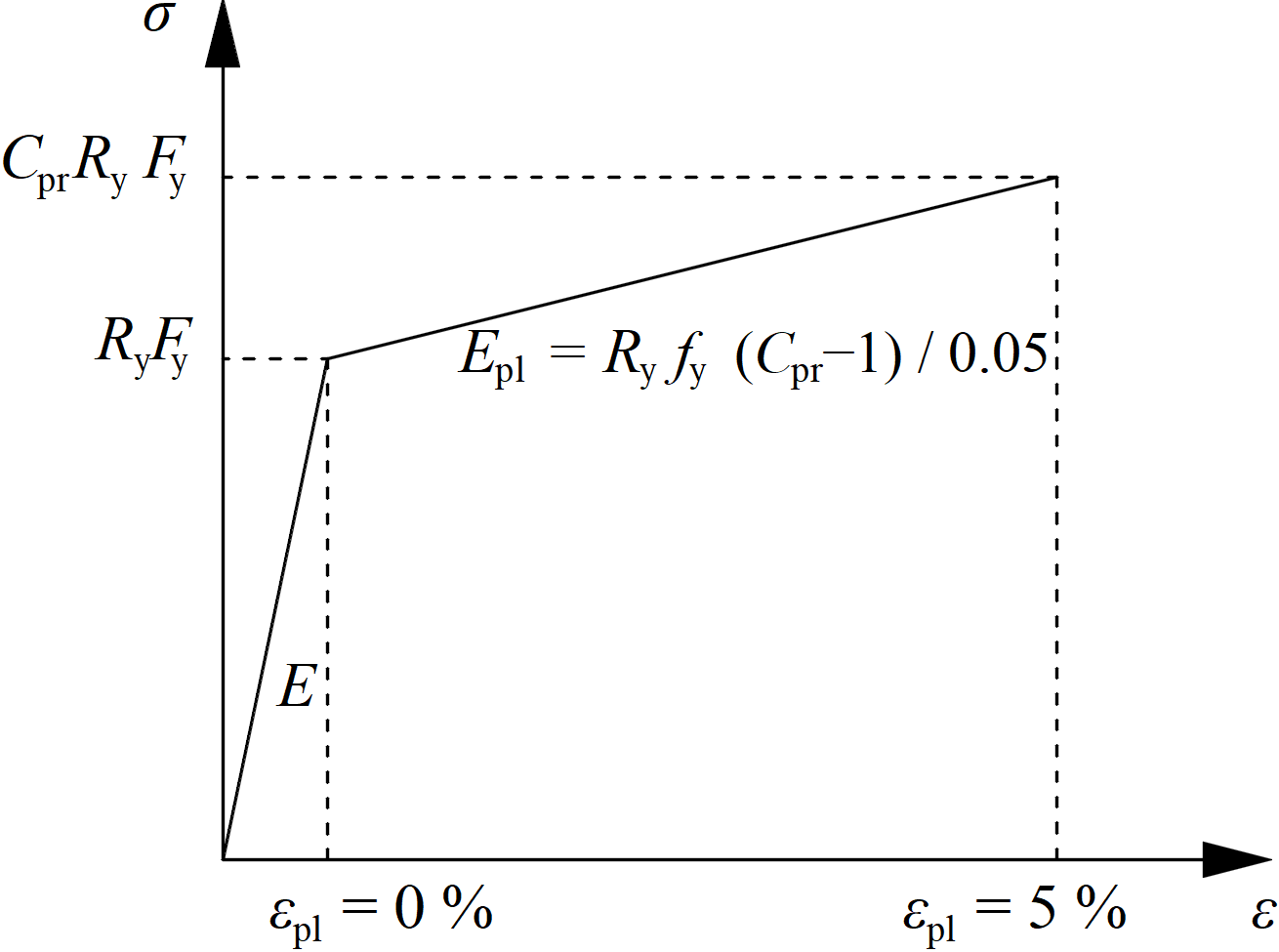
The increased strength of the dissipative item allows for the input of loads that cause the plastic hinge to appear in the dissipative item. In the case of moment resisting frame and beam as the dissipative item, the beam should be loaded by My = CprRyFyZpl,y and corresponding shear forceVz = –2 My / Lh, where:
- Fy – characteristic yield strength
- Zpl,y – plastic section modulus
- Lh – distance between plastic hinges on the beam
In case of asymmetric joint, the beam should be loaded by both sagging and hogging bending moments and their corresponding shear forces.
The plates of dissipative items are excluded from check.