Weld Optimization: A Balancing Act
Optimizing welds involves more than just achieving strength, it’s about finding the right balance between efficiency, safety, and material usage. Connection designers often struggle with deciding how much weld is “just enough,” while engineers revising designs need clarity on how much more load their connections can handle without risking failure. Misjudgments in either direction can lead to unnecessary costs, extended fabrication times, or, in worst cases, safety concerns.
Precision with Automatic Weld Sizing
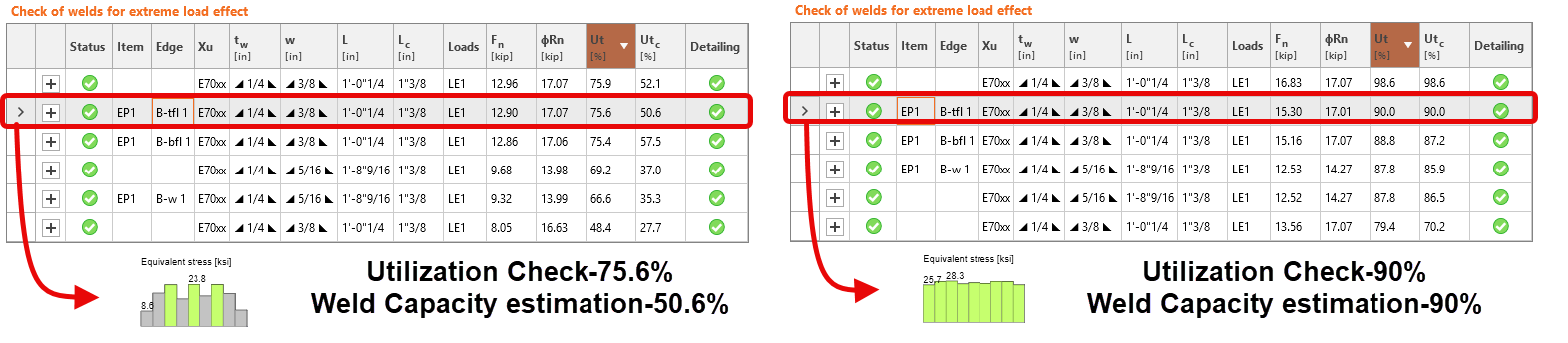
For connection designers, the Automatic Weld Sizing to Capacity Estimation feature provides a powerful advantage. By analyzing the entire connection model, this tool optimizes each weld’s size, ensuring it’s precisely calibrated for the applied loads. Instead of relying on broad assumptions or conservative estimates, designers can make informed decisions about weld dimensions, saving material and fabrication time across the entire structure.
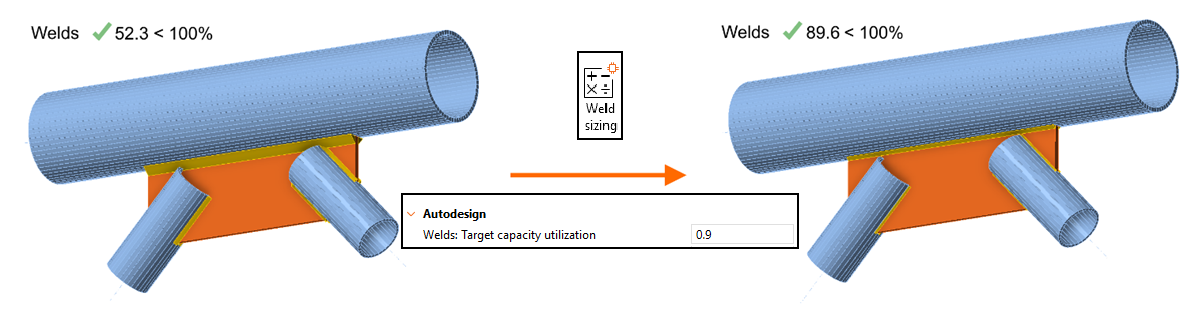
Imagine a large steel frame project where dozens of fillet welds connect beams and columns. A small optimization of just 1/16 of an inch per weld might seem negligible, but when multiplied across hundreds of connections, the savings in material and labor become significant.
This feature helps designers achieve leaner, more efficient designs while maintaining the necessary strength and compliance with structural codes.
Insight with Weld Capacity Estimation
For engineers revising existing designs or performing quality checks, the Weld Capacity Estimation percentage feature offers unparalleled clarity. By providing a percentage-based capacity estimation of the entire weld length, it enables users to see exactly how much load each weld can still handle. This tool is invaluable for ensuring that welds are neither underutilized nor dangerously overstressed.
Consider a scenario where a project experiences unexpected load changes late in the design phase. Instead of overhauling the connection details or adding excessive weld material, engineers can use this tool to understand whether existing welds can safely accommodate the new demands. This level of precision allows for smarter, faster revisions without compromising safety or project schedules.