


Together with the smooth bar option, this addition makes complex prestressing and retrofitting tasks far more efficient and accurate. Suitable, for example, for the following types of structures:
- Designing new prestressed members – unbonded tendons simplify construction and allow future adjustments.
- Retrofitting D-regions – for example, reinforcing dapped ends with vertical tendons to close cracks.
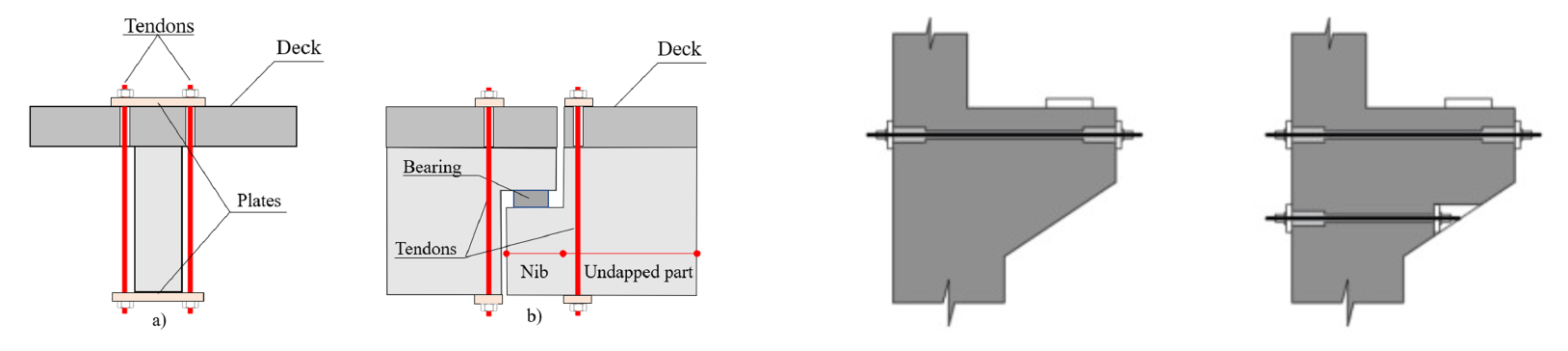
- Strengthening existing structural members – such as old precast reinforced beams or ribbed slab cross beams.

A Bonded/Unbonded switch has been added for post-tensioned tendons in Detail 2D, enabling users to easily model both tendon types. Outputs follow the same logic as bonded tendons, with the exception that anchorage and decompression checks are skipped, reflecting the behavior of unbonded tendons.
For unbonded tendons, when short-term losses are set to be calculated automatically, the default reduced friction coefficient is 0.1, in accordance with EN 1992-1-1 Table 5.2 and ACI 423.3R-05, chapter 3.5. This ensures accurate modeling of prestressing losses and tendon behavior.
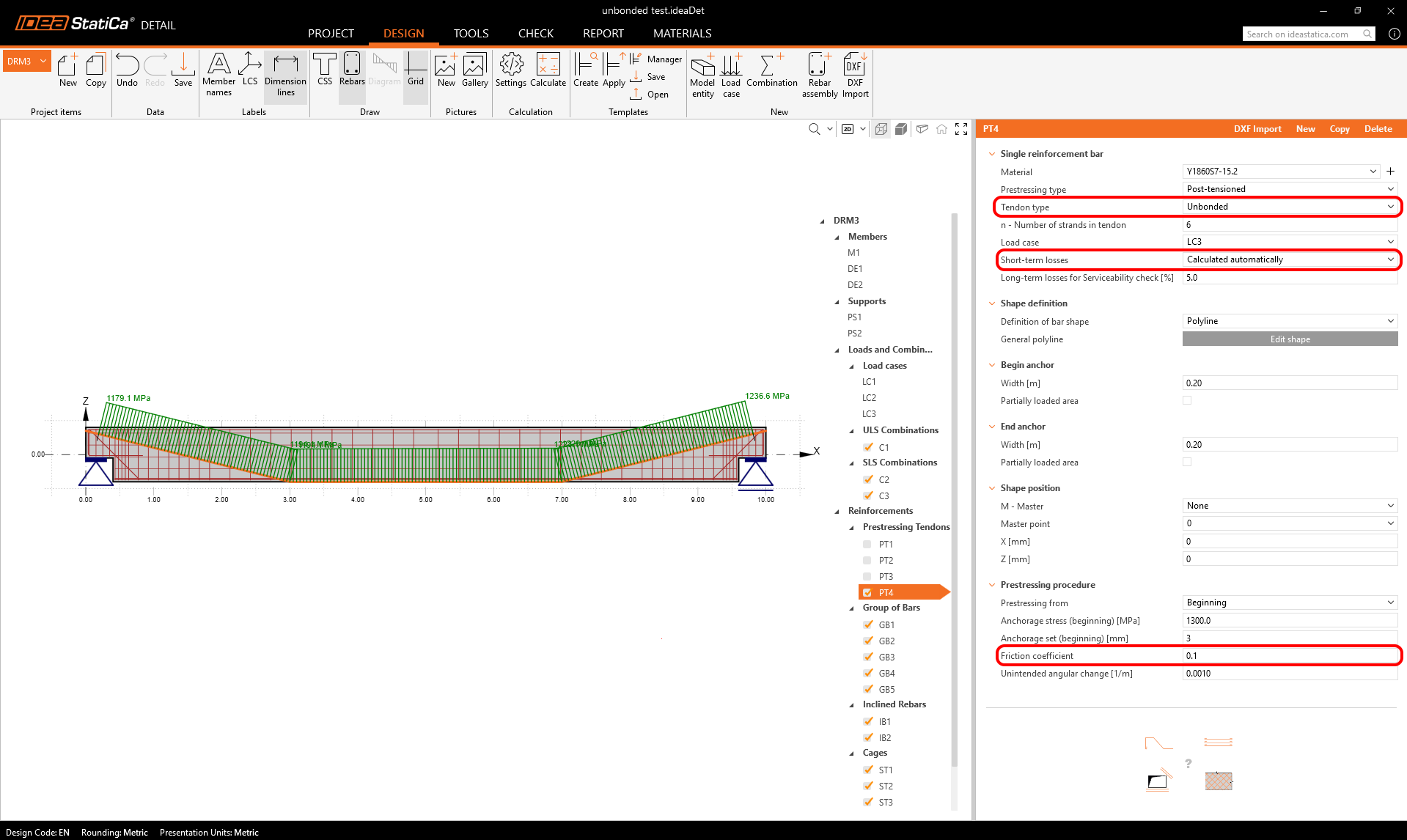
For user-defined tendons, the prestressing stress must be specified as a single value along the entire polyline.
Additionally, prestressing is applied only at the Beginning and End of the tendon, simplifying the definition while ensuring consistency in modeling.
An important recommendation for creep coefficient (EN, AUS only)
When strengthening an existing reinforced concrete structure, typically done long after casting, when much of the concrete’s creep capacity has already been consumed, the creep factor for prestressing should be set much lower than that for permanent (dead) loads. Otherwise, the calculated prestressing effects will be unrealistic because, according to the CSFM principle, prestressing is always applied in the first increment.
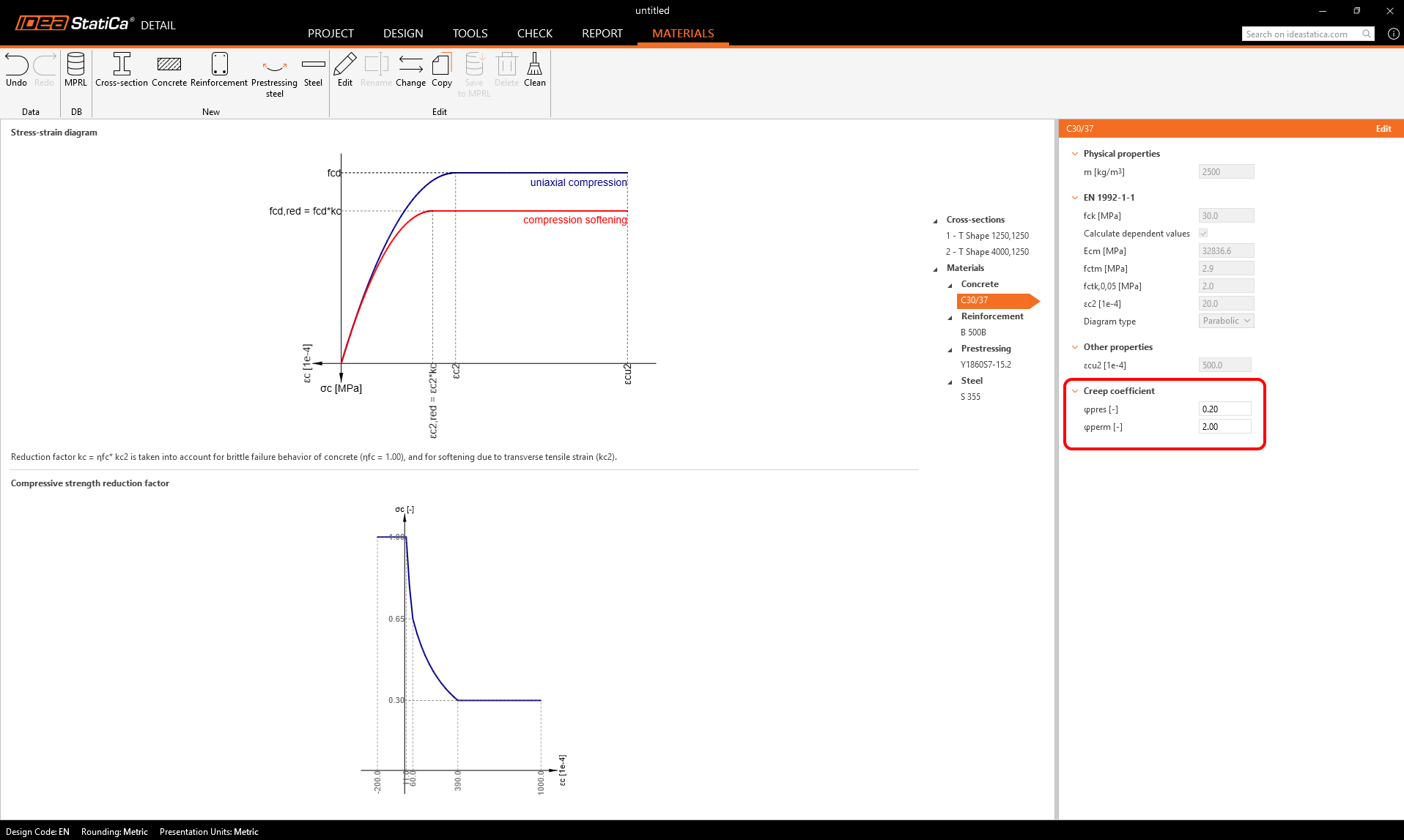
For the reinforcement of prestressed beams, there is a limitation (in the EN and AUS implementation) that the original prestressing and strengthening prestressing cannot be applied with different creep factors.