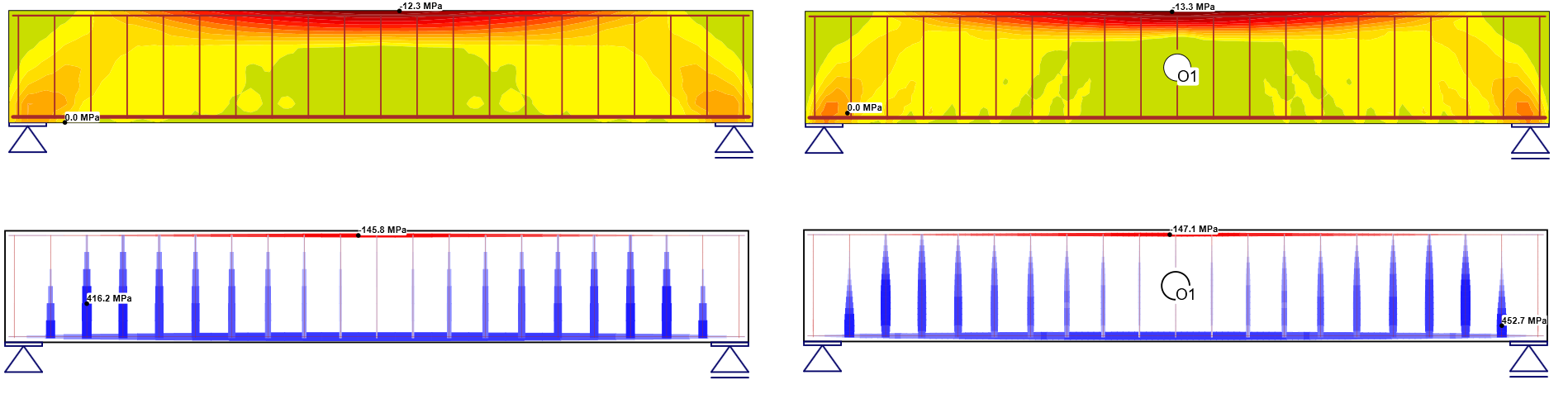
These ducts and pipes are usually placed underneath the soffit of the beam and, for aesthetic reasons, are covered by a suspended ceiling, thus creating a dead space. On each floor, the height of this dead space adds to the overall height of the building depending on the number and depth of ducts.
Therefore, the web openings enable the designer to reduce the height of the structure, especially with regard to tall building construction. In other words, leading to an effective economical design.
Stress concentration
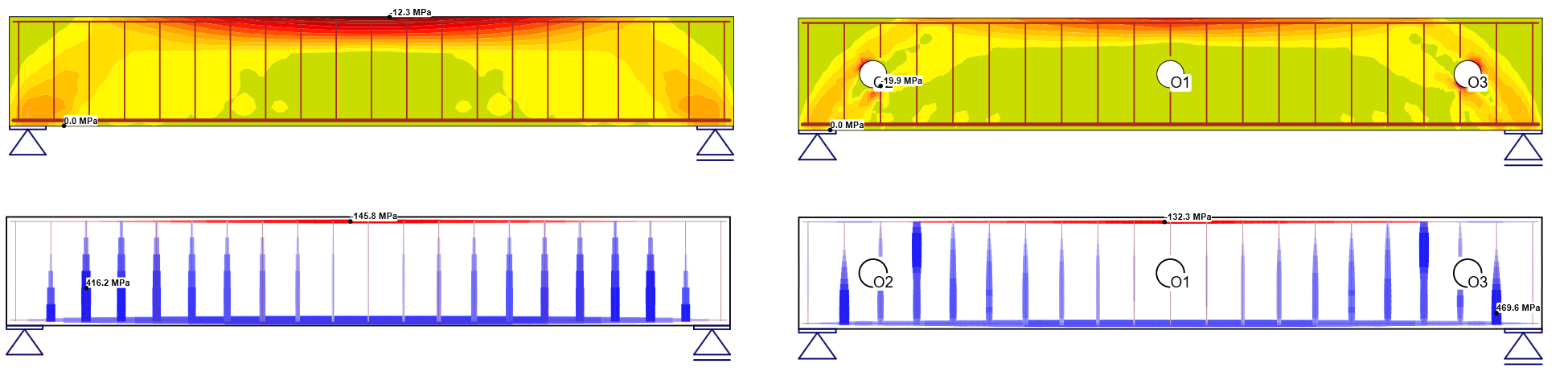
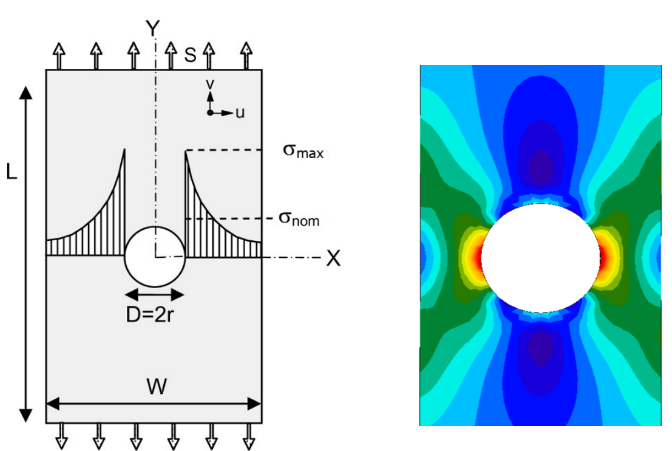
The stress concentration is observed in the vicinity of the geometrical irregularities as an abrupt change of the section or the openings. It’s called generally notches. The notches create the local increase of nominal stress. The result is an unequal stress flow along the cross-section. The ratio between the maximal and the nominal stress is called the stress concentration factor. The factor is dependant on the position of the load and the geometry of the notch. The values used to be found out from the experiments. Nowadays, we are using FEA to find out the stress concentration factor.
Small vs. big openings in beams
Small openings
Openings are classified as small or big (large) and the best position of the opening is decided based on its size. Web openings may take various shapes such as circular, rectangular, diamond, triangular, trapezoidal, and even irregular shapes. However, circular and rectangular openings are the most common ones.
Openings might be considered as big when their diameter exceeds 0.25 times the depth of the web. When the opening is small enough to maintain the beam-type behavior (in other words, if the usual beam theory applies), then the opening may be termed as small.
If the load-carrying mechanism for pure bending of the beam is not changed due to opening, the flexure at the ultimate limit is not influenced.