
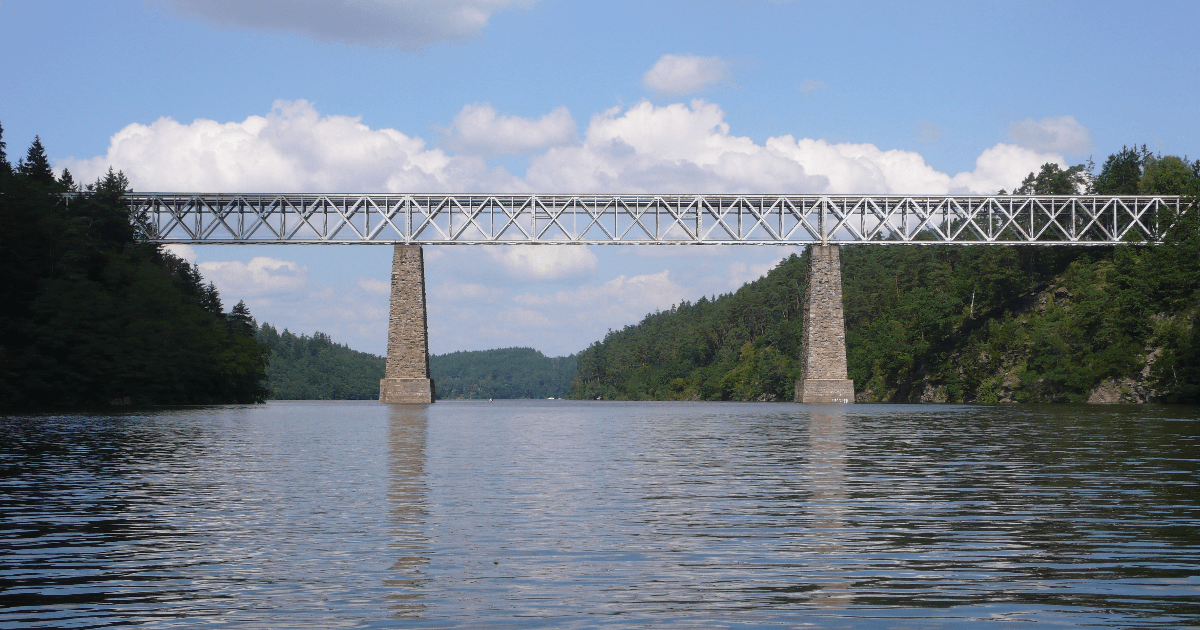


In 2015, a detailed theoretical and experimental investigation of the bridge structure was carried out by an engineering company SUDOP PRAHA a.s. in cooperation with Czech Technical University (CVUT) in Prague. The study concluded that that the bridge construction doesn’t meet the requirements of current railway traffic.
The aim of the project, assigned by the administrator of the bridge, was to determine the load capacity and safety assessment of the existing structure.
The project consisted of:
- check of the dimensions of the bridge structure and its foundations (creating drawings to describe existing conditions)
- detailed inspection of the bridge structures and testing of steel samples
- performing new structural analysis of the bridge (determination of load capacity, etc.)
- performing static and dynamic load test verification (to test the actual behavior of the bridge).
The steel part of the bridge was modeled in MIDAS Civil software. 3D beam structural model was created for the calculation of internal forces of the global construction. Geometry, materials, and all other relevant parameters were used as defined in the documentation of the existing structure.
To determine the longitudinal and rotational end stiffness, specialized software IDEA StatiCa Connection was used. It works on the principles of the new method CBFEM method (component-based finite element method). Stiffness was determined on detailed models of joints where the number of rivets corresponded to real shapes of joints.
The results of the analysis were validated by static and dynamic verification tests. These were provided by the Faculty of Civil Engineering, CVUT in Prague. When applying loads required by the Eurocode, it became clear that the construction is not capable of transmitting necessary loads, in particular wind loads and braking forces.
Regarding the condition of the steel structure of the bridge, its reconstruction was recommended to maintain the operability of this important railway.
Example of a calculated joint in IDEA StatiCa Connection:
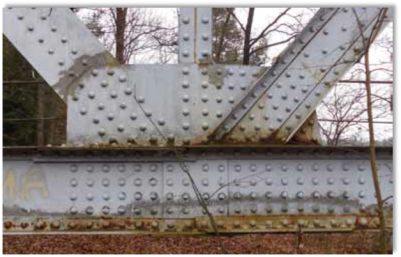
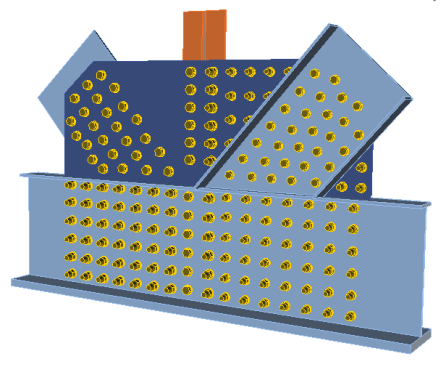
Photo credit: Tomas Maly