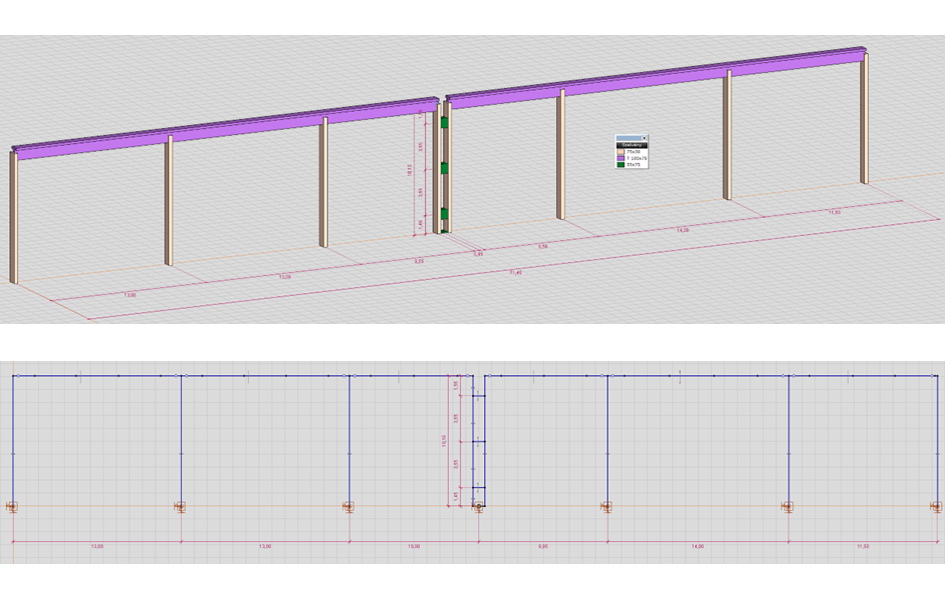
\[ \textsf{\textit{\footnotesize{Global 3D model of the structure in AxisVM}}}\]
About the Project
Located at a chemical plant in Hungary, the project focused on the assessment of an existing pipe bridge segment to verify its structural capacity under current operational loads. The pipe bridge extends over 100 meters, but due to its modular repetition, only a representative segment required detailed evaluation. The existing structure lacked design documentation, necessitating advanced surveying and diagnostic techniques to capture geometric and material data.
To reconstruct the as-built geometry, a 3D laser scan was performed, while reinforcement details were identified using a rebar scanner. Concrete strength was assessed via Schmidt hammer testing, and the quality of the reinforcing steel was estimated based on construction period norms, nearby structure documentation, and engineering experience.
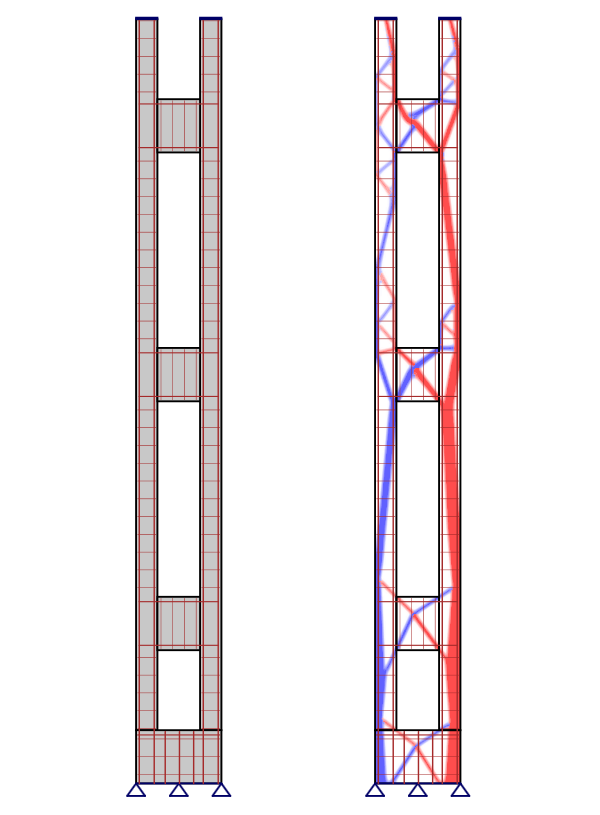
\[ \textsf{\textit{\footnotesize{Vierendeel column modeled in Detail - Topology optimization}}}\]
Using scanning technology and IDEA StatiCa in tandem allowed us to retrofit our analysis to an undocumented structure with remarkable accuracy. Despite the lack of original drawings, we could confidently assess reinforcement sufficiency.

Dávid Sadrinia
Structural engineer – BASE-Engineer Kft.
Engineering Challenges
The structure comprises precast, prestressed reinforced concrete “T” beams resting on columns embedded into socket footings, supported by monolithic block foundations. One key design element is the centrally placed Vierendeel column, which provides longitudinal stability and resists horizontal forces generated by pipe movement or environmental loading. The remaining columns act as pinned supports, stabilized longitudinally by this fixed central element.
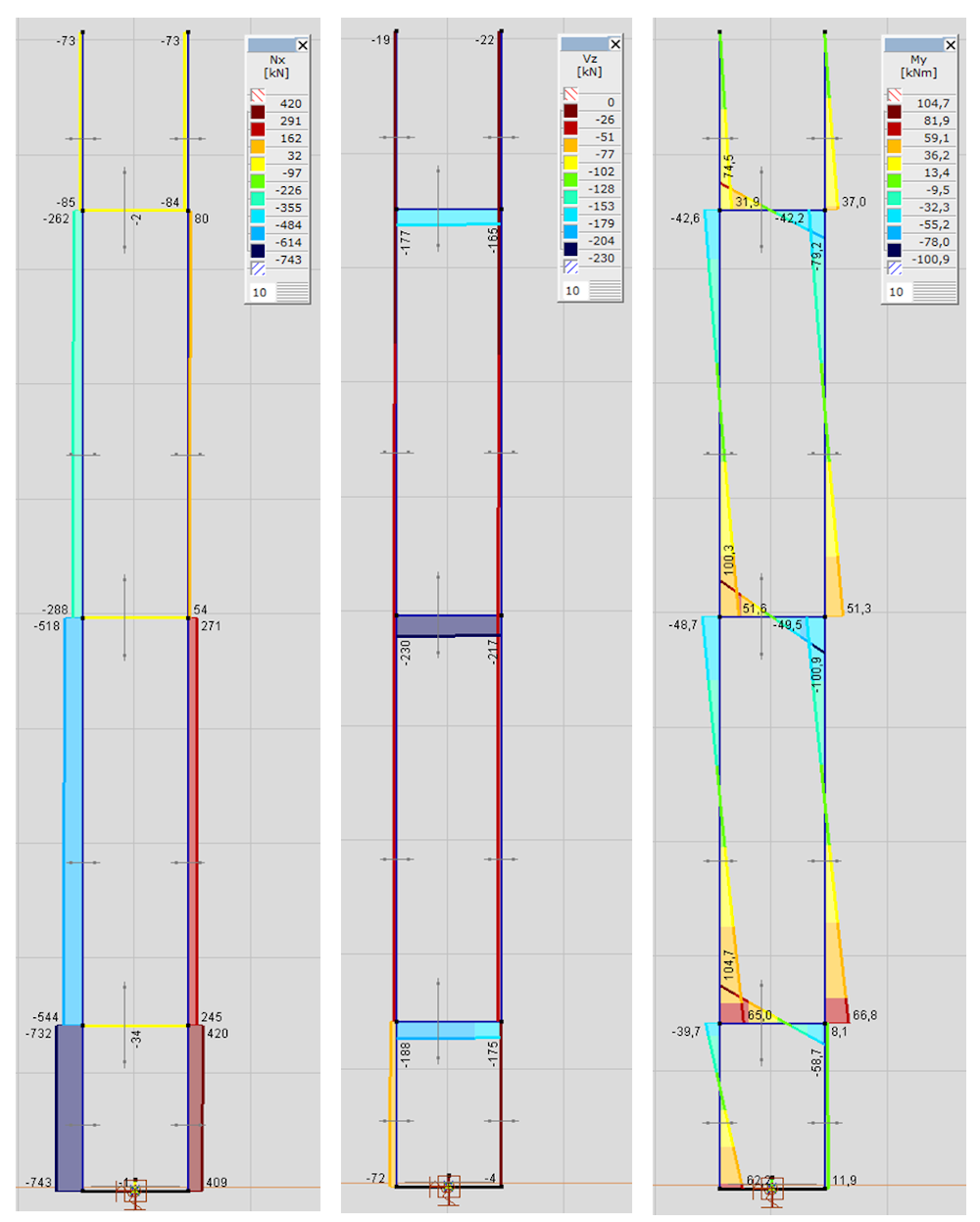
\[ \textsf{\textit{\footnotesize{Internal force diagrams in AxisVM}}}\]
In the transverse direction, both the fixed and pinned columns behave as cantilevers with fixed bases. In the longitudinal direction, pinned columns act as base-fixed with lateral support at the top, while the Vierendeel column was modeled either as a cantilever or as an oscillating vertical member between the beams.
The ability to extract internal forces from global models and apply them directly in IDEA StatiCa gave us a reliable means of assessing localized behavior where bar elements fall short. In this case, we were able to verify shear transfer through the transverse elements of a Vierendeel column, something that could not be handled using conventional tools and beam theory.
Dávid Sadrinia
Structural engineer – BASE-Engineer Kft.
Thermal expansion effects were negligible due to the mixed support configuration. The structure met requirements under transverse wind load, however, longitudinal horizontal forces posed a significant challenge. These induced shear transfer mechanisms within the beams, forces that could not be accurately captured using traditional bar-element finite element models.
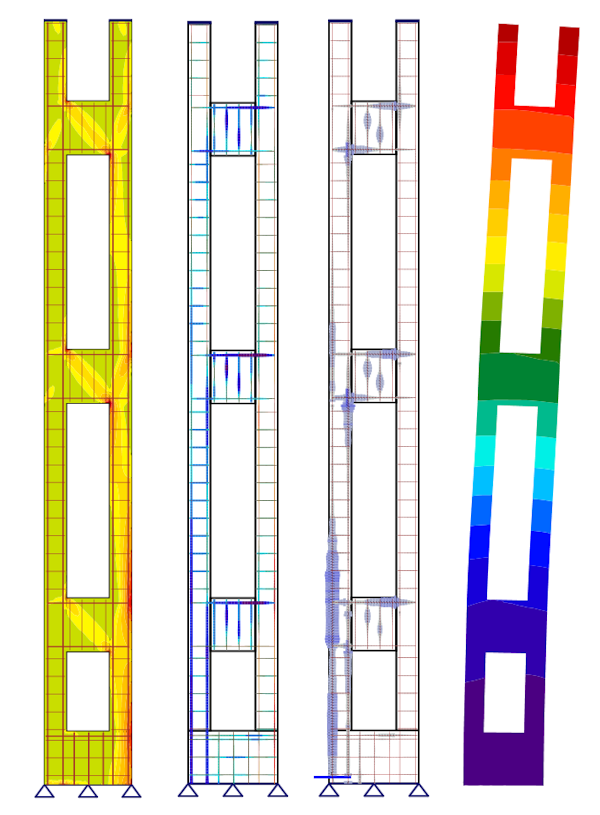
\[ \textsf{\textit{\footnotesize{Results in Detail - Concrete stress, Reinforcement stress, Crack width, Deformation}}}\]
Solutions and Results
To address the limitations of conventional modeling, IDEA StatiCa Detail was employed to assess the complex shear behavior in the beams under longitudinal loading. The internal force envelope, derived from global analysis, revealed a governing load combination. These internal forces were applied in Detail to assess the detailing adequacy of the beams.
IDEA StatiCa’s Topology Optimization offered a fast, intuitive way to validate the strut-and-tie assumptions we had, especially given the depth of the connecting beams. It saved us hours of manual modeling and made it possible to confirm the longitudinal load path and column adequacy with precision.
Dávid Sadrinia
Structural engineer – BASE-Engineer Kft.
Given the significant depth of the connecting beam, a strut-and-tie model was considered more appropriate to reflect the internal force distribution. Manual calculation of such a model would have been prohibitively time-consuming and error-prone due to its complexity. Instead, IDEA StatiCa’s Topology Optimization tool was used to visualize the likely force paths. The generated topology confirmed the expected force flow, enabling the engineers to input the actual reinforcement layout for verification.
The results showed that, with the applied detailing, the load-bearing capacity of the fixed column was sufficient. Additional checks using IDEA StatiCa revealed notable differences in the deformations under load, which helped inform further evaluation of serviceability performance.
This case reaffirmed the power of the software for handling real-world retrofit challenges, especially when standard tools don’t tell the full story. The verified capacity of the Vierendeel column and visualization of internal force flow provided clarity we wouldn’t have achieved otherwise.
Dávid Sadrinia
Structural engineer – BASE-Engineer Kft.
About BASE-Engineer Kft.
BASE-Engineer Kft., based in Pécs, Hungary, specializes in the structural design of large-scale industrial facilities as well as residential and commercial buildings. The firm combines traditional engineering experience with cutting-edge digital tools to deliver technically sound and constructible solutions. More information is available at base.hu.
Comienza tu prueba hoy mismo y disfruta de 14 días de acceso completo y servicios gratuitos.
Iniciar prueba gratuita