They can be! Especially with the help of proper approaches and tools. And I'm not afraid to say that IDEA StatiCa Detail belongs to such a category. Let me explain why.
Because we are structural engineers, very practical people with trust in facts and a taste for rules, we will start with a little bit of theory. Every reinforced or prestressed concrete structure can and should be divided into B and D-regions during the designing process.
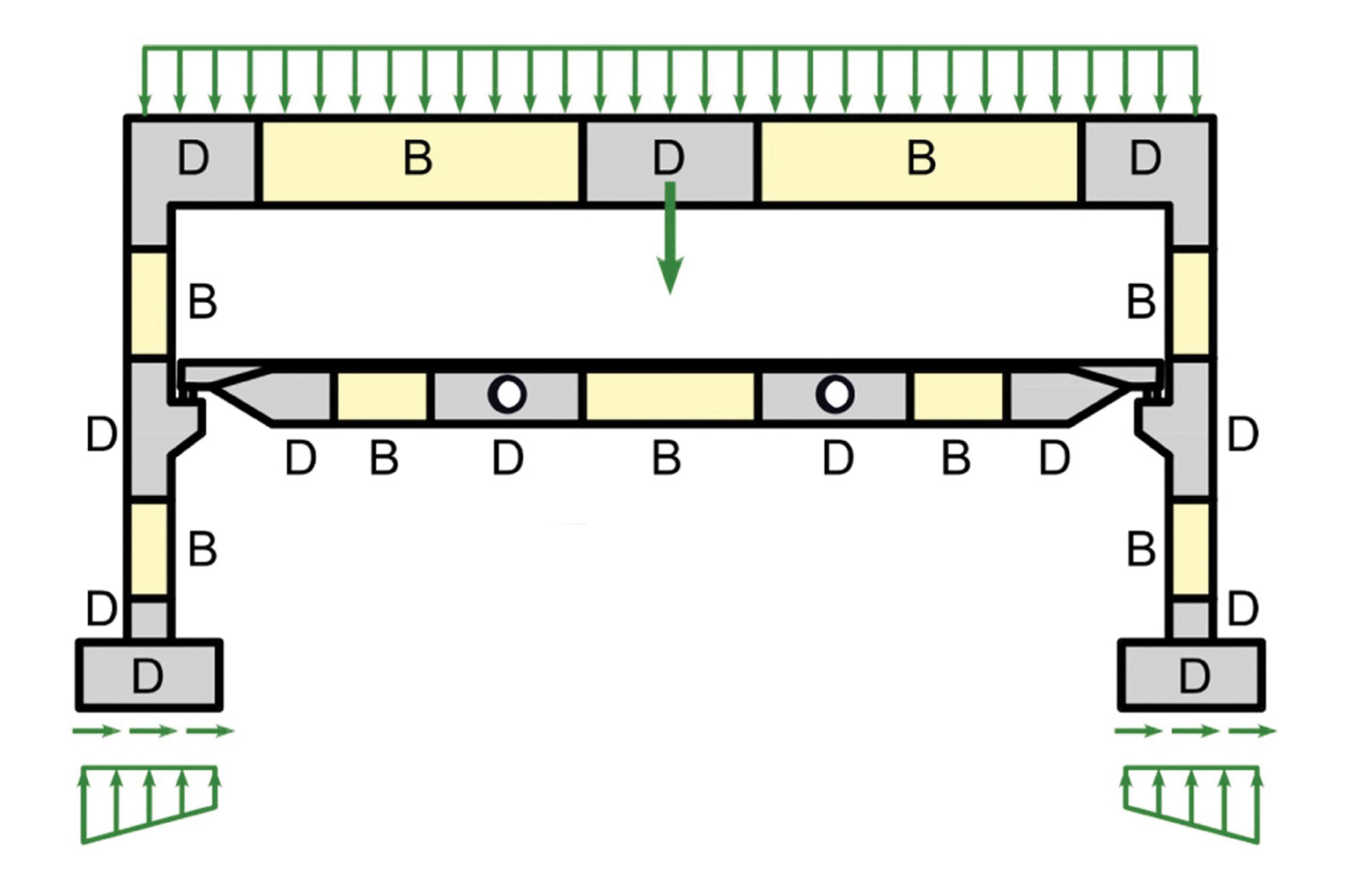
So-called B-regions are Bernoulli regions. That's where the Bernoulli-Navier hypothesis of plain strain distribution (classical beam theory) is valid, and it's okay to use the standard approach for the check.
On the other hand, we also recognize D-regions – discontinuity or disturbed regions. In these parts, the previously mentioned hypothesis doesn't apply. Therefore, we can't use standard methods and need to use other, more advanced approaches.
One of the most commonly used methods is the equivalent truss method, which you know by the names of the Strut and Tie method (S&T) and the stress fields method. The basic assumption of the Strut and Tie model is that the tensile strength of concrete is negligible. A simple truss model of the behavior of the D-region in the ultimate limit state is built from elements acting in compression and tension.
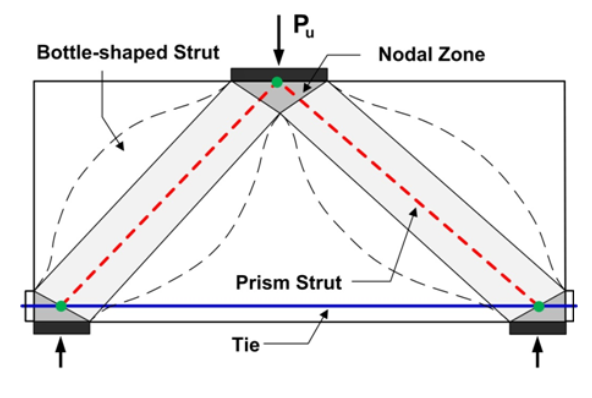
Ryan R. Setiadi, ST; Simplified pile caps design with Strut and Tie methods
It has its pros, but also cons. The disadvantages might be the time consumption, too conservative design, or even a dangerous design due to inexperienced engineers! Setting the correct truss model is not always easy, and the iterative process might become really time-absorbing. In practice, usually because of the pressure of delivering the results quickly, this often leads to the structural engineer only assessing the reinforcement of the tensiled tie and can, thereby, make a serious mistake. Moreover, the Strut and Tie method doesn't provide guidance for the assessment of serviceability limit states (). One might say that such checks can directly impact a structure's service life.