What is lateral-torsional buckling and what is the cause?
Lateral torsional buckling (LTB) is the deformation of an unrestrained beam due to the applied loads away from its longitudinal axis – both lateral displacement and twisting.
Unrestrained steel beams are beams whose compression flange is free to move (or displace) in the lateral direction and also rotate. If we apply this theory to a simply supported beam then the compression flange is the top flange. As this flange deflects laterally the tension flange tries to keep the beam straight and creates ‘restoring’ forces due to the lateral bending of the beam. However, these forces alone cannot keep the beam straight. The resistance of the beam to LTB is determined by the restoring forces and the lateral component of tensile forces in the tension flange.
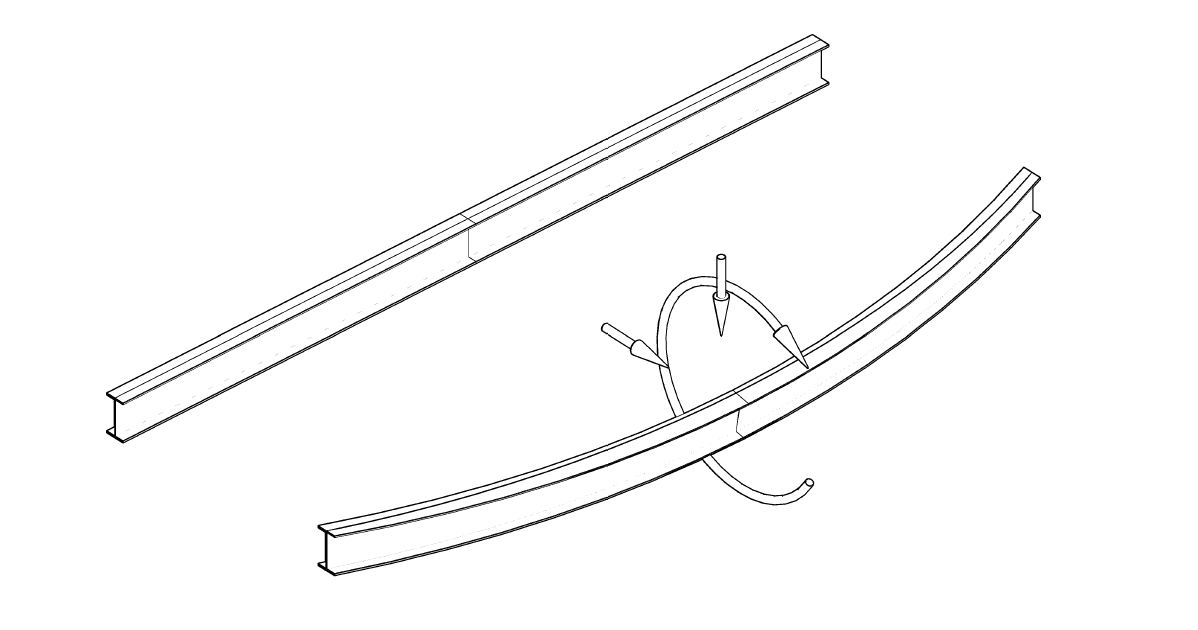
The interaction of the compression and tension flanges forces an unrestrained beam to twist. The resistance to this twist is dependent on the torsional resistance of the beam section. Beams with large flange thicknesses, for example, have a greater torsional resistance than those of lesser flange thicknesses for any given depth. There are other sections that also offer greater resistance (RHS/SHS) and these are often used in situations where there is a need for large(ish) spans to carry the vertical load (e.g. openings involving bi-fold doors) which are prone to out of plane force effects.
To see how the LTB failure propagates take a look at this video.
What factors influence LTB?
There are three main factors:
- Location of the applied load
- The bending moment distribution
- End support conditions