Description
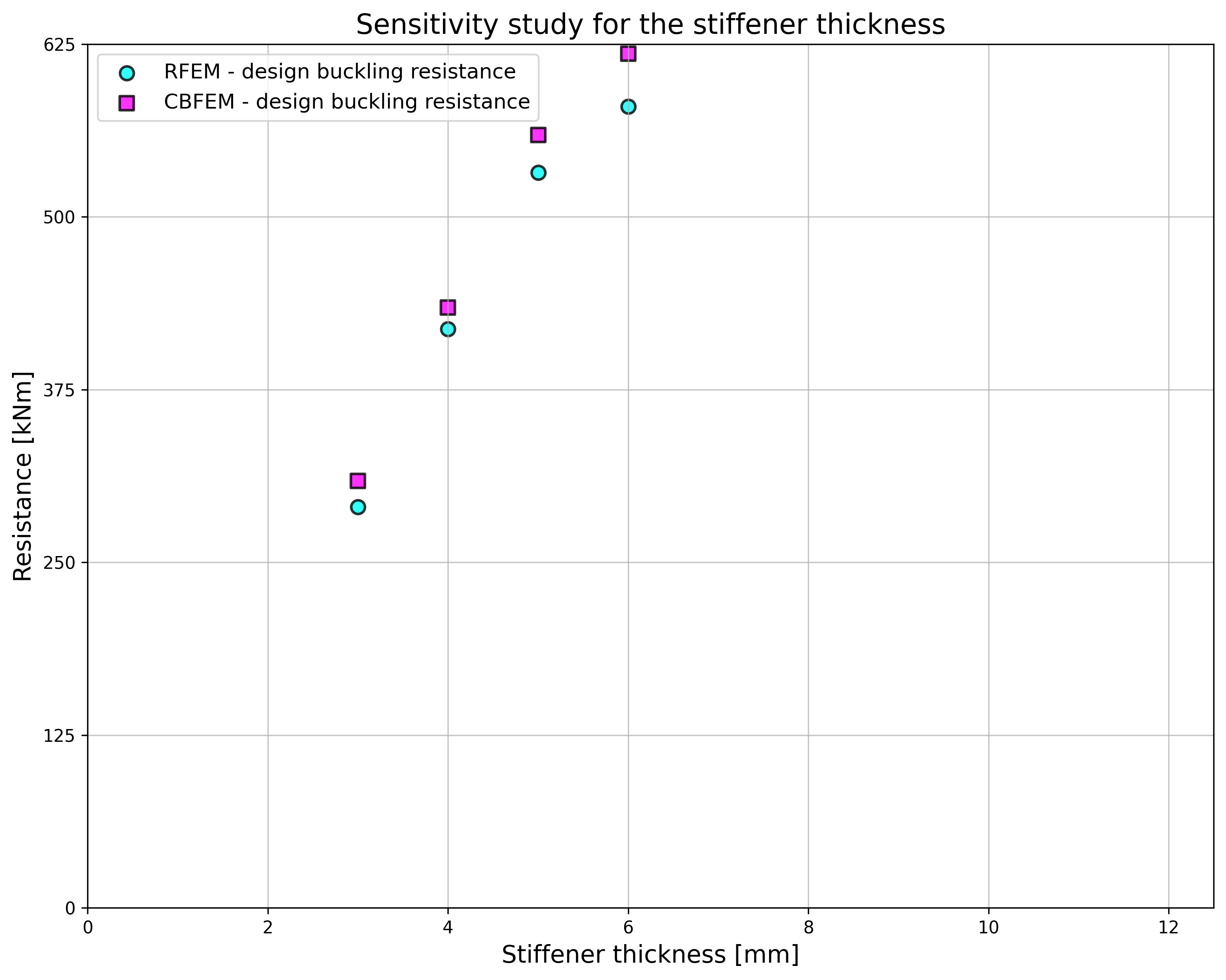
The objective of this study is a verification of component-based finite element method (CBFEM) of a class 4 column web stiffener in a beam-to-column joint with a research FEA model (RFEM) created in Dlubal RFEM software and component method (CM).
Research FEA model
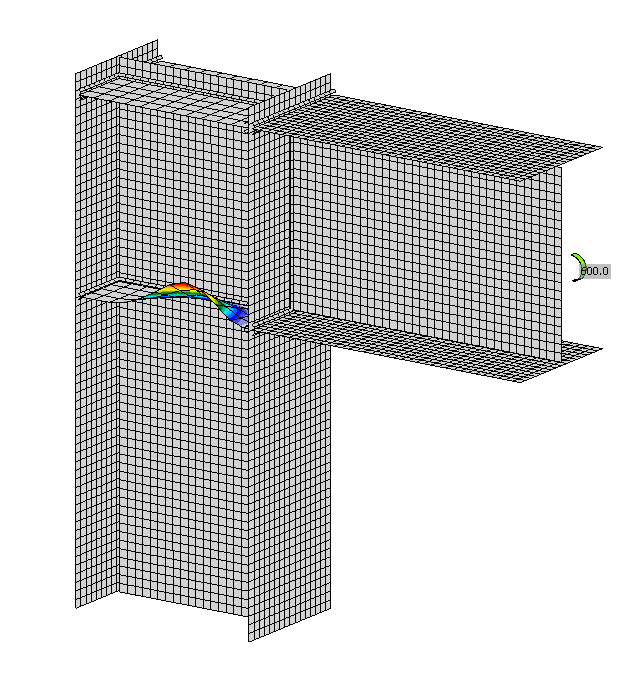
Research FEA model (RFEM) is used to verify the CBFEM model. In the numerical model, 4-node quadrilateral shell elements with nodes at its corners are applied. Geometrically and materially nonlinear analysis with imperfections (GMNIA) is applied. Equivalent geometric imperfections are derived from the first buckling mode, and the amplitude is set according to Annex C in EN 1993-1-5:2006. The numerical model is shown in Fig. 6.3.1.
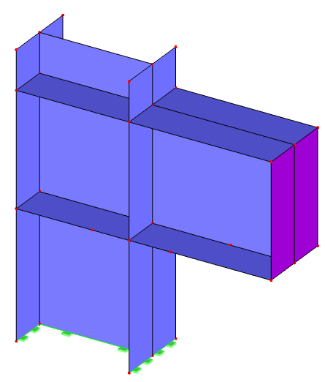
\[ \textsf{\textit{\footnotesize{Fig. 6.3.1 Research FEA model of a beam-to-column joint with slender column web stiffener}}}\]
CBFEM
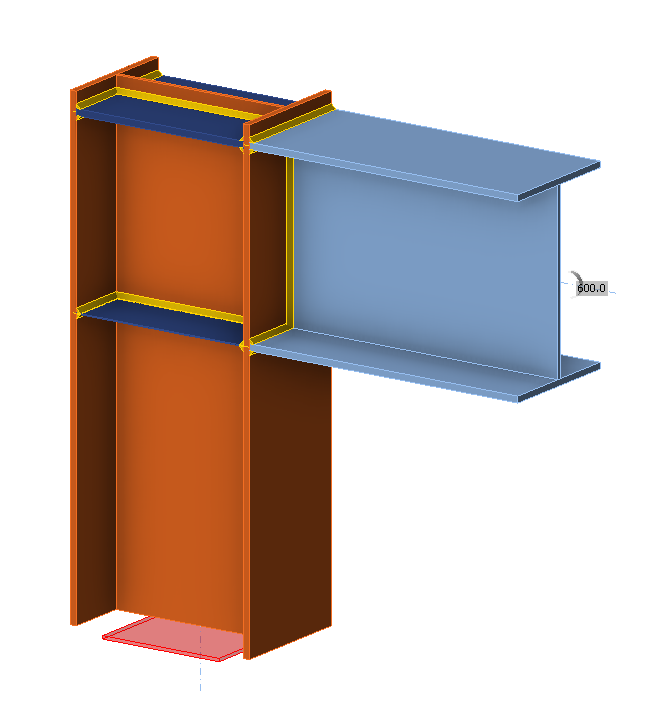
The design procedure for slender plates is described in section 3.10. The linear buckling analysis is implemented in the software. The calculation of the design resistances is done according to the design procedure. FCBFEM is interpolated by the user until ρ ∙ αult,k/γM1 is equal to 1. A beam-to-column joint with a slender column web stiffener is studied. The same cross-section is used for the beam and the column. The thickness of the column web stiffener is changing. The geometry of the examples is described in Tab. 6.3.1. The joint is loaded by bending moment.
Tab. 6.3.1 Examples overview
| Example | Column/beam flange | Column/beam web | Stiffener | Material | ||
| bf | tf | hw | tw | ts | ||
| [mm] | [mm] | [mm] | [mm] | [mm] | ||
| t3 | 400 | 20 | 600 | 12 | 3 | S235 |
| t4 |