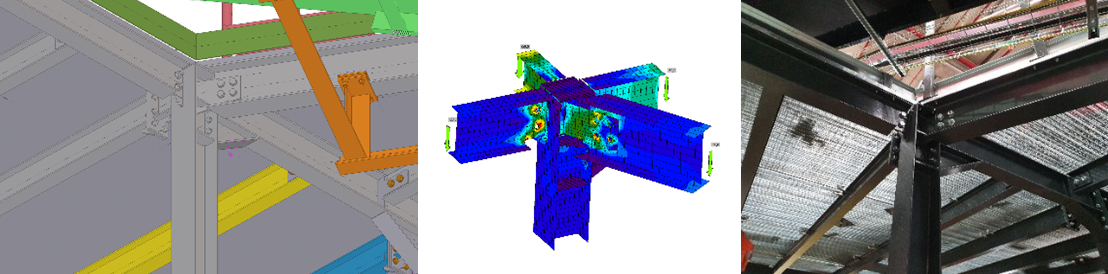
Building Information Modeling (BIM) has been with us for over a decade and yet it is still, more often than we would like, seen as a hurdle to efficient working. There are several reasons behind this observation but mostly it is because I have listened to and seen how lots of engineers work and how they cooperate with others.
Over ten years ago, I proposed that there were three types of modeling:
- Modeling for documentation
- Modeling for analysis and design
- Modeling for construction
The first of these, many proponents of Structural BIM are comfortable with and many will agree that it has streamlined their business.
However, despite the vast resources of the main vendors, not many are integrating the geometrical model with an analytical model. There are huge benefits to be had if this is utilized.
The third level is when the structural model is developed further so that it reflects not only WHAT is going to build, but HOW it will be built. There are even fewer engineers that make it this far and those that do are usually working very closely with the main contractor.
For this article, I am going to focus on the second stage as I am sure the first one has been covered time and time again. The third stage will be a topic for another day but suffice to say that the evolution of the model is a linear one and information should not be lost but augmented and developed.
What approach should engineers follow?
There are many approaches to integrating the structural analytical model with the geometric. Generally, the approaches fall into three categories: direct, file-based and middleware.
An example of both the direct and file-based approach is Autodesk Revit which has an analytical and geometrical model combined. integrates via file transfer. The new kid on the block is from the Nemetschek Group with a cloud-based middleware solution - AutoConverter - which has introduced a new file format (SAF) based on Microsoft Excel.