IFC is essential to building information modeling (BIM) processes and workflows because it enables interoperability between different BIM software applications.
History
The development of IFC began in the 1990s under the auspices of the International Alliance for Interoperability (IAI), now known as buildingSMART International.
The goal was to create a universal file format that could break down data silos (a collection of data held by one group that is not easily or fully accessible by other groups in the same organization) and enable collaboration among various stakeholders in the AECO industry. The first official version, IFC 1.0, was released in 1996.
Since then, IFC has undergone several revisions and updates to support evolving industry needs and technological advancements. Major versions include IFC2x3, IFC4, and IFC4 Addendum 2, each introducing new features and capabilities. IFC5 is currently in the early planning phase. It is expected to include full support for various infrastructure domains and more parametric capabilities.
ISO registers it and is an official International Standard, ISO 16739-1:2018.
How IFC works
IFC enables the exchange of building information models (BIM) and structural data between software applications and stakeholders in a construction project. It promotes collaboration and information exchange, reducing errors and redundancies in the construction process. The format supports the entire building lifecycle, from design and construction to facility management.
IFC is based on a hierarchical, object-oriented data model. It represents building elements and their relationships as objects and properties.
IFC defines the multiple file formats that may be used. The most frequent is IFC-STEP, others include IFC-XML and IFCJSON.
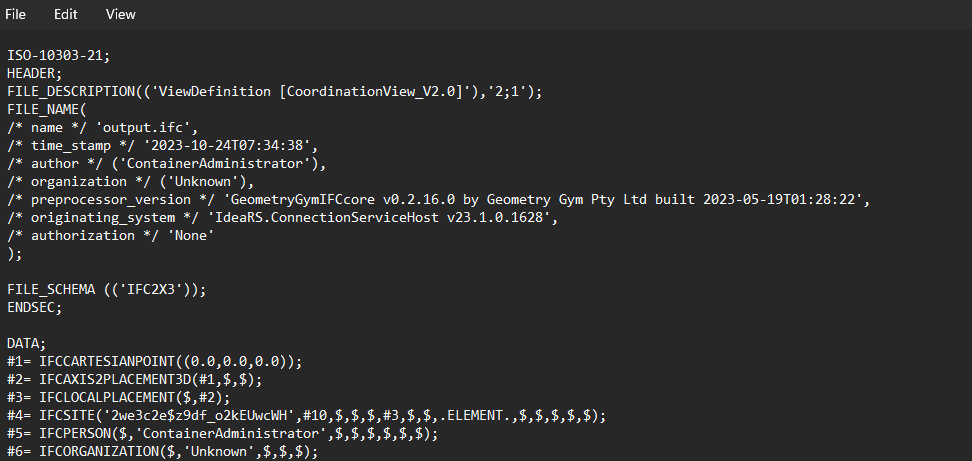
IFC-SPF is a text format defined by ISO 10303-21 ("STEP-File"), where each line typically consists of a single object record and has the file extension ".ifc". This is the most widely used IFC format, having the advantage of its compact size yet readable text.