
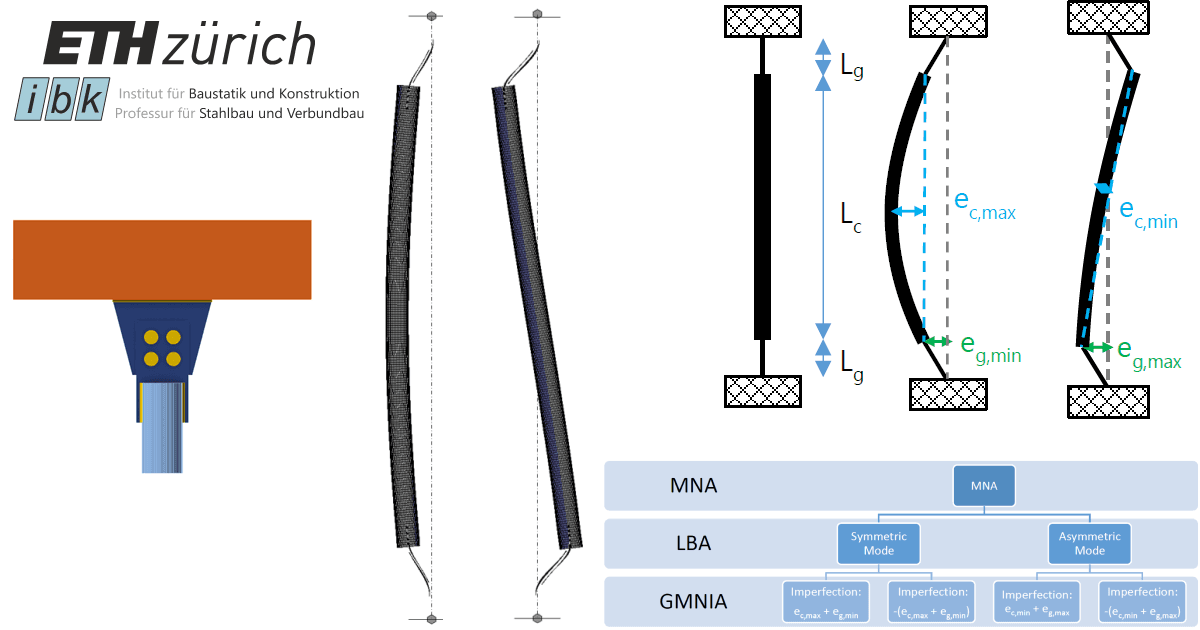
The report provides a workflow in IDEA StatiCa Member and compares the results to dozens of physical experiments to evaluate the feasibility, precision, and safety of this workflow.
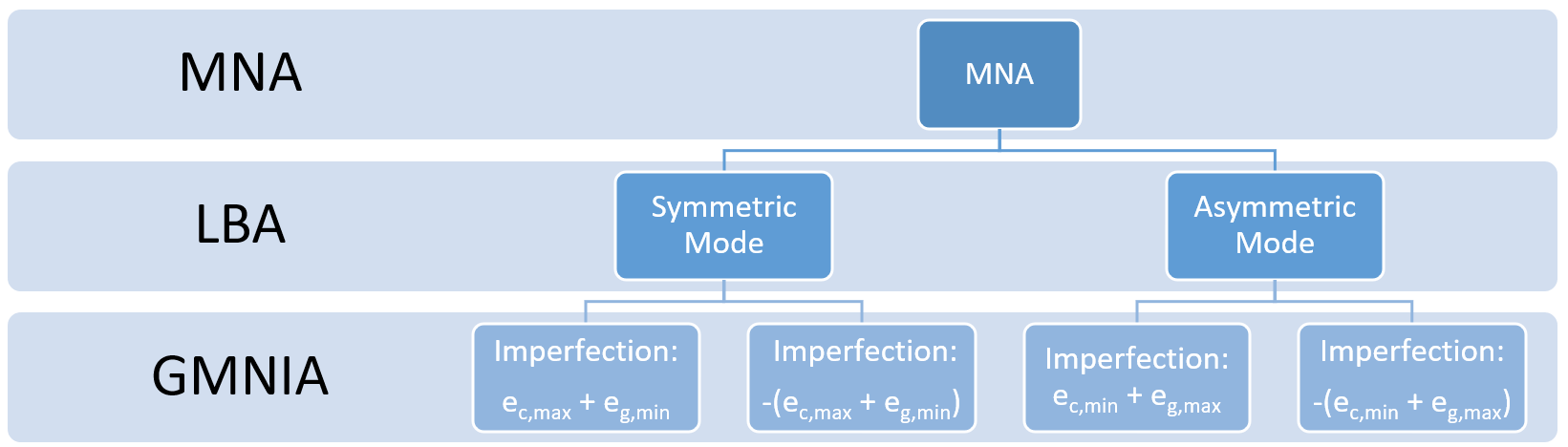
First, the models created in Abaqus with the same imperfection amplitudes are compared to prove that IDEA StatiCa Member and Abaqus provide nearly identical results. Then, the proposed workflow of design of a submodel consisting of a compressed member and its two single-sided gusset plate connections is described. Geometrically and materially nonlinear analysis with imperfections (GMNIA) is used and the selection of imperfections plays a major role. A total of four analyses should be performed with two imperfection shapes: (i) symmetrical global mode of the member, (ii) asymmetrical mode of gusset plates, and two imperfection amplitudes: (i) with a plus sign, (ii) with a minus sign.
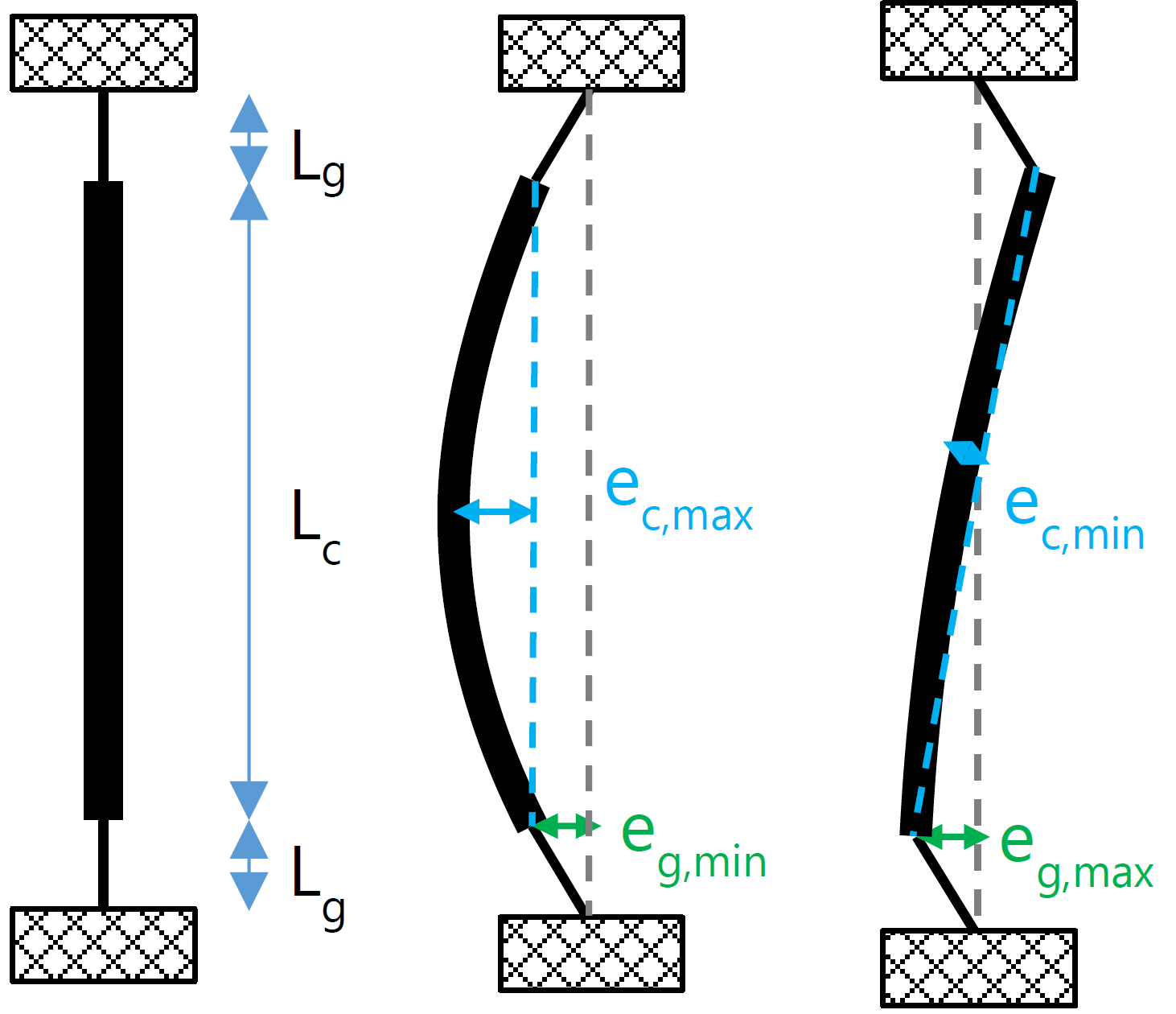
| Limit column imperfection | Limit gusset plate imperfection | |
| Maximum | \(e_{c,max} = \alpha L_c / 150\) | \(e_{g,max} = L_g/50 \) |
| Minimum | \(e_{c,min}=L_c/1000\) | \(e_{g,min}=L_g/100 \) |
Three sets of experiments and an additional numerical simulation from the literature are used to determine the precision and safety of the proposed workflow.
Highlights:
- Recommendation for a choice of imperfection shapes and amplitudes for a submodel consisting of compressed member with its single-sided gusset plate connection is provided.