
Partially loaded areas can be found on every structure. Some typical examples are bridge diaphragms with an area above the bearings, areas under the anchor, or concentrated load on the edge of a wall. Partially loaded areas are designed according to the requirements of the Eurocode and simultaneously are restrained by model geometry (openings, thickness, edges, abrupt change of cross-section).

We have heard many requests from structural engineers for solving this type of issue. With the new version IDEA StatiCa 20, we came with a solution on how to deal with triaxial stress in partially loaded areas. In these areas crushing of concrete is allowed, and the resistance of concrete in compression can be raised due to transverse confinement according to valid standards (Eurocode). The increase of the resistance can be up to 3 times the cylinder strength of concrete.
Solution with IDEA StatiCa
With IDEA StatiCa, you can design and assess reinforced concrete structures while taking into account the influence of the increasing compressive resistance of concrete in partially loaded areas. Horizontal reinforcement bars are automatically added to resist the transverse tensile forces and pass the Eurocode provisions.
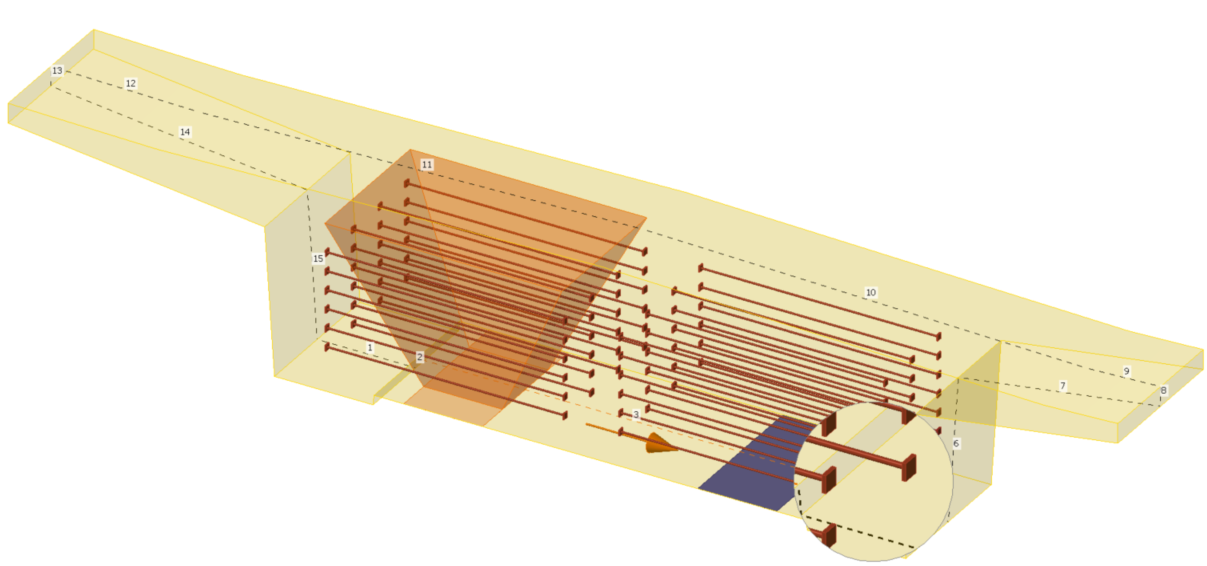
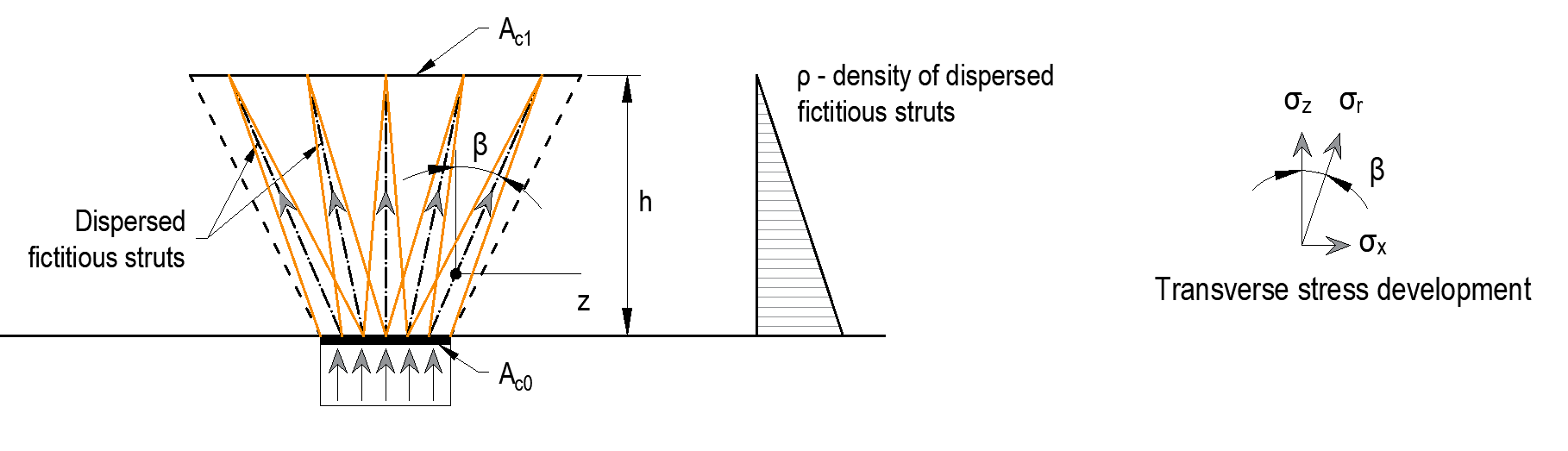
This functionality guarantees that models are getting converge and simultaneously comply with design criteria for valid standards (Eurocode). The implemented method is independent of the finite element mesh. The bearing capacity is increased with the changing of the concrete area. The consequence of this state is constant stress along with the height of a cone. Dispersed fictitious struts affect the stiffness of the cone and correctly redistribute the transverse stress, which appears in this area. The density of each dispersed strut is increased to the direction of the applied load.
Using IDEA StatiCa for partially loaded areas brings less-conservative design, saving both material and money.
Limitations
Please keep in mind some that come out from the standards valid in .